EP1503595A2 - Video codec system with real-time complexity adaptation - Google Patents
Video codec system with real-time complexity adaptation Download PDFInfo
- Publication number
- EP1503595A2 EP1503595A2 EP04015638A EP04015638A EP1503595A2 EP 1503595 A2 EP1503595 A2 EP 1503595A2 EP 04015638 A EP04015638 A EP 04015638A EP 04015638 A EP04015638 A EP 04015638A EP 1503595 A2 EP1503595 A2 EP 1503595A2
- Authority
- EP
- European Patent Office
- Prior art keywords
- algorithm
- setting
- weighted average
- target range
- instructions
- Prior art date
- Legal status (The legal status is an assumption and is not a legal conclusion. Google has not performed a legal analysis and makes no representation as to the accuracy of the status listed.)
- Withdrawn
Links
Images



Classifications
-
- H—ELECTRICITY
- H04—ELECTRIC COMMUNICATION TECHNIQUE
- H04N—PICTORIAL COMMUNICATION, e.g. TELEVISION
- H04N19/00—Methods or arrangements for coding, decoding, compressing or decompressing digital video signals
- H04N19/50—Methods or arrangements for coding, decoding, compressing or decompressing digital video signals using predictive coding
- H04N19/503—Methods or arrangements for coding, decoding, compressing or decompressing digital video signals using predictive coding involving temporal prediction
- H04N19/51—Motion estimation or motion compensation
- H04N19/57—Motion estimation characterised by a search window with variable size or shape
-
- H—ELECTRICITY
- H04—ELECTRIC COMMUNICATION TECHNIQUE
- H04N—PICTORIAL COMMUNICATION, e.g. TELEVISION
- H04N19/00—Methods or arrangements for coding, decoding, compressing or decompressing digital video signals
- H04N19/10—Methods or arrangements for coding, decoding, compressing or decompressing digital video signals using adaptive coding
- H04N19/102—Methods or arrangements for coding, decoding, compressing or decompressing digital video signals using adaptive coding characterised by the element, parameter or selection affected or controlled by the adaptive coding
- H04N19/103—Selection of coding mode or of prediction mode
-
- H—ELECTRICITY
- H04—ELECTRIC COMMUNICATION TECHNIQUE
- H04N—PICTORIAL COMMUNICATION, e.g. TELEVISION
- H04N19/00—Methods or arrangements for coding, decoding, compressing or decompressing digital video signals
- H04N19/10—Methods or arrangements for coding, decoding, compressing or decompressing digital video signals using adaptive coding
- H04N19/102—Methods or arrangements for coding, decoding, compressing or decompressing digital video signals using adaptive coding characterised by the element, parameter or selection affected or controlled by the adaptive coding
- H04N19/12—Selection from among a plurality of transforms or standards, e.g. selection between discrete cosine transform [DCT] and sub-band transform or selection between H.263 and H.264
- H04N19/122—Selection of transform size, e.g. 8x8 or 2x4x8 DCT; Selection of sub-band transforms of varying structure or type
-
- H—ELECTRICITY
- H04—ELECTRIC COMMUNICATION TECHNIQUE
- H04N—PICTORIAL COMMUNICATION, e.g. TELEVISION
- H04N19/00—Methods or arrangements for coding, decoding, compressing or decompressing digital video signals
- H04N19/10—Methods or arrangements for coding, decoding, compressing or decompressing digital video signals using adaptive coding
- H04N19/102—Methods or arrangements for coding, decoding, compressing or decompressing digital video signals using adaptive coding characterised by the element, parameter or selection affected or controlled by the adaptive coding
- H04N19/132—Sampling, masking or truncation of coding units, e.g. adaptive resampling, frame skipping, frame interpolation or high-frequency transform coefficient masking
-
- H—ELECTRICITY
- H04—ELECTRIC COMMUNICATION TECHNIQUE
- H04N—PICTORIAL COMMUNICATION, e.g. TELEVISION
- H04N19/00—Methods or arrangements for coding, decoding, compressing or decompressing digital video signals
- H04N19/10—Methods or arrangements for coding, decoding, compressing or decompressing digital video signals using adaptive coding
- H04N19/134—Methods or arrangements for coding, decoding, compressing or decompressing digital video signals using adaptive coding characterised by the element, parameter or criterion affecting or controlling the adaptive coding
- H04N19/156—Availability of hardware or computational resources, e.g. encoding based on power-saving criteria
-
- H—ELECTRICITY
- H04—ELECTRIC COMMUNICATION TECHNIQUE
- H04N—PICTORIAL COMMUNICATION, e.g. TELEVISION
- H04N19/00—Methods or arrangements for coding, decoding, compressing or decompressing digital video signals
- H04N19/10—Methods or arrangements for coding, decoding, compressing or decompressing digital video signals using adaptive coding
- H04N19/169—Methods or arrangements for coding, decoding, compressing or decompressing digital video signals using adaptive coding characterised by the coding unit, i.e. the structural portion or semantic portion of the video signal being the object or the subject of the adaptive coding
- H04N19/17—Methods or arrangements for coding, decoding, compressing or decompressing digital video signals using adaptive coding characterised by the coding unit, i.e. the structural portion or semantic portion of the video signal being the object or the subject of the adaptive coding the unit being an image region, e.g. an object
- H04N19/172—Methods or arrangements for coding, decoding, compressing or decompressing digital video signals using adaptive coding characterised by the coding unit, i.e. the structural portion or semantic portion of the video signal being the object or the subject of the adaptive coding the unit being an image region, e.g. an object the region being a picture, frame or field
-
- H—ELECTRICITY
- H04—ELECTRIC COMMUNICATION TECHNIQUE
- H04N—PICTORIAL COMMUNICATION, e.g. TELEVISION
- H04N19/00—Methods or arrangements for coding, decoding, compressing or decompressing digital video signals
- H04N19/10—Methods or arrangements for coding, decoding, compressing or decompressing digital video signals using adaptive coding
- H04N19/169—Methods or arrangements for coding, decoding, compressing or decompressing digital video signals using adaptive coding characterised by the coding unit, i.e. the structural portion or semantic portion of the video signal being the object or the subject of the adaptive coding
- H04N19/186—Methods or arrangements for coding, decoding, compressing or decompressing digital video signals using adaptive coding characterised by the coding unit, i.e. the structural portion or semantic portion of the video signal being the object or the subject of the adaptive coding the unit being a colour or a chrominance component
-
- H—ELECTRICITY
- H04—ELECTRIC COMMUNICATION TECHNIQUE
- H04N—PICTORIAL COMMUNICATION, e.g. TELEVISION
- H04N19/00—Methods or arrangements for coding, decoding, compressing or decompressing digital video signals
- H04N19/50—Methods or arrangements for coding, decoding, compressing or decompressing digital video signals using predictive coding
- H04N19/503—Methods or arrangements for coding, decoding, compressing or decompressing digital video signals using predictive coding involving temporal prediction
- H04N19/51—Motion estimation or motion compensation
- H04N19/523—Motion estimation or motion compensation with sub-pixel accuracy
Definitions
- the present invention relates to video encoding and decoding. More particularly, the invention pertains to a codec (encoder/decoder), an encoder, and a decoder in which the algorithin(s) adapt to available computational resources in response to complexity measurement performed at run-time. The invention further relates to a method for controlling the manner in which the algorithm(s) so adapt and a program in which the method can be embodied.
- video conferencing As a tool for providing real-time transmission of video and sound between two or more sites, video conferencing is widely used in modern business world, and is becoming more popular in other aspects of life as well. Such transmission may be accompanied by the transmission of graphics and other data, depending on the environment in which the system is employed. Most video conferences involve two-way, interactive exchanges, although one-way broadcasts are sometimes used in educational settings. The overall quality of a video conference depends on a number of factors, including the quality of the data capture and display devices, the amount of bandwidth used, and the quality and capabilities of the video conferencing system's basic component: the codec (coder/decoder).
- codec coder/decoder
- the codec includes the algorithms used to compress and decompress the video/image and sound data so that such data is easier for the processors to manage.
- Codecs define the video settings such as frame rate and size and the audio settings such as bits of quality. Most codecs only have rate-control. That is, such systems can adapt to available bandwidth. However, for a system (such as a video conferencing server) with multiple codecs using up shared computational resources, it is very important to be able to adaptively modify the complexity of the codecs.
- Some codecs have parameters for specifying the complexity, but do not have complexity parameters grouped into algorithm settings. Moreover, conventional codecs do not measure run-time complexity and change algorithm settings automatically in response to them.
- a codec encoder/decoder
- a codec comprises both an encoder and a decoder.
- the encoder includes a first plurality of variable parameters that are used to specify different settings at which a coding algorithm applied to incoming video data operates.
- the decoder includes a second plurality of variable parameters that are used to specify different settings at which a decoding algorithm applied to outgoing video data operates.
- the codec is configured such that, during operation, at least one of the coding algorithm and decoding algorithm is able to dynamically change its operating setting according to available computational resources in response to actual complexity measurements performed at run-time.
- the first plurality of variable parameters that are used to specify the different settings at which the coding algorithm operates include motion-search window, motion-search algorithm, motion-search sum-of-absolute-differences measurement sub-sampling factor, and motion-search half-pel refinement none/ x -only/ x -and- y .
- the second plurality of variable parameters that are used to specify the different settings at which the decoding algorithm operates include IDCT, chroma-skipping, and frame-display skipping.
- a video conferencing system comprises a plurality of codecs configured to share the system's resources.
- Each codec comprises an encoder that includes an associated set of parameters that are used to define different settings at which an associated coding algorithm applied to incoming video data operates, and a decoder that includes an associated set of parameters that are used to define different settings at which an associated decoding algorithm applied to outgoing video data operates.
- each of the codecs is configured such that its algorithms in use dynamically adapt their operating settings during operation according to available computational resources in response to actual complexity measurements performed at run-time.
- a device for processing a video stream may be an encoder or decoder.
- such device includes a plurality of variable parameters that are used to specify different settings at which an algorithm applied to the video stream operates.
- the device is configured such that, during operation, the algorithm is able to dynamically change its operating setting according to available computational resources in response to actual complexity measurements performed at run-time.
- the algorithm comprises a coding algorithm.
- the plurality of variable parameters that are used to specify the different settings at which the coding algorithm operates include motion-search window, motion-search algorithm, motion-search sum-of-absolute-differences measurement sub-sampling factor, and motion-search half-pel refinement none/ x -only/ x -and- y .
- the algorithm comprises a decoding algorithm.
- the plurality of variable parameters that are used to specify the different settings at which the decoding algorithm operates include IDCT, chroma-skipping, and frame-display skipping.
- the invention in another aspect, involves a method for processing a video stream, comprising the steps of: measuring the real-time used by an algorithm for a previous frame; averaging the measured real-time used for the previous frame with a previously measured real-time for the algorithm to obtain a weighted average time value; comparing the weighted average time value with a target range; and controlling a setting of the algorithm.
- the controlling step is accomplished by downgrading the algorithm setting, if the weighted average time value is greater than an upper bound of the target range, and upgrading the algorithm setting, if the weighted average time value is less than a lower bound of the target range and has been so over a predetermined number of frames.
- the controlling a setting of the algorithm further comprises periodically upgrading the algorithm setting, if the weighted average time value is between the lower bound of the target range and a target value within the target range. More preferably, the step of upgrading the algorithm periodically is also carried out, if the weighted average time value is less than the lower bound of the target range but has not been so for at least the predetermined number of frames.
- the above-described method or any of the steps thereof may be embodied in a program of instructions (e.g., software) which may be stored on, or conveyed to, a computer or other processor-controlled device for execution.
- a program of instructions e.g., software
- the method or any of the steps thereof may be implemented using functionally equivalent hardware (e.g., ASIC, digital signal processing circuitry, etc.) or a combination of software and hardware.
- the invention enables an encoder, decoder, and/or encoder/decoder (codec) to dynamically adapt its algorithms according to the available computational resources. Moreover, the adaptation is done in response to actual measurements performed at run-time, rather than off-line line tables for various platforms. More specifically, such device is configured to automatically changing its operating setting according to available computational resources in response to actual complexity measurements performed at run-time. In a system in which multiple codecs are operating simultaneously in real-time, sharing the system's available resources, the invention advantageously provides a way to increase the number of such simultaneous codecs that can co-exist.
- FIG. 1 The data flow of an exemplary video conferencing system 11 is shown schematically in Fig. 1.
- the illustrated system includes only two sites, but that is by way of example only.
- the system may include additional sites, subject to the system's available resources.
- a codec 12a/12b is installed at each videoconferencing site, along with other devices that enable the participant at that site to see and communicate with the other participants. Such other devices (not shown) typically include camera(s), microphone(s), monitor(s), and speaker(s).
- the codecs 12a/12b are in communication with one another through a network 13.
- the codec 12 digitizes and compresses video and audio signals, as well as any other data to be transmitted, multiplexes those signals, and delivers the combined signal (e.g., a baseband digital signal) to the network 13 for transmission to other codecs 12 in the system 11.
- Each codec 12 is also configured to accept a similarly encoded signal from the network 13, demultiplex the received signal, decompress the video, audio and any other data, and provide analog video and audio outputs and an output for any other received data.
- each codec 12 performs the functions of both an encoder and a decoder.
- the encoder 21 may be part of a codec such as that shown in Fig. 1, or it may be a stand alone module.
- the encoder 21 includes parameters 22 which are used to specify different settings at which the encoder's coding (e.g., compression) algorithm operates.
- each encoder 21 is implemented so as to be operable at algorithm settings 1 to E (with E being a small number such as 10).
- the various intermediate algorithm settings are obtained by varying one or more parameters including:
- the particular parameter choices corresponding to each of the E algorithm settings are determined by performing measurements on a large set of representative video streams and identifying the upper envelope of the quality (PSNR) vs. complexity (running-time) curve and choosing E roughly equi-spaced (along the complexity axis) points.
- PSNR quality
- complexity complexity
- the E algorithm settings are selected to provide a smooth transition across the operating range of the encoder 21, and each algorithm setting 1 to E is correlated with a particular group of parameter settings from which that algorithm setting is obtained, as is schematically shown by table 23 in encoder 21.
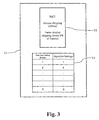
- a decoder 31 which is similarly implemented, is shown in Fig. 3.
- Each decoder 31 is implemented so as to be operable at decoding (e.g., decompression) algorithm settings 1 to D (with D being a small number such as 5).
- variable parameters 32 which are used to specify different settings at which the decoder's decoding (e.g., decompression) algorithm operates include:
- each encoder and each decoder measures the time (real-time) used for the last frame (step 401). This time is averaged with the previous measured time value for the current algorithm setting (step 402); thus, the value that gets used ( T avg ) is the weighted average over the entire history for that algorithm setting, with the most recent measurement carrying a weight of 0.5, the one before that of 0.25, and so on. This time value T a ⁇ g is then compared with a target time value T .
- the target time value T is either specified by the system (based upon the total number of concurrent video streams and other load), or is heuristically set to be half the value determined by the stream's frames-per-second speed. If the measured value T avg is greater than the target value T plus a tolerance t + (the additive sum represented by T tol+ ), then the algorithm setting is downgraded by 1.
- the algorithm is upgraded by 1; and (b) periodically, the algorithm setting is upgraded by 1 to test the waters, as it were, to check if possibly the computational load on the system has come down and a higher setting is possible.
- Tolerance values t + and t- may be a certain percentage of the target T .
- a typical choice would be a small tolerance on the high side, say 2% above T , and a moderate tolerance on the low end, say 10% below T .
- Such a setting is conservative in the sense that the algorithm is not upgraded aggressively, but is downgraded almost as soon as the running time overshoots the target.
- step 403 it is determined if T a ⁇ g > T tol+ . If so, then the algorithm setting is downgraded by 1 in step 404. If not, it is next determined in step 405 if T a ⁇ g ⁇ T. If so, it is then determined in step 406 whether T a ⁇ g ⁇ T tol - and has been so consistently over a predetermined number of frames n, where n is typically in the range of about 5 to about 100, bearing in mind that smaller values make the system more sensitive to change. If the decision in step 406 is "yes," the algorithm setting is upgraded by 1 in step 407.
- step 406 determines whether T avg is either between T tol- and T , or is less than T tol- but has not been consistently so over n frames. If so, the algorithm setting is upgraded by 1 in step 409. If not, the algorithm setting remains unchanged in step 410. The algorithm setting also remains unchanged if T avg is between T and T tol+ (step 405 returns "no"). After the algorithm setting is either downgraded (step 404), upgraded (step 407 or 409), or left unchanged (step 410), the control process loops back to step 401 where another real-time measurement is made. The process continues during run-time until there are no more frames to consider.
- the codec, as well as the individual encoder and decoder, of this invention provide a number of advantages over the prior art.
- the codec of the present invention offers much more than just rate-control, i.e., the ability to adapt to available bandwidth.
- the codec of this invention is also advantageously configured to adaptively modify its complexity, which is a very important feature for codecs in a system (such as a video conferencing server) with multiple codecs using up shared computational resources.
- the codec of the present invention not only has parameters for specifying the complexity, but also has such complexity parameters grouped into algorithm settings which automatically change in response to actual measured run-time complexity as described above. Actual measurements at run-time do away with inaccurate estimates based upon cycle-counts that fail to take into account real-time variations in systems owing to varying load, multithreading, IO, number of clients, etc.
- codec, encoder and decoder of this invention may conveniently implemented in software.
- An equivalent hardware implementation may be obtained using application specific integrated circuits ASICs, digital signal processing circuitry, or the like.
- machine-readable medium further includes hardware having a program of instructions hardwired thereon.
Landscapes
- Engineering & Computer Science (AREA)
- Multimedia (AREA)
- Signal Processing (AREA)
- Physics & Mathematics (AREA)
- Discrete Mathematics (AREA)
- General Physics & Mathematics (AREA)
- Computing Systems (AREA)
- Theoretical Computer Science (AREA)
- Compression Or Coding Systems Of Tv Signals (AREA)
- Compression, Expansion, Code Conversion, And Decoders (AREA)
Abstract
Description
Claims (15)
- A codec, comprising:wherein the codec is configured such that, during operation, at least one of the coding algorithm and decoding algorithm is able to dynamically change its operating setting according to available computational resources in response to actual complexity measurements performed at run-time.an encoder that includes a first plurality of variable parameters that are used to specify different settings at which a coding algorithm applied to incoming video data operates; anda decoder that includes a second plurality of variable parameters that are used to specify different settings at which a decoding algorithm applied to outgoing video data operates;
- A codec as recited in claim 1, wherein the first plurality of variable parameters that are used to specify the different settings at which the coding algorithm operates includemotion-search window,motion-search algorithm,motion-search sum-of absolute-differences measurement sub-sampling factor, andmotion-search half-pel refinement none/x-only/x-and-y.
- A codec as recited in claim 1, wherein the second plurality of variable parameters that are used to specify the different settings at which the decoding algorithm operates includeIDCT,chroma-skipping, andframe-display skipping.
- A video conferencing system, comprising:wherein each of the codecs is configured such that its algorithms in use dynamically adapt their operating settings during operation according to available computational resources in response to actual complexity measurements performed at run-time.a plurality of codecs configured to share the system's resources, each codec comprisingan encoder that includes an associated set of parameters that are used to define different settings at which an associated coding algorithm applied to incoming video data operates, anda decoder that includes an associated set of parameters that are used to define different settings at which an associated decoding algorithm applied to outgoing video data operates;
- A device for processing a video stream, comprising:wherein the device is configured such that, during operation, the algorithm is able to dynamically change its operating setting according to available computational resources in response to actual complexity measurements performed at run-time.a plurality of variable parameters that are used to specify different settings at which an algorithm applied to the video stream operates;
- A device as recited in claim 5, wherein the device comprises an encoder, and the algorithm comprises a coding algorithm.
- A device as recited in claim 6, wherein the plurality of variable parameters that are used to specify the different settings at which the coding algorithm operates includemotion-search window,motion-search algorithm,motion-search sum-of-absolute-differences measurement sub-sampling factor, andmotion-search half-pel refinement none/x-only/x-and-y.
- A device as recited in claim 5, wherein the device comprises a decoder, and the algorithm comprises a decoding algorithm.
- A device as recited in claim 8, wherein the plurality of variable parameters that are used to specify the different settings at which the decoding algorithm operates includeIDCT,chroma-skipping, andframe-display skipping.
- A method for processing a video stream, comprising the steps of:measuring the real-time used by an algorithm for a previous frame;averaging the measured real-time used for the previous frame with a previously measured real-time for the algorithm to obtain a weighted average time value;comparing the weighted average time value with a target range; andcontrolling a setting of the algorithm by:downgrading the algorithm setting, if the weighted average time value is greater than an upper bound of the target range, andupgrading the algorithm setting, if the weighted average time value is less than a lower bound of the target range and has been so over a predetermined number of frames.
- A method as recited in claim 10, wherein the controlling a setting of the algorithm further comprises:periodically upgrading the algorithm setting, if the weighted average time value is between the lower bound of the target range and a target value within the target range.
- A method as recited in claim 11, wherein the step of upgrading the algorithm periodically is also carried out, if the weighted average time value is less than the lower bound of the target range but has not been so for at least the predetermined number of frames.
- A machine-readable medium embodying a program of instructions for directing a device to process a video stream, the program of instructions comprising:instructions for measuring the real-time used by an algorithm for a previous frame;instructions for averaging the measured real-time used for the previous frame with a previously measured real-time for the algorithm to obtain a weighted average time value;instructions for comparing the weighted average time value with a target range; andinstructions for controlling a setting of the algorithm including:instructions' for downgrading the algorithm setting, if the weighted average time value is greater than an upper bound of the target range, andinstructions for upgrading the algorithm setting, if the weighted average time value is less than a lower bound of the target range and has been so over a predetermined number of frames.
- A machine-readable medium as recited in claim 13, wherein the instructions for controlling a setting of the algorithm further comprises:instructions for periodically upgrading the algorithm setting, if the weighted average time value is between the lower bound of the target range and a target value within the target range.
- A machine-readable medium as recited in claim 14, wherein the instructions for upgrading the algorithm periodically is also executed, if the weighted average time value is less than the lower bound of the target range but has not been so for at least the predetermined number of frames.
Applications Claiming Priority (2)
| Application Number | Priority Date | Filing Date | Title |
|---|---|---|---|
| US10/631,155 US20050024486A1 (en) | 2003-07-31 | 2003-07-31 | Video codec system with real-time complexity adaptation |
| US631155 | 2003-07-31 |
Publications (2)
| Publication Number | Publication Date |
|---|---|
| EP1503595A2 true EP1503595A2 (en) | 2005-02-02 |
| EP1503595A3 EP1503595A3 (en) | 2006-05-17 |
Family
ID=33541510
Family Applications (1)
| Application Number | Title | Priority Date | Filing Date |
|---|---|---|---|
| EP04015638A Withdrawn EP1503595A3 (en) | 2003-07-31 | 2004-07-02 | Video codec system with real-time complexity adaptation |
Country Status (3)
| Country | Link |
|---|---|
| US (1) | US20050024486A1 (en) |
| EP (1) | EP1503595A3 (en) |
| JP (1) | JP2005057760A (en) |
Cited By (12)
| Publication number | Priority date | Publication date | Assignee | Title |
|---|---|---|---|---|
| EP1838108A1 (en) * | 2006-03-23 | 2007-09-26 | Texas Instruments France | Processing video data at a target rate |
| WO2008147565A3 (en) * | 2007-05-25 | 2009-01-22 | Arc International Plc | Adaptive video encoding apparatus and methods |
| US7747088B2 (en) | 2005-09-28 | 2010-06-29 | Arc International (Uk) Limited | System and methods for performing deblocking in microprocessor-based video codec applications |
| EP2074824A4 (en) * | 2006-10-06 | 2012-06-27 | Freescale Semiconductor Inc | VIDEO PROCESSING COMPLEXITY SCALE ADJUSTMENT BASED ON POWER SAVING FACTOR |
| WO2012089671A1 (en) | 2010-12-29 | 2012-07-05 | Skype | Dynamical adaptation of data encoding dependent on cpu load |
| EP1662794A4 (en) * | 2003-09-02 | 2012-07-25 | Sony Corp | VIDEO CODING DEVICE, VIDEO CODING CONTROL METHOD, AND VIDEO CODING CONTROL PROGRAM |
| EP2025159A4 (en) * | 2006-05-30 | 2013-04-10 | Google Inc | Apparatus, arrangement, method and computer program product for digital video processing |
| US9055301B2 (en) | 2008-03-18 | 2015-06-09 | Texas Instruments Incorporated | Changing motion estimation precision to maintain encoding within desired time |
| US9942570B2 (en) | 2005-11-10 | 2018-04-10 | Nxp Usa, Inc. | Resource efficient video processing via prediction error computational adjustments |
| WO2018150201A1 (en) * | 2017-02-17 | 2018-08-23 | British Broadcasting Corporation | Image or video encoding and decoding |
| WO2022218633A1 (en) * | 2021-04-13 | 2022-10-20 | British Telecommunications Public Limited Company | Algorithm selection for processor-controlled device |
| DE112016004532B4 (en) * | 2015-12-08 | 2025-06-18 | Harmonic Inc. | Resource-conscious video processor |
Families Citing this family (4)
| Publication number | Priority date | Publication date | Assignee | Title |
|---|---|---|---|---|
| US20070160127A1 (en) * | 2006-01-10 | 2007-07-12 | International Business Machines Corporation | Bandwidth adaptive stream selection |
| KR101441886B1 (en) * | 2008-06-25 | 2014-09-25 | 에스케이텔레콤 주식회사 | Method and apparatus for measuring complexity of video codec |
| JP5864876B2 (en) * | 2011-03-25 | 2016-02-17 | オリンパス株式会社 | Image processing apparatus and image processing method |
| JP5924211B2 (en) * | 2012-09-21 | 2016-05-25 | ソニー株式会社 | Image processing apparatus, image processing method, and program |
Family Cites Families (15)
| Publication number | Priority date | Publication date | Assignee | Title |
|---|---|---|---|---|
| US5802281A (en) * | 1994-09-07 | 1998-09-01 | Rsi Systems, Inc. | Peripheral audio/video communication system that interfaces with a host computer and determines format of coded audio/video signals |
| US6178204B1 (en) * | 1998-03-30 | 2001-01-23 | Intel Corporation | Adaptive control of video encoder's bit allocation based on user-selected region-of-interest indication feedback from video decoder |
| US6850564B1 (en) * | 1998-06-26 | 2005-02-01 | Sarnoff Corporation | Apparatus and method for dynamically controlling the frame rate of video streams |
| US6850565B2 (en) * | 1998-12-18 | 2005-02-01 | Intel Corporation | Real time bit rate control system |
| US6356664B1 (en) * | 1999-02-24 | 2002-03-12 | International Business Machines Corporation | Selective reduction of video data using variable sampling rates based on importance within the image |
| US6490319B1 (en) * | 1999-06-22 | 2002-12-03 | Intel Corporation | Region of interest video coding |
| GB2381403B (en) * | 2000-05-10 | 2004-12-01 | Picturetel Corp | Video coding using multiple buffers |
| US6876703B2 (en) * | 2000-05-11 | 2005-04-05 | Ub Video Inc. | Method and apparatus for video coding |
| US6782052B2 (en) * | 2001-03-16 | 2004-08-24 | Sharp Laboratories Of America, Inc. | Reference frame prediction and block mode prediction for fast motion searching in advanced video coding |
| US7397851B2 (en) * | 2001-05-10 | 2008-07-08 | Roman Kendyl A | Separate plane compression |
| US6996838B2 (en) * | 2001-06-12 | 2006-02-07 | Scientific Atlanta, Inc. | System and method for media processing with adaptive resource access priority assignment |
| US6535240B2 (en) * | 2001-07-16 | 2003-03-18 | Chih-Lung Yang | Method and apparatus for continuously receiving frames from a plurality of video channels and for alternately continuously transmitting to each of a plurality of participants in a video conference individual frames containing information concerning each of said video channels |
| KR100643454B1 (en) * | 2001-11-17 | 2006-11-10 | 엘지전자 주식회사 | Video data transmission control method |
| TW569159B (en) * | 2001-11-30 | 2004-01-01 | Inst Information Industry | Video wavelet transform processing method |
| US6912255B2 (en) * | 2002-05-30 | 2005-06-28 | Mobixell Netwoks Inc. | Bit rate control through selective modification of DCT coefficients |
-
2003
- 2003-07-31 US US10/631,155 patent/US20050024486A1/en not_active Abandoned
-
2004
- 2004-07-02 EP EP04015638A patent/EP1503595A3/en not_active Withdrawn
- 2004-07-30 JP JP2004222985A patent/JP2005057760A/en not_active Withdrawn
Cited By (20)
| Publication number | Priority date | Publication date | Assignee | Title |
|---|---|---|---|---|
| US8665966B2 (en) | 2003-09-02 | 2014-03-04 | Sony Corporation | Video coding apparatus, method of controlling video coding and program of controlling video coding |
| EP1662794A4 (en) * | 2003-09-02 | 2012-07-25 | Sony Corp | VIDEO CODING DEVICE, VIDEO CODING CONTROL METHOD, AND VIDEO CODING CONTROL PROGRAM |
| US8218635B2 (en) | 2005-09-28 | 2012-07-10 | Synopsys, Inc. | Systolic-array based systems and methods for performing block matching in motion compensation |
| US7747088B2 (en) | 2005-09-28 | 2010-06-29 | Arc International (Uk) Limited | System and methods for performing deblocking in microprocessor-based video codec applications |
| US7971042B2 (en) | 2005-09-28 | 2011-06-28 | Synopsys, Inc. | Microprocessor system and method for instruction-initiated recording and execution of instruction sequences in a dynamically decoupleable extended instruction pipeline |
| US8212823B2 (en) | 2005-09-28 | 2012-07-03 | Synopsys, Inc. | Systems and methods for accelerating sub-pixel interpolation in video processing applications |
| US9942570B2 (en) | 2005-11-10 | 2018-04-10 | Nxp Usa, Inc. | Resource efficient video processing via prediction error computational adjustments |
| EP1838108A1 (en) * | 2006-03-23 | 2007-09-26 | Texas Instruments France | Processing video data at a target rate |
| EP2025159A4 (en) * | 2006-05-30 | 2013-04-10 | Google Inc | Apparatus, arrangement, method and computer program product for digital video processing |
| US9883202B2 (en) | 2006-10-06 | 2018-01-30 | Nxp Usa, Inc. | Scaling video processing complexity based on power savings factor |
| EP2074824A4 (en) * | 2006-10-06 | 2012-06-27 | Freescale Semiconductor Inc | VIDEO PROCESSING COMPLEXITY SCALE ADJUSTMENT BASED ON POWER SAVING FACTOR |
| WO2008147565A3 (en) * | 2007-05-25 | 2009-01-22 | Arc International Plc | Adaptive video encoding apparatus and methods |
| US8879636B2 (en) | 2007-05-25 | 2014-11-04 | Synopsys, Inc. | Adaptive video encoding apparatus and methods |
| US9055301B2 (en) | 2008-03-18 | 2015-06-09 | Texas Instruments Incorporated | Changing motion estimation precision to maintain encoding within desired time |
| CN103270739A (en) * | 2010-12-29 | 2013-08-28 | 斯凯普公司 | Dynamical adaptation of data encoding dependent on cpu load |
| WO2012089671A1 (en) | 2010-12-29 | 2012-07-05 | Skype | Dynamical adaptation of data encoding dependent on cpu load |
| DE112016004532B4 (en) * | 2015-12-08 | 2025-06-18 | Harmonic Inc. | Resource-conscious video processor |
| WO2018150201A1 (en) * | 2017-02-17 | 2018-08-23 | British Broadcasting Corporation | Image or video encoding and decoding |
| US10972747B2 (en) | 2017-02-17 | 2021-04-06 | British Broadcasting Corporation | Image or video encoding and decoding |
| WO2022218633A1 (en) * | 2021-04-13 | 2022-10-20 | British Telecommunications Public Limited Company | Algorithm selection for processor-controlled device |
Also Published As
| Publication number | Publication date |
|---|---|
| US20050024486A1 (en) | 2005-02-03 |
| JP2005057760A (en) | 2005-03-03 |
| EP1503595A3 (en) | 2006-05-17 |
Similar Documents
| Publication | Publication Date | Title |
|---|---|---|
| EP1503595A2 (en) | Video codec system with real-time complexity adaptation | |
| US7206016B2 (en) | Filtering artifacts from multi-threaded video | |
| US11363298B2 (en) | Video processing apparatus and processing method of video stream | |
| US8908757B2 (en) | Multi-channel video communication method and system | |
| EP0853436B1 (en) | Digital video signal filtering and encoding method and apparatus | |
| KR101365882B1 (en) | Techniques for managing visual compositions for a multimedia conference call | |
| US20050024487A1 (en) | Video codec system with real-time complexity adaptation and region-of-interest coding | |
| US8289371B2 (en) | Smart cropping of video images in a videoconferencing session | |
| US8374236B2 (en) | Method and apparatus for improving the average image refresh rate in a compressed video bitstream | |
| US20010012324A1 (en) | Method and apparatus for advanced encoder system | |
| US20040100586A1 (en) | System and method for scalable portrait video | |
| US11641447B2 (en) | System and method for automatically adjusting key frame quantization parameter and frame rate | |
| CA3182110A1 (en) | Reinforcement learning based rate control | |
| US8279259B2 (en) | Mimicking human visual system in detecting blockiness artifacts in compressed video streams | |
| US20060095398A1 (en) | Automatic defocussing of displayed multimedia information on client by monitoring static and dynamic properties of the client | |
| JP7334470B2 (en) | VIDEO PROCESSING DEVICE, VIDEO CONFERENCE SYSTEM, VIDEO PROCESSING METHOD, AND PROGRAM | |
| CN114745590B (en) | Video frame coding method, device, electronic equipment and medium | |
| Akramullah | Video quality metrics | |
| US9467691B2 (en) | Video system for displaying image data, method and computer program | |
| JP3202270B2 (en) | Video encoding device | |
| JP3173809B2 (en) | Television conference system | |
| EP1739965A1 (en) | Method and system for processing video data | |
| Yang et al. | Focus of attention: towards low bitrate video tele-conferencing | |
| CN119420922B (en) | Video coding method and device | |
| JP7613072B2 (en) | IMAGE PROCESSING APPARATUS, IMAGE PROCESSING METHOD, VIDEO TRANSMISSION/RECEIVED SYSTEM, AND PROGRAM |
Legal Events
| Date | Code | Title | Description |
|---|---|---|---|
| PUAI | Public reference made under article 153(3) epc to a published international application that has entered the european phase |
Free format text: ORIGINAL CODE: 0009012 |
|
| AK | Designated contracting states |
Kind code of ref document: A2 Designated state(s): AT BE BG CH CY CZ DE DK EE ES FI FR GB GR HU IE IT LI LU MC NL PL PT RO SE SI SK TR |
|
| AX | Request for extension of the european patent |
Extension state: AL HR LT LV MK |
|
| PUAL | Search report despatched |
Free format text: ORIGINAL CODE: 0009013 |
|
| AK | Designated contracting states |
Kind code of ref document: A3 Designated state(s): AT BE BG CH CY CZ DE DK EE ES FI FR GB GR HU IE IT LI LU MC NL PL PT RO SE SI SK TR |
|
| AX | Request for extension of the european patent |
Extension state: AL HR LT LV MK |
|
| 17P | Request for examination filed |
Effective date: 20060622 |
|
| 17Q | First examination report despatched |
Effective date: 20060804 |
|
| AKX | Designation fees paid |
Designated state(s): DE FR GB |
|
| STAA | Information on the status of an ep patent application or granted ep patent |
Free format text: STATUS: THE APPLICATION IS DEEMED TO BE WITHDRAWN |
|
| 18D | Application deemed to be withdrawn |
Effective date: 20061215 |