EP1503583A1 - Mobile terminal device and video/speech output control method in mobile terminal device and program thereof - Google Patents
Mobile terminal device and video/speech output control method in mobile terminal device and program thereof Download PDFInfo
- Publication number
- EP1503583A1 EP1503583A1 EP04017869A EP04017869A EP1503583A1 EP 1503583 A1 EP1503583 A1 EP 1503583A1 EP 04017869 A EP04017869 A EP 04017869A EP 04017869 A EP04017869 A EP 04017869A EP 1503583 A1 EP1503583 A1 EP 1503583A1
- Authority
- EP
- European Patent Office
- Prior art keywords
- output unit
- voice
- reception
- determination
- display
- Prior art date
- Legal status (The legal status is an assumption and is not a legal conclusion. Google has not performed a legal analysis and makes no representation as to the accuracy of the status listed.)
- Withdrawn
Links
- 238000000034 method Methods 0.000 title claims description 23
- 238000012544 monitoring process Methods 0.000 claims description 10
- 230000006870 function Effects 0.000 claims description 4
- 238000010276 construction Methods 0.000 description 9
- 238000010586 diagram Methods 0.000 description 2
- 239000004973 liquid crystal related substance Substances 0.000 description 2
- 230000004913 activation Effects 0.000 description 1
- 238000007792 addition Methods 0.000 description 1
- 238000013341 scale-up Methods 0.000 description 1
Images



Classifications
-
- H—ELECTRICITY
- H04—ELECTRIC COMMUNICATION TECHNIQUE
- H04N—PICTORIAL COMMUNICATION, e.g. TELEVISION
- H04N5/00—Details of television systems
- H04N5/44—Receiver circuitry for the reception of television signals according to analogue transmission standards
- H04N5/50—Tuning indicators; Automatic tuning control
-
- H—ELECTRICITY
- H04—ELECTRIC COMMUNICATION TECHNIQUE
- H04N—PICTORIAL COMMUNICATION, e.g. TELEVISION
- H04N21/00—Selective content distribution, e.g. interactive television or video on demand [VOD]
- H04N21/40—Client devices specifically adapted for the reception of or interaction with content, e.g. set-top-box [STB]; Operations thereof
- H04N21/43—Processing of content or additional data, e.g. demultiplexing additional data from a digital video stream; Elementary client operations, e.g. monitoring of home network or synchronising decoder's clock; Client middleware
- H04N21/438—Interfacing the downstream path of the transmission network originating from a server, e.g. retrieving encoded video stream packets from an IP network
- H04N21/4383—Accessing a communication channel
-
- H—ELECTRICITY
- H04—ELECTRIC COMMUNICATION TECHNIQUE
- H04N—PICTORIAL COMMUNICATION, e.g. TELEVISION
- H04N21/00—Selective content distribution, e.g. interactive television or video on demand [VOD]
- H04N21/40—Client devices specifically adapted for the reception of or interaction with content, e.g. set-top-box [STB]; Operations thereof
- H04N21/43—Processing of content or additional data, e.g. demultiplexing additional data from a digital video stream; Elementary client operations, e.g. monitoring of home network or synchronising decoder's clock; Client middleware
- H04N21/442—Monitoring of processes or resources, e.g. detecting the failure of a recording device, monitoring the downstream bandwidth, the number of times a movie has been viewed, the storage space available from the internal hard disk
- H04N21/44209—Monitoring of downstream path of the transmission network originating from a server, e.g. bandwidth variations of a wireless network
-
- H—ELECTRICITY
- H04—ELECTRIC COMMUNICATION TECHNIQUE
- H04N—PICTORIAL COMMUNICATION, e.g. TELEVISION
- H04N21/00—Selective content distribution, e.g. interactive television or video on demand [VOD]
- H04N21/40—Client devices specifically adapted for the reception of or interaction with content, e.g. set-top-box [STB]; Operations thereof
- H04N21/47—End-user applications
- H04N21/485—End-user interface for client configuration
-
- H—ELECTRICITY
- H04—ELECTRIC COMMUNICATION TECHNIQUE
- H04W—WIRELESS COMMUNICATION NETWORKS
- H04W52/00—Power management, e.g. Transmission Power Control [TPC] or power classes
- H04W52/02—Power saving arrangements
- H04W52/0209—Power saving arrangements in terminal devices
- H04W52/0261—Power saving arrangements in terminal devices managing power supply demand, e.g. depending on battery level
- H04W52/0267—Power saving arrangements in terminal devices managing power supply demand, e.g. depending on battery level by controlling user interface components
-
- Y—GENERAL TAGGING OF NEW TECHNOLOGICAL DEVELOPMENTS; GENERAL TAGGING OF CROSS-SECTIONAL TECHNOLOGIES SPANNING OVER SEVERAL SECTIONS OF THE IPC; TECHNICAL SUBJECTS COVERED BY FORMER USPC CROSS-REFERENCE ART COLLECTIONS [XRACs] AND DIGESTS
- Y02—TECHNOLOGIES OR APPLICATIONS FOR MITIGATION OR ADAPTATION AGAINST CLIMATE CHANGE
- Y02D—CLIMATE CHANGE MITIGATION TECHNOLOGIES IN INFORMATION AND COMMUNICATION TECHNOLOGIES [ICT], I.E. INFORMATION AND COMMUNICATION TECHNOLOGIES AIMING AT THE REDUCTION OF THEIR OWN ENERGY USE
- Y02D30/00—Reducing energy consumption in communication networks
- Y02D30/70—Reducing energy consumption in communication networks in wireless communication networks
Definitions
- the present invention relates to a mobile terminal device and a display/speech control method in the mobile terminal device and, more particularly, a mobile terminal device such as a headphone stereo apparatus or a mobile phone terminal having a built-in radio or television tuner.
- a headphone stereo apparatus with a liquid crystal television proposed is an apparatus having a TV tuner provided therein to control on/off of an output mode of an TV image as a main frame opens or closes (see e.g. Japanese Utility Model Laying-Open (Kokai) No. Heisei 01-057870).
- the above-described conventional mobile apparatus has its current consumption increased to shorten a continuous working time. Increase in current consumption is inevitable with the scale-up of a display unit such as an LCD (Liquid Crystal Display).
- LCD Liquid Crystal Display
- An object of the present invention is to provide a mobile terminal device which eliminates the above-described shortcomings and reduces current consumption to increase a continuous working time, and a display/voice control method in the mobile terminal device and a program thereof.
- a mobile terminal device mounted at least with a television tuner to display a video signal through a display output unit and output a voice signal through a voice output unit, comprising:
- the controller when determination that reception is good is made by the determination unit, outputs the video signal and the voice signal through the display output unit and the voice output unit and when the determination that reception is good is not made by the determination unit, suppresses output of the video signal and the voice signal from the display output unit and the voice output unit.
- the determination unit determines on the reception conditions by monitoring at least one of an AFT (Automatic Fine Tuning) voltage obtained by converting a frequency deviation which is caused by a reception condition at the time of the television channel selection and a reception level signal.
- AFT Automatic Fine Tuning
- the controller when determination that reception is good is made by the determination unit, makes the display output unit and the voice output unit output the video signal and the voice signal and when the determination that reception is good is not made by the determination unit, suppresses output of the video signal and the voice signal from the display output unit and the voice output unit, and the determination unit determines on the reception conditions by monitoring at least one of an AFT (Automatic Fine Tuning) voltage obtained by converting a frequency deviation which is caused by a reception condition at the time of the television channel selection and a reception level signal.
- AFT Automatic Fine Tuning
- the controller controls the voice output unit according to a result of the determination on a reception condition by the determination unit and external user setting.
- the controller controls the voice output unit according to a result of the determination on a reception condition by the determination unit and external user setting, and when determination is made by the determination unit that reception is good, makes the display output unit and the voice output unit output the video signal and the voice signal and when the determination is not made by the determination unit that reception is good, suppresses output of the video signal and the voice signal from the display output unit and the voice output unit.
- the controller controls the voice output unit according to a result of the determination on a reception condition by the determination unit and external user setting, and when determination is made by the determination unit that reception is good, makes the display output unit and the voice output unit output the video signal and the voice signal and when the determination is not made by the determination unit that reception is good, suppresses output of the video signal and the voice signal from the display output unit and the voice output unit, and the determination unit determines on the reception conditions by monitoring at least one of an AFT (Automatic Fine Tuning) voltage obtained by converting a frequency deviation which is caused by a reception condition at the time of the television channel selection and a reception level signal.
- AFT Automatic Fine Tuning
- the controller controls the display output unit and the voice output unit according to a result of the determination on a reception condition by the determination unit and external user setting.
- the controller controls the display output unit and the voice output unit according to a result of the determination on a reception condition by the determination unit and external user setting, and when determination is made by the determination unit that reception is good, makes the display output unit and the voice output unit output the video signal and the voice signal and when the determination is not made by the determination unit that reception is good, suppresses output of the video signal and the voice signal from the display output unit and the voice output unit.
- the controller controls the display output unit and the voice output unit according to a result of the determination on a reception condition by the determination unit and external user setting, and when determination is made by the determination unit that reception is good, makes the display output unit and the voice output unit output the video signal and the voice signal and when the determination is not made by the determination unit that reception is good, suppresses output of the video signal and the voice signal from the display output unit and the voice output unit, and the determination unit determines on the reception conditions by monitoring at least one of an AFT (Automatic Fine Tuning) voltage obtained by converting a frequency deviation which is caused by a reception condition at the time of the television channel selection and a reception level signal.
- AFT Automatic Fine Tuning
- a display/voice control method of a mobile terminal device mounted at least with a television tuner to display a video signal through a display output unit and output a voice signal through a voice output unit, comprising the steps of on the mobile terminal device side, determining on reception conditions at the time of television channel selection, and controlling at least one of the display output unit and the voice output unit according to a result of the determination.
- a program of a display/voice control method executed on a computer as a mobile terminal device mounted at least with a television tuner to display a video signal through a display output unit and output a voice signal through a voice output unit comprising the functions of determining on reception conditions at the time of television channel selection, and controlling at least one of the display output unit and the voice output unit according to a result of the determination.
- the display/voice control method of the present invention enables reduction in current consumption by conducting output according to reception conditions at the time of TV (television) channel selection, that is, by outputting a video signal and a voice signal when the reception condition is good and suppressing output of a video signal and a voice signal when the reception condition is not good.
- a voice output mode is arbitrarily controlled at each stage of reception conditions to enable reduction in current consumption.
- a display/voice output mode is arbitrarily controlled at each stage of reception conditions to enable reduction in current consumption.
- a result of determination on a reception state by an AFT (Automatic Fine Tuning) provided in a TV module and display of a video signal and output of a voice signal are controlled linking with each other.
- An AFT voltage which is used for determining whether reception is good at the time of selecting a TV channel, controls the result of the determination on reception conditions and output of the video signal and the voice signal so as to link with each other to reduce current consumption, thereby increasing a continuous working time of the mobile apparatus.
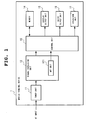
- Fig. 1 is a block diagram showing an internal structure of a mobile terminal device according to an embodiment of the present invention.
- a mobile terminal device 1 includes a tuner unit 11, a signal processing unit 12, a control unit (controller) 13, a memory 14, a display output unit 15, a voice output unit 16 and an operation unit 17.
- the tuner unit 11 frequency-converts an RF (Radio Frequency) signal and the signal processing unit 12 outputs a video signal and a voice signal from the frequency-converted RF signal.
- an AFT (Automatic Fine Tuning) unit 121 which converts a frequency deviation caused by a reception condition during TV channel selection into a voltage.
- the control unit 13 monitors an AFT voltage from the AFT unit 121 to conduct control according to reception conditions.
- the memory 14 stores operation modes for a threshold value for determining whether reception of an AFT signal is good and for each threshold value set by user operation, as well as storing a program (program executable by a computer) executed by the control unit 13.
- the display output unit 15 notifies display of a video signal and a reception condition, the voice output unit 16 outputs a voice signal and the operation unit 17 is an input apparatus for a user to operate.
- the control unit 13 reads, from the memory 14, a threshold value for determining on the AFT voltage output from the AFT unit 121 according to reception conditions, compares the AFT voltage and the threshold value to determine whether reception is good or not and as a result of the determination, controls the display output unit 15 and the voice output unit 16 according to an operation mode set by a user.
- the RF signal is frequency-converted by the tuner unit 11 and applied to the signal processing unit 12.
- the signal processing unit 12 outputs a video signal and a voice signal to the control unit 13, and the control unit 13 outputs these video signal and voice signal to the display output unit 15 and the voice output unit 16, respectively.
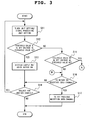
- Fig. 2 is a flow chart showing display/voice control processing in a mobile terminal device according to a first embodiment of the present invention. Since the mobile terminal device according to the first embodiment of the present invention has the same internal structure as that of the above-described mobile terminal device 1 shown in Fig. 1, display/voice control processing according to the first embodiment of the present invention will be described with reference to Figs. 1 and 2. Shown in Fig. 2 is control executed when determining whether a reception condition is good or not good at the time of TV channel selection. Processing illustrated in Fig. 2 is realized by the execution of a program stored in the memory 14 by the control unit 13.
- Step S1 in Fig. 2 setting of the tuner unit 11 and the signal processing unit 12 is conducted (Step S1 in Fig. 2) and the control unit 13 compares the AFT voltage from the AFT unit 121 and a threshold value A stored in the memory 14 to determine whether good reception exists or not from the comparison result (Step S2 in Fig. 2).
- the control unit 13 determines that the reception is good and controls the display output unit 15 and the voice output unit 16 to turn on output of the video signal and the voice signal (Step S3 in Fig. 2). Thereafter, when a request for another channel is made (Step S4 in Fig. 2), the control unit 13 returns to Step S1 to again execute each of the above-described processing.
- the control unit 13 determines that the reception is not good and controls the display output unit 15 and the voice output unit 16 to turn off output of the video signal and the voice signal (Step S5 in Fig. 2). Thereafter, when a request is made for returning to the setting of the previous reception good channel (Step S6 in Fig. 2), the control unit 13 conducts setting of the previous reception good channel (Step S7 in Fig. 2). In the display output unit 15, information about reception conditions may be displayed.
- Step S6 in Fig. 2 When no request is made for returning to the setting of the previous reception good channel (Step S6 in Fig. 2) and a request for another channel is made (Step S4 in Fig. 2), return to Step S1 to again execute each of the above-described processing.
- a voice signal is ordinarily output to the voice output unit 16 and if not, no voice signal is output to the voice output unit 16, thereby enabling reduction in current consumption.
- Figs. 3 and 4 are flow charts showing display/voice control processing in a mobile terminal device according to a second embodiment of the present invention. Since the mobile terminal device according to the second embodiment of the present invention has also the same internal structure as that of the above-described mobile terminal device 1 shown in Fig. 1, display/voice control processing according to the second embodiment of the present invention will be described with reference to Figs. 1, 3 and 4.
- As threshold values for use in determining on reception conditions at the time of TV channel selection three patterns are provided, reception good, reception possible and reception impossible. Processing shown in Figs. 3 and 4 is realized by the execution of the program stored in the memory 14 by the control unit 13.
- Step S11 in Fig. 3 setting of the tuner unit 11 and the signal processing unit 12 is conducted (Step S11 in Fig. 3) and the control unit 13 compares the AFT voltage from the AFT unit 121 and the threshold value A stored in the memory 14 to determine whether good reception exists or not from the comparison result (Step S12 in Fig. 3).
- the control unit 13 determines that the reception is good to turn on output of the video signal and the voice signal from the display output unit 15 and the voice output unit 16 (Step S13 in Fig. 3). Thereafter, when a request for another channel is made (Step S14 in Fig. 3), the control unit 13 returns to Step S11 to again execute each of the above-described processing.
- the control unit 13 determines that the reception is not good to compare, by using a threshold value B having a threshold value range larger than that of the threshold value A, the AFT voltage and the threshold value B and determine whether good reception exists or not (Step S15 in Fig. 3).
- the control unit 13 controls the display output unit 15 to turn on the output of the video signal (Step S18 in Fig. 4).
- the control unit 13 sets the previous reception good channel (Step S17 in Fig. 3).
- Step S16 in Fig. 3 If no request is made for returning to the setting of the previous reception good channel (Step S16 in Fig. 3) and a request for another channel is made (Step S14 in Fig. 3), the control unit 13 returns to Step S11 to again execute each of the above-described processing.
- Step S19 in Fig. 4 the control unit 13 turns off the output of the voice signal from the voice output unit 16 (Step S20 in Fig. 4).
- Step S19 in Fig. 4 When the user setting stored in the memory 14 is to turn on the output of the voice signal from the voice output unit 16 (Step S19 in Fig. 4) and to output the voice signal from the voice output unit 16 at a low level (Step S21 in Fig. 4), the control unit 13 outputs the voice signal from the voice output unit 16 at a low level (Step S23 in Fig. 4).
- Step S21 in Fig. 4 When the setting is not outputting the voice signal from the voice output unit 16 at a low level (Step S21 in Fig. 4), the control unit 13 turns on the output of the voice signal from the voice output unit 16 (Step S22 in Fig 4).
- the foregoing processing enables the present embodiment to set the voice output unit 16 according to external user setting, thereby enabling reduction in current consumption depending on user setting. It is also possible in the present embodiment to display icons or the like on the display output unit 15 to recognize reception conditions at a glance, thereby always notifying reception conditions of a reception channel. Furthermore, in the present embodiment, not the AFT voltage but a reception level signal or both can be used for determining whether reception is good or not.
- Figs. 5 to 7 are flow charts showing display/voice control processing in a mobile terminal device according to a third embodiment of the present invention. Since the mobile terminal device according to the third embodiment of the present invention also has the same internal structure as that of the above-described mobile terminal device 1 shown in Fig. 1, display/voice control processing according to the third embodiment of the present invention will be described with reference to Figs. 1 and 5 to 7. In the present embodiment, user setting is also possible at the display output unit 15. Processing shown in Figs. 5 to 7 is realized by the execution of the program stored in the memory 14 by the control unit 13.
- Step S31 in Fig. 5 setting of the tuner unit 11 and the signal processing unit 12 is conducted (Step S31 in Fig. 5) and the control unit 13 compares the AFT voltage from the AFT unit 121 and the threshold value A stored in the memory 14 to determine whether good reception exists or not from the comparison result (Step S32 in Fig. 5).
- the control unit 13 turns on the output of the video signal from the display output unit 15 (Step S38 in Fig. 6).
- the unit 13 turns off the output of the video signal from the display output unit 15 (Step S39 in Fig. 6).
- Step S40 in Fig. 6 the control unit 13 turns on the output of the voice signal from the voice output unit 16 (Step S42 in Fig. 6).
- Step S40 in Fig. 6 the control unit 13 turns off the output of the voice signal from the voice output unit 16 (Step S41 in Fig. 6).
- the control unit 13 determines that reception is not good to compare, by using the threshold value B having a threshold value range larger than that of the threshold value A, the AFT voltage and the threshold value B and determine whether good reception exists or not (Step S33 in Fig. 5).
- Step S43 in Fig. 7 when the AFT voltage is not less than the threshold value B1 and not more than the threshold value B2 and user setting stored in the memory 14 is to turn on the output of the video signal from the display output unit 15 (Step S43 in Fig. 7), the control unit 13 turns on the output of the video signal from the display output unit 15 (Step S45 in Fig. 7).
- the control unit 13 turns off the output of the video signal from the display output unit 15 (Step S44 in Fig. 7).
- Step S46 in Fig. 7 the control unit 13 turns off the output of the voice signal from the voice output unit 16 (Step S47 in Fig. 7).
- Step S46 in Fig. 7 When the user setting stored in the memory 14 is to turn on the output of the voice signal from the voice output unit 16 (Step S46 in Fig. 7) and to output the voice signal from the voice output unit 16 at a low level (Step S48 in Fig. 7), the control unit 13 outputs the voice signal from the voice output unit 16 at a low level (Step S50 in Fig. 7).
- Step S48 in Fig. 7 When the setting is not making output of the voice output unit 16 at a low level (Step S48 in Fig. 7), the control unit 13 turns on the output of the voice output unit 16 (Ste S49 in Fig. 7).
- Step S34 in Fig. 5 if a request is made for returning to the setting of the previous reception good channel (Step S34 in Fig. 5), the control unit 13 sets the previous reception good channel (Step S36 in Fig. 5). Thereafter, when a request for another channel is made (Step S35 in Fig. 5), the control unit 13 returns to Step S31 to again execute each of the above-described processing.
- Step S34 in Fig. 5 if no request is made for returning to the setting of the previous reception good channel (Step S34 in Fig. 5) and a request for another channel (Step S35 in Fig. 5), the control unit 13 returns to Step S31 to again execute each of the above-described processing.
- the foregoing processing enables the present embodiment to control display output/voice output according to external user setting every time a reception condition is determined, so that further reduction in current consumption is possible. It is also possible in the present embodiment to display icons or the like on the display output unit 15 to recognize reception conditions at a glance even when output of the display signal is turned off, thereby always notifying reception conditions of a reception channel. Furthermore, in the present embodiment, not the AFT voltage but a reception level signal or both can be used for determining whether reception is good or not.
- the present invention when as a result of comparison between an AFT voltage monitored at the time of TV channel selection and a threshold value to determine whether good reception exists or not, if the reception is good, a video signal and a voice signal will be ordinarily output to the display output unit 15 and the voice output unit 16, respectively, and if not, no video signal and no voice signal will be output to the display output unit 15 and the voice output unit 16, thereby reducing current consumption.
- the present invention enables reduction of current consumption by monitoring an AFT voltage at the time of TV channel selection and after comparing the AFT voltage and a threshold value to determine whether good reception exists or not, controlling the voice output unit 16 according to the determined reception condition.
- the present invention enables reduction in current consumption to increase a continuous working time of a mobile terminal device.
- the present invention is also applicable to such a mobile terminal device as a PDA (Personal Digital Assistant) other than such apparatuses as a headphone stereo apparatus and a mobile phone terminal.
- PDA Personal Digital Assistant
Landscapes
- Engineering & Computer Science (AREA)
- Multimedia (AREA)
- Signal Processing (AREA)
- Computer Networks & Wireless Communication (AREA)
- Human Computer Interaction (AREA)
- Databases & Information Systems (AREA)
- Television Receiver Circuits (AREA)
- Circuits Of Receivers In General (AREA)
- Mobile Radio Communication Systems (AREA)
Abstract
Description
- The present invention relates to a mobile terminal device and a display/speech control method in the mobile terminal device and, more particularly, a mobile terminal device such as a headphone stereo apparatus or a mobile phone terminal having a built-in radio or television tuner.
- In recent years, as mobile apparatuses such as a headphone stereo apparatus and a mobile phone terminal, products having a built-in tuner of an FM (Frequency Modulation) radio or a TV (television) have been marketed.
- As a headphone stereo apparatus with a liquid crystal television, proposed is an apparatus having a TV tuner provided therein to control on/off of an output mode of an TV image as a main frame opens or closes (see e.g. Japanese Utility Model Laying-Open (Kokai) No. Heisei 01-057870).
- Because a tuner of an FM radio or a TV is contained, the above-described conventional mobile apparatus has its current consumption increased to shorten a continuous working time. Increase in current consumption is inevitable with the scale-up of a display unit such as an LCD (Liquid Crystal Display).
- An object of the present invention is to provide a mobile terminal device which eliminates the above-described shortcomings and reduces current consumption to increase a continuous working time, and a display/voice control method in the mobile terminal device and a program thereof.
- According to the first aspect of the invention, a mobile terminal device mounted at least with a television tuner to display a video signal through a display output unit and output a voice signal through a voice output unit, comprising:
- a determination unit which determines on reception conditions at the time of selecting a television channel, and a controller which controls at least one of the display output unit and the voice output unit according to a result of the determination by the determination unit.
-
- In the preferred construction, the controller, when determination that reception is good is made by the determination unit, outputs the video signal and the voice signal through the display output unit and the voice output unit and when the determination that reception is good is not made by the determination unit, suppresses output of the video signal and the voice signal from the display output unit and the voice output unit.
- In another preferred construction, the determination unit determines on the reception conditions by monitoring at least one of an AFT (Automatic Fine Tuning) voltage obtained by converting a frequency deviation which is caused by a reception condition at the time of the television channel selection and a reception level signal.
- In another preferred construction, the controller, when determination that reception is good is made by the determination unit, makes the display output unit and the voice output unit output the video signal and the voice signal and when the determination that reception is good is not made by the determination unit, suppresses output of the video signal and the voice signal from the display output unit and the voice output unit, and the determination unit determines on the reception conditions by monitoring at least one of an AFT (Automatic Fine Tuning) voltage obtained by converting a frequency deviation which is caused by a reception condition at the time of the television channel selection and a reception level signal.
- In another preferred construction, the controller controls the voice output unit according to a result of the determination on a reception condition by the determination unit and external user setting.
- In another preferred construction, the controller controls the voice output unit according to a result of the determination on a reception condition by the determination unit and external user setting, and when determination is made by the determination unit that reception is good, makes the display output unit and the voice output unit output the video signal and the voice signal and when the determination is not made by the determination unit that reception is good, suppresses output of the video signal and the voice signal from the display output unit and the voice output unit.
- In another preferred construction, the controller controls the voice output unit according to a result of the determination on a reception condition by the determination unit and external user setting, and when determination is made by the determination unit that reception is good, makes the display output unit and the voice output unit output the video signal and the voice signal and when the determination is not made by the determination unit that reception is good, suppresses output of the video signal and the voice signal from the display output unit and the voice output unit, and the determination unit determines on the reception conditions by monitoring at least one of an AFT (Automatic Fine Tuning) voltage obtained by converting a frequency deviation which is caused by a reception condition at the time of the television channel selection and a reception level signal.
- In another preferred construction, the controller controls the display output unit and the voice output unit according to a result of the determination on a reception condition by the determination unit and external user setting.
- In another preferred construction, the controller controls the display output unit and the voice output unit according to a result of the determination on a reception condition by the determination unit and external user setting, and when determination is made by the determination unit that reception is good, makes the display output unit and the voice output unit output the video signal and the voice signal and when the determination is not made by the determination unit that reception is good, suppresses output of the video signal and the voice signal from the display output unit and the voice output unit.
- In another preferred construction, the controller controls the display output unit and the voice output unit according to a result of the determination on a reception condition by the determination unit and external user setting, and when determination is made by the determination unit that reception is good, makes the display output unit and the voice output unit output the video signal and the voice signal and when the determination is not made by the determination unit that reception is good, suppresses output of the video signal and the voice signal from the display output unit and the voice output unit, and the determination unit determines on the reception conditions by monitoring at least one of an AFT (Automatic Fine Tuning) voltage obtained by converting a frequency deviation which is caused by a reception condition at the time of the television channel selection and a reception level signal.
- According to another aspect of the invention, a display/voice control method of a mobile terminal device mounted at least with a television tuner to display a video signal through a display output unit and output a voice signal through a voice output unit, comprising the steps of on the mobile terminal device side, determining on reception conditions at the time of television channel selection, and controlling at least one of the display output unit and the voice output unit according to a result of the determination.
- According to another aspect of the invention, a program of a display/voice control method executed on a computer as a mobile terminal device mounted at least with a television tuner to display a video signal through a display output unit and output a voice signal through a voice output unit, comprising the functions of determining on reception conditions at the time of television channel selection, and controlling at least one of the display output unit and the voice output unit according to a result of the determination.
- More specifically, the display/voice control method of the present invention enables reduction in current consumption by conducting output according to reception conditions at the time of TV (television) channel selection, that is, by outputting a video signal and a voice signal when the reception condition is good and suppressing output of a video signal and a voice signal when the reception condition is not good.
- In addition, in the display/voice control method of the present invention, with reception conditions at the time of TV channel selection being classified into three stages, reception good, reception possible and reception impossible, a voice output mode is arbitrarily controlled at each stage of reception conditions to enable reduction in current consumption.
- Moreover, in the display/voice control method of the present invention, with reception conditions at the time of TV channel selection being classified into three stages, reception good, reception possible and reception impossible, a display/voice output mode is arbitrarily controlled at each stage of reception conditions to enable reduction in current consumption.
- These enable the display/voice control method of the present invention to reduce current consumption as much as possible at the time of TV module activation, thereby increasing a continuous working time of a mobile apparatus.
- In addition, in the display/voice control method of the present invention, a result of determination on a reception state by an AFT (Automatic Fine Tuning) provided in a TV module and display of a video signal and output of a voice signal are controlled linking with each other. An AFT voltage, which is used for determining whether reception is good at the time of selecting a TV channel, controls the result of the determination on reception conditions and output of the video signal and the voice signal so as to link with each other to reduce current consumption, thereby increasing a continuous working time of the mobile apparatus.
- Other objects, features and advantages of the present invention will become clear from the detailed description given herebelow.
- The present invention will be understood more fully from the detailed description given herebelow and from the accompanying drawings of the preferred embodiment of the invention, which, however, should not be taken to be limitative to the invention, but are for explanation and understanding only.
- In the drawings:
- Fig. 1 is a block diagram showing an internal structure of a mobile terminal device according to an embodiment of the present invention;
- Fig. 2 is a flow chart showing display/voice control processing in a mobile terminal device according to a first embodiment of the present invention;
- Fig. 3 is a flow chart showing display/voice control processing in a mobile terminal device according to a second embodiment of the present invention;
- Fig. 4 is a flow chart showing display/voice control processing in the mobile terminal device according to the second embodiment of the present invention;
- Fig. 5 is a flow chart showing display/voice. control processing in a mobile terminal device according to a third embodiment of the present invention;
- Fig. 6 is a flow chart showing display/voice control processing in the mobile terminal device according to the third embodiment of the present invention; and
- Fig. 7 is a flow chart showing display/voice control processing in the mobile terminal device according to the third embodiment of the present invention.
-
- The preferred embodiment of the present invention will be discussed hereinafter in detail with reference to the accompanying drawings. In the following description, numerous specific details are set forth in order to provide a thorough understanding of the present invention. It will be obvious, however, to those skilled in the art that the present invention may be practiced without these specific details. In other instance, well-known structures are not shown in detail in order to unnecessary obscure the present invention.
- Next, embodiments of the present invention will be described with reference to the drawings. Fig. 1 is a block diagram showing an internal structure of a mobile terminal device according to an embodiment of the present invention. In Fig. 1, a
mobile terminal device 1 includes atuner unit 11, asignal processing unit 12, a control unit (controller) 13, amemory 14, adisplay output unit 15, avoice output unit 16 and anoperation unit 17. - The
tuner unit 11 frequency-converts an RF (Radio Frequency) signal and thesignal processing unit 12 outputs a video signal and a voice signal from the frequency-converted RF signal. Provided in thesignal processing unit 12 is an AFT (Automatic Fine Tuning)unit 121 which converts a frequency deviation caused by a reception condition during TV channel selection into a voltage. - The
control unit 13 monitors an AFT voltage from theAFT unit 121 to conduct control according to reception conditions. Thememory 14 stores operation modes for a threshold value for determining whether reception of an AFT signal is good and for each threshold value set by user operation, as well as storing a program (program executable by a computer) executed by thecontrol unit 13. Thedisplay output unit 15 notifies display of a video signal and a reception condition, thevoice output unit 16 outputs a voice signal and theoperation unit 17 is an input apparatus for a user to operate. - The
control unit 13 reads, from thememory 14, a threshold value for determining on the AFT voltage output from theAFT unit 121 according to reception conditions, compares the AFT voltage and the threshold value to determine whether reception is good or not and as a result of the determination, controls thedisplay output unit 15 and thevoice output unit 16 according to an operation mode set by a user. - The RF signal is frequency-converted by the
tuner unit 11 and applied to thesignal processing unit 12. Thesignal processing unit 12 outputs a video signal and a voice signal to thecontrol unit 13, and thecontrol unit 13 outputs these video signal and voice signal to thedisplay output unit 15 and thevoice output unit 16, respectively. - Fig. 2 is a flow chart showing display/voice control processing in a mobile terminal device according to a first embodiment of the present invention. Since the mobile terminal device according to the first embodiment of the present invention has the same internal structure as that of the above-described
mobile terminal device 1 shown in Fig. 1, display/voice control processing according to the first embodiment of the present invention will be described with reference to Figs. 1 and 2. Shown in Fig. 2 is control executed when determining whether a reception condition is good or not good at the time of TV channel selection. Processing illustrated in Fig. 2 is realized by the execution of a program stored in thememory 14 by thecontrol unit 13. - First in the
mobile terminal device 1, setting of thetuner unit 11 and thesignal processing unit 12 is conducted (Step S1 in Fig. 2) and thecontrol unit 13 compares the AFT voltage from theAFT unit 121 and a threshold value A stored in thememory 14 to determine whether good reception exists or not from the comparison result (Step S2 in Fig. 2). - When the AFT voltage is not less than a threshold value A1 and not more than a threshold value A2, the
control unit 13 determines that the reception is good and controls thedisplay output unit 15 and thevoice output unit 16 to turn on output of the video signal and the voice signal (Step S3 in Fig. 2). Thereafter, when a request for another channel is made (Step S4 in Fig. 2), thecontrol unit 13 returns to Step S1 to again execute each of the above-described processing. - When the AFT voltage is less than the threshold value A1 or more than the threshold value A2, the
control unit 13 determines that the reception is not good and controls thedisplay output unit 15 and thevoice output unit 16 to turn off output of the video signal and the voice signal (Step S5 in Fig. 2). Thereafter, when a request is made for returning to the setting of the previous reception good channel (Step S6 in Fig. 2), thecontrol unit 13 conducts setting of the previous reception good channel (Step S7 in Fig. 2). In thedisplay output unit 15, information about reception conditions may be displayed. - When no request is made for returning to the setting of the previous reception good channel (Step S6 in Fig. 2) and a request for another channel is made (Step S4 in Fig. 2), return to Step S1 to again execute each of the above-described processing.
- According to the present embodiment, through the foregoing processing, if a reception condition is found to be good as a result of monitoring of the AFT voltage, a voice signal is ordinarily output to the
voice output unit 16 and if not, no voice signal is output to thevoice output unit 16, thereby enabling reduction in current consumption. - It is also possible in the present embodiment to display icons or the like on the
display output unit 15 to recognize reception conditions at a glance, thereby always notifying reception conditions of a reception channel. Furthermore, in the present embodiment, not the AFT voltage but a reception level signal or both can be used for determining whether reception is good or not. - Figs. 3 and 4 are flow charts showing display/voice control processing in a mobile terminal device according to a second embodiment of the present invention. Since the mobile terminal device according to the second embodiment of the present invention has also the same internal structure as that of the above-described mobile
terminal device 1 shown in Fig. 1, display/voice control processing according to the second embodiment of the present invention will be described with reference to Figs. 1, 3 and 4. In the present embodiment, as threshold values for use in determining on reception conditions at the time of TV channel selection, three patterns are provided, reception good, reception possible and reception impossible. Processing shown in Figs. 3 and 4 is realized by the execution of the program stored in thememory 14 by thecontrol unit 13. - First in the mobile
terminal device 1, setting of thetuner unit 11 and thesignal processing unit 12 is conducted (Step S11 in Fig. 3) and thecontrol unit 13 compares the AFT voltage from theAFT unit 121 and the threshold value A stored in thememory 14 to determine whether good reception exists or not from the comparison result (Step S12 in Fig. 3). - When the AFT voltage is not less than the threshold value A1 and not more than the threshold value A2, the
control unit 13 determines that the reception is good to turn on output of the video signal and the voice signal from thedisplay output unit 15 and the voice output unit 16 (Step S13 in Fig. 3). Thereafter, when a request for another channel is made (Step S14 in Fig. 3), thecontrol unit 13 returns to Step S11 to again execute each of the above-described processing. - When the AFT voltage is less than the threshold value A1 or more than the threshold value A2, the
control unit 13 determines that the reception is not good to compare, by using a threshold value B having a threshold value range larger than that of the threshold value A, the AFT voltage and the threshold value B and determine whether good reception exists or not (Step S15 in Fig. 3). - As a result of the determination, when the AFT voltage is not less than a threshold value B1 and not more than a threshold value B2, the
control unit 13 controls thedisplay output unit 15 to turn on the output of the video signal (Step S18 in Fig. 4). When the AFT voltage is less than the threshold value B1 or larger than the threshold value B2, if a request is made for returning to the setting of the previous reception good channel (Step S16 in Fig. 3), thecontrol unit 13 sets the previous reception good channel (Step S17 in Fig. 3). - If no request is made for returning to the setting of the previous reception good channel (Step S16 in Fig. 3) and a request for another channel is made (Step S14 in Fig. 3), the
control unit 13 returns to Step S11 to again execute each of the above-described processing. - On the other hand, after turning on the output of the video signal, when the user setting stored in the
memory 14 is not turning on the output of the voice signal from the voice output unit 16 (Step S19 in Fig. 4), thecontrol unit 13 turns off the output of the voice signal from the voice output unit 16 (Step S20 in Fig. 4). - When the user setting stored in the
memory 14 is to turn on the output of the voice signal from the voice output unit 16 (Step S19 in Fig. 4) and to output the voice signal from thevoice output unit 16 at a low level (Step S21 in Fig. 4), thecontrol unit 13 outputs the voice signal from thevoice output unit 16 at a low level (Step S23 in Fig. 4). When the setting is not outputting the voice signal from thevoice output unit 16 at a low level (Step S21 in Fig. 4), thecontrol unit 13 turns on the output of the voice signal from the voice output unit 16 (Step S22 in Fig 4). - The foregoing processing enables the present embodiment to set the
voice output unit 16 according to external user setting, thereby enabling reduction in current consumption depending on user setting. It is also possible in the present embodiment to display icons or the like on thedisplay output unit 15 to recognize reception conditions at a glance, thereby always notifying reception conditions of a reception channel. Furthermore, in the present embodiment, not the AFT voltage but a reception level signal or both can be used for determining whether reception is good or not. - Figs. 5 to 7 are flow charts showing display/voice control processing in a mobile terminal device according to a third embodiment of the present invention. Since the mobile terminal device according to the third embodiment of the present invention also has the same internal structure as that of the above-described mobile
terminal device 1 shown in Fig. 1, display/voice control processing according to the third embodiment of the present invention will be described with reference to Figs. 1 and 5 to 7. In the present embodiment, user setting is also possible at thedisplay output unit 15. Processing shown in Figs. 5 to 7 is realized by the execution of the program stored in thememory 14 by thecontrol unit 13. - First in the mobile
terminal device 1, setting of thetuner unit 11 and thesignal processing unit 12 is conducted (Step S31 in Fig. 5) and thecontrol unit 13 compares the AFT voltage from theAFT unit 121 and the threshold value A stored in thememory 14 to determine whether good reception exists or not from the comparison result (Step S32 in Fig. 5). - When the AFT voltage is not less than the threshold value A1 and not more than the threshold value A2 and user setting stored in the
memory 14 is to turn on the output of the video signal from the display output unit 15 (Step S37 in Fig. 6), thecontrol unit 13 turns on the output of the video signal from the display output unit 15 (Step S38 in Fig. 6). When the user setting stored in thememory 14 is not turning on the output of the video signal from the display output unit 15 (Step S37 in Fig. 6), theunit 13 turns off the output of the video signal from the display output unit 15 (Step S39 in Fig. 6). - Thereafter, when the user setting stored in the
memory 14 is to turn on the output of the voice signal from the voice output unit 16 (Step S40 in Fig. 6), thecontrol unit 13 turns on the output of the voice signal from the voice output unit 16 (Step S42 in Fig. 6). When the user setting stored in thememory 14 is not turning on the output of the voice signal from the voice output unit 16 (Step S40 in Fig. 6), thecontrol unit 13 turns off the output of the voice signal from the voice output unit 16 (Step S41 in Fig. 6). - On the other hand, when the AFT voltage is less than the threshold value A1 or more than the threshold value A2, the
control unit 13 determines that reception is not good to compare, by using the threshold value B having a threshold value range larger than that of the threshold value A, the AFT voltage and the threshold value B and determine whether good reception exists or not (Step S33 in Fig. 5). - As a result of the determination, when the AFT voltage is not less than the threshold value B1 and not more than the threshold value B2 and user setting stored in the
memory 14 is to turn on the output of the video signal from the display output unit 15 (Step S43 in Fig. 7), thecontrol unit 13 turns on the output of the video signal from the display output unit 15 (Step S45 in Fig. 7). When the user setting stored in thememory 14 is not turning on the output of the video signal from the display output unit 15 (Step S43 in Fig. 7), thecontrol unit 13 turns off the output of the video signal from the display output unit 15 (Step S44 in Fig. 7). - Thereafter, when the user setting stored in the
memory 14 is not turning on the output of the voice signal from the voice output unit 16 (Step S46 in Fig. 7), thecontrol unit 13 turns off the output of the voice signal from the voice output unit 16 (Step S47 in Fig. 7). - When the user setting stored in the
memory 14 is to turn on the output of the voice signal from the voice output unit 16 (Step S46 in Fig. 7) and to output the voice signal from thevoice output unit 16 at a low level (Step S48 in Fig. 7), thecontrol unit 13 outputs the voice signal from thevoice output unit 16 at a low level (Step S50 in Fig. 7). When the setting is not making output of thevoice output unit 16 at a low level (Step S48 in Fig. 7), thecontrol unit 13 turns on the output of the voice output unit 16 (Ste S49 in Fig. 7). - Moreover, when the AFT voltage is less than the threshold value B1 or larger than the threshold value B2, if a request is made for returning to the setting of the previous reception good channel (Step S34 in Fig. 5), the
control unit 13 sets the previous reception good channel (Step S36 in Fig. 5). Thereafter, when a request for another channel is made (Step S35 in Fig. 5), thecontrol unit 13 returns to Step S31 to again execute each of the above-described processing. - Furthermore, if no request is made for returning to the setting of the previous reception good channel (Step S34 in Fig. 5) and a request for another channel (Step S35 in Fig. 5), the
control unit 13 returns to Step S31 to again execute each of the above-described processing. - The foregoing processing enables the present embodiment to control display output/voice output according to external user setting every time a reception condition is determined, so that further reduction in current consumption is possible. It is also possible in the present embodiment to display icons or the like on the
display output unit 15 to recognize reception conditions at a glance even when output of the display signal is turned off, thereby always notifying reception conditions of a reception channel. Furthermore, in the present embodiment, not the AFT voltage but a reception level signal or both can be used for determining whether reception is good or not. - Thus, according to the present invention, when as a result of comparison between an AFT voltage monitored at the time of TV channel selection and a threshold value to determine whether good reception exists or not, if the reception is good, a video signal and a voice signal will be ordinarily output to the
display output unit 15 and thevoice output unit 16, respectively, and if not, no video signal and no voice signal will be output to thedisplay output unit 15 and thevoice output unit 16, thereby reducing current consumption. - Furthermore, the present invention enables reduction of current consumption by monitoring an AFT voltage at the time of TV channel selection and after comparing the AFT voltage and a threshold value to determine whether good reception exists or not, controlling the
voice output unit 16 according to the determined reception condition. - Moreover, according to the present invention, based on a result of comparison between an AFT voltage monitored at the time of TV channel selection and a threshold value to determine whether reception is good or not, conducting control of the
display output unit 15/thevoice output unit 16 according to the reception condition enables further reduction in current consumption. - With the foregoing described structure and operation, the present invention enables reduction in current consumption to increase a continuous working time of a mobile terminal device.
- As long as a radio or TV tuner is contained, the present invention is also applicable to such a mobile terminal device as a PDA (Personal Digital Assistant) other than such apparatuses as a headphone stereo apparatus and a mobile phone terminal.
- Although the invention has been illustrated and described with respect to exemplary embodiment thereof, it should be understood by those skilled in the art that the foregoing and various other changes, omissions and additions may be made therein and thereto, without departing from the spirit and scope of the present invention.
Claims (23)
- A mobile terminal device (1) mounted at least with a television tuner to display a video signal through a display output unit (15) and output a voice signal through a voice output unit (16), comprising:a determination unit which determines on reception conditions at the time of selecting a television channel, anda controller (13) which controls at least one of said display output unit (15) and said voice output unit (16) according to a result of the determination by said determination unit.
- The mobile terminal device (1) as set forth in claim 1, wherein
said controller (13), when determination that reception is good is made by said determination unit, outputs said video signal and said voice signal through said display output unit (15) and said voice output unit (16) and when the determination that reception is good is not made by said determination unit, suppresses output of said video signal and said voice signal from said display output unit (15) and said voice output unit (16). - The mobile terminal device (1) as set forth in claim 1 or 2, wherein
said determination unit determines on said reception conditions by monitoring at least one of an AFT (Automatic Fine Tuning) voltage obtained by converting a frequency deviation which is caused by a reception condition at the time of said television channel selection and a reception level signal. - The mobile terminal device (1) as set forth in claim 1, 2 or 3, wherein
said controller (13), when determination that reception is good is made by said determination unit, makes said display output unit (15) and said voice output unit (16) output said video signal and said voice signal and when the determination that reception is good is not made by said determination unit, suppresses output of said video signal and said voice signal from said display output unit (15) and said voice output unit (16), and
said determination unit determines on said reception conditions by monitoring at least one of an AFT (Automatic Fine Tuning) voltage obtained by converting a frequency deviation which is caused by a reception condition at the time of said television channel selection and a reception level signal. - The mobile terminal device (1) as set forth in claim 1, 2, 3 or 4, wherein
said controller (13) controls said voice output unit (16) according to a result of said determination on a reception condition by said determination unit and external user setting. - The mobile terminal device (1) as set forth in claim 1, 2, 3, 4 or 5, wherein
said controller (13) controls said voice output unit (16) according to a result of said determination on a reception condition by said determination unit and external user setting, and
when determination is made by said determination unit that reception is good, makes said display output unit (15) and said voice output unit (16) output said video signal and said voice signal and when the determination is not made by said determination unit that reception is good, suppresses output of said video signal and said voice signal from said display output unit (15) and said voice output unit (16). - The mobile terminal device (1) as set forth in any one of claims 1 to 6, wherein
said controller (13) controls said voice output unit (16) according to a result of said determination on a reception condition by said determination unit and external user setting, and
when determination is made by said determination unit that reception is good, makes said display output unit (15) and said voice output unit (16) output said video signal and said voice signal and when the determination is not made by said determination unit that reception is good, suppresses output of said video signal and said voice signal from said display output unit (15) and said voice output unit (16), and
said determination unit determines on said reception conditions by monitoring at least one of an AFT (Automatic Fine Tuning) voltage obtained by converting a frequency deviation which is caused by a reception condition at the time of said television channel selection and a reception level signal. - The mobile terminal device (1) as set forth in any one of claims 1 to 7, wherein
said controller (13) controls said display output unit (15) and said voice output unit (16) according to a result of said determination on a reception condition by said determination unit and external user setting. - The mobile terminal device (1) as set forth in any one of claims 1 to 8, wherein
said controller (13) controls said display output unit (15) and said voice output unit (16) according to a result of said determination on a reception condition by said determination unit and external user setting, and
when determination is made by said determination unit that reception is good, makes said display output unit (15) and said voice output unit (16) output said video signal and said voice signal and when the determination is not made by said determination unit that reception is good, suppresses output of said video signal and said voice signal from said display output unit (15) and said voice output unit (16). - The mobile terminal device (1) as set forth in any one of claims to 9, wherein
said controller (13) controls said display output unit (15) and said voice output unit (16) according to a result of said determination on a reception condition by said determination unit and external user setting, and
when determination is made by said determination unit that reception is good, makes said display output unit (15) and said voice output unit (16) output said video signal and said voice signal and when the determination is not made by said determination unit that reception is good, suppresses output of said video signal and said voice signal from said display output unit (15) and said voice output unit (16), and
said determination unit determines on said reception conditions by monitoring at least one of an AFT (Automatic Fine Tuning) voltage obtained by converting a frequency deviation which is caused by a reception condition at the time of said television channel selection and a reception level signal. - A display/voice control method of a mobile terminal device (1) mounted at least with a television tuner to display a video signal through a display output unit (15) and output a voice signal through a voice output unit (16), comprising the steps of:on said mobile terminal device (1) side, determining on reception conditions at the time of television channel selection, andcontrolling at least one of said display output unit (15) and said voice output unit (16) according to a result of the determination.
- The display/voice control method of a mobile terminal device (1) as set forth in claim 11, wherein
at the step of controlling at least one of said display output unit (15) and said voice output unit (16), when said determination results in finding that reception is good, said video signal and said voice signal are output through said display output unit (15) and said voice output unit (16) and when said determination results in finding that reception is not good, output of said video signal and said voice signal from said display output unit (15) and said voice output unit (16) is suppressed. - The display/voice control method of a mobile terminal device (1) as set forth in claim 11 or 12, wherein
at the step of determining on said reception conditions, at least one of an AFT (Automatic Fine Tuning) voltage obtained by converting a frequency deviation which is caused by a reception condition at the time of said television channel selection and a reception level signal is monitored to determine on said reception conditions. - The display/voice control method of a mobile terminal device (1) as set forth in claim 11, 12 or 13, wherein
at the step of controlling at least one of said display output unit (15) and said voice output unit (16), when said determination results in finding that reception is good, said video signal and said voice signal are output through said display output unit (15) and said voice output unit (16) and when said determination results in finding that reception is not good, output of said video signal and said voice signal from said display output unit (15) and said voice output unit (16) is suppressed, and
at the step of determining on said reception conditions, at least one of an AFT (Automatic Fine Tuning) voltage obtained by converting a frequency deviation which is caused by a reception condition at the time of said television channel selection and a reception level signal is monitored to determine on said reception conditions. - The method as set forth in claim 11, 12, 13 or 14, wherein
at the step of controlling at least one of said display output unit (15) and said voice output unit (16), said voice output unit (16) is controlled according to said determination result and external user setting. - The method as set forth in any one of claims 11 to 15, wherein
at the step of controlling at least one of said display output unit (15) and said voice output unit (16), said voice output unit (16) is controlled according to said determination result and external user setting, and when said determination results in finding that reception is good, said video signal and said voice signal are output through said display output unit (15) and said voice output unit (16) and when said determination results in finding that reception is not good, output of said video signal and said voice signal from said display output unit (15) and said voice output unit (16) is suppressed. - The method as set forth in any one of claims 11 to 16, wherein
at the step of controlling at least one of said display output unit (15) and said voice output unit (16), said voice output unit (16) is controlled according to said determination result and external user setting, and when said determination results in finding that reception is good, said video signal and said voice signal are output through said display output unit (15) and said voice output unit (16) and when said determination results in finding that reception is not good, output of said video signal and said voice signal from said display output unit (15) and said voice output unit (16) is suppressed, and
at the step of determining on said reception conditions, at least one of an AFT (Automatic Fine Tuning) voltage obtained by converting a frequency deviation which is caused by a reception condition at the time of said television channel selection and a reception level signal is monitored to determine on said reception conditions. - The method as set forth in any one of claims 11 to 17, wherein
at the step of controlling at least one of said display output unit (15) and said voice output unit (16), said display output unit (15) and said voice output unit (16) are controlled according to said determination result and external user setting. - The method as set forth in any one of claims 11 to 18, wherein
at the step of controlling at least one of said display output unit (15) and said voice output unit (16), said display output unit (15) and said voice output unit (16) are controlled according to said determination result and external user setting, and when said determination results in finding that reception is good, said video signal and said voice signal are output through said display output unit (15) and said voice output unit (16) and when said determination results in finding that reception is not good, output of said video signal and said voice signal from said display output unit (15) and said voice output unit (16) is suppressed. - The method as set forth in any one of claims 11 to 19, wherein
at the step of controlling at least one of said display output unit (15) and said voice output unit (16), said display output unit (15) and said voice output unit (16) are controlled according to said determination result and external user setting, and when said determination results in finding that reception is good, said video signal and said voice signal are output through said display output unit (15) and said voice output unit (16) and when said determination results in finding that reception is not good, output of said video signal and said voice signal from said display output unit (15) and said voice output unit (16) is suppressed, and
at the step of determining on said reception conditions, at least one of an AFT (Automatic Fine Tuning) voltage obtained by converting a frequency deviation which is caused by a reception condition at the time of said television channel selection and a reception level signal is monitored to determine on said reception conditions. - A program of a display/voice control method executed on a computer as a mobile terminal device (1) mounted at least with a television tuner to display a video signal through a display output unit (15) and output a voice signal through a voice output unit (16), comprising the functions of:determining on reception conditions at the time of television channel selection, andcontrolling at least one of said display output unit (15) and said voice output unit (16) according to a result of the determination.
- The program of a display/voice control method of a mobile terminal device (1) as set forth in claim 21, wherein
in the function of controlling at least one of said display output unit (15) and said voice output unit (16), said voice output unit (16) is controlled according to said determination result and external user setting. - The program of a display/voice control method of a mobile terminal device (1) as set forth in claim 21 or 22, wherein
in the function of controlling at least one of said display output unit (15) and said voice output unit (16), said voice output unit (16) is controlled according to said determination result and external user setting, and when said determination results in finding that reception is good, said video signal and said voice signal are output through said display output unit (15) and said voice output unit (16) and when said determination results in finding that reception is not good, output of said video signal and said voice signal from said display output unit (15) and said voice output unit (16) is suppressed.
Applications Claiming Priority (2)
| Application Number | Priority Date | Filing Date | Title |
|---|---|---|---|
| JP2003282229A JP2005051570A (en) | 2003-07-30 | 2003-07-30 | Mobile terminal device and display/speech control method used therefor, and program thereof |
| JP2003282229 | 2003-07-30 |
Publications (1)
| Publication Number | Publication Date |
|---|---|
| EP1503583A1 true EP1503583A1 (en) | 2005-02-02 |
Family
ID=33535673
Family Applications (1)
| Application Number | Title | Priority Date | Filing Date |
|---|---|---|---|
| EP04017869A Withdrawn EP1503583A1 (en) | 2003-07-30 | 2004-07-28 | Mobile terminal device and video/speech output control method in mobile terminal device and program thereof |
Country Status (4)
| Country | Link |
|---|---|
| US (1) | US20050026580A1 (en) |
| EP (1) | EP1503583A1 (en) |
| JP (1) | JP2005051570A (en) |
| CN (1) | CN1585461A (en) |
Families Citing this family (2)
| Publication number | Priority date | Publication date | Assignee | Title |
|---|---|---|---|---|
| GB2454032A (en) * | 2007-10-24 | 2009-04-29 | Plastic Logic Ltd | Edgeless document viewer |
| KR101526973B1 (en) * | 2008-07-07 | 2015-06-11 | 엘지전자 주식회사 | Mobile terminal and control method thereof |
Citations (4)
| Publication number | Priority date | Publication date | Assignee | Title |
|---|---|---|---|---|
| US4047226A (en) * | 1975-10-30 | 1977-09-06 | Louis W. Parker | Television signal-seeking automatic tuning system |
| US4241450A (en) * | 1979-08-27 | 1980-12-23 | Rca Corporation | Automatic turn-off apparatus for a radio or television receiver |
| US5157496A (en) * | 1989-09-25 | 1992-10-20 | Casio Computer Co., Ltd. | Portable television receiver equipped with remote controller |
| US6597929B1 (en) * | 1998-11-13 | 2003-07-22 | Samsung Electronics Co., Ltd. | Method for reducing power consumption of a radio terminal by sensing duration of nonservice and/or varying receive period |
Family Cites Families (5)
| Publication number | Priority date | Publication date | Assignee | Title |
|---|---|---|---|---|
| US5565908A (en) * | 1993-05-07 | 1996-10-15 | Kayon Systems, Inc. | Bi-directional system for providing information, management, and entertainment services |
| US5784095A (en) * | 1995-07-14 | 1998-07-21 | General Instrument Corporation | Digital audio system with video output program guide |
| US6954615B2 (en) * | 2000-07-25 | 2005-10-11 | Sony Corporation | Display terminal |
| US7050778B1 (en) * | 2000-09-18 | 2006-05-23 | Broadcom Corporation | Direct conversion turner |
| US6785529B2 (en) * | 2002-01-24 | 2004-08-31 | Qualcomm Incorporated | System and method for I-Q mismatch compensation in a low IF or zero IF receiver |
-
2003
- 2003-07-30 JP JP2003282229A patent/JP2005051570A/en active Pending
-
2004
- 2004-07-28 EP EP04017869A patent/EP1503583A1/en not_active Withdrawn
- 2004-07-29 US US10/901,161 patent/US20050026580A1/en not_active Abandoned
- 2004-07-30 CN CNA2004100702138A patent/CN1585461A/en active Pending
Patent Citations (4)
| Publication number | Priority date | Publication date | Assignee | Title |
|---|---|---|---|---|
| US4047226A (en) * | 1975-10-30 | 1977-09-06 | Louis W. Parker | Television signal-seeking automatic tuning system |
| US4241450A (en) * | 1979-08-27 | 1980-12-23 | Rca Corporation | Automatic turn-off apparatus for a radio or television receiver |
| US5157496A (en) * | 1989-09-25 | 1992-10-20 | Casio Computer Co., Ltd. | Portable television receiver equipped with remote controller |
| US6597929B1 (en) * | 1998-11-13 | 2003-07-22 | Samsung Electronics Co., Ltd. | Method for reducing power consumption of a radio terminal by sensing duration of nonservice and/or varying receive period |
Non-Patent Citations (1)
| Title |
|---|
| ROBERT STUART: "Direct-Broadcast Satellite Tuners Overview", SHARP RF APPLICATION NOTE, 1997, XP002306908, Retrieved from the Internet <URL:http://eio.com/bsfh.pdf> [retrieved on 20041122] * |
Also Published As
| Publication number | Publication date |
|---|---|
| CN1585461A (en) | 2005-02-23 |
| US20050026580A1 (en) | 2005-02-03 |
| JP2005051570A (en) | 2005-02-24 |
Similar Documents
| Publication | Publication Date | Title |
|---|---|---|
| US8891004B2 (en) | Method and apparatus for driving camera | |
| US7659919B2 (en) | Mobile television channel switching system and method | |
| CN112135355B (en) | Frequency band interference processing method, frequency band interference processing device and electronic equipment | |
| KR100704697B1 (en) | Method for controlling power consumption of a battery and a portable device to which the method is applied | |
| EP1696304A2 (en) | Information processing apparatus and method of controlling power saving in the same | |
| US8027673B2 (en) | Desense with adaptive control | |
| JP4852901B2 (en) | Electronic device and control method thereof | |
| EP1503583A1 (en) | Mobile terminal device and video/speech output control method in mobile terminal device and program thereof | |
| US20100271455A1 (en) | Communication terminal, display image control method, program and medium | |
| US20020052223A1 (en) | Radio telephone apparatus and method for controlling the number of display colors thereof | |
| US20080001872A1 (en) | Liquid crystal display device | |
| KR100442942B1 (en) | Method for saving battery reduce capacity by controlling power supply in call mode of image mobile phone | |
| KR100474314B1 (en) | Method for controlling power of mobile communication terminal | |
| JP2005223454A (en) | Mobile phone with tv function | |
| CN114048031A (en) | Network performance adjusting method and device | |
| JP2007036702A (en) | Portable information terminal and display control method | |
| US20080024668A1 (en) | Method, apparatus, and computer product for eliminating noise | |
| KR20040013761A (en) | Digital TV and method for setting screen of the same | |
| JPWO2006057133A1 (en) | Image display device | |
| JP5611500B2 (en) | Image display device and control method thereof | |
| KR101744356B1 (en) | Device and method for reducing current consuming in wireless terminal | |
| KR100672421B1 (en) | Mobile communication terminal and gamma correction method | |
| KR100213481B1 (en) | Volume level control method by channel using voice integrated adjustment function | |
| JP3319910B2 (en) | Battery level display device and method | |
| US20040110532A1 (en) | Telephone control method for portable information processing terminal and telephone control program product |
Legal Events
| Date | Code | Title | Description |
|---|---|---|---|
| PUAI | Public reference made under article 153(3) epc to a published international application that has entered the european phase |
Free format text: ORIGINAL CODE: 0009012 |
|
| AK | Designated contracting states |
Kind code of ref document: A1 Designated state(s): AT BE BG CH CY CZ DE DK EE ES FI FR GB GR HU IE IT LI LU MC NL PL PT RO SE SI SK TR |
|
| AX | Request for extension of the european patent |
Extension state: AL HR LT LV MK |
|
| 17P | Request for examination filed |
Effective date: 20041210 |
|
| 17Q | First examination report despatched |
Effective date: 20050308 |
|
| AKX | Designation fees paid |
Designated state(s): DE FR GB IT |
|
| STAA | Information on the status of an ep patent application or granted ep patent |
Free format text: STATUS: THE APPLICATION IS DEEMED TO BE WITHDRAWN |
|
| 18D | Application deemed to be withdrawn |
Effective date: 20061030 |