EP1503334A2 - Weighted overcomplete de-noising - Google Patents
Weighted overcomplete de-noising Download PDFInfo
- Publication number
- EP1503334A2 EP1503334A2 EP04012341A EP04012341A EP1503334A2 EP 1503334 A2 EP1503334 A2 EP 1503334A2 EP 04012341 A EP04012341 A EP 04012341A EP 04012341 A EP04012341 A EP 04012341A EP 1503334 A2 EP1503334 A2 EP 1503334A2
- Authority
- EP
- European Patent Office
- Prior art keywords
- combination
- transform
- noise
- initial
- noised
- Prior art date
- Legal status (The legal status is an assumption and is not a legal conclusion. Google has not performed a legal analysis and makes no representation as to the accuracy of the status listed.)
- Granted
Links
Images



Classifications
-
- G—PHYSICS
- G06—COMPUTING OR CALCULATING; COUNTING
- G06T—IMAGE DATA PROCESSING OR GENERATION, IN GENERAL
- G06T5/00—Image enhancement or restoration
- G06T5/70—Denoising; Smoothing
-
- G—PHYSICS
- G06—COMPUTING OR CALCULATING; COUNTING
- G06T—IMAGE DATA PROCESSING OR GENERATION, IN GENERAL
- G06T5/00—Image enhancement or restoration
- G06T5/10—Image enhancement or restoration using non-spatial domain filtering
-
- G—PHYSICS
- G06—COMPUTING OR CALCULATING; COUNTING
- G06V—IMAGE OR VIDEO RECOGNITION OR UNDERSTANDING
- G06V10/00—Arrangements for image or video recognition or understanding
- G06V10/20—Image preprocessing
- G06V10/30—Noise filtering
Definitions
- the present invention relates to techniques for removing noise from a digital representation (e.g., a digital image) using a set of overcomplete transforms and thresholding.
- the techniques may be employed in methods/algorithms which may embodied in software, hardware or combination thereof and may be implemented on a computer or other processor-controlled device.
- the signal in the additive independent and identically distributed (i.i.d.) noise problem continues to receive significant attention as it provides a benchmark for the accurate statistical modeling and representation of signals.
- the problem was first approached using a single transform and was later extended to overcomplete basis. Since then, the research in this area has thus far concentrated on obtaining better transforms and better thresholding techniques.
- De-noising using linear transforms and thresholding relies on sparse decompositions with the utilized transforms. Under i.i.d. noise assumptions, it can be shown that transform coefficients with small magnitudes have very low signal-to-noise ratio (SNR), and a thresholding nonlinearity that effectively detects and removes (in the case of hard-thresholding) or reduces (in the case of soft-thresholding) these coefficients can be shown to improve the noise performance. Of course, this improvement is confined to the class of signals over which the utilized linear transforms provide sparse decompositions.
- SNR signal-to-noise ratio
- One method comprises the steps of applying a set of M linear transforms to the noise-containing digital signal; determining M initial de-noised estimates of each digital element of the digital signal; deriving a combination of weight factors for the M initial de-noised estimates of each digital element by formulating the combination as a linear estimation problem and solving it for the individual weight factors; and formulating a final de-noised estimate of each digital element based on the corresponding M initial de-noised estimates and the combination of weight factors.
- the set of M linear transforms is preferably applied to the digital signal as a whole or to each digital element.
- the M initial de-noised estimates of a particular digital element are preferably obtained by thresholding each transform coefficient that has an absolute value below a threshold and inverse transforming the non-thresholded transform coefficients.
- the combination of weight factors is an optimal combination that is derived such that a conditional mean squared error with respect to the initial de-noised estimates is minimized.
- the set of M linear transforms may take any number of forms, including (i) a discrete cosine transform and a predetermined number of its overcomplete shifts, (ii) a wavelet transform and a predetermined number of its overcomplete shifts, or (iii) a Fourier transform and a predetermined number of its overcomplete shifts.
- the digital signal is an image or video frame comprised of a plurality of pixels, wherein each digital element comprises one or a group of pixels.
- an estimate x and of a noise-free portion x of a noise-containing signal y is obtained.
- ⁇ i ( n ) are optimally determined such that x and ( n ) minimizes a conditional mean squared error with respect to the initial de-noised estimates. More preferably, ⁇ i ( n ) the optimal determination is further determined based on a scaling factor that removes explicit dependence to noise variance and on (i) a matrix that is dependent on an overcomplete transform set applied in obtaining each x and ( n ), (ii) a diagonal matrix that is derived from a matrix that is dependent on an overcomplete transform set applied in obtaining each x and ( n ), or (iii) a reduced diagonal matrix that is derived from a diagonal matrix that is, in turn, derived from a matrix that is dependent on an overcomplete transform set applied in obtaining each x and ( n ).
- the invention involves an apparatus including one or more components for performing the processing operations described above in connection with the steps of the methods.
- Such components may be implemented with hardware, software, or combination thereof.
- Hardware implementations may be realized using, for example, a general microprocessor, or one or more application specific integrated circuits (ASICs), digital signal processing circuitry, etc., or a combination thereof.
- ASICs application specific integrated circuits
- any of the above-described methods or steps thereof may be embodied in a program of instructions (e.g., software) which may be stored on, or conveyed to, a computer or other processor-controlled device for execution.
- the program of instructions may be integrated with hardware designed to perform one or more of the steps (e.g., one or more ASICs, digital signal processing circuitry, etc.).
- the present invention is primarily directed to the familiar scenario in which i.d.d. noise in an image is removed using a set of overcomplete linear transforms and thresholding.
- My approach is independent of the utilized transforms and the thresholding scheme.
- My derivation of the optimal estimates does not require explicit image statistics but relies solely on the assumption that the utilized transforms provide sparse decompositions.
- my adaptive estimates utilize implicit conditional statistics, and they make the biggest impact around edges and singularities where standard sparsity assumptions fail.
- the first estimator which is also the most potent, improves de-noising performance throughout, even when no singularities (e.g., edges) are present in the signal.
- the second estimator is very simple and solely requires the amount of expected noise energy remaining in pixels after the application of each transform. For hard-thresholding, this can be approximated by the number of coefficients that survive thresholding, or the number of non-zero coefficients (after thresholding) with basis functions overlapping the given pixel, to yield the third estimate. It should be noted that hard-thresholding a coefficient c yields 0 if
- the role of the utilized transformations remain very important.
- the underlying operational basis of the algorithms of this invention is sparse image representations with the utilized linear transforms.
- the present invention may be used to remove noise from a digital image/video-frame and may also be embodied in recovery algorithms that employ spatial prediction to recover lost data in the image or video-frame. The details of the present techniques and algorithms of the present invention are described below.
- > T ⁇ and the related diagonal selection matrices With this notation and hard-thresholding, Equation (3) becomes x i H -1 i S i H i y
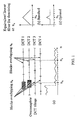
- Fig. 1(a) shows a noise corrupted piecewise constant signal, which together with Figs. 1(b) and (c), illustrates the main principles of the invention.
- Block DCT (4 by 1) decompositions are used for simplicity.
- Fig. 1(a) depicts an overcomplete system of four transforms (DCT 1, ..., DCT 4) that tile the signal as illustrated. Observe that the pixel identified at n e has four block DCTs overlapping it, one block from each transform. Of these four blocks, the first two overlap the "edge" (shown shaded) in the figure, whereas the latter two overlap smooth portions of the signal.
- Equation (4) forms the equivalent filter shown in Fig. 1(b)
- Equation (5) For convenience, zero mean quantities and orthonormal transforms are assumed.
- the objective is to derive the optimal weights in Equation (5) that minimize the conditional mean squared error, given the index sets V 1 ,..., V i ,..., V M , E [
- Equation 10 Focusing attention on the n th pixel, using Equations (5) and (11), gives The objective is to choose the ⁇ i ( n ) so that x and ( n ) minimizes Equation (10).
- This task becomes a conditional linear estimation problem where x ( n ) is estimated using observed quantities x ( n ) + w i ( n ) with the estimation weights ⁇ i ( n ).
- ⁇ ( n ) [ ⁇ 1 ( n )... ⁇ M ( n )] T
- ⁇ 2 / x ( n ) E [ x 2 ( n )]
- z ( n ) [ x ( n ) + w 1 ( n )... x ( n ) + w M ( n )] T .
- W ( n ) p,q E [ w T / p w q
- V 1 ,..., V i ,..., V M ] and, as observed, E [ xw T / i ] 0].
- Equation (15) reduces to where ⁇ is a scaling factor.
- ⁇ is a scaling factor.
- ⁇ i ⁇ i ( n ) 1 is obtained, which determines ⁇ and removes explicit dependence to statistical parameters ⁇ 2 / x ( n ), ⁇ 2 / w , etc.
- G ( n ) depends on the index sets, and there is an implicit dependence on image statistics.
- Equation (20) can be solved within the positive eigenspace of G ( n ) to yield ⁇ ( n ) whenever the rank of G ( n ) is nonzero. For the zero rank case, ⁇ ( n ) is assumed to be set to its standard value.
- Equation (20) As the “full solution,” this solution is complicated as it requires the formation and the solution of G ( n ) at every pixel.
- the matrix element ( p , q ) represents the cross correlation of noise remaining at pixel n after de-noising with the p th and q th transforms (divided by ⁇ 2 / w ). Assuming these cross terms are negligible in comparison to other quantities and thereby setting the off-diagonal elements of G ( n ) to zero yields a diagonal matrix D ( n ) where The solution of Equation (20) with G(n) replaced by D(n) via will be referred to as the "diagonal solution”.
- Equations (5) and (9) the final de-noised estimate can be constructed as where can be thought of as an equivalent time varying linear filter that is applied to the noisy signal y to obtain the de-noised output.
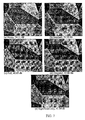
- Fig. 2 illustrates the computed equivalent filters for the full, diagonal, and standard solutions at three pixels progressively situated away from an edge in the image voronoi as shown in the magnified portion of the image voronoi. (That entire image is also shown in Fig. 3, along with another test image, teapot, in Fig. 3.)
- the 45°/135° axis in the plots are in column/row dimensions of the image. Point (0,0) is on top of the respective pixel, and it indicates that factor that is used by the equivalent filter to multiply that pixel. All solutions use the threshold that achieves the best respective image-wide peak signal-to-noise ratio (PSNR) performance.
- PSNR image-wide peak signal-to-noise
- the standard solution does very little spatial averaging in this region.
- the spatial support of the filter is restricted to a very local neighborhood of the respective pixel, and it does not broaden appreciably even when the pixel moves away from the edge.
- the diagonal solution produces filters that are broader in the black voronoi region, which results in better spatial averaging and improved de-noising performance around edges.
- the filters that are the broadest in the black voronoi region are produced by the full solution, which performs significant spatial averaging even for pixel 1, the pixel closest to the edge. All solutions do a good job of not closing the edge, but only the solutions set forth in this invention produce filters that perform significantly broad averaging in the correct region.
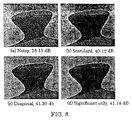
- FIG. 7(a)-(e) and 8(a)-(d) illustrate noisy and de-noised portions of the images
- Fig. 4 it can be seen that the PSNR for the full solution peaks at a much smaller threshold as compared to the other solutions.
- the full solution is the most aggressive in exploiting the model of Equation (11) and is also the most susceptible to modeling failures.
- model failures inevitably happen at higher thresholds which limit the performance of the full solution.
- Better thresholding techniques are expected to improve the optimized solutions' relative performance.
- Better thresholding techniques are expected to improve performance.
- step 901 one such algorithm starts in step 901 by obtaining a noise corrupted signal y .
- threshold T is set to, for example, a multiple of the standard deviation of the noise, or may be computed using another suitable statistical calculation or set to a fixed constant such as 10 or 40.
- step 903 an overcomplete set of linear transforms is applied to the signal y .
- a thresholding (preferably a hard-thresholding) operation is performed on the sets of transform coefficients in step 904 to obtain per-pixel estimates x and i of x , the signal without the noise factor w .
- step 905 the individual estimates at each pixel are evaluated and the optimal weights for the estimates are derived.
- the weighted estimates at each pixel are mathematically combined (e.g., averaged) to obtain a final de-noised signal (step 906).
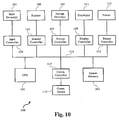
- Fig. 10 illustrates an exemplary system 100 which may be used to implement the processing of the present invention.
- the system includes a central processing unit (CPU) 101 that provides computing resources and controls the computer.
- CPU 101 may be implemented with a microprocessor or the like, and may also include a graphics processor and/or a floating point coprocessor for mathematical computations.
- System 100 further includes system memory 102 which may be in the form of random-access memory (RAM) and read-only memory (ROM).
- RAM random-access memory
- ROM read-only memory
- the system memory may be used to store a de-noising program during its execution as well as data to-be-processed and intermediate results.
- Input controller 103 represents an interface to various input devices 104, such as a keyboard, mouse or stylus. There is also a controller 105 which communicates with a scanner 106 or equivalent device for digitizing documents including images to be processed in accordance with the invention.
- a storage controller 107 interfaces with one or more storage devices 108 each of which includes a storage medium such as magnetic tape or disk, or an optical medium that may be used to record programs of instructions for operating systems, utilities and applications which may include embodiments of programs that implement various aspects of the present invention.
- a display controller 109 provides an interface to a display device 111 which may be any known type of display.
- a printer controller 112 is also provided for communicating with a printer 113 for printing documents including images processed in accordance with the invention.
- a communications controller 114 interfaces with one or more communication devices 115 which enables system 100 to connect to remote devices through any of a variety of networks including the Internet, a local area network (LAN), a wide area network (WAN), or through any suitable electromagnetic carrier signals including infrared signals.
- LAN local area network
- WAN wide area network
- electromagnetic carrier signals including infrared signals.
- bus 116 which may represent more than one physical bus.
- various system components may or may not be in physical proximity to one another.
- the input data and/or the output data may be remotely transmitted from one physical location to another.
- programs that implement various aspects of this invention may be accessed from a remote location (e.g., a server) over a network.
- Such data and/or programs may be conveyed through any of a variety of machine-readable medium including magnetic tape or disk or optical disc, network signals, or any other suitable electromagnetic carrier signals including infrared signals.
- the present invention may be conveniently implemented with software, a hardware implementation or combined hardware/software implementation is also possible.
- a hardware implementation may be realized, for example, using ASIC(s), digital signal processing circuitry, or the like.
- the claim language "device-readable medium” includes not only software-carrying media, but also hardware having instructions for performing the required processing hardwired thereon and also hardware/software combination.
- the claim language "program of instructions” includes both software and instructions embedded on hardware.
- the component(s) referred to in the apparatus claims includes any device or combination of devices capable of performing the claimed operations. Such devices may include instruction-based processors (e.g., CPUs), ASICs, digital processing circuitry, or combination thereof.
- the present invention provides software- or hardware-based algorithms/techniques for removing noise from a digital signal using thresholding in conjunction with linear transforms that provide sparse decompositions.
- the algorithms of this invention have a broad range of applications and in general may be used to remove noise from any digital signal including video, still image, audio (speech, music, etc.) signals.
- the algorithms of this invention may also be used, with some modification, to predict lost regions of data in any of these types of signals, including error correction resulting from network transmission, recovery of damaged images, scratch removal, etc.
- the thresholding operation is applied to each coefficient of a particular linear transform. In the data recovery algorithms briefly described below the thresholding is applied to select coefficients.
- the algorithms of this invention may be incorporated into the more specific de-noising algorithms set forth in the above-identified related applications.
- the algorithms of one such application iteratively recovers the missing pixels in these layers.
- the algorithms select a threshold and evaluate several overcomplete transforms over the layers. Select transform coefficients hard-thresholded and inverse transformed to recover one layer of pixels while keeping the pixels in the other layers unaltered. Given L layers, this operation is repeated L times to recover all of the layers.
- the algorithms reduce the threshold by a specific amount and proceed with the same computations for layer recovery starting with the first layer again. The algorithms terminate when the threshold reaches a predetermined lower level.
- the algorithms of the other related application are the result of the inventor having recognized that most of the recovery performance typically comes from the initial iterations. Hence, the algorithms of this related application provide a fast alternative to the above related application's algorithms while still achieving most of the benefits thereof.
- an initial thresholding decision is used to fix the set of transform coefficients that are thresholded to zero. However, this set is not recomputed at each iteration. Rather, this set is kept fixed for each layer, resulting in significant savings in computation, since the iterative solution is now reduced to a system of linear equations which can be solved directly, i.e., each layer is recovered in a single step without the need for iterations.
- the algorithms of this related application take a significant short-cut by directly solving for the pixels in each layer via the corresponding equation.
- the algorithms of this related application use a single threshold to fully recover the layer pixels, i.e., the reduction of the threshold and further iterations are only desirable if very detailed information is to be recovered.
Landscapes
- Engineering & Computer Science (AREA)
- General Physics & Mathematics (AREA)
- Theoretical Computer Science (AREA)
- Physics & Mathematics (AREA)
- Multimedia (AREA)
- Image Processing (AREA)
- Picture Signal Circuits (AREA)
- Mechanical Engineering (AREA)
- Analogue/Digital Conversion (AREA)
- Noise Elimination (AREA)
- Image Analysis (AREA)
- Facsimile Image Signal Circuits (AREA)
- Compression Or Coding Systems Of Tv Signals (AREA)
Abstract
Description
- This application claims priority under 35 U.S.C. § 119(e) on provisional application serial no. 60/475,401, filed on June 2, 2003. This application is also related to application serial nos. 10/229,667 and 10/646,248, filed on August 28, 2002 and August 22, 2003 respectively and respectively entitled "Iterated De-Noising For Image Recovery" and "Image Recovery Using Thresholding and Direct Linear Solvers." The content of each of these applications is incorporated by reference herein.
- The present invention relates to techniques for removing noise from a digital representation (e.g., a digital image) using a set of overcomplete transforms and thresholding. The techniques may be employed in methods/algorithms which may embodied in software, hardware or combination thereof and may be implemented on a computer or other processor-controlled device.
- The signal in the additive independent and identically distributed (i.i.d.) noise problem continues to receive significant attention as it provides a benchmark for the accurate statistical modeling and representation of signals. The problem was first approached using a single transform and was later extended to overcomplete basis. Since then, the research in this area has thus far concentrated on obtaining better transforms and better thresholding techniques.
- De-noising using linear transforms and thresholding relies on sparse decompositions with the utilized transforms. Under i.i.d. noise assumptions, it can be shown that transform coefficients with small magnitudes have very low signal-to-noise ratio (SNR), and a thresholding nonlinearity that effectively detects and removes (in the case of hard-thresholding) or reduces (in the case of soft-thresholding) these coefficients can be shown to improve the noise performance. Of course, this improvement is confined to the class of signals over which the utilized linear transforms provide sparse decompositions. However, if one imagines typically utilized localized transforms such as wavelets or block discrete cosine transforms (DCTs) over a particular image, it is apparent that many of the DCT or wavelet basis functions comprising the transform will overlap edges and other singularities. It is well known that sparsity properties do not hold over such features and de-noising performance suffers as a result. De-noising with overcomplete transforms tries to remedy this problem by averaging several de-noised estimates (corresponding to shifted versions of the same transform) at every pixel. It is hoped that some of the estimates will provide better performance than others, which will then be rectified in an average.
- It is an object of the present invention to provide further improvements in the technology of de-noising digital signals using overcomplete transforms and thresholding by exploiting a separate degree of freedom not available using the above-discussed de-noising approaches.
- It is another object of this invention to provide a digital image de-noising technique that involves formulating an optimal combination of de-noised estimates for each pixel and solving it for optimal estimates.
- According to one aspect of this invention, methods for obtaining an estimate of a noise-free portion of a noise-containing digital signal are provided. One method comprises the steps of applying a set of M linear transforms to the noise-containing digital signal; determining M initial de-noised estimates of each digital element of the digital signal; deriving a combination of weight factors for the M initial de-noised estimates of each digital element by formulating the combination as a linear estimation problem and solving it for the individual weight factors; and formulating a final de-noised estimate of each digital element based on the corresponding M initial de-noised estimates and the combination of weight factors.
- The set of M linear transforms is preferably applied to the digital signal as a whole or to each digital element.
- For each linear transform in the set of M linear transforms, the M initial de-noised estimates of a particular digital element are preferably obtained by thresholding each transform coefficient that has an absolute value below a threshold and inverse transforming the non-thresholded transform coefficients.
- Preferably, the combination of weight factors is an optimal combination that is derived such that a conditional mean squared error with respect to the initial de-noised estimates is minimized.
- The set of M linear transforms may take any number of forms, including (i) a discrete cosine transform and a predetermined number of its overcomplete shifts, (ii) a wavelet transform and a predetermined number of its overcomplete shifts, or (iii) a Fourier transform and a predetermined number of its overcomplete shifts.
- In preferred embodiments, the digital signal is an image or video frame comprised of a plurality of pixels, wherein each digital element comprises one or a group of pixels.
- In another method, an estimate x and of a noise-free portion x of a noise-containing signal y is obtained. The method comprises obtaining an estimate x and(n) for each element n of x and according to the following equation:wherein weight factors αi (n), i = 1,...,M,n = 1,...,N are optimally determined by formulating a combination thereof as a linear estimation problem. Then, the N x and(n) estimates are combined to obtain x and.

- Preferably, αi (n) are optimally determined such that x and(n) minimizes a conditional mean squared error with respect to the initial de-noised estimates. More preferably, α i (n) the optimal determination is further determined based on a scaling factor that removes explicit dependence to noise variance and on (i) a matrix that is dependent on an overcomplete transform set applied in obtaining each x and(n), (ii) a diagonal matrix that is derived from a matrix that is dependent on an overcomplete transform set applied in obtaining each x and(n), or (iii) a reduced diagonal matrix that is derived from a diagonal matrix that is, in turn, derived from a matrix that is dependent on an overcomplete transform set applied in obtaining each x and(n).
- In other aspects, the invention involves an apparatus including one or more components for performing the processing operations described above in connection with the steps of the methods. Such components may be implemented with hardware, software, or combination thereof. Hardware implementations may be realized using, for example, a general microprocessor, or one or more application specific integrated circuits (ASICs), digital signal processing circuitry, etc., or a combination thereof.
- In accordance with further aspects of the invention, any of the above-described methods or steps thereof may be embodied in a program of instructions (e.g., software) which may be stored on, or conveyed to, a computer or other processor-controlled device for execution. Alternatively, the program of instructions may be integrated with hardware designed to perform one or more of the steps (e.g., one or more ASICs, digital signal processing circuitry, etc.).
- Other objects and attainments together with a fuller understanding of the invention will become apparent and appreciated by referring to the following description and claims taken in conjunction with the accompanying drawings.
-
- Fig. 1(a) illustrates a noise corrupted piecewise constant signal, Fig. 1(b) illustrates the equivalent linear filter for de-noising at ns , and Fig. 1(c) illustrates the optimal filter for de-noising at that point.
- Fig. 2 illustrates the computed equivalent filters for the full, diagonal, and standard solutions at three pixels in the image voronoi.
- Fig. 3 illustrate the test images voronoi (256 x 256) and teapot (960 x 1280).
- Figs. 4, 5 and 6 illustrate peak signal-to-noise ratio (PSNR) vs. threshold curves for the full (Fig. 4 only), diagonal, significant-only, and standard solution systems achieved under different conditions.
- Figs. 7(a)-(e) and 8(a)-(d) illustrate noisy and de-noised portions of the test images.
- Fig. 9 is a flow diagram illustrating the basic process flow of a main algorithm of this invention.
- Fig. 10 is a block diagram illustrating an exemplary system which may be used to implement the techniques of the present invention.
-
- The present invention is primarily directed to the familiar scenario in which i.d.d. noise in an image is removed using a set of overcomplete linear transforms and thresholding. Rather than the standard approach where one obtains the de-noised signal by ad hoc averaging of the de-noised estimates (corresponding to each transform), I formulate the optimal combination as a linear estimation problem for each pixel and solve it for optimal estimates. My approach is independent of the utilized transforms and the thresholding scheme. My derivation of the optimal estimates does not require explicit image statistics but relies solely on the assumption that the utilized transforms provide sparse decompositions. Yet my adaptive estimates utilize implicit conditional statistics, and they make the biggest impact around edges and singularities where standard sparsity assumptions fail.
- Thus, in accordance with the present invention, after an overcomplete set of linear transformations (i.e., either shifted versions of the same transform or a general set of transforms {H 1,H 2,...,HM } with HiH -1 / i = 1, i = 1,...,M, where 1 is the identity) are evaluated at each pixel and the transform coefficients thresholded (preferably, hard-thresholded) and inverse transformed to obtain several de-noised estimates, those estimates are not simply averaged to obtain the final result. Rather, this invention provides a technique for actively determining the better estimates, which are then combined to obtain the final result.
- In so doing, my formulation does not lose the simplicity of averaging, nor does it require any explicit statistics or parameters. Three estimators are derived in order of diminishing computational complexity. The first estimator, which is also the most potent, improves de-noising performance throughout, even when no singularities (e.g., edges) are present in the signal. The second estimator is very simple and solely requires the amount of expected noise energy remaining in pixels after the application of each transform. For hard-thresholding, this can be approximated by the number of coefficients that survive thresholding, or the number of non-zero coefficients (after thresholding) with basis functions overlapping the given pixel, to yield the third estimate. It should be noted that hard-thresholding a coefficient c yields 0 if |c|≤T, and leaves the coefficient unchanged otherwise.
- As is the case with the inventions of the above-identified related applications, the role of the utilized transformations remain very important. Indeed, the underlying operational basis of the algorithms of this invention is sparse image representations with the utilized linear transforms. Thus, the present invention may be used to remove noise from a digital image/video-frame and may also be embodied in recovery algorithms that employ spatial prediction to recover lost data in the image or video-frame. The details of the present techniques and algorithms of the present invention are described below.
- Let x(N × 1) denote the signal, let y = x + w denote the noise corrupted signal, and let Hi (N × N), i = 1,..., M denote an overcomplete set of linear transforms. It is to be understood that (N × 1) determines the dimension of the matrix/vector x. In overcomplete de-noising, the transform coefficients of each transform is thresholded to obtain an estimate x and i of x, given y. These individual estimates are then combined to arrive at an overall estimate x and. The individual estimates x andi corresponding to each transform can be obtained in three stages for i = 1,..., M as follows:In this invention, the above equation (1) is replaced with
 where the weights αi (n),i = 1,...,M,n = 1,...,N are determined optimally as described below. For naturally overcomplete transforms such complex wavelets the techniques of this invention correspond to doing a pixel adaptive inverse transform. As will be become clear, this invention can accommodate a large variety of thresholding non-linearities; however, for the examples herein the thresholding function will be taken as a non-linearity that implements spatially uniform hard-thresholding on each coefficient via
 for k = 1,...,N , where ci (k) is the kth transform coefficient of the ith transform, and T is a given threshold. To help later notation, index sets are defined as
 With this notation and hard-thresholding, Equation (3) becomes
- Fig. 1(a) shows a noise corrupted piecewise constant signal, which together with Figs. 1(b) and (c), illustrates the main principles of the invention. Block DCT (4 by 1) decompositions are used for simplicity. Fig. 1(a) depicts an overcomplete system of four transforms (
DCT 1, ..., DCT 4) that tile the signal as illustrated. Observe that the pixel identified at ne has four block DCTs overlapping it, one block from each transform. Of these four blocks, the first two overlap the "edge" (shown shaded) in the figure, whereas the latter two overlap smooth portions of the signal. From approximation principles, it is expected that the block DCTs overlapping the smooth regions will provide sparse decompositions and yield good individual de-noised estimates for the pixel at ne , whereas the block DCTs overlapping the edge will not give rise to good de-noised estimates at ne . Hence, rather than setting αi (n) = 0.25 for i = 1,...,4 in Equation (4), it is beneficial to give more weight to i = 3,4 and less weight to i = 1,2 when the individual estimates are combined. - In the case of pixel ns , consider the example case where the hard-thresholding operation only retains the DC terms of the DCT coefficients in the four overlapping blocks. For this case, while Equation (4) forms the equivalent filter shown in Fig. 1(b), the optimal is given by α 1(ns ) = α 4(ns ) = 0.5, α 2(ns ) = α 3(ns ) = 0 as shown in Fig. 1(c).
- For convenience, zero mean quantities and orthonormal transforms are assumed. The objective is to derive the optimal weights in Equation (5) that minimize the conditional mean squared error, given the index sets V 1,...,Vi ,...,VM ,
V - Focusing attention on the nth pixel, using Equations (5) and (11), givesThe objective is to choose the α i (n) so that x and(n) minimizes Equation (10). This task becomes a conditional linear estimation problem where x(n) is estimated using observed quantities x(n) + wi (n) with the estimation weights αi (n).

- Let Γ(n) = [α1(n)...α M (n)] T ,
σ 2 / x(n) = E[x 2(n)], and z(n) = [x(n) + w 1(n)...x(n) + wM (n)] T . Equation (13) becomeswhere W(n) p,q = E[w T / p wq |V 1,...,Vi ,...,VM ] and, as observed, E[xw T / i] = 0].
- Let un (N×1) denote the unit vector that is 1 in the nth component and 0 otherwise. Using Equation (12) and under the i.i.d. noise assumption, the matrix elements of W(n) (M × M) can be written as
V σ 2 / w is the noise variance and G(n)(M × M) is a matrix that is solely dependent on the overcomplete transform set and the index sets Vi . - Then, Equation (15) reduces towhere λ is a scaling factor. Under the

assumption σ 2 / x(n)>>σ 2 / w, ∑ iαi (n) = 1 is obtained, which determines λ and removes explicit dependence to statistical parameters σ 2 / x(n),σ 2 / w, etc. Note however that the form of G(n) depends on the index sets, and there is an implicit dependence on image statistics. - Since G(n) is positive semidefinite, Equation (20) can be solved within the positive eigenspace of G(n) to yield Γ(n) whenever the rank of G(n) is nonzero. For the zero rank case, Γ(n) is assumed to be set to its standard value.
- Referring to equation (20) as the "full solution," this solution is complicated as it requires the formation and the solution of G(n) at every pixel. Looking at the form G(n) through Equation (16), observe that the matrix element (p,q) represents the cross correlation of noise remaining at pixel n after de-noising with the pth and qth transforms (divided by
σ 2 / w). Assuming these cross terms are negligible in comparison to other quantities and thereby setting the off-diagonal elements of G(n) to zero yields a diagonal matrix D(n) whereThe solution of Equation (20) with G(n) replaced by D(n) via will be referred to as the "diagonal solution".
- While much simpler, this solution still requires the keeping track of the actual values of the transform basis functions at every pixel sinceThe "significant-only" solution is obtained by replacing the diagonal matrix D(n) p , p with
 in Equation (22). Observe that for block transforms the diagonal entry
 (n) p·p is determined by the number of nonzero coefficients (the total number of coefficients in a block minus the number of coefficients hard-thresholded to zero) produced by the pth transform with basis functions overlapping the nth pixel. The weight for the pth transform at a given pixel will thus be proportional to the inverse of the number of nonzero coefficients produced by the transform with basis functions overlapping the pixel.
- Using Equations (5) and (9) the final de-noised estimate can be constructed aswhere
 can be thought of as an equivalent time varying linear filter that is applied to the noisy signal y to obtain the de-noised output. Fig. 2 illustrates the computed equivalent filters for the full, diagonal, and standard solutions at three pixels progressively situated away from an edge in the image voronoi as shown in the magnified portion of the image voronoi. (That entire image is also shown in Fig. 3, along with another test image, teapot, in Fig. 3.) The equivalent filters are constructed using fully overcomplete 8 × 8 DCTs, σ w = 5. The 45°/135° axis in the plots are in column/row dimensions of the image. Point (0,0) is on top of the respective pixel, and it indicates that factor that is used by the equivalent filter to multiply that pixel. All solutions use the threshold that achieves the best respective image-wide peak signal-to-noise ratio (PSNR) performance.
- Since a piecewise constant model is appropriate for this image, it is expected that L(n) will average pixels in the black voronoi region to obtain the de-noised result. As can be seen in the figure, the standard solution does very little spatial averaging in this region. The spatial support of the filter is restricted to a very local neighborhood of the respective pixel, and it does not broaden appreciably even when the pixel moves away from the edge. On the other hand, the diagonal solution produces filters that are broader in the black voronoi region, which results in better spatial averaging and improved de-noising performance around edges. For this example, the filters that are the broadest in the black voronoi region are produced by the full solution, which performs significant spatial averaging even for
pixel 1, the pixel closest to the edge. All solutions do a good job of not closing the edge, but only the solutions set forth in this invention produce filters that perform significantly broad averaging in the correct region. - De-noising results for the two test images shown in Fig. 3 are presented. All techniques are shown at the threshold that achieves peak PSNR. The utilized 8 x 8 DCTs and the 3 level, orthonormal, Daubechies D8 wavelets are fully overcomplete. The PSNR vs. threshold curves for the full (Fig. 4 only), diagonal, significant-only and standard solution systems are shown in Figs. 4-6. Fig. 4 is 8 × 8 DCT results on voronoi with σ w = 5; Fig. 5 is 8 × 8 DCT results on teapot with σ w = 10; and Fig. 6 is orthonormal D8 results on teapot with σ w = 10. Figs. 7(a)-(e) and 8(a)-(d) illustrate noisy and de-noised portions of the images, Fig. 7(a)-(e) showing 8 × 8 DCT results on voronoi with σ w = 5 and Figs. 8(a)-(d) showing 8 × 8 DCT results on teapot with σ w = 10. In Fig. 4, it can be seen that the PSNR for the full solution peaks at a much smaller threshold as compared to the other solutions.
- The full solution is the most aggressive in exploiting the model of Equation (11) and is also the most susceptible to modeling failures. Using hard-thresholding, model failures inevitably happen at higher thresholds which limit the performance of the full solution. Better thresholding techniques are expected to improve the optimized solutions' relative performance. For wavelets, the obtained results are about 0.2 dB better than the standard system (on the standard image Lena, improvements over the standard system are around 0.1 dB at σ w = 10). Using hard-thresholding, the overcomplete transforms associated with the utilized wavelet banks produce comparable entries in D(n) p·p for p = 1,...,M, which limits gains. Better thresholding techniques are expected to improve performance.
- The above-described principles of the invention can be incorporated into de-noising algorithms. Referring to the flow diagram of Fig. 9, one such algorithm starts in
step 901 by obtaining a noise corrupted signal y. Instep 902, threshold T is set to, for example, a multiple of the standard deviation of the noise, or may be computed using another suitable statistical calculation or set to a fixed constant such as 10 or 40. - In
step 903, an overcomplete set of linear transforms is applied to the signal y. A thresholding (preferably a hard-thresholding) operation, such as that defined in Equation (6), is performed on the sets of transform coefficients instep 904 to obtain per-pixel estimates x andi of x, the signal without the noise factor w. Next, instep 905, the individual estimates at each pixel are evaluated and the optimal weights for the estimates are derived. The weighted estimates at each pixel are mathematically combined (e.g., averaged) to obtain a final de-noised signal (step 906). - Fig. 10 illustrates an
exemplary system 100 which may be used to implement the processing of the present invention. As illustrated in Fig. 10, the system includes a central processing unit (CPU) 101 that provides computing resources and controls the computer.CPU 101 may be implemented with a microprocessor or the like, and may also include a graphics processor and/or a floating point coprocessor for mathematical computations.System 100 further includessystem memory 102 which may be in the form of random-access memory (RAM) and read-only memory (ROM). The system memory may be used to store a de-noising program during its execution as well as data to-be-processed and intermediate results. - A number of controllers and peripheral devices are also provided, as shown in Fig. 10.
Input controller 103 represents an interface tovarious input devices 104, such as a keyboard, mouse or stylus. There is also acontroller 105 which communicates with ascanner 106 or equivalent device for digitizing documents including images to be processed in accordance with the invention. Astorage controller 107 interfaces with one ormore storage devices 108 each of which includes a storage medium such as magnetic tape or disk, or an optical medium that may be used to record programs of instructions for operating systems, utilities and applications which may include embodiments of programs that implement various aspects of the present invention. Adisplay controller 109 provides an interface to adisplay device 111 which may be any known type of display. Aprinter controller 112 is also provided for communicating with aprinter 113 for printing documents including images processed in accordance with the invention. Acommunications controller 114 interfaces with one ormore communication devices 115 which enablessystem 100 to connect to remote devices through any of a variety of networks including the Internet, a local area network (LAN), a wide area network (WAN), or through any suitable electromagnetic carrier signals including infrared signals. - In the illustrated system, all major system components connect to
bus 116 which may represent more than one physical bus. However, various system components may or may not be in physical proximity to one another. For example, the input data and/or the output data may be remotely transmitted from one physical location to another. Also, programs that implement various aspects of this invention may be accessed from a remote location (e.g., a server) over a network. Such data and/or programs may be conveyed through any of a variety of machine-readable medium including magnetic tape or disk or optical disc, network signals, or any other suitable electromagnetic carrier signals including infrared signals. - While the present invention may be conveniently implemented with software, a hardware implementation or combined hardware/software implementation is also possible. A hardware implementation may be realized, for example, using ASIC(s), digital signal processing circuitry, or the like. As such, the claim language "device-readable medium" includes not only software-carrying media, but also hardware having instructions for performing the required processing hardwired thereon and also hardware/software combination. Similarly, the claim language "program of instructions" includes both software and instructions embedded on hardware. Also, the component(s) referred to in the apparatus claims includes any device or combination of devices capable of performing the claimed operations. Such devices may include instruction-based processors (e.g., CPUs), ASICs, digital processing circuitry, or combination thereof. With these implementation alternatives in mind, it is to be understood that the figures and accompanying description provide the functional information one skilled in the art would require to write program code (i.e., software) or to fabricate circuits (i.e., hardware) to perform the processing required.
- As the foregoing demonstrates, the present invention provides software- or hardware-based algorithms/techniques for removing noise from a digital signal using thresholding in conjunction with linear transforms that provide sparse decompositions. The algorithms of this invention have a broad range of applications and in general may be used to remove noise from any digital signal including video, still image, audio (speech, music, etc.) signals. The algorithms of this invention may also be used, with some modification, to predict lost regions of data in any of these types of signals, including error correction resulting from network transmission, recovery of damaged images, scratch removal, etc. In the algorithms of the present application, the thresholding operation is applied to each coefficient of a particular linear transform. In the data recovery algorithms briefly described below the thresholding is applied to select coefficients.
- With respect to predicting lost regions of data, the algorithms of this invention may be incorporated into the more specific de-noising algorithms set forth in the above-identified related applications. The algorithms of one such application iteratively recovers the missing pixels in these layers. Upon filling the layers with an initial value, the algorithms select a threshold and evaluate several overcomplete transforms over the layers. Select transform coefficients hard-thresholded and inverse transformed to recover one layer of pixels while keeping the pixels in the other layers unaltered. Given L layers, this operation is repeated L times to recover all of the layers. After that, the algorithms reduce the threshold by a specific amount and proceed with the same computations for layer recovery starting with the first layer again. The algorithms terminate when the threshold reaches a predetermined lower level.
- The algorithms of the other related application are the result of the inventor having recognized that most of the recovery performance typically comes from the initial iterations. Hence, the algorithms of this related application provide a fast alternative to the above related application's algorithms while still achieving most of the benefits thereof. In the algorithms of this related application, an initial thresholding decision is used to fix the set of transform coefficients that are thresholded to zero. However, this set is not recomputed at each iteration. Rather, this set is kept fixed for each layer, resulting in significant savings in computation, since the iterative solution is now reduced to a system of linear equations which can be solved directly, i.e., each layer is recovered in a single step without the need for iterations. Compared with the above related application's algorithms, the algorithms of this related application take a significant short-cut by directly solving for the pixels in each layer via the corresponding equation. In their simplest form, the algorithms of this related application use a single threshold to fully recover the layer pixels, i.e., the reduction of the threshold and further iterations are only desirable if very detailed information is to be recovered.
- While the invention has been described in conjunction with several specific embodiments, further alternatives, modifications, variations and applications will be apparent to those skilled in the art in light of the foregoing description. Thus, the invention described herein is intended to embrace all such alternatives, modifications, variations and applications as may fall within the spirit and scope of the appended claims.
Claims (31)
- A method for obtaining an estimate of a noise-free portion of a noise-containing digital signal, comprising the steps of:(a) applying a set of M linear transforms to the noise-containing digital signal;(b) determining M initial de-noised estimates of each digital element of the digital signal;(c) deriving a combination of weight factors for the M initial de-noised estimates of each digital element by formulating the combination as a linear estimation problem and solving it for the individual weight factors; and(d) formulating a final de-noised estimate of each digital element based on the corresponding M initial de-noised estimates and the combination of weight factors determined in steps (b) and (c) respectively.
- The method of claim 1, wherein the set of M linear transforms is applied to the digital signal as a whole or to each digital element.
- The method of claim 1, wherein, for each linear transform in the set of M linear transforms, the M initial de-noised estimates of a particular digital element are obtained by thresholding each transform coefficient that has an absolute value below a threshold and inverse transforming the non-thresholded transform coefficients.
- The method of claim 1, wherein the combination of weight factors is an optimal combination.
- The method of claim 1, wherein the combination of weight factors is derived such that a conditional mean squared error with respect to the initial de-noised estimates is minimized.
- The method of claim 1, wherein the set of M linear transforms comprises (i) a discrete cosine transform and a predetermined number of its overcomplete shifts, (ii) a wavelet transform and a predetermined number of its overcomplete shifts, or (iii) a Fourier transform and a predetermined number of its overcomplete shifts.
- The method of claim 1, wherein the digital signal is an image or video frame comprised of a plurality of pixels, wherein each digital element comprises one or a group of pixels.
- A method for obtaining an estimate x and of a noise-free portion x of a noise-containing signal y, comprising the steps of:wherein weight factors αi (n),i = 1,..., M,n = 1,..., N are optimally determined by formulating a combination thereof as a linear estimation problem; andobtaining an estimate x and(n) for each element n of x and according to the following equation:

combining the N x and(n) estimates to obtain x and. - The method of claim 8, wherein α i (n) are optimally determined such that x and(n) minimizes a conditional mean squared error with respect to the initial de-noised estimates.
- The method of claim 9, wherein α i (n) are optimally determined based on a scaling factor that removes explicit dependence to noise variance and on a matrix that is dependent on an overcomplete transform set applied in obtaining each x and(n).
- The method of claim 9, wherein αi (n) are optimally determined based on a scaling factor that removes explicit dependence to noise variance and on a diagonal matrix that is derived from a matrix that is dependent on an overcomplete transform set applied in obtaining each x and(n).
- The method of claim 9, α i (n) are optimally determined based on a scaling factor that removes explicit dependence to noise variance and on a reduced diagonal matrix that is derived from a diagonal matrix that is, in turn, derived from a matrix that is dependent on an overcomplete transform set applied in obtaining each x and(n).
- An apparatus for obtaining an estimate of a noise-free portion of a noise-containing digital signal, the apparatus comprising:one or more components configured to:apply a set of M linear transforms to the noise-containing digital signal;determine M initial de-noised estimates of each digital element of the digital signal;derive a combination of weight factors for the M initial de-noised estimates of each digital element by formulating the combination as a linear estimation problem and solving it for the individual weight factors; andformulate a final de-noised estimate of each digital element based on the corresponding M initial de-noised estimates and the combination of weight factors determined in steps (b) and (c) respectively.
- The apparatus of claim 13, wherein the set of M linear transforms is applied to the digital signal as a whole or to each digital element.
- The apparatus of claim 13, wherein, for each linear transform in the set of M linear transforms, the M initial de-noised estimates of a particular digital element are obtained by thresholding each transform coefficient that has an absolute value below a threshold and inverse transforming the non-thresholded transform coefficients.
- The apparatus of claim 13, wherein the combination of weight factors is an optimal combination.
- The apparatus of claim 13, wherein the combination of weight factors is derived such that a conditional mean squared error with respect to the initial de-noised estimates is minimized.
- The apparatus of claim 13, wherein the set of M linear transforms comprises (i) a discrete cosine transform and a predetermined number of its overcomplete shifts, (ii) a wavelet transform and a predetermined number of its overcomplete shifts, or (iii) a Fourier transform and a predetermined number of its overcomplete shifts.
- The apparatus of claim 13, wherein the digital signal is an image or video frame comprised of a plurality of pixels, wherein each digital element comprises one or a group of pixels.
- A device-readable medium having a program of instructions for directing a machine to perform a process of obtaining an estimate of a noise-free portion of a noise-containing digital signal, the program comprising:(a) instructions for applying a set of M linear transforms to the noise-containing digital signal;(b) instructions for determining M initial de-noised estimates of each digital element of the digital signal;(c) instructions for deriving a combination of weight factors for the M initial de-noised estimates of each digital element by formulating the combination as a linear estimation problem and solving it for the individual weight factors; and(d) instructions for formulating a final de-noised estimate of each digital element based on the corresponding M initial de-noised estimates and the combination of weight factors determined in steps (b) and (c) respectively.
- The device-readable medium of claim 20, wherein instruction (a) comprises instructions for applying the set of M linear transforms to the digital signal as a whole or to each digital element.
- The device-readable medium of claim 20, wherein instruction (b) comprise instructions for obtaining the M initial de-noised estimates of each digital element by thresholding each transform coefficient, of each linear transform in the set of M linear transforms, that has an absolute value below a threshold and inverse transforming the non-thresholded transform coefficients.
- The device-readable medium of claim 20, wherein, in instruction (c), the combination of weight factors is an optimal combination.
- The device-readable medium of claim 20, wherein, in instruction (c), the combination of weight factors is derived such that a conditional mean squared error with respect to the initial de-noised estimates is minimized.
- The device-readable medium of claim 20, wherein, in instruction (a), the set of M linear transforms comprises (i) a discrete cosine transform and a predetermined number of its overcomplete shifts, (ii) a wavelet transform and a predetermined number of its overcomplete shifts, or (iii) a Fourier transform and a predetermined number of its overcomplete shifts.
- The device-readable medium of claim 20, wherein the digital signal is an image or video frame comprised of a plurality of pixels, wherein each digital element comprises one or a group of pixels.
- A device-readable medium having a program of instructions for directing a machine to perform a process of obtaining an estimate x and of a noise-free portion x of a noise-containing signal y, the program comprising:wherein weight factors αi (n),i = 1,...,M,n = 1,...,N are optimally determined by formulating a combination thereof as a linear estimation problem; andinstructions for obtaining an estimate x and(n) for each element n of x and according to the following equation:

instructions for combining the N x and(n) estimates to obtain x and. - The device-readable medium of claim 27, wherein α i (n) are optimally determined such that x and(n) minimizes a conditional mean squared error with respect to the initial de-noised estimates.
- The device-readable medium of claim 28, wherein αi (n) are optimally determined based on a scaling factor that removes explicit dependence to noise variance and on a matrix that is dependent on an overcomplete transform set applied in obtaining each x and(n).
- The device-readable medium of claim 28, wherein αi (n) are optimally determined based on a scaling factor that removes explicit dependence to noise variance and on a diagonal matrix that is derived from a matrix that is dependent on an overcomplete transform set applied in obtaining each x and(n).
- The device-readable medium of claim 28, αi (n) are optimally determined based on a scaling factor that removes explicit dependence to noise variance and on a reduced diagonal matrix that is derived from a diagonal matrix that is, in turn, derived from a matrix that is dependent on an overcomplete transform set applied in obtaining each x and(n).
Applications Claiming Priority (4)
| Application Number | Priority Date | Filing Date | Title |
|---|---|---|---|
| US779540 | 1991-10-18 | ||
| US47540103P | 2003-06-02 | 2003-06-02 | |
| US475401P | 2003-06-02 | ||
| US10/779,540 US7352909B2 (en) | 2003-06-02 | 2004-02-13 | Weighted overcomplete de-noising |
Publications (3)
| Publication Number | Publication Date |
|---|---|
| EP1503334A2 true EP1503334A2 (en) | 2005-02-02 |
| EP1503334A3 EP1503334A3 (en) | 2005-07-20 |
| EP1503334B1 EP1503334B1 (en) | 2006-06-28 |
Family
ID=33457686
Family Applications (1)
| Application Number | Title | Priority Date | Filing Date |
|---|---|---|---|
| EP04012341A Expired - Lifetime EP1503334B1 (en) | 2003-06-02 | 2004-05-25 | Weighted overcomplete de-noising |
Country Status (6)
| Country | Link |
|---|---|
| US (1) | US7352909B2 (en) |
| EP (1) | EP1503334B1 (en) |
| JP (1) | JP2004362578A (en) |
| KR (1) | KR100613850B1 (en) |
| CN (1) | CN1599459A (en) |
| DE (1) | DE602004001366T2 (en) |
Families Citing this family (22)
| Publication number | Priority date | Publication date | Assignee | Title |
|---|---|---|---|---|
| EP1394742B1 (en) * | 2002-08-23 | 2007-12-12 | STMicroelectronics S.r.l. | Method for filtering the noise of a digital image sequence |
| EP1605403A1 (en) * | 2004-06-08 | 2005-12-14 | STMicroelectronics S.r.l. | Filtering of noisy images |
| US8594448B2 (en) * | 2004-08-16 | 2013-11-26 | Hewlett-Packard Development Company, L.P. | Bi-selective filtering in transform domain |
| US7433427B2 (en) * | 2004-11-29 | 2008-10-07 | Hewlett-Packard Development Company, L.P. | Enhanced denoising system utilizing incremental parsing |
| US7627059B2 (en) * | 2005-04-05 | 2009-12-01 | Samsung Electronics Co., Ltd. | Method of robust timing detection and carrier frequency offset estimation for OFDM systems |
| US7616699B2 (en) * | 2005-04-12 | 2009-11-10 | Samsung Electronics Co., Ltd. | Method of soft bit metric calculation with direct matrix inversion MIMO detection |
| US20060285590A1 (en) * | 2005-06-21 | 2006-12-21 | Docomo Communications Laboratories Usa, Inc. | Nonlinear, prediction filter for hybrid video compression |
| US7751506B2 (en) | 2005-12-01 | 2010-07-06 | Samsung Electronics Co., Ltd. | Method for the soft bit metric calculation with linear MIMO detection for LDPC codes |
| CN105376573A (en) | 2006-11-08 | 2016-03-02 | 汤姆逊许可证公司 | Methods and apparatus for in-loop de-artifact filtering |
| CN101779464B (en) * | 2007-06-08 | 2014-02-12 | 汤姆森特许公司 | In-loop anti-artifact filtering method and device based on multi-grid sparsity filtering |
| US7965900B2 (en) | 2007-09-26 | 2011-06-21 | Hewlett-Packard Development Company, L.P. | Processing an input image to reduce compression-related artifacts |
| EP2229782A2 (en) * | 2008-01-14 | 2010-09-22 | Thomson Licensing | Methods and apparatus for de-artifact filtering using multi-lattice sparsity-based filtering |
| US20100278236A1 (en) * | 2008-01-17 | 2010-11-04 | Hua Yang | Reduced video flicker |
| US8731062B2 (en) * | 2008-02-05 | 2014-05-20 | Ntt Docomo, Inc. | Noise and/or flicker reduction in video sequences using spatial and temporal processing |
| EP2351374A1 (en) * | 2008-11-25 | 2011-08-03 | Thomson Licensing | Methods and apparatus for sparsity-based de-artifact filtering for video encoding and decoding |
| CN102184523B (en) * | 2011-04-13 | 2012-11-21 | 展讯通信(上海)有限公司 | Digital image noise reduction method and system based on multiresolution and overcomplete transformation |
| CN103854258A (en) * | 2012-12-07 | 2014-06-11 | 山东财经大学 | Image denoising method based on Contourlet transformation self-adaptation direction threshold value |
| CN104134191B (en) * | 2014-07-11 | 2017-11-28 | 三星电子(中国)研发中心 | Image de-noising method and its device |
| CN110443194B (en) * | 2019-08-05 | 2021-09-07 | 哈尔滨工业大学 | A time-varying signal component extraction method based on SPI sparsity constraint |
| CN113971636B (en) * | 2020-07-24 | 2025-04-29 | 中移(苏州)软件技术有限公司 | A method, device, equipment and storage medium for processing critical noise data |
| CN115457946B (en) * | 2021-06-08 | 2025-07-04 | 佛山市顺德区美的洗涤电器制造有限公司 | Noise removal method, device, electronic equipment and medium |
| CN113822321B (en) * | 2021-07-12 | 2024-03-01 | 腾讯科技(深圳)有限公司 | Model generation training method and device, noise scale generation method and computing equipment |
Family Cites Families (24)
| Publication number | Priority date | Publication date | Assignee | Title |
|---|---|---|---|---|
| US6610256B2 (en) * | 1989-04-05 | 2003-08-26 | Wisconsin Alumni Research Foundation | Image processing and analysis of individual nucleic acid molecules |
| US5081690A (en) | 1990-05-08 | 1992-01-14 | Eastman Kodak Company | Row-by-row segmentation and thresholding for optical character recognition |
| JP2840694B2 (en) * | 1990-06-30 | 1998-12-24 | ソニー株式会社 | Data recording device |
| US5442462A (en) * | 1992-06-10 | 1995-08-15 | D.V.P. Technologies Ltd. | Apparatus and method for smoothing images |
| JP3258821B2 (en) * | 1994-06-02 | 2002-02-18 | 三菱電機株式会社 | Method for positioning and analyzing minute foreign matter, analyzer used for the method, and method for manufacturing semiconductor element or liquid crystal display element using the same |
| JPH08163594A (en) * | 1994-12-12 | 1996-06-21 | Sony Corp | Moving picture decoding method and moving picture decoding apparatus |
| FR2736741B1 (en) | 1995-07-11 | 1997-09-26 | Khiplus | METHOD FOR PROCESSING A SOURCE SEQUENCE OF NOISE DIGITAL IMAGES |
| KR100196872B1 (en) | 1995-12-23 | 1999-06-15 | 전주범 | Apparatus for restoring error of image data in image decoder |
| KR100197366B1 (en) | 1995-12-23 | 1999-06-15 | 전주범 | Video Error Recovery Device |
| KR100197368B1 (en) | 1995-12-23 | 1999-06-15 | 전주범 | Video Error Recovery Device |
| KR100220678B1 (en) | 1995-12-29 | 1999-09-15 | 전주범 | Channel Error Correction Method for Image Signals Transmitted from Block |
| US6212663B1 (en) | 1997-10-23 | 2001-04-03 | Sony Corporation | Apparatus and method for recovery of quantization codes in a lossy transmission environment |
| US6285410B1 (en) * | 1998-09-11 | 2001-09-04 | Mgi Software Corporation | Method and system for removal of flash artifacts from digital images |
| KR100587280B1 (en) | 1999-01-12 | 2006-06-08 | 엘지전자 주식회사 | Error concealment method |
| US6377280B1 (en) | 1999-04-14 | 2002-04-23 | Intel Corporation | Edge enhanced image up-sampling algorithm using discrete wavelet transform |
| US6643406B1 (en) | 1999-07-28 | 2003-11-04 | Polaroid Corporation | Method and apparatus for performing linear filtering in wavelet based domain |
| US6455860B1 (en) * | 1999-09-30 | 2002-09-24 | Gatan, Inc. | Resolution enhancement device for an optically-coupled image sensor using high extra-mural absorbent fiber |
| US6549674B1 (en) | 2000-10-12 | 2003-04-15 | Picsurf, Inc. | Image compression based on tiled wavelet-like transform using edge and non-edge filters |
| US6611627B1 (en) | 2000-04-24 | 2003-08-26 | Eastman Kodak Company | Digital image processing method for edge shaping |
| US6859565B2 (en) * | 2001-04-11 | 2005-02-22 | Hewlett-Packard Development Company, L.P. | Method and apparatus for the removal of flash artifacts |
| US6567497B2 (en) * | 2001-04-20 | 2003-05-20 | Lockheed Martin Corporation | Method and apparatus for inspecting a structure using X-rays |
| US7206459B2 (en) | 2001-07-31 | 2007-04-17 | Ricoh Co., Ltd. | Enhancement of compressed images |
| US6862366B2 (en) | 2001-09-13 | 2005-03-01 | Seiko Epson Corporation | Techniques for scratch and date removal from scanned film |
| US6587592B2 (en) | 2001-11-16 | 2003-07-01 | Adobe Systems Incorporated | Generating replacement data values for an image region |
-
2004
- 2004-02-13 US US10/779,540 patent/US7352909B2/en not_active Expired - Fee Related
- 2004-04-30 KR KR1020040030488A patent/KR100613850B1/en not_active Expired - Fee Related
- 2004-05-25 DE DE602004001366T patent/DE602004001366T2/en not_active Expired - Lifetime
- 2004-05-25 EP EP04012341A patent/EP1503334B1/en not_active Expired - Lifetime
- 2004-06-02 JP JP2004164501A patent/JP2004362578A/en not_active Withdrawn
- 2004-06-02 CN CNA2004100473637A patent/CN1599459A/en active Pending
Non-Patent Citations (3)
| Title |
|---|
| GULERYUZ O G ED - MATTHEWS M B (ED) INSTITUTE OF ELECTRICAL AND ELECTRONICS ENGINEERS: "Weighted overcomplete denoising" CONFERENCE RECORD OF THE 37TH. ASILOMAR CONFERENCE ON SIGNALS, SYSTEMS, & COMPUTERS. PACIFIC GROOVE, CA, NOV. 9 - 12, 2003, ASILOMAR CONFERENCE ON SIGNALS, SYSTEMS AND COMPUTERS, NEW YORK, NY : IEEE, US, vol. VOL. 1 OF 2. CONF. 37, 9 November 2003 (2003-11-09), pages 1992-1996, XP010701672 ISBN: 0-7803-8104-1 * |
| R. COIFMAN AND D. DONOHO: "Translation invariant denoising" TECHNICAL REPORT, DEPT. OF STATISTICS, STANFORD UNIVERSITY, [Online] no. 475, May 1995 (1995-05), pages 1-26, XP002328831 STANFORD UNIVERSITY Retrieved from the Internet: URL:http://www-stat.stanford.edu/~donoho/R eports/1995/TIDeNoise.pdf> [retrieved on 2005-05-20] * |
| XIN LI ET AL: "Spatially adaptive image denoising under overcomplete expansion" IMAGE PROCESSING, 2000. PROCEEDINGS. 2000 INTERNATIONAL CONFERENCE ON SEPTEMBER 10-13, 2000, PISCATAWAY, NJ, USA,IEEE, vol. 3, 10 September 2000 (2000-09-10), pages 300-303, XP010529463 ISBN: 0-7803-6297-7 * |
Also Published As
| Publication number | Publication date |
|---|---|
| EP1503334A3 (en) | 2005-07-20 |
| US7352909B2 (en) | 2008-04-01 |
| EP1503334B1 (en) | 2006-06-28 |
| JP2004362578A (en) | 2004-12-24 |
| DE602004001366T2 (en) | 2006-11-09 |
| KR100613850B1 (en) | 2006-08-17 |
| US20040240545A1 (en) | 2004-12-02 |
| DE602004001366D1 (en) | 2006-08-10 |
| KR20040104362A (en) | 2004-12-10 |
| CN1599459A (en) | 2005-03-23 |
Similar Documents
| Publication | Publication Date | Title |
|---|---|---|
| EP1503334B1 (en) | Weighted overcomplete de-noising | |
| Heckel et al. | Deep decoder: Concise image representations from untrained non-convolutional networks | |
| US7120308B2 (en) | Iterated de-noising for image recovery | |
| Cai et al. | Convergence analysis of tight framelet approach for missing data recovery | |
| Guleryuz | Weighted averaging for denoising with overcomplete dictionaries | |
| US6950473B2 (en) | Hybrid technique for reducing blocking and ringing artifacts in low-bit-rate coding | |
| Wen et al. | Joint adaptive sparsity and low-rankness on the fly: An online tensor reconstruction scheme for video denoising | |
| US20070165961A1 (en) | Method And Apparatus For Reducing Motion Blur In An Image | |
| Gupta et al. | Image denoising using wavelet transform method | |
| Guleryuz | Weighted overcomplete denoising | |
| Motta et al. | The iDUDE framework for grayscale image denoising | |
| Zhang et al. | Kernel Wiener filtering model with low-rank approximation for image denoising | |
| Wang et al. | Multi-matrices low-rank decomposition with structural smoothness for image denoising | |
| US8478062B2 (en) | Reducing signal-dependent noise in digital cameras | |
| US7260269B2 (en) | Image recovery using thresholding and direct linear solvers | |
| CN109446473A (en) | Steady tensor principal component analytical method based on piecemeal | |
| Dong et al. | Sparsity fine tuning in wavelet domain with application to compressive image reconstruction | |
| US20050105817A1 (en) | Inter and intra band prediction of singularity coefficients using estimates based on nonlinear approximants | |
| Lavanya et al. | Transformations analysis for image denoising using complex wavelet transform | |
| Wan et al. | Bayesian multiscale approach to joint image restoration and edge detection | |
| CN114418892A (en) | Image deblurring method combining robust significant edge selection and sparsity | |
| Sezan et al. | Tutorial review of recent developments in digital image restoration | |
| Metri et al. | Patch based wiener filter for image denoising | |
| Fei et al. | Image denoising based on the dyadic wavelet transform | |
| Danielyan | Block-based collaborative 3-D transform domain modeling in inverse imaging |
Legal Events
| Date | Code | Title | Description |
|---|---|---|---|
| PUAI | Public reference made under article 153(3) epc to a published international application that has entered the european phase |
Free format text: ORIGINAL CODE: 0009012 |
|
| AK | Designated contracting states |
Kind code of ref document: A2 Designated state(s): AT BE BG CH CY CZ DE DK EE ES FI FR GB GR HU IE IT LI LU MC NL PL PT RO SE SI SK TR |
|
| AX | Request for extension of the european patent |
Extension state: AL HR LT LV MK |
|
| PUAL | Search report despatched |
Free format text: ORIGINAL CODE: 0009013 |
|
| AK | Designated contracting states |
Kind code of ref document: A3 Designated state(s): AT BE BG CH CY CZ DE DK EE ES FI FR GB GR HU IE IT LI LU MC NL PL PT RO SE SI SK TR |
|
| AX | Request for extension of the european patent |
Extension state: AL HR LT LV MK |
|
| 17P | Request for examination filed |
Effective date: 20050812 |
|
| GRAP | Despatch of communication of intention to grant a patent |
Free format text: ORIGINAL CODE: EPIDOSNIGR1 |
|
| AKX | Designation fees paid |
Designated state(s): DE FR GB |
|
| GRAS | Grant fee paid |
Free format text: ORIGINAL CODE: EPIDOSNIGR3 |
|
| GRAA | (expected) grant |
Free format text: ORIGINAL CODE: 0009210 |
|
| AK | Designated contracting states |
Kind code of ref document: B1 Designated state(s): DE FR GB |
|
| REG | Reference to a national code |
Ref country code: GB Ref legal event code: FG4D |
|
| REF | Corresponds to: |
Ref document number: 602004001366 Country of ref document: DE Date of ref document: 20060810 Kind code of ref document: P |
|
| ET | Fr: translation filed | ||
| PLBE | No opposition filed within time limit |
Free format text: ORIGINAL CODE: 0009261 |
|
| STAA | Information on the status of an ep patent application or granted ep patent |
Free format text: STATUS: NO OPPOSITION FILED WITHIN TIME LIMIT |
|
| 26N | No opposition filed |
Effective date: 20070329 |
|
| PGFP | Annual fee paid to national office [announced via postgrant information from national office to epo] |
Ref country code: DE Payment date: 20130522 Year of fee payment: 10 Ref country code: GB Payment date: 20130522 Year of fee payment: 10 |
|
| PGFP | Annual fee paid to national office [announced via postgrant information from national office to epo] |
Ref country code: FR Payment date: 20130531 Year of fee payment: 10 |
|
| REG | Reference to a national code |
Ref country code: DE Ref legal event code: R119 Ref document number: 602004001366 Country of ref document: DE |
|
| GBPC | Gb: european patent ceased through non-payment of renewal fee |
Effective date: 20140525 |
|
| REG | Reference to a national code |
Ref country code: DE Ref legal event code: R119 Ref document number: 602004001366 Country of ref document: DE Effective date: 20141202 |
|
| REG | Reference to a national code |
Ref country code: FR Ref legal event code: ST Effective date: 20150130 |
|
| PG25 | Lapsed in a contracting state [announced via postgrant information from national office to epo] |
Ref country code: DE Free format text: LAPSE BECAUSE OF NON-PAYMENT OF DUE FEES Effective date: 20141202 |
|
| PG25 | Lapsed in a contracting state [announced via postgrant information from national office to epo] |
Ref country code: GB Free format text: LAPSE BECAUSE OF NON-PAYMENT OF DUE FEES Effective date: 20140525 Ref country code: FR Free format text: LAPSE BECAUSE OF NON-PAYMENT OF DUE FEES Effective date: 20140602 |