EP1501811B1 - Process for preparing thiazole derivative and the intermediate compounds for preparing the same - Google Patents
Process for preparing thiazole derivative and the intermediate compounds for preparing the same Download PDFInfo
- Publication number
- EP1501811B1 EP1501811B1 EP03721130A EP03721130A EP1501811B1 EP 1501811 B1 EP1501811 B1 EP 1501811B1 EP 03721130 A EP03721130 A EP 03721130A EP 03721130 A EP03721130 A EP 03721130A EP 1501811 B1 EP1501811 B1 EP 1501811B1
- Authority
- EP
- European Patent Office
- Prior art keywords
- formula
- compound
- compounds
- methyl
- reaction
- Prior art date
- Legal status (The legal status is an assumption and is not a legal conclusion. Google has not performed a legal analysis and makes no representation as to the accuracy of the status listed.)
- Expired - Lifetime
Links
Classifications
-
- C—CHEMISTRY; METALLURGY
- C07—ORGANIC CHEMISTRY
- C07D—HETEROCYCLIC COMPOUNDS
- C07D277/00—Heterocyclic compounds containing 1,3-thiazole or hydrogenated 1,3-thiazole rings
- C07D277/02—Heterocyclic compounds containing 1,3-thiazole or hydrogenated 1,3-thiazole rings not condensed with other rings
- C07D277/20—Heterocyclic compounds containing 1,3-thiazole or hydrogenated 1,3-thiazole rings not condensed with other rings having two or three double bonds between ring members or between ring members and non-ring members
- C07D277/32—Heterocyclic compounds containing 1,3-thiazole or hydrogenated 1,3-thiazole rings not condensed with other rings having two or three double bonds between ring members or between ring members and non-ring members with hetero atoms or with carbon atoms having three bonds to hetero atoms with at the most one bond to halogen, e.g. ester or nitrile radicals, directly attached to ring carbon atoms
- C07D277/36—Sulfur atoms
-
- C—CHEMISTRY; METALLURGY
- C07—ORGANIC CHEMISTRY
- C07C—ACYCLIC OR CARBOCYCLIC COMPOUNDS
- C07C323/00—Thiols, sulfides, hydropolysulfides or polysulfides substituted by halogen, oxygen or nitrogen atoms, or by sulfur atoms not being part of thio groups
- C07C323/10—Thiols, sulfides, hydropolysulfides or polysulfides substituted by halogen, oxygen or nitrogen atoms, or by sulfur atoms not being part of thio groups containing thio groups and singly-bound oxygen atoms bound to the same carbon skeleton
- C07C323/18—Thiols, sulfides, hydropolysulfides or polysulfides substituted by halogen, oxygen or nitrogen atoms, or by sulfur atoms not being part of thio groups containing thio groups and singly-bound oxygen atoms bound to the same carbon skeleton having the sulfur atom of at least one of the thio groups bound to a carbon atom of a six-membered aromatic ring of the carbon skeleton
- C07C323/20—Thiols, sulfides, hydropolysulfides or polysulfides substituted by halogen, oxygen or nitrogen atoms, or by sulfur atoms not being part of thio groups containing thio groups and singly-bound oxygen atoms bound to the same carbon skeleton having the sulfur atom of at least one of the thio groups bound to a carbon atom of a six-membered aromatic ring of the carbon skeleton with singly-bound oxygen atoms bound to carbon atoms of the same non-condensed six-membered aromatic ring
-
- C—CHEMISTRY; METALLURGY
- C07—ORGANIC CHEMISTRY
- C07D—HETEROCYCLIC COMPOUNDS
- C07D277/00—Heterocyclic compounds containing 1,3-thiazole or hydrogenated 1,3-thiazole rings
- C07D277/02—Heterocyclic compounds containing 1,3-thiazole or hydrogenated 1,3-thiazole rings not condensed with other rings
- C07D277/20—Heterocyclic compounds containing 1,3-thiazole or hydrogenated 1,3-thiazole rings not condensed with other rings having two or three double bonds between ring members or between ring members and non-ring members
- C07D277/22—Heterocyclic compounds containing 1,3-thiazole or hydrogenated 1,3-thiazole rings not condensed with other rings having two or three double bonds between ring members or between ring members and non-ring members with only hydrogen atoms, hydrocarbon or substituted hydrocarbon radicals, directly attached to ring carbon atoms
- C07D277/26—Radicals substituted by sulfur atoms
-
- Y—GENERAL TAGGING OF NEW TECHNOLOGICAL DEVELOPMENTS; GENERAL TAGGING OF CROSS-SECTIONAL TECHNOLOGIES SPANNING OVER SEVERAL SECTIONS OF THE IPC; TECHNICAL SUBJECTS COVERED BY FORMER USPC CROSS-REFERENCE ART COLLECTIONS [XRACs] AND DIGESTS
- Y02—TECHNOLOGIES OR APPLICATIONS FOR MITIGATION OR ADAPTATION AGAINST CLIMATE CHANGE
- Y02P—CLIMATE CHANGE MITIGATION TECHNOLOGIES IN THE PRODUCTION OR PROCESSING OF GOODS
- Y02P20/00—Technologies relating to chemical industry
- Y02P20/50—Improvements relating to the production of bulk chemicals
- Y02P20/55—Design of synthesis routes, e.g. reducing the use of auxiliary or protecting groups
Definitions
- the present invention relates to a process for preparing thiazole derivative of formula (XI), that activates the delta subtype of the human Proxisome Proliferator Activated Receptor (hPPAR ⁇ ), and also relates to the compounds of formula, (VIII) and (IX), intermediate compounds for preparation of the above compound of formula (XI).
- GW501516 2- ⁇ 2-methyl-4-[( ⁇ 4-metyl-2-[4-(trifluoromethyl)phenyl]-1,3-thiazole-5-yl ⁇ methyl)sulfonyl]phenoxy ⁇ acetic acid (hereinafter, called to "GW501516") among thiazole derivatives of formula (XI) showed an excellent effect to treatment of obesity in animal models ( Cell 2003, 113, 159 ), and proved effectiveness in cardiovascular disease by Increasing high density lipoprotein (HDL) and decreasing low density lipoprotein (LDL) effectively in the animal experiment ( Proc. Natl. Acad USA 2001, 98, 5306 ) and in clinical trial.
- HDL high density lipoprotein
- LDL low density lipoprotein
- Methyl (4-mercapto-3-methylphenoxy)acetate (7) synthesized from the starting material, 4'-hydroxy-3'-methylacetophenone (1), via 6 steps, was coupled to 5-choloromethyl-4-methyl-2-(4-trifluoromethyl-phenyl)thiazole (11), which was prepared from 4-(trifluoromethyl)thiobenzamide (8) via 3 steps, in the presence of excessive cesium carbonate to obtain the methyl ester (12) of GW501516, and then treating the ester with 1 N lithium hydroxide to give GW501516.
- the compound (13) of GW501516 can be prepared by introducing ethyl acetate group to o-cresol (14), reacting the resulted compound (15) with sulfonyl chloride, reducing the resulted compound (16) with tin (Sn) under acidic condition to form ethyl (4-mercapto-2-methyl phenoxy)acetate (17), reacting it with 5-chloromethyl-4-methyl-2-(4-trifluoromethyl phenyl)thiazole (11) together with an excessive cesium carbonate to obtain the ethyl ester intermediate (18) of GW501516, and deprotecting the ester group of the intermediate compound with 1 N lithium hydroxide.
- An object of the present invention is to provide a process for preparing compounds of formula (XI) in high yield in a short period, via unstable intermediate compounds without separation step in the reaction. This object has been solved by the subject matter as defined in the claims.
- the present invention provides a process for preparing compounds of formula (II), which comprises by reacting compounds of formula (I) with alkyl 2-chloroacatoacetate.
- the present invention further provides a process for preparing compounds of formula (III), which comprises by reducing the ester group of compounds of formula (II).
- the present invention further provides a process for preparing compounds of formula (IV), which comprises by introducing a leaving group to compounds of formula (III).
- the present invention further provides a process for preparing compounds of formula (VI), which comprises by reacting compounds of formula (V) with a phenol protecting group.
- the present invention further provides a process for preparing compounds of formula (VIII), which comprises by reacting compounds of formula (VI) with metallic or organometallic reagents and sulfur to form compounds of formula (VII), and reacting them with compounds of formula (IV) without a specific organic or inorganic base.
- the present invention further provides a process for preparing compounds of formula (IX), which comprises by eliminating the protecting group of phenol of compounds of formula (VIII).
- the present invention further provides a process for preparing compounds of formula (X), which comprises by reacting compounds of formula (IX) with alkyl haloacetate in the presence of organic or inorganic base.
- the present invention further provides a process for preparing compounds of formula (XI), which comprises by subjecting the ester compounds of formula (X) to hydrolyze.
- the present invention further provides processes for the novel compounds of formula (VIII) and (IX), each of which useful as intermediate compounds for preparation of the final products of the present invention.
- R 1 represents hydrogen atom, CF 3 . or halogen atom, and the number (n) of the substituent is 0 to 5 of the same or different one.
- R 2 stands for hydrogen atom, fluorine atom, chlorine atom, -O-alkyl, -S-alkyl, or -N-(alkyl) 2 (alkyl group having 1 to 4 carbon atoms).
- the position of each substituent is ortho- or meta- to the phenol group, and the number of substituent is 1 or 2.
- R 3 is a protecting group, and includes a tetrahydropyranyl, alkyl or allyl group having 1 to 4 carbon atoms, or silyl group such as trimethylsilyl, tert- butyldimethylsilyl, tert -butyldiphenylsilyl.
- Preferred examples of the protecting groups among them include tert -butyl, tetrahydropyranyl and silylated groups.
- R 4 is a protecting group, and examples thereof include alkyl having 1 to 4 carbon atoms such as methyl, ethyl, propyl, isopropyl, n -butyl, and tert -butyl group. Of these, methyl, ethyl, and propyl are preferred.
- Example of the halogen atom represented by X 1 includes a fluorine atom, chlorine atom, bromine atom or iodine atom.
- X 2 represents a leaving group, which can be easily displaced by metal thiolate in nucleophilic substitution reaction.
- halogen atom means a fluorine atom, chlorine atom, bromine atom or iodine atom.
- M represents a lithium ion or magnesium halide (CI, Br, or I).
- Compounds of formula (II) can be prepared by reacting compounds of formula (I) with ethyl or methyl 2-chloroacetoacetate in a solvent.
- Suitable solvents usable in this reaction include alcohols such as methanol, ethanol, propanol, and butanol; and ethers such as diethyl ether, tetrahydrofuran, and 1,4-dioxane. Of these, ethanol or tetrahydrofuran is preferred as a solvent.
- reaction time and temperature depend on the solvent to be used. However, it is preferred to conduct the reaction at 25 to 150°C for 6 hours to 1 day, more preferably 60 to 120°C within 16 hours.
- aluminum hydrides such as lithium aluminum hydride, and diisobutylaluminum hydride
- boron hydrides such as sodium borohydride and lithium borohydride
- lithium aluminum hydride and diisobutylaluminum hydride are preferred.
- diethyl ether, tetrahydrofuran, and dichloromethane can be given, with preferably, dichloromethane.
- reaction time and temperature depend on the solvent to be used. However, it is preferred to conduct the reaction at -100 to 60°C for 30 minutes to 6 hours, more preferably -78 to 25 °C within 2 hours.
- Compounds of formula (IV) can be prepared by subjecting halogenation reaction on compounds of formula (III), or reacting compounds of formula (III) with methanesulfonyl chloride or p -toluene sulfonyl chloride in a solvent.
- Suitable solvents usable in this include N , N -dimethylformamide, diethyl ether, tetrahydrofuran, tetrachloromethane, chloroform, dichloromethane, and pyridine. Of these, dichloromethane for halogenation reaction, and pyridine for methanesulfonate or p -toluenesulfonate reaction respectively are preferred.
- Suitable reagents for halogenation reaction to the alcohol moiety include triphenylphosphine (TPP) with N -chlorosuccinimide (NCS), triphenylphosphine with chlorine gas, triphenylphosphine with tetrachloromethane(CCl 4 ), phosphorus pentachloride (PCl 5 ), thionylchloride (SOCl 2 ), and methanesulfonyl chloride (MeSO 2 Cl) for introduction of chlorine atom; triphenylphosphine with N- bromosuccinimide (NBS), triphenylphosphine with bromine gas, triphenylphosphine with tetrabromomethane (CBr 4 ), phosphorus pentabromide (PBr 5 ), and thionyl bromide (SOBr 2 ) for introduction of bromine atom; triphenylphosphine with N -iodosuccine imide
- introduction of iodine atom can be carried out by substituting chloro- or bromocompounds of formula (IV) with sodium iodide(NaI) in acetone, so-called halogen-iodine substitution method.
- the preferred leaving group is chlorine or bromine atom
- the preferred reagent for this reaction is triphenylphosphine with N -chlorosuccinimide or N- bromosuccinimide.
- reaction time and temperature depend on the solvent to be used. However, it is preferred to conduct this reaction at -10 to 40 °C for 30 minutes to 1 day, more preferably 10 to 25 °C within 2 hours.
- Compounds of formula (VI) can be prepared by reacting compounds of formula (V) with conventional compounds for protecting phenol group in the presence of a base in a solvent.
- Suitable solvents usable in this reaction include N , N -dimethylformamide, N , N -dimethylacetamide, dimethyl sulfoxide, acetonitrile, acetone, ethyl acetate, tetrachloromethane, chloroform, and dichloromethane as aprotic polar solvents; tetrahydrofuran, 1,4-dioxane, dimethoxy ethane, and diethylene glycol dimethyl ether as ethers; and benzene, toluene, and xylene as aromatic hydrocarbons.
- an aprotic polar solvent is preferred, with N , N -dimethylformamide, chloroform, or dichloromethane being particularly preferred.
- Suitable base usable for reacting silyl protecting group with phenol include amines such as pyridine, triethylamine, imidazole, and N , N -dimethylaminopyridine.
- Suitable bases usable for reacting aryl ether protecting group with phenol include sodium hydroxide, potassium hydroxide, sodium carbonate, and potassium carbonate. As the preferred bases among the above, imidazole and potassium carbonate can be given.
- Tetrahydropyranyl (THP) protection on the phenol group can be achieved by reacting 3,4-dihydro-2 H -pyran with alkyl or aryl triphenylphosphonium bromide.
- reaction time and temperature depend on the solvent to be used. However, it is preferred to conduct this reaction at -10 to 80°C for 1 hour to 1 day, more preferably 0 to 25 °C within 4 hours.
- Compounds of formula (VIII) can be prepared by reacting intermediate compounds of formula (VII), without separation, with compounds of formula (IV) in an anhydrous solvent.
- Suitable anhydrous solvents usable in this reaction include diethyl ether, tetrahydrofuran, hexane, and heptane. These solvents may be used either singly or in combination of two. Diethyl ether, tetrahydrofuran, and a mixed solvent of diethyl ether with tetrahydrofuran are particularly preferred.
- lithium metal and magnesium metal can be given, and as organometallic reagents, n- butyllithium, sec -butyllithium, and tert -butyllithium can be used. Of these, organometallic reagents are preferred, with n-butyllithium and tert-butyllithium being particularly preferred.
- reaction time and temperature depend on the solvent to be used. However, it is preferred to conduct this reaction at -100 to 25 °C for 30 minutes to 1 day, more preferably in the step of sulfur introduction at -78 °C , later raising the reaction temperature up to 25 °C for 1 hour after introduction of compounds of formula (IV) into the reaction mixture.
- Compounds of formula (IX) can be prepared by eliminating the phenol-protecting group of compounds of formula (VIII) in a solvent.
- Suitable solvents usable in this reaction include N , N -dimethylformamide, N , N -dimethylacetamide, dimethyl sulfoxide, acetonitrile, acetone, ethyl acetate, tetrachloromethane, chloroform, and dichloromethane as polar solvents; tetrahydrofuran, 1,4-dioxane, dimethoxy ethane, and diethylene glycol dimethyl ether as ethers; and benzene, toluene, and xylene as aromatic hydrocarbons. Of these, tetrahydrofuran is particularly preferred.
- Suitable reagents for elimination of the protecting groups of methyl, ethyl, tert -butyl, benzyl, allyl on the phenol group include a Lewis acid such as trimethylsilyliodide, ethane thioalcohol, lithium iodide, aluminum bromide, aluminum chloride, boron triiodide, and trifluoroacetic acid; suitable reagents for elimination of silylated protecting groups such as trimethylsilyl, tert -butyldiphenylsilyl, triisopropylsilyl, tert -butyldimethylsilyl include tetrabutylammonium fluoride, hydrochloric acid, hydrobromic acid, hydroiodic acid, and potassium fluoride. Of these, tetrabutylammonium fluoride is preferred for eliminating the silyl-protecting group on the phenol.
- reaction time and temperature depend on the solvent to be used. However, it is preferred to conduct this reaction at 0 to 120°C for 30 minutes to 1 day, more preferably 10 to 25°C within 2 hours.
- Compounds of formula (X) can be prepared by reacting compounds of formula (IX) with alkyl halogen acetates in the presence of a base in a solvent.
- the alkyl halogen acetates are commercially available or can be synthesized by known methods in the art.
- the alkyl group and halogen therein include methyl, ethyl, tert -butyl and a chlorine atom, bromine atom, and iodine atom, respectively.
- the most preferred one among the alkyl halogen acetates is methyl (or ethyl) chloro (or bromo)acetate.
- Suitable solvents usable in this reaction include N , N -dimethylformamide, N , N -dimethylacetamide, dimethyl sulfoxide, acetonitrile, and acetone, with acetone being particularly preferred.
- bases used regardless of basicity, inasmuch as the base does not affect the reaction.
- Suitable bases include sodium hydride, lithium hydride, potassium hydride, sodium hydroxide, potassium hydroxide, lithium carbonate, sodium carbonate, sodium bicarbonate, potassium carbonate, and potassium bicarbonate.
- alkali metal hydride or alkali metal carbonate is preferred, with potassium carbonate being particularly preferred.
- reaction time and temperature depend on the solvent to be used. However, it is preferred to conduct this reaction at -10 to 120°C for 30 minutes to 1 day, more preferably 0 to 25°C within 4 hours.
- Compounds of formula (XI) can be prepared by subjecting hydrolysis of the carboxylic ester of compounds of formula (X) in the presence of a water-soluble inorganic base and alcohol solvent.
- Suitable solvents usable in this reaction include methanol, ethanol, and water miscible organic solvents.
- alkali metal hydroxide such as lithium hydroxide, sodium hydroxide, or potassium hydroxide
- 1 to 3 N sodium hydroxide is preferred.
- reaction time and temperature depend on the solvent to be used. However, it is preferred to conduct this reaction at -10 to 80°C for 10 minutes to 3 hours, more preferably 0 to 25°C for 30 minutes to 1 hour.
- Methyl 4-methyl-2-[4-(trifluoromethyl)phenyl]]thiazole-5-carboxylate (20.0 g, 66.4 mmol) obtained from Example 1 was dissolved in anhydrous dichloromethane (500 ml) under nitrogen atmosphere, and the reaction mixture was cooled to -78°C.
- Diisobutyl aluminum hydride (DIBAL-H, 166 ml, 1.0 M hexane solution, 2.5 eq.) was slowly added to the solution for 30 minutes, and the mixture was reacted for another 30 minutes at the same temperature. Subsequently, the temperature was raised to -10°C and reacted for 30 minutes.
- [4-Methyl-2-(4-trifluoromethyl-phenyl)thiazole-5-yl]methanol (15.0 g, 55.0 mmol) obtained from Example 2 was dissolved in anhydrous dichloromethane (300 ml), and then triphenylphosphine (TPP, 5.7 g, 60.0 mmol, 1.1 eq.) and tetrabromomethane (20.0 g, 60.0 mmol, 1.1 eq.) were added to the mixture sequencially at room temperature. After 1 hour, the solvent was evaporated from the reaction mixture under reduced pressure.
- TPP triphenylphosphine
- tetrabromomethane 20.0 g, 60.0 mmol, 1.1 eq.
- TPP triphenylphosphine
- [4-Methyl-2-(4-trifluoromethyl-phenyl)thiazole-5-yl]methanol (10.0 g, 36.6 mmol) obtained from Example 2 was dissolved in anhydrous dichloromethane (250 ml) and then triphenylphosphine (TPP, 11.5 g, 44.0 mmol, 1.2 eq.) and N- chlorosuccinimide (5.86 g, 44.0 mmol, 1.2 eq.) were added to the mixture at room temperature. After completion of the reaction, the solvent was evaporated under reduced pressure.
- TPP triphenylphosphine
- N- chlorosuccinimide 5.86 g, 44.0 mmol, 1.2 eq.
Landscapes
- Chemical & Material Sciences (AREA)
- Organic Chemistry (AREA)
- Pharmaceuticals Containing Other Organic And Inorganic Compounds (AREA)
- Thiazole And Isothizaole Compounds (AREA)
Description
- The present invention relates to a process for preparing thiazole derivative of formula (XI), that activates the delta subtype of the human Proxisome Proliferator Activated Receptor (hPPARδ ), and also relates to the compounds of formula, (VIII) and (IX), intermediate compounds for preparation of the above compound of formula (XI).
- Especially, 2-{2-methyl-4-[({4-metyl-2-[4-(trifluoromethyl)phenyl]-1,3-thiazole-5-yl}methyl)sulfonyl]phenoxy}acetic acid (hereinafter, called to "GW501516") among thiazole derivatives of formula (XI) showed an excellent effect to treatment of obesity in animal models (Cell 2003, 113, 159), and proved effectiveness in cardiovascular disease by Increasing high density lipoprotein (HDL) and decreasing low density lipoprotein (LDL) effectively in the animal experiment (Proc. Natl. Acad USA 2001, 98, 5306) and in clinical trial. And the process for preparation of the said substance has been disclosed in
PCT publication WO 01/00603A1 

- As an alternative synthesis method of GW501516, it is disclosed, as illustrated in the following scheme (2), that the compound (13) of GW501516 can be prepared by introducing ethyl acetate group to o-cresol (14), reacting the resulted compound (15) with sulfonyl chloride, reducing the resulted compound (16) with tin (Sn) under acidic condition to form ethyl (4-mercapto-2-methyl phenoxy)acetate (17), reacting it with 5-chloromethyl-4-methyl-2-(4-trifluoromethyl phenyl)thiazole (11) together with an excessive cesium carbonate to obtain the ethyl ester intermediate (18) of GW501516, and deprotecting the ester group of the intermediate compound with 1 N lithium hydroxide.

- Although the above compound (13) has known to be an excellent efficacy in the treatment of obesity in animal models and in the treatment of disease states associated with cholesterol metabolism in clinical trials, the manufacturing method thereof was not satisfactory, thereby being not cost-effective. That is to say,
- 1) The manufacturing method of reaction scheme (1) consists of 12 steps, and the total yield thereof is as low as 2%. So, it is not proper to be applied to the industry, due to its extreme low production yield.
- 2) The manufacturing process according to the reaction scheme (1) includes three refluxing steps at elevated temperature for 16 hours, which takes long time to obtain the final product.
- 3) Tin (Sn) powder used in reaction scheme (2) is very unstable to the moisture, and moreover, it is a combustible metal, thereby being very dangerous to adopt it in industrial scale.
- 4) An excessive tin (Sn) powder used in the reaction scheme (2) may lead to pollution of the environment.
- 5) A separated another step for reacting compound (11) with compound (7) or compound (17) in the reaction scheme (1) or (2) is required, and also an excess amount of cesium carbonate, which is not common inorganic base, is used, and also the reaction time is comparatively long.
- 6) The hydrolysis steps of methyl or ethyl ester using 1 N lithium hydroxide in reaction scheme (1) or (2) requires a long reaction time, about 16 hours, of which yield is as low as 60%.
- 7) Methyl or ethyl (4-mercapto-2-methylphenoxy)acetate (7) or (17) obtained as an intermediate compound in the reaction scheme (1) or (2) is unstable, so the respective compound can be easily changed to disulfides, which results in lowering the total reaction yield.
- Under the circumstance, the novel process for preparing the above compound with easiness and low cost has been demanded in the art.
- In view of the above situation, the inventors of the present invention have conducted extensive studies on the novel processes for preparing compounds of the following formula (X1), As a result, the inventors have found that the said compounds can be easily prepared as shown in the following reaction scheme. That is to say, 4-halogenated phenols of formula (V) are converted into compounds of formula (VI) which are stable to the base, the halogen group of compound (VI) is substituted with metal such as lithium or magnesium, and then they are converted into the metal thiolate intermediate compounds of formula (VII), using sulfur. The compounds (VII) are reacted with compounds of formula (IV) without separation and purification step, which are prepared from compounds of formula (I) via several steps, to obtain thioether compounds of formula (VIII) easily. It is subjected to deprotecting the phenol residue to get compounds of formula (IX), which are reacted with alkyl halogenated acetate to give compounds of formula (X), and then they are hydrolyzed to have compounds of formula (XI).

- An object of the present invention is to provide a process for preparing compounds of formula (XI) in high yield in a short period, via unstable intermediate compounds without separation step in the reaction. This object has been solved by the subject matter as defined in the claims.
- Therefore, the present invention provides a process for preparing compounds of formula (II), which comprises by reacting compounds of formula (I) with alkyl 2-chloroacatoacetate.
- The present invention further provides a process for preparing compounds of formula (III), which comprises by reducing the ester group of compounds of formula (II).
- The present invention further provides a process for preparing compounds of formula (IV), which comprises by introducing a leaving group to compounds of formula (III).
- The present invention further provides a process for preparing compounds of formula (VI), which comprises by reacting compounds of formula (V) with a phenol protecting group.
- The present invention further provides a process for preparing compounds of formula (VIII), which comprises by reacting compounds of formula (VI) with metallic or organometallic reagents and sulfur to form compounds of formula (VII), and reacting them with compounds of formula (IV) without a specific organic or inorganic base.
- The present invention further provides a process for preparing compounds of formula (IX), which comprises by eliminating the protecting group of phenol of compounds of formula (VIII).
- The present invention further provides a process for preparing compounds of formula (X), which comprises by reacting compounds of formula (IX) with alkyl haloacetate in the presence of organic or inorganic base.
- The present invention further provides a process for preparing compounds of formula (XI), which comprises by subjecting the ester compounds of formula (X) to hydrolyze.
- The present invention further provides processes for the novel compounds of formula (VIII) and (IX), each of which useful as intermediate compounds for preparation of the final products of the present invention.
- In the process for preparation of compounds of formula (XI) according to the present invention, R1 represents hydrogen atom, CF3. or halogen atom, and the number (n) of the substituent is 0 to 5 of the same or different one.
- R2 stands for hydrogen atom, fluorine atom, chlorine atom, -O-alkyl, -S-alkyl, or -N-(alkyl)2 (alkyl group having 1 to 4 carbon atoms). The position of each substituent is ortho- or meta- to the phenol group, and the number of substituent is 1 or 2.
- R3 is a protecting group, and includes a tetrahydropyranyl, alkyl or allyl group having 1 to 4 carbon atoms, or silyl group such as trimethylsilyl, tert-butyldimethylsilyl, tert-butyldiphenylsilyl. Preferred examples of the protecting groups among them include tert-butyl, tetrahydropyranyl and silylated groups.
- R4 is a protecting group, and examples thereof include alkyl having 1 to 4 carbon atoms such as methyl, ethyl, propyl, isopropyl, n-butyl, and tert-butyl group. Of these, methyl, ethyl, and propyl are preferred.
- Example of the halogen atom represented by X1 includes a fluorine atom, chlorine atom, bromine atom or iodine atom.
- X2 represents a leaving group, which can be easily displaced by metal thiolate in nucleophilic substitution reaction.
- Examples thereof include a halogen atom, methanesulfonate (MsO-), and p-tolunesulfonate (TsO-). Here, the halogen atom means a fluorine atom, chlorine atom, bromine atom or iodine atom.
- M represents a lithium ion or magnesium halide (CI, Br, or I).
- The compounds of the formula (I) and (V) are commercially available or can be synthesized easily by using known methods in the art.
- The process of the present invention will be described as set below.
- Compounds of formula (II) can be prepared by reacting compounds of formula (I) with ethyl or methyl 2-chloroacetoacetate in a solvent.
- Suitable solvents usable in this reaction include alcohols such as methanol, ethanol, propanol, and butanol; and ethers such as diethyl ether, tetrahydrofuran, and 1,4-dioxane. Of these, ethanol or tetrahydrofuran is preferred as a solvent.
- The reaction time and temperature depend on the solvent to be used. However, it is preferred to conduct the reaction at 25 to 150°C for 6 hours to 1 day, more preferably 60 to 120°C within 16 hours.
- Compounds of formula (III) can be prepared by reducing the ester moiety of compounds of formula (II) in an anhydrous solvent.
- As reducing agents, aluminum hydrides such as lithium aluminum hydride, and diisobutylaluminum hydride, and boron hydrides such as sodium borohydride and lithium borohydride can be given. Among them, lithium aluminum hydride and diisobutylaluminum hydride are preferred.
- As anhydrous solvents usable in this reaction, diethyl ether, tetrahydrofuran, and dichloromethane can be given, with preferably, dichloromethane.
- The reaction time and temperature depend on the solvent to be used. However, it is preferred to conduct the reaction at -100 to 60°C for 30 minutes to 6 hours, more preferably -78 to 25 °C within 2 hours.
- Compounds of formula (IV) can be prepared by subjecting halogenation reaction on compounds of formula (III), or reacting compounds of formula (III) with methanesulfonyl chloride or p-toluene sulfonyl chloride in a solvent.
- Suitable solvents usable in this include N, N-dimethylformamide, diethyl ether, tetrahydrofuran, tetrachloromethane, chloroform, dichloromethane, and pyridine. Of these, dichloromethane for halogenation reaction, and pyridine for methanesulfonate or p-toluenesulfonate reaction respectively are preferred.
- Suitable reagents for halogenation reaction to the alcohol moiety include triphenylphosphine (TPP) with N-chlorosuccinimide (NCS), triphenylphosphine with chlorine gas, triphenylphosphine with tetrachloromethane(CCl4), phosphorus pentachloride (PCl5), thionylchloride (SOCl2), and methanesulfonyl chloride (MeSO2Cl) for introduction of chlorine atom; triphenylphosphine with N-bromosuccinimide (NBS), triphenylphosphine with bromine gas, triphenylphosphine with tetrabromomethane (CBr4), phosphorus pentabromide (PBr5), and thionyl bromide (SOBr2) for introduction of bromine atom; triphenylphosphine with N-iodosuccine imide, triphenylphosphine with solid iodine, and triphenylphosphine with tetraiodomethane (CI4) for introduction of iodine atom. Alternatively, introduction of iodine atom can be carried out by substituting chloro- or bromocompounds of formula (IV) with sodium iodide(NaI) in acetone, so-called halogen-iodine substitution method. Of these, the preferred leaving group is chlorine or bromine atom, and the preferred reagent for this reaction is triphenylphosphine with N-chlorosuccinimide or N-bromosuccinimide.
- The reaction time and temperature depend on the solvent to be used. However, it is preferred to conduct this reaction at -10 to 40 °C for 30 minutes to 1 day, more preferably 10 to 25 °C within 2 hours.
- Compounds of formula (VI) can be prepared by reacting compounds of formula (V) with conventional compounds for protecting phenol group in the presence of a base in a solvent.
- Suitable solvents usable in this reaction include N, N-dimethylformamide, N,N-dimethylacetamide, dimethyl sulfoxide, acetonitrile, acetone, ethyl acetate, tetrachloromethane, chloroform, and dichloromethane as aprotic polar solvents; tetrahydrofuran, 1,4-dioxane, dimethoxy ethane, and diethylene glycol dimethyl ether as ethers; and benzene, toluene, and xylene as aromatic hydrocarbons. Of these, an aprotic polar solvent is preferred, with N, N-dimethylformamide, chloroform, or dichloromethane being particularly preferred.
- Suitable base usable for reacting silyl protecting group with phenol include amines such as pyridine, triethylamine, imidazole, and N, N-dimethylaminopyridine.
- Suitable bases usable for reacting aryl ether protecting group with phenol include sodium hydroxide, potassium hydroxide, sodium carbonate, and potassium carbonate. As the preferred bases among the above, imidazole and potassium carbonate can be given.
- Tetrahydropyranyl (THP) protection on the phenol group can be achieved by reacting 3,4-dihydro-2H-pyran with alkyl or aryl triphenylphosphonium bromide.
- The reaction time and temperature depend on the solvent to be used. However, it is preferred to conduct this reaction at -10 to 80°C for 1 hour to 1 day, more preferably 0 to 25 °C within 4 hours.
- Compounds of formula (VIII) can be prepared by reacting intermediate compounds of formula (VII), without separation, with compounds of formula (IV) in an anhydrous solvent.
- Suitable anhydrous solvents usable in this reaction include diethyl ether, tetrahydrofuran, hexane, and heptane. These solvents may be used either singly or in combination of two. Diethyl ether, tetrahydrofuran, and a mixed solvent of diethyl ether with tetrahydrofuran are particularly preferred.
- As suitable metallic reagents used for halogen-metal substitution, lithium metal and magnesium metal can be given, and as organometallic reagents, n-butyllithium, sec-butyllithium, and tert-butyllithium can be used. Of these, organometallic reagents are preferred, with n-butyllithium and tert-butyllithium being particularly preferred.
- The reaction time and temperature depend on the solvent to be used. However, it is preferred to conduct this reaction at -100 to 25 °C for 30 minutes to 1 day, more preferably in the step of sulfur introduction at -78 °C , later raising the reaction temperature up to 25 °C for 1 hour after introduction of compounds of formula (IV) into the reaction mixture.
- Compounds of formula (IX) can be prepared by eliminating the phenol-protecting group of compounds of formula (VIII) in a solvent.
- Suitable solvents usable in this reaction include N, N-dimethylformamide, N, N-dimethylacetamide, dimethyl sulfoxide, acetonitrile, acetone, ethyl acetate, tetrachloromethane, chloroform, and dichloromethane as polar solvents; tetrahydrofuran, 1,4-dioxane, dimethoxy ethane, and diethylene glycol dimethyl ether as ethers; and benzene, toluene, and xylene as aromatic hydrocarbons. Of these, tetrahydrofuran is particularly preferred.
- Suitable reagents for elimination of the protecting groups of methyl, ethyl, tert-butyl, benzyl, allyl on the phenol group include a Lewis acid such as trimethylsilyliodide, ethane thioalcohol, lithium iodide, aluminum bromide, aluminum chloride, boron triiodide, and trifluoroacetic acid; suitable reagents for elimination of silylated protecting groups such as trimethylsilyl, tert-butyldiphenylsilyl, triisopropylsilyl, tert-butyldimethylsilyl include tetrabutylammonium fluoride, hydrochloric acid, hydrobromic acid, hydroiodic acid, and potassium fluoride. Of these, tetrabutylammonium fluoride is preferred for eliminating the silyl-protecting group on the phenol.
- The reaction time and temperature depend on the solvent to be used. However, it is preferred to conduct this reaction at 0 to 120°C for 30 minutes to 1 day, more preferably 10 to 25°C within 2 hours.
- Compounds of formula (X) can be prepared by reacting compounds of formula (IX) with alkyl halogen acetates in the presence of a base in a solvent.
- The alkyl halogen acetates are commercially available or can be synthesized by known methods in the art. The alkyl group and halogen therein include methyl, ethyl, tert-butyl and a chlorine atom, bromine atom, and iodine atom, respectively. The most preferred one among the alkyl halogen acetates is methyl (or ethyl) chloro (or bromo)acetate.
- Suitable solvents usable in this reaction include N, N-dimethylformamide, N, N-dimethylacetamide, dimethyl sulfoxide, acetonitrile, and acetone, with acetone being particularly preferred.
- There is no specific limitation to bases used regardless of basicity, inasmuch as the base does not affect the reaction. Suitable bases include sodium hydride, lithium hydride, potassium hydride, sodium hydroxide, potassium hydroxide, lithium carbonate, sodium carbonate, sodium bicarbonate, potassium carbonate, and potassium bicarbonate. Of these, alkali metal hydride or alkali metal carbonate is preferred, with potassium carbonate being particularly preferred.
- The reaction time and temperature depend on the solvent to be used. However, it is preferred to conduct this reaction at -10 to 120°C for 30 minutes to 1 day, more preferably 0 to 25°C within 4 hours.
- Compounds of formula (XI) can be prepared by subjecting hydrolysis of the carboxylic ester of compounds of formula (X) in the presence of a water-soluble inorganic base and alcohol solvent.
- Suitable solvents usable in this reaction include methanol, ethanol, and water miscible organic solvents.
- As a base usable in this reaction, about 0.1 to 6 N aqueous solution of alkali metal hydroxide, such as lithium hydroxide, sodium hydroxide, or potassium hydroxide, is used. Of these, 1 to 3 N sodium hydroxide is preferred.
- The reaction time and temperature depend on the solvent to be used. However, it is preferred to conduct this reaction at -10 to 80°C for 10 minutes to 3 hours, more preferably 0 to 25°C for 30 minutes to 1 hour.
- Compounds of formula (XI) obtained as above are ligands of the human PPAR protein, PPARδ.
- The present invention will next be described in detail by way of examples, which should not be construed as limiting the invention.
- 4-(Trifluoromethyl)thiobenzamide (20.5 g, 0.1 mol) was dissolved in tetrahydrofuran (300 mℓ) at room temperature, and then methyl 2-chloroacetoacetate (12.2 mℓ, 0.1 mol) was added slowly for about 20 minutes therein while stirring. After completion of addition, the mixture was stirred again at room temperature for 30 minutes, and then the mixture was heated and refluxed at 78 to 80°C for 12 hours. After completion of the reaction, the reaction mixture was cooled to room temperature. Subsequently, 50% aqueous solution of sodium hydroxide (150 mℓ) was added and stirred for 20 minutes. The resultant organic layer was separated by extraction with ethyl acetate, and dried over magnesium sulfate. The solvent was evaporated under reduced pressure to thereby yield 28.8 g of the title compound (yield: 95.6%).
- 1H-NMR (300 MHz, CDCl3): 8.01 (d, 2H, J = 8.4 Hz), 7.64 (d, 2H, J = 8.3 Hz), 3.84 (s, 3H), 2.73 (s, 3H).
- Methyl 4-methyl-2-[4-(trifluoromethyl)phenyl]]thiazole-5-carboxylate (20.0 g, 66.4 mmol) obtained from Example 1 was dissolved in anhydrous dichloromethane (500 mℓ) under nitrogen atmosphere, and the reaction mixture was cooled to -78°C. Diisobutyl aluminum hydride (DIBAL-H, 166 mℓ, 1.0 M hexane solution, 2.5 eq.) was slowly added to the solution for 30 minutes, and the mixture was reacted for another 30 minutes at the same temperature. Subsequently, the temperature was raised to -10°C and reacted for 30 minutes. After completion of the reaction, an excessive diisobutyl aluminum hydride was removed by ethyl acetate. The resultant residue was extracted by 10% sulfuric acid and ethyl acetate, followed by drying over magnesium sulfate. The resultant mixture was purified on silica flash column, followed by evaporation under reduced pressure to thereby yield 17.5 g of the title compound (yield: 96.4%).
1H-NMR (300 MHz, CDCl3): 7.94 (d, 2H, J = 8.1 Hz), 7.63 (d, 2H, J = 8.2 Hz), 4.80 (s, 2H), 2.93 (bs, 1H), 2.41 (s, 3H).
13C-NMR (78.5 MHz, CDCl3): 164.6, 151.0, 137.0, 133.1, 132.0 (q), 126.8, 126.3 (m), 122.5, 57.1, 15.4. - [4-Methyl-2-(4-trifluoromethyl-phenyl)thiazole-5-yl]methanol (15.0 g, 55.0 mmol) obtained from Example 2 was dissolved in anhydrous dichloromethane (300 mℓ), and then triphenylphosphine (TPP, 5.7 g, 60.0 mmol, 1.1 eq.) and tetrabromomethane (20.0 g, 60.0 mmol, 1.1 eq.) were added to the mixture sequencially at room temperature. After 1 hour, the solvent was evaporated from the reaction mixture under reduced pressure. Subsequently, the remained triphenylphosphine oxide was precipitated by a mixed solvent of hexane and ethyl acetate (v/v = 5/1), followed by filtration and evaporation under reduced pressure to thereby yield 17.2 g of the title compound (yield: 93%).
1H-NMR (300 MHz, CDCl3): 8.00 (d, 2H, J = 8.1 Hz), 7.67 (d, 2H, J = 8.2 Hz), 4.72 (s, 2H), 2.47 (s, 3H).
13C-NMR (78.5 MHz, CDCl3): 165.0, 153.8, 136.9, 132.4, 129.7 (q), 127.0, 126.3 (m), 122.5, 23.8, 15.5. - [4-methyl-2-(4-trifluoromethyl-phenyl)thiazole-5-yl]methanol (10.0 g, 36.6 mmol) obtained from Example 2 was dissolved in anhydrous dichloromethane 300 mℓ, and then triphenylphosphine (TPP, 10.6 g, 40.3 mmol, 1.1 eq.) and N-bromosuccinimide (7.17 g, 40.3 mmol, 1.1 eq.) were added to the mixture at room temperature. After 1 hour, the solvent was evaporated from the reaction mixture under reduced pressure. Subsequently, the remained triphenylphosphine oxide was precipitated by a mixed solvent of hexane and ethyl acetate (v/v = 5/1), followed by filtration and evaporation under reduced pressure to thereby yield 11.1 g of the title compound (yield: 90.5%).
- [4-Methyl-2-(4-trifluoromethyl-phenyl)thiazole-5-yl]methanol (5.0 g, 18.3 mmol) obtained from Example 2 was dissolved in tetrachloromethane (300 mℓ), and then triphenylphosphine (TPP, 6.3 g, 23.8 mmol, 1.3 eq.) was added and the mixture was stirred under reflux for 10 hours. After completion of the reaction, the temperature of the reactor was cooled to room temperature, and a mixed solvent of hexane and ethyl acetate (v/v = 5/1) was added thereto to precipitate the remained triphenylphosphine oxide, followed by filtration and evaporation under reduced pressure to thereby yield 8.4 g of the title compound (yield: 78.4%).
1H-NMR (300 MHz, CDCl3): 8.01 (d, 2H, J = 8.1 Hz), 7.68 (d, 2H, J = 8.2 Hz), 4.79 (s, 2H), 2.51 (s, 3H). - [4-Methyl-2-(4-trifluoromethyl-phenyl)thiazole-5-yl]methanol (10.0 g, 36.6 mmol) obtained from Example 2 was dissolved in anhydrous dichloromethane (250 mℓ) and then triphenylphosphine (TPP, 11.5 g, 44.0 mmol, 1.2 eq.) and N-chlorosuccinimide (5.86 g, 44.0 mmol, 1.2 eq.) were added to the mixture at room temperature. After completion of the reaction, the solvent was evaporated under reduced pressure. Subsequently, the remained triphenylphosphine oxide was precipitated by adding a mixed solvent of hexane and ethyl acetate (v/v = 5/1), followed by filtration and evaporation under reduced pressure to thereby yield 10.5 g of the title compound (yield: 98.5%).
- 4-Iodo-2-methylphenol (15.0 g, 64.1 mmol) was dissolved in N, N-dimethylformamide (250 mℓ), and imidazole (8.7 g, 128.2 mmol, 2.0 eq.) added to the mixture. tert-Butyldimethyl silyl chloride (10.6 g, 70.5 mmol, 1.1 eq.) was slowly added to the above mixture and stirred at room temperature for 4 hours. After completion of the reaction, the reaction mixture was extracted with aqueous ammonium chloride solution and ethyl acetate, and dried over magnesium sulfate. The crude product was purified on silica flash column. The solvent was evaporated under reduced pressure to thereby yield 21.8 g of the title compound (yield: 97.5%).
1H-NMR (300 MHz, CDCl3): 7.47 (d, 1H, J = 0.6 Hz), 7.35 (dd, 1H, J = 8.4, 2.3 Hz), 6.54 (d, 1H, J = 8.4 Hz), 2.13 (s, 3H), 1.03 (s, 9H), 0.22 (s, 6H).
13C-NMR (78.5 MHz, CDCl3): 154.3, 139.9, 135.9, 132.3, 121.1, 83.9. 26.2, 18.7, 17.0, -3.8. - 4-Iodo-2-methylphenol (3.0 g, 12.9 mmol) was dissolved in acetone (250 mℓ) at room temperature, and then potassium carbonate (2.67 g, 19.4 mmol, 1.5 eq.) was added thereto and vigorously stirred. Ethyl bromoacetate (1.56 mℓ, 14.1 mmol, 1.5 eq.) was quickly added to the mixture, and then reacted further at room temperature for 4 hours. After completion of the reaction, the reaction mixture was extracted with aqueous ammonium chloride solution and ethyl acetate, and dried over magnesium sulfate. The crude product was purified on silica flash column. The solvent was evaporated under reduced pressure to thereby yield 4.26 g of the title compound (yield: 98.5%).
1H-NMR (300 MHz, CDCl3): 7.45 (d, 1H, J = 0.6 Hz), 7.39 (dd, 1H, J = 8.5, 2.1 Hz), 6.46 (d, 1H, J = 8.5 Hz), 2.18 (s, 3H), 4.59 (s, 2H), 4.24 (q, 2H, J = 14.3, 7.1 Hz), 2.24 (s, 3H), 1.28 (t, 3H, J = 7.1Hz).
13C-NMR (78.5 MHz, CDCl3): 168.9, 156.3, 139.7, 135.7, 130.4, 113.6, 84.2, 65.9, 61.1, 16.2, 14.4. - 4-Bromophenol (5.0 g, 29.0 mmol) was dissolved in N,N-dimethylformamide (150 mℓ), and imidazole (4.09 g, 60.0 mmol, 2.0 eq.) was added to the mixture, tert-Butyldimethyl silyl chloride (4.36 g, 29.0 mmol, 1.0 eq.) was slowly added to the above mixture and stirred at room temperature for 4 hours. After completion of the reaction, the reaction mixture was extracted with aqueous ammonium chloride solution and ethyl acetate, and dried over magnesium sulfate. The crude product was purified on silica flash column. The solvent was evaporated under reduced pressure to thereby yield 8.15 g of the title compound (yield: 97.8%).
1H-NMR (300 MHz, CDCl3): 7.32 (d, 2H. J = 8.8 Hz), 6.72 (d, 2H, J = 10.0 Hz), 0.98 (s, 9H), 0.18 (s, 6H).
13C-NMR (78.5 MHz, CDCl3): 155.3, 132.7, 122.3, 114.0, 26.0. 18.6, -4.1: - 4-Iodo-2-methyl-phenoxy-tert-butyldimethyl silane (5.0 g, 14.4 mmol) obtained from Example 7 was dissolved in anhydrous tetrahydrofuran (200 mℓ) under nitrogen atmosphere and cooled to -78°C. tert-Butyllithium (8.47 mℓ, 1.7 M hexane solution, 1.0 eq.) was slowly added thereto for 1 minute. The mixture was stirred for 10 minutes, and sulfur powder (460 mg, 14.4 mmol, 1.0 eq.) was poured into the mixture at once at the same temperature. The mixture was stirred for 10 minutes to dissolve the said sulfur completely, and 5-bromomethyl-4-methyl-2-[(4-trifluoromethyl)phenyl]thiazole (4.84 g , 14.4 mmol, 1.0 eq.) obtained from Example 4 was added at once. The reaction temperature was raised to room temperature slowly for about 1 hour to react, followed by terminating the reaction by aqueous ammonium chloride solution. The reaction mixture was extracted with ethyl acetate and brine. Subsequently, the organic layer was dried over magnesium sulfate and the solvent was evaporated by under reduced pressure. The residue was purified by silica gel column chromatography (hexane: ethyl acetate = 10: 1) to thereby yield 5.11 g of the title compound (yield: 69%).
1H-NMR (300 MHz, CDCl3): 7.97 (d, 2H, J = 8.0 Hz), 7.65 (d, 2H, J = 8.2 Hz), 7.17 (d, 1H, J = 1.8 Hz), 7.07 (dd, 1H, J = 8.2, 2.3 Hz), 6.67 (d, 1H, J = 8.3 Hz), 4.10 (s, 2H), 2.20 (s, 3H), 2.15 (s, 3H), 1.00 (s, 9H), 0.20 (s, 6H).
13C-NMR (78.5 MHz, CDCl3): 163.4, 154.9, 151.8, 136.8, 132.6, 130.4, 129.6 (q), 126.8, 126.2 (m), 125.2, 119.6, 33.0, 26.1, 18.7, 17.1, 15.2, -3.9. - 4-Iodo-2-methyl-phenoxy-tert-butyldimethyl silane (5.0 g, 14.4 mmol) obtained from Example 7 was dissolved, while stirring, in anhydrous tetrahydrofuran (150 mℓ) and diethyl ether 150 mℓ) under nitrogen atmosphere, and was cooled to - 78°C. n-Butyl lithium (9.0 mℓ, 1.6 M hexane solution, 1.0 eq.) was added thereto for 1 minute. The mixture was stirred for 10 minutes and sulfur powder (460 mg, 14.4 mmol, 1.0 eq.) was poured into the mixture at once at the same temperature. The mixture was stirred for 10 minutes to dissolve the said sulfur completely and 5-chloromethyl-4-methyl-2-[(4-trifluoromethyl)phenyl]thiazole (4.14 g, 14.4 mmol, 1.0 eq.) obtained from Example 5 was added at once. The reaction temperature was raised to room temperature slowly for about I hour to react, followed by terminating the reaction by aqueous ammonium chloride solution. The reaction mixture was extracted with ethyl acetate and brine. Subsequently, the organic layer was dried over magnesium sulfate and the solvent was evaporated by under reduced pressure. The residue was purified by silica gel column chromatography (hexane: ethyl acetate = 10: 1) to thereby yield 5.51 g of the title compound (yield: 78.1%).
- 4-Bromo-phenoxy-tert-butyldimethyl silane (5.0 g, 17.4 mmol) obtained from Example 9 was dissolved in anhydrous tetrahydrofuran (300 mℓ) under nitrogen atmosphere and cooled to -78°C. n-Butyl lithium (10.9 mℓ, 1.6 M hexane solution, 1.0 eq.) was added thereto for 1 minute. The mixture was stirred for 10 minutes and sulfur powder (557 mg, 17.4 mmol), 1.0 eq.) was poured into the mixture at once at the same temperature. The mixture was stirred for 10 minutes to dissolve the said sulfur completely and 5-chloromethyl-4-methyl-2-[(4-trifluoromethyl)phenyl]thiazole (5.08 g, 17.4 mmol, 1.0 eq.) obtained from Example 5 was added at once. The reaction temperature was raised to room temperature slowly for about 1 hour to react, followed by terminating the reaction by aqueous ammonium chloride solution. The reaction mixture was extracted with ethyl acetate and brine. Subsequently, the organic layer was dried over magnesium sulfate, and the solvent was evaporated by under reduced pressure. The residue was purified by silica gel column chromatography (hexane: ethyl acetate = 10: 1) to thereby yield 7.3 g of the title compound (yield: 84.6%).
1H-NMR (300 MHz, CDCl3): 7.97 (d, 2H, J = 8.0 Hz), 7.65 (d, 2H, J = 8.2 Hz), 7.24 (d, 2H, J = 8.7 Hz), 7.07 (d, 2H, J = 10.0 Hz), 4.08 (s, 2H), 2.20 (s, 3H), 2.17 (s, 3H), 0.97 (s, 9H), 0.17 (s, 6H). - 5-[4-(tert-Butyldimethylsilanyloxy)-3-methyl-phenylsulfanylmethyl]-4-methyl-2-[(4-trifluoromethyl)phenyl]thiazole (5.0 g, 9.8 mmol) obtained from Example 10 was dissolved in tetrahydrofuran (250 mℓ). Tetrabutylammonium fluoride (TBAF, 24.5 mℓ, 1 M tetrahydrofuran solution, 2.5 eq.) was slowly added at room temperature. After reaction for 30 minutes, the mixture was extracted with aqueous ammonium chloride solution and ethyl acetate, and the organic layer was dried over magnesium sulfate. The solvent was evaporated under reduced pressure and the residue was purified by silica gel column chromatography (hexane: ethyl acetate = 5: 1) to thereby yield 3.67 g of the title compound (yield: 94.6%).
1H-NMR (300 MHz, CDCl3): 7.96 (d, 2H, J = 8.2 Hz), 7.64 (d, 2H, J = 8.3 Hz), 7.20 (d, 1H, J = 1.8 Hz), 6.97 (dd, 1H, J = 8.2, 2.2 Hz), 6.59 (d, 1H, J = 8.2 Hz), 4.06 (s, 2H), 2.19 (s, 3H), 2.09 (s, 3H).
13C-NMR (78.5 MHz, CDCl3): 163.9, 155.5, 151.7, 137.4, 133.5, 132.0, 131.7, 131.6, 126.8, 126.3 (m), 125.8, 123.8, 115.7, 33.2, 16.2, 14.8. - 2-Methyl-4-{4-methyl-2-[(4-trifluoromethyl)phenyl]-thiazole-5-yl methylsulfanyl}phenol (5.0 g, 12.5 mmol) obtained from Example 13 was dissolved in anhydrous tetrahydrofuran (200 mℓ), and sodium hydride (378 mg, 15.6 mmol, 1.25 eq.) was added at -10°C. Ethyl bromoacetate (2.1 mℓ, 19.0 mmol, 1.5 eq.) was added for 2 hours while stirring vigorously. After completion of reaction, the mixture was extracted with brine and ethyl acetate, and the organic layer was dried over magnesium sulfate. The solvent was evaporated under reduced pressure, and the residue was purified on silica flash column to thereby yield 4.6 g of the title compound (yield: 76.8%).
1H-NMR (300 MHz, CDCl3): 7.97 (d, 2H, J = 8.1 Hz), 7.66 (d, 2H, J = 8.3 Hz), 7.21 (d, 1H, J = 1.7 Hz), 7.12 (dd, 1H, J = 8.4, 2.3 Hz), 6.60 (d, 1H, J = 8.4 Hz), 4.62 (s, 2H), 4.24 (q, 2H, J = 14.3, 7.1 Hz), 2.24 (s, 3H), 2.21 (s, 3H), 1.28 (t, 3H, J = 7.1Hz).
13C-NMR (78.5 MHz, CDCl3): 169.1, 156.8, 151.8, 136.5, 132.5, 131.1, 128.8, 126.8, 126.2 (m), 125.7, 112.0, 66.0, 61.8, 32.9, 16.5, 15.2, 14.5. - 2-Methyl-4-{4-methyl-2-[(4-trifluoromethyl)phenyl]thiazole-5-yl methylsulfanyl}phenol (10.0 g, 25.3 mmol) obtained from Example 13 was dissolved in acetone (350 mℓ), and potassium carbonate (8.0 g, 58.2 mmol, 2.3 eq.) was added at room temperature. Ethyl bromoacetate (4.2 mℓ, 38.0 mmol, 1.5 eq.) was added for 4 hours while stirring vigorously. After completion of reaction, the mixture was extracted with brine and ethyl acetate, and the organic layer was dried over magnesium sulfate. The solvent was evaporated under reduced pressure, and the residue was purified on silica flash column to thereby yield 11.8 g of the title compound (yield: 98.5%).
- Ethyl {2-methyl-4-[4-methyl-2-(4-trifluoromethyl-phenyl)thiazole-5-yl sulfanyl]phenoxy}acetate (5.0 g, 10.4 mmol) obtained from Example 15 was dissolved thoroughly in ethanol (300 mℓ), and 3 N sodium hydroxide solution (35 mℓ) was added. After stirring at room temperature for 30 minutes to complete the reaction, the mixture was adjusted to pH 2.0 with 1 N HCl. The mixture (ca. 80% of ethanol) was evaporated under reduced pressure, and the mixture was extracted with brine and ethyl acetate. The solvent was evaporated under reduced pressure. The residue was dissolved in methanol again and purified by LH-20 column chromatography to thereby yield 4.71 g of the title compound (yield: 98.8%).
1H-NMR (600 MHz, CD3OD): 7.99 (d, 2H, J = 8.1Hz), 7.72 (d, 2H, J = 8.3 Hz), 7.17 (s, 1H), 7.14 (dd, 1H, J = 8.4, 2.2 Hz), 6.72 (d, 1H, J = 8.4 Hz), 4.65 (s, 2H), 4.16 (s, 2H), 2.18 (s, 3H), 2.11 (s, 3H).
13C-NMR (150.9 MHz, CD3OD): 172.7, 164.8, 158.2, 152.6, 138.2, 137.5, 133.8, 133.3, 132.5 (q), 129.4, 127.8, 127.2 (m), 126.2, 112.9, 66.3, 32,9,16.4, 14.8. - As described above, compounds of formula (XI) can be prepared in a high yield easily, according to the present invention.
Claims (7)
- A process for preparing a compound of formula (XI)
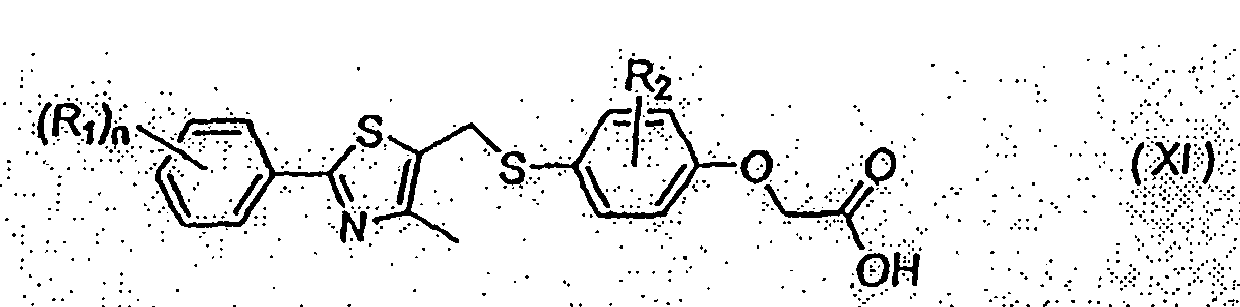 wherein R1 represents a hydrogen atom, CF3, or ahalogen atom,n is an integer of 0 to 5,R2 represents a hydrogen atom, fluorine atom,chlorine atom, a -(C1-C4) alkyl, -O(C1-C4) alkyl, -S(C1-C4) alkyl, or -N(C1-C4 alkyl)2-groupcomprising
reacting a metal thiolate intermediate compound of formula (VII) wherein M represents a lithium ion or magnesium halide (Cl, Br or I),R3 represents a protecting group having a tetrahydropyranyl, -(C1-C4) alkyl, allyl or silyl group, andR2 is as defined above,prepared from a compound of formula (VI)
 wherein R2 and R3 are as defined above, andX1 represents a halogen atomwith a compound of formula (IV)
 wherein R1 and n are as defined above and X2 represents a halogen atom, or a leaving group displaced by nucleophilesto form a compound of formula (VIII)
 wherein R1, n, R4 and R3 are as defined above;eliminating the protecting group of the obtained compound of formula (VIII) to form a compound of formula (IX)
 wherein R1, n and R2 are as defined above;reacting the compound of formula (IX) with an alkyl haloacetate to give a compound of formula (X)
 wherein R1, n and R2 are as defined above, andR4 represents a -(C1-C4) alkyl group,and hydrolyzing the compound of formula (X) to form a compound of formula (XI).
 - A process for preparing a compound of formula (X)
 wherein R1, n, R2 and R4 are as defined in claim 1comprising
reacting a compound of formula (IX) wherein R1, n and R2 are as defined in claim 1 with an alkyl haloacetate in the presence of an organic or inorganic base to give the compound of formula (X).
 - A process according to claim 2, further comprising hydrolyzing the compound of formula (X) to form a compound of formula (XI).
- A compound of formula (VIII)
 wherein R1, n, R2 and R3 are as defined in claim 1.
 - A compound of formula (IX)
 wherein R1, n and R2 are as defined in claim 1.
 - Use of a compound of formula (VI), (VII), (VIII) or (IX) for preparing a compound of formula (XI).
- A process for preparing a compound of formula (IX)
 wherein R1, n and R2 are as defined in Claim 1,comprising reacting a compound of formula (VI)
 wherein R2, R3 and X1 are as defined in Claim 1, with a metallic or organometallic reagent and sulfur to form a metal thiolate intermediate compound of formula (VII)
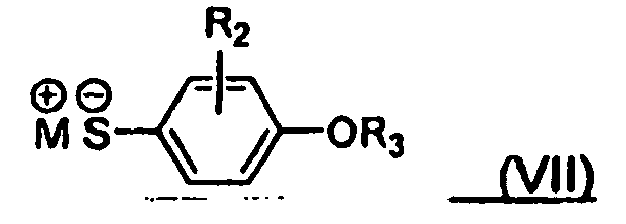 wherein M, R2 and R3 are as defined in Claim 1,reacting the obtained metal thiolate intermediate compound of formula (VII) with a compound of formula (IV)
 wherein R1, n and X2 are as defined in Claim 1, to form a compound of formula (VIII)
 wherein R1, n, R2 and R3 are as defined in Claim 1, and eliminating the protecting group of the obtained compound of formula (VIII) to form the compound of formula (IX).
Applications Claiming Priority (3)
| Application Number | Priority Date | Filing Date | Title |
|---|---|---|---|
| KR10-2002-0024595A KR100474202B1 (en) | 2002-05-04 | 2002-05-04 | Process for preparing thiazol derivative and the intermediate compounds for preparing the same |
| KR2002024595 | 2002-05-04 | ||
| PCT/KR2003/000877 WO2003106442A1 (en) | 2002-05-04 | 2003-05-01 | Process for preparing thiazole derivative and the intermediate compounds for preparing the same |
Publications (3)
| Publication Number | Publication Date |
|---|---|
| EP1501811A1 EP1501811A1 (en) | 2005-02-02 |
| EP1501811A4 EP1501811A4 (en) | 2006-02-08 |
| EP1501811B1 true EP1501811B1 (en) | 2009-07-15 |
Family
ID=29728605
Family Applications (1)
| Application Number | Title | Priority Date | Filing Date |
|---|---|---|---|
| EP03721130A Expired - Lifetime EP1501811B1 (en) | 2002-05-04 | 2003-05-01 | Process for preparing thiazole derivative and the intermediate compounds for preparing the same |
Country Status (8)
| Country | Link |
|---|---|
| US (2) | US7241901B2 (en) |
| EP (1) | EP1501811B1 (en) |
| JP (1) | JP2005536480A (en) |
| KR (1) | KR100474202B1 (en) |
| CN (1) | CN100457744C (en) |
| DE (1) | DE60328376D1 (en) |
| ES (1) | ES2330095T3 (en) |
| WO (1) | WO2003106442A1 (en) |
Families Citing this family (10)
| Publication number | Priority date | Publication date | Assignee | Title |
|---|---|---|---|---|
| RU2371437C2 (en) * | 2004-12-31 | 2009-10-27 | Сеул Нэшнл Юниверсити Индастри Фаундейшн | Organoselenium compounds and their use |
| CN101146783B (en) * | 2004-12-31 | 2011-02-02 | 财团法人首尔大学校产学协力财团 | Compounds Containing Organoselenium and Their Applications |
| RU2392274C2 (en) * | 2005-02-25 | 2010-06-20 | Сеул Нэшнл Юниверсити Индастри Фаундейшн | Thiazole derivatives as ppar-delta ligands and obtainment method |
| EP1856072A4 (en) * | 2005-02-25 | 2009-10-21 | Seoul Nat Univ Ind Foundation | THIAZONE DERIVATIVES AS PPAR DELTA LIGANDS AND METHOD FOR THEIR PREPARATION |
| US7982050B2 (en) | 2005-05-07 | 2011-07-19 | Seoul National University Industry Foundation | Process for preparing ligands of PPARdelta and the intermediate compounds for preparing the same |
| US20090012133A1 (en) * | 2006-01-10 | 2009-01-08 | Smithkline Beecham Corporation | Polymorphic Form of -Acetic Acid |
| KR101005020B1 (en) | 2006-12-13 | 2010-12-30 | 대전대학교 산학협력단 | Novel coumarin derivatives and anti-inflammatory and anti-allergic compositions containing them |
| RU2444518C2 (en) | 2007-01-08 | 2012-03-10 | Сеул Нэшнл Юниверсити Индастри Фаундейшн | THIAZOLE DERIVATIVE AS PPARδ LIGAND AND PHARMACEUTICAL, COSMETICAL AND DIETARY FOOD CONTAINING IT |
| CN107879994A (en) * | 2017-10-31 | 2018-04-06 | 广西师范大学 | A kind of synthetic method of thiazole compound |
| CN109897013B (en) * | 2019-03-31 | 2023-04-07 | 无锡科华生物科技有限公司 | Preparation method of selective PPAR delta agonist GW501516 |
Family Cites Families (12)
| Publication number | Priority date | Publication date | Assignee | Title |
|---|---|---|---|---|
| US4727187A (en) * | 1984-06-15 | 1988-02-23 | Ciba-Geigy Corporation | Process for the preparation of α, α-difluoroalkyl phenyl ether derivatives |
| JPH06306005A (en) * | 1993-04-23 | 1994-11-01 | Nippon Kayaku Co Ltd | Ether compound and production thereof |
| IL128600A0 (en) * | 1996-08-19 | 2000-01-31 | Japan Tobacco Inc | Propionic acid derivatives and pharmaceutical compositions containing them |
| JP4345230B2 (en) | 1998-03-10 | 2009-10-14 | 小野薬品工業株式会社 | Carboxylic acid derivatives and drugs containing the derivatives as active ingredients |
| GB9817118D0 (en) * | 1998-08-07 | 1998-10-07 | Glaxo Group Ltd | Pharmaceutical compounds |
| GB9914977D0 (en) * | 1999-06-25 | 1999-08-25 | Glaxo Group Ltd | Chemical compounds |
| PE20011010A1 (en) * | 1999-12-02 | 2001-10-18 | Glaxo Group Ltd | OXAZOLES AND THIAZOLES REPLACED AS AGONIST OF THE RECEPTOR ACTIVATED BY THE HUMAN PEROXISOMAS PROLIFERATOR |
| JP2001354671A (en) * | 2000-04-14 | 2001-12-25 | Nippon Chemiphar Co Ltd | Activator of peroxisome proliferator-activated receptor δ |
| EP1310494B1 (en) * | 2000-08-11 | 2012-01-25 | Nippon Chemiphar Co., Ltd. | PPAR (delta) ACTIVATORS |
| WO2002050047A1 (en) | 2000-12-20 | 2002-06-27 | Glaxo Group Limited | Substitued oxazoles and thiazoles as hppar alpha agonists |
| EP1357914A2 (en) * | 2001-02-02 | 2003-11-05 | SmithKline Beecham Corporation | Treatment of ppar mediated diseases |
| JP2005530702A (en) * | 2002-02-28 | 2005-10-13 | スミスクライン ビーチャム コーポレーション | Process and intermediate for the preparation of phenylthiomethyl-thiazole or oxazole |
-
2002
- 2002-05-04 KR KR10-2002-0024595A patent/KR100474202B1/en not_active Expired - Fee Related
-
2003
- 2003-05-01 EP EP03721130A patent/EP1501811B1/en not_active Expired - Lifetime
- 2003-05-01 CN CNB038100819A patent/CN100457744C/en not_active Expired - Fee Related
- 2003-05-01 DE DE60328376T patent/DE60328376D1/en not_active Expired - Lifetime
- 2003-05-01 WO PCT/KR2003/000877 patent/WO2003106442A1/en not_active Ceased
- 2003-05-01 US US10/513,408 patent/US7241901B2/en not_active Expired - Lifetime
- 2003-05-01 ES ES03721130T patent/ES2330095T3/en not_active Expired - Lifetime
- 2003-05-01 JP JP2004513274A patent/JP2005536480A/en active Pending
-
2007
- 2007-04-03 US US11/730,658 patent/US20070179300A1/en not_active Abandoned
Also Published As
| Publication number | Publication date |
|---|---|
| WO2003106442A1 (en) | 2003-12-24 |
| KR20030086373A (en) | 2003-11-10 |
| ES2330095T3 (en) | 2009-12-04 |
| EP1501811A1 (en) | 2005-02-02 |
| CN100457744C (en) | 2009-02-04 |
| EP1501811A4 (en) | 2006-02-08 |
| DE60328376D1 (en) | 2009-08-27 |
| US20050176785A1 (en) | 2005-08-11 |
| US20070179300A1 (en) | 2007-08-02 |
| KR100474202B1 (en) | 2005-03-08 |
| CN1649854A (en) | 2005-08-03 |
| US7241901B2 (en) | 2007-07-10 |
| JP2005536480A (en) | 2005-12-02 |
Similar Documents
| Publication | Publication Date | Title |
|---|---|---|
| US20070179300A1 (en) | Process for preparing thiazole derivative and the intermediate compounds for preparing the same | |
| EP1806338B1 (en) | Process for producing 2-amino-2-[2-[4-(3-benzyloxy-phenylthio)-2-chlorophenyl[ethyl]-1,3-propanediol hydrochloride and hydrates thereof. and intermediates the production thereof | |
| CZ287693A3 (en) | Thiazolidinedione derivatives, process for preparing and use | |
| JPH0321022B2 (en) | ||
| EP2726515B1 (en) | Supported alkoxylated organotin reactant, preparation and use for heterogeneous-phase synthesis of tetrazoles | |
| US7982050B2 (en) | Process for preparing ligands of PPARdelta and the intermediate compounds for preparing the same | |
| CN101830863B (en) | Process for the preparation of ligands for PPARδ and intermediate compounds for the preparation of the ligands | |
| CA2051479A1 (en) | Heteroarylmethylbenzenes | |
| KR100691375B1 (en) | Method for preparing peroxisomal proliferator activating receptor delta ligand and intermediate for preparing same | |
| KR100797798B1 (en) | Peroxysomal Proliferator Activating Receptor Delta Ligand Thiazole Derivatives and Methods for Making the Same | |
| WO1985004171A1 (en) | Thiazolidinedione derivatives, process for their preparation, and medicinal compositions containing same | |
| KR100632872B1 (en) | Method for preparing peroxisomal proliferator activating receptor delta ligand and intermediate for preparing same | |
| ZA200509944B (en) | Process for the preparation of racemic 2-{[2-(4-hydroxyphenyl)ethyl]thio}-3[4-(2-{4-[(methylsulfonyl)oxy]phenoxy}ethyl)phenyl]-propanoic acid | |
| CA2599281C (en) | Thiazole derivatives as ppar delta ligands and their manufacturing process | |
| KR100723828B1 (en) | Alkylarylsulfide Preparation and Novel Sulfide Derivatives | |
| EP2064219A2 (en) | Aromatic sulfinates and sulfonyl halides, and the preparation thereof | |
| JP2008517902A (en) | Method for producing alkylallylsulfide derivative and novel sulfide compound | |
| JP5198020B2 (en) | Fluorine-containing vinyl sulfide derivative and method for producing fluorine-containing pyrazole derivative | |
| JP2024524658A5 (en) | ||
| JPH06228158A (en) | Production of organosilyl-substituted aromatic or hetero-aromatic compound | |
| KR19990015054A (en) | Method for preparing phenylpropionic acid derivative | |
| KR20060030169A (en) | Method for preparing intermediates for the preparation of peroxysomal proliferator activated receptor alpha ligands |
Legal Events
| Date | Code | Title | Description |
|---|---|---|---|
| PUAI | Public reference made under article 153(3) epc to a published international application that has entered the european phase |
Free format text: ORIGINAL CODE: 0009012 |
|
| 17P | Request for examination filed |
Effective date: 20041026 |
|
| AK | Designated contracting states |
Kind code of ref document: A1 Designated state(s): AT BE BG CH CY CZ DE DK EE ES FI FR GB GR HU IE IT LI LU MC NL PT RO SE SI SK TR |
|
| RAP1 | Party data changed (applicant data changed or rights of an application transferred) |
Owner name: KANG, HEONJOONG |
|
| A4 | Supplementary search report drawn up and despatched |
Effective date: 20051228 |
|
| RIC1 | Information provided on ipc code assigned before grant |
Ipc: C07D 277/36 20060101AFI20040106BHEP Ipc: C07C 323/20 20060101ALI20051221BHEP |
|
| 17Q | First examination report despatched |
Effective date: 20060509 |
|
| 17Q | First examination report despatched |
Effective date: 20060509 |
|
| RAP1 | Party data changed (applicant data changed or rights of an application transferred) |
Owner name: SEOUL NATIONAL UNIVERSITY INDUSTRY FOUNDATION |
|
| GRAP | Despatch of communication of intention to grant a patent |
Free format text: ORIGINAL CODE: EPIDOSNIGR1 |
|
| GRAS | Grant fee paid |
Free format text: ORIGINAL CODE: EPIDOSNIGR3 |
|
| GRAA | (expected) grant |
Free format text: ORIGINAL CODE: 0009210 |
|
| AK | Designated contracting states |
Kind code of ref document: B1 Designated state(s): AT BE BG CH CY CZ DE DK EE ES FI FR GB GR HU IE IT LI LU MC NL PT RO SE SI SK TR |
|
| REG | Reference to a national code |
Ref country code: GB Ref legal event code: FG4D Ref country code: CH Ref legal event code: EP |
|
| REG | Reference to a national code |
Ref country code: IE Ref legal event code: FG4D |
|
| REF | Corresponds to: |
Ref document number: 60328376 Country of ref document: DE Date of ref document: 20090827 Kind code of ref document: P |
|
| REG | Reference to a national code |
Ref country code: ES Ref legal event code: FG2A Ref document number: 2330095 Country of ref document: ES Kind code of ref document: T3 |
|
| NLV1 | Nl: lapsed or annulled due to failure to fulfill the requirements of art. 29p and 29m of the patents act | ||
| PG25 | Lapsed in a contracting state [announced via postgrant information from national office to epo] |
Ref country code: AT Free format text: LAPSE BECAUSE OF FAILURE TO SUBMIT A TRANSLATION OF THE DESCRIPTION OR TO PAY THE FEE WITHIN THE PRESCRIBED TIME-LIMIT Effective date: 20090715 Ref country code: FI Free format text: LAPSE BECAUSE OF FAILURE TO SUBMIT A TRANSLATION OF THE DESCRIPTION OR TO PAY THE FEE WITHIN THE PRESCRIBED TIME-LIMIT Effective date: 20090715 Ref country code: SE Free format text: LAPSE BECAUSE OF FAILURE TO SUBMIT A TRANSLATION OF THE DESCRIPTION OR TO PAY THE FEE WITHIN THE PRESCRIBED TIME-LIMIT Effective date: 20090715 |
|
| PG25 | Lapsed in a contracting state [announced via postgrant information from national office to epo] |
Ref country code: SI Free format text: LAPSE BECAUSE OF FAILURE TO SUBMIT A TRANSLATION OF THE DESCRIPTION OR TO PAY THE FEE WITHIN THE PRESCRIBED TIME-LIMIT Effective date: 20090715 Ref country code: NL Free format text: LAPSE BECAUSE OF FAILURE TO SUBMIT A TRANSLATION OF THE DESCRIPTION OR TO PAY THE FEE WITHIN THE PRESCRIBED TIME-LIMIT Effective date: 20090715 |
|
| PG25 | Lapsed in a contracting state [announced via postgrant information from national office to epo] |
Ref country code: PT Free format text: LAPSE BECAUSE OF FAILURE TO SUBMIT A TRANSLATION OF THE DESCRIPTION OR TO PAY THE FEE WITHIN THE PRESCRIBED TIME-LIMIT Effective date: 20091115 Ref country code: BG Free format text: LAPSE BECAUSE OF FAILURE TO SUBMIT A TRANSLATION OF THE DESCRIPTION OR TO PAY THE FEE WITHIN THE PRESCRIBED TIME-LIMIT Effective date: 20091015 |
|
| PG25 | Lapsed in a contracting state [announced via postgrant information from national office to epo] |
Ref country code: DK Free format text: LAPSE BECAUSE OF FAILURE TO SUBMIT A TRANSLATION OF THE DESCRIPTION OR TO PAY THE FEE WITHIN THE PRESCRIBED TIME-LIMIT Effective date: 20090715 Ref country code: CZ Free format text: LAPSE BECAUSE OF FAILURE TO SUBMIT A TRANSLATION OF THE DESCRIPTION OR TO PAY THE FEE WITHIN THE PRESCRIBED TIME-LIMIT Effective date: 20090715 Ref country code: EE Free format text: LAPSE BECAUSE OF FAILURE TO SUBMIT A TRANSLATION OF THE DESCRIPTION OR TO PAY THE FEE WITHIN THE PRESCRIBED TIME-LIMIT Effective date: 20090715 Ref country code: RO Free format text: LAPSE BECAUSE OF FAILURE TO SUBMIT A TRANSLATION OF THE DESCRIPTION OR TO PAY THE FEE WITHIN THE PRESCRIBED TIME-LIMIT Effective date: 20090715 |
|
| PLBE | No opposition filed within time limit |
Free format text: ORIGINAL CODE: 0009261 |
|
| STAA | Information on the status of an ep patent application or granted ep patent |
Free format text: STATUS: NO OPPOSITION FILED WITHIN TIME LIMIT |
|
| PG25 | Lapsed in a contracting state [announced via postgrant information from national office to epo] |
Ref country code: BE Free format text: LAPSE BECAUSE OF FAILURE TO SUBMIT A TRANSLATION OF THE DESCRIPTION OR TO PAY THE FEE WITHIN THE PRESCRIBED TIME-LIMIT Effective date: 20090715 Ref country code: SK Free format text: LAPSE BECAUSE OF FAILURE TO SUBMIT A TRANSLATION OF THE DESCRIPTION OR TO PAY THE FEE WITHIN THE PRESCRIBED TIME-LIMIT Effective date: 20090715 |
|
| 26N | No opposition filed |
Effective date: 20100416 |
|
| PG25 | Lapsed in a contracting state [announced via postgrant information from national office to epo] |
Ref country code: GR Free format text: LAPSE BECAUSE OF FAILURE TO SUBMIT A TRANSLATION OF THE DESCRIPTION OR TO PAY THE FEE WITHIN THE PRESCRIBED TIME-LIMIT Effective date: 20091016 |
|
| PG25 | Lapsed in a contracting state [announced via postgrant information from national office to epo] |
Ref country code: MC Free format text: LAPSE BECAUSE OF NON-PAYMENT OF DUE FEES Effective date: 20100531 |
|
| REG | Reference to a national code |
Ref country code: CH Ref legal event code: PL |
|
| PG25 | Lapsed in a contracting state [announced via postgrant information from national office to epo] |
Ref country code: LI Free format text: LAPSE BECAUSE OF NON-PAYMENT OF DUE FEES Effective date: 20100531 Ref country code: CH Free format text: LAPSE BECAUSE OF NON-PAYMENT OF DUE FEES Effective date: 20100531 |
|
| PG25 | Lapsed in a contracting state [announced via postgrant information from national office to epo] |
Ref country code: IE Free format text: LAPSE BECAUSE OF NON-PAYMENT OF DUE FEES Effective date: 20100501 |
|
| PG25 | Lapsed in a contracting state [announced via postgrant information from national office to epo] |
Ref country code: CY Free format text: LAPSE BECAUSE OF FAILURE TO SUBMIT A TRANSLATION OF THE DESCRIPTION OR TO PAY THE FEE WITHIN THE PRESCRIBED TIME-LIMIT Effective date: 20090715 |
|
| PG25 | Lapsed in a contracting state [announced via postgrant information from national office to epo] |
Ref country code: LU Free format text: LAPSE BECAUSE OF NON-PAYMENT OF DUE FEES Effective date: 20100501 Ref country code: HU Free format text: LAPSE BECAUSE OF FAILURE TO SUBMIT A TRANSLATION OF THE DESCRIPTION OR TO PAY THE FEE WITHIN THE PRESCRIBED TIME-LIMIT Effective date: 20100116 |
|
| PG25 | Lapsed in a contracting state [announced via postgrant information from national office to epo] |
Ref country code: TR Free format text: LAPSE BECAUSE OF FAILURE TO SUBMIT A TRANSLATION OF THE DESCRIPTION OR TO PAY THE FEE WITHIN THE PRESCRIBED TIME-LIMIT Effective date: 20090715 |
|
| PGFP | Annual fee paid to national office [announced via postgrant information from national office to epo] |
Ref country code: ES Payment date: 20120427 Year of fee payment: 10 |
|
| PGFP | Annual fee paid to national office [announced via postgrant information from national office to epo] |
Ref country code: GB Payment date: 20130430 Year of fee payment: 11 |
|
| PGFP | Annual fee paid to national office [announced via postgrant information from national office to epo] |
Ref country code: IT Payment date: 20130510 Year of fee payment: 11 |
|
| PGFP | Annual fee paid to national office [announced via postgrant information from national office to epo] |
Ref country code: DE Payment date: 20140430 Year of fee payment: 12 Ref country code: FR Payment date: 20140509 Year of fee payment: 12 |
|
| GBPC | Gb: european patent ceased through non-payment of renewal fee |
Effective date: 20140501 |
|
| PG25 | Lapsed in a contracting state [announced via postgrant information from national office to epo] |
Ref country code: IT Free format text: LAPSE BECAUSE OF NON-PAYMENT OF DUE FEES Effective date: 20140501 |
|
| PG25 | Lapsed in a contracting state [announced via postgrant information from national office to epo] |
Ref country code: GB Free format text: LAPSE BECAUSE OF NON-PAYMENT OF DUE FEES Effective date: 20140501 |
|
| REG | Reference to a national code |
Ref country code: ES Ref legal event code: FD2A Effective date: 20150626 |
|
| PG25 | Lapsed in a contracting state [announced via postgrant information from national office to epo] |
Ref country code: ES Free format text: LAPSE BECAUSE OF NON-PAYMENT OF DUE FEES Effective date: 20140502 |
|
| REG | Reference to a national code |
Ref country code: DE Ref legal event code: R119 Ref document number: 60328376 Country of ref document: DE |
|
| REG | Reference to a national code |
Ref country code: FR Ref legal event code: ST Effective date: 20160129 |
|
| PG25 | Lapsed in a contracting state [announced via postgrant information from national office to epo] |
Ref country code: DE Free format text: LAPSE BECAUSE OF NON-PAYMENT OF DUE FEES Effective date: 20151201 |
|
| PG25 | Lapsed in a contracting state [announced via postgrant information from national office to epo] |
Ref country code: FR Free format text: LAPSE BECAUSE OF NON-PAYMENT OF DUE FEES Effective date: 20150601 |