EP1501197A1 - Bits recovery method and apparatus for an asymmetric data channel - Google Patents
Bits recovery method and apparatus for an asymmetric data channel Download PDFInfo
- Publication number
- EP1501197A1 EP1501197A1 EP04300147A EP04300147A EP1501197A1 EP 1501197 A1 EP1501197 A1 EP 1501197A1 EP 04300147 A EP04300147 A EP 04300147A EP 04300147 A EP04300147 A EP 04300147A EP 1501197 A1 EP1501197 A1 EP 1501197A1
- Authority
- EP
- European Patent Office
- Prior art keywords
- linear equalization
- equalization filter
- filter
- data
- data channel
- Prior art date
- Legal status (The legal status is an assumption and is not a legal conclusion. Google has not performed a legal analysis and makes no representation as to the accuracy of the status listed.)
- Ceased
Links
Images


Classifications
-
- G—PHYSICS
- G11—INFORMATION STORAGE
- G11B—INFORMATION STORAGE BASED ON RELATIVE MOVEMENT BETWEEN RECORD CARRIER AND TRANSDUCER
- G11B20/00—Signal processing not specific to the method of recording or reproducing; Circuits therefor
- G11B20/10—Digital recording or reproducing
- G11B20/10009—Improvement or modification of read or write signals
- G11B20/10046—Improvement or modification of read or write signals filtering or equalising, e.g. setting the tap weights of an FIR filter
- G11B20/10212—Improvement or modification of read or write signals filtering or equalising, e.g. setting the tap weights of an FIR filter compensation for data shift, e.g. pulse-crowding effects
-
- G—PHYSICS
- G11—INFORMATION STORAGE
- G11B—INFORMATION STORAGE BASED ON RELATIVE MOVEMENT BETWEEN RECORD CARRIER AND TRANSDUCER
- G11B20/00—Signal processing not specific to the method of recording or reproducing; Circuits therefor
- G11B20/10—Digital recording or reproducing
- G11B20/10009—Improvement or modification of read or write signals
-
- G—PHYSICS
- G11—INFORMATION STORAGE
- G11B—INFORMATION STORAGE BASED ON RELATIVE MOVEMENT BETWEEN RECORD CARRIER AND TRANSDUCER
- G11B20/00—Signal processing not specific to the method of recording or reproducing; Circuits therefor
- G11B20/10—Digital recording or reproducing
- G11B20/10009—Improvement or modification of read or write signals
- G11B20/10046—Improvement or modification of read or write signals filtering or equalising, e.g. setting the tap weights of an FIR filter
-
- G—PHYSICS
- G11—INFORMATION STORAGE
- G11B—INFORMATION STORAGE BASED ON RELATIVE MOVEMENT BETWEEN RECORD CARRIER AND TRANSDUCER
- G11B20/00—Signal processing not specific to the method of recording or reproducing; Circuits therefor
- G11B20/10—Digital recording or reproducing
- G11B20/10009—Improvement or modification of read or write signals
- G11B20/10268—Improvement or modification of read or write signals bit detection or demodulation methods
- G11B20/10287—Improvement or modification of read or write signals bit detection or demodulation methods using probabilistic methods, e.g. maximum likelihood detectors
- G11B20/10296—Improvement or modification of read or write signals bit detection or demodulation methods using probabilistic methods, e.g. maximum likelihood detectors using the Viterbi algorithm
-
- G—PHYSICS
- G11—INFORMATION STORAGE
- G11B—INFORMATION STORAGE BASED ON RELATIVE MOVEMENT BETWEEN RECORD CARRIER AND TRANSDUCER
- G11B20/00—Signal processing not specific to the method of recording or reproducing; Circuits therefor
- G11B20/10—Digital recording or reproducing
- G11B20/10009—Improvement or modification of read or write signals
- G11B20/10305—Improvement or modification of read or write signals signal quality assessment
- G11B20/10324—Improvement or modification of read or write signals signal quality assessment asymmetry of the recorded or reproduced waveform
- G11B20/10333—Improvement or modification of read or write signals signal quality assessment asymmetry of the recorded or reproduced waveform wherein the asymmetry is linked to domain bloom
-
- G—PHYSICS
- G11—INFORMATION STORAGE
- G11B—INFORMATION STORAGE BASED ON RELATIVE MOVEMENT BETWEEN RECORD CARRIER AND TRANSDUCER
- G11B20/00—Signal processing not specific to the method of recording or reproducing; Circuits therefor
- G11B20/10—Digital recording or reproducing
- G11B20/10009—Improvement or modification of read or write signals
- G11B20/10305—Improvement or modification of read or write signals signal quality assessment
- G11B20/10398—Improvement or modification of read or write signals signal quality assessment jitter, timing deviations or phase and frequency errors
- G11B20/10425—Improvement or modification of read or write signals signal quality assessment jitter, timing deviations or phase and frequency errors by counting out-of-lock events of a PLL
-
- H—ELECTRICITY
- H03—ELECTRONIC CIRCUITRY
- H03M—CODING; DECODING; CODE CONVERSION IN GENERAL
- H03M5/00—Conversion of the form of the representation of individual digits
- H03M5/02—Conversion to or from representation by pulses
- H03M5/04—Conversion to or from representation by pulses the pulses having two levels
- H03M5/14—Code representation, e.g. transition, for a given bit cell depending on the information in one or more adjacent bit cells, e.g. delay modulation code, double density code
- H03M5/145—Conversion to or from block codes or representations thereof
-
- H—ELECTRICITY
- H03—ELECTRONIC CIRCUITRY
- H03M—CODING; DECODING; CODE CONVERSION IN GENERAL
- H03M7/00—Conversion of a code where information is represented by a given sequence or number of digits to a code where the same, similar or subset of information is represented by a different sequence or number of digits
- H03M7/30—Compression; Expansion; Suppression of unnecessary data, e.g. redundancy reduction
- H03M7/46—Conversion to or from run-length codes, i.e. by representing the number of consecutive digits, or groups of digits, of the same kind by a code word and a digit indicative of that kind
-
- G—PHYSICS
- G11—INFORMATION STORAGE
- G11B—INFORMATION STORAGE BASED ON RELATIVE MOVEMENT BETWEEN RECORD CARRIER AND TRANSDUCER
- G11B20/00—Signal processing not specific to the method of recording or reproducing; Circuits therefor
- G11B20/10—Digital recording or reproducing
- G11B20/14—Digital recording or reproducing using self-clocking codes
- G11B20/1403—Digital recording or reproducing using self-clocking codes characterised by the use of two levels
- G11B20/1423—Code representation depending on subsequent bits, e.g. delay modulation, double density code, Miller code
- G11B20/1426—Code representation depending on subsequent bits, e.g. delay modulation, double density code, Miller code conversion to or from block codes or representations thereof
-
- G—PHYSICS
- G11—INFORMATION STORAGE
- G11B—INFORMATION STORAGE BASED ON RELATIVE MOVEMENT BETWEEN RECORD CARRIER AND TRANSDUCER
- G11B20/00—Signal processing not specific to the method of recording or reproducing; Circuits therefor
- G11B20/10—Digital recording or reproducing
- G11B20/18—Error detection or correction; Testing, e.g. of drop-outs
- G11B20/1833—Error detection or correction; Testing, e.g. of drop-outs by adding special lists or symbols to the coded information
- G11B2020/1863—Error detection or correction; Testing, e.g. of drop-outs by adding special lists or symbols to the coded information wherein the Viterbi algorithm is used for decoding the error correcting code
Definitions
- the present invention relates to a method and a device for bit recovery in an asymmetric data channel, and to an apparatus for reading from and/or writing to recording media using such method or device.
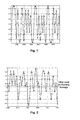
- Fig. 1 shows high frequency channel data representing a data stream from an exemplary optical channel signal.
- the channel data are not distorted by asymmetry.
- a data slicing process is easily able to distinguish between two different signal states (high and low).
- the data patterns recorded on a recording medium may be distorted by an asymmetric data writing procedure.
- Blooming which is caused by non-linear effects during data recording.
- Fig. 2 shows an example of a channel data stream deteriorated by strong signal asymmetry.
- a digitised optical channel data stream is resynchronised to the channel clock using a phase locked loop (PLL) and a sample rate converter (SRC), then equalized with a filter setting representing the inverse channel behaviour and finally detected using a simple slicer and a bit detector .
- PLL phase locked loop
- SRC sample rate converter
- An adaptive approach using a maximum likelihood decoder calculates the difference of the recovered data to the equalized data, e.g. with the least mean square (LMS) method, and uses this as adjusting information in order to get a coefficient set for the equalizer, which better fits to the channel characteristic.
- LMS least mean square
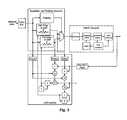
- Fig. 3 shows an advanced version of the above scheme, which makes use of this finding by adjusting a separate equalizer for each edge of the incoming data signal.
- a method for bit recovery in an asymmetric data channel comprises the steps of:
- the equalizer scheme is implemented at least twice in parallel. In this way it supports faster channel data streams. Alternatively, it is designed as a single circuit recalculating the new sample by working on different phases of a system clock.
- the system clock is faster than twice the channel clock. In this case the two coefficient sets may be switched over.
- the system clock is slower than twice the channel clock. In this case the switching is accomplished on different system clock phases.
- the method or the device are advantageously used in an apparatus for reading from and or writing to optical recording media. However, they can be applied to any other signal detection means dealing with asymmetric signal distortions.
- Fig. 4 a solution according to the invention using an equalizer with a single filter but two coefficient sets is shown.
- a polynomial filter (Volterra Filter), which is simplified to an additional DC level and a multiplier to create a quadratic filter stage, is used.
- the known approach using an FIR filter only considers the term h 1 (x(k)).
- the polyphase term h 2 which is basically a quadrature of the incoming signal, requires an additional DC compensation, which is taken into account by the factor h 0 .
- Fig. 5 to Fig. 8 show simulation results obtained with the solution according to the invention.
- Fig. 5 the differences between signals generated by the dual equalizer and Viterbi decoded data.
- Fig. 6 compares the digital sum value (DSV) of the recovered data with the reference data.
- DSV digital sum value
- Fig. 7 a signal level distribution of the channel data is shown.
- Fig. 8 shows the signal level distribution after equalization.
Landscapes
- Engineering & Computer Science (AREA)
- Signal Processing (AREA)
- Theoretical Computer Science (AREA)
- Physics & Mathematics (AREA)
- Probability & Statistics with Applications (AREA)
- Signal Processing For Digital Recording And Reproducing (AREA)
Abstract
- providing a non-linear equalization filter with two coefficient sets;
- using the non-linear equalization filter with a first coefficient set for compensating defects of a first type of transition between different storage states; and
- using the non-linear equalization filter with a second coefficient set for compensating defects of a second type of transition between different storage states.
Description
- The present invention relates to a method and a device for bit recovery in an asymmetric data channel, and to an apparatus for reading from and/or writing to recording media using such method or device.
- In current harddisk and optical disk applications partial response maximum likelihood detectors (PRML, Viterbi) are used for recovering the data from a channel data stream. Fig. 1 shows high frequency channel data representing a data stream from an exemplary optical channel signal. The channel data are not distorted by asymmetry. In this case a data slicing process is easily able to distinguish between two different signal states (high and low). However, the data patterns recorded on a recording medium may be distorted by an asymmetric data writing procedure. For example, on optical recording media one reason for asymmetry is Blooming, which is caused by non-linear effects during data recording. Fig. 2 shows an example of a channel data stream deteriorated by strong signal asymmetry. Due to the asymmetry a simple slicing algorithm is not able to properly distinguish between data bits representing digital high or low, since adaptive equalization means fail. This problem becomes worse when noise is present. In order to properly recover the channel data from this signal a compensation scheme is needed.
- Usually a digitised optical channel data stream is resynchronised to the channel clock using a phase locked loop (PLL) and a sample rate converter (SRC), then equalized with a filter setting representing the inverse channel behaviour and finally detected using a simple slicer and a bit detector .
- An adaptive approach using a maximum likelihood decoder calculates the difference of the recovered data to the equalized data, e.g. with the least mean square (LMS) method, and uses this as adjusting information in order to get a coefficient set for the equalizer, which better fits to the channel characteristic. The LMS updating is typically implemented as follows:
- However, some approaches only consider the direction (+ or - ) of the error signal ε.
- It has been found that the cause of signal asymmetry shows different behaviour during a transition from one storage state (e.g. land) to another storage state (e.g. pit). By separately compensating both transition defects a better signal data representation is found for decoding the contained data bits using a maximum likelihood approach. Fig. 3 shows an advanced version of the above scheme, which makes use of this finding by adjusting a separate equalizer for each edge of the incoming data signal.
- It is an object of the invention to improve the methods known from prior art.
- According to the invention, a method for bit recovery in an asymmetric data channel comprises the steps of:
- providing a non-linear equalization filter with two coefficient sets;
- using the non-linear equalization filter with a first coefficient set for compensating defects of a first type of transition between different storage states; and
- using the non-linear equalization filter with a second coefficient set for compensating defects of a second type of transition between different storage states.
- Favourably, the equalizer scheme is implemented at least twice in parallel. In this way it supports faster channel data streams. Alternatively, it is designed as a single circuit recalculating the new sample by working on different phases of a system clock.
- According to a first implementation of the inventive solution, the system clock is faster than twice the channel clock. In this case the two coefficient sets may be switched over. According to a second implementation, the system clock is slower than twice the channel clock. In this case the switching is accomplished on different system clock phases.
- Usually the modulation of a channel data stream is subject to certain runlength restrictions. This allows to use a slower system clock, since some calculations are no longer required.
- The method or the device are advantageously used in an apparatus for reading from and or writing to optical recording media. However, they can be applied to any other signal detection means dealing with asymmetric signal distortions.
- For a better understanding of the invention, an exemplary embodiment is specified in the following description with reference to the figures. It is understood that the invention is not limited to this exemplary embodiment and that specified features can also expediently be combined and/or modified without departing from the scope of the present invention. In the figures:
- Fig. 1
- shows a channel signal without asymmetry;
- Fig. 2
- shows a channel signal with asymmetry;
- Fig. 3
- shows an approach using an equalizer with a dual adaptive filter;
- Fig. 4
- shows a solution according to the invention using an equalizer with a single filter but two coefficient sets;
- Fig. 5
- shows the differences between signals generated by the dual equalizer and Viterbi decoded data;
- Fig. 6
- shows the digital sum value (DSV) of the recovered data compared with the reference data;
- Fig. 7
- shows a signal level distribution of the channel data; and
- Fig. 8
- shows the signal level distribution after equalization.
- In Fig. 4 a solution according to the invention using an equalizer with a single filter but two coefficient sets is shown. Instead of an FIR filter a polynomial filter (Volterra Filter), which is simplified to an additional DC level and a multiplier to create a quadratic filter stage, is used. The algorithm representing the non-linear filter can be expressed with the following (simplified) equation 1:
- The known approach using an FIR filter only considers the term h1(x(k)). The polyphase term h2, which is basically a quadrature of the incoming signal, requires an additional DC compensation, which is taken into account by the factor h0.
- Fig. 5 to Fig. 8 show simulation results obtained with the solution according to the invention. In Fig. 5 the differences between signals generated by the dual equalizer and Viterbi decoded data. Fig. 6 compares the digital sum value (DSV) of the recovered data with the reference data. In the graph, errors in data recovery are indicated as vertical bars. In Fig. 7 a signal level distribution of the channel data is shown. For comparison Fig. 8 shows the signal level distribution after equalization.
Claims (9)
- Method for bit recovery in an asymmetric data channel including the steps of:providing a non-linear equalization filter with two coefficient sets;using the non-linear equalization filter with a first coefficient set for compensating defects of a first type of transition between different storage states; andusing the non-linear equalization filter with a second coefficient set for compensating defects of a second type of transition between different storage states.
- Method according to claim 1, characterized in that the non-linear equalization filter with two coefficient sets is implemented at least twice in parallel.
- Method according to claims 1 or 2, characterized in that the non-linear equalization filter is a Volterra filter.
- Method according to claim 3, characterized in that the Volterra filter includes a DC Compensator, a linear FIR and a quadratic term.
- Device for bit recovery in an asymmetric data channel, characterized in that it includes a non-linear equalization filter with two coefficient sets, whereby the non-linear equalization filter is used with a first coefficient set for compensating defects of a first type of transition between different storage states and with a second coefficient set for compensating defects of a second type of transition between different storage states.
- Device according to claim 5, characterized in that the non-linear equalization filter with two coefficient sets is implemented at least twice in parallel.
- Device according to claims 5 or 6, characterized in that the non-linear equalization filter is a Volterra filter.
- Device according to claim 7, characterized in that the Volterra filter includes a DC Compensator, a linear FIR and a quadratic term.
- Apparatus for reading from and/or writing to recording media, characterized in that it uses a method according to anyone of claims 1 to 4 or includes a device according to anyone of claims 5 to 8 for bit recovery in an asymmetric data channel.
Priority Applications (1)
| Application Number | Priority Date | Filing Date | Title |
|---|---|---|---|
| EP04300147A EP1501197A1 (en) | 2003-06-06 | 2004-03-17 | Bits recovery method and apparatus for an asymmetric data channel |
Applications Claiming Priority (3)
| Application Number | Priority Date | Filing Date | Title |
|---|---|---|---|
| EP03012954 | 2003-06-06 | ||
| EP03012954A EP1484842A1 (en) | 2003-06-06 | 2003-06-06 | Bits recovery method and apparatus for an asymmetric data channel |
| EP04300147A EP1501197A1 (en) | 2003-06-06 | 2004-03-17 | Bits recovery method and apparatus for an asymmetric data channel |
Publications (1)
| Publication Number | Publication Date |
|---|---|
| EP1501197A1 true EP1501197A1 (en) | 2005-01-26 |
Family
ID=33492144
Family Applications (1)
| Application Number | Title | Priority Date | Filing Date |
|---|---|---|---|
| EP04300147A Ceased EP1501197A1 (en) | 2003-06-06 | 2004-03-17 | Bits recovery method and apparatus for an asymmetric data channel |
Country Status (1)
| Country | Link |
|---|---|
| EP (1) | EP1501197A1 (en) |
Citations (2)
| Publication number | Priority date | Publication date | Assignee | Title |
|---|---|---|---|---|
| US20020060827A1 (en) * | 2000-11-22 | 2002-05-23 | Agazzi Oscar E. | Method and system to identify and characterize nonlinearities in optical communications channels |
| US6449110B1 (en) * | 1999-02-03 | 2002-09-10 | Cirrus Logic, Inc. | Optimizing operation of a disk storage system by increasing the gain of a non-linear transducer and correcting the non-linear distortions using a non-linear correction circuit |
-
2004
- 2004-03-17 EP EP04300147A patent/EP1501197A1/en not_active Ceased
Patent Citations (3)
| Publication number | Priority date | Publication date | Assignee | Title |
|---|---|---|---|---|
| US6449110B1 (en) * | 1999-02-03 | 2002-09-10 | Cirrus Logic, Inc. | Optimizing operation of a disk storage system by increasing the gain of a non-linear transducer and correcting the non-linear distortions using a non-linear correction circuit |
| US20020060827A1 (en) * | 2000-11-22 | 2002-05-23 | Agazzi Oscar E. | Method and system to identify and characterize nonlinearities in optical communications channels |
| WO2002043340A2 (en) * | 2000-11-22 | 2002-05-30 | Broadcom Corporation | Method and apparatus to identify and characterize nonlinearities in optical communications channels |
Non-Patent Citations (4)
| Title |
|---|
| GOPALASWAMY S ET AL: "DESISION-DERECTED CORRECTION FOR BLOOM IN OPTICAL RECORDING CHANNELS", JAPANESE JOURNAL OF APPLIED PHYSICS, PUBLICATION OFFICE JAPANESE JOURNAL OF APPLIED PHYSICS. TOKYO, JP, vol. 39, no. 2B, PART 1, February 2000 (2000-02-01), pages 834 - 836, XP001051387, ISSN: 0021-4922 * |
| HANGYU CHO ET AL: "Combining nonlinear equalization and simple detection for high-density optical recording channels", IEEE TRANSACTIONS ON MAGNETICS, IEEE INC. NEW YORK, US, vol. 38, no. 5, September 2002 (2002-09-01), pages 2313 - 2315, XP002237636, ISSN: 0018-9464 * |
| POZIDIS H ET AL: "A SIMPLE NONLINEAR MODEL FOR THE OPTICAL RECORDING CHANNEL", ICC 2000. 2000 IEEE INTERNATIONAL CONFERENCE ON COMMUNICATIONS. CONFERENCE RECORD. NEW ORLEANS, LA, JUNE 18-21, 2000, IEEE INTERNATIONAL CONFERENCE ON COMMUNICATIONS, NEW YORK, NY: IEEE, US, vol. 1 OF 3, 18 June 2000 (2000-06-18), pages 99 - 103, XP001042920, ISBN: 0-7803-6284-5 * |
| SEOK JUN KO ET AL: "A robust digital timing recovery with asymmetry compensator for high speed optical drive systems", IEEE TRANSACTIONS ON CONSUMER ELECTRONICS, IEEE INC. NEW YORK, US, vol. 47, no. 4, 20 August 2001 (2001-08-20), pages 821 - 830, XP002237635, ISSN: 0098-3063 * |
Similar Documents
| Publication | Publication Date | Title |
|---|---|---|
| EP0750306B1 (en) | A method of maximum likelihood decoding and a digital information playback apparatus | |
| US7466766B2 (en) | Processing servo data having DC level shifts | |
| KR100553407B1 (en) | Reproduction signal processor, and optical disk reproducing apparatus having the same | |
| JP3996601B2 (en) | Signal processing apparatus and signal processing method | |
| US7286598B2 (en) | Bit recovery scheme for an asymmetric data channel | |
| JPWO2005024822A1 (en) | Reproduction signal processing apparatus and reproduction signal processing method | |
| EP1587234A1 (en) | Adaptive viterbi detector | |
| US7221638B2 (en) | Electronic circuit for decoding a read signal from an optical storage medium | |
| US8077817B2 (en) | Arrangement for adaptive bit recovery | |
| EP1496515B1 (en) | Method for adaptive recovery | |
| US7243297B2 (en) | Method for bit recovery in an asymmetric data channel | |
| EP1441344A1 (en) | Electronic circuit for decoding a read signal from an optical storage medium | |
| EP1486974A1 (en) | Recovery of RLL encoded bit stream from an asymmetric data channel | |
| Koo et al. | A robust PRML read channel with digital timing recovery for multi-format optical disc | |
| JP2004158090A (en) | Data playback device | |
| KR20060130586A (en) | Timing recovery method and system in optical system |
Legal Events
| Date | Code | Title | Description |
|---|---|---|---|
| PUAI | Public reference made under article 153(3) epc to a published international application that has entered the european phase |
Free format text: ORIGINAL CODE: 0009012 |
|
| AK | Designated contracting states |
Kind code of ref document: A1 Designated state(s): AT BE BG CH CY CZ DE DK EE ES FI FR GB GR HU IE IT LI LU MC NL PL PT RO SE SI SK TR |
|
| AX | Request for extension of the european patent |
Extension state: AL HR LT LV MK |
|
| 17P | Request for examination filed |
Effective date: 20050704 |
|
| RAP1 | Party data changed (applicant data changed or rights of an application transferred) |
Owner name: THOMSON LICENSING |
|
| AKX | Designation fees paid |
Designated state(s): DE FR GB IT |
|
| RAP1 | Party data changed (applicant data changed or rights of an application transferred) |
Owner name: THOMSON LICENSING |
|
| STAA | Information on the status of an ep patent application or granted ep patent |
Free format text: STATUS: THE APPLICATION HAS BEEN REFUSED |
|
| 18R | Application refused |
Effective date: 20140128 |