TECHNICAL FIELD
The present invention relates to a compound, a prodrug thereof,
or a pharmaceutically acceptable salt of the same, which exhibits an
acyl-CoA: cholesterol acyl transferase (ACAT) inhibitory activity, and is
useful as an agent for treatment of hyperlipidemia and atherosclerosis,
and a use thereof.
BACKGROUN ART
Cerebrovascular disorders such as stroke and myocardial
infarction, which rank in high in causes of death in developed countries,
break out with being accompanied by atherosclerosis as a basal disease.
In accordance with epidemiology research, it is pointed out that
hypercholesterolemia is one of risk factors for atherosclerosis, and there
are mainly used anti-hyperlipidemic agents, which can reduce
cholesterol level in blood, in the prophylaxis or treatment thereof.
However, there is no sufficiently effective agent in terms of the efficacy
thereof. Recently, it is found that cells derived from macrophage
accumulate cholesterol ester droplet within the cells and become foam
cells in atherosclerotic lesions, and it is clarified that these foam cells
deeply participate in the developments of atherosclerotic lesions
(Arteriosclerosis, 10, 164-177, 1990). In addition, it is reported that
ACAT activity is increased in the vascular wall of atherosclerotic lesions
and thereby cholesterol esters are accumulated in the vascular wall
(Biochem. Biophys. Acta, 617, 458-471, 1980). Therefore, an inhibitor
of ACAT, which catalyzes cholesterol esterification, is expected to
suppress the formation or the development of atherosclerotic lesions as
a result of the inhibition of foam cell formation and of cholesterol ester
accumulation in lesions.
On the other hand, cholesterol in food is absorbed in the free
form at intestinal epidermal cells, esterified by ACAT and then released
in the form of chylomicron into the blood. Therefore, an inhibitor of
ACAT is expected to reduce the cholesterol level in the blood by the
inhibition of absorption of cholesterol in food at the intestine and also
inhibition of the reabsorption of cholesterol released into the intestine (J.
Lipid. Research, 34, 279-294, 1993).
JP-A-2-6456, JP-A-2-6457 and EP 0293880 disclose
phenylurea derivatives having an ACAT inhibitory activity, but any of
these derivatives are structurally different in the chemical structure
from the compound of the present invention.
DISCLOSURE OF INVENTION
An object of the present invention is to provide a compound
having an ACAT inhibitory activity and being useful as an agent for
treatment of hyperlipidemia and atherosclerosis.
The present inventors have intensively studied in order to solve
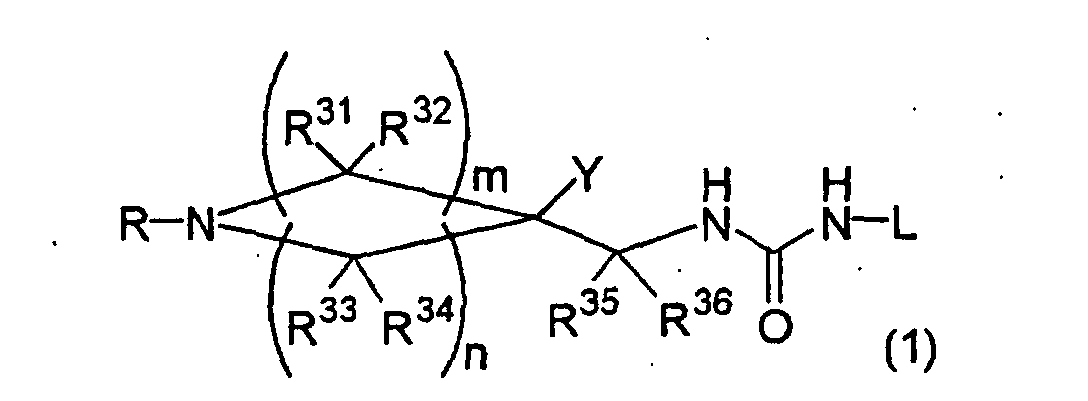
the above-mentioned problems, and have found that a piperidine
derivative of the following formula (1), a prodrug thereof, or a
pharmaceutically acceptable salt of the same exhibits a potent ACAT
inhibitory activity, and they have accomplished the present invention.
The compound of the present invention is a novel compound having a
different structure from the known compounds as disclosed above.
That is, the present invention relates to the following
embodiments:
L is a cycloalkyl group, a substituted cycloalkyl group, an
aromatic group, or a substituted aromatic group,
Y is an aryl group or a substituted aryl group,
R is a hydrogen atom, an alkyl group, a substituted alkyl group,
an alkenyl group, a substituted alkenyl group, an alkynyl group, a
substituted alkynyl group, a cycloalkyl group, a substituted cycloalkyl
group, an aromatic group, a substituted aromatic group, or a group of
the formula: -C(=O)R2 (R2 is an alkyl group, a substituted alkyl group,
an alkenyl group, a substituted alkenyl group, an alkynyl group, a
substituted alkynyl group, a cycloalkyl group, a substituted cycloalkyl
group, an aromatic group, or a substituted aromatic group),
R31, R32, R33 and R34 are the same or different, and are selected,
if two or more thereof exist, independently from a hydrogen atom, an
alkyl group, a substituted alkyl group, a hydroxy group, an alkoxy
group, and an aralkyloxy group, or a combination of R31 and R32,
and/or a combination of R33 and R34 may combine each other and form
an oxo group,
R35 and R36 are the same or different, and are selected, if both
exist, independently from a hydrogen atom, an alkyl group and a
substituted alkyl group, or R35 and R36 may combined each other and
form an oxo group,
or a prodrug thereof, or a pharmaceutically acceptable salt of the same. [2] The compound according to the above [1], or a prodrug thereof,
or a pharmaceutically acceptable salt of the same, wherein Y is a phenyl
group or a substituted phenyl group. [3] The compound according to the above [2], or a prodrug thereof,
or a pharmaceutically acceptable salt of the same, wherein L is a
substituted phenyl group. [4] The compound according to the above [3], or a prodrug thereof,
or a pharmaceutically acceptable salt of the same, wherein L is a group
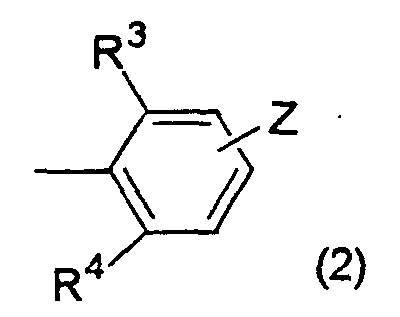
of the formula (2):
wherein R3 and R4 are independently a substituted or unsubstituted
lower alkyl group,
Z is a hydrogen atom, a hydroxy group, a lower alkylsulfonamido
group, a lower alkoxycarbonylamino group, an amino group, a
lower alkylamino group, or a di-lower alkyl amino group. [5] The compound according to the above [4], or a prodrug thereof,
or a pharmaceutically acceptable salt of the same, wherein R is an
aromatic group or a substituted aromatic group. [6] The compound according to the above [5], or a prodrug thereof,
or a pharmaceutically acceptable salt of the same, wherein R is a
substituted phenyl group. [7] The compound according to the above [6], or a prodrug thereof,
or a pharmaceutically acceptable salt of the same, wherein Y is a
substituted phenyl group or a substituted pyridyl group, and said
phenyl group or pyridyl group may be substituted by one or more
groups, which are the same or different and selected from a hydroxy
group and a group of the formula: -O-E-A {O is an oxygen atom, E is a
divalent C1-8 hydrocarbon group optionally having an unsaturated bond,
and A is a hydrogen atom, a hydroxy group, a carboxyl group, a lower
alkoxycarbonyl group, a benzyloxycarbonyl group, a halogen atom, a
cyano group, a trifluoromethyl group, an aralkyloxy group, an aryloxy
group, a lower alkoxy group, a lower alkanoyloxy group, a lower
alkylthio group, a lower alkylsulfinyl group, a lower alkylsulfonyl group,
an alkyl-substituted or unsubstituted benzenesulfonyloxy group, a
lower alkanoylamino group, a lower alkoxycarbonylamino group, a
lower alkylsulfonamido group, a phthalimido group, a cycloalkyl group,
an aryl group, a substituted aryl group, a heteroaryl group, a
substituted heteroaryl group, or a group of the formula:-NR6R7 (R6 and
R7 are independently a hydrogen atom, a lower alkyl group, a lower
alkoxy-substituted lower alkyl group, a cycloalkyl group, a lower alkoxycarbonyl
group, a heteroarylmethyl group, or an aralkyl group, or R6
and R7 may combine each other, and with the adjacent nitrogen atom to
which they bond, form a saturated cyclic amino group having 3 to 8
carbon atoms as ones forming the said ring, and optionally having one
-NR8- (R8 is a hydrogen atom, a lower alkyl group, a phenyl group, a
lower alkoxycarbonyl group, or a benzyl group) or one oxygen atom in
the cycle thereof), a group of the formula: -C(=O)NR6R7 (R6 and R7 are as
defined above), or a group of the formula:-NHC(=O)R9 (R9 is an alkyl
group, a substituted alkyl group, a cycloalkyl group, or a substituted
cycloalkyl group)}. [8] The compound according to the above [7], or a prodrug thereof,
or a pharmaceutically acceptable salt of the same, wherein in at least
one of the substituents represented by the formula: -O-E-A on Y, E is a
C1-4 alkylene group. [9] The compound according to the above [8], or a prodrug thereof,
or a pharmaceutically acceptable salt of the same, wherein in at least
one of the substituents represented by the formula: -O-E-A on Y, A is a
hydrogen atom or a hydroxy group. [10] The compound according to the above [9], or a prodrug thereof,
or a pharmaceutically acceptable salt of the same, wherein Z is a
hydrogen atom or an amino group. [11] The compound according to the above [10], or a prodrug thereof,
or a pharmaceutically acceptable salt of the same, wherein R3 and R4
are independently an unsubstituted lower alkyl group. [12] The compound according to the above [11], or a prodrug thereof,
or a pharmaceutically acceptable salt of the same, wherein R is a
substituted phenyl group or a substituted pyridyl group, and said
phenyl group or pyridyl group may be substituted by one or more
groups, which are the same or different and selected from a hydroxy
group and a group of the formula: -O-E-A {O is an oxygen atom, E is a
divalent C1-8 hydrocarbon group optionally having an unsaturated bond,
and A is a hydrogen atom, a hydroxy group, a carboxyl group, a lower
alkoxycarbonyl group, a benzyloxycarbonyl group, a halogen atom, a
cyano group, a trifluoromethyl group, an aralkyloxy group, an aryloxy
group, a lower alkoxy group, a lower alkanoyloxy group, a lower alkylthio
group, a lower alkylsulfinyl group, a lower alkylsulfonyl group, an
alkyl-substituted or unsubstituted benzenesulfonyloxy group, a lower
alkanoylamino group, a lower alkoxycarbonylamino group, a lower
alkylsulfonamido group, a phthalimido group, a cycloalkyl group, an
aryl group, a substituted aryl group, a heteroaryl group, a substituted
heteroaryl group, or a group of the formula: -NR6R7 (R6 and R7 are
independently a hydrogen atom, a lower alkyl group, a lower alkoxy-substituted
lower alkyl group, a cycloalkyl group, a lower alkoxycarbonyl
group, a heteroarylmethyl group, or an aralkyl group, or R6
and R7 may combine each other, and with the adjacent nitrogen atom to
which they bond, form a saturated cyclic amino group having 3 to 8
carbon atoms as ones forming the said ring, and optionally having one
-NR8- (R8 is a hydrogen atom, a lower alkyl group, a phenyl group, a
lower alkoxycarbonyl group, or a benzyl group) or one oxygen atom in
the cycle thereof), or a group of the formula: -C(=O)NR6R7 (R6 and R7 are
as defined above)}. [ 13] The compound according to the above [12], or a prodrug thereof,
or a pharmaceutically acceptable salt of the same, wherein in at least
one of the substituents represented by the formula:-O-E-A on R, E is a
C1-4 alkylene group. [14] The compound according to the above [13], or a prodrug thereof,
or a pharmaceutically acceptable salt of the same, wherein in at least
one of the substituents represented by the formula:-O-E-A on R, A is a
hydrogen atom, a hydroxy group, a lower alkoxy group, a lower
alkanoyloxy group, a lower alkanoylamino group, a lower alkoxycarbonylamino
group, or a group of the formula: -NR6R7 or the formula:
-C(=O)NR6R7. [15] The compound according to the above [14], or a prodrug thereof,
or a pharmaceutically acceptable salt of the same, wherein in at least
one of the substituents represented by the formula:-O-E-A on R, A is a
hydrogen atom, a hydroxy group, a lower alkoxy group, or a group of
the formula: -NR6R7 (R6 and R7 are independently a hydrogen atom or a
lower alkyl group). [16] The compound according to the above [15], or a prodrug thereof,
or a pharmaceutically acceptable salt of the same, wherein R3 and R4
are an isopropyl group. [17] The compound according to any one of the above [1] to [16], or
a prodrug thereof, or a pharmaceutically acceptable salt of the same,
wherein m is 2, n is 2, and all of R31, R32, R33, R34, R35 and R36 are a
hydrogen atom. [18] A pharmaceutical composition comprising as an active
ingredient the compound as set forth in any one of the above [1] to [17],
or a prodrug thereof, or a pharmaceutically acceptable salt of the same. [18] An acyl-CoA: cholesterol acyl transferase (ACAT) inhibitor,
which comprises as an active ingredient the compound as set forth in
any one of the above [1] to [17], or a prodrug thereof, or a
pharmaceutically acceptable salt of the same. [20] An agent for treatment of hyperlipidemia or atherosclerosis,
which comprises as an active ingredient the compound as set forth in
any one of the above [1] to [17], or a prodrug thereof, or a
pharmaceutically acceptable salt of the same. [21] A method for treatment of hyperlipidemia or atherosclerosis in a
patient in need, which comprises administering a therapeutically
effective amount of the compound as set forth in any one of the above
[1] to [17], or a prodrug thereof, or a pharmaceutically acceptable salt of
the same, to said patient. [22] A use of the compound as set forth in any one of the above [1]
to [ 17], or a prodrug thereof, or a pharmaceutically acceptable salt of
the same, in preparation of an agent for treatment of hyperlipidemia or
atherosclerosis.
BEST MODE FOR CARRYING OUT THE INVENTION
Each group in the present invention is explained below.
Unless defined otherwise, the definition for each group should be
applied to cases wherein said group is a part of another substituent.
The alkyl group or the alkyl moiety of a substituted alkyl group
may include, for example, a straight chain or branched chain C1-15 alkyl
group, and examples thereof are methyl, ethyl, propyl, 2-propyl, butyl,
2-butyl, 2-methylpropyl, 1,1-dimethylethyl, pentyl, 3-pentyl, 3-methylbutyl,
hexyl, 3-hexyl, 4-methylpentyl, 4-heptyl, octyl, 4-octyl,
decyl, etc., and preferable one is a straight chain or branched chain C1-6
alkyl group.
The alkenyl group or the alkenyl moiety of a substituted alkenyl
group may include, for example, a straight chain or branched chain C2-15
alkenyl group, and examples thereof are vinyl, allyl, 2-propenyl, 2-methyl-2-propenyl,
2-butenyl, 3-butenyl, 3-methyl-2-butenyl, 4-pentenyl,
3-hexenyl, 3-ethyl-2-pentenyl, 4-ethyl-3-hexenyl, etc.
The alkynyl group or the alkynyl moiety of a substituted alkynyl
group may include, for example, a straight chain or branched chain C3-15
alkynyl group, and examples thereof are 2-propinyl, 3-butynyl, 4-pentynyl,
3-hexynyl, 5-methyl-2-hexynyl, 6-methyl-4-heptynyl, etc.
The substituted alkyl group, the substituted alkenyl group, and
the substituted alkynyl group may have one or more substituents which
are the same or different, and the substituents are, for example, a
substituted or unsubstituted aromatic group, a substituted or
unsubstituted cycloalkyl group, a halogen atom, a cyano group, a
hydroxy group, a lower alkoxy group, a lower alkanoyloxy group, an
amino group, a mono-lower alkylamino group, a di-lower alkylamino
group, a carbamoyl group, a lower alkylaminocarbonyl group, a di-lower
alkylaminocarbonyl group, a lower alkoxycarbonylamino group, a
carboxyl group, a lower alkoxycarbonyl group, a lower alkylthio group, a
lower alkylsulfinyl group, a lower alkylsulfonyl group, a lower
alkanoylamino group, a lower alkylsulfonamido group, etc.
The halogen atom is, for example, fluorine atom, chlorine atom,
bromine atom, or iodine atom, and preferable halogen atom is fluorine
atom.
The cycloalkyl group or the cycloalkyl moiety of a substituted
cycloalkyl group includes, for example, a C3-8 cycloalkyl group, and
examples thereof are cyclopropyl, cyclobutyl, cyclopentyl, cyclohexyl,
cycloheptyl, cyclooctyl, etc.
The substituted cycloalkyl group may have one or more
substituents which are the same or different, and the substituents are,
for example, a lower alkyl group, a halogen atom, a cyano group, a
hydroxy group, a lower alkoxy group, a lower alkanoyloxy group, an
amino group, a mono-lower alkylamino group, a di-lower alkylamino
group, a carbamoyl group, a lower alkylaminocarbonyl group, a di-lower
alkylaminocarbonyl group, a lower alkoxycarbonylamino group, a
carboxyl group, a lower alkoxycarbonyl group, a lower alkylthio group, a
lower alkylsulfinyl group, a lower alkylsulfonyl group, a lower alkanoylamino
group, a lower alkylsulfonamido group, etc. Preferable halogen
atom is fluorine atom.
The term "lower" in the present invention means that an alkyl
moiety described with "lower" is a lower alkyl group, and such a lower
alkyl group includes a lower alkyl group having 1 to 6 carbon atoms
such as methyl, ethyl, propyl, 2-propyl, butyl, pentyl, hexyl, etc. The
substituent of the substituted lower alkyl moiety includes, for example,
a halogen atom, a cyano group, a lower alkoxy group, etc. Preferable
halogen atom is fluorine atom.
The aromatic group includes an aryl group and a heteroaryl
group.
The aryl group includes, for example, an aryl group having
carbon atoms of not more than 10, such as a phenyl group, a naphthyl
group, etc.
The heteroaryl group includes, for example, a 5- to 6-membered
monocyclic group having 1 to 2 nitrogen atoms, a 5- to 6-membered
monocyclic group having 1 to 2 nitrogen atoms and one oxygen atom or
one sulfur atom, a 5-membered monocyclic group having one oxygen
atom or one sulfur atom, a bicyclic group formed by condensing a 6-membered
ring and a 5- or 6-membered ring and having 1 to 4 nitrogen
atoms, and examples thereof are 2-pyridyl, 3-pyridyl, 4-pyridyl, 2-thienyl,
3-thienyl, 3-oxodiazolyl, 1-imidazolyl, 2-imidazolyl, 2-thiazolyl,
3-isothiazolyl, 2-oxazolyl, 3-isoxazolyl, 2-furyl, 3-furyl, 3-pyrrolyl, 2-quinolyl,
8-quinolyl, 2-quinazolinyl, 8-purinyl, etc.
The substituted aromatic group may have one or more
substituents, which are the same or different and selected from a
halogen atom, a cyano group, a trifluoromethyl group, a nitro group, a
hydroxy group, a methylenedioxy group, a lower alkyl group, a lower
alkoxy group, a lower alkoxy group being substituted by a hydroxy
group, a lower alkoxy group being substituted by one or more halogen
atoms, a benzyloxy group, a lower alkanoyloxy group, an amino group,
a mono-lower alkylamino group, a di-lower alkylamino group, a lower
alkoxycarbonylamino group, a carbamoyl group, a lower alkylaminocarbonyl
group, a di-lower alkylaminocarbonyl group, a carboxyl group,
a lower alkoxycarbonyl group, a lower alkylthio group, a lower alkylsulfinyl
group, a lower alkylsulfonyl group, a lower alkanoylamino group,
a lower alkylsulfonamido group, a group of the formula: -O-E-A {O is an
oxygen atom, E is a divalent C1-8 hydrocarbon group optionally having
an unsaturated bond, and A is a hydrogen atom, a hydroxy group, a
carboxyl group, a lower alkoxycarbonyl group, a benzyloxycarbonyl
group, a halogen atom, a cyano group, a benzyloxy group, a lower
alkoxy group, a lower alkanoyloxy group, a lower alkylthio group, a
lower alkylsulfinyl group, a lower alkylsulfonyl group, an alkyl-substituted
or unsubstituted benzenesulfonyloxy group, a lower
alkanoylamino group, a lower alkoxycarbonylamino group, a lower
alkylsulfonamido group, a phthalimido group, a cycloalkyl group, an
aryl group, a substituted aryl group, a heteroaryl group, a substituted
heteroaryl group, or a group of the formula:-NR6R7 (R6 and R7 are
independently a hydrogen atom, a lower alkyl group, a lower alkoxy-substituted
lower alkyl group, a cycloalkyl group, a lower alkoxycarbonyl
group, a heteroarylmethyl group, or an aralkyl group, or R6
and R7 may combine each other, and with the adjacent nitrogen atom to
which they bond, form a saturated cyclic amino group having 3 to 8
carbon atoms as ones forming the said ring, and optionally having one
-NR8- (R8 is a hydrogen atom, a lower alkyl group, a phenyl group, a
lower alkoxycarbonyl group, or a benzyl group) or one oxygen atom in
the cycle thereof), or a group of the formula: -C(=O)NR6R7 (R6 and R7 are
as defined above)}.
The divalent C1-8 hydrocarbon group optionally having an
unsaturated bond includes, for example, an alkylene group (e.g.,
methylene, ethylene, trimethylene, tetramethylene, pentamethylene,
hexamethylene, etc.), an alkenylene group (e.g., propenylene,
butenylene, etc.), and an alkynylene (e.g., ethynylene, propynylene,
butynylene, etc.). These groups may be either a straight chain one or a
branched chain one.
The aralkyl group includes an alkyl group being substituted by
the above-mentioned aryl group.
The saturated cyclic amino group having 3 to 8 carbon atoms
as ones forming the said ring, and optionally having one -NR8- or one
oxygen atom in the cycle thereof, which is formed by combining R6 and
R7 with the adjacent nitrogen atom to which they bond includes, for
example, 1-pyrrolidinyl, 1-piperidino, 1-piperazinyl, morpholino, 1-(4-methyl)piperazinyl,
etc.
The acyl group includes, for example, a formyl group, a C2-6
alkanoyl group (e.g., acetyl, propanoyl, etc.), a C4-7 cycloalkanecarbonyl
group (e.g., cyclopropanecarbonyl, cyclobutanecarbonyl, cyclopentanecarbonyl,
cyclohexanecarbonyl, etc.), a C3-6 cycloalkenecarbonyl group
(e.g., cyclopentenecarbonyl, cyclohexenecarbonyl, etc.), a C6-10 aroyl
group (e.g., benzoyl, toluoyl, naphthoyl, etc.), a saturated heterocyclic-carbonyl
group having a 5- or 6-membered saturated heterocyclic group
containing 1 to 2 heteroatoms selected from a nitrogen atom, an oxygen
atom and a sulfur atom (e.g., 2-piperidinecarbonyl, 3-morpholinecarbonyl,
etc.), a heteroaromatic acyl group having a 5- or 6-membered
heteroaromatic cycle containing 1 to 2 heteroatoms selected from a
nitrogen atom, an oxygen atom or a sulfur atom (e.g., furoyl, thenoyl,
nicotinoyl, isonicotinoyl, etc.).
The preferable group for Y is, for example, a substituted phenyl
group, and more preferable group for Y is a lower alkoxy-substituted
phenyl group.
The preferable group for R is, for example, a substituted or
unsubstituted phenyl group, a benzyl group, a pyridyl group, 2,2,2,-trifluoroethyl
group. More preferable group for R is a substituted
phenyl group.
The preferable group for L is a group of the formula (2):
The preferable groups for R3 and R4 are an unsubstituted lower
alkyl group, and more preferable group is an isopropyl group.
The preferable group for Z includes, for example, a hydrogen
atom, a hydroxy group, and an amino group, and more preferable group
for Z is an amino group.
The "prodrug" includes a compound which can easily be
hydrolyzed in the living body, and can reproduce the compound of the
formula (1). The "prodrug" includes, for example, when such a
compound of the formula (1) has a carboxyl group, then ones wherein
said carboxyl group is replaced by an alkoxycarbonyl group, an alkylthiocarbonyl
group, or an alkylaminocarbonyl group, or when a
compound of the formula (1) has an amino group, then ones wherein
said amino group is substituted by an alkanoyl group to form an
alkanoylamino group, or substituted by an alkoxycarbonyl group to
form an alkoxycarbonylamino group, or converted into an
acyloxymethylamino group or a hydroxyamine. When a compound of
the formula (1) has a hydroxy group, the prodrug thereof is, for example,
compounds wherein said hydroxy group is substituted by an acyl group
as mentioned above and converted to an acyloxy group, or converted
into a phosphate ester, or converted to an acyloxymethyloxy group.
The alkyl moiety of groups being used for making a prodrug may be the
above-mentioned alkyl groups, and said alkyl group may optionally be
substituted, for example, by an alkoxy group having 1 to 6 carbon
atoms, etc. Preferable examples are, to take the compounds wherein
a carboxyl group is converted into an alkoxycarbonyl group as an
example, a lower (e.g., having 1 to 6 carbon atoms) alkoxycarbonyl
group being substituted by an alkoxy group such as methoxycarbonyl,
methoxymethoxycarbonyl, ethoxymethoxycarbonyl, 2-methoxyethoxycarbonyl,
2-methoxyethoxymethoxycarbonyl, or pivaloyloxymethoxycarbonyl.
The pharmaceutically acceptable salt includes an acid addition
salt, and the acid for forming an acid addition salt includes, for example,
inorganic acids such as hydrochloric acid, hydrobromic acid, hydroiodic
acid, nitric acid, sulfuric acid, etc., or organic acids such as formic acid,
acetic acid, oxalic acid, citric acid, malic acid, tartaric acid, fumaric acid,
maleic acid, methanesulfonic acid, benzenesulfonic acid, etc.
The present compounds may have a stereoisomer due to an
asymmetric carbon atom thereof. In such cases, the present
compounds also include each isomer or a mixture thereof.
The present compounds as mentioned above may be in the form
of a free compound, a salt or a hydrate.
The compound of the above formula (1), a prodrug thereof, or a
pharmaceutically acceptable salt of the same may be administered
either parenterally or orally. The present compounds can be
formulated into liquid preparations such as solutions, emulsions,
suspensions, etc., and can be administered in the form of an injection,
and if necessary, buffering agents, solubilizers, isotonic agents, etc. may
be added thereto. Further, the present compounds can also be
administered rectally in the form of a suppository. The present
compounds can also be administered orally in the form of a
conventional administration form such as tablets (sugar-coated tablets,
film-coating tablets), powders, granules, capsules (including soft
capsules), syrups, and suspensions. These pharmaceutical
preparations can be formulated in a conventional manner by mixing an
active ingredient with conventional carriers or diluents, exipients,
binding agents, lubricants, disintegration agents, or stabilizers in a
conventional manner. If necessary, other additives such as
preservatives, antioxidant substances, coloring agents, sweetening
agents may be added thereof. The dosage and the frequency of
administration of the present compounds may vary according to the
conditions, ages, weights of the patients and the administration form,
etc., but when administered in the form of an injection, the present
compounds can usually be administered in a dose of 0.1 to 100 mg per
day in adult, once a day, or divided into 2 - 4 dosage units. When
administered orally, the dosage is in the range of 0.1 to 1000 mg
(preferablely 1 to 400 mg) once a day or divided into several dosage
units (e.g., 2 to 4 times)
The compound of the present invention may be prepared by the
following Processes. In each Process as mentioned below, even in
cases where the use of the protecting group is not specified, when the
starting compounds have a reactive functional group such as amino
group as a substituent, then if necessary, the reaction may
advantageously proceed by protecting these groups and removing the
protecting groups after the completion of the reaction or after a series of
reactions may be finished. The protection or deprotection can be
carried out by the methods disclosed in the literature: PROTECTIVE
GROUPS IN ORGANIC SYNTHESIS, 3rd ed., JOHN WILEY & SONS,
INC.; New York (1999).
(A) A compound of the formula (8), which is a piperidinecarbonitrile
having the 1-position substituted by an alkyl group or etc. represented
by R12 may be prepared as follows. In the following process, R12 is an
alkyl group, a substituted alkyl group, an alkenyl group, a substituted
alkenyl group, an alkynyl group, a substituted alkynyl group, a cycloalkyl
group, a substituted cycloalkyl group, an aromatic group, or a
substituted aromatic group.
The substituent of the substituted alkyl group, the substituted
alkenyl group, and the substituted alkynyl group may be, for example, a
substituted or unsubstituted aromatic group, a substituted or
unsubstituted cycloalkyl group, a fluorine atom, a trifluoromethyl group,
a lower alkoxy group, a di-lower alkylamino group, etc. The
substituent of the substituted cycloalkyl group may be, for example, a
lower alkyl group, a fluorine atom, a trifluoromethyl group, a lower
alkoxy group, a di-lower alkylamino group, etc. The substituent of the
substituted aromatic group may be, for example, a fluorine atom, a
trifluoromethyl group, a methylenedioxy group, a lower alkyl group, a
lower alkoxy group, a lower alkoxy group being substituted by one or
more fluorine atoms, a benzyloxy group, a di-lower alkylamino group,
etc.
(wherein Y
1 is an aryl group or a substituted aryl group; the substituent
may be a fluorine atom, a trifluoromethyl group, a methylenedioxy
group, a lower alkyl group, a lower alkoxy group, a lower alkoxy group
being substituted by one or more fluorine atoms, a benzyloxy group, a
di-lower alkylamino group, etc.; G
1 and G
2 are a leaving group; W
1 and
W
2 are a protecting group for a hydroxy group; Tf is a trifluoromethanesulfonyl
group; m' and n' are independently an integer of 1 to 3, and
m'+n'=4; m, n, R
31, R
32, R
33, R
34, and R
12 are as defined above)
For the preparation of the compound wherein the 3-position or
the 4-position of the piperidine nucleus is substituted by a cyano group
or Y1, the route for preparing the compound of the formula (5) is
employed. For example, the compound of the formula (3) is reacted
with the compound of the formula (4) in an amount of 1 to 1.5 mole
equivalent in the presence of a base such as sodium hydride in an
amount of 1 to 1.5 mole equivalent or more at a temperature of from
room temperature to a boiling point of the solvent to be used, and
further reacted with the compound of the formula (4') in the the
presence of a base such as sodium hydride in an amount of 1 to 1.5
mole equivalent or more at a temperature of from room temperature to a
boiling point of the solvent to be used, and the protecting group for a
hydroxy group of the resultant is removed to give the compound of the
formula (5). In the cases of m'=n'=2, the compound of the formula (4)
may be reacted with the compound of the formula (4) in an amount of 2
to 3 mole equivalents in the presence of a base such as sodium hydride
in an amount of 2 to 3 mole equivalents.
The above reaction is usually carried out in a solvent, and the
solvent may be any one which does not disturb the reaction, for
example, ethers (e.g., ethyl ether, dimethoxyethane, isopropyl ether,
tetrahydrofuran, dioxane, etc.), and dimethylsulfoxide.
On the other hand, for the preparation of the compound
wherein the 2-position of the piperidine nucleus is substituted by a
cyano group and Y1, the route for preparing the compound of the
formula (55) is employed. For example, the hydroxy group of the
compound of the formula (51) is protected to give the compound (52),
which is reacted with the compound of the formula (53) in an amount of
1 to 15 mole equivalent in an ether (e.g., THF) under basic conditions,
such as in the presence of a lithium diisopropylamide in an mount of 1
to 1.5 mole equivalent at a temperature of from -78°C to room
temperature, or in the presence of sodium hexamethyldisilanizide at a
temperature of from 0°C to under heating with reflux, followed by
removing the protecting groups from the product to give the compound
of the formula (55).
The leaving groups represented by G1 or G2 may be a chlorine
atom, a bromine atom, etc.
The protecting group for hydroxy group may be any one which
does not disturb the reaction, and preferably one is a silyl group such
as tert-butyldimethylsilyl group.
The deprotection may be carried out, for example, by the
method disclosed in PROTECTIVE GROUPS IN ORGANIC SYNTHESIS,
3rd ed., JOHN WILEY & SONS, INC.: New York (1999).
The compound of the formula (5) or the compound of the
formula (55) thus obtained is reacted in a solvent with
trifluoromethanesulfonic anhydride in an amount of 2 to 5 mole
equivalents in the presence of a base in an amount of 2 to 5 mole
equivalents at a temperature of from -30°C to -10°C to give the
compound of the formula (6), and without isolating the compound of the
formula (6), the compound of the formula (7) in an amount of 1 to 3
mole equivalents and a base in an amount of 1 to 3 mole equivalents
are added to the reaction mixture to give the compound of the formula
(8).
The solvent may be any solvent which does not disturb the
reaction, and may be ethers (e.g., ethyl ether, dimethoxyethane,
isopropyl ether, tetrahydrofuran, dioxane, etc.), and nitriles (e.g.,
acetonitrile, isobutyronitrile, etc.).
The base is preferably a tertiary amine such as triethylamine,
etc.
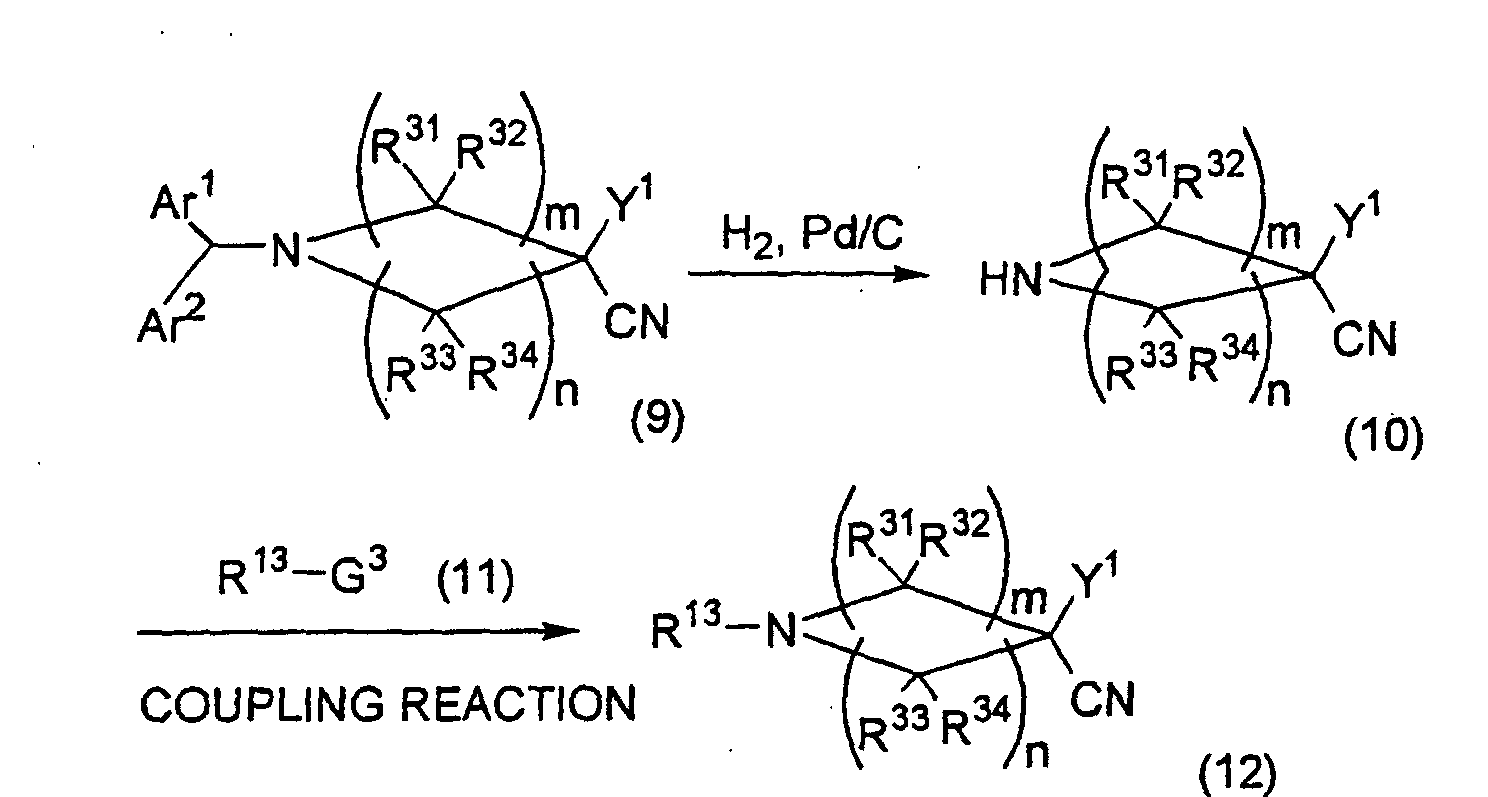
(B) The piperidinecarbonitrile having no substituent at the 1-position,
and the piperidinecarbonitrile having a substituent at the 1-position,
said substituent being an aromatic group or a substituted
aromatic group represented by R
13, may be prepared as follows. The
substituent of the substituted aromatic group represented by R
13 is a
fluorine atom, a trifluoromethyl group, a methylenedioxy group, a lower
alkyl group, a lower alkoxy group, a lower alkoxy group being
substituted by one or more fluorine atoms, a benzyloxy group, a di-lower
alkylamino group, etc.
(wherein m, n, R
31, R
32, R
33, R
34, Y
1 and R
13 are as defined above; G
3 is a
leaving group; Ar
1 is a substituted or unsubstituted phenyl group; Ar
2 is
a hydrogen atom or a substituted or unsubstituted phenyl group; the
substituent is a lower alkyl group or a lower alkoxy group, etc.)
Among the compounds of the formula (8) obtained in the above
Process (A), the compound of the formula (9) is subjected to
hydrogenation in a conventional manner to give the compound of the
formula (10).
Subsequently, the compound of the formula (10) is subjected to
coupling reaction with the compound of the formula (11) using a
palladium catalyst to give the compound of the formula (12).
The coupling reaction may be carried out in the presence of
sodium tert-butylate using a palladium (0) catalyst such as
tris(dibenzylideneacetone)dipalladium or tetrakis(triphenylphosphine)-palladium,
etc., and a phosphorous ligand such as 2,2'-bis(diphenylphosphino)-1,1'-binaphthyl,
1,1'-bis(diphenylphosphino)ferrocene, etc.
The solvent may be any solvent which does not disturb the
reaction, but the reaction may preferably proceed when an ether such
as tetrahydrofuran, etc. is used.
The leaving group represented by G3 is preferably a iodine atom
or a bromine atom.
(C) The present compound of the formula (15) is prepared from the
compound of the formula (8) or the compound of the formula (12)
obtained in the above Process (A) and (B), respectively, for example, by
the following Process.
(wherein m, n, R
31, R
32, R
33, R
34, R
35, R
36, L, Y, Y
1, R
12 and R
13 are as
defined above; R
15 is an alkyl group, a substituted alkyl group, an
alkenyl group, a substituted alkenyl group, an alkynyl group, a
substituted alkynyl group, a cycloalkyl group, a substituted cycloalkyl
group, an aromatic group, or a substituted aromatic group, and the
substituent of these groups may be the same ones as those for R
12 as
mentioned above)
The compound of the formula (8) or the compound of the
formula (12) obtained in the above Process (A) or (C) may be converted
into the compound of the formula (13) by reduction with lithium
aluminum hydride in a conventional manner.
Subsequently, the compound of the formula (13) is reacted with
the compound of the formula (14) usually in a solvent at a temperature
of from 0°C to 120°C, preferably at a temperature of from room
temperature to a boiling point of the solvent, followed by the conversion
of substituents and the removal of protecting groups, if necessary, to
advantageously give the compound of the formula (15).
The solvent may be any solvent which does not disturb the
reaction, and may be ethers (e.g., ethyl ether, dimethoxyethane,
isopropyl ether, tetrahydrofuran, dioxane, etc.), aromatic hydrocarbons
(e.g., benzene, toluene, xylene, etc.), esters (e.g., methyl acetate, ethyl
acetate, propyl acetate, etc.), halogenated hydrocarbons (e.g., dichloromethane,
chloroform, dichloroethane, chlorobenzene, dichlorobenzene,
etc.), ketones (e.g., acetone, methyl ethyl ketone, etc.), nitriles (e.g.,
acetonitrile, isobutyronitrile, etc.), N,N-dimethylformamide, dimethylsulfoxide,
etc.
(D) In addition, the compound of the present invention of the
following formula (64) having a substituent other than an oxo group on
the carbon atom attached to the amino group may be prepared from the
compound of the formula (8) or the formula (12) obtained in the above
Process (A) or (B), respectively, for example, by the following Process.
(wherein m, n, R
31, R
32, R
33, R
34, R
35, R
36, L, Y, Y
1, R
12, R
13 and R
15 are
as defined above; R
37 and R
38 are the same or different, and selected, if
both of R
37 and R
38 exist, independently from a hydrogen atom, an alkyl
group, and a substituted alkyl group).
The compound of the formula (8) or the compound of the
formula (12) obtained in the above Process (A) or (C) is subjected to
reduction using diisobutyl aluminum hydride (DIBAL) in an amount of
1 to 1.5 equivalent in a halogenated hydrocarbon solvent (e.g.,
methylene chloride) at a temperature of from under ice-cooling to room
temperature to give the compound of the formula (56).
Subsequently, the compound of the formula (56) is reacted with
a Wittig reagent such as (methoxymethyl)triphenylphosphonium
chloride in an amount of 1 to 1.5 equivalent in an ether (e.g.,
tetrahydrofuran) in the presence of a strong base such as sodium amide
(NaNH2) in an amount of 1 to 1.5 equivalent at a temperature of from
-78°C to room temperature to give the compound of the formula (57).
Then, the resultant compound of the formula (57) is reacted in
a mixed solvent of a halogenated hydrocarbon solvent such as
methylene chloride and trifluoroacetic acid (1:1) at a temperature of
from under ice-cooling to room temperature to give the compound of the
formula (58).
The compound of the formula (58) is oxidized with an oxidizing
agent such as potassium permanganate (KMnO4) in an amount of 1 to 3
equivalents in a halogenated hydrocarbon solvent such as methylene
chloride or chloroform at a temperature of from room temperature to
40°C to give the compound of the formula (59).
The compound of the formula (59) may be converted into the
compound of the formula (60), for example, by a method of reacting
with methyl iodide in an amount of 1 to 1.5 equivalent in the presence
of a base such as potassium carbonate in an amount of about 3
equivalents in dimethylformamide at a temperature of from room
temperature to under heating with reflux.
The compound of the formula (60) is reacted with the
compound of the formula: R37-G1 in an amount of 1 to 1.5 equivalent in
an ether such as tetrahydrofuran in the presence of a strong base such
as lithium diisopropyl amide in an amount of 1 to 1.5 equivalent at a
temperature of from -78°C to room temperature, followed by reacting
with the compound of the formula: R38-G2 in an amount of 1 to 1.5
equivalent in the presence of a strong base such as lithium diisopropyl
amide in an amount of 1 to 1.5 equivalent to give the compound of the
formula (61) (in which G1, G2, R37 and R38 are as defined above).
Further, the compound of the formula (61) is converted into the
compound of the formula (62) by hydrolysis with sodium hydroxide in
an amount of 1 to 3 equivalents in a mixed solvent of water and ethanol
(1:4) at a temperature of from room temperature to under heating with
reflux.
The compound of the formula (62) is converted into the
compound of the formula (63) by curtius rearrangement, for example,
by reacting with diphenylphosphoryl azide in an amount of 1 to 1.5
equivalent and triethylamine in an amount of 1 to 1.5 equivalent in
dimethylformamide at a temperature of from ice-cooling to 60°C.
The compound of the formula (63) thus obtained is reacted with
the compound of the formula (14) in a same manner as in the above
Process (C), if necessary, followed by the conversion of substituents and
the removal of protecting groups, to give the compound of the formula
(64).
(E) In addition, the compound of the present invention of the
formula (68) having an oxo group on the carbon atom attached to the
amino group may be prepared from the compound of the formula (8) or
the compound of the formula (12) obtained in the above Process (A) or
(B), respectively, by the following Process.
(wherein m, n, R
31, R
32, R
33, R
34, L, Y, Y
1, R
12, R
13 and R
15 are as defined
above)
The compound of the formula (8) or the compound of the
formula (12) obtained in the above Process (A) or (C), respectively, is
reacted in a 48 % aqueous hydrobromic acid solution at a temperature
of from room temperature to under heating with reflux to give the
compound of the formula (65).
Then, the compound of the formula (65) is reacted with oxalyl
chloride ((COCl)2) in an amount of 2 to 3 equivalents in a halogenated
hydrocarbon solvent (e.g., methylene chloride, etc.) at a temperature of
from 0°C to room temperature to give the compound of the formula (66).
On the other hand, the compound of the formula (14) is reacted
in a mixed solvent of a 28 % aqueous ammonia in 1,4-dioxane (1:4) at a
temperature of from 0°C to room temperature to give the compound of
the formula (67).
The compound of the above formula (66) is reacted with the
compound of the formula (14) in a halogenated hydrocarbon solvent
(e.g., methylene chloride) at a temperature of from room temperature to
under heating with reflux in the presence of a base such as
triethylamine in an amount of 1 to 3 equivalents, if necessary, followed
by the conversion of substituents and the removal of protecting groups
to give the compound of the formula (68).
(F) In addition, the compound of the present invention of the
formula (15') may be prepared by the following Process.
(wherein m, n, R
31, R
32, R
33, R
34, R
37, R
38, L, Y, Y
1 and R
15 are as defined
above; X is a chlorine atom or a bromine atom; R
10 is a lower alkyl
group or a substituted phenyl group)
The compound of the formula (13') is reacted with the
compound of the formula (16) at a temperature of from 0°C to 80°C to a
carbamic acid ester, which is reacted with the compound of the formula
(17) at a temperature of from room temperature to a boiling point of the
solvent, or at a temperature of from room temperature to 100°C, if
necessary, followed by the conversion of substituents and the removal
of protecting groups to give the compound of the present invention of
the formula (15').
The compound of the formula (16) includes, for example, methyl
chlorocarbonate, ethyl chlorocarbonate, isobutyl chlorocarbonate,
phenyl chlorocarbonate, p-nitrophenoyl chlorocarbonate, etc.
The reaction is usually carried out in a solvent, and the solvent
may be any solvent which does not disturb the reaction, for example,
ethers (e.g., ethyl ether, isopropyl ether, tetrahydrofuran, dioxane, etc.),
aromatic hydrocarbons (e.g., benzene, toluene, xylene, etc.), esters (e.g.,
methyl acetate, ethyl acetate, propyl acetate, etc.), halogenated
hydrocarbons (e.g., dichloromethane, chloroform, dichloroethane,
chlorobenzene, dichlorobenzene, etc.), ketones (e.g., acetone, methyl
ethyl ketone, etc.), nitriles (e.g., acetonitrile, isobutyronitrile, etc.), N,N-dimethylformamide,
dimethylsulfoxide, etc.
Alternatively, in a similar manner, the compound of the formula
(17) and the compound of the formula (16) are reacted first, then, the
resultant product is reacted with the compound of the formula (13'), if
necessary, followed by the conversion of substituents and the removal
of protecting groups to give the compound of the formula (15').
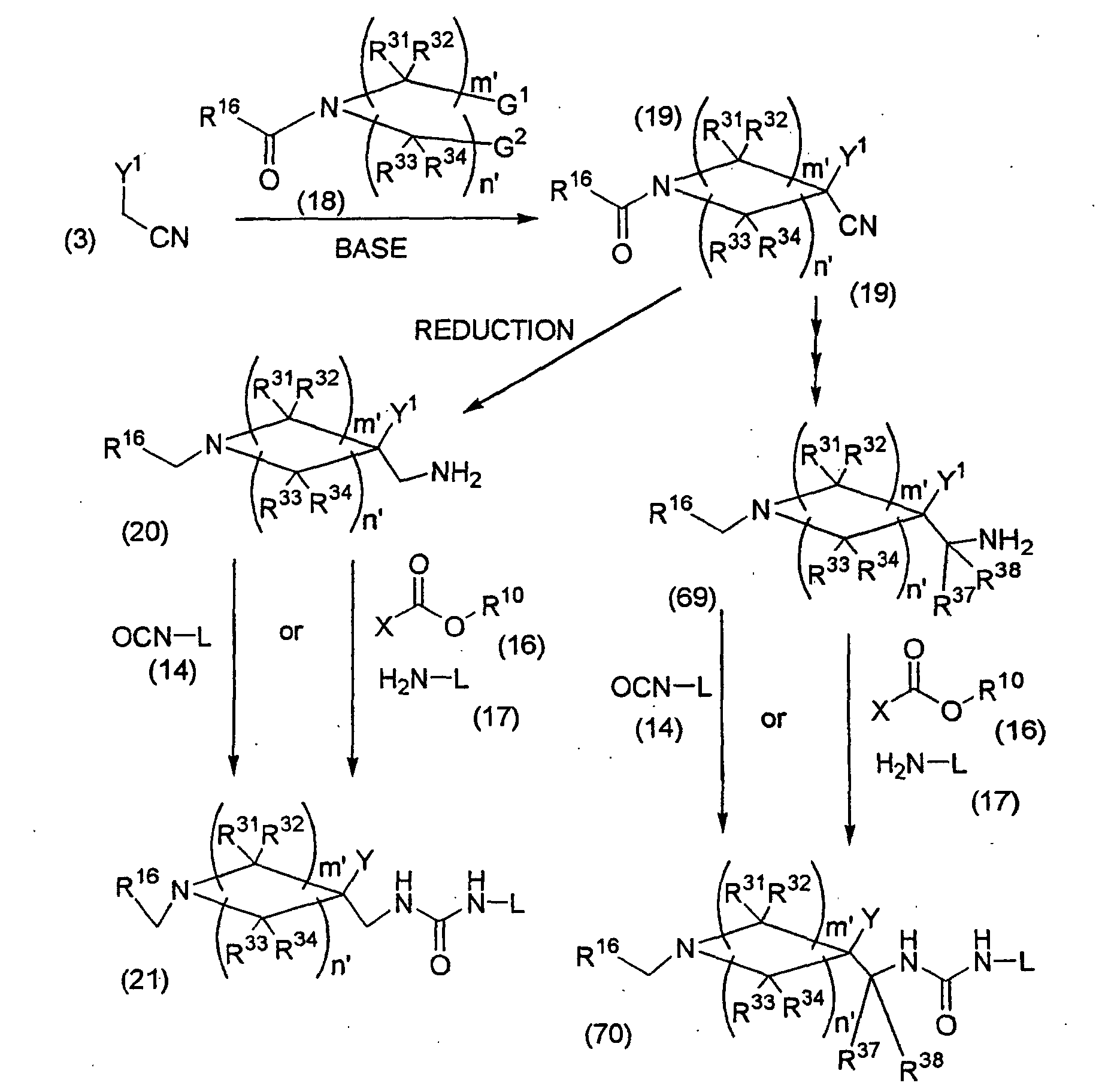
(G) The compound of the present invention may also be prepared
by the following Process, which is different from the above Processes (A)
to (D).
(wherein m', n', R
31, R
32, R
33, R
34, R
37, R
38, L, Y, Y
1, G
1, X, and R
10 are as
defined above; R
16 is an alkyl group, a substituted alkyl group, an
alkenyl group, a substituted alkenyl group, an alkynyl group, a
substituted alkynyl group, a cycloalkyl group, a substituted cycloalkyl
group, an aromatic group, or a substituted aromatic group; the
substituents on these groups are ones as defined for R
12 as mentioned
above)
The compound of the formula (3) is reacted with the compound
of the formula (18) in an amount of 1 to 2 equivalents in the presence of
a base (e.g., sodium hydride, etc.) in an amount of 1 to 3 equivalents at
a temperature of from room temperature to a boiling point of the solvent
to give the compound of the formula (19).
The leaving group represented by G1 or G2 may be a chlorine
atom, a bromine atom, etc.
The reaction is usually carried out in a solvent, and the solvent
may be any one which does not disturb the reaction, for example, ethers
(e.g., ethyl ether, dimethoxyethane, isopropyl ether, tetrahydrofuran,
dioxane, etc.), dimethylsulfoxide, etc.
The compound of the formula (19) thus obtained is treated with
lithium aluminum hydride in a usual manner for reduction of the nitrile
group and the amido group to give the compound of the formula (20).
Then, the compound of the formula (20) is converted into the compound
of the present invention of the formula (21) in a similar manner to that
of the preparation of the compound of the formula (15) or the compound
of the formula (15') from the compound of the formula (13) or the
compound of the formula (13') in the above Process (C) or (F).
Alternatively, the compound of the formula (69) is prepared
from the compound of the formula (19) in a similar manner to the above
Process (D), and the compound of the formula (69) is further reacted
with the compound of the formula (14) as mentioned above, or reacted
with the compound of the formula (16) and the compound of the
formula (17), if necessary, followed by the conversion of substituents
and the removal of protecting groups to give the compound of the
present invention of the formula (70).
(H) Among the compounds of the formula (15) and the formula (15')
obtained by the above Processes, the compound of the formula (22) is
converted in the compound of the formula (23) by a conventional
hydrogenation.
(wherein m, n, R
31, R
32, R
33, R
34, R
35, R
36, L, Y, Ar
1 and Ar
2 are as
defined above)
(I) The following derivatives are obtained from the compound of the
formula (23) obtained in the above.
(wherein m, n, R
31, R
32, R
33, R
34, R
35, R
36, L, G
1, G
2, Y and R
2 are as
defined above; R
19 is an alkyl group, a substituted alkyl group, an
alkenyl group, a substituted alkenyl group, an alkynyl group, a
substituted alkynyl group, a cycloalkyl group, or a substituted
cycloalkyl group; R
21 is an aromatic group or a substituted aromatic
group)
The compound of the formula (23) and the compound of the
formula (24) are condensed in a solvent using a condensing agent at a
temperature of from 0°C to 100°C, preferably at a temperature of from
0°C to 60°C, if necessary, followed by the conversion of substituents
and/or the deprotection to give the compound of formula (25).
The condensing agent includes, for example, dicyclohexylcarbodiimide
(DCC), 1,1'-carbonyldiimidazole, diethyl cyanophosphate
(DEPC), 1-ethyl-3-(3'-dimethylaminopropyl)carbodiimide hydrochloride
(WSC), etc.
The reaction may advantageously proceed by addition of a base
in an amount of 1 to 5 mole equivalents, preferably in an amount of 1 to
3 mole equivalents, to the amount of the compound of the formula (23).
The base may be a tertiary amine such as triethylamine, diisopropylethylamine,
or pyridine, etc.
The solvent may be any solvent which does not disturb the
reaction, for example, ethers (e.g., diethyl ether, dimethoxyethane,
tetrahydrofuran, dioxane, etc.), aromatic hydrocarbons (e.g., benzene,
toluene, xylene, etc.), esters (e.g., ethyl acetate, propyl acetate, etc.),
halogenated hydrocarbons (e.g., dichloromethane, chloroform, dichloroethane,
chlorobenzene, dichlorobenzene, etc.), ketones (e.g., acetone,
methyl ethyl ketone, etc.), nitriles (e.g., acetonitrile, isobutyronitrile,
etc.), and amides (e.g., N,N-dimethylformamide, N,N-dimethylacetamide,
etc.).
Alternatively, the compound of the formula (24) is converted
into a reactive derivative thereof, which is further reacted with the
compound of the formula (23) in a solvent at a temperature of from
-10°C to 120°C, preferably at a temperature of from 0°C to 60°C, if
necessary, followed by the conversion of substituents and/or the
deprotection to give the compound of the formula (25).
The reactive derivative of the compound of the formula (24) may
be, for example, an acid chloride, an acid bromide, an acid anhydride,
or a mixed acid anhydride with methyl carbonate, ethyl carbonate, etc.,
and the reaction may advantageously proceed by addition of a base in
an amount of 1 to 5 mole equivalents, preferably in an amount of 1 to 3
mole equivalents. The base may be a tertiary amine (e.g., triethylamine,
etc.), pyridine, an alkali metal carbonate (e.g., sodium carbonate,
potassium carbonate, etc.), and an alkali metal hydrogen carbonate (e.g.,
sodium hydrogen carbonate, etc.). The solvent may be any solvent
which does not disturb the reaction, for example, ethers (e.g., diethyl
ether, dimethoxyethane, tetrahydrofuran, dioxane, etc.), aromatic
hydrocarbons (e.g., benzene, toluene, xylene, etc.), esters (e.g., ethyl
acetate, propyl acetate, etc.), halogenated hydrocarbons (e.g., dichloromethane,
chloroform, dichloroethane, chlorobenzene, dichlorobenzene,
etc.), ketones (e.g., acetone, methyl ethyl ketone, etc.), nitriles (e.g.,
acetonitrile, isobutyronitrile, etc.), and amides (e.g., N,N-dimethylformamide,
N,N-dimethylacetamide, etc.).
In addition, the compound of formula (23) and the compound of
the formula (26) in an amount of 1 to 5 equivalents are treated with a
reducing agent in an amount of 1 to 5 equivalents at a temperature of
from 0 to 50°C in a lower alcohol (e.g., methanol, ethanol, etc.), if
necessary, followed by the conversion of substituents and/or the
deprotection to give the compound of the formula (27). The reducing
agent includes, for example, sodium borohydride (NaBH4), sodium
cyanoborohydride (NaBH3CN), sodium triacetoxyborohydride
(NaB(O2CCH3)3H), etc.
The compound of the formula (23) is reacted with the
compound of the formula (28) in a solvent, if necessary, followed by the
conversion of substituents and/or the deprotection to give the
compound of the formula (29).
The reaction is usually carried out in solvent at a temperature
of from 0°C to 100°C, preferably at a temperature of from room
temperature to 70°C, if necessary, in the presence of a base.
The solvent may be, for example, ethers (e.g., tetrahydrofuran,
dioxane, etc.), aromatic hydrocarbons (e.g., benzene, toluene, etc.),
ketones (e.g., acetone, 2-butonone, etc.), dimethylformamide, etc., and
the base may be, for example, sodium hydride, potassium carbonate,
sodium carbonate, triethylamine, etc.
When potassium carbonate or sodium carbonate is used, the
yield of the reaction may occasionally be improved by addition of
sodium iodide or potassium iodide into the reaction system.
The leaving group represented by G1 is usually a halogen atom
(e.g., chlorine, bromine, iodine, etc.), aromatic sulfonyloxy group (e.g.,
benzenesulfonyloxy group, p-toluenesulfonyloxy group, etc.) or
methanesulfonyloxy group.
In a similar manner to the conversion from the compound of
the formula (10) into the compound of the formula (12), the compound
of the formula (23) is coupled with the compound of the formula (30), if
necessary, followed by the conversion of substituents and/or the
deprotection to give the compound of the formula (31).
(J) The compound wherein the group Y is a substituted phenyl
group, and the substituent thereof is a group of the formula :-O-E-A
may be prepared by the following Process.
The compound of the formula (35) is prepared from the
compound of the formula (32), which is obtained in the above Processes,
by the following Process.
(wherein m, n, R
31, R
32, R
33, R
34, R
35, R
36, L, G
2, E and A are as defined
above; R
22 is a methyl group or a benzyl group; R
1 is the same groups
for the above R except for a hydrogen atom)
The protecting group R22 of the compound of the formula (32) is
removed by the method disclosed in the literature (e.g., PROTECTIVE
GROUPS IN ORGANIC SYNTHESIS, 3rd ed., JOHN WILEY & SONS,
INC.: New York (1999)) to give the compound of the formula (33).
Then, the compound of the formula (33) is reacted with the
compound of the formula (34) in a solvent, if necessary, followed by the
conversion of substituents and/or the deprotection to give the
compound of the formula (35).
The reaction is usually carried out in a solvent at a temperature
of from 0°C to 100°C, preferably at a temperature of from room
temperature to 70°C in the presence of a base.
The solvent may be ethers (e.g., tetrahydrofuran, dioxane, etc.),
aromatic hydrocarbons (e.g., benzene, toluene, etc.), ketones (e.g.,
acetone, 2-butanone, etc.), dimethylformamide, etc. The base
includes, for example, sodium hydride, potassium carbonate, sodium
carbonate, triethylamine, etc.
When potassium carbonate or sodium carbonate is used, the
yield of the reaction may occasionally be improved by addition of
potassium iodide or sodium iodide into the reaction system.
The leaving group represented by G2 is usually a halogen atom
(e.g., chlorine, bromine, iodine, etc.), aromatic sulfonyloxy group (e.g.,
benzenesulfonyloxy group, p-toluenesulfonyloxy group, etc.), or
methanesulfonyloxy group.
The starting compounds used in the above-mentioned each
Process may be known compounds or may be prepared from a
conventional known compound by a conventional method known by the
ordinary skilled person in this art or a modified method thereof.
Each compound obtained in the above-mentioned Processes
may be isolated and purified by a conventional isolation method such
as recrystallization, a conventional purification method using
chromatography, solvent extraction method, or reprecipitation.
The product obtained in any one of the Processes may be in the
form of an acid addition salt thereof or a free base, due to the reaction
conditions. These products may be converted into a desired acid
addition salt or a free base by a conventional method.
EXAMPLES
The present invention will be illustrated in more detail by the
following Reference Examples and Examples, and should not be
construed to be limited thereto.
Reference Example 1
Preparation of 1-benzoyl-4-(3-methoxyphenyl)piperidine-4-carbonitrile
To a solution of sodium hydride (1.36 g, 34 mmol) in dimethylsulfoxide
(DMSO, 30 ml) is added a solution of (3-methoxyphenyl)-acetonitrile
(1.90 ml, 13.6 mmol) and N,N-bis(2-chloroethyl)benzamide
(3.17 g, 13.6 mmol) in ether (10 ml) at room temperature, and the
mixture is stirred overnight. To the reaction mixture is added water,
and the mixture is extracted twice with ethyl acetate. The organic layer
is washed twice with water, dried over anhydrous magnesium sulfate,
and the solvent is evaporated under reduced pressure. Then, the
residue is purified by silica gel chromatography and crystallized from
hexane to give the title compound (2.26 g) as white crystals.
1H-NMR δ (CDCl3):1.95-2.21 (4H, brd), 3.28 (1H, brd), 3.54 (1H, brd),
3.85 (3H, s), 3.93 (1H, brd), 4.94 (1H, brd), 6.87-6.91 (1H, m), 7.01-7.07
(2H, m), 7.32-7.39 (1H, m), 7.43 (5H, s).
Reference Example 2
Preparation of [1-benzyl-4-(3-methoxyphenyl)piperidin-4-yl]methylamine
To a suspension of lithium aluminum hydride (1.18 g, 31.2
mmol) in ether (50 ml) is added ice-cold conc. sulfuric acid (1.73 ml,
31.2 mmol). To the mixture is added a solution of 1-benzoyl-4-(3-methoxyphenyl)piperidine-4-carbonitrile
(2.00 g, 6.24 mmol) in ether
(10 ml) at room temperature, and the mixture is stirred for 15 minutes.
The mixture is heated under reflux for 2 hours, and thereto is added
aqueous ammonia. The mixture is filtered on Celite, and the solvent is
evaporated under reduced pressure to give the title compound (1.94 g)
as colorless oil.
1H-NMR δ (CDCl3): 1.76-1.84 (2H, m), 2.16-2.25 (4H, m), 2.60-2.62 (2H,
m), 2.74 (2H, s), 3.41 (2H, s), 3.82 (3H, s), 6.75-6.79 (1H, m), 6.86-6.91
(2H, m), 7.23-7.31 (6H, m).
Reference Example 3
Preparation of [1-phenyl-4-(3-hydroxyphenyl)piperidin-4-yl]methylamine
To a solution of [1-phenyl-4-(3-methoxyphenyl)piperidin-4-yl]-methylamine
(200 mg, 0.675 mmol) in methylene chloride (20 ml) is
added dropwise boron tribromide (0.058 ml, 0.609 mmol) under ice
cooling over a period of 10 minutes. The mixture is warmed to room
temperature, and stirred overnight. To the reaction solution is added
ice-cold methanol, and the mixture is concentrated under reduced
pressure. To the reaction solution is added ether, and the mixture is
extracted twice with 3N aqueous hydrochloric acid solution. The
aqueous layer is basified with aqueous ammonia, and dried over
anhydrous magnesium sulfate, and the solvent is evaporated under
reduced pressure to give the title compound (144 mg) as oil.
1H-NMR δ (DMSO-d6): 1.80-1.88 (2H, m), 2.08-2.13 (2H, m), 2.59 (2H, s),
2.81-2.88 (2H, m), 3.32-3.37 (4H, m), 6.57-6.60 (1H, m), 6.66-6.79 (3H,
m), 6.86-6.89 (2H, m), 7.10-7.17 (3H, m), 9.24 (1H, brdm).
Reference Example 4
Preparation of 4-hydroxy-2-(2-hydroxyethyl)-(3-methoxyphenyl)butanenitrile
To a solution of sodium hydride (1.79 g, 44.8 mmol) in
dimethylsulfoxide (DMSO, 60 ml) is added a solution of (3-methoxyphenyl)acetonitrile
(2.50 ml, 17.9 mmol) and 2-bromoethyl tert-butyldimethylsilyl
ether (9.22 ml, 43.0 mmol) in ether (20 ml) at room
temperature, and the mixture is stirred overnight. To the mixture is
added water, and the mixture is extracted twice with ether. The
organic layer is washed three times with water, dried over anhydrous
magnesium sulfate, and the solvent is evaporated under reduced
pressure. Then, the reaction mixture is dissolved in tetrahydrofuran
(THF, 100 ml), and thereto is added tetrabutylammonium fluoride
(TBAF, 12.2 g, 46.5 mmol), and the mixture is stirred at room
temperature overnight. Water is added to the mixture, and the mixture
is extracted twice with ethyl acetate. The organic layer is washed twice
with water, dried over anhydrous magnesium sulfate, and the solvent is
evaporated under reduced pressure. The residue is purified by silica
gel chromatography to give the title compound (2.91 g) as colorless oil.
1H-NMR δ (DMSO-d6): 1.97-2.02 (4H, m), 3.12-3.22 (2H, m), 3.32-3.45
(2H, m), 3.76 (3H, s), 4.59 (2H, t, J = 5.13), 6.87-7.03 (3H, m), 7.31-7.36
(1H, m).
Reference Example 5-1
Preparation of 1-(4-fluorophenyl)-4-(3-methoxyphenyl)piperidine-4-carbonitrile
To a solution of 4-hydroxy-2-(2-hydroxyethyl)-(3-methoxyphenyl)butanenitrile
(70 mg, 0.195 mmol) in acetonitrile (6 ml) are
successively added trifluoromethanesulfonic anhydride (0.11 ml, 0.626
mmol) and triethylamine (0.080 ml, 0.626 mmol) at a temperature of
-30°C to -20°C, and the mixture is stirred for 15 minutes. To the
mixture are added 4-fluoroaniline (0.037 ml, 0.387 mmol) and
triethylaniline (0.066 ml, 0.387 mmol) at a temperature of -30°C to
-20°C, and the mixture is slowly warmed to room temperature and
stirred for 2 hours. The reaction is quenched by addition of water, and
the mixture is extracted with ether. The organic layer is washed twice
with water, dried over anhydrous magnesium sulfate, and the solvent is
evaporated under reduced pressure. The resultant is purified by
preparative thin layer chromatography (preparative TLC) to give the title
compound (53.5 mg) as colorless oil.
1H-NMR δ (DMSO-d6): 2.12-2.27 (4H, m), 2.88-2.97 (2H, m), 3.72-3.78
(5H, m), 6.93-6.97 (1H, m), 7.03-7.15 (6H, m), 7.35-7.40 (1H, m).
Reference Example 5-2
Preparation of 1-benzhydrile-4-(3-methoxyphenyl)piperidine-4-carbonitrile
The title compound is prepared in a similar manner to
Reference Example 5-1.
1H-NMR δ (DMSO-d6): 2.08 (4H, m), 2.18-2.26 (2H, m), 2.88-2.93 (2H,
m), 3.78 (3H, s), 4.45 (1H, s), 6.91-6.94 (1H, m), 7.03-7.05 (1H, m),
7.09-7.12 (1H, m), 7.16-7.21 (2H, m), 7.27-7.37 (5H, m), 7.44-7.47 (4H,
m).
Reference Example 6
Preparation of 4-(3-methoxyphenyl)piperidine-4-carbonitrile
A suspension of 1-benzhydrile-4-(3-methoxyphenyl)piperidine-4-carbonitrile
(34.3 mg, 0.090 mmol), acetic acid (0.005 ml, 0.090
mmol) and 10 % palladium hydroxide (3.4 mg) in methanol (20 ml) is
stirred under hydrogen atmosphere for 3 hours. The mixture is filtered
on Celite, and the solvent was evaporated under reduced pressure. To
the resultant is added a saturated aqueous sodium hydrogen carbonate
solution, and the mixture is extracted with ethyl acetate. The extract is
washed once with a saturated aqueous sodium hydrogen carbonate
solution, dried over anhydrous magnesium sulfate. The solvent is
evaporated under reduced pressure, and the residue is purified by
preparative TLC to give the title compound (12.9 mg) as oil.
1H-NMR δ (DMSO-d6): 1.86-2.06 (4H, m), 2.79-2.87 (2H, m), 3.07-3.11
(2H, m), 3.77 (3H, s), 6.92-6.96 (1H, m), 7.00-7.08 (2H, m), 7.33-7.39
(1H, m).
Reference Example 7-1
Preparation of 1-(3-pyridyl)-4-(3-methoxyphenyl)piperidine-4-carbonitrile
To a solution of tris(dibenzylideneacetone)dipalladium
(Pd2(dba)3, 14.0 mg, 10 mol %) and 2,2'-bis(diphenylphosphino)-1,1'-binaphthyl
(BINAP, 17.0 mg, 20 mol %) in tetrahydrofuran (THF, 100
ml) are added 3-iodopyridine (34 mg, 0.166 mmol), 4-(3-methoxyphenyl)piperidine-4-carbonitrile
(30 mg, 0.139 mmol), sodium tert-butylato
(47 mg, 0.417 mmol) at room temperature, and the mixture is
heated under reflux for 5 hours. The reaction is quenched by addition
of a saturated brine, and the mixture is extracted with ethyl acetate,
and the organic layer is washed twice with a saturated brine. The
extract is dried over anhydrous magnesium sulfate and concentrated
under reduced pressure. The resultant is purified by preparative TLC
to give the title compound (28.0 mg) as oil.
High performance liquid chromatography/Mass spectroscopy
m/z 294.1 (M+H)
Retention time: 0.22 min., 2.86 min.
Reference Example 7-2
Preparation of 1-[3-(benzyloxy)pyridin-2-yl]-4-(3-methoxyphenyl)-piperidine-4-carbonitrile
The title compound is prepared in a similar manner to
Reference Example 7-1.
High performance liquid chromatography/Mass spectroscopy
m/z 400.3 (M+H)
Retention time: 3.17 min.
Reference Example 8
Preparation of 3-(benzyloxy)-2-bromopyridine
To a solution of 2-bromo-3-pyridinol (1.74 g, 10.0 mmol) and
potassium carbonate (4.15 g, 30.0 mmol) in dimethylformamide (DMF,
150 ml) is added benzyl bromide (1.49 ml, 12.5 mmol) at room
temperature, and the mixture is warmed to 55°C and stirred for 3 hours.
The reaction is quenched by addition of water, and the mixture is
extracted with ethyl acetate. The organic layer is washed twice with
water, dried over anhydrous magnesium sulfate, and evaporated under
reduced pressure. The residue is purified by silica gel chromatography
to give the title compound (2.61 g) as oil.
1H-NMR δ (DMSO-d6): 7.33-7.49 (6H, m), 7.58-7.61 (1H, m), 7.95-7.98
(1H, m).
Example 1-1
Preparation of N-{[1-benzyl-4-(3-methoxyphenyl)piperidin-4-yl]methyl}-N'-(2,6-diisopropylphenyl)urea
To a solution of 2,6-diisopropyl isocyanate (1.27 g, 6.25 mmol)
in tetrahydrofuran (THF, 100 ml) is added [1-benzyl-4-(3-methoxyphenyl)piperidin-4-yl]methylamine
(1.94 g, 6.25 mmol) at room
temperature. The mixture is concentrated under reduced pressure,
and the resultant is purified by silica gel chromatography to give the
title compound (3.02 g) as amorphous.
1H-NMR δ (CDCl3): 1.05 (12H, brd), 1.78-1.81 (2H, m), 1.95 (2H, m),
2.26 (2H, m), 2.53 (2H, m), 3.05-3.15 (2H, m), 3.31 (2H, d, J = 5.49),
3.40 (2H, s), 3.71 (3H, s), 5.63 (1H, s), 6.53-6.62 (3H, m), 6.99 (1H, t, J
= 7.32), 7.07 (2H, d, J = 7.86), 7.23-7.28 (7H, m).
Example 1-2
Preparation of N-{[1-phenyl-4-(3-methoxyphenyl)piperidin-4-yl]methyl}-N'-(2,6-diisopropylphenyl)urea
The title compound is prepared in a similar manner to Example
1-1.
1H-NMR δ (CDCl3): 1.06-1.14 (12H, brd), 1.85-1.94 (2H, m), 2.10-2.15
(2H, m), 2.94-3.02 (2H, m), 3.09-3.18 (2H, m), 3.30-3.36 (4H, m), 3.70-3.79
(4H, m), 5.83 (1H, s), 6.55-6.63 (3H, m), 6.76-6.88 (3H, m), 6.99-7.30
(7H, m)
Example 2
Preparation of N-{[4-(3-methoxyphenyl)piperidin-4-yl]methyl}-N'-(2,6-diisopropylphenyl)urea
A suspension of 50 % (w/w) palladium on carbon (200 mg) and
N-{[1-benzyl-4-(3-methoxyphenyl)piperidin-4-yl]methyl}-N'-(2,6-diisopropylphenyl)urea
(2.02 g, 3.93 mmol) in methanol (30 ml) is
stirred under hydrogen atmosphere at room temperature for 4 hours.
To the reaction mixture is added 10 % hydrochloric acid/methanol (2
ml), and the mixture is filtered on Celite, and the solvent is evaporated
under reduced pressure. The resultant is crystallized from ether to
give the hydrochloride of the title compound (1.93 g) as white crystals.
1H-NMR δ (DMSO-d6): 1.06 (12H, d, J = 6.75), 1.90-2.04 (4H, brd), 2.74
(2H, brd), 2.97-3.06 (4H, brdm), 3.33 (2H, brd), 3.77 (3H, s), 5.87 (1H,
brd), 6.83-6.96 (3H, brdm), 7.04-7.31 (4H, brdm), 7.47 (1H, brd).
Example 3
Preparation of N-{[1-acetyl-4-(3-methoxyphenyl)piperidin-4-yl]methyl}-N'-(2,6-diisopropylphenyl)urea
To N-{[4-(3-methoxyphenyl)piperidin-4-yl]methyl}-N'-(2,6-diisopropylphenyl)urea
hydrochloride (500 mg, 1.09 mmol) is added
acetyl chloride (1.20 ml, 0.085 mmol) under ice-cooling, and thereto is
further added triethylamine (2.40 ml, 0.334 mmol), and the mixture is
stirred at room temperature for 2 hours. Water is added to the
reaction mixture, and the mixture is extracted twice with ethyl acetate.
The organic layer is washed twice with water, dried over anhydrous
magnesium sulfate, and the solvent is evaporated under reduced
pressure. The resultant is crystallized from ether/hexane to give the
title compound (399 mg) as white crystals.
1H-NMR δ (CDCl3): 1.08 (12H, brd), 1.65-1.76 (2H, brdm), 1.88-1.99 (2H,
brdm), 2.03 (3H, s), 3.08-3.31 (6H, m), 3.54-3.91 (5H, m), 6.00 (1H, s),
6.57-6.67 (4H, m), 7.04-7.11 (3H, m), 7.25-7.30 (1H, m).
Example 4
Preparation of N-{[1-ethyl-4-(3-methoxyphenyl)piperidin-4-yl]methyl}-N'-(2,6-diisopropylphenyl)urea
To a suspension of lithium aluminum hydride (16 mg, 0.430
mmol) in tetrahydrofuran (THF, 10 ml) is added N-{[1-acetyl-4-(3-methoxyphenyl)piperidin-4-yl]methyl}-N'-(2,6-diisopropylphenyl)urea
(200 mg, 0.430 mmol) at room temperature, and the mixture is stirred
overnight. To the mixture is added aqueous ammonia, and the mixture
is filtered on Celite. The solvent is evaporated under reduced pressure,
and the residue is purified by preparative TLC to give the title
compound (45 mg) as white crystal.
High performance liquid chromatography/Mass spectroscopy
m/z 452.1 (M+H)
Retention time: 3.63 min.
Example 5-1
Preparation of N-{[1-methyl-4-(3-methoxyphenyl)piperidin-4-yl]methyl}-N'-(2,6-diisopropylphenyl)urea
To a solution of N-{[4-(3-methoxyphenyl)piperidin-4-yl]methyl}-N'-(2,6-diisopropylphenyl)urea
(500 mg, 1.09 mmol) in methanol (10 ml)
are added a 37 % aqueous formaldehyde solution (176 mg, 2.17 mmol)
and sodium cyanoborohydride (NaBH3CN, 103 mg, 1.64 mmol) under
ice-cooling, and the mixture is warmed to room temperature and stirred
for 3 hours. Water is added to the reaction mixture, and the mixture is
extracted twice with ethyl acetate. The organic layer is washed twice
with water, dried over anhydrous magnesium sulfate, and the solvent is
evaporated under reduced pressure to give the title compound (481 mg)
as white crystals.
1H-NMR δ (CDCl3): 1.07 (12H, brd), 1.97-2.14 (2H, brd), 2.40-2.56 (5H,
brd), 2.83 (2H, brd), 3.05-3.14 (2H, m), 3.35 (2H, brd), 3.77 (3H, s), 5.90
(1H, brd), 6.54-6.74 (3H, brdm), 7.07-7.28 (5H, m).
Example 5-2
Preparation of N-{[1-butyl-4-(3-methoxyphenyl)piperidin-4-yl]methyl}-N'-(2,6-diisopropylphenyl)urea
The title compound is prepared in a similar manner to Example
5-1.
1H-NMR δ (DMSO-d6): 0.839 (3H, t, J = 7.14), 1.06 (12H, d, J = 6.78),
1.82 (2H, brd), 1.98 (2H, brd), 2.19 (4H, brd), 2.30 (2H, brd), 2.50 (2H,
brd), 2.97-3.06 (2H, m), 3.75 (3H, s), 5.67 (1H, brd), 6.80-7.33 (8H,
brdm).
Example 6-1
Preparation of N-{[1-phenyl-4-(3-methoxyphenyl)piperidin-4-yl]methyl}-N'-(4-tert-butoxycarbonylamino-2,6-diisopropylphenyl)urea
To a solution of [1-phenyl-4-(3-methoxyphenyl)piperidin-4-yl]-methylamine
(300 g, 1.01 mmol) in tetrahydrofuran (THF, 10 ml) is
added tert-butyl 3,5-diisopropyl-4-({[(4-nitrophenyl)oxy]carbonyl}amino)-phenylcarbamate
(486 mg, 1.06 mmol), and the mixture is stirred
overnight. Water is added to the reaction mixture, and the mixture is
extracted twice with ethyl acetate. The organic layer is washed twice
with water, and dried over anhydrous magnesium sulfate. The solvent
is evaporated under reduced pressure, and the residue is purified by
silica gel chromatography to give the title compound (522 mg) as
colorless amorphous.
1H-NMR δ (CDCl3): 1.02-1.13 (12H, m), 1.55 (9H; s), 1.86-1.93 (2H, m),
2.05-2.16 (2H, m), 2.93-3.00 (2H, m), 3.05-3.14 (2H, m), 3.31-3.38 (4H,
m), 3.71 (3H, s), 5.76 (1H, s), 6.59-6.87 (7H, m), 7.04-7.26 (5H, m).
Example 6-2
Preparation of N-{[1-phenyl-4-(3-hydroxyphenyl)piperidin-4-yl]methyl}-N'-(4-tert-butoxycarbonylamino-2,6-diisopropylphenyl)urea
The title compound is prepared from [1-phenyl 4-(3-hydroxyphenyl)piperidin-4-yl]methylamine
in a similar manner to Example 6-1.
1H-NMR δ (DMSO-d6): 1.04 (12H, d, J = 6.78), 1.45 (9H, s), 1.89-2.01
(4H, brd), 2.95-3.04 (4H, m), 3.31 (2H, brd), 5.69 (1H, brd), 6.61-6.89
(6H, m), 7.13-7.24 (6H, m), 9.09 (1H, brd), 9.28 (1H, s).
Example 7-1
Preparation of N-{[1-phenyl-4-(3-methoxyphenyl)piperidin-4-yl]methyl}-N'-(4-amino-2,6-diisopropylphenyl)urea
To a solution of N-{[1-phenyl-4-(3-methoxyphenyl)piperidin-4-yl]methyl}-N'-(4-tert-butoxycarbonylamino-2,6-diisopropylphenyl)urea
(188 mg, 0.306 mmol) in methanol (4 ml) is added 10 % hydrochloric
acid/methanol (0.40 ml), and the mixture is stirred at room
temperature overnight. The solvent is evaporated under reduced
pressure, and the residue is crystallized from hexane/ether to give the
hydrochloride of the title compound (155 mg) as white crystals.
1H-NMR δ (DMSO-d6): 1.05 (12H, d, J = 6.78), 2.28-2.32 (2H, brdm),
2.49-2.58 (2H, brdm), 2.98-3.07 (2H, m), 3.36-3.79 (9H, brdm), 6.17
(1H, brd), 6.78-7.11 (5H, m), 7.30-7.53 (3H, m), 7.73-7.83 (3H, m).
Example 7-2
Preparation of N-{[1-(2-methoxyphenyl)-4-(3-hydroxyphenyl)piperidin-4-yl]methyl}-N'-(4-amino-2,6-diisopropylphenyl)urea
The hydrochloride of the title compound is prepared in a similar
manner to Example 7-1.
Melting point: 238-240°C
Example 7-3
Preparation of N-{[1-(2-benzyloxyphenyl)-4-(3-methoxyphenyl)piperidin-4-yl]methyl}-N'-(4-amino-2,6-diisopropylphenyl)urea
The hydrochloride of the title compound is prepared in a similar
manner to Example 7-1.
Melting point: 201-202°C
Example 7-4
Preparation of N-{[1-(2-hydroxyphenyl)-4-(3-methoxyphenyl)piperidin-4-yl]methyl}-N'-(4-amino-2,6-diisopropylphenyl)urea
The title compound is prepared in a similar manner to Example
7-1.
Melting point: 207-208°C
Example 8
Preparation of N-{[1-phenyl-4-(3-hydroxyphenyl)piperidin-4-yl]methyl}-N'-(4-amino-2,6-diisopropylphenyl)urea
To a solution of N-{[1-phenyl-4-(3-methoxyphenyl)piperidin-4-yl]methyl}-N'-(4-tert-butoxycarbonylamino-2,6-diisopropylphenyl)urea
(309 mg, 0.503 mmol) in methylene chloride (10 ml) is added boron
tribromide (0.143 ml, 1.51 mmol) under ice-cooling, and the mixture is
stirred for 3 hours at room temperature. The reaction is quenched by
addition of methanol, and the reaction solution is neutralized by
addition of aqueous sodium hydrogen carbonate solution. The mixture
is extracted twice with ethyl acetate, and the organic layer is washed
twice with water, and dried over anhydrous magnesium sulfate. The
solvent is evaporated under reduced pressure and crystallized from
hexane/ether to give the title compound (180 mg) as white crystals.
1H-NMR δ (DMSO-d6): 1.02 (12H, brd), 1.90-2.00 (4H, brd), 2.87-2.40
(8H, m), 4.90 (2H, brd), 5.61 (1H, brd), 6.28 (2H, s), 6.61-7.18 (10H,
brdm), 9.23 (1H, s).
Example 9
Preparation of N-({1-phenyl-4-[3-(3-hydroxypropoxy)phenyl]piperidin-4-yl}methyl)-N'-(4-amino-2,6-diisopropylphenyl)urea
A suspension of N-{[1-phenyl-4-(3-hydroxyphenyl)piperidin-4-yl]methyl}-N'-(4-tert-butoxycarbonylamino-2,6-diisopropylphenyl)urea
(46.5 mg, 0.078 mmol) and potassium carbonate (31.3 mg, 0.227 mmol)
in dimethylformamide (DMF, 10 ml) is stirred at room temperature for
30 minutes, and thereto is added 3-bromopropylbenzyl ether (0.020 ml,
0.113 mmol). The mixture is warmed to 60°C, and stirred for 4 hours.
Further, to the mixture is added 3-bromopropylbenzyl ether (0.013 ml,
0.078 mmol) at room temperature, and the mixture is warmed to 60°C,
and stirred for 3 hours. Water is added to the reaction mixture, and
the mixture is extracted once with ethyl acetate. The organic layer is
washed twice with water, dried over anhydrous magnesium sulfate, and
the solvent is evaporated under reduced pressure. The reaction
mixture is dissolved in 10 % hydrochloric acid/methanol (20 ml), and
thereto is added a 50 % (w/w) palladium on carbon (10 mg). The
mixture is stirred under hydrogen atmosphere for 2 days, and the
mixture is rendered faintly alkaline with a saturated aqueous sodium
hydrogen carbonate solution, and the mixture is extracted with ethyl
acetate. The organic layer is washed twice with a saturated aqueous
sodium hydrogen carbonate solution, dried over anhydrous magnesium
sulfate, and the solvent is evaporated under reduced pressure. The
residue is purified by preparative TLC to give the title compound (6.5
mg, 15 %) as amorphous.
High performance liquid chromatography/Mass spectroscopy
m/z 559.4 (M+H)
Retention time: 2.84 min.
Example 10
Preparation of N-[(1-phenyl-4-{3-[3-(1,3-dioxo-1,3-dihydro-2H-isoindol-2-yl)propoxy]phenyl}piperidin-4-yl)methyl]-N'-(4-tert-butoxycarbonylamino-2,6-diisopropylphenyl)urea
A suspension of N-{[1-phenyl-4-(3-hydroxyphenyl)piperidin-4-yl]methyl}-N'-(4-tert-butoxycarbonylamino-2,6-diisopropylphenyl)urea
(1.82 g, 2.96 mmol) and potassium carbonate (1.23 g, 8.88 mmol) in
dimethylformamide (DMF, 100 ml) is stirred at room temperature for 30
minutes, and thereto is added N-(3-bromopropyl)phthalimide (1.19 g,
4.44 mmol). The mixture is warmed to 60°C, and stirred for 4 hours.
To the mixture is added additional N-(3-bromopropyl)phthalimide (793
mg, 2.96 mmol) at room temperature, and the mixture is warmed to
70°C, and stirred for 4 hours. To the mixture is added water, and the
mixture is extracted with ethyl acetate. The organic layer was washed
twice with water, dried over anhydrous magnesium sulfate. The
solvent is evaporated under reduced pressure and the residue is
purified by silica gel chromatography to give the title compound (2.76 g)
as amorphous.
1H-NMR δ (DMSO-d6): 1.03 (12H, d, J = 6.39), 1.45 (9H, s), 1.87-2.10
(6H, m), 2.94-3.03 (4H, m), 3.30-3.32 (2H, brd), 3.77 (2H, t, J = 6.60),
5.67 (1H, brd), 6.68-6.73 (3H, m), 6.87-6.97 (3H, m), 7.13-7.25 (6H, m),
7.79-7.86 (4H, m), 9.09 (1H, s).
Example 11-1
Preparation of N-{(1-phenyl-4-{3-[3-(2,2,2-trifluoroethyl)carbonylaminopropoxy]phenyl}piperidin-4-yl)methyl}-N'-(4-amino-2,6-diisopropylphenyl)urea
N-[(1-Phenyl-4-{3-[3-(1,3-dioxo-1,3-dihydro-2H-isoindol-2-yl)-propoxy]phenyl}piperidin-4-yl)methyl]-N'-(4-tert-butoxycarbonylamino-2,6-diisopropylphenyl)urea
(2.76 g, 3.50 mmol) is dissolved in a 30 %
methylamine/ethanol (50 ml), and the mixture is stirred at room
temperature overnight. The solvent is evaporated under reduced
pressure, and the reaction mixture (250 mg, 0.380 mmol) is separated
and dissolved in dimethylformamide (DMF, 10 ml). A solution of 3,3,3-trifluoropropionic
acid (34.6 mg, 0.270 mmol), 1-ethyl-3-(3'-dimethylaminopropyl
)carbodiimide hydrochloride (WSC, 31.0 mg, 0.162 mmol),
1-hydroxybenzotriazole hydrate (HOBt, 22.0 mg, 0.162 mmol), triethylamine
(0.045 ml, 0.324 mmol) in dimethylformamide (DMF, 10 ml) is
stirred at room temperature overnight. Water is added to the mixture,
and the mixture is extracted with ethyl acetate. The organic layer is
washed twice with water, and washed once with a saturated aqueous
sodium hydrogen carbonate solution. The mixture is dried over
anhydrous magnesium sulfate, and the solvent is evaporated under
reduced pressure. The residue is purified by preparative TLC to give
the purified product (179 mg, 61 %) as amorphous, which is dissolved
in 10 % hydrochloric acid/methanol. The mixture is stirred overnight,
and concentrated, and the residue is crystallized from chloroform/ ethyl
acetate to give the hydrochloride of the title compound (143 mg) as
white crystals.
Melting point: 197-198°C
Example 11-2
Preparation of N-({1-phenyl-4-[3-(3-cyclopropylcarbonylaminopropoxy)-phenyl]piperidin-4-yl}methyl)-N'-(4-amino-2,6-diisopropylphenyl)urea
The hydrochloride of the title compound is prepared in a similar
manner to Example 11-1.
Melting point: 197-199°C
Example 12-1
Preparation of N-{[1-(3-methoxyphenyl)-4-(3-methoxyphenyl)piperidin-4-yl]methyl}-N'-(4-amino-2,6-diisopropylphenyl)urea
(a) Preparation of N-{[1-(3-methoxyphenyl)-4-(3-methoxyphenyl)-piperidin-4-yl]methyl}-N'-(4-tert-butoxycarbonylamino-2,6-diisopropylphenyl)urea
To a solution of 4-hydroxy-2-(2-hydroxyethyl)-2-(3-methoxyphenyl)butanenitrile
(70 mg, 0.195 mmol) in acetonitrile (6 ml) are
added successively trifluoromethanesulfonic anhydride (0.11 ml, 0.626
mmol) and triethylamine (0.080 ml, 0.626 mmol) at a temperature of
from -30°C to -20°C, and the mixture is stirred for 15 minutes. To the
mixture are added m-anisidine (0.043 ml, 0.387 mmol) and triethylamine
(0.066 ml, 0.387 mmol) at a temperature of from -30°C to -20°C,
and the mixture is slowly warmed to room temperature, and stirred for
2 hours. The reaction is quenched by addition of water, and the
mixture is extracted with ether. The organic layer is washed twice with
water, dried over anhydrous magnesium sulfate, and the solvent is
evaporated under reduced pressure. To a suspension of lithium
aluminum hydride (24 mg, 0.639 mmol) in tetrahydrofuran (THF, 5 ml)
is added conc. sulfuric acid (0.018 ml, 0.639 mmol) under ice-cooling,
and the mixture is warmed to room temperature, and stirred for 30
minutes. A solution of the resultant in THF (1 ml) is stirred at room
temperature for 3 hours, and aqueous ammonia is slowly added to the
reaction mixture at room temperature to terminate the reaction. The
reaction mixture is filtered on Celite, and the filtrate is concentrated
under reduced pressure. The residue is dissolved in tetrahydrofuran
(THF, 6 ml), and thereto is added tert-butyl 3,5-diisopropyl-4-({[(4-nitrophenyl)oxy]carbonyl}amino)phenylcabamate
(93 mg, 0.204 mmol)
at room temperature, and the mixture is stirred overnight. The
reaction is quenched by addition of water, and the mixture is extracted
with ethyl acetate. The organic layer is washed thrice with 0.1N
aqueous sodium hydroxide solution, dried over magnesium sulfate, and
the solvent is evaporated under reduced pressure. The residue is
purified by preparative TLC to give the title compound (50.1 mg) as
amorphous.
High performance liquid chromatography/Mass spectroscopy
m/z 645.4 (M+H)
Retention time: 3.99 min.
(b) Preparation of N-{[1-(3-methoxyphenyl)-4-(3-methoxyphenyl)-piperidin-4-yl]methyl}-N'-(4-amino-2,6-diisopropylphenyl)urea
N-{[1-(3-Methoxyphenyl)-4-(3-methoxyphenyl)piperidin-4-yl]-methyl}-N'-(4-tert-butoxycarbonylamino-2,6-diisopropylphenyl)urea
(50.6 mg, 0.0785 mmol) is dissolved in 10 % hydrochloric
acid/methanol (10 ml), and the mixture is stirred overnight. The
mixture is concentrated, and crystallized from ethyl acetate to give the
hydrochloride of the title compound (31.8 mg) as white crystals.
Melting point: 194-195°C
The following compounds are prepared in a similar manner to
Example 12-1.
Example 12-2
Preparation of N-{[1-(3-methylphenyl)-4-(3-methoxyphenyl)piperidin-4-yl]methyl}-N'-(4-amino-2,6-diisopropylphenyl)urea
Melting point: 204-205°C
Example 12-3
Preparation of N-{[1-(3-fluorophenyl)-4-(3-methoxyphenyl)piperidin-4-yl]methyl}-N'-(4-amino-2,6-diisopropylphenyl)urea
Melting point: 182-183°C
Example 12-4
Preparation of N-{[1-(3-trifluoromethylphenyl)-4-(3-methoxyphenyl)-piperidin-4-yl]methyl}-N'-(4-amino-2,6-diisopropylphenyl)urea
Melting point: 184-185°C
Example 12-5
Preparation of N-{[1-(2,5-dimethoxyphenyl)-4-(3-methoxyphenyl)-piperidin-4-yl]methyl}-N'-(4-amino-2,6-diisopropylphenyl)urea
Melting point: 210-212°C
Example 12-6
Preparation of N-{[1-(4-fluorophenyl)-4-(3-methoxyphenyl)piperidin-4-yl]methyl}-N'-(4-amino-2,6-diisopropylphenyl)urea
Melting point: 200-201°C
Example 12-7
Preparation of N-{[1-(2-methoxyphenyl)-4-(3-methoxyphenyl)piperidin-4-yl]methyl}-N'-(3-amino-2,6-diisopropylphenyl)urea
Melting point: 200-201°C
Example 12-8
Preparation of N-{[1-(2-methoxyphenyl)-4-(3-trifluoromethylphenyl)-piperidin-4-yl]methyl}-N'-(4-amino-2,6-diisopropylphenyl)urea
Melting point: 199-200°C
Example 12-9
Preparation of N-{[1-(2-methoxyphenyl)-4-phenylpiperidin-4-yl]methyl}-N'-(4-amino-2,6-diisopropylphenyl)urea
Melting point: 209-210°C
Example 12-10
Preparation of N-{[1-(2-methoxyphenyl)-4-(3-fluorophenyl)piperidin-4-yl]methyl}-N'-(4-amino-2,6-diisopropylphenyl)urea
Melting point: 214-215°C
Example 12-11
Preparation of N-{[1-(2-methoxyphenyl)-4-(3-benzyloxyphenyl)piperidin-4-yl]methyl}-N'-(4-amino-2,6-diisopropylphenyl)urea
Melting point: 198-200°C
Example 12-12
Preparation of N-{[1-(2-methoxyphenyl)-4-(2-methoxyphenyl)piperidin-4-yl]methyl}-N'-(4-amino-2,6-diisopropylphenyl)urea
Melting point: 114-116°C
Example 12-13
Preparation of N-{[1-(2-methoxyphenyl)-4-(4-methoxyphenyl)piperidin-4-yl]methyl}-N'-(4-amino-2,6-diisopropylphenyl)urea
Melting point: 207-209
Example 12-14
Preparation of N-{[1-(5-chloro-2-methoxyphenyl)-4-(3-methoxyphenyl)-piperidin-4-yl]methyl}-N'-(4-amino-2,6-diisopropylphenyl)urea
Melting point: 202-203°C
Example 12-15
Preparation of N-{[1-(5-methyl-2-methoxyphenyl)-4-(3-methoxyphenyl)-piperidin-4-yl]methyl}-N'-(4-amino-2,6-diisopropylphenyl)urea
Melting point: 216-217°C
Example 13
Preparation of N-{[1-(3-pyridyl)-4-(3-methoxyphenyl)piperidin-4-yl]-methyl}-N'-(4-amino-2,6-diisopropylphenyl)urea
The hydrochloride of the title compound is prepared in a similar
manner to Reference Example 2-2, Example 6 and Example 7.
Melting point: 184-185°C
Example 14
The following compounds are prepared in a similar manner to
Reference Example 7 and Example 13.
Example 14-1
Preparation of N-{[1-(4-pyridyl)-4-(3-methoxyphenyl)piperidin-4-yl]-methyl}-N'-(4-amino-2,6-diisopropylphenyl)urea
Melting point: 197-198°C
Example 14-2
Preparation of N-{[1-(2-pyridyl)-4-(3-methoxyphenyl)piperidin-4-yl]-methyl}-N'-(4-amino-2,6-diisopropylphenyl)urea
Melting point: 197-198°C
Example 15-1
Preparation of N-{[1-(2-methoxyphenyl)-4-(3-hydroxyphenyl)piperidin-4-yl]methyl}-N'-(4-tert-butoxycarbonylamino-2,6-diisopropylphenyl)urea
A suspension of N-{[1-(2-methoxyphenyl)-4-(3-benzyloxyphenyl)-piperidin-4-yl]methyl}-N'-(4-tert-butoxycarbonylamino-2,6-diisopropylphenyl)urea
(405 mg, 0.562 mmol) and palladium on carbon (40 mg) in
methanol (20 ml) is stirred at room temperature under hydrogen
atmosphere for 6 hours. The mixture is filtered on Celite, and the
solvent is evaporated under reduced pressure. The residue is purified
by silica gel chromatography to give the title compound (293 mg) as
amorphous.
High performance liquid chromatography/Mass spectroscopy
m/z 631.7 (M+H)
Retention time: 3.12 min.
Example 15-2
Preparation of N-{[1-(2-hydroxyphenyl)-4-(3-methoxyphenyl)piperidin-4-yl]methyl}-N'-(4-tert-butoxycarbonylamino-2,6-diisopropylphenyl)urea
The title compound is prepared in a similar manner to Example
15-1.
High performance liquid chromatography/Mass spectroscopy
m/z 721.3 (M+H)
Retention time: 4.15 min.
Example 15-3
Preparation of tert-butyl (4-{[({[1-(3-hydroxypyridin-2-yl)-4-(3-methoxyphenyl)piperidin-4-yl]methyl}amino)carbonyl]amino}-3,5-diisopropyl)-carbamate
The title compound is obtained in a similar manner to Example
15-1.
High performance liquid chromatography/ Mass spectroscopy
m/z 632.5 (M+H)
Retention time: 3.15 min.
Example 16-1
Preparation of N-{[1-(2-methoxyphenyl)-4-(3-butoxyphenyl)piperidin-4-yl]methyl}-N'-(4-amino-2,6-diisopropylphenyl)urea
To a solution of N-{[1-(2-methoxyphenyl)-4-(3-hydroxyphenyl)-piperidin-4-yl]methyl}-N'-(4-tert-butoxycarbonylamino-2,6-diisopropylphenyl)urea
(50 mg, 0.0793 mmol) and cesium carbonate (32.9 mg,
0.238 mmol) in dimethylformamide (DMF, 10 ml) is added 1-iodobutane
(0.014 ml, 0.119 mmol) at room temperature, and the mixture is
warmed to 50°C, and stirred for 3 hours. Further, to the mixture are
added potassium carbonate (87.0 mg, 0.63 mmol) and 1-iodobutane
(0.028 ml, 0.238 mmol), and the mixture is stirred for 3 hours. The
reaction is quenched by addition of water, and the mixture is extracted
with ethyl acetate. The organic layer is washed twice with water, dried
over anhydrous magnesium sulfate, and the solvent is evaporated
under reduced pressure. The reaction mixture is dissolved in a 4N
hydrochloric acid/dioxane (5 ml), and the mixture is stirred at room
temperature overnight. The solvent is evaporated under reduced
pressure, and the resultant is crystallized from ethyl acetate to give the
hydrochloride of the title compound (35.2 mg) as white crystals.
Melting point: 192-193°C
Example 16-2
N-{[1-(2-Butoxyphenyl)-4-(3-methoxyphenyl)piperidin-4-yl]methyl}-N'-(4-amino-2,6-diisopropylphenyl)urea
The hydrochloride of the title compound is prepared in a similar
manner to Example 16-1.
Melting point: 193-194°C
Example 16-3
N-(4-Amino-2,6-diisopropylphenyl)-N'-{[1-(3-methoxypyridin-2-yl)-4-(3-methoxyphenyl)piperidin-4-yl]methyl}urea
The hydrochloride of the title compound is prepared in a similar
manner to Example 16-1.
Melting point: 188-189°C
Example 16-4
N-(4-Amino-2,6-diisopropylphenyl)-N'-{[1-[(3-propoxypyridin-2-yl)-4-(3-methoxyphenyl)piperidin-4-yl]methyl]urea
The hydrochloride of the title compound is prepared in a similar
manner to Example 16-1.
Melting point: 186-188°C
Example 16-5
N-(4-Amino-2,6-diisopropylphenyl)-N'-{[1-[(3-isopropoxypyridin-2-yl)-4-(3-methoxyphenyl)piperidin-4-yl]methyl]urea
The hydrochloride of the title compound is prepared in a similar
manner to Example 16-1.
Melting point: 190-191°C
Example 16-6
N-(4-Amino-2,6-diisopropylphenyl)-N'-{[1-[3-(2,2,2-trifluoroethoxy)-pyridin-2-yl]piperidin-4-yl]methyl}urea
The hydrochloride of the title compound is prepared in a similar
manner to Example 16-1.
Melting point: 189-191°C
Example 16-7
N-(4-Amino-2,6-diisopropylphenyl)-N'-{[1-[3-(2-methoxyethoxy)pyridin-2-yl]-4-(3-methoxyphenyl)piperidin-4-yl]methyl}urea
The hydrochloride of the title compound is prepared in a similar
manner to Example 16-1.
Melting point: 196-197°C
Example 16-8
N-(4-Amino-2,6-diisopropylphenyl)-N'-{[1-[3-(2-ethoxyethoxy)pyridin-2-yl]-4-(3-methoxyphenyl)piperidin-4-yl]methyl}urea
The hydrochloride of the title compound is prepared in a similar
manner to Example 16-1.
Melting point: 197-198°C
Example 16-9
N-(4-Amino-2,6-diisopropylphenyl)-N'-{[1-[3-(2-phenoxyethoxy)pyridin-2-yl]-4-(3-methoxyphenyl)piperidin-4-yl]methyl}urea
The hydrochloride of the title compound is prepared in a similar
manner to Example 16-1.
Melting point: 190-191°C
Example 16-10
N-(4-Amino-2,6-diisopropylphenyl)-N'-({4-(3-methoxyphenyl)-1-[3-(3-methoxypropoxy)pyridin-2-yl]piperidin-4-yl}methyl)urea
The hydrochloride of the title compound is prepared in a similar
manner to Example 16-1.
Melting point: 174-175°C
Example 17
Preparation of N-{[1-(2-benzyloxyphenyl)-4-(3-methoxyphenyl)piperidin-4-yl]methyl}-N'-(4-tert-butoxycarbonylamino-2,6-diisopropylphenyl)urea
To a suspension of lithium aluminum hydride (52.0 mg, 1.39
mmol) in ether (20 ml) is added a solution of 1-(2-benzyloxyphenyl)-4-(3-methoxyphenyl)piperidin-4-carbonitrile
(184 mg, 0.462 mmol) in
ether (15 ml) at room temperature, and the mixture is heated under
reflux for 3 hours. To the mixture is added slowly aqueous ammonia
at room temperature, and the reaction is quenched. The mixture is
filtered on Celite, and the reaction solution is evaporated under reduced
pressure. The residue is dissolved in tetrahydrofuran (THF, 10 ml),
and thereto is added tert-butyl 3,5-diisopropyl-4-({[(4-nitrophenyl)oxy]-carbonyl}amino)phenylcarbamate
(196 mg, 0.426 mmol) at room
temperature. The mixture is stirred for 3 hours, and the reaction is
quenched by additon of a saturated aqueous potassium carbonate.
The mixture is extracted with ethyl acetate, and the organic layer is
washed four times with a saturated aqueous potassium carbonate
solution. The mixture is dried over anhydrous magnesium sulfate, and
the resultant is evaporated under reduced pressure. The residue is
purified by silica gel chromatography to give the title compound (246
mg) as amorphous.
1H-NMR δ (DMSO-d6): 1.02 (12H, d, J = 6.60), 1.98-2.07 (4H, m), 2.94-2.99
(4H, m), 3.16 (2H, brdm), 3.76 (3H, s), 5.09 (2H, s), 5.63 (1H, brd.),
6.84-7.45 (17H, m), 9.09 (1H, brd.).
Example 18-1
Preparation of N-({1-[2-(3-hydroxypropoxy)phenyl]-4-(3-methoxyphenyl)-piperidin-4-yl}methyl)-N'-(4-amino-2,6-diisopropylphenyl)urea
To a solution of N-{[1-(2-hydroxyphenyl)-4-(3-methoxyphenyl)-piperidin-4-yl]methyl}-N'-(4-tert-butoxycarbonylamino-2,6-diisopropylphenyl)urea
(30 mg, 0.0476 mmol) and potassium carbonate (33 mg,
0.238 mmol) in dimethylformamide (DMF, 10 ml) is added 3-bromopropyl
acetate (34 mg, 0.190 mmol) at room temperature, and the
mixture is warmed to 55°C, and stirred for 5 hours. The reaction is
quenched by addition of water, and the mixture is extracted with ethyl
acetate. The organic layer is washed twice with water, dried over
anhydrous magnesium sulfate, and the solvent is evaporated under
reduced pressure. The reaction mixture is dissolved in methanol (5
ml)/water (1 ml), and thereto is added potassium carbonate (80 mg,
0.579 mmol) at room temperature. The mixture is stirred for 3 hours,
and the reaction is quenched by addition of water. The mixture is
extracted with ethyl acetate, and the organic layer is washed twice with
a saturated aqueous ammonium chloride solution, and washed once
with a saturated aqueous sodium hydrogen carbonate solution. The
resultant is dried over anhydrous magnesium sulfate, and the solvent is
evaporated under reduced pressure. The reaction mixture is dissolved
in 4N hydrochloric acid/dioxane (5 ml), and the mixture is stirred
overnight. The solvent is evaporated under reduced pressure, and the
residue is crystallized from ethyl acetate to give the hydrochloride of the
title compound (14.3 mg) as white crystals.
Melting point: 188-189°C
Example 18-2
Preparation of N-({1-(2-methoxyphenyl)-4-[3-(3-hydroxypropoxy)phenyl]-piperidin-4-yl}methyl)-N'-(4-amino-2,6-diisopropylphenyl)urea
The title compound is prepared in a similar manner to Example
18-1.
Melting point: 203-205°C
Example 18-3
N-(4-Amino-2,6-diisopropylphenyl)-N'-{[1-[3-(2-hydroxyethoxy)pyridin-2-yl]-4-(3-methoxyphenyl)piperidin-4-yl]methyl}urea
The hydrochloride of the title compound is prepared in a similar
manner to Example 18-1.
Melting point: 174-176°C
Example 19
tert-Butyl (4-{[({[1-[3-(benzyloxy)pyridin-2-yl]-4-(3-methoxyphenyl)-piperidin-4-yl]methyl}amino)carbonyl]amino}-3,5-diisopropylphenyl)-carbamate
The title compound is prepared in a similar manner to
Reference Example 2 and Example 6-1.
High performance liquid chromatography/Mass spectroscopy
m/z 722.4 (M+H)
Retention time: 3.57 min.
Example 20-1
N-(4-Amino-2,6-diisopropylphenyl)-N'-{[1-(3-hydroxypyridin-2-yl)-4-(3-methoxyphenyl)piperidin-4-yl]methyl}urea
tert-Butyl (4-{[({[1-(3-hydroxypyridin-2-yl)-4-(3-methoxyphenyl)-piperidin-4-yl]methyl}amino)carbonyl]amino}-3,5-diisopropylphenyl)-carbamate
(6.80 mg, 0.0108 mmol) is dissolved in a 4N solution of
hydrochloric acid in dioxane (5 ml), and the mixture is stirred overnight.
The reaction solution is concentrated, and crystallized from ethyl
acetate to give the hydrochloride of the title compound (5.60 mg) as
white crystals.
Melting point: 199-201°C
Example 20-2
N-(4-Amino-2,6-diisopropylphenyl)-N'-{[1-[(3-benzyloxy)pyridin-2-yl]-4-(3-methoxyphenyl)piperidin-4-yl]methyl}urea
The hydrochloride of the title compound is prepared in a similar
manner to Example 20-1.
Melting point: 171-172°C
In the above Examples and Reference Examples, the high
performance liquid chromatography for retention time is carried out
under the following conditions.
Column:
Flow rate: 3.5 ml/min.
Wavelength for detection: 220 nm
Mobile phase:
- Solution A: aqueous 0.05 % trifluoroacetic acid solution
- Solution B: 0.035 % solution of trifluoroacetic acid in acetonitrile
Time program:
| Step | Time (min) | Solution A:Solution B |
| 1 | 0.0 - 0.5 | 90:10 |
| 2 | 0.5-4.2 | 90:10 → 1:99 |
| 3 | 4.2-4.4 | 1:99 → 99:1 |
As the compound of the present invention represented by the
above formula (1), the following compounds are also exemplified in
addition to the compounds as disclosed in Examples.
N-(4-amino-2,6-diisopropylphenyl)-N'-{[1-[2-(2-methoxyethoxy)-phenyl]-2-(3-methoxyphenyl)piperidin-2-yl]methyl}urea
N-(4-amino-2,6-diisopropylphenyl)-N'-{[1-[2-(2-methoxyethoxy)-phenyl]-3-(3-methoxyphenyl)piperidin-3-yl]methyl}urea
N-{[(4-amino-2,6-diisopropylphenyl)amino]carbonyl}-1-[2-(2-methoxyethoxy)phenyl]-4-(3-methoxyphenyl)piperidin-4-carboxamide
N-(4-amino-2,6-diisopropylphenyl)-N'-{[1-[2-(2-methoxyethoxy)-phenyl]-4-(3-methoxyphenyl)-2,6-dimethylpiperidin-4-yl]methyl}urea
N-(4-amino-2,6-diisopropylphenyl)-N'-{[1-[2-(2-methoxyethoxy)-phenyl]-4-(3-methoxyphenyl)-2,6-dioxopiperidin-4-yl]methyl}urea
EXPERIMENTS
The ACAT inhibitory activity of the present compounds is
evaluated by the following method.
1. Assay of ACAT inhibitory activity using Caco-2 cells derived
from human colon adenocarcinoma:
The measurement of ACAT inhibitory activity using Caco-2 cells
was carried out by a modified method of that disclosed in the literature
(J. Lipid. Research, 28, 1057-1066, 1987, Jpn. J. Pharmacol., 68, 191-199,
1995), using radioactive [1-
3H]oleic acid as a substrate, and the
enzymatic activity was calculated from the radioactivity of the resultant
labeled cholesterolyl oleate. The results are shown in Table 1.
| Test compound (Example No.) | ACAT inhibitory rate (%) Concentration of compound: 500 nM |
| 11-1 | 57 |
| 12-2 | 59 |
| 12-3 | 63 |
The rat peritoneal-derived macrophage was prepared according
to the method disclosed in the literature: Biochimica et Biophysica Acta,
1126, 73-80, 1992. The ACAT activity was determined by a modified
method of the method disclosed in the above literature: Biochimica et
Biophysica Acta, 1126, 73-80, 1992, using radioactive [9,10-
3H]oleic
acid and exogenous cholesterol contained in the liposome which was reconstituted
according to the method disclosed in the literature:
Biochimica et Biophysica Acta, 1213, 127-134, 1994, and calculated
from the radioactivity of the labeled cholesterolyl oleate. The results
are shown in Table 2.
| Test compound (Example No.) | ACAT inhibitory rate (%) Concentration of compound: 500 nM |
| 11-1 | 99 |
| 12-2 | 99 |
| 12-3 | 99 |
The piperidine derivative of the present invention or an acid
addition salt thereof strongly inhibits ACAT activity in Caco-2 cells
derived from human colon adenocarcinoma and in rat peritoneal-derived
macrophage. Therefore, the present piperidine derivative is
useful not only as an agent for treatment of hyperlipidemia, but also in
the prophylaxis or treatment of atherosclerosis per se or various
diseases accompanied by atherosclerosis, for example, cerebral
infarction, cerebral thrombosis, transient cerebral ischemia, angina
pectoris, myocardial infarction, peripheral thrombus or occlusion.