EP1500403A1 - Preventive/remedy for diabetes - Google Patents
Preventive/remedy for diabetes Download PDFInfo
- Publication number
- EP1500403A1 EP1500403A1 EP03725677A EP03725677A EP1500403A1 EP 1500403 A1 EP1500403 A1 EP 1500403A1 EP 03725677 A EP03725677 A EP 03725677A EP 03725677 A EP03725677 A EP 03725677A EP 1500403 A1 EP1500403 A1 EP 1500403A1
- Authority
- EP
- European Patent Office
- Prior art keywords
- group
- prophylactic
- diabetes mellitus
- lower alkyl
- methyl
- Prior art date
- Legal status (The legal status is an assumption and is not a legal conclusion. Google has not performed a legal analysis and makes no representation as to the accuracy of the status listed.)
- Withdrawn
Links
- 0 Cc1c(C)c(*)c(Cc2c(*)[n](*)nc2O*)c(*)c1* Chemical compound Cc1c(C)c(*)c(Cc2c(*)[n](*)nc2O*)c(*)c1* 0.000 description 8
- KMWSTIOMDXMLGF-PXTPFGJHSA-N CC(C)[n]1nc(C[C@@H]([C@@H]([C@H]2O)O)O[C@H](CO)[C@H]2O)c(Cc2ccc(C)c(F)c2)c1[Cl]=[IH] Chemical compound CC(C)[n]1nc(C[C@@H]([C@@H]([C@H]2O)O)O[C@H](CO)[C@H]2O)c(Cc2ccc(C)c(F)c2)c1[Cl]=[IH] KMWSTIOMDXMLGF-PXTPFGJHSA-N 0.000 description 1
- IENVNIFPEVPYNU-MRSOFBGISA-N CCc1ccc(Cc(c(O[C@@H]([C@@H]([C@H]2O)O)O[C@H](COC(OC)=O)[C@H]2O)n[n]2C(C)C)c2[ClH]I)cc1 Chemical compound CCc1ccc(Cc(c(O[C@@H]([C@@H]([C@H]2O)O)O[C@H](COC(OC)=O)[C@H]2O)n[n]2C(C)C)c2[ClH]I)cc1 IENVNIFPEVPYNU-MRSOFBGISA-N 0.000 description 1
- HENGRQIRTYIFDT-PCBYGDGMSA-N CCc1ccc(Cc2c(C(F)(F)F)[nH]nc2O[C@@H]([C@@H]([C@H]([C@@H]2O)O)O)O[C@@H]2C(O)=O)cc1 Chemical compound CCc1ccc(Cc2c(C(F)(F)F)[nH]nc2O[C@@H]([C@@H]([C@H]([C@@H]2O)O)O)O[C@@H]2C(O)=O)cc1 HENGRQIRTYIFDT-PCBYGDGMSA-N 0.000 description 1
- XMRINXCTJKXHOY-MPZWGZMNSA-N CSc1ccc(Cc2c(C(F)(F)F)[nH]nc2O[C@@H]([C@@H]([C@H]2O)O)O[C@H](CO)[C@H]2O)cc1 Chemical compound CSc1ccc(Cc2c(C(F)(F)F)[nH]nc2O[C@@H]([C@@H]([C@H]2O)O)O[C@H](CO)[C@H]2O)cc1 XMRINXCTJKXHOY-MPZWGZMNSA-N 0.000 description 1
- ITWLPTKRLBXOAU-UHFFFAOYSA-N OC(C(C(CO1)OC2C3)OP1(O)=O)C23O Chemical compound OC(C(C(CO1)OC2C3)OP1(O)=O)C23O ITWLPTKRLBXOAU-UHFFFAOYSA-N 0.000 description 1
- UQPSKTWOVNNDJG-IUJPYIEESA-N O[C@H](C([C@H](C1COCc2ccccc2)OCc2ccccc2)/C=[O]\Cc2ccccc2)O[C@@H]1C(OCc1ccccc1)=O Chemical compound O[C@H](C([C@H](C1COCc2ccccc2)OCc2ccccc2)/C=[O]\Cc2ccccc2)O[C@@H]1C(OCc1ccccc1)=O UQPSKTWOVNNDJG-IUJPYIEESA-N 0.000 description 1
Images


Classifications
-
- A—HUMAN NECESSITIES
- A61—MEDICAL OR VETERINARY SCIENCE; HYGIENE
- A61K—PREPARATIONS FOR MEDICAL, DENTAL OR TOILETRY PURPOSES
- A61K45/00—Medicinal preparations containing active ingredients not provided for in groups A61K31/00 - A61K41/00
- A61K45/06—Mixtures of active ingredients without chemical characterisation, e.g. antiphlogistics and cardiaca
-
- A—HUMAN NECESSITIES
- A61—MEDICAL OR VETERINARY SCIENCE; HYGIENE
- A61K—PREPARATIONS FOR MEDICAL, DENTAL OR TOILETRY PURPOSES
- A61K31/00—Medicinal preparations containing organic active ingredients
- A61K31/13—Amines
- A61K31/155—Amidines (), e.g. guanidine (H2N—C(=NH)—NH2), isourea (N=C(OH)—NH2), isothiourea (—N=C(SH)—NH2)
-
- A—HUMAN NECESSITIES
- A61—MEDICAL OR VETERINARY SCIENCE; HYGIENE
- A61K—PREPARATIONS FOR MEDICAL, DENTAL OR TOILETRY PURPOSES
- A61K31/00—Medicinal preparations containing organic active ingredients
- A61K31/21—Esters, e.g. nitroglycerine, selenocyanates
- A61K31/27—Esters, e.g. nitroglycerine, selenocyanates of carbamic or thiocarbamic acids, meprobamate, carbachol, neostigmine
-
- A—HUMAN NECESSITIES
- A61—MEDICAL OR VETERINARY SCIENCE; HYGIENE
- A61K—PREPARATIONS FOR MEDICAL, DENTAL OR TOILETRY PURPOSES
- A61K31/00—Medicinal preparations containing organic active ingredients
- A61K31/70—Carbohydrates; Sugars; Derivatives thereof
- A61K31/7028—Compounds having saccharide radicals attached to non-saccharide compounds by glycosidic linkages
- A61K31/7034—Compounds having saccharide radicals attached to non-saccharide compounds by glycosidic linkages attached to a carbocyclic compound, e.g. phloridzin
-
- A—HUMAN NECESSITIES
- A61—MEDICAL OR VETERINARY SCIENCE; HYGIENE
- A61K—PREPARATIONS FOR MEDICAL, DENTAL OR TOILETRY PURPOSES
- A61K31/00—Medicinal preparations containing organic active ingredients
- A61K31/70—Carbohydrates; Sugars; Derivatives thereof
- A61K31/7042—Compounds having saccharide radicals and heterocyclic rings
- A61K31/7048—Compounds having saccharide radicals and heterocyclic rings having oxygen as a ring hetero atom, e.g. leucoglucosan, hesperidin, erythromycin, nystatin, digitoxin or digoxin
-
- A—HUMAN NECESSITIES
- A61—MEDICAL OR VETERINARY SCIENCE; HYGIENE
- A61K—PREPARATIONS FOR MEDICAL, DENTAL OR TOILETRY PURPOSES
- A61K31/00—Medicinal preparations containing organic active ingredients
- A61K31/70—Carbohydrates; Sugars; Derivatives thereof
- A61K31/7042—Compounds having saccharide radicals and heterocyclic rings
- A61K31/7052—Compounds having saccharide radicals and heterocyclic rings having nitrogen as a ring hetero atom, e.g. nucleosides, nucleotides
- A61K31/7056—Compounds having saccharide radicals and heterocyclic rings having nitrogen as a ring hetero atom, e.g. nucleosides, nucleotides containing five-membered rings with nitrogen as a ring hetero atom
-
- A—HUMAN NECESSITIES
- A61—MEDICAL OR VETERINARY SCIENCE; HYGIENE
- A61K—PREPARATIONS FOR MEDICAL, DENTAL OR TOILETRY PURPOSES
- A61K38/00—Medicinal preparations containing peptides
- A61K38/16—Peptides having more than 20 amino acids; Gastrins; Somatostatins; Melanotropins; Derivatives thereof
- A61K38/17—Peptides having more than 20 amino acids; Gastrins; Somatostatins; Melanotropins; Derivatives thereof from animals; from humans
- A61K38/22—Hormones
- A61K38/28—Insulins
-
- A—HUMAN NECESSITIES
- A61—MEDICAL OR VETERINARY SCIENCE; HYGIENE
- A61P—SPECIFIC THERAPEUTIC ACTIVITY OF CHEMICAL COMPOUNDS OR MEDICINAL PREPARATIONS
- A61P3/00—Drugs for disorders of the metabolism
- A61P3/08—Drugs for disorders of the metabolism for glucose homeostasis
- A61P3/10—Drugs for disorders of the metabolism for glucose homeostasis for hyperglycaemia, e.g. antidiabetics
-
- A—HUMAN NECESSITIES
- A61—MEDICAL OR VETERINARY SCIENCE; HYGIENE
- A61P—SPECIFIC THERAPEUTIC ACTIVITY OF CHEMICAL COMPOUNDS OR MEDICINAL PREPARATIONS
- A61P43/00—Drugs for specific purposes, not provided for in groups A61P1/00-A61P41/00
Definitions
- the present invention relates to a novel prophylactic and therapeutic agent of diabetes mellitus, specifically a prophylactic and therapeutic agent of diabetes mellitus, including a combination of an inhibitor of renal glucose reabsorption and a hypoglycemic agent as well as a prophylactic or therapeutic method of diabetes mellitus, using a combination of an inhibitor of renal glucose reabsorption and a hypoglycemic agent.
- Diabetes mellitus is a metabolic disease involving the increase of the level of blood glucose above the range of normal subjects due to the quantitative insufficiency or functional insufficiency of insulin in bodies, so that healthy life is markedly deteriorated because of microangiopathy in kidney, retina, nerve and the like and great vessel disorders such as arteriosclerosis.
- Hypoglycemic agents including insulin, insulin secretion-promoting agents, insulin resistance-ameliorating agents and ⁇ -glucosidase inhibitors have been widely applied so far for clinical therapeutic methods. However, these individual hypoglycemic agents have their unique problems although their usefulness is noted.
- the effectiveness of insulin secretion-promoting agents and insulin resistance-ameliorating agents is greatly reduced in diabetic patients with severely deteriorated insulin secretion potencies of their pancreas.
- diabetic patients with prominent insulin resistance the effectiveness of insulin and insulin secretion-promoting agents is lowered.
- Hyperglycemic state exists in diabetic patients after meals, between meals and during fasting, namely throughout a day, compared with normal subjects. The hyperglycemic state throughout a day should be corrected as much as possible as a whole.
- hypoglycemic agents have unique characteristic features of their hypoglycemic actions and cannot suppress abnormal increase in blood glucose throughout a day. For example, large-scale trial reports tell that insulin or insulin secretion-promoting agents cannot completely normalize the pattern of blood glucose variation throughout a day during the life cycles of diabetic patients, so that insulin or insulin secretion-promoting agents cannot absolutely prevent the onset of diabetic complications.
- ⁇ -Glucosidase inhibitors and nateglinide and repaglinide are now used as agents for ameliorating hyperglycemia after meals.
- hypoglycemic actions thereof are hardly sustainable in several hours after meals.
- any action to immediately lower the increase in blood glucose due to meals cannot be counted thereon.
- the existing hypoglycemic agents cannot completely normalize the pattern of blood glucose variation throughout a day during the life cycles of diabetic patients.
- the present inventors have made investigations so as to overcome the problems described above. Consequently, the inventors have found that the use of a combination of a hypoglycemic agent and an inhibitor of renal glucose reabsorption can produce a marked therapeutic effect, particularly a hypoglycemic action, from the standpoint of anti-diabetic action compared with no use thereof and that the use thereof can satisfy the demands due to the problems. Thus, the invention has been achieved.
- Hypoglycemic agents can be divided into agents suppressing hyperglycemia after meals or agents never suppressing hyperglycemia after meals. It has been shown that the suppression of not only fasting blood glucose but also postprandial hyperglycemia is important for the therapeutic treatment of diabetes mellitus.
- the inventors have examined whether or not individual combinations of an agent with a strong suppressive action of hyperglycemia after meals or an agent without such action among the existing hypoglycemic agents with an inhibitor of renal glucose reabsorption can more strictly control blood glucose in model animals. Consequently, the inventors have found that a combined use of any hypoglycemic agent with an inhibitor of renal glucose reabsorption can produce a therapeutic effect never obtained by the elevation of the dose of a single one agent, i.e. that such combined use can ameliorate the pattern of blood glucose variation throughout a day.
- the combined use can lower both the high blood glucose level immediately after glucose loading as a model of hyperglycemia after meals and the blood glucose level after a time passes after glucose loading.
- pharmaceutical agents highly effectively used in combination with an inhibitor of renal glucose reabsorption were not limited to a single one category.
- the prophylactic and therapeutic agent of the inventors would be essentially effective as the therapeutic treatment of diabetes mellitus, further, the inventors gave the combination agent to a type 2 diabetic model animals for a long period of time.
- the inventors have shown that the invention is more effective than therapeutic remedies using only existing hypoglycemic agents. Thus, the invention has been achieved.
- the prophylactic and therapeutic agent of diabetes mellitus of the invention includes a combination of an inhibitor of renal glucose reabsorption and a hypoglycemic agent (namely, a combination agent).
- a combination agent namely, a combination agent.
- any inhibitor of renal glucose reabsorption and any hypoglycemic agent are satisfactory, if these agents can be used in combination at the time of administration.
- the prophylactic and therapeutic agent of diabetes mellitus in accordance with the invention may be a single one preparation obtained by formulating together an inhibitor of renal glucose reabsorption and a hypoglycemic agent or may be a combination of at least two types of preparations obtained by separately formulating an inhibitor of renal glucose reabsorption and a hypoglycemic agent, as long as the inhibitor of renal glucose reabsorption and the hypoglycemic agent can be used in combination at the time of administration.
- at least one inhibitor of renal glucose reabsorption and at least one hypoglycemic agent may satisfactorily be used in combination. Therefore, satisfactorily, two or more inhibitors of renal glucose reabsorption may be used, while two or more hypoglycemic agents may be used as well.
- the hypoglycemic agent means a pharmaceutical agent with a major physiological action of promotion of glucose uptake into target tissue cells or suppression of glucose absorption from intestinal tube or suppression of glucose synthesis in tissues to lower the glucose concentration in blood to ameliorate hyperglycemia, for use in the prophylaxis and therapeutic treatment of various diseased conditions because of hyperglycemia.
- the hypoglycemic agent includes for example insulin preparations, insulin derivatives, insulin mimetics, insulin secretion-promoting agents, insulin resistance-ameliorating agents, ⁇ -glucosidase inhibitors and glucogenesis inhibitors.
- the insulin preparations include for example NPH, Lente, Utralente and insulin which can be absorbed transpulmonarily.
- the insulin derivatives mean insulin-derived proteins and peptides with insulin actions, and include for example lispro, B10Asp and HOE-901.
- the insulin secretion-promoting agents exert their hypoglycemic action, by mainly influencing pancreatic ⁇ -cell to promote insulin secretion into blood, and include for example sulfonylureas (for example, tolbutamide, chlorpropamide, glibenclamide (glyburide), glipizide, glimeperide and gliclazide, preferably glibenclamide); and meglitinide analogues (for example, repaglinide, nateglinide, meglitinide and mitiglinide (KAD-1229), preferably nateglinide); other than sulfonylureas and meglitinide analogues, the insulin secretion-promoting agents additionally include for example K + -ATP channel inhibitors (for example, BTS-67-582), glucagon-like peptide-1 receptor agonists (for example, glucagon-like peptide-1, exendin-4 and NN-2211) and dipeptidyl
- the insulin resistance-ameliorating agents mean agents exerting the hypoglycemic action by enhancing the action of insulin in target tissues, and include for example peroxisome proliferator activator receptor (PPAR)- ⁇ agonists (for example, thiazolidine-based compounds such as pioglitazone, rosiglitazone, ciglitazone and troglitazone; or non-thiazolidine-based compounds such as GI-262570, JTT-501, YM-440, NN-622 and KRP-297), PPAR- ⁇ antagonists and protein tyrosine phosphatase inhibitors.
- PPAR peroxisome proliferator activator receptor
- the insulin resistance-ameliorating agents include for example pharmaceutical agents with a function ameliorating insulin resistance, for example biguanides (for example, metformin, phenformin and buformin, preferably metformin), PPAR- ⁇ agonists (fibrate-series compounds such as simfibrate, clofibrate, bezafibrate and clinofibrate and non-fibrate-series compounds), anti-obesity agents (for example, 5-hydroxytryptamine reuptake inhibitors such as sibutramine, lipase inhibitors such as orlistat and adrenalin ⁇ -receptor agonists such as AJ-9677).
- biguanides for example, metformin, phenformin and buformin, preferably metformin
- PPAR- ⁇ agonists for example, metformin, phenformin and buformin
- PPAR- ⁇ agonists for example, metformin, phenformin and buformin
- Insulin mimetics mean those expressing the hypoglycemic action through the physiological insulin action, namely the action promoting glucose uptake into cells, in a manner more or less independent to insulin, except for insulin derivatives, and include for example insulin receptor-activating agents (for example, CLX-0901 and L-783281) and vanadium.
- ⁇ -Glucosidase inhibitors mean those expressing the hypoglycemic action through the suppression of glucose absorption into bodies, mainly via the inhibition of ⁇ -glucosidase in intestinal tube, and include for example acarbose, voglibose and miglitol.
- Glucogenesis inhibitors mean those expressing the hypoglycemic action mainly through the inhibition of glucogenesis, and include for example glucagon secretion suppressors (for example, M&B-39890A and octreotide), fatty acid decomposition inhibitors (for example, nicotinic acid derivatives and carnitine palmitoyltransferase-1 inhibitor) and glucose-6-phosphatase inhibitors.
- glucagon secretion suppressors for example, M&B-39890A and octreotide
- fatty acid decomposition inhibitors for example, nicotinic acid derivatives and carnitine palmitoyltransferase-1 inhibitor
- glucose-6-phosphatase inhibitors glucose-6-phosphatase inhibitors.
- hypoglycemic agents other than those listed above, anti-hyperlipemia agents (for example, HMG-CoA reductase inhibitors and LDL receptor inducers), hypotensive agents (for example, angiotensin converting enzyme inhibitors, angiotensin II receptor antagonists, ⁇ receptor antagonists, ⁇ 1 antagonists and calcium antagonists) and the like are also encompassed within the scope of the invention, as long as they can be used in combination with inhibitors of renal glucose reabsorption as a prophylactic and therapeutic agent of diabetes mellitus for the purpose of lowering blood glucose level.
- anti-hyperlipemia agents for example, HMG-CoA reductase inhibitors and LDL receptor inducers
- hypotensive agents for example, angiotensin converting enzyme inhibitors, angiotensin II receptor antagonists, ⁇ receptor antagonists, ⁇ 1 antagonists and calcium antagonists
- the hypoglycemic agent is at least one selected from sulfonylureas, meglitinide analogues and biguanides. In an embodiment of the invention, additionally, the hypoglycemic agent is preferably at least one selected from sulfonylureas and biguanides.
- hypoglycemic agent is preferably meglitinide analogues.
- the inhibitor of renal glucose reabsorption has an action inhibiting glucose reabsorption in uriniferous tubules. Therefore, the primary action of the inhibitor of renal glucose reabsorption is not involved in the promotion of the uptake into target tissue cells, the suppression of the absorption from intestinal tube, or the hypoglycemic action via the suppression of the synthesis in tissues.
- the inhibitor of renal glucose reabsorption differs from the hypoglycemic agents described above in terms of this point.
- any inhibitor thereof is satisfactory when the inhibitor has the action, but preferably includes those described below:
- the Compounds (1) and (2), the Compounds (1A) and (2A), the Compound (5), the Compound (8) and the Compound (22) and pharmaceutically acceptable salts of these Compounds are listed, because these compounds and salts thereof are very useful for glycemic control when used in combination with hypoglycemic agents, compared with the single use of any of inhibitors of renal glucose reabsorption or hypoglycemic agents.
- X represents ⁇ -D-glucopyranosyl group (where one or plural hydroxyl groups may be acylated);
- Y represents a lower alkyl group, a fluoro-lower alkyl group or a perfluoro-lower alkyl group;
- Z represents an optionally substituted cyclic alkyl group, an optionally substituted cyclic unsaturated alkyl group, a lower alkyl group with unsaturated bond, a lower alkyl group with an optionally substituted cyclic alkyl group or a lower alkyl group with an optionally substituted cyclic unsaturated alkyl group;
- R1 through R5 may be the same or different and represent hydrogen atom, a lower alkyl group, a fluoro-lower alkyl group, a perfluoro-lower alkyl group, a lower alkoxy group, a fluoro-lower alkoxy group, a perfluoro-lower alkoxy group, a
- lower alkyl in the Compounds (1) and (2) means alkyl groups with one to 6 carbon atoms.
- lower alkoxy means alkoxy groups with one to 6 carbon atoms.
- lower alkanoyl means alkanoyl groups with 2 to 6 carbon atoms.
- alkyl in the lower alkyl group, the perfluoro-lower alkyl group, the lower alkoxy group, the perfluoro-lower alkoxy group, the lower alkylthio group, the perfluoro-lower alkylthio group, the lower alkylamino group, the lower alkanoyl group, the alkenyl group, the alkynyl group and the lower alkoxy-carbonyl group may be linear or branched.
- the lower alkyl group in the Compounds (1) and (2) includes for example methyl group, ethyl group, propyl group, butyl group, pentyl group, isopropyl group, isobutyl group and isopentyl group.
- the fluoro-lower alkyl group in the Compounds (1) and (2) means lower alkyl groups where one or plural hydrogen atoms (but not all of the hydrogen atoms) are substituted with fluorine atoms, and includes for example monofluoromethyl group, difluoromethyl group, 2-fluoroethyl group, 2,2-difluoroethyl group, trifluoroethyl group (for example, 2,2,2-trifluoroethyl group), trifluoropropyl group (for example, 3,3,3-trifluoropropyl group and 1,1,1-trifluoro-2-propyl group), 1,3-difluoroisopropyl group and 1,1,1,3,3,3-hexafluoroisopropyl group, preferably trifluoroethyl group (for example, 2,2,2-trifluoroethyl group), trifluoropropyl group (for example, 3,3,3-trifluoropropyl group and 1,1,1-triflu
- the perfluoro-lower alkyl group in the Compounds (1) and (2) means lower alkyl groups where all of the hydrogen atoms are substituted with fluorine atoms, and includes for example trifluoromethyl group, pentafluoroethyl group and heptafluoropropyl group, preferably trifluoromethyl group.
- the lower alkoxy group in the Compounds (1) and (2) includes for example methoxy group, ethoxy group, propyloxy group and isopropyloxy group.
- the fluoro-lower alkoxy group in the Compounds (1) and (2) means lower alkoxy groups where one or plural hydrogen atoms (but not all of the hydrogen atoms) are substituted with fluorine atoms, and includes for example monofluoromethoxy group, difluoromethoxy group, 2-fluoroethoxy group, 2,2-difluoroethoxy group, trifluoroethoxy group (for example, 2,2,2-trifluoroethoxy group), trifluoropropyloxy group (for example, 3,3,3-trifluoropropyloxy group, 1,1,1-trifluoro-2-propyloxy group), 1,3-difluoroisopropyloxy group and 1,1,1,3,3,3-hexafluoroisopropyloxy group, preferably trifluoroethoxy group (for example, 2,2,2-trifluoroethoxy group). Additionally, the number of fluorine atoms for substitution is preferably one to 6.
- the perfluoro-lower alkoxy group in the Compounds (1) and (2) means lower alkoxy groups where all of the hydrogen atoms are substituted with fluorine atoms, and includes for example trifluoromethoxy group, pentafluoroethoxy group and heptafluoropropyloxy group, preferably trifluoromethoxy group.
- the lower alkylthio group in the Compounds (1) and (2) includes for example methylthio group, ethylthio group and propylthio group.
- the fluoro-lower alkylthio group in the Compounds (1) and (2) means lower alkylthio groups where one or plural hydrogen atoms (but not all of the hydrogen atoms) are substituted with fluorine atoms, and includes for example monofluoromethylthio group, difluoromethylthio group, 2-fluoroethylthio group, 2,2-difluoroethylthio group, trifluoroethylthio group (for example, 2,2,2-trifluoroethylthio group), trifluoropropylthio group (for example, 3,3,3-trifluoropropylthio group, 1,1,1-trifluoro-2-propylthio group), 1,3-difluoroisopropylthio group and 1,1,1,3,3,3-hexafluoroisopropylthio group, preferably trifluoroethylthio group (for example, 2,2,2-trifluoroethylthio group).
- the perfluoro-lower alkylthio group in the Compounds (1) and (2) means lower alkylthio groups where all of the hydrogen atoms are substituted with fluorine atoms, and includes for example trifluoromethylthio group, pentafluoroethylthio group and heptafluoropropylthio group, preferably trifluoromethylthio group.
- the lower alkylamino group in the Compounds (1) and (2) means methylamino group, ethylamino group, propylamino group, dimethylamino group and diethylamino group.
- the halogeno group in the Compounds (1) and (2) includes for example fluorine atom, bromine atom, chlorine atom and iodine atom.
- the lower alkanoyl group in the Compounds (1) and (2) includes for example acetyl group and propionyl group.
- the alkenyl group in the Compounds (1) and (2) includes alkenyl groups with 2 to 6 carbon atoms, for example vinyl group, propenyl group and 2-methyl-1-propenyl group.
- the cyclic alkenyl group in the Compounds (1) and (2) includes cyclic alkenyl groups with 5 to 10 carbon atoms, for example cyclopentenyl group and cyclohexenyl group.
- the alkynyl group in the Compounds (1) and (2) includes alkynyl groups with 2 to 6 carbon atoms, for example ethynyl group.
- the optionally substituted aralkyl group in the Compounds (1) and (2) includes optionally substituted aralkyl groups with 7 to 10 carbon atoms, for example benzyl group, benzyl group optionally substituted with one or two or more substituents on the benzene ring, phenethyl group and phenethyl group optionally substituted with one or two or more substituents on the benzene ring.
- the substituents for benzyl group and phenyl group include for example lower alkoxy groups, lower alkyl groups, halogeno groups and halogeno-lower alkyl groups. Additionally, the number of the substituents is preferably one to 3.
- the substituents for the optionally substituted phenyl group in the Compounds (1) and (2) include for example lower alkoxy groups, lower alkyl groups, halogeno groups and halogeno-lower alkyl groups. Additionally, the number of the substituents is preferably one to 3.
- the lower alkoxy-carbonyl group in the Compounds (1) and (2) includes for example methoxycarbonyl group, ethoxycarbonyl group and isopropoxycarbonyl group.
- the "lower alkyl group with unsaturated bond" in the Compounds (1) and (2) includes C2 to C6 alkyl groups with unsaturated bond, for example allyl group and vinyl group.
- the "optionally substituted cyclic alkyl group" in the Compounds (1) and (2) includes optionally substituted cyclic alkyl groups with 3 to 7 carbon atoms, for example cyclopropyl group, cyclobutyl group, cyclopentyl group, cyclohexyl group and cycloheptyl group, where these rings may be substituted with methyl group, ethyl group, methoxy group, ethoxy group, fluorine atom, chlorine atom and bromine atom.
- the number of substituents for the substitution of these rings is preferably one to 3.
- the "optionally substituted cyclic unsaturated alkyl group" in the Compounds (1) and (2) includes optionally substituted cyclic unsaturated alkyl groups with 5 to 10 carbon atoms, for example cyclopentenyl group and cyclohexenyl group, where these rings may be substituted with methyl group, ethyl group, methoxy group, ethoxy group, fluorine atom, chlorine atom and bromine atom.
- the number of substituents for the substitution of these rings is preferably one to 3.
- the "lower alkyl group with optionally substituted cyclic alkyl groups" in the Compounds (1) and (2) includes for example cyclobutylmethyl group, cyclobutylethyl group, cyclopentylmethyl group, cyclopentylethyl group, cyclohexylmethyl group and cyclohexylethyl group, where these rings may be substituted with methyl group, ethyl group, methoxy group, ethoxy group, fluorine atom, chlorine atom and bromine atom. Additionally, the number of substituents for the substitution of these rings is preferably one to 3.
- the "lower alkyl group with optionally substituted cyclic unsaturated alkyl groups" in the Compounds (1) and (2) includes for example cyclopentenylmethyl group and cyclohexenylmethyl group, where these rings may be substituted with methyl group, ethyl group, methoxy group, ethoxy group, fluorine atom, chlorine atom and bromine atom.
- the number of substituents for the substitution of these rings is preferably one to 3.
- the group for acylating the hydroxyl groups in the Compounds (1) and (2) includes for example acyl group and carbamate group.
- the acyl group includes for example acetyl group, propionyl group, benzoyl group and pivaloyl group.
- the carbamate group includes for example methyl carbonate group, ethyl carbonate group, propyl carbonate group, isopropyl carbonate group and phenyl carbonate group.
- One or plural hydroxyl groups in ⁇ -D-glucopyranosyl group as the group represented as X in the Compounds (1) and (2) may be acylated.
- one or plural hydroxyl groups in the group may be acylated with a group or groups selected from alkanoyl groups with 2 to 20 carbon atoms, lower alkoxy-carbonyl groups and benzoyl group.
- ⁇ -D-glucopyranosyl group includes for example 6-acetyl- ⁇ -D-glucopyranosyl group and 6-carbomethoxy- ⁇ -D-glucopyranosyl group.
- the number of hydroxyl groups to be acylated is preferably one to 3.
- the group represented as X in the Compounds (1) and (2) is particularly preferably ⁇ -D-glucopyranosyl group, 6-acetyl- ⁇ -D-glucopyranosyl group and 6-carbomethoxy- ⁇ -D-glucopyranosyl group. Further, the group is more preferably ⁇ -D-glucopyranosyl group.
- the group represented as Y in the Compounds (1) and (2) is preferably perfluoro-lower alkyl groups with one to 6 carbon atoms, particularly preferably trifluoromethyl group.
- the group represented as Y in the Compounds (1) and (2) is additionally preferably a lower alkyl group with one to 6 carbon atoms. Particularly, methyl group is preferable.
- the group represented as Z in the Compounds (1) and (2) is preferably an optionally substituted cyclic alkyl group, more preferably an optionally substituted cyclic alkyl group with 3 to 7 carbon atoms, particularly preferably cyclobutyl group and cyclopentyl group.
- the group represented as Z is preferably a lower alkyl group with unsaturated bond, more preferably a C2 to C6 alkyl group with unsaturated bond, particularly preferably allyl group and vinyl group.
- the group represented by Z is preferably an optionally substituted cyclic unsaturated alkyl group, more preferably a C4 to C7 cyclic unsaturated alkyl group, particularly preferably cyclopentenyl group and cyclohexenyl group.
- the groups represented as R1 through R5 in the Compounds (1) and (2) are preferably lower alkyl groups with one to 6 carbon atoms and lower alkylthio groups with one to 6 carbon atoms, particularly preferably methyl group, ethyl group, methylthio group and ethylthio group.
- n is particularly preferably an integer 1.
- Z is preferably an optionally substituted cyclic alkyl group.
- Y is preferably trifluoromethyl group.
- Y is trifluoromethyl group and n is 1.
- the Compounds (1) and (2) preferably include the following compounds and pharmaceutically acceptable salts thereof.
- 1'-Cyclobutyl-4'-[(4-ethylphenyl)methyl]-5'-trifluoromethyl-1H-pyrazole-3'-o- ⁇ -D-glucopyranoside 1'-Cyclopentyl-4'-[(4-ethylphenyl)methyl]-5'-trifluoromethyl-1H-pyrazole-3'-o- ⁇ -D-glucopyranoside
- 1'- (3-Cyclopenten-1-yl)-4'-[(4-ethylphenyl)methyl ]-5'-methyl-1H-pyrazole-3'-o- ⁇ -D-glucopyranoside 1'-Cyclopen
- the following compounds and pharmaceutically acceptable salts thereof are particularly preferable.
- the method shown below can be used when X is ⁇ -D-glucopyranosyl group.
- the compound (a8) encompassed within the Compound (1) can be produced for example as follows.
- the hydroxyl group in 1,2-dihydro-4-[(4-ethylphenyl)methyl]-5-(trifluoromethyl)-3H-pyrazol-3-one (a1) is protected with tert-butyldimethylsilyl chloride to prepare (a2).
- the nitrogen on the pyrazole is allowed to react with cyclobutyl alcohol by Mitsunobu reaction, to prepare (a3).
- the TBS group in (a3) is deprotected with dilute hydrochloric acid to prepare (a4), followed by overnight reaction with 2,3,4,6-tetra-o-acetyl- ⁇ -D-glucopyranosyl bromide (a5) in the presence of potassium carbonate in chloroform and water and subsequent purification using chromatography and the like, to obtain tetra-o-acetyl intermediate (a6).
- deprotection is done in aqueous sodium hydroxide solution, to obtain (a7). Reaction of the primary hydroxyl group in the resulting (a7) with methyl chlorocarbonate produces (a8).
- the Compounds (1) and (2) produced by the method can be separated and purified readily from the reaction mixtures by general isolation and purification measures, for example solvent extraction, chromatography and crystallization.
- the hydroxyl groups in the Compounds (1) and (2) may be substituted with appropriate substituents provided that the substituted hydroxyl groups can be modified into unsubstituted hydroxyl group in human body.
- the substituents for the hydroxyl groups include acyl group and carbamate group.
- the acyl group includes for example alkanoyl groups with 2 to 20 carbon atoms and benzoyl group.
- the carbamate group includes for example lower alkoxycarbonyl groups.
- the salts may satisfactorily be pharmaceutically acceptable.
- the salts include for example ammonium salts; salts with alkali metals such as sodium and potassium; salts with alkali earth metals such as calcium and magnesium; aluminum salts; zinc salts; salts with organic amines such as triethylamine, ethanolamine, morpholine, piperidine and dicyclohexylamine; and salts with basic amino acids such as arginine and lysine.
- the salts thereof include for example salts with inorganic acids such as hydrochloric acid, sulfuric acid and phosphoric acid; salts with organic carboxylic acids such as oxalic acid, acetic acid, citric acid, malic acid, benzoic acid, maleic acid, fumaric acid, tartaric acid, succinic acid and glutamic acid; and salts with organic sulfonic acids such as methanesulfonic acid and p-toluenesulfonic acid.
- inorganic acids such as hydrochloric acid, sulfuric acid and phosphoric acid
- organic carboxylic acids such as oxalic acid, acetic acid, citric acid, malic acid, benzoic acid, maleic acid, fumaric acid, tartaric acid, succinic acid and glutamic acid
- organic sulfonic acids such as methanesulfonic acid and p-toluenesulfonic acid.
- the Compounds (1) and (2) are mixed with necessary acids or bases at appropriate ratios in solvents and dispersants, or other salt forms of the Compounds (1) and (2) may be modified into such salts by cation exchange or anion exchange.
- the Compounds (1) and (2) include solvates thereof, for example hydrates thereof and alcohol adducts thereof.
- X1 represents ⁇ -D-glucopyranosyl group (where one or plural hydroxyl groups may be acylated) or ⁇ -D-glucuronyl group (where one or plural hydroxyl groups may be acylated and carboxyl group may be esterified);
- Y1 represents a lower alkyl group or a perfluoro-lower alkyl group;
- Z1 represents hydrogen atom, a lower alkyl group, a perfluoro-lower alkyl group, an optionally substituted aralkyl group or optionally substituted phenyl group;
- R11 through R15 may be the same or different and represent hydrogen atom, a lower alkyl group, a perfluoro-lower alkyl group, a lower alkoxy group, a perfluoro-lower alkoxy group, a lower alkylthio group, a perfluoro-lower alkylthio group, a lower alkylamino group, a
- lower in the Compounds (1A) and (2A) means one to 6 carbon atoms, preferably one to 4 carbon atoms.
- Alkyl alkenyl and “alkynyl” in the alkyl group, the perfluoro-lower alkyl group, the lower alkoxy group, the perfluoro-lower alkoxy group, the lower alkylthio group, the perfluoro-lower alkylthio group, the lower alkylamino group, the lower alkanoyl group, the lower alkenyl group and the lower alkynyl group may be linear or branched.
- the alkyl moiety in the "aralkyl group” in the Compounds (1A) and (2A) is a lower alkyl group.
- the aryl moiety in the "aralkyl group” is a monocyclic or bicyclic carbon atom-constituted aromatic substituent with 5 to 12 carbon atoms.
- the lower alkyl group in the Compounds (1A) and (2A) includes for example methyl group, ethyl group, propyl group, butyl group, pentyl group, isopropyl group, isobutyl group and isopentyl group.
- the perfluoro-lower alkyl group in the Compounds (1A) and (2A) includes for example trifluoromethyl group.
- the optionally substituted aralkyl group in the Compounds (1A) and (2A) includes aralkyl groups with 7 to 10 carbon atoms, for example benzyl group, benzyl group optionally substituted with one or two or more substituents on the benzene ring, phenethyl group and phenethyl group optionally substituted with one or two or more substituents on the benzene ring.
- the substituents for benzyl group and phenethyl group include for example lower alkoxy groups, lower alkyl groups, halogeno groups and halogeno-lower alkyl groups. Additionally, the number of the substituents is preferably one to 3.
- the substituents for the optionally substituted phenyl group in the Compounds (1A) and (2A) include for example lower alkoxy groups, lower alkyl groups, halogeno groups and halogeno-lower alkyl groups. Additionally, the number of the substituents is preferably one to 3.
- the lower alkoxy groups in the Compounds (1A) and (2A) include for example methoxy group, ethoxy group, propyloxy group and isopropyloxy group.
- the perfluoro-lower alkoxy groups in the Compounds (1A) and (2A) include for example trifluoromethoxy group.
- the lower alkylthio groups in the Compounds (1A) and (2A) include for example methylthio group, ethylthio group and propylthio group.
- the perfluoro-lower alkylthio groups in the Compounds (1A) and (2A) include for example trifluoromethylthio group.
- the lower alkylamino groups in the Compounds (1A) and (2A) include for example methylamino group, ethylamino group, propylamino group, dimethylamino group and diethylamino group.
- the halogeno groups in the Compounds (1A) and (2A) include fluorine atom, bromine atom, chlorine atom and bromine atom.
- the lower alkanoyl groups in the Compounds (1A) and (2A) include for example acetyl group and propionyl group.
- the lower alkenyl groups in the Compounds (1A) and (2A) include for example vinyl group, propenyl group and 2-methyl-1-propenyl group.
- the lower alkynyl groups in the Compounds (1A) and (2A) include for example ethynyl group and propynyl group.
- the group for acylating the hydroxyl groups in the Compounds (1A) and (2A) includes for example acyl group and carbamate group.
- the acyl group includes for example acetyl group, propionyl group, benzoyl group and pivaloyl group.
- the carbamate group includes for example methyl carbonate group, ethyl carbonate group, propyl carbonate group, isopropyl carbonate group and phenyl carbonate group.
- the group for esterifying carboxyl group includes lower alkyl groups, for example methyl group, ethyl group, propyl group and isopropyl group.
- One or plural hydroxyl groups in ⁇ -D-glucopyranosyl group as the group represented by X1 in the Compounds (1A) and (2A) may be acylated.
- one or plural hydroxyl groups in the group may be acylated with a group or groups selected from alkanoyl groups with 2 to 20 carbon atoms, lower alkoxy-carbonyl groups and benzoyl group.
- ⁇ -D-glucopyranosyl group includes for example 6-o-acetyl- ⁇ -D-glucopyranosyl group and 6-o-methoxycarbonyl- ⁇ -D-glucopyranosyl group.
- the number of hydroxyl groups to be acylated is preferably one to 3.
- one or plural hydroxyl groups may be acylated and carboxyl group may be esterified.
- one or plural hydroxyl groups may be acylated with a group or groups selected from alkanoyl groups with 2 to 20 carbon atoms, lower alkoxy-carbonyl groups and benzoyl group and carboxylic acid may be esterified with a lower alkyl group.
- the group includes 6-o-methyl- ⁇ -D-glucuronyl group.
- the number of hydroxyl groups to be acylated is preferably one to 3.
- the group represented by X1 is particularly preferably ⁇ -D-glucopyranosyl group, 6-o-acetyl- ⁇ -D-glucopyranosyl group, 6-o-methoxycarbonyl- ⁇ -D-glucopyranosyl group, ⁇ -D-glucuronyl group and 6-o-methyl- ⁇ -D-glucuronyl group. Further, ⁇ -D-glucopyranosyl group and ⁇ -D-glucuronyl group are more preferable.
- the group represented by X is ⁇ -D-glucopyranosyl group where one or plural hydroxyl groups are acylated with a group or groups selected from alkanoyl groups with 2 to 20 carbon atoms, lower alkoxy-carbonyl groups and benzoyl group. More preferably, one or more plural hydroxyl groups therein are acylated with C2 to C6 alkanoyl groups or lower alkoxycarbonyl groups. Among them, preferably, one hydroxyl group is acylated. Particularly, the hydroxyl group bonded to the carbon atom at 6-position is preferably acylated. Specifically, the group represented by X is preferably 6-o-acetyl- ⁇ -D-glucopyranosyl group and 6-o-methoxycarbonyl- ⁇ -D-glucopyranosyl group.
- the group represented by Y1 in the Compounds (1A) and (2A) is preferably a lower alkyl group with one to 3 carbon atoms or a perfluoro-lower alkyl group with one to 6 carbon atoms, particularly preferably methyl group and trifluoromethyl group.
- the group represented by Z1 in the Compounds (1A) and (2A) is preferably hydrogen atom or a lower alkyl group with one to 6 carbon atoms. Additionally preferably, the group is hydrogen atom, a lower alkyl group with one to 3 carbon atoms, an unsubstituted aralkyl group or an aralkyl group with the aryl moiety substituted at the 4-position and unsubstituted phenyl group. Additionally preferably, the group is hydrogen atom, methyl group, ethyl group, propyl group, isopropyl group, unsubstituted benzyl group or benzyl group with the aryl moiety substituted at the 4-position and unsubstituted phenyl group. Among them, hydrogen atom, methyl group, ethyl group, propyl group and isopropyl group are preferable. Particularly, isopropyl group is preferable.
- the groups represented by R11 through R15 in the Compounds (1A) and (2A) are preferably lower alkyl groups, perfluoro-lower alkyl groups, lower alkoxy groups, perfluoro-lower alkoxy groups, lower alkylthio groups, perfluoro-lower alkylthio groups, lower alkylamino groups, halogeno groups, lower alkanoyl groups, lower alkenyl groups and lower alkynyl groups, more preferably lower alkyl groups with one to 6 carbon atoms, lower alkylthio groups with one to 6 carbon atoms, halogeno groups, lower alkoxy groups, lower alkenyl groups and lower alkynyl groups, particularly preferably methyl group, ethyl group, methylthio group, ethylthio group, fluorine atom, methoxy group, vinyl group, propenyl group, ethynyl group and propynyl group.
- At least one of the groups represented by R11 through R15 is any one of the preferable groups described above.
- one or two of the groups represented by R11 through R15 are any of the preferable groups described above, while the remaining groups are hydrogen atom.
- at least R13 is any one of the preferable groups.
- these groups may be the same or different. More preferably, these groups may be different.
- R14 or R15 is fluorine atom when R13 is a lower alkyl group, a lower alkoxy group, a lower alkenyl group or a lower alkynyl group.
- R11, R12, R14 and R15 is a halogeno group.
- any one of R11, R12, R14 and R15 is a halogeno group or all of R11, R12, R14 and R15 are hydrogen atom, while R13 is a lower alkyl group, a lower alkoxy group, a lower alkenyl group or a lower alkynyl group.
- any one of R11, R12, R14 and R15 is fluorine atom, while R13 is methyl group, ethyl group, methoxy group, vinyl group or ethynyl group.
- n1 is particularly preferably an integer 1.
- At least one of R11 through R15 is a lower alkyl group, a perfluoro-lower alkyl group, a lower alkoxy group, a perfluoro-lower alkoxy group, a lower alkylthio group, a perfluoro-lower alkylthio group, a lower alkylamino group, a halogeno group, a lower alkanoyl group, a lower alkenyl group or a lower alkynyl group.
- R11, R12, R14 and R15 is a halogeno group.
- Y1 is preferably trifluoromethyl group.
- Y1 is trifluoromethyl group and n1 is 1.
- Y1 is trifluoromethyl group; n is 1; and X is 6-carbomethoxy- ⁇ -D-glucopyranosyl group.
- X1 is ⁇ -D-glucopyranosyl group (where one or plural hydroxyl groups may be acylated with a group or groups selected from alkanoyl groups with 2 to 20 carbon atoms, lower alkoxycarbonyl groups and benzoyl group).
- X1 is ⁇ -D-glucopyranosyl group (where one or plural hydroxyl groups may be acylated with a lower alkoxy-carbonyl group).
- Y1 is a lower alkyl group with one to 3 carbon atoms or a perfluoro-lower alkyl with one to 6 carbon atoms; n1 is 1; and X1 is ⁇ -D-glucopyranosyl group (where one or plural hydroxyl groups may be acylated with a group or groups selected from alkanoyl groups with 2 to 20 carbon atoms, lower alkoxy-carbonyl groups and benzoyl group); Z1 represents hydrogen atom, a lower alkyl group with one to 3 carbon atoms, an unsubstituted aralkyl group or a substituted aralkyl group with a substituent on the aryl moiety at 4-position or unsubstituted phenyl group; any one of R11, R12, R14 and R15 is a halogeno group or all of R11, R12, R14 and R15 are hydrogen atom, while R13 is
- Y1 is methyl group or trifluoromethyl group; n1 is 1; and X1 is ⁇ -D-glucopyranosyl group (where one or plural hydroxyl groups may be acylated with a group or groups selected from alkanoyl groups with 2 to 20 carbon atoms, lower alkoxycarbonyl groups and benzoyl group); Z1 is hydrogen atom, isopropyl group, an aralkyl group or phenyl group; any one of R11, R12, R14 and R15 is fluorine atom, while R13 is methyl group, ethyl group, methoxy group, vinyl group or ethynyl group.
- the Compounds (1A) and (2A) preferably include the following compounds and pharmaceutically acceptable salts thereof:
- X is ⁇ -D-glucopyranosyl group or ⁇ -D-glucuronyl group
- the following method can be used as an example of the production method of Compounds (1A) and (2A).
- the Compound of the formula (3A) can be obtained for example by overnight reaction of 1,2-dihydro-4-[(4-methylthiophenyl)methyl]-5-(trifluoromethyl)-3H-pyrazol-3-one (b1) (prepared by the method described in J. Med. Chem 1996, 39, 3920-3928) with 2,3,4,6-tetra-o-acetyl- ⁇ -D-glucopyranosyl bromide (b2) in the presence of potassium carbonate in chloroform and water and purification using chromatography and the like to obtain tetra-o-acetyl intermediate (b3) and subsequent deprotection of the intermediate in an aqueous potassium hydroxide solution.
- the Compound of the formula (4A) can be obtained for example by reaction of 1,2-dihydro-4-[(4-ethylphenyl)methyl]-5-(trifluoromethyl)-3H-pyrazol-3-one (b4) (prepared by the method described in J. Med.
- the Compound of the formula (b12) can be obtained as follows. For example, the hydroxyl group of 1,2-dihydro-4-[(4-ethylphenyl)methyl]-5-(trifluoromethyl)-3H-pyrazol-3-one (b4) is protected with tert-butyldimethylsilyl chloride to prepare (b7). Then, the nitrogen on the pyrazole reacts with benzyl alcohol by Mitsunobu reaction to prepare (b8).
- the TBS group of (b8) is deprotected in dilute hydrochloric acid to prepare (b9), which subsequently reacts with 2,3,4,6-tetra-o-acetyl- ⁇ -D-glucopyranosyl bromide (b2) overnight in the presence of potassium carbonate in chloroform and water followed by purification using chromatography and the like, to obtain tetra-o-acetyl intermediate (b10), which is then deprotected in an aqueous potassium hydroxide solution to obtain (b11). Reaction of the primary hydroxyl group of the resulting (b11) with methyl chlorocarbonate can produce (b12).
- the Compound of the formula (b18) can be obtained as follows. For example, ethyl acetoacetate and 3-fluoro-4-methoxybenzaldehyde react with trimethylsilyl chloride and sodium iodide in acetonitrile, to obtain the intermediate (b13), of which the ring is closed with hydrazine, to obtain 1,2-dihydro-4-[(3-fluoro-4-methoxyphenyl)methyl)-5-methyl-3H-pyrazol-3-one (b14). By Mitsunobu reaction, then, the hydroxyl group on the pyrazole reacts with 2,3,4,6-tetrabenzylglucopyranose to obtain (b15).
- the nitrogen of the pyrazole at 1-position can be isopropylated and prepared into (b16), using cesium carbonate and isopropyl iodide.
- the benzyl-protecting group of (b16) is deprotected with 20 % Pd(OH) 2 in hydrogen atmosphere to prepare (b17).
- the hydroxyl group of (b17) at 6-position reacts with methyl chlorocarbonate in collidine to obtain (b18).
- the Compound of the formula (b24) can be obtained as follows. For example, ethyl acetoacetate and 3-fluoro-4-methylbenzaldehyde react with trimethylsilyl chloride and sodium iodide in acetonitrile, to obtain the intermediate (b19), which is subjected to ring closing with hydrazine, to obtain 1,2-dihydro-4-[(3-fluoro-4-methylphenyl)methyl]-5-methyl-3H-pyrazol-3-one (b20).
- the Compounds (1A) and (2A) produced by the methods can be separated and purified readily from the reaction mixtures by general isolation and purification measures, for example solvent extraction, chromatography and crystallization.
- the hydroxyl groups in the Compounds (1A) and (2A) may be substituted with appropriate substituents provided that the substituted hydroxyl groups can be modified into unsubstituted hydroxyl group in human body.
- the substituents for the hydroxyl groups include acyl group and carbamate group.
- the acyl group includes for example alkanoyl groups with 2 to 20 carbon atoms and benzoyl group, while the carbamate group includes for example lower alkoxycarbonyl groups.
- the substituents for the hydroxyl groups in glucopyranosyl group preferably include carbamate group, particularly preferably methoxycarbonyl group as a lower alkoxy-carbonyl group.
- the carboxyl group in the compounds of the invention may be substituted with appropriate substituents provided that the substituted carboxyl group can be modified into unsubstituted carboxyl group in biological organisms.
- the substituents for the carboxyl group include for example lower alkyl groups, particularly methyl group and ethyl group.
- the salts may satisfactorily be pharmaceutically acceptable.
- the salts include ammonium salts; salts with alkali metals such as sodium and potassium; salts with alkali earth metals such as calcium and magnesium; aluminum salts; zinc salts; salts with organic amines such as triethylamine, ethanolamine, morpholine, piperidine and dicyclohexylamine; and salts with basic amino acids such as arginine and lysine.
- the salts thereof include for example salts with inorganic acids such as hydrochloric acid, sulfuric acid and phosphoric acid; salts with organic carboxylic acids such as oxalic acid, acetic acid, citric acid, malic acid, benzoic acid, maleic acid, fumaric acid, tartaric acid, succinic acid and glutamic acid; and salts with organic sulfonic acids such as methanesulfonic acid and p-toluenesulfonic acid.
- inorganic acids such as hydrochloric acid, sulfuric acid and phosphoric acid
- organic carboxylic acids such as oxalic acid, acetic acid, citric acid, malic acid, benzoic acid, maleic acid, fumaric acid, tartaric acid, succinic acid and glutamic acid
- organic sulfonic acids such as methanesulfonic acid and p-toluenesulfonic acid.
- the Compounds (1A) and (2A) are mixed with necessary acids or bases at appropriate ratios in solvents and dispersants, or other salt forms of the Compounds (1A) and (2A) may be modified into such salts by cation exchange or anion exchange.
- the Compounds (1A) and (2A) include solvates thereof, for example hydrates thereof and alcohol adducts thereof.
- X2 represents ⁇ -D-glucopyranosyl group (where one or plural hydroxyl groups may be acylated);
- Y2 represents hydrogen, a lower alkyl group, a fluoro-lower alkyl group or a perfluoro-lower alkyl group;
- Z2 represents a halo-lower alkyl group;
- R21 through R25 may be the same or different and represent hydrogen atom, a halogeno group, a lower alkyl group, a halo-lower alkyl group, a perfluoro-lower alkyl group, a lower alkoxy group, a perfluoro-lower alkoxy group, a lower alkylthio group, a perfluoro-lower alkylthio group, a lower alkylamino group, a lower alkanoyl group, a lower alkenyl group, a lower alkynyl group or an optionally substituted aralkyl group
- lower alkyl in the Compound (5) means alkyl groups with one to 6 carbon atoms (preferably one to 3 carbon atoms).
- lower alkenyl means alkenyl groups with 2 to 6 carbon atoms (preferably 2 to 4 carbon atoms).
- lower alkynyl means alkynyl groups with 2 to 6 carbon atoms (preferably 2 to 4 carbon atoms).
- lower alkoxy means alkoxy groups with one to 6 carbon atoms (preferably 2 to 4 carbon atoms).
- lower alkanoyl means alkanoyl groups with 2 to 6 carbon atoms (preferably 2 to 4 carbon atoms).
- the "alkyl”, “alkenyl” and “alkynyl” in the lower alkyl group, the perfluoro-lower alkyl group, the lower alkoxy group, the perfluoro-lower alkoxy group, the lower alkylthio group, the perfluoro-lower alkylthio group, the lower alkylamino group, the lower alkanoyl group, the lower alkenyl group and the lower alkynyl group may be linear or branched.
- the lower alkyl group in the Compound (5) includes for example methyl group, ethyl group, propyl group, butyl group, pentyl group, hexyl group, isopropyl group, isobutyl group, isopentyl group and isohexyl.
- the halo-lower alkyl group in the Compound (5) means lower alkyl groups where one or plural hydrogen atoms are substituted with halogeno groups, and includes for example fluoro-lower alkyl groups, chloro-lower alkyl groups and bromo-lower alkyl groups, such as fluoromethyl group, fluoroethyl group, fluoropropyl group, fluorobutyl group, fluoropentyl group, fluorohexyl group, chloromethyl group, chloroethyl group, chloropropyl group, chlorobutyl group, chloropentyl group, chlorohexyl group, bromomethyl group, bromoethyl group, bromopropyl group, bromobutyl group, bromopentyl group and bromohexyl group. Additionally, the number of halogeno groups for substitution is preferably one to 5.
- the fluoro-lower alkyl group in the Compound (5) means lower alkyl groups where one or plural hydrogen atoms (but not all of the hydrogen atoms) are substituted with fluorine atoms, and includes for example monofluoromethyl group, difluoromethyl group, 2-fluoroethyl group, 2,2-difluoroethyl group, 2,2,2-trifluoroethyl group, 3,3,3-trifluoropropyl group, 1,3-difluoroisopropyl group, 1,1,1-trifluoro-2-propyl group and 1,1,1,3,3,3-hexafluoroisopropyl group. Additionally, the number of fluorine atoms for substitution is preferably one to 5.
- the perfluoro-lower alkyl group in the Compound (5) means lower alkyl groups where all of the hydrogen atoms are substituted with fluorine atoms, and includes for example trifluoromethyl group, pentafluoroethyl group and heptafluoropropyl group.
- the lower alkoxy group in the Compound (5) includes for example methoxy group, ethoxy group, propyloxy group, isopropyloxy group and butyloxy group.
- the perfluoro-lower alkoxy group in the Compound (5) means lower alkoxy groups where all of the hydrogen atoms are substituted with fluorine atom, and includes for example trifluoromethoxy group, pentafluoroethoxy group and heptafluoropropyloxy group.
- the lower alkylthio group in the Compound (5) includes for example methylthio group, ethylthio group and propylthio group.
- the perfluoro-lower alkylthio group in the Compound (5) means lower alkylthio groups where all of the hydrogen atoms are substituted with fluorine atom, and includes for example trifluoromethylthio group, pentafluoroethylthio group and heptafluoropropylthio group.
- the lower alkylamino group in the Compound (5) includes for example methylamino group, ethylamino group, propylamino group, dimethylamino group, diethylamino group and diisopropylamino group.
- the lower alkanoyl group in the Compound (5) includes for example acetyl group and propionyl group.
- the lower alkenyl group in the Compound (5) includes for example vinyl group, propenyl group and 2-methyl-1-propenyl group.
- the lower alkynyl group in the Compound (5) includes for example ethynyl group and 2-methylethynyl group.
- the optionally substituted aralkyl group in the Compound (5) includes for example benzyl group with optionally substituted benzene ring and phenethyl group with optionally substituted benzene ring.
- the substituents include lower alkyl groups, lower alkoxy groups, halogeno groups, amino group and lower alkylamino groups, and the number thereof is preferably one to 3.
- the halogeno group in the Compound (5) includes for example fluorine atom, chlorine atom, bromine atom and iodine atom.
- the group for acylating the hydroxyl groups in the Compound (5) includes for example acyl group and carbamate group.
- the acyl group includes for example acetyl group, propionyl group, benzoyl group and pivaloyl group.
- the carbamate group includes for example methyl carbonate group, ethyl carbonate group, propyl carbonate group, isopropyl carbonate group and phenyl carbonate group.
- One or plural hydroxyl groups in ⁇ -D-glucopyranosyl group as the group represented by X2 in the Compound (5) may be acylated or carbamated. Particularly, one or plural hydroxyl groups in the group may be acylated with a group or groups selected from alkanoyl groups with 2 to 20 carbon atoms (preferably 2 to6 carbon atoms), lower alkoxy-carbonyl groups and benzoyl group.
- ⁇ -D-glucopyranosyl group includes for example 6-acetyl- ⁇ -D-glucopyranosyl group and 6-carboxymethoxy- ⁇ -D-glucopyranosyl group.
- the number of hydroxyl groups to be acylated is preferably one to 3.
- the group represented by X2 is particularly preferably ⁇ -D-glucopyranosyl group, 6-acetyl- ⁇ -D-glucopyranosyl group, 6-carboxymethoxy- ⁇ -D-glucopyranosyl group and 6-carboethoxy- ⁇ -D-glucopyranosyl group.
- the group represented by Y2 is preferably a lower alkyl group and a perfluoro-lower alkyl group, particularly preferably trifluoromethyl group and methyl group.
- the group represented by Z2 is preferably a halo-lower alkyl group with 2 to 6 carbon atoms. Additionally preferably, the alkyl group is branched.
- the substitution with halogeno groups may satisfactorily be a single substitution or plural substitutions. The substitution with one to three halogeno groups is preferable. Additionally, the positions for the substitution with halogeno groups are not particularly limited. Particularly, fluoro-lower alkyl groups are preferable, more preferably including monofluoroethyl, monofluoropropyl, monofluoroisopropyl, difluoroisopropyl and trifluoroisopropyl. 1,3-Difluoroisopropyl group is particularly preferable. Further, the group represented by Z2 is preferably a group except for perfluoro-lower alkyl groups.
- the groups represented as R21 through R25 are preferably lower alkyl groups with one to 6 carbon atoms, lower alkylthio groups with one to 6 carbon atoms, lower alkoxy groups with one to 6 carbon atoms and halogeno groups, particularly preferably methyl group, ethyl group, methoxy group, ethoxy group and fluorine. Among them, most preferably, R23 represents these groups.
- X2 is ⁇ -D-glucopyranosyl group (where one or plural hydroxyl groups may be acylated with a group or groups selected from alkanoyl groups with 2 to 20 carbon atoms, lower alkoxy-carbonyl groups and benzoyl group); Y2 is trifluoromethyl group; and Z2 is a halo-lower alkyl group.
- X2 is ⁇ -D-glucopyranosyl group (where one or plural hydroxyl groups may be acylated with a group or groups selected from alkanoyl groups with 2 to 20 carbon atoms, lower alkoxy-carbonyl groups and benzoyl group); Y2 istrifluoromethyl group; and Z2 is a fluoro-lower alkyl group.
- X2 is ⁇ -D-glucopyranosyl group (where one or plural hydroxyl groups may be acylated with a group or groups selected from alkanoyl groups with 2 to 20 carbon atoms, lower alkoxy-carbonyl groups and benzoyl group); Y2 is methyl group; and Z2 is a halo-lower alkyl group.
- X2 is ⁇ -D-glucopyranosyl group (where one or plural hydroxyl groups may be acylated with a group or groups selected from alkanoyl groups with 2 to 20 carbon atoms, lower alkoxy-carbonyl groups and benzoyl group); Y2 is methyl group; and Z2 is a fluoro-lower alkyl group.
- X2 is 6-acetyl- ⁇ -D-glucopyranosyl group
- Y2 is trifluoromethyl group
- Z2 is a fluoro-lower alkyl group.
- X2 is 6-carbomethoxy- ⁇ -D-glucopyranosyl group
- Y2 is trifluoromethyl group
- Z2 is a fluoro-lower alkyl group.
- X2 is 6-acetyl- ⁇ -D-glucopyranosyl group
- Y2 is methyl group
- Z2 is a fluoro-lower alkyl group.
- X2 is 6-carbomethoxy- ⁇ -D-glucopyranosyl group
- Y2 is methyl group
- Z2 is a fluoro-lower alkyl group.
- the Compound (5) preferably includes the following compounds and pharmaceutically acceptable salts thereof.
- X2 is ⁇ -D-glucopyranosyl group
- the following method can be used as an example of the production method of Compound (5).
- the Compound (5) can be obtained for example from 1,2-dihydro-4-[(4-ethylphenyl)methyl]-5-(trifluoromethyl)-3H-pyrazol-3-one (c1) (prepared by the method described in J. Med. Chem 1996, 39, 3920-3928) as a starting material. Specifically, the hydroxyl group of (c1) is protected with TBS group, to prepare (c2). The nitrogen on the pyrazole is selectively alkylated by Mitsunobu reaction, to obtain (c3). Then, the TBS group of (c3) is deprotected to prepare (c4).
- glycoside (c6) Reaction of (c4) with acetobromoglucose (c5) in the presence of potassium carbonate at ambient temperature produces glycoside (c6).
- the acetyl-protecting group of the glycoside (c6) is deprotected with 1N LiOHaq to prepare pyrazole glycoside (6).
- (6) is dissolved in collidine for reaction with methyl chlorocarbonate at -10 °C, to prepare (7) with methyl-carbonated glucose at the 6-position.
- the Compound (5) thus produced by the method described above can be separated and purified readily from the reaction mixtures by general isolation and purification measures, for example solvent extraction, chromatography and crystallization.
- the hydroxyl groups in the Compound (5) may be substituted with appropriate substituents provided that the substituted hydroxyl groups can be modified into unsubstituted hydroxyl group inhuman body.
- the substituents for the hydroxyl groups include acyl group and carbamate group.
- the acyl group includes for example alkanoyl groups with 2 to 20 carbon atoms and benzoyl group.
- the carbamate group includes for example lower alkoxy-carbonyl groups.
- the salts may satisfactorily be pharmaceutically acceptable.
- the salts include for example ammonium salt; salts with alkali metals such as sodium and potassium, salts with alkali earth metals such as calcium and magnesium; aluminum salt; zinc salt; salts with organic amines such as triethylamine, ethanolamine, morpholine, piperidine and dicyclohexylamine, and salts with basic amino acids such as arginine and lysine.
- the salts include for example salts with inorganic acids such as hydrochloric acid, sulfuric acid and phosphoric acid; salts with organic carboxylic acids such as oxalic acid, acetic acid, citric acid, malic acid, benzoic acid, maleic acid, fumaric acid, tartaric acid, succinic acid and glutamic acid; and salts with organic sulfonic acids such as methanesulfonic acid and p-toluenesulfonic acid.
- the Compound (5) is mixed with necessary acids or bases at appropriate ratios in solvents and dispersants, or other salt forms of the Compound (5) may be modified into such salts by cation exchange or anion exchange.
- the Compound (5) includes solvates thereof, for example hydrates thereof and alcohol adducts thereof.
- R31 is hydrogen atom or a lower alkyl group:
- the lower alkyl group in the Compound (8) means linear or branched alkyl groups with one to 6 carbon atoms, for example methyl group, ethyl group, propyl group, isopropyl group, butyl group, isobutyl group, sec-butyl group, tert-butyl group, pentyl group, isopentyl group, neopentyl group, tert-pentyl group and hexyl group.
- the lower alkoxy group includes linear or branched alkoxy groups with one to 6 carbon atoms, for example methoxy group, ethoxy group, propoxy group, isopropoxy group, butoxy group, isobutoxy group, sec-butoxy group, tert-butoxy group, pentyloxy group, isopentyloxy group, neopentyloxy group, tert-pentyloxy group and hexyloxy group.
- the lower alkylthio group includes linear or branched alkylthio groups with one to 6 carbon atoms, for example methylthio group, ethylthio group, propylthio group, isopropylthio group, butylthio group, isobutylthio group, sec-butylthio group, tert-butylthio group, pentylthio group, isopentylthio group, neopentylthio group, tert-pentylthio group and hexylthio group.
- the halogen atom includes fluorine atom, chlorine atom, bromine atom or iodine atom.
- the halo-lower alkyl group means lower alkyl groups substituted with one to three of the halogen atoms described above, which may be the same or different.
- the lower acyl group means linear, branched or cyclic acyl groups with 2 to 7 carbon atoms, such as acetyl group, propionyl group, butyryl group, isobutyryl group, pivaloyl group, hexanoyl group and cyclohexylcarbonyl group.
- the lower alkoxy-lower acyl group means lower acyl groups substituted with the lower alkoxy groups.
- the lower alkoxy-carbonyl group means linear, branched or cyclic alkoxycarbonyl groups with 2 to 7 carbon atoms, such as methoxycarbonyl group, ethoxycarbonyl group, isopropyloxycarbonyl group, isobutyloxycarbonyl group and cyclohexyloxycarbonyl group.
- the lower alkoxy-carbonyl-lower acyl group means the lower acyl group after substitution with the lower alkoxycarbonyl group, such as 3-(ethoxycarbonyl)propionyl group.
- the lower alkoxy-lower alkoxy-carbonyl group means the lower alkoxy-carbonyl group after substitution with the lower alkoxy group, such as 2-methoxyethoxycarbonyl group.
- the substituent R31 in the Compound (8) is preferably hydrogen atom or a linear or branched alkyl group with one to 3 carbon atoms, more preferably hydrogen atom, ethyl group, propyl group or isopropyl group.
- the substituent R32 is preferably a linear or branched alkyl group with one to 4 carbon atoms, a linear or branched alkoxy group with one to 3 carbon atoms, or a linear or branched alkylthio group with one to 3 carbon atoms, more preferably ethyl group, ethoxy group, isopropoxy group or methylthio group.
- either one of Q 1 and T 1 is a linear or branched alkyl group with one to 3 carbon atoms, more preferably methyl group.
- Pharmaceutically acceptable salts of the Compound (8) include for example acid addition salts thereof with mineral acids such as hydrochloric acid, hydrobromic acid, hydroiodic acid, sulfuric acid, nitric acid and phosphoric acid; acid addition salts thereof with organic acids such as formic acid, acetic acid, methanesulfonic acid, benzenesulfonic acid, p-toluenesulfonic acid, propionic acid, citric acid, succinic acid, tartaric acid, fumaric acid, butyric acid, oxalic acid, malonic acid, maleic acid, lactic acid, malic acid, carbonic acid, glutamic acid and aspartic acid; and salts thereof with inorganic bases, such as sodium salt and potassium salt.
- mineral acids such as hydrochloric acid, hydrobromic acid, hydroiodic acid, sulfuric acid, nitric acid and phosphoric acid
- organic acids such as formic acid, acetic acid, methanesulfonic acid,
- the Compound (8) and pharmaceutically acceptable salts thereof are the compounds described in the Examples 1 to 70 of WO 01/16147 and pharmaceutically acceptable salts thereof.
- the Compound (8) can be produced for example by the method described in WO 01/16147. Additionally, the Compound (8) can be prepared into pharmaceutically acceptable salts thereof by general methods.
- R41 is hydrogen atom or a hydroxy-lower alkyl group
- R42 is a lower alkyl group, a lower alkoxy group, a lower alkylthio group, a hydroxy-lower alkyl group, a hydroxy-lower alkoxy group, a hydroxy-lower alkylthio group, a lower alkoxy-lower alkyl group, a lower alkoxy-lower alkoxy group or a lower alkoxy-lower alkylthio group.
- the lower alkyl group in the Compound (10) means a linear or branched alkyl group with one to 6 carbon atoms, for example methyl group, ethyl group, propyl group, isopropyl group, butyl group, isobutyl group, sec-butyl group, tert-butyl group, pentyl group, isopentyl group, neopentyl group, tert-pentyl group and hexyl group.
- the lower alkoxy group means a linear or branched alkoxy group with one to 6 carbon atoms, for example methoxy group, ethoxy group, propoxy group, isopropoxy group, butoxy group, isobutoxy group, sec-butoxy group, tert-butoxy group, pentyloxy group, isopentyloxy group, neopentyloxy group, tert-pentyloxy group and hexyloxy group.
- the lower alkylthio group means a linear or branched alkylthio group with one to 6 carbon atoms, for example methylthio group, ethylthio group, propylthio group, isopropylthio group, butylthio group, isobutylthio group, sec-butylthio group, tert-butylthio group, pentylthio group, isopentylthio group, neopentylthio group, tert-pentylthio group and hexylthio group.
- the hydroxy-lower alkyl group in the Compound (10) means a linear or branched hydroxy-alkyl group with one to 6 carbon atoms, for example hydroxymethyl group, 2-hydroxyethyl group, 1-hydroxyethyl group, 3-hydroxypropyl group, 2-hydroxypropyl group, 1-hydroxypropyl group, 2-hydroxy-1-methylethyl group, 4-hydroxybutyl group, 3-hydroxybutyl group, 2-hydroxybutyl group, 1-hydroxybutyl group, 5-hydroxypentyl group, 4-hydroxypentyl group, 3-hydroxypentyl group, 2-hydroxypentyl group, 1-hydroxypentyl group, 6-hydroxyhexyl group, 5-hydroxyhexyl group, 4-hydroxyhexyl group, 3-hydroxyhexyl group, 2-hydroxyhexyl group and 1-hydroxyhexyl group.
- the hydroxy-lower alkoxy group means a linear or branched hydroxy-alkoxy group with one to 6 carbon atoms, for example 2-hydroxyethoxy group, 3-hydroxypropoxy group, 2-hydroxypropoxy group, 2-hydroxy-1-methylethoxy group, 4-hydroxybutoxy group, 3-hydroxybutoxy group, 2-hydroxybutoxy group, 5-hydroxypentyloxy group, 4-hydroxypentyloxy group, 3-hydroxypentyloxy group, 2-hydroxypentyloxy group, 6-hydroxyhexyloxy group, 5-hydroxyhexyloxy group, 4-hydroxyhexyloxy group, 3-hydroxyhexyloxy group and 2-hydroxyhexyloxy group.
- the hydroxy-lower alkylthio group means a linear or branched hydroxy-alkylthio group with one to 6 carbon atoms, for example hydroxymethylthio group, 2-hydroxyethylthio group, 1-hydroxyethylthio group, 3-hydroxypropylthio group, 2-hydroxypropylthio group, 1-hydroxypropylthio group, 2-hydroxy-1-methylethylthio group, 4-hydroxybutylthio group, 3-hydroxybutylthio group, 2-hydroxybutylthio group, 1-hydroxybutylthio group, 5-hydroxypentylthio group, 4-hydroxypentylthio group, 3-hydroxypentylthio group, 2-hydroxypentylthio group, 1-hydroxypentylthio group, 6-hydroxyhexylthio group, 5-hydroxyhexylthio group, 4-hydroxyhexylthio group, 3-hydroxyhexylthio group, 2-hydroxyhexylthio group and 1-hydroxyhexylthio group.
- the lower alkoxy-lower alkyl group means the hydroxy-lower alkyl group after o-alkylation with the lower alkyl groups.
- the lower alkoxy-lower alkoxy group means the hydroxy-lower alkoxy group after o-alkylation with the lower alkyl groups.
- the lower alkoxy-lower alkylthio group means the hydroxy-lower alkylthio group after o-alkylation with the lower alkyl groups.
- the protective group of the hydroxyl groups in the Compound (10) means protective groups of hydroxyl group for use in general organic synthetic reaction, such as benzyl group, methoxymethyl group and acetyl group.
- the substituent R41 in the Compound (10) is preferably hydrogen atom or a hydroxy-alkyl group with one to 3 carbon atoms.
- the substituent R42 is preferably a lower alkyl group, a lower alkoxy group or a hydroxy-alkyl group, more preferably an alkyl group with one to 4 carbon atoms, an alkoxy group with one to 3 carbon atoms or a hydroxy-alkyl group with one to 3 carbon atoms.
- Pharmaceutically acceptable salts of the Compound (10) include salts thereof with inorganic bases, such as sodium salt and potassium salt.
- the Compound (10) includes the hydrate thereof and solvates thereof with solvents acceptable for pharmaceutical products, such as ethanol.
- the Compound (10) and pharmaceutically acceptable salts thereof preferably include the compounds described in the Examples 1 to 12 in WO 01/68660 and pharmaceutically acceptable salts thereof.
- 2-(4-ethylbenzyl)-5-hydroxymethylphenyl- ⁇ -D-glucopyranoside and pharmaceutically acceptable salts thereof are particularly preferable.
- the Compound (10) can be produced for example by the method described in WO 01/68660. Additionally, the Compound (10) can be prepared into pharmaceutically acceptable salts thereof by general methods.
- R51 represents hydrogen, hydroxyl group, a lower alkyl, lower alkoxy or R52 represents hydrogen, -COO-lower alkyl, R55 represents hydroxymethyl, -CH 2 OCOO-lower alkyl, -CH 2 OSO 3 H, -COOH, -COONa;
- m represents 0 or 1;
- n2 represents 0, 1, 2, or 3;
- A1 represents the following cyclic structure: (where X3 represents oxygen, nitrogen or sulfur; when m is 0, R53 is a lower alkyl; when m is 1, R53 is a lower alkyl, hydroxyl group or a lower alkoxy group); -------------- represents single bond or double bond.]
- the lower alkyl group in the Compound (11) means a linear or branched alkyl group with one to 5 carbon atoms, such as methyl group, ethyl group, propyl group, isopropyl group, butyl group, isobutyl group, sec-butyl group, tert-butyl group, pentyl group, isopentyl group, neopentyl group and tert-pentyl group.
- the lower alkoxy group in the Compound (11) means a linear or branched alkoxy group with one to 5 carbon atoms, such as methoxy group, ethoxy group, propoxy group, isopropoxy group, butoxy group, isobutoxy group, sec-butoxy group, tert-butoxy group, pentoxy group, isopentoxy group, neopentoxy group and tert-pentoxy group.
- Pharmaceutically acceptable salts of the Compound (11) include for example sodium salt and potassium salt thereof as the salts thereof with inorganic bases.
- the pharmaceutically acceptable salts thereof include salts with inorganic acids and salts with organic acids.
- the salts with inorganic acids include salts with hydrochloric acid and sulfuric acid
- the salts with organic acids include salts with acetic acid, succinic acid and fumaric acid.
- the Compound (11) preferably includes the compounds described as the Compound Nos. 1 through 58 in the publication of JP-A-2001-288178 and pharmaceutically acceptable salts thereof.
- the Compound (11) can be produced for example by the method described in JP-A-2001-288178. Additionally, the Compound (11) can be prepared into pharmaceutically acceptable salts thereof by general methods.
- OX4 represents hydroxyl group optionally protected
- Y4 represents a lower alkyl group
- Z4 represents ⁇ -D-glucopyranosyl group where one or plural hydroxyl groups may be protected.
- the protective group may satisfactorily be any protective group for phenolic hydroxyl group.
- the protective group includes for example lower alkoxy-lower alkyl groups such as methoxymethyl group; allyl groups; acyl groups such as lower alkanoyl groups, lower alkoxy-lower alkanoyl groups, lower alkoxy-carbonyl groups, lower alkoxy-lower alkoxy-carbonyl groups and aryl-carbonyl groups (for example, benzoyl group), preferably acyl groups such as lower alkanoyl groups, lower alkoxy-lower alkanoyl groups, lower alkoxy-carbonyl groups and lower alkoxy-lower alkoxy-carbonyl groups.
- the protective group is a lower alkanoyl group and a lower alkoxy-carbonyl group.
- Z4 is ⁇ -D-glucopyranosyl group where one or plural hydroxyl groups are protected in the Compound (22)
- routine hydroxyl group-protecting groups readily removable by general methods such as acid treatment, hydrolysis and reduction can be used.
- the ⁇ -D-glucopyranosyl group where one or plural hydroxyl groups are protected with such groups includes for example [1] ⁇ -D-glucopyranosyl group with one or plural hydroxyl groups acylated; [2] ⁇ -D-glucopyranosyl group where two hydroxyl groups together with the protective groups thereof form 1-lower alkoxy-lower alkylidenedioxy group, benzylidenedioxy group, phosphinicodioxy group, carbonyldioxy group or the like; or [3] ⁇ -D-glucopyranosyl group where one or two hydroxyl groups are acylated and two hydroxyl groups together with the protective groups thereof form 1-lower alkoxy-lower alkylid
- the protective group of the hydroxyl groups in ⁇ -D-glucopyranosyl group is not limited to them. Any protective group with a function giving hydroxyl group after administration into biological organisms and subsequent deprotection, a function enabling ready absorption in biological organisms or ready administration into biological organisms or a function raising solubility in fats or solubility in water can be used preferably.
- hydroxyl groups in ⁇ -D-glucopyranosyl group are acylated, preferably, lower alkanoyl groups, lower alkoxy-lower alkanoyl groups, lower alkoxy-carbonyl groups, lower alkoxy-lower alkoxy-carbonyl groups, aryl-carbonyl groups (for example, benzoyl group) and the like can be used as the acyl group.
- aryl-carbonyl groups for example, benzoyl group
- residues prepared by removing hydroxyl group from one carboxyl group in amino acids may also be used.
- residues prepared by removing hydroxyl group from one carboxyl group in amino acids include for example residues prepared by removing hydroxyl group from one carboxyl group in a naturally occurring amino acid such as aspartic acid, glutamic acid, glutamine, serine, sarcosine, proline, phenylalanine, leucine, isoleucine, glycine, tryptophan, cysteine, histidine, tyrosine, or valine, or an enantiomer or a racemic mixture thereof.
- a naturally occurring amino acid such as aspartic acid, glutamic acid, glutamine, serine, sarcosine, proline, phenylalanine, leucine, isoleucine, glycine, tryptophan, cysteine, histidine, tyrosine, or valine, or an enantiomer or a racemic mixture thereof.
- ⁇ -D-glucopyranosyl group where two hydroxyl groups together with the protective groups thereof form 1-lower alkoxy-lower alkylidenedioxy group, benzylidenedioxy group, phosphinicodioxy group, carbonyldioxy group or the like includes ⁇ -D-glucopyranosyl group where the hydroxyl groups of ⁇ -D-glucopyranosyl group at 4- and 6-positions together with the protective groups form 1-lower alkoxy-lower alkylidenedioxy group, benzylidenedioxy group, phosphinicodioxy group, carbonyldioxy group or the like, namely ⁇ -D-glucopyranosyl group forming the structure represented by the following formula (where one of Ra and Rb represents hydrogen atom or a lower alkyl group and the other represents a lower alkoxy group; or one of Ra and Rb represents hydrogen atom and the other represents phenyl group; or Ra and Rb together form oxo group
- the 1-lower alkoxy-lower alkylidenedioxy group is preferably 1-lower alkoxyethylidenedioxy group.
- 1-methoxyethylidenedioxy group, 1-ethoxyethylidenedioxy group and the like can be used preferably.
- Y4 in the Compound (22) is preferably an alkyl group with one to 4 carbon atoms, particularly preferably methyl group and ethyl group.
- Specific compounds of the Compound (22) include such compound where Z4 is ⁇ -D-glucopyranosyl group where one or plural hydroxyl groups may be acylated with a group or groups selected from lower alkanoyl groups, lower alkoxy-carbonyl groups, lower alkoxy-lower alkanoyl groups and lower alkoxy-lower alkoxy-carbonyl groups, or such compound where Z4 is ⁇ -D-glucopyranosyl group where two hydroxyl groups together with the protective groups thereof form 1-lower alkoxy-lower alkylidenedioxy group or phosphinicodioxy group.
- More specific compounds thereof include such compound where z4 is ⁇ -D-glucopyranosyl group where the hydroxyl group at 2-position, 2- and 3-positions, 4-position or 6-position may be acylated with a group or groups selected from lower alkanoyl groups, lower alkoxy-carbonyl groups, lower alkoxy-lower alkanoyl groups and lower alkoxy-lower alkoxy-carbonyl groups, or such compound where Z4 is ⁇ -D-glucopyranosyl group where the hydroxyl groups at 4- and 6-positions together with the protective groups thereof form 1-lower alkoxy-lower alkylidenedioxy group or phosphinicodioxy group.
- Preferable compounds as the Compound (22) include compounds where OX4 is hydroxyl group, a lower alkanoyloxy group or a lower alkoxy-carbonyloxy group; Z4 is ⁇ -D-glucopyranosyl group, 2-o-(lower alkanoyl)- ⁇ -D-glucopyranosyl group, 2,3-di-o-(lower alkanoyl)- ⁇ -D-glucopyranosyl group, 4-o-(lower alkoxy-carbonyl)- ⁇ -D-glucopyranosyl group, 6-o-(lower alkanoyl)- ⁇ -D-glucopyranosyl group, 6-o-(lower alkoxycarbonyl)- ⁇ -D-glucopyranosyl group, 6-o-(lower alkoxycarbonyl)- ⁇ -D-glucopyranosyl group, 6-o-(lower alkoxy-lower alkanoyl)- ⁇ -D-glucopyran
- More preferable compounds as the Compound (22) include compounds where OX4 is hydroxyl group or a lower alkanoyloxy group; Z4 is ⁇ -D-glucopyranosyl group, 2,3-di-o-(lower alkanoyl)- ⁇ -D-glucopyranosyl group, 4-o-(lower alkoxycarbonyl)- ⁇ -D-glucopyranosyl group, 6-o-(lower alkoxycarbonyl)- ⁇ -D-glucopyranosyl group, 4,6-o-(1-lower alkoxy-lower alkylidene)- ⁇ -D-glucopyranosyl group, or 4,6-o-phosphinico- ⁇ -D-glucopyranosyl group.
- Still more preferable compounds as the Compound (22) include compounds where OX4 is hydroxyl group; Y4 is methyl group or ethyl group; Z4 is ⁇ -D-glucopyranosyl group, 4-o-(lower alkoxy-carbonyl)- ⁇ -D-glucopyranosyl group, 6-o-(lower alkoxy-carbonyl)- ⁇ -D-glucopyranosyl group, 4,6-o-(1-lower alkoxy-lower alkylidene)- ⁇ -D-glucopyranosyl group, or 4,6-o-phosphinico- ⁇ -D-glucopyranosyl group.
- Particularly preferable compounds as the Compound (22) include compounds where Z4 is ⁇ -D-glucopyranosyl group or 6-o-(lower alkoxy-carbonyl)- ⁇ -D-glucopyranosyl group.
- the Compound (22) can be used in the free form or a pharmaceutically acceptable salt thereof for the purpose of the invention.
- the pharmaceutically acceptable salt thereof includes alkali metal salts thereof, such as sodium salt, mineral acid salts such as hydrochloride salt, and organic acid salts such as tosylate salts.
- the Compound (22) and the pharmaceutically acceptable salt thereof include any of intramolecular salts thereof, and their solvates and hydrates.
- the Compound (22) preferably includes the compounds described in Examples 1 to 22 in the publication of JP-A-10-237089 and pharmaceutically acceptable salts thereof.
- the Compound (22) can be produced for example by the method described in JP-A-10-237089. Additionally, the Compound (22) can be prepared into pharmaceutically acceptable salts thereof by general methods.
- the combination of an inhibitor of renal glucose reabsorption and a hypoglycemic agent is preferably a combination where the inhibitor of renal glucose reabsorption is at least one selected from
- the combination is a combination where the inhibitor of renal glucose reabsorption is at least one selected from pyrazole derivatives and pharmaceutically acceptable salts thereof represented by the formulas (3), (3a), (4a), (7), (10-A), (12-A), (14-A) and (16-A) and the hypoglycemic agent is at least one selected from sulfonylureas and biguanides.
- the prophylactic and therapeutic agent of the invention is superior to a single sulfonylurea therapy or a single biguanide therapy by which the hyperglycemia after meals cannot be suppressed, because the combination can suppress hyperglycemia after meals.
- the combination can extend the sustainability of the pharmaceutical effect so that the combination is very useful for glycemic control.
- another preferable combination of the inhibitor of renal glucose reabsorption and the hypoglycemic agent is a combination where the inhibitor of renal glucose reabsorption is at least one selected from the Compound (22) and pharmaceutically acceptable salts thereof and the hypoglycemic agent is meglitinide analogues. More preferably, the combination is a combination where the inhibitor of renal glucose reabsorption is at least one selected from 3-(5-benzo[b]furanyl)-2'-(6-o-methoxycarbonyl- ⁇ -D-glucopyranosyloxy)-6'-hydroxy-4'-methylpropiophenone and pharmaceutically acceptable salts thereof and the hypoglycemic agent is meglitinide analogues.
- the prophylactic and therapeutic agent of the invention can more readily suppress hyperglycemia after meals than the single use of meglitinide analogues with short sustainability of pharmaceutical effect does, so that the combination is very useful for glycemic control.
- the prophylactic and therapeutic agent of diabetes mellitus in accordance with the invention has a far greater anti-diabetic action compared with the single use of hypoglycemic agents in the related art, and is useful as a prophylactic and therapeutic agent of diabetes mellitus (for example, true diabetes mellitus such as type 1 diabetes mellitus and type 2 diabetes mellitus), and various symptoms due to hyperglycemia (for example, diabetic complications such as diabetic nephropathy, diabetic neuropathy and diabetic retinopathy) for mammalian animals (for example, mouse, rat, hamster, rabbit, cat, dog, cow, sheep, monkey and humans).
- diabetes mellitus for example, true diabetes mellitus such as type 1 diabetes mellitus and type 2 diabetes mellitus
- various symptoms due to hyperglycemia for example, diabetic complications such as diabetic nephropathy, diabetic neuropathy and diabetic retinopathy
- mammalian animals for example, mouse, rat,
- the prophylactic and therapeutic agent of diabetes mellitus in accordance with the invention may be any preparation at least containing one active component containing an inhibitor of renal glucose reabsorption and one active component containing a hypoglycemic agent or any preparation containing such active components in mixture.
- a combination of preparations each containing each active component may also be encompassed within the scope of the prophylactic and therapeutic agent of diabetes mellitus in accordance with the invention.
- preparations containing other anti-diabetic agents and the like may also be encompassed within the scope of the invention as long as the preparations contain the active components of the invention.
- the ratio of an inhibitor of renal glucose reabsorption and a hypoglycemic agent varies within a wide range, in a manner dependent on a variety of factors, for example the desirable dose and the pharmaceutically acceptable carrier to be used therein.
- the content of a hypoglycemic agent is preferably about 0.01 to 100 per the content (by weight) of an inhibitor of renal glucose reabsorption, which is defined as 1.
- components contained in the prophylactic and therapeutic agent of diabetes mellitus in accordance with the invention except for an inhibitor of renal glucose reabsorption and a hypoglycemic agent should preferably be about 0.001 to 1000, more preferably about 0.01 to 100, per the content (by weight) of the inhibitor of renal glucose reabsorption, which is defined as 1.
- the prophylactic and therapeutic agent of diabetes mellitus in accordance with the invention is to be administered in the form of a single preparation to patients, the prophylactic and therapeutic agent can be administered so that the individual components might be within the ranges described above.
- the ratio described above can be used as the ratio on average.
- Per one preparation in accordance with the invention preferably, about 0.01 to 1000 mg of an inhibitor of renal glucose reabsorption can be contained.
- the dosage regimen of the prophylactic and therapeutic agent of diabetes mellitus in accordance with the invention is not specifically limited.
- the prophylactic and therapeutic agent of diabetes mellitus in accordance with the invention can be administered at a safe and necessary dose by intravenous, intra-arterial, subcutaneous and intra-muscular injections, and administration via infusion drops, instantaneously in one portion or by infusion.
- the dosage regimen of the prophylactic and therapeutic agent of diabetes mellitus in accordance with the invention may be given either parenterally or orally. In terms of pain to patients and the like, preparations except for insulin preparations are preferably given orally. However, a combination of preparations with different dosage regimens is also satisfactory.
- the prophylactic and therapeutic agent of diabetes mellitus in accordance with the invention may be prepared into for example oral preparations of various dosage forms, for example tablets, capsules, granules, powders, troches and liquids. These preparations can be prepared by methods known per se. Any of the active components and the preparations in accordance with the invention may contain pharmaceutically acceptable carriers, diluents, vehicles, disintegrators, lubricants, flowability-enhancing agents and other substances required for preparations. An appropriate combination is used for formulating these preparations, so that the preparations can be produced.
- an inhibitor of renal glucose reabsorption and a hypoglycemic agent can be simultaneously given or sequentially given in any order.
- a dosage regimen, a sequence and an interval practically preferable can be selected, depending on the preparations of individual pharmaceutical agents to be used, the time required for the expression of the pharmaceutical effect, and the conditions of individual patients to be treated, in overall view of routine techniques and in terms of the information described in this specification. For example, the following dosage regimens and the like are listed. [1] Administration of a composition containing an inhibitor of renal glucose reabsorption and a hypoglycemic agent, namely in the form of a single preparation.
- [2] Simultaneous administration of two types of preparations obtained by separately formulating an inhibitor of renal glucose reabsorption and a hypoglycemic agent into different preparations, by the same dosage route.
- [3] Administration of two types of preparations obtained by separately formulating an inhibitor of renal glucose reabsorption and a hypoglycemic agent into different preparations at an interval (for example, in a sequential order of an inhibitor of renal glucose reabsorption and a hypoglycemic agent or in the reverse order thereof) by the same dosage route.
- [4] Simultaneous administration of two types of preparations obtained by separately formulating an inhibitor of renal glucose reabsorption and a hypoglycemic agent into different preparations, by different dosage routes.
- the therapeutic unit practically preferable can vary, depending on each of the individual preparations of an inhibitor of renal glucose reabsorption and a hypoglycemic agent, the condition of each patient to be treated, namely routine markers such as blood glucose value, blood lipid concentration, and blood glycohemoglobin concentration.
- routine markers such as blood glucose value, blood lipid concentration, and blood glycohemoglobin concentration.
- the therapeutic unit optimal for given conditions can appropriately be selected using the routine markers and therapeutic unit, from the standpoint of the information described in this specification.
- the compounds represented by the general formulas (or by formulas) (1), (2), (3), (4), (3a), (4a), (1A), (2A), (3A), (4A), (10-A) , (12-A), (14-A), (16-A), (5), (6), (7), (8), (10), (11) and (22) and pharmaceutically acceptable salts thereof as inhibitors of renal glucose reabsorption are preferably dosed at about 1 to 500 mg/day.
- the dose of a hypoglycemic agent can be about 0.01 to 50,000 mg/day.
- any of dosage regimens such as simultaneous administration of both the two agents, pre-administration or post-administration of an inhibitor of renal glucose reabsorption, and plural combinations thereof may be possible.
- these individual pharmaceutical agents are given up to three times per day. Unless hypoglycemic symptoms or other adverse effects cause contraindication, such therapy may satisfactorily be repeated.
- the invention includes a commercial package including a combination agent including a combination of an inhibitor of renal glucose reabsorption and a hypoglycemic agent, along with an instruction insert about the combination agent, telling that the combination agent can be or should be used for the prophylaxis and therapy of diabetes mellitus.
- the inhibitor A of renal glucose reabsorption as represented by the formula (3):
- Wistar rats (age of 7 weeks; male) were divided into groups with matched body weights. After 17-hour starvation, glucose was orally given at 1 g/kg to the animals. Immediately after the administration, the inhibitor A of renal glucose reabsorption or the inhibitor B of renal glucose reabsorption (A at 30 mg/kg or 60 mg/kg; B at 30 mg/kg or 80 mg/kg) or glibenclamide (1 mg/kg or 2 mg/kg) or nateglinide (50 mg/kg or 80 mg/kg) was orally given. Additionally, a group on the combined use of both of an inhibitor of renal glucose reabsorption and a hypoglycemic agent was also prepared. A vehicle was orally given to a control group after glucose administration.
- nateglinide 50 mg/kg more highly suppressed hyperglycemia immediately after glucose loading (30 minutes and 60 minutes), compared with the vehicle-dosed group, but did not lower the blood glucose level 120 minutes after glucose loading and thereafter. Further, the pattern of glycemic suppression did not change even by the elevation of the dose (80 mg/kg).
- the hyperglycemia 30 minutes after glucose loading in the group given with the inhibitor B of renal glucose reabsorption (30 mg/kg) was not reduced as greatly as in the case of nateglinide, while the blood glucose level 60 minutes later was similar to that in the vehicle-dosed group. The blood glucose level 180 minutes after glucose loading and thereafter was lower than that in the vehicle-dosed group.
- KK mice (age of 25 weeks; male) fed with a commercially available high-calories feed for breeding (CMF; Oriental Yeast) were divided into groups with matched body weights. After starvation for 17 hours, glucose was orally given at 1 g/kg. Immediately thereafter, the inhibitor A of renal glucose reabsorption (30 mg/kg or 45 mg/kg) or metformin (200 mg/kg or 300 mg/kg) was orally given. Additionally, a group given with the inhibitor A of renal glucose reabsorption (30 mg/kg) and metformin (200 mg/kg) was prepared. A vehicle was orally given to a control group after glucose dosing.
- CMF high-calories feed for breeding
- the results in the Examples as shown in Figs.1, 2 and 3 indicate that the methods using combinations of the inhibitors of renal glucose reabsorption and the existing hypoglycemic agents in accordance with the invention can achieve strict glycemic control immediately after glucose loading and thereafter in the glucose-loaded animals as hyperglycemic models after meals and that the method could produce a higher effect, compared with their single use.
- Type 2 diabetic model GK rats (age of 7 weeks; male) were divided into groups with matched blood glucose levels and body weights, for once daily oral administration of the inhibitor A of renal glucose reabsorption (30 mg/kg) or glibenclamide at 3 or 6 mg/kg. Further, a group given with a combination of the inhibitor A of renal glucose reabsorption at 30 mg/kg and glibenclamide at 3 mg/kg was prepared. These agents were orally given once daily at the same time period as in the group administered with a single one agent. Only a vehicle was given orally to a control group. On day 25 after the start of administration, blood glucose was assayed sequentially, to compare the groups in terms of the resulting blood glucose levels. The results are shown in Fig. 4.
- the blood glucose level was significantly lowered, compared with not only the vehicle-dosed group and the group given glibenclamide alone but also the group given the inhibitor of renal glucose reabsorption alone.
- the condition of diabetes mellitus in the group given the combination was greatly improved, compared with the group given the inhibitor of renal glucose reabsorption alone, although glibenclamide was not observed to be effective.
- the combined use of the existing hypoglycemic agent and the inhibitor of renal glucose reabsorption could show a synergistic therapeutic effect on the conditions of diabetic mellitus, as never been obtained by the administration of the existing hypoglycemic agent alone.
- Type 2 diabetes model db/db mice (age 6 weeks) were fed and kept with a feed twice daily over one hour starting 9 am and one hour starting 3 pm, for one week. Then, the mice were divided into groups with matched blood glucose levels and body weights. Subsequently, the inhibitor B of renal glucose reabsorption at 80 mg/kg or nateglinide at 80 mg/kg was orally given, immediately before feeding twice daily. Only a vehicle was orally given immediately before feeding twice daily to the animals of a control group. On day 25 from the start of administration, the mice of the individual experimental groups were starved for 17 hours and then orally given glucose (1 g/kg) and nateglinide (50 mg/kg).
- Blood glucose levels were measured before and after the administration, to examine whether or not the hypoglycemic action of nateglinide could be observed (nateglinide load test). The results are shown in Table I.
- Inhibitor B of renal glucose reabsorption 131 ⁇ 6 172 ⁇ 14 , 103 ⁇ 5 Mean ⁇ SD; N 5 for groups except for vehicle group;
- nateglinide greatly suppressed hyperglycemia due to glucose loading in the group given the inhibitor B of renal glucose reabsorption, compared with the vehicle-dosed group and the nateglinide-dosed group.
- the long-term administration of the inhibitor of renal glucose reabsorption distinctly activated the nateglinide sensitivity of the diabetic model animals, so that the combined use of the inhibitor of renal glucose reabsorption and nateglinide could produce an effect as never been anticipated from the single use.
- Type 2 diabetes model Zucker diabetic fatty rats (age 15 weeks) were divided into groups with matched blood glucose levels and body weights. Subsequently, the inhibitor A of renal glucose reabsorption at 30 mg/kg or metformin at 200 mg/kg was orally given twice daily. Further, a group to be on a combined use of the inhibitor A of renal glucose reabsorption (30 mg/kg) and metformin (200 mg/kg) was prepared. The agents were orally given twice daily at the same time period as in the case of the groups administered with a single one of these agents. Only a vehicle was orally given twice daily to the animals in a control group. On day 39 from the start of administration, the animals were starved for 18 hours. Then, pancreas was resected from the animals, for the assay of insulin in pancreas homogenates by ELISA, to compare the groups in terms of insulin content in pancreas. The results are shown in Fig. 5.
- a crude product (2.1 g) of 1'-cyclobutyl-4'-[(4-ethylphenyl)methyl]-5'-trifluoromethyl-1H-pyrazole-3'-o-(2,3,4,6-tetraacetyl)- ⁇ -D-glucopyranoside was dissolved in ethanol (20 ml), followed by addition of 4 ml of aqueous 4N NaOH solution. The mixture was stirred at room temperature. After one hour, aqueous saturated sodium chloride (50 ml) and water (10 ml) were added, and the mixture was extracted three times with 20 ml of ethyl acetate.
- the desired compound was obtained from 1-cyclopentyl-4-[(4-ethylphenyl)methyl]-5-trifluoromethyl-3-o-t-butyldimethylsilyl-1H-pyrazole. (95 %)
- the desired compound was obtained via the hydrolysis of a crude product of 1'-cyclopentyl-4'-[(4-ethylphenyl)methyl]-5'-trifluoromethyl-1H-pyrazole-3'-o-(2,3,4,6-tetraacetyl)- ⁇ -D-glucopyranoside. (90 %)
- Test compounds suspended in olive oil were prepared into a 20 mg/ml solution to a dose of 5 ml per 1 kg rat body weight.
- test compounds were orally given at 100 mg/kg to the rats at 11 am.
- urine was collected. The volume of urine was measured. Then, urine sugar concentration was assayed by glucose oxidase method, to calculate the glucose excretion into urine per individual per day.
- reaction mixture was adjusted to pH 7, using 10 % hydrochloric acid.
- Chloroform (5 ml) was added to the pH-adjusted mixture, from which the aqueous layer was removed.
- the resulting organic layer was washed sequentially with aqueous saturated sodium hydrogen carbonate (4 mL) and aqueous saturated sodium chloride (4 mL).
- the 20 % palladium hydroxide-carbon was filtered off using combined solution of dichloromethane and methanol (4:1) (100 ml), then the filtrate was concentrated and dried up under reduced pressure.
- the deposited precipitate was filtered off, followed by concentration. By purification on a silica gel column chromatography (hexane ⁇ 5 % ethyl acetate/hexane), the desired compound was obtained. (0.40 g, 0.83 mmol) (83 %).
- the objective compound was obtained in the same manner as in the Step 2 of the Production Example 3-A except for the use of 4-methoxybenzyl bromide instead of benzyl bromide.
- the objective compound was obtained from 4-[(4-ethylphenyl)methyl]-1-[(4-methoxyphenyl)methyl]-5-(trifluoromethyl)-3-o-t-butyldimethylsilyl-1H-pyrazole in the same manner as in the Step 3 of the Production Example 3-A. (82 %)
- a crude product of the objective compound was obtained from 4-[(4-ethylphenyl)methyl]-1-[(4-methoxyphenyl)methyl]-5-(trifluoromethyl)-1H-pyrazole in the same manner as in the Step 4 of the Production Example 3-A.
- the objective compound was obtained from 4'-[(4'-ethylphenyl) methyl]-1'-[(4-methoxyphenyl)methyl] -5'-trifluoromethyl-1H-pyrazole-3'-o-(2,3,4,6-tetraacetyl)- ⁇ -D-glucopyranoside in the same manner as in the Step 5 of the Production Example 3-A. (91 % in 2 steps).
- the objective compound was obtained using 4-[(4-ethylphenyl)methyl]-1-phenyl-5-(trifluoromethyl)-3-o-t-butyldimethylsilyl-1H-pyrazole in the same manner as in the Step 3 of the Production Example 3-A. (95 %)
- a crude product of the objective compound was obtained using 4-[(4-ethylphenyl)methyl]-1-phenyl-5-trifluoromethyl-1H-pyrazole in the same manner as in the Step 4 of the Production Example 3-A.
- the objective compound was obtained using a crude product of 4'-[(4'-ethylphenyl)methyl]-1'-phenyl-5'-trifluoromethyl-1H-pyrazole-3'-o-(2,3,4,6-tetraacetyl)- ⁇ -D-glucopyranoside in the same manner as in the Step 5 of the Production Example 3-A. (84 % in 2 steps)
- the objective compound was obtained, using 4-[(4-ethylphenyl)methyl]-1-phenyl-5-trifluoromethyl-1H-pyrazole-3-o- ⁇ -D-glucopyranoside in the same manner as in the Production Example 4-A. (71 %).
- the reaction solution was cooled, to which water (250 ml), ethyl acetate (250 ml) and aqueous saturated sodium chloride (50 ml) were then added.
- the ethyl acetate layer was extracted, using a separation funnel.
- the resulting organic layer was washed with aqueous saturated sodium sulfite and dried over anhydrous magnesium sulfate. After concentration, the dried product was purified by silica gel column chromatography (EtOAc:-Hex; 1:4), to give the desired compound (2.54 g; 9.5 mmol). (73 %.)
- the objective compound (3.4 g; 12.7 mmol). was obtained, using 2-fluoro-4-methoxybenzaldehyde (3.0 g) in the same manner as in the Step 1 of Production Example 9. Yield 65 %.
- the objective compound (2.6 g; 3.46 mmol) was obtained, using 1,2-dihydro-4-[(2-fluoro-4-methoxyphenyl)methyl]-5-methyl-3H-pyrazol-3-one (1.0 g; 4.2 mmol) in the same manner as in the Step 3 of Production Example 9-A. Yield 82 %.
- the objective compound (157 mg; 0.19 mmol) was obtained, using 4'-[(2'-fluoro-4'-methoxyphenyl)methyl]-5'-methyl-1H-pyrazole-3'-o-(2,3,4,6-tetrabenzyl)- ⁇ -D-glucopyranoside (212 mg; 0.28 mmol) in the same manner as in the Step 4 of Production Example 9-A. Yield 70 %.
- the objective compound (80 mg; 0.18 mmol) was obtained, using 4'-[(2'-fluoro-4'-methoxyphenyl)methyl]-1'-isopropyl-5'-methyl-1H-pyrazole-3'-o-(2,3,4,6-tetrabenzyl)- ⁇ -D-glucopyranoside (150 mg; 0.19 mmol) in the same manner as in the Step 5 of Production Example 9-A. Yield 97 %.
- the objective compound (380 mg; 0.76 mmol) was obtained, using 4-[(2-fluoro-4-methoxyphenyl)methyl]-1-isopropyl-5'-methyl-1H-pyrazole-3-o- ⁇ -D-glucopyranoside (1.1 g; 2.42 mmol). Yield 31 %.
- the objective compound (4.5 g; 17.9 mmol) was obtained, using 3-fluoro-4-methylbenzaldehyde (3.0 g; 21.7 mmol) in the same manner as in the Step 1 of Production Example 9-A. Yield 82 %.
- the objective compound (2.3 g; 10.5 mmol) was obtained, using ethyl 2-[(3-fluoro-4-methyl)benzyl]-3-oxobutylate (2.84 g; 11.3 mmol) in the same manner as in the Step 2 of Production Example 9-A. Yield 93 %.
- the objective compound (283 mg; 0.59 mmol) was obtained, using 4-[(3-fluoro-4-methylphenyl)methyl]-1-isopropyl-5-methyl-1H-pyrazole-3-o- ⁇ -D-glucopyranoside (334 mg; 0.787 mmol) in the same manner as in Production Example 12-A. Yield 75 %.
- the objective compound (3.9 g; 15.7 mmol) was obtained, using 4-ethylbenzaldehyde (3.0 g) in the same manner as in Production Example 9-A. Yield 70 %.
- the objective compound (3.1 g; 14.3 mmol) was obtained, using ethyl 2-(4-ethylbenzyl)-3-oxobutylate (3.9 g) in the same manner as in the Step 2 of Production Example 9-A. Yield 91 %.
- the objective compound (2.3 g; 3.1 mmol) was obtained, using 1,2-dihydro-4-[(4-ethylphenyl)methyl]-5-methyl-3H-pyrazol-3-one (1.0 g; 4.6 mmol) in the same manner as in the Step 3 of Production Example 9-A. Yield 62 %.
- the objective compound (1.6 g; 2.0 mmol) was obtained, using 4'-[(4-ethylphenyl)methyl]-5'-methyl-1H-pyrazole-3'-o-(2,3,4,6-tetrabenzyl)- ⁇ -D-glucopyranoside (1.9 g; 2.6 mmol) in the same manner as in the Step 4 of Production Example 9-A. Yield 79 %.
- the objective compound (743 mg; 1.8 mmol) was obtained, using 4'- [ (4-ethylphenyl) methyl]-1'-isopropyl-5'-methyl-1H-pyrazole-3'-o-(2,3,4,6-tetrabenzyl)- ⁇ -D-glucopyranoside in the same manner as in the Step 5 of Production Example 9-A. Yield 87 %.
- the objective compound (570 mg; 1.2 mmol) was obtained, using 4-[(4-ethylphenyl)methyl]-1-isopropyl-5'-methyl-1H-pyrazole-3-o- ⁇ -D-glucopyranoside (702 mg; 1.67 mmol) in the same manner as in Production Example 10-A. Yield 71 %.
- Test compounds were dissolved in 100 mM mannitol-10 mM HEPES/Tris, pH 7.4 to prepare solutions at various concentrations.
- Renal brush border membrane was prepared from a rat kidney, to which a solution of a test compound was added for incubation at 37 °C for 30 minutes. Then, 14 C-D-glucose was added for incubation for one minute. A solution containing 1 mM phlorizin was used to terminate the glucose uptake reaction. The radioactivity 14 C of 14 C-D-glucose incorporated in the renal brush border membrane was counted with a liquid scintillation counter. The glucose uptake independent on sodium was reduced from the glucose uptake in a control group or a test group, to calculate the inhibition intensity. The results are shown in Table 1A. Test compound Inhibition intensity (concentration of test compound) Compound of Production Example 1-A 84 % (10 ⁇ M) Compound of Production Example 2-A 30 % (100 ⁇ M)
- mice Male Wistar rats aged 5 weeks (purchased from Charles River Japan, Inc.) were acclimatized in metabolic cages for one week, for use at this experiment.
- the test compounds suspended in olive oil were dosed at 5 ml per 1 kg rat body weight.
- test compounds were orally given to the rats at 11 am. Immediately after dosing until 24 hours later, urine was collected. The volume of urine was measured. Then, urine sugar concentration was assayed by glucose oxidase method, to calculate the glucose excretion into urine per individual per day. The results are shown in Table 2A.
- Dose Excreted urine sugar (mg) Compound of Production Example 4-A 100 mg/kg 27 Compound of Production Example 6-A 100 mg/kg 59 Compound of Production Example 8-A 100 mg/kg 4.1 Compound of Production Example 10-A 100 mg/kg 734 Compound of Production Example 14-A 100 mg/kg 918 Compound of Production Example 16-A 100 mg/kg 598 30 mg/kg 294 10 mg/kg 263 3 mg/kg 28 Compound of Reference Production Example 1 100 mg/kg 14
- 1,2-Dihydro-4-((4-ethylphenyl)methyl)-5-(trifluoromethyl)-3H-pyrazol-3-one (4) (prepared by the method described in J. Med. Chem 1996, 39, 3920-3928) (15.0 g; 55.6 mmol) was dissolved in dimethylformamide (150 ml) and cooled to 0 °C.
- t-Butyldimethylsilyl chloride (9.3 g; 61.1 mmol) was added in portions, and then, imidazole (4.2 g; 61.1 mmol) was added in portions. Then, the resulting mixture was back to ambient temperature, then the mixture was stirred for 3 hours.
- 1,2-Dihydro-4-((4-ethylphenyl)methyl)-1-(1,3-difluoro-2-propyl)-5-(trifluoromethyl)-3H-pyrazol-3-one (684 mg; 1.96 mmol) was dissolved in chloroform (10 ml), followed by addition of potassium carbonate (2.2 g; 15.7 mmol) and benzyltributylammonium chloride (153 mg; 0.49 mmol). The mixture was stirred at room temperature, further, 2,3,4,6-tetraacetyl- ⁇ -D-glucopyranosyl bromide (1.2 g; 2.94 mmol) was added. The reaction solution was stirred overnight at room temperature.
- test compounds suspended in olive oil were prepared into solutions to a dose of 5 ml per 1 kg rat body weight. After the rats were starved for 4 hours, the test compounds were orally given at 10, 30 and 100 mg/kg to the rats at 11 am. Immediately after dosing until 24 hours later, urine was collected. The volume of urine was measured. Then, urine glucose concentration was assayed by glucose oxidase method, to calculate the glucose excretion into urine per individual per day.
- the prophylactic and therapeutic agent of diabetes mellitus in accordance with the invention can produce a therapeutic effect of diabetes mellitus, as never has been obtained by the hypoglycemic agents of the relates art, specifically a hypoglycemic pattern as never been obtained by the use of the hypoglycemic agents of the related art and a greater anti-diabetic action after repeated administration than those obtained by the administration of anti-diabetic agents of the related art. Therefore, the invention is very useful for the prophylaxis and therapeutic treatment of diseases diagnosed on the basis of blood glucose level.
Landscapes
- Health & Medical Sciences (AREA)
- Life Sciences & Earth Sciences (AREA)
- Chemical & Material Sciences (AREA)
- Medicinal Chemistry (AREA)
- Pharmacology & Pharmacy (AREA)
- Animal Behavior & Ethology (AREA)
- General Health & Medical Sciences (AREA)
- Public Health (AREA)
- Veterinary Medicine (AREA)
- Epidemiology (AREA)
- Diabetes (AREA)
- Engineering & Computer Science (AREA)
- Molecular Biology (AREA)
- Bioinformatics & Cheminformatics (AREA)
- Nuclear Medicine, Radiotherapy & Molecular Imaging (AREA)
- Endocrinology (AREA)
- Emergency Medicine (AREA)
- Organic Chemistry (AREA)
- Chemical Kinetics & Catalysis (AREA)
- General Chemical & Material Sciences (AREA)
- Hematology (AREA)
- Obesity (AREA)
- Zoology (AREA)
- Gastroenterology & Hepatology (AREA)
- Immunology (AREA)
- Proteomics, Peptides & Aminoacids (AREA)
- Pharmaceuticals Containing Other Organic And Inorganic Compounds (AREA)
- Medicines That Contain Protein Lipid Enzymes And Other Medicines (AREA)
- Acyclic And Carbocyclic Compounds In Medicinal Compositions (AREA)
- Saccharide Compounds (AREA)
Abstract
The invention provides a prophylactic and therapeutic
agent of diabetes mellitus, including a combination of an
inhibitor of renal glucose reabsorption and a hypoglycemic
agent. In accordance with the invention, hyperglycemia after
meals, between meals and during fasting can be ameliorated.
More specifically, in accordance with the invention, a
therapeutic effect of diabetes mellitus as never been
obtained by the hypoglycemic agents of the related art can be
achieved.
Description
The present invention relates to a novel prophylactic
and therapeutic agent of diabetes mellitus, specifically a
prophylactic and therapeutic agent of diabetes mellitus,
including a combination of an inhibitor of renal glucose
reabsorption and a hypoglycemic agent as well as a
prophylactic or therapeutic method of diabetes mellitus,
using a combination of an inhibitor of renal glucose
reabsorption and a hypoglycemic agent.
Diabetes mellitus is a metabolic disease involving the
increase of the level of blood glucose above the range of
normal subjects due to the quantitative insufficiency or
functional insufficiency of insulin in bodies, so that
healthy life is markedly deteriorated because of
microangiopathy in kidney, retina, nerve and the like and
great vessel disorders such as arteriosclerosis.
Hypoglycemic agents including insulin, insulin secretion-promoting
agents, insulin resistance-ameliorating agents and
α-glucosidase inhibitors have been widely applied so far for
clinical therapeutic methods. However, these individual
hypoglycemic agents have their unique problems although their
usefulness is noted. For example, the effectiveness of
insulin secretion-promoting agents and insulin resistance-ameliorating
agents is greatly reduced in diabetic patients
with severely deteriorated insulin secretion potencies of
their pancreas. In diabetic patients with prominent insulin
resistance, the effectiveness of insulin and insulin
secretion-promoting agents is lowered. Hyperglycemic state
exists in diabetic patients after meals, between meals and
during fasting, namely throughout a day, compared with normal
subjects. The hyperglycemic state throughout a day should be
corrected as much as possible as a whole.
However, existing hypoglycemic agents have unique
characteristic features of their hypoglycemic actions and
cannot suppress abnormal increase in blood glucose throughout
a day. For example, large-scale trial reports tell that
insulin or insulin secretion-promoting agents cannot
completely normalize the pattern of blood glucose variation
throughout a day during the life cycles of diabetic patients,
so that insulin or insulin secretion-promoting agents cannot
absolutely prevent the onset of diabetic complications.
α-Glucosidase inhibitors and nateglinide and
repaglinide are now used as agents for ameliorating
hyperglycemia after meals. However, the hypoglycemic actions
thereof are hardly sustainable in several hours after meals.
As to other hypoglycemic agents, any action to immediately
lower the increase in blood glucose due to meals cannot be
counted thereon. As described above, the existing
hypoglycemic agents cannot completely normalize the pattern
of blood glucose variation throughout a day during the life
cycles of diabetic patients. At a current state, therefore,
expectations exist for the development of a prophylactic and
therapeutic agent of diabetes mellitus, which can overcome
these problems, particularly which can normalize the pattern
of blood glucose variation throughout a day, as well as a
prophylactic and therapeutic agent of diabetes mellitus,
which is applicable to diabetic patients for whom the
existing anti-diabetic agents have only poor effects.
It is an object of the invention to develop a great
prophylactic and therapeutic agent of diabetes mellitus.
Specifically, it is an object of the invention to provide a
prophylactic and therapeutic agent of diabetes mellitus, with
a therapeutic effect on diabetes mellitus as has never been
obtained by hypoglycemic agents of the related art,
particularly with an ability to normalize the pattern of
blood glucose variation throughout a day.
The present inventors have made investigations so as to
overcome the problems described above. Consequently, the
inventors have found that the use of a combination of a
hypoglycemic agent and an inhibitor of renal glucose
reabsorption can produce a marked therapeutic effect,
particularly a hypoglycemic action, from the standpoint of
anti-diabetic action compared with no use thereof and that
the use thereof can satisfy the demands due to the problems.
Thus, the invention has been achieved.
The invention is described in more detail herein below.
Hypoglycemic agents can be divided into agents
suppressing hyperglycemia after meals or agents never
suppressing hyperglycemia after meals. It has been shown
that the suppression of not only fasting blood glucose but
also postprandial hyperglycemia is important for the
therapeutic treatment of diabetes mellitus. The inventors
have examined whether or not individual combinations of an
agent with a strong suppressive action of hyperglycemia after
meals or an agent without such action among the existing
hypoglycemic agents with an inhibitor of renal glucose
reabsorption can more strictly control blood glucose in model
animals. Consequently, the inventors have found that a
combined use of any hypoglycemic agent with an inhibitor of
renal glucose reabsorption can produce a therapeutic effect
never obtained by the elevation of the dose of a single one
agent, i.e. that such combined use can ameliorate the pattern
of blood glucose variation throughout a day.
Namely, the combined use can lower both the high blood
glucose level immediately after glucose loading as a model of
hyperglycemia after meals and the blood glucose level after a
time passes after glucose loading. In that case,
pharmaceutical agents highly effectively used in combination
with an inhibitor of renal glucose reabsorption were not
limited to a single one category. For the purpose of
examining whether or not the prophylactic and therapeutic
agent of the inventors would be essentially effective as the
therapeutic treatment of diabetes mellitus, further, the
inventors gave the combination agent to a type 2 diabetic
model animals for a long period of time. By the therapeutic
method with combinations of inhibitors of renal glucose
reabsorption and the existing hypoglycemic agents, the
diseased conditions of the diabetic model animal were greatly
ameliorated, compared with therapeutic methods with no use of
such combination.
Based on the results described above, the inventors
have shown that the invention is more effective than
therapeutic remedies using only existing hypoglycemic agents.
Thus, the invention has been achieved.
The invention is described as follows.

Y represents a lower alkyl group, a fluoro-lower alkyl group or a perfluoro-lower alkyl group;
Z represents an optionally substituted cyclic alkyl group, an optionally substituted cyclic unsaturated alkyl group, a lower alkyl group with unsaturated bond, a lower alkyl group with an optionally substituted cyclic alkyl group or a lower alkyl group with an optionally substituted cyclic unsaturated alkyl group;
R1 through R5 may be the same or different and represent hydrogen atom, a lower alkyl group, a fluoro-lower alkyl group, a perfluoro-lower alkyl group, a lower alkoxy group, a fluoro-lower alkoxy group, a perfluoro-lower alkoxy group, a lower alkylthio group, a fluoro-lower alkylthio group, a perfluoro-lower alkylthio group, a lower alkylamino group, a halogeno group, a lower alkanoyl group, an alkenyl group, a cyclic alkenyl group, an alkynyl group, an optionally substituted aralkyl group, optionally substituted phenyl group or a lower alkoxy-carbonyl group; and
n represents an integer of 0 to 3.]
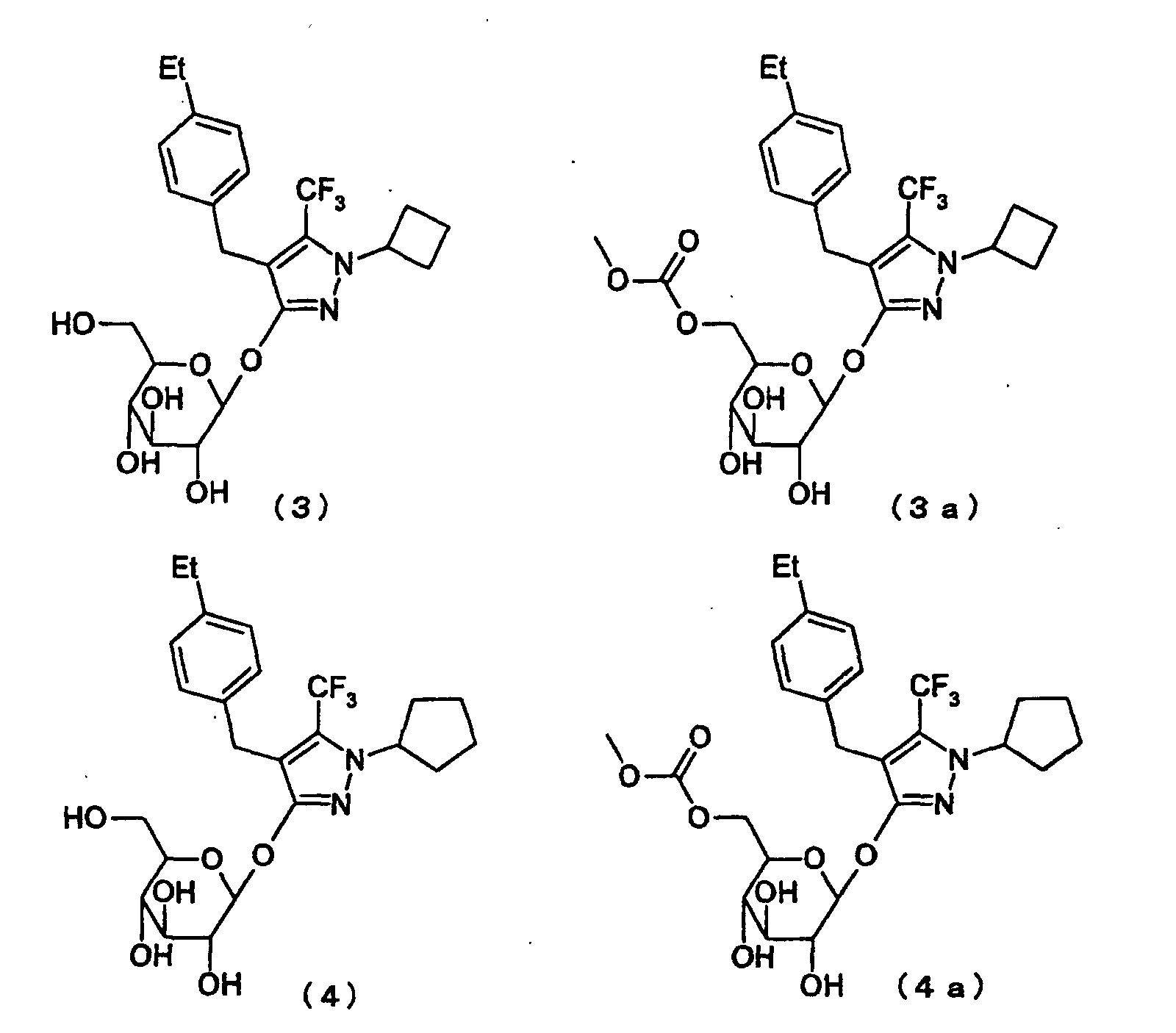

(where one or plural hydroxyl groups may be acylated) or β-D-glucuronyl group (where one or plural hydroxyl groups may be acylated and carboxyl group may be esterified);
Y1 represents a lower alkyl group or a perfluoro-lower alkyl group;
Z1 represents hydrogen atom, a lower alkyl group, a perfluoro-lower alkyl group, an optionally substituted aralkyl group or optionally substituted phenyl group;
R11 through R15 may be the same or different and represent hydrogen atom, a lower alkyl group, a perfluoro-lower alkyl group, a lower alkoxy group, a perfluoro-lower alkoxy group, a lower alkylthio group, a perfluoro-lower alkylthio group, a lower alkylamino group, a halogeno group, a lower alkanoyl group, a lower alkenyl group or a lower alkynyl group; and
n1 represents an integer of 0 to 3.]


(where one or plural hydroxyl groups may be acylated);
Y2 represents hydrogen, a lower alkyl group, a fluoro-lower alkyl group or a perfluoro-lower alkyl group;
Z2 represents a halo-lower alkyl group;
R21 through R25 may be the same or different and represent hydrogen atom, a halogeno group, a lower alkyl group, a halo-lower alkyl group, a perfluoro-lower alkyl group, a lower alkoxy group, a perfluoro-lower alkoxy group, a lower alkylthio group, a perfluoro-lower alkylthio group, a lower alkylamino group, a lower alkanoyl group, a lower alkenyl group, a lower alkynyl group or an optionally substituted aralkyl group.]
Y2 is trifluoromethyl group; and X2 is β-D-glucopyranosyl group (where one or plural hydroxyl groups may be acylated with a group or groups selected from alkanoyl groups with 2 to 20 carbon atoms, lower alkoxy-carbonyl groups and benzoyl group) in the general formula (5) and pharmaceutically acceptable salts thereof.


R32 is hydrogen atom, a lower alkyl group, a lower alkoxy group, a lower alkylthio group, a halo-lower alkyl group or a halogen atom.]

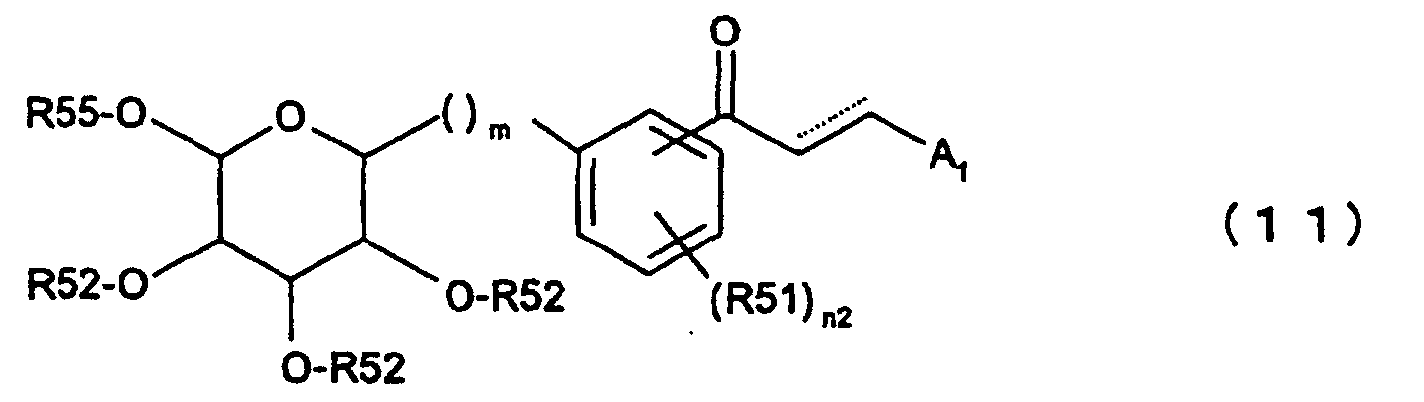
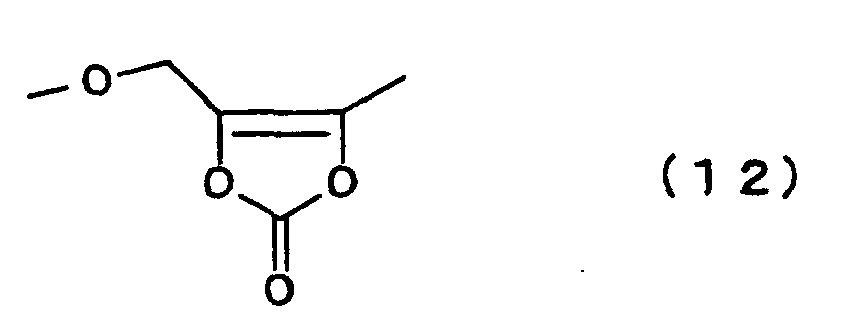

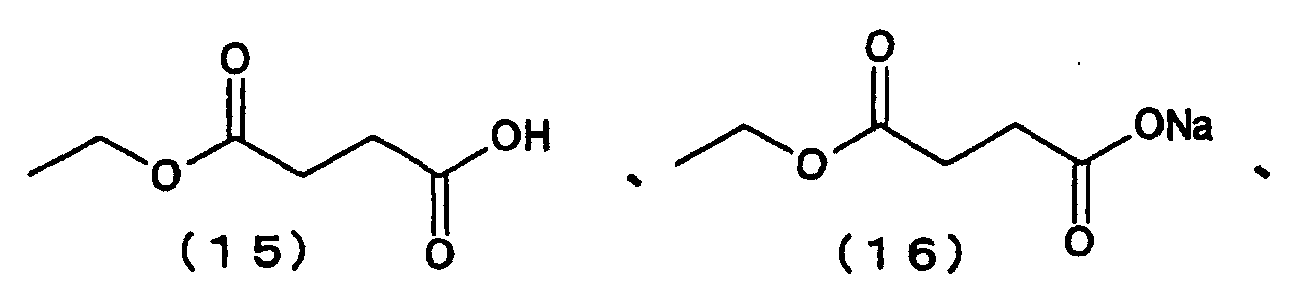
m represents 0 or 1;
n2 represents 0, 1, 2 or 3;
A1 represents the following cyclic structure:

--------
represents single bond or double bond.]

Y4 represents a lower alkyl group;
Z4 represents β-D-glucopyranosyl group where one or plural hydroxyl groups may be protected.]


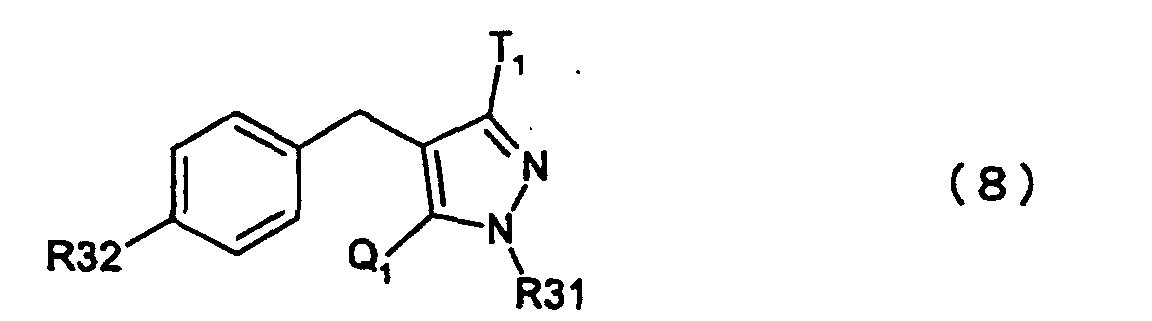


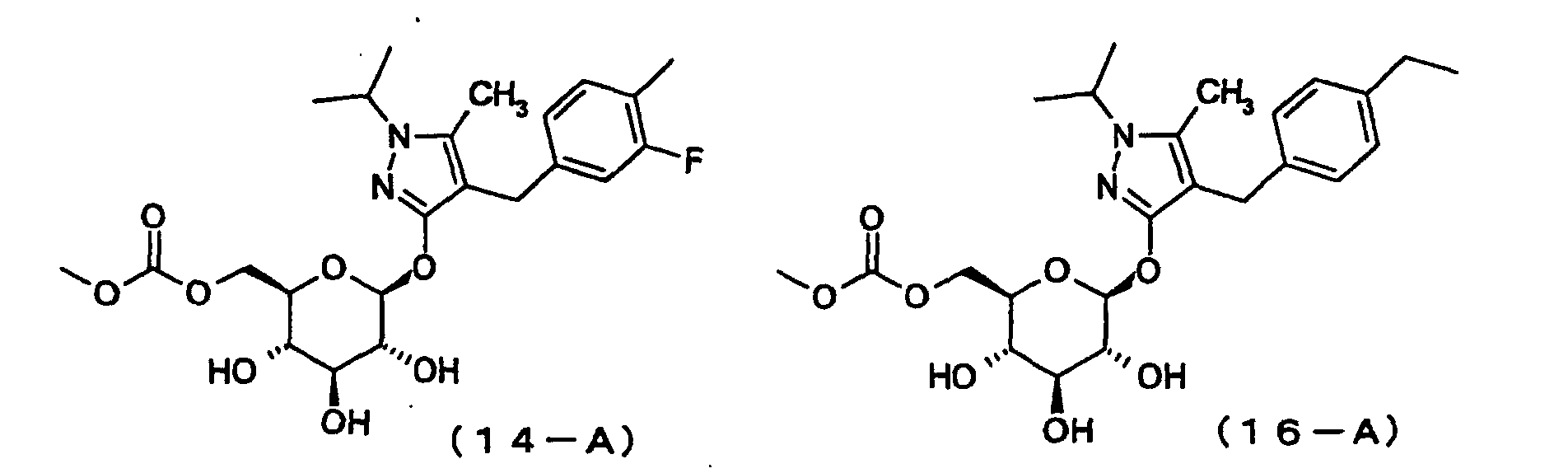
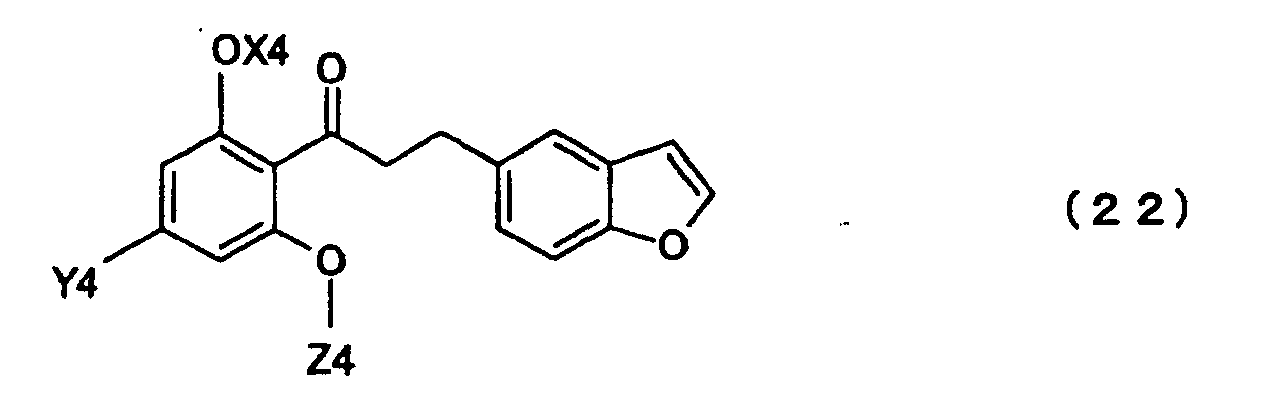
The prophylactic and therapeutic agent of diabetes
mellitus of the invention includes a combination of an
inhibitor of renal glucose reabsorption and a hypoglycemic
agent (namely, a combination agent). As the prophylactic and
therapeutic agent in accordance with the invention, therefore,
any inhibitor of renal glucose reabsorption and any
hypoglycemic agent are satisfactory, if these agents can be
used in combination at the time of administration. Thus, the
prophylactic and therapeutic agent of diabetes mellitus in
accordance with the invention may be a single one preparation
obtained by formulating together an inhibitor of renal
glucose reabsorption and a hypoglycemic agent or may be a
combination of at least two types of preparations obtained by
separately formulating an inhibitor of renal glucose
reabsorption and a hypoglycemic agent, as long as the
inhibitor of renal glucose reabsorption and the hypoglycemic
agent can be used in combination at the time of
administration. For the prophylactic and therapeutic agent
of diabetes mellitus in accordance with the invention,
additionally, at least one inhibitor of renal glucose
reabsorption and at least one hypoglycemic agent may
satisfactorily be used in combination. Therefore,
satisfactorily, two or more inhibitors of renal glucose
reabsorption may be used, while two or more hypoglycemic
agents may be used as well.
In accordance with the invention, the hypoglycemic
agent means a pharmaceutical agent with a major physiological
action of promotion of glucose uptake into target tissue
cells or suppression of glucose absorption from intestinal
tube or suppression of glucose synthesis in tissues to lower
the glucose concentration in blood to ameliorate
hyperglycemia, for use in the prophylaxis and therapeutic
treatment of various diseased conditions because of
hyperglycemia. The hypoglycemic agent includes for example
insulin preparations, insulin derivatives, insulin mimetics,
insulin secretion-promoting agents, insulin resistance-ameliorating
agents, α-glucosidase inhibitors and
glucogenesis inhibitors.
More specifically, the insulin preparations include for
example NPH, Lente, Utralente and insulin which can be
absorbed transpulmonarily.
The insulin derivatives mean insulin-derived proteins
and peptides with insulin actions, and include for example
lispro, B10Asp and HOE-901.
The insulin secretion-promoting agents exert their
hypoglycemic action, by mainly influencing pancreatic β-cell
to promote insulin secretion into blood, and include for
example sulfonylureas (for example, tolbutamide,
chlorpropamide, glibenclamide (glyburide), glipizide,
glimeperide and gliclazide, preferably glibenclamide); and
meglitinide analogues (for example, repaglinide, nateglinide,
meglitinide and mitiglinide (KAD-1229), preferably
nateglinide); other than sulfonylureas and meglitinide
analogues, the insulin secretion-promoting agents
additionally include for example K+-ATP channel inhibitors
(for example, BTS-67-582), glucagon-like peptide-1 receptor
agonists (for example, glucagon-like peptide-1, exendin-4 and
NN-2211) and dipeptidyl peptidase-IV inhibitors with an
effect of enhancing the action of glucagon-like peptide-1.
In accordance with the invention, sulfonylureas and
meglitinide analogues are preferable.
The insulin resistance-ameliorating agents mean agents
exerting the hypoglycemic action by enhancing the action of
insulin in target tissues, and include for example peroxisome
proliferator activator receptor (PPAR)-γ agonists (for
example, thiazolidine-based compounds such as pioglitazone,
rosiglitazone, ciglitazone and troglitazone; or non-thiazolidine-based
compounds such as GI-262570, JTT-501, YM-440,
NN-622 and KRP-297), PPAR-γ antagonists and protein
tyrosine phosphatase inhibitors. In a broad sense, the
insulin resistance-ameliorating agents include for example
pharmaceutical agents with a function ameliorating insulin
resistance, for example biguanides (for example, metformin,
phenformin and buformin, preferably metformin), PPAR-α
agonists (fibrate-series compounds such as simfibrate,
clofibrate, bezafibrate and clinofibrate and non-fibrate-series
compounds), anti-obesity agents (for example, 5-hydroxytryptamine
reuptake inhibitors such as sibutramine,
lipase inhibitors such as orlistat and adrenalin β-receptor
agonists such as AJ-9677). In accordance with the invention,
biguanides are preferable.
Insulin mimetics mean those expressing the hypoglycemic
action through the physiological insulin action, namely the
action promoting glucose uptake into cells, in a manner more
or less independent to insulin, except for insulin
derivatives, and include for example insulin receptor-activating
agents (for example, CLX-0901 and L-783281) and
vanadium.
α-Glucosidase inhibitors mean those expressing the
hypoglycemic action through the suppression of glucose
absorption into bodies, mainly via the inhibition of α-glucosidase
in intestinal tube, and include for example
acarbose, voglibose and miglitol.
Glucogenesis inhibitors mean those expressing the
hypoglycemic action mainly through the inhibition of
glucogenesis, and include for example glucagon secretion
suppressors (for example, M&B-39890A and octreotide), fatty
acid decomposition inhibitors (for example, nicotinic acid
derivatives and carnitine palmitoyltransferase-1 inhibitor)
and glucose-6-phosphatase inhibitors.
Additionally, hypoglycemic agents other than those
listed above, anti-hyperlipemia agents (for example, HMG-CoA
reductase inhibitors and LDL receptor inducers), hypotensive
agents (for example, angiotensin converting enzyme inhibitors,
angiotensin II receptor antagonists, β receptor antagonists,
α1 antagonists and calcium antagonists) and the like are also
encompassed within the scope of the invention, as long as
they can be used in combination with inhibitors of renal
glucose reabsorption as a prophylactic and therapeutic agent
of diabetes mellitus for the purpose of lowering blood
glucose level.
In accordance with the invention, preferably, the
hypoglycemic agent is at least one selected from
sulfonylureas, meglitinide analogues and biguanides. In an
embodiment of the invention, additionally, the hypoglycemic
agent is preferably at least one selected from sulfonylureas
and biguanides.
In another embodiment of the invention, still
additionally, the hypoglycemic agent is preferably
meglitinide analogues.
In accordance with the invention, the inhibitor of
renal glucose reabsorption has an action inhibiting glucose
reabsorption in uriniferous tubules. Therefore, the primary
action of the inhibitor of renal glucose reabsorption is not
involved in the promotion of the uptake into target tissue
cells, the suppression of the absorption from intestinal tube,
or the hypoglycemic action via the suppression of the
synthesis in tissues. The inhibitor of renal glucose
reabsorption differs from the hypoglycemic agents described
above in terms of this point.
As the inhibitor of renal glucose reabsorption, any
inhibitor thereof is satisfactory when the inhibitor has the
action, but preferably includes those described below:
More preferably, the Compounds (1) and (2), the
Compounds (1A) and (2A), the Compound (5), the Compound (8)
and the Compound (22) and pharmaceutically acceptable salts
of these Compounds are listed, because these compounds and
salts thereof are very useful for glycemic control when used
in combination with hypoglycemic agents, compared with the
single use of any of inhibitors of renal glucose reabsorption
or hypoglycemic agents.
The preferable inhibitors of renal glucose reabsorption
are now individually described below.

Y represents a lower alkyl group, a fluoro-lower alkyl group or a perfluoro-lower alkyl group;
Z represents an optionally substituted cyclic alkyl group, an optionally substituted cyclic unsaturated alkyl group, a lower alkyl group with unsaturated bond, a lower alkyl group with an optionally substituted cyclic alkyl group or a lower alkyl group with an optionally substituted cyclic unsaturated alkyl group;
R1 through R5 may be the same or different and represent hydrogen atom, a lower alkyl group, a fluoro-lower alkyl group, a perfluoro-lower alkyl group, a lower alkoxy group, a fluoro-lower alkoxy group, a perfluoro-lower alkoxy group, a lower alkylthio group, a fluoro-lower alkylthio group, a perfluoro-lower alkylthio group, a lower alkylamino group, a halogeno group,' a lower alkanoyl group, an alkenyl group, a cyclic alkenyl group, an alkynyl group, an optionally substituted aralkyl group, optionally substituted phenyl group or a lower alkoxy-carbonyl group; and
n represents an integer of 0 to 3.]
The term "lower alkyl" in the Compounds (1) and (2)
means alkyl groups with one to 6 carbon atoms.
The term "lower alkoxy" means alkoxy groups with one to
6 carbon atoms.
The term "lower alkanoyl" means alkanoyl groups with 2
to 6 carbon atoms.
Additionally, the "alkyl", "alkenyl" and "alkynyl" in the
lower alkyl group, the perfluoro-lower alkyl group, the lower
alkoxy group, the perfluoro-lower alkoxy group, the lower
alkylthio group, the perfluoro-lower alkylthio group, the
lower alkylamino group, the lower alkanoyl group, the alkenyl
group, the alkynyl group and the lower alkoxy-carbonyl group
may be linear or branched.
The lower alkyl group in the Compounds (1) and (2)
includes for example methyl group, ethyl group, propyl group,
butyl group, pentyl group, isopropyl group, isobutyl group
and isopentyl group.
The fluoro-lower alkyl group in the Compounds (1) and
(2) means lower alkyl groups where one or plural hydrogen
atoms (but not all of the hydrogen atoms) are substituted
with fluorine atoms, and includes for example
monofluoromethyl group, difluoromethyl group, 2-fluoroethyl
group, 2,2-difluoroethyl group, trifluoroethyl group (for
example, 2,2,2-trifluoroethyl group), trifluoropropyl group
(for example, 3,3,3-trifluoropropyl group and 1,1,1-trifluoro-2-propyl
group), 1,3-difluoroisopropyl group and
1,1,1,3,3,3-hexafluoroisopropyl group, preferably
trifluoroethyl group (for example, 2,2,2-trifluoroethyl
group), trifluoropropyl group (for example, 3,3,3-trifluoropropyl
group and 1,1,1-trifluoro-2-propyl group).
Additionally, the number of fluorine atoms for substitution
is preferably one to 6.
The perfluoro-lower alkyl group in the Compounds (1)
and (2) means lower alkyl groups where all of the hydrogen
atoms are substituted with fluorine atoms, and includes for
example trifluoromethyl group, pentafluoroethyl group and
heptafluoropropyl group, preferably trifluoromethyl group.
The lower alkoxy group in the Compounds (1) and (2)
includes for example methoxy group, ethoxy group, propyloxy
group and isopropyloxy group.
The fluoro-lower alkoxy group in the Compounds (1) and
(2) means lower alkoxy groups where one or plural hydrogen
atoms (but not all of the hydrogen atoms) are substituted
with fluorine atoms, and includes for example
monofluoromethoxy group, difluoromethoxy group, 2-fluoroethoxy
group, 2,2-difluoroethoxy group, trifluoroethoxy
group (for example, 2,2,2-trifluoroethoxy group),
trifluoropropyloxy group (for example, 3,3,3-trifluoropropyloxy
group, 1,1,1-trifluoro-2-propyloxy group),
1,3-difluoroisopropyloxy group and 1,1,1,3,3,3-hexafluoroisopropyloxy
group, preferably trifluoroethoxy
group (for example, 2,2,2-trifluoroethoxy group).
Additionally, the number of fluorine atoms for substitution
is preferably one to 6.
The perfluoro-lower alkoxy group in the Compounds (1)
and (2) means lower alkoxy groups where all of the hydrogen
atoms are substituted with fluorine atoms, and includes for
example trifluoromethoxy group, pentafluoroethoxy group and
heptafluoropropyloxy group, preferably trifluoromethoxy group.
The lower alkylthio group in the Compounds (1) and (2)
includes for example methylthio group, ethylthio group and
propylthio group.
The fluoro-lower alkylthio group in the Compounds (1)
and (2) means lower alkylthio groups where one or plural
hydrogen atoms (but not all of the hydrogen atoms) are
substituted with fluorine atoms, and includes for example
monofluoromethylthio group, difluoromethylthio group, 2-fluoroethylthio
group, 2,2-difluoroethylthio group,
trifluoroethylthio group (for example, 2,2,2-trifluoroethylthio
group), trifluoropropylthio group (for
example, 3,3,3-trifluoropropylthio group, 1,1,1-trifluoro-2-propylthio
group), 1,3-difluoroisopropylthio group and
1,1,1,3,3,3-hexafluoroisopropylthio group, preferably
trifluoroethylthio group (for example, 2,2,2-trifluoroethylthio
group). Additionally, the number of
fluorine atoms for substitution is preferably one to 6.
The perfluoro-lower alkylthio group in the Compounds
(1) and (2) means lower alkylthio groups where all of the
hydrogen atoms are substituted with fluorine atoms, and
includes for example trifluoromethylthio group,
pentafluoroethylthio group and heptafluoropropylthio group,
preferably trifluoromethylthio group.
The lower alkylamino group in the Compounds (1) and (2)
means methylamino group, ethylamino group, propylamino group,
dimethylamino group and diethylamino group.
The halogeno group in the Compounds (1) and (2)
includes for example fluorine atom, bromine atom, chlorine
atom and iodine atom.
The lower alkanoyl group in the Compounds (1) and (2)
includes for example acetyl group and propionyl group.
The alkenyl group in the Compounds (1) and (2) includes
alkenyl groups with 2 to 6 carbon atoms, for example vinyl
group, propenyl group and 2-methyl-1-propenyl group.
The cyclic alkenyl group in the Compounds (1) and (2)
includes cyclic alkenyl groups with 5 to 10 carbon atoms, for
example cyclopentenyl group and cyclohexenyl group.
The alkynyl group in the Compounds (1) and (2) includes
alkynyl groups with 2 to 6 carbon atoms, for example ethynyl
group.
The optionally substituted aralkyl group in the
Compounds (1) and (2) includes optionally substituted aralkyl
groups with 7 to 10 carbon atoms, for example benzyl group,
benzyl group optionally substituted with one or two or more
substituents on the benzene ring, phenethyl group and
phenethyl group optionally substituted with one or two or
more substituents on the benzene ring. Herein, the
substituents for benzyl group and phenyl group include for
example lower alkoxy groups, lower alkyl groups, halogeno
groups and halogeno-lower alkyl groups. Additionally, the
number of the substituents is preferably one to 3.
The substituents for the optionally substituted phenyl
group in the Compounds (1) and (2) include for example lower
alkoxy groups, lower alkyl groups, halogeno groups and
halogeno-lower alkyl groups. Additionally, the number of the
substituents is preferably one to 3.
The lower alkoxy-carbonyl group in the Compounds (1)
and (2) includes for example methoxycarbonyl group,
ethoxycarbonyl group and isopropoxycarbonyl group.
The "lower alkyl group with unsaturated bond" in the
Compounds (1) and (2) includes C2 to C6 alkyl groups with
unsaturated bond, for example allyl group and vinyl group.
The "optionally substituted cyclic alkyl group" in the
Compounds (1) and (2) includes optionally substituted cyclic
alkyl groups with 3 to 7 carbon atoms, for example
cyclopropyl group, cyclobutyl group, cyclopentyl group,
cyclohexyl group and cycloheptyl group, where these rings may
be substituted with methyl group, ethyl group, methoxy group,
ethoxy group, fluorine atom, chlorine atom and bromine atom.
The number of substituents for the substitution of these
rings is preferably one to 3.
The "optionally substituted cyclic unsaturated alkyl
group" in the Compounds (1) and (2) includes optionally
substituted cyclic unsaturated alkyl groups with 5 to 10
carbon atoms, for example cyclopentenyl group and
cyclohexenyl group, where these rings may be substituted with
methyl group, ethyl group, methoxy group, ethoxy group,
fluorine atom, chlorine atom and bromine atom. The number of
substituents for the substitution of these rings is
preferably one to 3.
The "lower alkyl group with optionally substituted
cyclic alkyl groups" in the Compounds (1) and (2) includes
for example cyclobutylmethyl group, cyclobutylethyl group,
cyclopentylmethyl group, cyclopentylethyl group,
cyclohexylmethyl group and cyclohexylethyl group, where these
rings may be substituted with methyl group, ethyl group,
methoxy group, ethoxy group, fluorine atom, chlorine atom and
bromine atom. Additionally, the number of substituents for
the substitution of these rings is preferably one to 3.
The "lower alkyl group with optionally substituted
cyclic unsaturated alkyl groups" in the Compounds (1) and (2)
includes for example cyclopentenylmethyl group and
cyclohexenylmethyl group, where these rings may be
substituted with methyl group, ethyl group, methoxy group,
ethoxy group, fluorine atom, chlorine atom and bromine atom.
The number of substituents for the substitution of these
rings is preferably one to 3.
The group for acylating the hydroxyl groups in the
Compounds (1) and (2) includes for example acyl group and
carbamate group. The acyl group includes for example acetyl
group, propionyl group, benzoyl group and pivaloyl group.
The carbamate group includes for example methyl carbonate
group, ethyl carbonate group, propyl carbonate group,
isopropyl carbonate group and phenyl carbonate group.
One or plural hydroxyl groups in β-D-glucopyranosyl
group as the group represented as X in the Compounds (1) and
(2) may be acylated. Particularly, one or plural hydroxyl
groups in the group may be acylated with a group or groups
selected from alkanoyl groups with 2 to 20 carbon atoms,
lower alkoxy-carbonyl groups and benzoyl group. Such β-D-glucopyranosyl
group includes for example 6-acetyl-β-D-glucopyranosyl
group and 6-carbomethoxy-β-D-glucopyranosyl
group. Further, the number of hydroxyl groups to be acylated
is preferably one to 3.
The group represented as X in the Compounds (1) and (2)
is particularly preferably β-D-glucopyranosyl group, 6-acetyl-β-D-glucopyranosyl
group and 6-carbomethoxy-β-D-glucopyranosyl
group. Further, the group is more preferably
β-D-glucopyranosyl group.
The group represented as Y in the Compounds (1) and (2)
is preferably perfluoro-lower alkyl groups with one to 6
carbon atoms, particularly preferably trifluoromethyl group.
Further, the group represented as Y in the Compounds
(1) and (2) is additionally preferably a lower alkyl group
with one to 6 carbon atoms. Particularly, methyl group is
preferable.
The group represented as Z in the Compounds (1) and (2)
is preferably an optionally substituted cyclic alkyl group,
more preferably an optionally substituted cyclic alkyl group
with 3 to 7 carbon atoms, particularly preferably cyclobutyl
group and cyclopentyl group.
Additionally, the group represented as Z is preferably
a lower alkyl group with unsaturated bond, more preferably a
C2 to C6 alkyl group with unsaturated bond, particularly
preferably allyl group and vinyl group.
Still additionally, the group represented by Z is
preferably an optionally substituted cyclic unsaturated alkyl
group, more preferably a C4 to C7 cyclic unsaturated alkyl
group, particularly preferably cyclopentenyl group and
cyclohexenyl group.
The groups represented as R1 through R5 in the
Compounds (1) and (2) are preferably lower alkyl groups with
one to 6 carbon atoms and lower alkylthio groups with one to
6 carbon atoms, particularly preferably methyl group, ethyl
group, methylthio group and ethylthio group.
In the Compounds (1) and (2), n is particularly
preferably an integer 1.
In the Compounds (1) and (2), Z is preferably an
optionally substituted cyclic alkyl group.
In the Compounds (1) and (2), further, Y is preferably
trifluoromethyl group.
In the Compounds (1) and (2), preferably, Y is
trifluoromethyl group and n is 1.
In the Compounds (1) and (2), additionally preferably,
Y is trifluoromethyl group; n is 1; and X is β-D-glucopyranosyl
group (where one or plural hydroxyl groups may
be acylated with a group or groups selected from alkanoyl
groups with 2 to 20 carbon atoms, lower alkoxy-carbonyl
groups and benzoyl group).
In the Compounds (1) and (2), additionally preferably,
Y is trifluoromethyl group; n is 1; and X is β-D-glucopyranosyl
group.
In the Compounds (1), additionally preferably, Y is
trifluoromethyl group; n is 1; and X is 6-acetyl-β-D-glucopyranosyl
group.
In the Compounds (1) and (2), additionally preferably,
Y is trifluoromethyl group; n is 1; and X is 6-carbomethoxy-β-D-glucopyranosyl
group.
Further, the Compounds (1) and (2) preferably include
the following compounds and pharmaceutically acceptable salts
thereof.
1'-Cyclobutyl-4'-[(4-ethylphenyl)methyl]-5'-trifluoromethyl-1H-pyrazole-3'-o-β-D-glucopyranoside
1'-Cyclopentyl-4'-[(4-ethylphenyl)methyl]-5'-trifluoromethyl-1H-pyrazole-3'-o-β-D-glucopyranoside
1'-Cyclohexyl-4'-[(4-ethylphenyl)methyl]-5'-trifluoromethyl-1H-pyrazole-3'-o-β-D-glucopyranoside
1'- (3-Cyclopenten-1-yl)-4'-[(4-ethylphenyl)methyl ]-5'-methyl-1H-pyrazole-3'-o-β-D-glucopyranoside
1'-Cyclobutyl-4'-[ (4-ethylphenyl) methyl ]-5'-methyl-1H-pyrazole-3'-o-β-D-glucopyranoside
1'-Cyclopentyl-4'-[(4-ethylphenyl)methyl)-5'-methyl-1H-pyrazole-3'-o-β-D-glucopyranoside
1'-Cyclohexyl-4'-[(4-ethylphenyl)methyl]-5'-methyl-1H-pyrazole-3'-o-β-D-glucopyranoside
1'-Cyclobutyl-4'-[(4-ethylphenyl)methyl]-5'-trifluoromethyl-1H-pyrazole-3'-o-(6-carbomethoxy)-β-D-glucopyranoside
1'-Cyclopentyl-4'-[ (4-ethylphenyl) methyl]-5'-trifluoromethyl-1H-pyrazole-3'-o-(6-carbomethoxy)-β-D-glucopyranoside
1'-Cyclohexyl-4'-[(4-ethylphenyl)methyl]-5'-trifluoromethyl-1H-pyrazole-3'-o-(6-carbomethoxy)-β-D-glucopyranoside
1'-(3-Cyclopenten-1-yl)-4'- [(4-ethylphenyl)methyl]-5'-methyl-1H-pyrazole-3'-o-(6-carbomethoxy)-β-D-glucopyranoside
1'-Cyclobutyl-4'-[ (4-ethylphenyl) methyl]-5'-methyl-1H-pyrazole-3'-o-(6-carbomethoxy)-β-D-glucopyranoside
1'-Cyclopentyl-4'-[ (4-ethylphenyl) methyl]-5'-methyl-1H-pyrazole-3'-o-(6-carbomethoxy)-β-D-glucopyranoside
1'-Cyclohexyl-4'-[(4-ethylphenyl)methyl]-5'-methyl-1H-pyrazole-3'-o-(6-carbomethoxy)-β-D-glucopyranoside.
1'-Cyclobutyl-4'-[(4-ethylphenyl)methyl]-5'-trifluoromethyl-1H-pyrazole-3'-o-β-D-glucopyranoside
1'-Cyclopentyl-4'-[(4-ethylphenyl)methyl]-5'-trifluoromethyl-1H-pyrazole-3'-o-β-D-glucopyranoside
1'-Cyclohexyl-4'-[(4-ethylphenyl)methyl]-5'-trifluoromethyl-1H-pyrazole-3'-o-β-D-glucopyranoside
1'- (3-Cyclopenten-1-yl)-4'-[(4-ethylphenyl)methyl ]-5'-methyl-1H-pyrazole-3'-o-β-D-glucopyranoside
1'-Cyclobutyl-4'-[ (4-ethylphenyl) methyl ]-5'-methyl-1H-pyrazole-3'-o-β-D-glucopyranoside
1'-Cyclopentyl-4'-[(4-ethylphenyl)methyl)-5'-methyl-1H-pyrazole-3'-o-β-D-glucopyranoside
1'-Cyclohexyl-4'-[(4-ethylphenyl)methyl]-5'-methyl-1H-pyrazole-3'-o-β-D-glucopyranoside
1'-Cyclobutyl-4'-[(4-ethylphenyl)methyl]-5'-trifluoromethyl-1H-pyrazole-3'-o-(6-carbomethoxy)-β-D-glucopyranoside
1'-Cyclopentyl-4'-[ (4-ethylphenyl) methyl]-5'-trifluoromethyl-1H-pyrazole-3'-o-(6-carbomethoxy)-β-D-glucopyranoside
1'-Cyclohexyl-4'-[(4-ethylphenyl)methyl]-5'-trifluoromethyl-1H-pyrazole-3'-o-(6-carbomethoxy)-β-D-glucopyranoside
1'-(3-Cyclopenten-1-yl)-4'- [(4-ethylphenyl)methyl]-5'-methyl-1H-pyrazole-3'-o-(6-carbomethoxy)-β-D-glucopyranoside
1'-Cyclobutyl-4'-[ (4-ethylphenyl) methyl]-5'-methyl-1H-pyrazole-3'-o-(6-carbomethoxy)-β-D-glucopyranoside
1'-Cyclopentyl-4'-[ (4-ethylphenyl) methyl]-5'-methyl-1H-pyrazole-3'-o-(6-carbomethoxy)-β-D-glucopyranoside
1'-Cyclohexyl-4'-[(4-ethylphenyl)methyl]-5'-methyl-1H-pyrazole-3'-o-(6-carbomethoxy)-β-D-glucopyranoside.
Among them, the following compounds and
pharmaceutically acceptable salts thereof are particularly
preferable.

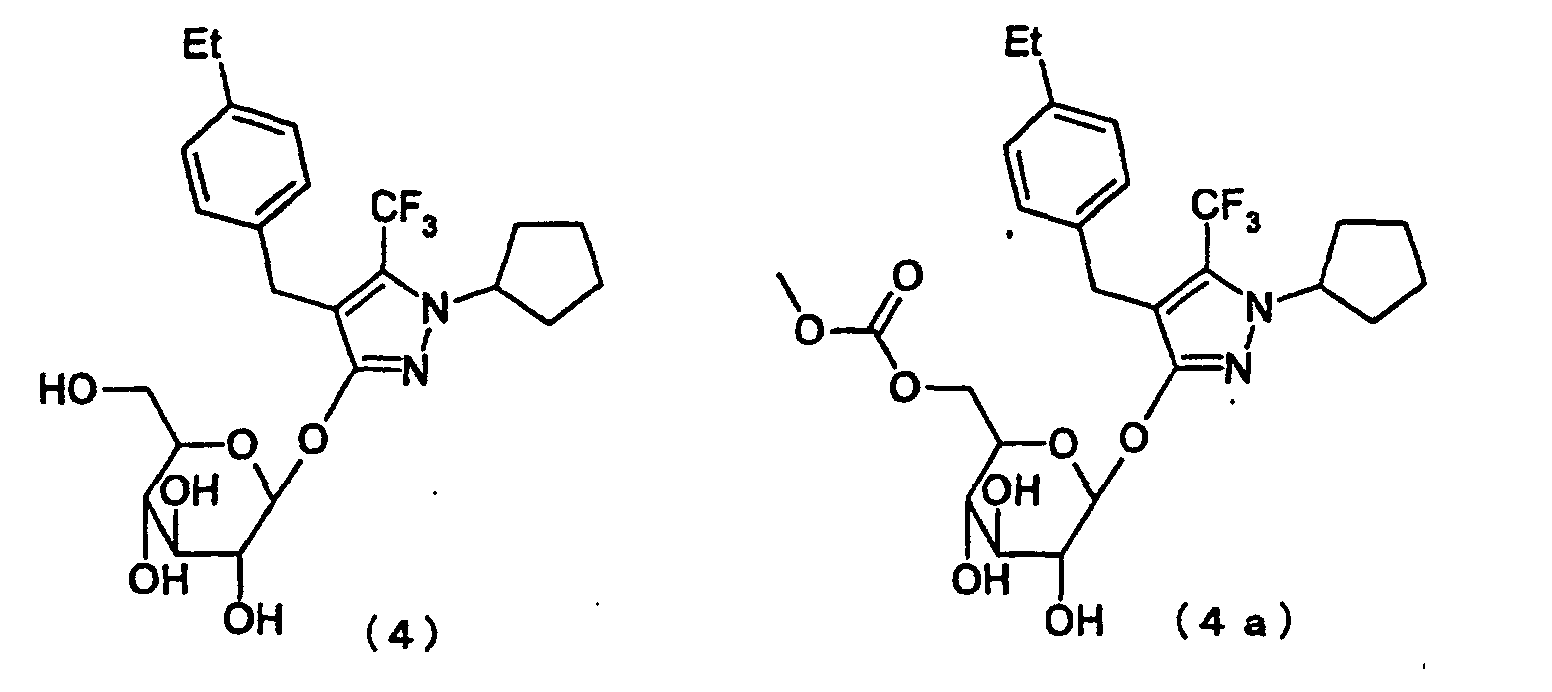 As an example of the method for producing the Compounds (1)
and (2), the method shown below can be used when X is β-D-glucopyranosyl
group.
As an example of the method for producing the Compounds (1)
and (2), the method shown below can be used when X is β-D-glucopyranosyl
group.

The compound (a8) encompassed within the Compound (1)
can be produced for example as follows. The hydroxyl group
in 1,2-dihydro-4-[(4-ethylphenyl)methyl]-5-(trifluoromethyl)-3H-pyrazol-3-one
(a1) is protected with tert-butyldimethylsilyl
chloride to prepare (a2). Then, the
nitrogen on the pyrazole is allowed to react with cyclobutyl
alcohol by Mitsunobu reaction, to prepare (a3). Then, the
TBS group in (a3) is deprotected with dilute hydrochloric
acid to prepare (a4), followed by overnight reaction with
2,3,4,6-tetra-o-acetyl-α-D-glucopyranosyl bromide (a5) in the
presence of potassium carbonate in chloroform and water and
subsequent purification using chromatography and the like, to
obtain tetra-o-acetyl intermediate (a6). Then, deprotection
is done in aqueous sodium hydroxide solution, to obtain (a7).
Reaction of the primary hydroxyl group in the resulting (a7)
with methyl chlorocarbonate produces (a8).
The Compounds (1) and (2) produced by the method can be
separated and purified readily from the reaction mixtures by
general isolation and purification measures, for example
solvent extraction, chromatography and crystallization.
The hydroxyl groups in the Compounds (1) and (2) may be
substituted with appropriate substituents provided that the
substituted hydroxyl groups can be modified into
unsubstituted hydroxyl group in human body. For example, the
substituents for the hydroxyl groups include acyl group and
carbamate group. The acyl group includes for example
alkanoyl groups with 2 to 20 carbon atoms and benzoyl group.
The carbamate group includes for example lower alkoxycarbonyl
groups.
In case that the Compounds (1) and (2) are possibly
prepared into salt forms, the salts may satisfactorily be
pharmaceutically acceptable. For any acid group in case that
such acid group exists in the formulas, the salts include for
example ammonium salts; salts with alkali metals such as
sodium and potassium; salts with alkali earth metals such as
calcium and magnesium; aluminum salts; zinc salts; salts with
organic amines such as triethylamine, ethanolamine,
morpholine, piperidine and dicyclohexylamine; and salts with
basic amino acids such as arginine and lysine. For any basic
group in case that such basic group exists in the formulas,
the salts thereof include for example salts with inorganic
acids such as hydrochloric acid, sulfuric acid and phosphoric
acid; salts with organic carboxylic acids such as oxalic acid,
acetic acid, citric acid, malic acid, benzoic acid, maleic
acid, fumaric acid, tartaric acid, succinic acid and glutamic
acid; and salts with organic sulfonic acids such as
methanesulfonic acid and p-toluenesulfonic acid. As to the
method for preparing such salts, the Compounds (1) and (2)
are mixed with necessary acids or bases at appropriate ratios
in solvents and dispersants, or other salt forms of the
Compounds (1) and (2) may be modified into such salts by
cation exchange or anion exchange.
The Compounds (1) and (2) include solvates thereof, for
example hydrates thereof and alcohol adducts thereof.

Y1 represents a lower alkyl group or a perfluoro-lower alkyl group;
Z1 represents hydrogen atom, a lower alkyl group, a perfluoro-lower alkyl group, an optionally substituted aralkyl group or optionally substituted phenyl group;
R11 through R15 may be the same or different and represent hydrogen atom, a lower alkyl group, a perfluoro-lower alkyl group, a lower alkoxy group, a perfluoro-lower alkoxy group, a lower alkylthio group, a perfluoro-lower alkylthio group, a lower alkylamino group, a halogeno group, a lower alkanoyl group, a lower alkenyl group or a lower alkynyl group; and
n represents an integer of 0 to 3.]
The term "lower" in the Compounds (1A) and (2A) means
one to 6 carbon atoms, preferably one to 4 carbon atoms.
"Alkyl", "alkenyl" and "alkynyl" in the alkyl group, the
perfluoro-lower alkyl group, the lower alkoxy group, the
perfluoro-lower alkoxy group, the lower alkylthio group, the
perfluoro-lower alkylthio group, the lower alkylamino group,
the lower alkanoyl group, the lower alkenyl group and the
lower alkynyl group may be linear or branched.
The alkyl moiety in the "aralkyl group" in the Compounds
(1A) and (2A) is a lower alkyl group. The aryl moiety in the
"aralkyl group" is a monocyclic or bicyclic carbon atom-constituted
aromatic substituent with 5 to 12 carbon atoms.
The lower alkyl group in the Compounds (1A) and (2A)
includes for example methyl group, ethyl group, propyl group,
butyl group, pentyl group, isopropyl group, isobutyl group
and isopentyl group.
The perfluoro-lower alkyl group in the Compounds (1A)
and (2A) includes for example trifluoromethyl group.
The optionally substituted aralkyl group in the
Compounds (1A) and (2A) includes aralkyl groups with 7 to 10
carbon atoms, for example benzyl group, benzyl group
optionally substituted with one or two or more substituents
on the benzene ring, phenethyl group and phenethyl group
optionally substituted with one or two or more substituents
on the benzene ring. Herein, the substituents for benzyl
group and phenethyl group include for example lower alkoxy
groups, lower alkyl groups, halogeno groups and halogeno-lower
alkyl groups. Additionally, the number of the
substituents is preferably one to 3.
The substituents for the optionally substituted phenyl
group in the Compounds (1A) and (2A) include for example
lower alkoxy groups, lower alkyl groups, halogeno groups and
halogeno-lower alkyl groups. Additionally, the number of the
substituents is preferably one to 3.
The lower alkoxy groups in the Compounds (1A) and (2A)
include for example methoxy group, ethoxy group, propyloxy
group and isopropyloxy group.
The perfluoro-lower alkoxy groups in the Compounds (1A)
and (2A) include for example trifluoromethoxy group.
The lower alkylthio groups in the Compounds (1A) and
(2A) include for example methylthio group, ethylthio group
and propylthio group.
The perfluoro-lower alkylthio groups in the Compounds
(1A) and (2A) include for example trifluoromethylthio group.
The lower alkylamino groups in the Compounds (1A) and
(2A) include for example methylamino group, ethylamino group,
propylamino group, dimethylamino group and diethylamino group.
The halogeno groups in the Compounds (1A) and (2A)
include fluorine atom, bromine atom, chlorine atom and
bromine atom.
The lower alkanoyl groups in the Compounds (1A) and
(2A) include for example acetyl group and propionyl group.
The lower alkenyl groups in the Compounds (1A) and (2A)
include for example vinyl group, propenyl group and 2-methyl-1-propenyl
group.
The lower alkynyl groups in the Compounds (1A) and (2A)
include for example ethynyl group and propynyl group.
The group for acylating the hydroxyl groups in the
Compounds (1A) and (2A) includes for example acyl group and
carbamate group. The acyl group includes for example acetyl
group, propionyl group, benzoyl group and pivaloyl group.
The carbamate group includes for example methyl carbonate
group, ethyl carbonate group, propyl carbonate group,
isopropyl carbonate group and phenyl carbonate group. The
group for esterifying carboxyl group includes lower alkyl
groups, for example methyl group, ethyl group, propyl group
and isopropyl group.
One or plural hydroxyl groups in β-D-glucopyranosyl
group as the group represented by X1 in the Compounds (1A)
and (2A) may be acylated. Particularly, one or plural
hydroxyl groups in the group may be acylated with a group or
groups selected from alkanoyl groups with 2 to 20 carbon
atoms, lower alkoxy-carbonyl groups and benzoyl group. Such
β-D-glucopyranosyl group includes for example 6-o-acetyl-β-D-glucopyranosyl
group and 6-o-methoxycarbonyl-β-D-glucopyranosyl
group. Further, the number of hydroxyl groups
to be acylated is preferably one to 3.
In β-D-glucuronyl group as the group represented by X1
in the Compounds (1A) and (2A), one or plural hydroxyl groups
may be acylated and carboxyl group may be esterified. In the
group, particularly, one or plural hydroxyl groups may be
acylated with a group or groups selected from alkanoyl groups
with 2 to 20 carbon atoms, lower alkoxy-carbonyl groups and
benzoyl group and carboxylic acid may be esterified with a
lower alkyl group. For example, the group includes 6-o-methyl-β-D-glucuronyl
group. Additionally, the number of
hydroxyl groups to be acylated is preferably one to 3.
In the Compounds (1A) and (2A), the group represented
by X1 is particularly preferably β-D-glucopyranosyl group, 6-o-acetyl-β-D-glucopyranosyl
group, 6-o-methoxycarbonyl-β-D-glucopyranosyl
group, β-D-glucuronyl group and 6-o-methyl-β-D-glucuronyl
group. Further, β-D-glucopyranosyl group and β-D-glucuronyl
group are more preferable. Particularly
preferably, the group represented by X is β-D-glucopyranosyl
group where one or plural hydroxyl groups are acylated with a
group or groups selected from alkanoyl groups with 2 to 20
carbon atoms, lower alkoxy-carbonyl groups and benzoyl group.
More preferably, one or more plural hydroxyl groups therein
are acylated with C2 to C6 alkanoyl groups or lower alkoxycarbonyl
groups. Among them, preferably, one hydroxyl group
is acylated. Particularly, the hydroxyl group bonded to the
carbon atom at 6-position is preferably acylated.
Specifically, the group represented by X is preferably 6-o-acetyl-β-D-glucopyranosyl
group and 6-o-methoxycarbonyl-β-D-glucopyranosyl
group.
The group represented by Y1 in the Compounds (1A) and
(2A) is preferably a lower alkyl group with one to 3 carbon
atoms or a perfluoro-lower alkyl group with one to 6 carbon
atoms, particularly preferably methyl group and
trifluoromethyl group.
The group represented by Z1 in the Compounds (1A) and
(2A) is preferably hydrogen atom or a lower alkyl group with
one to 6 carbon atoms. Additionally preferably, the group is
hydrogen atom, a lower alkyl group with one to 3 carbon atoms,
an unsubstituted aralkyl group or an aralkyl group with the
aryl moiety substituted at the 4-position and unsubstituted
phenyl group. Additionally preferably, the group is hydrogen
atom, methyl group, ethyl group, propyl group, isopropyl
group, unsubstituted benzyl group or benzyl group with the
aryl moiety substituted at the 4-position and unsubstituted
phenyl group. Among them, hydrogen atom, methyl group, ethyl
group, propyl group and isopropyl group are preferable.
Particularly, isopropyl group is preferable.
The groups represented by R11 through R15 in the
Compounds (1A) and (2A) are preferably lower alkyl groups,
perfluoro-lower alkyl groups, lower alkoxy groups, perfluoro-lower
alkoxy groups, lower alkylthio groups, perfluoro-lower
alkylthio groups, lower alkylamino groups, halogeno groups,
lower alkanoyl groups, lower alkenyl groups and lower alkynyl
groups, more preferably lower alkyl groups with one to 6
carbon atoms, lower alkylthio groups with one to 6 carbon
atoms, halogeno groups, lower alkoxy groups, lower alkenyl
groups and lower alkynyl groups, particularly preferably
methyl group, ethyl group, methylthio group, ethylthio group,
fluorine atom, methoxy group, vinyl group, propenyl group,
ethynyl group and propynyl group. Furthermore, at least one
of the groups represented by R11 through R15 is any one of
the preferable groups described above. Particularly, one or
two of the groups represented by R11 through R15 are any of
the preferable groups described above, while the remaining
groups are hydrogen atom. In this case, more preferably, at
least R13 is any one of the preferable groups. In case that
two of R11 through R15 are any of the preferable groups,
these groups may be the same or different. More preferably,
these groups may be different. Among them, preferably, R14
or R15 is fluorine atom when R13 is a lower alkyl group, a
lower alkoxy group, a lower alkenyl group or a lower alkynyl
group. Preferably, at least one of R11, R12, R14 and R15 is
a halogeno group. Particularly preferably, any one of R11,
R12, R14 and R15 is a halogeno group or all of R11, R12, R14
and R15 are hydrogen atom, while R13 is a lower alkyl group,
a lower alkoxy group, a lower alkenyl group or a lower
alkynyl group. Additionally preferably, any one of R11, R12,
R14 and R15 is fluorine atom, while R13 is methyl group,
ethyl group, methoxy group, vinyl group or ethynyl group.
In the Compounds (1A) and (2A), n1 is particularly
preferably an integer 1.
In the Compounds (1A) and (2A), at least one of R11
through R15 is a lower alkyl group, a perfluoro-lower alkyl
group, a lower alkoxy group, a perfluoro-lower alkoxy group,
a lower alkylthio group, a perfluoro-lower alkylthio group, a
lower alkylamino group, a halogeno group, a lower alkanoyl
group, a lower alkenyl group or a lower alkynyl group.
In the Compounds (1A) and (2A), additionally, at least
one of R11, R12, R14 and R15 is a halogeno group.
In the Compounds (1A) and (2A), further, Y1 is
preferably trifluoromethyl group.
In the Compounds (1A) and (2A), preferably, Y1 is
trifluoromethyl group and n1 is 1.
In the Compounds (1A) and (2A), additionally preferably,
Y1 is trifluoromethyl group; n1 is 1; and X1 is β-D-glucopyranosyl
group (where one or plural hydroxyl groups may
be acylated with a group or groups selected from alkanoyl
groups with 2 to 20 carbon atoms, lower alkoxy-carbonyl
groups and benzoyl group.)
In the Compounds (1A) and (2A), additionally preferably,
Y1 is trifluoromethyl group; n1 is 1; and X1 is β-D-glucuronyl
group (where one or plural hydroxyl groups may be
acylated with a group or groups selected from alkanoyl groups
with 2 to 20 carbon atoms, lower alkoxy-carbonyl groups and
benzoyl group and carbonyl group may be esterified with a
lower alkyl group).
In the Compounds (1A) and (2A), additionally preferably,
Y1 is trifluoromethyl group; n1 is 1; and X is β-D-glucopyranosyl
group.
In the Compounds (1A) and (2A), additionally preferably,
Y1 is trifluoromethyl group; n1 is 1; and X is 6-acetyl-β-D-glucopyranosyl
group.
In the Compounds (1A) and (2A), additionally preferably,
Y1 is trifluoromethyl group; n is 1; and X is 6-carbomethoxy-β-D-glucopyranosyl
group.
In the Compounds (1A) and (2A), additionally preferably,
Y1 is trifluoromethyl group; n1 is 1; and X is β-D-glucuronyl
group.
In the Compounds (1A) and (2A), additionally preferably,
Y1 is trifluoromethyl group; n1 is 1; and X is 6-methyl-β-D-glucuronyl
group.
In the Compounds (1A) and (2A), additionally preferably,
X1 is β-D-glucopyranosyl group (where one or plural hydroxyl
groups may be acylated with a group or groups selected from
alkanoyl groups with 2 to 20 carbon atoms, lower alkoxycarbonyl
groups and benzoyl group).
In the Compounds (1A) and (2A), additionally preferably,
X1 is β-D-glucopyranosyl group (where one or plural hydroxyl
groups may be acylated with a lower alkoxy-carbonyl group).
In the Compounds (1A) and (2A), additionally preferably,
Y1 is a lower alkyl group with one to 3 carbon atoms or a
perfluoro-lower alkyl with one to 6 carbon atoms; n1 is 1;
and X1 is β-D-glucopyranosyl group (where one or plural
hydroxyl groups may be acylated with a group or groups
selected from alkanoyl groups with 2 to 20 carbon atoms,
lower alkoxy-carbonyl groups and benzoyl group); Z1
represents hydrogen atom, a lower alkyl group with one to 3
carbon atoms, an unsubstituted aralkyl group or a substituted
aralkyl group with a substituent on the aryl moiety at 4-position
or unsubstituted phenyl group; any one of R11, R12,
R14 and R15 is a halogeno group or all of R11, R12, R14 and
R15 are hydrogen atom, while R13 is a lower alkyl group, a
lower alkoxy group, a halogeno group, a lower alkenyl group
or a lower alkynyl group.
In the Compounds (1A) and (2A), additionally preferably,
Y1 is methyl group; n1 is 1; and X is β-D-glucopyranosyl
group (where one or plural hydroxyl groups may be acylated
with a group or groups selected from alkanoyl groups with 2
to 20 carbon atoms, lower alkoxy-carbonyl groups and benzoyl
group); Z1 is isopropyl group; R13 is a lower alkyl group;
R14 or R15 is fluorine atom.
In the Compounds (1A) and (2A), additionally preferably,
Y1 is methyl group; n1 is 1; and X1 is β-D-glucopyranosyl
group (where one or plural hydroxyl groups may be acylated
with a group or groups selected from alkanoyl groups with 2
to 20 carbon atoms, lower alkoxy-carbonyl groups and benzoyl
group); Z1 is isopropyl group; R13 is a lower alkoxy group;
and R14 or R15 is fluorine atom.
In the Compounds (1A) and (2A), additionally preferably,
Y1 is methyl group; n1 is 1; and X1 is β-D-glucopyranosyl
group (where one or plural hydroxyl groups may be acylated
with a group or groups selected from alkanoyl groups with 2
to 20 carbon atoms, lower alkoxy-carbonyl groups and benzoyl
group); Z1 is isopropyl group; and R13 is a lower alkynyl
group.
In the Compounds (1A) and (2A), additionally preferably,
Y1 is methyl group; n1 is 1; and X1 is β-D-glucopyranosyl
group (where one or plural hydroxyl groups may be acylated
with a group or groups selected from alkanoyl groups with 2
to 20 carbon atoms, lower alkoxy-carbonyl groups and benzoyl
group); Z1 is isopropyl group; R13 is a lower alkynyl group;
and R14 or R15 is fluorine atom.
In the Compounds (1A) and (2A), additionally preferably,
Y1 is methyl group; n1 is 1; and X1 is β-D-glucopyranosyl
group (where one or plural hydroxyl groups may be acylated
with a group or groups selected from alkanoyl groups with 2
to 20 carbon atoms, lower alkoxy-carbonyl groups and benzoyl
group); Z1 is isopropyl group; and R3 is a lower alkenyl
group.
In the Compounds (1A) and (2A), additionally preferably,
Y1 is methyl group; n1 is 1; and X1 is β-D-glucopyranosyl
group (where one or plural hydroxyl groups may be acylated
with a group or groups selected from alkanoyl groups with 2
to 20 carbon atoms, lower alkoxy-carbonyl groups and benzoyl
group); Z1 is isopropyl group; R13 is a lower alkenyl group;
and R14 or R15 is fluorine atom.
In the Compounds (1A) and (2A), additionally preferably,
Y1 is methyl group or trifluoromethyl group; n1 is 1; and X1
is β-D-glucopyranosyl group (where one or plural hydroxyl
groups may be acylated with a group or groups selected from
alkanoyl groups with 2 to 20 carbon atoms, lower alkoxycarbonyl
groups and benzoyl group); Z1 is hydrogen atom,
isopropyl group, an aralkyl group or phenyl group; any one of
R11, R12, R14 and R15 is fluorine atom, while R13 is methyl
group, ethyl group, methoxy group, vinyl group or ethynyl
group.
Particularly, the Compounds (1A) and (2A) preferably
include the following compounds and pharmaceutically
acceptable salts thereof:
Among them, the following compounds and
pharmaceutically acceptable salts thereof are particularly
preferable:
Specifically, the following compounds and
pharmaceutically acceptable salts thereof are particularly
preferable.
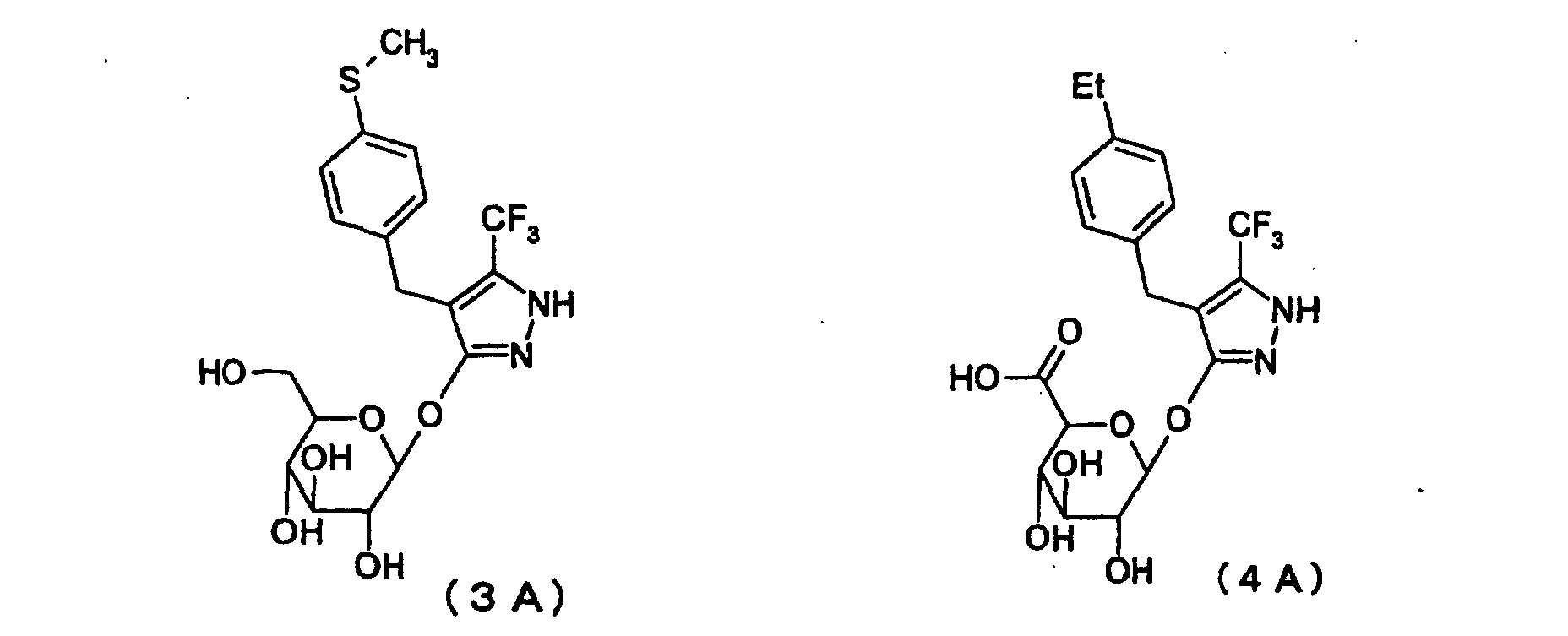


Additionally, the following compounds and
pharmaceutically acceptable salts thereof are also
particularly preferable:
In case that X is β-D-glucopyranosyl group or β-D-glucuronyl
group, the following method can be used as an
example of the production method of Compounds (1A) and (2A).

The Compound of the formula (3A) can be obtained for
example by overnight reaction of 1,2-dihydro-4-[(4-methylthiophenyl)methyl]-5-(trifluoromethyl)-3H-pyrazol-3-one
(b1) (prepared by the method described in J. Med. Chem 1996,
39, 3920-3928) with 2,3,4,6-tetra-o-acetyl-α-D-glucopyranosyl
bromide (b2) in the presence of potassium carbonate in
chloroform and water and purification using chromatography
and the like to obtain tetra-o-acetyl intermediate (b3) and
subsequent deprotection of the intermediate in an aqueous
potassium hydroxide solution.

The Compound of the formula (4A) can be obtained for
example by reaction of 1,2-dihydro-4-[(4-ethylphenyl)methyl]-5-(trifluoromethyl)-3H-pyrazol-3-one
(b4) (prepared by the
method described in J. Med. Chem 1996, 39, 3920-3928) and
2,3,4-tri-o-benzyl-D-glucopyranoside uronic acid benzyl ester
(b5) with triphenylphosphine and diethyl azodicarboxylate
(DEAD) in tetrahydrofuran for 1.5 hours and purification
using chromatography and the like to obtain tetrabenzyl
intermediate (b6) and subsequent deprotection of the
intermediate with 20% Pd(OH)2 in hydrogen atmosphere.

The Compound of the formula (b12) can be obtained as
follows. For example, the hydroxyl group of 1,2-dihydro-4-[(4-ethylphenyl)methyl]-5-(trifluoromethyl)-3H-pyrazol-3-one
(b4) is protected with tert-butyldimethylsilyl chloride to
prepare (b7). Then, the nitrogen on the pyrazole reacts with
benzyl alcohol by Mitsunobu reaction to prepare (b8). Then,
the TBS group of (b8) is deprotected in dilute hydrochloric
acid to prepare (b9), which subsequently reacts with 2,3,4,6-tetra-o-acetyl-α-D-glucopyranosyl
bromide (b2) overnight in
the presence of potassium carbonate in chloroform and water
followed by purification using chromatography and the like,
to obtain tetra-o-acetyl intermediate (b10), which is then
deprotected in an aqueous potassium hydroxide solution to
obtain (b11). Reaction of the primary hydroxyl group of the
resulting (b11) with methyl chlorocarbonate can produce (b12).
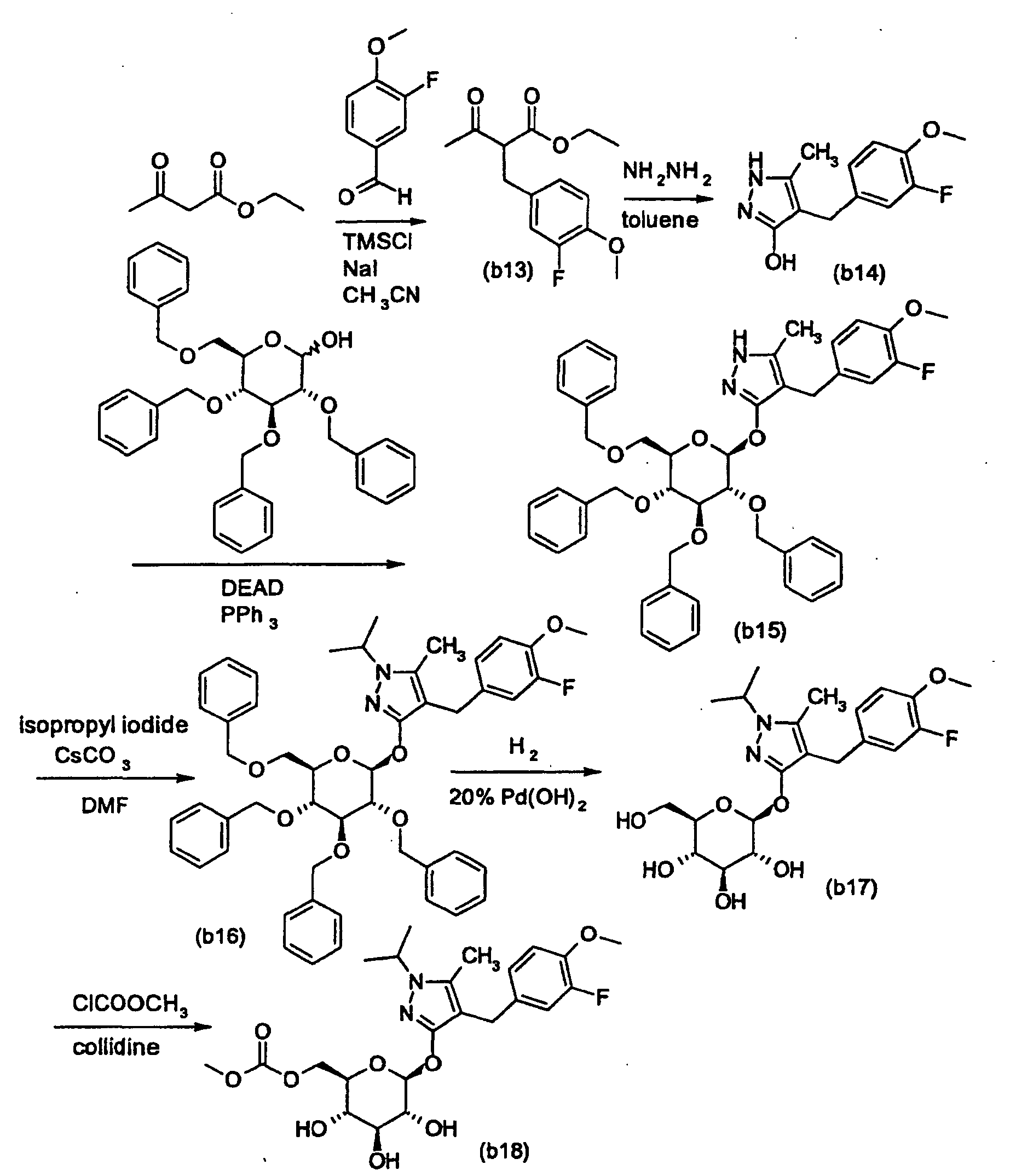
The Compound of the formula (b18) can be obtained as
follows. For example, ethyl acetoacetate and 3-fluoro-4-methoxybenzaldehyde
react with trimethylsilyl chloride and
sodium iodide in acetonitrile, to obtain the intermediate
(b13), of which the ring is closed with hydrazine, to obtain
1,2-dihydro-4-[(3-fluoro-4-methoxyphenyl)methyl)-5-methyl-3H-pyrazol-3-one
(b14). By Mitsunobu reaction, then, the
hydroxyl group on the pyrazole reacts with 2,3,4,6-tetrabenzylglucopyranose
to obtain (b15). Continuously, the
nitrogen of the pyrazole at 1-position can be isopropylated
and prepared into (b16), using cesium carbonate and isopropyl
iodide. The benzyl-protecting group of (b16) is deprotected
with 20 % Pd(OH)2 in hydrogen atmosphere to prepare (b17).
Continuously, the hydroxyl group of (b17) at 6-position
reacts with methyl chlorocarbonate in collidine to obtain
(b18).

The Compound of the formula (b24) can be obtained as
follows. For example, ethyl acetoacetate and 3-fluoro-4-methylbenzaldehyde
react with trimethylsilyl chloride and
sodium iodide in acetonitrile, to obtain the intermediate
(b19), which is subjected to ring closing with hydrazine, to
obtain 1,2-dihydro-4-[(3-fluoro-4-methylphenyl)methyl]-5-methyl-3H-pyrazol-3-one
(b20). Continuously, then, 2,3,4,6-o-tetraacetyl-α-D-glucopyranosyl
bromide is allowed to react
with the hydroxyl group on the pyrazole, using silver
carbonate, to obtain (b21). Continuously, the nitrogen of
the pyrazole at 1-position is then isopropylated, using
cesium carbonate and isopropyl iodide to obtain (b22). The
acetyl-protecting group of (b22) is deprotected with 1N LiOH,
to obtain (b23). Continuously, then, the hydroxyl group of
(b23) at 6-position reacts with methyl chlorocarbonate in
collidine, to obtain (b24).
The Compounds (1A) and (2A) produced by the methods can
be separated and purified readily from the reaction mixtures
by general isolation and purification measures, for example
solvent extraction, chromatography and crystallization.
Further, the hydroxyl groups in the Compounds (1A) and
(2A) may be substituted with appropriate substituents
provided that the substituted hydroxyl groups can be modified
into unsubstituted hydroxyl group in human body. For example,
the substituents for the hydroxyl groups include acyl group
and carbamate group. The acyl group includes for example
alkanoyl groups with 2 to 20 carbon atoms and benzoyl group,
while the carbamate group includes for example lower alkoxycarbonyl
groups. Particularly, the substituents for the
hydroxyl groups in glucopyranosyl group preferably include
carbamate group, particularly preferably methoxycarbonyl
group as a lower alkoxy-carbonyl group. The carboxyl group
in the compounds of the invention may be substituted with
appropriate substituents provided that the substituted
carboxyl group can be modified into unsubstituted carboxyl
group in biological organisms. The substituents for the
carboxyl group include for example lower alkyl groups,
particularly methyl group and ethyl group.
In case that the Compounds (1A) and (2A) are possibly
prepared into salt forms, the salts may satisfactorily be
pharmaceutically acceptable. For any acid group in case that
such acid group exists in the formulas, the salts include
ammonium salts; salts with alkali metals such as sodium and
potassium; salts with alkali earth metals such as calcium and
magnesium; aluminum salts; zinc salts; salts with organic
amines such as triethylamine, ethanolamine, morpholine,
piperidine and dicyclohexylamine; and salts with basic amino
acids such as arginine and lysine. For any basic group in
case that such basic group exists in the formulas, the salts
thereof include for example salts with inorganic acids such
as hydrochloric acid, sulfuric acid and phosphoric acid;
salts with organic carboxylic acids such as oxalic acid,
acetic acid, citric acid, malic acid, benzoic acid, maleic
acid, fumaric acid, tartaric acid, succinic acid and glutamic
acid; and salts with organic sulfonic acids such as
methanesulfonic acid and p-toluenesulfonic acid. As to the
method for preparing such salts, the Compounds (1A) and (2A)
are mixed with necessary acids or bases at appropriate ratios
in solvents and dispersants, or other salt forms of the
Compounds (1A) and (2A) may be modified into such salts by
cation exchange or anion exchange.
The Compounds (1A) and (2A) include solvates thereof,
for example hydrates thereof and alcohol adducts thereof.

Y2 represents hydrogen, a lower alkyl group, a fluoro-lower alkyl group or a perfluoro-lower alkyl group;
Z2 represents a halo-lower alkyl group;
R21 through R25 may be the same or different and represent hydrogen atom, a halogeno group, a lower alkyl group, a halo-lower alkyl group, a perfluoro-lower alkyl group, a lower alkoxy group, a perfluoro-lower alkoxy group, a lower alkylthio group, a perfluoro-lower alkylthio group, a lower alkylamino group, a lower alkanoyl group, a lower alkenyl group, a lower alkynyl group or an optionally substituted aralkyl group.]
The term "lower alkyl" in the Compound (5) means alkyl
groups with one to 6 carbon atoms (preferably one to 3 carbon
atoms).
The term "lower alkenyl" means alkenyl groups with 2 to
6 carbon atoms (preferably 2 to 4 carbon atoms).
The term "lower alkynyl" means alkynyl groups with 2 to
6 carbon atoms (preferably 2 to 4 carbon atoms).
The term "lower alkoxy" means alkoxy groups with one to
6 carbon atoms (preferably 2 to 4 carbon atoms).
The term "lower alkanoyl" means alkanoyl groups with 2
to 6 carbon atoms (preferably 2 to 4 carbon atoms).
In the Compound (5) , the "alkyl", "alkenyl" and "alkynyl"
in the lower alkyl group, the perfluoro-lower alkyl group,
the lower alkoxy group, the perfluoro-lower alkoxy group, the
lower alkylthio group, the perfluoro-lower alkylthio group,
the lower alkylamino group, the lower alkanoyl group, the
lower alkenyl group and the lower alkynyl group may be linear
or branched.
The lower alkyl group in the Compound (5) includes for
example methyl group, ethyl group, propyl group, butyl group,
pentyl group, hexyl group, isopropyl group, isobutyl group,
isopentyl group and isohexyl.
The halo-lower alkyl group in the Compound (5) means
lower alkyl groups where one or plural hydrogen atoms are
substituted with halogeno groups, and includes for example
fluoro-lower alkyl groups, chloro-lower alkyl groups and
bromo-lower alkyl groups, such as fluoromethyl group,
fluoroethyl group, fluoropropyl group, fluorobutyl group,
fluoropentyl group, fluorohexyl group, chloromethyl group,
chloroethyl group, chloropropyl group, chlorobutyl group,
chloropentyl group, chlorohexyl group, bromomethyl group,
bromoethyl group, bromopropyl group, bromobutyl group,
bromopentyl group and bromohexyl group. Additionally, the
number of halogeno groups for substitution is preferably one
to 5.
The fluoro-lower alkyl group in the Compound (5) means
lower alkyl groups where one or plural hydrogen atoms (but
not all of the hydrogen atoms) are substituted with fluorine
atoms, and includes for example monofluoromethyl group,
difluoromethyl group, 2-fluoroethyl group, 2,2-difluoroethyl
group, 2,2,2-trifluoroethyl group, 3,3,3-trifluoropropyl
group, 1,3-difluoroisopropyl group, 1,1,1-trifluoro-2-propyl
group and 1,1,1,3,3,3-hexafluoroisopropyl group.
Additionally, the number of fluorine atoms for substitution
is preferably one to 5.
The perfluoro-lower alkyl group in the Compound (5)
means lower alkyl groups where all of the hydrogen atoms are
substituted with fluorine atoms, and includes for example
trifluoromethyl group, pentafluoroethyl group and
heptafluoropropyl group.
The lower alkoxy group in the Compound (5) includes for
example methoxy group, ethoxy group, propyloxy group,
isopropyloxy group and butyloxy group.
The perfluoro-lower alkoxy group in the Compound (5)
means lower alkoxy groups where all of the hydrogen atoms are
substituted with fluorine atom, and includes for example
trifluoromethoxy group, pentafluoroethoxy group and
heptafluoropropyloxy group.
The lower alkylthio group in the Compound (5) includes
for example methylthio group, ethylthio group and propylthio
group.
The perfluoro-lower alkylthio group in the Compound (5)
means lower alkylthio groups where all of the hydrogen atoms
are substituted with fluorine atom, and includes for example
trifluoromethylthio group, pentafluoroethylthio group and
heptafluoropropylthio group.
The lower alkylamino group in the Compound (5) includes
for example methylamino group, ethylamino group, propylamino
group, dimethylamino group, diethylamino group and
diisopropylamino group.
The lower alkanoyl group in the Compound (5) includes
for example acetyl group and propionyl group.
The lower alkenyl group in the Compound (5) includes
for example vinyl group, propenyl group and 2-methyl-1-propenyl
group.
The lower alkynyl group in the Compound (5) includes
for example ethynyl group and 2-methylethynyl group.
The optionally substituted aralkyl group in the
Compound (5) includes for example benzyl group with
optionally substituted benzene ring and phenethyl group with
optionally substituted benzene ring. Herein, the
substituents include lower alkyl groups, lower alkoxy groups,
halogeno groups, amino group and lower alkylamino groups, and
the number thereof is preferably one to 3.
The halogeno group in the Compound (5) includes for
example fluorine atom, chlorine atom, bromine atom and iodine
atom.
The group for acylating the hydroxyl groups in the
Compound (5) includes for example acyl group and carbamate
group. The acyl group includes for example acetyl group,
propionyl group, benzoyl group and pivaloyl group. The
carbamate group includes for example methyl carbonate group,
ethyl carbonate group, propyl carbonate group, isopropyl
carbonate group and phenyl carbonate group.
One or plural hydroxyl groups in β-D-glucopyranosyl
group as the group represented by X2 in the Compound (5) may
be acylated or carbamated. Particularly, one or plural
hydroxyl groups in the group may be acylated with a group or
groups selected from alkanoyl groups with 2 to 20 carbon
atoms (preferably 2 to6 carbon atoms), lower alkoxy-carbonyl
groups and benzoyl group. Such β-D-glucopyranosyl group
includes for example 6-acetyl-β-D-glucopyranosyl group and 6-carboxymethoxy-β-D-glucopyranosyl
group. Further, the number
of hydroxyl groups to be acylated is preferably one to 3.
the group represented by X2 is particularly preferably β-D-glucopyranosyl group, 6-acetyl-β-D-glucopyranosyl group, 6-carboxymethoxy-β-D-glucopyranosyl group and 6-carboethoxy-β-D-glucopyranosyl group.
the group represented by X2 is particularly preferably β-D-glucopyranosyl group, 6-acetyl-β-D-glucopyranosyl group, 6-carboxymethoxy-β-D-glucopyranosyl group and 6-carboethoxy-β-D-glucopyranosyl group.
The group represented by Y2 is preferably a lower alkyl
group and a perfluoro-lower alkyl group, particularly
preferably trifluoromethyl group and methyl group.
The group represented by Z2 is preferably a halo-lower
alkyl group with 2 to 6 carbon atoms. Additionally
preferably, the alkyl group is branched. The substitution
with halogeno groups may satisfactorily be a single
substitution or plural substitutions. The substitution with
one to three halogeno groups is preferable. Additionally,
the positions for the substitution with halogeno groups are
not particularly limited. Particularly, fluoro-lower alkyl
groups are preferable, more preferably including
monofluoroethyl, monofluoropropyl, monofluoroisopropyl,
difluoroisopropyl and trifluoroisopropyl. 1,3-Difluoroisopropyl
group is particularly preferable. Further,
the group represented by Z2 is preferably a group except for
perfluoro-lower alkyl groups.
The groups represented as R21 through R25 are
preferably lower alkyl groups with one to 6 carbon atoms,
lower alkylthio groups with one to 6 carbon atoms, lower
alkoxy groups with one to 6 carbon atoms and halogeno groups,
particularly preferably methyl group, ethyl group, methoxy
group, ethoxy group and fluorine. Among them, most
preferably, R23 represents these groups.
In the Compound (5), preferably, X2 is β-D-glucopyranosyl
group (where one or plural hydroxyl groups may
be acylated with a group or groups selected from alkanoyl
groups with 2 to 20 carbon atoms, lower alkoxy-carbonyl
groups and benzoyl group); Y2 is trifluoromethyl group; and
Z2 is a halo-lower alkyl group.
In the Compound (5), preferably, X2 is β-D-glucopyranosyl
group (where one or plural hydroxyl groups may
be acylated with a group or groups selected from alkanoyl
groups with 2 to 20 carbon atoms, lower alkoxy-carbonyl
groups and benzoyl group); Y2 istrifluoromethyl group; and Z2
is a fluoro-lower alkyl group.
In the Compound (5), preferably, X2 is β-D-glucopyranosyl
group (where one or plural hydroxyl groups may
be acylated with a group or groups selected from alkanoyl
groups with 2 to 20 carbon atoms, lower alkoxy-carbonyl
groups and benzoyl group); Y2 is methyl group; and Z2 is a
halo-lower alkyl group.
In the Compound (5), preferably, X2 is β-D-glucopyranosyl
group (where one or plural hydroxyl groups may
be acylated with a group or groups selected from alkanoyl
groups with 2 to 20 carbon atoms, lower alkoxy-carbonyl
groups and benzoyl group); Y2 is methyl group; and Z2 is a
fluoro-lower alkyl group.
In the Compound (5), preferably, X2 is 6-acetyl-β-D-glucopyranosyl
group; Y2 is trifluoromethyl group; and Z2 is
a fluoro-lower alkyl group.
In the Compound (5), preferably, X2 is 6-carbomethoxy-β-D-glucopyranosyl
group; Y2 is trifluoromethyl group; and Z2
is a fluoro-lower alkyl group.
In the Compound (5), preferably, X2 is 6-acetyl-β-D-glucopyranosyl
group; Y2 is methyl group; and Z2 is a fluoro-lower
alkyl group.
In the Compound (5), preferably, X2 is 6-carbomethoxy-β-D-glucopyranosyl
group; Y2 is methyl group; and Z2 is a
fluoro-lower alkyl group.
Particularly, the Compound (5) preferably includes the
following compounds and pharmaceutically acceptable salts
thereof.
4-((4-Ethylphenyl)methyl)-1-(1,3-difluoro-2-propyl)-5-(trifluoromethyl)-1H-pyrazole-3-o-β-D-glucopyranoside;
4'-((4'-Ethylphenyl)methyl)-1'-(1',3'-difluoro-2'-propyl)-5'- (trifluoromethyl) -1H-pyrazole-3'-o-(6-o-acetyl-β-D-glucopyranoside);
4'-((4'-Ethylphenyl)methyl)-1'-(1',3'-difluoro-2'-propyl)-5'- (trifluoromethyl) -1H-pyrazole-3'-o-(6-o-methoxycarbonyl-β-D-glucopyranoside);
4-((4-Ethylphenyl)methyl)-1-(1,3-difluoro-2-propyl)-5-methyl-1H-pyrazole-3-o-β-D-glucopyranoside;
4'-((4'-Ethylphenyl)methyl)-1'-(1',3'-difluoro-2'-propyl)-5'-methyl-1H-pyrazole-3'-o-(6-o-acetyl-β-D-glucopyranoside);
4'-((4'-Ethylphenyl)methyl)-1'-(1',3'-difluoro-2'-propyl)-5'-methyl-1H-pyrazole-3'-o-(6-o-methoxycarbonyl-β-D-glucopyranoside);
4-((4-Ethylphenyl)methyl)-1-(2-monofluoroethyl)-5-(trifluoromethyl)-1H-pyrazole-3-o-β-D-glucopyranoside;
4'-((4'-Ethylphenyl) methyl)-1'-(2-monofluoroethyl)-5'-(trifluoromethyl)-1H-pyrazole-3'-o-(6-o-acetyl-β-D-glucopyranoside);
4'-((4'-Ethylphenyl)methyl)-1'-(2'-monofluoroethyl)-5'-(trifluoromethyl)-1H-pyrazole-3'-o-(6-o-methoxycarbonyl-β-D-glucopyranoside);
4-((4-Ethylphenyl)methyl)-1-(2-monofluoroethyl)-5-methyl-1H-pyrazole-3-o-β-D-glucopyranoside;
4'-((4'-Ethylphenyl)methyl)-1'-(2'-monofluoroethyl)-5'-methyl-1H-pyrazole-3'-o-(6-o-acetyl-β-D-glucopyranoside) ;
4'-((4'-Ethylphenyl)methyl)-1'-(2'-monofluoroethyl)-5'-methyl-1H-pyrazole-3'-o-(6-o-methoxycarbonyl-β-D-glucopyranoside);
4-((4-Ethylphenyl)methyl)-1-(3-monofluoropropyl)-5-(trifluoromethyl)-1H-pyrazole-3-o-β-D-glucopyranoside;
4'-((4'-Ethylphenyl)methyl)-1'-(3'-monofluoropropyl)-5'-(trifluoromethyl)-1H-pyrazole-3'-o-(6-o-acetyl-β-D-glucopyranoside);
4'-((4'-Ethylphenyl)methyl)-1'-(3'-monofluoropropyl)-5'-(trifluoromethyl)-1H-pyrazole-3'-o-(6-o-methoxycarbonyl-β-D-glucopyranoside);
4-((4-Ethylphenyl)methyl)-1-(3-monofluoropropyl)-5-methyl-1H-pyrazole-3-o-β-D-glucopyranoside;
4'-((4'-Ethylphenyl)methyl)-1'-(3'-monofluoropropyl)-5'-methyl-1H-pyrazole-3'-o-(6-o-acetyl-β-D-glucopyranoside) ;
4'-((4'-Ethylphenyl) methyl)-1'-(3'-monofluoropropyl) -5'-methyl-1H-pyrazole-3'-o-(6-o-methoxycarbonyl-β-D-glucopyranoside);
4-((4-Ethylphenyl)methyl)-1-(1,3-difluoro-2-propyl)-5-(trifluoromethyl)-1H-pyrazole-3-o-β-D-glucopyranoside;
4'-((4'-Ethylphenyl)methyl)-1'-(1',3'-difluoro-2'-propyl)-5'- (trifluoromethyl) -1H-pyrazole-3'-o-(6-o-acetyl-β-D-glucopyranoside);
4'-((4'-Ethylphenyl)methyl)-1'-(1',3'-difluoro-2'-propyl)-5'- (trifluoromethyl) -1H-pyrazole-3'-o-(6-o-methoxycarbonyl-β-D-glucopyranoside);
4-((4-Ethylphenyl)methyl)-1-(1,3-difluoro-2-propyl)-5-methyl-1H-pyrazole-3-o-β-D-glucopyranoside;
4'-((4'-Ethylphenyl)methyl)-1'-(1',3'-difluoro-2'-propyl)-5'-methyl-1H-pyrazole-3'-o-(6-o-acetyl-β-D-glucopyranoside);
4'-((4'-Ethylphenyl)methyl)-1'-(1',3'-difluoro-2'-propyl)-5'-methyl-1H-pyrazole-3'-o-(6-o-methoxycarbonyl-β-D-glucopyranoside);
4-((4-Ethylphenyl)methyl)-1-(2-monofluoroethyl)-5-(trifluoromethyl)-1H-pyrazole-3-o-β-D-glucopyranoside;
4'-((4'-Ethylphenyl) methyl)-1'-(2-monofluoroethyl)-5'-(trifluoromethyl)-1H-pyrazole-3'-o-(6-o-acetyl-β-D-glucopyranoside);
4'-((4'-Ethylphenyl)methyl)-1'-(2'-monofluoroethyl)-5'-(trifluoromethyl)-1H-pyrazole-3'-o-(6-o-methoxycarbonyl-β-D-glucopyranoside);
4-((4-Ethylphenyl)methyl)-1-(2-monofluoroethyl)-5-methyl-1H-pyrazole-3-o-β-D-glucopyranoside;
4'-((4'-Ethylphenyl)methyl)-1'-(2'-monofluoroethyl)-5'-methyl-1H-pyrazole-3'-o-(6-o-acetyl-β-D-glucopyranoside) ;
4'-((4'-Ethylphenyl)methyl)-1'-(2'-monofluoroethyl)-5'-methyl-1H-pyrazole-3'-o-(6-o-methoxycarbonyl-β-D-glucopyranoside);
4-((4-Ethylphenyl)methyl)-1-(3-monofluoropropyl)-5-(trifluoromethyl)-1H-pyrazole-3-o-β-D-glucopyranoside;
4'-((4'-Ethylphenyl)methyl)-1'-(3'-monofluoropropyl)-5'-(trifluoromethyl)-1H-pyrazole-3'-o-(6-o-acetyl-β-D-glucopyranoside);
4'-((4'-Ethylphenyl)methyl)-1'-(3'-monofluoropropyl)-5'-(trifluoromethyl)-1H-pyrazole-3'-o-(6-o-methoxycarbonyl-β-D-glucopyranoside);
4-((4-Ethylphenyl)methyl)-1-(3-monofluoropropyl)-5-methyl-1H-pyrazole-3-o-β-D-glucopyranoside;
4'-((4'-Ethylphenyl)methyl)-1'-(3'-monofluoropropyl)-5'-methyl-1H-pyrazole-3'-o-(6-o-acetyl-β-D-glucopyranoside) ;
4'-((4'-Ethylphenyl) methyl)-1'-(3'-monofluoropropyl) -5'-methyl-1H-pyrazole-3'-o-(6-o-methoxycarbonyl-β-D-glucopyranoside);
Specifically, the following compounds and
pharmaceutically acceptable salts thereof are particularly
preferable.

In case that X2 is β-D-glucopyranosyl group, for
example, the following method can be used as an example of
the production method of Compound (5).

The Compound (5) can be obtained for example from 1,2-dihydro-4-[(4-ethylphenyl)methyl]-5-(trifluoromethyl)-3H-pyrazol-3-one
(c1) (prepared by the method described in J.
Med. Chem 1996, 39, 3920-3928) as a starting material.
Specifically, the hydroxyl group of (c1) is protected with
TBS group, to prepare (c2). The nitrogen on the pyrazole is
selectively alkylated by Mitsunobu reaction, to obtain (c3).
Then, the TBS group of (c3) is deprotected to prepare (c4).
Reaction of (c4) with acetobromoglucose (c5) in the presence
of potassium carbonate at ambient temperature produces
glycoside (c6). The acetyl-protecting group of the glycoside
(c6) is deprotected with 1N LiOHaq to prepare pyrazole
glycoside (6). Then, (6) is dissolved in collidine for
reaction with methyl chlorocarbonate at -10 °C, to prepare
(7) with methyl-carbonated glucose at the 6-position.
The Compound (5) thus produced by the method described
above can be separated and purified readily from the reaction
mixtures by general isolation and purification measures, for
example solvent extraction, chromatography and
crystallization.
The hydroxyl groups in the Compound (5) may be
substituted with appropriate substituents provided that the
substituted hydroxyl groups can be modified into
unsubstituted hydroxyl group inhuman body. For example, the
substituents for the hydroxyl groups include acyl group and
carbamate group. The acyl group includes for example
alkanoyl groups with 2 to 20 carbon atoms and benzoyl group.
The carbamate group includes for example lower alkoxy-carbonyl
groups.
In case that the Compound (5) is possibly prepared into
salt forms, the salts may satisfactorily be pharmaceutically
acceptable. For any acid group in case that such acid group
exists in the formula, the salts include for example ammonium
salt; salts with alkali metals such as sodium and potassium,
salts with alkali earth metals such as calcium and magnesium;
aluminum salt; zinc salt; salts with organic amines such as
triethylamine, ethanolamine, morpholine, piperidine and
dicyclohexylamine, and salts with basic amino acids such as
arginine and lysine. For any basic group in case that such
basic group exists in the formula, the salts include for
example salts with inorganic acids such as hydrochloric acid,
sulfuric acid and phosphoric acid; salts with organic
carboxylic acids such as oxalic acid, acetic acid, citric
acid, malic acid, benzoic acid, maleic acid, fumaric acid,
tartaric acid, succinic acid and glutamic acid; and salts
with organic sulfonic acids such as methanesulfonic acid and
p-toluenesulfonic acid. As to the method for preparing such
salts, the Compound (5) is mixed with necessary acids or
bases at appropriate ratios in solvents and dispersants, or
other salt forms of the Compound (5) may be modified into
such salts by cation exchange or anion exchange.
The Compound (5) includes solvates thereof, for example
hydrates thereof and alcohol adducts thereof.


The lower alkyl group in the Compound (8) means linear
or branched alkyl groups with one to 6 carbon atoms, for
example methyl group, ethyl group, propyl group, isopropyl
group, butyl group, isobutyl group, sec-butyl group, tert-butyl
group, pentyl group, isopentyl group, neopentyl group,
tert-pentyl group and hexyl group.
The lower alkoxy group includes linear or branched
alkoxy groups with one to 6 carbon atoms, for example methoxy
group, ethoxy group, propoxy group, isopropoxy group, butoxy
group, isobutoxy group, sec-butoxy group, tert-butoxy group,
pentyloxy group, isopentyloxy group, neopentyloxy group,
tert-pentyloxy group and hexyloxy group.
The lower alkylthio group includes linear or branched
alkylthio groups with one to 6 carbon atoms, for example
methylthio group, ethylthio group, propylthio group,
isopropylthio group, butylthio group, isobutylthio group,
sec-butylthio group, tert-butylthio group, pentylthio group,
isopentylthio group, neopentylthio group, tert-pentylthio
group and hexylthio group.
The halogen atom includes fluorine atom, chlorine atom,
bromine atom or iodine atom. The halo-lower alkyl group
means lower alkyl groups substituted with one to three of the
halogen atoms described above, which may be the same or
different.
The lower acyl group means linear, branched or cyclic
acyl groups with 2 to 7 carbon atoms, such as acetyl group,
propionyl group, butyryl group, isobutyryl group, pivaloyl
group, hexanoyl group and cyclohexylcarbonyl group.
The lower alkoxy-lower acyl group means lower acyl
groups substituted with the lower alkoxy groups.
The lower alkoxy-carbonyl group means linear, branched
or cyclic alkoxycarbonyl groups with 2 to 7 carbon atoms,
such as methoxycarbonyl group, ethoxycarbonyl group,
isopropyloxycarbonyl group, isobutyloxycarbonyl group and
cyclohexyloxycarbonyl group.
The lower alkoxy-carbonyl-lower acyl group means the
lower acyl group after substitution with the lower alkoxycarbonyl
group, such as 3-(ethoxycarbonyl)propionyl group.
The lower alkoxy-lower alkoxy-carbonyl group means the
lower alkoxy-carbonyl group after substitution with the lower
alkoxy group, such as 2-methoxyethoxycarbonyl group.
The substituent R31 in the Compound (8) is preferably
hydrogen atom or a linear or branched alkyl group with one to
3 carbon atoms, more preferably hydrogen atom, ethyl group,
propyl group or isopropyl group. The substituent R32 is
preferably a linear or branched alkyl group with one to 4
carbon atoms, a linear or branched alkoxy group with one to 3
carbon atoms, or a linear or branched alkylthio group with
one to 3 carbon atoms, more preferably ethyl group, ethoxy
group, isopropoxy group or methylthio group. Preferably,
either one of Q1 and T1 is a linear or branched alkyl group
with one to 3 carbon atoms, more preferably methyl group.
Pharmaceutically acceptable salts of the Compound (8)
include for example acid addition salts thereof with mineral
acids such as hydrochloric acid, hydrobromic acid, hydroiodic
acid, sulfuric acid, nitric acid and phosphoric acid; acid
addition salts thereof with organic acids such as formic acid,
acetic acid, methanesulfonic acid, benzenesulfonic acid, p-toluenesulfonic
acid, propionic acid, citric acid, succinic
acid, tartaric acid, fumaric acid, butyric acid, oxalic acid,
malonic acid, maleic acid, lactic acid, malic acid, carbonic
acid, glutamic acid and aspartic acid; and salts thereof with
inorganic bases, such as sodium salt and potassium salt.
Preferably, the Compound (8) and pharmaceutically
acceptable salts thereof are the compounds described in the
Examples 1 to 70 of WO 01/16147 and pharmaceutically
acceptable salts thereof.
The Compound (8) can be produced for example by the
method described in WO 01/16147. Additionally, the Compound
(8) can be prepared into pharmaceutically acceptable salts
thereof by general methods.
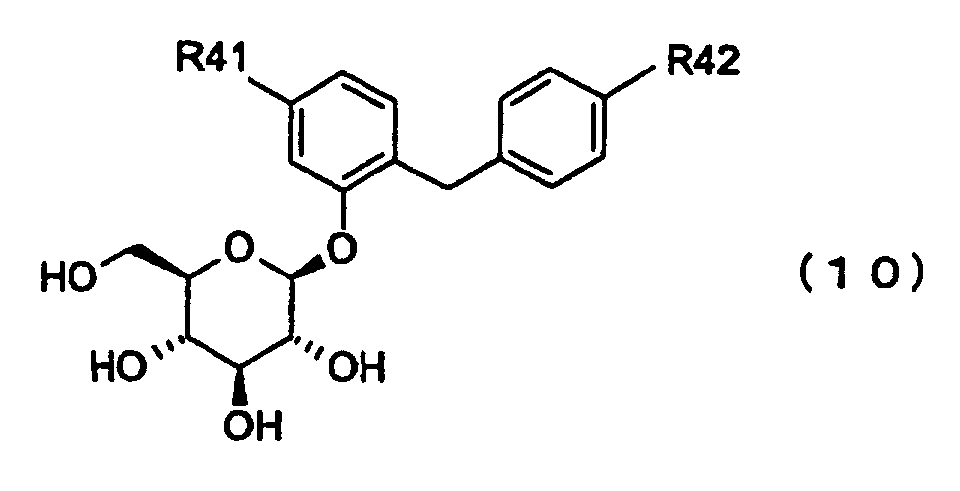
R42 is a lower alkyl group, a lower alkoxy group, a lower alkylthio group, a hydroxy-lower alkyl group, a hydroxy-lower alkoxy group, a hydroxy-lower alkylthio group, a lower alkoxy-lower alkyl group, a lower alkoxy-lower alkoxy group or a lower alkoxy-lower alkylthio group.]
The lower alkyl group in the Compound (10) means a
linear or branched alkyl group with one to 6 carbon atoms,
for example methyl group, ethyl group, propyl group,
isopropyl group, butyl group, isobutyl group, sec-butyl group,
tert-butyl group, pentyl group, isopentyl group, neopentyl
group, tert-pentyl group and hexyl group. The lower alkoxy
group means a linear or branched alkoxy group with one to 6
carbon atoms, for example methoxy group, ethoxy group,
propoxy group, isopropoxy group, butoxy group, isobutoxy
group, sec-butoxy group, tert-butoxy group, pentyloxy group,
isopentyloxy group, neopentyloxy group, tert-pentyloxy group
and hexyloxy group. The lower alkylthio group means a linear
or branched alkylthio group with one to 6 carbon atoms, for
example methylthio group, ethylthio group, propylthio group,
isopropylthio group, butylthio group, isobutylthio group,
sec-butylthio group, tert-butylthio group, pentylthio group,
isopentylthio group, neopentylthio group, tert-pentylthio
group and hexylthio group. The hydroxy-lower alkyl group in
the Compound (10) means a linear or branched hydroxy-alkyl
group with one to 6 carbon atoms, for example hydroxymethyl
group, 2-hydroxyethyl group, 1-hydroxyethyl group, 3-hydroxypropyl
group, 2-hydroxypropyl group, 1-hydroxypropyl
group, 2-hydroxy-1-methylethyl group, 4-hydroxybutyl group,
3-hydroxybutyl group, 2-hydroxybutyl group, 1-hydroxybutyl
group, 5-hydroxypentyl group, 4-hydroxypentyl group, 3-hydroxypentyl
group, 2-hydroxypentyl group, 1-hydroxypentyl
group, 6-hydroxyhexyl group, 5-hydroxyhexyl group, 4-hydroxyhexyl
group, 3-hydroxyhexyl group, 2-hydroxyhexyl
group and 1-hydroxyhexyl group. The hydroxy-lower alkoxy
group means a linear or branched hydroxy-alkoxy group with
one to 6 carbon atoms, for example 2-hydroxyethoxy group, 3-hydroxypropoxy
group, 2-hydroxypropoxy group, 2-hydroxy-1-methylethoxy
group, 4-hydroxybutoxy group, 3-hydroxybutoxy
group, 2-hydroxybutoxy group, 5-hydroxypentyloxy group, 4-hydroxypentyloxy
group, 3-hydroxypentyloxy group, 2-hydroxypentyloxy
group, 6-hydroxyhexyloxy group, 5-hydroxyhexyloxy
group, 4-hydroxyhexyloxy group, 3-hydroxyhexyloxy
group and 2-hydroxyhexyloxy group. The
hydroxy-lower alkylthio group means a linear or branched
hydroxy-alkylthio group with one to 6 carbon atoms, for
example hydroxymethylthio group, 2-hydroxyethylthio group, 1-hydroxyethylthio
group, 3-hydroxypropylthio group, 2-hydroxypropylthio
group, 1-hydroxypropylthio group, 2-hydroxy-1-methylethylthio
group, 4-hydroxybutylthio group, 3-hydroxybutylthio
group, 2-hydroxybutylthio group, 1-hydroxybutylthio
group, 5-hydroxypentylthio group, 4-hydroxypentylthio
group, 3-hydroxypentylthio group, 2-hydroxypentylthio
group, 1-hydroxypentylthio group, 6-hydroxyhexylthio
group, 5-hydroxyhexylthio group, 4-hydroxyhexylthio
group, 3-hydroxyhexylthio group, 2-hydroxyhexylthio
group and 1-hydroxyhexylthio group. The
lower alkoxy-lower alkyl group means the hydroxy-lower alkyl
group after o-alkylation with the lower alkyl groups. The
lower alkoxy-lower alkoxy group means the hydroxy-lower
alkoxy group after o-alkylation with the lower alkyl groups.
The lower alkoxy-lower alkylthio group means the hydroxy-lower
alkylthio group after o-alkylation with the lower alkyl
groups.
The protective group of the hydroxyl groups in the
Compound (10) means protective groups of hydroxyl group for
use in general organic synthetic reaction, such as benzyl
group, methoxymethyl group and acetyl group.
The substituent R41 in the Compound (10) is preferably
hydrogen atom or a hydroxy-alkyl group with one to 3 carbon
atoms. The substituent R42 is preferably a lower alkyl group,
a lower alkoxy group or a hydroxy-alkyl group, more
preferably an alkyl group with one to 4 carbon atoms, an
alkoxy group with one to 3 carbon atoms or a hydroxy-alkyl
group with one to 3 carbon atoms.
Pharmaceutically acceptable salts of the Compound (10)
include salts thereof with inorganic bases, such as sodium
salt and potassium salt.
The Compound (10) includes the hydrate thereof and
solvates thereof with solvents acceptable for pharmaceutical
products, such as ethanol.
The Compound (10) and pharmaceutically acceptable salts
thereof preferably include the compounds described in the
Examples 1 to 12 in WO 01/68660 and pharmaceutically
acceptable salts thereof.
Specifically, 2-(4-ethylbenzyl)-5-hydroxymethylphenyl-β-D-glucopyranoside
and pharmaceutically acceptable salts
thereof are particularly preferable.
The Compound (10) can be produced for example by the
method described in WO 01/68660. Additionally, the Compound
(10) can be prepared into pharmaceutically acceptable salts
thereof by general methods.


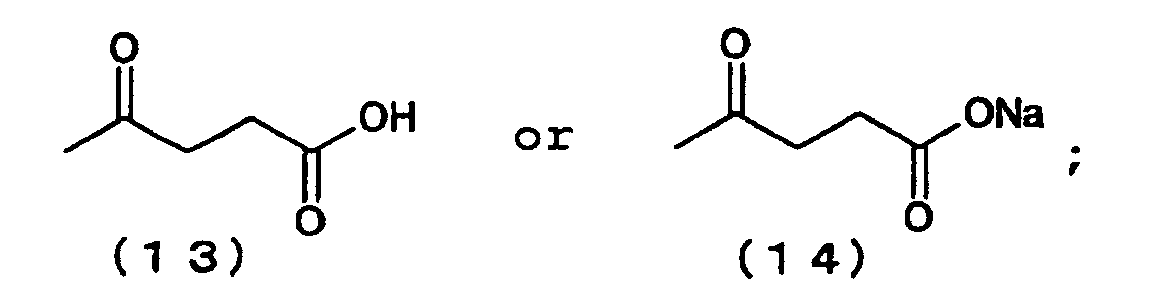

m represents 0 or 1;
n2 represents 0, 1, 2, or 3;
A1 represents the following cyclic structure:

--------------
represents single bond or double bond.]
The lower alkyl group in the Compound (11) means a
linear or branched alkyl group with one to 5 carbon atoms,
such as methyl group, ethyl group, propyl group, isopropyl
group, butyl group, isobutyl group, sec-butyl group, tert-butyl
group, pentyl group, isopentyl group, neopentyl group
and tert-pentyl group.
The lower alkoxy group in the Compound (11) means a
linear or branched alkoxy group with one to 5 carbon atoms,
such as methoxy group, ethoxy group, propoxy group,
isopropoxy group, butoxy group, isobutoxy group, sec-butoxy
group, tert-butoxy group, pentoxy group, isopentoxy group,
neopentoxy group and tert-pentoxy group.
Pharmaceutically acceptable salts of the Compound (11)
include for example sodium salt and potassium salt thereof as
the salts thereof with inorganic bases. In case that A1
contains a pyridine base, the pharmaceutically acceptable
salts thereof include salts with inorganic acids and salts
with organic acids. The salts with inorganic acids include
salts with hydrochloric acid and sulfuric acid, and the salts
with organic acids include salts with acetic acid, succinic
acid and fumaric acid.
The Compound (11) preferably includes the compounds
described as the Compound Nos. 1 through 58 in the
publication of JP-A-2001-288178 and pharmaceutically
acceptable salts thereof.
Among them, 3-(benzo[b]furan-5-yl)-3'-(6-o-methoxycarbonyl-β-D-glucopyranosyl)-6'-hydroxy-4'-methoxypropiophenone
(the Compound No. 5 in the publication)
and pharmaceutically acceptable salts thereof are
particularly preferable.
The Compound (11) can be produced for example by the
method described in JP-A-2001-288178. Additionally, the
Compound (11) can be prepared into pharmaceutically
acceptable salts thereof by general methods.

Y4 represents a lower alkyl group;
Z4 represents β-D-glucopyranosyl group where one or plural hydroxyl groups may be protected.]
In case that OX4 is a protected hydroxyl group in the
Compound (22), the protective group may satisfactorily be any
protective group for phenolic hydroxyl group. Specifically,
the protective group includes for example lower alkoxy-lower
alkyl groups such as methoxymethyl group; allyl groups; acyl
groups such as lower alkanoyl groups, lower alkoxy-lower
alkanoyl groups, lower alkoxy-carbonyl groups, lower alkoxy-lower
alkoxy-carbonyl groups and aryl-carbonyl groups (for
example, benzoyl group), preferably acyl groups such as lower
alkanoyl groups, lower alkoxy-lower alkanoyl groups, lower
alkoxy-carbonyl groups and lower alkoxy-lower alkoxy-carbonyl
groups. Particularly, the protective group is a lower
alkanoyl group and a lower alkoxy-carbonyl group.
In case that Z4 is β-D-glucopyranosyl group where one
or plural hydroxyl groups are protected in the Compound (22),
routine hydroxyl group-protecting groups readily removable by
general methods such as acid treatment, hydrolysis and
reduction can be used. The β-D-glucopyranosyl group where
one or plural hydroxyl groups are protected with such groups
includes for example [1] β-D-glucopyranosyl group with one or
plural hydroxyl groups acylated; [2] β-D-glucopyranosyl group
where two hydroxyl groups together with the protective groups
thereof form 1-lower alkoxy-lower alkylidenedioxy group,
benzylidenedioxy group, phosphinicodioxy group, carbonyldioxy
group or the like; or [3] β-D-glucopyranosyl group where one
or two hydroxyl groups are acylated and two hydroxyl groups
together with the protective groups thereof form 1-lower
alkoxy-lower alkylidenedioxy group, benzylidenedioxy group,
phosphinicodioxy group, or carbonyldioxy group. However, the
protective group of the hydroxyl groups in β-D-glucopyranosyl
group is not limited to them. Any protective group with a
function giving hydroxyl group after administration into
biological organisms and subsequent deprotection, a function
enabling ready absorption in biological organisms or ready
administration into biological organisms or a function
raising solubility in fats or solubility in water can be used
preferably.
When the hydroxyl groups in β-D-glucopyranosyl group
are acylated, preferably, lower alkanoyl groups, lower
alkoxy-lower alkanoyl groups, lower alkoxy-carbonyl groups,
lower alkoxy-lower alkoxy-carbonyl groups, aryl-carbonyl
groups (for example, benzoyl group) and the like can be used
as the acyl group. As the acyl group, additionally, residues
prepared by removing hydroxyl group from one carboxyl group
in amino acids (the amino groups, carboxyl groups and/or
hydroxyl groups existing in the residues may be protected)
may also be used. The residues prepared by removing hydroxyl
group from one carboxyl group in amino acids include for
example residues prepared by removing hydroxyl group from one
carboxyl group in a naturally occurring amino acid such as
aspartic acid, glutamic acid, glutamine, serine, sarcosine,
proline, phenylalanine, leucine, isoleucine, glycine,
tryptophan, cysteine, histidine, tyrosine, or valine, or an
enantiomer or a racemic mixture thereof.
β-D-glucopyranosyl group where two hydroxyl groups
together with the protective groups thereof form 1-lower
alkoxy-lower alkylidenedioxy group, benzylidenedioxy group,
phosphinicodioxy group, carbonyldioxy group or the like
includes β-D-glucopyranosyl group where the hydroxyl groups
of β-D-glucopyranosyl group at 4- and 6-positions together
with the protective groups form 1-lower alkoxy-lower
alkylidenedioxy group, benzylidenedioxy group,
phosphinicodioxy group, carbonyldioxy group or the like,
namely β-D-glucopyranosyl group forming the structure
represented by the following formula
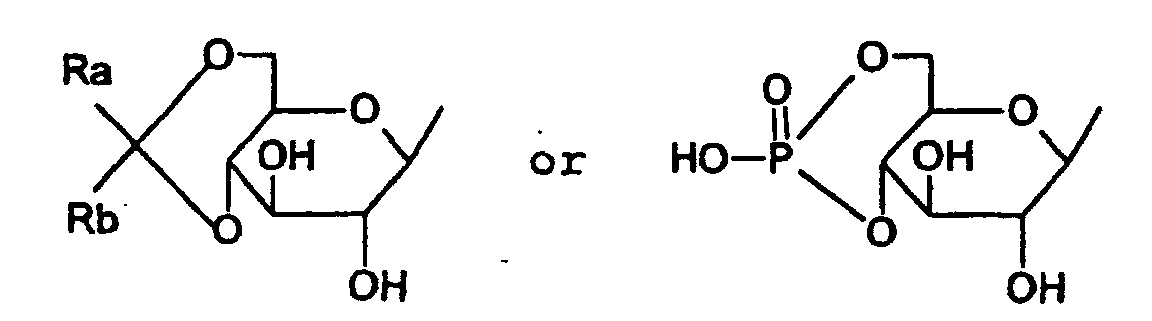 (where one of Ra and Rb represents hydrogen atom or a lower
alkyl group and the other represents a lower alkoxy group; or
one of Ra and Rb represents hydrogen atom and the other
represents phenyl group; or Ra and Rb together form oxo
group).
(where one of Ra and Rb represents hydrogen atom or a lower
alkyl group and the other represents a lower alkoxy group; or
one of Ra and Rb represents hydrogen atom and the other
represents phenyl group; or Ra and Rb together form oxo
group).
In case that two hydroxyl groups of β-D-glucopyranosyl
group together with the protective groups thereof form 1-lower
alkoxy-lower alkylidenedioxy group, the 1-lower alkoxy-lower
alkylidenedioxy group is preferably 1-lower alkoxyethylidenedioxy
group. Particularly, 1-methoxyethylidenedioxy
group, 1-ethoxyethylidenedioxy group
and the like can be used preferably.
Y4 in the Compound (22) is preferably an alkyl group with one to 4 carbon atoms, particularly preferably methyl group and ethyl group.
Y4 in the Compound (22) is preferably an alkyl group with one to 4 carbon atoms, particularly preferably methyl group and ethyl group.
Specific compounds of the Compound (22) include such
compound where Z4 is β-D-glucopyranosyl group where one or
plural hydroxyl groups may be acylated with a group or groups
selected from lower alkanoyl groups, lower alkoxy-carbonyl
groups, lower alkoxy-lower alkanoyl groups and lower alkoxy-lower
alkoxy-carbonyl groups, or such compound where Z4 is β-D-glucopyranosyl
group where two hydroxyl groups together
with the protective groups thereof form 1-lower alkoxy-lower
alkylidenedioxy group or phosphinicodioxy group.
More specific compounds thereof include such compound
where z4 is β-D-glucopyranosyl group where the hydroxyl group
at 2-position, 2- and 3-positions, 4-position or 6-position
may be acylated with a group or groups selected from lower
alkanoyl groups, lower alkoxy-carbonyl groups, lower alkoxy-lower
alkanoyl groups and lower alkoxy-lower alkoxy-carbonyl
groups, or such compound where Z4 is β-D-glucopyranosyl group
where the hydroxyl groups at 4- and 6-positions together with
the protective groups thereof form 1-lower alkoxy-lower
alkylidenedioxy group or phosphinicodioxy group.
Preferable compounds as the Compound (22) include
compounds where OX4 is hydroxyl group, a lower alkanoyloxy
group or a lower alkoxy-carbonyloxy group; Z4 is β-D-glucopyranosyl
group, 2-o-(lower alkanoyl)-β-D-glucopyranosyl
group, 2,3-di-o-(lower alkanoyl)-β-D-glucopyranosyl group,
4-o-(lower alkoxy-carbonyl)-β-D-glucopyranosyl group, 6-o-(lower
alkanoyl)-β-D-glucopyranosyl group, 6-o-(lower alkoxycarbonyl)-β-D-glucopyranosyl
group, 6-o-(lower alkoxy-lower
alkanoyl)-β-D-glucopyranosyl group, 6-o-(lower alkoxy-lower
alkoxy-carbonyl)-β-D-glucopyranosyl group, 4,6-o-(1-lower
alkoxy-lower alkylidene)-β-D-glucopyranosyl group or 4,6-o-phosphinico-β-D-glucopyranosyl
group.
More preferable compounds as the Compound (22) include
compounds where OX4 is hydroxyl group or a lower alkanoyloxy
group; Z4 is β-D-glucopyranosyl group, 2,3-di-o-(lower
alkanoyl)-β-D-glucopyranosyl group, 4-o-(lower alkoxycarbonyl)-β-D-glucopyranosyl
group, 6-o-(lower
alkoxycarbonyl)-β-D-glucopyranosyl group, 4,6-o-(1-lower
alkoxy-lower alkylidene)-β-D-glucopyranosyl group, or 4,6-o-phosphinico-β-D-glucopyranosyl
group.
Still more preferable compounds as the Compound (22)
include compounds where OX4 is hydroxyl group; Y4 is methyl
group or ethyl group; Z4 is β-D-glucopyranosyl group, 4-o-(lower
alkoxy-carbonyl)-β-D-glucopyranosyl group, 6-o-(lower
alkoxy-carbonyl)-β-D-glucopyranosyl group, 4,6-o-(1-lower
alkoxy-lower alkylidene)-β-D-glucopyranosyl group, or 4,6-o-phosphinico-β-D-glucopyranosyl
group.
Particularly preferable compounds as the Compound (22)
include compounds where Z4 is β-D-glucopyranosyl group or 6-o-(lower
alkoxy-carbonyl)-β-D-glucopyranosyl group.
The Compound (22) can be used in the free form or a
pharmaceutically acceptable salt thereof for the purpose of
the invention. The pharmaceutically acceptable salt thereof
includes alkali metal salts thereof, such as sodium salt,
mineral acid salts such as hydrochloride salt, and organic
acid salts such as tosylate salts.
Additionally, the Compound (22) and the
pharmaceutically acceptable salt thereof include any of
intramolecular salts thereof, and their solvates and hydrates.
The Compound (22) preferably includes the compounds
described in Examples 1 to 22 in the publication of JP-A-10-237089
and pharmaceutically acceptable salts thereof.
Among them, particularly, 3-(5-benzo[b]furanyl)-2'-(6-o-methoxycarbonyl-β-D-glucopyranosyloxy)-6'-hydroxy-4'-methylpropiophenone
(Example 2 in the publication) and
pharmaceutically acceptable salts thereof are preferable.
The Compound (22) can be produced for example by the
method described in JP-A-10-237089. Additionally, the
Compound (22) can be prepared into pharmaceutically
acceptable salts thereof by general methods.
For the prophylactic and therapeutic agent of diabetes
mellitus in accordance with the invention, the combination of
an inhibitor of renal glucose reabsorption and a hypoglycemic
agent is preferably a combination where the inhibitor of
renal glucose reabsorption is at least one selected from
More preferably, the combination is a combination where
the inhibitor of renal glucose reabsorption is at least one
selected from pyrazole derivatives and pharmaceutically
acceptable salts thereof represented by the formulas (3),
(3a), (4a), (7), (10-A), (12-A), (14-A) and (16-A) and the
hypoglycemic agent is at least one selected from
sulfonylureas and biguanides.
In case of such combination, the prophylactic and
therapeutic agent of the invention is superior to a single
sulfonylurea therapy or a single biguanide therapy by which
the hyperglycemia after meals cannot be suppressed, because
the combination can suppress hyperglycemia after meals.
Compared with a single therapy with an inhibitor of renal
glucose reabsorption, further, the combination can extend the
sustainability of the pharmaceutical effect so that the
combination is very useful for glycemic control.
Additionally, another preferable combination of the
inhibitor of renal glucose reabsorption and the hypoglycemic
agent is a combination where the inhibitor of renal glucose
reabsorption is at least one selected from the Compound (22)
and pharmaceutically acceptable salts thereof and the
hypoglycemic agent is meglitinide analogues. More preferably,
the combination is a combination where the inhibitor of renal
glucose reabsorption is at least one selected from 3-(5-benzo[b]furanyl)-2'-(6-o-methoxycarbonyl-β-D-glucopyranosyloxy)-6'-hydroxy-4'-methylpropiophenone
and
pharmaceutically acceptable salts thereof and the
hypoglycemic agent is meglitinide analogues.
In case of such combination, the prophylactic and
therapeutic agent of the invention can more readily suppress
hyperglycemia after meals than the single use of meglitinide
analogues with short sustainability of pharmaceutical effect
does, so that the combination is very useful for glycemic
control.
The prophylactic and therapeutic agent of diabetes
mellitus in accordance with the invention has a far greater
anti-diabetic action compared with the single use of
hypoglycemic agents in the related art, and is useful as a
prophylactic and therapeutic agent of diabetes mellitus (for
example, true diabetes mellitus such as type 1 diabetes
mellitus and type 2 diabetes mellitus), and various symptoms
due to hyperglycemia (for example, diabetic complications
such as diabetic nephropathy, diabetic neuropathy and
diabetic retinopathy) for mammalian animals (for example,
mouse, rat, hamster, rabbit, cat, dog, cow, sheep, monkey and
humans).
The prophylactic and therapeutic agent of diabetes
mellitus in accordance with the invention may be any
preparation at least containing one active component
containing an inhibitor of renal glucose reabsorption and one
active component containing a hypoglycemic agent or any
preparation containing such active components in mixture. A
combination of preparations each containing each active
component may also be encompassed within the scope of the
prophylactic and therapeutic agent of diabetes mellitus in
accordance with the invention. Further, preparations
containing other anti-diabetic agents and the like (third and
fourth pharmaceutical components) may also be encompassed
within the scope of the invention as long as the preparations
contain the active components of the invention.
In the prophylactic and therapeutic agent of diabetes
mellitus in accordance with the invention, the ratio of an
inhibitor of renal glucose reabsorption and a hypoglycemic
agent varies within a wide range, in a manner dependent on a
variety of factors, for example the desirable dose and the
pharmaceutically acceptable carrier to be used therein. In
case that both the two agents are combined in a single
preparation or in case that the two agents are separately
prepared into different preparations, the content of a
hypoglycemic agent is preferably about 0.01 to 100 per the
content (by weight) of an inhibitor of renal glucose
reabsorption, which is defined as 1. Additionally,
components contained in the prophylactic and therapeutic
agent of diabetes mellitus in accordance with the invention
except for an inhibitor of renal glucose reabsorption and a
hypoglycemic agent should preferably be about 0.001 to 1000,
more preferably about 0.01 to 100, per the content (by
weight) of the inhibitor of renal glucose reabsorption, which
is defined as 1. In case that the prophylactic and
therapeutic agent of diabetes mellitus in accordance with the
invention is to be administered in the form of a single
preparation to patients, the prophylactic and therapeutic
agent can be administered so that the individual components
might be within the ranges described above. Additionally in
case that the individual active components are to be
administered in the form of separate, different preparations,
the ratio described above can be used as the ratio on average.
Per one preparation in accordance with the invention,
preferably, about 0.01 to 1000 mg of an inhibitor of renal
glucose reabsorption can be contained.
The dosage regimen of the prophylactic and therapeutic
agent of diabetes mellitus in accordance with the invention
is not specifically limited. The prophylactic and
therapeutic agent of diabetes mellitus in accordance with the
invention can be administered at a safe and necessary dose by
intravenous, intra-arterial, subcutaneous and intra-muscular
injections, and administration via infusion drops,
instantaneously in one portion or by infusion. Additionally,
the dosage regimen of the prophylactic and therapeutic agent
of diabetes mellitus in accordance with the invention may be
given either parenterally or orally. In terms of pain to
patients and the like, preparations except for insulin
preparations are preferably given orally. However, a
combination of preparations with different dosage regimens is
also satisfactory.
The prophylactic and therapeutic agent of diabetes
mellitus in accordance with the invention may be prepared
into for example oral preparations of various dosage forms,
for example tablets, capsules, granules, powders, troches and
liquids. These preparations can be prepared by methods known
per se. Any of the active components and the preparations in
accordance with the invention may contain pharmaceutically
acceptable carriers, diluents, vehicles, disintegrators,
lubricants, flowability-enhancing agents and other substances
required for preparations. An appropriate combination is
used for formulating these preparations, so that the
preparations can be produced.
In the prophylactic and therapeutic agent of diabetes
mellitus in accordance with the invention, an inhibitor of
renal glucose reabsorption and a hypoglycemic agent can be
simultaneously given or sequentially given in any order. A
dosage regimen, a sequence and an interval practically
preferable can be selected, depending on the preparations of
individual pharmaceutical agents to be used, the time
required for the expression of the pharmaceutical effect, and
the conditions of individual patients to be treated, in
overall view of routine techniques and in terms of the
information described in this specification. For example,
the following dosage regimens and the like are listed. [1]
Administration of a composition containing an inhibitor of
renal glucose reabsorption and a hypoglycemic agent, namely
in the form of a single preparation. [2] Simultaneous
administration of two types of preparations obtained by
separately formulating an inhibitor of renal glucose
reabsorption and a hypoglycemic agent into different
preparations, by the same dosage route. [3] Administration
of two types of preparations obtained by separately
formulating an inhibitor of renal glucose reabsorption and a
hypoglycemic agent into different preparations at an interval
(for example, in a sequential order of an inhibitor of renal
glucose reabsorption and a hypoglycemic agent or in the
reverse order thereof) by the same dosage route. [4]
Simultaneous administration of two types of preparations
obtained by separately formulating an inhibitor of renal
glucose reabsorption and a hypoglycemic agent into different
preparations, by different dosage routes. [5] Administration
of two types of preparations obtained by separately
formulating an inhibitor of renal glucose reabsorption and a
hypoglycemic agent into different preparations at an interval
(for example, in an sequential order of an inhibitor of renal
glucose reabsorption and a hypoglycemic agent or in the
reverse order thereof) by different dosage routes.
The therapeutic unit practically preferable can vary,
depending on each of the individual preparations of an
inhibitor of renal glucose reabsorption and a hypoglycemic
agent, the condition of each patient to be treated, namely
routine markers such as blood glucose value, blood lipid
concentration, and blood glycohemoglobin concentration. The
therapeutic unit optimal for given conditions can
appropriately be selected using the routine markers and
therapeutic unit, from the standpoint of the information
described in this specification. For example, the compounds
represented by the general formulas (or by formulas) (1), (2),
(3), (4), (3a), (4a), (1A), (2A), (3A), (4A), (10-A) , (12-A),
(14-A), (16-A), (5), (6), (7), (8), (10), (11) and (22) and
pharmaceutically acceptable salts thereof as inhibitors of
renal glucose reabsorption are preferably dosed at about 1 to
500 mg/day. In this case, thus, the dose of a hypoglycemic
agent can be about 0.01 to 50,000 mg/day. For combined use
of another agent, any of dosage regimens such as simultaneous
administration of both the two agents, pre-administration or
post-administration of an inhibitor of renal glucose
reabsorption, and plural combinations thereof may be possible.
Preferably, these individual pharmaceutical agents are given
up to three times per day. Unless hypoglycemic symptoms or
other adverse effects cause contraindication, such therapy
may satisfactorily be repeated.
Additionally, the invention includes a commercial
package including a combination agent including a combination
of an inhibitor of renal glucose reabsorption and a
hypoglycemic agent, along with an instruction insert about
the combination agent, telling that the combination agent can
be or should be used for the prophylaxis and therapy of
diabetes mellitus.
The invention is now described in detail in the
following examples. However, these examples never limit the
invention.
In the following examples, the following inhibitors of
renal glucose reabsorption were used: the inhibitor A of
renal glucose reabsorption as represented by the formula (3):
Wistar rats (age of 7 weeks; male) were divided into
groups with matched body weights. After 17-hour starvation,
glucose was orally given at 1 g/kg to the animals.
Immediately after the administration, the inhibitor A of
renal glucose reabsorption or the inhibitor B of renal
glucose reabsorption (A at 30 mg/kg or 60 mg/kg; B at 30
mg/kg or 80 mg/kg) or glibenclamide (1 mg/kg or 2 mg/kg) or
nateglinide (50 mg/kg or 80 mg/kg) was orally given.
Additionally, a group on the combined use of both of an
inhibitor of renal glucose reabsorption and a hypoglycemic
agent was also prepared. A vehicle was orally given to a
control group after glucose administration.
Blood glucose was measured in a time course. As
apparently shown in Fig. 1, consequently, glibenclamide (1
mg/kg) did not suppress hyperglycemia immediately after
glucose loading (30 minutes), but lowered blood glucose 120
minutes after glucose loading and thereafter, compared with
the vehicle group. However, even the increase of the dose (2
mg/kg) did not change changed the pattern of glycemic
suppression. The inhibitor A of renal glucose reabsorption
(30 mg/kg) suppressed hyperglycemia observed in the vehicle
group immediately after glucose loading (30 minutes) but did
not lower the blood glucose level 120 minutes after glucose
loading and thereafter as greatly as glibenclamide did. The
pattern of glycemic suppression did not change even when the
dose was elevated (60 mg/kg). In case of using glibenclamide
(1 mg/kg) and the inhibitor A of renal glucose reabsorption
(30 mg/kg) in combination, blood glucose levels immediately
after glucose loading (30 minutes) and 120 minutes after
glucose loading and thereafter were both lower than the
levels in the vehicle group.
As apparently shown in Fig. 2, nateglinide (50 mg/kg)
more highly suppressed hyperglycemia immediately after
glucose loading (30 minutes and 60 minutes), compared with
the vehicle-dosed group, but did not lower the blood glucose
level 120 minutes after glucose loading and thereafter.
Further, the pattern of glycemic suppression did not change
even by the elevation of the dose (80 mg/kg). The
hyperglycemia 30 minutes after glucose loading in the group
given with the inhibitor B of renal glucose reabsorption (30
mg/kg) was not reduced as greatly as in the case of
nateglinide, while the blood glucose level 60 minutes later
was similar to that in the vehicle-dosed group. The blood
glucose level 180 minutes after glucose loading and
thereafter was lower than that in the vehicle-dosed group.
This pattern of glycemic suppression was also observed in the
group with the increase of the dose (80 mg/kg). In case of
using nateglinide (50 mg/kg) and the inhibitor B of renal
glucose reabsorption (30 mg/kg), the blood glucose levels
immediately after glucose loading (30 minutes and 60 minutes)
and the blood glucose level 180 minutes later and thereafter
were all lowered than those in the vehicle group. This
apparently indicates that such strict glycemic control as
never been obtained by the existing hypoglycemic agents can
be obtained by the combined use of the inhibitors of renal
glucose reabsorption and the existing hypoglycemic agents at
the tests using the glucose-loaded rats.
KK mice (age of 25 weeks; male) fed with a commercially
available high-calories feed for breeding (CMF; Oriental
Yeast) were divided into groups with matched body weights.
After starvation for 17 hours, glucose was orally given at 1
g/kg. Immediately thereafter, the inhibitor A of renal
glucose reabsorption (30 mg/kg or 45 mg/kg) or metformin (200
mg/kg or 300 mg/kg) was orally given. Additionally, a group
given with the inhibitor A of renal glucose reabsorption (30
mg/kg) and metformin (200 mg/kg) was prepared. A vehicle was
orally given to a control group after glucose dosing.
Blood glucose level was assayed in a time course. As
apparently shown in Fig. 3, consequently, metformin (200
mg/kg) dosed did not suppress the increase of blood glucose
in the mice 30 minutes after glucose loading but suppressed
the increase 60 minutes later and thereafter. The pattern of
glycemic suppression did not change even when the dose was
elevated (300 mg/kg). The administration of the inhibitor A
of renal glucose reabsorption (30 mg/kg) alone could suppress
hyperglycemia 30 minutes and 60 minutes after glucose loading,
compared with the control group, but could not suppress the
blood glucose level 2 hours later and thereafter.
Additionally, the pattern of glycemic suppression did not
change even when the dose was elevated (45 mg/kg). However,
the blood glucose in the group given with a combination of
the inhibitor A of renal glucose reabsorption (30 mg/kg) and
metformin (200 mg/kg) was suppressed at all the assay points,
compared with the blood glucose level in the control group.
This apparently indicates that such strict glycemic control
as has never been obtained by the existing hypoglycemic
agents can be obtained by the combined use of the inhibitor
of renal glucose reabsorption and the existing hypoglycemic
agent at the test using the glucose-loaded mice.
As described above, the results in the Examples as
shown in Figs.1, 2 and 3 indicate that the methods using
combinations of the inhibitors of renal glucose reabsorption
and the existing hypoglycemic agents in accordance with the
invention can achieve strict glycemic control immediately
after glucose loading and thereafter in the glucose-loaded
animals as hyperglycemic models after meals and that the
method could produce a higher effect, compared with their
single use.
Type 2 diabetic model GK rats (age of 7 weeks; male)
were divided into groups with matched blood glucose levels
and body weights, for once daily oral administration of the
inhibitor A of renal glucose reabsorption (30 mg/kg) or
glibenclamide at 3 or 6 mg/kg. Further, a group given with a
combination of the inhibitor A of renal glucose reabsorption
at 30 mg/kg and glibenclamide at 3 mg/kg was prepared. These
agents were orally given once daily at the same time period
as in the group administered with a single one agent. Only a
vehicle was given orally to a control group. On day 25 after
the start of administration, blood glucose was assayed
sequentially, to compare the groups in terms of the resulting
blood glucose levels. The results are shown in Fig. 4.
As shown in Fig. 4, hyperglycemia was observed in the
vehicle-dosed group. In the group given glibenclamide alone
(3 mg/kg), however, no difference was observed from the
vehicle-dosed group in terms of the blood glucose levels.
Additionally, even the elevation of the dose (6 mg/kg) did
not produce any difference in blood glucose level from the
vehicle-dosed group. In this diabetic model animals, no
effect of glibenclamide was observed. The blood glucose
level in the group given the inhibitor of renal glucose
reabsorption alone was significantly lowered, compared with
the group given the vehicle. The effect of the
administration of the inhibitor of renal glucose reabsorption
alone was observed in this model animals. In the group given
the combination of glibenclamide and the inhibitor of renal
glucose reabsorption (given at 3 mg/kg and 30 mg/kg,
respectively), meanwhile, the blood glucose level was
significantly lowered, compared with not only the vehicle-dosed
group and the group given glibenclamide alone but also
the group given the inhibitor of renal glucose reabsorption
alone. In other words, the condition of diabetes mellitus in
the group given the combination was greatly improved,
compared with the group given the inhibitor of renal glucose
reabsorption alone, although glibenclamide was not observed
to be effective. The combined use of the existing
hypoglycemic agent and the inhibitor of renal glucose
reabsorption could show a synergistic therapeutic effect on
the conditions of diabetic mellitus, as never been obtained
by the administration of the existing hypoglycemic agent
alone.
Type 2 diabetes model db/db mice (age 6 weeks) were fed
and kept with a feed twice daily over one hour starting 9 am
and one hour starting 3 pm, for one week. Then, the mice
were divided into groups with matched blood glucose levels
and body weights. Subsequently, the inhibitor B of renal
glucose reabsorption at 80 mg/kg or nateglinide at 80 mg/kg
was orally given, immediately before feeding twice daily.
Only a vehicle was orally given immediately before feeding
twice daily to the animals of a control group. On day 25
from the start of administration, the mice of the individual
experimental groups were starved for 17 hours and then orally
given glucose (1 g/kg) and nateglinide (50 mg/kg). Blood
glucose levels were measured before and after the
administration, to examine whether or not the hypoglycemic
action of nateglinide could be observed (nateglinide load
test). The results are shown in Table I.
| Blood glucose levels (mg/dl) at the time of nateglinide load test | |||
| Compound successively dosed | Blood glucose level before loading | | |
| Vehicle (N=4) | 134 ± 10 | 239 ± 25 | 126 ± 8 |
| Nateglinide | 158 ± 12 | 259 ± 18 | 144 ± 20 |
| Inhibitor B of renal glucose reabsorption | 131 ± 6 | 172 ± 14, | 103 ± 5 |
| Mean ± SD; N = 5 for groups except for vehicle group; |
As shown in Table I, the blood glucose levels
immediately before the nateglinide load test did not differ
in these groups. 30 minutes after loading with glucose and
nateglinide, nateglinide greatly suppressed hyperglycemia due
to glucose loading in the group given the inhibitor B of
renal glucose reabsorption, compared with the vehicle-dosed
group and the nateglinide-dosed group. In other words, it
was found that the long-term administration of the inhibitor
of renal glucose reabsorption distinctly activated the
nateglinide sensitivity of the diabetic model animals, so
that the combined use of the inhibitor of renal glucose
reabsorption and nateglinide could produce an effect as never
been anticipated from the single use.
Type 2 diabetes model Zucker diabetic fatty rats (age
15 weeks) were divided into groups with matched blood glucose
levels and body weights. Subsequently, the inhibitor A of
renal glucose reabsorption at 30 mg/kg or metformin at 200
mg/kg was orally given twice daily. Further, a group to be
on a combined use of the inhibitor A of renal glucose
reabsorption (30 mg/kg) and metformin (200 mg/kg) was
prepared. The agents were orally given twice daily at the
same time period as in the case of the groups administered
with a single one of these agents. Only a vehicle was orally
given twice daily to the animals in a control group. On day
39 from the start of administration, the animals were starved
for 18 hours. Then, pancreas was resected from the animals,
for the assay of insulin in pancreas homogenates by ELISA, to
compare the groups in terms of insulin content in pancreas.
The results are shown in Fig. 5.
As shown in Fig. 5, no difference was observed in
insulin content in spleen among the vehicle group, the group
given the inhibitor A of renal glucose reabsorption and the
group given metformin. However, the insulin content in the
group given the combination of the inhibitor A of renal
glucose reabsorption and metformin was so high, compared with
the remaining groups. Zucker diabetic fatty rat is a type 2
diabetic model animal, where the sustainment of hyperglycemic
conditions induces a high concentration of glycated
hemoglobin so that the aging of the model animal involves the
decrease of the insulin content in pancreas. In other words,
it was shown that a synergistic therapeutic effect of
diabetes mellitus and a synergistic effect on the prevention
of the progress of diabetes mellitus as have never been
obtained by the administration of any one of them could be
obtained from the combined use of the inhibitor of renal
glucose reabsorption and metformin.
1,2-Dihydro-4-[(4-ethylphenyl)methyl]-5-trifluoromethyl-3H-pyrazol-3-one
(4.76 g; 17.6 mmol)
(prepared by the method described in J. Med. Chem 1996, 39,
3920-3928) and imidazole (1.57 g; 23.1 mmol) were dissolved
in dimethylformamide (20 ml). t-Butyldimethylsilyl chloride
(2.98 g; 19.8 mmol) was added to the resulting mixture. The
mixture was stirred at room temperature for 30 minutes.
After the addition of water (100 ml), the mixture was
extracted with ethyl acetate and hexane (a mixture solvent at
2:1) three times. The organic phase was washed with water,
dried over sodium sulfate and concentrated, to give the
desired compound. (6.9 g, 17.9 mmol; quantitative).
1H-NMR(300MHz, CDCl3) δ: 0.21 (6H, s), 0.93 (9H, s),
1.19 (3H, t, J = 7.6 Hz) , 2.59 (2H, q, J = 7.6 Hz), 3.74 (2H,
s), 7.09 (4H, m). ESI-MS (m/z) 269[(M-TBS)-].
4-[(4-Ethylphenyl)methyl]-5-trifluoromethyl-3-o-t-butyldimethylsilyl-1H-pyrazole
(2.5 g; 6.5 mmol),
triphenylphosphine (1.9 g; 7.2 mmol) and cyclobutanol (0.71
g; 9.8 mmol) were dissolved in anhydrous tetrahydrofuran
(15ml), the mixture was stirred at room temperature. A 40 %
toluene solution of diethyl azodicarboxylate (3.4 ml; 7.5
mmol) was gradually added. Twenty minutes later, the
resulting mixture was concentrated, to which hexane (20 ml)
was added. The precipitate was filtered, followed by
concentration. By purification on a silica gel column
(hexane → 5 % ethyl acetate/hexane), the objective compound
was obtained . (1.4 g, 3.3 mmol, 51 %).
1H-NMR(300MHz, CDCl3) δ: 0.27 (6H, s) , 0.96 (9H, s),
1.20 (3H, t, J = 7.5 Hz), 2.26-2.34 (2H, m), 2.59 (2H, q, J =
7.5 Hz), 2.54-2.67 (2H, m), 3.72 (2H, s), 4.67 (1H, quint, J
= 8.1 Hz), 7.06 (2H, d, J = 8.5 Hz), 7.10 (2H, d, J = 8.5 Hz).
ESI-MS (m/z) [323 (M-TBS)-].
1-Cyclobutyl-4-[(4-ethylphenyl)methyl]-5-trifluoromethyl-3-o-t-butyldimethylsilyl-1H-pyrazole
(1.4 g;
3.3 mmol) was dissolved in tetrahydrofuran (25 ml) and
methanol (5 ml) , to which aqueous 1 M HCl solution (5 ml) was
added, for agitation overnight at room temperature. After
the addition of water (100 ml), the mixture was extracted
three times with 10 ml of ethyl acetate. After drying over
anhydrous sodium sulfate and concentration, the residue was
purified on a silica gel column chromatography (hexane → 5 %
ethyl acetate/hexane) to give the desired compound (0.84 g;
2.6 mmol). (78 %)
1H-NMR (300MHz, CDCl3) δ: 1.20 (3H, t, J = 7.5 Hz),
1.70-1.90 (2H, m), 2.28-2.36 (2H, m), 2.59 (2H, q, J = 7.5
Hz), 2.55-2.68 (2H, m), 3.80 (2H, s), 4.75 (1H, pseudo quint,
J = 8.1 Hz) , 7.10 (2H, d, J = 8.8 Hz) , 7.18 (2H, d, J = 8.8
Hz). ESI-MS (m/z) [325 (M+H)+], [323 (M-H)-].
Water (2 mL) and chloroform (10 mL) were added to 1-cyclobutyl-4-[(4-ethylphenyl)methyl]-5-trifluoromethyl-1H-pyrazole
(0.84 g; 2.6 mmol), 2,3,4,6-o-tetraacetyl-α-D-glucopyranosyl
bromide (1.5 g; 3.7 mmol), benzyl chloride
tri-n-butylammonium (0.10 g; 0.32 mmol) and potassium
carbonate (3.23 g; 23 mmol). The mixture was stirred at room
temperature for 18 hours. The organic layer was purified by
silica gel column chromatography (hexane → hexane : ethyl
acetate = 10:1 to 2:1), to obtain 2.1 g of a crude product
mainly containing the objective compound, which was then used
for the following reaction.
1H-NMR(300MHz, CDCl3) δ: 1.19 (3H, t, J = 7.6 Hz), 1.72-1.84
(2H, m), 1.89 (3H, s), 2.03 (3H, s), 2.04 (3H, s), 2.06
(3H, s), 2.29-2.38 (2H, m), 2.58 (2H, q, J = 7.6 Hz), 2.58-2.68
(2H, m), 3.72 (2H, s), 3.88 (1H, ddd, J = 9.9, 4.9, 2.3
Hz), 4.11-4.17 (1H, m), 4.26 (1H, dd, J = 12.3, 9.4 Hz),
4.70-4.76 (1H, m), 5.15-5.22 (1H, m), 5.28-5.32 (2H, m),
5.64-5.66 (1H, m), 7.06 (4H, s). ESI-MS (m/z) [655 (M+H)+].
A crude product (2.1 g) of 1'-cyclobutyl-4'-[(4-ethylphenyl)methyl]-5'-trifluoromethyl-1H-pyrazole-3'-o-(2,3,4,6-tetraacetyl)-β-D-glucopyranoside
was dissolved in
ethanol (20 ml), followed by addition of 4 ml of aqueous 4N
NaOH solution. The mixture was stirred at room temperature.
After one hour, aqueous saturated sodium chloride (50 ml) and
water (10 ml) were added, and the mixture was extracted three
times with 20 ml of ethyl acetate. After concentration, the
extract was purified on a silica gel column chromatography
(dichlorornethane → 10 % methanol/dichloromethane) to give
the desired compound. (0.63 g, 1.3 mmol). (50%)
1H-NMR(300MHz, CD3OD) δ= 1.18(3H, t, J = 7.6 Hz) , 1.79-1.89(2H,
m), 2.28-2.36(2H, m), 2.57(2H, q, J = 7.6 Hz), 2.60-2.72(2H,
m), 3.37-3.45(4H, m) , 3.65-3.71(1H, m) , 3.81 (2H, s),
3.81-3.86 (1H, m), 5.39-5.41 (1H, m), 7.06 (4H, s). MS(ESI)
m/z [487 (M+H)+], [485 (M-H)-].
1'-Cyclobutyl-4'-[(4-ethylphenyl)methyl]-5'-trifluoromethyl-1H-pyrazole-3'-o-β-D-glucopyranoside
(0.18 g;
0.32 mmol) was dissolved in 2, 4, 6-collidine (2.0 ml) and
cooled to -50°C. Methyl chlorocarbonate (0.035 ml; 0.45 mmol)
was added to the resulting mixture, which was then back to
room temperature over 0.5 hour. 27 hours later, ethyl
acetate (20 ml) and aqueous 1M HCl solution (20 ml) were
added and the mixture was extracted with ethyl acetate.
After drying and concentration, the residue was purified on a
silica gel column chromatography (hexane : ethyl acetate =
1:1 to 1:3 → ethyl acetate) to give the desired
compound. (0.12 g, 0.20 mmol). (62 %)
1H-NMR(300MHz, CDCl3) δ: 1.20 (3H, t, J = 7.6 Hz), 1.71-1.86
(2H, m), 2.29-2.38 (2H, m), 2.48 (1H, d, J = 2.6 Hz),
2.60-2.68 (2H, m), 2.60 (2H, q, J = 7.6 Hz), 2.68 (1H, s),
2.72 (1H, s), 3.49-3.65 (4H, m), 3.72 (1H, d, J = 15.2 Hz),
3.79 (3H, s), 3.87 (1H, d, J = 15.2 Hz), 4.32 (1H, dd, J =
12.0, 2.1 Hz), 4.48 (1H, dd, J = 12.0, 4.1 Hz), 4.74 (1H,
pseudo quint, J = 8.4 Hz), 5.22 (1H, d, J = 7.9 Hz), 7.10 (4H,
s). MS(ESI) m/z[545 (M+H)+], [543 (M-H)-].
In the same manner as in the Step 2 of the Production
Example 1 except for the use of cyclopentanol instead of
cyclobutanol, the desired compound was obtained. (86 %)
1H-NMR(300MHz, CDCl3) δ: 0.23 (6H, s), 0.94 (9H, s),
1.20 (3H, t, J=7.6Hz), 1.55-1.70 (2H, m), 1.80-2.05 (6H, m),
2.59 (2H, q, J=7.6Hz), 3.72 (2H, s), 4.54-4.66 (1H, m), 7.06
(2H, d, J=8.4Hz), 7.11 (2H, d, J=8.4Hz).
In the same manner as in the Step 3 of the Production
Example 1, the desired compound was obtained from 1-cyclopentyl-4-[(4-ethylphenyl)methyl]-5-trifluoromethyl-3-o-t-butyldimethylsilyl-1H-pyrazole.
(95 %)
1H-NMR(300MHz, CDCl3) δ: 1.20 (3H, t, J=7.6Hz), 1.50-1.70
(2H, m), 1.80-2.10 (6H, m), 2.60 (2H, q, J=7.6Hz), 3.79
(2H, s), 4.53-4.68 (1H, m), 7.09 (2H, d, J=8.1Hz), 7.17 (2H,
d, J=8.1Hz), 10.1-10.2 (1H, br). MS(ESI) m/z 339[(M+H)+],
[337 (M-H)-].
In the same manner as in the Step 4 of the Production
Example 1, a crude product of the desired compound was
obtained from 1-cyclopentyl-4-[(4-ethylphenyl)methyl]-5-trifluoromethyl-1H-pyrazole.
1H-NMR(300MHz, CDCl3) δ: 1.19 (3H, t, J = 7.6 Hz), 1.60-1.68
(2H, m), 1.88 (3H, s), 2.02 (3H, s), 2.04 (3H, s), 2.06
(3H, s), 1.98-2.0 (2H, m), 2.58 (2H, q, J = 7.6 Hz), 3.72 (2H,
s), 3.80-3.85 (1H, m), 4.11 (1H, dd, J = 8.5, 3.8 Hz), 4.25
(1H, dd, J = 12.5, 4.8 Hz), 4.65 (1H, pseudo quint, J = 7.0
Hz), 5.14-5.20 (1H, m), 5.24-5.30 (2H, m), 5.56-5.59 (1H, m),
7.06 (4H, s). MS(ESI) m/z[669 (M+H)+].
In the same manner as in the Step 5 of the Production
Example 1, the desired compound was obtained via the
hydrolysis of a crude product of 1'-cyclopentyl-4'-[(4-ethylphenyl)methyl]-5'-trifluoromethyl-1H-pyrazole-3'-o-(2,3,4,6-tetraacetyl)-β-D-glucopyranoside.
(90 %)
1H-NMR(300MHz, CD3OD) δ= 1.19 (3H, t, J = 7.6 Hz), 1.62-1.68
(2H, m), 1.87-2.04 (6H, m), 2.57 (2H, q, J = 7.6 Hz),
3.32-3.45 (3H, m), 3.67 (1H, dd, J = 12.0, 5.0Hz), 3.78-3.82
(3H, m), 4.70 (1H, pseudo quint, J = 6.9 Hz), 5.30-5.37 (1H,
m), 7.06 (4H, s). MS(ESI) m/z[501 (M+H)+], [499 (M-H)-].
In the same manner as in the Step 6 of Production
Example 1, the desired compound was obtained via the reaction
of 1'-cyclopentyl-4'-[(4-ethylphenyl)methyl]-5'-trifluoromethyl-1H-pyrazole-3'-o-β-D-glucopyranoside
with
methyl chlorocarbonate. (67 %)
1H-NMR(300MHz, CDCl3) δ: 1.20 (3H, t, J = 7.5 Hz), 1.60-1.70
(2H, m), 1.84-1.94 (2H, m), 1.98-2.04 (4H, m), 2.55 (1H,
d, J = 2.3 Hz), 2.60 (2H, q, J = 7.5 Hz), 2.75 (1H, d, J =
2.1 Hz), 2.85 (1H, d, J = 2.6 Hz), 3.47-3.63 (4H, m), 3.72
(1H, dd, J = 15.8, 1.2 Hz), 3.78 (3H, s), 3.87 (1H, d, J =
15.8 Hz), 4.36 (1H, dd, J = 12.0, 1.8 Hz), 4.45 (1H, dd, J =
12.0, 4.1 Hz), 4.66 (1H, pseudo quint, J = 6.9 Hz), 5.14 (1H,
d, J = 7.9 Hz), 7.10 (4H, s) MS(ESI) m/z[559 (M+H)+], [557
(M-H)-].
The structures of the compounds obtained in the
Production Examples 1 to 4 are shown below.
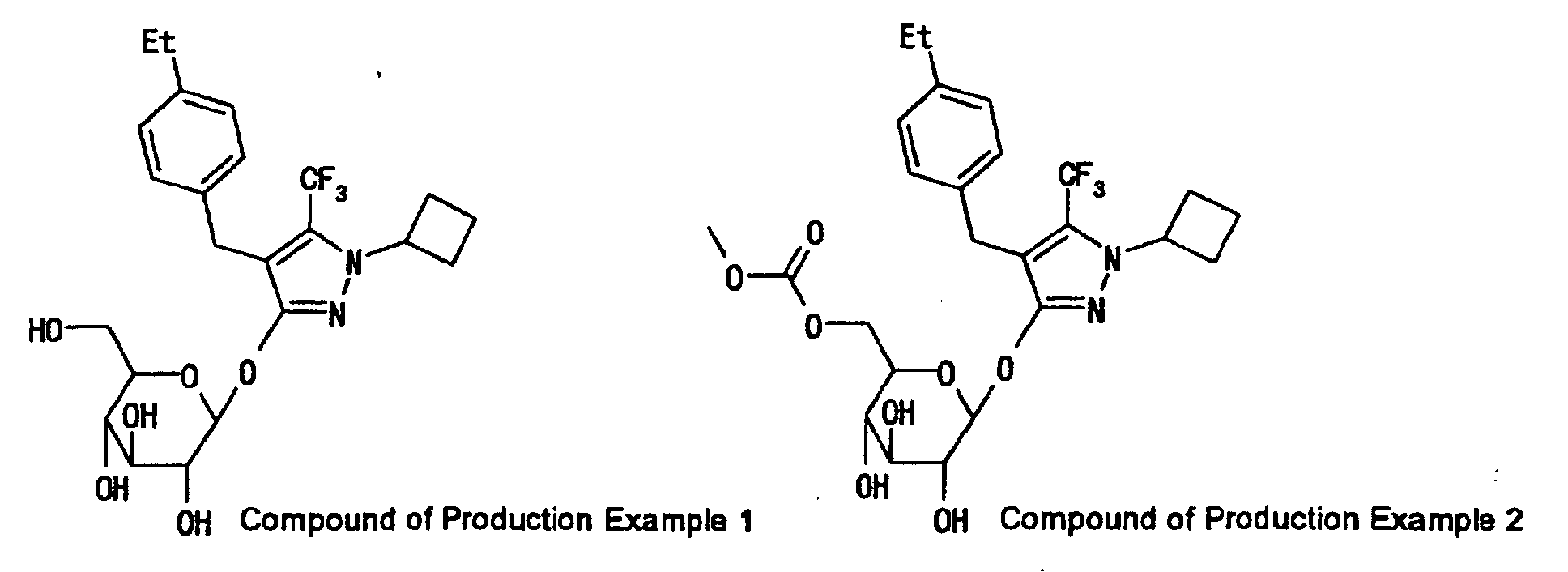

Male Wistar rats aged 5 weeks (purchased from Charles
River Japan, Inc.) were acclimatized in metabolic cages for
one week, for use at this experiment. The test compounds
suspended in olive oil were prepared into a 20 mg/ml solution
to a dose of 5 ml per 1 kg rat body weight.
After the rats were starved for 4 hours, the test
compounds were orally given at 100 mg/kg to the rats at 11 am.
Immediately after dosing until 24 hours later, urine was
collected. The volume of urine was measured. Then, urine
sugar concentration was assayed by glucose oxidase method, to
calculate the glucose excretion into urine per individual per
day.
The results are shown in Table 1.
| Test Compounds | Urine sugar excretion (mg) |
| Compound of Production Example 2 | 656 |
| Compound of Production Example 4 | 452 |
As apparently shown above, the resulting pyrazole
derivatives showed excellent excretion actions of urine sugar.
Water (0.1 mL) and chloroform (4 mL) were added to 1,2-dihydro-4-((4-methylthiophenyl)methyl)-5-(trifluoromethyl)-3H-pyrazol-3-one
(519 mg; 1.80 mmol) (prepared by the method
described in J. Med. Chem 1996, 39, 3920-3928), 2,3,4,6-o-tetraacetyl-α-D-glucopyranosyl
bromide (1.258 mg; 3.06 mmol),
benzyl chloride tri-n-butylammonium (112 mg; 0.36 mmol) and
potassium carbonate (1.244 g; 9.0 mmol), then the mixture was
stirred at room temperature for 21 hours. After completion
of the reaction, the resulting reaction mixture was adjusted
to pH 7, using 10 % hydrochloric acid. Chloroform (5 ml) was
added to the pH-adjusted mixture, from which the aqueous
layer was removed. The resulting organic layer was washed
sequentially with aqueous saturated sodium hydrogen carbonate
(4 mL) and aqueous saturated sodium chloride (4 mL). After
drying over magnesium sulfate, the obtained product was
concentrated and purified by silica gel column chromatography
(chloroform : methanol = 20:1 (V/V)), to give 4'-((4'-methylthiophenyl)
methyl) -5'- (trifluoromethyl) -1H-pyrazole-3'-o-(2,3,4,6-o-tetraacetyl)-β-D-glucopyranoside
as pale yellow
oil (870 mg; 1.41 mmol).
1H-NMR (300MHz, DMSO-d6) δ: 1.92(3H, s), 2.03(3H, s),
2.05(3H, s), 2.10(3H, s), 2.45(3H, s), 3.74(2H, s), 4.21(1H,
dd, J=2.4, 12.6Hz), 4.28(1H, dd, J=4.2, 12.6Hz), 5.19-5.28(4H,
m), 5.41(1H, d, J=6.3Hz), 7.09(2H, d, J=8.1Hz), 7.16(2H, d,
J=8.1Hz). ESI-MS (m/z) :619[(M+H)+], 617[(M-H)-].
The pale yellow oil of 4'-((4'-methylthiophenyl)methyl)-5'-(trifluoromethyl)-1H-pyrazole-3'-o-(2,3,4,6-o-tetraacetyl)-β-D-glucopyranoside
(804 mg; 1.30 mmol) was dissolved in
ethanol (6 mL), followed by dropwise addition of aqueous 50 %
potassium hydroxide solution (0.8 mL), then the reaction
mixture was stirred at room temperature for 10 minutes.
After completion of the reaction, the resulting reaction
mixture was adjusted to pH 7, using 10 % hydrochloric acid,
for agitation for 24 hours. The resulting crystal was
filtered, followed by washing with ethanol (5 mL). The
mother solution was concentrated, to give the oil, which was
then purified by silica gel column chromatography
(chloroform : methanol = 10:1 (V/V)), to give 4-((4-methylthiophenyl)methyl)-5-(trifluoromethyl)-1H-pyrazole-3-o-β-D-glucopyranoside
as white crystal (321 mg; 0.71 mmol).
1H-NMR (300MHz, DMSO-d6) δ: 2.43 (3H, s) , 3.15-3.25(4H,
m), 4.39(1H, dd, J=5.3, 12.0Hz), 3.67(1H, d, J=12.0), 3.75(2H,
s), 4.92(1H, br-s), 5.04(1H, br-s), 5.12(1H, br-s), 7.12(2H,
d, J=8.7Hz), 7.16(2H, d, J=8.7Hz). ESI-MS(m/z):449[(M-H)-].
2,3,4-Tri-o-benzyl-D-glucopyranoside uronic acid benzyl
ester (SIGMA) (199 mg; 0.359 mmol), 1,2-dihydro-4-((4-ethylphenyl)methyl)-5-(trifluoromethyl)-3H-pyrazol-3-one
(99
mg; 0.367 mmol) (prepared by the method described in J. Med.
Chem 1996, 39, 3920-3928) and triphenylphosphine (109 mg;
0.416 mmol) were dissolved in dry THF (with no content of
stabilizers) (0.5 ml). A 40 % toluene solution of diethyl
azodicarboxylate (0.18 ml; 0.40 mmol) was added to the
resulting solution under ice cooling, then the mixture was
stirred at room temperature for 1.5 hours. The reaction
solution was directly purified by silica gel chromatography
(hexane - ethyl acetate : hexane = 1:10 to 1:5), followed by
concentration under reduced pressure, to give benzyl 4'-((4'-ethylphenyl)
methyl)-5'-(trifluoromethyl) -1H-pyrazol-3'-yl-2,3,4-o-tribenzyl-β-D-glucopyranouronate
as pale yellow oil
(127 mg; 0.157 mmol).
1H-NMR (300MHz, DMSO-d6) δ: 1.12 (3H, t, J=7.8Hz), 2.50
(2H, q, J=7.8Hz), 3.64-3.86 (4H, m), 3.90-4.02 (1H, m), 4.05-4.20
(1H, m), 4.40-4.58 (3H, m), 4.65-4.82 (3H, m), 5.10 (1H,
d, J=12.1Hz), 5.15(1H, d, J=12.1Hz), 5.20-5.30 (1H, br),
6.90-7.35 (24H, m).
Benzyl 4'-((4'-ethylthiophenyl)methyl)-5'-(trifluoromethyl)-1H-pyrazol-3'-yl-2,3,4-o-tribenzyl-β-D-glucopyranouronate
(122 mg; 0.151 mmol) was dissolved in
ethyl acetate (4 ml) and methanol (4 ml). The mixture was
stirred in the presence of 20 % palladium hydroxide - carbon
(50 % wet; Aldrich) (204 mg) under hydrogen atmosphere at
atmospheric pressure and at room temperature for 8 hours.
The 20 % palladium hydroxide-carbon was filtered off using
combined solution of dichloromethane and methanol (4:1) (100
ml), then the filtrate was concentrated and dried up under
reduced pressure. The resulting solid was suspended in
distilled water, purified on a SepPack column (water :
methanol = 1:0 to 0:1), and then dried up under reduced
pressure at a bath temperature of 40 °C or less, to give 4-((4-ethylphenyl)methyl)-5-(trifluoromethyl)-1H-pyrazol-3-yl-β-D-glucopyranoside
uronic acid as amorphous white solid (22
mg; 0.050 mmol).
1H-NMR (300MHz, DMSO-d6) δ : 1.19 (3H, t, J=7.5Hz), 2. 58
(2H, q, J=7.5Hz), 3.35-3.51 (2H, m), 3.52-3.65 (1H, m), 3.70-3.90
(3H, m), 5.00-5.20 (1H, br), 7.06 (2H, d, J=8.4Hz), 7.09
(2H, d, J=8.4Hz). ESI-MS(m/z) 445[(M-H)+], 447[(M+H)+].
1,2-Dihydro-4-[(4-ethylphenyl)methyl]-5-trifluoromethyl-3H-pyrazol-3-one
(4.76 g; 17.6 mmol)
(prepared by the method described in J. Med. Chem 1996, 39,
3920-3928) and imidazole (1.57 g; 23.1 mmol) were dissolved
in dimethylformamide (20 ml). T-Butyldimethylsilyl chloride
(2.98 g; 19.8 mmol) was added to the resulting mixture, the
mixture was stirred at room temperature for 30 minutes.
After the addition of water (100 ml), the mixture was
extracted with ethyl acetate and hexane (a mixture solvent at
2:1) three times. The organic phase was washed with water,
dried over sodium sulfate and concentrated, to give the
desired compound. (6.9 g, 17.9 mmol; quantitative).
1H-NMR(300MHz, CDCl3) δ: 0.21 (6H, s), 0.93 (9H, s),
1.19 (3H, t, J=7.6 Hz), 2.59 (2H, q, J= 7.6Hz), 3.74 (2H, s),
7.09 (4H, pseudo ABq). ESI-MS(m/z) 269[(M-TBS)-].
4-[(4-Ethylphenyl)methyl]-5-trifluoromethyl-3-o-t-butyldimethylsilyl-1H-pyrazole
(0.39 g; 1.0 mmol),
triphenylphosphine (0.30 g; 1.1 mmol) and benzyl alcohol
(0.14 ml; 1.4 mmol) were dissolved in anhydrous
tetrahydrofuran (2.0 ml), then the mixture was stirred at
room temperature. A 40 % toluene solution of diethyl
azodicarboxylate (0.50 ml; 1.1 mmol) was gradually added.
Twenty minutes later, the resulting mixture was concentrated,
to which hexane (1 ml) was added. The deposited precipitate
was filtered off, followed by concentration. By purification
on a silica gel column chromatography (hexane → 5 % ethyl
acetate/hexane), the desired compound was obtained. (0.40 g,
0.83 mmol) (83 %).
1H-NMR(300MHz, CDCl3) δ: 0.22 (6H, s), 0.92 (9H, s),
1.20 (3H, t, J=7.5 Hz), 2.59 (2H, q, J= 7.5Hz) , 3.74 (2H, s) ,
5.19 (2H, s), 7.06 (4H, pseudo ABq), 7.11-7.33 (5H, m).
4-[(4-Ethylphenyl)methyl]-1-benzyl-5-trifluoromethyl-3-o-t-butyldimethylsilyl-1H-pyrazole
(0.40 g; 0.83 mmol) was
dissolved in tetrahydrofuran (2 ml) and methanol (0.5 ml), to
which aqueous 1 M HCl solution (1 ml) was added, then the
mixture was stirred at room temperature for 7 hours. Water
(5 ml) was added, for extraction three times with 5 ml of
ethyl acetate. After drying over anhydrous sodium sulfate
and concentration, purification on a silica gel column
(hexane →10 % ethyl acetate/hexane) was done to obtain the
objective compound (0.27 g; 0.74 mmol). (89 %)
1H-NMR(300MHz, CDCl3) δ: 1.21 (3H, t, J=7.6 Hz), 2.61
(2H, q, J=7.6 Hz), 3.77 (2H, s), 5.18 (2H, s), 7.07-7.31 (9H,
m). ESI-MS(m/z) [361 (M+H)+], [359 (M-H)-].
Water (1 mL) and chloroform (10 mL) were added to 4-[(4-ethylphenyl)methyl]-1-benzyl-5-trifluoromethyl-1H-pyrazole
(0.22 g; 0.62 mmol), 2,3,4,6-o-tetraacetyl-α-D-glucopyranosyl
bromide (0.39 g; 0.94 mmol), benzyl chloride
tri-n-butylammonium (0.055 g; 0.18 mmol) and potassium
carbonate (0.79 g; 5.7 mmol), the mixture was stirred at room
temperature for overnight. About 0.1 g of benzyl chloride
tri-n-butylammonium was further added, then the mixture was
stirred for overnight. The organic layer was purified by
silica gel column chromatography (ethyl acetate: hexane =
10:1), to give 0.39 g of a crude product mainly containing
the objective compound, which was then used for the following
reaction.
1H-NMR(300MHz, CDCl3) δ: 1.19 (3H, t, J=7.6 Hz), 1.86
(3H, s), 2.015 (3H, s), 2.019 (3H,s), 2.03 (3H, s), 2.58 (2H,
q, J=7.6 Hz), 3.74 (2H, s), 3.81 (1H, ddd, J=9.5, 4.2, 2.3
Hz), 4.08 (1H, dd, J=12.5, 2.3 Hz), 4.27 (1H, dd, J=12.5, 4.2
Hz) , 5.16-5.28 (3H, m) , 5.24 (2H, s) , 5.58-5.63 (1H, m) , 7. 05
(4H, s), 7.16-7.35 (5H, m). ESI-MS(m/z) [691 (M+H)+].
A crude product (0.28 g) of 4'-[(4'-ethylphenyl)methyl]-1'-benzyl-5'-trifluoromethyl-1H-pyrazole-3'-o-(2,3,4,6-tetraacetyl)-β-D-glucopyranoside
was dissolved in ethanol (5
ml), followed by addition of 5 ml of aqueous 4N NaOH solution,
then the mixture was stirred at room temperature. One hour
later, water (50 ml) was added, and the mixture was extracted
five times with 5 ml of ethyl acetate. After concentration,
the extract was purified on a silica gel column
chromatography (dichloromethane → 10 %
methanol/dichloromethane) to give the desired compound. (0.11
g, 0.21 mmol).
1H-NMR(300MHz, CD3OD) δ: 1.19 (3H, t, J=7.6 Hz), 2.58
(2H, q, J=7.6 Hz), 3.34-3.46 (4H, m), 3.68 (1H, dd, J=12.0,
4.7 Hz), 3.81 (1H, dd, J=12.0, 2.1 Hz), 3.83 (2H, s), 5.32
(2H, s), 5.34-5.37 (1H, m), 7.07 (4H, s), 7.10-7.12 (2H, m),
7.25-7.33 (3H, m).
4'-[ (4'-Ethylphenyl) methyl] -1'-benzyl-5'-trifluoromethyl-1H-pyrazole-3'-o-β-D-glucopyranoside
(0.11 g; 0.21 mmol) was
dissolved in pyridine (1.5 ml) and cooled in an ice bath.
Methyl chlorocarbonate (0.020 ml; 0.26 mmol) was added to the
resulting mixture, which was then back to ambient temperature
over 0.5 hour. 2 hours and 19 hours later, individually,
methyl chlorocarbonate (0.020 ml; 0.26 mmol) was added, and
the mixture was stirred at room temperature for 6 hours.
Ethyl acetate (5 ml), aqueous 1M HCl solution (10 ml) and
water (20 ml) were added, and the mixture was extracted with
ethyl acetate. After drying and concentration, the residue
was purified on a silica gel column chromatography (ethyl
acetate) to give the desired compound. (0.059 g,0.10 mmol).
(47 %)
1H-NMR(300MHz, CDCl3) δ: 1.18 (3H, t, J=7.6 Hz), 2.57
(2H, q, J=7.6 Hz), 3.48-3.60 (4H, m), 3.70 (3H, s), 3.74 (1H,
d, J=15.8 Hz), 3.82 (1H, d, J=15.8 Hz), 4.34 (2H, s), 5.22
(1H, d, J=4.4 Hz), 5.23 (2H, s), 7.07 (4H, s), 7.12 (2H, d,
J=6.4 Hz), 7.21-7.32 (3H, m). ESI-MS(m/z) [581 (M+H)+], [579
(M-H)-].
The objective compound was obtained in the same manner
as in the Step 2 of the Production Example 3-A except for the
use of 4-methoxybenzyl bromide instead of benzyl bromide.
1H-NMR(300MHz, CDCl3) δ: 0.22 (6H, s), 0.93 (9H, s),
1.19 (3H, t, J=7.6 Hz), 2.58 (2H, q, J=.6 Hz), 3.72 (2H, s),
3.78 (3H, s), 5.14 (2H, s), 6.83 (2H, d, J=8.8 Hz), 7.07 (4H,
pseudo ABq), 7.16 (2H, d, J=8.8 Hz).
The objective compound was obtained from 4-[(4-ethylphenyl)methyl]-1-[(4-methoxyphenyl)methyl]-5-(trifluoromethyl)-3-o-t-butyldimethylsilyl-1H-pyrazole
in the
same manner as in the Step 3 of the Production Example 3-A.
(82 %)
1H-NMR (300MHz, CDCl3) δ: 1.21 (3H, t, J=7.5 Hz) , 2.60
(2H, q, J=7.5 Hz), 3.77 (5H, s), 5.10 (2H, s), 6.81-6.84 (2H,
m), 7.07-7.19 (6H, m). ESI-MS(m/z) [391 (M+H)+], [389 (M-H)-].
A crude product of the objective compound was obtained
from 4-[(4-ethylphenyl)methyl]-1-[(4-methoxyphenyl)methyl]-5-(trifluoromethyl)-1H-pyrazole
in the same manner as in the
Step 4 of the Production Example 3-A.
1H-NMR(300MHz, CDCl3) δ: 1.19 (3H, t, J=7.6 Hz), 1.86
(3H, s), 2.07 (3H, s), 2.11 (6H, s), 2.58 (2H, q, J = 7.6 Hz),
3.73 (2H, s), 3.75-3.84 (1H, m), 4.24-4.30 (1H, m), 5.16 (2H,
s), 5.19-5.28 (3H, m), 5.56-5.60 (1H, m), 6.75 (2H, d, J=8.8
Hz), 7.05 (4H, s), 7.15 (2H, d, J=8.8 Hz). ESI-MS(m/z) [721
(M+H)+].
The objective compound was obtained from 4'-[(4'-ethylphenyl)
methyl]-1'-[(4-methoxyphenyl)methyl] -5'-trifluoromethyl-1H-pyrazole-3'-o-(2,3,4,6-tetraacetyl)-β-D-glucopyranoside
in the same manner as in the Step 5 of the
Production Example 3-A. (91 % in 2 steps).
1H-NMR (300MHz, CD3OD) δ: 1.19 (3H, t, J=7.6 Hz), 2.57 (2H, q, J=7.6 Hz), 3.36-3.44 (4H, m) , 3.66-3.82 (2H, m), 3.76 (3H, s), 3.82 (2H, s), 5.24 (2H, s), 5.33-5.36 (1H, m), 6.86 (2H, d, J=8.5 Hz), 7.07 (4H, s), 7.12 (2H, d, J=8.5 Hz). ESI-MS(m/z) [553 (M+H)+], [551 (M-H)-].
1H-NMR (300MHz, CD3OD) δ: 1.19 (3H, t, J=7.6 Hz), 2.57 (2H, q, J=7.6 Hz), 3.36-3.44 (4H, m) , 3.66-3.82 (2H, m), 3.76 (3H, s), 3.82 (2H, s), 5.24 (2H, s), 5.33-5.36 (1H, m), 6.86 (2H, d, J=8.5 Hz), 7.07 (4H, s), 7.12 (2H, d, J=8.5 Hz). ESI-MS(m/z) [553 (M+H)+], [551 (M-H)-].
4-[(4-Ethylphenyl)methyl]-1-[(4-methoxyphenyl)methyl]-5-trifluoromethyl-1H-pyrazole-3-o-β-D-glucopyranoside
(0.18
g; 0.32 mmol) was dissolved in 2,4,6-collidine (2 ml) and
cooled to -50 °C. Methyl chlorocarbonate (0.035 ml; 0.45
mmol) was added to the resulting mixture, which was then back
to room temperature over one hour. 27 hours later, ethyl
acetate (20 ml) and aqueous 1M HCl solution (20 ml) were
added, then the mixture was extracted with ethyl acetate.
After drying and concentration, the residue was purified n on
a silica gel column chromatography (hexane → ethyl acetate)
to give the desired compound. (0.12 g, 0.20 mmol). (62 %)
1H-NMR(300MHz, CDCl3) δ: 1.21 (3H, t, J=7.6 Hz), 2.26
(1H, d, J=2.3 Hz), 2.61 (2H, q, J=7.6 Hz), 2.69 (1H, s), 2.86
(1H, s), 3.45-3.61 (4H, m), 3.73 (1H, d, J=15.2 Hz), 3.80 (3H,
s), 3.80 (3H, s), 3.88 (1H, d, J=15.2 Hz), 4.37 (1H, d,
J=12.3 Hz), 4.49 (1H, dd, J=12.3, 3.0 Hz), 5.19 (2H, s), 5.20
(1H, d, J=7.6 Hz), 6.86 (2H, d, J=8.5 Hz), 7.10 (4H, s), 7.16
(2H, d, J=8.5 Hz).
4-[(4-Ethylphenyl)methyl]-5-trifluoromethyl-3-o-t-butyldimethylsilyl-1H-pyrazole
(0.079 g; 0.21 mmol),
phenylboronic acid (0.049 g; 0.40 mmol), and anhydrous copper
(II) acetate (0.057 g; 0.32 mmol) were dissolved in dry
dichloromethane (5 ml), followed by addition of Molecular
Sieves 4A powder (0.15 g) and pyridine (0.032ml; 0.40 mmol),
then the mixture was stirred at room temperature for
overnight. The reaction solution was purified on a silica
gel column chromatography (hexane → hexane : dichloromethane
= 5:1 to 3:1) to give the desired compound. (0.074 g; 0.16
mmol). (80 %)
1H-NMR(300MHz, CDCl3) δ: 0.27 (6H, s), 0.96 (9H, s),
1.21 (3H, t, J=7.6Hz), 2.61 (2H, q, J=7.6Hz), 3.84 (2H, s),
7.11 (2H, J=8.3Hz), 7.18 (2H, J=8.3Hz), 7.35-7.45 (5H, m).
ESI-MS(m/z) [461 (M+H)+], [459 (M-H)-].
The objective compound was obtained using 4-[(4-ethylphenyl)methyl]-1-phenyl-5-(trifluoromethyl)-3-o-t-butyldimethylsilyl-1H-pyrazole
in the same manner as in the
Step 3 of the Production Example 3-A. (95 %)
1H-NMR(300MHz, CDCl3) δ: 1.22 (3H, t, J=7.6Hz), 2.62 (2H,
q, J=7.6Hz), 3.81 (2H, s), 7.10 (2H, d, J=8.1Hz), 7.17 (2H, d,
J=8.1Hz), 7.35-7.50 (5H, m), 10.40-10.80 (1H, br-s). ESI-MS(m/z)
[347 (M+H)+], [345 (M-H)-].
A crude product of the objective compound was obtained
using 4-[(4-ethylphenyl)methyl]-1-phenyl-5-trifluoromethyl-1H-pyrazole
in the same manner as in the Step 4 of the
Production Example 3-A.
1H-NMR(300MHz, CDCl3) δ: 1.21 (3H, t, J=7.6Hz), 1.90 (3H,
s), 2.02 (3H, s), 2.03 (3H, s), 2.04 (3H, s), 2.61 (2H, q,
J=7.6Hz), 3.80-3.90 (2H, s and 1H, m), 4.10-4.30 (2H, m),
5.15-5.36 (3H, m), 5.68 (1H, d, J=7.5Hz), 7.10 (2H, d,
J=8.3Hz), 7.15 (2H, d, J=8.3Hz), 7.38-7.47 (5H, m). ESI-MS
(m/z) [677 (M+H)+].
The objective compound was obtained using a crude
product of 4'-[(4'-ethylphenyl)methyl]-1'-phenyl-5'-trifluoromethyl-1H-pyrazole-3'-o-(2,3,4,6-tetraacetyl)-β-D-glucopyranoside
in the same manner as in the Step 5 of the
Production Example 3-A. (84 % in 2 steps)
1H-NMR (300MHz, DMSO-d6) δ: 1.19 (3H, t, J=7.6Hz), 2.60
(2H, q, J=7.6Hz), 3.15-3.35 (4H, m), 3.45-3.55 (1H, m), 3.69
(1H, dd, J=11.4, 5.7Hz), 3.85 (1H, d, J=15.6Hz), 3.92 (1H, d,
J=15.6Hz), 4.55 (1H, t, J=5.7Hz), 5.03 (1H, d, J=4.5Hz), 5.13
(1H, d, J=3.9Hz), 5.35 (1H, d, J=7.5Hz), 5.41 (1H, d,
J=4.5Hz), 7.17 (2H, d, J=8.3Hz), 7.22 (2H, d, J=8.3Hz), 7.47-7.62
(5H, m). ESI-MS(m/z) [509 (M+H)+], [507 (M-H)-].
The objective compound was obtained, using 4-[(4-ethylphenyl)methyl]-1-phenyl-5-trifluoromethyl-1H-pyrazole-3-o-β-D-glucopyranoside
in the same manner as in the Production
Example 4-A. (71 %).
1H-NMR(300MHz, CDCl3) δ: 1.22 (3H, t, J=7.6Hz), 2.18 (1H,
br), 2.62 (2H, q, J=7.6Hz), 2.72 (1H, br), 2.89 (1H, br),
3.45-3.63 (4H, m), 3.78 (3H, s), 3.81 (1H, d, J=15.6Hz), 3.98
(1H, d, J=15.6Hz), 4.37 (1H, dd, 12.0, 1.7Hz), 4.49 (1H, dd,
12.0, 3.6Hz), 5.32 (1H, d, J=7.2Hz), 7.14 (2H, d, J=8.3Hz),
7.19 (2H, d, J=8.3Hz), 7.39-7.47 (5H, m). ESI-MS(m/z) [567
(M+H)+], [565 (M-H)-].
Ethyl acetoacetate (1.69 g; 13.0 mmol) and sodium
iodide (9.6 g; 65 mmol) were dissolved in 100 ml of
acetonitrile. The resulting solution was cooled to 0 °C.
Then, trimethylsilyl chloride (8.2 ml; 65 mmol) was gradually
added. 10 minutes later, 3-fluoro-4-methoxybenzaldehyde (2.0
g; 13.0 mmol) was added in three portions. 10 minutes later,
the resulting mixture was back to room temperature and
continuously stirred. 6 hours later, the mixture was
transferred into a bath at 60 °C, for overnight stirring. The
reaction solution was cooled, to which water (250 ml), ethyl
acetate (250 ml) and aqueous saturated sodium chloride (50
ml) were then added. The ethyl acetate layer was extracted,
using a separation funnel. The resulting organic layer was
washed with aqueous saturated sodium sulfite and dried over
anhydrous magnesium sulfate. After concentration, the dried
product was purified by silica gel column chromatography
(EtOAc:-Hex; 1:4), to give the desired compound (2.54 g; 9.5
mmol). (73 %.)
1H-NMR (300MHz,CDCl3) δ: 6.82-6.96 (3H, m) , 4.12-4.20
(2H, m), 3.86 (3H, s), 3.71 (1H, t, J=7.8), 3.08 (2H, d,
J=8.1), 2.20 (3H, s), 1.23 (3H, t, J=7.2).
Ethyl 2-[(3-fluoro-4-methoxy)benzyl]-3-oxobutylate
(2.54 g; 9.5 mmol) was dissolved in toluene (50 ml) , followed
by addition of hydrous hydrazine (0.72 g; 14.2 mmol), then
the mixture was stirred 100 °C for overnight. The reaction
solution was cooled, and the crystals were filtered.
Obtained crystals were dried with a vacuum pump, to give the
desired compound (1.86 g; 7.9 mmol). (83 %).
1H-NMR (300MHz, DMSO-d6) δ: 7.00 (1H, t, J=8.4), 6.86-6.94
(2H, m), 3.75 (3H, s), 3.46 (2H, s), 1.98 (3H, s). ESI-MS(m/z)
: 237[(M+H)+], 235[(M-H)-].
2,3,4,6-Tetra-o-benzyl-D-glucopyranoside (2.3 g; 4.2
mmol), 1,2-dihydro-4-[(3-fluoro-4-methoxyphenyl)methyl]-5-methyl-3H-pyrazol-3-one
(1.0 g; 4.2 mmol) and
triphenylphosphine (1.1 mg; 4.2 mmol) were dissolved in dry
THF (with no content of stabilizers) (40 ml). A 40 % toluene
solution of diethyl azodicarboxylate (1.9 ml; 4.2 mmol) was
added to the resulting solution under ice cooling, then the
mixture was stirred at room temperature for overnight. After
the reaction solution was concentrated, the concentrate was
directly purified by silica gel chromatography (hexane -
ethyl acetate : hexane = 2:3), followed by concentration
under reduced pressure, to give the desired compound (2.2 g;
2.9 mmol). (70 %).
1H-NMR (300MHz, CDCl3) δ: 7.10-7.32 (20H, m), 6.78-6.92
(2H, m), 6.67 (1H, t,J=8.1), 5.51 (1H, d, J=7.5), 4.46-4.92
(10H, m), 3.60-3.76 (6H, m), 3.71 (3H, s), 2.07 (3H, s). ESI-MS(m/z)
: 759 [(M+H)+], 757 [(M-H)-].
4'-[(3'-Fluoro-4'-methoxyphenyl)methyl]-5'-methyl-1H-pyrazole-3'-o-(2,3,4,6-tetrabenzyl)-β-D-glucopyranoside
(2.2
g; 2.9 mmol) was dissolved in dimethylformamide (44 ml),
followed by addition of cesium carbonate (9.6 g; 29.5 mmol)
and isopropyl iodide (2.5 g; 14.8 mmol), then the mixture was
stirred at room temperature for overnight..
Water (200 ml), aqueous saturated sodium chloride (50
ml) and dichloromethane (300 ml) were added. The organic
layer was extracted with a separation funnel. The extract
was dried over anhydrous sodium sulfate and concentrated.
The concentrate was purified by silica gel chromatography
(hexane - ethyl acetate : hexane = 1:3), followed by
concentration under reduced pressure, to give the desired
compound (1.7 g; 2.2 mmol). (74 %).
1H-NMR (300MHz, CDCl3) δ: 7.12-7.32 (20H, m), 6.80-6.92
(2H, m), 6.68 (1H, t, J=8.4), 5.47 (1H, d, J=7.2), 4.74-4.94
(5H, m), 4.44-4.64 (5H, m), 4.24-4.32 (1H, m), 3.73 (3H, s),
3.60-3.72 (6H, m), 2.06 (3H, s), 1.38 (3H, t, J=7.5). ESI-MS(m/z)
: 801[(M+H)+].
4'- [(3'-Fluoro-4'-methoxyphenyl)methyl]-1'-isopropyl-5'-methyl-1H-pyrazole-3'-o-(2,3,4,6-tetrabenzyl)-β-D-glucopyranoside
(1.7 g; 2.2 mmol) was dissolved in ethanol
(70 ml), followed by addition of 20 % palladium hydroxide-carbon
(1.0 g). Under hydrogen atmosphere, the resulting
mixture was stirred for 2 hours. The reaction solution was
filtered through a filter cell, to give the filtrate, which
was then concentrated and purified by silica gel
chromatography (15 % methanol : dichloromethane).
Subsequently, the purified product was again concentrated
under reduced pressure, to give the desired compound (828 mg;
1.9 mmol). (88 %).
1H-NMR (300MHz, DMSO-d6) δ: 6.92-7.04 (3H, m), 5.20 (1H,
d, J=4.5), 5.11 (1H, d, J=7.2), 5.02 (1H, d, J=3.6), 4.93 (1H,
d, J=4.5), 4.41 (1H, t, J=5.7), 4.28-4.40 (1H, m), 3.77 (3H,
s), 3.56-3.66 (1H, m), 3.42-3.52 (1H, m), 3.08-3.24 (4H, m),
2.07 (3H, s), 1.24-1.30 (3H, m). ESI-MS(m/z) : [441(M+H)+].
4-[(3-Fluoro-4-methoxyphenyl)methyl]-1-isopropyl-5-methyl-1H-pyrazole-3-o-β-D-glucopyranoside
(820 mg; 1.9 mmol)
was dissolved in collidine (8 ml)and cooled to 0 °C. 10
minutes later, methyl chlorocarbonate (0.22 ml) was added,
then the mixture was stirred for 7 hours. The resulting
mixture was neutralized with 2N HCl, then the mixture was
extracted with ethyl acetate. The organic layer was dried
over anhydrous sodium sulfate. After concentration, the
residue was purified by silica gel chromatography (ethyl
acetate). The resulting solution was concentrated under
reduced pressure, to give the desired compound (303 mg; 0.61
mmol). (33 %).
1H-NMR (300MHz, CDCl3) δ: 6.80-6.92 (3H, m), 5.02 (1H, d,
J=8.1), 4.40 (2H, s), 4.22-4.34 (1H, m), 3.85 (3H, s), 3.78
(3H, s), 3.44-3.66 (6H, m), 2.08 (3H, s), 1.38 (6H, d, J=6.6).
ESI-MS (m/z) : [499 (M+H)+].
The objective compound (3.4 g; 12.7 mmol). was obtained,
using 2-fluoro-4-methoxybenzaldehyde (3.0 g) in the same
manner as in the Step 1 of Production Example 9. Yield 65 %.
1H-NMR (300MHz, CDCl3) δ: 7.07 (1H, t, J=8.7), 6.40-6.62
(2H, m), 4.10-4.20 (2H, m), 3.79 (1H, t, J=7.8), 3.77 (3H, s),
3.04-3.18 (2H, m), 2.21 (3H, s) , 1. 21 (3H, t, J=7.2).
The objective compound (2.46 g; 10.4 mmol) was obtained,
using ethyl 2-[(2-fluoro-4-methoxy)benzyl]-3-oxobutylate (3.4
g) in the same manner as in the Step 2 of Production Example
9-A. Yield 83 %.
1H-NMR (300MHz, CDCl3) δ: 7.02 (1H, t, J=8.7), 6.72 (1H,
dd, J=2.4, 12.0), 6.66 (1H, d, J=2.7, 8.4) , 3.71 (3H, s),
3.47 (2H, s), 1.99 (3H, s). ESI-MS(m/z) : 237[(M+H)+],
235 [(M-H)-].
The objective compound (2.6 g; 3.46 mmol) was obtained,
using 1,2-dihydro-4-[(2-fluoro-4-methoxyphenyl)methyl]-5-methyl-3H-pyrazol-3-one
(1.0 g; 4.2 mmol) in the same manner
as in the Step 3 of Production Example 9-A. Yield 82 %.
1H-NMR (300MHz, DMSO-d6) δ: 7.12-7.32 (20H, m), 6.99 (1H,
t, J=9.0), 6.50 (1H, dd, J=2.4, 11.7), 6.42 (1H, dd, J=2.7,
8.4), 5.54 (1H, d, J=7.2), 4.44-4.92 (8H, m), 3.60-3.76 (8H,
m), 3.62 (3H, s), 2.09 (3H, s). ESI-MS(m/z) : 759[(M+H)+],
757 [(M-H)-].
The objective compound (157 mg; 0.19 mmol) was obtained,
using 4'-[(2'-fluoro-4'-methoxyphenyl)methyl]-5'-methyl-1H-pyrazole-3'-o-(2,3,4,6-tetrabenzyl)-β-D-glucopyranoside
(212
mg; 0.28 mmol) in the same manner as in the Step 4 of
Production Example 9-A. Yield 70 %.
1H-NMR (300MHz, CDCl3) δ: 7.14-7.30 (20H, m), 6.99 (1H,
t, J=8.7), 6.49 (1H, dd, J=2.4, 11.7), 6.41 (1H, dd, J=2.4,
8.7), 5.50 (1H, d, J=7.5), 4.74-4.96 (5H, m), 4.46-4.66 (5H,
m), 4.22-4.32 (1H, m), 3.64 (3H, s), 3.60-3.74 (6H, m), 2.08
(3H, s), 1.37 (6H, t, J=6.6). ESI-MS(m/z) : 801[(M+H)+].
The objective compound (80 mg; 0.18 mmol) was obtained,
using 4'-[(2'-fluoro-4'-methoxyphenyl)methyl]-1'-isopropyl-5'-methyl-1H-pyrazole-3'-o-(2,3,4,6-tetrabenzyl)-β-D-glucopyranoside
(150 mg; 0.19 mmol) in the same manner as in
the Step 5 of Production Example 9-A. Yield 97 %.
1H-NMR (300MHz, DMSO-d6) δ: 7.09 (1H, t, J=9.0), 6.73
(1H, dd, J=2.7, 12.3), 6.66 (1H, dd, J=2.7, 8.7), 5.18 (1H, d,
J=4.8), 5.11 (1H, d, J=7.5), 5.01 (1H, d, J=4.2), 4.91 (1H, d,
J=4.2), 4.42 (1H, t, J=6.0), 4.30-4.38 (1H, m), 3.72 (3H, s),
3.53 (2H, s), 3.42-3.66 (2H, m), 3.06-3.24 (4H, m), 2.07 (3H,
s), 1.28 (3H, d, J=2.7), 1.26 (3H, d, J=2.7). ESI-MS(m/z) :
441 [(M+H)+], 439 [(M-H)-].
Synthesis of 4'-[(2'-fluoro-4'-methoxyphenyl)methyl]-1'-isopropyl-5'-methyl-1H-pyrazole-3'-o-(6-carbomethoxy)-β-D-glucopyranoside
The objective compound (380 mg; 0.76 mmol) was obtained,
using 4-[(2-fluoro-4-methoxyphenyl)methyl]-1-isopropyl-5'-methyl-1H-pyrazole-3-o-β-D-glucopyranoside
(1.1 g; 2.42 mmol).
Yield 31 %.
1H-NMR (300MHz, CDCl3) δ: 7.08 (1H, t, J=8.4), 6.52-6.62
(2H, m), 5.02 (1H, d, J=7.8), 4.64 (1H, brs), 4.40 (2H, d,
J=2.4), 4.24-4.33 (1H, m), 3.77 (3H, s), 3.75 (3H, s), 3.59
(3H, s), 3.10-3.66 (6H, m), 1.38 (3H, s), 1.35 (3H, s).
The objective compound (4.5 g; 17.9 mmol) was obtained,
using 3-fluoro-4-methylbenzaldehyde (3.0 g; 21.7 mmol) in the
same manner as in the Step 1 of Production Example 9-A.
Yield 82 %.
1H-NMR (300MHz, CDCl3) δ: 7.06 (1H, t, J=8.1), 6.78-6.88
(2H, m), 4.15 (2H, q, J=6.9), 3.73 (1H, t, J=7.8), 3.10 (1H,
d, J=7.8), 2.22 (3H, s), 2.19 (3H, s), 1.22 (3H, t, J=6.9).
The objective compound (2.3 g; 10.5 mmol) was obtained,
using ethyl 2-[(3-fluoro-4-methyl)benzyl]-3-oxobutylate (2.84
g; 11.3 mmol) in the same manner as in the Step 2 of
Production Example 9-A. Yield 93 %.
1H-NMR (300MHz, DMSO-d6) δ: 7.11 (1H, d, J=8.4), 6.81-6.89
(2H, m), 3.49 (2H, s), 2.13 (3H, s), 1.98 (3H, s). ESI-MS(m/z)
: 221[(M+H)+]
2,3,4,6-o-Tetraacetyl-α-D-glucopyranosyl bromide (2.1
g; 5.0 mmol), 1,2-dihydro-4-[(3-fluoro-4-methylphenyl)methyl]-5-methyl-3H-pyrazol-3-one
(1.1 g; 5.0
mmol) and silver carbonate (1.38 g; 5 mmol) were dissolved in
dry THF (with no content of stabilizers) (50 ml), then the
mixture was stirred overnight at 65 °C in darkness. The
reaction solution was filtered through a filter cell,
followed by addition of dichloromethane and washing with
water. The organic layer was dried over anhydrous sodium
sulfate and concentrated, and purified by silica gel
chromatography (hexane - ethyl acetate : hexane = 1:3). The
resulting purified product was concentrated under reduced
pressure, to give the desired compound (1.1 g; 2.0 mmol).
(40 %).
1H-NMR (300MHz, CDCl3) δ: 7.03 (1H, t, J=7. 5) , 6.82 (1H,
dd, J=1.2, 7.8), 6.74 (1H, dd, J=1.5, 10.8), 5.59 (1H, d,
J=8.1), 5.16-5.30 (3H, m), 4.31 (1H, dd, J=3.9, 12.3), 4.12
(1H,,dd, J=2.1, 12.3), 3.82-3.88 (1H, m), 3.63 (1H, d,
J=15.9), 3.54 (1H, d, J=15.9), 2.20 (3H, d, J=1.5), 2.11 (3H,
s), 2.06 (3H, s), 2.03 (3H, s), 2.02 (3H, s), 1.91 (3H, s).
ESI-MS(m/z) : 551[(M+H)+], 549[(M-H)-].
4'-[(3'-Fluoro-4'-methylphenyl)methyl]-5'-methyl-1H-pyrazole-3'-o-(2,3,4,6-tetraacetyl)-β-D-glucopyranoside
(290
mg; 0.53 mmol) was dissolved in dimethylformamide (6 ml),
followed by addition of cesium carbonate (1.7 g; 5.2 mmol)
and isopropyl iodide (447 mg; 2.6 mmol), then the mixture was
stirred overnight at room temperature.
Water, aqueous saturated sodium chloride and
dichloromethane were added, then the mixture was extracted,
with a separation funnel. The organic layer was dried over
anhydrous sodium sulfate and concentrated. After
purification by silica gel chromatography (hexane - ethyl
acetate : hexane = 1:3), the resulting purified product was
concentrated under reduced pressure, to give the desired
compound (165 mg; 0.28 mmol). (53 %).
1H-NMR (300MHz, CDCl3) δ: 7.02 (1H, t, J=7.8), 6.82 (1H,
d, J=7.8), 6.74 (1H, d, J=10.8), 5.79 (1H, d, J=8.1), 5.12-5.34
(3H, m) , 4.18-4.32 (2H, m) , 4.06-4.16 (1H, m), 3.78-3.88
(1H, m), 3.48-3.64 (2H, m), 2.19 (3H, s), 2.07 (3H, s), 2.06
(3H, s), 2.04 (3H, s), 2.02 (3H, s), 1.93 (3H, s). ESI-MS
(m/z) : 593 [M+].
4'-[(3'-Fluoro-4'-methylphenyl)methyl]-1'-isopropyl-5'-methyl-1H-pyrazole-3'-o-(2,3,4,6-tetraacetyl)-β-D-glucopyranoside
(56 mg; 0.09 mmol) was dissolved in methanol
(0.2 ml) and tetrahydrofuran (0.4 ml), to which 1N LiOH (0.38
ml) was added at 0 °C. After stirring for one hour, water and
ethyl acetate were added to the mixture, then organic layer
of the mixture was extracted. After drying and concentration,
followed by purification by silica gel chromatography (15 %
methanol: dichloromethane), the resulting purified product
was concentrated under reduced pressure, to give the desired
compound (34 mg; 0.08 mmol). (85 %).
1H-NMR (300MHz, DMSO-d6) δ: 7.11 (1H, t, J=8.4), 5.19
(1H, d, J=4.8), 5.09 (1H, d, J=7.5), 4.99 (1H, d, J=3.9),
4.91 (1H, d, J=4.2), 4.41 (1H, t, J=5.7), 4.28-4.38 (1H, m),
3.56 (2H, m), 3.54-3.64 (1H, m), 3.40-3.50 (1H, m), 3.06-3.24
(4H, m), 2.13 (3H, s), 2.05 (3H, s), 1.26 (3H, d, J=3.0),
1.24 (3H, d, J=3.0). ESI-MS(m/z) : 425[(M+H)+], 423[(M-H)-].
The objective compound (283 mg; 0.59 mmol) was obtained,
using 4-[(3-fluoro-4-methylphenyl)methyl]-1-isopropyl-5-methyl-1H-pyrazole-3-o-β-D-glucopyranoside
(334 mg; 0.787
mmol) in the same manner as in Production Example 12-A.
Yield 75 %.
1H-NMR (300MHz, DMSO-d6) δ: 1.26(3H, d, J=6.3Hz),
1.28(3H, d, J=6.3Hz), 2.07(3H, s), 2.15(3H, s), 3.09-3.41(4H,
m), 3.56(2H, s), 4.10(1H, dd, J=6.0, 11. 4Hz) , 4.29(1H, dd,
J=1.8, 11.7Hz), 4.34(1H, m), 5.10(1H, d, J=7.8Hz), 5.13(1H, d,
J=5.1Hz), 5.24(1H, d, J=5.1Hz), 5.31(1H, d, J=5.1Hz), 6.89-7.13(3H,
m). ESI-MS (m/z) : 483[M+H]+ 481[(M-H)-]
The objective compound (3.9 g; 15.7 mmol) was obtained,
using 4-ethylbenzaldehyde (3.0 g) in the same manner as in
Production Example 9-A. Yield 70 %.
1H-NMR (300MHz, CDCl3) δ: 4.15 (2H, q, J=7.2), 3.76 (1H,
t, J=7.5), 3.12 (2H, d, J=8.1), 2.60 (2H, q, J=7.8), 2.19 (3H,
s) , 1.21 (6H, t, J=7.2).
The objective compound (3.1 g; 14.3 mmol) was obtained,
using ethyl 2-(4-ethylbenzyl)-3-oxobutylate (3.9 g) in the
same manner as in the Step 2 of Production Example 9-A.
Yield 91 %.
1H-NMR (300MHz, DMSO-d6) δ: 7.06 (4H, s),3.49 (2H, s),
2.52 (2H, q, J=7.8), 1.99 (3H, s), 1.33 (3H, t, J=7.5). ESI-MS(m/z)
: 217[(M+H)+], 215[(M-H)-].
The objective compound (2.3 g; 3.1 mmol) was obtained,
using 1,2-dihydro-4-[(4-ethylphenyl)methyl]-5-methyl-3H-pyrazol-3-one
(1.0 g; 4.6 mmol) in the same manner as in the
Step 3 of Production Example 9-A. Yield 62 %.
1H-NMR (300MHz, CDCl3) δ: 7.10-7.34 (20H, m), 7.07 (2H,
d, J=8.4), 6.97 (2H, d, J=8.4), 5.23 (1H, d, J=6.9), 4.44-5.00
(8H, m), 3.56-3.80 (8H, m), 2.50 (2H, q, J=7.5), 2.08
(3H, s), 1.13 (3H, t, J=7.5). ESI-MS(m/z) : 739[(M+H)+],
737 [(M-H)-].
The objective compound (1.6 g; 2.0 mmol) was obtained,
using 4'-[(4-ethylphenyl)methyl]-5'-methyl-1H-pyrazole-3'-o-(2,3,4,6-tetrabenzyl)-β-D-glucopyranoside
(1.9 g; 2.6 mmol) in
the same manner as in the Step 4 of Production Example 9-A.
Yield 79 %.
1H-NMR (300MHz, CDCl3) δ: 7.14-7.38 (20H, m), 7.07 (2H,
d, J=8.1), 6.97 (2H, d, J=8.1), 5.47 (1H,d,J=7.5), 4.20-5.00
(9H, m), 3.60-3.76 (8H, m), 2.52 (2H, q J=7.8), 2.07 (3H, s),
1.37 (6H, t, J=6.9), 1.14 (3H, t, J=8.1): 781 [(M+H)+].
The objective compound (743 mg; 1.8 mmol) was obtained,
using 4'- [ (4-ethylphenyl) methyl]-1'-isopropyl-5'-methyl-1H-pyrazole-3'-o-(2,3,4,6-tetrabenzyl)-β-D-glucopyranoside
in the
same manner as in the Step 5 of Production Example 9-A.
Yield 87 %.
1H-NMR (300MHz, DMSO-d6) δ: 7.09 (2H, d, J-7.8), 7.03
(2H, d, J=7.8), 5.18 (1H,brd, J=4.5), 5.11 (1H, d, J=6.9),
4.84-5.02 (2H, m), 4.26-4.44 (3H, m), 3.40 3.64 (3H, m),
3.04-3.26 (4H, m), 2.51 (2H, q, J=7.5), 2.06 (3H, s), 1.25
(6H, d, J=6.6), 1.14 (3H, t, J=5.7) : 421[(M+H)+], 419[(M-H)-].
The objective compound (570 mg; 1.2 mmol) was obtained,
using 4-[(4-ethylphenyl)methyl]-1-isopropyl-5'-methyl-1H-pyrazole-3-o-β-D-glucopyranoside
(702 mg; 1.67 mmol) in the
same manner as in Production Example 10-A. Yield 71 %.
1H-NMR (300MHz, CDCl3) δ: 7.08 (4H, s), 4.99 (1H, d,
J=7.5), 4.24-4.48 (4H, m), 3.77 (3H, s), 3.44-3.68 (6H, m),
2.94-3.16 (2H, m), 2.58 (2H, q, J=7.8), 2.09 (3H, s) , 1.36
(6H, d, J=6.6), 1.20 (3H, t, J=7.8) ESI-MS(m/z) : 479[(M+H)+],
477 [(M-H)-].
The structures of the compounds of Production Examples
1-A through 16-A are shown below.


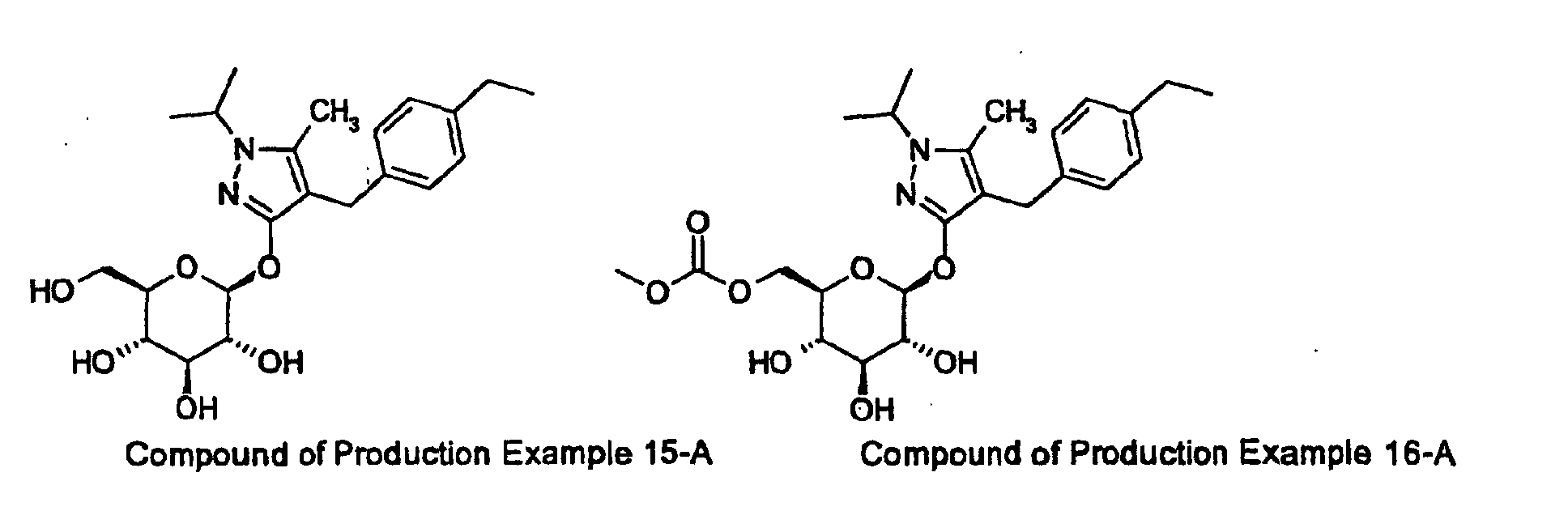
1H-NMR (300MHz, DMSO-d6) δ: 7.07 (1H, d, J=8.4), 6.75
(1H, d, J=8.4), 5.12-5.20 (2H, m), 5.00 (1H, d, J=3.9), 4.92
(1H, d, J=3.9), 4.42-4.56 (2H, m), 3.58-3.68 (1H, m), 3.51
(2H, s), 3.42-3.54 (1H, m), 3.06-3.24 (4H, m), 2.00 (3H, s),
1.22 (6H, d, J=6.3) ESI-MS(m/z) : 409[(M+H)+], 407[(M-H)-].
The structure of the compound of the Reference
Production Example 1 is shown below.
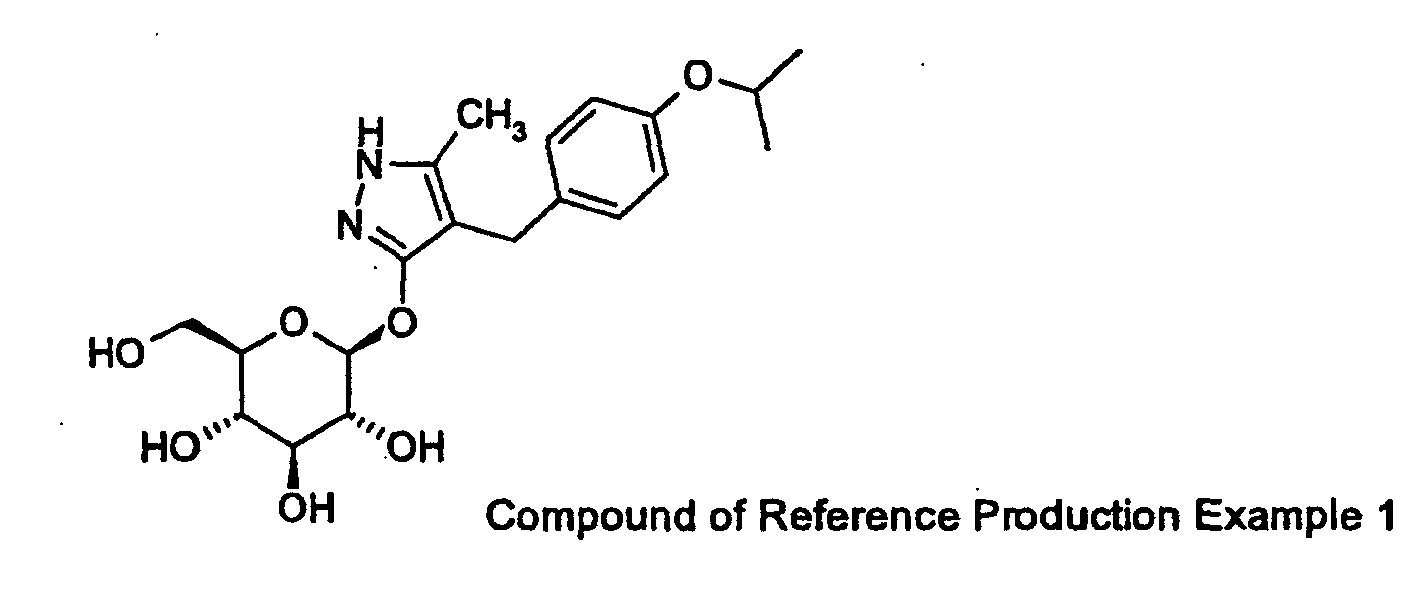
Test compounds were dissolved in 100 mM mannitol-10 mM
HEPES/Tris, pH 7.4 to prepare solutions at various
concentrations.
Renal brush border membrane was prepared from a rat
kidney, to which a solution of a test compound was added for
incubation at 37 °C for 30 minutes. Then, 14C-D-glucose was
added for incubation for one minute. A solution containing 1
mM phlorizin was used to terminate the glucose uptake
reaction. The radioactivity 14C of 14C-D-glucose incorporated
in the renal brush border membrane was counted with a liquid
scintillation counter. The glucose uptake independent on
sodium was reduced from the glucose uptake in a control group
or a test group, to calculate the inhibition intensity. The
results are shown in Table 1A.
| Test compound | Inhibition intensity (concentration of test compound) |
| Compound of Production Example 1-A | 84 % (10 µM) |
| Compound of Production Example 2- | 30 % (100 µM) |
Male Wistar rats aged 5 weeks (purchased from Charles
River Japan, Inc.) were acclimatized in metabolic cages for
one week, for use at this experiment. The test compounds
suspended in olive oil were dosed at 5 ml per 1 kg rat body
weight.
After the rats were starved for 4 hours, the test
compounds were orally given to the rats at 11 am.
Immediately after dosing until 24 hours later, urine was
collected. The volume of urine was measured. Then, urine
sugar concentration was assayed by glucose oxidase method, to
calculate the glucose excretion into urine per individual per
day. The results are shown in Table 2A.
| Dose | Excreted urine sugar (mg) | |
| Compound of Production Example 4- | 100 mg/kg | 27 |
| Compound of Production Example 6- | 100 mg/kg | 59 |
| Compound of Production Example 8- | 100 mg/kg | 4.1 |
| Compound of Production Example 10- | 100 mg/kg | 734 |
| Compound of Production Example 14- | 100 mg/kg | 918 |
| Compound of Production Example 16- | 100 mg/kg | 598 |
| 30 mg/kg | 294 | |
| 10 mg/kg | 263 | |
| 3 mg/kg | 28 | |
| Compound of Reference Production Example 1 | 100 mg/kg | 14 |
As apparently shown above, the resulting pyrazole
derivatives showed great inhibitory activities of glucose
uptake and excretion actions of urine sugar.
1,2-Dihydro-4-((4-ethylphenyl)methyl)-5-(trifluoromethyl)-3H-pyrazol-3-one
(4) (prepared by the
method described in J. Med. Chem 1996, 39, 3920-3928) (15.0
g; 55.6 mmol) was dissolved in dimethylformamide (150 ml) and
cooled to 0 °C. t-Butyldimethylsilyl chloride (9.3 g; 61.1
mmol) was added in portions, and then, imidazole (4.2 g; 61.1
mmol) was added in portions. Then, the resulting mixture was
back to ambient temperature, then the mixture was stirred for
3 hours. Water was added to the reaction solution, for
extraction twice with ethyl acetate. The organic phase was
washed with aqueous saturated sodium chloride, dried over
anhydrous sodium sulfate and concentrated, to give the
desired compound (21.4 g; 55.6 mmol). (100 %)
3-t-Butyldimethylsilyloxy-4-((4-ethylphenyl)methyl)-5-(trifluoromethyl)-1H-pyrazole
(2.0 g; 5.2 mmol) was dissolved
in tetrahydrofuran (20 ml), followed by addition of
triphenylphosphine (1.6 g; 6.25 mmol) and 1,3-difluoro-2-propanol
(0.48 ml; 6.25 mmol). The solution was cooled to 0
°C. A 40 % diethyl azodicarboxylate/toluene solution (2.84
ml; 6.25 mmol) was gradually added while the temperature of
the reaction solution was controlled under 10 °C. After the
reaction solution was back to room temperature for 2 hours,
the reaction solution was concentrated. A solvent of ethyl
acetate-hexane (1:10) was added to the concentrate solution,
then triphenylphosphine was filtered off.. The filtrate was
concentrated and purified on a silica gel column
chromatography (ethyl acetate-hexane = 1:4), to give the
desired difluoroisopropyl compound (1.95 g; 4.22 mmol).
(81%)
1H-NMR (300MHz, DMSO-d6) δ: 0.22 (6H, s), 0.91 (9H, s),
1.13 (3H, t, J=7.5), 2.53 (2H, q, J=7.5), 3.70 (2H, s), 4.65
(2H, brs), 4.81 (3H, brs), 7.02 (2H, d, J=8.4), 7.11 (2H, d,
J=8.7). ESI-MS(m/z): 347[(M-TBS)-]
3-t-Butyldimethylsilyloxy-4-((4-ethylphenyl)methyl)-1-(1,3-difluoro-2-propyl)-5-(trifluoromethyl)pyrazole
(1.95 g;
4.22 mmol) was dissolved in tetrahydrofuran (30 ml) and
cooled to 0 °C. A 1 M tetrabutylammonium fluoride-tetrahydrofuran
solution (6.33 ml; 6.33 mmol) was gradually
added, then the mixture was stirred at room temperature for
30 minutes. The reaction solution was concentrated, and the
residue was purified on a silica gel column chromatography
(ethyl acetate-hexane = 1:4) to give the desired compound
(684 mg; 1.96 mmol). (46 %)
1H-NMR (300MHz, DMSO-d6) δ: 1.18 (3H, t, J=7.5), 2.58
(2H, q, J=7.5), 3.74 (2H, s), 4.70 (2H, s), 4.86 (3H, brs),
7.08 (2H, d, J=7.8), 7.15 (2H, d, J=8.4), 10.75 (1H, brs).
ESI-MS(m/z): 347[(M-H)-]
1,2-Dihydro-4-((4-ethylphenyl)methyl)-1-(1,3-difluoro-2-propyl)-5-(trifluoromethyl)-3H-pyrazol-3-one
(684 mg; 1.96
mmol) was dissolved in chloroform (10 ml), followed by
addition of potassium carbonate (2.2 g; 15.7 mmol) and
benzyltributylammonium chloride (153 mg; 0.49 mmol). The
mixture was stirred at room temperature, further, 2,3,4,6-tetraacetyl-α-D-glucopyranosyl
bromide (1.2 g; 2.94 mmol) was
added. The reaction solution was stirred overnight at room
temperature. The reaction solution was neutralized with
aqueous 1N hydrochloric acid, to which aqueous saturated
sodium chloride was added, then the mixture was extracted
three times with dichloromethane. The organic phase was
dried, concentrated, and purified on a silica gel column
chromatography (ethyl acetate-hexane = 1:2) to give the
desired compound (2.51 g; 3.7 mmol). (Mixture with
acetobromoglucose)
1H-NMR (300MHz, DMSO-d6) δ: 1.13 (3H, t, J=7.5), 1.89
(3H, s), 1.96 (3H, s), 1.97 (3H, s), 2.00 (3H, s), 2.53 (2H,
q, J=7.5), 3.69 (2H, s), 3.98-4.04 (1H, m), 4.11-4.19 (3H, m),
4.69 (1H, t, J=5.7), 4.84 (1H, t, J=6.6), 4.96-5.11 (3H, m),
5.46 (1H, t, J=9.6), 5.85 (1H, d, J=8.1), 6.98 (2H, d, J=8.1),
7.09 (2H, d, J=8.1), ESI-MS(m/z): 679[(M+H)+]
4'-[(4'-Ethylphenyl)methyl]-1'-(1',3'-difluoro-2'-propyl)-5'-(trifluoromethyl)-1H-pyrazole-3'-o-(2,3,4,6-o-tetraacetyl)-β-D-glucopyranoside
(1.33 g; 1.96 mmol) was dissolved in
tetrahydrofuran (2 ml) and methanol (2 ml) ,followed by
addition of 1N lithium hydroxide. Then the mixture was
stirred at room temperature. 30 minutes later, the resulting
mixture was neutralized with aqueous 1N hydrochloric acid,
followed by addition of aqueous saturated sodium chloride.
After extraction with ethyl acetate, the resulting ethyl
acetate layer was dried over anhydrous sodium sulfate. After
concentration, the residue was purified on a silica gel
column (methanol-dichloromethane = 1:10, to give the desired
compound (1.52 g; 2.98 mmol).
1H-NMR (300MHz, DMSO-d6) δ: 1.14 (3H, t, J=7.5), 2.54
(2H, q, J=7.5), 3.19-3.25 (4H, m) , 3.47 (1H, m), 3.61-3.66
(1H, m), 3.77 (2H, s), 4.47 (1H, t, J=6.0), 4.66 (1H, t,
J=4.8), 4.82 (1H, t, J=4.8), 4.83-4.97 (1H, m), 4.97 (1H, d,
J=3.0), 5.08 (1H, d, J=4.2) , 5.23 (1H, d, J=7.5) , 5.36 (1H, d,
J=4.8), 7.09 (4H, s), ESI-MS(m/z): 509[(M-H)-]
4-[(4-Ethylphenyl)methyl]-1-(1,3-difluoro-2-propyl)-5-(trifluoromethyl)-1H-pyrazole-3-o-β-D-glucopyranoside
(700
mg; 1.37 mmol) was dissolved in 2,4,6-collidine (10 ml), and
cooled to -10 °C. Methyl chlorocarbonate (0.13 ml; 1.64 mmol)
was added to the resulting mixture, and the mixture was at -
10 °C overnight. The mixture was neutralized with 2N
hydrochloric acid, followed by addition of aqueous saturated
sodium chloride and the mixture was extracted twice with
ethyl acetate. The organic layer was washed sequentially
with 1N hydrochloric acid, aqueous saturated sodium carbonate,
and aqueous sodium chloride, and then dried and concentrated.
The residue was purified on a silica gel column
chromatography (5% MeOH-CH2Cl2) to give the desired compound
(526 mg). (68 %)
1H-NMR (300MHz, DMSO-d6) δ: 1.14 (3H, t, J=7.5), 2.53
(2H, q, J=7.5), 3.15-3.30 (4H, m), 3.46-3.51 (1H, m), 3.75
(2H, s), 4.12 (1H, d, J=11.7), 4.32(1H, d, J=11.7), 4.64-4.68
(2H, m), 4.80-4.83 (2H, m), 4.91 (1H, m), 5.21 (1H, d, J=4.2),
5.22 (1H, d, J=7.8), 5.31 (1H, d, J=5.7), 5.46 (1H, d, J=4.8),
7.08 (4H, s). ESI-MS (m/z) : 569 [(M+H)+], 567 [(M-H)-].
The structures of the compounds of Production Examples
1B and 2B are shown below.

Male Wistar rats aged 5 weeks (purchased from Charles
River Japan, Inc.) were acclimatized in metabolic cages for
one week, for use at this experiment. The test compounds
suspended in olive oil were prepared into solutions to a dose
of 5 ml per 1 kg rat body weight. After the rats were
starved for 4 hours, the test compounds were orally given at
10, 30 and 100 mg/kg to the rats at 11 am. Immediately after
dosing until 24 hours later, urine was collected. The volume
of urine was measured. Then, urine glucose concentration was
assayed by glucose oxidase method, to calculate the glucose
excretion into urine per individual per day. As a positive
control, 3-(5-benzo[b]furanyl)-2'-(6-o-methoxycarbonyl-β-D-glucopyranosyldxy)-6'-hydroxy-4'-methylpropiophenone
[under a
different name of 3-(benzo[b]furan-5-yl)-2', 6'-dihydroxy-4'-methylpropiophenone
2'-o-(6-o-methoxycarbonyl-β-D-glucopyranoside)]
was used. The results are shown in Table
1B.
| Excreted Urine Sugar Amount in Oral Administration in Rat (24 hours) | ||
| Test compound | Dose (mg/kg) | Excreted urine sugar (mg) |
| Compound of | 10 | 136 |
| 30 | 272 | |
| 100 | 524 | |
| | 10 | 2 |
| 30 | 78 | |
| 100 | 274 |
As apparently shown above, the resulting pyrazole-o-glycoside
derivatives when given orally at low doses showed
great actions on the excretion of urine sugar.
The prophylactic and therapeutic agent of diabetes
mellitus in accordance with the invention can produce a
therapeutic effect of diabetes mellitus, as never has been
obtained by the hypoglycemic agents of the relates art,
specifically a hypoglycemic pattern as never been obtained by
the use of the hypoglycemic agents of the related art and a
greater anti-diabetic action after repeated administration
than those obtained by the administration of anti-diabetic
agents of the related art. Therefore, the invention is very
useful for the prophylaxis and therapeutic treatment of
diseases diagnosed on the basis of blood glucose level.
This application is based on Japanese Patent
Application 2002-127691 filed in Japan, of which all the
contents are encompassed within this specification.
Claims (45)
- A prophylactic and therapeutic agent of diabetes mellitus, including a combination of an inhibitor of renal glucose reabsorption and a hypoglycemic agent.
- A prophylactic and therapeutic agent of diabetes mellitus according to claim 1, where the hypoglycemic agent is at least one selected from insulin preparations, insulin derivatives, insulin secretion-promoting agents, insulin resistance-ameliorating agents, insulin mimetics, α-glucosidase inhibitors and glucogenesis inhibitors.
- A prophylactic and therapeutic agent of diabetes mellitus according to claim 1, where the hypoglycemic agent is at least one selected from sulfonylureas, meglitinide analogues and biguanides.
- A prophylactic and therapeutic agent of diabetes mellitus according to claim 1, where the hypoglycemic agent is at least one selected from sulfonylureas and biguanides.
- A prophylactic and therapeutic agent of diabetes mellitus according to claim 4, where the sulfonylureas are at least one selected from tolbutamide, chlorpropamide, glibenclamide, glipizide, glimeperide, and gliclazide and where the biguanides are at least one selected from metformin, phenformin and buformin.
- A prophylactic and therapeutic agent of diabetes mellitus according to claim 1, where the hypoglycemic agent is meglitinide analogues.
- A prophylactic and therapeutic agent of diabetes mellitus according to claim 6, where the meglitinide analogues are at least one selected from repaglinide, nateglinide, meglitinide and mitiglinide.
- A prophylactic and therapeutic agent of diabetes mellitus according to claim 1, where the hypoglycemic agent is glibenclamide.
- A prophylactic and therapeutic agent of diabetes mellitus according to claim 1, where the hypoglycemic agent is metformin.
- A prophylactic and therapeutic agent of diabetes mellitus according to claim 1, where the hypoglycemic agent is repaglinide.
- A prophylactic and therapeutic agent of diabetes mellitus according to claim 1, where the hypoglycemic agent is nateglinide.
- A prophylactic and therapeutic agent of diabetes mellitus according to claim 1, where the hypoglycemic agent is mitiglinide.
- A prophylactic and therapeutic agent of diabetes mellitus according to any one of claims 1 through 12, where the inhibitor of renal glucose reabsorption is at least one selected from pyrazole derivatives represented by the following general formulas (1) and (2) and pharmaceutically acceptable salts thereof:[in the formula, X represents β-D-glucopyranosyl group (where one or plural hydroxyl groups may be acylated);

Y represents a lower alkyl group, a fluoro-lower alkyl group or a perfluoro-lower alkyl group;
Z represents an optionally substituted cyclic alkyl group, an optionally substituted cyclic unsaturated alkyl group, a lower alkyl group with unsaturated bond, a lower alkyl group with an optionally substituted cyclic alkyl group or a lower alkyl group with an optionally substituted cyclic unsaturated alkyl group;
R1 through R5 may be the same or different and represent hydrogen atom, a lower alkyl group, a fluoro-lower alkyl group, a perfluoro-lower alkyl group, a lower alkoxy group, a fluoro-lower alkoxy group, a perfluoro-lower alkoxy group, a lower alkylthio group, a fluoro-lower alkylthio group, a perfluoro-lower alkylthio group, a lower alkylamino group, a halogeno group, a lower alkanoyl group, an alkenyl group, a cyclic alkenyl group, an alkynyl group, an optionally substituted aralkyl group, optionally substituted phenyl group or a lower alkoxy-carbonyl group; and
n represents an integer of 0 to 3.] - A prophylactic and therapeutic agent of diabetes mellitus according to claim 13, where the inhibitor of renal glucose reabsorption is at least one selected from pyrazole derivatives where Z is an optionally substituted cyclic alkyl group in the general formulas (1) and (2) and pharmaceutically acceptable salts thereof.
- A prophylactic and therapeutic agent of diabetes mellitus according to claim 13, where the inhibitor of renal glucose reabsorption is at least one selected from pyrazole derivatives where Y is trifluoromethyl group in the general formulas (1) and (2) and pharmaceutically acceptable salts thereof.
- A prophylactic and therapeutic agent of diabetes mellitus according to claim 13, where the inhibitor of renal glucose reabsorption is at least one selected from pyrazole derivatives where Y is trifluoromethyl group and n is 1 in the general formulas (1) and (2) and pharmaceutically acceptable salts thereof.
- A prophylactic and therapeutic agent of diabetes mellitus according to claim 13, where the inhibitor of renal glucose reabsorption is at least one selected from pyrazole derivatives where Y is trifluoromethyl group; n is 1; and X is β-D-glucopyranosyl group (where one or plural hydroxyl groups may be acylated with a group or groups selected from alkanoyl groups with 2 to 20 carbon atoms, lower alkoxycarbonyl groups and benzoyl group) in the general formulas (1) and (2) and pharmaceutically acceptable salts thereof.
- A prophylactic and therapeutic agent of diabetes mellitus according to claim 13, where the inhibitor of renal glucose reabsorption is at least one selected from pyrazole derivatives represented by the following formulas (3), (3a), (4) and (4a) and pharmaceutically acceptable salts thereof:

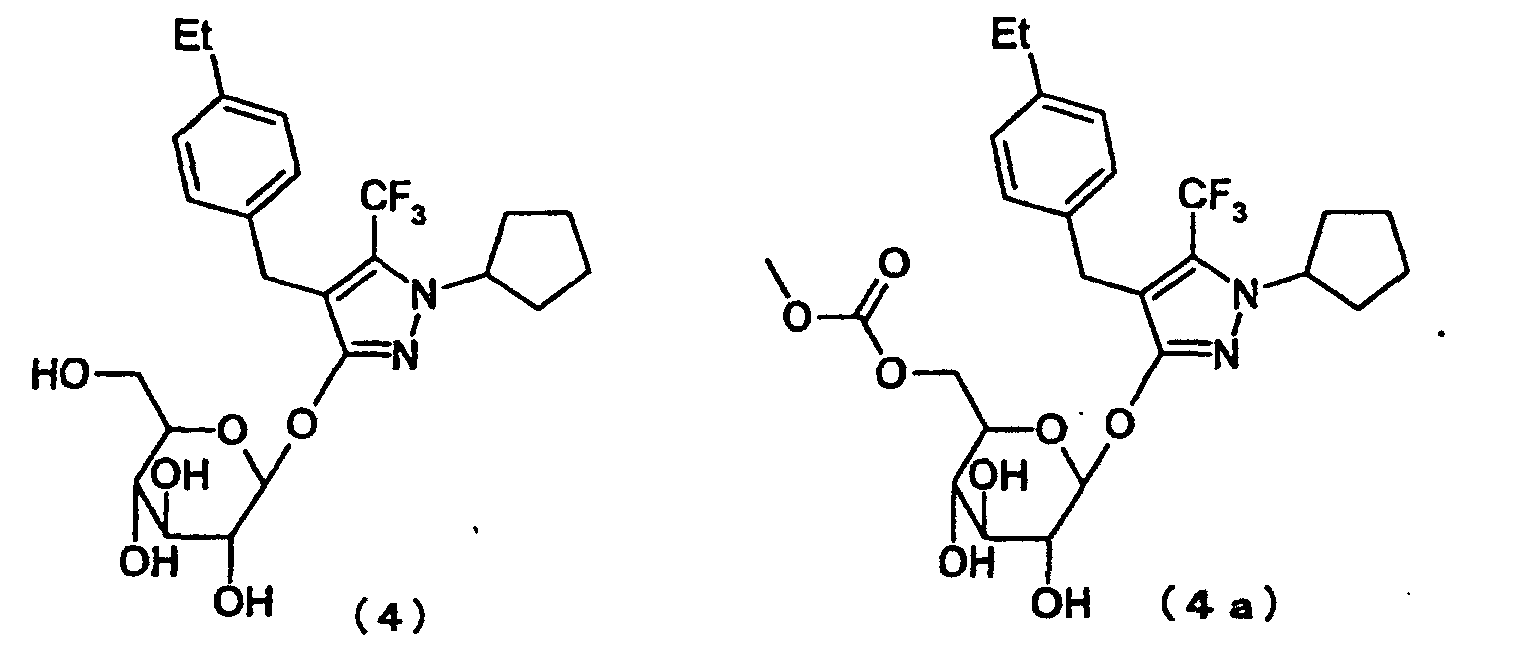
- A prophylactic and therapeutic agent of diabetes mellitus according to any one of claims 1 through 12, where the inhibitor of renal glucose reabsorption is at least one selected from pyrazole derivatives represented by the following formulas (1A) and (2A) and pharmaceutically acceptable salts thereof:[in the formulas, X1 represents β-D-glucopyranosyl group (where one or plural hydroxyl groups may be acylated) or β-D-glucuronyl group (where one or plural hydroxyl groups may be acylated and carboxyl group may be esterified);

Y1 represents a lower alkyl group or a perfluoro-lower alkyl group;
Z1 represents hydrogen atom, a lower alkyl group, a perfluoro-lower alkyl group, an optionally substituted aralkyl group or optionally substituted phenyl group;
R11 through R15 may be the same or different and represent hydrogen atom, a lower alkyl group, a perfluoro-lower alkyl group, a lower alkoxy group, a perfluoro-lower alkoxy group, a lower alkylthio group, a perfluoro-lower alkylthio group, a lower alkylamino group, a halogeno group, a lower alkanoyl group, a lower alkenyl group or a lower alkynyl group; and
n1 represents an integer of 0 to 3.] - A prophylactic and therapeutic agent of diabetes mellitus according to claim 19, where the inhibitor of renal glucose reabsorption is at least one selected from pyrazole derivatives where at least one of R11 through R15 is a lower alkyl group, a perfluoro-lower alkyl group, a lower alkoxy group, a perfluoro-lower alkoxy group, a lower alkylthio group, a perfluoro-lower alkylthio group, a lower alkylamino group, a halogeno group, a lower alkanoyl group, a lower alkenyl group or a lower alkynyl group in the general formulas (1A) and (2A) and pharmaceutically acceptable salts thereof.
- A prophylactic and therapeutic agent of diabetes mellitus according to claim 19, where the inhibitor of renal glucose reabsorption is at least one selected from pyrazole derivatives where at least one of R11, R12, R14 and R15 is a halogeno group in the general formulas (1A) and (2A) and pharmaceutically acceptable salts thereof.
- A prophylactic and therapeutic agent of diabetes mellitus according to claim 19, where the inhibitor of renal glucose reabsorption is at least one selected from pyrazole derivatives where Y1 is trifluoromethyl group in the general formulas (1A) and (2A) and pharmaceutically acceptable salts thereof.
- A prophylactic and therapeutic agent of diabetes mellitus according to claim 19, where the inhibitor of renal glucose reabsorption is at least one selected from pyrazole derivatives where Y1 is trifluoromethyl group and n1 is 1 in the general formulas (1A) and (2A) and pharmaceutically acceptable salts thereof.
- A prophylactic and therapeutic agent of diabetes mellitus according to claim 19, where the inhibitor of renal glucose reabsorption is at least one selected from pyrazole derivatives where Y1 is trifluoromethyl group; n1 is 1; and X1 is β-D-glucopyranosyl group (where one or plural hydroxyl groups may be acylated with a group or groups selected from alkanoyl groups with 2 to 20 carbon atoms, lower alkoxycarbonyl groups and benzoyl group) in the general formulas (1A) and (2A) and pharmaceutically acceptable salts thereof.
- A prophylactic and therapeutic agent of diabetes mellitus according to claim 19, where the inhibitor of renal glucose reabsorption is at least one selected from pyrazole derivatives where Y1 is trifluoromethyl group; n1 is 1; and X1 is β-D-glucuronyl group (where one or plural hydroxyl groups may be acylated with a group or groups selected from alkanoyl groups with 2 to 20 carbon atoms, lower alkoxycarbonyl groups and benzoyl group and where carboxyl group may be esterified with a lower alkyl group) in the general formulas (1A) and (2A) and pharmaceutically acceptable salts thereof.
- A prophylactic and therapeutic agent of diabetes mellitus according to claim 19, where the inhibitor of renal glucose reabsorption is at least one selected from pyrazole derivatives represented by the following formulas (3A), (4A), (10-A), (12-A), (14-A) and (16-A) and pharmaceutically acceptable salts thereof:
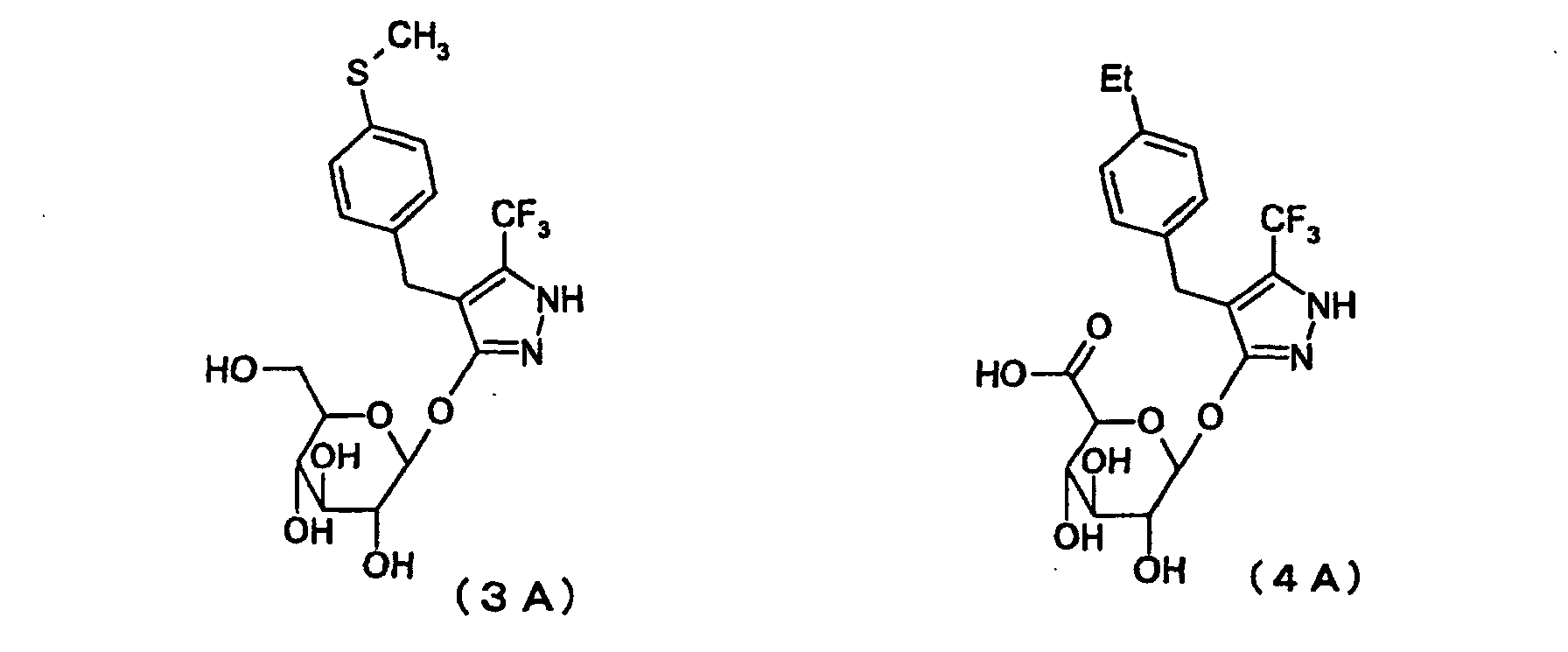


- A prophylactic and therapeutic agent of diabetes mellitus according to any one of claims 1 through 12, where the inhibitor of renal glucose reabsorption is at least one selected from pyrazole-o-glycoside derivatives represented by the following general formula (5) and pharmaceutically acceptable salts thereof:[in the formula, X2 represents β-D-glucopyranosyl group (where one or plural hydroxyl groups may be acylated);
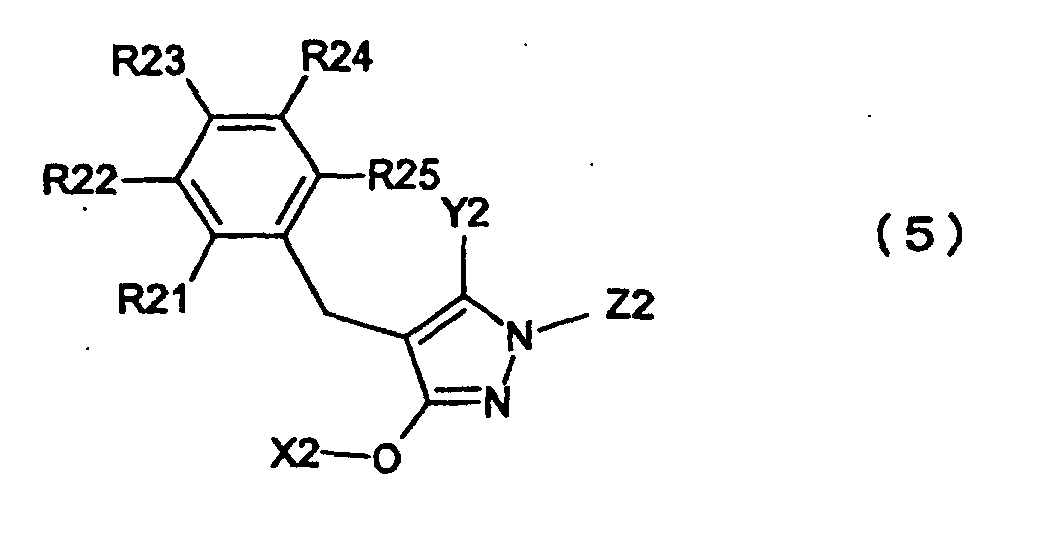
Y2 represents hydrogen, a lower alkyl group, a fluoro-lower alkyl group or a perfluoro-lower alkyl group;
Z2 represents a halo-lower alkyl group;
R21 through R25 may be the same or different and represent hydrogen atom, a halogeno group, a lower alkyl group, a halo-lower alkyl group, a perfluoro-lower alkyl group, a lower alkoxy group, a perfluoro-lower alkoxy group, a lower alkylthio group, a perfluoro-lower alkylthio group, a lower alkylamino group, a lower alkanoyl group, a lower alkenyl group, a lower alkynyl group or an optionally substituted aralkyl group.] - A prophylactic and therapeutic agent of diabetes mellitus according to claim 27, where the inhibitor of renal glucose reabsorption is at least one selected from pyrazole-o-glycoside derivatives where Z2 is a halo-lower alkyl group; Y2 is trifluoromethyl group; and X2 is β-D-glucopyranosyl group (where one or plural hydroxyl groups may be acylated with a group or groups selected from alkanoyl groups with 2 to 20 carbon atoms, lower alkoxy-carbonyl groups and benzoyl group) in the general formula (5) and pharmaceutically acceptable salts thereof.
- A prophylactic and therapeutic agent of diabetes mellitus according to claim 27, where the inhibitor of renal glucose reabsorption is at least one selected from pyrazole-o-glycoside derivatives where Z2 is a fluoro-lower alkyl group; Y2 is trifluoromethyl group; and X2 is β-D-glucopyranosyl group (where one or plural hydroxyl groups may be acylated with a group or groups selected from alkanoyl groups with 2 to 20 carbon atoms, lower alkoxy-carbonyl groups and benzoyl group) in the general formula (5) and pharmaceutically acceptable salts thereof.
- A prophylactic and therapeutic agent of diabetes mellitus according to claim 27, where the inhibitor of renal glucose reabsorption is at least one selected from pyrazole-o-glycoside derivatives where Z2 is a halo-lower alkyl group; Y2 is methyl group; and X2 is β-D-glucopyranosyl group (where one or plural hydroxyl groups may be acylated with a group or groups selected from alkanoyl groups with 2 to 20 carbon atoms, lower alkoxy-carbonyl groups and benzoyl group) in the general formula (5) and pharmaceutically acceptable salts thereof.
- A prophylactic and therapeutic agent of diabetes mellitus according to claim 27, where the inhibitor of renal glucose reabsorption is at least one selected from pyrazole-o-glycoside derivatives where Z2 is a fluoro-lower alkyl group; Y2 is methyl group; and X2 is β-D-glucopyranosyl group (where one or plural hydroxyl groups may be acylated with a group or groups selected from alkanoyl groups with 2 to 20 carbon atoms, lower alkoxy-carbonyl groups and benzoyl group) in the general formula (5) and pharmaceutically acceptable salts thereof.
- A prophylactic and therapeutic agent of diabetes mellitus according to claim 27, where the inhibitor of renal glucose reabsorption is at least one selected from compounds represented by the following formulas (6) and (7) and pharmaceutically acceptable salts thereof:

- A prophylactic and therapeutic agent of diabetes mellitus according to any one of claims 1 through 12, where the inhibitor of renal glucose reabsorption is at least one selected from glucopyranosyloxypyrazole derivatives represented by the following general formula (8) and pharmaceutically acceptable salts thereof:[in the formula, R31 is hydrogen atom or a lower alkyl group;
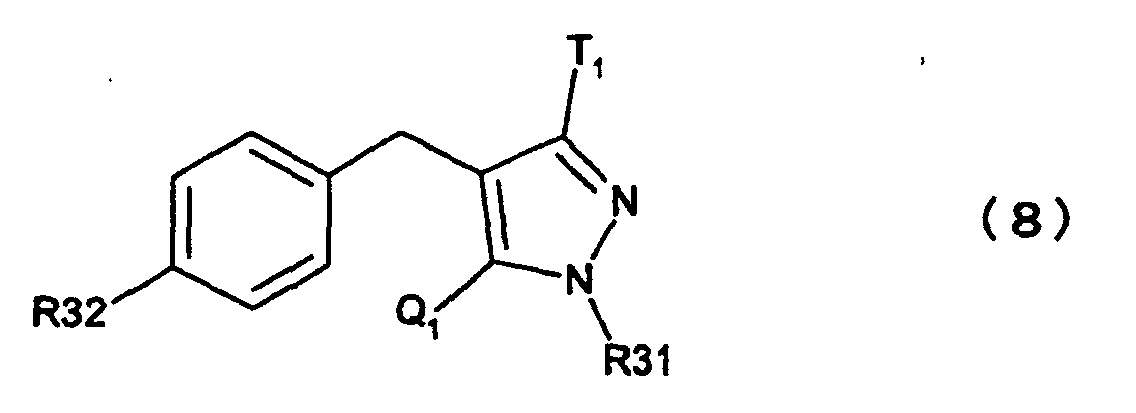
either one of Q1 and T1 is a group represented by the formula (9):(where P represents hydrogen atom, a lower acyl group, a lower alkoxy-lower acyl group, a lower alkoxy-carbonyl-lower acyl group, a lower alkoxy-carbonyl group or a lower alkoxy-lower alkoxy-carbonyl group), and the other is a lower alkyl group or a halo-lower alkyl group;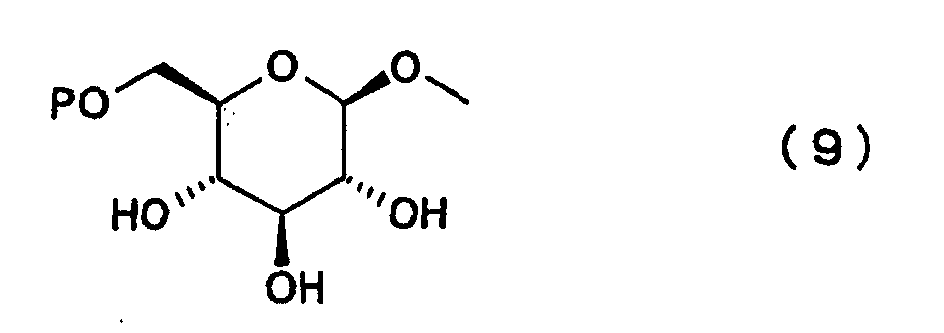
R32 is hydrogen atom, a lower alkyl group, a lower alkoxy group, a lower alkylthio group, a halo-lower alkyl group or a halogen atom.] - A prophylactic and therapeutic agent of diabetes mellitus according to any one of claims 1 through 12, where the inhibitor of renal glucose reabsorption is at least one selected from glucopyranosyloxybenzylbenzene derivatives represented by the following general formula (10) and pharmaceutically acceptable salts thereof:[where R41 is hydrogen atom or a hydroxy-lower alkyl group;
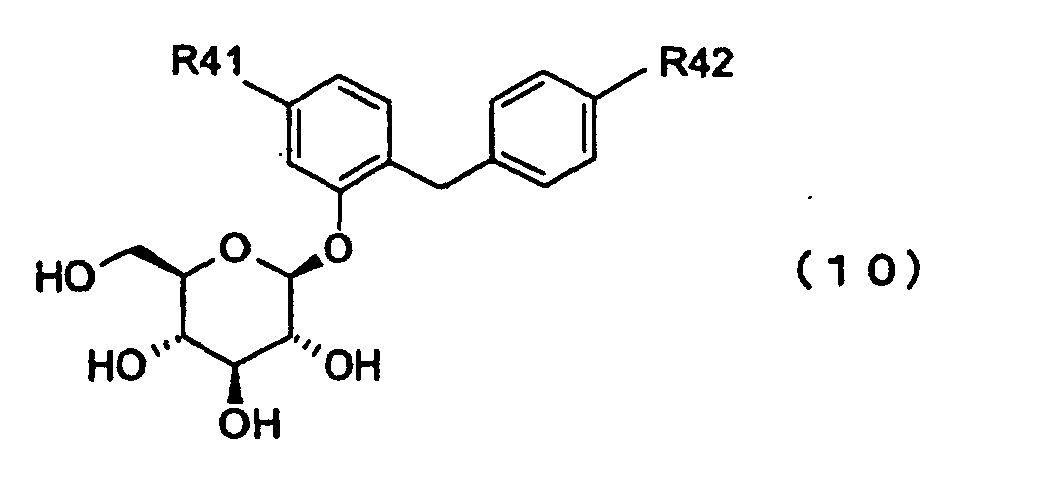
R42 is a lower alkyl group, a lower alkoxy group, a lower alkylthio group, a hydroxy-lower alkyl group, a hydroxy-lower alkoxy group, a hydroxy-lower alkylthio group, a lower alkoxy-lower alkyl group, a lower alkoxy-lower alkoxy group or a lower alkoxy-lower alkylthio group.] - A prophylactic and therapeutic agent of diabetes mellitus according to any one of claims 1 through 12, where the inhibitor of renal glucose reabsorption is at least one selected from compounds represented by the following general formula (11) and pharmaceutically acceptable salts thereof:[where R51 represents hydrogen, hydroxyl group, a lower alkyl, lower alkoxy or
 R52 represents hydrogen, -COO-lower alkyl,
 R55 represents hydroxymethyl, -CH2OCOO-lower alkyl,
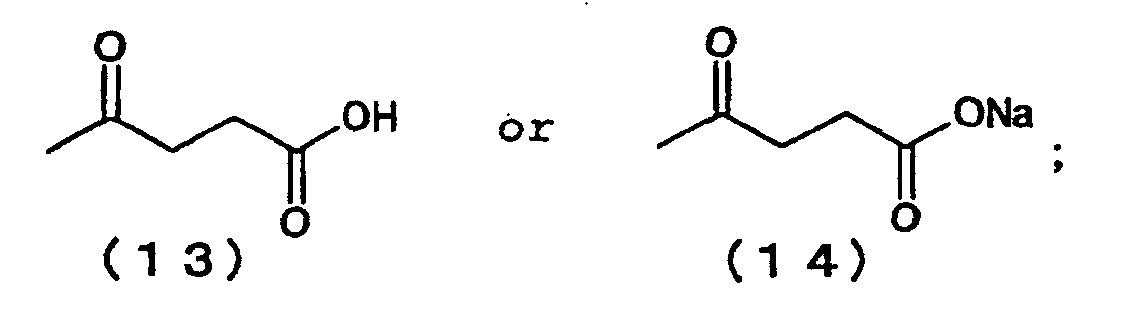 -CH2OSO3H, -COOH, -COONa;
m represents 0 or 1;
n2 represents 0, 1, 2 or 3;
A1 represents the following cyclic structure:(where X3 represents oxygen, nitrogen or sulfur; when m is 0, R53 is a lower alkyl; when m is 1, R53 is a lower alkyl, hydroxyl group or a lower alkoxy group);
--------
represents single bond or double bond.] - A prophylactic and therapeutic agent of diabetes mellitus according to any one of claims 1 through 12, where the inhibitor of renal glucose reabsorption is at least one selected from propiophenone derivatives represented by the following general formula (22) and pharmaceutically acceptable salts thereof:[in the formula, OX4 represents hydroxyl group optionally protected;

Y4 represents a lower alkyl group;
Z4 represents β-D-glucopyranosyl group where one or plural hydroxyl groups may be protected.] - A prophylactic and therapeutic agent of diabetes mellitus according to claim 1, where the inhibitor of renal glucose reabsorption is at least one selected from(i) pyrazole derivatives represented by the following general formulas (1) and (2) and pharmaceutically acceptable salts thereof:[in the formula, the individual symbols are according to claim 13];
 (ii) pyrazole derivatives represented by the following general formulas (1A) and (2A) and pharmaceutically acceptable salts thereof:[in the formula, the individual symbols are according to claim 19];
 (iii) pyrazole-o-glycoside derivatives represented by the following general formula (5) and pharmaceutically acceptable salts thereof:[in the formula, the individual symbols are according to claim 27]; and
 (iv) glucopyranosyloxypyrazole derivatives represented by the following general formula (8) and pharmaceutically acceptable salts thereof:[in the formula, the individual symbols are according to claim 33]; and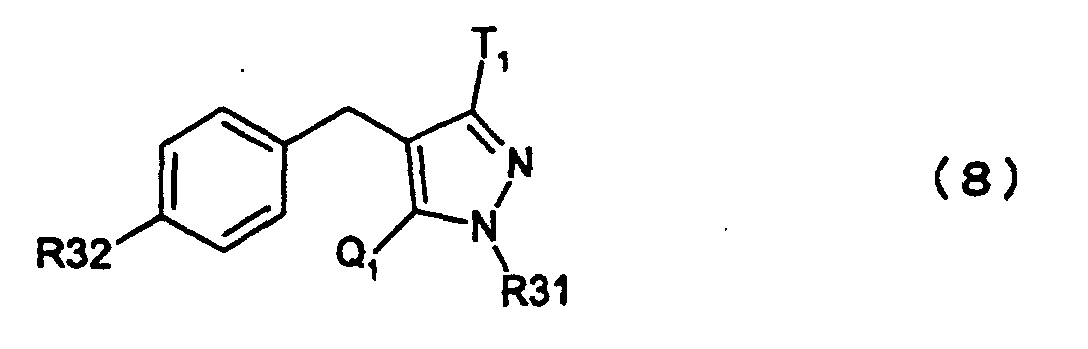
where the hypoglycemic agent is at least one selected from sulfonylureas and biguanides. - A prophylactic and therapeutic agent of diabetes mellitus according to claim 37, where the inhibitor of renal glucose reabsorption is at least one selected from pyrazole derivatives represented by the following formulas (3), (3a), (4a), (7), (10-A) , (12-A), (14-A) and (16-A) and pharmaceutically acceptable salts thereof:

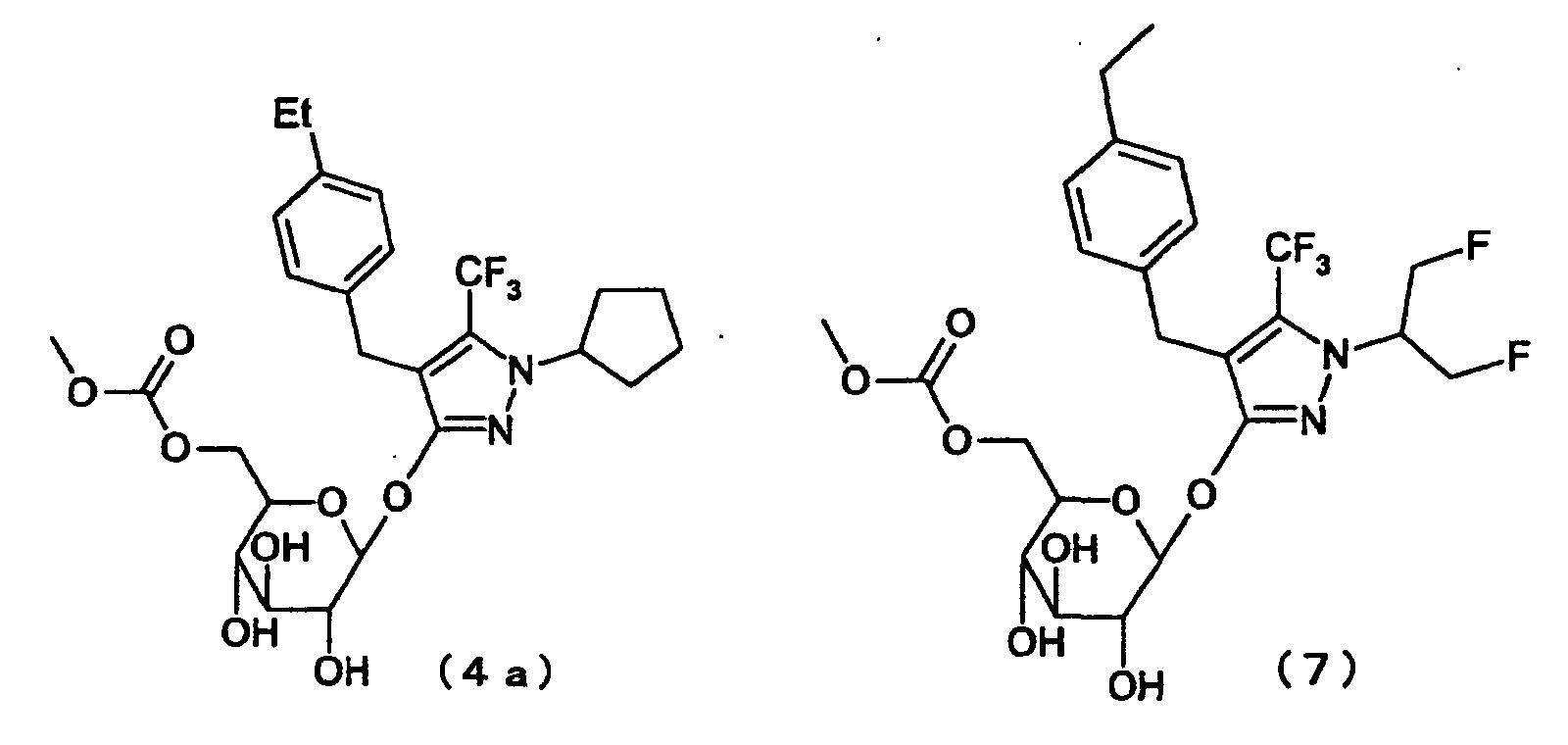
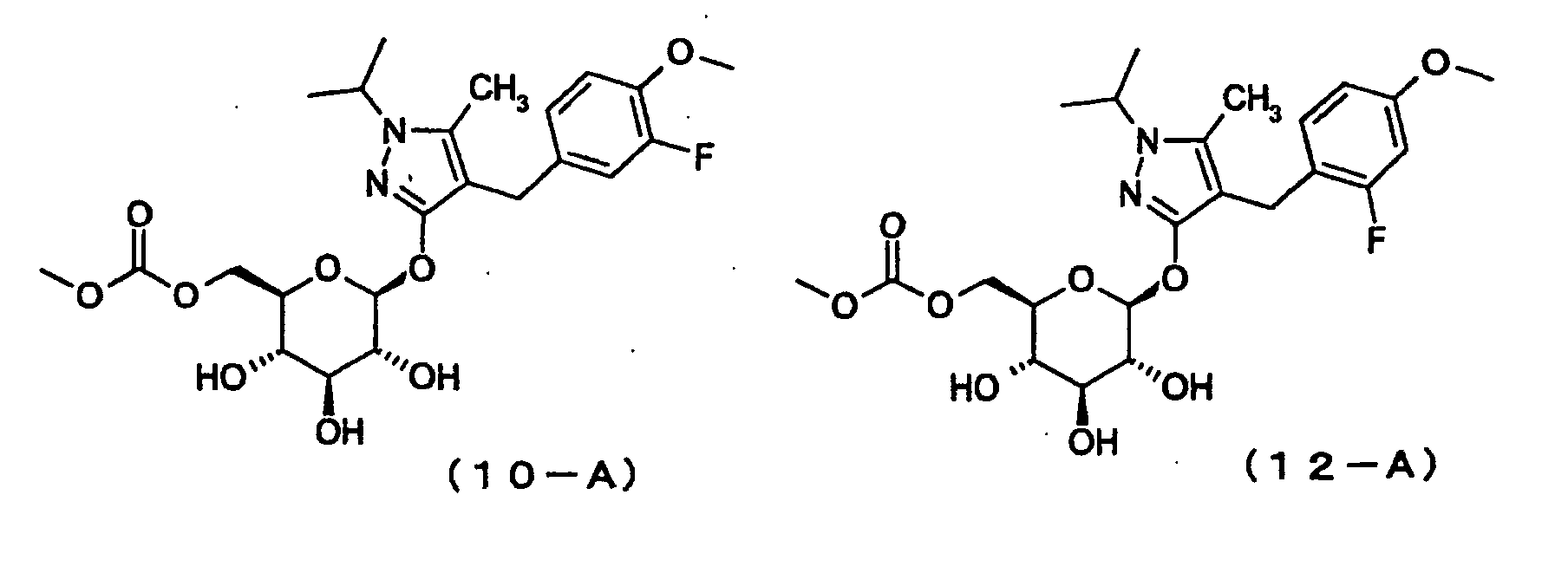

- A prophylactic and therapeutic agent of diabetes mellitus according to claim 37 or 38, where the sulfonylureas are at least one selected from tolbutamide, chlorpropamide, glibenclamide, glipizide, glimeperide and gliclazide and the biguanides are at least one selected from metformin, phenformin and buformin.
- A prophylactic and therapeutic agent of diabetes mellitus according to claim 1, where the inhibitor of renal glucose reabsorption is at least one selected from propiophenone derivatives represented by the following general formula (22) and pharmaceutically acceptable salts thereof and where the hypoglycemic agent is meglitinide analogues:[in the formula, the individual symbols are according to claim 36.]
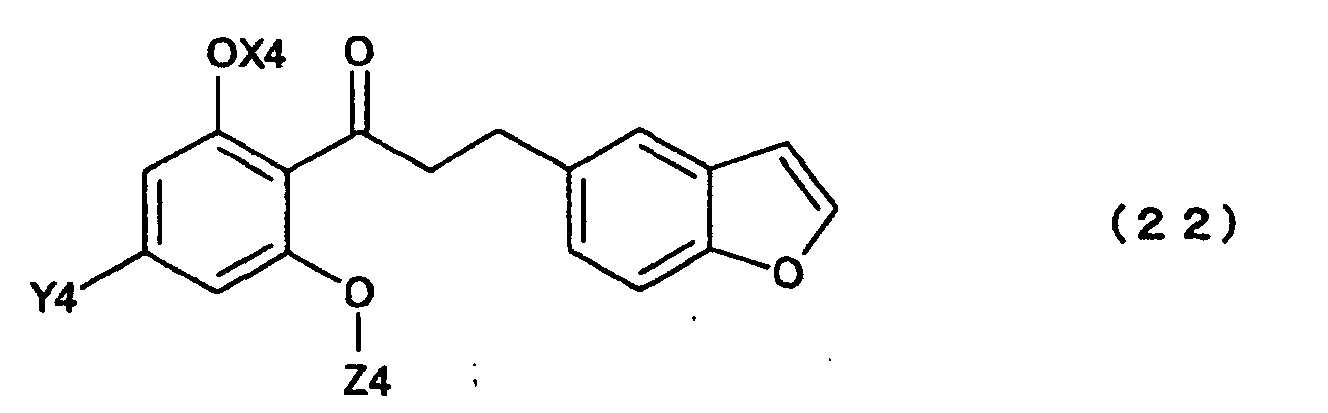
- A prophylactic and therapeutic agent of diabetes mellitus according to claim 40, where the inhibitor of renal glucose reabsorption is at least one selected from 3-(5-benzo[b]furanyl)-2'-(6-o-methoxycarbonyl-β-D-glucopyranosyloxy)-6'-hydroxy-4'-methylpropiophenone and pharmaceutically acceptable salts thereof.
- A prophylactic and therapeutic agent of diabetes mellitus according to claim 40 or 41, where the meglitinide analogues are at least one selected from repaglinide, nateglinide, meglitinide and mitiglinide.
- A prophylactic and therapeutic method of diabetes mellitus, including administering a combination of an effective dose of an inhibitor of renal glucose reabsorption and an effective dose of a hypoglycemic agent to mammals.
- A use of an inhibitor of renal glucose reabsorption and a hypoglycemic agent for producing a prophylactic and therapeutic agent of diabetes mellitus.
- A commercial package including a combination agent including a combination of an inhibitor of renal glucose reabsorption and a hypoglycemic agent and an instruction insert about the combination agent, telling that the combination agent can be or should be used for prophylactic and therapeutic treatment of diabetes mellitus.
Applications Claiming Priority (3)
| Application Number | Priority Date | Filing Date | Title |
|---|---|---|---|
| JP2002127691 | 2002-04-26 | ||
| JP2002127691 | 2002-04-26 | ||
| PCT/JP2003/005318 WO2003090783A1 (en) | 2002-04-26 | 2003-04-25 | Preventive/remedy for diabetes |
Publications (2)
| Publication Number | Publication Date |
|---|---|
| EP1500403A1 true EP1500403A1 (en) | 2005-01-26 |
| EP1500403A4 EP1500403A4 (en) | 2008-09-17 |
Family
ID=29267662
Family Applications (1)
| Application Number | Title | Priority Date | Filing Date |
|---|---|---|---|
| EP03725677A Withdrawn EP1500403A4 (en) | 2002-04-26 | 2003-04-25 | Preventive/remedy for diabetes |
Country Status (5)
| Country | Link |
|---|---|
| EP (1) | EP1500403A4 (en) |
| JP (2) | JP4424203B2 (en) |
| AU (1) | AU2003231517A1 (en) |
| CA (1) | CA2484306A1 (en) |
| WO (1) | WO2003090783A1 (en) |
Cited By (39)
| Publication number | Priority date | Publication date | Assignee | Title |
|---|---|---|---|---|
| WO2007010015A1 (en) * | 2005-07-22 | 2007-01-25 | Boehringer Ingelheim International Gmbh | Processes for preparing pyrazole-o-glycoside derivatives and novel intermediates of said processes |
| WO2007014895A3 (en) * | 2005-07-28 | 2007-05-10 | Boehringer Ingelheim Int | Methods for preventing and treating metabolic disorders and new pyrazole-o-glycoside derivatives |
| WO2008087198A1 (en) * | 2007-01-19 | 2008-07-24 | Boehringer Ingelheim International Gmbh | Pharmaceutical composition comprising a pyrazole-o-glucoside derivative |
| WO2009022009A1 (en) * | 2007-08-16 | 2009-02-19 | Boehringer Ingelheim International Gmbh | Pharmaceutical composition comprising a pyrazole-o-glucoside derivative |
| WO2009022007A1 (en) * | 2007-08-16 | 2009-02-19 | Boehringer Ingelheim International Gmbh | Pharmaceutical composition comprising a glucopyranosyl-substituted benzene derivative |
| WO2009022008A1 (en) * | 2007-08-16 | 2009-02-19 | Boehringer Ingelheim International Gmbh | Pharmaceutical composition comprising a pyrazole-o-glucoside derivative |
| US7524822B2 (en) | 2006-01-11 | 2009-04-28 | Boehringer Ingelheim International Gmbh | Crystalline form of 1′-(1-methylethyl)-4′-[(2-fluoro-4-methoxyphenyl)methyl]-5′-methyl-1H-pyrazol-3′-O-β-D-glucopyranoside, a method for its preparation and the use thereof for preparing medicaments |
| US7767651B2 (en) | 2005-01-28 | 2010-08-03 | Chugai Seiyaku Kabushiki Kaisha | Spiroketal derivatives and use thereof as diabetic medicine |
| US7820815B2 (en) | 2004-11-05 | 2010-10-26 | Boehringer Ingelheim International Gmbh | Process for the preparation of chiral 8-(-3-aminopiperidin-1-yl) xanthines |
| US7943748B2 (en) | 2004-07-27 | 2011-05-17 | Chugai Seiyaku Kabushiki Kaisha | Glucitol derivative, prodrug thereof and salt thereof, and therapeutic agent containing the same for diabetes |
| US8048897B2 (en) | 2004-07-26 | 2011-11-01 | Chugai Seiyaku Kabushiki Kaisha | Cyclohexane derivative, prodrug thereof and salt thereof, and therapeutic agent containing the same for diabetes |
| US8106060B2 (en) | 2005-07-30 | 2012-01-31 | Boehringer Ingelheim International Gmbh | 8-(3-amino-piperidin-1-yl)-xanthines, their preparation, and their use as pharmaceuticals |
| US8119648B2 (en) | 2002-08-21 | 2012-02-21 | Boehringer Ingelheim Pharma Gmbh & Co. Kg | 8-[3-amino-piperidin-1-yl]-xanthines, the preparation thereof and their use as pharmaceutical compositions |
| US8232281B2 (en) | 2006-05-04 | 2012-07-31 | Boehringer Ingelheim International Gmbh | Uses of DPP-IV inhibitors |
| TWI401260B (en) * | 2005-03-17 | 2013-07-11 | Kissei Pharmaceutical | Preparation method of grape glucopyranosyloxypyrazole derivatives |
| US8513264B2 (en) | 2008-09-10 | 2013-08-20 | Boehringer Ingelheim International Gmbh | Combination therapy for the treatment of diabetes and related conditions |
| US8697868B2 (en) | 2004-02-18 | 2014-04-15 | Boehringer Ingelheim International Gmbh | 8-[3-amino-piperidin-1-yl]-xanthines, their preparation and their use as pharmaceutical compositions |
| US8846695B2 (en) | 2009-01-07 | 2014-09-30 | Boehringer Ingelheim International Gmbh | Treatment for diabetes in patients with inadequate glycemic control despite metformin therapy comprising a DPP-IV inhibitor |
| US8853156B2 (en) | 2008-08-06 | 2014-10-07 | Boehringer Ingelheim International Gmbh | Treatment for diabetes in patients inappropriate for metformin therapy |
| US8865729B2 (en) | 2008-12-23 | 2014-10-21 | Boehringer Ingelheim International Gmbh | Salt forms of a xanthine compound |
| US8883800B2 (en) | 2011-07-15 | 2014-11-11 | Boehringer Ingelheim International Gmbh | Substituted quinazolines, the preparation thereof and the use thereof in pharmaceutical compositions |
| US9034883B2 (en) | 2010-11-15 | 2015-05-19 | Boehringer Ingelheim International Gmbh | Vasoprotective and cardioprotective antidiabetic therapy |
| US9149478B2 (en) | 2010-06-24 | 2015-10-06 | Boehringer Ingelheim International Gmbh | Diabetes therapy |
| US9155705B2 (en) | 2008-04-03 | 2015-10-13 | Boehringer Ingelheim International Gmbh | DPP-IV inhibitor combined with a further antidiabetic agent, tablets comprising such formulations, their use and process for their preparation |
| US9186392B2 (en) | 2010-05-05 | 2015-11-17 | Boehringer Ingelheim International Gmbh | Combination therapy |
| US9266888B2 (en) | 2006-05-04 | 2016-02-23 | Boehringer Ingelheim International Gmbh | Polymorphs |
| US9457029B2 (en) | 2009-11-27 | 2016-10-04 | Boehringer Ingelheim International Gmbh | Treatment of genotyped diabetic patients with DPP-IV inhibitors such as linagliptin |
| US9486526B2 (en) | 2008-08-06 | 2016-11-08 | Boehringer Ingelheim International Gmbh | Treatment for diabetes in patients inappropriate for metformin therapy |
| US9526728B2 (en) | 2014-02-28 | 2016-12-27 | Boehringer Ingelheim International Gmbh | Medical use of a DPP-4 inhibitor |
| US9526730B2 (en) | 2012-05-14 | 2016-12-27 | Boehringer Ingelheim International Gmbh | Use of a DPP-4 inhibitor in podocytes related disorders and/or nephrotic syndrome |
| US9555001B2 (en) | 2012-03-07 | 2017-01-31 | Boehringer Ingelheim International Gmbh | Pharmaceutical composition and uses thereof |
| US9713618B2 (en) | 2012-05-24 | 2017-07-25 | Boehringer Ingelheim International Gmbh | Method for modifying food intake and regulating food preference with a DPP-4 inhibitor |
| US20180185291A1 (en) | 2011-03-07 | 2018-07-05 | Boehringer Ingelheim International Gmbh | Pharmaceutical compositions |
| US10155000B2 (en) | 2016-06-10 | 2018-12-18 | Boehringer Ingelheim International Gmbh | Medical use of pharmaceutical combination or composition |
| US10406172B2 (en) | 2009-02-13 | 2019-09-10 | Boehringer Ingelheim International Gmbh | Pharmaceutical composition, methods for treating and uses thereof |
| CN112912069A (en) * | 2018-10-23 | 2021-06-04 | 国立研究开发法人科学技术振兴机构 | PPAR delta activators |
| US11033552B2 (en) | 2006-05-04 | 2021-06-15 | Boehringer Ingelheim International Gmbh | DPP IV inhibitor formulations |
| US11911388B2 (en) | 2008-10-16 | 2024-02-27 | Boehringer Ingelheim International Gmbh | Treatment for diabetes in patients with insufficient glycemic control despite therapy with an oral or non-oral antidiabetic drug |
| US12312352B2 (en) | 2012-05-14 | 2025-05-27 | Boehringer Ingelheim International Gmbh | Use of a DPP-4 inhibitor in SIRS and/or sepsis |
Families Citing this family (6)
| Publication number | Priority date | Publication date | Assignee | Title |
|---|---|---|---|---|
| JP4606876B2 (en) * | 2002-08-27 | 2011-01-05 | キッセイ薬品工業株式会社 | Pyrazole derivative, pharmaceutical composition containing the same, and pharmaceutical use thereof |
| JP4679155B2 (en) * | 2002-12-25 | 2011-04-27 | キッセイ薬品工業株式会社 | Nitrogen-containing heterocyclic derivative, pharmaceutical composition containing the same, and pharmaceutical use thereof |
| US7375090B2 (en) | 2003-08-26 | 2008-05-20 | Boehringer Ingelheim International Gmbh | Glucopyranosyloxy-pyrazoles, pharmaceutical compositions containing these compounds, the use thereof and processed for the preparation thereof |
| WO2011107494A1 (en) | 2010-03-03 | 2011-09-09 | Sanofi | Novel aromatic glycoside derivatives, medicaments containing said compounds, and the use thereof |
| EP2774619B1 (en) | 2013-03-04 | 2016-05-18 | BioActive Food GmbH | Composition for the treatment of hyperglycaemic diseases |
| EP2944311A1 (en) | 2014-05-16 | 2015-11-18 | BioActive Food GmbH | Combination of biologically active substances for treating hyperglycemic diseases |
Family Cites Families (8)
| Publication number | Priority date | Publication date | Assignee | Title |
|---|---|---|---|---|
| TW406086B (en) * | 1996-12-26 | 2000-09-21 | Tanabe Seiyaku Co | Propiophenone derivatives and process for preparing the same |
| AU7906898A (en) * | 1997-06-13 | 1998-12-30 | Novo Nordisk A/S | Novel niddm regimen |
| JP2000080041A (en) * | 1998-03-09 | 2000-03-21 | Tanabe Seiyaku Co Ltd | Pharmaceutical composition |
| UA71994C2 (en) * | 1999-08-31 | 2005-01-17 | Kissei Pharmaceutical | Glucopyranosyloxypyrazole derivatives, a pharmaceutical composition containing these derivatives and intermediate compounds for the preparation thereof |
| PH12000002657B1 (en) * | 1999-10-12 | 2006-02-21 | Bristol Myers Squibb Co | C-aryl glucoside SGLT2 inhibitors |
| US20030040490A1 (en) * | 2000-02-24 | 2003-02-27 | Yasuo Sugiyama | Drugs containing combined active ingredients |
| WO2002036602A1 (en) * | 2000-11-02 | 2002-05-10 | Ajinomoto Co., Inc. | Novel pyrazole derivatives and diabetes remedies containing the same |
| CA2672001A1 (en) * | 2001-04-27 | 2002-11-07 | Ajinomoto Co., Inc. | N-substituted pyrazole-o-glycoside derivatives and therapeutic agent for diabetes containing the same |
-
2003
- 2003-04-25 EP EP03725677A patent/EP1500403A4/en not_active Withdrawn
- 2003-04-25 AU AU2003231517A patent/AU2003231517A1/en not_active Abandoned
- 2003-04-25 JP JP2004501961A patent/JP4424203B2/en not_active Expired - Fee Related
- 2003-04-25 WO PCT/JP2003/005318 patent/WO2003090783A1/en not_active Ceased
- 2003-04-25 CA CA002484306A patent/CA2484306A1/en not_active Abandoned
-
2009
- 2009-07-10 JP JP2009164174A patent/JP2009221235A/en not_active Abandoned
Cited By (82)
| Publication number | Priority date | Publication date | Assignee | Title |
|---|---|---|---|---|
| US8664232B2 (en) | 2002-08-21 | 2014-03-04 | Boehringer Ingelheim Pharma Gmbh & Co. Kg | 8-[3-amino-piperidin-1-yl]-xanthines, the preparation thereof and their use as pharmaceutical compositions |
| US9108964B2 (en) | 2002-08-21 | 2015-08-18 | Boehringer Ingelheim International Gmbh | 8-[3-amino-piperidin-1-yl]-xanthines, the preparation thereof and their use as pharmaceutical compositions |
| US9556175B2 (en) | 2002-08-21 | 2017-01-31 | Boehringer Ingelheim International Gmbh | 8-[3-amino-piperidin-1-yl]-xanthines, the preparation thereof and thier use as pharmaceutical compositions |
| US10202383B2 (en) | 2002-08-21 | 2019-02-12 | Boehringer Ingelheim International Gmbh | 8-[3-amino-piperidin-1-yl]-xanthines, the preparation thereof and their use as pharmaceutical compositions |
| US9321791B2 (en) | 2002-08-21 | 2016-04-26 | Boehringer Ingelheim International Gmbh | 8-[3-amino-piperidin-1-yl]-xanthines, the preparation thereof and their use as pharmaceutical compositions |
| US10023574B2 (en) | 2002-08-21 | 2018-07-17 | Boehringer Ingelheim International Gmbh | 8-[3-amino-piperidin-1-yl]-xanthines, the preparation thereof and their use as pharmaceutical compositions |
| US8178541B2 (en) | 2002-08-21 | 2012-05-15 | Boehringer Ingelheim Pharma Gmbh & Co. Kg | 8-[3-amino-piperidin-1-yl]-xanthines, the preparation thereof and their use as pharmaceutical compositions |
| US8119648B2 (en) | 2002-08-21 | 2012-02-21 | Boehringer Ingelheim Pharma Gmbh & Co. Kg | 8-[3-amino-piperidin-1-yl]-xanthines, the preparation thereof and their use as pharmaceutical compositions |
| US8697868B2 (en) | 2004-02-18 | 2014-04-15 | Boehringer Ingelheim International Gmbh | 8-[3-amino-piperidin-1-yl]-xanthines, their preparation and their use as pharmaceutical compositions |
| US8048897B2 (en) | 2004-07-26 | 2011-11-01 | Chugai Seiyaku Kabushiki Kaisha | Cyclohexane derivative, prodrug thereof and salt thereof, and therapeutic agent containing the same for diabetes |
| US7943748B2 (en) | 2004-07-27 | 2011-05-17 | Chugai Seiyaku Kabushiki Kaisha | Glucitol derivative, prodrug thereof and salt thereof, and therapeutic agent containing the same for diabetes |
| US7820815B2 (en) | 2004-11-05 | 2010-10-26 | Boehringer Ingelheim International Gmbh | Process for the preparation of chiral 8-(-3-aminopiperidin-1-yl) xanthines |
| US9751855B2 (en) | 2004-11-05 | 2017-09-05 | Boehringer Ingelheim International Gmbh | Process for the preparation of chiral 8-(3-aminopiperidin-1-yl)-xanthines |
| US8541450B2 (en) | 2004-11-05 | 2013-09-24 | Boehringer Ingelheim International Gmbh | Process for the preparation of chiral 8-(3-aminopiperidin-1yl)-xanthines |
| US9499546B2 (en) | 2004-11-05 | 2016-11-22 | Boehringer Ingelheim International Gmbh | Process for the preparation of chiral 8-(3-aminopiperidin-1-yl)-xanthines |
| US8883805B2 (en) | 2004-11-05 | 2014-11-11 | Boehringer Ingelheim International Gmbh | Process for the preparation of chiral 8-(3-aminopiperidin-1-yl)-xanthines |
| US7767651B2 (en) | 2005-01-28 | 2010-08-03 | Chugai Seiyaku Kabushiki Kaisha | Spiroketal derivatives and use thereof as diabetic medicine |
| TWI401260B (en) * | 2005-03-17 | 2013-07-11 | Kissei Pharmaceutical | Preparation method of grape glucopyranosyloxypyrazole derivatives |
| WO2007010015A1 (en) * | 2005-07-22 | 2007-01-25 | Boehringer Ingelheim International Gmbh | Processes for preparing pyrazole-o-glycoside derivatives and novel intermediates of said processes |
| WO2007014895A3 (en) * | 2005-07-28 | 2007-05-10 | Boehringer Ingelheim Int | Methods for preventing and treating metabolic disorders and new pyrazole-o-glycoside derivatives |
| US8106060B2 (en) | 2005-07-30 | 2012-01-31 | Boehringer Ingelheim International Gmbh | 8-(3-amino-piperidin-1-yl)-xanthines, their preparation, and their use as pharmaceuticals |
| US7838500B2 (en) | 2006-01-11 | 2010-11-23 | Ajinomoto Co., Inc. | Crystalline form of 1′-(1-methylethyl)-4′-[(2-fluoro-4-methoxyphenyl)methyl]-5′-methyl-1H-pyrazol-3′-O-β-D-glucopyranoside, a method for its preparation and the use thereof for preparing medicaments |
| US7524822B2 (en) | 2006-01-11 | 2009-04-28 | Boehringer Ingelheim International Gmbh | Crystalline form of 1′-(1-methylethyl)-4′-[(2-fluoro-4-methoxyphenyl)methyl]-5′-methyl-1H-pyrazol-3′-O-β-D-glucopyranoside, a method for its preparation and the use thereof for preparing medicaments |
| US8673927B2 (en) | 2006-05-04 | 2014-03-18 | Boehringer Ingelheim International Gmbh | Uses of DPP-IV inhibitors |
| US9173859B2 (en) | 2006-05-04 | 2015-11-03 | Boehringer Ingelheim International Gmbh | Uses of DPP IV inhibitors |
| US11919903B2 (en) | 2006-05-04 | 2024-03-05 | Boehringer Ingelheim International Gmbh | Polymorphs |
| US11291668B2 (en) | 2006-05-04 | 2022-04-05 | Boehringer Ingelheim International Gmbh | Uses of DPP IV inhibitors |
| US9493462B2 (en) | 2006-05-04 | 2016-11-15 | Boehringer Ingelheim International Gmbh | Polymorphs |
| US11084819B2 (en) | 2006-05-04 | 2021-08-10 | Boehringer Ingelheim International Gmbh | Polymorphs |
| US11033552B2 (en) | 2006-05-04 | 2021-06-15 | Boehringer Ingelheim International Gmbh | DPP IV inhibitor formulations |
| US10301313B2 (en) | 2006-05-04 | 2019-05-28 | Boehringer Ingelheim International Gmbh | Polymorphs |
| US9266888B2 (en) | 2006-05-04 | 2016-02-23 | Boehringer Ingelheim International Gmbh | Polymorphs |
| US8232281B2 (en) | 2006-05-04 | 2012-07-31 | Boehringer Ingelheim International Gmbh | Uses of DPP-IV inhibitors |
| US10080754B2 (en) | 2006-05-04 | 2018-09-25 | Boehringer Ingelheim International Gmbh | Uses of DPP IV inhibitors |
| US12171767B2 (en) | 2006-05-04 | 2024-12-24 | Boehringer Ingelheim International Gmbh | Uses of DPP IV inhibitors |
| US12178819B2 (en) | 2006-05-04 | 2024-12-31 | Boehringer Ingelheim International Gmbh | DPP IV inhibitor formulations |
| US9815837B2 (en) | 2006-05-04 | 2017-11-14 | Boehringer Ingelheim International Gmbh | Polymorphs |
| WO2008087198A1 (en) * | 2007-01-19 | 2008-07-24 | Boehringer Ingelheim International Gmbh | Pharmaceutical composition comprising a pyrazole-o-glucoside derivative |
| EA018608B1 (en) * | 2007-08-16 | 2013-09-30 | Бёрингер Ингельхайм Интернациональ Гмбх | Pharmaceutical composition comprising a glucopyranosyl-substituted benzene derivative and dpp iv inhibitor |
| US8551957B2 (en) | 2007-08-16 | 2013-10-08 | Boehringer Ingelheim International Gmbh | Pharmaceutical composition comprising a glucopyranosyl-substituted benzene derivate |
| WO2009022008A1 (en) * | 2007-08-16 | 2009-02-19 | Boehringer Ingelheim International Gmbh | Pharmaceutical composition comprising a pyrazole-o-glucoside derivative |
| WO2009022007A1 (en) * | 2007-08-16 | 2009-02-19 | Boehringer Ingelheim International Gmbh | Pharmaceutical composition comprising a glucopyranosyl-substituted benzene derivative |
| WO2009022009A1 (en) * | 2007-08-16 | 2009-02-19 | Boehringer Ingelheim International Gmbh | Pharmaceutical composition comprising a pyrazole-o-glucoside derivative |
| EP2187879B1 (en) | 2007-08-16 | 2016-10-12 | Boehringer Ingelheim International GmbH | Pharmaceutical composition comprising a glucopyranosyl-substituted benzene derivative |
| US9415016B2 (en) | 2008-04-03 | 2016-08-16 | Boehringer Ingelheim International Gmbh | DPP-IV inhibitor combined with a further antidiabetic agent, tablets comprising such formulations, their use and process for their preparation |
| US10973827B2 (en) | 2008-04-03 | 2021-04-13 | Boehringer Ingelheim International Gmbh | DPP-IV inhibitor combined with a further antidiabetic agent, tablets comprising such formulations, their use and process for their preparation |
| US9155705B2 (en) | 2008-04-03 | 2015-10-13 | Boehringer Ingelheim International Gmbh | DPP-IV inhibitor combined with a further antidiabetic agent, tablets comprising such formulations, their use and process for their preparation |
| US10022379B2 (en) | 2008-04-03 | 2018-07-17 | Boehringer Ingelheim International Gmbh | DPP-IV inhibitor combined with a further antidiabetic agent, tablets comprising such formulations, their use and process for their preparation |
| US9486526B2 (en) | 2008-08-06 | 2016-11-08 | Boehringer Ingelheim International Gmbh | Treatment for diabetes in patients inappropriate for metformin therapy |
| US10034877B2 (en) | 2008-08-06 | 2018-07-31 | Boehringer Ingelheim International Gmbh | Treatment for diabetes in patients inappropriate for metformin therapy |
| US8853156B2 (en) | 2008-08-06 | 2014-10-07 | Boehringer Ingelheim International Gmbh | Treatment for diabetes in patients inappropriate for metformin therapy |
| US8513264B2 (en) | 2008-09-10 | 2013-08-20 | Boehringer Ingelheim International Gmbh | Combination therapy for the treatment of diabetes and related conditions |
| US11911388B2 (en) | 2008-10-16 | 2024-02-27 | Boehringer Ingelheim International Gmbh | Treatment for diabetes in patients with insufficient glycemic control despite therapy with an oral or non-oral antidiabetic drug |
| US9212183B2 (en) | 2008-12-23 | 2015-12-15 | Boehringer Ingelheim International Gmbh | Salt forms of 1-[(4-methyl-quinazolin-2-yl)methyl]-3-methyl-7-(2-butyn-1-yl)-8-(3-(R)-amino-piperidin-1-yl)-xanthine |
| US8865729B2 (en) | 2008-12-23 | 2014-10-21 | Boehringer Ingelheim International Gmbh | Salt forms of a xanthine compound |
| US8846695B2 (en) | 2009-01-07 | 2014-09-30 | Boehringer Ingelheim International Gmbh | Treatment for diabetes in patients with inadequate glycemic control despite metformin therapy comprising a DPP-IV inhibitor |
| US12115179B2 (en) | 2009-02-13 | 2024-10-15 | Boehringer Ingelheim International Gmbh | Pharmaceutical composition, methods for treating and uses thereof |
| US10406172B2 (en) | 2009-02-13 | 2019-09-10 | Boehringer Ingelheim International Gmbh | Pharmaceutical composition, methods for treating and uses thereof |
| US9457029B2 (en) | 2009-11-27 | 2016-10-04 | Boehringer Ingelheim International Gmbh | Treatment of genotyped diabetic patients with DPP-IV inhibitors such as linagliptin |
| US10092571B2 (en) | 2009-11-27 | 2018-10-09 | Boehringer Ingelheim International Gmbh | Treatment of genotyped diabetic patients with DPP-IV inhibitors such as linagliptin |
| US10004747B2 (en) | 2010-05-05 | 2018-06-26 | Boehringer Ingelheim International Gmbh | Combination therapy |
| US9186392B2 (en) | 2010-05-05 | 2015-11-17 | Boehringer Ingelheim International Gmbh | Combination therapy |
| US9603851B2 (en) | 2010-05-05 | 2017-03-28 | Boehringer Ingelheim International Gmbh | Combination therapy |
| US9149478B2 (en) | 2010-06-24 | 2015-10-06 | Boehringer Ingelheim International Gmbh | Diabetes therapy |
| US9034883B2 (en) | 2010-11-15 | 2015-05-19 | Boehringer Ingelheim International Gmbh | Vasoprotective and cardioprotective antidiabetic therapy |
| US11911387B2 (en) | 2010-11-15 | 2024-02-27 | Boehringer Ingelheim International Gmbh | Vasoprotective and cardioprotective antidiabetic therapy |
| US11564886B2 (en) | 2011-03-07 | 2023-01-31 | Boehringer Ingelheim International Gmbh | Pharmaceutical compositions |
| US10596120B2 (en) | 2011-03-07 | 2020-03-24 | Boehringer Ingelheim International Gmbh | Pharmaceutical compositions |
| US20180185291A1 (en) | 2011-03-07 | 2018-07-05 | Boehringer Ingelheim International Gmbh | Pharmaceutical compositions |
| US9199998B2 (en) | 2011-07-15 | 2015-12-01 | Boehringer Ingelheim Internatioal Gmbh | Substituted quinazolines, the preparation thereof and the use thereof in pharmaceutical compositions |
| US8962636B2 (en) | 2011-07-15 | 2015-02-24 | Boehringer Ingelheim International Gmbh | Substituted quinazolines, the preparation thereof and the use thereof in pharmaceutical compositions |
| US8883800B2 (en) | 2011-07-15 | 2014-11-11 | Boehringer Ingelheim International Gmbh | Substituted quinazolines, the preparation thereof and the use thereof in pharmaceutical compositions |
| US9555001B2 (en) | 2012-03-07 | 2017-01-31 | Boehringer Ingelheim International Gmbh | Pharmaceutical composition and uses thereof |
| US10195203B2 (en) | 2012-05-14 | 2019-02-05 | Boehringr Ingelheim International GmbH | Use of a DPP-4 inhibitor in podocytes related disorders and/or nephrotic syndrome |
| US9526730B2 (en) | 2012-05-14 | 2016-12-27 | Boehringer Ingelheim International Gmbh | Use of a DPP-4 inhibitor in podocytes related disorders and/or nephrotic syndrome |
| US12312352B2 (en) | 2012-05-14 | 2025-05-27 | Boehringer Ingelheim International Gmbh | Use of a DPP-4 inhibitor in SIRS and/or sepsis |
| US9713618B2 (en) | 2012-05-24 | 2017-07-25 | Boehringer Ingelheim International Gmbh | Method for modifying food intake and regulating food preference with a DPP-4 inhibitor |
| US9526728B2 (en) | 2014-02-28 | 2016-12-27 | Boehringer Ingelheim International Gmbh | Medical use of a DPP-4 inhibitor |
| US10155000B2 (en) | 2016-06-10 | 2018-12-18 | Boehringer Ingelheim International Gmbh | Medical use of pharmaceutical combination or composition |
| US12364700B2 (en) | 2016-06-10 | 2025-07-22 | Boehringer Ingelheim International Gmbh | Medical use of pharmaceutical combination or composition |
| CN112912069A (en) * | 2018-10-23 | 2021-06-04 | 国立研究开发法人科学技术振兴机构 | PPAR delta activators |
| US12268672B2 (en) | 2018-10-23 | 2025-04-08 | Japan Science And Technology Agency | PPARδ activator |
Also Published As
| Publication number | Publication date |
|---|---|
| JP2009221235A (en) | 2009-10-01 |
| WO2003090783A1 (en) | 2003-11-06 |
| JP4424203B2 (en) | 2010-03-03 |
| EP1500403A4 (en) | 2008-09-17 |
| CA2484306A1 (en) | 2003-11-06 |
| JPWO2003090783A1 (en) | 2005-08-25 |
| AU2003231517A1 (en) | 2003-11-10 |
Similar Documents
| Publication | Publication Date | Title |
|---|---|---|
| JP4424203B2 (en) | Diabetes prevention and treatment | |
| TWI448291B (en) | Combination therapy with sglt-2 inhibitors and their pharmaceutical compositions | |
| US20100317575A1 (en) | Pharmaceutical composition comprising a pyrazole-o-glucoside derivative | |
| EP1329456B1 (en) | Glucopyranosyloxybenzylbenzene derivatives and medicinal compositions containing the same | |
| US7645787B2 (en) | Pyrazole derivatives and diabetic medicine containing them | |
| RU2254340C2 (en) | Glucopyranosyloxybenzylbenzene derivatives, medicinal compositions comprising these derivatives and intermediate compounds for preparing indicated derivatives | |
| JP6861795B2 (en) | A pharmaceutical composition for the prevention or treatment of diabetes containing amodiaquine and an anti-diabetic drug as active ingredients. | |
| US20110077212A1 (en) | Therapeutic uses of sglt2 inhibitors | |
| US20220323473A1 (en) | Methods of treating diseases | |
| TW200524950A (en) | Substituted indazole-O-glucosides | |
| TW201040193A (en) | Pharmaceutical composition, methods for treating and uses thereof | |
| EA018608B1 (en) | Pharmaceutical composition comprising a glucopyranosyl-substituted benzene derivative and dpp iv inhibitor | |
| EP1354602B1 (en) | Medicinal compositions containing diuretic and insulin resistance-improving agent | |
| US20220409598A1 (en) | Method of controlling blood sugar level and treatment of diabetes and related conditions | |
| KR101685779B1 (en) | Pyrazole compounds as sglt1 inhibitors | |
| US7956041B2 (en) | Prophylactic and therapeutic agent of diabetes mellitus | |
| TWI308564B (en) | Use of alpha-phenylthiocarboxylic and alpha-phenyloxycarboxylic acids with serum-glucose-lowering and serum-lipid-lowering activity | |
| TWI655198B (en) | 4-{4-[(1E)-4-(2,9-diazaspiro[5.5]undec-2-yl)but-1-en-1-yl)-2- as SGLT1 inhibitor Methylbenzyl}-5-(propan-2-yl)-1H-pyrazol-3-yl β-D-glucopyranoside acetate or hydrate thereof | |
| WO2015138916A1 (en) | Myo-inositol trispyrophoshate as an anti-diabetic agent | |
| Sharma et al. | Current Approaches for the Treatment of Hyperglycaemia | |
| HK1134653A (en) | Combination therapy with sglt-2 inhibitors and their pharmaceutical compositions |
Legal Events
| Date | Code | Title | Description |
|---|---|---|---|
| PUAI | Public reference made under article 153(3) epc to a published international application that has entered the european phase |
Free format text: ORIGINAL CODE: 0009012 |
|
| 17P | Request for examination filed |
Effective date: 20041115 |
|
| AK | Designated contracting states |
Kind code of ref document: A1 Designated state(s): AT BE BG CH CY CZ DE DK EE ES FI FR GB GR HU IE IT LI LU MC NL PT RO SE SI SK TR |
|
| AX | Request for extension of the european patent |
Extension state: AL LT LV MK |
|
| A4 | Supplementary search report drawn up and despatched |
Effective date: 20080814 |
|
| 17Q | First examination report despatched |
Effective date: 20100413 |
|
| STAA | Information on the status of an ep patent application or granted ep patent |
Free format text: STATUS: THE APPLICATION IS DEEMED TO BE WITHDRAWN |
|
| 18D | Application deemed to be withdrawn |
Effective date: 20120811 |