EP1499123A1 - Information recording medium, information recording device and method, information reproduction device and method, information recording/reproduction device and method, recording or reproduction control computer program, and data structure including a control signal - Google Patents
Information recording medium, information recording device and method, information reproduction device and method, information recording/reproduction device and method, recording or reproduction control computer program, and data structure including a control signal Download PDFInfo
- Publication number
- EP1499123A1 EP1499123A1 EP03717724A EP03717724A EP1499123A1 EP 1499123 A1 EP1499123 A1 EP 1499123A1 EP 03717724 A EP03717724 A EP 03717724A EP 03717724 A EP03717724 A EP 03717724A EP 1499123 A1 EP1499123 A1 EP 1499123A1
- Authority
- EP
- European Patent Office
- Prior art keywords
- information
- reproduction
- record
- object data
- data
- Prior art date
- Legal status (The legal status is an assumption and is not a legal conclusion. Google has not performed a legal analysis and makes no representation as to the accuracy of the status listed.)
- Ceased
Links
Images













Classifications
-
- G—PHYSICS
- G11—INFORMATION STORAGE
- G11B—INFORMATION STORAGE BASED ON RELATIVE MOVEMENT BETWEEN RECORD CARRIER AND TRANSDUCER
- G11B20/00—Signal processing not specific to the method of recording or reproducing; Circuits therefor
- G11B20/10—Digital recording or reproducing
-
- H—ELECTRICITY
- H04—ELECTRIC COMMUNICATION TECHNIQUE
- H04N—PICTORIAL COMMUNICATION, e.g. TELEVISION
- H04N9/00—Details of colour television systems
- H04N9/79—Processing of colour television signals in connection with recording
- H04N9/80—Transformation of the television signal for recording, e.g. modulation, frequency changing; Inverse transformation for playback
- H04N9/804—Transformation of the television signal for recording, e.g. modulation, frequency changing; Inverse transformation for playback involving pulse code modulation of the colour picture signal components
- H04N9/8042—Transformation of the television signal for recording, e.g. modulation, frequency changing; Inverse transformation for playback involving pulse code modulation of the colour picture signal components involving data reduction
-
- G—PHYSICS
- G11—INFORMATION STORAGE
- G11B—INFORMATION STORAGE BASED ON RELATIVE MOVEMENT BETWEEN RECORD CARRIER AND TRANSDUCER
- G11B20/00—Signal processing not specific to the method of recording or reproducing; Circuits therefor
- G11B20/10—Digital recording or reproducing
- G11B20/12—Formatting, e.g. arrangement of data block or words on the record carriers
-
- G—PHYSICS
- G11—INFORMATION STORAGE
- G11B—INFORMATION STORAGE BASED ON RELATIVE MOVEMENT BETWEEN RECORD CARRIER AND TRANSDUCER
- G11B27/00—Editing; Indexing; Addressing; Timing or synchronising; Monitoring; Measuring tape travel
-
- G—PHYSICS
- G11—INFORMATION STORAGE
- G11B—INFORMATION STORAGE BASED ON RELATIVE MOVEMENT BETWEEN RECORD CARRIER AND TRANSDUCER
- G11B27/00—Editing; Indexing; Addressing; Timing or synchronising; Monitoring; Measuring tape travel
- G11B27/02—Editing, e.g. varying the order of information signals recorded on, or reproduced from, record carriers
- G11B27/031—Electronic editing of digitised analogue information signals, e.g. audio or video signals
- G11B27/034—Electronic editing of digitised analogue information signals, e.g. audio or video signals on discs
-
- G—PHYSICS
- G11—INFORMATION STORAGE
- G11B—INFORMATION STORAGE BASED ON RELATIVE MOVEMENT BETWEEN RECORD CARRIER AND TRANSDUCER
- G11B27/00—Editing; Indexing; Addressing; Timing or synchronising; Monitoring; Measuring tape travel
- G11B27/10—Indexing; Addressing; Timing or synchronising; Measuring tape travel
- G11B27/102—Programmed access in sequence to addressed parts of tracks of operating record carriers
- G11B27/105—Programmed access in sequence to addressed parts of tracks of operating record carriers of operating discs
-
- G—PHYSICS
- G11—INFORMATION STORAGE
- G11B—INFORMATION STORAGE BASED ON RELATIVE MOVEMENT BETWEEN RECORD CARRIER AND TRANSDUCER
- G11B27/00—Editing; Indexing; Addressing; Timing or synchronising; Monitoring; Measuring tape travel
- G11B27/10—Indexing; Addressing; Timing or synchronising; Measuring tape travel
- G11B27/19—Indexing; Addressing; Timing or synchronising; Measuring tape travel by using information detectable on the record carrier
- G11B27/28—Indexing; Addressing; Timing or synchronising; Measuring tape travel by using information detectable on the record carrier by using information signals recorded by the same method as the main recording
- G11B27/30—Indexing; Addressing; Timing or synchronising; Measuring tape travel by using information detectable on the record carrier by using information signals recorded by the same method as the main recording on the same track as the main recording
- G11B27/3027—Indexing; Addressing; Timing or synchronising; Measuring tape travel by using information detectable on the record carrier by using information signals recorded by the same method as the main recording on the same track as the main recording used signal is digitally coded
-
- G—PHYSICS
- G11—INFORMATION STORAGE
- G11B—INFORMATION STORAGE BASED ON RELATIVE MOVEMENT BETWEEN RECORD CARRIER AND TRANSDUCER
- G11B27/00—Editing; Indexing; Addressing; Timing or synchronising; Monitoring; Measuring tape travel
- G11B27/10—Indexing; Addressing; Timing or synchronising; Measuring tape travel
- G11B27/19—Indexing; Addressing; Timing or synchronising; Measuring tape travel by using information detectable on the record carrier
- G11B27/28—Indexing; Addressing; Timing or synchronising; Measuring tape travel by using information detectable on the record carrier by using information signals recorded by the same method as the main recording
- G11B27/32—Indexing; Addressing; Timing or synchronising; Measuring tape travel by using information detectable on the record carrier by using information signals recorded by the same method as the main recording on separate auxiliary tracks of the same or an auxiliary record carrier
- G11B27/327—Table of contents
- G11B27/329—Table of contents on a disc [VTOC]
-
- H—ELECTRICITY
- H04—ELECTRIC COMMUNICATION TECHNIQUE
- H04N—PICTORIAL COMMUNICATION, e.g. TELEVISION
- H04N5/00—Details of television systems
- H04N5/76—Television signal recording
- H04N5/91—Television signal processing therefor
- H04N5/92—Transformation of the television signal for recording, e.g. modulation, frequency changing; Inverse transformation for playback
-
- G—PHYSICS
- G11—INFORMATION STORAGE
- G11B—INFORMATION STORAGE BASED ON RELATIVE MOVEMENT BETWEEN RECORD CARRIER AND TRANSDUCER
- G11B2220/00—Record carriers by type
- G11B2220/20—Disc-shaped record carriers
- G11B2220/25—Disc-shaped record carriers characterised in that the disc is based on a specific recording technology
- G11B2220/2537—Optical discs
- G11B2220/2562—DVDs [digital versatile discs]; Digital video discs; MMCDs; HDCDs
-
- H—ELECTRICITY
- H04—ELECTRIC COMMUNICATION TECHNIQUE
- H04N—PICTORIAL COMMUNICATION, e.g. TELEVISION
- H04N5/00—Details of television systems
- H04N5/76—Television signal recording
- H04N5/84—Television signal recording using optical recording
- H04N5/85—Television signal recording using optical recording on discs or drums
-
- H—ELECTRICITY
- H04—ELECTRIC COMMUNICATION TECHNIQUE
- H04N—PICTORIAL COMMUNICATION, e.g. TELEVISION
- H04N9/00—Details of colour television systems
- H04N9/79—Processing of colour television signals in connection with recording
- H04N9/80—Transformation of the television signal for recording, e.g. modulation, frequency changing; Inverse transformation for playback
- H04N9/804—Transformation of the television signal for recording, e.g. modulation, frequency changing; Inverse transformation for playback involving pulse code modulation of the colour picture signal components
- H04N9/806—Transformation of the television signal for recording, e.g. modulation, frequency changing; Inverse transformation for playback involving pulse code modulation of the colour picture signal components with processing of the sound signal
- H04N9/8063—Transformation of the television signal for recording, e.g. modulation, frequency changing; Inverse transformation for playback involving pulse code modulation of the colour picture signal components with processing of the sound signal using time division multiplex of the PCM audio and PCM video signals
-
- H—ELECTRICITY
- H04—ELECTRIC COMMUNICATION TECHNIQUE
- H04N—PICTORIAL COMMUNICATION, e.g. TELEVISION
- H04N9/00—Details of colour television systems
- H04N9/79—Processing of colour television signals in connection with recording
- H04N9/80—Transformation of the television signal for recording, e.g. modulation, frequency changing; Inverse transformation for playback
- H04N9/82—Transformation of the television signal for recording, e.g. modulation, frequency changing; Inverse transformation for playback the individual colour picture signal components being recorded simultaneously only
- H04N9/8205—Transformation of the television signal for recording, e.g. modulation, frequency changing; Inverse transformation for playback the individual colour picture signal components being recorded simultaneously only involving the multiplexing of an additional signal and the colour video signal
-
- H—ELECTRICITY
- H04—ELECTRIC COMMUNICATION TECHNIQUE
- H04N—PICTORIAL COMMUNICATION, e.g. TELEVISION
- H04N9/00—Details of colour television systems
- H04N9/79—Processing of colour television signals in connection with recording
- H04N9/80—Transformation of the television signal for recording, e.g. modulation, frequency changing; Inverse transformation for playback
- H04N9/82—Transformation of the television signal for recording, e.g. modulation, frequency changing; Inverse transformation for playback the individual colour picture signal components being recorded simultaneously only
- H04N9/8205—Transformation of the television signal for recording, e.g. modulation, frequency changing; Inverse transformation for playback the individual colour picture signal components being recorded simultaneously only involving the multiplexing of an additional signal and the colour video signal
- H04N9/8227—Transformation of the television signal for recording, e.g. modulation, frequency changing; Inverse transformation for playback the individual colour picture signal components being recorded simultaneously only involving the multiplexing of an additional signal and the colour video signal the additional signal being at least another television signal
Definitions
- the present invention relates to an information record medium, such as a high density optical disc, capable of recording various information such as main picture, audio, sub picture, reproduction control information, and so on, at high density, relates to an information record apparatus for and method of recording the information onto the information record medium, relates to an information reproduction apparatus for and method of reproducing the information from the information record medium, relates to an information record/reproduction apparatus for and method capable of both recording and reproducing the information, relates to a computer program product for record or reproduction control, and relates to a data structure including control signal for the reproduction control.
- an information record medium such as a high density optical disc, capable of recording various information such as main picture, audio, sub picture, reproduction control information, and so on, at high density
- an information record apparatus for and method of recording the information onto the information record medium relates to an information reproduction apparatus for and method of reproducing the information from the information record medium
- an information record/reproduction apparatus for and method capable of both recording and reproducing the information
- DVDs become common as optical discs onto which various information such as main picture (video), audio, sub picture, reproduction control information and so on is recorded.
- main picture information video data
- audio information audio data
- sub picture information sub picture data
- MPEG 2 Motion Picture Experts Group phase 2
- the main picture information has data, which is compressed in a MPEG video format (ISO 13818-2), for one stream in one program stream.
- the audio information is recorded in a plurality of formats (i.e.
- the sub picture information is defined by a bitmap, and is compressed and recorded in a run length method, and has data for up to 32 streams in one program stream.
- a plurality of selectable streams of the audio information e.g. stereo audio stream or surround audio stream, original English audio stream, Japanese dubbing audio stream, and so on
- a plurality of selectable streams of the sub picture information e.g. Japanese caption stream, English caption stream and so on
- a transport stream of MPEG2 standard is coming to be standardized, which is suitable for larger volume or higher speed data transfer.
- a plurality of elementary streams are transferred at the same time at a far higher transfer rate than the aforementioned program streams format.
- a plurality of programs such as a plurality of satellite digital broadcasting channels in one satellite radio wave, are transmitted at the same time in a TDM (Time Division Multiplex) scheme. That is, in the transport stream format, a plurality of elementary streams each having a large amount of data can be multiplexed in the TDM scheme and transferred, for example, a plurality of movies to be recorded in a plurality of DVDs can be transferred at the same time.
- the aforementioned program stream is generally suitable for the data recording.
- a basic reproduction operation of the program stream is made of firstly taking in various logical information and reproduction control information and then reproducing contents information on the basis of the taken-in information.
- the aforementioned transport stream format is generally suitable for the data transfer.
- a basic reproduction operation of the transport stream is made of taking in various logical information and reproduction control information almost at the same time of taking in contents information and reproducing the contents information on the basis of the taken-in information. For this, if an optical disc stores programs therein recorded in both formats, it is technically difficult to quickly extract only a series of packets disposed discretely and constructing a stream relating to a desired program, and to perform the reproduction on the basis of them without delay.
- the present invention has been accomplished in view of the above problems. It is therefore an object of the present invention to provide an information record medium, an information record apparatus and method, an information reproduction apparatus and method, and an information record/reproduction apparatus and method, capable of multi-recording a plurality of programs in a plurality of encoding format different from each other, such as a transport stream format and a program stream format, and capable of selecting and reproducing a desired program regardless of its encoding format, during the reproduction, and further capable of switching quickly the plurality of programs thereamong.
- said information record medium comprising: an object data file for storing object data comprising a plurality of packets each storing a piece of the video information or the audio information and each being a logically accessible unit; a reproduction sequence file for storing reproduction sequence information defining a reproduction sequence of the object data; and an object information file for storing, as reproduction control information to control a reproduction of the object data file, correspondence definition information for defining a relationship between the plurality of packets and the plurality of partial streams, wherein the whole stream includes a part packetized in a first encoding format and another part packetized in a second encoding format, and the object information file further stores, as the reproduction control information, classification information for indicating whether the object data is a first object data conforming to the first en
- a whole stream includes a plurality of partial streams.
- the whole stream may bundle a plurality of partial streams to be recorded or reproduced at the same time on a reproduction time axis of the transport stream.
- the whole stream may bundle a plurality of partial streams to be recorded or reproduced at the same time on a reproduction time axis of the program stream.
- Each of these partial streams consists of video information (e.g. video data or sub picture data) or audio information (e.g. audio data), which forms a series of contents reproducible by the information reproduction apparatus.
- Such a whole stream is multi-recorded onto the information record medium, by a unit of packet that is a unit physically accessible by the information reproduction apparatus.
- the object data file stores object data consisting of a plurality of packets each being a unit logically accessible by the information reproduction apparatus and each storing a piece of contents information.
- the "packet” means an information unit such as a PS (Program Stream) pack, a TS (Transport Stream) packet and so on, whose data length may be fixed at about 192 bytes such as the TS packet. Alternatively, it may be fixed at about 2048 bytes such as the PS pack or may be variable.
- Reproduction sequence information stores reproduction sequence information (e.g. playlist information) to define a reproduction sequence of the object data stored in the object data file.
- reproduction sequence information e.g. playlist information
- the object information file stores, as the reproduction control information, the correspondence definition information to define correspondence relationships between a plurality of packets and a plurality of partial streams.
- the correspondence definition information may include stream IDs as mentioned below or an ES map table or the like as mentioned below including the stream IDs for each partial stream, if the partial stream conforms to a MPEG program stream.
- the correspondence definition infomation may includes an ES PID (Elementary Stream Packet ID) as mentioned below or an ES map table or the like as mentioned below including the ES PIDs for each partial stream, if the partial stream conforms to a MPEG transport stream.
- ES PID Simple Stream Packet ID
- the whole stream is divided into two parts, i.e. a part packetized on the basis of the first encoding format (i.e. the MPEG transport stream), and another part packetized on the basis of the second encoding format (i.e. the MPEG program stream).
- a certain range on the reproduction time axis is defined as the transport stream and the another range is defined as the program stream, and these two kinds of stream are connected to each other at a certain time point on the reproduction time axis.
- these two kinds of stream may be independently recorded on different reproduction time axes having no relationship between them.
- two kinds of stream are recorded onto the information record medium such as one optical disc.
- the object information file further stores classification information (e.g. object type information as mentioned below) to indicate which encoding format of these two kinds the object data conforms to.
- classification information e.g. object type information as mentioned below
- various information to be stored in the reproduction sequence information file and the object information file is not multiplexed by a unit of packet on the information record medium, different from the object data file. Therefore, it is possible to reproduce the object data by the information reproduction apparatus, on the basis of these reproduction sequence information and the reproduction control information (i.e. the correspondence definition information, the classification information and so on).
- the object information file is firstly referred in order to reproduce a desired program.
- packets on the partial stream constructing the desired program to be reproduced are identified.
- classification information it is identified whether the identified packet(s) is/are based on the first encoding format or the second encoding format.
- the access is made to the identified packet(s) in the object data file so that the reproduction of a plurality of packets, usually disposed discretely, corresponding to the desired program to be reproduced is performed consecutively or continuously.
- the reproduction is performed in a reproduction sequence according to the reproduction sequence information, and in a decoding format corresponding to the first or second encoding format identified on the basis of the classification information.
- the information record medium of the present invention a relatively complicated recording for multi-recording the whole stream including parts encoded in two kinds of encoding format, as well as reproduction thereof, can be performed by a relatively simple process.
- the part of the whole stream packetized in the first encoding format is a MPEG transport stream (TS), and the another part of the whole stream packetized in the second encoding format is a MPEG program stream (PS).
- TS MPEG transport stream
- PS MPEG program stream
- a relatively complicated recording for multi-recording the whole stream including a part encoded in the MPEG transport stream and another part encoded in the MPEG program stream, as well as reproduction thereof, can be performed by a relatively simple process.
- the object information file stores the correspondence definition information, the correspondence definition information being divided into a table including a part relating to the first object data of the correspondence definition information and a table including a part relating to the second object data of the correspondence definition information.
- a table including a part relating to the first object data of the correspondence definition information is referred.
- a table including a part relating to the second object data of the correspondence definition information is referred. In any case, therefore, referring to the table allows the quick reproduction operation.
- such a table may store the total object quantity existing in the object data file, or may store each object data classification information.
- the object information file further stores association group definition information for defining, as an association group, a set having a specific relationship from among a series of contents constructing the plurality of partial streams.
- the association group definition information identifies a set having a specific relationship from among a series of contents ( a plurality of contents).
- the set having a specific relationship may be a set of partial streams of one main picture (motion picture) and partial streams of the corresponding audio and/or sub picture (caption or still picture).
- the set may be a set of partial streams relating to a pair of the video or audio switchable to each other, during the reproduction such as the dual broadcasting or the multi-view or multi-vision broadcasting, or during the reproduction such as the bilingual broadcasting.
- a set of contents information i.e. a plurality of partial stream
- packets corresponding to a plurality of partial streams constructing the desired program to be reproduced are identified, on the basis of the correspondence definition information.
- the object information file further stores, as the reproduction control information, sub group definition information for defining, as a sub group, a set of partial streams switchable to each other during a reproduction in the association group.
- the object information file stores the sub group definition information (e.g. PU information as mentioned below), as one of the reproduction control information to control the reproduction of the object data file. Therefore, freely switchable partial streams in the association groups having a special relationship such as the multi-vision broadcasting, the multi-view broadcasting, the bilingual broadcasting and/or the bilingual captioned broadcasting can be identified easily at the information reproduction apparatus side, on the basis of the sub group (e.g. the PU as mentioned below) of a plurality of partial streams switchable to each other by the information reproduction apparatus in the association group described in the sub group definition information.
- the sub group definition information e.g. PU information as mentioned below
- the correspondence definition information includes packet identification information for indicating a relationship between a plurality of packets to be multiplexed at the same time point and the plurality of partial streams, for each partial stream, as for the first object data.
- packets corresponding to each partial stream can be identified for each reproduction time point, on the basis of the packet ID number (e.g. the ES PID as mentioned below or the ES map table including the ES PID for each elementary stream).
- the packet ID number e.g. the ES PID as mentioned below or the ES map table including the ES PID for each elementary stream.
- the object information file may further store address information of a predetermined kind of packet on each partial stream.
- it may include address information of head packet (e.g. a serial number of the packet and the reproduction start time point) of I picture. If the address information is obtained with the aforementioned packet ID number, the desired packet can be accessed quickly in the object data file, on the basis of them.
- the address information may be a physical address, it is typically a logical address. The actual physical address is defined uniquely from the logical address under the management of the file system.
- the correspondence definition information includes stream identification information for identifying at least a part of the plurality of packets corresponding to each of the plurality of partial streams, for each partial stream, as for the second object data.
- packets corresponding to each partial stream can be identified, on the basis of the stream identification information (e.g. the stream ID or sub stream ID as mentioned below, or the ES map table including these IDs for each elementary stream).
- the stream identification information e.g. the stream ID or sub stream ID as mentioned below, or the ES map table including these IDs for each elementary stream.
- the object information file may further store address information to indicate a record position of the access unit that may conform to the MPEG program stream.
- the quantity of packet constructing the access unit may be fixed or may be variable.
- packets corresponding to a certain time length e.g. 0.5 seconds, 1 second, 2 seconds, 5 seconds, 10 seconds and so on
- the "address information" may indicate the access unit head (start) address of the access unit in the program stream by the packet number (e.g. a serial number in the object file) and the reproduction start time point).
- the address information is obtained with the aforementioned stream ID information, the desired packet can be accessed quickly in the object data file, on the basis of them.
- the address information may be a physical address, it is typically a logical address. The actual physical address is defined uniquely from the logical address, under the management of the file system.
- the object data file stores still picture information as at least a part of the video information
- the object information file further stores address information for indicating a record position of the still picture information, data length information for indicating a data length of the still picture information, and data format information for indicating a data format of the still picture information as for the still picture information.
- the object data may include video information indicating a still picture of JPEG format or bitmap format, in addition to video information indicating a motion picture.
- the object information file makes it possible to reproduce the still picture from the still picture information, on the basis of the data format information indicating a data format (i.e. JPEG format, bitmap format and so on) of the still picture information, the data length information indicating a data length of the still picture information, and the address information indicating the record position of the still picture information.
- the still picture may be reproduced with the motion picture and the audio, or may be reproduced solely.
- an information record apparatus for multi-recording a whole stream including a plurality of partial streams each comprising video information or audio information constructing a series of contents by a unit of packet that is a physically accessible unit, onto an information record medium
- said information record apparatus comprising: a first record device for recording an object data file for storing object data comprising a plurality of packets each storing a piece of the video information or the audio information and each being a logically accessible unit; a second record device for recording a reproduction sequence file for storing reproduction sequence information defining a reproduction sequence of the object data; and a third record device for recording an object information file for storing, as reproduction control information to control a reproduction of the object data file, correspondence definition information for defining a relationship between the plurality of packets and the plurality of partial streams, wherein the whole stream includes a part packetized in a first encoding format and another part packetized in a second encoding format, and the object information file further stores, as the reproduction control information,
- the first record device such as a system controller, an encoder, the TS/PS object generator as mentioned below, an optical pickup and so on
- the second record device such as a system controller, an optical pickup and so on
- the reproduction sequence information file for storing the reproduction sequence information
- the third record device such as a system controller, an optical pickup and so on, records the object information file for storing the correspondence definition information and the classification information, as the reproduction control information. Therefore, a whole stream including parts encoded in two kinds of encoding format, such as the MPEG2 program stream and transport stream, can be multi-recorded onto the aforementioned information record medium of the present invention.
- the first record device multi-records the object data by a unit of packet, but the second and third devices do not multi-record the reproduction sequence information and the reproduction control information by a unit of packet.
- the information record apparatus of the present invention can also take various aspects, corresponding to various aspects of the information record medium of the present invention mentioned above.
- an information record method of multi-recording a whole stream including a plurality of partial streams each comprising video information or audio information, constructing a series of contents by a unit of packet that is a physically accessible unit, onto an information record medium said information record method comprising: a first record process of recording an object data file for storing object data comprising a plurality of packets each storing a piece of the video information or the audio information and each being a logically accessible unit; a second record process of recording a reproduction sequence file for storing reproduction sequence information defining a reproduction sequence of the object data; and a third record process of recording an object information file for storing, as reproduction control information to control a reproduction of the object data file, correspondence definition information for defining a relationship between the plurality of packets and the plurality of partial streams, wherein the whole stream includes a part packetized in a first encoding format and another part packetized in a second encoding format, and the object information file further stores, as the reproduction control information
- the object data file for storing the object data is recorded at the first record process
- the reproduction sequence information file for storing the reproduction sequence information is recorded at the second record process
- the object information file for storing the correspondence definition information and the classification information is recorded as the reproduction control information at the third record process. Therefore, a whole stream including parts encoded in two kinds of encoding format, such as the MPEG2 program stream and transport stream, can be multi-recorded onto the information record medium of the present invention mentioned above.
- the information record method can also take various aspects, corresponding to various aspects of the information record medium of the present invention mentioned above.
- an information reproduction apparatus for reproducing a part of the recorded whole stream from the aforementioned information record medium of the present invention (including its various aspects), said information reproduction apparatus comprising: a read device for physically reading information from the information record medium; and a reproduction device for reproducing the object data included in the information read by the read device, on the basis of the reproduction control information and the reproduction sequence information included in the information read by the read device.
- the read device such as an optical pickup, a decoder and so on, reads the information physically by a unit of the packet from the information record medium.
- the reproduction device such as a system controller, a demultiplexer, a decoder and so on, reproduces the object data particularly read by a unit of packet, on the basis of the reproduction control information and the reproduction sequence information included in the read information. Therefore, the whole stream including parts encoded in two kinds of encoding stream, such as the MPEG2 program stream and transport stream, can be reproduced from the aforementioned information record medium of the present invention.
- the information reproduction apparatus of the present invention can also take various aspects, corresponding to various aspects of the information record medium of the present invention mentioned above.
- the reproduction device switches a reproduction processing on the basis of the classification information so that a decoder conforming to the first encoding format performs decoding the data when the first object data is reproduced, and a decoder conforming to the second encoding format performs decoding the data when the second object data is reproduced.
- the reproduction device when the first object data is reproduced, according to the classification information, the reproduction device performs the decoding with the decoder conforming to the first encoding format.
- the reproduction device when the second object data is reproduced, according to the classification information, the reproduction device performs the decoding with the decoder conforming to the second encoding format.
- This switching the decoding process may be achieved by the shift switch. Alternatively, the switching may be achieved by using the same decoder and switching the data to be extracted.
- the object data file stores still picture information, as at least a part of the video information, and the reproduction device switches a reproduction processing so that a decoder conforming to the still picture information performs decoding the data when the still picture information is reproduced.
- the reproduction device decodes the first or second object data according to the classification information.
- the reproduction device further changes the decoder conforming to the data format.
- an information reproduction method of reproducing a part of the recorded whole stream from the aforementioned information record medium of the present invention comprising: a read process of physically reading information from the information record medium; and a reproduction process of reproducing the object data included in the information read at the read process, on the basis of the reproduction control information and the reproduction sequence information included in the information read at the read process.
- the information is physically read by a unit of packet from the information record medium at the read process. Then, the object data particularly read by a unit of packet is reproduced at the reproduction process, on the basis of the reproduction control information and the reproduction sequence information included in the read information. Therefore, the whole stream including parts encoded in two kinds of encoding format, such as the MPEG2 program stream and transport stream, can be reproduced from the information record medium of the present invention mentioned above.
- an information record and reproduction apparatus for recording the whole stream onto the aforementioned information record medium of the present invention (including its various aspects) and reproducing a part of the recorded whole stream
- said information record and reproduction apparatus comprising: a first record device for recording the object data file; a second record device for recording the reproduction sequence information file; a third record device for recording the object information file; a read device for physically reading information from the information record medium; and a reproduction device for reproducing the object data included in the information read by the read device, on the basis of the reproduction control information and the reproduction sequence information included in the information read by the read device.
- the first record device multi-records the object data file by a unit of packet
- the second record device records the reproduction sequence information file
- the third record device records the object information file.
- the read device reads physically the information from the information record medium
- the reproduction device reproduces the object data particularly read by a unit of packet, on the basis of the reproduction control information and the reproduction sequence information included in the read information. Therefore, a whole stream including parts encoded in two kinds of encoding format can be multi-recorded onto the information record medium of the present invention, and the multi-recorded information can be appropriately reproduced.
- the information record and reproduction apparatus can also take various aspects, corresponding to various aspects of the information record medium of the present invention mentioned above.
- an information record and reproduction method of recording the whole stream onto the aforementioned information record medium of the present invention (including its various aspects) and reproducing a part of the recorded whole stream said information record and reproduction method comprising: a first record process of recording the object data file; a second record process of recording the reproduction sequence information file; a third record process of recording the object information file; a read process of physically reading information from the information record medium; and a reproduction process of reproducing the object data included in the information read at the read process, on the basis of the reproduction control information and the reproduction sequence information included in the information read at the read process.
- the object data file is multi-recorded at the first record process
- the reproduction sequence information file is recorded at the second record process
- the object information file is recorded at the third record process.
- the information is physically read from the information record medium at the read process, and the object data particularly read by a unit of a packet is reproduced at the reproduction process, on the basis of the reproduction control information and the reproduction sequence information included in the read information. Therefore, a whole stream including parts encoded in two kinds of encoding format can be multi-recorded onto the information record medium of the present invention mentioned above, and the multi-recorded information can be appropriately reproduced.
- the information record and reproduction method can also take various aspects, corresponding to various aspects of the information record medium of the present invention mentioned above.
- the above object of the present invention is achieved by a computer program for a record control to control a computer disposed at the aforementioned information record apparatus of the present invention (including its various aspects), said computer program makes the computer function as at least a part of the first record device, the second record device and the third record device.
- the information record apparatus of the present invention can be embodied relatively easily, by reading and running the computer program from a record medium, such as a ROM, a CD-ROM, a DVD-ROM, a hard disk and so on, storing the computer program therein/thereon, or by downloading the computer program product to the computer via the communication device and running it.
- a record medium such as a ROM, a CD-ROM, a DVD-ROM, a hard disk and so on
- storing the computer program therein/thereon or by downloading the computer program product to the computer via the communication device and running it.
- the above object of the present invention is achieved by a computer program for a reproduction control to control a computer disposed at the aforementioned information reproduction apparatus of the present invention (including its various aspects), said computer program makes the computer function as at least a part of the reproduction device.
- the information reproduction apparatus of the present invention can be embodied relatively easily, by reading and running the computer program from a record medium, such as a ROM, a CD-ROM, a DVD-ROM, a hard disk and so on, storing the computer program therein/thereon, or by downloading the computer program product to the computer via the communication device and running it.
- a record medium such as a ROM, a CD-ROM, a DVD-ROM, a hard disk and so on
- storing the computer program therein/thereon or by downloading the computer program product to the computer via the communication device and running it.
- the above object of the present invention is achieved by a computer program for a record and reproduction control to control a computer disposed at the aforementioned information record and reproduction apparatus of the present invention (including its various aspects), said computer program makes the computer function as at least a part of the first record device, the second record device, the third record device and the reproduction device.
- the information record and reproduction apparatus of the present invention mentioned above can be embodied relatively easily, by reading and running the computer program from a record medium, such as a ROM, a CD-ROM, a DVD-ROM, a hard disk and so on, storing the computer program therein/thereon, or by downloading the computer program product to the computer via the communication device and running it.
- a record medium such as a ROM, a CD-ROM, a DVD-ROM, a hard disk and so on
- storing the computer program therein/thereon or by downloading the computer program product to the computer via the communication device and running it.
- a data structure including a control signal, in which a whole stream including a plurality of partial streams each comprising video information or audio information, constructing a series of contents, is multi-recorded by a unit of packet that is a physically accessible unit, said structure comprising: an object data file for storing object data comprising a plurality of packets each storing a piece of the video information or the audio information and each being a logically accessible unit; a reproduction sequence file for storing reproduction sequence information defining a reproduction sequence of the object data; and an object information file for storing, as reproduction control information to control a reproduction of the object data file, correspondence definition information for defining a relationship between the plurality of packets and the plurality of partial streams, wherein the whole stream includes a part packetized in a first encoding format and another part packetized in a second encoding format, and the object information file further stores, as the reproduction control information, classification information for indicating whether the object data is a first object data conforming to
- a relatively complicated recording for multi-recording the whole stream including parts encoded in two kinds of encoding format, as well as the reproduction thereof, can be performed by a relatively simple process.
- the above object of the present invention is achieved by the first program storage device, readable by a computer disposed at the information record apparatus, for tangibly embodying a computer program capable of making the computer perform the information record method of the present invention mentioned above.
- the above object of the present invention is achieved by the second program storage device, readable by a computer disposed at the information reproduction apparatus, for tangibly embodying a computer program capable of making the computer perform the information record method of the present invention mentioned above.
- the above object of the present invention is achieved by the third program storage device, readable by a computer disposed at the information record and reproduction apparatus, for tangibly embodying a computer program capable of making the computer perform the information record method of the present invention mentioned above.
- the information record method, the information reproduction method, or the information record and reproduction method may be embodied relatively easily, by reading and running the computer program product from a record medium, such as a ROM, a CD-ROM, a DVD-ROM, a hard disk and so on, storing the computer program therein/thereon, or by downloading the computer program product to the computer via the communication device and running it.
- a record medium such as a ROM, a CD-ROM, a DVD-ROM, a hard disk and so on, storing the computer program therein/thereon, or by downloading the computer program product to the computer via the communication device and running it.
- a computer data signal embodied in a first carrier wave, for giving a series of instructions to make a computer disposed at the information record apparatus perform the information record method.
- the above object of the present invention is achieved by a computer data signal embodied in a second carrier wave, for giving a series of instructions to make a computer disposed at the information reproduction apparatus perform the information reproduction method.
- a computer data signal embodied in a third carrier wave for giving a series of instructions to make a computer disposed at the information record and reproduction apparatus perform the information record and reproduction method.
- the information record method, the information reproduction method or the information record and reproduction method of the present invention can be performed relatively easily by downloading and running the computer program in the computer data signal via the computer network or the like.
- the information record medium of the present invention will be discussed, with reference to its embodiments, as well as FIG. 1 to FIG. 7.
- the information record medium of the present invention is applied to an optical disc capable of recording (writing) and reproducing (reading).
- FIG. 1 illustrates, in its upper part, a general plan view of the optical disc structure having a plurality of areas, and illustrates conceptually, in its lower part, an area structure in the radius direction corresponding to the upper part.
- the optical disc 100 may be recorded by various record methods, such as magneto-optical method, phase change method, capable of recording (writing) only once or a plurality of times.
- the optical disc 100 has a lead-in area 104, a data area 106 and a lead-out area 108, from the inner circumference around a center hole 102 to the outer circumference, on the record surface of the disc body measuring about 12 cm in diameter.
- groove tracks and land tracks may be alternately formed, concentrically or spirally around the center hole 102.
- the groove tracks may be wobbled.
- pre-pits may be formed on one or both tracks.
- the present invention is not exclusively limited to the optical disc having three areas mentioned above.
- FIG. 2 (a) schematically illustrates a MPEG2 program stream of a conventional DVD for a comparison
- FIG. 2 (b) schematically illustrates a MPEG2 transport stream (TS) structure
- FIG. 2(c) schematically illustrates a MPEG2 program stream structure in the present invention.
- one program stream to be recorded in the conventional DVD includes only one video stream for vide data as main picture information, along the time axis t, and further includes up to 8 audio streams of audio data as audio information, up to 32 sub picture streams for sub picture data as sub picture information. That is, the video data to be multiplexed at an arbitrary time point tx relates to only one video stream. For example, a plurality of video stream corresponding to a plurality of TV programs or a plurality of movies can not be included at the same time in the program stream.
- one transport stream (TS) to be recorded in the optical disc 100 of the present invention includes a plurality of video streams as elementary streams (ES) for video data as main picture information, and further includes a plurality of audio streams as elementary streams (ES) for audio data as audio information and a plurality of sub picture streams as elementary streams (ES) for sub picture as sub picture information.
- the video data to be multiplexed at an arbitrary time point tx relates to a plurality of video streams.
- a plurality of video streams that may corresponds to a plurality of TV programs or a plurality of movies can be included at the same time in the transport stream.
- the sub picture stream is not transferred in a digital broadcasting employing the existing transport stream.
- one program stream (PS) to be recorded onto the optical disc 100 of the present invention includes a plurality of video streams for video data as main picture information, and further includes a plurality of audio streams for audio data as audio information and a plurality of sub picture streams for sub picture data as sub picture information. That is, the video data to be multiplexed at an arbitrary time point tx relates to a plurality of video streams. For example, a plurality of video streams that may corresponds to a plurality of TV programs or a plurality of movies can be included at the same time in the program stream.
- the video stream, the audio stream and the sub picture stream are arranged in this order from the top in FIG. 2(a) to FIG. 2(c). Nevertheless, this order does not correspond to an order for multiplexing packet by packet as mentioned below.
- the transport stream conceptually, a set of one video stream, two audio streams and two sub picture streams corresponds to one program for example.
- the optical disc 100 in the aforementioned embodiment is adapted to multi-record the transport stream (TS) as shown in FIG. 2(b), i.e. to record a plurality of programs at the same time. Furthermore, instead of or in addition to this transport stream, the program stream (PS) as shown in FIG. 2(c) can be multi-recorded onto the same optical disc 100.
- TS transport stream
- PS program stream
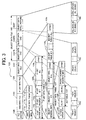
- FIG. 3 schematically illustrates the data structure to be recorded onto the optical disc 100.
- FIG. 4 schematically illustrates in detail the data structure in each object shown in FIG. 3.
- the "title” means a reproduction unit for consecutively or continuously executing a plurality of "playlists” and a unit having a logically large group such as one movie or one TV program.
- the “playlist” is a file for storing the information required to reproduce the "object” and consists of a plurality of “items” each storing the information relating to a reproduction range of the object to access the object. More specifically, “in point information” indicating the start address of the object and “out point information” indicating the end address are recorded in each item. Incidentally, these “in point information” and “out point information” may indicate directly the address respectively or may indicate indirectly the address with the time or time point on the reproduction time axis.
- the "object” is the entity information of contents constructing the aforementioned MPEG2 transport stream.
- the optical disc 100 is provided with four files as a logical structure: a disc information file 110; a playlist (P list) information file 120; an object information file 130; and an object data file 140.
- the disc 100 is further provided with a file system 105 for managing these files.
- FIG. 3 does not show directly the physical data arrangement on the optical disc 100, it is possible to perform the record so that the arrangement shown in FIG. 3 corresponds to another arrangement shown in FIG. 1, i.e. to record the file system 105 or the like in the data record area 106 following the lead-in area 104 and further record the object data file 140 or the like in the data record area 106.
- the file structure shown in FIG. 3 can be constructed, even without the lead-in area 104 or the lead-out area 108 shown in FIG. 1.
- the disc information file 110 is a file for storing general information about the entire optical disc 100, and stores the disc general information 112, the title information table 114 and other information 118.
- the disc general information 112 may store the total quantity of titles in the optical disc 100.
- the title information table 114 stores, as the logical information, each title type (e.g. sequential reproduction type, branch type and so on), or the playlist (P list) number constructing each title, for each title.
- the playlist information file 120 is a reproduction sequence information file, for storing the playlist (P list) information table 121 indicating the logical structure of each playlist.
- the playlist information file 120 is divided into the playlist (P list) general information 122, the playlist (P list) pointer 124, a plurality of playlists (P lists) 126 (P list #1-#n), and other information 128.
- the logical information of each playlist 126 is stored in the order of the playlist number. In other words, the order for storing the each playlist 126 is the playlist numbers.
- the same playlist 126 can be referred from a plurality of titles. That is, the playlist #p in the playlist information table 121 may be pointed on the title information table 114, even in the case that title #n and title #m use the same playlist #p.
- the object information file 130 stores the object information table 131 including a plurality of object information 133 (object information #1-#m) as mentioned below, the ES (Elementary Stream) map table 134 and other information 135. Furthermore, the object information 133 stores the AU table 137 including a plurality of AU (Associated Unit) information 138I(AU#1-AU#q) as mentioned below.
- the object data file 140 conforms to the MPEG2 transport stream (TS) standard, and has the object data 140TS for storing a plurality of TS object 142 for each transport stream (TS object #1-TS #s object), i.e. entity data of contents to be actually reproduced. Furthermore, in addition to or instead of this, it has the object data 140PS for storing the "PS object” conforming with the MPEG2 program stream (PS) standard and the object data 140ST for storing the "still picture object (still picture data)" made of the still picture data of JPEG format, bitmap format and so on.
- TS MPEG2 transport stream
- PS MPEG2 program stream
- object information 133 and the ES map table 134 in the aforementioned object information file 130 are sorted respectively for TS, PS and still picture, corresponding to that the object data file 140 is sorted for the TS, PS and still picture.
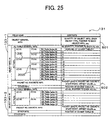
- the detail of these data structures will be discussed later with the specific example (figs. 25-27, figs. 31 and 32).
- the object data file 140 may have all three object data 140TS, 140PS and 140ST, or may have arbitrary two or only one from among them. Furthermore, each object data does not need to be arranged consecutively or continuously in the object data file 140.
- the disc information file 110 can be further divided into a plurality of files respectively to be stored. All these files may be managed by the file system 105.
- the object data file 140 can be divided into a plurality of files such as object data file #1, object data file #2, etc.
- the TS object 142 constructing the object data 140TS shown in FIG. 3 and being a unit logically reproducible may be divided into a plurality of aligned units 143 each having 6kB of data amount.
- the head of the aligned units 143 corresponds to the head of the TS object 142 (aligned).
- Each aligned unit 143 is further divided into a plurality of source packets 144 each having 192B of data amount.
- the source packet 144 is a physically reproducible unit, on the basis of which (i.e. by a unit of the packet) at least the video data, the audio data ant the sub picture data from among the data on the optical disc 100 are multiplexed, and other information may be multiplexed in the same manner.
- Each source packet 144 includes the control information 145 to control the reproduction, for example a packet arrival time stamp or the like indicating the reproduction start time point of the TS (Transport Stream) packet having 4B of data amount on the reproduction time axis, and the TS packet 146 having 188B of data amount.
- the TS packet 146 has a packet header 146a at its head portion.
- the video data may be packetized as the "video packet”
- the audio data may be packetized as the "audio packet”
- the sub picture data may be packetized as the "sub picture packet” otherwise other data may be packetized.
- the PS object constructing the object data 140PS relating to the program stream and being a logically reproducible unit is divided into access units as an accessible information unit.
- Each access unit is made of an information unit referred to as "PS pack" that may have 2048 bytes of data length.
- the detail of the PS pack is the same as in a known DVD, such as a video pack, an audio pack, a sub picture pack and a navigation pack.
- the ES address information is recorded in the ES map table 134 by an access unit. During the reproduction, the access unit can be accessed, on the basis of the ES address information.
- the data length, 2048 bytes, of each packet in the PS object may be variable, and the packet length information indicating the packet data length of each PS object is recorded in the object information file 130 (see FIG. 25 and FIG. 31), as discussed below.
- Each packet record position is identified by referring to the packet length information during the reproduction.
- the still picture object constructing the object data 140ST relating to the still picture and being a logically reproducible unit is made of the object data such as known JPEG format, bitmap format.
- FIG. 5(a) conceptually illustrates that the elementary stream (ES) for program #1 (PG1) in the upper stage and the elementary stream (ES) for program #2 (PG2) in the middle stage are multiplexed, and the transport stream (TS) for these two programs (PG1&2) is formed, under an assumption that a horizontal axis is defined as a time axis.
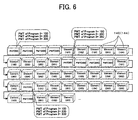
- FIG. 6 conceptually illustrates an image of the TS packets multiplexed in one transport stream (TS), as a packet array along the time axis.
- the elementary stream for program #1 (in the upper stage) may be formed by discretely arranging TS packets 146 obtained by packetizing the video data for program #1, along to the time axis.
- the elementary stream for program #2 (in the middle stage) may be formed by discretely arranging TS packets 146 obtained by packetizing the video data for program #2, along to the time axis. Then, these TS packets 146 are multiplexed so that the transport stream (in the lower stage) for two programs is made. Incidentally, omitted for convenience of explanation in FIG.
- the elementary stream made of TS packets obtained by packetizing the audio data and/or the sub picture stream made of TS packets obtained by packetizing the sub picture data may be multiplexed similarly as the elementary stream for program #1, as shown in FIG. 2(b).
- the elementary stream made of TS packets obtained by packetizing the audio data and the sub picture stream made of TS packets obtained by packetizing the sub picture data may be multiplexed similarly as the elementary stream for program #2.
- a plurality of TS packets 146 multiplexed as such forms one TS stream. Then, the plurality of TS packets 146 in the multiplexed form is multi-recorded onto the optical disc 100, with the information such as the packet arrival time stamp 145 and the like being added.
- This (i0j) is defined as a packet ID which is an identification number of the TS packet 146 for each elementary stream.
- This packet ID is fixed at an inherent value for a plurality of TS packets 146 to be multiplexed a the same time point, so that the plurality of TS packets 146 is distinguished from each other even if they are multiplexed at the same time point.
- PAT Program Association Table
- PMT Program Map Table
- the PAT among them stores a table indicating a plurality of the PMT packet ID.
- the PAT is defined by MPEG2 standard so that (000) is given as a predetermined packet ID, as shown in FIG. 6. That is, from among a plurality of packets multiplexed at the same time, the TS packet 146 obtained by packetizing the PAT is detected, as the TS packet 146 whose packet ID is (000).
- the PMT stores a table indicating the packet ID for each elementary stream forming each program as for one or more programs.
- any packet ID can be given to the PMT, their packet IDs are indicated by the PAT detectable based on the packet ID (000) as mentioned above. Therefore, among a plurality of packets multiplexed at the same time point, the TS packets 146 obtained by packetizing the PMT (i.e. TS packets 146 to which packet IDs (100), (200), (300) are given in FIG. 6) are detected on the basis of the PAT.
- the tuner refers to the PAT and the PMT constructed as such and thereby extracts the multiplexed packets corresponding to the desired elementary stream and decodes the extracted packets.
- these PAT and PMT are included as the TS packets 146 to be stored in the TS object 142 shown in FIG. 4. That is, when the transport stream as shown in FIG. 6. is transferred, the transferred transport stream can be directly recorded onto the optical disc 100, which is a great advantage.
- the PAT and the PMT recorded as such are not referred to when the optical disc 100 is reproduced.
- referring to the AU table 137 and the ES map table 134 shown in FIG. 3 and mentioned in detail later makes it possible to perform the reproduction effectively and apply to the complicated multi-vision reproduction or the like.
- a relationship between packets and the elementary stream obtained by referring to the PAT and the PMT on decoding or recording is stored in the object information file 130, in a form of AU table 137 and ES map table 134, without packetizing or multiplexing.
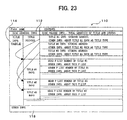
- the object information table relating to the TS object 142 will be mentioned later in detail (see figs. 15-19, FIG. 22, FIG. 25 and FIG. 26).
- FIG. 5(b) conceptually illustrates that the video or audio stream for program #3 (PG3) in the upper stage (individual stream conforming to MPEG2 program stream standard) and the stream for program #4 (PG4) in the middle stage (individual stream also conforming to MPEG2 program stream standard) are multiplexed, and the program stream (PS) for these two programs (PG3 and PG4) is formed, under an assumption that a horizontal axis is defined as a time axis.
- the video data for program #3 is packetized by the PS pack 146 (e.g. a data length of 2048 bytes) usually larger than the TS packet 146 in FIG. 5(a) (e.g. packet having a data length of 192 bytes including the packet arrival stamp 145 or the like as shown in FIG. 4), and arranged discretely along to the time axis (horizontal axis).
- the video data for program #4 is packetized by the PS pack 146PS, and arranged discretely along to the time axis (horizontal axis).
- these PS packs 146 are multiplexed to form the program stream for these two programs (in the lower stage).
- the stream made of PS packs obtained by packetizing the sub picture data or the stream made of PS packs obtained by packetizing the audio data may be packetized as the stream for program #1, as shown in FIG. 2(c).
- the stream made of PS packs obtained by packetizing the audio data or the stream made of PS packs obtained by packetizing the sub picture data may be also multiplexed, as the stream for program #4.
- the stream ID is given to the video stream and the audio stream in the MPEG program stream, and thereby a specific video stream or a specific audio stream to be reproduced is selected from a whole program stream (see FIG. 2(c) and FIG. 5(b)) to perform the reproduction.
- the sub stream ID is given to an encoded audio stream such as LPCM assigned to the private stream.
- a specific stream to be reproduced is selected from a whole program stream to perform the reproduction.
- the stream ID or the sub stream ID is recorded, for each stream, in the ES map table and the object information table including AU table.
- the object information table relating to the PS object will be mentioned later in detail, with the specific example (see figs. 20-22, FIG. 25 and FIG. 27).
- the identification information indicating that the object is a still picture is given to the still object in the object data 140ST relating to the still picture shown in FIG. 3. Thereby, a specific still picture information to be reproduced is selected to perform the reproduction.
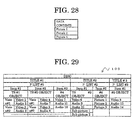
- the object information table relating to the still picture object will be mentioned later in detail, with the specific example (see FIG. 28, FIG. 29 and FIG. 32).
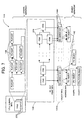
- FIG. 7 schematically illustrates the logical structure of data on the optical disc 100, focusing on the development from the logical hierarchy to the object hierarchy or the entity hierarchy.
- each title 200 logically consists of one or more playlists 126.
- the plurality of playlists may have a sequential structure or may have a branch structure.
- one title 200 consists of one playlist 126.
- one playlist 126 may be referred to from a plurality of titles 200.
- Each playlist 126 is logically made of a plurality of items (play items) 204.
- a plurality of items 204 may have the sequential structure or may have the branch structure.
- one item 204 may be referred to from a plurality of playlists 126.
- the aforementioned in-point information and out-point information described by the item 204 logically designates the reproduction range of the TS object 142, the PS object 142PS or the still picture object 142ST (hereinafter referred to as "TS object 142 and the like" as appropriate).
- TS object 142 and the like the object information 130d about the logically designated reproduction range is referred to and thereby the reproduction range of the TS object 142 and the like is physically designated, via the file system finally.
- the object information 130d includes various information to reproduce the TS object 142 and the like, such as the attribute information of the TS object 142 and the like, the ES address information 134d and the like required for the data search in the TS object 142 and the like (incidentally, the ES map table 134 shown in FIG. 3 includes a plurality of ES address information 134d).
- the in-point information and out-point information recorded on/in the item 204, as well as the ES address information 134d recorded in the ES map table 134 (see FIG. 3) of the object information 130d make it possible to perform the association from the logical hierarchy to the object hierarchy in the reproduction sequence so that the elementary stream is reproduced.
- units of the TS packet 146 or PS pack 146PS(see figs. 5 and 6) are multiplexed on the optical disc 100.
- the transport stream and program stream including a plurality elementary stream as shown in FIG. 2(b) and FIG. 2(c) can be recorded onto the optical disc 100.
- a plurality of programs can be recorded at the same time, within the restriction of the record rate.
- record method in which a plurality of programs is multiplexed relative to one TS object 142 and the like for the recording.
- the information record and reproduction apparatus is constructed so as to record and reproduce both the transport stream and the program stream on the same optical disc 100.
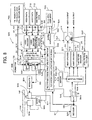
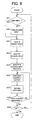
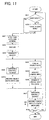
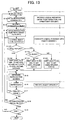
- FIG. 8 is a block diagram of the information record and reproduction apparatus, and each of FIG. 9 to FIG. 13 illustrates the operational flow of the information record and reproduction apparatus.
- the information record and reproduction apparatus 500 is roughly divided into a reproduction system and a record system.
- the information record and reproduction apparatus 500 is constructed to record the information onto the optical disc 100 mentioned above and reproduce the information recorded thereon/therein.
- the information record and reproduction apparatus 500 is thus for recording and reproduction.
- the information recode apparatus of the present invention can be constructed with the record system of the information record and reproduction apparatus 500 and the information reproduction apparatus of the present invention can be constructed with the reproduction system of the information record and reproduction apparatus 500.
- the information record and reproduction apparatus 500 is provided with: an optical pickup 502; a servo unit 503; a spindle motor 504; a decoder 506; a demultiplexer 508; a video decoder 511; an audio decoder 512; a sub picture decoder 513; an adder 514; a system controller 520; a memory 530; a still picture decoder 540; a modulator 606; a formatter 608; a TS/PS object generator 610; a video encoder 611; an audio encoder 612; and a sub picture encoder 613.
- the system controller 520 includes a file system/logical structure data generator 521 and a file system/logical structure data reader 522.
- the memory 530 and a user interface 720 to give a user input such as title information are connected to the system controller 520.
- the decoder 506, the demultiplexer 508, the video decoder 511, the audio decoder 512, the sub picture decoder 513, the adder 514 and the still picture decoder 540 mainly constructs the reproduction system.
- the modulator 606, the formatter 608, the TS/PS object generator 610, the video encoder 611, the audio encoder 612 and the sub picture encoder 613 mainly constructs the record system.
- the optical pickup 502, the servo unit 503, the spindle motor 504, the system controller 520, the memory 530 and the user interface 720 to give the user input such as title information are generally shared for both the reproduction system and the record system.
- an object data source 700 as a data source of TS object data, PS object data and still picture data; a video data source 711; an audio data source 712; and a sub picture data source 713 are prepared.
- the file system/logical structure data generator 521 disposed in the system controller 520 is used mainly in the record system, and the file system/logical structure reader 522 is used mainly in the reproduction system.
- the optical pickup 502 irradiates light beam LB such as laser beam onto the optical disc 100, at the first power as reading light during the reproduction, and modulates and irradiate LB at the second power as writing light on recording.
- the servo unit 503 performs the focus servo, the tracking servo and the like for the optical pickup 502, as well as the spindle servo for the spindle motor 504, under control of the control signal Sc1 outputted from the system controller 520, during the reproduction and recording.
- the spindle motor 504 is controlled under the spindle servo by the servo unit 503, for rotating the optical disc 100 at a predetermined speed.
- the object data source 700 may be made of the storage such as a video tape, a memory, for storing the object data D1 that corresponds to the TS object data, the PS object data or the still picture data.
- an information of each title (e.g. the construction or the contents of the playlist etc.) to be logically constructed on the optical disc 100 using the object data D1 is inputted into the system controller 520, as the user input 12 such as the title information, via the user interface 720.
- the system controller 520 takes in the user input 12 such as the title information via the user interface 720 (step S21: Yes, and step S22).
- the user interface 720 under control of the control signal Sc4 from the system controller 520, can perform the input operation in response to the contents to be recorded, such as the selection via the title menu screen.
- step S21: No these processes are omitted.
- the object data source 700 outputs the object data D1, under control of the control signal Sc8 to instruct the data reading from the system controller 520.
- the system controller 520 takes in the object data D1 from the object data source 700 (step S23), and performs the data array analysis (e.g. a record data length and the like) of the object data D1, the analysis of each elementary stream structure (e.g. interpretation of ES_PID (elementary stream/packet identification number)), on the basis of the PAT, the PMT and the like packetized with the video data as mentioned above, due to the TS analysis function in the file system/logical structure data generator 521. Alternatively, due to the PS analysis function in the file system/logical structure data generator 521, it may perform the interpretation of each stream structure in the program stream (e.g. interpretation of stream ID or sub stream ID) (step S24).
- the data array analysis e.g. a record data length and the like
- the analysis of each elementary stream structure e.g. interpretation of ES_PID (e
- the system controller 520 makes the file system/logical structure data generator 521 generate the disc information file 110, the playlist information file 120, the object information file 130 and the file system 105 (see FIG. 3), as the logical information file data D4, on the basis of the analysis result of each elementary stream and the data array of the object data D1, as well as the user input 12 such as the taken in title information (step S25).
- the memory 530 is used to generate this logical information file data D4.
- the formatter 608 is for formatting the data array to store both the object data D1 and the logical information file data D4 on the optical disc 100. More specifically, the formatter 608 is provided with a switch Sw1 and a switch Sw2 and is switching-controlled by a switch control signal Sc5 from the system controller 520. When formatting the TS object data D1, it connects the switch Sw1 to a 1 ⁇ side and the switch Sw2 to the 1 ⁇ side so as to output the TS object data D1 from the TS object data source 700. Incidentally, the transmission control of the TS object data D1 is performed by the control signal Sc8 from the system controller 520.
- the formatter 608 is switching-controlled by the switch control signal Sc5 from the system controller 520, and connects the switch Sw2 to a 2 ⁇ side so as to output the logical information file data D4.
- step S26 in FIG. 9 (i) the logical information file data D4 from the file system / logical structure data generator 521 at the step S25 or (ii) the TS object data D1 from the TS object data source 700 is outputted through the formatter 608 by the switching-control by the formatter 608 as constructed above (step S26).
- the output selectively outputted from the formatter 608 is transmitted to the modulator 606 as disc image data D5, is modulated by the modulator 606, and is recorded onto the optical disc 100 through the optical pickup 502 (step S27).
- the system controller 520 also performs the disc record control in this case.
- step S29 it is judged whether or not the recording onto the optical disc 100 is to be ended, on the basis of the presence or absence of an end command (step S29). If it is not to be ended (step S29: No), the operational flow returns to the step S21, continuing the record processing. On the other hand, if it is to be ended (step S29: Yes), a series of record processing ends.
- the information record and reproduction apparatus 500 performs the record processing in the case of using the already prepared TS object.
- the example in FIG. 9 shows that the logical information file data D4 and the corresponding object data D1 are outputted at the step S26, after preparing the logical information file data D4 at the step S25.
- the object data source 700 is provided with a receiver (set top box) for receiving the digital broadcast on air, for example, receives the object data D1, and transmits it to the formatter 608 in real time (step S41).
- reception information D3 i.e. information corresponding to the data transmitted through the receiver and the interface of the system controller 520
- the object data D1 outputted to the formatter 608 is outputted to the modulator 606 by the switching-control of the formatter 608 (step S42), and is recorded onto the optical disc 100 (step S43).
- the file system / logical structure data generator 521 prepares the logical information file data D4 (step S24 and step S25). Then, after the completion of recording a series of the object data D1, this logical information file data D4 is additionally recorded onto the optical disc 100 (step S46 and step S47). Incidentally, these steps S24 and S25 may be performed after the step 543.
- the information record and reproduction apparatus 500 performs the record processing in the case of receiving the transport stream or program stream on air and recording it in real time.
- the video data source 711, the audio data source 712, and the sub-picture data source 713 are individually provided with the storage, such as a video tape and a memory, and store a video data DV, an audio data DA, and a sub-picture data DS, respectively.
- These data sources are controlled by the control signal Sc8, giving an instruction for reading out the data, from the system controller 520. And these data sources transmit the video data DV, the audio data DA, and the sub-picture data DS, to the video encoder 611, the audio encoder 612, and the sub-picture encoder 613, respectively (step S61). Then, the video encoder 611, the audio encoder 612, and the sub-picture encoder 613 perform a predetermined type of encode processing (step S62).
- the TS/PS object generator 610 is controlled by a control signal Sc6 from the system controller 520 and converts the data encoded in this manner to the TS object data constituting the transport stream or the PS object data constituting the program stream (step S63).
- the data array information of each TS object data e.g. a record data length and the like
- the construction information of each elementary stream e.g. the ES_PID, as described later, and the like
- the data array information of each PS object data and the construction information of the program stream e.g. the stream ID, the sub stream ID and the like
- the object data D2 that is the TS object data or the PS object data generated by the TS/PS object generator 610 is transmitted to the (2) side of the switch Sw1 of the formatter 608.
- the formatter 608 is switching-controlled by the switch control signal Sc5 from the system controller 520 to shift the switch Sw1 to the 2 ⁇ side and the switch Sw2 to the 1 ⁇ side, thereby outputting the object data D2 (step S64).
- this object data D2 is recorded onto the optical disc 100 through the modulator 606 (step S65).
- the file system / logical structure data generator 521 prepares the logical information file data D4 (step S24 and step S25). Then, after the completion of recording a series of the object data D2, this is additionally recorded onto the optical disc 100 (step S67 and step S68). Incidentally, the step S24 and the step S25 may be processed after the step S65.
- the occasion demands e.g. in the case of editing one portion of the title
- the information record and reproduction apparatus 500 performs the record processing in the case of recording the video data, the audio data, and the sub-picture data, which are individually prepared in advance.
- this record processing is applicable even when recording an arbitrary content the user has.
- an authoring system generates the TS object or the PS object, the logical information file data, and the like in advance (step S81), and then completes the processing of switching-control performed at the formatter 608 (step S82). Then, the information obtained by this operation is transmitted to the modulator 606 equipped in front side and/or back side of an original disc cutting machine, as the disc image data D5 (step S83), and this cutting machine prepares the original disc (step S84).
- the title to be reproduced from the optical disc 100, its reproduction condition and the like are inputted to the system controller 520, as the user input 12 such as the title information and the like.
- the input processing suitable for the content to be reproduced such as a selection on a title menu screen, can be performed by the user interface 720.
- the system controller 520 controls the disc reproduction with respect to the optical disc 100, and the optical pickup 502 transmits a reading signal S7 to the demodulator 506.
- the demodulator 506 demodulates a recorded signal recorded onto the optical disc 100 from this reading signal S7, and outputs it as demodulated data D8.
- the logical information file data i.e. the file system 105, the disc information file 110, the P list information file 120, and the object information file 130, shown in FIG. 3 as being a not-multiplexed information part included in this demodulated data D8 are supplied to the system controller 520.
- the system controller 520 On the basis of this logical information file data, the system controller 520 performs various reproduction control, such as processing of determining a reproduction address and controlling the optical pickup 502.
- the demultiplexer 508 is controlled by a control signal Sc2 from the system controller 520 to demultiplex the object data.
- the control signal Sc9 shifts the switch Sw3 to 1 ⁇ side (i.e. the demultiplexer 508 side) for the switching control, and the control signal Sc2 controls the demultiplexer 508 so as to start demultiplexing in a timing suitable for the TS object or in a timing suitable for the PS object.
- the control signal Sc2 switches the internal processing for TS or for PS, and thereby the demultiplexer 508 transmits and supplies the video packet, the audio packet and the sub-picture packet to the video decoder 511, the audio decoder 512 and the sub-picture decoder 513, respectively. Then, the object data is decoded and thereby the video data DV, the audio data DA and the sub-picture data DS are respectively generated.
- the packets obtained by packetizing the PAT or the PMT, included in the transport stream shown in FIG. 6, are included respectively as a part of the demodulated data D8; however, they are discarded or abandoned at the demultiplexer 508.
- the demodulated data D8 includes the still picture data in JPEG format, the bitmap format and the like, the ES map table or the like in the object information file is referred to, and thereby the system controller firstly detects that the still picture data is included. Then, the system controller 520 shifts the switch Sw3 to (2) side (i.e. the still picture decoder 540 side) for the switching control by the control signal Sc9b. Thereby, the still picture data included in the demodulate data D8 is appropriately decoded by the still picture decoder 540. Then, the still picture decoder 540 outputs the decode process result as the still picture data DST to the adder 514.
- the adder 514 is controlled by a control signal Sc3, giving an instruction of the mixing, from the system controller 520, and mixes or superimposes in a predetermined timing the video data DV and the sub-picture data DS, which are respectively decoded at the video decoder 511 and the sub-picture decoder 513. Alternatively, it mixes or superimposes the still picture data DST from the still picture decoder, or outputs it alone. The result is outputted as a video output from the information record and reproduction apparatus 500 to a TV monitor, for example.
- the audio data DA decoded at the audio decoder 512 is outputted as an audio output from the information record and reproduction apparatus 500 to an external speaker, for example.
- FIG. 13 it is assumed that as an initial condition, the recognition of the optical disc 100 in the reproduction system and the recognition of a volume structure and a file structure by the file system 105 (see FIG. 3) have been already completed by the system controller 520 and the file system / logical structure data reader 522 inside the system controller 520.
- the operational flow after obtaining the total quantity of the total titles from the disc general information 112 in the disc information file 110 and then choosing or selecting one title from among them.
- step S11 the choice or selection of the title is performed via the user interface 720 (step S11), and the system controller 520 obtains the information about the reproduction sequence from a reading result of the file system / logical structure data reader 522. More specifically, the processing in the logical hierarchy (i.e. obtaining the information for indicating a playlist structure and the information about each of the Items constituting the playlist_(see FIG. 7)) is performed (step S12). By this, a reproduction object is determined (step S13).
- the object information file 130 relating to the TS object, the PS object or the still picture object as being the reproduction object is obtained.
- the AU (Association Unit) information 138 and the PU (Presentation Unit) information 302I are also obtained as the information stored in the object information file 130 (step S14). These obtained information allow the association or correlation from the above described logical hierarchy to the object hierarchy (see FIG. 7).
- the object to be reproduced next is determined (step S141).
- step S142 it is judged whether the determined object to be reproduced is the still picture object or not. If it is not the still picture object (step S142: No), it is judged whether it is the TS object or not (step S143).
- step S143 if it is the TS object (step S143: Yes), the control signal Sc9 from the system controller 520 shifts the switch Sw3 to 1 ⁇ side, and the control signal Sc2 from the system controller 520 sets the demultiplexer 508 for the TS (step S144).
- step S143 if it is not the TS object (step S143: No), the control signal Sc9 from the system controller 520 shifts the switch Sw3 to (1) side, and the control signal Sc2 from the system controller 520 sets the demultiplexer 508 for the PS (step S145).
- step S142 if it is the still picture object (step S142: Yes), the control signal Sc9 from the system controller 520 shifts the switch to 2 ⁇ side (step S146).
- step S15 the reproduction address of the object to be reproduced is determined (step S15) and then the object hierarchy processing is started, i.e. the reproduction is actually started (step S16).
- step S17 it is monitored whether or not a command for a "scene switching" corresponding to switching PU 302 in the AU 138 based on the AU information 138 and the PU information 302I as mentioned below is inputted (step S17).
- the command for the "scene switching" is inputted (step S17: Yes)
- step S15 the operational flow goes back to step S15 to repeat the processings from step S15 to step S17.
- step S18 it is judged whether or not reproductions of all objects to be reproduced are completed. At this stage, if reproductions of all objects to be reproduced are not completed (step S18: No), the operational flow goes back to step S14 to repeat the following processings.
- step S18 if reproductions of all objects to be reproduced are completed (step S18: Yes), it is judged whether or not a command to terminate the reproduction processing is inputted (step S19). At this stage, if the termination command is not inputted (step S19: No), the operational flow goes back to step S11 to repeat processings from step S11 to step S19. On the other hand, if the termination command is inputted (step S19: Yes), a series of reproduction processing ends.
- FIG. 14 schematically illustrates an entire access flow on reproduction, in relation to the logical structure of the optical disc 100.
- the logical structure of the optical disc 100 is categorized roughly into the following three hierarchies: a logical hierarchy 401; an object hierarchy 403; and a logical-object association hierarchy 402 mutually associating those two hierarchies.
- the logical hierarchy 401 is a hierarchy for logically specifying various logical information to be used to reproduce the desired title when reproducing, as well as the playlist (P list) to be reproduced and its construction.
- disc information 110d indicating the entire titles 200 and the like on the optical disc 100 is written within the disc information file 110 (see FIG. 3), and further, reproduction sequence information 120d of the entire contents on the optical disc 100 is written within the playlist information file 120 (see FIG. 3). More specifically, as the reproduction sequence information 120d, the construction of one or more playlists 126 is written in each title 200, and the construction of one or more Items 204 (see FIG. 7) is written in each playlist 126. Then, at the time of the access during the reproduction, the logical hierarchy 401 as described above specifies the title 200 to be reproduced, the playlist 126 corresponding to this title 200, and further the Item 204 corresponding to this playlist 126.
- the logical-object association hierarchy 402 is a hierarchy for specifying the attribute and the physical storing address of various object data in the object data file 140 to be reproduced, so as to specify the combination and/or the construction of the TS object data, the PS object data and the still picture data in the object data file 140 as being the entity data and to perform an address conversion to the object hierarchy 403 from the logical hierarchy 401, on the basis of the information specified in the logical hierarchy 401 as described above.
- the object information data 130d which separates a group of the contents constituting each Item 204 into units of the AU 138 and which finely separates each AU 138 into units of the PU 302, is written in the object information file 130 (see FIG. 3).
- the "PU (Presentation Unit) 302" is a unit associating and uniting a plurality of elementary streams by the reproduction switchable unit. If there are three audio streams in the PU 302, the user can freely switch these three audio (e.g. audio for each language), during the reproduction of this vision.
- the "AU (Associate Unit) 138" is a unit uniting a plurality of elementary streams such as the video stream in the TS object used in one title, and made of one or more PU 302. More specifically, it is a unit uniting the elementary stream packet IDs (ES_PID) for each TS object, indirectly via the PU 302.
- This AU 138 corresponds to an assembly made of a plurality of programs having a specific inter-relationship in view of the contents, such as a plurality of programs switchable to each other in the multi-source broadcasting.
- the PU 302 belonged to the same AU 138 corresponds to assembly made of one or more elementary stream each constructing a plurality of programs switchable to each other by the user operation during the reproduction.
- the elementary stream to be reproduced is identified. That is, if the TS object is recorded, a desired elementary stream can be reproduced from the multi-recorded optical disc 100, without using the PAT or the PMT shown in FIG. 6.
- the elementary stream to be actually reproduced is identified or designated by the ES_PID that is a packet ID (see FIG. 6) of the elementary stream, on the basis of the PU information 302.
- the information indicating the start time point and the end time point of the reproduction is converted to the elementary stream address information, and thereby the contents in a specific area (or a specific time range) of a specific elementary stream is reproduced.
- the stream in the program stream to be actually reproduced is identified or designated by a stream ID or sub stream ID of each stream, on the basis of the PU information 302.
- the information indicating the start time point and the end time point of the reproduction is converted to the address information of each stream, and thereby the contents in a specific area (or a specific time range) of a specific stream is reproduced.
- the address information, the data length and the data format of each still picture data are identified or designated, on the basis of the ES map table (see FIG. 32) for the still picture.
- an address conversion is performed from a logical address relating to each item 204 to a physical address relating to each PU 302.
- the object hierarchy 403 is a physical hierarchy to reproduce various data in the actual object data file 140.
- the TS object data, the PS object data and the still picture data are written within the object data file 140 (see FIG. 3).
- TS packets 146 constructing a plurality of elementary streams are multiplexed.
- the multiplexed packets are disposed along the time axis to form the transport stream (see FIG. 5(a)).
- a plurality of TS packets multiplexed at each time point is associated with the PU 302 identified by the logical-object association hierarchy 402, for each elementary stream.
- PS packs 146PS constructing a plurality of video streams, audio streams, sub picture streams are multiplexed.
- the multiplexed PS packs are disposed along the time axis to form the program stream (see FIG. 5(b)).
- a plurality of PS packs which is multiplexed is associated with the PU 302 identified in the logical-object association hierarchy 402, for each stream.
- it is possible to associate a plurality of PUs 302 with one stream e.g. the same audio stream is shared or the same sub picture stream is shared in a plurality of switchable programs).
- the still picture data it is stored as the object file for the still picture in JPEG format, bitmap format and the like, separately from the aforementioned transport stream or program stream (see FIG. 3).
- the still picture data packetized by the TS packet or the PS pack or not packetized is associated with the PU 302 identified by the logical-object association hierarchy 402.
- it is possible to associate a plurality of PUs 302 with one still picture data e.g. the same still picture data is shared in a plurality of switchable programs).
- the object data is actually performed, using the physical address obtained from the conversion in the logical-object association hierarchy 402.
- the three hierarchies shown in FIG. 14 allow the performing of the access with respect to the optical disc 100 during the reproduction.
- FIG. 15 schematically illustrates the data structure of the TS objects #1 and #2 including a plurality of elementary streams.
- FIG. 16 schematically illustrates the data structure of the PAT and the PMT of the TS object #1 in also this specific example.
- FIG. 17 schematically illustrates the data structure of the PAT and the PMT of the TS #2 object in also this specific example.
- FIG. 18 schematically illustrates the data structure of the TS #3 object in also this specific example.
- FIG. 19 schematically illustrates the data structure of the PAT and the PMT of the TS #3 object in also this specific example.
- FIG. 20 and FIG. 21 schematically illustrate the data structure of the PS objects #4 and #5 including a plurality of video streams and audio streams in also this specific example.
- FIG. 22 schematically illustrates the data structure finally constructed on the optical disc 100.
- title #1 is made of the TS #1 object and the TS #2 object by directly using the transport stream used in digital broadcasting, as two TS objects (see FIG. 3).
- "Program 1" in FIG. 15 is dual broadcasted using two programs whose program map packet ID ("Program Map PID” in FIG. 15) is "100" and "200” respectively, and whose program number (“Program No.” in FIG. 15) is "1" and "2" respectively.
- "Program 2" in FIG. 15 is normal broadcasting using one program whose program map packet ID is "300” and whose program number is "3".
- the elementary streams (ES) corresponding to the program whose program number is “1” are "Video 1 (Video Stream 1)", “Audio 1 (Audio Stream 1)” and “Audio 2 (Audio Stream 2)", and their elementary stream packet IDs (ES_PID) are "101", "102” and "103", respectively (see FIG. 6).
- the contents or packet IDs of other elementary streams (ES) are also shown in FIG. 15.
- the PAT Program Association Table
- the PMT Program Map Table
- the packet ID is set to a reference value "000" for example, on the basis of which the PAT can be firstly identified from among a plurality of packets multiplexed at each time point (see FIG. 6). Furthermore, by referring to the contents of the identified PAT, it is possible to identify the PMT from among a plurality of packets multiplexed at each time point (see FIG. 6), on the basis of "packet ID (e.g. "100") of the PMT for program 1", “packet ID (e.g. "200”) of the PMT for program 2", or "packet ID (e.g. "300") of the PMT for program 3".
- packet ID e.g. "100" of the PMT for program 1
- packetet ID e.g. "200
- packet ID e.g. "300
- the TS packet obtained by packetizing the contents to be reproduced, from among a plurality of packets multiplexed at each time point (see FIG. 6). For example, if the PMT for program 1 is identified, the TS packet can be identified on the basis of "packet ID of TS packet for video stream 1 (e.g. 101)", "packet ID of TS packet for audio stream 1 (e.g. 102)” or "packet ID of TS packet for audio stream 2 (e.g. 103)". Furthermore, if the PMT for program 2 or the PMT for program 3 is identified, it is possible to identify the TS packet to be reproduced.
- packet ID of TS packet for video stream 1 e.g. 101
- packet ID of TS packet for audio stream 1 e.g. 102
- packet ID of TS packet for audio stream 2 e.g. 103
- a set of data constructing a series of transport stream used for the broadcasting (e.g. a unit or the like broadcasted continuously without CM (commercial message)) is treated as the "TS object" (see FIG. 3). It is assumed that, on broadcasting, two programs are firstly transmitted via three programs using TS #1 object, and the program 2 then ends along the elapse of time, and the program 1 is continuously broadcasted by the TS #2 object with an intermittence of CM. Therefore, the program sequence is switched during the broadcasting.
- the PAT and the PMT during the broadcasting are constructed to identify two PMTs by one PAT and to identify individual TS packets of the elementary stream to be reproduced by each PMT.
- one title #1 is constructed directly using the TS #1 object and the TS #2 object during the broadcasting without CM contents.
- title #2 is constructed using the TS #3 object.
- This TS #3 object is authored to be stored in advance as ROM contents, and having especially two sub picture data elementary streams (i.e. "sub picture 1" and "sub picture 2" as ES contents in FIG. 18), in addition to the video data elementary streams and audio data elementary streams.
- the PAT and the PMT also have simple structures.
- PS object #4 (#4 object (MPEG-PS data)) includes one video stream “Video 7" and two audio streams “Audio 11" and "Audio 12", to which stream IDs are individually given.
- "Audio 12" is a private stream to which a sub stream ID is given in addition to a stream ID.
- PS object #5 includes one video stream “Video 8" and two audio streams “Audio 13" and “Audio 14", to which stream IDs are individually given.
- “Audio 14" is a private stream to which a sub stream ID is given in addition to a stream ID.
- the sub stream ID makes it possible to identify each stream recorded in one private stream from each other.
- the sub stream ID is not given.
- the sub stream ID is not given.
- MPEG private stream is identified by the stream ID "1011 1101”. In this case, the sub stream ID is given.
- the data structure constructed on the optical disc 100 discussed with reference to FIG. 15 to FIG. 21 is summed up as shown in FIG. 22.
- the optical disc 100 has a data structure in which three titles are constructed by three TS objects (#1-#3) and two PS object (#4 and #5).
- the "program 1" dual-broadcasted is logically re-constructed as a multi-vision type title (i.e. a type that the user can freely switches to see) similar to an "angle switching" in DVDs.
- the audio stream such as "Audio 1" of TS #1 object and "Audio 6" of TS #2 object are not used, and the elementary stream of the "program 2" is not used for this title.
- the video stream and the like constructed by the PS object can be united by AU and PU unit to form a multi-vision type title, similarly to the case of TS object.
- title #1 consists of both the TS object and the PS object on the same optical disc 100
- title #2 consists of only the TS object
- title #3 consists of only the PS objects.
- the optical disc 100 having the data structure such that can be subjected to the recording and reproduction by the information record and reproduction apparatus mentioned above, without a special conscious of the user whether each object is recorded in the transport stream or recorded in the program stream. This is practically very convenience.
- FIG. 23 schematically illustrates a specific example of the data structure of the disc information file 110.
- the disc information file 110 stores the disc general information 112, the title information table 114 and other information 118.
- the disc general information 112 is general information such as total title quantity information and/or disc volume information, indicating a serial number of a series of contents that may consist of a plurality of optical discs 100.
- the title information table 114 stores the entire playlist/playlists constructing each title.
- the title information table 114 further stores other information such as in-title chapter information as information for each title.
- the title information table 114 includes title pointer information, title #1 information, title #2 information, etc.
- the "title pointer information" is storing address information of title #n, i.e. the storing address information indicating a storing position of title #n in the title information table, in which the relationships are indicated by arrows.
- the title pointer information is recorded by a relative logical address.
- the title pointer information whose quantity corresponds to the quantity of titles in the optical disc 100 are listed as the relative logical address in the order of titles.
- data amount of each storing address information may be fixed byte, or may be variable byte.
- other information 118 is information about each title, such as a quantity of general playlist and/or title type such as sequential type or branch type.
- FIG. 24 schematically illustrates the data structure of the playlist information table 121 constructed in the playlist information file 120.
- the playlist information file 120 stores, for each field, the playlist general information 122, the playlist pointer table 124, the playlist #1 information table and the playlist #2 information table 126, as the playlist information table 121 (see FIG. 3).
- Each field may have a structure capable of adding tables as many as required. For example, if there are four playlists, each field may have a structure to increase the field to four. The same can be said to the item information table129.
- the playlist table size and other information such as the total quantity of playlist are recorded in the playlist general information (P list general information) 122 among them.
- the playlist pointer table (P list pointer table) 124 stores record position addresses of individual playlists as relative logical addresses in the playlist information table 121. Its relationships are shown by arrows in FIG. 24.
- the playlist #1 information table (P list #1 information table) 126 stores the general information about playlist #1, the item information table of playlist #1 (P list item information table) 129 and other information. The same types of information about playlist #2 are recorded also in the playlist #2 information table 126.
- the "item information table” 129 stores item information for all items constructing one program.
- the AU number in the AU (Associate Unit) table that is recorded in the "item #1 information" or the "item #2 information” is a number of the AU that stores information to identify an address of the TS object to be used for the item reproduction and/or each elementary stream (i.e. video stream, audio stream or sub picture stream) in the TS object to be used for the item reproduction.
- FIG. 25 schematically illustrates a specific example of the data structure of the object information table 131 (see FIG. 3) constructed in the object information file 130.
- FIG. 26 schematically illustrates a specific example of the data structure of the ES map table (#1) 134-1 for TS objects #1-#3 (see FIG. 15 to FIG. 19) constructed in the object information file 130 and associated with the object information table 131 in FIG. 25, i.e. an exemplary ES map table 134 shown in FIG. 3.
- FIG. 27 schematically illustrates a specific example of the data structure of the ES map table (#2) 134-2 for PS objects #4 and #5 (see FIG. 20 and FIG. 21) constructed in the object information file 130 and associated with the object information table 131 in FIG. 25, i.e. another exemplary ES map table 134 shown in FIG. 3.
- the AU table 137 is constructed as a part of the object information table 131, in the object information file 130
- the AU table 137 may have a structure of each field capable of adding tables as many as required. For example, if there are four AUs, each field may have a structure to increase the fields to four.
- the AU table 137 stores the "AU table general information", in which quantity of AU and pointers to individual AUs and so on are recorded, the "packet number discrete information" and “other information” in another field.
- the "AU” is a unit corresponding to a program in TV broadcasting as mentioned above (particularly, a unit made of a plurality of united switchable "visions" in multi-vision broadcasting), in which one or more PUs as reproduction units are included.
- the "PU” is a set of elementary streams included in each AU as mentioned above and switchable to each other.
- the PU information 302I identifies the ES table index # corresponding to each PU.
- multi-view contents consists of AU
- a plurality of PUs are stored in the AU
- pointers to a plurality of elementary stream packet IDs indicating packets constructing each view contents are stored in each PU. This indicates an index number in the ES map table mentioned below.
- the object general information in the object information table 131 includes the information 601 indicating total quantity of object information, each object type (i.e. TS object, PS object, still picture object), pointers to each object information and so on.
- each object type i.e. TS object, PS object, still picture object
- discrete information 602 which indicates a number of the packet being discrete state in a case that a packet drop out occurs in a packet serial number in the aforementioned TS object 142 during the editings, is added to the object information 133.
- the packet number can be counted taking into account the discrete state indicated by the discrete information (starting from the packet designated by the elementary stream) and thereby the packet address to be accessed can be identified, even if the packet number is not newly added when the packet drop out occurs.
- the discrete information includes a start point of the discrete state and the quantity of the packet/packets dropped out.
- the ES map table (#1) 134-1 corresponding to the TS object #1-#3 is constructed as another part of the object information table, in the object information file 130.
- Each of the "Index #L” includes the elementary stream packet ID (ES_PID) and the address information of the elementary stream, which is used for the reproduction, and so on.
- the TS packet number at the head of the I picture and the corresponding display time are only recorded in the ES map table 134 as the ES address information 134d. This can reduce the data amount.
- the elementary stream packet ID (ES_PID) of the actual elementary stream can be obtained from the index number of the ES map 134-1 designated by the AU table 137. Furthermore, since the address information of the elementary stream corresponding to the elementary stream packet ID can be obtained at the same time, the object data can be reproduced on the basis of these information.
- the ES map table (#2) 134-2 corresponding to the PS object #4 and #5 is constructed as another part of the object information table, in the object information file 130.
- Each of the "Index #L" includes the stream ID 603 and the sub stream ID 604, each of which is to be used for the reproduction, and the access unit address information 605 corresponding to it.
- the stream to be reproduced can be distinguished from other streams by the stream ID and the sub stream ID from the index number of the ES map table 134-2 designated by the AU table 137. Furthermore, the address of the access unit relating to the to-be-reproduced stream can be obtained. Thereby, the object data can be reproduced on the basis of these information.
- the address information of the access unit shown in FIG. 27 is sufficient for the access, even if it is not recorded for each stream.
- the address information of the access unit is preferably recorded for each program and used commonly among a plurality of streams constructing the program. This can reduce the data amount of the address information.
- the address information of the access unit may be recorded for each stream. Thereby, one sub picture data can be used among a plurality of access units.
- the object information 133 can be recorded for each object such as the TS object and the PS object and the "packet length" can be recorded for each object (see FIG. 25) so that the control based on the AU and PU (i.e. the reproduction control using the AU and PU explained focusing on the TS object as mentioned above) is performed in the same manner for both a TS object application and a PS object application.
- a program made of one PS object can be used as one title #3 like as the PS object #5 shown in FIG. 22.
- the TS object and the PS object can be combined and then used in one title like as title #1 shown in FIG. 22.
- the required information can be simply added, even if a new title is required to be added to the optical disc 100.
- certain information is no longer required as the result of the editings, it is no need to delete the certain information from the table insofar as the information is not simply referred to. This is advantageous.
- the ES_PID that is not referred from the AU table 137 in FIG. 25 is also recorded for each index of the ES map table 134-1. Nevertheless, the ES_PID that is not referred from the AU table 137 does not need to be recorded as such. However, by recording the ES_PID that is not referred from the AU table 137 and preparing the ES map table 134-1 for more flexible application, it is advantageous that the ES map table does not need to be re-constructed to re-edit the contents, for example, in the case of re-doing the authoring.
- the TS objects #1-#3 are united and the corresponding ES map table 134-1 and the corresponding object information 133-1 are constructed
- the PS objects #4 and #5 are united and the corresponding ES map table 134-2 and the corresponding object information 133-2 are constructed.
- the ES map table 134 and the object information 133 may be constructed for each of the TS objects #1-#3 or each of the PS objects #4 and #5.
- FIG. 28 schematically illustrates the data structure of the still picture object #6 including the still picture data in this specific example.
- FIG. 29 schematically illustrates the data structure finally constructed on the optical disc 100.
- the still picture object #6 consists of three still picture data in JPEG format, bitmap format, and the like.
- this object #6 is added to title #2. Thereby, for example, the slide show reproduction can be started, after the reproduction of the TS object constructing item #1 of title #2.
- an independent title may consist of such an object #6.
- the disc information file is the same as that of the first specific example explained with reference to FIG. 23. However, information indicating an object type may be recorded in the disc information file so that the still picture object is indicated as the still picture data.
- FIG. 30 schematically illustrates a specific example of the data structure of the playlist information table 121 constructed in the playlist information file 120.
- item #2 information is added to the item information table in the first playlist #2 information table.
- This item #2 information is about the still picture object, in which the object number, the AU number, and in particular the still picture display time information 600 are recorded. That is, when the item is reproduced, the still picture data is displayed for a time period indicated by this still picture display time information 600.
- Other configurations are the same those of the first specific example shown in FIG. 24.
- FIG. 31 schematically illustrates a specific example of the data structure of the AU table 137 (see FIG. 3) constructed in the object information file 130.
- FIG. 32 schematically illustrates a specific example of the data structure of the ES map table (#3) 134-3 for still picture object #6 (see FIG. 28) constructed in the object information file 130 and associated with the AU table 137 in FIG. 31, i.e. an exemplary ES map table 134 shown in FIG. 3.
- the AU table 137 is constructed as a part of the object information table, in the object file 130.
- object #3 for the still picture is added.
- the information 601 indicating an object type which means that the still picture object corresponds to object #3 is recorded in the object general information.
- Other configurations are the same as those of the first specific example.
- the ES map table (#3) 134-3 is constructed in addition to the ES map tables 134-1 and 134-2 shown in Figs. 26 and 27, in the object information file 130.
- the information indicating the data format, the data length, the address information, and so on are recorded in the ES map table 134-3 for each index, i.e. for each still picture (see FIG. 28).
- the still picture data of index #1-#3 are sequentially reproduced according to the still picture display time information 600 shown in FIG. 30.
- a plurality of programs can be multi-recorded onto the same optical disc 100, regardless of whether the programs are TS objects, PS objects or still picture objects. And further a desired program can be selected and reproduced during the reproduction. Furthermore, such a plurality of programs can be switched to each other quickly.
- the explanation is made to the optical disc 100 as an example of the information record medium and the recorder or player of the optical disc 100 as an example of the information record and reproduction apparatus.
- the present invention is not limited to the optical disc and the player or recorder thereof, but is applicable to various information record medium and the recorder or player thereof, supporting other high density recording or high transfer rate.
- An information recording medium an apparatus for and a method of recording the information, an apparatus for and a method of reproducing the information, an apparatus for and a method of recording and reproducing the information, a computer program for controlling the record or the reproduction, and a data structure including a control signal that accompany such changes are also intended to be within the technical scope of the present invention.
- An information recording medium, a apparatus for and a method of recording the information, an apparatus for and a method of reproducing the information, an apparatus for and a method of recording and reproducing the information, a computer program for controlling the record or the reproduction, and a data structure including a control signal that are associated with the present invention can be applied to a high-density optical disc for consumer or industrial use, such as a DVD, on which various information, such as the video information, the audio information, the sub-picture information, and the reproduction control information, can be recorded at high density and further can be applied to a DVD player, a DVD recorder, and the like. Moreover, they can be applied to an information recording medium, an information record and reproduction apparatus, or the like, which are inserted in or can be connected to various computer equipment for consumer or industrial use, for example.
Landscapes
- Engineering & Computer Science (AREA)
- Multimedia (AREA)
- Signal Processing (AREA)
- Signal Processing For Digital Recording And Reproducing (AREA)
- Television Signal Processing For Recording (AREA)
- Management Or Editing Of Information On Record Carriers (AREA)
Abstract
Description
Claims (20)
- An information record medium onto which a whole stream including a plurality of partial streams each comprising video information or audio information, constructing a series of contents, is multi-recorded by a unit of packet that is a physically accessible unit, said information record medium comprising:an object data file for storing object data comprising a plurality of packets each storing a piece of the video information or the audio information and each being a logically accessible unit;a reproduction sequence file for storing reproduction sequence information defining a reproduction sequence of the object data; andan object information file for storing, as reproduction control information to control a reproduction of the object data file, correspondence definition information for defining a relationship between the plurality of packets and the plurality of partial streams, whereinthe whole stream includes a part packetized in a first encoding format and another part packetized in a second encoding format, and
the object information file further stores, as the reproduction control information, classification information for indicating whether the object data is a first object data conforming to the first encoding format or a second object data conforming to the second encoding format. - The information record medium according to claim 1, wherein the part of the whole stream packetized in the first encoding format is a MPEG transport stream (TS), and the another part of the whole stream packetized in the second encoding format is a MPEG program stream (PS).
- The information record medium according to claim 1, wherein
the object information file stores the correspondence definition information, the correspondence definition information being divided into a table including a part relating to the first object data of the correspondence definition information and a table including a part relating to the second object data of the correspondence definition information. - The information record medium according to claim 1, wherein
the object information file further stores association group definition information for defining, as an association group, a set having a specific relationship from among a series of contents constructing the plurality of partial streams. - The information record medium according to claim 4, wherein
the object information file further stores, as the reproduction control information, sub group definition information for defining, as a sub group, a set of partial streams switchable to each other during a reproduction in the association group. - The information record medium according to claim 1, wherein
the correspondence definition information includes packet identification information for indicating a relationship between a plurality of packets to be multiplexed at the same time point and the plurality of partial streams, for each partial stream, as for the first object data. - The information record medium according to claim 1, wherein
the correspondence definition information includes stream identification information for identifying at least a part of the plurality of packets corresponding to each of the plurality of partial streams, for each partial stream, as for the second object data. - The information record medium according to claim 1, wherein
the object data file stores still picture information as at least a part of the video information,
the object information file further stores address information for indicating a record position of the still picture information, data length information for indicating a data length of the still picture information, and data format information for indicating a data format of the still picture information as for the still picture information. - An information record apparatus for multi-recording a whole stream including a plurality of partial streams each comprising video information or audio information constructing a series of contents by a unit of packet that is a physically accessible unit, onto an information record medium, said information record apparatus comprising:a first record device for recording an object data file for storing object data comprising a plurality of packets each storing a piece of the video information or the audio information and each being a logically accessible unit;a second record device for recording a reproduction sequence file for storing reproduction sequence information defining a reproduction sequence of the object data; anda third record device for recording an object information file for storing, as reproduction control information to control a reproduction of the object data file, correspondence definition information for defining a relationship between the plurality of packets and the plurality of partial streams, whereinthe whole stream includes a part packetized in a first encoding format and another part packetized in a second encoding format, andthe object information file further stores, as the reproduction control information, classification information for indicating whether the object data is a first object data conforming to the first encoding format or a second object data conforming to the second encoding format.
- An information record method of multi-recording a whole stream including a plurality of partial streams each comprising video information or audio information, constructing a series of contents by a unit of packet that is a physically accessible unit, onto an information record medium, said information record method comprising:a first record process of recording an object data file for storing object data comprising a plurality of packets each storing a piece of the video information or the audio information and each being a logically accessible unit;a second record process of recording a reproduction sequence file for storing reproduction sequence information defining a reproduction sequence of the object data; anda third record process of recording an object information file for storing, as reproduction control information to control a reproduction of the object data file, correspondence definition information for defining a relationship between the plurality of packets and the plurality of partial streams, whereinthe whole stream includes a part packetized in a first encoding format and another part packetized in a second encoding format, andthe object information file further stores, as the reproduction control information, classification information for indicating whether the object data is a first object data conforming to the first encoding format or a second object data conforming to the second encoding format.
- An information reproduction apparatus for reproducing a part of the recorded whole stream from the information record medium according to claim 1, said information reproduction apparatus comprising:a read device for physically reading information from the information record medium; anda reproduction device for reproducing the object data included in the information read by the read device, on the basis of the reproduction control information and the reproduction sequence information included in the information read by the read device.
- The information reproduction apparatus according to claim 11, wherein
the reproduction device switches a reproduction processing on the basis of the classification information so that a decoder conforming to the first encoding format performs decoding when the first object data is reproduced, and a decoder conforming to the second encoding format performs decoding the data when the second object data is reproduced. - The information reproduction apparatus according to claim 11, wherein,
the object data file stores still picture information, as at least a part of the video information, and
the reproduction device switches a reproduction processing so that a decoder conforming to the still picture information performs decoding when the still picture information is reproduced. - An information reproduction method of reproducing a part of the recorded whole stream from the information record medium according to claim 1, said information reproduction method comprising:a read process of physically reading information from the information record medium; anda reproduction process of reproducing the object data included in the information read at the read process, on the basis of the reproduction control information and the reproduction sequence information included in the information read at the read process.
- An information record and reproduction apparatus for recording the whole stream onto the information record medium according to claim 1 and reproducing a part of the recorded whole stream, said information record and reproduction apparatus comprising:a first record device for recording the object data file;a second record device for recording the reproduction sequence information file;a third record device for recording the object information file;a read device for physically reading information from the information record medium; anda reproduction device for reproducing the object data included in the information read by the read device, on the basis of the reproduction control information and the reproduction sequence information included in the information read by the read device.
- An information record and reproduction method of recording the whole stream onto the information record medium according to claim 1 and reproducing a part of the recorded whole stream, said information record and reproduction method comprising:a first record process of recording the object data file;a second record process of recording the reproduction sequence information file;a third record process of recording the object information file;a read process of physically reading information from the information record medium; anda reproduction process of reproducing the object data included in the information read at the read process, on the basis of the reproduction control information and the reproduction sequence information included in the information read at the read process.
- A computer program for a record control to control a computer disposed at the information record apparatus according to claim 9, said computer program makes the computer function as at least a part of the first record device, the second record device and the third record device.
- A computer program for a reproduction control to control a computer disposed at the information reproduction apparatus according to claim 11, said computer program makes the computer function as at least a part of the reproduction device.
- A computer program for a record and reproduction control to control a computer disposed at the information record and reproduction apparatus according to claim 15, said computer program makes the computer function as at least a part of the first record device, the second record device, the third record device and the reproduction device.
- A data structure including a control signal, in which a whole stream including a plurality of partial streams each comprising video information or audio information, constructing a series of contents, is multi-recorded by a unit of packet that is a physically accessible unit, said structure comprising:an object data file for storing object data comprising a plurality of packets each storing a piece of the video information or the audio information and each being a logically accessible unit;a reproduction sequence file for storing reproduction sequence information defining a reproduction sequence of the object data; andan object information file for storing, as reproduction control information to control a reproduction of the object data file, correspondence definition information for defining a relationship between the plurality of packets and the plurality of partial streams, whereinthe whole stream includes a part packetized in a first encoding format and another part packetized in a second encoding format, andthe object information file further stores, as the reproduction control information, classification information for indicating whether the object data is a first object data conforming to the first encoding format or a second object data conforming to the second encoding format.
Applications Claiming Priority (3)
| Application Number | Priority Date | Filing Date | Title |
|---|---|---|---|
| JP2002122867 | 2002-04-24 | ||
| JP2002122867A JP2003319339A (en) | 2002-04-24 | 2002-04-24 | Information recording medium, information recording apparatus and method, information reproducing apparatus and method, information recording and reproducing apparatus and method, computer program for recording or reproduction control, and data structure including control signal |
| PCT/JP2003/005292 WO2003092282A1 (en) | 2002-04-24 | 2003-04-24 | Information recording medium, information recording device and method, information reproduction device and method, information recording/reproduction device and method, recording or reproduction control computer program, and data structure including a control signal |
Publications (2)
| Publication Number | Publication Date |
|---|---|
| EP1499123A1 true EP1499123A1 (en) | 2005-01-19 |
| EP1499123A4 EP1499123A4 (en) | 2009-11-11 |
Family
ID=29267468
Family Applications (1)
| Application Number | Title | Priority Date | Filing Date |
|---|---|---|---|
| EP03717724A Ceased EP1499123A4 (en) | 2002-04-24 | 2003-04-24 | INFORMATION RECORDING MEDIUM, INFORMATION RECORDING DEVICE AND METHOD, INFORMATION REPRODUCING DEVICE AND METHOD, INFORMATION RECORDING / REPRODUCING DEVICE AND REPRODUCING SOFTWARE, REPRODUCTION / REPRODUCTION CONTROL SOFTWARE, AND RECORDING / REPRODUCTION CONTROL SOFTWARE DATA STRUCTURE |
Country Status (7)
| Country | Link |
|---|---|
| US (1) | US8098980B2 (en) |
| EP (1) | EP1499123A4 (en) |
| JP (1) | JP2003319339A (en) |
| KR (1) | KR100699037B1 (en) |
| CN (1) | CN100418378C (en) |
| AU (1) | AU2003227368A1 (en) |
| WO (1) | WO2003092282A1 (en) |
Families Citing this family (5)
| Publication number | Priority date | Publication date | Assignee | Title |
|---|---|---|---|---|
| JP3873001B2 (en) * | 2002-04-08 | 2007-01-24 | パイオニア株式会社 | Information recording medium, information recording apparatus and method, information reproducing apparatus and method, information recording / reproducing apparatus and method, computer program for recording or reproduction control, and data structure including control signal |
| US20070189246A1 (en) * | 2006-02-13 | 2007-08-16 | Lajos Molnar | Buffering multimedia mobile devices and methods to operate the same |
| JP4856041B2 (en) * | 2007-10-10 | 2012-01-18 | パナソニック株式会社 | Video / audio recording and playback device |
| US9723245B2 (en) | 2013-03-15 | 2017-08-01 | Samsung Electronics Co., Ltd. | Data transmitting apparatus, data receiving apparatus, data transceiving system, method for transmitting data, and method for receiving data |
| EP2779578B1 (en) * | 2013-03-15 | 2019-11-20 | Samsung Electronics Co., Ltd. | Data Transmitting Apparatus, Data Receiving Apparatus, Data Transceiving System, Method for Transmitting Data, and Method for Receiving Data |
Family Cites Families (11)
| Publication number | Priority date | Publication date | Assignee | Title |
|---|---|---|---|---|
| EP0847199B1 (en) * | 1995-09-29 | 1999-04-28 | Matsushita Electric Industrial Co., Ltd. | Method, disc and device for encoding seamless-connection of telecine-converted video data |
| KR19980073528A (en) * | 1997-03-15 | 1998-11-05 | 구자홍 | MPEG System Decoder |
| JPH1145512A (en) * | 1997-07-25 | 1999-02-16 | Hitachi Ltd | Digital disk recorder |
| CN1295702C (en) * | 1997-09-17 | 2007-01-17 | 松下电器产业株式会社 | Readable recording medium for optical disc and computer |
| JP3152651B2 (en) | 1998-10-12 | 2001-04-03 | 松下電器産業株式会社 | Information recording medium, apparatus and method for recording and reproducing information on information recording medium |
| KR100469523B1 (en) * | 1998-10-12 | 2005-02-02 | 마츠시타 덴끼 산교 가부시키가이샤 | Information recording medium, apparatus and method for recording or reproducing data thereof |
| KR100451625B1 (en) * | 1999-07-07 | 2004-10-08 | 마쯔시다덴기산교 가부시키가이샤 | AV data recording device and method, disk recorded by the AV data recording device and method, AV data reproducing device and method therefor |
| JP2001135024A (en) * | 1999-11-05 | 2001-05-18 | Hitachi Ltd | Image / audio signal recording / playback device |
| CN1239021C (en) * | 2000-04-21 | 2006-01-25 | 索尼公司 | Information processing device and method, program and recording medium |
| US20020131761A1 (en) * | 2001-01-16 | 2002-09-19 | Kojiro Kawasaki | Information recording medium, apparatus and method for recording/reproducing information to/from the medium |
| JP4416361B2 (en) * | 2001-09-14 | 2010-02-17 | パナソニック株式会社 | Multi-format transport stream decoder |
-
2002
- 2002-04-24 JP JP2002122867A patent/JP2003319339A/en active Pending
-
2003
- 2003-04-24 AU AU2003227368A patent/AU2003227368A1/en not_active Abandoned
- 2003-04-24 CN CNB038092182A patent/CN100418378C/en not_active Expired - Fee Related
- 2003-04-24 WO PCT/JP2003/005292 patent/WO2003092282A1/en not_active Ceased
- 2003-04-24 EP EP03717724A patent/EP1499123A4/en not_active Ceased
- 2003-04-24 US US10/512,378 patent/US8098980B2/en active Active
- 2003-04-24 KR KR1020047017071A patent/KR100699037B1/en not_active Expired - Fee Related
Also Published As
| Publication number | Publication date |
|---|---|
| AU2003227368A1 (en) | 2003-11-10 |
| JP2003319339A (en) | 2003-11-07 |
| KR20050006183A (en) | 2005-01-15 |
| WO2003092282A1 (en) | 2003-11-06 |
| KR100699037B1 (en) | 2007-03-23 |
| US8098980B2 (en) | 2012-01-17 |
| CN100418378C (en) | 2008-09-10 |
| CN1650620A (en) | 2005-08-03 |
| US20060044998A1 (en) | 2006-03-02 |
| EP1499123A4 (en) | 2009-11-11 |
Similar Documents
| Publication | Publication Date | Title |
|---|---|---|
| KR100617381B1 (en) | A data structure comprising an information recording medium, an information recording and / or reproducing apparatus and method, a computer program storage device for recording or reproducing control, and a control signal | |
| EP1528803B1 (en) | Information recording medium, information reproducing apparatus, and reproduction control computer program | |
| EP1551180A1 (en) | Information recording medium, information recording device and method, information reproduction device and method, information recording/reproduction device and method, information recording program, and information reproduction program | |
| US7680002B2 (en) | Information recording medium, information recording apparatus and method, information reproducing apparatus and method, information recording/reproducing apparatus and method, recording or reproduction control computer program, and data structure containing control signal | |
| US7801418B2 (en) | Information recording medium, information recording device and method, information reproduction device and method, information recording/reproduction device and method, computer program for recording or reproduction control, and data structure containing control signal | |
| EP1548739A1 (en) | Information recording medium, information recording device and method, information reproduction device and method, information recording/reproduction device and method, computer program for controlling recording or reproduction, and data structure including control signal | |
| EP1553585B1 (en) | Information recording medium, information recording device and method, information reproduction device and method, information recording/reproduction device and method, recording or reproduction control computer program, and data structure containing control signal | |
| EP1587317A1 (en) | Information recording medium, information recording device and method, information reproduction device and method, information recording/reproduction device and method, recording or reproduction control computer program, and data structure containing a control signal | |
| EP1499123A1 (en) | Information recording medium, information recording device and method, information reproduction device and method, information recording/reproduction device and method, recording or reproduction control computer program, and data structure including a control signal | |
| EP1494473B1 (en) | Information recording medium, information recording device and method, information reproducing device and method, and computer program for control of recording or reproduction | |
| JP2003242753A (en) | Information recording medium, information recording apparatus and method, information reproducing apparatus and method, information recording and reproducing apparatus and method, computer program for recording or reproduction control, and data structure including control signal | |
| US20060059531A1 (en) | Information recording medium, information recording device and method, information reproduction device and method, information recording reproduction device and method, recording or reproduction control computer program, and data structure containing control signal | |
| JP3992979B2 (en) | Information recording medium, information recording apparatus and method, information reproducing apparatus and method, information recording / reproducing apparatus and method, computer program for recording or reproduction control, and data structure including control signal | |
| US20050053358A1 (en) | Information recording medium, information recording apparatus and method, information reproducing apparatus and method, information recording/reproducing apparatus and method, computer program for controlling recording or reproducing, and data structure containing control signal | |
| US20050163486A1 (en) | Information recording medium, information recording apparatus and method, information reproducing apparatus and method, information recording/reproducing apparatus and method, computer program for controlling recording or reproducing, and data structure containing control signal | |
| HK1070221B (en) | Information recording medium, information recording apparatus and method, information reproducing apparatus and method, information recording/reproducing apparatus and method, recording or reproduction control computer program, and data structure containing control signal | |
| HK1073753B (en) | Information recording medium, information reproducing apparatus, and reproduction control computer program | |
| HK1073752B (en) | Information recording medium, information recording apparatus and method, information reproducing apparatus and method, information recording/reproducing apparatus and method, recording or reproduction control computer program, and control signal | |
| HK1087243A (en) | Information recording medium, information recording device and method, information playback device and method, information recording/playback device and method, information recording program, information playback program, information recording/playback program, and data structure including control s |
Legal Events
| Date | Code | Title | Description |
|---|---|---|---|
| PUAI | Public reference made under article 153(3) epc to a published international application that has entered the european phase |
Free format text: ORIGINAL CODE: 0009012 |
|
| 17P | Request for examination filed |
Effective date: 20041116 |
|
| AK | Designated contracting states |
Kind code of ref document: A1 Designated state(s): AT BE BG CH CY CZ DE DK EE ES FI FR GB GR HU IE IT LI LU MC NL PT RO SE SI SK TR |
|
| AX | Request for extension of the european patent |
Extension state: AL LT LV MK |
|
| A4 | Supplementary search report drawn up and despatched |
Effective date: 20090904 |
|
| 17Q | First examination report despatched |
Effective date: 20101117 |
|
| RAP1 | Party data changed (applicant data changed or rights of an application transferred) |
Owner name: PIONEER CORPORATION |
|
| REG | Reference to a national code |
Ref country code: DE Ref legal event code: R003 |
|
| STAA | Information on the status of an ep patent application or granted ep patent |
Free format text: STATUS: THE APPLICATION HAS BEEN REFUSED |
|
| 18R | Application refused |
Effective date: 20140407 |