EP1498411A1 - Diketohydrazine derivative compounds and drugs containing the compounds as the active ingredient - Google Patents
Diketohydrazine derivative compounds and drugs containing the compounds as the active ingredient Download PDFInfo
- Publication number
- EP1498411A1 EP1498411A1 EP03723188A EP03723188A EP1498411A1 EP 1498411 A1 EP1498411 A1 EP 1498411A1 EP 03723188 A EP03723188 A EP 03723188A EP 03723188 A EP03723188 A EP 03723188A EP 1498411 A1 EP1498411 A1 EP 1498411A1
- Authority
- EP
- European Patent Office
- Prior art keywords
- alkyl
- cyca
- compound
- disease
- substituted
- Prior art date
- Legal status (The legal status is an assumption and is not a legal conclusion. Google has not performed a legal analysis and makes no representation as to the accuracy of the status listed.)
- Granted
Links
- 0 CCC(C)=*C1=NN(C)CC1 Chemical compound CCC(C)=*C1=NN(C)CC1 0.000 description 34
- ZQGXZXSJLBHYOD-AHTKWCMKSA-N CC(C)[C@H](C1)[C@H]1C(C(C(NN(C(C)=O)c1ccccc1)=O)=O)NC(C1CCCCC1)=O Chemical compound CC(C)[C@H](C1)[C@H]1C(C(C(NN(C(C)=O)c1ccccc1)=O)=O)NC(C1CCCCC1)=O ZQGXZXSJLBHYOD-AHTKWCMKSA-N 0.000 description 1
- CIVIRBZBBVTEIV-HDQKBQCZSA-N CC(C)[C@H](C1)[C@]1(C(C(NN(C(C)=O)c1ccccc1)=O)O)NC(C1CCCCC1)=O Chemical compound CC(C)[C@H](C1)[C@]1(C(C(NN(C(C)=O)c1ccccc1)=O)O)NC(C1CCCCC1)=O CIVIRBZBBVTEIV-HDQKBQCZSA-N 0.000 description 1
- FGNCGVGFKAHBTH-UHFFFAOYSA-N CC(CCCC1)N1C(C)=O Chemical compound CC(CCCC1)N1C(C)=O FGNCGVGFKAHBTH-UHFFFAOYSA-N 0.000 description 1
- SQHWFIOYYNRKTE-UHFFFAOYSA-N CN(CC1C=CC=CC1CC1)S1=O Chemical compound CN(CC1C=CC=CC1CC1)S1=O SQHWFIOYYNRKTE-UHFFFAOYSA-N 0.000 description 1
- VHGGRTWHRJRQKU-UHFFFAOYSA-N CN(CC=C1)C1=O Chemical compound CN(CC=C1)C1=O VHGGRTWHRJRQKU-UHFFFAOYSA-N 0.000 description 1
- XQMCJOHVYSQEAM-UHFFFAOYSA-N CN(CC=N1)C1=O Chemical compound CN(CC=N1)C1=O XQMCJOHVYSQEAM-UHFFFAOYSA-N 0.000 description 1
- PRFRPFXHEWDMMB-UHFFFAOYSA-N CN(CCCc1c2cccc1)S2=O Chemical compound CN(CCCc1c2cccc1)S2=O PRFRPFXHEWDMMB-UHFFFAOYSA-N 0.000 description 1
- ZANHDXOCLSUSLY-UHFFFAOYSA-N CN(CCSC1)C1=O Chemical compound CN(CCSC1)C1=O ZANHDXOCLSUSLY-UHFFFAOYSA-N 0.000 description 1
- DNLWJTYNSDNDHX-UHFFFAOYSA-N CN(c1c(CCC2)cccc1)/S2=[O]/C1NC1 Chemical compound CN(c1c(CCC2)cccc1)/S2=[O]/C1NC1 DNLWJTYNSDNDHX-UHFFFAOYSA-N 0.000 description 1
- DREZZBQOUXCHMH-UHFFFAOYSA-N CNN1N(C)CC=CCC1=O Chemical compound CNN1N(C)CC=CCC1=O DREZZBQOUXCHMH-UHFFFAOYSA-N 0.000 description 1
Classifications
-
- C—CHEMISTRY; METALLURGY
- C07—ORGANIC CHEMISTRY
- C07D—HETEROCYCLIC COMPOUNDS
- C07D209/00—Heterocyclic compounds containing five-membered rings, condensed with other rings, with one nitrogen atom as the only ring hetero atom
- C07D209/02—Heterocyclic compounds containing five-membered rings, condensed with other rings, with one nitrogen atom as the only ring hetero atom condensed with one carbocyclic ring
- C07D209/44—Iso-indoles; Hydrogenated iso-indoles
- C07D209/48—Iso-indoles; Hydrogenated iso-indoles with oxygen atoms in positions 1 and 3, e.g. phthalimide
-
- A—HUMAN NECESSITIES
- A61—MEDICAL OR VETERINARY SCIENCE; HYGIENE
- A61K—PREPARATIONS FOR MEDICAL, DENTAL OR TOILETRY PURPOSES
- A61K31/00—Medicinal preparations containing organic active ingredients
- A61K31/16—Amides, e.g. hydroxamic acids
-
- A—HUMAN NECESSITIES
- A61—MEDICAL OR VETERINARY SCIENCE; HYGIENE
- A61K—PREPARATIONS FOR MEDICAL, DENTAL OR TOILETRY PURPOSES
- A61K31/00—Medicinal preparations containing organic active ingredients
- A61K31/16—Amides, e.g. hydroxamic acids
- A61K31/165—Amides, e.g. hydroxamic acids having aromatic rings, e.g. colchicine, atenolol, progabide
-
- A—HUMAN NECESSITIES
- A61—MEDICAL OR VETERINARY SCIENCE; HYGIENE
- A61K—PREPARATIONS FOR MEDICAL, DENTAL OR TOILETRY PURPOSES
- A61K31/00—Medicinal preparations containing organic active ingredients
- A61K31/33—Heterocyclic compounds
- A61K31/335—Heterocyclic compounds having oxygen as the only ring hetero atom, e.g. fungichromin
- A61K31/34—Heterocyclic compounds having oxygen as the only ring hetero atom, e.g. fungichromin having five-membered rings with one oxygen as the only ring hetero atom, e.g. isosorbide
- A61K31/341—Heterocyclic compounds having oxygen as the only ring hetero atom, e.g. fungichromin having five-membered rings with one oxygen as the only ring hetero atom, e.g. isosorbide not condensed with another ring, e.g. ranitidine, furosemide, bufetolol, muscarine
-
- A—HUMAN NECESSITIES
- A61—MEDICAL OR VETERINARY SCIENCE; HYGIENE
- A61K—PREPARATIONS FOR MEDICAL, DENTAL OR TOILETRY PURPOSES
- A61K31/00—Medicinal preparations containing organic active ingredients
- A61K31/33—Heterocyclic compounds
- A61K31/335—Heterocyclic compounds having oxygen as the only ring hetero atom, e.g. fungichromin
- A61K31/35—Heterocyclic compounds having oxygen as the only ring hetero atom, e.g. fungichromin having six-membered rings with one oxygen as the only ring hetero atom
- A61K31/351—Heterocyclic compounds having oxygen as the only ring hetero atom, e.g. fungichromin having six-membered rings with one oxygen as the only ring hetero atom not condensed with another ring
-
- A—HUMAN NECESSITIES
- A61—MEDICAL OR VETERINARY SCIENCE; HYGIENE
- A61K—PREPARATIONS FOR MEDICAL, DENTAL OR TOILETRY PURPOSES
- A61K31/00—Medicinal preparations containing organic active ingredients
- A61K31/33—Heterocyclic compounds
- A61K31/395—Heterocyclic compounds having nitrogen as a ring hetero atom, e.g. guanethidine or rifamycins
- A61K31/40—Heterocyclic compounds having nitrogen as a ring hetero atom, e.g. guanethidine or rifamycins having five-membered rings with one nitrogen as the only ring hetero atom, e.g. sulpiride, succinimide, tolmetin, buflomedil
-
- A—HUMAN NECESSITIES
- A61—MEDICAL OR VETERINARY SCIENCE; HYGIENE
- A61K—PREPARATIONS FOR MEDICAL, DENTAL OR TOILETRY PURPOSES
- A61K31/00—Medicinal preparations containing organic active ingredients
- A61K31/33—Heterocyclic compounds
- A61K31/395—Heterocyclic compounds having nitrogen as a ring hetero atom, e.g. guanethidine or rifamycins
- A61K31/40—Heterocyclic compounds having nitrogen as a ring hetero atom, e.g. guanethidine or rifamycins having five-membered rings with one nitrogen as the only ring hetero atom, e.g. sulpiride, succinimide, tolmetin, buflomedil
- A61K31/4025—Heterocyclic compounds having nitrogen as a ring hetero atom, e.g. guanethidine or rifamycins having five-membered rings with one nitrogen as the only ring hetero atom, e.g. sulpiride, succinimide, tolmetin, buflomedil not condensed and containing further heterocyclic rings, e.g. cromakalim
-
- A—HUMAN NECESSITIES
- A61—MEDICAL OR VETERINARY SCIENCE; HYGIENE
- A61K—PREPARATIONS FOR MEDICAL, DENTAL OR TOILETRY PURPOSES
- A61K31/00—Medicinal preparations containing organic active ingredients
- A61K31/33—Heterocyclic compounds
- A61K31/395—Heterocyclic compounds having nitrogen as a ring hetero atom, e.g. guanethidine or rifamycins
- A61K31/40—Heterocyclic compounds having nitrogen as a ring hetero atom, e.g. guanethidine or rifamycins having five-membered rings with one nitrogen as the only ring hetero atom, e.g. sulpiride, succinimide, tolmetin, buflomedil
- A61K31/403—Heterocyclic compounds having nitrogen as a ring hetero atom, e.g. guanethidine or rifamycins having five-membered rings with one nitrogen as the only ring hetero atom, e.g. sulpiride, succinimide, tolmetin, buflomedil condensed with carbocyclic rings, e.g. carbazole
- A61K31/4035—Isoindoles, e.g. phthalimide
-
- A—HUMAN NECESSITIES
- A61—MEDICAL OR VETERINARY SCIENCE; HYGIENE
- A61K—PREPARATIONS FOR MEDICAL, DENTAL OR TOILETRY PURPOSES
- A61K31/00—Medicinal preparations containing organic active ingredients
- A61K31/33—Heterocyclic compounds
- A61K31/395—Heterocyclic compounds having nitrogen as a ring hetero atom, e.g. guanethidine or rifamycins
- A61K31/41—Heterocyclic compounds having nitrogen as a ring hetero atom, e.g. guanethidine or rifamycins having five-membered rings with two or more ring hetero atoms, at least one of which being nitrogen, e.g. tetrazole
- A61K31/415—1,2-Diazoles
- A61K31/4152—1,2-Diazoles having oxo groups directly attached to the heterocyclic ring, e.g. antipyrine, phenylbutazone, sulfinpyrazone
-
- A—HUMAN NECESSITIES
- A61—MEDICAL OR VETERINARY SCIENCE; HYGIENE
- A61K—PREPARATIONS FOR MEDICAL, DENTAL OR TOILETRY PURPOSES
- A61K31/00—Medicinal preparations containing organic active ingredients
- A61K31/33—Heterocyclic compounds
- A61K31/395—Heterocyclic compounds having nitrogen as a ring hetero atom, e.g. guanethidine or rifamycins
- A61K31/41—Heterocyclic compounds having nitrogen as a ring hetero atom, e.g. guanethidine or rifamycins having five-membered rings with two or more ring hetero atoms, at least one of which being nitrogen, e.g. tetrazole
- A61K31/4164—1,3-Diazoles
- A61K31/4166—1,3-Diazoles having oxo groups directly attached to the heterocyclic ring, e.g. phenytoin
-
- A—HUMAN NECESSITIES
- A61—MEDICAL OR VETERINARY SCIENCE; HYGIENE
- A61K—PREPARATIONS FOR MEDICAL, DENTAL OR TOILETRY PURPOSES
- A61K31/00—Medicinal preparations containing organic active ingredients
- A61K31/33—Heterocyclic compounds
- A61K31/395—Heterocyclic compounds having nitrogen as a ring hetero atom, e.g. guanethidine or rifamycins
- A61K31/41—Heterocyclic compounds having nitrogen as a ring hetero atom, e.g. guanethidine or rifamycins having five-membered rings with two or more ring hetero atoms, at least one of which being nitrogen, e.g. tetrazole
- A61K31/4164—1,3-Diazoles
- A61K31/4168—1,3-Diazoles having a nitrogen attached in position 2, e.g. clonidine
-
- A—HUMAN NECESSITIES
- A61—MEDICAL OR VETERINARY SCIENCE; HYGIENE
- A61K—PREPARATIONS FOR MEDICAL, DENTAL OR TOILETRY PURPOSES
- A61K31/00—Medicinal preparations containing organic active ingredients
- A61K31/33—Heterocyclic compounds
- A61K31/395—Heterocyclic compounds having nitrogen as a ring hetero atom, e.g. guanethidine or rifamycins
- A61K31/41—Heterocyclic compounds having nitrogen as a ring hetero atom, e.g. guanethidine or rifamycins having five-membered rings with two or more ring hetero atoms, at least one of which being nitrogen, e.g. tetrazole
- A61K31/42—Oxazoles
- A61K31/421—1,3-Oxazoles, e.g. pemoline, trimethadione
-
- A—HUMAN NECESSITIES
- A61—MEDICAL OR VETERINARY SCIENCE; HYGIENE
- A61K—PREPARATIONS FOR MEDICAL, DENTAL OR TOILETRY PURPOSES
- A61K31/00—Medicinal preparations containing organic active ingredients
- A61K31/33—Heterocyclic compounds
- A61K31/395—Heterocyclic compounds having nitrogen as a ring hetero atom, e.g. guanethidine or rifamycins
- A61K31/41—Heterocyclic compounds having nitrogen as a ring hetero atom, e.g. guanethidine or rifamycins having five-membered rings with two or more ring hetero atoms, at least one of which being nitrogen, e.g. tetrazole
- A61K31/42—Oxazoles
- A61K31/423—Oxazoles condensed with carbocyclic rings
-
- A—HUMAN NECESSITIES
- A61—MEDICAL OR VETERINARY SCIENCE; HYGIENE
- A61K—PREPARATIONS FOR MEDICAL, DENTAL OR TOILETRY PURPOSES
- A61K31/00—Medicinal preparations containing organic active ingredients
- A61K31/33—Heterocyclic compounds
- A61K31/395—Heterocyclic compounds having nitrogen as a ring hetero atom, e.g. guanethidine or rifamycins
- A61K31/41—Heterocyclic compounds having nitrogen as a ring hetero atom, e.g. guanethidine or rifamycins having five-membered rings with two or more ring hetero atoms, at least one of which being nitrogen, e.g. tetrazole
- A61K31/425—Thiazoles
-
- A—HUMAN NECESSITIES
- A61—MEDICAL OR VETERINARY SCIENCE; HYGIENE
- A61K—PREPARATIONS FOR MEDICAL, DENTAL OR TOILETRY PURPOSES
- A61K31/00—Medicinal preparations containing organic active ingredients
- A61K31/33—Heterocyclic compounds
- A61K31/395—Heterocyclic compounds having nitrogen as a ring hetero atom, e.g. guanethidine or rifamycins
- A61K31/41—Heterocyclic compounds having nitrogen as a ring hetero atom, e.g. guanethidine or rifamycins having five-membered rings with two or more ring hetero atoms, at least one of which being nitrogen, e.g. tetrazole
- A61K31/425—Thiazoles
- A61K31/426—1,3-Thiazoles
-
- A—HUMAN NECESSITIES
- A61—MEDICAL OR VETERINARY SCIENCE; HYGIENE
- A61K—PREPARATIONS FOR MEDICAL, DENTAL OR TOILETRY PURPOSES
- A61K31/00—Medicinal preparations containing organic active ingredients
- A61K31/33—Heterocyclic compounds
- A61K31/395—Heterocyclic compounds having nitrogen as a ring hetero atom, e.g. guanethidine or rifamycins
- A61K31/41—Heterocyclic compounds having nitrogen as a ring hetero atom, e.g. guanethidine or rifamycins having five-membered rings with two or more ring hetero atoms, at least one of which being nitrogen, e.g. tetrazole
- A61K31/425—Thiazoles
- A61K31/427—Thiazoles not condensed and containing further heterocyclic rings
-
- A—HUMAN NECESSITIES
- A61—MEDICAL OR VETERINARY SCIENCE; HYGIENE
- A61K—PREPARATIONS FOR MEDICAL, DENTAL OR TOILETRY PURPOSES
- A61K31/00—Medicinal preparations containing organic active ingredients
- A61K31/33—Heterocyclic compounds
- A61K31/395—Heterocyclic compounds having nitrogen as a ring hetero atom, e.g. guanethidine or rifamycins
- A61K31/41—Heterocyclic compounds having nitrogen as a ring hetero atom, e.g. guanethidine or rifamycins having five-membered rings with two or more ring hetero atoms, at least one of which being nitrogen, e.g. tetrazole
- A61K31/425—Thiazoles
- A61K31/428—Thiazoles condensed with carbocyclic rings
-
- A—HUMAN NECESSITIES
- A61—MEDICAL OR VETERINARY SCIENCE; HYGIENE
- A61K—PREPARATIONS FOR MEDICAL, DENTAL OR TOILETRY PURPOSES
- A61K31/00—Medicinal preparations containing organic active ingredients
- A61K31/33—Heterocyclic compounds
- A61K31/395—Heterocyclic compounds having nitrogen as a ring hetero atom, e.g. guanethidine or rifamycins
- A61K31/41—Heterocyclic compounds having nitrogen as a ring hetero atom, e.g. guanethidine or rifamycins having five-membered rings with two or more ring hetero atoms, at least one of which being nitrogen, e.g. tetrazole
- A61K31/425—Thiazoles
- A61K31/429—Thiazoles condensed with heterocyclic ring systems
-
- A—HUMAN NECESSITIES
- A61—MEDICAL OR VETERINARY SCIENCE; HYGIENE
- A61P—SPECIFIC THERAPEUTIC ACTIVITY OF CHEMICAL COMPOUNDS OR MEDICINAL PREPARATIONS
- A61P1/00—Drugs for disorders of the alimentary tract or the digestive system
- A61P1/16—Drugs for disorders of the alimentary tract or the digestive system for liver or gallbladder disorders, e.g. hepatoprotective agents, cholagogues, litholytics
-
- A—HUMAN NECESSITIES
- A61—MEDICAL OR VETERINARY SCIENCE; HYGIENE
- A61P—SPECIFIC THERAPEUTIC ACTIVITY OF CHEMICAL COMPOUNDS OR MEDICINAL PREPARATIONS
- A61P11/00—Drugs for disorders of the respiratory system
-
- A—HUMAN NECESSITIES
- A61—MEDICAL OR VETERINARY SCIENCE; HYGIENE
- A61P—SPECIFIC THERAPEUTIC ACTIVITY OF CHEMICAL COMPOUNDS OR MEDICINAL PREPARATIONS
- A61P19/00—Drugs for skeletal disorders
-
- A—HUMAN NECESSITIES
- A61—MEDICAL OR VETERINARY SCIENCE; HYGIENE
- A61P—SPECIFIC THERAPEUTIC ACTIVITY OF CHEMICAL COMPOUNDS OR MEDICINAL PREPARATIONS
- A61P19/00—Drugs for skeletal disorders
- A61P19/02—Drugs for skeletal disorders for joint disorders, e.g. arthritis, arthrosis
-
- A—HUMAN NECESSITIES
- A61—MEDICAL OR VETERINARY SCIENCE; HYGIENE
- A61P—SPECIFIC THERAPEUTIC ACTIVITY OF CHEMICAL COMPOUNDS OR MEDICINAL PREPARATIONS
- A61P19/00—Drugs for skeletal disorders
- A61P19/08—Drugs for skeletal disorders for bone diseases, e.g. rachitism, Paget's disease
-
- A—HUMAN NECESSITIES
- A61—MEDICAL OR VETERINARY SCIENCE; HYGIENE
- A61P—SPECIFIC THERAPEUTIC ACTIVITY OF CHEMICAL COMPOUNDS OR MEDICINAL PREPARATIONS
- A61P19/00—Drugs for skeletal disorders
- A61P19/08—Drugs for skeletal disorders for bone diseases, e.g. rachitism, Paget's disease
- A61P19/10—Drugs for skeletal disorders for bone diseases, e.g. rachitism, Paget's disease for osteoporosis
-
- A—HUMAN NECESSITIES
- A61—MEDICAL OR VETERINARY SCIENCE; HYGIENE
- A61P—SPECIFIC THERAPEUTIC ACTIVITY OF CHEMICAL COMPOUNDS OR MEDICINAL PREPARATIONS
- A61P25/00—Drugs for disorders of the nervous system
-
- A—HUMAN NECESSITIES
- A61—MEDICAL OR VETERINARY SCIENCE; HYGIENE
- A61P—SPECIFIC THERAPEUTIC ACTIVITY OF CHEMICAL COMPOUNDS OR MEDICINAL PREPARATIONS
- A61P25/00—Drugs for disorders of the nervous system
- A61P25/28—Drugs for disorders of the nervous system for treating neurodegenerative disorders of the central nervous system, e.g. nootropic agents, cognition enhancers, drugs for treating Alzheimer's disease or other forms of dementia
-
- A—HUMAN NECESSITIES
- A61—MEDICAL OR VETERINARY SCIENCE; HYGIENE
- A61P—SPECIFIC THERAPEUTIC ACTIVITY OF CHEMICAL COMPOUNDS OR MEDICINAL PREPARATIONS
- A61P29/00—Non-central analgesic, antipyretic or antiinflammatory agents, e.g. antirheumatic agents; Non-steroidal antiinflammatory drugs [NSAID]
-
- A—HUMAN NECESSITIES
- A61—MEDICAL OR VETERINARY SCIENCE; HYGIENE
- A61P—SPECIFIC THERAPEUTIC ACTIVITY OF CHEMICAL COMPOUNDS OR MEDICINAL PREPARATIONS
- A61P3/00—Drugs for disorders of the metabolism
-
- A—HUMAN NECESSITIES
- A61—MEDICAL OR VETERINARY SCIENCE; HYGIENE
- A61P—SPECIFIC THERAPEUTIC ACTIVITY OF CHEMICAL COMPOUNDS OR MEDICINAL PREPARATIONS
- A61P3/00—Drugs for disorders of the metabolism
- A61P3/12—Drugs for disorders of the metabolism for electrolyte homeostasis
- A61P3/14—Drugs for disorders of the metabolism for electrolyte homeostasis for calcium homeostasis
-
- A—HUMAN NECESSITIES
- A61—MEDICAL OR VETERINARY SCIENCE; HYGIENE
- A61P—SPECIFIC THERAPEUTIC ACTIVITY OF CHEMICAL COMPOUNDS OR MEDICINAL PREPARATIONS
- A61P31/00—Antiinfectives, i.e. antibiotics, antiseptics, chemotherapeutics
-
- A—HUMAN NECESSITIES
- A61—MEDICAL OR VETERINARY SCIENCE; HYGIENE
- A61P—SPECIFIC THERAPEUTIC ACTIVITY OF CHEMICAL COMPOUNDS OR MEDICINAL PREPARATIONS
- A61P31/00—Antiinfectives, i.e. antibiotics, antiseptics, chemotherapeutics
- A61P31/12—Antivirals
- A61P31/14—Antivirals for RNA viruses
- A61P31/18—Antivirals for RNA viruses for HIV
-
- A—HUMAN NECESSITIES
- A61—MEDICAL OR VETERINARY SCIENCE; HYGIENE
- A61P—SPECIFIC THERAPEUTIC ACTIVITY OF CHEMICAL COMPOUNDS OR MEDICINAL PREPARATIONS
- A61P35/00—Antineoplastic agents
-
- A—HUMAN NECESSITIES
- A61—MEDICAL OR VETERINARY SCIENCE; HYGIENE
- A61P—SPECIFIC THERAPEUTIC ACTIVITY OF CHEMICAL COMPOUNDS OR MEDICINAL PREPARATIONS
- A61P37/00—Drugs for immunological or allergic disorders
-
- A—HUMAN NECESSITIES
- A61—MEDICAL OR VETERINARY SCIENCE; HYGIENE
- A61P—SPECIFIC THERAPEUTIC ACTIVITY OF CHEMICAL COMPOUNDS OR MEDICINAL PREPARATIONS
- A61P43/00—Drugs for specific purposes, not provided for in groups A61P1/00-A61P41/00
-
- A—HUMAN NECESSITIES
- A61—MEDICAL OR VETERINARY SCIENCE; HYGIENE
- A61P—SPECIFIC THERAPEUTIC ACTIVITY OF CHEMICAL COMPOUNDS OR MEDICINAL PREPARATIONS
- A61P5/00—Drugs for disorders of the endocrine system
-
- A—HUMAN NECESSITIES
- A61—MEDICAL OR VETERINARY SCIENCE; HYGIENE
- A61P—SPECIFIC THERAPEUTIC ACTIVITY OF CHEMICAL COMPOUNDS OR MEDICINAL PREPARATIONS
- A61P7/00—Drugs for disorders of the blood or the extracellular fluid
-
- A—HUMAN NECESSITIES
- A61—MEDICAL OR VETERINARY SCIENCE; HYGIENE
- A61P—SPECIFIC THERAPEUTIC ACTIVITY OF CHEMICAL COMPOUNDS OR MEDICINAL PREPARATIONS
- A61P9/00—Drugs for disorders of the cardiovascular system
-
- A—HUMAN NECESSITIES
- A61—MEDICAL OR VETERINARY SCIENCE; HYGIENE
- A61P—SPECIFIC THERAPEUTIC ACTIVITY OF CHEMICAL COMPOUNDS OR MEDICINAL PREPARATIONS
- A61P9/00—Drugs for disorders of the cardiovascular system
- A61P9/10—Drugs for disorders of the cardiovascular system for treating ischaemic or atherosclerotic diseases, e.g. antianginal drugs, coronary vasodilators, drugs for myocardial infarction, retinopathy, cerebrovascula insufficiency, renal arteriosclerosis
-
- C—CHEMISTRY; METALLURGY
- C07—ORGANIC CHEMISTRY
- C07C—ACYCLIC OR CARBOCYCLIC COMPOUNDS
- C07C243/00—Compounds containing chains of nitrogen atoms singly-bound to each other, e.g. hydrazines, triazanes
- C07C243/24—Hydrazines having nitrogen atoms of hydrazine groups acylated by carboxylic acids
- C07C243/26—Hydrazines having nitrogen atoms of hydrazine groups acylated by carboxylic acids with acylating carboxyl groups bound to hydrogen atoms or to acyclic carbon atoms
- C07C243/34—Hydrazines having nitrogen atoms of hydrazine groups acylated by carboxylic acids with acylating carboxyl groups bound to hydrogen atoms or to acyclic carbon atoms to carbon atoms of a carbon skeleton further substituted by nitrogen atoms
-
- C—CHEMISTRY; METALLURGY
- C07—ORGANIC CHEMISTRY
- C07C—ACYCLIC OR CARBOCYCLIC COMPOUNDS
- C07C251/00—Compounds containing nitrogen atoms doubly-bound to a carbon skeleton
- C07C251/72—Hydrazones
- C07C251/74—Hydrazones having doubly-bound carbon atoms of hydrazone groups bound to hydrogen atoms or to acyclic carbon atoms
- C07C251/76—Hydrazones having doubly-bound carbon atoms of hydrazone groups bound to hydrogen atoms or to acyclic carbon atoms to carbon atoms of a saturated carbon skeleton
-
- C—CHEMISTRY; METALLURGY
- C07—ORGANIC CHEMISTRY
- C07C—ACYCLIC OR CARBOCYCLIC COMPOUNDS
- C07C251/00—Compounds containing nitrogen atoms doubly-bound to a carbon skeleton
- C07C251/72—Hydrazones
- C07C251/84—Hydrazones having doubly-bound carbon atoms of hydrazone groups being part of rings other than six-membered aromatic rings
-
- C—CHEMISTRY; METALLURGY
- C07—ORGANIC CHEMISTRY
- C07C—ACYCLIC OR CARBOCYCLIC COMPOUNDS
- C07C251/00—Compounds containing nitrogen atoms doubly-bound to a carbon skeleton
- C07C251/72—Hydrazones
- C07C251/86—Hydrazones having doubly-bound carbon atoms of hydrazone groups bound to carbon atoms of six-membered aromatic rings
-
- C—CHEMISTRY; METALLURGY
- C07—ORGANIC CHEMISTRY
- C07D—HETEROCYCLIC COMPOUNDS
- C07D207/00—Heterocyclic compounds containing five-membered rings not condensed with other rings, with one nitrogen atom as the only ring hetero atom
- C07D207/02—Heterocyclic compounds containing five-membered rings not condensed with other rings, with one nitrogen atom as the only ring hetero atom with only hydrogen or carbon atoms directly attached to the ring nitrogen atom
- C07D207/18—Heterocyclic compounds containing five-membered rings not condensed with other rings, with one nitrogen atom as the only ring hetero atom with only hydrogen or carbon atoms directly attached to the ring nitrogen atom having one double bond between ring members or between a ring member and a non-ring member
- C07D207/22—Heterocyclic compounds containing five-membered rings not condensed with other rings, with one nitrogen atom as the only ring hetero atom with only hydrogen or carbon atoms directly attached to the ring nitrogen atom having one double bond between ring members or between a ring member and a non-ring member with hetero atoms or with carbon atoms having three bonds to hetero atoms with at the most one bond to halogen, e.g. ester or nitrile radicals, directly attached to ring carbon atoms
-
- C—CHEMISTRY; METALLURGY
- C07—ORGANIC CHEMISTRY
- C07D—HETEROCYCLIC COMPOUNDS
- C07D207/00—Heterocyclic compounds containing five-membered rings not condensed with other rings, with one nitrogen atom as the only ring hetero atom
- C07D207/46—Heterocyclic compounds containing five-membered rings not condensed with other rings, with one nitrogen atom as the only ring hetero atom with hetero atoms directly attached to the ring nitrogen atom
- C07D207/50—Nitrogen atoms
-
- C—CHEMISTRY; METALLURGY
- C07—ORGANIC CHEMISTRY
- C07D—HETEROCYCLIC COMPOUNDS
- C07D209/00—Heterocyclic compounds containing five-membered rings, condensed with other rings, with one nitrogen atom as the only ring hetero atom
- C07D209/02—Heterocyclic compounds containing five-membered rings, condensed with other rings, with one nitrogen atom as the only ring hetero atom condensed with one carbocyclic ring
- C07D209/44—Iso-indoles; Hydrogenated iso-indoles
- C07D209/46—Iso-indoles; Hydrogenated iso-indoles with an oxygen atom in position 1
-
- C—CHEMISTRY; METALLURGY
- C07—ORGANIC CHEMISTRY
- C07D—HETEROCYCLIC COMPOUNDS
- C07D211/00—Heterocyclic compounds containing hydrogenated pyridine rings, not condensed with other rings
- C07D211/04—Heterocyclic compounds containing hydrogenated pyridine rings, not condensed with other rings with only hydrogen or carbon atoms directly attached to the ring nitrogen atom
- C07D211/06—Heterocyclic compounds containing hydrogenated pyridine rings, not condensed with other rings with only hydrogen or carbon atoms directly attached to the ring nitrogen atom having no double bonds between ring members or between ring members and non-ring members
- C07D211/08—Heterocyclic compounds containing hydrogenated pyridine rings, not condensed with other rings with only hydrogen or carbon atoms directly attached to the ring nitrogen atom having no double bonds between ring members or between ring members and non-ring members with hydrocarbon or substituted hydrocarbon radicals directly attached to ring carbon atoms
- C07D211/18—Heterocyclic compounds containing hydrogenated pyridine rings, not condensed with other rings with only hydrogen or carbon atoms directly attached to the ring nitrogen atom having no double bonds between ring members or between ring members and non-ring members with hydrocarbon or substituted hydrocarbon radicals directly attached to ring carbon atoms with substituted hydrocarbon radicals attached to ring carbon atoms
- C07D211/26—Heterocyclic compounds containing hydrogenated pyridine rings, not condensed with other rings with only hydrogen or carbon atoms directly attached to the ring nitrogen atom having no double bonds between ring members or between ring members and non-ring members with hydrocarbon or substituted hydrocarbon radicals directly attached to ring carbon atoms with substituted hydrocarbon radicals attached to ring carbon atoms with hydrocarbon radicals, substituted by nitrogen atoms
- C07D211/28—Heterocyclic compounds containing hydrogenated pyridine rings, not condensed with other rings with only hydrogen or carbon atoms directly attached to the ring nitrogen atom having no double bonds between ring members or between ring members and non-ring members with hydrocarbon or substituted hydrocarbon radicals directly attached to ring carbon atoms with substituted hydrocarbon radicals attached to ring carbon atoms with hydrocarbon radicals, substituted by nitrogen atoms to which a second hetero atom is attached
-
- C—CHEMISTRY; METALLURGY
- C07—ORGANIC CHEMISTRY
- C07D—HETEROCYCLIC COMPOUNDS
- C07D211/00—Heterocyclic compounds containing hydrogenated pyridine rings, not condensed with other rings
- C07D211/04—Heterocyclic compounds containing hydrogenated pyridine rings, not condensed with other rings with only hydrogen or carbon atoms directly attached to the ring nitrogen atom
- C07D211/68—Heterocyclic compounds containing hydrogenated pyridine rings, not condensed with other rings with only hydrogen or carbon atoms directly attached to the ring nitrogen atom having one double bond between ring members or between a ring member and a non-ring member
- C07D211/72—Heterocyclic compounds containing hydrogenated pyridine rings, not condensed with other rings with only hydrogen or carbon atoms directly attached to the ring nitrogen atom having one double bond between ring members or between a ring member and a non-ring member with hetero atoms or with carbon atoms having three bonds to hetero atoms, with at the most one bond to halogen, directly attached to ring carbon atoms
-
- C—CHEMISTRY; METALLURGY
- C07—ORGANIC CHEMISTRY
- C07D—HETEROCYCLIC COMPOUNDS
- C07D211/00—Heterocyclic compounds containing hydrogenated pyridine rings, not condensed with other rings
- C07D211/04—Heterocyclic compounds containing hydrogenated pyridine rings, not condensed with other rings with only hydrogen or carbon atoms directly attached to the ring nitrogen atom
- C07D211/80—Heterocyclic compounds containing hydrogenated pyridine rings, not condensed with other rings with only hydrogen or carbon atoms directly attached to the ring nitrogen atom having two double bonds between ring members or between ring members and non-ring members
- C07D211/84—Heterocyclic compounds containing hydrogenated pyridine rings, not condensed with other rings with only hydrogen or carbon atoms directly attached to the ring nitrogen atom having two double bonds between ring members or between ring members and non-ring members with hetero atoms or with carbon atoms having three bonds to hetero atoms, with at the most one bond to halogen directly attached to ring carbon atoms
- C07D211/86—Oxygen atoms
-
- C—CHEMISTRY; METALLURGY
- C07—ORGANIC CHEMISTRY
- C07D—HETEROCYCLIC COMPOUNDS
- C07D211/00—Heterocyclic compounds containing hydrogenated pyridine rings, not condensed with other rings
- C07D211/92—Heterocyclic compounds containing hydrogenated pyridine rings, not condensed with other rings with a hetero atom directly attached to the ring nitrogen atom
- C07D211/98—Nitrogen atom
-
- C—CHEMISTRY; METALLURGY
- C07—ORGANIC CHEMISTRY
- C07D—HETEROCYCLIC COMPOUNDS
- C07D213/00—Heterocyclic compounds containing six-membered rings, not condensed with other rings, with one nitrogen atom as the only ring hetero atom and three or more double bonds between ring members or between ring members and non-ring members
- C07D213/02—Heterocyclic compounds containing six-membered rings, not condensed with other rings, with one nitrogen atom as the only ring hetero atom and three or more double bonds between ring members or between ring members and non-ring members having three double bonds between ring members or between ring members and non-ring members
- C07D213/04—Heterocyclic compounds containing six-membered rings, not condensed with other rings, with one nitrogen atom as the only ring hetero atom and three or more double bonds between ring members or between ring members and non-ring members having three double bonds between ring members or between ring members and non-ring members having no bond between the ring nitrogen atom and a non-ring member or having only hydrogen or carbon atoms directly attached to the ring nitrogen atom
- C07D213/60—Heterocyclic compounds containing six-membered rings, not condensed with other rings, with one nitrogen atom as the only ring hetero atom and three or more double bonds between ring members or between ring members and non-ring members having three double bonds between ring members or between ring members and non-ring members having no bond between the ring nitrogen atom and a non-ring member or having only hydrogen or carbon atoms directly attached to the ring nitrogen atom with hetero atoms or with carbon atoms having three bonds to hetero atoms with at the most one bond to halogen, e.g. ester or nitrile radicals, directly attached to ring carbon atoms
- C07D213/62—Oxygen or sulfur atoms
- C07D213/70—Sulfur atoms
-
- C—CHEMISTRY; METALLURGY
- C07—ORGANIC CHEMISTRY
- C07D—HETEROCYCLIC COMPOUNDS
- C07D213/00—Heterocyclic compounds containing six-membered rings, not condensed with other rings, with one nitrogen atom as the only ring hetero atom and three or more double bonds between ring members or between ring members and non-ring members
- C07D213/02—Heterocyclic compounds containing six-membered rings, not condensed with other rings, with one nitrogen atom as the only ring hetero atom and three or more double bonds between ring members or between ring members and non-ring members having three double bonds between ring members or between ring members and non-ring members
- C07D213/04—Heterocyclic compounds containing six-membered rings, not condensed with other rings, with one nitrogen atom as the only ring hetero atom and three or more double bonds between ring members or between ring members and non-ring members having three double bonds between ring members or between ring members and non-ring members having no bond between the ring nitrogen atom and a non-ring member or having only hydrogen or carbon atoms directly attached to the ring nitrogen atom
- C07D213/60—Heterocyclic compounds containing six-membered rings, not condensed with other rings, with one nitrogen atom as the only ring hetero atom and three or more double bonds between ring members or between ring members and non-ring members having three double bonds between ring members or between ring members and non-ring members having no bond between the ring nitrogen atom and a non-ring member or having only hydrogen or carbon atoms directly attached to the ring nitrogen atom with hetero atoms or with carbon atoms having three bonds to hetero atoms with at the most one bond to halogen, e.g. ester or nitrile radicals, directly attached to ring carbon atoms
- C07D213/72—Nitrogen atoms
- C07D213/76—Nitrogen atoms to which a second hetero atom is attached
-
- C—CHEMISTRY; METALLURGY
- C07—ORGANIC CHEMISTRY
- C07D—HETEROCYCLIC COMPOUNDS
- C07D213/00—Heterocyclic compounds containing six-membered rings, not condensed with other rings, with one nitrogen atom as the only ring hetero atom and three or more double bonds between ring members or between ring members and non-ring members
- C07D213/02—Heterocyclic compounds containing six-membered rings, not condensed with other rings, with one nitrogen atom as the only ring hetero atom and three or more double bonds between ring members or between ring members and non-ring members having three double bonds between ring members or between ring members and non-ring members
- C07D213/04—Heterocyclic compounds containing six-membered rings, not condensed with other rings, with one nitrogen atom as the only ring hetero atom and three or more double bonds between ring members or between ring members and non-ring members having three double bonds between ring members or between ring members and non-ring members having no bond between the ring nitrogen atom and a non-ring member or having only hydrogen or carbon atoms directly attached to the ring nitrogen atom
- C07D213/60—Heterocyclic compounds containing six-membered rings, not condensed with other rings, with one nitrogen atom as the only ring hetero atom and three or more double bonds between ring members or between ring members and non-ring members having three double bonds between ring members or between ring members and non-ring members having no bond between the ring nitrogen atom and a non-ring member or having only hydrogen or carbon atoms directly attached to the ring nitrogen atom with hetero atoms or with carbon atoms having three bonds to hetero atoms with at the most one bond to halogen, e.g. ester or nitrile radicals, directly attached to ring carbon atoms
- C07D213/72—Nitrogen atoms
- C07D213/76—Nitrogen atoms to which a second hetero atom is attached
- C07D213/77—Hydrazine radicals
-
- C—CHEMISTRY; METALLURGY
- C07—ORGANIC CHEMISTRY
- C07D—HETEROCYCLIC COMPOUNDS
- C07D213/00—Heterocyclic compounds containing six-membered rings, not condensed with other rings, with one nitrogen atom as the only ring hetero atom and three or more double bonds between ring members or between ring members and non-ring members
- C07D213/02—Heterocyclic compounds containing six-membered rings, not condensed with other rings, with one nitrogen atom as the only ring hetero atom and three or more double bonds between ring members or between ring members and non-ring members having three double bonds between ring members or between ring members and non-ring members
- C07D213/04—Heterocyclic compounds containing six-membered rings, not condensed with other rings, with one nitrogen atom as the only ring hetero atom and three or more double bonds between ring members or between ring members and non-ring members having three double bonds between ring members or between ring members and non-ring members having no bond between the ring nitrogen atom and a non-ring member or having only hydrogen or carbon atoms directly attached to the ring nitrogen atom
- C07D213/60—Heterocyclic compounds containing six-membered rings, not condensed with other rings, with one nitrogen atom as the only ring hetero atom and three or more double bonds between ring members or between ring members and non-ring members having three double bonds between ring members or between ring members and non-ring members having no bond between the ring nitrogen atom and a non-ring member or having only hydrogen or carbon atoms directly attached to the ring nitrogen atom with hetero atoms or with carbon atoms having three bonds to hetero atoms with at the most one bond to halogen, e.g. ester or nitrile radicals, directly attached to ring carbon atoms
- C07D213/78—Carbon atoms having three bonds to hetero atoms, with at the most one bond to halogen, e.g. ester or nitrile radicals
-
- C—CHEMISTRY; METALLURGY
- C07—ORGANIC CHEMISTRY
- C07D—HETEROCYCLIC COMPOUNDS
- C07D233/00—Heterocyclic compounds containing 1,3-diazole or hydrogenated 1,3-diazole rings, not condensed with other rings
- C07D233/04—Heterocyclic compounds containing 1,3-diazole or hydrogenated 1,3-diazole rings, not condensed with other rings having one double bond between ring members or between a ring member and a non-ring member
- C07D233/28—Heterocyclic compounds containing 1,3-diazole or hydrogenated 1,3-diazole rings, not condensed with other rings having one double bond between ring members or between a ring member and a non-ring member with hetero atoms or with carbon atoms having three bonds to hetero atoms with at the most one bond to halogen, e.g. ester or nitrile radicals, directly attached to ring carbon atoms
- C07D233/30—Oxygen or sulfur atoms
- C07D233/32—One oxygen atom
- C07D233/38—One oxygen atom with acyl radicals or hetero atoms directly attached to ring nitrogen atoms
-
- C—CHEMISTRY; METALLURGY
- C07—ORGANIC CHEMISTRY
- C07D—HETEROCYCLIC COMPOUNDS
- C07D233/00—Heterocyclic compounds containing 1,3-diazole or hydrogenated 1,3-diazole rings, not condensed with other rings
- C07D233/04—Heterocyclic compounds containing 1,3-diazole or hydrogenated 1,3-diazole rings, not condensed with other rings having one double bond between ring members or between a ring member and a non-ring member
- C07D233/28—Heterocyclic compounds containing 1,3-diazole or hydrogenated 1,3-diazole rings, not condensed with other rings having one double bond between ring members or between a ring member and a non-ring member with hetero atoms or with carbon atoms having three bonds to hetero atoms with at the most one bond to halogen, e.g. ester or nitrile radicals, directly attached to ring carbon atoms
- C07D233/44—Nitrogen atoms not forming part of a nitro radical
- C07D233/52—Nitrogen atoms not forming part of a nitro radical with hetero atoms directly attached to said nitrogen atoms
-
- C—CHEMISTRY; METALLURGY
- C07—ORGANIC CHEMISTRY
- C07D—HETEROCYCLIC COMPOUNDS
- C07D233/00—Heterocyclic compounds containing 1,3-diazole or hydrogenated 1,3-diazole rings, not condensed with other rings
- C07D233/54—Heterocyclic compounds containing 1,3-diazole or hydrogenated 1,3-diazole rings, not condensed with other rings having two double bonds between ring members or between ring members and non-ring members
- C07D233/66—Heterocyclic compounds containing 1,3-diazole or hydrogenated 1,3-diazole rings, not condensed with other rings having two double bonds between ring members or between ring members and non-ring members with hetero atoms or with carbon atoms having three bonds to hetero atoms with at the most one bond to halogen, e.g. ester or nitrile radicals, directly attached to ring carbon atoms
- C07D233/72—Two oxygen atoms, e.g. hydantoin
- C07D233/80—Two oxygen atoms, e.g. hydantoin with hetero atoms or acyl radicals directly attached to ring nitrogen atoms
-
- C—CHEMISTRY; METALLURGY
- C07—ORGANIC CHEMISTRY
- C07D—HETEROCYCLIC COMPOUNDS
- C07D239/00—Heterocyclic compounds containing 1,3-diazine or hydrogenated 1,3-diazine rings
- C07D239/02—Heterocyclic compounds containing 1,3-diazine or hydrogenated 1,3-diazine rings not condensed with other rings
- C07D239/06—Heterocyclic compounds containing 1,3-diazine or hydrogenated 1,3-diazine rings not condensed with other rings having one double bond between ring members or between a ring member and a non-ring member
- C07D239/08—Heterocyclic compounds containing 1,3-diazine or hydrogenated 1,3-diazine rings not condensed with other rings having one double bond between ring members or between a ring member and a non-ring member with hetero atoms directly attached in position 2
- C07D239/10—Oxygen or sulfur atoms
-
- C—CHEMISTRY; METALLURGY
- C07—ORGANIC CHEMISTRY
- C07D—HETEROCYCLIC COMPOUNDS
- C07D239/00—Heterocyclic compounds containing 1,3-diazine or hydrogenated 1,3-diazine rings
- C07D239/02—Heterocyclic compounds containing 1,3-diazine or hydrogenated 1,3-diazine rings not condensed with other rings
- C07D239/06—Heterocyclic compounds containing 1,3-diazine or hydrogenated 1,3-diazine rings not condensed with other rings having one double bond between ring members or between a ring member and a non-ring member
- C07D239/08—Heterocyclic compounds containing 1,3-diazine or hydrogenated 1,3-diazine rings not condensed with other rings having one double bond between ring members or between a ring member and a non-ring member with hetero atoms directly attached in position 2
- C07D239/12—Nitrogen atoms not forming part of a nitro radical
- C07D239/18—Nitrogen atoms not forming part of a nitro radical with hetero atoms attached to said nitrogen atoms, except nitro radicals, e.g. hydrazine radicals
-
- C—CHEMISTRY; METALLURGY
- C07—ORGANIC CHEMISTRY
- C07D—HETEROCYCLIC COMPOUNDS
- C07D239/00—Heterocyclic compounds containing 1,3-diazine or hydrogenated 1,3-diazine rings
- C07D239/02—Heterocyclic compounds containing 1,3-diazine or hydrogenated 1,3-diazine rings not condensed with other rings
- C07D239/24—Heterocyclic compounds containing 1,3-diazine or hydrogenated 1,3-diazine rings not condensed with other rings having three or more double bonds between ring members or between ring members and non-ring members
- C07D239/28—Heterocyclic compounds containing 1,3-diazine or hydrogenated 1,3-diazine rings not condensed with other rings having three or more double bonds between ring members or between ring members and non-ring members with hetero atoms or with carbon atoms having three bonds to hetero atoms with at the most one bond to halogen, directly attached to ring carbon atoms
- C07D239/32—One oxygen, sulfur or nitrogen atom
- C07D239/34—One oxygen atom
- C07D239/36—One oxygen atom as doubly bound oxygen atom or as unsubstituted hydroxy radical
-
- C—CHEMISTRY; METALLURGY
- C07—ORGANIC CHEMISTRY
- C07D—HETEROCYCLIC COMPOUNDS
- C07D241/00—Heterocyclic compounds containing 1,4-diazine or hydrogenated 1,4-diazine rings
- C07D241/02—Heterocyclic compounds containing 1,4-diazine or hydrogenated 1,4-diazine rings not condensed with other rings
- C07D241/06—Heterocyclic compounds containing 1,4-diazine or hydrogenated 1,4-diazine rings not condensed with other rings having one or two double bonds between ring members or between ring members and non-ring members
- C07D241/08—Heterocyclic compounds containing 1,4-diazine or hydrogenated 1,4-diazine rings not condensed with other rings having one or two double bonds between ring members or between ring members and non-ring members with oxygen atoms directly attached to ring carbon atoms
-
- C—CHEMISTRY; METALLURGY
- C07—ORGANIC CHEMISTRY
- C07D—HETEROCYCLIC COMPOUNDS
- C07D241/00—Heterocyclic compounds containing 1,4-diazine or hydrogenated 1,4-diazine rings
- C07D241/02—Heterocyclic compounds containing 1,4-diazine or hydrogenated 1,4-diazine rings not condensed with other rings
- C07D241/10—Heterocyclic compounds containing 1,4-diazine or hydrogenated 1,4-diazine rings not condensed with other rings having three double bonds between ring members or between ring members and non-ring members
- C07D241/14—Heterocyclic compounds containing 1,4-diazine or hydrogenated 1,4-diazine rings not condensed with other rings having three double bonds between ring members or between ring members and non-ring members with hetero atoms or with carbon atoms having three bonds to hetero atoms with at the most one bond to halogen, e.g. ester or nitrile radicals, directly attached to ring carbon atoms
- C07D241/18—Oxygen or sulfur atoms
-
- C—CHEMISTRY; METALLURGY
- C07—ORGANIC CHEMISTRY
- C07D—HETEROCYCLIC COMPOUNDS
- C07D263/00—Heterocyclic compounds containing 1,3-oxazole or hydrogenated 1,3-oxazole rings
- C07D263/02—Heterocyclic compounds containing 1,3-oxazole or hydrogenated 1,3-oxazole rings not condensed with other rings
- C07D263/08—Heterocyclic compounds containing 1,3-oxazole or hydrogenated 1,3-oxazole rings not condensed with other rings having one double bond between ring members or between a ring member and a non-ring member
- C07D263/16—Heterocyclic compounds containing 1,3-oxazole or hydrogenated 1,3-oxazole rings not condensed with other rings having one double bond between ring members or between a ring member and a non-ring member with hetero atoms or with carbon atoms having three bonds to hetero atoms with at the most one bond to halogen, e.g. ester or nitrile radicals, directly attached to ring carbon atoms
- C07D263/18—Oxygen atoms
- C07D263/20—Oxygen atoms attached in position 2
- C07D263/26—Oxygen atoms attached in position 2 with hetero atoms or acyl radicals directly attached to the ring nitrogen atom
-
- C—CHEMISTRY; METALLURGY
- C07—ORGANIC CHEMISTRY
- C07D—HETEROCYCLIC COMPOUNDS
- C07D263/00—Heterocyclic compounds containing 1,3-oxazole or hydrogenated 1,3-oxazole rings
- C07D263/02—Heterocyclic compounds containing 1,3-oxazole or hydrogenated 1,3-oxazole rings not condensed with other rings
- C07D263/08—Heterocyclic compounds containing 1,3-oxazole or hydrogenated 1,3-oxazole rings not condensed with other rings having one double bond between ring members or between a ring member and a non-ring member
- C07D263/16—Heterocyclic compounds containing 1,3-oxazole or hydrogenated 1,3-oxazole rings not condensed with other rings having one double bond between ring members or between a ring member and a non-ring member with hetero atoms or with carbon atoms having three bonds to hetero atoms with at the most one bond to halogen, e.g. ester or nitrile radicals, directly attached to ring carbon atoms
- C07D263/28—Nitrogen atoms not forming part of a nitro radical
-
- C—CHEMISTRY; METALLURGY
- C07—ORGANIC CHEMISTRY
- C07D—HETEROCYCLIC COMPOUNDS
- C07D265/00—Heterocyclic compounds containing six-membered rings having one nitrogen atom and one oxygen atom as the only ring hetero atoms
- C07D265/04—1,3-Oxazines; Hydrogenated 1,3-oxazines
- C07D265/06—1,3-Oxazines; Hydrogenated 1,3-oxazines not condensed with other rings
- C07D265/08—1,3-Oxazines; Hydrogenated 1,3-oxazines not condensed with other rings having one double bond between ring members or between a ring member and a non-ring member
-
- C—CHEMISTRY; METALLURGY
- C07—ORGANIC CHEMISTRY
- C07D—HETEROCYCLIC COMPOUNDS
- C07D265/00—Heterocyclic compounds containing six-membered rings having one nitrogen atom and one oxygen atom as the only ring hetero atoms
- C07D265/04—1,3-Oxazines; Hydrogenated 1,3-oxazines
- C07D265/06—1,3-Oxazines; Hydrogenated 1,3-oxazines not condensed with other rings
- C07D265/08—1,3-Oxazines; Hydrogenated 1,3-oxazines not condensed with other rings having one double bond between ring members or between a ring member and a non-ring member
- C07D265/10—1,3-Oxazines; Hydrogenated 1,3-oxazines not condensed with other rings having one double bond between ring members or between a ring member and a non-ring member with oxygen atoms directly attached to ring carbon atoms
-
- C—CHEMISTRY; METALLURGY
- C07—ORGANIC CHEMISTRY
- C07D—HETEROCYCLIC COMPOUNDS
- C07D265/00—Heterocyclic compounds containing six-membered rings having one nitrogen atom and one oxygen atom as the only ring hetero atoms
- C07D265/28—1,4-Oxazines; Hydrogenated 1,4-oxazines
- C07D265/30—1,4-Oxazines; Hydrogenated 1,4-oxazines not condensed with other rings
- C07D265/32—1,4-Oxazines; Hydrogenated 1,4-oxazines not condensed with other rings with oxygen atoms directly attached to ring carbon atoms
- C07D265/33—Two oxygen atoms, in positions 3 and 5
-
- C—CHEMISTRY; METALLURGY
- C07—ORGANIC CHEMISTRY
- C07D—HETEROCYCLIC COMPOUNDS
- C07D275/00—Heterocyclic compounds containing 1,2-thiazole or hydrogenated 1,2-thiazole rings
- C07D275/02—Heterocyclic compounds containing 1,2-thiazole or hydrogenated 1,2-thiazole rings not condensed with other rings
-
- C—CHEMISTRY; METALLURGY
- C07—ORGANIC CHEMISTRY
- C07D—HETEROCYCLIC COMPOUNDS
- C07D275/00—Heterocyclic compounds containing 1,2-thiazole or hydrogenated 1,2-thiazole rings
- C07D275/02—Heterocyclic compounds containing 1,2-thiazole or hydrogenated 1,2-thiazole rings not condensed with other rings
- C07D275/03—Heterocyclic compounds containing 1,2-thiazole or hydrogenated 1,2-thiazole rings not condensed with other rings with hetero atoms or with carbon atoms having three bonds to hetero atoms with at the most one bond to halogen, e.g. ester or nitrile radicals, directly attached to ring carbon atoms
-
- C—CHEMISTRY; METALLURGY
- C07—ORGANIC CHEMISTRY
- C07D—HETEROCYCLIC COMPOUNDS
- C07D275/00—Heterocyclic compounds containing 1,2-thiazole or hydrogenated 1,2-thiazole rings
- C07D275/04—Heterocyclic compounds containing 1,2-thiazole or hydrogenated 1,2-thiazole rings condensed with carbocyclic rings or ring systems
- C07D275/06—Heterocyclic compounds containing 1,2-thiazole or hydrogenated 1,2-thiazole rings condensed with carbocyclic rings or ring systems with hetero atoms directly attached to the ring sulfur atom
-
- C—CHEMISTRY; METALLURGY
- C07—ORGANIC CHEMISTRY
- C07D—HETEROCYCLIC COMPOUNDS
- C07D277/00—Heterocyclic compounds containing 1,3-thiazole or hydrogenated 1,3-thiazole rings
- C07D277/02—Heterocyclic compounds containing 1,3-thiazole or hydrogenated 1,3-thiazole rings not condensed with other rings
- C07D277/08—Heterocyclic compounds containing 1,3-thiazole or hydrogenated 1,3-thiazole rings not condensed with other rings having one double bond between ring members or between a ring member and a non-ring member
- C07D277/12—Heterocyclic compounds containing 1,3-thiazole or hydrogenated 1,3-thiazole rings not condensed with other rings having one double bond between ring members or between a ring member and a non-ring member with hetero atoms or with carbon atoms having three bonds to hetero atoms with at the most one bond to halogen, e.g. ester or nitrile radicals, directly attached to ring carbon atoms
- C07D277/18—Nitrogen atoms
-
- C—CHEMISTRY; METALLURGY
- C07—ORGANIC CHEMISTRY
- C07D—HETEROCYCLIC COMPOUNDS
- C07D277/00—Heterocyclic compounds containing 1,3-thiazole or hydrogenated 1,3-thiazole rings
- C07D277/02—Heterocyclic compounds containing 1,3-thiazole or hydrogenated 1,3-thiazole rings not condensed with other rings
- C07D277/20—Heterocyclic compounds containing 1,3-thiazole or hydrogenated 1,3-thiazole rings not condensed with other rings having two or three double bonds between ring members or between ring members and non-ring members
- C07D277/32—Heterocyclic compounds containing 1,3-thiazole or hydrogenated 1,3-thiazole rings not condensed with other rings having two or three double bonds between ring members or between ring members and non-ring members with hetero atoms or with carbon atoms having three bonds to hetero atoms with at the most one bond to halogen, e.g. ester or nitrile radicals, directly attached to ring carbon atoms
- C07D277/36—Sulfur atoms
-
- C—CHEMISTRY; METALLURGY
- C07—ORGANIC CHEMISTRY
- C07D—HETEROCYCLIC COMPOUNDS
- C07D277/00—Heterocyclic compounds containing 1,3-thiazole or hydrogenated 1,3-thiazole rings
- C07D277/02—Heterocyclic compounds containing 1,3-thiazole or hydrogenated 1,3-thiazole rings not condensed with other rings
- C07D277/20—Heterocyclic compounds containing 1,3-thiazole or hydrogenated 1,3-thiazole rings not condensed with other rings having two or three double bonds between ring members or between ring members and non-ring members
- C07D277/32—Heterocyclic compounds containing 1,3-thiazole or hydrogenated 1,3-thiazole rings not condensed with other rings having two or three double bonds between ring members or between ring members and non-ring members with hetero atoms or with carbon atoms having three bonds to hetero atoms with at the most one bond to halogen, e.g. ester or nitrile radicals, directly attached to ring carbon atoms
- C07D277/38—Nitrogen atoms
- C07D277/50—Nitrogen atoms bound to hetero atoms
-
- C—CHEMISTRY; METALLURGY
- C07—ORGANIC CHEMISTRY
- C07D—HETEROCYCLIC COMPOUNDS
- C07D277/00—Heterocyclic compounds containing 1,3-thiazole or hydrogenated 1,3-thiazole rings
- C07D277/02—Heterocyclic compounds containing 1,3-thiazole or hydrogenated 1,3-thiazole rings not condensed with other rings
- C07D277/20—Heterocyclic compounds containing 1,3-thiazole or hydrogenated 1,3-thiazole rings not condensed with other rings having two or three double bonds between ring members or between ring members and non-ring members
- C07D277/32—Heterocyclic compounds containing 1,3-thiazole or hydrogenated 1,3-thiazole rings not condensed with other rings having two or three double bonds between ring members or between ring members and non-ring members with hetero atoms or with carbon atoms having three bonds to hetero atoms with at the most one bond to halogen, e.g. ester or nitrile radicals, directly attached to ring carbon atoms
- C07D277/54—Nitrogen and either oxygen or sulfur atoms
-
- C—CHEMISTRY; METALLURGY
- C07—ORGANIC CHEMISTRY
- C07D—HETEROCYCLIC COMPOUNDS
- C07D277/00—Heterocyclic compounds containing 1,3-thiazole or hydrogenated 1,3-thiazole rings
- C07D277/60—Heterocyclic compounds containing 1,3-thiazole or hydrogenated 1,3-thiazole rings condensed with carbocyclic rings or ring systems
-
- C—CHEMISTRY; METALLURGY
- C07—ORGANIC CHEMISTRY
- C07D—HETEROCYCLIC COMPOUNDS
- C07D277/00—Heterocyclic compounds containing 1,3-thiazole or hydrogenated 1,3-thiazole rings
- C07D277/60—Heterocyclic compounds containing 1,3-thiazole or hydrogenated 1,3-thiazole rings condensed with carbocyclic rings or ring systems
- C07D277/62—Benzothiazoles
- C07D277/68—Benzothiazoles with hetero atoms or with carbon atoms having three bonds to hetero atoms with at the most one bond to halogen, e.g. ester or nitrile radicals, directly attached in position 2
- C07D277/82—Nitrogen atoms
-
- C—CHEMISTRY; METALLURGY
- C07—ORGANIC CHEMISTRY
- C07D—HETEROCYCLIC COMPOUNDS
- C07D279/00—Heterocyclic compounds containing six-membered rings having one nitrogen atom and one sulfur atom as the only ring hetero atoms
- C07D279/02—1,2-Thiazines; Hydrogenated 1,2-thiazines
-
- C—CHEMISTRY; METALLURGY
- C07—ORGANIC CHEMISTRY
- C07D—HETEROCYCLIC COMPOUNDS
- C07D279/00—Heterocyclic compounds containing six-membered rings having one nitrogen atom and one sulfur atom as the only ring hetero atoms
- C07D279/04—1,3-Thiazines; Hydrogenated 1,3-thiazines
- C07D279/06—1,3-Thiazines; Hydrogenated 1,3-thiazines not condensed with other rings
-
- C—CHEMISTRY; METALLURGY
- C07—ORGANIC CHEMISTRY
- C07D—HETEROCYCLIC COMPOUNDS
- C07D279/00—Heterocyclic compounds containing six-membered rings having one nitrogen atom and one sulfur atom as the only ring hetero atoms
- C07D279/10—1,4-Thiazines; Hydrogenated 1,4-thiazines
- C07D279/12—1,4-Thiazines; Hydrogenated 1,4-thiazines not condensed with other rings
-
- C—CHEMISTRY; METALLURGY
- C07—ORGANIC CHEMISTRY
- C07D—HETEROCYCLIC COMPOUNDS
- C07D285/00—Heterocyclic compounds containing rings having nitrogen and sulfur atoms as the only ring hetero atoms, not provided for by groups C07D275/00 - C07D283/00
- C07D285/01—Five-membered rings
- C07D285/02—Thiadiazoles; Hydrogenated thiadiazoles
- C07D285/04—Thiadiazoles; Hydrogenated thiadiazoles not condensed with other rings
- C07D285/10—1,2,5-Thiadiazoles; Hydrogenated 1,2,5-thiadiazoles
-
- C—CHEMISTRY; METALLURGY
- C07—ORGANIC CHEMISTRY
- C07D—HETEROCYCLIC COMPOUNDS
- C07D285/00—Heterocyclic compounds containing rings having nitrogen and sulfur atoms as the only ring hetero atoms, not provided for by groups C07D275/00 - C07D283/00
- C07D285/15—Six-membered rings
- C07D285/16—Thiadiazines; Hydrogenated thiadiazines
-
- C—CHEMISTRY; METALLURGY
- C07—ORGANIC CHEMISTRY
- C07D—HETEROCYCLIC COMPOUNDS
- C07D309/00—Heterocyclic compounds containing six-membered rings having one oxygen atom as the only ring hetero atom, not condensed with other rings
- C07D309/02—Heterocyclic compounds containing six-membered rings having one oxygen atom as the only ring hetero atom, not condensed with other rings having no double bonds between ring members or between ring members and non-ring members
- C07D309/04—Heterocyclic compounds containing six-membered rings having one oxygen atom as the only ring hetero atom, not condensed with other rings having no double bonds between ring members or between ring members and non-ring members with only hydrogen atoms, hydrocarbon or substituted hydrocarbon radicals, directly attached to ring carbon atoms
-
- C—CHEMISTRY; METALLURGY
- C07—ORGANIC CHEMISTRY
- C07D—HETEROCYCLIC COMPOUNDS
- C07D309/00—Heterocyclic compounds containing six-membered rings having one oxygen atom as the only ring hetero atom, not condensed with other rings
- C07D309/16—Heterocyclic compounds containing six-membered rings having one oxygen atom as the only ring hetero atom, not condensed with other rings having one double bond between ring members or between a ring member and a non-ring member
- C07D309/28—Heterocyclic compounds containing six-membered rings having one oxygen atom as the only ring hetero atom, not condensed with other rings having one double bond between ring members or between a ring member and a non-ring member with hetero atoms or with carbon atoms having three bonds to hetero atoms with at the most one bond to halogen, e.g. ester or nitrile radicals, directly attached to ring carbon atoms
-
- C—CHEMISTRY; METALLURGY
- C07—ORGANIC CHEMISTRY
- C07D—HETEROCYCLIC COMPOUNDS
- C07D335/00—Heterocyclic compounds containing six-membered rings having one sulfur atom as the only ring hetero atom
- C07D335/04—Heterocyclic compounds containing six-membered rings having one sulfur atom as the only ring hetero atom condensed with carbocyclic rings or ring systems
-
- C—CHEMISTRY; METALLURGY
- C07—ORGANIC CHEMISTRY
- C07D—HETEROCYCLIC COMPOUNDS
- C07D401/00—Heterocyclic compounds containing two or more hetero rings, having nitrogen atoms as the only ring hetero atoms, at least one ring being a six-membered ring with only one nitrogen atom
- C07D401/02—Heterocyclic compounds containing two or more hetero rings, having nitrogen atoms as the only ring hetero atoms, at least one ring being a six-membered ring with only one nitrogen atom containing two hetero rings
- C07D401/12—Heterocyclic compounds containing two or more hetero rings, having nitrogen atoms as the only ring hetero atoms, at least one ring being a six-membered ring with only one nitrogen atom containing two hetero rings linked by a chain containing hetero atoms as chain links
-
- C—CHEMISTRY; METALLURGY
- C07—ORGANIC CHEMISTRY
- C07D—HETEROCYCLIC COMPOUNDS
- C07D403/00—Heterocyclic compounds containing two or more hetero rings, having nitrogen atoms as the only ring hetero atoms, not provided for by group C07D401/00
- C07D403/02—Heterocyclic compounds containing two or more hetero rings, having nitrogen atoms as the only ring hetero atoms, not provided for by group C07D401/00 containing two hetero rings
- C07D403/12—Heterocyclic compounds containing two or more hetero rings, having nitrogen atoms as the only ring hetero atoms, not provided for by group C07D401/00 containing two hetero rings linked by a chain containing hetero atoms as chain links
-
- C—CHEMISTRY; METALLURGY
- C07—ORGANIC CHEMISTRY
- C07D—HETEROCYCLIC COMPOUNDS
- C07D405/00—Heterocyclic compounds containing both one or more hetero rings having oxygen atoms as the only ring hetero atoms, and one or more rings having nitrogen as the only ring hetero atom
- C07D405/02—Heterocyclic compounds containing both one or more hetero rings having oxygen atoms as the only ring hetero atoms, and one or more rings having nitrogen as the only ring hetero atom containing two hetero rings
- C07D405/12—Heterocyclic compounds containing both one or more hetero rings having oxygen atoms as the only ring hetero atoms, and one or more rings having nitrogen as the only ring hetero atom containing two hetero rings linked by a chain containing hetero atoms as chain links
-
- C—CHEMISTRY; METALLURGY
- C07—ORGANIC CHEMISTRY
- C07D—HETEROCYCLIC COMPOUNDS
- C07D409/00—Heterocyclic compounds containing two or more hetero rings, at least one ring having sulfur atoms as the only ring hetero atoms
- C07D409/02—Heterocyclic compounds containing two or more hetero rings, at least one ring having sulfur atoms as the only ring hetero atoms containing two hetero rings
- C07D409/12—Heterocyclic compounds containing two or more hetero rings, at least one ring having sulfur atoms as the only ring hetero atoms containing two hetero rings linked by a chain containing hetero atoms as chain links
-
- C—CHEMISTRY; METALLURGY
- C07—ORGANIC CHEMISTRY
- C07D—HETEROCYCLIC COMPOUNDS
- C07D417/00—Heterocyclic compounds containing two or more hetero rings, at least one ring having nitrogen and sulfur atoms as the only ring hetero atoms, not provided for by group C07D415/00
- C07D417/02—Heterocyclic compounds containing two or more hetero rings, at least one ring having nitrogen and sulfur atoms as the only ring hetero atoms, not provided for by group C07D415/00 containing two hetero rings
- C07D417/12—Heterocyclic compounds containing two or more hetero rings, at least one ring having nitrogen and sulfur atoms as the only ring hetero atoms, not provided for by group C07D415/00 containing two hetero rings linked by a chain containing hetero atoms as chain links
-
- C—CHEMISTRY; METALLURGY
- C07—ORGANIC CHEMISTRY
- C07D—HETEROCYCLIC COMPOUNDS
- C07D513/00—Heterocyclic compounds containing in the condensed system at least one hetero ring having nitrogen and sulfur atoms as the only ring hetero atoms, not provided for in groups C07D463/00, C07D477/00 or C07D499/00 - C07D507/00
- C07D513/02—Heterocyclic compounds containing in the condensed system at least one hetero ring having nitrogen and sulfur atoms as the only ring hetero atoms, not provided for in groups C07D463/00, C07D477/00 or C07D499/00 - C07D507/00 in which the condensed system contains two hetero rings
- C07D513/10—Spiro-condensed systems
-
- C—CHEMISTRY; METALLURGY
- C07—ORGANIC CHEMISTRY
- C07F—ACYCLIC, CARBOCYCLIC OR HETEROCYCLIC COMPOUNDS CONTAINING ELEMENTS OTHER THAN CARBON, HYDROGEN, HALOGEN, OXYGEN, NITROGEN, SULFUR, SELENIUM OR TELLURIUM
- C07F9/00—Compounds containing elements of Groups 5 or 15 of the Periodic Table
- C07F9/02—Phosphorus compounds
- C07F9/547—Heterocyclic compounds, e.g. containing phosphorus as a ring hetero atom
- C07F9/553—Heterocyclic compounds, e.g. containing phosphorus as a ring hetero atom having one nitrogen atom as the only ring hetero atom
- C07F9/576—Six-membered rings
- C07F9/59—Hydrogenated pyridine rings
-
- C—CHEMISTRY; METALLURGY
- C07—ORGANIC CHEMISTRY
- C07F—ACYCLIC, CARBOCYCLIC OR HETEROCYCLIC COMPOUNDS CONTAINING ELEMENTS OTHER THAN CARBON, HYDROGEN, HALOGEN, OXYGEN, NITROGEN, SULFUR, SELENIUM OR TELLURIUM
- C07F9/00—Compounds containing elements of Groups 5 or 15 of the Periodic Table
- C07F9/02—Phosphorus compounds
- C07F9/547—Heterocyclic compounds, e.g. containing phosphorus as a ring hetero atom
- C07F9/6558—Heterocyclic compounds, e.g. containing phosphorus as a ring hetero atom containing at least two different or differently substituted hetero rings neither condensed among themselves nor condensed with a common carbocyclic ring or ring system
- C07F9/65583—Heterocyclic compounds, e.g. containing phosphorus as a ring hetero atom containing at least two different or differently substituted hetero rings neither condensed among themselves nor condensed with a common carbocyclic ring or ring system each of the hetero rings containing nitrogen as ring hetero atom
-
- C—CHEMISTRY; METALLURGY
- C07—ORGANIC CHEMISTRY
- C07C—ACYCLIC OR CARBOCYCLIC COMPOUNDS
- C07C2601/00—Systems containing only non-condensed rings
- C07C2601/06—Systems containing only non-condensed rings with a five-membered ring
- C07C2601/08—Systems containing only non-condensed rings with a five-membered ring the ring being saturated
-
- C—CHEMISTRY; METALLURGY
- C07—ORGANIC CHEMISTRY
- C07C—ACYCLIC OR CARBOCYCLIC COMPOUNDS
- C07C2601/00—Systems containing only non-condensed rings
- C07C2601/12—Systems containing only non-condensed rings with a six-membered ring
- C07C2601/14—The ring being saturated
-
- Y—GENERAL TAGGING OF NEW TECHNOLOGICAL DEVELOPMENTS; GENERAL TAGGING OF CROSS-SECTIONAL TECHNOLOGIES SPANNING OVER SEVERAL SECTIONS OF THE IPC; TECHNICAL SUBJECTS COVERED BY FORMER USPC CROSS-REFERENCE ART COLLECTIONS [XRACs] AND DIGESTS
- Y02—TECHNOLOGIES OR APPLICATIONS FOR MITIGATION OR ADAPTATION AGAINST CLIMATE CHANGE
- Y02A—TECHNOLOGIES FOR ADAPTATION TO CLIMATE CHANGE
- Y02A50/00—TECHNOLOGIES FOR ADAPTATION TO CLIMATE CHANGE in human health protection, e.g. against extreme weather
- Y02A50/30—Against vector-borne diseases, e.g. mosquito-borne, fly-borne, tick-borne or waterborne diseases whose impact is exacerbated by climate change
Definitions
- the present invention relates to diketohydrazine derivatives. More specifically, the present invention relates to
- Cysteine protease is a generic name of proteases which have a cysteine residue in the activity center and catalyze protein degradation thereat.
- cysteine proteases are known; for example, cathepsin family, calpain, caspase, etc.
- Cysteine protease exists in various kinds of cells extensively and plays a basic and essential role in the homeostasis, such as conversion of precursor protein into its active form (processing) and degradation of proteins which have become out of use, etc.
- cysteine protease came to be taken as a cause of really various kinds of diseases.
- cathepsin S see J. Immunol., 161, 2731 (1998)
- cathepsin L see J. Exp. Med., 183, 1331 (1996)
- cathepsin F J. Exp. Med., 191 , 1177 (2000)
- cathepsin W which is expressed in CD8 T cells and NK cells specifically, is known to increase its expression by stimuli of IL-2 by 7 times and so it is conceived that it is concerned with immune responses [J. Immunol., 167, 2172 (2001)]. It is also reported that in leukemia patients, gene expression of cathepsin C and cathepsin W increases and cytotoxic T cells are activated [Int. J. Oncol., 22, 33 (2003)]. Therefore, it is conceivable that cysteine protease is much concerned with the progress of immune responses.
- cysteine protease inhibitor it is expected for a cysteine protease inhibitor to be used as an agent for the prophylaxis and/or treatment of those diseases concerning apoptosis, such as infectious diseases, deterioration or sthenia of immune function and brain function, or tumors etc.
- AIDS acquired immune deficiency syndrome
- ARC AIDS-related complex
- adult T cell leukemia hairy cell leukemia, spondylopathy
- respiratory apparatus disorder arthritis
- virus-related diseases HIV, HTLV-1 related diseases (uveitis etc.) and hepatitis C etc.
- cancer cancer
- collagenosis systemic lupus erythematosus, rheumatoid arthritis, etc.
- autoimmune diseases inflammatory bowel diseases, Sjoegren syndrome, primary biliary cirrhosis, spontaneous thrombocytopenic purpura, autoimmune hemolytic anemia, myasthenia gravis, insulin dependent (type-I) diabetes, etc.
- diseases accompanied by thrombocytopenia osteomyelodysplasia syndrome, periodic thrombocytopenia, aplastic anemia, spontaneous thrombocytopenia, disseminated intravascular coagulation (DIC) etc.
- hepatic diseases such as
- caspase-1 is concerned with various inflammatory diseases and those diseases caused by immune disorders, by means of interieukin-1 ⁇ (IL-1 ⁇ ) production.
- diseases are shown to be involved with caspase-1; for example, inflammatory bowel diseases such as ulcerative colitis, inflammatory diseases (insulin-dependent (type-I) diabetes, autoimmune thyroid diseases, infectious diseases, rejection of an organ transplant, graft versus host diseases, psoriasis, periodontitis (above, see N. Eng. J. Med., 328, 106 (1993)), pancreatitis (see J. Interferon Cytokine Res., 17, 113 (1997)), hepatitis (see J. Leuko.
- cysteine protease is concerned with rheumatoid arthritis.
- IL-1 ⁇ is shown to be concerned with this disease (see Arthritis Rheum., 39, 1092 (1996)), and in addition, as autoantibody toward calpastatin (endogenous calpain inhibitor) was found in the serum of the patients [Proc. Natl. Acad. Sci. USA, 92, 7267 (1995)], it is thought that increase of calpain activity leads to the cause of diseases.
- cathepsin B and cathepsin C activity is increased in leukocyte of patients suffering from rheumatoid arthritis [Biol. Chem., 383, 865 (2002)].
- cysteine protease causes a disease symptom by decomposing various proteins which compose the organism.
- cathepsin B plays a role in decomposing muscular protein in the chronic phase of sepsis (see J. Clin. Invest., 97, 1610 (1996)), and in decomposing muscular protein in myodystrophy model (see Biochem. J., 288, 643 (1992)). At the same time it is reported that calpain decomposes the myocyte cell proteins of myodystrophy patients (see J. Biol. Chem., 270, 10909 (1995)).
- calpain causes degeneration of brain tissues by means of degradation of protein kinase C- ⁇ (see J. Neurochem., 72, 2556 (1999)) and that a cathepsin B inhibitor inhibits nerve injury (see Eur. J. Neurosci., 10, 1723 (1998)).
- necrosis and apoptosis of hepatocyte were induced by means of protein-decomposing activity of calpain (see Gastroenterology, 116, 168 (1999)).
- cysteine protease is concerned with systemic disorders of organs and tissues by shock.
- IL-1 ⁇ is concerned with septic shock and systemic inflammatory response syndrome (see Igakuno ayumi, 169, 850 (1994)) and besides, it is reported that in endotoxin shock model induced by lipopolysaccharide, a calpain inhibitor prevented circulatory system disorder, disorders of liver and pancreas and acidosis by means of inhibitory effect of activation of nuclear factor ⁇ B (see Br. J. Pharmacol., 121 , 695 (1997)).
- Caspase-1 inhibitor suppressed apoptosis of blood vessel endothelial cells, which is seen in the early phase of purpura (thrombocytopenia) and is thought to be important for the progression of the pathology afterwards (see Am. J. Hematol., 59, 279 (1998)), so it is expected that a cysteine protease inhibitor makes effect on purpura and hemolytic uremic syndrome.
- cysteine protease and its inhibitor is being investigated in the areaof cancer and metastasis of cancer. Since the proliferations of pancreas cancer cells (see Cancer Res., 59, 4551 (1999)) and acute myeloid leukemia cells (see Clin. Lab. Haematol., 21, 173 (1999)) were inhibited by a caspase-1 inhibitor or its receptor antagonist, it is expected that caspase-1 activity is essential for the process of proliferation of tumor cells, and that an inhibitor thereof is effective for these cancers. Also, from the facts that cathepsin B activity increased in colon cancer metastasis model (see Clin. Exp.
- IL-1 As to AIDS (AIDS, 10, 1349 (1996)) and AIDS-related complex (ARC) (Arch. Immunol. Ther. Exp. (Warsz), 41, 147 (1993)), it is implied that IL-1 is concerned with the progress of symptoms, and so it is conceivable that cysteine protease inhibition leads to an effective therapy of AIDS and its complication.
- Cysteine protease in the phagosome of malaria protozoan is an essential enzyme for supplying nutrition of the parasites. Its inhibitor show an inhibitory effect of the proliferation of the protozoan (see Blood, 87, 4448 (1996)).
- amyloid In Alzheimer-type dementia, it is said that adhesion of non-physiological protein called amyloid to brain is deeply involved with nervous function disorders. Cysteine protease has an activity of generating amyloid by decomposing its precursor protein. Clinically, it is shown that cathepsin B possesses a processing activity of amyloid proteins in the brains of Alzheimer-type dementia patients (see Biochem. Biophys. Res. Commun., 177 , 377 (1991)). And expressions of cathepsin B protein (see Virchows Arch. A. Pathol. Anat. Histpathol., 423, 185 (1993)), cathepsin S protein (see Am. J.
- Pathol., 146, 848 (1995)) and calpain protein were confirmed in the brain lesions.
- cysteine protease is concerned with the disease symptoms, by the fact that calpain is concerned with the formation of paired helical filaments which accumulate in Alzheimer dementia patients and production of protein kinase C which stabilizes the protein (see J. Neurochem., 66, 1539 (1996)) and by the knowledge that caspase is concerned with neurocyte death by ⁇ amyloid protein adhesion (see Exp. Cell Res., 234, 507 (1997)).
- cathepsin S and cathepsin K do not exist in human arterial walls, but it was confirmed that they expressed in arteriosclerosis lesion and they had an decomposing activity of alveolus elastica (see J. Clin. Invest., 102 , 576 (1998)) and a calpain inhibitor and antisense of m-calpain inhibited the proliferation of human blood vessel smooth muscle cells and it is shown that m-calpain is concerned with the proliferation of smooth muscle (see Arteioscler. Thromb. Vssc.
- cysteine protease inhibitor is hopeful for the treatment of blood vessel lesion such as arteriosclerosis, restenosis after percutaneous transluminal coronary angioplasty (PTCA) etc.
- PTCA percutaneous transluminal coronary angioplasty
- LDL induces cathepsin H expression in human monocyte and cathepsin H is concerned with LDL transformation and it is implied that LDL is concerned with circulatory disorder (arteriosclerosis) [Arterioscler. Thromb. Vasc. Biol., 27 (2003)].
- cathepsin B is activated in the process of injuring hepatocyte by bile acid (see J. Clin. Invest., 103, 137 (1999)) and so it is expected that a cysteine protease inhibitor is useful for cholestatic cirrhosis.
- cathepsin Y is concerned with production of bradykinin potentiating peptide (BPP) which plays some role in converting kinin into bradykinin [Immunopharmacology, 45, 207 (1999)]. Therefore, it is expected that cathepsin Y inhibitor has anti-allergy effect.
- BPP bradykinin potentiating peptide
- cathepsin S is an enzyme that plays a role in elastin degradation by alveolus macrophages (see J. Biol. Chem., 269, 11530 (1994)), so it is probable that cysteine protease is a cause of pulmonary emphysema.
- IL-13 transgenic mice in which COPD-like pathology is recognized, increase of cathepsin B, S, L, H and H expression is recognized and it is also reported that administration of a cysteine protease inhibitor suppresses lung inflammation and lung emphysema [J. Clin. Invest.,106, 1081 (2000)]. And it is also shown that lung injury (see J. Clin.
- cysteine protease is also concerned with diseases concerning bones and joints.
- Cathepsin K is specifically recognized in osteoclast and it has a decomposing activity against bone matrix [J. Biol. Chem., 271 , 12517 (1996)], so its inhibitor is expected to show an effect in osteoporosis, arthritis, rheumatoid arthritis, osteoarthritis, hypocalcaemia, osteometastasis of cancer, where pathologic bone resorption is recognized.
- IL-1 ⁇ is shown to be concerned with bone resorption and cartilage degradation, and a caspase-1 inhibitor and IL-1 ⁇ receptor antagonist inhibit the symptoms of bone resorption and arthritis, so it is expected that it is effective for arthritis (see Cytokine, 8, 377 (1996)) and osteoporosis (see J. Clin. Invest., 93, 1959 (1994)). And it is also reported that IL-1 ⁇ is concerned with osteoarthritis (see Life Sci., 41 , 1187 (1987)).
- Cysteine protease is involved with production of various hormones. Since increase of messenger RNA of cathepsin S was recognized by stimuli of thytropin on thyroid epitheliocyte strains (see J. Biol. Chem., 267, 26038 (1992)), it is conceivable that a cysteine protease inhibitor is effective for hyperthyrodism.
- serine proteases include thrombin, chymase, trypsin, chymotripsin, urokinase, plasmin, elastase, etc.
- Thrombin which is produced in blood coagulation cascades, decomposed fibrinogen to form fibrin and activates the factor VIII.
- Thrombin is concerned with thrombophlebitis, thrombosis and asthma.
- Pancreatic elastase is concerned with pancreatitis.
- Chymase is an important enzyme in angiotensin synthesis and it is concerned with hypertension, myocardiac infarction, and coronary heart diseases.
- Cathepsin G is concerned with abnormal connective tissue decomposition.
- those compounds which have an inhibitory activity against cysteine proteases are useful as agents for the prophylaxis and/or treatment of inflammatory diseases (periodontitis, arthritis, inflammatory bowel diseases, infectious diseases, pancreatitis, hepatitis, glomerulonephritis, endocarditis, myocarditis, ulcerative colitis, etc.), immune diseases (diseases induced by immune response disorder (graft versus host diseases, rejection during transplantation, allergic diseases (asthmatic bronchitis, atopic dermatitis, allergic rhinitis, hay fever, diseases by house dust, hypersensitive pneumonia, food allergy, etc.), psoriasis, rheumatoid arthritis, etc.), autoimmune diseases (insulin dependent (type I) diabetes, systemic lupus erythematosus, Hashimoto's diseases, multiple sclerosis, etc.), acquired immune deficiency syndrome (AIDS, AIDS-related complex (ARC), etc.), ischemic CAD
- respiratory diseases adult acute respiratory distress syndrome, lung disorder, fibroid lungs, decomposition of alveolus elastica (emphysema etc.), etc.
- circulatory diseases arteriosclerosis, restenosis after PTCA (percutaneous transluminal coronary angioplasty), hyperlipidemia, etc.
- blood diseases thrombocytopenic purpura, hemolytic uremic syndrome, myelodysplastic syndrome, cyclic thrombocytopenia, aplastic anemia, spontaneous thrombocytopenia, disseminated intravascular coagulation (DIC), spontaneous thrombocytopenic purpura, autoimmune hemolytic anemia, hyperlipidemia, etc.
- neuronal diseases disementia such as Alzheimer's disease, Alzheimer-type senile dementia, cerebrovascular injury, peripheral nerve injury, neurodegenerative disease (Huntington's chorea, Parkinson's disease, multiple sclerosis, traumatic encephalopathy, traumatic spondylopathy, etc.), etc.
- an elastase inhibitor is useful for the treatment and/or prophylaxis of diseases resulting from hyperactivity of decomposition of elastin, collagen fiber and/or proteoglycan by elastase in mammals, particularly in humans, for example, chronic obstructive pulmonary diseases (COPD) such as decomposition of alveolus elastica (emphysema etc.), rheumatoid arthritis, atherosclerosis, adult respiratory distress syndrome (ARDS), glomerulonephritis, myocardial infarction, ulcerative colitis, parodontitis apicalis, etc.
- COPD chronic obstructive pulmonary diseases
- reaction site which interacts with the amino acid residues the activity center of proteases.
- the surrounding structure of the reaction sites are represented by ---P3P2P1-P1'P2'P3'---, centering peptide binding (P1-P1') of the reaction site, and at P1 site there exist amino acid residues which fit the substance specificity of proteases which the inhibitors aim.
- Some reaction sites against cysteine proteases are known, for example, in the specification of WO99/54317, the followings are described; P1 position against calpain I, II--norvaline, phenylalanine, etc.
- EP1008592 discloses a compound of formula (A) as cathepsin K inhibitor, wherein the following compound (CAS Reg. No. 274684-59-2) is disclosed specifically.
- WO 99/17775 discloses a quinoline derivative of formula (B) as cysteine protease and serine protease inhibitor, wherein the following compound (CAS Reg. No. 222959-79-7) is disclosed.
- US 6242494 discloses a compound of formula (C) as methionine aminopeptidase-2 inhibitor.
- the present inventors have energetically investigated to find out such compounds having cysteine protease inhibitory activity, to find out that the diketohydrazine derivative of formula (I) accomplishes the purpose.
- the present invention relates to
- the present invention relates to a compound of formula (I-i) (wherein all symbols have the same meaning as described hereinbefore.) or a pharmaceutically acceptable salt thereof, a compound of formula (I-ii) (wherein all symbols have the same meaning as described hereinbefore.)or a pharmaceutically acceptable salt thereof, a compound of formula (I-iii) (wherein all symbols have the same meaning as described hereinbefore.)or a pharmaceutically acceptable salt thereof.
- CycB is a 5-12 membered heteroring comprising 1 of nitrogen and 1 of oxo and optionally further comprising 1-2 of nitrogen, 1 of oxygen and/or 1 of sulfur.
- CycC is a 3-17 membered heteroring comprising 1-2 of nitrogen, I of oxygen and/or 1 of sulfur. is specifically (wherein J 4 , Y 4 , L 4 are each independently, a bond or C1-3 alkylene (wherein J 4 , Y 4 and L 4 are not a bond at the same time.), J 5 is C1-6 alkylene, Y 5 is bond, C1-3 alkylene, or -NR 67 - (wherein R 67 is hydrogen, C1-4 alkyl, phenyl, or C1-4 alkyl substituted with phenyl.), J 8 is C1-5 alkylene (wherein one carbon may be replaced by oxygen.), Y 8 is a bond or C1-4 alkylene, L 8 is -N- or -CH- and the other symbols have the same meaning as described hereinbefore.).
- CycD is a C3-14 mono- or bi-cyclic carboring, or 3-14 membered heteroring comprising 1-2 of nitrogen, 1 of oxygen and/or I of sulfur. is specifically (wherein J 6 and Y 6 are each independently, a bond or C1-3 alkylene (with proviso that J 6 and Y 6 are not a bond at the same time.), J 7 is C1-6 alkylene (wherein one carbon may be replaced by oxygen, sulfur, or -NR 67 - (wherein R 67 has the same meaning as described hereinbefore.), J 9 is C1-3 alkylene, oxygen, sulfur, or -NR 67 - (wherein R 67 has the same meaning as described hereinbefore.) and, the other symbols have the same meaning as described hereinbefore.).
- CycE is a 4-18 membered heteroring comprising 1 of nitrogen and 1 of oxo and optionally further comprising 1 of nitrogen, 1 of oxygen and/or 1 of -S(O) p -(wherein p is 0 or an integer of 1-2.).
- J 10 and Y 10 are each independently, a bond or C1-3 alkylene
- J 12 and Y 12 are each independently, a bond or C1-3 alkylene
- L 12 is C1-3 alkylene
- -NR 57 - wherein R 57 has the same meaning as described hereinbefore..
- CycF is a 5-8 membered mono-cyclic heteroring comprising 2 of nitrogen and 1 of oxo and optionally further comprising 1-2 of nitrogen, 1-2 of oxygen and/or 1 of sulfur. is specifically, (wherein J 11 is carbonyl or C2-4 alkylene, and the other symbols have the same meaning as described hereinbefore.).
- the C4-10 mono- or bi-cyclic carboring which CycH represents is a C4-10 mono- or bi-cyclic carboaryl or partially or completely saturated one thereof, and the 4-10 membered heteroring which CycH represents is a 4-10 membered mono- or bi-cyclic heteroaryl comprising 1-3 of atom selected from nitrogen, oxygen and sulfur or partially or completely saturated one thereof.
- the 5-10 membered mono- or bi-cyclic heteroring which CycJ represents is a 5-10 membered mono- or bi-cyclic heteroring comprising 2 of nitrogen and 1 of double bond and optionally further comprising 1-3 of atom selected from nitrogen, oxygen and sulfur.
- the 5-10 membered mono- or bi-cyclic heteroring which CycK represents is a 5-10 membered mono- or bi-cyclic heteroaryl comprising 1 of nitrogen and 1 of carbonyl and optionally further comprising 1-3 of atom selected from nitrogen, oxygen or sulfur, or partially or completely saturated one thereof.
- the 5-10 membered mono- or bi-cyclic heteroring which CycL represents is a 5-10 membered mono- or bi-cyclic heteroaryl comprising 2 of nitrogen and 1 of carbonyl and optionally further comprising 1-3 of atom selected from nitrogen, oxygen and sulfur or a partially or completely saturated one thereof
- the 5-10 membered mono- or bi-cyclic heteroring which CycM represents is a 5-10 membered mono- or bi-cyclic heteroaryl comprising 1 of nitrogen and I of oxidized sulfur, and optionally further comprising 1-3 of atom selected from nitrogen, oxygen and sulfur or partially or completely saturated one thereof.
- the 5-10 membered mono- or bi-cyclic heteroring which CycN represents is a 5-10 membered mono- or bi-cyclic heteroaryl comprising 2 of nitrogen and 1 of optionally oxidized sulfur and optionally further comprising 1-3 of atom selected from nitrogen, oxygen and sulfur or partially or completely saturated one thereof.
- CycB represents is specifically, 2-oxo-1,3,4-triazoline, 5-oxo-1,2,4-oxadiazoline, 5-oxo-1,2,4-thiadiazoline, 4-oxoimidazoline, 3,4-dihydro-4-oxopyrimidine, 3,4,5,6-tetrahydro-4-oxopyrimidine, 2-oxoindoline, 2-oxo-tetrahydroquinoline, 1,2-dihydro-2-oxoquinazoline, 1,2-dihydro-2-oxoquinoxaline, 3-oxopyrazolidine, perhydro- 3-oxopyridazine, 2-oxo-1,3,4-oxadiazolidine, perhydro-2-oxo-1,3,4-oxadiazine, etc.
- the 3-17 membered mono- or bicyclic heteroring i.e. which CycC represents is specifically, pyrrolidine, imidazolidine, pyrazolidine, piperidine, piperazine, perhydropyrimidine, perhydropyridazine, thiazolidine, indoline, isoindoline, tetrahydroquinoline, tetrahydroisoquinoline, etc.
- CycD represents is specifically, cyclopentane, cyclohexane, cycloheptane, benzene, indan, tetrahydronaphthalene, oxolane, oxane, thiolane, thiane, pyrrolidine, piperidine, bicycle[2.2.1]heptane, bicyclo[2.2.2]octane, 7-azabicyclo[2.2.1)heptane, 7-oxobicycto[2.2.1]heptane, 7-thiabicyclo[2.2.1]heptane, etc.
- CycE represents is specifically, 2-oxopyrrolidine, 2-oxopiperidine, 2-oxoperhydroazepine, 2-oxopiperazine, 3-oxomorpholine, 1,1,-dioxo-3-iso thiazolidine, 1,1-dioxo-3-isothiazine, 4-oxodiazepine, 2-oxoindoline, 2-oxo-tetra hydroquinoline, 1,1-dioxo-3-benzisothiazolidine, 1,1-dioxo-3-benzisothiazine, etc.
- CycF represents is 2,4-dioxoimidazolidine, 2-oxopiperazine, 2-oxoperhydrodiazepine, etc. substituted with R 1 and R 2 .
- CycH is a C4-10 mono- or bi-cyclic carboring or 4-10 membered mono- or bi-cyclic heteroring comprising 1-3 of nitrogen, 1-2 of oxygen and/orl-2 of optionally oxidized sulfur.
- the C4-10 mono- or bi-cyclic carboring which CycH represents is specifically, cyclobutane, cyclopentane, cyclohexane, cycloheptane, cyclooctane, cyclononane, cyclodecane, cyclopentene, cyclohexene, cycloheptene, cyclooctene, cyclononene, cyclodecene, bicyclo[4.4.0]decane, bicyclo[4.3.0]nonane, bicycle[3.3.1]nonane, bicyclo[3.3.0]octane, bicyclo[2.2.2]octane, bicyclo[3.2.1]octane, indan, dihydronaphthalene, tetrahydronaphthalene, etc.
- the 4-10 membered mono- or bi-cyclic heteroring comprising 1-3 of nitrogen, 1-2 of oxygen and/or 1-2 of optionally oxidized sulfur which CycH represents is specifically (wherein R B is C1-8 alkyl, C2-8 alkenyl, C2-8 acyl, -SO 2 (C1-8 alkyl), -(C1-8 alkyl)-O-(C1-8 alkyl), or C1-8 alkyl substituted with CycG, C2-8 acyl, carboxy, -C(O)O(C1-8 alkyl), cyano, amino, mono(C1-8 alkyl)amino, di(C1-8 alkyl)amino or hydroxy.).
- the 5-8 membered mono-cyclic heteroring comprising 2 of nitrogen and optionally further comprising 1 of nitrogen, I of oxygen and/or 1 of optionally oxidized sulfur which CycJ represents is specifically,
- the 5-10 membered mono- or bi-cyclic heteroring comprising 1 of nitrogen and 1 of oxo and optionally further comprising 1-3 of atom selected from nitrogen, oxygen or sulfur which CycK represents is specifically, (wherein R B has the same meaning as described hereinbefore.).
- the 5-10 membered mono- or bi-cyclic heteroring comprising 2 of nitrogen and 1 of oxo and optionally further comprising 1-3 of atom selected from nitrogen, oxygen or sulfur which CycL represents is specifically (wherein all symbols have the same meaning as described hereinbefore.).
- the 5-10 membered mono- or bi-cyclic heteroring comprising 1 of nitrogen and 1 of oxidized sulfur and optionally further comprising 1-3 of atom selected from nitrogen, oxygen or sulfur which CycM represents is specifically, (wherein all symbols have the same meaning as described hereinbefore.).
- the 5-10 membered mono- or bi-cyclic heteroring having 2 of nitrogen and 1 of oxidized sulfur and optionally further comprising 1-3 of atom selected from nitrogen, oxygen or sulfur which CycN represents is specifically, (wherein all symbols have the same meaning as described hereinbefore.), etc.
- CycQ includes, for example, cyclopropyl, cyclobutyl, cyclohexyl, cycloheptyl, pyrrolidine, piperidine, perhydroazepine, perhydroazocine, tetrahydrofuran, tetrahydropyran, tetrahydrothiophene, tetrahydrothiin, tetrahydrothiin-S-dioxide, etc.
- C1-4 alkyl is methyl, ethyl, propyl, butyl and isomers thereof.
- C1-8 alkyl is methyl, ethyl, propyl, butyl, pentyl, hexyl, heptyl, octyl and isomers thereof.
- C1-4 alkoxy is methoxy, ethoxy, propoxy, butoxy and isomers thereof
- C1-8 alkoxy is methoxy, ethoxy, propoxy, butoxy, pentyloxy, hexyloxy, heptyloxy, octyloxy and isomers thereof.
- C2-8 alkenyl is ethyl, propyl, butyl, pentyl, hexyl, heptyl, octyl having 1-3 of double bond and isomers thereof, for example, vinyl, propenyl, butenyl, hexenyl, hexadienyl, octadienyl, etc.
- C2-8 alkynyl includes ethyl, propyl, butyl, pentyl, hexyl, heptyl, octyl having 1-3 of triple bond and isomers thereof.
- C1-4 alkyl substituted with phenyl is phenylmethyl, phenylethyl, phenylpropyl, phenylbutyl and isomers thereof.
- C1-2 alkylene is methylene, ethylene and isomers thereof
- C1-3 alkylene is, methylene, ethylene, trimethylene and isomers thereof
- C1-4 alkylene is, methylene, ethylene, trimethylene, tetramethylene and isomers thereof
- C1-5 alkylene is, methylene, ethylene, trimethylene, tetramethylene, pentamethylene and isomers thereof.
- C1-6 alkylene is, methylene, ethylene, trimethylene, tetramethylene, pentamethylene, hexamethylene and isomers thereof.
- C2-4 alkylene is, ethylene, trimethylene, tetramethylene and isomers thereof
- C2-6 alkylene is, ethylene, trimethylene, tetramethylene, pentamethylene, hexamethylene and isomers thereof
- C2-8 alkylene is ethylene, trimethylene, tetramethylene, pentamethylene, hexamethylene, heptamethylene, octamethylene and isomers thereof.
- C1-8 monoalkylamino is amino group having one C1-8 alkyl as a substituent, for example, methylamino, ethylamino, propylamino, butylamino, pentylamino, hexylamino, heptylamino, octylamino and isomers thereof
- di(C1-8 alkyl)amino is amino group to which two C1-8 alkyls (they are the same or different) are attached, for example, dimethylamino, diethylamino, dipropylamino, dibutylamino, dipentylamino, dihexylamino, diheptylamino, dioctylamino, ethylmethylamino, methylpropyl amino, ethylpropylamino, hexylmethylamino, etc and isomers thereof.
- C2-6 alkylene wherein one carbon may be replaced by oxygen, sulfur or -NR 20 -, -NR 40 - or -NR 60 - is, ethylene, trimethylene, tetramethylene, pentamethylene, hexamethylene and one carbon of these isomers are replaced by oxygen, sulfur, -NR 20 -, -NR 40 - or -NR 60 -, for example., -CH 2 -O-CH 2 -, -CH 2 -CH 2 -O-CH 2 -, -CH 2 -CH 2 -S-CH 2 -, -CH 2 -CH 2 -NH-CH 2 -, -CH 2 -CH 2 -O-CH 2 CH 2 -, -CH 2 -CH 2 -S-CH 2 -CH 2 -, -CH 2 -CH 2 -NH-CH 2 -CH 2 -, -CH 2 -CH 2 -N(CH 3 )-CH 2 -CH
- C2-8 alkylene wherein one carbon may be replaced by oxygen, sulfur, -NR 20 -, -NR 40 - or -NR 60 - is, ethylene, trimethylene, tetramethylene, pentamethylene, hexamethylene, heptamethylene, octamethylene and isomers thereof and one carbon thereof is replaced by oxygen, sulfur, -NR 20 -, -NR 40 - or -NR 60 -, for example, -CH 2 -O-CH 2 -, -CH 2 -CH 2 -O-CH 2 -, -CH 2 -CH 2 -S-CH 2 -, -CH 2 -CH 2 -NH-CH 2 -, -CH 2 -CH 2 -O-CH 2 -CH 2 -, -CH 2 -CH 2 -S-CH 2 -CH 2 -, -CH 2 -CH 2 -NH-CH 2 -CH 2 -, -CH 2 -CH 2 -S
- C2-3 alkenylene is vinylene, allylene and isomers thereof.
- halogen is chlorine, fluorine, bromine and iodine.
- CycA includes C3-15 mono-, bi- or tri-cyclic carboring which CycA represents includes C3-15 mono-, bi- or tri-cyclic carboaryl and partially or completely saturated one thereof, for example, cyclopropane, cyclobutane, cyclopentane, cyclohexane, cycloheptane, cyclopentene, cyclohexene, cyclopentadiene, cyclohexadiene, benzene, pentalene, indene, naphthalene, azulene, fluorene, phenanthrene, anthracene, acenaphthylene, biphenylene, perhydropentalene, perhydroindene, perhydronaphthalene, perhydroazulene, perhydrofluorene, perhydrophenanthrene, perhydroanthracene, perhydroacenaphthylene, perhydrobiphenylene,
- CycA represents includes 3-15 membered heteroaryl comprising 1-4 of nitrogen, 1-2 of oxygen and/or 1 of sulfur and partially or completely saturated one thereof
- heteroaryl comprising 1-4 of nitrogen, 1-2 of oxygen and/or 1 of sulfur includes, for example, pyrrole, imidazole, triazole, tetrazole, pyrazole, pyridine, pyrazine, pyrimidine, pyridazine, azepine, diazepine, furan, pyran, oxepin, oxazepine, thiophene, thiain (thiopyran), thiepin, oxazole, isoxazole, thiazole, isothiazole, oxadiazole, oxazine, oxadiazine, oxazepine, oxadiazepine, thiadiazole, thiazine, thiadiazine, thiazepine, thiadiazepine, indole, isoindole, benzofuran, isobenzofuran, benzothiophen
- Partially or completely saturated 5-15 membered heteroaryl comprising 1-4 of nitrogen, 1-2 of oxygen and/or 1 of sulfur includes, for example, aziridine, oxyrane, azetidine, oxetane, thiirane, thietane, pyrroline, pyrrolidine, imidazoline, imidazolidine, triazoline, triazolidine, tetrazoline, tetrazolidine, pyrazoline, pyrazolidine, piperidine, piperazine, tetrahydropyridine, tetrahydropyrimidine, tetrahydropyridazine, dihydrofuran, tetrahydrofuran, dihydropyran, tetrahydropyran, dihydrothiophene, tetrahydrothiophene, dihydrothiain (dihydrothiopyran), tetrahydrothiain (tetrahydrothiopyran), o
- CycG and CycP represent includes, mono- or bi-cyclic C4-10 carboring, i.e. mono- or bi-cyclic C5-10 carboaryl or partially or completely saturated one thereof, for example, cyclobutane, cyclopentane, cyclohexane, cycloheptane, cyclopentene, cyclohexene, cyclopentadiene, cyclohexadiene, benzene, pentalene, indene, naphthalene, azulene, perhydropentalene, perhydroindene, perhydronaphthalene, perhydroazulene, adamantly ring. etc.
- 5-10 membered heteroring comprising 1-4 of nitrogen, 1-2 of oxygen and/or 1 of sulfur which CycG and CycP represent includes, mono- or bi-cyclic 5-10 membered heteroring comprising 1-4 of nitrogen, 1 of oxygen and 1 of sulfur, i.e. 5-10 membered mono- or bi-cyclic heteroaryl comprising 1-4 of nitrogen, 1 of oxygen and/or 1 of sulfur and partially or completely saturated one thereof.
- heteroaryl comprising 1-4 of nitrogen, 1-2 of oxygen and/or 1 of sulfur includes, pyrrole, imidazole, triazole, tetrazole, pyrazole, pyridine, pyrazine, pyrimidine, pyridazine, azepine, diazepine, furan, pyran, oxepin, thiophene, thiain(thiopyran), thiepin, oxazole, isoxazole, thiazole, isothiazole, oxadiazole, oxazine, oxadiazine, oxazepine, oxadiazepine, thiadiazole, thiazine, thiadiazine, thiazepine, thiadiazepine, indole, isoindole, benzofuran, isobenzofuran, benzothiophene, isobenzothiophene, isobenzothi
- 5-10 membered mono- or bi-cyclic heteroaryl comprising 1-4 of nitrogen, 102 of oxygen and/or 1 of sulfur includes, pyrroline, pyrrolidine, imidazoline, imidazolidine, triazoline, triazolidine, tetrazoline, tetrazolidine, pyrazoline, pyrazolidine, piperidine, piperazine, tetrahydropyridine, tetrahydropyrimidine, tetrahydropyridazine, dihydrofuran, tetrahydrofuran, dihydropyran, tetrahydropyran, dihydrothiophene, tetrahydrothiophene, dihydrothiain (dihydrothiopyran), tetrahydrothiain (tetrahydrothiopyran), oxazoline(dihydroxazole), oxazolidine(tetrahydroxazole), dihydroisox
- the C3-8 carboring which CycQ represents is cyclopropyl, cyclobutane, cyclopentane, cyclohexane, cycloheptane, cyclooctane, cyclopentene, cyclohexene, cycloheptene, cyclooctene, cyclohexadiene, cycloheptadiene, cyclooctadiene, etc.
- the 5-8 membered heteroring which CycQ represents includes, pyrrolidine, piperidine, perhydroazepine, perhydroazocine, tetrahydrofuran, tetrahydropyran, oxepin, oxocan, thiolan, tetrahydrothiophene, thian, thiepan, thiocan, dihydropyrrole, dihydropyridine, dihydroazepine, dihydroazocine, dihydrofuran, dihydropyran, dihydrothiophene, etc.
- the symbol indicates that the substituent attached thereto is in front of the sheet ( ⁇ -position) unless specified, indicates that the substituent attached thereto is behind the sheet ( ⁇ -position) unless specified, and indicates that the substituent attached thereto is in ⁇ -position or ⁇ -position or a mixture thereof.
- R is all preferable, and more preferably,
- R 16 is all preferable, and more preferably
- R 16 is
- R 16 is
- AA 1 is preferably a bond, or or AA 1 is also preferably taken together with R to represent and more preferably a bond or
- R 1 is all preferable and more preferably hydrogen, C1-8 alkyl, phenyl, or C1-8 alkyl substituted with NH 2 , C1-4 alkoxy, SH, SCH 3 , phenyl, hydroxyphenyl, COOH, CONH 2 , guanidino, amidino, imidazole or indole.
- R 1 is particularly preferably hydrogen, C1-8 alkyl, phenyl,or C1-8 alkyl substituted with C1-4 alkoxy or phenyl.
- R 2 is all preferable and particularly preferably hydrogen.
- R 1 and R 2 are also preferably taken together to form C3-6 alkylene.
- R 3 is all preferable, particularly preferably hydrogen or C1-4 alkyl.
- R 3 and R 1 are also preferably taken together to form C2-4 alkylene.
- AA 2 is all preferable and more preferably a bond, and morepreferably a bond
- R 4 is all preferable and more preferably , hydrogen, C1-8 alkyl, phenyl, or C1-8 alkyl substituted with NH 2 , C1-4 alkoxy, SH, SCH 3 , phenyl, hydroxyphenyl, carboxy, carbamoyl, guanidino, amidino, imidazole or indole.
- R 4 is particularly preferably hydrogen, C1-8 alkyl, phenyl, or C1-8 alkyl substituted with C1-4 alkoxy or phenyl.
- R 5 is all preferable and particularly preferably hydrogen.
- R 4 and R 5 are also preferably to form C3-6 alkylene.
- R 6 is all preferable and particularly preferably hydrogen or C1-4 alkyl.
- R 6 and R 4 are also preferably taken together to form C2-4 alkylene.
- R 38 is all preferable and more preferably .
- R 38 is particularly preferably [I] hydrogen or C1-4 alkyl, or [II] when AA 1 is a bond, taken together with R to form tetramethylene, pentamethylene, -CH 2 -CH 2 -O-CH 2 -CH 2 -, -CH 2 -CH 2 -NH-CH 2 -CH 2 - or -CH 2 -CH 2 -N(CH 3 )-CH 2 -CH 2 -.
- the group which AA 1 and AA 2 are taken together to form is all preferable and more preferably and particularly preferably
- R 7 is all preferable and more preferably hydrogen, C1-8 alkyl, optionally substituted phenyl, pyridyl, tetrahydropyranyl, piperidin-4-yl or cycloheptyl, or C1-8 alkyl substituted with amino, C1-4 alkoxy, mercapto, methylthio, phenyl, hydroxyphenyl, COOH, CONH 2 , guanidino, amidino, imidazole, or indole.
- R 7 is particularly preferably, hydrogen, C1-8 alkyl; optionally substituted phenyl, tetrahydropyranyl, piperidin-4-yl, cycloheptyl, cyclohexyl, cyclopentyl; C1-8 alkyl substituted with C1-4 alkoxy or phenyl.
- R 8 is all preferable and more preferably hydrogen.
- R 7 and R 8 are also preferably taken together to form C3-6 alkylene.
- R 7 is also preferably taken together with R 8 to form C3-6 alkylene which R 7 and R 8 together form is also preferable.
- R 9 is all preferable and particularly preferably hydrogen or C1-4 alkyl.
- R 9 and R 7 are also preferably taken together to form C2-4 alkylene.
- R A1 and R A2 are preferable and particularly C1-4 alkyl optionally substituted with -OR Z1 , -SR Z1 , -CO Z2 , -NR Z3 R Z4 , phenyl or heteroring comprising 1 to 2 atoms selected from nitrogen, oxygen and sulfur; -OR Z1 , -SR Z1 , -CO Z2 , -NR Z3 R Z4 , phenyl, and R A1 and R A2 are also preferably taken together to form CycH. CycH is preferably a C4-10 carboring or a 5-10 membered heteroring comprising 1 to 2 atoms selected from nitrogen, sulfur or oxygen.
- the ring which CycH forms is preferably In
- R A3 is all preferable, particularly R A3 is C1-4 alkyl optionally substituted with -OR Z1 , -SR Z1 , -CO Z2 , -NR Z3 R Z4 , phenyl or 5-8 membered heteroring comprising 1 to 2 atoms selected from nitrogen, oxygen and sulfur; and 5-8 membered heteroring comprising 1 to 2 atoms selected from nitrogen, oxygen and sulfur.
- R A4 is all preferable, particularly, hydrogen, -COR Z4 , phenyl, heteroring comprising 1 to 2 atoms selected from nitrogen, oxygen and sulfur, -OR Z1 , -SR Z1 , -CO Z2 , -NR Z3 R Z4 , phenyl or C1-4 alkyl substituted with heteroring comprising 1 to 2 atoms selected from nitrogen, oxygen and sulfur.
- R A3 and R A4 are also preferably taken together to form CycK.
- CycK is preferably And in
- R A3 is all preferable, and particularly preferably R A3 is -OR Z1 , -SR Z1 , -CO Z2 , -NR Z3 R Z4 , phenyl or C1-4 alkyl optionally substituted with 1 to 2 atoms selected from nitrogen, oxygen and sulfur, or phenyl, 5-8 membered heteroring comprising 1 to 2 atoms selected from nitrogen, oxygen and sulfur.
- R A4 is all preferable, particularly hydrogen, -COR Z4 , phenyl, heteroring comprising 1 to 2 atoms selected from nitrogen, oxygen and sulfur, C1-4 alkyl substituted with -OR Z1 , -SR Z1 , -CO Z2 , -NR Z3 R Z4 , phenyl or heteroring comprising 1 to 2 atoms selected from nitrogen, oxygen and sulfur.
- R A3 and R A4 are also preferably taken together to form CycM.
- R 10 is all preferable and more preferably hydrogen or C1-4 alkyl.
- preferable compounds are, in addition to the compounds shown in examples, as follows; the compound of formula (Ia-1) (wherein all symbols have the same meaning as described hereinbefore.), the compound of formula (Ib-1) (wherein all symbols have the same meaning as described hereinbefore.), the compound of formula (Ic-1) (wherein all symbols have the same meaning as described hereinbefore.), the compound of formula (Id-1) (wherein all symbols have the same meaning as described hereinbefore.), the compound of formula (Ie-1) (wherein all symbols have the same meaning as described hereinbefore.), the compound of formula (If-1) (wherein all symbols have the same meaning as described hereinbefore.), the compound of formula (Ig-1) (wherein all symbols have the same meaning as described hereinbefore.), the compound of formula (Ih-1) (wherein all symbols have the same meaning as described hereinbefore.), the compound of formula (Ij-1) (wherein all symbols have the same meaning as described hereinbefore.), the compound of formula (Ik-1)
- alkyl, alkoxy, alkylthio, alkenyl, alkynyl, and alkylene and alkenylene include straight and branched ones.
- the present invention includes isomers in double bond, ring, fused ring (E, Z, cis, trans), isomers by the presence of asymmetric carbon etc.(R, S, ⁇ , ⁇ , enantiomer, diastereomer), optical isomers having optical rotation (D, L, d, l, +, -), polars by chromatography separation (more polar, less polar), equilibrium compound, a compound of arbitrary ratios of those and racemic mixture.
- the compounds of formula (I) of the present invention may be converted into corresponding pharmaceutically acceptable salts by conventional methods.
- pharmaceutically acceptable salts include alkali metal salts, alkaline earth metal salts, amine salts, acid-addition salts, etc. and corresponding quaternary ammonium salts when the compound of formula (I) contains amino acid residues.
- Non-toxic and water-soluble salts are preferable as pharmaceutically acceptable salts.
- Appropriate pharmaceutically acceptable salts include salts of alkali metals (potassium, sodium, etc.), salts of alkaline earth metals (calcium, magnesium, etc.), ammonium salts and salts of pharmaceutically acceptable organic amines (tetramethyl ammonium, triethylamine, methylamine, dimethylamine, cyclopentylamine, benzylamine, phenethylamine, piperidine, monoethanolamine, diethanolamine, tris(hydroxymethyl)aminomethane, lysine, arginine, N-methyl-D-glucamine, etc. and preferably alkali metal salts.
- Non-toxic, water-soluble acid-addition salts are preferable.
- Appropriate acid-addition salts are, inorganic salts such as hydrochloride, hydrobromide, sulfate, phosphate, nitrate, or organic salts such as acetate, trifluoroacetate, lactate, tartrate, oxalate, fumarate, malate, citrate, benzoate, methanesulfonate, ethanesulfonate, benzenesulfonate, toluenesulfonate, isethionate, glucuronate, gluconate.
- the compounds of formula (I) of the present invention or a salt thereof may be converted into a solvate of water, ethanol, etc. by a conventional method.
- the compounds of formula (I) of the present invention may also be converted into N-oxide compounds or S-oxide compounds by a conventional method.
- This oxidation reaction is known, for example,
- the present invention further includes other oxidation reactions which oxidizes alcohol to ketone easily and selectively.
- oxidation reactions which oxidizes alcohol to ketone easily and selectively.
- Jones oxidation, oxidation by pyridinium chlorochromate (PCC), sulfur trioxide-pyridine complex or ones described in "Comprehensive Organic Transformations” (Richard C. Larock, VCH Publishers, Inc., (1989) 604-614) may be used.
- the compound of formula (IA) may be prepared by subjecting to amidation reaction the compound of formula (III) (wherein all symbols have the same meaning as described hereinbefore.) and the compound of formula (IV) (wherein all symbols have the same meaning as described hereinbefore.).
- Amidation reaction is known, for example,
- reaction (1), (2) and (3) are desirably carried out under atmosphere of inert gas (argon, nitrogen, etc.) and anhydrous conditions.
- inert gas argon, nitrogen, etc.
- compound of formula (IA-i) (wherein all symbols have the same meaning as described hereinbefore.) may be prepared according to the method described in the following reaction scheme 1.
- X is a eliminating group (halogen, methylthio, ethylthio, methanesulfonyloxy, toluenesulfonyloxy, trifluoromethylsulfonyl, etc.), and R P is a protective group of esters.
- the compound of formula (IA-ii) (wherein all symbols have the same meaning as described hereinbefore.) and the compound of formula (IA-iii) (wherein all symbols have the same meaning as described hereinbefore.) may be prepared according to the method described in reaction scheme 2. In the reaction scheme 2, all symbols have the same meaning as described hereinbefore.
- the compound wherein at least one of R, AA 1 , AA 2 , R 7 , R 8 , R 9 , R 10 , R X or R Y includes carboxy, hydroxy, amino, mercapto, guanidino, amidino or phosphono, i.e.
- the compound of formula (IB) (wherein R B , AA 1B , AA 2B , R 7B , R 8B , R 9B , R 10B , R XB and R YB have the same meaning as R, AA 1 , AA 2 , R 7 , R 8 , R 9 , R 10 , R X and R Y respectively, and among them at least one group includes carboxy, hydroxy, amino, mercapto, guanidino, amidino or phosphono.) may be prepared by subjecting to deprotection reaction the compound of formula (IA), in which at least one group of R, AA 1 , AA 2 , R 7 , R 8 , R 9 , R 10 , R X , R Y includes a protective group of carboxy, hydroxy, amino, mercapto, guanidino, amidino or phosphono, i.e.
- R A-1 , AA 1A-1 , AA 2A-1 , R 7A-1 , R 8A-1 , R 9A-1 , R 10A-1 , R XA-1 and R YA-1 has the same meaning as R A , AA 1A , AA 2A , R 7A , R 8A , R 9A , R 10A , R XA and R YA respectively, among which at least one group includes a protective group of carboxy, hydroxy, amino, mercapto, guanidino, amidino or phosphono.).
- Protective groups for carboxy include, for example, methyl, ethyl, t-butyl, benzyl, etc.
- Protective groups for hydroxy include, for example, methoxymethyl, 2-tetrahydropyranyl, t-butyldimethylsilyl, t-butyldiphenylsilyl, acetyl, benzyl, etc.
- Protective groups for amino include, for example, benzyloxycarbonyl, t-butoxycarbonyl, trifluoroacetyl, 9-fluorenylmethoxycarbonyl, etc.
- Protective groups for mercapto include, for example, benzyl, methoxybenzyl, methoxymethyl, 2-tetrahydropyranyl, diphenylmethyl, acetyl, etc.
- Protective groups for guanidino and amidino include, for example, benzyloxycarbonyl, t-butoxycarbonyl, 9-fluorenylmethoxycarbonyl, etc.
- Protective groups for carboxy, hydroxy, amino, mercapto, guanidino or amidino are not limited to the above groups, but those groups eliminated easily and selectively are also allowed. For example, the ones described in T. W. Greene, Protective Groups in Organic Synthesis, Wiley, New York, 1991 are used.
- Protective groups for phosphono include, for example, C1-2 alkyl, phenyl, benzyl, 2,2,2-trichloroethyl and cyanoethyl.
- the compound of formula (IIA-i) (wherein all symbols have the same meaning as described hereinbefore.) may be prepared by the method described in reaction scheme 4.
- the compound wherein R A1 and R A2 are taken together with the adjacent carbon to form thiazolidine ring may be prepared by the method described in the reaction scheme 5.
- those compounds whose structures are similar to the compound of formula (IIA-ia), for example, the compounds having tetrahydrothiazine or thiazetidine structures may also be prepared according to the steps A, B or C.
- the compound wherein R A1 and R A2 are taken together with the adjacent carbon to form thiazolidine ring i.e. the compound offormula (IA-ia) may also be prepared by the same procedure as described in step A, B or C using the compound of formula (XXIX) in place of the compound (XXV).
- the compound of formula (IIA-ii) (wherein all symbols have the same meaning as described hereinbefore) and the compound of formula (IIA-iii) (wherein all symbols have the same meaning as described hereinbefore.) may be prepared according to the method described in reaction scheme 6.
- the compound of formula (VI), which is used as a starting material in the reaction scheme 5 and 6, may be prepared by the method described in the following reaction scheme 7.
- R Q is a protective group of amino group, e.g. t-butoxycarbonyl, benzyloxycarbonyl, etc.
- TBS is t-butyldimethylsilyl
- TMS is trimethylsilyl
- R B is R A -AA 1A -AA 2A - group whose -CO- group in the right is missing, and the other symbols have the same meaning as described hereinbefore.
- the compound of formula (VI) when R-AA 1A -AA 2A - has carbonyl in the right, the compound of formula (VI) may be prepared according to the method described in step C of the reaction scheme 7.
- the compounds of formula (III) and (XXIX) may be prepared according to the method described in the reaction scheme 8.
- R B represents a group R A -AA 1A -AA 2A - whose -CO- group in the right is missing.
- the other symbols have the same meaning as described hereinbefore.
- the compounds of formula (III) to (XLVI) may be known per se or they may be prepared by known methods.
- reaction schemes may be carried out by known methods.
- other starting materials and reagents are known per se or they may be prepared by known methods.
- the compounds of formula (XXV), (XXVII) and (XXVIII) and the compound of formula (XXIX) are known; for example, they may be prepared by the methods described in WO02/96892
- reaction products may be purified by conventional techniques, for example, distillation under atmospheric or reduced pressure, high performance liquid chromatography, thin layer chromatography or column chromatography using silica gel or magnesium silicate, washing or recrystallization, etc. Purification may be carried out after each reaction, or after a series of reactions.
- enzyme reactions were carried out in combination of several
- the compound of formula (I) of the present invention showed an inhibitory activity of more than 50%.
- the Ki value of the compound of example 1(1) was 2.5nM
- that of the compound of example 2(6) was 14 nM
- that of the compound of example 5 was 4nM
- that of the compound of example 1(7) was 4.9nM.
- the compound of formula (I) of the present invention had an inhibitory activity more than 50% at 10 ⁇ M.
- IC 50 value of the compound of example 1 (7) was 60nM.
- the compound of formula (I) of the present invention has an inhibitory effect more than 50% at 10 ⁇ M.
- IC 50 value of the compound of example 1(7) was 30nM.
- the compound of formula (I) of the present invention had an inhibitory activity of more than 50% at 10 ⁇ M.
- IC 50 value of the compound of example 1 (7) was 79nM.
- the activity was measured according to the method described in Calcium-depending protease, Seibutsukagaku-Jikkenhou (Biochemistry Experimental Method) Tanpakubunkaikouso (Protease) I, 57 (1993).
- caspase-1 enzyme reaction solution (20 mmol/L of 4-(2-hydroxyethyl)-1-piperazinethanesulfonate-sodium hydroxide buffer pH 7.4, 10 mmol/L of potassium chloride, 1.5 mmol/L of magnesium chloride, 0.1 mmol/L EDTA, 10% glycerol) and 50 ⁇ l of cysteine protease inhibitor solution of several concentrations
- 50 ⁇ l of caspase-1 enzyme solution and 100 ⁇ l of synthesized substrate acetyl-L-tyrosinyl-L-valinyl-L-alanyl-L-aspartic acid-4-methyl-chromanyl-7-amide
- Osteoclast cells collected from rabbit bones were sowed over slices of bovine cortical bone, dentine or teeth of toothed whale and were cultured at 37°C in ⁇ -minimal essential medium containing final concentration 5% of fetal bovine serum and various concentrations of cysteine protease inhibitor.
- the pits formed on the slices by the osteoclast cells were observed and at the same time type-I collagen C-terminal telopeptide (CTx) concentration in culture medium was measured.
- Cx type-I collagen C-terminal telopeptide
- cysteine protease inhibitor (compulsory oral administration, intraperitoneal administration) on bone resorption which was promoted by intravenous administration of parathyroid hormone (PTH) solution (30 ⁇ g/ml) was investigated in rats, using calcium concentration in blood as an indicator.
- PTH parathyroid hormone
- cysteine protease inhibitor (compulsory oral administration, intraperitoneal administration) on bone resorption, promoted by subcutaneous administration of parathyroid hormone related peptide (PTHrP) to a fasting rat (thyroparathyroidectomized; TPTx) was investigated, using calcium concentration in blood as an indicator.
- PTHrP parathyroid hormone related peptide
- HEPS buffer 0.2 M, pH 8.0, 0.5 ml
- an aqueous solution of sodium chloride 2.5 M, 0.2 ml
- polyethyleneglycol 6000 1%, 0.1 ml
- distilled water 0.4 ml
- MeO-Suc-Ala-Ala-Pro-Val-pNA 10, 20 and 40 mM, each 0.01 ml
- HNE human neutrophil elastase
- 60 minutes after administration under ether anesthesia blood (0.9 ml) was drawn from the artery in the abdomen (3.8% sodium citrate solution (0.1 ml) was used).
- the compound of the present invention has a serine protease inhibitory effect, particularly elastase inhibitory effect by oral administration.
- the toxicity of the compound of the present invention was very low and it was confirmed that it was safe enough for pharmaceutical use.
- the compound of formula (I) of the present invention has an inhibitory activity against cysteine proteases (cathepsins such as K, L, S, B, F, C, H, etc., caspase, calpain, etc.), and therefore it is useful as an agent for the prophylaxis and/or treatment of inflammatory diseases (periodontitis, arthritis, inflammatory bowel diseases, infectious diseases, pancreatitis, hepatitis, glomerular nephritis, endocarditis, myocarditis, ulcerative colitis, etc.), immune diseases (diseases by disorder of immune response (graft versus host diseases, rejection of an organ transplantation, allergic diseases (bronchial asthma, atopic dermatitis, allergic rhinitis, hay fever, diseases induced by house dusts, irritable pneumonia, food allergy, etc.), psoriasis, rheumatoid arthritis, etc.), autoimmune diseases (insulin-dependent (type I) diabetes, systemic
- respiratory diseases adult acute respiratory distress syndrome, lung disorder, fibroid lungs, decomposition of alveolus elastica (emphysema etc.), circulatory diseases (arterosclerosis, restenosis after PTCA (percutaneous transluminal coronary angioplasty), hyperlipidemia, etc.), blood diseases (thrombocytopenic purpura, hemolytic uremic syndrome, myelodysplastic syndrome, cyclic thrombocytopenia, aplastic anemia, spontaneous thrombocytopenia, disseminated intravascular coagulation (DIC), spontaneous thrombocytopenic purpura, autoimmune hemolytic anemia, hyperlipidemia, etc.), neuronal diseases (dementia such as Alzheimer's disease, Alzheimer-type senile dementia, cerebrovascular injury, peripheral nerve injury, neurodegenerative disease (Huntington's chorea, Parkinson's disease, multiple sclerosis, traumatic encephalopathy, traumatic spondylopathy, etc.), etc.), hepatic and biliary diseases
- Cysteine protease which the compound of the present invention inhibits is all preferable, for example, cathepsin K, cathepsin L, cathepsin S, cathepsin B, cathepsin H, cathepsin F, cathepsin C, calpain, caspase-1.
- cysteine proteases other than them are included in the scope of the present invention and naturally so are those cysteine proteases to be discovered in the future.
- the compound of formula (I) of the present invention and a pharmaceutically acceptable salt and acid addition salt thereof also inhibits elastase and it is useful for the treatment and/or prophylaxis of diseases induced by an abnormal enhancement of degradation of elastin, collagen fiber and/or proteoglycans by elastase in mammals, particularly in humans, for example, chronic obstructive pulmonary disease (COPD) such as pulmonary emphysema, rheumatoid arthritis, arteriosclerosis, adult respiratory distress syndrome (ARDS), glomerular nephritis, myocardial infarction, ulcerative colitis and gingivitis, etc.
- COPD chronic obstructive pulmonary disease
- the compound of formula (I) of the present invention or a pharmaceutically acceptable salt thereof, an acid-addition salt thereof or a hydrate thereof may normally be administered orally or parenterally.
- the compound of formula (I) or a pharmaceutically acceptable salt thereof may also be administered as a concomitant agent in combination with other agents for
- a concomitant agent of the compound of formula (I) with other agents may be administered in a mode of compounded agent in which both components are compounded in a single preparation or in a mode of separate preparations.
- administration is conducted using separate preparations, a simultaneous administration and administrations with time difference is included.
- the compound of formula (I) may be firstly administered and then other drug may be administered, or the other drug may be firstly administered and then the compound of formula (I) may be administered.
- Each of the methods for the administration may be the same or different.
- examples of the other drug for supplementing and/or reinforcing the preventive and/or treating effect of the compound of formula (I) to osseous or articular diseases include, for example, bisphosphonates, steroids, vitamin K derivative, vitamin D derivative, caspase-1 inhibitor, PTHrP derivatives, PG ligands, metalloprotease inhibitor, famesoid X receptor agonist, estrogen agonist, progesterone agonists, etc.
- Bisphosphonates include, olpadronate, alendronate sodium hydrate, ibandronate, etidronate disodium, zoledronate, KCO-692 (clodronate sodium hydrate), incadronate disodium, pamidronate disodium, YM175, YM529 (ONO-5920), tiludronate disodium (ME3737, SR41319B), risedronate sodium hydrate (NE-58095), etc.
- Steroids include, KB-889 (OD14, tibolone), Osaterone acetate (TZP-4238), etc.
- Vitamin K derivatives include menatetrenone, etc.
- Vitamin D derivatives include, alfacalcidol, falecalcitriol, calcitriol, 1 ⁇ ,25-dihydroxycholecalciferol, dihydrotaxisterol, ST-630, KDR, ST-630, ED-71, rocaltrol (Ro44-7190), etc.
- Calcitonin formulations include, calcitonin salmon (STH-32, SMC20-51), calcitonin chicken (MCI-536), secalciferol, elcatonin, TJN-135, etc.
- Caspase-1 inhibitor include, pralnacasan, nitroflubiprofen, etc.
- PTHrP derivatives include, RS-66271, hPTHrP, etc.
- Bone Morphogenetic Protein include YM484 (BMP-2), etc.
- PG ligands include, for example, ONO-4819, nitroflubiprofen, etc.
- PG ligands include, ONO-4819, nitroflubiprofen, etc.
- Estrogen agonists include, TSE-424, WJ-713/MPA, raloxifene tartarate, Estradiol, teriparatide acetate, osaterone acetate, etc.
- Progesterone agonists include, trimegestone,etc.
- two or more members of any agent may be administered in combination.
- Such other agents which supplement and/or reinforce the preventive and/or treating effect of the compound of formula (I) include not only those which have been found on the basis of the above-mentioned mechanism but also those which will be found in future.
- the compound of formula (I) of the present invention a combination of the compound of formula (I) of the present invention and other drug is generally administered systemically or topically and orally or parenterally when it is used for the above objects.
- the dosages are determined depending on age, body weight, symptom, therapeutic effect, administration route, duration of the treatment and the like. Generally, 1 mg to 1000 mg per adult is orally administered once to several times per day, or 1 mg to 100 mg per adult is parenterally administered (preferably by intravenous administration) once to several times per day, or continuously administered from vein for 1 to 24 hours per day.
- the compound of formula (I) of the present invention and concomitant agent of the compound of formula (I) of the present invention and other agent(s) may be administered in the form of solid compositions, liquid compositions and other compositions for oral administration, and injections, liniments, suppositories, eye lotions, inhalants and the like for parenteral administration.
- Solid compositions for oral administration include tablets, pills, capsules, dispersible powders, granules and the like.
- Capsules include hard capsules and soft capsules.
- one or more active compound(s) are mixed with at least one inert diluent such as lactose, mannitol, glucose, hydroxypropyl cellulose, microcrystalline cellulose, starch, polyvinyl pyrrolidone or magnesium metasilicate aluminate.
- the composition may also contain additional substances other than the inert diluent, e.g., lubricants such as magnesium stearate, disintegrating agents such as cellulose calcium glycolate, stabilizing agents such as lactose, and assisting agents for dissolving such as glutamic acid and asparatic acid according to usual methods.
- the tablets or pills may be coated with film of gastric- or enteric-coating agents such as sugar, gelatin, hydroxypropyl cellulose and hydroxypropyl cellulose phthalate, or be coated with two or more films.
- film of gastric- or enteric-coating agents such as sugar, gelatin, hydroxypropyl cellulose and hydroxypropyl cellulose phthalate, or be coated with two or more films.
- capsules of absorbable materials such as gelatin are included.
- Liquid compositions for oral administration include pharmaceutically acceptable emulsions, solutions, syrups, elixirs and the like.
- one or more active compound(s) are contained in an inert diluent commonly used (e.g., purified water, ethanol).
- inert diluent commonly used (e.g., purified water, ethanol).
- such compositions may also contain auxiliary material such as wetting agents or suspending agents, sweetening agents, flavoring agents, flavoring agents, and preserving agents.
- Injections for parenteral administration in the present invention include solutions, suspensions and emulsions, and also solid injections which are to be dissolved or suspended in solvents upon use. Such an injection is prepared by dissolving, suspending or emulsifying one or more active substances in a solvent and then put to use.
- the solvent include distilled water for injection, physiological saline, plant oil, alcohols such propylene glycol, polyethylene glycol and ethanol, and combinations thereof.
- the injection may contain a stabilizer, a solubilizing auxiliary agent such as glutamic acid, aspartic acid and POLYSORBATE 80 (registered trade mark) etc.) , suspending agent, emulsifying agent, soothing agent, buffering agent, preservative agent and the like.
- a stabilizer such as glutamic acid, aspartic acid and POLYSORBATE 80 (registered trade mark) etc.
- suspending agent such as glutamic acid, aspartic acid and POLYSORBATE 80 (registered trade mark) etc.
- emulsifying agent such as glutamic acid, aspartic acid and POLYSORBATE 80 (registered trade mark) etc.
- compositions for parenteral administration include liquids for external use, ointments, endemic liniments, inhalants, spray compositions, suppositories for intrarectal administration, and pessaries for intravaginal administration and the like containing one or more active compound(s) which can be prepared by known methods.
- Spray compositions may contain stabilizing agents such as sodium hydrogen sulfate, buffering agents to give isotonicity, isotonic solutions such as sodium chloride, sodium citrate or citric acid, in addition to inert diluents.
- stabilizing agents such as sodium hydrogen sulfate, buffering agents to give isotonicity
- isotonic solutions such as sodium chloride, sodium citrate or citric acid, in addition to inert diluents.
- the solvents in the parentheses show the developing or eluting solvents and the ratios of the solvents used are by volume in chromatographic separations or TLC.
- the solvents in the parentheses in NMR show the solvents for measurement.
- TBS is t-butyldimethylsilyl
- Boc is t-butoxycarbonyl
- Ph is phenyl
- Bn is benzyl
- Ac is acetyl
- tBu is t-butyl.
- Step 1 To a solution of 4-formyltetrahydropyran (16.5 g) in toluene (150 ml) was added benzylamine (15.5 g) and the mixture was stirred for 20 minutes at room temperature. The precipitate was collected,and the filtrate was concentrated and azeotroped with toluene twice.
- Step 2 To the compound prepared in step 1 (64.0 g) were added 5% palladium carbon and methanol (150 ml) and under the atmosphere of hydrogen the mixture was stirred vigorously for 4 hours at 40°C. The reaction mixture was filtered and the filtrate was concentrated.
- Step 3 To a solution of the compound prepared in step 2 (49.0 g) in acetonitrile (150 ml) was added N-methylmorpholine (19.1 ml) and the mixture was cooled to 0°C and to the mixture was added cyclohexanecarbonyl chloride (19.4 ml) and the mixture was stirred for 30 minutes at the same temperature. To the reaction mixture was added N,N-dimethylethylenediamine (2.55 g) and it was extracted with water and ethyl acetate.
- Step 4 To a solution of the compound prepared in step 3 (60 g) in methanol (80 ml) was added 10% hydrochloric acid-methanol (70 ml) at room temperature and the mixture was stirred for 40 minutes. The reaction mixture was concentrated and to the residue was added a saturated aqueous solution of sodium bicarbonate and extracted with ethyl acetate. The organic layer was washed with a saturated aqueous solution of sodium bicarbonate and brine successively,dried over anhydrous magnesium sulfate and concentrated.
- Step 5 To a solution of the compound prepared in step 4 (12.2 g) in methanol (40 ml) was added hydrazine monohydrate (9.7 g) and the mixture was stirred for 2 hours at room temperature. To the reaction mixture was added methanol (20 ml) and it was stirred for another 20 hours.
- Step 6 To a suspension of the compound prepared in step 5 (626 mg) in DMSO (8 ml) were added N-methylmorpholine (0.22 ml) and 2-methylthio-3-t-butylthiazolinium iodide (1.14 g) and the mixture was stirred for 20 hours at room temperature.
- Step 7 To a solution of the compound prepared in step 6 (620 mg) in dimethylsulfoxide (5 ml) were added triethylamine (0.95 ml) and sulfur trioxide-pyridine complex (869 mg) and the mixture was stirred for 30 minutes. To the reaction mixture was added water and extracted with ethyl acetate. The organic layer was washed with brine, dried over anhydrous sodium sulfate and concentrated.
- Step 2 To a solution of the compound prepared in step 1 in DMSO (344 ml) were added triethylamine (72 ml) and a solution of sulfur trioxide-pyridine complex (82 g) in DMSO (280 ml) at 10°C and the mixture was stirred for 1 hour. The reaction mixture was poured into ice-water and extracted by ethyl acetate. The organic layer was washed by 10% aqueous solution of citric acid, water and a saturated aqueous solution of sodium chloride successively, and dried over anhydrous sodium sulfate and concentrated to give a crude product of (2S)-2-(t-butoxycarbonyl amino)-4-methylpentanal.
- Step 3 To a solution of the compound prepared in step 2 in methanol(180 ml) were added acetone cyanohydrine (19 ml) and potassiumcarbonate (4.7 g) at 0°C and the mixture was stirred for 1 hour at room temperature. The reaction mixture was concentrated and the residue was extracted by ethyl acetate and water. The organic layer was washed by water and a saturated aqueous solution of sodium chloride successively, dried over anhydrous sodium sulfate and concentrated.
- Step 4 To the compound prepared in step 3 (33.6 g) was added a concentrated hydrochloric acid (300 ml) and the mixture was stirred for 5 hours at 80°C. The reaction mixture was concentrated to give a crude product of (3S)-3-amino-2-hydroxy-5-methylhexanoic acid hydrochloride.
- Step 6 To a solution of the crude compound prepared in step 5 (32 g) in methylene chloride (300 ml) were added triethylamine (20 ml) and di-t-butyl-dicarbonate (34 ml) at 0°C and the mixture was stirred for 4 hours at room temperature. To the reaction mixture was added water and was extracted by ethyl acetate. The organic layer was washed by 10% aqueous solution of citric acid, a saturated aqueous solution of sodium bicarbonate, water and a saturated aqueous solution of sodium chloride successively, dried over anhydrous sodium sulfate and concentrated.
- Step 7 To a solution of the compound prepared in step 6 (825 mg) in ethyl acetate (6 ml) was added 4N hydrochloric acid-ethyl acetate (9 ml) and the mixture was stirred for 40 minutes at room temperature.
- Step 8 To a solution of the compound prepared in step 7 in acetonitrile (15 ml) were added N-methylmorpholine (0.49 ml) and cyclohexanecarbonyl chloride (484 mg) and the mixture was stirred overnight at room temperature. The reaction mixture was poured into 1N hydrochloric acid and extracted with ethyl acetate.
- Step 9 To a solution of the compound prepared in step 8 (670 mg) in methanol (2.4 ml) was added 1N aqueous solution of sodium hydroxide (2.4 ml) and the mixture was stirred for 30 minutes at room temperature.
- Step 10 To a solution of the compound prepared in step 9 (271 mg) and N-methylpyrrolidine-2-ylidenehydrazine (186 mg) in DMF (2 ml) were added 1-hydroxybenzotriazole (150 mg), triethylamine (0.34 ml) and 1-ethyl-3-[3-(dimethylamino)propyl]carbodiimide hydrochloride (230 mg) and the mixture was stirred for 17 hours. To the reaction mixture was added brine, and extracted with ethyl acetate twice. The organic layer was dried over anhydrous sodium sulfate and concentrated.
- 1-hydroxybenzotriazole 150 mg
- triethylamine (0.34 ml)
- 1-ethyl-3-[3-(dimethylamino)propyl]carbodiimide hydrochloride 230 mg
- Step 11 To a suspension of the compound prepared in step 10 (219 mg) in DMSO (0.42 ml) were added ethyl acetate (0.5 ml), triethylamine (0.42 ml) and sulfur trioxide-pyridine complex (286 mg) and the mixture was stirred for 1 hour. To the reaction mixture was added brine and extracted with ethyl acetate.
- Step 2 To a suspension of the compound prepared in step 1 (300 mg) in ethanol (3 ml) was added benzaldehyde (0.66 ml) and the mixture was refluxed for 6 hours.
- Step 3 To a solution of the compound prepared in step 2 (233 mg) in DMSO (2 ml) were added triethylamine (0.2 ml) and sulfur trioxide-pyridine complex (2.96 mg) at 0°C and the mixture was stirred for 30 minutes. To the reaction mixture was added water and extracted with ethyl acetate.
- Step 1 To a solution of the compound prepared in step 9 of example 2 (620 mg) and phenylhydrazine (246 mg) in N,N-dimethyldormamide (5 ml) were added 1-hydroxybenzotriazole (342 mg) and 1-ethyl-3-[3-(dimethylamino)propyl]carbo diimide hydrochloride (524 mg) and the mixture was stirred for 3 hours at room temperature. To the reaction mixture were added water and ethyl acetate and the mixture was filtered. The filtrate was extracted and the organic layer was washed with brine, dried over sodium sulfate and concentrated.
- Step 2 To a solution of the compound prepared in step 1 (510 mg) in pyridine (5 ml) was added acetic anhydride (0.40 ml) at room temperature and the mixture was stirred for 15 hours. To the reaction mixture was added 2N hydrochloric acid and extracted with ethyl acetate.
- Step 3 To a solution of the compound prepared in step 2 (202 mg) in acetonitrile (5ml) was added 1,1,1-triacetoxy-1,1-dihydro-1,2-benzoiodoxol-3-(1H)-one (Dess-Martin reagent) (254 mg) at room temperature and the mixture was stirred for 15 minutes.
- Step 1 To a solution of 3,3-dimethylbutylaldehyde (4.1 g) and methyl chloroacetate(4.44 g) in acetonitrile (60 ml) was added sodium hydride (1.57 g) at 60°C over a period of 75 minutes and the mixture was refluxed for 0.5 hours. The reaction mixture was poured into ice-water and extracted with t-butyl methyl ether, the organic layer was washed with brine and dried over anhydrous magnesium sulfate and concentrated.
- Step 2 To a mixture of the compound prepared in step 1 (2.75 g) and cyclohexanecarbonitrile (3.8 ml) was added borane trifluoride ether complex (2.1 ml) at 0°C and the mixture was stirred for 2 hours at room temperature.
- Step 5 To a solution of the compound prepared in step 4 (420 mg) in DMSO (2 ml) were added triethylamine (0.42 ml) and sulfur trioxide-pyridine complex (477 mg) and the mixture was stirred overnight at room temperature. The reaction mixture was poured into 1N hydrochloric acid and extracted with ethyl acetate. The organic layer was washed with water, a saturated aqueous solution of sodium bicarbonate and brine successively, dried over anhydrous magnesium sulfate and concentrated.
- Step 2 To a solution of the compound prepared in step 1 (600 mg) in DMF (5 ml) were added potassium carbonate (258 mg) and methyl iodide (0.116 ml) and the mixture was stirred for 2 hours at the same temperature and for 6 hours at room temperature.
- Step 3 By the same procedure as described in example 1 using a hydrochloride of the compound prepared in step 2, N-methyl-N'-(3-methyl-1,3-thiazolidin-2-ylidene) [3-cyclohexylcarbonylamino-5-methyl-2-oxohexanohydrazide] hydrochloride was given.
- Step 1 To a solution of 1-hydroxybenzotriazole (77 mg) in DMF (2 ml) were added 3-cyclohexylcarbonylamino-3-(tetrahydropyran-4-yl)-2-hydroxypropanoic acid (given by the same procedure as described in step 9 of example 2 using the compound prepared in step 4 of example 1; 125 mg) and thereto was added thiosemicarbazide (48 mg) and then thereto was added 1-ethyl-3-[3-(dimethylamino)propyl]carbodiimide hydrochloride (96 mg) at 0°C and the mixture was stirred at room temperature.
- Step 2 To a solution of the compound prepared in step 1 (65 mg) and sodium acetate (21 mg) in ethanol (1.2 ml) was added ethylbromoacetate (31 mg) and the mixture was refluxed. To the reaction mixture was added 2N hydrochloric acid (0.15 ml) and the mixture was concentrated. The residue was washed with ethyl acetate and dried to give N'-(3-methyl-4-oxo-1,3-thiazolidin-2-ylidene)-[3-cyctohexylcarbonyl amino-2-hydroxy-3-(tetrahydropyran-4-yl)propanohydrazide] (76 mg).
- Step 3 By the same procedure as described in example 1 using the compound prepared in step 2, N'-(3-methyl-4-oxo-1,3-thiazolidin-2-ylidene)-[3-cyclohexyl carbonylamino-3-(tetrahydropyran-4-yl)-2-oxopropanohydrazide].
- Step 1 To a solution of potassium hydroxide in methanol (1.0 M, 8.0 ml) was suspended 3-cyclohexylcarbonylamino-3-(tetrahydropyran-4-yl)-2- hydroxypropano hydrazide (prepared in step 5 in example 1; 2.0 g) and thereto were added methanol (16 ml) and carbon disulfide (0.46 ml) and the mixture was stirred for 3 hours at room temperature and followed by refluxing for 24 hours. The reaction mixture was poured into iced aqueous solution of citric acid and extracted with ethyl acetate.
- Step 2 To a solution of the compound prepared in step 1 (650 mg) in N,N-dimethylformamide (10 ml) were added N-(t-butoxycarbonyl)-N-(2-chloro ethyl)-N-propylamine (763 mg), sodium iodide (518 mg) and potassium carbonate (477 mg) and the mixture was stirred overnight at 60°C. The reaction mixture was poured into ice-water and was extracted with ethyl acetate. The organic layer was washed with water and brine successively, dried over anhydrous magnesium sulfate and concentrated.
- the oxidized compound (350 mg) was dissolved in ethyl acetate (2 ml) and thereto was added 4N hydrochloric acid / ethyl acetate (4 ml) and the mixture was stirred for 1 hour at room temperature. The reaction mixture was concentrated to give 1-[5-(N-t-butoxycarbonyl-N-propyl amino ethylthio)-1,3,4-oxadiazol-2-yl]-2-(tetrahydropyran-4-yl)-2-cyclohexylcarbonylamino-1-oxoethane (315 mg).
- Step 4 A suspension of the compound prepared in step 3 (315 mg) in acetonitrile was stirred for 1 hour at 80°C.
- Step 1 To a solution of 1:5-(1-hydroxy-2-cyclohexylcarbonylamino-2-tetrahydropyran-4-ylethyl)-2-thioxo-1,3,4-oxadiazoline (prepared in step 1 of example 8; 281 mg) in N,N-dimethylformamide (2 ml) were added N-methyl-N-(1,1-dimethyl-2-chloroethyl)amine (125 mg) and potassium carbonate (328 mg) and the mixture was stirred for 3 hours at 70°C. The reaction mixture was poured into brine and was extracted with ethyl acetate, dried over anhydrous magnesium sulfate and concentrated.
- Step 2 By the same procedure as described in step 7 of example I using the compound prepared in step 1, a free compound of N'-(3,4,4-trimethyl-1,3-thiazolidin-2-ylidene)-[3-cyclohexylcarbonylamino-3-(tetrahydropyran-4-yl)-2-o xopropanohydrazide] was given. To the free compound was added 4N hydrochloric acid-ethyl acetate solution and the mixture was stirred for 1 hour at room temperature and the mixture was concentrated.
- Step 1 To a solution of 4-formyltetrahydropyran (1.14 g), cycloheptylcarboxyamide (1.41 g) in N-methylpyrrolidone (8 ml) were added lithium bromide (304 mg), conc. sulfic acid (10 mg) and dibromobis(triphenylphosphine) palladium (II) (20 mg) and the mixture was stirred at 120°C for 10 hours in an autoclave under atmosphere of carbon monoxide at a pressure of 57 kg/cm 2 . The reaction mixture was extracted with ethyl acetate and a saturated aqueous solution of sodium bicarbonate. The aqueous layer was neutralized with conc.
- Step 2 To a solution of the compound prepared in step 1 (1.13 g), pyridine (0.97 ml) and dimethylaminopyridine (24.4 mg) in tetrahydrofuran (4 ml) was added 2-cycloheptylcarbonylamino-2-(tetrahydropyran-4-yl)acetic acid (prepared in step 1; 0.89 ml) and the mixture was refluxed for 6 hours. To the mixture was added 2-cycloheptylcarbonylamino-2-(tetrahydropyran-4-yl)acetic acid (0.089 ml) again and the mixture was stirred for 1 hour. To the reaction mixture was extracted with ethyl acetate and ice-water.
- Step 3 To a suspension of the compound prepared in step 2 (325 mg) in methanol (1 ml) was added hydrazine monohydrate (60 mg) and the mixture was stirred for 3 hours. To the mixture was added hydrazine monohydrate (6 mg) again and the mixture was stirred for 30 minutes. To the reaction mixture was added methanol (4 ml) and the precipitate was collected and washed with methanol to give 3-cycloheptylcarbonylamino-2-oxo-3-(tetrahydropyran-4-yl)propanohydrazide (142 mg).
- Step 4 By the same procedure as described in step 6 of example 1 using the compound prepared in step 3 and a corresponding compound, followed by recrystallization from isopropanol to give N'-(3-ethyl-4-methyl-1,3-thiazolidin-2-ylidene)-[3-cycloheptylcarbonylamino-3-[(3S)-tetrahydropyran-4-yl]-2-oxopropanoh ydrazide].
- the following components were admixed in a conventional method and punched out to give 100 tablets each containing 50 mg of the active ingredient.
- the following components were admixed in a conventional method, and the solution was sterilized in a conventional method, placed at 5 ml into ampoules and freeze-dried in a conventional method to thereby obtain 100 ampoules each containing 20 mg of the active ingredient.
Landscapes
- Chemical & Material Sciences (AREA)
- Organic Chemistry (AREA)
- Health & Medical Sciences (AREA)
- Life Sciences & Earth Sciences (AREA)
- General Health & Medical Sciences (AREA)
- Veterinary Medicine (AREA)
- Medicinal Chemistry (AREA)
- Pharmacology & Pharmacy (AREA)
- Animal Behavior & Ethology (AREA)
- Public Health (AREA)
- Epidemiology (AREA)
- General Chemical & Material Sciences (AREA)
- Nuclear Medicine, Radiotherapy & Molecular Imaging (AREA)
- Chemical Kinetics & Catalysis (AREA)
- Engineering & Computer Science (AREA)
- Bioinformatics & Cheminformatics (AREA)
- Physical Education & Sports Medicine (AREA)
- Rheumatology (AREA)
- Molecular Biology (AREA)
- Diabetes (AREA)
- Orthopedic Medicine & Surgery (AREA)
- Biochemistry (AREA)
- Hematology (AREA)
- Biomedical Technology (AREA)
- Neurology (AREA)
- Neurosurgery (AREA)
- Immunology (AREA)
- Endocrinology (AREA)
- Cardiology (AREA)
- Heart & Thoracic Surgery (AREA)
- Obesity (AREA)
- Communicable Diseases (AREA)
- Oncology (AREA)
- Virology (AREA)
- Hospice & Palliative Care (AREA)
- Tropical Medicine & Parasitology (AREA)
- AIDS & HIV (AREA)
- Psychiatry (AREA)
- Pain & Pain Management (AREA)
- Gastroenterology & Hepatology (AREA)
Abstract

Description

P1 position against calpain I, II--norvaline, phenylalanine, etc.
P1 position against calpain I --arginine, lysine, tyrosine, valine, etc.
P1 position against papain--homophenylalanine, arginine, etc.
P1 position against cathepsin B--homophenylalanine, phenylalanine, tyrosine, etc.
P1 position against cathepsin S--valine, norleucine, phenylalanine, etc.
P1 position against cathepsin L--homophenylalanine, lysine, etc.
P1 position against cathepsin K--arginine, homophenylalanine, leucine, etc.
P1 position against caspase--aspartic acid, etc.


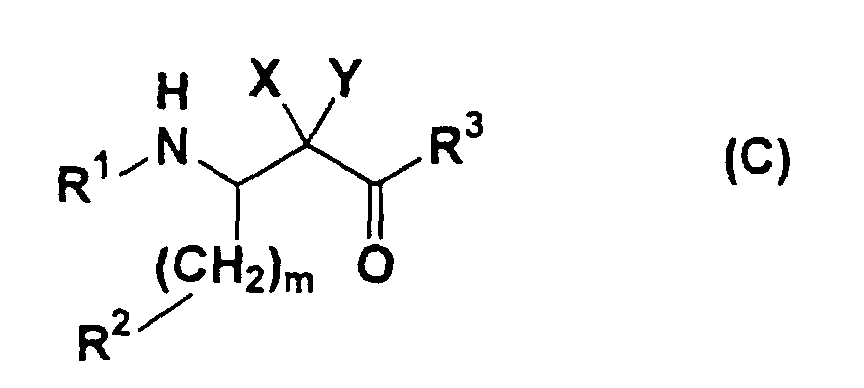
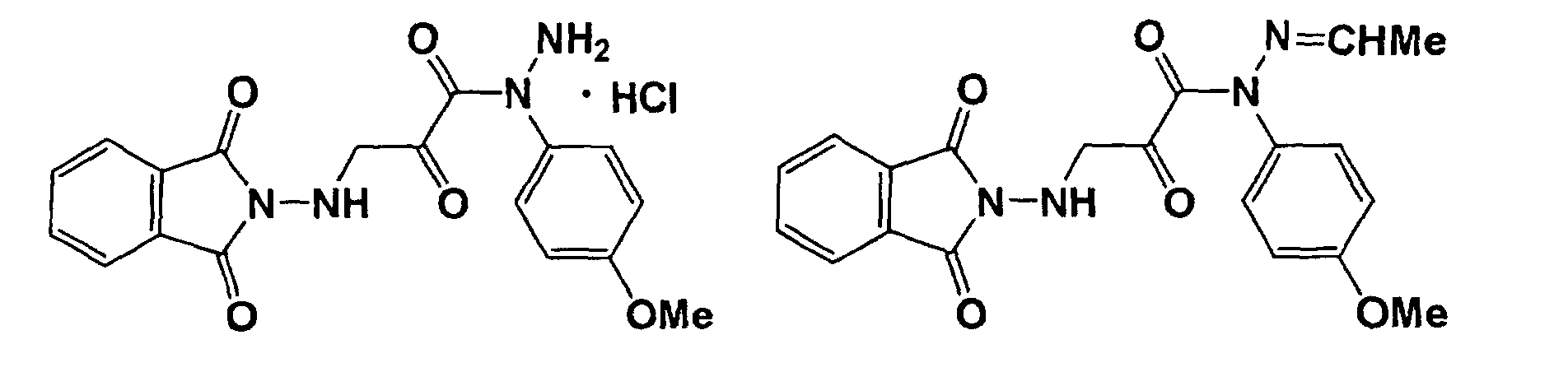


R16 is (1) C1-8 alkyl, (2) C2-8 alkenyl, (3) C2-8 alkynyl, (4) CycA or
(5) C1-8 alkyl, C2-8 alkenyl or C2-8 alkynyl substituted with substituted with 1 to 5 groups selected from halogen, nitro, trifluoromethyl, cyano, CycA, -NR18R19, -OR18, -SR18, -NHC(O)-CycA and -NHC(O)-(C1-8 alkyl);
R17, R18 and R19 are each independently, hydrogen, C1-4 alkyl, CycA, C1-4 alkyl substituted with CycA.),
AA1 is (1) a bond, or
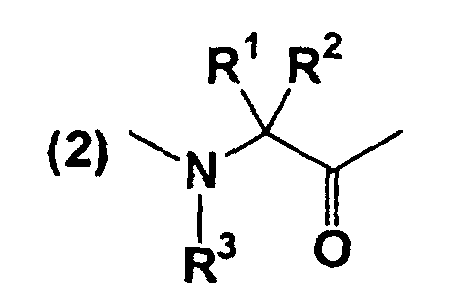
(wherein R20 is hydrogen, C1-4 alkyl, -C(O)O-(C1-4 alkyl), CycA or C1-4 alkyl substituted with CycA; R21, R22, R23 and R25 are each independently, hydrogen, C1-4 alkyl, CycA or C1-4 alkyl substituted with CycA; R24 is C1-4 alkyl, CycA, -NR21R22, -OR23, -SR23 or C1-4 alkyl substituted with CycA.),
R3 is hydrogen, C1-8 alkyl, CycA or C1-8 alkyl substituted with CycA or
R3 may be taken together with R1 to form C2-6 alkylene (wherein one carbon of the alkylene chain may be replaced by oxygen, sulfur or -NR20- and the alkylene may be substituted with -NR21R22, -OR23, -SR23 or oxo.).) or
R and AA1 may be taken together to form

AA2 is (1) a bond,

- (a) -NR31R32, (b) -OR33, (c) -SR33, (d) -COR34, (e) -NR35C(O)NR31R32, (f) guanidino, (g) amidino, (h) CycA, (j) -NR35SO2R31;or
(wherein R30 is hydrogen, C1-4 alkyl, -C(O)O-(C1-4 alkyl), CycA or C1-4 alkyl substituted with CycA; R31, R32, R33 and R35 are each independently, hydrogen, C1-4 alkyl, CycA or C1-4 alkyl substituted with CycA; R34 is C1-4 alkyl, CycA, -NR31R32, -OR33, -SR33 or C1-4 alkyl substituted with CycA.),
R6 is hydrogen, C1-8 alkyl, CycA or C1-8 alkyl substituted with CycA or
R6 may be taken together with R4 or R to form C2-6 alkylene (wherein one carbon of the alkylene chain may be replaced by oxygen, sulfur or -NR30- and the alkylene may be substituted with NR31R32, OR33, SR33 or oxo.),
R38 is hydrogen, C1-4 alkyl, CycA or C1-4 alkyl substituted with CycA or
when AA1 is a bond, R38 may be taken together with R to form C2-6 alkylene (wherein one carbon of the alkylene chain may be replaced by oxygen, sulfur or -NR37- (wherein R37 is hydrogen or C1-4 alkyl.).),
CycC is a 3-17 membered mono- or bi-cyclic heteroring,
CycD is a C3-14 mono- or bi-cyclic carboring or a 3-14 membered mono- or bi-cyclic heteroring) or
AA2 may be taken together with AA1 to form

R7 and R8 are each independently (1) hydrogen, (2) C1-8 alkyl, (3) CycA or (4) C1-8 alkyl substituted with 1 to 5 groups selected from the following (i)~(x);
(i) -NR41R42, (ii) -OR43, (iii) -SR43, (iv) -COR44, (v) -NR45C(O)NR41R42, (vi) guanidino, (vii) amidino, (viii) CycA, (ix) -NR45SO2R41, (x) -P(O)(OR46)(OR47), or
R7 and R8 may be taken together to form C2-8 alkylene (wherein one carbon of the alkylene chain may be replaced by oxygen, sulfur or -NR40- and the alkylene may be substituted with -NR41R42, -OR43, -SR43 or oxo),
R40 is hydrogen, C1-4 alkyl, -C(O)O-(C1-4 alkyl), CycA or C1-4 alkyl substituted with CycA,
R41, R42, R43 and R45 are each independently hydrogen, C1-4 alkyl, CycA or C1-4 alkyl substituted with CycA, R44 is C1-4 alkyl, CycA, -NR41R42, -OR43, -SR43 or C1-4 alkyl substituted with CycA,
R46 and R47 are each independently, hydrogen or C1-8 alkyl,
R9 is hydrogen, C1-8 alkyl, CycA or C1-8 alkyl substituted with CycA or
R9 may be taken together with R7 or R to form C2-6 alkylene (wherein one carbon of the alkylene chain may be replaced by oxygen, sulfur or -NR40- and the alkylene may be substituted with -NR41R42, -OR43, -SR43 or oxo), (wherein all symbols have the same meaning as hereinbefore.),


(wherein RZ1 and RZ2 are each independently, hydrogen, C1-8 alkyl, C2-8 alkenyl, CycP, C2-8 acyl, or C1-8 alkyl substituted with CycP, C2-8 acyl, C1-8 alkoxy, C1-8 alkylthio, C1-8 monoalkylamino or di(C1-8 alkyl)amino;
RZ3 is hydrogen, C1-8 alkyl, C2-8 alkenyl, CycP or C1-8 alkyl substituted with 1 to 5 groups selected from CycP, C1-8 alkoxy, C1-8 alkylthio, amino, C1-8 monoalkylamino, di(C1-8 alkyl)amino and C2-8 acyl;
RZ4 is C1-8 alkyl, CycP or C1-8 alkyl substituted with 1 to 5 groups selected from CycP, C1-8 alkoxy, C1-8 alkylthio, mono(C1-8 alkyl)amino, di(C1-8 alkyl)amino or C2-8 acyl;
RZ5 and RZ6 are each independently, hydrogen or C1-8 alkyl,
CycP is a C4-10 carboring or 5-10 membered heteroring comprising 1-4 of nitrogen, 1-2 of oxygen and/or 1-2 of sulfur and R10 has the same meaning as hereinbefore.) or
RA1 and RA2 may be taken together with the adjacent carbon to represent CycH

RA1 and R10 may be taken together with the adjacent carbon and nitrogen to represent

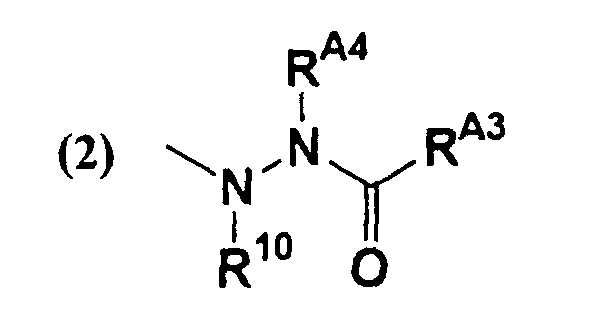
RA4 is (i) hydrogen, (ii) C1-8 alkyl, (iii) C2-8 alkenyl, (iv) -CORZ4, (v) CycP or (vi) C1-8 alkyl or C2-8 alkenyl substituted with 1 to 5 groups selected from CycP, -NRZ1RZ2, -ORZ3, -SRZ3, -CORZ4, -SO2RZ4, -COORZ3, -CONRZ1RZ2, -SO2NRZ1RZ2 and -P(O)(ORZ5)(ORZ6) (wherein all symbols have the same meaning as hereinbefore.),
R10 has the same meaning as hereinbefore, or
RA3 and RA4 may be taken together with the adjacent carbon and nitrogen to represent

RA3 and R10 may be taken together with the adjacent carbon and nitrogens to represent


RA3 and R10 may be taken together with the nitrogens and sulfur to represent
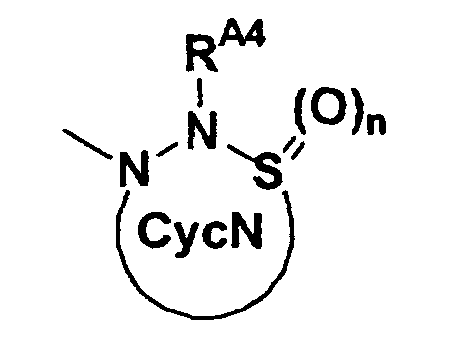
CycA's, CycB, CycC, CycD, CycE, CycF, CycH, CycJ, CycK, CycL, CycM, CycN and CycP may be each independently substituted with 1-5 of R27,
R27 is (1) C1-8 alkyl, (2) halogen, (3) -NR11R12, (4) -OR13, (5) -SR13, (6) CycG, (7) nitro, (8) cyano, (9) oxo, (10) -COR14, (11) -SO2R14, (12) -P(O)(OR15)(OR16), (13) guanidino, (14) amidino or (15) C1-8 alkyl substituted with 1 to 5 groups selected from the following (i) - (xii):
- (i) halogen, (ii) -NR11R12, (iii) -OR13, (iv) -SR13, (v) CycG, (vi) nitro, (vii) cyano, (viii) -COR14, (ix) -SO2R14, (x) -P(O)(OR15)(OR16), (xi) guanidino, (xii) amidino
R13 is hydrogen, C1-4 alkyl, trifluoromethyl, CycG or C1-4 alkyl substituted with CycG,
CycG's are each independently, a C4-10 mono- or bi-cyclic carboring or a 5-10 membered mono- or bi-cyclic heteroring comprising 1-4 of nitrogen, 1-2 of oxygen and/or 1-2 of sulfur,
R14 is C1-8 alkyl, CycG, -NR11R12, -OR13, -SR13 or C1-8 alkyl substituted with CycG, -NR11R12, -OR13 or -SR13,
R15's are each independently, hydrogen or C1-8 alkyl.),
when a saturated carbon atom exists in CycH, CycJ, CycK, CycL, CycM or CycN, the saturated carbon atom may form a spiro bond with CycQ (wherein CycQ is a C3-10 saturated or partially unsaturated mono-cyclic carboring or a 5-8 membered saturated or partially unsaturated monocyclic heteroring comprising 1 of -NRQ- (wherein RQ is C1-8 alkyl, C2-8 acyl, -SO2-(C1-8 alkyl), benzoyl, benzenesulfonyl, or toluenesulfonyl.), 1 of oxygen and/or 1 of sulfur which may be oxidized.)] or a pharmaceutically acceptable salt thereof

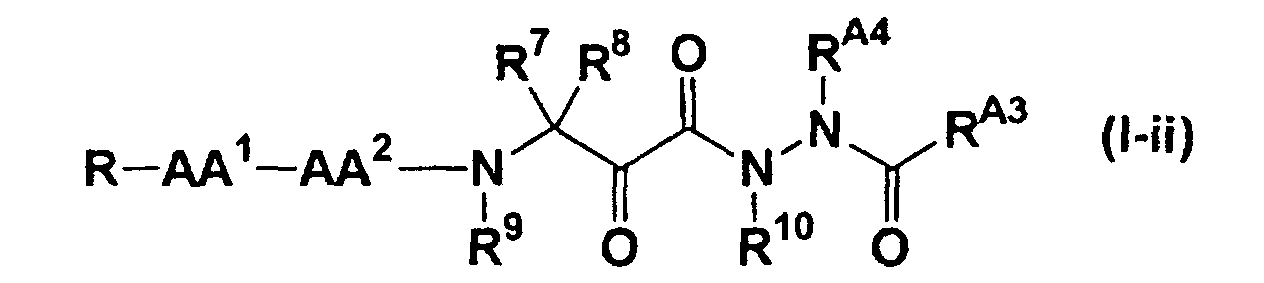
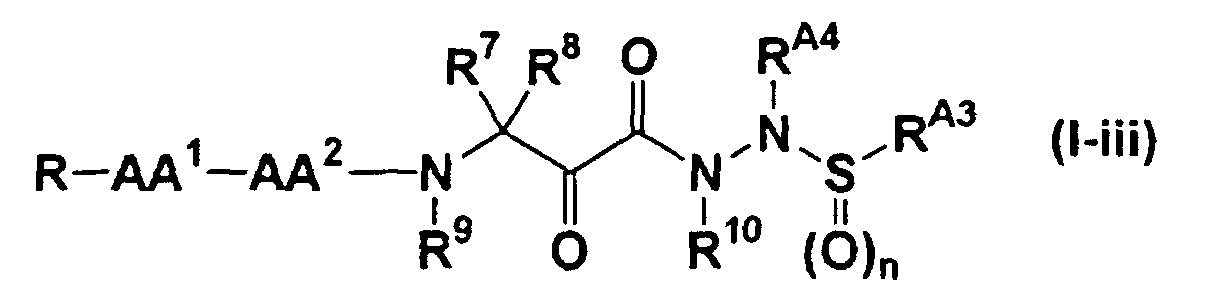
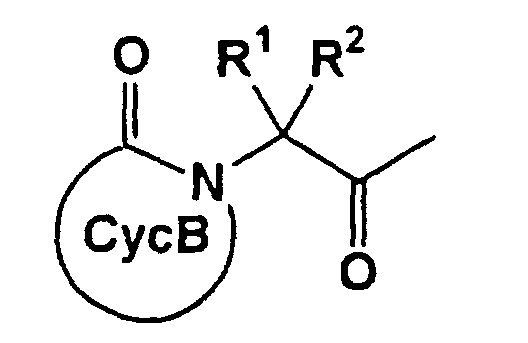
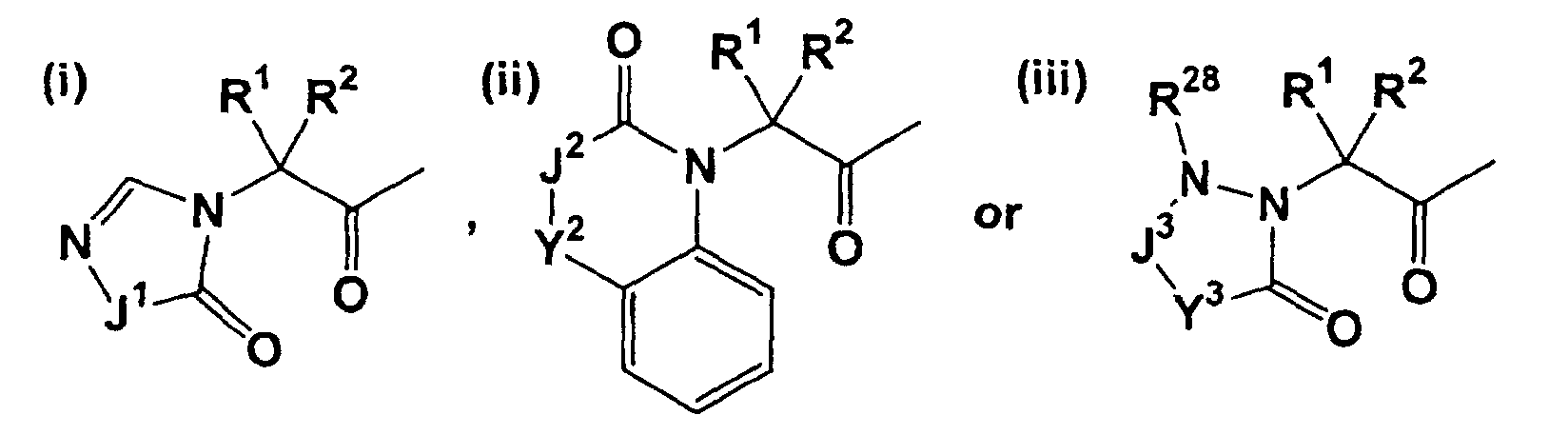
J2 is a bond or C1-2 alkylene,
Y2 is -N=CH-, -CH=N-, or C1-2 alkylene,
J3 is carbonyl or C1-3 alkylene,
Y3 is C1-3 alkylene, oxygen, or -NR29- (wherein R29 has the same meaning as described hereinbefore.),
R28 is hydrogen, C1-4 alkyl, CycA, or C1-4 alkyl substituted with CycA, or
R28 and R1 may be taken together to form C2-4 alkylene, the other symbols have the same meaning as described hereinbefore, each ring may be substituted with 1-5 of R27.).
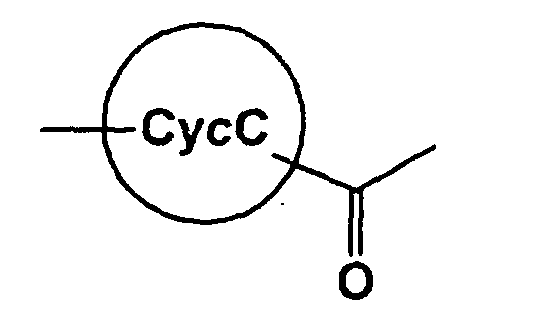

J5 is C1-6 alkylene,
Y5 is bond, C1-3 alkylene, or -NR67- (wherein R67 is hydrogen, C1-4 alkyl, phenyl, or C1-4 alkyl substituted with phenyl.),
J8 is C1-5 alkylene (wherein one carbon may be replaced by oxygen.),
Y8 is a bond or C1-4 alkylene,
L8 is -N- or -CH- and the other symbols have the same meaning as described hereinbefore.).


J7 is C1-6 alkylene (wherein one carbon may be replaced by oxygen, sulfur, or -NR67- (wherein R67 has the same meaning as described hereinbefore.),
J9 is C1-3 alkylene, oxygen, sulfur, or -NR67- (wherein R67 has the same meaning as described hereinbefore.) and, the other symbols have the same meaning as described hereinbefore.).

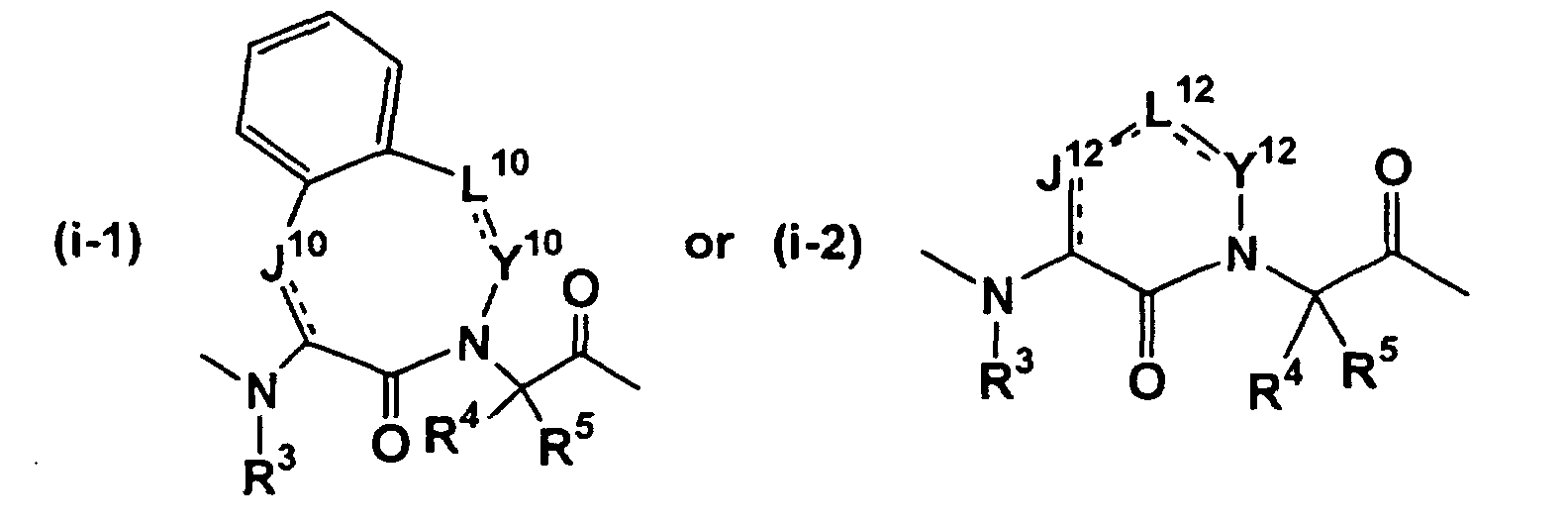
J10 and Y10 are each independently, a bond or C1-3 alkylene,
L10 is a bond, C1-3 alkylene, -NR57- (wherein R57 is hydrogen, C1-4 alkyl, phenyl, or C1-4 alkyl substituted with phenyl.), -N=, oxygen, or -S(O)p- (wherein p is 0 or an integer of 1-2.),
J12 and Y12 are each independently, a bond or C1-3 alkylene,
L12 is C1-3 alkylene, -NR57- (wherein R57 has the same meaning as described hereinbefore..),-N=, =N-, oxygen, or -S(O)p- (wherein p has the same meaning as described hereinbefore.),
the other symbols have the same meaning as described hereinbefore.).

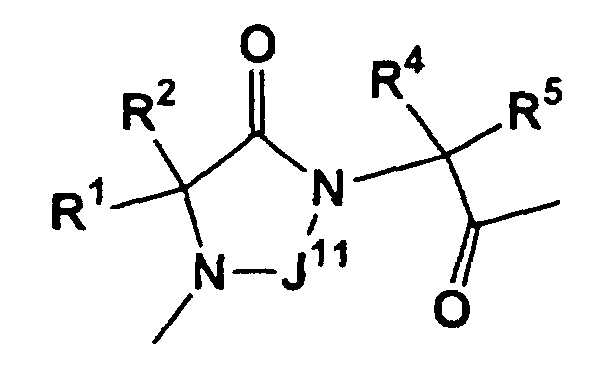



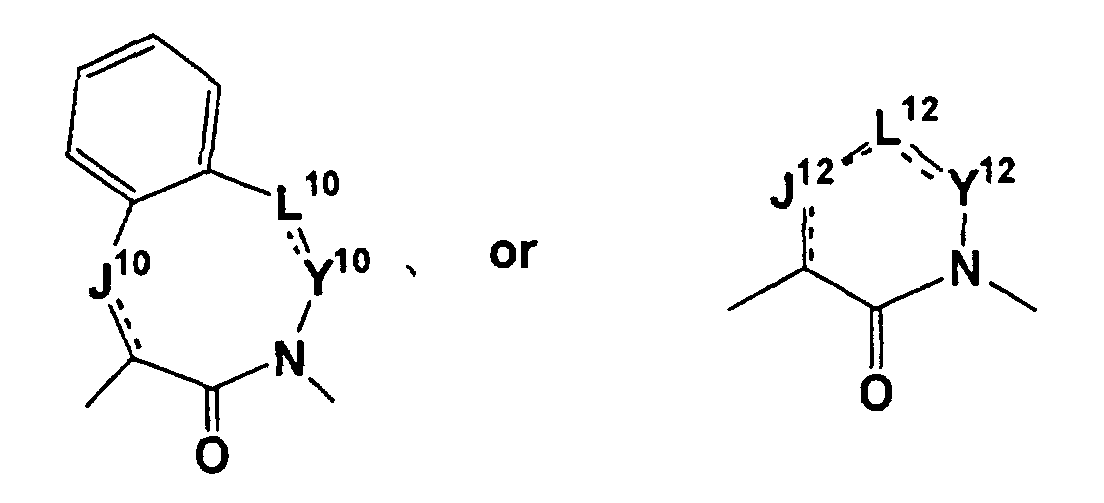
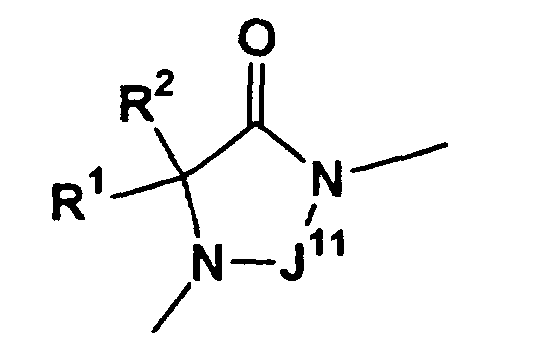






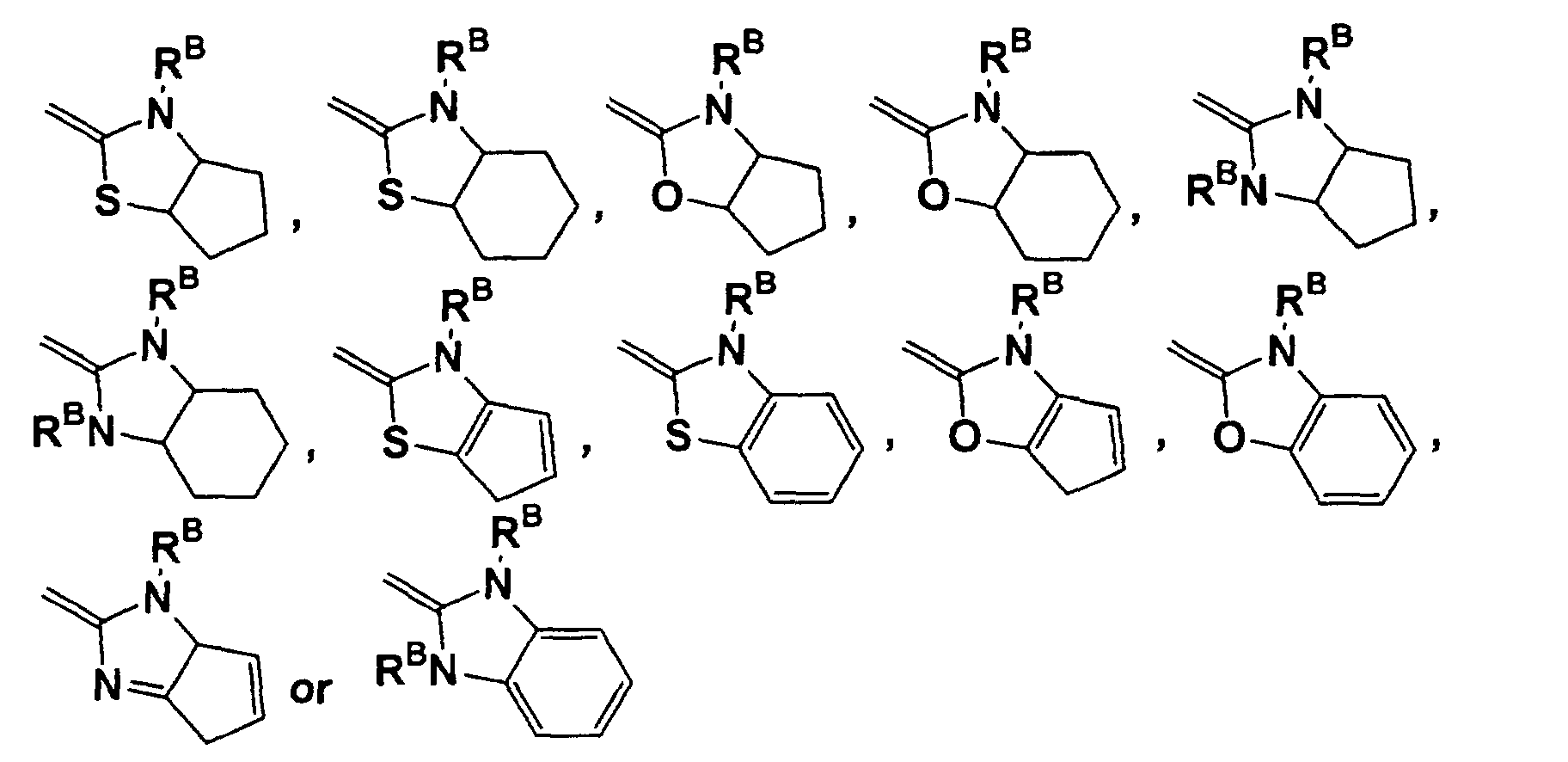
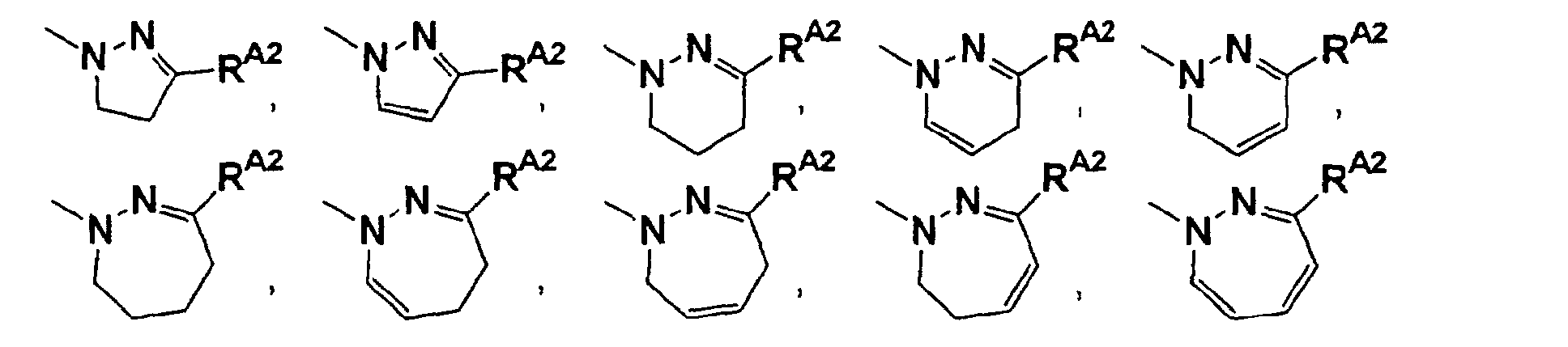
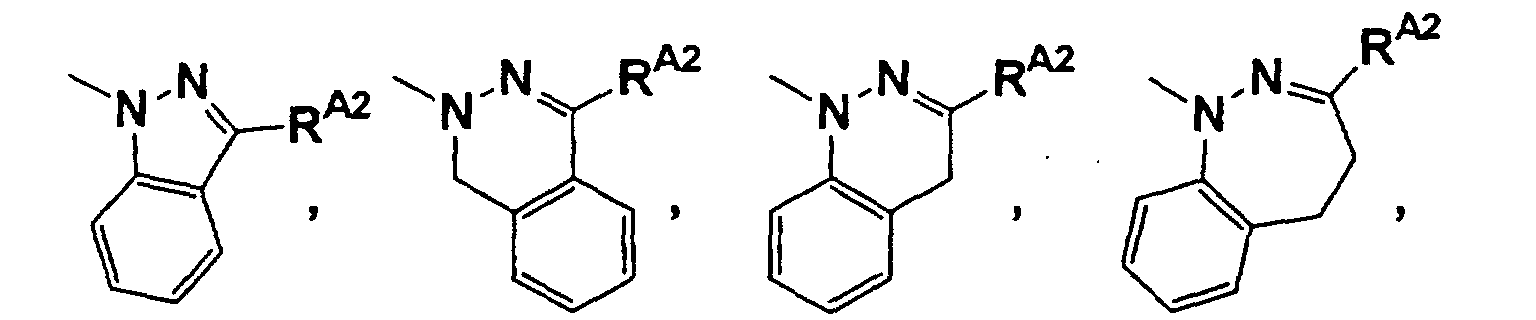

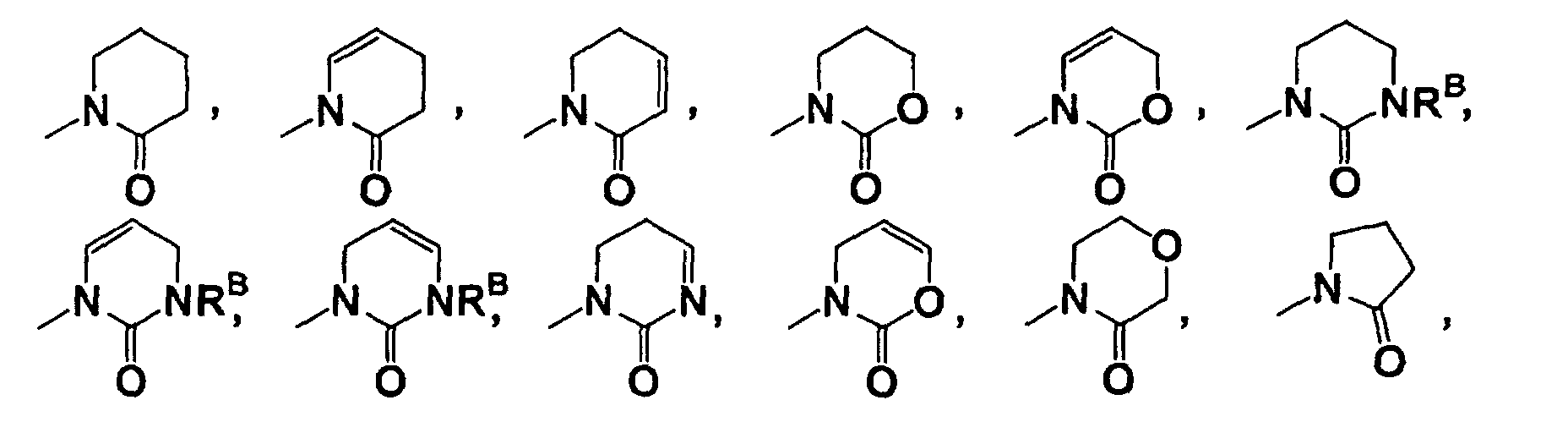








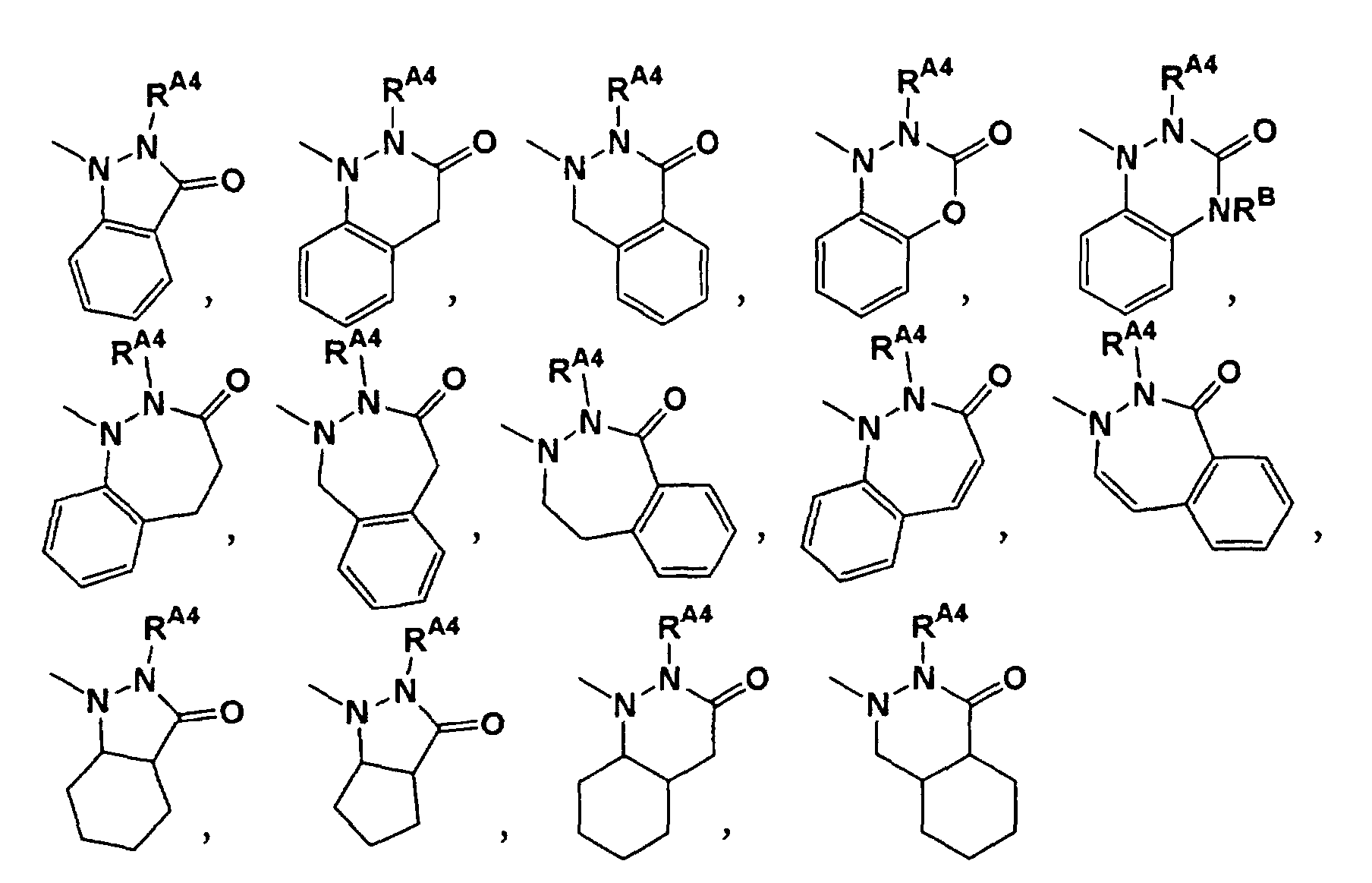


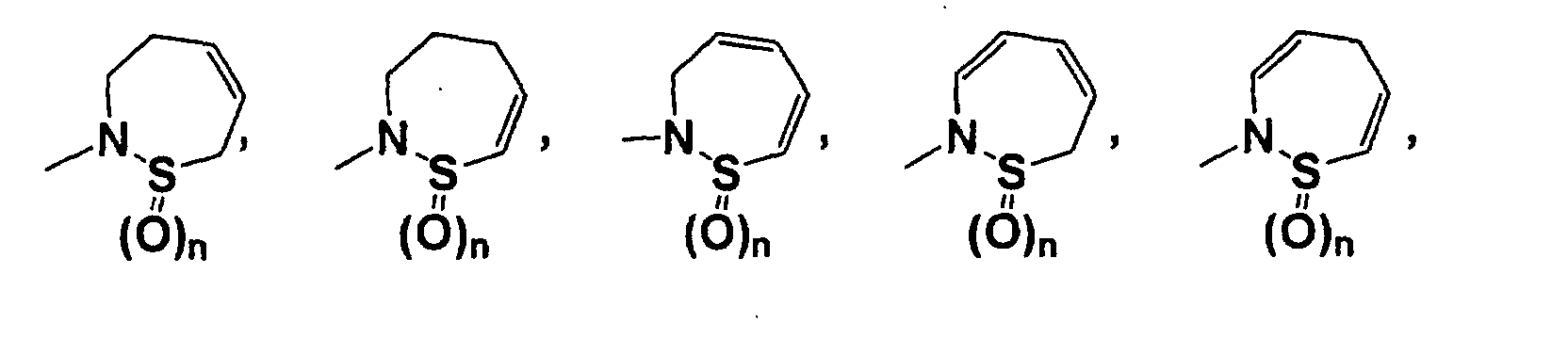




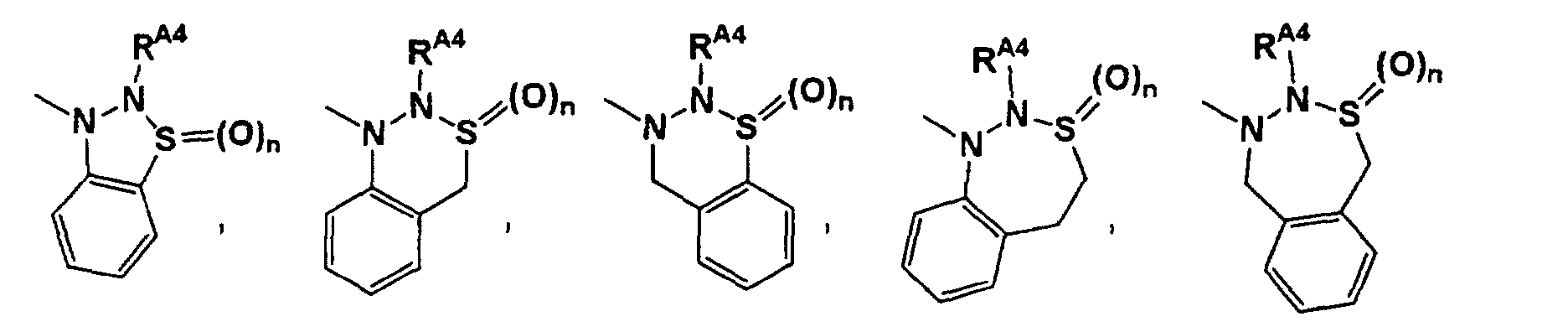





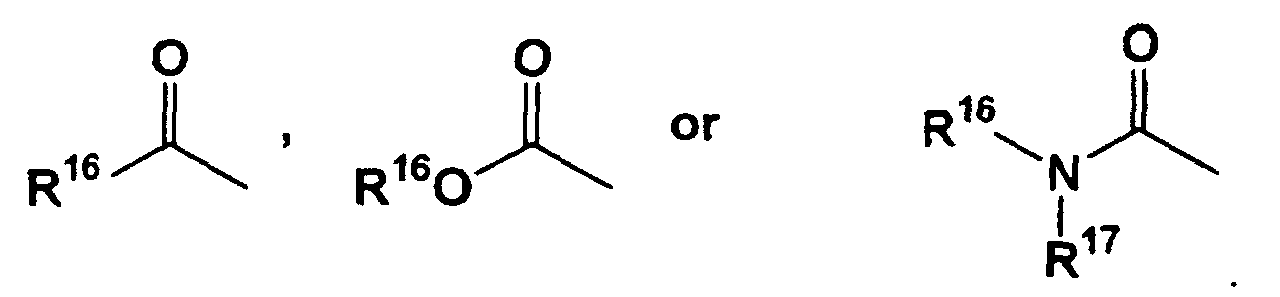
wherein CycA may be substituted with 1-5 of R27a,
R27a is (1) C1-8 alkyl, (2) halogen, (3) -NR11R12, (4) -OR13, (5) phenyl, (6) nitro, (7) cyano, (8) tetrazole, (9) -SR13, (10) -COR14, (11) oxo, or (12) C1-8 alkyl substituted with 1-5 of group selected from the following (a)-(k):
(b) (1) CycA having 1-5 of substitutent R27, or
(2) C1-8 alkyl, C2-8 alkenyl or C2-8 alkynyl substituted with CycA having 1-5 of substituent R27
(with proviso that , at least one R27 in (1) or (2) is a group selected from
(i) C5-10 mono- or bi-cyclic carboring, (ii) 5-10 membered mono- or bi-cyclic heteroring, (iii) -SO2R15, (iv) trifluoromethoxy, and (v) C1-8 alkyl substituted with 1-5 of group selected from (a) halogen, (b) -NR11R12, (c) -OR13, (d) C5-10 mono- or bi-cyclic carboring, (e) nitro, (f) trifluoromethyl, (g) cyano, (h) 5-10 membered mono- or bi-cyclic heteroring, (j) -SR13, (k) -COR14, (1) -SO2R14 or (m) trifluoromethoxy (with proviso that at least one group is C5-10 mono- or bi-cyclic carboring, 5-10 membered heteroring, -SO2R14 or trifluoromethoxy.).).
(b) (1) CycA having 1-5 of substituent R27, or
(2) C1-8 alkyl, C2-8 alkenyl or C2-8 alkynyl having 1-5 of substituent R27 (with proviso that, at least one group in (1) or (2) is,
(i) a C5-10 mono- or bi-cyclic carboring, (ii) a 5-10 membered mono- or bi-cyclic heteroring, (iii) -SO2R14 , (iv) trifluoromethoxy, and (v) C1-8 alkyl substituted with 1-5 of group selected from (a) halogen, (b) -NR11R12, (c) -OR13, (d) a C5-10 mono- or bi-cyclic carboring, (e) nitro, (f) trifluoromethyl, (g) cyano, (h) a 5-10 membered mono- or bi-cyclic heteroring, (j) -SR13, (k) -COR14, (1) -SO2R14 and (m) trifluoromethoxy (with proviso that, at least one group is selected from a C5-10 mono- or bi-hetetroring, a 5-10 membered mono- or bi-cyclic heteroring, -SO2R14 or trifluoromethoxy.).), wherein CycA is a mono- or bi-cyclic C5-10 carboaryl or partially or completely saturated one thereof, or a 5-10 membered heteroaryl comprising 1-4 of atom selected from nitrogen, oxygen and/or sulfur, or partially or completely saturated one thereof.
(b) (1) CycA having 1-5 of substituent R27, or
(2) C1-8 alkyl, C2-8 alkenyl or C2-8 alkynyl substituted with CycA having 1-5 of substituent R27
(with proviso that, at least one of R27 in (1) or (2) is
(i) a C5-10 mono- or bi-cyclic carboring, (ii) a 5-10 membered heteroring, (iii)-SO2R14, (iv)trifluoromethoxy, and (v) C1-8 alkyl substituted with 1-5 of group selected from (a) halogen, (b) -NR11R12, (c) -OR13, (d) a C5-10 mono- or bi-cyclic carboring, (e) nitro, (f) trifluoromethyl, (g) cyano, (h) a 5-10 membered mono- or bi-cyclic heteroring, (j) -SR13, (k) -COR14, (1) -SO2R14 and (m) trifluoromethoxy (with proviso that at least one is selected from a C5-10 mono- or bi-cyclic carboring, a 5-10 membered mono- or bi-cyclic heteroring, -SO2R14 or trifluoromethoxy.).), CycA is preferably cyclopentane, cyclohexane, cycloheptane, cyclooctane, cyclopentene, cyclohexene, cycloheptene, cyclooctene, benzene, naphthalene, indan, indene, dihydronaphthalene, tetrahydronaphthalene, pyrrolidine, piperidine, piperazine, morpholine, pyrrole, furan, thiophene, pyridine, pyrimidine, pyrazine, pyridazine, indole, isoindole, quinoline, isoquinoline, quinazoline, quinoxaline, phthalazine, benzothiophene, benzofuran, benzoxadiazole, tetrahydroquinoline, tetrahydroquinazoline, tetrahydroquinoxaline.

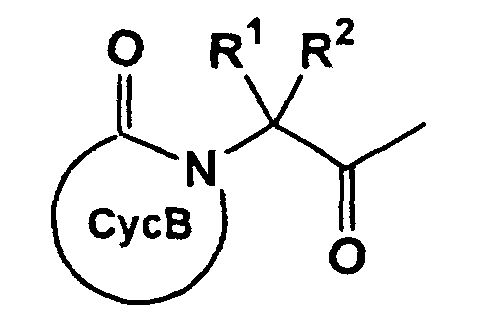

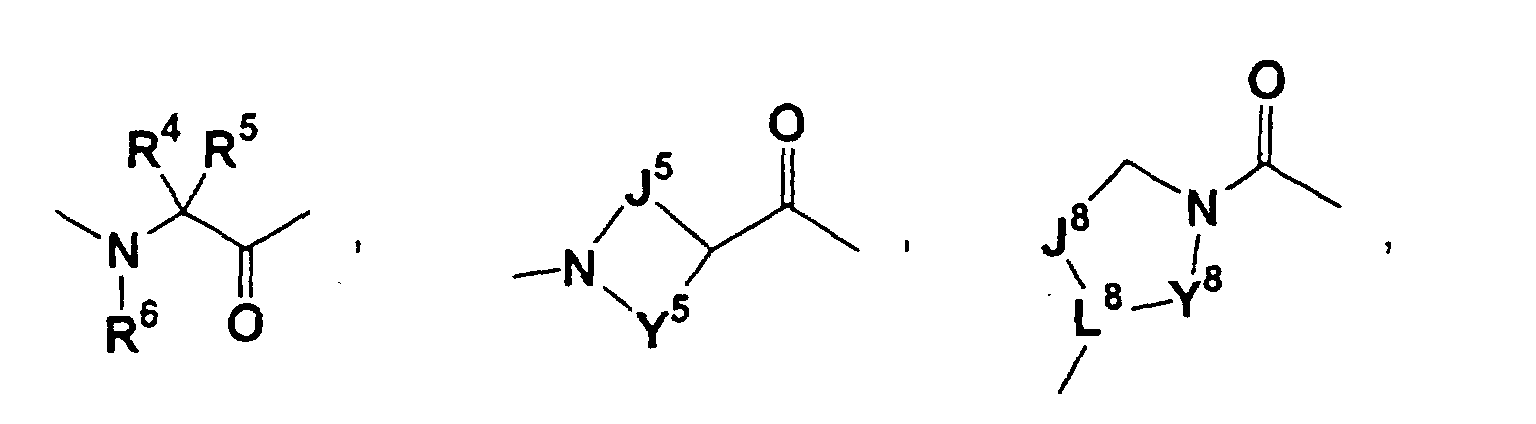



[II] when AA1 is a bond, taken together with R to form tetramethylene, pentamethylene, -CH2-CH2-O-CH2-CH2-, -CH2-CH2-NH-CH2-CH2- or -CH2-CH2-N(CH3)-CH2-CH2-.
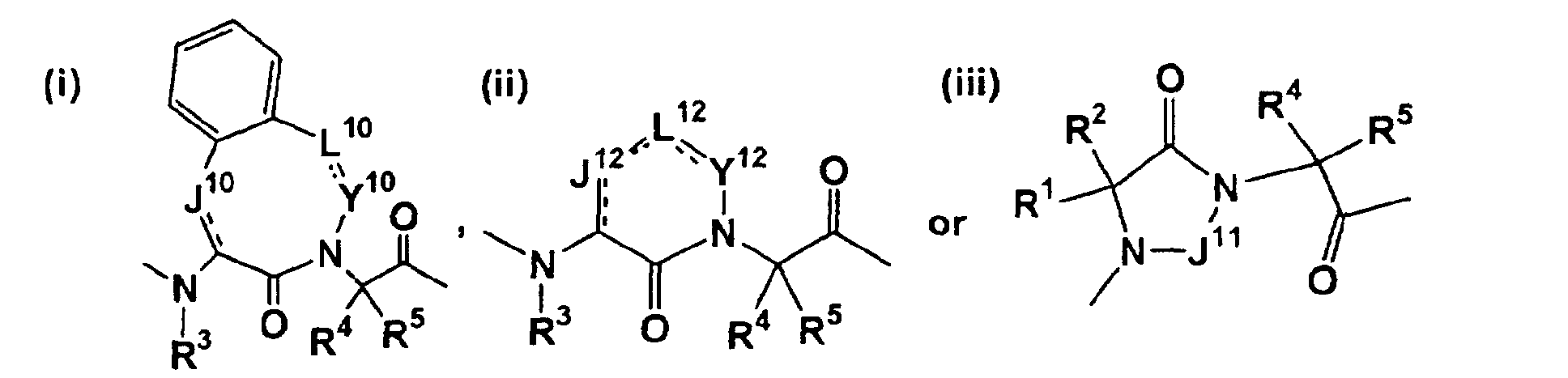
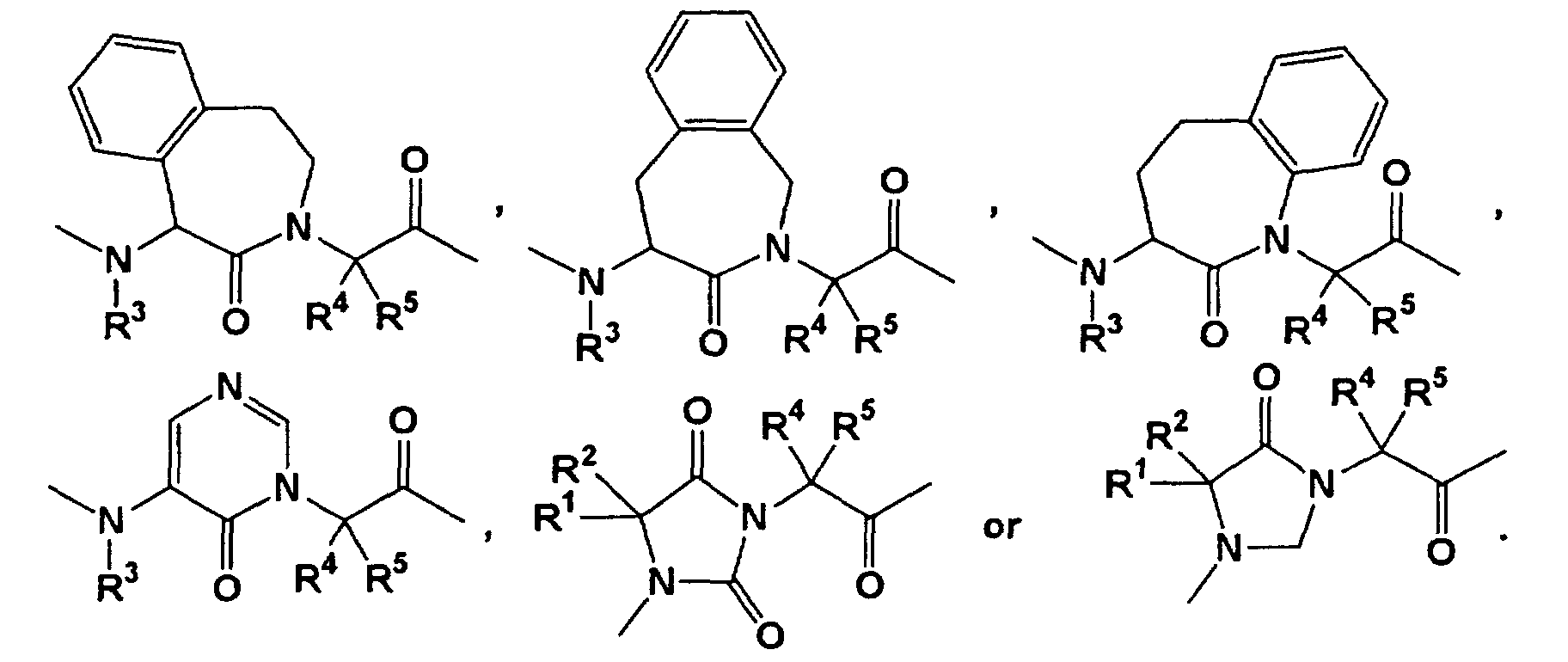
As


In




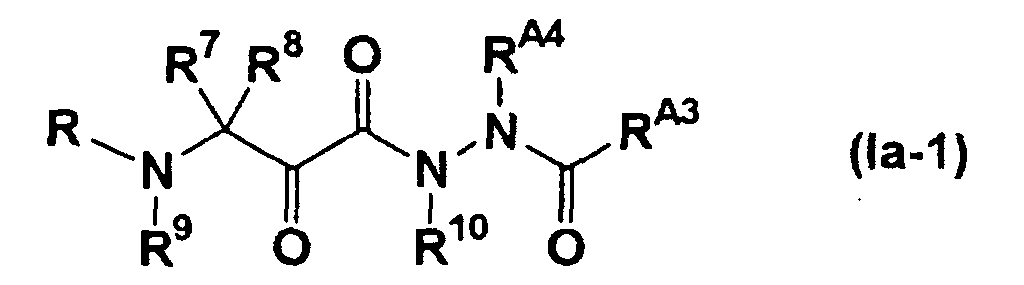
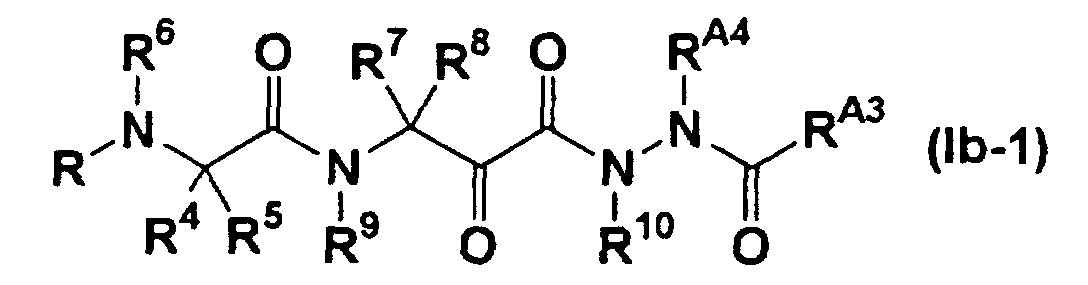
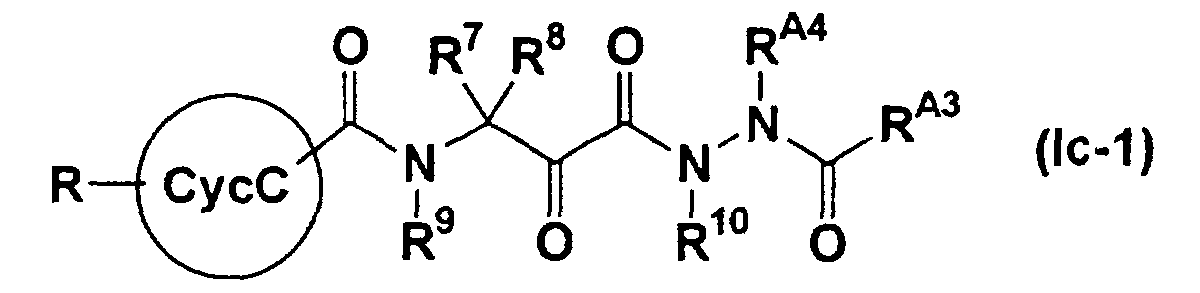


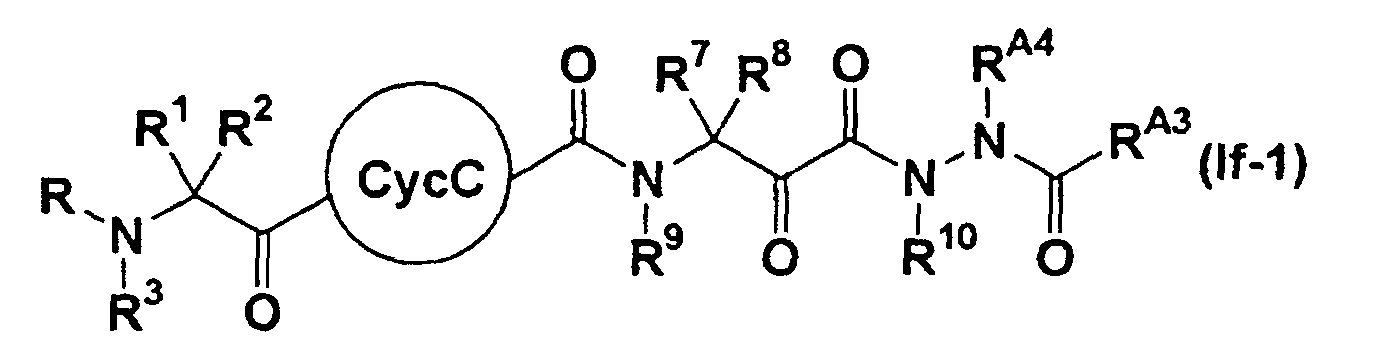


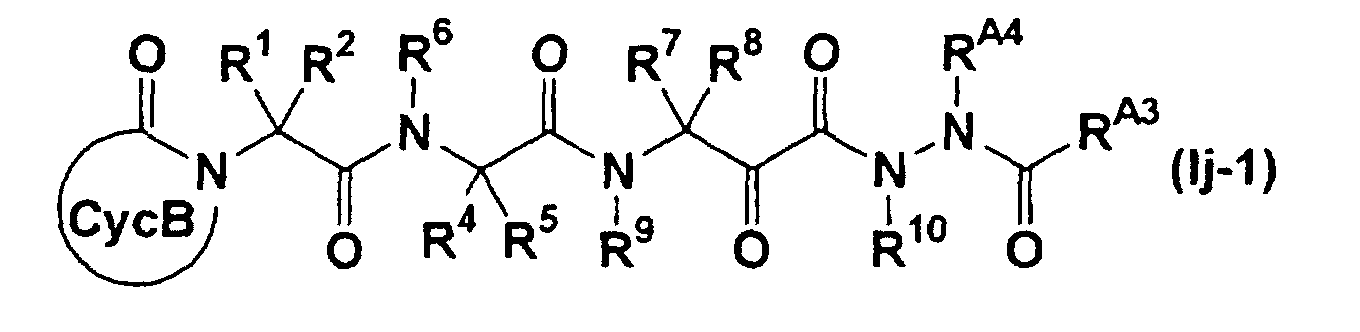


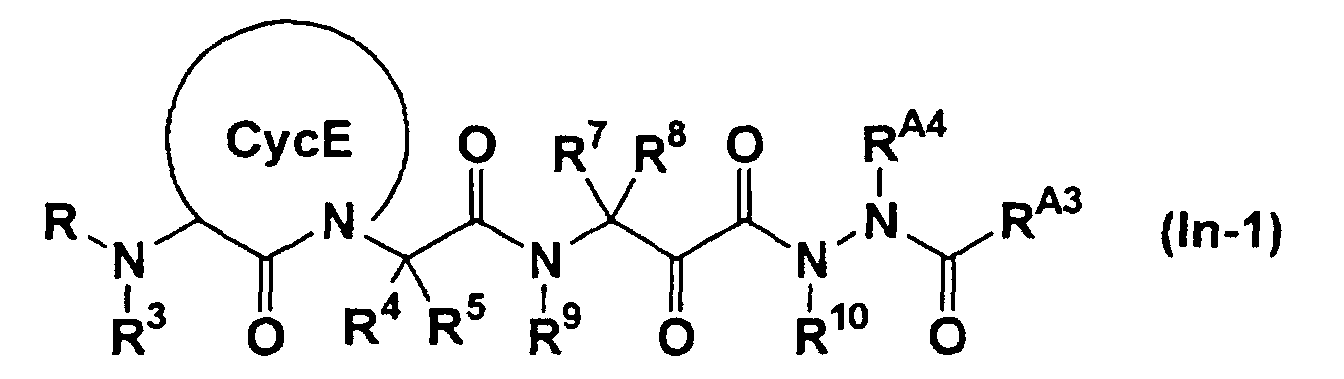

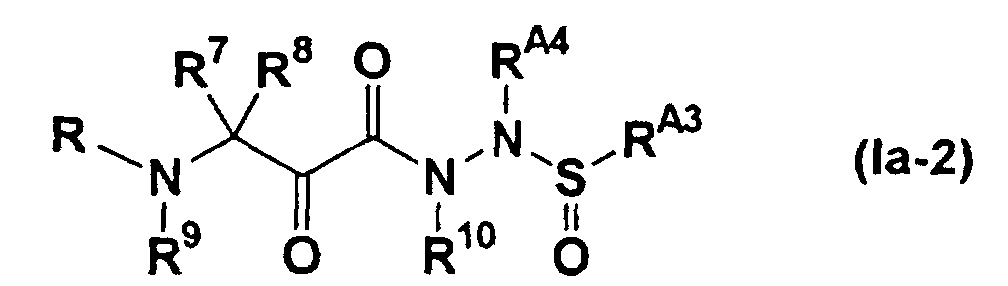


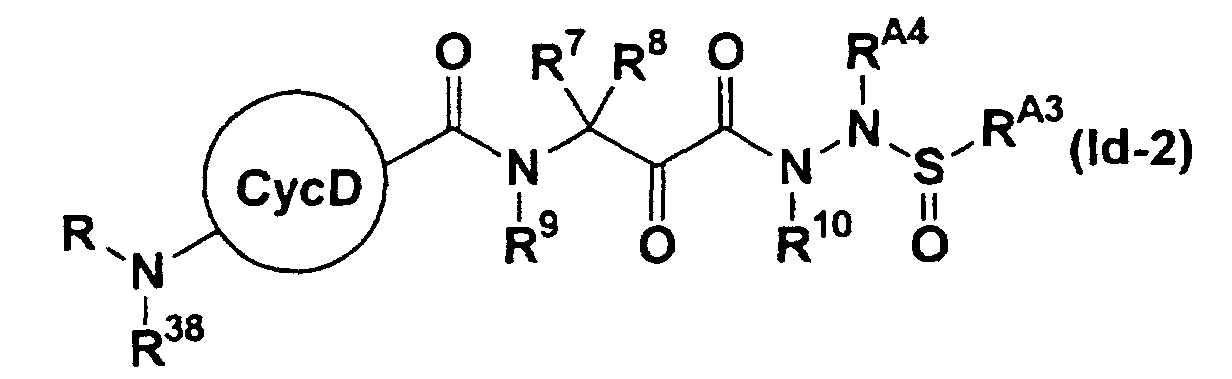


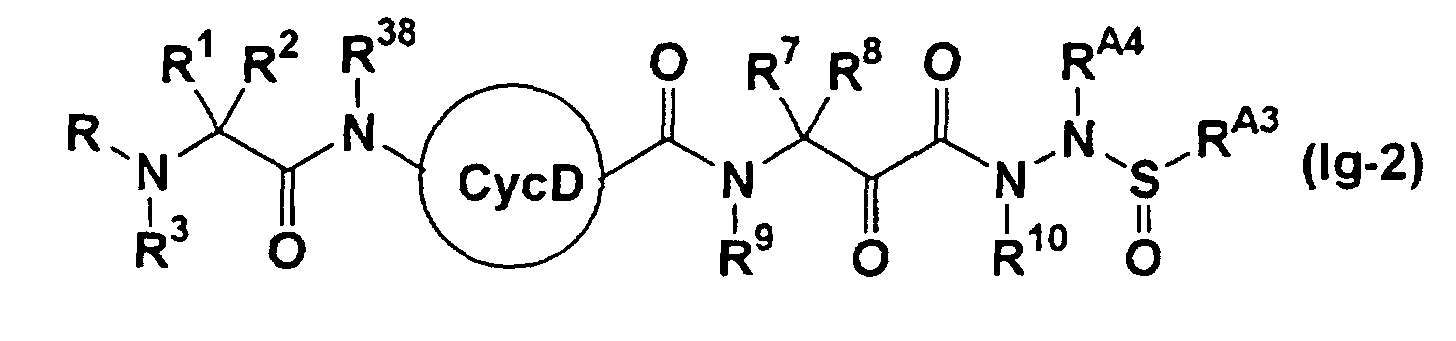
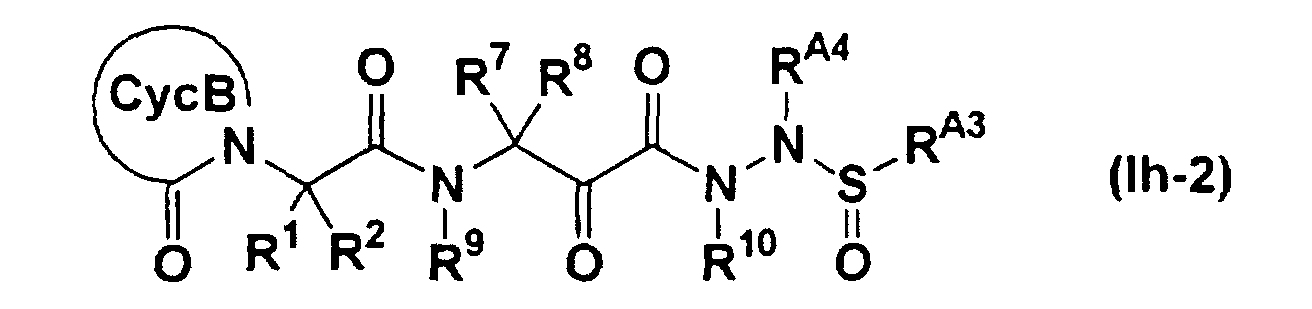
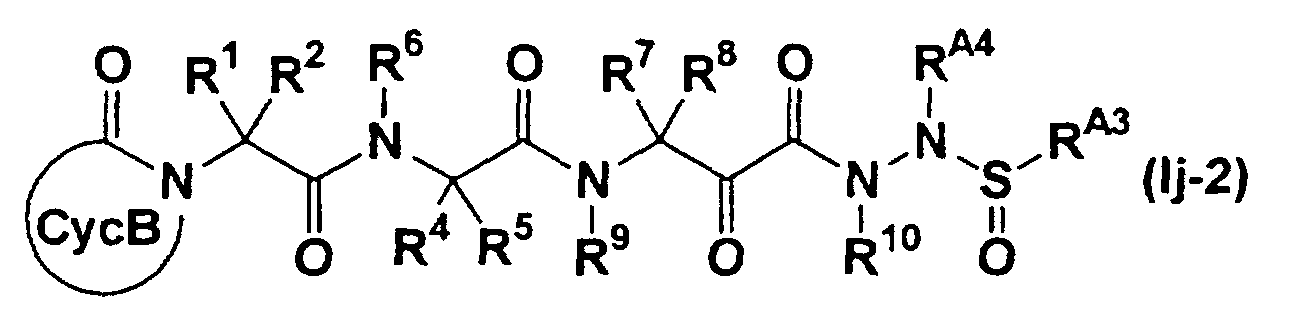
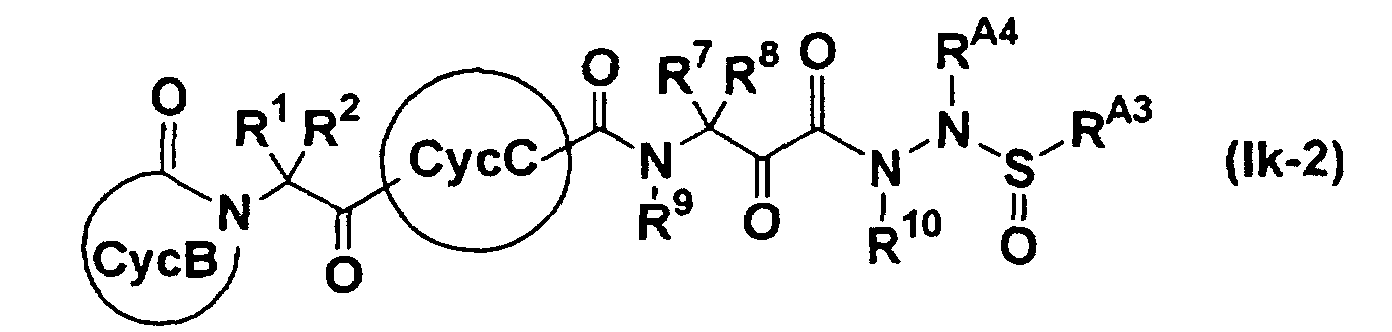


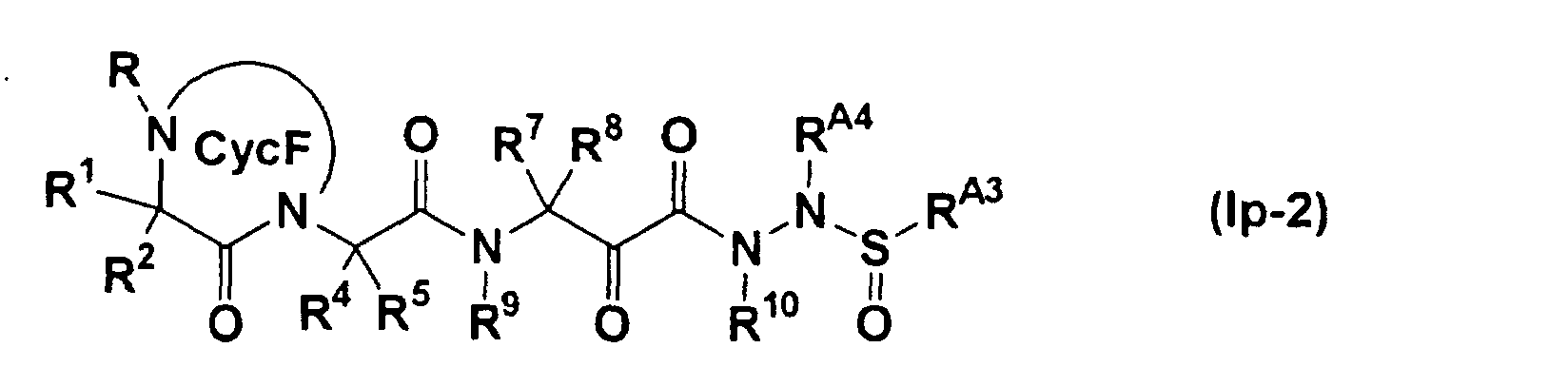
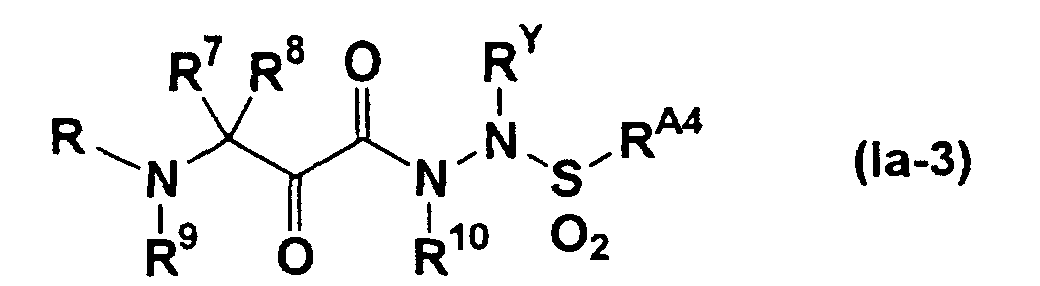

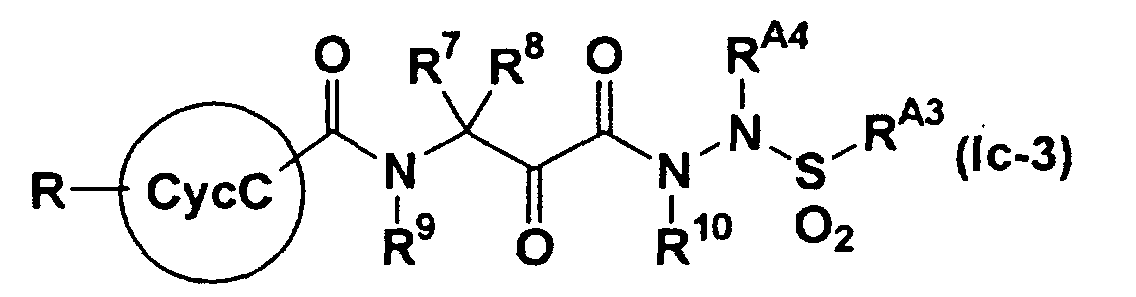


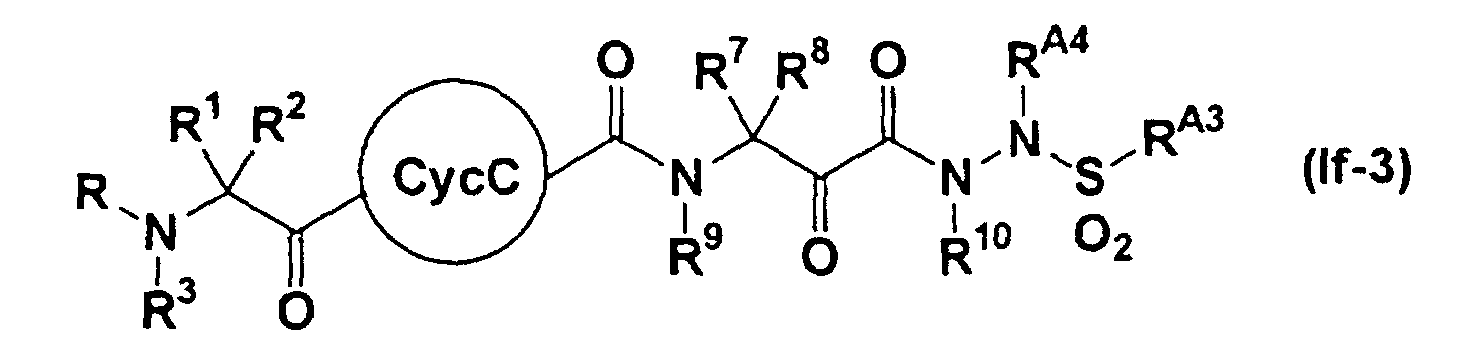
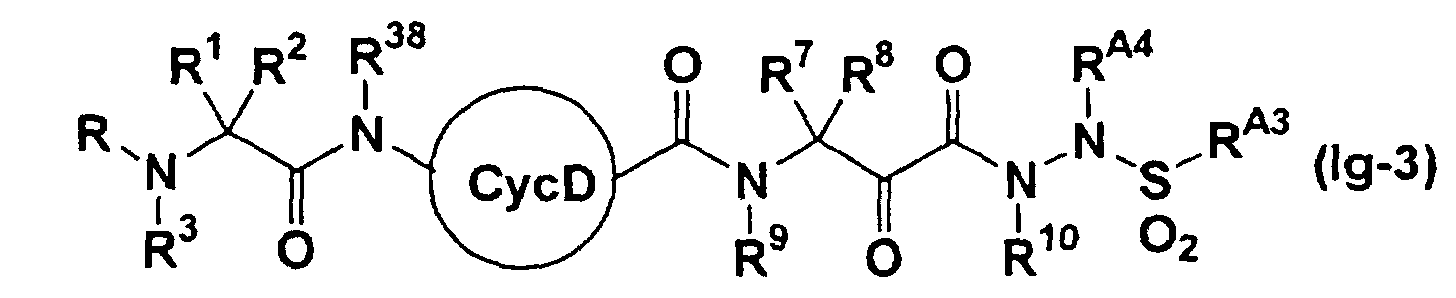
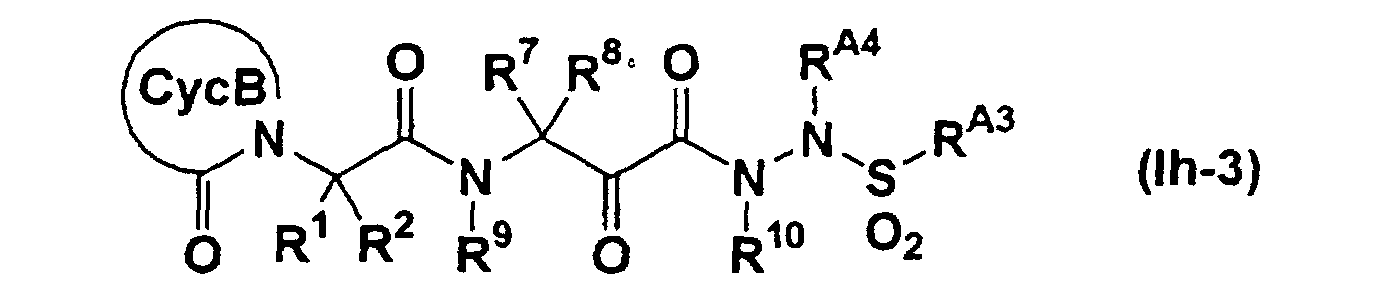
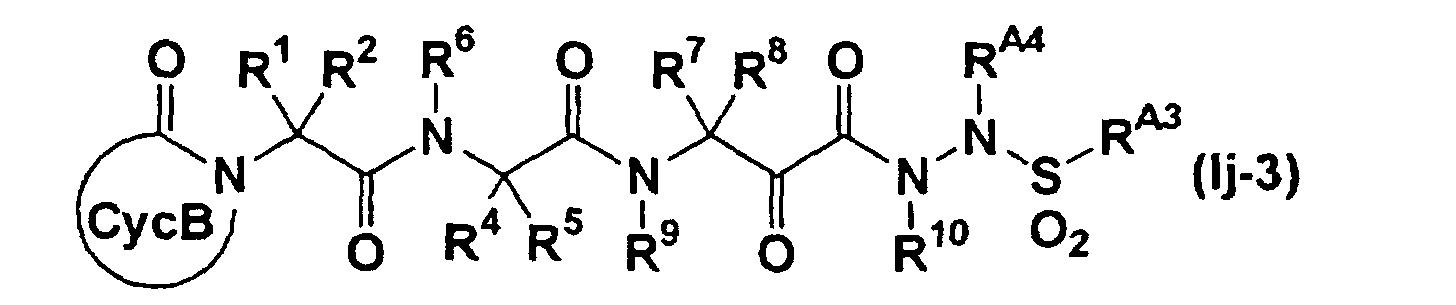
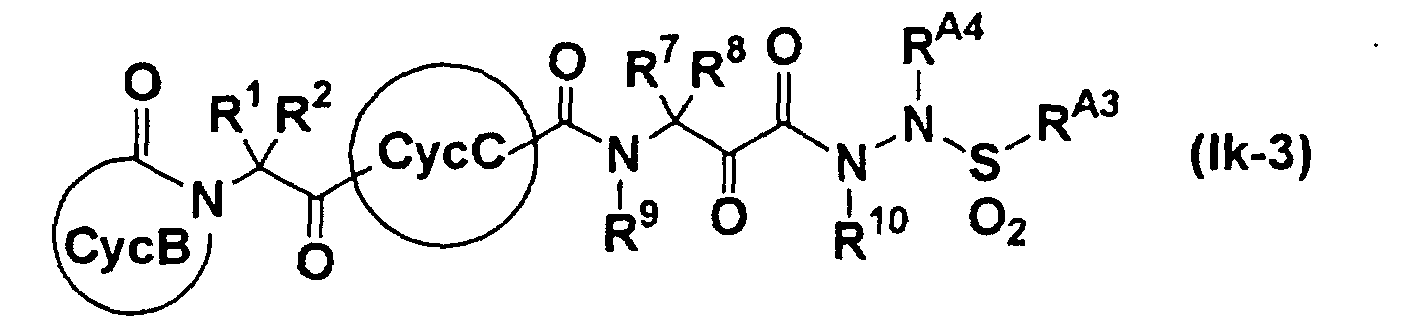


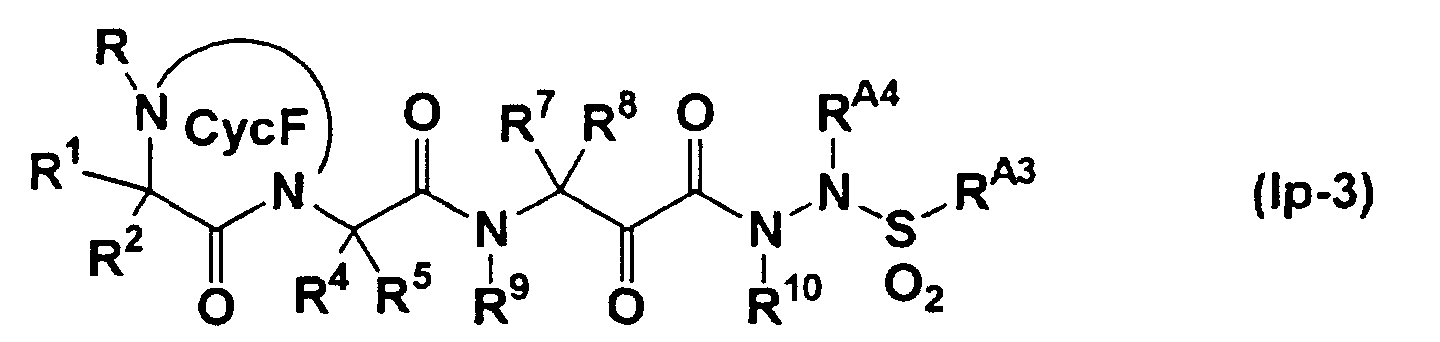


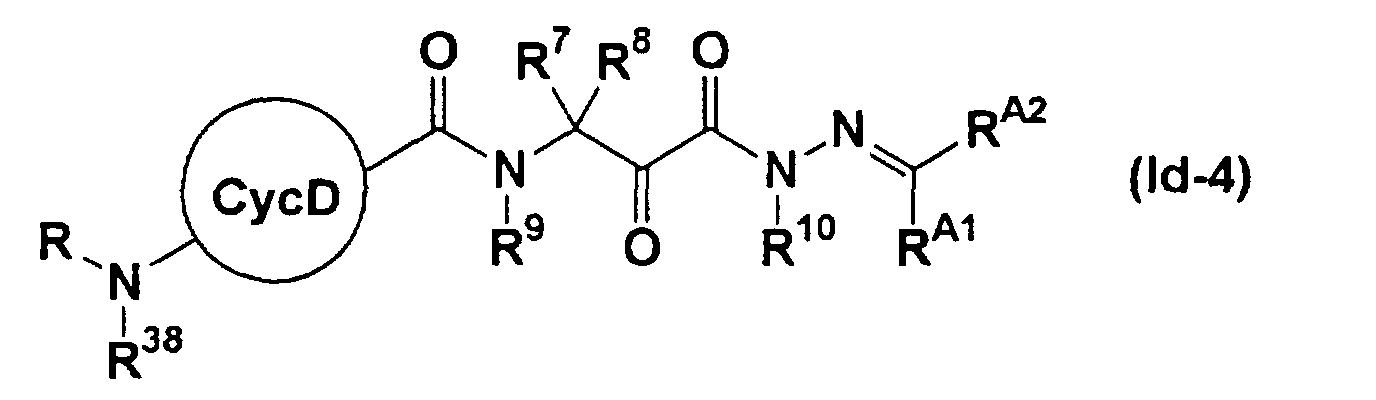
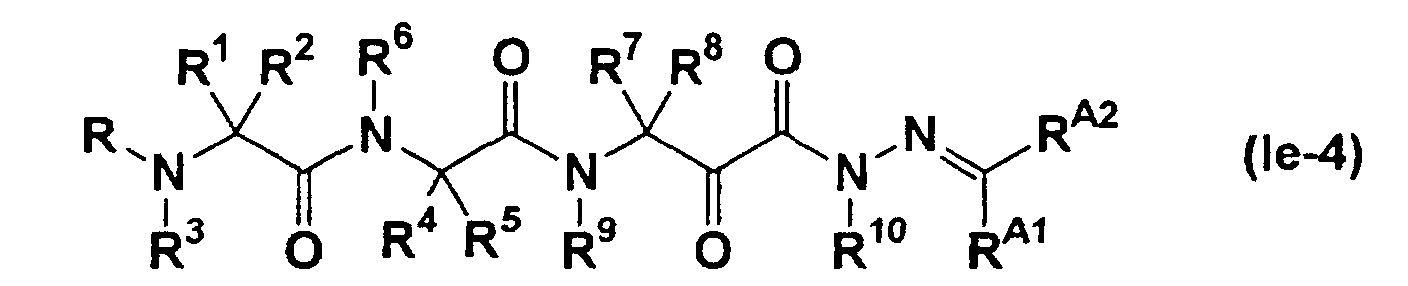








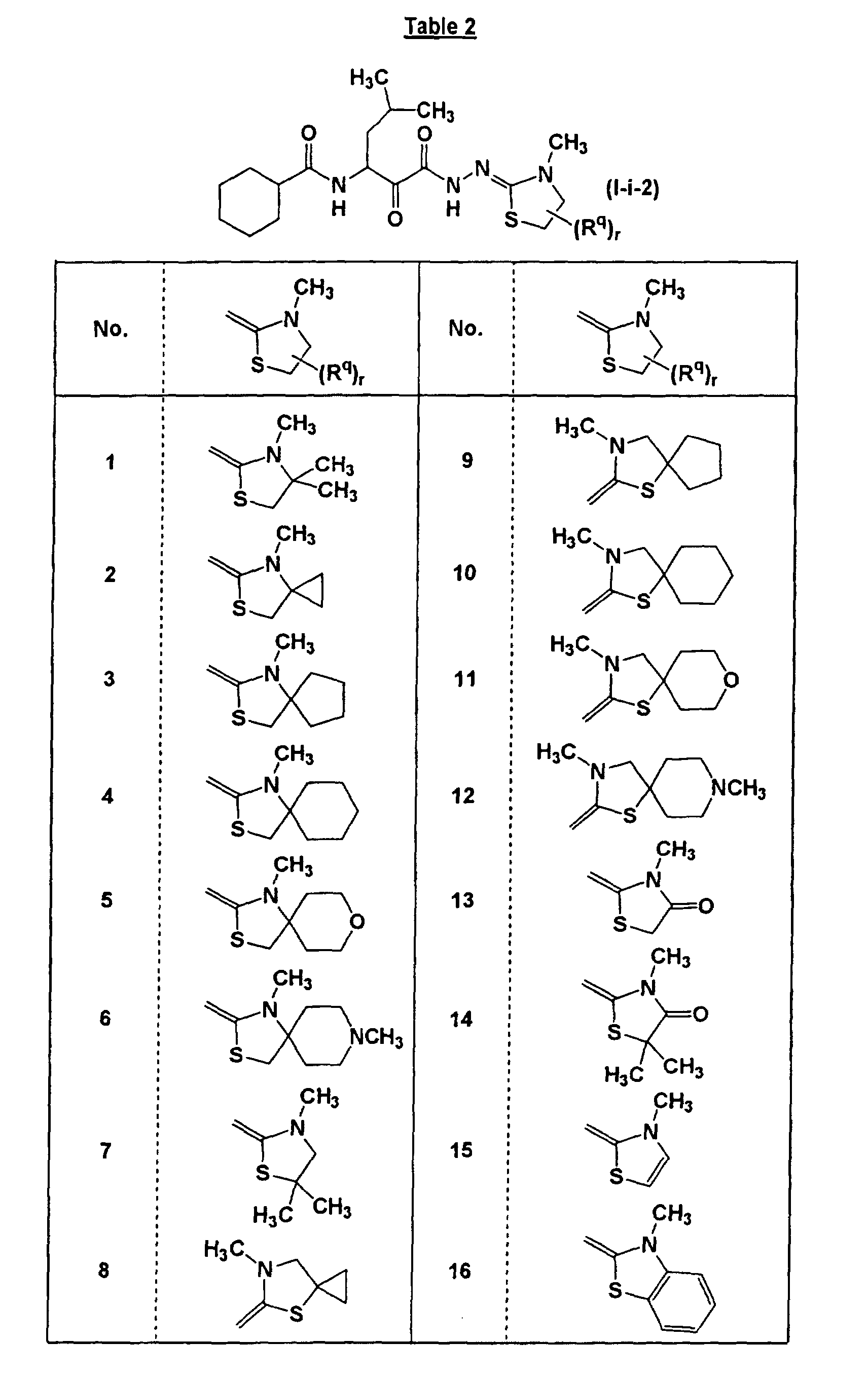


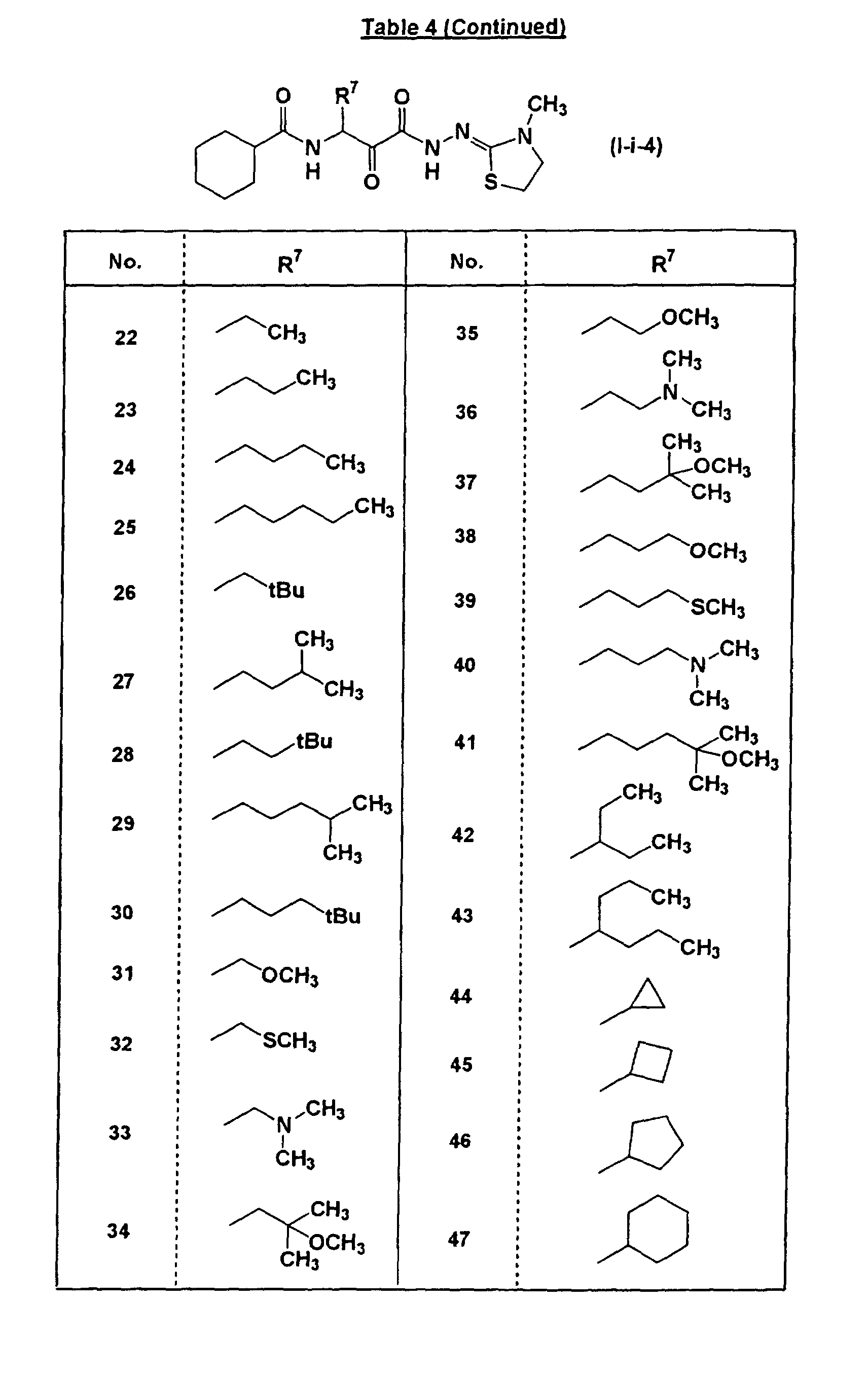

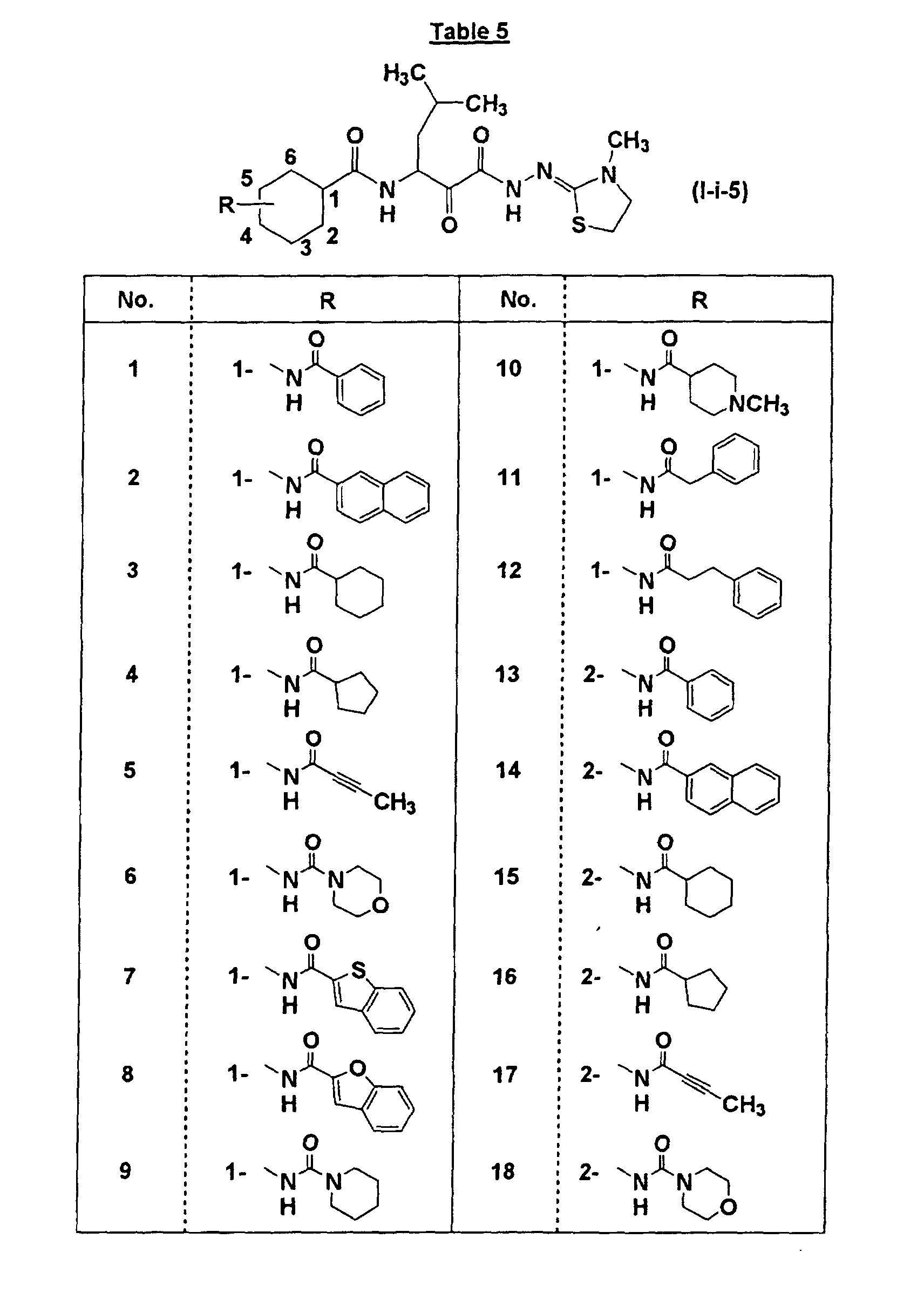
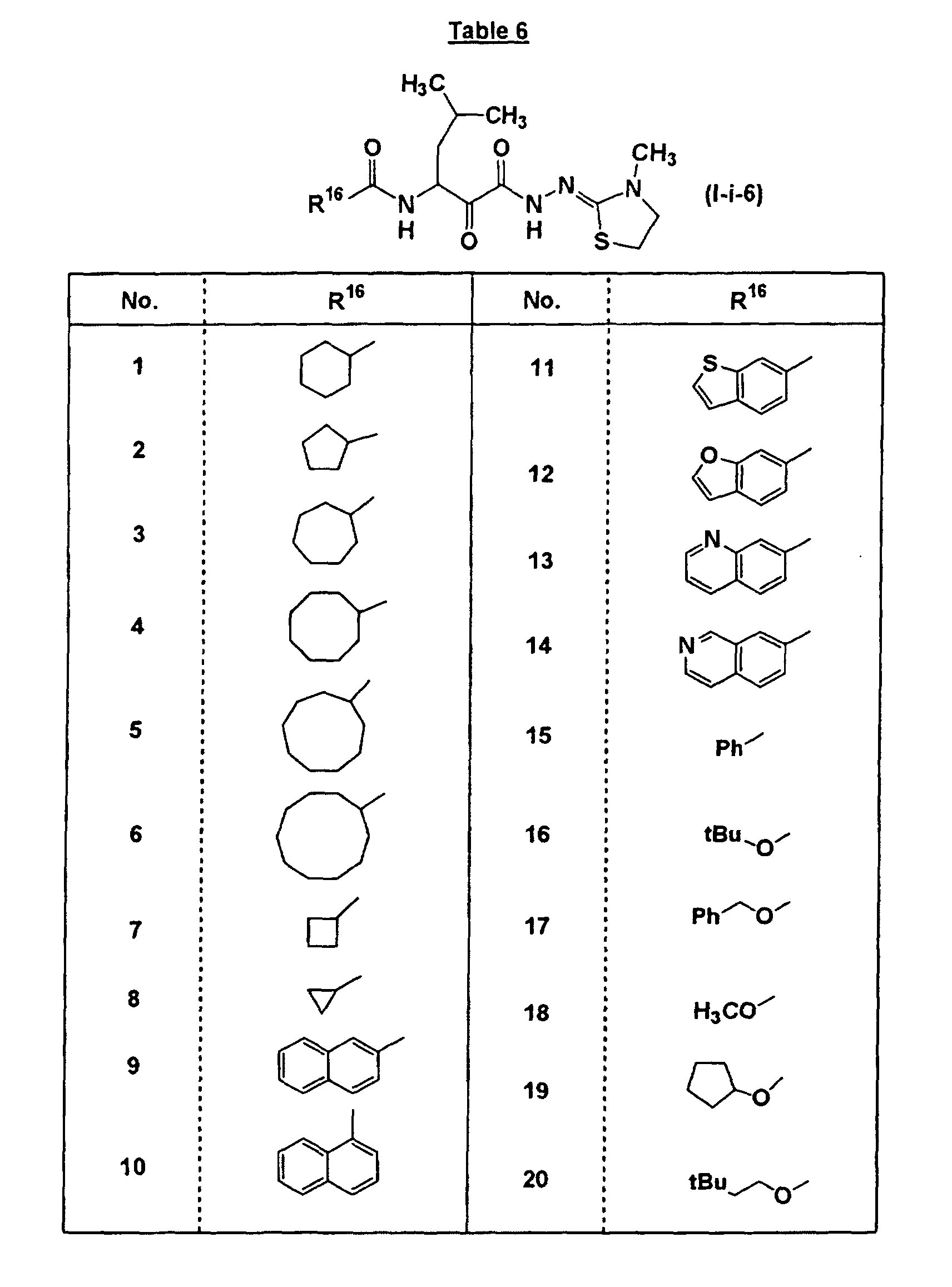
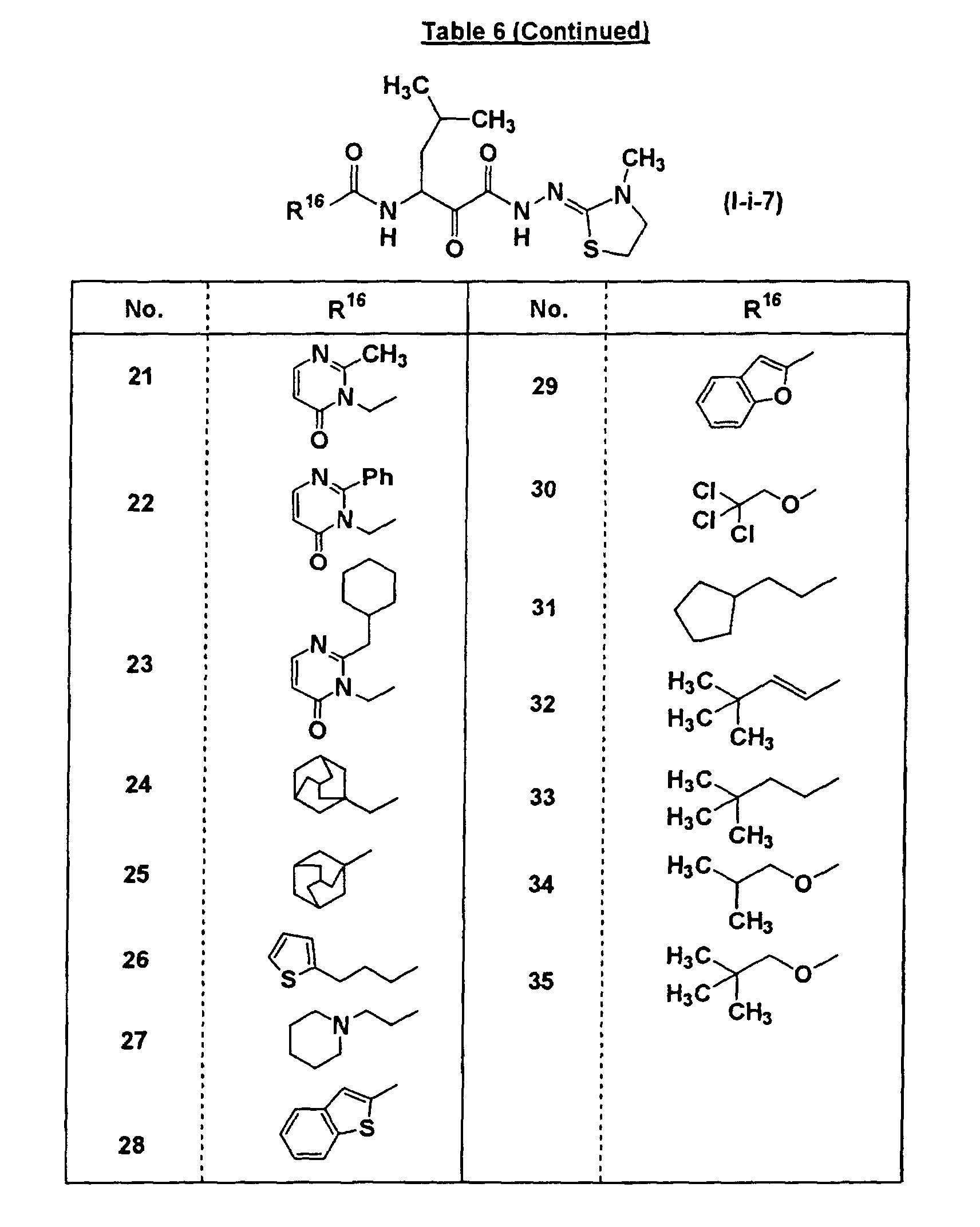
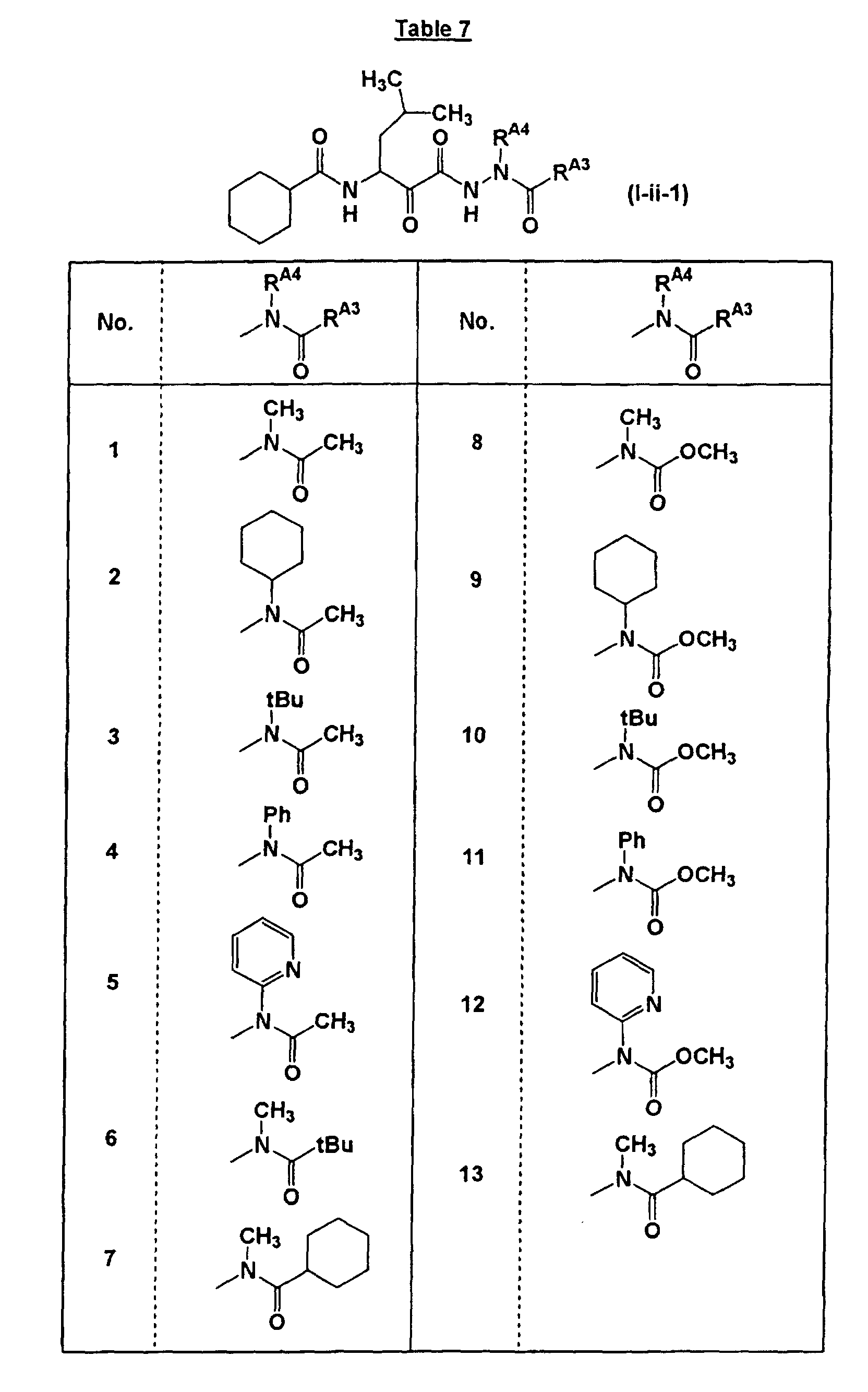
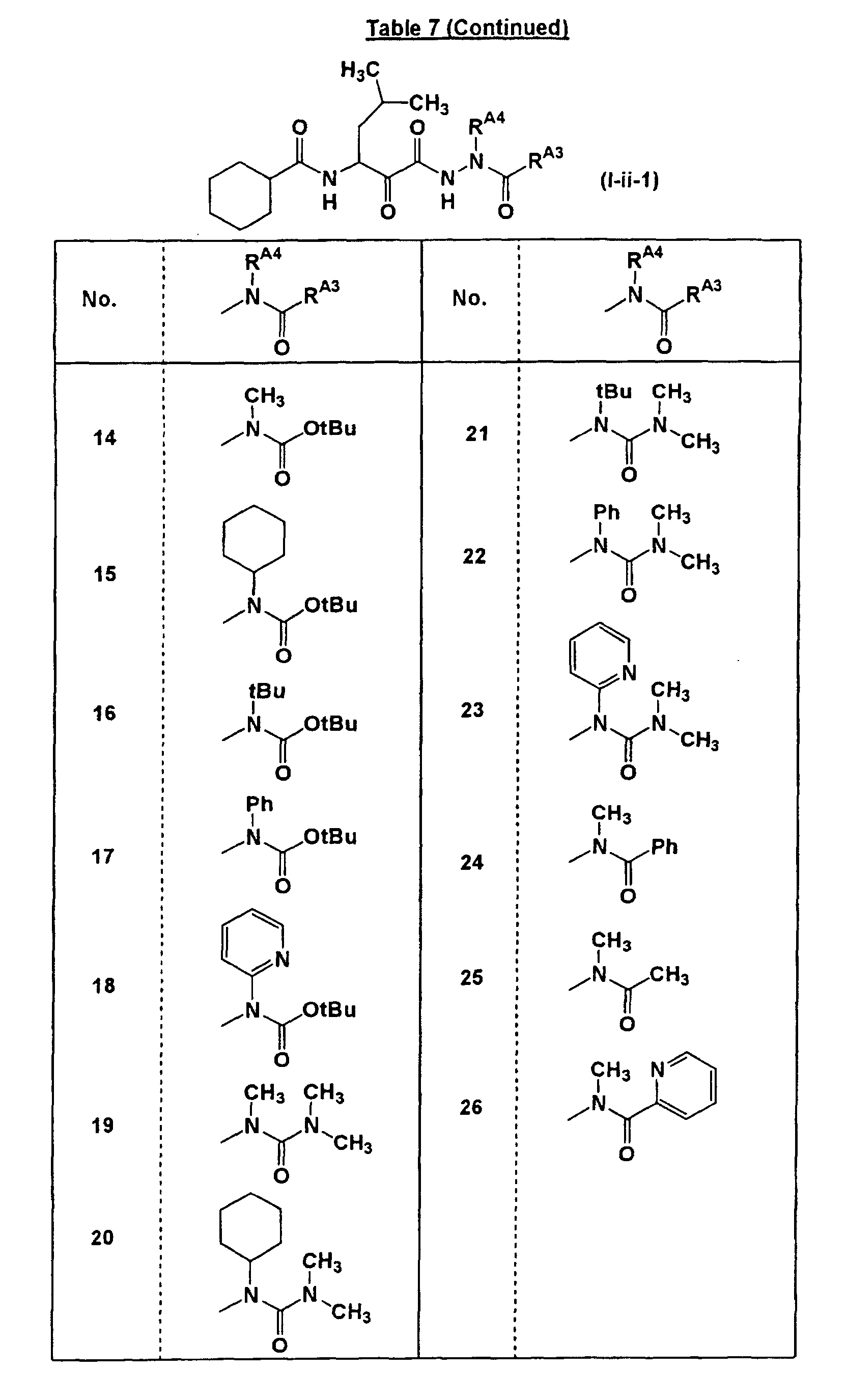


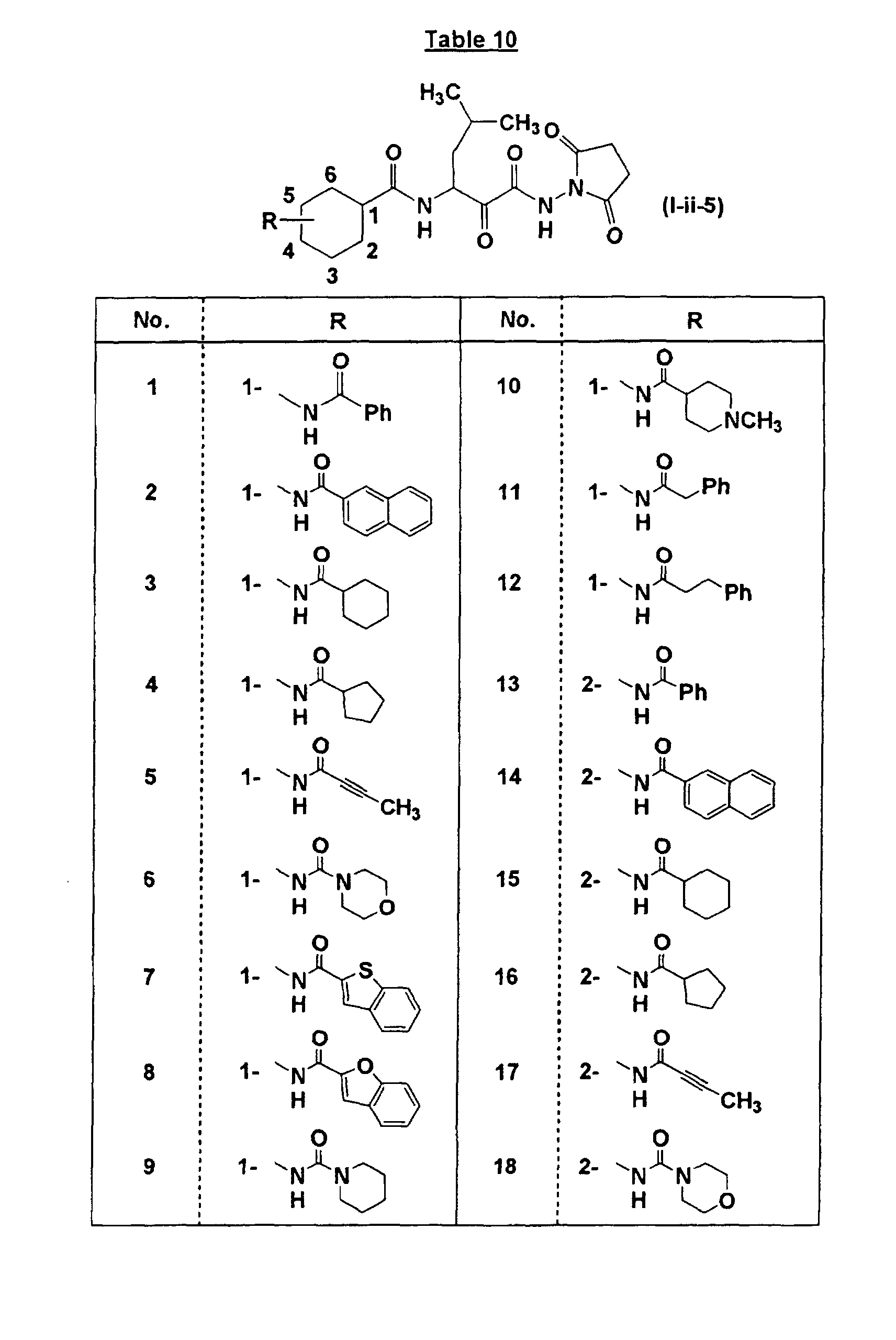
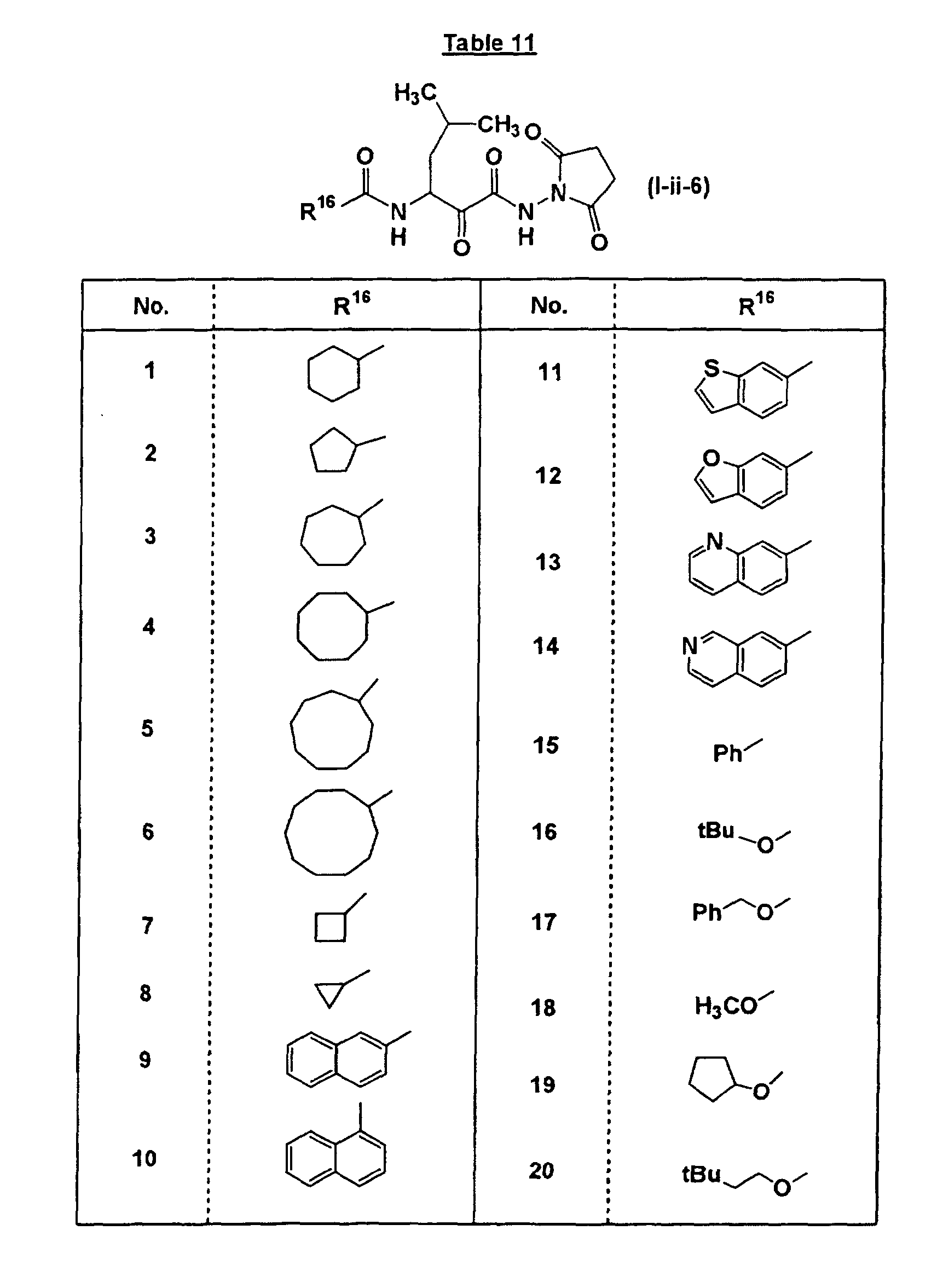

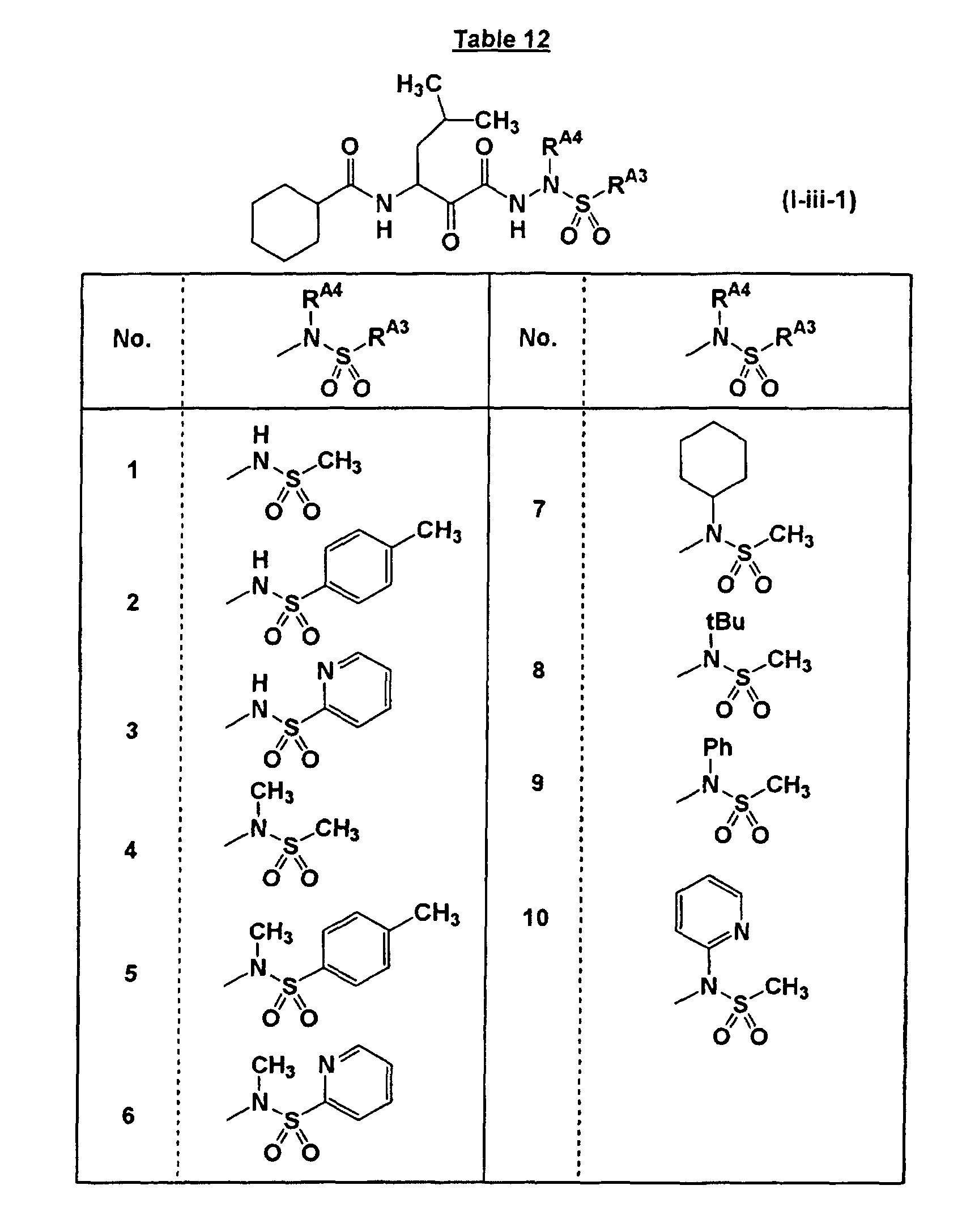
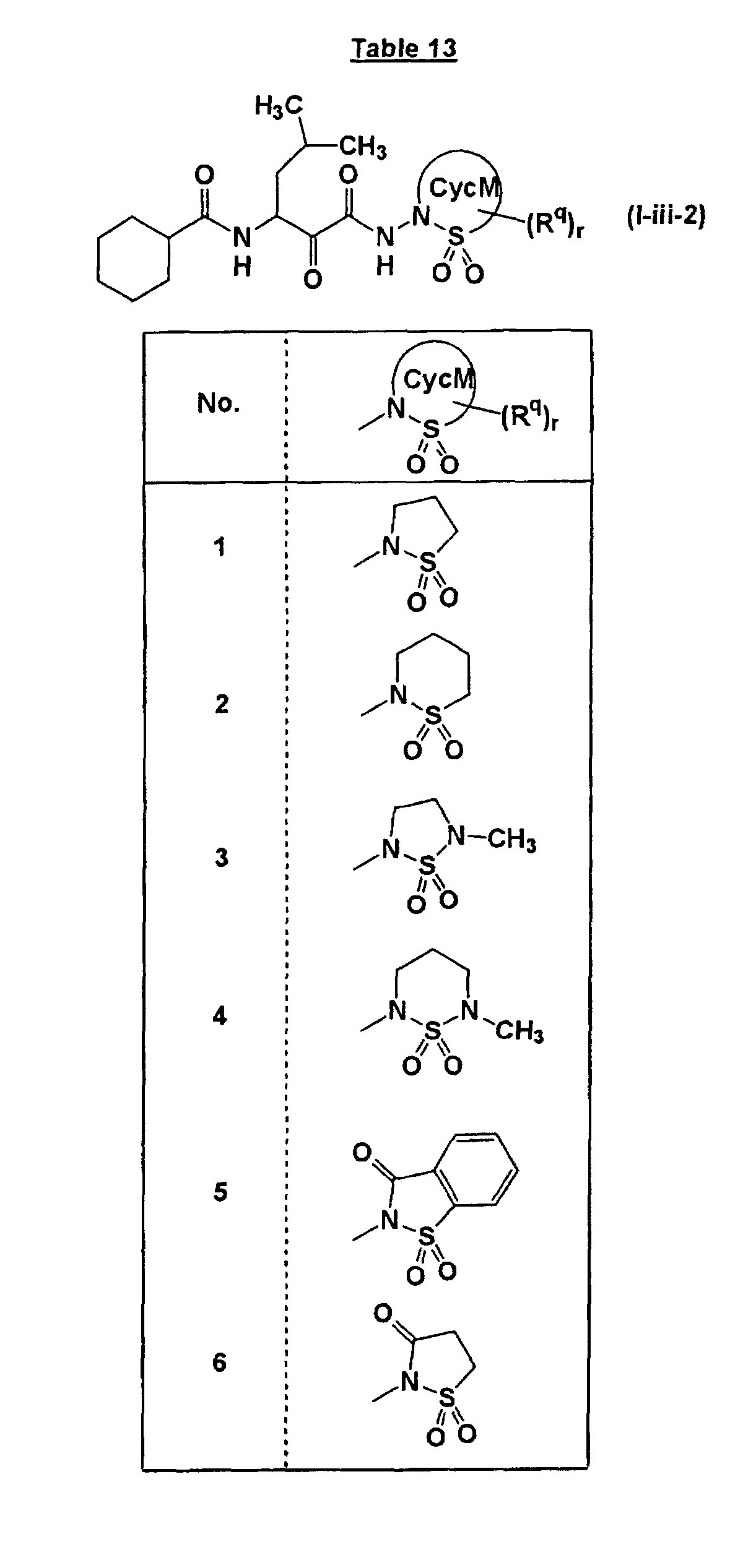
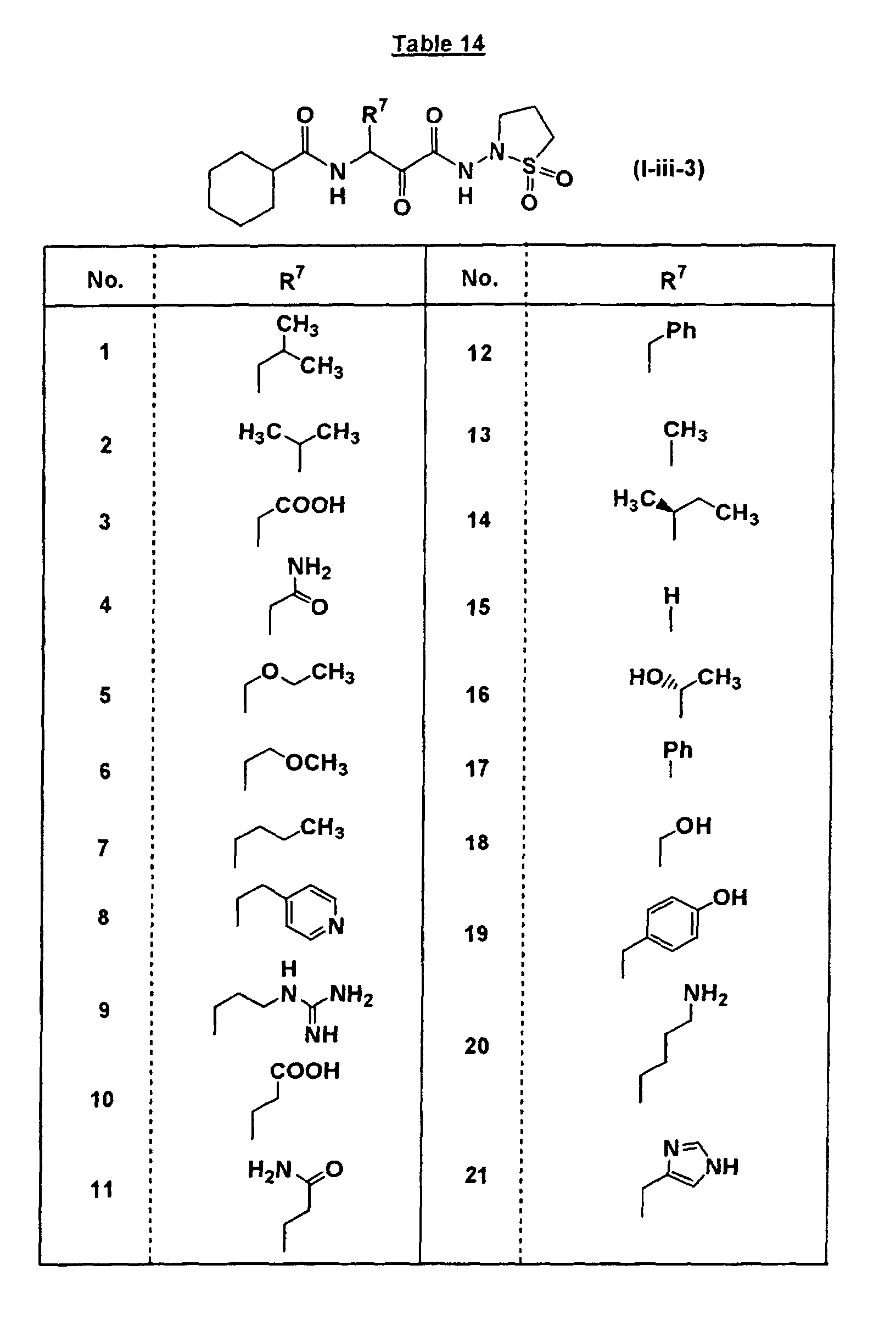


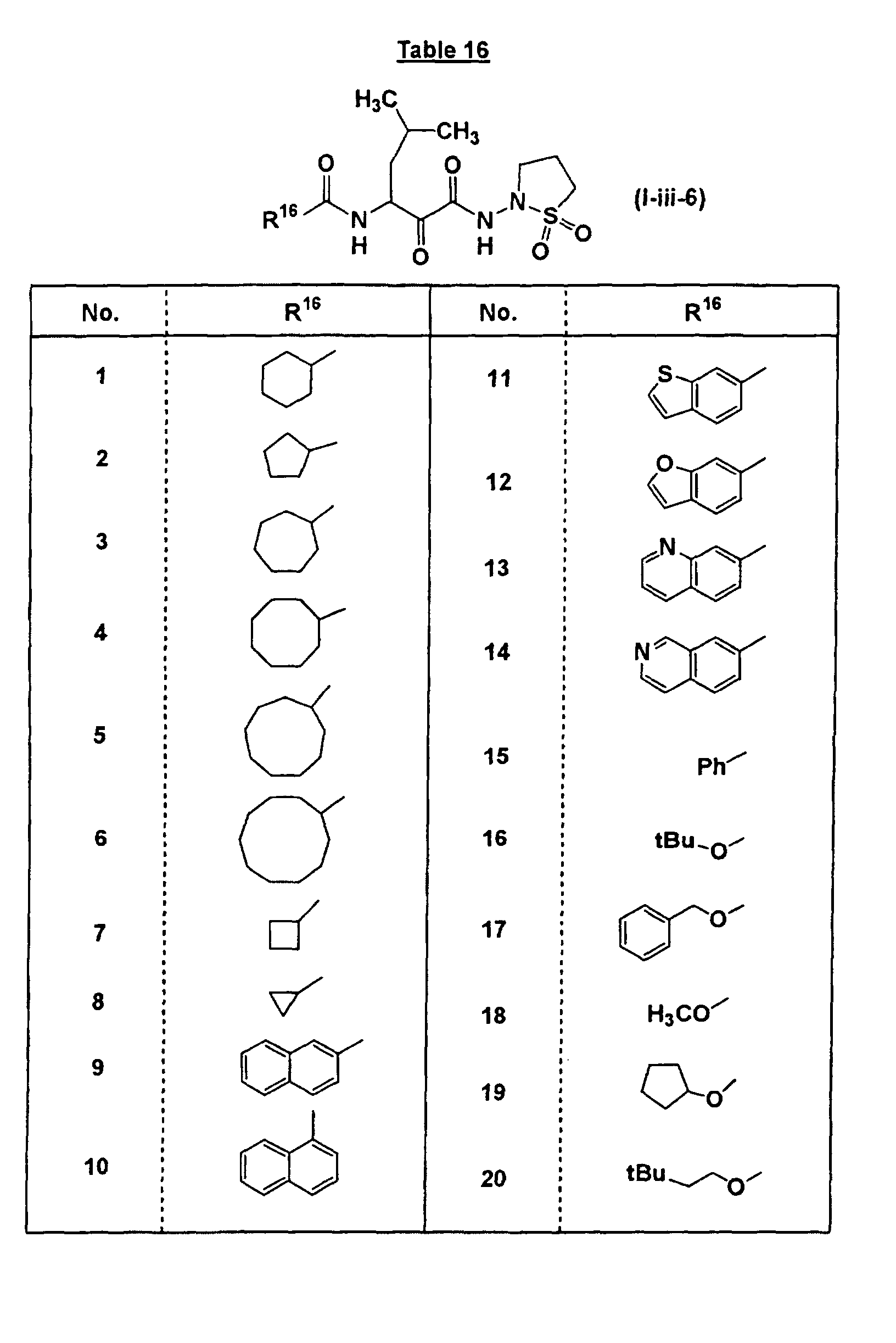

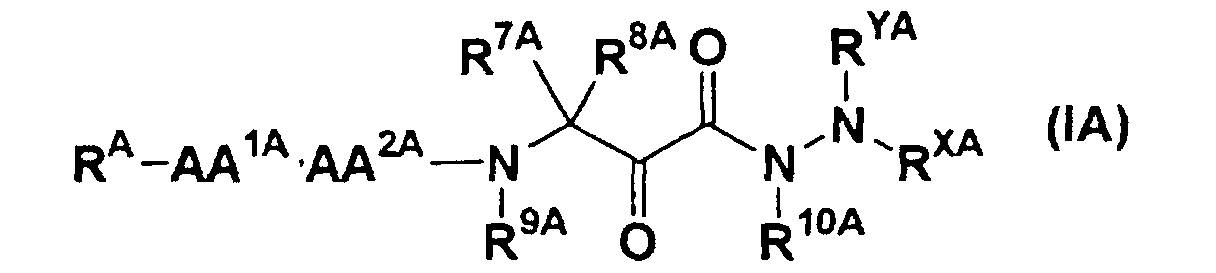
(A) The compound of formula (IA) may be prepared by subjecting to oxidation reaction the compound of formula (II)
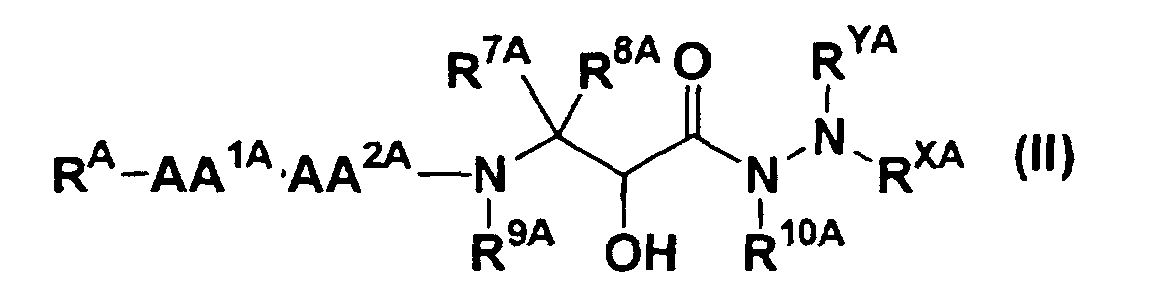
(B) The compound of formula (IA) may be prepared by subjecting to amidation reaction the compound of formula (III)
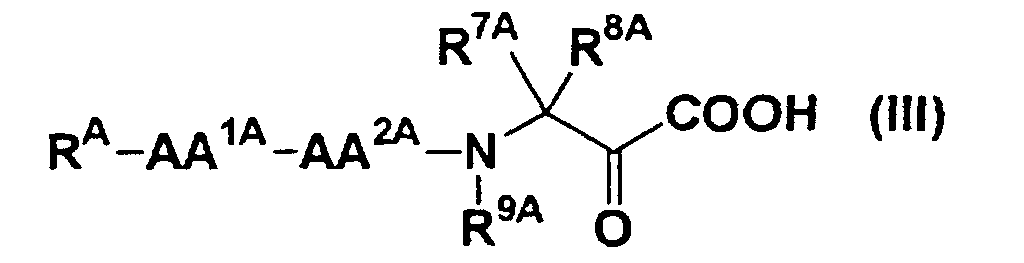
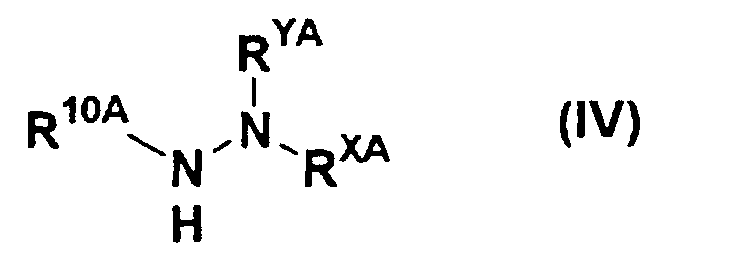
- (1) the method using acid halide is carried out, for example, by subjecting to a reaction carboxylic acid and acid-halogenating agent (oxalyl chloride, thionyl chloride, etc.) in an organic solvent (chloroform, methylene chloride, diethyl ether, tetrahydrofuran, etc.) or without a solvent, between -20°C and refluxing temperature, and then subjecting thus obtained acid halide to a reaction with amine in the presence of base (pyridine, triethylamine, dimethylaniline, dimethylaminopyridine, etc.) in an inert organic solvent (chloroform, methylene chloride, diethyl ether, tetrahydrofuran, etc.) at a temperature of 0 to 40°C. Alternatively, it may be carried out by subjecting to a reaction with acid halide in an organic solvent (dioxane, tetrahydrofuran, etc.) using an aqueous alkali solution (an aqueous solution of sodium bicarbonate or sodium hydroxide, etc.) at a temperature of 0 to 40°C.
- (2) In a method where mixed anhydride is used, for example, carboxylic acid is subjected to a reaction with acid halide (pivaloyl chloride, tosyl chloride, mesylchloride, etc.) or acid derivative (chloroethyl formate, chloroisobutyl formate, etc.) in an organic solvent (chloroform, methylene chloride, diethyl ether, tetrahydrofuran, etc.) or without a solvent, in the presence of a base (pyridine, triethylamine, dimethylaniline, dimethylaminopyridine, diisopropylethylamine, etc.), at a temperature of 0 to 40°C, and then thus obtained mixed anhydride is subjected to a reaction with amine in an organic solvent (chloroform, methylene chloride, diethyl ether, tetrahydrofuran, etc.) at a temperature of 0 to 40°C.
- (3) In a method wherea condensing agent is used, for example, carboxylic acid is subjected to a reaction with amine in an organic solvent (chloroform, methylene chloride, dimethylformamide, diethyl ether, tetrahydrofuran, etc.) or without a solvent, in the presence or absence of a base (pyridine, triethylamine, dimethylaniline, dimethylaminopyridine, etc.), using a condensing agent (1,3-dicyclohexylcarbodiimide (DCC), 1-ethyl-3-[3-(dimethyl amino)propyl]carbodiimide (EDC), 1,1'-carbonyldiimidazole (CDI), 2-chloro-1-methylpyridinium iodide, 1-propanephosphonic acid cyclic anhydride (PPA), etc.) in the presence or absence of 1-hydroxybenzotriazole (1-HOBt), at a temperature of 0 to 40°C.
(C) In the compound of formula (IA), the compound of formula (IA-i)
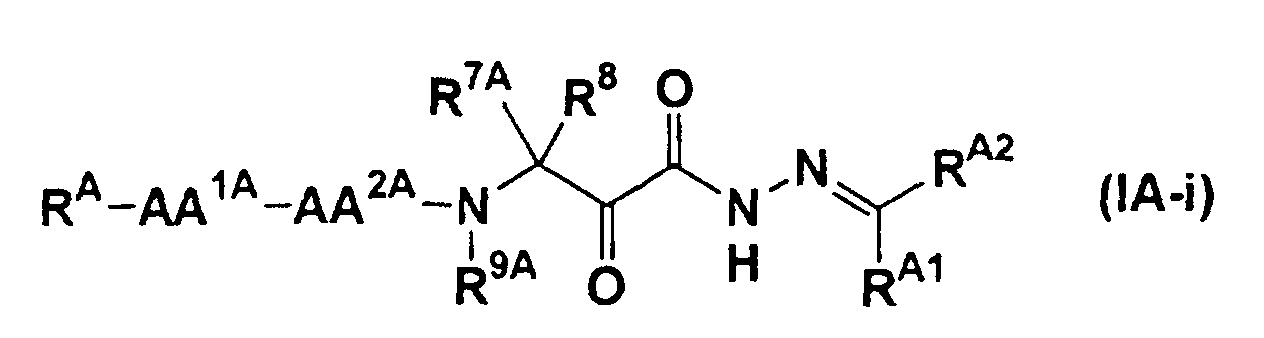

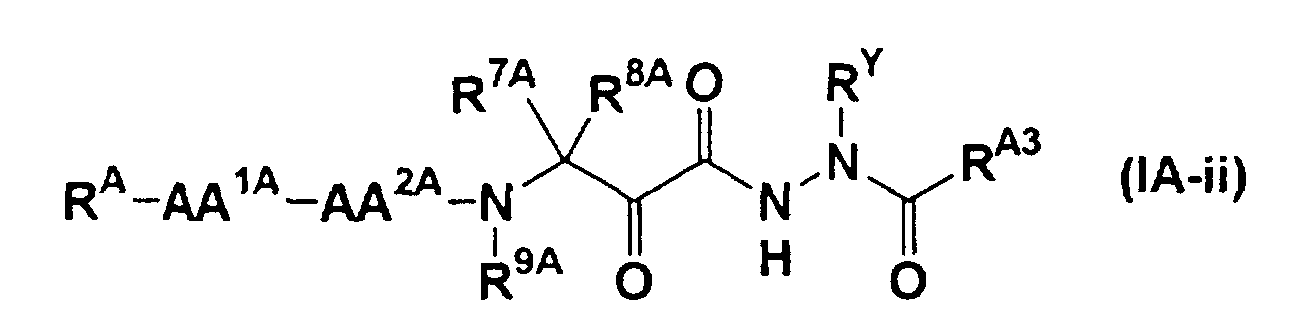
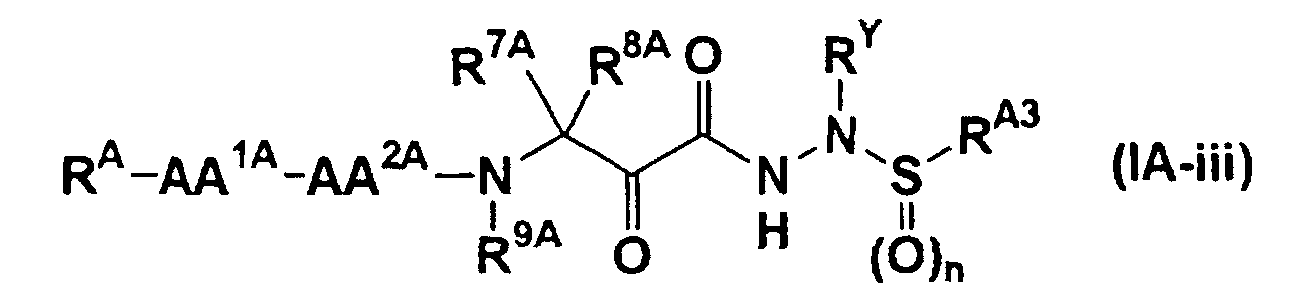
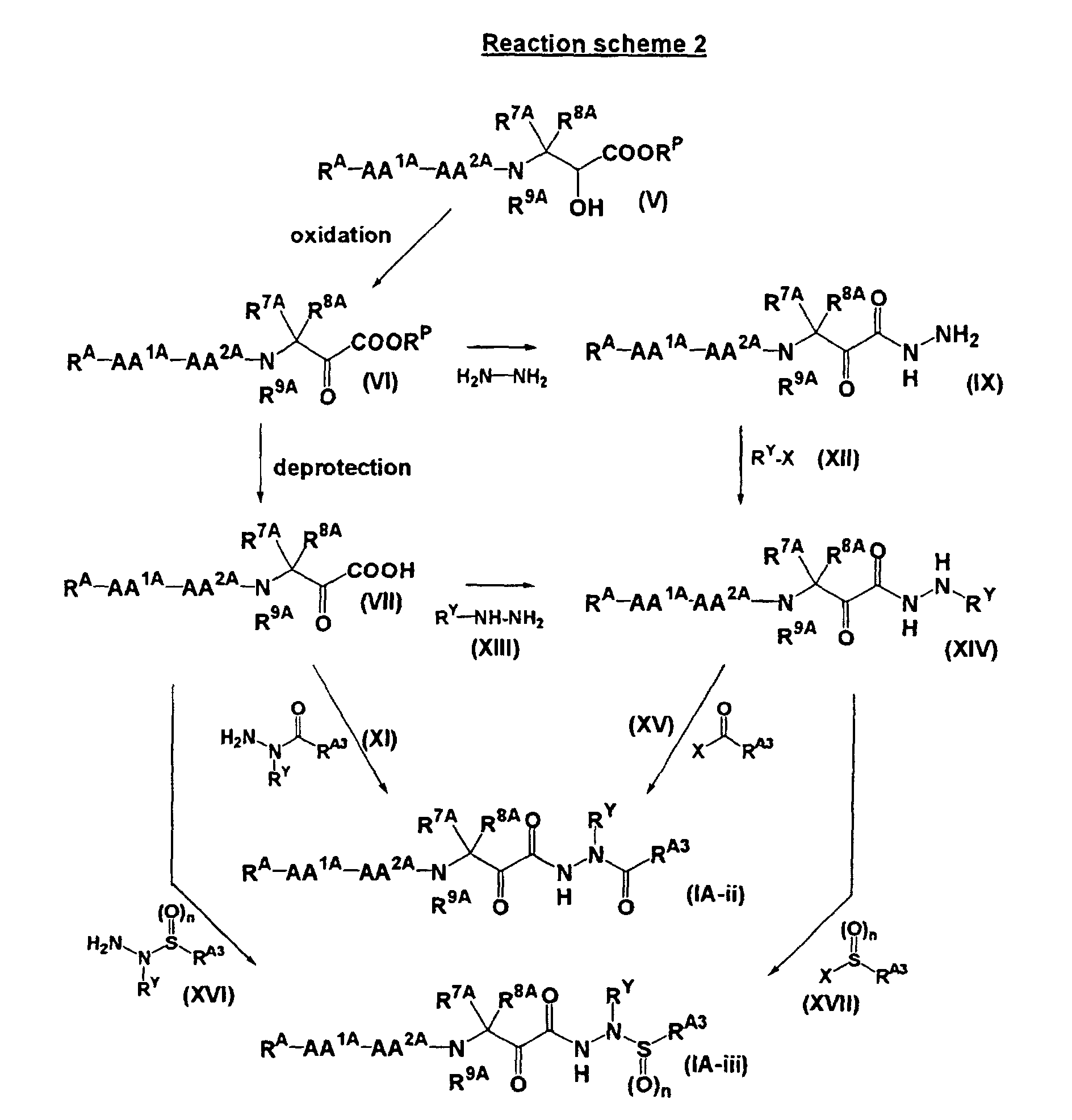
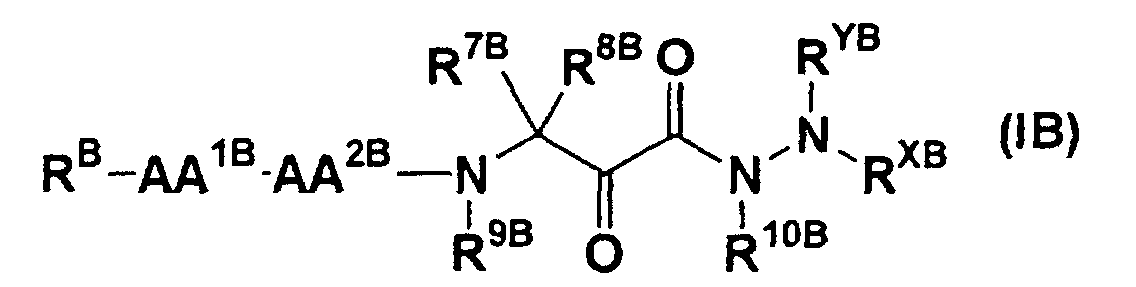


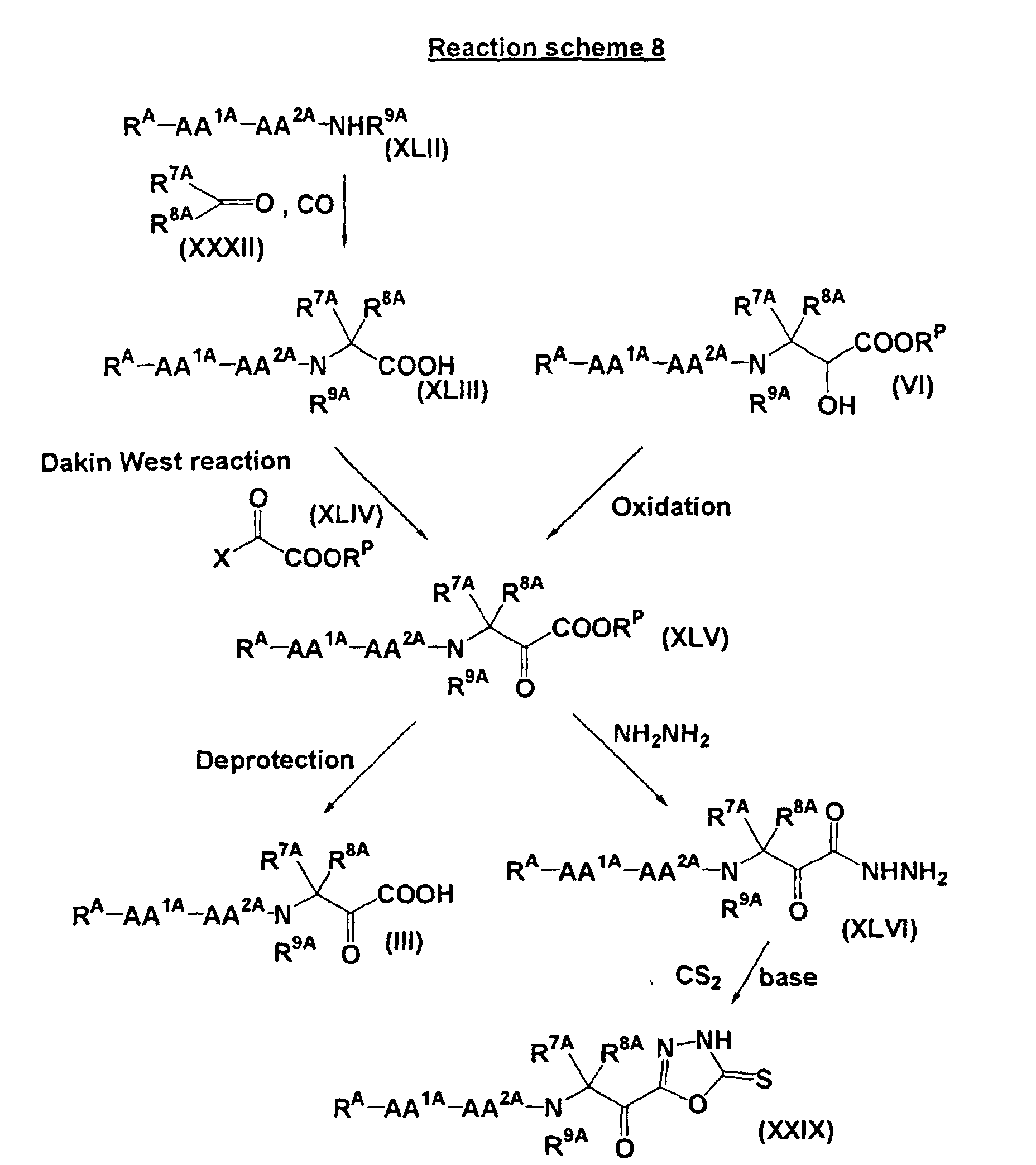
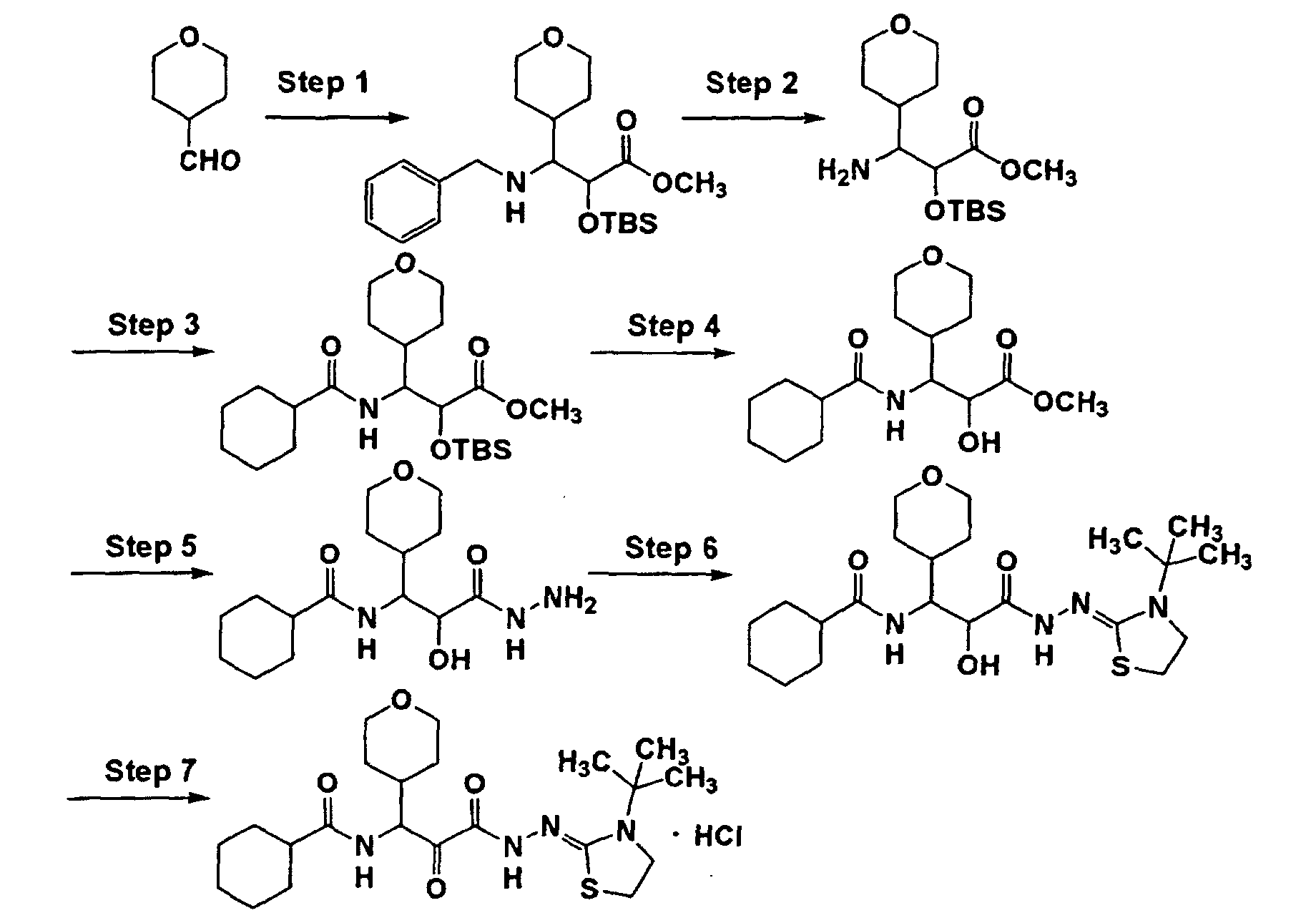
TLC:Rf 0.43 and 0.21 (n-hexane:ethyl acetate=7:3).
Step 2: To the compound prepared in step 1 (64.0 g) were added 5% palladium carbon and methanol (150 ml) and under the atmosphere of hydrogen the mixture was stirred vigorously for 4 hours at 40°C. The reaction mixture was filtered and the filtrate was concentrated. The residue was azeotroped with acetonitrile to give 3-amino-3-(tetrahydropyran-4-yl)-2-(t-butyldimethylsilyloxy)propanoic acid methyl ester (crude, 49.0 g).
TLC:Rf 0.12 (n-hexane:ethyl acetate=1:1).
Step 3: To a solution of the compound prepared in step 2 (49.0 g) in acetonitrile (150 ml) was added N-methylmorpholine (19.1 ml) and the mixture was cooled to 0°C and to the mixture was added cyclohexanecarbonyl chloride (19.4 ml) and the mixture was stirred for 30 minutes at the same temperature. To the reaction mixture was added N,N-dimethylethylenediamine (2.55 g) and it was extracted with water and ethyl acetate. The organic layer was washed with 1N hydrochloric acid, a saturated aqueous solution of sodium bicarbonate and brine successively, dried over anhydrous sodium sulfate and concentrated to give 3-cyclohexylcarbonylamino-3-(tetrahydro pyran-4-yl)-2-(t-butyldimethylsilyloxy)propanoic acid methyl ester (crude, 60.3 g).
TLC:Rf 0.74 and 0.75 (n-hexane:ethyl acetate=1:1).
Step 4: To a solution of the compound prepared in step 3 (60 g) in methanol (80 ml) was added 10% hydrochloric acid-methanol (70 ml) at room temperature and the mixture was stirred for 40 minutes. The reaction mixture was concentrated and to the residue was added a saturated aqueous solution of sodium bicarbonate and extracted with ethyl acetate. The organic layer was washed with a saturated aqueous solution of sodium bicarbonate and brine successively,dried over anhydrous magnesium sulfate and concentrated. The residue was washed with t-butylmethyl ether and dried to give 3-cyclohexylcarbonylamino-3-(tetrahydropyran-4-yl)-2-hydroxypropanoic acid methyl ester (28.2 g).
TLC:Rf 0.31 (n-hexane:ethyl acetate=1:1). Step 5: To a solution of the compound prepared in step 4 (12.2 g) in methanol (40 ml) was added hydrazine monohydrate (9.7 g) and the mixture was stirred for 2 hours at room temperature. To the reaction mixture was added methanol (20 ml) and it was stirred for another 20 hours. The reaction mixture was concentrated and to the residue was added diisopropyl ether and it was filtered, washed with diisopropyl ether and dried to give 3-cyclohexylcarbonylamino-3-(tetrahydropyran-4-yl)-2-hydroxypropanohydrazide (11.4 g).
TLC:Rf 0.30 (methylene chloride:methanol=9:1).
Step 6: To a suspension of the compound prepared in step 5 (626 mg) in DMSO (8 ml) were added N-methylmorpholine (0.22 ml) and 2-methylthio-3-t-butylthiazolinium iodide (1.14 g) and the mixture was stirred for 20 hours at room temperature. To the reaction mixture was added water and extracted with ethyl acetate three times. The organic layers were combined and washed with brine, dried over anhydrous sodium sulfate and concentrated to give N'-(3-t-butyl-1, 3-thiazolidin-2-ylidene)-[3-cyclohexylcarbonylamino-2-hydroxy-3-(tetrahydropyran-4-yl)propanohydrazine) (885 mg).
TLC:Rf 0.71 and 0.70 (methylene chloride:methanol=9:1).
Step 7: To a solution of the compound prepared in step 6 (620 mg) in dimethylsulfoxide (5 ml) were added triethylamine (0.95 ml) and sulfur trioxide-pyridine complex (869 mg) and the mixture was stirred for 30 minutes. To the reaction mixture was added water and extracted with ethyl acetate. The organic layer was washed with brine, dried over anhydrous sodium sulfate and concentrated. The residue was washed with t-butylmethyl ether and dried to give free compound of N'-(3-t-butyl-1,3-thiazolidin-2-ylidene)-[3-cyclohexylcarbonylamino-2-oxo-3-(tetrahydropyran-4-yl)propionohydrazide]. To the free compound was added 4N hydrochloric acid-ethyl acetate solution and concentrated. The residue washed with ethyl acetate and dried to give hydrochloride of the title compound (303 mg).
free compound
NMR:δ 1.00-1.76 (m, 23H), 2.14 (m, 1H), 2.28 (m, 1H), 3.01 (t, J=6.6 Hz, 2H), 3.22 (m, 2H), 3.67 (t, J=6.6 Hz, 2H), 3.82 (m, 2H), 5.02 (m, 1H), 7.96 (d, J=8.0 Hz, 1H), 10.64 (s, 1H).
hydrochloride
TLC:Rf 0.69 (methylene chloride:methanol=9:1);
NMR:δ 0.96-1.83 (m, 23H), 2.12 (m, 1H), 2.29 (m, 1H), 3.08 (t, J=7.0 Hz, 2H), 3.24 (m, 2H), 3.73-3.91 (m, 4H), 4.98 (m, 1H), 6.95-7.68 (broad, 1H), 8.04 (d, J=7.4 Hz, 1H), 10.94 (s, 1H).

| Example | R | R3 | Rx |
| 1(1) | cyclohexyl | (S)-isobutyl | phenyl |
| TLC:Rf 0.64 (methylene chloride:isopropanol=9:1) | |||
| NMR(100°C):δ 10.16 (br-m, 1H), 7.55-7.50 (m, 3H), 7.36-7.31 (m, 2H), 7.13-7.08 (m, 1H), 4.99 (br-m, 1H), 4.13 (t, J=6.0 Hz, 2H), 3.31 (t, J=6.0 Hz, 2H), 2.23-2.14 (m, 1H), 1.71-1.20 (m, 13H), 0.89 (d, J=6.0 Hz, 3H), 0.87 (d, J=6.0 Hz, 3H) | |||
| 1(2) hydrochloride | cyclohexyl | benzoylpiperidin-4-yl | methyl |
| TLC:Rf 0.71 (methylene chloride:methanol=9:1) | |||
| NMR:δ 1.00-1.45 (m, 7H), 1.45-1.80 (m, 7H), 2.05-2.35 (m, 2H), 3.09 (s, 3H), 3.17 (m, 1H), 3.38 (t, J=7.69 Hz, 2H), 3.59 (m, 1H), 3.90-4.20 (m, 3H), 4.47 (m, 1H), 4.88 (d, J=6.32 Hz, 2H), 7.41 (m, 5H), 8.22 (d, J=5.77Hz, 1H), 11.48(s, 1H) | |||
| 1(3) hydrochloride | cyclohexyl | N-pivaolylpiperidin-4-yl | methyl |
| TLC.Rf 0.37 (methylene chloride:methanol=9:1) | |||
| NMR:δ 1.00-1.40 (m, 16H), 1.40-1.70 (m, 7H), 2.00-2.40 (m, 2H), 2.51-2.80 (m, 2H), 3.06 (s, 3H), 3.36 (t, J=7.28 Hz, 2H), 3.70-4.20 (m, 3H), 4.27 (m, 2H), 4.89 (m, 1H), 8.17 (d, J=6.59 Hz, 1H), 11.38 (s, 1H) | |||
| 1(4) hydrochloride | cyclohexyl | N-toluenesulfonylpip eridin-4-yl | methyl |
| TLC:Rf 0.56 (methylene chloride:methanol=9:1) | |||
| NMR:δ 0.93-1.82 (m, 15H), 1.93-2.31 (m, 3H), 2.39 (s, 3H), 2.97-3.06 (m, 3H), 3.23-3.38 (m, 2H), 3.61 (m, 2H), 3.88 (m, 2H), 4.00-4.80 (broad, 1H), 4.82 (m, 1H), 7.43 (d, J=8.0 Hz, 2H), 7.59 (d, J=8.0 Hz, 2H), 8.14 (m, 1H), 11.25 (brs, 1H) |
NMR: δ 11.39 (br-s, 1H), 4.12 (d, J=6.6 Hz, 1H), 4.04 (t, J=7.5 Hz, 2H), 3.40 (t, J=7.5 Hz, 2H), 3.13 (s, 3H), 3.11 (s, 3H), 2.63-2.44 (m, 1H), 2.41-2.26 (m, 1H), 1.80-1.52 (m, 5H), 1.41-1.10 (m, 5H), 0.97 (d, J=6.9 Hz, 3H), 0.81 (d, J=6.9 Hz, 3H).
NMR:δ 0.90-1.82 (m, 21H), 2.25 (m, 1H), 2.97 (s, 6H), 3.65 (s, 4H), 4.64 (m, 1H), 8.27 (d, J=5.5 Hz, 1H), 10.14 (s, 1H), 11.33 (s, 1H).

| 1(7) | p=1 | TLC:Rf 0.60 (methylene chloride:methanol=9:1) |
| NMR: δ 11.06 (s, 1H,), 8.23 (d, J=6.3 Hz, 1H), 4.77 (t, J=6.3 Hz, 1H), 4.59 (s, 2H), 3.95-3.70 (m, 2H), 3.34-3.10 (m, 2H), 3.00 (s, 3H), 2.33-2.17 (m, 1H), 2.15-1.00 (m, 23H) | ||
| 1(8) | p=2 | TLC:Rf 0.62 (methylene chloride:methanol=9:1) |
| NMR: δ 11.06 (s, 1H), 8.23 (d, J=6.3 Hz, 1H), 4.78 (t, J=6.3 Hz, 1H), 4.61 (s, 2H), 3.90-3.75 (m, 2H), 3.35-3.12 (m, 2H), 2.98 (s, 3H), 2.33-2.18 (m, 1H), 2.15-2.00 (m, 1H), 1.90-1.00 (m, 24H) |

TLC:Rf 0.50(chloroform:methanol=10:1).
Step 2: To a solution of the compound prepared in step 1 in DMSO (344 ml) were added triethylamine (72 ml) and a solution of sulfur trioxide-pyridine complex (82 g) in DMSO (280 ml) at 10°C and the mixture was stirred for 1 hour. The reaction mixture was poured into ice-water and extracted by ethyl acetate. The organic layer was washed by 10% aqueous solution of citric acid, water and a saturated aqueous solution of sodium chloride successively, and dried over anhydrous sodium sulfate and concentrated to give a crude product of (2S)-2-(t-butoxycarbonyl amino)-4-methylpentanal.
TLC:Rf 0.45 (chloroform:methanol=10:1).
Step 3: To a solution of the compound prepared in step 2 in methanol(180 ml) were added acetone cyanohydrine (19 ml) and potassiumcarbonate (4.7 g) at 0°C and the mixture was stirred for 1 hour at room temperature. The reaction mixture was concentrated and the residue was extracted by ethyl acetate and water. The organic layer was washed by water and a saturated aqueous solution of sodium chloride successively, dried over anhydrous sodium sulfate and concentrated. The residue was purified by column chromatography on silica gel (n-hexane:ethyl acetate=3:1) to give (3S)-3-(t-butoxycarbonylamino)-2-hydroxy-5-methylhexanenitrile(33.6g).
TLC:Rf 0.40(n-hexane:ethyl acetate=3:1).
Step 4: To the compound prepared in step 3 (33.6 g) was added a concentrated hydrochloric acid (300 ml) and the mixture was stirred for 5 hours at 80°C. The reaction mixture was concentrated to give a crude product of (3S)-3-amino-2-hydroxy-5-methylhexanoic acid hydrochloride.
TLC:Rf 0.30 (chloroform:methanol:water=6:4:1).
Step 5: To methanol (1000 ml) was added thionyl chloride (92 ml) at -40°C dropwise and the mixture was stirred for 10 minutes. The solution was added to a solution of the compound prepared in step 4 in methanol (250 ml) at -10°C dropwise and the mixture was stirred for 4 hours at room temperature. The reaction mixture was concentrated to give a crude product of methyl (3S)-3-amino-2-hydroxy-5-methylhexanoate hydrochloride.
TLC:Rf 0.50 (chloroform:methanol:water=6:4:1).
Step 6: To a solution of the crude compound prepared in step 5 (32 g) in methylene chloride (300 ml) were added triethylamine (20 ml) and di-t-butyl-dicarbonate (34 ml) at 0°C and the mixture was stirred for 4 hours at room temperature. To the reaction mixture was added water and was extracted by ethyl acetate. The organic layer was washed by 10% aqueous solution of citric acid, a saturated aqueous solution of sodium bicarbonate, water and a saturated aqueous solution of sodium chloride successively, dried over anhydrous sodium sulfate and concentrated. The residue was purified by column chromatography on silica gel (n-hexane:ethyl acetate=3:1) to give (3S)-3-(t-butoxycarbonylamino)-2-hydroxy-5-methylhexanoic acid methyl ester (28 g).
TLC:Rf 0.40 and 0.35 (n-hexane:ethyl acetate=3:1).
Step 7: To a solution of the compound prepared in step 6 (825 mg) in ethyl acetate (6 ml) was added 4N hydrochloric acid-ethyl acetate (9 ml) and the mixture was stirred for 40 minutes at room temperature. The reaction mixture was concentrated to give (3S)-3-amino-2-hydroxy-5-methylhexanoic acid methyl ester hydrochloride.
TLC:Rf 0.26 (ethyl acetate:methanol=4:1).
Step 8: To a solution of the compound prepared in step 7 in acetonitrile (15 ml) were added N-methylmorpholine (0.49 ml) and cyclohexanecarbonyl chloride (484 mg) and the mixture was stirred overnight at room temperature. The reaction mixture was poured into 1N hydrochloric acid and extracted with ethyl acetate. The organic layer was washed with a saturated aqueous solution of sodium bicarbonate and brine successively and dried over anhydrous magnesium sulfate to give (3S)-3-cyclohexylcarbonylamino-2-hydroxy-5-methylhexanoic acid methyl ester (682 mg).
TLC:Rf 0.53 and 0.39 (n-hexane:ethyl acetate=1:1).
Step 9: To a solution of the compound prepared in step 8 (670 mg) in methanol (2.4 ml) was added 1N aqueous solution of sodium hydroxide (2.4 ml) and the mixture was stirred for 30 minutes at room temperature. The reaction mixture was poured into 1N hydrochloric acid and was extracted with ethyl acetate. The organic layer was washed with brine, dried over anhydrous magnesium sulfate and concentrated to give (3S)-3-cyclohexylcarbonylamino-2-hydroxy-5-methylhexanoic acid (676 mg).
TLC:Rf 0.56 (ethyl acetate:methanol=4:1).
Step 10: To a solution of the compound prepared in step 9 (271 mg) and N-methylpyrrolidine-2-ylidenehydrazine (186 mg) in DMF (2 ml) were added 1-hydroxybenzotriazole (150 mg), triethylamine (0.34 ml) and 1-ethyl-3-[3-(dimethylamino)propyl]carbodiimide hydrochloride (230 mg) and the mixture was stirred for 17 hours. To the reaction mixture was added brine, and extracted with ethyl acetate twice. The organic layer was dried over anhydrous sodium sulfate and concentrated. The residue was washed with diisopropyl ether and dried to give 2-[(3S)-3-cyclohexylcarbonylamino-2-hydroxy-5-methylhexanohydrazono]-1-methylpyrrolidine hydrochloride (243 mg).
TLC:Rf 0.78 (methylene chloride:methanol=8:2).
Step 11: To a suspension of the compound prepared in step 10 (219 mg) in DMSO (0.42 ml) were added ethyl acetate (0.5 ml), triethylamine (0.42 ml) and sulfur trioxide-pyridine complex (286 mg) and the mixture was stirred for 1 hour. To the reaction mixture was added brine and extracted with ethyl acetate. The organic layer was washed with brine, dried over anhydrous sodium sulfate and concentrated. The residue was purified by column chromatography on silica gel (ethyl acetate:methanol=20:1->1:1). The product was dissolved in ethyl acetate and thereto was added hydrochloric acid -ethyl acetate (0.1 ml) and concentrated to give N'-(1-methylpyrrolidine-2-yl idene)-(3-cyclohexylcarbonylamino-5-methyl-2-oxohexanohydrazide) hydrochloride (107 mg).
TLC:Rf 0.51 (ethyl acetate:methanol=9:1);
NMR:δ 11.8-11.4 (broad, 1H), 11.6 (brs, 1H), 8.35 (m, 1H), 4.78 (m, 1H), 3.80 (m, 2H), 3.14 (s, 3H), 2.83 (m, 2H), 2.18 (m, 1H), 2.04 (m, 2H), 1.80-1.00 (m, 13H), 1.00-0.70 (m, 6H).
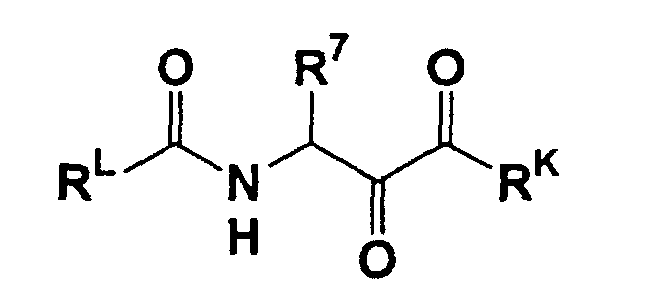
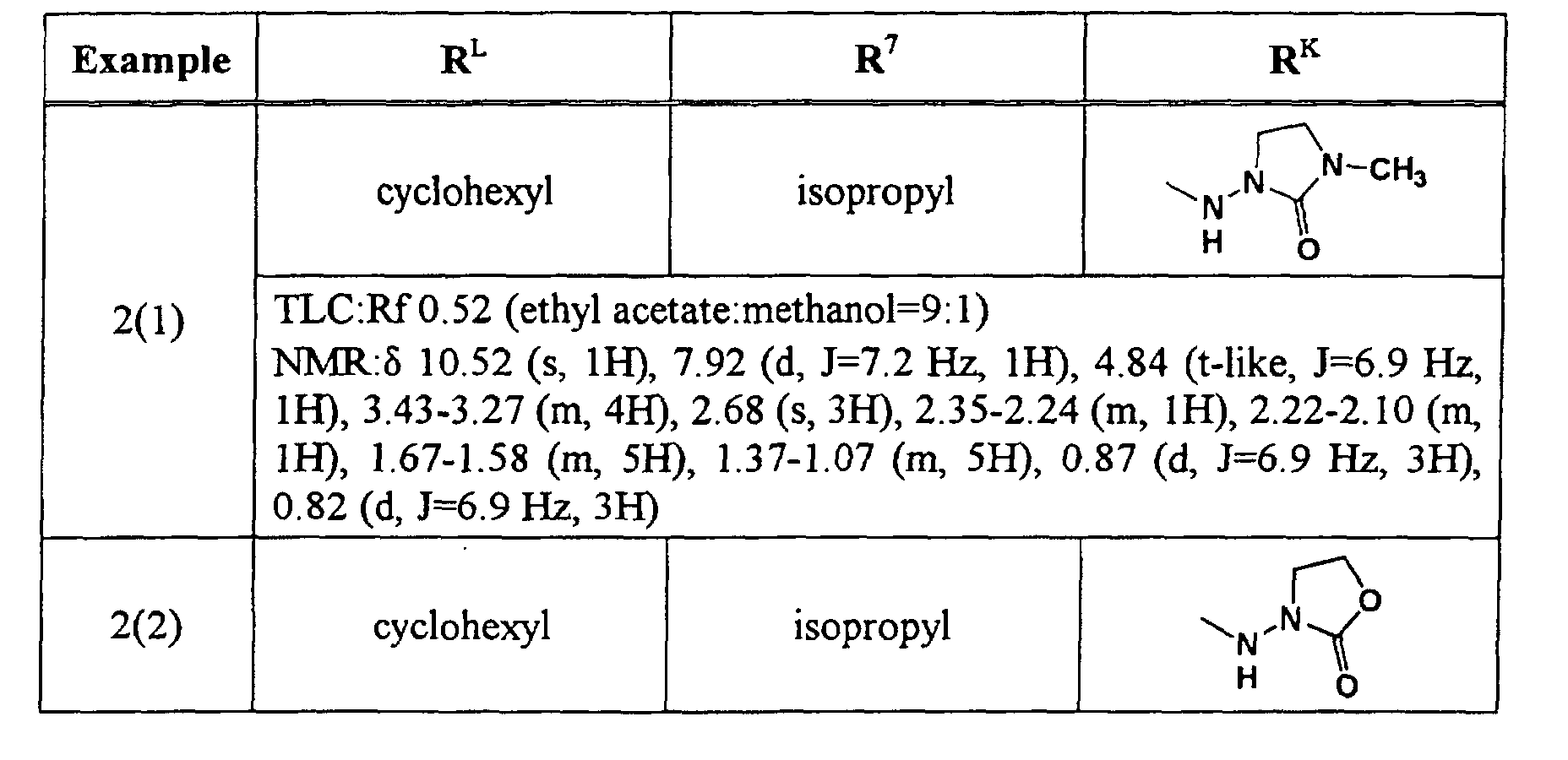
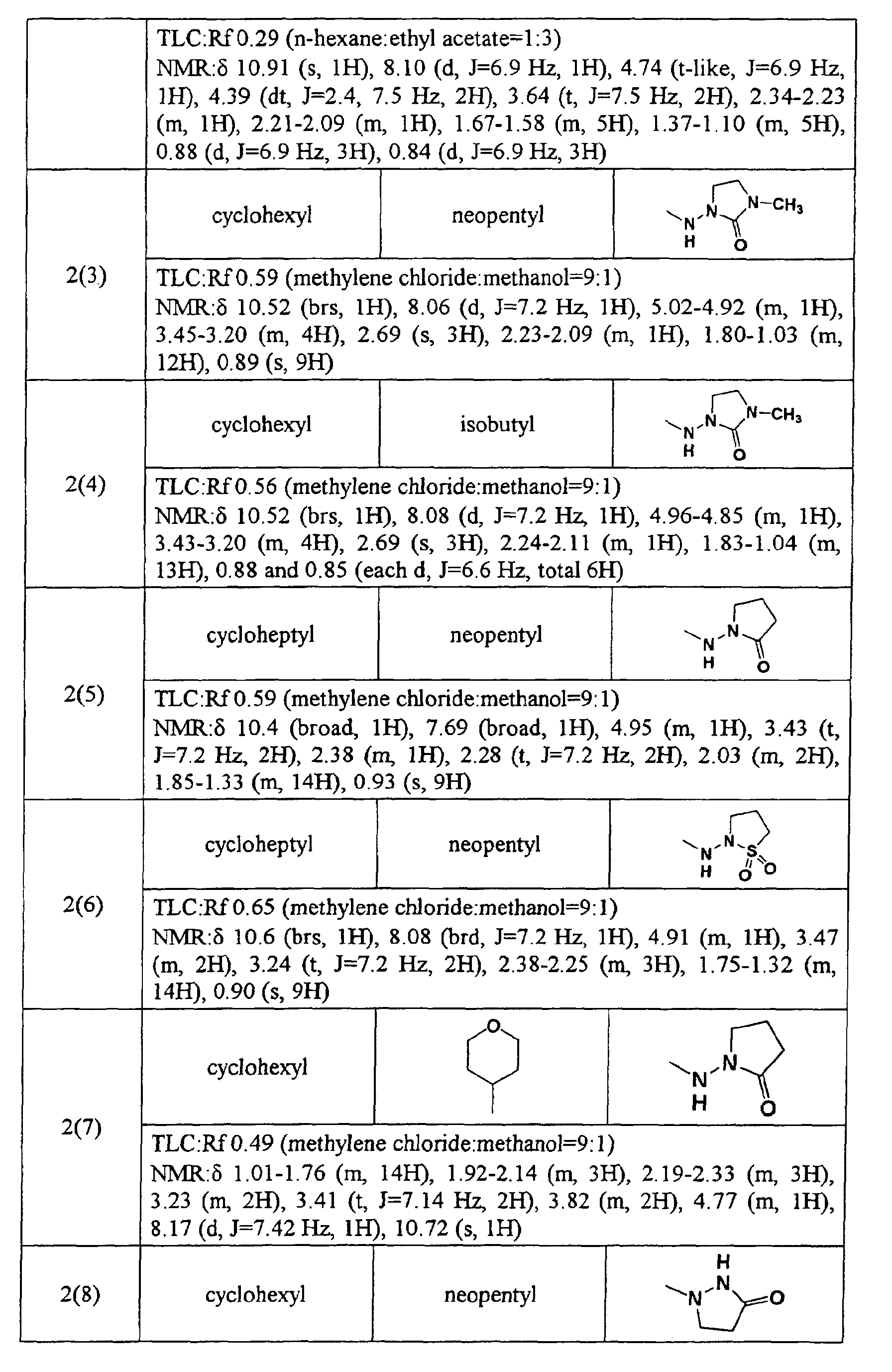
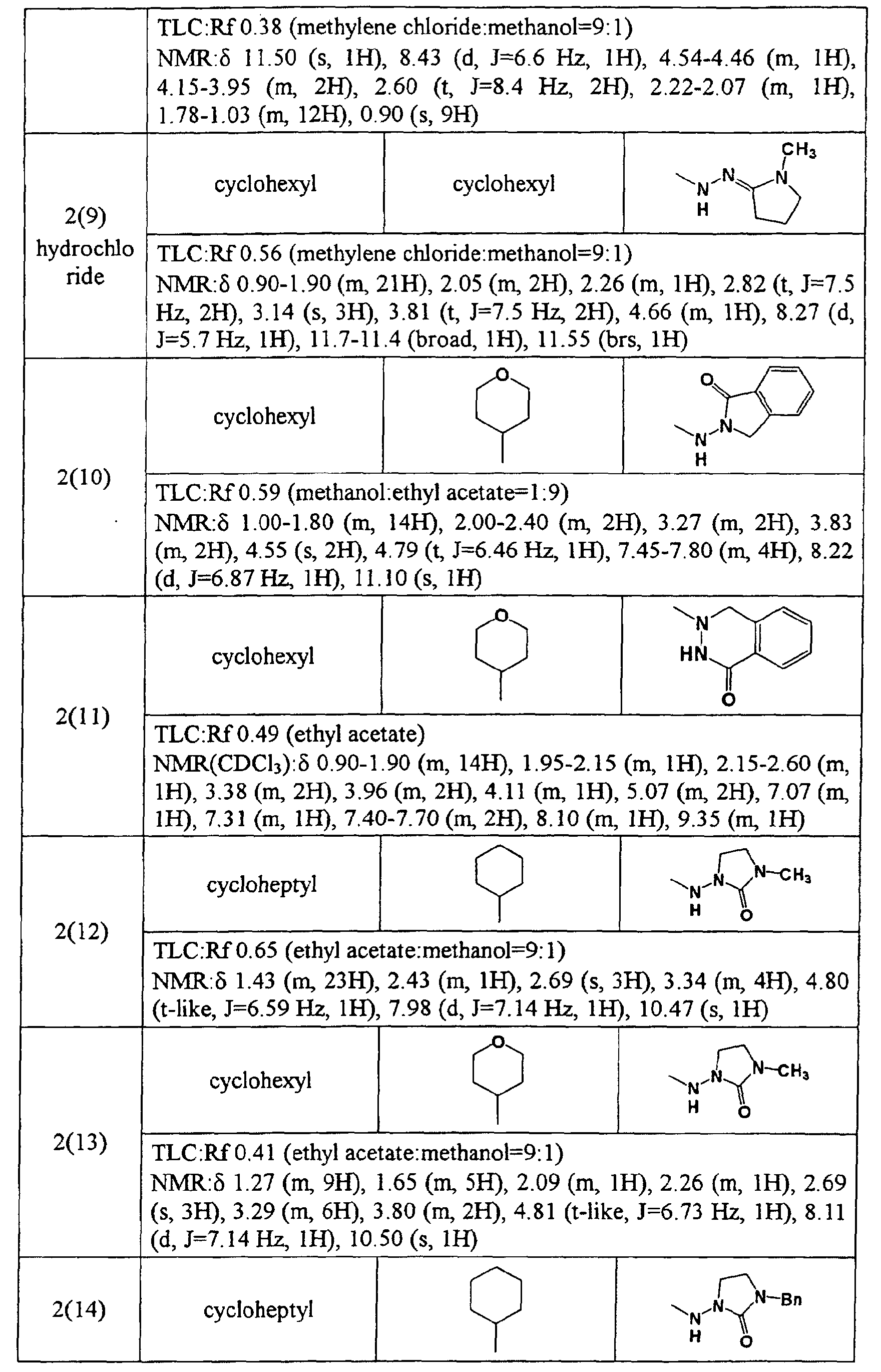
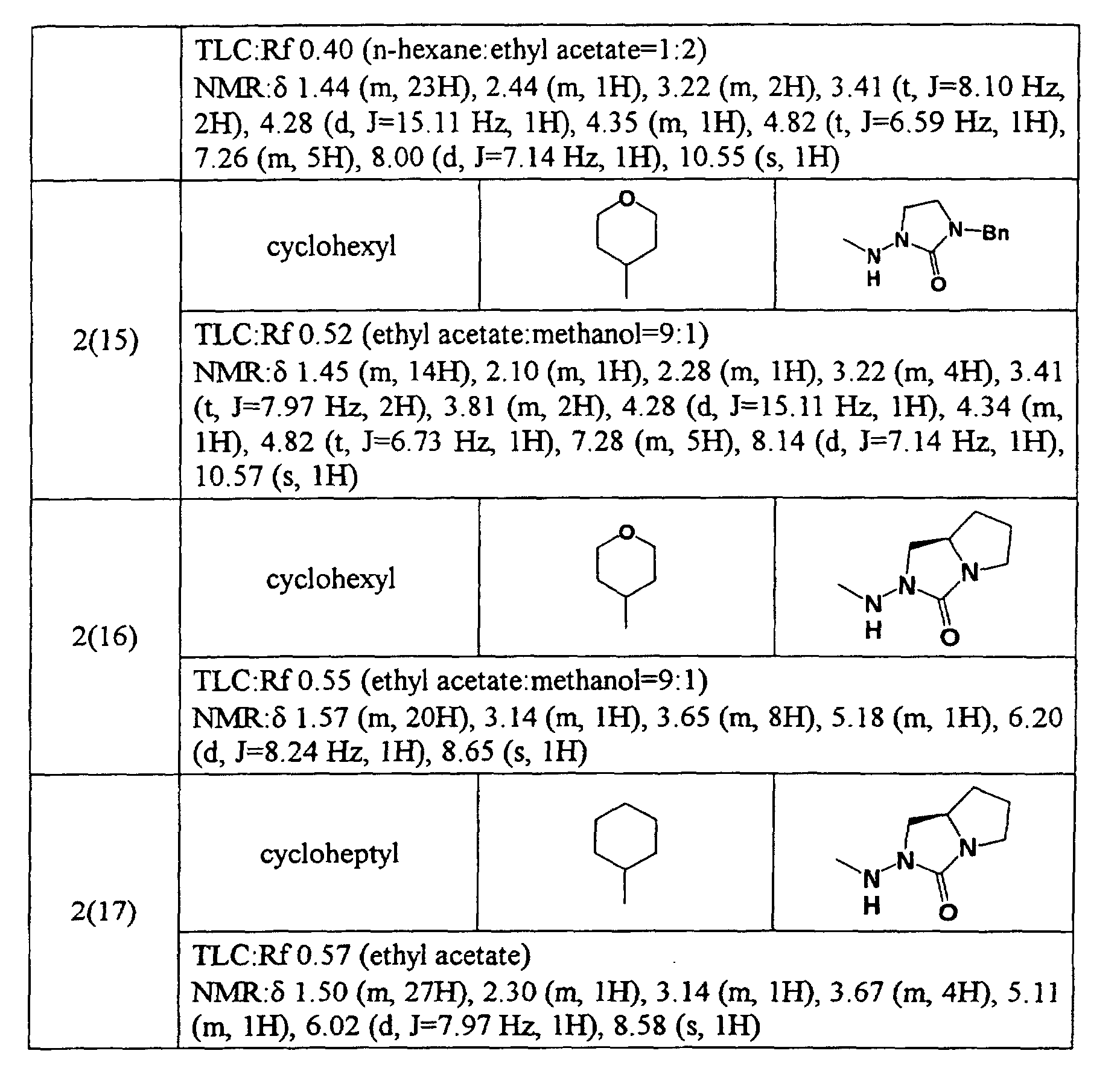

TLC:Rf 0.39 (methylene chloride:methanol=9:1).
Step 2: To a suspension of the compound prepared in step 1 (300 mg) in ethanol (3 ml) was added benzaldehyde (0.66 ml) and the mixture was refluxed for 6 hours. The reaction mixture was concentrated and the residue was washed with t-butyl methyl ether and dried to give N'-benzylidene-[(3S)-3-cyclohexylcarbonyl amino-2-hydroxy-5-methylhexanohydrazide](340 mg).
TLC:Rf 0.77 (ethyl acetate).
Step 3: To a solution of the compound prepared in step 2 (233 mg) in DMSO (2 ml) were added triethylamine (0.2 ml) and sulfur trioxide-pyridine complex (2.96 mg) at 0°C and the mixture was stirred for 30 minutes. To the reaction mixture was added water and extracted with ethyl acetate. The aqueous layer was reextracted with chloroform. The organic layers were combined and washed with brine, dried over anhydrous sodium sulfate and concentrated. The residue was washed with diisopropylether and dried to give N'-benzylidene-[(3S)-3-cyclohexylcarbonylamino-5-methyl-2-oxohexanohydrazide] (182 mg).
TLC:Rf 0.56 (ethyl acetate:n-hexane=1:1);
NMR: δ 12.18 and 12.09 (each brs, totally 1H), 8.49 and 7.99 (each s, totally 1H), 8.17 and 8.07 (each brd, J=6.3 Hz, totally 1H), 7.70-7.60 (m, 2H), 7.50-7.35 (m, 3H), 5.00 and 4.89 (each m, totally 1H), 2.30-2.10 (m, 1H), 1.81-1.02 (m, 13H), 1.00-0.80 (m, 6H).
Example 3(1)-Example 3(12)
By the same procedure as described in example 3 using the compound prepared in step 9 of example 2 or a corresponding compound, the following compounds were given. Unless specified, free compounds are shown.


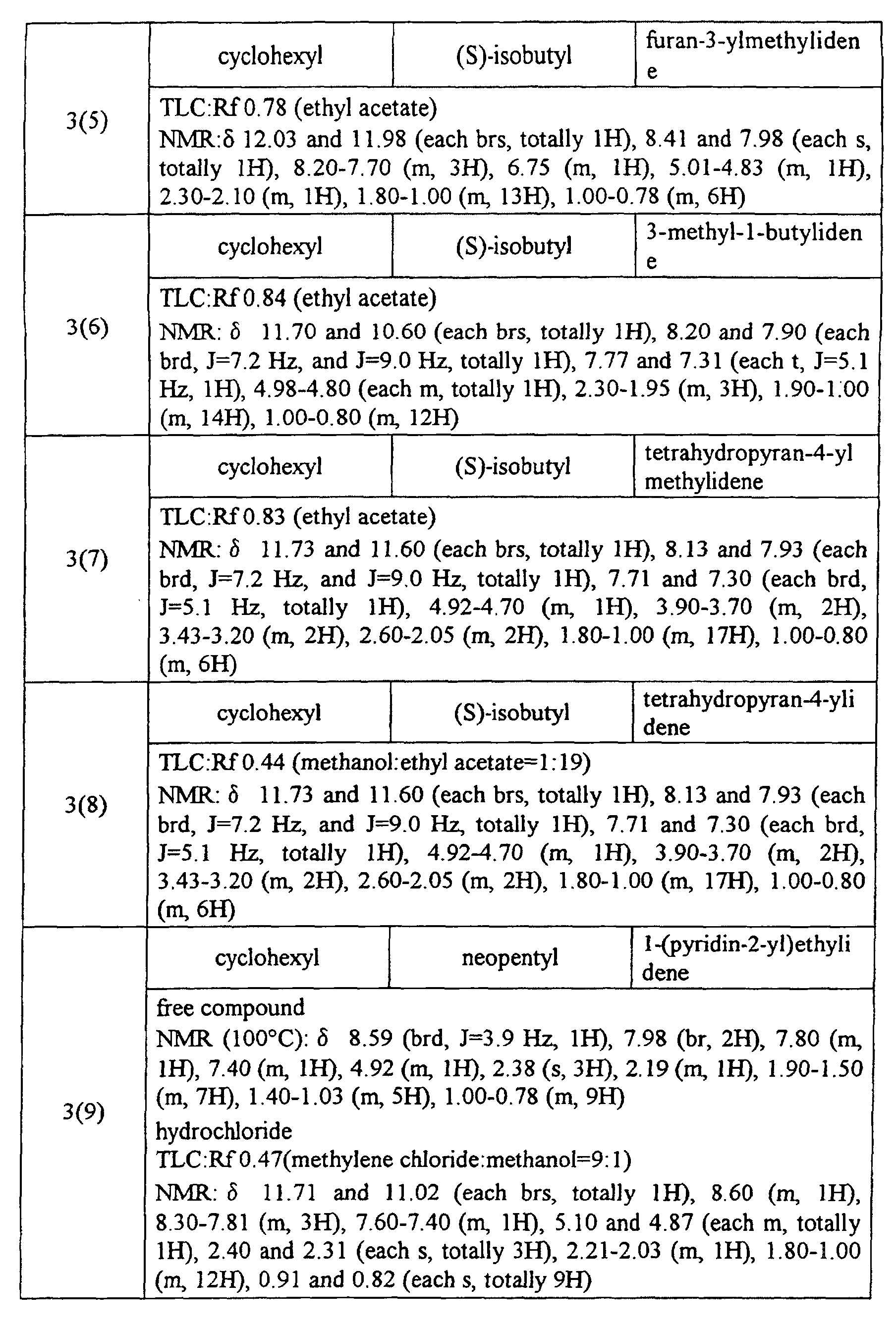

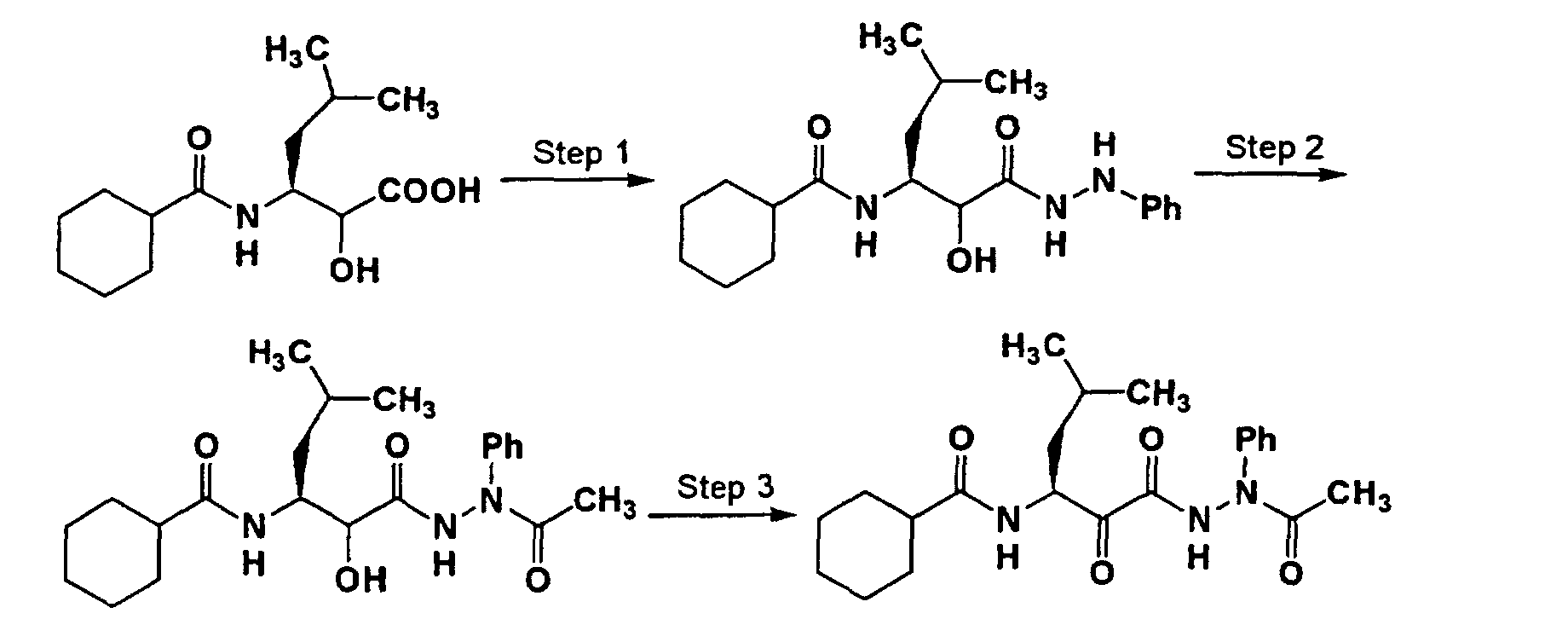
TLC:Rf 0.51 (ethyl acetate).
Step 2: To a solution of the compound prepared in step 1 (510 mg) in pyridine (5 ml) was added acetic anhydride (0.40 ml) at room temperature and the mixture was stirred for 15 hours. To the reaction mixture was added 2N hydrochloric acid and extracted with ethyl acetate. The organic layer was washed with a saturated aqueous solution of sodium bicarbonate and brine successively, dried over anhydrous sodium sulfate and concentrated. The residue was dissolved in methanol (5 ml) and thereto was added potassium carbonate (195 mg) and the mixture was stirred for 2 hours at room temperature. The organic layer was washed with brine, dried over anhydrous sodium sulfate and concentrated. The residue was washed with ethyl acetate and filtered and crystallized. The filtrate was concentrated and the residue was washed with t-butyl methyl ether and collected. It was combined with the above crystals and dried to give N'-acetyl-N'-phenyl-[(3S)-3-cyclohexylcarbonyl amino-2-hydroxy-5-methylhexanohydrazide] (335 mg).
TLC:Rf 0.60 (ethyl acetate).
Step 3: To a solution of the compound prepared in step 2 (202 mg) in acetonitrile (5ml) was added 1,1,1-triacetoxy-1,1-dihydro-1,2-benzoiodoxol-3-(1H)-one (Dess-Martin reagent) (254 mg) at room temperature and the mixture was stirred for 15 minutes. To the reaction mixture were added ethyl acetate and a saturated aqueous solution of sodium thiosulfate and the mixture was stirred vigorously for 5 minutes. Extracted organic layer was washed with a saturated aqueous solution of sodium bicarbonate twice, and brine once successively, dried over anhydrous sodium sulfate and concentrated. The residue was suspended in ethyl acetate (2 ml) and collected by filtration and dried to give N'-acetyl-N'-phenyl-[(3S)-3- cyclohexylcarbonylamino-5-methyl- 2-oxohexanohydrazide] (89 mg).
TLC:Rf 0.65 (n-hexane:ethyl acetate=2:8);
NMR(100°C):δ 11.2 (brs, 1H), 7.81 (brd, J=5.8 Hz, 1H), 7.54-7.14 (m, 5H), 4.75 (m, 1H), 2.15 (m, 1H), 2.04 (s, 3H), 1.70-1.00 (m, 13H), 0.90 (d, J=6.3 Hz, 3H), 0.88 (d, J=6.3 Hz, 3H).
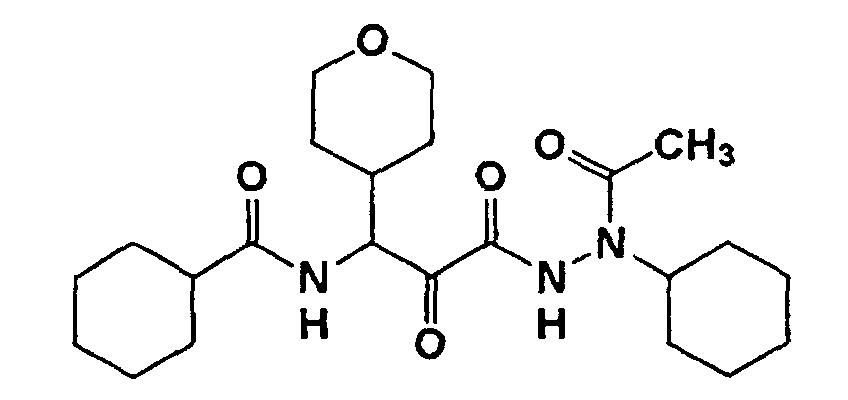
TLC:Rf 0.63 (ethyl acetate:methanol=9:1);
NMR:δ 1.00-1.40 (m, 12H), 1.40-1.75 (m, 12H), 1.78 and 1.81 (each s, total 3H), 2.00-2.35 (m, 2H), 3.22 (m, 2H), 3.83 (m, 2H), 4.09 (m, 1H), 4.55 (m, 1H), 8.30 (d, J=6.04 Hz, 1H), 10.82 and 10.89 (each brs, total 1H).
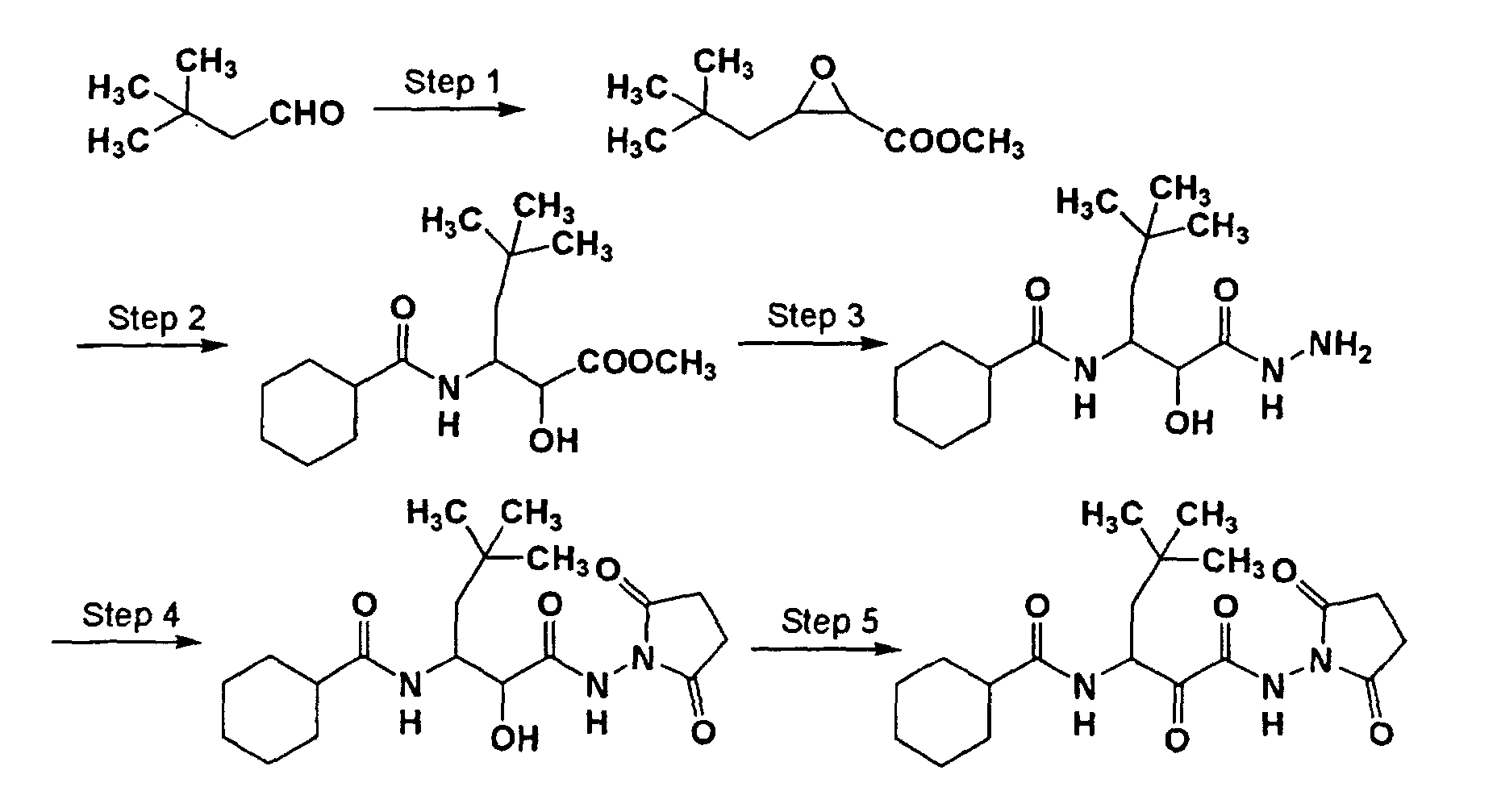
TLC:Rf 0.53 (n-hexane:ethyl acetate=4:1).
Step 2:To a mixture of the compound prepared in step 1 (2.75 g) and cyclohexanecarbonitrile (3.8 ml) was added borane trifluoride ether complex (2.1 ml) at 0°C and the mixture was stirred for 2 hours at room temperature. To the reaction mixture were added water, methanol and hydrochloric acid and the mixture was stirred for 4 hours at room temperature. The reaction mixture was poured into water and extracted with ethyl acetate. The organic layer was washed with a saturated aqueous solution of sodium bicarbonate and brine successively, drived over anhydrous magnesium sulfate and concentrated. The residue was washed with hexane and dried. The mother liquor was purified by column chromatography on silica gel (n-hexane:ethyl acetate=2:1) and it was combined with the above residue to give 3-cyclohexylcarbonylamino-5,5-dimethyl-2-hydroxyhexanoic acid methyl ester (2.76 g).
TLC:Rf 0.34 and 0.23 (n-hexane:ethyl acetate=2:1).
Step 3: To a solution of the compound prepared in step 2 (2.73 g) in methanol (10 ml) was added hydrazine monohydrate (2.33 g) and the mixture was stirred overnight at room temperature. The precipitate was collected and the mother liquor was washed with brine, and the given solid product was washed with t-butylmethyl ether and dried to give 3-cyclohexylcarbonylamino-5,5-dimethyl-2-hydroxyhexano hydrazide (2.73 g).
TLC:Rf 0.32 (ethyl acetate:methanol=9:1).
Step 4: To a solution of the compound prepared in step 3 (299 mg) in acetic acid (2 ml) was added succinic anhydride (110 mg) and the mixture was refluxed for 1 hour. The reaction mixture was concentrated to give 1-(3-cyclohexylcarbonylamino-5,5-dimethyl-2-hydroxyhexanoylamino)-2,5-dioxopyrrolidine (433 mg).
TLC:Rf 0.52 (methylene chloride:methanol=9:1).
Step 5: To a solution of the compound prepared in step 4 (420 mg) in DMSO (2 ml) were added triethylamine (0.42 ml) and sulfur trioxide-pyridine complex (477 mg) and the mixture was stirred overnight at room temperature. The reaction mixture was poured into 1N hydrochloric acid and extracted with ethyl acetate. The organic layer was washed with water, a saturated aqueous solution of sodium bicarbonate and brine successively, dried over anhydrous magnesium sulfate and concentrated. The residue was purified by column chromatography on silica gel (ethyl acetate) to give 1-(3-cyclohexylcarbonylamino-5,5-dimethyl-2-oxohexanoylamino)-2,5-dioxopyrroli dine (160 mg).
TLC:Rf 0.56 (methylene chloride:methanol=9:1);
NMR: δ 0.89 (s, 9H), 1.40 (m, 12H), 2.17 (m, 1H), 2.82 (s, 4H), 4.95 (m, 1H), 8.12 (d, J=7.14 Hz, 1H), 11.37 (s, 1H).


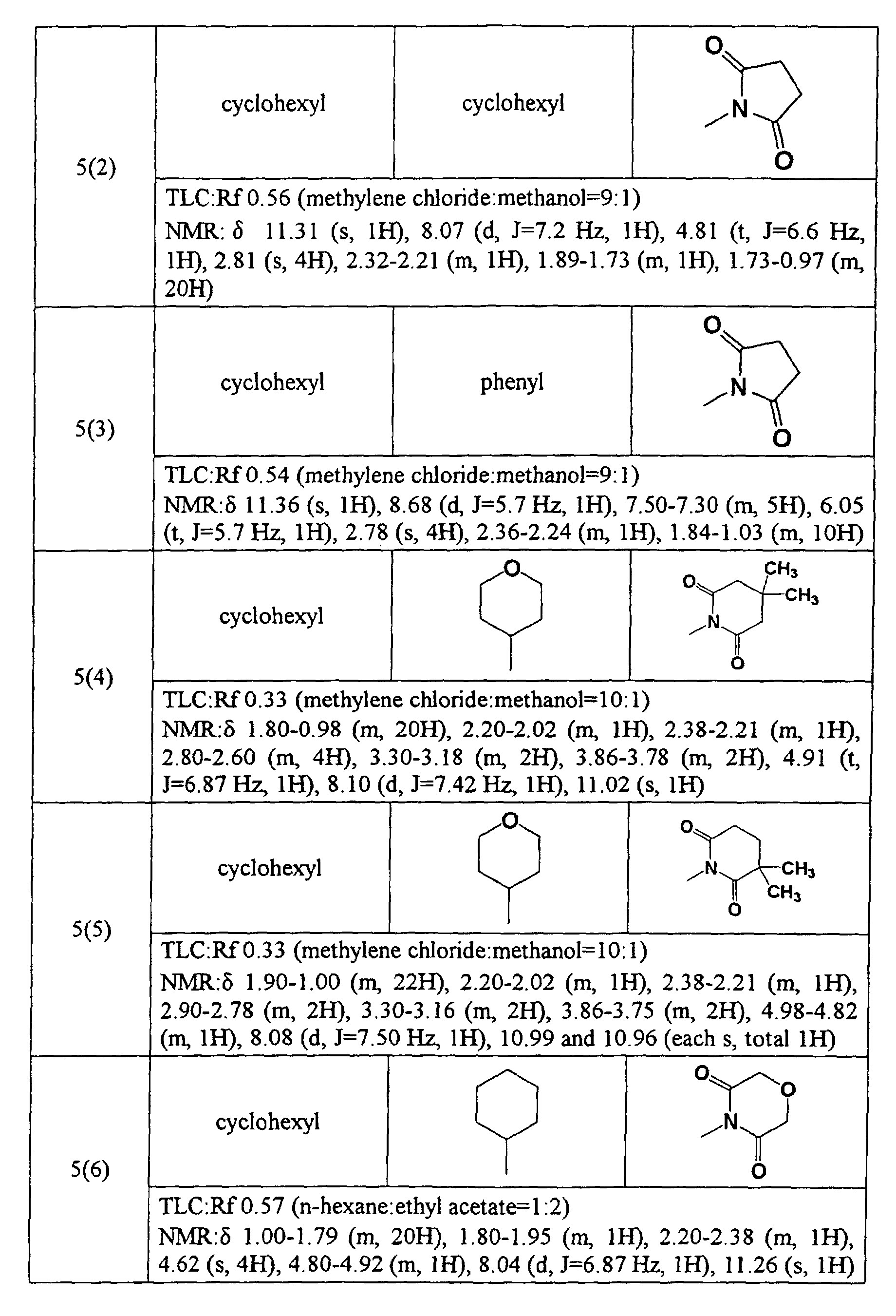
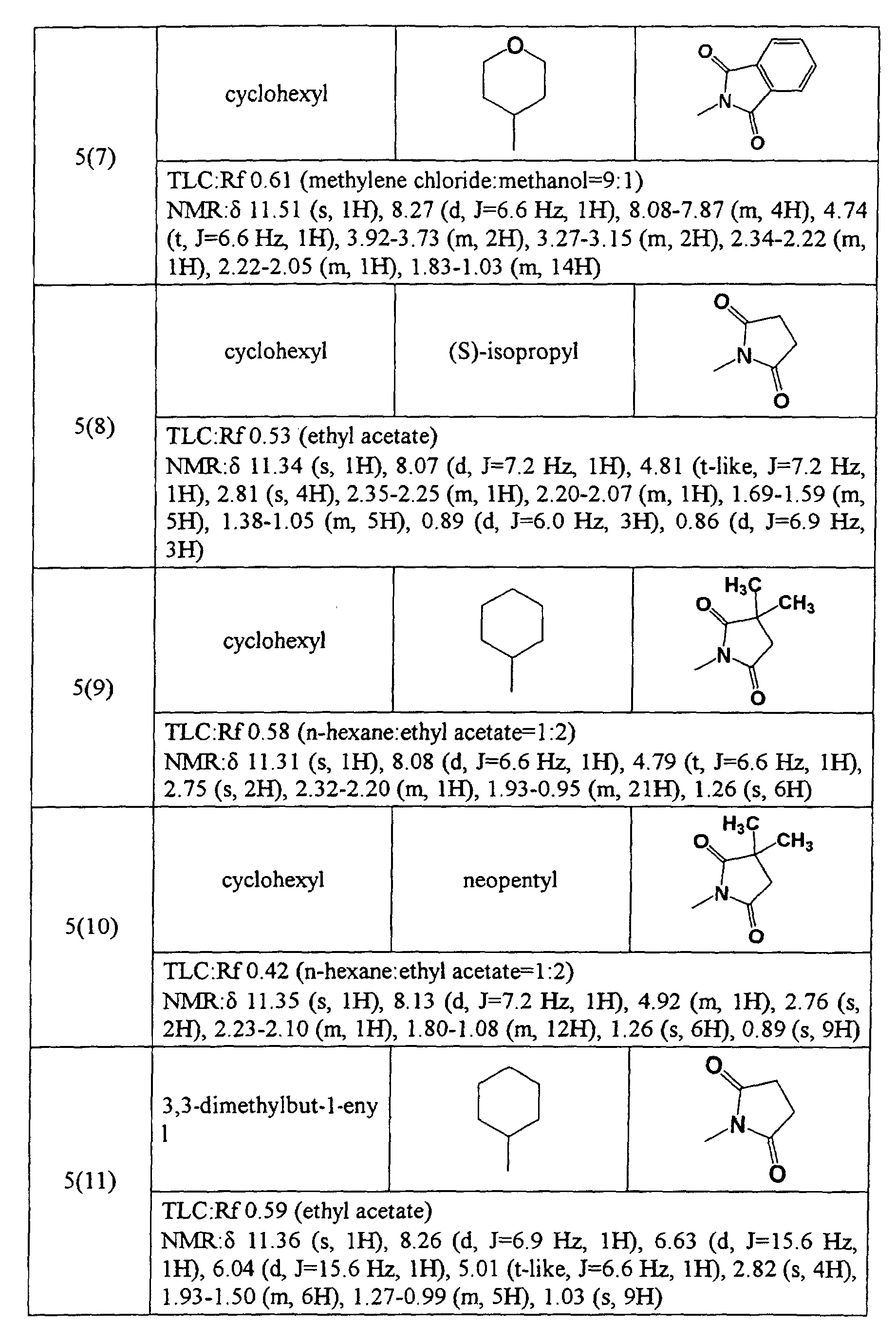


NMR:δ 1.39 (m, 22H), 1.90 (m, 1H), 2.43 (m, 1H), 2.78 (t, J=6.96 Hz, 2H), 3.14 (t, J=6.77 Hz, 2H), 4.88 (t, J=6.32 Hz, 1H), 8.26 (d, J=5.68 Hz, 1H), 12.36 (br. s., 1H).

TLC:Rf 0.55 (methylene chloride:methanol=9:1).
Step 2: To a solution of the compound prepared in step 1 (600 mg) in DMF (5 ml) were added potassium carbonate (258 mg) and methyl iodide (0.116 ml) and the mixture was stirred for 2 hours at the same temperature and for 6 hours at room temperature. To the reaction mixture was added and extracted with ethyl acetate. The organic layer was washed with water twice and brine once successively, dried over anhydrous sodium sulfate and concentrated. The residue was purified by column chromatography on silica gel (ethyl acetate:methanol=20:1) to give N-methyl-N'-(3-methyl-1,3-thiazolidin-2-ylidene)-[3-cyclohexylcarbonylamino-2-hydroxy-5-methylhexanohydrazide] (400 mg).
free compound
NMR:δ 8.20 and 7.78 (each d, J=9.0 Hz, total 1H), 4.82 and 4.52 (each m, total 1H), 3.70-3.60 (m, 2H), 3.28-3.18 (m, 2H), 2.95 and 2.94 (each s, total 3H), 2.85 and 2.80 (each s, total 3H), 2.28-2.12 (m, 1H), 1.80-1.00 (m, 13H), 0.92-0.77 (m, 6H).
hydrochloride
TLC:Rf 0.19 (ethyl acetate);
NMR: δ 7.27 and 6.94 (each brd, J=9.3 Hz, total 1H), 4.42-3.96 (m, 3H), 3.19 (t, J=6.9 Hz, 2H), 3.19 (t, J=6.9 Hz, 2H), 2.88 (s, 6H), 2.10-1.98 (m, 1H), 1.70-1.00 (m, 13H), 0.90-0.75 (m, 6H).
Step 3: By the same procedure as described in example 1 using a hydrochloride of the compound prepared in step 2, N-methyl-N'-(3-methyl-1,3-thiazolidin-2-ylidene) [3-cyclohexylcarbonylamino-5-methyl-2-oxohexanohydrazide] hydrochloride was given.
TLC:Rf 0.70(ethyl acetate:methanol=9:1);
NMR: δ 8.36 and 7.92 (each m, total 1H), 7.40-6.00 (broad, 1H), 4.80 and 4.87 (each m, total 1H), 3.88 and 3.78 (each m, total 2H), 3.40-3.26 (m, 2H), 3.09 and 3.03 (each s, total 3H), 3.05 and 2.91 (each s, total 3H), 2.28-2.12 (m, 1H), 1.80-1.00 (m, 13H), 0.93-0.78 (m, total 6H).

TLC:Rf 0.28(CHCl3:methanol=9:1).
Step 2: To a solution of the compound prepared in step 1 (65 mg) and sodium acetate (21 mg) in ethanol (1.2 ml) was added ethylbromoacetate (31 mg) and the mixture was refluxed. To the reaction mixture was added 2N hydrochloric acid (0.15 ml) and the mixture was concentrated. The residue was washed with ethyl acetate and dried to give N'-(3-methyl-4-oxo-1,3-thiazolidin-2-ylidene)-[3-cyctohexylcarbonyl amino-2-hydroxy-3-(tetrahydropyran-4-yl)propanohydrazide] (76 mg).
TLC:Rf 0.3 (chloroform:methanol=9:1).
Step 3: By the same procedure as described in example 1 using the compound prepared in step 2, N'-(3-methyl-4-oxo-1,3-thiazolidin-2-ylidene)-[3-cyclohexyl carbonylamino-3-(tetrahydropyran-4-yl)-2-oxopropanohydrazide].
TLC:Rf 0.41 (methylene chloride:methanol=9:1);
NMR: δ 11.14 (s, 1H), 8.06 (d, J=7.2 Hz, 1H), 4.99 (t, J=6.6 Hz, 1H), 3.89-3.77 (m, 2H), 3.29-3.13 (m, 2H), 3.10 (s, 3H), 2.38-2.22 (m, 1H), 2.20-2.04 (m, 1H), 1.80-1.06 (m, 14H).

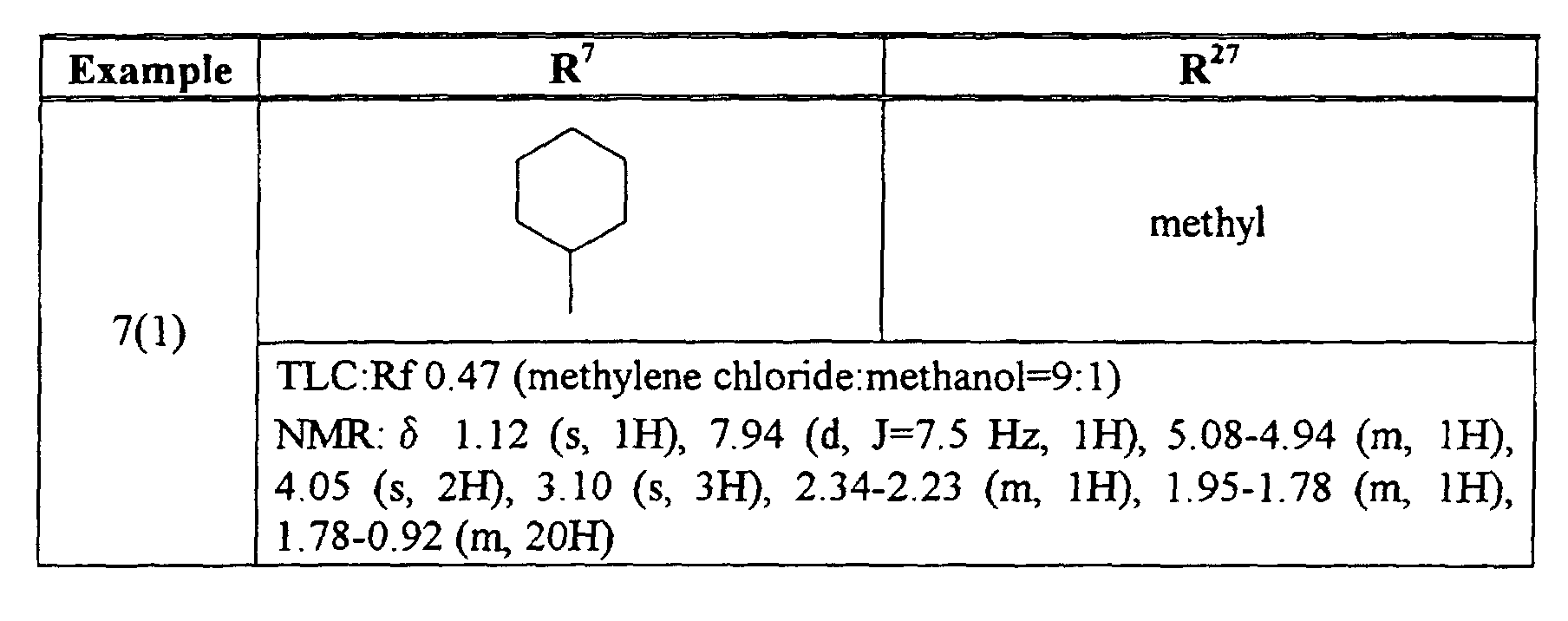

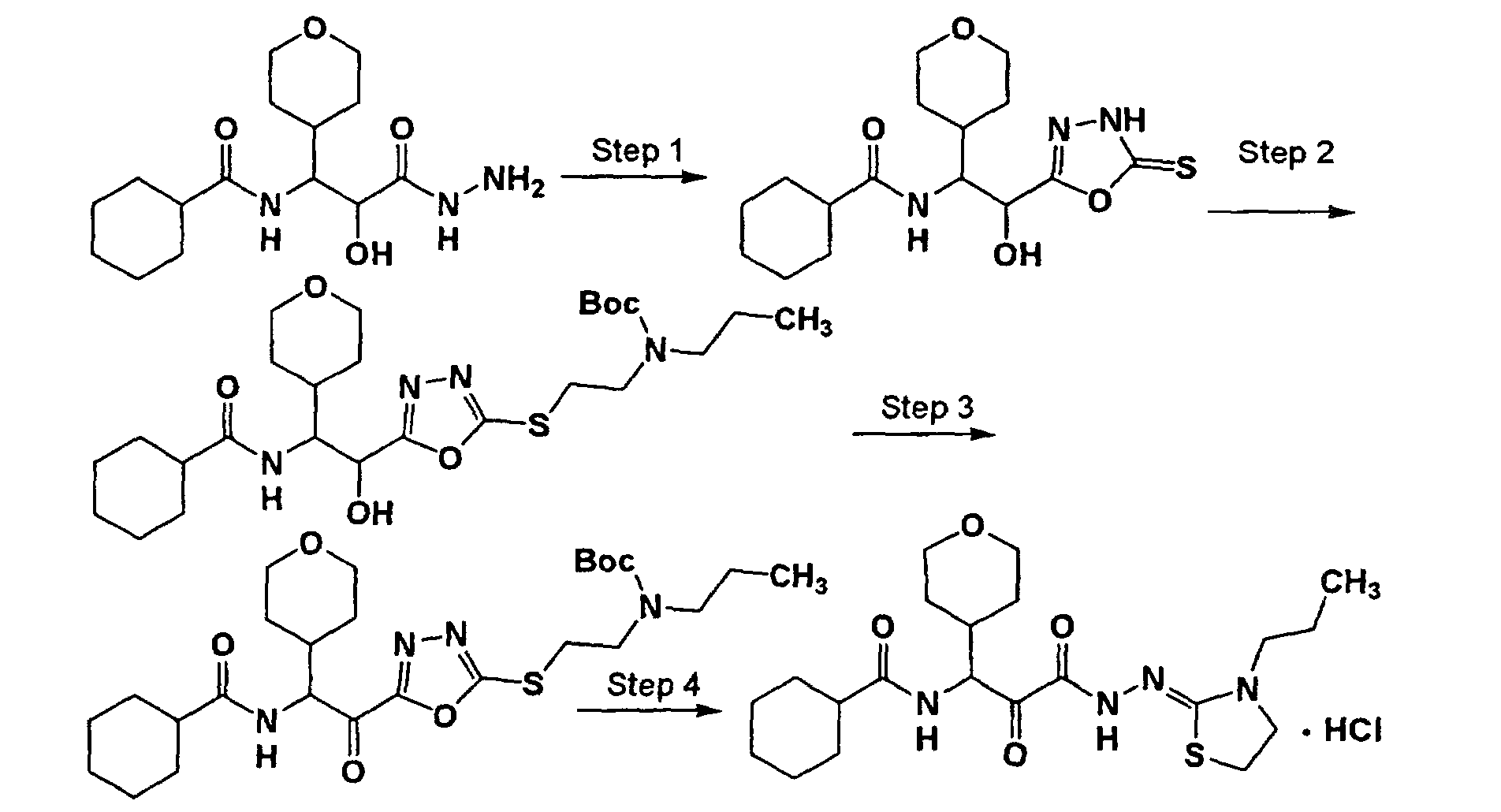
TLC:Rf 0.61 (ethyl acetate:methanol=9:1).
Step 2: To a solution of the compound prepared in step 1 (650 mg) in N,N-dimethylformamide (10 ml) were added N-(t-butoxycarbonyl)-N-(2-chloro ethyl)-N-propylamine (763 mg), sodium iodide (518 mg) and potassium carbonate (477 mg) and the mixture was stirred overnight at 60°C. The reaction mixture was poured into ice-water and was extracted with ethyl acetate. The organic layer was washed with water and brine successively, dried over anhydrous magnesium sulfate and concentrated. The residue was purified by column chromatography on silica gel (n-hexane:ethyl acetate=1:1) to give 1-[5-(N-t-butoxycarbonyl-N-propylaminoethylthio)-1,3,4-oxadiazol-2-yl]-2-(tetrahydropyran-4-yl)-2-cyclohexylcarbony laminoethanol (572 mg).
TLC:Rf 0.44 and 0.35(ethyl acetate).
Step 3: By the same procedure as described in step 3 of example 4 using the compound prepared in step 2 oxidized compound thereof (355 mg) (TLC:Rf 0.37 (n-hexane:ethyl acetate=1:1) was given. The oxidized compound (350 mg) was dissolved in ethyl acetate (2 ml) and thereto was added 4N hydrochloric acid / ethyl acetate (4 ml) and the mixture was stirred for 1 hour at room temperature. The reaction mixture was concentrated to give 1-[5-(N-t-butoxycarbonyl-N-propyl amino ethylthio)-1,3,4-oxadiazol-2-yl]-2-(tetrahydropyran-4-yl)-2-cyclohexylcarbonylamino-1-oxoethane (315 mg).
NMR:δ 0.90 (t, J=7.42 Hz, 3H), 1.47 (m, 16H), 2.20 (m, 2H), 2.89 (m, 2H), 3.23 (m, 4H), 3.65 (t, J=7.14 Hz, 2H), 3.82 (m, 2H), 4.90 (t, J=6.46 Hz, 1H), 8.43 (d, J=6.32 Hz, 1H), 9.07 (m, 2H).
Step 4: A suspension of the compound prepared in step 3 (315 mg) in acetonitrile was stirred for 1 hour at 80°C. The precipitated powder was collected to give N'-(3-propyl-1,3-thiazolidin-2-ylidene)-(3-cyclohexylcarbonylamino-3-(tetrahydropyran-4-yl)-2-oxopropanohydrazide) hydrochloride (240 mg).
TLC:Rf 0.54 (methylene chloride:methanol=9:1);
NMR:δ11.47 (br-s, 1H), 8.21 (d, J=6.6 Hz, 1H), 4.83 (t-like, J=6.0 Hz, 1H), 4.01 (t, J=7.2 Hz, 2H), 3.83 (t-like, J=6.3 Hz, 2H), 3.49 (t, J=7.2 Hz, 2H), 3.42 (t, J=7.2 Hz, 2H), 3.24 (t, J=9.9 Hz, 2H), 2.33-2.21 (m, 1H), 2.16-2.02 (m, 1H), 1.69-1.57 (m, 7H), 1.50-1.04 (m, 9H), 0.89 (t, J=7.5 Hz, 3H).

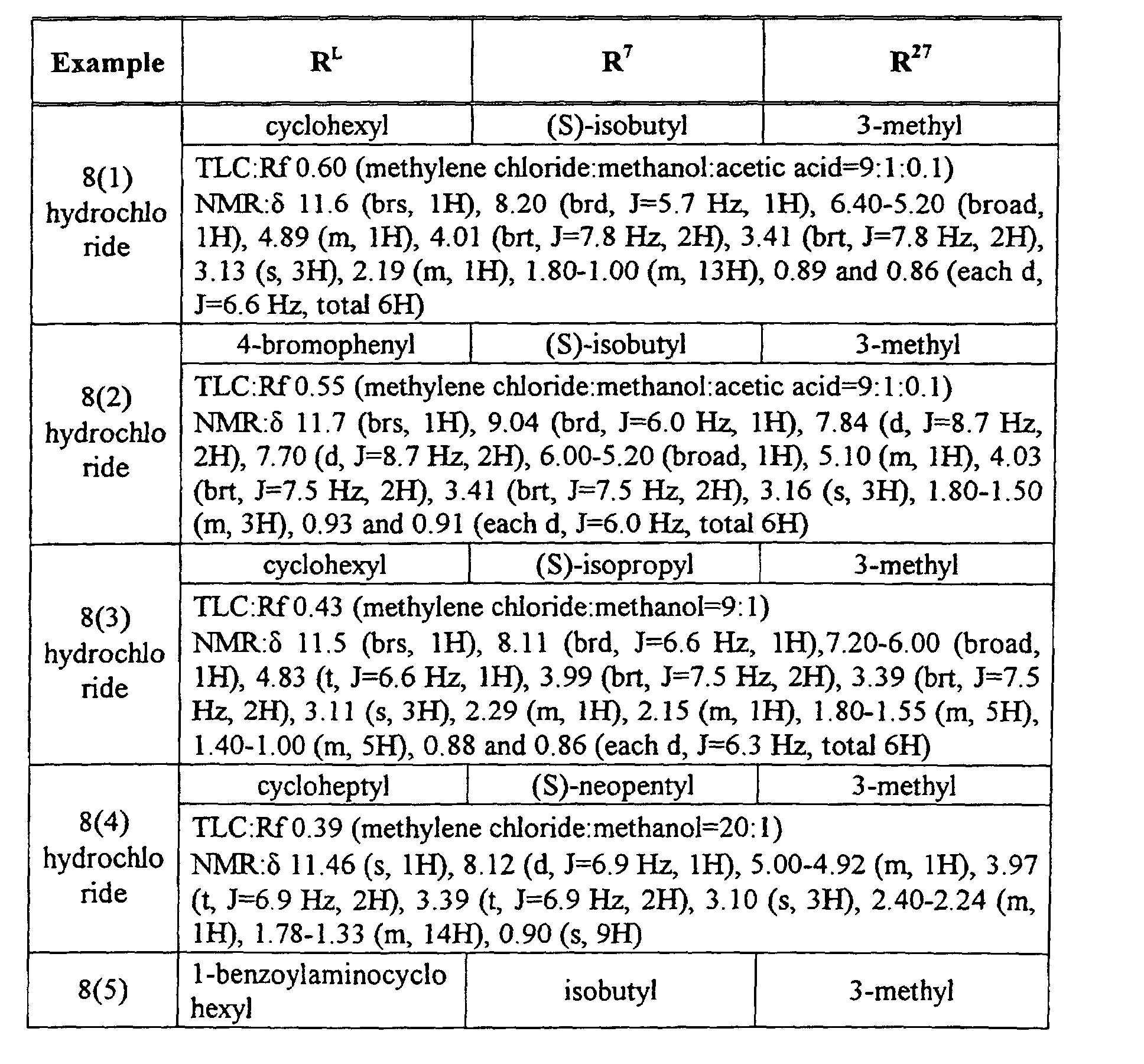
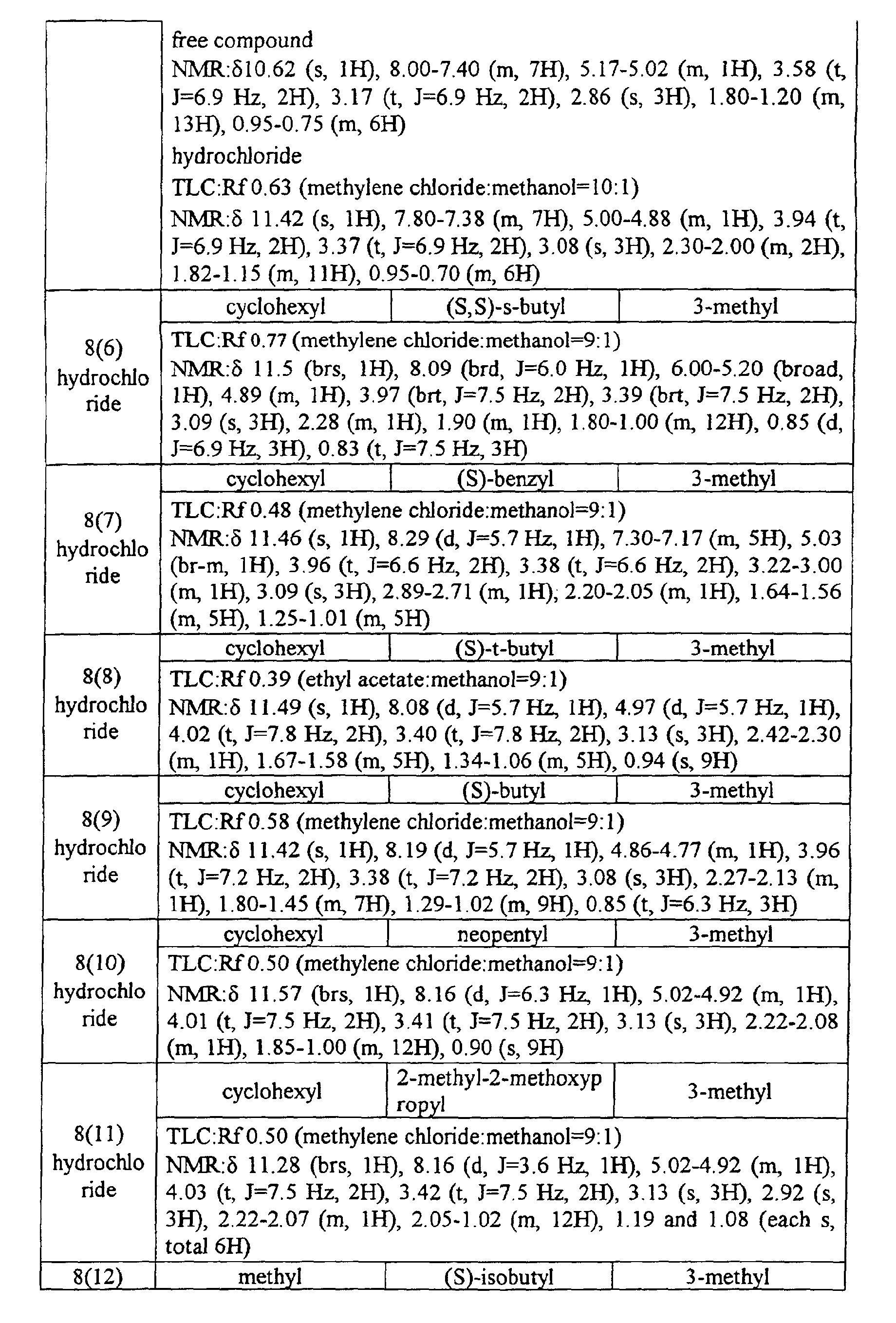
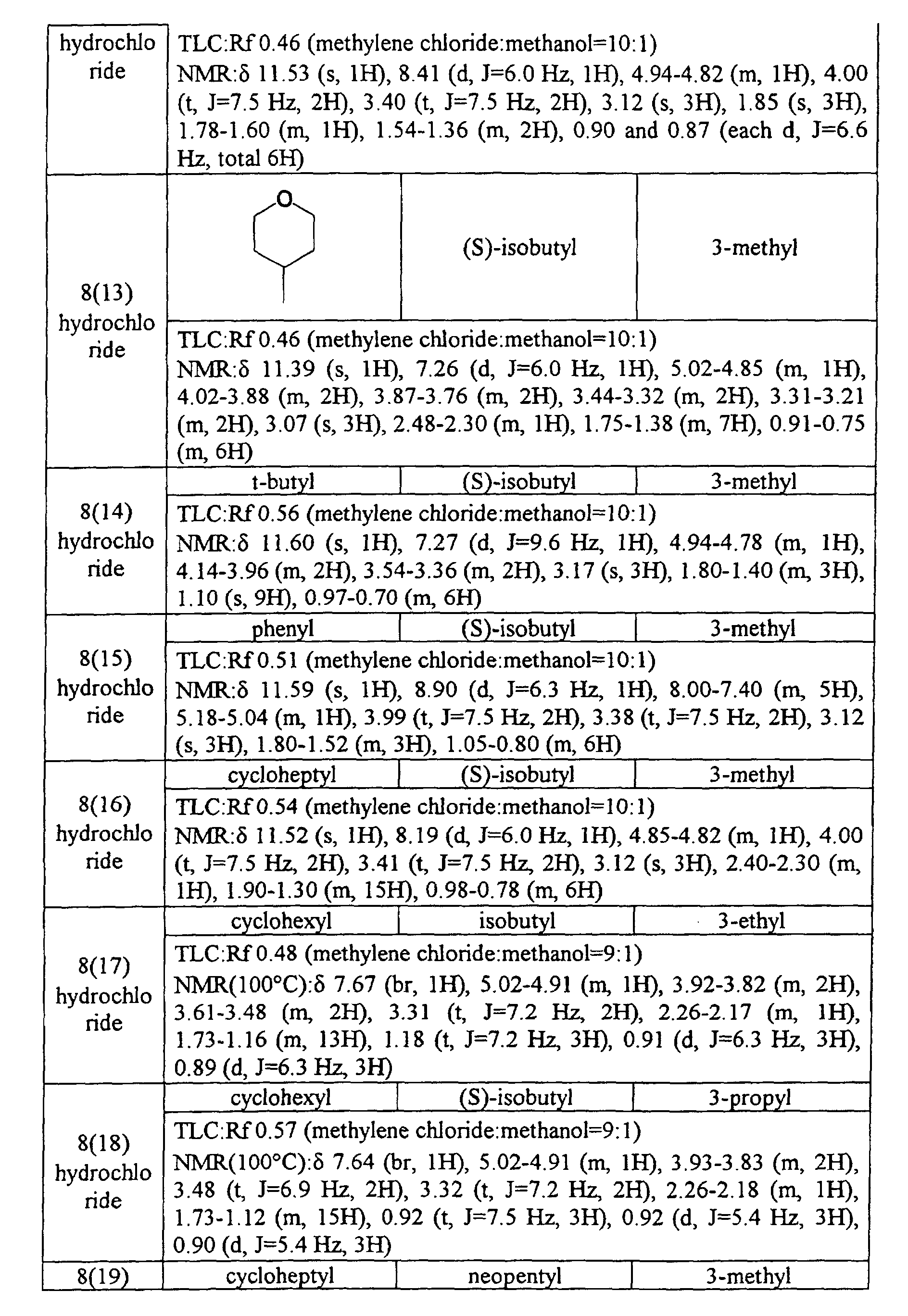
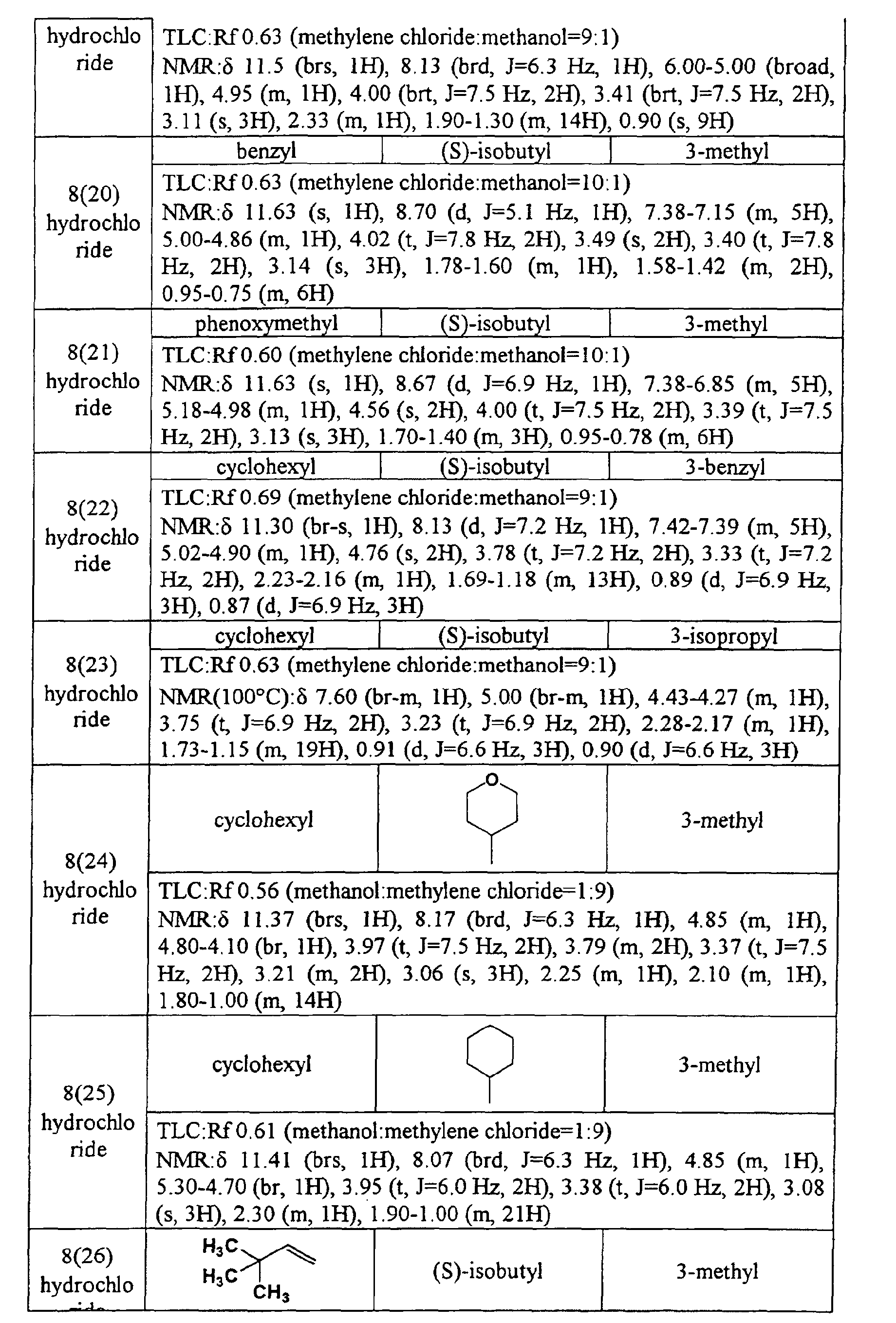

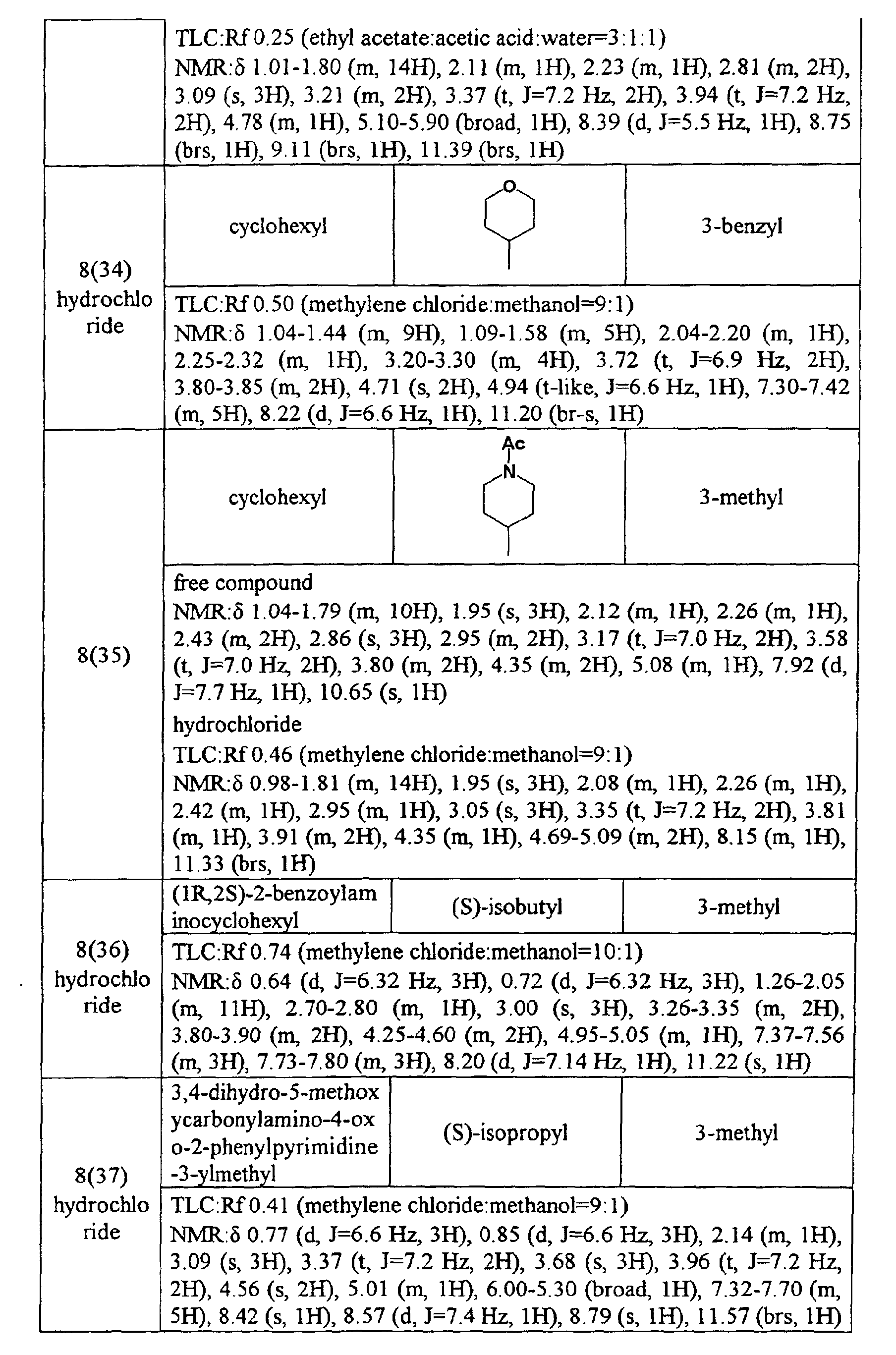
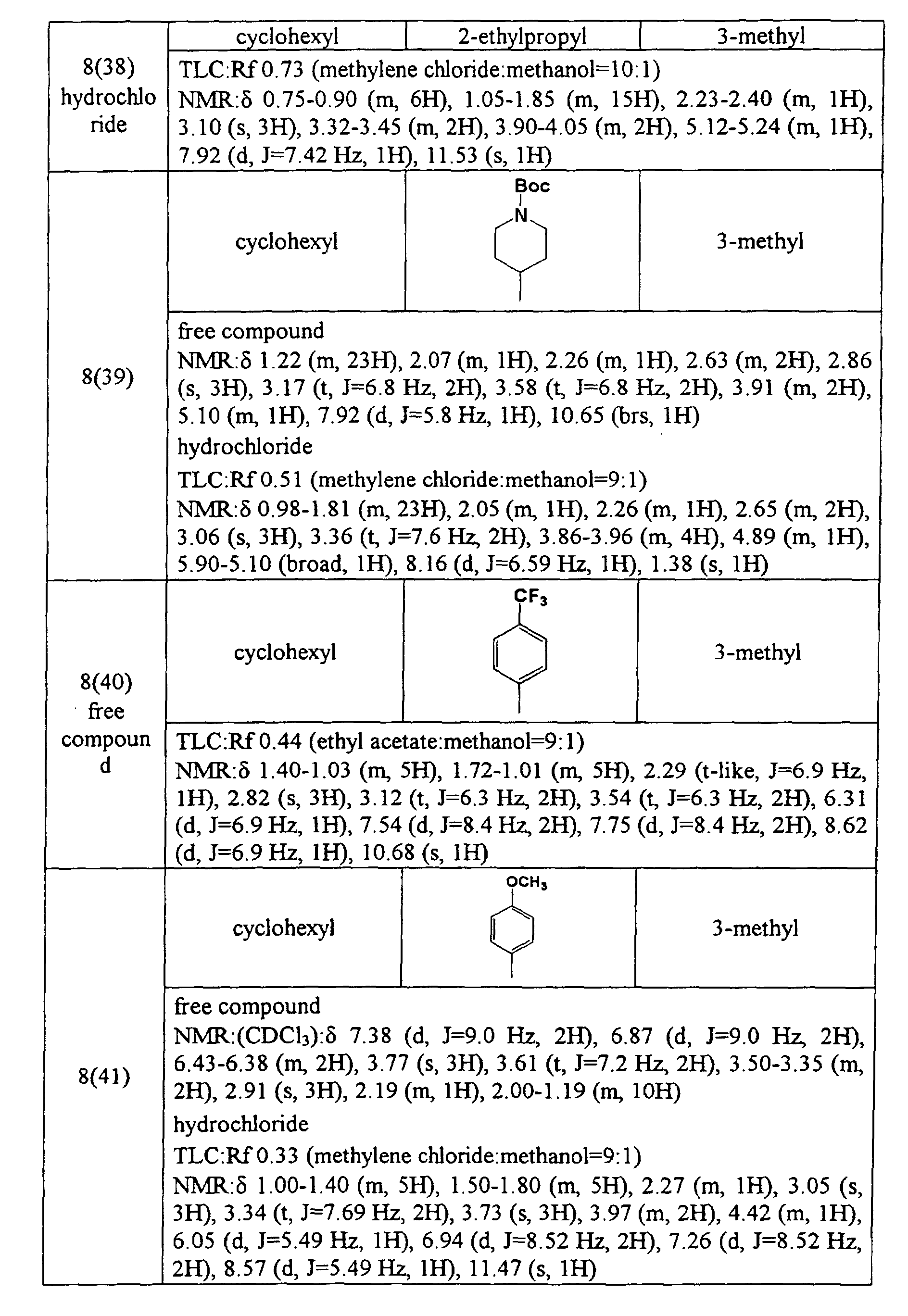
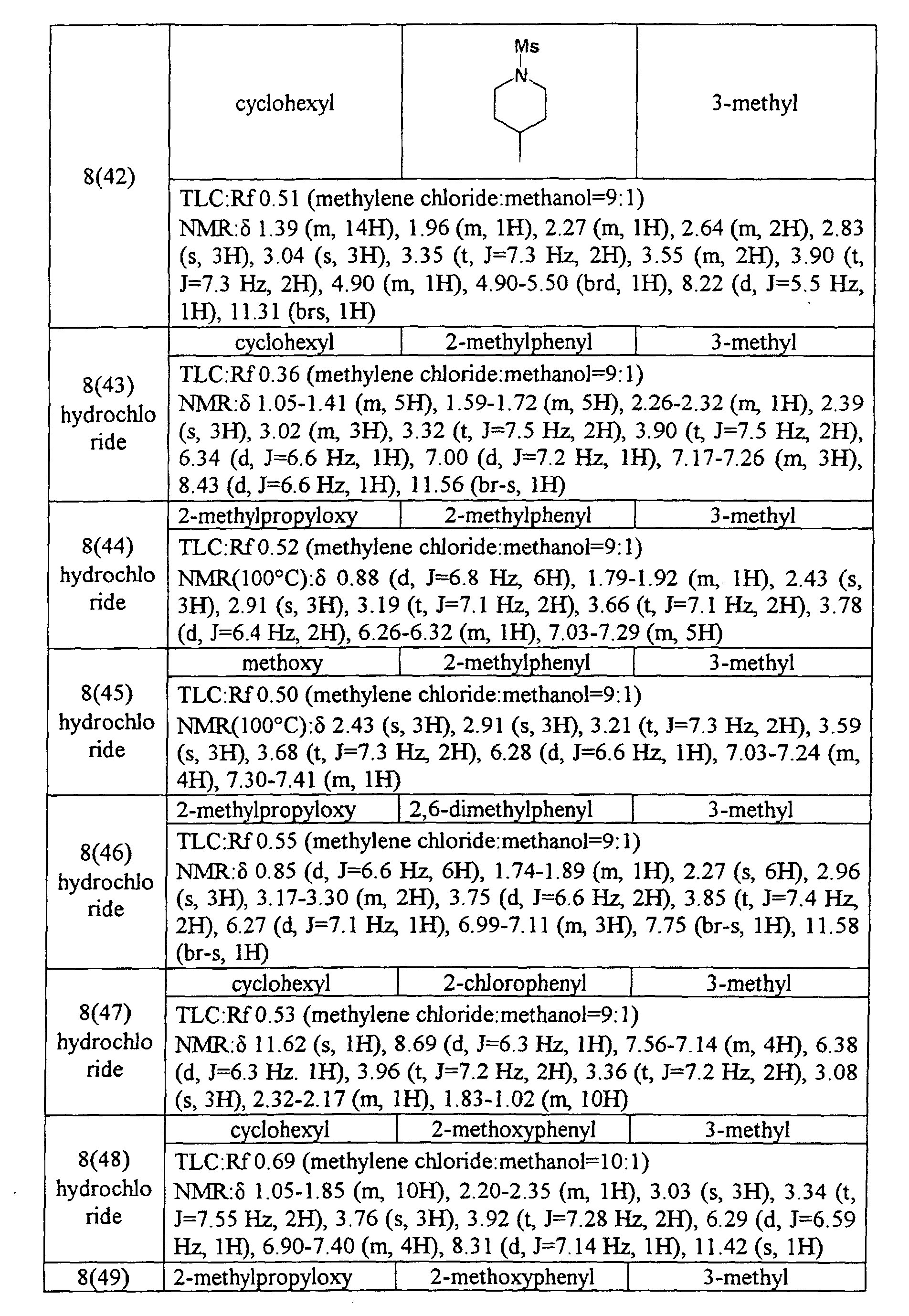
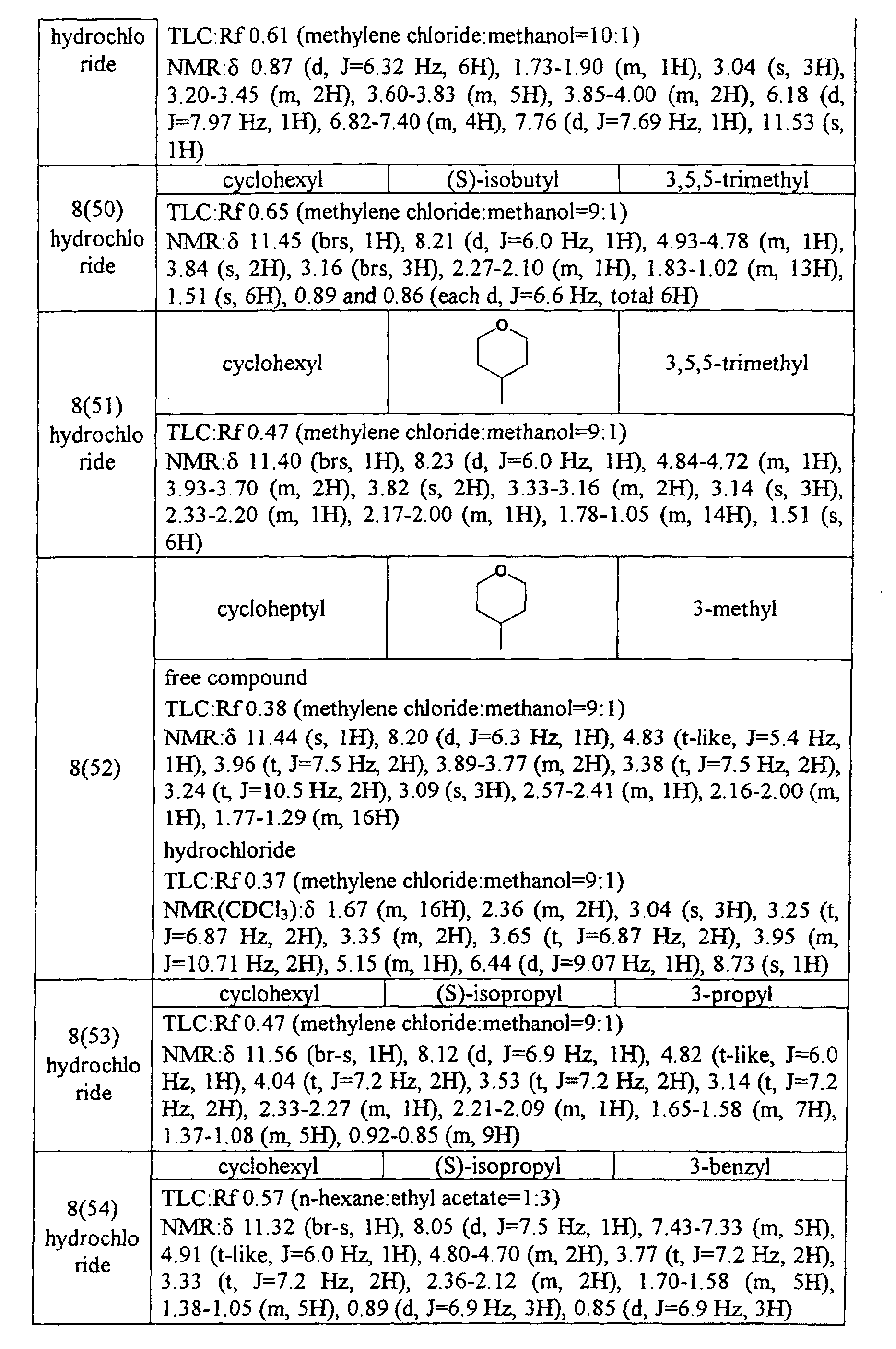
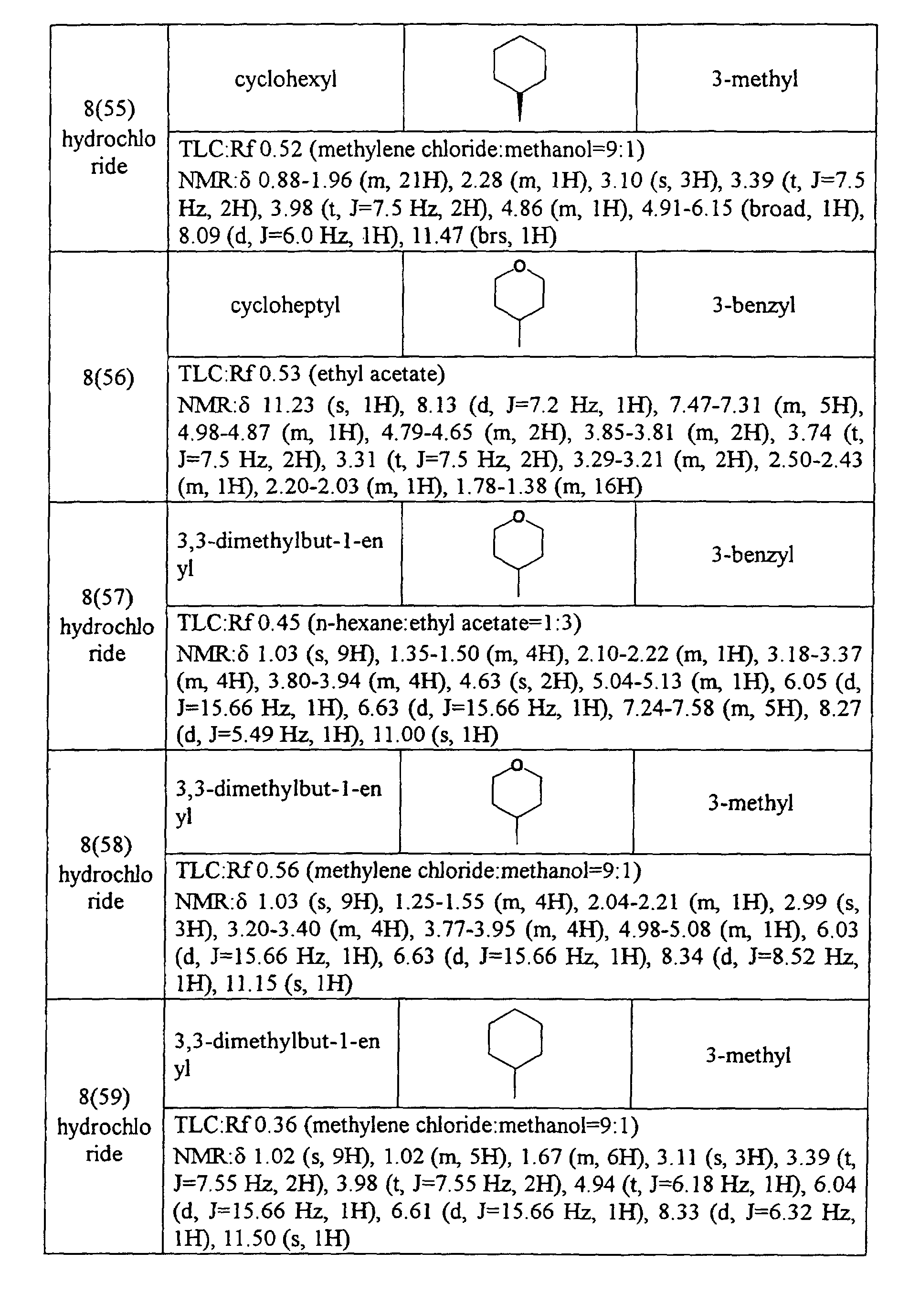
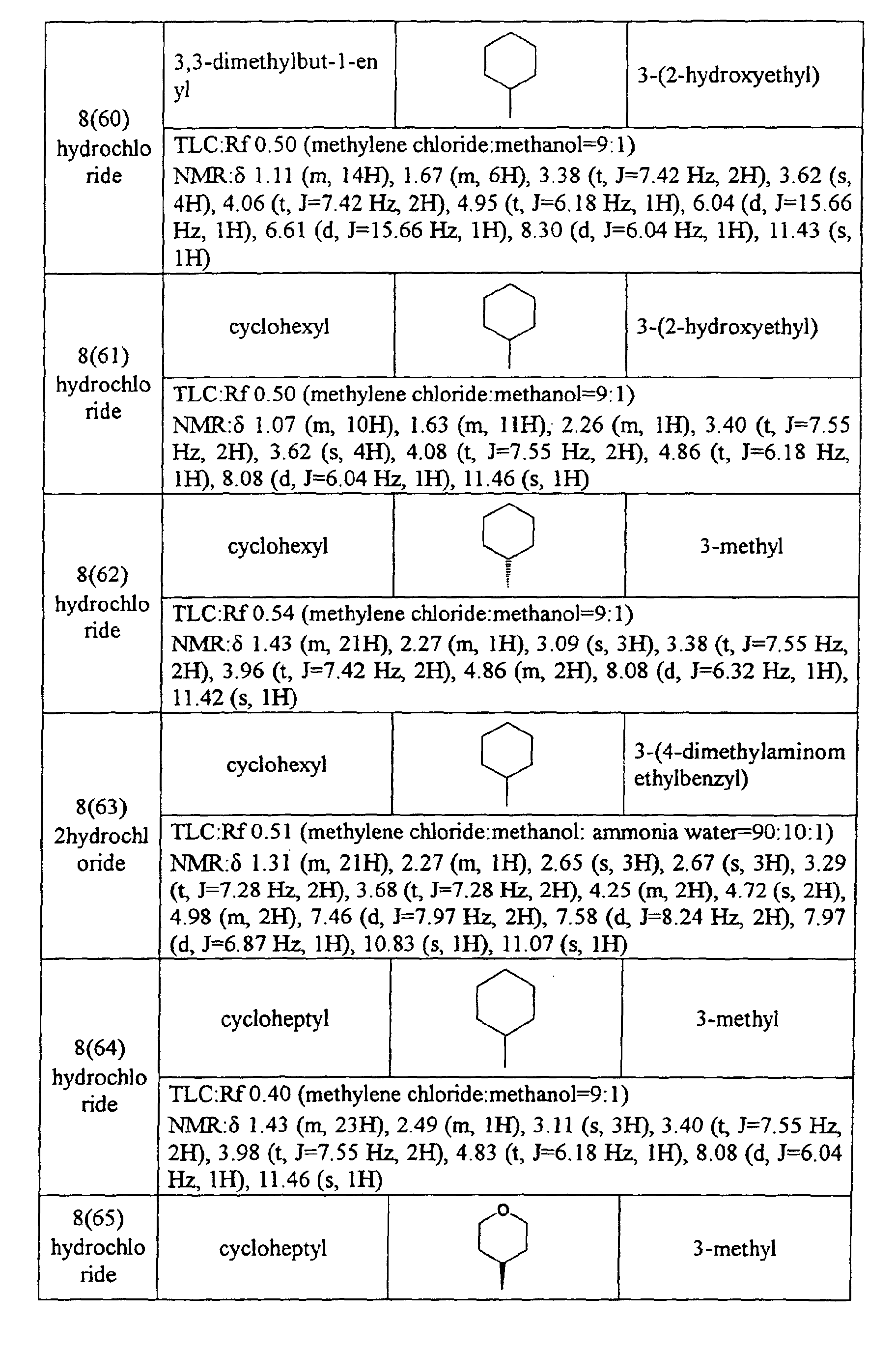

NMR:δ 11.28 (br-s, 1H), 7.73 (d, J=7.2 Hz, 2H), 7.66-7.55 (m, 3H), 5.04 (d, J=9.9 Hz, 1H), 3.86 (t, J=7.5 Hz, 2H), 3.32 (t, J=7.5 Hz, 2H), 3.04 (s, 3H), 2.84 (s, 3H), 2.20-2.02 (m, 1H), 0.83 (d, J=6.9 Hz, 3H), 0.79 (d, J=6.9 Hz, 3H).
NMR:δ 1.00-1.80 (m, 15H), 2.09 (m, 2H), 2.27 (m, 1H), 3.20-3.40 (m, 7H), 3.59 (t, J=5.22 Hz, 2H), 3.84 (m, 2H), 4.80 (t, J=6.18 Hz, 1H), 8.27 (d, J=6.04 Hz, 1H), 11.37 (s, 1H).
NMR:δ 11.10 (br, 1H), 8.52 (s, 1H), 4.03 (t, J=7.2 Hz, 2H), 3.40 (t, J=7.2 Hz, 2H), 2.16-2.04 (m, 1H), 1.68-1.57 (m, 5H), 1.36 (s, 6H), 1.29-1.03 (m, 5H).
NMR:δ 10.20 (brs, 1H), 7.90-7.78 (m, 3H), 7.60-7.40 (m, 3H), 5.11 (m, 1H), 3.31 (m, 2H), 2.98 (s, 3H), 2.92 (m, 2H), 2.31-2.10 (m, 2H), 2.10-1.90 (m, 1H), 1.90-1.20 (m, 13H), 1.00-0.70 (m, 6H).
hydrochloride:
TLC:Rf 0.58 (methylene chloride:methanol=9:1);
NMR:δ 11.45 (brs, 1H), 8.20-7.20 (m, 7H), 4.89 (q, J=6.0 Hz, 1H), 3.69 (m, 2H), 3.25 (s, 3H), 3.23 (m, 2H), 2.40-2.00 (m, 4H), 1.97-1.05 (m, 11H), 1.00-0.70 (m, 6H).
NMR:δ 10.62 (s, 1H), 8.00-7.40 (m, 7H), 5.17-5.02 (m, 1H), 3.58 (t, J=6.9 Hz, 2H), 3.17 (t, J=6.9 Hz, 2H), 2.86 (s, 3H), 1.80-1.20 (m, 13H), 0.95-0.75 (m, 6H).
hydrochloride:
TLC:Rf 0.63 (methylene chloride:methanol=10:1);
NMR:δ 11.42 (s, 1H), 7.80-7.38 (m, 7H), 5.00-4.88 (m, 1H), 3.94 (t, J=6.9 Hz, 2H), 3.37 (t, J=6.9 Hz, 2H), 3.08 (s, 3H), 2.30-2.00 (m, 2H), 1.82-1.15 (m, 11H), 0.95-0.70 (m, 6H).

TLC:Rf 0.51 and 0.44 (methylene chloride:methanol=9:1).
Step 2: By the same procedure as described in step 7 of example I using the compound prepared in step 1, a free compound of N'-(3,4,4-trimethyl-1,3-thiazolidin-2-ylidene)-[3-cyclohexylcarbonylamino-3-(tetrahydropyran-4-yl)-2-o xopropanohydrazide] was given. To the free compound was added 4N hydrochloric acid-ethyl acetate solution and the mixture was stirred for 1 hour at room temperature and the mixture was concentrated. The residue was washed with ehyl acetate to give N'-(3,4,4-trimethyl-1,3-thiazolidin-2-ylidene)-[3-cyclohexylcarbonylamino-3-(tetrahydropyran-4-yl)-2-oxopropanohydrazide] hydrochloride (140 mg).
free compound :
NMR: δ 1.25 (s, 3H), 1.26 (s, 3H), 1.29 (m, 14H), 2.10 (d, J=6.59 Hz, 1H), 2.29 (m, 1H), 2.74 (s, 3H), 3.04 (s, 2H), 3.26 (m, J=29.67 Hz, 2H), 3.82 (m, 2H), 5.06 (dd, J=8.10, 5.91 Hz, 1H), 7.95 (d, J=7.69 Hz, 1H), 10.55 (s, 1H). hydrochloride :
TLC:Rf 0.46 (methylene chloride:methanol=9:1);
NMR (CDCl3): δ 1.35 (s, 6H), 1.56 (m, 14H), 2.16 (m, 1H), 2.39 (m, 1H), 2.90 (s, 3H), 3.07 (s, 2H), 3.34 (m, 2H), 3.94 (m, 2H), 5.15 (dd, J=9.20, 6.46 Hz, 1H), 6.57 (d, J=9.07Hz, 1H), 8.76 (s, 1H).
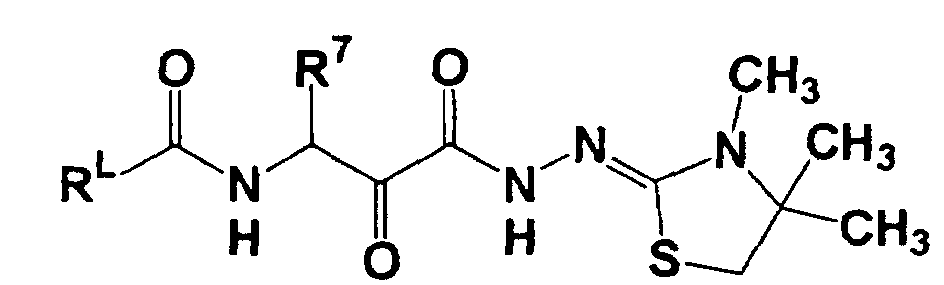
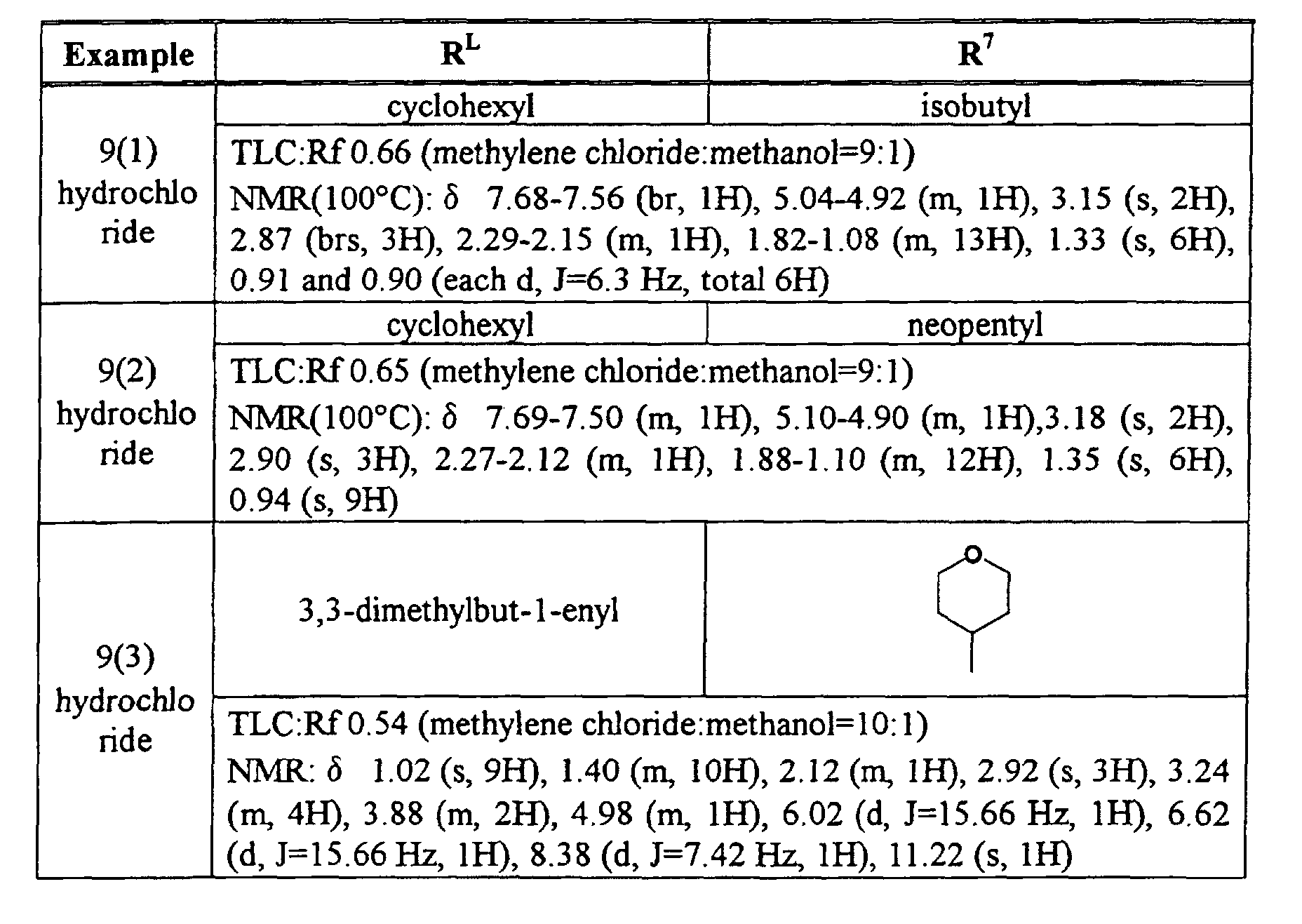
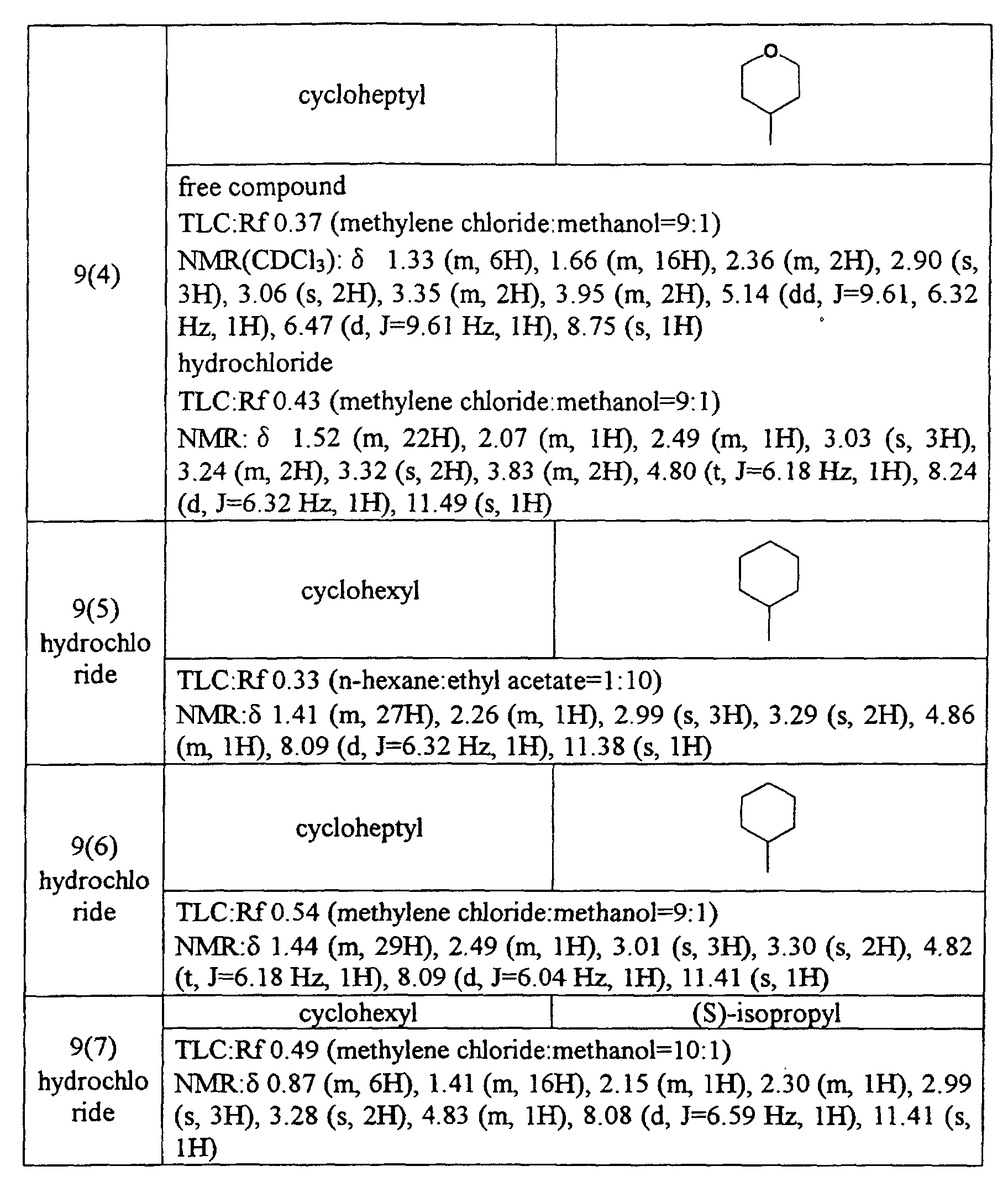
NMR:δ 1.35 (m, 23H), 2.09 (m, 1H), 2.28 (m, 1H), 3.25 (s, 2H), 3.44 (m, 4H), 3.84 (m, 2H), 4.87 (m, 1H), 8.17 (m, 1H), 11.27 (s, 1H).
NMR:δ 1.45 (m, 22H), 2.08 (m, 1H), 2.27 (m, 1H), 3.00 (s, 3H), 3.23 (m, 2H), 3.34 (s, 2H), 3.81 (m, 2H), 4.84 (t, J=6.32 Hz, 1H), 8.20 (d, J=6.32 Hz, 1H), 11.39 (s, 1H).
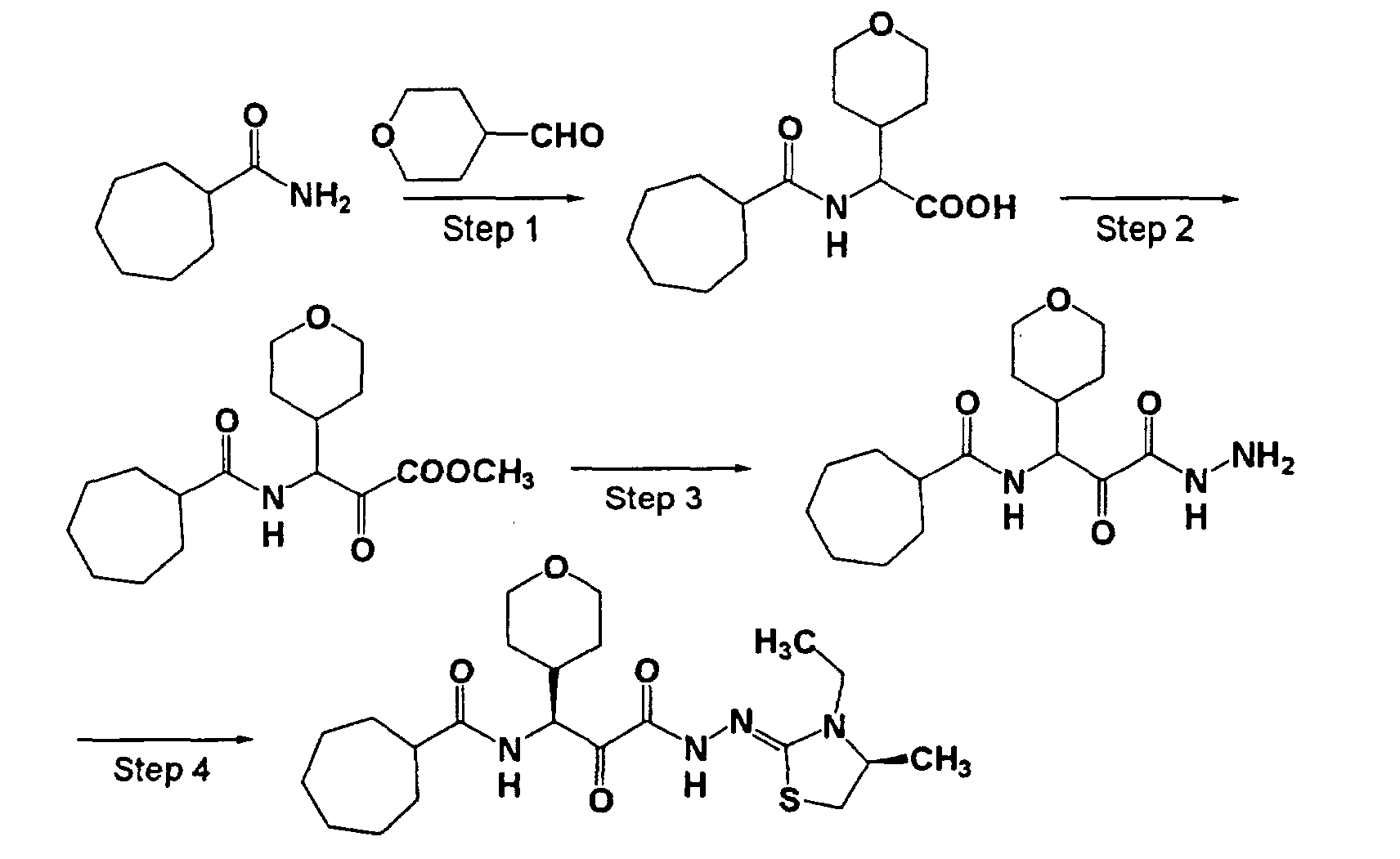
TLC:Rf0.60 (methylene chloride:methanol=10:1).
Step 2: To a solution of the compound prepared in step 1 (1.13 g), pyridine (0.97 ml) and dimethylaminopyridine (24.4 mg) in tetrahydrofuran (4 ml) was added 2-cycloheptylcarbonylamino-2-(tetrahydropyran-4-yl)acetic acid (prepared in step 1; 0.89 ml) and the mixture was refluxed for 6 hours. To the mixture was added 2-cycloheptylcarbonylamino-2-(tetrahydropyran-4-yl)acetic acid (0.089 ml) again and the mixture was stirred for 1 hour. To the reaction mixture was extracted with ethyl acetate and ice-water. The organic layer was washed with an aqueous solution of citric acid, a saturated aqueous solution of sodium bicarbonate, water and brine successively, dried over anhydrous sodium sulfate and concentrated. The residue was dissolved in methanol (4 ml) and thereto was added sodium bicarbonate (136 mg) and the mixture was refluxed for 150 minutes. The precipitate was collected, and the filtrate was concentrated, and the residue was washed with diisopropyl ether 3-cycloheptylcarbonylamino-3-(tetrahydropyran-4-yl)-2-oxopropanoic acid methyl ester (542 mg).
TLC:Rf 0.36(n- hexane:ethyl acetate=1:1).
Step 3: To a suspension of the compound prepared in step 2 (325 mg) in methanol (1 ml) was added hydrazine monohydrate (60 mg) and the mixture was stirred for 3 hours. To the mixture was added hydrazine monohydrate (6 mg) again and the mixture was stirred for 30 minutes. To the reaction mixture was added methanol (4 ml) and the precipitate was collected and washed with methanol to give 3-cycloheptylcarbonylamino-2-oxo-3-(tetrahydropyran-4-yl)propanohydrazide (142 mg).
TLC:Rf 0.44(methylene chloride:methanol=10:1).
Step 4: By the same procedure as described in step 6 of example 1 using the compound prepared in step 3 and a corresponding compound, followed by recrystallization from isopropanol to give N'-(3-ethyl-4-methyl-1,3-thiazolidin-2-ylidene)-[3-cycloheptylcarbonylamino-3-[(3S)-tetrahydropyran-4-yl]-2-oxopropanoh ydrazide].
TLC:Rf 0.54 (methylene chloride:methanol=9:1);
NMR (CDCl3) :δ 1.19 (t, J=7.14 Hz, 3H), 1.33 (d, J=6.22 Hz, 3H), 1.67 (m, 16H), 2.30 (m, 1H), 2.40 (m, 1H), 2.86 (dd, J=10.80, 6.41 Hz, 1H), 3.22 (td, J=14.10, 6.96 Hz, 1H), 3.35 (m, 3H), 3.79 (td, J=14.46, 7.32 Hz, 1H), 3.98 (m, 3H), 5.14 (dd, J=9.15, 6.22 Hz, 1H), 6.46 (d, J=9.15 Hz, 1H), 8.73 (s, 1H).
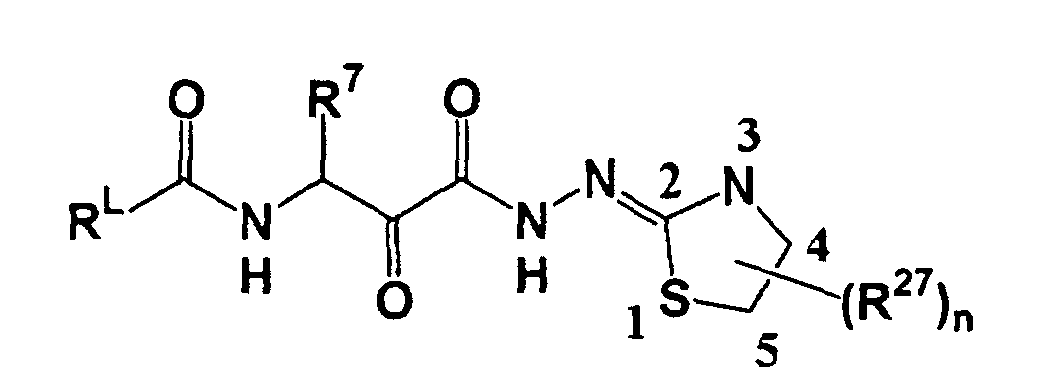
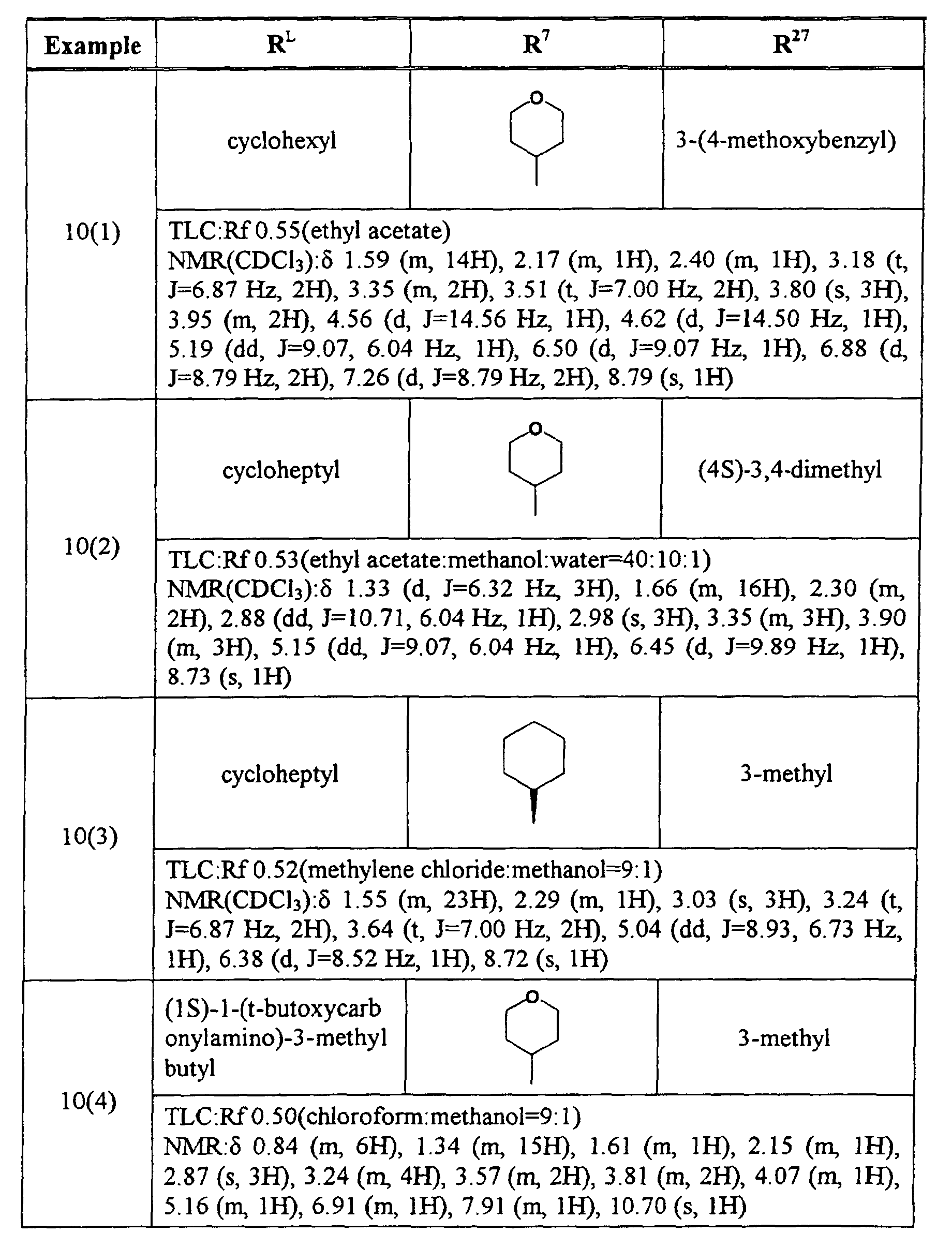
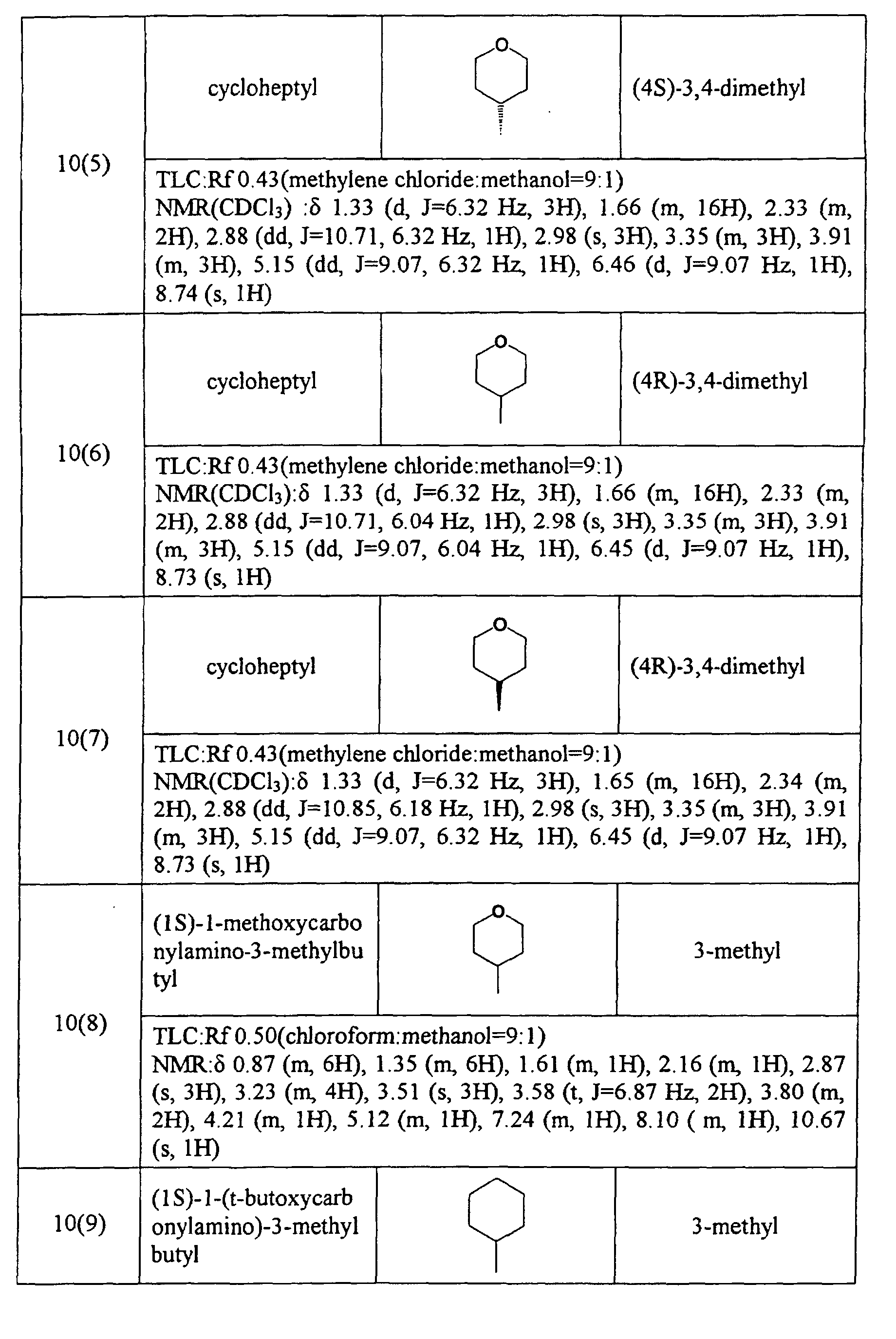
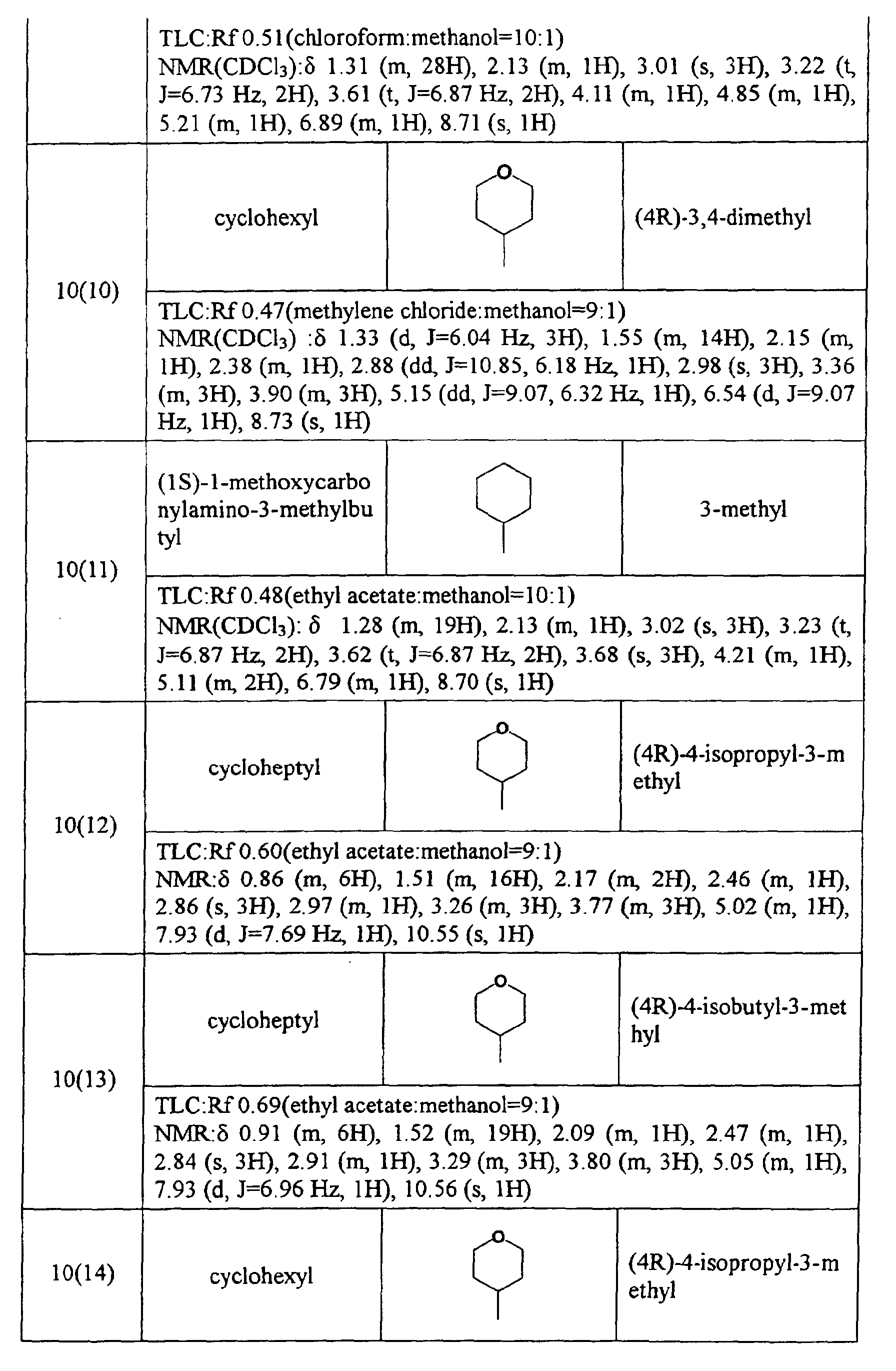
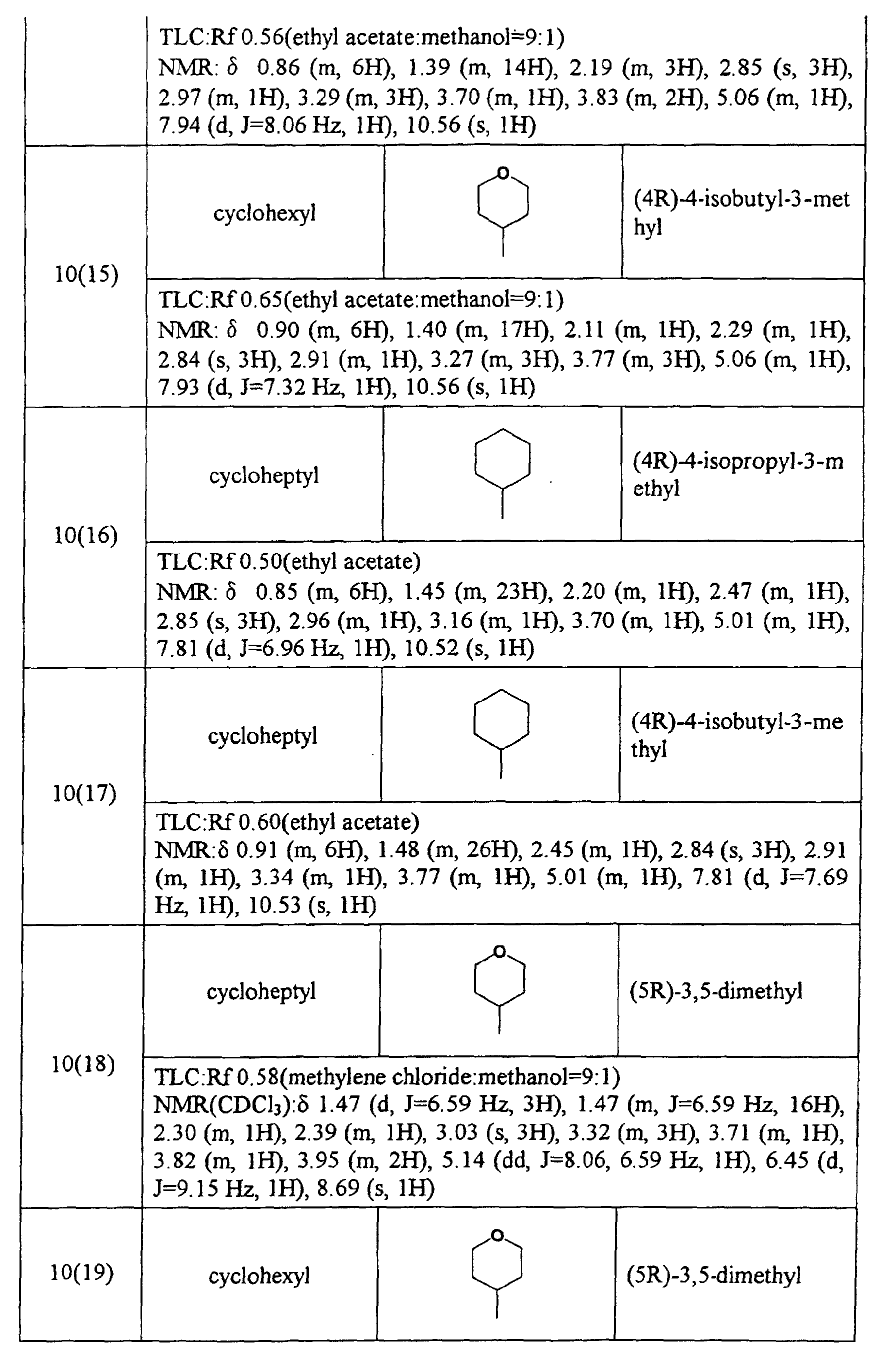
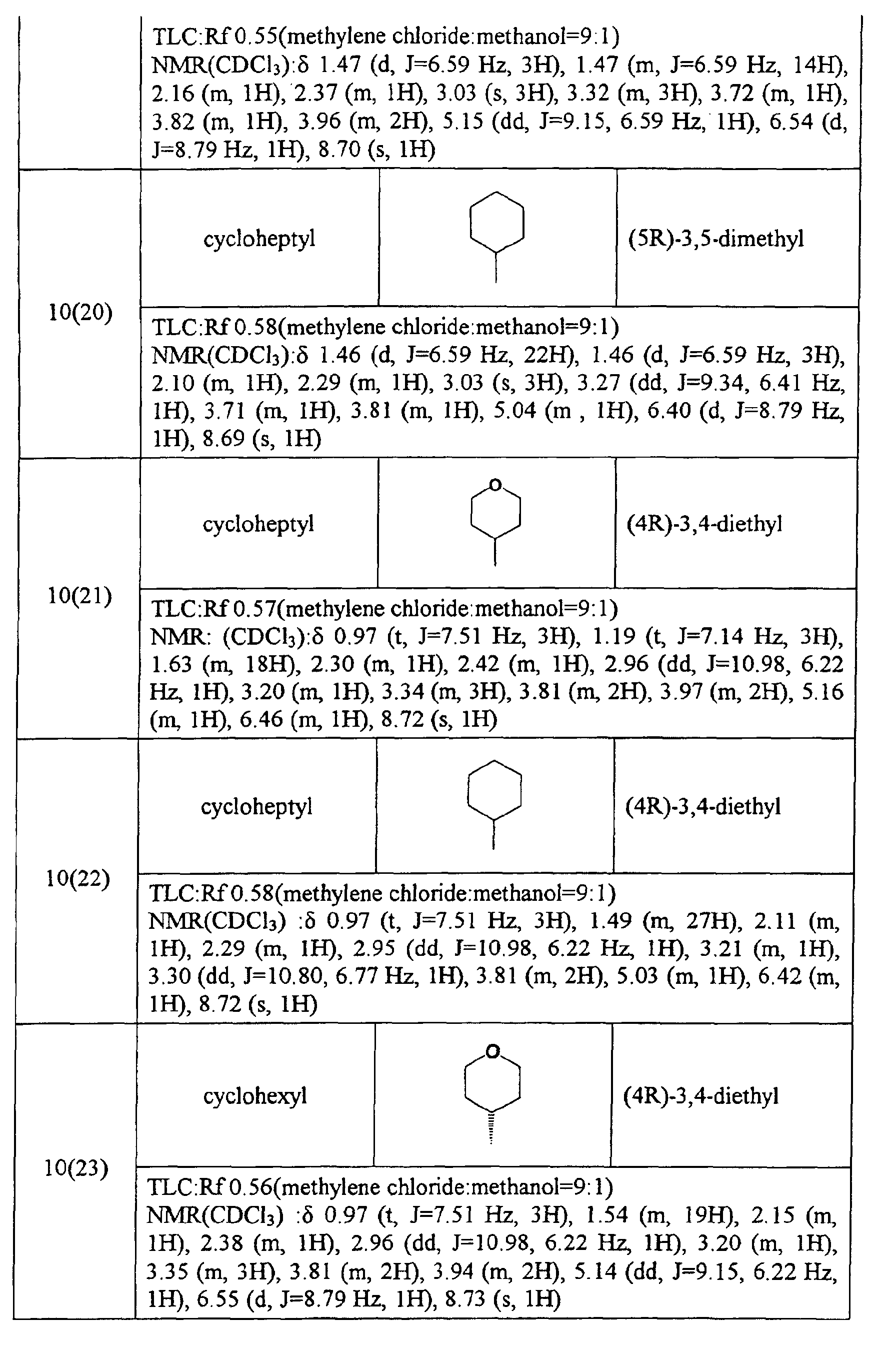
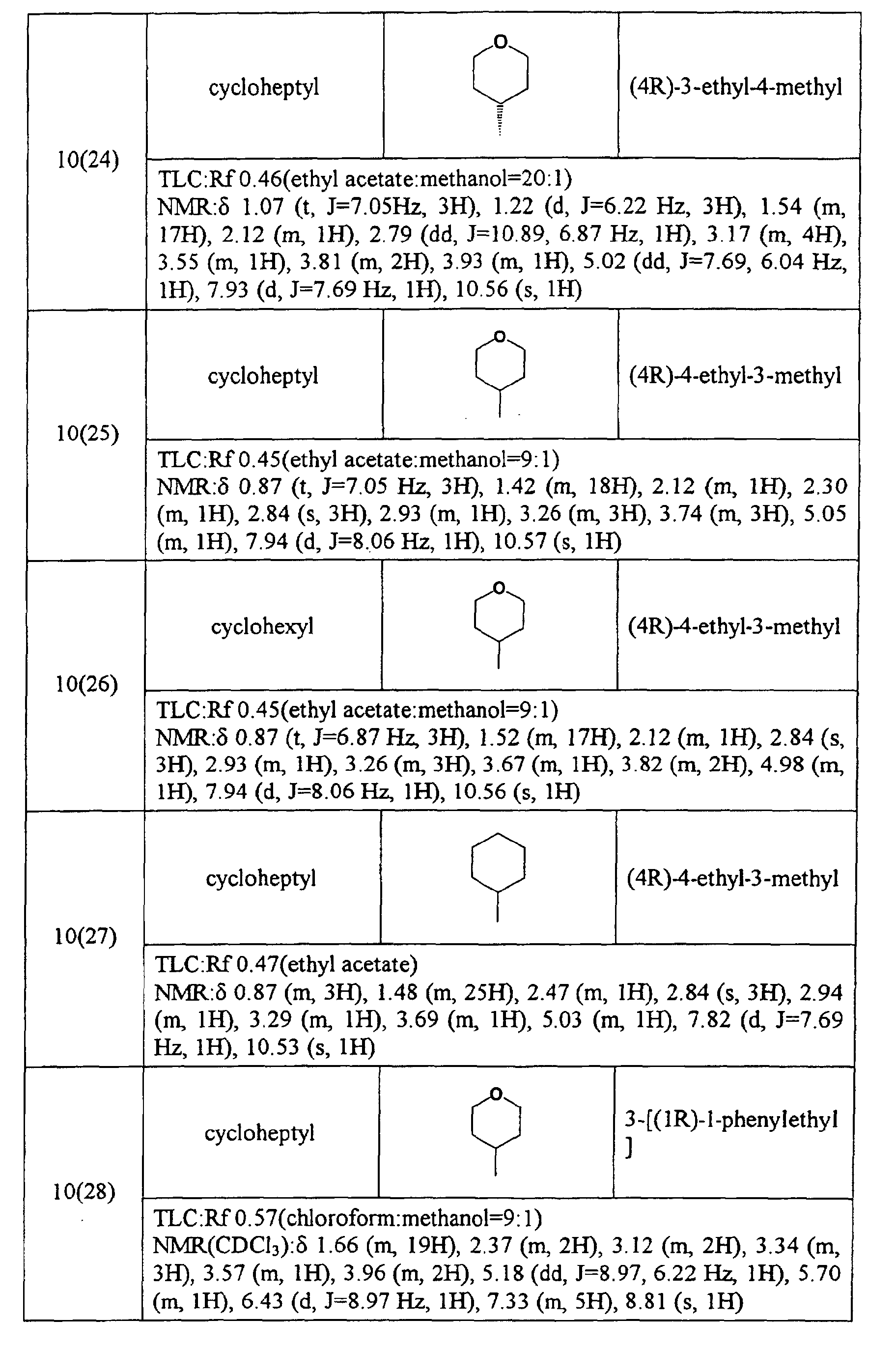
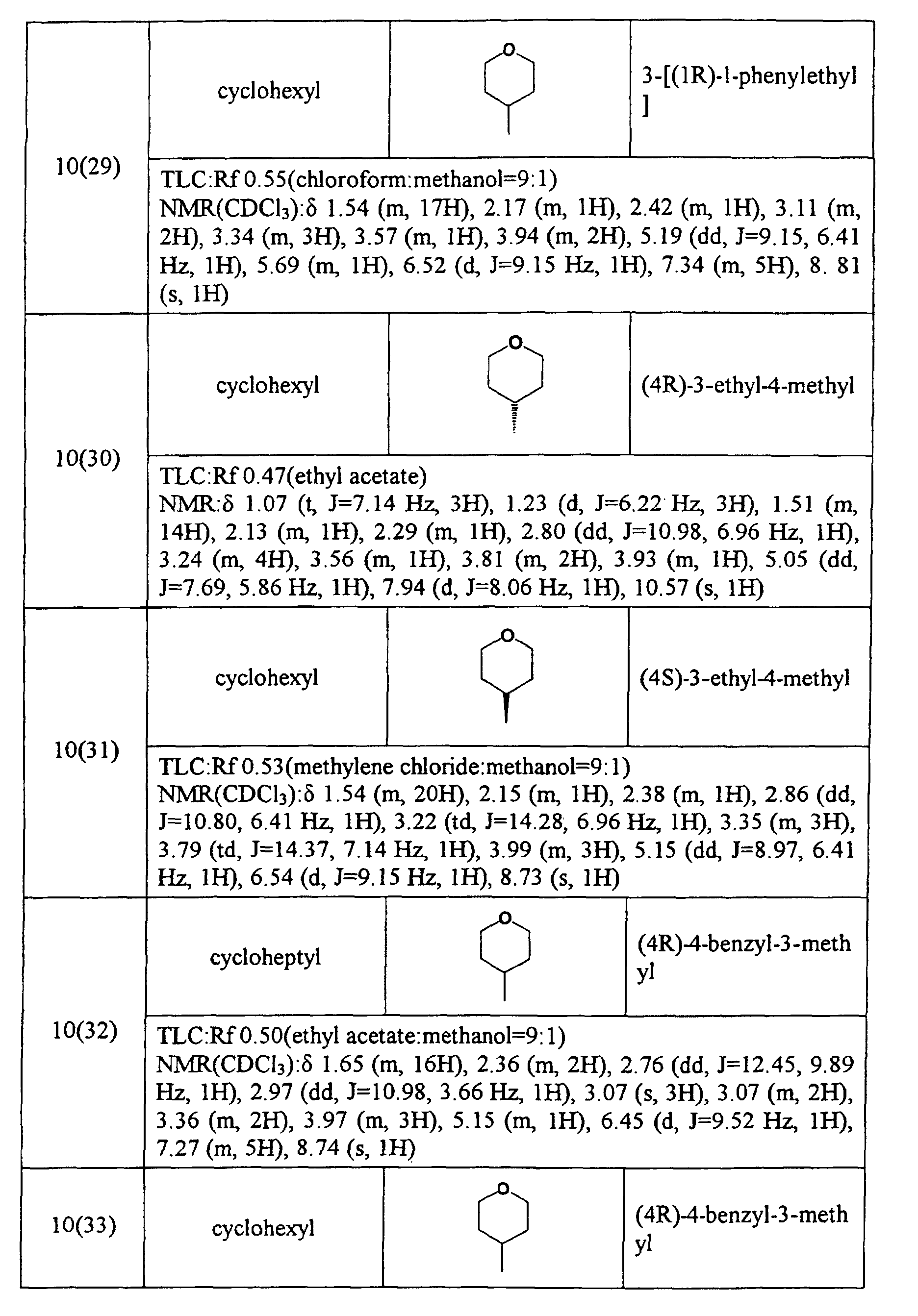
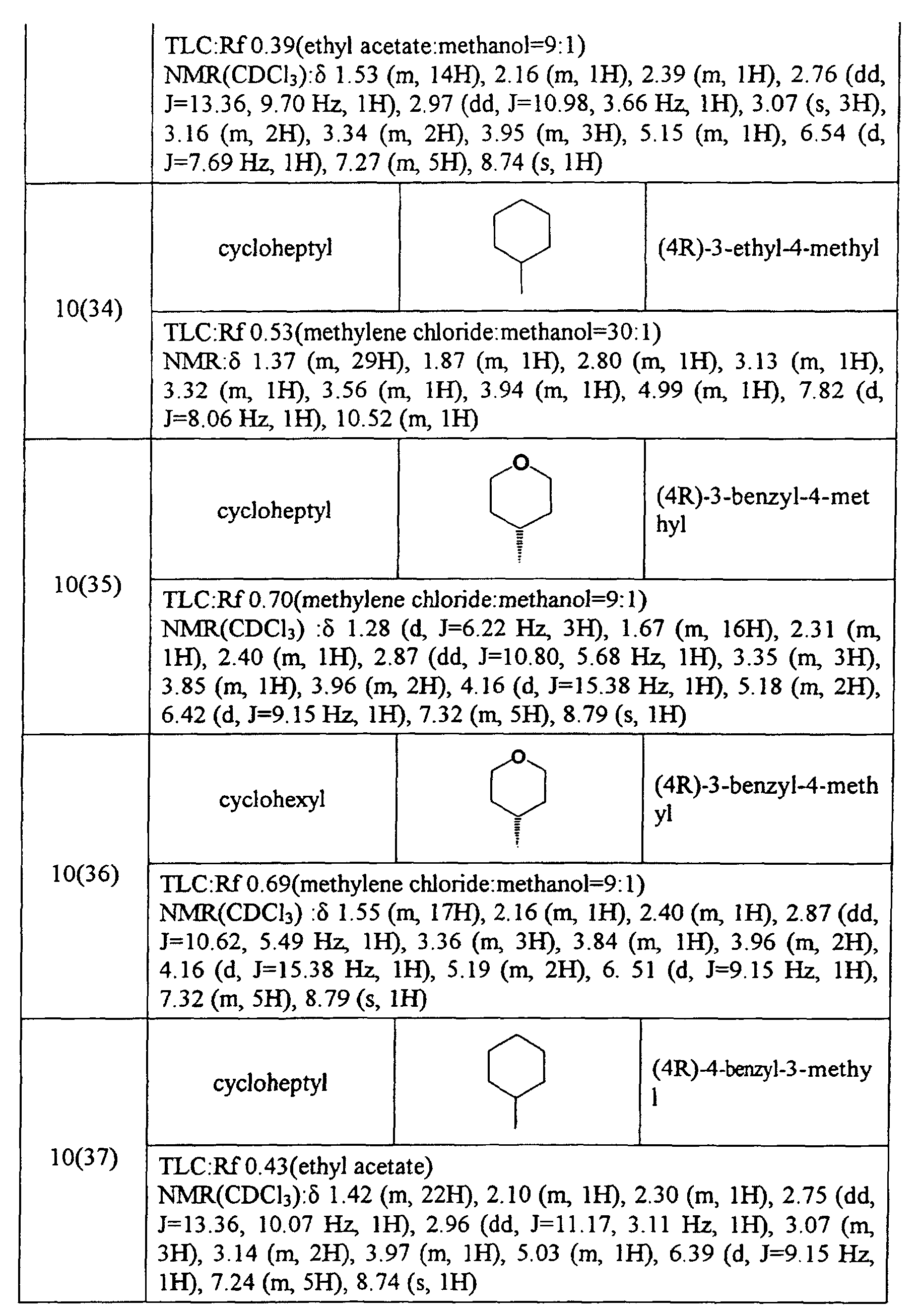

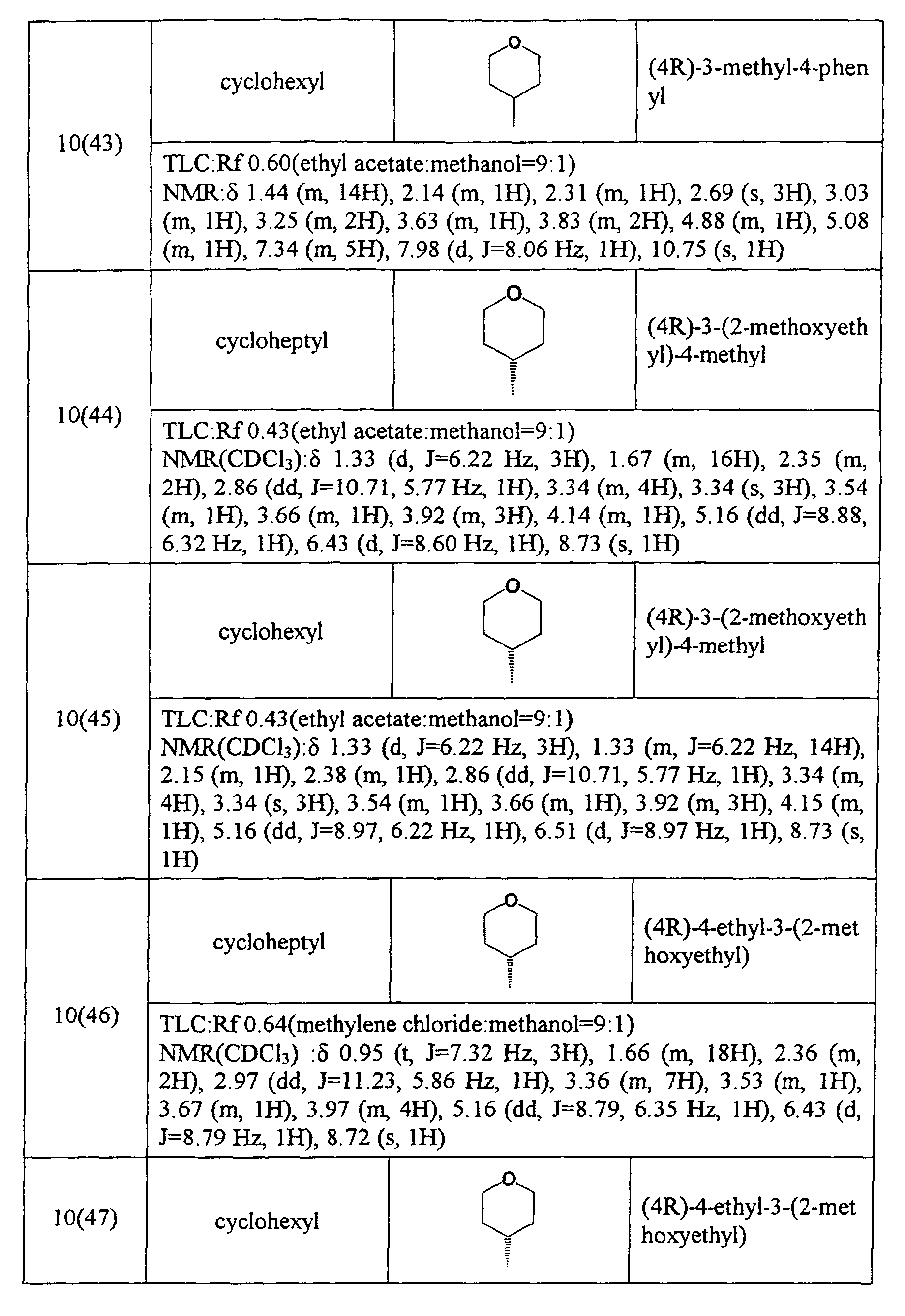


- N-(3-methyl-1,3-thiazolidin-2-ylidene)-[(3S)-3-cyclohexylcarbonylamino-2-oxo-5-methylhexanohydrazide] hydrochloride 5.0 g
- carboxymethylcellulose calcium(disintegrating agent) 0.2 g
- magnesium stearate (lubricant) 0.1 g
- microcrystalline cellulose 4.7 g
- N'-(3-methyl-1,3-thiazolidin-2-ylidene)-[(3S)-3-cyclohexylcarbonylamino-2-oxo-5-methylhexanohydrazide] hydrochloride 2.0 g
- mannitol 20 g
- distilled water 500 ml
Claims (23)
- A compound of formula (I)[wherein R is (1) hydrogen, (2) CycA, (3) C1-8 alkyl optionally substituted with 1 to 5 groups selected from halogen, CycA, nitro, trifluoromethyl and cyano,
 (wherein CycA is a C3-15 mono-, bi- or tri-cyclic carboring or a 3-15 membered mono-, bi- or tri-cyclic heteroring comprising 1-4 of nitrogen, 1-2 of oxygen and/or 1-2 of sulfur;
R16 is (1) C1-8 alkyl, (2) C2-8 alkenyl, (3) C2-8 alkynyl, (4) CycA or
(5) C1-8 alkyl, C2-8 alkenyl or C2-8 alkynyl substituted with substituted with 1 to 5 groups selected from halogen, nitro, trifluoromethyl, cyano, CycA, -NR18R19, -OR18, -SR18, -NHC(O)-CycA and -NHC(O)-(C1-8 alkyl);
R17, R18 and R19 are each independently, hydrogen, C1-4 alkyl, CycA, C1-4 alkyl substituted with CycA.),
AA1 is (1) a bond, or(wherein R1 and R2 are each independently, (i) hydrogen, (ii) C1-8 alkyl, (iii) CycA or (iv) C1-8 alkyl substituted with substituted with 1 to 5 groups selected from the following (a) to (j):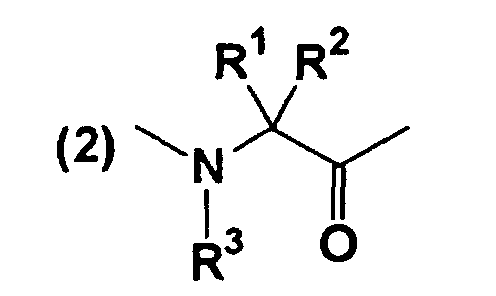 R1 and R2 are taken together to form C2-8 alkylene (wherein one carbon of the alkylene chain may be replaced by oxygen, sulfur or -NR20- and the alkylene may be substituted with -NR21R22, -OR21 or oxo.),(a) -NR21R22, (b) -OR23, (c) -SR23, (d) -COR24, (e) -NR25C(O)NR21R22, (f) guanidino, (g) amidino, (h) CycA, (j) -NR25SO2 R21 ;or
(wherein R20 is hydrogen, C1-4 alkyl, -C(O)O-(C1-4 alkyl), CycA or C1-4 alkyl substituted with CycA; R21, R22, R23 and R25 are each independently, hydrogen, C1-4 alkyl, CycA or C1-4 alkyl substituted with CycA; R24 is C1-4 alkyl, CycA, -NR21R22, -OR23, -SR23 or C1-4 alkyl substituted with CycA.),
R3 is hydrogen, C1-8 alkyl, CycA or C1-8 alkyl substituted with CycA or
R3 may be taken together with R1 to form C2-6 alkylene (wherein one carbon of the alkylene chain may be replaced by oxygen, sulfur or -NR20- and the alkylene may be substituted with -NR21R22, -OR23, -SR23 or oxo.).) or
R and AA1 may be taken together to form(wherein CycB is a 5-12 membered mono- or bi-cyclic heteroring and the other symbols have the same meaning as hereinbefore.),
AA2 is (1) a bond,(wherein R4 and R5 are each independently, (i) hydrogen, (ii) C1-8 alkyl, (iii) CycA or (iv) C1-8 alkyl substituted with 1 to 5 groups selected from the following (a) to (h): R4 and R5 may be taken together to form C2-8 alkylene (wherein one carbon of the alkylene chain may be replaced by oxygen, sulfur or -NR30- and the alkylene may be substituted with -NR31R32, -OR33, -SR33 or oxo.),(a) -NR31R32, (b) -OR33, (c) -SR33, (d) -COR34, (e) -NR35C(O)NR31R32, (f) guanidino, (g) amidino, (h) CycA, (j) -NR35SO2 R31 ;or
(wherein R30 is hydrogen, C1-4 alkyl, -C(O)O-(C1-4 alkyl), CycA or C1-4 alkyl substituted with CycA; R31, R32, R33 and R35 are each independently, hydrogen, C1-4 alkyl, CycA or C1-4 alkyl substituted with CycA; R34 is C1-4 alkyl, CycA, -NR31R32, -OR33, -SR33 or C1-4 alkyl substituted with CycA),
R6 is hydrogen, C1-8 alkyl, CycA or C1-8 alkyl substituted with CycA or
R6 may be taken together with R4 or R to form C2-6 alkylene (wherein one carbon of the alkylene chain may be replaced by oxygen, sulfur or -NR30- and the alkylene may be substituted with NR31R32, OR33, SR33 or oxo.),
R38 is hydrogen, C1-4 alkyl, CycA or C1-4 alkyl substituted with CycA or
when AA1 is a bond, R38 may be taken together with R to form C2-6 alkylene (wherein one carbon of the alkylene chain may be replaced by oxygen, sulfur or -NR37- (wherein R37 is hydrogen or C1-4 alkyl.).),
CycC is a 3-17 membered mono- or bi-cyclic heteroring,
CycD is a C3-14 mono- or bi-cyclic carboring or a 3-14 membered mono- or bi-cyclic heteroring) or
AA2 may be taken together with AA1 to form(wherein CycE is a 4-18 membered mono- or bi-cyclic heteroring, CycF is a 5-8 membered monocyclic heteroring, and the other symbols have the same meaning as hereinbefore.),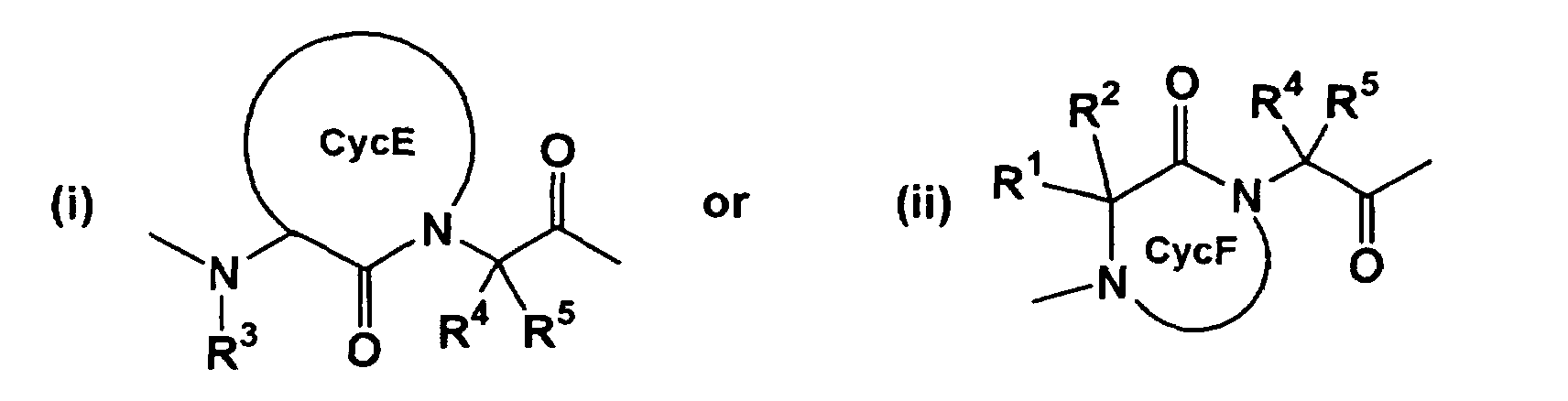
R7 and R8 are each independently (1) hydrogen, (2) C1-8 alkyl, (3) CycA or (4) C1-8 alkyl substituted with 1 to 5 groups selected from the following (i)~(x);
(i) -NR41R42, (ii) -OR43, (iii) -SR43, (iv) -COR44, (v) -NR45C(O)NR41R42, (vi) guanidino, (vii) amidino, (viii) CycA, (ix) -NR45SO2R41, (x) -P(O)(OR46)(OR47), or
R7 and R8 may be taken together to form C2-8 alkylene (wherein one carbon of the alkylene chain may be replaced by oxygen, sulfur or -NR40 - and the alkylene may be substituted with -NR41R42, -OR43, -SR43 or oxo),
R40 is hydrogen, C1-4 alkyl, -C(O)O-(C1-4 alkyl), CycA or C1-4 alkyl substituted with CycA,
R41, R42, R43 and R45 are each independently hydrogen, C1-4 alkyl, CycA or C1-4 alkyl substituted with CycA, R44 is C1-4 alkyl, CycA, -NR41R42, -OR43, -SR43 or C1-4 alkyl substituted with CycA,
R46 and R47 are each independently, hydrogen or C1-8 alkyl,
R9 is hydrogen, C1-8 alkyl, CycA or C1-8 alkyl substituted with CycA or
R9 may be taken together with R7 or R to form C2-6 alkylene (wherein one carbon of the alkylene chain may be replaced by oxygen, sulfur or -NR40- and the alkylene may be substituted with -NR41R42, -OR43, -SR43 or oxo), (wherein all symbols have the same meaning as hereinbefore.),is a group selected from the following (1), (2) or (3); [wherein RA1 and RA2 are each independently, (i) hydrogen, (ii) C1-8 alkyl, (iii) C2-8 alkenyl, (iv) -NRZ1RZ2, (v) -ORZ3, (vi) -SRZ3, (vii) -CORZ4, (viii) CycP or (ix) C1-8 alkyl or C2-8 alkenyl substituted with 1 to 5 groups selected from CycP, -NRZ1RZ2, -ORZ3, -SRZ3, -CORZ4, -SO2RZ4, -COORZ3, -CONRZ1RZ2, -SO2NRZ1RZ2 and -P(O)(ORZ5)(ORZ6)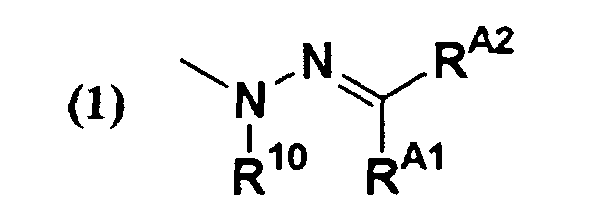
(wherein RZ1 and RZ2 are each independently, hydrogen, C1-8 alkyl, C2-8 alkenyl, CycP, C2-8 acyl, or C1-8 alkyl substituted with CycP, C2-8 acyl, C1-8 alkoxy, C1-8 alkylthio, C1-8 monoalkylamino or di(C1-8 alkyl)amino;
RZ3 is hydrogen, C1-8 alkyl, C2-8 alkenyl, CycP or C1-8 alkyl substituted with 1 to 5 groups selected from CycP, C1-8 alkoxy, C1-8 alkylthio, amino, C1-8 monoalkylamino, di(C1-8 alkyl)amino and C2-8 acyl;
RZ4 is C1-8 alkyl, CycP or C1-8 alkyl substituted with 1 to 5 groups selected from CycP, C1-8 alkoxy, C1-8 alkylthio, mono(C1-8 alkyl)amino, di(C1-8 alkyl)amino or C2-8 acyl;
RZ5 and RZ6 are each independently, hydrogen or C1-8 alkyl,
CycP is a C4-10 carboring or 5-10 membered heteroring comprising 1-4 of nitrogen, 1-2 of oxygen and/or 1-2 of sulfur and R10 has the same meaning as hereinbefore.) or
RA1 and RA2 may be taken together with the adjacent carbon to represent CycH(wherein CycH is a C4-10 mono- or bi-cyclic carboring or 4-10 membered mono- or bi-cyclic heteroring and R10 has the same meaning as hereinbefore.) or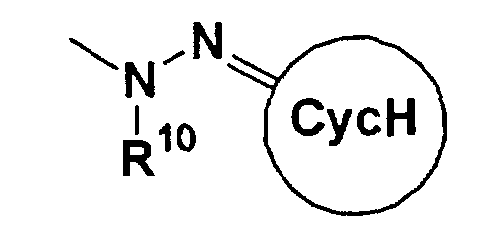
RA1 and R10 may be taken together with the adjacent carbon and nitrogen to represent(wherein CycJ is a 5-10 membered mono- or bi-cyclic heteroring and RA2 has the same meaning as hereinbefore.).], [wherein RA3 is (i) C1-8 alkyl, (ii) C2-8 alkenyl, (iii) -NRZ1RZ2, (ix) -ORZ3, (v) -SRZ3, (vi) -CORZ4, (vii) CycP or C1-8 alkyl or C2-8 alkenyl substituted with 1 to 5 groups selected from -NRZ1RZ2, -ORZ3, -SRZ3, -CORZ4, -SO2RZ4, CycP and -P(O)(ORZ5)(ORZ6) (wherein all symbols have the same meaning as hereinbefore.),
RA4 is (i) hydrogen, (ii) C1-8 alkyl, (iii) C2-8 alkenyl, (iv) -CORZ4, (v) CycP or (vi) C1-8 alkyl or C2-8 alkenyl substituted with 1 to 5 groups selected from CycP, -NRZ1RZ2, -ORZ3, -SRZ3, -CORZ4 , -SO2RZ4 , -COORZ3 , -CONRZ1RZ2 -SO2NRZ1RZ2 and -P(O)(ORZ5)(ORZ6) (wherein all symbols have the same meaning as hereinbefore.),
R10 has the same meaning as hereinbefore, or
RA3 and RA4 may be taken together with the adjacent carbon and nitrogen to represent(wherein CycK is a 5-10 membered mono- or bi-cyclic heteroring and R10 has the same meaning as hereinbefore.),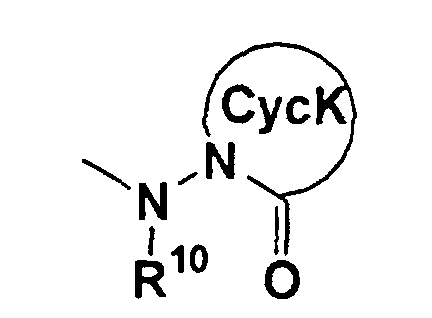
RA3 and R10 may be taken together with the adjacent carbon and nitrogens to represent(wherein CycL is a 5-10 membered mono- or bi-cyclic heteroring and RA4 has the same meaning as hereinbefore.)],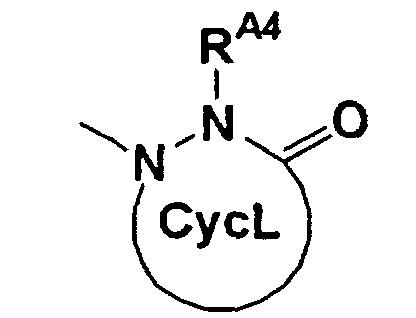 [wherein n is an integer of I or 2, and the other symbols have the same meaning as hereinbefore, and RA3 and RA4 may be taken together with the adjacent nitrogen and sulfur to represent
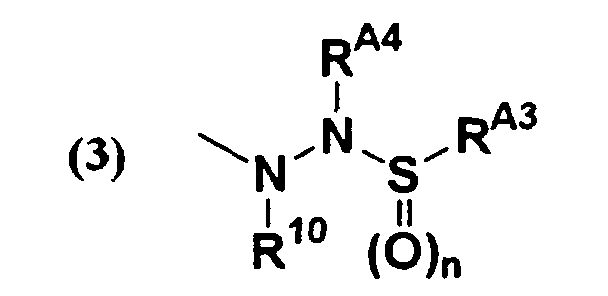 (wherein CycM is a 5-10 membered mono- or bi-cyclic heteroring and the other symbols have the same meaning as hereinbefore.) or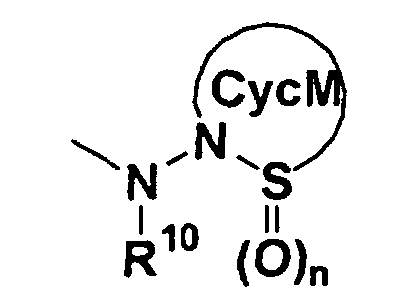
RA3 and R10 may be taken together with the nitrogens and sulfur to represent(wherein CycN is a 5-10 membered mono- or bi-cyclic heteroring and the other symbols have the same meaning as hereinbefore.)],
CycA's, CycB, CycC, CycD, CycE, CycF, CycH, CycJ, CycK, CycL, CycM, CycN and CycP may be each independently substituted with 1-5 of R27,
R27 is (1) C1-8 alkyl, (2) halogen, (3) -NR11R12, (4) -OR13, (5) -SR13, (6) CycG, (7) nitro, (8) cyano, (9) oxo, (10) -COR14, (11) -SO2R14, (12) -P(O)(OR15)(OR16), (13) guanidino, (14) amidino or (15) C1-8 alkyl substituted with 1 to 5 groups selected from the following (i) - (xii):(wherein R11 and R12 are each independently, hydrogen, C1-4 alkyl, C1-4 alkoxy, -C(O)O-(C1-4 alkyl), CycG or C1-4 alkyl substituted with CycG,(i) halogen, (ii) -NR11R12, (iii) -OR13, (iv) -SR13, (v) CycG, (vi) nitro, (vii) cyano, (viii) -COR14, (ix) -SO2R14, (x) -P(O)(OR15)(OR16), (xi) guanidino, (xii) amidino
R13 is hydrogen, C1-4 alkyl, trifluoromethyl, CycG or C1-4 alkyl substituted with CycG,
CycG's are each independently, a C4-10 mono- or bi-cyclic carboring or a 5-10 membered mono- or bi-cyclic heteroring comprising 1-4 of nitrogen, 1-2 of oxygen and/or 1-2 of sulfur,
R14 is C1-8 alkyl, CycG, -NR11R12, -OR13, -SR13 or C1-8 alkyl substituted with CycG, -NR11R12, -OR13 or -SR13,
R15's are each independently, hydrogen or C1-8 alkyl.),
when a saturated carbon atom exists in CycH, CycJ, CycK, CycL, CycM or CycN, the saturated carbon atom may form a spiro bond with CycQ (wherein CycQ is a C3-10 saturated or partially unsaturated mono-cyclic carboring or a 5-8 membered saturated or partially unsaturated monocyclic heteroring comprising 1 of -NRQ- (wherein RQ is C1-8 alkyl, C2-8 acyl, -SO2-(C1-8 alkyl), benzoyl, benzenesulfonyl, or toluenesulfonyl.), 1 of oxygen and/or 1 of sulfur which may be oxidized.)] or a pharmaceutically acceptable salt thereof. - The compound according to claim 1, wherein in the compound of formula (I)i,e. the compound of formula (I-i)
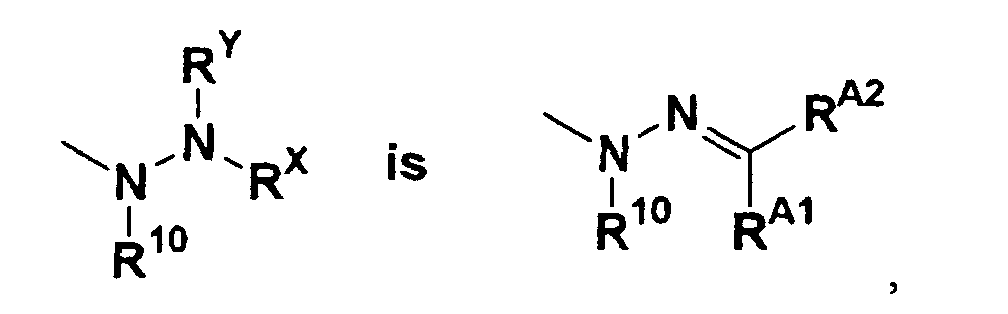 (wherein all symbols have the same meaning as claim 1.) or a pharmaceutically acceptable salt thereof.
- The compound according to claim 1, wherein in the compound of formula (I)i.e. the compound of formula (I-ii)
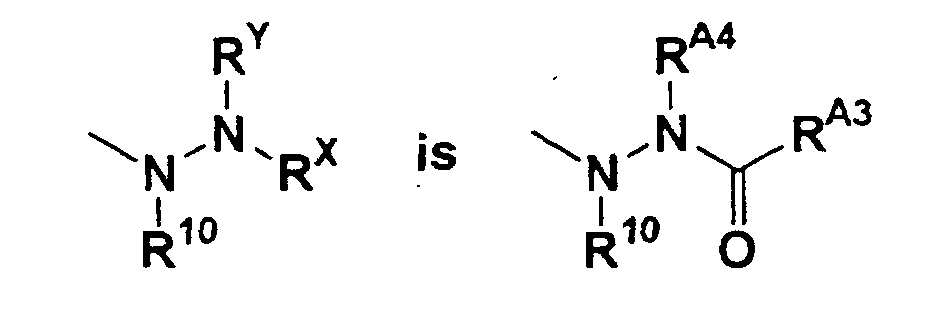 (wherein all symbols have the same meaning as claim 1.) or a pharmaceutically acceptable salt thereof
- The compound according to claim 1, wherein in the compound of formula (I)i.e. the compound of formula (I-iii)
 (wherein all symbols have the same meaning as claim 1.) or a pharmaceutically acceptable salt thereof.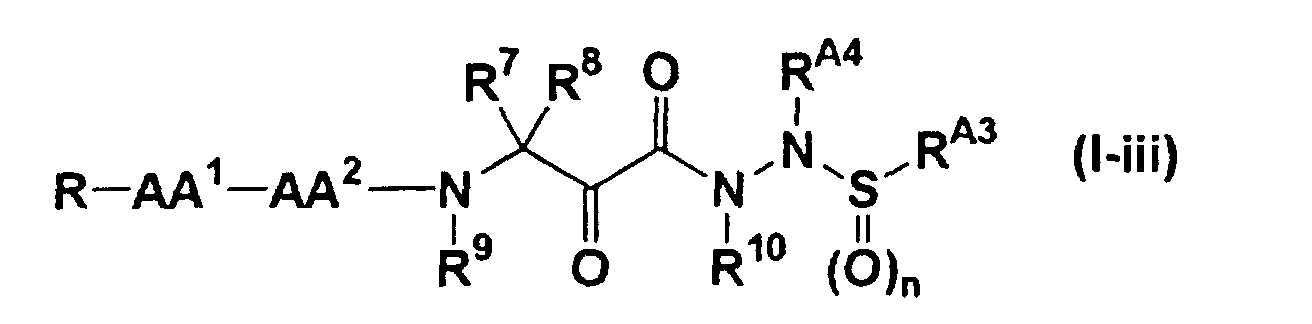
- A pharmaceutical composition comprising the compound of formula (I) or a pharmaceutically acceptable salt thereof which is described in claim 1.
- The pharmaceutical composition according to claim 5, which is a cysteine protease inhibitor.
- The pharmaceutically composition according to claim 5, which is a bone resorption inhibitor.
- A cysteine protease inhibitor comprising the compound of formula (I) or a pharmaceutically acceptable salt thereof described in claim 1 as active ingredient.
- The inhibitor according to claim 8, wherein cysteine protease is cathepsin K, cathepsin S, cathepsin L, cathepsin B, cathepsin H, cathepsin F, cathepsin Y, cathepsin C, calpain or caspase-1.
- The inhibitor according to claim 8, wherein cysteine protease is cathepsin K.
- A medicinal formulation comprising the compound of formula (I) or a pharmaceutically acceptable salt thereof described in claim 1, combinined with at least one selected from a bisphosphonate, a steroidal agent, a vitamin K derivative, a vitamin D derivative, a caspase-1 inhibitor, a PTHrP derivative, a PG ligand, a metalloprotease inhibitor, a farnesoid X receptor agonist, an estrogen agonist and a progesterone agonist.
- A pharmaceutical composition for the treatment and/or prophylaxis of an inflammatory disease, an immune disease, an ischemic disease, a respiratory disease, a circulatory disease, a blood disease, a neuronal disease, a hepatic or biliary disease, an osseous or articular disease or a metabolic disease, which comprises the compound of formula (I) or a pharmaceutically acceptable salt thereof described in claim 1.
- A pharmaceutical composition for the treatment and/or prophylaxis of a disease induced by apoptosis, a disease induced by decomposition of proteins which compose a body or shoc, which comprises the compound of formula (I) or a pharmaceutically acceptable salt thereof described in claim 1.
- The composition for the treatment and/or prophylaxis according to claim 12 wherein osseous or articular disease is osteoporosis, rheumatoid arthritis, arthritis, osteoarthritis, hypocalcaemia, bone metastasis of cancer or bone fracture.
- A method for the inhibition of cysteine protease in a mammal characterized by administering to a mammal an effective amount of the compound of formula (I) or a pharmaceutically acceptable salt thereof described in claim 1.
- A method for the treatment and/or prophylaxis of an inflammatory disease, an immune disease, an ischemic disease, a respiratory disease, a circulatory disease, a blood disease, a neuronal disease, a hepatic or biliary disease, an osseous or articular disease or a metabolic disease in a mammal characterized by administering to a mammal an effective amount of the compound of formula (I) or a pharmaceutically acceptable salt thereof described in claim 1.
- A method for the prophylaxis and/or treatment of a disease induced by apoptosis, a disease induced by decomposition of proteins which compose a body or shock characterized by administering to a mammal an effective amount of the compound of formula (I) or a pharmaceutically acceptable salt thereof described in claim 1.
- The method for the treatment and/or prophylaxis according to claim 16, wherein the osseous or articular disease is osteoporosis, rheumatoid arthritis, arthritis, osteoarthritis, hypocalcaemia, osteometastasis of cancer or bone fracture.
- Use of the compound or a pharmaceutically acceptable salt thereof described in claim 1 for the manufacture of a cysteine protease inhibitor.
- Use of the compound of formula (I) or a pharmaceutically acceptable salt thereof described in claim 1 for the manufacture of a pharmaceutical preparation for the prophylaxis and/or treatment of an inflammatory disease, an immune disease, an ischemic disease, a respiratory disease, a circulatory disease, a blood disease, a neuronal disease, a hepatic or biliary disease, an osseous or articular disease or a metabolic disease.
- Use of the compound of formula (I) or a pharmaceutically acceptable salt thereof described in claim 1 for the manufacture of a pharmaceutical preparation for the prophylaxis and/or treatment of a disease induced by apoptosis, a disease induced by decomposition of proteins which compose a body or shock.
- The use according to claim 21, wherein bone and joint disease is osteoporosis, rheumatoid arthritis, arthritis, osteoarthritis, hypocalcaemia,
- The compound according to claim 1, which is described in example 1 to example 10(66) or a pharmaceutically acceptable salt thereof.
Applications Claiming Priority (3)
| Application Number | Priority Date | Filing Date | Title |
|---|---|---|---|
| JP2002123796 | 2002-04-25 | ||
| JP2002123796 | 2002-04-25 | ||
| PCT/JP2003/005252 WO2003091202A1 (en) | 2002-04-25 | 2003-04-24 | Diketohydrazine derivative compounds and drugs contaiing the compounds as the active ingredient |
Publications (4)
| Publication Number | Publication Date |
|---|---|
| EP1498411A1 true EP1498411A1 (en) | 2005-01-19 |
| EP1498411A4 EP1498411A4 (en) | 2005-11-30 |
| EP1498411B1 EP1498411B1 (en) | 2013-01-16 |
| EP1498411B9 EP1498411B9 (en) | 2013-12-04 |
Family
ID=29267501
Family Applications (1)
| Application Number | Title | Priority Date | Filing Date |
|---|---|---|---|
| EP03723188.3A Expired - Lifetime EP1498411B9 (en) | 2002-04-25 | 2003-04-24 | Diketohydrazine derivative compounds and drugs containing the compounds as the active ingredient |
Country Status (20)
| Country | Link |
|---|---|
| US (2) | US7655804B2 (en) |
| EP (1) | EP1498411B9 (en) |
| JP (2) | JP3812678B2 (en) |
| KR (1) | KR100838333B1 (en) |
| CN (2) | CN100475778C (en) |
| AU (1) | AU2003235118C1 (en) |
| BR (1) | BR0309670A (en) |
| CA (1) | CA2483998C (en) |
| DK (1) | DK1498411T3 (en) |
| ES (1) | ES2399362T3 (en) |
| IL (1) | IL164699A (en) |
| MX (1) | MXPA04010523A (en) |
| NO (1) | NO333952B1 (en) |
| NZ (1) | NZ536728A (en) |
| PL (1) | PL217947B1 (en) |
| PT (1) | PT1498411E (en) |
| RU (1) | RU2368600C2 (en) |
| TW (1) | TWI328576B (en) |
| WO (1) | WO2003091202A1 (en) |
| ZA (1) | ZA200409502B (en) |
Cited By (5)
| Publication number | Priority date | Publication date | Assignee | Title |
|---|---|---|---|---|
| WO2005077969A2 (en) | 2004-02-04 | 2005-08-25 | Vertex Pharmaceuticals Incorporated | Inhibitors of serine proteases, particularly hcv ns3-ns4a protease |
| WO2007097720A3 (en) * | 2006-02-21 | 2007-11-08 | Agency Science Tech & Res | Method and reagents for treating hepatic fibrosis and inflammation |
| EP1741441A4 (en) * | 2004-04-26 | 2010-03-03 | Ono Pharmaceutical Co | Bone densifying agent characterized by use of cathepsin k inhibitor with pth |
| WO2011070541A1 (en) * | 2009-12-10 | 2011-06-16 | Medivir Uk Limited | Cysteine protease inhibitors |
| US8314141B2 (en) | 1996-10-18 | 2012-11-20 | Vertex Pharmaceuticals Incorporated | Inhibitors of serine proteases, particularly hepatitis C virus NS3 protease |
Families Citing this family (30)
| Publication number | Priority date | Publication date | Assignee | Title |
|---|---|---|---|---|
| CA2483998C (en) * | 2002-04-25 | 2012-05-29 | Ono Pharmaceutical Co., Ltd. | Diketohydrazine derivative compounds and drugs containing the compounds as the active ingredient |
| WO2005000793A1 (en) * | 2003-06-26 | 2005-01-06 | Taisho Pharmaceutical Co., Ltd. | 2-substituted cycloalkylcarboxylic acid derivative |
| PE20050374A1 (en) | 2003-09-05 | 2005-05-30 | Vertex Pharma | SERINE PROTEASE INHIBITORS, IN PARTICULAR HCV PROTEASE NS3-NS4A |
| JP4513517B2 (en) * | 2004-11-12 | 2010-07-28 | 宇部興産株式会社 | 3- (N-acylamino) -2-acyloxy-3- (4-tetrahydropyranyl) -2-propenoic acid ester and process for producing the same |
| US20090005323A1 (en) * | 2005-01-19 | 2009-01-01 | Michael David Percival | Cathepsin K Inhibitors and Obesity |
| JP5034277B2 (en) * | 2005-03-11 | 2012-09-26 | 宇部興産株式会社 | Of 3- (N-acylamino) -3- (4-tetrahydropyranyl) -2-oxopropanoic acid ester and 3- (N-acylamino) -3- (4-tetrahydropyranyl) -2-oxopropanohydrazide Production method |
| MX341849B (en) * | 2006-06-01 | 2016-09-05 | Sanofi Aventis | SPIROCICLIC NITRILS AS PROTEASA INHIBITORS. |
| KR20100023948A (en) | 2007-06-08 | 2010-03-04 | 닛뽕 케미파 가부시키가이샤 | Therapeutic or prophylactic agent for cerebral aneurysm |
| WO2009054454A1 (en) | 2007-10-24 | 2009-04-30 | National University Corporation Tokyo Medical And Dental University | Regulator for signaling of toll-like receptor, which comprises cathepsin inhibitor as active ingredient |
| CA2631071A1 (en) * | 2008-05-09 | 2009-11-09 | Tong-Jun Lin | Inhibition of calpain reduces allergic inflammation |
| WO2011069149A2 (en) * | 2009-12-04 | 2011-06-09 | Dcb-Usa Llc | Cathepsin s inhibitors |
| CN102241627B (en) * | 2010-05-14 | 2014-07-02 | 中国人民解放军总医院 | Carbamide compound and its medicinal usage |
| CN102675061B (en) * | 2011-10-31 | 2016-01-20 | 合肥市济泉医药科技有限公司 | The ether derivant of trans-resveratrol and medical use |
| WO2014113068A1 (en) * | 2013-01-18 | 2014-07-24 | Loma Linda University | Compositions and methods for diagnosing and treating sepsis |
| EP3009444B1 (en) * | 2013-06-14 | 2017-12-20 | Seikagaku Corporation | Alpha-oxoacyl amino-caprolactam derivative |
| EP3033752B1 (en) | 2013-08-12 | 2018-08-01 | Kateeva, Inc. | Ester-based solvent systems for printable organic light-emitting diode ink formulations |
| EP3426674A4 (en) | 2016-03-09 | 2019-08-14 | Blade Therapeutics, Inc. | CYCLIC CE-AMIDE COMPOUNDS AS MODULATORS OF CALPAIN, AND METHODS OF MAKING AND USING SAME |
| EP3481835A4 (en) | 2016-07-05 | 2020-02-26 | Blade Therapeutics, Inc. | CALPAIN MODULATORS AND THEIR THERAPEUTIC USES |
| WO2018035253A1 (en) * | 2016-08-16 | 2018-02-22 | Children's Medical Center Corporation | Compositions and methods for cardiac repair |
| JOP20190024A1 (en) | 2016-08-26 | 2019-02-19 | Gilead Sciences Inc | Substituted pyrrolizine compounds and uses thereof |
| SG10201912574WA (en) | 2016-09-28 | 2020-02-27 | Blade Therapeutics Inc | Calpain modulators and therapeutic uses thereof |
| KR102526964B1 (en) | 2018-02-26 | 2023-04-28 | 길리애드 사이언시즈, 인코포레이티드 | Substituted pyrrolizine compounds as HBV replication inhibitors |
| CN113372368B (en) * | 2020-03-09 | 2022-04-12 | 苏州爱科百发生物医药技术有限公司 | A kind of elastase inhibitor prodrug and use thereof |
| IL298324A (en) | 2020-06-10 | 2023-01-01 | Aligos Therapeutics Inc | Antiviral compounds for the treatment of coronavirus, picornavirus and novovirus infections |
| WO2022072975A1 (en) * | 2020-10-01 | 2022-04-07 | University Of Georgia Research Foundation, Inc. | Compositions and methods of treatment for sars-cov-2 through papain protease inhibition |
| CA3224494A1 (en) | 2021-07-09 | 2023-01-12 | Koen Vandyck | Anti-viral compounds |
| WO2023043816A1 (en) | 2021-09-17 | 2023-03-23 | Aligos Therapeutics, Inc. | Anti-viral compounds for treating coronavirus, picornavirus, and norovirus infections |
| CN115192564B (en) * | 2022-05-23 | 2023-11-17 | 四川大学华西医院 | Phenylalanine derivative, pharmaceutical composition and application thereof in tumor treatment |
| CN118777286A (en) * | 2024-07-05 | 2024-10-15 | 中国航发动力股份有限公司 | A method for determining the content of lead, antimony and bismuth in copper alloys by standard addition method |
| CN119792264B (en) * | 2025-03-14 | 2025-06-10 | 华中科技大学同济医学院附属同济医院 | Application of butyryl hydrazine in preparation of medicines for preventing or treating COPD |
Family Cites Families (6)
| Publication number | Priority date | Publication date | Assignee | Title |
|---|---|---|---|---|
| IL110898A0 (en) | 1993-09-10 | 1994-11-28 | Narhex Australia Pty Ltd | Polar-substituted hydrocarbons |
| US6083944A (en) | 1997-10-07 | 2000-07-04 | Cephalon, Inc. | Quinoline-containing α-ketoamide cysteine and serine protease inhibitors |
| US6117870A (en) * | 1998-11-12 | 2000-09-12 | Fujirebio Kabushiki Kaisha | Cyclic amide derivatives |
| EP1411933A1 (en) * | 2001-08-03 | 2004-04-28 | SmithKline Beecham Corporation | Alpha-ketoamide derivatives as cathepsin k inhibitors |
| CA2483998C (en) * | 2002-04-25 | 2012-05-29 | Ono Pharmaceutical Co., Ltd. | Diketohydrazine derivative compounds and drugs containing the compounds as the active ingredient |
| US7632813B2 (en) * | 2004-04-26 | 2009-12-15 | Ono Pharmaceutical Co., Ltd. | Bone densifying agent characterized by use of cathepsin K inhibitor with PTH |
-
2003
- 2003-04-24 CA CA2483998A patent/CA2483998C/en not_active Expired - Lifetime
- 2003-04-24 MX MXPA04010523A patent/MXPA04010523A/en active IP Right Grant
- 2003-04-24 PL PL373818A patent/PL217947B1/en unknown
- 2003-04-24 US US10/512,348 patent/US7655804B2/en not_active Expired - Fee Related
- 2003-04-24 CN CNB038091917A patent/CN100475778C/en not_active Expired - Fee Related
- 2003-04-24 ES ES03723188T patent/ES2399362T3/en not_active Expired - Lifetime
- 2003-04-24 DK DK03723188.3T patent/DK1498411T3/en active
- 2003-04-24 BR BR0309670-0A patent/BR0309670A/en not_active IP Right Cessation
- 2003-04-24 AU AU2003235118A patent/AU2003235118C1/en not_active Ceased
- 2003-04-24 EP EP03723188.3A patent/EP1498411B9/en not_active Expired - Lifetime
- 2003-04-24 KR KR1020047017135A patent/KR100838333B1/en not_active Expired - Fee Related
- 2003-04-24 PT PT37231883T patent/PT1498411E/en unknown
- 2003-04-24 NZ NZ536728A patent/NZ536728A/en not_active IP Right Cessation
- 2003-04-24 CN CNA2008101710939A patent/CN101423481A/en active Pending
- 2003-04-24 JP JP2004501947A patent/JP3812678B2/en not_active Expired - Fee Related
- 2003-04-24 RU RU2004134561/04A patent/RU2368600C2/en not_active IP Right Cessation
- 2003-04-24 WO PCT/JP2003/005252 patent/WO2003091202A1/en not_active Ceased
- 2003-04-24 TW TW092109562A patent/TWI328576B/en not_active IP Right Cessation
-
2004
- 2004-10-19 IL IL164699A patent/IL164699A/en not_active IP Right Cessation
- 2004-11-24 ZA ZA2004/09502A patent/ZA200409502B/en unknown
- 2004-11-25 NO NO20045137A patent/NO333952B1/en not_active IP Right Cessation
-
2006
- 2006-02-23 JP JP2006046815A patent/JP4826282B2/en not_active Expired - Fee Related
-
2009
- 2009-09-24 US US12/566,416 patent/US8138182B2/en not_active Expired - Fee Related
Cited By (14)
| Publication number | Priority date | Publication date | Assignee | Title |
|---|---|---|---|---|
| US8314141B2 (en) | 1996-10-18 | 2012-11-20 | Vertex Pharmaceuticals Incorporated | Inhibitors of serine proteases, particularly hepatitis C virus NS3 protease |
| EP2311851A3 (en) * | 2004-02-04 | 2011-05-25 | Vertex Pharmaceuticals Incorporated | Inhibitors of serine proteases, particularly HCV NS3-NS4A protease |
| WO2005077969A3 (en) * | 2004-02-04 | 2005-12-01 | Vertex Pharma | Inhibitors of serine proteases, particularly hcv ns3-ns4a protease |
| US8536136B2 (en) | 2004-02-04 | 2013-09-17 | Vertex Pharmaceuticals Incorporated | Inhibitors of serine proteases, particularly HCV NS3-NS4A protease |
| US7683033B2 (en) | 2004-02-04 | 2010-03-23 | Vertex Pharmaceuticals Incorporated | Inhibitors of serine proteases, particularly HCV NS3-NS4A protease |
| WO2005077969A2 (en) | 2004-02-04 | 2005-08-25 | Vertex Pharmaceuticals Incorporated | Inhibitors of serine proteases, particularly hcv ns3-ns4a protease |
| EP1741441A4 (en) * | 2004-04-26 | 2010-03-03 | Ono Pharmaceutical Co | Bone densifying agent characterized by use of cathepsin k inhibitor with pth |
| GB2449601B (en) * | 2006-02-21 | 2010-06-23 | Agency Science Tech & Res | Method and reagents for treating hepatic fibrosis and inflammation |
| GB2449601A (en) * | 2006-02-21 | 2008-11-26 | Agency Science Tech & Res | Method and reagents for treating hepatic fibrosis and inflammation |
| WO2007097720A3 (en) * | 2006-02-21 | 2007-11-08 | Agency Science Tech & Res | Method and reagents for treating hepatic fibrosis and inflammation |
| WO2011070541A1 (en) * | 2009-12-10 | 2011-06-16 | Medivir Uk Limited | Cysteine protease inhibitors |
| WO2011070539A1 (en) * | 2009-12-10 | 2011-06-16 | Medivir Uk Limited | Cysteine protease inhibitors |
| US8815809B2 (en) | 2009-12-10 | 2014-08-26 | Medivir Uk Ltd | Cysteine protease inhibitors |
| US8859605B2 (en) | 2009-12-10 | 2014-10-14 | Medivir Uk Ltd | Cysteine protease inhibitors |
Also Published As
Similar Documents
| Publication | Publication Date | Title |
|---|---|---|
| EP1498411B1 (en) | Diketohydrazine derivative compounds and drugs containing the compounds as the active ingredient | |
| US7390804B2 (en) | N-containing five-membered ring compounds and pharmaceutical agents comprising the same as active ingredient | |
| US20030166573A1 (en) | Oxadiazole derivatives and drugs containing these derivatives as the active ingredient | |
| US6809092B2 (en) | Benezene-fused heteroring derivatives and pharmaceutical agents comprising the same as active ingredient | |
| US20040204368A1 (en) | Oxadiazole derivative compounds and drugs containing these compounds as the active ingredient | |
| EP1234821A1 (en) | 1,3,4-oxadiazoline derivatives and drugs containing these derivatives as the active ingredient | |
| US6797720B2 (en) | 1,3,4-oxadiazoline derivative and an agent comprising its derivative as active ingredient | |
| JPWO2001055123A1 (en) | Nitrogen-containing five-membered ring compounds and drugs containing these compounds as active ingredients | |
| JPWO2001044214A1 (en) | Oxadiazole derivatives and drugs containing these derivatives as active ingredients | |
| JPWO2001055118A1 (en) | Benzene-fused heterocyclic derivatives and drugs containing such derivatives as active ingredients | |
| JPWO2001040204A1 (en) | 1,3,4-Oxadiazoline derivatives and drugs containing them as active ingredients |
Legal Events
| Date | Code | Title | Description |
|---|---|---|---|
| PUAI | Public reference made under article 153(3) epc to a published international application that has entered the european phase |
Free format text: ORIGINAL CODE: 0009012 |
|
| 17P | Request for examination filed |
Effective date: 20041025 |
|
| AK | Designated contracting states |
Kind code of ref document: A1 Designated state(s): AT BE BG CH CY CZ DE DK EE ES FI FR GB GR HU IE IT LI LU MC NL PT RO SE SI SK TR |
|
| AX | Request for extension of the european patent |
Extension state: AL LT LV MK |
|
| A4 | Supplementary search report drawn up and despatched |
Effective date: 20051014 |
|
| 17Q | First examination report despatched |
Effective date: 20100729 |
|
| GRAP | Despatch of communication of intention to grant a patent |
Free format text: ORIGINAL CODE: EPIDOSNIGR1 |
|
| GRAS | Grant fee paid |
Free format text: ORIGINAL CODE: EPIDOSNIGR3 |
|
| GRAA | (expected) grant |
Free format text: ORIGINAL CODE: 0009210 |
|
| RIN1 | Information on inventor provided before grant (corrected) |
Inventor name: OCHI, YASUO, C/O ONO PHARMACEUTICAL CO. LTD. Inventor name: OHMOTO, KAZUYUKI C/O ONO PHARMACEUTICAL CO. LTD. Inventor name: HATAYAMA, AKIRA, C/O ONO PHARMACEUTICAL CO. LTD. Inventor name: IMAWAKA, HARUO, C/O ONO PHARMACEUTICAL CO. LTD. Inventor name: TSURUTA, HIROSHI, C/O ONO PHARMACEUTICAL CO. LTD. |
|
| AK | Designated contracting states |
Kind code of ref document: B1 Designated state(s): AT BE BG CH CY CZ DE DK EE ES FI FR GB GR HU IE IT LI LU MC NL PT RO SE SI SK TR |
|
| REG | Reference to a national code |
Ref country code: GB Ref legal event code: FG4D |
|
| REG | Reference to a national code |
Ref country code: CH Ref legal event code: EP Ref country code: CH Ref legal event code: NV Representative=s name: BOVARD AG, CH |
|
| REG | Reference to a national code |
Ref country code: PT Ref legal event code: SC4A Free format text: AVAILABILITY OF NATIONAL TRANSLATION Effective date: 20130129 |
|
| REG | Reference to a national code |
Ref country code: IE Ref legal event code: FG4D |
|
| REG | Reference to a national code |
Ref country code: AT Ref legal event code: REF Ref document number: 593829 Country of ref document: AT Kind code of ref document: T Effective date: 20130215 Ref country code: CH Ref legal event code: EP Ref country code: CH Ref legal event code: NV Representative=s name: BOVARD AG, CH |
|
| REG | Reference to a national code |
Ref country code: DE Ref legal event code: R096 Ref document number: 60343126 Country of ref document: DE Effective date: 20130314 |
|
| REG | Reference to a national code |
Ref country code: ES Ref legal event code: FG2A Ref document number: 2399362 Country of ref document: ES Kind code of ref document: T3 Effective date: 20130327 |
|
| REG | Reference to a national code |
Ref country code: RO Ref legal event code: EPE |
|
| REG | Reference to a national code |
Ref country code: DK Ref legal event code: T3 |
|
| REG | Reference to a national code |
Ref country code: NL Ref legal event code: T3 |
|
| REG | Reference to a national code |
Ref country code: SE Ref legal event code: TRGR |
|
| REG | Reference to a national code |
Ref country code: GR Ref legal event code: EP Ref document number: 20130400617 Country of ref document: GR Effective date: 20130418 |
|
| PG25 | Lapsed in a contracting state [announced via postgrant information from national office to epo] |
Ref country code: BG Free format text: LAPSE BECAUSE OF FAILURE TO SUBMIT A TRANSLATION OF THE DESCRIPTION OR TO PAY THE FEE WITHIN THE PRESCRIBED TIME-LIMIT Effective date: 20130416 Ref country code: CY Free format text: LAPSE BECAUSE OF FAILURE TO SUBMIT A TRANSLATION OF THE DESCRIPTION OR TO PAY THE FEE WITHIN THE PRESCRIBED TIME-LIMIT Effective date: 20130116 |
|
| PG25 | Lapsed in a contracting state [announced via postgrant information from national office to epo] |
Ref country code: SI Free format text: LAPSE BECAUSE OF FAILURE TO SUBMIT A TRANSLATION OF THE DESCRIPTION OR TO PAY THE FEE WITHIN THE PRESCRIBED TIME-LIMIT Effective date: 20130116 |
|
| PG25 | Lapsed in a contracting state [announced via postgrant information from national office to epo] |
Ref country code: SK Free format text: LAPSE BECAUSE OF FAILURE TO SUBMIT A TRANSLATION OF THE DESCRIPTION OR TO PAY THE FEE WITHIN THE PRESCRIBED TIME-LIMIT Effective date: 20130116 Ref country code: EE Free format text: LAPSE BECAUSE OF FAILURE TO SUBMIT A TRANSLATION OF THE DESCRIPTION OR TO PAY THE FEE WITHIN THE PRESCRIBED TIME-LIMIT Effective date: 20130116 |
|
| PLBE | No opposition filed within time limit |
Free format text: ORIGINAL CODE: 0009261 |
|
| STAA | Information on the status of an ep patent application or granted ep patent |
Free format text: STATUS: NO OPPOSITION FILED WITHIN TIME LIMIT |
|
| PG25 | Lapsed in a contracting state [announced via postgrant information from national office to epo] |
Ref country code: MC Free format text: LAPSE BECAUSE OF FAILURE TO SUBMIT A TRANSLATION OF THE DESCRIPTION OR TO PAY THE FEE WITHIN THE PRESCRIBED TIME-LIMIT Effective date: 20130116 |
|
| 26N | No opposition filed |
Effective date: 20131017 |
|
| REG | Reference to a national code |
Ref country code: HU Ref legal event code: AG4A Ref document number: E017752 Country of ref document: HU |
|
| REG | Reference to a national code |
Ref country code: DE Ref legal event code: R097 Ref document number: 60343126 Country of ref document: DE Effective date: 20131017 |
|
| PGFP | Annual fee paid to national office [announced via postgrant information from national office to epo] |
Ref country code: RO Payment date: 20150311 Year of fee payment: 13 Ref country code: NL Payment date: 20150309 Year of fee payment: 13 |
|
| PGFP | Annual fee paid to national office [announced via postgrant information from national office to epo] |
Ref country code: LU Payment date: 20150429 Year of fee payment: 13 Ref country code: GR Payment date: 20150312 Year of fee payment: 13 |
|
| PGFP | Annual fee paid to national office [announced via postgrant information from national office to epo] |
Ref country code: TR Payment date: 20150416 Year of fee payment: 13 Ref country code: PT Payment date: 20150417 Year of fee payment: 13 Ref country code: SE Payment date: 20150413 Year of fee payment: 13 Ref country code: DK Payment date: 20150410 Year of fee payment: 13 Ref country code: FI Payment date: 20150409 Year of fee payment: 13 Ref country code: CZ Payment date: 20150403 Year of fee payment: 13 Ref country code: CH Payment date: 20150414 Year of fee payment: 13 |
|
| PGFP | Annual fee paid to national office [announced via postgrant information from national office to epo] |
Ref country code: HU Payment date: 20150320 Year of fee payment: 13 Ref country code: IE Payment date: 20150409 Year of fee payment: 13 Ref country code: AT Payment date: 20150325 Year of fee payment: 13 Ref country code: BE Payment date: 20150413 Year of fee payment: 13 |
|
| REG | Reference to a national code |
Ref country code: FR Ref legal event code: PLFP Year of fee payment: 14 |
|
| PGFP | Annual fee paid to national office [announced via postgrant information from national office to epo] |
Ref country code: ES Payment date: 20160311 Year of fee payment: 14 |
|
| PGFP | Annual fee paid to national office [announced via postgrant information from national office to epo] |
Ref country code: FR Payment date: 20160309 Year of fee payment: 14 |
|
| PGFP | Annual fee paid to national office [announced via postgrant information from national office to epo] |
Ref country code: GB Payment date: 20160420 Year of fee payment: 14 Ref country code: DE Payment date: 20160419 Year of fee payment: 14 |
|
| PG25 | Lapsed in a contracting state [announced via postgrant information from national office to epo] |
Ref country code: BE Free format text: LAPSE BECAUSE OF NON-PAYMENT OF DUE FEES Effective date: 20160430 |
|
| PGFP | Annual fee paid to national office [announced via postgrant information from national office to epo] |
Ref country code: IT Payment date: 20160418 Year of fee payment: 14 |
|
| REG | Reference to a national code |
Ref country code: DK Ref legal event code: EBP Effective date: 20160430 |
|
| REG | Reference to a national code |
Ref country code: SE Ref legal event code: EUG |
|
| REG | Reference to a national code |
Ref country code: CH Ref legal event code: PL |
|
| REG | Reference to a national code |
Ref country code: NL Ref legal event code: MM Effective date: 20160501 |
|
| REG | Reference to a national code |
Ref country code: AT Ref legal event code: MM01 Ref document number: 593829 Country of ref document: AT Kind code of ref document: T Effective date: 20160424 |
|
| PG25 | Lapsed in a contracting state [announced via postgrant information from national office to epo] |
Ref country code: LU Free format text: LAPSE BECAUSE OF NON-PAYMENT OF DUE FEES Effective date: 20160424 |
|
| REG | Reference to a national code |
Ref country code: IE Ref legal event code: MM4A |
|
| PG25 | Lapsed in a contracting state [announced via postgrant information from national office to epo] |
Ref country code: LI Free format text: LAPSE BECAUSE OF NON-PAYMENT OF DUE FEES Effective date: 20160430 Ref country code: NL Free format text: LAPSE BECAUSE OF NON-PAYMENT OF DUE FEES Effective date: 20160501 Ref country code: CZ Free format text: LAPSE BECAUSE OF NON-PAYMENT OF DUE FEES Effective date: 20160424 Ref country code: RO Free format text: LAPSE BECAUSE OF NON-PAYMENT OF DUE FEES Effective date: 20160424 Ref country code: HU Free format text: LAPSE BECAUSE OF NON-PAYMENT OF DUE FEES Effective date: 20160425 Ref country code: FI Free format text: LAPSE BECAUSE OF NON-PAYMENT OF DUE FEES Effective date: 20160424 Ref country code: CH Free format text: LAPSE BECAUSE OF NON-PAYMENT OF DUE FEES Effective date: 20160430 |
|
| REG | Reference to a national code |
Ref country code: GR Ref legal event code: ML Ref document number: 20130400617 Country of ref document: GR Effective date: 20161104 |
|
| PG25 | Lapsed in a contracting state [announced via postgrant information from national office to epo] |
Ref country code: PT Free format text: LAPSE BECAUSE OF NON-PAYMENT OF DUE FEES Effective date: 20161024 Ref country code: GR Free format text: LAPSE BECAUSE OF NON-PAYMENT OF DUE FEES Effective date: 20161104 Ref country code: AT Free format text: LAPSE BECAUSE OF NON-PAYMENT OF DUE FEES Effective date: 20160424 Ref country code: SE Free format text: LAPSE BECAUSE OF NON-PAYMENT OF DUE FEES Effective date: 20160425 |
|
| PG25 | Lapsed in a contracting state [announced via postgrant information from national office to epo] |
Ref country code: IE Free format text: LAPSE BECAUSE OF NON-PAYMENT OF DUE FEES Effective date: 20160424 Ref country code: DK Free format text: LAPSE BECAUSE OF NON-PAYMENT OF DUE FEES Effective date: 20160430 |
|
| REG | Reference to a national code |
Ref country code: DE Ref legal event code: R119 Ref document number: 60343126 Country of ref document: DE |
|
| GBPC | Gb: european patent ceased through non-payment of renewal fee |
Effective date: 20170424 |
|
| REG | Reference to a national code |
Ref country code: FR Ref legal event code: ST Effective date: 20171229 |
|
| PG25 | Lapsed in a contracting state [announced via postgrant information from national office to epo] |
Ref country code: FR Free format text: LAPSE BECAUSE OF NON-PAYMENT OF DUE FEES Effective date: 20170502 Ref country code: DE Free format text: LAPSE BECAUSE OF NON-PAYMENT OF DUE FEES Effective date: 20171103 |
|
| PG25 | Lapsed in a contracting state [announced via postgrant information from national office to epo] |
Ref country code: GB Free format text: LAPSE BECAUSE OF NON-PAYMENT OF DUE FEES Effective date: 20170424 |
|
| PG25 | Lapsed in a contracting state [announced via postgrant information from national office to epo] |
Ref country code: IT Free format text: LAPSE BECAUSE OF NON-PAYMENT OF DUE FEES Effective date: 20170424 |
|
| REG | Reference to a national code |
Ref country code: ES Ref legal event code: FD2A Effective date: 20180710 |
|
| PG25 | Lapsed in a contracting state [announced via postgrant information from national office to epo] |
Ref country code: ES Free format text: LAPSE BECAUSE OF NON-PAYMENT OF DUE FEES Effective date: 20170425 |
|
| PG25 | Lapsed in a contracting state [announced via postgrant information from national office to epo] |
Ref country code: TR Free format text: LAPSE BECAUSE OF NON-PAYMENT OF DUE FEES Effective date: 20160424 |