EP1498143A1 - Self-emulsifying and self-microemulsifying formulations for the oral administration of taxoids - Google Patents
Self-emulsifying and self-microemulsifying formulations for the oral administration of taxoids Download PDFInfo
- Publication number
- EP1498143A1 EP1498143A1 EP03291798A EP03291798A EP1498143A1 EP 1498143 A1 EP1498143 A1 EP 1498143A1 EP 03291798 A EP03291798 A EP 03291798A EP 03291798 A EP03291798 A EP 03291798A EP 1498143 A1 EP1498143 A1 EP 1498143A1
- Authority
- EP
- European Patent Office
- Prior art keywords
- self
- formulation
- taxoid
- surfactant
- microemulsifying
- Prior art date
- Legal status (The legal status is an assumption and is not a legal conclusion. Google has not performed a legal analysis and makes no representation as to the accuracy of the status listed.)
- Withdrawn
Links
- 239000000203 mixture Substances 0.000 title claims abstract description 130
- 238000009472 formulation Methods 0.000 title claims abstract description 102
- 239000004094 surface-active agent Substances 0.000 claims description 44
- 239000008389 polyethoxylated castor oil Substances 0.000 claims description 28
- 239000000546 pharmaceutical excipient Substances 0.000 claims description 25
- 229920002685 Polyoxyl 35CastorOil Polymers 0.000 claims description 23
- QUANRIQJNFHVEU-UHFFFAOYSA-N oxirane;propane-1,2,3-triol Chemical compound C1CO1.OCC(O)CO QUANRIQJNFHVEU-UHFFFAOYSA-N 0.000 claims description 23
- STORWMDPIHOSMF-UHFFFAOYSA-N decanoic acid;octanoic acid;propane-1,2,3-triol Chemical compound OCC(O)CO.CCCCCCCC(O)=O.CCCCCCCCCC(O)=O STORWMDPIHOSMF-UHFFFAOYSA-N 0.000 claims description 20
- 239000003921 oil Substances 0.000 claims description 17
- 239000003795 chemical substances by application Substances 0.000 claims description 13
- 239000000654 additive Substances 0.000 claims description 9
- RZRNAYUHWVFMIP-KTKRTIGZSA-N 1-oleoylglycerol Chemical compound CCCCCCCC\C=C/CCCCCCCC(=O)OCC(O)CO RZRNAYUHWVFMIP-KTKRTIGZSA-N 0.000 claims description 8
- GHHURQMJLARIDK-UHFFFAOYSA-N 2-hydroxypropyl octanoate Chemical compound CCCCCCCC(=O)OCC(C)O GHHURQMJLARIDK-UHFFFAOYSA-N 0.000 claims description 8
- RZRNAYUHWVFMIP-HXUWFJFHSA-N glycerol monolinoleate Natural products CCCCCCCCC=CCCCCCCCC(=O)OC[C@H](O)CO RZRNAYUHWVFMIP-HXUWFJFHSA-N 0.000 claims description 7
- 239000007787 solid Substances 0.000 claims description 7
- 239000003755 preservative agent Substances 0.000 claims description 6
- 239000003381 stabilizer Substances 0.000 claims description 6
- WECGLUPZRHILCT-GSNKCQISSA-N 1-linoleoyl-sn-glycerol Chemical compound CCCCC\C=C/C\C=C/CCCCCCCC(=O)OC[C@@H](O)CO WECGLUPZRHILCT-GSNKCQISSA-N 0.000 claims description 3
- 238000010438 heat treatment Methods 0.000 claims description 3
- 239000008240 homogeneous mixture Substances 0.000 claims description 3
- 238000003756 stirring Methods 0.000 claims description 3
- 238000004519 manufacturing process Methods 0.000 claims description 2
- 230000000996 additive effect Effects 0.000 claims 2
- 239000002609 medium Substances 0.000 description 30
- 229940079593 drug Drugs 0.000 description 27
- 239000003814 drug Substances 0.000 description 27
- 230000002496 gastric effect Effects 0.000 description 25
- 241000282472 Canis lupus familiaris Species 0.000 description 16
- 238000000338 in vitro Methods 0.000 description 16
- 239000000126 substance Substances 0.000 description 11
- 239000004530 micro-emulsion Substances 0.000 description 10
- 230000015572 biosynthetic process Effects 0.000 description 9
- LFQSCWFLJHTTHZ-UHFFFAOYSA-N Ethanol Chemical compound CCO LFQSCWFLJHTTHZ-UHFFFAOYSA-N 0.000 description 7
- 239000000839 emulsion Substances 0.000 description 7
- 230000000968 intestinal effect Effects 0.000 description 7
- 239000002159 nanocrystal Substances 0.000 description 7
- PEDCQBHIVMGVHV-UHFFFAOYSA-N Glycerine Chemical compound OCC(O)CO PEDCQBHIVMGVHV-UHFFFAOYSA-N 0.000 description 6
- HEMHJVSKTPXQMS-UHFFFAOYSA-M Sodium hydroxide Chemical compound [OH-].[Na+] HEMHJVSKTPXQMS-UHFFFAOYSA-M 0.000 description 6
- 238000002474 experimental method Methods 0.000 description 6
- 238000011534 incubation Methods 0.000 description 6
- 239000000243 solution Substances 0.000 description 6
- XLYOFNOQVPJJNP-UHFFFAOYSA-N water Substances O XLYOFNOQVPJJNP-UHFFFAOYSA-N 0.000 description 6
- BHIZVZJETFVJMJ-UHFFFAOYSA-N 2-hydroxypropyl dodecanoate Chemical compound CCCCCCCCCCCC(=O)OCC(C)O BHIZVZJETFVJMJ-UHFFFAOYSA-N 0.000 description 5
- 239000004480 active ingredient Substances 0.000 description 5
- 238000005119 centrifugation Methods 0.000 description 5
- 235000014113 dietary fatty acids Nutrition 0.000 description 5
- 239000000194 fatty acid Substances 0.000 description 5
- 229930195729 fatty acid Natural products 0.000 description 5
- 239000002245 particle Substances 0.000 description 5
- 239000012071 phase Substances 0.000 description 5
- 239000002202 Polyethylene glycol Substances 0.000 description 4
- WCUXLLCKKVVCTQ-UHFFFAOYSA-M Potassium chloride Chemical compound [Cl-].[K+] WCUXLLCKKVVCTQ-UHFFFAOYSA-M 0.000 description 4
- DNIAPMSPPWPWGF-UHFFFAOYSA-N Propylene glycol Chemical class CC(O)CO DNIAPMSPPWPWGF-UHFFFAOYSA-N 0.000 description 4
- 238000010521 absorption reaction Methods 0.000 description 4
- 238000004090 dissolution Methods 0.000 description 4
- 230000002209 hydrophobic effect Effects 0.000 description 4
- 235000010445 lecithin Nutrition 0.000 description 4
- 239000000787 lecithin Substances 0.000 description 4
- 150000002632 lipids Chemical class 0.000 description 4
- 238000002360 preparation method Methods 0.000 description 4
- QTBSBXVTEAMEQO-UHFFFAOYSA-N Acetic acid Chemical compound CC(O)=O QTBSBXVTEAMEQO-UHFFFAOYSA-N 0.000 description 3
- 239000002246 antineoplastic agent Substances 0.000 description 3
- 239000002552 dosage form Substances 0.000 description 3
- 230000000694 effects Effects 0.000 description 3
- 238000011156 evaluation Methods 0.000 description 3
- -1 fatty acid esters Chemical class 0.000 description 3
- 150000004665 fatty acids Chemical class 0.000 description 3
- 239000012530 fluid Substances 0.000 description 3
- 239000007903 gelatin capsule Substances 0.000 description 3
- 235000011187 glycerol Nutrition 0.000 description 3
- 239000012535 impurity Substances 0.000 description 3
- 239000007788 liquid Substances 0.000 description 3
- 238000005259 measurement Methods 0.000 description 3
- 125000001997 phenyl group Chemical group [H]C1=C([H])C([H])=C(*)C([H])=C1[H] 0.000 description 3
- 150000003904 phospholipids Chemical class 0.000 description 3
- 229920001223 polyethylene glycol Polymers 0.000 description 3
- 235000010482 polyoxyethylene sorbitan monooleate Nutrition 0.000 description 3
- 239000000843 powder Substances 0.000 description 3
- 238000012216 screening Methods 0.000 description 3
- BJEPYKJPYRNKOW-REOHCLBHSA-N (S)-malic acid Chemical compound OC(=O)[C@@H](O)CC(O)=O BJEPYKJPYRNKOW-REOHCLBHSA-N 0.000 description 2
- IIZPXYDJLKNOIY-JXPKJXOSSA-N 1-palmitoyl-2-arachidonoyl-sn-glycero-3-phosphocholine Chemical compound CCCCCCCCCCCCCCCC(=O)OC[C@H](COP([O-])(=O)OCC[N+](C)(C)C)OC(=O)CCC\C=C/C\C=C/C\C=C/C\C=C/CCCCC IIZPXYDJLKNOIY-JXPKJXOSSA-N 0.000 description 2
- OYHQOLUKZRVURQ-HZJYTTRNSA-M 9-cis,12-cis-Octadecadienoate Chemical compound CCCCC\C=C/C\C=C/CCCCCCCC([O-])=O OYHQOLUKZRVURQ-HZJYTTRNSA-M 0.000 description 2
- NLZUEZXRPGMBCV-UHFFFAOYSA-N Butylhydroxytoluene Chemical compound CC1=CC(C(C)(C)C)=C(O)C(C(C)(C)C)=C1 NLZUEZXRPGMBCV-UHFFFAOYSA-N 0.000 description 2
- 241000640882 Condea Species 0.000 description 2
- VZCYOOQTPOCHFL-OWOJBTEDSA-N Fumaric acid Chemical compound OC(=O)\C=C\C(O)=O VZCYOOQTPOCHFL-OWOJBTEDSA-N 0.000 description 2
- ZTHYODDOHIVTJV-UHFFFAOYSA-N Propyl gallate Chemical compound CCCOC(=O)C1=CC(O)=C(O)C(O)=C1 ZTHYODDOHIVTJV-UHFFFAOYSA-N 0.000 description 2
- FAPWRFPIFSIZLT-UHFFFAOYSA-M Sodium chloride Chemical compound [Na+].[Cl-] FAPWRFPIFSIZLT-UHFFFAOYSA-M 0.000 description 2
- 125000003545 alkoxy group Chemical group 0.000 description 2
- 125000000217 alkyl group Chemical group 0.000 description 2
- BJEPYKJPYRNKOW-UHFFFAOYSA-N alpha-hydroxysuccinic acid Natural products OC(=O)C(O)CC(O)=O BJEPYKJPYRNKOW-UHFFFAOYSA-N 0.000 description 2
- 229940041181 antineoplastic drug Drugs 0.000 description 2
- 239000012736 aqueous medium Substances 0.000 description 2
- CZBZUDVBLSSABA-UHFFFAOYSA-N butylated hydroxyanisole Chemical compound COC1=CC=C(O)C(C(C)(C)C)=C1.COC1=CC=C(O)C=C1C(C)(C)C CZBZUDVBLSSABA-UHFFFAOYSA-N 0.000 description 2
- 239000002775 capsule Substances 0.000 description 2
- 235000019438 castor oil Nutrition 0.000 description 2
- 239000004359 castor oil Substances 0.000 description 2
- 229940127089 cytotoxic agent Drugs 0.000 description 2
- 238000010790 dilution Methods 0.000 description 2
- 239000012895 dilution Substances 0.000 description 2
- 238000002296 dynamic light scattering Methods 0.000 description 2
- 235000019441 ethanol Nutrition 0.000 description 2
- 125000005456 glyceride group Chemical group 0.000 description 2
- ZEMPKEQAKRGZGQ-XOQCFJPHSA-N glycerol triricinoleate Natural products CCCCCC[C@@H](O)CC=CCCCCCCCC(=O)OC[C@@H](COC(=O)CCCCCCCC=CC[C@@H](O)CCCCCC)OC(=O)CCCCCCCC=CC[C@H](O)CCCCCC ZEMPKEQAKRGZGQ-XOQCFJPHSA-N 0.000 description 2
- 125000003976 glyceryl group Chemical group [H]C([*])([H])C(O[H])([H])C(O[H])([H])[H] 0.000 description 2
- 238000004128 high performance liquid chromatography Methods 0.000 description 2
- 238000001727 in vivo Methods 0.000 description 2
- 229940067606 lecithin Drugs 0.000 description 2
- 229940049918 linoleate Drugs 0.000 description 2
- 230000004130 lipolysis Effects 0.000 description 2
- 239000001630 malic acid Substances 0.000 description 2
- 235000011090 malic acid Nutrition 0.000 description 2
- 238000010907 mechanical stirring Methods 0.000 description 2
- 125000000325 methylidene group Chemical group [H]C([H])=* 0.000 description 2
- 238000002156 mixing Methods 0.000 description 2
- 239000008194 pharmaceutical composition Substances 0.000 description 2
- 239000001103 potassium chloride Substances 0.000 description 2
- 235000011164 potassium chloride Nutrition 0.000 description 2
- 230000000717 retained effect Effects 0.000 description 2
- JAJWGJBVLPIOOH-IZYKLYLVSA-M sodium taurocholate Chemical compound [Na+].C([C@H]1C[C@H]2O)[C@H](O)CC[C@]1(C)[C@@H]1[C@@H]2[C@@H]2CC[C@H]([C@@H](CCC(=O)NCCS([O-])(=O)=O)C)[C@@]2(C)[C@@H](O)C1 JAJWGJBVLPIOOH-IZYKLYLVSA-M 0.000 description 2
- 239000000725 suspension Substances 0.000 description 2
- UFTFJSFQGQCHQW-UHFFFAOYSA-N triformin Chemical compound O=COCC(OC=O)COC=O UFTFJSFQGQCHQW-UHFFFAOYSA-N 0.000 description 2
- GVJHHUAWPYXKBD-IEOSBIPESA-N α-tocopherol Chemical compound OC1=C(C)C(C)=C2O[C@@](CCC[C@H](C)CCC[C@H](C)CCCC(C)C)(C)CCC2=C1C GVJHHUAWPYXKBD-IEOSBIPESA-N 0.000 description 2
- NOOLISFMXDJSKH-UTLUCORTSA-N (+)-Neomenthol Chemical compound CC(C)[C@@H]1CC[C@@H](C)C[C@@H]1O NOOLISFMXDJSKH-UTLUCORTSA-N 0.000 description 1
- IXPNQXFRVYWDDI-UHFFFAOYSA-N 1-methyl-2,4-dioxo-1,3-diazinane-5-carboximidamide Chemical compound CN1CC(C(N)=N)C(=O)NC1=O IXPNQXFRVYWDDI-UHFFFAOYSA-N 0.000 description 1
- 239000000263 2,3-dihydroxypropyl (Z)-octadec-9-enoate Substances 0.000 description 1
- RFVNOJDQRGSOEL-UHFFFAOYSA-N 2-hydroxyethyl octadecanoate Chemical compound CCCCCCCCCCCCCCCCCC(=O)OCCO RFVNOJDQRGSOEL-UHFFFAOYSA-N 0.000 description 1
- RZRNAYUHWVFMIP-GDCKJWNLSA-N 3-oleoyl-sn-glycerol Chemical compound CCCCCCCC\C=C/CCCCCCCC(=O)OC[C@H](O)CO RZRNAYUHWVFMIP-GDCKJWNLSA-N 0.000 description 1
- HGHAUINQNDYSLF-RTHJZYJYSA-N CC(C)(C)OC(N[C@H]([C@H](C(O[C@@H](C1)C(C)=C([C@H](C([C@](C)([C@H](CC2[C@@H]3OC3C3)O)[C@H]([C@@H]4OC(c5ccccc5)=O)[C@@]23OC(C)=O)=O)O)C(C)(C)[C@@]14O)=O)O)c1ccccc1)=O Chemical compound CC(C)(C)OC(N[C@H]([C@H](C(O[C@@H](C1)C(C)=C([C@H](C([C@](C)([C@H](CC2[C@@H]3OC3C3)O)[C@H]([C@@H]4OC(c5ccccc5)=O)[C@@]23OC(C)=O)=O)O)C(C)(C)[C@@]14O)=O)O)c1ccccc1)=O HGHAUINQNDYSLF-RTHJZYJYSA-N 0.000 description 1
- 0 CC(C)([C@@](C1)([C@](C([C@]2([C@](C[C@@]3*)OC2)*=*)[C@]3(*)C([C@@]2O)=O)O)O)C2=C(C)[C@]1OC([C@](*)[C@](*)*O)=O Chemical compound CC(C)([C@@](C1)([C@](C([C@]2([C@](C[C@@]3*)OC2)*=*)[C@]3(*)C([C@@]2O)=O)O)O)C2=C(C)[C@]1OC([C@](*)[C@](*)*O)=O 0.000 description 1
- NOOLISFMXDJSKH-UHFFFAOYSA-N DL-menthol Natural products CC(C)C1CCC(C)CC1O NOOLISFMXDJSKH-UHFFFAOYSA-N 0.000 description 1
- VEXZGXHMUGYJMC-UHFFFAOYSA-N Hydrochloric acid Chemical compound Cl VEXZGXHMUGYJMC-UHFFFAOYSA-N 0.000 description 1
- 239000011786 L-ascorbyl-6-palmitate Substances 0.000 description 1
- QAQJMLQRFWZOBN-LAUBAEHRSA-N L-ascorbyl-6-palmitate Chemical compound CCCCCCCCCCCCCCCC(=O)OC[C@H](O)[C@H]1OC(=O)C(O)=C1O QAQJMLQRFWZOBN-LAUBAEHRSA-N 0.000 description 1
- 241001465754 Metazoa Species 0.000 description 1
- 229930012538 Paclitaxel Natural products 0.000 description 1
- NBIIXXVUZAFLBC-UHFFFAOYSA-L Phosphate ion(2-) Chemical compound OP([O-])([O-])=O NBIIXXVUZAFLBC-UHFFFAOYSA-L 0.000 description 1
- 229920002565 Polyethylene Glycol 400 Polymers 0.000 description 1
- ZLMJMSJWJFRBEC-UHFFFAOYSA-N Potassium Chemical compound [K] ZLMJMSJWJFRBEC-UHFFFAOYSA-N 0.000 description 1
- HDSBZMRLPLPFLQ-UHFFFAOYSA-N Propylene glycol alginate Chemical compound OC1C(O)C(OC)OC(C(O)=O)C1OC1C(O)C(O)C(C)C(C(=O)OCC(C)O)O1 HDSBZMRLPLPFLQ-UHFFFAOYSA-N 0.000 description 1
- PHYFQTYBJUILEZ-UHFFFAOYSA-N Trioleoylglycerol Natural products CCCCCCCCC=CCCCCCCCC(=O)OCC(OC(=O)CCCCCCCC=CCCCCCCCC)COC(=O)CCCCCCCC=CCCCCCCCC PHYFQTYBJUILEZ-UHFFFAOYSA-N 0.000 description 1
- 238000002441 X-ray diffraction Methods 0.000 description 1
- 125000002252 acyl group Chemical group 0.000 description 1
- 125000003302 alkenyloxy group Chemical group 0.000 description 1
- 229940087168 alpha tocopherol Drugs 0.000 description 1
- 238000004458 analytical method Methods 0.000 description 1
- 239000003963 antioxidant agent Substances 0.000 description 1
- 235000006708 antioxidants Nutrition 0.000 description 1
- 239000008346 aqueous phase Substances 0.000 description 1
- 125000003118 aryl group Chemical group 0.000 description 1
- 235000010385 ascorbyl palmitate Nutrition 0.000 description 1
- OGBUMNBNEWYMNJ-UHFFFAOYSA-N batilol Chemical class CCCCCCCCCCCCCCCCCCOCC(O)CO OGBUMNBNEWYMNJ-UHFFFAOYSA-N 0.000 description 1
- 229910002056 binary alloy Inorganic materials 0.000 description 1
- 239000000084 colloidal system Substances 0.000 description 1
- 150000001875 compounds Chemical class 0.000 description 1
- 239000013078 crystal Substances 0.000 description 1
- 239000002254 cytotoxic agent Substances 0.000 description 1
- 231100000599 cytotoxic agent Toxicity 0.000 description 1
- 238000013480 data collection Methods 0.000 description 1
- 230000003111 delayed effect Effects 0.000 description 1
- 230000001687 destabilization Effects 0.000 description 1
- 230000029087 digestion Effects 0.000 description 1
- 238000012377 drug delivery Methods 0.000 description 1
- 230000002708 enhancing effect Effects 0.000 description 1
- 238000001914 filtration Methods 0.000 description 1
- 235000021588 free fatty acids Nutrition 0.000 description 1
- 239000001530 fumaric acid Substances 0.000 description 1
- 235000011087 fumaric acid Nutrition 0.000 description 1
- 230000030136 gastric emptying Effects 0.000 description 1
- 239000011521 glass Substances 0.000 description 1
- 229960005150 glycerol Drugs 0.000 description 1
- 239000007902 hard capsule Substances 0.000 description 1
- 239000008241 heterogeneous mixture Substances 0.000 description 1
- IXCSERBJSXMMFS-UHFFFAOYSA-N hydrogen chloride Substances Cl.Cl IXCSERBJSXMMFS-UHFFFAOYSA-N 0.000 description 1
- 229910000041 hydrogen chloride Inorganic materials 0.000 description 1
- 230000007062 hydrolysis Effects 0.000 description 1
- 238000006460 hydrolysis reaction Methods 0.000 description 1
- 230000005764 inhibitory process Effects 0.000 description 1
- 210000004347 intestinal mucosa Anatomy 0.000 description 1
- 230000001926 lymphatic effect Effects 0.000 description 1
- 229960003511 macrogol Drugs 0.000 description 1
- 239000000463 material Substances 0.000 description 1
- 229940057917 medium chain triglycerides Drugs 0.000 description 1
- 229940041616 menthol Drugs 0.000 description 1
- 230000004060 metabolic process Effects 0.000 description 1
- 238000000034 method Methods 0.000 description 1
- 239000000693 micelle Substances 0.000 description 1
- RZRNAYUHWVFMIP-UHFFFAOYSA-N monoelaidin Natural products CCCCCCCCC=CCCCCCCCC(=O)OCC(O)CO RZRNAYUHWVFMIP-UHFFFAOYSA-N 0.000 description 1
- WWZKQHOCKIZLMA-UHFFFAOYSA-M octanoate Chemical compound CCCCCCCC([O-])=O WWZKQHOCKIZLMA-UHFFFAOYSA-M 0.000 description 1
- 229940100688 oral solution Drugs 0.000 description 1
- 229960001592 paclitaxel Drugs 0.000 description 1
- 238000003921 particle size analysis Methods 0.000 description 1
- 230000037361 pathway Effects 0.000 description 1
- 238000011170 pharmaceutical development Methods 0.000 description 1
- 230000000704 physical effect Effects 0.000 description 1
- 229920000223 polyglycerol Polymers 0.000 description 1
- 229920000642 polymer Polymers 0.000 description 1
- 239000000244 polyoxyethylene sorbitan monooleate Substances 0.000 description 1
- 229940068968 polysorbate 80 Drugs 0.000 description 1
- 229920000053 polysorbate 80 Polymers 0.000 description 1
- 231100000683 possible toxicity Toxicity 0.000 description 1
- 229910052700 potassium Inorganic materials 0.000 description 1
- 239000011591 potassium Substances 0.000 description 1
- 239000000770 propane-1,2-diol alginate Substances 0.000 description 1
- 235000010409 propane-1,2-diol alginate Nutrition 0.000 description 1
- 239000000473 propyl gallate Substances 0.000 description 1
- 235000010388 propyl gallate Nutrition 0.000 description 1
- 229940075579 propyl gallate Drugs 0.000 description 1
- 235000013772 propylene glycol Nutrition 0.000 description 1
- 150000003839 salts Chemical class 0.000 description 1
- 238000005070 sampling Methods 0.000 description 1
- 235000003441 saturated fatty acids Nutrition 0.000 description 1
- 150000004671 saturated fatty acids Chemical class 0.000 description 1
- 235000010413 sodium alginate Nutrition 0.000 description 1
- 239000000661 sodium alginate Substances 0.000 description 1
- 229940005550 sodium alginate Drugs 0.000 description 1
- 239000011780 sodium chloride Substances 0.000 description 1
- HRZFUMHJMZEROT-UHFFFAOYSA-L sodium disulfite Chemical compound [Na+].[Na+].[O-]S(=O)S([O-])(=O)=O HRZFUMHJMZEROT-UHFFFAOYSA-L 0.000 description 1
- 229940001584 sodium metabisulfite Drugs 0.000 description 1
- 235000010262 sodium metabisulphite Nutrition 0.000 description 1
- 239000007901 soft capsule Substances 0.000 description 1
- 239000007962 solid dispersion Substances 0.000 description 1
- 239000002904 solvent Substances 0.000 description 1
- 238000000935 solvent evaporation Methods 0.000 description 1
- RCINICONZNJXQF-MZXODVADSA-N taxol Chemical compound O([C@@H]1[C@@]2(C[C@@H](C(C)=C(C2(C)C)[C@H](C([C@]2(C)[C@@H](O)C[C@H]3OC[C@]3([C@H]21)OC(C)=O)=O)OC(=O)C)OC(=O)[C@H](O)[C@@H](NC(=O)C=1C=CC=CC=1)C=1C=CC=CC=1)O)C(=O)C1=CC=CC=C1 RCINICONZNJXQF-MZXODVADSA-N 0.000 description 1
- 125000004213 tert-butoxy group Chemical group [H]C([H])([H])C(O*)(C([H])([H])[H])C([H])([H])[H] 0.000 description 1
- 229960000984 tocofersolan Drugs 0.000 description 1
- VZCYOOQTPOCHFL-UHFFFAOYSA-N trans-butenedioic acid Natural products OC(=O)C=CC(O)=O VZCYOOQTPOCHFL-UHFFFAOYSA-N 0.000 description 1
- MWOOGOJBHIARFG-UHFFFAOYSA-N vanillin Chemical compound COC1=CC(C=O)=CC=C1O MWOOGOJBHIARFG-UHFFFAOYSA-N 0.000 description 1
- 235000012141 vanillin Nutrition 0.000 description 1
- FGQOOHJZONJGDT-UHFFFAOYSA-N vanillin Natural products COC1=CC(O)=CC(C=O)=C1 FGQOOHJZONJGDT-UHFFFAOYSA-N 0.000 description 1
- 230000007332 vesicle formation Effects 0.000 description 1
- 239000002076 α-tocopherol Substances 0.000 description 1
- 235000004835 α-tocopherol Nutrition 0.000 description 1
Images






Classifications
-
- A—HUMAN NECESSITIES
- A61—MEDICAL OR VETERINARY SCIENCE; HYGIENE
- A61K—PREPARATIONS FOR MEDICAL, DENTAL OR TOILETRY PURPOSES
- A61K47/00—Medicinal preparations characterised by the non-active ingredients used, e.g. carriers or inert additives; Targeting or modifying agents chemically bound to the active ingredient
- A61K47/44—Oils, fats or waxes according to two or more groups of A61K47/02-A61K47/42; Natural or modified natural oils, fats or waxes, e.g. castor oil, polyethoxylated castor oil, montan wax, lignite, shellac, rosin, beeswax or lanolin
-
- A—HUMAN NECESSITIES
- A61—MEDICAL OR VETERINARY SCIENCE; HYGIENE
- A61K—PREPARATIONS FOR MEDICAL, DENTAL OR TOILETRY PURPOSES
- A61K31/00—Medicinal preparations containing organic active ingredients
- A61K31/33—Heterocyclic compounds
- A61K31/335—Heterocyclic compounds having oxygen as the only ring hetero atom, e.g. fungichromin
- A61K31/337—Heterocyclic compounds having oxygen as the only ring hetero atom, e.g. fungichromin having four-membered rings, e.g. taxol
-
- A—HUMAN NECESSITIES
- A61—MEDICAL OR VETERINARY SCIENCE; HYGIENE
- A61K—PREPARATIONS FOR MEDICAL, DENTAL OR TOILETRY PURPOSES
- A61K47/00—Medicinal preparations characterised by the non-active ingredients used, e.g. carriers or inert additives; Targeting or modifying agents chemically bound to the active ingredient
- A61K47/06—Organic compounds, e.g. natural or synthetic hydrocarbons, polyolefins, mineral oil, petrolatum or ozokerite
- A61K47/08—Organic compounds, e.g. natural or synthetic hydrocarbons, polyolefins, mineral oil, petrolatum or ozokerite containing oxygen, e.g. ethers, acetals, ketones, quinones, aldehydes, peroxides
- A61K47/14—Esters of carboxylic acids, e.g. fatty acid monoglycerides, medium-chain triglycerides, parabens or PEG fatty acid esters
-
- A—HUMAN NECESSITIES
- A61—MEDICAL OR VETERINARY SCIENCE; HYGIENE
- A61K—PREPARATIONS FOR MEDICAL, DENTAL OR TOILETRY PURPOSES
- A61K9/00—Medicinal preparations characterised by special physical form
- A61K9/10—Dispersions; Emulsions
- A61K9/107—Emulsions ; Emulsion preconcentrates; Micelles
-
- A—HUMAN NECESSITIES
- A61—MEDICAL OR VETERINARY SCIENCE; HYGIENE
- A61K—PREPARATIONS FOR MEDICAL, DENTAL OR TOILETRY PURPOSES
- A61K9/00—Medicinal preparations characterised by special physical form
- A61K9/10—Dispersions; Emulsions
- A61K9/107—Emulsions ; Emulsion preconcentrates; Micelles
- A61K9/1075—Microemulsions or submicron emulsions; Preconcentrates or solids thereof; Micelles, e.g. made of phospholipids or block copolymers
-
- A—HUMAN NECESSITIES
- A61—MEDICAL OR VETERINARY SCIENCE; HYGIENE
- A61P—SPECIFIC THERAPEUTIC ACTIVITY OF CHEMICAL COMPOUNDS OR MEDICINAL PREPARATIONS
- A61P35/00—Antineoplastic agents
Definitions
- the present invention relates to oral formulations of taxoids.
- the taxoids used in the formulations according to the invention are preferably of the general formula (I) wherein R 1 is H, acyl (C 2 -C 4 ), alkyl (C 1 -C 3 ), R 2 is OH, alkoxy or R 2 and R 3 are methylene, R 3 is CH 3 or R 2 and R 3 are methylene, R 4 is OCOCH 3 or OCOOCH 3 , R is phenyl or alkoxy (C 3 -C 4 ) or alkenyloxy (C 3 -C 4 ), preferably phenyl or tert-butoxy, R' is aryl, preferably phenyl, optionally substituted or alkyl (C 2 -C 4 ) or alkylen (C 2 -C 4 ).
- taxoids used in the formulations according to the invention are for example the taxoids of formula (Ia) to (If) below
- Taxoids of general formula (Ia) to (If) and their applications are known. These taxoids are particularly advantageous for their use as chemotherapeutic agents.
- taxoids are poorly water-soluble compounds. The molecules are slightly lipophilic with a relatively high molecular weight. Up until now taxoids are administered intravenously, in particular using formulations consisting of PS80 or cremophor at high content. It was the aim of the current invention to develop taxoid formulations for oral administration.
- WO 95/24893 describes delivery systems for hydrophobic drugs.
- This application describes compositions comprising a digestible oil, a lipophilic surfactant and a hydrophilic surfactant that are intended for the formulation of hydrophobic active ingredients and for the enhancement of their bioavailability.
- WO 99/49848 describes pharmaceutical dosage forms for anticancer drugs, e.g. paclitaxel in which the active drug is formulated as stable self-emulsifying preconcentrate.
- WO 99/49848 describes compositions comprising an anticancer drug in a carrier system comprising at least one hydrophobic component selected from tri-, di- or monoglycerides, free fatty acids, fatty acid esters or derivatives thereof, and a hydrophilic component selected from hydroxyalkane, dihydroxyalkane or polyethylene glycol (PEG), and comprising at least one surfactant.
- a carrier system comprising at least one hydrophobic component selected from tri-, di- or monoglycerides, free fatty acids, fatty acid esters or derivatives thereof, and a hydrophilic component selected from hydroxyalkane, dihydroxyalkane or polyethylene glycol (PEG), and comprising at least one surfactant.
- PEG polyethylene glycol
- EP 0 152 945 B1 describes transparent multi-component systems for pharmaceutical application containing one or several active ingredients in a system composed of an oil component, surfactants, co-surfactant and optionally water.
- EP 0 670 715 B1 describes compositions for pharmaceutical use intended to be ingested, able to form a microemulsion, comprising at least an active ingredient, a lipophilic phase, a surfactant, a co-surfactant and a hydrophilic phase of special composition.
- EP 0 334 777 B1 describes a micro-emulsion with pharmaceutical use comprising a water-soluble phase and a lipidic phase, comprising at least one surface-active agent based on Polyethylenglycol and at least one co-surfactant based on polyglycerol.
- the present invention relates to a self-emulsifying formulation for the oral administration of taxoids comprising at least one taxoid and at least one amphiphilic surfactant with hydrophilic character that is preferably Labrasol® (glyceride of PEG and saturated fatty acids).
- the formulation contains a taxoid up to 200 mg/ml Labrasol®, for example 150 mg taxoid per ml Labrasol®, preferably between 5 and 100 mg taxoid per ml Labrasol®, e.g. 5 mg/ml, 10 mg/ml, 20 mg/ml, 30 mg/ml, 40 mg/ml, 50 mg/ml, 60 mg/ml, 70 mg/ml, 80 mg/ml, 90 mg/ml or 100 mg/ml.
- a taxoid up to 200 mg/ml Labrasol®, for example 150 mg taxoid per ml Labrasol®, preferably between 5 and 100 mg taxoid per ml Labrasol®, e.g. 5 mg/ml, 10 mg/ml, 20 mg/ml, 30 mg/ml, 40 mg/ml, 50 mg/ml, 60 mg/ml, 70 mg/ml, 80 mg/ml, 90 mg/ml or 100 mg/
- the taxoid/ Labrasol® formulation may comprise further certain additional additives, the latter may be stabilizing agents, preservatives, agents which make it possible to adjust the viscosity, or agents that can modify, for example, the organoleptic properties.
- the invention in another aspect relates to a self-microemulsifying (SMES) formulation for the oral administration of taxoids comprising at least one taxoid, Cremophor EL® (POE hydrogenated castor oil), at least one co-surfactant and at least one oil.
- SMES self-microemulsifying
- the co-surfactant is an amphiphilic surfactant with lipophilic character with an HLB (HLB stands for hydrophilic-lipophilic balance) of less than 10.
- HLB hydrophilic-lipophilic balance
- the co-surfactant is preferably chosen from Peceol® (Glyceryl monooleate), Lauroglycol 129® (PG monolaurate), Capryol 90® (Polyethylenglycol monocaprylate), Maisine 35-1® (Glyceryl mono-dicaprylate) and Imwitor 988® (Glyceryl mono-dicapryl).
- the oil is preferably a medium-chain triglyceride.
- the medium-chain triglyceride is preferably Miglyol 812N®.
- the amount of co-surfactant is preferably less than 50 % (weight percent), more preferable less 40 %, for example 35%, 30%, 25%, 20%, 15%, 10% or 5%.
- the oil concentration is preferably less than 40 %, more preferably less than 30 %, for example 25%, 20%, 15%, 10% or 5%.
- the ratio of surfactant to co-surfactant is 3:1 or higher (i.e. 5:1 or 6:1) and the oil concentration is 20%.
- the SMES formulation contains a taxoid in an amount comprised between 5 and 50 mg/g, preferably closer to 50 mg/g.
- the formulation has one of the following compositions:
- the formulation has one of the following compositions:
- the SMES contains 50 mg taxoid per g formulation, wherein the formulation comprises 60% Cremophor EL, 20% Imwitor 888 and 20% Miglycol 812N (weight percent).
- the taxoid/SMES formulation may comprise further certain additional additives, the latter may be stabilizing agents, preservatives, agents which make it possible to adjust the viscosity, or agents that can modify, for example, the organoleptic properties.
- the invention in another aspect relates to a process for preparing said self-emulsifying formulation, wherein there is prepared, where appropriate, the mixture of principal excipients, after heating, if necessary, in the case of the solid or semisolid excipients, and then, if necessary, the mixture with the additional additives, and then the taxoid and stirring is maintained in order to obtain a homogeneous mixture.
- the strategy has been to obtain a formulation able to enhance taxoid solubilisation in aqueous medium by using amphiphilic- and lipid-based formulations able to form a colloidal system (fine emulsion or micellar solution) in vivo.
- amphiphilic and lipid-based formulations 3 categories were identified:
- the solubility of taxoids in the excipient was the first screening step for the choice of the excipient and the selection of the prototypes. Then, the prototypes (liquid or semi-solid) were manufactured, and characterized in terms of in vitro behaviour in simulated GI media and chemical stability. Finally, the physical properties and stability of the semi-solid prototypes have been investigated.
- the excipients were formulated as binary systems with the drug, at the following concentrations:
- the ratio between the excipients in the retained formulations was as follow: ratio surfactant to co-surfactant 3:1 and with oil concentration of 20%.
- the dosage may vary according to the degree or the nature of the condition to be treated.
- the quantity of active product in a composition according to the invention will be determined such that a suitable dosage can be prescribed.
- the quantity of taxoids varies as a function of its solubility in the mixture and also as a function of the appropriate dosage for the treatment of patients.
- care should be taken not to load more than 10% w/w of taxoid drug so as to avoid microemulsion destabilization to occur.
- compositions are prepared such that a unit dose contains from 0.1 to 50 mg of active product.
- compositions may comprise 0.2 to 50 mg. However, this quantity may optionally be lower and may vary from 0.2 to 10 mg.
- composition further comprises certain additional additives
- the latter may be stabilizing agents, preservatives, agents which make it possible to adjust the viscosity, or agents that can modify, for example, the organoleptic properties.
- the stabilizing agents may be, for example, antioxidants chosen in particular from ⁇ -tocopherol, ascorbyl palmitate, BHT (butyl hydroxytoluene), BHA (butyl hydroxyanisole), propyl gallate or malic acid for example.
- the preservatives may, by way of example, be chosen from sodium metabisulfite, propylene glycol, ethanol or glycerin.
- agents capable of adjusting the viscosity there may be mentioned, for example, lecithins, phospholipids, propylene glycol alginate, sodium alginate or glycerin.
- the agents capable of modifying the organoleptic properties of the composition are, by way of example, malic acid, fumaric acid, glycerin, vanillin or menthol. When such additives are used, the latter may constitute from 0.001% to 5% by weight of the total composition.
- the pharmaceutical composition may be obtained by mixing, where appropriate, the principal excipients (after heating if necessary, in the case of solid or semisolid excipients), and then, if necessary, mixing with the additional additives, followed by the addition of the taxoid and maintaining stirred in order to obtain a homogeneous mixture.
- compositions according to the invention may be provided in the liquid, state.
- They are particularly suitable for presentation in the form of hard gelatin capsules or soft gelatin capsules, or in the form of an oral solution.
- compositions according to the invention are particularly advantageous because of their good stability, both physically and chemically, and the enhancement of the bioavailablity which they offer upon oral administration of taxoids.
- the weighed drug was dispersed in the excipient, and then maintained under mechanical stirring until complete dissolution (approximately 3-5 hours).
- the drug was dissolved in the mix of the 3 excipients previously homogenized together.
- the drug and the excipient were dispersed in absolute ethanol (0.1 g drug, 0.9 g excipient, 6 g: ethanol) in a balloon reactor, than heated at 50°C until dissolution.
- the solvent evaporation by Rotavap 150-200 mbar, 1h30, 110 rpm rotation led to the formation of a fluffy white powder.
- the chemical stability of the different formulations is a key parameter.
- Prototypes were stored in bulk (glass vial) for up to 3 months at +5°C ( ⁇ 3°C), 25°C ( ⁇ 2°C) and 30°C ( ⁇ 2°C) under 60% ( ⁇ 5%) relative humidity (RH) and 40°C ( ⁇ 2°C) under 75% ( ⁇ 5%) RH.
- the stability was evaluated by mean of the potency determined by HPLC, as well as evaluation of relative substances.
- the prototypes analysed for drug dosage and stability studies are showed in the table below.
- Prototypes of taxoid of formula Ib formulations for stability study PROTOTYPE DRUG CONCENTRATION mg/g formulation PS 80 100 Capryol 90 250 Labrasol 100 Labrasol 200 Phosal 75 SA 100 CremophorEL-Miglyol 812N-Peceol 50 CremophorEL-Miglyol 812N -Maisine 50 CremophorEL-Miglyol 812N-Lauroglycol 90 50 Cremophor EL-Miglyol 812N-Capryol 90 50 Cremophor EL-Miglyol 812N-Imwitor 988 50 Phospholipon 90 H 50 Phospholipon 90 H 100
- All the formulations are stable 3 months at 40°C under 75% RH, except the SMES formulations. Indeed, the SMES are stable 1 month at 25°C, whereas at 40°C the impurity taxoid of formula Ib (hydrolysis) appears (1.15-3.88% at t 1 month , depending on the nature of the co-surfactant).
- the 3 months analysis of the sample allowed to evaluate if this impurity increase was critical: after 3 months, an increase of taxoid of formula Ib impurity content was noticed.
- the SMES is stable at 5°C during 7 months.
- Example 2 in vitro behaviour in simulated gi media
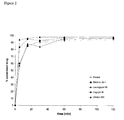
- the formulations (100 mg drug/g formulation, 500 mg formulation in a hard gelatin capsule) were diluted 1:500 in the gastric medium (1 capsule/250 mL), than incubated 2 hours at 37°C under stirring (50 rpm) in a USP standard dissolution apparatus.
- the same experiment has been carried out in gastric medium with 2 capsules loaded with less concentrated formulations (50 mg drug/g formulation), in order to study the effect of the drug/excipient and excipient/medium ratio on the release profile.
- a first incubation of 1 hour in gastric medium was followed by 2 hours incubation in fasted intestinal or fed intestinal medium, in order to simulate the gastric emptying process.
- Example 3 particle size analysis after incubation in gastric medium (USP)
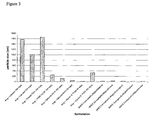
- the aim of this part of the study was to evaluate, by particle size measurement, the colloidal stability and the self-emulsifying properties of the emulsion/microemulsion/micellar solution of taxoid of formula Ib formulations after incubation in the gastric medium.
- the formulations (concentration 100 mg drug/g formulation, 100 mg formulation) were diluted 1:500 in the gastric medium (50 mL), then incubated 2 hours at 37°C under mechanical stirring (300 rpm). The sample was diluted immediately with water for size measurement or filtered onto 2 ⁇ m if necessary. The filtration allowed to retain oil droplets>2 ⁇ m, as well as drug crystals >2 ⁇ m, in order to allow the particle size measurement by QELS (quasi-elastic light scattering) (Nanosizer N4+, Beckmann-Coulter).
- QELS quadsi-elastic light scattering
- the recommended SMES for further evaluation is the one containing Imwitor 988 as co-surfactant: indeed, this excipient is described as able to prevent the lipolysis inhibition that generally occurs with hydrophilic surfactants (such as Cremophor) and should allow the digestion of the lipid (Miglyol) for drug release and absorption. Since the absorption of taxoid of formula Ib is not a critical step, a delayed lipolysis (to enhance the uptake of intact droplets by the lymphatic pathway) is not desirable.
- hydrophilic surfactants such as Cremophor
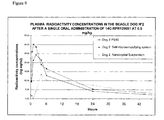
- Cmax The maximum plasma radioactivity concentrations (Cmax) in the beagle dogs after a single oral administration of C-14-taxoid of formula Ib at 0.5 mg/kg were determined (figure 11). No difference was demonstrated in plasma radioactivity Cmax for PS80 and SMES formulations. Significant differences were demonstrated for PS80 or SMES and nanocrystal formulations.
Landscapes
- Health & Medical Sciences (AREA)
- Chemical & Material Sciences (AREA)
- Life Sciences & Earth Sciences (AREA)
- Animal Behavior & Ethology (AREA)
- Veterinary Medicine (AREA)
- Medicinal Chemistry (AREA)
- Public Health (AREA)
- General Health & Medical Sciences (AREA)
- Pharmacology & Pharmacy (AREA)
- Epidemiology (AREA)
- General Chemical & Material Sciences (AREA)
- Oil, Petroleum & Natural Gas (AREA)
- Chemical Kinetics & Catalysis (AREA)
- Engineering & Computer Science (AREA)
- Dispersion Chemistry (AREA)
- Biophysics (AREA)
- Molecular Biology (AREA)
- Organic Chemistry (AREA)
- Nuclear Medicine, Radiotherapy & Molecular Imaging (AREA)
- Medicinal Preparation (AREA)
- Pharmaceuticals Containing Other Organic And Inorganic Compounds (AREA)
Abstract
Description
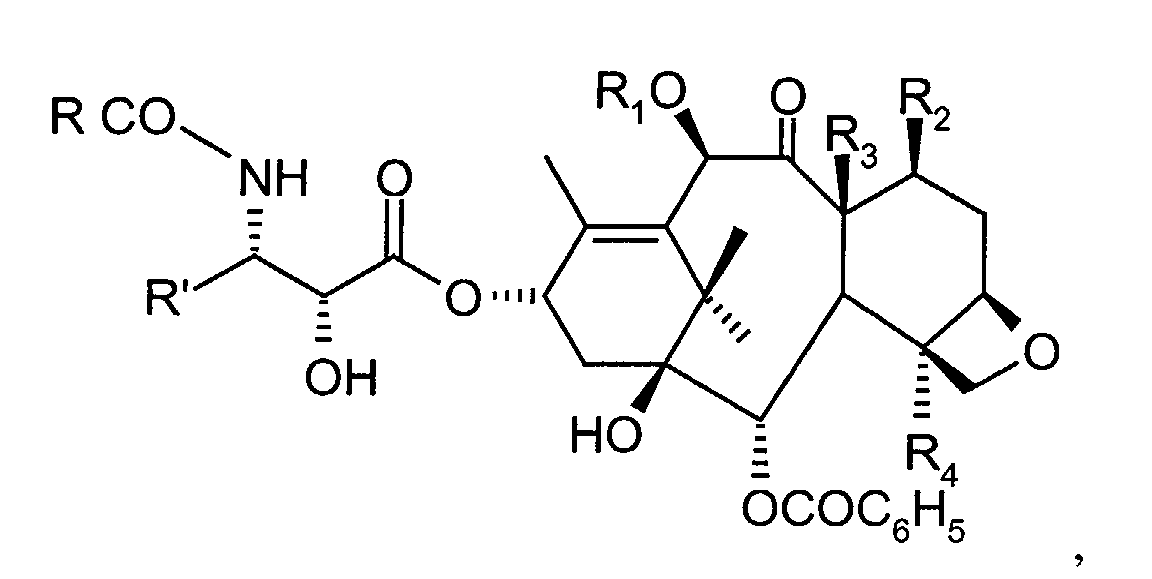
R1 is H, acyl (C2-C4), alkyl (C1-C3),
R2 is OH, alkoxy or R2 and R3 are methylene,
R3 is CH3 or R2 and R3 are methylene,
R4 is OCOCH3 or OCOOCH3,
R is phenyl or alkoxy (C3-C4) or alkenyloxy (C3-C4), preferably phenyl or tert-butoxy,
R' is aryl, preferably phenyl, optionally substituted or alkyl (C2-C4) or alkylen (C2-C4).


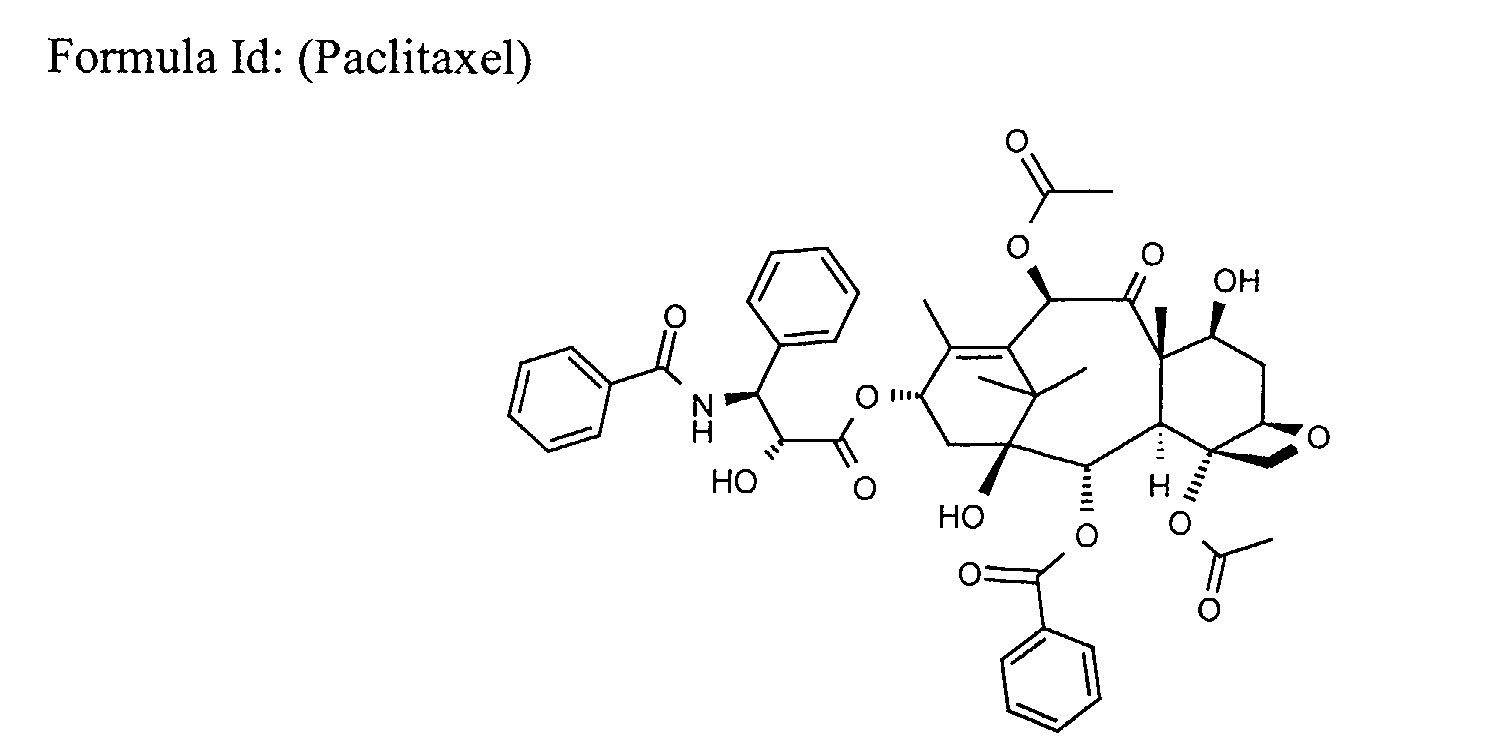
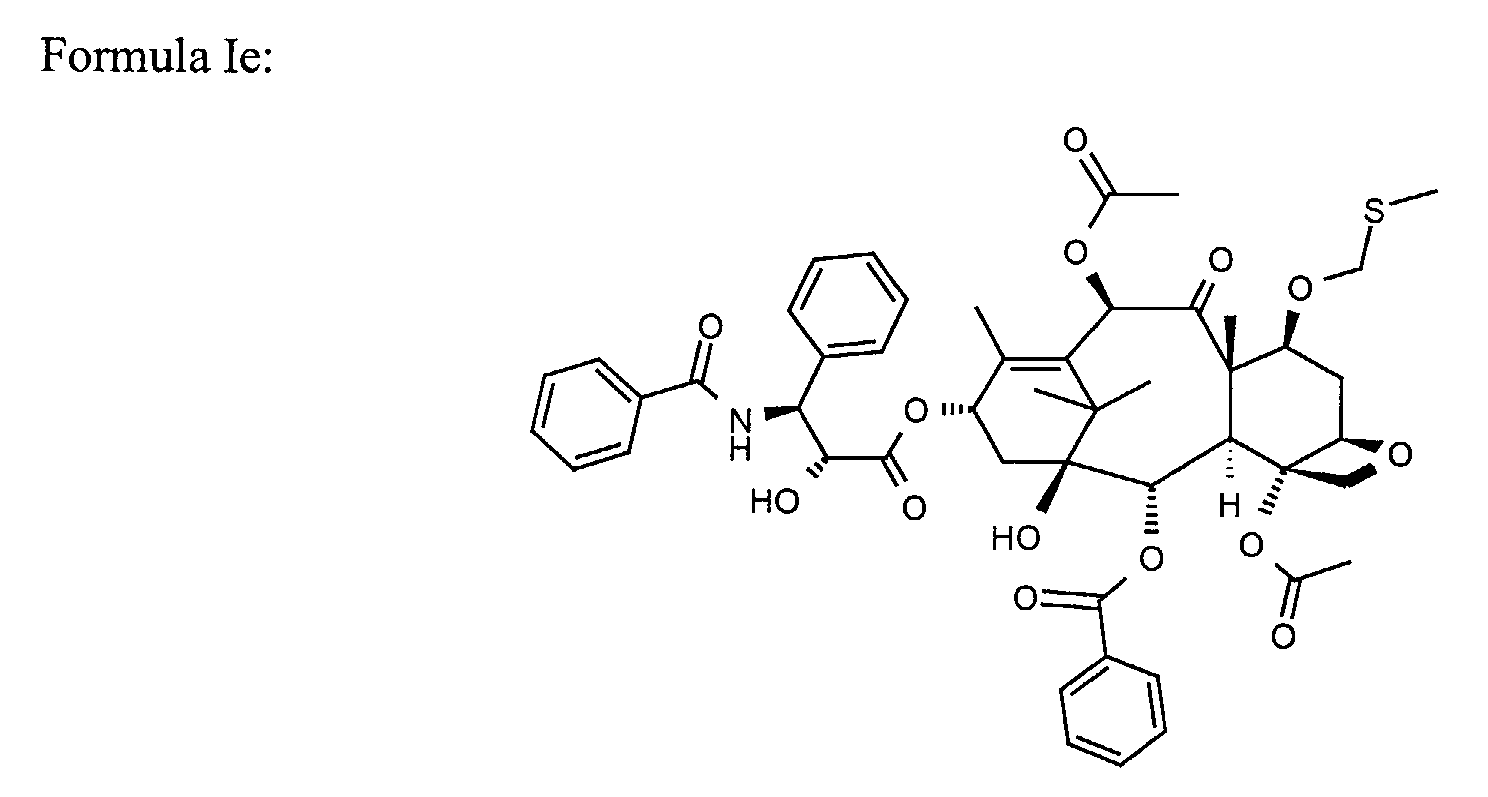

- Cremophor EL/Maisine/Miglyol 812N or
- Cremophor EL/Lauroglycol 90/Miglyol 812N or
- Cremophor EL/Capryol 90/Miglyol 812N or
- Cremophor EL/Peceol/Miglyol 812N or
- Cremophor EL/Imwitor 988/Miglyol 812N.
- Cremophor EL/Maisine/Miglyol 812N at 50 mg/g or
- Cremophor EL/Lauroglycol 90/Miglyol 812N at 50 mg/g or
- Cremophor EL/Capryol 90/Miglyol 812N at 50 mg/g or
- Cremophor EL/Peceol/Miglyol 812N at 50 mg/g or
- Cremophor EL/Imwitor 988/Miglyol 812N at 50 mg/g.
Among amphiphilic and lipid-based formulations, 3 categories were identified:


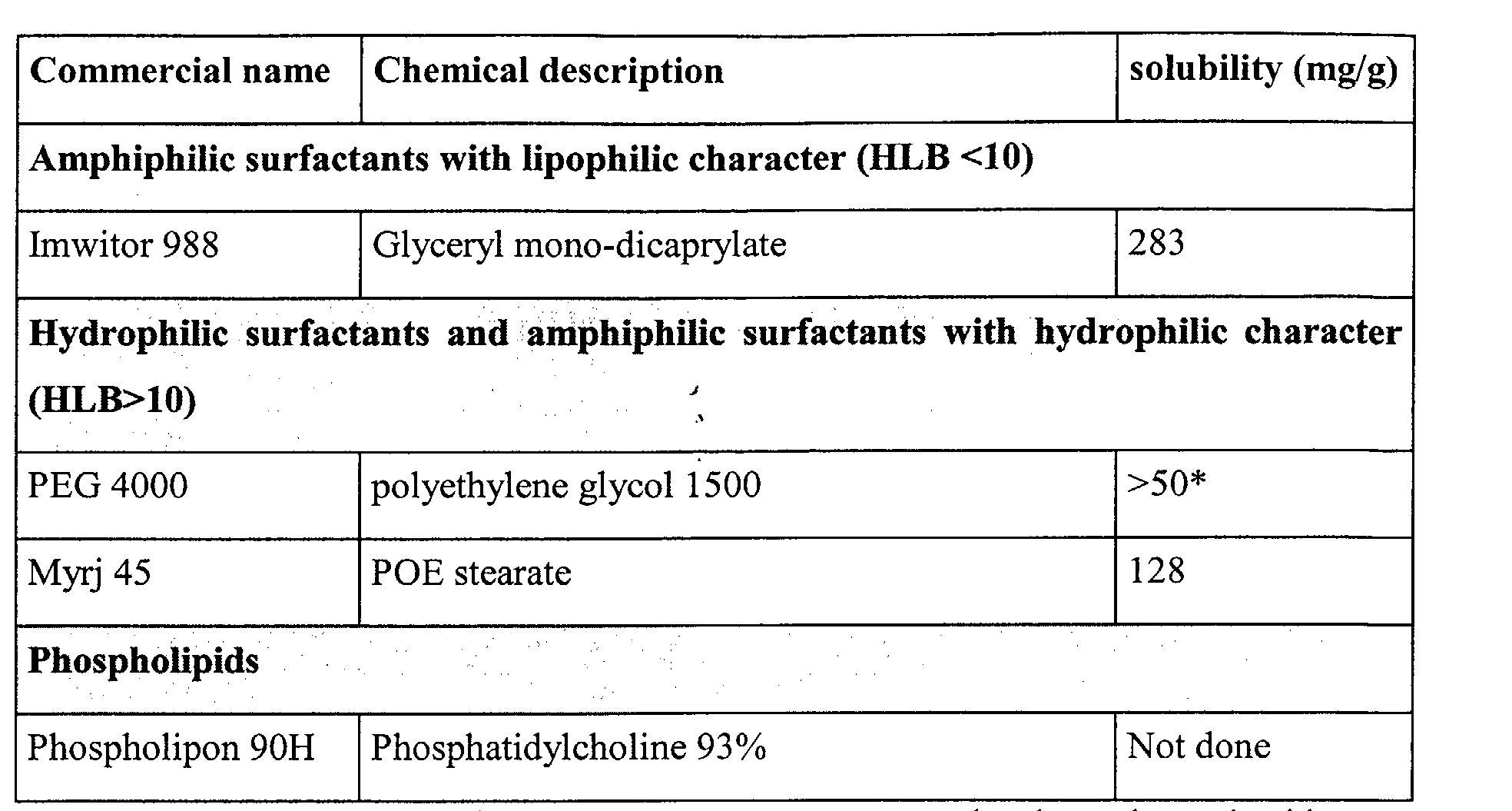
- Phosal 75SA (solution): 100 mg/g formulation
- Phospholipon 90H (solid powder): 50, 100 mg/g formulation
- Labrasol (solution): 50, 100, 200 mg/g formulation
- Cremophor EL/Maisine/Miglyol 812N at 50 mg/g
- Cremophor EL/
Lauroglycol 90/Miglyol 812N at 50 mg/g - Cremophor EL/
Capryol 90/Miglyol 812N at 50 mg/g - Cremophor EL/Peceol/Miglyol 812N at 50 mg/g
- Cremophor EL/
Imwitor 988/Miglyol 812N at 50 mg/g
When such additives are used, the latter may constitute from 0.001% to 5% by weight of the total composition.
- Taxoid of formula Ib
- Miglyol 812N (Condea Vista Company, Cranford, NJ, USA)
- Labrasol (Gattefossé, Saint Priest, F)
- Cremophor EL (BASF AG, Ludwigshafen, DE)
- Capryol 90 (Gattefossé, Saint Priest, F)
- Lauroglycol 90 (Gattefossé, Saint Priest, F)
- Peceol (Gattefossé, Saint Priest, F)
- Maisine 35-1 (Gattefossé, Saint Priest, F)
- Imwitor 988 (Condea Vista Company, Cranford, NJ, USA)
- Phosal 75SA (Nattermann, Cologne, DE)
- Phospholipon 90H (Nattermann, Cologne, DE)
- PS80 VG DF (Seppic, Paris, France)
The stability was evaluated by mean of the potency determined by HPLC, as well as evaluation of relative substances. The prototypes analysed for drug dosage and stability studies are showed in the table below.
| Prototypes of taxoid of formula Ib formulations for stability study | |
| PROTOTYPE | DRUG CONCENTRATION
mg/ |
| PS | |
| 80 | 100 |
| | 250 |
| | 100 |
| | 200 |
| Phosal 75 | 100 |
| CremophorEL-Miglyol 812N- | 50 |
| CremophorEL-Miglyol 812N - | 50 |
| CremophorEL-Miglyol 812N- | 50 |
| Cremophor EL-Miglyol 812N- | 50 |
| Cremophor EL-Miglyol 812N- | 50 |
| Phospholipon 90 | 50 |
| Phospholipon 90 | 100 |
- Gastric medium USP, pH 1.2
- Fasted intestinal medium, pH 6.8 (ref. Dressman et al., Pharm. Res., 1998)
- Fed intestinal medium, pH 5 (ref. Dressman et al., Pharm. Res., 1998)
| Composition of the simulated gastro-intestinal media | ||
| Gastric medium (G) | ||
| Sodium chloride | 2 g | |
| | 100 ml approximately | |
| Demineralised water | qsp 1000 ml | |
| Fasted intestinal medium (Fassif) | For 500 ml | |
| Potassium hydrogenophosphate | 0.029 M | 1.97 g |
| Sodium hydroxide | qs pH 6.8 | qs pH 6.8 |
| | 5 mM | 1.34 g |
| Lecithin (Phospholipon 90G) | 1.5 mM | 0.58 g |
| Potassium chloride | 0.22 M | 8.2 g |
| Demineralised water | qsp 11 | |
| Fed intestinal medium (Fessif) | For 500 ml | |
| Acetic acid | 0.144 M | 4.33 g |
| Sodium hydroxide | qs | |
| Sodium Taurocholate | 15 mM | 4.03 g |
| Lecithin (Phospholipon 90G) | 4 mM | 1.55 g |
| Potassium chloride | 0.19 M | 7.08 g |
| Demineralised water | qsp 11 | |
The same experiment has been carried out in gastric medium with 2 capsules loaded with less concentrated formulations (50 mg drug/g formulation), in order to study the effect of the drug/excipient and excipient/medium ratio on the release profile.
In a second step of experiments, a first incubation of 1 hour in gastric medium was followed by 2 hours incubation in fasted intestinal or fed intestinal medium, in order to simulate the gastric emptying process.
The profile obtained with formulation data from Phosal is not very representative, since these formulations led to the formation of a very heterogeneous mixture after incubation. The Labrasol formulation led to the formation of a very homogeneous emulsion with the medium, despite the low amount of drug recovered after centrifugation (see release profile), suggesting that for a coarse emulsion the centrifugation (determining the collapse of the emulsion) could sub-estimate its in vitro performance. The experiment with Phospholipon 90H was stopped (no data collection) since the powder floating did not allow the formation of a homogeneous suspension.
The sample was diluted immediately with water for size measurement or filtered onto 2 µm if necessary. The filtration allowed to retain oil droplets>2 µm, as well as drug crystals >2 µm, in order to allow the particle size measurement by QELS (quasi-elastic light scattering) (Nanosizer N4+, Beckmann-Coulter).
The results suggest using the formulations able to form small and monodisperse droplets in gastric medium in order to have a better performance in vivo. Further experiments in simulated intestinal media should be performed in order to evaluate the effect of biliary salts on the size and colloidal stability of the formulations.
| Summary of the in vitro behaviour of the formulations at 50 mg/g | |||||
| Formulation | Chemical Stability | Droplet size in vitro (2h at 37°C in gastric medium) | Homogeneity in vitro (2h at 37°C in gastric medium) | % released drug in vitro after 2h in gastric medium) | % released drug in vitro after 1h gastric + 2h Fassif |
| Labrasol | Not done | Not done | Good | 2% | 23% |
| SMES (5) | 7 months at 5°C | <30 nm | Good | >90% | 100% |
| Summary of the in vitro behaviour of the formulations at 100 mg/g | |||||
| Formulation | Chemical Stability | Droplet size in vitro (2h at 37°C in gastric medium) | Homogene ity in vitro (2h at 37°C in gastric medium) | % released drug in vitro after 2h in gastric medium) | % released drug in vitro after 1h gastric + 2h Fassif |
| Labrasol | >3 months at 40°C/75%R H | >1 µm | Good | 1-11% | 5-14% |
| SMES (5) | Not done | >1 µm (no microemulsion) | Not done | Not done | Not done |


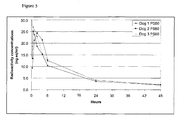
- Rapid absorption of radioactivity (tmax 0.5-2h) and low variability of radioactivity concentrations (C.V <11% for Cmax) for PS80 and self-microemulsifying formulations were observed.
- Rapid to slow absorption (tmax 0.5-4h) of radioactivity and high variability of radioactivity concentrations (C.V. 49% for Cmax) for nanocrystal formulation were observed.
- No difference was demonstrated in plasma radioactivity Cmax and AUC for PS80 and self-microemulsifying formulations (320 ± 25 vs 366 ± 57 ng eq.h/mL, respectively)
- Plasma radioactivity mean Cmax and AUC for PS80 or self-microemulsifying formulations are at least 1.6-fold higher than that of nanocrystal.
Claims (16)
- Self-emulsifying formulation for the oral administration of taxoids comprising at least one taxoid and at least one amphiphilic surfactant that is Labrasol®.
- Self-emulsifying formulation as claimed in claim 1, wherein the formulation contains up to 200 mg taxoid per ml Labrasol®
- Self-emulsifying formulation as claimed in claims 1 or 2, wherein the formulation contains between 50 and 100 mg taxoid per ml Labrasol®.
- Self-emulsifying formulation for the oral administration of taxoids comprising at least one taxoid and at least one amphiphilic surfactant which is Labrasol® and at least one additional additive chosen from stabilizing agents, preservatives, agents which make it possible to adjust the viscosity, or agents that can modify the organoleptic properties.
- Self-microemulsifying formulation for the oral administration of taxoids comprising at least one taxoid, at least one co-surfactant, at least one oil and a surfactant (Cremophor EL®).
- Self-microemulsifying formulation for the oral administration of taxoids comprising at least one taxoid, at least one co-surfactant, at least one oil, one surfactant (Cremophor EL®) and at least one additional additive chosen from stabilizing agents, preservatives, agents which make it possible to adjust the viscosity, or agents that can modify the organoleptic properties.
- Self-microemulsifying formulation as claimed in claims 5 or 6, wherein the co-surfactant is an amphiphilic surfactant with lipophilic character with an HLB of less than 10.
- Self-microemulsifying formulation as claimed in claims 5 to 7, wherein the co-surfactant is chosen from Peceol®, Lauroglycol 129®, Capryol 90®, Maisine 35-1® and Imwitor 988®.
- Self-microemulsifying formulation as claimed in claims 5 to 8, wherein the oil is Miglyol 812N®.
- Self-microemulsifying formulation as claimed in claims 5 to 9, wherein the amount of co-surfactant is less than 50 % (weight percent).
- Self-microemulsifying formulation as claimed in claims 5 to 10, wherein the oil concentration is less than 40 %.
- Self-microemulsifying formulation as claimed in claims 5 to 11, wherein the ratio of surfactant to co-surfactant is 3:1 and the oil concentration is 20%.
- Self-microemulsifying formulation as claimed in claims 5 to 12, wherein the taxoid concentration is not over 10% w/w.
- Self-microemulsifying formulation as claimed in claim 13, wherein the taxoid concentration is from 1 to 50 mg/g.
- Self-microemulsifying formulation as claimed in claims 5 to 14, wherein the formulation comprises 60% Cremophor EL, 20% Imwitor 888 and 20% Miglycol 812N (weight percent).
- A process for preparing a formulation as claimed in claims 1 to 6, wherein there is prepared, where appropriate, the mixture of principal excipients, after heating, if necessary, in the case of the solid or semisolid excipients, and then, if necessary, the mixture with the additional additives, and then the taxoid and stirring is maintained in order to obtain a homogeneous mixture.
Priority Applications (19)
| Application Number | Priority Date | Filing Date | Title |
|---|---|---|---|
| EP03291798A EP1498143A1 (en) | 2003-07-18 | 2003-07-18 | Self-emulsifying and self-microemulsifying formulations for the oral administration of taxoids |
| EP04741330A EP1648517B1 (en) | 2003-07-18 | 2004-07-15 | Self-emulsifying and self-microemulsifying formulations for the oral administration of taxoids |
| PCT/EP2004/008550 WO2005014048A1 (en) | 2003-07-18 | 2004-07-15 | Self-emulsifying and self-microemulsifying formulations for the oral administration of taxoids |
| ARP040102492A AR045911A1 (en) | 2003-07-18 | 2004-07-15 | SELF-EMULSIONABLE FORMULATIONS AND SELF-MICROEMULSIONABLE FORMULATIONS FOR ORAL ADMINISTRATION OF TAXOIDS |
| MXPA06000633A MXPA06000633A (en) | 2003-07-18 | 2004-07-15 | Self-emulsifying and self-microemulsifying formulations for the oral administration of taxoids. |
| CNB2004800203392A CN100566758C (en) | 2003-07-18 | 2004-07-15 | Self-emulsifying and self-microemulsifying formulations for oral administration of taxanes |
| AT04741330T ATE405293T1 (en) | 2003-07-18 | 2004-07-15 | SELF-EMULSIFIING AND SELF-MICROEMULSIFIING FORMULATIONS FOR ORAL ADMINISTRATION OF TAXOIDS |
| CA002532566A CA2532566A1 (en) | 2003-07-18 | 2004-07-15 | Self-emulsifying and self-microemulsifying formulations for the oral administration of taxoids |
| KR1020067001202A KR20060052834A (en) | 2003-07-18 | 2004-07-15 | Self-emulsifying and self-microemulsifying forms for oral administration of taxoids |
| DE602004015994T DE602004015994D1 (en) | 2003-07-18 | 2004-07-15 | Self-emulsifying and self-microemulsifying formulations for the oral administration of TAXOIDS |
| AU2004262495A AU2004262495B2 (en) | 2003-07-18 | 2004-07-15 | Self-emulsifying and self-microemulsifying formulations for the oral administration of taxoids |
| JP2006519898A JP2009513557A (en) | 2003-07-18 | 2004-07-15 | Self-emulsifying and self-microemulsifying formulations for oral administration of taxoids |
| HK06110507.9A HK1089951B (en) | 2003-07-18 | 2004-07-15 | Self-emulsifying and self-microemulsifying formulations for the oral administration of taxoids |
| BRPI0412740-4A BRPI0412740A (en) | 2003-07-18 | 2004-07-15 | self-emulsifying and self-emulsifying formulations for oral administration of taxoids |
| MYPI20042867A MY139106A (en) | 2003-07-18 | 2004-07-16 | Self-emulsifying and self-microemulsifying formulations for the oral administration of taxoids |
| TW093121231A TWI337870B (en) | 2003-07-18 | 2004-07-16 | Self-emulsifying and self-microemulsifying formulations for the oral administration of taxoids |
| US10/894,333 US20050025792A1 (en) | 2003-07-18 | 2004-07-19 | Self-emulsifying and self-microemulsifying formulations for the oral administration of taxoids |
| IL173112A IL173112A0 (en) | 2003-07-18 | 2006-01-12 | Self-emulsifying and self-microemulsifying formulations for the oral administration of taxoids |
| US12/238,490 US20090069411A1 (en) | 2003-07-18 | 2008-09-26 | Self-emulsifying and self-microemulsifying formulations for the oral administration of taxoids |
Applications Claiming Priority (1)
| Application Number | Priority Date | Filing Date | Title |
|---|---|---|---|
| EP03291798A EP1498143A1 (en) | 2003-07-18 | 2003-07-18 | Self-emulsifying and self-microemulsifying formulations for the oral administration of taxoids |
Publications (1)
| Publication Number | Publication Date |
|---|---|
| EP1498143A1 true EP1498143A1 (en) | 2005-01-19 |
Family
ID=33462261
Family Applications (2)
| Application Number | Title | Priority Date | Filing Date |
|---|---|---|---|
| EP03291798A Withdrawn EP1498143A1 (en) | 2003-07-18 | 2003-07-18 | Self-emulsifying and self-microemulsifying formulations for the oral administration of taxoids |
| EP04741330A Expired - Lifetime EP1648517B1 (en) | 2003-07-18 | 2004-07-15 | Self-emulsifying and self-microemulsifying formulations for the oral administration of taxoids |
Family Applications After (1)
| Application Number | Title | Priority Date | Filing Date |
|---|---|---|---|
| EP04741330A Expired - Lifetime EP1648517B1 (en) | 2003-07-18 | 2004-07-15 | Self-emulsifying and self-microemulsifying formulations for the oral administration of taxoids |
Country Status (16)
| Country | Link |
|---|---|
| US (2) | US20050025792A1 (en) |
| EP (2) | EP1498143A1 (en) |
| JP (1) | JP2009513557A (en) |
| KR (1) | KR20060052834A (en) |
| CN (1) | CN100566758C (en) |
| AR (1) | AR045911A1 (en) |
| AT (1) | ATE405293T1 (en) |
| AU (1) | AU2004262495B2 (en) |
| BR (1) | BRPI0412740A (en) |
| CA (1) | CA2532566A1 (en) |
| DE (1) | DE602004015994D1 (en) |
| IL (1) | IL173112A0 (en) |
| MX (1) | MXPA06000633A (en) |
| MY (1) | MY139106A (en) |
| TW (1) | TWI337870B (en) |
| WO (1) | WO2005014048A1 (en) |
Cited By (1)
| Publication number | Priority date | Publication date | Assignee | Title |
|---|---|---|---|---|
| EP2217063A4 (en) * | 2007-11-08 | 2011-11-02 | Virginia Tech Intell Prop | THIOLATED PACLITAXELS FOR REACTING WITH GOLD NANOPARTICLES AS MEDICATION DELIVERY AGENTS |
Families Citing this family (12)
| Publication number | Priority date | Publication date | Assignee | Title |
|---|---|---|---|---|
| EP1879013A4 (en) * | 2005-04-20 | 2014-05-21 | Chugai Pharmaceutical Co Ltd | PROCESS FOR THE PRODUCTION OF SELF-EMULSIFIABLE MEDICINAL FORMULATIONS |
| DE602005017628D1 (en) | 2005-09-22 | 2009-12-24 | Biocompatibles Uk Ltd | Fusion polypeptides of glp-1 (glucagon-like peptide-1) with increased peptidase resistance |
| FR2922107B1 (en) * | 2007-10-10 | 2010-02-26 | Aventis Pharma Sa | NEW TAXOID COMPOSITIONS |
| CN102228431A (en) * | 2010-03-16 | 2011-11-02 | 王国强 | Self-emulsified medicinal composition for taxane compounds |
| CN101829052B (en) * | 2010-03-16 | 2011-12-14 | 王国强 | Self-emulsifying preparation of taxane compound and preparation method thereof |
| US10842770B2 (en) | 2010-05-03 | 2020-11-24 | Teikoku Pharma Usa, Inc. | Non-aqueous taxane pro-emulsion formulations and methods of making and using the same |
| JP2013209294A (en) * | 2010-07-30 | 2013-10-10 | Meiji Seikaファルマ株式会社 | Liquid pharmaceutical composition |
| GB2488788B (en) | 2011-03-07 | 2013-07-10 | Natco Pharma Ltd | Oral formulation of phenylaminopyrymidine compound with enhanced bioavailability and pharmacological response |
| JO3685B1 (en) | 2012-10-01 | 2020-08-27 | Teikoku Pharma Usa Inc | Non-aqueous taxane nanodispersion formulations and methods of using the same |
| KR101542364B1 (en) * | 2014-10-31 | 2015-08-07 | 대화제약 주식회사 | Pharmaceutical composition for oral administration comprising taxanes |
| TWI838700B (en) * | 2015-09-30 | 2024-04-11 | 香港商慧源香港創新有限公司 | Oral taxane compositions and methods |
| CN109589305B (en) * | 2018-12-03 | 2021-03-19 | 昆明积大制药股份有限公司 | Docetaxel-cyclosporine A co-entrapped self-emulsifying preparation and preparation method thereof |
Citations (7)
| Publication number | Priority date | Publication date | Assignee | Title |
|---|---|---|---|---|
| US5698582A (en) * | 1991-07-08 | 1997-12-16 | Rhone-Poulenc Rorer S.A. | Compositions containing taxane derivatives |
| WO1998057630A1 (en) * | 1997-06-13 | 1998-12-23 | Laboratoires Thissen (L.T.B.) | Pharmaceutical form for administering paclitaxel, method for preparing a ready-for-use paclitaxel composition and thereof |
| WO1999049848A1 (en) * | 1998-04-01 | 1999-10-07 | Rtp Pharma Inc. | Anticancer compositions |
| WO2000003753A2 (en) * | 1998-07-14 | 2000-01-27 | Em Industries, Inc. | Microdisperse drug delivery systems |
| WO2001001960A1 (en) * | 1999-06-30 | 2001-01-11 | Lipocine, Inc. | Clear oil-containing pharmaceutical compositions |
| WO2002087563A2 (en) * | 2001-05-01 | 2002-11-07 | Angiotech Pharmaceuticals Inc. | Compositions comprising an anti-microtubule agent and a polypeptide or a polysaccharide and the use thereof for the preparation of a medicament for the treatment of inflammatory conditions |
| WO2003045357A1 (en) * | 2001-11-27 | 2003-06-05 | Transform Pharmaceuticals, Inc. | Oral pharmaceutical formulations comprising paclitaxel, derivatives and methods of administration thereof |
Family Cites Families (8)
| Publication number | Priority date | Publication date | Assignee | Title |
|---|---|---|---|---|
| ATE196254T1 (en) * | 1992-10-16 | 2000-09-15 | Ibah Inc | CONVERTIBLE MICROEMULSION FORMULATIONS |
| EP0684834A4 (en) * | 1993-02-17 | 1996-09-25 | Smithkline Beecham Corp | Microemulsions comprising therapeutic peptides. |
| US6964946B1 (en) * | 1995-10-26 | 2005-11-15 | Baker Norton Pharmaceuticals, Inc. | Oral pharmaceutical compositions containing taxanes and methods of treatment employing the same |
| US6638522B1 (en) * | 1998-12-11 | 2003-10-28 | Pharmasolutions, Inc. | Microemulsion concentrate composition of cyclosporin |
| DE19925211B4 (en) * | 1999-06-01 | 2006-01-12 | PBS Pharmaceutical Bulk Substances SA | Kit for the preparation of a formulation of paclitaxel |
| WO2001028518A1 (en) * | 1999-10-20 | 2001-04-26 | Vesifact Ag | Microemulsion preconcentrates which contain cyclosporines and corresponding microemulsions |
| CA2434641A1 (en) * | 2001-01-18 | 2002-08-22 | Pharmacia And Upjohn Company | Chemotherapeutic microemulsion compositions of paclitaxel with improved oral bioavailability |
| EP1498120A1 (en) * | 2003-07-18 | 2005-01-19 | Aventis Pharma S.A. | Semi-solid formulations for the oral administration of taxoids |
-
2003
- 2003-07-18 EP EP03291798A patent/EP1498143A1/en not_active Withdrawn
-
2004
- 2004-07-15 WO PCT/EP2004/008550 patent/WO2005014048A1/en not_active Ceased
- 2004-07-15 EP EP04741330A patent/EP1648517B1/en not_active Expired - Lifetime
- 2004-07-15 CA CA002532566A patent/CA2532566A1/en not_active Abandoned
- 2004-07-15 CN CNB2004800203392A patent/CN100566758C/en not_active Expired - Fee Related
- 2004-07-15 KR KR1020067001202A patent/KR20060052834A/en not_active Ceased
- 2004-07-15 JP JP2006519898A patent/JP2009513557A/en active Pending
- 2004-07-15 AU AU2004262495A patent/AU2004262495B2/en not_active Ceased
- 2004-07-15 DE DE602004015994T patent/DE602004015994D1/en not_active Expired - Lifetime
- 2004-07-15 AR ARP040102492A patent/AR045911A1/en not_active Application Discontinuation
- 2004-07-15 MX MXPA06000633A patent/MXPA06000633A/en active IP Right Grant
- 2004-07-15 AT AT04741330T patent/ATE405293T1/en not_active IP Right Cessation
- 2004-07-15 BR BRPI0412740-4A patent/BRPI0412740A/en not_active IP Right Cessation
- 2004-07-16 TW TW093121231A patent/TWI337870B/en not_active IP Right Cessation
- 2004-07-16 MY MYPI20042867A patent/MY139106A/en unknown
- 2004-07-19 US US10/894,333 patent/US20050025792A1/en not_active Abandoned
-
2006
- 2006-01-12 IL IL173112A patent/IL173112A0/en not_active IP Right Cessation
-
2008
- 2008-09-26 US US12/238,490 patent/US20090069411A1/en not_active Abandoned
Patent Citations (8)
| Publication number | Priority date | Publication date | Assignee | Title |
|---|---|---|---|---|
| US5698582A (en) * | 1991-07-08 | 1997-12-16 | Rhone-Poulenc Rorer S.A. | Compositions containing taxane derivatives |
| WO1998057630A1 (en) * | 1997-06-13 | 1998-12-23 | Laboratoires Thissen (L.T.B.) | Pharmaceutical form for administering paclitaxel, method for preparing a ready-for-use paclitaxel composition and thereof |
| WO1999049848A1 (en) * | 1998-04-01 | 1999-10-07 | Rtp Pharma Inc. | Anticancer compositions |
| WO2000003753A2 (en) * | 1998-07-14 | 2000-01-27 | Em Industries, Inc. | Microdisperse drug delivery systems |
| WO2001001960A1 (en) * | 1999-06-30 | 2001-01-11 | Lipocine, Inc. | Clear oil-containing pharmaceutical compositions |
| US6267985B1 (en) * | 1999-06-30 | 2001-07-31 | Lipocine Inc. | Clear oil-containing pharmaceutical compositions |
| WO2002087563A2 (en) * | 2001-05-01 | 2002-11-07 | Angiotech Pharmaceuticals Inc. | Compositions comprising an anti-microtubule agent and a polypeptide or a polysaccharide and the use thereof for the preparation of a medicament for the treatment of inflammatory conditions |
| WO2003045357A1 (en) * | 2001-11-27 | 2003-06-05 | Transform Pharmaceuticals, Inc. | Oral pharmaceutical formulations comprising paclitaxel, derivatives and methods of administration thereof |
Non-Patent Citations (1)
| Title |
|---|
| "Fiedler Lexicon der Hilfstoffe", 2002, EDITIO CANTOR VERLAG, AULENDORF, XP002257694 * |
Cited By (1)
| Publication number | Priority date | Publication date | Assignee | Title |
|---|---|---|---|---|
| EP2217063A4 (en) * | 2007-11-08 | 2011-11-02 | Virginia Tech Intell Prop | THIOLATED PACLITAXELS FOR REACTING WITH GOLD NANOPARTICLES AS MEDICATION DELIVERY AGENTS |
Also Published As
| Publication number | Publication date |
|---|---|
| US20090069411A1 (en) | 2009-03-12 |
| US20050025792A1 (en) | 2005-02-03 |
| AR045911A1 (en) | 2005-11-16 |
| WO2005014048A1 (en) | 2005-02-17 |
| MXPA06000633A (en) | 2006-04-19 |
| CA2532566A1 (en) | 2005-02-17 |
| TW200518772A (en) | 2005-06-16 |
| HK1089951A1 (en) | 2006-12-15 |
| EP1648517B1 (en) | 2008-08-20 |
| JP2009513557A (en) | 2009-04-02 |
| MY139106A (en) | 2009-08-28 |
| ATE405293T1 (en) | 2008-09-15 |
| CN100566758C (en) | 2009-12-09 |
| EP1648517A1 (en) | 2006-04-26 |
| TWI337870B (en) | 2011-03-01 |
| AU2004262495A1 (en) | 2005-02-17 |
| IL173112A0 (en) | 2006-06-11 |
| KR20060052834A (en) | 2006-05-19 |
| CN1822859A (en) | 2006-08-23 |
| DE602004015994D1 (en) | 2008-10-02 |
| BRPI0412740A (en) | 2006-09-26 |
| AU2004262495B2 (en) | 2011-02-03 |
Similar Documents
| Publication | Publication Date | Title |
|---|---|---|
| US20090069411A1 (en) | Self-emulsifying and self-microemulsifying formulations for the oral administration of taxoids | |
| Hörmann et al. | Drug delivery and drug targeting with parenteral lipid nanoemulsions—A review | |
| US20020025337A1 (en) | Lipid vehicle drug delivery composition containing vitamin e | |
| US20240099971A1 (en) | Self-emulsifying cannabidiol formulations | |
| AU2004262496B2 (en) | Semi-solid formulations for the oral administration of taxoids | |
| Goyal et al. | Self microemulsifying drug delivery system: A method for enhancement of bioavailability | |
| RU2348615C2 (en) | Emulsifying systems containing azetidine derivatives | |
| AU2004262498B2 (en) | Semi-solid systems containing azetidine derivatives | |
| HK1089951B (en) | Self-emulsifying and self-microemulsifying formulations for the oral administration of taxoids | |
| HK1091743B (en) | Semi-solid formulations for the oral administration of taxoids |
Legal Events
| Date | Code | Title | Description |
|---|---|---|---|
| PUAI | Public reference made under article 153(3) epc to a published international application that has entered the european phase |
Free format text: ORIGINAL CODE: 0009012 |
|
| AK | Designated contracting states |
Kind code of ref document: A1 Designated state(s): AT BE BG CH CY CZ DE DK EE ES FI FR GB GR HU IE IT LI LU MC NL PT RO SE SI SK TR |
|
| AX | Request for extension of the european patent |
Extension state: AL LT LV MK |
|
| 17P | Request for examination filed |
Effective date: 20050719 |
|
| AKX | Designation fees paid |
Designated state(s): FR |
|
| REG | Reference to a national code |
Ref country code: DE Ref legal event code: 8566 |
|
| STAA | Information on the status of an ep patent application or granted ep patent |
Free format text: STATUS: THE APPLICATION IS DEEMED TO BE WITHDRAWN |
|
| 18D | Application deemed to be withdrawn |
Effective date: 20061128 |