EP1497967B1 - Reverse caching for residential end-users to reduce usage of access links to a core communication network - Google Patents
Reverse caching for residential end-users to reduce usage of access links to a core communication network Download PDFInfo
- Publication number
- EP1497967B1 EP1497967B1 EP03747319A EP03747319A EP1497967B1 EP 1497967 B1 EP1497967 B1 EP 1497967B1 EP 03747319 A EP03747319 A EP 03747319A EP 03747319 A EP03747319 A EP 03747319A EP 1497967 B1 EP1497967 B1 EP 1497967B1
- Authority
- EP
- European Patent Office
- Prior art keywords
- content files
- ones
- caching system
- reverse caching
- access links
- Prior art date
- Legal status (The legal status is an assumption and is not a legal conclusion. Google has not performed a legal analysis and makes no representation as to the accuracy of the status listed.)
- Expired - Lifetime
Links
- 238000004891 communication Methods 0.000 title claims abstract description 77
- 238000012546 transfer Methods 0.000 claims abstract description 33
- 230000004044 response Effects 0.000 claims abstract description 15
- 238000012545 processing Methods 0.000 claims description 17
- 238000000034 method Methods 0.000 claims description 12
- 238000001914 filtration Methods 0.000 claims description 2
- 238000012544 monitoring process Methods 0.000 claims 4
- 230000002401 inhibitory effect Effects 0.000 claims 1
- 230000003292 diminished effect Effects 0.000 description 1
- 238000005516 engineering process Methods 0.000 description 1
- 239000013307 optical fiber Substances 0.000 description 1
Images



Classifications
-
- H—ELECTRICITY
- H04—ELECTRIC COMMUNICATION TECHNIQUE
- H04L—TRANSMISSION OF DIGITAL INFORMATION, e.g. TELEGRAPHIC COMMUNICATION
- H04L69/00—Network arrangements, protocols or services independent of the application payload and not provided for in the other groups of this subclass
- H04L69/30—Definitions, standards or architectural aspects of layered protocol stacks
- H04L69/32—Architecture of open systems interconnection [OSI] 7-layer type protocol stacks, e.g. the interfaces between the data link level and the physical level
- H04L69/322—Intralayer communication protocols among peer entities or protocol data unit [PDU] definitions
- H04L69/329—Intralayer communication protocols among peer entities or protocol data unit [PDU] definitions in the application layer [OSI layer 7]
-
- H—ELECTRICITY
- H04—ELECTRIC COMMUNICATION TECHNIQUE
- H04L—TRANSMISSION OF DIGITAL INFORMATION, e.g. TELEGRAPHIC COMMUNICATION
- H04L67/00—Network arrangements or protocols for supporting network services or applications
- H04L67/50—Network services
- H04L67/56—Provisioning of proxy services
- H04L67/564—Enhancement of application control based on intercepted application data
-
- H—ELECTRICITY
- H04—ELECTRIC COMMUNICATION TECHNIQUE
- H04L—TRANSMISSION OF DIGITAL INFORMATION, e.g. TELEGRAPHIC COMMUNICATION
- H04L67/00—Network arrangements or protocols for supporting network services or applications
- H04L67/50—Network services
- H04L67/56—Provisioning of proxy services
- H04L67/568—Storing data temporarily at an intermediate stage, e.g. caching
- H04L67/5683—Storage of data provided by user terminals, i.e. reverse caching
-
- H—ELECTRICITY
- H04—ELECTRIC COMMUNICATION TECHNIQUE
- H04L—TRANSMISSION OF DIGITAL INFORMATION, e.g. TELEGRAPHIC COMMUNICATION
- H04L67/00—Network arrangements or protocols for supporting network services or applications
- H04L67/50—Network services
- H04L67/56—Provisioning of proxy services
- H04L67/565—Conversion or adaptation of application format or content
- H04L67/5651—Reducing the amount or size of exchanged application data
Definitions
- the invention is related to the field of communications, and in particular, to technology for reducing the usage of access links to a core network.
- Most communication networks that serve residential end-users can be viewed as a core communication network that is connected to the residential end-users over access links.
- the core communication network is the Internet and the access links are wireless links to an Internet portal.
- the residential end-users operate wireless transceivers to communicate over wireless access links.
- access links often form a bandwidth bottleneck on communications between the residential end-users.
- the bandwidth on the access links is typically much lower than that available in the core communication network. If the access links operate as a shared medium among multiple residential end-users, then the bandwidth bottleneck can be especially severe during periods of heavy usage. The unfortunate result is diminished communication services to all residential end-users who share the access links.
- File sharing protocols are becoming popular among residential end-users. Some examples of these end-user file sharing protocols are Napster and Gnutella. These file sharing protocols allow residential end-users to become content hosts that serve up content files, such as songs and movies, over the Internet. The file sharing protocols allow others around the world to locate and download a desired song or movie from a specific residential end-user. Such protocols are known from XP002 189423.
- the residential end-users transfer-their content files over their access links to the core communication network.
- the transfer of content files requires significant bandwidth.
- the transfer of content files over the access links degrades communication services to all who share the access links.
- communication services can be seriously degraded.
- the invention helps solve the above problems by reducing the usage of the access links when residential end-users share content files.
- the reduction in usage maintains a higher quality of communication services for all users who share the access links.
- the invention is especially effective when a residential end-user hosts a popular content file because the access links are not repeatedly used to transfer the popular content file.
- Examples of the invention include reverse caching systems, claim 11, methods of operating reverse caching systems, claim 1, and software products, claim 21, for directing reverse caching systems.
- residential end-users are coupled to access links
- the access links are coupled to the reverse caching system
- the reverse caching system is coupled to a core communication network.
- the residential end-users host content files for transfer over the access links and the core communication network.
- the access links may comprise wireless links or coaxial cables.
- the core communication network may comprise the Internet.
- the content files may comprise audio or video.
- the reverse caching system monitors residential end-user communications to cache transferred ones of the content files in the reverse caching system when the transferred ones of the content files are transferred from the residential end-users over the access links to the core communication network.
- the reverse caching system monitors the residential end-user communications to identify requests for requested ones of the content files cached in the reverse caching system. In response to identifying the requests for the requested ones of the content files cached in the reverse caching system, the reverse caching system transfers the requested ones of the content files from the reverse caching system to the core communication network.
- the reverse caching system may filter the residential end-user communications to detect an end-user file sharing protocol.
- the reverse caching system may check a database to determine that the transferred ones of the content files may be legally cached in the reverse caching system.
- the reverse caching system may, in response to identifying the requests for the requested ones of the content files cached in the reverse caching system, inhibit a transfer over the access links of the requested ones of the content files responsive to the requests.
- the reverse caching system may maintain a data structure associating individual ones of the residential end-users with individual cached ones of the content files.
- FIGS. 1-5 and the following description depict specific examples to teach those skilled in the art how to make and use the best mode of the invention. For the purpose of teaching inventive principles, some conventional aspects have been simplified or omitted. Those skilled in the art will appreciate variations from these examples that fall within the scope of the invention. Those skilled in the art will appreciate that the features described below can be combined in various ways to form multiple variations of the invention. As a result, the invention is not limited to the specific examples described below, but only by the claims and their equivalents.
- FIGS. 1-2 Reverse Caching System Configuration -- FIGS. 1-2
- FIG. 1 illustrates a reverse caching environment in an example of the invention.
- Residential end-users 101-103 are coupled to access links 100.
- Access links 100 are coupled to access system 110.
- Access system 110 is coupled to core communication network 115.
- Access system 110 includes reverse caching system 120.
- Core communication network 115 could be the Internet or some other data communication system available to residential end-users.
- Access system 110 could be an Internet service provider or some other portal to core communication network 115.
- Access links 100 could use metallic, optical fiber, wireless link (air), or some other media. Examples of metallic media include coaxial cable and twisted pair wires.
- Access links 100 could use multipoint multiservice distribution system, code division multiple access, analog telephony, digital subscriber line, Internet protocol, Ethernet, asynchronous transfer mode, or some other type of communication protocol.
- Residential end-users 101-103 are individual persons living in a residence, such as a home or apartment. Residential end-users 101-103 operate end-user systems that are coupled to access links 100. The end-user systems could be computers, televisions, telephones, digital assistants, Internet appliances, or some other type of communication device. Residential end-users 101-103 host content files, such as audio and video files. Residential end-users 101-103 use an end-user file sharing protocol, such as Napster or Gnutella, to transfer their content files over access links 100 to core communication network 115.
- an end-user file sharing protocol such as Napster or Gnutella
- Reverse caching system 120 includes filter 121 and cache 122.
- Cache 122 is configured to store the content files.
- Filter 121 monitors residential end-user communications to cache content files that are transferred from residential end-users 101-103 over access links 100 to core communication network 115.
- Filter 121 also monitors the residential end-user communications to identify requests for the content files that are in cache 122. In response to identifying the requests, filter 121 transfers the requested content files from cache 122 to core communication network 115.
- the usage of access links 100 is reduced because they do not repeatedly transfer the same content files. This usage reduction maintains higher quality communication services for residential end-users 101-103.
- FIG. 2 illustrates reverse caching system 220 in an example of the invention.
- Reverse caching system 220 includes network interface 223, user interface 224, processing system 225, and storage system 226.
- Storage system 226 stores control software 227 and content files 228.
- Processing system 102 is linked to network interface 223, user interface 224, and storage system 226.
- Reverse caching system 220 could be comprised of a programmed general purpose computer, although those skilled in the art will appreciate that programmable or special purpose circuitry and equipment may be used.
- Reverse caching system 220 may use a client server architecture where operations are distributed among a server system and client devices that together comprises elements 223-228.
- Network interface 223 could comprise a network interface card or some other communication device.
- Network interface may include a packet filtering application specific integrated circuit configured to detect packets that use specific end-user file sharing protocols.
- a digital filter could be configured to detect Napster or Gnutella packets.
- Network interface 223 may be distributed among multiple communication devices.
- User interface 224 could comprise a keyboard, mouse, voice recognition interface, graphical display, touch screen, or some other type of user device.
- Processing system 225 could comprise a computer microprocessor, logic circuit, or some other processing device. Processing system 225 may be distributed among multiple processing devices.
- Storage system 226 could comprise a disk, tape, integrated circuit, server, or some other memory device. Storage system 226 may be distributed among multiple memory devices.
- Processing system 225 retrieves and executes control software 227 from storage system 226.
- Control software 227 could comprise an application program, firmware, or some other form of machine-readable processing instructions. When executed by processing system 225, control software 227 directs processing system 225 to operate in accord with the invention.
- Network interface 223, processing system 225, storage system 226, and control software 227 could comprise filter 121 of FIG. 1.
- Storage system 226 and content files 228 could comprise cache 122 of FIG. 1.
- User interface 224 could be used for configuration and data output for either filter 121 or cache 122.
- FIG. 3 illustrates a reverse caching communication sequence in an example of the invention.
- another end-user sends a request for a content file to the residential end-user through the core communication network, reverse caching system, and access links.
- the residential end-user transfers the requested content file to the other end-user through the access links, reverse caching system, and core communication network.
- the reverse caching system caches the content file during this file transfer.
- the other end-user sends another request for the content file to the residential end-user through the core communication network, reverse caching system, and access links.
- the reverse caching system transfers the requested content file to the other end-user through the core communication network. Note that access links are not required to subsequently transfer the content file - resulting in significant bandwidth savings on the access links.
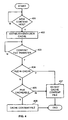
- FIG. 4 illustrates reverse caching system operation in an example of the invention, and operational steps are indicated parenthetically.
- the reverse caching system monitors residential end-user communications to identify residential end-users that become content file hosts (401). For example, filter circuitry in the reverse caching system may detect the use of an end-user file sharing protocol or a communication with a file sharing registration server. If a new content file host is identified among the residential end-users, then the reverse caching system establishes a cache for that particular residential end-user (402).
- the reverse caching system then monitors the residential end-user communications to identify content file transfers from the residential end-user (403). For example, filter circuitry in the reverse caching system may detect the use of an end-user file sharing protocol.
- the reverse caching system determines if the transferred content file is already in the end-user cache (404). If not, then a database check is made to determine if the particular content file is cacheable (405). For example, the database may indicate if the residential end-user has the appropriate legal rights for reverse caching the transferred content file. If the transferred content file is cacheable, but is not in the cache, then the reverse caching system caches the content file in the residential end-user cache (406). If the transferred content file is not cacheable, or is already in the cache, then the reverse caching system does not cache the content file (407).
- FIG. 5 illustrates reverse caching system operation in an example of the invention.
- the reverse caching system monitors the residential end-user communications to identify requests for content file transfers directed to the residential end-user (502). For example, filter circuitry in the reverse caching system may detect the use of an end-user file sharing protocol.
- the reverse caching system determines if the requested content file is in the end-user cache (503). If so, the reverse caching system determines if the content file is available for transfer (504). For example, concurrent use by the requesting end-user and the residential end-user may not be allowed, so a check would be made to determine if the residential end-user was currently using the content file.
- the reverse caching system transfers the requested content file from the end-user cache to the core communication network (505).
- the reverse caching system also notifies the residential end-user of the transfer (506).
- the notification inhibits any content file transfer from the residential end-user over the access links.
- the notification also prevents improper concurrent use of the content file.
- the reverse caching system notifies the residential end-user, so they can again properly use the content file (508). If the requested content file is not in the end-user cache, or if the content file is not available for transfer, then the reverse caching system does not transfer the requested content file (509).
- the reverse caching system may establish a cache for each individual residential end-user and treat each cache separately. This might entail maintaining a data structure that associates individual residential end-users with individual cached content files. Alternatively, the reverse caching system may pool all content files in a common cache to reduce duplicate content file storage. The reverse caching system may also group all residential end-users sharing the same access links as one virtual end-user to further simplify the system.
Landscapes
- Engineering & Computer Science (AREA)
- Computer Networks & Wireless Communication (AREA)
- Signal Processing (AREA)
- Computer Security & Cryptography (AREA)
- Information Transfer Between Computers (AREA)
- Information Retrieval, Db Structures And Fs Structures Therefor (AREA)
- Computer And Data Communications (AREA)
- Data Exchanges In Wide-Area Networks (AREA)
- Telephonic Communication Services (AREA)
- Mobile Radio Communication Systems (AREA)
- Meter Arrangements (AREA)
- Two-Way Televisions, Distribution Of Moving Picture Or The Like (AREA)
Abstract
Description
Claims (30)
- A method of operating a reverse caching system wherein residential end-users are coupled to access links, the access links are coupled to the reverse caching system, the reverse caching system is coupled to a core communication network, and the residential end-users host content files for transfer over the access links and the core communication network, the method being characterized by:monitoring residential end-user communications to cache transferred ones of the content files in the reverse caching system when the transferred ones of the content files are transferred from the residential end-users over the access links to the core communication network;monitoring the residential end-user communications to identify requests for requested ones of the content files cached in the reverse caching system;in response to identifying the requests for the requested ones of the content files cached in the reverse caching system, determining if the requested ones of the content files cached in the reverse caching system are available for concurrent use; andin response to determining that the requested ones of the content files cached in the reverse caching system are available for concurrent use, transferring the requested ones of the content files from the reverse caching system to the core communication network.
- The method of claim 1 wherein monitoring the residential end-user communications to cache the transferred ones of the content files and to identify the requests comprises filtering the residential end-user communications to detect an end-user file sharing protocol.
- The method of claim 1 wherein monitoring the residential end-user communications to cache the transferred ones of the content files further comprises checking a database to determine that the transferred ones of the content files may be legally cached in the reverse caching system.
- The method of claim 1 further comprising, in response to identifying the requests for the requested ones of the content files cached in the reverse caching system, inhibiting a transfer over the access links of the requested ones of the content files responsive to the requests.
- The method of claim 1 further comprising maintaining a data structure associating individual ones of the residential end-users with individual cached ones of the content files.
- The method of claim 1 wherein the access links comprise wireless links.
- The method of claim 1 wherein the access links comprise coaxial cables.
- The method of claim 1 wherein the core communication network comprises the Internet.
- The method of claim 1 wherein the content files comprise audio.
- The method of claim 1 wherein the content files comprise video.
- A reverse caching system wherein residential end-users are coupled to access links, the access links are coupled to the reverse caching system, the reverse caching system is coupled to a core communication network, and the residential end-users host content files for transfer over the access links and the core communication network, the reverse caching system being characterized by:a cache configured to store the content files; anda filter configured to monitor residential end-user communications to store transferred ones of the content files in the cache when the transferred ones of the content files are transferred from the residential end-users over the access links to the core communication network, monitor the residential end-user communications to identify requests for requested ones of the content files in the cache, and in response to identifying the requests for the requested ones of the content files in the cache, determine if the requested ones of the content files cached in the reverse caching system are available for concurrent use, and transfer the requested ones of the content files from the cache to the core communication network in response to determining that the requested ones of the content files cached in the reverse caching system are available for concurrent use.
- The reverse caching system of claim 11 wherein the filter is configured to filter the residential end-user communications to detect an end-user file sharing protocol.
- The reverse caching system of claim 11 wherein the filter is configured to check a database to determine that the transferred ones of the content files may be legally stored in the cache.
- The reverse caching system of claim 11 wherein the filter is configured, in response to identifying the requests for the requested ones of the content files in the cache, to inhibit a transfer over the access links of the requested ones of the content files responsive to the requests.
- The reverse caching system of claim 11 wherein the filter is configured to maintain a data structure associating individual ones of the residential end-users with individual cached ones of the content files.
- The reverse caching system of claim 11 wherein the access links comprise wireless links.
- The reverse caching system of claim 11 wherein the access links comprise coaxial cables.
- The reverse caching system of claim 11 wherein the core communication network comprises the Internet.
- The reverse caching system of claim 11 wherein the content files comprise audio.
- The reverse caching system of claim 11 wherein the content files comprise video.
- A product for a reverse caching system wherein residential end-users are coupled to access links, the access links are coupled to the reverse caching system, the reverse caching system is coupled to a core communication network, and the residential end-users host content files for transfer over the access links and the core communication network, the product being characterized by:a processing system;control software configured to direct the processing system to monitor residential end-user communications to store transferred ones of the content files in a cache when the transferred ones of the content files are transferred from the residential end-users over the access links to the core communication network, monitor the residential end-user communications to identify requests for requested ones of the content files in the cache, in response to identifying the requests for the requested ones of the content files in the cache determine if the requested ones of the content files cached in the reverse caching system are available for concurrent use, and transfer the requested ones of the content files from the cache to the core communication network in response to determining that the requested ones of the content files cached in the reverse caching system are available for concurrent use;a storage system configured to store the control software.
- The product of claim 21 wherein the control software is configured to direct the processing system to filter the residential end-user communications to detect an end-user file sharing protocol.
- The product of claim 21 wherein the control software is configured to direct the processing system to check a database to determine that the transferred ones of the content files may be legally stored in the cache.
- The product of claim 21 wherein the control software is configured to direct the processing system, in response to identifying the requests for the requested ones of the content files in the cache, to inhibit a transfer over the access links of the requested ones of the content files responsive to the requests.
- The product of claim 21 wherein the control software is configured to direct the processing system to maintain a data structure associating individual ones of the residential end-users with individual cached ones of the content files.
- The product of claim 21 wherein the access links comprise wireless links.
- The product of claim 21 wherein the access links comprise coaxial cables.
- The product of claim 21 wherein the core communication network comprises the Internet.
- The product of claim 21 wherein the content files comprise audio.
- The product of claim 21 wherein the content files comprise video.
Applications Claiming Priority (3)
| Application Number | Priority Date | Filing Date | Title |
|---|---|---|---|
| US128036 | 1987-12-03 | ||
| US10/128,036 US7016883B2 (en) | 2002-04-23 | 2002-04-23 | Reverse caching for residential end-users to reduce usage of access links to a core communication network |
| PCT/US2003/012841 WO2003092243A1 (en) | 2002-04-23 | 2003-04-23 | Reverse caching for residential end-users to reduce usage of access links to a core communication network |
Publications (2)
| Publication Number | Publication Date |
|---|---|
| EP1497967A1 EP1497967A1 (en) | 2005-01-19 |
| EP1497967B1 true EP1497967B1 (en) | 2005-12-28 |
Family
ID=29215393
Family Applications (1)
| Application Number | Title | Priority Date | Filing Date |
|---|---|---|---|
| EP03747319A Expired - Lifetime EP1497967B1 (en) | 2002-04-23 | 2003-04-23 | Reverse caching for residential end-users to reduce usage of access links to a core communication network |
Country Status (7)
| Country | Link |
|---|---|
| US (2) | US7016883B2 (en) |
| EP (1) | EP1497967B1 (en) |
| AT (1) | ATE314784T1 (en) |
| AU (1) | AU2003231762A1 (en) |
| CA (1) | CA2484082C (en) |
| DE (1) | DE60303025T2 (en) |
| WO (1) | WO2003092243A1 (en) |
Families Citing this family (5)
| Publication number | Priority date | Publication date | Assignee | Title |
|---|---|---|---|---|
| US8108485B1 (en) | 2008-12-17 | 2012-01-31 | Sprint Communications Company L.P. | Method and system for operating a communication system |
| WO2011146898A2 (en) * | 2010-05-21 | 2011-11-24 | Bologh Mark J | Internet system for ultra high video quality |
| US8886742B2 (en) * | 2011-01-28 | 2014-11-11 | Level 3 Communications, Llc | Content delivery network with deep caching infrastructure |
| US9161080B2 (en) | 2011-01-28 | 2015-10-13 | Level 3 Communications, Llc | Content delivery network with deep caching infrastructure |
| US9848055B1 (en) | 2013-09-20 | 2017-12-19 | Google Inc. | Local client discovery for content via cache |
Family Cites Families (20)
| Publication number | Priority date | Publication date | Assignee | Title |
|---|---|---|---|---|
| US5991306A (en) * | 1996-08-26 | 1999-11-23 | Microsoft Corporation | Pull based, intelligent caching system and method for delivering data over a network |
| US6167438A (en) * | 1997-05-22 | 2000-12-26 | Trustees Of Boston University | Method and system for distributed caching, prefetching and replication |
| JP4299911B2 (en) * | 1999-03-24 | 2009-07-22 | 株式会社東芝 | Information transfer system |
| US6701415B1 (en) * | 1999-03-31 | 2004-03-02 | America Online, Inc. | Selecting a cache for a request for information |
| US6415368B1 (en) * | 1999-12-22 | 2002-07-02 | Xerox Corporation | System and method for caching |
| AU7593601A (en) * | 2000-07-14 | 2002-01-30 | Atabok Inc | Controlling and managing digital assets |
| AU2001290591A1 (en) | 2000-09-01 | 2002-03-13 | Ikimbo, Inc. | System and method for transferring files |
| US8326730B2 (en) * | 2000-09-14 | 2012-12-04 | Latex | System and method of clearing services for risk management trading |
| US20050075949A1 (en) * | 2000-12-29 | 2005-04-07 | Uhrig Thomas C. | Method and system for analyzing and planning an inventory |
| CN1295904C (en) * | 2001-01-10 | 2007-01-17 | 思科技术公司 | Computer security and management system |
| US20020120607A1 (en) * | 2001-02-28 | 2002-08-29 | Lumenati, Inc. | File sharing system for serving content from a computer |
| US20030055732A1 (en) * | 2001-03-23 | 2003-03-20 | Masaya Nagata | Service management method, service management apparatus, service management network system, service management program, and computer program product storing the service management program |
| US7720996B2 (en) * | 2001-03-27 | 2010-05-18 | Microsoft Corporation | Internet protocol (IP) address proximity and application to peer provider location |
| US20020162109A1 (en) * | 2001-04-26 | 2002-10-31 | Koninklijke Philips Electronics N.V. | Distributed storage on a P2P network architecture |
| US7068309B2 (en) * | 2001-10-09 | 2006-06-27 | Microsoft Corp. | Image exchange with image annotation |
| US7404202B2 (en) * | 2001-11-21 | 2008-07-22 | Line 6, Inc. | System, device, and method for providing secure electronic commerce transactions |
| US7069336B2 (en) * | 2002-02-01 | 2006-06-27 | Time Warner Cable | Policy based routing system and method for caching and VPN tunneling |
| US20030158958A1 (en) * | 2002-02-20 | 2003-08-21 | Koninklijke Philips Electronics N.V. | Distributed storage network architecture using user devices |
| US7130921B2 (en) * | 2002-03-15 | 2006-10-31 | International Business Machines Corporation | Centrally enhanced peer-to-peer resource sharing method and apparatus |
| US9137324B2 (en) * | 2002-04-10 | 2015-09-15 | International Business Machines Corporation | Capacity on-demand in distributed computing environments |
-
2002
- 2002-04-23 US US10/128,036 patent/US7016883B2/en not_active Expired - Lifetime
-
2003
- 2003-04-23 AU AU2003231762A patent/AU2003231762A1/en not_active Abandoned
- 2003-04-23 AT AT03747319T patent/ATE314784T1/en not_active IP Right Cessation
- 2003-04-23 DE DE60303025T patent/DE60303025T2/en not_active Expired - Lifetime
- 2003-04-23 WO PCT/US2003/012841 patent/WO2003092243A1/en not_active Ceased
- 2003-04-23 CA CA2484082A patent/CA2484082C/en not_active Expired - Fee Related
- 2003-04-23 EP EP03747319A patent/EP1497967B1/en not_active Expired - Lifetime
-
2005
- 2005-12-20 US US11/312,189 patent/US7454394B2/en not_active Expired - Fee Related
Also Published As
| Publication number | Publication date |
|---|---|
| US20060136563A1 (en) | 2006-06-22 |
| CA2484082A1 (en) | 2003-11-06 |
| ATE314784T1 (en) | 2006-01-15 |
| DE60303025D1 (en) | 2006-02-02 |
| US7454394B2 (en) | 2008-11-18 |
| AU2003231762A1 (en) | 2003-11-10 |
| DE60303025T2 (en) | 2006-06-29 |
| CA2484082C (en) | 2012-07-17 |
| WO2003092243A1 (en) | 2003-11-06 |
| US7016883B2 (en) | 2006-03-21 |
| EP1497967A1 (en) | 2005-01-19 |
| US20030200276A1 (en) | 2003-10-23 |
Similar Documents
| Publication | Publication Date | Title |
|---|---|---|
| CA2385781C (en) | Path optimizer for peer to peer networks | |
| KR100723320B1 (en) | Internet client-server multiplexer | |
| KR101037020B1 (en) | System and method for selecting a data provider | |
| US6917960B1 (en) | Intelligent content precaching | |
| US7340531B2 (en) | Apparatus and method for data transfer | |
| US8024484B2 (en) | Caching signatures | |
| US8903950B2 (en) | Personalized content delivery using peer-to-peer precaching | |
| CN104246737B (en) | Systems and methods for using connection pooling techniques for video streaming in a content delivery network | |
| KR19990087916A (en) | Internet convolution audio/video server | |
| US20010014103A1 (en) | Content provider for pull based intelligent caching system | |
| EP3547748A1 (en) | Method and system for guiding service application traffic | |
| CN102137138B (en) | Method, device and system for cache collaboration | |
| CA2484082C (en) | Reverse caching for residential end-users to reduce usage of access links to a core communication network | |
| WO2018028345A1 (en) | Method and apparatus for detecting access path | |
| JP2008529157A (en) | System architecture and method for scheduled download service | |
| KR20030014094A (en) | a method of collaborating in transferring a file in a networking environment | |
| KR20150011087A (en) | Distributed caching management method for contents delivery network service and apparatus therefor | |
| US20070294423A1 (en) | Multi-Client Single-Session Media Streaming | |
| CN105872648A (en) | Video data sharing method and device | |
| KR100974916B1 (en) | Virtual Disk Drive File Transfer System and Its Method | |
| WO2006083864A2 (en) | System and method for streaming content utilizing client upstream communication bandwidth capacity over a network | |
| KR20060135565A (en) | Distributed streaming server | |
| prashant Borlepwar et al. | PACK: Prediction-Based Cloud Bandwidth and Cost Reduction System | |
| EP1287664A2 (en) | Client side address routing analysis | |
| KR20050002457A (en) | Apparatus and Method for Controlling Speed in Real-Time in Data Transfer Network |
Legal Events
| Date | Code | Title | Description |
|---|---|---|---|
| PUAI | Public reference made under article 153(3) epc to a published international application that has entered the european phase |
Free format text: ORIGINAL CODE: 0009012 |
|
| 17P | Request for examination filed |
Effective date: 20041018 |
|
| AK | Designated contracting states |
Kind code of ref document: A1 Designated state(s): AT BE BG CH CY CZ DE DK EE ES FI FR GB GR HU IE IT LI LU MC NL PT RO SE SI SK TR |
|
| AX | Request for extension of the european patent |
Extension state: AL LT LV MK |
|
| RIN1 | Information on inventor provided before grant (corrected) |
Inventor name: SLODERBECK, JASON, M. Inventor name: MYERS, STEVE Inventor name: DISPENSA, STEVE Inventor name: SPAETH, JONATHON |
|
| 17Q | First examination report despatched |
Effective date: 20050215 |
|
| GRAP | Despatch of communication of intention to grant a patent |
Free format text: ORIGINAL CODE: EPIDOSNIGR1 |
|
| GRAS | Grant fee paid |
Free format text: ORIGINAL CODE: EPIDOSNIGR3 |
|
| GRAA | (expected) grant |
Free format text: ORIGINAL CODE: 0009210 |
|
| AK | Designated contracting states |
Kind code of ref document: B1 Designated state(s): AT BE BG CH CY CZ DE DK EE ES FI FR GB GR HU IE IT LI LU MC NL PT RO SE SI SK TR |
|
| PG25 | Lapsed in a contracting state [announced via postgrant information from national office to epo] |
Ref country code: NL Free format text: LAPSE BECAUSE OF FAILURE TO SUBMIT A TRANSLATION OF THE DESCRIPTION OR TO PAY THE FEE WITHIN THE PRESCRIBED TIME-LIMIT Effective date: 20051228 Ref country code: AT Free format text: LAPSE BECAUSE OF FAILURE TO SUBMIT A TRANSLATION OF THE DESCRIPTION OR TO PAY THE FEE WITHIN THE PRESCRIBED TIME-LIMIT Effective date: 20051228 Ref country code: SK Free format text: LAPSE BECAUSE OF FAILURE TO SUBMIT A TRANSLATION OF THE DESCRIPTION OR TO PAY THE FEE WITHIN THE PRESCRIBED TIME-LIMIT Effective date: 20051228 Ref country code: SI Free format text: LAPSE BECAUSE OF FAILURE TO SUBMIT A TRANSLATION OF THE DESCRIPTION OR TO PAY THE FEE WITHIN THE PRESCRIBED TIME-LIMIT Effective date: 20051228 Ref country code: RO Free format text: LAPSE BECAUSE OF FAILURE TO SUBMIT A TRANSLATION OF THE DESCRIPTION OR TO PAY THE FEE WITHIN THE PRESCRIBED TIME-LIMIT Effective date: 20051228 Ref country code: CH Free format text: LAPSE BECAUSE OF FAILURE TO SUBMIT A TRANSLATION OF THE DESCRIPTION OR TO PAY THE FEE WITHIN THE PRESCRIBED TIME-LIMIT Effective date: 20051228 Ref country code: CZ Free format text: LAPSE BECAUSE OF FAILURE TO SUBMIT A TRANSLATION OF THE DESCRIPTION OR TO PAY THE FEE WITHIN THE PRESCRIBED TIME-LIMIT Effective date: 20051228 Ref country code: LI Free format text: LAPSE BECAUSE OF FAILURE TO SUBMIT A TRANSLATION OF THE DESCRIPTION OR TO PAY THE FEE WITHIN THE PRESCRIBED TIME-LIMIT Effective date: 20051228 Ref country code: FI Free format text: LAPSE BECAUSE OF FAILURE TO SUBMIT A TRANSLATION OF THE DESCRIPTION OR TO PAY THE FEE WITHIN THE PRESCRIBED TIME-LIMIT Effective date: 20051228 Ref country code: BE Free format text: LAPSE BECAUSE OF FAILURE TO SUBMIT A TRANSLATION OF THE DESCRIPTION OR TO PAY THE FEE WITHIN THE PRESCRIBED TIME-LIMIT Effective date: 20051228 |
|
| REG | Reference to a national code |
Ref country code: GB Ref legal event code: FG4D |
|
| REG | Reference to a national code |
Ref country code: CH Ref legal event code: EP |
|
| REG | Reference to a national code |
Ref country code: IE Ref legal event code: FG4D |
|
| REF | Corresponds to: |
Ref document number: 60303025 Country of ref document: DE Date of ref document: 20060202 Kind code of ref document: P |
|
| PG25 | Lapsed in a contracting state [announced via postgrant information from national office to epo] |
Ref country code: SE Free format text: LAPSE BECAUSE OF FAILURE TO SUBMIT A TRANSLATION OF THE DESCRIPTION OR TO PAY THE FEE WITHIN THE PRESCRIBED TIME-LIMIT Effective date: 20060328 Ref country code: GR Free format text: LAPSE BECAUSE OF FAILURE TO SUBMIT A TRANSLATION OF THE DESCRIPTION OR TO PAY THE FEE WITHIN THE PRESCRIBED TIME-LIMIT Effective date: 20060328 Ref country code: DK Free format text: LAPSE BECAUSE OF FAILURE TO SUBMIT A TRANSLATION OF THE DESCRIPTION OR TO PAY THE FEE WITHIN THE PRESCRIBED TIME-LIMIT Effective date: 20060328 Ref country code: BG Free format text: LAPSE BECAUSE OF FAILURE TO SUBMIT A TRANSLATION OF THE DESCRIPTION OR TO PAY THE FEE WITHIN THE PRESCRIBED TIME-LIMIT Effective date: 20060328 |
|
| PG25 | Lapsed in a contracting state [announced via postgrant information from national office to epo] |
Ref country code: ES Free format text: LAPSE BECAUSE OF FAILURE TO SUBMIT A TRANSLATION OF THE DESCRIPTION OR TO PAY THE FEE WITHIN THE PRESCRIBED TIME-LIMIT Effective date: 20060408 |
|
| PGFP | Annual fee paid to national office [announced via postgrant information from national office to epo] |
Ref country code: MC Payment date: 20060503 Year of fee payment: 4 |
|
| PGFP | Annual fee paid to national office [announced via postgrant information from national office to epo] |
Ref country code: IE Payment date: 20060526 Year of fee payment: 4 |
|
| PG25 | Lapsed in a contracting state [announced via postgrant information from national office to epo] |
Ref country code: PT Free format text: LAPSE BECAUSE OF FAILURE TO SUBMIT A TRANSLATION OF THE DESCRIPTION OR TO PAY THE FEE WITHIN THE PRESCRIBED TIME-LIMIT Effective date: 20060529 |
|
| PGFP | Annual fee paid to national office [announced via postgrant information from national office to epo] |
Ref country code: LU Payment date: 20060531 Year of fee payment: 4 |
|
| NLV1 | Nl: lapsed or annulled due to failure to fulfill the requirements of art. 29p and 29m of the patents act | ||
| PG25 | Lapsed in a contracting state [announced via postgrant information from national office to epo] |
Ref country code: HU Free format text: LAPSE BECAUSE OF FAILURE TO SUBMIT A TRANSLATION OF THE DESCRIPTION OR TO PAY THE FEE WITHIN THE PRESCRIBED TIME-LIMIT Effective date: 20060629 |
|
| REG | Reference to a national code |
Ref country code: CH Ref legal event code: PL |
|
| ET | Fr: translation filed | ||
| PLBE | No opposition filed within time limit |
Free format text: ORIGINAL CODE: 0009261 |
|
| STAA | Information on the status of an ep patent application or granted ep patent |
Free format text: STATUS: NO OPPOSITION FILED WITHIN TIME LIMIT |
|
| 26N | No opposition filed |
Effective date: 20060929 |
|
| REG | Reference to a national code |
Ref country code: IE Ref legal event code: MM4A |
|
| PG25 | Lapsed in a contracting state [announced via postgrant information from national office to epo] |
Ref country code: IE Free format text: LAPSE BECAUSE OF NON-PAYMENT OF DUE FEES Effective date: 20070423 |
|
| PG25 | Lapsed in a contracting state [announced via postgrant information from national office to epo] |
Ref country code: EE Free format text: LAPSE BECAUSE OF FAILURE TO SUBMIT A TRANSLATION OF THE DESCRIPTION OR TO PAY THE FEE WITHIN THE PRESCRIBED TIME-LIMIT Effective date: 20051228 |
|
| PG25 | Lapsed in a contracting state [announced via postgrant information from national office to epo] |
Ref country code: TR Free format text: LAPSE BECAUSE OF FAILURE TO SUBMIT A TRANSLATION OF THE DESCRIPTION OR TO PAY THE FEE WITHIN THE PRESCRIBED TIME-LIMIT Effective date: 20051228 |
|
| PG25 | Lapsed in a contracting state [announced via postgrant information from national office to epo] |
Ref country code: CY Free format text: LAPSE BECAUSE OF FAILURE TO SUBMIT A TRANSLATION OF THE DESCRIPTION OR TO PAY THE FEE WITHIN THE PRESCRIBED TIME-LIMIT Effective date: 20051228 |
|
| PG25 | Lapsed in a contracting state [announced via postgrant information from national office to epo] |
Ref country code: MC Free format text: LAPSE BECAUSE OF NON-PAYMENT OF DUE FEES Effective date: 20070430 |
|
| PG25 | Lapsed in a contracting state [announced via postgrant information from national office to epo] |
Ref country code: LU Free format text: LAPSE BECAUSE OF NON-PAYMENT OF DUE FEES Effective date: 20070423 |
|
| PGFP | Annual fee paid to national office [announced via postgrant information from national office to epo] |
Ref country code: IT Payment date: 20150427 Year of fee payment: 13 |
|
| REG | Reference to a national code |
Ref country code: FR Ref legal event code: PLFP Year of fee payment: 14 |
|
| PGFP | Annual fee paid to national office [announced via postgrant information from national office to epo] |
Ref country code: FR Payment date: 20160425 Year of fee payment: 14 |
|
| PG25 | Lapsed in a contracting state [announced via postgrant information from national office to epo] |
Ref country code: IT Free format text: LAPSE BECAUSE OF NON-PAYMENT OF DUE FEES Effective date: 20160423 |
|
| REG | Reference to a national code |
Ref country code: FR Ref legal event code: ST Effective date: 20171229 |
|
| PG25 | Lapsed in a contracting state [announced via postgrant information from national office to epo] |
Ref country code: FR Free format text: LAPSE BECAUSE OF NON-PAYMENT OF DUE FEES Effective date: 20170502 |
|
| REG | Reference to a national code |
Ref country code: DE Ref legal event code: R079 Ref document number: 60303025 Country of ref document: DE Free format text: PREVIOUS MAIN CLASS: H04L0029060000 Ipc: H04L0065000000 |
|
| PGFP | Annual fee paid to national office [announced via postgrant information from national office to epo] |
Ref country code: GB Payment date: 20220323 Year of fee payment: 20 |
|
| PGFP | Annual fee paid to national office [announced via postgrant information from national office to epo] |
Ref country code: DE Payment date: 20220322 Year of fee payment: 20 |
|
| REG | Reference to a national code |
Ref country code: DE Ref legal event code: R071 Ref document number: 60303025 Country of ref document: DE |
|
| REG | Reference to a national code |
Ref country code: GB Ref legal event code: PE20 Expiry date: 20230422 |
|
| PG25 | Lapsed in a contracting state [announced via postgrant information from national office to epo] |
Ref country code: GB Free format text: LAPSE BECAUSE OF EXPIRATION OF PROTECTION Effective date: 20230422 |