EP1496836B1 - N-(substituted benzyl)-8-hydroxy-1,6-naphthyridine-7- carboxamides useful as hiv integrase inhibitors - Google Patents
N-(substituted benzyl)-8-hydroxy-1,6-naphthyridine-7- carboxamides useful as hiv integrase inhibitors Download PDFInfo
- Publication number
- EP1496836B1 EP1496836B1 EP03716466A EP03716466A EP1496836B1 EP 1496836 B1 EP1496836 B1 EP 1496836B1 EP 03716466 A EP03716466 A EP 03716466A EP 03716466 A EP03716466 A EP 03716466A EP 1496836 B1 EP1496836 B1 EP 1496836B1
- Authority
- EP
- European Patent Office
- Prior art keywords
- naphthyridine
- alkyl
- dioxido
- hydroxy
- carbonyl
- Prior art date
- Legal status (The legal status is an assumption and is not a legal conclusion. Google has not performed a legal analysis and makes no representation as to the accuracy of the status listed.)
- Expired - Lifetime
Links
- 0 *c1cc(*)c(CN)cc1 Chemical compound *c1cc(*)c(CN)cc1 0.000 description 4
- YTHICMNXAVSSHA-UHFFFAOYSA-N Bc(c1c2nccc1)nc(C([O](C)C)=O)c2O Chemical compound Bc(c1c2nccc1)nc(C([O](C)C)=O)c2O YTHICMNXAVSSHA-UHFFFAOYSA-N 0.000 description 1
- IVHSRZSQMQJLKE-UHFFFAOYSA-N CCCCCNC(CC)=O Chemical compound CCCCCNC(CC)=O IVHSRZSQMQJLKE-UHFFFAOYSA-N 0.000 description 1
- QSPPRYLTQFCUCH-UHFFFAOYSA-N CCS(NC)(=O)=O Chemical compound CCS(NC)(=O)=O QSPPRYLTQFCUCH-UHFFFAOYSA-N 0.000 description 1
- UGVNDVHESWJZCG-UHFFFAOYSA-N CC[S](C)(N(C)c(nc1C(NCc(c(C(N(C)C)=O)c2)ccc2F)=O)c(ccc[n]2)c2c1O)(=O)=O Chemical compound CC[S](C)(N(C)c(nc1C(NCc(c(C(N(C)C)=O)c2)ccc2F)=O)c(ccc[n]2)c2c1O)(=O)=O UGVNDVHESWJZCG-UHFFFAOYSA-N 0.000 description 1
- FCMQMRAFVRTHCR-UHFFFAOYSA-N COC(c(cc(cc1)F)c1Br)=O Chemical compound COC(c(cc(cc1)F)c1Br)=O FCMQMRAFVRTHCR-UHFFFAOYSA-N 0.000 description 1
- CVFHFKWDNDKBOV-UHFFFAOYSA-N COC(c1cc(F)ccc1C#N)=O Chemical compound COC(c1cc(F)ccc1C#N)=O CVFHFKWDNDKBOV-UHFFFAOYSA-N 0.000 description 1
- OOIKJIDGXLKSNE-UHFFFAOYSA-N Cc(cc1)ccc1S(Oc(c(C(OC)=O)n1)c2ncccc2c1[Br]=C)(=O)=O Chemical compound Cc(cc1)ccc1S(Oc(c(C(OC)=O)n1)c2ncccc2c1[Br]=C)(=O)=O OOIKJIDGXLKSNE-UHFFFAOYSA-N 0.000 description 1
Classifications
-
- C—CHEMISTRY; METALLURGY
- C07—ORGANIC CHEMISTRY
- C07D—HETEROCYCLIC COMPOUNDS
- C07D471/00—Heterocyclic compounds containing nitrogen atoms as the only ring hetero atoms in the condensed system, at least one ring being a six-membered ring with one nitrogen atom, not provided for by groups C07D451/00 - C07D463/00
- C07D471/02—Heterocyclic compounds containing nitrogen atoms as the only ring hetero atoms in the condensed system, at least one ring being a six-membered ring with one nitrogen atom, not provided for by groups C07D451/00 - C07D463/00 in which the condensed system contains two hetero rings
- C07D471/04—Ortho-condensed systems
-
- A—HUMAN NECESSITIES
- A61—MEDICAL OR VETERINARY SCIENCE; HYGIENE
- A61P—SPECIFIC THERAPEUTIC ACTIVITY OF CHEMICAL COMPOUNDS OR MEDICINAL PREPARATIONS
- A61P31/00—Antiinfectives, i.e. antibiotics, antiseptics, chemotherapeutics
- A61P31/12—Antivirals
- A61P31/14—Antivirals for RNA viruses
- A61P31/18—Antivirals for RNA viruses for HIV
-
- A—HUMAN NECESSITIES
- A61—MEDICAL OR VETERINARY SCIENCE; HYGIENE
- A61P—SPECIFIC THERAPEUTIC ACTIVITY OF CHEMICAL COMPOUNDS OR MEDICINAL PREPARATIONS
- A61P43/00—Drugs for specific purposes, not provided for in groups A61P1/00-A61P41/00
Definitions
- the present invention is directed to N-(substituted benzyl)-8-hydroxy-1,6-naphthyridine-7-carboxamides and pharmaceutically acceptable salts thereof, their synthesis, and their use as inhibitors of the HIV integrase enzyme.
- the compounds of the present invention and their pharmaceutically acceptable salts are useful for preventing or treating infection by HIV and for treating, delaying the onset of, or preventing AIDS.
- a retrovirus designated human immunodeficiency virus is the etiological agent of the complex disease that includes progressive destruction of the immune system (acquired immune deficiency syndrome; AIDS) and degeneration of the central and peripheral nervous system.
- This virus was previously known as LAV, HTLV-III, or ARV.
- a common feature of retrovirus replication is the insertion by virally-encoded integrase of proviral DNA into the host cell genome, a required step in HIV replication in human T-lymphoid and monocytoid cells.
- Integration is believed to be mediated by integrase in three steps: assembly of a stable nucleoprotein complex with viral DNA sequences; cleavage of two nucleotides from the 3' termini of the linear proviral DNA; covalent joining of the recessed 3'OH termini of the proviral DNA at a staggered cut made at the host target site.
- the fourth step in the process, repair synthesis of the resultant gap may be accomplished by cellular enzymes.
- Nucleotide sequencing of HIV shows the presence of a pol gene in one open reading frame [ Ratner et al., Nature 1985, 313: 277 ]. Amino acid sequence homology provides evidence that the pol sequence encodes reverse transcriptase, integrase and an HIV protease [ Toh et al., EMBO J. 1985, 4: 1267 ; Power et al., Science 1986, 231: 1567 ; Pearl et al., Nature 1987, 329: 351 ]. All three enzymes have been shown to be essential for the replication of HIV.
- antiviral compounds which act as inhibitors of HIV replication are effective agents in the treatment of AIDS and similar diseases, including reverse transcriptase inhibitors such as azidothymidine (AZT) and efavirenz and protease inhbitors such as indinavir and nelfinavir.
- the compounds of this invention are inhibitors of HIV integrase and inhibitors of HTV replication.
- the inhibition of integrase in vitro and of HIV replication in cells is a direct result of inhibiting the strand transfer reaction catalyzed by the recombinant integrase in vitro in HIV infected cells.
- a particular advantage of the present invention is highly specific inhibition of HIV integrase and HIV replication.
- the present invention is directed to certain N-(substituted benzyl)-8-hydroxy- 1,6-naphthyridine-7-carboxamides. These compounds are useful in the inhibition of HIV integrase, the prevention of infection by HIV, the treatment of infection by HIV and in the prevention, treatment, and delay in the onset of AIDS and/or ARC, either as compounds or their pharmaceutically acceptable salts, or as pharmaceutical composition ingredients, whether or not in combination with other HIV/AIDS antivirals, anti-infectives, immunomodulators, antibiotics or vaccines.
- the compounds of the invention have one or more polar ortho substituents in the benzyl ring.
- the compounds can have improved potency against replication of HIV in cells relative to similar N-(benzyl)-8-hydroxy-1,6-napthyridine carboxamides which either have no ortho substituents on the benzyl ring or have non-polar or less polar ortho substituents.
- the present invention is directed to certain N-(substituted benzyl)-8-hydroxy-1,6-naphthyridine-7-carboxamide compounds. These compounds and pharmaceutically acceptable salts thereof are HIV integrase inhibitors.
- the compounds of the invention can have improved cell potency (i.e., antiviral potency as determined, for example, via an assay to measure inhibition of HIV replication), particularly in the presence of human serum, relative to similar N-benzyl-8-hydroxy-1,6-naphthyridine carboxamide HIV integrase inhibitors that do not have an ortho polar substituent or have non-polar or less polar ortho substituents.
- improved cell potency i.e., antiviral potency as determined, for example, via an assay to measure inhibition of HIV replication
- the present invention is a compound of Formula (I): wherein R 1' is -H or -F; R 2' is
- a first aspect of the present invention is a compound of Formula (I), or a pharmaceutically acceptable salt thereof, wherein R 2' is restricted to one of groups (1) to (3); R3' is restricted to one of groups (1) to (17); and all other variables are as defined in the first embodiment.
- one of R a* and R b* is -H, and the other of R a* and R b* is -C 1-4 alkyl or cyclopropyl; and all other variables are as defined in the fourth aspect.
- one of R a* and R b* is -H, and the other of R a* and R b* is -C 1-4 alkyl or cyclopropyl; and all other variables are as set forth in the fifth aspect.
- a sixth aspect of the present invention is a compound of Formula (I), wherein HetC' in the definition of R3' is a saturated heterocyclic ring selected from piperidinyl, morpholinyl, thiomorpholinyl, thiazolidinyl, isothiazolidinyl, oxazolidinyl, isooxazolidinyl, pyrrolidinyl, imidazolidinyl, piperazinyl, tetrahydrofuranyl, pyrazolidinyl, hexahydropyrimidinyl, thiazinanyl, thiazepanyl, thiadiazepanyl, dithiazepanyl, diazepanyl, and thiadiazinanyl, wherein the saturated heterocyclic ring is unsubstituted or substituted with 1 to 4 substituents each of which is independently:
- a seventh aspect of the present invention is a compound of Formula (I), or a pharmaceutically acceptable salt thereof, wherein HetC' in the definition of R3' is as defined in the sixth aspect of the first embodiment; and all other variables are as defined in the first aspect of the first embodiment.
- An eighth aspect of the present invention is a compound of Formula (I), wherein R3' is:
- a ninth aspect of the present invention is a compound of Formula (I), wherein R3' is:
- R a* and R b* are each independently -H, methyl, ethyl, or cyclopropyl, with the proviso that R a* and R b* are not both -H; and R a and R b are each independently -H, methyl, ethyl, or cyclopropyl, with the proviso that R a and R b are not both -H; and R c is methyl, ethyl, or cyclopropyl.
- one of R a* and R b* is -H, and the other of R a* and R b* is -C 1-4 alkyl or cyclopropyl.
- one of R a* and R b* is -H, and the other of R a* and R b* is methyl, ethyl, isopropyl, or n-propyl.
- a fourteenth aspect is a compound of Formula (I), or a pharmaceutically acceptable salt thereof, wherein R 1' is -H or -F; R 2' is
- a feature of the fourteenth aspect is a compound of Formula (1), or a pharmaceutically acceptable salt thereof, wherein R 2' and R 3' are as defined in the fourteenth aspect; one of R a and R b is -H, -C 1-4 alkyl, or cyclopropyl, and the other of R a and R b is -C 1-4 alkyl or cyclopropyl; all other variables are as defined in the fourteenth aspect; and provided that:
- a fifteenth aspect of the present invention is a compound of Formula (I), or a pharmaceutically acceptable salt thereof, wherein R 1' is -H or -F; R2'is:
- a feature of the fifteenth aspect of the present invention is a compound of Formula (I), or a pharmaceutically acceptable salt thereof, wherein R 2' and R 3' are as defined in the fifteenth aspect; all other variables are as defined in the fifteenth aspect; and provided that:
- a sixteenth aspect of the present invention is a compound of Formula (I), or a pharmaceutically acceptable salt thereof, wherein R 1' is -H or -F; R 2' is:
- a feature of the sixteenth aspect is a compound of Formula (I), or a pharmaceutically acceptable salt thereof, wherein:
- Additional aspects of the present invention include, but are not limited to, compounds of Formula (I) wherein each of two or three or more of R 1' , R 2' , R 3' , R a , R b , R c and HetC' is independently defined in accordance with its definition in one of the aspects, or a feature thereof, as set forth above. Any and all possible combinations of these variables in Formula (I) are additional aspects of the present invention.
- Another embodiment of the present invention is a compound selected from the group consisting of N- ⁇ 4-fluoro-2-[(methylamino)carbonyl]benzyl ⁇ -5-(1,1-dioxido-1,2-thiazinan-2-yl)-8-hydroxy-1,6-naphthyridine-7-carboxamide (also referred to herein as Compound A): N- ⁇ 2-[(dimethylamino)carbonyl]-4-fluorobenzyl ⁇ -5-(1,1-dioxido-1,2-thiazinan-2-yl)-8-hydroxy-1,6-naphthyridine-7-carboxamide: N- ⁇ 2-[(dimethylamino)carbonyl]-4-fluorobenzyl ⁇ -5-[methyl(methylsulfonyl)amino]-8-hydroxy-1,6-naphthyridine-7-carboxamide: N- ⁇ 4-fluoro-2-[(methylamino)carbonyl]benzyl
- An aspect of the preceding embodiment of the present invention is Compound A or a pharmaceutically acceptable salt thereof (e.g., a potassium salt or a sodium salt).
- Compound A has exhibited improved antiviral properties relative to the closely related N-benzyl-8-hydroxy-1,6-naphthyridine carboxamide integrase inhibitors not having an ortho polar substituent on the phenyl ring of the N-benzyl amide. These properties include improved antiviral potency in the presence of human serum proteins, and also retention of significant antiviral activity against several HIV mutants that are resistant to other integrase inhibitors.
- the present invention also includes a compound of the present invention (i) for use in, (ii) for use as a medicament for, or (iii) for use in the preparation of a medicament for: (a) inhibiting HIV protease, (b) preventing or treating infection by HIV, or (c) preventing, treating or delaying the onset of AIDS.
- the compounds of the present invention can optionally be employed in combination with one or more HIV/AIDS treatment agents selected from HIV/AIDS antiviral agents, anti-infective agents, and immunomodulators.
- Additional embodiments of the invention include the pharmaceutical compositions, combinations and methods set forth in (a)-(n) above and the uses set forth in the preceding paragraph, wherein the compound of the present invention employed therein is a compound of one of the embodiments, or an aspect or feature or sub-feature thereof, described above. In all of these embodiments, the compound may optionally be used in the form of a pharmaceutically acceptable salt.
- C 1-6 alkyl (or “C 1 -C 6 alkyl”) means linear or branched chain alkyl groups having from 1 to 6 carbon atoms and includes all of the hexyl alkyl and pentyl alkyl isomers as well as n-, iso-, sec- and t-butyl, n- and isopropyl, ethyl and methyl.
- C 1-4 alkyl means n-, iso-, sec- and t-butyl, n- and isopropyl, ethyl and methyl.
- -C 1-6 alkyl- refers to a C 1 to C 6 linear or branched alkyl group as just defined which is bivalent. It can alternatively be referred to as "C 1-6 alkylene” or "C 1-6 alkanediyl".
- a class of alkylenes of particular interest with respect to the invention is -(CH 2 ) 1-6 -, and sub-classes of particular interest include -(CH 2 ) 1-4 -, -(CH 2 ) 1-3 -, -(CH 2 ) 1-2 -, and -CH 2 -.
- C 3-8 cycloalkyl (or “C 3 -C 8 cycloalkyl”) means a cyclic ring of an alkane having three to eight total carbon atoms (i.e., cyclopropyl, cyclobutyl, cyclopentyl, cyclohexyl, cycloheptyl, or cyclooctyl). Similar terms such as “C 3-6 cycloalkyl” have an analogous meaning.
- halogen refers to fluorine, chlorine; bromine and iodine (alternatively referred to as fluoro, chloro, bromo, and iodo).
- C 1-6 haloalkyl (which may alternatively be referred to as “C 1 -C 6 haloalkyl” or “halogenated C 1 -C 6 alkyl”) means a C 1 to C 6 linear or branched alkyl group as defined above with one or more halogen substituents.
- C 1-4 haloalkyl has an analogous meaning.
- C 1-6 fluoroalkyl has an analogous meaning except that the halogen substituents are restricted to fluoro.
- a class of fluoroalkyls of particular interest with respect to the invention is the series (CH 2 ) 0-4 CF 3 (i.e., trifluoromethyl, 2,2,2-trifluoroethyl, 3,3,3-trifluoro-n-propyl, etc.).
- saturated heterocyclic ring refers to a 4- to 7-membered saturated monocyclic ring which consists of carbon atoms and one or more heteroatoms (e.g., from 1 to 4, or from 1 to 3, or from 1 to 2 heteroatoms; or 1 heteroatom) independently selected from N, O and S.
- heteroatoms e.g., from 1 to 4, or from 1 to 3, or from 1 to 2 heteroatoms; or 1 heteroatom
- Representative examples include piperidinyl, piperazinyl, azepanyl (i.e., ), pyrrolidinyl, pyrazolidinyl, imidazolidinyl, oxazolidinyl, isoxazolidinyl, morpholinyl (alternatively referred to as morpholino), thiomorpholinyl (or thiomorpholino), thiazolidinyl, isothiazolidinyl, tetrahydrothienyl, tetrahydrofuryl (or tetrahydrofuranyl), thiazinanyl (e.g., 1,2-thiazinanyl ), thiadiazinanyl (e.g., 1,2,6-thiadiazinanyl ), and dioxanyl.
- morpholinyl alternatively referred to as morpholino
- thiomorpholinyl or thiomorpholino
- thiazolidinyl isothiazolidiny
- bridged azabicyclo saturated ring system refers herein to a 7- to 9-membered bridged azabicycloalkyl saturated ring system containing a C 5-7 azacycloalkyl ring wherein two of its ring carbons are connected by a bridge containing 1 or 2 carbon atoms.
- the bridged azabicycloalkyl ring systems include azabicyclo[2.1.1]hexyl, azabicyclo[2.2.1]heptyl (e.g., 2-azabicyclo[2.2.1]hept-2-yl), and azabicyclo[2.2.2]octyl.
- heteromatic ring refers a 5- or 6-membered monocyclic aromatic ring which consists of carbon atoms and one or more heteroatoms (e.g., from 1 to 4, or from 1 to 3, or from 1 to 2 heteroatoms; or 1 heteroatom) independently selected from N, O and S.
- heteroaromatic rings include pyridyl, pyrrolyl, pyrazinyl, pyrimidinyl, pyridazinyl, thienyl (or thiophenyl), thiazolyl, furanyl, imidazolyl, pyrazolyl, triazolyl, tetrazolyl, oxazolyl, isooxazolyl, oxadiazolyl, thiazolyl, isothiazolyl, and thiadiazolyl.
- heterocycle described as containing from “1 to 4 heteroatoms” means the heterocycle can contain 1, 2, 3 or 4 heteroatoms.
- any variable e.g., R a , R b , or R c
- its definition on each occurrence is independent of its definition at every other occurrence. Also, combinations of substituents and/or variables are permissible only if such combinations result in stable compounds.
- substituted e.g., as in "aryl which is optionally substituted with from 1 to 5 substituents "
- substituted includes mono- and poly-substitution by a named substituent to the extent such single and multiple substitution (including multiple substitution at the same site) is chemically allowed.
- the compounds of the present invention may have asymmetric centers and may occur, except when specifically noted, as mixtures of stereoisomers or as individual diastereomers, or enantiomers, with all isomeric forms being included in the present invention.
- the compounds of the present invention are useful in the inhibition of HIV integrase, the prevention or treatment of infection by human immunodeficiency virus (HIV) and the prevention, treatment or the delay in the onset of consequent pathological conditions such as AIDS.
- HIV human immunodeficiency virus
- Preventing AIDS, treating AIDS, delaying the onset of AIDS, or preventing or treating infection by HIV is defined as including, but not limited to, treatment of a wide range of states of HIV infection: AIDS, ARC (AIDS related complex), both symptomatic and asymptomatic, and actual or potential exposure to HIV.
- the compounds of this invention are useful in treating infection by HIV after suspected past exposure to HIV by such means as blood transfusion, exchange of body fluids, bites, accidental needle stick, or exposure to patient blood during surgery.
- the compounds of this invention are useful in the preparation and execution of screening assays for antiviral compounds.
- the compounds of this invention are useful for isolating enzyme mutants, which are excellent screening tools for more powerful antiviral compounds.
- the compounds of this invention are useful in establishing or determining the binding site of other antivirals to HIV integrase, e.g., by competitive inhibition.
- the compounds of this invention are commercial products to be sold for these purposes.
- the compounds of the present invention can be administered in the form of pharmaceutically acceptable salts.
- pharmaceutically acceptable salt refers to a salt which possesses the effectiveness of the parent compound and which is not biologically or otherwise undesirable (e.g., is neither toxic nor otherwise deleterious to the recipient thereof).
- Suitable salts include acid addition salts which may, for example, be formed by mixing a solution of the compound of the present invention with a solution of a pharmaceutically acceptable acid such as hydrochloric acid, sulfuric acid, acetic acid, trifluoroacetic acid, or benzoic acid.
- suitable pharmaceutically acceptable salts thereof can include alkali metal salts (e.g., sodium or potassium salts), alkaline earth metal salts (e.g., calcium or magnesium salts), and salts formed with suitable organic ligands such as quaternary ammonium salts.
- alkali metal salts e.g., sodium or potassium salts
- alkaline earth metal salts e.g., calcium or magnesium salts
- suitable organic ligands such as quaternary ammonium salts.
- pharmaceutically acceptable esters can be employed to modify the solubility or hydrolysis characteristics of the compound.
- the compounds of the present invention can be administered orally, parenterally (including subcutaneous injections, intravenous, intramuscular, intrasternal injection or infusion techniques), by inhalation spray, or rectally, in the form of a unit dosage of a pharmaceutical composition containing a therapeutically effective amount of the compound and conventional non-toxic pharmaceutically-acceptable carriers, adjuvants and vehicles.
- administration and variants thereof (e.g., “administering” a compound) in reference to a compound of the invention mean providing the compound to the individual in need of treatment.
- administration and its variants are each understood to include concurrent and sequential provision of the compound and other agents.
- composition is intended to encompass a product comprising the specified ingredients in the specified amounts, as well as any product which results, directly or indirectly, from combining the specified ingredients in the specified amounts.
- pharmaceutically acceptable is meant that the ingredients of the pharmaceutical composition must be compatible with each other and not deleterious to the recipient thereof.
- subject refers to an animal, preferably a mammal, most preferably a human, who has been the object of treatment, observation or experiment.
- terapéuticaally effective amount means that amount of active compound or pharmaceutical agent that elicits the biological or medicinal response in a tissue, system, animal or human that is being sought by a researcher, veterinarian, medical doctor or other clinician, which includes alleviation of the symptoms of the disease being treated.
- the term also includes a prophylactically effective amount suitable for prevention of the disease or condition.
- compositions can be in the form of orally-administrable suspensions or tablets or capsules, nasal sprays, sterile injectible preparations, for example, as sterile injectible aqueous or oleagenous suspensions or suppositories.
- sterile injectible preparations for example, as sterile injectible aqueous or oleagenous suspensions or suppositories.
- These compositions can be prepared by methods and contain excipients which are well known in the art. Suitable methods and ingredients are described in Remington's Pharmaceutical Sciences, 18th edition, edited by A. R. Gennaro, Mack Publishing Co., 1990 , which is herein incorporated by reference in its entirety.
- the pharmaceutical composition is a capsule or a tablet suitable for oral administration comprising a compound of the present invention (e.g., Compound A or a salt thereof) and a nonionic surfactant (e.g., a poloxamer).
- a compound of the present invention e.g., Compound A or a salt thereof
- a nonionic surfactant e.g., a poloxamer
- the compounds of this invention can be administered orally in a dosage range of 0.001 to 1000 mg/kg of mammal (e.g., human) body weight per day in a single dose or in divided doses.
- mammal e.g., human
- One preferred dosage range is 0.01 to 500 mg/kg body weight per day orally in a single dose or in divided doses.
- Another preferred dosage range is 0.1 to 100 mg/kg body weight orally in single or divided doses.
- the compositions can be provided in the form of tablets or capsules containing 1.0 to 500 milligrams of the active ingredient, particularly 1, 5, 10, 15, 20, 25, 50, 75, 100, 150, 200, 250, 300, 400, and 500 milligrams of the active ingredient for the symptomatic adjustment of the dosage to the patient to be treated.
- a suitable dosage range for oral administration of Compound A to humans is in a range of from about 25 mg to about 1000 mg per day (e.g., from about 100 mg to about 800 mg per patient once per day).
- the present invention is also directed.to use of the HIV integrase inhibitor compounds of the present invention with one or more agents useful in the treatment of HIV infection or AIDS.
- the compounds of this invention may be effectively administered, whether at periods of pre-exposure and/or post-exposure, in combination with effective amounts of one or more of the HIV/AIDS antivirals, imunomodulators, antiinfectives, or vaccines useful for treating HIV infection or AIDS.
- Suitable agents include the antiviral agents listed in the following Table: Drug Name Manufacturer Indication (Activity) (Tradename and/or Location) abacavir GW 1592 1592U89 Glaxo Welcome (ZIAGEN®) HIV infection, AIDS, ARC (nucleoside reverse transcriptase inhibitor) abacavir + lamivudine + zidovudine GlaxoSmithKline (TRIZIVIR®) HIV infection, AIDS, ARC (nucleoside reverse transcriptase inhibitors) acemannan Carrington Labs (Irving, TX) ARC ACH 126443 Achillion Pharm.
- Drug Name Manufacturer Indication Active
- abacavir GW 1592 1592U89 Glaxo Welcome ZIAGEN®
- ARC nucleoside reverse transcriptase inhibitor
- ARC nucleoside reverse transcriptase inhibitors
- acemannan Carrington Labs Irving, TX
- HIV infections HIV infections, AIDS, ARC (nucleoside reverse transcriptase inhibitor) acyclovir Burroughs Wellcome HIV infection, AIDS, ARC, in combination with AZT AD-439 Tanox Biosystems HIV infection, AIDS, ARC AD-519 Tanox Biosystems HIV infection, AIDS, ARC adefovir dipivoxil GS 840 Gilead HIV infection, AIDS, ARC (reverse transcriptase inhibitor) AL-721 Ethigen (Los Angeles, CA) ARC, PGL, HIV positive, AIDS alpha interferon GlaxoSmithKline Kaposi's sarcoma, HIV, in combination w/Retrovir AMD3100 AnorMed HIV infection, AIDS, ARC (CXCR4 antagonist) amprenavir 141 W94 GW 141 VX478 (Vertex) GlaxoSmithKline (AGENERASE®) HIV infection, AIDS, ARC (PI) ansamycin LM 427 Adria Laboratories (Dublin,
- HIV infection HIV infection, AIDS, ARC recombinant human interferon beta Triton Biosciences (Almeda, CA) AIDS, Kaposi's sarcoma, ARC interferon alfa-n3 Interferon Sciences ARC, AIDS indinavir Merck (CRIXIVAN®) HIV infection, AIDS, ARC, asymptomatic HIV positive, also in combination with AZT/ddI/ddc ISIS 2922 ISIS Pharmaceuticals CMV retinitis JE2147/AG1776 Agouron HIV infection, AIDS, ARC (protease inhibitor) KNI-272 Nat'1 Cancer Institute HIV-assoc.
- HIV inhibitor peptide T octapeptide sequence Peninsula Labs (Belmont, CA) AIDS PRO 140 Progenics HIV infection, AIDS, ARC (CCR5 co-receptor inhibitor) PRO 542 Progenies HIV infection, AIDS, ARC (attachment inhibitor) trisodium phosphonoformate Astra Pharm. Products, Inc CMV retinitis, HIV infection, other CMV infections PNU-140690 Pharmacia Upjohn HIV infection, AIDS, ARC (protease inhibitor) probucol Vyrex HIV infection, AIDS RBC-CD4 Sheffield Med.
- the compounds of the present invention can be readily prepared according to the following reaction schemes and examples, or modifications thereof, using readily available starting materials, reagents and conventional synthesis procedures. In these reactions, it is also possible to make use of variants which are themselves known to those of ordinary skill in this art, but are not mentioned in greater detail. Furthermore, other methods for preparing compounds of the invention will be readily apparent to the person of ordinary skill in the art in light of the following reaction schemes and examples. Unless otherwise indicated, all variables are as defined above.
- the compounds of the present invention can be prepared by the coupling of suitable 1,6-naphthyridine-7-carboxylic acids (or acid derivatives such as acid halides or esters) with the appropriate benzylamines.
- Scheme 1 depicts the coupling reaction to obtain compounds of Formula (I).
- Amines of formula 1-1 can be prepared, for example, by the reaction of a suitable benzyl halide with ammonia, by conversion of a suitable benzyl halide with hexamethylenetetramine, by treating the halide with potassium phthalimide and hydrolyzing the product, and by converting a benzyl halide to an azide and then reducing the azide to an amine; which methods are described, for example, in Jerry March, Advanced Organic Chemistry, 3rd edition, John Wiley & Sons, 1985, pp. 364-365, 366, 377-378, 380, and 1106 .
- Amines of formula 1-1 can also be prepared using, for example, the methods described in Richard Larock, Comprehensive Organic Transformations, 2nd edition,Wiley-VCH Publishers Inc, 1999, pp 753-879 , or routine variations thereof.
- Naphthyridine carboxylic acids of formula 1-2 can be prepared using methods described in Ochiai et al., Chem.Ber. 1937, 70: 2018, 2023 ; and Albert et al., J.Chem.Soc. 1952, 4985, 4991 ; or routine variations thereof.
- the schemes set forth below illustrate and expand upon the chemistry portrayed in Scheme 1.
- Scheme 1A depicts a method for preparing benzylamine reactants having at least one ortho-aminocarbonyl group on the benzyl ring.
- Substituted toluene 1A-1 is functionalized on the methyl group via radical bromination to give the bromide 1A-2.
- Radical brominations are well known in the art and are described, for example, in J. March, Advanced Organic Chemistry, 3rd edition, John Wiley & Sons, 1985, p. 625 .
- the azide 1A-3 can then be obtained by displacement of the bromide with azide (see J. March, Advanced Organic Chemistry, 3rd edition, John Wiley & Sons, 1985, p.
- Alkylation of the bromide with the sodium anion of phenylsulfonamide 2-5 in a polar aprotic solvent like DMF can provide sulfonamide 2-6, which can be treated with a base (e.g., alkali metal alkoxide such as sodium methoxide) to provide the bicyclic ester 2-7 via a Dieckmann cyclization. Saponification of the ester (e.g., with aqueous NaOH at reflux) will afford the acid 2-8.
- the acid 2-8 can be activated with triphosgene and coupled with a variety of benzylamines to provide the compounds of the invention 2-9.
- the starting anhydrides of formula 2-1 can be prepared via methods described in Philips et al., Justus Liebigs Ann. Chem. 1895, 288: 2535 ; Bernthsen et al., Chem.Ber. 1887; 20: 1209 ; Bly et al., J.Org.Chem. 1964, 29: 2128-2135 ; and Krapcho et al., J.Heterocycl. Chem. 1993, 30: 1597-1606 ; or routine variations thereof.
- Scheme 3 depicts an alternative synthesis in which alcohol 2-4 can undergo the Mitsunobu reaction with the phenylsulfonamide of glycine methyl ester to provide 3-1.
- the sulfonamide 3-1 can again be elaborated to provide the acid 2-8, which can be coupled with a variety of amines using standard reagents to provide the compounds of the invention 2-9.
- Scheme 3A depicts a variation of the synthesis shown in Scheme 3, wherein the acid 3A-2 is reacted with ethyl chloroformate to form the mixed anhydride 3A-3, which is reduced to alcohol 3A-4.
- Alcohol 3A-4 can undergo the Mitsunobu reaction with methyl tosylglycine to form the ester 3A-5, which under treatment with base cyclizes to form the 1,6-naphthyridine 3A-6. Bromination then yields the bromoester 3A-7, which can be employed to prepare compounds of the invention.
- Preparation of compounds of the invention substituted with a sulfonamide can be prepared according to Scheme 6.
- the preparation includes halogenation of alkyl 8-hydroxy-naphthyridine carboxylate 6-1 with a halogenation agent such as N-bromosuccinimide, and then condensing the 5-halo-8-hydroxy-naphthyridine carboxylic ester 6-2 with sulfonamide 6-3 at elevated temperature (e.g., about 120 °C) in the presence of a copper promoter (e.g., copper(I) oxide) to afford sulfonamidonaphthyridine 6-4.
- the 7-position ester can then be hydrolyzed and the benzylamine portion attached through standard amide bond formation methods to give desired product 6-6.
- Scheme 7 shows a method for preparing compounds of the invention in which the benzylamine moiety has either an ortho-substituted amino-2-oxoethyl group or an ortho-substituted aminocarbonyl group.
- amine 7-1 is coupled with a suitable naphthyridine carboxylic acid under standard EDC /HOAt coupling conditions in the presence of a suitable base (e.g., NMM) to afford amide product 7-2.
- a suitable base e.g., NMM
- Scheme 8 describes the preparation of compounds having an aminocarboxy group at the 5-position of the naphthyridine ring.
- the brominated naphthyridine 8-1 is treated with carbon monoxide and methanol under palladium catalysis utilizing 1,1"-bis(diphenylphosphino)ferrocene as a ligand, using conditions similar to those described in Ortar, Tett. Letters 1986, 27 (33): 3931 , to afford acylated naphthyridine 8-2.
- the 3-bromopropylamine-HBr salt ( 2 ) and THF (43 L) were placed in a 72 L round-bottomed-flask under N 2 and the resulting slurry was cooled to 0 °C.
- Two dropping funnels were fitted to the flask. One was charged with the TEA and the other with a solution of the MsCl ( 1 ) and THF (4 L). The contents of the addition funnels were added at roughly the same rate (the TEA was added slightly faster than the MsCl) while maintaining an internal reaction temperature below 10 °C. The addition required 2 h.
- the resulting white suspension was warmed to 23 °C and aged for 1 h.
- the suspended solids (a mixture of TEA-HBr and TEA-HCl) were removed by filtration through a dry frit. The cake was washed with THF (8 L). The combined filtrate and cake-rinse, a THF solution of 3 , was collected in a 100 L round-bottomed-flask under N 2 . To the solution of 3 was added the 1,10-phenanthroline and the DIPA and the resulting solution was cooled to -30 °C. The n-BuLi was added over about 4 h maintaining the internal temperature below -20 °C. After 1.25 eq of the n-BuLi was added the reaction mixture became deep brown and the color remained as the addition was completed.
- n- Heptane (20 L) was added with stirring and the slurry was cooled to 5 °C. After a 1h age the solids were collected on a frit and rinsed with cold (5 °C) 3:5 EtOAc/ n- heptane. The wet cake was dried for 24 h under a stream of dry N 2 to provide 1.44 kg (53% from 2 ) of sultam 4 as a crystalline yellow solid.
- Step 1 5-Bromo-8-hydroxy-1,6-naphthyridine-7-carboxylic acid methyl ester
- N -bromosuccinimide (7.83 g, 44.0 mmol) was added to a solution of 8-hydroxy-1,6-naphthyridine-7-carboxylic acid methyl ester ( 5 , 8.17 g, 40.0 mmol) in chloroform (32 mL) over 20 min maintaining the temperature at 20-50 °C and the mixture was aged for 30 min at 50 °C. The mixture became a thick, stirrable slurry and HPLC analysis indicated ⁇ 2% starting material remaining. The mixture was cooled to 30 °C over 15 min. MeOH (64 mL) was added over 30 min then a 1:1 mixture of MeOH-water (64 mL) was added over 30 min.
- Step 2 5-Bromo-8-(4-toluenesulfonyloxy)-1,6-naphthyridin-7-carboxylic acid methyl ester
- Triethylamine (0.759 g, 7.50 mmol) was added to a suspension of 5-bromo-8-hydroxy-1,6-naphthyridine-7-carboxylic acid methyl ester ( 6 , 1.415 g, 5.000 mmol) in chloroform (5 mL) over 5 min maintaining the temperature at 20-50 °C to give a yellow suspension.
- p -Toluenesulfonyl chloride (1.15 g, 6.00 mmol) was added over 5 min maintaining the temperature at 20-40 °C to give a yellow solution.
- the mixture was aged at 40 °C for 2 h during which a crystalline solid precipitated out of the mixture and the color faded (HPLC analysis indicated ⁇ 0.5% starting material remaining).
- the mixture was cooled to 20 °C over 15 min. MeOH (10 mL) was added over 30 min then a 1:1 mixture of MeOH:water (10 mL) was added over 30 min.
- the mixture was cooled to -40 °C over 30 min and aged at -40 °C for 30 min.
- the cold mixture was filtered and the solid was washed with 1:1 MeOH:water (10 mL), MeOH (5 mL), MTBE (10 mL) and hexanes (10 mL) all at 10-20 °C.
- Step 3 5-(1,1-Dioxido-1,2-thiazinan-2-yl)-8-(4-toluenesulfonyloxy)-1,6-naphthyridine-7-carboxylic acid methyl ester.
- the mixture was diluted with chloroform (10 mL), Solkaflok (200 mg) was added and the resulting mixture was filtered through a plug of Solkaflok.
- the plug was washed with chloroform (10 mL) and the combined filtrates were stirred vigorously with a solution of EDTA disodium salt dihydrate (3.8 g, 10.2 mmol) in water (40 mL) while air was slowly bubbled in for 40 min.
- the upper aqueous phase became turquoise while the lower organic phase became yellow.
- the organic phase was washed with a solution of EDTA disodium salt (1.9 g, 5.1 mmol) in water (30 mL) and a solution of sodium bisulfate monohydrate (0.87g, 6.3 mmol) in water (30 mL). Each of the above three aqueous phases was back extracted sequentially with one portion of chloroform (15 mL). The organic phases were dried over sodium sulfate and filtered. The dried organic extracts were concentrated and solvent switched to a final volume of 15 mL MeOH using a total of 30 mL MeOH for the switch at atmospheric pressure. Product crystallized during the solvent switch. The resulting slurry was cooled to 0 °C over 30 min and aged at 0 °C for 30 min.
- Step 4 5-(1,1-Dioxido-1,2-thiazinan-2-yl)-8-hydroxy-1,6-naphthyridine-7-carboxylic acid methyl ester
- Step 3 1-(4-Fluoro-2-iodophenyl)methanamine
- Triphenylphosphine (13.2 g, 50.4 mmol) was added to 1-(azidomethyl)-4-fluoro-2-iodobenzene (9.31 g, 33.6 mmol) dissolved in dry DMF (20 mL) at 0°C. After one hour water (3.03 mL, 168 mmol) was added and the solution was heated to 55°C for one hour. The reaction was cooled and the solution was concentrated to about 10 mL in vacuo.
- Step 4 Tert-butyl 4-fluoro-2-iodobenzylcarbamate
- Triethylamine (1.41 mL, 10.1 mmol) was added to a 0°C suspension of 1-(4-fluoro-2-iodophenyl)methanamine (2.30 g, 9.16 mmol) and di- tert -butyl dicarbonate (2.20 g, 10.1 mmol) in dry methylene chloride (60 mL). The homogeneous solution was stirred at 0°C for five minutes then at room temperature for two hours. The reaction was diluted with methylene chloride (30 mL), washed with water three times and washed once with brine. The organic layer was dried over sodium sulfate, filtered, and concentrated in vacuo to a clear oil.
- Step 5 Tert-butyl 4-fluoro-2-[(methylamino)carbonyl]benzylcarbamate
- the glass insert was then placed in the pressure vessel and the vessel was purged once with carbon monoxide gas.
- the vessel was recharged with carbon monoxide gas to pressure of 300 psi, placed into an oil bath, and heated to 90°C for four hours.
- the vessel was cooled, the gas was released slowly and the resulting mixture was partitioned between water and ethyl acetate.
- the layers were separated and the organic extracts were dried over sodium sulfate, filtered, and concentrated in vacuo to a brown liquid.
- the residue was purified by flash column chromatography (ISCO column, 110 g silica gel) eluting with a 10-50% acetone / hexane gradient over 35 minutes to afford the desired product as a brown crystalline solid.
- Step 6 ⁇ 4-Fluoro-2-[(methylamino)carbonyl]phenyl ⁇ methanaminium chloride
- Hydrogen chloride gas was bubbled through a -78°C solution of tert-butyl 4-fluoro-2-[(methylamino)carbonyl]benzylcarbamate (615mg, 2.18 mmol) in ethyl acetate (20 mL) until the solution was saturated. The flask was then allowed to warm to room temperature. The reaction was concentrated in vacuo to a volume of about 5 mL and the flask was capped and placed in the freezer overnight. In the morning, the solids that had precipitated were collected by vacuum filtration and washed with cold ethyl acetate to give the desired product as an off-white solid.
- Step 7 5-(1,1-Dioxido-1,2-thiazinan-2-yl)-8-hydroxy-1,6-naphthyridine-7-carboxylic acid
- Step 8 5-(1,1-Dioxido-1,2-thiazinan-2-yl)-N- ⁇ 4-fluoro-2-[(methylamino)carbonyl]benzyl ⁇ -8-hydroxy-1,6-naphthyridine-7-carboxamide
- Step 8 The title compound of Step 8 was also obtained as follows: A solution of 5-(1,1-dioxido-1,2-thiazinan-2-yl)-8-hydroxy-1,6-naphthyridine-7-carboxylic acid (1.00 g, 3.09 mmol), 1-[3-(dimethylammo)propyl]-3-ethylcarbodiimide hydrochloride (0.77 g, 4.02 mmol), and 1-hydroxy-7-azabenzotriazole (0.55 g, 4.02 mmol) in degassed dry DMF (20 mL) was aged for 30 minutes to preform the activated ester.
- Triethylamine (0.47 mL, 3.40 mmol) and ⁇ 4-fluoro-2-[(methylamino)carbonyl]phenyl ⁇ -methanaminium chloride (0.74 g, 3.40 mmol) were added and the reaction stirred for 30 minutes.
- the reaction was poured into water, the pH was adjusted to ⁇ 10 using 1N NaOH, and resulting solution was extracted several times with CHCl 3 .
- the combined organic extracts were dried over Na 2 SO 4 , filtered, and concentrated to dryness in vacuo .
- the combined organic extracts were dried over Na 2 SO 4 , filtered, and concentrated to a brown oil.
- Methanol was added to the flask and the flask was sonicated for 5 minutes. Solids crashed out of the solution upon sonication and were collected by vacuum filtration to afford the title compound as a whitish solid.
- Step 9 Sodium 5-(1,1-dioxido-1,2-thiazinan-2-yl)-7- [( ⁇ 4-fluoro-2-[(methylamino)carbonyl]benzyl ⁇ amino)carbonyl]-1,6-naphthyridin-8-olate
- methyl 5-fluoro-2-methylbenzoate (Maybridge, 5g, 29.7 mmole) was dissolved in CCl 4 (50 mL). N-bromosuccinimide (5.82g, 32.7 mmol) and benzoyl peroxide (0.36g, 1.48 mmole) were added and the reaction brought to reflux overnight. An additional 0.3 eq of NBS and 0.01 eq of benzoyl peroxide was added and the reaction refluxed for 4 hrs, then cooled, filtered and concentrated. The residue was chromatographed on silica eluting with a gradient of 0-10% EtOAc/Hexanes.
- Step 2 Methyl 2- ⁇ [bis( tert -butoxycarbonyl)amino]methyl ⁇ -5-fluorobenzoate
- di-tert-butyl iminodicarboxylate (Aldrich, 3.86g, 17.8 mmol) was dissolved in dry DMF (5 mL) and treated with NaH (60% dispersion in oil, 0.71g, 17.8 mmol). After the evolution of gas had ceased, Methyl 2-(bromomethyl)-5-fluorobenzoate (4g, 16.2 mmole) dissolved in DMF (5 mL) was added. An additional 5 mL of DMF was added to aid stirring. The reaction was stirred for 2 hrs, then partitioned between water and EtOAc.
- Step 3 Preparation of tert-butyl 4-fluoro-2-[(methylamino)-carbonyl]benzylcarbamate
- Step 4 Preparation of ⁇ 4-fluoro-2-[(methylamino)carbonyl]phenyl ⁇ -methanaminium chloride
- Step 1 Di(tert-butyl) 4-fluoro-2-iodobenzylimidodicarbonate
- Step 2 Di(tert-butyl) 4-fluoro-2-[(methylamino)carbonyl]benzylimidodicarbonate
- the glass reaction vessel from a Parr high pressure apparatus was briefly dried in an oven and di(tert-butyl) 4-fluoro-2-iodobenzylimidodicarbonate (5.17g, 11.5 mmol) was added and dissolved with stirring in 25 mL of dry DMF. Argon was bubbled through the solution while it was cooled to 0°C. Palladium acetate (0.064g, 0.29 mmol), DPPF (0.16g, 0.29 mmol), and diisopropylethylamine ( 3g, 23 mmol) were added, the flask was tared, and the solution was saturated with methylamine gas (10.5g methylamine, 338.6 mmol).
- the water condensed on the outside of the reaction vessel was wiped off and the vessel was placed in the Parr high pressure apparatus which was flushed with carbon monoxide gas, then sealed and pressurized to 75 psi carbon monoxide and heated to 70°C internal temperature for 4 hrs.
- the vessel was cooled and vented and the green solution was poured into water and extracted with ether.
- the combined ether layers were dried with Na2SO4, filtered and evaporated and the residue was chromatographed on a 120g ISCO silica gel cartridge eluting with a gradient of 25-30% EtOAc/Hexanes to give the product as a mixture of mono and bis-tert-butylimidocarbonate protected material that was taken onto the next step.
- Step 3 ⁇ 4-fluoro-2-[(methylamino)carbonyl]phenyl)methanaminium chloride
- the mixture was then transferred to a 100 L nalgene extractor. After phase cut, the organic layer was washed with 10% NaHCO 3 (4 L), 25% brine (4 L), and then concentrated under reduced pressure. The residual oil was dissolved in toluene (6 L), and concentrated. This operation was done one more time. The remaining oil was dissolved in DMF (total vol. 9.2 L). The resulting solution was used for next step.
- HPLC conditions column: Zorbax, Rx C8 250 x 4.6 mm; temperature: 30 ° C; detection: 210 nm; mobile phase: 0.1% aq H 3 PO 4 (A)/MeCN (B); gradient: 90:10 (A)/(B) to 10:90 over 15 min, 10:90 hold for 5 min, 10:90 to 90:10 (A)/(B) over 10 seconds; flow rate: 1 mL/min; retention time for the desired monoester; 13.6 min.
- HPLC conditions column: Zorbax, Rx C8 250 x 4.6 mm; temperature: 30 ° C; detection at 210 nm; mobile phase: 0.1% aq H 3 PO 4 (A)/MeCN (B); gradient: 90:10 (A)/(B) to 10:90 over 15 min, 10:90 hold for 5 min, 10:90 to 90:10 (A)/(B) over 10 seconds; flow rate: 1 mL/min; retention time for the desired monoester: 11.7 min.
- HPLC conditions column: Zorbax, Rx C8 250 x 4.6 mm; temperature: 30 ° C; detection at 210 nm; mobile phase: 0.1% aq H 3 PO 4 (A)/MeCN (B); gradient: 90:10 (A)/(B) to 10:90 over 15 min, 10:90 hold for 5 min, 10:90 to 90:10 (A)/(B) over 10 seconds; flow rate: 1 mL/min; retention time for the desired monoester: 5.78 min.
- HPLC conditions column: Zorbax, Rx C8 250 x 4.6 mm; temperature: 30 °C; detection at 210 nm; mobile phase: 0.1 % aq H 3 PO 4 (A)/MeCN (B); gradient: 90:10 (A)/(B) to 10:90 over 15 min, 10:90 hold for 5 min, 10:90 to 90:10 (A)/(B) over 10 seconds; flow rate: 1 mL/min; retention time for the desired monoester: 14.5 min.
- Step 5 N-methyl 2-t-butyloxycarbonylaminomethyl-5-fluorobenzenecarboxamide
- HPLC conditions column: Zorbax, Rx C8 250 x 4.6 mm; temperature: 30 ° C; detection at 210 nm; mobile phase: 0.1% aq H 3 PO 4 (A)/MeCN (B); gradient: 90:10 (A)/(B) to 10:90 over 15 min, 10:90 hold for 5 min, 10:90 to 90:10 (A)/(B) over 10 seconds; flow rate: 1 mL/min; retention time for the desired monoester: 11.6 min.
- Step 6 N-methyl 2-amino-5-fluorobenzenecarboxamide, HCl salt
- the crystalline solid (2.434 kg) was recrystallized by dissolved in methanol (10.5 L) at 30 °C. To the resulting solution was added EtOAc (64 L), producing a slurry that was aged at 0-5 °C for 1 hour. The white crystalline solid was filtered off and washed with EtOAc (30 L), dried under vacuum with nitrogen sweep to give the desired product.
- HPLC conditions column: Zorbax, Rx C8 250 x 4.6 mm; temperature: 30 ° C; detection at 210 nm; mobile phase: 0.1% aq H 3 PO 4 (A)/MeCN (B); Gradient: 90:10 (A)/(B) to 10:90 over 15 min, 10:90 hold for 5 min, 10:90 to 90:10 (A)/(B) over 10 seconds; flow rate: 1 mL/min; retention time for the desired monoester: 3.33 min.
- Step 7 5-(1,1-Dioxido-1,2-thiazinan-2-yl)-8-hydroxy-1,6-naphthyridine-7-carboxylic acid
- the suspension was cooled to about 20 °C, filtered, and the cake was washed with water (4 x 4.3 L) as displacement washes.
- the cake was dried on the filter pot under nitrogen and house vacuum until the water content was ⁇ 6 wt % by Karl Fisher titration.
- the purity of carboxylic acid phenol 9 was >99.4 A% by HPLC assay.
- Step 8 5-(1,1-Dioxido-1,2-thiazinan-2-yl)-N-14-fluoro-2-[(methylamino)carbonyl]benzyl ⁇ -8-hydroxy-1,6-naphthyridine-7-carboxamide
- the reaction was diluted with water (1.6 L) at 20 °C, seeded (11 g), and aged for 0.5 hour.
- the batch was diluted with water (14.7 L) to give a 1:1 v/v ratio of water:DMF and then cooled to 0 °C.
- the batch was then filtered and the cake washed with chilled 1:1 water:DMF (4 x 2.5 L) and chilled water (4 x 5.5 L) as displacement washes.
- the cake was then dried at ambient temperature under nitrogen tent/house vacuum to obtain the title product (purity: >99.0 A% by HPLC assay).
- Step 9 Potassium 5-(1,1-dioxido-1,2-thiazinan-2-yl)-7- [( ⁇ 4-fluoro-2-[(methylamino)carbonyl]benzyl ⁇ amino)carbonyl]-1,6-naphthyridin-8-olate
- Step 1 tert-butyl 2-[(dimethylamino)carbonyl]-4-fluorobenzylcarbamate
- Step 2 ⁇ 2-[(dimethylamino)carbonyl]-4-fluorophenyl ⁇ methanaminium chloride
- Step 3 N- ⁇ 2-[(Dimethylamino)carbonyl]-4-fluorobenzyl ⁇ -5-(1,1-dioxido-1,2-thiazinan-2-yl)-8-hydroxy-1,6-naphthyridine-7-carboxamide
- Step 4 Sodium 7-[( ⁇ 2-[(dimethylamino)carbonyl]-4-fluorobenzyl ⁇ amino)-carbonyl]-5-(1,1-dioxido-1,2-thiazinan-2-yl)-1,6-naphthyridin-8-olate
- Step 1 Methyl 5-[methyl(methylsulfonyl)amino]-8- [(4-methylphenyl)sulfonyl]oxy ⁇ -1,6-naphthyridine-7-carboxylate
- Step 2 Methyl 8-hydroxy-5-[methyl(methylsulfonyl)amino]-1,6-naphthyridine-7-carboxylate
- Step 3 8-Hydroxy-5-[methyl(methylsulfonyl)amino]-1,6-naphthyridine-7-carboxylic acid
- Step 4 N- ⁇ 2-[(Dimethylamino)carbonyl]-4-fluorobenzyl ⁇ -8-hydroxy-5-[methyl(methylsulfonyl)amino]-1,6-naphthyridine-7-carboxamide
- Step 5 Sodium 7-[( ⁇ 2-[(dimethylamino)carbonyl]-4-fluorobenzyl ⁇ amino)carbonyl]- 5-[methyl(methylsulfonyl)amino]-1,6-naphthyridin-8-olate
- Step 1 Tert -butyl 4-fluoro-2-[(isopropylamino)carbonyl]benzylcarbamate
- Step 2 ⁇ 4-Fluoro-2-[(isopropylamino)carbonyl]phenyl ⁇ methanaminium chloride
- Step 3 5-(1,1-Dioxido-1,2-thiazinan-2-yl)-N- ⁇ 4-fluoro-2-[(isopropylamino)carbonyl]benzyl ⁇ -8-hydroxy-1,6-naphthyridine-7-carboxamide
- Step 4 Sodium 5-(1,1-dioxido-1,2-thiazinan-2-yl)-7-[( ⁇ 4-fluoro-2-[(isopropylamino)carbonyl]benzyl ⁇ amino)carbonyl]-1,6-naphthyridin-8-olate
- Step 1 Tert -butyl 2-[(ethylamino)carbonyl]-4-fluorobenzylcarbamate
- This compound was prepared in a manner similar to that described in Example 7, Step 1 using ethylamine instead of isopropylamine. The reaction was concentrated to dryness and taken on without further purification.
- Step 2 ⁇ 2-[(Ethylamino)carbonyl]-4-fluorophenyl ⁇ methanaminium chloride
- Step 3 5-(1,1-Dioxido-1,2-thiazinan-2-yl)-N- ⁇ 2-[(ethylamino)carbonyl]-4-fluorobenzyl ⁇ -8-hydroxy-1,6-naphthyridine-7-carboxamide
- Step 4 Sodium 5-(1,1-dioxido-1,2-thiazinan-2-yl)-7-[( ⁇ 2-[(ethylamino)carbonyl]-4-fluorobenzyl ⁇ amino)carbonyl]-1,6-naphthyridin-8-olate
- Step 1 2- ⁇ [( Tert -butoxycarbonyl)amino]methyl ⁇ -5-fluorobenzoic acid
- Step 4 N-[2-(Aminocarbonyl)-4-fluorobenzyl]-5-(1,1-dioxido-1,2-thiazinan-2-yl)-8-hydroxy-1,6-naphthyridine-7-carboxamide
- Step 5 Sodium 7-( ⁇ [2-(aminocarbonyl)-4-fluorobenzyl]amino ⁇ carbonyl)-5-(1,1-dioxido-1,2-thiazinan-2-yl)-1,6-naphthyridin-8-olate
- Step 1 N-[2-(Aminocarbonyl)-4-fluorobenzyl]-8-hydroxy-5-[methyl(methylsulfonyl)amino]-1,6-naphthyridine-7-carboxamide
- Step 2 Sodium 7-( ⁇ [2-(aminocarbonyl)-4-fluorobenzyl]amino ⁇ carbonyl)-5-[methyl(methylsulfonyl)amino]-1,6-naphthyridin-8-olate
- Methylamine gas was condensed into a sealed tube at -78 °C, and a solution of 5-chloro-2-benzofuran-1(3 H )-one (6.68 g, 39.8 mmol) in methanol (30 mL) was added. The solution was slowly warmed to room temperature overnight. The reaction was concentrated in vacuo , and the residue was partitioned between water and and chloroform. After three extractions with chloroform, the combined organics were dried over sodium sulfate, filtered, and concentrated in vacuo to afford 4-chloro-2-(hydroxymethyl)- N -methylbenzamide.
- Step 2 5-(1,1-Dioxido-1,2-thiazinan-2-yl)-8-hydroxy- N - ⁇ 2-[(methylamino)carbonyl]benzyl ⁇ -1,6-naphthyridine-7-carboxamide
- Step 2 Methyl 5-[(ethylsulfonyl)(methyl)amino]-8- ⁇ [(4-methylphenyl)sulfonyl]oxy ⁇ -1,6-naphthyridine-7-carboxylate
- the filtrate was diluted with chloroform (about 100 mL total volume) and stirred with an EDTA solution (5 g EDTA in 100 mL water) for two hours or until the aqueous layer became aqua in color and the organic layer became yellow.
- the layers were separated and the aqueous layer was extracted twice more with chloroform.
- the combined organic extracts were dried over sodium sulfate, filtered, and concentrated under reduced pressure.
- the residue was redissolved in 2 mL of DMSO and purified by preparative HPLC (Gilson semi preparative HPLC system using a Waters Nova pak column (10x40 mm I.D.
- Step 3 Methyl 8-hydroxy-5-[methyl(ethylsulfonyl)amino]-1,6-naphthyridine-7-carboxylate
- Step 4 8-Hydroxy-5-[methyl(ethylsulfonyl)amino]-1,6-naphthyridine-7-carboxylic acid
- Step 5 5-[(Ethylsulfonyl)(methyl)amino]-N- ⁇ 4-fluoro-2-[(methylamino)-carbonyl]benzyl ⁇ -8-hydroxy-1,6-naphthyridine-7-carboxamide
- 8-Hydroxy-5-[methyl(ethylsulfonyl)amino]-1,6-naphthyridine-7-carboxylic acid was coupled with ⁇ 2-[(methylamino)carbonyl]-4-fluorophenyl ⁇ methanaminium chloride (prepared as described in Example 3).
- the filtrate was vacuum reduced and purified by preparative HPLC (Gilson semi preparative HPLC system using a Waters Nova pak column (10x40 mm I.D. cartridges, C18, 6 ⁇ M pore size) eluting with 95-5% water (0.025% TFA) / acetonitrile (0.025% TFA) at 35 mL/min).
- the desired fractions were freeze dried to give the desired product as a white solid.
- Step 6 Sodium 7-[( ⁇ 2-[(methylamino)carbonyl]-4-fluorobenzyl ⁇ amino)carbonyl]- 5-[methyl(ethylsulfonyl)amino]-1,6-naphthyridin-8-olate
- Step 2 Methyl 8-hydroxy-5-(6-methyl-1,1-dioxido-1,2,6-thiadiazinan-2-yl)-1,6-naphthyridine-7-carboxylate
- the filtrate was diluted with chloroform (about 300 mL total volume) and stirred with an EDTA solution (15 g EDTA in 300 mL water) for two hours or until the aqueous layer became aqua in color and the organic layer became yellow.
- the layers were separated and the aqueous layer was extracted twice more with chloroform.
- the combined organic extracts were dried over sodium sulfate, filtered, and concentrated under reduced pressure. The residue crystallized from a small amount of methanol and was filtered and washed with methanol and dried in vacuo to give the desired product as a pale yellow solid.
- Step 3 8-Hydroxy-5-(6-methyl-1,1-dioxido-1,2,6-thiadiazinan-2-yl)-1,6-naphthyridine-7-carboxylic acid
- Step 4 N- ⁇ 4-Fluoro-2-[(methylamino)carbonyl]benzyl ⁇ -8-hydroxy-5-(6-methyl-1,1-dioxido-1,2,6-thiadiazinan-2-yl)-1,6-naphthyridine-7-carboxamide
- 8-Hydroxy-5-(6-methyl-1,1-dioxido-1,2,6-thiadiazinan-2-y1)-1,6-naphthyridine-7-carboxylic acid was coupled with ⁇ 2-[(methylamino)carbonyl]-4-fluorophenyl ⁇ methanaminium chloride (prepared as described in Example 3).
- the filtrate was injected directly into the preparative HPLC (Gilson semi preparative HPLC system using a Waters Nova pak column (10x40 mm I.D. cartridges, C18, 6 ⁇ M pore size) eluting with 95-5% water (0.025% TFA) / acetonitrile (0.025% TFA) at 35 mL/min).
- the desired fractions were freeze dried to give the desired product as a white solid.
- Step 5 Sodium 7-[( ⁇ 4-fluoro-2-[(methylamino)carbonyl]benzyl ⁇ amino)-carbonyl]-5-(6-methyl-1,1-dioxido-1,2,6-thiadiazinan-2-yl)-1,6-naphthyridin-8-olate
- an oral composition of a compound of this invention 50 mg of compound of Example 3 is formulated with sufficient finely divided lactose to provide a total amount of 580 to 590 mg to fill a size 0 hard gelatin capsule.
- Encapsulated oral compositions containing any one of the compounds of Examples 3C and 4-13 can be similarly prepared.
- HIV Integrase Assay Strand Transfer Catalyzed by Recombinant Integrase
Landscapes
- Organic Chemistry (AREA)
- Chemical & Material Sciences (AREA)
- Health & Medical Sciences (AREA)
- Life Sciences & Earth Sciences (AREA)
- General Health & Medical Sciences (AREA)
- Public Health (AREA)
- Medicinal Chemistry (AREA)
- Nuclear Medicine, Radiotherapy & Molecular Imaging (AREA)
- Chemical Kinetics & Catalysis (AREA)
- Pharmacology & Pharmacy (AREA)
- Virology (AREA)
- Animal Behavior & Ethology (AREA)
- Veterinary Medicine (AREA)
- General Chemical & Material Sciences (AREA)
- Engineering & Computer Science (AREA)
- AIDS & HIV (AREA)
- Tropical Medicine & Parasitology (AREA)
- Molecular Biology (AREA)
- Bioinformatics & Cheminformatics (AREA)
- Communicable Diseases (AREA)
- Oncology (AREA)
- Pharmaceuticals Containing Other Organic And Inorganic Compounds (AREA)
- Nitrogen Condensed Heterocyclic Rings (AREA)
- Medicines That Contain Protein Lipid Enzymes And Other Medicines (AREA)
Abstract
Description
- The present invention is directed to N-(substituted benzyl)-8-hydroxy-1,6-naphthyridine-7-carboxamides and pharmaceutically acceptable salts thereof, their synthesis, and their use as inhibitors of the HIV integrase enzyme. The compounds of the present invention and their pharmaceutically acceptable salts are useful for preventing or treating infection by HIV and for treating, delaying the onset of, or preventing AIDS.
- A retrovirus designated human immunodeficiency virus (HIV) is the etiological agent of the complex disease that includes progressive destruction of the immune system (acquired immune deficiency syndrome; AIDS) and degeneration of the central and peripheral nervous system. This virus was previously known as LAV, HTLV-III, or ARV. A common feature of retrovirus replication is the insertion by virally-encoded integrase of proviral DNA into the host cell genome, a required step in HIV replication in human T-lymphoid and monocytoid cells. Integration is believed to be mediated by integrase in three steps: assembly of a stable nucleoprotein complex with viral DNA sequences; cleavage of two nucleotides from the 3' termini of the linear proviral DNA; covalent joining of the recessed 3'OH termini of the proviral DNA at a staggered cut made at the host target site. The fourth step in the process, repair synthesis of the resultant gap, may be accomplished by cellular enzymes.
- Nucleotide sequencing of HIV shows the presence of a pol gene in one open reading frame [Ratner et al., Nature 1985, 313: 277]. Amino acid sequence homology provides evidence that the pol sequence encodes reverse transcriptase, integrase and an HIV protease [Toh et al., EMBO J. 1985, 4: 1267; Power et al., Science 1986, 231: 1567; Pearl et al., Nature 1987, 329: 351]. All three enzymes have been shown to be essential for the replication of HIV.
- It is known that some antiviral compounds which act as inhibitors of HIV replication are effective agents in the treatment of AIDS and similar diseases, including reverse transcriptase inhibitors such as azidothymidine (AZT) and efavirenz and protease inhbitors such as indinavir and nelfinavir. The compounds of this invention are inhibitors of HIV integrase and inhibitors of HTV replication. The inhibition of integrase in vitro and of HIV replication in cells is a direct result of inhibiting the strand transfer reaction catalyzed by the recombinant integrase in vitro in HIV infected cells. A particular advantage of the present invention is highly specific inhibition of HIV integrase and HIV replication.
- The following references are of interest as background:
- Chemical Abstracts No. 33-2525 discloses the preparation of 5-chloro-8-hydroxy-1,6-naphthyridine-7-carboxylic acid amide from the corresponding methyl ester.
-
US 5,294,620 discloses certain 1,6-naphthyridin-2-one derivatives having angiotensin II antagonist activity. -
US 2003/0055071 (Publication ofU.S. Application Serial No. 09/973,853, filed October 10, 2001 WO 02/30930 PCT/US 01/31456, filed October 9, 2001 ) each disclose certain 8-hydroxy-1,6-naphthyridine-7-carboxamides which are HIV integrase inhibitors useful, inter alia, for treating HIV infection and AIDS. -
WO-A-0009504 - The present invention is directed to certain N-(substituted benzyl)-8-hydroxy- 1,6-naphthyridine-7-carboxamides. These compounds are useful in the inhibition of HIV integrase, the prevention of infection by HIV, the treatment of infection by HIV and in the prevention, treatment, and delay in the onset of AIDS and/or ARC, either as compounds or their pharmaceutically acceptable salts, or as pharmaceutical composition ingredients, whether or not in combination with other HIV/AIDS antivirals, anti-infectives, immunomodulators, antibiotics or vaccines. The compounds of the invention have one or more polar ortho substituents in the benzyl ring. The compounds can have improved potency against replication of HIV in cells relative to similar N-(benzyl)-8-hydroxy-1,6-napthyridine carboxamides which either have no ortho substituents on the benzyl ring or have non-polar or less polar ortho substituents.
- Various embodiments, aspects and features of the present invention are either further described in or will be apparent from the ensuing description, examples and appended claims.
- The present invention is directed to certain N-(substituted benzyl)-8-hydroxy-1,6-naphthyridine-7-carboxamide compounds. These compounds and pharmaceutically acceptable salts thereof are HIV integrase inhibitors. The compounds of the present invention are characterized by having at least one ortho polar substituent (e.g., -C(=O)N(alkyl)2, -C(=O)NH(alkyl), -alkylene-C(=O)N(alkyl)2, or -alkylene-C(=O)NH(alkyl)) on the benzyl ring. The compounds of the invention can have improved cell potency (i.e., antiviral potency as determined, for example, via an assay to measure inhibition of HIV replication), particularly in the presence of human serum, relative to similar N-benzyl-8-hydroxy-1,6-naphthyridine carboxamide HIV integrase inhibitors that do not have an ortho polar substituent or have non-polar or less polar ortho substituents.
- The present invention is a compound of Formula (I):
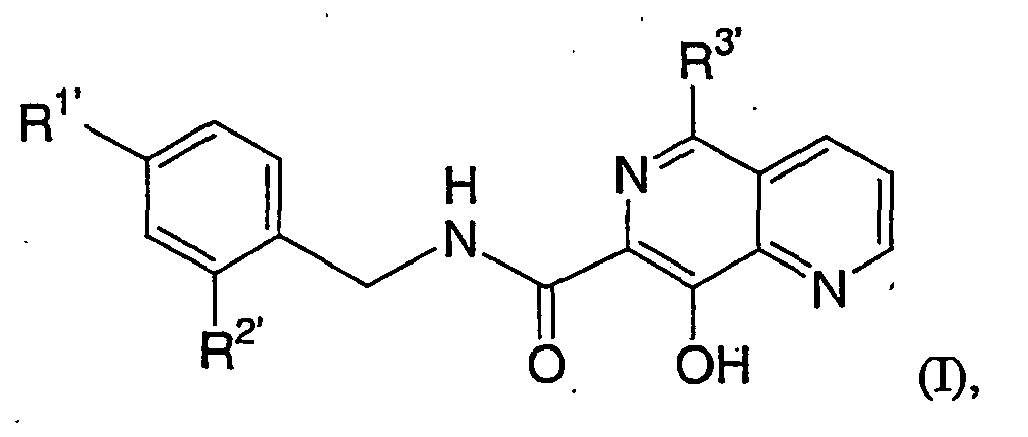
R1' is -H or -F;
R2' is - (1) -C1-6 alkyl-C(=O)N(RaRb),
- (2) -C(=O)N(RaRb),
- (3)


- (4) triazolyl or tetrazolyl,
- (5) -N(Ra)-C(Rb)=O,
- (6)
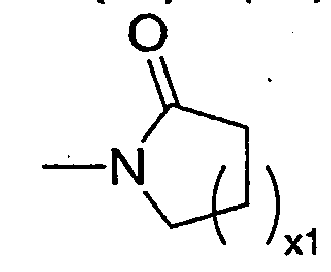
- (7) -CO2Rc;
- (1) -H,
- (2) -C(=O)N(RaRb),
- (3) -CH2-C(=O)N(RaRb),
- (4) -CH2CH2-C(=O)N(RaRb),
- (5) -S-CH2-C(=O)N(RaRb),
- (6) -O-CH2-C(=O)N(RaRb),
- (7) -N(Ra)-C(Rb)=O,
- (8) -N(SO2Rc)-CH2-C(=O)N(RaRb),
- (9) -N(Ra)-C(=O)-C(=O)-N(RaRb),
- (10) -N(Ra)SO2Rc,
- (11) -CH=CH-C(=O)-N(RaRb),
- (12) -N(Ra)-CH2-C(=O)N(RaRb),
- (13) -N(Ra)-C(=O)-N(RaRb),
- (14) -HetC',
- (15) -(CH2)1-3 alkyl-HetC',
- (16) -N(Ra)-(CH2)1-3-HetC',
- (17) -N(Ra)-SO2-N(RaRb),
- (18) -HetQ',
- (19)


- (20)


- A first aspect of the present invention is a compound of Formula (I), or a pharmaceutically acceptable salt thereof, wherein R2' is restricted to one of groups (1) to (3); R3' is restricted to one of groups (1) to (17); and all other variables are as defined in the first embodiment.
- A second aspect of the present invention is a compound of Formula (I),
wherein R2' is -(CH2)1-3-C(=O)N(RaRb), -C(=O)N(RaRb),
and all other variables are as originally defined in the first embodiment;
or a pharmaceutically acceptable salt thereof. - A third aspect of the present invention is a compound of Formula (I), or a pharmaceutically acceptable salt thereof, wherein R2' is -(CH2)1-3-C(=O)N(RaRb) or -C(=O)N(RaRb); and all other variables are as defined in the first aspect of the first embodiment.
- A fourth aspect of the present invention is a compound of Formula (I), wherein
R2' is -(CH2)1-3-C(=O)N(Ra*Rb*), -C(=O)N(Ra*Rb*),
Ra* and Rb* are each independently -H, -C1-4 alkyl, or cyclopropyl, with the proviso that Ra* and Rb* are not both -H;
each Ra in R3' is independently -H, -C1-4 alkyl, or cyclopropyl;
each Rb in R3' is independently -H, -C1-4 alkyl, or cyclopropyl; and
each Rc in R3' is independently a -C1-4 alkyl or cyclopropyl;
and all other variables are as originally defined in the first embodiment;
or a pharmaceutically acceptable salt thereof. - In a feature of the fourth aspect of the first embodiment, one of Ra* and Rb* is -H, and the other of Ra* and Rb* is -C1-4 alkyl or cyclopropyl; and all other variables are as defined in the fourth aspect.
- A fifth aspect of the present invention is a compound of Formula (I), or a pharmaceutically acceptable salt thereof, wherein
R2' is -(CH2)1-3-C(=O)N(Ra*Rb*) or -C(=O)N(Ra*Rb*);
Ra* and Rb* are each independently -H, -C1-4 alkyl, or cyclopropyl, with the proviso that Ra* and Rb* are not both -H;
each Ra in R3' is independently -H, -C1-4 alkyl, or cyclopropyl;
each Rb in R3' is independently -H, -C1-4 alkyl, or cyclopropyl; and
each Rc in R3' is independently a -C1-4 alkyl or cyclopropyl;
and all other variables are as originally defined in the first aspect of the first embodiment;
or a pharmaceutically acceptable salt thereof. - In a feature of the fifth aspect of the first embodiment, one of Ra* and Rb* is -H, and the other of Ra* and Rb* is -C1-4 alkyl or cyclopropyl; and all other variables are as set forth in the fifth aspect.
- A sixth aspect of the present invention is a compound of Formula (I), wherein
HetC' in the definition of R3' is a saturated heterocyclic ring selected from piperidinyl, morpholinyl, thiomorpholinyl, thiazolidinyl, isothiazolidinyl, oxazolidinyl, isooxazolidinyl, pyrrolidinyl, imidazolidinyl, piperazinyl, tetrahydrofuranyl, pyrazolidinyl, hexahydropyrimidinyl, thiazinanyl, thiazepanyl, thiadiazepanyl, dithiazepanyl, diazepanyl, and thiadiazinanyl, wherein the saturated heterocyclic ring is unsubstituted or substituted with 1 to 4 substituents each of which is independently: - (a) methyl or ethyl,
- (b) =O,
- (c) -C(=O)N(RaRb),
- (d) -CH2C(=O)N(RaRb),
- (e) -C(=O)Ra, or
- (f) -SO2Rc;
- A seventh aspect of the present invention is a compound of Formula (I), or a pharmaceutically acceptable salt thereof, wherein HetC' in the definition of R3' is as defined in the sixth aspect of the first embodiment; and all other variables are as defined in the first aspect of the first embodiment.
- An eighth aspect of the present invention is a compound of Formula (I), wherein R3' is:
- H, -C(=O)N(RaRb), -N(Ra)SO2Rc, -N(Ra)-C(=O)-C(=O)-N(RaRb), 1,1-dioxido-1,2-thiazinan-2-yl, 1,1-dioxidoisothiazolidin-2-yl, 1,1-dioxido-1,2,6-thiadiazinan-2-yl, 6-methyl-1,1-dioxido-1,2,6-thiadiazinan-2-yl, or 3-oxo-2-azabicyclo[2.2.1]hept-2-yl;
- A ninth aspect of the present invention is a compound of Formula (I), wherein R3' is:
- -H, -C(=O)N(RaRb), -N(Ra)SO2Rc, or 1,1-dioxido-1,2-thiazinan-2-yl;
- A tenth aspect of the present invention is a compound of Formula (I), wherein
R1' is -H or -F;
R2' is -(CH2)1-3-C(=O)N(Ra*Rb*), -C(=O)N(Ra*Rb*),
Ra* and Rb* are each independently -H, -C1-4 alkyl, or cyclopropyl, with the proviso that Ra* and Rb* are not both -H;
R3' is -H, -C(=O)N(RaRb), -N(Ra)SO2Rc, -N(Ra)-C(=O)-C(=O)-N(RaRb), 1,1-dioxido-1,2-thiazinan-2-yl, 1,1-dioxidoisothiazolidinyl-2-yl, 1,1-dioxido-1,2,6-thiadiazinan-2-yl; or 3-oxo-2-azabicyclo[2.2.1]hept-2-yl;
Ra and Rb are each independently -H, -C1-4 alkyl, or cyclopropyl, with the proviso that Ra and Rb are not both -H; and
Rc is -C1-4 alkyl or cyclopropyl;
or a pharmaceutically acceptable salt thereof. - An eleventh aspect of the present invention is a compound of Formula (I), wherein
R1' is -H or -F;
R2' is -(CH2)1-3-C(=O)N(Ra*Rb*) or -C(=O)N(Ra*Rb*);
Ra* and Rb* are each independently -H, -C1-4 alkyl, or cyclopropyl, with the proviso that Ra* and Rb* are not both -H;
R3' is -H, -C(=O)N(RaRb), -NHSO2Rc, -N(-C1-4 alkyl)SO2Rc, or 1,1-dioxido-1,2-thiazinan-2-yl;
Ra and Rb are each independently -H, -C1-4 alkyl, or cyclopropyl, with the proviso that Ra and Rb are not both -H; and
Rc is -C1-4 alkyl or cyclopropyl;
or a pharmaceutically acceptable salt thereof. - In a feature of either the tenth or the eleventh aspect of the first embodiment, Ra* and Rb* are each independently -H, methyl, ethyl, or cyclopropyl, with the proviso that Ra* and Rb* are not both -H; and Ra and Rb are each independently -H, methyl, ethyl, or cyclopropyl, with the proviso that Ra and Rb are not both -H; and Rc is methyl, ethyl, or cyclopropyl.
- A twelfth aspect of the present invention is a compound of Formula (I), wherein
R1' is -H or -F;
R2' is -(CH2)1-3-C(=O)N(Ra*Rb*), -C(=O)N(Ra*Rb*),
one of Ra* and Rb* is -H, and the other of Ra* and Rb* is -C1-4 alkyl or cyclopropyl;
R3' is -H, -C(=O)N(RaRb), -N(Ra)SO2Rc, -N(Ra)-C(=O)-C(=O)-N(RaRb), 1,1-dioxido-1,2-thiazinan-2-yl, 1,1-dioxidoisothiazolidinyl-2-yl, 1,1-dioxido-1,2,6-thiadiazinan-2-yl; or 3-oxo-2-azabicyclo[2.2.1]hept-2-yl;
Ra and Rb are each independently -H, -C1-4 alkyl, or cyclopropyl, with the proviso
that Ra and Rb are not both -H; and
Rc is -C1-4 alkyl or cyclopropyl;
or a pharmaceutically acceptable salt thereof. - A thirteenth aspect of the present invention is a compound of Formula (I), wherein
R1' is -H or -F;
R2' is -(CH2)1-3-C(=O)N(Ra*Rb*) or -C(=O)N(Ra*Rb*);
one of Ra* and Rb* is -H, and the other of Ra* and Rb* is -C1-4 alkyl or cyclopropyl;
R3' is -H, -C(=O)N(RaRb), -NHSO2Rc, -N(-C1-4 alkyl)SO2Rc, or 1,1-dioxido-1,2-thiazinan-2-yl;
Ra and Rb are each independently -H, -C1-4 alkyl, or cyclopropyl, with the proviso that Ra and Rb are not both -H; and
Rc is -C1-4 alkyl or cyclopropyl;
or a pharmaceutically acceptable salt thereof. - In a feature of either the twelfth or the thirteenth aspect, one of Ra* and Rb* is -H, and the other of Ra* and Rb* is -C1-4 alkyl or cyclopropyl. In another feature of either the twelfth or the thirteenth aspect, one of Ra* and Rb* is -H, and the other of Ra* and Rb* is methyl, ethyl, isopropyl, or n-propyl.
- A fourteenth aspect is a compound of Formula (I), or a pharmaceutically acceptable salt thereof, wherein
R1' is -H or -F;
R2' is - (1) -(CH2)1-3-C(=O)N(Ra*Rb*),
- (2) -C(=O)N(Ra*Rb*),
- (3) -C(=O)NH2,
- (4)

- (5) triazolyl, or
- (6) tetrazolyl;
- (1) -H,
- (2) -C(=O)N(Ra"Rb"),
- (3) -CH2-C(=O)N(Ra"Rb"),
- (4) -CH2CH2-C(=O)N(Ra"Rb"),
- (5) -N(Ra)-C(Rb)=O,
- (6) -N(Ra)-C(=O)-C(=O)-N(RaRb),
- (7) -N(Ra)SO2Rc,
- (8) -HetC', or
- (9) -HetQ';
- A feature of the fourteenth aspect is a compound of Formula (1), or a pharmaceutically acceptable salt thereof, wherein R2' and R3' are as defined in the fourteenth aspect; one of Ra and Rb is -H, -C1-4 alkyl, or cyclopropyl, and the other of Ra and Rb is -C1-4 alkyl or cyclopropyl; all other variables are as defined in the fourteenth aspect; and provided that:
- (i) when R3' is -C(=O)N(Ra"Rb"), -CH2-C(=O)N(Ra"Rb"), or -CH2CH2-C(=O)N(Ra"Rb"), then R2' is not -C(=O)NH2; and
- (ii) when R3' is -N(Ra)-C(Rb)=O or
-N(Ra)-C(=O)-C(=O)-N(RaRb), then R2' is not -C(=O)N(Ra*Rb*) or
-(CH2)1-3-C(=O)N(Ra*Rb*) wherein both Ra* and Rb* are not H. - A fifteenth aspect of the present invention is a compound of Formula (I), or a pharmaceutically acceptable salt thereof, wherein
R1' is -H or -F;
R2'is: - (1) -CH2C(=O)N(Ra*Rb*),
- (2) -C(=O)N(Ra*Rb*),
- (3) -C(=O)NH2,
- (4)

- (5) triazolyl, or
- (6) tetrazolyl;
- (1) -C(=O)N(Ra"Rb"),
- (2) -CH2-C(=O)N(Ra"Rb"),
- (3) -CH2CH2-C(=O)N(Ra"Rb"),
- (4) -N(Ra)-C(Rb)=O,
- (5) -N(Ra)-C(=O)-C(=O)-N(RaRb),
- (6) -N(Ra)SO2Rc,
- (7) 1,1-dioxido-1,2-thiazinan-2-yl,
- (8) 1,1-dioxidoisothiazolidin-2-yl,
- (9) 1,1-dioxido-1,2,6-thiadiazinan-2-yl,
- (10) 6-methyl-1,1-dioxido-1,2,6-thiadiazinan-2-yl, or
- (11) 3-oxo-2-azabicyclo[2.2.1]hept-2-yl;
- A feature of the fifteenth aspect of the present invention is a compound of Formula (I), or a pharmaceutically acceptable salt thereof, wherein R2' and R3' are as defined in the fifteenth aspect; all other variables are as defined in the fifteenth aspect; and provided that:
- (i) when R3' is -C(=O)N(Ra"Rb"), -CH2-C(=O)N(Ra"Rb"), or -CH2CH2-C(=O)N(Ra"Rb"), then R2' is not -C(=O)NH2; and
- (ii) when R3' is -N(Ra)-C(Rb)=O or -N(Ra)-C(=O)-C(=O)-N(RaRb), then R2' is not -C(=O)N(Ra*Rb*) or -(CH2)1-3-C(=O)N(Ra*Rb*) wherein both Ra* and Rb* are not H.
- A sixteenth aspect of the present invention is a compound of Formula (I), or a pharmaceutically acceptable salt thereof, wherein
R1' is -H or -F;
R2' is: - (1) -CH2C(=O)NH(CH3),
- (2) -CH2C(=O)N(CH3)2,
- (3) -C(=O)NH(CH3),
- (4) -C(=O)N(CH3)2,
- (5) -C(=O)NH(CH2CH3),
- (6) -C(=O)NH(CH2CH2CH3),
- (7) -C(=O)NH(CH(CH3)2),
- (8) -CH2C(=O)NH(cyclopropyl),
- (9) -C(=O)NH2,
- (10)

- (11) triazolyl, or
- (12) tetrazolyl; and
- (1) -C(=O)N(CH3)2,
- (2) -N(CH3)-C(CH3)=O,
- (3) -N(CH3)-C(=O)-C(=O)-N(CH3)2,
- (4) -N(CH3)SO2CH3,
- (5) -N(CH3)SO2CH2CH3,
- (6) -N(CH2CH3)SO2CH3,
- (7) 1,1-dioxido-1,2-thiazinan-2-yl,
- (8) 1,1-dioxidoisothiazolidin-2-yl,
- (9) 6-methyl-1,1-dioxido-1,2,6-thiadiazinan-2-yl, or
- (10) 3-oxo-2-azabicyclo[2.2.1]hept-2-yl; provided that:
- (i) when R3' is -C(=O)N(CH3)2, then R2' is not -C(=O)NH2; and
- (ii) when R3' is -N(CH3)-C(CH3)=O or
-N(CH3)-C(=O)-C(=O)-N(CH3)2, then R2' is not -C(=O)N(CH3)2 or -CH2C(=O)N(CH3)2.
- A feature of the sixteenth aspect is a compound of Formula (I), or a pharmaceutically acceptable salt thereof, wherein:
- R2' is -C(=O)NH2, -C(=O)NH(CH3), -C(=O)N(CH3)2, or -C(=O)NH(CH2CH3); and
- R3' is -N(CH3)SO2CH3, -N(CH3)SO2CH2CH3, 1,1-dioxido-1,2-thiazinan-2-yl, or 6-methyl-1,1-dioxido-1,2,6-thiadiazinan-2-yl.
- Additional aspects of the present invention include, but are not limited to, compounds of Formula (I) wherein each of two or three or more of R1', R2', R3', Ra, Rb, Rc and HetC' is independently defined in accordance with its definition in one of the aspects, or a feature thereof, as set forth above. Any and all possible combinations of these variables in Formula (I) are additional aspects of the present invention.
- Another embodiment of the present invention is a compound selected from the group consisting of
N-{4-fluoro-2-[(methylamino)carbonyl]benzyl}-5-(1,1-dioxido-1,2-thiazinan-2-yl)-8-hydroxy-1,6-naphthyridine-7-carboxamide (also referred to herein as Compound A):


- An aspect of the preceding embodiment of the present invention is Compound A or a pharmaceutically acceptable salt thereof (e.g., a potassium salt or a sodium salt). Compound A has exhibited improved antiviral properties relative to the closely related N-benzyl-8-hydroxy-1,6-naphthyridine carboxamide integrase inhibitors not having an ortho polar substituent on the phenyl ring of the N-benzyl amide. These properties include improved antiviral potency in the presence of human serum proteins, and also retention of significant antiviral activity against several HIV mutants that are resistant to other integrase inhibitors.
- Still another embodiment of the present invention is a compound selected from the group consisting of:
- N-[2-(aminocarbonyl)-4-fluorobenzyl]-5-(1,1-dioxido-1,2-thiazinan-2-yl)-8-hydroxy-1,6-naphthyridine-7-carboxamide:

- 5-(1,1-dioxido-1,2-thiazinan-2-yl)-8-hydroxy-N-{2-[(methylamino)carbonyl]benzyl}-1,6-naphthyridine-7-carboxamide:

- Still another embodiment of the present invention is a compound selected from the group consisting of:
- N-{4-fluoro-2-[(isopropylamino)carbonyl]benzyl}-5-(1,1-dioxido-1,2-thiazinan-2-yl)-8-hydroxy-1,6-naphthyridine-7-carboxamide;
- N-{4-fluoro-2-[(ethylamino)carbonyl]benzyl}-5-(1,1-dioxido-1,2-thiazinan-2-yl)-8-hydroxy-1,6-naphthyridine-7-carboxamide;
- N-{4-fluoro-2-[(amino)carbonyl]benzyl}-5-[methyl(methylsulfonyl)amino]-8-hydroxy-1,6-naphthyridine-7-carboxamide;
- N-{4-fluoro-2-[(methylamino)carbonyl]benzyl}-5-[(ethylsulfonyl)(methyl)amino]-8-hydroxy-1,6-naphthyridine-7-carboxamide;
- N-{4-fluoro-2-[(methylamino)carbonyl]benzyl}-5-(6-methyl-1,1-dioxido-1,2,6-thiadiazinan-2-yl)-8-hydroxy-1,6-naphthyridine-7-carboxamide;
- Other embodiments of the present invention relate to the following:
- (a) A pharmaceutical composition comprising a therapeutically effective amount of a compound of the invention (e.g., a compound of Formula (I) or any of the specific compounds set forth above) and a pharmaceutically acceptable carrier.
- (b) A pharmaceutical composition which comprises the product prepared by combining (e.g., mixing) a therapeutically effective amount of a compound of the invention and a pharmaceutically acceptable carrier.
- (c) The pharmaceutical composition of (a) or (b), further comprising a therapeutically effective amount of an HIV infection/AIDS treatment agent selected from the group consisting of HIV/AIDS antiviral agents, immunomodulators, and anti-infective agents.
- (d) The pharmaceutical composition of (c), wherein the HIV infection/AIDS treatment agent is an antiviral selected from the group consisting of HIV protease inhibitors, non-nucleoside HIV reverse transcriptase inhibitors, and nucleoside HIV reverse transcriptase inhibitors.
- (e) A combination useful for inhibiting HIV integrase, for treating or preventing infection by HIV, or for preventing, treating or delaying the onset of AIDS, which is a therapeutically effective amount of a compound of the invention and a therapeutically effective amount of an HIV infection/AIDS treatment agent selected from the group consisting of HIV/AIDS antiviral agents, immunomodulators, and anti-infective agents.
- (f) The combination of (e), wherein the HIV infection/AIDS treatment agent is an antiviral selected from the group consisting of HIV protease inhibitors, non-nucleoside HIV reverse transcriptase inhibitors and nucleoside HIV reverse transcriptase inhibitors.
- (g) A method of inhibiting HIV integrase in a subject in need thereof which comprises administering to the subject a therapeutically effective amount of a compound of the invention.
- (h) A method of preventing or treating infection by HIV in a subject in need thereof which comprises administering to the subject a therapeutically effective amount of a compound of the invention.
- (i) The method of (h), wherein the compound of the invention is administered in combination with a therapeutically effective amount of at least one antiviral selected from the group consisting of HIV protease inhibitors, non-nucleoside HIV reverse transcriptase inhibitors, and nucleoside HIV reverse transcriptase inhibitors.
- (j) A method of preventing, treating or delaying the onset of AIDS in a subject in need thereof which comprises administering to the subject a therapeutically effective amount of a compound of the invention.
- (k) The method of (j), wherein the compound is administered in combination with a therapeutically effective amount of at least one antiviral selected from the group consisting of HIV protease inhibitors, non-nucleoside HIV reverse transcriptase inhibitors, and nucleoside HIV reverse transcriptase inhibitors
- (l) A method of inhibiting HIV integrase in a subject in need thereof which comprises administering to the subject the pharmaceutical composition of (a), (b), (c) or (d) or the combination of (e) or (f).
- (m) A method of preventing or treating infection by HIV in a subject in need thereof which comprises administering to the subject the pharmaceutical composition of (a), (b), (c) or (d) or the combination of (e) or (f).
- (n) A method of preventing, treating or delaying the onset of AIDS in a subject in need thereof which comprises administering to the subject the pharmaceutical composition of (a), (b), (c) or (d) or the combination of (e) or (f).
- The present invention also includes a compound of the present invention (i) for use in, (ii) for use as a medicament for, or (iii) for use in the preparation of a medicament for: (a) inhibiting HIV protease, (b) preventing or treating infection by HIV, or (c) preventing, treating or delaying the onset of AIDS. In these uses, the compounds of the present invention can optionally be employed in combination with one or more HIV/AIDS treatment agents selected from HIV/AIDS antiviral agents, anti-infective agents, and immunomodulators.
- Additional embodiments of the invention include the pharmaceutical compositions, combinations and methods set forth in (a)-(n) above and the uses set forth in the preceding paragraph, wherein the compound of the present invention employed therein is a compound of one of the embodiments, or an aspect or feature or sub-feature thereof, described above. In all of these embodiments, the compound may optionally be used in the form of a pharmaceutically acceptable salt.
- As used herein, the term "C1-6 alkyl" (or "C1-C6 alkyl") means linear or branched chain alkyl groups having from 1 to 6 carbon atoms and includes all of the hexyl alkyl and pentyl alkyl isomers as well as n-, iso-, sec- and t-butyl, n- and isopropyl, ethyl and methyl. "C1-4 alkyl" means n-, iso-, sec- and t-butyl, n- and isopropyl, ethyl and methyl.
- The term "-C1-6 alkyl-" refers to a C1 to C6 linear or branched alkyl group as just defined which is bivalent. It can alternatively be referred to as "C1-6 alkylene" or "C1-6 alkanediyl". A class of alkylenes of particular interest with respect to the invention is -(CH2)1-6-, and sub-classes of particular interest include -(CH2)1-4-, -(CH2)1-3-, -(CH2)1-2-, and -CH2-.
- The term "C3-8 cycloalkyl" (or "C3-C8 cycloalkyl") means a cyclic ring of an alkane having three to eight total carbon atoms (i.e., cyclopropyl, cyclobutyl, cyclopentyl, cyclohexyl, cycloheptyl, or cyclooctyl). Similar terms such as "C3-6 cycloalkyl" have an analogous meaning.
- The term "halogen" (or "halo") refers to fluorine, chlorine; bromine and iodine (alternatively referred to as fluoro, chloro, bromo, and iodo).
- The term "C1-6 haloalkyl" (which may alternatively be referred to as "C1-C6 haloalkyl" or "halogenated C1-C6 alkyl") means a C1 to C6 linear or branched alkyl group as defined above with one or more halogen substituents. The term "C1-4 haloalkyl" has an analogous meaning. The term "C1-6 fluoroalkyl" has an analogous meaning except that the halogen substituents are restricted to fluoro. A class of fluoroalkyls of particular interest with respect to the invention is the series (CH2)0-4CF3 (i.e., trifluoromethyl, 2,2,2-trifluoroethyl, 3,3,3-trifluoro-n-propyl, etc.).
- The term "saturated heterocyclic ring" refers to a 4- to 7-membered saturated monocyclic ring which consists of carbon atoms and one or more heteroatoms (e.g., from 1 to 4, or from 1 to 3, or from 1 to 2 heteroatoms; or 1 heteroatom) independently selected from N, O and S. Representative examples include piperidinyl, piperazinyl, azepanyl (i.e.,


- The term "bridged azabicyclo saturated ring system" refers herein to a 7- to 9-membered bridged azabicycloalkyl saturated ring system containing a C5-7 azacycloalkyl ring wherein two of its ring carbons are connected by a bridge containing 1 or 2 carbon atoms. The bridged azabicycloalkyl ring systems include azabicyclo[2.1.1]hexyl, azabicyclo[2.2.1]heptyl (e.g., 2-azabicyclo[2.2.1]hept-2-yl), and azabicyclo[2.2.2]octyl.
- The term "heteroaromatic ring" refers a 5- or 6-membered monocyclic aromatic ring which consists of carbon atoms and one or more heteroatoms (e.g., from 1 to 4, or from 1 to 3, or from 1 to 2 heteroatoms; or 1 heteroatom) independently selected from N, O and S. Representative examples of heteroaromatic rings include pyridyl, pyrrolyl, pyrazinyl, pyrimidinyl, pyridazinyl, thienyl (or thiophenyl), thiazolyl, furanyl, imidazolyl, pyrazolyl, triazolyl, tetrazolyl, oxazolyl, isooxazolyl, oxadiazolyl, thiazolyl, isothiazolyl, and thiadiazolyl.
- Unless expressly stated to the contrary, all ranges cited herein are inclusive. For example, a heterocycle described as containing from "1 to 4 heteroatoms" means the heterocycle can contain 1, 2, 3 or 4 heteroatoms.
- When any variable (e.g., Ra, Rb, or Rc) occurs more than one time in any constituent or in Formula I or in any other formula depicting and describing compounds of the invention, its definition on each occurrence is independent of its definition at every other occurrence. Also, combinations of substituents and/or variables are permissible only if such combinations result in stable compounds.
- The term "substituted" (e.g., as in "aryl which is optionally substituted with from 1 to 5 substituents ...") includes mono- and poly-substitution by a named substituent to the extent such single and multiple substitution (including multiple substitution at the same site) is chemically allowed.
- The symbol "" in front of an open bond in the structural formula of a group marks the point of attachment of the group to the rest of the molecule.

- The compounds of the present invention may have asymmetric centers and may occur, except when specifically noted, as mixtures of stereoisomers or as individual diastereomers, or enantiomers, with all isomeric forms being included in the present invention.
- The compounds of the present invention are useful in the inhibition of HIV integrase, the prevention or treatment of infection by human immunodeficiency virus (HIV) and the prevention, treatment or the delay in the onset of consequent pathological conditions such as AIDS. Preventing AIDS, treating AIDS, delaying the onset of AIDS, or preventing or treating infection by HIV is defined as including, but not limited to, treatment of a wide range of states of HIV infection: AIDS, ARC (AIDS related complex), both symptomatic and asymptomatic, and actual or potential exposure to HIV. For example, the compounds of this invention are useful in treating infection by HIV after suspected past exposure to HIV by such means as blood transfusion, exchange of body fluids, bites, accidental needle stick, or exposure to patient blood during surgery.
- The compounds of this invention are useful in the preparation and execution of screening assays for antiviral compounds. For example, the compounds of this invention are useful for isolating enzyme mutants, which are excellent screening tools for more powerful antiviral compounds. Furthermore, the compounds of this invention are useful in establishing or determining the binding site of other antivirals to HIV integrase, e.g., by competitive inhibition. Thus the compounds of this invention are commercial products to be sold for these purposes.
- The compounds of the present invention can be administered in the form of pharmaceutically acceptable salts. The term "pharmaceutically acceptable salt" refers to a salt which possesses the effectiveness of the parent compound and which is not biologically or otherwise undesirable (e.g., is neither toxic nor otherwise deleterious to the recipient thereof). Suitable salts include acid addition salts which may, for example, be formed by mixing a solution of the compound of the present invention with a solution of a pharmaceutically acceptable acid such as hydrochloric acid, sulfuric acid, acetic acid, trifluoroacetic acid, or benzoic acid. When the compounds of the invention carry an acidic moiety, suitable pharmaceutically acceptable salts thereof can include alkali metal salts (e.g., sodium or potassium salts), alkaline earth metal salts (e.g., calcium or magnesium salts), and salts formed with suitable organic ligands such as quaternary ammonium salts. Also, in the case of an acid (-COOH) or alcohol group being present, pharmaceutically acceptable esters can be employed to modify the solubility or hydrolysis characteristics of the compound.
- For the purpose of preventing or treating HIV infection or preventing, treating or delaying the onset of AIDS, the compounds of the present invention can be administered orally, parenterally (including subcutaneous injections, intravenous, intramuscular, intrasternal injection or infusion techniques), by inhalation spray, or rectally, in the form of a unit dosage of a pharmaceutical composition containing a therapeutically effective amount of the compound and conventional non-toxic pharmaceutically-acceptable carriers, adjuvants and vehicles.
- The term "administration" and variants thereof (e.g., "administering" a compound) in reference to a compound of the invention mean providing the compound to the individual in need of treatment. When a compound of the invention is provided in combination with one or more other active agents (e.g., antiviral agents useful for treating HIV infection or AIDS), "administration" and its variants are each understood to include concurrent and sequential provision of the compound and other agents.
- As used herein, the term "composition" is intended to encompass a product comprising the specified ingredients in the specified amounts, as well as any product which results, directly or indirectly, from combining the specified ingredients in the specified amounts.
- By "pharmaceutically acceptable" is meant that the ingredients of the pharmaceutical composition must be compatible with each other and not deleterious to the recipient thereof.
- The term "subject" (which may be alternatively referred to herein as "patient") as used herein refers to an animal, preferably a mammal, most preferably a human, who has been the object of treatment, observation or experiment.
- The term "therapeutically effective amount" as used herein means that amount of active compound or pharmaceutical agent that elicits the biological or medicinal response in a tissue, system, animal or human that is being sought by a researcher, veterinarian, medical doctor or other clinician, which includes alleviation of the symptoms of the disease being treated. The term also includes a prophylactically effective amount suitable for prevention of the disease or condition. When the active compound (i.e., active ingredient) is administered as the salt, references to the amount of active ingredient are to the free acid or free base form of the compound.
- The pharmaceutical compositions can be in the form of orally-administrable suspensions or tablets or capsules, nasal sprays, sterile injectible preparations, for example, as sterile injectible aqueous or oleagenous suspensions or suppositories. These compositions can be prepared by methods and contain excipients which are well known in the art. Suitable methods and ingredients are described in Remington's Pharmaceutical Sciences, 18th edition, edited by A. R. Gennaro, Mack Publishing Co., 1990, which is herein incorporated by reference in its entirety. In one embodiment, the pharmaceutical composition is a capsule or a tablet suitable for oral administration comprising a compound of the present invention (e.g., Compound A or a salt thereof) and a nonionic surfactant (e.g., a poloxamer).
- The compounds of this invention can be administered orally in a dosage range of 0.001 to 1000 mg/kg of mammal (e.g., human) body weight per day in a single dose or in divided doses. One preferred dosage range is 0.01 to 500 mg/kg body weight per day orally in a single dose or in divided doses. Another preferred dosage range is 0.1 to 100 mg/kg body weight orally in single or divided doses. For oral administration, the compositions can be provided in the form of tablets or capsules containing 1.0 to 500 milligrams of the active ingredient, particularly 1, 5, 10, 15, 20, 25, 50, 75, 100, 150, 200, 250, 300, 400, and 500 milligrams of the active ingredient for the symptomatic adjustment of the dosage to the patient to be treated. The specific dose level and frequency of dosage for any particular patient may be varied and will depend upon a variety of factors including the activity of the specific compound employed, the metabolic stability and length of action of that compound, the age, body weight, general health, sex, diet, mode and time of administration, rate of excretion, drug combination, the severity of the particular condition, and the host undergoing therapy. A suitable dosage range for oral administration of Compound A to humans is in a range of from about 25 mg to about 1000 mg per day (e.g., from about 100 mg to about 800 mg per patient once per day).
- As noted above, the present invention is also directed.to use of the HIV integrase inhibitor compounds of the present invention with one or more agents useful in the treatment of HIV infection or AIDS. For example, the compounds of this invention may be effectively administered, whether at periods of pre-exposure and/or post-exposure, in combination with effective amounts of one or more of the HIV/AIDS antivirals, imunomodulators, antiinfectives, or vaccines useful for treating HIV infection or AIDS. Suitable agents include the antiviral agents listed in the following Table:
Drug Name Manufacturer Indication (Activity) (Tradename and/or Location) abacavir GW 1592 1592U89 Glaxo Welcome (ZIAGEN®) HIV infection, AIDS, ARC (nucleoside reverse transcriptase inhibitor) abacavir + lamivudine + zidovudine GlaxoSmithKline (TRIZIVIR®) HIV infection, AIDS, ARC (nucleoside reverse transcriptase inhibitors) acemannan Carrington Labs (Irving, TX) ARC ACH 126443 Achillion Pharm. HIV infections, AIDS, ARC (nucleoside reverse transcriptase inhibitor) acyclovir Burroughs Wellcome HIV infection, AIDS, ARC, in combination with AZT AD-439 Tanox Biosystems HIV infection, AIDS, ARC AD-519 Tanox Biosystems HIV infection, AIDS, ARC adefovir dipivoxil GS 840 Gilead HIV infection, AIDS, ARC (reverse transcriptase inhibitor) AL-721 Ethigen (Los Angeles, CA) ARC, PGL, HIV positive, AIDS alpha interferon GlaxoSmithKline Kaposi's sarcoma, HIV, in combination w/Retrovir AMD3100 AnorMed HIV infection, AIDS, ARC (CXCR4 antagonist) amprenavir 141 W94 GW 141 VX478 (Vertex) GlaxoSmithKline (AGENERASE®) HIV infection, AIDS, ARC (PI) ansamycin LM 427 Adria Laboratories (Dublin, OH) Erbamont (Stamford, CT) ARC antibody which neutralizes pH labile alpha aberrant interferon Advanced Biotherapy Concepts (Rockville, MD) AIDS, ARC AR177 Aronex Pharm HIV infection, AIDS, ARC atazanavir (BMS 232632) Bristol-Myers Squibb (ZRIVADA®) HIV infection, AIDS, ARC (protease inhibitor) beta-fluoro-ddA Nat'1 Cancer Institute AIDS-associated diseases BMS-232623 (CGP-73547) Bristol-Myers Squibb/ Novartis HIV infection, AIDS, ARC (protease inhibitor) BMS-234475 (CGP-61755) Bristol-Myers Squibb/ Novartis HIV infection, AIDS, ARC (protease inhibitor) capravirine (AG-1549, S-1153) Pfizer HIV infection, AIDS, ARC (non-nucleoside reverse transcriptase inhibitor) CI-1012 Warner-Lambert HIV-1 infection cidofovir Gilead Science CMV retinitis, herpes, papillomavirus curdlan sulfate AJI Pharma USA HIV infection cytomegalovirus immune globin MedImmune CMV retinitis cytovene ganciclovir Syntex sight threatening CMV peripheral CMV retinitis delavirdine Pharmacia-Upjohn (RESCRIPTOR®) HIV infection, AIDS, ARC (non-nucleoside reverse transcriptase inhibitor) dextran Sulfate Ueno Fine Chem. Ind. Ltd. (Osaka, Japan) AIDS, ARC, HIV positive asymptomatic ddC (zalcitabine, dideoxycytidine) Hoffman-La Roche (HIVID®) HIV infection, AIDS, ARC (nuclesodie reverse transcriptase inhibitor) ddI dideoxyinosine Bristol-Myers Squibb (VIDEX®) HIV infection, AIDS, ARC; combination with AZT/d4T (nucleoside reverse transcriptase inhibitor) DPC 681 & DPC 684 DuPont HIV infection, AIDS, ARC (protease inhibitors) DPC 961 & DPC 083 Bristol-Myers Squibb (from DuPont Pharma) HIV infection AIDS, ARC (non-nucleoside reverse transcriptase inhibitors) EL10 Elan Corp, PLC (Gainesville, GA) HIV infection efavirenz (DMP 266) Bristol-Myers Squibb (SUSTIVA®) Merck (STOCRIN®) HIV infection, AIDS, ARC (non-nucleoside RT inhibitor) famciclovir Novartis (FAMVIR®) herpes zoster, herpes simplex emtricitabine FTC Gilead (from Triangle Pharmaceuticals) (COVIRACIL®) Emory University HIV infection, AIDS, ARC (nucleoside reverse transcriptase inhibitor) emvirine Gilead (from Triangle Pharmaceuticals) (COACTINON®) HIV infection, AIDS, ARC (non-nucleoside reverse transcriptase inhibitor) enfuvirtide T-20 Trimeris & Roche (FUZEON®) HIV infection, AIDS, ARC (fusion inhibitor) HBY097 Hoechst Marion Roussel HIV infection, AIDS, ARC (non-nucleoside reverse transcriptase inhibitor) hypericin VIMRx Pharm. HIV infection, AIDS, ARC recombinant human interferon beta Triton Biosciences (Almeda, CA) AIDS, Kaposi's sarcoma, ARC interferon alfa-n3 Interferon Sciences ARC, AIDS indinavir Merck (CRIXIVAN®) HIV infection, AIDS, ARC, asymptomatic HIV positive, also in combination with AZT/ddI/ddc ISIS 2922 ISIS Pharmaceuticals CMV retinitis JE2147/AG1776 Agouron HIV infection, AIDS, ARC (protease inhibitor) KNI-272 Nat'1 Cancer Institute HIV-assoc. diseases lamivudine, 3TC GlaxoSmithKline (EPIVIR®) HIV infection, AIDS, ARC (nucleoside reverse transcriptase inhibitor); also with AZT lobucavir Bristol-Myers Squibb CMV infection lopinavir (ABT-378) Abbott HIV infection, AIDS, ARC (protease inhibitor) lopinavir + ritonavir (ABT-378/r) Abbott (KALETRA®) HIV infection, AIDS, ARC (protease inhibitor) mozenavir (DMP-450) AVID (Camden, NJ) HIV infection, AIDS, ARC (protease inhibitor) nelfinavir Agouron (VIRACEPT®) HIV infection, AIDS, ARC (protease inhibitor) nevirapine Boeheringer Ingleheim (VIRAMUNE®) HIV infection, AIDS, ARC (non-nucleoside reverse transcriptase inhibitor) novapren Novaferon Labs, Inc. (Akron, OH) HIV inhibitor peptide T octapeptide sequence Peninsula Labs (Belmont, CA) AIDS PRO 140 Progenics HIV infection, AIDS, ARC (CCR5 co-receptor inhibitor) PRO 542 Progenies HIV infection, AIDS, ARC (attachment inhibitor) trisodium phosphonoformate Astra Pharm. Products, Inc CMV retinitis, HIV infection, other CMV infections PNU-140690 Pharmacia Upjohn HIV infection, AIDS, ARC (protease inhibitor) probucol Vyrex HIV infection, AIDS RBC-CD4 Sheffield Med. Tech (Houston TX) HIV infection, AIDS, ARC ritonavir (ABT-538) Abbott (RITONAVIR®) HIV infection, AIDS, ARC (protease inhibitor) saquinavir Hoffmann-LaRoche (FORTOVASE®) HIV infection, AIDS, ARC (protease inhibitor) stavudine; d4T didehydrodeoxy-thymidine Bristol-Myers Squibb (ZERIT®) HIV infection, AIDS, ARC (nucleoside reverse transcriptase inhibitor) T-1249 Trimeris HIV infection, AIDS, ARC (fusion inhibitor) TAK-779 Takeda HIV infection, AIDS, ARC (injectable CCR5 receptor antagonist) tenofovir Gilead (VIREAD®) HIV infection, AIDS, ARC (nucleotide reverse transcriptase inhibitor) tipranavir (PNU-140690) Boehringer Ingelheim HIV infection, AIDS, ARC (protease inhibitor) TMC-120 & TMC-125 Tibotec HIV infections, AIDS, ARC (non-nucleoside reverse transcriptase inhibitors) TMC-126 Tibotec HIV infection, AIDS, ARC (protease inhibitor) valaciclovir GlaxoSmithKline genital HSV & CMV infections virazole ribavirin Viratek/ICN (Costa Mesa, CA) asymptomatic HIV positive, LAS, ARC zidovudine; AZT GlaxoSmithKline (RETROVIR®) HIV infection, AIDS, ARC, Kaposi's sarcoma in combination with other therapies (nucleoside reverse transcriptase inhibitor) - It will be understood that the scope of combinations of the compounds of this invention with HIV/AIDS antivirals, immunomodulators, anti-infectives or vaccines is not limited to the list of antivirals in the above Table, but includes in principle any combination with any pharmaceutical composition useful for the treatment of AIDS. The HIV/AIDS antivirals and other agents will typically be employed in these combinations in their conventional dosage ranges and regimens as reported in the art, including the dosages described in the Physicians' Desk Reference, 54th edition, Medical Economics Company, 2000, which is incorporated herein by reference in its entirety. The dosage ranges for a compound of the invention in these combinations are the same as those set forth above.
- Abbreviations used in the instant specification, particularly the Schemes and Examples, include the following:
- AIDS = acquired immunodeficiency syndrome
- APCI = atmospheric pressure chemical ionization mass spectroscopy
- ARC = AIDS related complex
- BOC or Boc = t-butyloxycarbonyl
- BOP = benzotriazol-1-yloxytris-(dimethylamino)phosphonium hexafluorophosphate
- t-Bu = tert-butyl
- n-BuLi = n-butyllithium
- DEAD = diethylazodicarboxylate
- DIPA = diisopropylamine
- DMF = dimethylformamide
- DMPU = 1,3-dimethyl-3,4,5,6-tetrahydro-2(1H)-pyrimidinone
- DMSO = dimethyl sulfoxide
- dppf = 1,1'-bis(diphenylphosphino)ferrocene
- EDC or EDAC = 1-ethyl-3-(3-dimethylaminopropyl) carbodiimide
- EDTA = ethylenediaminetetraacetic acid
- ES-MS = eletron spray mass spectroscopy
- Et = ethyl
- EtOAc = ethyl acetate
- HIV = human immunodeficiency virus
- HOAT = 1-hydroxy-7-azabensotriazole
- HOBt = 1-hydroxy benzotriazole hydrate
- HPLC = high performance liquid chromatography
- HRMS = high resolution mass spectroscopy
- KF = Karl Fisher titration for water
- LC = liquid chromatography
- Me = methyl
- MeOH = methanol
- Ms = mesyl or methanesulfonyl
- MS = mass spectroscopy
- MTBE = methyl tert-butyl ether
- NBS = N-bromosuccinimide
- NIS = N-iodosuccinimide
- NMM = N-methyl morpholine
- NMR = nuclear magnetic resonance
- Ph = phenyl
- PMBCl = p-methoxybenzyl chloride
- Pr = propyl
- TEA = Triethylamine
- Tf2O = triflic anhydride
- TFA = trifluoroacetic acid
- TsCl = toluenesulfonyl chloride
- THF = tetrahydrofuran
- TLC = thin layer chromatography
- UV = ultraviolet
- The compounds of the present invention can be readily prepared according to the following reaction schemes and examples, or modifications thereof, using readily available starting materials, reagents and conventional synthesis procedures. In these reactions, it is also possible to make use of variants which are themselves known to those of ordinary skill in this art, but are not mentioned in greater detail. Furthermore, other methods for preparing compounds of the invention will be readily apparent to the person of ordinary skill in the art in light of the following reaction schemes and examples. Unless otherwise indicated, all variables are as defined above.
- The compounds of the present invention can be prepared by the coupling of suitable 1,6-naphthyridine-7-carboxylic acids (or acid derivatives such as acid halides or esters) with the appropriate benzylamines. Scheme 1 depicts the coupling reaction to obtain compounds of Formula (I).

- Methods for coupling carboxylic acids with amines to form carboxamides are well known in the art. Suitable methods are described, for example, in Jerry March, Advanced Organic Chemistry, 3rd edition, John Wiley & Sons, 1985, pp. 370-376, or in M. Bodanszky, The Practice of Peptide Syntheses, Springer-Verlag, 1984. Amines of formula 1-1 can be prepared, for example, by the reaction of a suitable benzyl halide with ammonia, by conversion of a suitable benzyl halide with hexamethylenetetramine, by treating the halide with potassium phthalimide and hydrolyzing the product, and by converting a benzyl halide to an azide and then reducing the azide to an amine; which methods are described, for example, in Jerry March, Advanced Organic Chemistry, 3rd edition, John Wiley & Sons, 1985, pp. 364-365, 366, 377-378, 380, and 1106. Amines of formula 1-1 can also be prepared using, for example, the methods described in Richard Larock, Comprehensive Organic Transformations, 2nd edition,Wiley-VCH Publishers Inc, 1999, pp 753-879, or routine variations thereof. Naphthyridine carboxylic acids of formula 1-2 can be prepared using methods described in Ochiai et al., Chem.Ber. 1937, 70: 2018, 2023; and Albert et al., J.Chem.Soc. 1952, 4985, 4991; or routine variations thereof. The schemes set forth below illustrate and expand upon the chemistry portrayed in Scheme 1.
- Scheme 1A depicts a method for preparing benzylamine reactants having at least one ortho-aminocarbonyl group on the benzyl ring. Substituted toluene 1A-1 is functionalized on the methyl group via radical bromination to give the bromide 1A-2. Radical brominations are well known in the art and are described, for example, in J. March, Advanced Organic Chemistry, 3rd edition, John Wiley & Sons, 1985, p. 625. The azide 1A-3 can then be obtained by displacement of the bromide with azide (see J. March, Advanced Organic Chemistry, 3rd edition, John Wiley & Sons, 1985, p. 380), followed by reduction of the azide using triphenylphosphine and water to afford the amine 1A-4. Similar reductions are described in Tetrahedron 2000, 56(52): 10175-10184; in J. Am. Chem. Soc. 2001, 123(5): 875-885; and in Zhou, Tett Lett. 1999, 40: 2729. Following protection of the amino group on 1A-4 using BOC, the iodide can be transformed into the carboxyamide 1A-6 through a palladium-catalyzed carbonylation reaction in the presence of a suitable amine, in a manner similar to that described in G. Ortar, Tett. Lett. 1986, 27: 3931. Following removal of the BOC group, amine 1A-7 can be coupled to a suitable naphthyridine carboxylic acid, e.g., with EDC and HOAt in the presence of a suitable base such as triethylamine.


- In Scheme 2, following the procedure set forth in Ornstein et al., J. Med. Chem. 1989, 32: 827-833, quinolinic anhydride 2-1 can be opened with isopropanol to provide mono acid 2-2, which can be converted to the corresponding acyl chloride 2-3 (e.g., by refluxing thionyl chloride). Acyl chloride 2-3 can then be reduced (e.g., with NaBH4 or LiBH4) to the corresponding alcohol 2-4, which can be converted to the corresponding bromide through the action of bromine in the presence of triphenylphosphine. Alkylation of the bromide with the sodium anion of phenylsulfonamide 2-5 in a polar aprotic solvent like DMF can provide sulfonamide 2-6, which can be treated with a base (e.g., alkali metal alkoxide such as sodium methoxide) to provide the bicyclic ester 2-7 via a Dieckmann cyclization. Saponification of the ester (e.g., with aqueous NaOH at reflux) will afford the acid 2-8. The acid 2-8 can be activated with triphosgene and coupled with a variety of benzylamines to provide the compounds of the invention 2-9.
- The starting anhydrides of formula 2-1 can be prepared via methods described in Philips et al., Justus Liebigs Ann. Chem. 1895, 288: 2535; Bernthsen et al., Chem.Ber. 1887; 20: 1209; Bly et al., J.Org.Chem. 1964, 29: 2128-2135; and Krapcho et al., J.Heterocycl. Chem. 1993, 30: 1597-1606; or routine variations thereof.


- Scheme 3 depicts an alternative synthesis in which alcohol 2-4 can undergo the Mitsunobu reaction with the phenylsulfonamide of glycine methyl ester to provide 3-1. The sulfonamide 3-1 can again be elaborated to provide the acid 2-8, which can be coupled with a variety of amines using standard reagents to provide the compounds of the invention 2-9.


- Scheme 3A depicts a variation of the synthesis shown in Scheme 3, wherein the acid 3A-2 is reacted with ethyl chloroformate to form the mixed anhydride 3A-3, which is reduced to alcohol 3A-4. Alcohol 3A-4 can undergo the Mitsunobu reaction with methyl tosylglycine to form the ester 3A-5, which under treatment with base cyclizes to form the 1,6-naphthyridine 3A-6. Bromination then yields the bromoester 3A-7, which can be employed to prepare compounds of the invention.


- The preparation of compounds that feature additional substituents can be achieved in accordance with Scheme 4. Oxidation of the alcohol 2-4 with manganese dioxide in an inert solvent such as methylene chloride will provide aldehyde 4-1. The addition of Grignard reagents (such as phenyl magnesium bromide) to aldehyde moiety 4-1 can occur regioselectively to provide the alcohol 4-2, which can then be elaborated to the compounds of the invention 4-6.

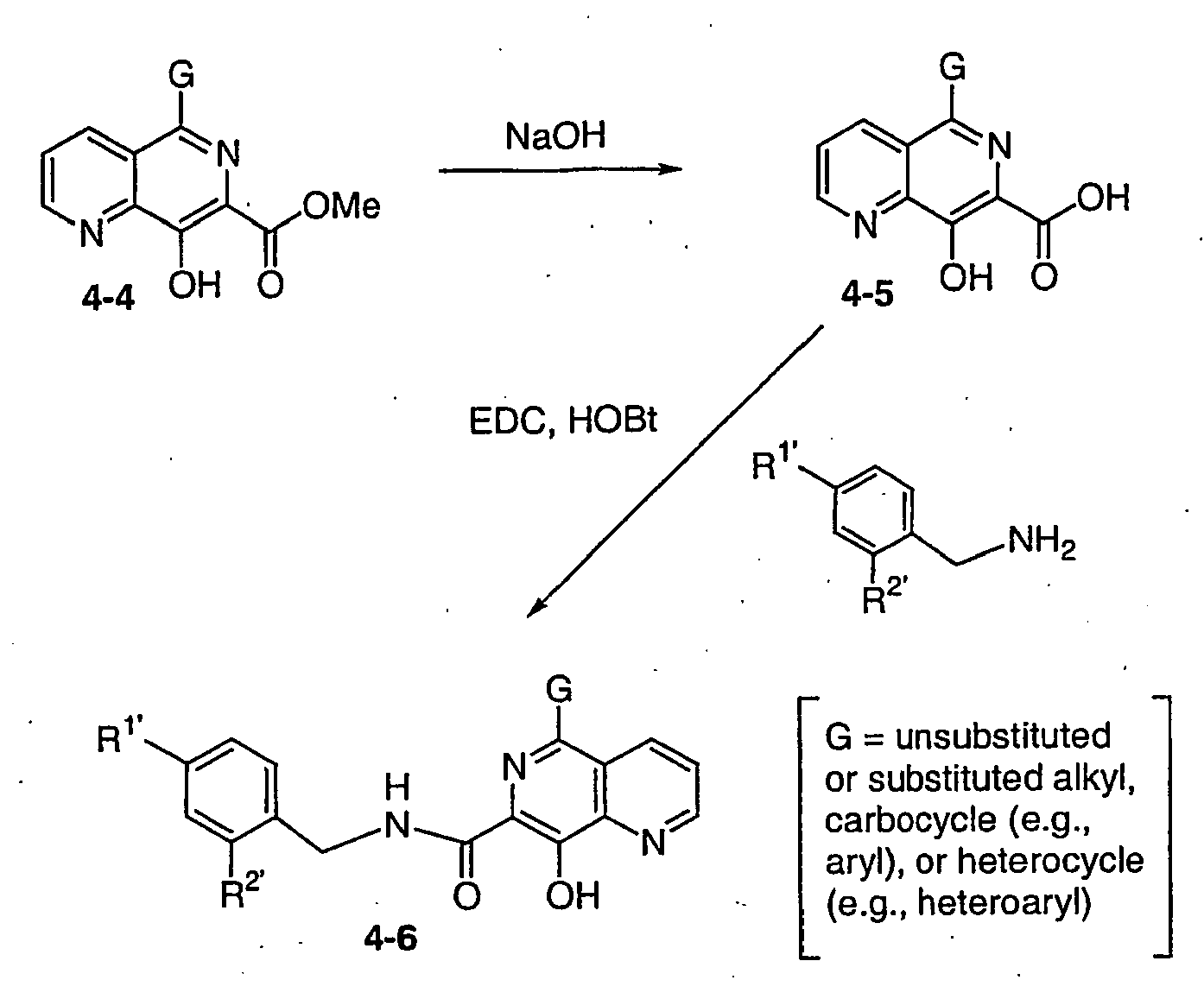
- Compounds of the invention that comprise an amino substituent at the 5 position can be prepared in the manner set forth in Scheme 5. Bromination of the phenol 5-1 occurs regioselectively upon treatment with NBS in an inert solvent like methylene chloride to afford 5-2. Reaction of this bromide with an amine at elevated temperatures in the presence of a polar solvent such as DMPU affords compounds of the invention 5-3.

- Preparation of compounds of the invention substituted with a sulfonamide can be prepared according to Scheme 6. The preparation includes halogenation of alkyl 8-hydroxy-naphthyridine carboxylate 6-1 with a halogenation agent such as N-bromosuccinimide, and then condensing the 5-halo-8-hydroxy-naphthyridine carboxylic ester 6-2 with sulfonamide 6-3 at elevated temperature (e.g., about 120 °C) in the presence of a copper promoter (e.g., copper(I) oxide) to afford sulfonamidonaphthyridine 6-4. The 7-position ester can then be hydrolyzed and the benzylamine portion attached through standard amide bond formation methods to give desired product 6-6.

- Scheme 7 shows a method for preparing compounds of the invention in which the benzylamine moiety has either an ortho-substituted amino-2-oxoethyl group or an ortho-substituted aminocarbonyl group. In this scheme, amine 7-1 is coupled with a suitable naphthyridine carboxylic acid under standard EDC /HOAt coupling conditions in the presence of a suitable base (e.g., NMM) to afford amide product 7-2. The resulting ester can then be hydrolyzed to the acid which can then be coupled with a suitable amine.

- Scheme 8 describes the preparation of compounds having an aminocarboxy group at the 5-position of the naphthyridine ring. In this scheme, the brominated naphthyridine 8-1 is treated with carbon monoxide and methanol under palladium catalysis utilizing 1,1"-bis(diphenylphosphino)ferrocene as a ligand, using conditions similar to those described in Ortar, Tett. Letters 1986, 27 (33): 3931, to afford acylated naphthyridine 8-2. Removal of the tosyl protecting group with sodium methoxide in an alcholic solvent (e.g., trifluoroethanol) affords the dimethyl dicarboxylate 8-3, which can be selectively hydrolyzed under aqueous base conditions (e.g., as described in Jerry March, Advanced Organic Chemistry, 3rd edition, John Wiley & Sons, 1985, pp. 334-338) to the carboxylic acid 8-4. The amide 8-5 can then be obtained from 8-4 with conventional amide coupling reagents like BOP or EDC in the presence of excess amine. The 7-position ester can then be hydrolyzed with aqueous base to afford the acid 8-6, which can then be coupled with a suitable benzylamine to give 8-7.


- Compounds of the invention that comprise an amide substituent at the 5-position of the naphthyridine can also be prepared in the manner set forth in Scheme 9. The brominated naphthyridine ester 9-1 prepared as described in Scheme 17 can be hydrolyzed to the acid and coupled using standard reagents to an appropriately substituted amine to give 9-3. Protection of the phenolic oxygen with a tosyl group under standard conditions gives the bromide 9-4, which can the react with carbon monoxide and methanol under palladium catalysis as described for Scheme 19 to afford the ester 9-5. This material can then be treated with base to remove the protecting group and elaborated under standard conditions to compounds of the invention 9-7.
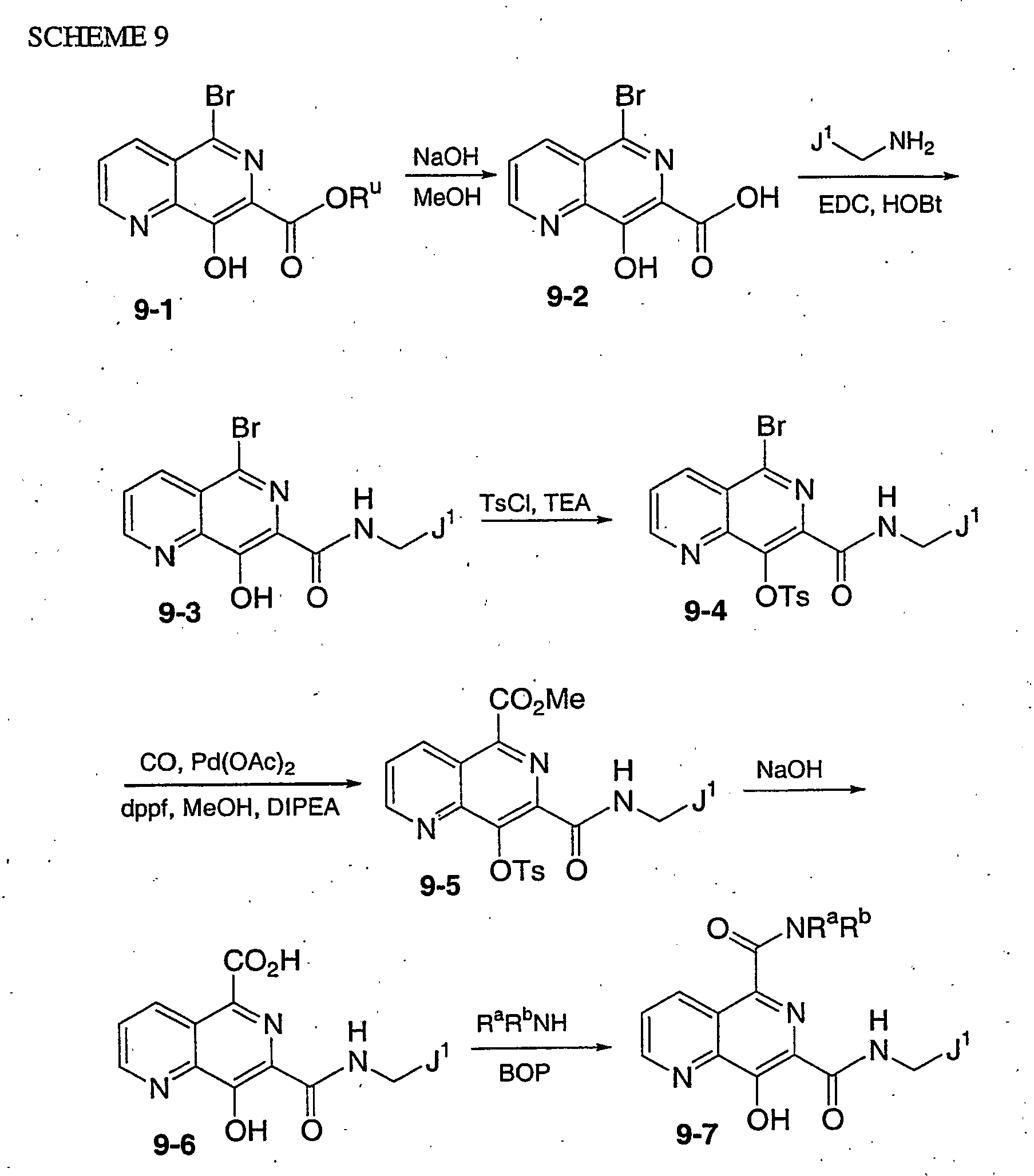
- In the processes for preparing compounds and intermediates of the present invention as set forth in the foregoing schemes, functional groups in various moieties and substituents may be sensitive or reactive under the reaction conditions employed and/or in the presence of the reagents employed. Such sensitivity/reactivity can interfere with the progress of the desired reaction to reduce the yield of the desired product, or possibly even preclude its formation. Accordingly, it may be necessary or desirable to protect sensitive or reactive groups on any of the molecules concerned. Protection can be achieved by means of conventional protecting groups, such as those described in Protective Groups in Organic Chemistry, ed. J.F.W. McOmie, Plenum Press, 1973 and in T.W. Greene & P.G.M. Wuts, Protective Groups in Organic Synthesis, John Wiley & Sons, 1991. The protecting groups may be removed at a convenient subsequent stage using methods known in the art. Alternatively the interfering group can be introduced into the molecule subsequent to the reaction step of concern. For example, if either of substituents R1' and R2' in amine 1-1 can interfere with the coupling reaction between reactants 1-1 and 1-2 of Scheme 1, the substituent can be incorporated into the molecule in a post-coupling step. Scheme 7 above illustrates the post-coupling introduction of an amide-containing substituent on the benzyl ring.
- Further description of methods suitable for use (either directly or via routine modification) in preparing compounds of the present invention can be found in
WO 02/30930 US 2003/0055071 , which is publishedU.S. Application Serial No. 09/973,853, filed October 10, 2001 - The following examples serve only to illustrate the invention and its practice. The examples are not to be construed as limitations on the scope or spirit of the invention.
-

Weight FW Moles Equiv. Density Volume MsCl ( 1 ) 2.36 kg 114.55 20.6 1.03 1.480 1.59 L 3-bromopropylamine ( 2 ) HBr salt 4.40 kg 220 20.0 1.00 TEA 4.07 kg 101.19 40.2 2.01 0.726 5.60 L THF 43+4+8= 55L DIPA 481 g 101.19 4.75 0.25 0.722 666 mL 1,10-Phenanthroline 4.11 g 180.21 n-BuLi, 1.6 M in hexane - The 3-bromopropylamine-HBr salt ( 2 ) and THF (43 L) were placed in a 72 L round-bottomed-flask under N2 and the resulting slurry was cooled to 0 °C. Two dropping funnels were fitted to the flask. One was charged with the TEA and the other with a solution of the MsCl ( 1 ) and THF (4 L). The contents of the addition funnels were added at roughly the same rate (the TEA was added slightly faster than the MsCl) while maintaining an internal reaction temperature below 10 °C. The addition required 2 h. The resulting white suspension was warmed to 23 °C and aged for 1 h. The suspended solids (a mixture of TEA-HBr and TEA-HCl) were removed by filtration through a dry frit. The cake was washed with THF (8 L). The combined filtrate and cake-rinse, a THF solution of 3 , was collected in a 100 L round-bottomed-flask under N2. To the solution of 3 was added the 1,10-phenanthroline and the DIPA and the resulting solution was cooled to -30 °C. The n-BuLi was added over about 4 h maintaining the internal temperature below -20 °C. After 1.25 eq of the n-BuLi was added the reaction mixture became deep brown and the color remained as the addition was completed. The reaction mixture was warmed to 0 °C over 3 h. A small aliquot was removed, and partitioned between saturated NH4Cl and EtOAc. The EtOAc was evaporated and the residue examined by 1H NMR to confirm consumption of 3 and conversion to 4 . To the reaction mixture at 0 °C was added saturated aqueous NH4Cl (12 L, the first 1L slowly, a heat kick to 6 °C was observed) and then brine (12 L). The phases were partitioned and the aqueous phase was extracted with EtOAc (20 L). The organic phases were combined, washed with brine (4 L) and then concentrated under vacuum to about 12 L. The solvent was switched to EtOAc (20 L used) maintaining a volume of 12 L. After the solvent switch, a yellow slurry resulted. n-Heptane (20 L) was added with stirring and the slurry was cooled to 5 °C. After a 1h age the solids were collected on a frit and rinsed with cold (5 °C) 3:5 EtOAc/n-heptane. The wet cake was dried for 24 h under a stream of dry N2 to provide 1.44 kg (53% from 2 ) of sultam 4 as a crystalline yellow solid.
-

- N-bromosuccinimide (7.83 g, 44.0 mmol) was added to a solution of 8-hydroxy-1,6-naphthyridine-7-carboxylic acid methyl ester ( 5 , 8.17 g, 40.0 mmol) in chloroform (32 mL) over 20 min maintaining the temperature at 20-50 °C and the mixture was aged for 30 min at 50 °C. The mixture became a thick, stirrable slurry and HPLC analysis indicated <2% starting material remaining. The mixture was cooled to 30 °C over 15 min. MeOH (64 mL) was added over 30 min then a 1:1 mixture of MeOH-water (64 mL) was added over 30 min. The mixture was cooled to -40 °C over 30 min and aged at -40 °C for 30 min. The cold mixture was filtered and the solid was washed with 1:1 MeOH:water (100 mL) at 10-20 °C. The off white crystalline solid was dried under a stream of nitrogen to provide 10.48 g (93% yield) of 5-bromo-8-hydroxy-1,6-naphthyridine-7-carboxylic acid methyl ester ( 6 ).
HPLC retention times: 5 = 2.2 min, 6 = 6.0 min, HPLC conditions: 150 × 4.6 mm ACE 3 C18 column, isocratic elution with 30% MeCN in 0.025% aq H3PO4 at 1 mL/min, 25 °C with detection at 254 nm;
HPLC retention times: 5 = 1.8 min, 6 = 3.1 min, HPLC conditions: 150 × 4.6 mm ACE 3 C18 column, isocratic elution with 46% MeCN in 0.025% aq H3PO4 at 1 mL/min, 25 °C with detection at 254 nm.
13C NMR of 6 (CDCl3, 100 MHz): 169.7, 156.3, 154.5, 143.9, 137.1, 132.4, 128.0, 126.1, 124.2, 53.4. -

- Triethylamine (0.759 g, 7.50 mmol) was added to a suspension of 5-bromo-8-hydroxy-1,6-naphthyridine-7-carboxylic acid methyl ester ( 6, 1.415 g, 5.000 mmol) in chloroform (5 mL) over 5 min maintaining the temperature at 20-50 °C to give a yellow suspension. p-Toluenesulfonyl chloride (1.15 g, 6.00 mmol) was added over 5 min maintaining the temperature at 20-40 °C to give a yellow solution. The mixture was aged at 40 °C for 2 h during which a crystalline solid precipitated out of the mixture and the color faded (HPLC analysis indicated <0.5% starting material remaining). The mixture was cooled to 20 °C over 15 min. MeOH (10 mL) was added over 30 min then a 1:1 mixture of MeOH:water (10 mL) was added over 30 min. The mixture was cooled to -40 °C over 30 min and aged at -40 °C for 30 min. The cold mixture was filtered and the solid was washed with 1:1 MeOH:water (10 mL), MeOH (5 mL), MTBE (10 mL) and hexanes (10 mL) all at 10-20 °C. The off-white crystalline solid was dried under a stream of nitrogen to provide 2.112 g (97% yield) of 5-bromo-8-(p-toluenesulfonyloxy)-1,6-naphthyridine-7-carboxylic acid methyl ester ( 7 ).
HPLC retention times: 6 = 3.1 min, 7 = 12.4 min, HPLC conditions: 150 × 4.6 mm ACE 3 C18 column, isocratic elution with 46% MeCN in 0.025% aq H3PO4 at 1 mL/min, 25 °C with detection at 254 nm.
13C NMR of 7 (d6-DMSO, 100 MHz): 163.2, 157.0, 146.5, 145.8, 141.9, 141.3, 139.2, 37.2, 132.3, 130.4, 129.0, 127.6, 127.1, 53.3, 21.7. -
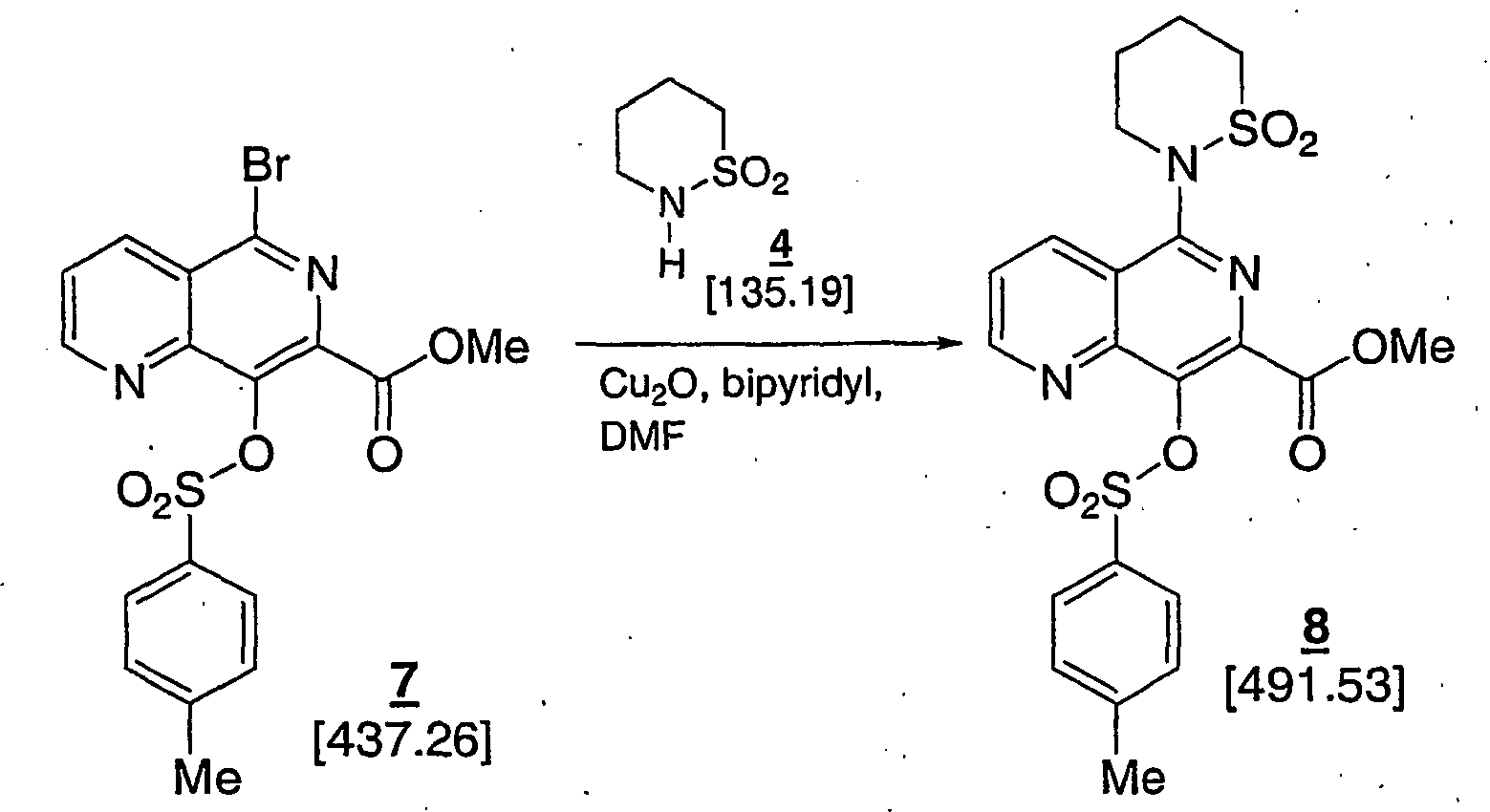
- A mixture of 5-bromo-8-(p-toluenesulfonyloxy)-1,6-naphthyridine-7-carboxylic acid methyl ester ( 7, 2.186 g, 5.000 mmol), 1,4-butane sultam ( 4, 811 mg, 6.00 mmol), copper (I) oxide (858 mg, 6.00 mmol, <5 micron), 2,2'-bipyridyl (937 mg, 6.00 mmol) and DMF (10 mL) was degassed by stirring under a stream of nitrogen for 1 min and heated to 120 °C for 4 h. The brown suspension became a dark red solution with a small amount of undissolved copper (I) oxide remaining (HPLC analysis indicated <0.5% starting material remaining). The mixture was diluted with chloroform (10 mL), Solkaflok (200 mg) was added and the resulting mixture was filtered through a plug of Solkaflok. The plug was washed with chloroform (10 mL) and the combined filtrates were stirred vigorously with a solution of EDTA disodium salt dihydrate (3.8 g, 10.2 mmol) in water (40 mL) while air was slowly bubbled in for 40 min. The upper aqueous phase became turquoise while the lower organic phase became yellow. The organic phase was washed with a solution of EDTA disodium salt (1.9 g, 5.1 mmol) in water (30 mL) and a solution of sodium bisulfate monohydrate (0.87g, 6.3 mmol) in water (30 mL). Each of the above three aqueous phases was back extracted sequentially with one portion of chloroform (15 mL). The organic phases were dried over sodium sulfate and filtered. The dried organic extracts were concentrated and solvent switched to a final volume of 15 mL MeOH using a total of 30 mL MeOH for the switch at atmospheric pressure. Product crystallized during the solvent switch. The resulting slurry was cooled to 0 °C over 30 min and aged at 0 °C for 30 min. The slurry was filtered cold and the solid was washed with MeOH (15 mL). The off white solid was dried under a stream of nitrogen to provide 1.910 g (78%) of 5-(N-1,4-butanesultam)-8-(p-toluenesulfonyloxy)-1,6-naphthyridine-7-carboxylic acid methyl ester ( 8 ).
HPLC retention times: 7 = 12.4 min, 8 = 10.3 min, DMF =1.3 min, Bipy = 1.5 min, HPLC conditions: 150 x 4.6 mm ACE 3 C18 column, isocratic elution with 46% MeCN in 0.025% aq H3PO4 at 1 mL/min, 25 °C with detection at 254 nm.
13C NMR of 8 (CDCl3, 100 MHz): 164.2, 155.3, 151.9, 146.7, 145.4, 141.2, 137.8, 135.3, 133.6, 129.6, 128.9, 125.4, 124.3, 53.4, 52.9, 48.7, 24.2, 22.0, 21.7. -

- 5-(N-1,4-butanesultam)-8-(p-toluenesulfonyloxy)-1,6-naphthyridine-7-carboxylic acid methyl ester ( 8 , 1.597 g, 3.250 mmol) was dissolved in DMF (3.25 mL) at 40 °C and transferred to a solution of 0.5M NaOMe in MeOH (16.25 mL, 8.125 mmol) over ca 1-2 min at 20-25 °C. The resulting yellow homogenous mixture was heated to 50 °C and aged for 5 min (HPLC analysis indicated <0.5% starting material remaining). Mixture was cooled to 25 °C over 15 min and aged at 25 °C for 15 min during which a yellow crystalline precipitate was deposited. Acetic acid (390 mg, 6.50 mmol) was added over 1 min (yellow color faded) then water (32.5 mL) was added over 15 min at 25 °C. The slurry was aged for 30 min 25 °C and filtered. The filter cake was washed with 1:1 MeOH:water (32.5 mL) and then with 1:1 MTBE:hexanes (8 mL). The filter cake was dried under a stream of nitrogen to provide 1.064 g (97%) of 5-(N-1,4-butanesultam)-8-hydroxy-1,6-naphthyridine-7-carboxylic acid methyl ester ( 9 ) as an off white crystalline solid.
HPLC retention times: 8 = 10.3 min, 9 = 2.9 min, HPLC conditions: 150 × 4.6 mm ACE 3 C18 column, isocratic elution with 46% MeCN in 0.025% aq H3PO4 at 1 mL/min, 25 °C with detection at 254 nm.
13C NMM of 9 (d6-DMSO, 100 MHz): 167.8, 154.4, 153.5, 143.9, 143.7, 135.2, 125.9, 125.2, 124.4, 53.2, 53.1, 49.1, 24.4, 21.9. -

-
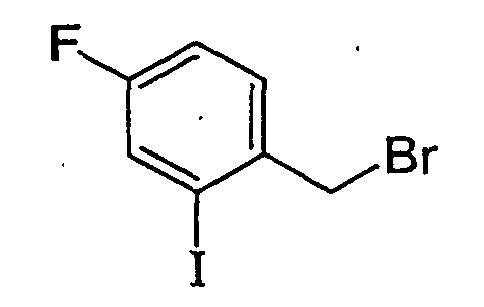
- A suspension of 4-fluoro-2-iodotoluene (14.3 g, 60.6 mmol, Lancaster Synthesis), N-bromosuccinimide (16.2 g, 90.9 mmol), and benzoyl peroxide (0.74 g, 3.0 mmol) in carbon tetrachloride (500 mL) was heated to reflux for 3 days. Additional NBS (0.5 eq portions) was added as needed over this period to drive the reaction to completion. The reaction was cooled, filtered, and the filtrate was concentrated in vacuo. The residue was purified by flash column chromatography (ISCO column, 110 g silica gel) eluting with 100% hexane to afford the desired product as a white solid.
- 1H NMR (DMSO-d6, 400 MHz) δ 7.79 (1H, dt, J = 8.4, 1.3 Hz), 7.68 (1H, m), 7.31 (1H, m), and 4.74 (2H, s) ppm.
-

- A suspension of 1-(bromomethyl)-4-fluoro-2-iodobeinzene (15.68 g, 47.8 mmol) and sodium azide (4.21 g, 64.7 mmol) in dry DMF (30 mL) was heated to 50°C for six hours. The reaction was filtered and the filtrate was concentrated in vacuo to a volume of about 10 mL. The crude was purified by flash column chromatography (ISCO column, 110 g silica gel) eluting with 100% hexane to afford the desired product as a clear oil.
1H NMR (DMSO-d6, 400 MHz) δ 7.83 (1H, dd, J = 8.3, 2.7 Hz), 7.54 (1H, dd, J = 8.6, 6.1 Hz), 7.33 (1H, td, J = 8.5, 2.6 Hz), and 4.52 (2H, s) ppm. -

- Triphenylphosphine (13.2 g, 50.4 mmol) was added to 1-(azidomethyl)-4-fluoro-2-iodobenzene (9.31 g, 33.6 mmol) dissolved in dry DMF (20 mL) at 0°C. After one hour water (3.03 mL, 168 mmol) was added and the solution was heated to 55°C for one hour. The reaction was cooled and the solution was concentrated to about 10 mL in vacuo. The residue was purified in two runs by preparative HPLC (Gilson semi preparative HPLC system using a Waters Delta pak column (3(10x40 mm I.D.) cartridges, C18, 15 µM pore size) eluting with 95-5% water (0.025% TFA) / acetonitrile (0.025% TFA) at 45 mL/min) to give the desired product in 75% purity. Using a Waters OASIS MCX Cartridge (6 g, 35 cc syringe), half of the 75% pure product dissolved in methanol was loaded onto the column pre-equilibrated with a 1:1 solution of water and methanol. The column was washed once with the 1:1 solution and then washed several times with methanol to remove all UV active material. The amine was eluted by washing the column with methanol saturated with ammonia gas. This procedure was repeated on the remaining 75% pure product. The two batches were combined and concentrated in vacuo to give the free base of the desired product as a yellow oil.
1H NMR (DMSO-d6, 400 MHz) δ 8.28 (2H, bs), 7.86 (1H, dd, J = 8.2, 2.7 Hz), 7.53 (1H, dd, J = 8.6, 5.9 Hz), 7.41 (1H, td, J = 8.5, 2.6 Hz), and 4.09 (2H, s) ppm. -

- Triethylamine (1.41 mL, 10.1 mmol) was added to a 0°C suspension of 1-(4-fluoro-2-iodophenyl)methanamine (2.30 g, 9.16 mmol) and di-tert-butyl dicarbonate (2.20 g, 10.1 mmol) in dry methylene chloride (60 mL). The homogeneous solution was stirred at 0°C for five minutes then at room temperature for two hours. The reaction was diluted with methylene chloride (30 mL), washed with water three times and washed once with brine. The organic layer was dried over sodium sulfate, filtered, and concentrated in vacuo to a clear oil. The residue was purified by flash column chromatography (ISCO column, 110 g silica gel) eluting with a 10-25% ethyl acetate / hexane gradient over 30 minutes to afford the desired product as a clear oil.
1H NMR (CDCl3, 400 MHz) δ 7.55 (1H, dd, J = 8.0, 2.5 Hz), 7.34 (1H, t, J = 7.1 Hz), 7.05 (1H, td, J = 8.3, 2.4 Hz), 5.02 (1H, m) 4.31 (2H, d, J = 6.0 Hz) and 1.46 (9H, s) ppm.
ES HRMS: calc'd for C12H15FINO2+Na 374.0024, observed 374.0022. -

- Through a solution of tert-butyl 4-fluoro-2-iodobenzylcarbamate (1.00 g, 2.85 mmol) in dry DMF (20 mL), in an oven dried glass insert in a high pressure bomb reactor flushed with nitrogen, was bubbled methylamine gas at 0°C until the solution was saturated and excess methylamine was condensed into the reaction (approximately 30 equivalents of methylamine). Diisopropylethylamine (0.99 mL, 5.70 mmol), palladium acetate (64 mg, 0.29 mmol) and 1,1'-bis(diphenylphosphino)ferrocene (158 mg, 0.29 mmol) were added to the saturated solution. The glass insert was then placed in the pressure vessel and the vessel was purged once with carbon monoxide gas. The vessel was recharged with carbon monoxide gas to pressure of 300 psi, placed into an oil bath, and heated to 90°C for four hours. The vessel was cooled, the gas was released slowly and the resulting mixture was partitioned between water and ethyl acetate. The layers were separated and the organic extracts were dried over sodium sulfate, filtered, and concentrated in vacuo to a brown liquid. The residue was purified by flash column chromatography (ISCO column, 110 g silica gel) eluting with a 10-50% acetone / hexane gradient over 35 minutes to afford the desired product as a brown crystalline solid.
1H NMR (DMSO-d6, 400 MHz) δ 8.38 (1H, d, J= 4.0 Hz), 7.35-7.19 (4H, m), 4.20 (2H, d, J = 6.1 Hz), 2.75 (3H, d, J = 4.6 Hz) and 1.39 (9H, s) ppm. -

- Hydrogen chloride gas was bubbled through a -78°C solution of tert-butyl 4-fluoro-2-[(methylamino)carbonyl]benzylcarbamate (615mg, 2.18 mmol) in ethyl acetate (20 mL) until the solution was saturated. The flask was then allowed to warm to room temperature. The reaction was concentrated in vacuo to a volume of about 5 mL and the flask was capped and placed in the freezer overnight. In the morning, the solids that had precipitated were collected by vacuum filtration and washed with cold ethyl acetate to give the desired product as an off-white solid.
1H NMR (DMSO-d6, 400 MHz) δ 8.81 (1H, d, J = 4.0 Hz), 8.25 (3H, bs), 7.62 (1H, dd, J = 8.3, 5.7 Hz), 7.50-7.42 (2H, m), 4.04 (2H, s), and 2.80 (3H, d, J = 3.7 Hz) ppm. -

- A suspension of methyl 5-(1,1-dioxido-1,2-thiazinan-2-yl)-8-hydroxy-1,6-naphthyridine-7-carboxylate (1.00 g, 2.96 mmol, prepared as described in Example 2 above) in methanol (18 mL) with aqueous lithium hydroxide (17.8 mL, 17.8 mmol, 1N solution) was stirred overnight at 60°C. The suspension was acidified to a pH = 4 using 3N HCl (about 6 mL) and the resulting solution was allowed to stir overnight at room temperature. In the morning, the solids that had precipitated out of solution were collected by vacuum filtration to give the desired product as a light yellow solid.
1H NMR (DMSO-d6, 400 MHz) δ 9.21 (1H, dd, J = 4.3, 1.6 Hz), 8.62 (1H, dd, J = 8.5, 1.6 Hz), 7.92 (1H, dd, J = 8.5, 4.3 Hz), 3.91-3.78 (2H, m), 3.55-3.45 (2H, m), 2.28 (3H, m) and 1.64 (1H, m) ppm. -

- A solution of 5-(1,1-dioxido-1,2-thiazinan-2-yl)-8-hydroxy-1,6-naphthyridine-7-carboxylic acid (100 mg, 0.31 mmol), 1-[3-(dimethylamino)propyl]-3-ethylcarbodiimide hydrochloride (89 mg, 0.46 mmol), 1-hydroxy-7-azabenzotriazole (63 mg, 0.46 mmol), {4-fluoro-2-[(methylamino)carbonyl]phenyl}-methanaminium chloride (101 mg, 0.46 mmol) and triethylamine (65 µL, 0.46 mmol) in dry DMF (2 mL) was stirred at room temperature overnight. In the morning, a couple drops of water were added and the reaction was filtered through a glass fiber filter. The filtrated was purified by preparative HPLC (Gilson semi preparative HPLC system using a Waters Nova pak column (10x40 mm I.D. cartridges, C18, 6 µM pore size) eluting with 95-5% water (0.025% TFA) / acetonitrile (0.025% TFA) at 35 mL/min) to give the product as a TFA salt. The crude solid was dissolved in CHCl3 and washed with aqueous saturated ammonium chloride solution. The aqueous layer was back-extracted with CHCl3 three times and the combined organic extracts were dried over sodium sulfate, filtered, and concentrated in vacuo to give the desired product as a pale yellow solid.
1H NMR (DMSO-d6, 400 MHz) δ 9.53 (1H, s), 9.19 (1H, s), 8.68 (1H, s), 8.58 (1H, d, J = 8.0 Hz), 7.89 (1H, d, J = 3.8 Hz), 7.53 (1H, m), 7.41-7.34 (2H, m), 4.64 (2H, d, J = 5.7 Hz), 3.92-3.47 (4H, m), 2.83 (3H, d, J = 3.8 Hz), 2.35 (3H, m), and 1.64 (1H, m) ppm. - The title compound of Step 8 was also obtained as follows:
A solution of 5-(1,1-dioxido-1,2-thiazinan-2-yl)-8-hydroxy-1,6-naphthyridine-7-carboxylic acid (1.00 g, 3.09 mmol), 1-[3-(dimethylammo)propyl]-3-ethylcarbodiimide hydrochloride (0.77 g, 4.02 mmol), and 1-hydroxy-7-azabenzotriazole (0.55 g, 4.02 mmol) in degassed dry DMF (20 mL) was aged for 30 minutes to preform the activated ester. Triethylamine (0.47 mL, 3.40 mmol) and {4-fluoro-2-[(methylamino)carbonyl]phenyl}-methanaminium chloride (0.74 g, 3.40 mmol) were added and the reaction stirred for 30 minutes. The reaction was poured into water, the pH was adjusted to ∼10 using 1N NaOH, and resulting solution was extracted several times with CHCl3. The combined organic extracts were dried over Na2SO4, filtered, and concentrated to dryness in vacuo. The residue was partitioned between basic water (pH = 10 using 1N NaOH) and ether. The layers were separated and the aqueous layer was extracted twice more with ether. The aqueous layer was then acidified to pH = 4 using 1N HCl and extracted several times with CHCl3. The combined organic extracts were dried over Na2SO4, filtered, and concentrated to a brown oil. Methanol was added to the flask and the flask was sonicated for 5 minutes. Solids crashed out of the solution upon sonication and were collected by vacuum filtration to afford the title compound as a whitish solid.
1H NMR (DMSO-d6, 400 MHz) δ 9.53 (1H, s), 9.19 (1H, s), 8.68 (1H, s), 8.58 (1H, d, J = 8.0 Hz), 7.89 (1H, d, J = 3.8 Hz), 7.53 (1H, m), 7.41-7.34 (2H, m), 4.64 (2H, d, J = 5.7 Hz), 3.92-3.47 (4H, m), 2.83 (3H, d, J = 3.8 Hz), 2.35 (3H, m), and 1.64 (1H, m) ppm. - Sodium hydroxide (150 µL, 0.15 mmol, 1N solution) was added to a cloudy solution of 5-(1,1-dioxido-1,2-thiazinan-2-yl)-N-{4-fluoro-2-[(methylamino)carbonyl]benzyl}-8-hydroxy-1,6-naphthyridine-7-carboxamide (73 mg, 0.15 mmol) in a 2 mL mixture of acetone, acetonitrile and water. The homogeneous bright yellow solution was allowed to stir at room temperature for 30 minutes. The solvent was removed in vacuo and dried overnight on the high vac with gentle heating to give the desired product as a bright yellow solid.
1H NMR (DMSO-d6, 400 MHz) δ 12.12 (1H, s), 8.78 (1H, m), 8.66 (1H, d, J = 4.6 Hz), 8.29 (1H, d, J = 6.8 Hz), 7.56 (1H, dd, J = 8.4, 4.2 Hz), 7.46 (1H, dd, J = 8.3, 5.6 Hz), 7.26-7.19 (2H, m), 4.61 (2H, d, J = 5.9 Hz), 3.81 (2H, m), 3.51 (1H, m), 3.23 (1H, m), 2.81 (3H, d, J = 4.4 Hz), 2.43 (1H, m), 2.23 (2H, m) and 1.64 (1H, m) ppm. ES HRMS: calc'd for C22H21FN5NaO5S 510.1218, observed 510.1219. -

- With no precautions to maintain a dry atmosphere, methyl 5-fluoro-2-methylbenzoate (Maybridge, 5g, 29.7 mmole) was dissolved in CCl4 (50 mL). N-bromosuccinimide (5.82g, 32.7 mmol) and benzoyl peroxide (0.36g, 1.48 mmole) were added and the reaction brought to reflux overnight. An additional 0.3 eq of NBS and 0.01 eq of benzoyl peroxide was added and the reaction refluxed for 4 hrs, then cooled, filtered and concentrated. The residue was chromatographed on silica eluting with a gradient of 0-10% EtOAc/Hexanes. The fractions were collected to give the product, which was a mixture of mono and bis-brominated materials, as a clear oil.
1H NMR (CDCl3, 400 MHz, major product peaks) δ 7.67 (1H, dd, J= 2.8, 9 Hz), 7.45 (1H, dd, J = 5.4, 9 Hz), 7.20 (1H, m), 4.93 (2H, s), 3.95 (3H, s) ppm. -

- In a dry flask under nitrogen, di-tert-butyl iminodicarboxylate (Aldrich, 3.86g, 17.8 mmol) was dissolved in dry DMF (5 mL) and treated with NaH (60% dispersion in oil, 0.71g, 17.8 mmol). After the evolution of gas had ceased, Methyl 2-(bromomethyl)-5-fluorobenzoate (4g, 16.2 mmole) dissolved in DMF (5 mL) was added. An additional 5 mL of DMF was added to aid stirring. The reaction was stirred for 2 hrs, then partitioned between water and EtOAc. The organic layer was dried with Na2SO4, filtered and concentrated and the residue was purified on silica eluting first with toluene, then with a gradient of 0-5% MeOH/CHCl3. The impure product thus obtained was re-chromatographed on silica eluting with a gradient of 0-30% EtOAc/Hexanes. The product was obtained as a clear oil.
1H NMR (DMSO, 400 MHz, major product peaks) δ 7.63 (1H, dd, J= 2.8, 9.4 Hz), 7.52 (1H, m), 7.20 (1H, dd, J= 5.3, 8.7 Hz), 4.98 (2H, s), 3.86 (3H, s), 1.38 (s, 18H) ppm. -

- A solution of methyl 2-{[bis(tert-butoxycarbonyl)amino]methyl}-5-fluorobenzoate (5.0g, 13.04 mmol) in toluene (40 mL) was treated with methylamine gas at -78°C until the solution was saturated. The reaction contents were then placed into a steel bomb and heated to 70°C overnight. After cooling, the reaction was concentrated and then the solids were triturated with ether. The resulting solids were collected by vacuum filtration. As a result of the relatively harsh reaction conditions one of the t-butyloxycarbonyl protecting groups was removed from the molecule.
1H NMR (CDCl3, 400 MHz) δ 7.41 (1H, dd, J = 5.6, 8.3 Hz), 7.14-7.06 (2H, m), 6.64 (1H, BS), 5.69 (1H, BS), 4.26 (2H, d, J = 6.3 Hz), 2.98 (3H, d, J = 4.8 Hz), 1.41 (9H, s) ppm. -

- A solution of tert-butyl 4-fluoro-2-[(methylamino)carbonyl]-benzylcarbamate (2.59g, 9.17 mmol) in EtOAc (75 mL) was cooled to -78°C. After cooling solids precipitated out of the solution. HCl gas was added to the suspension until it reached saturation at which time the reaction became homogenous. After adding the HCl gas the dry ice bath was replaced with an ice water bath and the reaction was stirred for 10 minutes at 0°C. The solution was concentrated slowly and then redissolved in EtOAc and this was repeated two more times. The resulting solids were then triturated from EtOAc and fluffy white solids were collected by vacuum filtration.
1H NMR (DMSO, 400 MHz) δ 8.82 (1H, d, J = 4.2 Hz), 8.34 (3H, bs), 7.64 (1H, dd, J = 5.6, 8.5 Hz), 7.49-7.41 (2H, m), 4.04 (2H, s), 2.80 (3H, d, J = 4.5 Hz) ppm. -

- A solution of 1-(bromomethyl)-4-fluoro-2-iodobenzene (Example 3, step 1) (5g, 15.9 mmol) in dry DMF (50 mL) under argon was cooled to 2°C and treated with NaH (60% dispersion in oil, 0.4g, 17.5 mmol) and stirred for 5 minutes to give a fine slurry. A solution of di-tert-butyl iminodicarboxylate (Aldrich, 3.8g, 17.5 mmol) in 20ml dry DMF was added dropwise, keeping the temperature between 2 and 7°C. After stirring for 1 hr at 0°C, the solution was allowed to warm to room temperature and stirred overnight. The reaction was poured into bicarbonate solution and water was added until all the solids dissolved. The solution was extracted with ether and the combined organic layers were dried over Na2SO4, filtered and evaporated and the crude product was purified on 120g silica gel ISCO cartridge eluting first with a gradient of 0-5% EtOAc/Hexanes followed by a gradient of 5-10% EtOAc/Hexanes to give the product as a clear oil that solidified to a white solid.
1H NMR (CDCl3, 400 MHz) δ 7.55 (1H, bd, J = 7.3 Hz), 7.03 (2H, m), 4.72 (s, 2H), 1.44 (18H, s). -
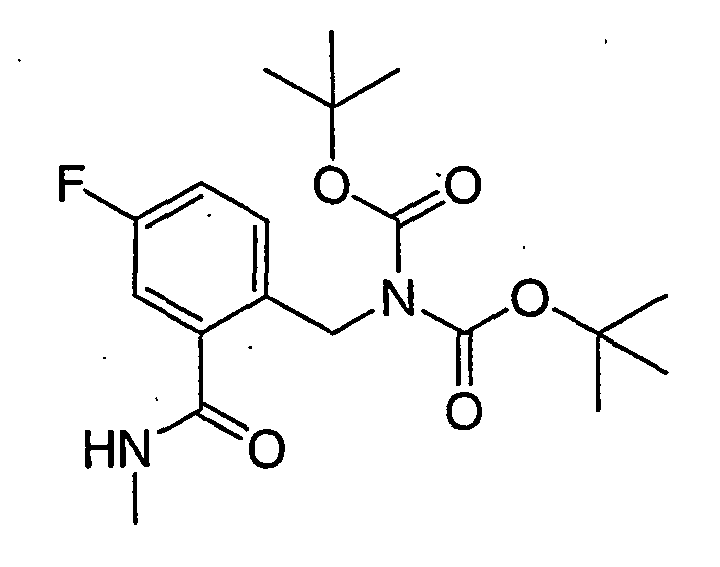
- The glass reaction vessel from a Parr high pressure apparatus was briefly dried in an oven and di(tert-butyl) 4-fluoro-2-iodobenzylimidodicarbonate (5.17g, 11.5 mmol) was added and dissolved with stirring in 25 mL of dry DMF. Argon was bubbled through the solution while it was cooled to 0°C. Palladium acetate (0.064g, 0.29 mmol), DPPF (0.16g, 0.29 mmol), and diisopropylethylamine ( 3g, 23 mmol) were added, the flask was tared, and the solution was saturated with methylamine gas (10.5g methylamine, 338.6 mmol). The water condensed on the outside of the reaction vessel was wiped off and the vessel was placed in the Parr high pressure apparatus which was flushed with carbon monoxide gas, then sealed and pressurized to 75 psi carbon monoxide and heated to 70°C internal temperature for 4 hrs. The vessel was cooled and vented and the green solution was poured into water and extracted with ether. The combined ether layers were dried with Na2SO4, filtered and evaporated and the residue was chromatographed on a 120g ISCO silica gel cartridge eluting with a gradient of 25-30% EtOAc/Hexanes to give the product as a mixture of mono and bis-tert-butylimidocarbonate protected material that was taken onto the next step. A small portion of the mono- and bis tert-butylimidocarbonate protected products were obtained pure and gave the following NMR.
1H NMR (CDCl3, 400 MHz) mono-protected product δ 7.42 (1H, dd, J = 5.6, 8.4 Hz), 7.1 (2H, m), 6.47 (1H, bs), 5.7 (1H, bs), 4.27 (2H, d, J = 6.4 Hz), 3.0 (3H, d, J = 4.9 Hz), 1.40 (9H, s) ppm.
1H NMR (DMSO-d6, 400 MHz) bis-protected product δ 8.4 (1H, d, J = 4.3 Hz), 7.35-7.2 (2H, m), 7.11 (1H, dd, J = 5.5, 8.3 Hz), 4.81 (2H,s), 2.75 (3H, d, J = 4.5 Hz), 1.38 (18H, s). -

- A mixture of mono and bis-protected intermediate from the previous step ( 4.58g, ∼ 19 mmol) was dissolved in 200mL EtOAc and cooled to -60°C under argon. The solution was saturated with HCl gas then the flask was transferred to an ice bath and the reaction monitored by HPLC until no starting materials remained. The reaction vessel was placed on a rotoevaporator and the solvent removed carefully under vacuum, first with the flask out of the water bath, then with the flask in room temperature water bath, to give a white solid. This material was resuspended in EtOAc and the solvent removed again under vacuum. The residue was dried under high vacuum overnight, then suspended in ether and filtered to give the final product as a white solid.
1H NMR (DMSO-d6, 400 MHz) δ 8.8 (1H, bs), 8.22 (3H, bs), 7.61 (1H, dd, J = 5.6, 8.4 Hz), 7.45 (2H, m), 4.04 (2H, s), 2.80 (3H, d, J = 4.5 Hz) ppm. -

Material MW Amount Moles 2-bromo-5-fluorobenzoic acid 219.01 4.00 kg 18.3 methanol 32.04
(d = 0.791)18 L 296.3 trimethylorthoformate 106.12 3.88 kg 36.5 96% sulfuric acid 98.08 0.373 kg 3.65 2M K2HPO4 174.18 4.82 L 9.68 ethyl acetate 16 L 10% NaHCO3 84.02 4 L 25% brine 4 L toluene 12 L DMF - To a 72 L round bottom flask, equipped with an overhead stirrer, thermocouple, water-cooled condenser, and nitrogen inlet, was charged methanol (18 L). 2-Bromo-5-fluorobenzoic acid (4.00 kg), trimethyl orthoformate (3.876 kg), were then charged with stirring, followed by the addition 96% sulfuric acid (0.373 kg). The resulting solution was refluxed at 63 °C and aged for 10-16 hr, while the by-product (methyl formate) was removed during the reaction. The reaction mixture was monitored by HPLC. The reaction mixture was concentrated, then diluted with ethyl acetate (16 L), and cooled to 20 °C. 2 M potassium hydrogen phosphate (4.82 L) was then added to adjust the pH to 6.5-7. The mixture was then transferred to a 100 L nalgene extractor. After phase cut, the organic layer was washed with 10% NaHCO3 (4 L), 25% brine (4 L), and then concentrated under reduced pressure. The residual oil was dissolved in toluene (6 L), and concentrated. This operation was done one more time. The remaining oil was dissolved in DMF (total vol. 9.2 L). The resulting solution was used for next step.
- HPLC conditions: column: Zorbax, Rx C8 250 x 4.6 mm; temperature: 30 ° C; detection: 210 nm; mobile phase: 0.1% aq H3PO4 (A)/MeCN (B); gradient: 90:10 (A)/(B) to 10:90 over 15 min, 10:90 hold for 5 min, 10:90 to 90:10 (A)/(B) over 10 seconds; flow rate: 1 mL/min; retention time for the desired monoester; 13.6 min.
- Evaporation of a sample to dryness gave a colorless oil: 1H NMR (400 MHz, CDCl3) δ: 7.64 (dd, J = 8.8, 5.0 Hz, 1H), 7.53 (dd, J = 8.8, 3.1 Hz, 1 H), 7.08 (td, J = 8.8, 3.1 Hz, 1 H), 3.95 (s, 3H); 13C NMR (100 MHz, CDCl3) δ: 165.4, 161.3 (d, J = 240.0 Hz), 135.9, 133.4, 120.0 (d, J = 20.0 Hz), 118.5 (d, J = 20.0 Hz), 116.1, 52.7.
-

Material MW Amount Moles methyl 2-bromo-5-fluorobenzoate 233.03 18.3 in DMF copper(I) cyanide 89.56 1.60 kg 17.9 DMF 5L+4L ethyl acetate 35 L + 17 L 10% NH4OH-20% NH4Cl 37 L 25% brine 8 L MeOH 33 L - To a solution of methyl 2-bromo-5-fluorobenzoate (18.26 moles) in DMF (total vol. 9.2 L) was charged copper(I) cyanide (1.603 kg) in DMF (5 L) slurry and followed with a DMF flush (4 L). After being degassed, the reaction mixture was heated at 100 °C for 10-16 hours. The reaction mixture was monitored by HPLC. After being cooled to 50 °C-60 °C, ethyl acetate (20 L) was added, and then 10% NH4OH-20% NH4Cl (22 L). The mixture was then transferred to a 100 L nalgene extractor. The 72 L round bottom flask was washed with 15 L of EtOAc and 15 L of water and transferred to the 100 L extractor. After phase cut, the aqueous layer was back-extraction with EtOAc (17 L) for one time. The combined organic layers were washed with 10% NH4OH/20% NH4Cl : water (1:1, 3 x 10 L), 16% brine (8 L), concentrated, and solvent switched to MeOH (total vol. 22 L, KF = 152.6 µg/mL). The resulting solution was used for next step.
- HPLC conditions: column: Zorbax, Rx C8 250 x 4.6 mm; temperature: 30 ° C; detection at 210 nm; mobile phase: 0.1% aq H3PO4 (A)/MeCN (B); gradient: 90:10 (A)/(B) to 10:90 over 15 min, 10:90 hold for 5 min, 10:90 to 90:10 (A)/(B) over 10 seconds; flow rate: 1 mL/min; retention time for the desired monoester: 11.7 min.
- Evaporation of a sample to dryness gave a light yellow solid: 1H NMR (CDCl3) δ: 7.86-7.80 (m, 2 H), 7.37 (td, J = 8.5, 2.6 H, 1 H), 4.02 (s, 3 H); 13C NMR (100 MHz, CDCl3) δ: 164.3 (d, J = 260 Hz), 163.3, 137.1 (d, J = 10.0 Hz), 135.2 (d, J = 10.0 HZ), 120.2 (d, J = 30.0 Hz), 118.8 (d, J = 20.0 Hz), 116.6, 109.0, 53.1.
-

Material MW Amount Moles methyl 2-nitrile-5-fluorobenzoate 179.15 10.6 in MeOH 3.0 M HCl in MeOH (anhydrous) 36.46 7.10 L 21.22 10% Pd/C 0.475 kg solka floc 2.6 kg MeOH 3 x 10 L - A degassed mixture of methyl 2-nitrile-5-fluorobenzoate (10.6 moles) in MeOH (total 10.0 L), 3.0 M HCl in MeOH (7.10 L), and 10% Pd/C (0.475 kg) was submitted to hydrogenation at 40 °C and 45 PSI for 48 hours. The reaction mixture was monitored by HPLC. After being cooled to ambient temperature, the reaction mixture was then filtered by passing a short Solka Flock (2.6 kg), which was washed with MeOH (3 x 10 L). The combined filtrates were concentrated and solvent-switched to toluene in total volume (about 18 L, KF = 154 µg/mL). The crystalline solid was filtered off and washed with toluene, dried under vacuum with nitrogen sweep to afford the title compound (>99A% purity, HPLC).
- HPLC conditions: column: Zorbax, Rx C8 250 x 4.6 mm; temperature: 30 ° C; detection at 210 nm; mobile phase: 0.1% aq H3PO4 (A)/MeCN (B); gradient: 90:10 (A)/(B) to 10:90 over 15 min, 10:90 hold for 5 min, 10:90 to 90:10 (A)/(B) over 10 seconds; flow rate: 1 mL/min; retention time for the desired monoester: 5.78 min.
- 1H NMR (CDCl3) δ: 8.43 (brs, 3 H), 7.74-7.65 (m, 2H), 7.55 (td, J = 8.4, 2.8 Hz, 1 H), 4.26 (q, J = 5.5 Hz), 3.85 (s, 3 H); 13C NMR (100 MHz, CDCl3) δ: 165.8, 162.1 (d, J = 250 Hz), 134.8 (d, J = 10.0 Hz), 131.9 (d, J = 10.0 Hz), 131.7, 120.1 (d, J = 20.0 Hz), 117.7 (d, J = 30.0 Hz), 53.2, 40.3.
-

Material MW Amount Moles ammonium salt 4 219.64 3.42 kg 15.6 (Boc)2O 218.25 3.73 kg 17.1 NMM 101.15
(d = 0.920)1.73 kg 17.1 40 wt.% MeNH2 31.06 1.21 kg 15.6 toluene 31 L 0.1 M EDTA Na sol'n 6.2 L 25% brine 6.2 L - To the ammonium salt 4 (3.42 kg) in toluene (31L) was added (Boc)2O (3.73 kg), followed by NMM (1.73 kg), at 15°C- 20 °C over 1 hour. The reaction mixture was aged at room temperature for 15-24 hours, followed by the addition of 40 wt% methylamine aqueous (1.21 kg) at 5 °C-10 °C, after which the mixture was aged at the same temperature for 2 hours to quench the excess (Boc)2O. The reaction mixture was then worked up by charging water (12 L). After phase cut, the organic layer was washed with 0.1 M EDTA sodium solution (6.2 L), 25% brine (6.2 L), and concentrated to total volume (20 L), which was divided by two equal amount portions for amidation in two batches.
- HPLC conditions: column: Zorbax, Rx C8 250 x 4.6 mm; temperature: 30 °C; detection at 210 nm; mobile phase: 0.1 % aq H3PO4 (A)/MeCN (B); gradient: 90:10 (A)/(B) to 10:90 over 15 min, 10:90 hold for 5 min, 10:90 to 90:10 (A)/(B) over 10 seconds; flow rate: 1 mL/min; retention time for the desired monoester: 14.5 min.
- Evaporation of a sample to dryness gave a colorless oil: 1H NMR (CDCl3) δ: 7.65 (dd, J = 9.4, 2.4, 1 H), 7.50 (dd, J = 8.0, 5.7 Hz, 1 H), 7.18 (dd, J = 8.0, 2.8 Hz, 1 H), 5.31 (brs, 1 H), 4.47 (d, J = 6.6 Hz, 1 H), 3.91 (s, 3 H), 1.41 (s, 9 H); 13C NMR (100 MHz, CDCl3) δ: 166.5, 1.61.5 (d, J = 250 Hz), 155.8, 137.0, 132.8 (d, J = 10.0 Hz), 130.2 (d, J = 10.0 Hz), 119.6 (d, J = 30.0 Hz), 117.7 (d, J = 20.0 Hz), 79.2, 52.4, 42.9, 28.4 (3C).
-

Material MW Amount Moles methyl benzoate 5 283.30 7.77 in toluene methylamine 31.06 0.483 kg 15.6 toluene 5 L heptane 50 L + 25 L - The crude methyl benzoate 5 in toluene (7.77 moles in 10 L) was cooled to -20 °C and methylamine (0.483 kg) gas was added. The mixture was then heated in an autoclave at 80-85 °C for 48 hours. The reaction was monitored by HPLC. After cooling to about 50 °C, the reaction mixture was transferred to a large round bottom flask for batch concentration. The solution was concentrated, producing a slurry, and solvent-switched to toluene (total vol. 12 L), after which heptane (50 L) was slowly charged to the slurry. The resulting slurry was aged at 0 °C for 1 hour. The white crystalline solid was filtered off, rinsed with heptane (25 L), and dried under vacuum with a nitrogen sweep to give methylamide.
- HPLC conditions: column: Zorbax, Rx C8 250 x 4.6 mm; temperature: 30 ° C; detection at 210 nm; mobile phase: 0.1% aq H3PO4 (A)/MeCN (B); gradient: 90:10 (A)/(B) to 10:90 over 15 min, 10:90 hold for 5 min, 10:90 to 90:10 (A)/(B) over 10 seconds; flow rate: 1 mL/min; retention time for the desired monoester: 11.6 min.
- 1H NMR (CDCl3) δ: 7.43 (dd, J = 8.4, 5.5 Hz, 1 H), 7.15-7.07 (m, 2 H), 6.52 (brs, 1 H), 5.66 (brs, 1 H), 4.28 (d, J = 6.4 Hz, 2 H), 3.10 (d, J = 4.8 H, 3 H), 1.42 (s, 9 H); 13C NMR (100 MHz, CDCl3) δ: 169.0, 161.5 (d, J = 250 Hz), 156.1, 137.3, 133.5, 132.0 (d, J = 10.0 Hz), 117.2 (, d, J = 20.0 Hz), 114.3 (d, J = 20.0 Hz), 79.4,42.2,26.7.
-

Material MW Amount Moles N-methyl amide 6 282.31 3.14 kg 11.1 HCl (gas) 36.46 3.25 kg 89.0 EtOAc 21.4 L + 42.8 L +30L heptane 40 L - To a solution of ethyl acetate (21.4 L) was bubbled HCl gas (3.25 kg) at -20 °C. N-Methyl amide 6 (3.14 kg) was charged to the HCl-EtOAc solution, and the reaction mixture was warmed to ambient temperature (17 °C) in about 3 hours and aged for 2-4 hours. The reaction was monitored by HPLC. The reaction mixture was diluted with EtOAc (42.8 L), and the resulting slurry was aged at 0-5 °C for 0.5 hour. The crystalline solid was filtered off and washed with EtOAc (30 L), then with heptane (40 L), and then dried under vacuum with a nitrogen sweep to give the salt. The crystalline solid (2.434 kg) was recrystallized by dissolved in methanol (10.5 L) at 30 °C. To the resulting solution was added EtOAc (64 L), producing a slurry that was aged at 0-5 °C for 1 hour. The white crystalline solid was filtered off and washed with EtOAc (30 L), dried under vacuum with nitrogen sweep to give the desired product.
- HPLC conditions: column: Zorbax, Rx C8 250 x 4.6 mm; temperature: 30 ° C; detection at 210 nm; mobile phase: 0.1% aq H3PO4 (A)/MeCN (B); Gradient: 90:10 (A)/(B) to 10:90 over 15 min, 10:90 hold for 5 min, 10:90 to 90:10 (A)/(B) over 10 seconds; flow rate: 1 mL/min; retention time for the desired monoester: 3.33 min.
- 1H NMR (CDCl3) δ: 8.84 (brs, 1 H), 8.05 (brs, 3 H), 7.55 (dd, J = 8.3, 5.8 Hz, 1 H), 7.46-7.13 (m, 2 H), 4.01 (s, 3 H), 2.77 (d, J = 4.6 Hz, 3 H); 13C NMR (100 MHz, CDCl3) δ: 167.9, 162.0 (d, J = 250 Hz), 157.9, 138.5 (d, J = 10.0 Hz), 134.3 (d, J = 10.0 Hz), 129.2, 117.6 (d, J = 20.0 Hz), 115.5 (d, J = 20.0 Hz), 40.7, 26.7.
-

Material MW Equivalents Amount Moles Tosylate 8 491.5 1.0 3.3 kg 6.7 2-propanol 4 L/kg 8 13.2 L water 4 L/kg 8 13.2 L LiOH ■ H2O 41.96 3.3 0.93 22.2 2N HCl 2.6 8.7 L 17.5 Water 5 L/kg 8 4x4.3L - A 50-L flask equipped with a mechanical stirrer, temperature probe, addition funnel, and nitrogen inlet was charged with 2-propanol (13.2 L) and tosylate 8 (3.3 kg). The lithium hydroxide monohydrate (0.93 kg) was then charged as a solution in GMP water (13.2 L) at 20-25 °C. The resulting suspension was warmed to 60 °C where a homogeneous yellow solution was obtained. The reaction was aged until complete conversion to 9 was reached as determined by HPLC assay (4-16 hours). The resulting yellow suspension was cooled to about 20 °C and diluted with 2 N HCl (8.7 L) over 0.5 hour. The pH was between 1.3-1.6 at 20 °C following HCl addiction. The suspension was cooled to about 20 °C, filtered, and the cake was washed with water (4 x 4.3 L) as displacement washes. The cake was dried on the filter pot under nitrogen and house vacuum until the water content was <6 wt % by Karl Fisher titration. The purity of carboxylic acid phenol 9 was >99.4 A% by HPLC assay.
-

Material MW Equivalents Amount Moles carboxylic acid 9 323.33 1.0 1.63 kg 5.04 DMF 10 L/kg 9 16.3 L amine 7 218.66 1.2 1.32 kg 6.05 HOBt 135.13 0.5 341 g 2.52 NMM 101.15 0.9 456 g 4.54 EDC ■ HCl 191.71 1.5 1.45 kg 7.56 water 10 L/kg 9 16.3 L - A 50-L flask equipped with a mechanical stirrer, temperature probe, and nitrogen inlet was charged with the dry DMF (16.3 L), carboxylic acid 9 (1.73 kg gross, 1.63 assay kg, KF = 6.0 wt % water), anhydrous HOBt (341 g), amine 7 (1.32 kg), and NMM (456 g, 500 mL). The suspension was agitated at 20 °C until a homogeneous solution was obtained and then cooled to 0-5 °C. The EDC (1.45 kg) was added and the reaction aged until complete conversion of 9 was reached as determined by HPLC (<0.5% 9, about 16 hours). The reaction was diluted with water (1.6 L) at 20 °C, seeded (11 g), and aged for 0.5 hour. The batch was diluted with water (14.7 L) to give a 1:1 v/v ratio of water:DMF and then cooled to 0 °C. The batch was then filtered and the cake washed with chilled 1:1 water:DMF (4 x 2.5 L) and chilled water (4 x 5.5 L) as displacement washes. The cake was then dried at ambient temperature under nitrogen tent/house vacuum to obtain the title product (purity: >99.0 A% by HPLC assay).
-

Material MW Equivalents Amount Moles carboxamide 10 487.1 1.0 4.2 kg 8.61 EtOH 20 mL/g 10 KOH (45 wt.% aq) 56.1 1.2 1286 g
(866 mL)10.34 - A 100 L cylinder equipped with a mechanical stirrer, temperature probe, addition funnel, and nitrogen inlet was charged with carboxamide 10 and EtOH (84 L) and then heated to 60 °C. To the resulting yellow suspension was added aq KOH. The resulting yellow solution was filtered through a 10 µm line filter into an adjacent 100 L flask. The solution was seeded and heated at 60 °C for 3 hours and then allowed to cool to room temperature overnight. The resulting slurry was cooled to 3-4 °C, filtered, and washed with 4 X 2 L of cold EtOH. The filter pot was placed under vacuum with a N2 stream to obtain the title salt as a crystalline ethanolate salt. The purity of the salt was >99.6 A% by HPLC assay. The salt contained 6.8 wt. % ethanol by GC and 0.5 wt. % water by Karl Fisher titration.
-

-

- This compound was prepared in a manner similar to that described in Example 3, using dimethylamine instead of methylamine, to afford a light brown oil.
1H NMR (DMSO, 400 MHz) δ 7.36 (3H, m), 7.08 (1H, dd, J = 8.8, 2.6 Hz), 4.02 (2H, m), 2.99 (3H, s), 2.76 (3H, s) and 1.39 (9H, s) ppm. -

- This compound was prepared in a manner similar to that described in Example 3 to afford a light pink solid.
1H NMR (DMSO-d6, 400 MHz) δ 8.38 (2H, bs), 7.69 (1H, dd, J = 8.4, 5.5 Hz), 7.39 (1H, dt, J = 8.5, 1.8 Hz), 7.33 (1H, dd, J = 9.0, 1.8 Hz), 3.91 (2H, s), 3.03 (3H, s), and 2.86 (3H, s) ppm. -

- In a similar manner as described for Example 3, the title compound was prepared as a light yellow solid.
1H NMR (DMSO-d6, 400 MHz) δ 9.17 (2H, m), 8.45 (1H, m), 7.87 (1H, m), 7.52 (1H, m), 7.26 (2H, m), 4.54 (2H, m), 3.84 (2H, m), 3.65 (1H, m), 3.48 (1H, m), 3.02 (3H, s), 2.85 (3H, s), 2.30 (3H, m), and 1.66 (1H, m) ppm. - In a similar manner as described for Example 3, the title compound was prepared as a yellow solid.
1H NMR (DMSO-d6, 400 MHz) δ 12.05 (1H, bs), 8.78 (1H, m), 8.28 (1H, d, J = 8.2 Hz), 7.55 (1H, dd, J = 8.2, 4.3 Hz), 7.48 (1H, m), 7.21 (1H, m), 7.09 (1H, m), 4.49 (2H, m), 3.83 (3H, m), 3.44 (2H, m), 3.01 (3H, s), 2.78 (3H, s), 2.24 (2H, m), and 1.51 (1H, m) ppm.
ES HRMS: calc'd for C23H24FN5O5S + H: 502.1555, observed 502.1557. -

-

- In a dried sealable pressure tube flushed with nitrogen was placed methyl 5-bromo-8-{[(4-methylphenyl)sulfonyl]oxy}-1,6-naphthyridine-7-carboxylate (500 mg, 1.14 mmol, prepared as described in Preparative Example 2, Step 2), N-methylmethanesulfonamide (168 mg, 1.54 mmol, prepared as in J. Chem. Soc., Perkins Trans. 1986, 2 (8): 1211-16), 2,2'-bipyridyl (241 mg, 1.54 mmol), dry DMF (3 mL) and copper(I) oxide (221 mg, 1.54 mmol). The tube was capped and heated to 85°C overnight. In the morning, the reaction was cooled and filtered through a glass fiber filter, washing with chloroform. The filtrate was diluted with chloroform (about 100 mL total volume) and stirred with an EDTA solution (5 g EDTA in 100 mL water) for two hours or until the aqueous layer became aqua in color and the organic layer became yellow. The layers were separated and the aqueous layer was extracted twice more with chloroform. The combined organic extracts were dried over sodium sulfate, filtered, and concentrated in vacuo. The residue was purified by flash column chromatography (ISCO column, 110 g silica) eluting with a 0-5% MeOH / CHCl3 gradient over 35 minutes. The concentrated fractions were triturated with methanol to give the product as a white solid.
1H NMR (DMSO-d6, 400 MHz) δ 9.04 (1H, dd, J = 4.2, 1.5 Hz), 8.67 (1H, dd, J = 8.4, 1.5 Hz), 7.87 (1H, dd, J = 8.6, 4.2 Hz), 7.75 (2H, d, J = 8.2 Hz); 7.44 (2H, d, J = 8.6 Hz), 3.76 (3H, s), 3.36 (3H, s), 3.30 (3H, s) and 2.43 (3H, s) ppm. -

- A solution of sodium methoxide (122 mg, 2.26 mmol) in dry methanol (5 mL) was added to methyl 5-[methyl(methylsulfonyl)amino]-8-{[(4-methylphenyl)sulfonyl]oxy}-1,6-naphthyridine-7-carboxylate (420 mg, 0.90 mmol) dissolved in a minimum amount of DMF and the resulting solution was heated to 50°C for one hour. The reaction was cooled, glacial acetic acid (104 µL, 1.80 mmol) was added and the reaction was concentrated to dryness in vacuo. The resulting residue was triturated with ethanol and the solids were collected by vacuum filtration to give the desired product as a yellow solid.
1H NMR (DMSO-d6, 400 MHz) δ 9.21 (1H, dt, J = 4.0, 1.6 Hz), 8.61 (1H, dt, J = 8.4, 1.6 Hz), 7.92 (1H, m), 3.94 (3H, d, J = 1.3 Hz), and 3.28 (6H, m) ppm. -

- Sodium hydroxide (2.31mL, 2.31 mmol, 1N solution) was added to a suspension of methyl 8-hydroxy-5-[methyl(methylsulfonyl)amino]-1,6-naphthyridine-7-carboxylate (240 mg, 0.77 mmol) in a 1:1 solution of THF/methanol (5 mL) and the resulting mixture was heated overnight at 50°C. In the morning, the homogeneous solution was acidified to a pH = 4 using 1N HCl solution. The reaction was cooled and the solids that had precipitated out of solution were collected by vacuum filtration to give the desired product as an off-white solid.
1H NMR (DMSO-d6, 400 MHz) δ 9.22 (1H, dd, J = 4.2, 1.5 Hz), 8.64 (1H, dd, J = 8.5, 1.4 Hz), 7.93 (1H, dd, J = 8.4, 4.2 Hz), 3.29 (3H, s), and 3.28 (3H, s) ppm. -

- In a manner similar to that described in Example 3, 8-hydroxy-5-[methyl(methylsulfonyl)amino]-1,6-naphthyridine-7-carboxylic acid was coupled with {2-[(dimethylamino)carbonyl]-4-fluorophenyl}methanaminium chloride (prepared as described in Example 4) to give the desired product as an off-white solid which was taken on as is to the sodium salt.
LC/MS: calc'd for C21H22FN5O5S 475.5, observed MH+ 476.3. - In a manner similar to that described for Example 3, the free base was converted to the desired salt, that was obtained as a yellow solid.
1H NMR (DMSO-d6, 400 MHz) δ 12.00 (1H, bs), 8.79 (1H, m), 8.28 (1H, d, J = 8.1 Hz), 7.57 (1H, dd, J = 8.0, 3.8 Hz), 7.47 (1H, dd, J = 8.6, 5.7 Hz), 7.28 (1H, dt, J = 8.7, 2.8 Hz), 7.13 (1H, dd, J = 8.9, 2.7 Hz), 4.42 (2H, d, J = 5.0 Hz), 3.28 (3H, s), 3.16 (3H, s), 3.01 (3H, s), and 2.79 (3H, s) ppm.
ES HRMS: calc'd for C21H21FN5NaO5S 498.1218, observed 498.1218. -

- In a manner similar to that described for Example 5, the title compound was obtained as a yellow solid.
1H NMR (DMSO-d6, 400 MHz) δ 8.79 (1H, dd, J = 4.2, 1.8 Hz), 8.29 (1H, dd, J = 8.3, 1.7 Hz), 7.57 (1H, dd, J = 8.4, 4.2 Hz), 7.40 (1H, dd, J = 8.6, 5.9 Hz), 7.20 (1H, dd, J = 9.7, 2.8 Hz), 7.14 (1H, dt, J = 8.6, 2.6 Hz), 4.63 (2H, m), 3.28 (3H, s), 3.16 (3H, s) and 2.78 (3H, s) ppm.
ES HRMS: calc'd for C20H20FN5O5S+H 461.1242, observed 462.1242. -
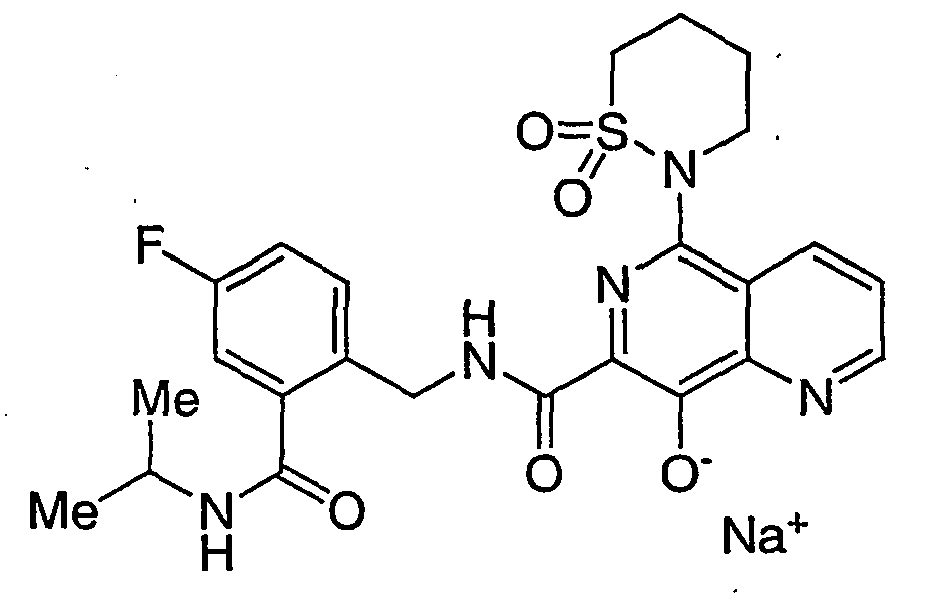
-

- In an oven-dried high pressure bomb reactor apparatus was placed dry toluene (30 mL) and nitrogen was bubbled through the solution. Methyl 2-{[(tert-butoxycarbonyl)amino]methyl}-5-fluorobenzoate (4.0 g, 14.1 mmol, prepared as described in Example 3C, Step 4) and isopropylamine (12.0 mL, 0.14 mol) were added to the vessel. The bomb was sealed and heated to 70°C overnight. The vessel was cooled and the reaction was concentrated to dryness in vacuo. The residue was purifed by flash column chromatography (ISCO column, 120g silica) running a 0-30% acetone/hexane gradient over 30 minutes. The product fractions were concentrated to give the title compound as a white solid.
1H NMR (DMSO-d6, 400 MHz) δ 8.32 (1H, d, J = 7.7 Hz), 7.23-7.34 (2H, m), 7.14-7.20 (2H, m), 4.19 (2H, d, J = 6.0), 4.02 (1H, m), 1.38 (9H, s), and 1.15 (6H, d, J = 6.6 Hz) ppm. -
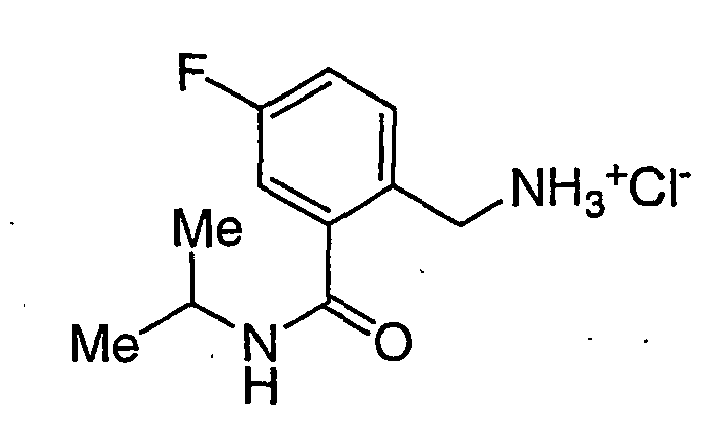
- This compound was prepared in a manner similar to that described in Example 3, Step 6 to afford a white solid.
1H NMR (DMSO-d6, 400 MHz) δ 8.66 (1H, d, J = 7.5 Hz), 8.33 (3H, bs), 7.63 (1H, m), 7.40-7.45 (2H, m), 4.07 (1H, m), 4.01 (2H, s), and 1.17 (6H, d, J = 7.1 Hz) ppm. -

- 5-(1,1-Dioxido-1,2-thiazinan-2-yl)-8-hydroxy-1,6-naphthyridine-7-carboxylic acid (200 mg, 0.62 mmol, prepared as described in Example 3, Step 7), 1-[3-(dimethylamino)propyl]-3-ethylcarbodiimide hydrochloride (154 mg, 0.80 mmol), and 1-hydroxy-7-azabenzotriazole (109 mg, 0.80 mmol) were added to dry DMF (15 mL) and stirred for 30 minutes to preform the activated ester. {4-Fluoro-2-[(isopropylamino)carbonyl]phenyl}methanaminium chloride (168 mg, 0.68 mmol) and triethylamine (95µL, 0.68 mmol) were added and the reaction was stirred overnight at room temperature. The reaction was poured into water, the pH was adjusted to ∼10 using 1N NaOH, and resulting solution was extracted several times with CHCl3. The combined organic extracts were dried over Na2SO4, filtered, and concentrated to dryness in vacuo. The residue was redissolved in basic water and CHCl3, acidified to pH = 4 using 1N HCl and extracted several times with CHCl3. The combined organic extracts were dried over Na2SO4, filtered, and concentrated to a whitish solid. Methanol was added to the flask and the flask was sonicated for 5 minutes. The resulting solids were collected by vacuum filtration to give the title compound as an off-white solid.
1H NMR (DMSO-d6, 400 MHz) δ 13.71 (1H, s), 9.51 (1H, m), 9.19 (1H, m), 8.58 (2H, m), 7.89 (1H, m), 7.52 (1H, m), 7.35 (2H, m), 4.63 (2H, d, J = 5.5 Hz), 4.10 (1H, m), 3.92 (1H, m), 3.76 (1H, m), 3.66 (1H, m), 3.46 (1H, m), 2.33 (3H, m), 1.65 (1H, m), and 1.20 (6H, dd, J = 6.6, 1.7 Hz) ppm. - 5-(1,1-Dioxido-1,2-thiazinan-2-yl)-N-{4-fluoro-2-[(isopropylamino)carbonyl]benzyl}-8-hydroxy-1,6-naphthyridine-7-carboxamide (203 mg, 0.39 mmol) was suspended in acetone (2 mL) and sodium hydroxide (0.39 mL, 0.39 mmol, 1N aqueous solution) was added. The flask was gently warmed to make the solution homogeneous and the solution was then filtered through a glass fiber filter to remove any dust. The solution was stirred at room temperature until solids crashed out of solution. The solids were collected by vacuum filtration to give the title compound as a yellow solid.
1H NMR (DMSO-d6, 400 MHz) δ 12.16 (1H, bs), 8.78 (1H, dd, J = 4.2, 1.8 Hz), 8.68 (1H, m), 8.28 (1H, d, J = 8.2 Hz), 7.55 (1H, dd, J = 8.2, 4.2 Hz), 7.45 (1H, m), 7.23 (1H, dt, J = 8.6, 2.7 Hz), 7.17 (1H, m), 4.60 (2H, d, J = 5.7 Hz), 4.09 (1H, m), 3.85 (2H, m), 3.49 (1H, m), 3.22 (1H, m), 2.37 (1H, m), 2.22 (2H, m), 1.52 (1H, m) and 1.18 (6H, d, J = 6.6 Hz) ppm. -

-

- This compound was prepared in a manner similar to that described in Example 7, Step 1 using ethylamine instead of isopropylamine. The reaction was concentrated to dryness and taken on without further purification.
-

- This compound was prepared in a manner similar to that described in Example 3, Step 6 to afford an off-white solid.
1H NMR (DMSO-d6, 400 MHz) δ 8.86 (1H, s), 8.38 (3H, bs), 7.64 (1H, m), 7.41-7.47 (2H, m), 4.03 (2H, d, J = 5.0 Hz), 3.29 (2H, m), and 1.15 (3H, t, J = 7.1 Hz) ppm. -

- In a similar manner as described for Example 7, Step 3 the title compound was prepared as a light yellow solid.
1H NMR (DMSO-d6, 400 MHz) δ 13.71 (1H, s), 9.52 (1H, t, J = 6.4 Hz), 9.19 (1H, d, J = 4.2 Hz), 8.73 (1H, t, J = 5.2 Hz), 8.58, (1H, d, J = 8.6 Hz), 7.89 (1H, dd, J = 8.4, 4.2 Hz), 7.53 (1H, dd, J = 8.4, 5.6 Hz), 7.40 (1H, dd, J = 9.2, 2.4 Hz), 7.33 (1H, m), 4.64 (2H, d, J = 6.4 Hz), 3.94 (1H, m), 3.66-3.76 (2H, m), 3.46 (1H, m), 3.33 (2H, m), 2.33 (3H, m), 1.64 (1H, m), and 1.17 (3H, t, J = 7.2 Hz) ppm. - In a similar manner as described for Example 7, Step 4 the title compound was prepared as a light yellow solid.
1H NMR (DMSO-d6, 400 MHz) δ 12.11 (1H, s), 8.78 (1H, d, J = 4.0 Hz), 8.73 (1H, t, J = 5.0 Hz), 8.29 (1H, d, J = 8.2 Hz), 7.55, (1H, dd, J = 8.2, 4.1 Hz), 7.45 (1H, dd, J = 8.4, 5.9 Hz), 7.03-7.25 (2H, m), 4.61 (2H, d, J = 6.0 Hz), 3.78-3.86 (2H, m), 3.51 (1H, m), 3.29 (2H, m), 3.22 (1H, m), 2.45 (1H, m), 2.23 (2H, m), 1.52 (1H, m), and 1.15 (3H, t, J = 7.2 Hz) ppm. -

-

- Methyl 2-{[(tert-butoxycarbonyl)amino]methyl}-5-fluorobenzoate (4.0 g, 14.1 mmol, prepared as described in Example 3C, Step 4) was dissolved in a 1:1 solution of methanol and THF (40 mL). Sodium hydroxide (15.5 mL, 15.5 mmol, 1N aqueous solution) was added and the reaction was stirred for 2 hours at room temperature. The reaction was acidified to a pH=4 using 3N HCl and concentrated to dryness in vacuo. The residue was purified by prep HPLC (Gilson semi preparative HPLC system using a Nova pak column (10x40 mm I.D. cartridge, C18, 6 µm pore size) eluting with 95-5% water (0.025% TFA) / acetonitrile (0.025% TFA) at 35 mL/min) in three runs. The fractions containing product were concentrated to afford the title compound as a white solid.
1H NMR (DMSO-d6, 400 MHz) δ 13.32 (1H, bs), 7.59 (1H, dd, J = 9.5, 2.2 Hz), 7.41-7.44 (2H, m), 7.26 (1H, t, J = 6.1 Hz), 4.44 (2H, d, J = 6.1 Hz), and 1.40 (9H, s) ppm. -

- 2-{[(Tert-butoxycarbonyl)amino]methyl}-5-fluorobenzoic acid (800 mg, 2.97 mmol), 1-[3-(dimethylamino)propyl]-3-ethylcarbodiimide hydrochloride (854 mg, 4.46 mmol), and 1-hydroxy-7-azabenzotriazole (607 mg, 4.46 mmol) were added to dry DMF (10 mL) and stirred for 30 minutes to preform the activated ester. Ammonia gas was bubbled through the solution for 30 seconds and the reaction was allowed to stir for 5 minutes. The solvent was removed in vacuo and the residue was purified by flash column chromatography (ISCO column, 120g silica) running a gradient of 0-40% acetone/hexane over 35 min. The product fractions were concentrated to afford the title compound as a white solid.
1H NMR (DMSO-d6, 400 MHz) δ 7.93 (1H, s), 7.56 (1H, s), 7.19-7.35 (4H, m), 4.25 (2H, d, J = 6. Hz), and 1.39 (9H, s) ppm. -

- This compound was prepared in a manner similar to that described in Example 3, Step 6 to afford a white solid.
1H NMR (DMSO-d6, 400 MHz) δ 8.29 (4H, bs), 7.89 (1H, s), 7.63 (1H, dd, J = 8.4, 5.7 Hz), 7.52 (1H, dd, J = 9.4, 2.6 Hz), 7.44 (1H, dt, J = 8.5, 2.7 Hz), and 4.07 (2H, s) ppm. -

- In a similar manner as described for Example 7, Step 3 the title compound was prepared as a light yellow solid.
1H NMR (DMSO-d6, 400 MHz) δ 13.68 (1H, bs), 9.47 (1H, bs), 9.18 (1H, d, J = 4.2 Hz), 8.58 (1H, d, J = 8.4 Hz), 8.21, (1H, s), 7.88 (1H, dd, J = 8.4, 4.2 Hz), 7.77 (1H, s), 7.53 (1H, dd, J = 8.3, 5.7 Hz), 7.45 (1H, dd, J = 9.3, 2.2 Hz), 7.34 (1H, dt, J = 8.4, 2.1 Hz), 4.68 (2H, d, J = 6.2 Hz), 3.94 (1H, m), 3.77 (1H, m), 3.58 (1H, m), 3.45 (1H, m), 2.30-2.37 (3H, m), and 1.62 (1H, m) ppm. - In a similar manner as described for Example 7, Step 4 the title compound was prepared as a light yellow solid.
1H NMR (DMSO-d6, 400 MHz) δ 12.12 (1H, bs), 8.78 (1H, d, J = 2.6 Hz), 8.30 (2H, m), 7.57, (2H, m), 7.46 (1H, dd, J = 9.2, 5.7 Hz), 7.22 (2H, m), 4.66 (2H, d, J = 5.5 Hz), 3.75-3.86 (2H, m), 3.54 (1H, m), 3.23 (1H, m), 2.43 (1H, m), 2.23 (2H, m), and 1.52 (1H, m) ppm. -

-

- In a similar manner as described for Example 7, Step 3, [2-(aminocarbonyl)-4-fluorophenyl]methanaminium chloride (from Example 9, Step 3) was coupled with 8-hydroxy-5-[methyl(methylsulfonyl)amino]-1,6-naphthyridine-7-carboxylic acid (from Example 5, Step 3) to afford the title compound.
1H NMR (DMSO-d6, 400 MHz) δ 13.63 (1H, bs), 9.66 (1H, bs), 9.18 (1H, d, J = 2.8 Hz), 8.61 (1H, d, J = 8.4 Hz), 8.15 (1H, s), 7.88 (1H, dd, J = 8.5, 4.1 Hz), 7.75 (1H, s), 7.49 (1H, dd, J = 8.5, 5.5 Hz), 7.40 (1H, dd, J= 9.3, 2.8 Hz), 7.30 (1H, dt, J = 8.5, 2.6 Hz), 4.70 (2H, d, J = 6.4 Hz), 3.34 (3H, s), and 3.21 (3H, s) ppm. - In a similar manner as described for Example 7, Step 4 the title compound was prepared as a light yellow solid.
1H NMR (DMSO-d6, 400 MHz) δ 12.02 (1H, s), 8.79 (1H, d, J = 4.2 Hz), 8.30 (2H, m), 7.58, (2H, m), 7.45 (1H, m), 7.23 (2H, m), 4.65 (2H, d, J = 5.9 Hz), 3.27 (3H, s), and 3.16 (3H, s) ppm.
ES HRMS: calc'd for C19H18FN5O5S + H: 448.1085, observed 448.1077 -

-
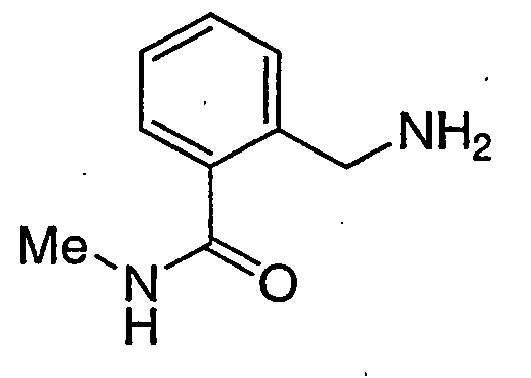
- A suspension of 4-chloro-2-methylbenzoic acid (15.0 g, 87.9 mmol), N-bromosuccinimide (15.9 g, 89.3 mmol), and benzoyl peroxide (1.07 g, 4.4 mmol) in carbon tetrachloride (340 mL) was heated to reflux for 1 hour. Additional NBS (9.0 mmol) was added over this period to drive the reaction toward completion. The reaction was cooled, and filtered. The filtrate was washed once with aqueous sodium bicarbonate, followed by two washes with water. The organic fraction was dried over magnesium sulfate and then filtered. To this was added triethylamine (12.0 mL, 86.1 mmol), till the solution was basic and stirred overnight at room temperature. After which, water was added and extracted three times with chloroform. The combined organics were dried over magnesium sulfate, filtered, and concentrated in vacuo. The product was recrystallized from a mixture of methanol, and diethyl ether as 5-chloro-2-benzofuran-1(3H)-one.
- Methylamine gas was condensed into a sealed tube at -78 °C, and a solution of 5-chloro-2-benzofuran-1(3H)-one (6.68 g, 39.8 mmol) in methanol (30 mL) was added. The solution was slowly warmed to room temperature overnight. The reaction was concentrated in vacuo, and the residue was partitioned between water and and chloroform. After three extractions with chloroform, the combined organics were dried over sodium sulfate, filtered, and concentrated in vacuo to afford 4-chloro-2-(hydroxymethyl)-N-methylbenzamide.
- To a solution of 4-chloro-2-(hydroxymethyl)-N-methylbenzamide (5.81 g, 29.2 mmol) in methylene chloride (200 mL) cooled in an ice bath, was added triethylamine (5.10 mL, 36.6 mmol) and methanesulfonyl chloride (2.50 mL, 32.3 mmol). After 90 min, the reaction was diluted with chloroform and partitioned with aqueous sodium bicarbonate and brine. After extracting three times with chloroform, the combined organics were dried over sodium sulfate, filtered, and concentrated in vacuo. To this residue was added DMF (50 mL) sodium azide (0.35 g, 5.4 mmol) and azidotrimethylsilane (2.6 mL, 19.6 mmol) portionwise with stirring at 40 °C for three days. The reaction was concentrated in vacuo and partitioned between chloroform and aqueous sodium bicarbonate. After extracting three times with chloroform, the combined organics were dried over sodium sulfate, filtered, and concentrated in vacuo. The residue was purified by flash column chromatography eluting with a 30-50% ethyl acetate/hexane gradient. Fractions were concentrated in vacuo to afford 2-(azidomethyl)-4-chloro-N-methylbenzamide.
- 2-(Azidomethyl)-4-chloro-N-methylbenzamide (0.88 g, 3.94 mmol) was dissolved in ethanol (25 mL), degassed, treated with 10% Pd on carbon (80 mg), and put under one atmosphere of hydrogen. After one hour the reaction was filtered through Celite, and concentrated in vacuo to afford 2-(aminomethyl)-N-methylbenzamide as a white solid.
1H NMR (DMSO-d6, 400 MHz) δ 8.74 (1H, br d, J = 4.2 Hz), 8.40 (2H, br s), 7.56 (4H, m), 4.05 (2H, s), and 2.80 (3H, d, J = 4.6 Hz). -

- In a manner similar to that described in Example 3, 5-(1,1-dioxido-1,2-thiazinan-2-yl)-8-hydroxy-1,6-naphthyridine-7-carboxylic acid was coupled with 2-(aminomethyl)-N-methylbenzamide to give the desired product as an off-white solid.
1H NMR (CDCl3, 400 MHz) δ 13.7 (1H, br s), 9.44 (1H, t, J = 6.5 Hz), 9.20 (1H, dd, J = 4.3, 1.6 Hz), 8.71 (1H, dd, J = 8.5, 1.6 Hz), 7.70 (1H, dd, J = 8.5, 4.3 Hz), 7.62 (1H, d, J = 7.3 Hz), 7.49 (2H, m), 7.37 (1H, dt, J = 7.5, 1.1 Hz), 6.13 (1H, br d, J = 4.2 Hz), 4.73 (1H, dd, J = 13.6, 7.2 Hz), 4.64 (1H, dd, J = 13.6, 6.2 Hz), 4.18 (1H, t, J = 13.0 Hz), 3.77 (1H, m), 3.63 (1H, d, J = 14.3 Hz), 3.23 (1H, d, J = 13.2 Hz), 3.03 (3H, d, J = 4.8 Hz), 2.70 (1H, m), 2.53 (2H, m), 1.70 (1H, d, J = 14.3 Hz).
ES HRMS: calc'd for C22H23N5O5S+H 470.1493, observed 470.1478. -

-

- To ethanesulfonyl chloride (10 gm, 77.8 mmol) cooled to zero degrees was added dropwise a 14% weight solution of methylamine in water (100 mL). The reaction was stirred in a 90 degree oil bath for 1 hour and then cooled and extracted with methylene chloride. The organic was dried over magnesium sulfate and carefully evaporated under reduced pressure to give the desired product as a volatile oil.
- 1H NMR (DMSO-d6, 400 MHz) δ 4.72 (1H, bs), 3.05 (2H, q, J= 7.5 Hz), 2.80 (3H, dd, J=5.3, 1.8 Hz), 1.37 (3H, t, J=7.3 Hz) ppm.
-
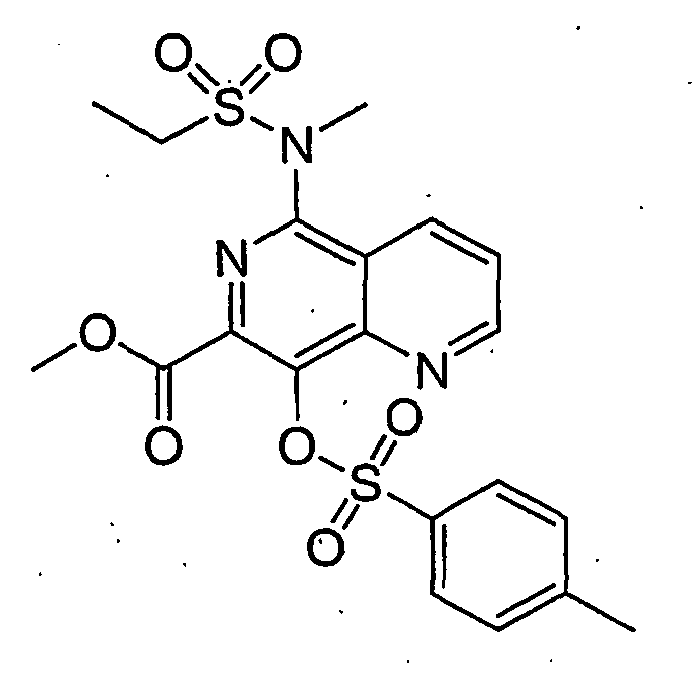
- In a dried sealable pressure tube flushed with argon was placed methyl 5-bromo-8-{[(4-methylphenyl)sulfonyl]oxy}-1,6-naphthyridine-7-carboxylate (2.0g, 4.57mmol), prepared as described in Example 2, Step 2), N-methylethanesulfonamide (1.13 g, 9.15 mmol), dry DMF (4 mL) and copper(I) oxide (785 mg, 5.49 mmol) and 2,2'bipyridyl (857 mg, 5.49 mmol). The tube was capped and heated to 118°C for 2 hours. The reaction was cooled and filtered through a glass fiber filter, washing with chloroform. The filtrate was diluted with chloroform (about 100 mL total volume) and stirred with an EDTA solution (5 g EDTA in 100 mL water) for two hours or until the aqueous layer became aqua in color and the organic layer became yellow. The layers were separated and the aqueous layer was extracted twice more with chloroform. The combined organic extracts were dried over sodium sulfate, filtered, and concentrated under reduced pressure. The residue was redissolved in 2 mL of DMSO and purified by preparative HPLC (Gilson semi preparative HPLC system using a Waters Nova pak column (10x40 mm I.D. cartridges, C18, 6 µM pore size) eluting with 95-5% water (0.025% TFA) / acetonitrile (0.025% TFA) at 35 mL/min) and the desired fractions were freeze dried to give the product as a yellow powder.
1H NMR (DMSO-d6, 400 MHz) δ 9.03 (1H, dd, J = 4.4, 1.6 Hz), 8.65 (1H, dd, J = 8.6, 1.6 Hz), 7.86 (1H, dd, J = 8.4, 4.2 Hz), 7.75 (2H, d, J = 8.2 Hz), 7.44 (2H, d, J = 8.2 Hz), 3.76 (3H, s), 3.55 (2H, q, J= 7.5 Hz), 3.39 (3H, s), 2.43 (3H, s), and 1.3 (3H, t, J=7.33 Hz) ppm. -

- A solution of sodium methoxide (479 mg, 8.86 mmol) in dry methanol (18 mL) was added to methyl 5-[methyl(ethylsulfonyl)amino]-8-{[(4-methylphenyl)sulfonyl]oxy}-1,6-naphthyridine-7-carboxylate (1.7 g, 3.54 mmol) dissolved in a minimum amount of DMF and the resulting solution was heated to 50°C for 5 minutes. The reaction was cooled, glacial acetic acid (0.433 mL, 7 mmol) was added followed by water (0.936 mL) over 15 minutes at 25 degrees C The resulting solid was collected by filtration and washed with 1:1 water methanol and dried in vacuo to give the desired product as a yellow solid.
1H NMR (DMSO-d6, 400 MHz) δ 11.55 (1H, bs), 9.22 (1H, dt, J = 4.1, 2.8 Hz), 8.60 (1H, d, J = 8.4Hz), 7.94 (1H, dd, J= 8.4,4.2 Hz), 3.94 (3H, d, J = 1.3 Hz), 3.50 (2H, q, J= 7.2 Hz), 3.29 (3H, bs), 1.31 (3H, t, J= 7.3 Hz) ppm. -

- Sodium hydroxide (6.73 mL, 6.73 mmol, 1N solution) was added to a suspension of methyl 8-hydroxy-5-[methyl(ethylsulfonyl)amino]-1,6-naphthyridine-7-carboxylate (730 mg, 2.24 mmol) in a 2:1 solution of dioxane/water (20 mL) and the resulting mixture was heated overnight at 55°C overnight. The opaque solution was acidified to a pH = 7 using 1N HCl solution. The reaction was cooled and the solids that had precipitated out of solution were collected by vacuum filtration to give the desired product as an off-white solid.
1H NMR (DMSO-d6, 400 MHz) δ 9.21 (1H, dd, J = 4.4, 1.6 Hz), 8.62 (1H, dd, J = 8.4, 1.5 Hz), 7.93 (1H, dd, J = 8.4, 4.2 Hz), 3.50 (2H, q, J= 7.5 Hz), 3.32 (3H, s), and 1.30 (3H, t, J= 7.5 Hz) ppm. -

- 8-Hydroxy-5-[methyl(ethylsulfonyl)amino]-1,6-naphthyridine-7-carboxylic acid was coupled with {2-[(methylamino)carbonyl]-4-fluorophenyl}methanaminium chloride (prepared as described in Example 3). A solution of 8-Hydroxy-5-[methyl(ethylsulfonyl)amino]-1,6-naphthyridine-7-carboxylic acid (50 mg, 0.16 mmol) in dry DMF (15 mL) was stirred at zero degrees. To this was added 1-[3-(dimethylamino)propyl]-3-ethylcarbodiimide hydrochloride (40 mg, 0.21 mmol), 1-hydroxy-7-azabenzotriazole (28 mg, 0.21 mmol). The mixture was stirred for 35 minutes at which time the {4-fluoro-2-[(methylamino)carbonyl]phenyl}-methanaminium chloride (38 mg, 0.21 mmol) and diisopropylethylamine (27 mg, 0.21 mmol) was added and the reaction was stirred at room temperature overnight. The reaction was filtered through a glass fiber filter. The filtrate was vacuum reduced and purified by preparative HPLC (Gilson semi preparative HPLC system using a Waters Nova pak column (10x40 mm I.D. cartridges, C18, 6 µM pore size) eluting with 95-5% water (0.025% TFA) / acetonitrile (0.025% TFA) at 35 mL/min). The desired fractions were freeze dried to give the desired product as a white solid.
1H NMR (CDCl3, 400 MHz) δ 9.37 (1H, m), 9.19 (1H, m), 8.74 (1H, dd, J=8.5, 1.3 Hz), 7.71 (1H, dd, J = 8.4, 4.2 Hz), 7.60 (1H, m), 7.18 (1H, s), 7.16 (1H, s), 6.65 (1H, m), 4.63 (2H, d, J = 6.5 Hz), 3.43 (2H, q, J= 7.4 Hz), 3.42 (3H, s), 3.04 (3H, d, J = 4.7 Hz), and 1.44 (3H, t, J= 7.5 Hz) ppm.
LC/MS: calc'd for C21H22FN5O5S 475.13, observed MH+ 476.14. - In a manner similar to that described for Example 3, the free acid was converted to the desired salt, that was obtained as a crystalline yellow solid from methanol.
1H NMR (DMSO-d6, 400 MHz) δ 12.26 (1H, m), 8.78 (1H, m), 8.73 (1H, m), 8.23 (1H, dd, J = 8.2, 1.5 Hz), 7.52 (1H, dd, J = 8.4, 4.2 Hz), 7.45 (1H, dd, J = 8.4, 5.7 Hz), 7.23 (1H, dt, J = 8.4, 5.9 Hz), 7.18 (1H, dd, J = 9.3, 2.9 Hz), 4.58 (2H, d, J = 5.9 Hz), 3.51 (2H, q, J= 7.3 Hz), 3.18 (3H, s), 2.81 (3H, d, J= 4.4 Hz), and 1.30 (3H, t, J= 7.5 Hz) ppm.
ES HRMS: calc'd for C21H21FN5NaO5S 476.1388, observed 476.1414. -

-

- In a dry flask was combined under argon N-methyl-1,3-propanediamine 27.5 gm, 312 mmol) and sulfamide (10 gm, 104 mmol) and the flask was heated overnight to 50 degrees. The amine was removed under reduced pressure to give a gel which was washed with hexane and ether. The residue was chromatographed on silica gel (1 kg) eluting with 50% ethyl acetate and methylene chloride. The colorless band eluting first was collected and reduced to give the desired product as an oil.
1H NMR (CDCl3, 400 MHz) δ 4.06 (1H, bs), 3.52 (2H, m), 3.30 (2H, t, J=5.7 Hz), 2.76 (3H, s), and 1.79 (2H, m). -
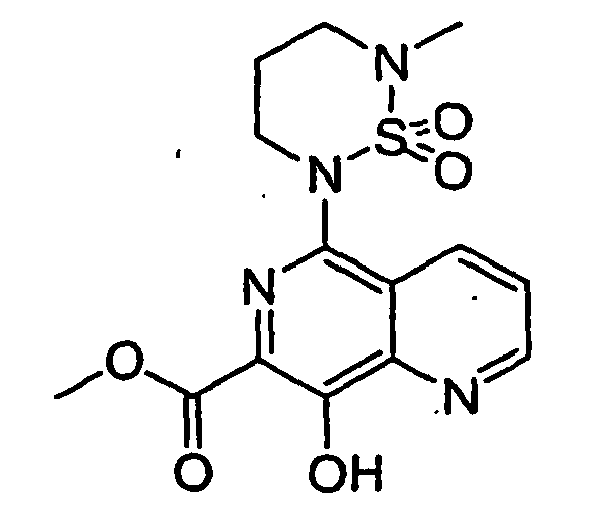
- In a dried sealable pressure tube flushed with argon was placed methyl 5-bromo-1,6-naphthyridine-7-carboxylate (0.6gms, 2.12 mmol), prepared as described in Preparative Example 2, Step 1, 2-Methyl-1,2,6-thiadiazinane 1,1-dioxide (955 mg, 6.36 mmol), dry pyridine (2 mL) and copper(I) oxide (303 mg, 2.12 mmol). The tube was capped and heated to 118°C overnight. The reaction was cooled and filtered through a glass fiber filter, washing with chloroform. The filtrate was diluted with chloroform (about 300 mL total volume) and stirred with an EDTA solution (15 g EDTA in 300 mL water) for two hours or until the aqueous layer became aqua in color and the organic layer became yellow. The layers were separated and the aqueous layer was extracted twice more with chloroform. The combined organic extracts were dried over sodium sulfate, filtered, and concentrated under reduced pressure. The residue crystallized from a small amount of methanol and was filtered and washed with methanol and dried in vacuo to give the desired product as a pale yellow solid.
1H NMR (CDCl3, 400 MHz) δ 11.75 (1H, s), 9.18 (1H, dt, J = 4.2, 1.6 Hz), 8.69 (1H, dt, J = 8.5, 1.5 Hz), 7.70 (1H, m), 4.12 (2H, m), 4.08 (3H, s), 3.80 (2H, m) and 2.95 (3H, s), 1.5(2H, buried) ppm. -

- Sodium hydroxide (3.85 mL, 3.85 mmol, 1N solution) was added to a suspension of methyl 8-hydroxy-5-(6-methyl-1,1-dioxido-1,2,6-thiadiazinan-2-yl)-1,6-naphthyridine-7-carboxylate (452 ing, 1.28 mmol) in a 2:1 solution of dioxane/water (10 mL) and the resulting mixture was heated overnight at 55°C overnight. The opaque solution was acidified to a pH = 7 using 1N HCl solution. The reaction was cooled and the solids that had precipitated out of solution were collected by vacuum filtration to give the desired product as an off-white solid.
1H NMR (DMSO-d6, 400 MHz) δ 9.19 (1H, dd, J= 4.2, 1.5 Hz), 8.64 (1H, dd, J=8.4, 1.5 Hz), 7.91 (1H, dd, J = 8.6, 4.2 Hz), 4.0 (2H, m), 3.70 (2H, t, J = 5.7 Hz), 2.97 (3H, s), 2.4-2.0 (2H, m) ppm. -

- 8-Hydroxy-5-(6-methyl-1,1-dioxido-1,2,6-thiadiazinan-2-y1)-1,6-naphthyridine-7-carboxylic acid was coupled with {2-[(methylamino)carbonyl]-4-fluorophenyl}methanaminium chloride (prepared as described in Example 3). A solution of 8-hydroxy-5-(6-methyl-1,1-dioxido-1,2,6-thiadiazinan-2-yl)-1,6-naphthyridine-7-carboxylic acid (200mg, 0.59 mmol) in dry DMF (2 mL) was stirred at zero degrees. To this was added 1-[3-(dimethylamino)propyl]-3-ethylcarbodiimide hydrochloride (147 mg, 0.77mmol), 1-hydroxy-7-azabenzotriazole (181 mg, 1.18 mmol). The mixture was stirred for 35 minutes at which time the {4-fluoro-2-[(methylamino)carbonyl]phenyl}-methanaminium chloride (194 mg, 0.89 mmol) and diisopropylethylamine (124 µL, 0.7 mmol) was added and the reaction was stirred at room temperature for 1 hour. The reaction was filtered through a glass fiber filter. The filtrate was injected directly into the preparative HPLC (Gilson semi preparative HPLC system using a Waters Nova pak column (10x40 mm I.D. cartridges, C18, 6 µM pore size) eluting with 95-5% water (0.025% TFA) / acetonitrile (0.025% TFA) at 35 mL/min). The desired fractions were freeze dried to give the desired product as a white solid.
1H NMR (CDCl3, 400 MHz) δ 13.4 (1H, bs), 9.15 (2H, dd, J= 4.2, 1.5 Hz), 9.10 (1H, m), 8.60 (1H, dd, J=8.6, 1.6 Hz), 7.65 (1H, dd, J = 8.4, 4.2 Hz), 7.60 (1H, dd, J = 7.9, 5.5 Hz), 7.26 (1H, m), 6.18 (1H, m), 4.68 (2H, d, J= 6.6 Hz), 4.68 (2H, d, J = 6.6 Hz), 4.10 (2H, bs), 3.8 (2H, bs), 3.03 (3H, dd, J=4.9, 1.8 Hz) and 2.95 (3H, d, J=1.6) ppm.
LC/MS: calc'd for C22H23FN6O5S calculated mass 502.14 observed MH+ 503.14 - In a manner similar to that described for Example 3, the free acid was converted to the desired salt, that was obtained as a crystalline yellow solid from methanol.
1H NMR (DMSO-d6, 400 MHz) δ 12.40 (1H, bs), 8.77 (2H, m), 8.30 (1H, d, J = 8.1 Hz), 7.50 (2H, m), 7.20 (2H, t, J = 11.2 Hz), 4.58 (2H, d, J = 5.4 Hz), 3.91 (1H, bs), 3.72 (1H, bs), 3.60 (2H, m), 2.96 (3H, s), 2.81 (3H, dd, J= 4.4, 1.8 Hz), 2.5 (1H, buried) and 1.82 (1H, m) ppm.
ES HRMS: calc'd for C22H22FN6NaO5S 503.1507, observed 503.1510. - As a specific embodiment of an oral composition of a compound of this invention, 50 mg of compound of Example 3 is formulated with sufficient finely divided lactose to provide a total amount of 580 to 590 mg to fill a size 0 hard gelatin capsule. Encapsulated oral compositions containing any one of the compounds of Examples 3C and 4-13 can be similarly prepared.
- Assays for the strand transfer activity of integrase were conducted in accordance with the method described in Example 193 of
WO 02/30930 - Further description on conducting the assay using preassembled complexes is found in Wolfe, A.L. et al., J. Virol. 1996, 70: 1424-1432, Hazuda et al., J. Virol. 1997, 71: 7005-7011; Hazuda et al., Drug Design and Discovery 1997, 15: 17-24; and Hazuda et al., Science 2000, 287: 646-650.
- Assays for the inhibition of acute HIV infection of T-lymphoid cells were conducted in accordance with Vacca, J.P. et al., Proc. Natl. Acad. Sci. USA 1994, 91: 4096. Representative compounds of the present invention exhibit inhibition of HIV replication in this assay. For example, the compounds prepared in Examples 3, 3C and 4-13 were tested in the present assay and all were found to have IC95's less than 5 micromolar.
HetQ' is a 7- to 9-membered bridged azabicycloalkyl saturated ring system containing a C5-7 azacycloalkyl ring in which two of the ring carbons are connected by a bridge containing 1 or 2 carbon atoms; wherein the bridged azabicycloalkyl ring system is optionally substituted with from 1 to 4 substituents each of which is independently halogen, oxo, or -C1-4 alkyl;
each Ra is independently -H, -C1-6 alkyl, or -C3-6 cycloalkyl;
each Rb is independently -H, -C1-6 alkyl, or -C3-6 cycloalkyl; and
each Rc is independently a -C1-6 alkyl or -C3-6 cycloalkyl;
or a pharmaceutically acceptable salt thereof.
or a pharmaceutically acceptable salt thereof.
or a pharmaceutically acceptable salt thereof.
or a pharmaceutically acceptable salt thereof.
HetQ' is azabicyclo[2.2.1]heptyl optionally substituted with 1 or 2 substituents each of which is independently oxo or -C1-4 alkyl;
one of Ra* and Rb* is -H, -C1-4 alkyl, or cyclopropyl, and the other of Ra* and Rb* is -C1-4 alkyl or cyclopropyl;
each of Ra" and Rb" is independently -C1-4 alkyl or cyclopropyl;
each of Ra and Rb is independently -H, -C1-4 alkyl, or cyclopropyl; and
Rc is -C1-4 alkyl or cyclopropyl;
or a pharmaceutically acceptable salt thereof.
each of Ra" and Rb" is independently a -C1-3 alkyl;
each of Ra and Rb is independently a -C1-3 alkyl; and
Rc is -C1-3 alkyl.
Claims (18)
- A compound of Formula (I):
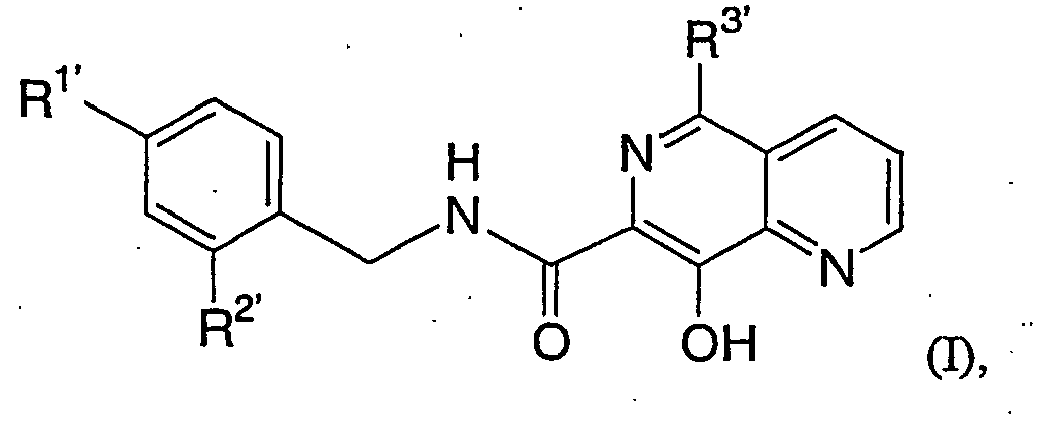
R1' is -H or -F;
R2' is(1) -C1-6 alkyl-C(=O)N(RaRb),(2) -C(=O)N(RaRb),(3)
 (4) triazolyl or tetrazolyl,(5) -N(Ra)-C(Rb)=O,(6)
 (7) -CO2Rc;R3'is:(1) -H,(2) -C(=O)N(RaRb),(3) -CH2-C(=O)N(RaRb),(4) -CH2CH2-C(=O)N(RaRb),(5) -S-CH2-C(=O)N(RaRb),(6) -O-CH2-C(=O)N(RaRb),(7) -N(Ra)-C(Rb)=O,(8) -N(SO2Rc)-CH2-C(=O)N(RaRb),(9) -N(Ra)-C(=O)-C(=O)-N(RaRb),(10) -N(Ra)SO2Rc,(11) -CH=CH-C(=O)-N(RaRb),(12) -N(Ra)-CH2-C(=O)N(RaRb),(13) -N(Ra)-C(=O)-N(RaRb),(14) -HetC',(15) -(CH2)1-3 alkyl-HetC',(16) -N(Ra)-(CH2)1-3-HetC',(17) -N(Ra)-SO2-N(RaRb),(18) -HetQ',(19)
 (20)HetC' is a 5- to 7-membered saturated heterocyclic ring containing from 1 to 4 heteratoms independently selected from N, O and S, wherein the saturated heterocyclic ring is optionally substituted with from 1 to 4 substituents each of which is independently halogen, -C1-4 alkyl, -C3-6 cycloalkyl, -O-C1-4 alkyl, -C1-4 haloalkyl, -O-C1-4 haloalkyl, -CN, oxo, phenyl, benzyl, phenylethyl, -(CH2)0-3C(=O)N(RaRb), -(CH2)0-3C(=O)Ra, -N(Ra)-C(=O)Rb, -N(Ra)-CO2Rb, -(CH2)1-3N(Ra)-C(=O)Rb, -N(RaRb), -(CH2)1-3N(RaRb), -SO2Rc, -(CH2)0-3C(=O)-HetD', -HetD', -N(Ra)-HetD', and -(CH2)1-3-HetD'; wherein each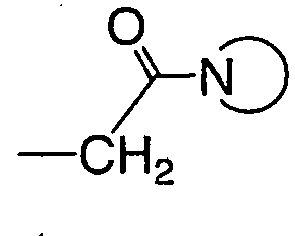

HetD' is independently a 5- or 6-membered heteroaromatic ring containing from 1 to 4 nitrogen atoms or a 5- or 6-membered saturated heterocyclic ring containing from 1 to 4 nitrogen atoms, wherein the ring is optionally substituted with 1 or 2 substituents each of which is independently halogen, oxo, -C1-4 alkyl, or -O-C1-4 alkyl;
HetQ' is a 7- to 9-membered bridged azabicycloalkyl saturated ring system containing a C5-7 azacycloalkyl ring in which two of the ring carbons are connected by a bridge containing 1 or 2 carbon atoms; wherein the bridged azabicycloalkyl ring system is optionally substituted with from 1 to 4 substituents each of which is independently halogen, oxo, or -C1-4 alkyl;
each Ra is independently -H, -C1-6 alkyl, or -C3-6 cycloalkyl;
each Rb is independently -H, -C1-6 alkyl, or -C3-6 cycloalkyl; and
each Rc is independently a -C1-6 alkyl or -C3-6 cycloalkyl;
or a pharmaceutically acceptable salt thereof. - The compound according to claim 1, wherein R2'is -(CH2)1-3-C(=O)N(RaRb), -C(=O)N(RaRb),

- The compound according to claim 2, wherein
R2' is -(CH2)1-3-C(=O)N(Ra*Rb*), -C(=O)N(Ra*Rb*),
Ra* and Rb* are each independently -H, -C1-4 alkyl, or cyclopropyl, with the proviso that Ra* and Rb* are not both -H;
each Ra in R3' is independently -H, -C1-4 alkyl, or cyclopropyl;
each Rb in R3' is independently -H, -C1-4 alkyl, or cyclopropyl; and
each Rc in R3' is independently a -C1-4 alkyl or cyclopropyl;
or a pharmaceutically acceptable salt thereof. - The compound according to claim 3, wherein R2' is -(CH2)1-3-C(=O)N(Ra*Rb*) or -C(=O)N(Ra*Rb*); and
one of Ra* and Rb* is -H, and the other of Ra* and Rb* is -C1-4 alkyl or cyclopropyl;
or a pharmaceutically acceptable salt thereof. - The compound according to any one of claims 1 to 4, wherein HetC' in the definition of R3' is a saturated heterocyclic ring selected from piperidinyl, morpholinyl, thiomorpholinyl, thiazolidinyl, isothiazolidinyl, oxazolidinyl, isooxazolidinyl, pyrrolidinyl, imidazolidinyl, piperazinyl, tetrahydrofuranyl, pyrazolidinyl, hexahydropyrimidinyl, thiazinanyl, thiazepanyl, thiadiazepanyl, dithiazepanyl, diazepanyl, and thiadiazinanyl, wherein the saturated heterocyclic ring is unsubstituted or substituted with 1 to 4 substituents each of which is independently:(a) methyl or ethyl,(b) =O,(c) -C(=O)NaRb),(d) -CH2C(=O)N(RaRb),(e) -C(=O)Ra, or(f) -SO2Rc;or a pharmaceutically acceptable salt thereof.
- The compound according to any one of claims 1 to 5, wherein R3' is -H, -C(=O)N(RaRb), -N(Ra)SO2Rc, -N(Ra)-C(=O)-C(=O)-N(RaRb), 1,1-dioxido-1,2-thiazinan-2-yl, 1,1-dioxidoisothiazolidin-2-yl, 1,1-dioxido-1,2,6-thiadiazinan-2-yl, 6-methyl-1,1-dioxido-1,2,6-thiadiazinan-2-yl, or 3-oxo-2-azabicyclo[2.2.1]hept-2-yl;
or a pharmaceutically acceptable salt thereof. - The compound according to claim 1, wherein:R1' is -H or -F;R2'is(1) -(CH2)1-3-C(=O)N(Ra*Rb*),(2) -C(=O)N(Ra*Rb*),(3) -C(=O)NH2,(4)
 (5) triazolyl, or(6) tetrazolyl;R3' is:(1) -H,(2) -C(=O)N(Ra"Rb"),(3) -CH2-C(=O)N(Ra"Rb"),(4) -CH2CH2-C(=O)N(Ra"Rb"),(5) -N(Ra)-C(Rb)=O,(6) -N(Ra)-C(=O)-C(=O)-N(RaRb),(7) -N(Ra)SO2Rc,(8) -HetC', or(9) -HetQ';HetC' is a saturated heterocyclic ring selected from thiazinanyl, isothiazolidinyl, and thiadiazinanyl, wherein the saturated heterocyclic ring is optionally substituted with from 1 to 4 substituents each of which is independently -C1-4 alkyl or oxo;
HetQ' is azabicyclo[2.2.1]heptyl optionally substituted with 1 or 2 substituents each of which is independently oxo or -C1-4 alkyl;
one of Ra* and Rb* is -H, -C1-4 alkyl, or cyclopropyl, and the other of Ra* and Rb* is -C1-4 alkyl or cyclopropyl;
each of Ra" and Rb" is independently -C1-4 alkyl or cyclopropyl;
each of Ra and Rb is independently -H, -C1-4 alkyl, or cyclopropyl; and
Rc is -C1-4 alkyl or cyclopropyl;
or a pharmaceutically acceptable salt thereof. - The compound according to claim 7, wherein
R1' is -H or -F;
R2' is:(1) -CH2C(=O)N(Ra*Rb*),(2) -C(=O)N(Ra*Rb*),(3) -C(=O)NH2,(4) (5) triazolyl, or(6) tetrazolyl;R3' is:(1) -C(=O)N(Ra"Rb"),(2) -CH2-C(=O)N(Ra"Rb"),(3) -CH2CH2-C(=O)N(Ra"Rb"),(4) -N(Ra)-C(Rb)=O,(5) -N(Ra)-C(=O)-C(=O)-N(RaRb),(6) -N(Ra)SO2Rc,(7) 1,1-dioxido-1,2-thiazinan-2-yl,(8) 1,1-dioxidoisothiazolidin-2-yl,(9) 1,1-dioxido-1,2,6-thiadiazinan-2-yl,(10) 6-methyl-1,1-dioxido-1,2,6-thiadiazinan-2-yl, or(11) 3-oxo-2-azabicyclo[2.2.1]hept-2-yl;one Ra* and Rb* is -H, -C1-3 alkyl, or cyclopropyl, and the other of Ra* and Rb* is -C1-3 alkyl;
each of Ra" and Rb" is independently a -C1-3 alkyl;
each of Ra and Rb is independently a -C1-3 alkyl; and
Rc is -C1-3 alkyl;
or a pharmaceutically acceptable salt thereof. - The compound according to claim 8, wherein
R1' is -H or -F;
R2'is:(1) -CH2C(=O)NH(CH3),(2) -CH2C(=O)N(CH3)2,(3) -C(=O)NH(CH3),(4) -C(=O)N(CH3)2,(5) -C(=O)NH(CH2CH3),(6) -C(=O)NH(CH2CH2CH3),(7) -C(=O)NH(CH(CH3)2),(8) -CH2C(=O)NH(cyclopropyl),(9) -C(=O)NH2,(10) (11) triazolyl, or(12) tetrazolyl; andR3' is:(1) -C(=O)N(CH3)2,(2) -N(CH3)-C(CH3)=O,(3) -N(CH3)-C(=O)-C(=O)-N(CH3)2,(4) -N(CH3)SO2CH3,(5) -N(CH3)SO2CH2CH3,(6) -N(CH2CH3)SO2CH3,(7) 1,1-dioxido-1,2-thiazinan-2-yl,(8) 1,1-dioxidoisothiazolidin-2-yl,(9) 6-methyl-1,1-dioxido-1,2,6-thiadiazinan-2-yl, or(10) 3-oxo-2-azabicyclo[2.2.1]hept-2-yl;
provided that:(i) when R3' is -C(=O)N(CH3)2, then R2' is not -C(=O)NH2; and(ii) when R3' is -N(CH3)-C(CH3)=O or -N(CH3)-C(=O)-C(=O)-N(CH3)2, then R2' is not -C(=O)N(CH3)2 or -CH2C(=O)N(CH3)2;or a pharmaceutically acceptable salt thereof. - The compound according to claim 9, wherein:R2' is -C(=O)NH2, -C(=O)NH(CH3), -C(=O)N(CH3)2, or -C(=O)NH(CH2CH3); andR3' is =N(CH3)SO2CH3, -N(CH3)SO2CH2CH3, 1,1-dioxido-1,2-thiazinan-2-yl, or 6-methyl-1,1-dioxido-1,2,6-thiadiazinan-2-yl;or a pharmaceutically acceptable salt thereof.
- A compound selected from the group consisting of:N-{4-fluoro-2-[(methylamino)carbonyl]benzyl}-5-(1,1-dioxido-1,2-thiazinan-2-yl)-8-hydroxy-1,6-naphthyridine-7-carboxamide;N-{2-[(dimethylamino)carbonyl]-4-fluorobenzyl}-5-(1,1-dioxido-1,2-thiazinan-2-yl)-8-hydroxy-1,6-naphthyridine-7-carboxamide;N-{2-[(dimethylamino)carbonyl]-4-fluorobenzyl}-5-[methyl(methylsulfonyl)amino]-8-hydroxy-1,6-naphthyridine-7-carboxamide;N-{4-fluoro-2-[(methylamino)carbonyl]benzyl}-5-[methyl(methylsulfonyl)amino]-8-hydroxy-1,6-naphthyridine-7-carboxamide;N-{4-fluoro-2-[(isopropylamino)carbonyl]benzyl}-5-(1,1-dioxido-1,2-thiazinan-2-yl)-8-hydroxy-1,6-naphthyridine-7-carboxamide;N-{4-fluoro-2-[(ethylamino)carbonyl]benzyl}-5-(1,1-dioxido-1,2-thiazinan-2-yl)-8-hydroxy-1,6-naphthyridine-7-carboxamide;N-[2-(aminocarbonyl)-4-fluorobenzyl]-5-(1,1-dioxido-1,2-thiazinan-2-yl)-8-hydroxy-1,6-naphthyridine-7-carboxamide;N-{4-fluoro-2-[(amino)carbonyl]benzyl}-5-[methyl(methylsulfonyl)amino]-8-hydroxy-1,6-naphthyridine-7-carboxamide;5-(1,1-dioxido-1,2-thiazinan-2-yl)-8-hydroxy-N-{2-[(methylamino)carbonyl]benzyl}-1,6-naphthyridine-7-carboxamide;N-{4-fluoro-2-[(methylamino)carbonyl]benzyl}-5-[(ethylsulfonyl)(methyl)amino]-8-hydroxy-1,6-naphthyridine-7-carboxamide;N-{4-fluoro-2-[(methylamino)carbonyl]benzyl}-5-(6-methyl-1,1-dioxido-1,2,6-thiadiazinan-2-yl)-8-hydroxy-1,6-naphthyridine-7-carboxamide;and pharmaceutically acceptable salts thereof.
- The compound according to claim 11, which is a compound selected from the group consisting of:N-{4-fluoro-2-[(methylamino)carbonyl]benzyl}-5-(1,1-dioxido-1,2-thiazinan-2-yl)-8-hydroxy-1,6-naphthyridine-7-carboxamide;N-{2-[(dimethylaimno)carbonyl]-4-fluorobenzyl}-5-(1,1-dioxido-1,2-thiazinan-2-yl)-8-hydroxy-1,6-naphthyridine-7-carboxamide;N-{4-flubro-2-[(methylamino)carbonyl]benzyl}-5-[methyl(methylsulfonyl)amino]-8-hydroxy-1,6-naphthyridine-7-carboxamide;N-{4-fluoro-2-[(ethylamino)carbonyl]benzyl}-5-(1,1-dioxido-1,2-thiazinan-2-yl)-8-hydroxy-1,6-naphthyridine-7-carboxamide;N-[2-(aminocarbonyl)-4-fluorobenzyl]-5-(1,1-dioxido-1,2-thiazinan-2-yl)-8-hydroxy-1,6-naphthyridine-7-carboxamide:N-{4-fluoro-2-[(amino)carbonyl]benzyl}-5-[methyl(methylsulfonyl)amino]-8-hydroxy-1,6-naphthyridine-7-carboxamide;5-(1,1-dioxido-1,2-thiazinan-2-yl)-8-hydroxy-N-{2-[(methylamino)carbonyl]benzyl}-1,6-naphthyridine-7-carboxamide:N-{4-fluoro-2-[(methylamino)carbonyl]benzyl}-5-[(ethylsulfonyl)(methyl)amino]-8-hydroxy-1,6-naphthyridine-7-carboxamide;N-{4-fluoro-2-[(methylamino)carbonyl]benzyl}-5-(6-methyl-1,1-dioxido-1,2,6-thiadiazinan-2-yl)-8-hydroxy-1,6-naphthyridine-7-carboxamide;and pharmaceutically acceptable salts thereof.
- The compound according to claim 12, which is N-{4-fluoro-2-[(methylamino)carbonyl]benzyl}-5-(1,1-dioxido-1,2-thiazinan-2-yl)-8-hydroxy-1,6-naphthyridine-7-carboxamide,having the formula:

- A pharmaceutical composition comprising a compound according to any preceding claim, or a pharmaceutically acceptable salt thereof, and a pharmaceutically acceptable carrier.
- A compound according to any one of claims 1 to 13, or a pharmaceutically acceptable salt thereof for use in therapy.
- The use of a compound according to anyone of claims 1 to 13, or a pharmaceutically acceptable salt thereof for the manufacture of a medicament for inhibiting HIV integrase, for preventing or treating infection by HIV, or for preventing, treating or delaying the onset of AIDS.
- A compound according to any one of claims 1 to 13, or a pharmaceutically acceptable salt thereof and an HIV infection/AIDS antiviral agent selected from the group consisting of HIV protease inhibitors, non-nucleoside HIV reverse transcriptase inhibitors and nucleoside HIV reverse transcriptase inhibitors for simultaneous, separate or sequential administration.
- A combination useful for inhibiting HIV integrase, for treating or preventing infection by HIV, or for preventing, treating or delaying the onset of AIDS, which is a therapeutically effective amount of a compound according to claim 1, or a pharmaceutically acceptable salt thereof, and a therapeutically effective amount of an HIV infection/AIDS antiviral agent selected from the group consisting of HIV protease inhibitors, non-nucleoside HIV reverse transcriptase inhibitors and nucleoside HIV reverse transcriptase inhibitors.
Applications Claiming Priority (3)
| Application Number | Priority Date | Filing Date | Title |
|---|---|---|---|
| US36492902P | 2002-03-15 | 2002-03-15 | |
| US364929P | 2002-03-15 | ||
| PCT/US2003/007448 WO2003077850A2 (en) | 2002-03-15 | 2003-03-12 | N-(substituted benzyl)-8-hydroxy-1,6-naphthyridine-7- carboxamides useful as hiv integrase inhibitors |
Publications (3)
| Publication Number | Publication Date |
|---|---|
| EP1496836A2 EP1496836A2 (en) | 2005-01-19 |
| EP1496836A4 EP1496836A4 (en) | 2006-03-22 |
| EP1496836B1 true EP1496836B1 (en) | 2008-09-24 |
Family
ID=28041987
Family Applications (1)
| Application Number | Title | Priority Date | Filing Date |
|---|---|---|---|
| EP03716466A Expired - Lifetime EP1496836B1 (en) | 2002-03-15 | 2003-03-12 | N-(substituted benzyl)-8-hydroxy-1,6-naphthyridine-7- carboxamides useful as hiv integrase inhibitors |
Country Status (8)
| Country | Link |
|---|---|
| US (1) | US7323460B2 (en) |
| EP (1) | EP1496836B1 (en) |
| JP (1) | JP4494020B2 (en) |
| AT (1) | ATE409187T1 (en) |
| AU (2) | AU2003220170B2 (en) |
| CA (1) | CA2478310A1 (en) |
| DE (1) | DE60323743D1 (en) |
| WO (2) | WO2003077857A2 (en) |
Families Citing this family (17)
| Publication number | Priority date | Publication date | Assignee | Title |
|---|---|---|---|---|
| WO2003077857A2 (en) * | 2002-03-15 | 2003-09-25 | Merck & Co., Inc. | N-(substituted benzyl)-8-hydroxy-1,6-naphthyridine-7- carboxamides useful as hiv integrase inhibitors |
| ATE404537T1 (en) | 2002-08-13 | 2008-08-15 | Shionogi & Co | HETEROCYCLIC COMPOUNDS HAVING HIV-INTEGRASE-INHIBITING EFFECT |
| PA8586801A1 (en) | 2002-10-31 | 2005-02-04 | Pfizer | HIV-INTEGRESS INHIBITORS, PHARMACEUTICAL COMPOSITIONS AND METHODS FOR USE |
| CA2513141A1 (en) | 2003-01-27 | 2004-08-12 | Pfizer Inc. | Hiv-integrase inhibitors, pharmaceutical compositions, and methods for their use |
| WO2004080402A2 (en) * | 2003-03-12 | 2004-09-23 | Merck & Co. Inc. | Potassium salt of an hiv integrase inhibitor |
| ATE433974T1 (en) | 2003-09-19 | 2009-07-15 | Gilead Sciences Inc | AZACHINOLINOL PHOSPHONATE COMPOUNDS AS INTEGRAS INHIBITORS |
| CN1870896A (en) | 2003-10-20 | 2006-11-29 | 默克公司 | Hydroxypyridopyrrolopyrazine diketopes useful as HIV integrase inhibitors |
| US7919623B2 (en) * | 2004-02-04 | 2011-04-05 | Shionogi & Co., Ltd. | Naphthyridine derivatives having inhibitory activity against HIV integrase |
| WO2005087768A1 (en) * | 2004-03-09 | 2005-09-22 | Merck & Co., Inc. | Hiv integrase inhibitors |
| DE602005002746T2 (en) | 2004-04-26 | 2008-02-07 | Pfizer Inc. | INHIBITORS OF THE HIV INTEGRASE ENZYME |
| BRPI0510319A (en) | 2004-04-26 | 2007-10-16 | Pfizer | hiv integrase enzyme inhibitors |
| AU2006306355A1 (en) * | 2005-10-27 | 2007-05-03 | Merck & Co., Inc. | HIV integrase inhibitors |
| MX2009002121A (en) | 2006-09-07 | 2009-05-20 | Hoffmann La Roche | A process for the manufacture of snac (salcaprozate sodium). |
| CN106117196A (en) * | 2016-06-09 | 2016-11-16 | 青岛辰达生物科技有限公司 | A kind of method preparing cancer therapy drug Dasatinib |
| CN107722106A (en) * | 2016-08-11 | 2018-02-23 | 重庆大学 | HIV inhibitors |
| CN112409267A (en) * | 2019-08-22 | 2021-02-26 | 江苏阿尔法药业有限公司 | Preparation method of sofosbuvir intermediate |
| AR122928A1 (en) * | 2020-07-10 | 2022-10-19 | Goldfinch Bio Inc | 1,6-SUBSTITUTED NAPHTHYRIDINES INHIBITOR OF CDK5 |
Family Cites Families (41)
| Publication number | Priority date | Publication date | Assignee | Title |
|---|---|---|---|---|
| JPS5751837B2 (en) | 1973-04-05 | 1982-11-04 | ||
| US4416884A (en) | 1978-04-12 | 1983-11-22 | Otsuka Pharmaceutical Co., Ltd. | Piperazinylbenzoheterocyclic compounds |
| FR2632639B1 (en) | 1988-06-09 | 1990-10-05 | Sanofi Sa | AMINO-4 CARBOXY-3 NAPHTYRIDINES DERIVATIVES, THEIR PREPARATION AND PHARMACEUTICAL COMPOSITIONS CONTAINING THEM |
| AU1625192A (en) | 1991-05-31 | 1992-12-03 | Zeneca Limited | Heterocyclic derivatives |
| TW263498B (en) * | 1993-11-10 | 1995-11-21 | Takeda Pharm Industry Co Ltd | |
| US5776944A (en) | 1994-06-16 | 1998-07-07 | Lg Chemical Ltd. | 7-(4-aminomethyl-3-methyloxyiminopyrroplidin-1-yl)-1-cyclopropyl-6-flu oro-4-oxo-1,4-dihydro-1,8-naphthyridine-3-carboxylic acid and the process for the preparation thereof |
| DK0688772T3 (en) | 1994-06-16 | 1999-11-01 | Lg Chemical Ltd | Quinoline Carboxylic Acid Derivatives with 7- (4-Aminomethyl-3-oxime) -pyrrolidine Substituents and Process for their Preparation |
| US5681832A (en) | 1995-02-17 | 1997-10-28 | The United States Of America As Represented By The Department Of Health And Human Services | Aroylaniline compounds, pharmaceutical compositions, and methods of using same to inhibit viral activity |
| MX9800921A (en) | 1995-08-02 | 1998-05-31 | Chirotech Technology Ltd | Quinolones and their therapeutic use. |
| US5945431A (en) | 1996-03-15 | 1999-08-31 | Biochem Therapeutics Incorporated | Cytomegalovirus inhibiting compounds |
| AU4172197A (en) | 1996-09-10 | 1998-04-02 | Pharmacia & Upjohn Company | 8-hydroxy-7-substituted quinolines as anti-viral agents |
| CN1252054C (en) | 1996-09-25 | 2006-04-19 | 曾尼卡有限公司 | Qinoline derivatives inhibiting effect of growth factors such as VEGF |
| DE69828284T2 (en) | 1997-06-30 | 2005-12-08 | Nippon Kayaku K.K. | NAPHTHYRIDINE DERIVATIVES OR SALTS THEREOF |
| HUP0003258A3 (en) | 1997-08-25 | 2001-05-28 | Neurogen Corp Branford | Substituted 4-oxo-napthyridine-3-carboxamides as gaba brain receptor ligands |
| GB9720052D0 (en) | 1997-09-19 | 1997-11-19 | Smithkline Beecham Plc | Novel compounds |
| WO1999016747A1 (en) | 1997-09-30 | 1999-04-08 | Daiichi Pharmaceutical Co., Ltd. | Sulfonyl derivatives |
| EP1037633B1 (en) * | 1997-12-11 | 2003-09-10 | Biochem Pharma Inc. | Antiviral compounds |
| EP1042295B1 (en) | 1997-12-22 | 2005-09-07 | Pharmacia & Upjohn Company LLC | 4-hydroxyquinoline-3-carboxamides and hydrazides as antiviral agents |
| AU4225499A (en) | 1998-06-03 | 1999-12-20 | Merck & Co., Inc. | Hiv integrase inhibitors |
| US6262055B1 (en) | 1998-06-03 | 2001-07-17 | Merck & Co., Inc. | HIV integrase inhibitors |
| US6380249B1 (en) | 1998-06-03 | 2002-04-30 | Merck & Co., Inc. | HIV integrase inhibitors |
| WO1999062513A1 (en) | 1998-06-03 | 1999-12-09 | Merck & Co., Inc. | Hiv integrase inhibitors |
| AU757409B2 (en) | 1998-06-03 | 2003-02-20 | Merck & Co., Inc. | Hiv integrase inhibitors |
| US6306891B1 (en) | 1998-06-03 | 2001-10-23 | Merck & Co., Inc. | HIV integrase inhibitors |
| SE9802550D0 (en) | 1998-07-15 | 1998-07-15 | Active Biotech Ab | Quinoline derivatives |
| EA200100124A1 (en) * | 1998-08-11 | 2001-10-22 | Пфайзер Продактс Инк. | SUBSTITUTED 1,8-NAFTYRIDIN-4 (1H) -OHONID AS PHOSPHODESTERASE 4 INHIBITORS |
| WO2001000578A1 (en) | 1999-06-25 | 2001-01-04 | Merck & Co., Inc. | 1-(aromatic- or heteroaromatic-substituted)-3-(heteroaromatic substituted)-1,3-propanediones and uses thereof |
| EP1297834A4 (en) | 2000-06-14 | 2007-05-09 | Shionogi & Co | Inhibitor for enzyme having two divalent metal ions as active centers |
| US6730682B2 (en) | 2000-07-12 | 2004-05-04 | Pharmacia & Upjohn Company | Heterocycle carboxamides as antiviral agents |
| GB0017676D0 (en) | 2000-07-19 | 2000-09-06 | Angeletti P Ist Richerche Bio | Inhibitors of viral polymerase |
| WO2002009504A1 (en) * | 2000-08-02 | 2002-02-07 | George Robert A | Squirrel-proof bird feeding apparatus and method |
| EP1326865B1 (en) | 2000-10-12 | 2009-05-06 | Merck & Co., Inc. | Aza- and polyaza-naphthalenyl carboxamides useful as hiv integrase inhibitors |
| AU1532802A (en) | 2000-10-12 | 2002-04-22 | Merck & Co Inc | Aza- and polyaza-naphthalenyl-carboxamides useful as hiv integrase inhibitors |
| JP2004517860A (en) | 2000-10-12 | 2004-06-17 | メルク エンド カムパニー インコーポレーテッド | Aza- and polyaza-naphthalenylcarboxamides useful as HIV integrase inhibitors |
| AU2002230392A1 (en) | 2000-10-12 | 2002-05-15 | Merck & Co., Inc. | AZA-and polyaza-naphthalenyl ketones useful as HIV integrase inhibitors |
| CN1659143A (en) | 2001-03-01 | 2005-08-24 | 盐野义制药株式会社 | Nitrogen-containing heteroaryl compounds having HIV integrase inhibitory activity |
| AR036256A1 (en) | 2001-08-17 | 2004-08-25 | Merck & Co Inc | SODIUM SALT OF AN HIV INTEGRAS INHIBITOR, PROCESSES FOR PREPARATION, PHARMACEUTICAL COMPOSITIONS CONTAINING IT AND ITS USE FOR THE MANUFACTURE OF A MEDICINAL PRODUCT |
| CA2463975A1 (en) | 2001-10-26 | 2003-05-01 | Maria Emilia Di Francesco | Dihydroxypyrimidine carboxamide inhibitors of hiv integrase |
| DE122009000048I1 (en) | 2001-10-26 | 2010-04-08 | Angeletti P Ist Richerche Bio | N-SUBSTITUTED HYDROXYPYRIMIDINONE CARBOXAMIDE INHIBITORS OF THE HIV INTEGRASE |
| WO2003077857A2 (en) * | 2002-03-15 | 2003-09-25 | Merck & Co., Inc. | N-(substituted benzyl)-8-hydroxy-1,6-naphthyridine-7- carboxamides useful as hiv integrase inhibitors |
| EP1499391A2 (en) * | 2002-04-10 | 2005-01-26 | Merck & Co., Inc. | Pharmaceutical compositions containing an hiv integrase inhibitor and a nonionic surfactant |
-
2003
- 2003-03-12 WO PCT/US2003/007671 patent/WO2003077857A2/en not_active Ceased
- 2003-03-12 EP EP03716466A patent/EP1496836B1/en not_active Expired - Lifetime
- 2003-03-12 CA CA002478310A patent/CA2478310A1/en not_active Abandoned
- 2003-03-12 AU AU2003220170A patent/AU2003220170B2/en not_active Ceased
- 2003-03-12 DE DE60323743T patent/DE60323743D1/en not_active Expired - Lifetime
- 2003-03-12 US US10/508,094 patent/US7323460B2/en not_active Expired - Fee Related
- 2003-03-12 AT AT03716466T patent/ATE409187T1/en not_active IP Right Cessation
- 2003-03-12 AU AU2003218130A patent/AU2003218130A1/en not_active Abandoned
- 2003-03-12 JP JP2003575904A patent/JP4494020B2/en not_active Expired - Fee Related
- 2003-03-12 WO PCT/US2003/007448 patent/WO2003077850A2/en not_active Ceased
Also Published As
| Publication number | Publication date |
|---|---|
| AU2003220170B2 (en) | 2008-12-11 |
| AU2003218130A8 (en) | 2003-09-29 |
| WO2003077850A2 (en) | 2003-09-25 |
| AU2003218130A1 (en) | 2003-09-29 |
| AU2003220170A1 (en) | 2003-09-29 |
| US20050176955A1 (en) | 2005-08-11 |
| WO2003077850A3 (en) | 2004-11-11 |
| WO2003077857A2 (en) | 2003-09-25 |
| DE60323743D1 (en) | 2008-11-06 |
| JP2005527521A (en) | 2005-09-15 |
| EP1496836A4 (en) | 2006-03-22 |
| EP1496836A2 (en) | 2005-01-19 |
| CA2478310A1 (en) | 2003-09-25 |
| ATE409187T1 (en) | 2008-10-15 |
| US7323460B2 (en) | 2008-01-29 |
| JP4494020B2 (en) | 2010-06-30 |
| WO2003077857A3 (en) | 2006-06-08 |
Similar Documents
| Publication | Publication Date | Title |
|---|---|---|
| AU2003267098B2 (en) | Dihydroxypyridopyrazine-1,6-dione compounds useful as HIV integrase inhibitors | |
| EP1467970B1 (en) | Hydroxynaphthyridinone carboxamides useful as hiv integrase inhibitors | |
| US6921759B2 (en) | Aza- and polyaza-naphthalenyl carboxamides useful as HIV integrase inhibitors | |
| US6919351B2 (en) | Aza-and polyaza-naphthalenyl-carboxamides useful as HIV integrase inhibitors | |
| US6841558B2 (en) | Aza-and polyaza-naphthalenyl carboxamides useful as HIV intergrase inhibitors | |
| US20050010048A1 (en) | Aza-and polyaza-naphthalenly ketones useful as hiv integrase inhibitors | |
| US7323460B2 (en) | N-(substituted benzyl)-8-hydroxy-1,6-naphthyridine-7-carboxamides useful as HIV integrase inhibitors | |
| AU2002215328A1 (en) | AZA- and polyaza-naphthalenyl-carboxamides useful as HIV integrase inhibitors | |
| US20080207634A1 (en) | Chemical Compounds | |
| EP1539714B1 (en) | 8-hydroxy-1-oxo-tetrahydropyrrolopyrazine compounds useful as hiv integrase inhibitors | |
| US20050165000A1 (en) | Pharmaceutical compositions containing an hiv integrase inhibitor and a nonionic surfactant | |
| AU2003302382B2 (en) | 8-hydroxy-1-oxo-tetrahydropyrrolopyrazine compounds useful as HIV integrase inhibitors | |
| WO2004080402A2 (en) | Potassium salt of an hiv integrase inhibitor |
Legal Events
| Date | Code | Title | Description |
|---|---|---|---|
| PUAI | Public reference made under article 153(3) epc to a published international application that has entered the european phase |
Free format text: ORIGINAL CODE: 0009012 |
|
| AK | Designated contracting states |
Kind code of ref document: A2 Designated state(s): AT BE BG CH CY CZ DE DK EE ES FI FR GB GR HU IE IT LI LU MC NL PT RO SE SI SK TR |
|
| AX | Request for extension of the european patent |
Extension state: AL LT LV MK |
|
| 17P | Request for examination filed |
Effective date: 20050511 |
|
| A4 | Supplementary search report drawn up and despatched |
Effective date: 20060206 |
|
| RIC1 | Information provided on ipc code assigned before grant |
Ipc: A61K 31/4375 20060101ALI20060131BHEP Ipc: C07D 471/04 20060101AFI20060131BHEP Ipc: A61P 31/18 20060101ALI20060131BHEP |
|
| 17Q | First examination report despatched |
Effective date: 20060620 |
|
| GRAP | Despatch of communication of intention to grant a patent |
Free format text: ORIGINAL CODE: EPIDOSNIGR1 |
|
| GRAS | Grant fee paid |
Free format text: ORIGINAL CODE: EPIDOSNIGR3 |
|
| GRAA | (expected) grant |
Free format text: ORIGINAL CODE: 0009210 |
|
| AK | Designated contracting states |
Kind code of ref document: B1 Designated state(s): AT BE BG CH CY CZ DE DK EE ES FI FR GB GR HU IE IT LI LU MC NL PT RO SE SI SK TR |
|
| REG | Reference to a national code |
Ref country code: GB Ref legal event code: FG4D |
|
| REG | Reference to a national code |
Ref country code: CH Ref legal event code: EP |
|
| REG | Reference to a national code |
Ref country code: IE Ref legal event code: FG4D |
|
| REF | Corresponds to: |
Ref document number: 60323743 Country of ref document: DE Date of ref document: 20081106 Kind code of ref document: P |
|
| PG25 | Lapsed in a contracting state [announced via postgrant information from national office to epo] |
Ref country code: FI Free format text: LAPSE BECAUSE OF FAILURE TO SUBMIT A TRANSLATION OF THE DESCRIPTION OR TO PAY THE FEE WITHIN THE PRESCRIBED TIME-LIMIT Effective date: 20080924 Ref country code: AT Free format text: LAPSE BECAUSE OF FAILURE TO SUBMIT A TRANSLATION OF THE DESCRIPTION OR TO PAY THE FEE WITHIN THE PRESCRIBED TIME-LIMIT Effective date: 20080924 Ref country code: SI Free format text: LAPSE BECAUSE OF FAILURE TO SUBMIT A TRANSLATION OF THE DESCRIPTION OR TO PAY THE FEE WITHIN THE PRESCRIBED TIME-LIMIT Effective date: 20080924 |
|
| NLV1 | Nl: lapsed or annulled due to failure to fulfill the requirements of art. 29p and 29m of the patents act | ||
| PG25 | Lapsed in a contracting state [announced via postgrant information from national office to epo] |
Ref country code: BE Free format text: LAPSE BECAUSE OF FAILURE TO SUBMIT A TRANSLATION OF THE DESCRIPTION OR TO PAY THE FEE WITHIN THE PRESCRIBED TIME-LIMIT Effective date: 20080924 |
|
| PG25 | Lapsed in a contracting state [announced via postgrant information from national office to epo] |
Ref country code: BG Free format text: LAPSE BECAUSE OF FAILURE TO SUBMIT A TRANSLATION OF THE DESCRIPTION OR TO PAY THE FEE WITHIN THE PRESCRIBED TIME-LIMIT Effective date: 20081224 Ref country code: ES Free format text: LAPSE BECAUSE OF FAILURE TO SUBMIT A TRANSLATION OF THE DESCRIPTION OR TO PAY THE FEE WITHIN THE PRESCRIBED TIME-LIMIT Effective date: 20090104 |
|
| PG25 | Lapsed in a contracting state [announced via postgrant information from national office to epo] |
Ref country code: NL Free format text: LAPSE BECAUSE OF FAILURE TO SUBMIT A TRANSLATION OF THE DESCRIPTION OR TO PAY THE FEE WITHIN THE PRESCRIBED TIME-LIMIT Effective date: 20080924 Ref country code: CZ Free format text: LAPSE BECAUSE OF FAILURE TO SUBMIT A TRANSLATION OF THE DESCRIPTION OR TO PAY THE FEE WITHIN THE PRESCRIBED TIME-LIMIT Effective date: 20080924 Ref country code: SK Free format text: LAPSE BECAUSE OF FAILURE TO SUBMIT A TRANSLATION OF THE DESCRIPTION OR TO PAY THE FEE WITHIN THE PRESCRIBED TIME-LIMIT Effective date: 20080924 Ref country code: RO Free format text: LAPSE BECAUSE OF FAILURE TO SUBMIT A TRANSLATION OF THE DESCRIPTION OR TO PAY THE FEE WITHIN THE PRESCRIBED TIME-LIMIT Effective date: 20080924 Ref country code: PT Free format text: LAPSE BECAUSE OF FAILURE TO SUBMIT A TRANSLATION OF THE DESCRIPTION OR TO PAY THE FEE WITHIN THE PRESCRIBED TIME-LIMIT Effective date: 20090224 |
|
| PG25 | Lapsed in a contracting state [announced via postgrant information from national office to epo] |
Ref country code: DK Free format text: LAPSE BECAUSE OF FAILURE TO SUBMIT A TRANSLATION OF THE DESCRIPTION OR TO PAY THE FEE WITHIN THE PRESCRIBED TIME-LIMIT Effective date: 20080924 Ref country code: EE Free format text: LAPSE BECAUSE OF FAILURE TO SUBMIT A TRANSLATION OF THE DESCRIPTION OR TO PAY THE FEE WITHIN THE PRESCRIBED TIME-LIMIT Effective date: 20080924 |
|
| PLBE | No opposition filed within time limit |
Free format text: ORIGINAL CODE: 0009261 |
|
| STAA | Information on the status of an ep patent application or granted ep patent |
Free format text: STATUS: NO OPPOSITION FILED WITHIN TIME LIMIT |
|
| PG25 | Lapsed in a contracting state [announced via postgrant information from national office to epo] |
Ref country code: IT Free format text: LAPSE BECAUSE OF FAILURE TO SUBMIT A TRANSLATION OF THE DESCRIPTION OR TO PAY THE FEE WITHIN THE PRESCRIBED TIME-LIMIT Effective date: 20080924 |
|
| 26N | No opposition filed |
Effective date: 20090625 |
|
| PG25 | Lapsed in a contracting state [announced via postgrant information from national office to epo] |
Ref country code: MC Free format text: LAPSE BECAUSE OF NON-PAYMENT OF DUE FEES Effective date: 20090331 |
|
| REG | Reference to a national code |
Ref country code: CH Ref legal event code: PL |
|
| REG | Reference to a national code |
Ref country code: IE Ref legal event code: MM4A |
|
| PG25 | Lapsed in a contracting state [announced via postgrant information from national office to epo] |
Ref country code: CH Free format text: LAPSE BECAUSE OF NON-PAYMENT OF DUE FEES Effective date: 20090331 Ref country code: LI Free format text: LAPSE BECAUSE OF NON-PAYMENT OF DUE FEES Effective date: 20090331 Ref country code: SE Free format text: LAPSE BECAUSE OF FAILURE TO SUBMIT A TRANSLATION OF THE DESCRIPTION OR TO PAY THE FEE WITHIN THE PRESCRIBED TIME-LIMIT Effective date: 20081224 Ref country code: IE Free format text: LAPSE BECAUSE OF NON-PAYMENT OF DUE FEES Effective date: 20090312 |
|
| PGFP | Annual fee paid to national office [announced via postgrant information from national office to epo] |
Ref country code: FR Payment date: 20100318 Year of fee payment: 8 |
|
| PGFP | Annual fee paid to national office [announced via postgrant information from national office to epo] |
Ref country code: GB Payment date: 20100208 Year of fee payment: 8 |
|
| PGFP | Annual fee paid to national office [announced via postgrant information from national office to epo] |
Ref country code: DE Payment date: 20100331 Year of fee payment: 8 |
|
| PG25 | Lapsed in a contracting state [announced via postgrant information from national office to epo] |
Ref country code: GR Free format text: LAPSE BECAUSE OF FAILURE TO SUBMIT A TRANSLATION OF THE DESCRIPTION OR TO PAY THE FEE WITHIN THE PRESCRIBED TIME-LIMIT Effective date: 20081225 |
|
| PG25 | Lapsed in a contracting state [announced via postgrant information from national office to epo] |
Ref country code: LU Free format text: LAPSE BECAUSE OF NON-PAYMENT OF DUE FEES Effective date: 20090312 |
|
| PG25 | Lapsed in a contracting state [announced via postgrant information from national office to epo] |
Ref country code: HU Free format text: LAPSE BECAUSE OF FAILURE TO SUBMIT A TRANSLATION OF THE DESCRIPTION OR TO PAY THE FEE WITHIN THE PRESCRIBED TIME-LIMIT Effective date: 20090325 |
|
| PG25 | Lapsed in a contracting state [announced via postgrant information from national office to epo] |
Ref country code: TR Free format text: LAPSE BECAUSE OF FAILURE TO SUBMIT A TRANSLATION OF THE DESCRIPTION OR TO PAY THE FEE WITHIN THE PRESCRIBED TIME-LIMIT Effective date: 20080924 |
|
| PG25 | Lapsed in a contracting state [announced via postgrant information from national office to epo] |
Ref country code: CY Free format text: LAPSE BECAUSE OF FAILURE TO SUBMIT A TRANSLATION OF THE DESCRIPTION OR TO PAY THE FEE WITHIN THE PRESCRIBED TIME-LIMIT Effective date: 20080924 |
|
| GBPC | Gb: european patent ceased through non-payment of renewal fee |
Effective date: 20110312 |
|
| REG | Reference to a national code |
Ref country code: FR Ref legal event code: ST Effective date: 20111130 |
|
| PG25 | Lapsed in a contracting state [announced via postgrant information from national office to epo] |
Ref country code: FR Free format text: LAPSE BECAUSE OF NON-PAYMENT OF DUE FEES Effective date: 20110331 Ref country code: DE Free format text: LAPSE BECAUSE OF NON-PAYMENT OF DUE FEES Effective date: 20111001 |
|
| REG | Reference to a national code |
Ref country code: DE Ref legal event code: R119 Ref document number: 60323743 Country of ref document: DE Effective date: 20111001 |
|
| PG25 | Lapsed in a contracting state [announced via postgrant information from national office to epo] |
Ref country code: GB Free format text: LAPSE BECAUSE OF NON-PAYMENT OF DUE FEES Effective date: 20110312 |