EP1496359A1 - Substrates for hybridization and method of using the same - Google Patents
Substrates for hybridization and method of using the same Download PDFInfo
- Publication number
- EP1496359A1 EP1496359A1 EP03715495A EP03715495A EP1496359A1 EP 1496359 A1 EP1496359 A1 EP 1496359A1 EP 03715495 A EP03715495 A EP 03715495A EP 03715495 A EP03715495 A EP 03715495A EP 1496359 A1 EP1496359 A1 EP 1496359A1
- Authority
- EP
- European Patent Office
- Prior art keywords
- nucleic acid
- strand
- stranded
- substrate
- probe
- Prior art date
- Legal status (The legal status is an assumption and is not a legal conclusion. Google has not performed a legal analysis and makes no representation as to the accuracy of the status listed.)
- Granted
Links
Images
Classifications
-
- C—CHEMISTRY; METALLURGY
- C12—BIOCHEMISTRY; BEER; SPIRITS; WINE; VINEGAR; MICROBIOLOGY; ENZYMOLOGY; MUTATION OR GENETIC ENGINEERING
- C12Q—MEASURING OR TESTING PROCESSES INVOLVING ENZYMES, NUCLEIC ACIDS OR MICROORGANISMS; COMPOSITIONS OR TEST PAPERS THEREFOR; PROCESSES OF PREPARING SUCH COMPOSITIONS; CONDITION-RESPONSIVE CONTROL IN MICROBIOLOGICAL OR ENZYMOLOGICAL PROCESSES
- C12Q1/00—Measuring or testing processes involving enzymes, nucleic acids or microorganisms; Compositions therefor; Processes of preparing such compositions
- C12Q1/68—Measuring or testing processes involving enzymes, nucleic acids or microorganisms; Compositions therefor; Processes of preparing such compositions involving nucleic acids
- C12Q1/6813—Hybridisation assays
- C12Q1/6834—Enzymatic or biochemical coupling of nucleic acids to a solid phase
- C12Q1/6837—Enzymatic or biochemical coupling of nucleic acids to a solid phase using probe arrays or probe chips
Definitions
- the present invention relates to a hybridization substrate and a complementarity test method employing the same.
- a nucleic acid probe is employed to detect a single nucleic acid (target nucleic acid).
- the nucleic acid probe is mixed with a target nucleic acid and hybridization of the nucleic acid and the target nucleic acid is detected using, for example, a label such as fluorescence present on the nucleic acid probe.
- DNA probes are primarily employed as the nucleic acid probe because they are readily synthesized with DNA synthesizers. Fluorescent probes are often employed because of the ease with which nucleic acid probes that have hybridized with the target nucleic acid can be detected using them. However, there are cases in which RI and the like are employed instead of fluorescent labels.
- DNA is immobilized, for example, by combining a thiol to single-stranded DNA to obtained thiolated single-stranded DNA, which is then immobilized, for example, on a metal substrate.
- DNA that has been immobilized by this method assumes a collapsed structure on the substrate.
- surface coverage rate and activity are extremely low.
- the object of the present invention is to provide a hybridization substrate upon the surface of which DNA strands are immobilized, and to provide a complementarity test method employing this substrate.
- the present invention solving the above-stated problems, is as given below.
- the first hybridization substrate of the present invention is characterized by having on a substrate surface a branching nucleic acid strand comprising a principal strand of nucleic acid at least one portion of which is attached to the surface of the substrate and at least one portion of which is single-stranded, and at least one strand of single-stranded nucleic acid for probe that is partially hybridized to at least one portion of the single-stranded portion of the principal nucleic acid. That is, the branching nucleic acid strand is comprised of one principal strand of nucleic acid and one or more strands of single-stranded nucleic acid for probes. A portion of the single-stranded nucleic acid for probes is hybridized to the single-stranded portion of the principal strand of nucleic acid.
- the second hybridization substrate of the present invention is characterized by having on a substrate surface a branching nucleic acid strand comprising a principal strand of nucleic acid at least one portion of which is attached to the surface of the substrate and at least one portion of which is single-stranded; at least one accessory strand of nucleic acid that is single-stranded and partially hybridized to at least a portion of the single-stranded portion of the principal strand of nucleic acid; at least one strand of single-stranded nucleic acid for probe partially hybridized to at least one portion of the single-stranded portion of the principal strand of nucleic acid; and/or at least one strand of single-stranded nucleic acid for probe partially hybridized to at least a portion of the accessory strand of nucleic acid.
- the branching nucleic acid strand comprises a principal strand of nucleic acid; one or more accessory strands of nucleic acid; and one or more strands of single-stranded nucleic acid for probes.
- a portion of the accessory strand of nucleic acid is hybridized to a single-stranded portion of the principal strand of nucleic acid, and a portion of the single-stranded nucleic acid for probes is hybridized to a single-stranded portion of the principal strand of nucleic acid or the accessory strand of nucleic acid.
- Both the first and second substrates of the present invention have a principal strand of nucleic acid constituting a branching nucleic acid strand. At least a portion of the principal strand of nucleic acid is attached to the surface of the substrate, and at least a portion of this principal strand is single-stranded.
- At least a portion of the principal strand of nucleic acid is attached to the substrate surface.
- one end can be attached to the substrate surface and the other end can be free of the substrate surface; both ends can be attached to the substrate surface and the middle portion can be free of the substrate surface; or the middle portion can be attached to the substrate surface and the two ends can be free of the substrate surface.
- the case where one end is attached to the substrate surface and the other end is free of the substrate surface is desirable from the perspective of ease of manufacturing.
- the portion that is attached to the substrate surface can be double-stranded, and the portion that is free of the substrate surface can be single-stranded.
- the principal strand of nucleic acid can be DNA, RNA, or PNA, for example.
- the single-stranded portion of the principal strand of nucleic acid has at least one site with a sequence for hybridizing with a strand of single-stranded nucleic acid for a probe.
- the number of sites with sequences for hybridizing with strands of single-stranded nucleic acid for probes is not specifically limited, and may be suitably determined based on the desired number of probe areas on a single branching nucleic acid strand. Further, the number of sites with sequences for hybridizing with strands of single-stranded nucleic acid for probes may also be suitably determined by taking into account the number of nucleic acids (length) of the area being hybridized and the number of nucleic acids (length) of the principal strand of nucleic acid that can be prepared.
- the sites of sequences for hybridizing with single-stranded nucleic acid for probes are not limited so long as being complementary with the areas of hybridization with the single-stranded nucleic acid for probes. From the perspective of stability of hybridization, the number of nucleic acids is suitably from 10 to 30, 10 to 20 being desirable and 15 being preferred. However, this range is not given by way of limitation.
- the single-stranded portion of the principal strand of nucleic acid may have a probe area on the end of, or part way along, the portion that is free of the substrate surface.
- one or more probe areas can be present at the tips of the portion(s) that are free of the substrate surface.
- one or more probe areas can be present in the middle portion (at a position roughly equidistant (equal numbers of nucleic acids) from the two ends attached to the substrate surface) that is free of the substrate surface.
- the number of nucleic acids and the sequence of the probe area in the single-stranded portion of the principal strand of nucleic acid can be suitably determined based on the application of the substrate of the present invention.
- the structure of the principal strand of nucleic acid and the method of immobilizing it on the substrate surface are not specifically limited.
- it may be single-stranded DNA attached to an Affymetrics-type DNA microarray or single-stranded DNA attached to a Stanford-type DNA microarray.
- Branching DNA can be manufactured by hybridizing to the single strand of DNA attached to the solid substrate at least one single-stranded accessory strand of DNA having a nucleic acid sequence portion that is complementary to the immobilized single strand of DNA.
- the principal strand of nucleic acid may be a DNA strand having one portion that is double-stranded and another portion that is single-stranded, and be attached to the substrate surface on the double-stranded side.
- one strand may be longer than the other strand so that one portion is double-stranded and the remaining portion is single-stranded, with the single-stranded portion beginning at the end of the double-stranded portion and running to the end of the longer strand.
- the principal strand of nucleic acid need not be DNA; for example, either the double-stranded portion or the single-stranded portion may be single-stranded RNA. In the double-stranded portion, one of the strands making up the double-stranded portion may be RNA.
- the principal strand of nucleic acid may also be a strand of DNA with double-stranded portions at each end and a single-stranded portion in the middle, with the double-stranded portions at both ends being secured to the substrate surface.
- the number of nucleic acids in double-stranded portions can be kept within a range of from 10 to 80 to ensure stability of the double-stranded portions, and the number of nucleic acids in single-stranded portions can be suitably selected, for example, within a range of from 20 to 90 in consideration of the number of single-stranded nucleic acid strands and accessory strands of nucleic acid for hybridization probes and the length of the hybridization areas.
- greater lengths than these can be manufactured and employed in the present invention.
- such a DNA strand there are two single strands of different length.
- the shorter of the single strands of DNA has a nucleic acid sequence that complements the nucleic acid sequence of the longer of the single strands of DNA from one end of the longer strand.
- such a DNA strand can be manufactured by hybridizing the two single strands.
- a DNA strand having the above-described double-stranded portion and single-stranded portion is secured to the substrate surface on the double-stranded portion side.
- Such a configuration positions the double-stranded portion closer to the substrate surface and the single-stranded portion of the DNA strand away from the substrate surface. This affords the advantages of providing a certain amount of space around the single-stranded portion, facilitating the use of the single-stranded portion as a hybridization sequence, and densely positioning the double-stranded portions close to the substrate surface, preventing the collapse of the DNA strands.
- the DNA strand can be secured to the metal surface of the substrate by means of sulfur atoms.
- metal substrates are gold, silver, chromium, gallium, nickel, and neodymium.
- metal-coated substrates are substrates of glass, mica, or the like coated with a metal such as gold, silver, chromium, gallium, nickel, or neodymium.
- the DNA strand can be secured with a sulfur atom to the surface of the substrate.
- a glass substrate is the common glass slide.
- An example of a silicon substrate is a silicon wafer.
- entirely double-stranded DNA may be further secured to the surface of the substrate. Further securing entirely double-stranded DNA to the substrate surface affords the advantages of increasing the space around the single-stranded portions free of the substrate surface, thus facilitating the use of the single-stranded portions as hybridization sequences, and densely positioning double-stranded portions near the substrate surface, preventing the collapse of the DNA strands.
- the substrate may be a metal substrate or a metal-coated substrate, for example.
- entirely double-stranded DNA may be secured through sulfur atoms to the metal surface of the substrate.
- the substrate may also be a glass or silicon substrate, in which case entirely double-stranded DNA may be secured through sulfur atoms to the substrate surface in addition to DNA strands having double-stranded portions and single-stranded portions.
- the ratio of the number of secured DNA strands having double-stranded portions and single-stranded portions to the number of strands of entirely double-stranded DNA can be suitably determined in consideration of the density (tightness) of the single-stranded portions serving as hybridization sequences. For example, a range of from 99:1 to 1:99, desirably from 99:1 to 25:75, is suitable.
- Double-stranded DNA having a double-stranded portion and a single-stranded portion can be manufactured by hybridizing two single strands of differing length, the nucleic acid sequence of the shorter strand of DNA being complementary to the nucleic acid sequence from one end of the longer single strand of DNA.
- the hybridization of the shorter single-stranded DNA and longer single-stranded DNA having a complementary sequence on the 3' end side can also be suitably conducted under the usual conditions by the usual methods.
- Anchoring of the DNA strands to the metal surface of the substrate is conducted by bringing the DNA strands having double-stranded portions and single-stranded portions with thiol groups on the ends of the double-stranded portions into contact with the metal surface.
- the securing of DNA strands having thiol groups to metal surfaces is described in J. Am. Chem. Soc. 1998, 120, 9787-9792, for example, and is a known method.
- a mixture of a prescribed ratio of DNA strands having double-stranded portions and single-stranded portions with thiol groups on the ends of the double-stranded portions and entirely double-stranded DNA having terminal thiol groups can be brought into contact with the metal surface of a metal or metal-coated substrate in the same manner as above to secure DNA strands having double-stranded portions and single-stranded portions and entirely double-stranded DNA to the metal surface in a prescribed ratio.
- the surface of the substrate is treated with a heterobifunctional crosslinking agent and the treated surface is brought into contact with DNA strands having double-stranded portions and single-stranded portions with thiol groups on the ends of the double-stranded portions to secure the DNA strands to the surface.
- the DNA strands having double-stranded portions and single-stranded portions with thiol groups on the ends of the double-stranded portions can be manufactured by the method set forth above.
- a thiol group is incorporated onto the end of the double-stranded portion of the DNA strand having a double-stranded portion and a single-stranded portion.
- the thiol group may be incorporated onto the shorter strand or the longer strand of the DNA strand having a double-stranded portion and a single-stranded portion.
- the thiol group is desirably incorporated onto the shorter strand constituting only the double-stranded portion. This is advantageous in that the longer strand having a single-stranded portion contributing to hybridization can be employed with no other processing than hybridization with the shorter strand.
- the above-mentioned heterobifunctional crosslinking agent may be one or more crosslinking agents selected from the group consisting of: succinimidyl 4-[maleimidophenyl] butyrate (SMPB), m-maleimidobenzoyl-N-hydroxysuccinimide ester (MBS), succinimidyl 4-(maleimidoethyl)cyclohexane-1-carboxylate (SMCC), N-( ⁇ -maleimidobutoxy)succinimide ester (GMBS), m-maleimidopropionic acid-N-hydroxysuccinimide ester (MPS), and N-succinimidyl(4-iodoacetyl)aminobenzoate (SIAB).
- SMPB succinimidyl 4-[maleimidophenyl] butyrate
- MVS m-maleimidobenzoyl-N-hydroxysuccinimide ester
- SCC succinimidyl 4-(male
- a mixture comprising a prescribed ratio of DNA strands having double-stranded portions and single-stranded portions with thiol groups on the ends of the double-stranded portions and entirely double-stranded DNA having terminal thiol groups can be brought into contact with the surface of a glass or silicon substrate that has been surface treated with a heterobifunctional crosslinking agent to secure the two types of DNA strands to the surface in a prescribed ratio.
- the DNA strands are desirably brought into contact with the metal surface in the presence of divalent metal ions. Conducting this method in the presence of divalent metal ions affords the advantages of increasing the stability of the double-stranded portions and stably aggregating the double-stranded portions resulting in securing stable existence on the substrate.
- divalent metal ions examples include: magnesium ions, calcium ions, cobalt ions, barium ions, strontium ions, cadmium ions, zinc ions, and iron ions.
- concentration of these divalent metal ions suitably falls within a range of from 1 to 1,000 mM.
- the DNA strands are desirably brought into contact with the surface in the presence of divalent metal ions for the same reasons as above.
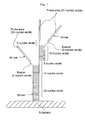
- the first substrate of the present invention has a branching nucleic acid strand comprising at least one single-stranded nucleic acid for probe partially hybridized to at least one portion of the single-stranded principal nucleic acid. This will be described based on Fig. 1.
- 80mer and 20mer single-stranded DNA hybridized at the end of the 80mer are employed as the principal strand of nucleic acid.
- the double-stranded portion of the 80mer and 20mer is secured to the substrate.
- the single-stranded portion of the principal strand of nucleic acid has 60 nucleic acids. These 60 nucleic acids have the following structure from the substrate side. 15 nucleic acids area for hybridizing to single-stranded nucleic acid for first probe 5 nucleic acids spacer 15 nucleic acids area for hybridizing to single-stranded nucleic acid for second probe 5 nucleic acids spacer 20 nucleic acids probe area
- the single-stranded nucleic acid for probe may be DNA, RNA, or PNA, for example. It comprises at least a probe area and an area of hybridization with the single-stranded portion of the principal strand of nucleic acid. A spacer area may be present between the probe area and the hybridization area.
- the portion of the sequence of the single-stranded nucleic acid for probe used for hybridization with the single-stranded portion of the principle strand of nucleic acid is not specifically limited other than it be complementary to the single-stranded portion of the principal strand of nucleic acid. From the perspective of hybridization stability, a number of nucleic acids of from 10 to 30 is suitable, 10-20 is desirable, and 15 is preferred. However, this range is not given by way of limitation.
- sequence and number of nucleic acids of the probe area may be suitably determined based on the application of the substrate of the present invention.
- the single-stranded nucleic acid of first and second probes shown in Fig. 1 comprises 40 nucleic acids consisting of a 15-nucleic acid hybridization area, a 5-nucleic acid spacer, and a 20-nucleic acid probe area.
- the number of single-stranded nucleic acid strands for probe used for hybridization on the single-stranded portion of the principal strand of nucleic acid can be suitably determined by adjusting the length of the single-stranded portion of the principal strand of nucleic acid and the length of the hybridization areas of the single-stranded nucleic acid used for the probes. From the perspective of facilitating the manufacturing of the principal strand of nucleic acid, the length of the principal strand of nucleic acid desirably falls within a range of from 50 to 200 nucleic acids.
- this length may be increased as techniques for manufacturing nucleic acid improve.
- the second substrate of the present invention there is at least one single-stranded accessory strand of nucleic acid partially hybridizing with at least a portion of the single-stranded portion of the principal strand of nucleic acid.
- the accessory strand of nucleic acid may be DNA, RNA, or PNA, for example, and has an area for hybridization with the single-stranded portion of the principal strand of nucleic acid and an area for hybridization with the single-stranded nucleic acid for probe. Further, the accessory strand of nucleic acid may have a probe area on its tip on the side not hybridizing with the single-stranded portion of the principal strand of nucleic acid. From the perspective of facilitating the manufacturing of the accessory strand of nucleic acid, the length of the accessory strand of nucleic acid desirably falls within a range of from 50 to 200 nucleic acids.
- this length may be increased as techniques for manufacturing nucleic acid improve.
- At least one strand of single-stranded nucleic acid for probe is partially hybridized on at least a portion of the accessory strand of nucleic acid. Further, at least one strand of single-stranded nucleic acid for probe may also be partially hybridized on at least a portion of the single-stranded portion of the principal strand of nucleic acid.
- the number of strands of single-stranded nucleic acid for probes hybridized with a single branching nucleic acid strand can be increased, and when testing for complementarity, the signal intensity can be increased, by hybridizing strands of single-stranded nucleic acid for probes to the accessory strands of nucleic acid branching off of the principal strand of nucleic acid (and in some cases, to the principal strand of nucleic acid).
- the sequence of the multiple probe areas may be identical to hybridize with a single target nucleic acid.
- the sequences of the multiple probe areas may be different to permit a single branching nucleic acid strand to hybridize with multiple target nucleic acids having different sequences.
- the substrate of the present invention may consist of multiple spots on a single substrate surface, with multiple branching nucleic acid strands being formed at each spot.
- the size of a single spot and the number (density) of branching nucleic acid strands at a given spot can be suitably selected in consideration of the application of the substrate. Further, the number of spots formed on a substrate can also be suitably determined.
- the substrate of the present invention can be manufactured by a number of methods.
- Examples of methods of manufacturing the substrate of mode 1 are:
- Examples of methods of manufacturing the substrate of mode 2 are:
- the principal strands of nucleic acid, accessory strands of nucleic acid, and strands of single-stranded nucleic acid for probes can all be obtained by known methods. For example, they may be obtained by known methods of synthesizing nucleic acid and by cutting from natural organisms.
- the complementarity test method of the present invention comprises bringing a target nucleic acid into contact with a surface upon which the branching nucleic acid strands of the substrate of the present invention have been secured and testing for complementarity between the target nucleic acid and the probe areas of the branching nucleic acid strand (the probe areas may be areas derived from nucleic acid for probe, the principal strand of nucleic acid, and/or accessory strands of nucleic acid). More specifically, complementarity is tested by detecting by a suitable method the presence of target acid that has hybridized with the probe areas.
- Hybridization of the target nucleic acid with a probe area can be detected by suitably employing known methods.
- detection methods are the surface plasmon resonance and crystal oscillator methods.
- a laser beam is directed onto the substrate surface and surface plasmon resonance produced on the substrate surface is measured to determine the thickness of the film present on the substrate surface.
- the presence of nucleic acid strands that have hybridized with the target nucleic acid is identified by differences in film thickness to detect whether hybridization has occurred.
- the crystal oscillator method is a method of determining the mass of adhered material from a decrease in frequency due to the adhesion of substances to a crystal oscillator electrode (for example, see Chem. Rev., 1992, 92, 1355-1379).
- Fluorescent-labeled DNA and methods of determining hybridization based on fluorescence are known; these known techniques may be employed without modification in the present invention.
- the complementarity testing method of the present invention also permits the detection of target nucleic acid comprising mismatched nucleic acids. That is, in the complementarity testing method of the present invention, there is hybridization with fully complementary target nucleic acid, but there is not hybridization with target nucleic acid containing a single mismatched nucleic acid. Thus, it is possible to detect target acids with single mismatched nucleic acids.
- a target nucleic acid is desirably brought into contact with the substrate surface in the presence of a divalent metal ion to enhance the stability of the double-stranded portion following hybridization.
- divalent metal ions are: magnesium ions, calcium ions, cobalt ions, barium ions, strontium ions, cadmium ions, zinc ions, and iron ions.
- concentration of these divalent metal ions suitably falls within a range of from 1 to 1,000 mM.
- 20merSH 5-terminal thiolation 80merP: (From the 5'-terminal, 20 nucleic acids constituted a probe area, 5 nucleic acids (TTTTT) were a spacer, 15 nucleic acids constituted a hybridization area with a first probe of single-stranded nucleic acid, 5 nucleic acids (TTTTT) constituted a spacer, 15 nucleic acids constituted a hybridization area with a second probe of single-stranded nucleic acid, and 20 nucleic acids constituted a hybridization area with 20merSH.) 40merP: (From the 5'-terminal, 15 nucleic acids constituted a hybridization area with 80merP, 5 nucleic acids (TTTTT) constituted a spacer, and 20 nucleic acids constituted a probe area.) 20merM:
- 5'-Terminal thiolated 20merSH was synthesized by the known C6 synthesis method. (For example, see Chemical and Biology Experimental Line 22, Mineo NIWA, "The Chemical Synthesis of DNA", pp. 38-43, Hirokawa Shoten.)
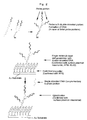
- the above-described 80merP, 40merP, and 20merSH were dissolved in buffer solution in a ratio of 1:2:1. This solution was superheated to 95°C and then gradually cooled to room temperature to induce partial hybridization. Ethanol was then added to precipitate the DNA. The DNA obtained was freeze dried to remove the solvent, yielding the probe DNA (branching DNA) shown in Fig. 2. The structure of the DNA obtained was confirmed by electrophoresis.
- thiolated double-stranded DNA oligomer was secured to the surface of a gold substrate under the following conditions.
- Buffer MgCl 2 (H 2 O) 6 was adjusted to a concentration of 20 mM. This solution was then sterilized for 20 min at 120°C and employed as solvent.
- Post-treatment Rinsed with solvent to wash away excess DNA.
- Target DNA was hybridized with a substrate upon which the probe DNA (branching DNA) obtained as set forth above had been secured.
- sequence 4 5'-CTGTGTCGATCAGTTCTCCA-3' (20merM) (sequence 4) that was expected to hybridize with the probe site of the probe DNA was employed as target DNA.
- Adsorption onto the solid metal substrate and hybridization of target DNA with probe DNA secured on the substrate were observed in situ by surface plasmon resonance.
- DNA monomolecular layer was evaluated by atomic force microscopy (AFM), X-ray photoelectron spectroscopy (XPS), and infrared reflection-absorption spectroscopy (IR-RAS).
- AFM atomic force microscopy
- XPS X-ray photoelectron spectroscopy
- IR-RAS infrared reflection-absorption spectroscopy
- probe DNA branching DNA
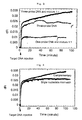
- the intensity of surface plasmon resonance increased about three-fold. It was thus confirmed that securing the probe to the branches increased the amount of target DNA that hybridized.
- a substrate with a gold surface upon which the above described complex of a 50:50 ratio of probe DNA (branching DNA) and 20mer/20merSH complex had been secured was employed.
- the state of hybridization with this substrate of target DNA 5'-CTGTGTCGATCAGTTCTCCA-3' (20merM) (SEQ. ID NO. 4) and control DNA 5'-CTGTGTCAATCAGTTCTCCA-3' (20merS) (SEQ. ID NO. 5) differing in sequence by just one nucleic acid was observed in situ by surface plasmon resonance.
- the results are given in Fig. 4.
- the results of Fig. 4 reveal that the method of the present invention was capable of identifying a single-nucleic acid mismatch.
- the present invention provides a hybridization substrate in which DNA strands are secured to the surface of a substrate in a manner affording a high surface coverage rate and high activity; a method of manufacturing the same; and a complementarity test method employing this substrate.
Landscapes
- Chemical & Material Sciences (AREA)
- Organic Chemistry (AREA)
- Life Sciences & Earth Sciences (AREA)
- Zoology (AREA)
- Wood Science & Technology (AREA)
- Proteomics, Peptides & Aminoacids (AREA)
- Health & Medical Sciences (AREA)
- Engineering & Computer Science (AREA)
- Microbiology (AREA)
- Biochemistry (AREA)
- Physics & Mathematics (AREA)
- Molecular Biology (AREA)
- Biotechnology (AREA)
- Biophysics (AREA)
- Analytical Chemistry (AREA)
- Immunology (AREA)
- Bioinformatics & Cheminformatics (AREA)
- General Engineering & Computer Science (AREA)
- General Health & Medical Sciences (AREA)
- Genetics & Genomics (AREA)
- Measuring Or Testing Involving Enzymes Or Micro-Organisms (AREA)
- Apparatus Associated With Microorganisms And Enzymes (AREA)
Abstract
Description
| 15 nucleic acids | area for hybridizing to single-stranded nucleic acid for |
| 5 nucleic acids | spacer |
| 15 nucleic acids | area for hybridizing to single-stranded nucleic acid for |
| 5 nucleic acids | spacer |
| 20 nucleic acids | probe area |
20merSH:

80merP:

40merP:

20merM:


Claims (22)
- A hybridization substrate having on a substrate surface thereof a branching nucleic acid strand comprising a principal strand of nucleic acid at least one portion of which is attached to the surface of the substrate and at least one portion of which is single-stranded, and at least one strand of single-stranded nucleic acid for probe that is partially hybridized to at least one portion of the single-stranded portion of the principal nucleic acid.
- The hybridization substrate according to claim 1 wherein the principal strand of nucleic acid comprises a portion that is attached to the substrate surface and comprises an end that is free of the substrate surface, with the portion attached to the substrate surface being double-stranded and the portion that is free of the substrate surface being single-stranded.
- The hybridization substrate according to claim 1 or 2 wherein the single-stranded portion of the principal strand of nucleic acid has at least one site in the form of a sequence for hybridizing the single-stranded nucleic acid for the probe.
- The hybridization substrate according to any of claims 1 to 3 wherein the single-stranded portion of the principal strand of nucleic acid has a probe area within, or on the end of, the portion that is free of the substrate surface.
- The hybridization substrate according to any of claims 1 to 4 wherein the single-stranded nucleic acid for the probe has at least a probe area and an area for hybridizing with the single-stranded portion of the principal strand of nucleic acid.
- A hybridization substrate having on a substrate surface thereof a branching nucleic acid strand comprising a principal strand of nucleic acid at least one portion of which is attached to the surface of the substrate and at least one portion of which is single-stranded; at least one accessory strand of nucleic acid that is single-stranded and partially hybridized to at least a portion of the single-stranded portion of the principal strand of nucleic acid; at least one strand of single-stranded nucleic acid for probe partially hybridized to at least one portion of the single-stranded portion of the principal strand of nucleic acid; and/or at least one strand of single-stranded nucleic acid for probe partially hybridized to at least a portion of the accessory strand of nucleic acid.
- The hybridization substrate according to claim 6 wherein the principal strand of nucleic acid comprises a portion that is attached to the substrate surface and has an end that is free of the substrate surface, with the portion attached to the substrate surface being double-stranded and the portion that is free of the substrate surface being single-stranded.
- The hybridization substrate according to claim 6 or 7 wherein the single-stranded portion of the principal strand of nucleic acid and/or the accessory strand of nucleic acid has at least one site in the form of a sequence for hybridizing a strand of single-stranded nucleic acid for the probe.
- The hybridization substrate according to any of claims 6 to 8 wherein the single-stranded portion of the principal strand of nucleic acid has a probe area within, or on the end of, the portion that is free of the substrate surface.
- The hybridization substrate according to any of claims 6 to 9 wherein the accessory strand of nucleic acid has a probe area on the end of a portion not hybridizing with the single-stranded portion of the principal strand of nucleic acid.
- The hybridization substrate according to any of claims 6 to 10 wherein the accessory strand of nucleic acid has one site in the form of a sequence for hybridizing with the single-stranded portion of the principal strand of nucleic acid and at least one site in the form of a sequence for hybridizing with the single-stranded nucleic acid for the probe.
- The hybridization substrate according to any of claims 1 to 11 wherein the single-stranded nucleic acid for the probe has at least a probe area and an area for hybridization with the single-stranded portion of the principal strand of nucleic acid and/or the accessory strand of nucleic acid.
- The hybridization substrate according to claim 12 wherein the single-stranded nucleic acid for the probe has a spacer area between the probe area and the hybridization area.
- The hybridization substrate according to any of claims 1 to 13 wherein the branching nucleic acid strand has multiple probe areas, with the nucleic acid sequence of the multiple probe areas being identical.
- The hybridization substrate according to any of claims 1 to 13 wherein the branching nucleic acid strand has multiple probe areas, with the nucleic acid sequence of the multiple probe areas being different.
- The hybridization substrate according to any of claims 1 to 15 wherein there are multiple spots formed from multiple branching nucleic acid strands.
- A method comprising bringing target nucleic acid into contact with a surface upon which has been immobilized the branching nucleic acid strand of the substrate according to any of claims 1 to 16 to test the complementarity of the target nucleic acid with the probe area of the branching nucleic acid strand.
- The method according to claim 17 wherein the contact of the target nucleic acid with the surface upon which is immobilized the branching nucleic acid strand is conducted in the presence of a divalent metal ion.
- The method according to claim 18 wherein the divalent metal ion is a magnesium ion.
- The method according to any of claims 17 to 19 wherein hybridization of the target nucleic acid and the probe area of the branching nucleic acid strand is detected by the surface plasmon resonance method or the crystal oscillator method.
- The method according of any of claims 17 to 19 wherein the target nucleic acid is labeled with a fluorescent label and hybridization with the probe area of the branching nucleic acid strand is detected by fluorescence.
- The method according to any of claims 17 to 21 for detecting target nucleic acid containing mismatched nucleic acids.
Applications Claiming Priority (3)
| Application Number | Priority Date | Filing Date | Title |
|---|---|---|---|
| JP2002095132A JP2003294742A (en) | 2002-03-29 | 2002-03-29 | Hybridization substrate and method of using the same |
| JP2002095132 | 2002-03-29 | ||
| PCT/JP2003/003815 WO2003083473A1 (en) | 2002-03-29 | 2003-03-27 | Substrates for hybridization and method of using the same |
Publications (3)
| Publication Number | Publication Date |
|---|---|
| EP1496359A1 true EP1496359A1 (en) | 2005-01-12 |
| EP1496359A4 EP1496359A4 (en) | 2007-05-23 |
| EP1496359B1 EP1496359B1 (en) | 2010-06-30 |
Family
ID=28671803
Family Applications (1)
| Application Number | Title | Priority Date | Filing Date |
|---|---|---|---|
| EP03715495A Expired - Lifetime EP1496359B1 (en) | 2002-03-29 | 2003-03-27 | Substrates for hybridization and method of using the same |
Country Status (5)
| Country | Link |
|---|---|
| US (1) | US20060084058A1 (en) |
| EP (1) | EP1496359B1 (en) |
| JP (1) | JP2003294742A (en) |
| DE (1) | DE60333185D1 (en) |
| WO (1) | WO2003083473A1 (en) |
Cited By (1)
| Publication number | Priority date | Publication date | Assignee | Title |
|---|---|---|---|---|
| CN104263725A (en) * | 2014-09-19 | 2015-01-07 | 上海市计量测试技术研究院 | Spire tetrahedral DNA nano-structural probe and telomerase electrochemical detection |
Families Citing this family (3)
| Publication number | Priority date | Publication date | Assignee | Title |
|---|---|---|---|---|
| EP2064348B1 (en) * | 2006-09-18 | 2012-02-08 | Ensemble Therapeutics Corporation | Receptor family profiling |
| JP5920687B2 (en) * | 2010-09-17 | 2016-05-18 | 国立大学法人 東京大学 | DNA base sequence analyzing apparatus and DNA base sequence analyzing method |
| SG190377A1 (en) * | 2010-11-24 | 2013-06-28 | Kaneka Corp | Amplified nucleic acid detection method and detection device |
Family Cites Families (12)
| Publication number | Priority date | Publication date | Assignee | Title |
|---|---|---|---|---|
| US5175270A (en) * | 1986-09-10 | 1992-12-29 | Polyprobe, Inc. | Reagents for detecting and assaying nucleic acid sequences |
| US5278051A (en) * | 1991-12-12 | 1994-01-11 | New York University | Construction of geometrical objects from polynucleotides |
| JPH05260972A (en) * | 1992-03-19 | 1993-10-12 | Nippon Jiin:Kk | Immobilized anchor for amplifying nucleic acid and its adjustment |
| EP0636186B1 (en) * | 1992-04-03 | 1998-11-25 | The Perkin-Elmer Corporation | Probe composition and method |
| US5861244A (en) * | 1992-10-29 | 1999-01-19 | Profile Diagnostic Sciences, Inc. | Genetic sequence assay using DNA triple strand formation |
| EP0880598A4 (en) * | 1996-01-23 | 2005-02-23 | Affymetrix Inc | Nucleic acid analysis techniques |
| US20020012913A1 (en) * | 1998-09-15 | 2002-01-31 | Kevin L. Gunderson | Nucleic acid analysis using complete n-mer arrays |
| ATE334226T1 (en) * | 1999-01-25 | 2006-08-15 | Micronas Holding Gmbh | IMMOBILIZATION OF MOLECULES ON SURFACES USING POLYMER BRUSHES |
| US6506594B1 (en) * | 1999-03-19 | 2003-01-14 | Cornell Res Foundation Inc | Detection of nucleic acid sequence differences using the ligase detection reaction with addressable arrays |
| FR2802550B1 (en) * | 1999-12-17 | 2004-03-05 | Centre Nat Rech Scient | BIOCUCES, PREPARATION AND USES |
| JP2003043037A (en) | 2001-07-27 | 2003-02-13 | Inst Of Physical & Chemical Res | Hybridization substrate, method of manufacturing and using this substrate |
| AU2006330866A1 (en) | 2005-12-22 | 2007-07-05 | Vertex Pharmaceuticals Incorporated | Modulators of muscarinic receptors |
-
2002
- 2002-03-29 JP JP2002095132A patent/JP2003294742A/en active Pending
-
2003
- 2003-03-27 DE DE60333185T patent/DE60333185D1/en not_active Expired - Lifetime
- 2003-03-27 EP EP03715495A patent/EP1496359B1/en not_active Expired - Lifetime
- 2003-03-27 WO PCT/JP2003/003815 patent/WO2003083473A1/en not_active Ceased
- 2003-03-27 US US10/508,691 patent/US20060084058A1/en not_active Abandoned
Cited By (2)
| Publication number | Priority date | Publication date | Assignee | Title |
|---|---|---|---|---|
| CN104263725A (en) * | 2014-09-19 | 2015-01-07 | 上海市计量测试技术研究院 | Spire tetrahedral DNA nano-structural probe and telomerase electrochemical detection |
| CN104263725B (en) * | 2014-09-19 | 2017-03-22 | 上海市计量测试技术研究院 | Spire tetrahedral DNA nano-structural probe and telomerase electrochemical detection |
Also Published As
| Publication number | Publication date |
|---|---|
| JP2003294742A (en) | 2003-10-15 |
| DE60333185D1 (en) | 2010-08-12 |
| WO2003083473A1 (en) | 2003-10-09 |
| EP1496359B1 (en) | 2010-06-30 |
| US20060084058A1 (en) | 2006-04-20 |
| EP1496359A4 (en) | 2007-05-23 |
Similar Documents
| Publication | Publication Date | Title |
|---|---|---|
| US20220042090A1 (en) | PROGRAMMABLE RNA-TEMPLATED SEQUENCING BY LIGATION (rSBL) | |
| US12516446B2 (en) | Array and method for detecting spatial information of nucleic acids | |
| JP4947355B2 (en) | Nucleic acid detection method with increased sensitivity | |
| KR20100038330A (en) | High specificity and high sensitivity detection based on steric hindrance & enzyme-related signal amplification | |
| KR20220044681A (en) | Kits for detecting one or more target nucleic acid analytes in a sample, and methods of making and using the same | |
| US20030077609A1 (en) | Modified oligonucleotides and uses thereof | |
| US20140378675A1 (en) | Methods for Detecting and Measuring Specific Nucleic Acid Sequences | |
| US20140155289A1 (en) | Nucleic acid analysis method | |
| KR20230080414A (en) | Kits for detecting one or more target analytes in a sample and methods of making and using the same | |
| EP1496359B1 (en) | Substrates for hybridization and method of using the same | |
| EP1279434A2 (en) | Hybridization substrate, method of manufacturing same, and method of use for same | |
| FI4399331T3 (en) | Method for detecting sense and antisense strands in an oligonucleotide duplex | |
| US20100204461A1 (en) | Bimolecular Constructs | |
| JP2004205414A (en) | Nucleic acid microarray, method for producing the same, and method for using the same | |
| JP2004329096A (en) | Complementation test method and gold particles used for it | |
| JP4193039B2 (en) | Double-stranded oligonucleotide array | |
| US20090258367A1 (en) | METHOD OF MAPPING OF mRNA DISTRIBUTION WITH ATOMIC FORCE MICROSCOPY | |
| JP2000300268A (en) | Method for measuring nucleic acid and kit therefor | |
| HK40066267B (en) | Array and method for detecting spatial information of nucleic acids | |
| HK40066267A (en) | Array and method for detecting spatial information of nucleic acids | |
| JP2010284159A (en) | Highly specific probe, nucleic acid array using the same, and method for producing the same | |
| FR2770539A1 (en) | METHOD FOR IN VITRO DIAGNOSIS OF PATHOLOLGIA ASSOCIATED WITH GENETIC REMANIATION AND DIAGNOSTIC KITS | |
| Nikiforov et al. | Approaches to Oligonucleotide lmmobilization | |
| Chen et al. | Electrochemical Biosensor for Detection of Chronic Myelogenous Leukemia and Acute Promyelocytic Leukemia | |
| WO2007054682A1 (en) | Switchable biosensor devices |
Legal Events
| Date | Code | Title | Description |
|---|---|---|---|
| PUAI | Public reference made under article 153(3) epc to a published international application that has entered the european phase |
Free format text: ORIGINAL CODE: 0009012 |
|
| 17P | Request for examination filed |
Effective date: 20041027 |
|
| AK | Designated contracting states |
Kind code of ref document: A1 Designated state(s): AT BE BG CH CY CZ DE DK EE ES FI FR GB GR HU IE IT LI LU MC NL PT RO SE SI SK TR |
|
| RAP1 | Party data changed (applicant data changed or rights of an application transferred) |
Owner name: JAPAN SCIENCE AND TECHNOLOGY AGENCY |
|
| A4 | Supplementary search report drawn up and despatched |
Effective date: 20070419 |
|
| 17Q | First examination report despatched |
Effective date: 20070730 |
|
| GRAP | Despatch of communication of intention to grant a patent |
Free format text: ORIGINAL CODE: EPIDOSNIGR1 |
|
| GRAS | Grant fee paid |
Free format text: ORIGINAL CODE: EPIDOSNIGR3 |
|
| GRAA | (expected) grant |
Free format text: ORIGINAL CODE: 0009210 |
|
| AK | Designated contracting states |
Kind code of ref document: B1 Designated state(s): CH DE FR GB LI NL SE |
|
| REG | Reference to a national code |
Ref country code: CH Ref legal event code: EP Ref country code: GB Ref legal event code: FG4D |
|
| REG | Reference to a national code |
Ref country code: CH Ref legal event code: NV Representative=s name: N&G PATENT SERVICES SA |
|
| REF | Corresponds to: |
Ref document number: 60333185 Country of ref document: DE Date of ref document: 20100812 Kind code of ref document: P |
|
| REG | Reference to a national code |
Ref country code: NL Ref legal event code: T3 |
|
| REG | Reference to a national code |
Ref country code: SE Ref legal event code: TRGR |
|
| PLBE | No opposition filed within time limit |
Free format text: ORIGINAL CODE: 0009261 |
|
| STAA | Information on the status of an ep patent application or granted ep patent |
Free format text: STATUS: NO OPPOSITION FILED WITHIN TIME LIMIT |
|
| 26N | No opposition filed |
Effective date: 20110331 |
|
| REG | Reference to a national code |
Ref country code: DE Ref legal event code: R097 Ref document number: 60333185 Country of ref document: DE Effective date: 20110330 |
|
| REG | Reference to a national code |
Ref country code: NL Ref legal event code: V1 Effective date: 20111001 |
|
| REG | Reference to a national code |
Ref country code: CH Ref legal event code: PL |
|
| REG | Reference to a national code |
Ref country code: SE Ref legal event code: EUG |
|
| GBPC | Gb: european patent ceased through non-payment of renewal fee |
Effective date: 20110327 |
|
| REG | Reference to a national code |
Ref country code: FR Ref legal event code: ST Effective date: 20111130 |
|
| PG25 | Lapsed in a contracting state [announced via postgrant information from national office to epo] |
Ref country code: FR Free format text: LAPSE BECAUSE OF NON-PAYMENT OF DUE FEES Effective date: 20110331 Ref country code: DE Free format text: LAPSE BECAUSE OF NON-PAYMENT OF DUE FEES Effective date: 20111001 Ref country code: CH Free format text: LAPSE BECAUSE OF NON-PAYMENT OF DUE FEES Effective date: 20110331 Ref country code: LI Free format text: LAPSE BECAUSE OF NON-PAYMENT OF DUE FEES Effective date: 20110331 Ref country code: NL Free format text: LAPSE BECAUSE OF NON-PAYMENT OF DUE FEES Effective date: 20111001 |
|
| REG | Reference to a national code |
Ref country code: DE Ref legal event code: R119 Ref document number: 60333185 Country of ref document: DE Effective date: 20111001 |
|
| PG25 | Lapsed in a contracting state [announced via postgrant information from national office to epo] |
Ref country code: GB Free format text: LAPSE BECAUSE OF NON-PAYMENT OF DUE FEES Effective date: 20110327 |
|
| PG25 | Lapsed in a contracting state [announced via postgrant information from national office to epo] |
Ref country code: SE Free format text: LAPSE BECAUSE OF NON-PAYMENT OF DUE FEES Effective date: 20110328 |