EP1496096A2 - Additive for oil-based drilling fluids - Google Patents
Additive for oil-based drilling fluids Download PDFInfo
- Publication number
- EP1496096A2 EP1496096A2 EP04253947A EP04253947A EP1496096A2 EP 1496096 A2 EP1496096 A2 EP 1496096A2 EP 04253947 A EP04253947 A EP 04253947A EP 04253947 A EP04253947 A EP 04253947A EP 1496096 A2 EP1496096 A2 EP 1496096A2
- Authority
- EP
- European Patent Office
- Prior art keywords
- drilling fluid
- product
- wetting agent
- acids
- drilling
- Prior art date
- Legal status (The legal status is an assumption and is not a legal conclusion. Google has not performed a legal analysis and makes no representation as to the accuracy of the status listed.)
- Granted
Links
Images
Classifications
-
- C—CHEMISTRY; METALLURGY
- C09—DYES; PAINTS; POLISHES; NATURAL RESINS; ADHESIVES; COMPOSITIONS NOT OTHERWISE PROVIDED FOR; APPLICATIONS OF MATERIALS NOT OTHERWISE PROVIDED FOR
- C09K—MATERIALS FOR MISCELLANEOUS APPLICATIONS, NOT PROVIDED FOR ELSEWHERE
- C09K23/00—Use of substances as emulsifying, wetting, dispersing, or foam-producing agents
- C09K23/017—Mixtures of compounds
-
- C—CHEMISTRY; METALLURGY
- C09—DYES; PAINTS; POLISHES; NATURAL RESINS; ADHESIVES; COMPOSITIONS NOT OTHERWISE PROVIDED FOR; APPLICATIONS OF MATERIALS NOT OTHERWISE PROVIDED FOR
- C09K—MATERIALS FOR MISCELLANEOUS APPLICATIONS, NOT PROVIDED FOR ELSEWHERE
- C09K8/00—Compositions for drilling of boreholes or wells; Compositions for treating boreholes or wells, e.g. for completion or for remedial operations
- C09K8/02—Well-drilling compositions
- C09K8/03—Specific additives for general use in well-drilling compositions
- C09K8/035—Organic additives
-
- C—CHEMISTRY; METALLURGY
- C09—DYES; PAINTS; POLISHES; NATURAL RESINS; ADHESIVES; COMPOSITIONS NOT OTHERWISE PROVIDED FOR; APPLICATIONS OF MATERIALS NOT OTHERWISE PROVIDED FOR
- C09K—MATERIALS FOR MISCELLANEOUS APPLICATIONS, NOT PROVIDED FOR ELSEWHERE
- C09K8/00—Compositions for drilling of boreholes or wells; Compositions for treating boreholes or wells, e.g. for completion or for remedial operations
- C09K8/02—Well-drilling compositions
- C09K8/32—Non-aqueous well-drilling compositions, e.g. oil-based
-
- C—CHEMISTRY; METALLURGY
- C09—DYES; PAINTS; POLISHES; NATURAL RESINS; ADHESIVES; COMPOSITIONS NOT OTHERWISE PROVIDED FOR; APPLICATIONS OF MATERIALS NOT OTHERWISE PROVIDED FOR
- C09K—MATERIALS FOR MISCELLANEOUS APPLICATIONS, NOT PROVIDED FOR ELSEWHERE
- C09K8/00—Compositions for drilling of boreholes or wells; Compositions for treating boreholes or wells, e.g. for completion or for remedial operations
- C09K8/02—Well-drilling compositions
- C09K8/32—Non-aqueous well-drilling compositions, e.g. oil-based
- C09K8/36—Water-in-oil emulsions
Definitions
- the present invention relates to methods for drilling boreholes in subterranean formations, particularly hydrocarbon bearing formations, and to drilling fluids for use in such drilling operations. More particularly, the present invention relates to oil or synthetic based drilling fluids, fluids comprising invert emulsions, and more particularly drilling fluid additives that facilitate or enhance emulsification, electrical stability or filtration properties of the drilling fluid.
- a drilling fluid or mud is a specially designed fluid that is circulated through a wellbore as the wellbore is being drilled to facilitate the drilling operation.
- the various functions of a drilling fluid include removing drill cuttings from the wellbore, cooling and lubricating the drill bit, aiding in support of the drill pipe and drill bit, and providing a hydrostatic head to maintain the integrity of the wellbore walls and prevent well blowouts.
- Specific drilling fluid systems are selected to optimize a drilling operation in accordance with the characteristics of a particular geological formation.
- Oil or synthetic-based muds, or invert emulsions are normally used to drill swelling or sloughing shales, salt, gypsum, anhydrite or other evaporite formations, hydrogen sulfide-containing formations, and hot (greater than about 300 degrees Fahrenheit) holes, but may be used in other holes penetrating a subterranean formation as well.
- These non-aqueous based drilling fluids typically contain oil or a synthetic oil or other synthetic material or synthetic fluid ("synthetic") as the continuous phase and may also contain water which is dispersed in the continuous phase by emulsification so that there is no distinct layer of water in the fluid.
- oil mud or "oil or synthetic-based mud” typically means an invert oil or synthetic mud emulsion or invert emulsion.
- An all oil mud simply comprises 100% oil by volume as the liquid phase; that is, there is no aqueous internal phase.
- An invert emulsion drilling fluid may commonly comprise between about 50:50 to 95:5 by volume oil phase to water phase.
- invert emulsions used in drilling typically comprise: a base oil or synthetic fluid for the external phase; a saline, aqueous solution for the internal phase (typically a solution comprising about 30% calcium chloride); and other agents or additives for suspension, fluid loss, density, oil-wetting, emulsification, filtration, and rheology control.
- a base oil or synthetic fluid for the external phase typically a saline, aqueous solution for the internal phase (typically a solution comprising about 30% calcium chloride); and other agents or additives for suspension, fluid loss, density, oil-wetting, emulsification, filtration, and rheology control.
- An improved and more efficient material or product and method is disclosed for providing emulsion stability and filtration control to invert emulsions and other oil or synthetic based drilling fluids for use in drilling boreholes in subterranean formations, particularly hydrocarbon bearing formations.
- the product of the invention has the advantage of a pour point at temperatures as low as about 20 degrees Fahrenheit with minimal solvent.
- the product of the invention may be transported in a highly (about 90% to about 100%) active state, which reduces the need to inventory products containing different solvents for compatibility with the drilling fluid.
- This advantage further eliminates the need for shipping large amounts of inert material.
- the product of the invention has the further advantage of providing high levels of filtration control to a drilling fluid made with conventional emulsifiers, especially at temperatures up to about 250 °F.
- the product of this invention when added to drilling fluids, reduces or eliminates the need for conventional fluid loss additives.
- the product for this invention comprises two primary components or parts.
- One part is a carboxylic acid-terminated polyamide and/or wetting agent and the other part is itself a mixture obtainable by, or obtained by the Diels-Alder reaction of dienophiles, preferably carboxylic acids, carboxylic acids, acid anhydrides, or combinations or mixes thereof, with a mixture of fatty acids and resin acids.
- dienophiles preferably carboxylic acids, carboxylic acids, acid anhydrides, or combinations or mixes thereof, with a mixture of fatty acids and resin acids.
- These two components or parts are blended or mixed and further reacted with cations to form soaps.
- This blending or mixing and this saponification reaction may be achieved in the manufacturing process or it may be effected "in situ" by the presence of or addition of cations to the drilling fluid.
- the term "in situ” shall be understood to mean in the drilling fluid.
- Drilling fluids commonly comprise cations. Sources of such cations include, without limitation, lime, quicklime, and calcium chloride, among others. Further, drilling fluids may incorporate cations contacted in or available from the subterranean formation itself.
- the method of the invention employs the product of the invention for improved drilling fluids and improved drilling of boreholes in subterranean formations.
- a drilling fluid comprising a wetting agent and a product produced by the Diels-Alder reaction of dienophiles with a mixture of fatty acids and resin acids.
- the drilling fluid is preferably oil or synthetic based.
- the dienophiles are preferably selected from the group consisting of carboxylic acids, polycarboxylic acids, acid anhydrides, and mixtures thereof, and are most preferably maleic anhydride.
- the mixture of fatty acids and resin acids are preferably derived from the distillation of tall oil, preferably crude tall oil.
- the mixture preferably has a ratio of fatty acids to resins acids ranging from about 4:1 to about 1:1, more preferably about 2:1.
- the ratio of wetting agent to said mixture is about 1:5 to about 1:1, more preferably about 1:2 to about 1:3.
- the product is preferably saponified.
- the saponification is preferably effected with calcium chloride, lime, quicklime, or other sources of calcium cations.
- the saponification occurs in situ.
- the saponification occurs before said blend is added to said drilling fluid.
- the drilling fluid may further comprise lime, calcium chlorides, quicklime, or other saponifying agents.
- the drilling fluid may further comprise carboxylic acid-terminated polyamide in said blend.
- the wetting agent may be omitted.
- an emulsifier comprising a wetting agent and a product produced by the Diels-Alder reaction of dienophiles selected from the group consisting of carboxylic acids, polycarboxylic acids, and acid anhydrides, and combinations or mixes thereof, with a mixture of fatty acids and resin acids derived from the distillation of crude tail oil, wherein said mixture comprises a ratio of fatty acids to resin acids ranges from about 4:1 to about 1:1, and wherein the ratio of said wetting agent to said product ranges from about 1:5 to about 1:1.
- the wetting agent and product may have any combination of the features of the wetting agent and product described above.
- an additive for improving the properties of an invert emulsion comprising water or brine in an oil or synthetic based drilling fluid for use in drilling a borehole in a subterranean formation
- said additive comprising a wetting agent and a product produced by the Diels-Alder reaction of dienophiles, selected from compounds or reagents selected from the group consisting of carboxylic acids, polycarboxylic acids, acid anhydrides, and combinations or mixes thereof, with a mixture of fatty acids and resin acids derived from the distillation of crude tall oil, wherein said acid mixture comprises a ratio of fatty acids to resin acids ranges from about. 4:1 to about 1:1, and wherein the ratio of said wetting agent to said product ranges from about 1:5 to about 1:1.
- the wetting agent and product may have any combination of the features of the wetting agent and product described above.
- the additive may be saponified.
- the properties which can be improved include emulsification, filtration control, and electrical stability.
- the drilling fluid, emulsifier and additive described above may be used to provide a number of functions, in particular: filtration control; emulsification; and/or electrical stability.
- a method for drilling a borehole in a subterranean formation comprising employing an oil or synthetic based drilling fluid comprising an invert emulsion and an additive comprising a wetting agent and a product produced by the Diels-Alder reaction of compounds or reagents with a mixture of fatty acids and resin acids wherein said compounds or reagents are selected from the group consisting of carboxylic acids, polycarboxylic acids, acid anhydrides and combinations or mixes thereof.
- the drilling fluid may have any combination of the features of the drilling fluid described above.
- the mixture preferably comprises fatty acids and resin acids derived from the distillation of tall oil, preferably tall oil.
- the mixture preferably has a ratio of fatty acids to resin acids ranging from about 4:1 to about 1:1, more preferably 2:1.
- the ratio of said wetting agent to said product is preferably about 1:5 to about 1:1, more preferably about 1:2 to about 1:3.
- the product is saponified using, for example, calcium chloride, lime, quicklime, or other sources of calcium cations.
- the saponification may occur in situ or before the product is added to the drilling fluid.
- the product and/or the wetting agent is added to said drilling fluid in the borehole.
- the product and/or the wetting agent is added to said drilling fluid at the well surface.
- the product and/or the wetting agent is added to said drilling fluid when the drilling fluid is prepared.
- the wetting agent and the product are blended together before addition to the drilling fluid
- the drilling step comprises at least one step selected from the group consisting of: drilling a borehole in a subterranean formation; completing a borehole in a subterranean formation; testing a borehole in a subterranean formation; servicing a borehole in a subterranean formation; and producing fluid from a borehole in a subterranean formation.
- the drilling step preferably comprises drilling a borehole in a subterranean formation, completing said borehole, and producing fluid from said borehole.
- a method for improving or facilitating the emulsification of a drilling fluid comprising adding to said drilling fluid a wetting agent and a product produced by the Diels-Alder reaction of dienophiles with a mixture of fatty acids and resin acids.
- the wetting agent and the product are preferably blended together before addition to the drilling fluid.
- the wetting agent and the product may have any combination of the features of the wetting agent and the product described above.
- the dienophiles are preferably selected from the group consisting of carboxylic acids, polycarboxylic acids, acid anhydrides, and combinations or mixes thereof.
- a carboxylic acid terminated polyamide may also be added to the drilling fluid.
- a method for improving the filtration properties of an oil or synthetic based drilling fluid or a drilling fluid comprising an invert emulsion comprising adding to said drilling fluid a wetting agent and a product produced by the Diels-Alder reaction of dienophiles with a mixture of fatty acids and resin acids.
- the wetting agent and the product may have any combination of the features of the wetting agent and the product described above.
- the dienophiles are preferably selected from the group consisting of carboxylic acids, polycarboxylic acids, acid anhydrides, and combinations or mixes thereof.
- the wetting agent and the product are blended in situ the drilling fluid.
- a method for improving the electrical stability of an oil or synthetic based drilling fluid, or a drilling fluid comprising an invert emulsion comprising adding to said fluid a wetting agent and a product produced by the Diels-Alder reaction of dienophiles with a mixture of fatty acids and resin acids.
- the wetting agent and the product may have any combination of the features of the wetting agent and the product described above.
- the dienophiles are preferably selected from the group consisting of carboxylic acids, polycarboxylic acids, acid anhydrides, and combinations or mixes thereof.
- a method for drilling a borehole in a subterranean formation employing a drilling fluid comprising adding to said fluid a carboxylic acid terminated polyamide and a product produced by the Diels-Alder reaction of compounds or reagents with a mixture of fatty acids and resin acids wherein said compounds or reagents are selected form the group consisting of carboxylic acids, polycarboxylic acids, acid anhydrides and combinations or mixes thereof.
- the polyamide and/or the product is added to the drilling fluid in the borehole.
- the polyamide and the product are blended in the drilling fluid in the borehole
- said polyamide and/or the product is added to the drilling fluid at the well surface.
- the polyamide and/or the product is added to the drilling fluid when the drilling fluid is prepared.
- the polyamide and the product are blended together before addition to the drilling fluid.
- the drilling fluid may have any combination of the features of the drilling fluid described above.
- said fluid may further comprise a wetting agent.
- the drilling step preferably comprises drilling a borehole in a subterranean formation, completing said borehole, and producing fluid from said borehole.
- the product of the invention comprises a blend, mixture, or a combination (hereinafter "blend) of: (1) a carboxylic acid-terminated polyamide and/or a wetting agent ("Component 'A'”); and (2) a mixture or reaction product (“Component 'B''') produced by the Diels-Alder reaction of dienophiles, preferably carboxylic acids, polycarboxylic acids, and anhydrides, or combinations or mixes thereof, with a mixture of fatty acids and resin acids.
- Component B has a ratio of fatty acids to resin acids preferably ranging from about 4:1 to about 1:1 and a most preferred ratio of about 2:1 and is preferably comprised of fatty acids and resin acids derived from the distillation of crude tall oil.
- a carboxylic acid terminated amide When a carboxylic acid terminated amide is used as Component A, it is preferably concentrated (i.e., about 90 % active), and typically made from the condensation reaction between fatty acids and polyamines.
- the fatty acids and polyamines are reacted in such proportion as to create a "partial amide" intermediate product having a mole ratio of the reactive acid sites to amine sites ranges from about 0.5:1 to about 0.75:1 and most preferably about 0.6:1.
- This partial amide intermediate product is diluted with a minimum amount of solvent, as needed for further processing, and the remaining amine sites are further reacted with an acid anhydride or polycarboxylic acid to produce the carboxylic acid-terminated polyamide.
- a most preferred carboxylic acid-terminated fatty polyamide for use in the invention is EZ-MUL® NT CONCENTRATE, the active constituent of EZ-MUL® NT available from Halliburton Energy Services, Inc. in Houston, Texas, although other carboxylic acid terminated fatty polyamides are believed to be useable.
- any wetting agent that provides a wetting function in a drilling fluid and preferably that is environmentally acceptable for use in a drilling fluid may be substituted for, or added to, the carboxylic acid terminated amide as Component A in the blend comprising the product of the invention.
- wetting agents include, without limitation, quaternary ammonium salt, lecithin, and sodium dodecylbenzene sulfonate.
- the preferred ratio of Component A to Component B is about 1:5 to about 1:1. Ratios of Component A to Component B of about 1:2 to about 1:3 are most preferred. The exact ratio of these two components or parts may vary greatly depending on the exact desired characteristics of the product. Preferably, however, the quantity of Component B will exceed the quantity of Component A.
- the blend comprising the product of the invention is preferably made by blending, mixing, or combining these two components-the polyamide and/or wetting agent, and the Diels-Alder modified fatty acid/resin acid mixture or reaction product--together.
- the polyamide and/or wetting agent, and the fatty acid/resin acid components are reacted with cations to form soaps.
- the polyamide (if present) may undergo some saponification along with or as well as the fatty acid/resin acids. Such blending and saponification may be achieved as part of the manufacturing process of the product of the invention or may be effected in situ the drilling fluid by the presence or addition of cations to the drilling fluid.
- Calcium cations are preferred and may be obtained, for example, by reacting the modified fatty acid/resin acid component with lime, quicklime, or calcium chloride.
- the blending in the drilling fluid may occur when the drilling fluid is prepared, when the drilling fluid is at the well surface, or after the drilling fluid has been pumped into the wellbore.
- the components may be added to the drilling fluid separately or together.
- Tall oil is a commonly known product made from acid treatment of alkaline liquors obtained from the manufacture ofwood pulp, and tall oil and its derivatives have previously been used in oil-well drilling muds.
- the modified fatty acid/resin acid component of the blend of the product of the invention alone is not effective for achieving the advantages of the invention.
- EZ-MUL® is known to have utility as an emulsifier for oil based drilling fluids.
- carboxylic acid- terminated fatty polyamides alone cannot achieve all ofthe advantages of the invention.
- the blend (or mixture) comprising the product of the invention provides a marked advance in the art.
- wetting agents are known to have utility in oil-based drilling fluids. However, wetting agents alone cannot achieve all of the advantages of the product of the invention. In the combination disclosed, however, the blend comprising the product of the invention provides superior performance.
- the product of the invention is a powerfully efficient additive for oil or synthetic based drilling fluids, affording or effecting enhanced emulsification, and improved electrical stability and fluid loss control, with significantly less volume of additive than previously known or available with prior art drilling fluid additives.
- the product of the invention does not rely on a carrier.
- the material comprising the product is highly active and is believed to be useful with all or substantially all synthetic and oil-based systems known to be effective for drilling fluids.
- the product of the invention may also add viscosity to the drilling fluid and thus is preferably added to the base drilling fluid before any weighting agents such as barite, for example, are added.
- the product of this invention is stable even at temperatures up to (and including) about 250 degrees Fahrenheit without filtration additives and up to about 300 degrees to about 350 degrees Fahrenheit with filtration additives.
- Combining a wetting agent with a carboxylic acid-terminated polyamide as Component A may improve the rheological stability of the product of the invention at temperatures up to about 300°F.
- Using both a wetting agent and a carboxylic acid terminated amide as Component A, along with Component B, to comprise the product of the invention in an emulsifier package may also improve the oil-wetting nature of the drilling fluid in some base oils or synthetics and/or at certain reservoir conditions.
- a particular drilling fluid comprising the product ofthe invention might show enhanced performance upon addition of a wetting agent to the product of the invention, or more particularly or preferably to Component A, while the same drilling fluid in a different environment might show no improvement upon such addition of wetting agent.
- the product of the invention has a high acid value. Consequently, improved results may be seen when a neutralizer or neutralizing agent is added to the drilling fluid.
- a neutralizer or neutralizing agent for example, a preferred maximum of about eight pounds of lime (or similar saponifying agent) might favorably be added per barrel of drilling fluid when about three pounds per barrel of the product of the invention are used in the drilling fluid.
- a preferred minimum amount of lime is about one-half pound per pound of the product of the invention. Additional lime (or similar saponifying agent) may be helpful or needed with larger quantities of product of the invention for optimum results, although satisfactory results might also be obtained with less.
- Excess emulsifiers i.e., more than needed to effect emulsification
- a wetting agent may preferably be used as Component A or added when Component A is a carboxylic acid-terminated amide to help maintain low riser viscosities as drill solids are incorporated in or become carried by the drilling fluid.
- the method of the invention comprises adding the product of the invention to an oil or synthetic based drilling fluid or employing a drilling fluid comprising the product of the invention in drilling a borehole in a subterranean formation.
- the method of the invention comprises adding the product of the invention to an oil or synthetic based drilling fluid to facilitate emulsification of the drilling fluid or the formation of invert emulsions.
- Substitution of a wetting agent for the polyamide in Component A may also yield certain advantages with some drilling fluids in some environments.
- Carboxylic acid terminated polyamides without wetting agent to comprise Component A may yield superior performance in other drilling fluids and/or in other environments.
- the tests showed that no fluid loss control additives were needed for the same filtration properties as prior art emulsifiers when the product of the invention was used.
- the tests also indicated that the product of the invention performs well with other emulsifying products, which should allow simpler maintenance treatments in oil or synthetic based fluids when using the product of the invention.
- the product of the invention is added to an oil or synthetic based drilling fluid or a drilling fluid comprising an invert emulsion to improve or facilitate the emulsification of the oil or synthetic base fluid.
Landscapes
- Chemical & Material Sciences (AREA)
- Engineering & Computer Science (AREA)
- Materials Engineering (AREA)
- Organic Chemistry (AREA)
- Life Sciences & Earth Sciences (AREA)
- General Life Sciences & Earth Sciences (AREA)
- Oil, Petroleum & Natural Gas (AREA)
- Lubricants (AREA)
- Colloid Chemistry (AREA)
- Emulsifying, Dispersing, Foam-Producing Or Wetting Agents (AREA)
- Production Of Liquid Hydrocarbon Mixture For Refining Petroleum (AREA)
Abstract
Description
- The present invention relates to methods for drilling boreholes in subterranean formations, particularly hydrocarbon bearing formations, and to drilling fluids for use in such drilling operations. More particularly, the present invention relates to oil or synthetic based drilling fluids, fluids comprising invert emulsions, and more particularly drilling fluid additives that facilitate or enhance emulsification, electrical stability or filtration properties of the drilling fluid.
- A drilling fluid or mud is a specially designed fluid that is circulated through a wellbore as the wellbore is being drilled to facilitate the drilling operation. The various functions of a drilling fluid include removing drill cuttings from the wellbore, cooling and lubricating the drill bit, aiding in support of the drill pipe and drill bit, and providing a hydrostatic head to maintain the integrity of the wellbore walls and prevent well blowouts. Specific drilling fluid systems are selected to optimize a drilling operation in accordance with the characteristics of a particular geological formation.
- Oil or synthetic-based muds, or invert emulsions, are normally used to drill swelling or sloughing shales, salt, gypsum, anhydrite or other evaporite formations, hydrogen sulfide-containing formations, and hot (greater than about 300 degrees Fahrenheit) holes, but may be used in other holes penetrating a subterranean formation as well. These non-aqueous based drilling fluids typically contain oil or a synthetic oil or other synthetic material or synthetic fluid ("synthetic") as the continuous phase and may also contain water which is dispersed in the continuous phase by emulsification so that there is no distinct layer of water in the fluid. The term "oil mud" or "oil or synthetic-based mud" typically means an invert oil or synthetic mud emulsion or invert emulsion. An all oil mud simply comprises 100% oil by volume as the liquid phase; that is, there is no aqueous internal phase. An invert emulsion drilling fluid may commonly comprise between about 50:50 to 95:5 by volume oil phase to water phase.
- Most commonly, invert emulsions used in drilling typically comprise: a base oil or synthetic fluid for the external phase; a saline, aqueous solution for the internal phase (typically a solution comprising about 30% calcium chloride); and other agents or additives for suspension, fluid loss, density, oil-wetting, emulsification, filtration, and rheology control. With space at some well sites limited, such as on offshore platforms, and with increasing costs of transport of materials to a wellsite, there is industry-wide interest in, and on-going need for, more efficient and concentrated drilling fluid additives and for drilling fluids which can be formulated and maintained with minimal or fewer additives than common with prior art drilling fluids.
- An improved and more efficient material or product and method is disclosed for providing emulsion stability and filtration control to invert emulsions and other oil or synthetic based drilling fluids for use in drilling boreholes in subterranean formations, particularly hydrocarbon bearing formations.
- The product of the invention has the advantage of a pour point at temperatures as low as about 20 degrees Fahrenheit with minimal solvent. Thus, the product of the invention may be transported in a highly (about 90% to about 100%) active state, which reduces the need to inventory products containing different solvents for compatibility with the drilling fluid. This advantage further eliminates the need for shipping large amounts of inert material. Moreover, the product of the invention has the further advantage of providing high levels of filtration control to a drilling fluid made with conventional emulsifiers, especially at temperatures up to about 250 °F. Still further, the product of this invention, when added to drilling fluids, reduces or eliminates the need for conventional fluid loss additives.
The product for this invention comprises two primary components or parts. One part is a carboxylic acid-terminated polyamide and/or wetting agent and the other part is itself a mixture obtainable by, or obtained by the Diels-Alder reaction of dienophiles, preferably carboxylic acids, carboxylic acids, acid anhydrides, or combinations or mixes thereof, with a mixture of fatty acids and resin acids. These two components or parts are blended or mixed and further reacted with cations to form soaps. This blending or mixing and this saponification reaction may be achieved in the manufacturing process or it may be effected "in situ" by the presence of or addition of cations to the drilling fluid. As used herein, the term "in situ" shall be understood to mean in the drilling fluid. Typically, such blending and the saponification reaction will occur in the drilling fluid when the drilling fluid is being prepared for use as a drilling fluid or when the drilling fluid is in use as a drilling fluid in drilling a borehole in a subterranean formation. Drilling fluids commonly comprise cations. Sources of such cations include, without limitation, lime, quicklime, and calcium chloride, among others. Further, drilling fluids may incorporate cations contacted in or available from the subterranean formation itself. - The method of the invention employs the product of the invention for improved drilling fluids and improved drilling of boreholes in subterranean formations.
- According to one aspect of the invention there is provided a drilling fluid comprising a wetting agent and a product produced by the Diels-Alder reaction of dienophiles with a mixture of fatty acids and resin acids.
- The drilling fluid is preferably oil or synthetic based. The dienophiles are preferably selected from the group consisting of carboxylic acids, polycarboxylic acids, acid anhydrides, and mixtures thereof, and are most preferably maleic anhydride. The mixture of fatty acids and resin acids are preferably derived from the distillation of tall oil, preferably crude tall oil.
- The mixture preferably has a ratio of fatty acids to resins acids ranging from about 4:1 to about 1:1, more preferably about 2:1. The ratio of wetting agent to said mixture is about 1:5 to about 1:1, more preferably about 1:2 to about 1:3.
- The product is preferably saponified. The saponification is preferably effected with calcium chloride, lime, quicklime, or other sources of calcium cations. In an embodiment, the saponification occurs in situ. In another embodiment, the saponification occurs before said blend is added to said drilling fluid.
- The drilling fluid may further comprise lime, calcium chlorides, quicklime, or other saponifying agents.
- The drilling fluid may further comprise carboxylic acid-terminated polyamide in said blend. In an embodiment, the wetting agent may be omitted.
- According to another aspect of the invention there is provided an emulsifier comprising a wetting agent and a product produced by the Diels-Alder reaction of dienophiles selected from the group consisting of carboxylic acids, polycarboxylic acids, and acid anhydrides, and combinations or mixes thereof, with a mixture of fatty acids and resin acids derived from the distillation of crude tail oil, wherein said mixture comprises a ratio of fatty acids to resin acids ranges from about 4:1 to about 1:1, and wherein the ratio of said wetting agent to said product ranges from about 1:5 to about 1:1. The wetting agent and product may have any combination of the features of the wetting agent and product described above.
- According to another aspect of the invention there is provided an additive for improving the properties of an invert emulsion comprising water or brine in an oil or synthetic based drilling fluid for use in drilling a borehole in a subterranean formation, said additive comprising a wetting agent and a product produced by the Diels-Alder reaction of dienophiles, selected from compounds or reagents selected from the group consisting of carboxylic acids, polycarboxylic acids, acid anhydrides, and combinations or mixes thereof, with a mixture of fatty acids and resin acids derived from the distillation of crude tall oil, wherein said acid mixture comprises a ratio of fatty acids to resin acids ranges from about. 4:1 to about 1:1, and wherein the ratio of said wetting agent to said product ranges from about 1:5 to about 1:1. The wetting agent and product may have any combination of the features of the wetting agent and product described above.
- The additive may be saponified. The properties which can be improved include emulsification, filtration control, and electrical stability.
- The drilling fluid, emulsifier and additive described above may be used to provide a number of functions, in particular: filtration control; emulsification; and/or electrical stability.
- According to another aspect of the invention there is provided a method for drilling a borehole in a subterranean formation, said method comprising employing an oil or synthetic based drilling fluid comprising an invert emulsion and an additive comprising a wetting agent and a product produced by the Diels-Alder reaction of compounds or reagents with a mixture of fatty acids and resin acids wherein said compounds or reagents are selected from the group consisting of carboxylic acids, polycarboxylic acids, acid anhydrides and combinations or mixes thereof.
- The drilling fluid may have any combination of the features of the drilling fluid described above.
- The mixture preferably comprises fatty acids and resin acids derived from the distillation of tall oil, preferably tall oil.
- The mixture preferably has a ratio of fatty acids to resin acids ranging from about 4:1 to about 1:1, more preferably 2:1. The ratio of said wetting agent to said product is preferably about 1:5 to about 1:1, more preferably about 1:2 to about 1:3.
- Preferably, the product is saponified using, for example, calcium chloride, lime, quicklime, or other sources of calcium cations. The saponification may occur in situ or before the product is added to the drilling fluid.
- In an embodiment, the product and/or the wetting agent is added to said drilling fluid in the borehole.
- In an embodiment, the product and/or the wetting agent is added to said drilling fluid at the well surface.
- In an embodiment, the product and/or the wetting agent is added to said drilling fluid when the drilling fluid is prepared.
- In an embodiment, the wetting agent and the product are blended together before addition to the drilling fluid,
- In an embodiment, the drilling step comprises at least one step selected from the group consisting of: drilling a borehole in a subterranean formation; completing a borehole in a subterranean formation; testing a borehole in a subterranean formation; servicing a borehole in a subterranean formation; and producing fluid from a borehole in a subterranean formation. The drilling step preferably comprises drilling a borehole in a subterranean formation, completing said borehole, and producing fluid from said borehole.
- According to another aspect of the invention there is provided a method for improving or facilitating the emulsification of a drilling fluid, said method comprising adding to said drilling fluid a wetting agent and a product produced by the Diels-Alder reaction of dienophiles with a mixture of fatty acids and resin acids.
- The wetting agent and the product are preferably blended together before addition to the drilling fluid.
- The wetting agent and the product may have any combination of the features of the wetting agent and the product described above. In particular, the dienophiles are preferably selected from the group consisting of carboxylic acids, polycarboxylic acids, acid anhydrides, and combinations or mixes thereof. A carboxylic acid terminated polyamide may also be added to the drilling fluid.
- According to another aspect of the invention there is provided a method for improving the filtration properties of an oil or synthetic based drilling fluid or a drilling fluid comprising an invert emulsion, said method comprising adding to said drilling fluid a wetting agent and a product produced by the Diels-Alder reaction of dienophiles with a mixture of fatty acids and resin acids.
- The wetting agent and the product may have any combination of the features of the wetting agent and the product described above. In particular, the dienophiles are preferably selected from the group consisting of carboxylic acids, polycarboxylic acids, acid anhydrides, and combinations or mixes thereof.
- Preferably, the wetting agent and the product are blended in situ the drilling fluid.
- According to another aspect of the invention there is provided a method for improving the electrical stability of an oil or synthetic based drilling fluid, or a drilling fluid comprising an invert emulsion, said method comprising adding to said fluid a wetting agent and a product produced by the Diels-Alder reaction of dienophiles with a mixture of fatty acids and resin acids.
- The wetting agent and the product may have any combination of the features of the wetting agent and the product described above. In particular, the dienophiles are preferably selected from the group consisting of carboxylic acids, polycarboxylic acids, acid anhydrides, and combinations or mixes thereof.
- According to another aspect of the invention there is provided a method for drilling a borehole in a subterranean formation employing a drilling fluid, said method comprising adding to said fluid a carboxylic acid terminated polyamide and a product produced by the Diels-Alder reaction of compounds or reagents with a mixture of fatty acids and resin acids wherein said compounds or reagents are selected form the group consisting of carboxylic acids, polycarboxylic acids, acid anhydrides and combinations or mixes thereof.
- In an embodiment, the polyamide and/or the product is added to the drilling fluid in the borehole.
- In an embodiment, the polyamide and the product are blended in the drilling fluid in the borehole,
- In an embodiment, said polyamide and/or the product is added to the drilling fluid at the well surface.
- In an embodiment, the polyamide and/or the product is added to the drilling fluid when the drilling fluid is prepared.
- In an embodiment, the polyamide and the product are blended together before addition to the drilling fluid.
- The drilling fluid may have any combination of the features of the drilling fluid described above. In particular, said fluid may further comprise a wetting agent.
- The drilling step preferably comprises drilling a borehole in a subterranean formation, completing said borehole, and producing fluid from said borehole. Reference is now made to the accompanying drawings, in which:
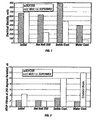
- Figure 1 is a graph comparing the electrical stability of a synthetic based drilling fluid containing the product of the invention with the same synthetic based drilling fluid containing conventional emulsifiers instead of the product of the invention, using data from Tables 1 and 2.
- Figure 2 is a graph comparing HTHP filtration of a synthetic based drilling fluid containing the product of the invention with the same synthetic based drilling fluid containing conventional emulsifiers instead of the product of the invention, using data from Tables 3 and 4.
-
- The product of the invention comprises a blend, mixture, or a combination (hereinafter "blend) of: (1) a carboxylic acid-terminated polyamide and/or a wetting agent ("Component 'A'"); and (2) a mixture or reaction product ("Component 'B''') produced by the Diels-Alder reaction of dienophiles, preferably carboxylic acids, polycarboxylic acids, and anhydrides, or combinations or mixes thereof, with a mixture of fatty acids and resin acids. Component B has a ratio of fatty acids to resin acids preferably ranging from about 4:1 to about 1:1 and a most preferred ratio of about 2:1 and is preferably comprised of fatty acids and resin acids derived from the distillation of crude tall oil.
- When a carboxylic acid terminated amide is used as Component A, it is preferably concentrated (i.e., about 90 % active), and typically made from the condensation reaction between fatty acids and polyamines. The fatty acids and polyamines are reacted in such proportion as to create a "partial amide" intermediate product having a mole ratio of the reactive acid sites to amine sites ranges from about 0.5:1 to about 0.75:1 and most preferably about 0.6:1. This partial amide intermediate product is diluted with a minimum amount of solvent, as needed for further processing, and the remaining amine sites are further reacted with an acid anhydride or polycarboxylic acid to produce the carboxylic acid-terminated polyamide. A most preferred carboxylic acid-terminated fatty polyamide for use in the invention is EZ-MUL® NT CONCENTRATE, the active constituent of EZ-MUL® NT available from Halliburton Energy Services, Inc. in Houston, Texas, although other carboxylic acid terminated fatty polyamides are believed to be useable.
- Any wetting agent that provides a wetting function in a drilling fluid and preferably that is environmentally acceptable for use in a drilling fluid may be substituted for, or added to, the carboxylic acid terminated amide as Component A in the blend comprising the product of the invention. Examples of such wetting agents include, without limitation, quaternary ammonium salt, lecithin, and sodium dodecylbenzene sulfonate.
- In comprising the product of the invention, the preferred ratio of Component A to Component B is about 1:5 to about 1:1. Ratios of Component A to Component B of about 1:2 to about 1:3 are most preferred. The exact ratio of these two components or parts may vary greatly depending on the exact desired characteristics of the product. Preferably, however, the quantity of Component B will exceed the quantity of Component A.
- The blend comprising the product of the invention is preferably made by blending, mixing, or combining these two components-the polyamide and/or wetting agent, and the Diels-Alder modified fatty acid/resin acid mixture or reaction product--together. After blending, the polyamide and/or wetting agent, and the fatty acid/resin acid components, are reacted with cations to form soaps. The polyamide (if present) may undergo some saponification along with or as well as the fatty acid/resin acids. Such blending and saponification may be achieved as part of the manufacturing process of the product of the invention or may be effected in situ the drilling fluid by the presence or addition of cations to the drilling fluid. Calcium cations are preferred and may be obtained, for example, by reacting the modified fatty acid/resin acid component with lime, quicklime, or calcium chloride. The blending in the drilling fluid may occur when the drilling fluid is prepared, when the drilling fluid is at the well surface, or after the drilling fluid has been pumped into the wellbore. When blending in the wellbore, the components may be added to the drilling fluid separately or together.
- Tall oil is a commonly known product made from acid treatment of alkaline liquors obtained from the manufacture ofwood pulp, and tall oil and its derivatives have previously been used in oil-well drilling muds. However, the modified fatty acid/resin acid component of the blend of the product of the invention alone is not effective for achieving the advantages of the invention. EZ-MUL® is known to have utility as an emulsifier for oil based drilling fluids. However, carboxylic acid- terminated fatty polyamides alone cannot achieve all ofthe advantages of the invention. In the combination disclosed, however, the blend (or mixture) comprising the product of the invention provides a marked advance in the art.
- Similarly, wetting agents are known to have utility in oil-based drilling fluids. However, wetting agents alone cannot achieve all of the advantages of the product of the invention. In the combination disclosed, however, the blend comprising the product of the invention provides superior performance.
- The product of the invention is a powerfully efficient additive for oil or synthetic based drilling fluids, affording or effecting enhanced emulsification, and improved electrical stability and fluid loss control, with significantly less volume of additive than previously known or available with prior art drilling fluid additives. The product effects or helps facilitate emulsification typically in amounts of about one-third the quantity commonly needed for emulsification of oil or synthetic based fluids with prior art emulsifiers. That is, amounts of about three pounds to about five pounds of the product of the invention per barrel of drilling fluid can be effective for emulsification. Even lower quantities can improve the electrical stability and filtration control of drilling fluids, even if already emulsified with other emulsifiers.
- The product of the invention does not rely on a carrier. The material comprising the product is highly active and is believed to be useful with all or substantially all synthetic and oil-based systems known to be effective for drilling fluids. The product of the invention may also add viscosity to the drilling fluid and thus is preferably added to the base drilling fluid before any weighting agents such as barite, for example, are added.
- The product of this invention is stable even at temperatures up to (and including) about 250 degrees Fahrenheit without filtration additives and up to about 300 degrees to about 350 degrees Fahrenheit with filtration additives. Combining a wetting agent with a carboxylic acid-terminated polyamide as Component A may improve the rheological stability of the product of the invention at temperatures up to about 300°F. Using both a wetting agent and a carboxylic acid terminated amide as Component A, along with Component B, to comprise the product of the invention in an emulsifier package may also improve the oil-wetting nature of the drilling fluid in some base oils or synthetics and/or at certain reservoir conditions. For example, in a hostile or difficult offshore environment, a particular drilling fluid comprising the product ofthe invention might show enhanced performance upon addition of a wetting agent to the product of the invention, or more particularly or preferably to Component A, while the same drilling fluid in a different environment might show no improvement upon such addition of wetting agent.
- The product of the invention has a high acid value. Consequently, improved results may be seen when a neutralizer or neutralizing agent is added to the drilling fluid. For example, a preferred maximum of about eight pounds of lime (or similar saponifying agent) might favorably be added per barrel of drilling fluid when about three pounds per barrel of the product of the invention are used in the drilling fluid. A preferred minimum amount of lime is about one-half pound per pound of the product of the invention. Additional lime (or similar saponifying agent) may be helpful or needed with larger quantities of product of the invention for optimum results, although satisfactory results might also be obtained with less.
- Care is recommended when using the product of this invention to avoid over-treating. Excess emulsifiers (i.e., more than needed to effect emulsification) in drilling fluids can contribute to high fluid viscosity at cold temperatures (i.e., temperatures less than about 45 degrees Fahrenheit). For deepwater operations (i.e., use of drilling fluids at depths of water greater than about 500 feet and at temperatures less than about 45 degrees Fahrenheit), a wetting agent may preferably be used as Component A or added when Component A is a carboxylic acid-terminated amide to help maintain low riser viscosities as drill solids are incorporated in or become carried by the drilling fluid.
- The method of the invention comprises adding the product of the invention to an oil or synthetic based drilling fluid or employing a drilling fluid comprising the product of the invention in drilling a borehole in a subterranean formation. In another embodiment, the method of the invention comprises adding the product of the invention to an oil or synthetic based drilling fluid to facilitate emulsification of the drilling fluid or the formation of invert emulsions.
- Experiments were conducted that demonstrate or exemplify the invention. Several formulations of synthetic or oil-based drilling fluids were prepared, typical of those used in the field, and all of which comprised invert emulsions. Specifically, samples of drilling fluids were prepared comprising a synthetic or diesel oil base, to which additives were added, including the product of the invention or a known emulsifier for comparison, as indicated in Tables 1-13 below. The different samples were subjected to different conditions, such as high temperatures or hot rolling, or further additives or contaminants, for example, simulated drill solids or salt water, for comparison of performance and properties. The results of tests tabulated in Tables 1-4 are graphed in Figures 1 and 2.
- As used in the tables, the following compounds or products have the meanings indicated below:
- SF BASE™ is a synthetic oil base for drilling fluids typically used in drilling mud systems such as PETROFREE®SF, available from Halliburton Energy Services, Inc. in Houston Texas;
- LE BASE™ is a synthetic oil base for drilling fluids typically used in drilling mud systems such as PETROFREE® LE;
- GELTONE® II, is an organoclay for improving viscosity characteristics;
- SUSPENTONE® is an organoclay for improving the ability of a drilling fluid to suspend drill cuttings;
- INVERMUL® is an emulsifier;
- EZ MUL® is an emulsifier with a carboxylic acid terminated polyamide;
- LE SUPERMUL® is an emulsifier with a carboxylic acid terminated polyamide;
- LE MUL® is an emulsifier;
- DRILTREAT™ is a wetting agent;
- DEEP-TREAT™ is a wetting agent;
- BAROID® is barite, a weighting agent;
- DURATONE® HT is a filtration control agent;
- BDF-257™ is Component B;
- BDF-258™ is the product of the invention having Component B and a carboxylic acid terminated polyamide as Component A;
- BD QUAT 2HT™ is dimethyl dihydrogenated tallow quaternary amine and chloride salt; and Rev Dust is material used to simulate drill solids. All trademarks are the property of Halliburton Energy Services, Inc. and the products are available from Halliburton Energy Services, Inc. in Houston, Texas.
-
- These experimental results show that the product of the invention has emulsion-forming capabilities comparable to or exceeding prior art emulsifiers at only about one-third the concentration and that the product of the invention improves the electrical stability of the drilling fluid, even after heat stress. These results also show that the product of the invention imparts very low filtration properties to the drilling fluids. Further, the product of the invention provides significantly better filtration control than conventional emulsifiers, even after solids and brine contamination. As demonstrated by the data in the tables above, inclusion of a wetting agent with a carboxylic acid terminated polyamide to comprise Component A may provide significant performance advantages in some drilling fluids at certain temperatures or under certain well conditions. Substitution of a wetting agent for the polyamide in Component A may also yield certain advantages with some drilling fluids in some environments. Carboxylic acid terminated polyamides without wetting agent to comprise Component A may yield superior performance in other drilling fluids and/or in other environments.
- Still further, the tests showed that no fluid loss control additives were needed for the same filtration properties as prior art emulsifiers when the product of the invention was used. The tests also indicated that the product of the invention performs well with other emulsifying products, which should allow simpler maintenance treatments in oil or synthetic based fluids when using the product of the invention.
- In the method of the invention, the product of the invention is added to an oil or synthetic based drilling fluid or a drilling fluid comprising an invert emulsion to improve or facilitate the emulsification of the oil or synthetic base fluid.
- The foregoing description of the invention is intended to be a description of preferred embodiments. Various changes in the details of the described product and method can be made without departing from the intended scope of this invention as defined by the appended claims.
| PETROFREE® SF 14 lb/gal; 75/25 OWR with 250,000 ppm WPS | |||||||
| Sample Mark | A (7.33 lb/bbl Active emulsifier content) | ||||||
| SF BASE, bbl | 0.516 | ||||||
| Freshwater, bbl | 0.181 | ||||||
| GELTONE® II, lb | 3 | ||||||
| SUSPENTONE™, lb | 1 | ||||||
| LE™ MUL, lb | 4 | ||||||
| LE™ SUPERMUL, Ib | 6 | ||||||
| Lime, lb | 5 | ||||||
| DURATONE® HT, lb | 7 | ||||||
| BAROID®, lb | 330 | ||||||
| Calcium chloride, lb | 21.9 | ||||||
| DEEP-TREAT™, lb | 3 | ||||||
| Mixed 15 minutes at 7000 rpm on a Silverson L4RT before testing; mixed 10 minutes after rolling | |||||||
| Rev Dust, lb | ― | 45 | ― | ||||
| 15% NaCl Brine Added, % vol | ― | 33 | |||||
| Hot rolled @250°F, hr | ― | 16 | 16 | 16 | |||
| Temperature, °F | 120 | 40 | 120 | 40 | 120 | 40 | 120 |
| Plastic viscosity, cP | 23 | 80 | 24 | 112 | 37 | 108 | 38 |
| Yield point, lb/100 ft2 | 15 | 18 | 8 | 19 | 8 | 26 | 11 |
| 10 Sec gel, lb/100 ft2 | 8 | 7 | 6 | 10 | 7 | 9 | 6 |
| 10 Min gel, lb/100 ft2 | 9 | 11 | 8 | 18 | 10 | 12 | 10 |
| Electrical stability, v | 690 | 235 | 488 | 77 | |||
| HTHP filtrate @250°F, ml | 2.4 | 2.4 | 10.4 | 7.6 (0.5 water) | |||
| Fann 35 dial readings | |||||||
| 600 rpm | 61 | 178 | 56 | 243 | 82 | 242 | 87 |
| 300 rpm | 38 | 98 | 32 | 131 | 45 | 134 | 49 |
| 200 rpm | 29 | 69 | 24 | 91 | 33 | 94 | 36 |
| 100 rpm | 20 | 38 | 15 | 51 | 20 | 53 | 23 |
| 6 rpm | 7 | 7 | 5 | 10 | 5 | 10 | 7 |
| 3 rpm | 6 | 6 | 4 | 9 | 4 | 8 | 6 |
| Note: Contaminated samples were made up with mud already hot rolled 16 hr.@250°F |
| PETROFREE® SF 14 lb/gal; 75/25 OWR with 250,000 ppm WPS | |||||||||
| Sample Mark | H3 | ||||||||
| SF BASE, bbl | 0.516 | ||||||||
| Freshwater, bbl | 0.181 | ||||||||
| GELTONE® II, lb | 3 | ||||||||
| SUSPENTONE™, lb | 1 | ||||||||
| BDF-258, lb | 3 | ||||||||
| Lime, lb | 8 | ||||||||
| DURATONE® HT, lb | 7 | ||||||||
| BAROID®, lb | 330 | ||||||||
| Calcium chloride, lb | 21.9 | ||||||||
| DEEP-TREAT™, lb | 3 | ||||||||
| Mixed 15 minutes at 7000 rpm on a Silverson L4RT before testing; mixed 10 minutes after rolling | |||||||||
| Rev Dust, lb | ― | 45 | ― | ||||||
| 15% NaCl Brine Added, % vol | ― | 33 | |||||||
| Hot rolled @250°F, hr | ― | ― | 16 | 16 | 16 | ||||
| Temperature, °F | 120 | 40 | 120 | 40 | 120 | 40 | 120 | 40 | 120 |
| Plastic viscosity, cP | 29 | 78 | 27 | 72 | 26 | N/A | 49 | 113 | 43 |
| Yield point, lb/100 ft2 | 16 | 33 | 14 | 24 | 12 | N/A | 24 | 43 | 20 |
| 10 Sec gel, lb/100 ft2 | 8 | 15 | 7 | 13 | 7 | 27 | 16 | 19 | 13 |
| 10 Min gel, lb/100 ft2 | 10 | 17 | 9 | 15 | 9 | 57 | 36 | 20 | 13 |
| Electrical stability, v | 638 | 669 | 630 | 884 | 393 | ||||
| HTHP filtrate @250°F, ml | 2.0 | 1.6 | 5.2 | 2.4 | |||||
| Fann 35 dial readings | |||||||||
| 600 rpm | 74 | 189 | 68 | 168 | 64 | O/S | 122 | 269 | 106 |
| 300 rpm | 45 | 111 | 41 | 96 | 38 | 186 | 73 | 156 | 63 |
| 200 rpm | 35 | 82 | 32 | 72 | 30 | 139 | 56 | 116 | 48 |
| 100 rpm | 24 | 53 | 22 | 45 | 20 | 88 | 38 | 72 | 32 |
| 6 rpm | 9 | 17 | 8 | 14 | 8 | 29 | 15 | 21 | 12 |
| 3 rpm | 8 | 15 | 7 | 12 | 7 | 26 | 14 | 19 | 11 |
| Note: O/S indicates an off-scale reading, or >300. Contaminated samples were made up with mud already rolled 16 hr @250°F |
| PETROFREE® LE 14 lb/gal; 75/25 OWR with 250,000 ppm WPS | |||||||||
| Sample Mark | C | ||||||||
| LE BASE, bbl | 0.5094 | ||||||||
| Freshwater, bbl | 0.1793 | ||||||||
| GELTONE® II, lb | 3.5 | ||||||||
| SUSPENTONE™, | 2 | ||||||||
| LE™ MUL, lb | 7 | ||||||||
| LE™ SUPERMUL, lb | 4 | ||||||||
| Lime, lb | 7 | ||||||||
| DURATONE® HT, lb | 6 | ||||||||
| Calcium chloride, lb | 21.8 | ||||||||
| BAROID®, lb | 332.3 | ||||||||
| DEEP-TREAT™, lb | 3.5 | ||||||||
| Mixed 15 minutes at 7000 rpm on a Silverson L4RT before testing; mixed 10 minutes after rolling | |||||||||
| Rev Dust, lb | ― | 45 | - | ||||||
| 15% NaCl Brine Added, % vol | ― | 33 | |||||||
| Hot rolled @250°F, hr | - | - | 16 | 16 | 16 | ||||
| Temperature, °F | 120 | 40 | 120 | 40 | 120 | 40 | 120 | 40 | 120 |
| Plastic viscosity, cP | 23 | 94 | 22 | 77 | 23 | 82 | 32 | 87 | 35 |
| Yield point, lb/100 | 12 | 51 | 9 | 18 | 6 | 12 | 5 | 14 | 4 |
| 10 Sec gel, lb/100 ft2 | 6 | 17 | 6 | 9 | 5 | 8 | 5 | 7 | 5 |
| 10 Min gel, lb/100 ft2 | 9 | 21 | 8 | 15 | 7 | 15 | 8 | 10 | 6 |
| Electrical stability, v | 737 | 676 | 474 | 545 | 230 | ||||
| HTHP filtrate @250°F, ml | 4.4 | 2.0 | 10.0 | 12.0- 1.1 emul. | |||||
| Fann 35 | |||||||||
| 600 rpm | 58 | 239 | 53 | 172 | 52 | 176 | 69 | 188 | 74 |
| 300 rpm | 35 | 145 | 31 | 95 | 29 | 94 | 37 | 101 | 39 |
| 200 rpm | 26 | 108 | 24 | 67 | 22 | 66 | 28 | 70 | 29 |
| 100 rpm | 17 | 66 | 16 | 38 | 13 | 37 | 17 | 38 | 17 |
| 6 rpm | 6 | 19 | 5 | 9 | 4 | 8 | 4 | 7 | 5 |
| 3 rpm | 5 | 17 | 4 | 8 | 3 | 7 | 3 | 6 | 4 |
| Note: O/S indicates an off-scale reading, or >300. Contaminated samples were made up with mud already hot rolled 16 hr @250°F |
| PETROFREE® LE 14 lb/gal; 75/25 OWR with 250,000 ppm WPS | |||||||||
| Sample Mark | B2 | ||||||||
| LE BASE, bbl | 0.5163 | ||||||||
| Freshwater, bbl | 0.1796 | ||||||||
| GELTONE® II, lb | 3 | ||||||||
| SUSPENTONE™, lb | 2 | ||||||||
| BDF-258, lb | 3 | ||||||||
| Lime, lb | 7 | ||||||||
| DURATONE® HT, lb | 6 | ||||||||
| Calcium chloride, lb | 21.8 | ||||||||
| BAROID®, lb | 333.2 | ||||||||
| DEEP-TREAT™, lb | 3.3 | ||||||||
| Mixed 15 minutes at 7000 rpm on a Silverson L4RT before testing; mixed 10 minutes after rolling | |||||||||
| Rev Dust, lb | ― | 45 | ― | ||||||
| 15% NaCl Brine Added, % vol | ― | 33 | |||||||
| Hot rolled @250°F, hr | ― | ― | 16 | 16 | 16 | ||||
| Temperature, °F | 120 | 40 | 120 | 40 | 120 | 40 | 120 | 40 | 120 |
| Plastic viscosity, cP | 26 | 72 | 23 | 64 | 23 | 98 | 34 | 96 | 36 |
| Yield point, lb/100 ft2 | 12 | 29 | 9 | 16 | 7 | 26 | 6 | 32 | 11 |
| 10 Sec gel, lb/100 ft2 | 7 | 14 | 6 | 12 | 6 | 13 | 6 | 16 | 10 |
| 10 Min gel, lb/100 ft2 | 9 | 18 | 8 | 16 | 9 | 28 | 8 | 21 | 9 |
| Electrical stability, v | 554 | 615 | 568 | 574 | 269 | ||||
| HTHP filtrate @250°F, ml | 2.2 | 2.2 | 3.0 | 1.8 | |||||
| Fann 35 dial readings | |||||||||
| 600 rpm | 64 | 173 | 55 | 144 | 53 | 222 | 74 | 224 | 83 |
| 300 rpm | 38 | 101 | 32 | 80 | 30 | 124 | 40 | 128 | 47 |
| 200 rpm | 29 | 75 | 25 | 58 | 23 | 89 | 29 | 94 | 36 |
| 100 rpm | 20 | 47 | 17 | 35 | 15 | 52 | 18 | 58 | 23 |
| 6 rpm | 7 | 15 | 6 | 10 | 6 | 13 | 4 | 16 | 8 |
| 3 rpm | 6 | 14 | 5 | 9 | 5 | 11 | 3 | 14 | 7 |
| Note: O/S indicates an off-scale reading, or >300. Contaminated samples were made up with mud already hot rolled 16 hr @250°F |
| PETROFREE® SF 14 lb/gal; 75/25 OWR with 250,000 ppm WPS | |||||||||
| Sample Mark | H2 | ||||||||
| SF BASE, bbl | 0.516 | ||||||||
| Freshwater, bbl | 0.181 | ||||||||
| GELTONE® II, lb | 3 | ||||||||
| SUSPENTONE™, lb | 1 | ||||||||
| BDF-258, lb | 3 | ||||||||
| Lime, lb | 8 | ||||||||
| DURATONE® HT, lb | 7 | ||||||||
| BAROID®, lb | 330 | ||||||||
| Calcium chloride, lb | 21.9 | ||||||||
| DEEP-TREAT™, lb | 3 | ||||||||
| DRILTREAT®, lb | 1 | ||||||||
| Mixed 15 minutes at 7000 rpm on a Silverson L4RT before testing; mixed 10 minutes after rolling | |||||||||
| Rev Dust, lb | ― | 45 | ― | ||||||
| 15% NaCl Brine Added, % vol | ― | 33 | |||||||
| Hot rolled @250°F, hr | ― | ― | 16 | 16 | 16 | ||||
| Temperature, °F | 120 | 40 | 120 | 40 | 120 | 40 | 120 | 40 | 120 |
| Plastic viscosity, cP | 28 | 82 | 25 | 86 | 25 | N/A | 46 | 116 | 41 |
| Yield point, lb/100 ft2 | 14 | 36 | 16 | 29 | 14 | N/A | 22 | 45 | 22 |
| 10 Sec gel, lb/100 ft2 | 7 | 17 | 7 | 14 | 8 | 28 | 18 | 19 | 12 |
| 10 Min gel, lb/100 ft2 | 10 | 20 | 9 | 18 | 10 | 60 | 31 | 21 | 12 |
| Electrical stability, v | 603 | 694 | 684 | 846 | 409 | ||||
| HTHP filtrate @250°F, ml | 1.2 | 1.6 | 4.0 | 1.6 | |||||
| Fann 35 dial readings | |||||||||
| 600rpm | 70 | 200 | 66 | 201 | 64 | O/S | 114 | 277 | 104 |
| 300 rpm | 42 | 118 | 41 | 115 | 39 | 201 | 68 | 161 | 63 |
| 200 rpm | 33 | 89 | 32 | 84 | 30 | 149 | 52 | 119 | 48 |
| 100 rpm | 22 | 57 | 22 | 51 | 21 | 93 | 34 | 74 | 33 |
| 6 rpm | 8 | 19 | 8 | 15 | 8 | 28 | 13 | 22 | 13 |
| 3 rpm | 7 | 17 | 7 | 14 | 7 | 24 | 12 | 19 | 12 |
| Note: O/S indicates an off-scale reading, or >300. Contaminated samples were made up with mud already rolled 16 hr @250°F |
| PETROFREE® SF 14 lb/gal; 75/25 OWR with 250,000 ppm WPS NO DURATONE® HT | |||||||||
| Sample Mark | O | ||||||||
| SF BASE, lb | 0.516 | ||||||||
| Freshwater, bbl | 0.181 | ||||||||
| GELTONE® II, lb | 4 | ||||||||
| SUSPENTONE™, lb | 1 | ||||||||
| BDF-258, lb | 3 | ||||||||
| Lime, lb | 9 | ||||||||
| Calcium chloride, lb | 21.9 | ||||||||
| BAROID®, lb | 330 | ||||||||
| DRILTREAT®, lb | 1 | ||||||||
| DEEP-TREAT™, lb | 3 | ||||||||
| Mixed 15 minutes at 7000 rpm on a Silverson L4RT before testing; mixed 10 minutes after rolling | |||||||||
| Hot rolled @250°F, hr | ― | ― | 16 | 16 | 16 | ||||
| Rev Dust, lb | ― | ― | ― | 45 | ― | ||||
| 15% NaCl brine, % vol | ― | ― | 33 | ||||||
| Temperature, °F | 120 | 40 | 120 | 40 | 120 | 40 | 120 | 40 | 120 |
| Plastic viscosity, cP | 28 | 88 | 33 | 85 | 29 | N/A | 50 | N/A | 69 |
| Yield point, lb/100 ft2 | 5 | 19 | 8 | 20 | 8 | N/A | 5 | N/A | 45 |
| 10 Sec gel, lb/100 ft2 | 5 | 10 | 7 | 9 | 5 | 5 | 3 | 48 | 25 |
| 10 Min gel, lb/100 ft2 | 8 | 14 | 9 | 13 | 7 | 14 | 10 | > 60 | 62 |
| Electrical stability @120°F, v | 471 | 519 | 496/230 | 218 | 285 | ||||
| HTHP filtrate @250°F, ml | 0.2 | 1.6 | 4.0 | 3.4 - 0.4 H2O | |||||
| Fann 35 dial readings | |||||||||
| 600 rpm | 61 | 195 | 74 | 190 | 66 | O/S | 105 | O/S | 183 |
| 300 rpm | 33 | 107 | 41 | 105 | 37 | 173 | 55 | O/S | 114 |
| 200 rpm | 25 | 75 | 31 | 75 | 27 | 123 | 39 | 256 | 87 |
| 100 rpm | 16 | 43 | 20 | 44 | 17 | 68 | 21 | 163 | 57 |
| 6 rpm | 5 | 10 | 7 | 10 | 5 | 7 | 3 | 45 | 26 |
| 3 rpm | 4 | 8 | 6 | 8 | 4 | 5 | 2 | 40 | 24 |
| Note: O/S indicates an off-scale reading, or >300. Contaminated samples were made up with mud already rolled 16 hr @250°F |
| INVERMUL® 14 lb/gal; 250,000 WPS | ||||||||
| Sample Mark | 1 | 2 | 3 | 4 | 5 | |||
| Diesel, bbl | 0.5395 | 0.5234 | 0.5679 | 0.5743 | 0.5608 | |||
| Fresh water, bbl | 0.1814 | 0.1815 | 0.1449 | 0.1453 | 0.1454 | |||
| Oil-to-Water Ratio | 75/25 | 75/25 | 80/20 | 80/20 | 80/20 | |||
| GELTONE® II, lb | 2 | 2 | 2 | 2 | 2 | |||
| SUSPENTONE™, lb | 1 | 1 | ― | ― | ― | |||
| BDF-258, lb | 3.5 | ― | 6 | 3 | ― | |||
| INVERMUL® NT, lb | ― | 3 | ― | ― | 3 | |||
| Lime, lb | 8 | 8 | 12 | 8 | 8 | |||
| DURATONE® HT, lb | 6 | 6 | 6 | 6 | 6 | |||
| EZ MUL® NT, lb | ― | 6 | ― | ― | 6 | |||
| Calcium chloride, lb | 22.0 | 22.1 | 17.6 | 17.7 | 17.7 | |||
| BAROID®, lb | 302 | 301 | 307 | 310 | 309 | |||
| Rev Dust, lb | 20 | 20 | 20 | 20 | 20 | |||
| DRILTREAT®, lb | ― | ― | ― | 1.5 | ― | |||
| Hot rolled @300°F, hr | ― | ― | ― | 16 | ― | 16 | ― | 16 |
| Plastic viscosity @150°F, cP | 25 | 26 | 21 | 23 | 22 | 19 | 20 | 22 |
| Yield point, lb/100 ft2 | 31 | 53 | 17 | 11 | 13 | 9 | 30 | 8 |
| 10 Sec gel, lb/100 ft2 | 26 | 32 | 12 | 14 | 8 | 8 | 16 | 8 |
| 10 Min gel, lb/100 ft2 | 34 | 34 | 23 | 29 | 15 | 16 | 16 | 9 |
| Electrical stability, v | 593 | 1140 | 923 | 1302 | 697 | 783 | 1404 | 766 |
| HTHP filtrate @300°F, ml | 11.6 | 3.8 | 6.2 | 16.4 | 5.6 | 10.0 | 5.4 | 7.6 |
| Fann 35 dial readings | ||||||||
| 600 rpm | 81 | 105 | 59 | 57 | 57 | 47 | 70 | 52 |
| 300 rpm | 56 | 79 | 38 | 34 | 35 | 28 | 50 | 30 |
| 200 rpm | 46 | 69 | 30 | 26 | 28 | 21 | 42 | 23 |
| 100 rpm | 36 | 56 | 22 | 17 | 19 | 14 | 32 | 16 |
| 6 rpm | 21 | 33 | 10 | 8 | 8 | 7 | 17 | 7 |
| 3 rpm | 20 | 32 | 9 | 7 | 7 | 6 | 16 | 6 |
| INVERMUL® 14 lb/gal; 80/20 OWR with 250,000 | ||||
| Sample Mark | ||||
| 10 | 11 | |||
| Diesel, bbl | 0.577 | 0.577 | ||
| Fresh water, bbl | 0.145 | 0.145 | ||
| GELTONE® II, lb | 6 | 6 | ||
| BDF-258, lb | 3 | 3 | ||
| Lime, lb | 8 | 8 | ||
| Calcium chloride, lb | 17.6 | 17.6 | ||
| DEEP-TREAT™, lb | 1.5 | 1 | ||
| BAROID®, lb | 312 | 312 | ||
| Rev Dust, lb | 20 | 20 | ||
| DRILTREAT®, lb | ― | 1 | ||
| Hot rolled @150°F, hr | 16 | ― | 16 | ― |
| Hot rolled @250°F, hr | ― | 16 | ― | 16 |
| Plastic viscosity @150°F, cP | 23 | 24 | 23 | 24 |
| Yield point, lb/100 ft2 | 28 | 10 | 25 | 12 |
| 10 Sec gel, lb/100 ft2 | 17 | 10 | 18 | 11 |
| 10 Min gel, lb/100 ft2 | 22 | 16 | 20 | 20 |
| Electrical stability, v | 686 | 783 | 561 | 723 |
| HTHP filtrate @250°F, ml | 5.6 | 6.8 | 6.6 | 9.4 |
| HTHP filt.cake thickness, 1/32" | 4 | 3 | 5 | 5 |
| Fann 35 | ||||
| 600 rpm | 74 | 58 | 71 | 60 |
| 300 rpm | 51 | 34 | 48 | 36 |
| 200 rpm | 42 | 26 | 39 | 28 |
| 100 rpm | 32 | 17 | 30 | 19 |
| 6 rpm | 17 | 7 | 17 | 8 |
| 3 rpm | 16 | 6 | 17 | 8 |
| Note: 0.4 lb/bbl DEEP-TREAT™ was sufficient to wet in the barite and Rev Dust in mud 11. Additional product was added after the Rev Dust to total 1 lb/bbl. |
| PETROFREE® SF 14 lb/gal; 75/25 OWR with 250,000 ppm WPS NO DURATONE® HT | |||||||||
| Sample Mark | I | ||||||||
| SF BASE, bbl | 0.516 | ||||||||
| Freshwater, bbl | 0.181 | ||||||||
| GELTONE® II, lb | 4 | ||||||||
| SUSPENTONE™, lb | 1 | ||||||||
| BDF-258, lb | 3.5 | ||||||||
| Lime, lb | 9 | ||||||||
| DURATONE® HT, lb | - | ||||||||
| Calcium chloride, lb | 21.9 | ||||||||
| DEEP-TREAT™, lb | 3 | ||||||||
| BAROID®, lb | 330 | ||||||||
| Mixed 15 minutes at 7000 rpm on a Silverson L4RT before testing; mixed 10 minutes after rolling | |||||||||
| Hot rolled @250°F, hr | ― | ― | 16 | 16 | 16 | ||||
| Rev Dust, lb | ― | 45 | ― | ||||||
| 15% NaCl Brine Added, % vol | ― | 33 | |||||||
| Temperature, °F | 120 | 40 | 120 | 40 | 120 | 40 | 120 | 58 | 120 |
| Plastic viscosity, cP | 29 | 85 | 32 | 76 | 31 | N/A | 54 | N/A | 71 |
| Yield point, lb/100 ft2 | 9 | 17 | 9 | 15 | 6 | N/A | 7 | N/A | 53 |
| 10 Sec gel, lb/100 ft2 | 7 | 10 | 8 | 9 | 7 | 6 | 4 | 55 | 34 |
| 10 Min gel, lb/100 ft2 | 8 | 15 | 11 | 10 | 7 | 13 | 8 | - | 65 |
| Electrical stability, v | 482 | 529 | 241 | 234 | 293 | ||||
| HTHP filtrate @250°F, ml | 1.6 | 2.8 | 6.0 | 5.0 - 1.0 H2O | |||||
| Fann 35 dial readings | |||||||||
| 600 rpm | 67 | 187 | 73 | 167 | 68 | O/S | 115 | O/S | 195 |
| 300 rpm | 38 | 102 | 41 | 91 | 37 | 186 | 61 | 278 | 124 |
| 200 rpm | 29 | 73 | 31 | 65 | 28 | 130 | 43 | 220 | 97 |
| 100 rpm | 19 | 42 | 20 | 38 | 18 | 71 | 23 | 151 | 67 |
| 6 rpm | 6 | 10 | 7 | 9 | 6 | 8 | 3 | 53 | 29 |
| 3 rpm | 5 | 8 | 6 | 7 | 5 | 5 | 2 | 50 | 28 |
| PETROFREE® SF 14 lb/gal; 75/25 OWR with 250,000 ppm WPS NO DURATONE® HT | |||||||||
| Sample Mark | N | ||||||||
| SF BASE, lb | 0.516 | ||||||||
| Freshwater, bbl | 0.181 | ||||||||
| GELTONE® II, lb | 4 | ||||||||
| SUSPENTONE™, lb | 1 | ||||||||
| BDF-258, lb | 3.5 | ||||||||
| Lime, lb | 9 | ||||||||
| Calcium chloride, lb | 21.9 | ||||||||
| DEEP-TREAT™, lb | 4 | ||||||||
| BAROID®, lb | 330 | ||||||||
| Mixed 15 minutes at 7000 rpm on a Silverson L4RT before testing; mixed 10 minutes after rolling | |||||||||
| Hot rolled @250°F, hrs | ― | ― | 16 | 16 | 16 | ||||
| Rev Dust, lb | ― | 45 | ― | ||||||
| 15% NaCl brine, % vol | ― | 33 | |||||||
| DEEP-TREAT™, lb | ― | 2 | 2 | ||||||
| Temperature, °F | 120 | 40 | 120 | 40 | 120 | 40 | 120 | 40 | 120 |
| Plastic viscosity, cP | 35 | 103 | 38 | 80 | 31 | 124 | 44 | N/A | 53 |
| Yield point, lb/100 ft2 | 11 | 18 | 11 | 16 | 6 | 22 | 5 | N/A | 10 |
| 10 Sec gel, lb/100 ft2 | 8 | 10 | 7 | 8 | 6 | 5 | 5 | 8 | 6 |
| 10 Min gel, lb/100 ft2 | 14 | 16 | 11 | 9 | 7 | 8 | 7 | 10 | 7 |
| Electrical stability @120°F, v | 503 | 527 | 209 | 275 | 156 | ||||
| HTHP filtrate @250°F, ml | 0.6 | 1.2 | 1.6 | 1.0 - trace emul | |||||
| Fann 35 dial readings | |||||||||
| 600 rpm | 81 | 224 | 87 | 176 | 68 | 270 | 93 | O/S | 116 |
| 300 rpm | 46 | 121 | 49 | 96 | 37 | 146 | 49 | 189 | 63 |
| 200 rpm | 35 | 85 | 37 | 68 | 29 | 101 | 35 | 134 | 44 |
| 100 rpm | 22 | 49 | 24 | 39 | 18 | 55 | 20 | 74 | 25 |
| 6 rpm | 7 | 10 | 7 | 8 | 6 | 6 | 4 | 10 | 5 |
| 3 rpm | 6 | 8 | 6 | 7 | 5 | 4 | 3 | 7 | 4 |
| Note: O/S indicates an off-scale reading, or >300. Contaminated samples were made up with mud already rolled 16 hr @250°F |
| PETROFREE® SF 14 lb/gal; 75/25 OWR with 250,000 ppm WPS | |||||||||
| Sample Mark | BB | ||||||||
| SF BASE, lb | 0.516 | ||||||||
| Freshwater, bbl | 0.181 | ||||||||
| GELTONE® II, lb | 4 | ||||||||
| SUSPENTONE™, lb | 1 | ||||||||
| BDF-258, lb | 3.5 | ||||||||
| Lime, lb | 9 | ||||||||
| Calcium chloride, lb | 21.9 | ||||||||
| BD QUAT 2HT, lb | 1 | ||||||||
| BAROID®, lb | 330 | ||||||||
| DEEP-TREAT™, lb | 3 | ||||||||
| Mixed 15 minutes at 7000 rpm on a Silverson L4RT before testing; mixed 10 minutes after rolling | |||||||||
| Hot rolled @250°F, hr | ― | ― | 16 | 16 | 16 | ||||
| Rev Dust, lb | ― | ― | ― | 45 | ― | ||||
| 15% NaCl brine, % vol | ― | ― | 25 | ||||||
| Temperature, °F | 120 | 40 | 120 | 40 | 120 | 40 | 120 | 40 | 120 |
| Plastic viscosity, cP | 29 | 76 | 30 | 75 | 28 | 119 | 40 | 119 | 43 |
| Yield point, lb/100 ft2 | 15 | 32 | 17 | 24 | 10 | 16 | 6 | 35 | 14 |
| 10 Sec gel, lb/100 ft2 | 8 | 14 | 8 | 11 | 7 | 7 | 5 | 15 | 8 |
| 10 Min gel, lb/100 ft2 | 13 | 17 | 9 | 12 | 8 | 11 | 10 | 15 | 9 |
| Electrical stability @120°F, v | 633 | 486 average | 333 | 576 | 223 | ||||
| HTHP filtrate @250°F, ml | 2.2 | 5.4 | 4.0 | 3.0 - 0.2 emul. | |||||
| Fann 35 | |||||||||
| 600 rpm | 73 | 184 | 77 | 174 | 66 | 254 | 86 | 273 | 100 |
| 300 rpm | 44 | 108 | 47 | 99 | 38 | 135 | 46 | 154 | 57 |
| 200 rpm | 34 | 81 | 36 | 73 | 30 | 93 | 33 | 111 | 42 |
| 100 rpm | 23 | 52 | 24 | 45 | 19 | 50 | 19 | 65 | 26 |
| 6 rpm | 8 | 16 | 8 | 13 | 7 | 7 | 4 | 15 | 8 |
| 3 rpm | 7 | 14 | 7 | 11 | 6 | 5 | 3 | 13 | 7 |


Claims (29)
- A drilling fluid comprising a wetting agent and a product produced by the Diels-Alder reaction of dienophiles with a mixture of fatty acids and resin acids.
- A drilling fluid according to claim 1 wherein said drilling fluid is oil or synthetic based.
- A drilling fluid according to claim 1 or 2, wherein said dienophiles are selected from: carboxylic acids, polycarboxylic acids, acid anhydrides, and mixtures thereof:
- A drilling fluid according to claim 1, 2 or 3, wherein said mixture of fatty acids and resin acids are derived from the distillation of tall oil, preferably crude tall oil.
- A drilling fluid according to claim 1, 2, 3 or 4, wherein said dienophiles are maleic anhydrides.
- A drilling fluid according to any preceding claim, wherein said mixture has a ratio of fatty acids to resins acids ranging from about 4:1 to about 1:1, preferably of about 2:1.
- A drilling fluid according to any preceding claim, wherein the ratio of wetting agent to said mixture is about 1:5 to about 1:1, preferably about 1:2 to about 1:3.
- A drilling fluid according to claim 1 wherein said product is saponified, and preferably said saponification is effected with calcium chloride, lime, quicklime, or other sources of calcium cations.
- A drilling fluid according to claim 8 wherein said saponification occurs in situ.
- A drilling fluid according to claim 8 wherein said saponification occurs before said blend is added to said drilling fluid.
- A drilling fluid according to any preceding claim further comprising lime, calcium chlorides, quicklime, or other saponifying agents.
- A drilling fluid according to any preceding claim further comprising carboxylic acid-terminated polyamide.
- A method for drilling a borehole in a subterranean formation, said method comprising employing an oil or synthetic based drilling fluid comprising an invert emulsion and an additive comprising a wetting agent and a product produced by the Diels-Alder reaction of compounds or reagents with a mixture of fatty acids and resin acids wherein said compounds or reagents are selected from the group consisting of carboxylic acids, polycarboxylic acids, acid anhydrides and combinations or mixes thereof.
- A method according to claim 13 wherein said product is added to said drilling fluid in the borehole, and preferably said wetting agent and said product are added to said drilling fluid in the borehole.
- A method according to claim 13, wherein said product and/or wetting agent is added to said drilling fluid at the well surface.
- A method according to claim 28 wherein said product and/or wetting agent is added to said drilling fluid when the drilling fluid is prepared.
- A method according to any one of claims 13 to 18 wherein said drilling comprises at least one step selected from: drilling a borehole in a subterranean formation; completing a borehole in a subterranean formation; testing a borehole in a subterranean formation; servicing a borehole in a subterranean formation; and producing fluid from a borehole in a subterranean formation.
- A method for improving or facilitating the emulsification of a drilling fluid, said method comprising adding to said drilling fluid a wetting agent and a product produced by the Diets- Alder reaction of dienophiles with a mixture of fatty acids and resin acids.
- A method according to claim 13 or 18 wherein the wetting agent and the product are blended together before addition to the drilling fluid.
- A method for improving the filtration properties of an oil or synthetic based drilling fluid or a drilling fluid comprising an invert emulsion, said method employing adding to said drilling fluid a wetting agent and a product produced by the Diels-Alder reaction of dienophiles with a mixture of fatty acids and resin acids.
- A method according to claim 20 wherein said wetting agent and said product are blended in situ the drilling fluid.
- A method for improving the electrical stability of an oil or synthetic based drilling fluid, or a drilling fluid comprising an invert emulsion, said method comprising adding to said fluid a wetting agent and a product produced by the Diels-Alder reaction of dienophiles with a mixture of fatty acids and resin acids.
- A method for drilling a borehole in a subterranean formation employing a drilling fluid, said method comprising adding to said fluid a carboxylic acid terminated polyamide and a product produced by the Diels-Alder reaction of compounds or reagents with a mixture of fatty acids and resin acids wherein said compounds or reagents are selected form the group consisting of carboxylic acids, polycarboxylic acids, acid anhydrides and combinations or mixes thereof.
- A method according to claim 23 wherein said polyamide and/or said product is added to said drilling fluid in the borehole.
- A method according to claim 23 wherein said polyamide and/or the product is added to said drilling fluid at the well surface.
- A method according to claim 23 wherein said polyamide and/or the product is added to said drilling fluid when the drilling fluid is prepared.
- A method according to claim 23 wherein said polyamide and said product are blended together before addition to the drilling fluid.
- A method according to any one of claims 23 to 29 wherein said fluid further comprises a wetting agent.
- A method according to any one of claims 23 to 30 comprising drilling a borehole in a subterranean formation, completing said borehole, and producing fluid from said borehole.
Priority Applications (2)
| Application Number | Priority Date | Filing Date | Title |
|---|---|---|---|
| EP10185433.9A EP2264120B1 (en) | 2003-07-01 | 2004-06-30 | Additive for oil-based drilling fluids |
| EP10185487.5A EP2264121B1 (en) | 2003-07-01 | 2004-06-30 | Additive for oil-based drilling fluids |
Applications Claiming Priority (2)
| Application Number | Priority Date | Filing Date | Title |
|---|---|---|---|
| US10/611,009 US7008907B2 (en) | 2001-10-31 | 2003-07-01 | Additive for oil-based drilling fluids |
| US611009 | 2003-07-01 |
Related Child Applications (2)
| Application Number | Title | Priority Date | Filing Date |
|---|---|---|---|
| EP10185487.5 Division-Into | 2010-10-01 | ||
| EP10185433.9 Division-Into | 2010-10-01 |
Publications (3)
| Publication Number | Publication Date |
|---|---|
| EP1496096A2 true EP1496096A2 (en) | 2005-01-12 |
| EP1496096A3 EP1496096A3 (en) | 2006-04-19 |
| EP1496096B1 EP1496096B1 (en) | 2012-12-12 |
Family
ID=33452634
Family Applications (3)
| Application Number | Title | Priority Date | Filing Date |
|---|---|---|---|
| EP10185433.9A Expired - Lifetime EP2264120B1 (en) | 2003-07-01 | 2004-06-30 | Additive for oil-based drilling fluids |
| EP10185487.5A Expired - Lifetime EP2264121B1 (en) | 2003-07-01 | 2004-06-30 | Additive for oil-based drilling fluids |
| EP04253947A Expired - Lifetime EP1496096B1 (en) | 2003-07-01 | 2004-06-30 | Additive for oil-based drilling fluids |
Family Applications Before (2)
| Application Number | Title | Priority Date | Filing Date |
|---|---|---|---|
| EP10185433.9A Expired - Lifetime EP2264120B1 (en) | 2003-07-01 | 2004-06-30 | Additive for oil-based drilling fluids |
| EP10185487.5A Expired - Lifetime EP2264121B1 (en) | 2003-07-01 | 2004-06-30 | Additive for oil-based drilling fluids |
Country Status (7)
| Country | Link |
|---|---|
| US (1) | US7008907B2 (en) |
| EP (3) | EP2264120B1 (en) |
| AR (1) | AR041486A1 (en) |
| BR (1) | BRPI0402573A (en) |
| CA (1) | CA2472681C (en) |
| MX (1) | MXPA04006567A (en) |
| NO (1) | NO20042786L (en) |
Cited By (7)
| Publication number | Priority date | Publication date | Assignee | Title |
|---|---|---|---|---|
| WO2006079778A1 (en) * | 2005-01-28 | 2006-08-03 | Halliburton Energy Services, Inc. | Metallic soaps of modified tall oil acids |
| US7271132B2 (en) | 2001-10-31 | 2007-09-18 | Halliburton Energy Services, Inc. | Metallic soaps of modified fatty acids and rosin acids and methods of making and using same |
| WO2006087505A3 (en) * | 2005-01-18 | 2008-04-03 | Halliburton Energy Serv Inc | Spotting fluid compositions and associated methods |
| US8048828B2 (en) | 2005-01-18 | 2011-11-01 | Halliburton Energy Services Inc. | Spotting fluid compositions and associated methods |
| CN103270130A (en) * | 2010-12-23 | 2013-08-28 | 哈利伯顿能源服务公司 | Drilling fluids having reduced sag potential and related methods |
| WO2014028272A1 (en) * | 2012-08-15 | 2014-02-20 | Halliburton Energy Services, Inc. | Wellbore servicing compositions and methods of making and using same |
| WO2016102654A1 (en) * | 2014-12-23 | 2016-06-30 | Agrana Beteiligungs-Aktiengesellschaft | Process fluid with environmentally friendly biostabilisator |
Families Citing this family (25)
| Publication number | Priority date | Publication date | Assignee | Title |
|---|---|---|---|---|
| US6806233B2 (en) * | 1996-08-02 | 2004-10-19 | M-I Llc | Methods of using reversible phase oil based drilling fluid |
| US6887832B2 (en) * | 2000-12-29 | 2005-05-03 | Halliburton Energy Service,S Inc. | Method of formulating and using a drilling mud with fragile gels |
| US7456135B2 (en) * | 2000-12-29 | 2008-11-25 | Halliburton Energy Services, Inc. | Methods of drilling using flat rheology drilling fluids |
| DE60044619D1 (en) * | 2000-12-29 | 2010-08-12 | Cognis Ip Man Gmbh | LIQUID FOR INVERT EMULSIONS |
| MXPA03005918A (en) | 2000-12-29 | 2005-02-14 | Halliburton Energy Serv Inc | Thinners for invert emulsions. |
| GB2413403B (en) * | 2004-04-19 | 2008-01-09 | Halliburton Energy Serv Inc | Field synthesis system and method for optimizing drilling operations |
| US7670423B2 (en) * | 2005-06-03 | 2010-03-02 | Halliburton Energy Services, Inc. | Cement composition comprising environmentally compatible defoaming agents and methods of use |
| US7273103B2 (en) * | 2005-06-03 | 2007-09-25 | Halliburtoncenergy Services, Inc. | Cement compositions comprising environmentally compatible defoaming agents and methods of use |
| US7803743B2 (en) * | 2005-06-06 | 2010-09-28 | Baker Hughes Incorporated | Invert emulsion carrier fluid and oil-wetting agent and method of using same |
| US8258084B2 (en) | 2006-01-18 | 2012-09-04 | Georgia-Pacific Chemicals Llc | Spray dried emulsifier compositions, methods for their preparation, and their use in oil-based drilling fluid compositions |
| RU2312881C1 (en) * | 2006-06-19 | 2007-12-20 | Александр Илларионович Миков | Reagent for changing direction of filtration streams when performing treatment of bottomhole formation zone in injection and production wells, and a method of preparing the same |
| US8071715B2 (en) * | 2007-01-31 | 2011-12-06 | Georgia-Pacific Chemicals Llc | Maleated and oxidized fatty acids |
| EP2170277A1 (en) * | 2007-07-03 | 2010-04-07 | Georgia-Pacific Chemicals LLC | Chemical modification of maleated fatty acids |
| EP2249967B1 (en) | 2008-01-31 | 2019-03-13 | Ingevity South Carolina, LLC | Oxidized and maleated derivative composition |
| US8691733B2 (en) * | 2009-09-01 | 2014-04-08 | Halliburton Energy Services, Inc. | Suspension characteristics in invert emulsions |
| US9034800B2 (en) | 2011-09-29 | 2015-05-19 | Chevron Phillips Chemical Company Lp | Fluid loss additives and methods of making and using same |
| US8575072B2 (en) | 2011-09-29 | 2013-11-05 | Chevron Phillips Chemical Company Lp | Fluid loss additives and methods of making and using same |
| US8727005B1 (en) | 2012-10-30 | 2014-05-20 | Halliburton Energy Services, Inc. | Wellbore servicing compositions and methods of making and using same |
| US9528040B2 (en) | 2014-07-03 | 2016-12-27 | ViChem Speciality Products LLC | Additives for boosting performance of water-based drilling fluids, drilling fluids including same, and methods of making and using same |
| WO2016077893A1 (en) * | 2014-11-21 | 2016-05-26 | Petroleo Brasileiro S.A. - Petrobras | Drilling fluid composition and use thereof for drilling oil and gas wells |
| US11162009B2 (en) | 2015-04-08 | 2021-11-02 | Gumpro Drilling Fluid Pvt. Ltd. | Lubricant additives for water based drilling fluid |
| US10407607B2 (en) | 2015-04-08 | 2019-09-10 | Gumpro Drilling Fluid PVT. LTD | Solid invert emulsion drilling fluid additives, methods of preparation and use in oil-based drilling fluids |
| US11359125B2 (en) | 2020-04-27 | 2022-06-14 | Saudi Arabian Oil Company | Invert-emulsion drilling fluids and methods for reducing lost circulation in a subterranean formation using the invert-emulsion drilling fluids |
| CN113429525B (en) * | 2021-06-29 | 2023-11-07 | 中国石油大学(华东) | High-temperature-resistant oil-based drilling fluid cutting agent and preparation method and application thereof |
| CN113930224B (en) * | 2021-10-13 | 2022-11-11 | 荆州嘉华科技有限公司 | Solid emulsifier with good emulsification stability for oil-based drilling fluid and preparation method and application thereof |
Family Cites Families (79)
| Publication number | Priority date | Publication date | Assignee | Title |
|---|---|---|---|---|
| US2816073A (en) | 1956-07-16 | 1957-12-10 | Phillips Petroleum Co | Drilling fluid |
| US3684012A (en) | 1970-06-12 | 1972-08-15 | John W Scheffel | Method and composition for treating high-temperature subterranean formations |
| US3878117A (en) | 1973-05-17 | 1975-04-15 | Phillips Petroleum Co | Novel benzothiazyl disulfides, their preparation and use as lubricant additives |
| US3928215A (en) | 1973-06-29 | 1975-12-23 | Marathon Oil Co | High fluidity cutting oils which exhibit retro-viscous properties |
| US4012329A (en) | 1973-08-27 | 1977-03-15 | Marathon Oil Company | Water-in-oil microemulsion drilling fluids |
| US3912683A (en) | 1974-07-12 | 1975-10-14 | Exxon Research Engineering Co | Process for the preparation of sulfobutyl latex |
| US4148821A (en) | 1974-10-16 | 1979-04-10 | Stepan Chemical Company | Process for sulfonation |
| US4390474A (en) | 1974-10-16 | 1983-06-28 | Stepan Chemical Company | Sulfonation petroleum composition |
| US4007149A (en) | 1975-07-02 | 1977-02-08 | Exxon Research And Engineering Company | Process for preparing latices of sulfonated elastomers |
| US4153588A (en) | 1977-11-29 | 1979-05-08 | Exxon Research & Engineering Co. | Metal neutralized sulfonated EPDM terpolymers and compositions thereof |
| US4447338A (en) | 1981-08-12 | 1984-05-08 | Exxon Research And Engineering Co. | Drilling mud viscosification agents based on sulfonated ionomers |
| WO1983002949A1 (en) | 1982-02-18 | 1983-09-01 | Richard Pawel Jachnik | Drilling fluids and methods of using them |
| US4425462A (en) | 1982-09-13 | 1984-01-10 | Exxon Research And Engineering Co. | Drilling fluids based on sulfonated elastomeric polymers |
| DE3400164A1 (en) | 1983-01-14 | 1984-07-19 | Sandoz-Patent-GmbH, 7850 Lörrach | LIQUID LOSS REDUCING ADDITIVES FOR PUNCHING LIQUIDS |
| US4787990A (en) | 1983-02-04 | 1988-11-29 | Conoco Inc. | Low toxicity oil-based drilling fluid |
| US4508628A (en) | 1983-05-19 | 1985-04-02 | O'brien-Goins-Simpson & Associates | Fast drilling invert emulsion drilling fluids |
| US4553601A (en) | 1984-09-26 | 1985-11-19 | Halliburton Company | Method for fracturing subterranean formations |
| US4552215A (en) | 1984-09-26 | 1985-11-12 | Halliburton Company | Method of gravel packing a well |
| GB2166782A (en) | 1984-11-07 | 1986-05-14 | Mobil Oil Corp | Low toxicity drilling fluids |
| US4810355A (en) | 1985-12-12 | 1989-03-07 | Amoco Corporation | Process for preparing dehazed white oils |
| DE3766007D1 (en) | 1986-05-30 | 1990-12-13 | British Petroleum Co | DRILLING LIQUID. |
| GB8615478D0 (en) | 1986-06-25 | 1986-07-30 | Bp Chem Int Ltd | Low toxity oil composition |
| DE3622826A1 (en) | 1986-07-08 | 1988-01-21 | Henkel Kgaa | POWDERED LUBRICANT ADDITIVES FOR WATER-BASED DRILL RINSING |
| GB2212192A (en) | 1987-11-09 | 1989-07-19 | Exxon Chemical Patents Inc | Low toxicity oil base mud systems |
| US5045219A (en) | 1988-01-19 | 1991-09-03 | Coastal Mud, Incorporated | Use of polyalphalolefin in downhole drilling |
| DE3801476A1 (en) | 1988-01-20 | 1989-08-03 | Henkel Kgaa | COMPOSITIONS FOR THE EXEMPTION OF FIXED DRILLING RESTAURANTS |
| USRE36066E (en) | 1988-12-19 | 1999-01-26 | Henkel Kgaa | Use of selected ester oils in drilling fluids and muds |
| US5252554A (en) | 1988-12-19 | 1993-10-12 | Henkel Kommanditgesellschaft Auf Aktien | Drilling fluids and muds containing selected ester oils |
| US5232910A (en) | 1988-12-19 | 1993-08-03 | Henkel Kommanditgesellschaft Auf Aktien | Use of selected ester oils in drilling fluids and muds |
| DE3903784A1 (en) | 1989-02-09 | 1990-08-16 | Henkel Kgaa | MONOCARBONIC ACID METHYL ESTER IN INVERT DRILLING CLOSURE |
| US5318954A (en) | 1989-03-08 | 1994-06-07 | Henkel Kommanditgesellschaft Auf Aktien | Use of selected ester oils of low carboxylic acids in drilling fluids |
| DE3907392A1 (en) | 1989-03-08 | 1990-09-13 | Henkel Kgaa | ESTER OF CARBONIC ACIDS, MEDIUM CHAIN LENGTH, AS THE BEST NEEDLE PART OF THE OIL PHASE IN INVERT DRILL RINSE |
| US5318955A (en) | 1989-04-07 | 1994-06-07 | Henkel Kommanditgesellschaft Auf Aktien | Use of selected ethers of monofunctional alcohols in drilling fluids |
| US5318956A (en) | 1989-05-16 | 1994-06-07 | Henkel Kommanditgesellschaft Auf Aktien | Use of selected ester oils in water-based drilling fluids of the O/W emulsion type and corresponding drilling fluids with improved ecological acceptability |
| DE3923394A1 (en) | 1989-07-14 | 1991-01-17 | Henkel Kgaa | ALCOXYLATION PRODUCTS OF OH GROUP-CONTAINING CARBONIC ACID DERIVATIVES AND / OR CARBONIC ACIDS |
| US5096883A (en) | 1989-09-29 | 1992-03-17 | Union Oil Company Of California | Oil-base drilling fluid comprising branched chain paraffins such as the dimer of 1-decene |
| US5189012A (en) | 1990-03-30 | 1993-02-23 | M-I Drilling Fluids Company | Oil based synthetic hydrocarbon drilling fluid |
| JPH03293197A (en) | 1990-04-11 | 1991-12-24 | Oji Paper Co Ltd | Image receiving sheet for thermal printers |
| DE4014859A1 (en) | 1990-05-09 | 1991-11-14 | Henkel Kgaa | USE OF A COMBINATION OF IONIC AND NON-IONIC SURFACES |
| DE4019266A1 (en) | 1990-06-16 | 1992-01-23 | Henkel Kgaa | FLOW -ABLE BOHRLOCHANGE AGENTS BASED ON POLYCARBONIC ACID ESTERS |
| US5508258A (en) | 1990-08-03 | 1996-04-16 | Henkel Kommanditgesellschaft Auf Aktien | Use of surface-active alpha-sulfo-fatty acid di-salts in water and oil based drilling fluids and other drill-hole treatment agents |
| US5053534A (en) * | 1990-10-11 | 1991-10-01 | Westvaco Corporation | Process for making a dicarboxylic acid |
| US5182326A (en) * | 1991-04-08 | 1993-01-26 | Westvaco Corporation | Rosin and fatty acid based pigment grinding aids for water-based ink formulations |
| US5194640A (en) * | 1991-06-10 | 1993-03-16 | Westvaco Corporation | Process for making high-purity oleic acid |
| US5260268A (en) | 1991-07-18 | 1993-11-09 | The Lubrizol Corporation | Methods of drilling well boreholes and compositions used therein |
| US5744677A (en) | 1991-10-16 | 1998-04-28 | Amoco Corporation | Ethylene oligomerization |
| US5330662A (en) | 1992-03-17 | 1994-07-19 | The Lubrizol Corporation | Compositions containing combinations of surfactants and derivatives of succinic acylating agent or hydroxyaromatic compounds and methods of using the same |
| CA2091419A1 (en) | 1992-03-17 | 1993-09-18 | James H. Bush | Compositions containing esters of carboxy-containing interpolymers and methods of using the same |
| DE59300931D1 (en) | 1992-05-13 | 1995-12-21 | Hoechst Ag | Nonionic, flowable pearlescent dispersions. |
| GB9210578D0 (en) | 1992-05-18 | 1992-07-01 | Exxon Chemical Patents Inc | Functional fluid |
| WO1994016030A1 (en) | 1993-01-14 | 1994-07-21 | M-I Drilling Fluids Company | Non-fluorescing oil-based drilling fluid |
| US5333698A (en) | 1993-05-21 | 1994-08-02 | Union Oil Company Of California | White mineral oil-based drilling fluid |
| WO1994028087A1 (en) | 1993-06-01 | 1994-12-08 | Albemarle Corporation | Invert drilling fluids |
| MY111305A (en) | 1993-09-01 | 1999-10-30 | Sofitech Nv | Wellbore fluid. |
| US5498596A (en) | 1993-09-29 | 1996-03-12 | Mobil Oil Corporation | Non toxic, biodegradable well fluids |
| DE69511941T2 (en) | 1994-02-02 | 2000-04-20 | Chevron Chemical Co. Llc | METHOD FOR PRODUCING SKELETON-ISOMERIZED LINEAR OLEFINS |
| DE69516608T2 (en) | 1994-02-02 | 2000-12-28 | Chevron Chemical Co. Llc, San Francisco | DRILLING FLUID CONTAINING COMMON LINEAR OLEFINS |
| DE4420455A1 (en) | 1994-06-13 | 1995-12-14 | Henkel Kgaa | Flowable borehole treatment compositions containing linear alpha-olefins, in particular corresponding drilling fluids |
| US5569642A (en) | 1995-02-16 | 1996-10-29 | Albemarle Corporation | Synthetic paraffinic hydrocarbon drilling fluid |
| US5607901A (en) | 1995-02-17 | 1997-03-04 | Bp Exploration & Oil, Inc. | Environmentally safe annular fluid |
| US5635457A (en) | 1995-04-17 | 1997-06-03 | Union Oil Company Of California | Non-toxic, inexpensive synthetic drilling fluid |
| US5958845A (en) | 1995-04-17 | 1999-09-28 | Union Oil Company Of California | Non-toxic, inexpensive synthetic drilling fluid |
| US5593954A (en) | 1995-04-26 | 1997-01-14 | The Lubrizol Corporation | Friction modifier for water-based well drilling fluids and methods of using the same |
| US6090754A (en) | 1995-05-11 | 2000-07-18 | Atlantic Richfield Company | Surfactant blends for well operation |
| US5877378A (en) | 1995-06-14 | 1999-03-02 | Amoco Corporation | Process for selective utilization of alpha-olefins in mixtures containing non-alpha-olefins |
| US5929297A (en) | 1995-12-20 | 1999-07-27 | Bp Amoco Corporation | Olefin oligomerization process |
| GB9601019D0 (en) | 1996-01-18 | 1996-03-20 | Sofitech Nv | Wellbore fluid |
| DE69611028T2 (en) | 1996-01-30 | 2001-07-19 | Bp Amoco Corp., Chicago | Process for the isomerization of olefins |
| US5837655A (en) | 1996-05-01 | 1998-11-17 | Halliday; William S. | Purified paraffins as lubricants, rate of penetration enhancers, and spotting fluid additives for water-based drilling fluids |
| US6022833A (en) | 1996-10-30 | 2000-02-08 | Henkel Kommanditgesellschaft Auf Aktien | Multicomponent mixtures for use in geological exploration |
| EP0951519B1 (en) | 1996-10-30 | 2001-12-19 | Cognis Deutschland GmbH | Process for the facilitated waste disposal of working substances based on water-in-oil invert emulsions |
| DE19647565A1 (en) | 1996-11-18 | 1998-05-20 | Henkel Kgaa | Multi-phase lubricant concentrates for use in water-based systems in the field of earth drilling |
| DE19652680A1 (en) | 1996-12-18 | 1998-06-25 | Clariant Gmbh | Mixtures of alkoxylates with foam-suppressing and disinfecting effects and their use in cleaning agents |
| US5909779A (en) | 1997-08-19 | 1999-06-08 | M-I L.L.C. | Oil-based drilling fluids suitable for drilling in the presence of acidic gases |
| US6387853B1 (en) | 1998-03-27 | 2002-05-14 | Bj Services Company | Derivatization of polymers and well treatments using the same |
| AU5044800A (en) | 1999-05-26 | 2000-12-12 | Procter & Gamble Company, The | Compositions and methods for using polymeric suds enhancers |
| US6620770B1 (en) * | 2001-10-31 | 2003-09-16 | Halliburton Energy Services, Inc. | Additive for oil-based drilling fluids |
| US6946509B2 (en) * | 2002-09-20 | 2005-09-20 | Resolution Specialty Materials Llc | Acrylate-functional alkyd resins having improved dry time |
| US7262238B2 (en) * | 2003-01-20 | 2007-08-28 | Hexion Specialty Chemicals, Inc. | Resin composition |
-
2003
- 2003-07-01 US US10/611,009 patent/US7008907B2/en not_active Expired - Lifetime
-
2004
- 2004-06-29 CA CA002472681A patent/CA2472681C/en not_active Expired - Fee Related
- 2004-06-30 BR BR0402573-3A patent/BRPI0402573A/en not_active Application Discontinuation
- 2004-06-30 AR ARP040102305A patent/AR041486A1/en not_active Application Discontinuation
- 2004-06-30 EP EP10185433.9A patent/EP2264120B1/en not_active Expired - Lifetime
- 2004-06-30 EP EP10185487.5A patent/EP2264121B1/en not_active Expired - Lifetime
- 2004-06-30 EP EP04253947A patent/EP1496096B1/en not_active Expired - Lifetime
- 2004-07-01 MX MXPA04006567A patent/MXPA04006567A/en active IP Right Grant
- 2004-07-01 NO NO20042786A patent/NO20042786L/en not_active Application Discontinuation
Non-Patent Citations (1)
| Title |
|---|
| None |
Cited By (14)
| Publication number | Priority date | Publication date | Assignee | Title |
|---|---|---|---|---|
| US7432230B2 (en) | 2001-10-31 | 2008-10-07 | Halliburton Energy Service, Inc. | Metallic soaps of modified fatty acids and rosin acids and methods of making and using same |
| US7271132B2 (en) | 2001-10-31 | 2007-09-18 | Halliburton Energy Services, Inc. | Metallic soaps of modified fatty acids and rosin acids and methods of making and using same |
| US7534746B2 (en) | 2001-10-31 | 2009-05-19 | Halliburton Energy Services, Inc. | Metallic soaps of modified tall oil acids |
| US8048829B2 (en) | 2005-01-18 | 2011-11-01 | Halliburton Energy Services Inc. | Spotting fluid compositions and associated methods |
| WO2006087505A3 (en) * | 2005-01-18 | 2008-04-03 | Halliburton Energy Serv Inc | Spotting fluid compositions and associated methods |
| EP2319895A1 (en) * | 2005-01-18 | 2011-05-11 | Halliburton Energy Services, Inc. | Spotting fluid compositions and associated methods |
| US8048828B2 (en) | 2005-01-18 | 2011-11-01 | Halliburton Energy Services Inc. | Spotting fluid compositions and associated methods |
| WO2006079778A1 (en) * | 2005-01-28 | 2006-08-03 | Halliburton Energy Services, Inc. | Metallic soaps of modified tall oil acids |
| CN103270130A (en) * | 2010-12-23 | 2013-08-28 | 哈利伯顿能源服务公司 | Drilling fluids having reduced sag potential and related methods |
| CN103270130B (en) * | 2010-12-23 | 2016-08-10 | 哈利伯顿能源服务公司 | There is drilling fluid and the correlation technique of the diving property of sag of reduction |
| WO2014028272A1 (en) * | 2012-08-15 | 2014-02-20 | Halliburton Energy Services, Inc. | Wellbore servicing compositions and methods of making and using same |
| WO2016102654A1 (en) * | 2014-12-23 | 2016-06-30 | Agrana Beteiligungs-Aktiengesellschaft | Process fluid with environmentally friendly biostabilisator |
| EP3492550A1 (en) | 2014-12-23 | 2019-06-05 | Agrana Beteiligungs- Aktiengesellschaft | Process fluid comprising environmentally compatible bio-stabilizers |
| US11827847B2 (en) | 2014-12-23 | 2023-11-28 | Agrana Beteiligungs-Aktiengesellschaft | Process fluid with environmentally friendly biostabilisator |
Also Published As
| Publication number | Publication date |
|---|---|
| BRPI0402573A (en) | 2005-06-14 |
| US7008907B2 (en) | 2006-03-07 |
| CA2472681C (en) | 2009-09-15 |
| EP1496096A3 (en) | 2006-04-19 |
| MXPA04006567A (en) | 2005-04-19 |
| US20050037929A1 (en) | 2005-02-17 |
| CA2472681A1 (en) | 2005-01-01 |
| EP2264120A1 (en) | 2010-12-22 |
| AR041486A1 (en) | 2005-05-18 |
| EP1496096B1 (en) | 2012-12-12 |
| EP2264120B1 (en) | 2013-06-05 |
| EP2264121B1 (en) | 2013-06-19 |
| EP2264121A1 (en) | 2010-12-22 |
| NO20042786L (en) | 2005-01-03 |
Similar Documents
| Publication | Publication Date | Title |
|---|---|---|
| US6620770B1 (en) | Additive for oil-based drilling fluids | |
| US7008907B2 (en) | Additive for oil-based drilling fluids | |
| US7432230B2 (en) | Metallic soaps of modified fatty acids and rosin acids and methods of making and using same | |
| CA2231555C (en) | Improved oil-based drilling fluid | |
| US5888944A (en) | Oil-based drilling fluid | |
| US8163675B2 (en) | Emulsifier based on polyamines and fatty acid/maleic anhydride | |
| US4508628A (en) | Fast drilling invert emulsion drilling fluids | |
| US5909779A (en) | Oil-based drilling fluids suitable for drilling in the presence of acidic gases | |
| MXPA05006551A (en) | Flat rheology drilling fluid. | |
| EP2480622B1 (en) | Invert emulsion fluids with high internal phase concentration | |
| CA2676923C (en) | Method for viscosifying invert emulsion drilling fluids | |
| US7534746B2 (en) | Metallic soaps of modified tall oil acids | |
| GB2297103A (en) | Base oil for well-bore fluids | |
| US12435258B2 (en) | Organoclay-free invert emulsion oil-based drilling fluids with polyhedral oligomeric silsesquioxane | |
| MX2011002712A (en) | Invert emulsion wellbore fluids and method for reducing toxicity thereof. |
Legal Events
| Date | Code | Title | Description |
|---|---|---|---|
| PUAI | Public reference made under article 153(3) epc to a published international application that has entered the european phase |
Free format text: ORIGINAL CODE: 0009012 |
|
| AK | Designated contracting states |
Kind code of ref document: A2 Designated state(s): AT BE BG CH CY CZ DE DK EE ES FI FR GB GR HU IE IT LI LU MC NL PL PT RO SE SI SK TR |
|
| AX | Request for extension of the european patent |
Extension state: AL HR LT LV MK |
|
| PUAL | Search report despatched |
Free format text: ORIGINAL CODE: 0009013 |
|
| AK | Designated contracting states |
Kind code of ref document: A3 Designated state(s): AT BE BG CH CY CZ DE DK EE ES FI FR GB GR HU IE IT LI LU MC NL PL PT RO SE SI SK TR |
|
| AX | Request for extension of the european patent |
Extension state: AL HR LT LV MK |
|
| 17P | Request for examination filed |
Effective date: 20060621 |
|
| AKX | Designation fees paid |
Designated state(s): DE FR GB IT NL |
|
| 17Q | First examination report despatched |
Effective date: 20070424 |
|
| REG | Reference to a national code |
Ref country code: DE Ref legal event code: R079 Ref document number: 602004040373 Country of ref document: DE Free format text: PREVIOUS MAIN CLASS: C09K0007060000 Ipc: C09K0008320000 |
|
| RIC1 | Information provided on ipc code assigned before grant |
Ipc: B01F 17/00 20060101ALI20120523BHEP Ipc: C09K 8/36 20060101ALI20120523BHEP Ipc: C09K 8/32 20060101AFI20120523BHEP |
|
| GRAP | Despatch of communication of intention to grant a patent |
Free format text: ORIGINAL CODE: EPIDOSNIGR1 |
|
| GRAS | Grant fee paid |
Free format text: ORIGINAL CODE: EPIDOSNIGR3 |
|
| GRAA | (expected) grant |
Free format text: ORIGINAL CODE: 0009210 |
|
| AK | Designated contracting states |
Kind code of ref document: B1 Designated state(s): DE FR GB IT NL |
|
| REG | Reference to a national code |
Ref country code: GB Ref legal event code: FG4D |
|
| REG | Reference to a national code |
Ref country code: DE Ref legal event code: R096 Ref document number: 602004040373 Country of ref document: DE Effective date: 20130207 |
|
| REG | Reference to a national code |
Ref country code: NL Ref legal event code: T3 |
|
| REG | Reference to a national code |
Ref country code: DE Ref legal event code: R082 Ref document number: 602004040373 Country of ref document: DE Representative=s name: WEISSE, RENATE, DIPL.-PHYS. DR.-ING., DE |
|
| PLBE | No opposition filed within time limit |
Free format text: ORIGINAL CODE: 0009261 |
|
| STAA | Information on the status of an ep patent application or granted ep patent |
Free format text: STATUS: NO OPPOSITION FILED WITHIN TIME LIMIT |
|
| 26N | No opposition filed |
Effective date: 20130913 |
|
| REG | Reference to a national code |
Ref country code: DE Ref legal event code: R097 Ref document number: 602004040373 Country of ref document: DE Effective date: 20130913 |
|
| PGFP | Annual fee paid to national office [announced via postgrant information from national office to epo] |
Ref country code: NL Payment date: 20140610 Year of fee payment: 11 |
|
| REG | Reference to a national code |
Ref country code: FR Ref legal event code: PLFP Year of fee payment: 12 |
|
| PGFP | Annual fee paid to national office [announced via postgrant information from national office to epo] |
Ref country code: FR Payment date: 20150528 Year of fee payment: 12 |
|
| PGFP | Annual fee paid to national office [announced via postgrant information from national office to epo] |
Ref country code: DE Payment date: 20150630 Year of fee payment: 12 |
|
| REG | Reference to a national code |
Ref country code: NL Ref legal event code: MM Effective date: 20150701 |
|
| PG25 | Lapsed in a contracting state [announced via postgrant information from national office to epo] |
Ref country code: NL Free format text: LAPSE BECAUSE OF NON-PAYMENT OF DUE FEES Effective date: 20150701 |
|
| PGFP | Annual fee paid to national office [announced via postgrant information from national office to epo] |
Ref country code: GB Payment date: 20160408 Year of fee payment: 13 |
|
| PGFP | Annual fee paid to national office [announced via postgrant information from national office to epo] |
Ref country code: IT Payment date: 20160614 Year of fee payment: 13 |
|
| REG | Reference to a national code |
Ref country code: DE Ref legal event code: R119 Ref document number: 602004040373 Country of ref document: DE |
|
| REG | Reference to a national code |
Ref country code: FR Ref legal event code: ST Effective date: 20170228 |
|
| PG25 | Lapsed in a contracting state [announced via postgrant information from national office to epo] |
Ref country code: FR Free format text: LAPSE BECAUSE OF NON-PAYMENT OF DUE FEES Effective date: 20160630 Ref country code: DE Free format text: LAPSE BECAUSE OF NON-PAYMENT OF DUE FEES Effective date: 20170103 |
|
| GBPC | Gb: european patent ceased through non-payment of renewal fee |
Effective date: 20170630 |
|
| PG25 | Lapsed in a contracting state [announced via postgrant information from national office to epo] |
Ref country code: GB Free format text: LAPSE BECAUSE OF NON-PAYMENT OF DUE FEES Effective date: 20170630 |
|
| PG25 | Lapsed in a contracting state [announced via postgrant information from national office to epo] |
Ref country code: IT Free format text: LAPSE BECAUSE OF NON-PAYMENT OF DUE FEES Effective date: 20170630 |