EP1496063A1 - Novel phosphonamides, process for producing the same, and use thereof - Google Patents
Novel phosphonamides, process for producing the same, and use thereof Download PDFInfo
- Publication number
- EP1496063A1 EP1496063A1 EP03707191A EP03707191A EP1496063A1 EP 1496063 A1 EP1496063 A1 EP 1496063A1 EP 03707191 A EP03707191 A EP 03707191A EP 03707191 A EP03707191 A EP 03707191A EP 1496063 A1 EP1496063 A1 EP 1496063A1
- Authority
- EP
- European Patent Office
- Prior art keywords
- group
- compound
- general formula
- compound represented
- process according
- Prior art date
- Legal status (The legal status is an assumption and is not a legal conclusion. Google has not performed a legal analysis and makes no representation as to the accuracy of the status listed.)
- Granted
Links
Classifications
-
- C—CHEMISTRY; METALLURGY
- C22—METALLURGY; FERROUS OR NON-FERROUS ALLOYS; TREATMENT OF ALLOYS OR NON-FERROUS METALS
- C22B—PRODUCTION AND REFINING OF METALS; PRETREATMENT OF RAW MATERIALS
- C22B59/00—Obtaining rare earth metals
-
- C—CHEMISTRY; METALLURGY
- C07—ORGANIC CHEMISTRY
- C07F—ACYCLIC, CARBOCYCLIC OR HETEROCYCLIC COMPOUNDS CONTAINING ELEMENTS OTHER THAN CARBON, HYDROGEN, HALOGEN, OXYGEN, NITROGEN, SULFUR, SELENIUM OR TELLURIUM
- C07F9/00—Compounds containing elements of Groups 5 or 15 of the Periodic Table
- C07F9/02—Phosphorus compounds
- C07F9/28—Phosphorus compounds with one or more P—C bonds
- C07F9/38—Phosphonic acids [RP(=O)(OH)2]; Thiophosphonic acids ; [RP(=X1)(X2H)2(X1, X2 are each independently O, S or Se)]
- C07F9/44—Amides thereof
- C07F9/4403—Amides thereof the acid moiety containing a substituent or a structure which is considered as characteristic
- C07F9/4407—Amides of acyclic saturated acids which can have further substituents on alkyl
-
- C—CHEMISTRY; METALLURGY
- C07—ORGANIC CHEMISTRY
- C07F—ACYCLIC, CARBOCYCLIC OR HETEROCYCLIC COMPOUNDS CONTAINING ELEMENTS OTHER THAN CARBON, HYDROGEN, HALOGEN, OXYGEN, NITROGEN, SULFUR, SELENIUM OR TELLURIUM
- C07F9/00—Compounds containing elements of Groups 5 or 15 of the Periodic Table
- C07F9/02—Phosphorus compounds
- C07F9/28—Phosphorus compounds with one or more P—C bonds
- C07F9/38—Phosphonic acids [RP(=O)(OH)2]; Thiophosphonic acids ; [RP(=X1)(X2H)2(X1, X2 are each independently O, S or Se)]
- C07F9/44—Amides thereof
- C07F9/4403—Amides thereof the acid moiety containing a substituent or a structure which is considered as characteristic
- C07F9/4419—Amides of aromatic acids (P-C aromatic linkage)
-
- C—CHEMISTRY; METALLURGY
- C07—ORGANIC CHEMISTRY
- C07F—ACYCLIC, CARBOCYCLIC OR HETEROCYCLIC COMPOUNDS CONTAINING ELEMENTS OTHER THAN CARBON, HYDROGEN, HALOGEN, OXYGEN, NITROGEN, SULFUR, SELENIUM OR TELLURIUM
- C07F9/00—Compounds containing elements of Groups 5 or 15 of the Periodic Table
- C07F9/02—Phosphorus compounds
- C07F9/547—Heterocyclic compounds, e.g. containing phosphorus as a ring hetero atom
- C07F9/6564—Heterocyclic compounds, e.g. containing phosphorus as a ring hetero atom having phosphorus atoms, with or without nitrogen, oxygen, sulfur, selenium or tellurium atoms, as ring hetero atoms
- C07F9/6581—Heterocyclic compounds, e.g. containing phosphorus as a ring hetero atom having phosphorus atoms, with or without nitrogen, oxygen, sulfur, selenium or tellurium atoms, as ring hetero atoms having phosphorus and nitrogen atoms with or without oxygen or sulfur atoms, as ring hetero atoms
- C07F9/6584—Heterocyclic compounds, e.g. containing phosphorus as a ring hetero atom having phosphorus atoms, with or without nitrogen, oxygen, sulfur, selenium or tellurium atoms, as ring hetero atoms having phosphorus and nitrogen atoms with or without oxygen or sulfur atoms, as ring hetero atoms having one phosphorus atom as ring hetero atom
- C07F9/65848—Cyclic amide derivatives of acids of phosphorus, in which two nitrogen atoms belong to the ring
-
- C—CHEMISTRY; METALLURGY
- C22—METALLURGY; FERROUS OR NON-FERROUS ALLOYS; TREATMENT OF ALLOYS OR NON-FERROUS METALS
- C22B—PRODUCTION AND REFINING OF METALS; PRETREATMENT OF RAW MATERIALS
- C22B3/00—Extraction of metal compounds from ores or concentrates by wet processes
- C22B3/20—Treatment or purification of solutions, e.g. obtained by leaching
- C22B3/26—Treatment or purification of solutions, e.g. obtained by leaching by liquid-liquid extraction using organic compounds
- C22B3/38—Treatment or purification of solutions, e.g. obtained by leaching by liquid-liquid extraction using organic compounds containing phosphorus
- C22B3/382—Phosphine chalcogenides, e.g. compounds of the formula R3P=X with X = O, S, Se or Te
-
- C—CHEMISTRY; METALLURGY
- C22—METALLURGY; FERROUS OR NON-FERROUS ALLOYS; TREATMENT OF ALLOYS OR NON-FERROUS METALS
- C22B—PRODUCTION AND REFINING OF METALS; PRETREATMENT OF RAW MATERIALS
- C22B3/00—Extraction of metal compounds from ores or concentrates by wet processes
- C22B3/20—Treatment or purification of solutions, e.g. obtained by leaching
- C22B3/26—Treatment or purification of solutions, e.g. obtained by leaching by liquid-liquid extraction using organic compounds
- C22B3/38—Treatment or purification of solutions, e.g. obtained by leaching by liquid-liquid extraction using organic compounds containing phosphorus
- C22B3/386—Polyphosphoric oxyacids, or derivatives thereof
-
- Y—GENERAL TAGGING OF NEW TECHNOLOGICAL DEVELOPMENTS; GENERAL TAGGING OF CROSS-SECTIONAL TECHNOLOGIES SPANNING OVER SEVERAL SECTIONS OF THE IPC; TECHNICAL SUBJECTS COVERED BY FORMER USPC CROSS-REFERENCE ART COLLECTIONS [XRACs] AND DIGESTS
- Y02—TECHNOLOGIES OR APPLICATIONS FOR MITIGATION OR ADAPTATION AGAINST CLIMATE CHANGE
- Y02P—CLIMATE CHANGE MITIGATION TECHNOLOGIES IN THE PRODUCTION OR PROCESSING OF GOODS
- Y02P10/00—Technologies related to metal processing
- Y02P10/20—Recycling
Definitions
- the present invention relates to a novel phosphonamide compound which is useful as an agent for extracting a rare earth metal ion or the like, a process for producing the same and a process for extracting a rare earth metal ion from an aqueous solution containing a rare earth metal ion using the said compound.
- Rare earth elements (a generic name of scandium, yttrium and 15 kinds of lanthanide elements) are used in large quantities as a constitutive element of important materials such as a magnet, an abrasive for hard disk, a hydrogen secondary battery, a catalyst for exhaust gas treatment, an MRI imaging agent and the like. These elements are separated and recovered from the above-mentioned materials as well as separated and purified from monazite, bastnaesite or zenotime which is a mineral ore.
- the rare earth element can be separated.
- acidic compounds such as dialkylphosphonic acids and carboxylic acids described in p. 251 of "Rare Metal Jiten” (edited by Masao Douyama, issued by Fujitec Corporation, 1991), and neutral compounds such as phosphate esters described in p. 21 of "Kidoruigenso No Kagaku" (written by N. E. Topp, translated by Jiro Shiokawa and Ginya Adachi, issued by Kagaku-Dojin Publishing Co. Inc., 1974) are generally widely known to the public and utilized.
- the above-mentioned acidic compounds release hydrogen ions into the aqueous solution and significantly change the characteristics of the aqueous solution, particularly the concentration of hydrogen ions in the aqueous solution.
- This comprises a problem in that the transfer efficiency of a rare earth element from an aqueous layer to an organic layer is significantly lowered.
- the above-mentioned neutral compounds known to date comprises a problem in that the transfer efficiency of a rare earth element from an aqueous layer to an organic layer is intrinsically low.
- the present invention aims to provide a process for extracting a rare earth metal ion by which a rare earth metal ion can be efficiently extracted by an easy operation, and an effective extraction agent for the process.
- the present inventors have intensively studied in order to solve the above-mentioned problems. As a result, they have found that a phosphonamide compound having a specific structure can be extremely effectively used as an agent for extracting a rare earth metal ion. The present invention has been thus accomplished.
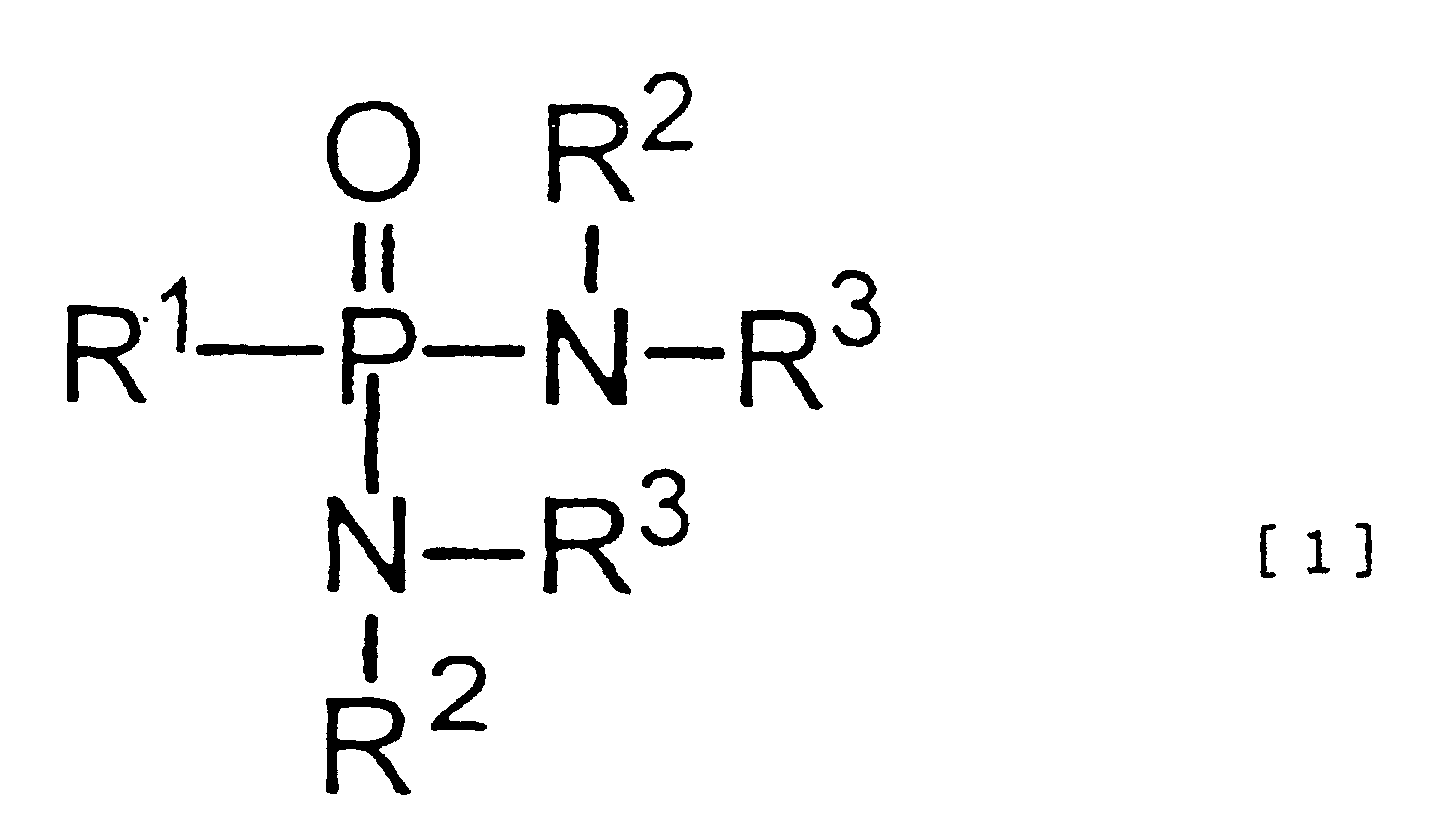
- the present invention relates to a phosphonamide compound represented by the general formula [1] (wherein R 1 represents an alkyl group, a cycloalkyl group, an alkenyl group, a cycloalkenyl group, an alkynyl group, an aryl group, an aralkyl group, or a heterocyclic group, with the proviso that each group may have a substituent; R 2 represents a hydrogen atom, an alkyl group, a cycloalkyl group, an alkenyl group, a cycloalkenyl group, an aryl group, an aralkyl group, or a heterocyclic group, with the proviso that each group may have a substituent; and R 3 represents a hydrogen atom, an alkyl group, a cycloalkyl group, an alkenyl group, a cycloalkenyl group, an aryl group, an aralkyl group, or a heterocyclic group,
- the present invention relates to a process for producing the above-mentioned phosphonamide compound, characterized by subjecting an amine compound or an ammonium salt compound and a phosphoryl compound to a reaction for phosphorus-nitrogen bond formation in the presence of a basic compound.
- the present invention relates to a process for producing the above-mentioned phosphonamide compound, characterized by subjecting a phosphoric amide compound and an organometallic compound to a reaction for phosphorus-carbon bond formation.
- the present invention relates to a process for producing the above-mentioned phosphonamide compound, characterized by subjecting a phosphonamide compound and an organic compound having a leaving group to a reaction for nitrogen-carbon bond formation.
- the present invention relates to an agent for extracting a rare earth metal ion, comprising the above-mentioned phosphonamide compound.
- the present invention relates to a process for extracting a rare earth ion from an aqueous solution containing a rare earth metal ion, characterized by using the above-mentioned phosphonamide compound as an extraction agent.
- the present invention relates to a process for back-extracting a rare earth metal ion, characterized by that an organic solvent layer comprising an extracted rare earth metal ion is mixed and contacted with a water, whereby the metal ion is transferred to an aqueous layer.
- R 1 is an alkyl group which may have a substituent
- a linear or branched alkyl group having 1 to 40 carbon atoms, preferably, 1 to 30 carbon atoms, more preferably, 1 to 18 carbon atoms is included, and specifically, for example, a methyl group, an ethyl group, an n-propyl group, an isopropyl group, an n-, iso-, sec-, or tert-butyl group, an n-, iso-, sec-, tert-, or neo-pentyl group, an n-hexyl group, an n-octyl group, a 2-octyl group, a 2-ethyl hexyl group, an n-nonyl group, an n-decyl group, an n-dodecyl group, a cet
- R 1 is a cycloalkyl group which may have a substituent
- a monocyclic or multicyclic cycloalkyl group having 5 to 30 carbon atoms, preferably, 5 to 20 carbon atoms, more preferably, 5 to 10 carbon atoms is included, and specifically, a cyclopentyl group, a cyclohexyl group, a cyclooctyl group and the like are included.
- R' is an alkenyl group which may have a substituent
- the one in which the above-mentioned alkyl group having 2 or more carbon atoms has at least one double bond is included, and specifically, for example, a vinyl group, an allyl group, a 1-propenyl group, an isopropenyl group, a 2-butenyl group, a 1,3-butadienyl group, a 2-pentenyl group, a 2-hexenyl group and the like are included.
- R 1 is a cycloalkenyl group which may have a substituent
- the one in which the above-mentioned cycloalkyl group has at least one unsaturated bond such as double bond and specifically, for example, a cyclopentenyl group, a cyclohexenyl group and the like are included.
- R 1 is an alkynyl group which may have a substituent
- the one in which the above-mentioned alkyl group having 2 or more carbon atoms has at least one unsaturated bond such as triple bond is included, and specifically, for example, an ethynyl group, a 1-propynyl group, a 2-propynyl group and the like are included.
- R 1 is an aryl group which may have a substituent
- a monocyclic, polycyclic or condensed cyclic aryl group having 6 to 42 carbon atoms, preferably, 6 to 26 carbon atoms, more preferably, 6 to 22 carbon atoms is included, and specifically, a phenyl group, a naphthyl group, a biphenyl group and the like are exemplified.
- R 1 is an aralkyl group which may have a substituent
- a monocyclic, polycyclic or condensed cyclic aralkyl group having 7 to 30 carbon atoms, preferably, 7 to 20 carbon atoms, more preferably, 7 to 15 carbon atoms is included, and specifically, a benzyl group, a phenethyl group, a naphthylmethyl group, a naphthylethyl group and the like are exemplified.
- R 1 is a heterocyclic group which may have a substituent, for example, a saturated or unsaturated monocyclic, polycyclic or condensed cyclic heterocyclic group having at least one nitrogen atom, oxygen atom or sulfur atom in the ring in which one ring is a 5 to 20-membered ring, preferably, 5 to 10-membered ring, more preferably, 5 to 7-membered ring, and the above-mentioned cycloalkyl group, cycloalkenyl group or aryl group may be condensed is included, and specifically, a pyridyl group, a thienyl group, a phenylthienyl group, a thiazolyl group, a furyl group, a piperidyl group, a piperazyl group, a pyrrolyl group, a morpholino group, a imidazolyl group, a indolyl group,
- a substituent for example,
- any substituent may be used as long as it does not interfere with a process for producing the compound of the present invention and does not have an adverse effect when the phosphonamide compound represented by the general formula [1] is used as an agent for extracting a rare earth metal ion.
- an alkoxy group composed of the above-mentioned alkyl group (such as a methoxy group, an ethoxy group, an isopropoxy group, a tert-butoxy group, a 2-ethylhexyloxy group or an octyloxy group), an alkylthio group (such as a methylthio group or an ethylthio group), a dialkylamino group (such as a dimethylamino group or a diethylamino group), a trisubstituted silyl group (such as a trimethylsilyl group, a triethylsilyl group, a tert-butyldimethylsilyl group or a triphenylsilyl group), a trisubstituted siloxy group (such as a trimethylsiloxy group, a triethylsiloxy group, a tert-butyldimethylsiloxy group or a tri
- the above-mentioned alkyl group, cycloalkyl group, alkenyl group, cycloalkenyl group, alkynyl group, aryl group, aralkyl group, and heterocyclic group can be substituted one another, these groups may be substituted one another.
- an alkyl-substituted cycloalkyl group an alkyl-substituted aryl group, an alkyl-substituted cycloalkenyl group, an alkyl-substituted aralkyl group, a cycloalkyl-substituted alkyl group, a cycloalkyl-substituted alkenyl group, a cycloalkyl-substituted alkynyl group, an alkenyl-substituted aryl group, an aryl-substituted alkenyl group, an aryl-substituted alkynyl group and the like are included.
- the alkylene group the cycloalkylene group or the arylene group in the case where two R 3 s, in the formula, are united to form an alkylene group, a cycloalkylene group or an arylene group, a divalent group which is formed by removal of one hydrogen atom from the above-mentioned alkyl group, cycloalkyl group and aryl group, respectively, is included.
- alkylene group for example, a linear or branched alkylene group having 1 to 20 carbon atoms, preferably, 1 to 10 carbon atoms, more preferably, 1 to 6 carbon atoms is included, and more specifically, for example, a methylene group, an ethylene group, a trimethylene group, a methylethylene group, a propylene group, a tetramethylene group, a 1,2-dimethylethylene group, a pentamethylene group, a hexamethylene group and the like are included.
- cycloalkylene group for example, a monocyclic, polycyclic or condensed cyclic cycloalkylene group having 3 to 30 carbon atoms, preferably, 3 to 20 carbon atoms, more preferably, 3 to 10 carbon atoms is included, and more specifically, a cyclopropylene group, a cyclopentylene group, a cyclohexylene group, a cyclooctylene group and the like are included.
- arylene group a monocyclic, polycyclic or condensed cyclic divalent aromatic hydrocarbon group having 6 to 30 carbon atoms, preferably, 6 to 20 carbon atoms, more preferably, 6 to 14 carbon atoms is included, and more specifically, for example, a phenylene group, a tolylene group, a xylylene group, a naphthylene group, a methylnaphthylene group, a biphenylene group and the like are included.
- the phosphonamide compound of the present invention represented by the general formula [1] can be produced by subjecting an amine compound or an ammonium salt compound and a phosphoryl compound to a reaction for phosphorus-nitrogen bond formation in the presence of a basic compound.
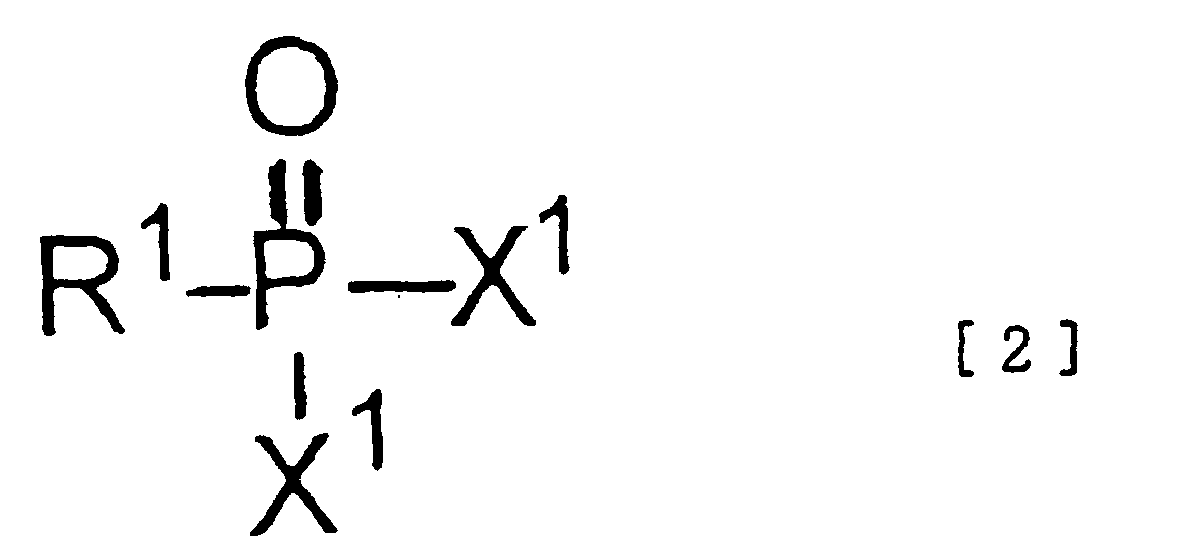
- a compound represented by the following general formula [2] (wherein R 1 is the same as above; X 1 represents a leaving group) is included.
- R 2 R 4 NH represents a hydrogen atom, an alkyl group, a cycloalkyl group, an alkenyl group, a cycloalkenyl group, an aryl group, an aralkyl group, or a heterocyclic group, with the proviso that each group may have a substituent
- R 2 NH- R 5 -NHR 2 represents an alkylene group, a cycloalkylene group or an arylene group
- ammonium salt compound used in the above-mentioned production process for example, a compound represented by the following general formula [5] R 2 R 4 NH 2 X 2 (wherein R 2 and R 4 are the same as above; X 2 represents an anion group), a compound represented by the following general formula [6] X 2 R 2 NH 2 -R 5 -NH 2 R 2 X 2 (wherein R 2 , R 5 and X 2 are the same as above), and the like are included.
- the leaving group represented by X 1 is not specifically limited as long as it can easily be replaced to form a new phosphorus-nitrogen bond by the production process of the present invention, and, for example, a halogen atom such as chlorine, bromine, or iodine, an alkoxy group such as a methoxy group, an ethoxy group, an isopropoxy group or a tert-butoxy group, an aryloxy group such as a phenoxy group or a naphthoxy group, an alkylthio group such as a methylthio group or an ethylthio group, an arylthio group such as a phenylthio group, a tolylthio group or a naphtylthio group and the like are included.
- a halogen atom such as chlorine, bromine, or iodine
- an alkoxy group such as a methoxy group, an ethoxy group, an isopropoxy group or a
- the alkyl group represented by R 4 which may have a substituent and other monovalent groups in the above-mentioned general formulae [3] and [5], and the alkylene group represented by R 5 and other divalent groups in the general formulae [4] and [6], correspond to a monovalent group and a divalent group represented by R 3 in the above-mentioned general formula [I], respectively.
- anion group represented by X 2 for example, besides a halide ion such as a chloride ion, a bromide ion or an iodide ion, various anion groups such as a hypochlorite ion, a perchlorate ion, a trifluoromethanesulfonate ion, a pentafluorobenzenesulfonate ion ion, a tetrafluoroborate ion, a hexafluorophosphate ion, a p-toluenesulfonate ion, a benzenesulfonate ion, a methanesulfonate ion, a hydroxide ion, a trifluoroacetate ion, a pentafluorobenzoate ion, an acetate
- the equivalent weight of the used compound represented by the general formula [3] or the general formula [5] is not limited, however, it is generally 1.5 to 20 equivalent, preferably, 2 to 10 equivalent relative to the compound represented by the general formula [2].
- the equivalent weight of the used compound represented by the general formula [4] or the general formula [6] is not limited, however, it is generally 0.5 to 10 equivalent, preferably, 1 to 5 equivalent relative to the compound represented by the general formula [2].
- reaction of the compound represented by the general formula [2] with the compound represented by any of the general formulae [3] to [6] can be performed at various temperatures in any cases, however, it is generally performed at -100 to 180°C, preferably at -70 to 150°C.
- the solvent various hydrocarbon solvents, ether solvents, aprotic high-polar solvents can be used.
- hexane, decane, benzene, toluene, xylene, diethyl ether, tetrahydrofuran, dioxane, N,N-dimethylformamide, acetonitrile, benzonitrile, hexamethylphosphoric triamide, dimethylsulfoxide and the like are included.
- the amount of the solvent to be used is not limited, however, it is generally 0.1 to 100 mL, preferably, 1 to 20 mL relative to 1 mmol of the compound represented by the general formula [2].
- the base to be used is in the form of a liquid at the above-mentioned reaction temperature, this can be used as the solvent.
- various inorganic or organic bases can be used.
- the amount of the base to be used it is used at a ratio of 0.01 to 100 equivalent, preferably, 0.1 to 20 equivalent relative to the compound represented by the general formula [2].
- each of these bases may be used solely, or plural bases may be used in combination as needed.
- the compound represented by the above-mentioned general formula [3] or [4] can be favorably used as the base.
- the phosphonamide compound of the present invention represented by the general formula [1] can be also produced by the reaction for carbon-phosphorus bond formation between a phosphoric amide compound and an organometallic compound.
- a compound represented by the following general formula [7] (wherein R 2 and R 3 are the same as above; X 3 represents a leaving group) is included.
- organometallic compound used in the above-mentioned production process for example, a compound represented by the following general formula [8] R 1 -M (wherein R 1 is the same as above; M represents a metallo group) is included.
- the leaving group represented by X 3 is not specifically limited as long as it can easily be replaced to form a new carbon-phosphorus bond by the production process of the present invention, and, for example, a halogen atom such as chlorine, bromine, or iodine, an alkoxy group such as a methoxy group, an ethoxy group, an isopropoxy group or a tert-butoxy group, an aryloxy group such as a phenoxy group or a naphthoxy group, an alkylthio group such as a methylthio group or an ethylthio group, an arylthio group such as a phenylthio group, a tolylthio group or a naphtylthio group and the like are included.
- a halogen atom such as chlorine, bromine, or iodine
- an alkoxy group such as a methoxy group, an ethoxy group, an isopropoxy group or a tert
- a metal in Group 1 or 2 of the periodic table or a derivative thereof is included, and as the specific examples, for example, a lithio group, a chloromagnesio group, a bromomagnesio group, an iodomagnesio group and the like are included.
- the equivalent weight of the used compound represented by the general formula [8] is not limited, however, it is generally 0.5 to 10 equivalent, preferably, 1 to 5 equivalent relative to the compound represented by the general formula [7].
- reaction of the compound represented by the general formula [7] with the compound represented by the general formula [8] can be performed at various temperatures, however, it is generally performed at -100 to 180°C, preferably at -70 to 150°C.
- the solvent various hydrocarbon solvents, ether solvents, aprotic high-polar solvents can be used.
- specific examples for example, hexane, decane, benzene, toluene, xylene, diethyl ether, tetrahydrofuran, dioxane, hexamethylphosphoric triamide and the like are included.
- the amount of the solvent to be used is not limited, however, it is generally 0.1 to 100 mL, preferably, 1 to 20 mL relative to 1 mmol of the compound represented by the general formula [5].
- the phosphonamide compound of the present invention represented by the general formula [1] can be also produced by subjecting an acidic phosphonamide compound and an organic compound having a leaving group to a reaction for carbon-nitrogen bond formation.
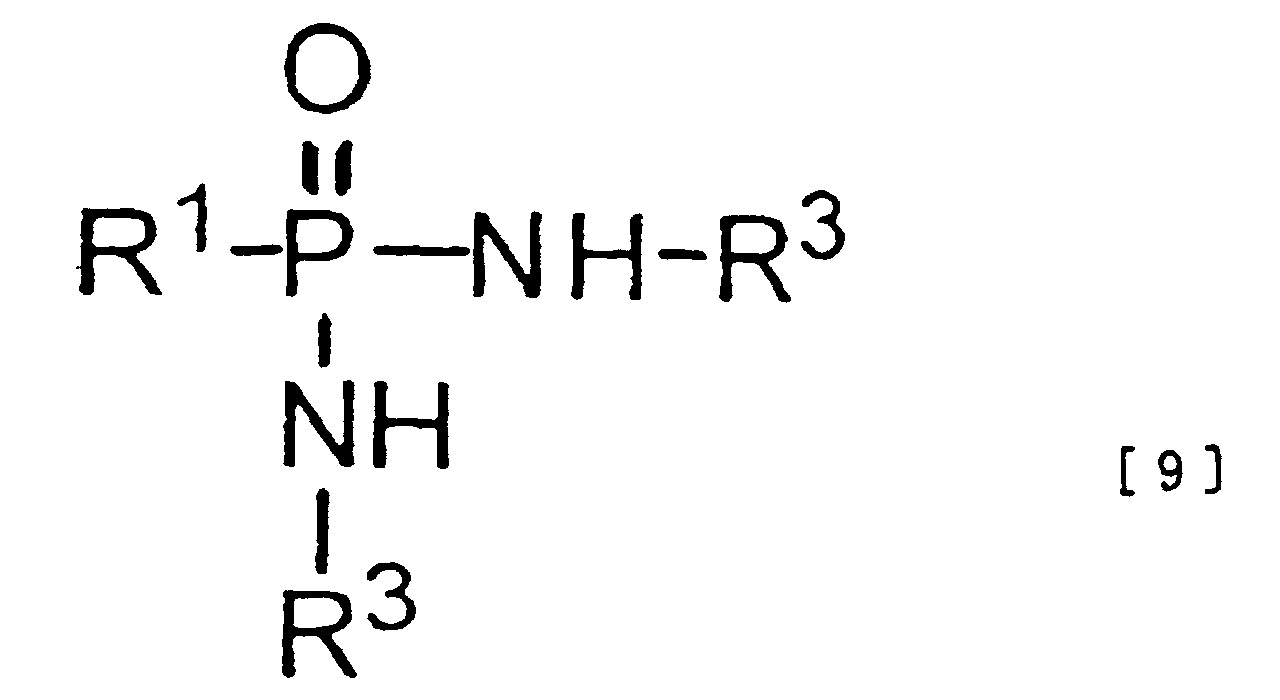
- the acidic phosphonamide compound according to the present invention is a phosphonamide compound having one or more hydrogen atoms attached to the nitrogen atom.
- the leaving group represented by X 4 is not specifically limited as long as it can easily be replaced to form a new carbon-nitrogen bond by the production process of the present invention, and, besides a halogen atom such as a chlorine atom, a bromine atom or an iodine atom, various leaving groups including an iodonio group such as an acetoxyphenyliodonio group or a phenyl(trifluoromethanesulfoxy)iodonio group, a sulfonyl group such as a methanesulfonyl group or a trifluoromethanesulfonyl group and the like are exemplified.
- a halogen atom such as a chlorine atom, a bromine atom or an iodine atom
- various leaving groups including an iodonio group such as an acetoxyphenyliodonio group or a phenyl(trifluoromethane
- a metal hydride compound such as sodium hydride or lithium aluminum hydride
- a metal amide compound such as lithium diisopropylamide, lithium amide or sodium amide
- an organometallic compound represented by the above-mentioned general formula [8] (wherein R 1 and M are the same as above) and the like are included.
- the amount of the base to be used it is used at a ratio of 0.01 to 100 equivalent, preferably, 0.1 to 20 equivalent relative to the compound represented by the general formula [9].
- each of these bases may be used solely, or plural bases may be used in combination as needed.
- the equivalent weight of the used compound represented by the general formula [10] in the reaction of the compound represented by the general formula [9] with the compound represented by the general formula [10] is not limited, and, it is generally 1.5 to 10 equivalent, preferably, 2 to 5 equivalent relative to the compound represented by the general formula [9].
- reaction of the compound represented by the general formula [9] with the compound represented by the general formula [10] can be performed at various temperatures, however, it is generally performed at -100 to 180°C, preferably at -70 to 150°C.
- the solvent various hydrocarbon solvents, ether solvents, aprotic high-polar solvents can be used.
- specific examples for example, hexane, decane, benzene, toluene, xylene, diethyl ether, tetrahydrofuran, dioxane, hexamethylphosphoric triamide, acetonitrile and the like are included.
- the amount of the solvent to be used is not limited, however, it is generally 0.1 to 100 mL, preferably, 1 to 20 mL relative to 1 mmol of the compound represented by the general formula [9].
- a produced phosphonamide compound can be purified by a common process such as distillation, column chromatography, and recrystallization in any cases.
- the phosphonamide compound of the present invention can be used as an agent for extracting a rare earth metal.
- a process for extracting a rare earth metal by using the phosphonamide compound of the present invention as an extraction agent is performed by mixing and contacting an aqueous solution containing a rare earth metal ion, a phosphonamide compound represented by the above-mentioned general formula [1] and an organic solvent at a suitable temperature with the use of means such as stirring or shaking, and conducting layer separation into an organic layer (an extraction agent layer) and an aqueous layer.
- the organic solvent to be used for extraction the one which can dissolve the phosphonamide compound of the present invention and is not completely miscible with water is preferable, and, halogenated hydrocarbons, hydrocarbons, ethers, alcohols, nitro compounds, phosphate esters and the like are exemplified.
- Specific examples include chloroform, carbon tetrachloride, methyl isobutyl ketone, nitrobenzene, octanol, hexane, octane, decane, dodecane, benzene, toluene, xylene, ethylbenzene, tributyl phosphate and the like.
- each of these organic solvents may be used solely, or plural organic solvents may be used in combination as needed.
- the phosphonamide compound represented by the general formula [1] is liquid and is not completely miscible with water, the phosphonamide compound can serve as an organic solvent (extraction solvent).
- the pH value of the aqueous solution containing a rare earth metal ion, which is used for extraction is kept at pH 7 or lower by using an appropriate acid.
- an appropriate acid various inorganic acids and organic acids are used suitably, and the specific examples include hydrochloric acid, sulfuric acid, nitric acid, acetic acid, oxalic acid, carbonic acid, phosphoric acid, citric acid, tartaric acid, ethylenediaminetetraacetic acid and the like.
- Each of these acids may be used solely or plural acids may be used in combination as needed.
- the concentration of the rare earth metal ions contained in the aqueous solution, when conducting extraction, is not specifically limited, however, it is generally 1.0 x 10 -9 to 10 mol/L, preferably, 5.0 x 10 -7 to 5.0 mol/L.
- the number of moles of the phosphonamide compound represented by the general formula [1], which is used for extraction, is not specifically limited, however, it is preferable to be 0.01-fold or more relative to the total amount of the rare earth metal ions.
- the volume ratio of the aqueous solution containing a rare earth metal ion to the organic solvent containing a phosphonamide compound, which are used for extraction, is not specifically limited, however, it is generally 0.001:1 to 100:1, preferably, 0.02:1 to 50:1.
- the extraction temperature when performing extraction is not specifically limited, however, it is generally 0 to 100°C, preferably 10 to 70°C.
- the rare earth metal ion extracted and transferred from an aqueous layer to an organic solvent layer under the extraction conditions can be back-extracted from the organic solvent layer to an aqueous layer by contacting the organic solvent layer with water other than the aqueous layer.
- the metal ion can be transferred to an aqueous layer, thereby the rare earth metal ion can be back-extracted into the aqueous layer.
- the water to be used for back-extracting a rare earth metal ion from an organic solvent layer comprising an extracted rare earth metal ion a weakly acidic or acidic water is preferable.
- the pH value of the water to be used for the back-extraction be kept at lower than pH7 by using an appropriate acid.
- the acid to be used for the pH adjustment various inorganic acids and organic acids are included, and the specific examples include hydrochloric acid, sulfuric acid, nitric acid, acetic acid, oxalic acid, carbonic acid, phosphoric acid, citric acid, tartaric acid, ethylenediaminetetraacetic acid and the like. Each of these acids may be used solely or plural acids may be used in combination as needed.
- the pH adjustment may be performed by using acidic salts, various buffer agents (buffer solutions) or the like, instead of an acid.
- the volume ratio of the organic layer to the aqueous layer, which are used for back-extraction is not specifically limited, however, it is generally 0.001:1 to 1000:1, preferably, 0.02:1 to 50:1.
- the temperature for the back-extraction is not specifically limited, however, it is generally 0 to 100°C, preferably 10 to 70°C.
- This compound is a novel compound which has not been described in a published article.
- the extraction ratio described below indicates the ratio of the number of moles of ions transferred from the aqueous layer to the organic layer relative to the number of moles of ions contained in the initial aqueous layer for each ion.
- the concentrations of trivalent lanthanum ions and trivalent europium ions remaining in the aqueous solution were measured by ICP emission spectrochemical analysis and the extraction ratios of trivalent lanthanum and trivalent europium ions were calculated. As a result, 94.2% (0.376 ⁇ mol) of trivalent lanthanum ions and 97.0% (0.388 ⁇ mol) of trivalent europium ions were found to be extracted from the aqueous layer to the organic layer.
- the concentrations of trivalent lanthanum ions and trivalent europium ions found in the aqueous solution were measured by ICP emission spectrochemical analysis and the back-extraction ratios were calculated.
- back-extraction ratio indicates, when a rare earth metal ion contained in the dichloromethane layer is extracted with an aqueous layer, the ratio of the number of moles of ions transferred from the dichloromethane layer to the aqueous layer relative to the initial number of moles of ions contained in the dichloromethane layer for each ion.
- the back-extraction ratios of trivalent lanthanum ion and trivalent europium ion are shown in Table 4.
- the present invention provides a novel phosphonamide compound which is useful as an agent for extracting a rare earth metal ion or the like, a process for producing the same, and a process for extracting a rare earth metal ion from an aqueous solution containing a rare earth metal ion using the compound.
- a rare earth metal ion can be extremely efficiently extracted by an easy operation from an aqueous solution containing a rare earth metal ion.
- the rare earth metal ion extracted and transferred from an aqueous layer to an organic solvent layer by the extraction operation can be efficiently back-extracted from the organic solvent layer to an aqueous layer by mixing and contacting the organic solvent layer with a slightly acidic to acidic water different from the initial aqueous layer.
Landscapes
- Chemical & Material Sciences (AREA)
- Organic Chemistry (AREA)
- Engineering & Computer Science (AREA)
- Life Sciences & Earth Sciences (AREA)
- Materials Engineering (AREA)
- Environmental & Geological Engineering (AREA)
- Manufacturing & Machinery (AREA)
- Molecular Biology (AREA)
- General Life Sciences & Earth Sciences (AREA)
- Mechanical Engineering (AREA)
- Metallurgy (AREA)
- Geology (AREA)
- Health & Medical Sciences (AREA)
- Biochemistry (AREA)
- General Health & Medical Sciences (AREA)
- Geochemistry & Mineralogy (AREA)
- Extraction Or Liquid Replacement (AREA)
- Manufacture And Refinement Of Metals (AREA)
Abstract
Description


1H-NMR(CDCl3):δ0.85-0.90(6H,m),1.07-1.22(6H,m),3.12-3.19(2H,m),3.26-3.35(4H, m),7.32-7.38(3H,m),7.71-7.79(2H,m)ppm.
13 C-NMR(CDCl3):δ20.5(d,J=4.3Hz)21.5(d,J=2.3Hz),39.9(d,J=9.8Hz),44.6(d,J=6.2Hz),1 28.0(d,J=30.5Hz), 128.7(d,J=156.7Hz),131.0(d,J=2.9Hz),132.8(d,J=13.3Hz)ppm.
31P-NMR(CDCl3):δ24.3ppm.
MS(EI):m/z 266,77.
Elementary analysis, calculated as C14H23ON2P: C, 63.14; H, 8.70; N, 10.52%. Found: C, 63.02; H, 8.81; N, 10.45%.
1H-NMR(CDCl3):δ0.76(6H,t,J=7.3Hz),1.37-1.49(4H,m),2.67-2.75(4H,m),3.20-3.31(2H, m),3.37-3.40(2H,m),7.38-7.43(3H,m),7.68-7.72(2H,m)ppm.
13C-NMR(CDCl3):δ11.7,21.7(d,J=4.1 Hz),45.7(d,J=9.3Hz),46.9(d,J=5.2Hz), 128.1 (d,J=1
3.4Hz), 131.2(d,J=3.1 Hz), 132.4(d,J=156.3Hz), 132.5(d,J=9.3Hz)ppm.
31P-NMR(CDCl3):δ28.3ppm.
MS(EI):m/z 266,77
Elementary analysis, calculated as C14H23ON2P: C, 63.14; H, 8.70; N, 10.52%. Found: C, 63.08; H, 8.76; N, 10.47%.
1H-NMR(CDCl3):δ3.93-4.03(4H,m),6.92(2H,t,J=7.2Hz),7.15-7.24(8H,m),7.37-7.40(3H, m),7.81 -7.85(2H,m)ppm.
13 C-NMR(CDCl3):δ43.8(d,J=8.6Hz),116.5(d,J=4.8Hz),121.8,128.7(d,J=14.5Hz),1 29.2,1
32.1,132.2(d,J=3.1 1hz),132.5(d,J=10.7Hz),141.3(d,J=7.6Hz)ppm.
31 P-NMR(CDCl3)δ18.8ppm.
MS(EI):m/z 334,77.
Elementary analysis, calculated as C20H29ON2P: C, 71.85; H, 5.73; N, 8.38%. Found: C, 71.83; H, 5.64; N, 8.30%.
1H-NMR(CDCl3):δ0.87(6H,t,J=7.0Hz),1.25(20H,brs),1.50-1,54(4H,m),2.48(4H,t,J=7.5 Hz),5.38(2H,d,J=9.6Hz),6.94(8H,s),7.39-7.48(2H,m),7.49-7.55(1H,m),7.90(2H,dd,J=6. 9,13.4Hz)ppm.
13C-NMR(CDCl3): δ 14.1,22.6,29.2,29.4,30.9,31.5,31.9,35.1,118.5(d,J=6.2Hz),128.7(d, J=13.5Hz),129.1,130.4(d,J=173.7Hz),131.7(d,J=10.3 Hz),132.3,136.6,137.5ppm.
31P-NMR(CDCl3):δ10.0ppm.
Elementary analysis, calculated as C34H49ON2P: C, 76.65; H, 9.27; N, 5.26%. Found: C, 76.86; H, 9.27; N, 5.15%.
1H-NMR(CDCl3):δ0.88(6H,t,J=6.9Hz),1.28(16H,brs), 1.36-1.41 (4H,m),1.70-1.77(4H,qu in,J=7.5Hz),5.11 (2H,d,J=9.1 Hz),6.71 (4H,d,J=8.4Hz),6.98(4H,d,J=8.4Hz),7.41-7.43(2H, m),7.44-7.46(1H,m),7.83-7.90(2H,m)ppm.
13C-NMR(CDCl3):δ14.1,22.6,26.0,29.2,29.3,29.7,31.8,68.3,115.2,120.8(d,J=6.2Hz), 128. 6(d,J=13.5Hz),131.6(d,J=157.2Hz),131.6(d,J=10.4Hz),132.2,132.7,154.7ppm.
31P-NMR(CDCl3):δ10.9ppm.
Elementary analysis, calculated as C34H49O3N2P: C, 72.31; H, 8.75; N, 4.96%. Found: C, 72.64; H, 8.92; N, 4.97%.
1H-NMR(CDCl3): δ 0.84(6H,t,J=6.9Hz),1.13(4H,brs),1.25(48H,brs),1.41-1.43(4H,m),2. 76(4H,q,J=7.6Hz),3.21-3.30(2H,m),3.36-3.40(2H,m),7.32-7.41(3H,m),7.68-7.80(2H,m) ppm.
13C-NMR(CDCl3): δ 14.1,22.7,26.8,28.5(d,J=4.SHz),29.2,29.4,29.5,29.55,29.63,29.67.2 9.70,31.9,45.1 (d,J=5.2Hz),45.8(d,J=9.4Hz),128.2(d,J=13.7Hz),131.2,132.5(d,J=157.0H z),132.6(d,J=9.8Hz)ppm.
31P-NMR(CDCl3):δ28.4ppm.
Elementary analysis, calculated as C40H75ON2P: C, 76.14; H, 11.98; N, 4.44%. Found: C, 76.10; H, 12.15; N, 4.31%.
1H-NMR(CDCl3):δ0.88(3H,t,J=6.9Hz),1.26-1.31(10H,brs),1.41-1.45(2H,m),1.78(2H,qu in,J=6.7Hz),2.50(6H,d,J=10.1 Hz),3.19-3.24(2H,m),3.33-3.38(2H,m),3.98(2H,t,J=6.7H z),6.92(2H,dd,J=2.6,8.6Hz),7.62(2H,dd,J=8.6,12.3Hz)ppm.
13 C-NMR(CDCl3):δ14.1,22.7,26.0,29.2,29.3,31.7(d,J=5.6Hz),48.6,68.1,114.4(d,J=14.8 Hz),120.5,134.5(d,J=11.3Hz),162.0ppm.
31P-NMR(CDCl3): δ 30.2ppm.
MS(EI):m/z 338.
Elementary analysis, calculated as C18H31ON2P: C, 63.88; H, 9.23; N, 8.28%. Found: C, 63.57; H, 9.45; N, 8.19%.
1H-NMR(CDCl3):δ 0.83(6H,t,J=6.9Hz),0.95-1.43(24H,m),2.29(6H,s),3.17-3.23(2H,m), 3.29-3.35(2H,m),6.95(4H,d,J=8.0Hz),7.02(4H,d,J=8.0Hz),7.34-7.41(3H,m),7.71-7.78(2 H,m)ppm.
13C-NMR(CDCl3):δ14.0,20.9,22.6,26.7,28.5(d,J=3.1 Hz),29.1,29.2,31.7,50.5(d,J=4.1Hz), 127.9(d,J=13.5Hz),128.5(d,J=3.1Hz),129.2,131.0,132.2(d,J=157.3Hz), 132.6(d,J=9.3Hz), 135.0,140.0(d,J=2.0Hz)ppm.
31P-NMR(CDCl3):δ21.3ppm.
Elementary analysis, calculated as C36H33ON2P: C, 77.10; H, 9.53; N, 5.00%. Found:
C, 77.24; H, 9.56; N, 4.99%.
1H-NMR(CDCl3): δ 0.83(6H,t,J=7.2Hz),0.94-1.23(24H,m),3.08-3.22(2H,m),3.23-3.26 (2H,m),3.76(6H,s),6.74(4H,d,J=7.9Hz),6.94(4H,d,J=7.9Hz),7.31-7.48(3H,m),7.70-7.76 (2H,m)ppm.
13C-NMR(CDCl3): δ 14.0,22.6,26.7,28.5(d,J=3.1Hz),29.1,29.2,31.7,50.7(d,J=4.1Hz),55. 3,113.8,127.9(d,J=12.4Hz),130.1(d,J=3.1Hz),130.9(d,J=3.1Hz),132.1(d,J=153.1Hz),132. 7(d,J=8. 3 Hz),13 5.3 (d,J=3.1 Hz),157.4ppm.
31P-NMR(CDCl3):δ21.7ppm.
Elementary analysis, calculated as C36H33O3N2P: C, 72.94; H, 9.01; N, 4.73%. Found: C, 72.90; H, 9.01; N, 5.01%.
1H-NMR(CDCl3):0.87(6H,t,J=6.9Hz),1.26(20H,brs),1.53-1.57(4H,m),2.52(4H,t,J=7.6H z),3.05(6H,d,J=9.3Hz),6.99(4H,d,J=8.4Hz),7.09(4H,d,J=8.4Hz),7.26-7.41(3H,m),7.70-7. 76(2H,m)ppm.
13C-NMR(CDCl3):δ14.1,22.7,29.3,29.5,31.5,31.6(d,J=3.1 Hz),31.9,35.3,38.2(d,J=5.2Hz), 125.2(d,J=4.2Hz),128.1 (d,J=13.SHz),128.7(2C),131.7(d,J=90.0Hz),132.6(d,J=9.3Hz),1 39.2,142.8(d,J=3.1 Hz)ppm.
31P-NMR(CDCl3):δ22.5ppm.
Elementary analysis, calculated as C36H33ON2P: C, 77.10; H, 9.53; N, 5.00%. Found: C, 77.00; H, 9.68; N, 5.03%.
1H-NMR(CDCl3): δ 0.88(6H,t,J=6.9Hz),1.29(16H,brs),1.38-1.43(4H,m),1.74(4H,quin,J =6.6Hz),2.99(6H,d,J=10.2Hz),3 .88(4H,t,J=6.6Hz),6.74(4H,d,J=9.0Hz),7.07(4H,d,J=9.0 Hz),7.34-7.39(3H,m),7.60-7.75(2H,m)ppm.
13C-NMR(CDCl3): δ 14.1,22.6,29.19,29.24,29.3,31.8,38.7(d,J=5.2Hz),68.1,114.6,127.5 (d,J=4.1 Hz),128.0(d,J=13.4Hz),130.8(d,J=157.4Hz),131.1 (d,J=2.1 Hz},132.5(d,J=8.3Hz), 137.9(d,J=3.1Hz),156.5ppm.
31P-NMR(CDCl3):δ22.6ppm.
Elementary analysis, calculated as C36H33O3N2P: C, 72.94; H, 9.01; N, 4.73%. Found: C, 72.85; H, 9.07; N, 4.99%.
1H-NMR(CDCl3):δ2.44(6H,d,J=7.6Hz),3.15-3.23(2H,m),3.32-3.37(2H,m),7.38-7.45(3H, m),7.64-7.71(2H,m)ppm.
13C-NMR(CDCl3): δ 31.6(d,J=6.3Hz),48.4(d,J=8.8Hz),128.3(d,J=13.7Hz),131.0(d,J=15 6.6Hz), 131.5(d,J=2.9Hz),132.5(d,J=9.8Hz)ppm.
31P-NMR(CDCl3): δ 29.5ppm.
MS(EI):m/z 210.77


| A | Extraction ratio (%) | ||
| Lanthanum | Europium | ||
| Comparative example 2 | 0 | 0 | 0 |
| Example 35 | 0.2 | 94.2 | 97.0 |
| Example 36 | 0.1 | 40.9 | 59.1 |
| Example 37 | 0.05 | 22.8 | 35.0 |
| Example 38 | 0.02 | 6.7 | 10.2 |
| Rare earth ion | Extraction ratio / % | |
| Example 39 | Example 40 | |
| La | 63.1 | 0.7 |
| Ce | 78.6 | 4.6 |
| Pr | 79.1 | 3.0 |
| Nd | 75.8 | 1.7 |
| Sm | 75.5 | 3.3 |
| Eu | 74.9 | 3.7 |
| Gd | 70.1 | 4.8 |
| Tb | 73.9 | 5.0 |
| Dy | 74.7 | 5.9 |
| Ho | 75.6 | 5.6 |
| Er | 77.1 | 8.9 |
| Yb | 93.2 | 27.3 |
| Lu | 95.7 | 39.4 |
| Kind of aqueous solution | Back-extraction ratio / % | ||
| Lanthanum | Europium | ||
| Example 41 | 3 mol/L nitric acid aqueous solution | 98.6 | > 99.9 |
| Example 42 | 1 mol/L nitric acid aqueous solution | > 99.9 | > 99.9 |
| Example 43 | 0.1 mol/L nitric acid aqueous solution | 99.2 | > 99.9 |
| Example 44 | 0.5 mol/L acetic acid -0.5 mol/L sodium acetate aqueous solution | > 99.9 | > 99.9 |
Claims (20)
- A phosphonamide compound represented by the general formula [1](wherein R1 represents an alkyl group, a cycloalkyl group, an alkenyl group, a cycloalkenyl group, an alkynyl group, an aryl group, an aralkyl group, or a heterocyclic group, with the proviso that each group may have a substituent; R2 represents a hydrogen atom, an alkyl group, a cycloalkyl group, an alkenyl group, a cycloalkenyl group, an aryl group, an aralkyl group, or a heterocyclic group, with the proviso that each group may have a substituent; R3 represents a hydrogen atom, an alkyl group, a cycloalkyl group, an alkenyl group, a cycloalkenyl group, an aryl group, an aralkyl group, or a heterocyclic group, with the proviso that each group may have a substituent; and the two R3s may be united to form an alkylene group, a cycloalkylene group or an arylene group).
- A process for producing the phosphonamide compound according to claim 1, characterized by subjecting an amine compound or an ammonium salt compound and a phosphoryl compound to a reaction for phosphorus-nitrogen bond formation in the presence of a basic compound.
- The production process according to claim 2, wherein the phosphoryl compound is a compound represented by the general formula [2](wherein R1 is the same as above; X1 represents a leaving group).

- The production process according to claim 2 or 3, wherein the amine compound is a compound represented by the general formula [3]
- The production process according to claim 2 or 3, wherein the amine compound is a compound represented by the general formula [4]
- The production process according to claim 2 or 3, wherein the ammonium salt compound is a compound represented by the general formula [5]
- The production process according to claim 2 or 3, wherein the ammonium salt compound is a compound represented by the general formula [6]
- A process for producing the phosphonamide compound according to claim 1, characterized by subjecting a phosphoric amide compound and an organometallic compound to a reaction for phosphorus-carbon bond formation.
- The production process according to claim 8, wherein the phosphoric amide compound is a compound represented by the general formula [7](wherein R2 and R3 are the same as above; X3 represents a leaving group).

- The production process according to claim 8 or 9, wherein the organometallic compound is a compound represented by the general formula [8]
- A process for producing the phosphonamide compound according to claim 1, characterized by subjecting an acidic phosphonamide compound and an organic compound having a leaving group to a reaction for carbon-nitrogen bond formation.
- The production process according to claim 11, wherein the acidic phosphonamide compound is a compound represented by the general formula [9](wherein R1 and R3 are the same as above).

- The production process according to claim 11 or 12, wherein the organic compound having a leaving group is an organic compound represented by the general formula [10]
- An agent for extracting a rare earth metal ion, comprising the phosphonamide compound according to claim 1.
- A process for extracting a rare earth metal ion from an aqueous solution containing a rare earth metal ion, characterized by using the phosphonamide compound according to claim 1 as an extraction agent.
- The extraction process according to claim 15, wherein an organic solvent is used for extraction.
- The extraction process according to claim 15, wherein the organic solvent is an organic solvent which is not completely miscible with water.
- The extraction process according to claim 15, wherein an aqueous solution containing a rare earth metal ion, a phosphonamide compound according to claim 1 and an organic solvent are mixed and contacted, whereby the metal ion is transferred to the organic solvent layer.
- A process for back-extracting a rare earth metal ion, characterized by that the organic solvent layer comprising the extracted rare earth metal ion by the extraction process according to claim 18 is mixed and contacted with a water, whereby the metal ion is transferred to the aqueous layer.
- The back-extraction process according to claim 19, wherein the water for mixing and contacting is a weakly acidic or acidic water.
Applications Claiming Priority (3)
| Application Number | Priority Date | Filing Date | Title |
|---|---|---|---|
| JP2002057419 | 2002-03-04 | ||
| JP2002057419 | 2002-03-04 | ||
| PCT/JP2003/002422 WO2003074538A1 (en) | 2002-03-04 | 2003-03-03 | Novel phosphonamides, process for producing the same, and use thereof |
Publications (3)
| Publication Number | Publication Date |
|---|---|
| EP1496063A1 true EP1496063A1 (en) | 2005-01-12 |
| EP1496063A4 EP1496063A4 (en) | 2006-09-20 |
| EP1496063B1 EP1496063B1 (en) | 2009-08-19 |
Family
ID=27784658
Family Applications (1)
| Application Number | Title | Priority Date | Filing Date |
|---|---|---|---|
| EP03707191A Expired - Lifetime EP1496063B1 (en) | 2002-03-04 | 2003-03-03 | Extraction process for rare earth metal ions using a phosphonamide compound |
Country Status (8)
| Country | Link |
|---|---|
| US (1) | US7829044B2 (en) |
| EP (1) | EP1496063B1 (en) |
| JP (1) | JP4151842B2 (en) |
| CN (1) | CN1639175A (en) |
| AU (1) | AU2003211439B2 (en) |
| BR (1) | BR0308126A (en) |
| RU (1) | RU2314314C2 (en) |
| WO (1) | WO2003074538A1 (en) |
Cited By (3)
| Publication number | Priority date | Publication date | Assignee | Title |
|---|---|---|---|---|
| CZ303164B6 (en) * | 2011-01-18 | 2012-05-09 | Ústav organické chemie a biochemie Akademie ved CR, v.v.i. | Process for preparing phosphonic acid substituted diamides |
| US9945009B2 (en) | 2011-03-18 | 2018-04-17 | Orbite Technologies Inc. | Processes for recovering rare earth elements from aluminum-bearing materials |
| US10174402B2 (en) | 2011-09-16 | 2019-01-08 | Orbite Technologies Inc. | Processes for preparing alumina and various other products |
Families Citing this family (25)
| Publication number | Priority date | Publication date | Assignee | Title |
|---|---|---|---|---|
| EP1701940B1 (en) * | 2003-12-23 | 2008-05-28 | H.Lundbeck A/S | 2-(1h-indolylsulfanyl)-benzyl amine derivatives as ssri |
| AR052308A1 (en) * | 2004-07-16 | 2007-03-14 | Lundbeck & Co As H | DERIVATIVES OF 2- (1H-INDOLILSULFANIL) -ARILAMINE AND A PHARMACEUTICAL COMPOSITION CONTAINING THE COMPOUND |
| CN1324153C (en) * | 2005-01-10 | 2007-07-04 | 包头华美稀土高科有限公司 | Preparation method of high-purity single rare earth |
| AR054393A1 (en) * | 2005-06-17 | 2007-06-20 | Lundbeck & Co As H | DERIVATIVES OF BENZO (B) FURANO AND BENZO (B) THIOPHEN, PHARMACEUTICAL COMPOSITIONS CONTAINING THEM AND THEIR USE IN THE MANUFACTURE OF A MEDICINAL PRODUCT FOR THE TREATMENT OF DISEASES MEDIATED BY THE INHIBITION OF THE REINFORCEMENT OF AMINA BOSS NEUTRANTS. |
| US7629473B2 (en) * | 2005-06-17 | 2009-12-08 | H. Lundbeck A/S | 2-(1H-indolylsulfanyl)-aryl amine derivatives |
| JP5596539B2 (en) | 2007-05-21 | 2014-09-24 | オーバイト アルミナ インコーポレイテッド | Method for extracting aluminum and iron from aluminum ore |
| JPWO2009119789A1 (en) * | 2008-03-28 | 2011-07-28 | 日本化薬株式会社 | Aqueous dispersion of organophosphorus compound and flameproofing method using the same |
| JP5931487B2 (en) * | 2011-02-15 | 2016-06-08 | 学校法人 関西大学 | Metal extractant comprising phenylphosphonic acid ester |
| JP5894262B2 (en) | 2011-05-04 | 2016-03-23 | オーバイト アルミナ インコーポレイテッドOrbite Aluminae Inc. | Method for recovering rare earth elements from various ores |
| CA2834356C (en) | 2011-06-03 | 2014-11-25 | Orbite Aluminae Inc. | Methods for preparing hematite |
| BR112014016732A8 (en) | 2012-01-10 | 2017-07-04 | Orbite Aluminae Inc | processes for treating red mud |
| EP2838848B1 (en) | 2012-03-29 | 2019-05-08 | Orbite Technologies Inc. | Processes for treating fly ashes |
| MY175471A (en) | 2012-07-12 | 2020-06-29 | Orbite Tech Inc | Processes for preparing titanium oxide and various other products |
| JP2015535886A (en) | 2012-09-26 | 2015-12-17 | オーバイト アルミナ インコーポレイテッドOrbite Aluminae Inc. | Process for preparing alumina and magnesium chloride by HCl leaching of various materials |
| WO2014075173A1 (en) | 2012-11-14 | 2014-05-22 | Orbite Aluminae Inc. | Methods for purifying aluminium ions |
| US10030286B1 (en) | 2013-11-13 | 2018-07-24 | Ii-Vi Incorporated | Method of direct solvent extraction of rare earth metals from an aqueous acid-leached ore slurry |
| CN103773954B (en) * | 2014-01-27 | 2015-10-14 | 中国科学院长春应用化学研究所 | Neutral phosphonic acid amides extraction agent is used for extracting and separating Ce 4+purposes |
| RU2566790C1 (en) * | 2014-07-22 | 2015-10-27 | Федеральное государственное бюджетное образовательное учреждение высшего профессионального образования "Национальный минерально-сырьевой университет "Горный" | Method of praseodymium (iii) salts extraction |
| FR3035880B1 (en) * | 2015-05-07 | 2017-06-02 | Commissariat Energie Atomique | USE OF NOVEL COMPOUNDS FOR THE SELECTIVE EXTRACTION OF RARE EARTHS FROM AQUEOUS SOLUTIONS COMPRISING PHOSPHORIC ACID AND METHOD OF EXTRACTING THE SAME |
| US10808296B2 (en) | 2015-10-30 | 2020-10-20 | Ii-Vi Delaware, Inc. | Selective recovery of rare earth metals from an acidic slurry or acidic solution |
| AU2016344326B2 (en) | 2015-10-30 | 2019-05-16 | Ii-Vi Incorporated | Composite extractant-enhanced polymer resin, method of making the same, and its usage for extraction of valuable metal(s) |
| CN108395574B (en) * | 2018-02-07 | 2019-12-24 | 中国科学院宁波材料技术与工程研究所 | Application of a nitrogen-phosphorus heterocyclic compound in flame-retardant modification of epoxy resin |
| CN112458282B (en) * | 2019-09-06 | 2023-03-28 | 中国科学院长春应用化学研究所 | Use and method of phosphoryl carboxylic acids or salts thereof for separating yttrium |
| CN113667038A (en) * | 2021-08-30 | 2021-11-19 | 中南大学 | Water-soluble phosphorylated chitosan and preparation method thereof |
| CN118324805B (en) * | 2024-04-11 | 2024-12-20 | 广东工业大学 | A phosphonamide derivative nucleating agent and its preparation method and application |
Family Cites Families (6)
| Publication number | Priority date | Publication date | Assignee | Title |
|---|---|---|---|---|
| FR2539549B1 (en) * | 1983-01-17 | 1988-10-14 | Rhone Poulenc Chim Base | PROCESS FOR GLOBAL RECOVERY OF URANIUM, YTTRIUM, THORIUM AND RARE EARTH CONTAINED IN AN ORGANIC PHASE |
| FR2669348A1 (en) * | 1990-11-16 | 1992-05-22 | Centre Nat Rech Scient | Compositions containing hydroxydiphosphonic derivatives for the extraction of metal cations |
| US5232895A (en) * | 1991-11-12 | 1993-08-03 | Imperial Chemical Industries Plc | Alkylphosphonodiamide herbicides |
| US5186733A (en) * | 1991-11-12 | 1993-02-16 | Imperial Chemical Industries Plc | Arylphosphonodiamide compounds and herbicidal compositions thereof |
| JP2977744B2 (en) * | 1995-09-12 | 1999-11-15 | 核燃料サイクル開発機構 | Separation method of trivalent actinides and rare earth elements |
| RU2163403C2 (en) * | 1999-02-23 | 2001-02-20 | Государственное унитарное предприятие Научно-производственное объединение "Радиевый институт им. В.Г. Хлопина" | Extracting mixture for simultaneous separation of radionuclides from liquid radioactive wastes (alternatives) |
-
2003
- 2003-03-03 AU AU2003211439A patent/AU2003211439B2/en not_active Ceased
- 2003-03-03 RU RU2004129330/04A patent/RU2314314C2/en active
- 2003-03-03 EP EP03707191A patent/EP1496063B1/en not_active Expired - Lifetime
- 2003-03-03 WO PCT/JP2003/002422 patent/WO2003074538A1/en not_active Ceased
- 2003-03-03 JP JP2003573006A patent/JP4151842B2/en not_active Expired - Lifetime
- 2003-03-03 US US10/506,424 patent/US7829044B2/en not_active Expired - Fee Related
- 2003-03-03 BR BR0308126-5A patent/BR0308126A/en not_active IP Right Cessation
- 2003-03-03 CN CNA03805308XA patent/CN1639175A/en active Pending
Cited By (3)
| Publication number | Priority date | Publication date | Assignee | Title |
|---|---|---|---|---|
| CZ303164B6 (en) * | 2011-01-18 | 2012-05-09 | Ústav organické chemie a biochemie Akademie ved CR, v.v.i. | Process for preparing phosphonic acid substituted diamides |
| US9945009B2 (en) | 2011-03-18 | 2018-04-17 | Orbite Technologies Inc. | Processes for recovering rare earth elements from aluminum-bearing materials |
| US10174402B2 (en) | 2011-09-16 | 2019-01-08 | Orbite Technologies Inc. | Processes for preparing alumina and various other products |
Also Published As
| Publication number | Publication date |
|---|---|
| EP1496063B1 (en) | 2009-08-19 |
| RU2004129330A (en) | 2005-04-10 |
| US7829044B2 (en) | 2010-11-09 |
| WO2003074538A1 (en) | 2003-09-12 |
| AU2003211439A2 (en) | 2003-09-16 |
| AU2003211439B2 (en) | 2008-11-20 |
| RU2314314C2 (en) | 2008-01-10 |
| JPWO2003074538A1 (en) | 2005-06-30 |
| AU2003211439A1 (en) | 2003-09-16 |
| EP1496063A4 (en) | 2006-09-20 |
| CN1639175A (en) | 2005-07-13 |
| BR0308126A (en) | 2005-01-04 |
| US20050107599A1 (en) | 2005-05-19 |
| JP4151842B2 (en) | 2008-09-17 |
Similar Documents
| Publication | Publication Date | Title |
|---|---|---|
| US7829044B2 (en) | Phosphonamides, process for producing the same, and use thereof | |
| CN110300810B (en) | Separation of rare earth metals | |
| EP2067774A1 (en) | Perchloric acid ion trapping agent | |
| Legrand et al. | Totally Stereoselective P–O to P–C Migration Rearrangement: Application to the Synthesis of New Chiral o‐Hydroxyaryl Phosphine Oxides | |
| TWI637961B (en) | Cyclic decane neutral complex, method for producing the same, and method for producing cyclic hydrogenated decane or cyclic organic decane | |
| WO2004080974A1 (en) | A purification method of ionic liquids to obtain their high purity | |
| US20260132107A1 (en) | Method of preparing ionic fluids | |
| KR20220127369A (en) | Production method for 1-[5-(2-fluorophenyl)-1-(pyridin-3-ylsulfonyl)-1h-pyrrol-3-yl]-n-methylmethanamine monofumarate | |
| JP3848271B2 (en) | N, N'-bisphosphonoalkanediamine compound, method for producing the same, and use thereof | |
| Collins et al. | Organophosphorus compounds. XIII. Synthesis of some 4-phenylperhydro-1, 4-azaphosphorines | |
| Jones et al. | The coordination chemistry of silylsulphurdiimides | |
| JP5497174B2 (en) | Dialkyldiaza-tetraalkyloctanediamide derivatives useful for separation of trivalent actinides from lanthanides and methods for producing the same | |
| Bakalarz-Jeziorna et al. | Synthesis of multifunctionalized phosphonic acid esters via opening of oxiranes and azetidinium salts with phosphoryl-substituted carbanions | |
| EP2053049B1 (en) | Preparation of 2' , 6' -di-pyrazolyl-pyridine containing a reactive group R in 4' position | |
| JPH08113581A (en) | Phosphine compound,its production and method of using it | |
| Garifzyanov et al. | Synthesis and ionophoric properties of α, ω-diphosphorylated aza podands: II. Kabachnik-fields reaction as a method for design of α, ω-diphosphorylated aza podands and their use for determination of metal ions | |
| Petriček | Syntheses and Crystal Structures of Anionic Lanthanide Chloride Complexes [(CH | |
| US20230072446A1 (en) | Lithium selective organogels | |
| SU1549960A1 (en) | Method of obtaining dibutoxyphosphin-substituted methyldialkylamines | |
| Winter et al. | Reactivity of hexachlorocyclotriphosphazene towards alkyl-lithium reagents | |
| Schumann et al. | Synthesis and Characterization of the First Bisand Tris [1‐(ω‐alken‐1‐yl) indenyl] lanthanide Complexes | |
| EP2559788A1 (en) | Method for directly producing phosphine derivative from phosphine oxide derivative | |
| Chang | INVESTIGATIONS INTO THE COORDINATION CHEMISTRY OF SUBSITUTED THIOBIURETS AND THEIR ANALOGUES WITH LANTHANIDES AND EARTH-ABUNDANT METALS | |
| Garifzyanov et al. | Synthesis and Ionophoric Properties of=, M-Diphosphorylated Aza Podands: II. Kabachnik! Fields Reaction as a Method for Design of=, M-Diphosphorylated Aza Podands and Their Use for Determination of Metal Ions | |
| EA046417B1 (en) | METHOD FOR PRODUCING PHOSPHINOXIDES |
Legal Events
| Date | Code | Title | Description |
|---|---|---|---|
| PUAI | Public reference made under article 153(3) epc to a published international application that has entered the european phase |
Free format text: ORIGINAL CODE: 0009012 |
|
| 17P | Request for examination filed |
Effective date: 20040923 |
|
| AK | Designated contracting states |
Kind code of ref document: A1 Designated state(s): AT BE BG CH CY CZ DE DK EE ES FI FR GB GR HU IE IT LI LU MC NL PT RO SE SI SK TR |
|
| A4 | Supplementary search report drawn up and despatched |
Effective date: 20060822 |
|
| REG | Reference to a national code |
Ref country code: DE Ref legal event code: 8566 |
|
| 17Q | First examination report despatched |
Effective date: 20070502 |
|
| GRAP | Despatch of communication of intention to grant a patent |
Free format text: ORIGINAL CODE: EPIDOSNIGR1 |
|
| RTI1 | Title (correction) |
Free format text: EXTRACTION PROCESS FOR RARE EARTH METAL IONS USING A PHOSPHONAMIDE COMPOUND |
|
| GRAS | Grant fee paid |
Free format text: ORIGINAL CODE: EPIDOSNIGR3 |
|
| GRAA | (expected) grant |
Free format text: ORIGINAL CODE: 0009210 |
|
| RIN1 | Information on inventor provided before grant (corrected) |
Inventor name: HAN, LI-BIAO Inventor name: HAYASHI, TERUYUKI Inventor name: TANAKA, MASATO Inventor name: MAKIOKA, YOSHIKAZU |
|
| AK | Designated contracting states |
Kind code of ref document: B1 Designated state(s): FR GB |
|
| REG | Reference to a national code |
Ref country code: GB Ref legal event code: FG4D |
|
| PLBE | No opposition filed within time limit |
Free format text: ORIGINAL CODE: 0009261 |
|
| STAA | Information on the status of an ep patent application or granted ep patent |
Free format text: STATUS: NO OPPOSITION FILED WITHIN TIME LIMIT |
|
| 26N | No opposition filed |
Effective date: 20100520 |
|
| GBPC | Gb: european patent ceased through non-payment of renewal fee |
Effective date: 20100303 |
|
| REG | Reference to a national code |
Ref country code: FR Ref legal event code: ST Effective date: 20101130 |
|
| PG25 | Lapsed in a contracting state [announced via postgrant information from national office to epo] |
Ref country code: FR Free format text: LAPSE BECAUSE OF NON-PAYMENT OF DUE FEES Effective date: 20100331 |
|
| PG25 | Lapsed in a contracting state [announced via postgrant information from national office to epo] |
Ref country code: GB Free format text: LAPSE BECAUSE OF NON-PAYMENT OF DUE FEES Effective date: 20100303 |