EP1494135A2 - Method and apparatus for video copy detection - Google Patents
Method and apparatus for video copy detection Download PDFInfo
- Publication number
- EP1494135A2 EP1494135A2 EP04011566A EP04011566A EP1494135A2 EP 1494135 A2 EP1494135 A2 EP 1494135A2 EP 04011566 A EP04011566 A EP 04011566A EP 04011566 A EP04011566 A EP 04011566A EP 1494135 A2 EP1494135 A2 EP 1494135A2
- Authority
- EP
- European Patent Office
- Prior art keywords
- video
- target video
- frame
- program instructions
- temporal
- Prior art date
- Legal status (The legal status is an assumption and is not a legal conclusion. Google has not performed a legal analysis and makes no representation as to the accuracy of the status listed.)
- Withdrawn
Links
Images





Classifications
-
- G—PHYSICS
- G06—COMPUTING OR CALCULATING; COUNTING
- G06F—ELECTRIC DIGITAL DATA PROCESSING
- G06F16/00—Information retrieval; Database structures therefor; File system structures therefor
- G06F16/70—Information retrieval; Database structures therefor; File system structures therefor of video data
- G06F16/78—Retrieval characterised by using metadata, e.g. metadata not derived from the content or metadata generated manually
- G06F16/783—Retrieval characterised by using metadata, e.g. metadata not derived from the content or metadata generated manually using metadata automatically derived from the content
- G06F16/7847—Retrieval characterised by using metadata, e.g. metadata not derived from the content or metadata generated manually using metadata automatically derived from the content using low-level visual features of the video content
-
- E—FIXED CONSTRUCTIONS
- E06—DOORS, WINDOWS, SHUTTERS, OR ROLLER BLINDS IN GENERAL; LADDERS
- E06B—FIXED OR MOVABLE CLOSURES FOR OPENINGS IN BUILDINGS, VEHICLES, FENCES OR LIKE ENCLOSURES IN GENERAL, e.g. DOORS, WINDOWS, BLINDS, GATES
- E06B3/00—Window sashes, door leaves, or like elements for closing wall or like openings; Layout of fixed or moving closures, e.g. windows in wall or like openings; Features of rigidly-mounted outer frames relating to the mounting of wing frames
- E06B3/66—Units comprising two or more parallel glass or like panes permanently secured together
- E06B3/663—Elements for spacing panes
- E06B3/667—Connectors therefor
-
- E—FIXED CONSTRUCTIONS
- E06—DOORS, WINDOWS, SHUTTERS, OR ROLLER BLINDS IN GENERAL; LADDERS
- E06B—FIXED OR MOVABLE CLOSURES FOR OPENINGS IN BUILDINGS, VEHICLES, FENCES OR LIKE ENCLOSURES IN GENERAL, e.g. DOORS, WINDOWS, BLINDS, GATES
- E06B3/00—Window sashes, door leaves, or like elements for closing wall or like openings; Layout of fixed or moving closures, e.g. windows in wall or like openings; Features of rigidly-mounted outer frames relating to the mounting of wing frames
- E06B3/66—Units comprising two or more parallel glass or like panes permanently secured together
- E06B3/6604—Units comprising two or more parallel glass or like panes permanently secured together comprising false glazing bars or similar decorations between the panes
-
- E—FIXED CONSTRUCTIONS
- E06—DOORS, WINDOWS, SHUTTERS, OR ROLLER BLINDS IN GENERAL; LADDERS
- E06B—FIXED OR MOVABLE CLOSURES FOR OPENINGS IN BUILDINGS, VEHICLES, FENCES OR LIKE ENCLOSURES IN GENERAL, e.g. DOORS, WINDOWS, BLINDS, GATES
- E06B3/00—Window sashes, door leaves, or like elements for closing wall or like openings; Layout of fixed or moving closures, e.g. windows in wall or like openings; Features of rigidly-mounted outer frames relating to the mounting of wing frames
- E06B3/68—Window bars
- E06B3/685—False glazing bars
-
- G—PHYSICS
- G06—COMPUTING OR CALCULATING; COUNTING
- G06V—IMAGE OR VIDEO RECOGNITION OR UNDERSTANDING
- G06V20/00—Scenes; Scene-specific elements
- G06V20/40—Scenes; Scene-specific elements in video content
- G06V20/46—Extracting features or characteristics from the video content, e.g. video fingerprints, representative shots or key frames
Definitions
- This invention relates generally to digital video technology and more particularly to a method and apparatus for detecting unauthorized copies of video data based on the spatial and temporal content of the video data.
- watermarking embeds information into the image prior to distribution.
- all copies of the marked content contain the watermark, which can be extracted, to prove ownership.
- additional information beyond the image itself, is not required.
- the image or video contains enough unique information that can be used for detecting copies, especially illegally distributed copies. For instance, if an owner of an image or video suspects that the image is being illegally distributed on the Internet, the owner can raise a query to a copy detection system.
- the content-based copy detection can also be a complementary approach to watermarking. After the copy detector provides a creator or a distributor with a suspect list, the actual owner of the media can use a watermark or other authentication techniques to prove ownership.
- Content-based copy detection schemes extract signatures from the original images.
- the same signature, extracted from the test image is compared to the original image signature to determine if the test image is a copy of the original image.
- the key advantage of the content-based copy detection over watermarking is the fact that the signature extraction is not required to be conducted before the image is distributed.
- copies that are not the same as the original, i.e., copies that are slightly modified may not be detected.
- a third party may generate various modifications to avoid copy detection or enhance image quality which may cause the content based copy detection system not to detect the copy.
- Color histogram-based methods such as the histogram intersection method, have been used in content-based image/video retrieval systems. However, they are not suitable for copy detection systems since the color histogram does not preserve information about the spatial distribution of colors.
- Another method which can consider the pixel locations is the partition based approach. In this method, the image is divided into sub-images. In one such method, the color information of each partition is obtained by a local color histogram. The similarity of two images is measured by comparing their local color histogram, and by considering the similarity of all the sub-images.
- this method comes at a high computational cost and requires a long search time. Additionally, this method will not detect images that have their spatial outlay modified.
- the traditional video matching techniques have predominantly relied on image correspondence.
- the distance between two video sequences is computed by combining dissimilarities of corresponding frames.
- One challenge for video matching is that the different digitizing and encoding processes give rise to several distortions, such as changes in brightness, shifts in hue, changes in saturation, different blocky artifacts, and so on. That is, most of the currently available techniques focus on coping with slight color distortions introduced by different encoding parameters.
- techniques to deal with aspect ratio conversions must be considered because those conversions are frequently made in practice to fit different displays. For example, the video streams may be displayed in a 4:3 or 16:9 aspect ratio.
- Traditional video matching techniques are not capable of accommodating the changes in aspect ratios so that copies having different aspect ratios are identified.
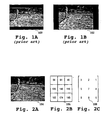
- Figures 1A and 1B illustrate common techniques used to change aspect ratios for video data.
- Video frame 100 of Figure 1A illustrates video frame 100 in which a "letter box” approach is used to scale down the aspect ratio of a video.
- Figure 1B illustrates video frame 102 in which a "pillar box” approach is used to modify the aspect ratio of a video.
- the traditional video matching techniques e.g., key frame based approaches, correlation based methods, ordinal measuring techniques, etc., fail to consider the temporal aspects of a video stream. The failure to notice the temporal variation of videos may lead to many false detections of copies.
- the present invention fills these needs by providing a method and system for video copy detection unaffected by aspect ratio changes or slight distortions of content, considering the temporal aspects of video streams. It should be appreciated that the present invention can be implemented in numerous ways, including as a method, a system, computer readable media or a device. Several inventive embodiments of the present invention are described below.
- a method for detecting whether video data appears in a target video begins with calculating a spatial distance between two spatial signatures associated with the video data and the target video.
- the method includes calculating a temporal distance between two temporal signatures associated with the video data and the target video. Then, the spatial distance and the temporal distance are combined. It is then determined whether the video data appears in the target video, where the determination is based upon the combined distance.
- the spatial distance and the temporal distance are calculated from corresponding spatial signature values and temporal signature values as described herein.
- a method for detecting copies of a video clip begins with partitioning both a frame of the video clip and a frame of a target video so that ordinal measures associated with the target video are invariant when an aspect ratio associated with the target video changes.
- the method includes determining a dissimilarity value between the frame of the video clip and the frame of the target video.
- a method for a matching technique for detecting copies of a video clip initiates with comparing temporal trails of intensity distributions between frames of the video clip and frames of a target video.
- a computer readable medium having program instructions for detecting whether video data appears in a target video.
- the computer readable medium includes program instructions for calculating a spatial signature value associated with the video data and the target video and program instructions for calculating a temporal signature value associated with the video data and the target video.
- Program instructions for combining the spatial signature value and the temporal signature value are provided.
- Program instructions for determining whether the video data appears in the target video based upon the combined value are included.
- a computer readable medium having program instructions for detecting copies of a video clip.
- the computer readable medium includes program instructions for partitioning a frame of the video clip and a frame of a target video so that ordinal measures associated with the target video are invariant when an aspect ratio associated with the target video changes.
- Program instructions for determining a dissimilarity value between the frame of the video clip and the frame of the target video are included.
- a computer readable medium having program instructions for executing a matching technique for detecting copies of a video clip.
- the computer readable medium includes program instructions for comparing temporal trails of intensity distributions between the video clip and a target video.
- a computer in still yet another embodiment, includes a central processing unit (CPU) and a memory.
- Video copy detection logic configured to detect copies of a video clip is included.
- the video copy detection logic includes logic for partitioning a frame of the video clip and a frame of a target video and logic for determining a spatial dissimilarity between a rank matrix associated with the frame of the video clip and a rank matrix associated with the frame of the target video.
- Logic for determining a direction of intensity distribution between corresponding partitions of sequential frames of the video clip and respective sequential frames of the target video is included in the video copy detection logic.
- a bus interconnecting the CPU, the memory and the video detection logic is included.
- an integrated circuit in another embodiment, includes logic for combining a spatial distance value defined between a partition of a target video frame and a corresponding partition of a query video frame with a temporal distance value associated with the partition of the target video frame and the corresponding partition of the query video frame to define a dissimilarity value. Logic for determining if the dissimilarity value is a local minimum is also included.
- Figures 1A and 1B illustrate common techniques used to change aspect ratios for video data.
- Figures 2A-2C are graphical representations of the use of ordinal measures for copy detection.
- FIGS 3A-1 through 3B-3 illustrate intensity distributions of an image where the image is partitioned differently.
- FIGS 4A and 4B illustrate two sub-image sequences obtained from partitioning original image frames in accordance with one embodiment of the invention.
- Figure 5A is a graph illustrating the temporal variations of the mean values of intensity distributions for frames and their partitions in accordance with one embodiment of the invention.
- Figure 5B is a graph illustrating the temporal variations of the mean values of intensity distributions for frames and their partitions where Histogram equalization has been applied for comparison with Figure 5A.
- Figure 6 illustrates a graphical representation of the procedure for computing d T ( ⁇ q , ⁇ t ) (the distance between two partitions) in accordance with one embodiment of the invention.
- Figure 7 is a simplified schematic diagram that provides a visual overview of the process for determining a match between a query video clip and a target video in accordance with one embodiment of the invention.
- FIG. 8 illustrates an exemplary graphical user interface (GUI) of the implementation for the video copy detector described herein in accordance with one embodiment of the invention.
- GUI graphical user interface
- FIG. 9 is a graph illustrating the performances of the proposed algorithm using a receiver operating characteristics (ROC) curve in accordance with one embodiment of the invention.
- ROC receiver operating characteristics
- Figures 10A and 10B are graphs of the precision and recall rates, respectively, versus the normalized threshold values in accordance with one embodiment of the invention.
- Figure 11 is a bar graph illustrating the precision and recall rates when ⁇ is 0.1 in accordance with one embodiment of the invention.
- Figure 12 is a simplified diagram illustrating a video copy detection system in accordance with one embodiment of the invention.
- Figure 13 is a flow chart diagram illustrating the method operations for detecting whether video data appears in the target video in accordance with one embodiment of the invention.
- the embodiments of the present invention provide system utilizing an algorithm for efficiently detecting copies of video data.
- copies that have been modified in terms of color and visible appearance, as well as spatial configuration, e.g., aspect ratio can be identified routinely.
- the ordinal variable may be drawn from a discrete ordered set, such as the grades in schools.
- the ratio between two measurements is not of importance; only the relative ordering is relevant.
- the relative ordering between measurements is expressed by their ranks.
- a rank permutation is obtained by sorting the measurements in ascending order and labeling them using integers [1,2,3,...,N], N being the number of the measurements.
- Figures 2A-2C are graphical representations of the use of ordinal measures for copy detection.
- Figure 2A represents image 104 partitioned into m ⁇ n (3 ⁇ 3) equal-sized blocks. It should be appreciated that partitioning an image into m ⁇ n equal-sized blocks makes the system independent of input image sizes.
- An m ⁇ n sub-image 106 of Figure 2B is calculated by taking the average value of each corresponding block of image 104 of Figure 2A. This array is converted to rank matrix 108 as shown in Figure 2C.
- the intensity values in sub-image 106 of Figure 2B are each increased by 10 in the copied image so the sub-image has values: ⁇ 74, 71, 56 ⁇ , ⁇ 145, 156, 126 ⁇ , ⁇ 195, 184, 155 ⁇ . Nevertheless, the rank matrix of the sub-image with increased values is identical to that shown in Figure 2C and thus perfect matching with an original image can be achieved.
- Figures 3A-2 through 3B-3 illustrate intensity distributions of image 3A-1 where the image is partitioned differently.
- Figure 3A-1 is original image 110a
- Figure 3A-2 represents intensity distribution 112 of a 2x2 partition of image 110a.
- Figure 3A-3 illustrates intensity distribution 114 of a 3x3 partition of image 110a.
- Figure 3B-1 is a spatially modified image 110b of image 110a of Figure 3A-1.
- the 4x3 video format of Figure 3A-1 has been reformatted to a letter box format.
- the intensity distributions i.e., the ordinal measures
- the intensity distributions are invariant when the partitions are 2 ⁇ 2, since changes in the partition values are symmetric.
- the ordinal measures for intensity distribution 112 and 116 remain the same since the intensity distributions are similarly impacted by the aspect ratio change, i.e., each of the partitions is evenly darkened.
- the asymmetrical changes will induce changes in ordinal measures as illustrated by comparing the shading, which represents the degree of intensity distribution, of the partitions for Figures 3A-3 and 3B-3.
- the ordinal measures for intensity distribution 114 and 118 change since the intensity distributions are impacted differently, i.e., are asymmetrical.
- the letter box format basically darkens the lower and upper partitions and does not affect the middle partitions. Consequently, one of the major issues in designing an efficient video copy detector is to consider the impact of aspect ratio changes. It will be apparent to one skilled in the art that the above analysis is applicable to a pillar box format change or any other suitable aspect ratio change.
- a matching method which is based on ordinal measures of 2 ⁇ 2 partitioned image frames is provided, where the ordinal measures of the matching method are invariant to changes in the aspect ratio of the video data.
- the robustness determines the amount of data inconsistency that can be tolerated by the system before mismatches begin to occur, while the discriminability is concerned with the technique's ability to reject irrelevant data such that false detections do not occur.
- a critical factor balancing between those conflicting issues is the number of partitions. As might be expected, the system becomes more robust as the number of partitions is reduced. On the contrary, the discriminability becomes high as the number of partitions increases. Thus, previous techniques have utilized partitions greater than 2x2 in order to increase the discriminability while still maintaining acceptable robustness. Since the discriminability might be lowered due to adopting a small number of partitions, e.g., 2x2, the embodiments described herein will exploit not only ordinal signatures of the video data, but also temporal signatures to enhance the discriminability.
- FIGs 4A and 4B illustrate two sub-image sequences obtained from partitioning original image frames in accordance with one embodiment of the invention.
- the two sub-image sequences include sequence 1, represented by frames 120a-120d in Figure 4A and sequence 2 122a-122d in Figure 4B, have different temporal variations.
- the ordinal signatures between corresponding sub-images are identical. It should be appreciated that the traditional image frame matching based methods would fail to reject these irrelevant videos since the temporal information is not taken into account. By considering the temporal information of the video data, as well as the sequence of the ordinal signatures, a more efficient way of video matching is provided as discussed below.
- a sub-video of V is defined as V [ p : p + N - 1], in which the number of frames is N and the first frame is V [ p ], 0 ⁇ p ⁇ n - N .
- the problem of video copy detection may be defined as that of determining if a copy for a given video clip appears in the target video, and if so at what location.
- a sub-video V t [ p : p + N - 1] from the target video is a copy if the dissimilarity between two video clips, or D ( V q , V t [ p : p + N - 1]) is less than a noise threshold ⁇ .
- V q [ i ] is ⁇ q , i and that of i -th frame from the target sub-sequence V t [ p : p + N - 1], is ⁇ t , p + i , 0 ⁇ i ⁇ N - 1.
- the spatial distance between two image frames can be defined as: where d ( ⁇ q , i , ⁇ t , p + i ) is a normalized distance between two rank matrices and C is the maximum distance between two rank matrices ⁇ i and ⁇ j , ⁇ ( ⁇ i , ⁇ j ) ⁇ S m .
- C is obtained when the two permutations are reverse of each other, and S m is a set of all possible rank matrices with size m .
- the spatial dissimilarity between two sequences D s ( V q , V t [ p : p + N - 1]) is computed by averaging over N dissimilarities, i.e., One skilled in the art will appreciate that this measure can be viewed as a matching algorithm with 2 ⁇ 2 partitions.
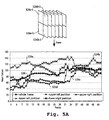
- FIG. 5A is a graph illustrating the temporal variations of the mean values of intensity distributions for frames and their partitions in accordance with one embodiment of the invention.
- the sequence of video frames are partitioned in a 2x2 configuration.
- the mean values of the intensity distributions for a partition has more variation as compared to those of the whole frame. That is, lines 124a-124d, which correspond to partitions 124a-1-124d-1, respectively, illustrate a higher degree of variation than line 126 which represents the intensity distribution of the whole frame.
- Figure 5B is a graph illustrating the temporal variations of the mean values of intensity distributions for frames and their partitions where Histogram equalization has been applied in accordance with one embodiment of the invention.
- the mean values of whole frames, as illustrated by line 130 becomes indistinctive as each frame is processed by histogram equalization and thus the mean of that frame is always adjusted to be the middle value of gray scale.
- the mean values of the intensity distribution of four partitions 128a-1-128d-1 still have discriminatory behaviors as illustrated by corresponding traces 128a-128d.
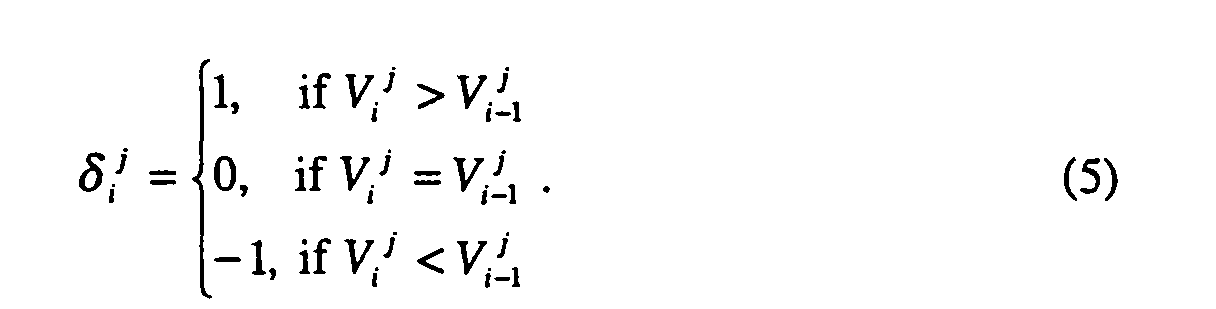
- temporal signatures For temporal matching, temporal signatures, ⁇ i , have been adopted.
- Figure 6 illustrates a graphical representation of the procedure for computing d T ( ⁇ q , ⁇ t ) (the distance between two partitions) in accordance with one embodiment of the invention.
- a sequence of numbers representing the intensity distribution for the jth partition of a query video and a target video are represented in rows 132 and 14, respectively.
- Row 134 represents the temporal signatures for the partitions of successive video frames of the query video.
- the numbers from the first two frames are compared and since the numbers associated with these two frames, 100 and 103, respectively, are increasing, a 1 is assigned for the comparison in row 134.
- Figure 6 represents one embodiment for determining a direction associated with the temporal distribution of intensity between corresponding partitions of sequential frames of the video data and respective sequential frames of the target video.
- D ( V q , V t [ p : p + N - 1]) ⁇ D s ( V q , V t [ p : p + N - 1]) + (1 - ⁇ ) D T ( V q , V t [ p : p + N - 1]), where ⁇ [0,1] represents the trade-off between spatial and temporal distances.
- FIG. 7 is a simplified schematic diagram that provides a visual overview of the process for determining a match between a query video clip and a target video in accordance with one embodiment of the invention.
- Video clip frames 143 (which may be referred to as the query video) are used to determine if any copies of the video clip is included in target video frames 142.
- video clip frames 143 will be discussed as containing five frames.
- the query video clip may contain any suitable number of frames greater than one and is not limited to a particular number of frames.
- the spatial and the temporal distances discussed above are calculated and combined for each five frame video clip of target video frames 142. This distance is then presented below in the graph of Figure 7.
- the spatial and temporal distance (D) is tracked by line 145, which is calculated by Equation 6 as described above.
- a local minima is found at points 146a and 146b. If the local minima is below a threshold ⁇ , which is represented by line 144, then the frame associated with the local minima and the four preceding frames are identified as a copy of the five frames of the query video clip.
- a target video may have more than one copy of a query video. For example, where the target video is a television program and the query video clip is a commercial that ran during the program, the commercial may have been repeated a number of times during the program.
- Figure 7 pictorially illustrates the process described by operations 1-4 above.
- Figure 8 illustrates an exemplary graphical user interface (GUI) of the implementation for the video copy detector described herein in accordance with one embodiment of the invention.
- the test video has in excess of 120,000 frames and is encoded in MPEG1 format.
- the test video i.e., target video contains a variety type of sequences, such as sports, landscapes, home videos, etc.
- Region 149 of GUI 147 illustrates the matching technique being applied.
- the highlighted technique includes an ⁇ value of 0.5 and a (1- ⁇ ) value of 0.5.
- ⁇ is represented by S and 1- ⁇ is represented by T.
- Buttons 148a-c include general navigation buttons 148c, query generation button 148b and matching button 148a.
- Query generation button 148b initiates functionality to generate and partition a query image in one embodiment.
- Matching button 148c initiates functionality to search for a match of the query video clip in the target video clip.
- the target video clip may be displayed in region 151.
- the threshold applied for the determination of the local minima was 0.1 as displayed in region 153.
- the algorithm is adaptive to various spatial and temporal weighting.
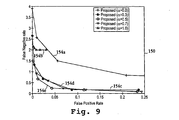
- Figure 9 is a graph illustrating the performances of the proposed algorithm using a receiver operating characteristics (ROC) curve in accordance with one embodiment of the invention.
- ROC receiver operating characteristics
- FIGS 10A and 10B are graphs of the precision and recall rates, respectively, versus the normalized threshold values in accordance with one embodiment of the invention.
- Matched copy clips also referred to as detected copy clips, denotes the real copy clips, i.e., the actual matched copies disregarding false positives, among the clips detected as a copy.
- Total copy clips indicates the real copy clips existing through the target video.
- ⁇ 0.1, where both of rates are high.
- line 158a-e provides the best precision.
- line 162a-e provides the best recall.
- ⁇ 0.7.
- FIG 12 is a simplified diagram illustrating a video copy detection system in accordance with one embodiment of the invention.
- Video copy detection system 166 includes central processing unit (CPU) 174, memory 172, video copy detection logic 168, all interconnected by bus 170.
- video copy detection logic 168 includes logic for partitioning a frame of the video clip and a frame of a target video as described above.
- the logic for partitioning each frame is configured to partition each frame in a 2x2 matrix.
- Video copy detection logic 168 also includes logic for determining a spatial dissimilarity between a rank matrix associated with a frame of the video clip and a rank matrix associated with the frame of the target video.
- Video copy detection logic 168 further includes logic for determining a direction of intensity distribution between corresponding partitions of sequential frames of the video clip and respective sequential frames of the target video.
- the direction of intensity distribution creates a temporal trail in order to account for temporal variations as the video takes place over time.
- the values representing the spatial dissimilarity and the corresponding values representing the direction of the intensity distribution are combined for corresponding partitions, thereby resulting in a sequence of values.
- a first sequence is associated with the temporal intensity change of successive partitions for the video clip, while a second sequence of values is associated with the temporal intensity change corresponding to the target video.
- the first sequence of values and the second sequence of values are then compared to determine whether the values are changing in a similar direction as discussed with reference to Figure 6.
- the video copy detection logic 168 may be embodied as hardware, software or some combination of both.
- the hardware configuration may include an integrated circuit containing circuitry configured to execute the functionality described herein. Of course the integrated circuit may be included on a plug-in board or adapter card.
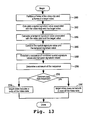
- Figure 13 is a flow chart diagram illustrating the method operations for detecting whether video data appears in the target video in accordance with one embodiment of the invention.
- the method initiates with operation 180 where both a frame of the video clip and a frame of the target video are partitioned.
- the frame of the video clip and the frame of the target video are partitioned in a 2x2 matrix so that ordinal measures associated with the target video are invariant when an aspect ratio associated with the target video changes. For example, if an aspect ratio of the target video is changed to a pillar box or a letter box configuration, the 2x2 configuration will accommodate these changes so that ordinal measures associated with the target video are not affected.
- the method then advances to operation 182 where a spatial signature value associated with the video data and the target video are calculated.
- the spatial signature value represents the spatial distance between two image frames.
- the spatial distance may be represented as a normalized distance between two rank matrices as discussed above.
- the method of Figure 13 then moves to operation 184 where a temporal signature value associated with the video data and the target video are calculated.
- the temporal signature value represents a temporal distance metric that is expressed by a normalized distance.
- the temporal signature value includes an estimate of the degree of discordance, i.e., the number of corresponding pairs whose temporal change is not in the same direction, as described with reference to Figure 6.
- the method then proceeds to operation 186 where the spatial signature value and the temporal signature value are combined.
- the spatial signature value and the temporal signature value may be combined as illustrated above with reference to equation 6. As described therein, a tradeoff value is provided between the spatial and temporal distances.
- the spatial signature value and the temporal signature value are combined for each partition for a sequence of frames, thereby resulting in a sequence of combined spatial signature values and corresponding temporal signature values as referenced in operation 188.
- operation 190 a minimum of the sequence established in operation 188 is determined.
- decision operation 192 it is determined if the minimum from operation 190 is below a threshold value.
- a threshold value one or more local minima may be found as discussed with reference to Figure 7. If the local minimum is below a threshold value, then the target video includes a copy of the video data, and is marked as such. If the minimum is greater than the threshold value in decision operation 192, then the target video does not include a copy of the video data as represented in operation 196.
- the above described invention detects unauthorized copies of a video clip.
- a 2x2 partitioned image is used for the query and target video data.
- the spatial factor is associated with a low discriminability because of the small number of partitions
- the temporal factor is included to enhance the discriminability sacrificed by the partition configuration.
- the partition configuration is capable of evaluating aspect ratio changes applied to the target video.
- the memory requirement for storing/indexing the signatures associated with the embodiments described above is 4 bytes per frame, which is relatively small when compared to the memory requirements for video copy detection based solely upon spatial matching.
- the embodiments described herein may be incorporated into multimedia search engines. As these engines are getting cluttered with a large number of copies, e.g., among retrieval results several copies might exist, which prevents users from prompt browsing. Therefore a scheme to detect and remove copies from the retrieval results before displaying as described above, may be utilized to prevent the copies.
- the content-based video copy detection scheme is also useful for media tracking.
- Media tracking refers to keeping track of when and where a particular known piece of media has been used. For example, monitoring a particular TV commercial for market research is a specific application of the media tracking. In detail, one might want to know when and how many times, and on which channel a competitor's commercial is aired. By doing so, the competitor's marketing strategy can be apprehended. Media tracking is also useful in relation to right management and royalty payments.
- the invention may employ various computer-implemented operations involving data stored in computer systems. These operations include operations requiring physical manipulation of physical quantities. Usually, though not necessarily, these quantities take the form of electrical or magnetic signals capable of being stored, transferred, combined, compared, and otherwise manipulated. Further, the manipulations performed are often referred to in terms, such as producing, identifying, determining, or comparing.
- the above described invention may be practiced with other computer system configurations including hand-held devices, microprocessor systems, microprocessor-based or programmable consumer electronics, minicomputers, mainframe computers and the like.
- the invention may also be practiced in distributing computing environments where tasks are performed by remote processing devices that are linked through a communications network.
- the invention can also be embodied as computer readable code on a computer readable medium.
- the computer readable medium is any data storage device that can store data which can be thereafter read by a computer system.
- the computer readable medium also includes an electromagnetic carrier wave in which the computer code is embodied. Examples of the computer readable medium include hard drives, network attached storage (NAS), read-only memory, random-access memory, CD-ROMs, CD-Rs, CD-RWs, magnetic tapes, and other optical and non-optical data storage devices.
- the computer readable medium can also be distributed over a network coupled computer system so that the computer readable code is stored and executed in a distributed fashion.
Landscapes
- Engineering & Computer Science (AREA)
- Multimedia (AREA)
- Theoretical Computer Science (AREA)
- General Physics & Mathematics (AREA)
- Library & Information Science (AREA)
- Physics & Mathematics (AREA)
- Structural Engineering (AREA)
- Civil Engineering (AREA)
- Data Mining & Analysis (AREA)
- Databases & Information Systems (AREA)
- General Engineering & Computer Science (AREA)
- Television Signal Processing For Recording (AREA)
- Image Analysis (AREA)
- Information Retrieval, Db Structures And Fs Structures Therefor (AREA)
- Testing, Inspecting, Measuring Of Stereoscopic Televisions And Televisions (AREA)
Abstract
Description



Claims (43)
- A method for detecting whether video data appears in a target video, comprising the operations of:calculating a spatial distance between two spatial signatures associated with the video data and the target video;calculating a temporal distance between two temporal signatures associated with the video data and the target video;combining the spatial distance and the temporal distance; anddetermining whether the video data appears in the target video based upon the combined spatial distance and the temporal distance.
- The method of claim 1, further comprising:calculating a spatial signature value associated with the video data and the target video;calculating a temporal signature value associated with the video data and the target video; andpartitioning a frame of the video data and a corresponding frame of the target video into a configuration that compensates for aspect ratio changes of the corresponding frame of the target video.
- The method of claim 1, wherein the method operation of calculating a spatial signature value associated with the video data and the target video includes,determining both a first ordinal measure for a frame of the video data and a second ordinal measure for a frame of the target video; andcomputing a spatial distance between the first ordinal measure and the second ordinal measure.
- The method of claim 1, wherein the method operation of calculating a temporal signature value associated with the video data and the target video includes,
determining a direction of temporal distribution of intensity between corresponding partitions of sequential frames of the video data and respective sequential frames of the target video. - The method of claim 1, wherein the method operation of combining the spatial distance and the temporal distance includes,adjusting the spatial distance by a value;adjusting the temporal distance by 1 minus the value, wherein the value is a number between 0 and 1.
- A method for detecting copies of a video clip, comprising the operations of:partitioning both a frame of the video clip and a frame of a target video so that ordinal measures associated with the target video are invariant when an aspect ratio associated with the target video changes; anddetermining a dissimilarity value between the frame of the video clip and the frame of the target video.
- The method of claim 6, wherein the method operation of partitioning both a frame of the video clip and a frame of a target video includes,subdividing both the frame of the video clip and the frame of the target video into four regions.
- The method of claim 6, wherein the method operation of determining a dissimilarity value between the frame of the video clip and the frame of the target video includes,calculating a spatial dissimilarity value based on differences between a rank matrix of the frame of the video clip and a rank matrix of the frame of the target video;calculating a temporal distance metric based on a direction of intensity distribution between corresponding partitions of sequential frames of the video clip and respective sequential frames of the target video; andcombining the spatial dissimilarity value with the temporal distance metric.
- The method of claim 6, further comprising:repeating the partitioning and the determining;generating a sequence of dissimilarity values; andidentifying a minimum of the sequence of dissimilarity values.
- The method of claim 9, wherein the method operation of identifying a minimum of the sequence of dissimilarity values includes,determining if the minimum is less than a threshold value; andif the minimum is below the threshold value then the method includes,identifying a frame of the target video associated with the minimum as a copy of a corresponding frame of the video clip.
- A matching technique for detecting copies of a video clip, comprising the operation of:comparing temporal trails of intensity distributions between frames of the video clip and frames of a target video.
- The matching technique of claim 11, further comprising:partitioning the frames of the video clip and the frames of the target video into a configuration where ordinal measures associated with the frames of the target video are invariant when an aspect ratio associated with the frames of the target video changes.
- The matching technique of claim 11, further comprising:comparing spatial ordinal signatures between frames of the video clip and frames of a target video; andcombining results from the comparing of the temporal trails and the comparing of the spatial signatures.
- The matching technique of claim 13, further comprising:establishing a threshold value;examining the combined results;determining a minimum of the combined results;comparing the minimum to the threshold value; andidentifying a frame of the target video associated the minimum as a copy if the minimum is less than the threshold value.
- The matching technique of claim 11, wherein the method operation of comparing temporal trails of intensity distributions between frames of the video clip and frames of a target video includes,identifying a direction of intensity distribution between corresponding partitions of sequential frames of the video data and respective sequential frames of the target video.
- The matching technique of claim 15, wherein the method operation of identifying a direction of intensity distribution between corresponding partitions of sequential frames of the video data and respective sequential frames of the target video includes,assigning a first set of values corresponding to an intensity of successive partitions of the sequential frames of the video data; andassigning a second set of values corresponding to an intensity of successive partitions of the sequential frames of the target video.
- The matching technique of claim 16, further comprising:generating a first sequence of values indicating a temporal intensity change of the successive partitions of the sequential frames of the video data;generating a second sequence of values indicating a temporal intensity change of the successive partitions of the sequential frames of the target video; anddetermining whether the temporal intensity change of the video data and the temporal intensity change of the target video are in a same direction through a comparison of the first sequence of values and the second sequence of values.
- A computer readable medium having program instructions for detecting whether video data appears in a target video, comprising:program instructions for calculating a spatial distance between two spatial signatures associated with the video data and the target video;program instructions for calculating a temporal distance between two temporal signatures associated with the video data and the target video;program instructions for combining the spatial distance and the temporal distance; andprogram instructions for determining whether the video data appears in the target video based upon a value representing the combined spatial distance and the temporal distance.
- The computer readable medium of claim 18, further comprising:program instructions for calculating a spatial signature value associated with the video data and the target video;program instructions for calculating a temporal signature value associated with the video data and the target video; andprogram instructions for partitioning a frame of the video data and a corresponding frame of the target video into a configuration that compensates for aspect ratio changes of the corresponding frame of the target video.
- The computer readable medium of claim 19, wherein the program instructions for calculating a spatial signature value associated with the video data and the target video includes,program instructions for determining both a first ordinal measure for a frame of the video data and a second ordinal measure for a frame of the target video; andprogram instructions for computing the spatial distance between the first ordinal measure and the second ordinal measure.
- The computer readable medium of claim 19, wherein the method operation of calculating a temporal signature value associated with the video data and the target video includes,determining a direction of temporal distribution of intensity between corresponding partitions of sequential frames of the video data and respective sequential frames of the target video.
- A computer readable medium having program instructions for detecting copies of a video clip, comprising:program instructions for partitioning a frame of the video clip and a frame of a target video so that ordinal measures associated with the target video are invariant when an aspect ratio associated with the target video changes; andprogram instructions for determining a dissimilarity value between the frame of the video clip and the frame of the target video.
- The computer readable medium of claim 22, wherein the program instructions for partitioning both a frame of the video clip and a frame of a target video includes,program instructions for subdividing both the frame of the video clip and the frame of the target video into four regions.
- The computer readable medium of claim 22, wherein the program instructions for determining a dissimilarity value between the frame of the video clip and the frame of the target video includes,program instructions for calculating a spatial dissimilarity value based on differences between a rank matrix of the frame of the video clip and a rank matrix of the frame of the target video;program instructions for calculating a temporal distance metric based on a direction of intensity distribution between corresponding partitions of sequential frames of the video clip and respective sequential frames of the target video; andprogram instructions for combining the spatial dissimilarity value with the temporal distance metric.
- The computer readable medium of claim 22, further comprising:program instructions for repeating the partitioning and the determining;program instructions for generating a sequence of dissimilarity values; andprogram instructions for identifying a minimum of the sequence of dissimilarity values.
- The computer readable medium of claim 25, wherein the program instructions for identifying a minimum of the sequence of dissimilarity values includes,program instructions for determining if the minimum is less than a threshold value; andif the minimum is below the threshold value then the method includes,program instructions for identifying a frame of the target video associated with the minimum as a copy of a corresponding frame of the video clip.
- A computer readable medium having program instructions for executing a matching technique for detecting copies of a video clip, comprising:program instructions for comparing temporal trails of intensity distributions between the video clip and a target video.
- The computer readable medium of claim 27, further comprising:program instructions for partitioning the frames of the video clip and the frames of the target video into a configuration where ordinal measures associated with the frames of the target video are invariant when an aspect ratio associated with the frames of the target video changes.
- The computer readable medium of claim 27, further comprising:program instructions for comparing spatial ordinal signatures between frames of the video clip and frames of a target video; andprogram instructions for combining results from the comparing of the temporal trails and the comparing of the spatial signatures.
- The computer readable medium of claim 29, further comprising:program instructions for establishing a threshold value;program instructions for examining the combined results;program instructions for determining a minimum of the combined results;program instructions for comparing the minimum to the threshold value; andprogram instructions for identifying a frame of the target video associated the minimum as a copy if the minimum is less than the threshold value.
- The computer readable medium of claim 27, wherein the program instructions for comparing temporal trails of intensity distributions between frames of the video clip and frames of a target video includes,program instructions for identifying a direction of intensity distribution between corresponding partitions of sequential frames of the video data and respective sequential frames of the target video.
- The computer readable medium of claim 31, wherein the program instructions for identifying a direction of intensity distribution between corresponding partitions of sequential frames of the video data and respective sequential frames of the target video includes,program instructions for assigning a first set of values corresponding to an intensity of successive partitions of the sequential frames of the video data; andprogram instructions for assigning a second set of values corresponding to an intensity of successive partitions of the sequential frames of the target video.
- The computer readable medium of claim 32, further comprising:program instructions for generating a first sequence of values indicating a temporal intensity change of the successive partitions of the sequential frames of the video data;program instructions for generating a second sequence of values indicating a temporal intensity change of the successive partitions of the sequential frames of the target video; andprogram instructions for determining whether the temporal intensity change of the video data and the temporal intensity change of the target video are in a same direction through a comparison of the first sequence of values and the second sequence of values.
- A computer, comprising:a bus interconnecting the CPU, the memory and the video detection logic.a central processing unit (CPU);a memory;video copy detection logic configured to detect copies of a video clip, the video copy detection logic including,logic for partitioning a frame of the video clip and a frame of a target video;logic for determining a spatial dissimilarity between a rank matrix associated with the frame of the video clip and a rank matrix associated with the frame of the target video;logic for determining a direction of intensity distribution between corresponding partitions of sequential frames of the video clip and respective sequential frames of the target video; and
- The computer of claim 34, wherein the video copy detection logic further includes,logic for combining a value representing the spatial dissimilarity and a value representing the direction of intensity distribution for corresponding partitions.
- The computer of claim 34, wherein the video copy detection logic further includes,logic for generating a first sequence of values indicating a temporal intensity change of successive partitions of sequential frames of the video clip;logic for generating a second sequence of values indicating a temporal intensity change of successive partitions of sequential frames of the target video; andlogic for determining whether the first sequence of values and the second sequence of values are changing in a similar direction.
- The computer of claim 34, wherein the logic for partitioning a frame of the video clip and a frame of a target video partitions each frame in a 2x2 format.
- The computer of claim 34, wherein each logic element is one or a combination of hardware and software.
- An integrated circuit, comprising:logic for combining a spatial distance value defined between a partition of a target video frame and a corresponding partition of a query video frame with a temporal distance value associated with the partition of the target video frame and the corresponding partition of the query video frame to define a dissimilarity value; andlogic for determining if the dissimilarity value is a local minimum.
- The integrated circuit of claim 39, further comprising:logic for calculating the spatial distance value based upon an ordinal measure associated with the partition.
- The integrated circuit of claim 39, further comprising:logic for calculating the temporal distance value based upon a direction of change for an intensity distribution between corresponding successive video frames of a target video and a query video.
- The integrated circuit of claim 39, further comprising:logic for partitioning both the target video frame and the query video frame in a 2x2 matrix.
- The integrated circuit of claim 39, wherein the logic for determining if the dissimilarity value is a local minimum includes,logic for comparing the dissimilarity value to a threshold value; andlogic for identifying the dissimilarity value as a local minimum if the dissimilarity value is less than the threshold value.
Applications Claiming Priority (4)
| Application Number | Priority Date | Filing Date | Title |
|---|---|---|---|
| US48075803P | 2003-06-23 | 2003-06-23 | |
| US480758P | 2003-06-23 | ||
| US778464 | 2004-02-13 | ||
| US10/778,464 US7532804B2 (en) | 2003-06-23 | 2004-02-13 | Method and apparatus for video copy detection |
Publications (2)
| Publication Number | Publication Date |
|---|---|
| EP1494135A2 true EP1494135A2 (en) | 2005-01-05 |
| EP1494135A3 EP1494135A3 (en) | 2006-02-08 |
Family
ID=33436770
Family Applications (1)
| Application Number | Title | Priority Date | Filing Date |
|---|---|---|---|
| EP04011566A Withdrawn EP1494135A3 (en) | 2003-06-23 | 2004-05-14 | Method and apparatus for video copy detection |
Country Status (5)
| Country | Link |
|---|---|
| US (1) | US7532804B2 (en) |
| EP (1) | EP1494135A3 (en) |
| JP (1) | JP2005020742A (en) |
| KR (2) | KR100671772B1 (en) |
| CN (1) | CN1574019A (en) |
Cited By (7)
| Publication number | Priority date | Publication date | Assignee | Title |
|---|---|---|---|---|
| WO2007020423A3 (en) * | 2005-08-15 | 2007-05-03 | Mitsubishi Electric Inf Tech | Mutual-rank similarity-space for navigating, visualising and clustering in image databases |
| CN101888479B (en) * | 2009-05-14 | 2012-05-02 | 汉王科技股份有限公司 | Method and device for detecting and tracking target image |
| WO2013104432A1 (en) * | 2012-01-10 | 2013-07-18 | Qatar Foundation | Detecting video copies |
| WO2015130697A1 (en) * | 2014-02-28 | 2015-09-03 | Sys-Tech Solutions, Inc. | Methods and a system for verifying the identity of a printed item |
| US10546171B2 (en) | 2012-03-01 | 2020-01-28 | Sys-Tech Solutions, Inc. | Method and system for determining an authenticity of a barcode using edge linearity |
| US10552848B2 (en) | 2012-03-01 | 2020-02-04 | Sys-Tech Solutions, Inc. | Method and system for determining whether a barcode is genuine using a deviation from an idealized grid |
| US10997385B2 (en) | 2012-03-01 | 2021-05-04 | Sys-Tech Solutions, Inc. | Methods and a system for verifying the authenticity of a mark using trimmed sets of metrics |
Families Citing this family (44)
| Publication number | Priority date | Publication date | Assignee | Title |
|---|---|---|---|---|
| US7930546B2 (en) * | 1996-05-16 | 2011-04-19 | Digimarc Corporation | Methods, systems, and sub-combinations useful in media identification |
| US7167574B2 (en) * | 2002-03-14 | 2007-01-23 | Seiko Epson Corporation | Method and apparatus for content-based image copy detection |
| US7532804B2 (en) | 2003-06-23 | 2009-05-12 | Seiko Epson Corporation | Method and apparatus for video copy detection |
| US7486827B2 (en) * | 2005-01-21 | 2009-02-03 | Seiko Epson Corporation | Efficient and robust algorithm for video sequence matching |
| US20060277609A1 (en) * | 2005-06-07 | 2006-12-07 | Marc Brandon | Method and apparatus for tracking pirated media |
| US20090019149A1 (en) * | 2005-08-02 | 2009-01-15 | Mobixell Networks | Content distribution and tracking |
| WO2007091243A2 (en) * | 2006-02-07 | 2007-08-16 | Mobixell Networks Ltd. | Matching of modified visual and audio media |
| WO2007142639A1 (en) * | 2006-06-06 | 2007-12-13 | Warner Bros. Entertainment Inc. | Method and apparatus for tracking pirated media |
| JP4763525B2 (en) * | 2006-06-21 | 2011-08-31 | 日本電信電話株式会社 | Video alignment method |
| US8738749B2 (en) * | 2006-08-29 | 2014-05-27 | Digimarc Corporation | Content monitoring and host compliance evaluation |
| US9105306B2 (en) * | 2006-12-27 | 2015-08-11 | Nec Corporation | Identifying objects in images using object identity probabilities based on interframe distances |
| DE602008004340D1 (en) * | 2007-05-17 | 2011-02-17 | Dolby Lab Licensing Corp | DERIVED FROM IMAGE PROCESSING AND FRAME RATE CONVERSION SENSITIVE VIDEO SIGNATURES |
| JP5322416B2 (en) * | 2007-09-12 | 2013-10-23 | 株式会社メガチップス | Block matching circuit and data update method |
| US8380045B2 (en) * | 2007-10-09 | 2013-02-19 | Matthew G. BERRY | Systems and methods for robust video signature with area augmented matching |
| US8793498B2 (en) * | 2008-08-11 | 2014-07-29 | Nbcuniversal Media, Llc | System and method for forensic analysis of media works |
| US8224157B2 (en) * | 2009-03-30 | 2012-07-17 | Electronics And Telecommunications Research Institute | Method and apparatus for extracting spatio-temporal feature and detecting video copy based on the same in broadcasting communication system |
| US8295611B2 (en) * | 2009-08-10 | 2012-10-23 | Pixel Forensics, Inc. | Robust video retrieval utilizing audio and video data |
| US9087125B2 (en) * | 2009-08-10 | 2015-07-21 | Pixel Forensics, Inc. | Robust video retrieval utilizing video data |
| US8515933B2 (en) * | 2009-08-18 | 2013-08-20 | Industrial Technology Research Institute | Video search method, video search system, and method thereof for establishing video database |
| US8671109B2 (en) * | 2009-10-01 | 2014-03-11 | Crim (Centre De Recherche Informatique De Montreal) | Content-based video copy detection |
| US8831760B2 (en) | 2009-10-01 | 2014-09-09 | (CRIM) Centre de Recherche Informatique de Montreal | Content based audio copy detection |
| US20110191320A1 (en) * | 2010-02-02 | 2011-08-04 | Game Plan Technologies, Inc. | Digital asset management system |
| CN101937506B (en) * | 2010-05-06 | 2012-10-17 | 复旦大学 | Near Copy Video Detection Method |
| US8731292B2 (en) * | 2011-01-07 | 2014-05-20 | Alcatel Lucent | Method and apparatus for comparing videos |
| CN103430175B (en) * | 2011-01-07 | 2016-12-28 | 阿尔卡特朗讯公司 | For the method and apparatus that video is compared |
| US8913851B1 (en) | 2011-04-29 | 2014-12-16 | Google Inc. | Fingerprinting image using points of interest for robust image identification |
| CN102393900B (en) * | 2011-07-02 | 2013-05-29 | 山东大学 | Video Copy Detection Method Based on Robust Hash |
| US9323840B2 (en) * | 2013-01-07 | 2016-04-26 | Gracenote, Inc. | Video fingerprinting |
| US9626567B2 (en) * | 2013-03-13 | 2017-04-18 | Visible Measures Corp. | Automated video campaign building |
| CN104408092B (en) * | 2014-11-14 | 2018-01-09 | 中国科学院计算技术研究所 | Image search method and system based on sequencing estimating characteristic |
| US9621935B2 (en) | 2015-04-01 | 2017-04-11 | Tribune Broadcasting Company, Llc | Using bitrate data to output an alert indicating a functional state of back-up media-broadcast system |
| US9674475B2 (en) | 2015-04-01 | 2017-06-06 | Tribune Broadcasting Company, Llc | Using closed-captioning data to output an alert indicating a functional state of a back-up video-broadcast system |
| US9420348B1 (en) | 2015-04-01 | 2016-08-16 | Tribune Broadcasting Company, Llc | Using aspect-ratio transitions to output an alert indicating a functional state of a back up video-broadcast system |
| US9582244B2 (en) | 2015-04-01 | 2017-02-28 | Tribune Broadcasting Company, Llc | Using mute/non-mute transitions to output an alert indicating a functional state of a back-up audio-broadcast system |
| US9420277B1 (en) | 2015-04-01 | 2016-08-16 | Tribune Broadcasting Company, Llc | Using scene-change transitions to output an alert indicating a functional state of a back-up video-broadcast system |
| US9531488B2 (en) | 2015-04-01 | 2016-12-27 | Tribune Broadcasting Company, Llc | Using single-channel/multi-channel transitions to output an alert indicating a functional state of a back-up audio-broadcast system |
| US9264744B1 (en) | 2015-04-01 | 2016-02-16 | Tribune Broadcasting Company, Llc | Using black-frame/non-black-frame transitions to output an alert indicating a functional state of a back-up video-broadcast system |
| CN105072455A (en) * | 2015-08-11 | 2015-11-18 | 精硕世纪科技(北京)有限公司 | Video matching method and device |
| EP3239896B1 (en) | 2016-04-28 | 2018-11-28 | Joanneum Research Forschungsgesellschaft mbH | Data structure for describing an image sequence, and methods for extracting and matching these data structures |
| CN105959686B (en) * | 2016-06-22 | 2018-11-09 | 腾讯科技(深圳)有限公司 | A kind of video feature extraction method, video matching method and device |
| JP6495219B2 (en) * | 2016-10-19 | 2019-04-03 | 日本電信電話株式会社 | Video detection apparatus, method, and program |
| CN111277902B (en) * | 2020-02-17 | 2022-03-25 | 北京达佳互联信息技术有限公司 | Video matching method, device and equipment |
| CN113395583B (en) * | 2020-09-29 | 2023-06-27 | 腾讯科技(深圳)有限公司 | Watermark detection method, watermark detection device, computer equipment and storage medium |
| WO2022124679A1 (en) * | 2020-12-07 | 2022-06-16 | 삼성전자 주식회사 | Device and method for detecting duplicate video |
Family Cites Families (32)
| Publication number | Priority date | Publication date | Assignee | Title |
|---|---|---|---|---|
| GB2267598B (en) | 1992-06-01 | 1995-09-13 | Macrovision Uk Limited | Improvements in or relating to detecting copied video recordings |
| JP3372611B2 (en) | 1993-10-18 | 2003-02-04 | キヤノン株式会社 | Video transmission system, video processing device, and video processing method |
| JP3340532B2 (en) | 1993-10-20 | 2002-11-05 | 株式会社日立製作所 | Video search method and apparatus |
| KR0152788B1 (en) | 1994-11-26 | 1998-10-15 | 이헌조 | Copy protection method and apparatus of digital imaging system |
| US6381367B1 (en) | 1997-05-29 | 2002-04-30 | Macrovision Corp. | Method and apparatus for compression compatible video fingerprinting |
| US5960081A (en) | 1997-06-05 | 1999-09-28 | Cray Research, Inc. | Embedding a digital signature in a video sequence |
| US5987456A (en) | 1997-10-28 | 1999-11-16 | University Of Masschusetts | Image retrieval by syntactic characterization of appearance |
| US6332030B1 (en) | 1998-01-15 | 2001-12-18 | The Regents Of The University Of California | Method for embedding and extracting digital data in images and video |
| US6141464A (en) | 1998-03-30 | 2000-10-31 | Xerox Corporation | Robust method for finding registration marker positions |
| US6240423B1 (en) | 1998-04-22 | 2001-05-29 | Nec Usa Inc. | Method and system for image querying using region based and boundary based image matching |
| US6070171A (en) | 1998-05-15 | 2000-05-30 | Palantir Software, Inc. | Method and system for copy-tracking distributed software featuring tokens containing a key field and a usage field |
| US6285774B1 (en) | 1998-06-08 | 2001-09-04 | Digital Video Express, L.P. | System and methodology for tracing to a source of unauthorized copying of prerecorded proprietary material, such as movies |
| US6285995B1 (en) | 1998-06-22 | 2001-09-04 | U.S. Philips Corporation | Image retrieval system using a query image |
| US6266429B1 (en) | 1998-09-23 | 2001-07-24 | Philips Electronics North America Corporation | Method for confirming the integrity of an image transmitted with a loss |
| US6373979B1 (en) | 1999-01-29 | 2002-04-16 | Lg Electronics, Inc. | System and method for determining a level of similarity among more than one image and a segmented data structure for enabling such determination |
| US6404925B1 (en) | 1999-03-11 | 2002-06-11 | Fuji Xerox Co., Ltd. | Methods and apparatuses for segmenting an audio-visual recording using image similarity searching and audio speaker recognition |
| US6487311B1 (en) | 1999-05-04 | 2002-11-26 | International Business Machines Corporation | OCR-based image compression |
| US6389417B1 (en) | 1999-06-29 | 2002-05-14 | Samsung Electronics Co., Ltd. | Method and apparatus for searching a digital image |
| WO2001003005A1 (en) | 1999-06-30 | 2001-01-11 | Sharp Kabushiki Kaisha | Dynamic image search information recording apparatus and dynamic image searching device |
| US6751363B1 (en) | 1999-08-10 | 2004-06-15 | Lucent Technologies Inc. | Methods of imaging based on wavelet retrieval of scenes |
| US6577766B1 (en) | 1999-11-10 | 2003-06-10 | Logitech, Inc. | Method and apparatus for motion detection in the discrete cosine transform domain |
| TW510114B (en) | 1999-11-15 | 2002-11-11 | Canon Kk | Information processing apparatus and processing method therefor |
| US6675174B1 (en) | 2000-02-02 | 2004-01-06 | International Business Machines Corp. | System and method for measuring similarity between a set of known temporal media segments and a one or more temporal media streams |
| US6865302B2 (en) | 2000-03-16 | 2005-03-08 | The Regents Of The University Of California | Perception-based image retrieval |
| EP1225756A1 (en) | 2001-01-03 | 2002-07-24 | Synoptics Limited | Method of obtaining an image |
| KR100450793B1 (en) | 2001-01-20 | 2004-10-01 | 삼성전자주식회사 | Apparatus for object extraction based on the feature matching of region in the segmented images and method therefor |
| US6892193B2 (en) | 2001-05-10 | 2005-05-10 | International Business Machines Corporation | Method and apparatus for inducing classifiers for multimedia based on unified representation of features reflecting disparate modalities |
| US7127106B1 (en) | 2001-10-29 | 2006-10-24 | George Mason Intellectual Properties, Inc. | Fingerprinting and recognition of data |
| US20040013302A1 (en) | 2001-12-04 | 2004-01-22 | Yue Ma | Document classification and labeling using layout graph matching |
| US7167574B2 (en) | 2002-03-14 | 2007-01-23 | Seiko Epson Corporation | Method and apparatus for content-based image copy detection |
| JP2004007552A (en) | 2002-04-12 | 2004-01-08 | Seiko Epson Corp | Method and apparatus for content-based image copy detection |
| US7532804B2 (en) | 2003-06-23 | 2009-05-12 | Seiko Epson Corporation | Method and apparatus for video copy detection |
-
2004
- 2004-02-13 US US10/778,464 patent/US7532804B2/en not_active Expired - Fee Related
- 2004-05-11 KR KR1020040032916A patent/KR100671772B1/en not_active Expired - Fee Related
- 2004-05-14 EP EP04011566A patent/EP1494135A3/en not_active Withdrawn
- 2004-06-23 CN CNA2004100597907A patent/CN1574019A/en active Pending
- 2004-06-23 JP JP2004184917A patent/JP2005020742A/en not_active Withdrawn
-
2006
- 2006-10-27 KR KR1020060104870A patent/KR20060117890A/en not_active Abandoned
Cited By (10)
| Publication number | Priority date | Publication date | Assignee | Title |
|---|---|---|---|---|
| WO2007020423A3 (en) * | 2005-08-15 | 2007-05-03 | Mitsubishi Electric Inf Tech | Mutual-rank similarity-space for navigating, visualising and clustering in image databases |
| CN101888479B (en) * | 2009-05-14 | 2012-05-02 | 汉王科技股份有限公司 | Method and device for detecting and tracking target image |
| WO2013104432A1 (en) * | 2012-01-10 | 2013-07-18 | Qatar Foundation | Detecting video copies |
| US9418297B2 (en) | 2012-01-10 | 2016-08-16 | Qatar Foundation | Detecting video copies |
| US10546171B2 (en) | 2012-03-01 | 2020-01-28 | Sys-Tech Solutions, Inc. | Method and system for determining an authenticity of a barcode using edge linearity |
| US10552848B2 (en) | 2012-03-01 | 2020-02-04 | Sys-Tech Solutions, Inc. | Method and system for determining whether a barcode is genuine using a deviation from an idealized grid |
| US10832026B2 (en) | 2012-03-01 | 2020-11-10 | Sys-Tech Solutions, Inc. | Method and system for determining whether a barcode is genuine using a gray level co-occurrence matrix |
| US10922699B2 (en) | 2012-03-01 | 2021-02-16 | Sys-Tech Solutions, Inc. | Method and system for determining whether a barcode is genuine using a deviation from a nominal shape |
| US10997385B2 (en) | 2012-03-01 | 2021-05-04 | Sys-Tech Solutions, Inc. | Methods and a system for verifying the authenticity of a mark using trimmed sets of metrics |
| WO2015130697A1 (en) * | 2014-02-28 | 2015-09-03 | Sys-Tech Solutions, Inc. | Methods and a system for verifying the identity of a printed item |
Also Published As
| Publication number | Publication date |
|---|---|
| US20040258397A1 (en) | 2004-12-23 |
| KR20060117890A (en) | 2006-11-17 |
| US7532804B2 (en) | 2009-05-12 |
| KR20050000307A (en) | 2005-01-03 |
| EP1494135A3 (en) | 2006-02-08 |
| JP2005020742A (en) | 2005-01-20 |
| KR100671772B1 (en) | 2007-01-19 |
| CN1574019A (en) | 2005-02-02 |
Similar Documents
| Publication | Publication Date | Title |
|---|---|---|
| US7532804B2 (en) | Method and apparatus for video copy detection | |
| US7486827B2 (en) | Efficient and robust algorithm for video sequence matching | |
| Kang et al. | Identifying tampered regions using singular value decomposition in digital image forensics | |
| US7167574B2 (en) | Method and apparatus for content-based image copy detection | |
| Guo et al. | Fake colorized image detection | |
| EP2198376B1 (en) | Media fingerprints that reliably correspond to media content | |
| US8837769B2 (en) | Video signature based on image hashing and shot detection | |
| Zhang et al. | Efficient video frame insertion and deletion detection based on inconsistency of correlations between local binary pattern coded frames | |
| Liu et al. | Neighboring joint density-based JPEG steganalysis | |
| US20030095682A1 (en) | Apparatus and method for embedding and extracting digital watermarks based on wavelets | |
| Tsai et al. | DCT and DWT-based image watermarking by using subsampling | |
| US7382905B2 (en) | Desynchronized fingerprinting method and system for digital multimedia data | |
| Ouyang et al. | A semi-fragile watermarking tamper localization method based on QDFT and multi-view fusion | |
| KR20140058643A (en) | Apparatus and method for robust low-complexity video fingerprinting | |
| Malekesmaeili et al. | Video copy detection using temporally informative representative images | |
| Liu et al. | Detection of JPEG double compression and identification of smartphone image source and post-capture manipulation | |
| Panchal et al. | Multiple forgery detection in digital video based on inconsistency in video quality assessment attributes | |
| Wang et al. | Robust Image Watermarking via Perceptual Structural Regularity-based JND Model. | |
| Nie et al. | Robust video hashing based on representative-dispersive frames | |
| Tang et al. | Stateful-ccsh: An efficient authentication scheme for high-resolution video surveillance system | |
| Weng et al. | Expansion high payload imperceptible steganography using parameterized multilayer EMD with clock-adjustment model | |
| Dalmia et al. | First quantization matrix estimation for double compressed JPEG images utilizing novel DCT histogram selection strategy | |
| Lv et al. | Enhancing feature point‐based video watermarking against geometric attacks with template | |
| Dhaou et al. | An Efficient Anaglyph 3D Content based Video Retrieval using Watermarking Technique | |
| Tariang et al. | Re-compressed based JPEG forgery detection and localization through automated quality factor investigation |
Legal Events
| Date | Code | Title | Description |
|---|---|---|---|
| PUAI | Public reference made under article 153(3) epc to a published international application that has entered the european phase |
Free format text: ORIGINAL CODE: 0009012 |
|
| AK | Designated contracting states |
Kind code of ref document: A2 Designated state(s): AT BE BG CH CY CZ DE DK EE ES FI FR GB GR HU IE IT LI LU MC NL PL PT RO SE SI SK TR |
|
| AX | Request for extension of the european patent |
Extension state: AL HR LT LV MK |
|
| PUAL | Search report despatched |
Free format text: ORIGINAL CODE: 0009013 |
|
| AK | Designated contracting states |
Kind code of ref document: A3 Designated state(s): AT BE BG CH CY CZ DE DK EE ES FI FR GB GR HU IE IT LI LU MC NL PL PT RO SE SI SK TR |
|
| AX | Request for extension of the european patent |
Extension state: AL HR LT LV MK |
|
| RIC1 | Information provided on ipc code assigned before grant |
Ipc: G06F 17/30 20060101AFI20041117BHEP |
|
| 17P | Request for examination filed |
Effective date: 20060306 |
|
| AKX | Designation fees paid |
Designated state(s): DE FR GB |
|
| RIN1 | Information on inventor provided before grant (corrected) |
Inventor name: CHANGICK, KIM |
|
| GRAP | Despatch of communication of intention to grant a patent |
Free format text: ORIGINAL CODE: EPIDOSNIGR1 |
|
| STAA | Information on the status of an ep patent application or granted ep patent |
Free format text: STATUS: THE APPLICATION IS DEEMED TO BE WITHDRAWN |
|
| 18D | Application deemed to be withdrawn |
Effective date: 20090703 |