EP1491741A2 - Acetylene-based addition for homogeneous-charge compression ignition (HCCI) engine operation - Google Patents
Acetylene-based addition for homogeneous-charge compression ignition (HCCI) engine operation Download PDFInfo
- Publication number
- EP1491741A2 EP1491741A2 EP04013273A EP04013273A EP1491741A2 EP 1491741 A2 EP1491741 A2 EP 1491741A2 EP 04013273 A EP04013273 A EP 04013273A EP 04013273 A EP04013273 A EP 04013273A EP 1491741 A2 EP1491741 A2 EP 1491741A2
- Authority
- EP
- European Patent Office
- Prior art keywords
- acetylene
- based component
- fuel
- amount
- combustion mixture
- Prior art date
- Legal status (The legal status is an assumption and is not a legal conclusion. Google has not performed a legal analysis and makes no representation as to the accuracy of the status listed.)
- Granted
Links
Images

Classifications
-
- F—MECHANICAL ENGINEERING; LIGHTING; HEATING; WEAPONS; BLASTING
- F02—COMBUSTION ENGINES; HOT-GAS OR COMBUSTION-PRODUCT ENGINE PLANTS
- F02B—INTERNAL-COMBUSTION PISTON ENGINES; COMBUSTION ENGINES IN GENERAL
- F02B51/00—Other methods of operating engines involving pretreating of, or adding substances to, combustion air, fuel, or fuel-air mixture of the engines
-
- C—CHEMISTRY; METALLURGY
- C10—PETROLEUM, GAS OR COKE INDUSTRIES; TECHNICAL GASES CONTAINING CARBON MONOXIDE; FUELS; LUBRICANTS; PEAT
- C10L—FUELS NOT OTHERWISE PROVIDED FOR; NATURAL GAS; SYNTHETIC NATURAL GAS OBTAINED BY PROCESSES NOT COVERED BY SUBCLASSES C10G OR C10K; LIQUIFIED PETROLEUM GAS; USE OF ADDITIVES TO FUELS OR FIRES; FIRE-LIGHTERS
- C10L3/00—Gaseous fuels; Natural gas; Synthetic natural gas obtained by processes not covered by subclass C10G, C10K; Liquefied petroleum gas
- C10L3/02—Compositions containing acetylene
-
- F—MECHANICAL ENGINEERING; LIGHTING; HEATING; WEAPONS; BLASTING
- F02—COMBUSTION ENGINES; HOT-GAS OR COMBUSTION-PRODUCT ENGINE PLANTS
- F02B—INTERNAL-COMBUSTION PISTON ENGINES; COMBUSTION ENGINES IN GENERAL
- F02B1/00—Engines characterised by fuel-air mixture compression
- F02B1/12—Engines characterised by fuel-air mixture compression with compression ignition
-
- F—MECHANICAL ENGINEERING; LIGHTING; HEATING; WEAPONS; BLASTING
- F02—COMBUSTION ENGINES; HOT-GAS OR COMBUSTION-PRODUCT ENGINE PLANTS
- F02B—INTERNAL-COMBUSTION PISTON ENGINES; COMBUSTION ENGINES IN GENERAL
- F02B43/00—Engines characterised by operating on gaseous fuels; Plants including such engines
- F02B43/10—Engines or plants characterised by use of other specific gases, e.g. acetylene, oxyhydrogen
-
- Y—GENERAL TAGGING OF NEW TECHNOLOGICAL DEVELOPMENTS; GENERAL TAGGING OF CROSS-SECTIONAL TECHNOLOGIES SPANNING OVER SEVERAL SECTIONS OF THE IPC; TECHNICAL SUBJECTS COVERED BY FORMER USPC CROSS-REFERENCE ART COLLECTIONS [XRACs] AND DIGESTS
- Y02—TECHNOLOGIES OR APPLICATIONS FOR MITIGATION OR ADAPTATION AGAINST CLIMATE CHANGE
- Y02T—CLIMATE CHANGE MITIGATION TECHNOLOGIES RELATED TO TRANSPORTATION
- Y02T10/00—Road transport of goods or passengers
- Y02T10/10—Internal combustion engine [ICE] based vehicles
- Y02T10/12—Improving ICE efficiencies
-
- Y—GENERAL TAGGING OF NEW TECHNOLOGICAL DEVELOPMENTS; GENERAL TAGGING OF CROSS-SECTIONAL TECHNOLOGIES SPANNING OVER SEVERAL SECTIONS OF THE IPC; TECHNICAL SUBJECTS COVERED BY FORMER USPC CROSS-REFERENCE ART COLLECTIONS [XRACs] AND DIGESTS
- Y02—TECHNOLOGIES OR APPLICATIONS FOR MITIGATION OR ADAPTATION AGAINST CLIMATE CHANGE
- Y02T—CLIMATE CHANGE MITIGATION TECHNOLOGIES RELATED TO TRANSPORTATION
- Y02T10/00—Road transport of goods or passengers
- Y02T10/10—Internal combustion engine [ICE] based vehicles
- Y02T10/30—Use of alternative fuels, e.g. biofuels
Definitions
- the present invention relates to internal combustion engines, and more particularly to homogeneous-charge compression ignition (HCCI) engines.
- HCCI homogeneous-charge compression ignition
- HCCI Homogeneous-charge compression ignition
- engines compress a homogeneous or nearly homogeneous mixture of air, engine exhaust and fuel vapor (intake charge) until the mixture auto-ignites.
- Auto-ignition induces combustion of the air and fuel vapor mixture, which drives engine pistons to produce work.
- the auto-ignition reaction is a relatively low temperature, quick reaction that results in low nitrogen oxide (NO x ) emissions and improved engine efficiency.
- NO x nitrogen oxide
- One difficulty of operating an HCCI engine has been to properly control the combustion process so that robust and stable combustion with low emissions, optimal heat release rate and low noise can be achieved over a wide range of operating conditions.
- the present invention provides a vehicle driven by a homogeneous-charge compression ignition (HCCI) engine.
- the vehicle includes a fuel supply that supplies a hydrocarbon fuel in a first amount and an acetylene supply that supplies an acetylene-based component in a second amount.
- a cylinder has a piston reciprocally driven therein. The cylinder receives a combustion mixture including a third amount of air, the first amount of hydrocarbon fuel and the second amount of the acetylene-based component.
- the piston compresses the combustion mixture to induce auto-ignition of the combustion mixture.
- the acetylene-based component consists essentially of acetylene.
- the acetylene-based component includes acetylene and hydrogen.
- the vehicle further includes an inlet valve in the engine that is movable between an open position and a closed position. When in the open position the inlet valve enables a flow of the combustion mixture into the cylinder.
- the vehicle further includes a fuel injector that selectively injects the first amount of the hydrocarbon fuel into the cylinder, an acetylene injector that injects the second amount the acetylene-based component into either the cylinder or the intake manifold and an inlet valve movable between an open position and a closed position. When in the open position the inlet valve enables a flow of the third amount of the air into the cylinder to mix with the hydrocarbon fuel and the acetylene-based component to produce the combustion mixture.
- the acetylene supply is a plasma or thermal generator that converts a portion of the hydrocarbon fuel to produce the second amount of the acetylene-based component.
- the second amount of the acetylene-based component is within a range of up to 20 weight % of the fuel mixture.
- the second amount of the acetylene-based component varies based on a load of the HCCI engine.
- the second amount of the acetylene-based component remains constant regardless of a load of the HCCI engine.
- FIG. 1 is a functional block diagram of a vehicle having a homogeneous-charge compression ignition (HCCI) engine according to the present invention.
- HCCI homogeneous-charge compression ignition
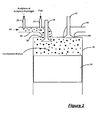
- Figure 2 is a schematic illustration of a cylinder of the HCCI engine.
- the vehicle 10 includes a homogeneous-charge compression ignition (HCCI) engine 12.
- the HCCI engine 12 includes a throttle 14 and an intake manifold 16. Air is drawn into the HCCI engine 12 through the throttle 14 and the intake manifold 16 and into a cylinder 18. Although only a single cylinder 18 is shown, it is appreciated that the HCCI engine 12 can include multiple cylinders 18. The air is part of a combustion mixture that is combusted within the cylinder 18 to produce work.
- HCCI homogeneous-charge compression ignition
- a hydrocarbon fuel is supplied to the HCCI engine 12 from a fuel system 20.
- a fuel injector 22 is associated with the cylinder 18.
- the fuel injector 22 regulates the amount of fuel that is included in the combustion mixture.
- An acetylene-based component is supplied to the HCCI engine 12 from an acetylene source 24.
- the acetylene-based component can include either pure acetylene (C 2 H 2 ) or an acetylene-hydrogen mixture (C 2 H 2 - H 2 ), or a mixture of acetylene, hydrogen, and other products which accompany acetylene production.
- An acetylene injector 26 regulates the amount of the acetylene-based component that is included in the combustion mixture.
- the acetylene source 24 can be a plasma generator that converts a portion of the hydrocarbon fuel, supplied by the fuel system, to acetylene or the acetylene-hydrogen mixture. Using an appropriately chosen voltage and frequency, the plasma generator dissociates molecules of the hydrocarbon fuel into a variety of atomic, ionic and molecular fragments including hydrogen atoms (H), carbon atoms (C) and small carbon-containing molecules such as CH and CH 2 . As the fragments cool they recombine to predominantly form acetylene, hydrogen and other molecules. For lower energy plasma generators, the hydrocarbon fuel is dissociated into a variety of molecular fragments that undergo chemical reactions to produce acetylene, hydrogen and other molecules.
- the acetylene source 24 can be a separate acetylene tank or can be produced on-board by other means.
- Such other means include, but are not limited to a high-temperature reactor containing carbon or hydrogen or a thermal reactor that converts the hydrocarbon fuel to acetylene and hydrogen.
- a controller 28 controls operation of the HCCI engine 12.
- the controller 28 communicates with the fuel injector 22 and the acetylene injector 26 to control respective amounts of the hydrocarbon fuel and acetylene-based component that is included in the combustion mixture.
- the controller 28 also communicates with the fuel system 20 and acetylene source 24 to control operation of each.
- a speed sensor 30 generates an engine speed signal that is sent to the controller 28.
- Engine load is determined based on driver pedal input and fueling rates are determined in response to engine speed and load.
- Other sensors such as a manifold absolute pressure (MAP) sensor 32, may be located in the intake manifold 16. These other sensors send signals to the controller 28.
- MAP manifold absolute pressure
- the cylinder 18 includes a piston 34 slidably disposed and reciprocally driven therein.
- One or more inlet valves 36 selectively block intake ports 38 that are in fluid communication with an intake path 40 of the intake manifold 16.
- One or more exhaust valves 42 selectively block exhaust ports 44 that are in fluid communication with an exhaust path 46 of an exhaust manifold (not shown).
- a combustion mixture is either drawn into the cylinder 18 or components thereof are mixed in the cylinder 18.
- both the inlet valves 36 and exhaust valves 42 closed i.e., blocking the intake ports 38 and exhaust ports 44
- the combustion mixture is compressed within the cylinder 18 by the piston 34.
- the temperature and pressure of the combustion mixture increase to the point of auto-ignition and a combustion reaction occurs.
- Exhaust gas is created by the combustion reaction.
- the exhaust valve 42 opens to exhaust the exhaust gas from the cylinder 18.
- the combustion mixture can be created in several manners.
- the fuel injector 22 and acetylene injector 24 are disposed upstream of the intake port 38.
- the acetylene-based component, fuel and air are mixed to form the combustion mixture prior to intake into the cylinder 18 through the intake port 38.
- the fuel injector 22 and acetylene injector 24 can respectively inject the fuel and the acetylene-based component directly into the cylinder 18. Air is drawn into the cylinder 18 through the intake port 38 and mixes with the injected fuel and acetylene-based component to form the combustion mixture.
- either the fuel injector 22 or the acetylene injector 24 can be disposed upstream of the intake port 38 to inject either the fuel or the acetylene-based component into the air stream flowing through the intake path 40.
- the other of the fuel injector 22 or the acetylene injector 24 directly injects either the fuel or the acetylene-based component to mix with the mixture drawn into the cylinder 18 through the intake port 38.
- the acetylene or the acetylene-hydrogen mixture components of the combustion mixture make auto-ignition easier. More specifically, it is believed that the initiation reaction of oxygen (O 2 ) with acetylene occurs at a lower temperature than the O 2 reaction with other fuel components. As a result, the initiation reaction starts a chain reaction involving the other fuel components to induce complete combustion of the combustion mixture. The chain reaction begins earlier in the engine cycle, which allows auto-ignition to occur earlier. Thus, the fueling rate to the engine can be reduced (e.g., in the case of low engine load) and still achieve the same auto-ignition time as a higher fueling rate without acetylene or an acetylene-hydrogen mixture. It is also believed that the hydrogen (H 2 ) in the acetylene-hydrogen mixture enables an extra boost to auto-ignition through the reaction: OH + H 2 ⁇ H 2 O + H and subsequent reactions.
- the combustion mixture can further include an amount of recirculated exhaust gas.
- a portion of exhaust gas exiting the engine 12 is bled back into the cylinder 18 to mix with the other components of the combustion mixture.
- the recirculated exhaust gas improves auto-ignition of the combustion mixture.
- the fueling rate to the HCCI engine 12 varies based on the engine load and speed. For low engine speeds and loads, the fueling rate is reduced and for high engine speeds and loads the fueling rate is increased. As mentioned above, the engine load is determined by driver pedal position and the controller 28 adjusts the fueling rate based on the engine load and speed.
- the acetylene-based component induces auto-ignition at lower engine loads when the fueling rate is reduced.
- the amount of acetylene-based component is within a range of 2 - 20 weight % of the fuel mixture. It is appreciated that any amount of acetylene present is desirable. Thus, even a small amount, greater than zero weight % or greater than 2 weight % is beneficial.
- the injection rate of the acetylene-based component is held constant as the fueling rate varies.
- the weight % of the acetylene-based component varies as the fueling rate varies. For example, as the fueling rate increases for higher engine loads, the weight % of the acetylene-based component decreases. As the fueling rate decreases for lower engine loads, the weight % of the acetylene-based component increases.
- the acetylene-based component amount can vary. For example, the acetylene-based component can be injected during periods of low engine load to enable quicker auto-ignition and then can be reduced or ceased altogether during periods of high engine load.
Landscapes
- Engineering & Computer Science (AREA)
- Chemical & Material Sciences (AREA)
- Combustion & Propulsion (AREA)
- Mechanical Engineering (AREA)
- General Engineering & Computer Science (AREA)
- Oil, Petroleum & Natural Gas (AREA)
- Chemical Kinetics & Catalysis (AREA)
- General Chemical & Material Sciences (AREA)
- Organic Chemistry (AREA)
- Combustion Methods Of Internal-Combustion Engines (AREA)
- Electrical Control Of Air Or Fuel Supplied To Internal-Combustion Engine (AREA)
- Output Control And Ontrol Of Special Type Engine (AREA)
Abstract
Description
- The present invention relates to internal combustion engines, and more particularly to homogeneous-charge compression ignition (HCCI) engines.
- Homogeneous-charge compression ignition (HCCI) engines compress a homogeneous or nearly homogeneous mixture of air, engine exhaust and fuel vapor (intake charge) until the mixture auto-ignites. Auto-ignition induces combustion of the air and fuel vapor mixture, which drives engine pistons to produce work. The auto-ignition reaction is a relatively low temperature, quick reaction that results in low nitrogen oxide (NOx) emissions and improved engine efficiency. One difficulty of operating an HCCI engine has been to properly control the combustion process so that robust and stable combustion with low emissions, optimal heat release rate and low noise can be achieved over a wide range of operating conditions.
- At medium engine speed and load, a combination of valve timing strategy and exhaust re-breathing during the intake stroke has been effective in providing adequate heating of the intake charge so that auto-ignition during the compression stroke leads to stable combustion with low noise. This method, however, may not be satisfactory at or near idle conditions. As the idle speed and load is approached from a medium speed and load condition, the exhaust temperature decreases. At near idle, there can be insufficient energy in the re-breathed exhaust to produce reliable auto-ignition. As a result, the cycle-to-cycle variability of the combustion process is too high to enable stable combustion at the idle condition.
- Accordingly, the present invention provides a vehicle driven by a homogeneous-charge compression ignition (HCCI) engine. The vehicle includes a fuel supply that supplies a hydrocarbon fuel in a first amount and an acetylene supply that supplies an acetylene-based component in a second amount. A cylinder has a piston reciprocally driven therein. The cylinder receives a combustion mixture including a third amount of air, the first amount of hydrocarbon fuel and the second amount of the acetylene-based component. The piston compresses the combustion mixture to induce auto-ignition of the combustion mixture.
- In one feature, the acetylene-based component consists essentially of acetylene.
- In another feature, the acetylene-based component includes acetylene and hydrogen.
- In another feature, the vehicle further includes an inlet valve in the engine that is movable between an open position and a closed position. When in the open position the inlet valve enables a flow of the combustion mixture into the cylinder.
- In another feature, the vehicle further includes a fuel injector that selectively injects the first amount of the hydrocarbon fuel into the cylinder, an acetylene injector that injects the second amount the acetylene-based component into either the cylinder or the intake manifold and an inlet valve movable between an open position and a closed position. When in the open position the inlet valve enables a flow of the third amount of the air into the cylinder to mix with the hydrocarbon fuel and the acetylene-based component to produce the combustion mixture.
- In another feature, the acetylene supply is a plasma or thermal generator that converts a portion of the hydrocarbon fuel to produce the second amount of the acetylene-based component.
- In still another feature, the second amount of the acetylene-based component is within a range of up to 20 weight % of the fuel mixture.
- In another feature, the second amount of the acetylene-based component varies based on a load of the HCCI engine.
- In yet another feature, the second amount of the acetylene-based component remains constant regardless of a load of the HCCI engine.
- Further areas of applicability of the present invention will become apparent from the detailed description provided hereinafter. It should be understood that the detailed description and specific examples, while indicating the preferred embodiment of the invention, are intended for purposes of illustration only and are not intended to limit the scope of the invention.
- The present invention will become more fully understood from the detailed description and the accompanying drawings, wherein:
- Figure 1 is a functional block diagram of a vehicle having a homogeneous-charge compression ignition (HCCI) engine according to the present invention; and
- Figure 2 is a schematic illustration of a cylinder of the HCCI engine.
- The following description of the preferred embodiments is merely exemplary in nature and is in no way intended to limit the invention, its application, or uses.
- Referring now to Figure 1, a functional block diagram of a
vehicle 10 is shown. Thevehicle 10 includes a homogeneous-charge compression ignition (HCCI)engine 12. The HCCIengine 12 includes athrottle 14 and anintake manifold 16. Air is drawn into the HCCIengine 12 through thethrottle 14 and theintake manifold 16 and into acylinder 18. Although only asingle cylinder 18 is shown, it is appreciated that the HCCIengine 12 can includemultiple cylinders 18. The air is part of a combustion mixture that is combusted within thecylinder 18 to produce work. - A hydrocarbon fuel is supplied to the HCCI
engine 12 from afuel system 20. Afuel injector 22 is associated with thecylinder 18. Thefuel injector 22 regulates the amount of fuel that is included in the combustion mixture. An acetylene-based component is supplied to the HCCIengine 12 from anacetylene source 24. The acetylene-based component can include either pure acetylene (C2H2) or an acetylene-hydrogen mixture (C2H2 - H2), or a mixture of acetylene, hydrogen, and other products which accompany acetylene production. Anacetylene injector 26 regulates the amount of the acetylene-based component that is included in the combustion mixture. - The
acetylene source 24 can be a plasma generator that converts a portion of the hydrocarbon fuel, supplied by the fuel system, to acetylene or the acetylene-hydrogen mixture. Using an appropriately chosen voltage and frequency, the plasma generator dissociates molecules of the hydrocarbon fuel into a variety of atomic, ionic and molecular fragments including hydrogen atoms (H), carbon atoms (C) and small carbon-containing molecules such as CH and CH2. As the fragments cool they recombine to predominantly form acetylene, hydrogen and other molecules. For lower energy plasma generators, the hydrocarbon fuel is dissociated into a variety of molecular fragments that undergo chemical reactions to produce acetylene, hydrogen and other molecules. It is also anticipated that theacetylene source 24 can be a separate acetylene tank or can be produced on-board by other means. Such other means include, but are not limited to a high-temperature reactor containing carbon or hydrogen or a thermal reactor that converts the hydrocarbon fuel to acetylene and hydrogen. - The ratio between acetylene and hydrogen in the acetylene-hydrogen mixture is based on the carbon to hydrogen ratio of the fuel used to make the mixture. Assuming no other products are formed, the following reaction stoichiometry governs:

- A
controller 28 controls operation of the HCCIengine 12. Thecontroller 28 communicates with thefuel injector 22 and theacetylene injector 26 to control respective amounts of the hydrocarbon fuel and acetylene-based component that is included in the combustion mixture. Thecontroller 28 also communicates with thefuel system 20 andacetylene source 24 to control operation of each. Aspeed sensor 30 generates an engine speed signal that is sent to thecontroller 28. Engine load is determined based on driver pedal input and fueling rates are determined in response to engine speed and load. Other sensors, such as a manifold absolute pressure (MAP)sensor 32, may be located in theintake manifold 16. These other sensors send signals to thecontroller 28. - Referring now to Figure 2, operation of the HCCI
engine 12 will be discussed. Thecylinder 18 includes apiston 34 slidably disposed and reciprocally driven therein. One ormore inlet valves 36 selectively blockintake ports 38 that are in fluid communication with anintake path 40 of theintake manifold 16. One ormore exhaust valves 42 selectively blockexhaust ports 44 that are in fluid communication with anexhaust path 46 of an exhaust manifold (not shown). During operation, a combustion mixture is either drawn into thecylinder 18 or components thereof are mixed in thecylinder 18. With both theinlet valves 36 andexhaust valves 42 closed (i.e., blocking theintake ports 38 and exhaust ports 44) the combustion mixture is compressed within thecylinder 18 by thepiston 34. The temperature and pressure of the combustion mixture increase to the point of auto-ignition and a combustion reaction occurs. Exhaust gas is created by the combustion reaction. Theexhaust valve 42 opens to exhaust the exhaust gas from thecylinder 18. - The combustion mixture can be created in several manners. In one manner, the
fuel injector 22 andacetylene injector 24 are disposed upstream of theintake port 38. The acetylene-based component, fuel and air are mixed to form the combustion mixture prior to intake into thecylinder 18 through theintake port 38. In an alternative manner, thefuel injector 22 andacetylene injector 24 can respectively inject the fuel and the acetylene-based component directly into thecylinder 18. Air is drawn into thecylinder 18 through theintake port 38 and mixes with the injected fuel and acetylene-based component to form the combustion mixture. As another alternative, either thefuel injector 22 or theacetylene injector 24 can be disposed upstream of theintake port 38 to inject either the fuel or the acetylene-based component into the air stream flowing through theintake path 40. The other of thefuel injector 22 or theacetylene injector 24 directly injects either the fuel or the acetylene-based component to mix with the mixture drawn into thecylinder 18 through theintake port 38. - The acetylene or the acetylene-hydrogen mixture components of the combustion mixture make auto-ignition easier. More specifically, it is believed that the initiation reaction of oxygen (O2) with acetylene occurs at a lower temperature than the O2 reaction with other fuel components. As a result, the initiation reaction starts a chain reaction involving the other fuel components to induce complete combustion of the combustion mixture. The chain reaction begins earlier in the engine cycle, which allows auto-ignition to occur earlier. Thus, the fueling rate to the engine can be reduced (e.g., in the case of low engine load) and still achieve the same auto-ignition time as a higher fueling rate without acetylene or an acetylene-hydrogen mixture. It is also believed that the hydrogen (H2) in the acetylene-hydrogen mixture enables an extra boost to auto-ignition through the reaction: OH + H2 → H2O + H and subsequent reactions.
- It is also anticipated that the combustion mixture can further include an amount of recirculated exhaust gas. To achieve this, a portion of exhaust gas exiting the
engine 12 is bled back into thecylinder 18 to mix with the other components of the combustion mixture. The recirculated exhaust gas improves auto-ignition of the combustion mixture. - The fueling rate to the
HCCI engine 12 varies based on the engine load and speed. For low engine speeds and loads, the fueling rate is reduced and for high engine speeds and loads the fueling rate is increased. As mentioned above, the engine load is determined by driver pedal position and thecontroller 28 adjusts the fueling rate based on the engine load and speed. - The acetylene-based component induces auto-ignition at lower engine loads when the fueling rate is reduced. Preferably, the amount of acetylene-based component is within a range of 2 - 20 weight % of the fuel mixture. It is appreciated that any amount of acetylene present is desirable. Thus, even a small amount, greater than zero weight % or greater than 2 weight % is beneficial.
- In one embodiment, the injection rate of the acetylene-based component is held constant as the fueling rate varies. As a result, the weight % of the acetylene-based component varies as the fueling rate varies. For example, as the fueling rate increases for higher engine loads, the weight % of the acetylene-based component decreases. As the fueling rate decreases for lower engine loads, the weight % of the acetylene-based component increases. In an alternative embodiment, the acetylene-based component amount can vary. For example, the acetylene-based component can be injected during periods of low engine load to enable quicker auto-ignition and then can be reduced or ceased altogether during periods of high engine load.
- The description of the invention is merely exemplary in nature and, thus, variations that do not depart from the gist of the invention are intended to be within the scope of the invention. Such variations are not to be regarded as a departure from the spirit and scope of the invention.
Claims (36)
- A method of operating a homogeneous-charge compression ignition (HCCI) engine, comprising:mixing air, fuel and an acetylene-based component to form a combustion mixture; andcompressing said combustion mixture to induce auto-ignition of said combustion mixture, releasing energy and converting said combustion mixture to exhaust gas.
- The method of claim 1 wherein said acetylene-based component consists essentially of acetylene.
- The method of claim 1 wherein said acetylene-based component comprises acetylene and hydrogen.
- The method of claim 1 wherein said combustion mixture further comprises engine exhaust.
- The method of claim 1 further comprising producing said acetylene-based component using a plasma generator.
- The method of claim 5 wherein said plasma generator uses a voltage and a frequency to produce said acetylene-based component.
- The method of claim 1 further comprising producing said acetylene-based component with a thermal reactor.
- The method of claim 1 further comprising drawing said combustion mixture into a cylinder of said HCCI engine.
- The method of claim 1 wherein said step of mixing air, fuel and an acetylene-based component occurs within a cylinder of said HCCI engine.
- The method of claim 1 wherein based on 100 parts by weight of said fuel, said acetylene-based component constitutes up to 20 parts by weight of said fuel.
- The method of claim 10 wherein said acetylene-based component constitutes at least 2 parts by weight of said fuel.
- The method of claim 1 further comprising exhausting said exhaust gas.
- A method of operating a homogeneous-charge compression ignition (HCCI) engine between a high load condition and a low load condition, comprising:controlling a supply of an acetylene-based component based on a load of said engine;controlling a supply of a fuel based on said load of said engine;mixing air, said fuel and said acetylene-based component to form a combustion mixture; andcompressing said combustion mixture to induce auto-ignition of said combustion mixture and convert said combustion mixture to exhaust gas.
- The method of claim 13 wherein said acetylene-based component consists essentially of acetylene.
- The method of claim 13 wherein said acetylene-based component comprises acetylene and hydrogen.
- The method of claim 13 wherein said combustion mixture further comprises engine exhaust.
- The method of claim 13,wherein said step of controlling a supply of said acetylene-based component comprises maintaining a consistent supply regardless of said load.
- The method of claim 13 wherein said step of controlling a supply of said acetylene-based component comprises terminating said supply when said load is high.
- The method of claim 13 wherein said step of controlling a supply of said acetylene-based component comprises increasing said supply as said load decreases.
- The method of claim 13 wherein said step of controlling a mixture amount of said fuel comprises reducing said mixture amount as said load decreases.
- The method of claim 13 further comprising producing said acetylene-based component using a plasma generator.
- The method of claim 21 wherein said plasma generator uses an a voltage and a frequency to produce said acetylene-based component.
- The method of claim 13 further comprising producing said acetylene-based component using a thermal reactor.
- The method of claim 13 further comprising drawing said combustion mixture into a cylinder of said HCCI engine.
- The method of claim 13 wherein said step of mixing air, fuel and said acetylene-based component occurs within a cylinder of said HCCI engine.
- The method of claim 13 further comprising injecting an amount said acetylene-based component within a range of up to 20 weight % of said fuel.
- A vehicle driven by a homogeneous-charge compression ignition (HCCI) engine, comprising:a fuel supply that supplies a hydrocarbon fuel in a first amount;an acetylene supply that supplies an acetylene-based component in a second amount; anda cylinder having a piston reciprocally driven therein, said cylinder receiving a combustion mixture including a third amount of air, said first amount of hydrocarbon fuel and said second amount of said acetylene-based component, wherein said piston compresses said combustion mixture to induce auto-ignition of said combustion mixture.
- The vehicle of claim 27 wherein said acetylene-based component consists essentially of acetylene.
- The vehicle of claim 27 wherein said acetylene-based component comprises acetylene and hydrogen.
- The vehicle of claim 27 wherein said combustion mixture further comprises engine exhaust.
- The vehicle of claim 27 further comprising an inlet valve movable between an open position and a closed position, wherein when in said open position said inlet valve enables a flow of said combustion mixture into said cylinder.
- The vehicle of claim 27 further comprising:a fuel injector that selectively injects said first amount of said hydrocarbon fuel into said cylinder;an acetylene injector that injects said second amount of said acetylene-based component into said cylinder; andan inlet valve movable between an open position and a closed position, wherein when in said open position said inlet valve enables a flow of said third amount of said air into said cylinder to mix with said hydrocarbon fuel and said acetylene-based component to produce said combustion mixture.
- The vehicle of claim 27 wherein said acetylene supply is a plasma generator that converts a portion of said hydrocarbon fuel to produce said second amount of said acetylene-based component.
- The vehicle of claim 27 wherein said second amount of said acetylene-based component is up to 20 weight % of said fuel.
- The vehicle of claim 27, wherein said second amount of said acetylene-based component varies based on a load of said HCCI engine.
- The vehicle of claim 27, wherein said second amount of said acetylene-based component remains constant regardless of a load of said HCCI engine.
Applications Claiming Priority (2)
| Application Number | Priority Date | Filing Date | Title |
|---|---|---|---|
| US602938 | 2003-06-24 | ||
| US10/602,938 US20040261762A1 (en) | 2003-06-24 | 2003-06-24 | Acetylene-based addition for homogeneous-charge compression ignition (HCCI) engine operation |
Publications (3)
| Publication Number | Publication Date |
|---|---|
| EP1491741A2 true EP1491741A2 (en) | 2004-12-29 |
| EP1491741A3 EP1491741A3 (en) | 2005-02-02 |
| EP1491741B1 EP1491741B1 (en) | 2006-04-19 |
Family
ID=33418644
Family Applications (1)
| Application Number | Title | Priority Date | Filing Date |
|---|---|---|---|
| EP04013273A Expired - Lifetime EP1491741B1 (en) | 2003-06-24 | 2004-06-04 | Acetylene-based addition for homogeneous-charge compression ignition (HCCI) engine operation |
Country Status (3)
| Country | Link |
|---|---|
| US (1) | US20040261762A1 (en) |
| EP (1) | EP1491741B1 (en) |
| DE (1) | DE602004000668T2 (en) |
Cited By (1)
| Publication number | Priority date | Publication date | Assignee | Title |
|---|---|---|---|---|
| GR1009424B (en) * | 2017-09-01 | 2019-01-04 | Θεοδωρος Βασιλειου Κακιουσης | Cheap mechanical energy production and thereby cheap electric current generation |
Families Citing this family (7)
| Publication number | Priority date | Publication date | Assignee | Title |
|---|---|---|---|---|
| JP4103867B2 (en) * | 2004-08-04 | 2008-06-18 | トヨタ自動車株式会社 | Control device for hydrogenated internal combustion engine |
| US7487663B2 (en) * | 2006-04-20 | 2009-02-10 | Exxonmobil Research & Engineering Co. | Method for selecting fuel to both optimize the operating range and minimize the exhaust emissions of HCCI engines |
| US20090192164A1 (en) * | 2006-06-28 | 2009-07-30 | Aska Pharmaceutical Co., Ltd. | Treating agent of inflammatory bowel disease |
| US20080069768A1 (en) * | 2006-09-20 | 2008-03-20 | Elgafi Mohamed | Simultaneous production of hydrogen and energy |
| CN112943441A (en) * | 2021-03-03 | 2021-06-11 | 东风汽车集团股份有限公司 | Combustion control method, system and device for hybrid power homogeneous charge compression ignition engine |
| PL443048A1 (en) | 2022-12-05 | 2024-06-10 | Polski Koncern Naftowy ORLEN Spółka Akcyjna | Method of feeding an internal combustion piston engine with gaseous fuel containing hydrogen and hydrocarbons |
| WO2025168403A1 (en) * | 2024-02-05 | 2025-08-14 | Shell Internationale Research Maatschappij B.V. | Fuel compositions with hydrogen |
Family Cites Families (12)
| Publication number | Priority date | Publication date | Assignee | Title |
|---|---|---|---|---|
| US3622493A (en) * | 1968-01-08 | 1971-11-23 | Francois A Crusco | Use of plasma torch to promote chemical reactions |
| US4419969A (en) * | 1979-07-31 | 1983-12-13 | Bundrick Jr Benjamin | Flexible cylinder-head internal combustion engine with cylinder compression adjustable for use with available fluid fuels |
| US4690743A (en) * | 1985-05-02 | 1987-09-01 | Al-Chem Fuels, Inc. | Method for gas synthesis |
| US4765293A (en) * | 1986-05-07 | 1988-08-23 | The Cessna Aircraft Company | Hybrid internal combustion reciprocating engine |
| US4965052A (en) * | 1987-11-03 | 1990-10-23 | Atlantic Richfield Company | Integrated product generation and catalytic product synthesis in an engine-reactor |
| US5409784A (en) * | 1993-07-09 | 1995-04-25 | Massachusetts Institute Of Technology | Plasmatron-fuel cell system for generating electricity |
| US6230683B1 (en) * | 1997-08-22 | 2001-05-15 | Cummins Engine Company, Inc. | Premixed charge compression ignition engine with optimal combustion control |
| US6314925B1 (en) * | 1997-07-03 | 2001-11-13 | Richard Berkeley Britton | Two-stroke internal combustion engine with recuperator in cylinder head |
| US5832880A (en) * | 1997-07-28 | 1998-11-10 | Southwest Research Institute | Apparatus and method for controlling homogeneous charge compression ignition combustion in diesel engines |
| WO2001018154A1 (en) * | 1999-09-06 | 2001-03-15 | Agrofuel Ab | Motor fuel for diesel engines |
| EP1427797B1 (en) * | 2001-09-18 | 2007-10-17 | Southwest Research Institute | Fuels for homogeneous charge compression ignition engines |
| EP1371715A1 (en) * | 2002-06-13 | 2003-12-17 | Shell Internationale Researchmaatschappij B.V. | Fuel compositions |
-
2003
- 2003-06-24 US US10/602,938 patent/US20040261762A1/en not_active Abandoned
-
2004
- 2004-06-04 DE DE602004000668T patent/DE602004000668T2/en not_active Expired - Lifetime
- 2004-06-04 EP EP04013273A patent/EP1491741B1/en not_active Expired - Lifetime
Cited By (1)
| Publication number | Priority date | Publication date | Assignee | Title |
|---|---|---|---|---|
| GR1009424B (en) * | 2017-09-01 | 2019-01-04 | Θεοδωρος Βασιλειου Κακιουσης | Cheap mechanical energy production and thereby cheap electric current generation |
Also Published As
| Publication number | Publication date |
|---|---|
| EP1491741A3 (en) | 2005-02-02 |
| US20040261762A1 (en) | 2004-12-30 |
| EP1491741B1 (en) | 2006-04-19 |
| DE602004000668D1 (en) | 2006-05-24 |
| DE602004000668T2 (en) | 2007-01-11 |
Similar Documents
| Publication | Publication Date | Title |
|---|---|---|
| Eichlseder et al. | The potential of hydrogen internal combustion engines in a future mobility scenario | |
| US7421999B2 (en) | Control apparatus for an internal combustion engine capable of pre-mixed charge compression ignition | |
| US6378489B1 (en) | Method for controlling compression ignition combustion | |
| CN108779723B (en) | Method for operating a piston internal combustion engine | |
| Ouelette et al. | Progress in the development of natural gas high pressure direct injection for Euro VI heavy-duty trucks | |
| KR20070083894A (en) | Emission Reduction in Diesel Engines Using Selective Combustion Treatment and Low Pressure EZR ... | |
| JP6639345B2 (en) | Internal combustion engine control device and internal combustion engine control method | |
| US12624669B2 (en) | Internal combustion engine | |
| JP4859832B2 (en) | Fuel supply to diesel engine in HCCI combustion mode, HCCI + CD combustion mode and CD combustion mode by selectively using fuel supply map | |
| US20190170077A1 (en) | Combustion control method and combustion control system with variable excess air coefficient for gasoline engine | |
| EP1491741B1 (en) | Acetylene-based addition for homogeneous-charge compression ignition (HCCI) engine operation | |
| CN117404209A (en) | A flexible fuel injection ammonia-hydrogen engine combustion system and control strategy | |
| US11603808B2 (en) | Engine management system and method | |
| US7171924B2 (en) | Combustion control system of a homogeneous charge | |
| JP6789907B2 (en) | Internal combustion engine | |
| AU2024281524A1 (en) | Improvements relating to internal combustion engines | |
| Hänggi et al. | Control-oriented analysis of a lean-burn light-duty natural gas research engine with scavenged pre-chamber ignition | |
| Stan | Direct injection systems: the next decade in engine technology | |
| CN114341471A (en) | Method for operating an internal combustion engine | |
| US11162439B2 (en) | Control method of variable stroke engine for reforming high-octane fuel under the flexible cylinder engine (FCE) mode | |
| JP7738970B2 (en) | internal combustion engine | |
| Poola et al. | Simultaneous reduction of NOx and particulate emissions by using oxygen-enriched combustion air | |
| JP2005510651A (en) | Fuel injection method for combustion engine and combustion engine | |
| US20160290258A1 (en) | Method and system for reducing engine nox emissions by fuel dilution | |
| WO2023147652A1 (en) | Apparatus and method for regulating gaseous fuel pressure and mitigating emissions in an internal combustion engine system |
Legal Events
| Date | Code | Title | Description |
|---|---|---|---|
| PUAI | Public reference made under article 153(3) epc to a published international application that has entered the european phase |
Free format text: ORIGINAL CODE: 0009012 |
|
| PUAL | Search report despatched |
Free format text: ORIGINAL CODE: 0009013 |
|
| AK | Designated contracting states |
Kind code of ref document: A2 Designated state(s): AT BE BG CH CY CZ DE DK EE ES FI FR GB GR HU IE IT LI LU MC NL PL PT RO SE SI SK TR |
|
| AX | Request for extension of the european patent |
Extension state: AL HR LT LV MK |
|
| AK | Designated contracting states |
Kind code of ref document: A3 Designated state(s): AT BE BG CH CY CZ DE DK EE ES FI FR GB GR HU IE IT LI LU MC NL PL PT RO SE SI SK TR |
|
| AX | Request for extension of the european patent |
Extension state: AL HR LT LV MK |
|
| 17P | Request for examination filed |
Effective date: 20050408 |
|
| 17Q | First examination report despatched |
Effective date: 20050510 |
|
| AKX | Designation fees paid |
Designated state(s): DE |
|
| GRAP | Despatch of communication of intention to grant a patent |
Free format text: ORIGINAL CODE: EPIDOSNIGR1 |
|
| RIN1 | Information on inventor provided before grant (corrected) |
Inventor name: ENG, JAMES A. Inventor name: SLOANE, THOMPSON M. Inventor name: NAIT, PAUL M. Inventor name: LEPPARD, WILLIAM R. |
|
| GRAS | Grant fee paid |
Free format text: ORIGINAL CODE: EPIDOSNIGR3 |
|
| GRAA | (expected) grant |
Free format text: ORIGINAL CODE: 0009210 |
|
| AK | Designated contracting states |
Kind code of ref document: B1 Designated state(s): DE |
|
| REF | Corresponds to: |
Ref document number: 602004000668 Country of ref document: DE Date of ref document: 20060524 Kind code of ref document: P |
|
| PLBE | No opposition filed within time limit |
Free format text: ORIGINAL CODE: 0009261 |
|
| STAA | Information on the status of an ep patent application or granted ep patent |
Free format text: STATUS: NO OPPOSITION FILED WITHIN TIME LIMIT |
|
| 26N | No opposition filed |
Effective date: 20070122 |
|
| PGFP | Annual fee paid to national office [announced via postgrant information from national office to epo] |
Ref country code: DE Payment date: 20110601 Year of fee payment: 8 |
|
| REG | Reference to a national code |
Ref country code: DE Ref legal event code: R119 Ref document number: 602004000668 Country of ref document: DE Effective date: 20130101 |
|
| PG25 | Lapsed in a contracting state [announced via postgrant information from national office to epo] |
Ref country code: DE Free format text: LAPSE BECAUSE OF NON-PAYMENT OF DUE FEES Effective date: 20130101 |