EP1489597A2 - Voice detection device - Google Patents
Voice detection device Download PDFInfo
- Publication number
- EP1489597A2 EP1489597A2 EP04014123A EP04014123A EP1489597A2 EP 1489597 A2 EP1489597 A2 EP 1489597A2 EP 04014123 A EP04014123 A EP 04014123A EP 04014123 A EP04014123 A EP 04014123A EP 1489597 A2 EP1489597 A2 EP 1489597A2
- Authority
- EP
- European Patent Office
- Prior art keywords
- vowel
- parameter
- parameters
- vocalization
- myoelectric
- Prior art date
- Legal status (The legal status is an assumption and is not a legal conclusion. Google has not performed a legal analysis and makes no representation as to the accuracy of the status listed.)
- Granted
Links
Images







Classifications
-
- G—PHYSICS
- G10—MUSICAL INSTRUMENTS; ACOUSTICS
- G10L—SPEECH ANALYSIS TECHNIQUES OR SPEECH SYNTHESIS; SPEECH RECOGNITION; SPEECH OR VOICE PROCESSING TECHNIQUES; SPEECH OR AUDIO CODING OR DECODING
- G10L25/00—Speech or voice analysis techniques not restricted to a single one of groups G10L15/00 - G10L21/00
- G10L25/93—Discriminating between voiced and unvoiced parts of speech signals
-
- G—PHYSICS
- G10—MUSICAL INSTRUMENTS; ACOUSTICS
- G10L—SPEECH ANALYSIS TECHNIQUES OR SPEECH SYNTHESIS; SPEECH RECOGNITION; SPEECH OR VOICE PROCESSING TECHNIQUES; SPEECH OR AUDIO CODING OR DECODING
- G10L15/00—Speech recognition
- G10L15/24—Speech recognition using non-acoustical features
Definitions
- the present invention relates to a voice detection device.
- a voice detection device In a voice detection device, there has hitherto been adopted a voice recognition technique in which a speech's voices are handled as acoustic signals and, by carrying out frequency analysis of the acoustic signals, voice information is recognized andprocessed.
- a spectrum envelope or the like is employed.
- a certain degree of sound volume was necessary at the time of speaking, and detection of the voice information was not possible unless acoustic signals from the speech were input. This, however, disturbs those around the speaker at the time of voice inputting, and hence it is substantially difficult to use such a voice detection device within offices or libraries, or various kinds of public institutions.
- non-patent document 1 a voice recognition procedure to process myoelectric signals generated in association with perioral muscles activities so as to recognize a kind of a vowel being produced.
- the voice recognition procedure disclosed in the non-patent document 1 is to discriminate between five vowels (a, i, u, e, o) by counting the number of times a threshold crossing, after passing myoelectric signals through a bandpass filter.
- Patent Document 1 Japanese Patent Application Provisional Publication No. 52-112205
- Patent Document 2 Japanese Patent Application Provisional Publication No. 6-43897
- Patent Document 3 Japanese Patent Application Provisional Publication No. 7-181888
- Non-Patent Document 1 Noboru Sugie et al., "A speech Employing a Speech Synthesizer Vowel Discrimination from Perioral Muscles Activities and Vowel Production, " IEE transactions on Biomedical Engineering, Vo. 32, No. 7
- Non-Patent Document 2 Manabe, Hiraiwa and Sugimura, "non-phonation voice recognition using myoelectric signals, " Interaction 2002 Collected Papers, 2002, p. 181-182.
- the inventors have examined, from various angles, a voice detection device capable of solving the above-mentioned problems.
- the inventors have paid attention to the processing with identification of vowels and identification of consonants being separated from each other. That is, since the voice recognition using myoelectric siganls has an advantage of not being affected by ambient noise, as an auxiliary means for the voice recognition using usual speech signals, it is possible to use the recognition using myoelectric signals.
- the present invention notice has been taken of enabling the identification of vowels and from this view point, it has been attempted to realize the voice recognition.
- the present invention is implemented based on these knowledges.
- a voice detection device comprises myoelectric signal acquisition means to acquire, from a plurality of regions, myoelectric signals generated at the time of a vocalization operation; parameter calculation means to calculate, as parameters, fluctuations of the acquired myoelectric signals relative to a predetermined value for each channel corresponding to one of the plurality of regions; a vowel vocalization recognition means to specify a vocalization operation timing for a vowel at the time of the vocalization operation, basedon the fluctuations ofthe calculatedparameters; and a vowel specification means to specify a vowel corresponding to the vocalization operation, based on the fluctuation condition of the parameters in each channel before and after the specified vocalization operation timing.
- a vowel corresponding to the vocalization operation is specified. Therefore, it is possible to specify a vowel based on the information as to the increase or decrease of the parameters. Therefore, if one can grasp the tendency of the fluctuations of the parameters, one can specify a vowel. Hence the voice recognition pertaining to the vowel becomes possible.
- a voice detection device preferably further comprises myoelectric information storage means to store a combination of vowels before and after the vocalization operation timing and the fluctuation condition of the parameters, related to each other in each channel; and wherein the vowel specification means specifies the combination of vowels stored in the myoelectric information storage means, based on the fluctuation condition of the parameters so as to specify a vowel corresponding to the vocalization operation. Since the vowel specification means references the parameter fluctuation condition stored in the myoelectric information storage means and specifies a vowel matching the acquired parameter fluctuation condition, the voice recognition pertaining to the vowel becomes possible.
- said parameters include a first parameter corresponding to a first time window and a second parameter corresponding to a second time window with a shorter time period than that of the first time window; the vowel vocalization recognition means specifies the vocalization operation timing based on the second parameter; and the vowel specification means specifies said vowel based on the first parameter. Since the vocalization operation timing is specified based on a second parameter corresponding to a second time window whose time period is set short, it becomes possible to specify the vocalization operation timing more appropriately.
- a voice detection device comprises a myoelectric signal acquisition means to acquire, from a plurality of regions, myoelectric signals generated at the time of a vocalization operation; a parameter calculation means to calculate, as parameters, fluctuations of the acquired myoelectric signals relative to a predetermined value in each channel corresponding to one of the plurality of regions; a fluctuation monitoring means to monitor whether or not the parameters would fluctuate over a predetermined time period; and a vowel specification means to specify a vowel corresponding to the vocalization operation, based on the monitoring result and the parameters.
- a voice detection device based on whether or not the parameters have fluctuated, one specifies a vowel corresponding to the vocalization operation. Hence one can specify a vowel by determining whether the parameters have increased or decreased. Therefore, one can specify a vowel by grasping the tendency of the parameter fluctuations. Hence the voice recognition pertaining to a vowel becomes possible.
- a voice detection device preferably further comprises myoelectric information storage means to store a combination of vowels before and after the vocalization operation timing and a fluctuation condition of the parameter in a state where both are related to each other in each channel; wherein the vowel specification means adopts, if the parameters have not fluctuated over a predetermined time period, the parameter for the predetermined time period and, based on the fluctuation condition of the adopted parameter, specifies the combination of vowels stored in the myoelectric information storage means so as to specify a vowel corresponding to the vocalization operation. Since the vowel specification means references the parameter fluctuation condition stored in the myoelectric information storage means and specifies a vowel matching the acquired parameter fluctuation condition, the voice recognition pertaining to a vowel becomes possible.
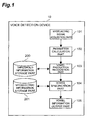
- Fig. 1 is a view showing the structure of a voice detection device according to an embodiment of this invention.
- Fig. 2 is a view showing the structure of a myoelectric signal acquisition part of Fig. 1.
- Fig. 3 is a view illustrating the operation of the parameter calculation part of Fig. 1.
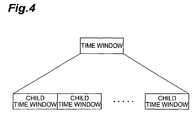
- Fig. 4 is a view illustrating the operation of the parameter calculation part of Fig. 1.
- Fig. 5 is a view illustrating an example of the parameters calculated by the parameter calculation part of Fig. 1.
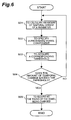
- Fig. 6 is a view illustrating the operation of the vowel vocalization recognition part of Fig. 1.
- Fig. 7 is a view showing an example of the information stored in the threshold information storage part of Fig. 1.
- Fig. 8 is a view illustrating the operation of the vowel specification part of Fig. 1.
- Fig. 9A is a view showing an example of the information stored in the myoelectric information storage part of Fig. 1.
- Fig. 9B is a view showing an example of the information stored in the myoelectric information storage part of Fig. 1.
- Fig. 9C is a view showing an example of the information stored in the myoelectric information storage part of Fig. 1.
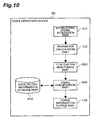
- Fig. 10 is a view showing the structure of a variation of the voice detection device according to the embodiment of this invention.
- Fig. 11A is a view showing an example of the information stored in the myoelectric information storage part of Fig. 10.
- Fig. 11B is a view showing an example of the information stored in the myoelectric information storage part of Fig. 10.
- Fig. 11C is a view showing an example of the information stored in the myoelectric information storage part of Fig. 10.
- Fig. 12 is a view illustrating the operation of the voice detection device of Fig. 10.
- Fig. 1 is a block diagram illustrative of the voice detection device 10.
- Voice detection device 10 according to this embodiment is a non-phonation voice detection device, that is, a recognition device which recognizes a speaker's speech content performing a vocalization operation without producing a sound.
- Voice detection device 10 is physically so constituted as to comprise parts such as electrodes for acquiring myoelectric signals, CPU and memories.
- Voice detection device 10 comprises as functional components amyoelectric signal acquisition part 101 (myoelectric signal acquisition means), a parameter calculation part 102 (parameter calculation means), a vowel production recognition part 103 (vowel vocalization recognition means), a vowel specification part 104 (vowel specification means), a vowel information output part 105, a threshold information storage part 200, and a myoelectric information storage part 201 (myoelectric information storage means).
- amyoelectric signal acquisition part 101 myoelectric signal acquisition means
- parameter calculation part 102 parameter calculation means
- a vowel production recognition part 103 vowel vocalization recognition means
- a vowel specification part 104 vowel specification means
- a vowel information output part 105 a threshold information storage part 200
- myoelectric information storage part 201 myoelectric information storage means
- Myoelectric signal acquisition part 101 is a part for acquiring, from a plurality of regions, myoelectric signals generated at the time of a vocalization operation. Myoelectric signal acquisition part 101 outputs the acquired myoelectric signals to the parameter calculation part 102.
- the structure of the myoelectric signal acquisition part 101 is shown in Fig. 2.
- the myoelectric signal acquisition part 101 is constituted by myoelectric signal measurement electrodes 101a-101f and amplifiers 101g-101i.
- the myoelectric signal measurement electrodes 101a and 101b acquire myoelectric signals generated from muscles corresponding to zygomaticus major and output these to the amplifier 101g.
- Amplifier 101g amplifies these myoelectric signals and output to the parameter calculation part 102.
- the myoelectric signal measurement electrodes 101c and 101d acquire myoelectric signals generated from muscles corresponding to orbicularis oris and output to the amplifier 101h. Amplifier 101h amplifies these myoelectric signals and outputs to the parameter calculation part 102. Further, the myoelectric signal measurement electrodes 101e and 101f acquire myoelectirc signals generated from muscles corresponding to digastricus output to the amplifier 101i. Amplifier 101i amplifies these myoelectric signals and output to the parameter calculation part 102.
- Parameter calculation part 102 is a part for calculating, as parameters, fluctuations of myoelectric signals output from the myoelectric signal acquisition part 101 relative to a predetermined value for each channel corresponding to one of the regions. That is, the parameter calculation part 102 calculates the parameters for each of the myoelectric signals output from each amplifier 101g-101i of the myoelectric signal acquisition part 101.
- Fig. 3 is a depiction of a parameter calculation method of the parameter calculation part 102.
- Myoelectric signals output from the myoelectric signal acquisition part 101 can be represented by amplitudes of a time series of potentials as shown at the upper part of Fig. 3.
- Parameter calculation part 102 sequentially cut myoelectric signals output from the myoelectric signal acquisition part 101 out from time windows 30-32 (first time windows) with a predetermined time period.
- the predetermined time periods set at these time windows 30-32 are the same in length, and the disclosure times of the time windows 30-32 are set to be sequentially staggered.
- the lags of the disclosure times of the time windows 30-32 are arbitrary set, but, for example, the lags may be set to be equal to half the predetermined time.
- each time window 30-32 is so constituted as to include child time windows (second time windows).
- the predetermined times set at these child time windows are also arbitrary set.
- the child time windows are set at 10-50 ms, and the time windows are set at 100 ms-500 ms.
- the utilization aspect of the parameters calculated from the time windows (first parameters) and the parameters calculated from the child time windows (second parameters) are described later.
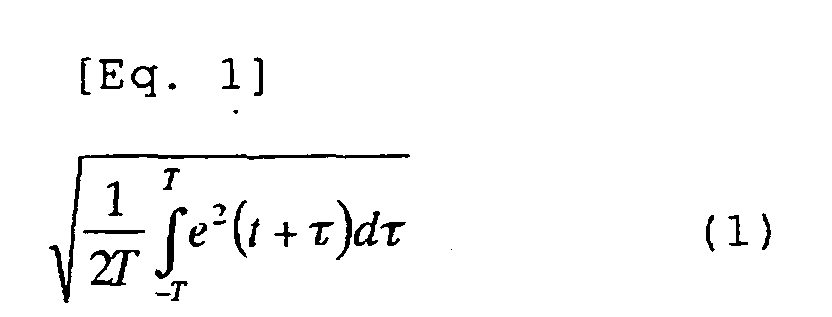
- Parameter calculation part 102 calculates, as parameters, a root means square (RMS) of myoelectric signals for each time window and each child time window.
- RMS root means square
- the root mean square is defined by the equation (1) , where e (t) is a potential of a myoelectric signal.
- the root mean square calculated as this parameter can be handled as information relative to an activity amount of muscles.
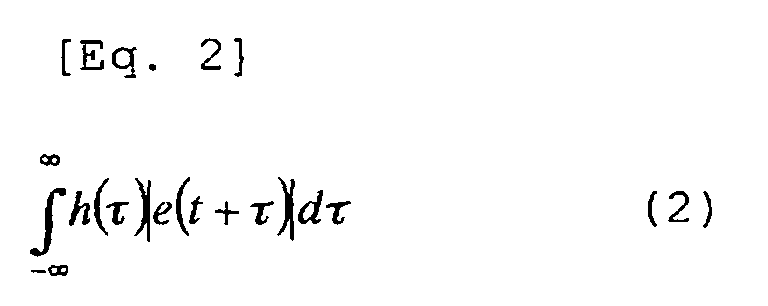
- IEMG integral myoelectrogram
- RMS root mean square
- ARV average rectification value
- IEMG integral electromyogram
- Fig. 5 illustrates the root mean square values (RMS values) in a time series in the case of the vocalization of "/a/" from a rest condition and the subsequent vocalization of "/i/".
- data 50 indicates a parameter (second parameter) at the child time window with a predetermined time being set at 50 ms
- data 51 indicates a parameter (second parameter) at the time window with a predetermined time being set at 200 ms. Note that in an example shown in Fig.
- a cycle of the time window is set at 100 ms and a cycle of the child time window is set at 25 ms, so that a cycle of the change in the parameters are set at 100 ms and 25 ms, respectively.
- the method of processing data shown n Fig. 5 is described later.
- Parameter calculation part 102 outputs the parameters thus calculated to the vowel production recognition part 103.
- Vowel production recognition part 103 is a part for specifying the vocalization operation timing of a vowel at the vocalization operation, based on the fluctuations of the parameters output from the parameter calculation part 102.
- the operation of the vowel production recognition part 103 is now described with reference to an example of data shown in Fig. 5.
- Fig. 5 paying attention to data 50 of the child time window, one recognizes that a significant change in RMS value occurred at the part of 2.3-2.4 sec and at the part in the vicinity of 2.6 sec.
- Vowel production recognition part 103 specifies the timing of this change as the timing of the vocalization operation timing of a vowel and output to the vowel specification part 104 along with the parameters received from the parameter calculation part 102.
- Fig. 6 is a flow chart illustrating a method in which the vowel production recognitionpart 103 detects a change in a parameter.
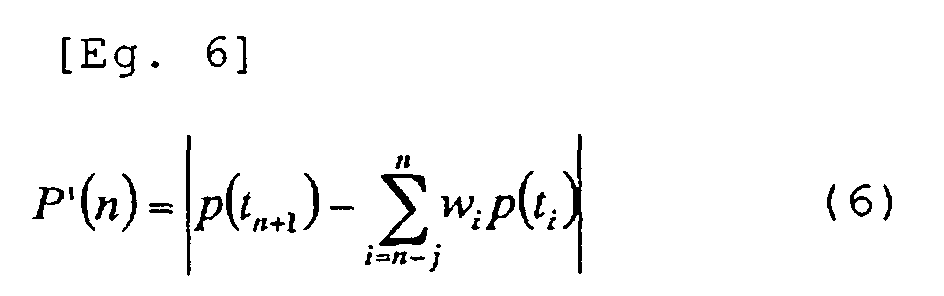
- Vowel production recognition part 103 calculates an amount of temporal change in a parameter (step S01) .
- a amount of temporal change P'(n) one may employ, as defined by the equation (7), the quotient of the absolute value of the difference between the sum of the weighted parameters up to immediately before a predetermined time and the proximate parameter divided by the value of the proximate parameter.
- the degree of a change in the value of the parameter is expressed by a ratio.
- Vowel production recognition part 103 specifies a vowel component vocalized proximately (S02) .
- the vowel component vocalized immediately before has already been recognized, and the vowel production recognition part 103 specifies this already recognized vowel component as the one vocalized proximately.
- the procedure to recognize the vowel component vocalized immediately before one can use a known voice recognition procedure. Further, for example, one may make it a rule to ask a user to initially pronounce "ah, " and have the vocalized vowel component recognized.
- Vowel production recognition part 103 references, based on this specified vowel component, the information stored in the threshold information storage part 200 and acquires a corresponding threshold (step S03). As shown in Fig.
- proximate vowel components and “thresholds” are stored, associated with each other.
- “Thresholds” are stored for each channel and, for example, if a "proximate vowel component” is “/a/”, then a “threshold” is 0.5 for "channel 1", 0.2 for "channel 2" and 0.2 for "channel 3".
- the function of this "threshold” is similar to that of a "change characteristic" as described later, and the "threshold” corresponds to a short time window (child time window) and the "change characteristic” corresponds to a long time window.
- Vowel production recognition part 103 determines whether or not the amount of temporal change calculated in step S01 exceeds the threshold acquired at step S01 in each channel (step S04). If the amount of temporal change exceeds the threshold in each channel at a certain time, the vowel production recognition part 103 records this time as the timing of a vowel being changed (step S05). If the amount of temporal change does not exceed the threshold, it returns to the process of step S01. Note that in case of determining an amount of temporal change exceeding a threshold, one may make it a condition that an amount of temporal change exceeds a threshold for all channels, that an amount of temporal change exceeds a threshold for a majority of the channels or that an amount of temporal change exceeds a threshold for one channel.
- the vowel production recognition part 103 outputs, along with the parameters output from the parameter calculation part 102, the timing of a vowel changing to the vowel specification part 104.
- Vowel specification part 104 is apart for specifying a vowel corresponding to a vocalization operation, based on the fluctuation condition of the parameters in each channel before and after the timing of a vowel changing output from the vowel production recognition part 103.
- a method in which the vowel specification part 104 specifies a vowel is now described with reference to Fig. 8.
- Fig. 8 is a flow chart illustrating a method in which the vowel specification part 104 specifies a vowel.
- Vowel specification part 104 detects a change characteristic of a parameter before and after the timing of a vowel changing. This change characteristic is classified according to whether a parameter has increased significantly, increased, remained equal, or decreased before and after the timing of a vowel changing. More specifically, one determines the case of an increase of more than 200 % from the preceding condition as a significant increase, the case of an increase not less than 50 % to below 200 % from the preceding condition as an increase, the case of a change less than ⁇ 50 % from the preceding condition as equal, and the case of a decrease less than 50 % from the preceding condition as a decrease.
- the timing of a vowel changing is at the part of 2.3-2.4 sec and at the part in the vicinity of 2.6 sec. Looking at the data 51 of a time window set at a longer time period than that of a child time window for these parts, one can grasp its increase/decrease. Vowel specification part 104 detects this change characteristic for each channel.
- Vowel specification part 104 specifies a vowel component being vocalized proximately (step S12). Vowel specification part 104 recognizes a vowel component upon a comparison of information stored in the myoelectric information storage part 201 and the change characteristic of each channel, based on this specified vowel component (step S13) .
- An example of information stored in the myoelectric information storage part 201 is shown in Figs. 9A-9C.
- Fig. 9A shows the correspondence between an immediately preceding vowel component at orbicularis oris and the change characteristic
- Fig. 9B shows the correspondence between an immediately preceding vowel component at zygomaticus major and the change characteristic
- Fig. 9A shows the correspondence between an immediately preceding vowel component at orbicularis oris and the change characteristic
- Fig. 9B shows the correspondence between an immediately preceding vowel component at zygomaticus major and the change characteristic
- FIG. 9C shows the correspondence between an immediately preceding vowel component at digastricus and the change characteristic. For example, if the change characteristic for each channel is "equal” at orbicularis oris, “increase” at zygomaticus major, and “decrease” at digastricus, it recognizes, based on information shown in Figs. 9A-9C, the vocalized vowel as “/i/”. Note that in Figs. 9A-9C "eql” means “equal”, “dec” means “decrease”, “inc” means “increase” and “sig inc” means “significant increase” .
- Vowel specification part 104 outputs the recognized vowel to the vowel information output part 105.
- Vowel information output part 105 is a part for outputting information specifying a vowel in conformity with an output object.
- this output obj ect there may be mentioned a recognition algorithm, a speaker or a display.
- a time window set at a long time period and a child time window set at a short time period. That is, one can grasp the tendency of a myoelectric signal over a long time period with the time window set at a long time period and, conversely, the tendency of a myoelectric signal over a short time period with the child time window set at a short time period. Therefore, a child time window is suitable to grasp the timing of a vocalization operation, and a time window is suitable to grasp the tendency before and after that timing.
- two kinds of time window are used, but it is possible to recognize a vowel by the use of one kind of time window.
- one kind of time window For example, in the case of using only the aforesaid child time window set at a short time period, it is possible to use an average of a plurality of child time windows, instead of the aforesaid time window set at a long time period.
- Voice detection device 90 being a partly modified voice detection device 10.
- the structure of the voice detection device 90 is shown in Fig. 10, and the operation of the voice detection device 90 is shown in a flow chart of Fig. 12.
- Voice detection device 90 is physically so constituted as to comprise part such as electrodes for acquiring myoelectric signals, CPU and memories.
- Voice detection device 90 comprises, as functional components, a myoelectric signal acquisition part 101 (myoelectric signal acquisition means), a parameter calculation part 102 (parameter calculation means), a fluctuation monitoring part 903 (fluctuation monitoring means) , a vowel specification part 904 (vowel specification means), a vowel information output part 105, and a myoelectric information storage part 910 (myoelectric information storage means).
- a myoelectric signal acquisition part 102, a parameter calculation part 102 and a vowel information output part 105 are the same as in the voice detection device 10, their being described is omitted.
- Fluctuation monitoring part 903 is a part monitoring whether or not the parameters output from the parameter calculation part 102 fluctuate over a predetermined time. Fluctuation monitoring part 903 detects the change characteristic of the parameters (step S21). This change characteristic indicates whether or not a parameter has fluctuated. Fluctuation monitoring part 903 determines whether or not a parameter has fluctuated (step S22). Fluctuation monitoring part 903 determines that a parameter has not fluctuated if the parameter's value remains within the range of 50-150 % as compared with an immediately preceding parameter, and determines that a parameter has fluctuated if the parameter's value has surpassed that range. If the parameter has fluctuated, the fluctuation monitoring part 903 resets a counter (step S23).
- the fluctuation monitoring part 903 increments a counter (step S24). Fluctuation monitoring part 903 determines whether or not the counter condition has exceeded a predetermined threshold (step s25). If this counter condition has exceeded a predetermined threshold, the fluctuation monitoring part 903 outputs the parameters output from the parameter calculation part 102 to the vowel specification part 904. In these steps S24-S25, the time window in which the fluctuation monitoring part 903 monitors the fluctuations is set at a very short time period, at 20-50 ms in this embodiment. Thus, if the information indicating the excess beyond a predetermined time period does not come in, no parameters are output to the vowel specification part 904. Therefore, it is possible to prevent accidental noise's being mixed into.
- Vowel specification part 904 is apart for specifying a vowel corresponding to a vocalization operation based on the monitoring result of the fluctuation monitoring part 903 and the parameters.
- Vowel specification part 904 specifies a proximate vowel component (step S26).
- a vowel component being vocalized immediately before has already been recognized, and the vowel production recognition part 103 specifies this already recognized vowel component as the one being vocalized proximately.
- the procedure to recognize a vowel component being vocalized immediately before it is possible to use a known voice recognition procedure. Further, for example, one may make it a rule to ask a user to initially pronounce "ah" and have the vocalized vowel component recognized.
- Vowel specification part 904 specifies a vowel component based on this specified proximate vowel component and the information stored in the myoelectric signal storage part 910 (step 527).
- Figs. 11A-11C show an example of the information stored in the myoelectric information storage part 910.
- Fig. 11A shows the correspondence between the immediately preceding vowel component at orbicularis oris and the change characteristic
- Fig. 11B shows the correspondence between the immediately preceding vowel component at zygomaticus major and the change characteristic
- Fig. 11C shows the correspondence between the immediately preceding vowel component at digastricus and the change characteristic.
- a "significant increase” means the case of an increase not less than 200 % from the level of the preceding condition
- an “increase” means the case of an increase not less than 50 % to below 200 % from the level of the preceding condition
- equal means a change amount less than ⁇ 50% from the level of the preceding condition
- a “decrease” means a decrease not less than 50 % from the level of the preceding condition.
Landscapes
- Engineering & Computer Science (AREA)
- Computational Linguistics (AREA)
- Health & Medical Sciences (AREA)
- Audiology, Speech & Language Pathology (AREA)
- Human Computer Interaction (AREA)
- Physics & Mathematics (AREA)
- Acoustics & Sound (AREA)
- Multimedia (AREA)
- Signal Processing (AREA)
- User Interface Of Digital Computer (AREA)
- Measurement And Recording Of Electrical Phenomena And Electrical Characteristics Of The Living Body (AREA)
- Input From Keyboards Or The Like (AREA)
Abstract
Description



Claims (5)
- A voice detection device comprising:myoelectric signal acquisition means to acquire, from a plurality of regions, myoelectric signals generated at the time of a vocalization operation;parameter calculation means to calculate, as parameters, fluctuations of said acquired myoelectric signals relative to a predetermined value for each channel corresponding to one of said plurality of regions;vowel vocalization recognition means to specify a vocalization operation timing for a vowel at the time of said vocalization operation, based on the fluctuations of said calculated parameters; andvowel specification means to specify a vowel corresponding tosaid vocalization operation,based on the fluctuation condition of the parameters for said each channel before and after said specified vocalization operation timing.
- Avoice detection device according to claim 1, further comprising myoelectric information storage means to store a combination of vowels before and after the vocalization operation timing and the fluctuation condition of said parameters in a state where both are related to each other in each channel,
wherein said vowel specification means specifies the combination of vowels stored in said myoelectric information storage means, based on the fluctuation condition of said parameters so as to specify a vowel corresponding to said vocalization operation. - A voice detection device according to claim 1, wherein said parameters include a first parameter corresponding to a first time window and a second parameter corresponding to a second time window, which is set with a shorter time period than that of said first time window;
said vowel vocalization recognition means specifies the vocalization operation timing, based on said second parameter; and
said vowel specification means specifies said vowel, based on said first parameter. - A voice detection device comprising:myoelectric signal acquisition means to acquire, from a plurality of regions, myoelectric signals generated at the time of a vocalization operation;parameter calculation means to calculate, as parameters, fluctuations of said detected myoelectric signals relative to a predetermined value in each channel corresponding to one of said plurality of regions;fluctuation monitoring means to monitor whether or not said parameters would fluctuate over a predetermined time period; andvowel specification means to specify a vowel corresponding to said vocalization operation, based on said monitoring result and said parameters.
- A voice detection device according to claim 4, further comprising myoelectric information storage means to store a combination of vowels before and after the vocalization operation timing and a fluctuation condition of said parameter in a state where both are related to each other in each channel,
wherein said vowel specification means adopts, if said parameter has not fluctuated over a predetermined time period, said parameter for the predetermined time period and, based on the fluctuation condition of said adopted parameter, specifies the combination of vowels stored in said myoelectric information storage means so as to specify a vowel corresponding to said vocalization operation.
Applications Claiming Priority (2)
| Application Number | Priority Date | Filing Date | Title |
|---|---|---|---|
| JP2003176969 | 2003-06-20 | ||
| JP2003176969A JP4447857B2 (en) | 2003-06-20 | 2003-06-20 | Voice detection device |
Publications (4)
| Publication Number | Publication Date |
|---|---|
| EP1489597A2 true EP1489597A2 (en) | 2004-12-22 |
| EP1489597A8 EP1489597A8 (en) | 2005-04-06 |
| EP1489597A3 EP1489597A3 (en) | 2006-06-07 |
| EP1489597B1 EP1489597B1 (en) | 2008-01-16 |
Family
ID=33411018
Family Applications (1)
| Application Number | Title | Priority Date | Filing Date |
|---|---|---|---|
| EP04014123A Expired - Lifetime EP1489597B1 (en) | 2003-06-20 | 2004-06-16 | Vowel recognition device |
Country Status (5)
| Country | Link |
|---|---|
| US (1) | US7418385B2 (en) |
| EP (1) | EP1489597B1 (en) |
| JP (1) | JP4447857B2 (en) |
| CN (1) | CN1272766C (en) |
| DE (1) | DE602004011292T2 (en) |
Families Citing this family (8)
| Publication number | Priority date | Publication date | Assignee | Title |
|---|---|---|---|---|
| JP4632831B2 (en) * | 2005-03-24 | 2011-02-16 | 株式会社エヌ・ティ・ティ・ドコモ | Speech recognition method and speech recognition apparatus |
| US7769593B2 (en) * | 2006-09-28 | 2010-08-03 | Sri International | Method and apparatus for active noise cancellation |
| JP5030150B2 (en) * | 2007-03-20 | 2012-09-19 | 独立行政法人産業技術総合研究所 | Voice recognition device using myoelectric signal |
| US9564128B2 (en) | 2013-12-09 | 2017-02-07 | Qualcomm Incorporated | Controlling a speech recognition process of a computing device |
| US11183219B2 (en) * | 2019-05-01 | 2021-11-23 | Sony Interactive Entertainment Inc. | Movies with user defined alternate endings |
| US12505842B2 (en) * | 2019-05-29 | 2025-12-23 | Cornell University | Devices, systems, and methods for personal speech recognition and replacement |
| CN114200879A (en) * | 2021-12-08 | 2022-03-18 | 长江存储科技有限责任公司 | Gas leakage monitoring method and device and computer storage medium |
| CN114298111B (en) * | 2021-12-30 | 2025-09-26 | 深圳数联天下智能科技有限公司 | Cough sound recognition method, device and readable storage medium |
Family Cites Families (15)
| Publication number | Priority date | Publication date | Assignee | Title |
|---|---|---|---|---|
| JPS52112205A (en) | 1976-03-17 | 1977-09-20 | Kuniaki Miyazawa | Method of identifying audio or language |
| US4343969A (en) * | 1978-10-02 | 1982-08-10 | Trans-Data Associates | Apparatus and method for articulatory speech recognition |
| JPS572099A (en) * | 1980-06-05 | 1982-01-07 | Tokyo Shibaura Electric Co | Voice recognizing device |
| JPS62232691A (en) * | 1986-04-03 | 1987-10-13 | 株式会社リコー | voice recognition device |
| US4937870A (en) * | 1988-11-14 | 1990-06-26 | American Telephone And Telegraph Company | Speech recognition arrangement |
| US5586215A (en) | 1992-05-26 | 1996-12-17 | Ricoh Corporation | Neural network acoustic and visual speech recognition system |
| JP3333022B2 (en) * | 1993-11-26 | 2002-10-07 | 富士通株式会社 | Singing voice synthesizer |
| JP3455921B2 (en) | 1993-12-24 | 2003-10-14 | 日本電信電話株式会社 | Voice substitute device |
| US5794203A (en) * | 1994-03-22 | 1998-08-11 | Kehoe; Thomas David | Biofeedback system for speech disorders |
| JPH08335091A (en) * | 1995-06-09 | 1996-12-17 | Sony Corp | Speech recognition device, speech synthesis device, and speech recognition synthesis device |
| JP3006677B2 (en) * | 1996-10-28 | 2000-02-07 | 日本電気株式会社 | Voice recognition device |
| JP3893763B2 (en) * | 1998-08-17 | 2007-03-14 | 富士ゼロックス株式会社 | Voice detection device |
| US6795807B1 (en) * | 1999-08-17 | 2004-09-21 | David R. Baraff | Method and means for creating prosody in speech regeneration for laryngectomees |
| JP2001265375A (en) * | 2000-03-17 | 2001-09-28 | Oki Electric Ind Co Ltd | Rule speech synthesizer |
| JP3908965B2 (en) * | 2002-02-28 | 2007-04-25 | 株式会社エヌ・ティ・ティ・ドコモ | Speech recognition apparatus and speech recognition method |
-
2003
- 2003-06-20 JP JP2003176969A patent/JP4447857B2/en not_active Expired - Fee Related
-
2004
- 2004-06-16 EP EP04014123A patent/EP1489597B1/en not_active Expired - Lifetime
- 2004-06-16 DE DE602004011292T patent/DE602004011292T2/en not_active Expired - Lifetime
- 2004-06-18 US US10/869,945 patent/US7418385B2/en active Active
- 2004-06-18 CN CNB2004100597682A patent/CN1272766C/en not_active Expired - Fee Related
Also Published As
| Publication number | Publication date |
|---|---|
| EP1489597B1 (en) | 2008-01-16 |
| JP2005010652A (en) | 2005-01-13 |
| US7418385B2 (en) | 2008-08-26 |
| DE602004011292T2 (en) | 2009-03-05 |
| EP1489597A3 (en) | 2006-06-07 |
| CN1272766C (en) | 2006-08-30 |
| US20050027529A1 (en) | 2005-02-03 |
| CN1573927A (en) | 2005-02-02 |
| EP1489597A8 (en) | 2005-04-06 |
| DE602004011292D1 (en) | 2008-03-06 |
| JP4447857B2 (en) | 2010-04-07 |
Similar Documents
| Publication | Publication Date | Title |
|---|---|---|
| EP3998557B1 (en) | Audio signal processing method and related apparatus | |
| US9595259B2 (en) | Sound source-separating device and sound source-separating method | |
| US6638217B1 (en) | Apparatus and methods for detecting emotions | |
| US9177203B2 (en) | Target detection device and target detection method | |
| CN116959471A (en) | Speech enhancement method, speech enhancement network training method and electronic device | |
| US8315856B2 (en) | Identify features of speech based on events in a signal representing spoken sounds | |
| US20030171921A1 (en) | Speech recognition system, speech recognition method, speech synthesis system, speech synthesis method, and program product | |
| EP2927906B1 (en) | Method and apparatus for detecting voice signal | |
| US12148432B2 (en) | Signal processing device, signal processing method, and signal processing system | |
| KR19990028694A (en) | Method and device for evaluating the property of speech transmission signal | |
| CN108597505A (en) | Audio recognition method, device and terminal device | |
| EP0838805B1 (en) | Speech recognition apparatus using pitch intensity information | |
| CN113724692B (en) | A method for audio acquisition and anti-interference processing of telephone scenes based on voiceprint features | |
| EP1489597B1 (en) | Vowel recognition device | |
| US12387728B2 (en) | Utterance section detection device, utterance section detection method, and storage medium | |
| CN114647829A (en) | Identity authentication method and device, storage medium and electronic equipment | |
| Fraile et al. | Mfcc-based remote pathology detection on speech transmitted through the telephone channel-impact of linear distortions: Band limitation, frequency response and noise | |
| CN106971736A (en) | A kind of method and system for lifting the Application on Voiceprint Recognition degree of accuracy | |
| KR102894070B1 (en) | Neural network based emotion inference apparatus and method infering emotion status from voice | |
| US20190066714A1 (en) | Method, information processing apparatus for processing speech, and non-transitory computer-readable storage medium | |
| KR100381372B1 (en) | Apparatus for feature extraction of speech signals | |
| JP2006113298A (en) | Audio signal analysis method, audio signal recognition method using the method, audio signal section detection method, apparatus, program and recording medium thereof | |
| CN111508503B (en) | Method and device for identifying same speaker | |
| CN113808595B (en) | Voice conversion method and device from source speaker to target speaker | |
| CN111179942B (en) | Voiceprint recognition method, voiceprint recognition device, voiceprint recognition equipment and computer readable storage medium |
Legal Events
| Date | Code | Title | Description |
|---|---|---|---|
| PUAI | Public reference made under article 153(3) epc to a published international application that has entered the european phase |
Free format text: ORIGINAL CODE: 0009012 |
|
| 17P | Request for examination filed |
Effective date: 20040616 |
|
| AK | Designated contracting states |
Kind code of ref document: A2 Designated state(s): AT BE BG CH CY CZ DE DK EE ES FI FR GB GR HU IE IT LI LU MC NL PL PT RO SE SI SK TR |
|
| AX | Request for extension of the european patent |
Extension state: AL HR LT LV MK |
|
| RIN1 | Information on inventor provided before grant (corrected) |
Inventor name: SUGIMURA, TOSHIAKI,INTELLECTUAL PROPERTY DEPT. Inventor name: HIRAIWA, AKIRA Inventor name: NINJOUCHI, TAKASHI,INTELLECTUAL PROPERTY DEPT. Inventor name: MANABE, HIROYUKI,INTELLECTUAL PROPERTY DEPARTMENT Inventor name: HAYASHI, KOUKI,INTELLECTUAL PROPERTY DEPARTMENT |
|
| RIN1 | Information on inventor provided before grant (corrected) |
Inventor name: HAYASHI, KOUKI,INTELLECTUAL PROPERTY DEPARTMENT Inventor name: NINJOUCHI, TAKASHI,INTELLECTUAL PROPERTY DEPT. Inventor name: SUGIMURA, TOSHIAKI,INTELLECTUAL PROPERTY DEPT. Inventor name: MANABE, HIROYUKI,INTELLECTUAL PROPERTY DEPARTMENT Inventor name: HIRAIWA, AKIRA |
|
| PUAL | Search report despatched |
Free format text: ORIGINAL CODE: 0009013 |
|
| AK | Designated contracting states |
Kind code of ref document: A3 Designated state(s): AT BE BG CH CY CZ DE DK EE ES FI FR GB GR HU IE IT LI LU MC NL PL PT RO SE SI SK TR |
|
| AX | Request for extension of the european patent |
Extension state: AL HR LT LV MK |
|
| RIC1 | Information provided on ipc code assigned before grant |
Ipc: G10L 15/24 20060101AFI20060420BHEP |
|
| 17Q | First examination report despatched |
Effective date: 20060829 |
|
| AKX | Designation fees paid |
Designated state(s): DE GB |
|
| 17Q | First examination report despatched |
Effective date: 20060829 |
|
| GRAP | Despatch of communication of intention to grant a patent |
Free format text: ORIGINAL CODE: EPIDOSNIGR1 |
|
| RTI1 | Title (correction) |
Free format text: VOWEL RECOGNITION DEVICE |
|
| GRAS | Grant fee paid |
Free format text: ORIGINAL CODE: EPIDOSNIGR3 |
|
| GRAA | (expected) grant |
Free format text: ORIGINAL CODE: 0009210 |
|
| AK | Designated contracting states |
Kind code of ref document: B1 Designated state(s): DE GB |
|
| REG | Reference to a national code |
Ref country code: GB Ref legal event code: FG4D |
|
| REF | Corresponds to: |
Ref document number: 602004011292 Country of ref document: DE Date of ref document: 20080306 Kind code of ref document: P |
|
| PLBE | No opposition filed within time limit |
Free format text: ORIGINAL CODE: 0009261 |
|
| STAA | Information on the status of an ep patent application or granted ep patent |
Free format text: STATUS: NO OPPOSITION FILED WITHIN TIME LIMIT |
|
| 26N | No opposition filed |
Effective date: 20081017 |
|
| PGFP | Annual fee paid to national office [announced via postgrant information from national office to epo] |
Ref country code: DE Payment date: 20180605 Year of fee payment: 15 |
|
| PGFP | Annual fee paid to national office [announced via postgrant information from national office to epo] |
Ref country code: GB Payment date: 20180613 Year of fee payment: 15 |
|
| REG | Reference to a national code |
Ref country code: DE Ref legal event code: R119 Ref document number: 602004011292 Country of ref document: DE |
|
| GBPC | Gb: european patent ceased through non-payment of renewal fee |
Effective date: 20190616 |
|
| PG25 | Lapsed in a contracting state [announced via postgrant information from national office to epo] |
Ref country code: DE Free format text: LAPSE BECAUSE OF NON-PAYMENT OF DUE FEES Effective date: 20200101 Ref country code: GB Free format text: LAPSE BECAUSE OF NON-PAYMENT OF DUE FEES Effective date: 20190616 |