EP1489503A2 - Terminal device with resource conflict resolution - Google Patents
Terminal device with resource conflict resolution Download PDFInfo
- Publication number
- EP1489503A2 EP1489503A2 EP04012239A EP04012239A EP1489503A2 EP 1489503 A2 EP1489503 A2 EP 1489503A2 EP 04012239 A EP04012239 A EP 04012239A EP 04012239 A EP04012239 A EP 04012239A EP 1489503 A2 EP1489503 A2 EP 1489503A2
- Authority
- EP
- European Patent Office
- Prior art keywords
- java
- priority
- application
- execution
- request
- Prior art date
- Legal status (The legal status is an assumption and is not a legal conclusion. Google has not performed a legal analysis and makes no representation as to the accuracy of the status listed.)
- Granted
Links
Images


Classifications
-
- G—PHYSICS
- G06—COMPUTING OR CALCULATING; COUNTING
- G06F—ELECTRIC DIGITAL DATA PROCESSING
- G06F9/00—Arrangements for program control, e.g. control units
- G06F9/06—Arrangements for program control, e.g. control units using stored programs, i.e. using an internal store of processing equipment to receive or retain programs
- G06F9/46—Multiprogramming arrangements
- G06F9/52—Program synchronisation; Mutual exclusion, e.g. by means of semaphores
- G06F9/526—Mutual exclusion algorithms
-
- G—PHYSICS
- G06—COMPUTING OR CALCULATING; COUNTING
- G06F—ELECTRIC DIGITAL DATA PROCESSING
- G06F9/00—Arrangements for program control, e.g. control units
- G06F9/06—Arrangements for program control, e.g. control units using stored programs, i.e. using an internal store of processing equipment to receive or retain programs
- G06F9/46—Multiprogramming arrangements
- G06F9/50—Allocation of resources, e.g. of the central processing unit [CPU]
-
- G—PHYSICS
- G06—COMPUTING OR CALCULATING; COUNTING
- G06F—ELECTRIC DIGITAL DATA PROCESSING
- G06F2209/00—Indexing scheme relating to G06F9/00
- G06F2209/52—Indexing scheme relating to G06F9/52
- G06F2209/522—Manager
Definitions
- the present invention relates to techniques for solving conflicts which occur when a resource is to be used by a plurality of functions in a terminal device.
- IO input/output
- IO processes are executed in order of the priority allocated to the request data. Consequently, execution of an IO process for an IO request to which a low a priority is allocated may be delayed indefinitely.
- the present invention provides techniques for solving conflicts which occur when a resource is used by a plurality of functions to be run by a terminal device.
- the present invention provides a terminal device comprising: execution means for executing a plurality of programs; conflict determination means for determining whether a resource is used by a second application executed in compliance with a program executed by the execution means, the resource requested to be used by a first application executed in compliance with a program executed by the execution means; display means for, in a case that the determination made by the conflict determination means is positive, displaying a screen for prompting a user to input an instruction; execution/cancellation means for executing or canceling an request from the first application in accordance with the input instruction; and notification means for providing notification to the first application that a request is cancelled, in a case that a request is cancelled by the execution/cancellation means.
- the above terminal device in a case that a resource requested to be used by a first application is used by a second application, the above terminal device displays a screen for prompting a user to input an instruction, and executes or cancels a request from a first application in accordance with the input instruction; and the terminal provides notification to a first application that a request is canceled (process 1).
- the present invention provides a terminal device comprising: conflict determination means for determining whether a resource is used by a second application executed in compliance with a program executed by the execution means, the resource requested to be used by a first application executed in compliance with a program executed by the execution means; comparison means for comparing, in a case that the determination made by the conflict determination means is positive, a priority provided to the first application with a priority provided to the second application; comparison execution/cancellation means for executing or canceling an request from the first application on the basis of the comparison result determined by the comparison means; and notification means for providing notification to the first application that a request is cancelled, in a case that a request is cancelled by the comparison execution/cancellation means.
- the terminal device compares a priority allocated to the first application with a priority allocated to the second application, executes or cancels a request from the first application on the basis of the comparison result, and provides notification to a first application that a request is canceled (process 2).
- the present invention provides a terminal device comprising: conflict determination means for determining whether a resource is used by a second application executed in compliance with a program executed by the execution means, the resource requested to be used by a first application executed in compliance with a program executed by the execution means; priority determination means for determining, in a case that the determination made by the conflict determination means is positive, whether a priority is provided to both the first application and the second application; comparison means for comparing, in a case that the determination made by the priority determination means is positive, a priority provided to the first application with a priority provided to the second application; display means for displaying, in a case that the determination made by the priority determination means is negative, a screen for prompting a user to input an instruction; execution/cancellation means for executing or canceling a request from the first application in accordance with either the comparison result by the comparison means, or the input instruction; and notification means for providing notification to the first application that a request is cancelled, in a case that a request is cancelled by the execution/cancellation means.
- the terminal device in a case that a resource requested to be used by a first application is used by a second application, the above process 1 and process 2 are executed.
- OS operating system
- SS system software
- AP application program
- APP application program
- Java APP an APP configured by a byte code in compliance with Java requirements
- non- Java APP an APP which is not a Java APP
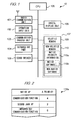
- Fig.1 is a block diagram denoting the hardware configuration of mobile phone 10 according to the first embodiment of the present invention.
- mobile phone 10 has the same hardware configuration as a standard terminal, and comprises: radio communication unit 101 running radio communication with base stations in mobile communication networks (not shown); operation input unit 102 which has a keypad for operation by a user and which outputs signals to CPU 105 corresponding to the user's input operation; communication process unit 103 which runs a call connection or disconnection with a partner device through a mobile communication network; infrared ray port 104 for communicating with external devices using a communication standard such as IrDA (Infrared Data Association); sound speaker 108 which outputs alarms or music, and communication microphones and communication speakers (neither of which is shown).
- IrDA Infrared Data Association
- memory unit 107 is comprised of volatile memory 109 and non-volatile memory 110.
- Native software and native priority information 110a are written in non-volatile memory 110.
- Native software is software pre-installed in non-volatile memory 110 prior to the sale of mobile phone 10.
- OS operation system
- WWW World Wide Web
- mailer program a call program, an infrared ray communication program, a music replay program, an animation replay program, a KVM (K Virtual Machine) program
- JAM Java Application Manager
- native APPs are non-Java APPs
- a Java APP pre-installed in non-volatile memory 110 prior to the sale of mobile phone 10, is a native APP.
- Native priority information 110a is information indicating priority of each native APP, the information being determined by a designer of mobile phone 10.
- An example of native priority information 110a is shown in Fig.2. According to Fig.2, each number indicates a priority, and a high number indicates a high priority. The use of priorities will be described later.
- Non-volatile memory 110 is also used for storing non-native software.
- Non-native software is software written in non-volatile memory 110 by a user of mobile phone 10.
- CPU 105 enables mobile phone 10 to run a multi-task OS (hereafter, referred to as just "OS") by reading out OS software stored in non-volatile memory 110, and executing it at the time of switching on mobile phone 10.
- OS manages resources used by AP.
- the resource to be managed is referred to as "resource”.
- “hardware resource” there are three types of resources: “hardware resource”; “software resource”; and “network resource”.
- Examples of “hardware resource” are the hardware configuring mobile phone 10 and outside devices such as UIM (User Identity Module) which may be used in cooperation with mobile phone 10.
- An example of “software resource” is the data stored in memory unit 107.
- Examples of “network resource” are: a radio resource such as a radio channel to be used, when mobile phone 10 performs a radio communication with a mobile communication network; a communication resource such as a packet transmission line; or a transmission line for connecting a line.
- an origination function is a function for originating a call and connecting a transmission line by preparing resources such as radio communication unit 11 and a radio channel, which are necessary for making a call.
- a standard sound output function is a pre-set function for outputting standard sound, such as an alarm or operation sound of operation input unit 102, which uses sound speaker 108.
- An infrared ray communication execution function is a function for running an infrared ray communication in compliance with a standard of IrDA (Infrared Data Association) by using infrared ray port 104.
- a music replay function is a function for replaying music data stored in non-volatile memory 110, using sound speaker 108.
- An animation replay function is a function for replaying animation data stored in non-volatile memory 110, and displaying it on crystal display unit 106.
- non-Java AP executed in compliance with Java APPs run by OS.
- non-Java AP is not limited to these resources.
- JAM 110c to be run in compliance with JAM program 110b, KVM, a WWW browser, a mailer, a call function and an infrared ray communication execution function are also examples of non-Java AP.
- Fig.3 is a diagram denoting a relationship of some functions run by mobile phone 10. As shown in Fig.3, the functions run by mobile phone 10, in compliance with native software, are configured by either a host system or a Java execution environment. Further, as is clear from Fig.3, only the OS has both a host system and a Java execution environment
- the OS When an instruction indicated by an output signal from operation input unit 102 is a request to execute non-Java AP, the OS reads out a native APP for executing non-Java AP from non-volatile memory 110. Further, the OS executes or terminates non-Java AP when receiving a request for executing or terminating non-Java AP. Further, when the OS receives an inquiry from JAM 110c as to whether non-Java AP is running in a host system, the OS provides, to JAM 110c, either information indicating that non-Java AP is configuring a host system, or information indicating that there is no non-Java AP configuring the host system.
- a Java execution environment executes Java APPs
- KVM which is the configuration element of a Java execution environment
- KVM is a JVM (Java Virtual Machine) designed for small electronic devices which has restrictions with regard to storage capacity, processing speed, and power consumption.
- KVM runs Java AP in mobile phone 10 in compliance with byte codes having Java APPs.
- KVM provides to Java AP, API (Application Interface) for accessing resources in mobile phone 10.
- Java AP can use resources such as an origination function, a standard sound output function, an infrared ray communication execution function, a music replay function, and an animation replay function through API.
- JAM 110c downloads a JAR file including Java APPs and an ADF (Application Descriptor File) through a mobile communication network, and writes them in non-volatile memory 110. Further, when JAM 110c receives an instruction for running Java APPs stored in non-volatile memory 110, JAM 110c reads out, from non-volatile memory 110, an ADF corresponding to a Java APP, and enables KVM to run a Java APP by referring to an appClass key in the ADF. A main class name of a Java APP is allocated to an appClass key in an ADF, and KVM is designed for running a Java APP having a main class name provided from JAM 110c. Further, JAM 110c manages the running of Java APPs, and performs a display process which displays a list of executable Java APPs or the meditation process which provides to the OS a request with regard to the use of resources from KVM.
- ADF Application Descriptor File
- JAM 110c when JAM 110c receives an execution request for executing a specific non-Java AP (resource) from KVM, JAM 110c inquires of a host system as to whether non-Java AP (non-resource) is running, determines on the basis of a response to the inquiry whether an execution request from KVM is accepted, and has a function of providing the result of the determination to KVM. Such a determination is not always made on the basis of a response to an inquiry. In some cases, the determination may be made on the basis of native priority information 110a or a user's instruction. Further, in some cases, the information may not be notified to KVM. Parameters for making such determinations will be described in detail in the following description of the operation of the present embodiment.
- Java APP hereafter, referred to as "first Java APP”
- Java AP executed in compliance with a first Java APP, displays an input screen on crystal display unit 106 and prompts a user to input instructions. Then, the first Java AP requests to execute an origination function after the user inputs instructions.
- non-volatile memory 110 stores a Java APP (hereafter, referred to as "second Java APP") for executing Java AP (hereafter, referred to as "second Java AP”) which has the same function as that of the first Java AP.
- second Java APP Java APP
- Fig.4 is a flowchart denoting the mediation process run by JAM 110c
- Fig.5 to Fig.7 are sequence figures showing how mobile phone 10 is operated.
- JAM 110c When an instruction is input to mobile phone 10 by a user of operation input unit 102, JAM 110c is executed in mobile phone 10. Then, JAM 110c displays, on crystal display unit 106, a list of Java APPs stored in non-volatile memory 110. The user selects the first Java APP from the list by using operation input unit 102, and inputs an instruction for executing Java AP.
- JAM 110c refers to ADF corresponding to the selected Java APP, and executes KVM by designating a main class name designated by an AppClass key in ADF.
- KVM reads out a JAR file corresponding to the designated main class name, and executes a Java APP in a JAR file. Consequently, an input screen is displayed by Java AP. Then, a user inputs an instruction in accordance with an input screen display by using operation input unit 102.
- the first Java APP calls a call method of a phone class which is a plurality of elements which configure a class library (S1 in Fig.5).
- KVM provides, to JAM 110c, the main class name designated at the time of executing KVM, together with request data S2 indicating a request for executing an origination function.
- JAM 110c provides to the OS inquiry data S3 for inquiring whether non-Java AP is running in a host system. Then, the OS checks whether non-Java AP is running in the host system, and provides to Jam 110c result data S4 indicating whether non-Java AP is running in the host system (S101 in Fig.4 ).
- JAM 110c determines that no conflict, or no interference will occur (S102:No), and provides to the host system, request data S5 obtained by extracting only data from request data S2 provided by KVM, the data indicating a request for executing an origination function (S103). Consequently, an origination function is executed in a host system.
- the conflict which occurs with regard to using resources is that a plurality of APs attempt to use a single resource (e.g. an origination function, or a communication speaker).
- interference is caused by the use of a plurality of user interfaces. For example, a combination of music replay and sound communication cause interference.
- result data S6 provided to JAM 110c from a host system indicates that non-Java AP using an origination function is already executed. Therefore, JAM 110c determines that conflict or interference will occur with regard to using resources (S102:Yes), and determines whether a priority is provided to both a call function, and to Java AP specified by a main class name and indicated by request data S2(S104). Since the first Java AP is non-native AP, priority information indicating a priority is not stored in non-volatile memory 110. Consequently, the determination result is NO (S104 No).
- JAM 110c displays on crystal display 106, a screen for inquiring of a user as to whether Java AP is processed by priority, not a call function, and waits for an instruction to be input by the user. Then, when the user inputs an instruction (S105), JAM 110c checks the instruction (S106). Cases depending on each instruction will be described below.
- JAM 110c executes the cancellation process. That is to say, an execution request indicated by request data S2 is cancelled, and notification data S7 is provided to KVM (S107).
- KVM indicates exception "S8" to the first Java AP which generates a call method.
- the first Java AP detects the occurrence of exception "S8", and displays on crystal display unit 106 a screen notifying that a request for executing an origination function is cancelled because a resource conflict has occurred between the first Java AP and a communication already performed.
- JAM 110c provides, to a host system, termination instruction data S9 for instructing to terminate a call function (S108) together with request data S5 described above (S103). Consequently, in the host system, an origination function is executed after a call function is terminated.
- a main class name provided to KVM is the main class name of the second Java AP, and KVM executes the second Java AP. Since the function of the second Java AP is the same as that of the first Java AP, the data transmitted and received among Java AP and KVM and JAM 110c is the same as that of "Operation Example 2", with the exception of the main class name.
- “Operation Example 3” differs from “Operation Example 2" with regard to the determination as to whether a priority is provided to a call function, and to Java AP specified by a main class name and indicated by request data S2 from KVM (S104). Since the second Java AP and the call function are native APs, native priority information 110a stored in non-volatile memory 110 indicates a priority for the second Java AP and the call function. Therefore, the determination result is "Yes" (S104: Yes).
- JAM 110c compares the priority for the second Java AP with the priority for the call function (S109), and determines whether the priority for the call function is higher than the priority for the second Java AP(S110). When it is determined that the priority for the call function is higher (S110: Yes), JAM 110c executes the cancellation process in S107. Conversely, when the it is determined that the priority for the call function is not higher (S110: No), JAM 110c displays on crystal display unit 106 a screen for inquiring of a user as to whether to process Java AP by priority, and waits for an instruction to be input by the user(S105). The operation after the user's instruction is the same as that of Operation Example 2.
- the problems of "conflict” and "interference” are solved. Additionally, since the cancellation of an execution request is immediately notified to Java AP or to a user, Java AP or the user can execute the next process. Further, since an execution request is executed or canceled on the basis of AP priority using resources, and AP priority requesting to execute resources, that the problem of interruption of important AP by non-important AP is avoided. Further, since AP termination using resources which may cause conflict or interference is executed on the basis of a user's instruction, loss of unwanted data is also avoided.
- a priority of AP using resources is higher than a priority of AP requesting to execute resources, since an execution request is cancelled without a user's instruction, it is not always necessary to wait for an instruction to be input by a user.
- Such a function is advantageous when, for example, a user mistakenly executes a low priority Java AP requesting to execute an origination function while using a call function with a high a priority.
- Fig.8 is a block diagram denoting the hardware configuration of mobile phone 20 according to the second embodiment of the present invention.
- Fig.9 is a diagram indicating a relationship of some functions run by mobile phone 20.
- the only point in which mobile phone 20 differs from mobile phone 10 is that mobile phone 20 is comprised of non-volatile memory 202 in place of non-volatile memory 110.
- the points in which non-volatile memory 202 is different from non-volatile memory 110 are that non-native priority information 202a is written in non-volatile memory 202, and JAM program 202b is written in non-volatile memory 202 in place of JAM program 110b.
- Non-native priority information 202a indicates a priority of each non-native AP.
- An example of non-native priority information 202a is shown in Fig.10.
- JAM 202c executed in compliance with JAM program 202b has a function of initializing non-native priority information 202a.
- JAM 202c refers to non-native priority information 202a at the time of determining whether an execution request is executed, and JAM 202c updates non-native priority information 202a. The process of updating non-native priority information 202a will be described in the operation of the second embodiment.
- the content of native priority information 110a is the same as that of Fig.2, and non-native priority information 202a is initialized.
- the first Java APP is already stored in non-volatile memory 110. Further, when the first Java AP requests to execute an origination function, a call function (non-Java AP) using an origination function is already executed.
- a flow of the second embodiment is the same as that of the first embodiment up to the point that JAM 202c waits for a user's instruction as to whether to process the first Java AP by priority (S105).
- JAM 202c is run in the same manner as JAM 110c in a case that the user's instruction is to process a call function by priority.
- JAM 202c is run in the same manner as JAM 110c (S108, S103), and updates non-native priority information 202a for providing, to the first Java AP, the priority 5, which is greater than 4 (4 is a priority of a call function in Fig.2) by 1 (S202).
- the first Java AP is executed during the running of a call function after the termination of the first Java AP, and that the first Java AP requests to execute an origination function.
- a priority is provided to a call function and the first Java AP (S201:Yes)
- a call function and the first Java AP are compared (S109), and JAM 202c determines whether a function requesting to use a resource is unconditionally processed by priority (S203).
- the determination is "Yes" only when a function of a priority requesting to use a resource is higher than a function of a priority already using a resource. Since the priority of the call function is 4, and the priority of the first Java AP is 5, the determination result in S203 is Yes (S203:Yes). Accordingly, the call function is terminated, and an origination function is used by the first Java AP without waiting for the user's instruction(S108, S103).
- the first Java AP is executed during the running of an infrared ray communication function, whose priority is 6, after the termination of the first Java AP, and the first Java AP requests to execute an infrared ray communication function which is controlled by an infrared ray communication execution function.
- the determination result in S 203 is No.
- JAM 202c determines whether the first Java AP is non-native AP (S204). The determination is made on the basis of whether a priority of the first Java AP is indicated in native priority information 110a, or in non-native priority information 202a.
- the operation is the same as that of JAM starting from S105.
- a priority of the first Java AP is 7, since JAM 202c refers to a priority of infrared ray communication function in place of a priority of a call function in Fig.2 for updating a priority of the first Java AP.
- the second Java AP is executed during the running of a call function after the termination of the first Java AP, and that the second Java AP requests to execute an origination function.
- JAM202c executes the cancellation process(S107). That is to say, the request by the second Java AP is cancelled.
- JAM202c displays, on crystal display unit 106, a screen for inquiring as to whether a user still requires to initialize a priority, and waits for an instruction to be input by the user.
- JAM202c checks the instruction details (S302).
- JAM202c executes an initialization process only if an instruction indicates that it is still necessary to initialize a priority (S302: No), and initializes non-native priority information 202a (S303).
- JAM 202c is run in the same manner as JAM 110c starting from S105.
- a priority can be provided to non-native AP not having a priority. Further, in a case that non-native AP whose priority is higher than native AP using a resource requests to execute a function, the function is executed without waiting for a user's instruction. Therefore, it is not always necessary to wait for an instruction to be input by a user.
- a priority of non-native AP is determined on the basis of a user's instruction executed at the time of changing AP using a resource. That is to say, when a priority of non-native AP is determined, it is not necessary for users to select AP to be compared with non-native AP, or to determine a priority. Accordingly, a priority of non-native AP is determined without the necessity of input by a user.
Landscapes
- Engineering & Computer Science (AREA)
- Software Systems (AREA)
- Theoretical Computer Science (AREA)
- Physics & Mathematics (AREA)
- General Engineering & Computer Science (AREA)
- General Physics & Mathematics (AREA)
- Telephone Function (AREA)
- Computer And Data Communications (AREA)
- Mobile Radio Communication Systems (AREA)
Abstract
Description
- The present invention relates to techniques for solving conflicts which occur when a resource is to be used by a plurality of functions in a terminal device.
- In the prior art for solving conflicts, when input/output(hereafter, referred to as "IO") requests to an IO device (resource) are made, a priority is allocated for data indicating each IO request and the data is stored in a memory, and then an IO process for each IO request is run on the basis of the priority allocated to the request data (e.g. JP1998-105297).
- In the above art, IO processes are executed in order of the priority allocated to the request data. Consequently, execution of an IO process for an IO request to which a low a priority is allocated may be delayed indefinitely.
- To overcome the above problems, the present invention provides techniques for solving conflicts which occur when a resource is used by a plurality of functions to be run by a terminal device.
- To solve the above problems, the present invention provides a terminal device comprising: execution means for executing a plurality of programs; conflict determination means for determining whether a resource is used by a second application executed in compliance with a program executed by the execution means, the resource requested to be used by a first application executed in compliance with a program executed by the execution means; display means for, in a case that the determination made by the conflict determination means is positive, displaying a screen for prompting a user to input an instruction; execution/cancellation means for executing or canceling an request from the first application in accordance with the input instruction; and notification means for providing notification to the first application that a request is cancelled, in a case that a request is cancelled by the execution/cancellation means.
- According to the above terminal device, in a case that a resource requested to be used by a first application is used by a second application, the above terminal device displays a screen for prompting a user to input an instruction, and executes or cancels a request from a first application in accordance with the input instruction; and the terminal provides notification to a first application that a request is canceled (process 1).
- Further, the present invention provides a terminal device comprising: conflict determination means for determining whether a resource is used by a second application executed in compliance with a program executed by the execution means, the resource requested to be used by a first application executed in compliance with a program executed by the execution means; comparison means for comparing, in a case that the determination made by the conflict determination means is positive, a priority provided to the first application with a priority provided to the second application; comparison execution/cancellation means for executing or canceling an request from the first application on the basis of the comparison result determined by the comparison means; and notification means for providing notification to the first application that a request is cancelled, in a case that a request is cancelled by the comparison execution/cancellation means.
- According to the above terminal device, in a case that a resource requested to be used by a first application is used by a second application, the terminal device compares a priority allocated to the first application with a priority allocated to the second application, executes or cancels a request from the first application on the basis of the comparison result, and provides notification to a first application that a request is canceled (process 2).
- Further, the present invention provides a terminal device comprising: conflict determination means for determining whether a resource is used by a second application executed in compliance with a program executed by the execution means, the resource requested to be used by a first application executed in compliance with a program executed by the execution means; priority determination means for determining, in a case that the determination made by the conflict determination means is positive, whether a priority is provided to both the first application and the second application; comparison means for comparing, in a case that the determination made by the priority determination means is positive, a priority provided to the first application with a priority provided to the second application; display means for displaying, in a case that the determination made by the priority determination means is negative, a screen for prompting a user to input an instruction; execution/cancellation means for executing or canceling a request from the first application in accordance with either the comparison result by the comparison means, or the input instruction; and notification means for providing notification to the first application that a request is cancelled, in a case that a request is cancelled by the execution/cancellation means.
- According to the terminal device, in a case that a resource requested to be used by a first application is used by a second application, the
above process 1 andprocess 2 are executed. -
- Fig.1 is a block diagram denoting the hardware configuration of
mobile phone 10 according to the first embodiment of the present invention. - Fig.2 is a diagram denoting an example of
native priority information 110a inmobile phone 10. - Fig.3 is a diagram denoting a relationship of some functions run by
mobile phone 10. - Fig.4 is a flowchart denoting a mediation process in
mobile phone 10. - Fig.5 is a sequence diagram explaining the operation of
mobile phone 10. - Fig.6 is a sequence diagram explaining the operation of
mobile phone 10. - Fig.7 is a sequence diagram explaining the operation of
mobile phone 10. - Fig.8 is a block diagram denoting the hardware configuration of
mobile phone 20 according to the second embodiment of the present invention. - Fig.9 is a diagram denoting a relationship of a part of functions to be run in
mobile phone 20. - Fig. 10 is a diagram denoting an example of
native priority information 202a inmobile phone 20. - Fig.11 is a flowchart denoting a mediation process in
mobile phone 20. -
- The embodiments will now be described with reference to the drawings. Like numerals denote like elements in the figures. Hereafter, an operating system is referred to as "OS", system software is referred to as "SS", an application is referred to as "AP", an application program is referred to as "APP", an APP configured by a byte code in compliance with Java requirements is referred to as "Java APP", and an APP which is not a Java APP is referred to as "non- Java APP".
- Fig.1 is a block diagram denoting the hardware configuration of
mobile phone 10 according to the first embodiment of the present invention. As shown in this figure,mobile phone 10 has the same hardware configuration as a standard terminal, and comprises:radio communication unit 101 running radio communication with base stations in mobile communication networks (not shown);operation input unit 102 which has a keypad for operation by a user and which outputs signals toCPU 105 corresponding to the user's input operation;communication process unit 103 which runs a call connection or disconnection with a partner device through a mobile communication network;infrared ray port 104 for communicating with external devices using a communication standard such as IrDA (Infrared Data Association);sound speaker 108 which outputs alarms or music, and communication microphones and communication speakers (neither of which is shown). - Further, as shown in the figure,
memory unit 107 is comprised ofvolatile memory 109 andnon-volatile memory 110. Native software andnative priority information 110a are written in non-volatilememory 110. Native software is software pre-installed innon-volatile memory 110 prior to the sale ofmobile phone 10. There are two types of native software; native SS and native APP. - OS (operation system) software is exemplified as native SS, a WWW (World Wide Web) browser program, a mailer program, a call program, an infrared ray communication program, a music replay program, an animation replay program, a KVM (K Virtual Machine) program; and JAM (Java Application Manager)
programs 110b are exemplified as native APPs. Also, exemplified native APPs are non-Java APPs; and a Java APP, pre-installed innon-volatile memory 110 prior to the sale ofmobile phone 10, is a native APP. -
Native priority information 110a is information indicating priority of each native APP, the information being determined by a designer ofmobile phone 10. An example ofnative priority information 110a is shown in Fig.2. According to Fig.2, each number indicates a priority, and a high number indicates a high priority. The use of priorities will be described later. -
Non-volatile memory 110 is also used for storing non-native software. Non-native software is software written innon-volatile memory 110 by a user ofmobile phone 10.CPU 105 enablesmobile phone 10 to run a multi-task OS (hereafter, referred to as just "OS") by reading out OS software stored innon-volatile memory 110, and executing it at the time of switching onmobile phone 10. "OS" manages resources used by AP. Hereafter, the resource to be managed is referred to as "resource". - There are three types of resources: "hardware resource"; "software resource"; and "network resource". Examples of "hardware resource" are the hardware configuring
mobile phone 10 and outside devices such as UIM (User Identity Module) which may be used in cooperation withmobile phone 10. An example of "software resource" is the data stored inmemory unit 107. Examples of "network resource" are: a radio resource such as a radio channel to be used, whenmobile phone 10 performs a radio communication with a mobile communication network; a communication resource such as a packet transmission line; or a transmission line for connecting a line. - Further, there is a resource combining a plurality of resources such as an origination function, a standard sound output function, an infrared ray communication execution function, a music replay function, and an animation replay function. An origination function is a function for originating a call and connecting a transmission line by preparing resources such as radio communication unit 11 and a radio channel, which are necessary for making a call. A standard sound output function is a pre-set function for outputting standard sound, such as an alarm or operation sound of
operation input unit 102, which usessound speaker 108. An infrared ray communication execution function is a function for running an infrared ray communication in compliance with a standard of IrDA (Infrared Data Association) by usinginfrared ray port 104. A music replay function is a function for replaying music data stored innon-volatile memory 110, usingsound speaker 108. An animation replay function is a function for replaying animation data stored innon-volatile memory 110, and displaying it oncrystal display unit 106. - A large resource (=the resource combining a plurality of functions) described above is provided as non-Java AP executed in compliance with Java APPs run by OS. However, non-Java AP is not limited to these resources. For example, JAM 110c to be run in compliance with
JAM program 110b, KVM, a WWW browser, a mailer, a call function and an infrared ray communication execution function are also examples of non-Java AP. - Fig.3 is a diagram denoting a relationship of some functions run by
mobile phone 10. As shown in Fig.3, the functions run bymobile phone 10, in compliance with native software, are configured by either a host system or a Java execution environment. Further, as is clear from Fig.3, only the OS has both a host system and a Java execution environment - When an instruction indicated by an output signal from
operation input unit 102 is a request to execute non-Java AP, the OS reads out a native APP for executing non-Java AP fromnon-volatile memory 110.
Further, the OS executes or terminates non-Java AP when receiving a request for executing or terminating non-Java AP. Further, when the OS receives an inquiry fromJAM 110c as to whether non-Java AP is running in a host system, the OS provides, to JAM 110c, either information indicating that non-Java AP is configuring a host system, or information indicating that there is no non-Java AP configuring the host system. - A Java execution environment executes Java APPs, and KVM, which is the configuration element of a Java execution environment, is a JVM (Java Virtual Machine) designed for small electronic devices which has restrictions with regard to storage capacity, processing speed, and power consumption. KVM runs Java AP in
mobile phone 10 in compliance with byte codes having Java APPs. - Also, KVM provides to Java AP, API (Application Interface) for accessing resources in
mobile phone 10. Java AP can use resources such as an origination function, a standard sound output function, an infrared ray communication execution function, a music replay function, and an animation replay function through API. Further, unlike other non-Java AP, KVM is executed when an execution instruction of Java AP (=running Java APPs) is input in the OS. - In accordance with a user's instruction,
JAM 110c downloads a JAR file including Java APPs and an ADF (Application Descriptor File) through a mobile communication network, and writes them innon-volatile memory 110. Further, whenJAM 110c receives an instruction for running Java APPs stored innon-volatile memory 110,JAM 110c reads out, fromnon-volatile memory 110, an ADF corresponding to a Java APP, and enables KVM to run a Java APP by referring to an appClass key in the ADF. A main class name of a Java APP is allocated to an appClass key in an ADF, and KVM is designed for running a Java APP having a main class name provided fromJAM 110c. Further,JAM 110c manages the running of Java APPs, and performs a display process which displays a list of executable Java APPs or the meditation process which provides to the OS a request with regard to the use of resources from KVM. - In the above mediation process, when
JAM 110c receives an execution request for executing a specific non-Java AP (resource) from KVM,JAM 110c inquires of a host system as to whether non-Java AP (non-resource) is running, determines on the basis of a response to the inquiry whether an execution request from KVM is accepted, and has a function of providing the result of the determination to KVM. Such a determination is not always made on the basis of a response to an inquiry. In some cases, the determination may be made on the basis ofnative priority information 110a or a user's instruction. Further, in some cases, the information may not be notified to KVM. Parameters for making such determinations will be described in detail in the following description of the operation of the present embodiment. - Next, the operation of the embodiment will be described. It is assumed that the OS and
Jam 110c are already running. Further, it is assumed that a Java APP (hereafter, referred to as "first Java APP") is stored innon-volatile memory 110 ofmobile phone 10. Java AP (hereafter, referred to as "first Java AP"), executed in compliance with a first Java APP, displays an input screen oncrystal display unit 106 and prompts a user to input instructions. Then, the first Java AP requests to execute an origination function after the user inputs instructions. Further, when the first Java AP detects the occurrence of exception "S8", the first Java AP displays, oncrystal display unit 106, a screen notifying the user that an execution request of an origination function is cancelled because a resource conflict has occurred between the first Java AP and a communication already performed. Also, it is assumed thatnon-volatile memory 110 stores a Java APP (hereafter, referred to as "second Java APP") for executing Java AP (hereafter, referred to as "second Java AP") which has the same function as that of the first Java AP. - With regard to the operation of
mobile phone 10, in a case that non- Java AP using an origination function is not executed when the first Java AP requests to execute an origination function, the operation prior to execution of the first Java AP will be described with reference to Fig.4 and Fig.5. Fig.4 is a flowchart denoting the mediation process run byJAM 110c, and Fig.5 to Fig.7 are sequence figures showing howmobile phone 10 is operated. - First, when an instruction is input to
mobile phone 10 by a user ofoperation input unit 102,JAM 110c is executed inmobile phone 10. Then,JAM 110c displays, oncrystal display unit 106, a list of Java APPs stored innon-volatile memory 110. The user selects the first Java APP from the list by usingoperation input unit 102, and inputs an instruction for executing Java AP. - On the basis of the above instruction,
JAM 110c refers to ADF corresponding to the selected Java APP, and executes KVM by designating a main class name designated by an AppClass key in ADF. KVM reads out a JAR file corresponding to the designated main class name, and executes a Java APP in a JAR file. Consequently, an input screen is displayed by Java AP. Then, a user inputs an instruction in accordance with an input screen display by usingoperation input unit 102. - When a user inputs an instruction, the first Java APP calls a call method of a phone class which is a plurality of elements which configure a class library (S1 in Fig.5). Accordingly, KVM provides, to JAM 110c, the main class name designated at the time of executing KVM, together with request data S2 indicating a request for executing an origination function.
JAM 110c provides to the OS inquiry data S3 for inquiring whether non-Java AP is running in a host system. Then, the OS checks whether non-Java AP is running in the host system, and provides to Jam 110c result data S4 indicating whether non-Java AP is running in the host system (S101 in Fig.4 ). - Since the result data S4 indicates that non-Java AP using an origination function is not running,
JAM 110c determines that no conflict, or no interference will occur (S102:No), and provides to the host system, request data S5 obtained by extracting only data from request data S2 provided by KVM, the data indicating a request for executing an origination function (S103). Consequently, an origination function is executed in a host system. Here, the conflict which occurs with regard to using resources is that a plurality of APs attempt to use a single resource (e.g. an origination function, or a communication speaker). Also, when a combination of resources is used, interference is caused by the use of a plurality of user interfaces. For example, a combination of music replay and sound communication cause interference. - Next, the operation of
mobile phone 10 will be described with reference to Fig.4, Fig.5, and Fig.7 in a case that a call function (=non- Java AP) using an origination function is already executed when the first Java AP requests to execute an origination function. - In this case, in contrast with result data S4 described above, result data S6 provided to JAM 110c from a host system (refer to Fig.6) indicates that non-Java AP using an origination function is already executed. Therefore,
JAM 110c determines that conflict or interference will occur with regard to using resources (S102:Yes), and determines whether a priority is provided to both a call function, and to Java AP specified by a main class name and indicated by request data S2(S104). Since the first Java AP is non-native AP, priority information indicating a priority is not stored innon-volatile memory 110. Consequently, the determination result is NO (S104 No). - Next,
JAM 110c displays oncrystal display 106, a screen for inquiring of a user as to whether Java AP is processed by priority, not a call function, and waits for an instruction to be input by the user. Then, when the user inputs an instruction (S105),JAM 110c checks the instruction (S106). Cases depending on each instruction will be described below. - When an instruction input by a user is an instruction for processing a call function by priority, not the first Java AP (S106: No),
JAM 110c executes the cancellation process. That is to say, an execution request indicated by request data S2 is cancelled, and notification data S7 is provided to KVM (S107). KVM indicates exception "S8" to the first Java AP which generates a call method. The first Java AP detects the occurrence of exception "S8", and displays on crystal display unit 106 a screen notifying that a request for executing an origination function is cancelled because a resource conflict has occurred between the first Java AP and a communication already performed. - When an instruction input by a user is an instruction for processing the first Java AP by priority, not a call function (S106: Yes), as shown in Fig.7,
JAM 110c provides, to a host system, termination instruction data S9 for instructing to terminate a call function (S108) together with request data S5 described above (S103). Consequently, in the host system, an origination function is executed after a call function is terminated. - Next, with reference to Fig.4, the operation of
mobile phone 10 will be described in a case that a call function using an origination function has already been executed when the second Java AP requests to execute an origination function. Here, a flow of data reception and transmission among Java AP and KVM andJAM 110c is the same as that of Fig.6 and Fig.7. - In this case, at the time of executing the second Java AP, a main class name provided to KVM is the main class name of the second Java AP, and KVM executes the second Java AP. Since the function of the second Java AP is the same as that of the first Java AP, the data transmitted and received among Java AP and KVM and
JAM 110c is the same as that of "Operation Example 2", with the exception of the main class name. - "Operation Example 3" differs from "Operation Example 2" with regard to the determination as to whether a priority is provided to a call function, and to Java AP specified by a main class name and indicated by request data S2 from KVM (S104). Since the second Java AP and the call function are native APs,
native priority information 110a stored innon-volatile memory 110 indicates a priority for the second Java AP and the call function. Therefore, the determination result is "Yes" (S104: Yes). - Next,
JAM 110c compares the priority for the second Java AP with the priority for the call function (S109), and determines whether the priority for the call function is higher than the priority for the second Java AP(S110). When it is determined that the priority for the call function is higher (S110: Yes),JAM 110c executes the cancellation process in S107. Conversely, when the it is determined that the priority for the call function is not higher (S110: No),JAM 110c displays on crystal display unit 106 a screen for inquiring of a user as to whether to process Java AP by priority, and waits for an instruction to be input by the user(S105). The operation after the user's instruction is the same as that of Operation Example 2. - As described above, according to the first embodiment, the problems of "conflict" and "interference" are solved. Additionally, since the cancellation of an execution request is immediately notified to Java AP or to a user, Java AP or the user can execute the next process. Further, since an execution request is executed or canceled on the basis of AP priority using resources, and AP priority requesting to execute resources, that the problem of interruption of important AP by non-important AP is avoided. Further, since AP termination using resources which may cause conflict or interference is executed on the basis of a user's instruction, loss of unwanted data is also avoided. Further, in a case that a priority of AP using resources is higher than a priority of AP requesting to execute resources, since an execution request is cancelled without a user's instruction, it is not always necessary to wait for an instruction to be input by a user. Such a function is advantageous when, for example, a user mistakenly executes a low priority Java AP requesting to execute an origination function while using a call function with a high a priority.
- In general, in a case that Java APPs provided by third parties, other than a maker or a distributor of
mobile phone 10, are downloaded to and used inmobile phone 10, there is a high probability of conflict or interference occurring. From this point of view, the present invention is practical since conflict or interference are reliably solved, even in the case described above. - Further, the first embodiment may be modified as follows:
- (1) The determination as to whether an execution request is executed or cancelled is made merely on the basis of an inquiry result to a host system and a priority. In this case, with regard to AP to which a priority is not provided, it is assumed that a low a priority is provided to AP.
- (2) In a case that a priority is provided to both APs to be compared, the determination as to whether an execution request is executed may be made on the basis of only a priority. In a case that a priority provided to both APs is the same, for example, the determination of an execution request is made such that the AP already using resources is executed by priority.
- (3) In a case that conflict or interference occurs without using a priority, JAM110c always waits for an instruction to be input by a user.
-
- Fig.8 is a block diagram denoting the hardware configuration of
mobile phone 20 according to the second embodiment of the present invention. Fig.9 is a diagram indicating a relationship of some functions run bymobile phone 20. The only point in whichmobile phone 20 differs frommobile phone 10 is thatmobile phone 20 is comprised ofnon-volatile memory 202 in place ofnon-volatile memory 110. The points in whichnon-volatile memory 202 is different fromnon-volatile memory 110 are thatnon-native priority information 202a is written innon-volatile memory 202, andJAM program 202b is written innon-volatile memory 202 in place ofJAM program 110b. -
Non-native priority information 202a indicates a priority of each non-native AP. An example ofnon-native priority information 202a is shown in Fig.10. Asnon-native priority information 202a inmobile phone 20 is initialized and contains no information at the time of purchase, an example is shown ofnon-native priority information 202a, after non-native APP is written innon-volatile memory 202. - In comparison with
JAM 110c,JAM 202c executed in compliance withJAM program 202b has a function of initializingnon-native priority information 202a. A further difference is thatJAM 202c refers tonon-native priority information 202a at the time of determining whether an execution request is executed, andJAM 202c updatesnon-native priority information 202a. The process of updatingnon-native priority information 202a will be described in the operation of the second embodiment. - Next, the second embodiment will be described with reference to Fig.8 to Fig.12. Here, the operations to be described are the same as those of the first embodiment. The content of
native priority information 110a is the same as that of Fig.2, andnon-native priority information 202a is initialized. Further, the first Java APP is already stored innon-volatile memory 110. Further, when the first Java AP requests to execute an origination function, a call function (non-Java AP) using an origination function is already executed. - A flow of the second embodiment is the same as that of the first embodiment up to the point that JAM 202c waits for a user's instruction as to whether to process the first Java AP by priority (S105).
JAM 202c is run in the same manner asJAM 110c in a case that the user's instruction is to process a call function by priority. Conversely, in a case that the user's instruction is to process the first Java AP by priority,JAM 202c is run in the same manner asJAM 110c (S108, S103), and updatesnon-native priority information 202a for providing, to the first Java AP, thepriority 5, which is greater than 4 (4 is a priority of a call function in Fig.2) by 1 (S202). - Next, it is assumed that the first Java AP is executed during the running of a call function after the termination of the first Java AP, and that the first Java AP requests to execute an origination function. In this case, since a priority is provided to a call function and the first Java AP (S201:Yes), a call function and the first Java AP are compared (S109), and
JAM 202c determines whether a function requesting to use a resource is unconditionally processed by priority (S203). The determination is "Yes" only when a function of a priority requesting to use a resource is higher than a function of a priority already using a resource. Since the priority of the call function is 4, and the priority of the first Java AP is 5, the determination result in S203 is Yes (S203:Yes). Accordingly, the call function is terminated, and an origination function is used by the first Java AP without waiting for the user's instruction(S108, S103). - Next, it is assumed that the first Java AP is executed during the running of an infrared ray communication function, whose priority is 6, after the termination of the first Java AP, and the first Java AP requests to execute an infrared ray communication function which is controlled by an infrared ray communication execution function. In this case, as a priority of the first Java AP is 5, the determination result in S 203 is No. Then,
JAM 202c determines whether the first Java AP is non-native AP (S204). The determination is made on the basis of whether a priority of the first Java AP is indicated innative priority information 110a, or innon-native priority information 202a. Since the first Java AP is non-native AP (S204 :Yes), the operation is the same as that of JAM starting from S105. As a result, in a case that a user's instruction is to process the first Java AP by priority, a priority of the first Java AP is 7, sinceJAM 202c refers to a priority of infrared ray communication function in place of a priority of a call function in Fig.2 for updating a priority of the first Java AP. - Next, it is assumed that the second Java AP is executed during the running of a call function after the termination of the first Java AP, and that the second Java AP requests to execute an origination function. In this case, since the second Java AP is native AP (S204: No), JAM202c executes the cancellation process(S107). That is to say, the request by the second Java AP is cancelled.
- Next, it is assumed that the second Java AP is terminated, and the initialization is executed in accordance with instructions input by the user. In the initialization process, JAM202c displays, on
crystal display unit 106, a screen for inquiring as to whether a user still requires to initialize a priority, and waits for an instruction to be input by the user. When the user inputs an instruction (S301), JAM202c checks the instruction details (S302). JAM202c executes an initialization process only if an instruction indicates that it is still necessary to initialize a priority (S302: No), and initializesnon-native priority information 202a (S303). - Next, it is assumed that the first Java AP is executed during the running of a call function, and that the first Java AP requests to execute an origination function. In this case, since
non-native priority information 202a is initialized, a priority is not provided to the first Java AP (S201: No).JAM 202c is run in the same manner asJAM 110c starting from S105. - In the second embodiment, the effects which differ from the first embodiment will be described.
- First, a priority can be provided to non-native AP not having a priority. Further, in a case that non-native AP whose priority is higher than native AP using a resource requests to execute a function, the function is executed without waiting for a user's instruction. Therefore, it is not always necessary to wait for an instruction to be input by a user.
- Further, in the second embodiment, a priority of non-native AP is determined on the basis of a user's instruction executed at the time of changing AP using a resource. That is to say, when a priority of non-native AP is determined, it is not necessary for users to select AP to be compared with non-native AP, or to determine a priority. Accordingly, a priority of non-native AP is determined without the necessity of input by a user.
- Further, the second embodiment may be modified as follows:
- (1) In the second embodiment, a priority which is higher by 1 than that of AP to which it is compared, is provided to non-native AP permitted to use a resource. However, if a priority which is a lot higher than AP to be compared, is provided to non-native AP, a process which is very different from a user's instruction may be executed. Therefore, ideally, a minimal priority is provided to non-native AP. Also, it is possible to set a limitation to a priority of non-native AP.
- (2) In the second embodiment, an unconditional priority is provided to non-native AP; however, the priority may be flexible. For example, a priority of non-native AP may be 2 for native AP(a), and a priority of non-native AP may be 3 for native AP(b).
- (3) In the second embodiment, a priority is set to each non-native AP; however, the same priority may be set to each non-native AP in a case that it is not necessary to control non-native AP in a precise manner.
- (4) Because
non-volatile memory 110 is configured by a non-rewritable non-volatile memory and a rewritable non-volatile memory, andnative priority information 110a is stored in a non-rewritable non-volatile memory, andnon-native priority information 202a is stored in a rewritable non-volatile memory, it is also possible to protect the rewriting of a priority of native AP. -
- The first and second embodiments may be modified as follows:
- (1) JAM may notify the reason for cancellation of an execution request to Java AP requesting an execution through KVM. As a result, the representation capability of Java AP is improved. For example, in a case that Java AP is designed to display a cancellation reason of an execution request, or information indicating all non-Java AP which is running, users can make selections flexibly (e.g. an execution request is cancelled because a line is busy, or an infrared ray communication is performed).
- (2) In the above embodiments, an execution request from Java AP is to be cancelled; however, under the condition that non-Java AP requests to execute Java AP, an execution request from non-Java AP may be cancelled. This modification is possible because KVM or JAM recognizes a resource used by Java AP, and JAM receives an execution request from non-Java AP, and determines whether to execute or cancel an execution request.
- (3) In the above embodiments, Java AP requests to execute non-Java AP (resource); however, non-Java AP may also request to execute non-Java AP (resource). In this case, except for a case where a program equivalent to JAM receives an execution request from non-Java AP, and provides notification to non-Java AP if an execution request is cancelled, it is necessary to design a program equivalent to JAM to be performed in the same manner as JAM.
- (4) Further, Java AP may be specified by using an identifier different from a main class name.
- (5) In the above embodiments, a mobile phone is exemplified as a terminal device however, a terminal device is not limited to a mobile phone.
- (6) In the above embodiments, programs for executing JAM are pre-stored in
memory unit 107; however, programs may be downloaded through a communication network, and written inmemory unit 107. Further, as a recording media in which programs are recorded is installed inmobile phone 10, JAM is executed in compliance with programs installed inmobile phone 10. - (7) In the above embodiments, a priority is provided to each native AP; however, the same priority is set to each native AP in a case that it is not necessary to control native AP in a precise manner. Even in this modification, it is also possible that all native APs are processed by priority over all non-native APs, or specified native APs are processed by priority over all non-native AP.
- (8) In the above embodiments, operations are controlled by focusing on whether an application is native AP or non-native AP; however, they may be controlled depending on types of recording medias storing APPs. For example, in a case that a priority is compared with regard to APPs stored in a non-rewritable memory (e.g. ROM: Read Only Memory), it is possible to determine whether to execute or cancel a request without waiting for a user's input. Further, a high priority may be provided to APPs stored in a non-rewritable memory, and a low priority may be provided to APPs stored in a rewritable memory. Further, the same priority may be set to APPs stored in a non-rewritable memory.
-
Claims (3)
- A terminal device comprising:execution means for executing a plurality of programs;conflict determination means for determining whether a resource is used by a second application executed in compliance with a program executed by said execution means, the resource requested to be used by a first application executed in compliance with a program executed by said execution means;display means for, in a case that the determination made by said conflict determination means is positive, displaying a screen for prompting a user to input an instruction;execution/cancellation means for executing or canceling an request from said first application in accordance with said input instruction; andnotification means for providing notification to said first application that a request is cancelled, in a case that a request is cancelled by said execution/cancellation means.
- A terminal device comprising:execution means for executing a plurality of programs;conflict determination means for determining whether a resource is used by a second application executed in compliance with a program executed by said execution means, the resource requested to be used by a first application executed in compliance with a program executed by said execution means;comparison means for comparing, in a case that the determination made by said conflict determination means is positive, a priority provided to said first application with a priority provided to said second application;comparison execution/cancellation means for executing or canceling a request from said first application on the basis of the comparison result determined by said comparison means; andnotification means for notifying to said first application that a request is cancelled, in a case that a request is cancelled by said comparison execution/cancellation means.
- A terminal device comprising:execution means for executing a plurality of programs;conflict determination means for determining whether a resource is used bya second application executed in compliance with a program executed by said execution means, the resource requested to be used by a first application executed in compliance with a program executed by said execution means;priority determination means for determining, in a case that the determination made by said conflict determination means is positive, whether a priority is provided to both said first application and said second application;comparison means for comparing, in a case that the determination made bysaid priority determination means is positive, a priority provided to said first application with a priority provided to said second application;display means for displaying, in a case that the determination made by saidpriority determination means is negative, a screen for prompting a user to input an instruction;execution/cancellation means for executing or canceling a request from saidfirst application in accordance with either the comparison result by said comparison means, or said input instruction; andnotification means for notifying to said first application that a request is cancelled, in a case that a request is cancelled by said execution/cancellation means.
Applications Claiming Priority (2)
| Application Number | Priority Date | Filing Date | Title |
|---|---|---|---|
| JP2003144782 | 2003-05-22 | ||
| JP2003144782A JP3822577B2 (en) | 2003-05-22 | 2003-05-22 | Computer and program |
Publications (3)
| Publication Number | Publication Date |
|---|---|
| EP1489503A2 true EP1489503A2 (en) | 2004-12-22 |
| EP1489503A3 EP1489503A3 (en) | 2007-11-07 |
| EP1489503B1 EP1489503B1 (en) | 2010-07-14 |
Family
ID=33410859
Family Applications (1)
| Application Number | Title | Priority Date | Filing Date |
|---|---|---|---|
| EP04012239A Expired - Lifetime EP1489503B1 (en) | 2003-05-22 | 2004-05-24 | Terminal device with resource conflict resolution |
Country Status (5)
| Country | Link |
|---|---|
| US (1) | US7526766B2 (en) |
| EP (1) | EP1489503B1 (en) |
| JP (1) | JP3822577B2 (en) |
| CN (1) | CN1308823C (en) |
| DE (1) | DE602004028075D1 (en) |
Families Citing this family (25)
| Publication number | Priority date | Publication date | Assignee | Title |
|---|---|---|---|---|
| JP2005004350A (en) * | 2003-06-10 | 2005-01-06 | Sony Ericsson Mobilecommunications Japan Inc | Resource management method and device, resource management program, and storage medium |
| US7568203B2 (en) * | 2004-06-18 | 2009-07-28 | Telmap Ltd | Mobile device with local server |
| US7251561B2 (en) * | 2004-07-28 | 2007-07-31 | Telmap Ltd. | Selective download of corridor map data |
| US7414637B2 (en) * | 2004-09-10 | 2008-08-19 | Telmap Ltd. | Placement of map labels |
| US20070293148A1 (en) * | 2004-12-23 | 2007-12-20 | Chiang Kuo C | Portable video communication device with multi-illumination source |
| US7761853B2 (en) * | 2005-02-25 | 2010-07-20 | Kyocera Corporation | Portable terminal device, method for restoring program, method for terminating program, and computer program therefor |
| CN101160563A (en) * | 2005-04-18 | 2008-04-09 | 捷讯研究有限公司 | Method and system for hosting and executing component applications |
| WO2006129819A1 (en) | 2005-05-31 | 2006-12-07 | Matsushita Electric Industrial Co., Ltd. | Broadcast receiving terminal and program execution method |
| US7574428B2 (en) | 2005-10-11 | 2009-08-11 | Telmap Ltd | Geometry-based search engine for navigation systems |
| US7474671B2 (en) * | 2005-11-04 | 2009-01-06 | Research In Motion Limited | System and method for resolving contention among applications requiring data connections between a mobile communications device and a wireless network |
| US20080039120A1 (en) * | 2006-02-24 | 2008-02-14 | Telmap Ltd. | Visual inputs for navigation |
| JP4855212B2 (en) * | 2006-10-20 | 2012-01-18 | 株式会社エヌ・ティ・ティ・ドコモ | Wireless communication apparatus and wireless communication method |
| JP5133000B2 (en) * | 2007-06-28 | 2013-01-30 | 株式会社マキタ | Electric driving tool |
| JP4591480B2 (en) | 2007-06-29 | 2010-12-01 | ブラザー工業株式会社 | Computer program and network terminal |
| US20090125229A1 (en) * | 2007-11-14 | 2009-05-14 | Telmap, Ltd. | Corridor mapping with alternative routes |
| US8472934B2 (en) * | 2007-11-28 | 2013-06-25 | Nokia Corporation | Portable apparatus, method and user interface |
| JP4612710B2 (en) * | 2008-06-02 | 2011-01-12 | 株式会社日立製作所 | Transaction parallel control method, database management system, and program |
| WO2009157136A1 (en) * | 2008-06-24 | 2009-12-30 | パナソニック株式会社 | Access control apparatus, access control program, and access control method |
| US8607224B2 (en) * | 2009-05-28 | 2013-12-10 | Yahoo! Inc. | System for packaging native program extensions together with virtual machine applications |
| US9356991B2 (en) | 2010-05-10 | 2016-05-31 | Litera Technology Llc | Systems and methods for a bidirectional multi-function communication module |
| US9164802B2 (en) * | 2011-05-24 | 2015-10-20 | International Business Machines Corporation | System, method and program product for allocating resources and services |
| US9141975B2 (en) | 2012-09-23 | 2015-09-22 | Intel Corporation | Inferring user risk profile from travel patterns |
| US9870298B2 (en) * | 2013-08-26 | 2018-01-16 | Google Llc | Application resource utilization management |
| KR20160142528A (en) * | 2015-06-03 | 2016-12-13 | 엘지전자 주식회사 | Terminal device, network system and controlling method thereof |
| US10360408B1 (en) * | 2016-08-29 | 2019-07-23 | SecureStrux, LLC | Method and system for computer self-determination of security protocol compliance |
Citations (3)
| Publication number | Priority date | Publication date | Assignee | Title |
|---|---|---|---|---|
| JPH10105297A (en) | 1996-09-26 | 1998-04-24 | Matsushita Electric Ind Co Ltd | Portable information terminal |
| WO2001084301A2 (en) | 2000-05-02 | 2001-11-08 | Microsoft Corporation | Resource manager architecture |
| GB2364143A (en) | 2000-06-30 | 2002-01-16 | Nokia Corp | Resource allocation |
Family Cites Families (22)
| Publication number | Priority date | Publication date | Assignee | Title |
|---|---|---|---|---|
| JPH05158672A (en) | 1991-12-10 | 1993-06-25 | Chubu Nippon Denki Software Kk | Program start selection system using menu |
| US5826109A (en) * | 1994-01-04 | 1998-10-20 | Intel Corporation | Method and apparatus for performing multiple load operations to the same memory location in a computer system |
| JPH07245663A (en) | 1994-03-04 | 1995-09-19 | Nippon Telegr & Teleph Corp <Ntt> | Competitive control system |
| JPH07295838A (en) | 1994-04-20 | 1995-11-10 | Canon Inc | Information processing system |
| US5596728A (en) * | 1994-05-04 | 1997-01-21 | Compaq Computer Corporation | Method and apparatus for resolving resource conflicts after a portable computer has docked to an expansion base unit |
| JP3392236B2 (en) * | 1994-11-04 | 2003-03-31 | 富士通株式会社 | Distributed transaction processing system |
| US6179489B1 (en) * | 1997-04-04 | 2001-01-30 | Texas Instruments Incorporated | Devices, methods, systems and software products for coordination of computer main microprocessor and second microprocessor coupled thereto |
| US6430640B1 (en) * | 1997-03-07 | 2002-08-06 | Virtual Resources Communications, Inc. | Self-arbitrating, self-granting resource access |
| EP0910008A3 (en) * | 1997-10-14 | 2005-01-26 | Canon Kabushiki Kaisha | Apparatus and method for changing, adding and deleting a job, and a storage medium for such a program |
| FI108478B (en) * | 1998-01-21 | 2002-01-31 | Nokia Corp | Built-in system |
| FR2779595B1 (en) * | 1998-06-08 | 2000-07-21 | Thomson Multimedia Sa | METHOD FOR MANAGING PRIORITIES FOR ACCESS TO RESOURCES IN A HOME NETWORK AND APPARATUS FOR IMPLEMENTING SAME |
| DE69831857T2 (en) | 1998-06-10 | 2006-06-14 | Sun Microsystems Inc | Method and device for scheduling processes for resource allocation |
| US6505348B1 (en) * | 1998-07-29 | 2003-01-07 | Starsight Telecast, Inc. | Multiple interactive electronic program guide system and methods |
| US6363434B1 (en) | 1999-03-30 | 2002-03-26 | Sony Corporation Of Japan | Method of managing resources within a network of consumer electronic devices |
| US6944642B1 (en) * | 1999-10-04 | 2005-09-13 | Microsoft Corporation | Systems and methods for detecting and resolving resource conflicts |
| US6904599B1 (en) * | 1999-11-29 | 2005-06-07 | Microsoft Corporation | Storage management system having abstracted volume providers |
| US6785756B2 (en) | 2001-05-10 | 2004-08-31 | Oracle International Corporation | Methods and systems for multi-policy resource scheduling |
| US6910028B2 (en) * | 2001-07-27 | 2005-06-21 | International Business Machines Corporation | Conflict-handling assimilator service for exchange of rules with merging |
| JP2003099273A (en) | 2001-09-25 | 2003-04-04 | Denso Corp | Communication terminal and computer program |
| US20040039801A9 (en) * | 2002-03-11 | 2004-02-26 | Venkatachary Srinivasan | System and method for delivering data in a network |
| US20040023646A1 (en) | 2002-07-31 | 2004-02-05 | Satoshi Inami | Information processing terminal and information processing method |
| JP2004078936A (en) | 2002-07-31 | 2004-03-11 | Matsushita Electric Ind Co Ltd | Information processing terminal and information processing method |
-
2003
- 2003-05-22 JP JP2003144782A patent/JP3822577B2/en not_active Expired - Fee Related
-
2004
- 2004-05-21 US US10/850,867 patent/US7526766B2/en not_active Expired - Fee Related
- 2004-05-21 CN CNB2004100424607A patent/CN1308823C/en not_active Expired - Fee Related
- 2004-05-24 EP EP04012239A patent/EP1489503B1/en not_active Expired - Lifetime
- 2004-05-24 DE DE602004028075T patent/DE602004028075D1/en not_active Expired - Lifetime
Patent Citations (3)
| Publication number | Priority date | Publication date | Assignee | Title |
|---|---|---|---|---|
| JPH10105297A (en) | 1996-09-26 | 1998-04-24 | Matsushita Electric Ind Co Ltd | Portable information terminal |
| WO2001084301A2 (en) | 2000-05-02 | 2001-11-08 | Microsoft Corporation | Resource manager architecture |
| GB2364143A (en) | 2000-06-30 | 2002-01-16 | Nokia Corp | Resource allocation |
Also Published As
| Publication number | Publication date |
|---|---|
| EP1489503A3 (en) | 2007-11-07 |
| US20050021876A1 (en) | 2005-01-27 |
| EP1489503B1 (en) | 2010-07-14 |
| JP3822577B2 (en) | 2006-09-20 |
| CN1308823C (en) | 2007-04-04 |
| CN1573698A (en) | 2005-02-02 |
| JP2004348439A (en) | 2004-12-09 |
| DE602004028075D1 (en) | 2010-08-26 |
| US7526766B2 (en) | 2009-04-28 |
Similar Documents
| Publication | Publication Date | Title |
|---|---|---|
| EP1489503A2 (en) | Terminal device with resource conflict resolution | |
| EP1571805B1 (en) | Protocol stack with modification facility | |
| US20220214932A1 (en) | Methods, devices and computer storage media for inter-mini program platform communication | |
| KR101047278B1 (en) | Middleware Application Message / Event Model | |
| US20240407029A1 (en) | Connection method and apparatus | |
| WO2016090902A1 (en) | Hot-handover method and device for operating systems, and mobile terminal | |
| CN101860626A (en) | Application providing method and mobile terminal | |
| CN106201600A (en) | Application program for mobile terminal progress control method and operating system | |
| EP1891743A1 (en) | Mobile terminal and method for operation | |
| CN117278666A (en) | Wallpaper setting methods and electronic equipment | |
| US20220245005A1 (en) | Methods, devices and computer storage media for inter-mini program platform discovery | |
| WO2006011343A1 (en) | Competition solving device | |
| CN112000411A (en) | Mobile terminal and display method of recording channel occupation information thereof | |
| CN111966425B (en) | Process cleaning method, device, storage medium and mobile terminal | |
| CN114679752A (en) | Method and terminal device for sharing wireless communication capability between dual systems | |
| US20250383916A1 (en) | Thread scheduling method and apparatus | |
| RU2297732C2 (en) | Method for executing a client program by radio communication block | |
| CN114510295B (en) | A method for loading application resources, intelligent terminal and storage medium | |
| CN118277120B (en) | Method for managing system service and related device | |
| CN114595203B (en) | File synchronization method, terminal device and storage medium based on dual systems | |
| US20060089968A1 (en) | Terminal for mobile communications | |
| CN114254233A (en) | Popup task processing method and device, storage medium and electronic equipment | |
| CN114924873A (en) | Resource sharing method, system, electronic equipment and readable storage medium | |
| KR20230024748A (en) | Smart phone and method for providing virtual mobile service using the same | |
| KR100593843B1 (en) | Application operating system for mobile terminal |
Legal Events
| Date | Code | Title | Description |
|---|---|---|---|
| PUAI | Public reference made under article 153(3) epc to a published international application that has entered the european phase |
Free format text: ORIGINAL CODE: 0009012 |
|
| 17P | Request for examination filed |
Effective date: 20040524 |
|
| AK | Designated contracting states |
Kind code of ref document: A2 Designated state(s): AT BE BG CH CY CZ DE DK EE ES FI FR GB GR HU IE IT LI LU MC NL PL PT RO SE SI SK TR |
|
| AX | Request for extension of the european patent |
Extension state: AL HR LT LV MK |
|
| PUAL | Search report despatched |
Free format text: ORIGINAL CODE: 0009013 |
|
| AK | Designated contracting states |
Kind code of ref document: A3 Designated state(s): AT BE BG CH CY CZ DE DK EE ES FI FR GB GR HU IE IT LI LU MC NL PL PT RO SE SI SK TR |
|
| AX | Request for extension of the european patent |
Extension state: AL HR LT LV MK |
|
| RIC1 | Information provided on ipc code assigned before grant |
Ipc: G06F 9/50 20060101AFI20070928BHEP Ipc: G06F 9/52 20060101ALI20070928BHEP |
|
| 17Q | First examination report despatched |
Effective date: 20080414 |
|
| AKX | Designation fees paid |
Designated state(s): DE GB |
|
| GRAP | Despatch of communication of intention to grant a patent |
Free format text: ORIGINAL CODE: EPIDOSNIGR1 |
|
| GRAS | Grant fee paid |
Free format text: ORIGINAL CODE: EPIDOSNIGR3 |
|
| GRAA | (expected) grant |
Free format text: ORIGINAL CODE: 0009210 |
|
| AK | Designated contracting states |
Kind code of ref document: B1 Designated state(s): DE GB |
|
| REG | Reference to a national code |
Ref country code: GB Ref legal event code: FG4D |
|
| REF | Corresponds to: |
Ref document number: 602004028075 Country of ref document: DE Date of ref document: 20100826 Kind code of ref document: P |
|
| PLBE | No opposition filed within time limit |
Free format text: ORIGINAL CODE: 0009261 |
|
| STAA | Information on the status of an ep patent application or granted ep patent |
Free format text: STATUS: NO OPPOSITION FILED WITHIN TIME LIMIT |
|
| 26N | No opposition filed |
Effective date: 20110415 |
|
| REG | Reference to a national code |
Ref country code: DE Ref legal event code: R097 Ref document number: 602004028075 Country of ref document: DE Effective date: 20110415 |
|
| PGFP | Annual fee paid to national office [announced via postgrant information from national office to epo] |
Ref country code: GB Payment date: 20150520 Year of fee payment: 12 |
|
| GBPC | Gb: european patent ceased through non-payment of renewal fee |
Effective date: 20160524 |
|
| PG25 | Lapsed in a contracting state [announced via postgrant information from national office to epo] |
Ref country code: GB Free format text: LAPSE BECAUSE OF NON-PAYMENT OF DUE FEES Effective date: 20160524 |
|
| PGFP | Annual fee paid to national office [announced via postgrant information from national office to epo] |
Ref country code: DE Payment date: 20180508 Year of fee payment: 15 |
|
| REG | Reference to a national code |
Ref country code: DE Ref legal event code: R119 Ref document number: 602004028075 Country of ref document: DE |
|
| PG25 | Lapsed in a contracting state [announced via postgrant information from national office to epo] |
Ref country code: DE Free format text: LAPSE BECAUSE OF NON-PAYMENT OF DUE FEES Effective date: 20191203 |