EP1489424A1 - Method of analyzing peptide for determining c-terminal amino acid sequence - Google Patents
Method of analyzing peptide for determining c-terminal amino acid sequence Download PDFInfo
- Publication number
- EP1489424A1 EP1489424A1 EP03710459A EP03710459A EP1489424A1 EP 1489424 A1 EP1489424 A1 EP 1489424A1 EP 03710459 A EP03710459 A EP 03710459A EP 03710459 A EP03710459 A EP 03710459A EP 1489424 A1 EP1489424 A1 EP 1489424A1
- Authority
- EP
- European Patent Office
- Prior art keywords
- peptide
- terminal amino
- acid
- perfluoroalkanoic
- alkanoic acid
- Prior art date
- Legal status (The legal status is an assumption and is not a legal conclusion. Google has not performed a legal analysis and makes no representation as to the accuracy of the status listed.)
- Withdrawn
Links
- 0 CC(C(NC(*)C(O)=O)=O)NC Chemical compound CC(C(NC(*)C(O)=O)=O)NC 0.000 description 3
Images


Classifications
-
- G—PHYSICS
- G01—MEASURING; TESTING
- G01N—INVESTIGATING OR ANALYSING MATERIALS BY DETERMINING THEIR CHEMICAL OR PHYSICAL PROPERTIES
- G01N33/00—Investigating or analysing materials by specific methods not covered by groups G01N1/00 - G01N31/00
- G01N33/48—Biological material, e.g. blood, urine; Haemocytometers
- G01N33/50—Chemical analysis of biological material, e.g. blood, urine; Testing involving biospecific ligand binding methods; Immunological testing
- G01N33/68—Chemical analysis of biological material, e.g. blood, urine; Testing involving biospecific ligand binding methods; Immunological testing involving proteins, peptides or amino acids
- G01N33/6803—General methods of protein analysis not limited to specific proteins or families of proteins
- G01N33/6818—Sequencing of polypeptides
- G01N33/6821—Sequencing of polypeptides involving C-terminal degradation
-
- G—PHYSICS
- G01—MEASURING; TESTING
- G01N—INVESTIGATING OR ANALYSING MATERIALS BY DETERMINING THEIR CHEMICAL OR PHYSICAL PROPERTIES
- G01N33/00—Investigating or analysing materials by specific methods not covered by groups G01N1/00 - G01N31/00
- G01N33/48—Biological material, e.g. blood, urine; Haemocytometers
- G01N33/50—Chemical analysis of biological material, e.g. blood, urine; Testing involving biospecific ligand binding methods; Immunological testing
- G01N33/68—Chemical analysis of biological material, e.g. blood, urine; Testing involving biospecific ligand binding methods; Immunological testing involving proteins, peptides or amino acids
- G01N33/6803—General methods of protein analysis not limited to specific proteins or families of proteins
- G01N33/6842—Proteomic analysis of subsets of protein mixtures with reduced complexity, e.g. membrane proteins, phosphoproteins, organelle proteins
Definitions
- the present invention relates to a method for analysis of C-terminal amino acid sequence of peptide, more particularly to a method comprising steps of releasing the C-terminal amino acids of the peptide successively by chemical means, determining the molecular weights of the obtained reaction products by mass spectrometry, and clarifying the C-terminal amino acid sequence as for the peptide, based on the observed decreases in molecular weight that are caused by a series of amino acids eliminated successively.
- the present invention further relates to a kit, which is used exclusively for the above method for analysis, for treatment to prepare the reaction products to be subjected to mass spectrometry by treatment of releasing the C-terminal amino acids of the peptide successively by chemical means.
- amino acid sequences identified thereof are essential information in course of studying the biological properties and functions of the peptides and proteins.
- the full-length amino acid sequences for peptides and proteins are determined as deduced amino acid sequences, based on corresponding gene information thereof, that is, nucleotide sequences of c-DNAs produced from genomic genes or m-RNAs which encode their peptides.
- nucleotide sequences of c-DNAs produced from genomic genes or m-RNAs which encode their peptides that is, nucleotide sequences of c-DNAs produced from genomic genes or m-RNAs which encode their peptides.
- the knowledge of partial amino acid sequences of the peptides is still required.
- the N-terminal amino acid sequence and C-terminal amino acid sequence of peptide are particularly useful.
- the aimed c-DNA can be selected by using nucleic acid probes that are produced based on the above amino acid sequences of the two terminals.
- the aimed c-DNA can be amplified selectively by applying PCR with use of oligonucleotide primers that are produced based on the amino acid sequences of the two termini.
- the method for analyzing the N-terminal amino acid sequence of a peptide there has been conventionally used a method of allowing an acid to act on a peptide to release the N-terminal amino acids successively by hydrolysis and identifying the amino acids resulted therefrom.
- the method for analyzing the C-terminal amino acid sequence of a peptide there has been proposed a method of releasing the C-terminal amino acids thereof successively by chemical means and identifying the C-terminal amino acids released thereby, based on the molecular weight differences between the original peptide and truncated peptides that are obtained as reaction products therefrom.
- a method comprising steps of allowing a vapor generated from a high concentration aqueous solution of pentafluoropropanoic acid (CF 3 CF 2 COOH) or a high concentration aqueous solution of heptafluorobutanoic acid (CF 3 CF 2 CF 2 COOH), to act on a dried peptide under heating up condition at 90° C, and releasing the C-terminal amino acids by selective hydrolysis enhanced with use of said perfluoroalkanoic acid [Tsugita, A. et al., Eur. J. Biochem. 206, 691-696 (1992)].
- the individual reaction products are formed in reaction of successively releasing C-terminal amino acids from the original peptide; hence, for example, a set of reaction products including several members in series, where up to several amino acid residues have been removed from the original peptide, are subjected to mass spectrometry and, thereby, the masses of corresponding ion species thereto can be analyzed collectively, which enables determination of C-terminal amino acid sequence of such several amino acid residues at one time.
- the information of C-terminal amino acid sequence used in production of nucleic acid probe or primer may ordinarily be, in terms of the nucleotide sequence which codes such amino acid sequence, about 18 to 24 bases and accordingly about 6 to 8 amino acids.
- the identification of C-terminal amino acid sequence of up to ten odd amino acid residues is required only in very rare cases.
- the above methods for preparation of treated sample comprising a series of reaction products, in which all the removals extending up to 10 amino acid residues are included, by the reaction of releasing the C-terminal amino acids from the dried peptide, where a vapor of a perfluoroalkanoic acid or a perfluoroalkanoic acid anhydride are supplied in vapor phase and allowed to act thereon, are suitable for the above-mentioned purposes.
- the methods comprising such steps of supplying a vapor of a perfluoroalkanoic acid or a perfluoroalkanoic acid anhydride in vapor phase and allowing them to act on a dried peptide are useful means for clarifying the C-terminal amino acid sequence therein; however, for extending application of the methods as a general means for a wide use, the methods have been found to have the practical problems described below.
- the treatment temperature is required to be kept at such a low temperature as, for example, -18° C.
- the control of the treatment temperature is not enough, there is a high possibility that undesired side reactions are escalated thereby; therefore, in this view, the method still has somewhat weakness in the wide applicability and leaves a room to be improved further.
- the resulting water gives rise to deterioration of the reagent used, i.e. deactivation of the perfluoroalkanoic acid anhydride used, which may result in a reduced reactivity on occasion, and thus there remains some anxiety that it may happen to become a serious problem in practical application.
- the present invention solves the above-mentioned problems and aims at providing a method for reaction to release the C-terminal amino acids successively, with use of which method, when a reaction mechanism via formation of oxazolone ring structure as explained above is used to release the C-terminal amino acids from the peptide, undesired side reactions such as cleavage of peptide bond somewhere along the peptide chain can be easily suppressed and further said chemical treatment itself can be carried out under widely applicable conditions.
- the aim of the present invention is to provide a method for analysis of C-terminal amino acid sequence of peptide, by using a novel means for reaction of releasing the C-terminal amino acids successively, which means can avoid side reactions such as cleavage in the middle of peptide, when successively releasing the C-terminal amino acids, and can carry out the chemical treatment itself therefor in mild temperature conditions near room temperature that do not need any precise temperature control with heating or cooling.
- the present invention ultimately aims at wide application of such a method for analysis of C-terminal amino acid sequence of peptide and, in more particular, aims at providing a kit for treatment of releasing the C-terminal amino acids successively according to said novel means for reaction of releasing the C-terminal amino acids from the peptide, which is exclusively used in the analysis method of the present invention.
- an oxazolone ring structure can be formed from the C-terminal amino acids of peptide, as an reaction intermediate and then reaction of selectively releasing the C-terminal amino acid can be completed in association with cleavage of the oxazolone ring.
- alkanoic acid anhydride is significantly mild as compared with a perfluoroalkanoic acid anhydride, even in the co-presence of the perfluoroalkanoic acid, it is far from giving rise to any cleavage in the middle of peptide.
- the alkanoic acid anhydride acts, in the co-presence of the perfluoroalkanoic acid, on the hydroxy group present on the serine residue [-NH-CH(CH 2 OH)-CO-] or threonine residue [-NH-CH(CH(CH 3 )OH)-CO-] in the peptide to make progress preferentially in an O-acylation reaction, which leads to inhibiting the N,O-acyl rearrangement reaction competitively.
- N-acylation reaction to the amino group of N-terminal proceeds simultaneously and there also proceed, for example, an N-acylation reaction to the amino group on the ⁇ -position of lysine residue [-NH-CH(CH 2 CH 2 CH 2 CH 2 NH 2 )-CO-] and an O-acylation reaction to the phenolic hydroxy group of tyrosine reside [-NH-CH(CH 2 -C 6 H 4 -OH)-CO-].
- the method for analysis of C-terminal amino acid sequence of peptide is a method for analyzing the C-terminal amino acid sequence of a peptide to be examined, which method comprises steps of:
- alkanoic acid anhydride contained in said mixture obtained by adding a small amount of a perfluoroalkanoic acid to the alkanoic acid anhydride there is preferably used a symmetric anhydride of an alkanoic acid having 2 to 4 carbon atoms.
- a symmetric anhydride of a linear-chain alkanoic acid having 2 to 4 carbon atoms is preferred, and in particular, acetic anhydride is used suitably.
- perfluoroalkanoic acid there is preferably used a perfluoroalkanoic acid of which pKa is within the range of 0.3 to 2.5.
- the perfluoroalkanoic acid there can be suitably used, for example, a perfluoroalkanoic acid having 2 to 4 carbon atoms, and among the rest, a linear-chain perfluoroalkanoic acid having 2 to 4 carbon atoms is more adapted.
- the content of the perfluoroalkanoic acid is selected desirably in a range of 1 to 20% by volume relative to the total volume of the alkanoic acid anhydride and the perfluoroalkanoic acid.
- said dry atmosphere is preferably a state in which oxygen as well as water has been removed.
- the dry atmosphere is more preferably achieved inside an airtight vessel by vacuuming up the atmosphere inside it.
- the temperature is more preferably set at a temperature selected in a range of 15 to 50°C.
- the method in addition to the step of the treatment using said mixture obtained by adding a small amount of the perfluoroalkanoic acid to the alkanoic acid anhydride, the method may be provided with additional steps for hydrolysis treatment comprising steps of:
- the method in addition to the step of said treatment using the mixture obtained by adding a small amount of the perfluoroalkanoic acid to the alkanoic acid anhydride, the method may be provided, prior to the step of releasing the C-terminal amino acids successively, with an additional step for a pre-treatment of applying, to the N-terminal amino group of the peptide to be examined, N-acylation protection in advance with use of an acyl group derived from the alkanoic acid constituting said alkanoic acid anhydride.
- the pretreatment step of applying N-acylation protection to the N-terminal amino group may be conducted by employing technique where the N-acylation for amino groups in the peptide is effected by allowing an alkanoic acid anhydride and an alkanoic acid both of vapor phase, which are supplied from a mixture obtained by adding a small amount of the alkanoic acid to the alkanoic acid anhydride, to act on a dried sample of the peptide to be examined in a dry atmosphere at a temperature selected in a range of 10 to 60°C.
- alkanoic acid anhydride used in the pretreatment step of applying N-acylation protection to the N-terminus and as the alkanoic acid anhydride used in the step conducted thereafter of releasing the C-terminal amino acids successively used may be the same alkanoic acid anhydride.
- the present invention also provides a process for preparing a mixture containing a series of reaction products obtainable by releasing the C-terminal amino acids successively from a target peptide with use of chemical means, which is corresponding to the most characteristic step comprised in the above-mentioned method for analysis of C-terminal amino acid sequence of peptide according to the present invention; that is, the process of the present invention for preparing a mixture containing a series of reaction products obtainable by releasing the C-terminal amino acids successively from a peptide with use of chemical means is defined as a process for preparation of a mixture containing a series of reaction products obtainable by releasing the C-terminal amino acids successively from a target peptide with use of chemical means, wherein the process is conducted to prepare the mixture containing a series of reaction products obtainable by releasing the C-terminal amino acids successively from the peptide by the chemical means comprising steps of:
- the present invention provides a kit for treatment that can be exclusively used for said treatment technique to successively release C-terminal amino acids according to the present invention; that is, the kit of the present invention used for the treatment of releasing the C-terminal amino acids successively is defined as a kit used for treatment of reaction to release the C-terminal amino acids successively from a target peptide by chemical means, wherein the kit for treatment of releasing the C-terminal amino acids successively is the kit being set up with a combination of:
- the method for analysis of C-terminal amino acid sequence of peptide according to the present invention is basically utilizing such a technique comprising steps of releasing the C-terminal amino acids form the peptide successively to prepare a series of reaction products with truncated peptide chains relative to the peptide to be examined, and identifying the amino acids released therefrom, based on the differences between the series of the molecular weights for the reaction products and the molecular weight for the original peptide.
- the method uses mass spectrometry as means for measuring the molecular weights of the series of reaction products and the molecular weight of the original peptide, and among others, there is preferably used a Time-of-Flight type mass spectrometer, for example, a MALDI-TOF-MS system, which is very suitable for a measurement conducted under such conditions as there takes place, in the step of ionization, no removal of fragments with atomic moieties from the amino acid residues composing the peptide.
- a Time-of-Flight type mass spectrometer for example, a MALDI-TOF-MS system, which is very suitable for a measurement conducted under such conditions as there takes place, in the step of ionization, no removal of fragments with atomic moieties from the amino acid residues composing the peptide.
- the most characteristic feature in the analysis method of the present invention is that in the step of releasing the C-terminal amino acids from the peptide successively, the method is using such a treatment comprising steps of allowing an alkanoic acid anhydride and a perfluoroalkanoic acid both of vapor phase, which are supplied from a mixture of the alkanoic acid anhydride with a small amount of the perfluoroalkanoic acid added thereto, to act on a dried sample of the target peptide in a dry atmosphere at a temperature selected in a range of 15 to 60°C, and carrying out the release of the C-terminal amino acid in association with the process that at the C-terminal of the peptide, the formation of a 5-oxazolone structure represented by the following general formula (III): wherein R1 is a side chain of the C-terminal amino acid of the peptide, and R2 is a side chain of the amino acid residue positioned just before said C-terminal amino acid, is followed by the following general
- reaction scheme (I) The reaction of the formation of said 5-oxazolone ring is expressed as a whole by the following reaction scheme (I):
- reaction scheme (I) In particular, in the case of the process for selectively releasing C-terminal amino acid according to the present invention, at first, by choice of the step of allowing an alkanoic acid anhydride and a perfluoroalkanoic acid both of vapor phase and supplied from a mixture obtained by adding a small amount of a perfluoroalkanoic acid to an alkanoic acid anhydride, to act on a dried peptide in a dry atmosphere at a temperature of a range of 15 to 60° C, at the stage of the keto-enol tautomerism represented by the following reaction formula (Ia): the ratio for staying in the enol state is heightened by allowing the perfluoroalkanoic acid of vapor phase to function as a proton donor toward the dried peptide.
- an intramolecular ester bond is formed between the hydroxy group exposed in the enol type and the C-terminal carboxy group to complete the 5-oxazolone ring-formation.
- the intramolecular ester bond is formed in a state in which a perfluoroalkanoic acid and water molecule, both of vapor phase, are generated from a high concentration aqueous solution of the perfluoroalkanoic acid by heating up to, for example, 90° C, and present together. It is expected that, in this esterification reaction as well, the perfluoroalkanoic acid of vapor phase maybe functions as a proton donor to induce the esterification reaction proceeding under an acid catalyst.
- the reaction temperature is set high.
- an alkanoic acid anhydride is used as a reagent for activation of C-terminal carboxy group; there occurs conversion into an asymmetric acid anhydride as illustrated by, for example, the following reaction formula (Ib); and thus the activated C-terminal carboxy group is involved in the reaction.
- the reaction temperature can proceed under a mild temperature condition and the reaction temperature can be selected in a range of 15 to 60° C.
- such a reaction temperature is selected preferably at around room temperature or in a temperature range slightly higher than room temperature, in more particular, more preferably in a range of 15 to 50° C.
- the perfluoroalkanoic acid used therein its proton-donating ability is used, and thus a perfluoroalkanoic acid of which pKa is within the range of 0.3 to 2.5 is preferably used.
- this perfluoroalkanoic acid needs to be supplied to a dried peptide in a vapor phase, it is preferred that the perfluoroalkanoic acid being be superior in volatility is selected so that a desired vapor pressure is obtained at said temperature selected in a range of 15 to 60° C.
- a perfluoroalkanoic acid having 2 to 4 carbon atoms is more suitable, and a liner-chain perfluoroalkanoic acid having 2 to 4 carbon atoms is further more adapted.
- a liner-chain perfluoroalkanoic acid having 2 to 4 carbon atoms is further more adapted.
- use of trifluoroacetic acid (CF 3 COOH), pentafluoropropanoic acid (CF 3 CF 2 COOH) or heptafluorobutanoic acid (CF 3 CF 2 CF 2 COOH) is more desired.
- the alkanoic acid anhydride used as an activation reagent is consumed with the progress of the reaction; therefore, it is desired to conduct the reaction while the vapor pressure of the alkanoic acid anhydride supplied in a vapor phase is maintained at a given level.
- the means adapted for the purpose include such a means that the reaction system is kept in a sealed state and thereby the vapor pressure of the alkanoic acid anhydride present in the system is stabilized.
- exemplified is such a procedure in which a liquid mixture obtained by adding a small amount of a perfluoroalkanoic acid to an alkanoic acid anhydride is placed in a sealable reactor; the liquid mixture is once cooled to reduce its vapor pressure; in this state, the reactor inside is evacuated and then sealed off; the alkanoic acid anhydride is vaporized in the reactor by heating up to a reaction temperature.
- the sulfur present in methionine which is included in the amino acid residues composing a peptide to be examined, can be prevented from oxidation by oxygen and consequent change of its formula weight.
- the sulfur present in methionine which is included in the amino acid residues composing a peptide to be examined, can be prevented from oxidation by oxygen and consequent change of its formula weight.
- such prevention of oxidation is more preferred for achieving a higher accuracy.
- the peptide to be examined contains a plurality of cysteines which are forming an -S-S- bond of its oxidized type between a cysteine of adjacent peptide or forming a -S-S- bond within one peptide molecule
- an ordinary reduction treatment is applied beforehand to eliminate such a linkage and thereby the peptide is converted into a peptide containing reduced forms of cysteines.
- to the reduced form of cysteine present in a peptide is applied, for its protection, for example, carboxymethylation or pyridylethylation to the sulfanyl group (-SH) on its side chain.
- alkanoic acid anhydrides as long as they can produce an appropriate vapor pressure when heated to the temperature of reaction, is applicable as the alkanoic acid anhydride used therein. Meanwhile, there is preferred an alkanoic acid anhydride which gives a sufficient vapor pressure when the reaction temperature is selected in the above-mentioned preferable range, for example, of 15 to 50° C. Therefore, a symmetric anhydride of an alkanoic acid having 2 to 4 carbon atoms is used preferably.
- a symmetric anhydride of a linear-chain alkanoic acid anhydride having 2 to 4 carbon atoms is used more preferably, and in particular, a symmetric anhydride of a linear-chain alkanoic acid having 2 carbon atoms, i.e. acetic acid is used appropriately. Since such an alkanoic acid anhydride is used for the activation of C-terminal carboxy group, the anhydride is preferred to give minimum steric hindrance, and the above-mentioned acetic acid, etc. are very suitable in this respect as well.
- the alkanoic acid anhydride and the perfluoroalkanoic acid are allowed to act on a dried peptide in respective vapor states.
- the reaction is conducted in a dry atmosphere in order to avoid the hydrolysis of once-formed 5-oxazolone ring by the water incoming from outside of the system and its reversion to original structure.
- the reaction is desired to be carried out generally in a sealed reactor.
- the mixture of the alkanoic acid anhydride and perfluoroalkanoic acid, initially fed into the reactor is, at room temperature, a liquid mixture wherein the alkanoic acid anhydride and perfluoroalkanoic acid are mixed uniformly.
- the perfluoroalkanoic acid functioning as a catalyst is not consumed during the reaction in principle and therefore its content can be a small amount. More specifically explaining, the vapor of perfluoroalkanoic acid present in the vapor phase, as compared with the vapor of alkanoic acid anhydride co-existing, can be in a relatively low concentration.
- the content of perfluoroalkanoic acid, in the mixture containing the alkanoic acid anhydride with a small amount of the perfluoroalkanoic acid added thereto, is desired to be selected, for example, in a range of 1 to 20% by volume, preferably in a range of 3 to 10% volume relative to the total volume of the alkanoic acid anhydride and the perfluoroalkanoic acid.
- reaction products obtained after the completion of such reactions are the mixture comprising, in addition to those having a carboxy group exposed at the C-terminal, such as shown in the above reaction formula (II), an intermediate product having the 5-oxazolone ring structure and a form of reaction intermediate in which its C-terminal is converted into the form of asymmetric acid anhydride.
- the successive reaction used in the treatment step of releasing C-terminal amino acid selectively is constructed at least with two-stage elementary reactions, i.e. a stage of formation of 5-oxazolone ring structure as illustrated by the reaction formula (Ib) and a stage of separation of C-terminal amino acid by the cleavage of 5-oxazolone ring structure, as illustrated by the reaction formula (II'). Therefore, the overall reaction rate depends upon the reaction rates of the two stages, but depends mainly upon the partial pressures (concentrations in vapor phase) of the alkanoic acid anhydride and perfluoroalkanoic acid used therefor as well as the reaction temperature therein.
- the treatment duration for the treatment step of selectively releasing C-terminal amino acid in such a successive manner needs to be appropriately chosen depending mainly upon the partial pressures (concentrations in vapor phase) of the alkanoic acid anhydride and perfluoroalkanoic acid and the reaction temperature employed therefor and also in view of the intended length of the C-terminal amino acid sequence to be analyzed.
- the basic, nitrogen-containing aromatic cyclic compound or tertiary amine compound both of vapor phase has no ability to react with, for example, products remaining such a form in which its C-terminal has been turned into an asymmetric acid anhydride or to form any amide bond therewith; and further, the basic, nitrogen-containing aromatic cyclic compound or tertiary amine can be made into a uniform solution when preparing an aqueous solution thereof; which features are preferably fit to use for the treatment of hydrolysis.
- the basic, nitrogen-containing aromatic cyclic compound which can be used there is preferred a monocyclic nitrogen-containing aromatic compound which can give an appropriate vapor pressure, and, for example, pyridine can be more suitably used.
- the tertiary amine compound which can be used there is preferred one having the same weak basicity as shown by pyridine and, for instance, such as DMAE [(CH 3 ) 2 N-CH 2 CH 2 OH] can be suitably used.
- DMAE dimethylamino
- the DMAE content is preferably selected in a range of 1 to 20% by volume, in more particular at 10% by volume relative to the whole volume of the aqueous solution thereof.
- the monocyclic nitrogen-containing aromatic compound or tertiary amine compound is allowed to act on a dried mixed sample containing the reaction products, in the vapor state together with water molecule.
- the reaction as well is desired to be conducted in a sealed reactor.
- the treatment temperature is desirably chosen, for example, from a temperature of 60° C or more but, when the mechanical strength of the reactor is taken into consideration, in a range of 100° C or lower. In order to complete the treatment for hydrolysis quickly, such a temperature of 100° C or slightly lower is desired to be selected.
- the process for selectively releasing C-terminal amino acid in addition to the step of the treatment using a mixture obtained by adding a small amount of a perfluoroalkanoic acid to an alkanoic acid anhydride, the process may be provided, prior to said step of releasing the C-terminal amino acids successively, with a step for a pre-treatment of applying, to the N-terminal amino group of the peptide to be examined, N-acylation protection in advance with use of an acyl group derived from the alkanoic acid constituting said alkanoic acid anhydride.
- reaction intermediate wherein the C-terminal carboxy group of peptide is activated, is presumed to be formed.
- this reaction intermediate would react with the N-terminal amino group of an adjacent peptide to form an amide bond therewith, no intended reaction product with truncated peptide chain is obtained. Since the reaction per se is carried out in a solid phase, frequency of such accidental side reaction is not so high. However, N-acylation is desirably applied beforehand to protection against the side reaction.
- N-terminal amino group of peptide ordinarily undergoes N-acylation by the alkanoic acid anhydride, and accordingly N-acylation protection takes place in the reaction system; nevertheless, it is more desired to conduct the pretreatment aiming at N-acylation protection.
- the pretreatment step of applying N-acylation protection to the N-terminal amino group may be conducted by employing technique where the N-acylation for amino groups in the peptide is effected by allowing an alkanoic acid anhydride and an alkanoic acid both of vapor phase, which are supplied from a mixture obtained by adding a small amount of the alkanoic acid to the alkanoic acid anhydride, to act on a dried sample of the peptide to be examined in a dry atmosphere at a temperature selected in a range of 10 to 60°C.
- the alkanoic acid anhydride used in the pretreatment step of applying N-acylation protection to the N-terminal and as the alkanoic acid anhydride used in the step conducted thereafter of releasing the C-terminal amino acids successively, used is the same alkanoic acid anhydride.
- the reaction is allowed to proceed by supplying, to the dried peptide sample, the alkanoic acid anhydride and alkanoic acid both in a vapor state; therefore, in order to obtain appropriate vapor pressures thereof, there can be suitably used the same alkanoic acid anhydride as the alkanoic acid anhydride used in the step conducted thereafter, of releasing the C-terminal amino acids successively.
- the combination can provide N-acylation protection to N-terminal amino group in the pretreatment, with much less possibility to invite undesired side reactions.
- N-acylation protection proceeds simultaneously also to the ⁇ -amino group on the side chain of the lysine residue present in the peptide.
- O-acylation proceeds also to the hydroxyl groups on the side chain of the serine and threonine resides present in the peptide, and thereby protection thereof is made.
- the phenolic hydroxyl group on the side chain of the tyrosine residue present in the peptide also undergoes partially O-acylation although its reactivity is varied.
- the amino group on the side chain of lysine residue and the hydroxyl group on the side chain of serine and threonine residues are all modified with the protection group, and are no longer able to take part in undesired side reactions. It is generally preferred from this standpoint as well that the pretreatment step of application of the N-acylation protection to the N-terminal amino group of peptide is conducted in advance.
- the pretreatment temperature is preferred to be selected in a range of 10 to 60° C, more preferably at around room temperature or a temperature range slightly higher than room temperature, and in more particular in a range of 15 to 50° C.
- the content of the alkanoic acid in the mixture obtained by adding a small amount of the alkanoic acid to the alkanoic acid anhydride is preferred to be selected in a range of 2 to 10% by volume, specifically at 5% by volume relative to the total volume of the alkanoic acid anhydride and alkanoic acid.
- the procedure for reaction in the pretreatment step is preferably conducted in very similar manner to the above-mentioned procedure for the step of selectively releasing C-terminal amino acids. That is, the above-mentioned procedure for operation and conditions suitable to the step for selectively releasing C-terminal amino acids are also adapted to said reaction step in the pretreatment step.
- the rate of N-acylation reaction in the pretreatment step depends upon the partial pressures (concentrations in vapor phase) of the alkanoic acid anhydride and alkanoic acid used as well as the reaction temperature; therefore, the reaction time of the pretreatment step is desired to be selected appropriately depending mainly upon the reaction temperature.
- the reaction time is selected to be within one hour, for example, for 30 minutes, whereby the N-acylation to the N-terminal amino group of peptide can be completed.
- addition of pyridine of catalytic amount for example, 0.1 to 1.0% by volume relative to the total volume of the alkanoic acid anhydride and alkanoic acid is more preferred in order to enhance the acylation reaction with use of the alkanoic acid anhydride and the alkanoic acid. Since this pyridine base functions as a proton receptor, for example, removal of protons to be eliminated in association with the acylation to amino group is made more swiftly.
- the process for selectively releasing C-terminal amino acids according to the present invention is carried out in such a mode in which the pretreatment step, the reaction step of selectively releasing C-terminal amino acids and the post-treatment step are all comprised.
- An example of such a flow pattern of steps is illustrated in Fig. 1.
- a drying-up operation is conducted in said flow when each step has been completed, so that the reagents used in each step do not remain in the peptide sample.
- This drying-up operation is generally conducted by vacuum distillation, and thereby the C-terminal amino acids released that are by-products in said reaction can be removed as well, in some cases.
- the flow pattern of steps of Fig. 1 illustrates an example wherein acetic anhydride of high availability in a very high purity is utilized as the alkanoic acid anhydride used therein.
- a range of treatment time which is selected depending upon the proportions of the acetic anhydride and fluoroalkanoic acid used and the treatment temperature employed, for model case where the length of amino acids of the C-terminal amino acid sequence to be truncated in said step are intended to be ten odd amino acids as maximum case and 3 amino acids as minimum case.
- N-acetylation to N-terminal amino group of peptide is carried out by using acetic anhydride and acetic acid both of vapor phase.
- acetic anhydride and acetic acid both of vapor phase.
- the activation reaction to C-terminal carboxy group expressed by the above-shown reaction formula (Ia) and the side reaction caused thereby take place.
- a small amount of pyridine vapor can be allowed to co-exist to form a weak addition salt between the pyridine base and the C-terminal carboxy group of peptide, which may provide protection effect against the occurrence of the undesired side reaction.
- Such protection of addition salt formation type undergoes easy deprotection by conducting a drying-up operation upon completion of the pretreatment step to distil off the pyridine base under vacuum, and no problem occurs in the next reaction step of selectively releasing C-terminal amino acids. From these standpoints, it is preferred to add, for the protection of addition salt formation type, a small amount of a nitrogen-containing heterocyclic aromatic compound which can be easily distilled off under reduced pressure and has a weak basicity, such as pyridine. Further, since the protection of addition salt formation type possesses protective function also for the carboxy group on the side chain of amino acid, it can effectively prevent even the undesired side reaction that is originated from the carboxy group on the side chain of amino acid coincidently.
- the molecular weights of the series of reaction products prepared by successively releasing C-terminal amino acids and the molecular weight of the original peptide are determined by consulting measured data by mass spectrometry and there are identified amino acids corresponding to the differences in the molecular weights thereof. Therefore, it is generally desired that the original peptide remains in the mixture subjected to the measurement by mass spectrometry, in such an amount as to enable the determination of its molecular weight.
- the method of the present invention for analysis of the C-terminal amino acid sequence of peptide may be applied to such a case where maximum length analyzed for the C-terminal amino acid sequence is as long as ten and odd amino acids.
- maximum length analyzed for the C-terminal amino acid sequence is as long as ten and odd amino acids.
- the content of the minimum content reaction product is desired at least to be not smaller than about 1/10 of the content of the maximum content reaction product.
- the remaining amount of the original peptide as well is desired at least to be not smaller than about 1/10 of the content of the maximum content reaction product.
- the required information of C-terminal amino acid sequence is within 10 amino acids in many cases and, when selecting the treatment time in which about 10 amino acids can be released, the above-mentioned requirements regarding the contents can be satisfied.
- mass spectrometry is used for the measurement of molecular weight.
- the measurement is more suitably conducted using a mass spectrometer equipped with such means for ionization that is well operated under such conditions as to suppress the fragmentation resulting in detachment of part of atomic moieties from the amino acid residues comprising the peptide, in the ionization step therein.
- a time-of-Flight type mass spectrometer for instance, such as MALDI-TOF-MS system, which is suitable for measurement in such a high molecular weight range.
- the peptide with no release of C-terminal amino acid therefrom that is used as a datum point is preferably in a range of no more than 3,000, more preferably in a range of no more than 2,000.
- its length is 30 amino acids at longest, more preferably in a range of no more than 20 amino acids.
- the resulting C-terminal peptide fragments are a series of peptide fragments which has the same N-terminal amino acid but difference in C-terminal amino acid thereof.
- peptide is in advance treated to convert into the state where no secondary structure is constructed at least in the C-terminal portion thereof, for example, being treated for de-folding, and thereafter, drying of such peptide sample is conducted, and then the above-mentioned chemical treatment is applied thereto.
- the process of the present invention for preparing a mixture comprising a series of reaction products obtainable by releasing the C-terminal amino acids successively from the peptide with use of chemical means corresponds to the technique used in the reaction step of releasing C-terminal amino acid selectively for the method of the present invention for analysis of C-terminal amino acid sequence of peptide explained above. Therefore, the preferred mode for carrying out the process is the same as described previously.
- This technique can be applied not only for a linear peptide to prepare a sample used for determination of C-terminal amino acid sequence thereof but also for a cyclic peptide to prepare a sample used for determining amino acid sequence thereof, wherein by ring-opening, the cyclic peptide is in advance converted into form of linear peptide, which is subjected to determination of its C-terminal amino acid sequence.
- various microorganisms for example, produce cyclic peptide type compounds having biological activities, and said technique can be applied for preparation of a sample for determination of the structures of such compounds.
- the ester bond to alcoholic hydroxy group undergoes hydrolysis more quickly, and accordingly there remain, at high selectivities in the reaction products obtained finally, only N-alkanoylation to N-terminal amino group, N-alkanoylation to the amino group on the ⁇ -position of lysine residue [-NH-CH(CH 2 CH 2 CH 2 CH 2 NH 2 )-CO-] and, in some cases, also O-alkanoylation to the phenolic hydroxy group of tyrosine residue [-NH-CH(CH 2 -C 6 H 4 -OH)-CO-].
- the molecular weight differences between such multi-acetylated product and deacetylated product are aligned in the integral times of formula weight 42, specifically 84, 126 and 168 are close to the formula weight 87 of serine residue [-NH-CH(CH 2 OH)-CO-], the formula weight 128 of glutamine residue [-NH-CH(CH 2 CH 2 -CONH 2 )-CO-] or the formula weight 129 of glutamic acid residue [-NH-CH(CH 2 CH 2 -COOH)-CO-] and the formula weight 170 of N-acetyllysine residue [-NH-CH(CH 2 CH 2 CH 2 CH 2 NH-COCH 3 )-CO-], respectively.
- the kit of the present invention used for treatment to release the C-terminal amino acids successively is a kit being set up with a combination of a reactor vessel and a set of reagents usable under the reaction conditions suitable for said reactor vessel, which is applicable to the reactions used exclusively in the aforementioned process of the present invention for preparing a mixture containing a series of reaction products obtainable by releasing the C-terminal amino acids successively from a peptide with use of chemical means.
- the set of reagents for said reactions include, as a liquid reagent for the reaction of releasing the C-terminal amino acids successively, at least a mixture obtained by a small amount of a perfluoroalkanoic acid to an alkanoic acid anhydride, or separately the alkanoic acid anhydride and the perfluoroalkanoic acid in combination for preparation of the mixture.
- the kit may be set up to further comprise the reagents used in the pretreatment step and the post-treatment step therein. It is preferable for the kit to select the compositions and use amounts of these reagents being adapted to the reaction conditions explained above.
- the sample container for holding a sample of target peptide to be treated, since a solution containing the peptide sample is fed therein, and then treatment for drying up is conducted, and subjected thereafter to an intended treatment(s), the sample container can be formed in shape of a micro vial type used in treatment of freeze-drying or of a multi-well plate type used in simultaneous handling of a plurality of peptide samples.
- the reactor vessel is provided with a liquid reagent-holding system that is capable of reserving the liquid reagent for said reaction or each of the liquid reagents combined in the component kit thereof respectively, capable of feeding the liquid reagents for said reactions at given rates to the peptide sample held in said sample container, and capable of maintaining such a state that their direct contact with each other is avoided, and the reactor vessel has capacity to accommodate said sample container inside.
- the reactor vessel is designed in such a form that the inside can be evacuated, the liquid reagents remaining therein after the completion of the reaction can be distilled off under reduced pressure, and the structure can be made gas-tight during the reaction.
- the reactor vessel is required to be made of such a material that, when the vapor of the reagent is generated in the reactor vessel, no reaction takes place between the reagent and the wall of the vessel. Therefore, there is suitably used such a vessel formed by using glass material that is widely used for reactor in chemical reactions.
- cocks made of such a material as Teflon@ or the like is used suitably.
- a peptide solution containing 10 pmol of commercially available human angiotensin I is fed into a micro vial and subjected to a freeze-drying treatment.
- the vial containing the dried peptide sample was set in a glass-made reactor of air-tight test tube type with fitting stopper, having an evacuation port equipped with a Teflon-made cock valve for sealing.
- a given amount of the following liquid reagent is placed in the glass-made reactor.
- the reagent for pretreatment there is used 300 ⁇ l of acetic anhydride containing 5% by volume of acetic acid. After the vial containing the dried peptide sample has been set up in the glass-made reactor, the reactor inside is evacuated under cooling condition and then sealed in an air-tight state.
- the whole reactor of air-tight state is kept at 50° C for 1 hour to allow acetic anhydride and acetic acid both of vapor phase, supplied from the liquid reagent in the reactor, to act on the dried peptide sample.
- acetic anhydride in the co-presence of acetic acid as an acylation reagent to act on the dried peptide sample.
- selective acetylation to the N-terminal amino group of the peptide proceeds.
- the peptide is converted into N-acetylated human angiotensin I.
- the unreacted acetic anhydride, acetic acid, etc. remaining in the reactor is distilled off under reduced pressure and the N-acetylated human angiotensin I obtained is dried.
- acetic anhydride containing 5% by volume of trifluoroacetic acid is used. After the vial containing the dried sample has been set up in the glass-made reactor, the reactor inside is evacuated under cooling condition and then sealed in an air-tight state.
- the whole reactor of air-tight state is kept at 40° C for 16 hours to allow acetic anhydride and trifluoroacetic acid both of vapor phase, supplied from the liquid reagent in the reactor, to act on the dried sample.
- acetic anhydride functions as an acylation reagent in the co-presence of trifluoroacetic acid
- O-acetylation proceeds to the phenolic hydroxy group on the side chain of tyrosine (Tyr).
- keto-enol tautomerism represented by the following reaction formula (Ia), promoted by trifluoroacetic acid functioning as a proton donor: and conversion into asymmetric acid anhydride and formation of cyclic ester, which occur by the action of acetic anhydride on C-terminal carboxy group and are represented by the following reaction formula (Ib); and whereby the C-terminal is once converted into a 5-oxazolone structure.
- the oxazolone ring is cleaved with the help of acetic acid (CH 3 COOH) by-produced in the above reaction or of trifluoroacetic acid which is co-present, and the C-terminal amino acid is eliminated as N-acylated amino acid [Ac-NH-CH(R1)-COOH] and from the amino acid residue [-NH-CH(R2)-CO-] positioned just before the C-terminal acid, its terminal carboxy group comes to be exposed newly. Furthermore, a reaction to the next stage proceeds and the next amino acid ahead that has been newly exposed at C-terminal is converted into a 5-oxazolone structure as well.
- acetic acid CH 3 COOH
- the reaction products obtained in the present Example are only three kinds of truncated peptides in which leucine (Leu), histidine (HiS) and phenylalanine (PHe) have been released successively.
- the C-terminals of said three kinds of truncated peptides they are in the mixture state including those staying in the 5-oxazolone structure, or being advanced even in conversion into an asymmetric acid anhydride therefrom, other than those being converted into carboxy group.
- the unreacted acetic anhydride, trifluoroacetic acid, etc. remaining in the reactor are distilled off under reduced pressure and a mixture of the residual N-acetylated human angiotensin I and the reaction products obtained is dried.
- the post-treatment is a treatment mainly aiming to convert them into the state where the C-terminals of the peptides all turned carboxy groups by applying treatment for hydrolysis to them. That is, an aqueous solution of a basic, nitrogen-containing organic compound is used as a liquid reagent for post-treatment, and the basic, nitrogen-containing organic compound and water molecule both of vapor phase, generated from the solution are allowed to act on said mixture which is dried beforehand.
- the whole reactor of air-tight state is heated at 100° C for 30 minutes to allow the vapor-phase pyridine and water molecule, supplied from the liquid reagent in the reactor, to act on the dried sample.
- the asymmetric acid anhydride and the 5-oxazolone structure undergo hydrolysis by the action of water molecule in the co-presence of pyridine base, whereby they are converted into a form having a carboxy group at the C-terminal.
- Hydrolysis of ester bond proceeds also to the O-acetylated phenolic hydroxy group on the side chain of tyrosine (Tyr), whereby deacetylation (deprotection) thereof is made partially.
- N-acetylation i.e.
- the reaction products obtained after the post-treatment are N-acetylated products in which the N-terminal of peptide is modified with the acetyl group. Consequently, in the reaction products, the N-terminal of peptide is modified with the acetyl group and the C-terminal has an exposed carboxy group; but they stay still in such state that those containing O-acetylation on the side chain of the tyrosine (Tyr) are partially remained.
- the residual water molecule, pyridine, etc. in the reactor are distilled off under reduced pressure; and a mixture of N-acetylated human angiotensin I and the reaction products obtained after post-treatment is dried.
- Fig. 2 shows the mass spectrum measured for the mixture containing reaction products, which are treated for successively releasing C-terminal amino acids by said method of chemical treatment mentioned in the present Example.
- the mass of the main ion species from N-acetylated human angiotensin I is measured separately, referring to the measured mass for said peak, there are identified the reaction products corresponding to the important peaks measured in the mass spectrum of Fig. 2.
- Table 1 are shown the masses of the peaks measured, their differences from the mass of the peak due to the original N-acetylated human angiotensin I, and the amino acid residues, which are removed in individual reaction products, identified based thereon, as well as the forms of individual reaction products.
- the peak due to the original N-acetylated human angiotensin I is accompanied by a peak having a mass which is larger by 42.
- the latter peak is judged to be due to those being modified with additional acetyl group, i.e. those having the O-acetylation on the side chain of tyrosine (Tyr).
- Tyr tyrosine
- the remaining three peaks each accompanied by a peak having a mass which is larger by 42 are due to those products at C-terminal of which the amino acids are successively released, naturally occurring amino acid residues that will give rise to its deference in the masses measured are identify. Since no further releasing proceeds after the release of these three amino acids, the fourth amino acid residue from C-terminal is concluded to be proline.
- leucine (Leu) and isoleucine (Ile) have the same formula weight and cannot be distinguished from each other in analysis by mass spectrometry; however, in Table 1, they are expressed as leucine (Leu).
- Fig. 3 shows the mass spectrum measured for the mixture comprising reaction products, obtained by the treatment for successively releasing C-terminal amino acids in said way for chemical treatments as explained in the present example.
- Table 2 Summarized in Table 2 are the results of assignment for reaction products corresponding to the important peaks measured in the mass spectrum of Fig. 3.
- Comparison between the spectrum of Fig. 3 and the spectrum of Fig. 2 confirms that even when the temperature for treatment of releasing is increased from 40° C to 50° C, there is no further progress in removal after three amino acids from C-terminal has been removed and there occurs no side reaction such as cleavage in the middle of the peptide.
- Example 1 the pretreatment operation was carried out in order to modify the N-terminal amino group of peptide for its protection.
- the present Example it was verified that no side reaction causing serious troubles takes place even when the pretreatment is not carried out, because, in the process for the chemical treatment according to the present invention, at the step of carrying out the treatment of successively releasing C-terminal amino acids, a peptide sample used is dried up in advance into a solid phase, and the reaction is promoted by supplying both acetic anhydride and trifluoroacetic acid in a vapor phase, which are utilized in the reaction.
- Example 2 the pretreatment described in Example 1 was omitted, and the operation for the reaction of releasing C-terminal amino acids and the subsequent post-treatment operation were conducted to a dried sample of human angiotensin I.
- the treatment temperature was selected at 50° C as in Example 2.
- Fig. 4 is shown the mass spectrum observed for the mixture containing reaction products resulted from the treatment for successively releasing C-terminal amino acids conducted by said method for chemical treatments as explained in the present example.
- Table 3 are summarized the results of assignment for reaction products corresponding to the important peaks measured in the mass spectrum shown in Fig. 4. Comparison of the spectra of Fig. 4 and Fig. 3 confirms that, even when no pretreatment is conducted, N-acetylation to the N-terminal amino group of peptide proceeds as well simultaneously, no further removal takes place after the 3 amino acids from the C-terminal has been removed, and there is no side reaction such as cleavage in the middle of the peptide.
- the amide bonds for the N-terminal amino groups being modified with trifluoroacetyl group are partially hydrolyzed in the post-treatment with far more ease than those being modified with acetyl group; therefore, there is observed an accessory peak having a mass which is smaller by 42, corresponding to reaction products in which the N-terminal amino group is not N-acylated.
- Example 1 and Example 2 since modification by acetyl group is made to the N-terminal amino gorup of peptide in the pretreatment step, there is no reaction product in which the N-terminal amino group is modified with a trifluoroacetyl group in place of an acetyl group; however, in the present Example, there are also formed some portion of reaction products in which the N-terminal amino group are modified with a trifluoroacetyl group.
- FIG. 4 there are indeed observed collateral peaks attributed to the modification of N-terminal amino group with trifluoroacetyl group, having a mass which is larger by 54 that of a peak due to that having the modification of N-terminal amino group with acetyl group.
- the alkanoic acid anhydride used per se since the alkanoic acid anhydride used per se has a low reactivity, it is possible to successively release the C-terminal amino acids of peptide under a mild temperature condition such as a temperature selected in a range of 15 to 60° C, preferably room temperature or a temperature slightly higher than that, for instance, a temperature selected in a range of 15 to 50° C, without inviting undesired side reactions such as cleavage of amide bond in the middle of peptide.
- a mild temperature condition such as a temperature selected in a range of 15 to 60° C, preferably room temperature or a temperature slightly higher than that, for instance, a temperature selected in a range of 15 to 50° C.
- the reaction under such a mild condition it is possible to attain more superior adjustment and control of the maximum length of the amino acids to be cut off for the C-terminal amino acid sequencing. Therefore, in the light of such merits as the excellent controllability and the mild reaction conditions, for instance the wide range of admittable variation in reaction temperature in the process for successively releasing the C-terminal amino acids of peptide, the method for analysis of the C-terminal amino acid sequence of peptide according to the present invention comes up to an analytical method having wide applicability.
Landscapes
- Life Sciences & Earth Sciences (AREA)
- Health & Medical Sciences (AREA)
- Engineering & Computer Science (AREA)
- Molecular Biology (AREA)
- Physics & Mathematics (AREA)
- Hematology (AREA)
- Chemical & Material Sciences (AREA)
- Urology & Nephrology (AREA)
- Immunology (AREA)
- Biomedical Technology (AREA)
- Biophysics (AREA)
- Bioinformatics & Computational Biology (AREA)
- Bioinformatics & Cheminformatics (AREA)
- Analytical Chemistry (AREA)
- Biochemistry (AREA)
- Proteomics, Peptides & Aminoacids (AREA)
- Biotechnology (AREA)
- Food Science & Technology (AREA)
- Medicinal Chemistry (AREA)
- Cell Biology (AREA)
- Microbiology (AREA)
- General Health & Medical Sciences (AREA)
- General Physics & Mathematics (AREA)
- Pathology (AREA)
- Investigating Or Analysing Biological Materials (AREA)
- Other Investigation Or Analysis Of Materials By Electrical Means (AREA)
- Peptides Or Proteins (AREA)
Abstract
The present invention provides a method for
analyzing the C-terminal amino acid sequence of a peptide
by applying reaction technique for successively releasing
the C-terminal amino acids therefrom, which method can
suppress, when releasing the C-terminal amino acids of
the peptide in sequence, such a undesirable side reaction
as cleavage of peptide bond in the intermediate position
of the peptide, and allows to carry out the chemical
treatment thereof under widely applicable conditions. In
the method according to the present invention, an
alkanoic acid anhydride and a perfluoroalkanoic acid both
of vapor phase, which are supplied from a mixture
containing an alkanoic acid anhydride with a small amount
of a perfluoroalkanoic acid added thereto, are allowed to
act on a dry sample of the peptide to be examined in a
dry atmosphere at a temperature chosen in a range of 15
to 60 °C; whereby the release of the C-terminal amino
acid is resulted from successive formation of a 5-oxazolone
structure being followed by cleavage of the 5-oxazolone
ring; and then the C-terminal amino acids
sequence is identified by analysis based on the decrease
in molecular weight in a series of the reaction products
obtained.
Description
The present invention relates to a method for
analysis of C-terminal amino acid sequence of peptide,
more particularly to a method comprising steps of
releasing the C-terminal amino acids of the peptide
successively by chemical means, determining the molecular
weights of the obtained reaction products by mass
spectrometry, and clarifying the C-terminal amino acid
sequence as for the peptide, based on the observed
decreases in molecular weight that are caused by a series
of amino acids eliminated successively. The present
invention further relates to a kit, which is used
exclusively for the above method for analysis, for
treatment to prepare the reaction products to be
subjected to mass spectrometry by treatment of releasing
the C-terminal amino acids of the peptide successively by
chemical means.
With respect to peptides and proteins collected
from nature, the amino acid sequences identified thereof
are essential information in course of studying the
biological properties and functions of the peptides and
proteins. Currently, the full-length amino acid
sequences for peptides and proteins are determined as
deduced amino acid sequences, based on corresponding gene
information thereof, that is, nucleotide sequences of c-DNAs
produced from genomic genes or m-RNAs which encode
their peptides. However, in identifying the c-DNAs
produced from the genomic gene or m-RNA which encodes the
peptide, the knowledge of partial amino acid sequences of
the peptides is still required.
It is generally considered that, as the knowledge
of the partial amino acid sequences of peptide, the N-terminal
amino acid sequence and C-terminal amino acid
sequence of peptide are particularly useful.
Specifically explaining, for example, in selecting a c-DNA
which encodes an intended peptide from a c-DNA
library prepared from a large number of m-RNAs, if the N-terminal
amino acid sequence and C-terminal amino acid
sequence thereof are known, the aimed c-DNA can be
selected by using nucleic acid probes that are produced
based on the above amino acid sequences of the two
terminals. Or, the aimed c-DNA can be amplified
selectively by applying PCR with use of oligonucleotide
primers that are produced based on the amino acid
sequences of the two termini.
As the method for analyzing the N-terminal amino
acid sequence of a peptide, there has been conventionally
used a method of allowing an acid to act on a peptide to
release the N-terminal amino acids successively by
hydrolysis and identifying the amino acids resulted
therefrom. Meanwhile, as the method for analyzing the C-terminal
amino acid sequence of a peptide, there has been
proposed a method of releasing the C-terminal amino acids
thereof successively by chemical means and identifying
the C-terminal amino acids released thereby, based on the
molecular weight differences between the original peptide
and truncated peptides that are obtained as reaction
products therefrom. As the technique for releasing the
C-terminal amino acids successively by chemical means,
there is proposed, for example, a method comprising steps
of allowing a vapor generated from a high concentration
aqueous solution of pentafluoropropanoic acid
(CF3CF2COOH) or a high concentration aqueous solution of
heptafluorobutanoic acid (CF3CF2CF2COOH), to act on a
dried peptide under heating up condition at 90° C, and
releasing the C-terminal amino acids by selective
hydrolysis enhanced with use of said perfluoroalkanoic
acid [Tsugita, A. et al., Eur. J. Biochem. 206, 691-696
(1992)]. There is also proposed a method comprising
steps of using, in place of the above high concentration
aqueous solution of a perfluoroalkanoic acid, an
acetonitrile solution of pentafluoropropanoic acid
anhydride [(CF3CF2CO)2O] or an acetonitrile solution of
heptafluorobutanoic acid anhydride [(CF3CF2CF2CO)2O],
allowing a vapor generated form the solution, to act on a
dried peptide under cooling down condition at such a low
temperature, for example, at -18° C, and releasing the C-terminal
amino acids selectively, which is forced with
use of the perfluoroalkanoic acid anhydride [Tsugita, A.
et al., Chem. Lett. 1992, 235-238; Takamoto K. et al.,
Eur. J. Biochem. 228, 362-372 (1995)].
In said technique for selectively releasing the C-terminal
amino acids by allowing a perfluoroalkanoic acid
or a perfluoroalkanoic acid anhydride, which are supplied
as a vapor thereof, to act on a dried peptide, it has
been reported that an oxazolone ring structure is once
formed from the C-terminal amino acids as a reaction
intermediate, in a dehydration reaction shown by the
following reaction scheme (I):
 then, the perfluoroalkanoic acid acts on the oxazolone
ring to give rise to a reaction shown by the following
reaction scheme (II):
then, the perfluoroalkanoic acid acts on the oxazolone
ring to give rise to a reaction shown by the following
reaction scheme (II):
 as a result, reaction of selectively releasing the C-terminal
amino acid therefrom is achieved.
as a result, reaction of selectively releasing the C-terminal
amino acid therefrom is achieved.
As the above reaction of selectively releasing the
C-terminal amino acid proceeds successively, there is
obtained, at a timing when a given treatment time has
passed, a mixture comprising a series of reaction
products in which one to ten odd amino acid residues have
been removed from the C-terminal of the original peptide,
respectively. This mixture comprising a series of
reaction products is subjected to mass spectrometry to
measure the masses of the ion species derived from the
reaction products, whereby can be obtained a series of
peaks exhibiting the mass differences, which reflect the
C-terminal amino acid sequence. Specifically explaining,
the individual reaction products are formed in reaction
of successively releasing C-terminal amino acids from the
original peptide; hence, for example, a set of reaction
products including several members in series, where up to
several amino acid residues have been removed from the
original peptide, are subjected to mass spectrometry and,
thereby, the masses of corresponding ion species thereto
can be analyzed collectively, which enables determination
of C-terminal amino acid sequence of such several amino
acid residues at one time.
Incidentally, for example, the information of C-terminal
amino acid sequence used in production of
nucleic acid probe or primer may ordinarily be, in terms
of the nucleotide sequence which codes such amino acid
sequence, about 18 to 24 bases and accordingly about 6 to
8 amino acids. The identification of C-terminal amino
acid sequence of up to ten odd amino acid residues is
required only in very rare cases. Therefore, the above
methods for preparation of treated sample comprising a
series of reaction products, in which all the removals
extending up to 10 amino acid residues are included, by
the reaction of releasing the C-terminal amino acids from
the dried peptide, where a vapor of a perfluoroalkanoic
acid or a perfluoroalkanoic acid anhydride are supplied
in vapor phase and allowed to act thereon, are suitable
for the above-mentioned purposes.
The methods comprising such steps of supplying a
vapor of a perfluoroalkanoic acid or a perfluoroalkanoic
acid anhydride in vapor phase and allowing them to act on
a dried peptide are useful means for clarifying the C-terminal
amino acid sequence therein; however, for
extending application of the methods as a general means
for a wide use, the methods have been found to have the
practical problems described below.
In the above-mentioned method with use of a high
concentration aqueous solution of a perfluoroalkanoic
acid, which allows a vapor of the perfluoroalkanoic acid
to act on a dried peptide under heating up condition, for
example, at 90° C, there occurs a side reaction in which,
at the serine residue [-NH-CH(CH2OH)-CO-] in the peptide,
an N,O-acyl rearrangement reaction proceeds between the
amino group (-NH-) on its α-position and the hydroxyl
group (-OH) on its β-position, subsequently, hydrolysis
proceeds, which results in cleavage of peptide taking
place at the N-terminal of the serine residue. Depending
upon the conditions used, there also occurs a side
reaction in which, at the threonine reside [-NH-CH(CH(CH3)OH)-CO-]
having a hydroxyl group (-OH) on its
β-position, hydrolysis proceeds based on a similar
mechanism, which results in cleavage of peptide taking
place at the N-terminal of the threonine residue. There
further occurs a side reaction in which, at the aspartic
acid residue [-NH-CH(CH2COOH)-CO-] in the peptide,
peptide bond rearrangement from C-terminal carboxy group
to carboxy group on its β-position and subsequent
hydrolysis proceed, which results in cleavage of peptide
taking place at the C-terminal of the aspartic acid
residue.
When the cleavage of peptide due to such side
reactions happens, selective release of C-terminal amino
acids proceeds simultaneously even to the resulting N-terminal
peptide fragments. On some occasions, the coexistence
of reaction products that are originated from
these side reactions may be a factor interfering with the
accuracy in the measurement by mass spectrometry
conducted toward intended reaction products.
Further, even when there occurs no cleavage of
peptide but when there is formed a branched type peptide
wherein the N-terminal portion of peptide is linked to
the hydroxyl group (-OH) on the β-position thereof,
which leads to loss of amide bond at the site, there is
no formation of oxazolone ring structure therefrom, and
accordingly selective release of C-terminal amino acid
make no further progress thereafter.
Meanwhile, in the above-mentioned method with use
of an acetonitrile solution of a perfluoroalkanoic acid
anhydride, which allows a vapor of the perfluoroalkanoic
acid anhydride generated from the solution to act on a
dried peptide under cooling down condition, for example,
at -18° C, no water molecule being vaporized from the
solution is present in said system and, therefore, the
method has such an advantage that the occurrence of the
above-mentioned side reactions can be avoided effectively.
However, since the reactivity of the perfluoroalkanoic
acid anhydride used is high, effective suppression of
undesired side reactions is more difficult when the
treatment temperature rises higher; therefore, the
treatment temperature is required to be kept at such a
low temperature as, for example, -18° C. In other words,
when the control of the treatment temperature is not
enough, there is a high possibility that undesired side
reactions are escalated thereby; therefore, in this view,
the method still has somewhat weakness in the wide
applicability and leaves a room to be improved further.
In addition, when water condensation takes place in
association with cooling, the resulting water gives rise
to deterioration of the reagent used, i.e. deactivation
of the perfluoroalkanoic acid anhydride used, which may
result in a reduced reactivity on occasion, and thus
there remains some anxiety that it may happen to become a
serious problem in practical application.
The present invention solves the above-mentioned
problems and aims at providing a method for reaction to
release the C-terminal amino acids successively, with use
of which method, when a reaction mechanism via formation
of oxazolone ring structure as explained above is used to
release the C-terminal amino acids from the peptide,
undesired side reactions such as cleavage of peptide bond
somewhere along the peptide chain can be easily
suppressed and further said chemical treatment itself can
be carried out under widely applicable conditions. More
specifically, the aim of the present invention is to
provide a method for analysis of C-terminal amino acid
sequence of peptide, by using a novel means for reaction
of releasing the C-terminal amino acids successively,
which means can avoid side reactions such as cleavage in
the middle of peptide, when successively releasing the C-terminal
amino acids, and can carry out the chemical
treatment itself therefor in mild temperature conditions
near room temperature that do not need any precise
temperature control with heating or cooling. Furthermore,
the present invention ultimately aims at wide application
of such a method for analysis of C-terminal amino acid
sequence of peptide and, in more particular, aims at
providing a kit for treatment of releasing the C-terminal
amino acids successively according to said novel means
for reaction of releasing the C-terminal amino acids from
the peptide, which is exclusively used in the analysis
method of the present invention.
The present inventors made an intensive study and
examination continually in order to solve the above-mentioned
problems. As a result, it was concluded that
the undesired reactions seen in the case of the method,
where a high concentration aqueous solution of a
perfluoroalkanoic acid is used to allow a vapor of the
perfluoroalkanoic acid therefrom to act on a dried
peptide under heating up conditions, for example, at 90°
C, occur because the vapor of a perfluoroalkanoic acid as
well as water molecule, both vaporized from the high
concentration aqueous solution of the perfluoroalkanoic
acid, are present in the reaction system, for example, at
the serine residue [NH-CH(CH2OH)-CO-] in the peptide, the
N,O-acyl rearrangement reaction between the amino group
(-NH-) on its α-position and the hydroxy group (-OH) on
its β-position is promoted under said heating conditions
and the hydrolysis of the ester formed thereby is also
advanced by the help of water molecules co-existing in
the reaction system. Meanwhile, in the case of the
method, where an acetonitrile solution of a
perfluoroalkanoic acid anhydride is used to allow a vapor
of the perfluoroalkanoic acid anhydride therefrom to act
on a dried peptide under cooling down conditions, for
example, at -18° C, it has been confirmed that although
there is no water molecule in the reaction system, such a
high reactivity of the perfluoroalkanoic acid anhydride
per se invites a rapid increase in the frequency of
undesired side reactions relative to rising up of the
treatment temperature.
Based on the above finding, the present inventors
searched such reaction conditions as, without using any
water solvent working as source for feeding water
molecules to the reaction system and further without
using any reagent with such high reactivity as
perfluoroalkanoic acid anhydride, an oxazolone ring
structure can be formed from the C-terminal amino acids
of peptide, as an reaction intermediate and then reaction
of selectively releasing the C-terminal amino acid can be
completed in association with cleavage of the oxazolone
ring. As a result, it was found that with use of a
mixture obtained by adding a small amount of a
perfluoroalkanoic acid to an alkanoic acid anhydride,
when the perfluoroalkanoic acid and alkanoic acid
anhydride, both of vapor phase, supplied from the mixture
are allowed to act on a dried peptide, even at a
treatment temperature such as 60° C or less, the
formation of oxazolone ring structure can be progressed,
and subsequently followed by the reaction of selectively
releasing the C-terminal amino acid therefrom, which is
resulted from the cleavage of this oxazolone ring. It
was also found that as the reactivity of alkanoic acid
anhydride is significantly mild as compared with a
perfluoroalkanoic acid anhydride, even in the co-presence
of the perfluoroalkanoic acid, it is far from giving rise
to any cleavage in the middle of peptide. Specifically
explaining, the alkanoic acid anhydride acts, in the co-presence
of the perfluoroalkanoic acid, on the hydroxy
group present on the serine residue [-NH-CH(CH2OH)-CO-]
or threonine residue [-NH-CH(CH(CH3)OH)-CO-] in the
peptide to make progress preferentially in an O-acylation
reaction, which leads to inhibiting the N,O-acyl
rearrangement reaction competitively. It was also found
that an N-acylation reaction to the amino group of N-terminal
proceeds simultaneously and there also proceed,
for example, an N-acylation reaction to the amino group
on the ε-position of lysine residue [-NH-CH(CH2CH2CH2CH2NH2)-CO-]
and an O-acylation reaction to
the phenolic hydroxy group of tyrosine reside [-NH-CH(CH2-C6H4-OH)-CO-].
As a result, it was found that
since the reactive functional groups such as hydroxy
group or amino group on the side chain, which are
involved in the rearrangement reaction such as N,O-acyl
rearrangement reaction that initiates the cleavage in the
middle of peptide, undergo protection and modification,
undesired side reactions are avoided and, at a treatment
temperature of, for example, 60° C or less, there
selectively proceed only reactions wherein the oxazolone
ring structure is formed as the intended reaction
intermediate from the C-terminal amino acid, and
subsequently followed by the reaction of releasing the C-terminal
amino acid in association with the cleavage of
the oxazolone ring. Based on the above findings, the
present inventors have been completed the present
invention.
Hence, the method for analysis of C-terminal amino
acid sequence of peptide according to the present
invention is
a method for analyzing the C-terminal amino acid sequence of a peptide to be examined, which method comprises steps of:
a method for analyzing the C-terminal amino acid sequence of a peptide to be examined, which method comprises steps of:
- allowing an alkanoic acid anhydride and a
perfluoroalkanoic acid both of vapor phase, which are
supplied from a mixture containing an alkanoic acid
anhydride with a small amount of a perfluoroalkanoic acid
added thereto, to act on a dry sample of the peptide to
be examined in a dry atmosphere at a temperature selected
in a range of 15 to 60 °C; and carrying out the release
of the C-terminal amino acid in association with the
process that at the C-terminus of the peptide, the
formation of a 5-oxazolone structure represented by the
following general formula (III):

Further, as the alkanoic acid anhydride contained
in said mixture obtained by adding a small amount of a
perfluoroalkanoic acid to the alkanoic acid anhydride,
there is preferably used a symmetric anhydride of an
alkanoic acid having 2 to 4 carbon atoms. Among others,
as said symmetric acid anhydride, a symmetric anhydride
of a linear-chain alkanoic acid having 2 to 4 carbon
atoms is preferred, and in particular, acetic anhydride
is used suitably. Meanwhile, as said perfluoroalkanoic
acid, there is preferably used a perfluoroalkanoic acid
of which pKa is within the range of 0.3 to 2.5. As the
perfluoroalkanoic acid, there can be suitably used, for
example, a perfluoroalkanoic acid having 2 to 4 carbon
atoms, and among the rest, a linear-chain
perfluoroalkanoic acid having 2 to 4 carbon atoms is more
adapted. In said mixture obtained by adding a small
amount of the perfluoroalkanoic acid to the alkanoic acid
anhydride, the content of the perfluoroalkanoic acid is
selected desirably in a range of 1 to 20% by volume
relative to the total volume of the alkanoic acid
anhydride and the perfluoroalkanoic acid.
In the treatment using said mixture obtained by
adding a small amount of the perfluoroalkanoic acid to
the alkanoic acid anhydride, said dry atmosphere is
preferably a state in which oxygen as well as water has
been removed. In particular, the dry atmosphere is more
preferably achieved inside an airtight vessel by
vacuuming up the atmosphere inside it. Additionally, in
the treatment using the mixture obtained by adding a
small amount of the perfluoroalkanoic acid to the
alkanoic acid anhydride, the temperature is more
preferably set at a temperature selected in a range of 15
to 50°C.
In the analysis method of the present invention, in
addition to the step of the treatment using said mixture
obtained by adding a small amount of the
perfluoroalkanoic acid to the alkanoic acid anhydride,
the method may be provided with additional steps for
hydrolysis treatment comprising steps of:
Further in the analysis method of the present
invention, in addition to the step of said treatment
using the mixture obtained by adding a small amount of
the perfluoroalkanoic acid to the alkanoic acid anhydride,
the method may be provided, prior to the step of releasing the C-terminal amino acids successively, with an additional step for a pre-treatment of applying, to the N-terminal amino group of the peptide to be examined, N-acylation protection in advance with use of an acyl group derived from the alkanoic acid constituting said alkanoic acid anhydride.
the method may be provided, prior to the step of releasing the C-terminal amino acids successively, with an additional step for a pre-treatment of applying, to the N-terminal amino group of the peptide to be examined, N-acylation protection in advance with use of an acyl group derived from the alkanoic acid constituting said alkanoic acid anhydride.
The pretreatment step of applying N-acylation
protection to the N-terminal amino group may be conducted
by employing technique where the N-acylation for amino
groups in the peptide is effected by allowing an alkanoic
acid anhydride and an alkanoic acid both of vapor phase,
which are supplied from a mixture obtained by adding a
small amount of the alkanoic acid to the alkanoic acid
anhydride, to act on a dried sample of the peptide to be
examined in a dry atmosphere at a temperature selected in
a range of 10 to 60°C. In such a case, as the alkanoic
acid anhydride used in the pretreatment step of applying
N-acylation protection to the N-terminus and as the
alkanoic acid anhydride used in the step conducted
thereafter of releasing the C-terminal amino acids
successively, used may be the same alkanoic acid
anhydride.
The present invention also provides a process for
preparing a mixture containing a series of reaction
products obtainable by releasing the C-terminal amino
acids successively from a target peptide with use of
chemical means, which is corresponding to the most
characteristic step comprised in the above-mentioned
method for analysis of C-terminal amino acid sequence of
peptide according to the present invention; that is, the
process of the present invention for preparing a mixture
containing a series of reaction products obtainable by
releasing the C-terminal amino acids successively from a
peptide with use of chemical means is defined as
a process for preparation of a mixture containing a series of reaction products obtainable by releasing the C-terminal amino acids successively from a target peptide with use of chemical means,
wherein the process is conducted to prepare the mixture containing a series of reaction products obtainable by releasing the C-terminal amino acids successively from the peptide by the chemical means comprising steps of:
a process for preparation of a mixture containing a series of reaction products obtainable by releasing the C-terminal amino acids successively from a target peptide with use of chemical means,
wherein the process is conducted to prepare the mixture containing a series of reaction products obtainable by releasing the C-terminal amino acids successively from the peptide by the chemical means comprising steps of:

In addition, the present invention provides a kit
for treatment that can be exclusively used for said
treatment technique to successively release C-terminal
amino acids according to the present invention; that is,
the kit of the present invention used for the treatment
of releasing the C-terminal amino acids successively is
defined as
a kit used for treatment of reaction to release the C-terminal amino acids successively from a target peptide by chemical means,
wherein the kit for treatment of releasing the C-terminal amino acids successively is the kit being set up with a combination of:
a kit used for treatment of reaction to release the C-terminal amino acids successively from a target peptide by chemical means,
wherein the kit for treatment of releasing the C-terminal amino acids successively is the kit being set up with a combination of:
The present invention is explained in more detail
below.
The method for analysis of C-terminal amino acid
sequence of peptide according to the present invention is
basically utilizing such a technique comprising steps of
releasing the C-terminal amino acids form the peptide
successively to prepare a series of reaction products
with truncated peptide chains relative to the peptide to
be examined, and identifying the amino acids released
therefrom, based on the differences between the series of
the molecular weights for the reaction products and the
molecular weight for the original peptide. In more
particular, the method uses mass spectrometry as means
for measuring the molecular weights of the series of
reaction products and the molecular weight of the
original peptide, and among others, there is preferably
used a Time-of-Flight type mass spectrometer, for example,
a MALDI-TOF-MS system, which is very suitable for a
measurement conducted under such conditions as there
takes place, in the step of ionization, no removal of
fragments with atomic moieties from the amino acid
residues composing the peptide.
Meanwhile, the most characteristic feature in the
analysis method of the present invention is that in the
step of releasing the C-terminal amino acids from the
peptide successively, the method is using such a
treatment comprising steps of
allowing an alkanoic acid anhydride and a
perfluoroalkanoic acid both of vapor phase, which are
supplied from a mixture of the alkanoic acid anhydride
with a small amount of the perfluoroalkanoic acid added
thereto, to act on a dried sample of the target peptide
in a dry atmosphere at a temperature selected in a range
of 15 to 60°C, and
carrying out the release of the C-terminal amino acid in association with the process that at the C-terminal of the peptide, the formation of a 5-oxazolone structure represented by the following general formula (III):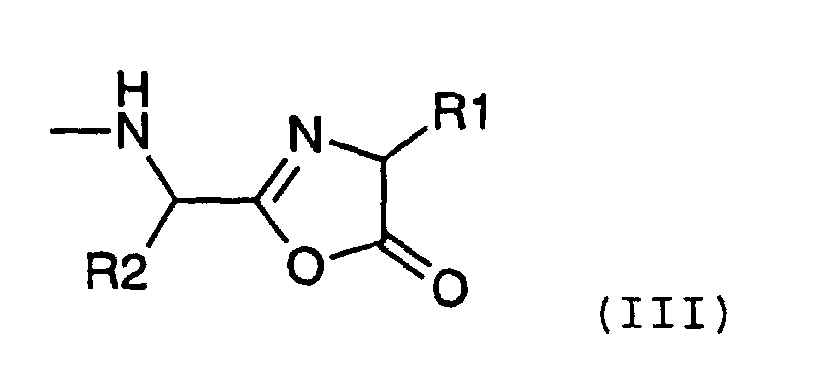 wherein R1 is a side chain of the C-terminal amino
acid of the peptide, and R2 is a side chain of the amino
acid residue positioned just before said C-terminal amino
acid, is followed by the cleavage of the 5-oxazolone ring.
wherein R1 is a side chain of the C-terminal amino
acid of the peptide, and R2 is a side chain of the amino
acid residue positioned just before said C-terminal amino
acid, is followed by the cleavage of the 5-oxazolone ring.
carrying out the release of the C-terminal amino acid in association with the process that at the C-terminal of the peptide, the formation of a 5-oxazolone structure represented by the following general formula (III):
The reaction of the formation of said 5-oxazolone
ring is expressed as a whole by the following reaction
scheme (I):
 In particular, in the case of the process for selectively
releasing C-terminal amino acid according to the present
invention, at first, by choice of the step of allowing an
alkanoic acid anhydride and a perfluoroalkanoic acid both
of vapor phase and supplied from a mixture obtained by
adding a small amount of a perfluoroalkanoic acid to an
alkanoic acid anhydride, to act on a dried peptide in a
dry atmosphere at a temperature of a range of 15 to 60° C,
at the stage of the keto-enol tautomerism represented by
the following reaction formula (Ia):
In particular, in the case of the process for selectively
releasing C-terminal amino acid according to the present
invention, at first, by choice of the step of allowing an
alkanoic acid anhydride and a perfluoroalkanoic acid both
of vapor phase and supplied from a mixture obtained by
adding a small amount of a perfluoroalkanoic acid to an
alkanoic acid anhydride, to act on a dried peptide in a
dry atmosphere at a temperature of a range of 15 to 60° C,
at the stage of the keto-enol tautomerism represented by
the following reaction formula (Ia):
 the ratio for staying in the enol state is heightened by
allowing the perfluoroalkanoic acid of vapor phase to
function as a proton donor toward the dried peptide.
the ratio for staying in the enol state is heightened by
allowing the perfluoroalkanoic acid of vapor phase to
function as a proton donor toward the dried peptide.
Then, an intramolecular ester bond is formed
between the hydroxy group exposed in the enol type and
the C-terminal carboxy group to complete the 5-oxazolone
ring-formation. On the other hand, in the case of the
conventional method, the intramolecular ester bond is
formed in a state in which a perfluoroalkanoic acid and
water molecule, both of vapor phase, are generated from a
high concentration aqueous solution of the
perfluoroalkanoic acid by heating up to, for example,
90° C, and present together. It is expected that, in
this esterification reaction as well, the
perfluoroalkanoic acid of vapor phase maybe functions as
a proton donor to induce the esterification reaction
proceeding under an acid catalyst. However, since the
reaction is carried out in a solvent-free solid phase,
the reaction temperature is set high. Meanwhile, in the
process for selectively releasing C-terminal amino acid
according to the present invention, an alkanoic acid
anhydride is used as a reagent for activation of C-terminal
carboxy group; there occurs conversion into an
asymmetric acid anhydride as illustrated by, for example,
the following reaction formula (Ib);
 and thus the activated C-terminal carboxy group is
involved in the reaction. As a result, such a reaction
can proceed under a mild temperature condition and the
reaction temperature can be selected in a range of 15 to
60° C. Incidentally, such a reaction temperature is
selected preferably at around room temperature or in a
temperature range slightly higher than room temperature,
in more particular, more preferably in a range of 15 to
50° C.
and thus the activated C-terminal carboxy group is
involved in the reaction. As a result, such a reaction
can proceed under a mild temperature condition and the
reaction temperature can be selected in a range of 15 to
60° C. Incidentally, such a reaction temperature is
selected preferably at around room temperature or in a
temperature range slightly higher than room temperature,
in more particular, more preferably in a range of 15 to
50° C.
Meanwhile, in the process for selectively releasing
C-terminal amino acid according to the present invention,
as for the perfluoroalkanoic acid used therein, its
proton-donating ability is used, and thus a
perfluoroalkanoic acid of which pKa is within the range
of 0.3 to 2.5 is preferably used. In addition, since
this perfluoroalkanoic acid needs to be supplied to a
dried peptide in a vapor phase, it is preferred that the
perfluoroalkanoic acid being be superior in volatility is
selected so that a desired vapor pressure is obtained at
said temperature selected in a range of 15 to 60° C.
From this standpoint as well, a perfluoroalkanoic acid
having 2 to 4 carbon atoms is more suitable, and a liner-chain
perfluoroalkanoic acid having 2 to 4 carbon atoms
is further more adapted. Specifically, use of
trifluoroacetic acid (CF3COOH), pentafluoropropanoic acid
(CF3CF2COOH) or heptafluorobutanoic acid (CF3CF2CF2COOH)
is more desired.
On the other hand, the alkanoic acid anhydride used
as an activation reagent is consumed with the progress of
the reaction; therefore, it is desired to conduct the
reaction while the vapor pressure of the alkanoic acid
anhydride supplied in a vapor phase is maintained at a
given level. Examples of the means adapted for the
purpose include such a means that the reaction system is
kept in a sealed state and thereby the vapor pressure of
the alkanoic acid anhydride present in the system is
stabilized. In more particular, exemplified is such a
procedure in which a liquid mixture obtained by adding a
small amount of a perfluoroalkanoic acid to an alkanoic
acid anhydride is placed in a sealable reactor; the
liquid mixture is once cooled to reduce its vapor
pressure; in this state, the reactor inside is evacuated
and then sealed off; the alkanoic acid anhydride is
vaporized in the reactor by heating up to a reaction
temperature. By employing such a procedure, there is
another advantage that the leakage of water into the
reactor can be prevented. Further, when evacuation is
conducted so that no oxygen remains in the reaction
system, for example, the sulfur present in methionine,
which is included in the amino acid residues composing a
peptide to be examined, can be prevented from oxidation
by oxygen and consequent change of its formula weight.
In the method of the present invention based on the
measurement of molecular weights, such prevention of
oxidation is more preferred for achieving a higher
accuracy.
Incidentally, for example, when the peptide to be
examined contains a plurality of cysteines which are
forming an -S-S- bond of its oxidized type between a
cysteine of adjacent peptide or forming a -S-S- bond
within one peptide molecule, an ordinary reduction
treatment is applied beforehand to eliminate such a
linkage and thereby the peptide is converted into a
peptide containing reduced forms of cysteines. Further,
to the reduced form of cysteine present in a peptide is
applied, for its protection, for example,
carboxymethylation or pyridylethylation to the sulfanyl
group (-SH) on its side chain.
Variety of alkanoic acid anhydrides, as long as
they can produce an appropriate vapor pressure when
heated to the temperature of reaction, is applicable as
the alkanoic acid anhydride used therein. Meanwhile,
there is preferred an alkanoic acid anhydride which gives
a sufficient vapor pressure when the reaction temperature
is selected in the above-mentioned preferable range, for
example, of 15 to 50° C. Therefore, a symmetric
anhydride of an alkanoic acid having 2 to 4 carbon atoms
is used preferably. Among others, as the symmetric acid
anhydride, a symmetric anhydride of a linear-chain
alkanoic acid anhydride having 2 to 4 carbon atoms is
used more preferably, and in particular, a symmetric
anhydride of a linear-chain alkanoic acid having 2 carbon
atoms, i.e. acetic acid is used appropriately. Since
such an alkanoic acid anhydride is used for the
activation of C-terminal carboxy group, the anhydride is
preferred to give minimum steric hindrance, and the
above-mentioned acetic acid, etc. are very suitable in
this respect as well.
In said reaction of releasing amino acids, the
alkanoic acid anhydride and the perfluoroalkanoic acid
are allowed to act on a dried peptide in respective vapor
states. The reaction is conducted in a dry atmosphere in
order to avoid the hydrolysis of once-formed 5-oxazolone
ring by the water incoming from outside of the system and
its reversion to original structure. In this view, the
reaction is desired to be carried out generally in a
sealed reactor. Incidentally, the mixture of the
alkanoic acid anhydride and perfluoroalkanoic acid,
initially fed into the reactor is, at room temperature, a
liquid mixture wherein the alkanoic acid anhydride and
perfluoroalkanoic acid are mixed uniformly. In this
mixture containing the alkanoic acid anhydride with a
small amount of the perfluoroalkanoic acid added thereto,
the perfluoroalkanoic acid functioning as a catalyst is
not consumed during the reaction in principle and
therefore its content can be a small amount. More
specifically explaining, the vapor of perfluoroalkanoic
acid present in the vapor phase, as compared with the
vapor of alkanoic acid anhydride co-existing, can be in a
relatively low concentration. In other words, depending
upon the kinds of the alkanoic acid anhydride and
perfluoroalkanoic acid used, for instance, on the
respective saturated vapor pressures thereof at the
reaction temperature, there is appropriately selected a
liquid mixture having a mixing ratio which can achieve an
intended partial pressure ratio (a concentration ratio in
vapor phase). The content of perfluoroalkanoic acid, in
the mixture containing the alkanoic acid anhydride with a
small amount of the perfluoroalkanoic acid added thereto,
is desired to be selected, for example, in a range of 1
to 20% by volume, preferably in a range of 3 to 10%
volume relative to the total volume of the alkanoic acid
anhydride and the perfluoroalkanoic acid.
In the process for selectively releasing C-terminal amino
acid according to the present invention, it is concluded
that, from the once-formed 5-oxazolone ring, the
separation of the C-terminal amino acid and the formation
of the reaction intermediate for the next-stage may
proceed, for instance, via such reaction as shown by the
following reaction formula (II'):
 as a result, successive release of C-terminal amino acids
is advanced in such way. Therefore, the reaction
products obtained after the completion of such reactions
are the mixture comprising, in addition to those having a
carboxy group exposed at the C-terminal, such as shown in
the above reaction formula (II), an intermediate product
having the 5-oxazolone ring structure and a form of
reaction intermediate in which its C-terminal is
converted into the form of asymmetric acid anhydride.
as a result, successive release of C-terminal amino acids
is advanced in such way. Therefore, the reaction
products obtained after the completion of such reactions
are the mixture comprising, in addition to those having a
carboxy group exposed at the C-terminal, such as shown in
the above reaction formula (II), an intermediate product
having the 5-oxazolone ring structure and a form of
reaction intermediate in which its C-terminal is
converted into the form of asymmetric acid anhydride.
The successive reaction used in the treatment step
of releasing C-terminal amino acid selectively is
constructed at least with two-stage elementary reactions,
i.e. a stage of formation of 5-oxazolone ring structure
as illustrated by the reaction formula (Ib) and a stage
of separation of C-terminal amino acid by the cleavage of
5-oxazolone ring structure, as illustrated by the
reaction formula (II'). Therefore, the overall reaction
rate depends upon the reaction rates of the two stages,
but depends mainly upon the partial pressures
(concentrations in vapor phase) of the alkanoic acid
anhydride and perfluoroalkanoic acid used therefor as
well as the reaction temperature therein. In addition,
as a series of reaction products are formed by successive
reactions, the maximum length of C-terminal amino acid
sequence removed, which can be attained in the series of
reaction products obtained, becomes longer as the
treatment duration becomes longer. Hence, the treatment
duration for the treatment step of selectively releasing
C-terminal amino acid in such a successive manner needs
to be appropriately chosen depending mainly upon the
partial pressures (concentrations in vapor phase) of the
alkanoic acid anhydride and perfluoroalkanoic acid and
the reaction temperature employed therefor and also in
view of the intended length of the C-terminal amino acid
sequence to be analyzed.
It is possible to arrange additional treatment for
hydrolysis at the end in order to convert the forms of
reaction intermediate having no carboxy group exposed at
the C-terminal, such as illustrated in the above reaction
formula (II'), formed during the treatment step of
selectively releasing C-terminal amino acid in such a
successive manner, into a form having a exposed carboxy
group exposed at the C-terminal. Hence, in the process
of the present invention for releasing C-terminal amino
acids selectively, it is preferred to provide, in
addition to said step of the treatment with use of a
mixture obtained by adding a small amount of a
perfluoroalkanoic acid to an alkanoic acid anhydride,
the process with additional steps for hydrolysis
treatment comprising steps of:
The basic, nitrogen-containing aromatic cyclic
compound or tertiary amine compound both of vapor phase
has no ability to react with, for example, products
remaining such a form in which its C-terminal has been
turned into an asymmetric acid anhydride or to form any
amide bond therewith; and further, the basic, nitrogen-containing
aromatic cyclic compound or tertiary amine can
be made into a uniform solution when preparing an aqueous
solution thereof; which features are preferably fit to
use for the treatment of hydrolysis. As the basic,
nitrogen-containing aromatic cyclic compound which can be
used, there is preferred a monocyclic nitrogen-containing
aromatic compound which can give an appropriate vapor
pressure, and, for example, pyridine can be more suitably
used. As the tertiary amine compound which can be used,
there is preferred one having the same weak basicity as
shown by pyridine and, for instance, such as DMAE
[(CH3)2N-CH2CH2OH] can be suitably used. When, for
example, pyridine is used, the pyridine content is
preferably selected in a range of 5 to 15% by volume, in
more particular at 10% by volume relative to the whole
volume of the aqueous solution thereof. When
(dimethylamino)ethanol (DMAE) is used, the DMAE content
is preferably selected in a range of 1 to 20% by volume,
in more particular at 10% by volume relative to the whole
volume of the aqueous solution thereof.
The monocyclic nitrogen-containing aromatic
compound or tertiary amine compound is allowed to act on
a dried mixed sample containing the reaction products, in
the vapor state together with water molecule. In this
post-treatment, the reaction as well is desired to be
conducted in a sealed reactor. In said post-treatment,
since water molecule is used, its vapor pressure needs to
be set at a certain level or higher. Therefore, the
treatment temperature is desirably chosen, for example,
from a temperature of 60° C or more but, when the
mechanical strength of the reactor is taken into
consideration, in a range of 100° C or lower. In order
to complete the treatment for hydrolysis quickly, such a
temperature of 100° C or slightly lower is desired to be
selected.
Moreover, in the process for selectively releasing
C-terminal amino acid according to the present invention,
in addition to the step of the treatment using a mixture
obtained by adding a small amount of a perfluoroalkanoic
acid to an alkanoic acid anhydride, the process may be
provided, prior to said step of releasing the C-terminal
amino acids successively, with a step for a pre-treatment
of applying, to the N-terminal amino group of the peptide
to be examined, N-acylation protection in advance with
use of an acyl group derived from the alkanoic acid
constituting said alkanoic acid anhydride. Specifically
explaining, in said step of the treatment using a mixture
obtained by adding a small amount of a perfluoroalkanoic
acid to an alkanoic acid anhydride, a reaction
intermediate wherein the C-terminal carboxy group of
peptide is activated, is presumed to be formed. When
this reaction intermediate would react with the N-terminal
amino group of an adjacent peptide to form an
amide bond therewith, no intended reaction product with
truncated peptide chain is obtained. Since the reaction
per se is carried out in a solid phase, frequency of such
accidental side reaction is not so high. However, N-acylation
is desirably applied beforehand to protection
against the side reaction.
In addition, during said treatment using a mixture
obtained by adding a small amount of a perfluoroalkanoic
acid to an alkanoic acid anhydride, the N-terminal amino
group of peptide ordinarily undergoes N-acylation by the
alkanoic acid anhydride, and accordingly N-acylation
protection takes place in the reaction system;
nevertheless, it is more desired to conduct the
pretreatment aiming at N-acylation protection.
The pretreatment step of applying N-acylation
protection to the N-terminal amino group may be conducted
by employing technique where the N-acylation for amino
groups in the peptide is effected by allowing an alkanoic
acid anhydride and an alkanoic acid both of vapor phase,
which are supplied from a mixture obtained by adding a
small amount of the alkanoic acid to the alkanoic acid
anhydride, to act on a dried sample of the peptide to be
examined in a dry atmosphere at a temperature selected in
a range of 10 to 60°C. In such a case, it is preferred
that the alkanoic acid anhydride used in the pretreatment
step of applying N-acylation protection to the N-terminal
and as the alkanoic acid anhydride used in the step
conducted thereafter of releasing the C-terminal amino
acids successively, used is the same alkanoic acid
anhydride. Specifically explaining, in the pretreatment
reaction for applying N-acylation protection to the N-terminal
amino group, the reaction is allowed to proceed
by supplying, to the dried peptide sample, the alkanoic
acid anhydride and alkanoic acid both in a vapor state;
therefore, in order to obtain appropriate vapor pressures
thereof, there can be suitably used the same alkanoic
acid anhydride as the alkanoic acid anhydride used in the
step conducted thereafter, of releasing the C-terminal
amino acids successively. In addition, since the
reactivity of the alkanoic acid anhydride is too low to
cause undesired side reactions such as peptide cleavage,
in a dry atmosphere at a temperature of a range of 10 to
60° C and further since the alkanoic acid to be used
together is strikingly inferior in acid catalytic
activity to perfluoroalkanoic acid, the combination can
provide N-acylation protection to N-terminal amino group
in the pretreatment, with much less possibility to invite
undesired side reactions.
Additionally, in the step of N-acylation protection
to the N-terminal amino group of peptide, N-acylation
protection proceeds simultaneously also to the ε-amino
group on the side chain of the lysine residue present in
the peptide. Furthermore, O-acylation proceeds also to
the hydroxyl groups on the side chain of the serine and
threonine resides present in the peptide, and thereby
protection thereof is made. Besides, the phenolic
hydroxyl group on the side chain of the tyrosine residue
present in the peptide also undergoes partially O-acylation
although its reactivity is varied. As a result
of the pretreatment step wherein a plurality of these
acylation protections take place as well, the amino group
on the side chain of lysine residue and the hydroxyl
group on the side chain of serine and threonine residues
are all modified with the protection group, and are no
longer able to take part in undesired side reactions. It
is generally preferred from this standpoint as well that
the pretreatment step of application of the N-acylation
protection to the N-terminal amino group of peptide is
conducted in advance.
Incidentally, in the combination use of the
alkanoic acid anhydride and alkanoic acid in the
pretreatment step, there is substantially no fear of
undesired side reactions, for example, such as cleavage
in the middle of peptide. However, the pretreatment
temperature is preferred to be selected in a range of 10
to 60° C, more preferably at around room temperature or a
temperature range slightly higher than room temperature,
and in more particular in a range of 15 to 50° C. On the
other hand, the content of the alkanoic acid in the
mixture obtained by adding a small amount of the alkanoic
acid to the alkanoic acid anhydride is preferred to be
selected in a range of 2 to 10% by volume, specifically
at 5% by volume relative to the total volume of the
alkanoic acid anhydride and alkanoic acid.
Besides, the procedure for reaction in the
pretreatment step is preferably conducted in very similar
manner to the above-mentioned procedure for the step of
selectively releasing C-terminal amino acids. That is,
the above-mentioned procedure for operation and
conditions suitable to the step for selectively releasing
C-terminal amino acids are also adapted to said reaction
step in the pretreatment step. Incidentally, the rate of
N-acylation reaction in the pretreatment step depends
upon the partial pressures (concentrations in vapor
phase) of the alkanoic acid anhydride and alkanoic acid
used as well as the reaction temperature; therefore, the
reaction time of the pretreatment step is desired to be
selected appropriately depending mainly upon the reaction
temperature. When the reaction temperature is selected
at, for example, 50° C, the reaction time is selected to
be within one hour, for example, for 30 minutes, whereby
the N-acylation to the N-terminal amino group of peptide
can be completed. In such a case, addition of pyridine
of catalytic amount, for example, 0.1 to 1.0% by volume
relative to the total volume of the alkanoic acid
anhydride and alkanoic acid is more preferred in order to
enhance the acylation reaction with use of the alkanoic
acid anhydride and the alkanoic acid. Since this
pyridine base functions as a proton receptor, for example,
removal of protons to be eliminated in association with
the acylation to amino group is made more swiftly.
Further preferably, the process for selectively
releasing C-terminal amino acids according to the present
invention is carried out in such a mode in which the
pretreatment step, the reaction step of selectively
releasing C-terminal amino acids and the post-treatment
step are all comprised. An example of such a flow
pattern of steps is illustrated in Fig. 1. A drying-up
operation is conducted in said flow when each step has
been completed, so that the reagents used in each step do
not remain in the peptide sample. This drying-up
operation is generally conducted by vacuum distillation,
and thereby the C-terminal amino acids released that are
by-products in said reaction can be removed as well, in
some cases. The flow pattern of steps of Fig. 1
illustrates an example wherein acetic anhydride of high
availability in a very high purity is utilized as the
alkanoic acid anhydride used therein.
On the other hand, in the flow pattern of steps
illustrated in Fig. 1, as for the treatment duration in
the reaction step of selectively releasing C-terminal
amino acids, illustrated is a range of treatment time
which is selected depending upon the proportions of the
acetic anhydride and fluoroalkanoic acid used and the
treatment temperature employed, for model case where the
length of amino acids of the C-terminal amino acid
sequence to be truncated in said step are intended to be
ten odd amino acids as maximum case and 3 amino acids as
minimum case. In general, when the proportion of the
fluoroalkanoic acid is larger and the treatment
temperature is higher, the reaction rate is higher, and
thereby it is possible to prepare a series of reaction
products that have attained the maximum of truncated
length of amino acid sequence, which is set as the goal,
in shorter treatment duration.
Furthermore, in the pretreatment step, N-acetylation
to N-terminal amino group of peptide is
carried out by using acetic anhydride and acetic acid
both of vapor phase. Even in the case of such
combination of acetic anhydride and acetic acid, there is,
in some cases, a fear, maybe very small, that the
activation reaction to C-terminal carboxy group expressed
by the above-shown reaction formula (Ia) and the side
reaction caused thereby take place. In order to suppress
such side reaction, a small amount of pyridine vapor can
be allowed to co-exist to form a weak addition salt
between the pyridine base and the C-terminal carboxy
group of peptide, which may provide protection effect
against the occurrence of the undesired side reaction.
Such protection of addition salt formation type undergoes
easy deprotection by conducting a drying-up operation
upon completion of the pretreatment step to distil off
the pyridine base under vacuum, and no problem occurs in
the next reaction step of selectively releasing C-terminal
amino acids. From these standpoints, it is
preferred to add, for the protection of addition salt
formation type, a small amount of a nitrogen-containing
heterocyclic aromatic compound which can be easily
distilled off under reduced pressure and has a weak
basicity, such as pyridine. Further, since the
protection of addition salt formation type possesses
protective function also for the carboxy group on the
side chain of amino acid, it can effectively prevent even
the undesired side reaction that is originated from the
carboxy group on the side chain of amino acid
coincidently.
In the method of the present invention for analysis
of C-terminal amino acid sequence of peptide, the
molecular weights of the series of reaction products
prepared by successively releasing C-terminal amino acids
and the molecular weight of the original peptide are
determined by consulting measured data by mass
spectrometry and there are identified amino acids
corresponding to the differences in the molecular weights
thereof. Therefore, it is generally desired that the
original peptide remains in the mixture subjected to the
measurement by mass spectrometry, in such an amount as to
enable the determination of its molecular weight.
Specifically explaining, the method of the present
invention for analysis of the C-terminal amino acid
sequence of peptide may be applied to such a case where
maximum length analyzed for the C-terminal amino acid
sequence is as long as ten and odd amino acids. With
respect to the contents of the series of reaction
products of which sorts reach, as maximum case,
correspondingly into the number of ten and odd, the
content of the minimum content reaction product is
desired at least to be not smaller than about 1/10 of the
content of the maximum content reaction product. In
addition, the remaining amount of the original peptide as
well is desired at least to be not smaller than about
1/10 of the content of the maximum content reaction
product. Meanwhile, the required information of C-terminal
amino acid sequence is within 10 amino acids in
many cases and, when selecting the treatment time in
which about 10 amino acids can be released, the above-mentioned
requirements regarding the contents can be
satisfied.
Meanwhile, mass spectrometry is used for the
measurement of molecular weight. The measurement is more
suitably conducted using a mass spectrometer equipped
with such means for ionization that is well operated
under such conditions as to suppress the fragmentation
resulting in detachment of part of atomic moieties from
the amino acid residues comprising the peptide, in the
ionization step therein. Furthermore, as a peptide or
the like has a high molecular weight, it is preferred to
use a Time-of-Flight type mass spectrometer, for instance,
such as MALDI-TOF-MS system, which is suitable for
measurement in such a high molecular weight range.
However, even when such a type of mass spectrometer is
used, there is an upper limit as to the molecular weight
allowing for effective ionization, and therefore it is
desired that the maximum amino acids of a peptide that is
possibly subjected to measurement does not exceed the
limit of 20 to 30 amino acids. In addition, amino acids
corresponding are identified based on the measured
differences in molecular weight; therefore, in order to
distinguish two amino acid residues giving a formula
weight difference of 1, for instance such as Asn vs Asp,
or Gln vs Glu, from each other at a high precision, the
molecular weight of the longest peptide, i.e. the peptide
with no release of C-terminal amino acid therefrom that
is used as a datum point, is preferably in a range of no
more than 3,000, more preferably in a range of no more
than 2,000. When reduced to amino acids, it is preferred
that its length is 30 amino acids at longest, more
preferably in a range of no more than 20 amino acids.
When the method of the present invention for
analysis of C-terminal amino acid sequence of peptide is
applied to a peptide having length of amino acids far
more than the limit mentioned above, e.g. a protein, it
is desired to conduct, prior to carrying out mass
spectrometry, treatment for specific cleavage of the
peptide is carried out by using, for example, a protease
having a specificity for the cleavage site of amino acid
sequence, to allow the C-terminal peptide fragment
obtained to have length of amino acids within the above-mentioned
range. That is, when the same treatment for
site-specific cleavage is applied to both the original
peptide and a series of the reaction products prepared
therefrom, the resulting C-terminal peptide fragments are
a series of peptide fragments which has the same N-terminal
amino acid but difference in C-terminal amino
acid thereof. By using a mixture comprising such series
of peptide fragments to identify their molecular weights
by means of mass spectrometry, the method of the present
invention for analysis of C-terminal amino acid sequence
of peptide can be utilized.
However, when the present analysis method is
applied to a long peptide such as a protein, in such a
case that, in the long peptide, -S-S- bond between
cysteine residues is formed owing to protein folding, it
is necessary to beforehand reduce the -S-S- bond to
eliminate the bridging between cysteine residues; further,
the reduced form of cysteine is modified by
carboxymethylation or the like to protect the sulfanyl
group (-SH) on the side chain. Also, in the region
constituting a secondary structure such as α-helix in
association with the protein folding, the carbonyl group
(C=O) and imino group (-NH-) of amino acid residue
constituting the amide bond are in the state forming
intramolecular hydrogen bond. When being held in such
state forming the intramolecular hydrogen bond, the
progress of the reaction used in the present invention
may be suppressed. In view of this, it is desired that
peptide is in advance treated to convert into the state
where no secondary structure is constructed at least in
the C-terminal portion thereof, for example, being
treated for de-folding, and thereafter, drying of such
peptide sample is conducted, and then the above-mentioned
chemical treatment is applied thereto. When peptide is
in the shape being treated for de-folding, for example,
in such a case that after a series steps of chemical
treatments have been completed, site-specific cleavage of
the peptide using a protease or the like is needed prior
to step of analysis in mass spectrometry, it has such an
advantage that the C-terminal peptide fragments obtained
therein are generally easy to separate.
In the method of the present invention for analysis
of C-terminal amino acid sequence of peptide, the amino
acids released successively are identified based on the
differences in molecular weight. Therefore, distinction
between leucine (Leu) residue and isoleucine (Ile)
residue both having the same formula weight is impossible
in principle, which is the same as in the conventional
method for analysis of C-terminal amino acid sequence
using mass spectrometry. On the other hand, in the
reaction for releasing C-terminal amino acid, conversion
of amide bond into enol from and subsequent formation of
5-oxazolone ring structure are essential as shown in the
reaction formula (Ib), and thus no further reaction for
releasing proceeds when cyclic amino acid proline (Pro),
in which any imino group (-NH-) forming amide bond
together with carbonyl group (C=O) is not present, has
come to be the C-terminal amino acid. In other words, by
confirming that there occurs no further elimination of C-terminal
amino acid even when treatment duration is
prolonged, it is possible to predict that the amino acid
residue that is main factor for such arrest is cyclic
amino acid proline (Pro).
The process of the present invention for preparing
a mixture comprising a series of reaction products
obtainable by releasing the C-terminal amino acids
successively from the peptide with use of chemical means
corresponds to the technique used in the reaction step of
releasing C-terminal amino acid selectively for the
method of the present invention for analysis of C-terminal
amino acid sequence of peptide explained above.
Therefore, the preferred mode for carrying out the
process is the same as described previously. This
technique can be applied not only for a linear peptide to
prepare a sample used for determination of C-terminal
amino acid sequence thereof but also for a cyclic peptide
to prepare a sample used for determining amino acid
sequence thereof, wherein by ring-opening, the cyclic
peptide is in advance converted into form of linear
peptide, which is subjected to determination of its C-terminal
amino acid sequence. Specifically explaining,
various microorganisms, for example, produce cyclic
peptide type compounds having biological activities, and
said technique can be applied for preparation of a sample
for determination of the structures of such compounds.
Even in said process of the present invention for
preparing a mixture containing a series of reaction
products obtainable by releasing the C-terminal amino
acids successively from the peptide with use of chemical
means, for example, when there occur N,O-acyl
rearrangement for the hydroxy groups present on the
serine residue [-NH-CH(CH2OH)-CO-] and threonine residue
[-NH-CH(CH(CH3)OH)-CO-] in the peptide, which
subsequently results in branching, the ester bond therein,
as compared with amide bond, undergoes cleavage more
easily. However, owing to the action of alkanoic acid
anhydride and perfluoroalkanoic acid both of vapor phase,
O-alkanoylation to the hydroxy group on their side chain
proceeds preferentially, which attains effectively
competitive inhibition against the N,O-acyl rearrangement.
Incidentally, when the post-treatment step is carried out,
the ester bond to alcoholic hydroxy group, as compared
with the ester bond to phenolic hydroxy group, undergoes
hydrolysis more quickly, and accordingly there remain, at
high selectivities in the reaction products obtained
finally, only N-alkanoylation to N-terminal amino group,
N-alkanoylation to the amino group on the ε-position of
lysine residue [-NH-CH(CH2CH2CH2CH2NH2)-CO-] and, in some
cases, also O-alkanoylation to the phenolic hydroxy group
of tyrosine residue [-NH-CH(CH2-C6H4-OH)-CO-].
For example, when numbers of acetylated forms of
serine residue and threonine residue are included in the
reaction products obtained finally, the molecular weight
differences between such multi-acetylated product and
deacetylated product are aligned in the integral times of
formula weight 42, specifically 84, 126 and 168 are close
to the formula weight 87 of serine residue [-NH-CH(CH2OH)-CO-],
the formula weight 128 of glutamine
residue [-NH-CH(CH2CH2-CONH2)-CO-] or the formula weight
129 of glutamic acid residue [-NH-CH(CH2CH2-COOH)-CO-]
and the formula weight 170 of N-acetyllysine residue [-NH-CH(CH2CH2CH2CH2NH-COCH3)-CO-],
respectively. Therefore,
there is some fear that the peak for the multi-acetylated
products may be mistaken as main peaks, and the
deacetylated products may be mis-assigned as derived
products therefrom with the release of such an amino acid.
However, actual measurement is made in such an analytical
precision that the distinction between glutamine residue
and glutamic acid residue, of which the formula weights
differ only 1, is possible; since the formula weight
difference related to the difference in number of
remaining acetyl groups differs from the formula weight
of amino acid residue showing a similar formula at least
with the formula weight difference of 2 to 3, the
possibility of such mis-assignment mentioned above is not
high in many cases. However, it is preferred to carry
out the post-treatment to eliminate such undesired
remains of the alkanoyl groups.
The kit of the present invention used for treatment
to release the C-terminal amino acids successively is a
kit being set up with a combination of a reactor vessel
and a set of reagents usable under the reaction
conditions suitable for said reactor vessel, which is
applicable to the reactions used exclusively in the
aforementioned process of the present invention for
preparing a mixture containing a series of reaction
products obtainable by releasing the C-terminal amino
acids successively from a peptide with use of chemical
means. The set of reagents for said reactions include,
as a liquid reagent for the reaction of releasing the C-terminal
amino acids successively, at least a mixture
obtained by a small amount of a perfluoroalkanoic acid to
an alkanoic acid anhydride, or separately the alkanoic
acid anhydride and the perfluoroalkanoic acid in
combination for preparation of the mixture. Since the
same type of reactor can be used also in the pretreatment
step as well as the post-treatment step explained above,
the kit may be set up to further comprise the reagents
used in the pretreatment step and the post-treatment step
therein. It is preferable for the kit to select the
compositions and use amounts of these reagents being
adapted to the reaction conditions explained above.
With respect to the sample container for holding a
sample of target peptide to be treated, since a solution
containing the peptide sample is fed therein, and then
treatment for drying up is conducted, and subjected
thereafter to an intended treatment(s), the sample
container can be formed in shape of a micro vial type
used in treatment of freeze-drying or of a multi-well
plate type used in simultaneous handling of a plurality
of peptide samples.
The reactor vessel is provided with a liquid
reagent-holding system that is capable of reserving the
liquid reagent for said reaction or each of the liquid
reagents combined in the component kit thereof
respectively, capable of feeding the liquid reagents for
said reactions at given rates to the peptide sample held
in said sample container, and capable of maintaining such
a state that their direct contact with each other is
avoided, and the reactor vessel has capacity to
accommodate said sample container inside. Preferably,
the reactor vessel is designed in such a form that the
inside can be evacuated, the liquid reagents remaining
therein after the completion of the reaction can be
distilled off under reduced pressure, and the structure
can be made gas-tight during the reaction. In addition,
the reactor vessel is required to be made of such a
material that, when the vapor of the reagent is generated
in the reactor vessel, no reaction takes place between
the reagent and the wall of the vessel. Therefore, there
is suitably used such a vessel formed by using glass
material that is widely used for reactor in chemical
reactions. For the cocks used in a sealed-state
operation, cocks made of such a material as Teflon@ or
the like is used suitably.
The present invention is described specifically
below by way of Examples. These Examples are examples of
the best mode for carrying out the present invention;
however, the present invention is in no way restricted by
such specific embodiments illustrated thereby.
In order to verify the usefulness of the method for
analysis of the C-terminal amino acid sequence of peptide
according to the present invention, analysis of C-terminal
amino acid sequence was conducted for human
angiotensin I, which is a peptide comprising 10 amino
acids.
With respect to human angiotensin I, which is the peptide to be examined in the present Example, its amino acid sequence is already known to be Asp-Arg-Val-Tyr-Ile-His-Pro-Phe-His-Leu. Using this peptide, the precision of identification for the C-terminal amino acid sequence analyzed by means of the analysis method according to the present invention was verified.
With respect to human angiotensin I, which is the peptide to be examined in the present Example, its amino acid sequence is already known to be Asp-Arg-Val-Tyr-Ile-His-Pro-Phe-His-Leu. Using this peptide, the precision of identification for the C-terminal amino acid sequence analyzed by means of the analysis method according to the present invention was verified.
First, a peptide solution containing 10 pmol of
commercially available human angiotensin I is fed into a
micro vial and subjected to a freeze-drying treatment.
The vial containing the dried peptide sample was set in a
glass-made reactor of air-tight test tube type with
fitting stopper, having an evacuation port equipped with
a Teflon-made cock valve for sealing. Separately, a
given amount of the following liquid reagent is placed in
the glass-made reactor.
As the reagent for pretreatment, there is used 300
µl of acetic anhydride containing 5% by volume of acetic
acid. After the vial containing the dried peptide sample
has been set up in the glass-made reactor, the reactor
inside is evacuated under cooling condition and then
sealed in an air-tight state.
The whole reactor of air-tight state is kept at
50° C for 1 hour to allow acetic anhydride and acetic
acid both of vapor phase, supplied from the liquid
reagent in the reactor, to act on the dried peptide
sample. By allowing acetic anhydride in the co-presence
of acetic acid as an acylation reagent to act on the
dried peptide sample, selective acetylation to the N-terminal
amino group of the peptide proceeds. As a
result, the peptide is converted into N-acetylated human
angiotensin I. After such pretreatment has been
completed, the unreacted acetic anhydride, acetic acid,
etc. remaining in the reactor is distilled off under
reduced pressure and the N-acetylated human angiotensin I
obtained is dried.
Next, in a state that the vial holding the dried
sample of N-acetylated human angiotensin I prepared is
set similarly in the glass-made reactor of air-tight test
tube type with fitting stopper, a given amount of the
following liquid reagent is placed anew in the glass-made
reactor.
As a liquid reagent for the reaction of selectively
releasing C-terminal amino acid, 300 µl of acetic
anhydride containing 5% by volume of trifluoroacetic acid
is used. After the vial containing the dried sample has
been set up in the glass-made reactor, the reactor inside
is evacuated under cooling condition and then sealed in
an air-tight state.
The whole reactor of air-tight state is kept at
40° C for 16 hours to allow acetic anhydride and
trifluoroacetic acid both of vapor phase, supplied from
the liquid reagent in the reactor, to act on the dried
sample. In this case, since acetic anhydride functions
as an acylation reagent in the co-presence of
trifluoroacetic acid, O-acetylation proceeds to the
phenolic hydroxy group on the side chain of tyrosine
(Tyr). Meanwhile, at the C-terminal of peptide, there
proceed keto-enol tautomerism represented by the
following reaction formula (Ia), promoted by
trifluoroacetic acid functioning as a proton donor:
 and conversion into asymmetric acid anhydride and
formation of cyclic ester, which occur by the action of
acetic anhydride on C-terminal carboxy group and are
represented by the following reaction formula (Ib);
and conversion into asymmetric acid anhydride and
formation of cyclic ester, which occur by the action of
acetic anhydride on C-terminal carboxy group and are
represented by the following reaction formula (Ib);
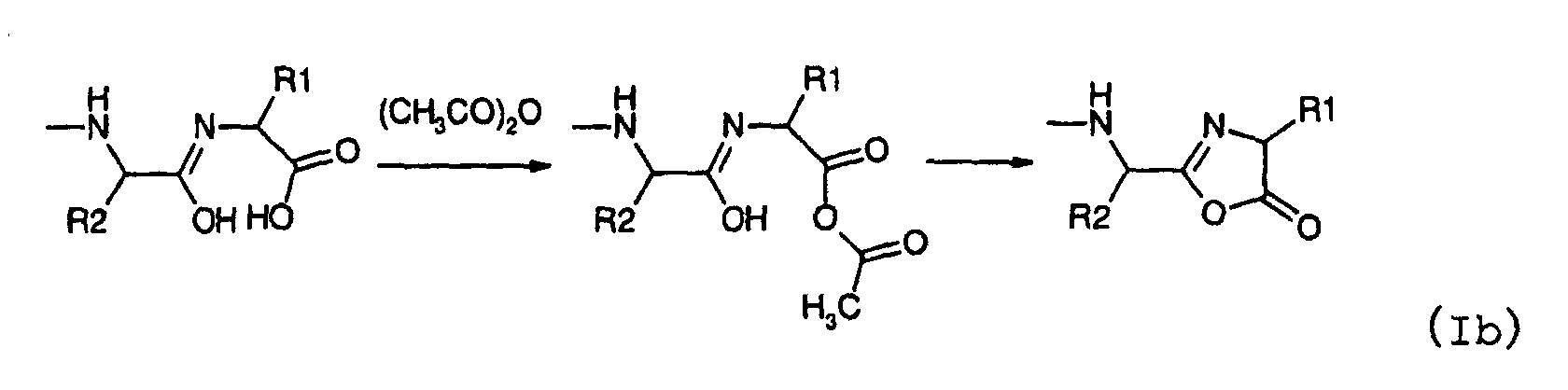 and whereby the C-terminal is once converted into a 5-oxazolone
structure. Further, the oxazolone ring is
cleaved with the help of acetic acid (CH3COOH) by-produced
in the above reaction or of trifluoroacetic acid
which is co-present, and the C-terminal amino acid is
eliminated as N-acylated amino acid [Ac-NH-CH(R1)-COOH]
and from the amino acid residue [-NH-CH(R2)-CO-]
positioned just before the C-terminal acid, its terminal
carboxy group comes to be exposed newly. Furthermore, a
reaction to the next stage proceeds and the next amino
acid ahead that has been newly exposed at C-terminal is
converted into a 5-oxazolone structure as well.
and whereby the C-terminal is once converted into a 5-oxazolone
structure. Further, the oxazolone ring is
cleaved with the help of acetic acid (CH3COOH) by-produced
in the above reaction or of trifluoroacetic acid
which is co-present, and the C-terminal amino acid is
eliminated as N-acylated amino acid [Ac-NH-CH(R1)-COOH]
and from the amino acid residue [-NH-CH(R2)-CO-]
positioned just before the C-terminal acid, its terminal
carboxy group comes to be exposed newly. Furthermore, a
reaction to the next stage proceeds and the next amino
acid ahead that has been newly exposed at C-terminal is
converted into a 5-oxazolone structure as well.
Thus, leucine (Leu), histidine (His) and
phenylalanine (Phe) are successively released from the C-terminal
of human angiotensin I to reach reaction product
in which proline (Pro) is exposed at the C-terminal.
Proline contains amino nitrogen in the ring structure;
therefore, when a peptide bond is formed thereto, there
occurs no keto-enol tautomerism represented by the above-shown
reaction formula (Ia). Accordingly, the reaction
can never progress in further conversion into a 5-oxazolone
structure represented by the reaction formula
(Ib). As a result, under the conditions of allowing a
vapor phase acetic anhydride to act in the co-presence of
trifluoroacetic acid, there is no selective release of
proline (Pro) positioned at the C-terminal. That is, the
reaction products obtained in the present Example are
only three kinds of truncated peptides in which leucine
(Leu), histidine (HiS) and phenylalanine (PHe) have been
released successively. On the other hand, with respect
to the C-terminals of said three kinds of truncated
peptides, they are in the mixture state including those
staying in the 5-oxazolone structure, or being advanced
even in conversion into an asymmetric acid anhydride
therefrom, other than those being converted into carboxy
group.
After the completion of the treatment for selective
releasing C-terminal amino acids, the unreacted acetic
anhydride, trifluoroacetic acid, etc. remaining in the
reactor are distilled off under reduced pressure and a
mixture of the residual N-acetylated human angiotensin I
and the reaction products obtained is dried.
Next, in a state that the vial holding the dried
sample of a mixture of N-acetylated human angiotensin I
and the obtained reaction products is set similarly in
the glass-made reactor of air-tight test tube type with
fitting stopper, a given amount of the following liquid
reagent is placed anew in the glass-made reactor.
As in the above mixture, the C-terminals of
reaction products of peptide are in the mixture state
including those staying in the 5-oxazolone structure, or
being advanced even in conversion into an asymmetric acid
anhydride therefrom, other than those being converted
into carboxy group, the post-treatment is a treatment
mainly aiming to convert them into the state where the C-terminals
of the peptides all turned carboxy groups by
applying treatment for hydrolysis to them. That is, an
aqueous solution of a basic, nitrogen-containing organic
compound is used as a liquid reagent for post-treatment,
and the basic, nitrogen-containing organic compound and
water molecule both of vapor phase, generated from the
solution are allowed to act on said mixture which is
dried beforehand. In the present Example, 300 µl of an
aqueous solution holding 10% by volume of pyridine
therein is used as the liquid reagent for the post-treatment
of hydrolysis; and after the vial containing
the dried sample has been set in the glass-made reactor,
the inside of the reacter is evacuated under cooling
condition and then sealed in an air-tight state.
The whole reactor of air-tight state is heated at
100° C for 30 minutes to allow the vapor-phase pyridine
and water molecule, supplied from the liquid reagent in
the reactor, to act on the dried sample. The asymmetric
acid anhydride and the 5-oxazolone structure undergo
hydrolysis by the action of water molecule in the co-presence
of pyridine base, whereby they are converted
into a form having a carboxy group at the C-terminal.
Hydrolysis of ester bond proceeds also to the O-acetylated
phenolic hydroxy group on the side chain of
tyrosine (Tyr), whereby deacetylation (deprotection)
thereof is made partially. Meanwhile, in N-acetylation,
i.e. the acetyl group being substituted on N-terminal
amino group, no hydrolysis of amide bond takes place
under the above-mentioned conditions. Therefore, the
reaction products obtained after the post-treatment are
N-acetylated products in which the N-terminal of peptide
is modified with the acetyl group. Consequently, in the
reaction products, the N-terminal of peptide is modified
with the acetyl group and the C-terminal has an exposed
carboxy group; but they stay still in such state that
those containing O-acetylation on the side chain of the
tyrosine (Tyr) are partially remained.
After the post-treatment has been completed, the
residual water molecule, pyridine, etc. in the reactor
are distilled off under reduced pressure; and a mixture
of N-acetylated human angiotensin I and the reaction
products obtained after post-treatment is dried.
The mixture of N-acetylated human angiotensin I and
the reaction products resulted after post-treatment,
prepared by conducting the series of chemical treatments
as explained above, is subjected to mass spectrometry to
measure the molecular weights of the individual peptides
contained therein.
In the present Example, using a Time-of-Flight type
mass spectrometer, specifically, MALDI-TOF-MS system,
there are conducted, on the dried mixture sample (for
C1/3 analysis), measurement of the masses of main ion
species, which are reflecting the molecular weights of
individual peptides, and their relative signal
intensities, and subsequently comparison thereof. Mass
spectrometry under the same conditions is conducted
separately for the dried sample of N-acetylated human
angiotensin I obtained from the pretreatment alone, to
determine the mass of main ion species from N-acetylated
human angiotensin I to be used as a reference.
Fig. 2 shows the mass spectrum measured for the
mixture containing reaction products, which are treated
for successively releasing C-terminal amino acids by said
method of chemical treatment mentioned in the present
Example. The mass of the main ion species from N-acetylated
human angiotensin I is measured separately,
referring to the measured mass for said peak, there are
identified the reaction products corresponding to the
important peaks measured in the mass spectrum of Fig. 2.
In Table 1 are shown the masses of the peaks measured,
their differences from the mass of the peak due to the
original N-acetylated human angiotensin I, and the amino
acid residues, which are removed in individual reaction
products, identified based thereon, as well as the forms
of individual reaction products.
| m/Z | Δm | Assignment | Corresponding peptide structure |
| 1380.7 | +42.0 | +CH3CO | Ac-DRVY(Ac)IHPFHL |
| 1338.7 - | Ac-DRVYIHPFHL | ||
| 1267.6 | -71.1 | -Leu, +CH3CO | Ac-DRVY(Ac)IHPFH |
| 1224.6 | -114.1 | -Leu | Ac-DRVYIHPFH |
| 1130.5 | -208.2 | -His·Leu, +CH3CO | Ac-DRVY(Ac)IHPF |
| 1088.5 | -250.2 | -His·Leu | Ac-DRVYIHPF |
| 983.5 | -355.2 | -Phe·His·Leu, +CH3CO | Ac-DRVY(Ac)IHP |
| 941.5 | -397.2 | -Phe·His·Leu | Ac-DRVYIHP |
The peak due to the original N-acetylated human
angiotensin I is accompanied by a peak having a mass
which is larger by 42. The latter peak is judged to be
due to those being modified with additional acetyl group,
i.e. those having the O-acetylation on the side chain of
tyrosine (Tyr). Assuming that the remaining three peaks
each accompanied by a peak having a mass which is larger
by 42, are due to those products at C-terminal of which
the amino acids are successively released, naturally
occurring amino acid residues that will give rise to its
deference in the masses measured are identify. Since no
further releasing proceeds after the release of these
three amino acids, the fourth amino acid residue from C-terminal
is concluded to be proline. Incidentally,
leucine (Leu) and isoleucine (Ile) have the same formula
weight and cannot be distinguished from each other in
analysis by mass spectrometry; however, in Table 1, they
are expressed as leucine (Leu).
It is confirmed by the above verification
experiment that by conducting the treatment for
selectively releasing C-terminal amino acids according to
the present invention, a series of reaction products
wherein the C-terminal amino acids have been successively
removed from the original peptide, are obtained under
mild treatment conditions and the C-terminal amino acid
sequence of the peptide can be analyzed at a high
accuracy.
In this Example, it was verified that there occurs
no progress of side reaction that may result in serious
problem even if the reaction temperature varies slightly
during the reaction of successively releasing C-terminal
amino acids, because mild treatment conditions are
employed in the treatment technique for selectively
releasing C-terminal amino acids according to the present
invention. In particular, the treatment temperature
employed for the reaction of releasing C-terminal amino
acids, which is included in the series of chemical
treatments described in Example 1, was changed from 40° C
to 50° C, and the reaction products obtained in these two
case were compared with each other.
There were chosen the same procedure and conditions
for each operation as the operational procedure and
conditions described in Example 1, with the except of
said change in the temperature for the reaction of
releasing by using acetic anhydride with 5% by volume of
trifluoroacetic acid added threreto.
Fig. 3 shows the mass spectrum measured for the
mixture comprising reaction products, obtained by the
treatment for successively releasing C-terminal amino
acids in said way for chemical treatments as explained in
the present example. Summarized in Table 2 are the
results of assignment for reaction products corresponding
to the important peaks measured in the mass spectrum of
Fig. 3. Comparison between the spectrum of Fig. 3 and
the spectrum of Fig. 2 confirms that even when the
temperature for treatment of releasing is increased from
40° C to 50° C, there is no further progress in removal
after three amino acids from C-terminal has been removed
and there occurs no side reaction such as cleavage in the
middle of the peptide.
| m/Z | Δm | Assignment | Corresponding peptide structure |
| 1380.7 | +42.0 | +CH3CO | Ac-DRVY(Ac)IHPFHL |
| 1338.7 - | Ac-DRVYIHPFHL | ||
| 1265.7 | -73.0 | -Leu, +CH3CO | Ac-DRVY(Ac)IHPFH |
| 1223.6 | -115.1 | -Leu | Ac-DRVYIHPFH |
| 1131.6 | -207.1 | -His·Leu, +CH3CO | Ac-DRVY(Ac)IHPF |
| 1088.6 | -250.1 | -His·Leu | Ac-DRVYIHPF |
| 983.5 | -355.2 | -Phe·His·Leu, +CH3CO | Ac-DRVY(Ac)IHP |
| 941.5 | -397.2 | -Phe·His·Leu | Ac-DRVYIHP |
In said cases of Example 1 and Example 2, the
pretreatment operation was carried out in order to modify
the N-terminal amino group of peptide for its protection.
In the present Example, it was verified that no side
reaction causing serious troubles takes place even when
the pretreatment is not carried out, because, in the
process for the chemical treatment according to the
present invention, at the step of carrying out the
treatment of successively releasing C-terminal amino
acids, a peptide sample used is dried up in advance into
a solid phase, and the reaction is promoted by supplying
both acetic anhydride and trifluoroacetic acid in a vapor
phase, which are utilized in the reaction.
Specifically explaining, the pretreatment described
in Example 1 was omitted, and the operation for the
reaction of releasing C-terminal amino acids and the
subsequent post-treatment operation were conducted to a
dried sample of human angiotensin I. In this case, in
the operation for the reaction of releasing C-terminal
amino acids, the treatment temperature was selected at
50° C as in Example 2.
In the operation, as acetic anhydride and
trifluoroacetic acid are supplied in a vapor phase to
give rise to a reaction, there proceed simultaneously, in
addition to the reaction of releasing C-terminal amino
acids, N-acetylation to the N-terminal amino group of
peptide and O-acetylation to the phenolic hydroxy group
on the side chain of tyrosine. Further, there occur such
by-products that have modifications of trifluoroacetyl
group to the N-terminal amino group of peptide and to the
phenolic hydroxy group on the side chain of tyrosine
therein, which is presumably attributable to such
phenomena that when acting acetic anhydride and
trifluoroacetic acid coincidently, the exchange reaction
between these two may also occur.
In Fig. 4 is shown the mass spectrum observed for
the mixture containing reaction products resulted from
the treatment for successively releasing C-terminal amino
acids conducted by said method for chemical treatments as
explained in the present example. In Table 3 are
summarized the results of assignment for reaction
products corresponding to the important peaks measured in
the mass spectrum shown in Fig. 4. Comparison of the
spectra of Fig. 4 and Fig. 3 confirms that, even when no
pretreatment is conducted, N-acetylation to the N-terminal
amino group of peptide proceeds as well
simultaneously, no further removal takes place after the
3 amino acids from the C-terminal has been removed, and
there is no side reaction such as cleavage in the middle
of the peptide. Incidentally, the amide bonds for the N-terminal
amino groups being modified with trifluoroacetyl
group are partially hydrolyzed in the post-treatment with
far more ease than those being modified with acetyl
group; therefore, there is observed an accessory peak
having a mass which is smaller by 42, corresponding to
reaction products in which the N-terminal amino group is
not N-acylated. That is, in Example 1 and Example 2,
since modification by acetyl group is made to the N-terminal
amino gorup of peptide in the pretreatment step,
there is no reaction product in which the N-terminal
amino group is modified with a trifluoroacetyl group in
place of an acetyl group; however, in the present Example,
there are also formed some portion of reaction products
in which the N-terminal amino group are modified with a
trifluoroacetyl group. In the spectrum of Fig. 4, there
are indeed observed collateral peaks attributed to the
modification of N-terminal amino group with
trifluoroacetyl group, having a mass which is larger by
54 that of a peak due to that having the modification of
N-terminal amino group with acetyl group.
| m/Z | Δm | Assignment | Corresponding peptide structure |
| 1380.7 | +42.0 | +CH3CO | Ac-DRVY(Ac)IHPFHL |
| 1338.7 - | Ac-DRVYIHPFHL | ||
| 1277.6 | -61.1 | -Leu+Δ(CF3-CH3) | Tf-DRVYIHPFH |
| 1265.7 | -73.0 | -Leu, +CH3CO | Ac-DRVY(Ac)IHPFH |
| 1223.6 | -115.1 | -Leu | Ac-DRVYIHPFH |
| 1183.6 | -155.1 | -Leu-CH3CO | DRVYIHPFH |
| 1088.6 | -250.1 | -His·Leu | Ac-DRVYIHPF |
| 1046.6 | -292.1 - His·Leu-CH3CO | DRVYIHPF | |
| 993.5 | -345.2 | -Phe·His·Leu, +Δ(CF3-CH3) | Tf-DRVYIHP |
| 983.5 | -355.2 | -Phe·His·Leu, +CH3CO | Ac-DRVY(Ac)IHP |
| 941.5 | -397.2 | -Phe·His·Leu | Ac-DRVYIHP |
| 899.5 | -439.2 | -Phe·His·Leu-CH3CO | DRVYIHP |
Furthermore, it is clearly confirmed that, in
addition to the N-acetylation to the N-terminal amino
group of peptide, O-acetylation to the phenolic hydroxy
group on the side chain of tyrosine proceeds
simultaneously. Meanwhile, as the reaction is practiced
in a solid phase, there are effectively avoided such
undesired side reactions that the activated reaction
intermediates, for example asymmetric acid anhydride,
formed in the reaction of successively releasing C-terminal
amino acids, would act on the N-terminal amino
group of peptide and the phenolic hydroxy group on the
side chain of tyrosine. In contrast, the N-acetylation
and O-acetylation effected by the acetic anhydride and
trifluoroacetic acid both supplied in a vapor phase
progress rapidly. As a result, it is confirmed that the
reaction of successively releasing C-terminal amino acids
proceeds in such state that the peptide has been in situ
modified for its protection.
In the method for analysis of C-terminal amino acid
sequence of peptide according to the present invention,
as the means for successively releasing the C-terminal
amino acids of peptide, employed is such technique
comprising steps of allowing the alkanoic acid anhydride
and perfluoroalkanoic acid both of vapor phase, supplied
from a mixture obtained by adding a small amount of an
alkanoic acid anhydride to a perfluoroalkanoic acid, to
act on a peptide to be examined of dried solid state in a
dry atmosphere at a temperature selected in a range of 10
to 60° C, and and carrying out the release of the C-terminal
amino acid in association with the process that
formation of a 5-oxazolone structure thereof is followed
by the cleavage of the 5-oxazolone ring to prepare a
series of reaction products. In this technique, since
the alkanoic acid anhydride used per se has a low
reactivity, it is possible to successively release the C-terminal
amino acids of peptide under a mild temperature
condition such as a temperature selected in a range of 15
to 60° C, preferably room temperature or a temperature
slightly higher than that, for instance, a temperature
selected in a range of 15 to 50° C, without inviting
undesired side reactions such as cleavage of amide bond
in the middle of peptide. In this connection, since
there is no cleavage of amide bond in the middle of
peptide, it is feasible to avoid mixing the peptide
fragment resulting from said cleavage of amide bond and
the reaction product originating from the peptide
fragment in the aimed reaction products obtained.
Furthermore, with use of the reaction under such a mild
condition, it is possible to attain more superior
adjustment and control of the maximum length of the amino
acids to be cut off for the C-terminal amino acid
sequencing. Therefore, in the light of such merits as
the excellent controllability and the mild reaction
conditions, for instance the wide range of admittable
variation in reaction temperature in the process for
successively releasing the C-terminal amino acids of
peptide, the method for analysis of the C-terminal amino
acid sequence of peptide according to the present
invention comes up to an analytical method having wide
applicability.
Claims (17)
- A method for analyzing the C-terminal amino acid sequence of a peptide to be examined, which method comprises steps of:wherein the technique of treatment used in the step of releasing the C-terminal amino acids is a means comprising steps of:releasing the C-terminal amino acids in sequence from the peptide to be examined by chemical means to prepare a mixture containing a series of reaction products thereof,subjecting the series of reaction products and the original peptide to mass spectrometry to measure the decreases in molecular weight associated with the successive release of the C-terminal amino acid thereof, andidentifying a series of the amino acids removed successively, based on a series of the decrease in the molecular weight measured and arranging the amino acids identified from the C-terminal to obtain the information of the C-terminal amino acid sequence of the peptide,wherein R1 is a side chain of the C-terminal amino acid of the peptide, and R2 is a side chain of the amino acid residue positioned just before the C-terminal amino acid, is followed by the cleavage of the 5-oxazolone ring.allowing an alkanoic acid anhydride and a perfluoroalkanoic acid both of vapor phase, which are supplied from a mixture containing an alkanoic acid anhydride with a small amount of a perfluoroalkanoic acid added thereto, to act on a dry sample of the peptide to be examined in a dry atmosphere at a temperature selected in a range of 15 to 60 °C; and carrying out the release of the C-terminal amino acid in association with the process that at the C-terminal of the peptide, the formation of a 5-oxazolone structure represented by the following general formula (III):

- A method claimed in Claim 1, wherein a symmetric anhydride of an alkanoic acid having 2 to 4 carbon atoms is used as the alkanoic acid anhydride contained in said mixture obtained by adding a small amount of a perfluoroalkanoic acid to the alkanoic acid anhydride.
- A method claimed in Claim 2, wherein a symmetric anhydride of a linear-chain alkanoic acid having 2 to 4 carbon atoms is used as said symmetric anhydride of an alkanoic acid having 2 to 4 carbon atoms.
- A method claimed in Claim 1, wherein acetic anhydride is used as the alkanoic acid anhydride contained in said mixture obtained by adding a small amount of a perfluoroalkanoic acid to the alkanoic acid anhydride.
- A method claimed in Claim 1, wherein a perfluoroalkanoic acid of which pKa is within the range of 0.3 to 2.5 is used as the perfluoroalkanoic acid contained in said mixture obtained by adding a small amount of the perfluoroalkanoic acid to the alkanoic acid anhydride.
- A method claimed in Claim 1, wherein a perfluoroalkanoic acid having 2 to 4 carbon atoms is used as the perfluoroalkanoic acid contained in said mixture obtained by adding a small amount of the perfluoroalkanoic acid to the alkanoic acid anhydride.
- A method claimed in Claim 6, wherein a linear-chain perfluoroalkanoic acid having 2 to 4 carbon atoms is used as said perfluoroalkanoic acid having 2 to 4 carbon atoms.
- A method claimed in Claim 1, wherein in said mixture obtained by adding a small amount of the perfluoroalkanoic acid to the alkanoic acid anhydride, the content of the perfluoroalkanoic acid is selected in a range of 1 to 20% by volume relative to the total volume of the alkanoic acid anhydride and the perfluoroalkanoic acid.
- A method claimed in Claim 1, wherein, in the treatment using said mixture obtained by adding a small amount of the perfluoroalkanoic acid to the alkanoic acid anhydride, said dry atmosphere is a state in which oxygen as well as water has been removed.
- A method claimed in Claim 9, wherein the dry atmosphere is achieved inside an airtight vessel by vacuuming up the atmosphere inside it.
- A method claimed in Claim 1, wherein, in the treatment using the mixture obtained by adding a small amount of the perfluoroalkanoic acid to the alkanoic acid anhydride, the temperature is set at a temperature selected in a range of 15 to 50°C.
- A method claimed in Claim 1, wherein, in addition to the step of the treatment using said mixture obtained by adding a small amount of the perfluoroalkanoic acid to the alkanoic acid anhydride, the method is provided with additional steps for hydrolysis treatment comprising steps of:applying, to the mixture containing a series of reaction products, which is obtained in said step of releasing the C-terminal amino acids successively, a post-treatment of removing the residual alkanoic acid anhydride and perfluoroalkanoic acid therein in a dry state,then, feeding a basic, nitrogen-containing aromatic cyclic compound or a tertiary amine compound and water molecule both of vapor phase supplied by using an aqueous solution in which the basic, nitrogen-containing aromatic cyclic compound or a tertiary amine compound is dissolved,allowing the water molecule to act on the reaction products of peptide in the presence of said basic, nitrogen-containing organic compound, andafter said treatment for hydrolysis, re-drying post-treatment which is conducted by removing the basic, nitrogen-containing organic compound and water molecule both remaining in the mixture containing a series of the reaction products, followed by drying.
- A method claimed in Claim 1 or Claim 12, wherein, in addition to the step of said treatment using the mixture obtained by adding a small amount of the perfluoroalkanoic acid to the alkanoic acid anhydride, the method is provided, prior to the step of releasing the C-terminal amino acids successively, with an additional step for a pre-treatment of applying, to the N-terminal amino group of the peptide to be examined, N-acylation protection in advance with use of an acyl group derived from the alkanoic acid constituting said alkanoic acid anhydride.
- A method claimed in Claim 13, wherein the pretreatment step of applying N-acylation protection to the N-terminal amino group is conducted by employing technique where the N-acylation for amino groups in the peptide is effected by allowing an alkanoic acid anhydride and an alkanoic acid both of vapor phase, which are supplied from a mixture obtained by adding a small amount of the alkanoic acid to the alkanoic acid anhydride, to act on a dried sample of the peptide to be examined in a dry atmosphere at a temperature selected in a range of 10 to 60°C.
- A method claimed in Claim 14, wherein as the alkanoic acid anhydride used in the pretreatment step of applying N-acylation protection to the N-terminal and as the alkanoic acid anhydride used in the step conducted thereafter of releasing the C-terminal amino acids successively, used is the same alkanoic acid anhydride.
- A process for preparation of a mixture containing a series of reaction products obtainable by releasing the C-terminal amino acids successively from a target peptide with use of chemical means,
wherein the process is conducted to prepare the mixture containing a series of reaction products obtainable by releasing the C-terminal amino acids successively from the peptide by the chemical means comprising steps of:wherein R1 is a side chain of the C-terminal amino acid of the peptide, and R2 is a side chain of the amino acid residue positioned just before said C-terminal amino acid, is followed by the cleavage of the 5-oxazolone ring.allowing an alkanoic acid anhydride and a perfluoroalkanoic acid both of vapor phase, which are supplied from a mixture of the alkanoic acid anhydride with a small amount of the perfluoroalkanoic acid added thereto, to act on a dried sample of the target peptide in a dry atmosphere at a temperature selected in a range of 15 to 60°C, andcarrying out the release of the C-terminal amino acid in association with the process that at the C-terminal of the peptide, the formation of a 5-oxazolone structure represented by the following general formula (III):
- A kit used for treatment of reaction to release the C-terminal amino acids successively from a target peptide by chemical means,
wherein the kit for treatment of releasing the C-terminal amino acids successively is the kit being set up with a combination of:as a liquid reagent for the reaction of releasing the C-terminal amino acids successively, at least a mixture obtained by a small amount of a perfluoroalkanoic acid to an alkanoic acid anhydride, or separately the alkanoic acid anhydride and the perfluoroalkanoic acid in combination for preparation of the mixture,a sample container for holding a sample of the target peptide to be treated therein, anda reactor vessel which is provided with a liquid reagent-holding system capable of reserving said liquid reagent therein and capable of maintaining such a state that said liquid reagent makes no direct contact with said peptide sample held in the sample container and which has capacity to accommodate said sample container inside.
Applications Claiming Priority (3)
| Application Number | Priority Date | Filing Date | Title |
|---|---|---|---|
| JP2002083311 | 2002-03-25 | ||
| JP2002083311A JP4102581B2 (en) | 2002-03-25 | 2002-03-25 | Method for analyzing C-terminal amino acid sequence of peptide |
| PCT/JP2003/003512 WO2003081255A1 (en) | 2002-03-25 | 2003-03-24 | Method of analyzing peptide for determining c-terminal amino acid sequence |
Publications (2)
| Publication Number | Publication Date |
|---|---|
| EP1489424A1 true EP1489424A1 (en) | 2004-12-22 |
| EP1489424A4 EP1489424A4 (en) | 2008-09-10 |
Family
ID=28449174
Family Applications (1)
| Application Number | Title | Priority Date | Filing Date |
|---|---|---|---|
| EP03710459A Withdrawn EP1489424A4 (en) | 2002-03-25 | 2003-03-24 | Method of analyzing peptide for determining c-terminal amino acid sequence |
Country Status (5)
| Country | Link |
|---|---|
| US (1) | US7384790B2 (en) |
| EP (1) | EP1489424A4 (en) |
| JP (1) | JP4102581B2 (en) |
| CN (1) | CN1556925A (en) |
| WO (1) | WO2003081255A1 (en) |
Cited By (1)
| Publication number | Priority date | Publication date | Assignee | Title |
|---|---|---|---|---|
| GB2421949A (en) * | 2005-01-04 | 2006-07-12 | Nec Corp | Mass spectrometric analysis of proteins |
Families Citing this family (10)
| Publication number | Priority date | Publication date | Assignee | Title |
|---|---|---|---|---|
| JP4257492B2 (en) * | 2002-11-29 | 2009-04-22 | 日本電気株式会社 | Method for analyzing C-terminal amino acid sequence of peptide |
| JP4086642B2 (en) * | 2002-12-10 | 2008-05-14 | 日本電気株式会社 | Method for analyzing C-terminal amino acid sequence of peptide |
| JP3534191B1 (en) | 2002-12-26 | 2004-06-07 | 日本電気株式会社 | Method for analyzing peptide C-terminal amino acid sequence using mass spectrometry |
| WO2005062034A1 (en) * | 2003-12-19 | 2005-07-07 | Nec Corporation | Method of identifying protein with the use of mass spectrometry |
| US7588944B2 (en) | 2004-02-17 | 2009-09-15 | Nec Corporation | Method of analyzing C-terminal amino acid sequence of peptide |
| EP1983346A4 (en) * | 2006-02-08 | 2010-03-17 | Nec Corp | Method for cleavage of peptide bond at c-terminus of peptide, and method for determination of c-terminal amino acid sequence of peptide |
| US20110053196A1 (en) * | 2006-02-08 | 2011-03-03 | Nec Corporation | Method for modifying a peptide and a method for identifying a peptide |
| WO2017145496A1 (en) * | 2016-02-22 | 2017-08-31 | 株式会社島津製作所 | Method for analyzing sialyl sugar chain |
| JP6348193B1 (en) * | 2017-02-06 | 2018-06-27 | 日清食品ホールディングス株式会社 | Amino acid origin discrimination method |
| WO2020124252A1 (en) * | 2018-12-20 | 2020-06-25 | Rapid Novor Inc. | A labelling method to distinguish isobaric amino acids and amino acid combinations |
Family Cites Families (4)
| Publication number | Priority date | Publication date | Assignee | Title |
|---|---|---|---|---|
| JP2686505B2 (en) * | 1991-08-28 | 1997-12-08 | セイコーインスツルメンツ株式会社 | Method for determining amino acid sequence from carboxy terminus of protein or peptide |
| US5521097A (en) * | 1991-08-28 | 1996-05-28 | Seiko Instruments Inc. | Method of determining amino acid sequence of protein or peptide from carboxy-terminal |
| JP3124507B2 (en) * | 1996-05-24 | 2001-01-15 | セイコーインスツルメンツ株式会社 | Method for determining amino acid sequence from carboxy terminus of protein or peptide |
| EP0905519B1 (en) * | 1997-09-08 | 2005-05-25 | Seiko Instruments Inc. | A method for amino acid sequencing of protein or peptide from carboxy terminus thereof |
-
2002
- 2002-03-25 JP JP2002083311A patent/JP4102581B2/en not_active Expired - Fee Related
-
2003
- 2003-03-24 CN CNA038011174A patent/CN1556925A/en active Pending
- 2003-03-24 US US10/489,198 patent/US7384790B2/en not_active Expired - Fee Related
- 2003-03-24 EP EP03710459A patent/EP1489424A4/en not_active Withdrawn
- 2003-03-24 WO PCT/JP2003/003512 patent/WO2003081255A1/en not_active Ceased
Cited By (2)
| Publication number | Priority date | Publication date | Assignee | Title |
|---|---|---|---|---|
| GB2421949A (en) * | 2005-01-04 | 2006-07-12 | Nec Corp | Mass spectrometric analysis of proteins |
| GB2421949B (en) * | 2005-01-04 | 2007-03-14 | Nec Corp | Method of analyzing a protein |
Also Published As
| Publication number | Publication date |
|---|---|
| WO2003081255A1 (en) | 2003-10-02 |
| JP2003279581A (en) | 2003-10-02 |
| CN1556925A (en) | 2004-12-22 |
| EP1489424A4 (en) | 2008-09-10 |
| US20050074832A1 (en) | 2005-04-07 |
| JP4102581B2 (en) | 2008-06-18 |
| US7384790B2 (en) | 2008-06-10 |
Similar Documents
| Publication | Publication Date | Title |
|---|---|---|
| EP1425586B1 (en) | Mass labels | |
| US6271037B1 (en) | Method and product for the sequence determination of peptides using a mass spectrometer | |
| US7384790B2 (en) | Method of analyzing peptide for determining C-terminal amino acid sequence | |
| US8119411B2 (en) | Method for analyzing C-terminal amino acid sequence of peptide using mass spectrometry | |
| JP2005514404A (en) | Labeling reagents and their use | |
| US7670841B2 (en) | Method of analyzing C-terminal amino acid sequence of peptide | |
| Thiede et al. | C‐terminal ladder sequencing by an approach combining chemical degradation with analysis by matrix‐assisted‐laser‐desorption ionization mass spectrometry | |
| CA2836114C (en) | Method of detection of amino acid sequence and/or identification of peptides and proteins, by use of a new derivatization reagent and synthesis of 5-formyl-benzene-1,3-disulphonicacid as derivatization reagent | |
| US7651859B2 (en) | Method of analyzing c-terminal amino acid sequence of peptide | |
| JP4289355B2 (en) | Method for analyzing peptide C-terminal amino acid sequence | |
| EP1983346A1 (en) | Method for cleavage of peptide bond at c-terminus of peptide, and method for determination of c-terminal amino acid sequence of peptide | |
| Craig et al. | MS based scanning methodologies applied to Conus venom | |
| AU2002331952B2 (en) | Mass labels | |
| EP1739080A1 (en) | Ionization Modifier for Mass Spectrometry | |
| AU2002331952A1 (en) | Mass labels |
Legal Events
| Date | Code | Title | Description |
|---|---|---|---|
| PUAI | Public reference made under article 153(3) epc to a published international application that has entered the european phase |
Free format text: ORIGINAL CODE: 0009012 |
|
| 17P | Request for examination filed |
Effective date: 20040311 |
|
| AK | Designated contracting states |
Kind code of ref document: A1 Designated state(s): AT BE BG CH CY CZ DE DK EE ES FI FR GB GR HU IE IT LI LU MC NL PT RO SE SI SK TR |
|
| RAP1 | Party data changed (applicant data changed or rights of an application transferred) |
Owner name: NEC CORPORATION |
|
| A4 | Supplementary search report drawn up and despatched |
Effective date: 20080811 |
|
| STAA | Information on the status of an ep patent application or granted ep patent |
Free format text: STATUS: THE APPLICATION IS DEEMED TO BE WITHDRAWN |
|
| 18D | Application deemed to be withdrawn |
Effective date: 20121001 |