EP1489293A1 - Fuel system - Google Patents
Fuel system Download PDFInfo
- Publication number
- EP1489293A1 EP1489293A1 EP03253919A EP03253919A EP1489293A1 EP 1489293 A1 EP1489293 A1 EP 1489293A1 EP 03253919 A EP03253919 A EP 03253919A EP 03253919 A EP03253919 A EP 03253919A EP 1489293 A1 EP1489293 A1 EP 1489293A1
- Authority
- EP
- European Patent Office
- Prior art keywords
- rail
- fuel
- accumulator
- pump
- volume
- Prior art date
- Legal status (The legal status is an assumption and is not a legal conclusion. Google has not performed a legal analysis and makes no representation as to the accuracy of the status listed.)
- Granted
Links
- 239000000446 fuel Substances 0.000 title claims abstract description 163
- 238000005086 pumping Methods 0.000 claims abstract description 22
- 238000004891 communication Methods 0.000 claims abstract description 18
- 238000002347 injection Methods 0.000 claims description 49
- 239000007924 injection Substances 0.000 claims description 49
- 230000008901 benefit Effects 0.000 description 12
- 238000005553 drilling Methods 0.000 description 7
- 230000000694 effects Effects 0.000 description 6
- 238000001816 cooling Methods 0.000 description 4
- 238000002485 combustion reaction Methods 0.000 description 3
- 238000010276 construction Methods 0.000 description 2
- 230000007246 mechanism Effects 0.000 description 2
- 230000004048 modification Effects 0.000 description 2
- 238000012986 modification Methods 0.000 description 2
- 230000003071 parasitic effect Effects 0.000 description 2
- 230000004044 response Effects 0.000 description 2
- 238000004804 winding Methods 0.000 description 2
- 230000001419 dependent effect Effects 0.000 description 1
- 238000004519 manufacturing process Methods 0.000 description 1
Images



Classifications
-
- F—MECHANICAL ENGINEERING; LIGHTING; HEATING; WEAPONS; BLASTING
- F02—COMBUSTION ENGINES; HOT-GAS OR COMBUSTION-PRODUCT ENGINE PLANTS
- F02M—SUPPLYING COMBUSTION ENGINES IN GENERAL WITH COMBUSTIBLE MIXTURES OR CONSTITUENTS THEREOF
- F02M55/00—Fuel-injection apparatus characterised by their fuel conduits or their venting means; Arrangements of conduits between fuel tank and pump F02M37/00
- F02M55/02—Conduits between injection pumps and injectors, e.g. conduits between pump and common-rail or conduits between common-rail and injectors
- F02M55/025—Common rails
-
- F—MECHANICAL ENGINEERING; LIGHTING; HEATING; WEAPONS; BLASTING
- F02—COMBUSTION ENGINES; HOT-GAS OR COMBUSTION-PRODUCT ENGINE PLANTS
- F02M—SUPPLYING COMBUSTION ENGINES IN GENERAL WITH COMBUSTIBLE MIXTURES OR CONSTITUENTS THEREOF
- F02M59/00—Pumps specially adapted for fuel-injection and not provided for in groups F02M39/00 -F02M57/00, e.g. rotary cylinder-block type of pumps
- F02M59/02—Pumps specially adapted for fuel-injection and not provided for in groups F02M39/00 -F02M57/00, e.g. rotary cylinder-block type of pumps of reciprocating-piston or reciprocating-cylinder type
- F02M59/10—Pumps specially adapted for fuel-injection and not provided for in groups F02M39/00 -F02M57/00, e.g. rotary cylinder-block type of pumps of reciprocating-piston or reciprocating-cylinder type characterised by the piston-drive
- F02M59/102—Mechanical drive, e.g. tappets or cams
-
- F—MECHANICAL ENGINEERING; LIGHTING; HEATING; WEAPONS; BLASTING
- F02—COMBUSTION ENGINES; HOT-GAS OR COMBUSTION-PRODUCT ENGINE PLANTS
- F02M—SUPPLYING COMBUSTION ENGINES IN GENERAL WITH COMBUSTIBLE MIXTURES OR CONSTITUENTS THEREOF
- F02M63/00—Other fuel-injection apparatus having pertinent characteristics not provided for in groups F02M39/00 - F02M57/00 or F02M67/00; Details, component parts, or accessories of fuel-injection apparatus, not provided for in, or of interest apart from, the apparatus of groups F02M39/00 - F02M61/00 or F02M67/00; Combination of fuel pump with other devices, e.g. lubricating oil pump
- F02M63/02—Fuel-injection apparatus having several injectors fed by a common pumping element, or having several pumping elements feeding a common injector; Fuel-injection apparatus having provisions for cutting-out pumps, pumping elements, or injectors; Fuel-injection apparatus having provisions for variably interconnecting pumping elements and injectors alternatively
- F02M63/0225—Fuel-injection apparatus having a common rail feeding several injectors ; Means for varying pressure in common rails; Pumps feeding common rails
-
- F—MECHANICAL ENGINEERING; LIGHTING; HEATING; WEAPONS; BLASTING
- F02—COMBUSTION ENGINES; HOT-GAS OR COMBUSTION-PRODUCT ENGINE PLANTS
- F02M—SUPPLYING COMBUSTION ENGINES IN GENERAL WITH COMBUSTIBLE MIXTURES OR CONSTITUENTS THEREOF
- F02M2200/00—Details of fuel-injection apparatus, not otherwise provided for
- F02M2200/40—Fuel-injection apparatus with fuel accumulators, e.g. a fuel injector having an integrated fuel accumulator
Definitions
- the present invention relates to a fuel system for an internal combustion engine and, in particular, to a fuel system including an accumulator volume in the form of a common rail for supplying fuel to a plurality of injectors.
- common rail fuel injection systems it is common to provide a single pump for charging an accumulator volume, or common rail, with high pressure fuel for supply to a plurality of injectors of the fuel system.
- the timing of injection is controlled by means of a nozzle control valve associated with each injector.
- One advantage of the common rail system is that the timing of injection of fuel at high pressure is not dependent upon a cam drive mechanism, and so fast and accurate control of the timing of injection can be achieved with the nozzle control valves.
- achieving very high injection pressure within a common rail system is problematic and the high levels to which fuel must be pressurised can cause high stresses within the pump and within the rail.
- the rail must therefore be provided with a relatively thick wall for pressure containment, making it heavy and bulky. Parasitic fuel losses can also be high.
- EUPs Electronic Unit Pumps
- EUP fuel system one EUP is provided for each cylinder of the engine and has a dedicated injector to which pressurised fuel is supplied by the EUP for injection purposes.
- the EUP includes a dedicated pump having a cam-driven plunger for raising fuel pressure within a pump chamber, from where pressurised fuel is supplied to the associated injector.
- the constraints of the cam drive mechanism can limit the range of injection timing that can be achieved.
- EUIs Electronic Injectors
- EUIs Electronic Injectors
- a fuel system for supplying fuel to a plurality of injectors, the fuel system comprising;
- each unit pump is integrated with the accumulator housing by mounting within an opening or cross bore provided in the accumulator housing, so that the unit pumps pass through the accumulator housing.
- the accumulator assembly is preferably a rail assembly comprising a first rail volume (the first accumulator volume) and a second rail volume (the second accumulator volume) housed within a rail housing (the accumulator housing).
- a first rail volume for lower pressure fuel may be arranged adjacent to, side by side or in parallel with a second rail volume for higher pressure fuel, within a common rail housing, and thus provides a cooling effect for high pressure fuel within the second rail volume.
- the assembled unit pump and rail assembly forming an integrated pump/rail assembly, is configured such that each unit pump is received within the accumulator housing so as to permit communication between the second accumulator volume and its pump chamber internally within the pump/rail assembly, with the communication path conveniently traversing an interface between unit pump and rail housings.
- a plurality of unit pumps are provided, equal in number to the number of injectors to which fuel is to be supplied.
- the first rail volume may be communicable with the pump chamber of each unit pump within the accumulator housing via first valve means, typically in the form of a non-return valve having an open position, in which the pump chamber communicates with the first rail volume, and a closed position in which said communication is broken.
- first valve means typically in the form of a non-return valve having an open position, in which the pump chamber communicates with the first rail volume, and a closed position in which said communication is broken.
- the fuel system therefore preferably includes second valve means, wherein the second rail volume is communicable with the pump chamber of each unit pump through the second valve means.
- the second valve means is a rail control valve which is operable between an open position in which a supply of fuel at the injectable pressure level, being the first injectable pressure level, is supplied from the second rail volume to the injectors of the system and a closed position in which communication between the pump chamber and the second rail volume is broken so that the unit pump is operable to increase fuel to a second injectable pressure level.
- the rail control valve and/or the non-return valve form an integral part of the unit pump, being contained within a common pump housing.
- the plunger of each unit pump is movable within the plunger bore to perform a pumping cycle having a pumping stroke and a return stroke.
- a pumping stroke pressurisation of fuel occurs within the pump chamber.
- the plunger return stroke the pumping chamber is filled with fuel to be pressurised during the following pumping stroke.
- Each unit pump is preferably driven by means of a cam arrangement, with the plunger co-operating with a drive member, such as a tappet, to effect plunger motion.
- a cam follower such as a roller may be provided for driving the drive member in response to rotation of an engine driven cam, so as to drive plunger movement.
- the fuel system may, but need not, include the fuel injectors and may, but need not, include respective high pressure supply passages for supplying fuel from the pump chamber of each unit pump to an associated one of the injectors.
- each unit pump forms an EUI-type unit, in which the unit pump is incorporated with an associated injector (electronically controlled) within a common pump/injector unit.
- an associated injector electrostatically controlled
- the system may include control valve means operable to control the timing of commencement of injection at a first and/or second injectable pressure level.
- the control valve means may, in a first embodiment, include a nozzle control valve that is operable to control fuel pressure within an injector control chamber so as to permit control of injection timing at the first and/or second injectable pressure level.
- the injector may include a valve needle that itself has a surface exposed to fuel pressure within the control chamber, so that, by controlling fuel pressure within the control chamber by means of the nozzle control valve, opening and closure of the valve needle can be controlled.
- the supply means may take the form of a transfer pump for supplying fuel at the supply pressure level. It will be appreciated, however, that whilst the supply means of the system may include the transfer pump, the system need not include the pump, and may be manufactured without it, in which case the supply means may simply take the form of an inlet to the first rail volume.
- an accumulator assembly for a common rail fuel system having a plurality of unit pumps, the accumulator assembly including an accumulator housing within which is defined a first accumulator volume for fuel at a supply pressure level and a second accumulator volume for fuel at an injectable pressure level, wherein the accumulator housing is provided with a plurality of openings, each for receiving one of the unit pumps, in use, so as to permit communication between respective pump chambers of the unit pumps and the first accumulator volume internally within the accumulator housing.
- a fuel system for supplying fuel to a plurality of fuel injectors 14a-14f (six of which are shown), each of which is supplied with fuel at an injectable pressure through respective high pressure supply lines or passages 12a-12f.
- the fuel system includes pump means in the form of a plurality of unit pumps 10a-10f, each of which is dedicated to a respective one of the injectors 14a-14f.
- Each unit pump 10a-10f is of a generally similar type to the known Electronic Unit Pump (EUP), as described previously, although the significant modifications to the construction and operation will be described in further detail later.
- EUP Electronic Unit Pump
- the unit pumps 10a-10f are integrated with a rail assembly, referred to generally as 16, including first and second accumulator or rail volumes defined by first and second rails 18, 20.
- the first rail 18 receives fuel at relatively low pressure from fuel supply means (not shown in Figure 1) through a rail inlet.
- the fuel supply means includes a transfer pump feeding fuel to the rail inlet.
- the second rail 20 receives fuel which has been pressurised to an injectable pressure level by the unit pumps 10a-10f.
- the first and second rails 18, 20 are arranged adjacent to and in parallel with one another and are defined or integrated within a common accumulator housing in the form of a rail housing 22. When assembled with the rail assembly 16, the unit pumps 10a,10b define an "integrated rail/pump assembly".
- the rail assembly 16 will now be described in further detail with reference to Figures 2 to 5.
- Figure 5 only a first one of the unit pumps 10a is visible and this illustrates the location of the unit pump 10a relative to the rail housing 22.
- the rail housing 22 is provided with a plurality of cross bores or openings 24a-24f, each of which extends through the housing 22 so as to intersect, and interrupt, the first rail volume 18.
- Each unit pump 10a-10f is mounted within the rail assembly 16 so that its pump chamber (not visible) is able to communicate with the first rail 18 at points internally within the rail housing 22, therefore avoiding the need for external pipe connections and external seals between the unit pump 10a-10f and the rails 18, 20.
- the total number of openings 24a-24f provided in the rail housing 22 is equal to the number of unit pumps 10a-10f of the system (i.e. six in the example shown), so that each opening receives a respective one of the unit pumps 10a-10f when the system is assembled.
- Appropriate fixing points 26, for example bolt holes, are provided for each opening 24a-24f (indicated for the first opening 24a only) to provide a means of fixing or clamping each unit pump 10a-10f to an engine housing (not identified), typically the engine cylinder block, when it is received within its opening 24a-24f.
- Each unit pump 10a-10f sits within the opening 24a-24f so that its longitudinal axis intersects the longitudinal axis of the first rail 18.
- One end of the second rail 20 is provided with a pressure sensor 28 which senses the pressure of fuel within the second rail 20 and provides an output signal to an Engine Control Unit (ECU) (not shown).
- ECU Engine Control Unit
- a pressure relief valve 30 is provided at the opposite end of the second rail 20.
- the pressure relief valve 30 is electronically controllable by the ECU, which controls the pressure relief valve in response to the rail pressure sensor output signal so as to prevent over-pressurisation of fuel within the second rail 20.
- a return drilling 32 is provided in the rail housing 16, as shown in Figure 3, to provide a flow path for fuel that is relieved through the valve 30 into the first rail 18 at lower pressure.
- Figure 6 shows the hydraulic arrangement of the unit pumps 10a-10f, the first and second rails 18, 20 and the injectors 14a-14f.
- a single injector 14a and its dedicated unit pump 10a are shown in Figure 6 in relation to the first and second rails 18, 20 although, as will be apparent from the foregoing description, the first and second rails 18, 20 are common to all injectors 14a-14f and all unit pumps 10a-10f of the system. Only a single one of the unit pumps 10a and a single one of the injectors 14a will be described in detail, as all unit pumps and all injectors are substantially identical.
- the injector 14a includes an injection nozzle 34 and a control valve means in the form of a nozzle control valve 36 (alternatively referred to as a needle control valve), which is arranged to control movement of a valve needle 38 so as to control the delivery of fuel from the injection nozzle 34.
- the valve needle 38 is engageable with a valve needle seating and movement of the valve needle 38 away from the seating permits fuel to flow through one or more injection nozzle outlets (not indicated) into the associated engine cylinder or other combustion space.
- the nozzle control valve 36 is arranged within a flow path 40 between fuel supply means 42, which may be within the cylinder block, and an injector control chamber 44 arranged at the back end of the valve needle.
- a surface of the valve needle 38 is exposed to fuel pressure within the control chamber 44, so that fuel within the control chamber 44 applies a force to the valve needle 38 which serves to urge the valve needle 38 against its seating.
- the valve needle 38 is provided with a needle spring 46, housed within the control chamber 44, which also serves to urge the needle 38 towards its closed or seated position.
- the fuel supply means takes the form of a transfer pump 42 for supplying fuel at relatively low pressure, typically between 3 and 7 bar, to the flow path 40.
- the injection nozzle 34 includes a delivery chamber 48 which receives fuel at an injectable pressure level through the supply passage 12a, and from where fuel is supplied to the injection nozzle outlets when the valve needle 38 is unseated.
- a delivery chamber 48 which receives fuel at an injectable pressure level through the supply passage 12a, and from where fuel is supplied to the injection nozzle outlets when the valve needle 38 is unseated.
- the nozzle control valve 36 is movable between a first position (open) and a second position (closed).
- the supply passage 12a communicates with the control chamber 44 of the injector so that high fuel pressure within the chamber 44 acts on valve needle 38, in combination with the needle spring 46, to seat the valve needle 38.
- the control chamber 44 communicates with the transfer pump 42 and communication between the supply passage 12a and the control chamber 44 is broken, so that the pressure of fuel within the control chamber 44 acting on the valve needle is reduced.
- the valve needle 38 is thus caused to lift due to high pressure fuel acting on valve needle thrust surfaces which are exposed to fuel pressure within the delivery chamber 48. Operation of the nozzle control valve 36 to control fuel pressure within the control chamber 44 therefore provides a means of controlling valve needle movement towards and away from its seating to control injection.
- FIG 6 also shows the second rail 20 and the rail pressure sensor 28 (as shown in Figure 1). Communication between the second rail 20 and the pump chamber 52 is controlled by means of an electrically controllable valve in the form of a rail control valve 58 forming part of the unit pump 10a.
- Each unit pump (e.g. 10a) has a pumping element or plunger 50 and a pump chamber 52 in communication with one end of the supply passage 12a.
- the plunger 50 is movable within a plunger bore 54 provided in a unit pump housing (not identified) under the influence of a cam drive arrangement (not shown in Figure 6) so as to pressurise fuel within the pump chamber 52.
- the plunger bore 54 is provided with an internal groove 55, or an enlarged diameter region, which serves to collect leakage fuel from the pump chamber 52 down the plunger bore 54 and drains to a low pressure drain, as described in further detail later.
- the pump chamber 52 also communicates with the transfer pump 42 through a supply passage which is hydraulically equivalent to the first rail 18.
- This supply passage, or first rail 18, is provided with a hydraulically operable non-return valve 56 provided with a non-return valve spring 57, and receives fuel at relatively low pressure from the transfer pump 42, in use. If the non return valve 56 is in its open position, the transfer pump 42 is able to supply fuel to the pump chamber 52 at a relatively low pressure through the first rail 18. If the non return valve 56 is in the closed position the communication path between the pump chamber 52 and the first rail 18, and hence the transfer pump 42, is closed off.
- the unit pump 10a includes a unit pump housing 60 which is provided with the bore 54 within which the plunger 50 moves and within which the pump chamber 52 is defined.
- the plunger 50 has an associated plunger return spring 62 and a tappet drive member 64 (also identified in Figure 1 as 64a-64f), as is common in a known EUP.
- the tappet 64 co-operates with a roller 66 which rides over the surface of the cam so as to impart drive to the tappet 64 and, hence, to the plunger 50 so as to effect a plunger pumping stroke, during which the plunger 50 is driven inwardly within the bore 54 to reduce the volume of the pump chamber 52.
- the plunger return spring 62 serves to drive a return stroke of the plunger 50, during which the plunger 50 is urged outwardly from the bore 54, increasing the volume of the pump chamber 52.
- the rail control valve 58 and the non-return valve 56 are housed, adjacent to one another, within a rail control valve housing 59 located at an upper end of the unit pump 10a.
- the rail control valve 58 is operable by means of an electromagnetic actuator arrangement including an energisable winding 62 and an armature (not identified) coupled to a rail control valve member 64 so that energisation and de-energisation of the winding 62 causes movement of the rail control valve member 64 to open and close the rail control valve 58.
- the pump chamber 52 communicates with an outlet passage 72 defined by a drilling provided in the unit pump housing 60 which, in turn, communicates with the supply passage 12a through a high pressure circuit 76 provided in the various housing parts.
- the outlet passage 72 also communicates with a rail circuit 74 defined by drillings in various housing parts, depending on the position of the rail control valve 58.
- the fuel system is capable of providing injection at first and second injectable pressure levels, depending upon the operating state of the rail control valve 58.
- a first mode of operation the system operates in a common rail-type mode in which plunger movement has minimal or no effect on the pressure level in the pump chamber 52 due to the rail control valve 58 being open, and fuel at the first, moderate rail pressure, which is stored in the second rail 20, is delivered to the injector 14a.
- a second mode of operation the system operates in an EUP-type mode in which plunger movement increases the pressure level to a second higher level, due to the rail control valve 58 being closed, and fuel at this higher level is delivered to the injector 14a.
- the pump chamber 52 of the unit pump 10a communicates with the second rail 20 through the rail circuit 74 and also with the supply passage 12a.
- the rail control valve 58 is closed the communication path (i.e. the rail circuit 74) between the pump chamber 52 and the second rail 20 is broken, and instead the pump chamber 52 communicates only with the supply passage 12a (through the high pressure circuit 76).
- Actuation and de-actuation of the rail control valve 58 is controlled by means of control signals supplied by the ECU.
- the operating state of the nozzle control valve 36 determines whether injection takes place and, thus, provides a control means for the timing of commencement and termination of injection.
- the volume of the pump chamber 52 is expanding and, with the rail control valve 58 closed, a point will be reached at which the non-return valve 56 opens to permit fuel to be supplied to the pump chamber 52.
- the non-return valve 56 is still open.
- the driven tappet 64 acts on the plunger 50 it is urged inwardly within the bore 54, thereby reducing the volume of the pump chamber 52.
- the rail control valve 58 closed, movement of the plunger 50 through the pumping stroke causes fuel pressure within the pump chamber 52 to be increased.
- the pressure level (referred to as the first pressure level) to which fuel within the pump chamber 52 is pressurised is higher than transfer pressure supplied by the pump 42, but typically is less than the pressure that would be achieved by a high pressure common rail-type pump. Typically, for example, this first pressure level may be up to about 1000 bar. If the rail control valve 58 is opened during the period for which the non return valve 56 is closed, fuel at the first injectable pressure level is supplied, via the outlet passage 72 and the rail circuit 74, to the second rail 20. Fuel at this first injectable pressure level also fills the supply passage 12a through the drilling 76 and, hence, supplies fuel at the first injectable pressure level to the injection nozzle 34.
- the nozzle control valve 36 In order to inject fuel at the first injectable pressure level, the nozzle control valve 36 is actuated to move into its closed position so that fuel in the control chamber is able to return to the transfer pump 42, therefore allowing the valve needle 38 to open. Injection may be terminated by actuating the nozzle control valve 36 to move into its open position so that high fuel pressure is re-established within the control chamber 44 to seat the needle 38.
- the rail control valve 58 is closed during the plunger pumping stroke (i.e. with the non return valve 56 closed) the pressure of fuel within the pump chamber 52, which during the start of the pumping stroke is held at about 1000 bar, will be increased during the pumping stroke of the plunger 50 to a second pressure level that is higher than the first as fuel can no longer flow into and out of the second rail 20.
- this second injectable pressure level may be between 2000 and 3000 bar.
- the rail control valve 58 is closed during the plunger return stroke. As the plunger withdraws from the pump chamber 52, increasing the pump chamber volume, the pressure drop across the non-return valve 56 causes it to open, permitting a supply of new fuel into the pump chamber 52 ready for the next pumping cycle.
- the timing of operation of the rail control valve 58 is important, so as to ensure that fuel is pressurised within the pump chamber 52 to the second pressure level at the required time (i.e. by closing the rail control valve 58) and also to ensure fuel is supplied to the pump chamber 52 by the pump 42 following an injection event.
- the duration for which the valve 58 is open, and the relative timing of its opening and closure will be controlled by control signals provided by the engine controller in accordance with look-up tables or data maps containing pre-stored information.
- look-up tables and data maps for control of engine fuelling and timing would be familiar to a person skilled in this technical field.
- the pressure relief valve 30 can be opened to permit fuel within the second rail 20 to flow into the first rail 18 at lower pressure through the return drilling 32 (as shown in Figure 3).
- an injection event comprising a pilot injection of fuel at a first, moderate pressure level followed by a main injection event at a second, higher pressure level can be achieved by switching the rail control valve 58. It has been found that this combination of a pilot followed by a main injection of fuel provides a benefit for emission levels and noise.
- the fuel system can also be used to implement a main injection of fuel at a higher pressure level followed by a late, post injection of fuel at a lower pressure level. This can be useful for after-treatment purposes.
- a boot-shaped injection characteristic comprising an initiate higher rate fuel injection immediately followed by a lower rate injection, can also be achieved through rapid switching of the rail control valve 58 and the nozzle control valve 36, when appropriate.
- the locality of the first rail 18 to the second rail 20 provides benefits for cooling of the second rail, as cooler lower pressure fuel (i.e. at transfer pressure) within the first rail 18 provides a cooling effect for higher pressure fuel within the second rail 20.
- the rail/pump assembly may also be provided with means for feeding fuel pressure within the first rail 18 to a low pressure drain, thereby improving the cooling effect of the first rail further.
- an additional feed drilling or passage may be provided in the rail housing 22 in communication, at one end, with the first rail 18 and communicating at the other end with the low pressure drain.
- the rail assembly 16 is also simple and convenient to manufacture and assemble. Once the rail housing 22 has been machined to provide the openings 24a-24f, each unit pump 10a-10f, in its fully assembled state, is inserted into a respective one of the openings 24a-24f so as to make the required communications between the pump chambers and the rails 18, 20. When the unit pumps 10a-10f are inserted into the openings 24a-24f, the appropriate fixing means are then inserted through the bolt holes to secure the unit pumps 10a-10f in position.
- a third rail volume may be provided within the rail housing 22.
- the third rail volume may be arranged adjacent to, or in side by side arrangement, with the first and second rails 18, 20 and may be arranged to communicate, through an additional drilling in the unit pump, with the plunger leakage groove 55.
- the injector 14a-14f associated with each unit pump 10a-10f may itself form part of the unit pump 10a-10f (i.e. within a common housing), in an EUI-type arrangement.
- the EUI has a first injector end, at which the injector is arranged, and an opposite pump end, at which the pumping elements are arranged. It will be appreciated that either the injector end of the EUI or the pump end of the EUI may be inserted into the respective opening 24a-24f to mount the unit within the rail assembly 16.
- the unit pump incorporating the injector is mounted within its respective opening 24a-24f so that its pump chamber communicates with the pump chamber of each EUI at a point internally within the accumulator housing 22.
- first and second rails 18, 20 may be provided to give the aforementioned advantages in an EUP-accumulator type system, even if the system is configured to enable fuel injection at only one injectable pressure level.
Landscapes
- Engineering & Computer Science (AREA)
- Chemical & Material Sciences (AREA)
- Combustion & Propulsion (AREA)
- Mechanical Engineering (AREA)
- General Engineering & Computer Science (AREA)
- Fuel-Injection Apparatus (AREA)
- Control Of The Air-Fuel Ratio Of Carburetors (AREA)
Abstract
Description
- The present invention relates to a fuel system for an internal combustion engine and, in particular, to a fuel system including an accumulator volume in the form of a common rail for supplying fuel to a plurality of injectors.
- In conventional common rail fuel injection systems, it is common to provide a single pump for charging an accumulator volume, or common rail, with high pressure fuel for supply to a plurality of injectors of the fuel system. The timing of injection is controlled by means of a nozzle control valve associated with each injector. One advantage of the common rail system is that the timing of injection of fuel at high pressure is not dependent upon a cam drive mechanism, and so fast and accurate control of the timing of injection can be achieved with the nozzle control valves. However, achieving very high injection pressure within a common rail system is problematic and the high levels to which fuel must be pressurised can cause high stresses within the pump and within the rail. The rail must therefore be provided with a relatively thick wall for pressure containment, making it heavy and bulky. Parasitic fuel losses can also be high.
- It has been recognised that significant improvements in combustion quality and efficiency may be achieved by rapidly varying the injection pressure level and injection rate within an injection event. Such variations in the injection characteristics can be difficult to achieve rapidly with common rail systems, and the efficiency of the system can be limited. For example, in a common rail system designed to achieve injection at a high rail pressure, it is also possible to achieve a lower injection pressure by relieving some of the high pressure fuel to a low pressure reservoir. This, however, is an inefficient use of pumping energy.
- By way of background to the present invention it is acknowledged that Electronic Unit Pumps (EUPs) provide a different fuel system concept to that of the common rail system. In an EUP fuel system, one EUP is provided for each cylinder of the engine and has a dedicated injector to which pressurised fuel is supplied by the EUP for injection purposes. The EUP includes a dedicated pump having a cam-driven plunger for raising fuel pressure within a pump chamber, from where pressurised fuel is supplied to the associated injector. In an EUP system, however, the constraints of the cam drive mechanism can limit the range of injection timing that can be achieved. It is also acknowledged that Electronic Injectors (EUIs) are known, in which the associated injector is incorporated within the same unit as its dedicated plunger and injection is controlled by means of a nozzle control valve of the unit.
- It is one aim of the present invention to provide a common rail fuel system which provides improvements over known common rail fuel systems and which addresses, in particular, the issue of variable injection characteristics and of parasitic fuel losses so as to provide enhanced system efficiency.
- According to a first aspect of the present invention there is provided a fuel system for supplying fuel to a plurality of injectors, the fuel system comprising;
- an accumulator assembly having first and second accumulator volumes defined within a common accumulator housing,
- supply means for supplying fuel at a supply pressure level to the first accumulator volume,
- a plurality of unit pumps, each for receiving fuel at the supply pressure level from the first accumulator volume and for pressurising said fuel to an injectable pressure level for supply to the second accumulator volume,
- each unit pump including a pumping plunger for pressuring fuel within an associated pump chamber and being integrated with the accumulator housing so as to permit communication between the first accumulator volume and the pump chamber internally within the accumulator housing.
-
- Preferably, each unit pump is integrated with the accumulator housing by mounting within an opening or cross bore provided in the accumulator housing, so that the unit pumps pass through the accumulator housing.
- The accumulator assembly is preferably a rail assembly comprising a first rail volume (the first accumulator volume) and a second rail volume (the second accumulator volume) housed within a rail housing (the accumulator housing).
- It is a particular benefit of the fuel system of the present invention that a first rail volume for lower pressure fuel may be arranged adjacent to, side by side or in parallel with a second rail volume for higher pressure fuel, within a common rail housing, and thus provides a cooling effect for high pressure fuel within the second rail volume.
- In a further preferred embodiment the assembled unit pump and rail assembly, forming an integrated pump/rail assembly, is configured such that each unit pump is received within the accumulator housing so as to permit communication between the second accumulator volume and its pump chamber internally within the pump/rail assembly, with the communication path conveniently traversing an interface between unit pump and rail housings.
- Preferably, a plurality of unit pumps are provided, equal in number to the number of injectors to which fuel is to be supplied.
- The first rail volume may be communicable with the pump chamber of each unit pump within the accumulator housing via first valve means, typically in the form of a non-return valve having an open position, in which the pump chamber communicates with the first rail volume, and a closed position in which said communication is broken.
- It is a particular benefit of being able to inject fuel at two pressure levels, that a sequence of a main injection of fuel having a second (higher) pressure level followed by a post injection of fuel having a first (moderate) pressure level can be achieved and this can have benefits for after-treatment purposes. It is also desirable to inject a pilot injection of fuel at a first pressure level followed by a main injection of fuel at a second pressure level, or to provide a boot-shaped injection characteristic, which also provides benefits in terms of engine noise and emissions levels.
- The fuel system therefore preferably includes second valve means, wherein the second rail volume is communicable with the pump chamber of each unit pump through the second valve means.
- Preferably, the second valve means is a rail control valve which is operable between an open position in which a supply of fuel at the injectable pressure level, being the first injectable pressure level, is supplied from the second rail volume to the injectors of the system and a closed position in which communication between the pump chamber and the second rail volume is broken so that the unit pump is operable to increase fuel to a second injectable pressure level.
- Conveniently the rail control valve and/or the non-return valve form an integral part of the unit pump, being contained within a common pump housing.
- In a preferred embodiment, the plunger of each unit pump is movable within the plunger bore to perform a pumping cycle having a pumping stroke and a return stroke. During the plunger pumping stroke, pressurisation of fuel occurs within the pump chamber. During the plunger return stroke, the pumping chamber is filled with fuel to be pressurised during the following pumping stroke.
- Each unit pump is preferably driven by means of a cam arrangement, with the plunger co-operating with a drive member, such as a tappet, to effect plunger motion. A cam follower such as a roller may be provided for driving the drive member in response to rotation of an engine driven cam, so as to drive plunger movement.
- It will be appreciated that the fuel system may, but need not, include the fuel injectors and may, but need not, include respective high pressure supply passages for supplying fuel from the pump chamber of each unit pump to an associated one of the injectors.
- In one particular embodiment, each unit pump forms an EUI-type unit, in which the unit pump is incorporated with an associated injector (electronically controlled) within a common pump/injector unit. The requirement for a high pressure supply passage between the unit pump and its associated injector is avoided in this embodiment.
- The system may include control valve means operable to control the timing of commencement of injection at a first and/or second injectable pressure level. The control valve means may, in a first embodiment, include a nozzle control valve that is operable to control fuel pressure within an injector control chamber so as to permit control of injection timing at the first and/or second injectable pressure level.
- The injector may include a valve needle that itself has a surface exposed to fuel pressure within the control chamber, so that, by controlling fuel pressure within the control chamber by means of the nozzle control valve, opening and closure of the valve needle can be controlled.
- The supply means may take the form of a transfer pump for supplying fuel at the supply pressure level. It will be appreciated, however, that whilst the supply means of the system may include the transfer pump, the system need not include the pump, and may be manufactured without it, in which case the supply means may simply take the form of an inlet to the first rail volume.
- According to a second aspect of the present invention, there is provided an accumulator assembly for a common rail fuel system having a plurality of unit pumps, the accumulator assembly including an accumulator housing within which is defined a first accumulator volume for fuel at a supply pressure level and a second accumulator volume for fuel at an injectable pressure level, wherein the accumulator housing is provided with a plurality of openings, each for receiving one of the unit pumps, in use, so as to permit communication between respective pump chambers of the unit pumps and the first accumulator volume internally within the accumulator housing.
- It will be appreciated that any one or more of the preferred and/or optional features described previously for the first aspect of the invention may be included as preferred or optional features of the second aspect of the invention also.
- Embodiments of the present invention will now be described, by way of example only, with reference to the accompanying drawings in which:
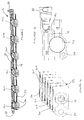
- Figure 1 is a diagrammatic view to show a fuel system of a first embodiment of the present invention,
- Figure 2 is a diagrammatic view of a rail assembly of the fuel system in Figure 1,
- Figure 3 is a top view of one end of the rail assembly in Figure 2, to show a pressure relief valve of the first rail,
- Figure 4 is a perspective view, from one end, of the rail assembly in Figures 1 to 3,
- Figure 5 is an end view of a part of the fuel system in Figure 1, to illustrate how one of the unit pumps of the system is integrated within the rail assembly housing,
- Figure 6 is a schematic view of the fuel system in Figure 1,
- Figure 7 is a sectional view of a unit pump forming part of the fuel system in Figures 1 and 6, and
- Figure 8 is an alternative sectional view of the unit pump to that shown in Figure 7, to illustrate high pressure and rail circuits of the unit pump.
-
- Referring to Figure 1, there is shown a fuel system for supplying fuel to a plurality of
fuel injectors 14a-14f (six of which are shown), each of which is supplied with fuel at an injectable pressure through respective high pressure supply lines orpassages 12a-12f. The fuel system includes pump means in the form of a plurality ofunit pumps 10a-10f, each of which is dedicated to a respective one of theinjectors 14a-14f. Eachunit pump 10a-10f is of a generally similar type to the known Electronic Unit Pump (EUP), as described previously, although the significant modifications to the construction and operation will be described in further detail later. - The
unit pumps 10a-10f are integrated with a rail assembly, referred to generally as 16, including first and second accumulator or rail volumes defined by first andsecond rails first rail 18 receives fuel at relatively low pressure from fuel supply means (not shown in Figure 1) through a rail inlet. Typically the fuel supply means includes a transfer pump feeding fuel to the rail inlet. Thesecond rail 20 receives fuel which has been pressurised to an injectable pressure level by theunit pumps 10a-10f. The first andsecond rails rail housing 22. When assembled with therail assembly 16, the unit pumps 10a,10b define an "integrated rail/pump assembly". - The
rail assembly 16 will now be described in further detail with reference to Figures 2 to 5. In Figure 5, only a first one of the unit pumps 10a is visible and this illustrates the location of theunit pump 10a relative to therail housing 22. Therail housing 22 is provided with a plurality of cross bores oropenings 24a-24f, each of which extends through thehousing 22 so as to intersect, and interrupt, thefirst rail volume 18. Each unit pump 10a-10f is mounted within therail assembly 16 so that its pump chamber (not visible) is able to communicate with thefirst rail 18 at points internally within therail housing 22, therefore avoiding the need for external pipe connections and external seals between the unit pump 10a-10f and therails second rail 20 internally within the pump/rail assembly via internal interface seals between faces of the unit pump housing and therail housing 22, as described in further detail later. - The total number of
openings 24a-24f provided in therail housing 22 is equal to the number of unit pumps 10a-10f of the system (i.e. six in the example shown), so that each opening receives a respective one of the unit pumps 10a-10f when the system is assembled. Appropriate fixing points 26, for example bolt holes, are provided for eachopening 24a-24f (indicated for thefirst opening 24a only) to provide a means of fixing or clamping each unit pump 10a-10f to an engine housing (not identified), typically the engine cylinder block, when it is received within itsopening 24a-24f. Each unit pump 10a-10f sits within theopening 24a-24f so that its longitudinal axis intersects the longitudinal axis of thefirst rail 18. - One end of the
second rail 20 is provided with apressure sensor 28 which senses the pressure of fuel within thesecond rail 20 and provides an output signal to an Engine Control Unit (ECU) (not shown). Apressure relief valve 30 is provided at the opposite end of thesecond rail 20. Thepressure relief valve 30 is electronically controllable by the ECU, which controls the pressure relief valve in response to the rail pressure sensor output signal so as to prevent over-pressurisation of fuel within thesecond rail 20. Areturn drilling 32 is provided in therail housing 16, as shown in Figure 3, to provide a flow path for fuel that is relieved through thevalve 30 into thefirst rail 18 at lower pressure. - Figure 6 shows the hydraulic arrangement of the unit pumps 10a-10f, the first and
second rails injectors 14a-14f. For simplicity only asingle injector 14a and itsdedicated unit pump 10a are shown in Figure 6 in relation to the first andsecond rails second rails injectors 14a-14f and all unit pumps 10a-10f of the system. Only a single one of the unit pumps 10a and a single one of theinjectors 14a will be described in detail, as all unit pumps and all injectors are substantially identical.
Theinjector 14a includes aninjection nozzle 34 and a control valve means in the form of a nozzle control valve 36 (alternatively referred to as a needle control valve), which is arranged to control movement of avalve needle 38 so as to control the delivery of fuel from theinjection nozzle 34. Thevalve needle 38 is engageable with a valve needle seating and movement of thevalve needle 38 away from the seating permits fuel to flow through one or more injection nozzle outlets (not indicated) into the associated engine cylinder or other combustion space. - The
nozzle control valve 36 is arranged within aflow path 40 between fuel supply means 42, which may be within the cylinder block, and an injector control chamber 44 arranged at the back end of the valve needle. A surface of thevalve needle 38 is exposed to fuel pressure within the control chamber 44, so that fuel within the control chamber 44 applies a force to thevalve needle 38 which serves to urge thevalve needle 38 against its seating. Thevalve needle 38 is provided with aneedle spring 46, housed within the control chamber 44, which also serves to urge theneedle 38 towards its closed or seated position. The fuel supply means takes the form of atransfer pump 42 for supplying fuel at relatively low pressure, typically between 3 and 7 bar, to theflow path 40. - The
injection nozzle 34 includes adelivery chamber 48 which receives fuel at an injectable pressure level through thesupply passage 12a, and from where fuel is supplied to the injection nozzle outlets when thevalve needle 38 is unseated. It will be appreciated by comparing Figure 1 and Figure 6 that the highpressure supply passage 12a between theunit pump 10a and itsinjector 14a in Figure 1 is hydraulically equivalent to the identically numbered passage in Figure 6. It will now also be appreciated that theflow path 40, identified in Figure 6, between thetransfer pump 42 and theinjector 10a is not shown in Figure 1 but may be, for example, through a gallery or rail in the cylinder head or block of the engine. - The
nozzle control valve 36 is movable between a first position (open) and a second position (closed). When thenozzle control valve 36 is opened, thesupply passage 12a communicates with the control chamber 44 of the injector so that high fuel pressure within the chamber 44 acts onvalve needle 38, in combination with theneedle spring 46, to seat thevalve needle 38. When thenozzle control valve 36 is closed, the control chamber 44 communicates with thetransfer pump 42 and communication between thesupply passage 12a and the control chamber 44 is broken, so that the pressure of fuel within the control chamber 44 acting on the valve needle is reduced. By closing thenozzle control valve 36, thevalve needle 38 is thus caused to lift due to high pressure fuel acting on valve needle thrust surfaces which are exposed to fuel pressure within thedelivery chamber 48. Operation of thenozzle control valve 36 to control fuel pressure within the control chamber 44 therefore provides a means of controlling valve needle movement towards and away from its seating to control injection. - Figure 6 also shows the
second rail 20 and the rail pressure sensor 28 (as shown in Figure 1). Communication between thesecond rail 20 and thepump chamber 52 is controlled by means of an electrically controllable valve in the form of arail control valve 58 forming part of theunit pump 10a. - Each unit pump (e.g. 10a) has a pumping element or
plunger 50 and apump chamber 52 in communication with one end of thesupply passage 12a. Theplunger 50 is movable within a plunger bore 54 provided in a unit pump housing (not identified) under the influence of a cam drive arrangement (not shown in Figure 6) so as to pressurise fuel within thepump chamber 52. The plunger bore 54 is provided with aninternal groove 55, or an enlarged diameter region, which serves to collect leakage fuel from thepump chamber 52 down the plunger bore 54 and drains to a low pressure drain, as described in further detail later. - The
pump chamber 52 also communicates with thetransfer pump 42 through a supply passage which is hydraulically equivalent to thefirst rail 18. This supply passage, orfirst rail 18, is provided with a hydraulically operablenon-return valve 56 provided with anon-return valve spring 57, and receives fuel at relatively low pressure from thetransfer pump 42, in use. If thenon return valve 56 is in its open position, thetransfer pump 42 is able to supply fuel to thepump chamber 52 at a relatively low pressure through thefirst rail 18. If thenon return valve 56 is in the closed position the communication path between thepump chamber 52 and thefirst rail 18, and hence thetransfer pump 42, is closed off. - The construction of the
unit pump 10a is shown in further detail in Figures 7 and 8. Theunit pump 10a includes a unit pump housing 60 which is provided with thebore 54 within which theplunger 50 moves and within which thepump chamber 52 is defined. Theplunger 50 has an associatedplunger return spring 62 and a tappet drive member 64 (also identified in Figure 1 as 64a-64f), as is common in a known EUP. Thetappet 64 co-operates with aroller 66 which rides over the surface of the cam so as to impart drive to thetappet 64 and, hence, to theplunger 50 so as to effect a plunger pumping stroke, during which theplunger 50 is driven inwardly within thebore 54 to reduce the volume of thepump chamber 52. Theplunger return spring 62 serves to drive a return stroke of theplunger 50, during which theplunger 50 is urged outwardly from thebore 54, increasing the volume of thepump chamber 52. - The
rail control valve 58 and thenon-return valve 56 are housed, adjacent to one another, within a railcontrol valve housing 59 located at an upper end of theunit pump 10a. Therail control valve 58 is operable by means of an electromagnetic actuator arrangement including an energisable winding 62 and an armature (not identified) coupled to a railcontrol valve member 64 so that energisation and de-energisation of the winding 62 causes movement of the railcontrol valve member 64 to open and close therail control valve 58. - The
pump chamber 52 communicates with anoutlet passage 72 defined by a drilling provided in the unit pump housing 60 which, in turn, communicates with thesupply passage 12a through ahigh pressure circuit 76 provided in the various housing parts. Theoutlet passage 72 also communicates with arail circuit 74 defined by drillings in various housing parts, depending on the position of therail control valve 58. - The fuel system is capable of providing injection at first and second injectable pressure levels, depending upon the operating state of the
rail control valve 58. In a first mode of operation, the system operates in a common rail-type mode in which plunger movement has minimal or no effect on the pressure level in thepump chamber 52 due to therail control valve 58 being open, and fuel at the first, moderate rail pressure, which is stored in thesecond rail 20, is delivered to theinjector 14a. In a second mode of operation the system operates in an EUP-type mode in which plunger movement increases the pressure level to a second higher level, due to therail control valve 58 being closed, and fuel at this higher level is delivered to theinjector 14a. - To clarify, when the
rail control valve 58 is opened, thepump chamber 52 of theunit pump 10a communicates with thesecond rail 20 through therail circuit 74 and also with thesupply passage 12a. When therail control valve 58 is closed the communication path (i.e. the rail circuit 74) between thepump chamber 52 and thesecond rail 20 is broken, and instead thepump chamber 52 communicates only with thesupply passage 12a (through the high pressure circuit 76). Actuation and de-actuation of therail control valve 58 is controlled by means of control signals supplied by the ECU. The operating state of thenozzle control valve 36 determines whether injection takes place and, thus, provides a control means for the timing of commencement and termination of injection. - Various modes of operation of the fuel system will now be described in further detail, particularly with reference to Figures 6 to 8.
- In use, during a return stroke of the
plunger 50, the volume of thepump chamber 52 is expanding and, with therail control valve 58 closed, a point will be reached at which thenon-return valve 56 opens to permit fuel to be supplied to thepump chamber 52. At the start of the plunger pumping stroke thenon-return valve 56 is still open. As the driventappet 64 acts on theplunger 50 it is urged inwardly within thebore 54, thereby reducing the volume of thepump chamber 52. With therail control valve 58 closed, movement of theplunger 50 through the pumping stroke causes fuel pressure within thepump chamber 52 to be increased. As the pressure differential across thenon-return valve 56 increases, due to increasing fuel pressure within thepump chamber 52 acting in combination with thevalve spring 57, a point will be reached at which thenon-return valve 56 is caused to close. Further movement of theplunger 50 through the pumping stroke causes fuel pressure within thepump chamber 52 to increase further, until such time as therail control valve 58 is opened to permit pressurised fuel, at a first pressure level, to fill thesecond rail 20. - During this first mode of operation the pressure level (referred to as the first pressure level) to which fuel within the
pump chamber 52 is pressurised is higher than transfer pressure supplied by thepump 42, but typically is less than the pressure that would be achieved by a high pressure common rail-type pump. Typically, for example, this first pressure level may be up to about 1000 bar. If therail control valve 58 is opened during the period for which thenon return valve 56 is closed, fuel at the first injectable pressure level is supplied, via theoutlet passage 72 and therail circuit 74, to thesecond rail 20. Fuel at this first injectable pressure level also fills thesupply passage 12a through thedrilling 76 and, hence, supplies fuel at the first injectable pressure level to theinjection nozzle 34. - Continued plunger movement through its pumping cycle causes fuel at the first pressure level to be supplied to and drawn out of the
pump chamber 52 through the openrail control valve 58, with the unit pumps 10a-10b being operable in a phased cyclical manner so that fuel volume that is displaced from onepump chamber 52 of one unit pump and supplied to thesecond rail 20 during its pumping stroke coincides with fuel within thesecond rail 20 being supplied to thepump chamber 52 of another unit pump during its return stroke, so as to maintain rail fuel volume. - In order to inject fuel at the first injectable pressure level, the
nozzle control valve 36 is actuated to move into its closed position so that fuel in the control chamber is able to return to thetransfer pump 42, therefore allowing thevalve needle 38 to open. Injection may be terminated by actuating thenozzle control valve 36 to move into its open position so that high fuel pressure is re-established within the control chamber 44 to seat theneedle 38. - If the
rail control valve 58 is closed during the plunger pumping stroke (i.e. with thenon return valve 56 closed) the pressure of fuel within thepump chamber 52, which during the start of the pumping stroke is held at about 1000 bar, will be increased during the pumping stroke of theplunger 50 to a second pressure level that is higher than the first as fuel can no longer flow into and out of thesecond rail 20. Typically, this second injectable pressure level may be between 2000 and 3000 bar. With therail control valve 58 closed, injection at the second injectable pressure level is initiated by actuating thenozzle control valve 36 to allow the control chamber to communicate with thetransfer pump 42, as described previously. In a similar manner termination of injection at the second injectable pressure level may be implemented by actuating thenozzle control valve 36 to reestablish high fuel pressure within the control chamber 44. - In order to re-fill the
second rail 20 following an injection event, therail control valve 58 is closed during the plunger return stroke. As the plunger withdraws from thepump chamber 52, increasing the pump chamber volume, the pressure drop across thenon-return valve 56 causes it to open, permitting a supply of new fuel into thepump chamber 52 ready for the next pumping cycle. - If the
rail control valve 58 is opened during the pumping stroke it will be appreciated that thenon-return valve 56 stays closed due to pressure within thepump chamber 52 being higher than transfer pressure. - It will be appreciated that the timing of operation of the
rail control valve 58 is important, so as to ensure that fuel is pressurised within thepump chamber 52 to the second pressure level at the required time (i.e. by closing the rail control valve 58) and also to ensure fuel is supplied to thepump chamber 52 by thepump 42 following an injection event. In practice, for example, the duration for which thevalve 58 is open, and the relative timing of its opening and closure, will be controlled by control signals provided by the engine controller in accordance with look-up tables or data maps containing pre-stored information. The implementation of look-up tables and data maps for control of engine fuelling and timing would be familiar to a person skilled in this technical field. - It is a further feature of the fuel system of Figures 1 to 7 that should it be desirable to reduce the pressure of fuel that is stored within the
second rail 20, thepressure relief valve 30 can be opened to permit fuel within thesecond rail 20 to flow into thefirst rail 18 at lower pressure through the return drilling 32 (as shown in Figure 3). - It is one advantage of the invention that an injection event comprising a pilot injection of fuel at a first, moderate pressure level followed by a main injection event at a second, higher pressure level can be achieved by switching the
rail control valve 58. It has been found that this combination of a pilot followed by a main injection of fuel provides a benefit for emission levels and noise. The fuel system can also be used to implement a main injection of fuel at a higher pressure level followed by a late, post injection of fuel at a lower pressure level. This can be useful for after-treatment purposes. A boot-shaped injection characteristic, comprising an initiate higher rate fuel injection immediately followed by a lower rate injection, can also be achieved through rapid switching of therail control valve 58 and thenozzle control valve 36, when appropriate. - It is a further advantage of the invention that the locality of the
first rail 18 to thesecond rail 20 provides benefits for cooling of the second rail, as cooler lower pressure fuel (i.e. at transfer pressure) within thefirst rail 18 provides a cooling effect for higher pressure fuel within thesecond rail 20. In an alternative embodiment (not illustrated), the rail/pump assembly may also be provided with means for feeding fuel pressure within thefirst rail 18 to a low pressure drain, thereby improving the cooling effect of the first rail further. For example, an additional feed drilling or passage may be provided in therail housing 22 in communication, at one end, with thefirst rail 18 and communicating at the other end with the low pressure drain. - Another benefit is achieved in that the hydraulic connection between the first rails and the
unit pump 10a is internally within therail housing 22. The need for additional pipework, additional connections and additional seals is therefore avoided. It is also an advantage that the hydraulic connection between thesecond rail 20 and theunit pump 10a is internally within the rail/pump assembly, at the interface between the unit pump housing 60 and the rail housing 22 (as can be seen in Figure 8), and so the need for external high pressure connections and seals is avoided here also. - The
rail assembly 16 is also simple and convenient to manufacture and assemble. Once therail housing 22 has been machined to provide theopenings 24a-24f, each unit pump 10a-10f, in its fully assembled state, is inserted into a respective one of theopenings 24a-24f so as to make the required communications between the pump chambers and therails openings 24a-24f, the appropriate fixing means are then inserted through the bolt holes to secure the unit pumps 10a-10f in position. - In a further modification to that described previously, a third rail volume may be provided within the
rail housing 22. The third rail volume may be arranged adjacent to, or in side by side arrangement, with the first andsecond rails plunger leakage groove 55. - In an alternative embodiment of the invention to that described previously, the
injector 14a-14f associated with each unit pump 10a-10f may itself form part of the unit pump 10a-10f (i.e. within a common housing), in an EUI-type arrangement. The EUI has a first injector end, at which the injector is arranged, and an opposite pump end, at which the pumping elements are arranged. It will be appreciated that either the injector end of the EUI or the pump end of the EUI may be inserted into therespective opening 24a-24f to mount the unit within therail assembly 16. As before, the unit pump incorporating the injector is mounted within itsrespective opening 24a-24f so that its pump chamber communicates with the pump chamber of each EUI at a point internally within theaccumulator housing 22. - It will be appreciated that although the embodiment of the invention described previously includes a
rail control valve 58 for permitting the system to switch between first and second injectable pressure levels, arail control valve 58 that operates in this manner is not an essential element of the invention. The first andsecond rails
Claims (17)
Priority Applications (6)
| Application Number | Priority Date | Filing Date | Title |
|---|---|---|---|
| DE60319968T DE60319968T2 (en) | 2003-06-20 | 2003-06-20 | Fuel system |
| EP03253919A EP1489293B1 (en) | 2003-06-20 | 2003-06-20 | Fuel system |
| AT03253919T ATE390555T1 (en) | 2003-06-20 | 2003-06-20 | FUEL SYSTEM |
| JP2006516429A JP2007516373A (en) | 2003-06-20 | 2004-06-17 | Fuel system |
| US10/561,773 US7509942B2 (en) | 2003-06-20 | 2004-06-17 | Fuel system |
| PCT/GB2004/002578 WO2004113715A1 (en) | 2003-06-20 | 2004-06-17 | Fuel system |
Applications Claiming Priority (1)
| Application Number | Priority Date | Filing Date | Title |
|---|---|---|---|
| EP03253919A EP1489293B1 (en) | 2003-06-20 | 2003-06-20 | Fuel system |
Publications (2)
| Publication Number | Publication Date |
|---|---|
| EP1489293A1 true EP1489293A1 (en) | 2004-12-22 |
| EP1489293B1 EP1489293B1 (en) | 2008-03-26 |
Family
ID=33396014
Family Applications (1)
| Application Number | Title | Priority Date | Filing Date |
|---|---|---|---|
| EP03253919A Expired - Lifetime EP1489293B1 (en) | 2003-06-20 | 2003-06-20 | Fuel system |
Country Status (6)
| Country | Link |
|---|---|
| US (1) | US7509942B2 (en) |
| EP (1) | EP1489293B1 (en) |
| JP (1) | JP2007516373A (en) |
| AT (1) | ATE390555T1 (en) |
| DE (1) | DE60319968T2 (en) |
| WO (1) | WO2004113715A1 (en) |
Cited By (4)
| Publication number | Priority date | Publication date | Assignee | Title |
|---|---|---|---|---|
| EP2063093A1 (en) * | 2007-11-26 | 2009-05-27 | Delphi Technologies, Inc. | Fuel injection system |
| CN106050507A (en) * | 2016-08-04 | 2016-10-26 | 广西玉柴机器股份有限公司 | Segmented type unit pump oil inlet pipe |
| CN106050506A (en) * | 2016-08-04 | 2016-10-26 | 广西玉柴机器股份有限公司 | Segmented type unit pump oil return pipe |
| CN113260782A (en) * | 2018-12-20 | 2021-08-13 | 雷诺股份公司 | Fuel supply device |
Families Citing this family (10)
| Publication number | Priority date | Publication date | Assignee | Title |
|---|---|---|---|---|
| EP1359316B1 (en) * | 2002-05-03 | 2007-04-18 | Delphi Technologies, Inc. | Fuel injection system |
| JP4199710B2 (en) * | 2004-08-03 | 2008-12-17 | 臼井国際産業株式会社 | Fuel delivery pipe |
| JP4209399B2 (en) * | 2005-02-25 | 2009-01-14 | 三菱重工業株式会社 | Accumulated fuel injection system |
| DE102007006865A1 (en) * | 2007-02-12 | 2008-08-14 | Siemens Ag | Internal combustion engine controlling method for use in motor vehicle, involves operating high-pressure pumps in normal mode of operation, in which two pumps together supply fuel to pressure reservoir |
| US7584747B1 (en) * | 2008-03-26 | 2009-09-08 | Caterpillar Inc. | Cam assisted common rail fuel system and engine using same |
| US20110297125A1 (en) * | 2010-06-03 | 2011-12-08 | Caterpillar Inc. | Reverse Flow Check Valve For Common Rail Fuel System |
| DE102011005096A1 (en) * | 2011-03-04 | 2012-09-06 | Man Diesel & Turbo Se | internal combustion engine |
| WO2014167166A1 (en) * | 2013-04-09 | 2014-10-16 | Wärtsilä Finland Oy | A dual fuel injection unit and dual fuel feeding arrangement |
| DE102016200643B4 (en) * | 2016-01-19 | 2018-04-19 | Continental Automotive Gmbh | Fuel injection arrangement |
| US10830194B2 (en) * | 2016-10-07 | 2020-11-10 | Caterpillar Inc. | Common rail fuel system having pump-accumulator injectors |
Citations (5)
| Publication number | Priority date | Publication date | Assignee | Title |
|---|---|---|---|---|
| EP0861380A1 (en) * | 1996-09-25 | 1998-09-02 | EJOT VERBINDUNGSTECHNIK GmbH & Co. KG | Plastic nut for joining plate-like parts |
| US5806494A (en) * | 1997-08-06 | 1998-09-15 | Caterpillar Inc. | Hydraulically actuated fuel injection system with integrated actuation fluid rail and injectors |
| EP0976926A2 (en) * | 1998-07-03 | 2000-02-02 | Wärtsilä NSD OY AB | Integrated pump and tappet unit in a fuel feeding system |
| WO2002050417A1 (en) * | 2000-12-21 | 2002-06-27 | Institut Francais Du Petrole | Liquid-phase gas fuel method and device injection for an internal combustion engine |
| DE10136925C1 (en) * | 2001-07-30 | 2002-12-12 | Orange Gmbh | Fuel injector for internal combustion engine with high-pressure piston pump and valves has pump working area linked on intake to low-pressure source and on compression to high-pressure reservoir |
Family Cites Families (19)
| Publication number | Priority date | Publication date | Assignee | Title |
|---|---|---|---|---|
| DE3326045A1 (en) * | 1983-07-20 | 1985-01-31 | Robert Bosch Gmbh, 7000 Stuttgart | FUEL INJECTION PUMP FOR INTERNAL COMBUSTION ENGINES |
| DE3509536A1 (en) * | 1984-05-09 | 1985-11-14 | Robert Bosch Gmbh, 7000 Stuttgart | FUEL INJECTION PUMP FOR INTERNAL COMBUSTION ENGINES |
| FI93985C (en) * | 1991-04-17 | 1995-06-26 | Waertsilae Diesel Int | Mounting and coupling arrangements for a fuel injection pump |
| JP2885076B2 (en) * | 1994-07-08 | 1999-04-19 | 三菱自動車工業株式会社 | Accumulator type fuel injection device |
| JPH09209867A (en) * | 1996-02-07 | 1997-08-12 | Mitsubishi Motors Corp | Fuel injection device |
| DE19641952C5 (en) * | 1996-10-11 | 2005-06-02 | Daimlerchrysler Ag | Fuel guide for a multi-cylinder internal combustion engine with mounting holes for plug-in pumps |
| FI107831B (en) * | 1998-05-20 | 2001-10-15 | Waertsilae Tech Oy Ab | Fuel Supply System |
| US6467457B1 (en) * | 1999-10-25 | 2002-10-22 | International Engine Intellectual Property Company, L.L.C. | Injector actuating fluid check and methods |
| EP1101931B1 (en) * | 1999-11-19 | 2006-08-30 | CRT Common Rail Technologies AG | High pressure common rail injection system |
| JP3775498B2 (en) * | 2000-03-31 | 2006-05-17 | 三菱ふそうトラック・バス株式会社 | Accumulated fuel injection system |
| US6405711B1 (en) * | 2000-07-27 | 2002-06-18 | Delphi Technologies, Inc. | Fuel delivery module for fuel injected internal combustion engines |
| DE10036868B4 (en) * | 2000-07-28 | 2004-07-29 | Robert Bosch Gmbh | Injector for an injection system comprising a high-pressure plenum |
| DE10112154A1 (en) * | 2001-03-14 | 2002-09-26 | Bosch Gmbh Robert | Fuel injection system |
| JP3555588B2 (en) * | 2001-03-23 | 2004-08-18 | トヨタ自動車株式会社 | Common rail fuel injector |
| DE10158951A1 (en) * | 2001-12-03 | 2003-06-12 | Daimler Chrysler Ag | Fuel Injection system for IC engine, operates with pressure conversion, has connection from control chamber and admission chamber to return line passing via common valve connection |
| DE10246208A1 (en) * | 2002-10-04 | 2004-04-15 | Robert Bosch Gmbh | Surge suppression device for storage injection system has equalizing device between high pressure storage cavity and fuel injector |
| US6845758B2 (en) * | 2003-02-19 | 2005-01-25 | International Engine Intellectual Property Company, Llc | Fuel injector retainer assembly |
| US7219655B2 (en) * | 2003-02-28 | 2007-05-22 | Caterpillar Inc | Fuel injection system including two common rails for injecting fuel at two independently controlled pressures |
| ITBO20030200A1 (en) * | 2003-04-04 | 2004-10-05 | Magneti Marelli Powertrain Spa | THIXOTROPIC ALUMINUM FUEL MANIFOLD FOR INJECTION |
-
2003
- 2003-06-20 EP EP03253919A patent/EP1489293B1/en not_active Expired - Lifetime
- 2003-06-20 AT AT03253919T patent/ATE390555T1/en not_active IP Right Cessation
- 2003-06-20 DE DE60319968T patent/DE60319968T2/en not_active Expired - Fee Related
-
2004
- 2004-06-17 US US10/561,773 patent/US7509942B2/en not_active Expired - Fee Related
- 2004-06-17 WO PCT/GB2004/002578 patent/WO2004113715A1/en not_active Ceased
- 2004-06-17 JP JP2006516429A patent/JP2007516373A/en active Pending
Patent Citations (5)
| Publication number | Priority date | Publication date | Assignee | Title |
|---|---|---|---|---|
| EP0861380A1 (en) * | 1996-09-25 | 1998-09-02 | EJOT VERBINDUNGSTECHNIK GmbH & Co. KG | Plastic nut for joining plate-like parts |
| US5806494A (en) * | 1997-08-06 | 1998-09-15 | Caterpillar Inc. | Hydraulically actuated fuel injection system with integrated actuation fluid rail and injectors |
| EP0976926A2 (en) * | 1998-07-03 | 2000-02-02 | Wärtsilä NSD OY AB | Integrated pump and tappet unit in a fuel feeding system |
| WO2002050417A1 (en) * | 2000-12-21 | 2002-06-27 | Institut Francais Du Petrole | Liquid-phase gas fuel method and device injection for an internal combustion engine |
| DE10136925C1 (en) * | 2001-07-30 | 2002-12-12 | Orange Gmbh | Fuel injector for internal combustion engine with high-pressure piston pump and valves has pump working area linked on intake to low-pressure source and on compression to high-pressure reservoir |
Cited By (5)
| Publication number | Priority date | Publication date | Assignee | Title |
|---|---|---|---|---|
| EP2063093A1 (en) * | 2007-11-26 | 2009-05-27 | Delphi Technologies, Inc. | Fuel injection system |
| US8011349B2 (en) | 2007-11-26 | 2011-09-06 | Delphi Technologies Holdings S.arl | Fuel injection system |
| CN106050507A (en) * | 2016-08-04 | 2016-10-26 | 广西玉柴机器股份有限公司 | Segmented type unit pump oil inlet pipe |
| CN106050506A (en) * | 2016-08-04 | 2016-10-26 | 广西玉柴机器股份有限公司 | Segmented type unit pump oil return pipe |
| CN113260782A (en) * | 2018-12-20 | 2021-08-13 | 雷诺股份公司 | Fuel supply device |
Also Published As
| Publication number | Publication date |
|---|---|
| WO2004113715A1 (en) | 2004-12-29 |
| ATE390555T1 (en) | 2008-04-15 |
| EP1489293B1 (en) | 2008-03-26 |
| DE60319968T2 (en) | 2009-04-16 |
| US20060144368A1 (en) | 2006-07-06 |
| DE60319968D1 (en) | 2008-05-08 |
| JP2007516373A (en) | 2007-06-21 |
| US7509942B2 (en) | 2009-03-31 |
Similar Documents
| Publication | Publication Date | Title |
|---|---|---|
| EP1359316B1 (en) | Fuel injection system | |
| EP1489293B1 (en) | Fuel system | |
| US6167869B1 (en) | Fuel injector utilizing a multiple current level solenoid | |
| US5947380A (en) | Fuel injector utilizing flat-seat poppet valves | |
| US6651625B1 (en) | Fuel system and pump suitable for use therein | |
| US6405940B2 (en) | Fuel injector | |
| US8113175B2 (en) | Fuel injection system | |
| US5984210A (en) | Fuel injector utilizing a solenoid having complementarily-shaped dual armatures | |
| US7404393B2 (en) | Fuel injection system | |
| EP0913574B1 (en) | Fuel injector solenoid utilizing an apertured armature | |
| US5934559A (en) | Electronic fuel injector with internal single-pole solenoid and center flow post | |
| US5915624A (en) | Fuel injector utilizing a biarmature solenoid | |
| US5971300A (en) | Fuel injector employing center fuel flow and pressure-assisted check closing | |
| US6758416B2 (en) | Fuel injector having an expansion tank accumulator | |
| US20040099246A1 (en) | Fuel injector with multiple control valves | |
| US7451743B2 (en) | Fuel injection system with accumulator fill valve assembly |
Legal Events
| Date | Code | Title | Description |
|---|---|---|---|
| PUAI | Public reference made under article 153(3) epc to a published international application that has entered the european phase |
Free format text: ORIGINAL CODE: 0009012 |
|
| AK | Designated contracting states |
Kind code of ref document: A1 Designated state(s): AT BE BG CH CY CZ DE DK EE ES FI FR GB GR HU IE IT LI LU MC NL PT RO SE SI SK TR |
|
| AX | Request for extension of the european patent |
Extension state: AL LT LV MK |
|
| 17P | Request for examination filed |
Effective date: 20050127 |
|
| 17Q | First examination report despatched |
Effective date: 20050622 |
|
| AKX | Designation fees paid |
Designated state(s): AT BE BG CH CY CZ DE DK EE ES FI FR GB GR HU IE IT LI LU MC NL PT RO SE SI SK TR |
|
| 17Q | First examination report despatched |
Effective date: 20050622 |
|
| GRAP | Despatch of communication of intention to grant a patent |
Free format text: ORIGINAL CODE: EPIDOSNIGR1 |
|
| GRAS | Grant fee paid |
Free format text: ORIGINAL CODE: EPIDOSNIGR3 |
|
| GRAA | (expected) grant |
Free format text: ORIGINAL CODE: 0009210 |
|
| AK | Designated contracting states |
Kind code of ref document: B1 Designated state(s): AT BE BG CH CY CZ DE DK EE ES FI FR GB GR HU IE IT LI LU MC NL PT RO SE SI SK TR |
|
| REG | Reference to a national code |
Ref country code: GB Ref legal event code: FG4D |
|
| REG | Reference to a national code |
Ref country code: CH Ref legal event code: EP Ref country code: IE Ref legal event code: FG4D |
|
| REF | Corresponds to: |
Ref document number: 60319968 Country of ref document: DE Date of ref document: 20080508 Kind code of ref document: P |
|
| PG25 | Lapsed in a contracting state [announced via postgrant information from national office to epo] |
Ref country code: FI Free format text: LAPSE BECAUSE OF FAILURE TO SUBMIT A TRANSLATION OF THE DESCRIPTION OR TO PAY THE FEE WITHIN THE PRESCRIBED TIME-LIMIT Effective date: 20080326 |
|
| PG25 | Lapsed in a contracting state [announced via postgrant information from national office to epo] |
Ref country code: AT Free format text: LAPSE BECAUSE OF FAILURE TO SUBMIT A TRANSLATION OF THE DESCRIPTION OR TO PAY THE FEE WITHIN THE PRESCRIBED TIME-LIMIT Effective date: 20080326 |
|
| NLV1 | Nl: lapsed or annulled due to failure to fulfill the requirements of art. 29p and 29m of the patents act | ||
| PG25 | Lapsed in a contracting state [announced via postgrant information from national office to epo] |
Ref country code: SI Free format text: LAPSE BECAUSE OF FAILURE TO SUBMIT A TRANSLATION OF THE DESCRIPTION OR TO PAY THE FEE WITHIN THE PRESCRIBED TIME-LIMIT Effective date: 20080326 Ref country code: BE Free format text: LAPSE BECAUSE OF FAILURE TO SUBMIT A TRANSLATION OF THE DESCRIPTION OR TO PAY THE FEE WITHIN THE PRESCRIBED TIME-LIMIT Effective date: 20080326 |
|
| PG25 | Lapsed in a contracting state [announced via postgrant information from national office to epo] |
Ref country code: SK Free format text: LAPSE BECAUSE OF FAILURE TO SUBMIT A TRANSLATION OF THE DESCRIPTION OR TO PAY THE FEE WITHIN THE PRESCRIBED TIME-LIMIT Effective date: 20080326 Ref country code: SE Free format text: LAPSE BECAUSE OF FAILURE TO SUBMIT A TRANSLATION OF THE DESCRIPTION OR TO PAY THE FEE WITHIN THE PRESCRIBED TIME-LIMIT Effective date: 20080626 Ref country code: CZ Free format text: LAPSE BECAUSE OF FAILURE TO SUBMIT A TRANSLATION OF THE DESCRIPTION OR TO PAY THE FEE WITHIN THE PRESCRIBED TIME-LIMIT Effective date: 20080326 Ref country code: ES Free format text: LAPSE BECAUSE OF FAILURE TO SUBMIT A TRANSLATION OF THE DESCRIPTION OR TO PAY THE FEE WITHIN THE PRESCRIBED TIME-LIMIT Effective date: 20080707 Ref country code: PT Free format text: LAPSE BECAUSE OF FAILURE TO SUBMIT A TRANSLATION OF THE DESCRIPTION OR TO PAY THE FEE WITHIN THE PRESCRIBED TIME-LIMIT Effective date: 20080901 |
|
| ET | Fr: translation filed | ||
| PG25 | Lapsed in a contracting state [announced via postgrant information from national office to epo] |
Ref country code: RO Free format text: LAPSE BECAUSE OF FAILURE TO SUBMIT A TRANSLATION OF THE DESCRIPTION OR TO PAY THE FEE WITHIN THE PRESCRIBED TIME-LIMIT Effective date: 20080326 Ref country code: NL Free format text: LAPSE BECAUSE OF FAILURE TO SUBMIT A TRANSLATION OF THE DESCRIPTION OR TO PAY THE FEE WITHIN THE PRESCRIBED TIME-LIMIT Effective date: 20080326 |
|
| PG25 | Lapsed in a contracting state [announced via postgrant information from national office to epo] |
Ref country code: DK Free format text: LAPSE BECAUSE OF FAILURE TO SUBMIT A TRANSLATION OF THE DESCRIPTION OR TO PAY THE FEE WITHIN THE PRESCRIBED TIME-LIMIT Effective date: 20080326 Ref country code: MC Free format text: LAPSE BECAUSE OF NON-PAYMENT OF DUE FEES Effective date: 20080630 |
|
| PLBE | No opposition filed within time limit |
Free format text: ORIGINAL CODE: 0009261 |
|
| REG | Reference to a national code |
Ref country code: CH Ref legal event code: PL |
|
| STAA | Information on the status of an ep patent application or granted ep patent |
Free format text: STATUS: NO OPPOSITION FILED WITHIN TIME LIMIT |
|
| GBPC | Gb: european patent ceased through non-payment of renewal fee |
Effective date: 20080626 |
|
| 26N | No opposition filed |
Effective date: 20081230 |
|
| PG25 | Lapsed in a contracting state [announced via postgrant information from national office to epo] |
Ref country code: EE Free format text: LAPSE BECAUSE OF FAILURE TO SUBMIT A TRANSLATION OF THE DESCRIPTION OR TO PAY THE FEE WITHIN THE PRESCRIBED TIME-LIMIT Effective date: 20080326 Ref country code: IE Free format text: LAPSE BECAUSE OF NON-PAYMENT OF DUE FEES Effective date: 20080620 Ref country code: BG Free format text: LAPSE BECAUSE OF FAILURE TO SUBMIT A TRANSLATION OF THE DESCRIPTION OR TO PAY THE FEE WITHIN THE PRESCRIBED TIME-LIMIT Effective date: 20080626 |
|
| PG25 | Lapsed in a contracting state [announced via postgrant information from national office to epo] |
Ref country code: CH Free format text: LAPSE BECAUSE OF NON-PAYMENT OF DUE FEES Effective date: 20080630 Ref country code: GB Free format text: LAPSE BECAUSE OF NON-PAYMENT OF DUE FEES Effective date: 20080626 Ref country code: LI Free format text: LAPSE BECAUSE OF NON-PAYMENT OF DUE FEES Effective date: 20080630 |
|
| PGFP | Annual fee paid to national office [announced via postgrant information from national office to epo] |
Ref country code: IT Payment date: 20090622 Year of fee payment: 7 |
|
| PG25 | Lapsed in a contracting state [announced via postgrant information from national office to epo] |
Ref country code: CY Free format text: LAPSE BECAUSE OF FAILURE TO SUBMIT A TRANSLATION OF THE DESCRIPTION OR TO PAY THE FEE WITHIN THE PRESCRIBED TIME-LIMIT Effective date: 20080326 |
|
| PGFP | Annual fee paid to national office [announced via postgrant information from national office to epo] |
Ref country code: DE Payment date: 20090619 Year of fee payment: 7 |
|
| PG25 | Lapsed in a contracting state [announced via postgrant information from national office to epo] |
Ref country code: LU Free format text: LAPSE BECAUSE OF NON-PAYMENT OF DUE FEES Effective date: 20080620 Ref country code: HU Free format text: LAPSE BECAUSE OF FAILURE TO SUBMIT A TRANSLATION OF THE DESCRIPTION OR TO PAY THE FEE WITHIN THE PRESCRIBED TIME-LIMIT Effective date: 20080927 |
|
| PG25 | Lapsed in a contracting state [announced via postgrant information from national office to epo] |
Ref country code: TR Free format text: LAPSE BECAUSE OF FAILURE TO SUBMIT A TRANSLATION OF THE DESCRIPTION OR TO PAY THE FEE WITHIN THE PRESCRIBED TIME-LIMIT Effective date: 20080326 |
|
| PG25 | Lapsed in a contracting state [announced via postgrant information from national office to epo] |
Ref country code: GR Free format text: LAPSE BECAUSE OF FAILURE TO SUBMIT A TRANSLATION OF THE DESCRIPTION OR TO PAY THE FEE WITHIN THE PRESCRIBED TIME-LIMIT Effective date: 20080627 |
|
| REG | Reference to a national code |
Ref country code: FR Ref legal event code: ST Effective date: 20110228 |
|
| PG25 | Lapsed in a contracting state [announced via postgrant information from national office to epo] |
Ref country code: IT Free format text: LAPSE BECAUSE OF NON-PAYMENT OF DUE FEES Effective date: 20100620 |
|
| PG25 | Lapsed in a contracting state [announced via postgrant information from national office to epo] |
Ref country code: DE Free format text: LAPSE BECAUSE OF NON-PAYMENT OF DUE FEES Effective date: 20110101 |
|
| PG25 | Lapsed in a contracting state [announced via postgrant information from national office to epo] |
Ref country code: FR Free format text: LAPSE BECAUSE OF NON-PAYMENT OF DUE FEES Effective date: 20100630 |
|
| PGFP | Annual fee paid to national office [announced via postgrant information from national office to epo] |
Ref country code: FR Payment date: 20090611 Year of fee payment: 7 |