EP1489175A1 - Modified promoter - Google Patents
Modified promoter Download PDFInfo
- Publication number
- EP1489175A1 EP1489175A1 EP03744981A EP03744981A EP1489175A1 EP 1489175 A1 EP1489175 A1 EP 1489175A1 EP 03744981 A EP03744981 A EP 03744981A EP 03744981 A EP03744981 A EP 03744981A EP 1489175 A1 EP1489175 A1 EP 1489175A1
- Authority
- EP
- European Patent Office
- Prior art keywords
- promoter
- dna fragment
- modified
- sre
- amylase
- Prior art date
- Legal status (The legal status is an assumption and is not a legal conclusion. Google has not performed a legal analysis and makes no representation as to the accuracy of the status listed.)
- Withdrawn
Links
Images




Classifications
-
- C—CHEMISTRY; METALLURGY
- C12—BIOCHEMISTRY; BEER; SPIRITS; WINE; VINEGAR; MICROBIOLOGY; ENZYMOLOGY; MUTATION OR GENETIC ENGINEERING
- C12N—MICROORGANISMS OR ENZYMES; COMPOSITIONS THEREOF; PROPAGATING, PRESERVING, OR MAINTAINING MICROORGANISMS; MUTATION OR GENETIC ENGINEERING; CULTURE MEDIA
- C12N15/00—Mutation or genetic engineering; DNA or RNA concerning genetic engineering, vectors, e.g. plasmids, or their isolation, preparation or purification; Use of hosts therefor
- C12N15/09—Recombinant DNA-technology
- C12N15/63—Introduction of foreign genetic material using vectors; Vectors; Use of hosts therefor; Regulation of expression
- C12N15/79—Vectors or expression systems specially adapted for eukaryotic hosts
- C12N15/80—Vectors or expression systems specially adapted for eukaryotic hosts for fungi
Definitions
- the present invention relates to an improvement in a promoter used for producing a protein. More particularly, the present invention relates to a modified promoter obtained by modifying a promoter capable of functioning in a filamentous fungus. Furthermore, the present invention relates to a protein production system using the modified promoter.
- Aspergillus filamentous fungi secrete a large amount of various enzyme proteins to the outside of the fungus body. For example, it is said that industrially used Aspergillus oryzae produces several tens grams or more of enzyme proteins per litter of culture medium.
- the use of filamentous fungi as a host enables secretion production of homogenous and heterogeneous proteins with high productivity.
- many strains of filamentous fungi have conventionally been used for production of brewing products, and so it can be said that the filamentous fungi are suitable for producing proteins also from the viewpoint of safety. Therefore, in recent years, examples in which filamentous fungi are used as a host for producing useful proteins by gene recombination has been reported.
- the amount of produced proteins is determined by various factors in the process from the expression of a targeted protein to the modification of the protein.
- the most effective means for increasing the production amount of proteins is to enhance the transcription efficiency, that is, to increase the amount of transcription. From such a viewpoint, promoters derived from various filamentous fungi have been isolated and protein production systems using the promoters have been reported to date.
- a promoter of amylase gene of Aspergillus oryzae (see, for example, JP 62 (1987)-272988A and Biotechnology, 5, 368 (1987)), a promoter of glucoamylase gene of Aspergillus niger (see, for example, Biotechnology, 6, 1419 (1988)) have been isolated and used.
- examples of attempts that have been carried out to produce useful proteins using filamentous fungi with high efficiency include, mainly, producing bacteria with high productivity by classical breeding, and isolating naturally occurring higher expression promoter.
- attempts have required much labor and been much dependent upon the contingency, so that possibility of obtaining high expression promoter is low.
- the capability of expression control of promoters is improved, such problems could radically be resolved.
- modification of ⁇ -glucosidase gene of Aspergillus oryzae has been reported (see, for example, JP 9(1999)-9968A and Appl. Microbiol. Biotechnol., 50, 459-467 (1998)).
- the present invention was completed based on the above-mentioned background and has an object to provide a base sequence involved in expression regulation by a promoter. Furthermore, it is also an object of the present invention to provide a modified promoter with high expression activity by modifying a promoter based on the information of this base sequence. Furthermore, it is also an object of the present invention to construct an expression system (production system) of proteins using the filamentous fungus as a host by using this modified promoter.
- the present investors have carried out the following investigations. That is to say, the present inventors have paid attention to Taka-amylase A gene of Aspergillus oryzae which is known to have a high promoter activity, and, by modifying this promoter, attempted to obtain a modified promoter with a higher transcription activity. As a result, the present inventors have found a pair of sequences capable of enhancing the transcription activity by inserting thereof into a promoter region. By using the promoter modified by the sequences, it was possible to obtain an Aspergillus nidulans strain capable of producing amylase with high productivity. From further investigation, in a strain into which multiple copies of amylase genes having the modified promoter, more efficient production of proteins was observed.
- the present invention was completed based on the above-mentioned findings and provides the following configurations.
- a function capable of enhancing the promoter activity in the present invention is referred to as an "enhancer function.”
- the present inventors paid attention to a CCAAT sequence (SEQ ID NO: 3) and SRE (SEQ ID NO: 6) of the promoter region being widely conserved in genus Aspergillus, and investigated the influence on the promoter activity when theses sequences are exogenously inserted in the promoter region.
- a plasmid including a promoter region of a Taka-amylase A gene of an Aspergillus oryzae strain JCM02239 was constructed.
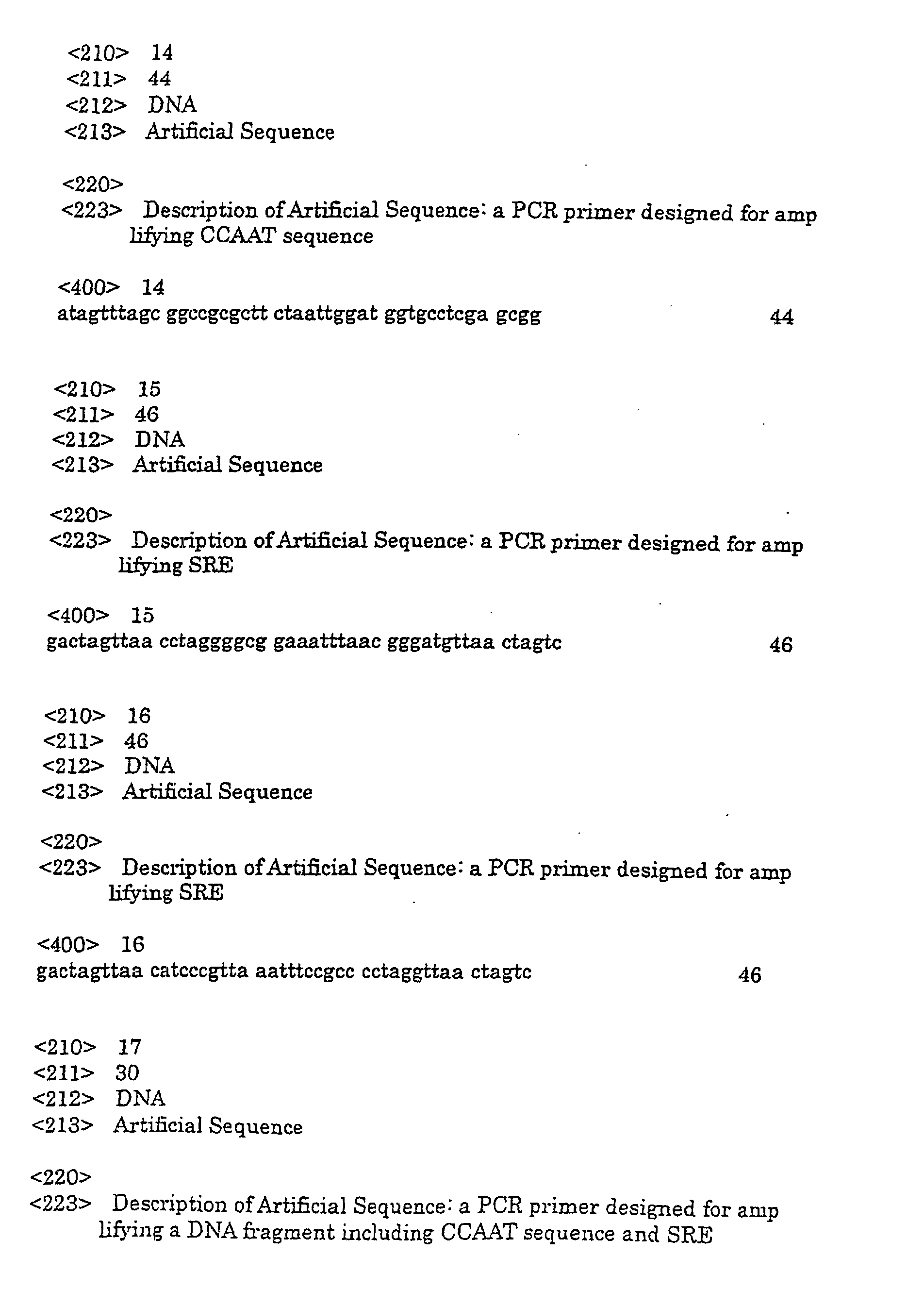
- a DNA fragment including a CCAAT sequence and a DNA fragment including SRE were obtained, respectively. Then, each DNA fragment was singly inserted into a promoter region of the above-mentioned plasmid so as to construct amodified promoter. Next, a plasmid including each of the modif ied promoters and coding region of the Taka-amylase A gene was prepared. By using the thus obtained plasmids, respectively, Aspergillus nidulans was transformed. The transformants were compared with each other.
- the amylase activity of the transformant having a modified promoter in which the CCAAT sequence or the SRE was inserted was lower than or substantially equal to that of transformant having a promoter that was not modified. Furthermore, when a case where the promoter was modified by inserting a plurality of the CCAAT sequences or a plurality of the SREs were inserted so as to modify the promoter was investigated, similarly the increase in the promoter activity was not observed. From the above-mentioned results, it was anticipated that even if a promoter is modified by inserting the CCAAT sequence or the SRE singly into the promoter region, the promoter activity cannot increase.
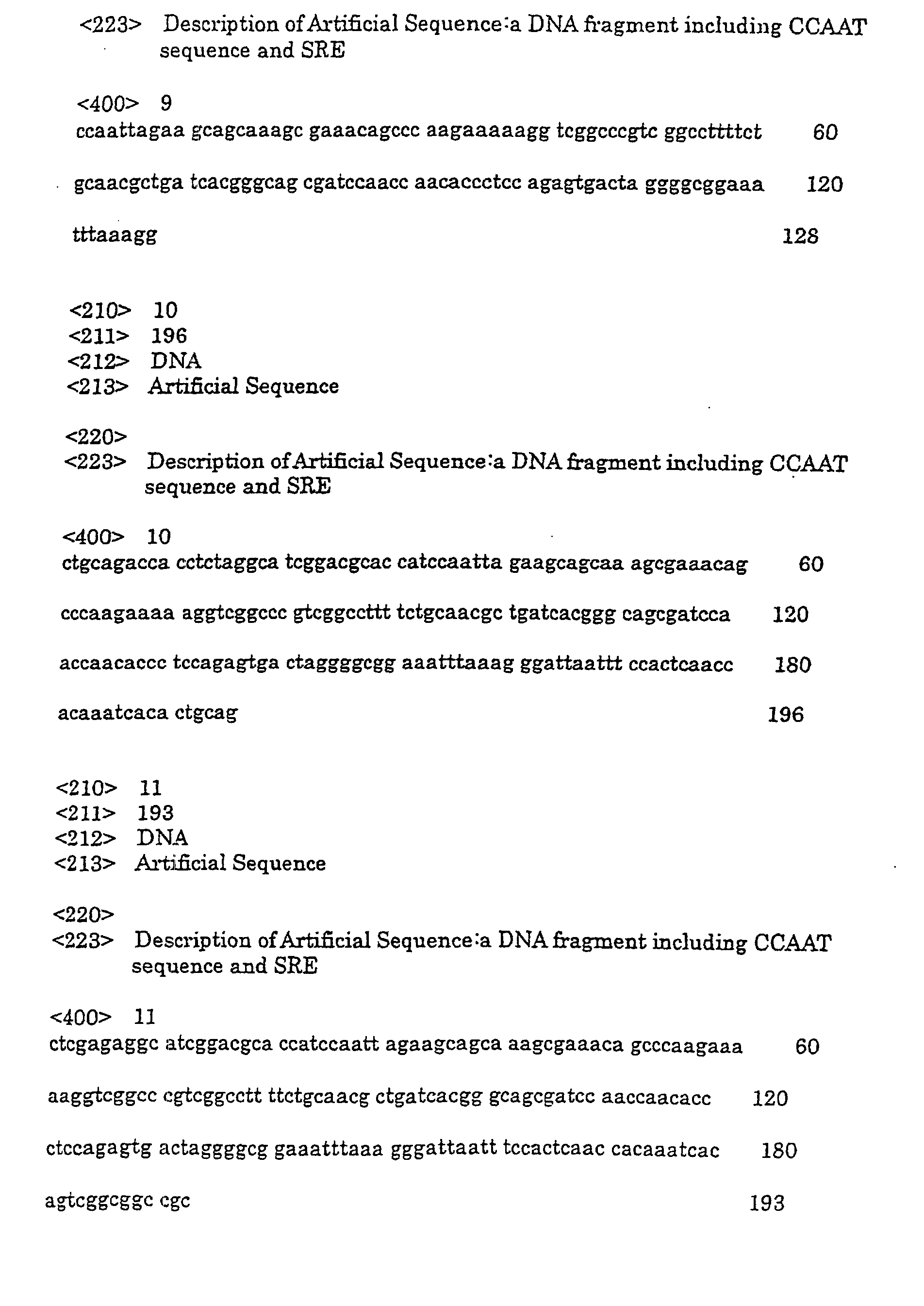
- a DNA fragment including the CCAAT sequence and the SRE (CCAAT-SRE fragment: SEQ ID NO: 9) was produced using a promoter region of a Taka-amylase A gene of an Aspergillus oryzae strain JCM02239 as a template.
- a modified promoter of a Taka-amylase A gene was constructed by the same method as mentioned above.
- the function of the DNA sequence can be occasionally maintained.
- the CCAAT sequence is known as a binding sequence of wide domain transcription activation factor (HAP). It was reported that for this binding, the CCAAT sequence at the 5'-end side was important. Therefore, even if bases other than those of the CCAAT sequence at the 5' -end side are substituted, it is expected that the enhancer function of the CCAAT sequence is maintained.
- HAP wide domain transcription activation factor
- the present inventors investigated whether or not the enhancer function of the SRE was maintained in a case where a part of the bases is substituted. Firstly, by a PCR reaction using a primer designed so that a part of the SRE was substituted, a DNA fragment including the CCAAT sequence and the SRE (CGGAATTTAAACGG : SEQ ID NO: 7) with a part of the bases substituted of the promoter region of a Taka-amylase A gene was obtained. Then, by the same method as mentioned above, a modified promoter in which this DNA fragment was inserted and modification was carried out was produced.
- the enhancer function is expected to be maintained.
- the bases in the 6th to 9th and 11th positions from the 5'-end side, and further preferably the bases in the 4th to 11th positions from the 5'-end side is A or T.
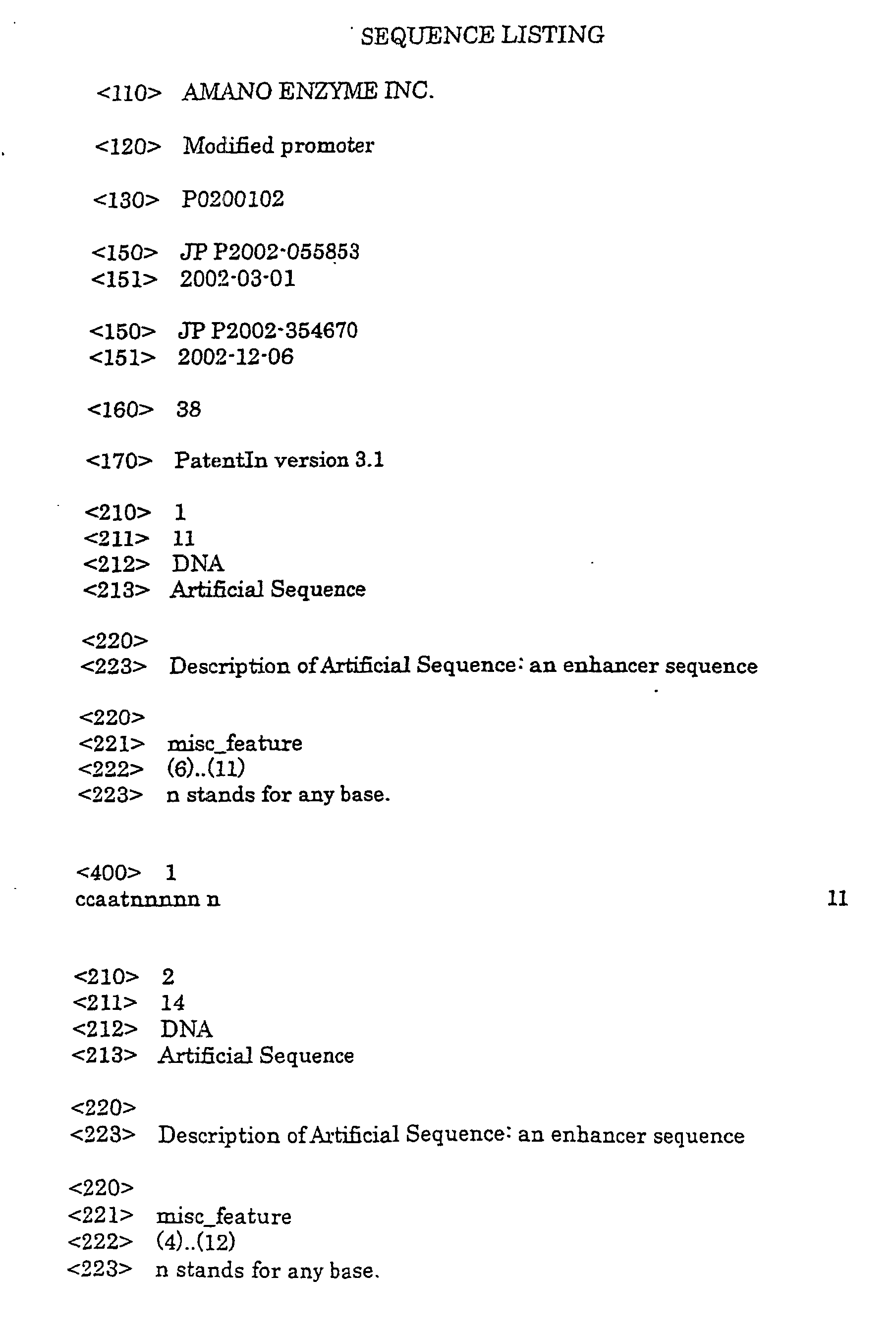
- the base sequence of the first DNA fragment used for modification of the promoter region of the present invention is preferably CCAATTAGAAG (SEQ ID NO: 3).
- the base sequence of the second DNA fragment is preferably CGGHNWWWWNWHGG (SEQ ID NO: 4), more preferably CGGWWWWWWWHGG (SEQ ID NO: 5), and yet further preferably CGGAAATTTAAAGG (SEQ ID NO: 6), CGGAATTTAAACGG (SEQ ID NO: 7) or CGGAAATTTAACGG (SEQ ID NO: 8).
- N in the base sequence denotes A (adenine), G (guanine), C(cytosine), or T (thymine); W denotes A (adenine) or T (thymine); and H denotes A (adenine), C (cytosine) or T (thymine), respectively.
- the sequence obtained by substituting the base in the 12th position from the 5' -end side of the SRE by C has a more excellent enhancer function per se, it can be said that a promoter can be modified by only this sequence. That is to say, the sequence (CGGAAATTTAACGG:SEQ ID NO: 8) is useful for modifying a promoter and by using the sequence singly, it is possible to construct a promoter with high activity.
- the present inventors have investigated the relation between the modification of the promoter region by inserting the CCAAT-SRE fragment and the catabolite repression. Firstly, a promoter in which one copy of CCAAT-SRE fragment was inserted and promoters in which two copies and three copies of CCAAT-SRE fragments were respectively inserted were prepared. Then, the transformant into which a Taka-amylase gene including any of a promoter to which the modification is not provided and a modified promoter is inserted were respectively obtained, and the amylase activities of fungi grown in a medium containing glucose as a carbon source were compared with each other.
- a promoter is modified by inserting a plurality of CCAAT fragments and SRE fragments into a promoter.
- the first DNA fragment and the second DNA fragment can be synthesized by using, for example, a commercially available DNA synthesizer. Furthermore, for example, they can be prepared by a PCR method with appropriate primers by using a promoter region of a Taka-amylase A gene of Aspergillus oryzae as a template. Also, the modified promoter of the present invention can be prepared by preparing one DNA fragment including the first DNA fragment and the second DNA fragment, and then integrating this into a promoter capable of functioning in filamentous fungi.
- such a DNA fragment can be prepared as follows, that is, a promoter including sequences corresponding to the first DNA fragment and the second DNA fragment is selected from promoters in Aspergillus genera, and a PCR method using this promoter as a template is carried out.
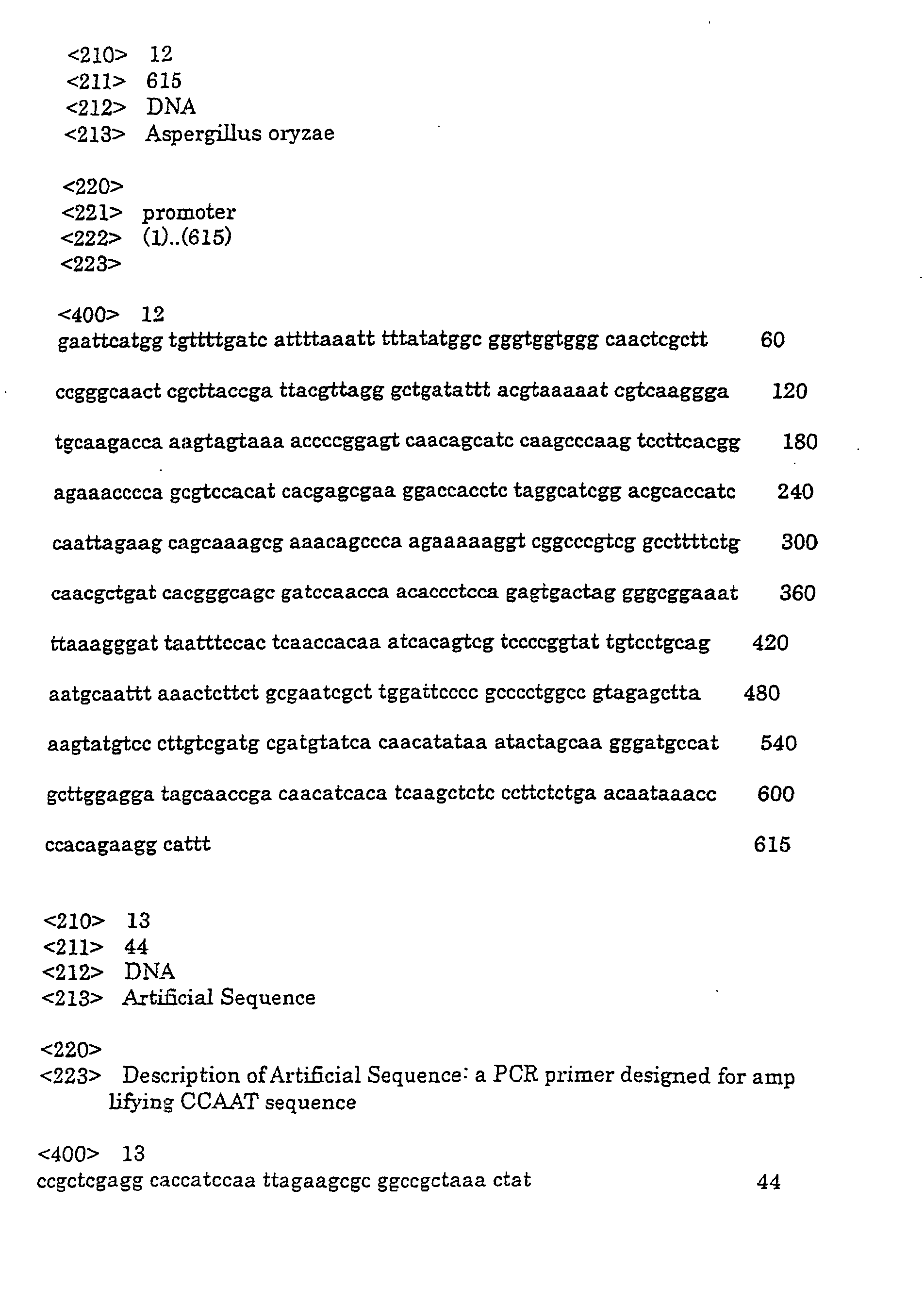
- An example of the preferable promoter to be used as a template can include a promoter of a Taka-amylase A gene of Aspergillus oryzae (SEQ ID NO: 12).
- SEQ ID NO: 12 Taka-amylase A gene of Aspergillus oryzae
- One example of the base sequence of the DNA fragment used for modification of a promoter in the present invention is shown in SEQ ID NO: 9.
- This DNA fragment (CCAAT-SRE fragment) is apart (positions from 240 to 367 (positions - 312 to-185 when transcription initiation site is +1)) of the promoter region of a Taka-amylase A gene of Aspergillus oryzae .
- a DNA fragment obtained by modifying a part of this fragment can be used for modification of a promoter region as long as it has a function (enhancer function) capable of enhancing the promoter into which it is integrated.
- a part of modification denotes that a part of the bases constitute the DNA fragment is substituted, deleted, or one to several bases are added or inserted. Allowable degree of such modification is dependent upon a site on the DNA fragment to be modified.
- a portion that is important for enhancer function is a sequence portion corresponding to the first DNA fragment and the second DNA fragment, it is preferable that this sequence portion is less modified.
- relatively large modification can be allowed. For example, about 1 to 20, preferably 1 to 10, and furthermore preferably 1 to 5 bases can be substituted, deleted, and added. Note here that suchmodification includes insertion of a restriction enzyme recognition sequence to the 5' -end, 3'-end or other sites, or addition of a sequence coding signal peptide, and the like.
- the first DNA fragment and the second DNA fragment are inserted in a promoter capable of functioning in filamentous fungi and thus a modified promoter is constructed, but the insertion site of these DNA fragments is not particularly limited.
- a promoter having a CCAAT sequence and SRE is employed as a promoter to be modified, these DNA fragments are preferably inserted in sites other than the site between these two sequences. That is to say, it is preferable that these DNA fragments having an enhancer function are inserted in the site at the 5'-end side with respect to the CCAAT sequence or in the site at the 3' -end side with respect to the SRE.
- the modified promoter of the present invention can prepared.
- the number of the first DNA fragments and the number of the second DNA fragments are the same as each other.
- one first DNA fragment and one second DNA fragment are combined as a pair, and in each pair, the first DNA fragment and the second DNA fragment are inserted so that the first DNA fragment is located at the 5'-end side of the promoter.
- a promoter may be modified.
- a promoter having a CCAAT sequence and SRE is employed as a promoter to be modified, the DNA fragments are preferably inserted in sites other than the site between these two sequences.
- the number of DNA fragments to be integrated is more preferably two than one, and more preferably three than two.
- the insertion of the DNA fragment can block or release the mechanism working for suppressing the promoter activity (it is shown to be effective in removing the catabolite repression in producing amylase).
- the kind of the promoter capable of functioning in filamentous fungi of the present invention is not particularly limited as long as it has a nature of functioning in filamentous fungi.
- Examples thereof include a promoter of gene encoding proteins in microorganism such as genus Aspergillus, genus Penicillium, genus Trichoderma , etc.
- a promoter of gene encoding a-amylase, glucoamylase, a-glucosidase, etc. of genus Aspergillus can be used.
- a promoter of a Taka-amylase of Aspergillus oryzae is preferably used.
- promoters can be obtained from a microorganism possessing them by genetic engineering technique such as a restriction enzyme treatment, a PCR method, etc. Furthermore, when a vector in which a targeted promoter is integrated is available, the promoters can be obtained from the vector by genetic engineering technique such as a restriction enzyme treatment, a PCR method, etc.
- filamentous fungi in the present invention denote filamentous fungi in a broad sense and it also includes yeast.
- the present invention provides a vector in which the above-mentioned modified promoter is integrated.
- Such vectors can be used for producing a protein of interest.
- an expression vector is constructed by introducing a structural gene of a protein of interest under control of the modified promoter.
- An appropriate host is transformed by using this, and the transformant in which a modified promoter and the structural gene of the protein of interest are appropriately introduced is cultured in conditions capable of producing the protein.
- the protein of interest is collected from the culture medium or fungus body.
- the vector in which the modified promoter is integrated used in the present invention includes a vector in which a structural gene of a specific protein is integrated under control of the modified promoter.
- the vector of the present invention has a selection marker suitable for selecting the transformant when filamentous fungi as a host are transformed.
- a selection marker an appropriate selection maker can be employed depending on the host to be used.
- the selection marker includes an auxotrophic complementary gene such as ornithine carbamoyltransferase gene (argB), nitrate reduction enzyme gene (niaD), acetamidase gene (amdS), tryptophan synthase gene (trpC), dihydrof olate reductase gene (DHFR), etc., and drug resistant gene against oligomycin, destomycin, hygromycin, etc.
- filamentous fungi classified into genus Aspergillus (Aspergillus oryzae , Aspergillus niger, Aspergillus nidulans ), genus Penicillium, genus Trichoderma , genus Rhizopus, etc. can be used.
- filamentous fungi of genus Aspergillus is used.
- Aspergillus oryzae or niger is preferably used.
- the present inventors have produced a transformant obtained by inserting an amylase gene of Aspergillus oryzae into Aspergillus oryzae as a host, and further transformant of laccase gene, which is much different from Aspergillus oryzae in terms of phylogenetic systematics, and confirmed the expression of proteins.
- the proteins that can be produced by using the modified promoter of the present invention are not particularly limited. Examples include sugar-related enzyme such as a-amylase, glucoamylase, a-glucosidase, cellulase, pectinase, etc.; oxidation-reduction enzyme such as laccase, peroxidase, etc.; protease such as chymosin; lipase, and the like.
- the protein may be homogeneous protein or may be a heterogeneous protein.
- the introduction of the vector of the present invention into a host can be carried out by a conventional method.
- it can be carried out by the method by Turner et al. using, for example, fungus body as a protoplast (see Gene, 36, 321-331 (1985)).
- the method by Gomi et al. (Agric. Biol. Chem. , 51, 323-328 (1987)) may be employed.
- the trans formant in which the modified promoter of the present invention and the structural gene of a protein of interest are appropriately inserted is cultured in conditions capable of expressing the structural gene.
- the protein of interest can be produced.
- a culture medium an appropriate one can be used depending upon the host to be used. For example, various media which are commercially available or medium which is obtained by adding to one of these media components such as arginine, uridine, which are necessary for development, selection and promoting expression of proteins can be used.
- the protein of interest can be collected from the culture medium or fungus body after desirable time of culture. That is to say, if the protein is a secretory protein, the proteins can be collected from the culture medium, and if the protein is other than the secretary protein, they can be collected from the fungus body.
- the protein of interest can be obtained as follows. For example, the culture supernatant is filtrated and centrifuged, so that impurities are removed. Then, separation and purification is carried out by employing the combination of salting out such as an ammonium sulfate precipitation, dialysis, various chromatographies, and the like.
- the proteins of interest are collected from the fungus body, for example, fungus body is disrupted by compression process, ultrasonic process, etc. Then, separation and purification are carried out by the same method as mentioned above, and thereby the proteins of interest can be obtained. Note here that the above-mentioned series of processes (disrupting the fungus body, separation and purification) may be carried out after previously collecting the fungus body by filtration, centrifugation, etc.
- pTG-taa (Mol. Gene. Genet., 254, 119-126 (1997)] including 3164 bp of a Taka-amylase A gene ( taaG2) of an Aspergillus oryzae strain JCM02239 [Gene, 84, 319-327 (1989)] as a starting material
- a Taka-amylase A gene promoter region and a coding region of Taka-amylase A gene were prepared.
- 750bp of Eco RI -Sal I fragment including a Taka-amylase A ( taaG2) promoter region was obtained.
- This fragment was inserted into an Eco RI -Sal I site of a multicloning site of a plasmid pKF18K (Toyobo Co., Ltd.) to obtain a plasmid pKF-taaP including a Taka-amylase promoter. Introducing mutation into a promoter region and the construction of the modif ied promoter region were carried out using this plasmid.
- a fragment including a CCAAT sequence [Mol. Gen. Genet., 237,251-260(1993)] that is abindingfactorof apreviouslyreported wide-domain transcription activation factor (HAP) and SRE [Mol. Gen. Genet., 262, 668-676(1999)] that is a binding factor of transcription activation factor of starch degrading enzyme gene cluster (AmyR) was obtained as follows.
- XNF 5'-CCGCTCGAGGCACCATCCAATTAGAAGCGCGGCCGCTAAACTAT3' : SEQ ID NO: 13
- XNR 5'-ATAGTTTAGCGGCCGCGCTTCTAATTGGATGGTGCCTCGAGCGG-3':SEQ ID NO: 14
- a DNA fragment including the region from the CCAAT sequence to the SRE (SEQ ID NO: 9, hereinafter, referred to as a "CCAAT-SRE fragment") was obtained by carrying out 30 cycles of PCR reactions using the following primers and pKF-taaP as a template prepared in Example 1. Each cycle consists of 94°C for 30 seconds; 54°C for 30 seconds; and 72°C for 90 seconds.
- a fragment including a Pst I site SEQ ID NO: 10
- a fragment including an Xho I -Not I site SEQ ID NO: 11
- a fragment including an Xho I -Not I site SEQ ID NO: 11
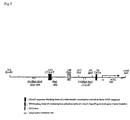
- Fig. 1 shows a sequence (SEQ ID NO: 12) of a wild type promoter; and Fig. 2 shows the position of the introduced restriction enzyme.
- Primer for introducing Xho I site into an upstream region (position at 128 where a Taka-amylase promoter shown in SEQ ID NO: 12 is located)
- Example 2 a CCAAT fragment prepared in Example 2 was cut with Xho I and Not I and recovered and purified by agarose gel electrophoresis. The obtained DNA fragment was inserted into an Xho I -Not I site introduced into a downstream region of the promoter as mentioned above and a plasmid pKF-CCAATb including a modified promoter PCCAATb was produced.
- CCAAT-SRE Xho I- Not I fragment was cut with Xho I and Not I, and recovered and purified. The recovered and purified fragment was inserted into an Xho I- Not I site at the downstream region of the promoter, and then a CCAAT-SRE ( Pst I) fragment was inserted into a Pst I site, and thereby a plasmid pKF-PCSPb including a modified promoter PCSPb in which CCAAT-SRE fragments were inserted into two positions was produced.
- Fig. 3 shows a process for producing a plasmid for evaluating a promoter activity.
- a plasmid pUC18 Toyobo Co., Ltd.
- Klenow treatment so as to have blunt ends and subjected to self-ligation, thereby obtaining a plasmid pUC18 (S-) with deletion of a Sal I site.
- an Eco RI fragment of a Taka-amylase A gene was isolated from the plasmid pTG-taa. This fragment was inserted into an Eco RI site of multicloning site of the pUC18 (S-) so as to obtain a pUC-taa (S-).
- This plasmid pUC-taa (S-) was partially degraded by Eco RI and a plasmid pUC-taa with deletion of an Eco RI site at the 3'-end side of taaG2 gene was obtained.
- a plasmid pBlue (XSE-) with deletion of Xho I, Sal I, Bam HI from pBluescriptII KS(+) was obtained.
- plasmid pKF-taaPM series (pKF-CCAATb, pKF-SREb, pKF-PCSP, pKF-PCSb or pKF-PCSPb) including the modified promoter region obtained in Example 3, an Eco RI- Sal I fragment of the modified promoter region was isolated; inserted into a multicloning site Eco RI- Sal I of a plasmid pBlue-taa, and then a plasmid pBlue-taaM in which the modified promoter region and taaG2 gene were ligated with each other was obtained.
- Xba I- Bam HI fragment of taaG2 gene including the modified promoter was isolated, and integrated into a multicloning site Xba I- Bam HI of a plasmid pBAR7 (plasmid in which argB gene with deletion of C-end derived from Aspergillus nidulans was inserted into pBluescriptII KS(+)) so as to obtain plasmid pBAR-taaM series (pBAR-CCAATb, pBAR-SREb, pBAR-PCSP, pBAR-PCSb and pBAR-PCSPb) for measuring promoter activity.
- Transformation of filamentous fungi was carried out as follows. Firstly, each plasmid of the pBAR-taaM series (pBAR-CCAATb, pBAR-SREb, pBAR-PCSP, pBAR-PCSb and pBAR-PCSPb) obtained in Example 4 was digested with Eco RV, followed by purification with phenol/chloroform extraction and ethanol precipitation. Then, the purified product was used for transformation. Then, Aspergillus nidulans was transformed with these plasmids.
- pBAR-taaM series pBAR-CCAATb, pBAR-SREb, pBAR-PCSP, pBAR-PCSb and pBAR-PCSPb
- Aspergillus nidulans strain ABPU1 ( biA1 ; pyrG89 ; wA3; argB2 ; pyroA4 ) with deletion of ornithine carbamoyltransferase gene was cultured with shaking in a medium obtained by adding necessary nutrient (arginine, uridine, pyridoxine and biotin) to a complete medium (2% malt extract, 2% glucose and 0.1% Bacto-pepton) at 37° C overnight.
- a medium obtained by adding necessary nutrient arginine, uridine, pyridoxine and biotin
- a complete medium 2% malt extract, 2% glucose and 0.1% Bacto-pepton
- the obtained fungus bodies were suspended in a cell wall digesting solution [20 mg/ml Yatalase (Takara Shuzo Co., Ltd.), 0.8MNaCl, 10 mM phosphate buffer (pH6.0)] and shaken mildly at 30° C for 1 to 2 hours to form a protoplast.
- the obtained protoplast was filtered with nylon filter, thereby removing residual fungus bodies.
- preparation and transformation of competent cell were carried out in accordance with the method by Turner et al.
- a chromosomal DNA was prepared as follows. Firstly, the transformed strain was cultured with shaking in a complete medium to which necessary nutrient (uridine, pyridoxine and biotin) was added at 37° C over night so as to obtain fungus bodies. Then, the obtained fungus bodies were collected and washed by using a Buchner funnel and filter paper No. 2 (Advantech) and washed with sterile water. After removing excess water, frozen at -80°C and lyophilized by using FREEZONE (LABCONCO).
- This precipitates were dissolved in a TE solution containing 0.1 mg/ml RNase and reacted at 37° C for 30 minutes. Furthermore, a TE solution containing 0.2 mg/ml proteinaseK was added and reacted at 37° C for 30 minutes. This solution was subjected to phenol/chloroform extraction and precipitated in 2.5 volume of cold ethanol. This precipitate was rinsed with 70% ethanol and dried, followed by dissolving it in a TE solution, which was defined as a chromosomal DNA solution.
- Southern blotting analysis includes: digesting a chromosomal DNA with Pvu II or Eco RV, then separating it by agarose gel electrophoresis to blot on nylon membrane (Roche). Thereafter, detection was carried out using about 1000 bp of Bgl II -Sma I digested product of taaG2 as a probe. At this time, labeling of probe and detection of signals were carried out using DIG nucleic acid detection kit (Roche).
- transformant that is transformed strain in which one copy of plasmid is integrated into an argB locus homologously and is capable of measuring the promoter activity without being affected by the position when it is integrated into the chromosome and by the number of copies of the gene to be inserted were selected.
- Example 5 By using a transformant obtained in Example 5, in which pBAR-CCAATb or pBAR-SREb was integrated, the change in the promoter activity, when the modification by inserting a CCAAT sequence or SRE singly was carried out, was evaluated. Furthermore, by using a transformant in which pBAR-PCSP was integrated, the case where both CCAAT sequence and SRE were inserted at the same time was similarly evaluated.
- each transformant was inoculated radially on an agar medium obtained by adding necessary nutrient (uridine, pyridoxine and biotin) to a minimum medium (0.9% NaNO 3 , 0.05% KCl, 0.15% KH 2 PO 4 , 0.15% Trace element, 0.05% MgSO 4 ⁇ 7H 2 O, 1% glucose (pH6.5)), and cultured at 37°C for three days. Thereafter, from this agar medium, conidiospores were suspended in a solution for suspending spores (0.01% tween80, 0.8% NaCl) and filtrated with cotton and a spore suspension solution was prepared.
- agar medium obtained by adding necessary nutrient (uridine, pyridoxine and biotin) to a minimum medium (0.9% NaNO 3 , 0.05% KCl, 0.15% KH 2 PO 4 , 0.15% Trace element, 0.05% MgSO 4 ⁇ 7H 2 O, 1% glucose (pH6.5)
- Amylase activity was quantified by: preparing 150 ⁇ l of reaction system by adding an enzyme solution to 20mM sodium acetate buffer, 10 mM CaCl 2 , and 2% Soluble Starch (Nacalai Tesque Inc.); reacting this reaction system at 37° C for 20 minutes to generate reduction sugar; and quantifying the generated reduction sugar by Nelson-Somogyi method. Furthermore, the amount of enzymes for releasing 1 ⁇ mol/min of glucose was represented by 1 unit. By employing the amylase activity measured as mentioned above as an index, the promoter activities of the wild type promoter and the modified promoter were evaluated.
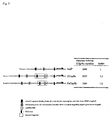
- Fig. 4 shows a measurement result of the amylase activity.
- the modified promoters (PCCAATb and PSREb) in which CCAAT sequence or SRE was inserted were compared with the wild type promoter (taaP), the activity was deteriorated or was not substantially different from each other.
- the effect of enhancing the promoter activity by singly inserting CCAAT sequence or SRE was not observed.
- the effect of enhancing the promoter activity was not observed (data are not shown).
- a plasmid pBAR-CSPPb for measuring the promoter activity was prepared as in Example 4, and a transformant in which pBAR-CSPPb was integrated in accordance with Example 5 was obtained.
- this transformant the same as in Example 6, a spore suspension solution was prepared.
- the measurement results when the C source was glucose are shown in Table (column of glucose) of Fig. 5.
- the production amount of amylase when a transformed strain having a wild type promoter is cultured in a medium using glucose as a C source is about one-fourtiethof the production amount of amylase when a transformed strain having a wild type promoter is cultured in a medium using starch as a C source.
- the ratio of the production of amylase when being cultured in a medium using glucose as a C source to the production amount of amylase when being cultured in a medium using starch as a C source is about 1 : 8.
- the modified promoter in which a CCAAT-SRE fragment was inserted into the promoter region had an effect of reducing catabolite repression as compared with a wild type promoter. Furthermore, also in the case where the culturing was carried out in a medium using glucose as a C source, similar to the case where culturing was carried out in a medium using starch as a C source, the effect of enhancing the expression by the insertion of a plurality of the CCAAT-SRE sequences is observed, it was shown that by using the modified promoter, two effects, that is, the effect of enhancing the expression and the effect of reducing the catabolite repression were obtained. That is to say, it was determined that when a modified promoter in which a plurality of CCAAT-SRE sequences are integrated was used, even if the carbon source was glucose, amylase could be produced excellently.
- Promoters were modified by varying the insertion position of a CCAAT-SRE fragment. The influence of the insertion position on the promoter activity was compared and the effective insertion position was investigated. Firstly, by the same method as in Example 3, modified promoters PCmSa, PCmSN and PCmSS in which the CCAAT-mSRE fragment prepared in Example 9 was respectively inserted into an Xho I -Not I site at the upstream region of the promoter, a Not I site in a region between the CCAAT sequence and the SRE, or a Spe I at the downstream region were prepared. By the same method as in Examples 3 and 4, plasmids including these modified promoters for measuring the amylase activity were constructed. Then, by the same method as in Examples 5 and 6, the promoter activities were compared.
- the amount of amylase expression by using the promoter PCmSb (Example 9) whose insertion position was in an Xho I- Not I site at the downstream region of the promoter was larger than those of the modified promoters PCmSa and PCmSS whose insertion position was upstream to the CCAAT sequence or just before the TATA-box.
- an Aspergillus nidulans strain capable of producing amylase with high productivity was tried to be obtained.
- strains (CSb16, CSP6, and SPb19) in which multiple copies of amylase gene having a modified promoter were integrated into an argB locus homologously were selected and cultured on 100ml of SPY medium (3% Starch, 0.2% KCl, 0.1% KH 2 PO 4 , 0.05% MgSO 4 ⁇ 7H 2 O, 1% polypeptone, and 0.5% Yeast Extract) at 37° for 5 days and the amylase activity was measured by the method shown in Example 6. The results are shown in table of Fig. 7.
- a CSb17 strain having a modified promoter exhibited 5 times expression amount of amylase.
- the expression amount tends to increase.
- the strain with the highest expression amount had about 34 times as the expression amount of a wild type promoter and expressed about not less than 10 gram/litter of amylase when represented by a mass of proteins. It could be confirmed from this results that by intengrating multiple copies of amylase genes having a modified promoter, a large amount of proteins was able to be produced.
- the CSP6 strain and the CSPb19 strain were cultured in 100ml of SPY medium (C source: starch: 3% Starch, 0.2% KCl, 0.1% KH 2 PO 4 , 0.05% MgSO 4 ⁇ 7H 2 O, 1% polypeptone, 0.5% Yeast Extract), MPY medium (C source; maltose: 3% Maltose, 0.2% KCl, 0.1% KH 2 PO 4 , 0.05% MgSO 4 ⁇ 7H 2 O, 1% polypeptone, 0.5% Yeast Extract), and GPY medium (C source: glucose: 3% Glucose, 0.2% KCl, 0.1% KH 2 PO 4 , 0.05% MgSO 4 ⁇ 7H 2 O, 1% polypeptone, 0.5% Yeast Extract) at 37° for 5 days, and then the amylase activity was measured by the same method as in Example 6.
- C source starch: 3% Starch, 0.2% KCl, 0.1% KH 2 PO 4 ,
- sCCAAT-mSRE fragment DNA fragment having a short distance between the CCAAT sequence and the SRE (hereinafter, which will be referred to as "sCCAAT-mSRE fragment") was obtained and inserted into an Xho I- Not I site at the downstream region of the promoter (taaP) region so as to produce a modified promoter PsCmSb.
- sCCAAT-mSRE fragment DNA fragment having a short distance between the CCAAT sequence and the SRE
- the measurement results of the amylase activity are shown in Table of Fig. 9.
- the promoter (PsCmSb) that was modified by using sCCAAT-SRE fragment showed about 1.6 times effect of increasing the expression amount of amylase as compared with a wild type promoter (taaP). That is to say, also when the distance between the CCAAT sequence and the SRE is shortened, the effect of enhancing the promoter activity can be obtained. This strongly suggests that two regions, CCAAT sequence and SRE are responsible for the activation of promoter.
- PsCmSb has increasing effect that is only a half as compared with PCmSb in which the original size of CCAAT-mSRE region was inserted, but the reduction of increasing effect is thought to be because the positional relationship between a HAP complex linked to the CCAAT sequence and AmyR liked to the SRE is displaced from the optimal potion due to the change in the distance between the CCAAT sequence and SRE. That is to say, it is thought that by optimizing the distance between the CCAAT sequence and SRE, it was sufficiently possible to maintain the effect of enhancing the promoter activity possessed by the CCAAT-SRE fragment even when a shorter DNA fragment is used.
- modifiedpromoters taaS sequence in a SRE portion is CGGAAATTTAACGG: SEQ ID NO:8
- MSRE2 sequence in a SRE portion is CGGAAATTTAATTA: SEQ ID NO: 30
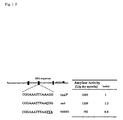
- the measurement results of the amylase activity are shown in Table of Fig. 10.
- the modified promoter taaS in which the 12th base from the 5' -end side of SRE existing in a wild type promoter was substituted by C showed about 1.2 times greater amylase activity than that of the wild type promoter. It was determined from this result that even if the 12th base from the 5'-end side of SRE was mutated, theenhancerfunctionpossessedbySREcouldbemaintained, and that the sequence in which this base is substituted by C had more excellent function.
- Example 3 In order to demonstrate that the use of a modified promoter is also effective in production system of enzymes using Aspergillus oryzae as a host, the following experiments were carried out using the modified promoters prepared in Example 3 and Example 7. Firstly, the plasmid pBAR-CSPb prepared in Example 4 was cut with XbaI and BamHI, and thereafter about 3600 bp of DNA fragments were recovered and purified by agarose gel electrophoresis.
- pYRG100 was produced as follows in accordance with the previous report (Nippon Shoyu Kenkyusyo Zasshi, 25(1), 21-26 (1999)).
- a PCR reaction was carried out using a chromosomal DNA of Aspergillus oryzae strain AMA 1201 (FERM P-19089) as a template and using a primer PyrF and a primer PyrR mentioned below.
- the thus obtained amplified product was cut with SalI and HindIII to obtain a DNA fragment of about 1.9 Kbp, which was then inserted into SalI-HindIII of multicloning site of pUC119.
- pYRG100 was obtained.
- Example 16 Transformation of strain producing amylase with low productivity (Aspergillus oryzae strain AMA 1201-P), and strain producing amylase with high productivity (strain Aspergillus oryzae KBN6217-56)
- Aspergillus oryzae strain AMA 1201-P that is a strain with deletion of pyrG gene and Aspergillus oryzae strain KBN 6217-56 that is a strain with deletion of the same gene were cultured with shaking in a complete medium (2% malt extract , 2% glucose, and 0.1% Bacto-pepton) to which uridine was added at 30° C over night. Then, the obtained fungus bodies were suspended in a cell wall digesting solution [20 mg/ml Yatalase (Takara Shuzo Co., Ltd.), 0.8 M NaCl, 10 mM phosphate buffer (pH6.0)] and shaken mildly at 30° C for 1 to 2 hours to form a protoplast. The obtained protoplast was filtered with nylon filter, thereby removing the residual fungus bodies.
- a parent strain of the Aspergillus oryzae strain AMA 1201-P is a strain AMA 1201; while a parent strain of the Aspergillus oryzae strain KBN 6217-56 is KBN 6217 strain. Both strains were obtained by separating resistant strain of 5-Fluoroorotic acid (5-FOA) in accordance with Mol. Gen. Genet. (1987) 210: 460-461, and thereafter selecting uridine requiring mutant strain. Aspergillus oryzae strain AMA 1201 is deposited as follows. Accession number PERM P-19089 International depositary: National Institute of Advanced Industrial Science and Technology, International Patent Organism Depositary, of which address is Chuo No.
- Transformants obtained in the above 1. were inoculated dottedly on an agar medium for detecting amylase activity (2% maltose, 1% amylopectin, 0.15% KH 2 PO 4 , 0.05% KCl, 0.09% NaNO 3 , 0.05% MgSO 4 ⁇ 7H 2 O, 1.5% Agar (pH6.5)).
- the size of halo generated by degradation of amylopectin of the substrate due to the effect of amylase secreted from fungus body was used as an index, strains producing amylase with high productivity were screened for each host.
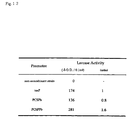
- the strain producing amylase with high productivity obtained in the above 2. was scraped out by an applicator, and inoculated on 100ml of SP medium (1% Starch, 1% polypeptone, 0.5% KH 2 PO 4 , 0.1% NaNO 3 , 0.05% MgSO 4 ⁇ 7H 2 O (pH6.5)) and cultured with shaking at 30° C for 66 hours. Thereafter, the amylase activity was measured in accordance with Example 6. The measurement results are shown in Table of Fig. 11.
- the production of amylase by a transformant is significantly increased as compared with that of the parent strain.
- the amount of production of amylase was 57 times or more as compared with that of the parent strain.
- the productivity of amylase in the transformed strain was 10 times or more as compared with that of the parent strain.
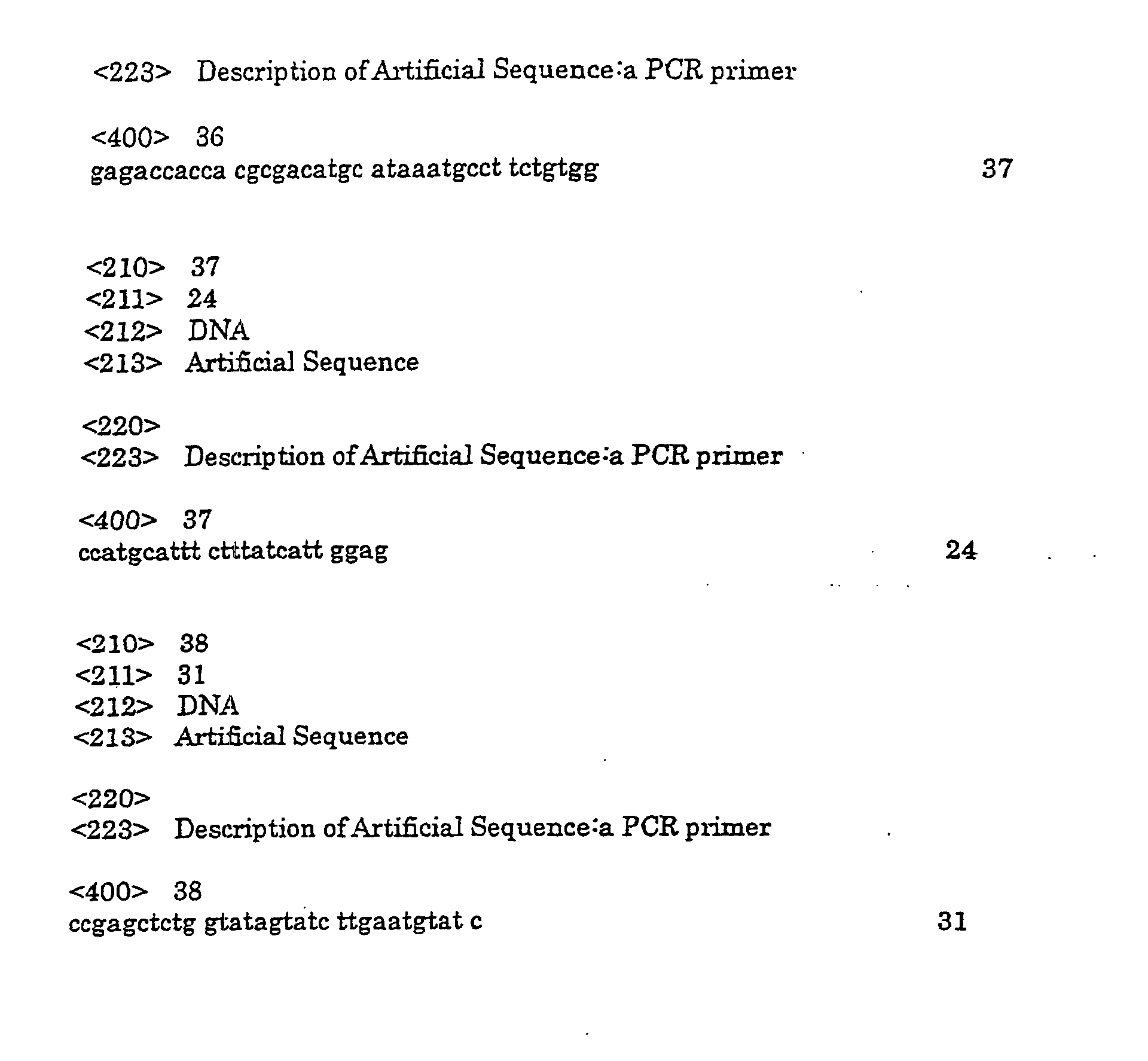
- a plasmid for expressing a laccase gene was constructed as follows. Firstly, in order to be linked to laccase gene, by a PCR reaction using the following primers, mutation was introduced into a Taka-amylase promoter and modified promoters (PCSPb and PCSPPb), respectively. Primer at the 5'-end side of a Taka-amylase gene promoter (including an EcoRI cutting site): Primer for adding an EcoT22I cutting site to the 3'-end side of a Taka-amylase gene:
- Primer for amplifying laccase gene and for adding an EcoT22I cutting site to the 5'-end side P11: Primer for amplifying laccase gene and for adding a SacI cutting site to the 3'-end side:
- P12 A template DNA to be used for a PCR reaction was prepared by using a strain KL112 cultured in a potato dextrose agar medium in accordance with the method by Raeder et al. (U. Raeder and P. Broda, Lett. Appl. Microb.,1, 17-20 (1985)). Note here that the strain KL112 is deposited as follows.
- the obtained restriction enzyme-cut fragments were inserted into EcoRI-SacI cutting site of an expression vector pYRG100 to construct a vector for expressing laccase pTALC100 (Taka-amylase promoter), pTALCPb (a modified promoter, PCSPb) and pTALCPPb (a modified promoter, PCSPPb).
- Aspergillus oryzae strain AMA 1201-P was transformed by the same method as described in Example 16-1. Then, the transformants were inoculated dottedly on an agar medium for detecting a laccase activity (a potato dextrose agar medium (DIFCO), 10mM CuSO 4 , 1mM cafeic acid), and halo generated by browning material generated by oxidation cleavage and polymerization of cafeic acid of the substrate because of the effect of laccase secreted from fungus body was used as an index, strains producing amylase with high productivity were screened.
- a laccase activity a potato dextrose agar medium (DIFCO), 10mM CuSO 4 , 1mM cafeic acid
- halo generated by browning material generated by oxidation cleavage and polymerization of cafeic acid of the substrate because of the effect of laccase secreted from fungus body was used as an index
- strains producing amylase with high productivity were screened.
- the strain producing laccase with high productivity obtained in the above 1 was scraped out by an applicator, and inoculated in 50ml of SPN medium (3% Starch, 1% polypeptone, 1% fermented residue, 0.1% KH 2 PO 4 , 0.2% KCl, 0.05% MgSO 4 ⁇ 7H 2 O, 10mM CuSO 4 (pH6.5)) and cultured with shaking at 30° C for 6 days. After culturing, fungus bodies and supernatant were separated from each other by using a Buchner funnel and filter paper, and the supernatant was used as an enzyme solution.
- SPN medium 3% Starch, 1% polypeptone, 1% fermented residue, 0.1% KH 2 PO 4 , 0.2% KCl, 0.05% MgSO 4 ⁇ 7H 2 O, 10mM CuSO 4 (pH6.5)
- Laccase activity was measured by examining the change in the absorbance at 430 nm when 2.5 ml of reaction system was prepared by adding an enzyme solution to 50 mM sodium acetate buffer and 1 mM guaiacol (Wako Pure Chemical Industries, Ltd.) and reacted at 40°C for 10 minutes.
- a modified promoter having high expression efficiency and functioning in filamentous fungi is provided.
- this modified promoter By using this modified promoter, an efficient production system of homogeneous and heterogeneous proteins using a filamentous fungus as a host can be constructed.
- transformant having not less than 7 times expression amount was obtained as compared with the case where a wild type promoter was used.
- the modified promoter of the present invention was extremely useful in construction of a production system capable of producing proteins with high productivity.
Landscapes
- Life Sciences & Earth Sciences (AREA)
- Health & Medical Sciences (AREA)
- Genetics & Genomics (AREA)
- Engineering & Computer Science (AREA)
- Zoology (AREA)
- Bioinformatics & Cheminformatics (AREA)
- Biomedical Technology (AREA)
- Organic Chemistry (AREA)
- Biotechnology (AREA)
- General Engineering & Computer Science (AREA)
- Chemical & Material Sciences (AREA)
- Wood Science & Technology (AREA)
- Microbiology (AREA)
- Physics & Mathematics (AREA)
- Plant Pathology (AREA)
- Mycology (AREA)
- Molecular Biology (AREA)
- Biochemistry (AREA)
- General Health & Medical Sciences (AREA)
- Biophysics (AREA)
- Micro-Organisms Or Cultivation Processes Thereof (AREA)
- Enzymes And Modification Thereof (AREA)
- Preparation Of Compounds By Using Micro-Organisms (AREA)
Abstract
Description
Furthermore, when the present inventors have paid attention to the enhancer function of SRE and attempted to improve thereof by providing various mutations, we successfully obtained a sequence having more excellent enhancer function than that of SRE.
Firstly, the present inventors paid attention to a CCAAT sequence (SEQ ID NO: 3) and SRE (SEQ ID NO: 6) of the promoter region being widely conserved in genus Aspergillus, and investigated the influence on the promoter activity when theses sequences are exogenously inserted in the promoter region. First of all, a plasmid including a promoter region of a Taka-amylase A gene of an Aspergillus oryzae strain JCM02239 was constructed. On the other hand, a DNA fragment including a CCAAT sequence and a DNA fragment including SRE were obtained, respectively. Then, each DNA fragment was singly inserted into a promoter region of the above-mentioned plasmid so as to construct amodified promoter. Next, a plasmid including each of the modif ied promoters and coding region of the Taka-amylase A gene was prepared. By using the thus obtained plasmids, respectively, Aspergillus nidulans was transformed. The transformants were compared with each other. As a result, the amylase activity of the transformant having a modified promoter in which the CCAAT sequence or the SRE was inserted was lower than or substantially equal to that of transformant having a promoter that was not modified. Furthermore, when a case where the promoter was modified by inserting a plurality of the CCAAT sequences or a plurality of the SREs were inserted so as to modify the promoter was investigated, similarly the increase in the promoter activity was not observed. From the above-mentioned results, it was anticipated that even if a promoter is modified by inserting the CCAAT sequence or the SRE singly into the promoter region, the promoter activity cannot increase.
On the other hand, when bases in the 13th and 14th positions from the 5'-end side were substituted by another base, the activity was lowered as compared with that of the wild type promoter thereof. Taken this result and the fact that the portions are conserved widely in genus Aspergillus into consideration, it is thought that substitution of these bases by other bases is not preferable. Furthermore, it is known that GGG at the 5' end of the SRE is widely conserved in genus Aspergillus. It is also thought that substitution of this sequence region by other bases is not preferable.
Also, the modified promoter of the present invention can be prepared by preparing one DNA fragment including the first DNA fragment and the second DNA fragment, and then integrating this into a promoter capable of functioning in filamentous fungi. For example, such a DNA fragment can be prepared as follows, that is, a promoter including sequences corresponding to the first DNA fragment and the second DNA fragment is selected from promoters in Aspergillus genera, and a PCR method using this promoter as a template is carried out. An example of the preferable promoter to be used as a template can include a promoter of a Taka-amylase A gene of Aspergillus oryzae (SEQ ID NO: 12). One example of the base sequence of the DNA fragment used for modification of a promoter in the present invention is shown in SEQ ID NO: 9. This DNA fragment (CCAAT-SRE fragment) is apart (positions from 240 to 367 (positions - 312 to-185 when transcription initiation site is +1)) of the promoter region of a Taka-amylase A gene of Aspergillus oryzae. Note here that a DNA fragment obtained by modifying a part of this fragment can be used for modification of a promoter region as long as it has a function (enhancer function) capable of enhancing the promoter into which it is integrated. Herein, a part of modification denotes that a part of the bases constitute the DNA fragment is substituted, deleted, or one to several bases are added or inserted. Allowable degree of such modification is dependent upon a site on the DNA fragment to be modified. As mentioned above, since a portion that is important for enhancer function is a sequence portion corresponding to the first DNA fragment and the second DNA fragment, it is preferable that this sequence portion is less modified. On the other hand, since it is anticipated that other portions are not directly responsible for the enhancer function, it is thought that relatively large modification can be allowed. For example, about 1 to 20, preferably 1 to 10, and furthermore preferably 1 to 5 bases can be substituted, deleted, and added. Note here that suchmodification includes insertion of a restriction enzyme recognition sequence to the 5' -end, 3'-end or other sites, or addition of a sequence coding signal peptide, and the like.
In the case where a DNA fragment including the first DNA fragment and the second DNA fragment is used, by inserting a plurality of such DNA fragments, a promoter may be modified. Also in this case, a promoter having a CCAAT sequence and SRE is employed as a promoter to be modified, the DNA fragments are preferably inserted in sites other than the site between these two sequences.
The proteins that can be produced by using the modified promoter of the present invention are not particularly limited. Examples include sugar-related enzyme such as a-amylase, glucoamylase, a-glucosidase, cellulase, pectinase, etc.; oxidation-reduction enzyme such as laccase, peroxidase, etc.; protease such as chymosin; lipase, and the like. The protein may be homogeneous protein or may be a heterogeneous protein.
Furthermore, as a synthetic oligo DNA used in Examples, those synthesized in Takara Shuzo Co., Ltd. or Invitorogen Japan K.K. were used. The sequence determination was performed with ABI PRISM 310 Genetic Analyzer (Applied Biosystems), and a PCR reaction was carried out by using Thermal Cycler (PerkinElmer Japan Co., Ltd.).
Firstly, from pTG-taa, 750bp of EcoRI-SalI fragment including a Taka-amylase A ( taaG2) promoter region was obtained. This fragment was inserted into an EcoRI-SalI site of a multicloning site of a plasmid pKF18K (Toyobo Co., Ltd.) to obtain a plasmid pKF-taaP including a Taka-amylase promoter. Introducing mutation into a promoter region and the construction of the modif ied promoter region were carried out using this plasmid.
Firstly, as a synthetic DNA in which an XhoI site was added to the 5'-end side and a NotI site was added to the 3'-end side of a CCAAT sequence, XNF (5'-CCGCTCGAGGCACCATCCAATTAGAAGCGCGGCCGCTAAACTAT3' : SEQ ID NO: 13), and as a complementary strand of this sequence, XNR (5'-ATAGTTTAGCGGCCGCGCTTCTAATTGGATGGTGCCTCGAGCGG-3':SEQ ID NO: 14) were synthesized. Then, complementary strands of the synthetic DNAs were mixed with each other and heated at 98° C for 10 minutes, then cooled down to 30° C over two hours, and then cooled down to 4°C for annealing. Thereby, a DNA fragment including a CCAAT sequence singly was obtained.









Then, from plasmid pKF-taaPM series (pKF-CCAATb, pKF-SREb, pKF-PCSP, pKF-PCSb or pKF-PCSPb) including the modified promoter region obtained in Example 3, an EcoRI-SalI fragment of the modified promoter region was isolated; inserted into a multicloning site EcoRI-SalI of a plasmid pBlue-taa, and then a plasmid pBlue-taaM in which the modified promoter region and taaG2 gene were ligated with each other was obtained. From pBlue-taaM, XbaI-BamHI fragment of taaG2 gene including the modified promoter was isolated, and integrated into a multicloning site XbaI-BamHI of a plasmid pBAR7 (plasmid in which argB gene with deletion of C-end derived from Aspergillus nidulans was inserted into pBluescriptII KS(+)) so as to obtain plasmid pBAR-taaM series (pBAR-CCAATb, pBAR-SREb, pBAR-PCSP, pBAR-PCSb and pBAR-PCSPb) for measuring promoter activity.
Then, Aspergillus nidulans was transformed with these plasmids. Aspergillus nidulans strain ABPU1 (biA1; pyrG89; wA3; argB2; pyroA4) with deletion of ornithine carbamoyltransferase gene was cultured with shaking in a medium obtained by adding necessary nutrient (arginine, uridine, pyridoxine and biotin) to a complete medium (2% malt extract, 2% glucose and 0.1% Bacto-pepton) at 37° C overnight. Then, the obtained fungus bodies were suspended in a cell wall digesting solution [20 mg/ml Yatalase (Takara Shuzo Co., Ltd.), 0.8MNaCl, 10 mM phosphate buffer (pH6.0)] and shaken mildly at 30° C for 1 to 2 hours to form a protoplast. The obtained protoplast was filtered with nylon filter, thereby removing residual fungus bodies. Then, by using this protoplast, preparation and transformation of competent cell were carried out in accordance with the method by Turner et al. [Gene, 36, 321-331(1985)], and 20 to 40 strains per plasmid of trnasformants capable of growing in a medium without containing arginine (Czapek-Dox agar medium (0.2% NaNO3, 0.1% K2HPO4, 0.05% KCl, 0.05% MgSO4·7H2O, 2% glucose (pH5.5)) to which uridine, pyridoxine and biotin were added) were obtained.
On the other hand, in the modified promoter (PCSP) in which a CCAAT sequence and SRE were inserted at the same time, as compared with the wild type promoter (taaP), significant increase in the activity was observed, and about 4 times amylase activity was observed. From the results, it can be said that in order to increase the promoter activity, it is important to insert both CCAAT sequence and SRE at the same time.

Firstly, by the same method as in Example 3, modified promoters PCmSa, PCmSN and PCmSS in which the CCAAT-mSRE fragment prepared in Example 9 was respectively inserted into an XhoI-NotI site at the upstream region of the promoter, a NotI site in a region between the CCAAT sequence and the SRE, or a SpeI at the downstream region were prepared. By the same method as in Examples 3 and 4, plasmids including these modified promoters for measuring the amylase activity were constructed. Then, by the same method as in Examples 5 and 6, the promoter activities were compared.
From the transformant prepared in Examples 5 or 7, strains (CSb16, CSP6, and SPb19) in which multiple copies of amylase gene having a modified promoter were integrated into an argB locus homologously were selected and cultured on 100ml of SPY medium (3% Starch, 0.2% KCl, 0.1% KH2PO4, 0.05% MgSO4·7H2O, 1% polypeptone, and 0.5% Yeast Extract) at 37° for 5 days and the amylase activity was measured by the method shown in Example 6. The results are shown in table of Fig. 7. As compared with a taa2 strain having a wild type promoter, a CSb17 strain having a modified promoter exhibited 5 times expression amount of amylase. In the strain in which multiple copies of amylase genes were integrated, in accordance with the increase in the number of copies, the expression amount tends to increase. The strain with the highest expression amount had about 34 times as the expression amount of a wild type promoter and expressed about not less than 10 gram/litter of amylase when represented by a mass of proteins. It could be confirmed from this results that by intengrating multiple copies of amylase genes having a modified promoter, a large amount of proteins was able to be produced.
The CSP6 strain and the CSPb19 strain were cultured in 100ml of SPY medium (C source: starch: 3% Starch, 0.2% KCl, 0.1% KH2PO4, 0.05% MgSO4·7H2O, 1% polypeptone, 0.5% Yeast Extract), MPY medium (C source; maltose: 3% Maltose, 0.2% KCl, 0.1% KH2PO4, 0.05% MgSO4·7H2O, 1% polypeptone, 0.5% Yeast Extract), and GPY medium (C source: glucose: 3% Glucose, 0.2% KCl, 0.1% KH2PO4, 0.05% MgSO4·7H2O, 1% polypeptone, 0.5% Yeast Extract) at 37° for 5 days, and then the amylase activity was measured by the same method as in Example 6.
Firstly, a PCR reaction was carried out by using primers CSXf and CSNr shown in Example 2 and primers CBglr and SBglf shown below, and a fragment including a CCAAT sequence and a fragment including SRE were obtained separately. These fragments were linked at a BglII site, and thereby a DNA fragment having a short distance between the CCAAT sequence and the SRE (hereinafter, which will be referred to as "sCCAAT-mSRE fragment") was obtained and inserted into an XhoI-NotI site at the downstream region of the promoter (taaP) region so as to produce a modified promoter PsCmSb. Byusing this modified promoter, the promoter activitywas evaluated by the same method as in Examples 3 to 6.






Aspergillus oryzae strain AMA 1201 is deposited as follows.
Accession number PERM P-19089
International depositary: National Institute of Advanced Industrial Science and Technology, International Patent Organism Depositary, of which address is Chuo No. 6, 1-3, Higashi 1-chome, Tsukuba-shi, Ibaraki-ken, 305-8566, Japan.
Deposited date: November 1, 2002
Similarly, Aspergillus oryzae strain KBN6217 is deposited as follows.
Accession number PERM P-19088
International depositary: National Institute of Advanced Industrial Science and Technology, International Patent Organism Depositary, of which address is Chuo No. 6, 1-3, Higashi 1-chome, Tsukuba-shi, Ibaraki-ken, 305-8566, Japan.
Deposited date: November 1, 2002
The measurement results are shown in Table of Fig. 11. In any cases where a strain producing amylase with low productivity AMA 1201-P or a strain producing amylase with high productivity KBN 6217-56 is used as a host, the production of amylase by a transformant is significantly increased as compared with that of the parent strain. Specifically, in a transformed strain obtained by using a strain producing amylase with low productivity AMA 1201-P as a host, the amount of production of amylase was 57 times or more as compared with that of the parent strain. On the other hand, in the transformed strain using a strain capable of originally producing amylase with high productivity, the productivity of amylase in the transformed strain was 10 times or more as compared with that of the parent strain. As mentioned above, it was conf irmed that also in the case where Aspergillus oryzae was used as a host, the modified promoter of the present invention functioned effectively.
Primer at the 5'-end side of a Taka-amylase gene promoter (including an EcoRI cutting site):




Accession number PERM P-19071
International depositary: National Institute of Advanced Industrial Science and Technology, International Patent Organism Depositary, of which address is Chuo No. 6, 1-3, Higashi 1-chome, Tsukuba-shi, Ibaraki-ken, 305-8566, Japan.
Deposited date: October 18, 2002
Each promoter region mutated as mentioned above was cut with EcoRI and EcoT22I. On the other hand, amplified laccase gene was cut with EcoT22I and SacI. Then, restriction enzyme-cut fragments were collected and purified by agarose gel electrophoresis. The obtained restriction enzyme-cut fragments were inserted into EcoRI-SacI cutting site of an expression vector pYRG100 to construct a vector for expressing laccase pTALC100 (Taka-amylase promoter), pTALCPb (a modified promoter, PCSPb) and pTALCPPb (a modified promoter, PCSPPb).
From the above-mentioned results, even in the case where a heterogeneous gene was intended to be expressed, it was confirmed that the use of a modified promoter including a larger number of CCAAT-SRE sequences was advantageous in efficiently producing enzyme.
Note here that when the transformant culture filtrates were subjected to SDS-polyacrylamide gel electrophoresis, the amount of proteins expected from a laccase gene was apparently increased as compared with non-recombinant in any transformants.




Claims (19)
- A modified promoter constructed by inserting a first DNA fragment including CCAATNNNNNN (a first base sequence: SEQ ID NO: 1) and a second DNA fragment including CGGNNNNNNNNNGG (a second base sequence: SEQ ID NO: 2) into a promoter capable of functioning in a filamentous fungus.
- The modified promoter according to claim 1, wherein said first base sequence is CCAATTAGAAG (SEQ ID NO: 3).
- The modified promoter according to claim 1, wherein said second base sequence is CGGHNWWWWNWHGG (SEQ ID NO: 4).
- The modified promoter according to claim 1, wherein said second base sequence is CGGWWWWWWWWHGG (SEQ ID NO: 5).
- The modified promoter according to claim 1, wherein said second base sequence is CGGAAATTTAAAGG (SEQ ID NO: 6), CGGAATTTAAACGG (SEQ ID NO: 7) or CGGAAATTTAACGG (SEQ ID NO: 8).
- The modified promoter according to claim 1, wherein the first DNA fragment and the second DNA fragment are inserted so that they are arranged sequentially from the 5'-end side to the 3'-end side of said promoter.
- The modified promoter according to claim 6, wherein said first DNA fragment and said second DNA fragment are inserted at the 5'-end side that is upstream to a CCAAT sequence existing in said promoter or at the 3'-end side that is downstream to a SRE region existing in the promoter region.
- The modified promoter according to claim 1, wherein a plurality of said first DNA fragments and a plurality of said second DNA fragments are inserted.
- The modified promoter according to claim 8, wherein the same number of said first DNA fragments and said second DNA fragments are inserted.
- The modified promoter according to claim 9, wherein one first DNA fragment and one second DNA fragment are combined as a pair, and in each pair, said first DNA fragment and said second DNA fragment are inserted so that the first DNA fragment is located at the 5'-end side of said promoter.
- A modified promoter constructed by integrating one to several of either a DNA fragment having a base sequence of SEQ ID NO: 9, or a DNA fragment obtained by partial modification of the DNA fragment and which has an enhancer function, into a promoter capable of functioning in a filamentous fungus.
- The modified promoter according to claim 1, wherein said promoter capable of functioning in a filamentous fungus is a promoter of Taka-amylase of Aspergillus oryzae.
- A DNA fragment having an enhancer function consisting of a base sequence of CGGAATTTAAACGG (SEQ ID NO: 7) or CGGAAATTTAACGG (SEQ ID NO: 8).
- A modified promoter capable of functioning in a filamentous fungus, comprising a DNA fragment according to claim 13.
- A vector in which the modified promoter according to claim 1 is integrated.
- A vector in which the modified promoter according to claim 1 is integrated and further a structural gene of a targeted protein is integrated under control of the modified promoter.
- A transformed filamentous fungus comprising the vector according to claim 16 capable of expressing said structural gene.
- A filamentous fungus comprising the modified promoter according to claim 1, and a structure gene encoding a targeted protein and being under control of the modified promoter.
- A method for producing a protein, the method comprising: culturing the filamentous fungus according to claim 18 under conditions capable of producing protein; and collecting the produced protein.
Applications Claiming Priority (5)
| Application Number | Priority Date | Filing Date | Title |
|---|---|---|---|
| JP2002055853 | 2002-03-01 | ||
| JP2002055853 | 2002-03-01 | ||
| JP2002354670A JP4495904B2 (en) | 2002-03-01 | 2002-12-06 | Modified promoter |
| JP2002354670 | 2002-12-06 | ||
| PCT/JP2003/002401 WO2003080830A1 (en) | 2002-03-01 | 2003-02-28 | Modified promoter |
Publications (2)
| Publication Number | Publication Date |
|---|---|
| EP1489175A1 true EP1489175A1 (en) | 2004-12-22 |
| EP1489175A4 EP1489175A4 (en) | 2005-09-21 |
Family
ID=28456210
Family Applications (1)
| Application Number | Title | Priority Date | Filing Date |
|---|---|---|---|
| EP03744981A Withdrawn EP1489175A4 (en) | 2002-03-01 | 2003-02-28 | Modified promoter |
Country Status (7)
| Country | Link |
|---|---|
| US (1) | US8648183B2 (en) |
| EP (1) | EP1489175A4 (en) |
| JP (1) | JP4495904B2 (en) |
| CN (1) | CN100359013C (en) |
| AU (1) | AU2003211620B2 (en) |
| CA (1) | CA2478113A1 (en) |
| WO (1) | WO2003080830A1 (en) |
Families Citing this family (6)
| Publication number | Priority date | Publication date | Assignee | Title |
|---|---|---|---|---|
| CN101889077B (en) | 2007-11-28 | 2013-06-26 | 天野酶株式会社 | Transformant transfected with flavin adenine dinucleotide-binding glucose dehydrogenase gene and method for producing flavin adenine dinucleotide-binding glucose dehydrogenase using the same |
| US8617865B2 (en) | 2008-10-24 | 2013-12-31 | Amano Enzyme Inc. | Tannase, gene encoding same, and process for producing same |
| AU2013316427B2 (en) | 2012-09-14 | 2018-08-09 | Amano Enzyme Inc. | Saccharide oxidase, and production method for same and use of same |
| WO2015001505A2 (en) * | 2013-07-05 | 2015-01-08 | Basf Plant Science Company Gmbh | Gene expression or activity enhancing elements |
| KR20180086206A (en) * | 2015-12-14 | 2018-07-30 | 바스프 에스이 | Modified bi-directional catalase promoter from Bacillus |
| CN110511953B (en) * | 2018-08-31 | 2022-09-30 | 江南大学 | Recombinant expression vector suitable for corynebacterium glutamicum, exogenous protein expression system, application and preparation method of xylanase |
Family Cites Families (5)
| Publication number | Priority date | Publication date | Assignee | Title |
|---|---|---|---|---|
| DK122686D0 (en) * | 1986-03-17 | 1986-03-17 | Novo Industri As | PREPARATION OF PROTEINS |
| US5536661A (en) * | 1987-03-10 | 1996-07-16 | Novo Nordisk A/S | Process for the production of protein products in aspergillus |
| JP3343567B2 (en) * | 1995-06-29 | 2002-11-11 | 大関株式会社 | Filamentous fungal enhancer DNA base sequence and its use |
| CN1226282A (en) * | 1996-06-28 | 1999-08-18 | 诺沃挪第克公司 | Recombinant enzyme with mutanase activity |
| JP3162042B2 (en) | 1999-02-26 | 2001-04-25 | 白鶴酒造株式会社 | Pyritiamine resistance marker gene and transformant |
-
2002
- 2002-12-06 JP JP2002354670A patent/JP4495904B2/en not_active Expired - Lifetime
-
2003
- 2003-02-28 WO PCT/JP2003/002401 patent/WO2003080830A1/en not_active Ceased
- 2003-02-28 US US10/505,171 patent/US8648183B2/en not_active Expired - Fee Related
- 2003-02-28 AU AU2003211620A patent/AU2003211620B2/en not_active Ceased
- 2003-02-28 CN CNB038099136A patent/CN100359013C/en not_active Expired - Lifetime
- 2003-02-28 EP EP03744981A patent/EP1489175A4/en not_active Withdrawn
- 2003-02-28 CA CA002478113A patent/CA2478113A1/en not_active Abandoned
Also Published As
| Publication number | Publication date |
|---|---|
| CA2478113A1 (en) | 2003-10-02 |
| EP1489175A4 (en) | 2005-09-21 |
| AU2003211620B2 (en) | 2007-06-21 |
| US8648183B2 (en) | 2014-02-11 |
| CN1650009A (en) | 2005-08-03 |
| CN100359013C (en) | 2008-01-02 |
| JP4495904B2 (en) | 2010-07-07 |
| JP2003319786A (en) | 2003-11-11 |
| US20050170453A1 (en) | 2005-08-04 |
| AU2003211620B8 (en) | 2003-10-08 |
| WO2003080830A1 (en) | 2003-10-02 |
| AU2003211620A1 (en) | 2003-10-08 |
Similar Documents
| Publication | Publication Date | Title |
|---|---|---|
| JP3833725B2 (en) | Recombinant strain that does not contain a selectable marker gene, its production method and use of the strain | |
| EP0979294B1 (en) | Gene conversion as a tool for the construction of recombinant industrial filamentous fungi | |
| US20090011508A1 (en) | Method for the production of a strain having a deleted region in chromosome | |
| JP2012504390A (en) | Methods of using positive and negative selection genes in filamentous fungal cells | |
| JP2000501620A (en) | fungi in which areA, pepC and / or pepE genes are inactivated | |
| US8648183B2 (en) | Modified promoter | |
| US8569038B2 (en) | Transformant having an increased frequency of homologous recombination | |
| JPH099968A (en) | Filamentous fungal enhancer DNA nucleotide sequence and use thereof | |
| JP5105691B2 (en) | Cyclic nucleotide derived from Aspergillus filamentous fungi, method for producing Aspergillus filamentous fungus self-cloning strain, and self-cloning strain | |
| Guo et al. | A food-grade industrial arming yeast expressing β-1, 3-1, 4-glucanase with enhanced thermal stability | |
| EP1496117B1 (en) | Selection marker gene | |
| JP5507062B2 (en) | High expression promoter | |
| JP4756125B2 (en) | Novel mutants and selectable markers of Aspergillus oryzae | |
| US7341848B2 (en) | Isomaltose synthase-knockout microorganism belonging eumycota | |
| HK1067385B (en) | Selection marker gene | |
| MXPA99009238A (en) | Gene conversion as a tool for the construction of recombinant industrial filamentous fungi | |
| JPH06253825A (en) | Novel yeast, novel gene and its use |
Legal Events
| Date | Code | Title | Description |
|---|---|---|---|
| PUAI | Public reference made under article 153(3) epc to a published international application that has entered the european phase |
Free format text: ORIGINAL CODE: 0009012 |
|
| 17P | Request for examination filed |
Effective date: 20040917 |
|
| AK | Designated contracting states |
Kind code of ref document: A1 Designated state(s): AT BE BG CH CY CZ DE DK EE ES FI FR GB GR HU IE IT LI LU MC NL PT SE SI SK TR |
|
| AX | Request for extension of the european patent |
Extension state: AL LT LV MK RO |
|
| A4 | Supplementary search report drawn up and despatched |
Effective date: 20050808 |
|
| 17Q | First examination report despatched |
Effective date: 20060207 |
|
| GRAP | Despatch of communication of intention to grant a patent |
Free format text: ORIGINAL CODE: EPIDOSNIGR1 |
|
| INTG | Intention to grant announced |
Effective date: 20150721 |
|
| STAA | Information on the status of an ep patent application or granted ep patent |
Free format text: STATUS: THE APPLICATION IS DEEMED TO BE WITHDRAWN |
|
| 18D | Application deemed to be withdrawn |
Effective date: 20151202 |