EP1489106A1 - Arene-ruthenium complexes immobilized on polymers, catalysts consisting of the complexes, and processes for organic syntheses with the same - Google Patents
Arene-ruthenium complexes immobilized on polymers, catalysts consisting of the complexes, and processes for organic syntheses with the same Download PDFInfo
- Publication number
- EP1489106A1 EP1489106A1 EP03710299A EP03710299A EP1489106A1 EP 1489106 A1 EP1489106 A1 EP 1489106A1 EP 03710299 A EP03710299 A EP 03710299A EP 03710299 A EP03710299 A EP 03710299A EP 1489106 A1 EP1489106 A1 EP 1489106A1
- Authority
- EP
- European Patent Office
- Prior art keywords
- polymer
- catalyst
- arene
- supported
- ruthenium
- Prior art date
- Legal status (The legal status is an assumption and is not a legal conclusion. Google has not performed a legal analysis and makes no representation as to the accuracy of the status listed.)
- Granted
Links
- RWGFKTVRMDUZSP-UHFFFAOYSA-N CC(C)c1ccccc1 Chemical compound CC(C)c1ccccc1 RWGFKTVRMDUZSP-UHFFFAOYSA-N 0.000 description 1
Classifications
-
- C—CHEMISTRY; METALLURGY
- C08—ORGANIC MACROMOLECULAR COMPOUNDS; THEIR PREPARATION OR CHEMICAL WORKING-UP; COMPOSITIONS BASED THEREON
- C08F—MACROMOLECULAR COMPOUNDS OBTAINED BY REACTIONS ONLY INVOLVING CARBON-TO-CARBON UNSATURATED BONDS
- C08F8/00—Chemical modification by after-treatment
- C08F8/42—Introducing metal atoms or metal-containing groups
-
- B—PERFORMING OPERATIONS; TRANSPORTING
- B01—PHYSICAL OR CHEMICAL PROCESSES OR APPARATUS IN GENERAL
- B01J—CHEMICAL OR PHYSICAL PROCESSES, e.g. CATALYSIS OR COLLOID CHEMISTRY; THEIR RELEVANT APPARATUS
- B01J31/00—Catalysts comprising hydrides, coordination complexes or organic compounds
- B01J31/16—Catalysts comprising hydrides, coordination complexes or organic compounds containing coordination complexes
- B01J31/165—Polymer immobilised coordination complexes, e.g. organometallic complexes
- B01J31/1658—Polymer immobilised coordination complexes, e.g. organometallic complexes immobilised by covalent linkages, i.e. pendant complexes with optional linking groups, e.g. on Wang or Merrifield resins
-
- B—PERFORMING OPERATIONS; TRANSPORTING
- B01—PHYSICAL OR CHEMICAL PROCESSES OR APPARATUS IN GENERAL
- B01J—CHEMICAL OR PHYSICAL PROCESSES, e.g. CATALYSIS OR COLLOID CHEMISTRY; THEIR RELEVANT APPARATUS
- B01J31/00—Catalysts comprising hydrides, coordination complexes or organic compounds
- B01J31/16—Catalysts comprising hydrides, coordination complexes or organic compounds containing coordination complexes
- B01J31/22—Organic complexes
- B01J31/2282—Unsaturated compounds used as ligands
- B01J31/2295—Cyclic compounds, e.g. cyclopentadienyls
-
- B—PERFORMING OPERATIONS; TRANSPORTING
- B01—PHYSICAL OR CHEMICAL PROCESSES OR APPARATUS IN GENERAL
- B01J—CHEMICAL OR PHYSICAL PROCESSES, e.g. CATALYSIS OR COLLOID CHEMISTRY; THEIR RELEVANT APPARATUS
- B01J31/00—Catalysts comprising hydrides, coordination complexes or organic compounds
- B01J31/16—Catalysts comprising hydrides, coordination complexes or organic compounds containing coordination complexes
- B01J31/24—Phosphines, i.e. phosphorus bonded to only carbon atoms, or to both carbon and hydrogen atoms, including e.g. sp2-hybridised phosphorus compounds such as phosphabenzene, phosphole or anionic phospholide ligands
-
- C—CHEMISTRY; METALLURGY
- C07—ORGANIC CHEMISTRY
- C07C—ACYCLIC OR CARBOCYCLIC COMPOUNDS
- C07C29/00—Preparation of compounds having hydroxy or O-metal groups bound to a carbon atom not belonging to a six-membered aromatic ring
- C07C29/132—Preparation of compounds having hydroxy or O-metal groups bound to a carbon atom not belonging to a six-membered aromatic ring by reduction of an oxygen containing functional group
- C07C29/136—Preparation of compounds having hydroxy or O-metal groups bound to a carbon atom not belonging to a six-membered aromatic ring by reduction of an oxygen containing functional group of >C=O containing groups, e.g. —COOH
- C07C29/143—Preparation of compounds having hydroxy or O-metal groups bound to a carbon atom not belonging to a six-membered aromatic ring by reduction of an oxygen containing functional group of >C=O containing groups, e.g. —COOH of ketones
-
- C—CHEMISTRY; METALLURGY
- C07—ORGANIC CHEMISTRY
- C07C—ACYCLIC OR CARBOCYCLIC COMPOUNDS
- C07C67/00—Preparation of carboxylic acid esters
- C07C67/30—Preparation of carboxylic acid esters by modifying the acid moiety of the ester, such modification not being an introduction of an ester group
- C07C67/333—Preparation of carboxylic acid esters by modifying the acid moiety of the ester, such modification not being an introduction of an ester group by isomerisation; by change of size of the carbon skeleton
-
- C—CHEMISTRY; METALLURGY
- C07—ORGANIC CHEMISTRY
- C07D—HETEROCYCLIC COMPOUNDS
- C07D207/00—Heterocyclic compounds containing five-membered rings not condensed with other rings, with one nitrogen atom as the only ring hetero atom
- C07D207/46—Heterocyclic compounds containing five-membered rings not condensed with other rings, with one nitrogen atom as the only ring hetero atom with hetero atoms directly attached to the ring nitrogen atom
- C07D207/48—Sulfur atoms
-
- C—CHEMISTRY; METALLURGY
- C07—ORGANIC CHEMISTRY
- C07D—HETEROCYCLIC COMPOUNDS
- C07D211/00—Heterocyclic compounds containing hydrogenated pyridine rings, not condensed with other rings
- C07D211/92—Heterocyclic compounds containing hydrogenated pyridine rings, not condensed with other rings with a hetero atom directly attached to the ring nitrogen atom
- C07D211/96—Sulfur atom
-
- C—CHEMISTRY; METALLURGY
- C07—ORGANIC CHEMISTRY
- C07D—HETEROCYCLIC COMPOUNDS
- C07D225/00—Heterocyclic compounds containing rings of more than seven members having one nitrogen atom as the only ring hetero atom
- C07D225/02—Heterocyclic compounds containing rings of more than seven members having one nitrogen atom as the only ring hetero atom not condensed with other rings
-
- C—CHEMISTRY; METALLURGY
- C07—ORGANIC CHEMISTRY
- C07D—HETEROCYCLIC COMPOUNDS
- C07D307/00—Heterocyclic compounds containing five-membered rings having one oxygen atom as the only ring hetero atom
- C07D307/02—Heterocyclic compounds containing five-membered rings having one oxygen atom as the only ring hetero atom not condensed with other rings
- C07D307/26—Heterocyclic compounds containing five-membered rings having one oxygen atom as the only ring hetero atom not condensed with other rings having one double bond between ring members or between a ring member and a non-ring member
- C07D307/28—Heterocyclic compounds containing five-membered rings having one oxygen atom as the only ring hetero atom not condensed with other rings having one double bond between ring members or between a ring member and a non-ring member with only hydrogen atoms, hydrocarbon or substituted hydrocarbon radicals, directly attached to ring carbon atoms
-
- C—CHEMISTRY; METALLURGY
- C07—ORGANIC CHEMISTRY
- C07D—HETEROCYCLIC COMPOUNDS
- C07D307/00—Heterocyclic compounds containing five-membered rings having one oxygen atom as the only ring hetero atom
- C07D307/77—Heterocyclic compounds containing five-membered rings having one oxygen atom as the only ring hetero atom ortho- or peri-condensed with carbocyclic rings or ring systems
- C07D307/92—Naphthofurans; Hydrogenated naphthofurans
-
- C—CHEMISTRY; METALLURGY
- C07—ORGANIC CHEMISTRY
- C07F—ACYCLIC, CARBOCYCLIC OR HETEROCYCLIC COMPOUNDS CONTAINING ELEMENTS OTHER THAN CARBON, HYDROGEN, HALOGEN, OXYGEN, NITROGEN, SULFUR, SELENIUM OR TELLURIUM
- C07F15/00—Compounds containing elements of Groups 8, 9, 10 or 18 of the Periodic Table
- C07F15/0006—Compounds containing elements of Groups 8, 9, 10 or 18 of the Periodic Table compounds of the platinum group
- C07F15/0046—Ruthenium compounds
-
- C—CHEMISTRY; METALLURGY
- C07—ORGANIC CHEMISTRY
- C07F—ACYCLIC, CARBOCYCLIC OR HETEROCYCLIC COMPOUNDS CONTAINING ELEMENTS OTHER THAN CARBON, HYDROGEN, HALOGEN, OXYGEN, NITROGEN, SULFUR, SELENIUM OR TELLURIUM
- C07F15/00—Compounds containing elements of Groups 8, 9, 10 or 18 of the Periodic Table
- C07F15/0006—Compounds containing elements of Groups 8, 9, 10 or 18 of the Periodic Table compounds of the platinum group
- C07F15/0046—Ruthenium compounds
- C07F15/0053—Ruthenium compounds without a metal-carbon linkage
-
- B—PERFORMING OPERATIONS; TRANSPORTING
- B01—PHYSICAL OR CHEMICAL PROCESSES OR APPARATUS IN GENERAL
- B01J—CHEMICAL OR PHYSICAL PROCESSES, e.g. CATALYSIS OR COLLOID CHEMISTRY; THEIR RELEVANT APPARATUS
- B01J2231/00—Catalytic reactions performed with catalysts classified in B01J31/00
- B01J2231/30—Addition reactions at carbon centres, i.e. to either C-C or C-X multiple bonds
- B01J2231/32—Addition reactions to C=C or C-C triple bonds
- B01J2231/324—Cyclisations via conversion of C-C multiple to single or less multiple bonds, e.g. cycloadditions
-
- B—PERFORMING OPERATIONS; TRANSPORTING
- B01—PHYSICAL OR CHEMICAL PROCESSES OR APPARATUS IN GENERAL
- B01J—CHEMICAL OR PHYSICAL PROCESSES, e.g. CATALYSIS OR COLLOID CHEMISTRY; THEIR RELEVANT APPARATUS
- B01J2231/00—Catalytic reactions performed with catalysts classified in B01J31/00
- B01J2231/50—Redistribution or isomerisation reactions of C-C, C=C or C-C triple bonds
- B01J2231/54—Metathesis reactions, e.g. olefin metathesis
- B01J2231/543—Metathesis reactions, e.g. olefin metathesis alkene metathesis
-
- B—PERFORMING OPERATIONS; TRANSPORTING
- B01—PHYSICAL OR CHEMICAL PROCESSES OR APPARATUS IN GENERAL
- B01J—CHEMICAL OR PHYSICAL PROCESSES, e.g. CATALYSIS OR COLLOID CHEMISTRY; THEIR RELEVANT APPARATUS
- B01J2231/00—Catalytic reactions performed with catalysts classified in B01J31/00
- B01J2231/60—Reduction reactions, e.g. hydrogenation
- B01J2231/64—Reductions in general of organic substrates, e.g. hydride reductions or hydrogenations
- B01J2231/641—Hydrogenation of organic substrates, i.e. H2 or H-transfer hydrogenations, e.g. Fischer-Tropsch processes
- B01J2231/643—Hydrogenation of organic substrates, i.e. H2 or H-transfer hydrogenations, e.g. Fischer-Tropsch processes of R2C=O or R2C=NR (R= C, H)
-
- B—PERFORMING OPERATIONS; TRANSPORTING
- B01—PHYSICAL OR CHEMICAL PROCESSES OR APPARATUS IN GENERAL
- B01J—CHEMICAL OR PHYSICAL PROCESSES, e.g. CATALYSIS OR COLLOID CHEMISTRY; THEIR RELEVANT APPARATUS
- B01J2531/00—Additional information regarding catalytic systems classified in B01J31/00
- B01J2531/80—Complexes comprising metals of Group VIII as the central metal
- B01J2531/82—Metals of the platinum group
- B01J2531/821—Ruthenium
-
- C—CHEMISTRY; METALLURGY
- C07—ORGANIC CHEMISTRY
- C07B—GENERAL METHODS OF ORGANIC CHEMISTRY; APPARATUS THEREFOR
- C07B2200/00—Indexing scheme relating to specific properties of organic compounds
- C07B2200/11—Compounds covalently bound to a solid support
-
- C—CHEMISTRY; METALLURGY
- C07—ORGANIC CHEMISTRY
- C07C—ACYCLIC OR CARBOCYCLIC COMPOUNDS
- C07C2601/00—Systems containing only non-condensed rings
- C07C2601/06—Systems containing only non-condensed rings with a five-membered ring
- C07C2601/10—Systems containing only non-condensed rings with a five-membered ring the ring being unsaturated
Definitions
- the present invention relates to a polymer-supported arene-ruthenium complex, a catalyst thereof, and organic synthesis methods using the same.
- Catalysts supported on polymers have been studied to overcome these disadvantages.
- practical methods of supporting the catalyst on the polymer have not been established, and experimental polymer-supported catalysts have outstanding serious disadvantages of low catalytic activity and limitation on reactions to which the catalyst can be applied.
- an object of the present invention is to fundamentally overcome the above problems, thereby providing a novel polymer-supported arene-ruthenium complex and a catalyst thereof, which can be produced by a simple process, are stable and easy to recover, have a high catalytic activity, and can be used for various organic synthesis reactions, and novel methods using the same for an organic synthesis reactions such as ring-closing metathesis of an olefin compound and reduction of a carbonyl group.
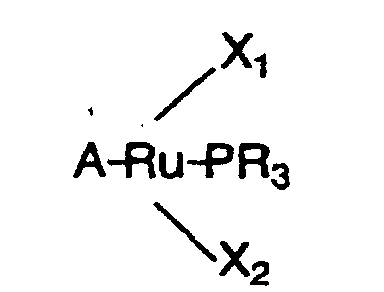
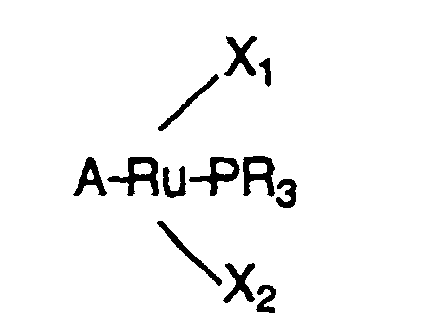
- a polymer-supported arene-ruthenium complex characterized in that the complex is represented by the following formula: wherein A represents an organic polymer with a side chain comprising an aromatic ring coordinated to Ru, X 1 and X 2 represent the same or different halogen atoms, and R represents a hydrocarbon group that may have a substituent.
- the polymer-supported arene-ruthenium complex characterized in that the hydrocarbon group is an alicyclic hydrocarbon group or an aromatic hydrocarbon group.
- the polymer-supported arene-ruthenium complex characterized in that the aromatic ring of the side chain is a benzene ring.
- the polymer-supported arene-ruthenium complex characterized in that the organic polymer is a polystyrene.
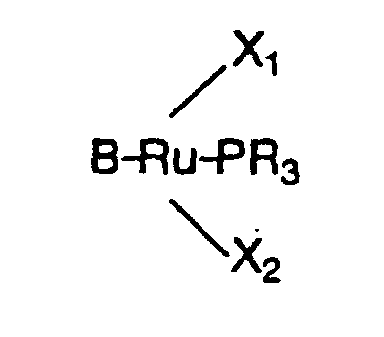
- a method for producing the polymer-supported arene-ruthenium complex of any one of the first to fourth aspects of the invention characterized by comprising a ligand exchange reaction of a complex monomer represented by the following formula: wherein B represents an aromatic compound comprising an aromatic ring coordinated to Ru, and X 1 , X 2 and R are as defined above, with the organic polymer A that has an aromatic ring at a side chain.
- a polymer-supported arene-ruthenium catalyst for an organic synthesis reaction characterized by comprising the polymer-supported arene-ruthenium complex of any one of the first to fourth aspects of the invention as an active component.
- the polymer-supported arene-ruthenium catalyst characterized in that the catalyst is prepared by mixing the complex with a phosphine compound.
- the polymer-supported arene-ruthenium catalyst characterized in that the catalyst is prepared by mixing the complex with MPF 6 in which M represents a monovalent cation.
- the polymer-supported arene-ruthenium catalyst characterized in that the catalyst is prepared by mixing the complex with an alkynyl alcohol compound.
- a method of an organic synthesis reaction characterized in that a ring-closing metathesis reaction of an olefin compound is carried out in the presence of the catalyst of any one of the sixth to ninth aspects of the invention.
- a method of an organic synthesis reaction characterized in that reduction of a carbonyl group is carried out in the presence of the catalyst of the sixth or seventh aspect of the invention to synthesize an alcohol compound.
- a method of an organic synthesis reaction characterized in that a reaction comprising carbon-carbon addition of an acetylene group is carried out in the presence of the catalyst of any one of the sixth to eighth aspects of the invention.
- the present invention is characterized by the above aspects. An embodiment of the invention is described below.
- the polymer-supported arene-ruthenium complex provided in the invention is represented by the above general formula.
- the aromatic ring in the side chain of the organic polymer A is coordinated to the Ru (ruthenium), and the halogen atoms X 1 and X 2 , and the phosphine group PR 3 are bonded to the Ru.
- R forming the phosphine group is a hydrocarbon group that may have a substituent, and the hydrocarbon group may be an aliphatic, alicyclic, aromatic, or heterocyclic group.
- the hydrocarbon group is preferably an alicyclic hydrocarbon group such as a cyclohexyl group and a cyclopentyl group, or an aromatic hydrocarbon group such as a phenyl group.
- the hydrocarbon group may have a substituent as long as the substituent does not inhibit the immobilization on the polymer and the activity of the catalyst.
- substituents include hydrocarbon groups such as a methyl group, an ethyl group, a butyl group, and aryl groups, alkoxy groups, halogen atoms, ester groups, etc.
- the hydrocarbon groups R's forming the phosphine group PR 3 may be the same or different groups selected from the above groups.
- the halogen atoms X 1 and X 2 may be a chlorine atom, a bromine atom, an iodine atom, etc. respectively, and may be the same or different atoms.
- the organic polymer A with the side chain containing the aromatic ring coordinated to the Ru (ruthenium) is not particularly restricted in its kind, and it is preferable that the aromatic ring in the side chain is a benzene ring.
- Typical examples of such organic polymers include polystyrenes, common and easily available.
- the main chain of the polymer may contain not only a carbon chain but also an ether bond, an ester bond and additionally an amino bond, an amide bond, etc. as appropriate.
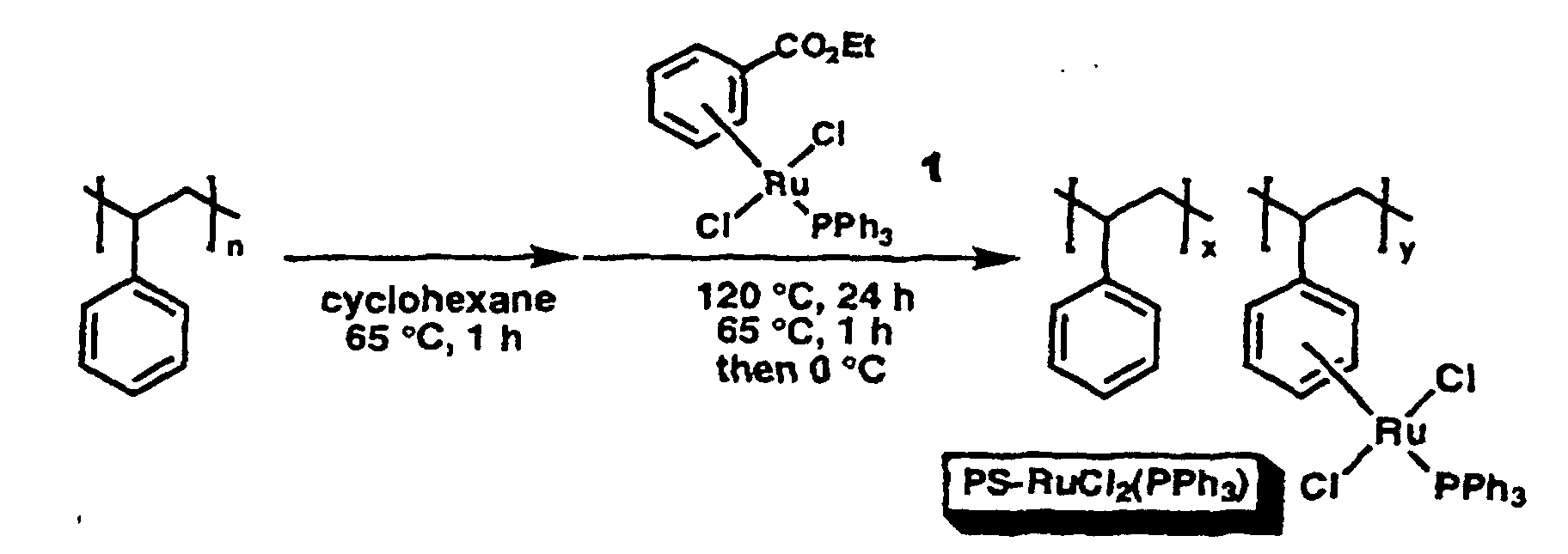
- the polymer-supported arene-ruthenium complex of the invention can be, for instance, produced by the above-described ligand exchange reaction between the complex monomer and the organic polymer A. More practically, the ligand exchange reaction is preferably carried out in accordance with a microencapsulation method, which also is proposed by the inventors.
- a polymer-supported PS-RuCl 2 (PPh 3 ) complex can be produced by reacting a monomer complex in a cyclohexane solvent as shown in the following formula.
- the polymer-supported arene-ruthenium complex of the invention can be effectively used for various organic synthesis reactions as a catalyst without modification or as a catalyst composition prepared by mixing with an auxiliary active component, a cocatalyst, can be used in a reaction accelerator, or can be accelerated by heating.
- the complex shows a high catalytic activity, and can be reused because it is polymer-supported, and expresses high catalytic activity in reutilization.
- the catalyst or the prepared catalyst composition comprises the polymer-supported arene-ruthenium complex as an active component.
- the catalyst composition is a preparation mixed with a phosphine compound, or MPF 6 (in which M represents a monovalent cation), or an alcohol compound, an amine compound, an alkene compound, an alkynylene compound, etc.
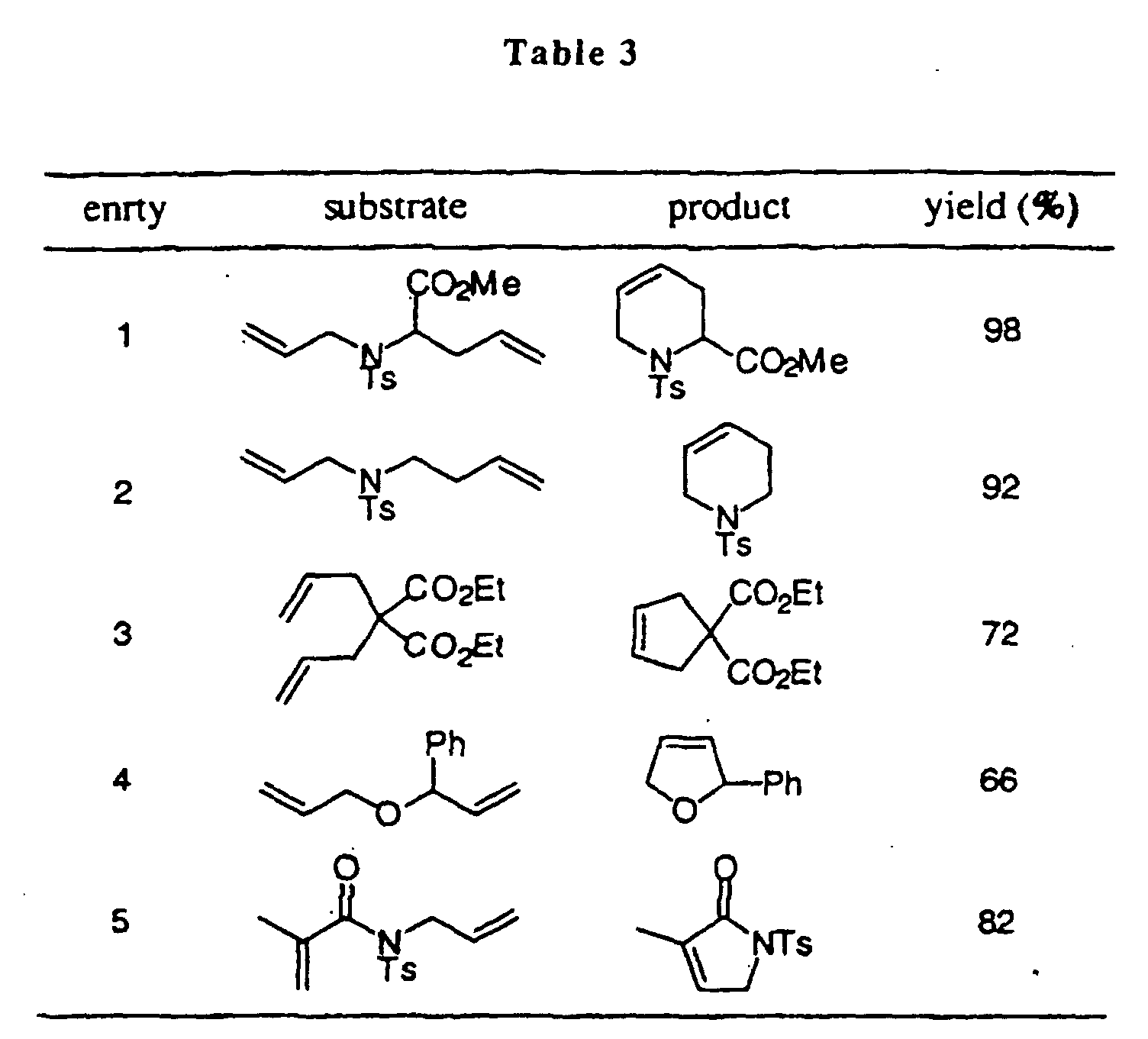
- a ring-closing metathesis reaction of an olefin compound is particularly useful. This reaction is such that a compound having at least two olefin bonds is closed into a ring, and can be one of important principal elementary reactions for synthesizing various pharmaceuticals, agricultural chemicals, perfumes, cosmetics, polymer materials, etc.
- Examples of the catalysts effective for the ring-closing metathesis reaction include compositions of the polymer-supported arene-ruthenium complex and a phosphine compound, an alkynyl alcohol compound having an acetylene bond, NaPF 6 , etc.
- various solvents may be used.
- the solvents include polar solvents such as alcohols, halogenated hydrocarbons, nitriles, amides, and sulfoxides, and hydrocarbons such as benzene, toluene, and hexane.
- preferred solvents include polar solvents such as mixed solvents of an alcohol and a hydrocarbon.
- the catalyst may be prepared before the organic synthesis reaction using the catalyst.
- the catalyst may be prepared by adding the components of the catalyst to the reaction system.
- the catalyst is useful for various organic synthesis reactions, and has a high activity and excellent reusability.
- a ring-closing metathesis reaction shown in the following reaction formula can be achieved with remarkably excellent results by using the catalyst, and thus a 5-membered heterocyclic compound can be synthesized with a yield of 75 % by the first use of the catalyst, with a yield of 81 % by the second use of the catalyst, with a yield of 98 % by the third use of the catalyst.
- the polymer-supported arene-ruthenium complex of the invention can form a reusable catalyst, which shows a high activity in alcohol synthesis by reducing a carbonyl group, a carbon-carbon addition of an acetylene group, etc.
- Polymer-supported arene-ruthenium complexes (3a) and (3b) were produced in accordance with the following reaction formula.
- Triphenylphosphine (0.321 g, 1.22 mmol) was added to 14.5 ml of a dichloromethane solution of a ruthenium dimer (1): [Ru( ⁇ 6 -C 6 H 5 CO 2 Et)Cl 2 ] 2 (0.394 g, 0.61 mmol), and stirred at the room temperature for 30 minutes.
- a ruthenium complex (2b) was obtained in the same manner as (1) using tricyclohexylphosphine instead of triphenylphosphine.
- Polystyrene (5.00 g) was dissolved in cyclohexane (100 ml) at 65°C.
- the above ruthenium complex (2a) (0.20 g) was added to this solution, and stirred at 120°C for 24 hours and at 65°C for 1 hour.
- the ligand exchange reaction process was monitored by a TLC.
- the reaction mixture was gradually cooled to 0°C, and phase separation was observed.
- the polymer-supported arene-ruthenium complex PS-RuCl 2 (PPh 3 ) (3a) (0.058 mmol/g, 689 mg, 0.04 mmol), tricyclohexylphosphine PCy 3 (11.2 mg, 0.04 mmol), 1,1-diphenyl-2-propynol (4) (8.3 mg, 0.04 mmol), and NaPF 6 (6.7 mg, 0.04 mmol) were added to a mixed solvent of isopropanol-hexane (1:10, 10 ml), and stirred under reflux for 1 hour.
- the activated ruthenium catalyst (5a) was isolated by filtration, washed with ethanol and hexane, and then dried under a reduced pressure.
- the catalyst was isolated by filtration and washed with ethanol and hexane, and the filtrate was concentrated under a reduced pressure. It was confirmed by fluorescent X-ray analysis that ruthenium metal was not contained in the filtrate.
- the crude product was subjected to a silica gel chromatography, to obtain N-tosyl-2,5-dihydropyrrole (33.5 mg, 75% yield).
- the recovered catalyst (0.04 mmol) was mixed with PCy 3 (11.2 mg, 0.04 mmol) and 1,1-diphenyl-2-propynol (4) (8.3 mg, 0.04 mmol) in a solvent of isopropanol-hexane (1:10, 10 ml), and stirred under reflux for 1 hour. Then, NaPF 6 (6.7 mg, 0.04 mmol) was added thereto, and further stirred at the room temperature for 12 hours.
- the mixture was subjected to filtration, washing with ethanol and hexane, and drying under a reduced pressure, to obtain a recycled, activated catalyst (5a).
- the above ring-closing metathesis reaction was carried out with excellent results by using the recycled, activated catalyst (5a), and thus the product was obtained with a yield of 81 % by the second use of the catalyst, and with a yield of 98 % by the third use.
- the ring-closing metathesis reaction was carried out in the same manner as Example 2 except for using an activated ruthenium catalyst (5b), which was prepared using the polymer-supported ruthenium complex (3b), instead of the activated ruthenium catalyst (5a).
- N-tosyl-2,5-dihydropyrrole was obtained with a yield of 49 %.
- the recovered catalyst was recycled.
- the product was obtained with a yield of 72 % by the second use of the catalyst, and with a yield of 77 % by the third use.
- the ring-closing metathesis reaction was carried out in the same manner as Example 2 except that a catalyst prepared without NaPF 6 was used instead of the activated ruthenium catalyst (5a). N-tosyl-2,5-dihydropyrrole was obtained with a yield of 40 %.
- the catalyst was recycled.
- the product was obtained with a yield of 72 % by the second use of the catalyst, and with a yield of 77 % by the third use.
- the polymer-supported arene-ruthenium complex PS-RuCl 2 (PPh 3 ) (3a) (44.3 mg, 0.17 mmol) produced in Example 1, K 2 CO 3 (58.1 mg, 0.42 mmol), and triphenylphosphine (44.3 mg, 0.17 mmol) were added to and mixed with an isopropanol solution (8.4 ml) of acetophenone (101.4 mg, 0.84 mmol) at room temperature, and then stirred under reflux for 12 hours.
- the catalyst was isolated by filtration and washed with ethanol and hexane, and the filtrate was concentrated under a reduced pressure and purified by a silica gel chromatography to obtain 1-phenylethanol (89.3 mg, 87% yield).
- the polymer-supported arene-ruthenium complex PS-RuCl 2 (PPh 3 ) (3a) (0.058 mmol/g, 689 mg, 0.04 mmol) produced in Example 1, triphenylphosphine (10.5 mg, 0.04 mmol), and NH 4 PF 6 (6.5 mg, 0.04 mmol) were mixed with 10 ml of a 10/1 hexane-toluene solution of 2-ethynyl-1-(2-furyl)cyclohexene (7) (34.3 mg, 0.20 mmol) at the room temperature, and stirred under reflux for 20 hours.
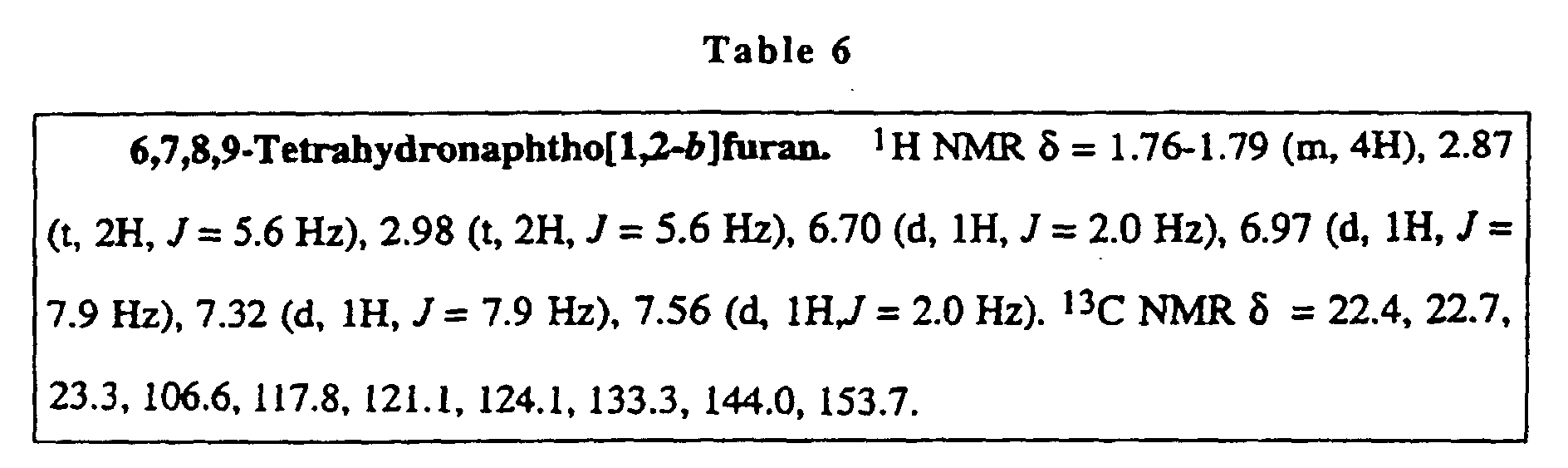
- the catalyst was isolated by filtration and washed with ethanol and hexane, and the filtrate was concentrated under a reduced pressure and purified by silica gel chromatography to obtain 6,7,8,9-tetrahydronaphtho[1,2-6]furan (23.4 mg, 68% yield).
- a novel polymer-supported arene-ruthenium complex and a catalyst thereof which can be produced by a simple process, are stable and easy to recover, have a high catalytic activity, and can be used for various organic synthesis reactions.
- novel methods for organic synthesis reactions such as ring-opening metathesis reaction of an olefin compound and reduction of a carbonyl group, using the catalyst.
Landscapes
- Chemical & Material Sciences (AREA)
- Organic Chemistry (AREA)
- Inorganic Chemistry (AREA)
- Chemical Kinetics & Catalysis (AREA)
- Engineering & Computer Science (AREA)
- Materials Engineering (AREA)
- Medicinal Chemistry (AREA)
- Health & Medical Sciences (AREA)
- General Chemical & Material Sciences (AREA)
- Polymers & Plastics (AREA)
- Catalysts (AREA)
- Organic Low-Molecular-Weight Compounds And Preparation Thereof (AREA)
- Low-Molecular Organic Synthesis Reactions Using Catalysts (AREA)
- Addition Polymer Or Copolymer, Post-Treatments, Or Chemical Modifications (AREA)
- Other In-Based Heterocyclic Compounds (AREA)
- Furan Compounds (AREA)
- Hydrogenated Pyridines (AREA)
- Pyrrole Compounds (AREA)
Abstract
Description





Claims (12)
- A polymer-supported arene-ruthenium complex characterized in that the complex is represented by the following formula:wherein A represents an organic polymer with a side chain comprising an aromatic ring coordinated to Ru, X1 and X2 represent the same or different halogen atoms, and R represents a hydrocarbon group that may have a substituent.
- The polymer-supported arene-ruthenium complex of claim 1, characterized in that the hydrocarbon group is an alicyclic hydrocarbon group or an aromatic hydrocarbon group.
- The polymer-supported arene-ruthenium complex of claim 1 or 2, characterized in that the aromatic ring of the side chain is a benzene ring.
- The polymer-supported arene-ruthenium complex of any one of claims 1 to 3, characterized in that the organic polymer is a polystyrene.
- A method for producing the polymer-supported arene-ruthenium complex of any one of claims 1 to 4, characterized by comprising a ligand exchange of a complex monomer represented by the following formula:wherein B represents an aromatic compound comprising an aromatic ring coordinated to Ru, and X1, X2 and R are as defined above, with an organic polymer A with a side chain comprising an aromatic ring.
- A polymer-supported arene-ruthenium catalyst for an organic synthesis reaction, characterized by comprising the polymer-supported arene-ruthenium complex of any one of claims 1 to 4 as an active component.
- The polymer-supported arene-ruthenium catalyst of claim 6, characterized in that the catalyst is prepared by mixing the complex with a phosphine compound.
- The polymer-supported arene-ruthenium catalyst of claim 7, characterized in that the catalyst is prepared by being mixed with MPF6, in which M represents a monovalent cation.
- The polymer-supported arene-ruthenium catalyst of claim 8, characterized in that the catalyst is prepared by being mixed with an alkynyl alcohol compound.
- A method of an organic synthesis reaction, characterized in that a ring-closing metathesis reaction of an olefin compound is carried out in the presence of the catalyst of any one of claims 6 to 9.
- A method of an organic synthesis reaction, characterized in that reduction of a carbonyl group is carried out in the presence of the catalyst of claim 6 or 7, to synthesize an alcohol compound.
- A method of an organic synthesis reaction, characterized in that a reaction comprising carbon-carbon addition of an acetylene group is carried out in the presence of the catalyst of any one of claims 6 to 8.
Applications Claiming Priority (3)
| Application Number | Priority Date | Filing Date | Title |
|---|---|---|---|
| JP2002065662 | 2002-03-11 | ||
| JP2002065662 | 2002-03-11 | ||
| PCT/JP2003/002861 WO2003076478A1 (en) | 2002-03-11 | 2003-03-11 | Arene-ruthenium complexes immobilized on polymers, catalysts consisting of the complexes, and processes for organic syntheses with the same |
Publications (3)
| Publication Number | Publication Date |
|---|---|
| EP1489106A1 true EP1489106A1 (en) | 2004-12-22 |
| EP1489106A4 EP1489106A4 (en) | 2008-08-27 |
| EP1489106B1 EP1489106B1 (en) | 2012-05-09 |
Family
ID=27800233
Family Applications (1)
| Application Number | Title | Priority Date | Filing Date |
|---|---|---|---|
| EP03710299A Expired - Lifetime EP1489106B1 (en) | 2002-03-11 | 2003-03-11 | Arene-ruthenium complexes immobilized on polymers, catalysts consisting of the complexes, and processes for organic syntheses with the same |
Country Status (4)
| Country | Link |
|---|---|
| US (1) | US7348290B2 (en) |
| EP (1) | EP1489106B1 (en) |
| JP (1) | JP4011022B2 (en) |
| WO (1) | WO2003076478A1 (en) |
Cited By (2)
| Publication number | Priority date | Publication date | Assignee | Title |
|---|---|---|---|---|
| WO2006005479A3 (en) * | 2004-07-08 | 2006-08-03 | Boehringer Ingelheim Int | Continuous metathesis method with ruthenium catalysts |
| WO2009132443A1 (en) * | 2008-05-01 | 2009-11-05 | Kanata Chemical Technologies Inc. | Cationic transition-metal arene catalysts |
Family Cites Families (7)
| Publication number | Priority date | Publication date | Assignee | Title |
|---|---|---|---|---|
| JPS598361B2 (en) * | 1980-02-25 | 1984-02-24 | 理化学研究所 | Novel polypyridylruthenium polymer complex and its production method |
| JPS597721B2 (en) * | 1980-09-05 | 1984-02-20 | 理化学研究所 | Novel tris(bipyridyl)ruthenium-type polymer complex and its production method |
| JP3919268B2 (en) * | 1996-11-08 | 2007-05-23 | 高砂香料工業株式会社 | Ruthenium-optically active phosphine complex, process for producing the same, and process for producing optically active 4-methyl-2-oxetanone using the same |
| EP0921129A1 (en) * | 1997-12-03 | 1999-06-09 | Studiengesellschaft Kohle mbH | Highly active cationic ruthenium and osmium complexes for olefin metathesis reactions |
| JP5066656B2 (en) * | 1998-09-10 | 2012-11-07 | ユニバーシティ・オブ・ニュー・オーリンズ・リサーチ・アンド・テクノロジー・ファウンデーション・インコーポレーテッド | Catalytic complexes with carbene ligands |
| US6605201B1 (en) * | 1999-11-15 | 2003-08-12 | Therasense, Inc. | Transition metal complexes with bidentate ligand having an imidazole ring and sensor constructed therewith |
| CN100509155C (en) | 2001-03-26 | 2009-07-08 | 陶氏环球技术公司 | Multiphase catalyst composition |
-
2003
- 2003-03-11 JP JP2003574692A patent/JP4011022B2/en not_active Expired - Fee Related
- 2003-03-11 WO PCT/JP2003/002861 patent/WO2003076478A1/en not_active Ceased
- 2003-03-11 EP EP03710299A patent/EP1489106B1/en not_active Expired - Lifetime
- 2003-03-11 US US10/507,073 patent/US7348290B2/en not_active Expired - Fee Related
Cited By (2)
| Publication number | Priority date | Publication date | Assignee | Title |
|---|---|---|---|---|
| WO2006005479A3 (en) * | 2004-07-08 | 2006-08-03 | Boehringer Ingelheim Int | Continuous metathesis method with ruthenium catalysts |
| WO2009132443A1 (en) * | 2008-05-01 | 2009-11-05 | Kanata Chemical Technologies Inc. | Cationic transition-metal arene catalysts |
Also Published As
| Publication number | Publication date |
|---|---|
| EP1489106B1 (en) | 2012-05-09 |
| US7348290B2 (en) | 2008-03-25 |
| WO2003076478A1 (en) | 2003-09-18 |
| JP4011022B2 (en) | 2007-11-21 |
| EP1489106A4 (en) | 2008-08-27 |
| JPWO2003076478A1 (en) | 2005-07-07 |
| US20050119416A1 (en) | 2005-06-02 |
Similar Documents
| Publication | Publication Date | Title |
|---|---|---|
| EP2260047B1 (en) | Method for manufacturing ruthenium carbene complexes | |
| Das et al. | Synthesis of ethers from esters via Fe-catalyzed hydrosilylation | |
| EP0916637B1 (en) | Process for preparating optically active compounds | |
| Wienand et al. | Reactions of Fischer carbene complexes with electron-deficient olefins: scope and limitations of this route to donor-acceptor-substituted cyclopropanes | |
| JP2013099739A (en) | Catalyst complex with carbene ligand | |
| US6303837B1 (en) | Process for synthesizing α-substituted ring systems | |
| EP2364214A1 (en) | Method for preparation of amides from alcohols and amines by extrusion of hydrogen | |
| US9586981B2 (en) | Z-selective metathesis catalysts | |
| Han et al. | Chiral ferrocenyl P, S-ligands for highly efficient copper-catalyzed asymmetric [3+ 2] cycloaddition of azomethine ylides | |
| EP1489106B1 (en) | Arene-ruthenium complexes immobilized on polymers, catalysts consisting of the complexes, and processes for organic syntheses with the same | |
| EP1948671B1 (en) | Preparation of catalysts | |
| JP2021513572A (en) | Reaction of olefin derivatives in the presence of metathesis catalyst | |
| JP4131074B2 (en) | Method for producing ruthenium compound | |
| EP1005476B1 (en) | Method for producing ruthenium complexes | |
| CN109369514B (en) | Synthetic method of six-membered carbocyclic ring derivative | |
| WO2012040853A1 (en) | Group 5 metal complexes useful for amine functionalization and synthetic process for manufacture thereof | |
| JP2003260366A (en) | Novel chiral copper catalyst and method for producing N-acylated amino acid derivative using the same | |
| JP3691235B2 (en) | Process for producing optically active piperidines | |
| US9340519B2 (en) | Paracyclophane-based ligands, their preparation and use in catalysis | |
| Nakyama et al. | Improved synthesis of 2-chlorocyclobutanone derivatives | |
| WO1998040341A1 (en) | Process for preparation of cyclopentenones in supercritical fluids | |
| JP4359440B2 (en) | Method for producing nitriles | |
| JPH115769A (en) | Method for producing tertiary amines | |
| WO2005086622A2 (en) | Imido-tethered carbenes of molybdenum for ring-opening metathesis polymerisation and ring-closing metathesis | |
| Hryniewicka et al. | An Improved Synthesis of Ruthenium Metathesis Catalysts |
Legal Events
| Date | Code | Title | Description |
|---|---|---|---|
| PUAI | Public reference made under article 153(3) epc to a published international application that has entered the european phase |
Free format text: ORIGINAL CODE: 0009012 |
|
| 17P | Request for examination filed |
Effective date: 20041011 |
|
| AK | Designated contracting states |
Kind code of ref document: A1 Designated state(s): AT BE BG CH CY CZ DE DK EE ES FI FR GB GR HU IE IT LI LU MC NL PT RO SE SI SK TR |
|
| RIC1 | Information provided on ipc code assigned before grant |
Ipc: C07C 33/20 20060101ALI20080716BHEP Ipc: C07D 211/78 20060101ALI20080716BHEP Ipc: C07D 307/28 20060101ALI20080716BHEP Ipc: C08F 12/08 20060101ALI20080716BHEP Ipc: C07D 211/70 20060101ALI20080716BHEP Ipc: C07F 9/50 20060101ALI20080716BHEP Ipc: C07C 67/333 20060101ALI20080716BHEP Ipc: B01J 31/22 20060101AFI20080716BHEP Ipc: C07D 207/38 20060101ALI20080716BHEP Ipc: C07C 69/74 20060101ALI20080716BHEP Ipc: B01J 31/24 20060101ALI20080716BHEP Ipc: C07D 207/20 20060101ALI20080716BHEP Ipc: C07C 6/04 20060101ALI20080716BHEP Ipc: C07F 15/00 20060101ALI20080716BHEP Ipc: C07C 29/143 20060101ALI20080716BHEP Ipc: C08F 8/42 20060101ALI20080716BHEP |
|
| A4 | Supplementary search report drawn up and despatched |
Effective date: 20080724 |
|
| 17Q | First examination report despatched |
Effective date: 20090708 |
|
| REG | Reference to a national code |
Ref country code: DE Ref legal event code: R079 Ref document number: 60340881 Country of ref document: DE Free format text: PREVIOUS MAIN CLASS: C08F0008420000 Ipc: B01J0031060000 |
|
| RIC1 | Information provided on ipc code assigned before grant |
Ipc: B01J 31/06 20060101AFI20111128BHEP |
|
| GRAP | Despatch of communication of intention to grant a patent |
Free format text: ORIGINAL CODE: EPIDOSNIGR1 |
|
| GRAS | Grant fee paid |
Free format text: ORIGINAL CODE: EPIDOSNIGR3 |
|
| GRAA | (expected) grant |
Free format text: ORIGINAL CODE: 0009210 |
|
| AK | Designated contracting states |
Kind code of ref document: B1 Designated state(s): DE FR GB |
|
| REG | Reference to a national code |
Ref country code: GB Ref legal event code: FG4D |
|
| REG | Reference to a national code |
Ref country code: DE Ref legal event code: R096 Ref document number: 60340881 Country of ref document: DE Effective date: 20120705 |
|
| PLBE | No opposition filed within time limit |
Free format text: ORIGINAL CODE: 0009261 |
|
| STAA | Information on the status of an ep patent application or granted ep patent |
Free format text: STATUS: NO OPPOSITION FILED WITHIN TIME LIMIT |
|
| 26N | No opposition filed |
Effective date: 20130212 |
|
| REG | Reference to a national code |
Ref country code: DE Ref legal event code: R097 Ref document number: 60340881 Country of ref document: DE Effective date: 20130212 |
|
| PGFP | Annual fee paid to national office [announced via postgrant information from national office to epo] |
Ref country code: FR Payment date: 20140311 Year of fee payment: 12 |
|
| PGFP | Annual fee paid to national office [announced via postgrant information from national office to epo] |
Ref country code: GB Payment date: 20140305 Year of fee payment: 12 |
|
| PGFP | Annual fee paid to national office [announced via postgrant information from national office to epo] |
Ref country code: DE Payment date: 20140417 Year of fee payment: 12 |
|
| REG | Reference to a national code |
Ref country code: DE Ref legal event code: R119 Ref document number: 60340881 Country of ref document: DE |
|
| GBPC | Gb: european patent ceased through non-payment of renewal fee |
Effective date: 20150311 |
|
| REG | Reference to a national code |
Ref country code: FR Ref legal event code: ST Effective date: 20151130 |
|
| PG25 | Lapsed in a contracting state [announced via postgrant information from national office to epo] |
Ref country code: DE Free format text: LAPSE BECAUSE OF NON-PAYMENT OF DUE FEES Effective date: 20151001 Ref country code: GB Free format text: LAPSE BECAUSE OF NON-PAYMENT OF DUE FEES Effective date: 20150311 |
|
| PG25 | Lapsed in a contracting state [announced via postgrant information from national office to epo] |
Ref country code: FR Free format text: LAPSE BECAUSE OF NON-PAYMENT OF DUE FEES Effective date: 20150331 |