EP1489096A1 - Novel hemepeptide - Google Patents
Novel hemepeptide Download PDFInfo
- Publication number
- EP1489096A1 EP1489096A1 EP03743542A EP03743542A EP1489096A1 EP 1489096 A1 EP1489096 A1 EP 1489096A1 EP 03743542 A EP03743542 A EP 03743542A EP 03743542 A EP03743542 A EP 03743542A EP 1489096 A1 EP1489096 A1 EP 1489096A1
- Authority
- EP
- European Patent Office
- Prior art keywords
- heme
- peptide
- amino acid
- restriction enzyme
- ala
- Prior art date
- Legal status (The legal status is an assumption and is not a legal conclusion. Google has not performed a legal analysis and makes no representation as to the accuracy of the status listed.)
- Granted
Links
- ZXKBVCUVSLFOSC-UHFFFAOYSA-N C1C2C1COC2 Chemical compound C1C2C1COC2 ZXKBVCUVSLFOSC-UHFFFAOYSA-N 0.000 description 1
Classifications
-
- C—CHEMISTRY; METALLURGY
- C07—ORGANIC CHEMISTRY
- C07K—PEPTIDES
- C07K14/00—Peptides having more than 20 amino acids; Gastrins; Somatostatins; Melanotropins; Derivatives thereof
- C07K14/795—Porphyrin- or corrin-ring-containing peptides
- C07K14/805—Haemoglobins; Myoglobins
-
- A—HUMAN NECESSITIES
- A61—MEDICAL OR VETERINARY SCIENCE; HYGIENE
- A61P—SPECIFIC THERAPEUTIC ACTIVITY OF CHEMICAL COMPOUNDS OR MEDICINAL PREPARATIONS
- A61P25/00—Drugs for disorders of the nervous system
- A61P25/14—Drugs for disorders of the nervous system for treating abnormal movements, e.g. chorea, dyskinesia
-
- A—HUMAN NECESSITIES
- A61—MEDICAL OR VETERINARY SCIENCE; HYGIENE
- A61P—SPECIFIC THERAPEUTIC ACTIVITY OF CHEMICAL COMPOUNDS OR MEDICINAL PREPARATIONS
- A61P25/00—Drugs for disorders of the nervous system
- A61P25/14—Drugs for disorders of the nervous system for treating abnormal movements, e.g. chorea, dyskinesia
- A61P25/16—Anti-Parkinson drugs
-
- A—HUMAN NECESSITIES
- A61—MEDICAL OR VETERINARY SCIENCE; HYGIENE
- A61P—SPECIFIC THERAPEUTIC ACTIVITY OF CHEMICAL COMPOUNDS OR MEDICINAL PREPARATIONS
- A61P3/00—Drugs for disorders of the metabolism
-
- A—HUMAN NECESSITIES
- A61—MEDICAL OR VETERINARY SCIENCE; HYGIENE
- A61P—SPECIFIC THERAPEUTIC ACTIVITY OF CHEMICAL COMPOUNDS OR MEDICINAL PREPARATIONS
- A61P3/00—Drugs for disorders of the metabolism
- A61P3/06—Antihyperlipidemics
-
- A—HUMAN NECESSITIES
- A61—MEDICAL OR VETERINARY SCIENCE; HYGIENE
- A61P—SPECIFIC THERAPEUTIC ACTIVITY OF CHEMICAL COMPOUNDS OR MEDICINAL PREPARATIONS
- A61P3/00—Drugs for disorders of the metabolism
- A61P3/08—Drugs for disorders of the metabolism for glucose homeostasis
- A61P3/10—Drugs for disorders of the metabolism for glucose homeostasis for hyperglycaemia, e.g. antidiabetics
-
- A—HUMAN NECESSITIES
- A61—MEDICAL OR VETERINARY SCIENCE; HYGIENE
- A61P—SPECIFIC THERAPEUTIC ACTIVITY OF CHEMICAL COMPOUNDS OR MEDICINAL PREPARATIONS
- A61P35/00—Antineoplastic agents
-
- A—HUMAN NECESSITIES
- A61—MEDICAL OR VETERINARY SCIENCE; HYGIENE
- A61P—SPECIFIC THERAPEUTIC ACTIVITY OF CHEMICAL COMPOUNDS OR MEDICINAL PREPARATIONS
- A61P43/00—Drugs for specific purposes, not provided for in groups A61P1/00-A61P41/00
-
- A—HUMAN NECESSITIES
- A61—MEDICAL OR VETERINARY SCIENCE; HYGIENE
- A61P—SPECIFIC THERAPEUTIC ACTIVITY OF CHEMICAL COMPOUNDS OR MEDICINAL PREPARATIONS
- A61P7/00—Drugs for disorders of the blood or the extracellular fluid
-
- A—HUMAN NECESSITIES
- A61—MEDICAL OR VETERINARY SCIENCE; HYGIENE
- A61P—SPECIFIC THERAPEUTIC ACTIVITY OF CHEMICAL COMPOUNDS OR MEDICINAL PREPARATIONS
- A61P7/00—Drugs for disorders of the blood or the extracellular fluid
- A61P7/04—Antihaemorrhagics; Procoagulants; Haemostatic agents; Antifibrinolytic agents
-
- A—HUMAN NECESSITIES
- A61—MEDICAL OR VETERINARY SCIENCE; HYGIENE
- A61P—SPECIFIC THERAPEUTIC ACTIVITY OF CHEMICAL COMPOUNDS OR MEDICINAL PREPARATIONS
- A61P9/00—Drugs for disorders of the cardiovascular system
-
- A—HUMAN NECESSITIES
- A61—MEDICAL OR VETERINARY SCIENCE; HYGIENE
- A61P—SPECIFIC THERAPEUTIC ACTIVITY OF CHEMICAL COMPOUNDS OR MEDICINAL PREPARATIONS
- A61P9/00—Drugs for disorders of the cardiovascular system
- A61P9/04—Inotropic agents, i.e. stimulants of cardiac contraction; Drugs for heart failure
-
- A—HUMAN NECESSITIES
- A61—MEDICAL OR VETERINARY SCIENCE; HYGIENE
- A61P—SPECIFIC THERAPEUTIC ACTIVITY OF CHEMICAL COMPOUNDS OR MEDICINAL PREPARATIONS
- A61P9/00—Drugs for disorders of the cardiovascular system
- A61P9/10—Drugs for disorders of the cardiovascular system for treating ischaemic or atherosclerotic diseases, e.g. antianginal drugs, coronary vasodilators, drugs for myocardial infarction, retinopathy, cerebrovascula insufficiency, renal arteriosclerosis
-
- A—HUMAN NECESSITIES
- A61—MEDICAL OR VETERINARY SCIENCE; HYGIENE
- A61P—SPECIFIC THERAPEUTIC ACTIVITY OF CHEMICAL COMPOUNDS OR MEDICINAL PREPARATIONS
- A61P9/00—Drugs for disorders of the cardiovascular system
- A61P9/12—Antihypertensives
-
- A—HUMAN NECESSITIES
- A61—MEDICAL OR VETERINARY SCIENCE; HYGIENE
- A61K—PREPARATIONS FOR MEDICAL, DENTAL OR TOILETRY PURPOSES
- A61K38/00—Medicinal preparations containing peptides
Definitions
- the present invention relates to novel heme peptides, in particular, heme peptides having NO-scavenging ability, methods for producing the heme peptide, and NO scavengers and pharmaceutical compositions each comprising the heme peptide.
- NO nitrogen monoxide
- lifestyle-related diseases such as diabetes, arteriosclerosis and cancer.
- abnormality in NO production is involved in many physiological functions and diseases. For example, it is known that shortage of NO is responsible for hypertension, hyperlipemia, arteriosclerosis, heart failure, coronary spasm, etc., and that excess of NO is responsible for cerebral apoplexy, Huntington's disease, Parkinson's disease, etc.
- NO is one of the environmental pollutant NO x
- development NO-scavenging materials is important in measuring environmental pollution and in purifying polluted air, water or the like.
- NO is a gas and unstable at normal temperatures. Therefore, it is difficult to handle or quantify NO. Further, no effective NO-scavenging materials have been known to date.
- cytochrome c has NO-scavenging ability (Chemistry and Organisms, 34 (12), 784-786 (1996)). Also, the inventors have isolated similar C-type cytochromes from various organisms such as red alga Porphyra yezonesis , green alga chlorella and photosynthetic bacteria, and confirmed NO-scavenging ability in them (Biosci. Biotechnol. Biochem., 64(3), 628-632, 2000; Jap. J. Pharmacol., 75 (Suppl. I), p. 113 (1997)).
- the present inventors have determined the tertiary structure of red alga Porphyra yezonesis -derived cytochrome c 6 by three-dimensional structure analysis with x-ray (Acta Cryst., D56, 1577-1582 (2000)) and constructed an expression system for cytochrome c 6 in a recombinant Escherichia coli.
- the present inventors have advanced further the research in materials having NO-scavenging ability, as a consequence they have found heme peptides having higher NO-scavenging ability than cytochrome c.
- the present invention relates to a heme peptide represented by the following formula I.
- A1 is a hydrogen atom or a peptide chain consisting of 1 to 20, preferably 1 to 10, especially preferably 1 to 5, amino acid residues
- A2 is a hydroxyl group or a peptide chain consisting of 1 to 50, preferably 1 to 10, especially preferably 1 to 5, amino acid residues
- the heme is a heme nucleus represented by the following formula: X1 and X2 each independently represent any amino acid residue; and X3 is His, Lys or Arg.
- the heme nucleus described above is capable of linking to cysteine residues via the cysteinyl thioether bonds at positions 3 and 8.
- the present invention also relates to a method of producing the heme peptide of any one of (1) to (5) above, comprising digesting cytochrome c with a restriction enzyme, optionally conducting a salting out treatment, and purifying the resultant digest by gel filtration chromatography.
- the restriction enzyme is selected from the group consisting of thermolysin, trypsin, chymotrypsin, Achromobacter protease I and Staphylococcus aureus V8 protease.
- the present invention relates to an NO-scavenger comprising the heme peptide of any one of (1) to (5) above.
- the above-described peptide of the present invention is characterized by (a) comprising a peptide having an amino acid sequence spanning from Cys at position 14 to the amino acid residue at position 18 of cytochrome c in the shortest or this sequence in which the amino acid residues at positions 15, 16 and 18 are substituted; (b) its heme nucleus being bound to the Cys residues at positions 14 and 17 via the cysteinyl thioether bonds at positions 3 and 8; (c) the amino acid residue at potion 18 being His, Lys or Arg; (d) the amino acid residues at positions 15 and 16 being preferably Ala, Gln, Lys, Arg or Val; and (e) the N-terminal peptide chain of the Cys residue at position 14 and the C-terminal peptide chain of the Cys residue at position 17 each consisting of preferably 50 nucleotides or less, more preferably 10 nucleotides or less.
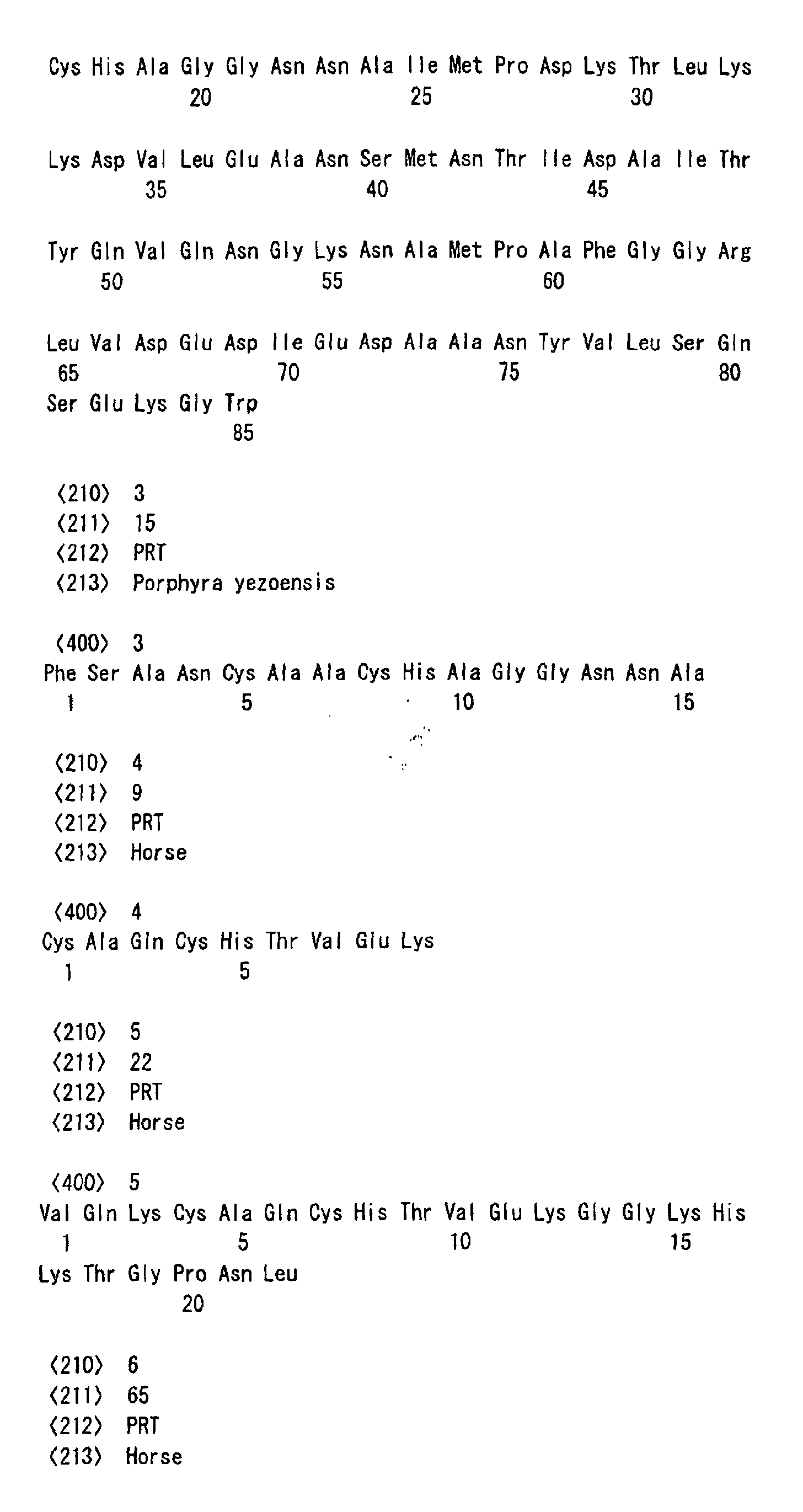
- a peptide chain may be given which consists of 1 to 13 consecutive amino acid residues starting from position 13 and running to the N-terminal in a partial amino acid sequence spanning from position 1 to position 13 of SEQ ID NO: 1 (sequence for horse cardiac muscle cytochrome c ) or SEQ ID NO: 2 (sequence for red alga Porphyra yezonesis cytochrome c 6 ) in the sequence listing, or in the partial amino acid sequence where one to several amino acids are substituted, deleted or added.
- SEQ ID NO: 1 sequence for horse cardiac muscle cytochrome c
- SEQ ID NO: 2 sequence for red alga Porphyra yezonesis cytochrome c 6
- a peptide chain may be given which consists of 1 to 50 consecutive amino acid residues starting from position 19 and running to the C-terminal in a partial amino acid sequence spanning from position 19 to position 70 of SEQ ID NO: 1 (sequence for horse cardiac muscle cytochrome c ) or SEQ ID NO: 2 (sequence for red alga Porphyra yezonesis cytochrome c 6 ) in the sequence listing, or in the partial amino acid sequence where one to several amino acids are substituted, deleted or added.
- SEQ ID NO: 1 sequence for horse cardiac muscle cytochrome c
- SEQ ID NO: 2 sequence for red alga Porphyra yezonesis cytochrome c 6
- the "NO-scavenger” may be for any purpose as long as it is capable of being used for capturing NO.
- the NO-scavenger is a diagnostic for use in measuring NO concentrations in the body (e.g. in blood), a prophylactic and/or therapeutic for diseases associated with excess of NO that captures NO in the body (e.g. in blood), a research reagent, a reagent for use in measuring NO concentrations in air, exhaust gas or water, or a treating agent for use in water treatment or exhaust gas treatment.
- the heme peptide of the invention may also be prepared by introducing a vector comprising a DNA having a nucleotide sequence encoding the amino acid sequence of cytochrome c (or the DNA into which a site-specific mutation has been introduced) into a host cell, culturing the host cell, isolating the cytochrome c from the resultant culture, digesting the cytochrome c with a restriction enzyme, and purifying resultant digest by a method, such as chromatography.
- vectors which may be used for transformation include plasmids, phages, etc. that are conventionally used in the field of biotechnology.
- a host cell preferably a prokaryotic cell, more preferably a bacterium, especially Escherichia coli is used.
- the isolation of cytochrome c may be performed by, for example, harvesting cultured cells, disrupting the cells physically, and then extracting and purifying the cytochrome c .
- the harvesting of cultured cells may be performed by scraping off when the cells are cultured in a solid medium or by centrifugation when the cells are cultured in a liquid medium.
- cytochrome c encompasses all the c -type cytochromes including cytochrome c 1 , cytochrome c 2 , cytochrome c 6 , cytochrome c-551, and so on.
- amino acid residues constituting the peptide of the invention also include modified amino acid residues.
- Isoelectric point was analyzed by isoelectric focusing using Ampholine PAGplate gel (Pharmacia; for IEF; pH 3.5-9.5). Absorption maximum was determined with Hitachi U-3310 Spectrophotometer (Hitachi). Oxidation-reduction potential was determined with Hitachi U-3310 Spectrophotometer (Hitachi) and ORP electrode (Metrohm).
- a heme peptide having the following amino acid sequence was prepared. (The heme nucleus in formula II is bound to the cysteine residues at positions 5 and 8 of a peptide having the sequence as shown in SEQ ID NO: 3.)
- cytochrome c 6 purified from red alga Porphyra yezonesis was dissolved in 200 ⁇ l of 0.1 M Tris-HCl buffer (pH 7.8) (containing 2 mM calcium chloride). The resultant cytochrome c 6 solution was kept at 37°C for 5 min. To this solution, 62.5 ⁇ l of 1 mg/ml thermolysin solution in 0.1 M Tris-HCl buffer was added. Further, 37.5 ⁇ l of the same buffer was added thereto. This reaction solution was kept at 37°C for 4.5 hr. Then, the reaction solution was ice-cooled to terminate the reaction, and 700 ⁇ l of the same buffer was added thereto.
- the resultant reaction solution was purified by gel filtration column chromatography (Toyopearl HW-40F; 1.0 x 80 cm; Tosoh) to thereby obtain the above-described peptide.
- the resultant peptide was electrophoresed to thereby confirm that this peptide was a single substance. Further, the amino acid sequence of this peptide was analyzed with an amino acid sequencer to thereby confirm that this peptide had the above-described sequence.
- the resultant peptide had the following physical properties: Isoelectric point: 4.15; Absorption maximum of oxidized type: 404, 526 nm; Absorption maximum of reduced type: 413.5, 549.5 nm; Oxidation-reduction potential: -82.2 mV; Molecular weight: 2200.
- a heme peptide having the following amino acid sequence was prepared. (The heme nucleus in formula II is bound to the cysteine residues at positions 1 and 4 of a peptide having the sequence as shown in SEQ ID NO: 4.)
- the resultant peptide had the following physical properties: Isoelectric point: 4.95; Absorption maximum of oxidized type: 395, 619 nm; Absorption maximum of reduced type: 412, 520, 549 nm; Oxidation-reduction potential: -132 mV; Molecular weight: 1637.
- a heme peptide having the following amino acid sequence was prepared. (The heme nucleus in formula II is bound to the cysteine residues at positions 4 and 7 of a peptide having the sequence as shown in SEQ ID NO: 5.)
- cytochrome c horse cardiac muscle cytochrome c (Wako Purechemical Industries) was dissolved in 100 ⁇ l of 0.1 M Tris-HCl buffer (pH 8.0). The resultant cytochrome c solution was kept at 37°C for 5 min. To this solution, 40 ⁇ l of 1 mg/ml chymotrypsin solution in 0.1 M Tris-HCl buffer was added. Further, 60 ⁇ l of the same buffer was added thereto. This reaction solution was kept at 37°C for 24 hr. Then, the reaction solution was ice-cooled to terminate the reaction.
- the resultant peptide had the following physical properties: Isoelectric point: 6.02; Absorption maximum of oxidized type: 398, 620 nm; Absorption maximum of reduced type: 416, 520, 549 nm; Oxidation-reduction potential: -66.5 mV; Molecular weight: 3065.
- a heme peptide having the following amino acid sequence was prepared. (The heme nucleus in formula II is bound to the cysteine residues at positions 14 and 17 of a peptide having the sequence as shown in SEQ ID NO: 6.)
- the resultant peptide had the following physical properties: Isoelectric point: 9.52; Absorption maximum of oxidized type: 404, 535 nm; Absorption maximum of reduced type: 415, 520, 549 nm; Oxidation-reduction potential: -62.1 mV; Molecular weight: 8900.
- An NO-scavenging heme peptide represented by the following formula was prepared in the same manner as described in Example 3 except that Achromobacter protease I (lysyl endopeptidase) was used as a restriction enzyme instead of chymotrypsin. (The heme nucleus in formula II is bound to the cysteine residues at positions 1 and 4 of a peptide having the sequence as shown in SEQ ID NO: 7.)
- Achromobacter protease I lysyl endopeptidase
- An NO-scavenging heme peptide represented by the following formula was prepared in the same manner as described in Example 1 except that Achromobacter protease I (lysyl endopeptidase) was used as a restriction enzyme instead of thermolysin. (The heme nucleus in formula II is bound to the cysteine residues at positions 6 and 9 of a peptide having the sequence as shown in SEQ ID NO: 8.)
- Achromobacter protease I lysyl endopeptidase
- An NO-scavenging heme peptide represented by the following formula was prepared in the same manner as described in Example 3 except that Staphylococcus aureus V8 protease (endoprotenase Glu-C) was used as a restriction enzyme instead of chymotrypsin and that an ammonium buffer was used instead of the phosphate buffer.
- Staphylococcus aureus V8 protease endoprotenase Glu-C
- an ammonium buffer was used instead of the phosphate buffer.
- An NO-scavenging heme peptide represented by the following formula was prepared in the same manner as described in Example 1 except that Staphylococcus aureus V8 protease (endoprotenase Glu-C) was used as a restriction enzyme instead of thermolysin and that an ammonium buffer was used instead of the phosphate buffer.
- Staphylococcus aureus V8 protease endoprotenase Glu-C
- an ammonium buffer was used instead of the phosphate buffer.
- the amount of the remaining nitrite was determined by the diazotization method. 0.02 ml of the reaction solution was taken, and 1.98 ml of ultrapure water was added thereto. Then, 1 ml of 1% sulfanilamide, 1 ml of 0.02% N-1-naphthyl ethylenediamine chloride and 1 ml of ultrapure water were added thereto. The resultant solution was left at room temperature for 20 min. Then, absorption of the produced azo dye was measured at 540 nm, followed by calculation of the amount of the remaining nitrite from a working curve prepared from a nitrous acid solution of a known concentration.
- the heme peptide of the invention has a remarkably high NO-scavenging ability as compared to cytochrome c .
- An NO-scavenger which can be used as a reagent for quantifying NO in the body, as a pharmaceutical composition that controls NO in the body, as a reagent for measuring NO concentrations in environment, or as a purifying agent for polluted air and polluted waste water. Further, out of the heme peptides of the invention, those which are soluble in water are suitable for uses in liquid samples.
Landscapes
- Health & Medical Sciences (AREA)
- Chemical & Material Sciences (AREA)
- Organic Chemistry (AREA)
- Medicinal Chemistry (AREA)
- Bioinformatics & Cheminformatics (AREA)
- Life Sciences & Earth Sciences (AREA)
- Engineering & Computer Science (AREA)
- General Health & Medical Sciences (AREA)
- Public Health (AREA)
- Veterinary Medicine (AREA)
- General Chemical & Material Sciences (AREA)
- Animal Behavior & Ethology (AREA)
- Pharmacology & Pharmacy (AREA)
- Nuclear Medicine, Radiotherapy & Molecular Imaging (AREA)
- Chemical Kinetics & Catalysis (AREA)
- Diabetes (AREA)
- Hematology (AREA)
- Cardiology (AREA)
- Heart & Thoracic Surgery (AREA)
- Obesity (AREA)
- Neurology (AREA)
- Biomedical Technology (AREA)
- Neurosurgery (AREA)
- Biochemistry (AREA)
- Psychology (AREA)
- Proteomics, Peptides & Aminoacids (AREA)
- Molecular Biology (AREA)
- Genetics & Genomics (AREA)
- Biophysics (AREA)
- Gastroenterology & Hepatology (AREA)
- Emergency Medicine (AREA)
- Endocrinology (AREA)
- Hospice & Palliative Care (AREA)
- Urology & Nephrology (AREA)
- Vascular Medicine (AREA)
- Peptides Or Proteins (AREA)
- Medicines That Contain Protein Lipid Enzymes And Other Medicines (AREA)
- Preparation Of Compounds By Using Micro-Organisms (AREA)
Abstract
Description

A2 is a hydroxyl group or a peptide chain consisting of 1 to 50, preferably 1 to 10, especially preferably 1 to 5, amino acid residues;
the heme is a heme nucleus represented by the following formula:
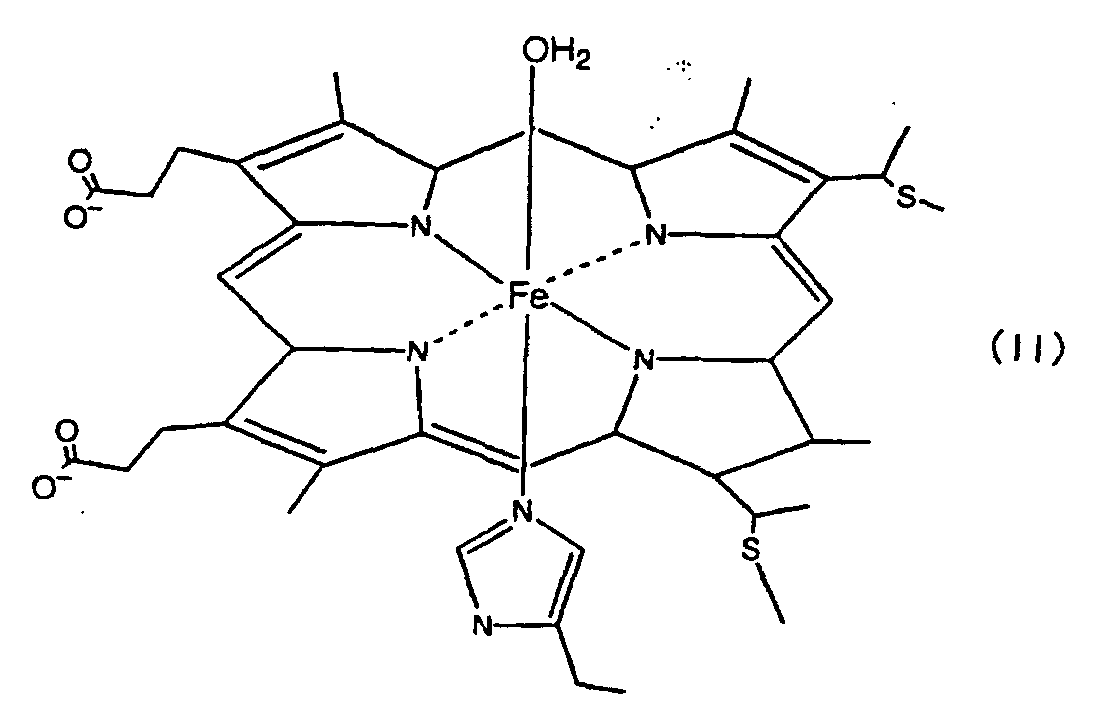
X3 is His, Lys or Arg.)
A1 is a hydrogen atom or a peptide chain having an amino acid sequence of Val Gln Lys;
A2 is a peptide chain having an amino acid sequence of Thr Val Glu Lys or Thr Val Glu Lys Gly Gly Lys His Lys Thr Gly Pro Asn Leu;
X1 is Ala; X2 is Gln; and X3 is His.
A1 is a peptide chain having an amino acid sequence of Phe Ser Ala Asn;
A2 is a peptide chain having an amino acid sequence of Ala Gly Gly Asn Asn Ala;
X1 is Ala; X2 is Ala; and X3 is His.

Isoelectric point: 4.15; Absorption maximum of oxidized type: 404, 526 nm; Absorption maximum of reduced type: 413.5, 549.5 nm; Oxidation-reduction potential: -82.2 mV; Molecular weight: 2200.

Isoelectric point: 4.95; Absorption maximum of oxidized type: 395, 619 nm; Absorption maximum of reduced type: 412, 520, 549 nm; Oxidation-reduction potential: -132 mV; Molecular weight: 1637.

Isoelectric point: 6.02; Absorption maximum of oxidized type: 398, 620 nm; Absorption maximum of reduced type: 416, 520, 549 nm; Oxidation-reduction potential: -66.5 mV; Molecular weight: 3065.
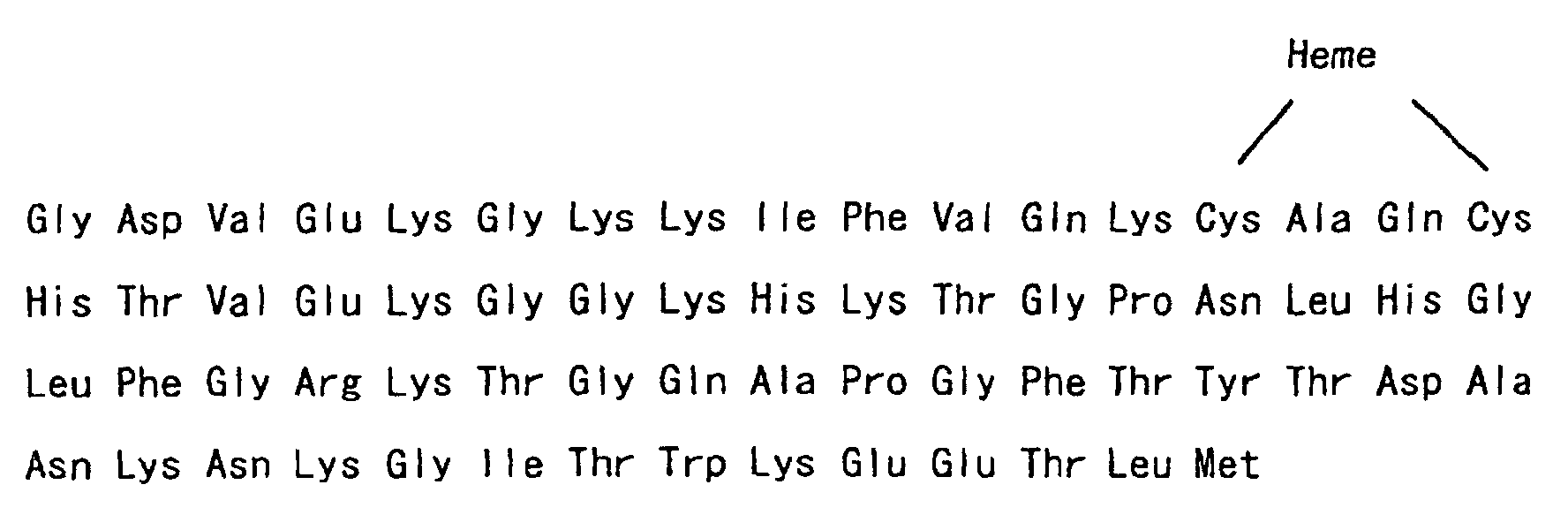
Isoelectric point: 9.52; Absorption maximum of oxidized type: 404, 535 nm; Absorption maximum of reduced type: 415, 520, 549 nm; Oxidation-reduction potential: -62.1 mV; Molecular weight: 8900.




| Peptide | Rate Constant k cat (s-1) |
| Example 1 mp15 | 2.54 |
| Example 2 mp9 | 1.66 |
| Example 3 mp22 | 0.80 |
| Example 4 mp65 | 0.12 |
| Comparative Example 1 Horse cardiac muscle cytochrome c | 15.21 x 10⁻³ |
| Comparative Example 2 Red alga Porphyra yezonesis cytochrome c | 6 0.05 |



Claims (20)
- A heme peptide represented by the following formula I:where A1 is a hydrogen atom or a peptide chain consisting of 1 to 20 amino acid residues;

A2 is a hydroxyl group or a peptide chain consisting of 1 to 50 amino acid residues;
the heme is a heme nucleus represented by the following formula:X1 and X2 each independently represent any amino acid residue; and
X3 is His, Lys or Arg. - The heme peptide according to claim 1, wherein X1 and X2 in formula I each independently represent an amino acid residue selected from the group consisting of Ala, Gln, Lys, Arg and Val.
- The heme peptide according to claim 1, wherein X1 is Ala; X2 is Gln or Ala; and X3 is His in formula I.
- The heme peptide according to claim 1, wherein
A1 is a hydrogen atom or a peptide chain having an amino acid sequence of Val Gln Lys;
A2 is a peptide chain having an amino acid sequence of Thr Val Glu Lys or Thr Val Glu Lys Gly Gly Lys His Lys Thr Gly Pro Asn Leu;
X1 is Ala; X2 is Gln; and X3 is His in formula I. - The heme peptide according to claim 1, wherein
A1 is a peptide chain having an amino acid sequence of Phe Ser Ala Asn;
A2 is a peptide chain having an amino acid sequence of Ala Gly Gly Asn Asn Ala;
X1 is Ala; X2 is Ala; and X3 is His in formula I. - A method of producing the heme peptide according to claim 1, comprising digesting cytochrome c with a restriction enzyme and purifying the resultant digest by gel filtration chromatography.
- The method according to claim 6, wherein the restriction enzyme is selected from the group consisting of thermolysin, trypsin, chymotrypsin, Achromobacter protease I and Staphylococcus aureus V8 protease.
- A method of producing the heme peptide according to claim 2, comprising digesting cytochrome c with a restriction enzyme and purifying the resultant digest by gel filtration chromatography.
- The method according to claim 8, wherein the restriction enzyme is selected from the group consisting of thermolysin, trypsin, chymotrypsin, Achromobacter protease I and Staphylococcus aureus V8 protease.
- A method of producing the heme peptide according to claim 3, comprising digesting cytochrome c with a restriction enzyme and purifying the resultant digest by gel filtration chromatography.
- The method according to claim 10, wherein the restriction enzyme is selected from the group consisting of thermolysin, trypsin, chymotrypsin, Achromobacter protease I and Staphylococcus aureus V8 protease.
- A method of producing the heme peptide according to claim 4, comprising digesting cytochrome c with a restriction enzyme and purifying the resultant digest by gel filtration chromatography.
- The method according to claim 12, wherein the restriction enzyme is selected from the group consisting of thetmolysin, trypsin, chymotrypsin, Achromobacter protease I and Staphylococcus aureus V8 protease.
- A method of producing the heme peptide according to claim 5, comprising digesting cytochrome c with a restriction enzyme and purifying the resultant digest by gel filtration chromatography.
- The method according to claim 14, wherein the restriction enzyme is selected from the group consisting of thermolysin, trypsin, chymotrypsin, Achromobacter protease I and Staphylococcus aureus V8 protease.
- An NO scavenger comprising the heme peptide according to claim 1.
- An NO scavenger comprising the heme peptide according to claim 2.
- An NO scavenger comprising the heme peptide according to claim 3.
- An NO scavenger comprising the heme peptide according to claim 4.
- An NO scavenger comprising the heme peptide according to claim 5.
Applications Claiming Priority (3)
| Application Number | Priority Date | Filing Date | Title |
|---|---|---|---|
| JP2002058086 | 2002-03-04 | ||
| JP2002058086A JP4070081B2 (en) | 2002-03-04 | 2002-03-04 | New heme peptide |
| PCT/JP2003/002394 WO2003074564A1 (en) | 2002-03-04 | 2003-02-28 | Novel hemepeptide |
Publications (3)
| Publication Number | Publication Date |
|---|---|
| EP1489096A1 true EP1489096A1 (en) | 2004-12-22 |
| EP1489096A4 EP1489096A4 (en) | 2006-11-08 |
| EP1489096B1 EP1489096B1 (en) | 2010-07-07 |
Family
ID=27784682
Family Applications (1)
| Application Number | Title | Priority Date | Filing Date |
|---|---|---|---|
| EP03743542A Expired - Lifetime EP1489096B1 (en) | 2002-03-04 | 2003-02-28 | Novel hemepeptide |
Country Status (7)
| Country | Link |
|---|---|
| US (1) | US7358338B2 (en) |
| EP (1) | EP1489096B1 (en) |
| JP (1) | JP4070081B2 (en) |
| AT (1) | ATE473241T1 (en) |
| AU (1) | AU2003211601A1 (en) |
| DE (1) | DE60333264D1 (en) |
| WO (1) | WO2003074564A1 (en) |
Families Citing this family (1)
| Publication number | Priority date | Publication date | Assignee | Title |
|---|---|---|---|---|
| WO2019006169A1 (en) * | 2017-06-28 | 2019-01-03 | University Of Pittsburgh - Of The Commonwealth System Of Higher Education | Synthetic heme-containing molecules and their use |
Family Cites Families (1)
| Publication number | Priority date | Publication date | Assignee | Title |
|---|---|---|---|---|
| US5273896A (en) | 1989-10-13 | 1993-12-28 | Novo Nordisk A/S | Hemopeptide having peroxidase activity for bleaching dyes |
-
2002
- 2002-03-04 JP JP2002058086A patent/JP4070081B2/en not_active Expired - Fee Related
-
2003
- 2003-02-28 AT AT03743542T patent/ATE473241T1/en not_active IP Right Cessation
- 2003-02-28 US US10/507,156 patent/US7358338B2/en not_active Expired - Fee Related
- 2003-02-28 AU AU2003211601A patent/AU2003211601A1/en not_active Abandoned
- 2003-02-28 DE DE60333264T patent/DE60333264D1/en not_active Expired - Lifetime
- 2003-02-28 EP EP03743542A patent/EP1489096B1/en not_active Expired - Lifetime
- 2003-02-28 WO PCT/JP2003/002394 patent/WO2003074564A1/en not_active Ceased
Also Published As
| Publication number | Publication date |
|---|---|
| DE60333264D1 (en) | 2010-08-19 |
| EP1489096A4 (en) | 2006-11-08 |
| EP1489096B1 (en) | 2010-07-07 |
| WO2003074564A1 (en) | 2003-09-12 |
| AU2003211601A1 (en) | 2003-09-16 |
| ATE473241T1 (en) | 2010-07-15 |
| US7358338B2 (en) | 2008-04-15 |
| JP4070081B2 (en) | 2008-04-02 |
| US20060258563A1 (en) | 2006-11-16 |
| JP2003252900A (en) | 2003-09-10 |
Similar Documents
| Publication | Publication Date | Title |
|---|---|---|
| Jung et al. | Use of site-directed fluorescence labeling to study proximity relationships in the lactose permease of Escherichia coli | |
| EP0669980B1 (en) | Method of controlling polypeptide production in bacteria | |
| CN101186940B (en) | Process for obtaining insulin or insulin derivatives with properly bonded cystine bonds | |
| Lu et al. | Chemical modification and site-directed mutagenesis of methionine residues in recombinant human granulocyte colony-stimulating factor: effect on stability and biological activity | |
| US7939293B2 (en) | Method for producing carboxy-terminal-amidified peptides | |
| GB2188322A (en) | Aprotinin and analogues thereof produced by a recombinant host | |
| SK171492A3 (en) | Polypeptide, method of its preparation its use and pharmaceutical agent | |
| JP4019432B2 (en) | Method for refolding human activin A | |
| Lambert et al. | Solution synthesis of charybdotoxin (ChTX), a K+ channel blocker | |
| CA2257122C (en) | Method of activating denatured protein | |
| Schmoldt et al. | A fusion protein system for the recombinant production of short disulfide bond rich cystine knot peptides using barnase as a purification handle | |
| JPH02500194A (en) | Novel polypeptide and its production method | |
| KR101949556B1 (en) | Method for the production of polypeptides | |
| EP1489096B1 (en) | Novel hemepeptide | |
| Fujii et al. | Effect of alterations of basic amino acid residues of Escherichia coli heat-stable enterotoxin II on enterotoxicity | |
| WO1994010200A1 (en) | Somatotropin modifications | |
| CN113801234B (en) | A kind of semaglutide derivative and its application | |
| Dalbøge et al. | Cloning and expression of an interleukin-1β precursor and its conversion to interleukin-1β | |
| JPH04506800A (en) | somatotropin analogs | |
| Zuomei et al. | Viable transmembrane region mutants of bacteriophage M13 coat protein prepared by site-directed mutagenesis | |
| DE60033141T2 (en) | PROCESS FOR REMOVING THE N-TERMINAL ALANIN RESTS WITH AEROMONAS AMINOPEPTIDASE | |
| US5663305A (en) | Somatotropin analogs | |
| Dunkel et al. | Progesterone binding to uteroglobin: two alternative orientations of the ligand | |
| Aoki et al. | A new approach to gene mutation analysis using “GFP-display” | |
| CN118063550A (en) | Novel brucella-resistant polypeptide and preparation method and application thereof |
Legal Events
| Date | Code | Title | Description |
|---|---|---|---|
| PUAI | Public reference made under article 153(3) epc to a published international application that has entered the european phase |
Free format text: ORIGINAL CODE: 0009012 |
|
| 17P | Request for examination filed |
Effective date: 20041004 |
|
| AK | Designated contracting states |
Kind code of ref document: A1 Designated state(s): AT BE BG CH CY CZ DE DK EE ES FI FR GB GR HU IE IT LI LU MC NL PT SE SI SK TR |
|
| AX | Request for extension of the european patent |
Extension state: AL LT LV MK RO |
|
| A4 | Supplementary search report drawn up and despatched |
Effective date: 20061006 |
|
| RAP1 | Party data changed (applicant data changed or rights of an application transferred) |
Owner name: NIHON UNIVERSITY |
|
| 17Q | First examination report despatched |
Effective date: 20070313 |
|
| GRAP | Despatch of communication of intention to grant a patent |
Free format text: ORIGINAL CODE: EPIDOSNIGR1 |
|
| RIN1 | Information on inventor provided before grant (corrected) |
Inventor name: KAWACHI, RYU Inventor name: NISHIO, TOSHIYUKI Inventor name: SURUGA, KOHEI Inventor name: OKU, TADATAKE |
|
| GRAS | Grant fee paid |
Free format text: ORIGINAL CODE: EPIDOSNIGR3 |
|
| GRAA | (expected) grant |
Free format text: ORIGINAL CODE: 0009210 |
|
| AK | Designated contracting states |
Kind code of ref document: B1 Designated state(s): AT BE BG CH CY CZ DE DK EE ES FI FR GB GR HU IE IT LI LU MC NL PT SE SI SK TR |
|
| REG | Reference to a national code |
Ref country code: GB Ref legal event code: FG4D |
|
| REG | Reference to a national code |
Ref country code: CH Ref legal event code: EP |
|
| REG | Reference to a national code |
Ref country code: IE Ref legal event code: FG4D |
|
| REF | Corresponds to: |
Ref document number: 60333264 Country of ref document: DE Date of ref document: 20100819 Kind code of ref document: P |
|
| REG | Reference to a national code |
Ref country code: NL Ref legal event code: VDEP Effective date: 20100707 |
|
| PG25 | Lapsed in a contracting state [announced via postgrant information from national office to epo] |
Ref country code: SI Free format text: LAPSE BECAUSE OF FAILURE TO SUBMIT A TRANSLATION OF THE DESCRIPTION OR TO PAY THE FEE WITHIN THE PRESCRIBED TIME-LIMIT Effective date: 20100707 |
|
| PG25 | Lapsed in a contracting state [announced via postgrant information from national office to epo] |
Ref country code: FI Free format text: LAPSE BECAUSE OF FAILURE TO SUBMIT A TRANSLATION OF THE DESCRIPTION OR TO PAY THE FEE WITHIN THE PRESCRIBED TIME-LIMIT Effective date: 20100707 Ref country code: AT Free format text: LAPSE BECAUSE OF FAILURE TO SUBMIT A TRANSLATION OF THE DESCRIPTION OR TO PAY THE FEE WITHIN THE PRESCRIBED TIME-LIMIT Effective date: 20100707 Ref country code: NL Free format text: LAPSE BECAUSE OF FAILURE TO SUBMIT A TRANSLATION OF THE DESCRIPTION OR TO PAY THE FEE WITHIN THE PRESCRIBED TIME-LIMIT Effective date: 20100707 |
|
| PG25 | Lapsed in a contracting state [announced via postgrant information from national office to epo] |
Ref country code: PT Free format text: LAPSE BECAUSE OF FAILURE TO SUBMIT A TRANSLATION OF THE DESCRIPTION OR TO PAY THE FEE WITHIN THE PRESCRIBED TIME-LIMIT Effective date: 20101108 Ref country code: CY Free format text: LAPSE BECAUSE OF FAILURE TO SUBMIT A TRANSLATION OF THE DESCRIPTION OR TO PAY THE FEE WITHIN THE PRESCRIBED TIME-LIMIT Effective date: 20100707 Ref country code: BG Free format text: LAPSE BECAUSE OF FAILURE TO SUBMIT A TRANSLATION OF THE DESCRIPTION OR TO PAY THE FEE WITHIN THE PRESCRIBED TIME-LIMIT Effective date: 20101007 |
|
| PG25 | Lapsed in a contracting state [announced via postgrant information from national office to epo] |
Ref country code: GR Free format text: LAPSE BECAUSE OF FAILURE TO SUBMIT A TRANSLATION OF THE DESCRIPTION OR TO PAY THE FEE WITHIN THE PRESCRIBED TIME-LIMIT Effective date: 20101008 Ref country code: BE Free format text: LAPSE BECAUSE OF FAILURE TO SUBMIT A TRANSLATION OF THE DESCRIPTION OR TO PAY THE FEE WITHIN THE PRESCRIBED TIME-LIMIT Effective date: 20100707 Ref country code: SE Free format text: LAPSE BECAUSE OF FAILURE TO SUBMIT A TRANSLATION OF THE DESCRIPTION OR TO PAY THE FEE WITHIN THE PRESCRIBED TIME-LIMIT Effective date: 20100707 |
|
| PG25 | Lapsed in a contracting state [announced via postgrant information from national office to epo] |
Ref country code: DK Free format text: LAPSE BECAUSE OF FAILURE TO SUBMIT A TRANSLATION OF THE DESCRIPTION OR TO PAY THE FEE WITHIN THE PRESCRIBED TIME-LIMIT Effective date: 20100707 |
|
| PLBE | No opposition filed within time limit |
Free format text: ORIGINAL CODE: 0009261 |
|
| STAA | Information on the status of an ep patent application or granted ep patent |
Free format text: STATUS: NO OPPOSITION FILED WITHIN TIME LIMIT |
|
| PG25 | Lapsed in a contracting state [announced via postgrant information from national office to epo] |
Ref country code: CZ Free format text: LAPSE BECAUSE OF FAILURE TO SUBMIT A TRANSLATION OF THE DESCRIPTION OR TO PAY THE FEE WITHIN THE PRESCRIBED TIME-LIMIT Effective date: 20100707 Ref country code: EE Free format text: LAPSE BECAUSE OF FAILURE TO SUBMIT A TRANSLATION OF THE DESCRIPTION OR TO PAY THE FEE WITHIN THE PRESCRIBED TIME-LIMIT Effective date: 20100707 Ref country code: IT Free format text: LAPSE BECAUSE OF FAILURE TO SUBMIT A TRANSLATION OF THE DESCRIPTION OR TO PAY THE FEE WITHIN THE PRESCRIBED TIME-LIMIT Effective date: 20100707 Ref country code: SK Free format text: LAPSE BECAUSE OF FAILURE TO SUBMIT A TRANSLATION OF THE DESCRIPTION OR TO PAY THE FEE WITHIN THE PRESCRIBED TIME-LIMIT Effective date: 20100707 |
|
| 26N | No opposition filed |
Effective date: 20110408 |
|
| PG25 | Lapsed in a contracting state [announced via postgrant information from national office to epo] |
Ref country code: ES Free format text: LAPSE BECAUSE OF FAILURE TO SUBMIT A TRANSLATION OF THE DESCRIPTION OR TO PAY THE FEE WITHIN THE PRESCRIBED TIME-LIMIT Effective date: 20101018 |
|
| REG | Reference to a national code |
Ref country code: DE Ref legal event code: R097 Ref document number: 60333264 Country of ref document: DE Effective date: 20110408 |
|
| PG25 | Lapsed in a contracting state [announced via postgrant information from national office to epo] |
Ref country code: MC Free format text: LAPSE BECAUSE OF NON-PAYMENT OF DUE FEES Effective date: 20110228 |
|
| REG | Reference to a national code |
Ref country code: CH Ref legal event code: PL |
|
| GBPC | Gb: european patent ceased through non-payment of renewal fee |
Effective date: 20110228 |
|
| PG25 | Lapsed in a contracting state [announced via postgrant information from national office to epo] |
Ref country code: CH Free format text: LAPSE BECAUSE OF NON-PAYMENT OF DUE FEES Effective date: 20110228 Ref country code: LI Free format text: LAPSE BECAUSE OF NON-PAYMENT OF DUE FEES Effective date: 20110228 |
|
| REG | Reference to a national code |
Ref country code: FR Ref legal event code: ST Effective date: 20111102 |
|
| REG | Reference to a national code |
Ref country code: IE Ref legal event code: MM4A |
|
| REG | Reference to a national code |
Ref country code: DE Ref legal event code: R119 Ref document number: 60333264 Country of ref document: DE Effective date: 20110901 |
|
| PG25 | Lapsed in a contracting state [announced via postgrant information from national office to epo] |
Ref country code: FR Free format text: LAPSE BECAUSE OF NON-PAYMENT OF DUE FEES Effective date: 20110228 Ref country code: IE Free format text: LAPSE BECAUSE OF NON-PAYMENT OF DUE FEES Effective date: 20110228 |
|
| PG25 | Lapsed in a contracting state [announced via postgrant information from national office to epo] |
Ref country code: GB Free format text: LAPSE BECAUSE OF NON-PAYMENT OF DUE FEES Effective date: 20110228 |
|
| PG25 | Lapsed in a contracting state [announced via postgrant information from national office to epo] |
Ref country code: LU Free format text: LAPSE BECAUSE OF NON-PAYMENT OF DUE FEES Effective date: 20110228 |
|
| PG25 | Lapsed in a contracting state [announced via postgrant information from national office to epo] |
Ref country code: DE Free format text: LAPSE BECAUSE OF NON-PAYMENT OF DUE FEES Effective date: 20110901 |
|
| PG25 | Lapsed in a contracting state [announced via postgrant information from national office to epo] |
Ref country code: TR Free format text: LAPSE BECAUSE OF FAILURE TO SUBMIT A TRANSLATION OF THE DESCRIPTION OR TO PAY THE FEE WITHIN THE PRESCRIBED TIME-LIMIT Effective date: 20100707 |
|
| PG25 | Lapsed in a contracting state [announced via postgrant information from national office to epo] |
Ref country code: HU Free format text: LAPSE BECAUSE OF FAILURE TO SUBMIT A TRANSLATION OF THE DESCRIPTION OR TO PAY THE FEE WITHIN THE PRESCRIBED TIME-LIMIT Effective date: 20100707 |