EP1489089A1 - Crystals of glucopyranosyloxybenzyl benzene derivative - Google Patents
Crystals of glucopyranosyloxybenzyl benzene derivative Download PDFInfo
- Publication number
- EP1489089A1 EP1489089A1 EP03744982A EP03744982A EP1489089A1 EP 1489089 A1 EP1489089 A1 EP 1489089A1 EP 03744982 A EP03744982 A EP 03744982A EP 03744982 A EP03744982 A EP 03744982A EP 1489089 A1 EP1489089 A1 EP 1489089A1
- Authority
- EP
- European Patent Office
- Prior art keywords
- glucopyranoside
- methoxybenzyl
- phenyl
- ethoxycarbonyl
- crystals
- Prior art date
- Legal status (The legal status is an assumption and is not a legal conclusion. Google has not performed a legal analysis and makes no representation as to the accuracy of the status listed.)
- Withdrawn
Links
Images

Classifications
-
- C—CHEMISTRY; METALLURGY
- C07—ORGANIC CHEMISTRY
- C07H—SUGARS; DERIVATIVES THEREOF; NUCLEOSIDES; NUCLEOTIDES; NUCLEIC ACIDS
- C07H15/00—Compounds containing hydrocarbon or substituted hydrocarbon radicals directly attached to hetero atoms of saccharide radicals
- C07H15/20—Carbocyclic rings
- C07H15/203—Monocyclic carbocyclic rings other than cyclohexane rings; Bicyclic carbocyclic ring systems
-
- A—HUMAN NECESSITIES
- A61—MEDICAL OR VETERINARY SCIENCE; HYGIENE
- A61K—PREPARATIONS FOR MEDICAL, DENTAL OR TOILETRY PURPOSES
- A61K31/00—Medicinal preparations containing organic active ingredients
- A61K31/70—Carbohydrates; Sugars; Derivatives thereof
- A61K31/7028—Compounds having saccharide radicals attached to non-saccharide compounds by glycosidic linkages
- A61K31/7034—Compounds having saccharide radicals attached to non-saccharide compounds by glycosidic linkages attached to a carbocyclic compound, e.g. phloridzin
-
- A—HUMAN NECESSITIES
- A61—MEDICAL OR VETERINARY SCIENCE; HYGIENE
- A61P—SPECIFIC THERAPEUTIC ACTIVITY OF CHEMICAL COMPOUNDS OR MEDICINAL PREPARATIONS
- A61P3/00—Drugs for disorders of the metabolism
- A61P3/04—Anorexiants; Antiobesity agents
-
- A—HUMAN NECESSITIES
- A61—MEDICAL OR VETERINARY SCIENCE; HYGIENE
- A61P—SPECIFIC THERAPEUTIC ACTIVITY OF CHEMICAL COMPOUNDS OR MEDICINAL PREPARATIONS
- A61P3/00—Drugs for disorders of the metabolism
- A61P3/08—Drugs for disorders of the metabolism for glucose homeostasis
- A61P3/10—Drugs for disorders of the metabolism for glucose homeostasis for hyperglycaemia, e.g. antidiabetics
-
- A—HUMAN NECESSITIES
- A61—MEDICAL OR VETERINARY SCIENCE; HYGIENE
- A61P—SPECIFIC THERAPEUTIC ACTIVITY OF CHEMICAL COMPOUNDS OR MEDICINAL PREPARATIONS
- A61P43/00—Drugs for specific purposes, not provided for in groups A61P1/00-A61P41/00
Definitions
- the present invention relates to crystals of 2-(4-methoxybenzyl)phenyl 6-O-ethoxycarbonyl- ⁇ -D-glucopyranoside and their uses.
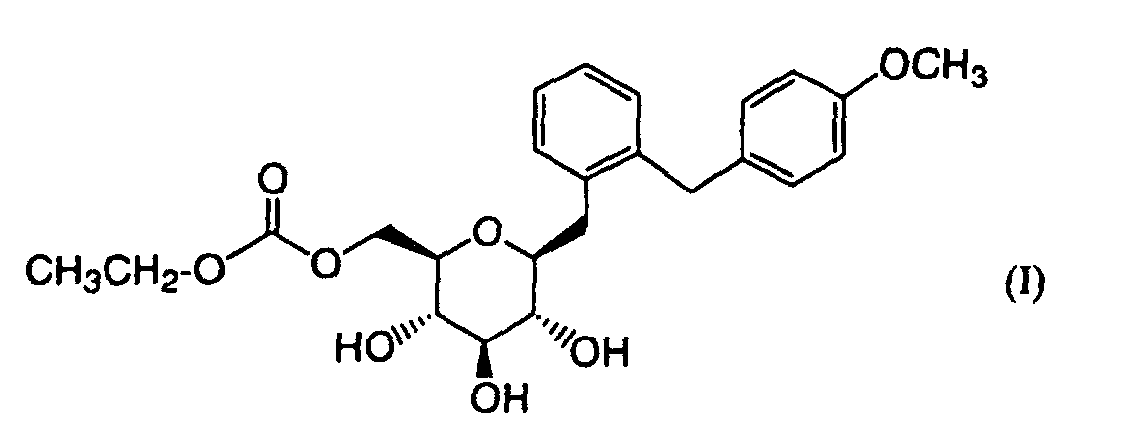
- 2-(4-Methoxybenzyl)phenyl 6-O-ethoxycarbonyl- ⁇ -D-glucopyranoside represented by formula (I): is a novel compound not known in literatures, which has been found by the present applicant. This compound is converted to an active form of 2-(4-methoxybenzyl)phenyl ⁇ -D-gluco-pyranoside in vivo, which exhibits excellent inhibitory activities against SGLT2 and is useful for the treatment or prevention of diseases associated with hyperglycemia such as diabetes mellitus, diabetic complication, obesity and the like. None of crystalline form of this compound has been known so far.
- 2-(4-Methoxybenzyl)phenyl 6-O-ethoxycarbonyl- ⁇ -D-glucopyranoside could have been prepared only in an amorphous form up to now.
- For preparing the amorphous form of said compound in high purity troublesome purification steps have been required.
- the amorphous form of said compound has unsatisfactory stabilities, and is difficult to prepare formulations due to its viscous property.
- the present inventors intensively investigated for crystalline forms of 2-(4-methoxybenzyl)phenyl 6-O-ethoxy-carbonyl- ⁇ -D-glucopyranoside which have good storage stability and are suitable for formulating, and had found that 2-(4-methoxybenzyl)phenyl 6-O-ethoxycarbonyl- ⁇ -D-glucopyranoside had two crystalline forms, "crystalline form ⁇ " and "crystalline form ⁇ ". Moreover, the present inventors had found unexpectedly that these crystalline forms could be prepared in high purities by a convenient purification procedure, and had good storage stabilities and flowabilities, and accordingly are suitable for formulating. Based on these findings, the present invention has been accomplished.
- the present invention therefore provides:
- Crystalline forms ⁇ and ⁇ of the present invention can be prepared as follows.
- Crystals of 2-(4-methoxybenzyl)phenyl 6-O-ethoxycarbonyl- ⁇ -D-glucopyranoside were firstly obtained by dissolving an amorphous form of said compound in ethanol under heating, and then scratching a wall of a vessel for crystallization under ice-cooling.
- the crystals were obtained in a mixture of crystalline forms ⁇ and ⁇ .
- the present inventors had eagerly studied for crystallizing conditions and found that crystalline forms ⁇ and ⁇ of the present invention could be prepared in a pure crystalline form by crystallizing from a particular solvent as described below.
- Crystalline form ⁇ of the present invention can be prepared as follows. An arbitrary form of 2-(4-methoxybenzyl)phenyl 6-O-ethoxycarbonyl- ⁇ -D-glucopyranoside is dissolved in a suitable first solvent (also referred to as "good solvent”) under heating. Thereafter, to the solution is added, if required, a second solvent (also referred to as “poor solvent”), and the resulting mixture is stirred or stood for crystallization. The precipitated crystals are collected and dried to afford crystalline form ⁇ .
- a suitable first solvent also referred to as "good solvent”
- second solvent also referred to as “poor solvent
- first solvents examples include ethanol, isopropanol, ethyl acetate, acetone or methyl ethyl ketone, which can be used singly or as a mixture of one or more solvents.
- the amount of first solvents is varied depending on the type of the solvent, and is ordinarily in the range of about 2 to about 20 parts by weight on the basis of a part by weight of 2-(4-methoxybenzyl)phenyl 6-O-ethoxycarbonyl- ⁇ -D-glucopyranoside.
- second solvents which can be miscible with a solution of said compound in a first solvent, include hexane, heptane or water.
- the amount of second solvents is varied depending on the type of the solvent, and is ordinarily in the range of about 0.1 to about 5 parts by weight on the basis of a part by weight of a first solvent.
- the crystallizing temperature for crystalline form ⁇ is ordinarily below about 50° C, preferably in the range of about 20 to about 50° C.
- the crystallizing time is varied depending on the crystallizing temperature, and is ordinarily in the range of about 1 to about 24 hours.
- Crystalline form ⁇ of the present invention can be prepared as follows. An arbitrary form of 2-(4-methoxybenzyl)phenyl 6-O-ethoxycarbonyl- ⁇ -D-glucopyranoside is dissolved in methanol, the amount of which is ordinarily in the range of about 3 to about 10 parts by weight, preferably about 4 to about 6 parts by weight on the basis of a part by weight of 2-(4-methoxybenzyl)phenyl 6-O-ethoxycarbonyl- ⁇ -D-glucopyranoside. Thereafter, the solution is concentrated under reduced pressure at a temperature of about 30 to about 40° C for crystallization, and the precipitated crystals are collected and dried to afford crystalline form ⁇ .
- crystalline form ⁇ can be prepared by heating an amorphous form of 2-(4-methoxybenzyl)phenyl 6-O-ethoxycarbonyl- ⁇ -D-glucopyranoside at a temperature of about 120 to about 140° C for about 1 to about 4 hours.
- Crystalline forms ⁇ and ⁇ thus obtained can be identified by their characteristic diffraction peaks as shown in the X-ray powder diffraction charts of fig. 1 or 2;
- Crystalline forms ⁇ and ⁇ of the present invention can be stored under ordinarily storage conditions such as 25 °C/60% relative humidity and the like for a long period without changing their crystalline forms, and are also chemically stable. Crystalline forms ⁇ and ⁇ of the present invention have excellent flowabilities and good handling properties, and can be formulated into powders, fine granules, granules, tablets, capsules or the like according to conventional methods.
- dosage forms can be administered depending upon their usages.
- Exemplary dosage forms include powders, granules, fine granules, dry syrups, tablets, capsules, injections, liquids, ointments, suppositories, poultices and the like, which are administered orally or parenterally.
- compositions can be formulated by admixing, diluting or dissolving with appropriate pharmaceutical additives such as excipients, disintegrators, binders, lubricants, diluents, buffers, isotonic agents, preservatives, wetting agents, emulsifying agents, dispersing agents, stabilizing agents, solubilizing agents and the like, according to conventional formulation procedures depending upon their dosage forms.
- appropriate pharmaceutical additives such as excipients, disintegrators, binders, lubricants, diluents, buffers, isotonic agents, preservatives, wetting agents, emulsifying agents, dispersing agents, stabilizing agents, solubilizing agents and the like, according to conventional formulation procedures depending upon their dosage forms.
- the dosage of a crystal of the present invention as an active ingredient is appropriately determined depending on the age, sex or bodyweight of the individual patient, the severity of the disease, the condition to be treated and the like.
- a typical dosage for oral administration is in the range of from about 0.1 mg to about 1000 mg per day per adult human.
- a typical dosage for parenteral administration is in the range of from about 0.01 mg to about 300 mg per day per adult human.
- the dosages may be administered in single or divided doses, for example one to several times daily.
- X-ray powder diffraction patterns of each crystalline form were obtained using an X-ray diffraction analyzer, RINT2100 (Rigaku) which was operated at a tube voltage of 40 kV and a tube electric current of 40 mA, and using Cu beam.
- reaction mixture was purified by column chromatography on aminopropyl silica gel (eluent: dichloromethane) to give 2-(4-methoxybenzyl)phenyl 2,3,4,6-terta-O-acetyl- ⁇ -D-glucopyranoside (0.11 g).
- the desiccant was removed by filtration, and the solvent of the filtrate was removed under reduced pressure.
- the residue (326 g) was dissolved in ethanol (1039 mL) under heating, and the resulting solution was treated with activated charcoal (11 g). After the mixture was stirred for 5 minutes, insoluble materials were filtered through celite. To the filtrate was added n-hexane (2046 mL) at about 30 to about 40° C over about 45 minutes, and the resulting mixture was allowed to stand at room temperature for 17 hours.
- Stability tests were carried out under the following conditions for crystalline forms ⁇ and ⁇ . Residual percentages of test substances were determined by HPLC, and changes in crystalline form were examined by X-ray powder diffraction analysis.
- crystalline forms ⁇ and ⁇ of the present invention indicate no change in their crystalline forms and residual percentage, and have excellent storage stabilities.
- Preparation of the cDNA library for PCR amplification was performed by reverse transcription of a total RNA deprived from human kidney (Ori gene) with oligo dT as the primer, using SUPERSCRIPT Preamplification System (Gibco-BRL : LIFE TECHNOLOGIES).
- the DNA fragment coding for human SGLT2 was amplified by the Pfu DNA Polymerase (Stratagene)-used PCR reaction, in which the human kidney cDNA library described above was used as the template and the following oligo nucleotides 0702F and 0712R, presented as Sequence Number 1 and 2 respectively, were used as the primers.
- the amplified DNA fragment was ligated into pCR-Blunt (Invitrogen), a vector for cloning, according to standard method of the kit.
- the competent cell, Escherichia coli HB101 (Toyobo) was transformed according to usual method and then selection of the transformants was performed on the LB agar medium containing 50 ⁇ g/mL of kanamycin.
- amplifying of the DNA fragment coding for human SGLT2 was performed by the Pfu DNA Polymerase (Stratagene) -used PCR reaction, in which the following oligo nucleotides 0714F and 0715R, presented as Sequence Number 3 and 4 respectively, were used as the primers.
- the amplified DNA fragment was digested with restriction enzymes, Xho I and Hind III, and then purified with Wizard Purification System (Promega). This purified DNA fragment was inserted at the corresponding multi-cloning sites of pcDNA3.1 (-) Myc/His-B (Invitrogen), a vector for expressing of fusion protein.
- the competent cell Escherichia coli HB101 (Toyobo) was transformed according to usual method and then selection of the transformant was performed on the LB agar medium containing 100 ⁇ g/mL of ampicillin. After the plasmid DNA was extracted and purified from this transformant, the base sequence of the DNA fragment inserted at the multi-cloning sites of pcDNA3.1 (-) Myc/His-B was analyzed. This clone had a single base substitution (ATC which codes for the isoleucine-433 was substituted by GTC) compared with the human SGLT2 reported by Wells et al (Am. J. Physiol., Vol. 263, pp. 459-465 (1992)).
- KL29 the plasmid coding human SGLT2
- COS-7 cells ROKEN CELL BANK RCB0539
- Electroporation was performed with GENE PULSER II (Bio-Rad Laboratories) under the condition: 0.290 kV, 975 ⁇ F, 2 x 10 6 cells of COS-7 cell and 20 ⁇ g of KL29 in 500 ⁇ L of OPTI-MEM I medium (Gibco-BRL : LIFE TECHNOLOGIES) in the 0.4 cm type cuvette. After the gene transfer, the cells were harvested by centrifugation and resuspended with OPTI-MEM I medium (1 mL/cuvette).
- 125 ⁇ L of this cell suspension was added to each well in 96-wells plate. After overnight culture at 37 °C under 5 % CO 2 , 125 ⁇ L of DMEM medium which is containing 10 % of fetal bovine serum (Sanko Jyunyaku), 100 units/mL sodium penicillin G (Gibco-BRL : LIFE TECHNOLOGIES), 100 ⁇ g/mL streptomycin sulfate (Gibco-BRL : LIFE TECHNOLOGIES) was added to each well. After a culture until the following day, these cells were used for the measurement of the inhibitory activity against the uptake of methyl- ⁇ -D-glucopyranoside.
- DMEM medium which is containing 10 % of fetal bovine serum (Sanko Jyunyaku), 100 units/mL sodium penicillin G (Gibco-BRL : LIFE TECHNOLOGIES), 100 ⁇ g/mL streptomycin sulfate (Gi
- each diluent was used as test sample for measurement of the inhibitory activity.
- uptake buffer a pH 7.4 buffer containing 140 mM sodium chloride, 2 mM potassium chloride, 1 mM calcium chloride, 1 mM magnesium chloride, 5 mM methyl- ⁇ -D-glucopyranoside, 10 mM 2-[4-(2-hydroxyethyl)-1-piperazinyl]ethane sulfonic acid and 5 mM tris(hydroxymethyl)aminomethane
- the pretreatment buffer a pH 7.4 buffer containing 140 mM choline chloride, 2 mM potassium chloride, 1 mM calcium chloride, 1 mM magnesium chloride, 10 mM 2-[4-(2-hydroxyethyl)-1-piperazinyl]ethane sulfonic acid and 5 mM tris(hydroxymethyl)aminomethane
- the pretreatment buffer was removed, 200 ⁇ L of the same buffer was added again, and the cells were incubated at 37° C for 10 minutes.
- the buffer for measurement was prepared by adding of 7 ⁇ L of methyl- ⁇ -D-(U-14C) glucopyranoside (Amersham Pharmacia Biotech) to 525 ⁇ L of the prepared test sample.
- the buffer for measurement without test compound was prepared.
- the buffer for measurement of the basal uptake which contains 140 mM choline chloride in place of sodium chloride, was prepared similarly. After the pretreatment buffer was removed, 75 ⁇ L of the buffer for measurement was added to each well, the cells were incubated at 37°C for 2 hours.
- the washing buffer a pH 7.4 buffer containing 140 mM choline chloride, 2 mM potassium chloride, 1 mM calcium chloride, 1 mM magnesium chloride, 10 mM methyl- ⁇ -D-glucopyranoside, 10 mM 2-[4-(2-hydroxyethyl)-1-piperazinyl]ethane sulfonic acid and 5 mM tris(hydroxymethyl)aminomethane
- the cells were solubilized by addition of 75 ⁇ L of 0.2 N sodium hydroxide to each well.
- Crystalline forms ⁇ and ⁇ of the present invention can be prepared in high purity by a convenient purification procedure, and are suitable for a commercial production. Crystalline forms ⁇ and ⁇ of the present invention has good storage stabilities, and are suitable for producing and supplying a constant quality of medicaments. Furthermore, crystalline forms ⁇ and ⁇ of the present invention has goodflowabilities and handling properties, and are suitable for formulation. Therefore, crystalline forms ⁇ and ⁇ of the present invention are useful as a drug substance.
Landscapes
- Health & Medical Sciences (AREA)
- Chemical & Material Sciences (AREA)
- Life Sciences & Earth Sciences (AREA)
- Organic Chemistry (AREA)
- General Health & Medical Sciences (AREA)
- Molecular Biology (AREA)
- Medicinal Chemistry (AREA)
- Pharmacology & Pharmacy (AREA)
- Animal Behavior & Ethology (AREA)
- Public Health (AREA)
- Veterinary Medicine (AREA)
- Engineering & Computer Science (AREA)
- Diabetes (AREA)
- Epidemiology (AREA)
- Genetics & Genomics (AREA)
- Biochemistry (AREA)
- Bioinformatics & Cheminformatics (AREA)
- Chemical Kinetics & Catalysis (AREA)
- General Chemical & Material Sciences (AREA)
- Nuclear Medicine, Radiotherapy & Molecular Imaging (AREA)
- Biotechnology (AREA)
- Hematology (AREA)
- Obesity (AREA)
- Child & Adolescent Psychology (AREA)
- Emergency Medicine (AREA)
- Endocrinology (AREA)
- Saccharide Compounds (AREA)
- Pharmaceuticals Containing Other Organic And Inorganic Compounds (AREA)
- Pyrane Compounds (AREA)
- Medicines Containing Material From Animals Or Micro-Organisms (AREA)
Abstract
Description
1H-NMR (CDCl3) δ ppm: 1.91 (3H, s), 2.03 (3H, s), 2.05 (3H, s), 2.08 (3H, s), 3.77 (3H, s), 3.80-3.95 (3H, m), 4.17 (1H, dd, J=2.5, 12.2Hz), 4.29 (1H, dd, J=5.5, 12.2Hz), 5.11 (1H, d, J=7.5Hz), 5.10-5.25 (1H, m), 5.25-5.40 (2H, m), 6.75-6.85 (2H, m), 6.95-7.10 (5H, m), 7.10-7.25 (1H, m)
1H-NMR (CD3OD) δ ppm: 3.35-3.55 (4H, m), 3.69 (1H, dd, J=5.1, 12.1Hz), 3.73 (3H, s), 3.80-4.00 (2H, m), 4.03 (1H, d, J=15.1Hz), 4.91 (1H, d, J=7.4Hz), 6.75-6.85 (2H,m), 6.85-6.95 (1H, m), 6.95-7.10 (1H, m), 7.10-7.20 (4H, m)
1H-NMR (CD3OD) δ ppm: 1.23 (3H, t, J=7.1Hz), 3.30-3.65 (4H, m), 3.74 (3H, s), 3.93 (1H, d, J=15.1Hz), 4.02 (1H, d, J=15.1Hz), 4.05-4.20 (2H, m), 4.29 (1H, dd, J=6.4,11.7Hz), 4.45 (1H, dd, J=2.2, 11.7Hz), 4.89 (1H, d, J=7.4Hz), 6.75-6.85(2H, m), 6.85-7.05 (2H, m), 7.05-7.2 (4H, m)





| Test compound | IC50 value (nM) |
| Reference Example 2 | 350 |
Claims (7)
- A crystal of 2-(4-methoxybenzyl)phenyl 6-O-ethoxycarbonyl-β-D-glucopyranoside.
- The crystal according to claim 1, which shows an X-ray powder diffraction pattern having characteristic peaks at a diffraction angle (2 ± 0.1) of 5.6, 13.8, 14.6, 16.8, 17.7 and 20.8 degrees.
- The crystal according to claim 1, which shows an X-ray powder diffraction pattern having characteristic peaks at a diffraction angle (2 ± 0.1) of 4.7, 5.5, 7.3, 8.6, 14.5 and 16.7 degrees.
- A pharmaceutical composition which comprises, as an active ingredient, a crystal according to any one of claims 1 to 3.
- The pharmaceutical composition according to claim 4, for the prevention or treatment of a disease associated with hyperglycemia.
- A use of a crystal according to any one of claims 1 to 3, for the manufacture of a medicament for preventing or treating a disease associated with hyperglycemia.
- A method for preventing or treating a disease associated with hyperglycemia, which comprises administering a therapeutically effective amount of a crystal according to any one of claims 1 to 3.
Applications Claiming Priority (3)
| Application Number | Priority Date | Filing Date | Title |
|---|---|---|---|
| JP2002081038 | 2002-03-22 | ||
| JP2002081038 | 2002-03-22 | ||
| PCT/JP2003/002466 WO2003080635A1 (en) | 2002-03-22 | 2003-03-04 | Crystals of glucopyranosyloxybenzyl benzene derivative |
Publications (2)
| Publication Number | Publication Date |
|---|---|
| EP1489089A1 true EP1489089A1 (en) | 2004-12-22 |
| EP1489089A4 EP1489089A4 (en) | 2009-10-28 |
Family
ID=28449107
Family Applications (1)
| Application Number | Title | Priority Date | Filing Date |
|---|---|---|---|
| EP03744982A Withdrawn EP1489089A4 (en) | 2002-03-22 | 2003-03-04 | Crystals of glucopyranosyloxybenzyl benzene derivative |
Country Status (13)
| Country | Link |
|---|---|
| US (1) | US7371730B2 (en) |
| EP (1) | EP1489089A4 (en) |
| JP (1) | JP4490109B2 (en) |
| KR (1) | KR100945455B1 (en) |
| CN (1) | CN1307190C (en) |
| AU (1) | AU2003211543B2 (en) |
| BR (1) | BR0308653A (en) |
| CA (1) | CA2476800C (en) |
| MX (1) | MXPA04009229A (en) |
| NO (1) | NO330297B1 (en) |
| NZ (1) | NZ535230A (en) |
| PL (1) | PL210710B1 (en) |
| WO (1) | WO2003080635A1 (en) |
Cited By (29)
| Publication number | Priority date | Publication date | Assignee | Title |
|---|---|---|---|---|
| WO2010092125A1 (en) | 2009-02-13 | 2010-08-19 | Boehringer Ingelheim International Gmbh | Pharmaceutical composition comprising a sglt2 inhibitor, a dpp-iv inhibitor and optionally a further antidiabetic agent and uses thereof |
| WO2011120923A1 (en) | 2010-03-30 | 2011-10-06 | Boehringer Ingelheim International Gmbh | Pharmaceutical composition comprising an sglt2 inhibitor and a ppar- gamma agonist and uses thereof |
| WO2012062698A1 (en) | 2010-11-08 | 2012-05-18 | Boehringer Ingelheim International Gmbh | Pharmaceutical composition, methods for treating and uses thereof |
| WO2012107476A1 (en) | 2011-02-09 | 2012-08-16 | Boehringer Ingelheim International Gmbh | Pharmaceutical composition, methods for treating and uses thereof |
| US8283454B2 (en) | 2008-08-22 | 2012-10-09 | Theracos, Inc. | Processes for the preparation of SGLT2 inhibitors |
| WO2012163990A1 (en) | 2011-06-03 | 2012-12-06 | Boehringer Ingelheim International Gmbh | Sglt-2 inhibitors for treating metabolic disorders in patients treated with neuroleptic agents |
| WO2014161836A1 (en) | 2013-04-04 | 2014-10-09 | Boehringer Ingelheim Vetmedica Gmbh | Treatment of metabolic disorders in equine animals |
| US8987323B2 (en) | 2010-06-12 | 2015-03-24 | Theracos, Inc. | Crystalline form of benzylbenzene SGLT2 inhibitor |
| US9193751B2 (en) | 2012-04-10 | 2015-11-24 | Theracos, Inc. | Process for the preparation of benzylbenzene SGLT2 inhibitors |
| US9464043B2 (en) | 2013-10-12 | 2016-10-11 | Theracos Sub, Llc | Preparation of hydroxy-benzylbenzene derivatives |
| WO2018073154A1 (en) | 2016-10-19 | 2018-04-26 | Boehringer Ingelheim International Gmbh | Combinations comprising an ssao/vap-1 inhibitor and a sglt2 inhibitor, uses thereof |
| EP3485890A1 (en) | 2014-01-23 | 2019-05-22 | Boehringer Ingelheim Vetmedica GmbH | Treatment of metabolic disorders in canine animals |
| WO2019201752A1 (en) | 2018-04-17 | 2019-10-24 | Boehringer Ingelheim International Gmbh | Pharmaceutical composition, methods for treating and uses thereof |
| EP3721882A1 (en) | 2014-04-01 | 2020-10-14 | Boehringer Ingelheim Vetmedica GmbH | Treatment of metabolic disorders in equine animals |
| WO2021105152A1 (en) | 2019-11-28 | 2021-06-03 | Boehringer Ingelheim Vetmedica Gmbh | Use of sglt-2 inhibitors in the drying-off of non-human mammals |
| EP3862003A1 (en) | 2013-12-17 | 2021-08-11 | Boehringer Ingelheim Vetmedica GmbH | An sglt-2 inhibitor for use in the treatment of a metabolic disorder in feline animals |
| WO2021165177A1 (en) | 2020-02-17 | 2021-08-26 | Boehringer Ingelheim Vetmedica Gmbh | Use of sglt-2 inhibitors for the prevention and/or treatment of cardiac diseases in felines |
| WO2023006745A1 (en) | 2021-07-28 | 2023-02-02 | Boehringer Ingelheim Vetmedica Gmbh | Use of sglt-2 inhibitors for the prevention and/or treatment of hypertension in non-human mammals |
| WO2023006747A1 (en) | 2021-07-28 | 2023-02-02 | Boehringer Ingelheim Vetmedica Gmbh | Use of sglt-2 inhibitors for the prevention and/or treatment of renal diseases in non-human mammals |
| WO2023006718A1 (en) | 2021-07-28 | 2023-02-02 | Boehringer Ingelheim Vetmedica Gmbh | Use of sglt-2 inhibitors for the prevention and/or treatment of cardiac diseases in non-human mammals excluding felines, in particular canines |
| WO2023129595A1 (en) | 2021-12-30 | 2023-07-06 | Newamsterdam Pharma B.V. | Obicetrapib and sglt2 inhibitor combination |
| WO2023227492A1 (en) | 2022-05-25 | 2023-11-30 | Boehringer Ingelheim Vetmedica Gmbh | Aqueous pharmaceutical compositions comprising sglt-2 inhibitors |
| EP4403230A2 (en) | 2014-09-25 | 2024-07-24 | Boehringer Ingelheim Vetmedica GmbH | Combination treatment of sglt2 inhibitors and dopamine agonists for preventing metabolic disorders in equine animals |
| WO2024184293A1 (en) | 2023-03-06 | 2024-09-12 | Boehringer Ingelheim Vetmedica Gmbh | Systems for delivery of liquid pharmaceutical compositions in particular comprising one or more sglt-2 inhibitor(s) |
| WO2024226537A1 (en) | 2023-04-24 | 2024-10-31 | Newamsterdam Pharma B.V. | Amorphous obicetrapib and sglt2 inhibitor combination |
| WO2024240632A1 (en) | 2023-05-24 | 2024-11-28 | Boehringer Ingelheim Vetmedica Gmbh | Combination treatment and/or prevention of cardiac diseases in non-human mammals comprising one or more sglt-2 inhibitors and pimobendan and/or telmisartan |
| WO2024240633A1 (en) | 2023-05-24 | 2024-11-28 | Boehringer Ingelheim Vetmedica Gmbh | Combination treatment and/or prevention of renal diseases and/or hypertension in non-human mammals comprising one or more sglt-2 inhibitors and telmisartan |
| US12178809B2 (en) | 2018-10-29 | 2024-12-31 | Boehringer Ingelheim International Gmbh | Pyridinyl sulfonamide derivatives, pharmaceutical compositions and uses thereof |
| US12213970B2 (en) | 2018-10-29 | 2025-02-04 | Boehringer Ingelheim International Gmbh | Pyridinyl sulfonamide derivatives, pharmaceutical compositions and uses thereof |
Families Citing this family (13)
| Publication number | Priority date | Publication date | Assignee | Title |
|---|---|---|---|---|
| PL210710B1 (en) | 2002-03-22 | 2012-02-29 | Kissei Pharmaceutical | Crystals of glucopyranosyloxybenzyl benzene derivative |
| PE20080251A1 (en) | 2006-05-04 | 2008-04-25 | Boehringer Ingelheim Int | USES OF DPP IV INHIBITORS |
| EP2291189B1 (en) | 2008-05-22 | 2014-10-01 | AstraZeneca AB | Method for treating hyperuricemia employing an sglt2 inhibitor and composition containing same |
| WO2010009243A1 (en) | 2008-07-15 | 2010-01-21 | Theracos, Inc. | Deuterated benzylbenzene derivatives and methods of use |
| ES2380408T3 (en) * | 2008-08-28 | 2012-05-11 | Pfizer Inc. | Dioxa-bicyclo derivatives [3.2.1] octane-2,3,4-triol |
| US8420819B2 (en) * | 2009-06-03 | 2013-04-16 | Boehringer Ingelheim International Gmbh | Process for optimizing the particle size of an active pharmaceutical ingredient by crystallization |
| US8669380B2 (en) | 2009-11-02 | 2014-03-11 | Pfizer Inc. | Dioxa-bicyclo[3.2.1]octane-2,3,4-triol derivatives |
| WO2012025857A1 (en) | 2010-08-23 | 2012-03-01 | Hetero Research Foundation | Cycloalkyl methoxybenzyl phenyl pyran derivatives as sodium dependent glucose co transporter (sglt2) inhibitors |
| JOP20210009A1 (en) | 2018-07-19 | 2021-01-12 | Astrazeneca Ab | Methods of treating hfpef employing dapagliflozin and compositions comprising the same |
| JP2023536009A (en) | 2020-07-27 | 2023-08-23 | アストラゼネカ・アクチエボラーグ | Methods of treating chronic kidney disease with dapagliflozin |
| WO2022208172A1 (en) | 2021-04-01 | 2022-10-06 | Astrazeneca Uk Limited | Systems and methods for managing prediabetes with a gliflozin sodium-glucose cotransport 2 inhibitor pharmaceutical composition |
| WO2023144722A1 (en) | 2022-01-26 | 2023-08-03 | Astrazeneca Ab | Dapagliflozin for use in the treatment of prediabetes or reducing the risk of developing type 2 diabetes |
| IL329013A (en) | 2023-12-15 | 2026-08-01 | Astrazeneca Ireland Ltd | Sglt2 inhibitors and baxdrostat for treating chronic kidney disease and hypertension |
Family Cites Families (4)
| Publication number | Priority date | Publication date | Assignee | Title |
|---|---|---|---|---|
| ES2254376T3 (en) | 2000-03-17 | 2006-06-16 | Kissei Pharmaceutical Co., Ltd. | GLUCOPIRANOSILOXIBENCILBENCENO DERIVATIVES, MEDICINAL PREPARATIONS CONTAINING THEM AND INTERMEDIARIES FOR THE PREPARATION OF DERIVATIVE INDICATES. |
| US6683056B2 (en) * | 2000-03-30 | 2004-01-27 | Bristol-Myers Squibb Company | O-aryl glucoside SGLT2 inhibitors and method |
| JP3798375B2 (en) * | 2000-09-29 | 2006-07-19 | キッセイ薬品工業株式会社 | Glucopyranosyloxybenzylbenzene derivative and pharmaceutical composition containing the same |
| PL210710B1 (en) | 2002-03-22 | 2012-02-29 | Kissei Pharmaceutical | Crystals of glucopyranosyloxybenzyl benzene derivative |
-
2003
- 2003-03-04 PL PL372415A patent/PL210710B1/en not_active IP Right Cessation
- 2003-03-04 WO PCT/JP2003/002466 patent/WO2003080635A1/en not_active Ceased
- 2003-03-04 US US10/507,611 patent/US7371730B2/en not_active Expired - Fee Related
- 2003-03-04 MX MXPA04009229A patent/MXPA04009229A/en active IP Right Grant
- 2003-03-04 BR BR0308653-4A patent/BR0308653A/en not_active IP Right Cessation
- 2003-03-04 NZ NZ535230A patent/NZ535230A/en not_active IP Right Cessation
- 2003-03-04 EP EP03744982A patent/EP1489089A4/en not_active Withdrawn
- 2003-03-04 CN CNB038064847A patent/CN1307190C/en not_active Expired - Fee Related
- 2003-03-04 KR KR1020047014801A patent/KR100945455B1/en not_active Expired - Fee Related
- 2003-03-04 JP JP2003578388A patent/JP4490109B2/en not_active Expired - Fee Related
- 2003-03-04 CA CA2476800A patent/CA2476800C/en not_active Expired - Fee Related
- 2003-03-04 AU AU2003211543A patent/AU2003211543B2/en not_active Ceased
-
2004
- 2004-10-19 NO NO20044426A patent/NO330297B1/en not_active IP Right Cessation
Cited By (40)
| Publication number | Priority date | Publication date | Assignee | Title |
|---|---|---|---|---|
| US9006403B2 (en) | 2008-08-22 | 2015-04-14 | Theracos, Inc. | Processes for the preparation of SGLT2 inhibitors |
| US8283454B2 (en) | 2008-08-22 | 2012-10-09 | Theracos, Inc. | Processes for the preparation of SGLT2 inhibitors |
| WO2010092125A1 (en) | 2009-02-13 | 2010-08-19 | Boehringer Ingelheim International Gmbh | Pharmaceutical composition comprising a sglt2 inhibitor, a dpp-iv inhibitor and optionally a further antidiabetic agent and uses thereof |
| WO2011120923A1 (en) | 2010-03-30 | 2011-10-06 | Boehringer Ingelheim International Gmbh | Pharmaceutical composition comprising an sglt2 inhibitor and a ppar- gamma agonist and uses thereof |
| US8987323B2 (en) | 2010-06-12 | 2015-03-24 | Theracos, Inc. | Crystalline form of benzylbenzene SGLT2 inhibitor |
| US9834573B2 (en) | 2010-06-12 | 2017-12-05 | Theracos Sub, Llc | Crystalline form of benzylbenzene SGLT2 inhibitor |
| US10981942B2 (en) | 2010-06-12 | 2021-04-20 | Theracos Sub, Llc | Crystalline form of benzylbenzene SGLT2 inhibitor |
| US10533032B2 (en) | 2010-06-12 | 2020-01-14 | Theracos Sub, Llc | Crystalline form of benzylbenzene SGLT2 inhibitor |
| WO2012062698A1 (en) | 2010-11-08 | 2012-05-18 | Boehringer Ingelheim International Gmbh | Pharmaceutical composition, methods for treating and uses thereof |
| EP3539540A1 (en) | 2010-11-08 | 2019-09-18 | Boehringer Ingelheim International GmbH | Pharmaceutical composition, methods for treating and uses thereof |
| WO2012107476A1 (en) | 2011-02-09 | 2012-08-16 | Boehringer Ingelheim International Gmbh | Pharmaceutical composition, methods for treating and uses thereof |
| WO2012163990A1 (en) | 2011-06-03 | 2012-12-06 | Boehringer Ingelheim International Gmbh | Sglt-2 inhibitors for treating metabolic disorders in patients treated with neuroleptic agents |
| US9193751B2 (en) | 2012-04-10 | 2015-11-24 | Theracos, Inc. | Process for the preparation of benzylbenzene SGLT2 inhibitors |
| US9725478B2 (en) | 2012-04-10 | 2017-08-08 | Theracos Sub, Llc | Process for the preparation of benzylbenzene SGLT2 inhibitors |
| WO2014161836A1 (en) | 2013-04-04 | 2014-10-09 | Boehringer Ingelheim Vetmedica Gmbh | Treatment of metabolic disorders in equine animals |
| EP4245765A2 (en) | 2013-04-04 | 2023-09-20 | Boehringer Ingelheim Vetmedica GmbH | Treatment of metabolic disorders in equine animals |
| US9464043B2 (en) | 2013-10-12 | 2016-10-11 | Theracos Sub, Llc | Preparation of hydroxy-benzylbenzene derivatives |
| US10093616B2 (en) | 2013-10-12 | 2018-10-09 | Theracos Sub, Llc | Preparation of hydroxy-benzylbenzene derivatives |
| EP3862003A1 (en) | 2013-12-17 | 2021-08-11 | Boehringer Ingelheim Vetmedica GmbH | An sglt-2 inhibitor for use in the treatment of a metabolic disorder in feline animals |
| EP4285995A2 (en) | 2013-12-17 | 2023-12-06 | Boehringer Ingelheim Vetmedica GmbH | An sglt-2 inhibitor for use in the treatment of a metabolic disorder in feline animals |
| EP4234012A2 (en) | 2014-01-23 | 2023-08-30 | Boehringer Ingelheim Vetmedica GmbH | Sglt2 inhibitors for treatment of metabolic disorders in canine animals |
| EP3485890A1 (en) | 2014-01-23 | 2019-05-22 | Boehringer Ingelheim Vetmedica GmbH | Treatment of metabolic disorders in canine animals |
| EP3721882A1 (en) | 2014-04-01 | 2020-10-14 | Boehringer Ingelheim Vetmedica GmbH | Treatment of metabolic disorders in equine animals |
| EP4454653A2 (en) | 2014-04-01 | 2024-10-30 | Boehringer Ingelheim Vetmedica GmbH | Treatment of pituitary pars intermedia dysfunction in equine animals |
| EP4403230A2 (en) | 2014-09-25 | 2024-07-24 | Boehringer Ingelheim Vetmedica GmbH | Combination treatment of sglt2 inhibitors and dopamine agonists for preventing metabolic disorders in equine animals |
| WO2018073154A1 (en) | 2016-10-19 | 2018-04-26 | Boehringer Ingelheim International Gmbh | Combinations comprising an ssao/vap-1 inhibitor and a sglt2 inhibitor, uses thereof |
| WO2019201752A1 (en) | 2018-04-17 | 2019-10-24 | Boehringer Ingelheim International Gmbh | Pharmaceutical composition, methods for treating and uses thereof |
| US12213970B2 (en) | 2018-10-29 | 2025-02-04 | Boehringer Ingelheim International Gmbh | Pyridinyl sulfonamide derivatives, pharmaceutical compositions and uses thereof |
| US12178809B2 (en) | 2018-10-29 | 2024-12-31 | Boehringer Ingelheim International Gmbh | Pyridinyl sulfonamide derivatives, pharmaceutical compositions and uses thereof |
| WO2021105152A1 (en) | 2019-11-28 | 2021-06-03 | Boehringer Ingelheim Vetmedica Gmbh | Use of sglt-2 inhibitors in the drying-off of non-human mammals |
| WO2021165177A1 (en) | 2020-02-17 | 2021-08-26 | Boehringer Ingelheim Vetmedica Gmbh | Use of sglt-2 inhibitors for the prevention and/or treatment of cardiac diseases in felines |
| WO2023006747A1 (en) | 2021-07-28 | 2023-02-02 | Boehringer Ingelheim Vetmedica Gmbh | Use of sglt-2 inhibitors for the prevention and/or treatment of renal diseases in non-human mammals |
| WO2023006745A1 (en) | 2021-07-28 | 2023-02-02 | Boehringer Ingelheim Vetmedica Gmbh | Use of sglt-2 inhibitors for the prevention and/or treatment of hypertension in non-human mammals |
| WO2023006718A1 (en) | 2021-07-28 | 2023-02-02 | Boehringer Ingelheim Vetmedica Gmbh | Use of sglt-2 inhibitors for the prevention and/or treatment of cardiac diseases in non-human mammals excluding felines, in particular canines |
| WO2023129595A1 (en) | 2021-12-30 | 2023-07-06 | Newamsterdam Pharma B.V. | Obicetrapib and sglt2 inhibitor combination |
| WO2023227492A1 (en) | 2022-05-25 | 2023-11-30 | Boehringer Ingelheim Vetmedica Gmbh | Aqueous pharmaceutical compositions comprising sglt-2 inhibitors |
| WO2024184293A1 (en) | 2023-03-06 | 2024-09-12 | Boehringer Ingelheim Vetmedica Gmbh | Systems for delivery of liquid pharmaceutical compositions in particular comprising one or more sglt-2 inhibitor(s) |
| WO2024226537A1 (en) | 2023-04-24 | 2024-10-31 | Newamsterdam Pharma B.V. | Amorphous obicetrapib and sglt2 inhibitor combination |
| WO2024240632A1 (en) | 2023-05-24 | 2024-11-28 | Boehringer Ingelheim Vetmedica Gmbh | Combination treatment and/or prevention of cardiac diseases in non-human mammals comprising one or more sglt-2 inhibitors and pimobendan and/or telmisartan |
| WO2024240633A1 (en) | 2023-05-24 | 2024-11-28 | Boehringer Ingelheim Vetmedica Gmbh | Combination treatment and/or prevention of renal diseases and/or hypertension in non-human mammals comprising one or more sglt-2 inhibitors and telmisartan |
Also Published As
| Publication number | Publication date |
|---|---|
| US20050119192A1 (en) | 2005-06-02 |
| CN1642965A (en) | 2005-07-20 |
| NZ535230A (en) | 2006-10-27 |
| JP4490109B2 (en) | 2010-06-23 |
| KR100945455B1 (en) | 2010-03-05 |
| JPWO2003080635A1 (en) | 2005-07-21 |
| AU2003211543B2 (en) | 2009-03-12 |
| WO2003080635A1 (en) | 2003-10-02 |
| NO330297B1 (en) | 2011-03-21 |
| EP1489089A4 (en) | 2009-10-28 |
| KR20040099347A (en) | 2004-11-26 |
| PL210710B1 (en) | 2012-02-29 |
| PL372415A1 (en) | 2005-07-25 |
| NO20044426L (en) | 2004-12-22 |
| US7371730B2 (en) | 2008-05-13 |
| BR0308653A (en) | 2005-02-15 |
| CA2476800A1 (en) | 2003-10-02 |
| AU2003211543A1 (en) | 2003-10-08 |
| HK1077830A1 (en) | 2006-02-24 |
| MXPA04009229A (en) | 2004-11-26 |
| CN1307190C (en) | 2007-03-28 |
| CA2476800C (en) | 2010-08-17 |
Similar Documents
| Publication | Publication Date | Title |
|---|---|---|
| US7371730B2 (en) | Crystals of glucopyranosyloxybenzyl benzene derivative | |
| EP1329456B1 (en) | Glucopyranosyloxybenzylbenzene derivatives and medicinal compositions containing the same | |
| JP4212891B2 (en) | Glucopyranosyloxybenzylbenzene derivative, pharmaceutical composition containing the same, and production intermediate thereof | |
| CA2402609C (en) | Glucopyranosyloxybenzylbenzene derivatives, medicinal compositions containing the same and intermediates for the preparation of the derivatives | |
| JPWO2001068660A1 (en) | Glucopyranosyloxybenzylbenzene derivatives, pharmaceutical compositions containing the same, and intermediates for their production | |
| HK1077830B (en) | Crystals of glucopyranosyloxybenzyl benzene derivative | |
| JP4794285B2 (en) | Benzylphenol derivative or its salt |
Legal Events
| Date | Code | Title | Description |
|---|---|---|---|
| PUAI | Public reference made under article 153(3) epc to a published international application that has entered the european phase |
Free format text: ORIGINAL CODE: 0009012 |
|
| 17P | Request for examination filed |
Effective date: 20040826 |
|
| AK | Designated contracting states |
Kind code of ref document: A1 Designated state(s): AT BE BG CH CY CZ DE DK EE ES FI FR GB GR HU IE IT LI LU MC NL PT RO SE SI SK TR |
|
| AX | Request for extension of the european patent |
Extension state: AL LT LV MK |
|
| A4 | Supplementary search report drawn up and despatched |
Effective date: 20090925 |
|
| 17Q | First examination report despatched |
Effective date: 20100503 |
|
| GRAP | Despatch of communication of intention to grant a patent |
Free format text: ORIGINAL CODE: EPIDOSNIGR1 |
|
| INTG | Intention to grant announced |
Effective date: 20131118 |
|
| STAA | Information on the status of an ep patent application or granted ep patent |
Free format text: STATUS: THE APPLICATION IS DEEMED TO BE WITHDRAWN |
|
| 18D | Application deemed to be withdrawn |
Effective date: 20140329 |