EP1489081A1 - Spiro derivatives and adhesion molecule inhibitors comprising the same as the active ingredient - Google Patents
Spiro derivatives and adhesion molecule inhibitors comprising the same as the active ingredient Download PDFInfo
- Publication number
- EP1489081A1 EP1489081A1 EP03715376A EP03715376A EP1489081A1 EP 1489081 A1 EP1489081 A1 EP 1489081A1 EP 03715376 A EP03715376 A EP 03715376A EP 03715376 A EP03715376 A EP 03715376A EP 1489081 A1 EP1489081 A1 EP 1489081A1
- Authority
- EP
- European Patent Office
- Prior art keywords
- substituted
- substituent
- alkyl
- substituent group
- formula
- Prior art date
- Legal status (The legal status is an assumption and is not a legal conclusion. Google has not performed a legal analysis and makes no representation as to the accuracy of the status listed.)
- Withdrawn
Links
- 0 C*CC(C)N(*)CI*C Chemical compound C*CC(C)N(*)CI*C 0.000 description 5
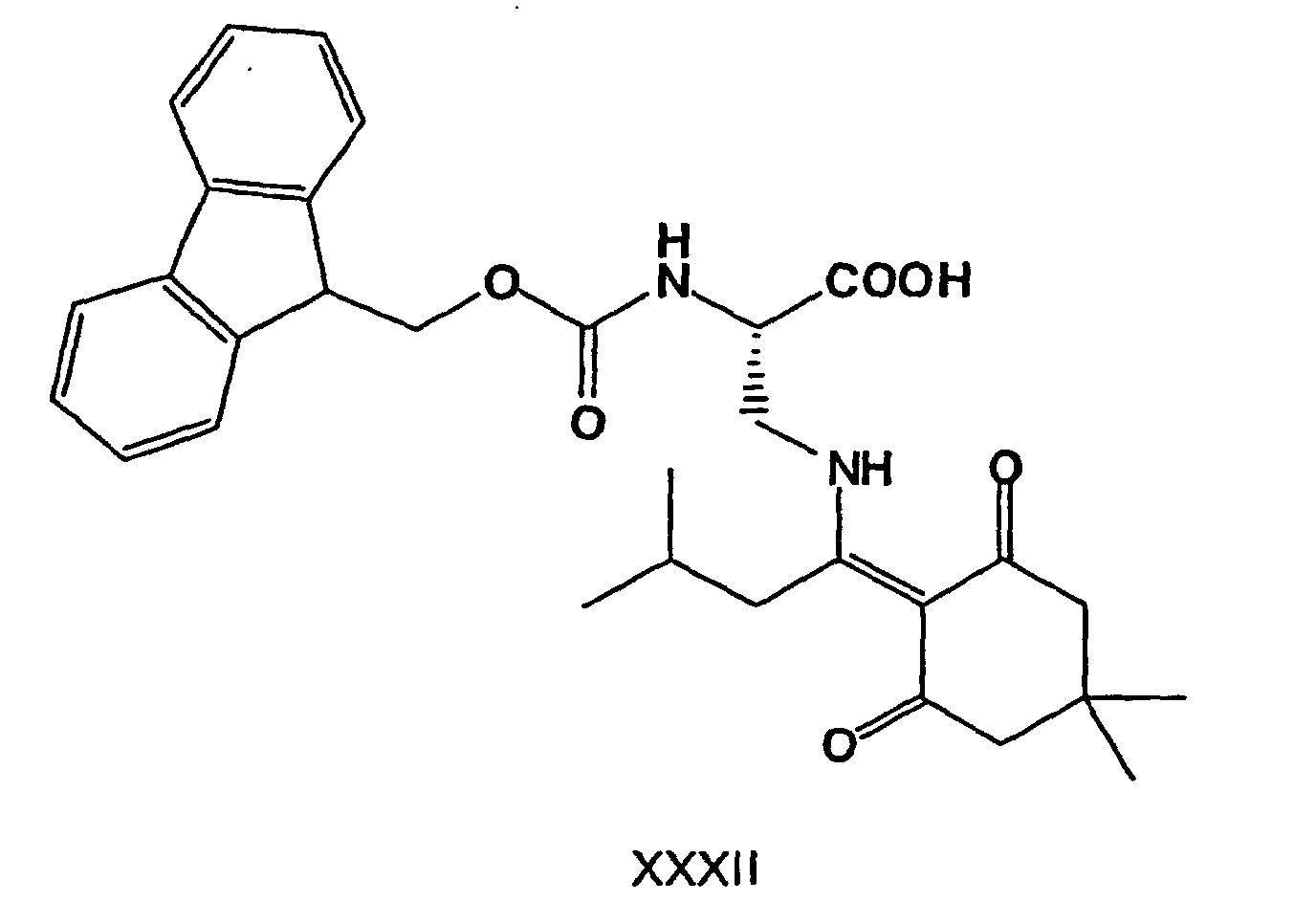
- PTMIGKZUTGSHED-VWLOTQADSA-N CC(C)CC(NCC[C@@H](C(O)=O)NC(OCC1c2ccccc2-c2c1cccc2)=O)=C(C(CC(C)(C)C1)=O)C1=O Chemical compound CC(C)CC(NCC[C@@H](C(O)=O)NC(OCC1c2ccccc2-c2c1cccc2)=O)=C(C(CC(C)(C)C1)=O)C1=O PTMIGKZUTGSHED-VWLOTQADSA-N 0.000 description 1
Classifications
-
- C—CHEMISTRY; METALLURGY
- C07—ORGANIC CHEMISTRY
- C07K—PEPTIDES
- C07K5/00—Peptides containing up to four amino acids in a fully defined sequence; Derivatives thereof
- C07K5/04—Peptides containing up to four amino acids in a fully defined sequence; Derivatives thereof containing only normal peptide links
- C07K5/06—Dipeptides
- C07K5/06139—Dipeptides with the first amino acid being heterocyclic
-
- A—HUMAN NECESSITIES
- A61—MEDICAL OR VETERINARY SCIENCE; HYGIENE
- A61P—SPECIFIC THERAPEUTIC ACTIVITY OF CHEMICAL COMPOUNDS OR MEDICINAL PREPARATIONS
- A61P1/00—Drugs for disorders of the alimentary tract or the digestive system
- A61P1/04—Drugs for disorders of the alimentary tract or the digestive system for ulcers, gastritis or reflux esophagitis, e.g. antacids, inhibitors of acid secretion, mucosal protectants
-
- A—HUMAN NECESSITIES
- A61—MEDICAL OR VETERINARY SCIENCE; HYGIENE
- A61P—SPECIFIC THERAPEUTIC ACTIVITY OF CHEMICAL COMPOUNDS OR MEDICINAL PREPARATIONS
- A61P1/00—Drugs for disorders of the alimentary tract or the digestive system
- A61P1/16—Drugs for disorders of the alimentary tract or the digestive system for liver or gallbladder disorders, e.g. hepatoprotective agents, cholagogues, litholytics
-
- A—HUMAN NECESSITIES
- A61—MEDICAL OR VETERINARY SCIENCE; HYGIENE
- A61P—SPECIFIC THERAPEUTIC ACTIVITY OF CHEMICAL COMPOUNDS OR MEDICINAL PREPARATIONS
- A61P11/00—Drugs for disorders of the respiratory system
- A61P11/02—Nasal agents, e.g. decongestants
-
- A—HUMAN NECESSITIES
- A61—MEDICAL OR VETERINARY SCIENCE; HYGIENE
- A61P—SPECIFIC THERAPEUTIC ACTIVITY OF CHEMICAL COMPOUNDS OR MEDICINAL PREPARATIONS
- A61P11/00—Drugs for disorders of the respiratory system
- A61P11/06—Antiasthmatics
-
- A—HUMAN NECESSITIES
- A61—MEDICAL OR VETERINARY SCIENCE; HYGIENE
- A61P—SPECIFIC THERAPEUTIC ACTIVITY OF CHEMICAL COMPOUNDS OR MEDICINAL PREPARATIONS
- A61P13/00—Drugs for disorders of the urinary system
- A61P13/12—Drugs for disorders of the urinary system of the kidneys
-
- A—HUMAN NECESSITIES
- A61—MEDICAL OR VETERINARY SCIENCE; HYGIENE
- A61P—SPECIFIC THERAPEUTIC ACTIVITY OF CHEMICAL COMPOUNDS OR MEDICINAL PREPARATIONS
- A61P17/00—Drugs for dermatological disorders
-
- A—HUMAN NECESSITIES
- A61—MEDICAL OR VETERINARY SCIENCE; HYGIENE
- A61P—SPECIFIC THERAPEUTIC ACTIVITY OF CHEMICAL COMPOUNDS OR MEDICINAL PREPARATIONS
- A61P19/00—Drugs for skeletal disorders
- A61P19/02—Drugs for skeletal disorders for joint disorders, e.g. arthritis, arthrosis
-
- A—HUMAN NECESSITIES
- A61—MEDICAL OR VETERINARY SCIENCE; HYGIENE
- A61P—SPECIFIC THERAPEUTIC ACTIVITY OF CHEMICAL COMPOUNDS OR MEDICINAL PREPARATIONS
- A61P25/00—Drugs for disorders of the nervous system
-
- A—HUMAN NECESSITIES
- A61—MEDICAL OR VETERINARY SCIENCE; HYGIENE
- A61P—SPECIFIC THERAPEUTIC ACTIVITY OF CHEMICAL COMPOUNDS OR MEDICINAL PREPARATIONS
- A61P29/00—Non-central analgesic, antipyretic or antiinflammatory agents, e.g. antirheumatic agents; Non-steroidal antiinflammatory drugs [NSAID]
-
- A—HUMAN NECESSITIES
- A61—MEDICAL OR VETERINARY SCIENCE; HYGIENE
- A61P—SPECIFIC THERAPEUTIC ACTIVITY OF CHEMICAL COMPOUNDS OR MEDICINAL PREPARATIONS
- A61P37/00—Drugs for immunological or allergic disorders
- A61P37/02—Immunomodulators
-
- A—HUMAN NECESSITIES
- A61—MEDICAL OR VETERINARY SCIENCE; HYGIENE
- A61P—SPECIFIC THERAPEUTIC ACTIVITY OF CHEMICAL COMPOUNDS OR MEDICINAL PREPARATIONS
- A61P37/00—Drugs for immunological or allergic disorders
- A61P37/02—Immunomodulators
- A61P37/06—Immunosuppressants, e.g. drugs for graft rejection
-
- A—HUMAN NECESSITIES
- A61—MEDICAL OR VETERINARY SCIENCE; HYGIENE
- A61P—SPECIFIC THERAPEUTIC ACTIVITY OF CHEMICAL COMPOUNDS OR MEDICINAL PREPARATIONS
- A61P37/00—Drugs for immunological or allergic disorders
- A61P37/08—Antiallergic agents
-
- A—HUMAN NECESSITIES
- A61—MEDICAL OR VETERINARY SCIENCE; HYGIENE
- A61P—SPECIFIC THERAPEUTIC ACTIVITY OF CHEMICAL COMPOUNDS OR MEDICINAL PREPARATIONS
- A61P43/00—Drugs for specific purposes, not provided for in groups A61P1/00-A61P41/00
-
- A—HUMAN NECESSITIES
- A61—MEDICAL OR VETERINARY SCIENCE; HYGIENE
- A61P—SPECIFIC THERAPEUTIC ACTIVITY OF CHEMICAL COMPOUNDS OR MEDICINAL PREPARATIONS
- A61P9/00—Drugs for disorders of the cardiovascular system
- A61P9/08—Vasodilators for multiple indications
-
- A—HUMAN NECESSITIES
- A61—MEDICAL OR VETERINARY SCIENCE; HYGIENE
- A61P—SPECIFIC THERAPEUTIC ACTIVITY OF CHEMICAL COMPOUNDS OR MEDICINAL PREPARATIONS
- A61P9/00—Drugs for disorders of the cardiovascular system
- A61P9/10—Drugs for disorders of the cardiovascular system for treating ischaemic or atherosclerotic diseases, e.g. antianginal drugs, coronary vasodilators, drugs for myocardial infarction, retinopathy, cerebrovascula insufficiency, renal arteriosclerosis
-
- C—CHEMISTRY; METALLURGY
- C07—ORGANIC CHEMISTRY
- C07D—HETEROCYCLIC COMPOUNDS
- C07D471/00—Heterocyclic compounds containing nitrogen atoms as the only ring hetero atoms in the condensed system, at least one ring being a six-membered ring with one nitrogen atom, not provided for by groups C07D451/00 - C07D463/00
- C07D471/02—Heterocyclic compounds containing nitrogen atoms as the only ring hetero atoms in the condensed system, at least one ring being a six-membered ring with one nitrogen atom, not provided for by groups C07D451/00 - C07D463/00 in which the condensed system contains two hetero rings
- C07D471/10—Spiro-condensed systems
Definitions
- the present invention relates to a novel spiro derivative or a pharmaceutically acceptable salt thereof, useful as an adhesion molecule inhibitor, especially VLA-4 inhibitor, to an adhesion molecule inhibitor, especially VLA-4 inhibitor, containing the same as an active ingredient, and to a therapeutic agent against inflammatory diseases containing the same as an active ingredient.
- Adhesion molecules are involved in adhesion between cells and between cells and intercellular matrix and migration and activation of cells.
- Adhesion molecules include a number of families such as integrin family and immunoglobulin superfamily.
- the adhesion molecules belonging to the integrin family are those expressed on leukocytes such as lymphocytes, monocytes, basophils and eosinophils.
- leukocytes such as lymphocytes, monocytes, basophils and eosinophils.
- These adhesion molecules have a heterodimer structure, in which an ⁇ chain and a ⁇ chain are non-covalently bound, and are classified into several subfamilies depending on the molecular species of the ⁇ chain (Cell, 76, 301 (1994)).
- VLA-4 very late antigen-4 also called ⁇ 4 ⁇ 1, CD49d/CD29, a member of the integrin family, is expressed on lymphocytes, monocytes, eosinophils and mast cells (Ann. Rev. Immunol., 8 , 365 (1990)).
- VCAM-1 vascular cell adhesion molecule-1
- CS-1 vascular endothelial cells
- VLA-4 ligands Immunol. Today, 14 , 506 (1993); Cell, 60 , 577 (1990)).
- VLA-4 on the leucocytes interacts with these ligands, participating in cell functions such as cell adhesion, extravascular migration or infiltration, differentiation and proliferation (Springer Semin. Immunopathol., 16 , 379 (1995)).
- CS-1 region amino acid sequence of the binding site with VLA-4 is 3 amino acid residues (LDV) of Leucine (Leu)-Aspartic acid (Asp)-Valine (Val) (J. Cell Biol., 124 , 601 (1994)). It has been reported that the CS-1 peptide or LDV derivative are effective against asthma or arthritis models by inhibiting ligands binding with VLA-4 in the same manner as that of the above-described antibodies (J. Clin. Invest., 94 , 655 (1994); Proc. Natl. Acad. Sci. USA, 88 , 9072 (1991)).
- adhesion molecules VLA-4 and VCAM-1 mainly participate in the process of accumulation of leukocytes to an inflammatory site
- a novel compound having an activity to inhibit the adhesion of VLA-4 and VCAM-1 is thought to inhibit accumulation of leukocytes to an inflammatory site.
- the probability that such a compound is an effective therapeutic drug against the above-mentioned diseases is high.
- An object of the present invention is to discover a compound which inhibits cell infiltration via adhesion molecules, especially, adhesion molecule VLA-4, thereby making it possible to prevent and treat inflammatory diseases caused by infiltration of leukocytes such as monocytes, lymphocytes and eosinophils.
- the present invention encompasses the following invention.
- the present invention provides a method for inhibiting an adhesion molecule, comprising administering an effective amount of the spiro derivative or a pharmaceutically acceptable salt thereof according to the present invention to a subject.
- the present invention further provides a use of the spiro derivative or a pharmaceutically acceptable salt thereof according to the present invention for the production of a pharmaceutical.
- the present invention still further provides a use of the spiro derivative or a pharmaceutically acceptable salt thereof according to the present invention for the production of an adhesion molecule inhibitor.
- a novel substance which inhibits cell infiltration via adhesion molecules, especially, adhesion molecule VLA-4, thereby making it possible to prevent and treat inflammatory diseases caused by infiltration of leukocytes such as monocytes, lymphocytes and eosinophils.
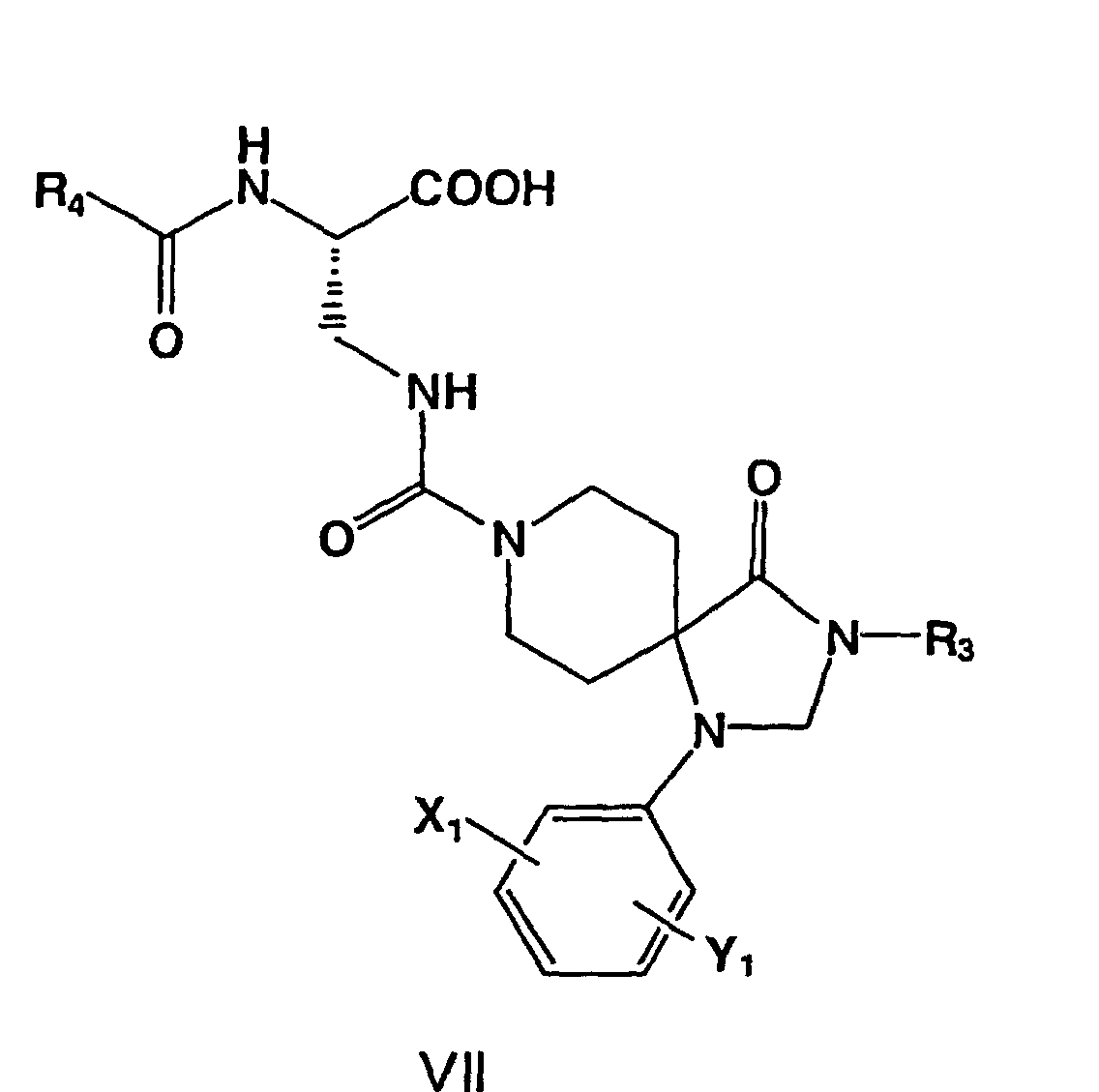
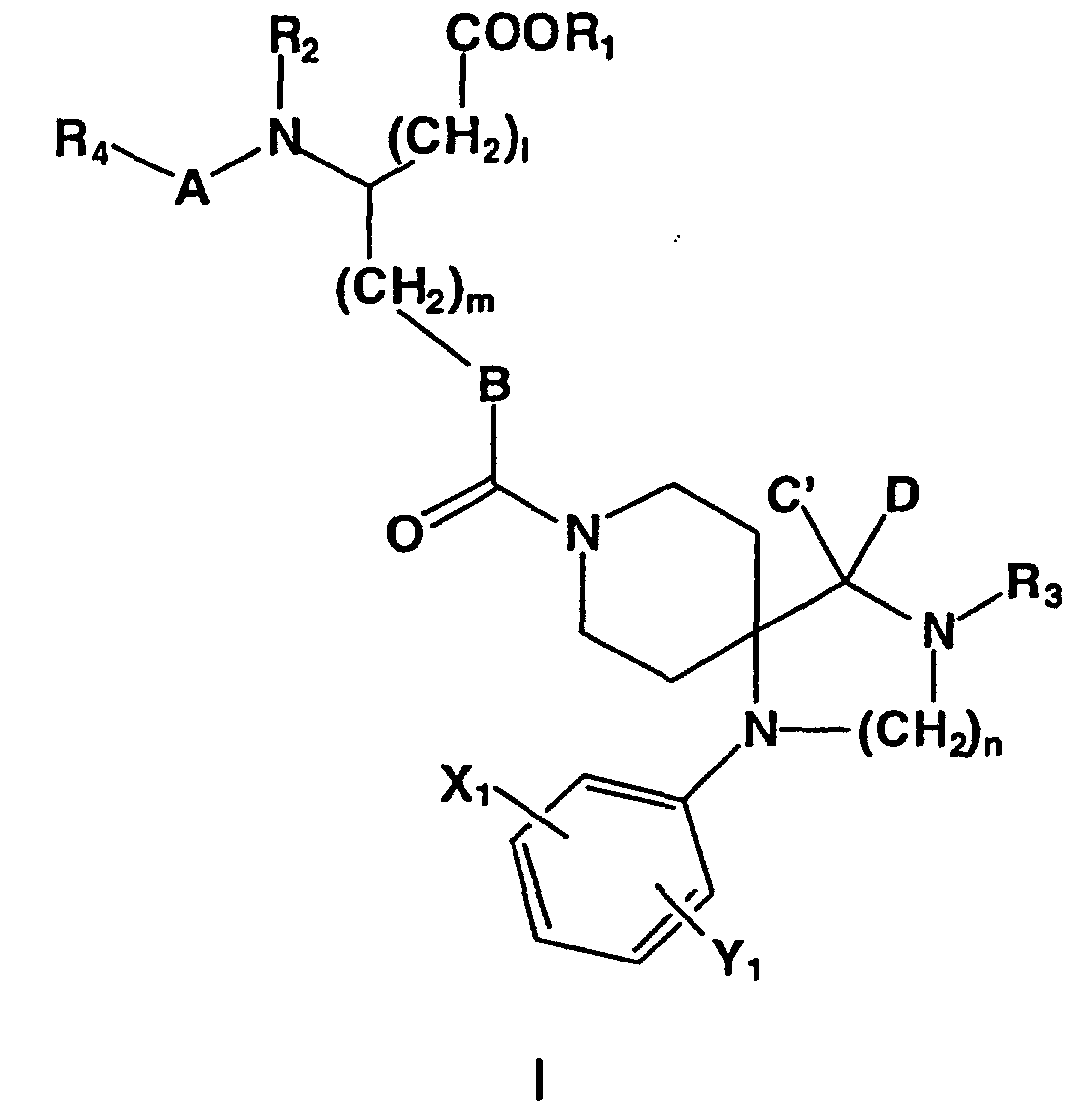
- the spiro derivative according to the present invention is represented by the general formula I.
- l and m each independently represent an integer of 0 to 2.
- n an integer of 1 to 3.
- A represents -C(O)- or -S(O) 2 -.
- B represents -CH 2 - or -NH-.
- X 1 and Y 1 independently represent hydrogen, halogen (fluorine, chlorine, bromine or iodine), C 1-8 alkyl (methyl, ethyl, n-propyl, 1-methylethyl and the like), trifluoromethyl, C 1-8 alkoxy (methoxy, ethoxy, n-propoxy, 1-methylethoxy and the like), cyano, nitro, hydroxyl, amino, or tetrazolyl (for example, 5-tetrazolyl and 1-tetrazolyl).
- R 1 represents hydrogen, C 1-6 linear alkyl (methyl, ethyl, n-propyl, n-butyl, n-pentyl or n-hexyl), C 3-8 branched alkyl (1-methylethyl, 1-methylpropyl, 2-methylpropyl, 1-methylbutyl, 2-methylbutyl, 3-methylbutyl, 1-methylpentyl, 2-methylpentyl, 3-methylpentyl, 4-methylpentyl, 1-methylhexyl, 2-methylhexyl, 3-methylhexyl, 4-methylhexyl, 5-methylhexyl, 3,5-dimethylhexyl, 3,6-dimethylhexyl, 4,5-dimethylhexyl and the like), benzyl or -CH 2 OC(O)C(CH 3 ) 3 .
- R 2 represents hydrogen or C 1-6 linear alkyl (methyl, ethyl, n-propyl, n-butyl, n-pentyl or n-hexyl).
- R 3 represents hydrogen, C 1-6 linear alkyl (methyl, ethyl, n-propyl, n-butyl, n-pentyl or n-hexyl), C 3-8 branched alkyl (1-methylethyl, 1-methylpropyl, 2-methylpropyl, 1-methylbutyl, 2-methylbutyl, 3-methylbutyl, 1-methylpentyl, 2-methylpentyl, 3-methylpentyl, 4-methylpentyl, 1-methylhexyl, 2-methylhexyl, 3-methylhexyl, 4-methylhexyl, 5-methylhexyl, 3,5-dimethylhexyl, 3,6-dimethylhexyl, 4,5-dimethylhexyl and the like), allyl, homoallyl, C 3-8 cycloalkyl-C 1-8 alkyl (cyclopropylmethyl, cyclopropylethyl, cyclopropylpropyl, cyclopropyl
- Substituent group E represents halogen, C 1-8 alkyl (methyl, ethyl, 1-methylethyl, 1,1-dimethylethyl, propyl, 1-methylpropyl, 2-methylpropyl, butyl and the like), C 1-8 alkoxy (methoxy, ethoxy, propoxy, butoxy, 1-methylethyl, 1,1-dimethylethyl, 1-methylpropoxy, 2-methylpropoxy and the like), trifluoromethyl, trifluoromethoxy, C 1-8 alkylthio (methylthio, ethylthio, propylthio and the like), cyano, nitro, hydroxyl, amino, C 1-8 alkylacyl (acetyl, propionyl, butyryl, isobutyryl, valeryl, isovaleryl, pivaloyl and the like), C 1-8 alkylacylamino (acetylamino, propionylamino, butyrylamin
- an alkylacyl means a group in which an alkyl group is bonded to a carbonyl group, wherein the number of carbon atoms of the alkylacyl is represented by the number of carbon atoms of the alkyl moiety.
- a "C 1-8 alkyl" represented by R 4 may be linear or branched, and represents methyl, ethyl, n-propyl, n-butyl, n-pentyl, n-hexyl, n-heptyl, n-octyl, 1-methylethyl, 1-methylpropyl, 2-methylpropyl, 1-methylbutyl, 2-methylbutyl, 3-methylbutyl, 1-methylpentyl, 2-methylpentyl, 3-methylpentyl, 4-methylpentyl, 1-methylhexyl, 2-methylhexyl, 3-methylhexyl, 4-methylhexyl, 5-methylhexyl, 1,1-dimethylethyl, 2,2-dimethylpropyl, 3,5-dimethylhexyl, 3,6-dimethylhexyl, 4,5-dimethylhexyl and the like, and may also be substituted with 1 to 4 substituents of R 5 selected independently.
- a "C 2-8 alkenyl" represented by R 4 may be linear or branched, and represents vinyl, 1-propenyl, 1-butenyl, 1-pentenyl, 1-hexenyl, 1-heptenyl, 1-octenyl, allyl, 2-butenyl, 3-butenyl, 2-pentenyl, 3-pentenyl, 4-pentenyl, 1-methylvinyl, 1-methyl-1-propenyl, 2-methyl-1-propenyl, 1,2-dimethyl-1-propenyl, 1-methyl-1-butenyl, 2-methyl-1-butenyl, 3-methyl-1-butenyl, 1-methyl-2-butenyl, 2-methyl-2-butenyl, 3-methyl-2-butenyl, 1,2-dimethyl-1-butenyl and the like, and may also be substituted with 1 to 4 substituents of R 5 selected independently.
- a "C 2-8 alkynyl" represented by R 4 may be linear or branched, and represents ethynyl, 1-propynyl, 1-butynyl, 1-pentynyl, 1-hexynyl, 1-heptynyl, 1-octynyl, 3-methyl-1-butynyl, 3,3-dimethyl-1-butynyl, 3-methyl-1-pentynyl, 4-methyl-1-pentynyl, 3,3-dimethyl-1-pentynyl, 3,4-dimethyl-1-pentynyl, 3,3,4-trimethyl- 1-pentynyl and the like, and may also be substituted with 1 to 4 substituents of R 8 selected independently.
- a "Cy” represented by R 4 may be C 3-8 cycloalkyl that may be substituted with 1 to 4 substituents of R 6 or 3- to 8-membered monocyclic or bicyclic heterocycle that includes I to 4 nitrogen atoms, oxygen atoms or sulfur atoms independently selected, which heterocycle may be substituted with I to 4 substituents of R 6 (with the proviso that the hetero atoms do not bond directly with A).
- the "C 3-8 cycloalkyl" represented by “Cy” represents cyclopropyl, cyclobutyl, cyclopentyl, cyclohexyl, cycloheptyl or cyclooctyl.
- the "3- to 8-membered monocyclic or bicyclic heterocycle that includes 1 to 4 nitrogen atoms, oxygen atoms or sulfur atoms independently selected” represented by “Cy” may be saturated or partially unsaturated, and represents oxirane, oxetane, dihydrofuran, tetrahydrofuran, dihydropyran, tetrahydropyran, oxepane, oxocane, thiirane, thietane, dihydrothiophene, tetrahydrothiophene, dihydrothiopyran, tetrahydrothiopyran, thiepane, thiocane, aziridine, azetidine, dihydropyrrole, pyrrolidine, dihydropyridine, tetrahydropyridine, piperidine, azepan, azocane, oxazolidine, thiazoline, imidazolidine, dihydro
- R 4 An "Ar” represented by R 4 is phenyl that may be substituted with 1 to 5 substituents of R 7 , naphthyl that may be substituted with 1 to 5 substituents of R 7 , or 5- to 8-membered monocyclic or bicyclic heteroaryl that includes 1 to 4 nitrogen atoms, oxygen atoms or sulfur atoms independently selected, which heterocycle may be substituted with 1 to 5 substituents of R 7 (wherein the hetero atoms do not directly bond with A).
- R 4 the "5- to 8-membered monocyclic or bicyclic heteroaryl that includes 1 to 4 nitrogen atoms, oxygen atoms or sulfur atoms independently selected" represented by "Ar” represents furan, benzofuran, isobenzofuran, benzodioxane, thiophene, benzo[b]thiophene, benzo[c]thiophene, pyrrole, indole, isoindole, quinoline, isoquinoline, imidazole, pyrazole, indazole, benzimidazole, cinnoline, quinazoline, quinoxaline, oxazole, isoxazole, benzoxazine, thiazole, isothiazole, benzoxathiin, furazole, triazole, tetrazole and the like.
- a "Cy-C 1-8 alkyl" represented by R 4 represents methyl, ethyl, n-propyl, n-butyl, n-pentyl, n-hexyl, n-heptyl, n-octyl, 1-methylethyl, 1-methylpropyl, 2-methylpropyl, 1-methylbutyl, 2-methylbutyl, 3-methylbutyl, 1-methylpentyl, 2-methylpentyl, 3-methylpentyl, 4-methylpentyl, 1-methylhexyl, 2-methylhexyl, 3-methylhexyl, 4-methylhexyl, 5-methylhexyl, 1,1-dimethylethyl, 2,2-dimethylpropyl, 3,5-dimethylhexyl, 3,6-dimethylhexyl, 4,5-dimethylhexyl and the like substituted with "Cy".
- a "Cy-C 1-8 alkenyl” represented by R 4 represents vinyl, 1-propenyl, 1-butenyl, 1-pentenyl, 1-hexenyl, 1-heptenyl, 1-octenyl, allyl, 2-butenyl, 3-butenyl, 2-pentenyl, 3-pentenyl, 4-pentenyl, 1-methylvinyl, 1-meihyl-1-propenyl, 2-methyl-1-propenyl, 1,2-dimethyl-1-propenyl, 1-methyl-1-butenyl, 2-methyl-1-butenyl, 3-methyl-1-butenyl, 1-methyl-2-butenyl, 2-methyl-2-butenyl, 3-methyl-2-butenyl, 1,2-dimethyl-1-butenyl and the like substituted with "Cy".
- a "Cy-C 1-8 alkynyl" represented by R 4 represents ethynyl, 1-propynyl, 1-butynyl, 1-pentynyl, 1-hexynyl, 1-heptynyl, 1-octynyl, 3-methyl-1-butynyl, 3,3-dimethyl-1-butynyl, 3-methyl-1-pentynyl, 4-methyl-1-pentynyl, 3,3-dimethyl-1-pentynyl, 3,4-dimethyl-1-pentynyl, 3,3,4-trimethyl-1-pentynyl and the like substituted with "Cy".
- An "Ar-C 1-8 alkyl" represented by R 4 represents methyl, ethyl, n-propyl, n-butyl, n-pentyl, n-hexyl, n-heptyl, n-octyl, 1-methylethyl, 1-methylpropyl, 2-methylpropyl, 1-methylbutyl, 2-methylbutyl, 3-methylbutyl, 1-methylpentyl, 2-methylpentyl, 3-methylpentyl, 4-methylpentyl, 1-methylhexyl, 2-methylhexyl, 3-methylhexyl, 4-methylhexyl, 5-methylhexyl, 1,1-dimethylethyl, 2,2-dimethylpropyl, 3,5-dimethylhexyl, 3,6-dimethylhexyl, 4,5-dimethylhexyl and the like substituted with "Ar".
- An "Ar-C 1-8 alkenyl” represented by R 4 represents vinyl, 1-propenyl, 1-butenyl, 1-pentenyl, 1-hexenyl, 1-heptenyl, 1-octenyl, allyl, 2-butenyl, 3-butenyl, 2-pentenyl, 3-pentenyl, 4-pentenyl, 1-methylvinyl, 1-methyl-1-propenyl, 2-methyl-1-prop 1,2-dimethyl-1-propenyl, 1-methyl-1-butenyl, 2-methyl-1-butenyl, 3-methyl-1-butenyl, 1-methyl-2-butenyl, 2-methyl-2-butenyl, 3-methyl-2-butenyl, 1,2-dimethyl-1-butenyl and the like substituted with "Ar".
- An “Ar-C 1-8 alkynyl” represented by R 4 represents 1-propynyl, 1-butynyl, 1-pentynyl, 1-hexynyl, 1-heptynyl, 1-octynyl, 3-methyl-1-butynyl, 3,3-dimethyl-1-butynyl, 3-methyl-1-pentynyl, 4-methyl-1-pentynyl, 3,3-dimethyl-1-pentynyl, 3,4-dimethyl-1-pentynyl, 3,3,4-trimethyl-1-pentynyl and the like substituted with "Ar".
- a "C 1-8 alkyl" represented by R 6 , R 7 , R a , R b , R c and R d represents methyl, ethyl, n-propyl, n-butyl, n-pentyl, n-hexyl, n-heptyl, n-octyl, 1-methylethyl, 1-methylpropyl, 2-methylpropyl, 1-methylbutyl, 2-methylbutyl, 3-methylbutyl, 1-methylpentyl, 2-methylpentyl, 3-methylpentyl, 4-methylpentyl, 1-methylhexyl, 2-methylhexyl, 3-methylhexyl, 4-methylhexyl, 5-methylhexyl, 1,1-dimethylethyl, 2,2-dimethylpropyl, 3,5-dimethylhexyl, 3,6-dimethylhexyl, 4,5-dimethylhexyl and the like.
- a "C 2-8 alkenyl” represented by R 6 and R 7 represents vinyl, 1-propenyl, 1-butenyl, 1-pentenyl, 1-hexenyl, 1-heptenyl, 1-octenyl, allyl, 2-butenyl, 3-butenyl, 2-pentenyl, 3-pentenyl, 4-pentenyl, 1-methylvinyl, 1-methyl-1-propenyl, 2-methyl-1-propenyl, 1,2-dimethyl-1-propenyl, 1-methyl-1-butenyl, 2-methyl-1-butenyl, 3-methyl-1-butenyl, 1-methyl-2-butenyl, 2-methyl-2-butenyl, 3-methyl-2-butenyl, 1,2-dimethyl-1-butenyl and the like.
- a "C 2-8 alkynyl" represented by R 6 and R 7 may be linear or branched, and represents ethynyl, 1-propynyl, 1-butynyl, 1-pentynyl, 1-hexynyl, 1-heptynyl, 1-octynyl, 3-methyl-I-butynyl, 3,3-dimethyl-1-butynyl, 3-methyl-1-pentynyl, 4-methyl-1-pentynyl, 3,3-dimethyl-1-pentynyl, 3,4-dimethyl-1-pentynyl, 3,3,4-trimethyl-1-pentynyl and the like.
- a "C 3-8 cycloalkyl" represented by R b , R c and R d represents cyclopropyl, cyclobutyl, cyclopentyl, cyclohexyl, cycloheptyl or cyclooctyl.
- a "C 3-8 cycloalkyl-C 1-8 alkyl" represented by R 6 , R 7 , R b , R c and R d represents cyclopropylmethyl, cyclobutylmethyl, cyclopentylmethyl, cyclohexylmethyl, cycloheptylmethyl, cyclooctylmethyl, cyclopropylethyl, cyclobutylethyl, cyclopentylethyl, cyclohexylethyl, cycloheptylethyl, cyclooctylethyl, cyclopropylpropyl, cyclobutylpropyl, cyclopentylpropyl, cyclohexylpropyl, cycloheptylpropyl, cyclooctylpropyl, cyclopropylbutyl, cyclobutylbutyl, cyclopentylbutyl, cycl
- An "unsubstituted phenyl or phenyl substituted with at least one substituent of substituent group E" represented by R 6 , R 7 , R b , R c and R d represents phenyl, 2-fluorophenyl, 2-chlorophenyl, 2-bromophenyl, 2-methylphenyl, 2-methoxyphenyl, 2-trifluoromethylphenyl, 2-methylthiophenyl, 2-cyanophenyl, 2-nitrophenyl, 2-hydroxyphenyl, 2-aminophenyl, 2-acetylphenyl, 2-acetylaminophenyl, 2-tetrazolylphenyl, 3-fluorophenyl, 3-chlorophenyl, 3-bromophenyl, 3-methylphenyl, 3-methoxyphenyl, 3-trifluoromethylphenyl, 3-methylthiophenyl, 3-cyanophenyl, 3-nitrophenyl, 3-hydroxyphenyl, 3-aminopheny
- An "unsubstituted benzyl or benzyl substituted with at least one substituent of substituent group E" represented by R 6 , R 7 , R b , R c and R d represents benzyl, 2-fluorobenzyl, 2-chlorobenzyl, 2-bromobenzyl, 2-methylbenzyl, 2-methoxybenzyl, 2-trifluoromethylbenzyl, 2-methylthiobenzyl, 2-cyanobenzyl, 2-nitrobenzyl, 2-hydroxybenzyl, 2-aminobenzyl, 2-acetylbenzyl, 2-acetylaminobenzyl, 2-tetrazolylbenzyl, 3-fluorobenzyl, 3-chlorobenzyl, 3-bromobenzyl, 3-methylbenzyl, 3-methoxybenzyl, 3-trifluoromethylbenzyl, 3-methylthiobenzyl, 3-cyanobenzyl, 3-nitrobenzyl, 3-hydroxybenzyl, 3-aminobenzy
- R b , R c and R d represents phenethyl, 2-fluorophenethyl, 2-chlorophenethyl, 2-bromophenethyl, 2-methylphenethyl, 2-methoxyphenethyl, 2-trifluoromethylphenethyl, 2-methylthiophenethyl, 2-cyanophenethyl, 2-nitrophenethyl, 2-hydroxyphenethyl, 2-aminophenethyl, 2-acetylphenethyl, 2-acetylaminophenethyl, 2-tetrazolylphenethyl, 3-fluorophenethyl, 3-chlorophenethyl, 3-bromophenethyl, 3-methylphenethyl, 3-methoxyphenethyl, 3-trifluoromethylphene
- R b , R c and R d represents styryl, 2-fluorostyryl, 2-chlorostyryl, 2-bromostyryl, 2-methylstyryl, 2-methoxystyryl, 2-trifluoromethylstyryl, 2-methylthiostyryl, 2-cyanostyryl, 2-nitrostyryl, 2-hydroxystyryl, 2-aminostyryl, 2-acetylstyryl, 2-acetylaminostyryl, 2-tetrazolylstyryl, 3-fluorostyryl, 3-chlorostyryl, 3-bromostyryl, 3-methylstyryl, 3-methoxystyryl, 3-trifluoromethylstyryl, 3-methylthiostyryl, 3-cyanostyryl, 3-nitrostyryl, 3-hydroxystyryl, 3-aminostyryl, 3-acetylstyryl, 2-acetylaminostyryl, 2-tetrazolylstyryl, 3-fluorostyryl, 3-ch
- R b , R c and R d represents 1-naphthyl, 2-naphthyl, 2-fluoronaphthyl, 2-chloronaphthyl, 2-bromonaphthyl, 2-methylnaphthyl, 2-methoxynaphthyl, Z-triffuoromethylnaphthyl, 2-cyanonaphthyl, 2-nitronaphthyl, 2-hydroxynaphthyl, 2-aminonaphthyl, 2,8-dichloronaphthyl, 2,8-dimethylnaphthyl, 2,8-dimethoxynaphthyl, 2,8-dinitronaphthyl, 2,8-dihydroxynaphthyl and the like.
- R b , R c and R d represents napthylmethyl, (2-cyanonaphthyl)methyl, (2-hydroxynaphthyl)methyl, (2-chloronaphthyl)methyl, (2-nitronaphthyl)methyl, (2-aminonaphthyl)methyl, (2-bromonaphthyl)methyl, (2-fluoronaphthyl)methyl, (2-tetrazolylnaphthyl)methyl, (2,8-dihydroxynaphthyl)methyl, (2,8-dimethoxynaphthyl)methyl, (2,8-dichloronaphthyl)methyl, (2,8-dinitronaphthyl)methyl, (2,8-dimethylnaphthyl)methyl and the like
- n is 1
- X 1 and Y 1 are preferable as X 1 and Y 1 , more preferable is hydrogen, halogen, methyl, trifluoromethyl, methoxy, cyano, nitro or hydroxyl and even more preferable is hydrogen.
- R 1 While any group is preferable as R 1 , more preferable is hydrogen or C 1-6 linear alkyl.
- R 2 While any group is preferable as R 2 , more preferable is hydrogen.
- R 3 is hydrogen, C 1-6 linear alkyl, C 3-8 branched alkyl, C 6-10 cycloalkylalkyl or benzyl and more preferable is methyl, ethyl, propyl, 2-methylpropyl or benzyl.
- R 4 is preferably a group selected from the following (i) through (vii).
- any group is preferable as the C 3-8 cycloalkyl, more preferable is cyclopropyl, cyclopentyl or cyclohexyl.
- a 3- to 8-membered monocyclic or bicyclic heterocycle that includes 1 to 4 nitrogen atoms or oxygen atoms independently selected is preferably a 3- to 8-membered monocyclic heterocycle that includes 1 to 2 nitrogen atoms or oxygen atoms (oxirane, oxetane, dihydrofuran, tetrahydrofuran, dihydropyran, tetrahydropyran, oxepane, oxocane, dioxolane, dioxane, aziridine, azetidine, dihydropyrrole, pyrrolidine, piperidine, azepan, azocane, imidazolidine, dihydroimidazolidine, tetrahydropyrimidine, hexahydropyrimidine, piperidine, oxazolidine, dihydrooxazole, oxathiolanedihydrooxazine or the like) and more preferably a 3-to 8-member
- the 5- to 8-membered monocyclic or bicyclic heteroaryl that includes 1 to 4 nitrogen atoms, oxygen atoms or sulfur atoms independently selected may be preferably any group, more preferably furan, benzofuran, thiophene, benzothiophene, pyrrole, pyridine, indole, quinoline, isoquinoline, imidazole, pyrazole, indazole, benzimidazole, cinnoline, quinazoline, quinoxaline, oxazole, isoxazole, thiazole or isothiazole.
- the C 3-8 cycloalkyl-C 1-8 alkyl is preferably cyclopropylmethyl, cyclobutylmethyl, cyclopentylmethyl, cyclohexylmethyl, cyclopropylethyl, cyclobutylethyl, cyclopentylethyl or cyclohexylmethyl.
- the 3- to 8-membered monocyclic heterocycle-C 1-8 alkyl, the heterocycle including 1 to 4 nitrogen atoms or oxygen atoms independently selected, is preferably pyrrolidinylmethyl, piperidinylmethyl, imidazolinylmethyl, piperidinylmethyl, tetrahydrofuranylmethyl, tetrahydropyranylmethyl, oxazolinylmethyl, pyrrolidinylethyl, piperidinylethyl, imidazolinylethyl, piperidinylethyl, tetrahydrofuranylethyl, tetrahydropyranylethyl, oxazolinylethyl, pyrrolidinylpropyl, piperidinylpropyl, imidazolinylpropyl, piperidinylpropyl, tetrahydrofuranylpropyl, tetrahydropyranylpropyl or ox
- the substituent R 6 for C 3-8 alkyl is preferably selected from the following substituent groups.
- halogen, trifluoromethyl, -OR a , C 1-8 alkyl, O, -C(O)R b , -C(O)NR c R d , -SO 2 R b , -SO 2 NR c R d , -NR c C(O)R b , -NR c SO 2 R b , phenyl or benzyl.
- the substituent R 6 for 3- to 8-membered monocyclic or bicyclic heterocycle comprising from 1 to 4 nitrogen atoms or oxygen atoms independently selected is preferably selected from the following substituent groups.
- C 1-8 alkyl, C 3-8 cycloalkyl-C 1-8 alkyl, O, -C(O)R b , -C(O)OR b , -C(O)NR c R d , -SO 2 R b , -SO 2 NR c R d , unsubstituted phenyl or phenyl substituted with at least one substituent of substituent group E, or unsubstituted benzyl or benzyl substituted with at least one substituent of substituent group E.
- the substituent R 7 for phenyl and naphthyl is preferably halogen, trifluoromethyl, -OR a , C 1-8 alkyl, cyano, nitro or phenyl, and more preferably halogen, trifluoromethyl, hydroxyl, methoxy, trifluoromethoxy, methyl, cyano or nitro.
- the substituent R 7 for the 5- to 8-membered monocyclic or bicyclic heteroaryl that includes 1 to 4 nitrogen atoms, oxygen atoms or sulfur atoms independently selected is preferably selected from the following substituent group.
- halogen trifluoromethyl, -OR a , C 1-8 alkyl, C 3-8 cycloalkyl-C 1-8 alkyl, -C(O)R b , -SO 2 R b , or unsubstituted benzyl or benzyl substituted with at least one substituent of substituent group E.
- the substituent R 7 for the 3- to 8-membered monocyclic heterocycle-C 1-8 alkyl, the heterocycle including 1 to 4 nitrogen atoms or oxygen atoms independently selected, is preferably selected from the following substituent group.
- halogen trifluoromethyl, -OR a , C 1-8 alkyl, C 3-8 cycloalkyl-C 1-8 alkyl, -C(O)R b , -SO 2 R b , or unsubstituted benzyl or benzyl substituted with at least one substituent of substituent group E.
- R 6 , R 7 , R a , R b and R c any of the substituent group E, that is the substituents for phenyl, benzyl, phenethyl, styryl, naphthyl and naphthylmethyl, is preferable, more preferable is halogen, methyl, methoxy, trifluoromethyl, trifluoromethoxy, cyano, nitro and hydroxyl.
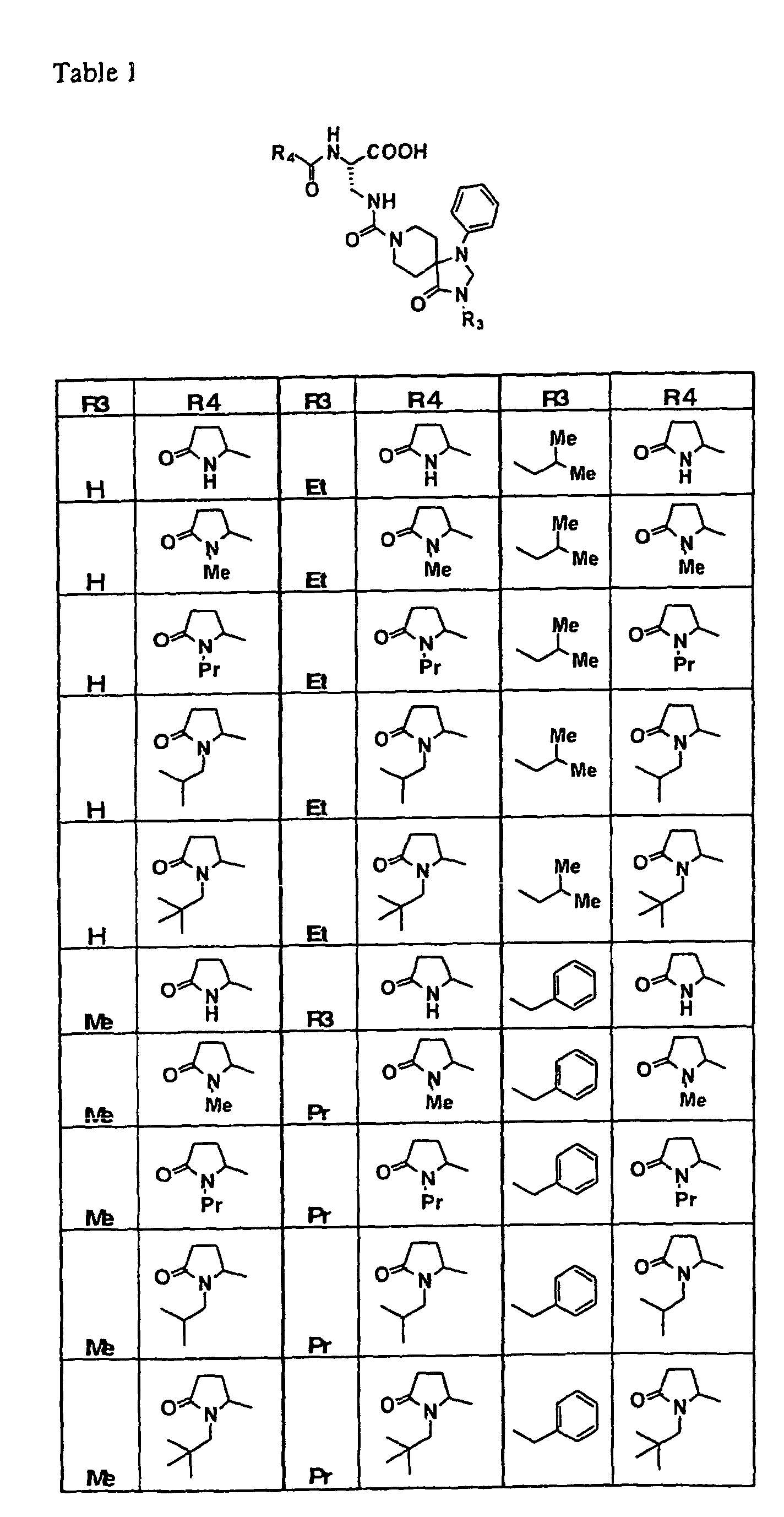
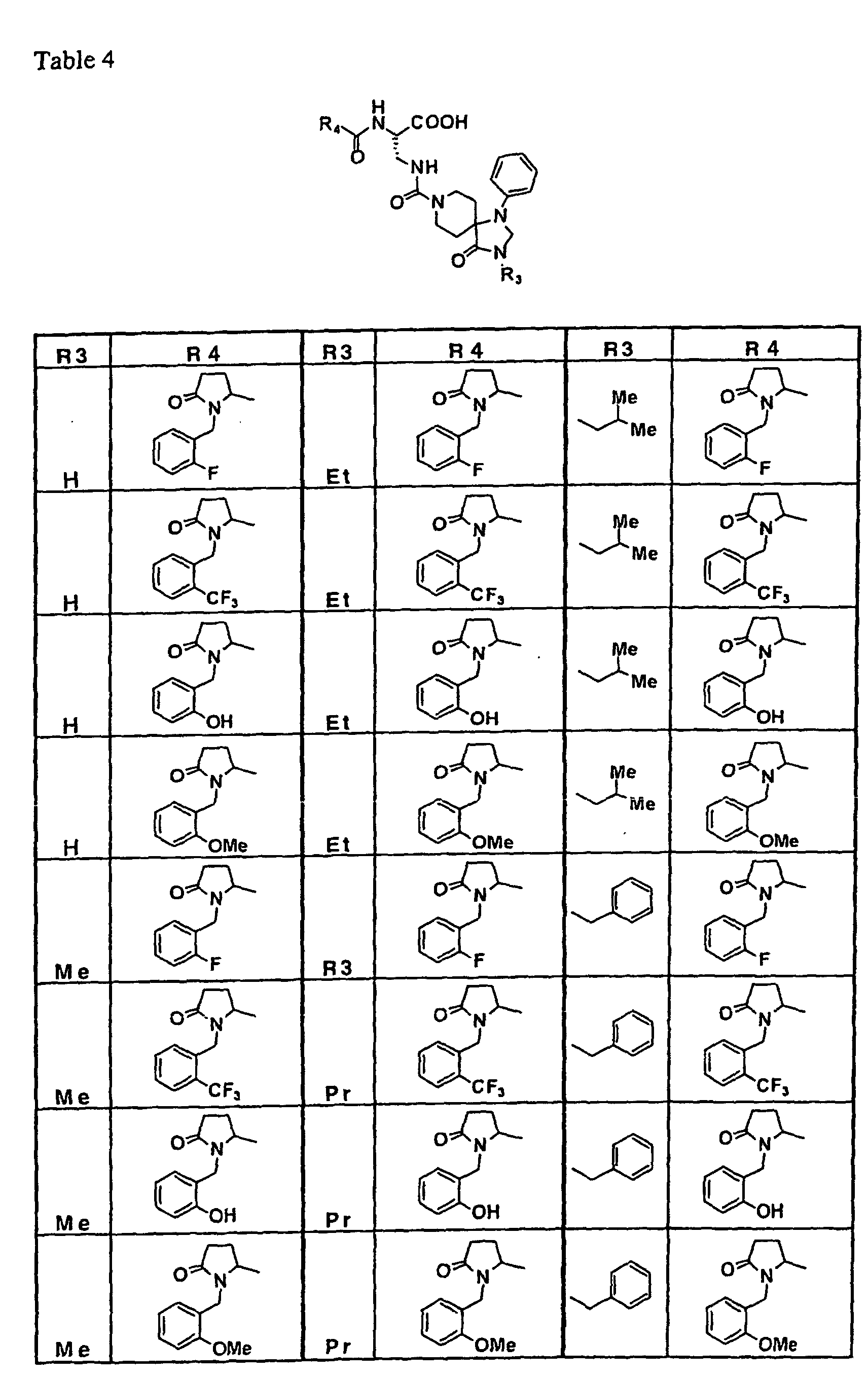
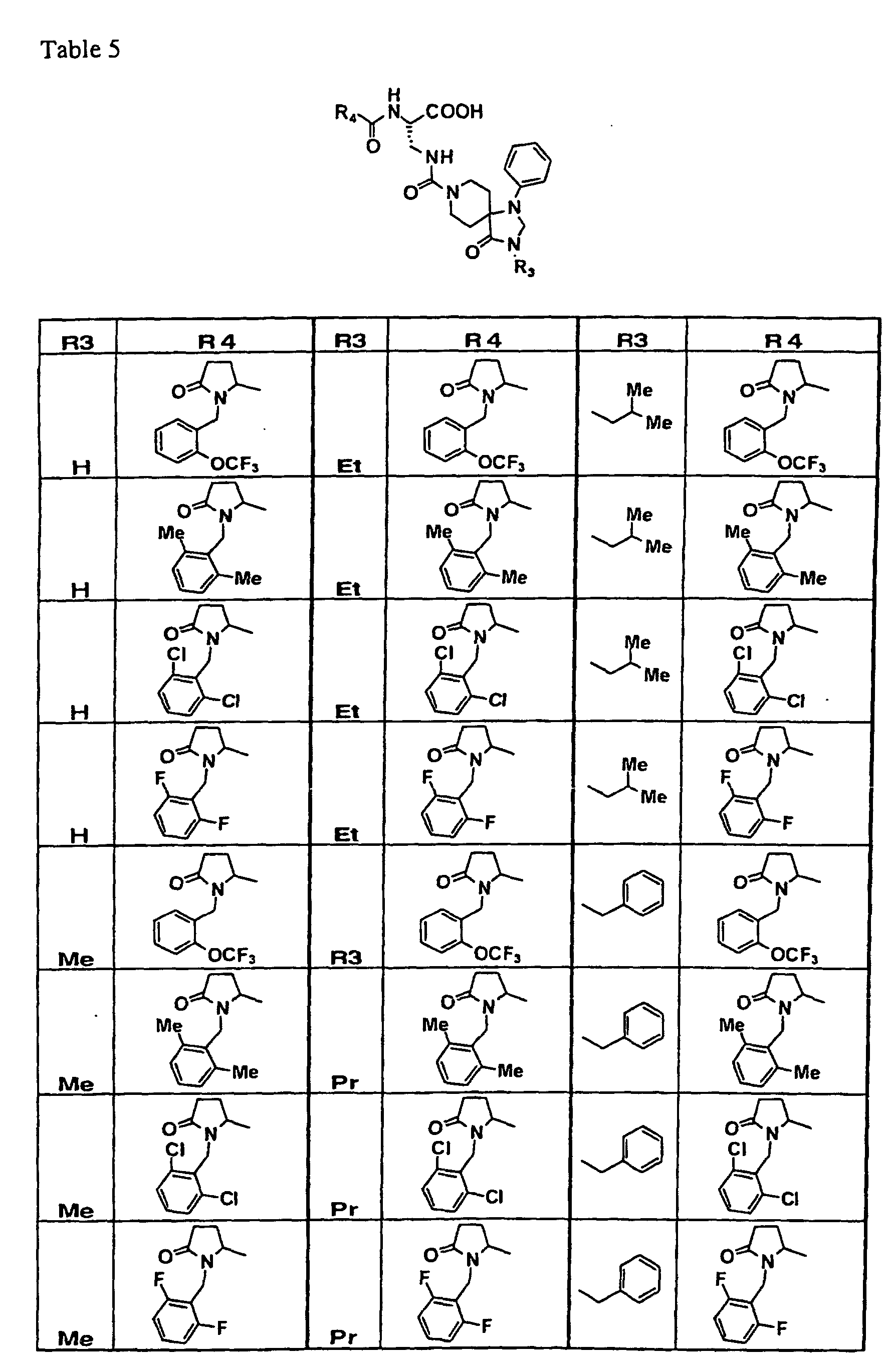
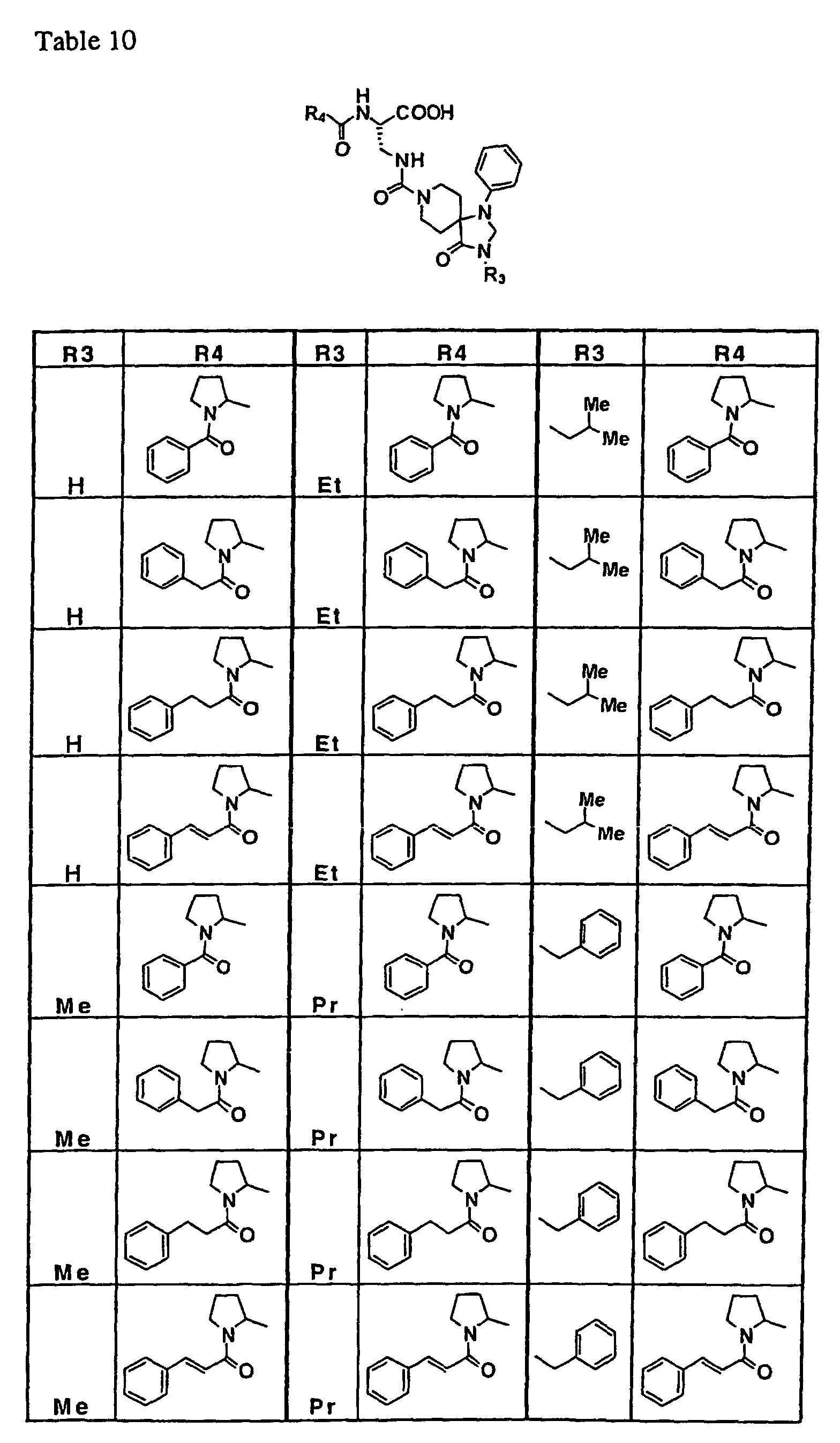
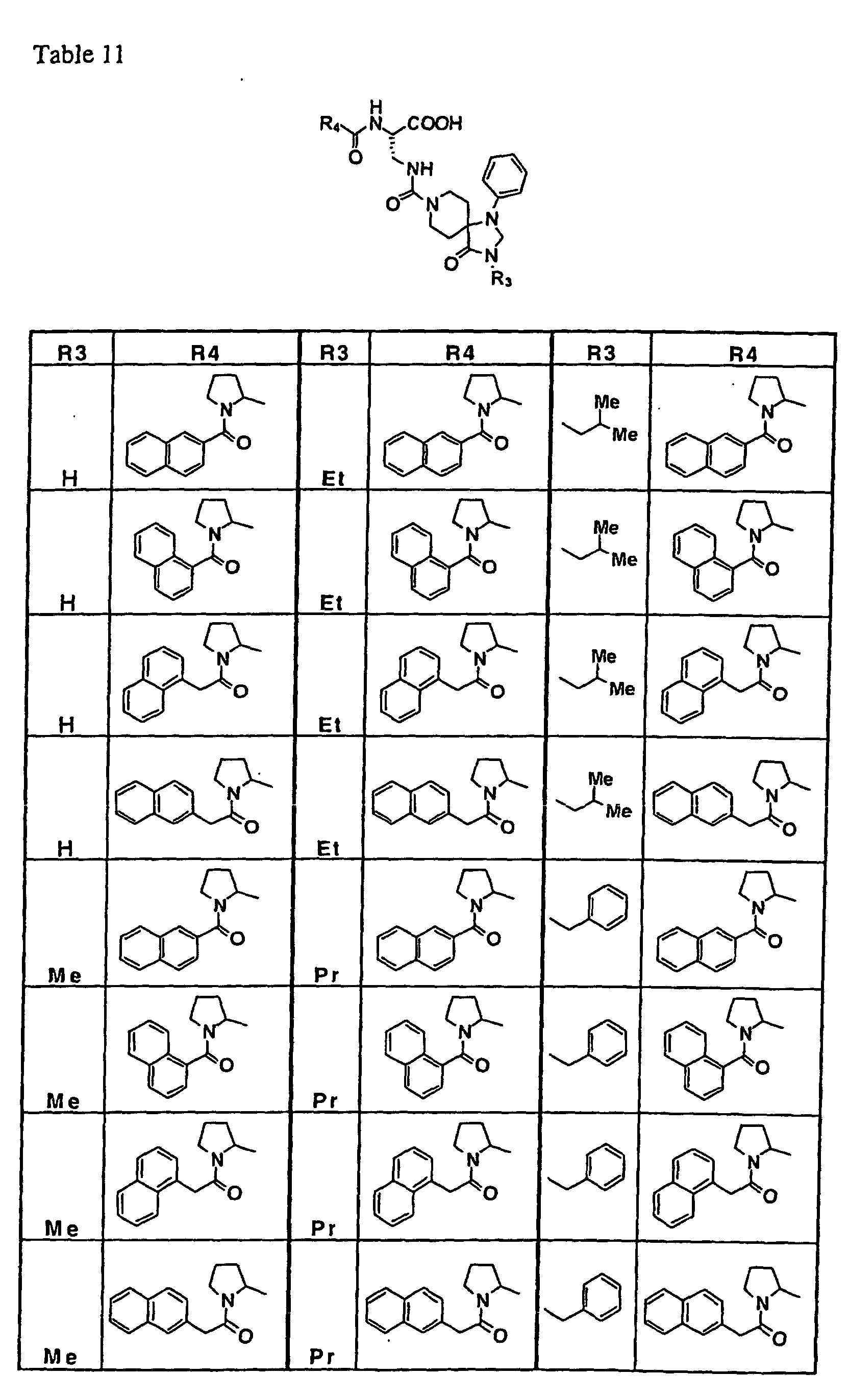
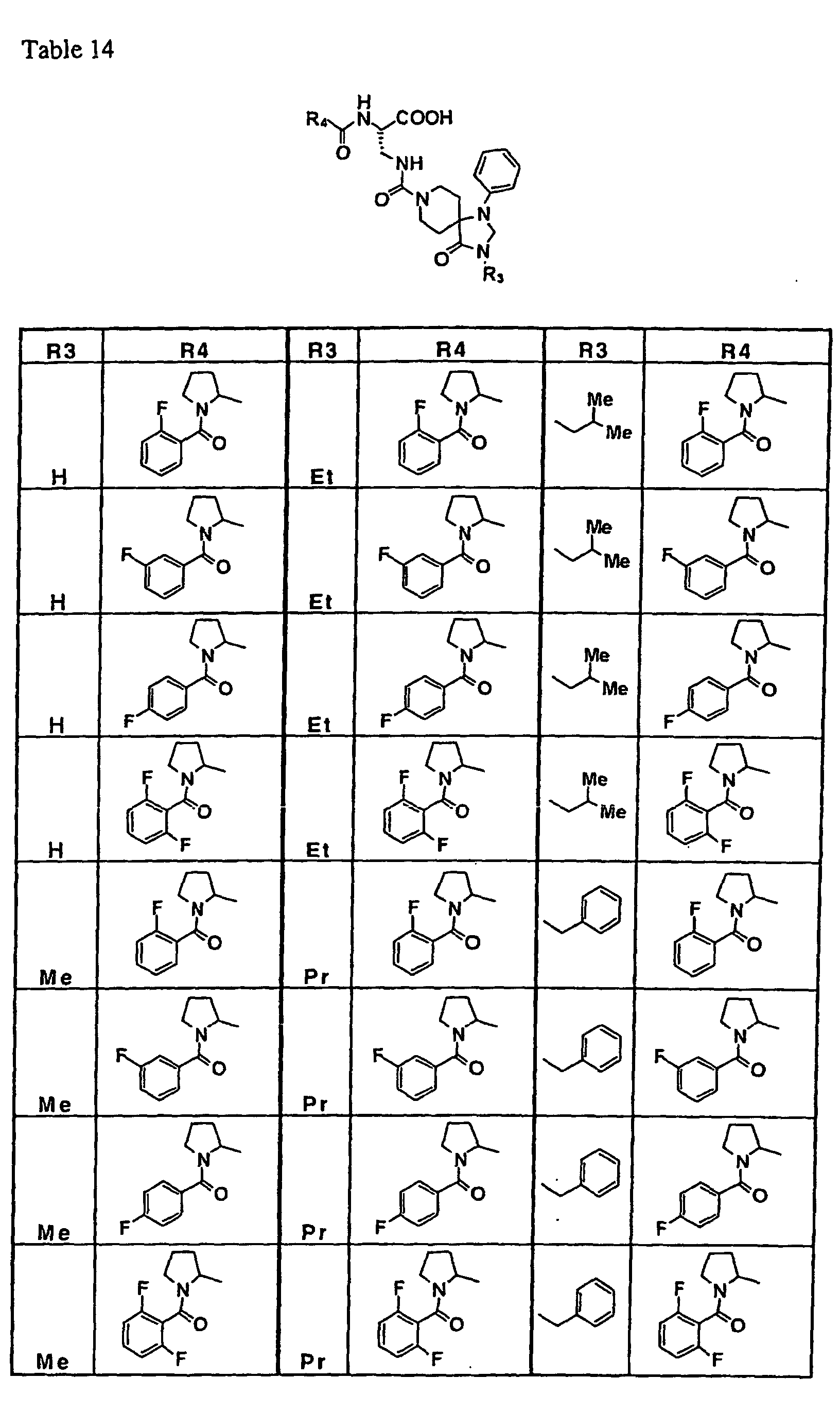
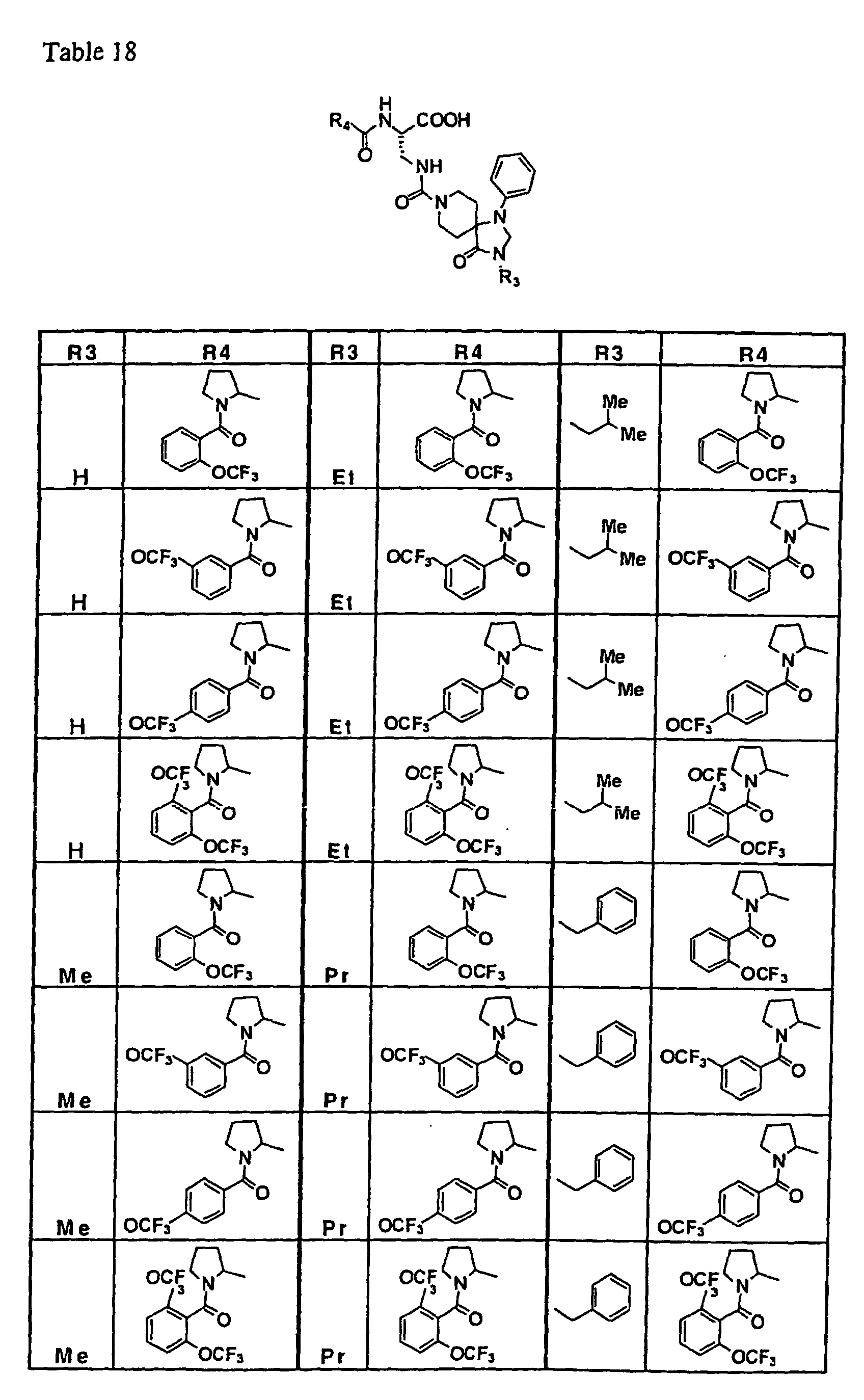
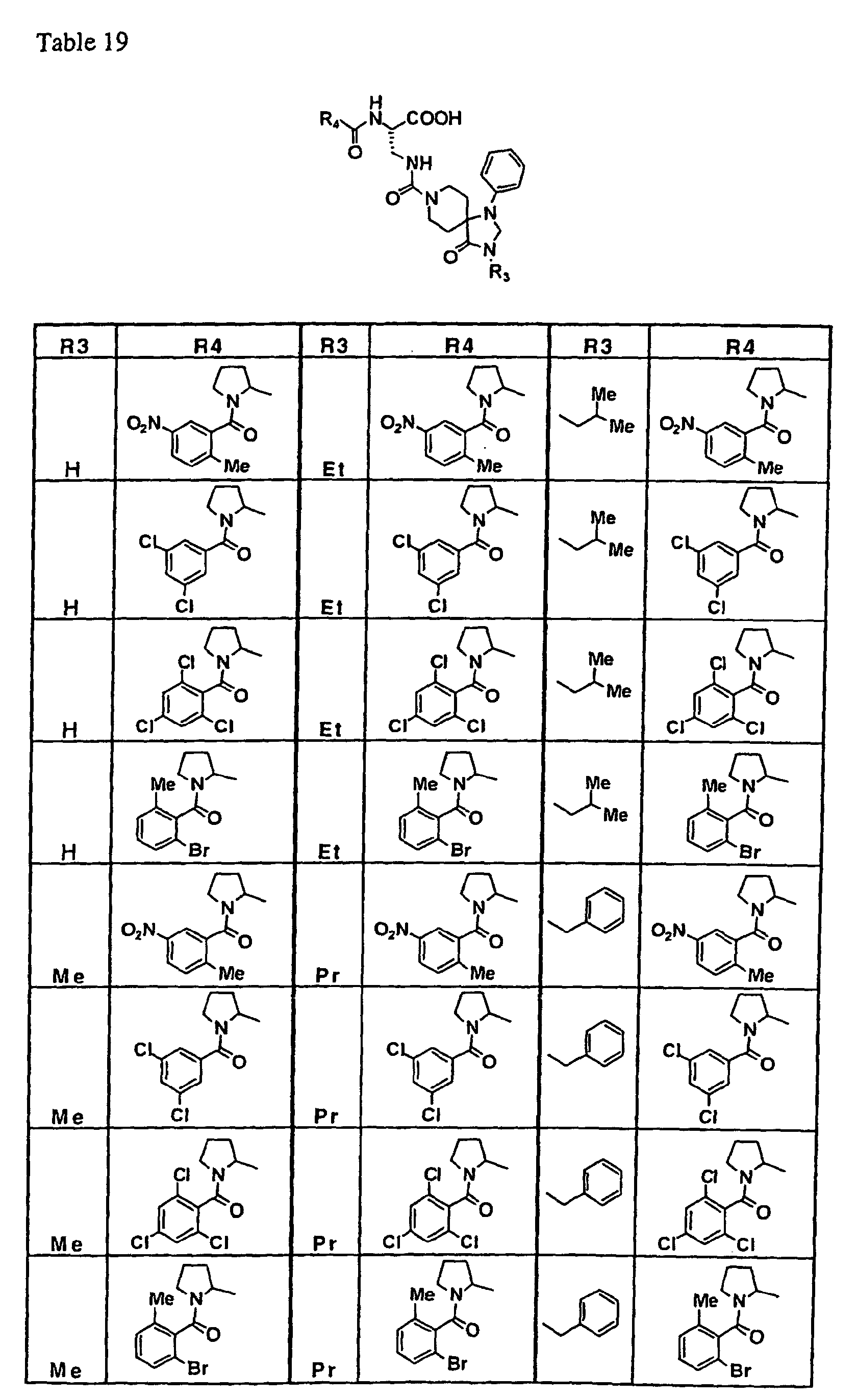
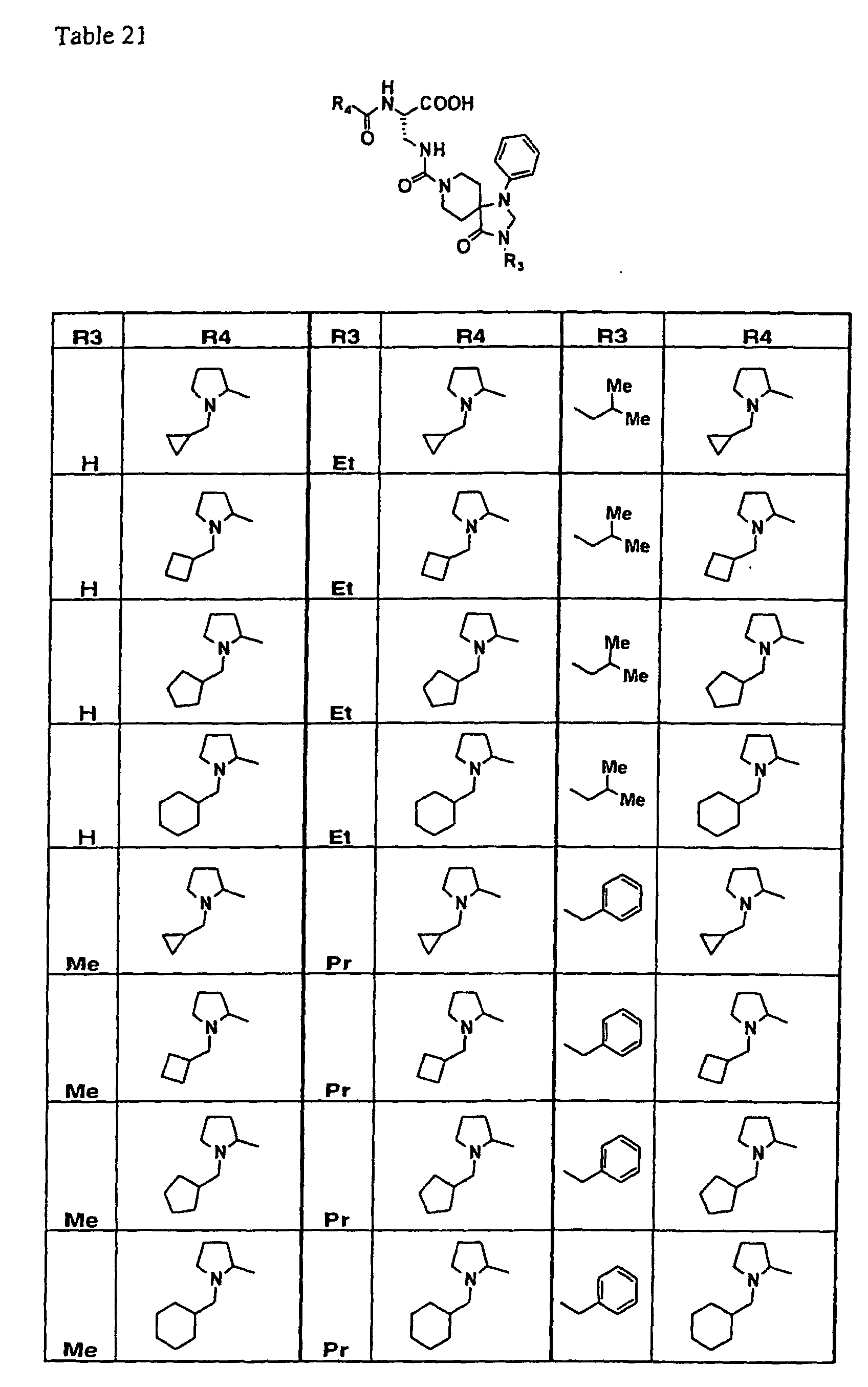
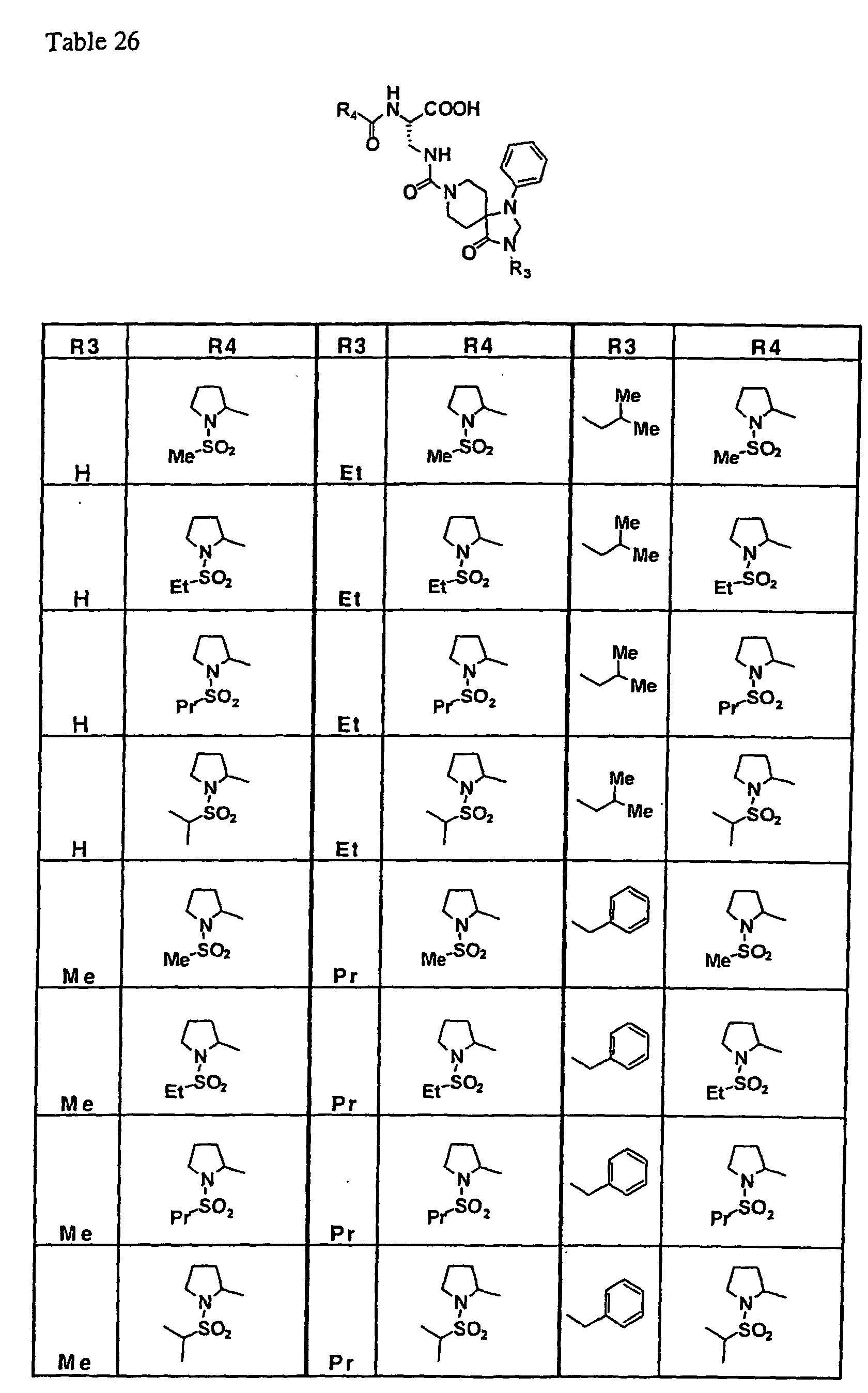
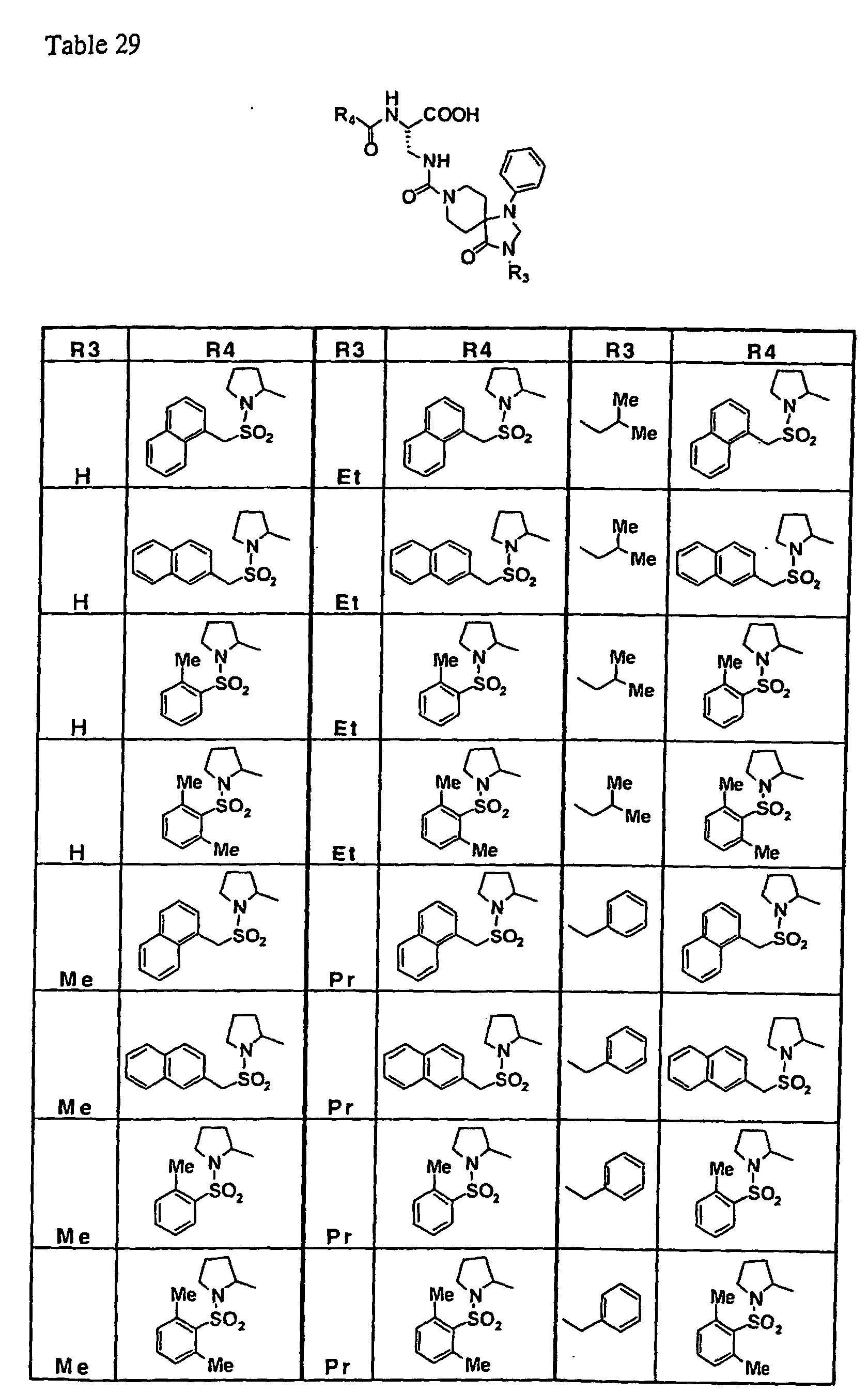
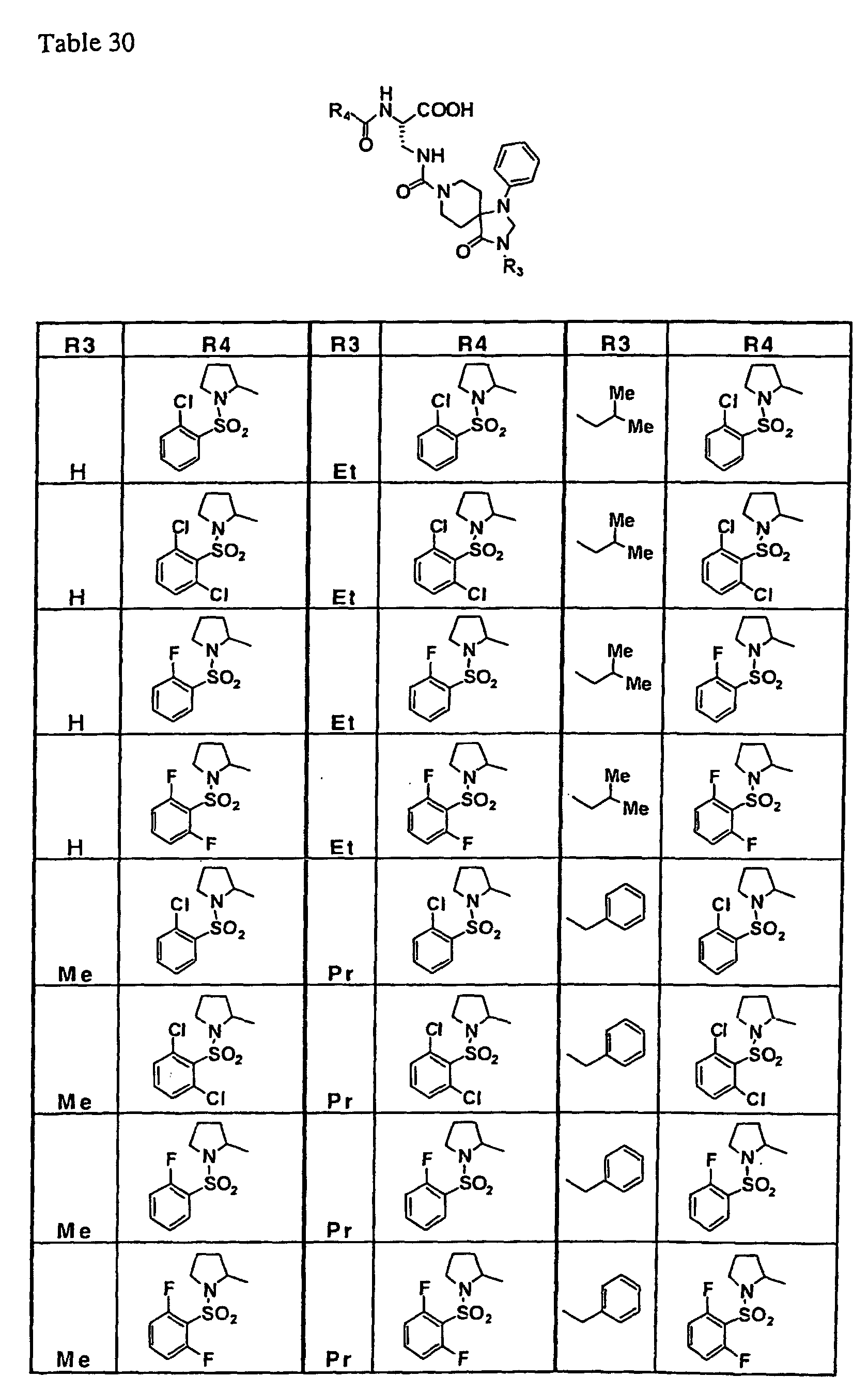
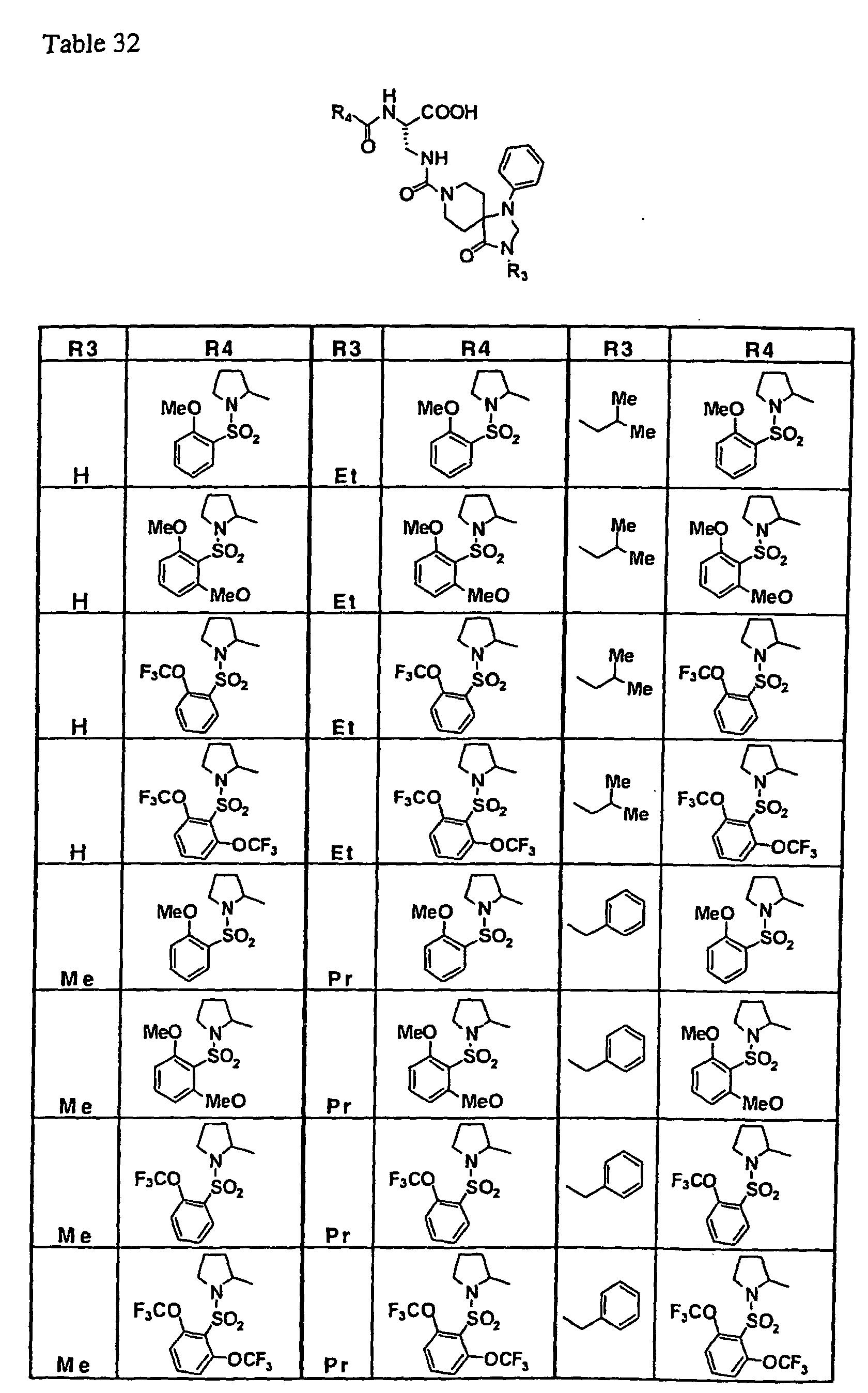
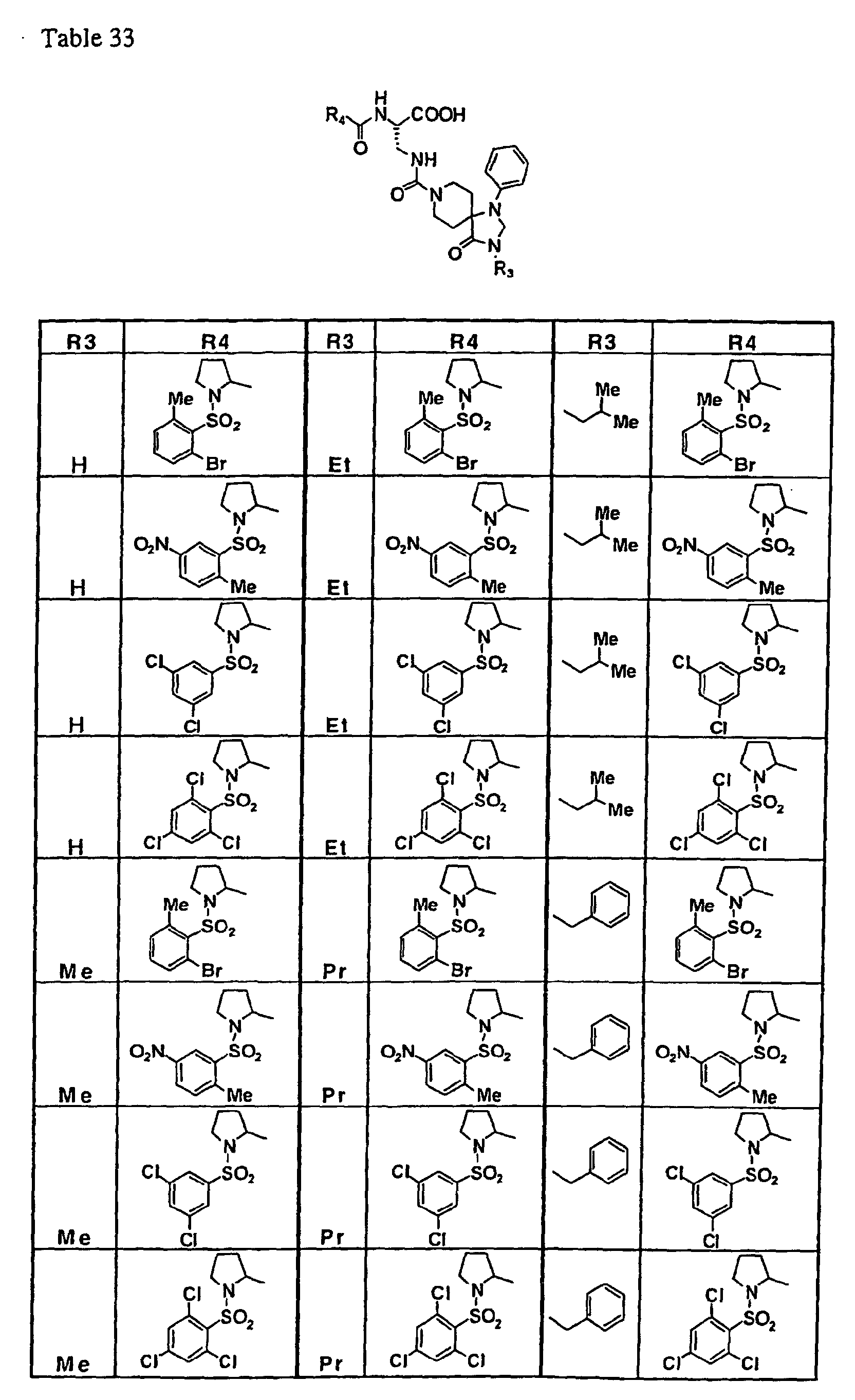
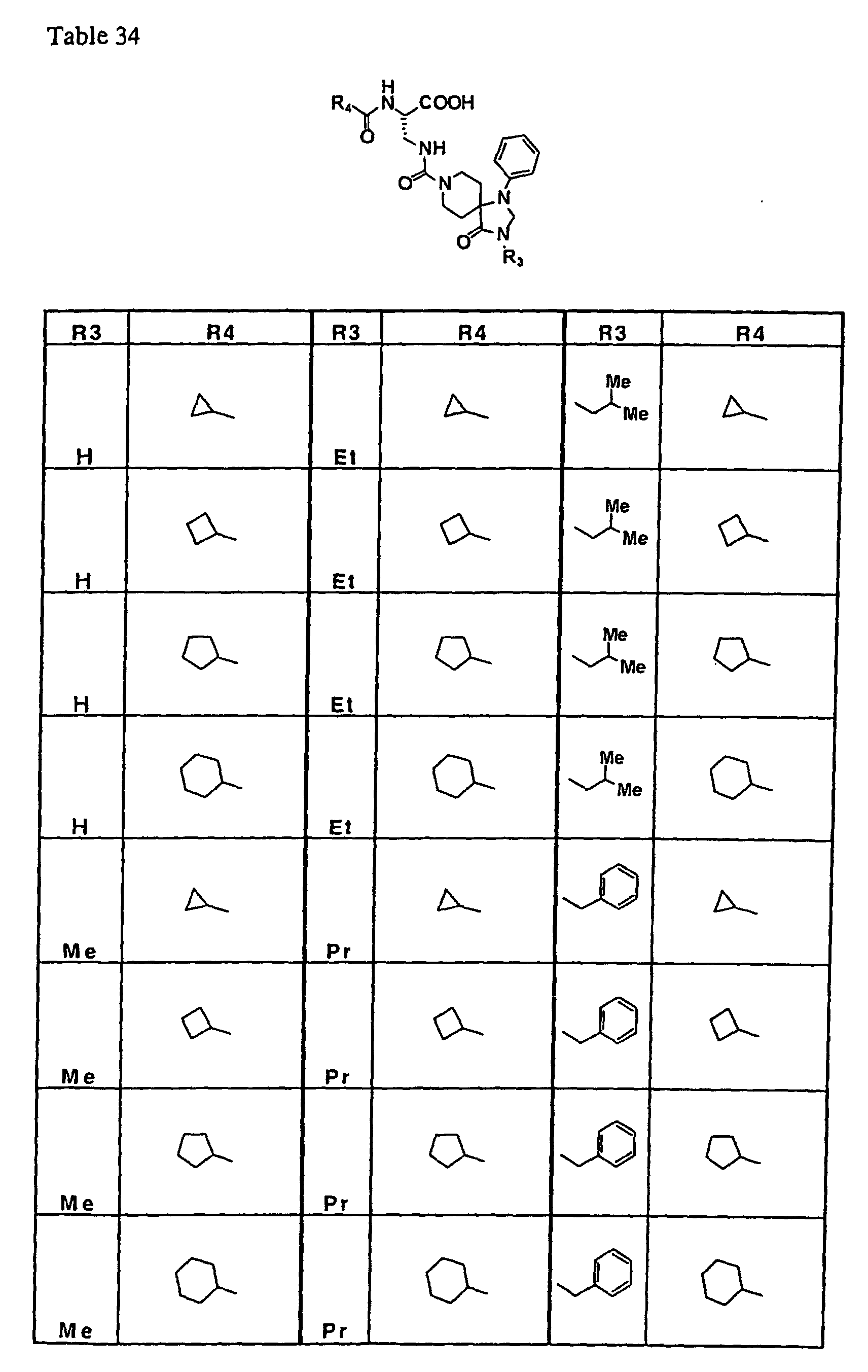
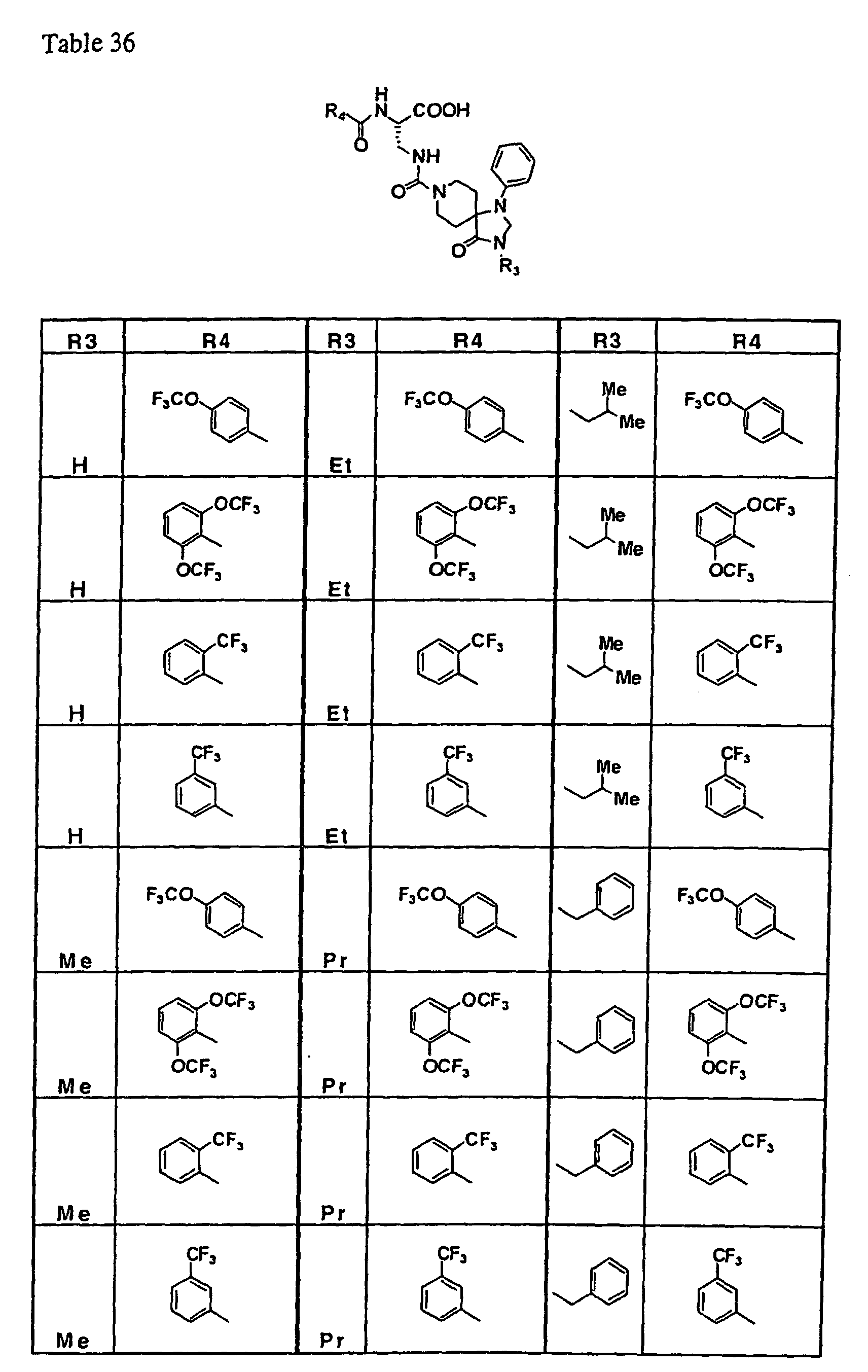
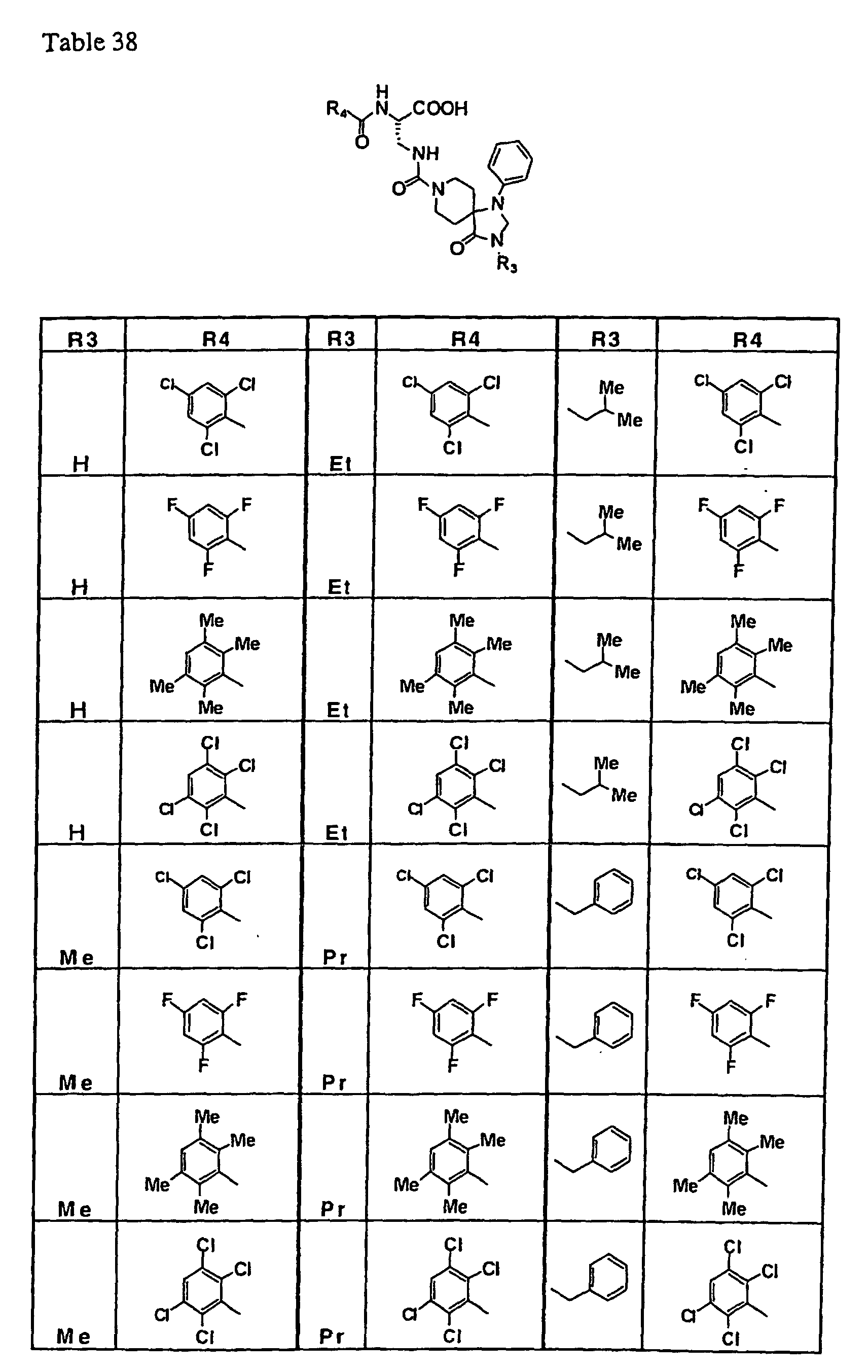
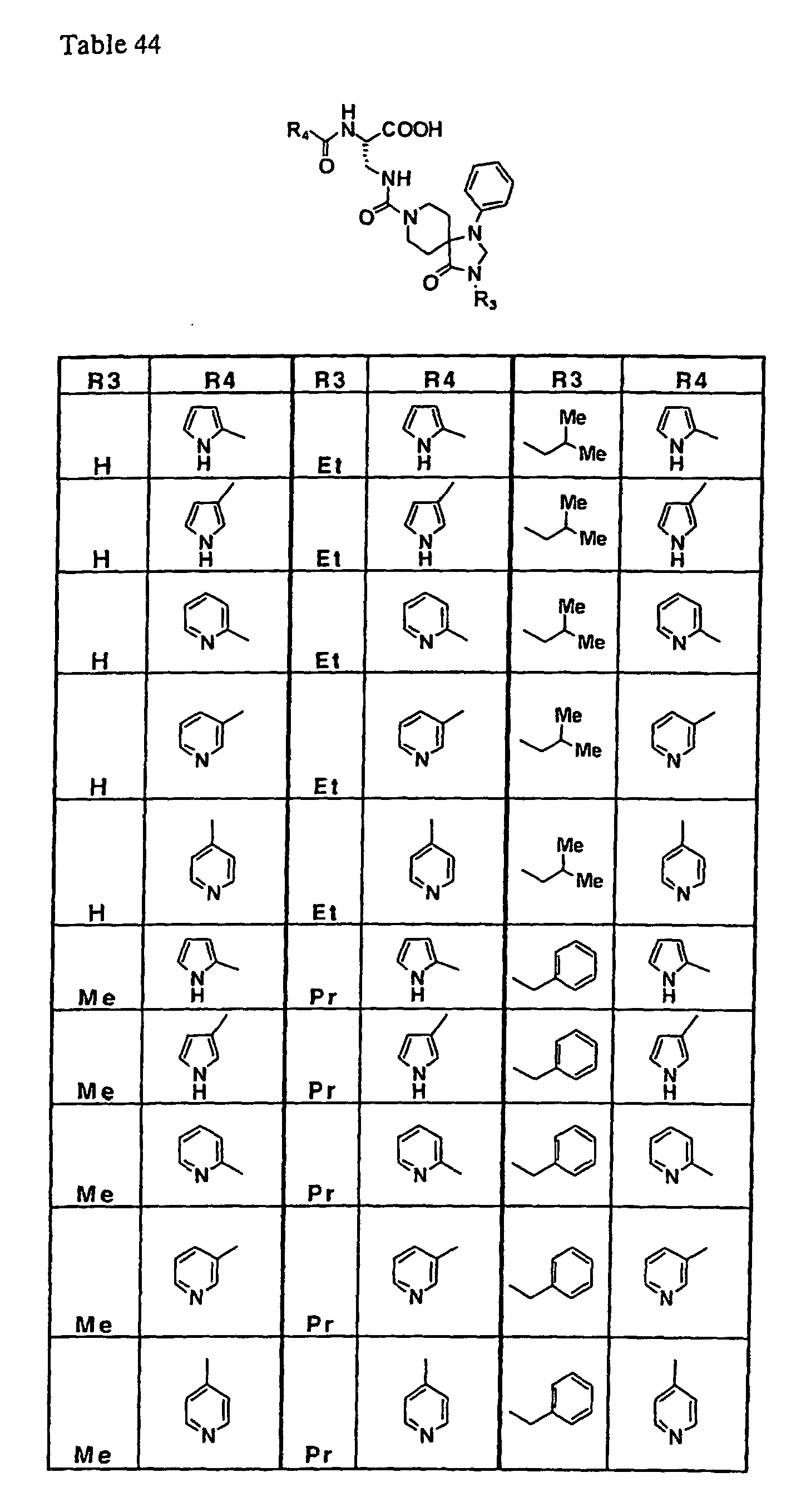
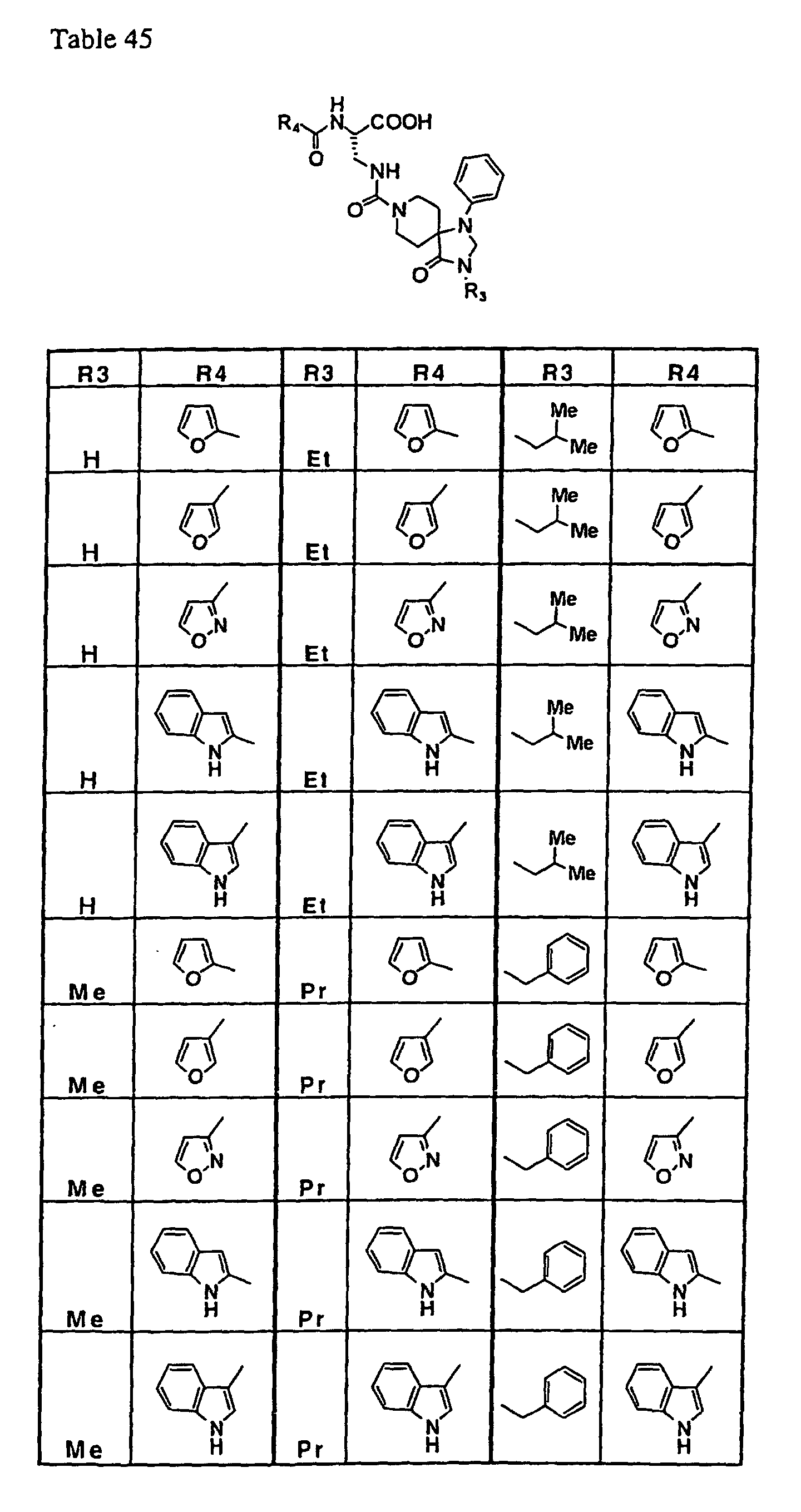
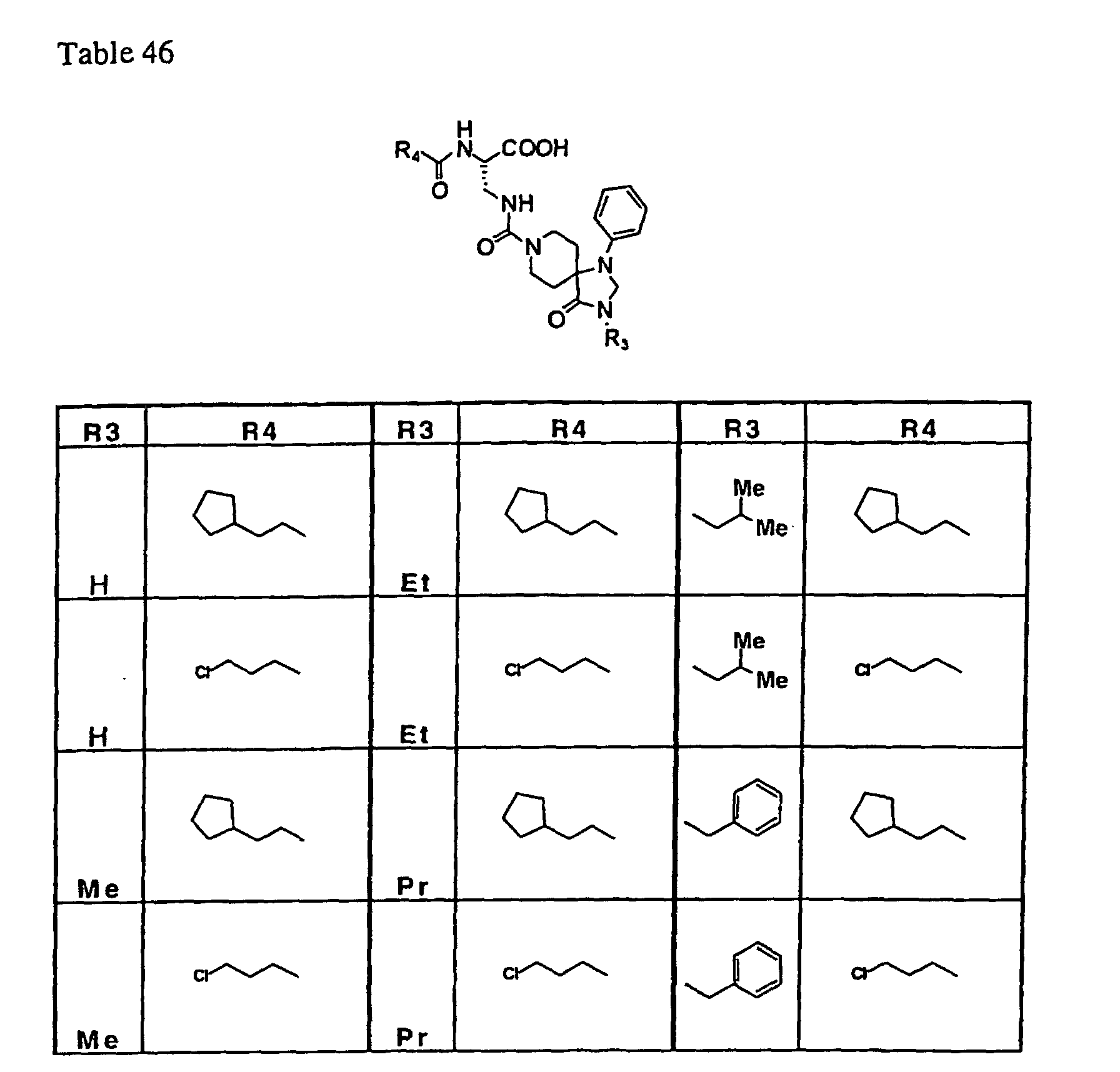
- the compound according to the present invention include the compounds illustrated in the following Tables I to 46, pharmaceutically acceptable salt thereof and the compounds illustrated in the Examples.
- the present invention is not to be restricted to these compounds.
- the present invention may comprise isomers formed from the presence of asymmetric centers, that is, comprises opitical isomers and mixtures thereof.
- a base such as aqueous sodium hydroxide solution, aqueous lithium hydroxide solution or aqueous barium hydroxide solution
- a solvent such as an alcoholic solvent, such as
- hydrolysis using a base such as aqueous sodium hydroxide solution, aqueous lithium hydroxide solution or aqueous barium hydroxide solution
- a base such as aqueous sodium hydroxide solution, aqueous lithium hydroxide solution or aqueous barium hydroxide solution
- the added amount of the base is usually about 1 to 4 equivalents with respect to Formula VIII.
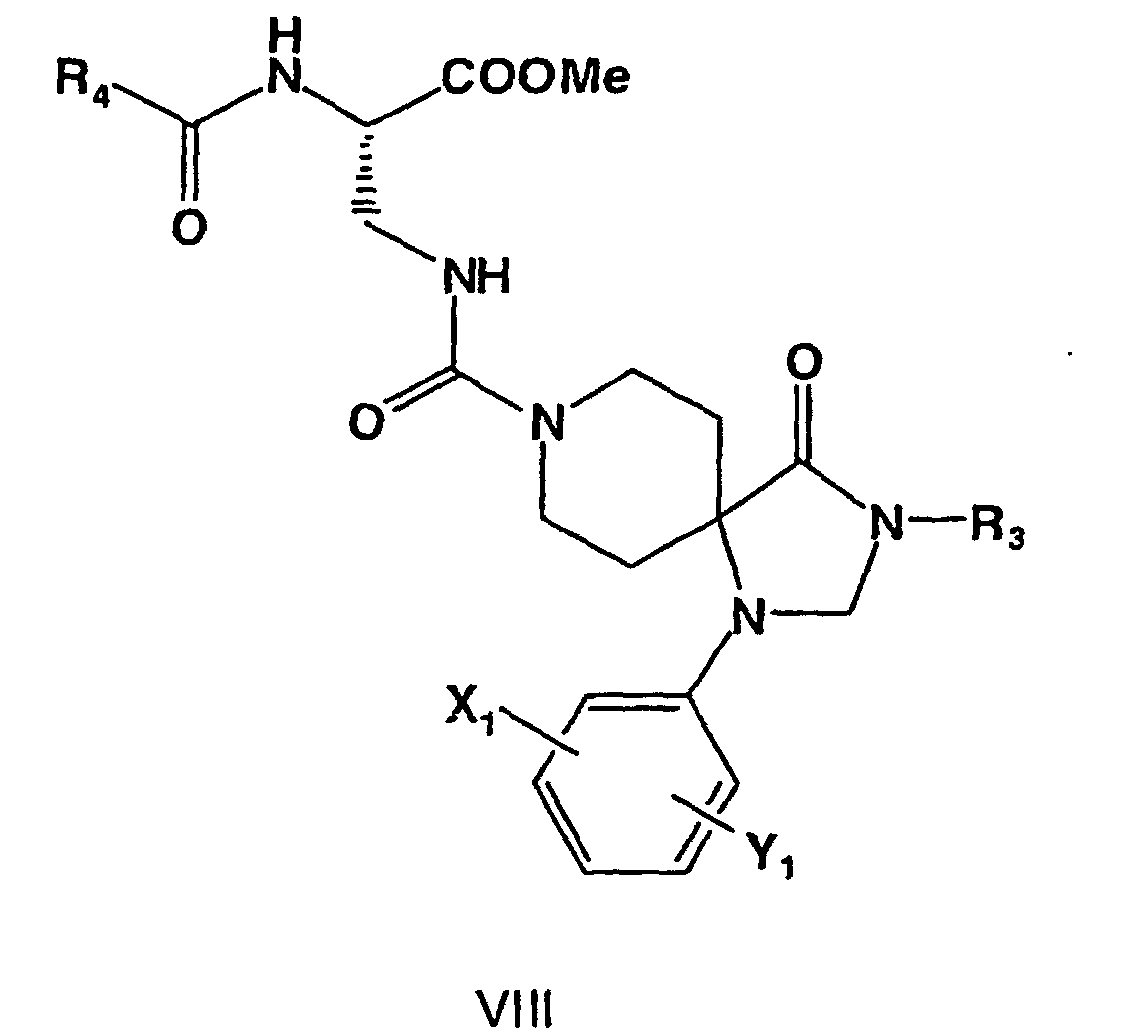
- Formula VIII can be produced from Formula IX (wherein R 4 has the same definition as that described above, Z represents chloro, bromo or hydroxyl) and Formula X (wherein X 1 , Y 1 and R 3 have the same definition as that described above).
- Formula IX when Z is chloro or bromo, Formula VIII can be produced by reacting Formula IX and Formula X in a solvent such as tetrahydrofuran, dimethylformamide, chloroform, dichloromethane or 1,4-dioxane in the presence of a tertiary amine, such as triethylamine or diisopropylethylamine, pyridine or 4-(N,N-dimethylamino)pyridine. While the reaction of Formula IX and Formula X is not particularly restricted, it can usually be carried out by reacting at a temperature of from 0°C to about room temperature for approximately 1 to 24 hours.
- a solvent such as tetrahydrofuran, dimethylformamide, chloroform, dichloromethane or 1,4-dioxane
- a tertiary amine such as triethylamine or diisopropylethylamine, pyridine or 4-(N,N-dimethylamino
- mixing ratio means molar ratio hereinafter
- the term “mixing ratio” means molar ratio hereinafter
- the amount of the tertiary amine to be added is, although not restricted, usually about 1 to 4 equivalents with respect to Formula IX.
- a condensing agent such as dicyclohexylcarbodiimide (DCC), benzotriazol-1-yloxytris(dicyclopentylamino)phosphonium hexafluorophosphate salt (PyBOP), benzotriazol-1-yloxytris(dimethylamino)phosphonium hexafluorophosphate salt (BOP), diphenylphosphoryl azide (DPPA) or 1-ethyl-3-[3-(dimethylamino))propyl]carbodiimide (WSC) is used in a solvent such as tetrahydrofuran, dimethylformamide, chloroform or dichloromethane in the presence of a tertiary amine such as triethylamine, diisopropylethylamine or N-methylmorpholine.
- DCC dicyclohexylcarbodiimide
- PyBOP benzotriazol-1-yloxytris
- the amount of such a condensing agent to be added is not restricted, and is usually about 1 to 3 equivalents with respect to Formula IX. Addition of an additive such as 1-hydroxybenzotriazole (HOBT) may be advantageous in the proceeding of the reaction in some cases.
- HOBT 1-hydroxybenzotriazole
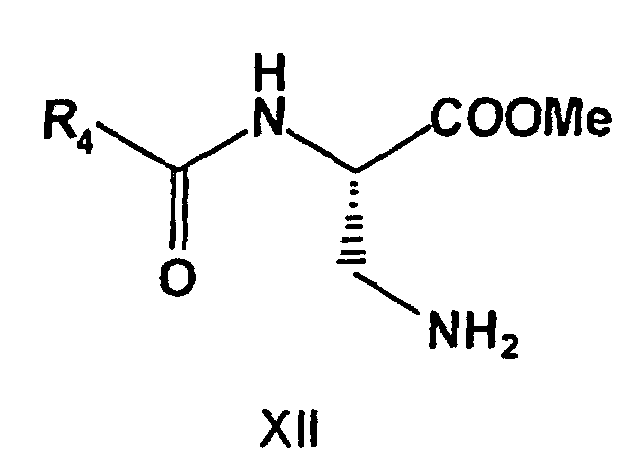
- Formula VIII can also be produced by treating Formula XI, (wherein X 1 , Y 1 and R 3 have the same definition as that described above) with usually 0.5 to 2 equivalents of diphosgene, triphosgene, 1,1-carbonyldiimidazole or the like in a solvent such as dichloromethane or chloroform, in the presence of a tertiary amine such as triethylamine or diisopropylethylamine, then reacting the obtained product with Formula XII, (wherein R 4 has the same definition as that described above).
- the mixing ratio of Formula XI to Formula XII may usually be, although not restricted, about 1:1 to 2:1, and the reaction may usually be carried out at about 0°C to room temperature for about 1 to 24 hours.
- the amount of the tertiary amine to be added is not restricted, and is usually about 1 to 4 equivalents with respect to diphosgene, triphosgene or 1,1-carbonyldiimidazole.
- Formula VIII may be achieved by reacting Formula XII with Formula XIII, (wherein X 1 , Y 1 and R 3 have the same definition as that described above) in a solvent such as dimethylformamide, tetrahydrofuran or dimethoxyethane at about 0°C to room temperature for about 1 to 24 hours.
- a solvent such as dimethylformamide, tetrahydrofuran or dimethoxyethane at about 0°C to room temperature for about 1 to 24 hours.
- the mixing ratio of Formula XII to Formula XIII is not restricted, and is usually about 1:1 to 1: 3.
- Another method is to react Formula XII with p-nitrophenyl chloroformate or phenyl chloroformate in a solvent such as acetonitrile, dichloromethane or dimethoxyethane, in the presence of a base such as sodium hydrogen carbonate or tribenzylamine (first step); and then react the obtained product with Formula XI in a solvent such as acetonitrile, dichloromethane or dimethoxyethane, in the presence of a tertiary amine such as triethylamine or diisopropylethylamine (second step).
- a solvent such as acetonitrile, dichloromethane or dimethoxyethane
- a base such as sodium hydrogen carbonate or tribenzylamine
- the amount of the base such as sodium hydrogen carbonate or tribenzylamine used in the reaction is not restricted, and is usually about 1 to 4 equivalents with respect to p-nitrophenyl chloroformate or phenyl chloroformate.
- the amount of the tertiary amine to be added is not restricted, and is usually about 1 to 6 equivalents with respect to Formula XI.
- the temperature of the reaction between Formula XII and p-nitrophenyl chloroformate or phenyl chloroformate, while not restricted is usually about 0°C to room temperature.
- the reaction temperature in the second step may usually be about 0°C to 50°C when p-nitrophenyl chloroformate is used, and may usually be about room temperature to refluxing temperature when phenyl chloroformate is used.
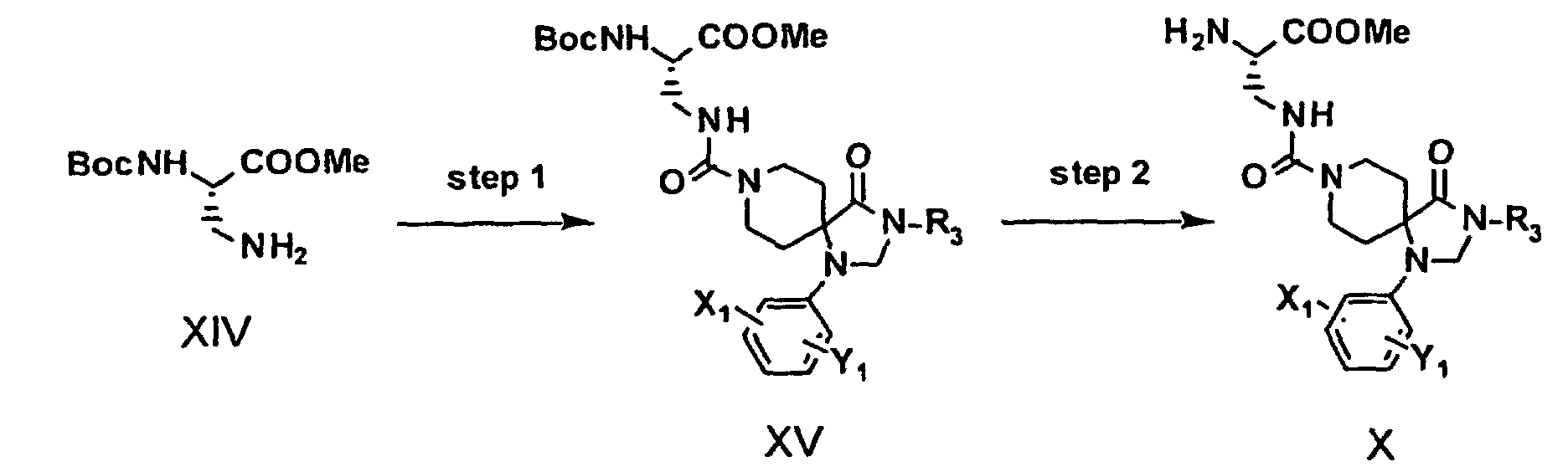
- Formula X may be produced by the following steps (in the present specification the Japanese word for "step” is rendered using the English term “step” in the chemical reactions): (wherein X 1 , Y 1 and R 3 have the same definition as that described above)
- Step 1 may be carried out in the same manner as in the reaction between Formula XI and Formula XII.
- Step 2 is a step for removing t-butoxycarbonyl group (referred to as "Boc" for short) on the nitrogen atom.
- this step may be carried out by using trifluoroacetic acid, hydrochloric acid, hydrobromic acid and the like in a halogen-containing solvent such as chloroform or dichloromethane as the reaction solvent.
- this step may be carried out by using trifluoroacetic acid alone.
- the reaction temperature is not restricted, and usually a temperature between 0°C and room temperature is selected.
- the reaction time may be appropriately selected depending on the reaction temperature and the like, and usually, is about 1 to 24 hours.
- Formula XII may be produced by the following steps using commercially available asparagine XVI as a starting material. (wherein R 4 has the same definition as that described above).
- Step 1 may be carried out in the same manner as in the reaction between Formula IX and X using Formula XVI and IX.
- Z in Formula IX is chloro or bromo
- aqueous sodium hydroxide solution, aqueous potassium hydroxide solution or the like may be used as the base.
- Step 2 may be carried out by reacting Formula XVII and bromine in a basic solvent such as aqueous sodium hydroxide solution, aqueous potassium hydroxide solution or the like, for about 1 to 8 hours, although this is not restricted.
- the reaction temperature is not restricted, and is usually about room temperature to 100°C.
- Bromine is usually used in excess to Formula XVII.
- This step may also be carried out by the method described in J. Org. Chem., 62, 6918 (1997) or J. Org. Chem., 49, 4272 (1984).
- Step 3 may be carried out by using thionyl chloride in a solvent such as methanol at about 0°C to room temperature.
- the reaction time is not restricted, and is usually about 1 to 8 hours.
- the mixing ratio of Formula XVIII to thionyl chloride is not restricted, and is usually about 1:1 to 1:10.
- the reaction may also be carried out by treating Formula XVIII with, although this is not restricted, an excess amount of diazomethane or trimethylsilyldiazomethane in a solvent such as methanol at about 0°C to room temperature.
- Step 4 may be carried out by using a base such as aqueous sodium hydroxide solution, aqueous potassium hydroxide solution, aqueous potassium carbonate solution or triethylamine, in an excess amount with respect to Formula XIX, in a solvent such as chloroform or dichloromethane at about 0°C to room temperature.
- a base such as aqueous sodium hydroxide solution, aqueous potassium hydroxide solution, aqueous potassium carbonate solution or triethylamine
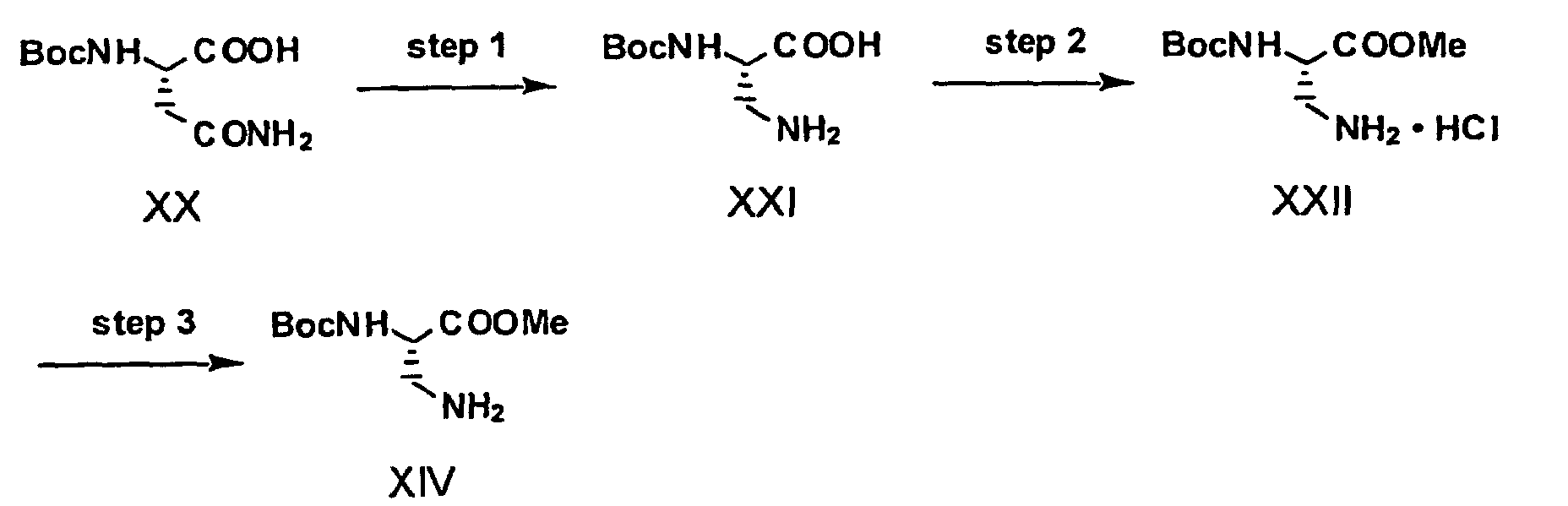
- Formula XIV may be produced by the following steps using commercially available Formula XX.
- Step 1 may be carried out in the same manner as in step 2 in the process of producing Formula XII.
- Step 2 may be carried out in the same manner as in step 3 in the process of producing Formula XII.
- Step 3 may be carried out in the same manner as in step 4 in the process of producing Formula XII.
- a base such as aqueous sodium hydroxide solution, aqueous lithium hydroxide solution or aqueous barium hydroxide solution in an solvent such
- hydrolysis using a base such as aqueous sodium hydroxide solution, aqueous lithium hydroxide solution or aqueous barium hydroxide solution is not particularly restricted, usually, it is carried out by reacting at a temperature of from 0°C to about room temperature for approximately 1 to 24 hours.
- the added amount of the base is usually about 1 to 4 equivalents with respect to Formula XXIV.
- Formula XXIV can be produced by reacting Formula XXV (wherein R 4 has the same definition as that described above, Z represents chloro or bromo) and Formula X in a solvent such as tetrahydrofuran, dimethylformamide, chloroform, dichloromethane or 1,4-dioxane in the presence of a tertiary amine, such as triethylamine or diisopropylethylamine, pyridine or 4-(N,N-dimethylamino)pyridine. While the reaction of Formula X and Formula XXV is not particularly restricted, usually, it can be carried out by reacting at a temperature of from 0°C to about room temperature for approximately 1 to 24 hours. While the mixing ratio of Formula X and Formula XXV is not restricted, it may be about 1:1 to 1:2, and the amount of the tertiary amine to be added is, although not restricted, usually about 1 to 4 equivalents with respect to Formula XXV.
- a solvent such
- the compounds represented by Formula I can also be produced by solid-phase synthesis.
- the compounds can also be produced using the split and pool process employing solid-phase synthesis. In the split and pool process, IRORTs MicroKan system or Mimotopes' Lantern system can be used.
- Formula XXVI wherein X 1 , Y 1 , R 3 and R 4 have the same definition as that described above and R 11 represents a resin used in ordinarily solid-phase synthesis, for example a Wang resin.
- the splitting from Formula XXVI can be carried out by, for example, using an acid such as trifluoroacetic acid, acetic acid or hydrochloric acid in a solvent such as methylene chloride, tetrahydrofuran, water or methanol.
- Preferable acid conditions are a solution of 1 to 20% trifluoroacetic acid-methylene chloride. While the reaction temperature is not particularly restricted, usually, the temperature is from 0 to 100°C and preferably from 10 to 30°C. While the reaction time is not particularly restricted, usually, it is from 0.1 to 24 hours and preferably from 0.1 to 2 hours.
- Formula XXVI can be produced by reacting Formula XI and Formula XXVII (wherein R 4 and R 11 have the same definition as that described above) in a solvent such as dimethylformamide, methylene chloride or tetrahydrofuran in the presence of a tertiary amine, such as triethylamine or diisopropylethylamine. While the mixing ratio of Formula XI and Formula XXVII is not particularly restricted, it is usually about 1:1 to 50:1, preferably 2:1 to 20:1.
- the amount of the tertiary amine to be added is, although not restricted, usually about I to 50 equivalents with respect to Formula XXVII, preferably 1 to 20 equivalents.
- the reaction temperature is not restricted, and is preferably between 0 and 50°C.
- the reaction time may be appropriately selected depending on the reaction temperature and the like, and usually, is about 0.1 to 2 hours.
- Formula XXVII can be produced by reacting Formula XXVIII, (wherein R 4 and R 11 have the same definition as that described above) and p-nitrophenyl chloroformate in a solvent such as methylene chloride, tetrahydrofuran or a mixture of methylene chloride-tetrahydrofuran in the presence of a tertiary amine such as diisopropylethylamine or N-methylmorpholine.
- a solvent such as methylene chloride, tetrahydrofuran or a mixture of methylene chloride-tetrahydrofuran in the presence of a tertiary amine such as diisopropylethylamine or N-methylmorpholine.
- a tertiary amine such as diisopropylethylamine or N-methylmorpholine.
- the amount of the p-nitrophenyl chloroformate to be used is, although not restricted, usually about 1 to 50 equivalent
- the amount of the tertiary amine to be added is, although not restricted, usually about 1 to 4 equivalents with respect to the p-nitrophenyl chloroformate.
- the reaction temperature is not restricted, and is preferably between 0 and 50°C.
- the reaction time may be appropriately selected depending on the reaction temperature and the like, and usually, is about 0.1 to 2 hours.
- Formula XXVIII can be produced by reacting Formula XXIX (wherein R 4 and R 11 have the same definition as that described above) with 1 to 20% hydrazine hydrate in a solvent such as dimethylformamide or dimethylacetamide.
- the reaction temperature is not restricted, and is usually between 0 and 50°C.
- the reaction time may be appropriately selected depending on the reaction temperature and the like, and usually, is about 0.1 to 2 hours.
- Formula XXIX can be produced from Formula IX and Formula XXX. (wherein R 11 has the same definition as that described above)
- Formula XXIX when Z is chloro or bromo, Formula XXIX can be produced by reacting Formula IX and Formula XXX in a solvent such as tetrahydrofuran, dimethylformamide or dichloromethane in the presence of an amine, such as triethylamine, diisopropylethylamine or pyridine. While the reaction of Formula IX and Formula X is not particularly restricted, and may be carried out at a temperature of, usually, between 0 and 50°C, for about 1 to 48 hours. While the mixing ratio of Formula IX and Formula XXX is not particularly restricted, it is usually about 1:1 to 50:1, preferably 1:1 to 20:1. The amount of the amine to be added is, although not restricted, usually about 1 to 4 equivalents with respect to Formula IX.
- a solvent such as tetrahydrofuran, dimethylformamide or dichloromethane
- an amine such as triethylamine, diisopropylethylamine or
- a condensing agent such as dicyclohexylcarbodiimide (DCC), benzotriazol-1-yloxytris(dicyclopentylamino)phosphonium hexafluorophosphate (PyBOP), benzotriazol-1-yloxytris(dimethylamino)phosphonium hexafluorophosphate (BOP), diphenylphosphoryl azide (DPPA) or 1-ethyl-3-[3-(dimethylamino)propyl]carbodiimide (WSC) is used in a solvent such as tetrahydrofuran, dimethylformamide or dichloromethane in the presence of a tertiary amine such as triethylamine, diisopropylethylamine or N-methylmorpholine.
- DCC dicyclohexylcarbodiimide
- PyBOP benzotriazol-1-yloxytris(dicyclopenty
- the amount of such a condensing agent to be added is not restricted, and is usually about 1 to 3 equivalents with respect to Formula IX. Addition of an additive such as 1-hydroxybenzotriazole (HOBT) may be advantageous in the proceeding of the reaction in some cases. While the mixing ratio of Formula IX and Formula XXX is not particularly restricted, it is usually about 1:1 to 50:1, preferably 1:1 to 20:1. While the reaction of Formula IX and Formula XXX is not particularly restricted, it may be carried out at a temperature of, usually, between 0 and 50°C, for about 1 to 48 hours.
- HOBT 1-hydroxybenzotriazole
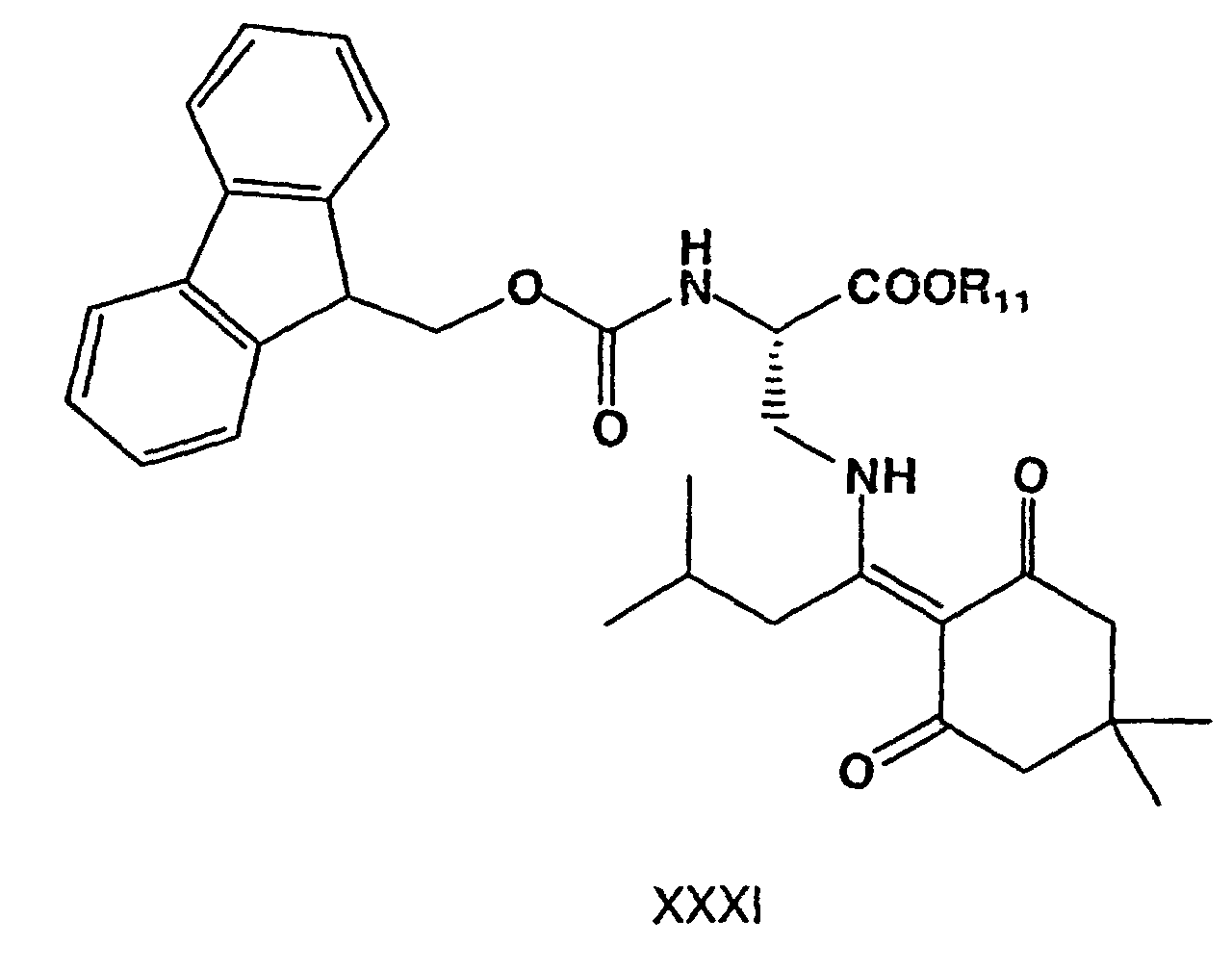
- Formula XXX can be produced by reacting Formula XXXI (wherein R 11 has the same definition as that described above) with 10 to 30% piperidine in a solvent such as dimethylformamide or methylene chloride.
- the reaction temperature is not particularly restricted, and is usually between about 0 and 50°C.
- the reaction time may be appropriately selected depending on the reaction temperature and the like, and usually, is about 0.1 to 10 hours.
- Formula XXXI can be produced by employing a condensing agent to react a resin used in ordinary solid-phase synthesis, such as a Wang resin, with commercially available Formula XXXII in a solvent such as dimethylformamide or tetrahydrofuran.
- a condensing agent such as a Wang resin
- a combination of diisopropylcarbodiimide and dimethylaminopyridine or combination of diethyl azodicarboxylate and triphenylphosphine can be used as the condensing agent.
- a Wang resin is preferably used as the resin in the solid-phase synthesis. While the reaction temperature is not particularly restricted, it is preferably between 0 and 50°C. The reaction time may be appropriately selected depending on the reaction temperature and the like, and is preferably from I to 48 hours.
- novel spiro derivatives used in the present invention have one or more asymmetric carbon atoms, there exist racemic modifications, diasteromers and optical isomers. In the present invention, any of these may be used.
- the reaction products obtained by the above-described processes may be isolated and purified in the form of a free compound, a salt or a solvate such as hydrate thereof.
- the salt may be produced by a usual salt-producing treatment. Isolation and purification may be carried out by ordinary chemical processes such as extraction, concentration, evaporation, crystallization, filtration, recrystallization and various types of chromatography.
- Various isomers may be isolated by conventional methods utilizing the differences in the physicochemical properties between the isomers.
- Optical isomers may be separated by a general optical resolution method such as fractional crystallization or chromatography.
- Optically active substance may also be produced by an appropriate optically active compound as the starting material.
- Examples of the pharmaceutically acceptable salts of the compounds represented by Formula I include inorganic salts such as ammonium salt, alkaline metal salts (e.g., sodium salt and potassium salt), alkaline earth metal salts (e.g., calcium salt and magnesium salt); organic salts such as dicyclohexylamine salt, N-methyl-D-glucamine salt, ethanolamine salt, diethanolamine salt, triethanolamine salt, diisopropanolamine salt and tris(hydroxymethyl)aminomethane salt; and lysine salt and arginine salt.
- inorganic salts such as ammonium salt, alkaline metal salts (e.g., sodium salt and potassium salt), alkaline earth metal salts (e.g., calcium salt and magnesium salt); organic salts such as dicyclohexylamine salt, N-methyl-D-glucamine salt, ethanolamine salt, diethanolamine salt, triethanolamine salt, diisopropanolamine salt and tris(hydroxymethyl)aminomethan
- the compounds according to the present invention have adhesion molecule inhibitory action can be confirmed by, for example, measuring adhesion inhibitory activity against VLA-4, which is one member of the integrin family.
- the inhibitory activity of the compound according to the present invention against the adhesion of VLA-4 may be determined by using an adhesion-measuring system in which the adhesion between VLA-4-expressing cells such as Ramos cells or Jurkat cells and fibronectin or fibronectin fragment such as a peptide containing CS-1 sequence (Gly Pro Glu IIe Leu Asp Val Pro Ser Thr) (hereinafter referred to as "CS-1 peptide”) immobilized on an immunoplate is measured.
- CS-1 peptide a binding-measuring system in which the adhesion between VLA-4 protein and fibronectin or fibronectin fragment such as CS-1 peptide immobilized on an immunoplate is measured may be used.
- the inhibitory activity of a compound it is preferred to evaluate the inhibitory activity of a compound using a binding-measuring system of soluble VLA-4 with CS-1 peptide (WO 98/32771), but the method is not restricted thereto.
- the compounds according to the present invention may be used as therapeutic drugs for inflammatory diseases, in particular, chronic inflammatory diseases.
- inflammatory diseases include allergic diseases such as asthma, dermatitis and rhinitis, autoimmune diseases such as arthritis, multiple sclerosis, Crohn's disease and ulcerative colitis, hepatitis, nephritis, graft rejections after organ transplantation and type I diabetes.
- bronchial asthma atopic dermatitis and allergic rhinitis
- autoimmune diseases such as rheumatoid arthritis, multiple sclerosis, Crohn's disease and ulcerative colitis, hepatitis, nephritis, graft rejections after organ transplantation and type I diabetes.
- the compounds may be used as a therapeutic drug for the prevention of postoperative restenosis, arteriosclerosis and the like.
- the inflammatory disease suppressing effect of the compounds obtained in accordance with the above-described method will be illustrated using a mouse inflammatory model, although such effect is not limited thereto.
- the compound represented by Formula I or a base addition salt thereof may be administered as it is in the form of powder, or may be administered as a pharmaceutical composition in the form of an appropriate formulation, orally or parenterally (e.g., percutaneous administration, intravenous administration, rectal administration, inhalation, nasal drip or eye drip) to mammals.
- parenterally e.g., percutaneous administration, intravenous administration, rectal administration, inhalation, nasal drip or eye drip
- formulations for administration examples include tablets, powders, pills, capsules, granules, syrups, liquid preparations, injections, emulsions, suspensions and suppositories. These formulations may be prepared by the methods which per se are known, and contain various carriers usually used in the field of formulation. Examples thereof include vehicles, lubricants, binders and disintegrators for solid formulations; and solvents, solubilizers, suspending agents and soothing agents for liquid formulations. Additives such as antiseptics, antioxidants, coloring agents, sweeteners, absorbents, and wetting agents may be used as required.
- Examples of the vehicles include lactose, sucrose, D-mannitol, starch, cornstarch, crystalline cellulose and light anhydrous silicic acid.
- Examples of the lubricants include magnesium stearate, calcium stearate, talc and colloidal silica.
- Examples of the binders include crystalline cellulose, saccharose, D-mannitol, dextrin, hydroxypropylcellulose, hydroxypropylmethylcellulose, polyvinylpyrrolidone, starch, sucrose, gelatin, methylcellulose and carboxymethylcellulose sodium.
- Examples of the disintegrators include starch, carboxymethylcellulose, carboxymethylcellulose calcium, cross carmelose sodium, sodium carboxymethyl starch and L-hydroxypropylcellulose.
- solvents examples include water for injection, alcohol, propylene glycol, Macrogol, sesame oil and corn oil.
- solubilizers include polyethylene glycol, propylene glycol, D-mannitol, benzyl benzoate, ethanol, cholesterol, triethanolamine, sodium carbonate and sodium citrate.
- suspending agents examples include surfactants such as stearyl triethanolamine, sodium lauryl sulfate, lauryl aminopropionate, lecithin, benzalkonium chloride, benzethonium chloride and glycerin monostearate, and hydrophilic macromolecules such as polyvinyl alcohol, polyvinyl pyrrolidone, methylcellulose, hydroxymethylcellulose, hydroxyethylcellulose and hydroxypropylcellulose.
- isotonicities include glucose, sodium chloride, D-sorbitol and D-mannitol.
- buffering agents include buffering solutions containing phosphate, acetate, carbonate or citrate.
- An example of the soothing agents is benzyl alcohol.
- antiseptics examples include p-hydroxybenzoates, chlorobutanol, benzyl alcohol, phenethyl alcohol, dehydroacetic acid and sorbic acid.
- antioxidants examples include sulfites and ascorbic acid.
- the effective dose and the number of times of administration of the compounds represented by Formula I and pharmaceutically acceptable salts thereof differ depending on the administration form, age and bodyweight of the patient, the type and severity of the disease to be treated, and usually, 0.1 to 1000 mg, preferably 1 to 300 mg of the compound may be administered once or in several times per day per adult.
- formulations may contain other active ingredients for therapy so long as the combination with the compounds, or salts thereof represented by Formula I does not cause an undesirable interaction.
- active ingredients for therapy so long as the combination with the compounds, or salts thereof represented by Formula I does not cause an undesirable interaction.
- examples thereof include steroid drugs, nonsteroidal anti-inflammatory drug, lipoxygenase inhibitors, leucotriene inhibitors, bronchodilators, thromboxane synthesis inhibitors, thromboxane antagonists, histamine antagonists, histamine release inhibitors, platelet activating factor (PAF) antagonists, serotonin antagonists, adenosine receptor antagonists, adrenalin ⁇ receptor stimulators, immunosuppressors and immunomodulators.
- steroid drugs nonsteroidal anti-inflammatory drug
- lipoxygenase inhibitors lipoxygenase inhibitors, leucotriene inhibitors, bronchodilators, thromboxane synthesis inhibitors, thromboxane antagonists, his
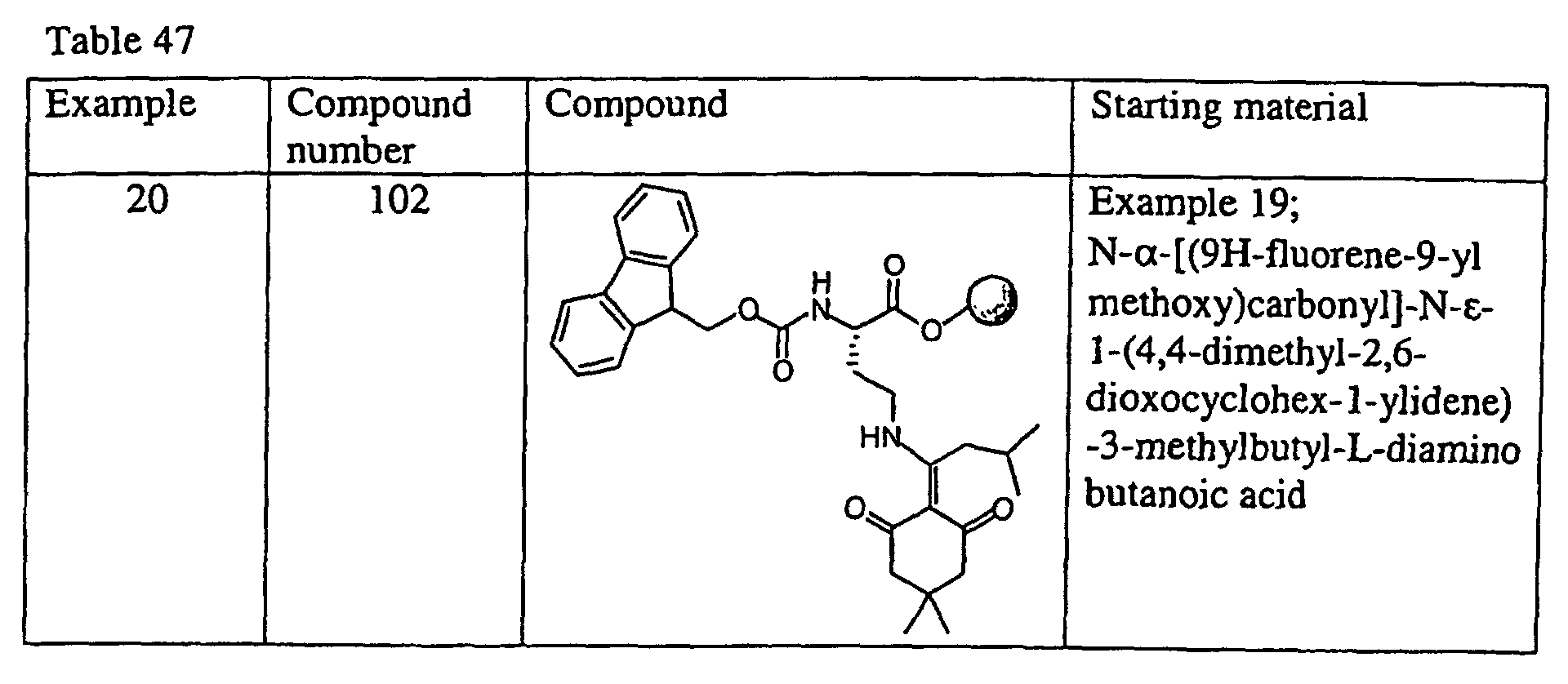
- Example compound 102 was obtained in the same manner.
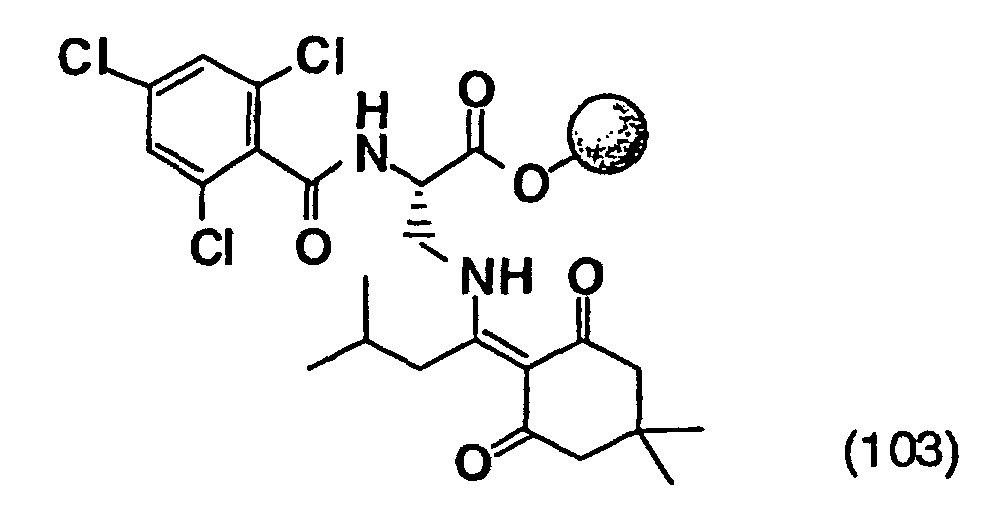
- a Wang resin loaded with 2-[(9H-fluorene-9-ylmethoxy)carbonylamino]-3-[1-(4,4-dimethyl-2,6-dioxocyclohex-1-ylidene)-3-methylbutylamino]propanoic acid was charged into 96 MicroKans (20 mg each, ca 16 ⁇ mol).
- the 96 MicroKans and a solution of 10% piperidine in methylene chloride (100 ml) were charged into a 500 ml flask, and the resulting mixture was shaken at room temperature for 1 hour.
- the resin was filtered, then washed with dimethylformamide, methanol, tetrahydrofuran and methylene chloride (respectively 100 ml, 5 times each), and vacuum dried.
- Methylene chloride (12 ml), 2,4,6-trichlorobenzoyl chloride (560 ⁇ l, 3.6 mmol) and triethylamine (830 ⁇ l, 5.4 mmol) were charged into 12 MicroKans.
- the reaction mixture was shaken at room temperature for 16 hours, and filtered.
- the resin was washed with dimethylformamide, methanol, tetrahydrofuran and methylene chloride (respectively 10 ml, 5 times each), and vacuum dried to obtain a Wang resin loaded with 2-(2,4,6-trichlorobenzoylamino)-3-[1-(4,4-dimethyl-2,6-dioxocyclohex-1-ylidene)-3-methylbutylamino]propanoic acid.
- test compounds were evaluated in accordance with the method described in WO 98/32771. That is, in accordance with the teaching of a report (J. Bio. Chem., 262 , 6886 (1987)), a conjugate between a peptide (Gys Leu His Gly Pro Glu Glu De Leu Asp Val Pro Ser Thr) containing CS-1 sequence and rabbit IgG (Sigma) was prepared. This was diluted with a phosphate buffer (hereinafter abbreviated as "PBS(-)”), and the obtained solution was placed in the wells of a 96-well immunoplate (NUNC) in an amount of 100 ⁇ l/well, followed by leaving to stand the immunoplate at 4°C for 16 hours to immobilize the conjugate.
- PBS(-) phosphate buffer
- the wells were then washed twice with PBS(-), and 1% BSA solution in PBS, which BSA was heated at 80°C for 10 minutes, was placed in each well in an amount of 300 ⁇ l/well.
- the immunoplate was left to stand at 4°C for 3 hours, and then the solution in each well was removed by suction.
- Compound 16 suppressed the increase in the ratio of ear swelling in a dose-dependent manner from DNFB induction, wherein the ED 50 value thereof was 0.8 mg/kg.
- a novel substance which inhibits cell infiltration via adhesion molecules, especially adhesion molecule VLA-4, thereby making it possible to prevent and treat inflammatory diseases caused by infiltration of leukocytes such as monocytes, lymphocytes and eosinophils.
Landscapes
- Health & Medical Sciences (AREA)
- Chemical & Material Sciences (AREA)
- Organic Chemistry (AREA)
- Life Sciences & Earth Sciences (AREA)
- Medicinal Chemistry (AREA)
- General Health & Medical Sciences (AREA)
- Bioinformatics & Cheminformatics (AREA)
- Engineering & Computer Science (AREA)
- General Chemical & Material Sciences (AREA)
- Nuclear Medicine, Radiotherapy & Molecular Imaging (AREA)
- Pharmacology & Pharmacy (AREA)
- Animal Behavior & Ethology (AREA)
- Chemical Kinetics & Catalysis (AREA)
- Public Health (AREA)
- Veterinary Medicine (AREA)
- Immunology (AREA)
- Pulmonology (AREA)
- Cardiology (AREA)
- Molecular Biology (AREA)
- Heart & Thoracic Surgery (AREA)
- Urology & Nephrology (AREA)
- Proteomics, Peptides & Aminoacids (AREA)
- Genetics & Genomics (AREA)
- Rheumatology (AREA)
- Biophysics (AREA)
- Biochemistry (AREA)
- Neurosurgery (AREA)
- Dermatology (AREA)
- Orthopedic Medicine & Surgery (AREA)
- Physical Education & Sports Medicine (AREA)
- Neurology (AREA)
- Biomedical Technology (AREA)
- Pain & Pain Management (AREA)
- Transplantation (AREA)
- Vascular Medicine (AREA)
- Otolaryngology (AREA)
- Gastroenterology & Hepatology (AREA)
- Pharmaceuticals Containing Other Organic And Inorganic Compounds (AREA)
Abstract
Description

n represents an integer of 1 to 3;
A represents -C(O)- or -S(O)2-;
B represents -CH2- or -NH-;
C' and D both represent a hydrogen atom, or C' and D represent together =O;
X1 and Y1 independently represent hydrogen, halogen, C1-8 alkyl, trifluoromethyl, C1-8 alkoxy, cyano, nitro, hydroxyl, amino, or tetrazolyl;
R1 represents hydrogen, C1-6 linear alkyl, C3-8 branched alkyl, benzyl or -CH2OC(O)C(CH3)3;
R2 represents hydrogen or C1-6 linear alkyl;
R3 represents hydrogen, C1-6 linear alkyl, C3-8 branched alkyl; allyl, homoallyl, C3-8 cycloalkyl-C1-8 alkyl, unsubstituted phenyl or phenyl substituted with at least one substituent of substituent group E, unsubstituted benzyl or benzyl substituted with at least one substituent of substituent group E, unsubstituted phenethyl or phenethyl substituted with at least one substituent of substituent group E, unsubstituted styryl or styryl substituted with at least one substituent of substituent group E, unsubstituted naphthyl or naphthyl substituted with at least one substituent of substituent group E, or unsubstituted naphthylmethyl or naphthylmethyl substituted with at least one substituent of substituent group E (wherein substituent group E consists of halogen, C1-8 alkyl, C1-8 alkoxy, trifluoromethyl, trifluoromethoxy, C1-8 alkylthio, cyano, nitro, hydroxyl, amino, C1-8 alkylacyl, C1-8 alkylacylamino and tetrazolyl);
R4 represents C1-8 alkyl, C2-8 alkenyl, C2-8 alkynyl, Cy, Cy-C1-8 alkyl, Cy-C2-8 alkenyl, Cy-C2-8 alkynyl, Ar, Ar-C1-8 alkyl, Ar-C2-8 alkenyl or Ar-C2-8 alkynyl, wherein the alkyl, alkenyl and alkynyl may be linear or branched, and may be substituted with 1 to 4 independently selected substituents of R5, wherein
Cy is C3-8 cycloalkyl that may be substituted with 1 to 4 substituents of R6 or 3- to 8-membered monocyclic or bicyclic heterocycle that includes 1 to 4 nitrogen atoms, oxygen atoms or sulfur atoms independently selected, which heterocycle may be substituted with 1 to 4 substituents of R6 (with the proviso that the hetero atoms do not bond directly with A),
Ar is phenyl that may be substituted with 1 to 5 substituents of R7, naphthyl that may be substituted with 1 to 5 substituents of R7, or 5- to 8-membered monocyclic or bicyclic heteroaryl that includes 1 to 4 nitrogen atoms, oxygen atoms or sulfur atoms independently selected, which heterocycle may be substituted with 1 to 5 substituents of R7 (wherein the hetero atoms do not directly bond with A),
R5 is halogen, trifluoromethyl, -ORa or -SRa,
Ra is hydrogen, C1-8 alkyl, allyl, homoallyl, trifluoromethyl, phenyl or benzyl,
R6 and R7 are, each independently, R5, C1-8 alkyl, C2-8 alkenyl, C2-8 alkynyl, C3-8 cycloalkyl-C1-8 alkyl, cyano, nitro, =O, -SO2Rb, -SO2NRcRd, -C(O)Rb, -C(O)ORb, -C(O)NRcRd, -NRcRd, -NRcC(O)Rb, -NRcSO2Rb, unsubstituted phenyl or phenyl substituted with at least one substituent of substituent group E or unsubstituted benzyl or benzyl substituted with at least one substituent of substituent group E,
Rb, Rc and Rd are each independent, and are hydrogen, C1-8 alkyl, C3-8 cycloalkyl, C3-8 cycloalkyl-C1-8 alkyl, unsubstituted phenyl or phenyl substituted with at least one substituent of substituent group E, unsubstituted benzyl or benzyl substituted with at least one substituent of substituent group E, unsubstituted phenethyl or phenethyl substituted with at least one substituent of substituent group E, unsubstituted styryl or styryl substituted with at least one substituent of substituent group E, unsubstituted naphthyl or naphthyl substituted with at least one substituent of substituent group E, or unsubstituted naphthylmethyl or naphthylmethyl substituted with at least one substituent of substituent group E
(with the proviso that excluded are the compounds in which, when A is -C(O)-, R4 is C1-7 linear alkyl, C3-9 branched alkyl, adamantyl, benzyl or phenethyl substituted with 0 to 2 substituents of halogen, C1-8 alkyl, C1-8 alkoxy, cyano, nitro, hydroxyl, amino, or tetrazolyl;
Formula II,

Formula III
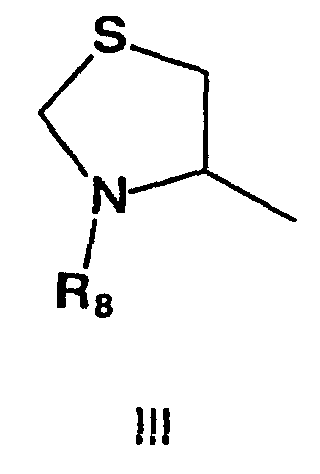
benzoyl substituted with 0 to 2 substituents of halogen, alkyl containing 1 to 8 carbon atoms, alkoxy containing 1 to 8 carbon atoms, cyano, nitro, hydroxyl, amino or tetrazolyl, phenylsulfonyl substituted with 0 to 2 substituents of halogen, alkyl containing 1 to 8 carbon atoms, alkoxy containing 1 to 8 carbon atoms, cyano, nitro, hydroxyl, amino or tetrazolyl, benzyl substituted with 0 to 2 substituents of halogen, alkyl containing 1 to 8 carbon atoms, alkoxy containing 1 to 8 carbon atoms, cyano, nitro, hydroxyl, amino or tetrazolyl).
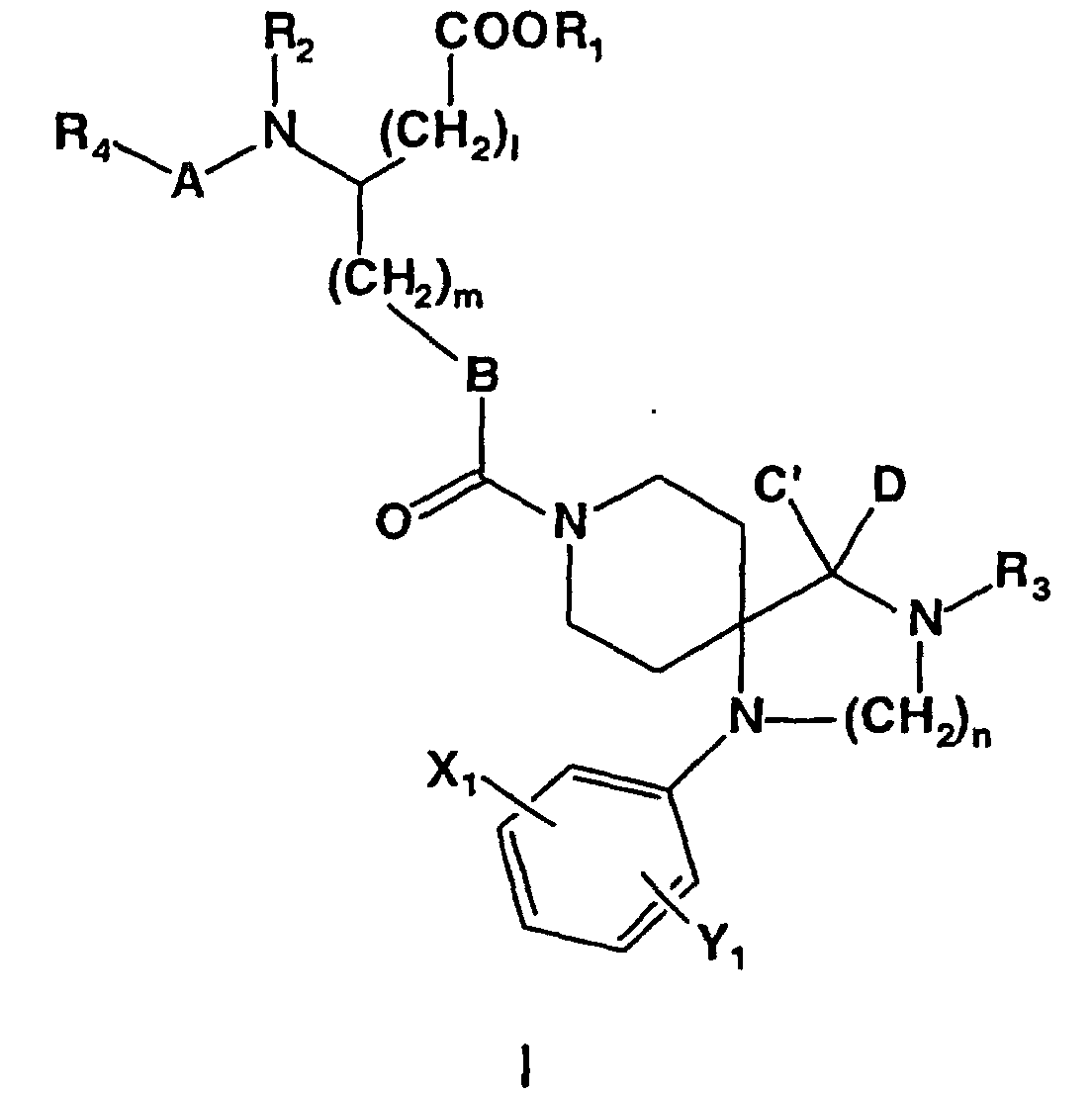
n represents an integer of 1 to 3;
A represents -C(O)- or -S(O)2-;
B represents -CH2- or -NH-;
C' and D both represent a hydrogen atom, or C' and D represent together =O;
X1 and Y1 independently represent hydrogen, halogen, C1-8 alkyl, trifluoromethyl, C1-8 alkoxy, cyano, nitro, hydroxyl, amino, or tetrazolyl;
R1 represents hydrogen, C1-6 linear alkyl, C3-8 branched alkyl, benzyl or -CH2OC(O)C(CH3)3;
R2 represents hydrogen or C1-6 linear alkyl;
R3 represents hydrogen, C1-6 linear alkyl, C3-8 branched alkyl, allyl, homoallyl, C6-10 cycloalkylalkyl, unsubstituted phenyl or phenyl substituted with at least one substituent of substituent group E, unsubstituted benzyl or benzyl substituted with at least one substituent of substituent group E, unsubstituted phenethyl or phenethyl substituted with at least one substituent of substituent group E, unsubstituted styryl or styryl substituted with at least one substituent of substituent group E, or unsubstituted naphthylmethyl or naphthylmethyl substituted with at least one substituent of substituent group E (wherein substituent group E consists of halogen, C1-8 alkyl, C1-8 alkoxy, trifluoromethyl, trifluoromethoxy, C1-8 alkylthio, cyano, nitro, hydroxyl, amino, C1-8 alkylacyl, C1-8 alkylacylamino and tetrazolyl);
R4 represents C3-8 cycloalkyl that may be substituted with 1 to 4 substituents of R6 or 3- to 8-membered monocyclic or bicyclic heterocycle that includes 1 to 4 nitrogen atoms or oxygen atoms independently selected, which heterocycle may be substituted with 1 to 4 substituents of R6 (with the proviso that the hetero atoms do not bond directly with A), tetrahydrothiophene or tetrahydrothiopyran that may be substituted with 1 to 4 substituents of R6, phenyl that may be substituted with 3 to 5 substituents of R7, naphthyl that may be substituted with 1 to 4 substituents of R7, 5- to 8-membered monocyclic or bicyclic heteroaryl that includes 1 to 4 nitrogen atoms, oxygen atoms or sulfur atoms independently selected, which heterocycle may be substituted with 1 to 4 substituents of R7, C3-8 cycloalkyl-C1-8 alkyl, or 3- to 8-membered monocyclic heterocycle-C1-8 alkyl, the heterocycle including 1 to 4 nitrogen atoms or oxygen atoms independently selected and which may be substituted with 1 to 4 substituents of R6, wherein
R6 and R7 are, independently, halogen, trifluoromethyl, -ORa, -SRa, C1-8 alkyl, C2-8 alkenyl, C2-8 alkynyl, C3-8 cycloalkyl-C1-8 alkyl, cyano, nitro, =O, -SO2Rb, -SO2NRcRd, -C(O)Rb, -C(O)ORb, -C(O)NRcRd, -NRcRd, -NRcC(O)Rb, -NRcSO2Rb, unsubstituted phenyl or phenyl substituted with at least one substituent of substituent group E, or unsubstituted benzyl or benzyl substituted with at least one substituent of substituent group E,
Ra is hydrogen, C1-8 alkyl, allyl, homoallyl, trifluoromethyl, phenyl or benzyl,
Rb, Rc and Rd are each independent, and are hydrogen, C1-8 alkyl, C3-8 cycloalkyl, C3-8 cycloalkyl-C1-8 alkyl, unsubstituted phenyl or phenyl substituted with at least one substituent of substituent group E, unsubstituted benzyl or benzyl substituted with at least one substituent of substituent group E, unsubstituted phenethyl or phenethyl substituted with at least one substituent of substituent group E, unsubstituted styryl or styryl substituted with at least one substituent of substituent group E, unsubstituted naphthyl or naphthyl substituted with at least one substituent of substituent group E, or unsubstituted naphthylmethyl or naphthylmethyl substituted with at least one substituent of substituent group E.
l, m, n, B, C', D, X1, Y1, R1, R2, and R3 are defined in the same manner as in the above-described (2),
A represents -C(O)- or -S(O)2-,
R4 represents C3-8 cycloalkyl that may be substituted with 1 to 4 substituents of R6 (wherein R6 is defined in the same manner as in the above-described (2)), phenyl that may be substituted with 3 to 5 substituents of R7 (wherein R7 is defined in the same manner as in the above-described (2)), naphthyl that may be substituted with 1 to 4 substituents of R7 (wherein R7 is defined in the same manner as in the above-described (2)), Formula IV that may be substituted with 1 to 4 substituents of R6,
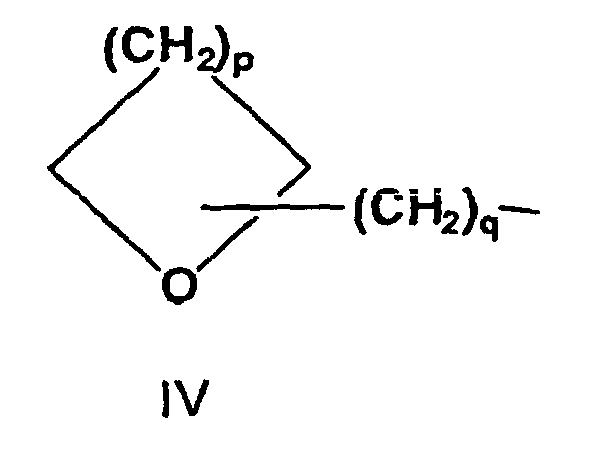


l, m, n, A, B, C', D, X1, Y1, R1, R2, and R3 are defined in the same manner as in the above-described (2), and
R4 represents Formula IV (wherein p and q are defined in the same manner as in the above-described (3)), Formula V (wherein r and s are defined in the same manner as in the above-described (3), R9 represents hydrogen, C1-8 alkyl, -SO2Rb, or -C(O)Rb, Rb represents C1-8 alkyl, substituted phenyl or phenyl substituted with at least one substituent of substituent group E, substituted benzyl or benzyl substituted with at least one substituent of substituent group E, substituent group E being defined in the same manner as in the above-described (2)), or Formula VI (wherein t and u are defined in the same manner as in the above-described (3),
R10 represents hydrogen, C1-8 alkyl, substituted phenyl or phenyl substituted with at least one substituent of substituent group E, substituted benzyl or benzyl substituted with at least one substituent of substituent group E, substituent group E being defined in the same manner as in the above-described (2)).



















and Formula X


with usually 0.5 to 2 equivalents of diphosgene, triphosgene, 1,1-carbonyldiimidazole or the like in a solvent such as dichloromethane or chloroform, in the presence of a tertiary amine such as triethylamine or diisopropylethylamine, then reacting the obtained product with Formula XII,
The mixing ratio of Formula XI to Formula XII may usually be, although not restricted, about 1:1 to 2:1, and the reaction may usually be carried out at about 0°C to room temperature for about 1 to 24 hours. The amount of the tertiary amine to be added is not restricted, and is usually about 1 to 4 equivalents with respect to diphosgene, triphosgene or 1,1-carbonyldiimidazole.

in a solvent such as dimethylformamide, tetrahydrofuran or dimethoxyethane at about 0°C to room temperature for about 1 to 24 hours. The mixing ratio of Formula XII to Formula XIII is not restricted, and is usually about 1:1 to 1: 3.


can be produced by hydrolysis of Formula XXIV,
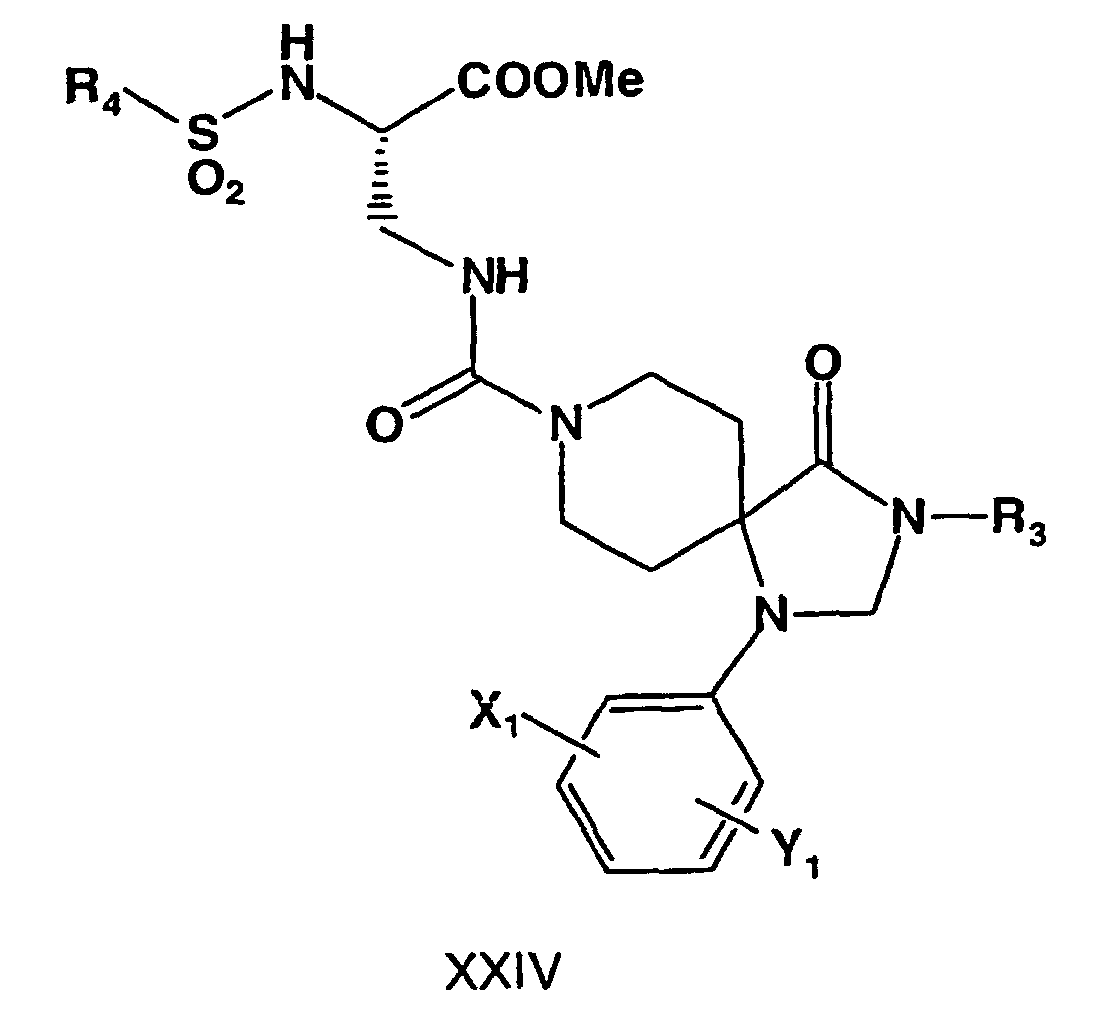
using a base such as aqueous sodium hydroxide solution, aqueous lithium hydroxide solution or aqueous barium hydroxide solution in an solvent such as an alcoholic solvent, for example, methanol, or tetrahydrofuran, dimethoxyethane or 1,4-dioxane. While the hydrolysis using a base such as aqueous sodium hydroxide solution, aqueous lithium hydroxide solution or aqueous barium hydroxide solution is not particularly restricted, usually, it is carried out by reacting at a temperature of from 0°C to about room temperature for approximately 1 to 24 hours. The added amount of the base is usually about 1 to 4 equivalents with respect to Formula XXIV.
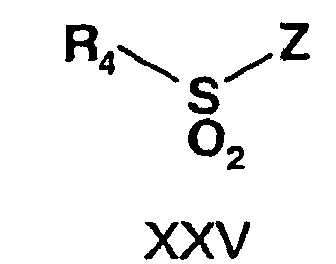
and Formula X in a solvent such as tetrahydrofuran, dimethylformamide, chloroform, dichloromethane or 1,4-dioxane in the presence of a tertiary amine, such as triethylamine or diisopropylethylamine, pyridine or 4-(N,N-dimethylamino)pyridine. While the reaction of Formula X and Formula XXV is not particularly restricted, usually, it can be carried out by reacting at a temperature of from 0°C to about room temperature for approximately 1 to 24 hours. While the mixing ratio of Formula X and Formula XXV is not restricted, it may be about 1:1 to 1:2, and the amount of the tertiary amine to be added is, although not restricted, usually about 1 to 4 equivalents with respect to Formula XXV.

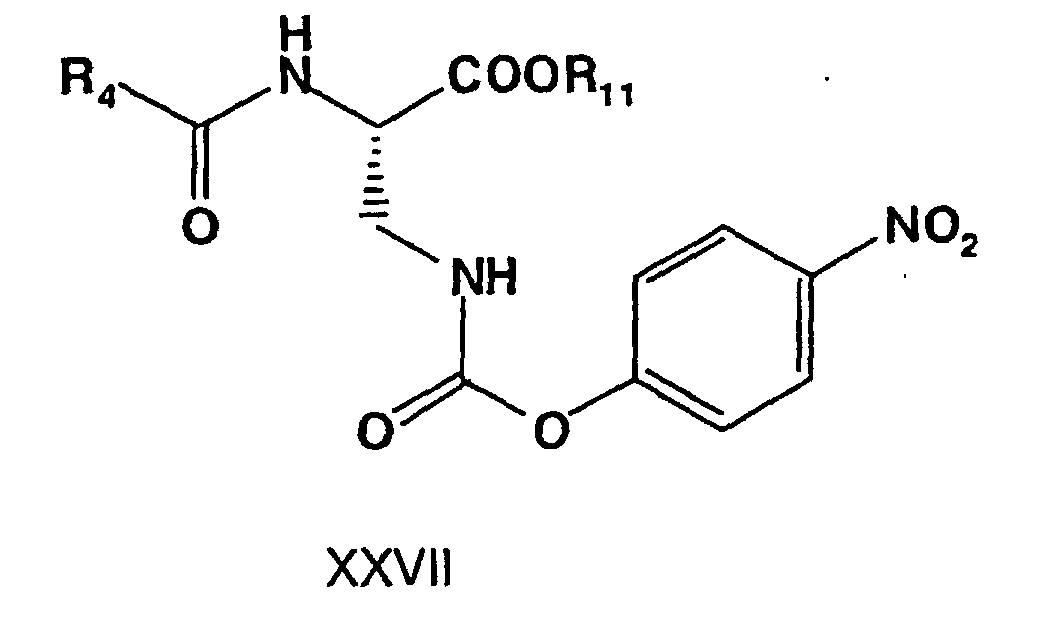

and p-nitrophenyl chloroformate in a solvent such as methylene chloride, tetrahydrofuran or a mixture of methylene chloride-tetrahydrofuran in the presence of a tertiary amine such as diisopropylethylamine or N-methylmorpholine. The amount of the p-nitrophenyl chloroformate to be used is, although not restricted, usually about 1 to 50 equivalents with respect to Formula XXVIII, preferably 1 to 20 equivalents. The amount of the tertiary amine to be added is, although not restricted, usually about 1 to 4 equivalents with respect to the p-nitrophenyl chloroformate. The reaction temperature is not restricted, and is preferably between 0 and 50°C. The reaction time may be appropriately selected depending on the reaction temperature and the like, and usually, is about 0.1 to 2 hours.

with 1 to 20% hydrazine hydrate in a solvent such as dimethylformamide or dimethylacetamide. The reaction temperature is not restricted, and is usually between 0 and 50°C. The reaction time may be appropriately selected depending on the reaction temperature and the like, and usually, is about 0.1 to 2 hours.

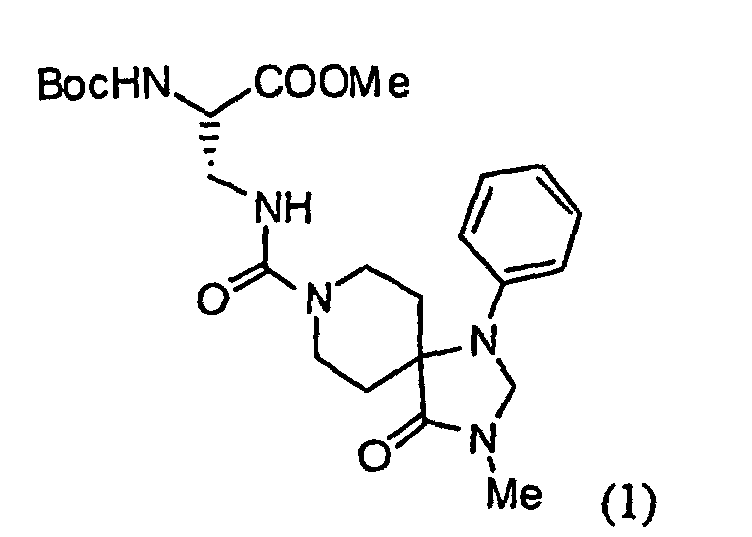
LR-MS(m/z):490(M+H)+
1H-NMR (300MHz, CDCl3, δppm):1.43 (9H, s), 1.63-1.72 (2H, m), 2.49-2.60 (2H, m), 3.01 (3H, s), 3.49-3.90 (6H, m), 3.75 (3H, s), 4.38 (1H, s), 4.68 (2H, s), 5.29 (1H, m), 5.84 (1H, m), 6.86 (1H, m), 7.26-7.31 (2H, m).
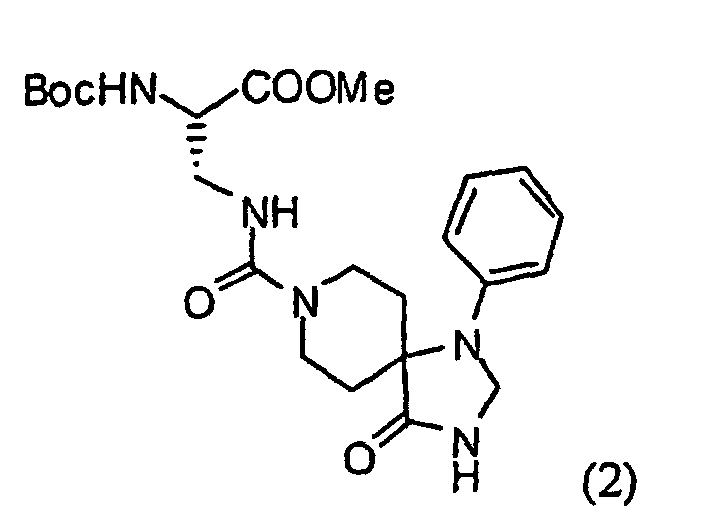
LR-MS(m/z):476(M+H)+
1H-NMR (300MHz, CDCl3, δppm):1.43 (9H, s), 1.64-1.76 (2H, m), 2.48-2.59 (2H, m), 3.51-3.87 (6H, m), 3.75 (3H, s), 4.38 (1H, m), 4.75 (2H, s), 5.30 (1H, m), 5.85 (1H, m), 6.74-6.77 (2H, m), 6.87 (1H, m), 7.26-7.31 (2H, m).
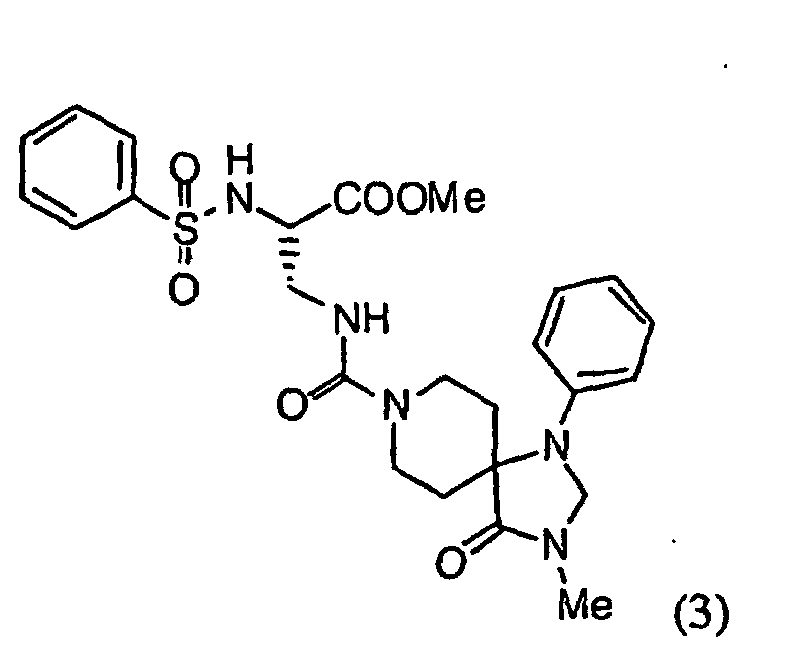
LR-MS(m/z):530(M+H)+
1H-NMR (300MHz, CDCl3, δppm): 1.65-1.70 (2H, m), 2.50-2.61 (2H, m), 3.01 (3H, s), 3.48 (1H, m), 3.59 (3H, s), 3.63-3.88 (5H, m), 3.97 (1H, m), 4.68 (2H, s), 5.06 (1H, m), 6.09 (1H, m), 6.76 (2H, d, J=7.90), 6.84 (1H, t, J=7.32), 7.26 (2H, t, J=7.32), 7.47-7.61 (3H, m), 7.83-7.86 (2H, m).

LR-MS(m/z):516 (M+H)+
1H-NMR (300MHz, CDCl3, δppm): 1.67-1.72 (2H, m), 2.44-2.53 (2H, m), 3.01 (3H, s), 3.54-3.79 (7H, m), 4.68 (2H, s), 5.49 (1H, m), 6.41 (1H, m), 6.75 (2H, d, J=8.20), 6.87 (1H, t, J=7.03), 7.24-7.29 (2H, m), 7.45-7.58 (3H, m), 7.82 (2H, d, J=7.61).
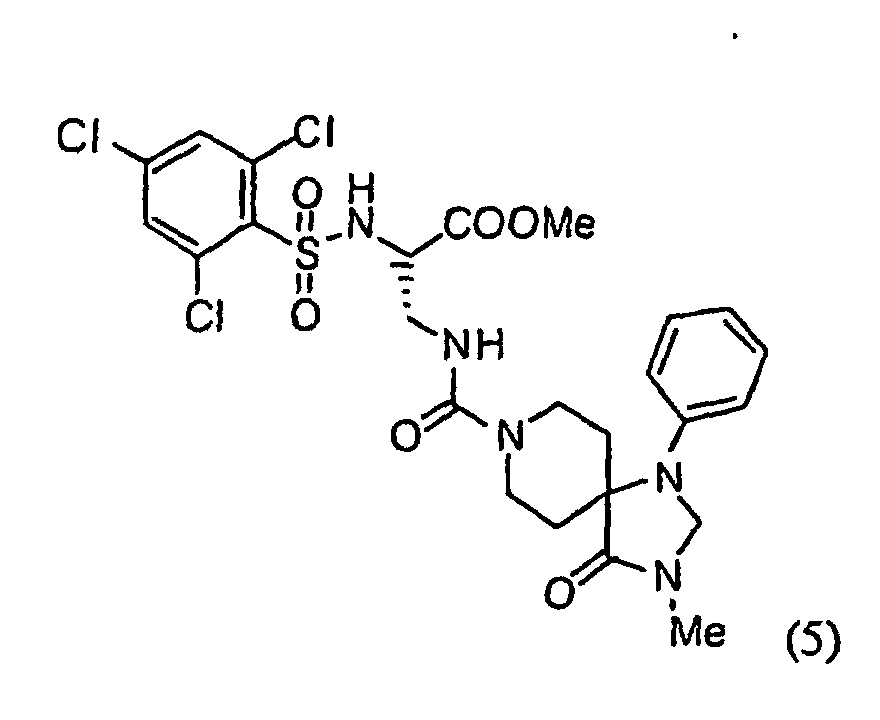
LR-MS(m/z):632(M+H)+
1H-NMR (300MHz, CDCl3, δppm): 1.65-1.70 (2H, m), 2.49-2.59 (2H, m), 3.01 (3H, s), 3.64-3.89 (6H, m), 3.61 (3H, s), 4.28 (1H, m), 4.68 (2H, s), 5.09 (1H, m), 6.74 (2H, d, J=8.20), 6.85 (1H, t, J=7.32), 7.22-7.28 (2H, m), 7.45 (2H, s).
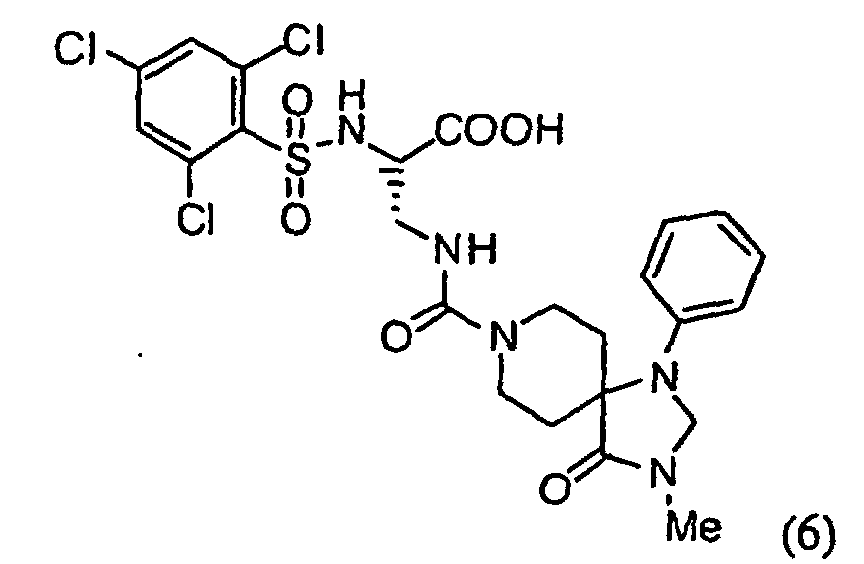
LR-MS(m/z):618 (M+H)+
1H-NMR (300MHz, CDCl3, δppm): 1.68-1.73 (2H, m), 2.44-2.55 (2H, m), 3.01 (3H, s), 3.61-3.08 (7H, m), 4.68 (2H, s), 5.56 (1H, m), 6.73 (2H, d, J=8.20), 6.87 (1H, t, J=7.32), 7.09 (1H, m), 7.26 (2H, d, J=8.20), 7.43 (2H, s).

LR-MS(m/z):578 (M+H)+
1H-NMR (300MHz, CDCl3, δppm): 1.65-1.70 (2H, m), 2.51-2.64 (2H, m), 2.67 (3H, s), 3.01 (3H, s), 3.50-3.77 (4H, m), 3.58 (3H, s), 3.84-3.88 (2H, m), 4.10 (1H, m), 4.68 (2H, s), 5.07 (1H, m), 6.68 (1H, m), 6.77 (2H, d, J=8.20), 6.84 (1H, t, J=7.32), 7.19-7.39 (5H, m).
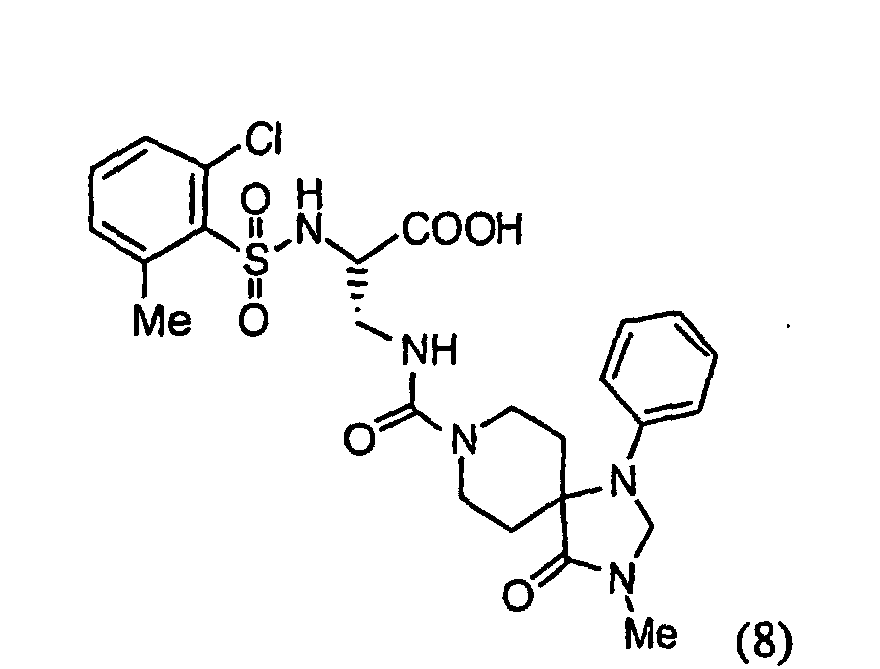
LR-MS(m/z):564 (M+H)+
1H-NMR (300MHz, CDCl3, δppm): 1.68-1.72 (2H, m), 2.44-2.54 (2H, m), 2.64 (3H, s), 3.01 (3H, s), 3.61-3.81 (7H, m), 4.68 (2H, s), 5.52 (1H, m), 6.75 (2H, d, J=7.90), 6.84-6.89 (2H, m), 7.18 (1H, d, J=6.44), 7.24-7.37 (4H, m).
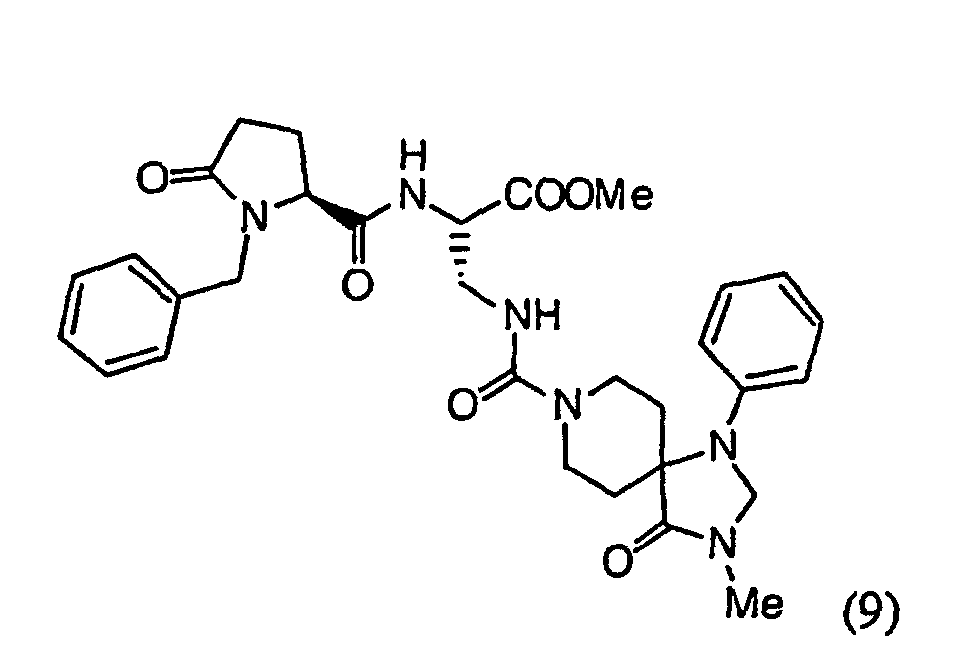
LR-MS(m/z):591 (M+H)+
1H-NMR (300MHz, CD3OD, δppm): 1.63-1.67 (2H, m), 2.20 (1H, m), 2.20-2.62 (5H, m), 2.98 (3H, s), 3.51-3.75 (4H, m), 3.72 (3H, s), 3.84-4.01 (4H, m), 4.47 (1H, t, J=6.44), 4.72 (2H, s), 4.99 (1H, d, J=14.9), 6.87-6.82 (3H, m), 7.18-7.34 (7H, m).

LR-MS(m/z):577 (M+H)+
1H-NMR (300MHz, CD3OD, δppm): 1.62-1.67 (2H, m), 2.03 (1H, m), 2.17-2.63 (5H, m), 2.98 (3H, s), 3.52-3.74 (4H, m), 3.81-3.99 (4H, m), 4.48 (1H, m), 4.71 (2H, s), 4.99 (1H, d, J=14.9), 6.77-6.81 (3H, m), 7.18-7.41 (7H, m).

LR-MS(m/z):577 (M+H)+
1H-NMR (300MHz, CDCl3, δppm):1.73-1.80 (2H, m), 2.06 (1H, m), 2.10-2.67 (5H, m), 3.57-3.95 (7H, m), 3.77 (3H, s), 4.55 (1H, m), 4.73 (2H, s), 5.11-5.16 (2H, m), 6.74 (2H, d, J=8.49), 6.83-6.91 (2H, m), 7.21-7.32 (7H, m), 8.22 (1H, m).
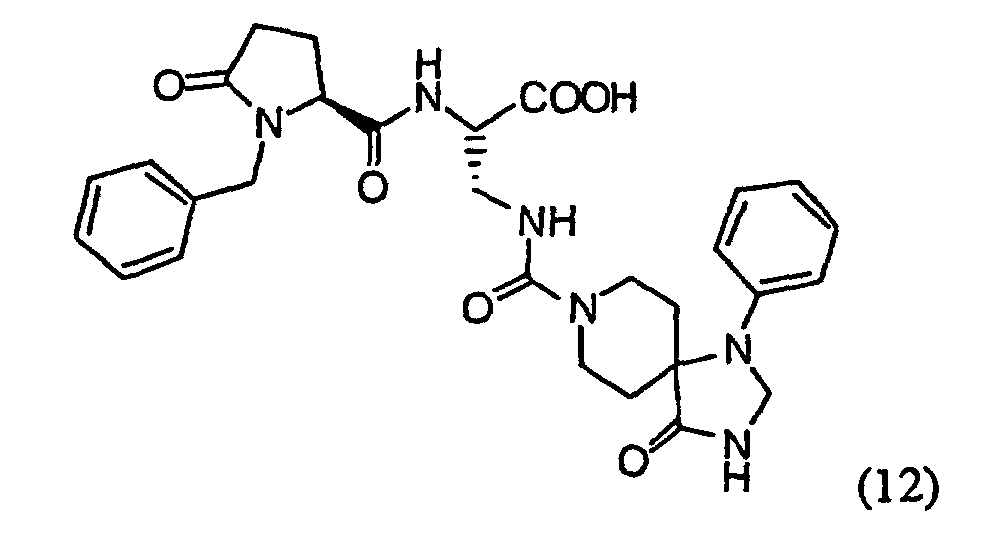
LR-MS(m/z):563 (M+H)+
1H-NMR (300MHz, CD3OD δpm):1.66-1.71 (2H, m), 2.02 (1H, m), 2.19-2.62 (5H, m), 3.52-3.69 (4H, m), 3.81-4.00 (4H, m), 4.47 (1H, m), 4.69 (2H, s), 4.99 (1H, d, J=14.9), 6.76-6.81 (3H, m), 7.18-7.33 (7H, m).
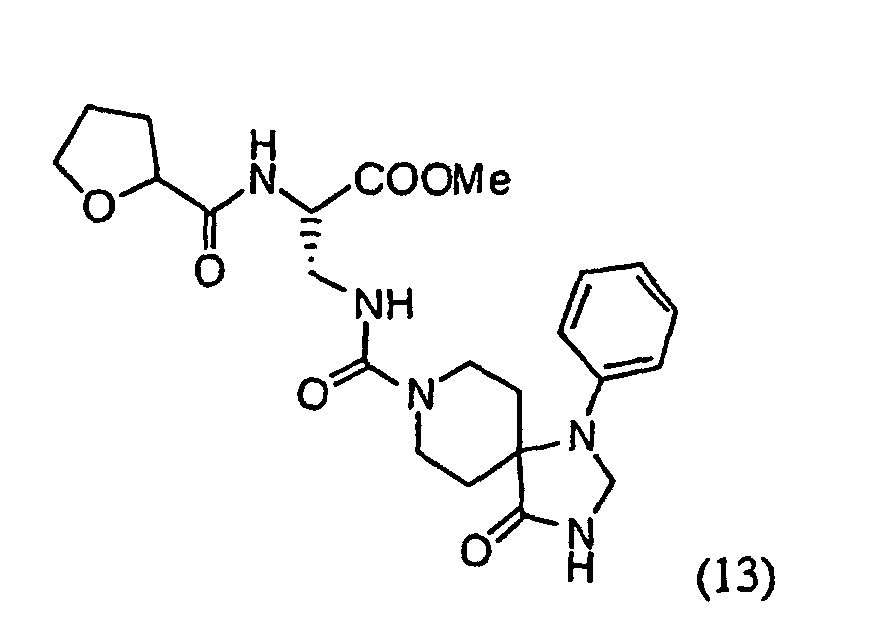
LR-MS(m/z):474 (M+H)+
1H-NMR (300MHz, CDCl3, δppm):1.73-2.11 (5H, m), 2.26 (1H, m), 2.42-2.59 (2H, m), 3.55-4.03 (8H, m), 3.76 (3H, s), 4.38 (1H, m), 4.60 (1H, m), 4.74 (2H, s), 5.47 (1H, m), 6.74-6.77 (2H, m), 6.88 (1H, m), 7.24-7.33 (2H, m), 7.92 (1H, m).

LR-MS(m/z):460 (M+H)+
1H-NMR (300MHz, CD3OD, δppm):1.64-1.74 (2H, m), 1.80-2.09 (3H, m), 2.21 (1H, m), 2.43-2.64 (2H, m), 3.55-4.06 (8H, m), 4.32 (1H, m), 4.44 (1H, m), 4.70 (2H, s), 6.78-6.82 (3H, m), 7.22-7.27 (2H, m).

LR-MS(m/z):515 (M+H)+
1H-NMR (300MHz, CDCl3, δppm):1.66-2.19 (6H, m), 2.01 (3H, s), 2.53-2.64 (2H, m), 3.41-3.82 (6H, m), 3.79 (3H, s), 3.90-4.03 (2H, m), 4.26 (1H, m), 4.57 (1H, m), 4.74 (2H, s), 5.86 (1H, m), 6.72-7.00 (4H, m), 7.21-7.35 (3H, m).

LR-MS(m/z):501 (M+H)+
1H-NMR (300MHz, CD3OD, δppm):1.65-1.69 (2H, m), 1.86-2.32 (4H, m), 2.00 (3H, s), 2.44-2.58 (2H, m), 3.44-3.80 (6H, m), 3.89-3.95 (2H, m), 4.38-4.53 (2H, m), 4.85 (2H, s), 6.78-6.82 (3H, m), 7.22-7.27 (2H, m).

LR-MS(m/z):529 (M+H)+
1H-NMR (300MHz, CDCl3, δppm):1.30-1.77 (7H, m), 2.10-2.20 (3H, m), 2.27-2.60 (3H, m), 3.28 (1H, m), 3.60-3.96 (9H, m), 4.50 (1H, m), 4.74 (2H, s), 5.14-5.37 (2H, m), 6.75 (2H, d, J=8.49), 6.84-6.94 (2H, m), 7.25-7.32 (2H, m).

LR-MS(m/z):515 (M+H)+
1H-NMR (300MHz, CD3OD, δppm):1.47-1.70 (7H, m), 2.07-2.22 (3H, m), 2.32 (1H, m), 2.46-2.65 (2H, m), 3.38-3.79 (6H, m), 3.88-4.05 (2H, m), 4.39 (1H, m), 4.69 (2H, s), 5.23 (1H, m), 6.75-6.82 (3H, m), 7.22-7.27 (2H, m).
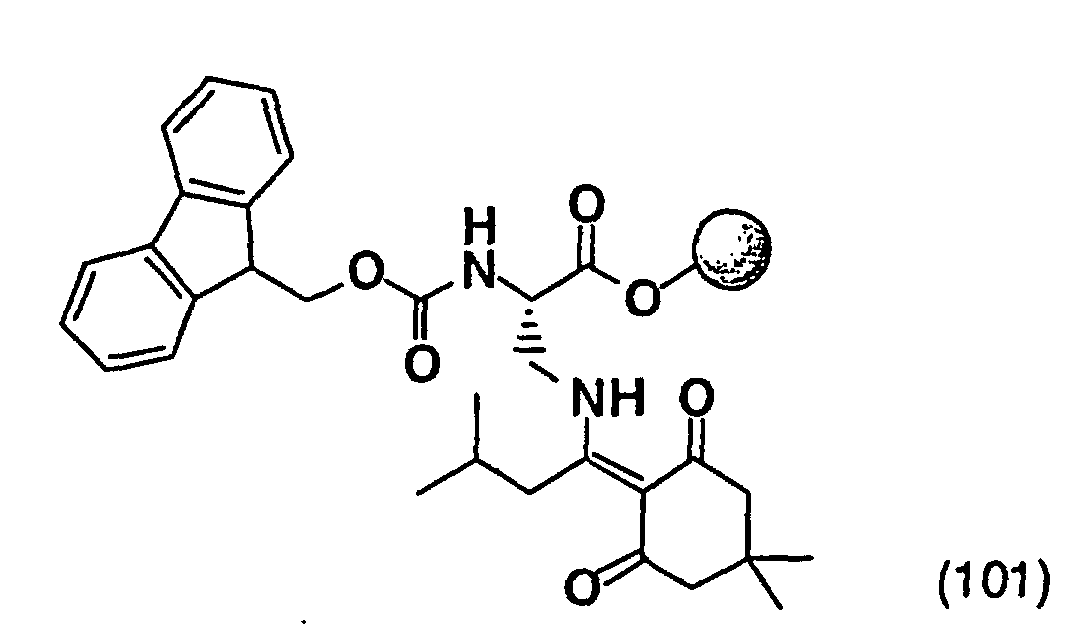


LC-MS Data
Column: Xterra ODS 5 µm, 4.6 × 50 mm (Waters)
Developing solvent: 0.1% aqueous formic acid solution:.0.1% formic acid/acetonitrile solution =90:10 (0 minutes) → 10:90 (3-5 minutes)
MS (m/z) (M+H)+ = 568
Retention time: 4.06 minutes

| Compound number | Inhibitory activity (IC50:nM) |
| 8 | 110 |
| 16 | 110 |
| 18 | 65 |
Claims (22)
- A spiro derivative or a pharmaceutically acceptable salt thereof represented by Formula I,wherein I and m each independently represent an integer of 0 to 2;
n represents an integer of 1 to 3;
A represents -C(O)- or -S(O)2-;
B represents -CH2- or -NH-;
C' and D both represent a hydrogen atom, or C' and D represent together =O;
X1 and Y1 independently represent hydrogen, halogen, C1-8 alkyl, trifluoromethyl, C1-8 alkoxy, cyano, nitro, hydroxyl, amino, or tetrazolyl;
R1 represents hydrogen, C1-6 linear alkyl, C3-8 branched alkyl, benzyl or -CH2OC(O)C(CH3)3;
R2 represents hydrogen or C1-6 linear alkyl;
R3 represents hydrogen, C1-6 linear alkyl, C3-8 branched alkyl, allyl, homoallyl, C3-8 cycloalkyl-C1-8 alkyl, unsubstituted phenyl or phenyl substituted with at least one substituent of substituent group E, unsubstituted benzyl or benzyl substituted with at least one substituent of substituent group E, unsubstituted phenethyl or phenethyl substituted with at least one substituent of substituent group E, unsubstituted styryl or styryl substituted with at least one substituent of substituent group E, unsubstituted naphthyl or naphthyl substituted with at least one substituent of substituent group E, or unsubstituted naphthylmethyl or naphthylmethyl substituted with at least one substituent of substituent group E (wherein substituent group E consists of halogen, C1-8 alkyl, C1-8 alkoxy, trifluoromethyl, trifluoromethoxy, C1-8 alkylthio, cyano, nitro, hydroxyl, amino, C1-8 alkylacyl, C1-8 alkylacylamino and tetrazolyl);
R4 represents C1-8 alkyl, C2-8 alkenyl, C2-8 alkynyl, Cy, Cy-C1-8 alkyl, Cy-C2-8 alkenyl, Cy-C2-8 alkynyl, Ar, Ar-C1-8 alkyl, Ar-C2-8 alkenyl or Ar-C2-8 alkynyl, wherein the alkyl, alkenyl and alkynyl may be linear or branched, and may be substituted with 1 to 4 of R5 independently selected, wherein
Cy is C3-8 cycloalkyl that may be substituted with 1 to 4 substituents of R6 or 3- to 8-membered monocyclic or bicyclic heterocycle that includes 1 to 4 nitrogen atoms, oxygen atoms or sulfur atoms independently selected, which heterocycle may be substituted with 1 to 4 substituents of R6 (with the proviso that the hetero atoms do not bond directly with A),
Ar is phenyl that may be substituted with 1 to 5 substituents of R7, naphthyl that may be substituted with 1 to 5 substituents of R7, or 5- to 8-membered monocyclic or bicyclic heteroaryl that includes I to 4 nitrogen atoms, oxygen atoms or sulfur atoms independently selected, which heterocycle may be substituted with 1 to 5 substituents of R7 (wherein the hetero atoms do not directly bond with A),
R5 is halogen, trifluoromethyl, -ORa or -SRa,
Ra is hydrogen, C1-8 alkyl, allyl, homoallyl, trifluoromethyl, phenyl or benzyl,
R6 and R7 are, each independently, R5, C1-8 alkyl, C2-8 alkenyl, C2-8 alkynyl, C3-8 cycloalkyl-C1-8 alkyl, cyano, nitro, =O, -SO2Rb, -SO2NRcRd, -C(O)Rb, -C(O)ORb, -C(O)NRcRd, -NRcRd, -NRcC(O)Rb, -NRcSO2Rb, unsubstituted phenyl or phenyl substituted with at least one substituent of substituent group E or unsubstituted benzyl or benzyl substituted with at least one substituent of substituent group E,
Rb, Rc and Rd are each independent, and are hydrogen, C1-8 alkyl, C3-8 cycloalkyl, C3-8 cycloalkyl-C1-8 alkyl, unsubstituted phenyl or phenyl substituted with at least one substituent of substituent group E, unsubstituted benzyl or benzyl substituted with at least one substituent of substituent group E, unsubstituted phenethyl or phenethyl substituted with at least one substituent of substituent group E, unsubstituted styryl or styryl substituted with at least one substituent of substituent group E, unsubstituted naphthyl or naphthyl substituted with at least one substituent of substituent group E, or unsubstituted naphthylmethyl or naphthylmethyl substituted with at least one substituent of substituent group E
(with the proviso that excluded are the compounds in which, when A is -C(O)-, R4 is C1-7 linear alkyl, C3-9 branched alkyl, adamantyl, benzyl or phenethyl substituted with 0 to 2 substituents of halogen, C1-8 alkyl, C1-8 alkoxy, cyano, nitro, hydroxyl, amino, or tetrazolyl; Formula II,wherein X2 and Y2 each independently represent hydrogen, halogen, alkyl containing 1 to 8 carbon atoms, alkoxy containing 1 to 8 carbon atoms, cyano, nitro, hydroxyl, amino, or tetrazolyl; or
Formula IIIwherein R8 represents linear alkyl containing 1 to 6 carbon atoms, branched alkyl containing 3 to 8 carbon atoms, linear alkylacyl containing 1 to 6 carbon atoms, branched alkylacyl containing 3 to 8 carbon atoms, cycloalkylacyl containing 5 to 7 carbon atoms, linear alkylsulfonyl containing 1 to 6 carbon atoms or branched alkylsulfonyl containing 3 to 8 carbon atoms, or
benzoyl substituted with 0 to 2 substituents of halogen, alkyl containing 1 to 8 carbon atoms, alkoxy containing 1 to 8 carbon atoms, cyano, nitro, hydroxyl, amino or tetrazolyl, phenylsulfonyl substituted with 0 to 2 substituents of halogen, alkyl containing 1 to 8 carbon atoms, alkoxy containing 1 to 8 carbon atoms, cyano, nitro, hydroxyl, amino or tetrazolyl, benzyl substituted with 0 to 2 substituents of halogen, alkyl containing 1 to 8 carbon atoms, alkoxy containing 1 to 8 carbon atoms, cyano, nitro, hydroxyl, amino or tetrazolyl). - A spiro derivative or a pharmaceutically acceptable salt thereof represented by Formula I,wherein I and m each independently represent an integer of 0 to 2;
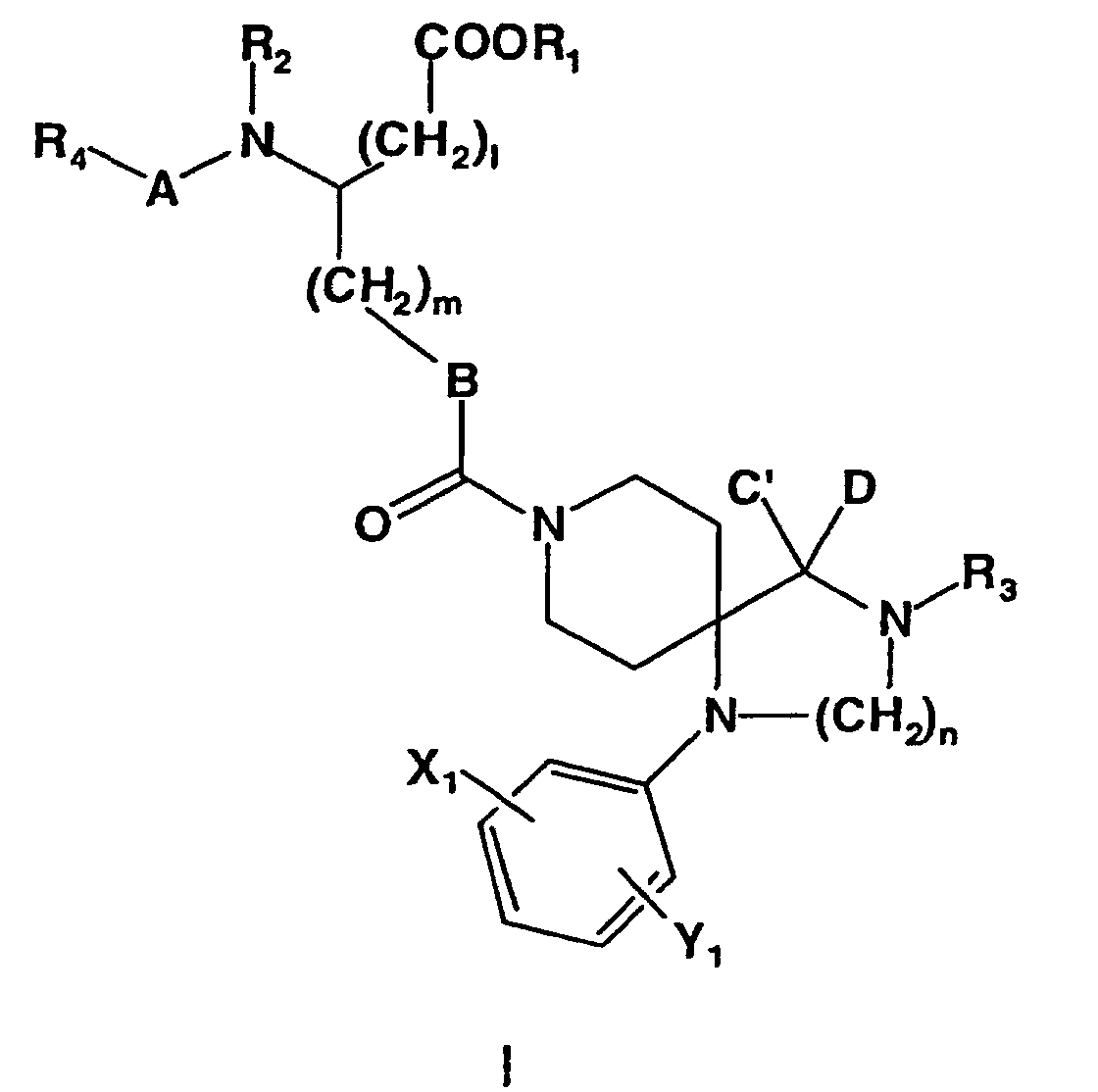
n represents an integer of 1 to 3;
A represents -C(O)- or -S(O)2-;
B represents -CH2- or -NH-;
C' and D both represent a hydrogen atom, or C' and D represent together =O;
X1 and Y1 independently represent hydrogen, halogen, C1-8 alkyl, trifluoromethyl, C1-8 alkoxy, cyano, nitro, hydroxyl, amino, or tetrazolyl;
R1 represents hydrogen, C1-6 linear alkyl, C3-8 branched alkyl, benzyl or -CH2OC(O)C(CH3)3;
R2 represents hydrogen or C1-6 linear alkyl;
R3 represents hydrogen, C1-6 linear alkyl, C3-8 branched alkyl, allyl, homoallyl, C6-10 cycloalkylalkyl, unsubstituted phenyl or phenyl substituted with at least one substituent of substituent group E, unsubstituted benzyl or benzyl substituted with at least one substituent of substituent group E, unsubstituted phenethyl or phenethyl substituted with at least one substituent of substituent group E, unsubstituted styryl or styryl substituted with at least one substituent of substituent group E, or unsubstituted naphthylmethyl or naphthylmethyl substituted with at least one substituent of substituent group E (wherein substituent group E consists of halogen, C1-8 alkyl, C1-8 alkoxy, trifluoromethyl, trifluoromethoxy, C1-8 alkylthio, cyano, nitro, hydroxyl, amino, C1-8 alkylacyl, C1-8 alkylacylamino and tetrazolyl);
R4 represents C3-8 cycloalkyl that may be substituted with 1 to 4 substituents of R6 or 3- to 8-membered monocyclic or bicyclic heterocycle that includes 1 to 4 nitrogen atoms or oxygen atoms independently selected, which heterocycle may be substituted with 1 to 4 substituents of R6 (with the proviso that the hetero atoms do not bond directly with A), tetrahydrothiophene or tetrahydrothiopyran that may be substituted with 1 to 4 substituents of R6, phenyl that may be substituted with 3 to 5 substituents of R7, naphthyl that may be substituted with 1 to 4 substituents of R7, 5- to 8-membered monocyclic or bicyclic heteroaryl that includes 1 to 4 nitrogen atoms, oxygen atoms or sulfur atoms independently selected, which heterocycle may be substituted with 1 to 4 substituents of R7, C3-8 cycloalkyl-C1-8 alkyl, or 3- to 8-membered monocyclic heterocycle-C1-8 alkyl, the heterocycle including 1 to 4 nitrogen atoms or oxygen atoms independently selected and which may be substituted with 1 to 4 substituents of R6, wherein
R6 and R7 are, independently, halogen, trifluoromethyl, -ORa, -SRa, C1-8 alkyl, C2-8 alkenyl, C2-8 alkynyl, C3-8 cycloalkyl-C1-8 alkyl, cyano, nitro, =O, -SO2Rb, -SO2NRcRd, -C(O)Rb, -C(O)ORb, -C(O)NRcRd, -NRcRd, -NRcC(O)Rb, -NRcSO2Rb, unsubstituted phenyl or phenyl substituted with at least one substituent of substituent group E, or unsubstituted benzyl or benzyl substituted with at least one substituent of substituent group E,
R3 is hydrogen, C1-8 alkyl, allyl, homoallyl, trifluoromethyl, phenyl or benzyl,
Rb, Rc and Rd are each independent, and are hydrogen, C1-8 alkyl, C3-8 cycloalkyl, C3-8 cycloalkyl-C1-8 alkyl, unsubstituted phenyl or phenyl substituted with at least one substituent of substituent group E, unsubstituted benzyl or benzyl substituted with at least one substituent of substituent group E, unsubstituted phenethyl or phenethyl substituted with at least one substituent of substituent group E, unsubstituted styryl or styryl substituted with at least one substituent of substituent group E, unsubstituted naphthyl or naphthyl substituted with at least one substituent of substituent group E, or unsubstituted naphthylmethyl or naphthylmethyl substituted with at least one substituent of substituent group E. - A spiro derivative or a pharmaceutically acceptable salt thereof, wherein in the above-described Formula I,
l, m, n, B, C', D, X1, Y1, R1, R2, and R3 are defined in the same manner as in claim 2,
A represents -C(O)- or -S(O)2-,
R4 represents C3-8 cycloalkyl that may be substituted with 1 to 4 substituents of R6 (wherein R6 is defined in the same manner as in claim 2), phenyl that may be substituted with 3 to 5 substituents of R7 (wherein R7 is defined in the same manner as in claim 2), naphthyl that may be substituted with 1 to 4 substituents of R7 (wherein R7 is defined in the same manner as in claim 2), Formula IV that may be substituted with 1 to 4 substituents of R6,wherein R6 is defined in the same manner as in claim 2, and p represents an integer of 0 to 5 and q represents an integer of 0 to 2,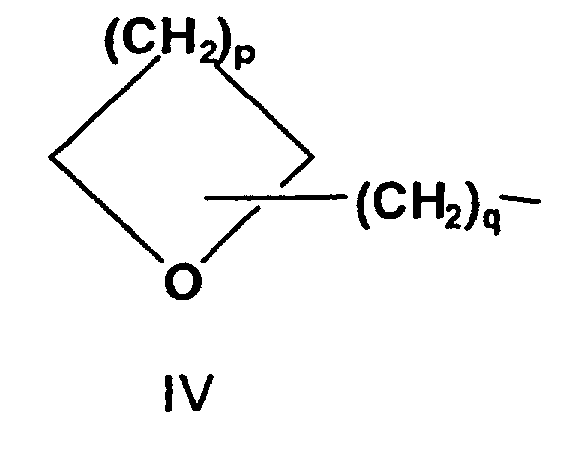
Formula V that may be substituted with 1 to 4 substituents of R6,wherein R6 is defined in the same manner as in claim 2, r represents an integer of 0 to 5 and s represents an integer of 0 to 2, R9 represents hydrogen, C1-8 alkyl, -SO2Rb, -SO2NRcRd, -C(O)Rb, -C(O)ORb, -C(O)NRcRd, unsubstituted phenyl or phenyl substituted with at least one substituent of substituent group E, unsubstituted benzyl or benzyl substituted with at least one substituent of substituent group E, unsubstituted phenethyl or phenethyl substituted with at least one substituent of substituent group E, unsubstituted styryl or styryl substituted with at least one substituent of substituent group E, unsubstituted naphthyl or naphthyl substituted with at least one substituent of substituent group E, or unsubstituted naphthylmethyl or naphthylmethyl substituted with at least one substituent of substituent group E, and Rb, Rc, Rd and substituent group E are defined in the same manner as in claim 2, or
Formula VI that may be substituted with 1 to 4 substituents of R6,wherein R6 is defined in the same manner as in claim 2, t represents an integer of 0 to 4 and u represents an integer of 0 to 2, R10 represents hydrogen, C1-8 alkyl, unsubstituted phenyl or phenyl substituted with at least one substituent of substituent group E, unsubstituted benzyl or benzyl substituted with at least one substituent of substituent group E, unsubstituted phenethyl or phenethyl substituted with at least one substituent of substituent group E, unsubstituted styryl or styryl substituted with at least one substituent of substituent group E, unsubstituted naphthyl or naphthyl substituted with at least one substituent of substituent group E, or unsubstituted naphthylmethyl or naphthylmethyl substituted with at least one substituent of substituent group E, and substituent group E is defined in the same manner as in claim 2.
- A spiro derivative or a pharmaceutically acceptable salt thereof, wherein in the Formula I,
l, m, n, A, B, C', D, X1, Y1, R1, R2, and R3 are defined in the same manner as in claim 2, and
R4 represents Formula IV, Formula V or Formula VI (wherein Formula IV, Formula V and Formula VI are defined in the same manner as in claim 3). - A spiro derivative or a pharmaceutically acceptable salt thereof, wherein in the Formula I,
l, m, n, A, B, C', D, X1, Y1, R1, R2, and R3 are defined in the same manner as in claim 2, and
R4 represents Formula IV (wherein p and q are defined in the same manner as in claim 3), Formula V (wherein r and s are defined in the same manner as in claim 3, R9 represents hydrogen, C1-8 alkyl, -SO2Rb, or -C(O)Rb, Rb represents C1-8 alkyl, substituted phenyl or phenyl substituted with at least one substituent of substituent group E, substituted benzyl or benzyl substituted with at least one substituent of substituent group E, substituent group E being defined in the same manner as in claim 2), or Formula VI (wherein t and u are defined in the same manner as in claim 3, R10 represents hydrogen, C1-8 alkyl, substituted phenyl or phenyl substituted with at least one substituent of substituent group E, substituted benzyl or benzyl substituted with at least one substituent of substituent group E, substituent group E being defined in the same manner as in claim 2). - The spiro derivative or pharmaceutically acceptable salt thereof according to claim 1, wherein in Formula I, A is -C(O)-.
- The spiro derivative or pharmaceutically acceptable salt thereof according to claim 1, wherein in Formula I, B is -NH-.
- The spiro derivative or pharmaceutically acceptable salt thereof according to claim 1, wherein in Formula I, C' and D represent together =O.
- The spiro derivative or pharmaceutically acceptable salt thereof according to claim 1, wherein in Formula I, X1 and Y1 are both hydrogen.
- The spiro derivative or pharmaceutically acceptable salt thereof according to claim 1, wherein in Formula I, n is 1.
- The spiro derivative or pharmaceutically acceptable salt thereof according to claim 1, wherein in Formula I, is 0.
- The spiro derivative or pharmaceutically acceptable salt thereof according to claim 1, wherein in Formula I, m is 1 or 2.
- The spiro derivative or pharmaceutically acceptable salt thereof, according to claims 1, wherein in Formula I, R3 is hydrogen, C1-6 linear alkyl, C3-8 branched alkyl or benzyl.
- The spiro derivative or pharmaceutically acceptable salt thereof according to claim 1, wherein in Formula I, R1 is hydrogen or C1-6 linear alkyl.
- An adhesion molecule inhibitor comprising the spiro derivative or pharmaceutically acceptable salt thereof according to claim 1 as an active ingredient.
- The adhesion molecule inhibitor according to claim 15, wherein the adhesion molecule is integrin family.
- The adhesion molecule inhibitor according to claim 16, wherein the integrin family is VLA-4.
- A drug comprising the spiro derivative or pharmaceutically acceptable salt thereof according to claim 1 as an active ingredient.
- An inflammatory disease therapeutic agent comprising the spiro derivative or pharmaceutically acceptable salt thereof according to claim 1 as an active ingredient.
- The inflammatory disease therapeutic agent according to claim 19, wherein the inflammatory disease is an allergic disease or an autoimmune disease.
- The inflammatory disease therapeutic agent according to claim 20, wherein the allergic disease is asthma, rhinitis or dermatitis.
- The inflammatory disease therapeutic agent according to claim 20, wherein the autoimmune disease is multiple sclerosis, ulcerative colitis, arthritis or nephritis.
Applications Claiming Priority (3)
| Application Number | Priority Date | Filing Date | Title |
|---|---|---|---|
| JP2002080697 | 2002-03-22 | ||
| JP2002080697 | 2002-03-22 | ||
| PCT/JP2003/003324 WO2003080611A1 (en) | 2002-03-22 | 2003-03-19 | Spiro derivatives and adhesion molecule inhibitors comprising the same as the active ingredient |
Publications (2)
| Publication Number | Publication Date |
|---|---|
| EP1489081A1 true EP1489081A1 (en) | 2004-12-22 |
| EP1489081A4 EP1489081A4 (en) | 2007-06-20 |
Family
ID=28449097
Family Applications (1)
| Application Number | Title | Priority Date | Filing Date |
|---|---|---|---|
| EP03715376A Withdrawn EP1489081A4 (en) | 2002-03-22 | 2003-03-19 | Spiro derivatives and adhesion molecule inhibitors comprising the same as the active ingredient |
Country Status (7)
| Country | Link |
|---|---|
| US (1) | US20060241132A1 (en) |
| EP (1) | EP1489081A4 (en) |
| JP (1) | JPWO2003080611A1 (en) |
| CN (1) | CN1656095A (en) |
| AU (1) | AU2003227186A1 (en) |
| CA (1) | CA2480039A1 (en) |
| WO (1) | WO2003080611A1 (en) |
Families Citing this family (10)
| Publication number | Priority date | Publication date | Assignee | Title |
|---|---|---|---|---|
| AU2008219007A1 (en) | 2007-02-20 | 2008-08-28 | Merrimack Pharmaceuticals, Inc. | Methods of treating multiple sclerosis by administration of alpha-fetoprotein in combination with an integrin antagonist |
| JP5639039B2 (en) | 2008-04-11 | 2014-12-10 | メリマック ファーマシューティカルズ インコーポレーティッド | Human serum albumin linker and its conjugates |
| CN102282168A (en) | 2008-11-18 | 2011-12-14 | 梅里麦克制药股份有限公司 | Human serum albumin linker and its conjugate |
| US9345766B2 (en) | 2012-08-30 | 2016-05-24 | Merrimack Pharmaceuticals, Inc. | Combination therapies comprising anti-ERBB3 agents |
| WO2020092401A1 (en) | 2018-10-30 | 2020-05-07 | Gilead Sciences, Inc. | COMPOUNDS FOR INHIBITION OF ALPHA 4β7 INTEGRIN |
| WO2020092394A1 (en) | 2018-10-30 | 2020-05-07 | Gilead Sciences, Inc. | Imidazopyridine derivatives as alpha4beta7 integrin inhibitors |
| ES2987796T3 (en) | 2018-10-30 | 2024-11-18 | Gilead Sciences Inc | N-benzoyl-phenylalanine derivatives as alpha4beta7 integrin inhibitors for the treatment of inflammatory diseases |
| DK3873884T3 (en) | 2018-10-30 | 2025-02-17 | Gilead Sciences Inc | 3-(QUINOLIN-8-YL)-1,4-DIHYDROPYRIDO[3,4-D]PYRIMIDINE-2,4-DIONE DERIVATIVES AS ALPHA4BETA7 INTEGRIN INHIBITORS FOR THE TREATMENT OF INFLAMMATORY DISEASES |
| CN110305042A (en) * | 2019-07-01 | 2019-10-08 | 吉尔生化(上海)有限公司 | N α-fluorenylmethyloxycarbonyl-N γ-(4,4- dimethyl -2,6- dioxo hexamethylene subunit) ethyl-butyric acid preparation method |
| AU2020329207B2 (en) | 2019-08-14 | 2024-02-29 | Gilead Sciences, Inc. | Compounds for inhibition of alpha 4 beta 7 integrin |
Family Cites Families (3)
| Publication number | Priority date | Publication date | Assignee | Title |
|---|---|---|---|---|
| US5817756A (en) * | 1993-09-09 | 1998-10-06 | Scios Inc. | Pseudo- and non-peptide bradykinin receptor antagonists |
| HUP0202648A3 (en) * | 1998-06-12 | 2003-02-28 | Sod Conseils Rech Applic | Imidazolyl derivatives, pharmaceutical compositions containing them and their use |
| AU8811401A (en) * | 2000-09-25 | 2002-04-02 | Toray Industries | Spiro compounds and adhesion molecule inhibitors containing the same as the active ingredient |
-
2003
- 2003-03-19 WO PCT/JP2003/003324 patent/WO2003080611A1/en not_active Ceased
- 2003-03-19 AU AU2003227186A patent/AU2003227186A1/en not_active Abandoned
- 2003-03-19 CA CA002480039A patent/CA2480039A1/en not_active Abandoned
- 2003-03-19 US US10/508,500 patent/US20060241132A1/en not_active Abandoned
- 2003-03-19 EP EP03715376A patent/EP1489081A4/en not_active Withdrawn
- 2003-03-19 JP JP2003578365A patent/JPWO2003080611A1/en not_active Withdrawn
- 2003-03-19 CN CNA038116766A patent/CN1656095A/en active Pending
Also Published As
| Publication number | Publication date |
|---|---|
| CN1656095A (en) | 2005-08-17 |
| CA2480039A1 (en) | 2003-10-02 |
| JPWO2003080611A1 (en) | 2005-07-21 |
| EP1489081A4 (en) | 2007-06-20 |
| WO2003080611A1 (en) | 2003-10-02 |
| AU2003227186A1 (en) | 2003-10-08 |
| US20060241132A1 (en) | 2006-10-26 |
Similar Documents
| Publication | Publication Date | Title |
|---|---|---|
| EP0675886B1 (en) | Aminomethylene substituted non-aromatic heterocycles and use as substance p antagonists | |
| DE60309598T2 (en) | INDICATIVES SUITABLE AS HISTAMINE H3 ANTAGONISTS | |
| WO1998005641A1 (en) | Fluorinated 1,4-disubstituted piperidine derivatives | |
| BG64902B1 (en) | IIb/IIIa CELL ADHESION INHIIBITORS, METHOD FOR THE PRODUCTION, PHARMACEUTCIAL COMPOSITION AND ADMINISTRATION THEREOF | |
| JP2002542245A (en) | Substituted imidazoles, their manufacture and use | |
| US6919349B2 (en) | Spiro compounds and adhesion molecule inhibitors containing the same as the active ingredient | |
| EP1440071B1 (en) | Imidazopyridine compounds as 5-ht 4? receptor modulators | |
| US20060241132A1 (en) | Spiro derivatives and adhesion molecule inhibitors comprising the same as active ingredient | |
| UA59417C2 (en) | Compounds of piperydinylaminomethyl trifluoromethyl cyclic ethers as antagonists of substance r | |
| EP2522669B1 (en) | 3-Spirocyclic indolyl derivatives useful as ORL-1 receptor modulators | |
| AU2004313486A1 (en) | Alkylamino, arylamino, and sulfonamido cyclopentyl amide modulators of chemokine receptor activity | |
| US6680333B2 (en) | Imidazolidine derivatives, their preparation, their use and pharmaceutical preparations comprising them | |
| JPS6041680A (en) | Tetrahydroisoxazolo(4,5-c)pyridine derivative and pharmaceutical composition | |
| RU2245879C2 (en) | Spiroimidazolidine derivatives, method for their preparing and pharmaceutical composition based on thereof | |
| US20060052434A1 (en) | Pyrrolizine compounds useful as anti-inflammatory agents | |
| JPWO2002016404A1 (en) | Cyclic Peptide Derivatives | |
| JPH06211886A (en) | Erythromycin derivative | |
| US20010023248A1 (en) | Aminomethylene substituted non-aromatic heterocycles and use as substance P antagonists | |
| JPS5913769A (en) | Novel 1-phenyl-2,5-benzoxazocine derivative and its preparation | |
| AU5264890A (en) | Thiopyrano(2,3-b)indole derivative | |
| CA2077916A1 (en) | Thiopyrano[2,3-b]indole derivatives |
Legal Events
| Date | Code | Title | Description |
|---|---|---|---|
| PUAI | Public reference made under article 153(3) epc to a published international application that has entered the european phase |
Free format text: ORIGINAL CODE: 0009012 |
|
| 17P | Request for examination filed |
Effective date: 20040923 |
|
| AK | Designated contracting states |
Kind code of ref document: A1 Designated state(s): AT BE BG CH CY CZ DE DK EE ES FI FR GB GR HU IE IT LI LU MC NL PT RO SE SI SK TR |
|
| AX | Request for extension of the european patent |
Extension state: AL LT LV MK |
|
| A4 | Supplementary search report drawn up and despatched |
Effective date: 20070522 |
|
| RIC1 | Information provided on ipc code assigned before grant |
Ipc: C07K 5/06 20060101ALI20070511BHEP Ipc: A61P 37/02 20060101ALI20070511BHEP Ipc: A61P 29/00 20060101ALI20070511BHEP Ipc: A61P 25/00 20060101ALI20070511BHEP Ipc: A61P 19/02 20060101ALI20070511BHEP Ipc: A61P 17/00 20060101ALI20070511BHEP Ipc: A61P 13/12 20060101ALI20070511BHEP Ipc: A61P 11/06 20060101ALI20070511BHEP Ipc: A61P 11/02 20060101ALI20070511BHEP Ipc: A61P 1/04 20060101ALI20070511BHEP Ipc: A61K 31/438 20060101ALI20070511BHEP Ipc: C07D 471/10 20060101AFI20031008BHEP |
|
| STAA | Information on the status of an ep patent application or granted ep patent |
Free format text: STATUS: THE APPLICATION IS DEEMED TO BE WITHDRAWN |
|
| 18D | Application deemed to be withdrawn |
Effective date: 20070821 |