EP1489061A1 - Process for producing cyclic compound - Google Patents
Process for producing cyclic compound Download PDFInfo
- Publication number
- EP1489061A1 EP1489061A1 EP03715428A EP03715428A EP1489061A1 EP 1489061 A1 EP1489061 A1 EP 1489061A1 EP 03715428 A EP03715428 A EP 03715428A EP 03715428 A EP03715428 A EP 03715428A EP 1489061 A1 EP1489061 A1 EP 1489061A1
- Authority
- EP
- European Patent Office
- Prior art keywords
- group
- formula
- compound
- reaction mixture
- carbon atoms
- Prior art date
- Legal status (The legal status is an assumption and is not a legal conclusion. Google has not performed a legal analysis and makes no representation as to the accuracy of the status listed.)
- Granted
Links
- 0 *C(C(*)O*C(CSC1C2*)=C(*)N1*2=O)C1NC(*)=C(*)CC1 Chemical compound *C(C(*)O*C(CSC1C2*)=C(*)N1*2=O)C1NC(*)=C(*)CC1 0.000 description 2
Classifications
-
- C—CHEMISTRY; METALLURGY
- C07—ORGANIC CHEMISTRY
- C07D—HETEROCYCLIC COMPOUNDS
- C07D499/00—Heterocyclic compounds containing 4-thia-1-azabicyclo [3.2.0] heptane ring systems, i.e. compounds containing a ring system of the formula:, e.g. penicillins, penems; Such ring systems being further condensed, e.g. 2,3-condensed with an oxygen-, nitrogen- or sulfur-containing hetero ring
- C07D499/04—Preparation
- C07D499/06—Preparation by forming the ring or condensed ring systems
-
- C—CHEMISTRY; METALLURGY
- C07—ORGANIC CHEMISTRY
- C07D—HETEROCYCLIC COMPOUNDS
- C07D403/00—Heterocyclic compounds containing two or more hetero rings, having nitrogen atoms as the only ring hetero atoms, not provided for by group C07D401/00
- C07D403/02—Heterocyclic compounds containing two or more hetero rings, having nitrogen atoms as the only ring hetero atoms, not provided for by group C07D401/00 containing two hetero rings
- C07D403/12—Heterocyclic compounds containing two or more hetero rings, having nitrogen atoms as the only ring hetero atoms, not provided for by group C07D401/00 containing two hetero rings linked by a chain containing hetero atoms as chain links
-
- C—CHEMISTRY; METALLURGY
- C07—ORGANIC CHEMISTRY
- C07D—HETEROCYCLIC COMPOUNDS
- C07D499/00—Heterocyclic compounds containing 4-thia-1-azabicyclo [3.2.0] heptane ring systems, i.e. compounds containing a ring system of the formula:, e.g. penicillins, penems; Such ring systems being further condensed, e.g. 2,3-condensed with an oxygen-, nitrogen- or sulfur-containing hetero ring
-
- C—CHEMISTRY; METALLURGY
- C07—ORGANIC CHEMISTRY
- C07D—HETEROCYCLIC COMPOUNDS
- C07D499/00—Heterocyclic compounds containing 4-thia-1-azabicyclo [3.2.0] heptane ring systems, i.e. compounds containing a ring system of the formula:, e.g. penicillins, penems; Such ring systems being further condensed, e.g. 2,3-condensed with an oxygen-, nitrogen- or sulfur-containing hetero ring
- C07D499/04—Preparation
-
- C—CHEMISTRY; METALLURGY
- C07—ORGANIC CHEMISTRY
- C07D—HETEROCYCLIC COMPOUNDS
- C07D501/00—Heterocyclic compounds containing 5-thia-1-azabicyclo [4.2.0] octane ring systems, i.e. compounds containing a ring system of the formula:, e.g. cephalosporins; Such ring systems being further condensed, e.g. 2,3-condensed with an oxygen-, nitrogen- or sulfur-containing hetero ring
-
- C—CHEMISTRY; METALLURGY
- C07—ORGANIC CHEMISTRY
- C07D—HETEROCYCLIC COMPOUNDS
- C07D503/00—Heterocyclic compounds containing 4-oxa-1-azabicyclo [3.2.0] heptane ring systems, i.e. compounds containing a ring system of the formula:, e.g. oxapenicillins, clavulanic acid derivatives; Such ring systems being further condensed, e.g. 2,3-condensed with an oxygen-, nitrogen- or sulfur-containing hetero ring
- C07D503/02—Preparation
- C07D503/04—Preparation by forming the ring or condensed ring systems
Definitions
- the present invention relates to an industrially advantageous method for preparing a compound having a cyclic structure in its molecule (hereinafter referred to as a "cyclic compound”), which is useful, e.g., as a starting material for the production of pharmaceuticals, agrochemicals, etc. More specifically, the present invention relates to a method for preparing a cyclic compound, which comprises the step of forming a cyclic structure through intramolecular cyclization using a trialkyl phosphite.
- the step of obtaining a phosphorus ylide compound of Formula (7) from a compound of Formula (6) is actually accomplished by using an excess amount (more than two-fold molar excess) of a trialkyl phosphite represented by the formula (R'''O) 3 P to react with the compound of Formula (6) for the purpose of improving the reaction yield.
- the reaction mixture is purified using the technique of flash column chromatography before being provided for cyclization to obtain a compound of Formula (8).
- the present invention has been made by taking into consideration the above situation, and aims to provide an industrially advantageous method for preparing a cyclic compound using a trialkyl phosphite through intramolecular cyclization.
- the inventors of the present invention have found that the yield of cyclization is reduced when unreacted trialkyl phosphite is not sufficiently removed from the reaction mixture obtained after reaction with an excess amount of trialkyl phosphite and hence the trialkyl phosphite, even in a little amount, still remains in the reaction mixture. In turn, they have found that the yield is significantly improved when cyclization is performed after removal of trialkyl phosphite from the reaction mixture.
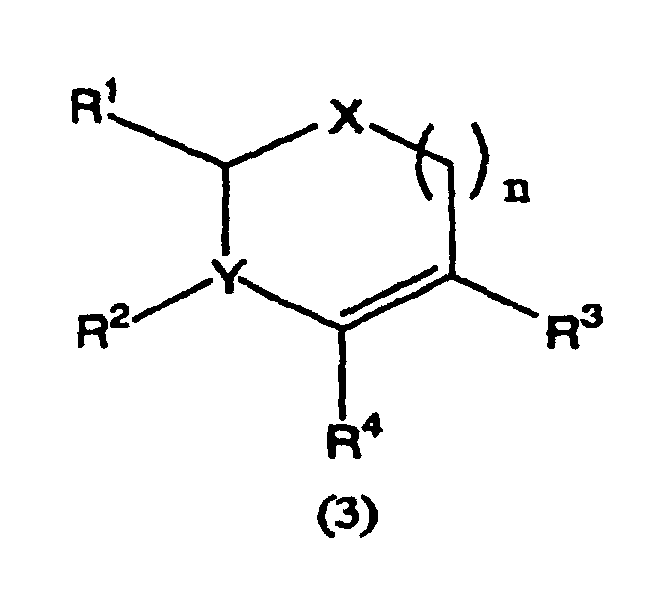
- a method for preparing a cyclic compound of Formula (3) (wherein X represents CH 2 , O or S, Y represents CH or N, n represents 0 or 1, R 1 represents an optionally substituted alkyl group containing 1 to 10 carbon atoms, R 2 and R 3 each independently represent an optionally substituted alkyl group containing 1 to 6 carbon atoms, an optionally substituted alkenyl group containing 1 to 6 carbon atoms, an optionally substituted phenyl group, an optionally substituted heterocyclic group or an optionally substituted heteroylmethyl group, and R 4 represents an alkoxycarbonyl group containing 1 to 6 carbon atoms, a haloalkoxycarbonyl group containing 1 to 6 carbon atoms or an alkenyloxycarbonyl group containing 1 to 6 carbon atoms, provided that R 1 and R 2 may together form a carbocyclic ring containing 3 to 8 carbon atoms or a heterocyclic
- the step of removing unreacted trialkyl phosphite from the reaction mixture preferably comprises reducing the internal pressure of the vessel holding the above reaction mixture to 0.7 kPa or below and heating the vessel at 75°C to 80°C to distill off the trialkyl phosphite remaining in the above reaction mixture.
- the step of removing unreacted trialkyl phosphite from the reaction mixture more preferably comprises reducing the internal pressure of the vessel holding the above reaction mixture to 0.7 to 2 kPa and heating the vessel at 50°C to 75°C to distill off low-boiling products, followed by reducing the internal pressure of the vessel to 0.7 kPa or below and heating at 75°C to 80°C to distill off the trialkyl phosphite remaining in the above reaction mixture.
- the method of the present invention is preferably applicable to the preparation of a cyclic compound of Formula (3) which has a ⁇ -lactam ring in its molecule.
- a preferred embodiment of the present invention is directed to a method for preparing a ⁇ -lactam compound of Formula (3-1): (wherein X, n, R 3 and R 4 are as defined above and R 6 represents a hydroxyalkyl group whose hydroxy moiety is protected with a protecting group), which comprises:
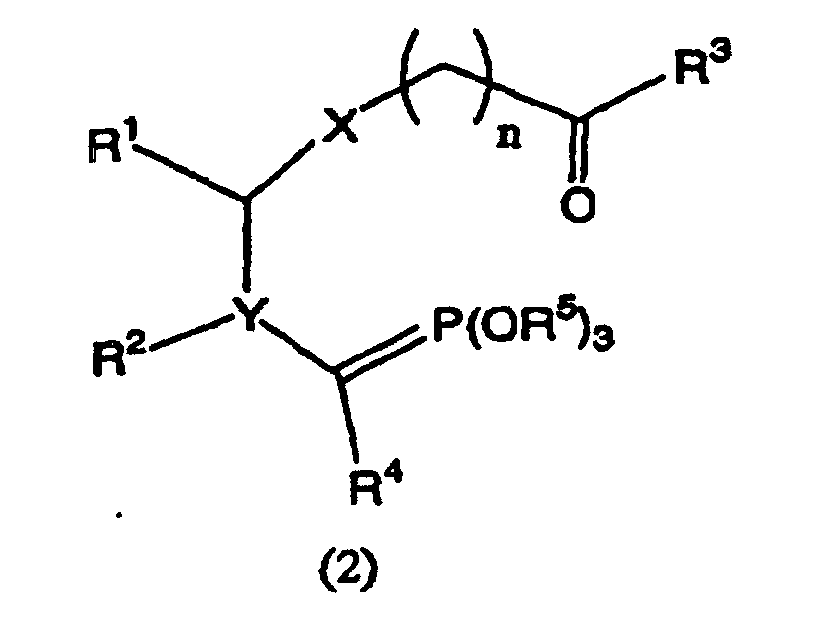
- the method of the present invention has the following steps: (A) reacting a compound of Formula (1) with an excess amount of a trialkyl phosphite to obtain a reaction mixture containing a compound of Formula (2); (B) removing unreacted trialkyl phosphite from the reaction mixture; and (C) heating the reaction mixture in the presence of a diluent.
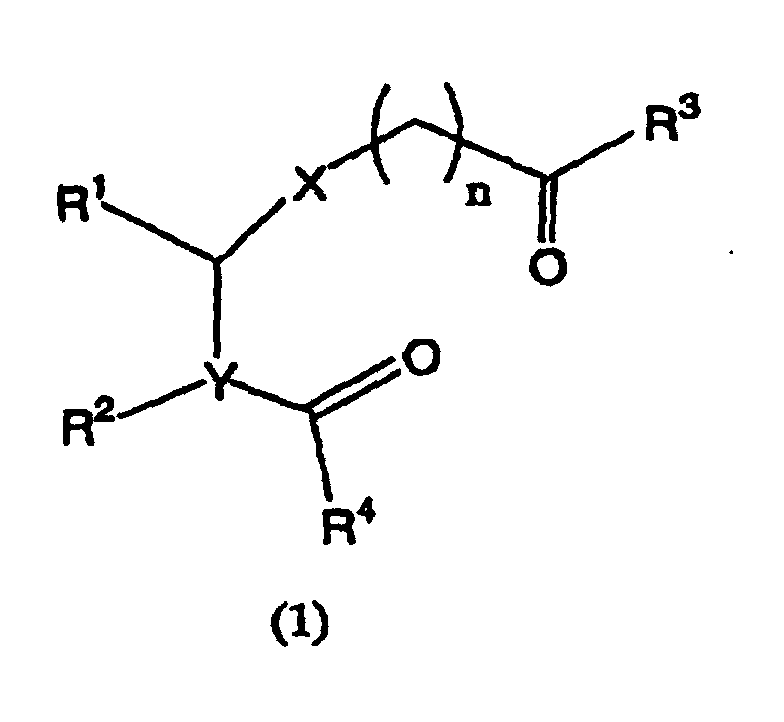
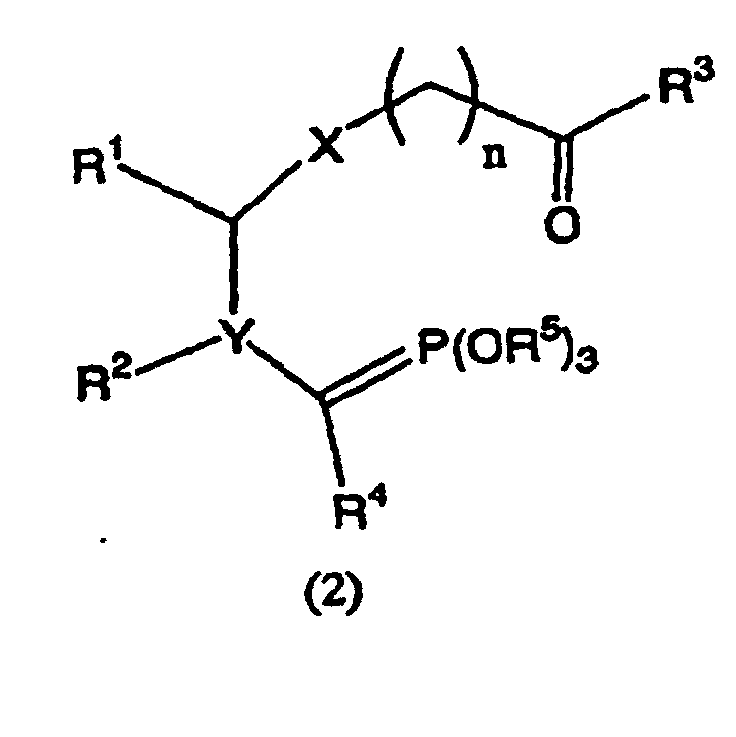
- a compound of Formula (1) is reacted with a trialkyl phosphite represented by the formula (R 5 O) 3 P to give a compound of Formula (2).
- X represents CH 2 , O or S, with S being particularly preferred.
- n 0 or 1, with 0 being particularly preferred.
- R 1 represents an optionally substituted alkyl group containing 1 to 10 carbon atoms.
- Examples of an alkyl group containing 1 to 10 carbon atoms defined for R 1 include, for example, a methyl group, an ethyl group, a n-propyl group, an isopropyl group, a n-butyl group, a sec-butyl group, an isobutyl group, a t-butyl group, a n-pentyl group, a neopentyl group, a n-hexyl group, an isohexyl group, a n-heptyl group, a n-octyl group and a n-decyl group.
- Examples of a substituent include a hydroxy group; a cyano group; a nitro group; an alkoxy group such as a methoxy group, an ethoxy group, a n-propoxy group, an isopropoxy group, a n-butoxy group or a t-butoxy group; a trialkylsilyloxy group such as a trimethylsilyloxy group, a t-butyldimethylsilyloxy group or a triethylsilyloxy group; a triarylsilyloxy group such as a triphenylsilyloxy group; an alkoxycarbonyloxy group such as a t-butoxycarbonyloxy group; an alkoxyalkoxy group such as a methoxymethoxy group or a 1-ethoxyethoxy group; an alkylthio group such as a methylthio group, an ethylthio group, a n-propylthio group or a but
- R 2 and R 3 each independently represent an alkyl group containing 1 to 6 carbon atoms, such as a methyl group, an ethyl group, a n-propyl group, a n-butyl group, an isopropyl group, a sec-butyl group, a t-butyl group, a n-pentyl group or a n-hexyl group; an alkenyl group containing 1 to 6 carbon atoms, such as a vinyl group, a 1-propenyl group, a 2-propenyl group, a 1-butenyl group, a 2-butenyl group, a 2-pentenyl group or a 2-hexenyl group; an optionally substituted phenyl group; an optionally substituted heterocyclic group; or an optionally substituted heteroylmethyl group.
- an alkyl group containing 1 to 6 carbon atoms such as a methyl group, an ethyl group, a
- heterocyclic ring in the above heterocyclic or heteroylmethyl group examples include 5- or 6-membered saturated or unsaturated heterocyclic rings containing 1 to 3 oxygen atoms, nitrogen atoms or sulfur atoms as ring member(s).
- Examples of a substituent attached to the above phenyl, heterocyclic or heteroylmethyl group include, for example, a halogen atom such as fluorine or chlorine; an alkyl group such as a methyl group or an ethyl group; an alkoxy group such as a methoxy group or an ethoxy group; a dialkylamino group such as a dimethylamino group; a cyano group; and a nitro group.
- a substituent attached to the above phenyl, heterocyclic or heteroylmethyl group include, for example, a halogen atom such as fluorine or chlorine; an alkyl group such as a methyl group or an ethyl group; an alkoxy group such as a methoxy group or an ethoxy group; a dialkylamino group such as a dimethylamino group; a cyano group; and a nitro group.
- R 3 is, for example, a saturated or unsaturated heterocyclic group containing one ring oxygen atom (e.g., tetrahydrofuran, tetrahydropyran, furan, pyran) or a saturated or unsaturated heterocyclic group containing two ring oxygen atoms (e.g., 1,3-dioxolane, 1,4-dioxane, 1,3-dioxane). More preferred is a 5- or 6-membered saturated heterocyclic group containing one or two ring oxygen atoms.
- a saturated or unsaturated heterocyclic group containing one ring oxygen atom e.g., tetrahydrofuran, tetrahydropyran, furan, pyran
- a saturated or unsaturated heterocyclic group containing two ring oxygen atoms e.g., 1,3-dioxolane, 1,4-dioxane, 1,3-dioxane.
- Heterocyclic groups particularly preferred as R 3 include saturated 5- or 6-membered heterocyclic groups containing one ring oxygen atom, as exemplified by tetrahydrofuran-2-yl, tetrahydrofuran-3-yl, tetrahydropyran-2-yl, 1,3-dioxolan-2-yl, 1,4-dioxan-2-yl, 1,3-dioxan-2-yl, tetrahydropyran-3-yl and tetrahydropyran-4-yl.
- R 4 represents an alkoxycarbonyl group containing 1 to 6 carbon atoms, such as a methoxycarbonyl group, an ethoxycarbonyl group, a n-propoxycarbonyl group, an isopropoxycarbonyl group, a n-butoxycarbonyl group, a sec-butoxycarbonyl group, a t-butoxycarbonyl group or a n-pentyloxycarbonyl group; a haloalkoxycarbonyl group containing 1 to 6 carbon atoms, such as a 2,2,2-trichloroethoxycarbonyl group; or an alkenyloxycarbonyl group containing 1 to 6 carbon atoms, such as a vinyloxycarbonyl group, a 1-propenyloxycarbonyl group, a 2-propenyloxycarbonyl group, a 1-butenyloxycarbonyl group, a 2-butenyloxycarbonyl group, a 2-pentenyloxycarbonyl group or
- Y represents CH or N, with N being particularly preferred.
- R 1 and R 2 may together form a carbocyclic ring containing 3 to 8 carbon atoms or a heterocyclic ring containing 2 to 7 carbon atoms.
- Examples of such a carbocyclic ring containing 3 to 8 carbon atoms include a cyclopropane ring, a cyclobutane ring, a cyclopentane ring, a cyclopentene ring, a cyclohexane ring, a cyclohexene ring, a benzene ring, a cycloheptane ring and a cyclooctane ring.
- heterocyclic ring containing 2 to 7 carbon atoms examples include an aziridine ring, an azetidine ring, a ⁇ -lactam ring, a ⁇ -lactam ring, a ⁇ -lactam ring, a pyrrole ring, a pyrrolidine ring and a piperidine ring.
- the compound of Formula (1) has optical isomers and stereoisomers based on its asymmetric carbon atom(s), all of which are intended to fall within the scope of the present invention. Moreover, all the reactions involved in the method of the present invention are intended to proceed without any configuration changes, so that racemization does not occur in principle.
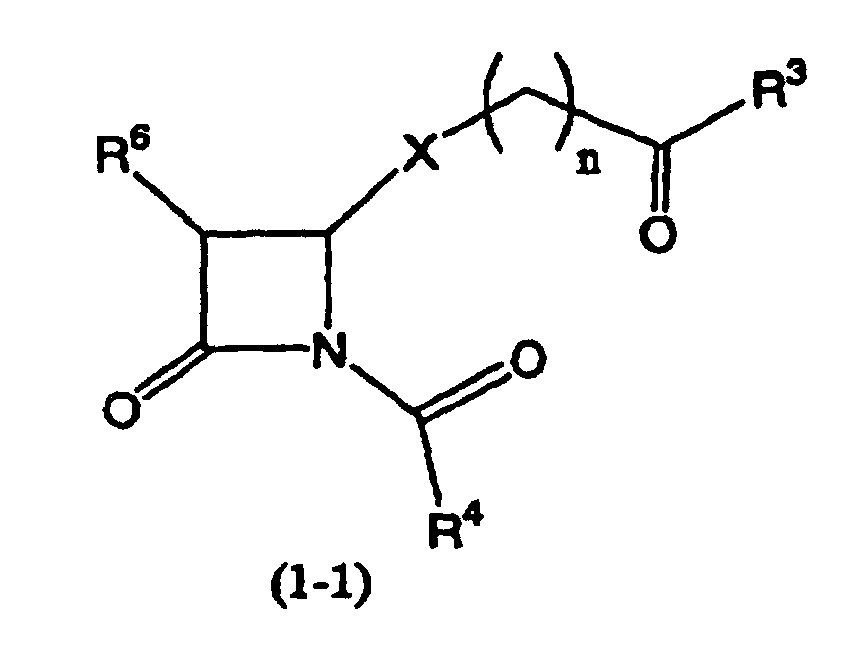
- a ⁇ -lactam compound of the following Formula (1-1) is particularly preferred for use in the method of the present invention.
- R 6 represents a hydroxyalkyl group whose hydroxy moiety is protected with a protecting group.
- the protecting group for hydroxy groups include a trialkylsilyl group, an aryldialkylsilyl group, a diarylalkylsilyl group, a triarylsilyl group, an alkyl group containing 1 to 6 carbon atoms which is substituted with an alkoxy group containing 1 to 6 carbon atoms, a triphenylmethyl group, and a tetrahydropyranyl group.
- R 6 include a trimethylsilyloxymethyl group, a 1-trimethylsilyloxyethyl group, a 1-trimethylsilyloxypropyl group, a t-butyldimethylsilyloxymethyl group, a 1-t-butyldimethylsilyloxyethyl group, a 1-t-butyldimethylsilyloxypropyl group, a phenyldimethylsilyloxymethyl group, a 1-phenyldimethylsilyloxyethyl group, a 1-phenyldimethylsilyloxyethyl group, a triethylsilyloxymethyl group, a 1-triethylsilyloxyethyl group, a 1-triethylsilyloxypropyl group, a methoxymethyl group, a 1-methoxyethyl group, a 1-methoxypropyl group, a 1-ethoxymethyl group, a 1-ethoxyethy
- a hydroxyalkyl group whose hydroxy moiety is protected with a trisubstituted silyl group because it is readily deprotected under neutral conditions. More preferred is a hydroxyalkyl group whose hydroxy moiety is protected with a t-butyldimethylsilyl group, even more preferred is a 1-(t-butyldimethylsilyloxy)ethyl group, and particularly preferred is a (R)-1-(t-butoxydimethylsilyloxy)ethyl group.
- the compound of the above Formula (1-1) has optical isomers based on its asymmetric carbon atoms and stereoisomers, all of which are intended to fall within the scope of the present invention.
- a compound that has the S-configuration at the 3-position carbon and the R-configuration at the 4-position carbon of the azetidinone ring is particularly preferred.
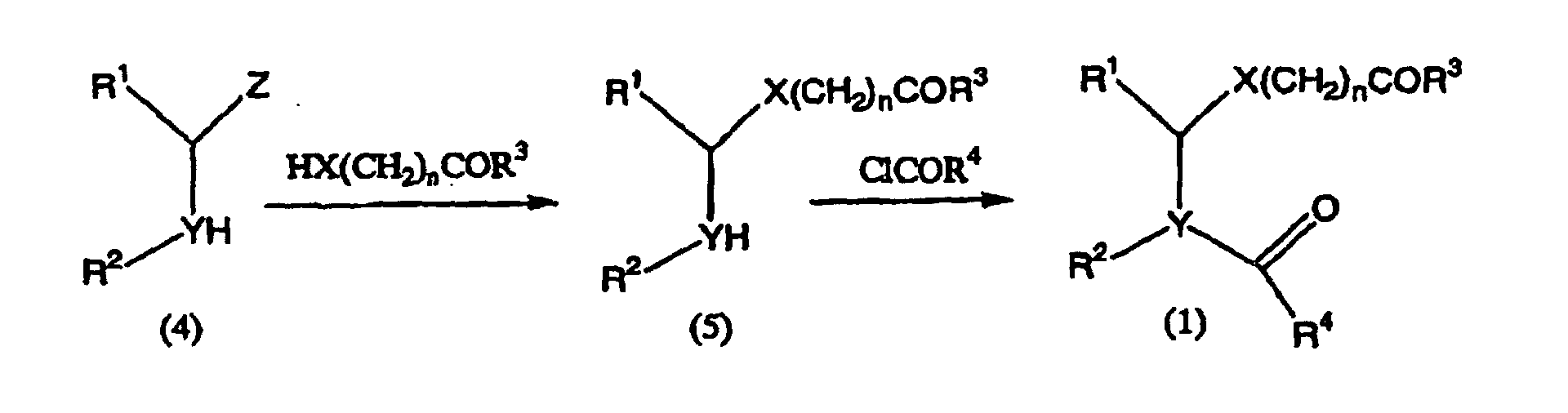
- the compound of the above Formula (1) can be prepared as follows, by way of example.
- Examples of a base used in the reactions for obtaining the compounds of Formulae (5) and (1) include metal hydroxides such as sodium hydroxide, potassium hydroxide, magnesium hydroxide and calcium hydroxide; carbonates such as sodium carbonate, potassium carbonate, magnesium carbonate and calcium carbonate; bicarbonates such as sodium bicarbonate and potassium bicarbonate; metal alkoxides such as sodium methoxide, sodium ethoxide, potassium ethoxide, magnesium ethoxide and potassium t-butoxide; and organic bases such as triethylamine, pyridine, lutidine and 1,8-diazabicyclo[5.4.0]undec-7-ene (DBU).
- metal hydroxides such as sodium hydroxide, potassium hydroxide, magnesium hydroxide and calcium hydroxide
- carbonates such as sodium carbonate, potassium carbonate, magnesium carbonate and calcium carbonate
- bicarbonates such as sodium bicarbonate and potassium bicarbonate
- metal alkoxides such as sodium methoxide, sodium e
- examples of a solvent used in the reactions for obtaining the compounds of Formulae (5) and (1) include water; alcohols such as methanol and ethanol; ketones such as acetone and methyl ethyl ketone; ethers such as diethyl ether, tetrahydrofuran and dioxane; halogenated hydrocarbons such as methylene chloride and chloroform; amides such as N,N-dimethylformamide; as well as acetonitrile and dimethyl sulfoxide.
- reaction mixture is extracted with a water-immiscible organic solvent.
- organic solvent is washed with water, dried and distilled off to give the compound of Formula (5) or (1).
- the compound of the above Formula (1) is a compound of Formula (1-1), it can be prepared as shown in the following reaction scheme (see JP 63-162694 A), by way of example.
- R 3 , R 4 , R 6 , X and n are as defined above.
- Z represents a leaving group such as a halogen atom (e.g., fluorine, chlorine, bromine, iodine), an acetoxy group, an arylsulfonyl group (e.g., a phenylsulfonyl group, a 4-methylphenylsulfonyl group) or a (halo)alkylsulfonyl group (e.g., a methylsulfonyl group, an ethylsulfonyl group, a trifluoromethylsulfonyl group).
- a halogen atom e.g., fluorine, chlorine, bromine, iodine
- an arylsulfonyl group e.g., a phenylsulfonyl group, a 4-methylphenylsulfonyl group
- reaction mixture is extracted with a water-immiscible organic solvent.
- organic solvent is washed with water, dried and distilled off to give the compound of Formula (5) or (1).
- the compound of Formula (4) which is used as a starting material, can be prepared as described in JP 61-207373 A, by way of example.
- R 5 represents an alkyl group containing 1 to 4 carbon atoms, such as methyl, ethyl, n-propyl, isopropyl or n-butyl.
- a preferred trialkyl phosphite include trimethyl phosphite, triethyl phosphite, tri-n-propyl phosphite and tri-n-butyl phosphite.
- triethyl phosphite is particularly preferred for use in the reaction because a target product will be obtained in high yield, as well as because of its easy availability and being easy to handle, etc.
- trialkyl phosphite may be used directly or may be purified by distillation or other techniques before use.
- the trialkyl phosphite used for this purpose may also be prepared in a known manner, for example, by reacting a phosphorus trihalide (e.g., phosphorus trichloride, phosphorus tribromide) with an alcohol represented by the formula R 5 OH (wherein R 5 is as defined above) in the presence of a tertiary amine or by treating a phosphorus trihalide with an alkoxide represented by the formula MOR 5 (wherein M represents an alkali metal or the like and R 5 is as defined above).
- a phosphorus trihalide e.g., phosphorus trichloride, phosphorus tribromide
- the trialkyl phosphite is preferably used in an excess amount in terms of obtaining a target product in high yield.
- the amount of the trialkyl phosphite used in the reaction preferably ranges from 2 to 5 moles, more preferably 4 to 5 moles, per mole of the compound of Formula (1).
- a reaction may be carried out without using a solvent or in the presence of an appropriate diluent, it is preferable to carry out the reaction without using a solvent because a target product will be obtained with high efficiency and in high yield.
- a diluent available for use include, for example, ethers such as tetrahydrofuran and dioxane; aromatic hydrocarbons such as benzene, toluene and xylene; and aliphatic hydrocarbons such as hexane and cyclohexane.
- the reaction temperature is 0°C to 100°C, preferably 20°C to 80°C. This reaction is exothermic.
- the reaction time will vary depending on the scale of the reaction, but it is usually several tens of minutes to several hours.
- unreacted trialkyl phosphite is removed from the reaction mixture obtained in Step II) above.
- the trialkyl phosphite is removed completely. If the trialkyl phosphite is not sufficiently removed and hence still remains in the reaction mixture, a target product cannot be obtained in high yield in the subsequent cyclization step.
- Procedures used for removal of the trialkyl phosphite are not limited in any way as long as the trialkyl phosphite can be removed from the reaction mixture while ensuring the stable existence (i.e., avoiding the decomposition) of the compound of Formula (2).
- a procedure preferably exemplified for removal of the trialkyl phosphite involves reducing the internal pressure of the vessel holding the reaction mixture and heating the vessel at a given temperature to distill off the trialkyl phosphite, a low-boiling product, from the reaction system.
- the procedure is preferably performed by stirring the reaction mixture. This procedure allows efficient and almost complete removal of the trialkyl phosphite from the reaction mixture.
- the reaction vessel used for the reaction with the trialkyl phosphite can be used continuously to hold the reaction mixture, but another vessel can also be provided for this purpose. In terms of work efficiency, it is preferable to use a reaction vessel capable of reducing pressure therein to ensure a continuous process of obtaining the compound of Formula (2) and removing the trialkyl phosphite.
- both the degree of vacuum and the heating temperature will vary depending on the type of trialkyl phosphite.
- the pressure inside the vessel is usually set to 0.01 to 10 kPa, preferably 0.01 to 5 kPa, while the heating temperature is usually 50°C to 80°C.
- the internal pressure may be set between 0.7 and 2 kPa and the reaction mixture may be heated at 50°C to 75°C to remove most part of unreacted triethyl phosphite, followed by heating at 75°C to 80°C under a vacuum of 0.7 kPa or below, thus ensuring efficient removal of unreacted triethyl phosphite from the reaction mixture.
- the heating time will vary depending on the scale of the reaction, but it is usually several tens of minutes to several hours, preferably 30 to 120 minutes.
- a part of the reaction mixture may be sampled and analyzed by a known means such as gas chromatography.
- the trialkyl phosphite removed from the reaction mixture can be collected through a condenser connected and attached to the vessel and may be provided again for the reaction after being purified, if necessary.
- an organic solvent which ensures homogeneous reaction.
- an organic solvent available for use include, for example, halogenated hydrocarbons such as methylene chloride, chloroform, carbon tetrachloride and 1,2-dichloroethane; aromatic hydrocarbons such as benzene, toluene, xylene, chlorobenzene and dichlorobenzene; ethers such as diethyl ether, tetrahydrofuran, dioxane, 1,2-dimethoxyethane and 1,2-diethoxyethane; and ketones such as acetone, methyl ethyl ketone, methyl isobutyl ketone, diethyl ketone and cyclohexanone.
- the reaction temperature ranges from 20°C to the boiling point of a solvent to be used.
- the reaction is usually completed in several tens of minutes to several tens of hours.
- isolation and purification may be performed according to standard procedures for synthetic organic chemistry to give a target product.
- the resulting reaction mixture may be directly provided for the subsequent reaction without any treatment.
- the structure of a target product can be determined, e.g., by measuring various spectra including 1 H-NMR, IR and MASS spectra.
- the starting material (3S,4R)-1-(allyloxy)oxoacetyl-3-((R)-1-t-butyldimethylsilyloxyethyl)-4-(2-tetrahydrofuranyl)carbonylthio-azetidin-2-one is a known substance (see, e.g., JP 63-162694 A).
- Step A Preparation of (3S,4R)-1-(allyloxycarbonyl)-triethoxyphosphanylidenemethyl-3-((R)-1-t-butyldimethylsilyloxyethyl)-4-((R)-2-tetrahydrofuranyl)carbonylthioazetidin-2-one (2-2)
- Triethyl phosphite (99.7 g, 0.6 mol) was charged into a 500 ml four-necked flask equipped with a thermometer, a stirring machine and a rectifying column.
- (3S,4R)-1-(Allyloxy)oxoacetyl-3-((R)-1-hydroxyethyl)-4-((R)-2-tetrahydrofuranyl)carbonylthio-azetidin-2-one (1-2) (70.7 g, 0.15 mol) was melted at 70°C and slowly added dropwise to the flask at 20°C to 40°C while stirring. After completion of the dropwise addition, the mixture was stirred for an additional 1.5 hours. The reaction mixture heated up to around 80°C.
- the reaction mixture was then heated in a vacuum to remove triethyl phosphite. Removal of triethyl phosphite was performed as follows. The internal pressure of the reaction vessel was set between 0.7 to 1.3 kPa and the reaction mixture was heated at 50°C to 70°C (150 minutes) to distill off most part of triethyl phosphite, followed by heating under conditions of 0.7 kPa and 75°C to 80°C (65 minutes).
- reaction mixture A part of the reaction mixture was sampled and analyzed by gas chromatography (GC) under the following conditions to determine whether triethyl phosphite was removed from the reaction mixture, indicating that the content of triethyl phosphite was below the detection limit.
- GC gas chromatography
- the yield of the reaction mixture was 114.6 g.
- Step C Cyclization of (3S,4R)-1-(allyloxycarbonyl)-triethoxyphosphanylidenemethyl-3-((R)-1-t-butyldimethylsilyloxyethyl)-4-((R)-2-tetrahydrofuranyl)carbonylthioazetidin-2-one (2-2)
- Example 2 The same procedure as shown in Example 1 was repeated, except that the reaction mixture obtained in Step B of Example 1 was evaporated at 1.3 kPa and at an internal temperature of 50°C to 70°C (215 minutes) to remove triethyl phosphite. Gas chromatography analysis was performed under the same conditions as used in Example 1, indicating that 5% by weight of triethyl phosphite remained in the reaction mixture to be provided for Step C.
- the resulting reaction product was analyzed by high performance liquid chromatography, indicating that the target compound (3-2) was obtained in only 84% yield over three steps A to C. Gas chromatography analysis indicated that structurally unidentified products were generated in substantial amounts.
- the yield of cyclization can be significantly improved when conventional processes simply include an additional simple step for removal of trialkyl phosphite from the reaction mixture, which step involves heating the reaction mixture at a given temperature in an increased vacuum.
Landscapes
- Chemical & Material Sciences (AREA)
- Organic Chemistry (AREA)
- Health & Medical Sciences (AREA)
- Life Sciences & Earth Sciences (AREA)
- Molecular Biology (AREA)
- Engineering & Computer Science (AREA)
- Biotechnology (AREA)
- Nitrogen And Oxygen Or Sulfur-Condensed Heterocyclic Ring Systems (AREA)
- Low-Molecular Organic Synthesis Reactions Using Catalysts (AREA)
- Hydrogenated Pyridines (AREA)
Abstract

Description

the step of heating the resulting mixture in a diluent,
wherein said method is characterized by having the step of removing unreacted trialkyl phosphite from the reaction mixture prior to the step of heating the reaction mixture in a diluent.




Claims (4)
- A method for preparing a cyclic compound of Formula (3):(wherein X represents CH2, O or S, Y represents CH or N, n represents 0 or 1, R1 represents an optionally substituted alkyl group containing 1 to 10 carbon atoms, R2 and R3 each independently represent an optionally substituted alkyl group containing 1 to 6 carbon atoms, an optionally substituted alkenyl group containing 1 to 6 carbon atoms, an optionally substituted phenyl group, an optionally substituted heterocyclic group or an optionally substituted heteroylmethyl group, and R4 represents an alkoxycarbonyl group containing 1 to 6 carbon atoms, a haloalkoxycarbonyl group containing 1 to 6 carbon atoms or an alkenyloxycarbonyl group containing 1 to 6 carbon atoms, provided that R1 and R2 may together form a carbocyclic ring containing 3 to 8 carbon atoms or a heterocyclic ring containing 2 to 7 carbon atoms), which comprises:
 wherein said method is characterized by having the step of removing unreacted trialkyl phosphite from the reaction mixture prior to the step of heating the reaction mixture in a diluent.the step of reacting a compound of Formula (1):(wherein X, Y, n, R1, R2 R3 and R4 are as defined above) with a trialkyl phosphite represented by the formula (R5O)3P (wherein R5 represents an alkyl group containing 1 to 4 carbon atoms) in an amount of 2 to 5 moles per mole of the compound to obtain a reaction mixture containing a compound of Formula (2):
 (wherein X, Y, n, R1, R2, R3, R4 and R5 are as defined above); and
 the step of heating the resulting mixture in a diluent,
 - The method for preparing a cyclic compound according to claim 1, wherein the step of removing unreacted trialkyl phosphite from the reaction mixture comprises reducing the internal pressure of the vessel holding the reaction mixture to 0.7 kPa or below and heating the vessel at 75°C to 80°C to distill off the trialkyl phosphite remaining in the reaction mixture.
- The method for preparing a cyclic compound according to claim 1 or 2, wherein the step of removing unreacted trialkyl phosphite from the reaction mixture comprises reducing the internal pressure of the vessel holding the reaction mixture to 0.7 to 2 kPa and heating the vessel at 50°C to 75°C to distill off low-boiling products, followed by reducing the internal pressure of the vessel to 0.7 kPa or below and heating at 75°C to 80°C to distill off the trialkyl phosphite remaining in the reaction mixture.
- The method for preparing a cyclic compound according to any one of claims 1 to 3, wherein the compound of Formula (1) is a compound of Formula (1-1):(wherein X, n, R3 and R4 are as defined above and R6 represents a hydroxyalkyl group whose hydroxy moiety is protected with a protecting group), the compound of Formula (2) is a compound of Formula (2-1):
 (wherein X, n, R3, R4 and R5 are as defined above), and the compound of Formula (3) is a β-lactam compound of Formula (3-1):
 (wherein R3, R4, R6, X and n are as defined above).
Applications Claiming Priority (3)
| Application Number | Priority Date | Filing Date | Title |
|---|---|---|---|
| JP2002086575 | 2002-03-26 | ||
| JP2002086575 | 2002-03-26 | ||
| PCT/JP2003/003737 WO2003080543A1 (en) | 2002-03-26 | 2003-03-26 | Process for producing cyclic compound |
Publications (3)
| Publication Number | Publication Date |
|---|---|
| EP1489061A1 true EP1489061A1 (en) | 2004-12-22 |
| EP1489061A4 EP1489061A4 (en) | 2007-04-11 |
| EP1489061B1 EP1489061B1 (en) | 2011-08-31 |
Family
ID=28449313
Family Applications (1)
| Application Number | Title | Priority Date | Filing Date |
|---|---|---|---|
| EP03715428A Expired - Lifetime EP1489061B1 (en) | 2002-03-26 | 2003-03-26 | Process for producing cyclic compound |
Country Status (8)
| Country | Link |
|---|---|
| US (1) | US7459551B2 (en) |
| EP (1) | EP1489061B1 (en) |
| JP (1) | JP4349913B2 (en) |
| KR (1) | KR100890883B1 (en) |
| CN (1) | CN1312086C (en) |
| AT (1) | ATE522521T1 (en) |
| AU (1) | AU2003227220A1 (en) |
| WO (1) | WO2003080543A1 (en) |
Family Cites Families (8)
| Publication number | Priority date | Publication date | Assignee | Title |
|---|---|---|---|---|
| GB8520631D0 (en) * | 1985-08-16 | 1985-09-25 | Hoechst Uk Ltd | Derivatives |
| JP2526046B2 (en) * | 1986-12-26 | 1996-08-21 | サントリー株式会社 | Penem derivative, its manufacturing method and its use |
| EP0297042A1 (en) * | 1987-06-23 | 1988-12-28 | Ciba-Geigy Ag | Substituted penem compounds |
| JPS6422880U (en) | 1987-07-30 | 1989-02-07 | ||
| EP0399228A1 (en) | 1989-04-29 | 1990-11-28 | Hoechst Aktiengesellschaft | Process for the preparation of penem compounds |
| GB9116236D0 (en) | 1991-07-27 | 1991-09-11 | Smithkline Beecham Plc | Novel compounds |
| JPH0757756B2 (en) | 1992-08-28 | 1995-06-21 | サントリー株式会社 | Penem derivative, production method and use thereof |
| EP0597401A3 (en) * | 1992-11-11 | 1995-07-26 | Takeda Chemical Industries Ltd | Production of penem. |
-
2003
- 2003-03-26 WO PCT/JP2003/003737 patent/WO2003080543A1/en not_active Ceased
- 2003-03-26 US US10/508,659 patent/US7459551B2/en not_active Expired - Lifetime
- 2003-03-26 AU AU2003227220A patent/AU2003227220A1/en not_active Abandoned
- 2003-03-26 JP JP2003578304A patent/JP4349913B2/en not_active Expired - Lifetime
- 2003-03-26 AT AT03715428T patent/ATE522521T1/en not_active IP Right Cessation
- 2003-03-26 EP EP03715428A patent/EP1489061B1/en not_active Expired - Lifetime
- 2003-03-26 CN CNB038120682A patent/CN1312086C/en not_active Expired - Lifetime
- 2003-03-26 KR KR1020047014811A patent/KR100890883B1/en not_active Expired - Lifetime
Also Published As
| Publication number | Publication date |
|---|---|
| CN1312086C (en) | 2007-04-25 |
| KR100890883B1 (en) | 2009-03-31 |
| ATE522521T1 (en) | 2011-09-15 |
| JPWO2003080543A1 (en) | 2005-07-21 |
| WO2003080543A1 (en) | 2003-10-02 |
| JP4349913B2 (en) | 2009-10-21 |
| CN1656046A (en) | 2005-08-17 |
| US7459551B2 (en) | 2008-12-02 |
| US20050209450A1 (en) | 2005-09-22 |
| EP1489061A4 (en) | 2007-04-11 |
| EP1489061B1 (en) | 2011-08-31 |
| KR20040097191A (en) | 2004-11-17 |
| AU2003227220A1 (en) | 2003-10-08 |
Similar Documents
| Publication | Publication Date | Title |
|---|---|---|
| Barluenga et al. | 1, 3-Amino alcohols from 4-amino-1-aza dienes. Diastereo-and enantioselective approach to the four diastereoisomers of the N-terminal amino acid component of nikkomycins B and BX | |
| EP3483161A1 (en) | Intermediates used to make entecavir | |
| SU1442071A3 (en) | Versions of method of producing derivatives of 4-acetoxy-3-oxyethyl-azetidi-2-non | |
| US5264443A (en) | 3-aryl oxazolidinone compounds and therapeutic use thereof | |
| JP5644917B2 (en) | Process for producing 3- (4-tetrahydropyranyl) -3-oxopropanoic acid alkyl compound and 4-acyltetrahydropyran | |
| US7459551B2 (en) | Method for preparing cyclic compounds | |
| Xiong et al. | Stereocontrolled synthesis of rosuvastatin calcium via iodine chloride-induced intramolecular cyclization | |
| KR20090070233A (en) | Synthetic Intermediates of Pyrrolylheptanoic Acid Compounds and Preparation Process Using Novel Intermediates | |
| JP5150501B2 (en) | Method for synthesizing HMG-CoA reductase inhibitor | |
| RU2130927C1 (en) | Method of synthesis of beta-methylcarbapenem intermediate compounds, intermediate compounds | |
| KR20130041792A (en) | Method for producing acyloxypyranone compound, method for producing alkyne compound, and method for producing dihydrofuran compound | |
| US7550608B2 (en) | Processes for the preparation of docetaxel | |
| US7667055B2 (en) | Processes for the production of polycyclic fused ring compounds | |
| EP0276993B1 (en) | Process for preparing azetidinones | |
| EP0801057B1 (en) | Process for producing optically active trans-vinyl sulfide alcohols | |
| KR20160126700A (en) | New Statin intermediate, the preparation of the same and the preparation of Rosuvastatin using the same | |
| EP0847989B1 (en) | Process for producing cyclohexylazetidinone | |
| JPH0267287A (en) | How to make penem | |
| EP0229384B1 (en) | Beta-lactam compounds and their production | |
| WO2001072704A1 (en) | AZETIDINONE DERIVATIVES, A PROCESS FOR THEIR PREPARATION AND A METHOD FOR PRODUCING 1-β-ALKYL AZETIDINONE USING THE SAME | |
| US5149835A (en) | Substituted mevalonolactones, and methods for stereoselective preparation thereof and desmethyl homologues thereof | |
| JP2922943B2 (en) | Imidazolidinone derivatives | |
| CA1273352A (en) | Intermediates useful in the preparation of hmg-coa reductase inhibitors | |
| JPH09278748A (en) | Process for producing N-substituted-β-lactam compound | |
| JPS62153289A (en) | 2,6-epoxy-2,4,5,6-tetrahydro-2h-naphthaceno(1,2-b)oxocin-9,12-dione derivative |
Legal Events
| Date | Code | Title | Description |
|---|---|---|---|
| PUAI | Public reference made under article 153(3) epc to a published international application that has entered the european phase |
Free format text: ORIGINAL CODE: 0009012 |
|
| 17P | Request for examination filed |
Effective date: 20040921 |
|
| AK | Designated contracting states |
Kind code of ref document: A1 Designated state(s): AT BE BG CH CY CZ DE DK EE ES FI FR GB GR HU IE IT LI LU MC NL PT RO SE SI SK TR |
|
| AX | Request for extension of the european patent |
Extension state: AL LT LV MK |
|
| RAP1 | Party data changed (applicant data changed or rights of an application transferred) |
Owner name: DAIICHI ASUBIO PHARMA CO., LTD. Owner name: NIPPON SODA CO., LTD. |
|
| A4 | Supplementary search report drawn up and despatched |
Effective date: 20070313 |
|
| RIC1 | Information provided on ipc code assigned before grant |
Ipc: C07D 477/14 20060101ALI20070302BHEP Ipc: C07B 37/10 20060101ALI20070302BHEP Ipc: C07D 503/02 20060101ALI20070302BHEP Ipc: C07D 505/02 20060101ALI20070302BHEP Ipc: C07D 499/04 20060101ALI20070302BHEP Ipc: C07D 403/12 20060101AFI20070302BHEP Ipc: C07D 487/04 20060101ALI20070302BHEP Ipc: C07D 501/02 20060101ALI20070302BHEP Ipc: C07F 7/18 20060101ALI20070302BHEP |
|
| RAP1 | Party data changed (applicant data changed or rights of an application transferred) |
Owner name: NIPPON SODA CO., LTD. Owner name: ASUBIO PHARMA CO., LTD. |
|
| 17Q | First examination report despatched |
Effective date: 20070905 |
|
| RAP1 | Party data changed (applicant data changed or rights of an application transferred) |
Owner name: NIPPON SODA CO., LTD. |
|
| GRAP | Despatch of communication of intention to grant a patent |
Free format text: ORIGINAL CODE: EPIDOSNIGR1 |
|
| GRAS | Grant fee paid |
Free format text: ORIGINAL CODE: EPIDOSNIGR3 |
|
| GRAA | (expected) grant |
Free format text: ORIGINAL CODE: 0009210 |
|
| AK | Designated contracting states |
Kind code of ref document: B1 Designated state(s): AT BE BG CH CY CZ DE DK EE ES FI FR GB GR HU IE IT LI LU MC NL PT RO SE SI SK TR |
|
| REG | Reference to a national code |
Ref country code: GB Ref legal event code: FG4D Ref country code: CH Ref legal event code: EP |
|
| REG | Reference to a national code |
Ref country code: IE Ref legal event code: FG4D |
|
| REG | Reference to a national code |
Ref country code: NL Ref legal event code: T3 |
|
| REG | Reference to a national code |
Ref country code: DE Ref legal event code: R096 Ref document number: 60338254 Country of ref document: DE Effective date: 20111103 |
|
| REG | Reference to a national code |
Ref country code: SE Ref legal event code: TRGR |
|
| PG25 | Lapsed in a contracting state [announced via postgrant information from national office to epo] |
Ref country code: FI Free format text: LAPSE BECAUSE OF FAILURE TO SUBMIT A TRANSLATION OF THE DESCRIPTION OR TO PAY THE FEE WITHIN THE PRESCRIBED TIME-LIMIT Effective date: 20110831 |
|
| REG | Reference to a national code |
Ref country code: AT Ref legal event code: MK05 Ref document number: 522521 Country of ref document: AT Kind code of ref document: T Effective date: 20110831 |
|
| PG25 | Lapsed in a contracting state [announced via postgrant information from national office to epo] |
Ref country code: CY Free format text: LAPSE BECAUSE OF FAILURE TO SUBMIT A TRANSLATION OF THE DESCRIPTION OR TO PAY THE FEE WITHIN THE PRESCRIBED TIME-LIMIT Effective date: 20110831 Ref country code: AT Free format text: LAPSE BECAUSE OF FAILURE TO SUBMIT A TRANSLATION OF THE DESCRIPTION OR TO PAY THE FEE WITHIN THE PRESCRIBED TIME-LIMIT Effective date: 20110831 Ref country code: SI Free format text: LAPSE BECAUSE OF FAILURE TO SUBMIT A TRANSLATION OF THE DESCRIPTION OR TO PAY THE FEE WITHIN THE PRESCRIBED TIME-LIMIT Effective date: 20110831 Ref country code: GR Free format text: LAPSE BECAUSE OF FAILURE TO SUBMIT A TRANSLATION OF THE DESCRIPTION OR TO PAY THE FEE WITHIN THE PRESCRIBED TIME-LIMIT Effective date: 20111201 |
|
| PG25 | Lapsed in a contracting state [announced via postgrant information from national office to epo] |
Ref country code: BE Free format text: LAPSE BECAUSE OF FAILURE TO SUBMIT A TRANSLATION OF THE DESCRIPTION OR TO PAY THE FEE WITHIN THE PRESCRIBED TIME-LIMIT Effective date: 20110831 |
|
| PG25 | Lapsed in a contracting state [announced via postgrant information from national office to epo] |
Ref country code: SK Free format text: LAPSE BECAUSE OF FAILURE TO SUBMIT A TRANSLATION OF THE DESCRIPTION OR TO PAY THE FEE WITHIN THE PRESCRIBED TIME-LIMIT Effective date: 20110831 Ref country code: CZ Free format text: LAPSE BECAUSE OF FAILURE TO SUBMIT A TRANSLATION OF THE DESCRIPTION OR TO PAY THE FEE WITHIN THE PRESCRIBED TIME-LIMIT Effective date: 20110831 |
|
| PG25 | Lapsed in a contracting state [announced via postgrant information from national office to epo] |
Ref country code: EE Free format text: LAPSE BECAUSE OF FAILURE TO SUBMIT A TRANSLATION OF THE DESCRIPTION OR TO PAY THE FEE WITHIN THE PRESCRIBED TIME-LIMIT Effective date: 20110831 Ref country code: PT Free format text: LAPSE BECAUSE OF FAILURE TO SUBMIT A TRANSLATION OF THE DESCRIPTION OR TO PAY THE FEE WITHIN THE PRESCRIBED TIME-LIMIT Effective date: 20120102 Ref country code: RO Free format text: LAPSE BECAUSE OF FAILURE TO SUBMIT A TRANSLATION OF THE DESCRIPTION OR TO PAY THE FEE WITHIN THE PRESCRIBED TIME-LIMIT Effective date: 20110831 |
|
| PG25 | Lapsed in a contracting state [announced via postgrant information from national office to epo] |
Ref country code: DK Free format text: LAPSE BECAUSE OF FAILURE TO SUBMIT A TRANSLATION OF THE DESCRIPTION OR TO PAY THE FEE WITHIN THE PRESCRIBED TIME-LIMIT Effective date: 20110831 |
|
| PLBE | No opposition filed within time limit |
Free format text: ORIGINAL CODE: 0009261 |
|
| STAA | Information on the status of an ep patent application or granted ep patent |
Free format text: STATUS: NO OPPOSITION FILED WITHIN TIME LIMIT |
|
| 26N | No opposition filed |
Effective date: 20120601 |
|
| REG | Reference to a national code |
Ref country code: DE Ref legal event code: R097 Ref document number: 60338254 Country of ref document: DE Effective date: 20120601 |
|
| PG25 | Lapsed in a contracting state [announced via postgrant information from national office to epo] |
Ref country code: MC Free format text: LAPSE BECAUSE OF NON-PAYMENT OF DUE FEES Effective date: 20120331 |
|
| REG | Reference to a national code |
Ref country code: CH Ref legal event code: PL |
|
| PG25 | Lapsed in a contracting state [announced via postgrant information from national office to epo] |
Ref country code: CH Free format text: LAPSE BECAUSE OF NON-PAYMENT OF DUE FEES Effective date: 20120331 Ref country code: LI Free format text: LAPSE BECAUSE OF NON-PAYMENT OF DUE FEES Effective date: 20120331 |
|
| PG25 | Lapsed in a contracting state [announced via postgrant information from national office to epo] |
Ref country code: ES Free format text: LAPSE BECAUSE OF FAILURE TO SUBMIT A TRANSLATION OF THE DESCRIPTION OR TO PAY THE FEE WITHIN THE PRESCRIBED TIME-LIMIT Effective date: 20111211 |
|
| PG25 | Lapsed in a contracting state [announced via postgrant information from national office to epo] |
Ref country code: BG Free format text: LAPSE BECAUSE OF FAILURE TO SUBMIT A TRANSLATION OF THE DESCRIPTION OR TO PAY THE FEE WITHIN THE PRESCRIBED TIME-LIMIT Effective date: 20111130 |
|
| PG25 | Lapsed in a contracting state [announced via postgrant information from national office to epo] |
Ref country code: TR Free format text: LAPSE BECAUSE OF FAILURE TO SUBMIT A TRANSLATION OF THE DESCRIPTION OR TO PAY THE FEE WITHIN THE PRESCRIBED TIME-LIMIT Effective date: 20110831 |
|
| PG25 | Lapsed in a contracting state [announced via postgrant information from national office to epo] |
Ref country code: LU Free format text: LAPSE BECAUSE OF NON-PAYMENT OF DUE FEES Effective date: 20120326 |
|
| PG25 | Lapsed in a contracting state [announced via postgrant information from national office to epo] |
Ref country code: HU Free format text: LAPSE BECAUSE OF FAILURE TO SUBMIT A TRANSLATION OF THE DESCRIPTION OR TO PAY THE FEE WITHIN THE PRESCRIBED TIME-LIMIT Effective date: 20030326 |
|
| REG | Reference to a national code |
Ref country code: FR Ref legal event code: PLFP Year of fee payment: 14 |
|
| REG | Reference to a national code |
Ref country code: FR Ref legal event code: PLFP Year of fee payment: 15 |
|
| REG | Reference to a national code |
Ref country code: FR Ref legal event code: PLFP Year of fee payment: 16 |
|
| PGFP | Annual fee paid to national office [announced via postgrant information from national office to epo] |
Ref country code: IE Payment date: 20220209 Year of fee payment: 20 Ref country code: GB Payment date: 20220203 Year of fee payment: 20 Ref country code: DE Payment date: 20220203 Year of fee payment: 20 |
|
| PGFP | Annual fee paid to national office [announced via postgrant information from national office to epo] |
Ref country code: SE Payment date: 20220210 Year of fee payment: 20 Ref country code: NL Payment date: 20220215 Year of fee payment: 20 Ref country code: IT Payment date: 20220210 Year of fee payment: 20 Ref country code: FR Payment date: 20220209 Year of fee payment: 20 |
|
| REG | Reference to a national code |
Ref country code: DE Ref legal event code: R071 Ref document number: 60338254 Country of ref document: DE |
|
| REG | Reference to a national code |
Ref country code: NL Ref legal event code: MK Effective date: 20230325 |
|
| REG | Reference to a national code |
Ref country code: GB Ref legal event code: PE20 Expiry date: 20230325 |
|
| REG | Reference to a national code |
Ref country code: IE Ref legal event code: MK9A |
|
| REG | Reference to a national code |
Ref country code: SE Ref legal event code: EUG |
|
| PG25 | Lapsed in a contracting state [announced via postgrant information from national office to epo] |
Ref country code: GB Free format text: LAPSE BECAUSE OF EXPIRATION OF PROTECTION Effective date: 20230325 |
|
| PG25 | Lapsed in a contracting state [announced via postgrant information from national office to epo] |
Ref country code: IE Free format text: LAPSE BECAUSE OF EXPIRATION OF PROTECTION Effective date: 20230326 |