EP1487195A1 - Captured image display device and captured image display method - Google Patents
Captured image display device and captured image display method Download PDFInfo
- Publication number
- EP1487195A1 EP1487195A1 EP03705400A EP03705400A EP1487195A1 EP 1487195 A1 EP1487195 A1 EP 1487195A1 EP 03705400 A EP03705400 A EP 03705400A EP 03705400 A EP03705400 A EP 03705400A EP 1487195 A1 EP1487195 A1 EP 1487195A1
- Authority
- EP
- European Patent Office
- Prior art keywords
- image data
- graphic memory
- transfer
- lcd module
- image
- Prior art date
- Legal status (The legal status is an assumption and is not a legal conclusion. Google has not performed a legal analysis and makes no representation as to the accuracy of the status listed.)
- Granted
Links
Images




Classifications
-
- H—ELECTRICITY
- H04—ELECTRIC COMMUNICATION TECHNIQUE
- H04N—PICTORIAL COMMUNICATION, e.g. TELEVISION
- H04N5/00—Details of television systems
- H04N5/222—Studio circuitry; Studio devices; Studio equipment
- H04N5/262—Studio circuits, e.g. for mixing, switching-over, change of character of image, other special effects ; Cameras specially adapted for the electronic generation of special effects
- H04N5/2621—Cameras specially adapted for the electronic generation of special effects during image pickup, e.g. digital cameras, camcorders, video cameras having integrated special effects capability
-
- H—ELECTRICITY
- H04—ELECTRIC COMMUNICATION TECHNIQUE
- H04N—PICTORIAL COMMUNICATION, e.g. TELEVISION
- H04N23/00—Cameras or camera modules comprising electronic image sensors; Control thereof
-
- H—ELECTRICITY
- H04—ELECTRIC COMMUNICATION TECHNIQUE
- H04M—TELEPHONIC COMMUNICATION
- H04M1/00—Substation equipment, e.g. for use by subscribers
- H04M1/72—Mobile telephones; Cordless telephones, i.e. devices for establishing wireless links to base stations without route selection
- H04M1/724—User interfaces specially adapted for cordless or mobile telephones
- H04M1/72403—User interfaces specially adapted for cordless or mobile telephones with means for local support of applications that increase the functionality
- H04M1/72427—User interfaces specially adapted for cordless or mobile telephones with means for local support of applications that increase the functionality for supporting games or graphical animations
-
- H—ELECTRICITY
- H04—ELECTRIC COMMUNICATION TECHNIQUE
- H04N—PICTORIAL COMMUNICATION, e.g. TELEVISION
- H04N23/00—Cameras or camera modules comprising electronic image sensors; Control thereof
- H04N23/60—Control of cameras or camera modules
- H04N23/63—Control of cameras or camera modules by using electronic viewfinders
-
- H—ELECTRICITY
- H04—ELECTRIC COMMUNICATION TECHNIQUE
- H04N—PICTORIAL COMMUNICATION, e.g. TELEVISION
- H04N5/00—Details of television systems
- H04N5/76—Television signal recording
- H04N5/91—Television signal processing therefor
- H04N5/93—Regeneration of the television signal or of selected parts thereof
-
- H—ELECTRICITY
- H04—ELECTRIC COMMUNICATION TECHNIQUE
- H04M—TELEPHONIC COMMUNICATION
- H04M2250/00—Details of telephonic subscriber devices
- H04M2250/52—Details of telephonic subscriber devices including functional features of a camera
Definitions
- the present invention relates to a photographed image display device and a photographed image display method which are used, for example, in digital cameras and mobile telephones with an image display function.
- photographed image display devices using a semiconductor photodetector such as a Charge Coupled Device (CCD) for converting light into electrical signals have rapidly become widespread.
- CCD Charge Coupled Device
- Such photographed image display devices include digital cameras, and mobile communications terminals such as mobile telephones and Personal Digital Assistants (PDAs) equipped with a digital camera.
- PDAs Personal Digital Assistants
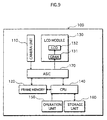
- Fig. 9 is a functional block diagram illustrating an example construction of a conventional photographed image display device 100.
- the photographed image display device 100 is constituted by a camera unit 110, a frame memory 120, a liquid crystal display (LCD) module 130, a CPU 140, an operation unit 150, a storage unit 160, and an Application Specific Integrated Circuit (ASIC) 170.
- a camera unit 110 a frame memory 120
- a liquid crystal display (LCD) module 130 a CPU 140
- an operation unit 150 a storage unit 160
- an Application Specific Integrated Circuit (ASIC) 170 ASIC
- the camera unit 110 photographs an obj ect, and sequentially outputs image data obtained by the photographing (hereinafter referred to as photographed image data) to the ASIC 170.
- to photograph an object represents a process of forming an image of the object on the light-receiving surface of a semiconductor photodetector through a lens of a camera and converting the formed image into image data.
- the frame memory 120 temporarily stores photographed image data transferred from the ASIC 170.
- the LCD module 130 includes a graphic Random Access Memory (GRAM) 131, and an LCD 132. Photographed image data input to the LCD module 130 from the ASIC 170 is displayed on the LCD 132.
- GRAM graphic Random Access Memory
- the GRAM 131 temporarily stores photographed image data input from the ASIC 170.
- the LCD 132 displays the photographed image data.
- the CPU 140 receives a user's instruction input through the operation unit 150, and issues an instruction corresponding to the user's instruction to an appropriate constituent. For example, when receiving a photographing start instruction from a user, the CPU 140 instructs the ASIC 170 to execute a photographing operation. When receiving a photographed image storage instruction, the CPU 140 reads the photographed image data stored in the frame memory 120, and stores the photographed image data in the storage unit 160.
- the operation unit 150 generates a corresponding instruction signal, when receiving the user' s instruction, and outputs the generated instruction signal to the CPU 140.
- the storage unit 160 stores photographed image data input by the CPU 140.
- the ASIC 170 controls the photographing operation in the following manner.
- the CPU 140 instructs the ASIC 170 to execute the photographing operation
- the ASIC 170 receives photographed image data output from the camera unit 110.
- the ASIC 170 performs image processing (e.g. color correction) on the photographed image data, and then transfers the photographed image data to the frame memory 120.
- the ASIC 170 reads the photographed image data from the frame memory 120 to output the photographed image data to the LCD module 130.
- this photographed image display device 100 can photograph an image of a desired object, and store the photographed image.
- the conventional photographed image display device 100 requires the frame memory 120 as a buffer memory, to enable photographed image data to be retrieved as needed in response to the photographed image storage instruction from the user.
- the object can be achieved by a photographed image display device including: an LCD module including a graphic memory operable to store image data and an LCD operable to display an image based on the image data stored in the graphic memory; a camera operable to form an optical image of an object, convert the formed optical image into image data, and output the image data sequentially; a transfer unit operable to receive the image data output from the camera and transfer the image data to the graphic memory; a storage medium operable to store image data; a storage instruction receiving unit operable to receive a storage instruction to store the image data into the storage medium; a judging unit operable to judge whether the transfer of the image data from the transfer unit to the graphic memory has been completed; and a storing unit operable to, when the transfer has been completed, read the image data from the graphic memory according to the storage instruction, and store the read image data into the storage medium.
- an LCD module including a graphic memory operable to store image data and an LCD operable to display an image based on the image data stored in the graphic memory; a camera operable to form
- a photographed image display method for a photographed image display device including (i) an LCD module including a graphic memory for storing image data and an LCD for displaying an image based on the image data stored in the graphic memory and (ii) a storage medium for storing image data.
- the photographed image display method includes:.a photographing step of forming an optical image of an object, converting the formed optical image into image data, and outputting the image data sequentially; a transfer step of receiving the image data output in the photographing step and transferring the image data to the graphic memory; a storage instruction receiving step of receiving a storage instruction to store the image data into the storage medium; a judging step of judging whether the transfer of the image data to the graphic memory has been completed; and a storing step of, when the transfer has been completed, reading the image data from the graphic memory according to the storage instruction, and storing the read image data into the storage medium.
- the photographed image display device includes: an LCD module including a graphic memory operable to store image data and an LCD operable to display an image based on the image data stored in the graphic memory; a camera operable to form an optical image of an object, convert the formed optical image into image data, and output the image data sequentially; a transfer unit operable to receive the image data output from the camera and transfer the image data to the graphic memory; a storage medium operable to store image data; a storage instruction receiving unit operable to receive a storage instruction to store the image data into the storage medium; a judging unit operable to judge whether the transfer of the image data from the transfer unit to the graphic memory has been completed; and a storing unit operable to, when the transfer has been completed, read the. image data from the graphic memory according to the storage instruction, and store the read image data into the storage medium.
- an LCD module including a graphic memory operable to store image data and an LCD operable to display an image based on the image data stored in the graphic memory; a camera operable to form an optical image of an object
- a photographed image display program used for a photographed image display device including (i) an LCD module having a graphic memory for storing image data and an LCD for displaying an image based on the image data stored in the graphic memory and (ii) a storage medium for storing image data.
- the photographed image display program includes: a photographing step of forming an optical image of an object, converting the formed optical image into image data, and outputting the image data sequentially; a transfer step of receiving the image data output in the photographing step and transferring the image data to the graphic memory; a storage instruction receiving step of receiving a storage instruction to store the image data into the storage medium; a judging step of. judging whether the transfer of the image data to the graphic memory has been completed; and a storing step of, when the transfer has been completed, reading the image data from the graphic memory according to the storage instruction, and storing the read image data into the storage medium.
- the image data obtained by photographing the object i.e. photographed image data
- the photographed image data is retrieved directly from the graphicmemory in the LCDmodule in response to a storage instruction from a user, to be stored in the storing medium. Therefore, the photographed image data can be stored in the storing medium, without using a buffer memory such as a frame memory for storing photographed image data.
- the photographed image display device can have a simpler construction than in the related art.
- a photographed image display device including: a first LCD module and a second LCD module which each include a graphic memory operable to store image data and an LCD operable to display an image based on the image data stored in the graphic memory; a camera operable to form an optical image of an obj ect, convert the formed optical image into image data, and output the image data sequentially; a first transfer unit operable to receive the image data output from the camera and transfer the image data to the graphic memory in the first LCD module; a storage medium prestoring frame image data; a judging unit operable to judge whether the transfer of the image data from the first transfer unit to the graphic memory in the first LCD module has been completed; and a second transfer unit operable to, when the transfer has been completed, read the image data from the graphic memory in the first LCD module, combine the read image data and the frame image data so as to generate composite image data, andtransfer the composite image data to the graphic memory in the second LCD module.
- a photographed image display method for a photographed image display device including (i) a first LCD module and a second LCD module each including a graphic memory for temporarily storing image data and an LCD for displaying the image data, and (ii) a storage medium prestoring frame image data.
- the photographed image display method includes: a photographing step of forming an optical image of an object, converting the formed optical image into image data, and outputting the image data sequentially; a first transfer step of receiving the image data output in the photographing step and transferring the image data to the graphic memory in the first LCD module; a judging step of judging whether the transfer of the image data to the graphic memory in the first LCD module has been completed; and a second transfer step of, when the transfer has been completed, reading the image data from the graphic memory in the first LCD module, combining the read image data and the frame image data so as to generate composite image data, and transferring the. composite image data to the graphic memory in the second LCD module.
- the photographed image display device includes: a first LCD module and a second LCD module which each include a graphic memory operable to store image data and an LCD operable to display an image based on the image data stored in the graphic memory; a camera operable to form an optical image of an object, convert the formed optical image into image data, and output the image data sequentially; a first transfer unit operable to receive the image data output from the camera and transfer the image data to the graphic memory in the first LCD module; a storage medium prestoring frame image data; a judging unit operable to judge whether the transfer of the image data from the first transfer unit to the graphic memory in the first LCD module has been completed; and a second transfer unit operable to, when the transfer has been completed, read the image data from the graphic memory in the first LCD module, combine the read image data and the frame image data so as to generate composite image data, and transfer the composite image data to the graphic memory in the second LCD module.
- a photographed image display program used for a photographed image display device including (i) a first LCD module and a second LCD module each having a graphic memory for temporarily storing image data and an LCD for displaying the image data, and (ii) a storage medium prestoring frame image data.
- the photographed image display program includes: a photographing step of forming an optical image of an object, converting the formed optical image into image data, and outputting the image data sequentially; a first transfer step of receiving the image data output in the photographing step and transferring the image data to the graphic memory in the first LCD module; a judging step of judging whether the transfer of the image data to the graphic memory in the first LCD module has been completed; and a second transfer step of, when the transfer has been completed, reading the image data from the graphic memory in the first LCD module, combining the read image data and the frame image data so as to generate composite image data, and transferring the composite image data to the graphic memory in the second LCD module.
- the image data obtained by photographing the object i.e. photographed image data
- the composite image data is generated by combining the retrieved image data and the frame image data stored in the storage medium.
- the composite image data is transferred to the graphic memory in the second LCD module, so as to be displayed on the LCD in the second LCD module.
- a composite image for the photographed object can be displayed on the LCD without using a buffer memory.
- a photographed image display device including: a first LCD module and a second LCD module which each include a graphic memory operable to store image data and an LCD operable to display an image based on the image data stored in the graphic memory; a camera operable to form an optical image of an object, convert the formed optical image into image data, and output the image data sequentially; a first transfer unit operable to receive the image data output from the camera and transfer the image data to the graphic memory in the first LCD module; a storage medium prestoring frame image data; a judging unit operable to judge whether the transfer of the image data from the first transfer unit to the graphic memory in the first LCD module has been completed; second transfer unit operable to, when the transfer has been completed, read the image data from the graphic memory in the first LCD module, combine the read image data and the frame image data so as to generate composite image data, and transfer the composite image data to the graphic memory in the second LCD module; a storage instruction receiving unit operable to receive a storage instruction to store the composite image data into the storage medium
- a photographed image display device includes: an LCDmodule including a graphicmemory operable to store image data and an LCD operable to display an image based on the image data stored in the graphic memory; a camera operable to form an optical image of an object, convert the formed optical image into image data, and output the image data sequentially; and a storage medium operable to store image data.
- the image data sequentially output from the camera is transferred to the graphic memory.
- the photographed image display device judges whether the trans fer of the image data to the graphic memory has been completed. When the transfer has been completed, the photographed image display device reads the image data from the graphic memory, and stores the read image data into the storage medium.
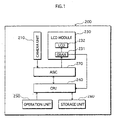
- Fig. 1 illustrates a construction of a photographed image display device 200 relating to the first embodiment.
- the photographed image display device 200 is constituted by a camera unit 210, an LCD module 230, a CPU 240, an operation unit 250, a storage unit 260, and an ASIC 270.
- the camera unit 210 includes a camera such as a CCD camera and a complementary metal oxide semiconductor (CMOS) camera.
- CMOS complementary metal oxide semiconductor
- the camera unit 210 cyclically repeats the following operations (1) to (4).
- the LCD module 230 includes a GRAM 231 and an LCD 232.
- the LCD module 230 displays a photographed image on the LCD 232 based on photographed image data transferred from the ASIC 270.
- the GRAM 231 temporarily stores photographed image data that is transferred from the ASIC 270.
- photographed image data that has been stored in the GRAM 231 is overwritten with the new photographed image data.
- the LCD 232 displays a photographed image based on photographed image data stored in the GRAM 231.
- the CPU 240 receives a user's instruction through the operation unit 250. Furthermore, the CPU 240 issues an instruction corresponding to the received user's instruction to an appropriate component of the photographed image display device 200, or executes an operation corresponding to the received user's instruction. For example, when receiving a photographing operation executing instruction from a user, the CPU 240 instructs the ASIC 270 to perform a photographing operation. When receiving a photographing operation end instruction, the CPU 240 instructs the ASIC 270 to end the photographing operation. When receiving a photographed image storage instruction, the CPU 240 performs a photographed image data storage operation. In detail, when transfer of photographed image data from the ASIC 270 to the GRAM 231 is completed, the CPU 240 reads the photographed image data from the GRAM 231, and stores the photographed image data in the storage unit 260.
- the CPU 240 judges whether the transfer of the photographed image data from the ASIC 270 to the GRAM 231 has been completed or not, with reference to a value of a flag shown by the ASIC 270. Specifically speaking, when the value of the flag is set to one, the CPU 240 judges that the transfer is occurring. When the value of the flag is set to zero, the CPU 240 judges that the transfer has been completed.
- the photographing operation executing instruction is a user's instruction to display a photographed image on the LCD module 230 based on photographed image data obtained by the camera unit 210.
- the photographed image storage instruction is a user's instruction to store photographed image data obtained using the camera unit 210, in the storage unit 260.
- the photographing operation end instruction is a user's instruction to end the photographing operation.
- the photographing operation indicates that a photographed image is displayed on the LCD module 230 based on photographed image data obtained by the camera unit 210.
- the operation unit 250 has a key input unit (not illustrated) for receiving a user's instruction.
- the operation unit 250 generates an instruction signal corresponding to a key input, and outputs the generated instruction signal to the CPU 240.
- the storage unit 260 stores photographed image data input by the CPU 240.
- the ASIC 270 is an integrated circuit (IC) specifically designed to be used for the photographing operation.
- the ASIC 270 is, for example, constituted by a processor, a memory, an input/output circuit, an interface circuit, a communication circuit and the like.
- the ASIC 270 controls the photographing operation.
- the CPU 240 instructs the ASIC 270 to execute the photographing operation
- the ASIC 270 receives photographed image data that is output from the camera unit 210, and transfers the photographed image data to the LCD module 230.
- the CPU 240 instructs the ASIC 270 to end the photographing operation
- the ASIC 270 ends the photographing operation.
- the ASIC 270 sets the value of the flag to one on reception of the output start signal from the camera unit 210.
- the flag indicates whether transfer of photographed image data from the ASIC 270 to the GRAM 231 is occurring.
- the ASIC 270 sets the value of the flag to zero.
- the value of the flag is stored in a register, which is readable from the CPU 240.
- the ASIC 270 judges whether the camera unit 210 inputs the output start signal (step S1002).
- step S1002:Y If judged in the affirmative (step S1002:Y), the ASIC 270 sets the value of the flag to one (step S1003), and receives photographed image data from the camera unit 210 (step S1004). Then, the ASIC 270 transfers the photographed image data to the GRAM 231 in the LCD module 230 (step S1005), and judges whether the camera unit 210 inputs the output end signal (step S1006).
- step S1006:Y If judged in the affirmative (step S1006:Y), the ASIC 270 sets the value of the flag to zero (step S1007).
- the LCD 232 displays a photographed image based on the photographed image data stored in the GRAM 231 (step 51008).
- step S1006:N If judged in the negative (step S1006:N), the ASIC 270 repeats the procedure of the steps S1004 to S1006.
- step S1009:Y When receiving the photographing operation end instruction from the CPU .240 in a step S1009 (step S1009:Y), the ASIC 270 ends the photographing operation. If not (step S1009:N), the ASIC 270 repeats the procedure of the steps S1002 to S1009.
- Fig. 3 is a flow chart illustrating the photographed image data storage operation.
- step S1101:Y When receiving the photographed image storage instruction from the user through the operation unit 250 during the above-described photographing operation (the steps S1002 to S1008 in Fig. 2) (step S1101:Y), the CPU 240 reads the value of the flag shown by the ASIC 270. The CPU 240 then judges whether transfer of photographed image data from the ASIC 270 to the GRAM 231 in the LCD module 230 is occurring (step S1102).
- step S1102:N If judged in the negative (step S1102:N), the CPU 240 reads photographed image data from the GRAM 231 (step S1103), and stores the photographed image data in the storage unit 260 (step S1104).
- step 1102:Y If judged in the affirmative (step 1102:Y), the CPU 240 waits until the transfer is completed (steps S1106 and S1107). When the transfer is completed, in other words, the value of the flag shown by the ASIC 270 is set to zero (step S1107:Y), the CPU 240 executes the procedure of the steps S1103 and S1104.
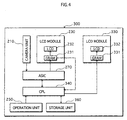
- Fig. 4 illustrates a construction of a photographed image display device 300 relating to a second embodiment.
- the photographed image display device 300 is constituted by the camera unit 210, the LCD module 230, an LCD module 330, a CPU 340, the operation unit 250, a storage unit 360, and the ASIC 270.
- the same reference numerals are applied to the components common to the photographed image display device 200 relating to the first embodiment shown in Fig. 1 and the photographed image display device 300.
- the following part describes the photographed image display device 300 with focus on its difference from the photographed image display device 200.
- the LCD module 330 includes a GRAM 331 and an LCD 332. A composite image is displayed on the LCD 332 based on composite image data stored in the GRAM 331.
- composite image data is generated in the following manner.
- the CPU 340 reads and combines photographed image data stored in the GRAM 231 and frame image data stored in the storage unit 360.
- the CPU 340 after storing the photographed image data into the GRAM 331, the CPU 340 partly overwrites a memory area of the GRAM 331 which is occupied by the photographed image data, with the frame image data.
- the GRAM 331 temporarily stores the composite image data.
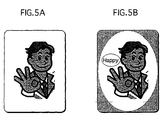
- Fig. 5A illustrates, as an example, a photographed image that is displayed based on the photographed image data on which the overwriting operation is to be performed.
- Fig. 5B illustrates, as an example, a composite image that is displayed based on the composite image data obtained as a result of the overwriting operation.
- the frame image data is template image data showing template images of picture frames shaped as, for example, a heart or a star.
- the frame image data is prestored in the storage unit 360.
- Figs. 6A to 6C each illustrate, as an example, an image that is displayed based on the frame image data.
- the LCD 332 displays a composite image based on the composite image data stored in the GRAM 331.
- the CPU 340 has an ability to execute a composite image display operation, in addition to the functions of the CPU 240.
- the CPU 340 receives a composite image display instruction from a user through the operation unit 250. In response to the instruction, when transfer of photographed image data from the ASIC 270 to the GRAM 231 has been completed, the CPU 340 reads the photographed image data from the GRAM 231. Furthermore, the CPU 340 reads the frame image data that is prestored in the storage unit 360, and combines the photographed image data and the frame image data, to generate composite image data. The CPU 340 stores the composite image data in the GRAM 331.
- the composite image display instruction is a user's instruction to display a composite image (e.g. as shown in Fig. 5B) based on a photographed image.
- the CPU 340 ends the composite image display operation, when receiving a composite image display operation end instruction from the user through the operation unit 250.
- the composite image display operation end instruction is a user' s instruction to end the composite image display operation.
- the user may specify desired frame image data by designating an identifier.
- the CPU 340 reads frame image data corresponding to the identifier designated by the user (for example, frame image data showing a picture frame image in Fig. 6A), from the storage unit 360, to perform the composite image display operation.
- the storage unit 360 prestores one or more pieces of frame image data each of which is associated with an identifier.
- the photographing operation performed by the ASIC 270 is described in the first embodiment, and therefore not repeatedly explained here.
- the CPU 340 When receiving the composite image display instruction from the user through the operation unit 250 during the photographing operation (step S1201:Y), the CPU 340 reads the value of the flag shown by the ASIC 270. Thus, the CPU 340 judges whether transfer of photographed image data from the ASIC 270 to the GRAM 231 in the LCD module 230 is occurring (step S1202) .
- step S1202:N the CPU 340 reads photographed image data from the GRAM 231 (step S1203), and the frame image data prestored in the storage unit 360 (step S1204) . Furthermore, the CPU 340 combines the photographed image data and the frame image data, to generate composite image data (step S1205). The CPU 340 then stores the composite image data in the GRAM 331 in the LCDmodule 330 (step S1206). If the composite image data has been stored in the GRAM 331, the LCD 332 displays a composite image based on the composite image data stored in the GRAM 331 (step S1207).
- step S1202:Y If judged in the affirmative in the step S1202 (step S1202:Y), the CPU 340 waits until the transfer is completed (steps S1209 and S1210). When the transfer is completed, that is to say, the value of the flag shown by the ASIC 270 is set to zero (step S1210:Y), the CPU 340 performs the procedure of the steps S1203 to S1207.
- step S1208:Y If the CPU 340 receives the composite image display operation end instruction from the user through the operation unit 250 (step S1208:Y), the CPU 340 ends the composite image display operation. If not (step S1208:N), the procedure of the composite image display operation goes back to the step S1202.
- the photographed image display devices 200 and 300 respectively relating to the first and second embodiments of the present invention may be mounted with mobile telephones, digital cameras, camcorders, mobile communications terminals such as PDAs, and other electronic devices.
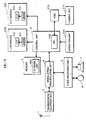
- Fig. 10 is a functional block diagram illustrating a mobile telephone which is mounted with the photographed image display device 300 relating to the second embodiment.
- the mobile telephone shown in Fig. 10 can be modified.
- the CPU 340 and the storage unit 360 may be replaced with the CPU 240 and the storage unit 260 respectively, and the LCD module 330 may be excluded.
- the mobile telephone shown in Fig. 10 is constituted by an antenna 1, a transmission/reception unit 2, a memory 3, a modulating/demodulating unit 4, a voice processing unit 5, a microphone 6, a receiver 7, a control unit 8, and the photographed image display device 300.
- the antenna 1 transmits and receives radio waves for communication.
- the transmission/reception unit 2 transmits and receives data communicated via radio waves.
- the memory 3 includes the storage unit 360.
- the modulating/demodulating unit 4 modulates and demodulates communication data.
- the voice processing unit 5 digital-to-analog converts communication data output from the modulating/demodulating unit 4 to generate sound signals, and outputs the sound signals to the receiver 7.
- the voice processing unit 5 also converts sounds output from the microphone 6 into sound signals, and outputs the sound signals to the modulating/demodulating unit 4 as communication data to be transmitted.
- the control unit 8 includes a microprocessor, a Read Only Memory (ROM) and the like. The control unit 8 executes a control program stored in the ROM, to control the entire mobile telephone.
- the composite image data is displayed on the LCD 332.
- the CPU 340 may store the composite image data in the storage unit 360.
- Fig. 8 is a flow chart illustrating the composite image display operation including the above-mentioned composite image storage operation performed by the CPU 340.
- the CPU 340 when receiving the composite image storage instruction from the user through the operation unit 250 (step S1211:Y), the CPU 340 reads composite image data from the GRAM 331, and stores the composite image data into the storage unit 360 (step S1212).
- the rest of the steps of the flow chart in Fig. 8 are the same as the corresponding steps of the flow chart in Fig. 7, and therefore not repeatedly explained here.
- the CPU 340 may prohibit display of photographed image data on the LCD 232. Specifically speaking, when receiving the composite image display instruction in the step S1201 in Fig. 7 or 8 (step S1201:Y), the CPU 340 may turn the LCD 232 off. In this case, when receiving the composite image display operation end instruction in the step S1208 (step S1208:Y), the CPU 340 may turn the LCD 232 back on.
- This construction can save power consumption of the photographed image display device 300.
- a photographed image display device and a photographed image display method according to the present invention can contribute to miniaturize a mobile communications terminal with a photographing function and to reduce a manufacturing cost of such a terminal.
Landscapes
- Engineering & Computer Science (AREA)
- Signal Processing (AREA)
- Multimedia (AREA)
- Human Computer Interaction (AREA)
- Computer Networks & Wireless Communication (AREA)
- Studio Devices (AREA)
- Television Signal Processing For Recording (AREA)
- Liquid Crystal Display Device Control (AREA)
- Control Of Indicators Other Than Cathode Ray Tubes (AREA)
Abstract
Description
Claims (9)
- A photographed image display device comprising:an LCD module including a graphic memory operable to store image data and an LCD operable to display an image based on the image data stored in the graphic memory;a photographing unit operable to form an optical image of an object, convert the formed optical image into image data, and output the image data sequentially;a transfer unit operable to receive the image data output from the photographing unit and transfer the image data to the graphic memory;a storage medium operable to store image data;a storage instruction receiving unit operable to receive a storage instruction to store the image data into the storage medium;a judging unit operable to judge whether the transfer of the image data from the transfer unit to the graphic memory has been completed; anda storing unit operable to, when the transfer has been completed, read the image data from the graphic memory according to the storage instruction, and store the read image data into the storage medium.
- A photographed image display device comprising:a first LCDmodule and a secondLCDmodulewhich each include a graphic memory operable to store image data and an LCD operable to display an image based on the image data stored in the graphic memory;a photographing unit operable to form an optical image of an object, convert the formed optical image into image data, and output the image data sequentially;a first transfer unit operable to receive the image data output from the photographing unit and transfer the image data to the graphic memory in the first LCD module;a storage medium prestoring frame image data;a judging unit operable to judge whether the transfer of the image data from the first transfer unit to the graphic memory in the first LCD module has been completed; anda second transfer unit operable to, when the transfer has been completed, read the image data from the graphic memory in the first LCD module, combine the read image data and the frame image data so as to generate composite image data, and transfer the composite image data to the graphic memory in the second LCD module.
- The photographed image display device of Claim 2, further comprising:a storage instruction receiving unit operable to receive a storage instruction to store the composite image data into the storage medium; anda storing unit operable to store the composite image data into the storage medium according to the storage instruction.
- A photographed image display method for a photographed image display device including (i) an LCD module including a graphic memory for storing image data and an LCD for displaying an image based on the image data stored in the graphic memory and (ii) a storage medium for storing image data, the photographed image display method comprising:a photographing step of forming an optical image of an object, converting the formed optical image into image data, and outputting the image data sequentially;a transfer step of receiving the image data output in the photographing step and transferring the image data to the graphic memory;a storage instruction receiving step of receiving a storage instruction to store the image data into the storage medium;a judging step of judging whether the transfer of the image data to the graphic memory has been completed; anda storing step of, when the transfer has been completed, reading the image data from the graphic memory according to the storage instruction, and storing the read image data into the storage medium.
- A photographed image display method for a photographed image display device including (i) a first LCD module and a second LCD module each including a graphic memory for temporarily storing image data and an LCD for displaying the image data, and (ii) a storage medium prestoring frame image data, the photographed image display method comprising:a photographing step of forming an optical image of an object, converting the formed optical image into image data, and outputting the image data sequentially;a first transfer step of receiving the image data output in the photographing step and transferring the image data to the graphic memory in the first LCD module;a judging step of judging whether the transfer of the image data to the graphic memory in the first LCD module has been completed; anda second transfer step of, when the transfer has been completed, reading the image data from the graphic memory in the first LCD module, combining the read image data and the frame image data so as to generate composite image data, and transferring the composite image data to the graphic memory in the second LCD module.
- A mobile telephone including a photographed image display device, the photographed image display device comprising:an LCD module including a graphic memory operable to store image data and an LCD operable to display an image based on the image data stored in the graphic memory;a photographing unit operable to form an optical image of an object, convert the formed optical image into image data, and output the image data sequentially;a transfer unit operable to receive the image data output from the photographing unit and transfer the image data to the graphic memory;a storage medium operable to store image data;a storage instruction receiving unit operable to receive a storage instruction to store the image data into the storage medium;a judging unit operable to judge whether the transfer of the image data from the transfer unit to the graphic memory has been completed; anda storing unit operable to, when the transfer has been completed, read the image data from the graphic memory according to the storage instruction, and store the read image data into the storage medium.
- A mobile telephone including a photographed image display device, the photographed image display device comprising:a first LCDmodule and a secondLCDmodule which each include a graphic memory operable to store image data and an LCD operable to display an image based on the image data stored in the graphic memory;a photographing unit operable to form an optical image of an object, convert the formed optical image into image data, and output the image data sequentially;a first transfer unit operable to receive the image data output from the photographing unit and transfer the image data to the graphic memory in the first LCD module;a storage medium prestoring frame image data;a judging unit operable to judge whether the transfer of the image data from the first transfer unit to the graphic memory in the first LCD module has been completed; anda second transfer unit operable to, when the transfer has been completed, read the image data from the graphic memory in the first LCD module, combine the read image data and the frame image data so as to generate composite image data, and transfer the composite image data to the graphic memory in the second LCD module.
- A photographed image display program used for a photographed image display device including (i) an LCD module having a graphic memory for storing image data and an LCD for displaying an image based on the image data stored in the graphic memory and (ii) a storage medium for storing image data, the photographed image display program comprising:a photographing step of forming an optical image of an object, converting the formed optical image into image data, and outputting the image data sequentially;a transfer step of receiving the image data output in the photographing step and transferring the image data to the graphic memory;a storage instruction receiving step of receivinga storage instruction to store the image data into the storage medium;a judging step of judging whether the transfer of the image data to the graphic memory has been completed; anda storing step of, when the transfer has been completed, reading the image data from the graphic memory according to the storage instruction, and storing the read image data into the storage medium.
- A photographed image display program used for a photographed image display device including (i) a first LCD module and a second LCD module each having a graphic memory for temporarily storing image data and an LCD for displaying the image data, and (ii) a storage medium prestoring frame image data, the photographed image display program comprising:a photographing step of forming an optical image of an object, converting the formed optical image into image data, and outputting the image data sequentially;a first transfer step of receiving the image data output in the photographing step and transferring the image data to the graphic memory in the first LCD module;a judging step of j udging whether the transfer of the image data to the graphic memory in the first LCD module has been completed; anda second transfer step of, when the transfer has been completed, reading the image data from the graphic memory in the first LCD module, combining the read image data and the frame image data so as to generate composite image data, and transferring the composite image data to the graphic memory in the second LCD module.
Applications Claiming Priority (3)
| Application Number | Priority Date | Filing Date | Title |
|---|---|---|---|
| JP2002070981A JP3948986B2 (en) | 2002-03-14 | 2002-03-14 | Captured image display device and captured image display method |
| JP2002070981 | 2002-03-14 | ||
| PCT/JP2003/001968 WO2003077535A1 (en) | 2002-03-14 | 2003-02-24 | Captured image display device and captured image display method |
Publications (3)
| Publication Number | Publication Date |
|---|---|
| EP1487195A1 true EP1487195A1 (en) | 2004-12-15 |
| EP1487195A4 EP1487195A4 (en) | 2006-03-29 |
| EP1487195B1 EP1487195B1 (en) | 2009-12-02 |
Family
ID=27800355
Family Applications (1)
| Application Number | Title | Priority Date | Filing Date |
|---|---|---|---|
| EP03705400A Expired - Lifetime EP1487195B1 (en) | 2002-03-14 | 2003-02-24 | Photographed IMAGE DISPLAY DEVICE, photographed IMAGE DISPLAY METHOD and photographed IMAGE DISPLAY program |
Country Status (8)
| Country | Link |
|---|---|
| US (1) | US7522206B2 (en) |
| EP (1) | EP1487195B1 (en) |
| JP (1) | JP3948986B2 (en) |
| KR (1) | KR20050004810A (en) |
| CN (1) | CN100334877C (en) |
| AU (1) | AU2003211273A1 (en) |
| DE (1) | DE60330321D1 (en) |
| WO (1) | WO2003077535A1 (en) |
Cited By (2)
| Publication number | Priority date | Publication date | Assignee | Title |
|---|---|---|---|---|
| EP1725005A1 (en) * | 2005-05-17 | 2006-11-22 | Samsung Electronics Co., Ltd. | Method for displaying special effects in image data and a portable terminal implementing the same |
| WO2018085848A1 (en) * | 2016-11-07 | 2018-05-11 | Snap Inc. | Selective identification and order of image modifiers |
Families Citing this family (4)
| Publication number | Priority date | Publication date | Assignee | Title |
|---|---|---|---|---|
| EP1713030A4 (en) * | 2004-02-05 | 2007-05-02 | Vodafone Kk | IMAGE PROCESSING METHOD, IMAGE PROCESSING APPARATUS, AND MOBILE COMMUNICATION TERMINAL APPARATUS |
| US8872843B2 (en) * | 2004-07-02 | 2014-10-28 | Samsung Electronics Co., Ltd. | Method for editing images in a mobile terminal |
| KR102017448B1 (en) | 2019-01-03 | 2019-09-03 | 강수철 | A Boiler Control System Using CO Detecting Function |
| KR102017450B1 (en) | 2019-01-22 | 2019-09-02 | 강수철 | A Boiler Control System Using CO Detecter |
Family Cites Families (9)
| Publication number | Priority date | Publication date | Assignee | Title |
|---|---|---|---|---|
| US6400374B2 (en) * | 1996-09-18 | 2002-06-04 | Eyematic Interfaces, Inc. | Video superposition system and method |
| JP3516328B2 (en) * | 1997-08-22 | 2004-04-05 | 株式会社日立製作所 | Information communication terminal equipment |
| US6628333B1 (en) * | 1997-11-12 | 2003-09-30 | International Business Machines Corporation | Digital instant camera having a printer |
| JPH11313238A (en) * | 1998-04-28 | 1999-11-09 | Canon Inc | Image processing apparatus, image processing method, and storage medium |
| JP3985115B2 (en) * | 1998-10-27 | 2007-10-03 | カシオ計算機株式会社 | Electronic camera and image display method |
| JP4553441B2 (en) * | 2000-03-10 | 2010-09-29 | 富士フイルム株式会社 | Mobile communication terminal |
| JP3695279B2 (en) * | 2000-04-20 | 2005-09-14 | セイコーエプソン株式会社 | Portable electronic devices |
| EP1148411A3 (en) * | 2000-04-21 | 2005-09-14 | Sony Corporation | Information processing apparatus and method for recognising user gesture |
| JP3312165B2 (en) * | 2000-08-25 | 2002-08-05 | オムロン株式会社 | Image printing apparatus and method, and recording medium |
-
2002
- 2002-03-14 JP JP2002070981A patent/JP3948986B2/en not_active Expired - Fee Related
-
2003
- 2003-02-24 CN CNB038102897A patent/CN100334877C/en not_active Expired - Fee Related
- 2003-02-24 US US10/507,043 patent/US7522206B2/en not_active Expired - Fee Related
- 2003-02-24 WO PCT/JP2003/001968 patent/WO2003077535A1/en not_active Ceased
- 2003-02-24 EP EP03705400A patent/EP1487195B1/en not_active Expired - Lifetime
- 2003-02-24 AU AU2003211273A patent/AU2003211273A1/en not_active Abandoned
- 2003-02-24 KR KR10-2004-7014419A patent/KR20050004810A/en not_active Ceased
- 2003-02-24 DE DE60330321T patent/DE60330321D1/en not_active Expired - Lifetime
Cited By (8)
| Publication number | Priority date | Publication date | Assignee | Title |
|---|---|---|---|---|
| EP1725005A1 (en) * | 2005-05-17 | 2006-11-22 | Samsung Electronics Co., Ltd. | Method for displaying special effects in image data and a portable terminal implementing the same |
| WO2018085848A1 (en) * | 2016-11-07 | 2018-05-11 | Snap Inc. | Selective identification and order of image modifiers |
| US10623666B2 (en) | 2016-11-07 | 2020-04-14 | Snap Inc. | Selective identification and order of image modifiers |
| EP3901951A1 (en) * | 2016-11-07 | 2021-10-27 | Snap Inc. | Selective identification and order of image modifiers |
| US11233952B2 (en) | 2016-11-07 | 2022-01-25 | Snap Inc. | Selective identification and order of image modifiers |
| US11750767B2 (en) | 2016-11-07 | 2023-09-05 | Snap Inc. | Selective identification and order of image modifiers |
| EP4459619A3 (en) * | 2016-11-07 | 2025-01-08 | Snap Inc. | Selective identification and order of image modifiers |
| US12231804B2 (en) | 2016-11-07 | 2025-02-18 | Snap Inc. | Selective identification and order of image modifiers |
Also Published As
| Publication number | Publication date |
|---|---|
| DE60330321D1 (en) | 2010-01-14 |
| US20050225651A1 (en) | 2005-10-13 |
| CN100334877C (en) | 2007-08-29 |
| EP1487195B1 (en) | 2009-12-02 |
| US7522206B2 (en) | 2009-04-21 |
| JP2003274241A (en) | 2003-09-26 |
| AU2003211273A1 (en) | 2003-09-22 |
| KR20050004810A (en) | 2005-01-12 |
| JP3948986B2 (en) | 2007-07-25 |
| CN1653802A (en) | 2005-08-10 |
| WO2003077535A1 (en) | 2003-09-18 |
| EP1487195A4 (en) | 2006-03-29 |
Similar Documents
| Publication | Publication Date | Title |
|---|---|---|
| US6823198B2 (en) | Portable phone with camera | |
| JP3642332B2 (en) | Folding mobile phone device | |
| US20070285550A1 (en) | Method and apparatus for taking images using mobile communication terminal with plurality of camera lenses | |
| US20040252203A1 (en) | Image processing apparatus | |
| US20050264650A1 (en) | Apparatus and method for synthesizing captured images in a mobile terminal with a camera | |
| EP1487195B1 (en) | Photographed IMAGE DISPLAY DEVICE, photographed IMAGE DISPLAY METHOD and photographed IMAGE DISPLAY program | |
| JPH11146370A (en) | Portable videophone device | |
| JP2002009879A (en) | Wearable network system | |
| JP2003319311A (en) | Image processing apparatus and system | |
| JP4257508B2 (en) | Electronic camera | |
| JP2001320454A (en) | Mobile phone with camera | |
| JP3359526B2 (en) | Digital electronic camera | |
| US7868933B2 (en) | Imaging device | |
| US20080119223A1 (en) | Mobile Telephone | |
| HK1070222A (en) | Captured image display device and captured image display method | |
| JP3957156B2 (en) | Image correction method, apparatus, and program | |
| JP5054276B2 (en) | Continuous shooting method and digital camera | |
| JP4015567B2 (en) | Mobile terminal device | |
| US7800647B2 (en) | Image capturing device | |
| JPH11136653A (en) | Image transfer wireless communication terminal system | |
| JP4565121B2 (en) | Imaging apparatus and imaging program | |
| JP2003250073A (en) | Electronic camera and portable terminal | |
| JP2003333318A (en) | Mobile phone terminal device and handwritten information input method | |
| JP2007019921A (en) | Image correction apparatus, image processing method, and image processing program | |
| JPWO2006080245A1 (en) | Portable information terminal |
Legal Events
| Date | Code | Title | Description |
|---|---|---|---|
| PUAI | Public reference made under article 153(3) epc to a published international application that has entered the european phase |
Free format text: ORIGINAL CODE: 0009012 |
|
| 17P | Request for examination filed |
Effective date: 20041007 |
|
| AK | Designated contracting states |
Kind code of ref document: A1 Designated state(s): AT BE BG CH CY CZ DE DK EE ES FI FR GB GR HU IE IT LI LU MC NL PT SE SI SK TR |
|
| AX | Request for extension of the european patent |
Extension state: AL LT LV MK RO |
|
| REG | Reference to a national code |
Ref country code: HK Ref legal event code: DE Ref document number: 1070222 Country of ref document: HK |
|
| A4 | Supplementary search report drawn up and despatched |
Effective date: 20060213 |
|
| 17Q | First examination report despatched |
Effective date: 20060828 |
|
| GRAP | Despatch of communication of intention to grant a patent |
Free format text: ORIGINAL CODE: EPIDOSNIGR1 |
|
| RTI1 | Title (correction) |
Free format text: PHOTOGRAPHED IMAGE DISPLAY DEVICE, PHOTOGRAPHED IMAGE DISPLAY METHOD AND PHOTOGRAPHED IMAGE DISPLAY PROGRAM |
|
| RAP1 | Party data changed (applicant data changed or rights of an application transferred) |
Owner name: KYOCERA CORPORATION |
|
| GRAS | Grant fee paid |
Free format text: ORIGINAL CODE: EPIDOSNIGR3 |
|
| GRAA | (expected) grant |
Free format text: ORIGINAL CODE: 0009210 |
|
| AK | Designated contracting states |
Kind code of ref document: B1 Designated state(s): DE FR GB IT |
|
| REG | Reference to a national code |
Ref country code: GB Ref legal event code: FG4D |
|
| REF | Corresponds to: |
Ref document number: 60330321 Country of ref document: DE Date of ref document: 20100114 Kind code of ref document: P |
|
| PLBE | No opposition filed within time limit |
Free format text: ORIGINAL CODE: 0009261 |
|
| STAA | Information on the status of an ep patent application or granted ep patent |
Free format text: STATUS: NO OPPOSITION FILED WITHIN TIME LIMIT |
|
| 26N | No opposition filed |
Effective date: 20100903 |
|
| PG25 | Lapsed in a contracting state [announced via postgrant information from national office to epo] |
Ref country code: IT Free format text: LAPSE BECAUSE OF FAILURE TO SUBMIT A TRANSLATION OF THE DESCRIPTION OR TO PAY THE FEE WITHIN THE PRESCRIBED TIME-LIMIT Effective date: 20091202 |
|
| PGFP | Annual fee paid to national office [announced via postgrant information from national office to epo] |
Ref country code: FR Payment date: 20110218 Year of fee payment: 9 Ref country code: DE Payment date: 20110216 Year of fee payment: 9 |
|
| PGFP | Annual fee paid to national office [announced via postgrant information from national office to epo] |
Ref country code: GB Payment date: 20110223 Year of fee payment: 9 |
|
| REG | Reference to a national code |
Ref country code: HK Ref legal event code: WD Ref document number: 1070222 Country of ref document: HK |
|
| GBPC | Gb: european patent ceased through non-payment of renewal fee |
Effective date: 20120224 |
|
| REG | Reference to a national code |
Ref country code: FR Ref legal event code: ST Effective date: 20121031 |
|
| REG | Reference to a national code |
Ref country code: DE Ref legal event code: R119 Ref document number: 60330321 Country of ref document: DE Effective date: 20120901 |
|
| PG25 | Lapsed in a contracting state [announced via postgrant information from national office to epo] |
Ref country code: GB Free format text: LAPSE BECAUSE OF NON-PAYMENT OF DUE FEES Effective date: 20120224 Ref country code: FR Free format text: LAPSE BECAUSE OF NON-PAYMENT OF DUE FEES Effective date: 20120229 |
|
| PG25 | Lapsed in a contracting state [announced via postgrant information from national office to epo] |
Ref country code: DE Free format text: LAPSE BECAUSE OF NON-PAYMENT OF DUE FEES Effective date: 20120901 |