EP1486539A2 - Self-assembling dyes - Google Patents
Self-assembling dyes Download PDFInfo
- Publication number
- EP1486539A2 EP1486539A2 EP04104187A EP04104187A EP1486539A2 EP 1486539 A2 EP1486539 A2 EP 1486539A2 EP 04104187 A EP04104187 A EP 04104187A EP 04104187 A EP04104187 A EP 04104187A EP 1486539 A2 EP1486539 A2 EP 1486539A2
- Authority
- EP
- European Patent Office
- Prior art keywords
- ink
- dye
- group
- substituted
- unsubstituted
- Prior art date
- Legal status (The legal status is an assumption and is not a legal conclusion. Google has not performed a legal analysis and makes no representation as to the accuracy of the status listed.)
- Granted
Links
- LLOQRRBDHHNMHT-OGAWRBAASA-N CC(CCNC(NC(NC(C)=C1)=NC1=O)=O)CC(C)(C)CNC(OCCN(CCOC(NCC(C)(C)CC(C)CCNC(NC(NC(C)=C1)=NC1=O)=O)=O)c(cc1)ccc1/N=N/c(cc1)ccc1OC)=O Chemical compound CC(CCNC(NC(NC(C)=C1)=NC1=O)=O)CC(C)(C)CNC(OCCN(CCOC(NCC(C)(C)CC(C)CCNC(NC(NC(C)=C1)=NC1=O)=O)=O)c(cc1)ccc1/N=N/c(cc1)ccc1OC)=O LLOQRRBDHHNMHT-OGAWRBAASA-N 0.000 description 1
- PVNOOSHPBLMUQW-QVIHXGFCSA-N CCCCCCNC(OCCN(CCOC(NC)=O)c(cc1)ccc1/N=N/c(cc1)ccc1OC)=O Chemical compound CCCCCCNC(OCCN(CCOC(NC)=O)c(cc1)ccc1/N=N/c(cc1)ccc1OC)=O PVNOOSHPBLMUQW-QVIHXGFCSA-N 0.000 description 1
- YJLVPYQVUOMSAQ-SLEBQGDGSA-N CCCNC(C(C(c1ccccc11)=O)=C/C1=N\c(c(C)c1)ccc1N(CC)CCO)=O Chemical compound CCCNC(C(C(c1ccccc11)=O)=C/C1=N\c(c(C)c1)ccc1N(CC)CCO)=O YJLVPYQVUOMSAQ-SLEBQGDGSA-N 0.000 description 1
- FXPKAFRKRKKBAN-CJLVFECKSA-N CCN(CCO)c(cc1C)ccc1/N=C(\C=C(C1=O)NC(OC)=O)/C(C)=C1Cl Chemical compound CCN(CCO)c(cc1C)ccc1/N=C(\C=C(C1=O)NC(OC)=O)/C(C)=C1Cl FXPKAFRKRKKBAN-CJLVFECKSA-N 0.000 description 1
- JFTCXYCHIBNAAF-WQVHNPAPSA-N CCN(CCOC(NCCC(C)CC(C)(C)CNC(NC(NC(C)=C1)=NC1=O)=O)=O)c(cc1)ccc1/N=N/c(cc1)ccc1OCCOC Chemical compound CCN(CCOC(NCCC(C)CC(C)(C)CNC(NC(NC(C)=C1)=NC1=O)=O)=O)c(cc1)ccc1/N=N/c(cc1)ccc1OCCOC JFTCXYCHIBNAAF-WQVHNPAPSA-N 0.000 description 1
- QRYNWRMUZQEDBH-VHEBQXMUSA-N COc(cc1)ccc1/N=N/c(cc1)ccc1N(CCO)CCO Chemical compound COc(cc1)ccc1/N=N/c(cc1)ccc1N(CCO)CCO QRYNWRMUZQEDBH-VHEBQXMUSA-N 0.000 description 1
Classifications
-
- C—CHEMISTRY; METALLURGY
- C09—DYES; PAINTS; POLISHES; NATURAL RESINS; ADHESIVES; COMPOSITIONS NOT OTHERWISE PROVIDED FOR; APPLICATIONS OF MATERIALS NOT OTHERWISE PROVIDED FOR
- C09D—COATING COMPOSITIONS, e.g. PAINTS, VARNISHES OR LACQUERS; FILLING PASTES; CHEMICAL PAINT OR INK REMOVERS; INKS; CORRECTING FLUIDS; WOODSTAINS; PASTES OR SOLIDS FOR COLOURING OR PRINTING; USE OF MATERIALS THEREFOR
- C09D11/00—Inks
- C09D11/30—Inkjet printing inks
- C09D11/34—Hot-melt inks
-
- C—CHEMISTRY; METALLURGY
- C08—ORGANIC MACROMOLECULAR COMPOUNDS; THEIR PREPARATION OR CHEMICAL WORKING-UP; COMPOSITIONS BASED THEREON
- C08G—MACROMOLECULAR COMPOUNDS OBTAINED OTHERWISE THAN BY REACTIONS ONLY INVOLVING UNSATURATED CARBON-TO-CARBON BONDS
- C08G18/00—Polymeric products of isocyanates or isothiocyanates
- C08G18/06—Polymeric products of isocyanates or isothiocyanates with compounds having active hydrogen
- C08G18/28—Polymeric products of isocyanates or isothiocyanates with compounds having active hydrogen characterised by the compounds used containing active hydrogen
- C08G18/30—Low-molecular-weight compounds
- C08G18/38—Low-molecular-weight compounds having heteroatoms other than oxygen
-
- C—CHEMISTRY; METALLURGY
- C08—ORGANIC MACROMOLECULAR COMPOUNDS; THEIR PREPARATION OR CHEMICAL WORKING-UP; COMPOSITIONS BASED THEREON
- C08G—MACROMOLECULAR COMPOUNDS OBTAINED OTHERWISE THAN BY REACTIONS ONLY INVOLVING UNSATURATED CARBON-TO-CARBON BONDS
- C08G18/00—Polymeric products of isocyanates or isothiocyanates
- C08G18/06—Polymeric products of isocyanates or isothiocyanates with compounds having active hydrogen
- C08G18/70—Polymeric products of isocyanates or isothiocyanates with compounds having active hydrogen characterised by the isocyanates or isothiocyanates used
- C08G18/72—Polyisocyanates or polyisothiocyanates
- C08G18/80—Masked polyisocyanates
- C08G18/8061—Masked polyisocyanates masked with compounds having only one group containing active hydrogen
- C08G18/807—Masked polyisocyanates masked with compounds having only one group containing active hydrogen with nitrogen containing compounds
-
- C—CHEMISTRY; METALLURGY
- C09—DYES; PAINTS; POLISHES; NATURAL RESINS; ADHESIVES; COMPOSITIONS NOT OTHERWISE PROVIDED FOR; APPLICATIONS OF MATERIALS NOT OTHERWISE PROVIDED FOR
- C09B—ORGANIC DYES OR CLOSELY-RELATED COMPOUNDS FOR PRODUCING DYES, e.g. PIGMENTS; MORDANTS; LAKES
- C09B43/00—Preparation of azo dyes from other azo compounds
- C09B43/12—Preparation of azo dyes from other azo compounds by acylation of amino groups
-
- C—CHEMISTRY; METALLURGY
- C09—DYES; PAINTS; POLISHES; NATURAL RESINS; ADHESIVES; COMPOSITIONS NOT OTHERWISE PROVIDED FOR; APPLICATIONS OF MATERIALS NOT OTHERWISE PROVIDED FOR
- C09B—ORGANIC DYES OR CLOSELY-RELATED COMPOUNDS FOR PRODUCING DYES, e.g. PIGMENTS; MORDANTS; LAKES
- C09B43/00—Preparation of azo dyes from other azo compounds
- C09B43/18—Preparation of azo dyes from other azo compounds by acylation of hydroxyl group or of mercapto group
- C09B43/20—Preparation of azo dyes from other azo compounds by acylation of hydroxyl group or of mercapto group with monocarboxylic acids, carbamic acid esters or halides, mono- isocyanates or haloformic acid esters
- C09B43/206—Preparation of azo dyes from other azo compounds by acylation of hydroxyl group or of mercapto group with monocarboxylic acids, carbamic acid esters or halides, mono- isocyanates or haloformic acid esters with formation of OCXN or OSO2N group
-
- C—CHEMISTRY; METALLURGY
- C09—DYES; PAINTS; POLISHES; NATURAL RESINS; ADHESIVES; COMPOSITIONS NOT OTHERWISE PROVIDED FOR; APPLICATIONS OF MATERIALS NOT OTHERWISE PROVIDED FOR
- C09B—ORGANIC DYES OR CLOSELY-RELATED COMPOUNDS FOR PRODUCING DYES, e.g. PIGMENTS; MORDANTS; LAKES
- C09B55/00—Azomethine dyes
- C09B55/009—Azomethine dyes, the C-atom of the group -C=N- being part of a ring (Image)
-
- C—CHEMISTRY; METALLURGY
- C09—DYES; PAINTS; POLISHES; NATURAL RESINS; ADHESIVES; COMPOSITIONS NOT OTHERWISE PROVIDED FOR; APPLICATIONS OF MATERIALS NOT OTHERWISE PROVIDED FOR
- C09D—COATING COMPOSITIONS, e.g. PAINTS, VARNISHES OR LACQUERS; FILLING PASTES; CHEMICAL PAINT OR INK REMOVERS; INKS; CORRECTING FLUIDS; WOODSTAINS; PASTES OR SOLIDS FOR COLOURING OR PRINTING; USE OF MATERIALS THEREFOR
- C09D11/00—Inks
- C09D11/02—Printing inks
- C09D11/03—Printing inks characterised by features other than the chemical nature of the binder
- C09D11/037—Printing inks characterised by features other than the chemical nature of the binder characterised by the pigment
-
- C—CHEMISTRY; METALLURGY
- C09—DYES; PAINTS; POLISHES; NATURAL RESINS; ADHESIVES; COMPOSITIONS NOT OTHERWISE PROVIDED FOR; APPLICATIONS OF MATERIALS NOT OTHERWISE PROVIDED FOR
- C09D—COATING COMPOSITIONS, e.g. PAINTS, VARNISHES OR LACQUERS; FILLING PASTES; CHEMICAL PAINT OR INK REMOVERS; INKS; CORRECTING FLUIDS; WOODSTAINS; PASTES OR SOLIDS FOR COLOURING OR PRINTING; USE OF MATERIALS THEREFOR
- C09D11/00—Inks
- C09D11/30—Inkjet printing inks
- C09D11/32—Inkjet printing inks characterised by colouring agents
-
- C—CHEMISTRY; METALLURGY
- C09—DYES; PAINTS; POLISHES; NATURAL RESINS; ADHESIVES; COMPOSITIONS NOT OTHERWISE PROVIDED FOR; APPLICATIONS OF MATERIALS NOT OTHERWISE PROVIDED FOR
- C09D—COATING COMPOSITIONS, e.g. PAINTS, VARNISHES OR LACQUERS; FILLING PASTES; CHEMICAL PAINT OR INK REMOVERS; INKS; CORRECTING FLUIDS; WOODSTAINS; PASTES OR SOLIDS FOR COLOURING OR PRINTING; USE OF MATERIALS THEREFOR
- C09D11/00—Inks
- C09D11/30—Inkjet printing inks
- C09D11/32—Inkjet printing inks characterised by colouring agents
- C09D11/328—Inkjet printing inks characterised by colouring agents characterised by dyes
Definitions
- the present invention relates to a particular type of novel dye. It further relates to ink-jet compositions and ink-jet printing processes using these dyes, and to an ink-jet printing apparatus provided with an ink cartridge containing such a dye.
- ink jet printing has become a popular technique because of its simplicity, convenience and low cost. Especially in those instances where a limited edition of the printed matter is needed ink jet printing has become a technology of choice.
- a recent survey on progress and trends in ink jet printing technology is given by Hue P. Le in Journal of Imaging Science and Technology Vol. 42 (1), Jan/Febr 1998.
- ink jet printing tiny drops of ink fluid are projected directly onto an ink receptor surface without physical contact between the printing device and the receptor.
- the printing device stores the printing data electronically and controls a mechanism for ejecting the drops image-wise. Printing is accomplished by moving the print head across the paper or vice versa.
- Early patents on ink jet printers include US 3,739,393, US 3,805,273 and US 3,891,121.
- the jetting of the ink droplets can be performed in several different ways.
- a continuous droplet stream is created by applying a pressure wave pattern. This process is known as continuous ink jet printing.
- the droplet stream is divided into droplets that are electrostatically charged, deflected and recollected, and into droplets that remain uncharged, continue their way undeflected, and form the image.
- the charged deflected stream forms the image and the uncharged undeflected jet is recollected.
- several jets are deflected to a different degree and thus record the image (multideflection system).
- the ink droplets can be created “on demand” (“DOD” or “drop on demand” method) whereby the printing device ejects the droplets only when they are used in imaging on a receiver thereby avoiding the complexity of drop charging, deflection hardware, and ink recollection.
- DOD on demand
- the ink droplet can be formed by means of a pressure wave created by a mechanical motion of a piezoelectric transducer (so-called “piezo method”), or by means of discrete thermal pushes (so-called “bubble jet” method, or “thermal jet” method).
- Ink compositions for ink jet typically include following ingredients : dyes or pigments, water and/or organic solvents, humectants such as glycols, detergents, thickeners, polymeric binders, preservatives, etc.. It will be readily understood that the optimal composition of such an ink is dependent on the ink jetting method used and on the nature of the substrate to be printed.
- the ink compositions can be roughly divided in :
- dyes used in inks for ink jet printing must meet different stringent requirements. For example they desirably provide sharp, non-feathered images having good waterfastness,solvent fastness, lightfastness and optical density. Their solubility must be fine-tuned to the vehicle they are dissolved in. Preferably they have high molecular extinction coefficients.
- SOx sulphur oxides
- NOx nitrogen oxides
- the self-assembling dyes represented by formula (I) can be used to construct supramolecular dye systems with improved properties such as light fastness, water and solvent fastness.
- Objects of the present invention are realized by providing a self-assembling dye according to formula (I): wherein 'Linker' represents any linking group; 'CU' means any chromophore group selected from the group consisting of an azo dye with a molar extinction coefficient larger than 10 3 l.mol -1 .cm -1 , an anthraquinone dye, a (poly)methine dye, an azomethine dye, a disazo dye, a carbonium dye, a styryl dye, a stilbene dye, a phthalocyanine dye, a coumarin dye, an aryl-carbonium dye, a nitro dye, a naphtholactam dye, a dioxazine dye, a flavin dye and a formazan dye; n and o are the same or different and are integers having a value of at least 1; m can be zero or any integer having a value of at least 1; n and o are the same
- self-assembly may be defined as the process by which a supramolecular species forms spontaneously from its components.
- self-assembly is very far from a unique feature of supramolecular systems - it is ubiquitous throughout life chemistry. Biological systems aside, self-assembly is also commonplace throughout chemistry.
- self-assembling dyes are used to construct supramolecular dye-systems with improved properties such as lightfastness, water and solvent fastness.
- a distinctive feature of using weak, non-covalent forces in molecular assemblies is that such interactions are normally readily reversible so that the final product is in thermodynamic equilibrium with its components (usually via its corresponding partially assembled intermediates). This leads to an additional property of most supramolecular systems : they have an in-built capacity for error correction not available to fully covalent systems. It needs to be noted that supramolecular systems may also form under kinetic rather than thermodynamic control. This situation will tend to be more likely for larger supramolecular assemblies incorporating many intermolecular contacts, especially when moderately rigid components are involved.
- EISA Evaporation Induced Self-Assembly
- the self-assembly process can occur between the self-assembling dyes themselves but also between (a) self-assembling dye molecule(s) including the self-assembling dye according to formula (I) and (a) complementary multiple H-donor/acceptor molecule(s) lacking the dye-fragment.
- the association constant of the assembly reaction K ass determined by 1 H-NMR in CDCl 3 , is at least 2.5 M -1 , more preferably at least 10 2 M -1 , and most preferably at least 10 5 M -1 .
- Hydrogen bonds are a special type of electrostatic interaction and can be described as an attractive interaction between a proton donor and a proton acceptor.
- the definition of a hydrogen bond presented by Pimentel and McClellan (G.C. Pimentel, A.L. McClellan, The Hydrogen Bond, Freeman, San Francisco, 1960) is used, which is:
- Both the donor (A) and the acceptor (B) atoms have electronegative character, with the proton involved in the hydrogen bond being shared between the electron pairs on A and B.
- the inherent directionality of hydrogen bonds makes them ideal for use in achieving complementarity in supramolecular systems.
- Objects of the present invention are realized with a self-assembling dye according to formula (I): wherein 'Linker' represents any linking group; 'CU' means any chromophore group selected from the group consisting of an azo dye with a molar extinction coefficient larger than 10 3 l.mol -1 .cm -1 , an anthraquinone dye, a (poly)methine dye, an azomethine dye, a disazo dye, a carbonium dye, a styryl dye, a stilbene dye, a phthalocyanine dye, a coumarin dye, an aryl-carbonium dye, a nitro dye, a naphtholactam dye, a dioxazine dye, a flavin dye and a formazan dye; n and o are the same or different and are integers having a value of at least 1; m can be zero or any integer having a value of at least 1; R 1 and R 2 are the same or
- the SAU is an ureidopyrimidone group represented by formula (II): wherein, R 1 and R 2 are the same or different and represent hydrogen, a halogen, a substituted or unsubstituted alkoxy group, a substituted or unsubstituted thioalkoxy group, a substituted or unsubstituted sulphoxy group, a substituted or unsubstituted sulphone group, a substituted or unsubstituted amino group, a nitrile group, a substituted or unsubstituted, saturated or unsaturated alkyl group, a substituted or unsubstituted acyl group, a substituted or unsubstituted sulphonyl group, a substituted or unsubstituted phosphoryl group, a substituted or unsubstituted aryl group, a substituted or unsubstituted aralkyl group
- the dyes according to the present invention can be prepared using synthetic methods known to those who are skilled in the art of organic synthesis. By way of example the synthesis of several dyes according to the present invention is described in the Examples.
- Y represents CU or Z-CU
- CU means any chromophore group absorbing between 200nm and 2000nm, such as an azo dye, an anthraquinone dye, a (poly)methine dye, an azomethine dye, a polyene dye, a pyrene dye, a disazo dye, a carbonium dye, a styryl dye, a stilbene dye, a phthalocyanine dye, a coumarin dye, an aryl-carbonium dye, a nitro dye, a naphtholactam dye, a dioxazine dye, a flavin dye, a formazan dye;
- R 1 and R 2 are the same or different and represent hydrogen, a halogen, a substituted or unsubstituted alkoxy group, a substituted or unsubstituted thioalkoxy group, a substituted or unsubstitute
- inks are formulated containing self-complementary dyes according to Formula (I).
- Self-assembly through the formation of intermolecular hydrogen bonds is induced through evaporation of the ink vehicle.
- the self-assembling dyes are dissolved in the ink no or partial self-assembly occurs because of the formation of hydrogen bonds with the ink vehicle.
- the ink vehicle or one of the ink vehicles
- self-assembly of the dyes is induced resulting in supramolecular structures.
- the integrity of the individual component molecules normally remains largely intact: that is, the wave functions of the respective molecular components remain largely separate on complex formation.
- inks are formulated which contain at least one dye according to Formula (I) and further at least one other analogous dye (CU') n' (SAU') m' whereby the SAU and SAU' residues are complementary so that the dyes are able to assemble with each other. Assembly through the formation of intermolecular hydrogen bonds is induced through evaporation of the ink vehicle. As long as the self-assembling dyes are dissolved in the ink no or partial self-assembly occurs because of the formation of hydrogen bonds with the ink vehicle. Once the ink vehicle (or one of the ink vehicles) is removed through, for example, evaporation, self-assembly of the dyes is induced resulting in supramolecular structures. The considerations about the integrity of the individual component molecules are the same as for the first embodiment.
- inks are formulated containing dyes according to Formula (I) and compounds according to formula (III): (SAU") p (X) q wherein X is any linking group an Q is 0 or 1, whereby the SAU and SAU" residues are complementary so that the dye(s) of Formula (I) and compounds according to formula (III) are able to assemble with each other. Assembly through the formation of intermolecular hydrogen bonds is induced through evaporation of the ink vehicle. As long as the assembling dyes are dissolved in the ink no or partial assembly occurs because of the formation of hydrogen bonds with the ink vehicle.
- the components of the self-assembly process are separated from each other.
- the dye(s) according to Formula (I) is (are) part of the ink while the analogous self-assembling dye(s)(CU') n' (SAU') m' or the compounds according to formula (III) are incorporated into an ink receiving layer of an ink jet recording element.
- the scope of the present invention further encompasses a process for the formation of an ink jet image comprising the step of image-wise jetting by means of an ink jet printing apparatus onto an ink jet recording element, comprising a support and at least one ink receiving layer, droplets of an ink composition comprising a liquid or solid vehicle and at least one dye according to formula (I).
- the scope of the present invention further encompasses a process for the formation of an ink jet image comprising the step of image-wise jetting by means of an ink jet printing apparatus onto an ink jet recording element, comprising a support and at least one ink receiving layer, droplets of an ink composition comprising a liquid or solid vehicle and at least one dye according to formula (I).
- the analogous self-assembling dye(s)(CU') n' (SAU') m' or the compounds according to formula (III) can be present in the ink receiving layer of the ink jet recording element as single molecules or covalently linked to a polymer backbone such as gelatin, cellulose, polyvinyl alcohol, etc.
- a polymer backbone such as gelatin, cellulose, polyvinyl alcohol, etc.
- the analogous self-assembling dye(s) (CU') n ,(SAU') m , or the compounds according to formula (III) are present in the ink receiving layer as single molecules.
- the considerations about the mechanism of the assembly and about the integrity of the component molecules are the same as for the previous embodiments.
- the dyes according to the present invention can be formulated in water based inks, in solvent and/or oil based inks, in UV-curable inks and in hot melt (phase change) inks.
- Typical ink compositions are described extensively in the existing patent literature and can be found for example in "Inkjet Technology and Product Development Strategies, Stephen F. Pond, Torrey Pines Research, 2000, Chapter 5: Ink Design” and references cited therein.
- Preferred ink compositions are those comprising dyes according to the present invention in an aqueous medium and in a solvent and/or oil based medium.
- the present dyes are useful as colorants for aqueous inks.
- the ink compositions of the present invention preferably contain from 0.5% to 40%, more preferably from 0.5% to 15%, and especially from 1% to 10%, by weight of the dye of Formula (I) based on the total weight of the ink.
- many ink compositions contain less than 5% by weight of colorant, it is desirable that the dye has a solubility of around 10% or more to allow the preparation of concentrates which may be used to prepare more dilute inks and to minimise the chance of precipitation of colorant if evaporation of the liquid medium occurs during use of the ink.
- the liquid medium is an aqueous medium it is preferably water or a mixture of water and one or more water-soluble organic solvents.
- the weight ratio of water to organic solvent(s) is preferably from 99:1 to 1:99, more preferably from 99:1 to 50:50 and especially from 95:5 to 80:20.
- the water-soluble organic solvent(s) is (are) preferably selected from C 1-4 -alkanols such as methanol, ethanol, n-propanol, isopropanol, n-butanol, sec-butanol, tert-butanol; amides such as dimethylformamide or dimethylacetamide; ketones or ketone-alcohols such as acetone or diacetone alcohol; ethers such as tetrahydrofuran or dioxane; oligo- or poly-alkyleneglycols such as diethylene glycol, triethylene glycol, hexylene glycol, polyethylene glycol or polypropylene glycol; alkyleneglycols or thioglycols containing a C 2 -C 6 alkylene group such as ethylene glycol, propylene glycol, butylene glycol, pentylene glycol or hexylene glycol and thiodiglycol; polyols such
- Preferred water-soluble organic solvents are 2-pyrrolidone; N-methyl-pyrrolidone; alkylene- and oligo-alkylene-glycols, such as ethyleneglycol, diethyleneglycol, triethyleneglycol; and lower alkyl ethers of polyhydric alcohols such as or 2-methoxy-2-ethoxy-2-ethoxyethanol; and polyethyleneglycols with a molecular weight of up to 500.
- the present dyes are particularly useful as colorants for solvent and/or oil based inks.
- Solvent based ink compositions are used where fast drying times are required and particularly when printing onto hydrophobic substrates such as plastics, metal or glass.
- the liquid medium is solvent based
- the solvent is preferably selected from ketones, alkanols, aliphatic hydrocarbons, esters, ethers, amides or mixtures thereof.
- an aliphatic hydrocarbon is used as the solvent a polar solvent such as an alcohol, ester, ether or amide is preferably added.
- Preferred solvents include ketones, especially methyl ethyl ketone and alkanols especially ethanol and n-propanol.
- Typical solvents for solvent based ink jet inks are methanol, ethanol, propanol, diacetone alcohol, methoxypropanol, glycol, methyl ethyl ketone, methyl isopropyl ketone, ethyl acetate, butyl acetate and methoxypropyl acetate, ethyl lactate and butyl lactate, monomethylethers from glycol, n.butylether from diethyleneglycol (Dowanol PM-series) and triethyleneglycol, tripropyleneglycolmonomethylether (TMP), dipropyleneglycolmonomethylether, and (di)methylnaphthalene.
- TMP tripropyleneglycolmonomethylether
- TMP dipropyleneglycolmonomethylether
- Solvent and/or oil based ink compositions of the present invention preferably contain from 0.5% to 40%, more preferably from 0.5% to 15%, and especially from 1% to 10%, by weight of the dye of Formula (1) based on the total weight of the ink. Although many ink compositions contain less than 5% by weight of colorant, it is desirable that the dye has a solubility of around 10% or more to allow the preparation of concentrates which may be used to prepare more dilute inks and to minimize the chance of precipitation of colorant if evaporation of the liquid medium occurs during use of the ink.
- the melting point of the solid is preferably in the range from 60°C to 125°C.
- Suitable low melting point solids include long chain fatty acids or alcohols, preferably those with C 18-24 chains, or sulphonamides.
- the dyes according to the present invention or mixtures of the dyes may be dissolved in the low melting point solid or may be finely dispersed in it.
- the viscosity of the final ink should be between 1-25 mPa.s at 20°C, preferably between 1-15 mPa.s at 20°C and most preferably between 1-10 mPa.s at 20°C for water and solvent-based inks, and between 1-25 mPa.s at 45°C, preferably between 2-18 mPa.s at 45°C and most preferably between 3-12 mPa.s at 45°C for oil-based inks.
- the inks according to the present invention may contain further dyes other than the dyes according the present invention, for example to modify the colour or brightness of the ink. They may also contain stabilizing agents, such as UV-absorbers, singlet oxygen quenchers such as hindered amine light stabilizers, peroxide scavengers and other radical scavengers.
- stabilizing agents such as UV-absorbers, singlet oxygen quenchers such as hindered amine light stabilizers, peroxide scavengers and other radical scavengers.
- the ink jet recording element used in accordance comprises a support and optionally at least one ink receiving layer.
- the support of the ink jet recording element can be chosen from the paper type and polymeric type support well-known from photographic technology.
- Paper types include plain paper, cast coated paper, polyethylene coated paper and polypropylene coated paper.
- Polymeric supports include cellulose acetate propionate or cellulose acetate butyrate, polyesters such as polyethylene terephthalate (PET) and polyethylene naphthalate, polyamides, polycarbonates, polyimides, polyolefins, poly(vinylacetals), polyethers and polysulfonamides.
- PET polyethylene terephthalate
- polyamides polycarbonates
- polyimides polyolefins
- poly(vinylacetals) poly(vinylacetals)
- polyethers and polysulfonamides.
- Other examples of useful high-quality polymeric supports for the present invention include opaque white polyesters and extrusion blends of polyethylene terephthalate and polypropylene.
- Polyester film supports and especially polyethylene terephthalate, are preferred because of their excellent properties of dimensional stability.
- typical useful supports include PET, wet strength paper, PVC, PVC with an adhesive backing, the polyethylene paper TYVEK, trade name of Du Pont Co., the porous polyethylene paper TESLIN, trade name of International Paper CO., canvas, polypropylene, and polycarbonate.
- the ink receiving layer may contain the typical ingredients well-known in the art from numerous patent applications. Typical ingredients include binders, pigments, mordants, surfactants, spacing agents, whitening agents, UV-absorbers, hardeners, plasticizers, etc..
- the scope of the present invention further encompasses an ink jet printing apparatus comprising an ink cartridge containing at least one dye according to formula (I), and optionally at least one analogous self-assembling dye(s)(CU') n' (SAU') m' , as extensively described above.
- the ink jet printing process can be performed according to any of the well-known techniques, such as the continuous printing method, the thermal jet method and the piezo method.
- UV data have been recorded in 1 cm sample holders with observed optical densities between 0.1 and 2.0. ⁇ is given as l.mol -1 .cm -1 .
- Different Perkin Elmer UV-spectroscopes have been used.
- FT-IR spectra have been recorded on a Spectrum One Perkin Elmer ATR FT-IR spectroscope.
- NMR spectra have been recorded on a 300 MHz Varian spectroscope.
- MALDI-TOF MS data have been recorded on a Perceptive Voyager DE Pro spectrometer.
- the density, i.e. optical density of the Evaluation Examples was measured using a MacBeth TR1224 densitometer.
- the dyes according to the present invention can be prepared using synthetic methods known to those who are skilled in the art of organic synthesis.
- IR : ⁇ (cm-1) 709, 744, 761, 798, 844, 946, 971, 1028, 1132, 1171, 1248, 1319, 1368, 1381, 1390, 1415, 1439, 1469, 1518, 1580, 1647, 1693, 2260, 2873 , 2933, 2956, 3143, 3196.
- Reference dye-3 (17.4 gram) and the isocyanate-2 (prepared according to Example 1) (14.8 gram) were dissolved in 400 mL of dry chloroform. Several drops of the dibutyltin dilaurate catalyst were added and the reaction mixture was stirred under an argon atmosphere at an oil bath temperature of 80°C for 21 hours. The reaction mixture was cooled to room temperature and added dropwise to 700 mL of hexane. The precipitated fine yellow powder was filtered and purified through a second precipitation from chloroform into a mixture of hexane/chloroform (500 mL/200 mL). 29.1 gram (90%) of Dye-1 was obtained.
- Reference dye-1 (709 mg) and the isocyanate-2 (470 mg) were dissolved in 50 mL of dry chloroform. Several drops of dibutyltin dilaurate (catalyst) were added. The reaction mixture was refluxed for 21 hours under argon, cooled to room temperature and the solvent was removed under reduced pressure. The compound was purified using column chromatography starting with pure chloroform as the eluent and gradually switching to 2% methanol/chloroform eluent. The collected product was precipitated in hexane (to remove the catalyst that is still present after chromatography). Yield: 90% of Dye-2.
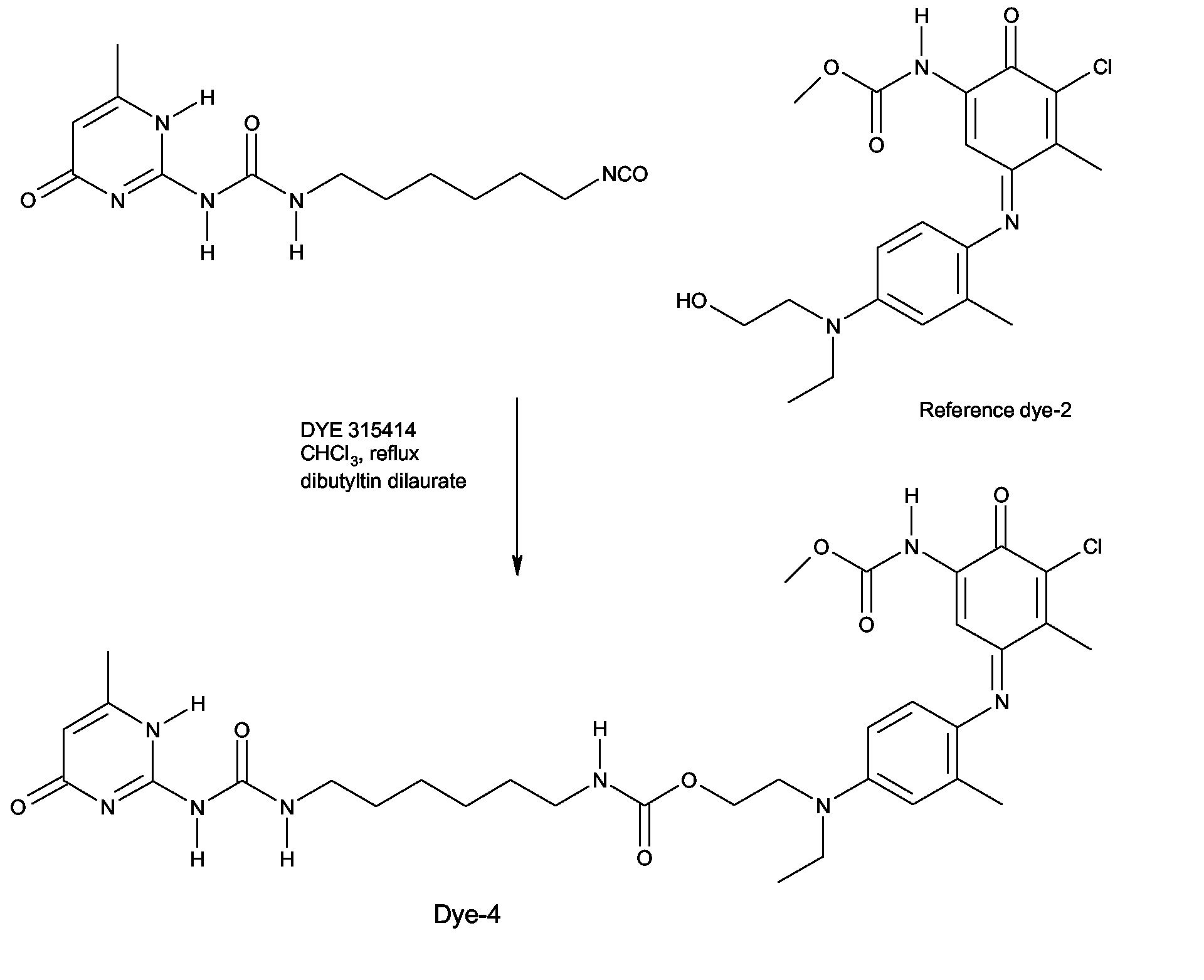
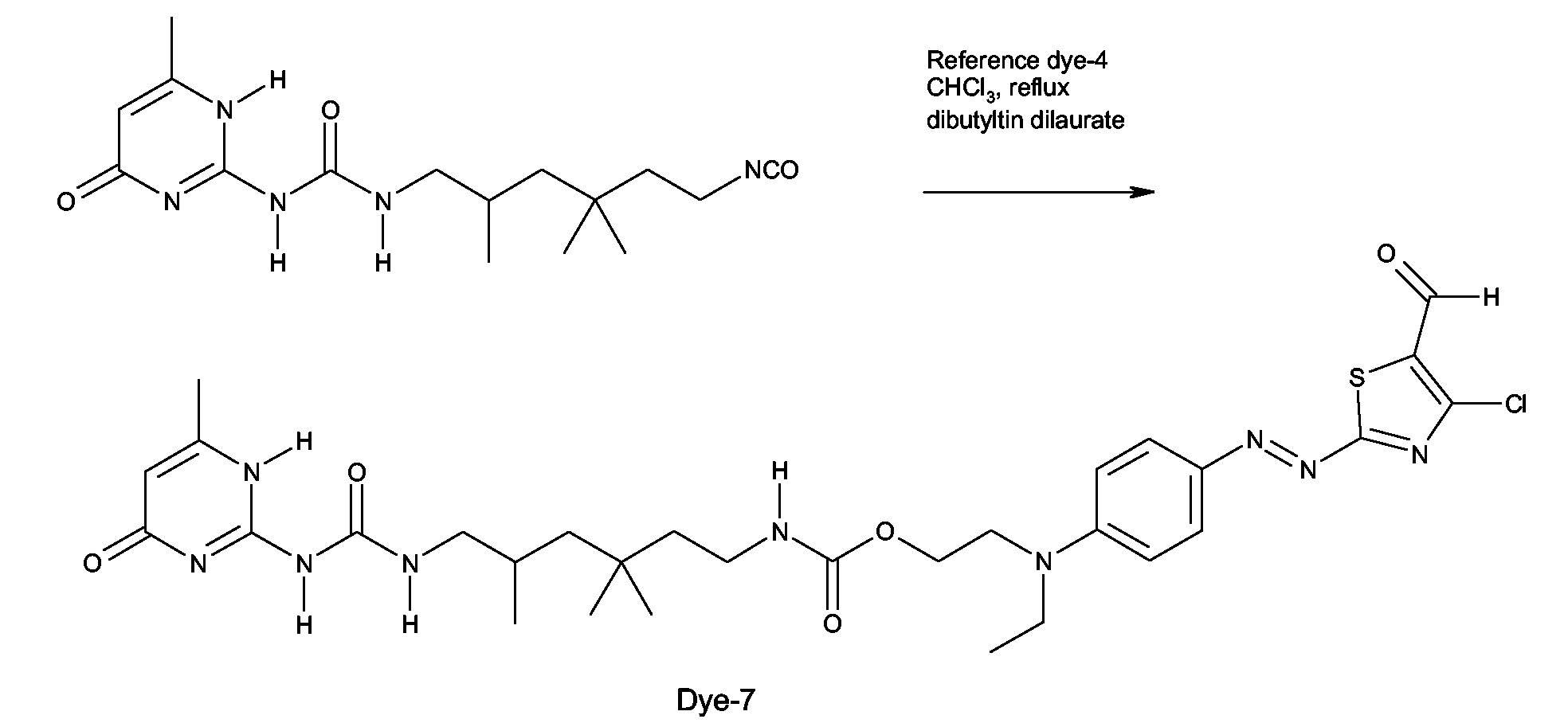
- Reference dye-4 (706 mg) and the isocyanate-2 (579 mg) were dissolved in 50 mL of dry chloroform. Several drops of dibutyltin dilaurate (catalyst) were added, and the reaction mixture was boiled under an argon atmosphere for 21 hours. The reaction mixture was cooled to room temperature and the solvent was removed under reduced pressure. The compound was purified using column chromatography starting with pure chloroform as the eluent and gradually switching to 2% methanol in chloroform. The collected product was precipitated in hexane (to remove the catalyst) to yield 1.15 gram of Dye-3 (92%).
- ⁇ (cm-1) 653, 664, 684, 721, 799, 826, 880, 926, 997, 1072, 1101, 1215, 1242, 1309, 1327, 1372, 1411, 1445, 1482, 1519, 1581, 1595, 1658, 1697, 2856, 2928, 3214.
- ⁇ (cm-1) 664, 750, 784, 804, 843, 875, 917, 968, 1042, 1110, 1135, 1179, 1243, 1318, 1348, 1375, 1393, 1455, 1514, 1583, 1630, 1660, 1698, 1700, 2858, 2929, 3216, 3374.
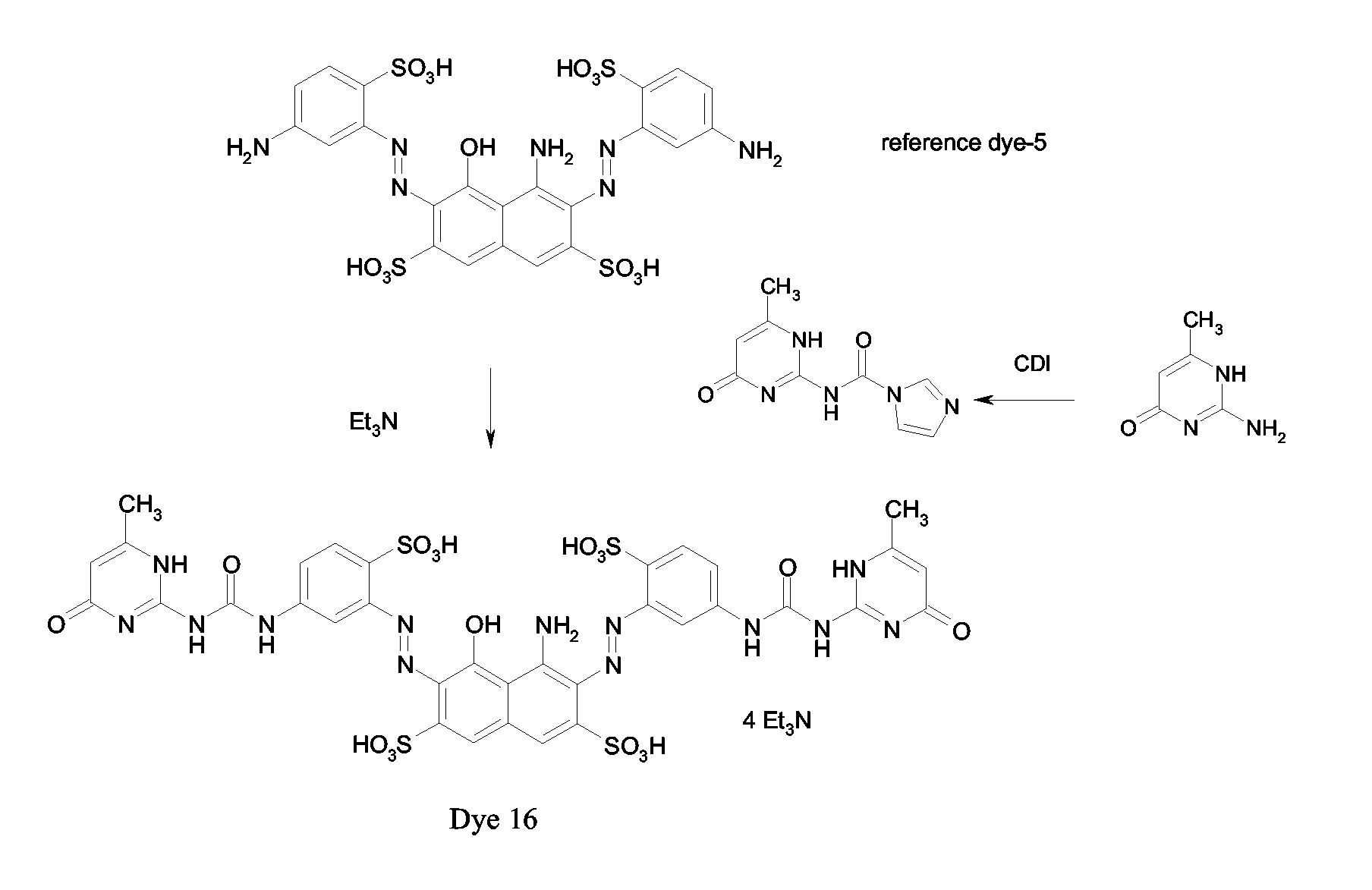
- Reference dye-5 (1.0 gram) and the isocyanate-2 (1.0 gram) were mixed in 20 mL dry CHCl3 and 5 mL dry pyridine. Several drops of dibutyltin dilaurate (catalyst) were added and the reaction mixture was boiled and stirred under an argon atmosphere for several hours. The mixture was cooled. Evaporation and co-evaporation with toluene removed the solvent. Dye-5 was obtained as a red powder.
- the isocyanate-1 (2.0 g; 5.96 mmol) and reference dye-2 (see example 5) (2.43 g; 5.99 mmol) were dissolved in 120 mL of dry chloroform.
- a few drops of dibutyltin dilaurate catalyst were added and the mixture was refluxed for 24 hours under an argon atmosphere.
- the reaction was monitored with TLC (2% MeOH/CHCl 3 ).
- Silica was added and the suspension was stirred for a few hours, followed by filtration.
- the filtrate was concentrated and the residue was dissolved in chloroform and precipitated in pentane to remove the catalyst; further purification was achieved with column chromatography (starting with pure chloroform as eluent and changing to 2% MeOH in chloroform).
- ⁇ (cm-1) 666, 705, 745, 768, 784, 804, 842, 875, 917, 968, 1042, 1110, 1135, 1179, 1250, 1319, 1350, 1376, 1394, 1456, 1515, 1595, 1632, 1660, 1697, 1723, 2957, 3218, 3376.
- the isocyanate-1 (3.5 g; 10.4 mmol) and reference dye-4 (3.58 g; 10.6 mmol) were dissolved in 120 mL of dry chloroform. A few drops of dibutyltin dilaurate catalyst were added and the mixture was refluxed for 24 hours under argon. The reaction was followed with TLC (2% MeOH/CHCl 3 ). Silica was added and the suspension was stirred for a few hours, followed by filtration.
- the isocyanate-1 (2.0 g; 5.96 mmol) and reference dye-1 (2.5 g; 5.96 mmol) were dissolved in 120 mL of dry chloroform. A few drops of dibutyltin dilaurate catalyst were added and the mixture was refluxed for 96 hours under argon. The reaction was followed with TLC (2% MeOH/CHCl 3 ). Silica was added and the suspension was stirred for a few hours, followed by filtration.
- the isocyanate-1 (6.15 g; 18.3 mmol) and reference dye-3 (6.00 g; 17.5 mmol) were dissolved in 180 mL of dry chloroform. A few drops of dibutyltin dilaurate catalyst were added and the mixture was refluxed for 24 hours under argon. The reaction was followed with TLC (2% MeOH/CHCl 3 ) and IR. The reaction mixture was evaporated under reduced pressure and the residue was precipitated from chloroform into pentane to remove the catalyst.
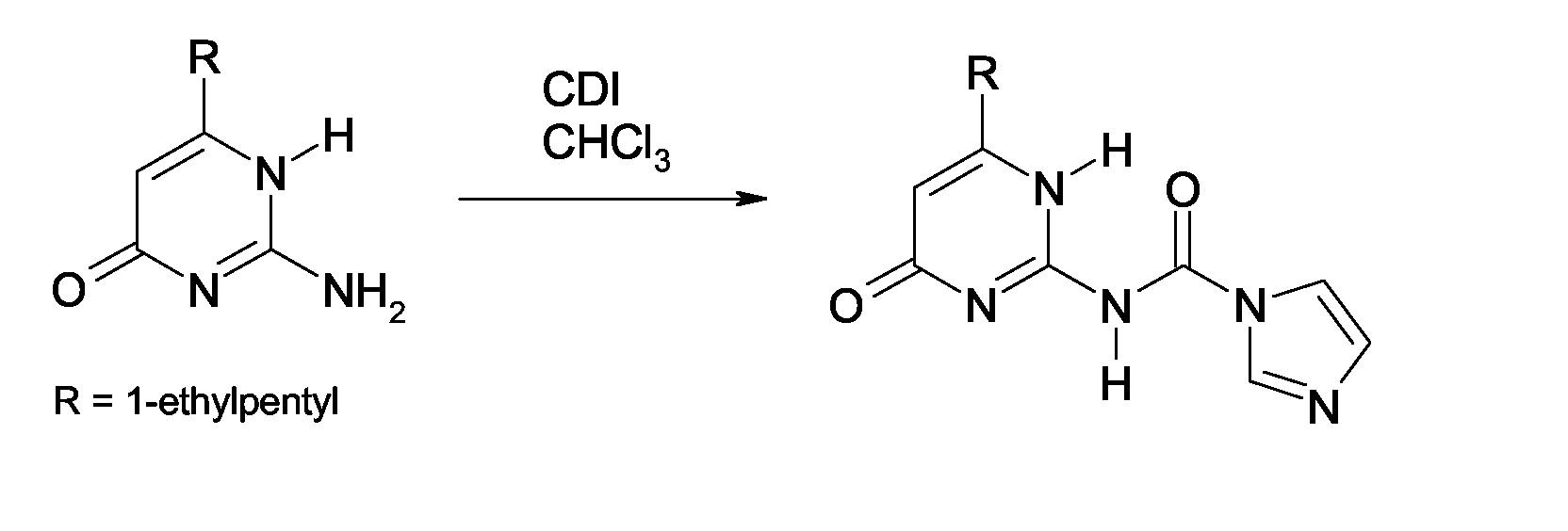
- 6-(1-Ethylpentyl)-isocytosine (3.0 gram, 14.4 mmol) and carbonyldiimidazole (CDI; 3.24 gram, 20 mmol) were stirred at room temperature in 40 mL CHCl 3 for two hours, during which the mixture was kept under an argon atmosphere. The solution was washed with an aqueous NaCl solution, dried with MgSO 4 and concentrated to give a quantitative yield of CDI-activated product. NMR analyses showed signals at the expected resonances and no traces of excess CDI were discerned. (The isocytosine starting product had been prepared by a standard coupling procedure of its ⁇ -keto ester precursor and guanidine carbonate).
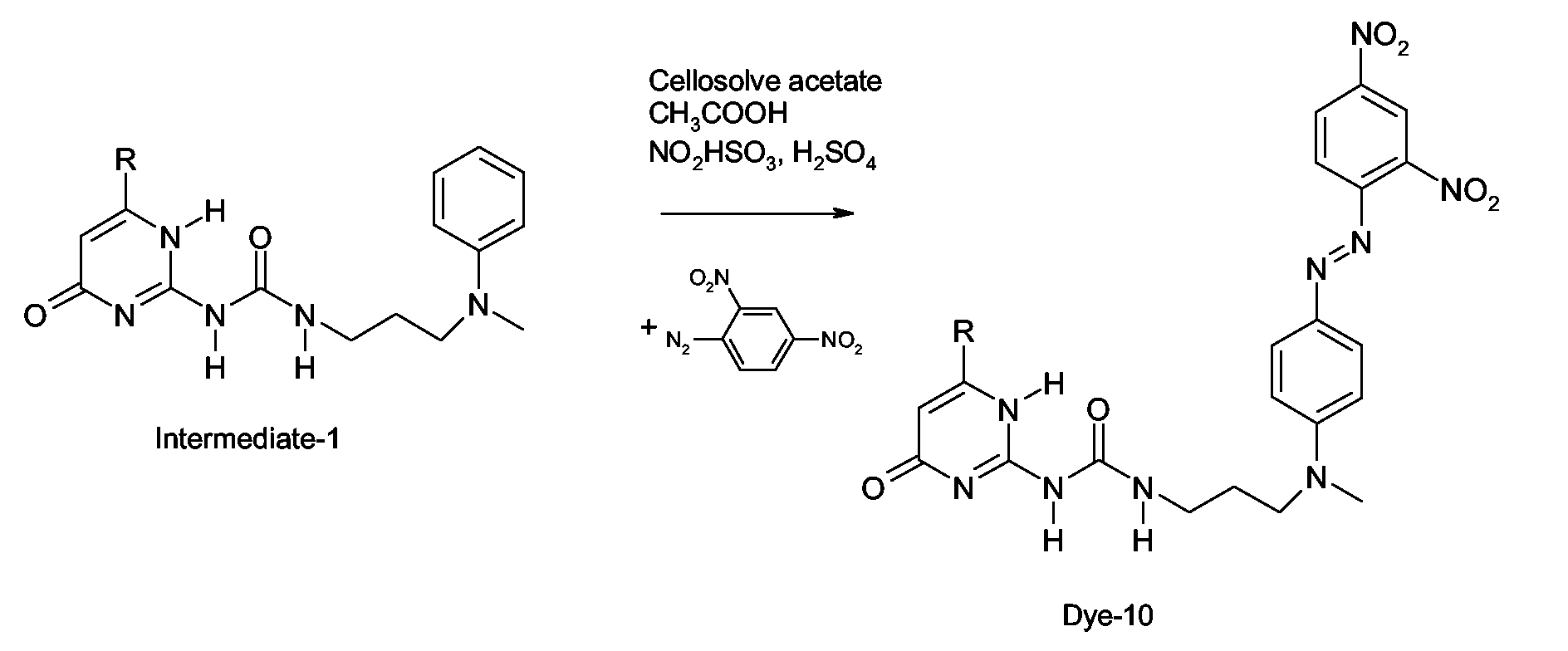
- 2,4-Dinitroaniline (0.6 gram, 3.3 mmol) was suspended in 4.5 mL of acetic acid and 0.6 mL of H 2 SO 4 .
- a 40% solution of nitrosyl sulfuric acid (NO 2 HSO 3 , 0.9 gram, 2.8 mmol) in H 2 SO 4 was added to this mixture, while remaining the mixture at 15 °C. Stirring was continued for 30 minutes.
- the resulting yellow solution was added dropwise to a cooled solution of Intermediate-1 (0.5 gram, 1.26 mmol) in 4 mL of cellosolve acetate. The mixture turned red and was stirred overnight, while the temperature of the mixture was allowed to rise from 5 °C to room temperature.
- the activated 6-(1-ethylpentyl)isocytosine (2.8 gram; 9.3 mmol) was dissolved in 50 mL dry CHCl 3 together with Solvent Brown 1 (Fat Brown RR;C.I.11285)(1.06 gram, 4.0 mmol), and the mixture was heated in an oil bath of 80 °C for about 20 hours. Purification by column chromatography (silica; CHCl 3 /MeOH, 98/2), and then by precipitation into acetone afforded Dye-13 as an orange solid.
- the starting diol 0.5 gram
- Isocyanate-1 (1.11 gram)
- a drop of dibutyltin dilaurate catalyst were mixed and heated in 100 mL of dry chloroform. After 24 hours of reflux, all isocyanate was consumed (FTIR analysis).
- the red product Dye-14 was isolated using column chromatography (silica, CHCl 3 /MeOH, 98/2).
- the compound was purified using preparative chromatography using a gradient elution from methanol/water 10/90 to methanol/water 90/10, both buffered with 1.05 mL triethylamine and 0.5 mL acetic acid per liter eluent, on a Kromasil C18 (100A, 10 ⁇ m)silica.
- the chromatography was run on a Prochrom LC80 column at a speed of 150 mL per minute and a gradient elution time of 30 minutes.
- Dye-16 was isolated with 10% yield and characterized by 1H-NMR spectroscopy and mass spectroscopy.
- the azodye-diol (1 gram; 3.17 mmol (prepared according to standard procedures) was dissolved in 20 mL of THF together with phthalimide (1.4 gram; 9.5 mmol) and triphenylphosphine (2.4 gram; 9.1 mmol).
- Diisopropylazodicarboxylate (1.9 gram; 9.4 mmol) in THF was added dropwise to this solution while cooling the mixture in a water bath. Overnight stirring at room temperature yielded a precipitate. Ether was added, stirring was continued for some time and the precipitate was collected by filtration. Yield: 1.43 gram (78%).
- the diphthalimide (1.43 gram; 2.5 mmol) was suspended in 40 mL of boiling THF and hydrazine hydrate (2.6 mL). The suspension developed into a clear solution and subsequently a white precipitate was formed. After cooling down the mixture it was filtered and the filtrate was concentrated to yield the crude diamine that was used in the next step.
- the CDI-activated product of (1-ethylpentyl)-isocytosine (2.1 gram, 6.93 mmol) was stirred overnight at room temperature in 50 mL CHCl 3 together with the crude diamine (0.87 gram; 2.78 mmol). The mixture was subsequently washed with a HCl solution and a NaHCO 3 solution, and thereafter dried and concentrated.
- the isocytosine (1.65 g, 5.7 mmol) was stripped from possible protic solvents by co-evaporation with toluene and was dissolved in 40 mL of CHCl 3 that had been pre-dried over molecular sieves. Carbonyl diimidazole, CDI, (1.7 g, 10.5 mmol) was added and the solution was stirred for 8 hours at room temperature; NMR analysis showed that no isocytosine was present anymore. The solution was washed twice with a saturated NaCl solution, dried with MgSO 4 , and concentrated to give a white product. Yield of the activated product: 1.9 g (90%).
- the activated isocytosine (1.16 g, 3.0 mmol) was stirred for three days at room temperature with 4-(4-(N,N-bis-(2-amino ethyl)amine)-phenylazo)-anisole (0.45 g, 1.44 mmol) in 25 mL of CHCl 3 under an atmosphere of argon.
- the mixture was washed with an 1M HCl solution and with a NaHCO 3 solution.
- the organic layer was dried with Na 2 SO 4 and concentrated to give a yellow solid.
- the isocytosine (0.82 g, 2.6 mmol) was co-evaporated with toluene and stirred for 6 hours with CDI (0.55 g, 3.4 mmol) in 20 mL of dry CHCl 3 under an argon atmosphere. The mixture was washed twice with a saturated NaCl solution, dried with Na 2 SO 4 and concentrated. The activated product (0.8 g, 1.95 mmol) was stirred with 4-(4-(N,N-bis-(2-amino ethyl)amine)-phenylazo)-anisole (0.26 g, 0.83 mmol) in 25 mL of CHCl 3 .
- the ⁇ -keto ester was purified by silica column chromatography using consecutively CHCl 3 /MeOH (2%), and CHCl 3 /MeOH (4%) containing 2% triethylamine as eluents.
- the ⁇ -keto ester (1.6 g, 5.0 mmol) and guanidine carbonate (1.15 g, 12.8 mmol) were boiled in 20 mL of ethanol for 16 hours. The mixture was concentrated and eluted over a silica column, first using CHCl 3 with 4% MeOH to remove contaminations. The isocytosine was collected as a white solid by eluting with CHCl 3 /MeOH (4%) containing 2% triethylamine.
- the activated product (1.9 g, 4.5 mmol) was stirred with 4-(4-(N,N-bis-(2-amino ethyl)amine)-phenylazo)-anisole (0.55 g, 1.76 mmol) in 50 mL of dry CHCl 3 . After 24 hours, the solution was washed with a 1M HCl solution and thereafter with a NaHCO 3 solution. Drying with Na 2 SO 4 was followed by filtration and concentration to give Dye-20 as a yellow solid. The solid was dissolved in CHCl 3 and precipitated into pentane, followed by crystallization from ethylacetate. Yield: 1.55 (87%).
- the activated isocytosine (3.9 g, 12.3 mmol) was stirred overnight with 4-(4-(N,N-bis-(2-amino ethyl)amine)-phenylazo)-anisole (1.47 g, 4.7 mmol) in 120 mL of chloroform.
- the mixture was consecutively extracted with a 1 M aqueous HCl solution and a bicarbonate solution, followed by drying over Na 2 SO 4 . Evaporation of the solvent was followed by precipitation from chloroform into methanol, and then from chloroform into pentane to yield 1.5 grams of Dye-21 as a yellow solid.
- the CDI-activated glycolated isocytosine has been described in Example 11.
- the dye alcohol (10 g, 29.2 mmol; prepared according to standard procedures), phthalimide (5.1 g, 34.7 mmol) and triphenylphosphine (9.2 g, 35.1 mmol) were dissolved in 200 mL THF.
- DIAD 7.1 g, 35.1 mmol
- the product was concentrated and purified on a silica column (CHCl 3 /MeOH, 1%). Stirring in ether/THF 20/1 gave a precipitate that was filtered and dried. Yield: 11.9 g (86%).
- the CDI-activated glycolated isocytosine has been described in Example 11.
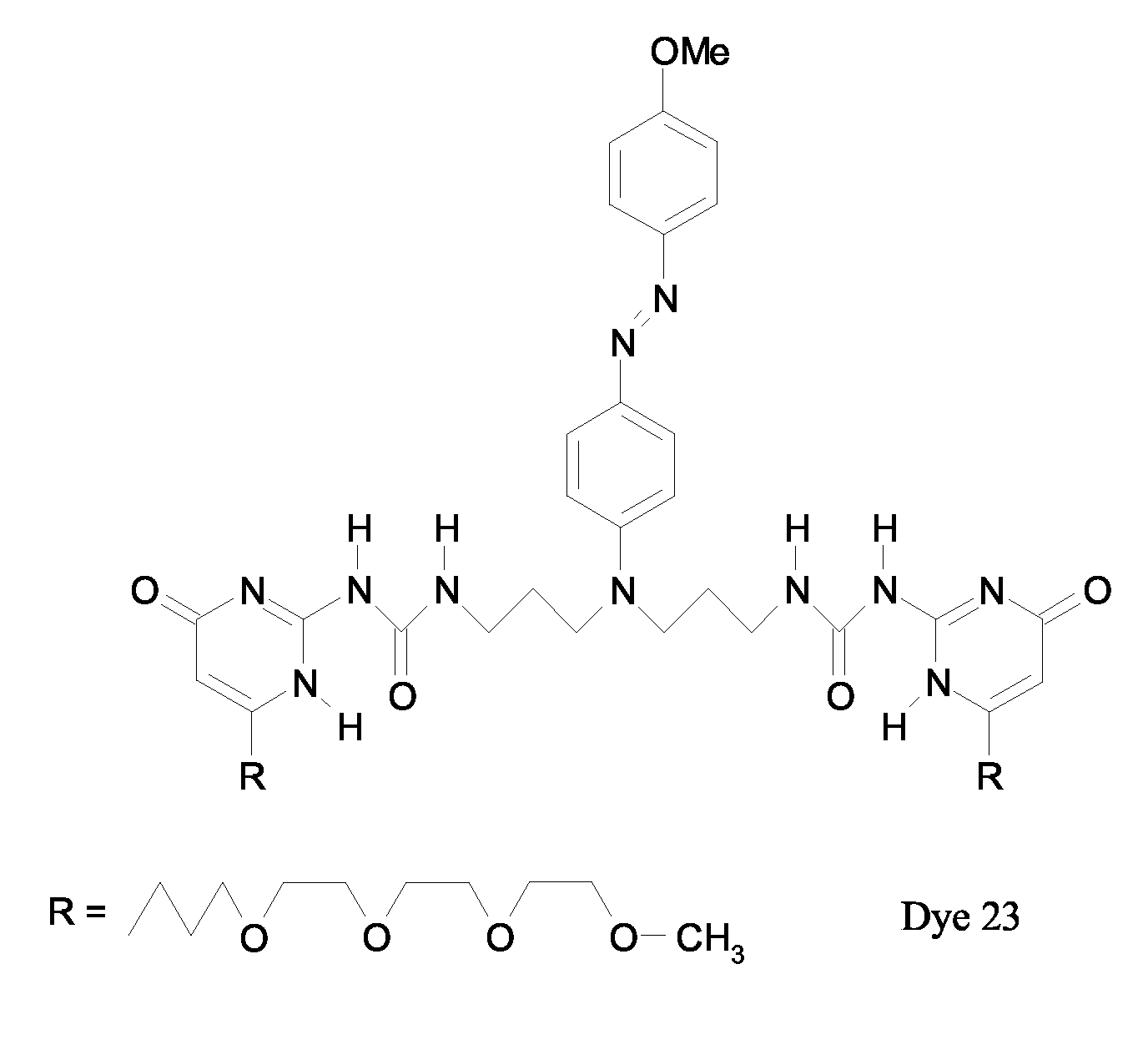
- the diamine (0.7 g, 2.1 mmol) and the CDI-activated isocytosine (2.0 g, 4.9 mmol) were stirred overnight in 20 mL of THF at room temperature under an argon atmosphere. Chloroform was added and the mixture was washed with a 0.01 M HCl solution and a saturated bicarbonate solution. The organic phase is dried over Na 2 SO 4 , filtered and concentrated under reduced pressure. The residue is purified by column chromatography over silica using CHCl 3 /MeOH (2%) as eluent to yield 0.95 g of pure Dye-23.
- Both reference and invention dyes were dissolved in 2-butanone as a 0.015 molar solution.
- Samples of 5 mL of the dye solutions were diluted with 5 mL methanol. From each sample, 20 ⁇ l of each solution was spotted on a Polar DTR receiver (trademark from AGFA) using an Anachem SK233 apparatus. Each sample was spotted 5 times and the average density value was taken as initial density for each dye at the start of the light-fastness test.
- the spotted samples were exposed during 8 hours using a Xenon-apparatus (Xenotest 150, equipped with a 7IR-filter, working in indoor mode). After one, two, four and eight hours, the density was measured again and the average density of the five spots was taken as the residual density.
- the percentage residual density is expressed as (residual density / initial density) x 100.
- the results are summarized in Table 2.
- Both reference compounds and the invention dye were dissolved in CH 2 Cl 2 /2-methoxypropanol (1/1).
- Reference dye-7 was dissolved as a 0.25% solution (w/v).
- the reference dye-8 and the invention dye-16 were dissolved as a 0.5 % solution (w/v).
- 1 mL of the samples was diluted with 0.75 mL 2-methoxypropanol and 0.75 mL CH 2 Cl 2 .
- a second sample of 1 mL was diluted with 1.75 mL 2-methoxypropanol and 2 mL CH 2 Cl 2 .
- For each sample 10 ⁇ l was spotted on a Polar DTR receiver (trademark from AGFA).
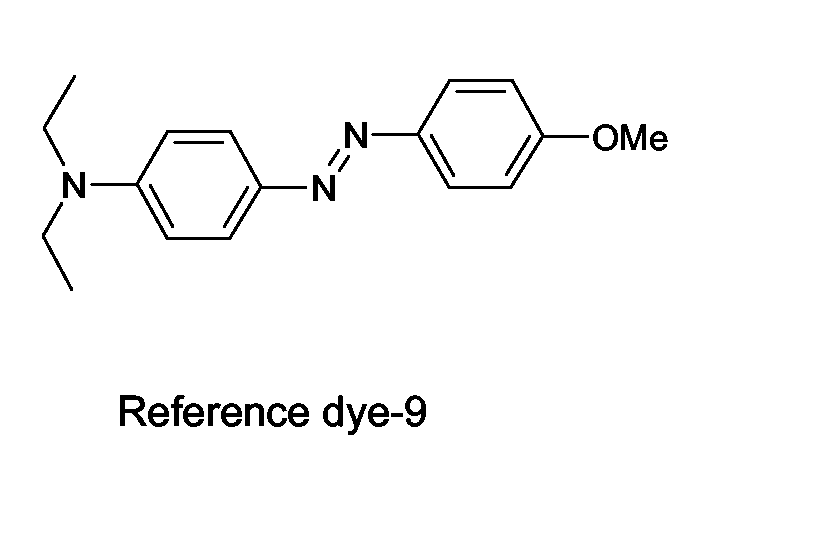
- Both reference dye-9 and the invention Dye-17 were dissolved in CH 2 Cl 2 /2-methoxypropanol (1/1).
- Reference dye-9 was dissolved as a 0.25% solution (w/v).
- the invention Dye-17 was dissolved as a 0.5 % solution (w/v).
- 1 mL of the samples was diluted with 0.75 mL 2-methoxypropanol and 0.75 mL CH 2 Cl 2 .
- a second sample of 1 mL was diluted with 1.75 mL 2-methoxypropanol and 2 mL CH 2 Cl 2 .
- For each sample 10 ⁇ l was spotted on a Polar DTR receiver (trademark from AGFA).
- This example deals with ink preparation and the evaluation of some physical properties.
- Table 5 shows the basic formulation, which the dyes were assessed in.
- the ink raw materials were placed into a plastic bottle and sonicated for one hour.
- the inks were then filtered to 1 ⁇ m and the physical properties measured.
- Table 6 shows the physical property measurements for each ink.
- the dyes according to the invention have similar physical ink properties and the filtration times are all good. Generally a filtration time of less than 45 seconds is expected for a dye-based ink.
- Ink %Composition w/w Dye (Dye-6;Dye-7) 3 Vinyl chloride/vinyl acetate copolymer UCAR VAGD 2 Butyl lactate 95 Ink %Composition w/w Dye (Dye-9) 3 Vinyl chloride/vinyl acetate copolymer UCAR VAGD 2 Butyl lactate 75 N-Methyl Pyrrolidone 20
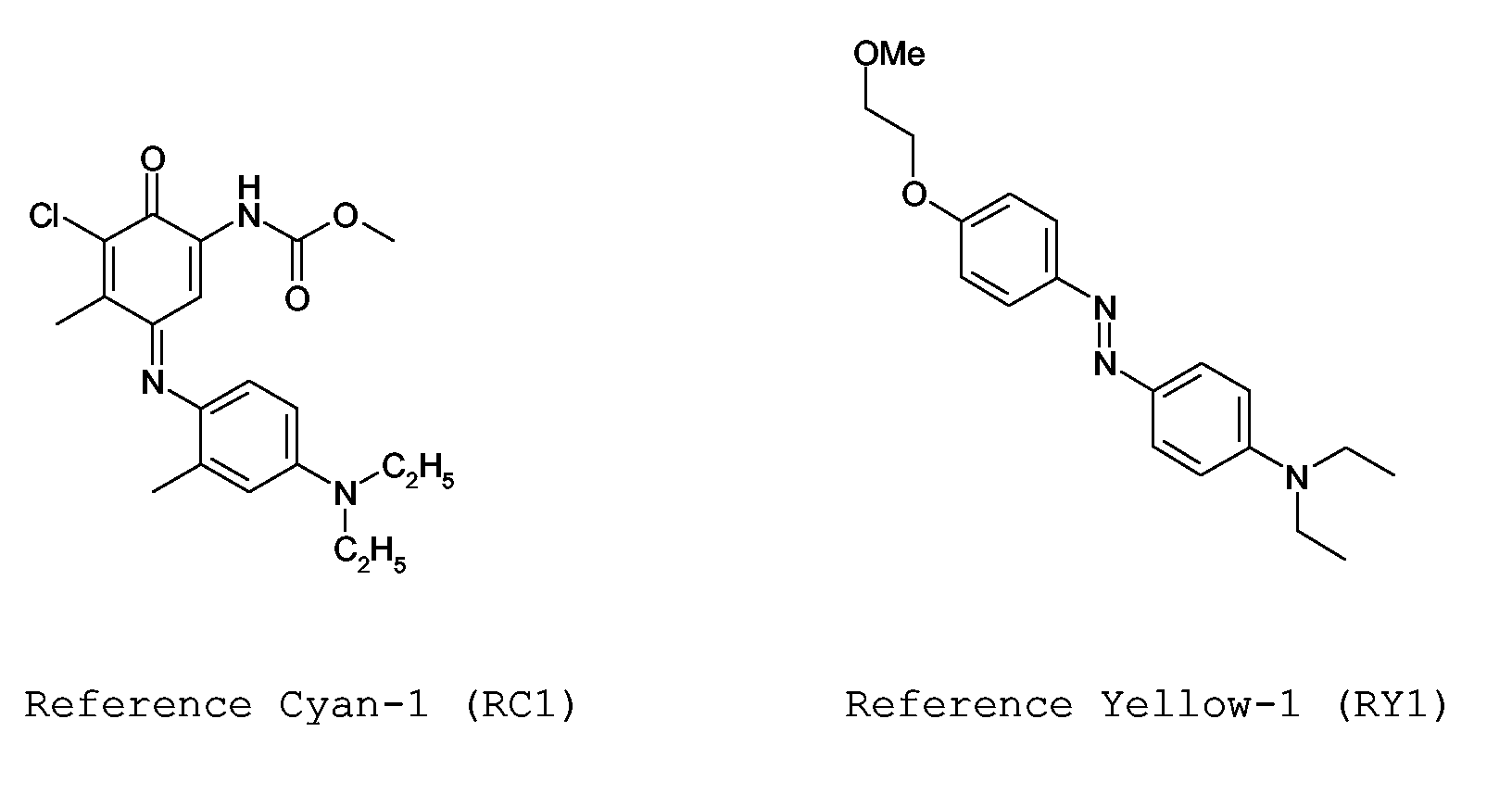
- Inks Ink 1-6 were tested under standard operating conditions in a Trident UltraJet printhead.
- the standard conditions are defined as :
Landscapes
- Chemical & Material Sciences (AREA)
- Organic Chemistry (AREA)
- Engineering & Computer Science (AREA)
- Materials Engineering (AREA)
- Wood Science & Technology (AREA)
- Life Sciences & Earth Sciences (AREA)
- Chemical Kinetics & Catalysis (AREA)
- Health & Medical Sciences (AREA)
- Medicinal Chemistry (AREA)
- Polymers & Plastics (AREA)
- General Chemical & Material Sciences (AREA)
- Inks, Pencil-Leads, Or Crayons (AREA)
- Ink Jet Recording Methods And Recording Media Thereof (AREA)
Abstract
Description
- water based ; the drying mechanism involves absorption, penetration and evaporation;
- oil based ; the drying involves absorption and penetration;
- solvent based ; the drying mechanism involves primarely evaporation;
- hot melt or phase change : the ink vehicle is liquid at the ejection temperature but solid at room temperature ; drying is replaced by solidification;
- UV-curable ; drying is replaced by polymerization.
- The ink-receiving layer should have a high ink absorbing capacity, so that the dots will not flow out and will not be expanded more than is necessary to obtain a high optical density.
- The ink-receiving layer should have a high ink absorbing speed (short ink drying time) so that the ink droplets will not feather if smeared immediately after applying.
- The ink dots that are applied to the ink-receiving layer should be substantially round in shape and smooth at their peripheries. The dot diameter must be constant and accurately controlled.
- The receiving layer must be readily wetted so that there is no "puddling", i.e. coalescence of adjacent ink dots, and an earlier absorbed ink drop should not show any "bleeding", i.e. overlap with neighbouring or later placed dots.
- Transparent ink-jet recording elements must have a low haze-value and be excellent in transmittance properties.
- After being printed the image must have a good resistance regarding waterfastness, lightfastness, and good endurance under severe conditions of temperature and humidity.
- The ink jet recording element may not show any curl or sticky behaviour if stacked before or after being printed.
- The ink jet recording element must be able to move smoothly through different types of printers.
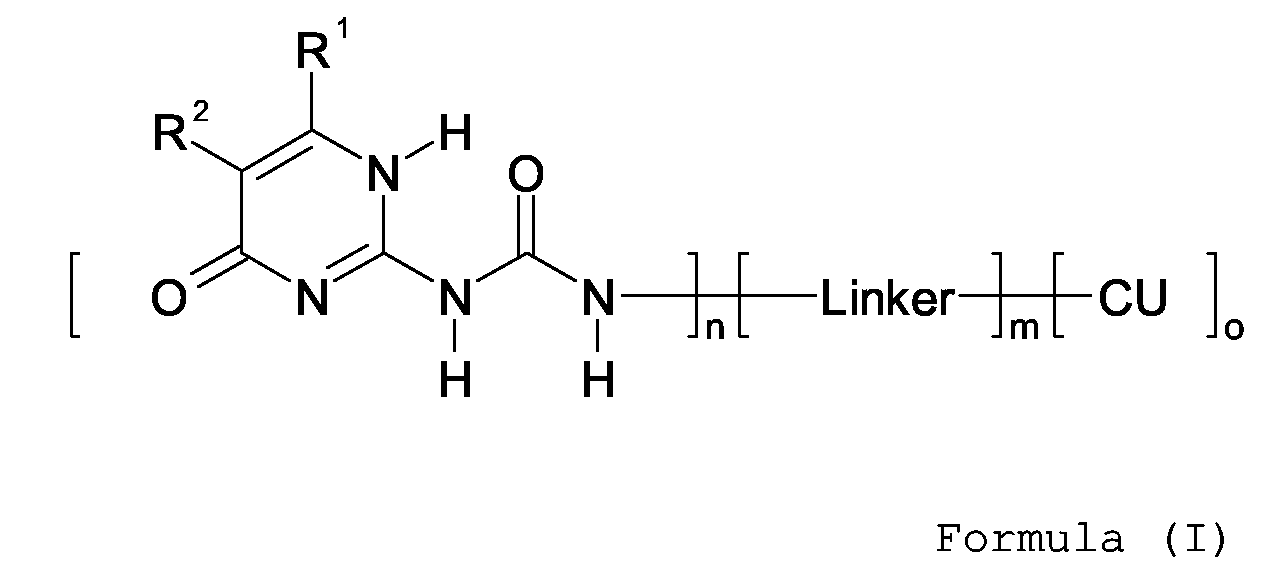
'Linker' represents any linking group;
'CU' means any chromophore group selected from the group consisting of an azo dye with a molar extinction coefficient larger than 103 l.mol-1.cm-1, an anthraquinone dye, a (poly)methine dye, an azomethine dye, a disazo dye, a carbonium dye, a styryl dye, a stilbene dye, a phthalocyanine dye, a coumarin dye, an aryl-carbonium dye, a nitro dye, a naphtholactam dye, a dioxazine dye, a flavin dye and a formazan dye;
n and o are the same or different and are integers having a value of at least 1; m can be zero or any integer having a value of at least 1;
n and o are the same or different and are integers having a value of at least 1; m can be zero or any integer having a value of at least 1;
R1 and R2 are the same or different and represent hydrogen, a halogen, a substituted or unsubstituted alkoxy group, a substituted or unsubstituted thioalkoxy group, a substituted or unsubstituted sulphoxy group, a substituted or unsubstituted sulphone group, a substituted or unsubstituted amino group, a nitrile group, a substituted or unsubstituted, saturated or unsaturated alkyl group, a substituted or unsubstituted acyl group, a substituted or unsubstituted sulphonyl group, a substituted or unsubstituted phosphoryl group, a substituted or unsubstituted aryl group, a substituted or unsubstituted aralkyl group, a heterocyclic group, a CU group, or R1 and R2 represent the necessary atoms to form a ring system
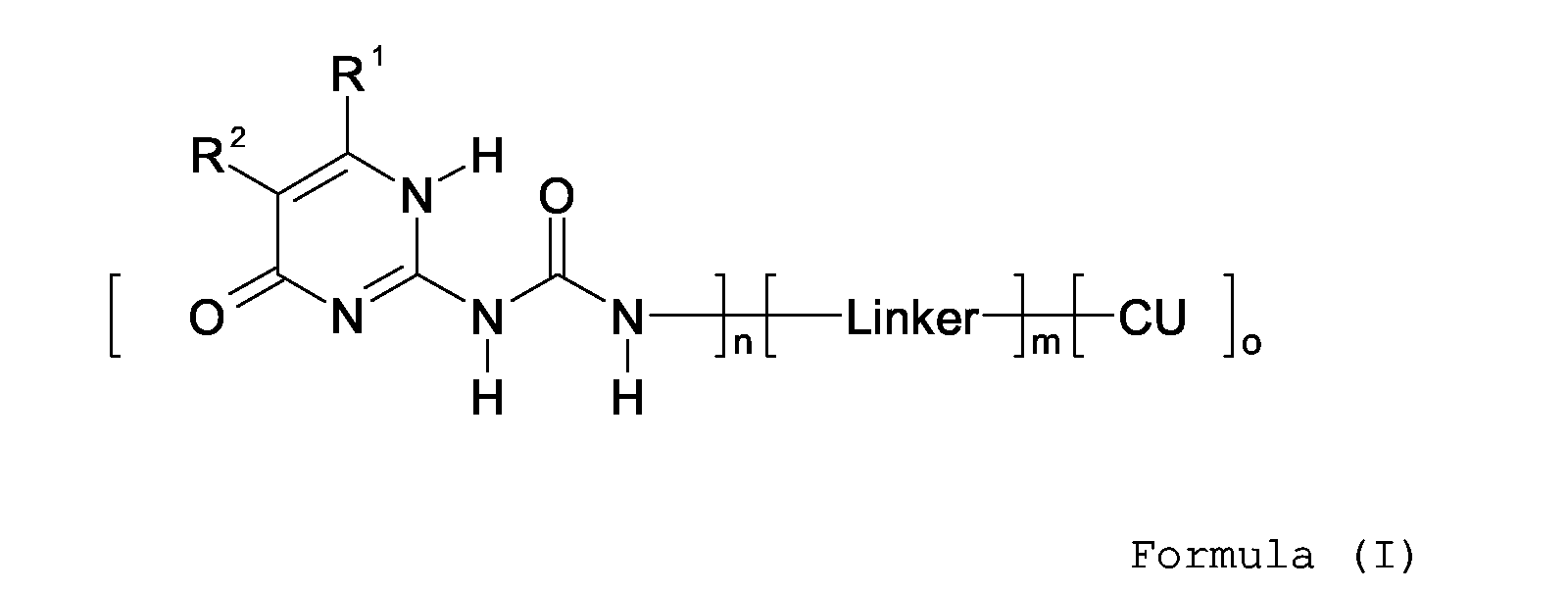
'Linker' represents any linking group;
'CU' means any chromophore group selected from the group consisting of an azo dye with a molar extinction coefficient larger than 103 l.mol-1.cm-1, an anthraquinone dye, a (poly)methine dye, an azomethine dye, a disazo dye, a carbonium dye, a styryl dye, a stilbene dye, a phthalocyanine dye, a coumarin dye, an aryl-carbonium dye, a nitro dye, a naphtholactam dye, a dioxazine dye, a flavin dye and a formazan dye;
n and o are the same or different and are integers having a value of at least 1; m can be zero or any integer having a value of at least 1;
R1 and R2 are the same or different and represent hydrogen, a halogen, a substituted or unsubstituted alkoxy group, a substituted or unsubstituted thioalkoxy group, a substituted or unsubstituted sulphoxy group, a substituted or unsubstituted sulphone group, a substituted or unsubstituted amino group, a nitrile group, a substituted or unsubstituted, saturated or unsaturated alkyl group, a substituted or unsubstituted acyl group, a substituted or unsubstituted sulphonyl group, a substituted or unsubstituted phosphoryl group, a substituted or unsubstituted aryl group, a substituted or unsubstituted aralkyl group, a heterocyclic group, a CU group, or R1 and R2 represent the necessary atoms to form a ring system.

R1 and R2 are the same or different and represent hydrogen, a halogen, a substituted or unsubstituted alkoxy group, a substituted or unsubstituted thioalkoxy group, a substituted or unsubstituted sulphoxy group, a substituted or unsubstituted sulphone group, a substituted or unsubstituted amino group, a nitrile group, a substituted or unsubstituted, saturated or unsaturated alkyl group, a substituted or unsubstituted acyl group, a substituted or unsubstituted sulphonyl group, a substituted or unsubstituted phosphoryl group, a substituted or unsubstituted aryl group, a substituted or unsubstituted aralkyl group, a heterocyclic group, a CU group, or R1 and R2 represent the necessary atoms to form a ring system.

Y represents CU or Z-CU;
CU means any chromophore group absorbing between 200nm and 2000nm, such as an azo dye, an anthraquinone dye, a (poly)methine dye, an azomethine dye, a polyene dye, a pyrene dye, a disazo dye, a carbonium dye, a styryl dye, a stilbene dye, a phthalocyanine dye, a coumarin dye, an aryl-carbonium dye, a nitro dye, a naphtholactam dye, a dioxazine dye, a flavin dye, a formazan dye;
R1 and R2 are the same or different and represent hydrogen, a halogen, a substituted or unsubstituted alkoxy group, a substituted or unsubstituted thioalkoxy group, a substituted or unsubstituted sulphoxy group, a substituted or unsubstituted sulphone group, a substituted or unsubstituted amino group, a nitrile group, a substituted or unsubstituted, saturated or unsaturated alkyl group, a substituted or unsubstituted acyl group, a substituted or unsubstituted sulphonyl group, a substituted or unsubstituted phosphoryl group, a substituted or unsubstituted aryl group, a substituted or unsubstituted aralkyl group, a heterocyclic group, a CU group, or R1 and R2 represent the necessary atoms to form a ring system; and
Z represents any linking group.


whereby the SAU and SAU" residues are complementary so that the dye(s) of Formula (I) and compounds according to formula (III) are able to assemble with each other. Assembly through the formation of intermolecular hydrogen bonds is induced through evaporation of the ink vehicle. As long as the assembling dyes are dissolved in the ink no or partial assembly occurs because of the formation of hydrogen bonds with the ink vehicle. Once the ink vehicle (or one of the ink vehicles) is removed through, for example, evaporation, assembly of the dyes is induced resulting in supramolecular structures. The considerations about the integrity of the individual component molecules are the same as for the first and second embodiment.


1H NMR (300 MHz, CDCl3): δ = 1.1-1.7 (m, 11H), 2.1 (s, 3H), 3.0-3.2 (m, 4H), 3.4 (m, 5H), 3.6 (m, 2H), 3.7 (m, 2H), 4.1 (m, 2H), 4.3 (m, 2H), 5.15 and 5.2 (2s, 1H), 5.8 (s, 1H), 6.75 (d, 2H), 6.95 (d, 2H), 7.8 (d, 4H), 10.1 (s, 1H), 11.7 (s, 1H), 13.1 (s, 1H). MALDI-TOF MS (FW=636.75), found m/z = 637.13. IR : υ (cm-1) = 666, 750, 823, 837, 923, 942, 1003, 1035, 1058, 1105, 1132, 1151, 1194, 1240, 1315, 1361, 1377, 1396, 1446, 1511, 1546, 1583, 1667, 1682, 1700, 2929, 3290. λmax = 409 nm; ε=26321 (CHCl3); λmax = 409 nm; ε=29000 (MeOH).

1H NMR (300 MHz, CDCl3): δ = 0.9 (t, 3H), 1.1-1.7 (m, 13H), 2.1 (s, 3H), 2.4 (s, 3H), 3.1 (m, 4H), 3.4 (m, 4H), 3.6 (s, 2H), 4.2 (m, 2H), 5.2-5.4 (2s, 1H), 5.8 (s, 1H), 6.6 (m, 1H), 6.7 (m, 2H), 7.5 (m, 1H), 7.6 (t, 1H), 8.1 (d, 1H), 8.4 (m, 2H), 9.3 (m, 1H), 10.1 (s, 1H), 11.7 (s, 1H), 13.1 (s, 1H). MALDI-TOF MS (FW=712.84), found m/z = 714.24. IR: υ (cm-1) = 667, 753, 799, 842, 937, 988, 1029, 1072, 1101, 1139, 1193, 1250, 1318, 1353, 1393, 1446, 1470, 1501, 1534, 1578, 1606, 1660, 1698, 2859, 2929, 3288. λmax = 678 nm; ε=24288 (CHCl3); λmax = 681 nm; ε=23000 (MeOH).
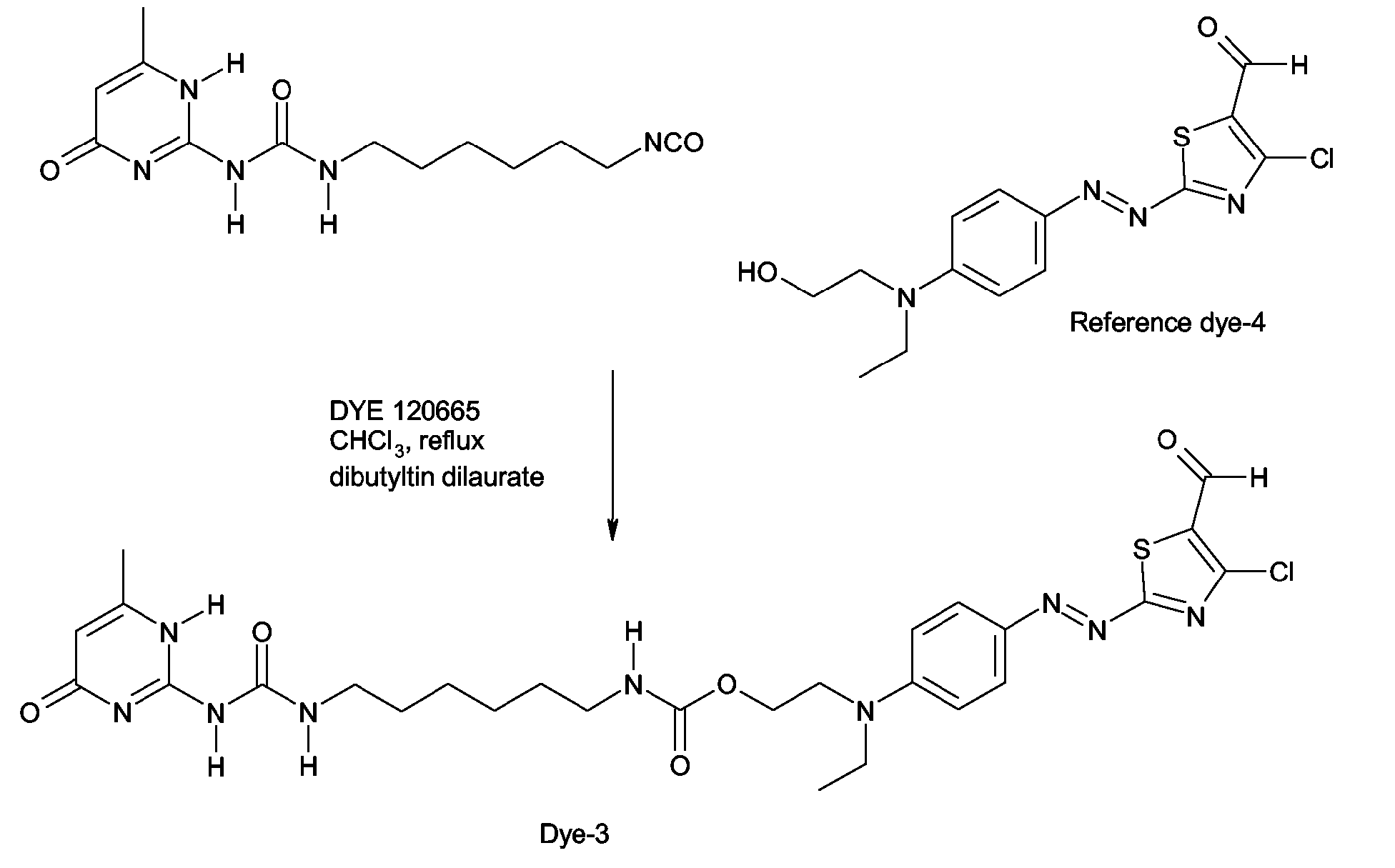
1H NMR (300 MHz, CDCl3): δ = 1.1-1.6 (m, 11H), 2.2 (s, 3H), 3.2 (m, 4H), 3.6 (m, 2H), 3.7 (m, 2H), 4.3 (m, 2H), 5.2-5.4 (2s, 1H), 5.8 (s, 1H), 6.8 (m, 2H), 7.9 (d, 2H), 10.0 (s, 1H), 10.1 (s, 1H), 11.7 (s, 1H), 13.1 (s, 1H). MALDI-TOF MS (FW=632.12), found m/z = 632.14. IR: υ (cm-1) = 653, 664, 684, 721, 799, 826, 880, 926, 997, 1072, 1101, 1215, 1242, 1309, 1327, 1372, 1411, 1445, 1482, 1519, 1581, 1595, 1658, 1697, 2856, 2928, 3214. λmax = 555 nm; ε=44000 (CHCl3); λmax = 547 nm; ε =38000 (MeOH).
1H NMR (300 MHz, CDCl3): δ = 1.2 (t, 3H), 1.3 (m, 4H), 1.4-1.6 (m, 4H), 2.2 (s, 3H), 2.3 (s, 3H), 2.5 (s, 3H), 3.0-3.2 (m, 4H), 3.4 (m, 2H), 3.5 (m, 2H), 3.7 (s, 3H), 4.2 (m, 2H), 5.1 and 5.3 (2s, 1H), 5.8 (s, 1H), 6.6 (m, 2H), 6.8 (d, 1H), 7.6 (s, 1H), 7.9 (s, 1H), 10.1 (s, 1H), 11.7 (s, 1H), 13.1 (s, 1H). MALDI-TOF MS (FW=699.20), found m/z = 700.25. IR : υ (cm-1) = 664, 750, 784, 804, 843, 875, 917, 968, 1042, 1110, 1135, 1179, 1243, 1318, 1348, 1375, 1393, 1455, 1514, 1583, 1630, 1660, 1698, 1700, 2858, 2929, 3216, 3374. λmax = 653 nm; ε=26000 (CHCl3); λmax = 652 nm; ε=21000 (MeOH).

1H NMR (300 MHz, CDCl3): δ = 3.1- 3.3 (m, 4H), 3.5 (m, 2H), 3.7 (m, 2H), 4.2 (m, 2H), 5.0-5.2 (2s, 1H), 5.8 (s, 1H), 6.8 (m, 2H), 7.9 (m, 4H), 8.3 (m, 2H), 10.1 (s, 1H), 11.7 (s, 1H), 13.1 (s, 1H). MALDI-TOF MS (FW=607.7), found m/z = 608.2. IR : υ (cm-1) = 689, 741, 767, 798, 858, 943, 1041, 1105, 1133, 1194, 1251, 1311, 1338, 1384, 1446, 1512, 1590, 1662, 1698, 2857, 2932, 3230. λmax = 479 nm (CHCl3); λmax = 476 nm (MeOH).

1H NMR (300 MHz, CDCl3): δ = 0.9-1.0 (m, 10H), 1.2-1.4 (m, 4H), 1.5-1.7 (m, 3H), 2.2 (s, 3H), 2.3 (s, 3H) , 2.5 (s, 3H), 3.0 (m, 2H), 3.2 (m, 2H), 3.5 (m, 2H), 3.6 (m, 2H), 3.7 (s, 3H), 4.2 (m, 2H), 5.2-5.4 (2s, 1H), 5.8 (s, 1H), 6.6 (m, 2H), 6.75 (d, 1H), 7.7 (s, 1H), 7.9 (s, 1H), 10.1 (s, 1H), 11.7 (s, 1H), 13.1 (s, 1H). IR : υ (cm-1) = 666, 705, 745, 768, 784, 804, 842, 875, 917, 968, 1042, 1110, 1135, 1179, 1250, 1319, 1350, 1376, 1394, 1456, 1515, 1595, 1632, 1660, 1697, 1723, 2957, 3218, 3376. λmax = 655 nm; ε= 25000 (CHCl3);λmax = 647 nm; ε= 21000 (MEK); λmax = 638 nm; ε= 24000 (EtOAc).
1H NMR (300 MHz, CDCl3): δ 0.9 (m, 9H), 1.0-1.8 (8H), 2.2 (s, 3H), 2.8-3.0 (m, 4H), 3.5 (m, 2H), 3.7 (m, 2H), 4.3 (m, 2H), 5.2-5.4 (1H), 5.8 (s, 1H), 6.8 (m, 2H), 7.9 (m, 2H), 10.1 (m, 2H), 11.9 (bs, 1H), 13.1 (bs, 1H).
FT-IR: υ (cm-1) = 666, 684, 721, 761, 796, 826, 880, 925, 997, 1013, 1073, 1123, 1218, 1244, 1310, 1327, 1372, 1411, 1482, 1520, 1597, 1660, 1698, 2957. λmax = 553nm; ε=3700 (CHCl3);λmax = 561 nm; ε= 39000 (MEK); λmax = 553 nm; ε= 36000 (EtOAc).

1H NMR (300 MHz, CDCl3): δ 0.9-1.9 (22H), 2.2 (s, 3H), 2,4 (s, 3H), 3.0 (m, 2H), 3.2 (m, 2H), 3.4 (m, 4H), 3.6 (m, 2H), 4.3 (t, 2H), 5.2-5.4 (1H), 5.8 (s, 1H), 6.6 (d, 1H), 6.7 (m, 2H), 7.6 (t, 1H), 7.7 (t, 1H), 8.2 (d, 1H), 8.48 (s 1H), 8.55 (d, 1H), 9.3 (t, 1H), 10.1 (bs, 1H), 11.9 (bs, 1H), 13.1 (bs, 1H).
FT-IR: υ (cm-1) = 696, 754, 797, 841, 936, 1029, 1072, 1100, 1138, 1193, 1246, 1318, 1354, 1393, 1447, 1470, 1501, 1532, 1580, 1607, 1660, 1698, 2958. λmax = 684 nm; ε =25000 (CHCl3);λmax = 679 nm; ε = 22000 (MEK) ; λmax = 680 nm; ε = 22000 (EtOAc).

1H NMR (300 MHz, CDCl3): δ 0.9 (m, 9H), 1.0-1.8 (8H), 2.2 (s, 3H), 3.0 (m, 2H), 3.3 (m, 2H), 3.5 (m, 5H), 3.6 (m, 2H), 3.8 (m, 2H), 4.2-4.4 (m, 4H), 5.0-5.4 (three m, 1H), 5.8 (s, 1H), 6.8 (m, 2H), 7.0 (d, 2H), 7.8 (m, 4H), 10.1 (m, 1H), 11.9 (bs, 1H), 13.1 (bs, 1H).
FT-IR: υ (cm-1) = 664, 731, 775, 821, 836, 924, 1033, 1060, 1133, 1149, 1196, 1242, 1316, 1355, 1396, 1447, 1511, 1581, 1594, 1660, 1697, 2956, 3216. λmax = 409 nm; ε =29112(CHCl3).
(1H, s), 5.7 (1H, s), 2.4 (1H, m), 1.6 (4H, m), 1.2 (4H, m), 0.95-0.7 (6H, m).

1H NMR (CDCl3), δ = 13.2 (1H, s), 12.0 (1H, s), 10.3 (1H, s), 7.2 and 6.7 (5H), 5.8 (1H, s), 3.5-3.3 (4H, m), 3.0 (3H, s), 2.3 (1H, m), 1.9 (2H, m), 1.8-1.5 (4H, m), 1.3 (4H, m), 0.95-0.8 (6H, m).
1H NMR (CDCl3), δ = 13.1 (1H, s), 12.0 (1H, s), 10.4 (1H, s), 8.7 (1H, s), 8.4 (1H, d), 7.9 (3H, m), 6.8 (2H, d), 5.8 (1H, s), 3.6 (2H, m), 3.4 (2H, m), 3.2 (3H, s), 2.3 (1H, m), 2.0 (2H, m), 1.7-1.5 (4H, m), 1.3 (4H, m), 0.9 (6H, m).

1H NMR (CDCl3), δ = 13.1 (2H, s), 12.0 (2H, s), 10.3 (2H, s), 7.4-7.0 and 6.8-6.5 (5H), 5.8 (2H, s), 3.5-3.3 (8H, m), 2.3 (2H, m), 2.0 (4H, m), 1.6 (8H, m), 1.3 (8H, m), 0.95-0.7 (12H, m).

After drying the structure of Dye-11 was confirmed by MALDI-TOF MS ([M+]=779, [M+Na+]=802, [M+K+]=818).


1H NMR (CDCl3, TFA-D1), δ = 12.0 (6H, bs), 8.9 (1H, d), 8.4 (1H, bs), 8.0 (4H, m), 7.6 (4H, m), 6.3 (1H, s), 6.2 (1H, s), 2.6 (2H, m), 1.7 (8H, m), 1.4 (8H, m), 1.0 (12H, m). λmax = 408 nm; ε =19868 (CHCl3). MALDI-TOF MS analysis, [M+H+] = 734, [M+Na+] = 756, [M+K+] = 772. λmax = 408 nm; ε =20000 (CHCl3).

1H NMR (CDCl3), δ = 13.1 (2H, bs), 11.8 (2H, bs), 10.1 (2H, bs), 8.3 (2H, m), 7.9 (4H, m), 6.8 (2H, m), 5.8 (2H, s), 5.8-5.2 (2H), 4.2 (4H, m), 3.7 (4H, m), 3.3-2.8 (8H), 2.2 (6H, s), 1.8-1.2 (8H, m), 1.0 (20H, m).λmax = 464 nm; ε =28465 (CHCl3).
MALDI-TOF MS analysis, [M+H+] = 1001, [M+Na+] = 1023.
λmax = 464 nm; ε =28000 (CHCl3).

1H NMR (CDCl3), δ = 13.1 (2H, bs), 11.8 (2H, bs), 10.1 (2H, bs), 7.8 (4H, m), 6.9 (2H, m), 6.7 (2H, m), 5.8 (2H, s), 5.6-5.2 (2H), 4.2 (4H, m), 3.8 (3H, s), 3.6 (4H), 3.3-2.8 (8H), 2.2 (6H, s), 1.8-1.2 (8H, m), 1.0 (20H, m).λmax = 405 nm; ε =31920 (CHCl3).
MALDI-TOF MS analysis, [M+H+] = 985, [M+Na+] = 1009.
λmax = 405 nm; ε =32000 (CHCl3).

1H NMR (CDCl3), δ = 7.9-7.6 (12H, m), 7.0 (4H, 2), 3.95 (4H, m), 3.9 (3H, s), 3.8 (4H, m).
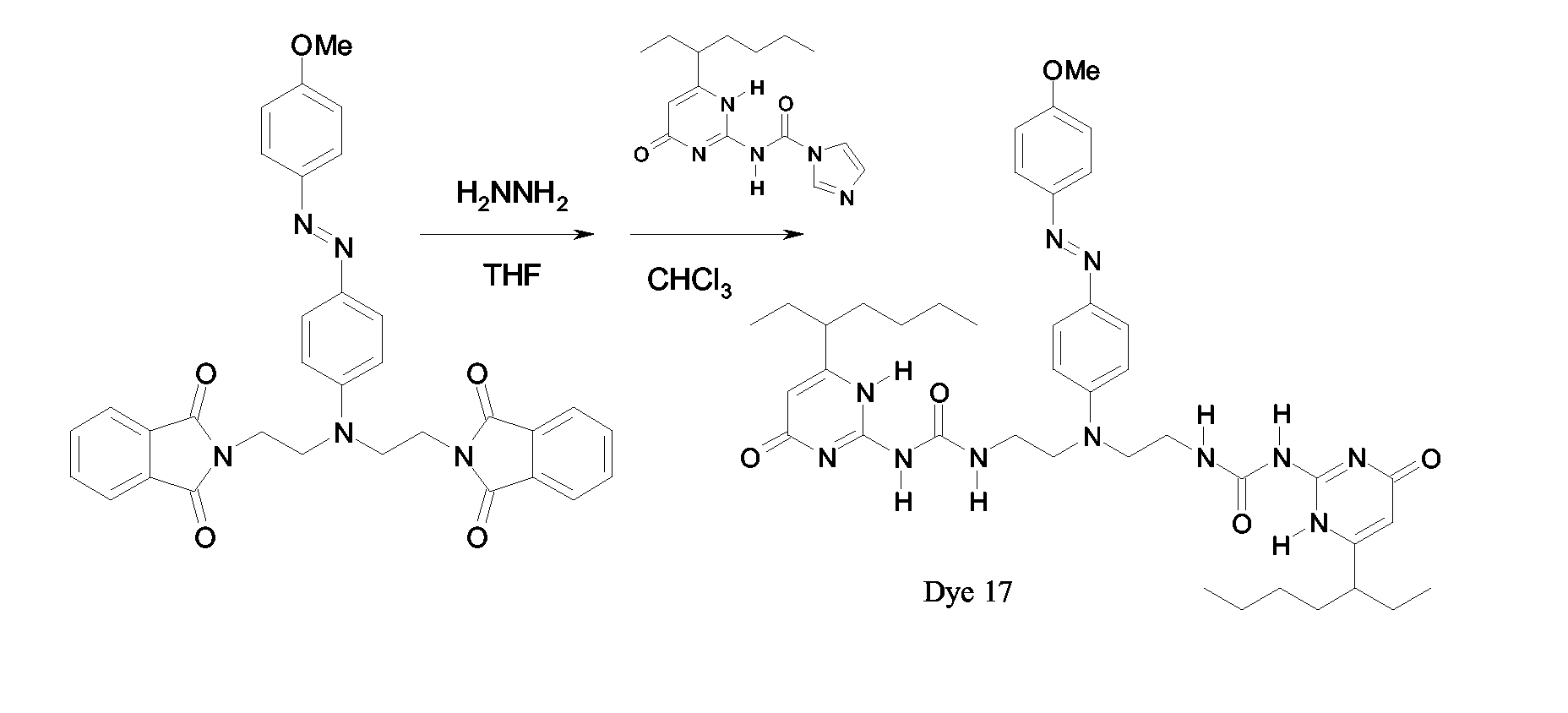
1H NMR (CDCl3), δ = 13.2 (2H, s), 11.9 (2H, s), 10.4 (2H, s), 7.8 (4H, m), 7.0 (4H, m), 5.8 (2H, s), 3.8 (3H, s), 3.7-3.4 (8H, m), 2.3 (2H, m), 1.8-1.5 (8H, m), 1.3 (8H, m), 0.95-0.8 (12H, m).
MALDI-TOF MS, [M+H+] = 784.6, [M+Na+] = 806.6, [M+K+] = 822.6
UV: λmax = 408 nm; ε = 14000 (CHCl3).
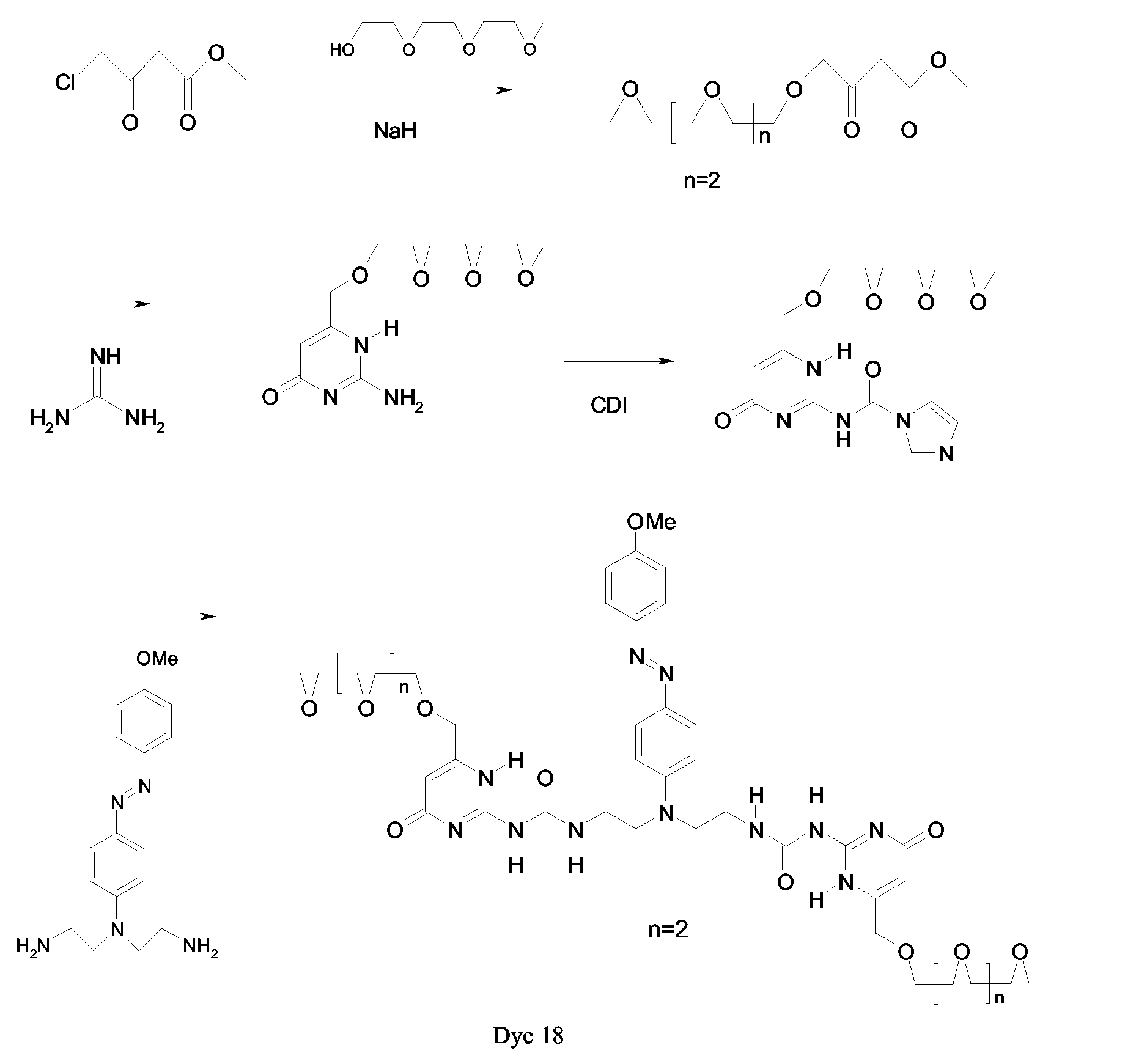
1H NMR (CD3SOCD3), δ = 11.0-10.0 (6H, bs), 7.7 (4H, m), 7.0 (4H, m), 5.8 (2H, s), 4.2 (4H, s), 3.8 (4H, s), 3.6-3.3 (31H, m), 3.2 (6H,s). MALDI-TOF MS C43H61N11O13, [M+H+] = 940.3, [M+Na+] = 962.3, [M+K+] = 978.3, [M+2Na+-H+] = 984.3, [M+K++Na+-H+] = 1000.3.
UV: λmax (CHCl3) = 404 nm; ε = 28000.
NMR-data on the intermediate products are in agreement with the assigned molecular structures.
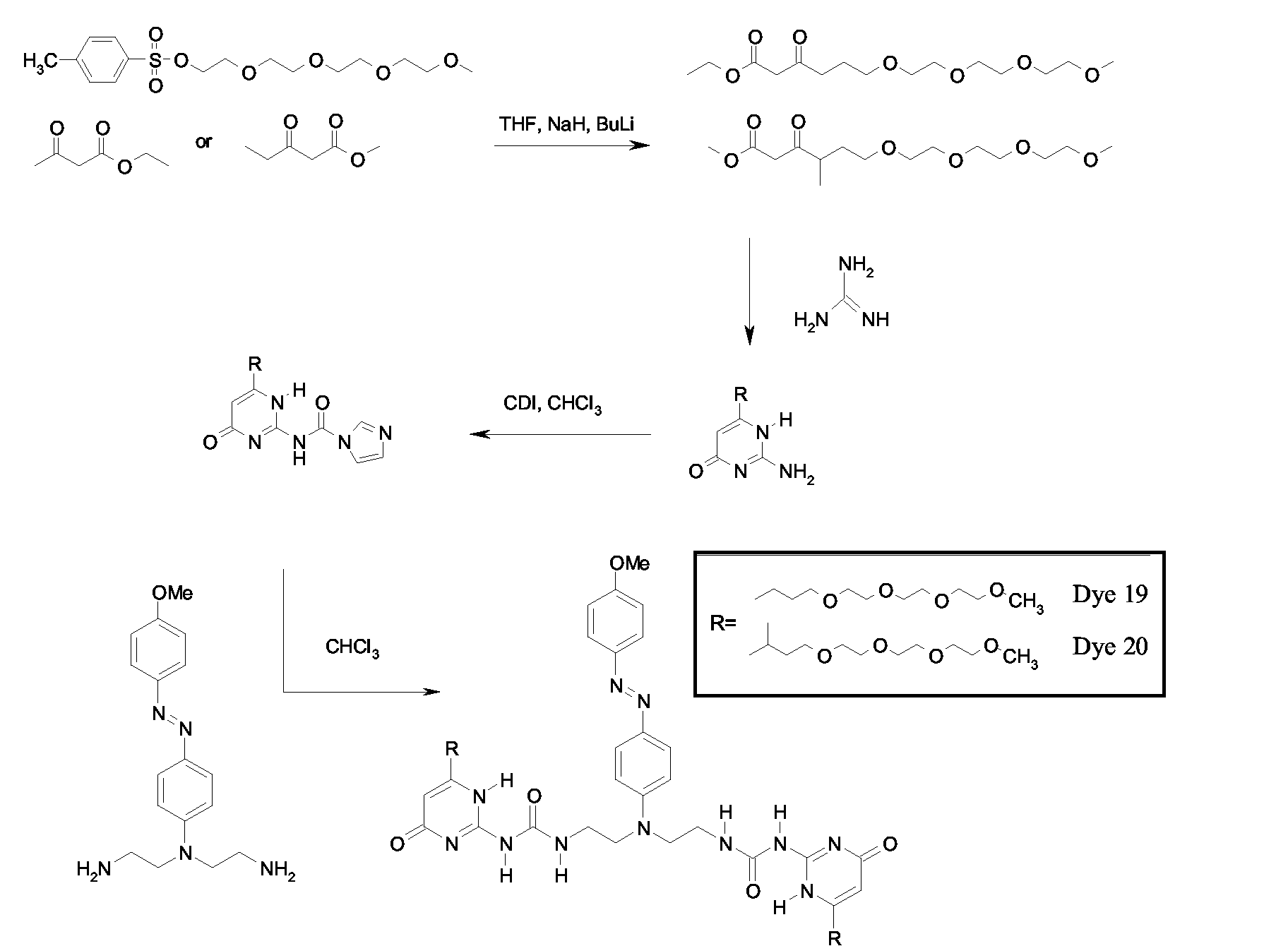
The isocytosine (0.82 g, 2.6 mmol) was co-evaporated with toluene and stirred for 6 hours with CDI (0.55 g, 3.4 mmol) in 20 mL of dry CHCl3 under an argon atmosphere. The mixture was washed twice with a saturated NaCl solution, dried with Na2SO4 and concentrated.
The activated product (0.8 g, 1.95 mmol) was stirred with 4-(4-(N,N-bis-(2-amino ethyl)amine)-phenylazo)-anisole (0.26 g, 0.83 mmol) in 25 mL of CHCl3. After 24 hours, the solution was washed with a 1M HCl and thereafter with a NaHCO3 solution. Drying with Na2SO4 was followed by filtration and concentration to yield Dye-19 as a yellow solid. The solid was dissolved in CHCl3 and precipitated into pentane. Yield: 0.77 g (95%).
1H NMR (CDCl3), δ = 13.0 (2H, bs), 11.9 (2H, bs), 10.4 (2H, bs), 7.8 (4H, m), 6.9 (4H, m), 5.9 (2H, s), 3.9-3.3 (45H, m), 2.6 (4H, t), 1.9 (4H, t).
MALDI-TOF MS C47H69N11O13, [M+H+] = 996.5, [M+Na+] = 1018.5.
UV: λmax (CHCl3) = 404 nm; ε = 15000 NMR-data on the intermediate products are in agreement with the assigned molecular structures.
The β-keto ester (1.6 g, 5.0 mmol) and guanidine carbonate (1.15 g, 12.8 mmol) were boiled in 20 mL of ethanol for 16 hours. The mixture was concentrated and eluted over a silica column, first using CHCl3 with 4% MeOH to remove contaminations. The isocytosine was collected as a white solid by eluting with CHCl3/MeOH (4%) containing 2% triethylamine. Yield: 1.36 g (83%).
The isocytosine (1.36 g, 4.1 mmol) was stripped from protic contaminants by co-evaporation with toluene and was dissolved in 25 mL of dry CHCl3. CDI (1.05 g, 6.5 mmol) was added and stirring was maintained overnight under an argon atmosphere. The mixture was washed twice with a saturated NaCl solution, dried with Na2SO4 and concentrated.
The activated product (1.9 g, 4.5 mmol) was stirred with 4-(4-(N,N-bis-(2-amino ethyl)amine)-phenylazo)-anisole (0.55 g, 1.76 mmol) in 50 mL of dry CHCl3. After 24 hours, the solution was washed with a 1M HCl solution and thereafter with a NaHCO3 solution. Drying with Na2SO4 was followed by filtration and concentration to give Dye-20 as a yellow solid. The solid was dissolved in CHCl3 and precipitated into pentane, followed by crystallization from ethylacetate. Yield: 1.55 (87%).
1H NMR (CDCl3), δ = 13.1 (2H, bs), 11.9 (2H, bs), 10.4 (2H, bs), 7.8 (4H, m), 6.9 (4H, m), 5.9 (2H, s), 3.9-3.3 (45H, m), 2.9 (2H, m), 1.9 (4H, t), 1.3 (6H, d).
MALDI-TOF MS C49H73N11O13, [M+H+] = 1024.5, [M+Na+] = 1046.5.
UV: λmax (CHCl3) = 404 nm; ε (CHCl3) = 16000
NMR-data on the intermediate products are in agreement with the assigned molecular structures.

1H NMR (CDCl3), δ = 13.0 (2H, bs), 11.9 (2H, bs), 10.5 (2H, bs), 7.8 (4H, m), 7.0 (2H, m), 6.9 (2H, m), 3.8 (3H, s), 3.7 (4H, m), 3.5 (4H, m), 2.8 (2H, m), 2.1 (6H, s), 1.8-1.5 (8H, m), 1.4-1.2 (8H, m), 0.9 (12H, m).
MALDI-TOF MS C43H61N11O5, [M+H+] = 812.1, [M+Na+] = 834.1.
UV: λmax (CHCl3) = 410 nm; ε (CHCl3) = 22000
NMR-data on the intermediate products are in agreement with the assigned molecular structures.

The dye alcohol (10 g, 29.2 mmol; prepared according to standard procedures), phthalimide (5.1 g, 34.7 mmol) and triphenylphosphine (9.2 g, 35.1 mmol) were dissolved in 200 mL THF. DIAD (7.1 g, 35.1 mmol) was added dropwise at room temperature. After overnight reaction, the product was concentrated and purified on a silica column (CHCl3/MeOH, 1%). Stirring in ether/THF 20/1 gave a precipitate that was filtered and dried. Yield: 11.9 g (86%). Hydrazine hydrate (2 g, 40 mmol) was added to the phthalimide dye (11.9 g, 25.2 mmol) in boiling THF. After overnight reflux the white precipitate was removed by filtration. The filtrate was stirred overnight at 40 °C after an additional portion of hydrazine hydrate (1.5 g, 30 mmol) was added. Filtration and co-evaporation of the filtrate with toluene gave the amine product. This amine (1.35 g, 3.9 mmol) and the activated isocytosine (2.2 g, 5.4 mmol) were stirred overnight at room temperature in 20 mL of THF. The solution was concentrated, CHCl3 was added and the organic solution was washed consecutively with 0.01 M HCl, salt and bicarbonate solutions. After drying on MgSO4 the residue was purified by column chromatography on silica using CHCl3/MeOH 1% to 4% as eluent. 1.54 g of Dye-22 was obtained(57%).
1H NMR (CDCl3), δ = 13.0 (1H, bs), 11.9 (1H, bs), 10.4 (1H, bs), 7.8 (4H, m), 7.0 (2H, m), 6.8 (2H, m), 5.8 (1H, s), 4.2 (2H, t), 3.8 (2H, m), 3.7-3.4 (26H, m), 2.7 (2H, t), 2.0 (2H, m), 1.3 (3H, t). MALDI-TOF MS C34H49N7O8, [M+H+] = 684.1, [M+Na+] = 706.1.
UV: λmax (CHCl3) = 413 nm; ε = 17000 NMR-data on the intermediate products are in agreement with the assigned molecular structures.

1H NMR (CDCl3), δ = 13.2 (1H, s), 13.0 (1H, s), 11.9 (1H, s), 11.7 (1H, s), 10.2 (1H, s), 10.0 (1H, s), 7.8 (4H, m), 7.0 (2H, m), 6.8 (2H, m), 5.8 (1H, s), 5.7 (1H, s), 3.9 (6H, s), 4.0-3.3 (39H, m), 3.1 (2H, m), 2.5 (4H, m), 2.1 (2H, m), 1.8 (4H, m).
MALDI-TOF MS C49H73N11O13, [M+H+] = 1024.4, [M+Na+] = 1046.4.
UV: λmax (CHCl3) = 418 nm; ε = 24000

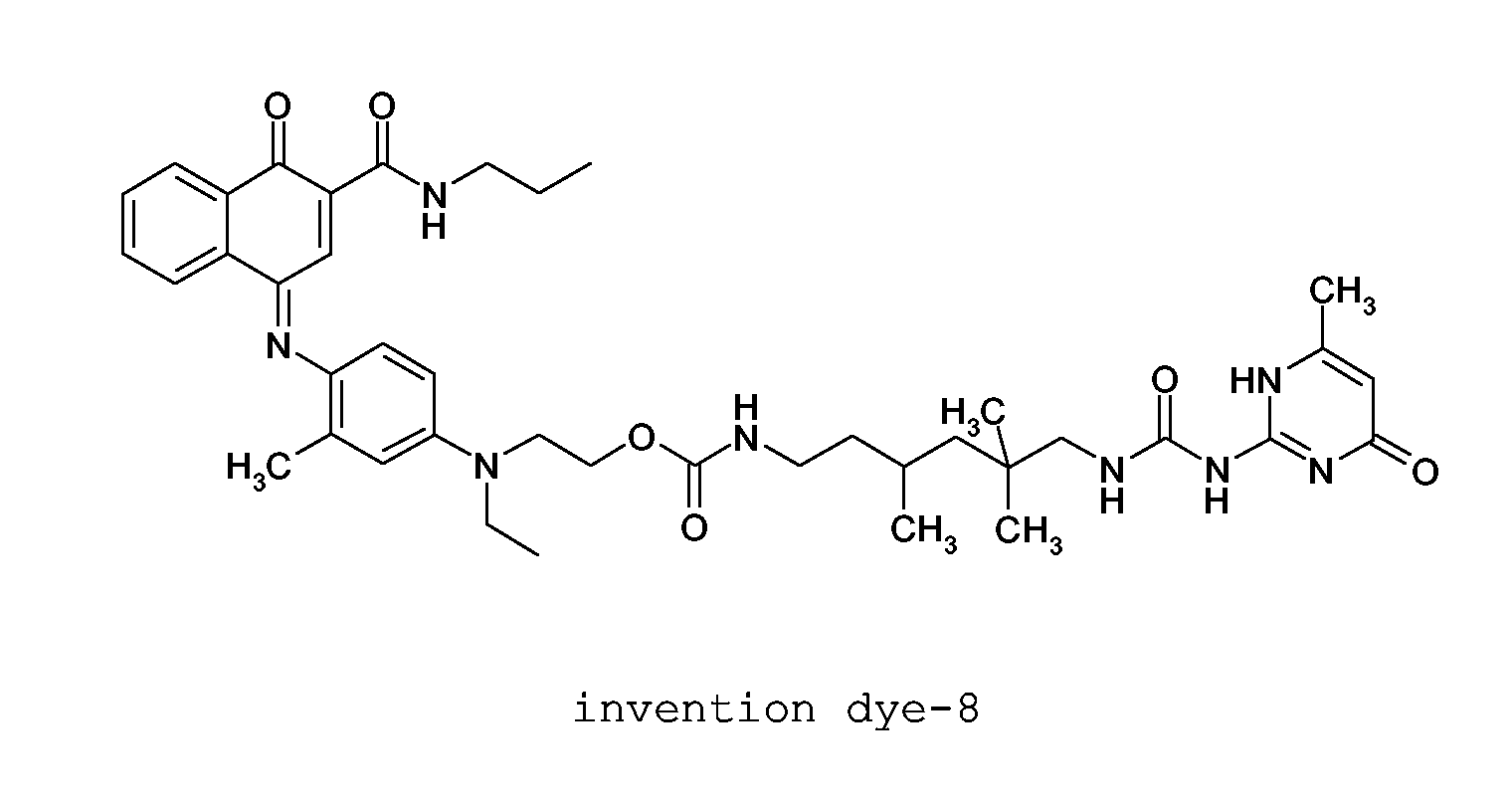
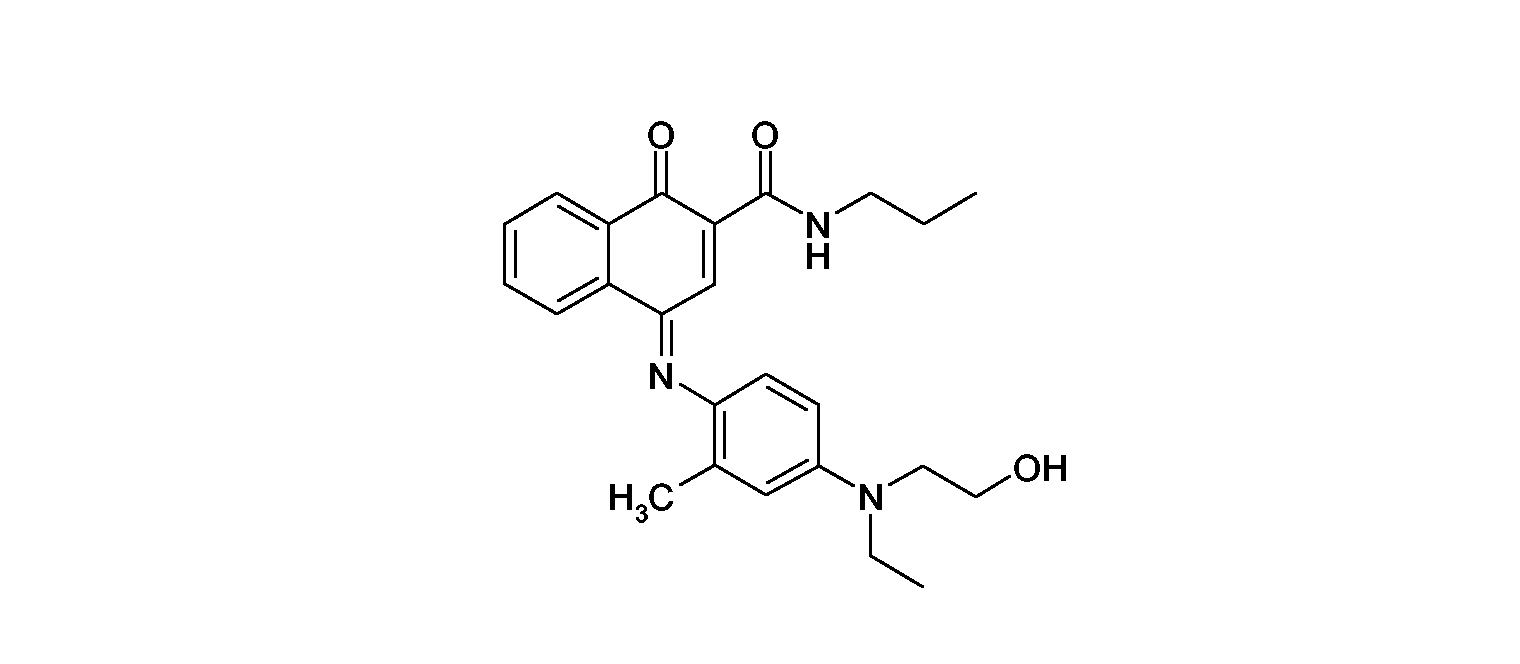


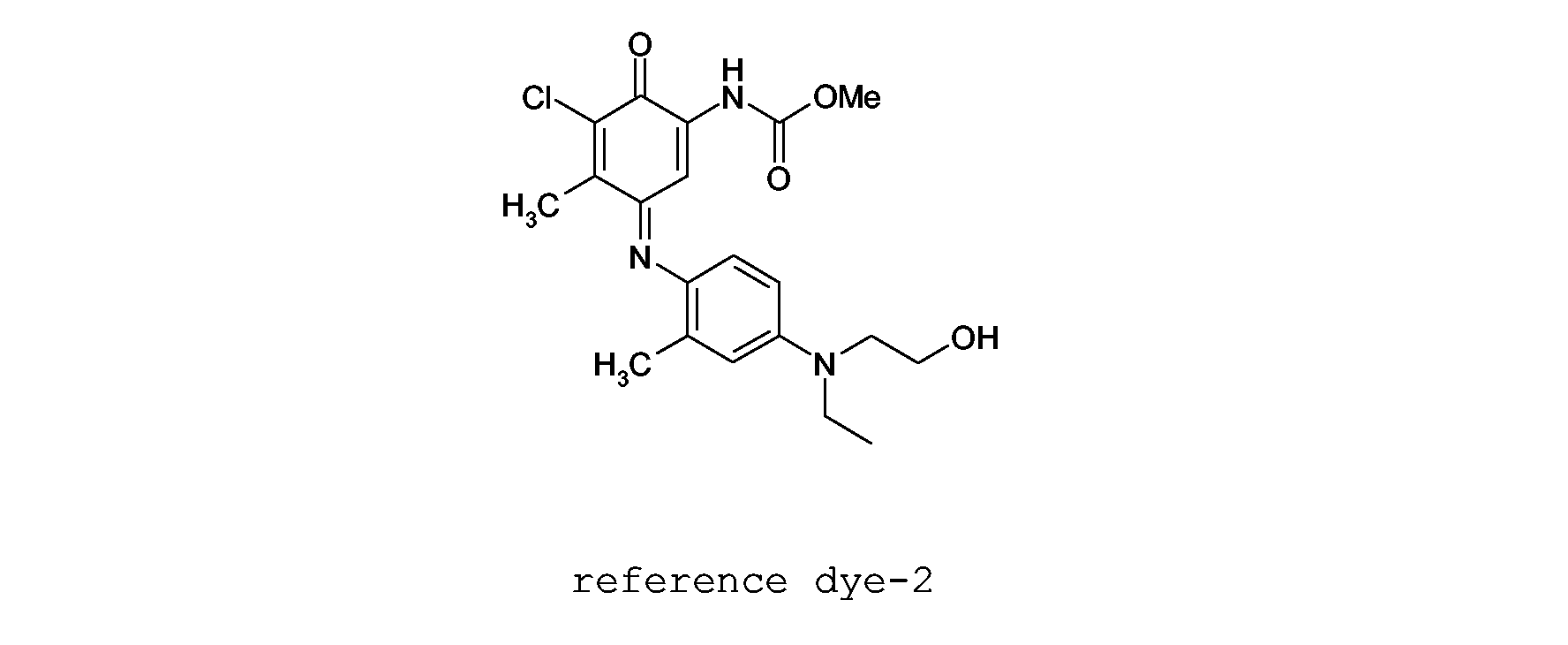
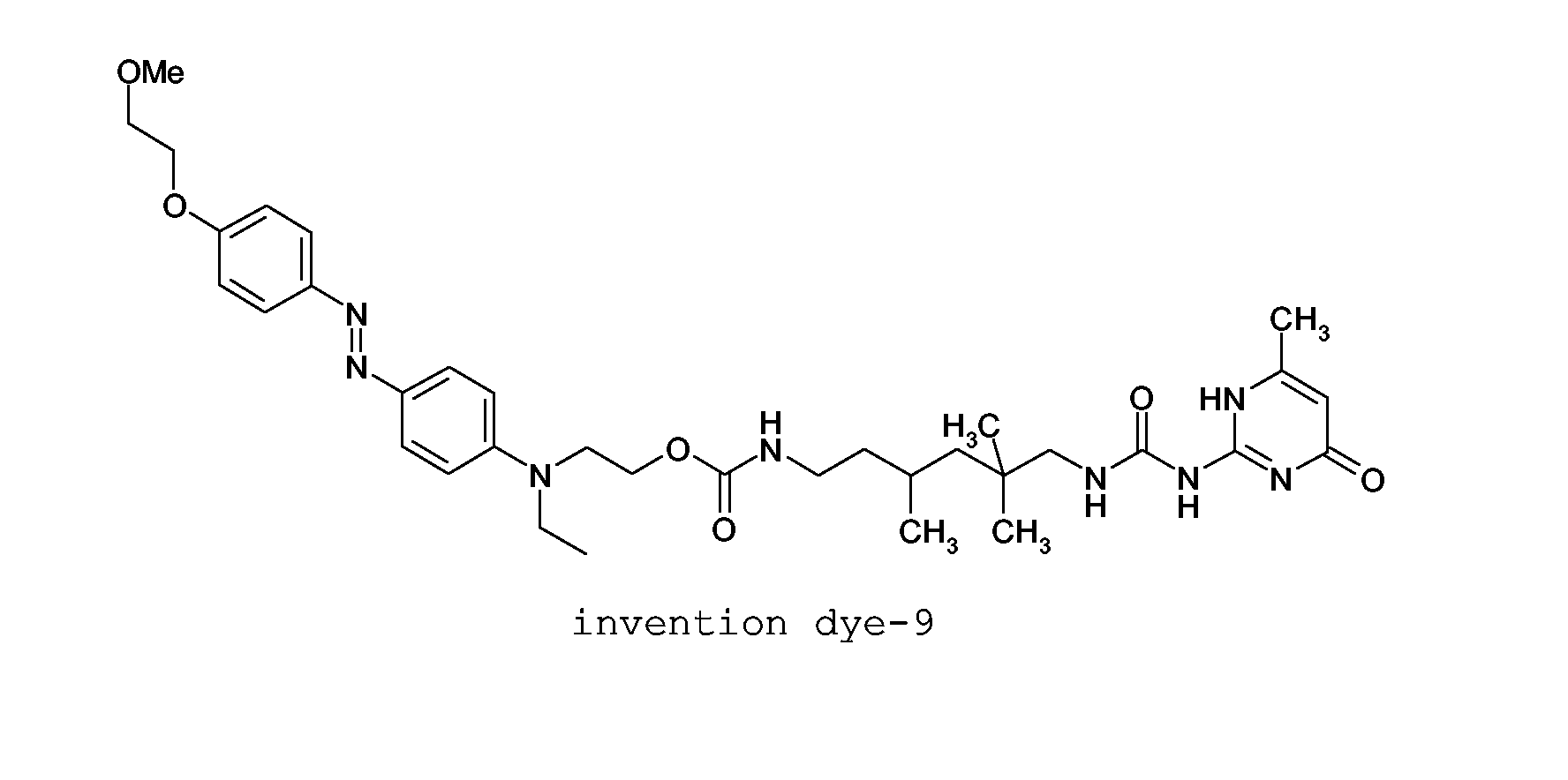

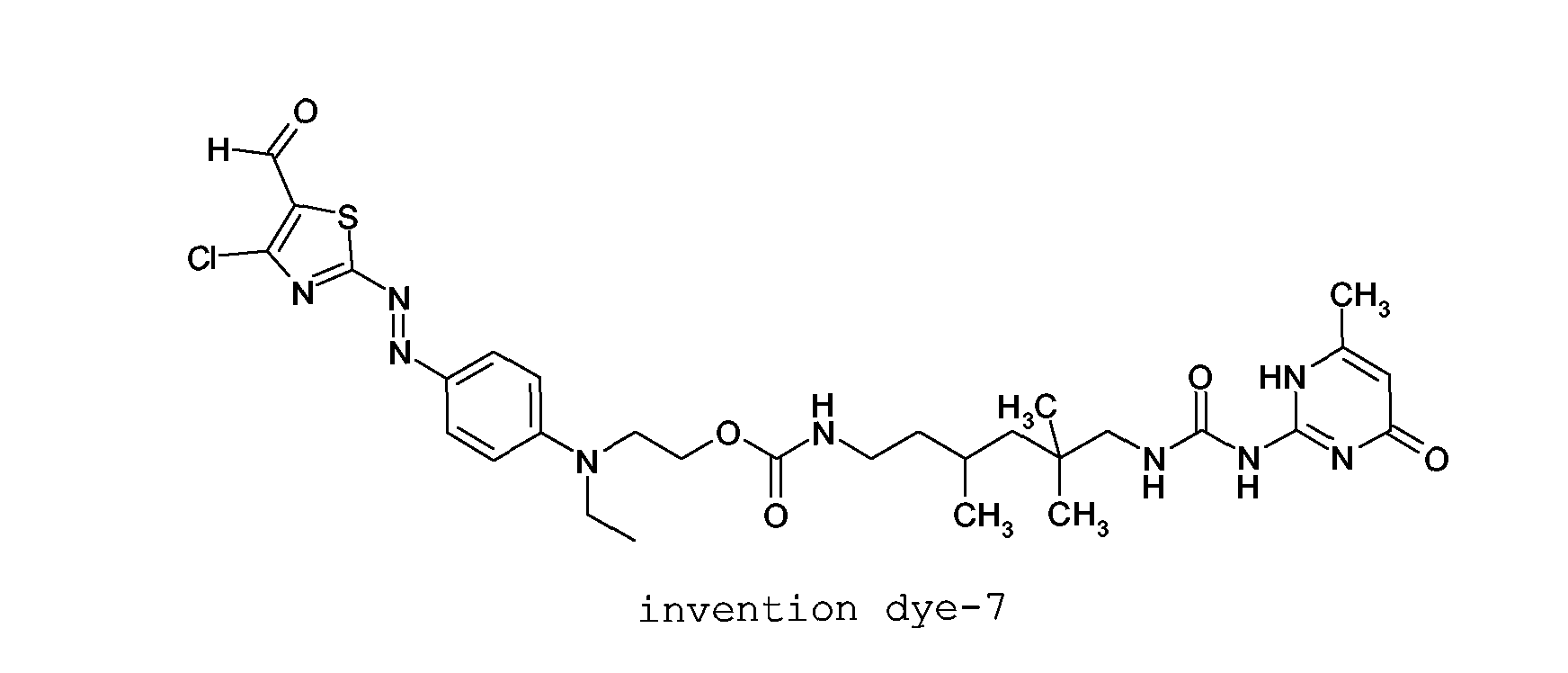
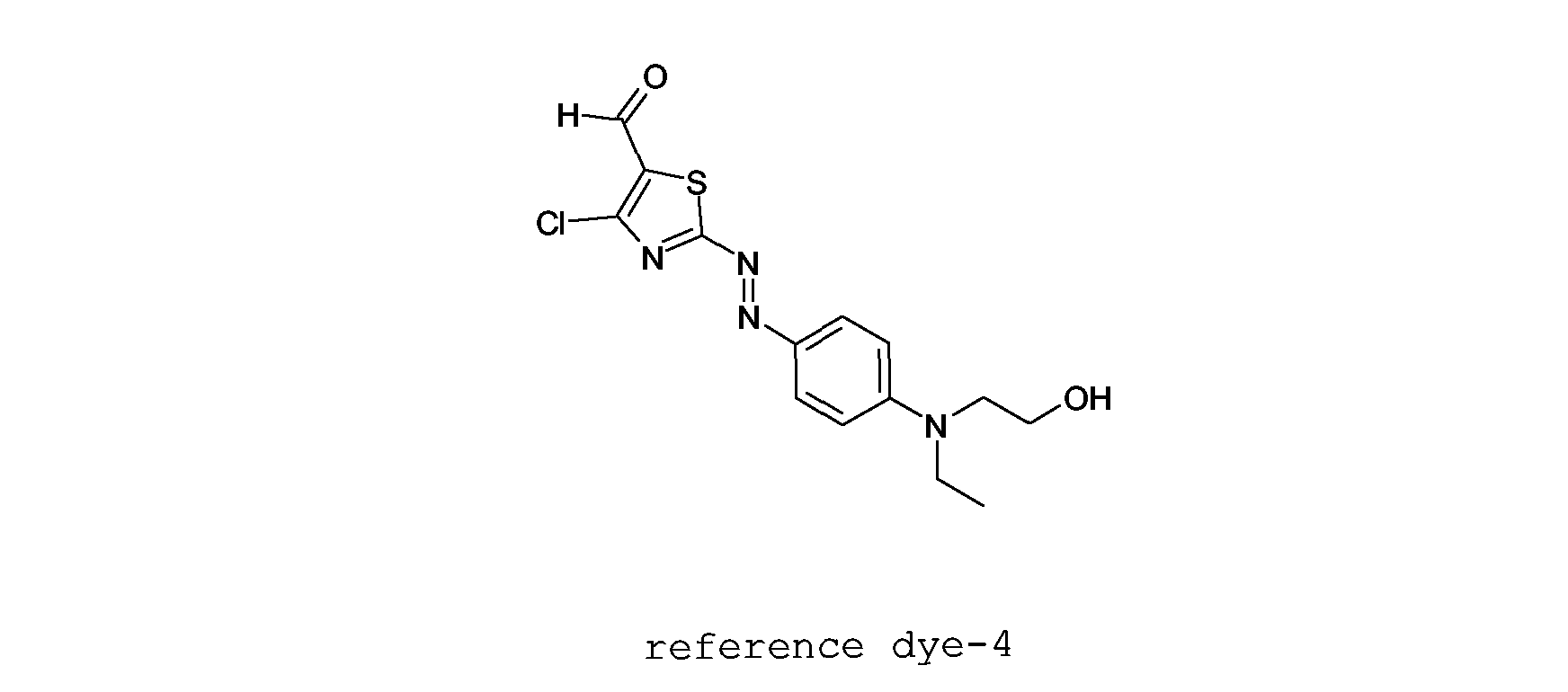
| Dye | 1 h exposure % residual density | 2 h exposure % residual density | 4 h exposure % residual density | 8 h exposure % residual density |
| Invention dye-8 | 86 | 78 | 73 | 42 |
| Reference dye-1 | 75 | 60 | 36 | 21 |
| Invention dye-6 | 92 | 89 | 80 | 61 |
| Reference dye-2 | 90 | 71 | 58 | 34 |
| Invention dye-9 | 99 | 97 | 77 | 63 |
| Reference dye-3 | 94 | 81 | 58 | 39 |
| Invention dye-7 | 99 | 87 | 77 | 56 |
| Reference dye-4 | 89 | 73 | 58 | 33 |
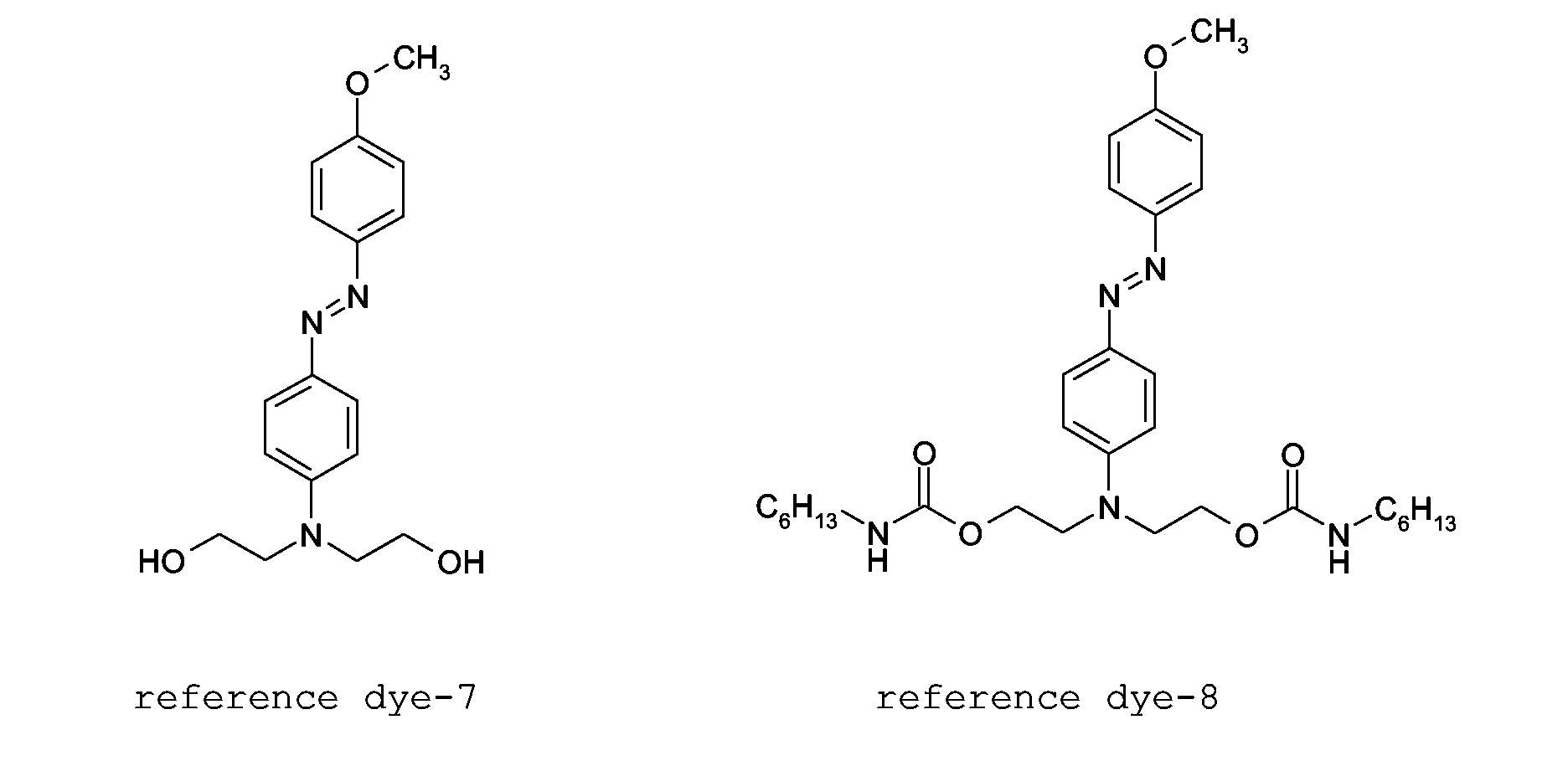

| Dye | 1 hr exposure % residual density | 2 hrs exposure % residual density | 4 hrs exposure % residual density | 8 hrs exposure % residual density |
| Invention dye-15 | 100 | 100 | 100 | 90 |
| Reference dye-7 | 100 | 95 | 82 | 68 |
| Reference dye-8 | 100 | 100 | 95 | 75 |

| Dye | 1 hr exposure % residual density | 2 hrs exposure % residual density | 4 hrs exposure % residual density | 8 hrs exposure % residual density |
| Invention dye-17 | 100 | 100 | 100 | 100 |
| Reference dye-9 | 92 | 85 | 77 | 55 |
| Ink | %Composition w/w |
| Dye (Dye-6;Dye-7) | 3 |
| Vinyl chloride/vinyl acetate copolymer UCAR VAGD | 2 |
| Butyl lactate | 95 |
| Ink | %Composition w/w |
| Dye (Dye-9) | 3 |
| Vinyl chloride/vinyl acetate copolymer UCAR VAGD | 2 |
| Butyl lactate | 75 |
| N-Methyl Pyrrolidone | 20 |
| Ink1/Dye-6 Cyan | Ink2/Dye-7 Magenta | Ink3/RM1 Magenta | Ink4/RC1 Cyan | |
| Viscosity (mPa.s) | 7.70 | 8.24 | 7.15 | 8.27 |
| Surface Tension dynes/cm | 31.5 | 31.5 | 31.5 | 31.5 |
| Filtration Performance | 27 sec. | 26 sec. | 29 sec. | 28 sec. |
| Ink5/Dye-9 Yellow | Ink6/RY1 Yellow | |||
| Viscosity (mPa.s) | 8.44 | 7.56 | ||
| Surface Tension dynes/cm | 31.5 | 30 | ||
| Filtration Performance1 | 33 | 33 |



| Sample | % density loss after 8 hours exposure at density 1 |
| invention dye-16 | 1 % |
| reference dye-6 | 5 % |
| reference dye-5 | 20 % |
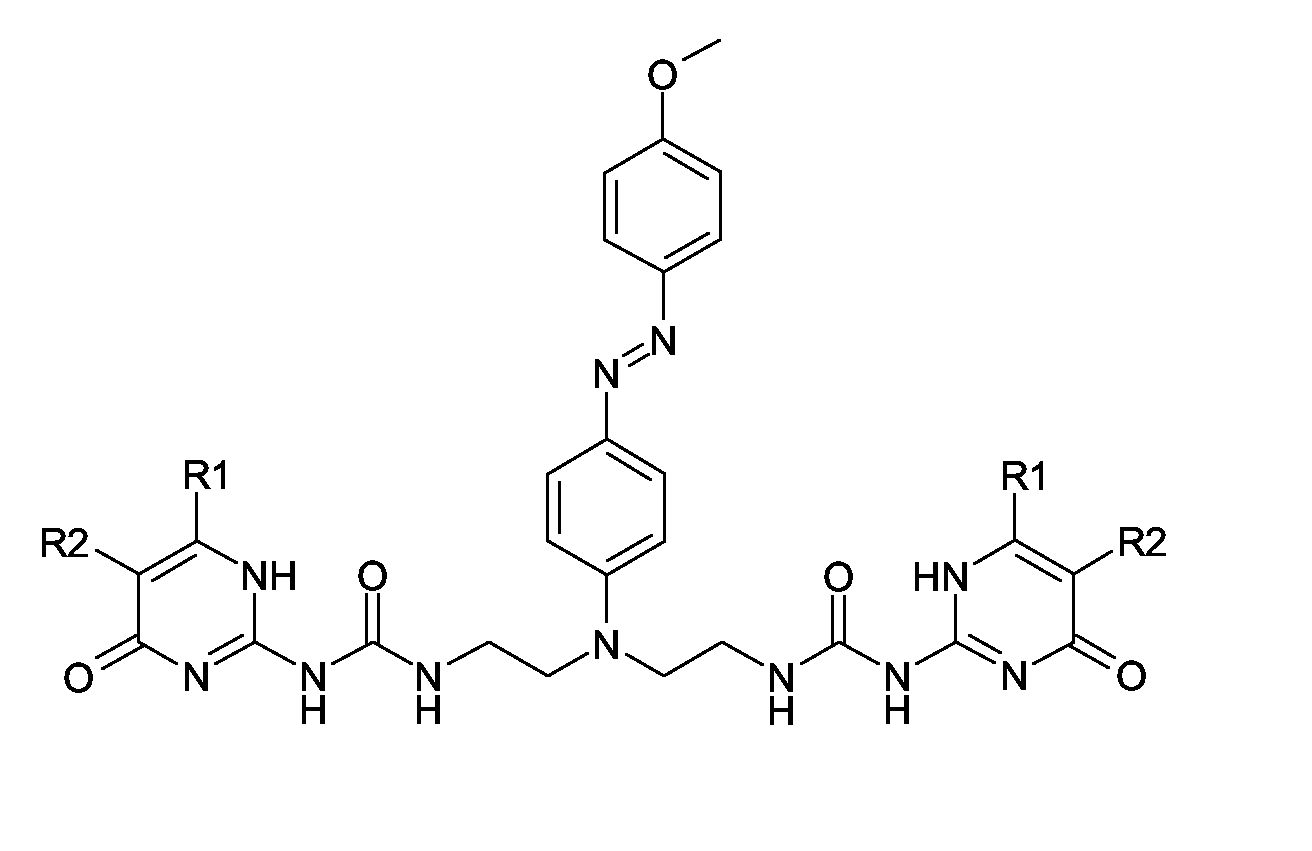
| Compound | R1 | R2 | % density loss at density 1 after eight hours Xenon exposure |
| invention dye-17 | CH3(CH2)3CHCH2CH3 | H | 24 % |
| invention dye-21 | CH3(CH2)3CHCH2CH3 | CH3 | 29 % |
| invention dye-19 | -(CH2)3O(CH2CH2O)3CH3 | H | 11 % |
| invention dye-20 | -CH(CH3)CH2CH2O(CH2CH2O)3CH3 | H | 8 % |
| reference dye-9 (comparative) | - | - | 51 % |
Claims (13)
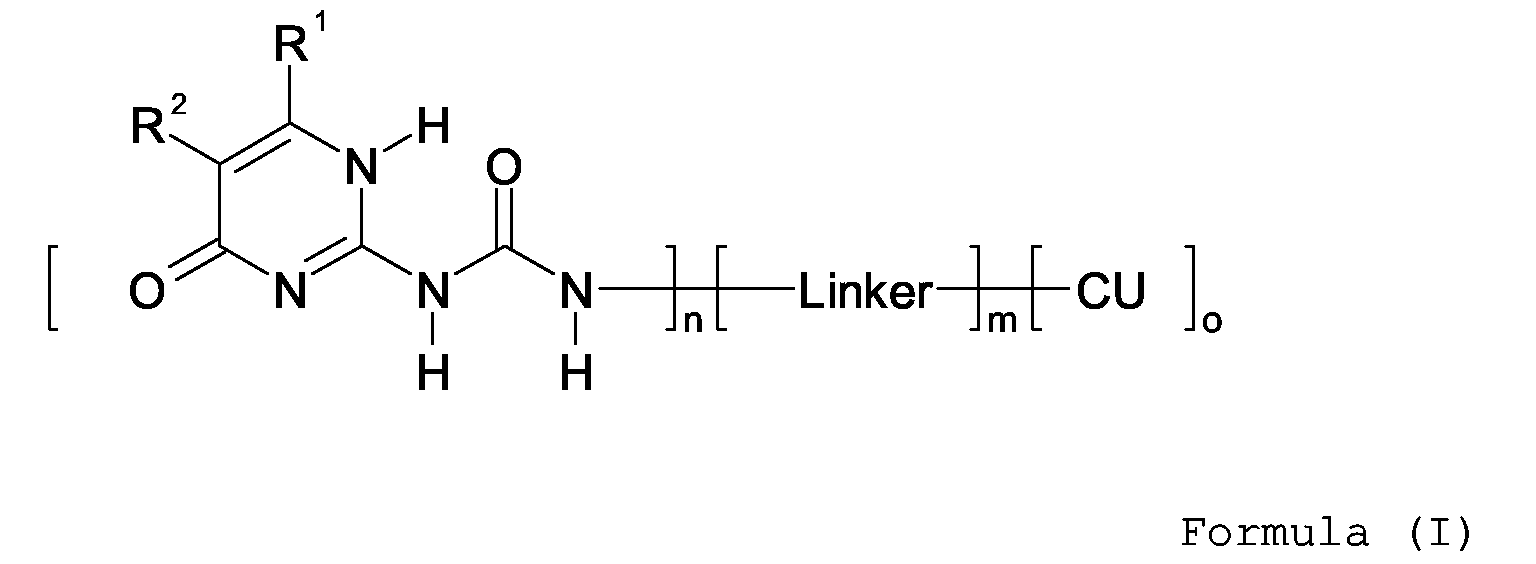
- A self-assembling dye according to formula (I):wherein
'Linker' represents any linking group;
'CU' means any chromophore group selected from the group consisting of an azo dye with a molar extinction coefficient larger than 103 l.mol-1.cm-1, an anthraquinone dye, a (poly)methine dye, an azomethine dye, a disazo dye, a carbonium dye, a styryl dye, a stilbene dye, a phthalocyanine dye, a coumarin dye, an aryl-carbonium dye, a nitro dye, a naphtholactam dye, a dioxazine dye, a flavin dye and a formazan dye;
n and o are the same or different and are integers having a value of at least 1; m can be zero or any integer having a value of at least 1;
R1 and R2 are the same or different and represent hydrogen, a halogen, a substituted or unsubstituted alkoxy group, a substituted or unsubstituted thioalkoxy group, a substituted or unsubstituted sulphoxy group, a substituted or unsubstituted sulphone group, a substituted or unsubstituted amino group, a nitrile group, a substituted or unsubstituted, saturated or unsaturated alkyl group, a substituted or unsubstituted acyl group, a substituted or unsubstituted sulphonyl group, a substituted or unsubstituted phosphoryl group, a substituted or unsubstituted aryl group, a substituted or unsubstituted aralkyl group, a heterocyclic group, a CU group, or R1 and R2 represent the necessary atoms to form a ring system. - A self-assembling dye according to claim 1, wherein said Linker is selected from the group consisting of a substituted or unsubstituted, saturated or unsaturated aliphatic group, a substituted or unsubstituted alicyclic hydrocarbon group, a substituted or unsubstituted aromatic group and a substituted or unsubstituted heteroaromatic group.
- A self-assembling dye according to claim 1 or 2, wherein the association constant Kass of the self-assembling reaction, determined by 1H-NMR in CDCl3, is at least 2.5 M-1.
- An self-assembling dye according to claim 1 or 2, wherein said association constant Kass is at least 102 M-1.
- An self-assembling dye according to claim 1 or 2, wherein said association constant Kass is at least 105 M-1.
- An ink-jet ink comprising a self-assembling dye according to any of claims 1 to 5.
- An ink-jet ink according to claim 6, wherein said ink-jet ink is a water based ink-jet ink.
- An ink-jet ink according to claim 6, wherein said ink-jet ink is a solvent based ink-jet ink.
- An ink-jet ink according to claim 6, wherein said ink-jet ink is a oil based ink-jet ink.
- An ink-jet ink according to claim 6, wherein said ink-jet ink is a hot melt based ink-jet ink.
- An ink-jet ink according to claim 6, wherein said ink-jet ink is a UV-curable ink-jet ink.
- A process for the formation of an ink-jet image comprising the step of image-wise jetting ink-jet ink by means of an ink-jet printing apparatus onto an ink-jet recording element, characterized in that said ink-jet ink is an ink-jet ink according to any of claims 5 to 11.
- An ink-jet printing apparatus comprising an ink cartridge containing an ink-jet ink according to any of claims 5 to 11.
Priority Applications (1)
| Application Number | Priority Date | Filing Date | Title |
|---|---|---|---|
| EP04104187A EP1486539B1 (en) | 2001-10-25 | 2002-10-01 | Self-assembling dyes |
Applications Claiming Priority (4)
| Application Number | Priority Date | Filing Date | Title |
|---|---|---|---|
| EP01000574 | 2001-10-25 | ||
| EP01000574 | 2001-10-25 | ||
| EP04104187A EP1486539B1 (en) | 2001-10-25 | 2002-10-01 | Self-assembling dyes |
| EP20020102401 EP1310533B2 (en) | 2001-10-25 | 2002-10-01 | Ink composition containing a particular type of dye, and corresponding ink jet printing process |
Related Parent Applications (1)
| Application Number | Title | Priority Date | Filing Date |
|---|---|---|---|
| EP20020102401 Division EP1310533B2 (en) | 2001-10-25 | 2002-10-01 | Ink composition containing a particular type of dye, and corresponding ink jet printing process |
Publications (3)
| Publication Number | Publication Date |
|---|---|
| EP1486539A2 true EP1486539A2 (en) | 2004-12-15 |
| EP1486539A3 EP1486539A3 (en) | 2006-08-02 |
| EP1486539B1 EP1486539B1 (en) | 2009-08-26 |
Family
ID=33300893
Family Applications (3)
| Application Number | Title | Priority Date | Filing Date |
|---|---|---|---|
| EP20060119217 Expired - Lifetime EP1717283B1 (en) | 2001-10-25 | 2002-10-01 | Ink composition containing a particular type of dye, and corresponding ink jet printing process. |
| EP05105220A Withdrawn EP1577356A1 (en) | 2001-10-25 | 2002-10-01 | Ink composition containing a particular type of dye, and corresponding ink jet printing process. |
| EP04104187A Expired - Lifetime EP1486539B1 (en) | 2001-10-25 | 2002-10-01 | Self-assembling dyes |
Family Applications Before (2)
| Application Number | Title | Priority Date | Filing Date |
|---|---|---|---|
| EP20060119217 Expired - Lifetime EP1717283B1 (en) | 2001-10-25 | 2002-10-01 | Ink composition containing a particular type of dye, and corresponding ink jet printing process. |
| EP05105220A Withdrawn EP1577356A1 (en) | 2001-10-25 | 2002-10-01 | Ink composition containing a particular type of dye, and corresponding ink jet printing process. |
Country Status (1)
| Country | Link |
|---|---|
| EP (3) | EP1717283B1 (en) |
Cited By (5)
| Publication number | Priority date | Publication date | Assignee | Title |
|---|---|---|---|---|
| EP1801170A1 (en) * | 2005-12-20 | 2007-06-27 | Agfa Graphics N.V. | Inkjet ink for preparing lithographic printing plates and method for their preparation |
| WO2007071550A1 (en) * | 2005-12-20 | 2007-06-28 | Agfa Graphics Nv | Inkjet ink for preparing lithographic printing plates and method for their preparation |
| WO2011083243A1 (en) | 2010-01-05 | 2011-07-14 | L'oreal | Cosmetic treatment methods and kit |
| WO2013004982A2 (en) | 2011-07-07 | 2013-01-10 | L'oreal | Cosmetic treatment processes and kit |
| GB2511623A (en) * | 2013-01-18 | 2014-09-10 | Domino Printing Sciences Plc | Inkjet composition |
Families Citing this family (3)
| Publication number | Priority date | Publication date | Assignee | Title |
|---|---|---|---|---|
| DE602005013555D1 (en) * | 2005-12-20 | 2009-05-07 | Agfa Graphics Nv | Contrast dyes for inkjet lithographic printing plates |
| US7384463B2 (en) | 2006-10-30 | 2008-06-10 | Xerox Corporation | Phase change ink containing amphiphilic molecule |
| CN109369541A (en) * | 2018-10-12 | 2019-02-22 | 常州大学 | A kind of catechol ether chain bridged bis-ureidopyrimidinone compound and its synthesis method |
Family Cites Families (7)
| Publication number | Priority date | Publication date | Assignee | Title |
|---|---|---|---|---|
| US4666519A (en) * | 1984-06-29 | 1987-05-19 | Orient Chemical Industries, Ltd. | Aqueous ink composition |
| US5413630A (en) * | 1993-12-13 | 1995-05-09 | Xerox Corporation | Colorant and ink compositions |
| TW473525B (en) * | 1994-12-16 | 2002-01-21 | Bic Corp | Erasable ink composition and marking instrument containing same |
| US5852072A (en) * | 1994-12-16 | 1998-12-22 | Bic Corporation | Erasable ink composition containing a waterborne polyurethane urea |
| EP0816448B1 (en) * | 1996-06-28 | 2003-09-03 | Xerox Corporation | Phase change ink formulation using a urethane isocyanate-derived resin |
| NL1004192C2 (en) * | 1996-10-04 | 1998-04-07 | Dsm Nv | Supramolecular polymer. |
| US5919846A (en) * | 1998-02-19 | 1999-07-06 | Milliken Research Corporation | Colorant having isocyanate substituent |
-
2002
- 2002-10-01 EP EP20060119217 patent/EP1717283B1/en not_active Expired - Lifetime
- 2002-10-01 EP EP05105220A patent/EP1577356A1/en not_active Withdrawn
- 2002-10-01 EP EP04104187A patent/EP1486539B1/en not_active Expired - Lifetime
Cited By (6)
| Publication number | Priority date | Publication date | Assignee | Title |
|---|---|---|---|---|
| EP1801170A1 (en) * | 2005-12-20 | 2007-06-27 | Agfa Graphics N.V. | Inkjet ink for preparing lithographic printing plates and method for their preparation |
| WO2007071550A1 (en) * | 2005-12-20 | 2007-06-28 | Agfa Graphics Nv | Inkjet ink for preparing lithographic printing plates and method for their preparation |
| WO2011083243A1 (en) | 2010-01-05 | 2011-07-14 | L'oreal | Cosmetic treatment methods and kit |
| WO2013004982A2 (en) | 2011-07-07 | 2013-01-10 | L'oreal | Cosmetic treatment processes and kit |
| GB2511623A (en) * | 2013-01-18 | 2014-09-10 | Domino Printing Sciences Plc | Inkjet composition |
| GB2511623B (en) * | 2013-01-18 | 2016-01-06 | Domino Printing Sciences Plc | Inkjet-printed deposit comprising self-assembled supramolecular polymer |
Also Published As
| Publication number | Publication date |
|---|---|
| EP1486539A3 (en) | 2006-08-02 |
| EP1577356A1 (en) | 2005-09-21 |
| EP1486539B1 (en) | 2009-08-26 |
| EP1717283A1 (en) | 2006-11-02 |
| EP1717283B1 (en) | 2008-07-16 |
Similar Documents
| Publication | Publication Date | Title |
|---|---|---|
| US20030209166A1 (en) | Ink composition containing a particular type of dye, and corresponding ink jet printing process | |
| US7025813B2 (en) | Ink composition containing a particular type of dye, and corresponding ink-jet printing process | |
| EP1310533B1 (en) | Ink composition containing a particular type of dye, and corresponding ink jet printing process | |
| EP1068251B1 (en) | Coloured polyurethanes | |
| EP1362082B1 (en) | Coloured, water-dissipatable polyurethanes | |
| JP2004115802A (en) | Coloring compound | |
| US7355044B2 (en) | Self-assembling dyes | |
| JP2002509974A (en) | Colored polyurethane | |
| EP1486539B1 (en) | Self-assembling dyes | |
| JP2001524143A (en) | Composition | |
| JP2002509975A (en) | Composition | |
| US6457822B1 (en) | Ink jet printing method | |
| CN1550528A (en) | Phase change inks with improved image permanence | |
| JP2003206424A (en) | Ink composition containing particular type of dye, and corresponding ink jet printing process | |
| US7273897B2 (en) | Ink jet ink composition | |
| Vanmaele et al. | Ink composition containing a particular type of dye, and corresponding ink jet printing process | |
| US20040102542A1 (en) | Coloured, water-dissipatable polyurethanes | |
| Vanmaele et al. | Self-assembling dyes | |
| US20050165130A9 (en) | Ink composition and ink-jet recording method | |
| EP1066341B1 (en) | Ink compositions containing 1,3,4-thiadiazolylazo dyes | |
| EP1188805B1 (en) | Dye-based ink jet ink compositions having improved stability and light fastness | |
| EP1283249A2 (en) | Ink jet ink composition containing a hyperbrached polymeric dye and printing method |
Legal Events
| Date | Code | Title | Description |
|---|---|---|---|
| PUAI | Public reference made under article 153(3) epc to a published international application that has entered the european phase |
Free format text: ORIGINAL CODE: 0009012 |
|
| AC | Divisional application: reference to earlier application |
Ref document number: 1310533 Country of ref document: EP Kind code of ref document: P |
|
| AK | Designated contracting states |
Kind code of ref document: A2 Designated state(s): DE FR GB |
|
| PUAL | Search report despatched |
Free format text: ORIGINAL CODE: 0009013 |
|
| AK | Designated contracting states |
Kind code of ref document: A3 Designated state(s): DE FR GB |
|
| RAP1 | Party data changed (applicant data changed or rights of an application transferred) |
Owner name: AGFA GRAPHICS N.V. |
|
| 17P | Request for examination filed |
Effective date: 20070202 |
|
| AKX | Designation fees paid |
Designated state(s): DE FR GB |
|
| 17Q | First examination report despatched |
Effective date: 20071108 |
|
| GRAP | Despatch of communication of intention to grant a patent |
Free format text: ORIGINAL CODE: EPIDOSNIGR1 |
|
| GRAS | Grant fee paid |
Free format text: ORIGINAL CODE: EPIDOSNIGR3 |
|
| GRAA | (expected) grant |
Free format text: ORIGINAL CODE: 0009210 |
|
| AC | Divisional application: reference to earlier application |
Ref document number: 1310533 Country of ref document: EP Kind code of ref document: P |
|
| AK | Designated contracting states |
Kind code of ref document: B1 Designated state(s): DE FR GB |
|
| REG | Reference to a national code |
Ref country code: GB Ref legal event code: FG4D |
|
| REF | Corresponds to: |
Ref document number: 60233531 Country of ref document: DE Date of ref document: 20091008 Kind code of ref document: P |
|
| PLBE | No opposition filed within time limit |
Free format text: ORIGINAL CODE: 0009261 |
|
| STAA | Information on the status of an ep patent application or granted ep patent |
Free format text: STATUS: NO OPPOSITION FILED WITHIN TIME LIMIT |
|
| 26N | No opposition filed |
Effective date: 20100527 |
|
| REG | Reference to a national code |
Ref country code: FR Ref legal event code: PLFP Year of fee payment: 14 |
|
| PGFP | Annual fee paid to national office [announced via postgrant information from national office to epo] |
Ref country code: GB Payment date: 20150804 Year of fee payment: 14 |
|
| PGFP | Annual fee paid to national office [announced via postgrant information from national office to epo] |
Ref country code: FR Payment date: 20150810 Year of fee payment: 14 |
|
| PGFP | Annual fee paid to national office [announced via postgrant information from national office to epo] |
Ref country code: DE Payment date: 20150810 Year of fee payment: 14 |
|
| REG | Reference to a national code |
Ref country code: DE Ref legal event code: R119 Ref document number: 60233531 Country of ref document: DE |
|
| GBPC | Gb: european patent ceased through non-payment of renewal fee |
Effective date: 20161001 |
|
| REG | Reference to a national code |
Ref country code: FR Ref legal event code: ST Effective date: 20170630 |
|
| PG25 | Lapsed in a contracting state [announced via postgrant information from national office to epo] |
Ref country code: FR Free format text: LAPSE BECAUSE OF NON-PAYMENT OF DUE FEES Effective date: 20161102 Ref country code: GB Free format text: LAPSE BECAUSE OF NON-PAYMENT OF DUE FEES Effective date: 20161001 Ref country code: DE Free format text: LAPSE BECAUSE OF NON-PAYMENT OF DUE FEES Effective date: 20170503 |