EP1486519A1 - A kind of functional olefin mother grain and the method of it and the use of it - Google Patents
A kind of functional olefin mother grain and the method of it and the use of it Download PDFInfo
- Publication number
- EP1486519A1 EP1486519A1 EP03711794A EP03711794A EP1486519A1 EP 1486519 A1 EP1486519 A1 EP 1486519A1 EP 03711794 A EP03711794 A EP 03711794A EP 03711794 A EP03711794 A EP 03711794A EP 1486519 A1 EP1486519 A1 EP 1486519A1
- Authority
- EP
- European Patent Office
- Prior art keywords
- master batch
- polyolefin
- butyl
- functional master
- mentioned
- Prior art date
- Legal status (The legal status is an assumption and is not a legal conclusion. Google has not performed a legal analysis and makes no representation as to the accuracy of the status listed.)
- Granted
Links
Classifications
-
- C—CHEMISTRY; METALLURGY
- C08—ORGANIC MACROMOLECULAR COMPOUNDS; THEIR PREPARATION OR CHEMICAL WORKING-UP; COMPOSITIONS BASED THEREON
- C08L—COMPOSITIONS OF MACROMOLECULAR COMPOUNDS
- C08L27/00—Compositions of homopolymers or copolymers of compounds having one or more unsaturated aliphatic radicals, each having only one carbon-to-carbon double bond, and at least one being terminated by a halogen; Compositions of derivatives of such polymers
- C08L27/02—Compositions of homopolymers or copolymers of compounds having one or more unsaturated aliphatic radicals, each having only one carbon-to-carbon double bond, and at least one being terminated by a halogen; Compositions of derivatives of such polymers not modified by chemical after-treatment
- C08L27/04—Compositions of homopolymers or copolymers of compounds having one or more unsaturated aliphatic radicals, each having only one carbon-to-carbon double bond, and at least one being terminated by a halogen; Compositions of derivatives of such polymers not modified by chemical after-treatment containing chlorine atoms
- C08L27/06—Homopolymers or copolymers of vinyl chloride
-
- C—CHEMISTRY; METALLURGY
- C08—ORGANIC MACROMOLECULAR COMPOUNDS; THEIR PREPARATION OR CHEMICAL WORKING-UP; COMPOSITIONS BASED THEREON
- C08F—MACROMOLECULAR COMPOUNDS OBTAINED BY REACTIONS ONLY INVOLVING CARBON-TO-CARBON UNSATURATED BONDS
- C08F255/00—Macromolecular compounds obtained by polymerising monomers on to polymers of hydrocarbons as defined in group C08F10/00
-
- C—CHEMISTRY; METALLURGY
- C08—ORGANIC MACROMOLECULAR COMPOUNDS; THEIR PREPARATION OR CHEMICAL WORKING-UP; COMPOSITIONS BASED THEREON
- C08F—MACROMOLECULAR COMPOUNDS OBTAINED BY REACTIONS ONLY INVOLVING CARBON-TO-CARBON UNSATURATED BONDS
- C08F255/00—Macromolecular compounds obtained by polymerising monomers on to polymers of hydrocarbons as defined in group C08F10/00
- C08F255/02—Macromolecular compounds obtained by polymerising monomers on to polymers of hydrocarbons as defined in group C08F10/00 on to polymers of olefins having two or three carbon atoms
-
- C—CHEMISTRY; METALLURGY
- C08—ORGANIC MACROMOLECULAR COMPOUNDS; THEIR PREPARATION OR CHEMICAL WORKING-UP; COMPOSITIONS BASED THEREON
- C08F—MACROMOLECULAR COMPOUNDS OBTAINED BY REACTIONS ONLY INVOLVING CARBON-TO-CARBON UNSATURATED BONDS
- C08F257/00—Macromolecular compounds obtained by polymerising monomers on to polymers of aromatic monomers as defined in group C08F12/00
- C08F257/02—Macromolecular compounds obtained by polymerising monomers on to polymers of aromatic monomers as defined in group C08F12/00 on to polymers of styrene or alkyl-substituted styrenes
-
- C—CHEMISTRY; METALLURGY
- C08—ORGANIC MACROMOLECULAR COMPOUNDS; THEIR PREPARATION OR CHEMICAL WORKING-UP; COMPOSITIONS BASED THEREON
- C08F—MACROMOLECULAR COMPOUNDS OBTAINED BY REACTIONS ONLY INVOLVING CARBON-TO-CARBON UNSATURATED BONDS
- C08F259/00—Macromolecular compounds obtained by polymerising monomers on to polymers of halogen containing monomers as defined in group C08F14/00
- C08F259/02—Macromolecular compounds obtained by polymerising monomers on to polymers of halogen containing monomers as defined in group C08F14/00 on to polymers containing chlorine
- C08F259/04—Macromolecular compounds obtained by polymerising monomers on to polymers of halogen containing monomers as defined in group C08F14/00 on to polymers containing chlorine on to polymers of vinyl chloride
-
- C—CHEMISTRY; METALLURGY
- C08—ORGANIC MACROMOLECULAR COMPOUNDS; THEIR PREPARATION OR CHEMICAL WORKING-UP; COMPOSITIONS BASED THEREON
- C08J—WORKING-UP; GENERAL PROCESSES OF COMPOUNDING; AFTER-TREATMENT NOT COVERED BY SUBCLASSES C08B, C08C, C08F, C08G or C08H
- C08J3/00—Processes of treating or compounding macromolecular substances
- C08J3/20—Compounding polymers with additives, e.g. colouring
- C08J3/22—Compounding polymers with additives, e.g. colouring using masterbatch techniques
- C08J3/226—Compounding polymers with additives, e.g. colouring using masterbatch techniques using a polymer as a carrier
-
- C—CHEMISTRY; METALLURGY
- C08—ORGANIC MACROMOLECULAR COMPOUNDS; THEIR PREPARATION OR CHEMICAL WORKING-UP; COMPOSITIONS BASED THEREON
- C08L—COMPOSITIONS OF MACROMOLECULAR COMPOUNDS
- C08L23/00—Compositions of homopolymers or copolymers of unsaturated aliphatic hydrocarbons having only one carbon-to-carbon double bond; Compositions of derivatives of such polymers
- C08L23/02—Compositions of homopolymers or copolymers of unsaturated aliphatic hydrocarbons having only one carbon-to-carbon double bond; Compositions of derivatives of such polymers not modified by chemical after-treatment
- C08L23/10—Homopolymers or copolymers of propene
-
- C—CHEMISTRY; METALLURGY
- C08—ORGANIC MACROMOLECULAR COMPOUNDS; THEIR PREPARATION OR CHEMICAL WORKING-UP; COMPOSITIONS BASED THEREON
- C08L—COMPOSITIONS OF MACROMOLECULAR COMPOUNDS
- C08L25/00—Compositions of, homopolymers or copolymers of compounds having one or more unsaturated aliphatic radicals, each having only one carbon-to-carbon double bond, and at least one being terminated by an aromatic carbocyclic ring; Compositions of derivatives of such polymers
- C08L25/02—Homopolymers or copolymers of hydrocarbons
- C08L25/04—Homopolymers or copolymers of styrene
- C08L25/06—Polystyrene
-
- C—CHEMISTRY; METALLURGY
- C08—ORGANIC MACROMOLECULAR COMPOUNDS; THEIR PREPARATION OR CHEMICAL WORKING-UP; COMPOSITIONS BASED THEREON
- C08L—COMPOSITIONS OF MACROMOLECULAR COMPOUNDS
- C08L51/00—Compositions of graft polymers in which the grafted component is obtained by reactions only involving carbon-to-carbon unsaturated bonds; Compositions of derivatives of such polymers
- C08L51/06—Compositions of graft polymers in which the grafted component is obtained by reactions only involving carbon-to-carbon unsaturated bonds; Compositions of derivatives of such polymers grafted on to homopolymers or copolymers of aliphatic hydrocarbons containing only one carbon-to-carbon double bond
-
- C—CHEMISTRY; METALLURGY
- C09—DYES; PAINTS; POLISHES; NATURAL RESINS; ADHESIVES; COMPOSITIONS NOT OTHERWISE PROVIDED FOR; APPLICATIONS OF MATERIALS NOT OTHERWISE PROVIDED FOR
- C09J—ADHESIVES; NON-MECHANICAL ASPECTS OF ADHESIVE PROCESSES IN GENERAL; ADHESIVE PROCESSES NOT PROVIDED FOR ELSEWHERE; USE OF MATERIALS AS ADHESIVES
- C09J151/00—Adhesives based on graft polymers in which the grafted component is obtained by reactions only involving carbon-to-carbon unsaturated bonds; Adhesives based on derivatives of such polymers
- C09J151/06—Adhesives based on graft polymers in which the grafted component is obtained by reactions only involving carbon-to-carbon unsaturated bonds; Adhesives based on derivatives of such polymers grafted on to homopolymers or copolymers of aliphatic hydrocarbons containing only one carbon-to-carbon double bond
-
- C—CHEMISTRY; METALLURGY
- C08—ORGANIC MACROMOLECULAR COMPOUNDS; THEIR PREPARATION OR CHEMICAL WORKING-UP; COMPOSITIONS BASED THEREON
- C08J—WORKING-UP; GENERAL PROCESSES OF COMPOUNDING; AFTER-TREATMENT NOT COVERED BY SUBCLASSES C08B, C08C, C08F, C08G or C08H
- C08J2323/00—Characterised by the use of homopolymers or copolymers of unsaturated aliphatic hydrocarbons having only one carbon-to-carbon double bond; Derivatives of such polymers
- C08J2323/02—Characterised by the use of homopolymers or copolymers of unsaturated aliphatic hydrocarbons having only one carbon-to-carbon double bond; Derivatives of such polymers not modified by chemical after treatment
-
- C—CHEMISTRY; METALLURGY
- C08—ORGANIC MACROMOLECULAR COMPOUNDS; THEIR PREPARATION OR CHEMICAL WORKING-UP; COMPOSITIONS BASED THEREON
- C08J—WORKING-UP; GENERAL PROCESSES OF COMPOUNDING; AFTER-TREATMENT NOT COVERED BY SUBCLASSES C08B, C08C, C08F, C08G or C08H
- C08J2423/00—Characterised by the use of homopolymers or copolymers of unsaturated aliphatic hydrocarbons having only one carbon-to-carbon double bond; Derivatives of such polymers
-
- C—CHEMISTRY; METALLURGY
- C08—ORGANIC MACROMOLECULAR COMPOUNDS; THEIR PREPARATION OR CHEMICAL WORKING-UP; COMPOSITIONS BASED THEREON
- C08L—COMPOSITIONS OF MACROMOLECULAR COMPOUNDS
- C08L2666/00—Composition of polymers characterized by a further compound in the blend, being organic macromolecular compounds, natural resins, waxes or and bituminous materials, non-macromolecular organic substances, inorganic substances or characterized by their function in the composition
- C08L2666/02—Organic macromolecular compounds, natural resins, waxes or and bituminous materials
-
- C—CHEMISTRY; METALLURGY
- C08—ORGANIC MACROMOLECULAR COMPOUNDS; THEIR PREPARATION OR CHEMICAL WORKING-UP; COMPOSITIONS BASED THEREON
- C08L—COMPOSITIONS OF MACROMOLECULAR COMPOUNDS
- C08L33/00—Compositions of homopolymers or copolymers of compounds having one or more unsaturated aliphatic radicals, each having only one carbon-to-carbon double bond, and only one being terminated by only one carboxyl radical, or of salts, anhydrides, esters, amides, imides or nitriles thereof; Compositions of derivatives of such polymers
- C08L33/04—Homopolymers or copolymers of esters
- C08L33/14—Homopolymers or copolymers of esters of esters containing halogen, nitrogen, sulfur, or oxygen atoms in addition to the carboxy oxygen
-
- C—CHEMISTRY; METALLURGY
- C08—ORGANIC MACROMOLECULAR COMPOUNDS; THEIR PREPARATION OR CHEMICAL WORKING-UP; COMPOSITIONS BASED THEREON
- C08L—COMPOSITIONS OF MACROMOLECULAR COMPOUNDS
- C08L79/00—Compositions of macromolecular compounds obtained by reactions forming in the main chain of the macromolecule a linkage containing nitrogen with or without oxygen or carbon only, not provided for in groups C08L61/00 - C08L77/00
- C08L79/02—Polyamines
-
- Y—GENERAL TAGGING OF NEW TECHNOLOGICAL DEVELOPMENTS; GENERAL TAGGING OF CROSS-SECTIONAL TECHNOLOGIES SPANNING OVER SEVERAL SECTIONS OF THE IPC; TECHNICAL SUBJECTS COVERED BY FORMER USPC CROSS-REFERENCE ART COLLECTIONS [XRACs] AND DIGESTS
- Y10—TECHNICAL SUBJECTS COVERED BY FORMER USPC
- Y10T—TECHNICAL SUBJECTS COVERED BY FORMER US CLASSIFICATION
- Y10T428/00—Stock material or miscellaneous articles
- Y10T428/13—Hollow or container type article [e.g., tube, vase, etc.]
- Y10T428/1352—Polymer or resin containing [i.e., natural or synthetic]
Definitions
- the present invention belongs to the field of polymerization and processing of polymer and relates to the preparation of a kind of multifunctional antimicrobial oligomer containing the reactive double bond, amino group and guanidyl group and the functional master batch formed by the bonding reaction of the oligomer with polyolefin (named molecule assembling technique).
- a functional master batch By means of blending the functional master batch with a normal polyolefin by a certain ratio, one can prepare various fibres and plastic products with the broad-spectrum antimicrobial ability, improving antistatic ability, dyeability as well as paintable ability.
- Antimicrobial material obtained by adding one or more specific antimicrobial agents, is a kind of novel founctional material which can inhibit or sterilize microbe. Since antimicrobial materials appeared in the market, they have developed quickly and become very popular because various synthetic materials and products are applied widely in everyday life. A CBS survey made in 1997 showed that people in Euro-American countries pay more and more great attention to the antimicrobial function of commodities. 52% of Americans will pay attention to whether the products they need have antimicrobial properties and deodorizing abilities when they purchase the commodities. The antimicrobial products are initially applied in the developed countries, such as Japan as well as Europe and America. It is since 1990's that the antimicrobial products have entered into a booming stage along with the fast development of economy and improvement of living standards in China.
- antimicrobial materials have become a green barrier to protect human health, which they have a great significance of improving living environment as well as diminishing the diseases of human being. Therefore, antimicrobial modification for various raw materials has become a new trend in material industries, thereof the antimicrobial products have great market demands and a mature future.
- antimicrobial materials have come into practical application in the form of antibiotic fibre products since 1960s, and have been used in antimicrobial plastics since the early 1980s, since then they have experienced fast development with their application in various industries, such as chemical engineering, fibres, food, electrical appliance and cement, covering almost all major kinds of fibres and plastics products, such as Dacron, polypropylene fibres, Acrylon, PP, ABS, PE, and PVC, etc. Since 1990's, antimicrobial materials have developed into a giant industry.
- Antimicrobial agents can be divided into three kinds according to their chemical composition: inorganic, organic and natural ones.
- natural antimicrobial agents they can not be industrialized for the limitation of sources and processing condition.
- organic antimicrobial agents they have high efficiency and broad-spectrum antimicrobial ability, but they also have problems, such as poor thermal stability, toxicity, easiness of seepage and dissolution, short usage life time and poor wash resistance, so their application are greatly limited.
- organic antimicrobial agents can not be used efficiently like organic antimicrobial agents, moreover, they have poor effects on fungi and mould. Meanwhile, silver is chemically active, so is easily oxidized into silver oxide in brown color, leading to deteriorate the antimicrobial ability as well as stain on the appearance of the products. On the other hand, the poor compatibility of inorganic antimicrobial powder with macromolecular materials will cause agglomeration in matrix resin, resulting in difficulties in spinning and drawing. Inorganic antimicrobial agents play their role by releasing heavy metallic ions which are not conformable to the National Hygienic Standard concerning foods and packing materials, thereby mentioned agents can not be used in materials for food packing, kitchen wares and drinking water pipes, etc.
- the British Patent GB 2,182,245 discloses polyhexamethylene biguanide being used as an antimicrobial agent.
- polyhexamethylene biguanide used as decontaminant in water treatment characterizing good water solubility and high safety for environmental protection are disclosed in Japanese Patents JP 05,209,195, JP 05,209,197, and JP 05,209,196.
- US Pat. No.4,891,423 discloses polyoxyethylenediamine biguanide being used as water-soluble antimicrobial liquor for contact lenses which proves that such an antimicrobial agent has a superior safety for human.
- Russian Patent RU 2,052,453 and SU 1,750,979 disclose polyethylene diamine biguanide being used as an antimicrobial agent in water treatment and stuff added into pigment for oil painting protection.
- polymer material containing guanidyl groups is a kind of effective antimicrobial agent, and can be used as water purificating agent because of its good water-soluble property.
- water-soluble property contrarily becomes retardation for its application as an antimicrobial modifier in the areas of plastics, fibres, rubber, and coating materials. Therefore, it is very important that further modification of the polymer containing guadinyl groups is needed in order to have more industrial value and wider application.
- the objective of the present invention is to overcome the deficiency existing in prior art and to provide master batch of polyolefin material with superior properties such as antimicrobial ability, antistatic ability, dye ability, and easy-to-coat ability as well as a method of producing the same and application thereof.
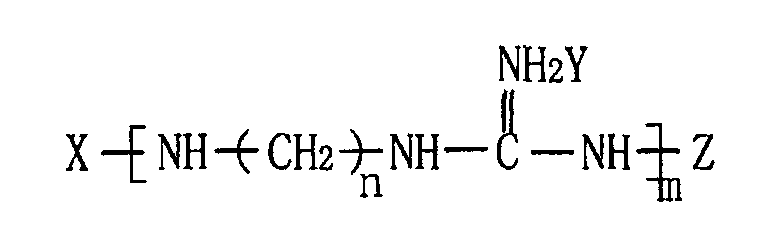
- Mentioned X is one selected from acryloyl, methacryloyl, maleoyl, fumaroyl, itaconoyl, undecynoyl, and hydroxypropyl methacrylate.
- a process to produce functional master batch of polyolefin characterized in that mentioned process is carried out by liquid phase, melt phase, or solid phase reaction and the reactant and the amount (by weight) listed below:
- Mentioned polyamine is C 2 -C 20 organic amine preferably selected from the group consisting of ethylenediamine, propylene diamine, 1,6-hexanediamine, 1,10-decanediamine, hexamine, tetraethylenepentamine, triethylenetetramine, triethylenediamine, triethylenetriamine, N-hydroxyethyl-ethylenediamine, 3-dimethylamino-propylamine etc;
- guanidine salt is a salt of inorganic acid selected from guanidine carbonate, guanidine hydrochloride, guanidine nitrate, guanidine phosphate, aminoguanidine bicarbonate etc.
- C 3 -C 20 compound containing 1-5 active unsaturated double bond(s) is one preferably selected from acrylic acid, methacrylic acid, methyl methacrylate, ethyl methacrylate, butyl acrylate, ethyl acrylate, 2-hydroxyethyl acrylate, 2-hydroxypropyl acrylate, undecylenic acid, glycidyl methacrylate, glycidyl acrylate, 2-hydroxypropyl methacrylate, maleic anhydride, fumarate, itaconic acid, sorbic acid etc.
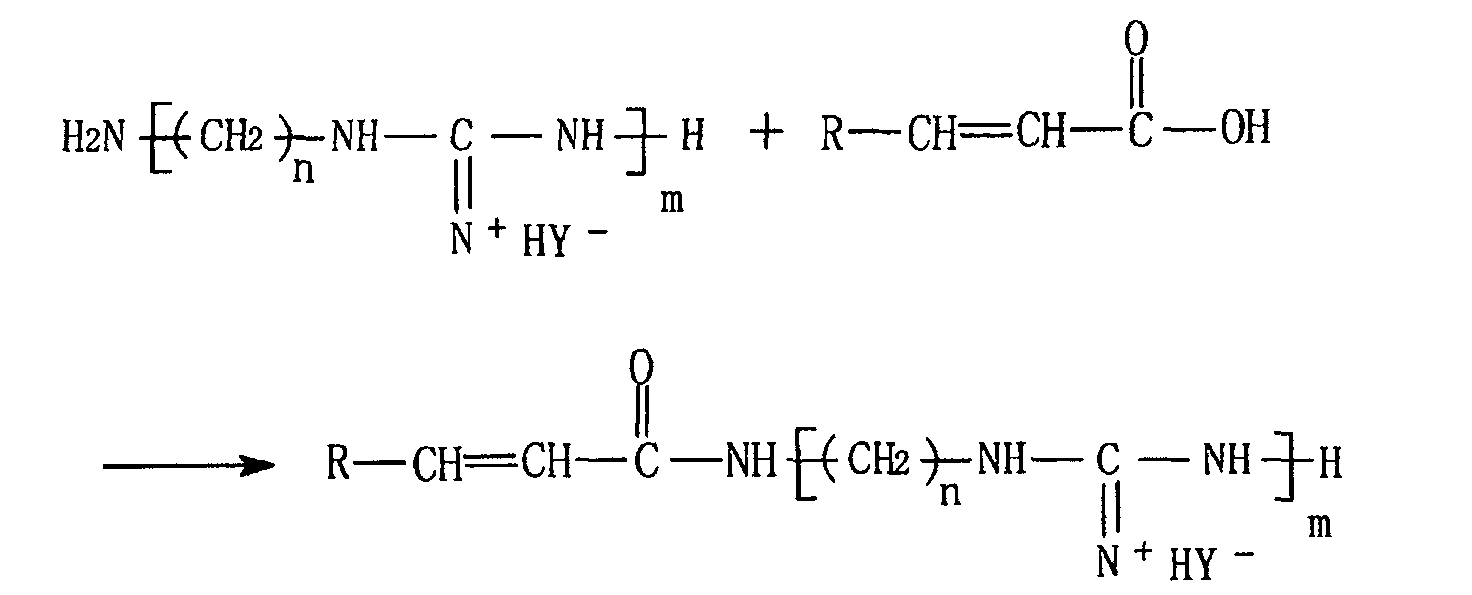
- the functional master batch of polyolefin is produced by liquid phase, melt phase, or solid phase reaction as follows:
- polyolefin master batch as the modifier for fibres, is characterized in that the polyolefin master batch are mixed with polypropylene (PP) or polyethylene (PE) chips by a certain ratio, thereby spinning and getting the good-dyeable, excellent antimicrobial and antistatic fibers or non-woven fabrics.
- PP polypropylene
- PE polyethylene
- An application of polyolefin master batch as the modifier for PP car bumper is characterized in that the polyolefin master batch are mixed with PP special chips by a certain ratio, thereby producing easy-paintable PP car bumpers.
- polystyrene master batch are mixed with polypropylene (PP), polystyrene (PS), polyethylene(PE) or polyvinyl chloride (PVC) chips by a certain ratio. Then one can get various plastic products with excellent antimicrobial ability including BOPP (biaxial oriented polypropylene) film, atactic polypropylene (PPR) drinking water pipe and PE, PS(polystyrene), PVC films as well as other plastic articles.
- PP polypropylene
- PS polystyrene
- PE polyethylene
- PVC polyvinyl chloride
- the molecular structure of mentioned polyamine and guanidine salt oligomer can be mensurated by IR spectroscopy.
- the characteristic absorption peaks of guanidyl, amino, double bond, and amide are at 1633-1660cm -1 , and 3180-3360cm -1 , 1540-1695cm -1 and 665-770cm -1 , and 1610-1655cm -1 , respectively.
- Mentioned polyamine and guanidine salt oligomer can be used as a modifier for antimicrobial agent, antistatic agent or dye-site provider for synthetic fibres, being added into other polymers in an amount of 2-40% by weight. If the amount of mentioned oligomer is less than 2.0%, it can not reach the goal for inadequate polar groups existing in such obtained materials, however, if the amount of is more than 40%, it will cause crosslinking of resin, thereby reducing a processing ability of the resin. On the other hand, it will cause a large amount of unbonded polyamine and guanidine salt oligomer remaining in resin matrix, resulting in break-off at spinning, and also increasing the cost.
- the molecular weight of mentioned polyamine and guanidine salt oligomer can be mensurated by VPO(Vapour Pressure Osmometer) or MS(Mass Spectra) methods. Mentioned molecular weight ranges from 300 to 60,000. There may be two circumstances happening if the molecular weight is less than 300, one is that amino content in polymer will be too low, the other is that the bonding rate will reduce, thereby both situations will cause the deterioration of modification effect. However, if the molecular weight is greater than 60,000, it will increase viscosity of the molten polymer, cause the crosslinking reaction and reduce the processibility. Accordingly, the molecular weight of the polyamine and guanidine salt oligomer preferably ranges from 300 to 60,000.
- the heat resistance of mentioned polyamine and guanidine salt oligomer is measured by TGA(Thermogravimetric Analysis).
- the polymer of this invention has excellent heat resistance and its decomposing temperature is higher than 360°C. It will not be decomposed in a normal processing condition. In addition, it has shown a high reactivity.
- Antimicrobial master batch can be manufactured by reacting oligomer with polyolefin resin through melt, liquid and solid phase.
- molecular assemble technique means part of molecular chain of the matrix resin is assembled with a preferred functional group through chemical bonds, thereby providing the part of resin itself with antimicrobial, antistatic properties.
- molecular assembling technique fundamentally overcomes the lacunae of prior technique, such as poor safety for human being, inferior washable durability and etc for small molecules of organic antimicrobial agents.
- the products with antimicrobial functional groups which are firmly linked with matrix resin molecule through chemical bonds, so can endure wash with detergent and more safety without toxicity.
- the functional master batch has excellent compatibility with resin matrix and excellent processibility, particularly suitable for more complicated process, such as producing fine filament and biaxial stretching film.
- the safety of the materials ensure their applications in food packing materials and drinking water pipe materials, where the ordinary antimicrobe materials containing organic and inorganic antimicrobial agents can not compete.
- guanidine salt and its derivative as major functional groups for assembling because they are important raw materials for producing sulfadiazine, sulfadimidine, and the like. These medicine have broad-spectrum antimicrobial, safe, and excellent thermal stability.
- guanidine salt and its derivative have strong polar and moisture adsorbability, thay can be used as antistatic agents for synthetic fibres.
- the assembled functional groups benefit the materials with improvement for other functions. Compared to the matrix resin, mentioned antimicrobial functional groups have much stronger polar, and easily enriched on the surface during the processing. So on one hand the efficiency increase, on the other hand, the surface electric resistivity reduce, and the antistatic ability of materials is improved.
- the polar groups can combine with dye or paint molecules, the problems in dyeing and painting for polyolefin can be solved to a certian extent. Because of the difference in polarity, the antimicrobial groups can act as nucleating agents, increasing the rate of crystallization and reducing the grain size. So the mechanical performance of materials can be also improved to a certain extent.
- Mentioned functional master batch are blended with the corresponding polyolefin to obtain polypropylene fibre having better dyeability, antimicrobial ability, and antistatic ability; and car bumper with easy-paintable property, antimicrobial PPR water pipe, PP, PE, or PVC film, electrical appliance, toys and etc. Specific applications will be explained in detail with reference to the following examples.
- Antimicrobial ability Antimicrobial plastics, reference to GB15979-1995 Antimicrobial fibres, reference to FZ/T01021-1992 Mould proof ability: Toxicological test (Acute oral ingestion test, Dermal irritation test, micronucleus test) Surface electric resistivity reference to GB/T2423.16-1999 reference to GB15193-1994 and GB/T17409-1998 reference to GB 1410-89
- Dye uptake of fibres is measured by a standard method by using 721 Photometer to measure the optical density of dyebath prior and after dyeing.
- dye uptake,% optical density of original dyebath - optical density of raffinate optical density of original dyebath x 100%
- 172g 1,10-decanediamine and 200g guanidine carbonate are added into a 1000ml three-neck flask.
- the mixure is heated to 110°C with agitation for 1 hr under nitrogen gas protection , then heated to 185°C and kept for 8 hrs.
- 35g maleic anhydride is added into the flask and the reaction is terminated after 40 min.
- the number average molecular weight of the product is 8,600 and its thermal decomposition temperature is 370°C.
- the characteristic absorption peaks corresponding to guanidyl, amino, amido and double bond, can be found respectively on the IR spectrum of the product.
- the number average molecular weight of the product is 16,600 and its thermal decomposition temperature is 366°C.
- the characteristic absorption peaks corresponding to guanidyl, amino, amido and double bond, can be found respectively on the IR spectrum of the product.
- 210g hexanediamine and 210g guanidine nitrate are added into a 500ml three-neck flask.
- the mixure is heated to 100°C with agitation for 2 hrs under nitrogen gas protection , then heated to 160°C and kept for 1 hr.
- 10g glycidyl methacrylate is added into the flask and the reaction is terminated after 20 min.
- the number average molecular weight of the product is 800 and its thermal decomposition temperature is 365°C.
- the characteristic absorption peaks corresponding to guanidyl, amino, amido and double bond, can be found respectively on the IR spectrum of the product.
- 80g polypropylene Y2600 available from Shanghai Petrochemical Co. Ltd.
- 20g maleic acid ester of polydecamethylenediamine-guanidine carbonate with a molecular weight of 50,000, 4g of styrene, and 1.3g of benzoyl peroxide are and 1300g of xylene added into a 2000ml flask.
- the mixure is heated gradually to 110 °C. After all solids are dissolved, the reaction is kept for 4hrs.
- the reaction is finished and the reactant is cooled to room temperature, then 100g acetone is added into the flask to make the solid completely precipitate from the solution.
- the functional master batch of polypropylene is obtained after filtering and drying. (with Code No. 1).
- the assembling rate measured by IR spectroscopy is 96.6%.
- the assembling rate measured by IR spectroscopy is 92.6%.
- the assembling rate measured by IR spectroscopy is 73.2%.
- the reference sample obtained from polypropylene Y1600 (available from Shanghai Petrochemical Co. Ltd.,) is labeled as A.
- the sample obtained from blending 4.8kg of polypropylene Y1600 with 200g of No.1 functional master batch is labeled as A'.
- the reference sample obtained from atactic polypropylene RA-130E (available from Northern Europe Chemicals Co. Ltd.) is labeled as B.
- the sample obtained from blending 19kg of RA-130E with 1.5kg of No.1 functional master batch is labeled as B'.
- the reference sample obtained from film grade polypropylene F1001 (available from Yanshan Petrochemical Co.) is labeled as C.
- the sample obtained from blending 9.5kg of F1001 with 350g of No.1 functional master batch is labeled as C'.
- 25 ⁇ m thickness films are manufactured from both samples by biaxial elongation.
- the properties of both samples are listed below: Sample No. Tensile strength, MPa Breaking elongation,% antimicribial efficiency,% (Staphylococcus aureus) Mould resistance glad longitudinal lateral longitudinal lateral C 165 91 23 106 --- 2 C' 172 95 21 98 95 0
- Formula D is composed of polypropylene, rubber and additives and Formula D' is the same as formula D except adding 5% of No.1 functional polypropylene. Both samples were processed through mix and extrusion through a twin-screw extruder. Then they are molded into sheet with an injector, treated with surfactant, dried, painted. The mechanical properties and adhesive strength of coating film were measured and the results are listed below: Sample No.
- the reference sample of spherical polyvinyl chloride TH-5 (available from Tianjin Chemical Plant) is labeled as E.
- the sample obtained from blending 9.5kg of PVC TH-5 with 500g of No.2 functional master batch is labeled as E'.
- the reference sample obtained from polystyrene Tororex (available from Mitsuyi Toatsu Chemical Com. Japan) is labeled as F.
- the sample obtained from blending 9.5kg of polystyrene Tororex with 500g of No.3 functional master batch is labeled as F'.
- the functional master batch produced by molecular assembling according to the present invention can improve the properties of polyolefin products in various aspects and show wide application fields.
- the oligomer By introducing active double bonds onto the molecular chains of oligomer produced by the reaction of polyamine and guanidine salt, the oligomer can be assembled onto the molecular chains of polyolefin though the addition reaction of double bonds, giving the material antimicrobial, hygroscopic, antistatic and dye-able properties.
- the key point of the present invention is the synthesis of antimicrobial agent and assembling it onto matrix resin.
Landscapes
- Chemical & Material Sciences (AREA)
- Chemical Kinetics & Catalysis (AREA)
- Organic Chemistry (AREA)
- Health & Medical Sciences (AREA)
- Medicinal Chemistry (AREA)
- Polymers & Plastics (AREA)
- Compositions Of Macromolecular Compounds (AREA)
- Processes Of Treating Macromolecular Substances (AREA)
- Addition Polymer Or Copolymer, Post-Treatments, Or Chemical Modifications (AREA)
- Manufacture Of Macromolecular Shaped Articles (AREA)
- Graft Or Block Polymers (AREA)
- Transition And Organic Metals Composition Catalysts For Addition Polymerization (AREA)
- Low-Molecular Organic Synthesis Reactions Using Catalysts (AREA)
- Agricultural Chemicals And Associated Chemicals (AREA)
Abstract

Description


| Antimicrobial ability | Antimicrobial plastics, reference to GB15979-1995 |
| Antimicrobial fibres, reference to FZ/T01021-1992 | |
| Mould proof ability: Toxicological test (Acute oral ingestion test, Dermal irritation test, micronucleus test) Surface electric resistivity | reference to GB/T2423.16-1999 |
| reference to GB15193-1994 and GB/T17409-1998 | |
| reference to GB 1410-89 |
| Sam ple No. | Tensile strength N/dtex | Breaking elongation, % | Dye ability, % disperse blue | Anti-so ap washing ability | Dye ability, % acid blue | Anti-so ap washing ability | antimicribial efficiency,% (Staphylococcu s aureus) |
| A | 3.8 | 112 | 6.1 | --- | 0 | --- | --- |
| A' | 3.2 | 128 | 82 | 4 | 86 | 4-5 | 90 |
| Sam ple No. | Tensile strength MPa | Breaking elongation % | Notch impact strength kJ/m2 | Surface resistivity (relative humidity 70%) | antimicribial efficiency % (Staphylococcus aureus) | Mould resistance glad |
| B | 26.0 | 560 | 5.2 | 1.5×10¹⁶ | --- | 2 |
| B' | 26.5 | 550 | 5.3 | 5.2×10¹⁰ | 87 | 0 |
| Sample No. | Tensile strength, MPa | Breaking elongation,% | antimicribial efficiency,% (Staphylococcus aureus) | Mould resistance glad | ||
| longitudinal | lateral | longitudinal | lateral | |||
| C | 165 | 91 | 23 | 106 | --- | 2 |
| C' | 172 | 95 | 21 | 98 | 95 | 0 |
| Sample No. | Tensile strength, MPa | Bending strength, MPa | Bending modulus, GPa | Impact strength, J/m | adhesive strength (N·M-1) | Adhesive strength after immersion in water for 48hs (N·M-1) |
| D | 18.00 | 19 | 0.588 | Not broken | 168 | 102 |
| D' | 18.33 | 19 | 0.628 | Not broken | 619 | 432 |
| Sample No. | Tensile strength | Bending modulus, MPa | Notch impact strength, kJ/m2 | Surface resistivity (relative humidity 70%) | antimicribial efficiency % (Staphyloco ccus aureus) | Mould resistance class | antimicribial efficiency,% (Staphyloco ccus aureus) |
| E | 53.5 | 136 | 5.6 | 2.9×10¹⁵ | --- | 2 | --- |
| E' | 53.8 | 150 | 5.7 | 6.7×10¹⁰ | 82 | 0 | 82 |
| Sample No. | bending strength MPa | Izod impact strength J/m | Surface resistivity (relative humidity 70%) | antimicribial efficiency % (Staphylococc us aureus) | Mould resistance glad | antimicribial efficiency % (Staphyloco ccus aureus) |
| F | 95 | 26 | 5.9×10¹⁵ | --- | 2 | --- |
| F' | 98 | 26 | 3.7×10¹⁰ | 78 | 0 | 78 |
Claims (13)
- A functional master batch of polyolefin, characterized by its molecular structure shown below:wherein R is a polyamine and guanidine salt oligomer bonded onto polyolefin molecular chain by covalence bond, while S is one selected from hydrogen, chlorine, methyl, or phenyl group.

Mentioned polyamine and guanidine salt oligomer is composed as the following molecular structure.wherein n=2-20, m=2-300, Y is one from Cl-, Br-, NO3 -, HCO3 -, or H2PO4 -, X is C3-C20 acryl or ester group containing 1-5 active unsaturated double bond(s), and Z is hydrogen or X.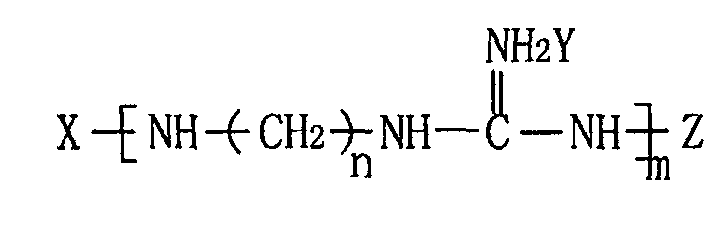
- The functional master batch of polyolefin according to claim 1, characterized in that mentioned X is one selected from acryloyl, methacryloyl, maleoyl, fumaroyl, itaconoyl, undecynoyl, and hydroxypropyl methacrylate.
- A process to produce functional master batch of polyolefin, characterized in that mentioned functional master batch of polyolefin is produced by liquid phase, melt phase, or solid phase reaction with the reactant and the amount (by weight) listed below:wherein (3) and (4) is counted on the basis of total amount of (1)+(2) by weight.60%-98% polyolefin resin,2%-40% polyamine and guanidine salt oligomer,0.5%-15% olefin monomer and0.01%-5.0% initiator.
- The process to produce functional master batch of polyolefin according to claim 3, characterized in that mentioned polyamine and guanidine salt oligomer is produced by the steps below:mixing polyamine with guanidine salt by the molar ratio of 1:0.1-3.0, then adding them to a reactor,heating to 90-150°C and reacting for 0.5-8hs,then raising the temperature to 160-250°C and reacting for 1-10hs,adding a certain amount of C3-C20 organic compound containing 1-5 reactive unsaturated double bond(s) into the system to form the polyamine and guanidine salt oligomer after 10-120min reaction.
- The process to produce functional master batch of polyolefin according to claim 4, characterized in that mentioned C2-C20 organic polyamine is one selected from ethylenediamine, propylene diamine, 1,6-hexanediamine, 1,10-decanediamine, hexamine, tetraethylenepentamine, triethylenetetramine, triethylenediamine, triethylenetriamine, N-hydroxyethyl-ethylenediamine, 3-dimethylamino-propylamine.
Mentioned guanidine salt is a salt of inorganic acid selected from guanidine carbonate, guanidine hydrochloride, guanidine nitrate, guanidine phosphate, aminoguanidine bicarbonate .
Mentioned C3-C20 compound containing 1-5 reactive unsaturated double bond(s) is one preferably selected from acrylic acid, methacrylic acid, methyl methacrylate, ethyl methacrylate, butyl acrylate, ethyl acrylate, 2-hydroxyethyl acrylate, 2-hydroxypropyl acrylate, undecylenic acid, glycidyl methacrylate, glycidyl acrylate, 2-hydroxypropyl methacrylate, maleic anhydride, fumarate, itaconic acid, sorbic acid . - The process to produce functional master batch of polyolefin according to claim 3, characterized in that mentioned olefin monomer is one selected from styrene, divinylbenzene, α-methylstyrene.
- The process to produce functional master batch of polyolefin according to claim 3, characterized in that mentioned initiator is at least one selected from 2,5-dimethyl-2,5-di(t-butyl peroxy) hexane, 2,5- dimethyl-2,5-di(t-butyl peroxy) hexyne-3, isopropyl benzene hydroperoxide, benzoylperoxide, dodecanoyl peroxide, di-t-butyl isopropyl benzene peroxide, t-butyl peroxyacetate, t-butyl 2-ethylcaproate peroxide, 2,5-dimethyl-2,5-di(benzoyl peroxy)hexane, t-butyl isopropyl benzene peroxide, 2,4-dichlorobenzoyl peroxide, p-chlorobenzoyl peroxide, t-butyl peroxylaurate, peroxysuccinic acid, hydroxycyclohexyl hydroperoxide, 1,1-di(peroxy-t-butyl)-3,3,5-trimethyl cyclohexane, 4,4-di (peroxy-t-butyl)n-butyl valerate, t-butyl hydroperoxide, t-butyl peroxybenzoate.
- The process to produce functional master batch of polyolefin according to claim 3, characterized in that mentioned liquid phase reaction contains the steps below:adding various raw materials into the xylene as a solvent,heating to 90-125°C to form 5-55% solution and reacting for 3-4hs,cooling and precipitating the solid,filtering and drying the solid to obtain the functional master batch.
- The process to produce functional master batch of polyolefin according to claim 3, characterized in that mentioned melt phase reaction contains the steps below:adding various raw materials into a single screw extruder, or a twin screw extruder, or a Banbury mixer,carrying on the bonding reaction at 170-260°C for 1-25min,getting the product of the functional master batch.
- The process to produce functional master batch of polyolefin according to claim 3, characterized in that mentioned solid phase reaction contains the steps below:mixing even the polyolefin powder and other raw materials,heating to 90-145°C and simultaneously mixing, then reacting for 1-8hs,getting the product of functional master batch after the reaction completion.
- An application of polyolefin master batch as the modifier for fibres, characterized in that the polyolefin master batch are mixed with polypropylene (PP) or polyethylene (PE) chips by a certain ratio, thereby spinning and getting the good-dyeable, excellent antimicrobial and antistatic fibers or non-woven fabrics.
- An application of polyolefin master batch as the modifier for PP car bumper, characterized in that the polyolefin master batch are mixed with PP special chips by a certain ratio, thereby producing easy-paintable PP car bumpers.
- An application of polyolefin master batch as the modifier for antimicrobial agent, characterized in that the polyolefin master batch are mixed with polypropylene (PP), polystyrene (PS), polyethylene(PE) or polyvinyl chloride (PVC) chips by a certain ratio. Then one can get various plastic products with excellent antimicrobial ability including BOPP(biaxial oriented polypropylene) film, atactic polypropylene drinking water pipe(PPR) and PE, PS(polystyrene), PVC films as well as other plastic articles.
Applications Claiming Priority (3)
| Application Number | Priority Date | Filing Date | Title |
|---|---|---|---|
| CN02111048 | 2002-03-15 | ||
| CNB021110484A CN1282698C (en) | 2002-03-15 | 2002-03-15 | Functional agglomerates of polyolefin as well as its preparing method and application |
| PCT/CN2003/000183 WO2003078490A1 (en) | 2002-03-15 | 2003-03-14 | A kind of functional olefin mother grain and the method of it and the use of it |
Publications (3)
| Publication Number | Publication Date |
|---|---|
| EP1486519A1 true EP1486519A1 (en) | 2004-12-15 |
| EP1486519A4 EP1486519A4 (en) | 2006-08-16 |
| EP1486519B1 EP1486519B1 (en) | 2008-07-09 |
Family
ID=27811200
Family Applications (1)
| Application Number | Title | Priority Date | Filing Date |
|---|---|---|---|
| EP03711794A Expired - Lifetime EP1486519B1 (en) | 2002-03-15 | 2003-03-14 | Preparation method of functional masterbatch of polyolefin and its application |
Country Status (10)
| Country | Link |
|---|---|
| US (2) | US7282538B2 (en) |
| EP (1) | EP1486519B1 (en) |
| JP (1) | JP4610904B2 (en) |
| CN (1) | CN1282698C (en) |
| AT (1) | ATE400596T1 (en) |
| AU (1) | AU2003221218A1 (en) |
| DE (1) | DE60322034D1 (en) |
| DK (1) | DK1486519T3 (en) |
| ES (1) | ES2311091T3 (en) |
| WO (1) | WO2003078490A1 (en) |
Cited By (3)
| Publication number | Priority date | Publication date | Assignee | Title |
|---|---|---|---|---|
| EP1983026A1 (en) * | 2007-04-18 | 2008-10-22 | The Procter and Gamble Company | Modified Polyolefin Surfaces |
| WO2017182536A1 (en) * | 2016-04-20 | 2017-10-26 | Ineos Styrolution Group Gmbh | Antimicrobially active, non-leaching thermoplastic molding compounds |
| CN109569331A (en) * | 2018-12-18 | 2019-04-05 | 万华化学集团股份有限公司 | A kind of preparation method of hydrophilic antibiotic filter membrane |
Families Citing this family (45)
| Publication number | Priority date | Publication date | Assignee | Title |
|---|---|---|---|---|
| CN1309780C (en) * | 2004-05-17 | 2007-04-11 | 山东天野塑化有限公司 | High molecular antistatic masterbatch |
| CN101210062B (en) * | 2006-12-27 | 2010-05-19 | 华东理工大学 | An antibacterial polymer material |
| CN101245141B (en) * | 2007-02-16 | 2011-04-06 | 铜陵高聚生物科技有限公司 | Hydrochloric polyhexamethylene guanidine and preparation method thereof |
| CN101724284B (en) * | 2008-10-31 | 2012-06-27 | 中国石油化工股份有限公司 | Anti-bacterial thermoplastic composite and preparation method thereof |
| US10322954B2 (en) | 2008-11-20 | 2019-06-18 | Hydro Air Global, Llc | Antimicrobial device and materials for fluid treatment |
| CN101812160B (en) * | 2009-02-23 | 2012-05-30 | 上海富元塑胶科技有限公司 | A kind of polyolefin functionalized masterbatch and its preparation method and application |
| EP2230259A1 (en) * | 2009-03-18 | 2010-09-22 | Mindinvest Holdings Ltd. | Complex containing a polymeric gaunidin |
| WO2011047118A1 (en) | 2009-10-14 | 2011-04-21 | Water Visions International, Inc. | Fibrous antimicrobial materials, structures, and barrier applications |
| DE102009052725A1 (en) * | 2009-11-12 | 2011-05-19 | B. Braun Melsungen Ag | Use of polyoxyalkylenediamine-based polyguanidine derivatives for medical articles |
| DE102009052721A1 (en) | 2009-11-12 | 2011-05-26 | B. Braun Melsungen Ag | Use of polymeric or oligomeric active ingredients for medical articles |
| CN102234392B (en) * | 2010-04-22 | 2013-02-27 | 中国石油化工股份有限公司 | Antibacterial biaxially oriented polypropylene film and preparation method thereof |
| CN102847195B (en) * | 2011-06-29 | 2016-02-24 | 李春洁 | The manufacture method of medical antiviral gauze or binder |
| CN102851778A (en) * | 2011-06-29 | 2013-01-02 | 马志银 | Method for manufacturing physical antiviral non-woven fabric |
| CN102321351A (en) * | 2011-08-24 | 2012-01-18 | 昆山埃登新材料有限公司 | PET (polyethylene terephthalate) mite-repellent polymer material |
| CN103627126A (en) * | 2012-08-20 | 2014-03-12 | 叶向明 | Antibiosis master batch and application of antibiosis master batch in blended yarn, blended fabric and woven fabric |
| AT513858B1 (en) * | 2013-01-25 | 2014-08-15 | Sealife Pharma Gmbh | New bioactive polymers |
| CN103146105B (en) * | 2013-03-06 | 2015-04-29 | 华东理工大学 | Reaction extrusion polymerization method of functional acrylate resin |
| CN104004139A (en) * | 2014-06-05 | 2014-08-27 | 上海富元塑胶科技有限公司 | Multifunctional polyolefin wax as well as preparation method and application thereof |
| CN104448476B (en) * | 2014-11-19 | 2017-05-10 | 杭州联通管业有限公司 | High polymer quaternary ammonium salt antibacterial tube and preparation method thereof |
| CN104855416B (en) * | 2015-05-27 | 2018-02-16 | 武汉桀升生物科技有限公司 | A kind of high temperature resistant complex antimicrobials and preparation method thereof |
| CN108440761B (en) * | 2017-02-16 | 2020-11-24 | 中国科学院理化技术研究所 | A kind of non-release polymer antibacterial masterbatch containing guanidine side chain and preparation method and application thereof |
| CN108948503A (en) * | 2017-05-23 | 2018-12-07 | 武汉金牛经济发展有限公司 | A kind of PPR pipe antibacterial colorant master batch and preparation method |
| CN107254045B (en) * | 2017-05-26 | 2021-05-18 | 天津大学 | Preparation method of guanidine polymer bactericide |
| CN107326463B (en) * | 2017-06-30 | 2019-06-21 | 吉林师范大学 | A kind of preparation method of polymethylene guanidine modified PVC antibacterial fiber |
| CN109693404A (en) * | 2017-10-20 | 2019-04-30 | 维龙(上海)包装工业有限公司 | A kind of anti-harmful microorganism polypropylene film and its manufacturing method |
| CN108691030A (en) * | 2018-05-24 | 2018-10-23 | 王德文 | The antifouling aquiculture net cage of sterilizing and anti-virus |
| CN109293838B (en) * | 2018-08-31 | 2021-06-08 | 汕头市远生实业有限公司 | Grafted antibacterial polypropylene and preparation process thereof |
| CN109535571B (en) * | 2018-10-10 | 2021-02-19 | 桂林新先立抗菌材料有限公司 | Injection molding material and preparation method thereof |
| CN109440211B (en) * | 2018-10-30 | 2021-01-19 | 浙江千禧龙纤特种纤维股份有限公司 | Antibacterial mother liquor for producing bacteriostatic ultrahigh molecular weight polyethylene fibers |
| CN110387640A (en) * | 2019-06-21 | 2019-10-29 | 爹地宝贝股份有限公司 | A kind of fluorescent nonwoven fabric and preparation method thereof for health product |
| CN110777442A (en) * | 2019-11-06 | 2020-02-11 | 吉林师范大学 | Preparation method of itaconic acid guanidinium styrene copolymer disinfection fiber |
| CN110964277B (en) * | 2019-11-30 | 2021-03-23 | 华东理工大学 | A kind of guanidine salt antibacterial agent graft-modified polyvinylidene fluoride and preparation method thereof |
| CN112142929A (en) * | 2020-09-16 | 2020-12-29 | 邓天生 | Antibacterial polyethylene material and preparation method thereof |
| CN114427124B (en) * | 2020-10-29 | 2024-02-13 | 中国石油化工股份有限公司 | Antibacterial flame-retardant polypropylene fiber composition, preparation method thereof, fiber and non-woven fabric |
| CN112778739A (en) * | 2021-01-07 | 2021-05-11 | 华东理工大学 | Concentrated long-acting antibacterial anti-fouling PC master batch and preparation method thereof |
| CN112852043B (en) * | 2021-01-11 | 2025-02-11 | 华东理工大学 | A concentrated long-lasting antibacterial and antifouling polyolefin masterbatch and preparation method thereof |
| CN113150439A (en) * | 2021-04-09 | 2021-07-23 | 佛山市顺德区美的饮水机制造有限公司 | Plastic composition and application thereof, plastic part and preparation method and application thereof |
| CN113150302B (en) * | 2021-04-21 | 2022-05-20 | 上海玉城高分子材料股份有限公司 | Inorganic composite guanidine salt polymer harmful microorganism resistant material and preparation method thereof |
| CN113896838B (en) * | 2021-11-12 | 2023-06-16 | 江苏越升科技股份有限公司 | Long-acting antibacterial polystyrene resin and preparation method thereof |
| CN114369188A (en) * | 2021-11-18 | 2022-04-19 | 山东志存科技有限公司 | Synthesis process of macromolecular bactericide polyolefin carbamidine |
| CN114656714A (en) * | 2022-03-01 | 2022-06-24 | 山东清田塑工有限公司 | High-strength and easy-to-recover mulch film and preparation method thereof |
| CN116948281B (en) * | 2022-07-15 | 2025-11-18 | 湖北美的洗衣机有限公司 | Methods for preparing sustained-release functional units, sustained-release functional units, and household appliances |
| CN118005982B (en) * | 2023-04-07 | 2024-11-22 | 任丘市华信电信器材有限公司 | A method for preparing a fire-resistant high-strength plastic pipe |
| CN117903530B (en) * | 2024-03-20 | 2024-05-31 | 北京和瑞储能科技有限公司 | Polypropylene modified master batch, modified polypropylene containing same and preparation method and application thereof |
| CN119161652B (en) * | 2024-09-29 | 2025-03-25 | 山东亿博阳光工程材料有限公司 | Composite drainage net material and preparation method thereof |
Family Cites Families (10)
| Publication number | Priority date | Publication date | Assignee | Title |
|---|---|---|---|---|
| GB231805A (en) * | 1924-04-04 | 1925-11-30 | Leon Lilienfeld | Manufacture of artificial materials |
| GB818844A (en) * | 1954-08-24 | 1959-08-26 | Ciba Ltd | New hardenable derivatives of formaldehyde condensation products of the aminotriazine or urea group, and their manufacture and use |
| GB952194A (en) * | 1960-12-23 | 1964-03-11 | Smith Kline French Lab | New guanidine derivatives and processes for preparing the same |
| SE425043B (en) * | 1977-05-10 | 1982-08-30 | Kenogard Ab | FUNGICID COMPOSITION, PREFERRED FOR USE AS A THREE PROTECTIVE, CONTAINING AT LEAST ONE QUARTER OF AMMONIUM SUBSTANCE IN MIXING WITH AN AMINE COMPONENT |
| JPS5573706A (en) * | 1978-11-28 | 1980-06-03 | Nitto Electric Ind Co Ltd | Antifungal material |
| JPS62201935A (en) * | 1986-02-20 | 1987-09-05 | Chisso Corp | Prevention of segregation of polyolefin masterbatch pellet mixture |
| JPH06234726A (en) * | 1992-11-24 | 1994-08-23 | Takeda Chem Ind Ltd | Antibacterial and antifungal compound, its production and antibacterial and antifungal agent |
| US5659011A (en) * | 1994-09-23 | 1997-08-19 | Waldmann; John J. | Agents having high nitrogen content and high cationic charge based on dicyanimide dicyandiamide or guanidine and inorganic ammonium salts |
| IL152600A0 (en) * | 2000-05-11 | 2003-06-24 | P O C Oil Industry Technology | Biocidal polymers based on guanidine salts |
| JP2002038032A (en) * | 2000-07-26 | 2002-02-06 | Daiwa Kagaku Kogyo Kk | Antibacterial and antifungal composition of thermoplastics |
-
2002
- 2002-03-15 CN CNB021110484A patent/CN1282698C/en not_active Expired - Fee Related
-
2003
- 2003-03-14 EP EP03711794A patent/EP1486519B1/en not_active Expired - Lifetime
- 2003-03-14 DK DK03711794T patent/DK1486519T3/en active
- 2003-03-14 ES ES03711794T patent/ES2311091T3/en not_active Expired - Lifetime
- 2003-03-14 WO PCT/CN2003/000183 patent/WO2003078490A1/en not_active Ceased
- 2003-03-14 JP JP2003576488A patent/JP4610904B2/en not_active Expired - Fee Related
- 2003-03-14 AU AU2003221218A patent/AU2003221218A1/en not_active Abandoned
- 2003-03-14 DE DE60322034T patent/DE60322034D1/en not_active Expired - Lifetime
- 2003-03-14 AT AT03711794T patent/ATE400596T1/en not_active IP Right Cessation
-
2004
- 2004-09-15 US US10/941,626 patent/US7282538B2/en not_active Expired - Lifetime
-
2007
- 2007-05-22 US US11/751,894 patent/US7531225B2/en not_active Expired - Fee Related
Cited By (5)
| Publication number | Priority date | Publication date | Assignee | Title |
|---|---|---|---|---|
| EP1983026A1 (en) * | 2007-04-18 | 2008-10-22 | The Procter and Gamble Company | Modified Polyolefin Surfaces |
| WO2008129495A3 (en) * | 2007-04-18 | 2008-12-18 | Procter & Gamble | Modified polyolefin surfaces |
| WO2017182536A1 (en) * | 2016-04-20 | 2017-10-26 | Ineos Styrolution Group Gmbh | Antimicrobially active, non-leaching thermoplastic molding compounds |
| CN109569331A (en) * | 2018-12-18 | 2019-04-05 | 万华化学集团股份有限公司 | A kind of preparation method of hydrophilic antibiotic filter membrane |
| CN109569331B (en) * | 2018-12-18 | 2021-10-22 | 万华化学集团股份有限公司 | A kind of preparation method of hydrophilic antibacterial filter membrane |
Also Published As
| Publication number | Publication date |
|---|---|
| JP2005520877A (en) | 2005-07-14 |
| JP4610904B2 (en) | 2011-01-12 |
| US20070270552A1 (en) | 2007-11-22 |
| ES2311091T3 (en) | 2009-02-01 |
| CN1445270A (en) | 2003-10-01 |
| US7282538B2 (en) | 2007-10-16 |
| CN1282698C (en) | 2006-11-01 |
| WO2003078490A1 (en) | 2003-09-25 |
| ATE400596T1 (en) | 2008-07-15 |
| AU2003221218A1 (en) | 2003-09-29 |
| EP1486519B1 (en) | 2008-07-09 |
| EP1486519A4 (en) | 2006-08-16 |
| US20050133952A1 (en) | 2005-06-23 |
| US7531225B2 (en) | 2009-05-12 |
| DE60322034D1 (en) | 2008-08-21 |
| DK1486519T3 (en) | 2008-11-17 |
Similar Documents
| Publication | Publication Date | Title |
|---|---|---|
| EP1486519B1 (en) | Preparation method of functional masterbatch of polyolefin and its application | |
| CN101812160B (en) | A kind of polyolefin functionalized masterbatch and its preparation method and application | |
| DE3881700T2 (en) | IMPACT-RESISTANT STYRENE POLYMER / THERMOPLASTIC POLYMER BLEND. | |
| JPS59202261A (en) | Method for modifying surface of high-molecular material | |
| JPS6164741A (en) | Thermoplastic resin composition | |
| EP2358772A1 (en) | Weatherable colored resinous composition and method | |
| JP4679929B2 (en) | Infrared transparent thermoplastic resin composition and molded article using the same | |
| IL99182A (en) | Flame retardant polypropylene molding compositions and molded articles including the same | |
| JPH01103612A (en) | Thermoplastic copolymer | |
| JPS60245662A (en) | Weather-resistant resin composition | |
| DE69108180T2 (en) | Graft copolymers with excellent properties to be colored and thermoplastic resin compositions thus produced. | |
| JPH08217936A (en) | Antibacterial and antifungal resin composition | |
| JPS6279252A (en) | Modified hydrogenated block copolymer composition and production thereof | |
| JPS62209165A (en) | Thermoplastic resin composition | |
| JP3472308B2 (en) | Impact resistant methacrylic resin | |
| JP2796595B2 (en) | Multilayer polymer and resin composition | |
| JPS61200108A (en) | Rubber-modified thermoplastic resin composition | |
| JPS61261344A (en) | Antistatic thermoplastic resin composition | |
| US20080161498A1 (en) | Polypropylene derivatives and preparation thereof | |
| JPH03243652A (en) | Polyester-polycarbonate based resin composition having high impact resistance | |
| JPS61200107A (en) | Rubber-modified thermoplastic resin composition | |
| JPH0559247A (en) | Weather-resistant, high-impact polymer composition excellent in heat resistance | |
| KR20250061967A (en) | A PMMA-based resin composition with excellent optical properties and a molded product manufactured including the same | |
| US20040230013A1 (en) | Blends of poly (alpha-methylene-gamma-methyl-gamma-butyrolactone-co-glycidyl methacrylate) and polyphenylene sulfide polymer, articles therefrom and preparation thereof | |
| CN111808396A (en) | Antibacterial plastic and preparation method thereof |
Legal Events
| Date | Code | Title | Description |
|---|---|---|---|
| PUAI | Public reference made under article 153(3) epc to a published international application that has entered the european phase |
Free format text: ORIGINAL CODE: 0009012 |
|
| 17P | Request for examination filed |
Effective date: 20040915 |
|
| AK | Designated contracting states |
Kind code of ref document: A1 Designated state(s): AT BE BG CH CY CZ DE DK EE ES FI FR GB GR HU IE IT LI LU MC NL PT RO SE SI SK TR |
|
| AX | Request for extension of the european patent |
Extension state: AL LT LV MK |
|
| RIC1 | Information provided on ipc code assigned before grant |
Ipc: C08F 299/00 20060101AFI20030927BHEP Ipc: C08F 257/02 20060101ALI20060323BHEP Ipc: C08F 259/04 20060101ALI20060323BHEP |
|
| RTI1 | Title (correction) |
Free format text: PREPARATION METHOD OF FUNCTIONAL MASTERBATCH OF POLYOLEFIN AND ITS APPLICATION |
|
| A4 | Supplementary search report drawn up and despatched |
Effective date: 20060714 |
|
| 17Q | First examination report despatched |
Effective date: 20061204 |
|
| GRAP | Despatch of communication of intention to grant a patent |
Free format text: ORIGINAL CODE: EPIDOSNIGR1 |
|
| GRAS | Grant fee paid |
Free format text: ORIGINAL CODE: EPIDOSNIGR3 |
|
| GRAA | (expected) grant |
Free format text: ORIGINAL CODE: 0009210 |
|
| AK | Designated contracting states |
Kind code of ref document: B1 Designated state(s): AT BE BG CH CY CZ DE DK EE ES FI FR GB GR HU IE IT LI LU MC NL PT RO SE SI SK TR |
|
| AX | Request for extension of the european patent |
Extension state: AL LT LV MK |
|
| REG | Reference to a national code |
Ref country code: GB Ref legal event code: FG4D |
|
| REG | Reference to a national code |
Ref country code: CH Ref legal event code: EP |
|
| REF | Corresponds to: |
Ref document number: 60322034 Country of ref document: DE Date of ref document: 20080821 Kind code of ref document: P |
|
| REG | Reference to a national code |
Ref country code: IE Ref legal event code: FG4D |
|
| REG | Reference to a national code |
Ref country code: DK Ref legal event code: T3 |
|
| REG | Reference to a national code |
Ref country code: CH Ref legal event code: NV Representative=s name: ISLER & PEDRAZZINI AG |
|
| NLV1 | Nl: lapsed or annulled due to failure to fulfill the requirements of art. 29p and 29m of the patents act | ||
| PG25 | Lapsed in a contracting state [announced via postgrant information from national office to epo] |
Ref country code: NL Free format text: LAPSE BECAUSE OF FAILURE TO SUBMIT A TRANSLATION OF THE DESCRIPTION OR TO PAY THE FEE WITHIN THE PRESCRIBED TIME-LIMIT Effective date: 20080709 Ref country code: PT Free format text: LAPSE BECAUSE OF FAILURE TO SUBMIT A TRANSLATION OF THE DESCRIPTION OR TO PAY THE FEE WITHIN THE PRESCRIBED TIME-LIMIT Effective date: 20081209 |
|
| REG | Reference to a national code |
Ref country code: ES Ref legal event code: FG2A Ref document number: 2311091 Country of ref document: ES Kind code of ref document: T3 |
|
| PG25 | Lapsed in a contracting state [announced via postgrant information from national office to epo] |
Ref country code: BG Free format text: LAPSE BECAUSE OF FAILURE TO SUBMIT A TRANSLATION OF THE DESCRIPTION OR TO PAY THE FEE WITHIN THE PRESCRIBED TIME-LIMIT Effective date: 20081009 Ref country code: FI Free format text: LAPSE BECAUSE OF FAILURE TO SUBMIT A TRANSLATION OF THE DESCRIPTION OR TO PAY THE FEE WITHIN THE PRESCRIBED TIME-LIMIT Effective date: 20080709 Ref country code: SI Free format text: LAPSE BECAUSE OF FAILURE TO SUBMIT A TRANSLATION OF THE DESCRIPTION OR TO PAY THE FEE WITHIN THE PRESCRIBED TIME-LIMIT Effective date: 20080709 Ref country code: AT Free format text: LAPSE BECAUSE OF FAILURE TO SUBMIT A TRANSLATION OF THE DESCRIPTION OR TO PAY THE FEE WITHIN THE PRESCRIBED TIME-LIMIT Effective date: 20080709 |
|
| PG25 | Lapsed in a contracting state [announced via postgrant information from national office to epo] |
Ref country code: BE Free format text: LAPSE BECAUSE OF FAILURE TO SUBMIT A TRANSLATION OF THE DESCRIPTION OR TO PAY THE FEE WITHIN THE PRESCRIBED TIME-LIMIT Effective date: 20080709 |
|
| PG25 | Lapsed in a contracting state [announced via postgrant information from national office to epo] |
Ref country code: EE Free format text: LAPSE BECAUSE OF FAILURE TO SUBMIT A TRANSLATION OF THE DESCRIPTION OR TO PAY THE FEE WITHIN THE PRESCRIBED TIME-LIMIT Effective date: 20080709 |
|
| PLBE | No opposition filed within time limit |
Free format text: ORIGINAL CODE: 0009261 |
|
| STAA | Information on the status of an ep patent application or granted ep patent |
Free format text: STATUS: NO OPPOSITION FILED WITHIN TIME LIMIT |
|
| PG25 | Lapsed in a contracting state [announced via postgrant information from national office to epo] |
Ref country code: SK Free format text: LAPSE BECAUSE OF FAILURE TO SUBMIT A TRANSLATION OF THE DESCRIPTION OR TO PAY THE FEE WITHIN THE PRESCRIBED TIME-LIMIT Effective date: 20080709 Ref country code: RO Free format text: LAPSE BECAUSE OF FAILURE TO SUBMIT A TRANSLATION OF THE DESCRIPTION OR TO PAY THE FEE WITHIN THE PRESCRIBED TIME-LIMIT Effective date: 20080709 Ref country code: CZ Free format text: LAPSE BECAUSE OF FAILURE TO SUBMIT A TRANSLATION OF THE DESCRIPTION OR TO PAY THE FEE WITHIN THE PRESCRIBED TIME-LIMIT Effective date: 20080709 |
|
| 26N | No opposition filed |
Effective date: 20090414 |
|
| PG25 | Lapsed in a contracting state [announced via postgrant information from national office to epo] |
Ref country code: MC Free format text: LAPSE BECAUSE OF NON-PAYMENT OF DUE FEES Effective date: 20090331 |
|
| REG | Reference to a national code |
Ref country code: IE Ref legal event code: MM4A |
|
| PG25 | Lapsed in a contracting state [announced via postgrant information from national office to epo] |
Ref country code: IE Free format text: LAPSE BECAUSE OF NON-PAYMENT OF DUE FEES Effective date: 20090314 Ref country code: SE Free format text: LAPSE BECAUSE OF FAILURE TO SUBMIT A TRANSLATION OF THE DESCRIPTION OR TO PAY THE FEE WITHIN THE PRESCRIBED TIME-LIMIT Effective date: 20081009 |
|
| PG25 | Lapsed in a contracting state [announced via postgrant information from national office to epo] |
Ref country code: GR Free format text: LAPSE BECAUSE OF FAILURE TO SUBMIT A TRANSLATION OF THE DESCRIPTION OR TO PAY THE FEE WITHIN THE PRESCRIBED TIME-LIMIT Effective date: 20081010 |
|
| PG25 | Lapsed in a contracting state [announced via postgrant information from national office to epo] |
Ref country code: LU Free format text: LAPSE BECAUSE OF NON-PAYMENT OF DUE FEES Effective date: 20090314 |
|
| PG25 | Lapsed in a contracting state [announced via postgrant information from national office to epo] |
Ref country code: HU Free format text: LAPSE BECAUSE OF FAILURE TO SUBMIT A TRANSLATION OF THE DESCRIPTION OR TO PAY THE FEE WITHIN THE PRESCRIBED TIME-LIMIT Effective date: 20090110 |
|
| PG25 | Lapsed in a contracting state [announced via postgrant information from national office to epo] |
Ref country code: TR Free format text: LAPSE BECAUSE OF FAILURE TO SUBMIT A TRANSLATION OF THE DESCRIPTION OR TO PAY THE FEE WITHIN THE PRESCRIBED TIME-LIMIT Effective date: 20080709 |
|
| PG25 | Lapsed in a contracting state [announced via postgrant information from national office to epo] |
Ref country code: CY Free format text: LAPSE BECAUSE OF FAILURE TO SUBMIT A TRANSLATION OF THE DESCRIPTION OR TO PAY THE FEE WITHIN THE PRESCRIBED TIME-LIMIT Effective date: 20080709 |
|
| REG | Reference to a national code |
Ref country code: FR Ref legal event code: PLFP Year of fee payment: 13 |
|
| REG | Reference to a national code |
Ref country code: FR Ref legal event code: PLFP Year of fee payment: 14 |
|
| REG | Reference to a national code |
Ref country code: FR Ref legal event code: PLFP Year of fee payment: 15 |
|
| REG | Reference to a national code |
Ref country code: FR Ref legal event code: PLFP Year of fee payment: 16 |
|
| PGFP | Annual fee paid to national office [announced via postgrant information from national office to epo] |
Ref country code: GB Payment date: 20200304 Year of fee payment: 18 Ref country code: DK Payment date: 20200310 Year of fee payment: 18 Ref country code: IT Payment date: 20200226 Year of fee payment: 18 Ref country code: DE Payment date: 20200303 Year of fee payment: 18 |
|
| PGFP | Annual fee paid to national office [announced via postgrant information from national office to epo] |
Ref country code: CH Payment date: 20200313 Year of fee payment: 18 |
|
| PGFP | Annual fee paid to national office [announced via postgrant information from national office to epo] |
Ref country code: FR Payment date: 20200227 Year of fee payment: 18 |
|
| PGFP | Annual fee paid to national office [announced via postgrant information from national office to epo] |
Ref country code: ES Payment date: 20200401 Year of fee payment: 18 |
|
| REG | Reference to a national code |
Ref country code: DE Ref legal event code: R119 Ref document number: 60322034 Country of ref document: DE |
|
| REG | Reference to a national code |
Ref country code: CH Ref legal event code: PL |
|
| REG | Reference to a national code |
Ref country code: DK Ref legal event code: EBP Effective date: 20210331 |
|
| GBPC | Gb: european patent ceased through non-payment of renewal fee |
Effective date: 20210314 |
|
| PG25 | Lapsed in a contracting state [announced via postgrant information from national office to epo] |
Ref country code: GB Free format text: LAPSE BECAUSE OF NON-PAYMENT OF DUE FEES Effective date: 20210314 Ref country code: FR Free format text: LAPSE BECAUSE OF NON-PAYMENT OF DUE FEES Effective date: 20210331 Ref country code: DE Free format text: LAPSE BECAUSE OF NON-PAYMENT OF DUE FEES Effective date: 20211001 Ref country code: LI Free format text: LAPSE BECAUSE OF NON-PAYMENT OF DUE FEES Effective date: 20210331 Ref country code: CH Free format text: LAPSE BECAUSE OF NON-PAYMENT OF DUE FEES Effective date: 20210331 |
|
| PG25 | Lapsed in a contracting state [announced via postgrant information from national office to epo] |
Ref country code: IT Free format text: LAPSE BECAUSE OF NON-PAYMENT OF DUE FEES Effective date: 20210314 Ref country code: DK Free format text: LAPSE BECAUSE OF NON-PAYMENT OF DUE FEES Effective date: 20210331 |
|
| REG | Reference to a national code |
Ref country code: ES Ref legal event code: FD2A Effective date: 20220523 |
|
| PG25 | Lapsed in a contracting state [announced via postgrant information from national office to epo] |
Ref country code: ES Free format text: LAPSE BECAUSE OF NON-PAYMENT OF DUE FEES Effective date: 20210315 |