EP1486500A1 - 10-(3-cyclopropylaminomethyl-1-pyrrolidinyl)pyridobenzoxazinecarboxylic acid derivative effective against resistant bacterium - Google Patents

10-(3-cyclopropylaminomethyl-1-pyrrolidinyl)pyridobenzoxazinecarboxylic acid derivative effective against resistant bacterium Download PDF

Info

Publication number
EP1486500A1
EP1486500A1 EP03708575A EP03708575A EP1486500A1 EP 1486500 A1 EP1486500 A1 EP 1486500A1 EP 03708575 A EP03708575 A EP 03708575A EP 03708575 A EP03708575 A EP 03708575A EP 1486500 A1 EP1486500 A1 EP 1486500A1
Authority
EP
European Patent Office
Prior art keywords
methyl
hydrate
salt
cyclopropylaminomethyl
oxo
Prior art date
Legal status (The legal status is an assumption and is not a legal conclusion. Google has not performed a legal analysis and makes no representation as to the accuracy of the status listed.)
Granted
Application number
EP03708575A
Other languages
German (de)
French (fr)
Other versions
EP1486500B1 (en
EP1486500A4 (en
Inventor
Yoshikazu Asahina
Masaya Takei
Current Assignee (The listed assignees may be inaccurate. Google has not performed a legal analysis and makes no representation or warranty as to the accuracy of the list.)
Kyorin Pharmaceutical Co Ltd
Original Assignee
Kyorin Pharmaceutical Co Ltd
Priority date (The priority date is an assumption and is not a legal conclusion. Google has not performed a legal analysis and makes no representation as to the accuracy of the date listed.)
Filing date
Publication date
Application filed by Kyorin Pharmaceutical Co Ltd filed Critical Kyorin Pharmaceutical Co Ltd
Publication of EP1486500A1 publication Critical patent/EP1486500A1/en
Publication of EP1486500A4 publication Critical patent/EP1486500A4/en
Application granted granted Critical
Publication of EP1486500B1 publication Critical patent/EP1486500B1/en
Anticipated expiration legal-status Critical
Expired - Lifetime legal-status Critical Current

Links

Classifications

    • CCHEMISTRY; METALLURGY
    • C07ORGANIC CHEMISTRY
    • C07DHETEROCYCLIC COMPOUNDS
    • C07D498/00Heterocyclic compounds containing in the condensed system at least one hetero ring having nitrogen and oxygen atoms as the only ring hetero atoms
    • C07D498/02Heterocyclic compounds containing in the condensed system at least one hetero ring having nitrogen and oxygen atoms as the only ring hetero atoms in which the condensed system contains two hetero rings
    • C07D498/04Ortho-condensed systems
    • CCHEMISTRY; METALLURGY
    • C07ORGANIC CHEMISTRY
    • C07DHETEROCYCLIC COMPOUNDS
    • C07D498/00Heterocyclic compounds containing in the condensed system at least one hetero ring having nitrogen and oxygen atoms as the only ring hetero atoms
    • C07D498/02Heterocyclic compounds containing in the condensed system at least one hetero ring having nitrogen and oxygen atoms as the only ring hetero atoms in which the condensed system contains two hetero rings
    • C07D498/06Peri-condensed systems
    • AHUMAN NECESSITIES
    • A61MEDICAL OR VETERINARY SCIENCE; HYGIENE
    • A61PSPECIFIC THERAPEUTIC ACTIVITY OF CHEMICAL COMPOUNDS OR MEDICINAL PREPARATIONS
    • A61P31/00Antiinfectives, i.e. antibiotics, antiseptics, chemotherapeutics
    • A61P31/04Antibacterial agents

Definitions

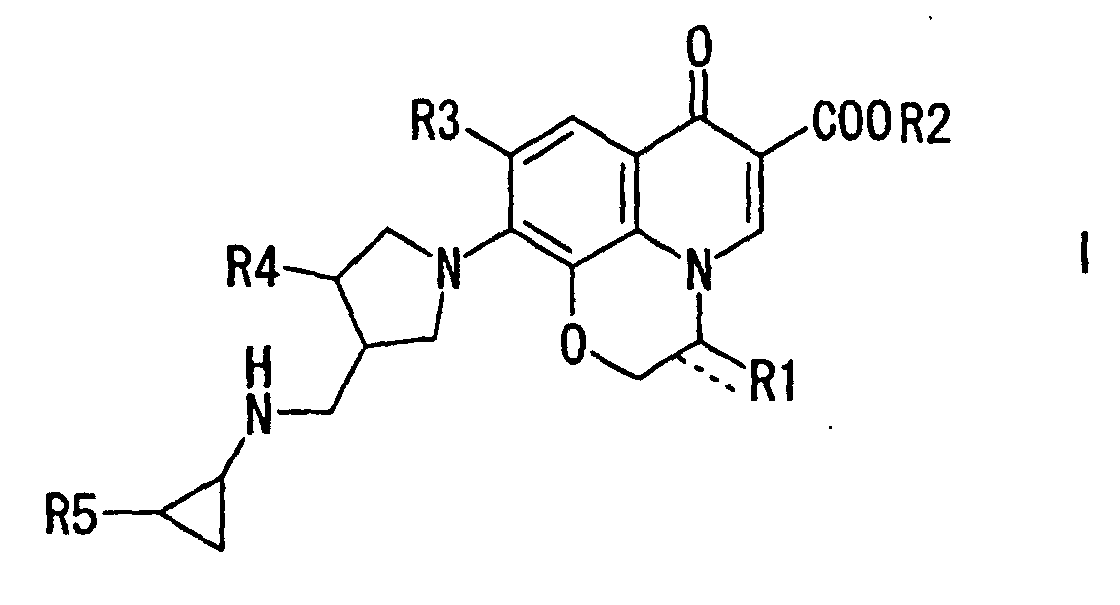
  • the present invention relates to novel 10-(3-cyclopropylaminomethyl-1-pyrrolidinyl)pyridobenzoxazine carboxylic acid derivatives, salts and hydrates thereof that, in addition to being safe and exhibiting strong antibacterial activities, are effective against drug-resistant bacteria that are less susceptible to conventional antibacterial agents.
  • Patent Article 1 Japanese Patent Laid-Open Publication No. Sho 57-46986 (Patent Article 1); Japanese Patent Laid-Open Publication No. Sho 61-204188 (Patent Article 2); Japanese Patent Laid-Open Publication No. Sho 62-155282 (Patent Article 3).
  • MRSA Methicillin-Resistant Staphylococcus aureus
  • PRSP Penicillin-Resistant Streptococcus pneumoniae
  • VRE Vancomycin-Resistant Enterococcus
  • the present inventors have devoted a significant amount of effort to seeking quinolone carboxylic acid derivatives that are effective against gram-positive bacteria, in particular, such drug-resistant bacteria as MRSA, PRSP, and VRE, which are less susceptible to traditional quinolone carboxylic acid-based antibacterial agents.
  • the effort was rewarded by the discovery of the compounds of the present invention, which proved to be effective against gram-positive bacteria, in particular, such drug-resistant bacteria as MRSA, PRSP, and VRE, and exhibit higher antibacterial activity as compared not only with traditional quinolone carboxylic acid-based antibacterial agents, but also with various other antibacterial agents.
  • the discovery ultimately led the present inventors to complete the present invention.
  • R1 is a methyl group, a fluoromethyl group, a methoxymethyl group, an acetoxymethyl group, a hydroxymethyl group, or a methylene group
  • Examples of the lower alkyl group in the general formula (I) include a methyl group, an ethyl group, a propyl group, an isopropyl group, and a cyclopropyl group.
  • Examples of the pharmaceutically acceptable cation include sodium ion, potassium ion, magnesium ion, calcium ion, and ammonium ion.
  • Examples of the ester of a prodrug include a pivaloyloxymethyl group, an acetoxymethyl group, a phthalidinyl group, an indanyl group, a methoxymethyl group, and a 5-methyl-2-oxo-1,3-dioxolene-4-yl group.
  • Examples of the halogen atom include fluorine, chlorine, bromine, and iodine.
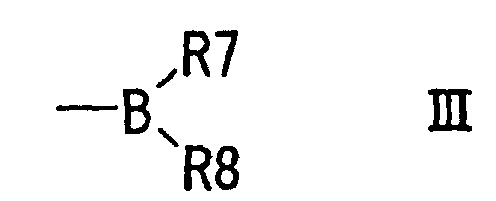
  • the compound of the present invention may be produced by reacting a compound represented by the following general formula (II): [wherein R1 and R3 are the same as in the general formula (I); and R6 is represented by the following general formula (III): [wherein R6 and R7 are each independently a fluorine atom, or a lower alkylcarbonyloxy group]] with a compound represented by the following general formula (IV), or an acid addition salt thereof: [wherein R4 and R5 are the same as in the general formula (I); and R10 is a hydrogen atom or a protective group of nitrogen atom such as t-butoxycarbonyl] and then removing the boron chelate and, if necessary, the protective group of nitrogen atom.
  • general formula (II) [wherein R1 and R3 are the same as in the general formula (I); and R6 is represented by the following general formula (III): [wherein R6 and R7 are each independently a fluorine atom, or a lower alkylcarbony
  • the reaction of the compound of the general formula (II) with the compound of the general formula (IV) may be carried out in the absence or presence of a solvent, such as an alcohol, acetonitrile, dimethylsulfoxide, N,N-dimethylformamide, N,N-dimethylacetamide, N-methylpyrrolidone, tetrahydrofuran, dioxane, benzene, or toluene, and in the presence of an acid receptor.
  • the acid receptor may be a carbonate or a hydrogen carbonate of an alkali metal or an alkaline earth metal, or a basic organic compound, such as triethylamine, diazabicyclo-7-undecene, or pyridine.
  • the reaction is typically carried out at a temperature in the range of room temperature to 200°C and preferably in the range of 25°C to 150°C.
  • the reaction takes from 30min to 48 hours and is typically complete within 30min to 15 hours.
  • the compound of the general formula (I) may be converted to its salt using an ordinary technique.
  • salts include salts formed with an inorganic acid, such as hydrochloric acid, sulfuric acid, and phosphoric acid, salts formed with an organic acid, such as methanesulfonic acid, lactic acid, oxalic acid, and acetic acid, and salts formed with sodium, potassium, magnesium, calcium, aluminum, cerium, chromium, cobalt, copper, iron, zinc, platinum, silver, or the like.
  • the compound of the present invention may be administered to humans or animals in a pharmaceutically known form through a pharmaceutically known route.
  • the compound may be prepared in the form of powders, tablets, capsules, ointments, injections, syrups, solutions, eye drops, and suppositories for oral or parenteral administration.
  • trans-1-Benzyl-4-methyl-3-pyrrolidinecarboxylic acid (4.04g) was dissolved in dichloromethane (50mL). To this solution, 1,1'-carbonylbis-1H-imidazole (3.58g) was added and the mixture was stirred at room temperature for 1 hour. While the reaction mixture was cooled on an ice bath, a dichloromethane solution (15mL) of cyclopropylamine (1.53mL) was added dropwise and the mixture was stirred at room temperature for 3 hours. Subsequently, the reaction mixture was washed with water, was dried over anhydrous sodium sulfate, and was then concentrated under reduced pressure.
  • trans-1-Benzyl-N-cyclopropyl-4-methyl-3-pyrrolidinecarboxamide (3.80g) was suspended in anhydrous tetrahydrofuran (85mL).
  • a 1mol/L tetrahydrofuran solution of borane-tetrahydrofuran complex (58.8mL) was added and the mixture was refluxed for 8 hours while heated.
  • a 2mol/L aqueous solution of sodium hydroxide 35mL was added to the reaction mixture and the mixture was refluxed for 4 hours while heated. After concentration under reduced pressure, the resultant residue was extracted with toluene (2 x 100mL) and the toluene extracts were combined.
  • trans-1-Benzyl-3-[[(N-tert-butoxycarbonyl-N-cyclopropyl)amino]methyl]-4-methylpyrrolidine (3.00g) was dissolved in ethanol (50mL). To this solution, 7.5% palladium carbon (300mg) was added and the mixture was stirred at room temperature for 6 hours under a hydrogen pressure of 3.9 x 10 5 Pa. Subsequently, the catalyst was removed from the reaction mixture by filtration and the collected catalyst was washed with ethanol.
  • trans-3-[[(N-tert-Butoxycarbonyl-N-cyclopropyl)amino]methyl]-4-methylpyrrolidine (2.07g) was dissolved in dichloromethane (10mL). While this solution was cooled on an ice bath, trifluoroacetic acid (5mL) was added and the mixture was stirred at room temperature for 2 hours. After concentration under reduced pressure, the resulting residue was dissolved in tetrahydrofuran (6mL) and the solution was allowed to stand for 13 hours at room temperature. The separated crystal was collected by filtration, followed by washing with tetrahydrofuran and drying under reduced pressure, to give 2.47g of trans-3-cyclopropylaminomethyl-4-methylpyrrolidine trifluoroacetic acid salt.
  • the salt product (2.37g) was dissolved in water (5mL), followed by addition of a 20% aqueous solution of sodium hydroxide to adjust the pH to 14. The solution was then extracted with diethyl ether (2 x 50mL) and the extracts were combined. The combined extract was then dried over anhydrous sodium sulfate and was concentrated under reduced pressure. The resulting residue was purified by distillation under reduced pressure to obtain 660mg of trans-3-cyclopropylaminomethyl-4-methylpyrrolidine.
  • cis-1-Benzyl-3-hydroxy-4-methylpyrrolidine (6.81g) was dissolved in dichloromethane (70mL). While this solution was cooled on a dry ice/acetone bath, triethylamine (5.21mL) was added. Methanesulfonyl chloride (2.89mL) was then added dropwise and the mixture was further stirred for 1 hour. Following addition of water (50mL), the temperature of the mixture was allowed to rise to room temperature and the dichloromethane layer was separated. The aqueous layer was extracted with dichloromethane (50mL) and the extract was combined with the dichloromethane layer.
  • Lithium aluminum hydride (80%, 3.89g) was suspended in diethyl ether (90mL). While the suspension was cooled on an ice bath, a diethyl ether solution (25mL) of cis-1-benzyl-4-methyl-3-pyrrolidinecarbonitrile (4.11g) was added dropwise and the mixture was stirred at room temperature for 1 hour. While the reaction mixture was cooled on an ice bath, a saturated aqueous solution of sodium hydrogen carbonate (8mL) was carefully added dropwise. Following dilution with diethyl ether (100mL), insoluble materials were collected by filtration and were washed with diethyl ether. The filtrate and the washing solution were combined and the combined solution was concentrated under reduced pressure.
  • cis-1-Benzyl-4-methyl-3-aminomethylpyrrolidine 1000mg was dissolved in methanol (10mL). While this solution was cooled on an ice bath, benzaldehyde (0.50mL) was added dropwise and the mixture was stirred at room temperature for 1 hour. Subsequently, sodium cyanoborohydride (184mg) was added and the mixture was stirred at room temperature for 1.5 hours. This was followed by a second addition of sodium cyanoborohydride (123mg) and stirring for additional 5.5 hours. Subsequently, a 2mol/L aqueous solution of sodium hydroxide (5mL) was added to the reaction mixture and the mixture was refluxed for 2 hours while heated.
  • trans-1-benzyl-4-trifluoromethyl-3-pyrrolidinecarboxylic acid (3.00g) was reacted to give 3.32g of trans-1-benzyl-4-trifluoromethyl-3-pyrrolidinecarboxamide.
  • Lithium aluminum hydride (80%, 5.56g) was suspended in tetrahydrofuran (170mL). While the suspension was cooled on a sodium chloride/ice bath, a tetrahydrofuran solution (300mL) of N-[[(3S,4R)-benzyl-4-benzyloxypyrrolidin-3-yl]carbonyl]-(2'S)-bornane-10,2-sultam (19.9g) was added dropwise and the mixture was stirred at -5°C or below for 1 hour. Subsequently, water (34mL) was carefully added dropwise to the mixture. Insoluble materials were collected by filtration and were washed with ethyl acetate (2 x 400mL).
  • the filtrate and the washing solutions were combined and the combined organic layer was extracted with 1mol/L hydrochloric acid (2 x 500mL).
  • the hydrochloric acid extracts were combined and a 30% aqueous solution of sodium hydroxide was added to make the combined solution basic (pH 14).
  • the mixture was then extracted with diethyl ether (2 x 500mL) and the diethyl ether extracts were combined.
  • the resulting residue was dissolved in N,N-dimethylformamide (60mL), followed by addition of sodium azide (1.14g) and stirring at 100°C for 2 hours.
  • the reaction mixture was then concentrated under reduced pressure and water (30mL) was added to the resulting residue.
  • the mixture was then extracted with diethyl ether (2 x 100mL) and the diethyl ether extracts were combined.
  • the combined diethyl ether layer was dried over anhydrous sodium sulfate and was concentrated under reduced pressure.
  • reaction mixture was sequentially washed with water (2mL), 1mol/L hydrochloric acid (2 x 2mL), and a saturated aqueous solution of sodium chloride (2 x 2mL), followed by drying over anhydrous sodium sulfate and concentration under reduced pressure.
  • the eluted pale brown tar-like material was dissolved in ethanol (60mL).
  • potassium carbonate (4.07g) dissolved in water (30mL) was added and the mixture was heat-refluxed for 3 hours while being stirred.
  • the reaction mixture was concentrated under reduced pressure, and the resulting residue was dissolved in dichloromethane (200mL).
  • the dichloromethane solution was washed with a saturated aqueous solution of sodium chloride (2 x 50mL), was dried over anhydrous sodium sulfate, and was then concentrated under reduced pressure.
  • Platinum oxide (IV) (50.0mg) was suspended in ethanol (7mL) and the suspension was stirred at room temperature for 30min in a stream of hydrogen (provided from a balloon).
  • an ethanol solution (3mL) of a mixture (551mg) of (3R,4R)-3-azidomethyl-1-benzyloxycarbonyl-4-fluoropyrrolidine and 3-azidomethyl-1-benzyloxycarbonyl-3-pyrroline was added, and the mixture was stirred at room temperature for 5 hours in a stream of hydrogen (provided from a balloon). Subsequently, the catalyst was removed from the reaction mixture by filtration and was washed with ethanol.
  • 80% ethanol (2500mL) and triethylamine (25.0mL) were added and the mixture was heat-refluxed for 2 hours while being stirred.
  • the reaction mixture was left on an ice bath for 2 hours and the resulting crystal was collected by filtration. The collected crystal was washed with ethanol, was suspended in purified water (300ml), and was then collected by filtration.
  • Process B To a dichloromethane solution (273mL) of bis(acetato-O)[(3R)-9,10-difluoro-3-fluoromethyl-2,3-dihydro-7-oxo-7H-pyrido[1,2,3-d,e][1,4]benzoxazine-6-carboxylato-O 6 ,O 7 ]boron (22.6g), (3R)-3-cyclopropylaminomethylpyrrolidine (8.41g) and triethylamine (7.59g) were added and the mixture was allowed to stand at room temperature for 13 hours.
  • reaction mixture was sequentially washed with water (200mL) and a saturated aqueous solution of sodium chloride (50ml), was dried over anhydrous sodium sulfate, and was then concentrated under reduced pressure.
  • a 5% aqueous solution of acetic acid 100mL was added and the mixture was stirred at 80°C for 3 hours.
  • the reaction mixture was washed with ethyl acetate (100mL).
  • the resultant crystal was collected by filtration, was washed with purified water, and was then dissolved in ethanol (50mL) by heating. The solution was allowed to stand at room temperature for 2 hours. Subsequently, the resulting crystal was collected by filtration, was washed ethanol, and was then dried under reduced pressure to give 251mg of (3S)-10-[(3S)-3-cyclopropylaminomethyl-1-pyrrolidinyl]-9-fluoro-2,3-dihydro-3-hydroxymethyl-7-oxo-7H-pyrido[1,2,3-d,e][1,4]benzoxazine-6-carboxylic acid as a yellow crystal.
  • a 5% aqueous solution of acetic acid (17mL) and ethanol (10mL) were added and the mixture was stirred at 80°C for 2 hours.
  • Test Example 1 in vitro antibacterial activity
  • the in vitro antibacterial activity was determined for each of the compounds of the present invention by the agar dilution method according to NCCLS (National Committee for Clinical Laboratory Standard (1997), Methods for Dilution Antibacterial Susceptibility Tests for Bacteria that grow Aerobically-Forth Edition: Approved Standard m7-A4. NCCLS, Villanova, Pa.), which involved the use of Muller-Hinton agar medium. For pneumococci and enterococci, MIC was determined by using Muller-Hinton agar medium containing 5% defibrinated equine blood. The results are shown in Table 1 below.
  • Example 1 Example 2
  • Example 4 Example 5
  • Example 6 S . aureus Smith 0.016 0.031 0.031 0.25 0.25 S . aureus MR5867 0.016 0.016 0.031 0.25 0.25 S . aureus MS16401 0.125 0.25 0.5 4
  • S. pneumoniae Type III 0.032 0.125 0.125 0.125 0.125 0.125 E. faecalis IID682 0.063 0.25 0.25 0.25 0.25 0.25 Strain MIC (mg/mL)
  • Example 10 Example 11
  • Example 12 Example 13 S . aureus Smith ⁇ 0.008 0.016 0.008 0.016 0.008 S .
  • Example 14 Example 15
  • Example 16 Example 17
  • Example 21 Ciprofloxacin S. aureus Smith 0.016 0.008 0.016 0.25 S. aureus MR5867 0.016 0.016 0.016 0.25 S. aureus MS16401 0.125 0.063 0.031 8 S. pneumoniae Type III 0.125 0.016 0.016 0.5 E. faecalis IID682 0.25 0.063 0.063 0.5 S. aureus MR5867: methicillin-resistant S. aureus S. aureus MS 16401: quinolone-resistant S. aureus
  • novel 10-(3-cyclopropylaminomethyl-1-pyrrolidinyl)pyridobenzoxazine carboxylic acid derivatives, salts and hydrates thereof, which are compounds of the present invention, are not only safe and exhibit strong antibacterial activities, but they are also effective against drug-resistant bacteria that are less susceptible to conventional antibacterial agents.

Landscapes

  • Chemical & Material Sciences (AREA)
  • Organic Chemistry (AREA)
  • Health & Medical Sciences (AREA)
  • Chemical Kinetics & Catalysis (AREA)
  • Life Sciences & Earth Sciences (AREA)
  • General Chemical & Material Sciences (AREA)
  • Medicinal Chemistry (AREA)
  • Nuclear Medicine, Radiotherapy & Molecular Imaging (AREA)
  • Communicable Diseases (AREA)
  • Pharmacology & Pharmacy (AREA)
  • Oncology (AREA)
  • Animal Behavior & Ethology (AREA)
  • General Health & Medical Sciences (AREA)
  • Public Health (AREA)
  • Veterinary Medicine (AREA)
  • Pharmaceuticals Containing Other Organic And Inorganic Compounds (AREA)
  • Nitrogen And Oxygen Or Sulfur-Condensed Heterocyclic Ring Systems (AREA)
  • Agricultural Chemicals And Associated Chemicals (AREA)
  • Nitrogen Condensed Heterocyclic Rings (AREA)

Abstract

A compound as represented by the general formula (I) shown below exhibits high antibacterial activity against gram-positive bacteria, in particular, such drug-resistant bacteria as MRNA, PRSP and VRE: <CHEM> wherein R1 is a methyl group, a fluoromethyl group, a methoxymethyl group, an acetoxymethyl group, a hydroxymethyl group or a methylene; R2 is a hydrogen atom, a lower alkyl group having 1 to 3 carbon atoms, or a pharmaceutically acceptable cation and an ester of a prodrug; R3 is a hydrogen atom or a halogen atom; R4 is a hydrogen atom, a lower alkyl group having 1 to 3 carbon atoms, a fluoromethyl group, a trifluoromethyl group or a fluorine atom; and R5 is a hydrogen atom or a fluorine atom, with exceptions where R1 is a methyl group, R4 and R5 are at the same time a hydrogen atom, and R3 is a fluorine atom.

Description

TECHNICAL FIELD
The present invention relates to novel 10-(3-cyclopropylaminomethyl-1-pyrrolidinyl)pyridobenzoxazine carboxylic acid derivatives, salts and hydrates thereof that, in addition to being safe and exhibiting strong antibacterial activities, are effective against drug-resistant bacteria that are less susceptible to conventional antibacterial agents.
TECHNICAL BACKGROUND
Reference should be made to the following articles: Japanese Patent Laid-Open Publication No. Sho 57-46986 (Patent Article 1); Japanese Patent Laid-Open Publication No. Sho 61-204188 (Patent Article 2); Japanese Patent Laid-Open Publication No. Sho 62-155282 (Patent Article 3).
Since the development of norfloxacin, considerable effort has been made worldwide to develop quinolone carboxylic acid-based antibacterial agents, which are also known as new quinolones and have now become important cures for infectious diseases.
The recent emergence of drug-resistant bacteria, such as Methicillin-Resistant Staphylococcus aureus (MRSA), Penicillin-Resistant Streptococcus pneumoniae (PRSP), and Vancomycin-Resistant Enterococcus (VRE), most of which are gram-positive bacteria, has posed a serious threat to the treatment of patients. Traditional quinolone carboxylic acid-based antibacterial agents have relatively weak antibacterial activities against gram-positive bacteria and thus are not considered as effective cures for the drug-resistant bacteria. Furthermore, the increasing incidence of Quinolone-Resistant Staphylococcus aureus (QRSA) makes the use of these drugs even more difficult.
While pyridobenzoxazine carboxylic acid-based antibacterial agents similar to the ones claimed in the present invention are described in, for example, Patent Articles 1, 2, and 3, none of these agents offer sufficient antibacterial activity against gram-positive bacteria, nor are they described to have antibacterial activity against drug-resistant bacteria such as those described above.
DISCLOSURE OF THE INVENTION
It is therefore an objective of the present invention to provide novel pyridobenzoxazine carboxylic acid-based compounds that, in addition to being safe and exhibiting strong antibacterial activities, are effective against drug-resistant bacteria that are less susceptible to conventional antibacterial agents.
In view of the above-described problems, the present inventors have devoted a significant amount of effort to seeking quinolone carboxylic acid derivatives that are effective against gram-positive bacteria, in particular, such drug-resistant bacteria as MRSA, PRSP, and VRE, which are less susceptible to traditional quinolone carboxylic acid-based antibacterial agents. The effort was rewarded by the discovery of the compounds of the present invention, which proved to be effective against gram-positive bacteria, in particular, such drug-resistant bacteria as MRSA, PRSP, and VRE, and exhibit higher antibacterial activity as compared not only with traditional quinolone carboxylic acid-based antibacterial agents, but also with various other antibacterial agents. The discovery ultimately led the present inventors to complete the present invention.
According to the present invention, there is provided a compound as represented by the following general formula (I), or a salt or a hydrate thereof:
Figure 00030001
wherein R1 is a methyl group, a fluoromethyl group, a methoxymethyl group, an acetoxymethyl group, a hydroxymethyl group, or a methylene group; R2 is a hydrogen atom, a lower alkyl group having 1 to 3 carbon atoms, or a pharmaceutically acceptable cation and an ester of a prodrug; R3 is a hydrogen atom or a halogen atom; R4 is a hydrogen atom, a lower alkyl group having 1 to 3 carbon atoms, a fluoromethyl group, a trifluoromethyl group or a fluorine atom; and R5 is a hydrogen atom or a fluorine atom.
Examples of the lower alkyl group in the general formula (I) include a methyl group, an ethyl group, a propyl group, an isopropyl group, and a cyclopropyl group. Examples of the pharmaceutically acceptable cation include sodium ion, potassium ion, magnesium ion, calcium ion, and ammonium ion. Examples of the ester of a prodrug include a pivaloyloxymethyl group, an acetoxymethyl group, a phthalidinyl group, an indanyl group, a methoxymethyl group, and a 5-methyl-2-oxo-1,3-dioxolene-4-yl group. Examples of the halogen atom include fluorine, chlorine, bromine, and iodine.
BEST MODE FOR CARRYING OUT THE INVENTION
An exemplary production process of the compound of the present invention will now be described.
The compound of the present invention may be produced by reacting a compound represented by the following general formula (II):
Figure 00050001
[wherein R1 and R3 are the same as in the general formula (I); and R6 is represented by the following general formula (III):
Figure 00050002
[wherein R6 and R7 are each independently a fluorine atom, or a lower alkylcarbonyloxy group]]
with a compound represented by the following general formula (IV), or an acid addition salt thereof:
Figure 00050003
[wherein R4 and R5 are the same as in the general formula (I); and R10 is a hydrogen atom or a protective group of nitrogen atom such as t-butoxycarbonyl]
and then removing the boron chelate and, if necessary, the protective group of nitrogen atom.
The reaction of the compound of the general formula (II) with the compound of the general formula (IV) may be carried out in the absence or presence of a solvent, such as an alcohol, acetonitrile, dimethylsulfoxide, N,N-dimethylformamide, N,N-dimethylacetamide, N-methylpyrrolidone, tetrahydrofuran, dioxane, benzene, or toluene, and in the presence of an acid receptor. The acid receptor may be a carbonate or a hydrogen carbonate of an alkali metal or an alkaline earth metal, or a basic organic compound, such as triethylamine, diazabicyclo-7-undecene, or pyridine. The reaction is typically carried out at a temperature in the range of room temperature to 200°C and preferably in the range of 25°C to 150°C. The reaction takes from 30min to 48 hours and is typically complete within 30min to 15 hours.
If desired, the compound of the general formula (I) may be converted to its salt using an ordinary technique. Examples of such salts include salts formed with an inorganic acid, such as hydrochloric acid, sulfuric acid, and phosphoric acid, salts formed with an organic acid, such as methanesulfonic acid, lactic acid, oxalic acid, and acetic acid, and salts formed with sodium, potassium, magnesium, calcium, aluminum, cerium, chromium, cobalt, copper, iron, zinc, platinum, silver, or the like.
The compound of the present invention may be administered to humans or animals in a pharmaceutically known form through a pharmaceutically known route. For example, the compound may be prepared in the form of powders, tablets, capsules, ointments, injections, syrups, solutions, eye drops, and suppositories for oral or parenteral administration.
EXAMPLES
Exemplary tests as well as production processes for the compound of the present invention will now be described in detail with reference to examples.
Reference Example 1 Bis(acetato-O)[(3R)-9,10-difluoro-3-fluoromethyl-2,3-dihydro-7-oxo-7H-pyrido[1,2,3-d,e][1,4]benzoxazine-6-carboxylato-O6,O7]boron
To a mixture of boric acid (12.8g) and acetic anhydride (63.4g), zinc chloride (236mg) was added and the resulting mixture was stirred at room temperature for 0.5 hours. To this mixture, (3R)-9,10-difluoro-3-fluoromethyl-2,3-dihydro-7-oxo-7H-pyrido[1,2,3-d,e][1,4]benzoxazine-6-carboxylic acid ethyl ester (22.6g) was added and the mixture was stirred at 60°C for 2.5 hours. Subsequently, the reaction mixture was concentrated under reduced pressure and the resulting residue was dissolved in ethyl acetate (300mL). The solution was sequentially washed with a saturated aqueous solution of sodium hydrogen carbonate (2 x 200mL) and then with water (100mL), followed by drying over anhydrous sodium sulfate and concentration under reduced pressure. The resulting residue was purified on a silica gel column (dichloromethane: acetone = 7:1), and the eluted yellow amorphous product was crystallized in an acetone/diethyl ether mixture to give 24.5g of bis(acetato-O)[(3R)-9,10-difluoro-3-fluoromethyl-2,3-dihydro-7-oxo-7H-pyrido[1,2,3-d,e][1,4]benzoxazine-6-carboxylato-O6,O7]boron as a white powder.
1H NMR(CDCl3): δ 1.85 (s, 3H), 2.05 (s, 3H), 4.62 (ddd, J = 2.9 Hz, 3.9 Hz, 12.2 Hz, 1H), 4.74 (ddd, J = 7.8 Hz, 10.3 Hz, 46.4 Hz, 1H), 4.90 (ddd, J = 4.9 Hz, 10.3 Hz, 45.4 Hz, 1H), 4.92 (dd, J = 1.0 Hz, 12.7 Hz, 1H), 5.35-5.38 (m, 1H), 7.92 (dd, J = 7.3 Hz, 9.3 Hz, 1H), 9.22 (s, 1H).
Elementary analysis (%): Calcd for C17H13BF3NO8·0.75H2O: C 46.34, H 3.32, N 3.18; found: C 46.30, H 3.34, N 3.30.
Reference Example 2 Synthesis of bis(acetato-O)[(3S)-9,10-difluoro-2,3-dihydro-3-methoxymethyl-7-oxo-7H-pyrido[1,2,3-d,e][1,4]benzoxazine-6-carboxylato-O6,O7]boron Step 1:
(3S)-9,10-Difluoro-2,3-dihydro-3-hydroxymethyl-7-oxo-7H-pyrido[1,2,3-d,e][1,4]benzoxazine-6-carboxylic acid ethyl ester (1.30g) was suspended in anhydrous dimethylformamide (40mL). Silver oxide (I) (4.63g) and methyl iodide (1.25mL) were then added to the suspension. The resulting mixture was stirred at room temperature for 21 hours. Subsequently, insoluble materials were removed from the reaction mixture by filtration and the filtrate was concentrated under reduced pressure. The resulting residue was purified on a silica gel column (dichloromethane: acetone= 5: 1) to give 740mg of (3S)-9,10-difluoro-2,3-dihydro-3-methoxymethyl-7-oxo-7H-pyrido[1,2,3-d,e][1,4]benzoxazine-6-carboxylic acid ethyl ester as a white powder.
MS (EI)m/z: 339 (M+).
Elementary analysis (%): Calcd for C16H15F2NO5: C 56.64, H 4.46, N 4.13; found: C 56.56, H 4.71, N 4.26.
Step 2:
In a similar manner to Reference Example 1, (3S)-9,10-difluoro-2,3-dihydro-3-methoxymethyl-7-oxo-7H-pyrido[1,2,3-d,e][1,4]benzoxazine-6-carboxylic acid ethyl ester (679mg) was reacted to give 830mg of bis(acetato-O)[(3S)-9,10-difluoro-2,3-dihydro-3-methoxymethyl-7-oxo-7H-pyrido[1,2,3-d,e][1,4]benzoxazine-6-carboxylato-O6,O7]boron as a colorless amorphous product.
1H NMR(CDCl3):δ 1.86 (s, 3H), 2.06 (s, 3H), 3.39 (s, 3H), 3.70 (dd, J= 8.3 Hz, 10.3 Hz, 1H), 3.82 (dd, J = 5.4 Hz, 10.3 Hz, 1H), 4.56 (dd, J= 2.9 Hz, 12.2 Hz, 1H), 4.86 (dd, J = 1.0 Hz, 12.2 Hz, 1H), 5.10-5.13 (m, 1H), 7.89 (dd, J = 7.3 Hz, 9.3 Hz, 1H) , 9.13 (s, 1H).
Elementary analysis (%): Calcd for C18H16BF2NO9·1.5H2O: C 46.38, H 4.11, N 3.00; found: C 46.18, H 3.74, N 3.15.
Reference Example 3 Synthesis of bis(acetato-O)[(3S)-3-acetoxymethyl-9,10-difluoro-2,3-dihydro-7-oxo-7H-pyrido[1,2,3-d,e][1,4]benzoxazine-6-carboxylato-O6,O7]boron Step 1:
(3S)-9,10-Difluoro-2,3-dihydro-3-hydroxymethyl-7-oxo-7H-pyrido[1,2,3-d,e][1,4]benzoxazine-6-carboxylic acid ethyl ester (976mg) was suspended in anhydrous dichloromethane (30mL). To the suspension, acetic anhydride (368mg) and 4-dimethylaminopyridine (5.0mg) were added and the resulting mixture was refluxed for 1.5 hours while heated. Subsequently, the mixture was allowed to cool and was washed with water. This was followed by drying over anhydrous sodium sulfate and concentration under reduced pressure. The resulting residue was suspended in ethanol and the suspension was filtrated to give 1.04g of (3R)-3-acetoxymethyl-9,10-difluoro-2,3-dihydro-7-oxo-7H-pyrido[1,2,3-d,e][1,4]benzoxazine-6-carboxylic acid ethyl ester as a white powder.
MS(EI)m/z: 367(M+).
Elementary analysis (%): Calcd for C17H15F2NO6: C 55.59, H 4.12, N 3.81; found: C 56.25, H 4.15, N 3.93.
Step 2:
In a similar manner to Reference Example 1, (3S)-3-acetoxymethyl-9,10-difluoro-2,3-dihydro-7-oxo-7H-pyrido[1,2,3-d,e][1,4]benzoxazine-6-carboxylic acid ethyl ester (918mg) was reacted to give 1.00g of bis(acetato-O)[(3S)-3-acetoxymethyl-9,10-difluoro-2,3-dihydro-7-oxo-7H-pyrido[1,2,3-d,e][1,4]benzoxazine-6-carboxylato-O6,O7]boron as a colorless amorphous product.
1H NMR(CDCl3): δ 1.83 (s, 3H), 2.03 (s, 3H), 2.08 (s, 3H), 4.44-4.54 (m, 2H), 4.63 (dd, J = 2.9 Hz, 12.2 Hz, 1H), 4.89 (dd, J = 1.0 Hz, 12.7 Hz, 1H), 5.27-5.30 (m, 1H), 7.88 (dd, J = 7.3 Hz, 9.3 Hz, 1H), 9.17 (s, 1H).
Elementary analysis (%): Calcd for C19H16BF2NO10·1.75H2O: C 45.76, H 3.94, N 2.81; found: C 45.94, H 3.82, N 2.95.
Reference Example 4 Synthesis of trans-3-cyclopropylaminomethyl-4-methylpyrrolidine Step 1:
trans-1-Benzyl-4-methyl-3-pyrrolidinecarboxylic acid (4.04g) was dissolved in dichloromethane (50mL). To this solution, 1,1'-carbonylbis-1H-imidazole (3.58g) was added and the mixture was stirred at room temperature for 1 hour. While the reaction mixture was cooled on an ice bath, a dichloromethane solution (15mL) of cyclopropylamine (1.53mL) was added dropwise and the mixture was stirred at room temperature for 3 hours. Subsequently, the reaction mixture was washed with water, was dried over anhydrous sodium sulfate, and was then concentrated under reduced pressure. The resulting residue was crystallized in a hexane/diisopropyl ether mixture and the.formed crystal was filtrated. The collected crystal was then washed with a hexane/diisopropyl ether mixture and was dried under reduced pressure to obtain 4.07g of trans-1-benzyl-N-cyclopropyl-4-methyl-3-pyrrolidinecarboxamide as a white crystal.
Melting point: 81-83°C.
MS (EI) m/z: 258(M+).
Step 2:
trans-1-Benzyl-N-cyclopropyl-4-methyl-3-pyrrolidinecarboxamide (3.80g) was suspended in anhydrous tetrahydrofuran (85mL). To this suspension, a 1mol/L tetrahydrofuran solution of borane-tetrahydrofuran complex (58.8mL) was added and the mixture was refluxed for 8 hours while heated. Subsequently, a 2mol/L aqueous solution of sodium hydroxide (35mL) was added to the reaction mixture and the mixture was refluxed for 4 hours while heated. After concentration under reduced pressure, the resultant residue was extracted with toluene (2 x 100mL) and the toluene extracts were combined. The combined extract was washed with water, was dried over anhydrous sodium sulfate, and was then concentrated under reduced pressure. The resulting residue was dissolved in dichloromethane (50mL). To this solution, di-tert-butyl dicarbonate (3.53g) was added and the mixture was stirred at room temperature for 4 hours. Subsequently, the reaction mixture was concentrated under reduced pressure and the resulting residue was purified on a silica gel column (hexane: ethyl acetate = 4:1 shifted to 1:1) to obtain 3.07g of trans-1-benzyl-3-[[(N-tert-butoxycarbonyl-N-cyclopropyl)amino]methyl]-4-methylpyrrolidine as a colorless oil.
MS (FAB+)m/z: 345 (MH+).
HRMS (FAB+): Calcd for C21H33N2O2 (MH+): 345.2542; found: 345.2505.
Step 3:
trans-1-Benzyl-3-[[(N-tert-butoxycarbonyl-N-cyclopropyl)amino]methyl]-4-methylpyrrolidine (3.00g) was dissolved in ethanol (50mL). To this solution, 7.5% palladium carbon (300mg) was added and the mixture was stirred at room temperature for 6 hours under a hydrogen pressure of 3.9 x 10⁵Pa. Subsequently, the catalyst was removed from the reaction mixture by filtration and the collected catalyst was washed with ethanol. The filtrate and the washing solution were combined and the resulting residue was dried under reduced pressure to obtain 2.12g of trans-3-[[(N-tert-butoxycarbonyl-N-cyclopropyl)amino]methyl]-4-methylpyrrolidine as a pale brown oil.
MS (FAB+) m/z: 255 (MH+).
HRMS (FAB+): Calcd for C14H27N2O2 (MH+): 255.2073; found: 255.2079.
Step 4:
trans-3-[[(N-tert-Butoxycarbonyl-N-cyclopropyl)amino]methyl]-4-methylpyrrolidine (2.07g) was dissolved in dichloromethane (10mL). While this solution was cooled on an ice bath, trifluoroacetic acid (5mL) was added and the mixture was stirred at room temperature for 2 hours. After concentration under reduced pressure, the resulting residue was dissolved in tetrahydrofuran (6mL) and the solution was allowed to stand for 13 hours at room temperature. The separated crystal was collected by filtration, followed by washing with tetrahydrofuran and drying under reduced pressure, to give 2.47g of trans-3-cyclopropylaminomethyl-4-methylpyrrolidine trifluoroacetic acid salt. The salt product (2.37g) was dissolved in water (5mL), followed by addition of a 20% aqueous solution of sodium hydroxide to adjust the pH to 14. The solution was then extracted with diethyl ether (2 x 50mL) and the extracts were combined. The combined extract was then dried over anhydrous sodium sulfate and was concentrated under reduced pressure. The resulting residue was purified by distillation under reduced pressure to obtain 660mg of trans-3-cyclopropylaminomethyl-4-methylpyrrolidine.
1H NMR(CDCl3): δ 0.30-0.37 (m, 2H), 0.41-0.45(m, 2H), 1.04(d, J = 6.3 Hz, 3H), 1.66-1.76(m, 4H), 2.08-2.13(m, 1H), 2.46(dd, J =7.3 Hz, 10.7 Hz, 1H), 2.57(dd, J = 8.3 Hz, 11.7 Hz, 1H), 2.63(dd, J =6.3 Hz, 10.7 Hz, 1H), 2.80 (dd, J = 5.4 Hz, 11.7 Hz, 1H), 3.10 (dd, J =6.8 Hz, 10.7Hz, 1H), 3.14 (dd, J = 7.3 Hz, 10.7 Hz, 1H).
Elementary analysis (%): Calcd for C9H18N2·2CF3COOH: C 40.84, H 5.27, N 7.33; found: C 40.90, H 5.47, N 7.37.
Reference Example 5 Synthesis of (3R,4R)-3-cyclopropylaminomethyl-4-methylpyrrolidine Step 1:
(3R,4R)-1-Benzyl-4-methyl-3-pyrrolidinecarboxylic acid (6.27g) was suspended in dichloromethane (250mL). To this suspension, cyclopropylamine (1.76mL) and hydrochloric acid 1-ethyl-(3-dimethylaminopropyl)carbodiimide (12.2g) were sequentially added and the mixture was stirred at room temperature for 4 hours. Subsequently, the reaction mixture was washed with water, was dried over anhydrous sodium sulfate, and was then concentrated under reduced pressure. The resulting residue was purified on a silica gel column (ethyl acetate: methanol = 10:1) to give 3.32g of (3R,4R)-1-benzyl-N-cyclopropyl-4-methyl-3-pyrrolidinecarboxamide as a white crystal.
MS (EI) m/z: 258 (M+).
Elementary analysis (%): Calcd for C16H22N2O: C 74.38, H 8.58, N 10.84; found: C 74.46, H 8.67, N 10.72.
Step 2:
In a similar manner to Step 2 in Reference Example 4, (3R,4R)-1-benzyl-N-cyclopropyl-4-methyl-3-pyrrolidinecarboxamide (5.52g) was reacted to give 4.16g of (3R,4R)-1-benzyl-3-[[(N-tert-butoxycarbonyl-N-cyclopropyl)amino]methyl]-4-methylpyrrolidine as a pale brown oil.
MS (FAB+) m/z: 345 (MH+).
HRMS (FAB+): Calcd for C21H33N2O2 (MH+): 345.2542; found 345.2585.
Step 3:
In a similar manner to Step 3 in Reference Example 4, (3R,4R)-1-benzyl-3-[[(N-tert-butoxycarbonyl-N-cyclopropyl)amino]methyl]-4-methylpyrrolidine (4.00g) was reacted to give 2.88g of (3R,4R)-3-[[(N-tert-butoxycarbonyl-N-cyclopropyl)amino]methyl]-4-methylpyrrolidine.
MS (FAB+) m/z: 255 (MH+).
HRMS (FAB+): Calcd for C14H27N2O2(MH+): 255.2073; found: 255.2070.
Step 4:
In a similar manner to Step 4 in Reference Example 4, (3R,4R)-3-[[(N-tert-butoxycarbonyl-N-cyclopropyl)amino]methyl]-4-methylpyrrolidine (2.78g) was reacted to give 730mg of (3R,4R)-3-cyclopropylaminomethyl-4-methylpyrrolidine.
Specific rotation: +74.6°(c=0.648, methanol).
Elementary analysis (%): Calcd for C9H18N2 ·2CF3COOH: C 40.84, H 5.27, N 7.33; found: C 40.73, H 5.26, N 7.36.
Reference Example 6 Synthesis of (3S,4S)-3-cyclopropylaminomethyl-4-methylpyrrolidine Step 1:
In a manner similar to Step 1 in Reference Example 5, (3S,4S)-1-benzyl-4-methyl-3-pyrrolidinecarboxylic acid (14.5g) was reacted to give 6.33g of (3S,4S)-1-benzyl-N-cyclopropyl-4-methyl-3-pyrrolidinecarboxamide as a pale brown crystal.
MS (EI) m/z: 258 (M+).
Elementary analysis (%): Calcd for C16H22N2O: C 74.38, H 8.58, N 10.84; found: C 74.64, H 8.66, N 10.71.
Step 2:
In a manner similar to Step 2 in Reference Example 4, (3S,4S)-1-benzyl-N-cyclopropyl-4-methyl-3-pyrrolidinecarboxamide (6.13g) was reacted to give 4.67g of (3S,4S)-1-benzyl-3-[[(N-tert-butoxycarbonyl-N-cyclopropyl)amino]methyl]-4-methylpyrrolidine as a pale brown oil.
MS (FAB+) m/z: 345 (MH+).
HRMS (FAB+): Calcd for C21H33N2O2 (MH+): 345.2542; found: 345.2547.
Step 3:
In a similar manner to Step 3 in Reference Example 4, (3S,4S)-1-benzyl-3-[[(N-tert-butoxycarbonyl-N-cyclopropyl)amino]methyl]-4-methylpyrrolidine (4.47g) was reacted to give 3.05g of (3S,4S)-3-[[(N-tert-butoxycarbonyl-N-cyclopropyl)amino]methyl]-4-methylpyrrolidine.
MS (FAB+) m/z: 255 (MH+).
HRMS (FAB+): Calcd for C14H27N2O2 (MH+): 255.2073; found 255.2075.
Step 4:
In a similar manner to Step 4 in Reference Example 4, (3S,4S)-3-[[(N-tert-butoxycarbonyl-N-cyclopropyl)amino]methyl]-4-methylpyrrolidine (2.85g) was reacted to give 1.21g of (3S,4S)-3-cyclopropylaminomethyl-4-methylpyrrolidine.
Specific rotation: -74.5°(c=0.62, methanol).
Elementary analysis (%): Calcd for C9H18N2·2CF3COOH: C 40.84, H 5.27, N 7.33; found: C 40.80, H 5.18, N 7.39.
Reference Example 7 Synthesis of cis-3-cyclopropylaminomethyl-4-methylpyrrolidine Step 1:
cis-1-Benzyl-3-hydroxy-4-methylpyrrolidine (6.81g) was dissolved in dichloromethane (70mL). While this solution was cooled on a dry ice/acetone bath, triethylamine (5.21mL) was added. Methanesulfonyl chloride (2.89mL) was then added dropwise and the mixture was further stirred for 1 hour. Following addition of water (50mL), the temperature of the mixture was allowed to rise to room temperature and the dichloromethane layer was separated. The aqueous layer was extracted with dichloromethane (50mL) and the extract was combined with the dichloromethane layer. The combined dichloromethane layer was then washed with water, followed by drying over anhydrous sodium sulfate and concentration under reduced pressure. The resulting residue was dissolved in acetonitrile (180mL). To this solution, tetrabutylammonium cyanide (23.9g) was added and the mixture was refluxed for 7 hours while heated. Subsequently, the reaction mixture was concentrated under reduced pressure and the resulting residue was dissolved in ethyl acetate (300mL). The solution was washed with water, was dried over anhydrous sodium sulfate, and was concentrated under reduced pressure. The resulting residue was purified on a silica gel column (hexane: ethyl acetate = 1:1) to give 4.61g of cis-1-benzyl-4-methyl-3-pyrrolidinecarbonitrile as a brown oil.
IR (neat): 2240, 1496, 1454 cm-1.
MS (EI) m/z: 200 (M+).
Step 2:
Lithium aluminum hydride (80%, 3.89g) was suspended in diethyl ether (90mL). While the suspension was cooled on an ice bath, a diethyl ether solution (25mL) of cis-1-benzyl-4-methyl-3-pyrrolidinecarbonitrile (4.11g) was added dropwise and the mixture was stirred at room temperature for 1 hour. While the reaction mixture was cooled on an ice bath, a saturated aqueous solution of sodium hydrogen carbonate (8mL) was carefully added dropwise. Following dilution with diethyl ether (100mL), insoluble materials were collected by filtration and were washed with diethyl ether. The filtrate and the washing solution were combined and the combined solution was concentrated under reduced pressure. The resulting residue was purified on a silica gel column (hexane: ethyl acetate = 1:1 shifted to ethyl acetate: methanol = 10:1) to give 2.35g of cis-1-benzyl-4-methyl-3-aminomethylpyrrolidine as a pale yellow oil.
1H NMR(CDCl3): δ 0.94 (d, J = 7.3 Hz, 3H), 1.09-1.66 (br, 2H), 2.03 (dd, J = 7.3 Hz, 9.3 Hz, 1H), 2.11-2.26 (m, 2H), 2.31-2.42 (m, 1H), 2.58 (dd, J = 8.3 Hz, 12.2 Hz, 1H), 2.82 (dd, J = 5.9 Hz, 12.2 Hz, 1H), 2.96-3.02 (m, 2H), 3.60 (s, 2H), 7.21-7.35 (m, 5H).
Step 3:
cis-1-Benzyl-4-methyl-3-aminomethylpyrrolidine (1000mg) was dissolved in methanol (10mL). While this solution was cooled on an ice bath, benzaldehyde (0.50mL) was added dropwise and the mixture was stirred at room temperature for 1 hour. Subsequently, sodium cyanoborohydride (184mg) was added and the mixture was stirred at room temperature for 1.5 hours. This was followed by a second addition of sodium cyanoborohydride (123mg) and stirring for additional 5.5 hours. Subsequently, a 2mol/L aqueous solution of sodium hydroxide (5mL) was added to the reaction mixture and the mixture was refluxed for 2 hours while heated. Following concentration under reduced pressure, the resulting residue was extracted with toluene (2 x 30mL) and the toluene extracts were combined. The combined toluene layer was then washed with water, followed by drying over anhydrous sodium sulfate and concentration under reduced pressure. The resulting residue was purified on a silica gel column (hexane: ethyl acetate = 4:1) to give 690mg of cis-1-benzyl-3-benzylaminomethyl-4-methylpyrrolidine as a pale yellow oil.
MS (EI) m/z: 294 (M+).
HRMS (EI) : Calcd for C20H26N2(M+): 294.2096; found: 294.2110.
Step 4:
cis-1-Benzyl -3-benzylaminomethyl-4-methylpyrrolidine (680mg) was dissolved in methanol (7mL). To this solution, molecular sieves 3A (700mg), acetic acid (1.32mL), [1-(ethoxycyclopropyl)oxy]trimethylsilane (1.85mL), and sodium cyanoborohydride (435mg) were added and the mixture was refluxed for 4 hours while heated. Insoluble materials were collected by filtration and were washed with methanol. The filtrate and the washing solution were combined and the combined organic layer was concentrated under reduced pressure. To the resulting residue, water was added (5mL), followed by addition of a 2mol/L aqueous solution of sodium hydroxide to make the mixture basic. The mixture was then extracted with toluene (2 x 50mL) and the extracts were combined. The combined toluene layer was then washed with water, was dried over anhydrous sodium sulfate, and was then concentrated under reduced pressure. The resulting residue was purified on a silica gel column (hexane: ethyl acetate = 4:1) to give 648mg of cis-1-benzyl-3-(N-benzyl-N-cyclopropyl)aminomethyl-4-methylpyrrolidine as a colorless oil.
MS (EI) m/z: 334 (M+).
HRMS (EI) : Calcd for C23H30N2(M+): 334.2409; found: 334.2403.
Step 5:
cis-1-Benzyl-3-(N-benzyl-N-cyclopropyl)aminomethyl-4-methylpyrrolidine (640mg) was dissolved in ethanol (10mL). To this solution, 10% palladium carbon (500mg) and chloroform (0.77mL) were added and the mixture was stirred at 50°C for 7 hours under a hydrogen pressure of 3.9 x 10⁵Pa. From the reaction mixture, the catalyst was collected by filtration and was washed with ethanol. The filtrate and the washing solution were combined and the combined organic layer was concentrated under reduced pressure. To the resulting residue, water (2mL) was added, followed by addition of a 2mol/L aqueous solution of sodium hydroxide to make the mixture basic. Sodium chloride was then added to the mixture for salting out and the mixture was extracted with diethyl ether (2 x 25mL). The diethyl ether extracts were combined and the combined diethyl ether layer was dried over anhydrous sodium sulfate and was concentrated under reduced pressure. The resulting residue was purified on a silica gel column (hexane: ethyl acetate = 4:1 shifted to dichloromethane: methanol = 10:1) to give 124mg of cis-3-cyclopropylaminomethyl-4-methylpyrrolidine as a pale brown oil.
MS (CI+) m/z: 155 (MH+).
HRMS (CI+): Calcd for C9H19N2(MH+): 155.1548; found: 155.1553.
Reference Example 8 Synthesis of (3R,4S)-3-cyclopropylaminomethyl-4-methylpyrrolidine Step 1:
(3R,4S)-1-Benzyl-3-hydroxy-4-methylpyrrolidine (4.00g) was dissolved in dichloromethane (40mL). While this solution was cooled on a dry ice/acetone bath, triethylamine (3.06mL) was added. Methanesulfonyl chloride (1.70mL) was then added dropwise and the mixture was further stirred for 1 hour. Following addition of water (40mL), the temperature of the mixture was allowed to rise to room temperature and the dichloromethane layer was separated. The aqueous layer was extracted with dichloromethane (40mL) and the extract was combined with the dichloromethane layer. The combined dichloromethane layer was then washed with water, followed by drying over anhydrous sodium sulfate and concentration under reduced pressure. The resulting residue was dissolved in N,N-dimethylformamide (120mL). To this solution, tetrabutylammonium cyanide (5.53g) and sodium cyanide (2.05g) were added and the mixture was stirred at 80°C for 13 hours. Subsequently, the reaction mixture was concentrated under reduced pressure and water (50mL) was added to the resulting residue. The mixture was extracted with diethyl ether (2 x 200mL). The diethyl ether extracts were combined and the combined extract was washed with a saturated aqueous solution of sodium chloride, followed by drying over anhydrous sodium sulfate and concentration under reduced pressure. The resulting residue was purified on a silica gel column (hexane: ethyl acetate = 4:1) to give 3.32g of (3R,4S)-1-benzyl-4-methyl-3-pyrrolidinecarbonitrile as a brown oil.
1H NMR(CDCl3) :δ 1.22 (d, J = 7.3 Hz, 3H), 2.12 (dd, J = 8.3 Hz, 9.3 Hz, 1H), 2.45-2.57 (m, 1H), 2.60-2.67 (m, 1H), 2.99 (dd, J = 7.3 Hz, 9.3 Hz, 1H), 3.09-3.19 (m, 2H), 3.62 (s, 2H), 7.25-7.35 (m, 5H).
MS(EI)m/z: 200 (M+).
Step 2:
In a similar manner to Step 2 in Reference Example 7, (3R,4S)-1-benzyl-4-methyl-3-pyrrolidinecarbonitrile (3.20g) was reacted to obtain 2.98g of (35,45)-1-benzyl-4-methyl-3-aminomethylpyrrolidine.
1H NMR(CDCl3) :δ 0. 94 (d, J = 7.3 Hz, 3H), 2.03 (dd, J = 7.3 Hz, 9.3 Hz, 1H), 2.11-2.26 (m, 2H), 2.31-2.43 (m, 1H), 2.58 (dd, J = 8.3 Hz, 12.2 Hz, 1H), 2.82 (dd, J = 5.9 Hz, 12.2 Hz, 1H), 2.97-3.02 (m, 2H), 3.60 (s,2H), 7.22-7.33 (m, 5H).
Step 3:
In a similar manner to Step 3 in Reference Example 7, (3S,4S)-1-benzyl-4-methyl-3-aminomethylpyrrolidine (2.80g) was reacted to give 3.49g of (3R,4S)-1-benzyl-3-benzylaminomethyl-4-methyl-pyrrolidine.
MS (EI) m/z: 294 (M+).
HRMS (EI) : Calcd for C20H26N2(M+): 294.2096; found: 294.2072.
Step 4:
In a similar manner to Step 4 in Reference Example 7, (3R,4S)-1-benzyl-3-benzylaminomethyl-4-methylpyrrolidine (3.40g) was reacted to give 3.72g of ( 3R,4S)-1-benzyl-3-(N-benzyl-N-cyclopropyl)aminomethyl-4-methylpyrrolidine.
MS (FAB+) m/z: 335 (MH+).
HRMS (EI) : Calcd for C23H31N2(MH+): 335.2487; found: 335.2503.
Step 5:
In a similar manner to Step 5 in Reference Example 7, (3R,4S)-1-benzyl-3-(N-benzyl-N-cyclopropyl)aminomethyl-4-methylpyrrolidine (3.60g) was reacted to give 1.29g of (3R,4S)-3-cyclopropylaminomethyl-4-methylpyrrolidine.
MS (CI+)m/z: 155 (MH+).
HRMS (CI+): Calcd for C9H19N2(MH+): 155.1548; found: 155.1539.
Reference Example 9 Synthesis of (3S,4R)-3-cyclopropylaminomethyl-4-methylpyrrolidine Step 1:
In a similar manner to Step 1 in Example 8, (3S,4R)-1-benzyl-3-hydroxy-4-methylpyrrolidine (4.62g) was reacted to give 3.07g of (3S,4R)-1-benzyl-4-methyl-3-pyrrolidinecarbonitrile.
1H NMR(CDCl3):δ 1.22 (d, J = 6.8 Hz, 3H), 2.13 (t,J = 9.3 Hz, 1H), 2.45-2.55 (m, 1H), 2.61-2.65 (m, 1H), 2.99 (dd, J = 6.8 Hz, 9.3 Hz, 1H), 3.09-3.19 (m, 2H), 3.62 (s, 2H), 7.27-7.34 (m, 5H).
Step 2:
In a similar manner to Step 2 in Reference Example 7, (3S,4R)-1-benzyl-4-methyl-3-pyrrolidinecarbonitrile (3.00g) was reacted to give 1.44g of (3R,4R)-1-benzyl-4-methyl-3-aminomethylpyrrolidine.
MS (EI)m/z: 204 (M+).
HRMS (EI) : Calcd for C13H20N2(M+): 204.1626; found: 204.1614.
Step 3:
In a similar manner to Step 3 in Reference Example 7, (3R,4R)-1-benzyl-4-methyl-3-aminomethylpyrrolidine (1.06g) was reacted to give 1.20g of (3S,4R)-1-benzyl-3-benzylaminomethyl-4-methylpyrrolidine.
MS (EI) m/z: 294 (M+).
HRMS (EI) : Calcd for C20H26N2(M+): 294.2096; found: 294.2106.
Step 4:
In a similar manner to Step 4 in Reference Example 7, (3S,4R)-1-benzyl-3-benzylaminomethyl-4-methylpyrrolidine (1.40g) was reacted to give 1.55g of (3S,4R)-1-benzyl-3-(N-benzyl-N-cyclopropyl)aminomethyl-4-methylpyrrolidine.
MS (FAB+) m/z: 335 (MH+).
HRMS (EI): Calcd for C23H31N2(MH+): 335.2487; found: 335.2498.
Step 5:
In a similar manner to Step 5 in Reference Example 7, (3S,4R)-1-benzyl-3-(N-benzyl-N-cyclopropyl)aminomethyl-4-methylpyrrolidine (700mg) was reacted to give 215mg of (3S,4R)-3-cyclopropylaminomethyl-4-methylpyrrolidine.
MS (CI+)m/z: 155 (MH+).
HRMS (CI+): Calcd for C9H19N2(MH+): 155.1548; found: 155.1510.
Reference Example 10 Synthesis of trans-3-cyclopropylaminomethyl-4-trifluoromethylpyrrolidine Step 1:
In a similar manner to Step 1 in Example 4, trans-1-benzyl-4-trifluoromethyl-3-pyrrolidinecarboxylic acid (3.00g) was reacted to give 3.32g of trans-1-benzyl-4-trifluoromethyl-3-pyrrolidinecarboxamide.
1H NMR(CDCl3) :δ 0.42-0.46 (m, 2H), 0.75-0.79 (m, 2H), 2.64-2.78 (m, 4H), 2.82-2.86 (m, 1H), 2.95 (t, J = 9.3 Hz, 1H), 3.10-3.22 (m, 1H), 3.59 (d, J = 13.2 Hz, 1H), 3.68 (d, J = 12.7 Hz, 1H), 6.34-6.53 (br, 1H), 7.26-7.36 (m, 5H).
Step 2:
In a similar manner Step 2 in Example 4, trans-1-benzyl-4-trifluoromethyl-3-pyrrolidinecarboxamide (3.21g) was reacted to give 3.37g of trans-1-benzyl-3-[[(N-tert-butoxycarbonyl-N-cyclopropyl)amino]methyl]-4-trifluoromethylpyrrolidine.
MS (FAB+) m/z: 399 (MH+).
HRMS (FAB+): Calcd for C21H30F3N2O2 (MH+): 399.2259; found: 399.2254.
Step 3:
In a similar manner to Step 3 in Example 4, trans-1-benzyl-3-[[(N-tert-butoxycarbonyl-N-cyclopropyl)amino]methyl]-4-trifluoromethylpyrrolidine (3.27g) was reacted to give 2.38g of trans-3-[[(N-tert-butoxycarbonyl-N-cyclopropyl)amino]methyl]-4-trifluoromethylpyrrolidine.
MS (FAB+) m/z: 309 (MH+).
HRMS (FAB+): Calcd for C14H24F3N2O2(MH+): 309. 1790; found: 309.1783.
Step 4:
In a similar manner to Step 4 in Example 4, trans-3-[[(N-tert-butoxycarbonyl-N-cyclopropyl)amino]methyl]-4-trifluoromethylpyrrolidine (2.30g) was reacted to give 992mg of trans-3-cyclopropylaminomethyl-4-trifluoromethylpyrrolidine. 1H NMR(CDCl3): δ 0.29-0.33 (m, 2H), 0.42-0.46 (m, 2H), 2.10-2.15 (m, 1H), 2.30-2.39 (m, 1H), 2.41-2.53 (m, 1H), 2.62-2.71 (m, 2H), 2.83 (dd, J= 6.3 Hz, 11.7 Hz, 1H), 3.10 (d, J = 6.8 Hz, 2H), 3.18 (dd, J= 7.8 Hz, 11. 7 Hz, 1H).
Elementary analysis (%): Calcd for C9H15F3N2·2CF3COOH: C 35.79, H 3.93, N 6.42; found: C 35.82, H 3.90, N 6.59.
Reference Example 11 Synthesis of (3R,4S)-3-cyclopropylaminomethyl-4-fluoropyrrolidine (Process (I)) Step 1:
(E)-3-Benzyloxypropenyl-(1R)-camphorsultam (21.6g) was dissolved in dichloromethane (300mL) containing trifluoroacetic acid (0.216mL). To this solution, N-methoxymethyl-N-(trimethylsilyl)benzylamine (15.0g) was added dropwise and the mixture was further stirred for 2 hours. The mixture was sequentially washed with a saturated aqueous solution of sodium hydrogen carbonate (2 x 200mL) and then with water (200mL), followed by drying over anhydrous sodium sulfate and concentration under reduced pressure. The resulting pale yellow oil was dissolved in diethyl ether (150mL) and the solution was allowed to stand for 18 hours at room temperature. The crystal formed was collected by filtration, was washed with diethyl ether, and was then dried under reduced pressure to give 11.5g of N-[[(3S,4R)-benzyl-4-benzyloxypyrrolidin-3-yl]carbonyl]-(2'S)-bornane-10,2-sultam as a white crystal. The filtrate and the washing solution were combined and the combined organic layer was concentrated under reduced pressure. The resulting residue was purified on a silica gel column (eluant = cyclohexane: ethyl acetate = 4:1) to obtain additional 8.48g of N-[[(3S,4R)-benzyl-4-benzyloxypyrrolidin-3-yl]carbonyl]-(2'S)-bornane-10,2-sultam.
1H NMR(CDCl3): δ 0.95 (s, 3H), 1.02 (s, 3H), 1.32-1.45 (m, 2H), 1.86-1.96 (m, 3H), 2.00-2.10 (m, 2H), 2.57 (dd, J=9.3 Hz, 5.3 Hz), 2.69 (dd, J= 9.8 Hz, 3.9 Hz, 1H), 2.93 (dd, J= 10.3 Hz, 6.3 Hz, 1H), 3.20 (t, J=9.3Hz), 3.42-3.51 (m, 3H), 3.69-3.74 (m, 2H), 3.90 (d, J=11.7 Hz), 4.54 (d, J= 11.7 Hz), 4.63-4.66 (m, 1H), 7.22-7.31 (m, 10H).
Step 2:
Lithium aluminum hydride (80%, 5.56g) was suspended in tetrahydrofuran (170mL). While the suspension was cooled on a sodium chloride/ice bath, a tetrahydrofuran solution (300mL) of N-[[(3S,4R)-benzyl-4-benzyloxypyrrolidin-3-yl]carbonyl]-(2'S)-bornane-10,2-sultam (19.9g) was added dropwise and the mixture was stirred at -5°C or below for 1 hour. Subsequently, water (34mL) was carefully added dropwise to the mixture. Insoluble materials were collected by filtration and were washed with ethyl acetate (2 x 400mL). The filtrate and the washing solutions were combined and the combined organic layer was extracted with 1mol/L hydrochloric acid (2 x 500mL). The hydrochloric acid extracts were combined and a 30% aqueous solution of sodium hydroxide was added to make the combined solution basic (pH 14). The mixture was then extracted with diethyl ether (2 x 500mL) and the diethyl ether extracts were combined. The combined diethyl ether layer was concentrated under reduced pressure and the resulting residue was purified on a silica gel column (eluant = hexane: ethyl acetate = 1:1) to give 9.91g of (3R,4R)-(1-benzyl-4-benzyloxypyrrolidin-3-yl)methanol as a pale yellow oil.
1H NMR(CDCl3): δ 2.29-2.34(m, 1H), 2.40 (dd, J=10.3 Hz, 4.4 Hz, 1H), 2.68 (dd, J=9.3 Hz, 2.4 Hz, 1H), 2.75 (dd, J= 9.8 Hz, 6.3 Hz, 1H), 3.18 (dd, J= 9.8 Hz, 6.8 Hz, 1H), 3.61 (s, 2H), 3.65 (dd, J=10.3 Hz, 4.4 Hz, 1H), 3.73 (dd, J=10.3 Hz, 4.4 Hz, 1H), 4.07 (ddd, J= 6.3 Hz, 4.4 Hz, 2.0 Hz, 1H), 4.48 (s, 2H), 7.25-7.35 (m, 10H).
Step 3:
Process (A) : (3R,4R)-(1-benzyl-4-benzyloxypyrrolidi n -3-yl)methanol (9.80g) was dissolved in ethanol (100mL). To this solution, 10% palladium carbon (2.00g) was added and the mixture was stirred at 50°C for 21 hours under a hydrogen pressure of 3.9 x 10⁵Pa. Subsequently, the catalyst was collected from the reaction mixture by filtration through a Celite pad. The collected catalyst and the Celite pad were washed with ethanol. The filtrate and the washing solution were combined and the combined organic layer was concentrated under reduced pressure. The resulting residue was dissolved in ethanol (100mL), followed by addition of 10% palladium carbon (2.00g). The mixture was then stirred at 50°C for 20 hours under a hydrogen pressure of 3.9 x 10⁵Pa. Subsequently, the catalyst was collected from the reaction mixture by filtration through a Celite pad. The collected catalyst and the Celite pad were washed with ethanol. The filtrate and the washing solution were combined and the combined organic layer was concentrated under reduced pressure. The resulting residue was dried under reduced pressure to give 3.77g of (3R,4R)-(4-hydroxypyrrolidin-3-yl)methanol.
1H NMR(DMSO-d6): δ 1.96-2.03 (m, 1H), 2.61 (dd, J=11.6 Hz, 5.5 Hz, 1H), 2.68 (dd, J=11.6 Hz, 3.1 Hz, 1H), 2.91 (dd, J= 11.1 Hz, 5.5 Hz, 1H), 3.06 (dd, J= 11.0 Hz, 7.3 Hz, 1H), 3.26 (dd, J=10.4 Hz, 7.3 Hz, 1H), 3.37 (dd, J=10.4 Hz, 6.1 Hz), 3.90-3.93 (m, 1H).
Sodium hydroxide (2.70g) was dissolved in water (25mL) and dioxane (15mL) was added. To this solution, (3R,4R)-(4-hydroxypyrrolidin-3-yl)methanol (1.00g) was dissolved. While the solution was cooled on an ice bath, carbobenzoxy chloride (0.97mL) was added dropwise. The mixture was stirred at 5°C or below for 1 hour, followed by dropwise addition of carbobenzoxy chloride (0.97mL). The mixture was further stirred at 5°C or below for additional 1 hour and carbobenzoxy chloride (0.97mL) was subsequently added dropwise. This was followed by stirring for 1 hour at 5°C or below and another 1 hour at room temperature. Subsequently, the reaction mixture was extracted with dichloromethane (2 x 100mL). The dichloromethane extracts were combined, and the combined dichloromethane layer was dried over anhydrous sodium sulfate and was concentrated under reduced pressure. The resulting residue was purified on a silica gel column (eluant = hexane: ethyl acetate = 1:1 shifted to ethyl acetate: methanol = 20:1) to give 1.18g of (3R,4R)-[1-benzyloxycarbonyl-4-hydroxypyrrolidin-3-yl]methanol as a milky white tar-like product.
MS (EI) m/z: 251 (M+).
1H NMR(CDCl3): δ 2.08-2.40 (br +m, 2H), 2.58-2.79 (br, 1H), 3.20 (dd, J=11.0 Hz, 7.3 Hz, 1H), 3.32 (dt, J=11.1Hz, 5.5 Hz, 1H), 3.59-3.76 (m, 4H), 4.23-4.33 (br, 1H), 5.12 (s, 2H), 7.28-7.36 (m, 5H).
Process (B): (3R,4R)-[1-benzyl-4-benzyloxypyrrolidin-3-yl]methanol (10.0g) was dissolved in methanol (200mL). To this solution, 10% palladium carbon (3.00g) suspended in water (60mL) and ammonium formate (21.2g) were sequentially added, and the mixture was heat-refluxed for 4 hours while being stirred. Subsequently, the catalyst was collected from the reaction mixture by filtration through a Celite pad. The collected catalyst and the Celite pad were washed with a methanol/water mixture (80:20). The filtrate and the washing solution were combined and the combined solution was concentrated under reduced pressure. The resulting pale brown, tar-like material was dissolved in N,N-dimethylformamide (100mL). While this solution was cooled on an ice bath, triethylamine (9.40mL) was added, followed by dropwise' addition of carbobenzoxy chloride (6.00mL). While being cooled on an ice bath, the resulting mixture was stirred for 1.5 hours and was subsequently concentrated under reduced pressure. The resulting residue was dissolved in ethyl acetate (400mL) and the solution was washed with a saturated aqueous solution of sodium chloride (2 x 100mL), was dried over anhydrous sodium sulfate, and was then concentrated under reduced pressure. The resulting residue was purified on a silica gel column (eluant = ethyl acetate, shifted to ethyl acetate: methanol = 20:1) to give 7.66g of (3R,4R)-[1-benzyloxycarbonyl-4-hydroxypyrrolidin-3-yl]methanol as a milky white tar-like product.
This compound was identical to the compound obtained by Process (A).
Step 4:
Process (A): (3R,4R)-(1-benzyloxycarbonyl-4-hydroxypyrrolidin-3-yl)methanol (3.19g) was dissolved in N,N-dimethylformamide (91mL). While this solution was cooled on an ice bath, imidazole (6.05g) and tert-butylchlorodimethylsilane (5.74g) were sequentially added and the mixture was stirred at room temperature for 3 hours. Subsequently, the reaction mixture was concentrated under reduced pressure and the resulting residue was dissolved in diethyl ether (400mL). The diethyl ether layer was washed with a saturated aqueous solution of sodium chloride (2 x 100mL), was dried over anhydrous sodium sulfate, and was then concentrated under reduced pressure. The resulting residue was purified on a silica gel column (eluant = hexane: ethyl acetate = 4:1) to give 5.46g of (3R,4R)-1-benzyloxycarbonyl-3-(tert-butyldimethylsilyl)oxymethyl-4-(tert-butyldimethylsilyl)oxypyrrolidine as a colorless oil.
MS (CI+): m/z=480(MH+).
1H NMR(CDCl3): δ 0. 03 (s, 3H), 0. 05 (s, 3H), 0. 06 (s, 3H), 0. 07 (s, 3H), 0.87 (s, 9H), 0.88 (s, 9H), 2.17-2.27 (m, 1H), 3.21-3.28 (m, 2H), 3.48-3.67 (m, 4H), 4.21-4.28 (m, 1H), 5.13 (s, 2H), 7.31-7.37 (m, 5H).
(3R,4R)-1-Benzyloxycarbonyl-3-(tert-butyldimethylsilyl)oxymethyl-4-(tert-butyldimethylsilyl)oxypyrrolidine (5.46g) was dissolved in tetrahydrofuran (23mL). While this solution was cooled on an ice bath, water (23mL) and acetic acid (68mL) were sequentially added and the mixture was stirred at room temperature for 8 hours. Subsequently, the reaction mixture was concentrated under reduced pressure and the resulting residue was purified on a silica gel column (eluant = hexane: ethyl acetate = 4:1 shifted to 1:1) to give 2.74g of (3R,4R)-1-benzyloxycarbonyl-3-hydroxymethyl-4-(tert-butyldimethylsilyloxy)pyrrolidine as a colorless oil.
MS (CI+): m/z=366(MH+).
1H NMR(CDCl3): δ 0.07-0.08 (m, 6H), 0.88 (s, 9H), 2.23-2.35 (m, 1H), 3.21-3.30 (m, 2H), 3.58-3.72 (m, 4H), 4.17-4.25 (m, 1H), 5.128 (s, 1H), 5.135 (s, 1H), 7.31-7.37 (m, 5H).
(3R,4R)-1-Benzyloxycarbonyl-3-hydroxymethyl-4-(tert-butyldimethylsilyloxy)pyrrolidine (2.73g) was dissolved in dichloromethane (60mL). While this solution was cooled on a sodium chloride/ice bath, triethylamine (1.21mL) was added, which was followed by dropwise addition of methanesulfonyl chloride (0.71mL) at -5°C or below. The reaction mixture was then stirred at -5°C or below for 1 hour, was washed with water (2 x 25mL), was dried over anhydrous sodium sulfate, and was then concentrated under reduced pressure. The resulting residue was dissolved in N,N-dimethylformamide (60mL), followed by addition of sodium azide (1.14g) and stirring at 100°C for 2 hours. The reaction mixture was then concentrated under reduced pressure and water (30mL) was added to the resulting residue. The mixture was then extracted with diethyl ether (2 x 100mL) and the diethyl ether extracts were combined. The combined diethyl ether layer was dried over anhydrous sodium sulfate and was concentrated under reduced pressure. The resulting residue was purified on a silica gel column (eluant = hexane: ethyl acetate = 4:1) to give 3.06g of (3R,4R)-3-azidomethyl-1-benzyloxycarbonyl-4-(tert-butyldimethylsilyl)oxypyrrolidine as a colorless oil.
MS (CI+) :m/z=391 (MH+).
1H NMR(CDCl3): δ 0.07-0.09 (m, 3H), 2.23-2.34 (m, 1H), 3.19-3.25 (m, 2H), 3.27-3.40 (m, 2H), 3.60-3.71 (m, 2H), 4.11-4.17 (m, 1H), 5.13 (s, 2H), 7.31-7.37 (m, 5H).
(3R,4R)-3-Azidomethyl-1-benzyloxycarbonyl-4-(tert-butyldimethylsilyl)oxypyrrolidine (3.05g) was dissolved in tetrahydrofuran (50mL). While this solution was cooled on an ice bath, tetrabutylammonium fluoride (1mol/L tetrahydrofuran solution, 13.3mL) was added dropwise and the mixture was stirred for additional 1 hour. Subsequently, a saturated aqueous solution of sodium chloride 70mL) was added and the mixture was extracted with ethyl acetate (150mL, 100mL). The ethyl acetate extracts were combined and the combined solvent was dried over anhydrous sodium sulfate and was concentrated under reduced pressure. The resulting residue was purified on a silica gel column (eluant = ethyl acetate) to give 2.01g of (3R,4R)-3-azidomethyl-1-benzyloxycarbonyl-4-hydroxypyrrolidine as a milky white syrup-like product.
MS (CI+) :m/z=277 (MH+).
1H NMR (CDCl3): δ 2.18-2.30 (br, 1H), 2.32-2.40 (m, 1H), 3.24 (dd, J=11.6 Hz, 6.1 Hz, 1H), 3.30-3.47 (m, 3H), 3.68-3.75 (m, 2H), 4.18-4.24 (m, 1H), 5.13 (s, 2H), 7.31-7.37 (m, 5H).
Process (B): (3R,4R)-[1-Benzyloxycarbonyl-4-hydroxypyrrolidin-3-yl]methanol (3.00g), sodium azide (2.32g), triphenylphosphine (3.43g) and N,N-dimethylformamide (60mL) were mixed with each other. While the mixture was cooled on an ice bath, a dichloromethane solution (14mL) of carbon tetrabromide (4.34g) was added dropwise. The reaction mixture was stirred for 25 hours at room temperature and additional 2 hours at 60°C, followed by addition of methanol (5mL) and concentration under reduced pressure. The resulting residue was dissolved in ethyl acetate (200mL) and was washed with a saturated aqueous solution of sodium chloride (2 x 50mL), followed by drying over anhydrous sodium sulfate and concentration under reduce pressure. The resulting residue was purified on silica gel column (eluant = ethyl acetate: hexane = 2:1) to give 2.94g of (3R,4R)-3-azidomethyl-1-benzyloxycarbonyl-4-hydroxypyrrolidine as a pale brown syrup-like product. This compound was identical to the compound obtained by Process (A).
Process (C): (3R,4R)-[1-Benzyloxycarbonyl-4-hydroxypyrrolidin-3-yl]methanol (150mg) was dissolved in dichloromethane (12mL) and 2,4,6-collidine (0.79mL) was added. While this solution was cooled on an ice bath, methanesulfonyl chloride (46.2µL) was added dropwise. The mixture was then stirred for 2 hours on the ice bath and was allowed to stand for 15 hours in a refrigerator (3°C). Subsequently, the reaction mixture was sequentially washed with water (2mL), 1mol/L hydrochloric acid (2 x 2mL), and a saturated aqueous solution of sodium chloride (2 x 2mL), followed by drying over anhydrous sodium sulfate and concentration under reduced pressure. The resulting residue was purified on a silica gel column (eluant = hexane: ethyl acetate = 1:2 shifted to ethyl acetate) to give 38.7mg of (3R,4R)-1-benzyloxycarbonyl-3-methanesulfonyloxy-4-methanesulfonyloxymethylpyrrolidine as a pale yellow syrup-like product and 133mg of (3R,4R)-1-benzyloxycarbonyl-3-hydroxy-4-methanesulfonyloxymethylpyrrolidine as a white syrup-like product.
(3R,4R)-1-Benzyloxycarbonyl-3-hydroxy-4-methanesulfonyloxymethylpyrrolidine (125mg) was dissolved in N,N-dimethylformamide (3mL) and sodium azide (50.0mg) was added. The mixture was stirred at 100°C for 1 hour and was then concentrated under reduced pressure. The resulting residue was dissolved in ethyl acetate (5mL) and the solution was washed with water (2 x 1mL), followed by drying over anhydrous sodium sulfate and concentration under reduced pressure. The resulting residue was purified on a silica gel column (eluant = ethyl acetate) to give 91.0mg of (3R,4R)-3-azidomethyl-1-benzyloxycarbonyl-4-hydroxypyrrolidine as a milky white syrup-like product. The compound was identical to the compound obtained by Process (A).
Step 5:
Process (A): (3R,4R)-3-Azidomethyl-1-benzyloxycarbonyl-4-hydroxypyrrolidine (1.20g) was dissolved in dichloromethane (40mL). While this solution was cooled on a sodium chloride/ice bath, diethylaminosulfur trifluoride (1.20mL) was added dropwise and the mixture was stirred at room temperature for 3 hours. The reaction vessel was again cooled on a sodium chloride/ice bath and diethylaminosulfur trifluoride (0.57mL) was again added dropwise. The mixture was then stirred at room temperature for 2 hours. While the reaction mixture was cooled on an ice bath, a saturated aqueous solution of sodium hydrogen carbonate (40mL) was added dropwise and the dichloromethane layer was separated. The dichloromethane layer was sequentially washed with a saturated aqueous solution of sodium hydrogen carbonate (2 x 20mL) and water (20mL), followed by drying over anhydrous sodium sulfate and concentration under reduced pressure. The resulting residue was purified on a silica gel column (eluant = hexane: ethyl acetate = 2:1) to give 726mg of (3R,4S)-3-azidomethyl-1-benzyloxycarbonyl-4-fluoropyrrolidine as a pale brown oil.
MS (CI+) :m/z=279 (MH+).
1H NMR(CDCl3): δ 2.34-2.54 (m, 1H), 3.22 (dt, J=11. 0 Hz, 2.4 Hz, 1H), 3.39-3.49 (m, 1H), 3.54-3.69 (m, 2H), 3.73-3.91 (m, 2H), 5.14 (s, 2H), 5.16 (dt, J=53.2 Hz, 3.7 Hz, 1H), 7.32-7.37 (m, 5H).
Process (B): (3R,4R)-3-Azidomethyl-1-benzyloxycarbonyl-4-hydroxypyrrolidine (1.79g) was dissolved in toluene (56mL). While this solution was cooled on an ice bath, 1,8-diazabicyclo[5.4.0]undec-7-ene (2.03mL) was added. This was followed by dropwise addition of perfluoro-1-octanesulfonyl fluoride (2.80mL) and stirring for another 1 hour. Insoluble materials were removed from the reaction mixture by filtration and were washed with toluene. The filtrate and the washing solution were combined and the combined organic layer was concentrated under reduced pressure. The resulting residue was then purified on a silica gel column (eluant = hexane.: ethyl acetate = 2:1) to give 1.58g of (3R,4S)-3-azidomethyl-1-benzyloxycarbonyl-4-fluoropyrrolidine as a pale brown syrup-like product. The compound was identical to the compound obtained by Process (A).
Step 6:
(3R,4S)-3-Azidomethyl-1-benzyloxycarbonyl-4-fluoropyrrolidine (1.35g) was dissolved in ethanol (30mL). To this solution, platinum oxide (IV) (190mg) was added and the mixture was stirred at room temperature for 2 hours in a stream of hydrogen (provided from a balloon). Subsequently, the catalyst was collected from the reaction mixture by filtration through a Celite pad. The collected catalyst and the Celite pad were washed with ethanol. The filtrate and the washing solution were combined and the combined organic layer was concentrated under reduced pressure. The resulting residue was purified on a silica gel column (eluant = ethyl acetate: methanol = 10:1) to give 1.13g of (3S,4S)-3-aminomethyl-1-benzyloxycarbonyl-4-fluoropyrrolidine as a pale brown oil.
MS (CI+):m/z=253(MH+).
Step 7:
(3S,4S)-3-Aminomethyl-1-benzyloxycarbonyl-4-fluoropyrrolidine (1.10g) was dissolved in methanol (13mL). To this solution, molecular sieves 4A (440mg) and benzaldehyde (0.44mL) were sequentially added and the mixture was stirred at room temperature for 1 hour. Subsequently, a borane-pyridine complex (0.44mL) was added and the mixture was further stirred at room temperature for 3.5 hours. This was followed by addition of 6mol/L hydrochloric acid (7.3mL) and stirring at room temperature for 1 hour. Subsequently, a 30% aqueous solution of sodium hydroxide was added to make the mixture basic and the mixture was extracted with diethyl ether (2 x 100mL). The diethyl ether extracts were combined and the combined diethyl ether layer was dried over anhydrous sodium sulfate and was then concentrated under reduced pressure. The resulting residue was purified on a silica gel column (eluant = hexane: ethyl acetate = 4:1 shifted to 1:1) to give 1.18g of (3S,4S)-3-benzylaminomethyl-1-benzyloxycarbonyl-4-fluoropyrrolidine as a colorless tar-like product.
MS (CI+) :m/z=343 (MH+).
Step 8:
(3S,4S)-3-Benzylaminomethyl-1-benzyloxycarbonyl-4-fluoropyrrolidine (1.15g) was dissolved in methanol (21mL). To this solution, molecular sieves 3A (1.05g), acetic acid (1.92mL), [(1-ethoxycyclopropyl)oxy]trimethylsilane (2.70mL), and sodium cyanoborohydride (633mg) were added and the mixture was heat-refluxed for 2 hours while being stirred. Subsequently, insoluble materials were removed from the reaction mixture by filtration through a Celite pad. The insoluble materials and the Celite pad were washed with methanol. The filtrate and the washing solution were combined and a 2mol/L aqueous solution of sodium hydroxide was added to make the combined organic layer basic (pH14). Methanol was then removed under reduced pressure and the residue was extracted with diethyl ether (2 x 100mL). The diethyl ether extracts were combined and the combined diethyl ether layer was dried over anhydrous sodium sulfate and was then concentrated under reduced pressure. The resulting residue was purified on a silica gel column (eluant = hexane: ethyl acetate = 4:1) to give 1.26g of (3S,4S)-3-(N-benzyl-N-cyclopropyl)aminomethyl-1-benzyloxycarbonyl-4-fluoropyrrolidine as a colorless tar-like product.
MS (EI) m/z:=382 (M+).
Step 9:
(3S,4S)-3-(N-Benzyl-N-cyclopropyl)aminomethyl-1-benzyloxycarbonyl-4-fluoropyrrolidine (1.22g) was dissolved in ethanol (14mL). To this solution, 10% palladium carbon (150mg) was added and the mixture was stirred at room temperature for 4 hours in a stream of hydrogen (provided from a balloon). Subsequently, the catalyst was collected from the reaction mixture by filtration through a Celite pad. The collected catalyst and the Celite pad were washed with ethanol. The filtrate and the washing solution were combined and the combined organic layer was concentrated under reduced pressure. The resulting residue was purified on a silica gel column (eluant = ethyl acetate: methanol = 20:1). The eluate was distilled under reduced pressure to give 414mg of (3R,4S)-3-cyclopropylaminomethyl-4-fluoropyrrolidine as a colorless oil.
MS (CI+): m/z=159 (MH+).
HRMS (CI+): Calcd for C8H16FN2: 159.1298; found: 159.1316.
Reference Example 12 Synthesis of (3R,4S)-3-cyclopropylaminomethyl-4-fluoropyrrolidine (Process (II)) Step 1:
(3R,4R)-(4-Hydroxypyrrolidin-3-yl)methanol (1.18g) was dissolved in ethanol (25mL) and triethylamine (1.40mL) was added to the solution. While this mixture was cooled on a sodium chloride/ice bath, benzyl bromide (1.10mL) was added dropwise. The mixture was then stirred at room temperature for 1 hour and was concentrated under reduced pressure. The resulting residue was purified on a silica gel column (eluant = ethyl acetate: methanol = 20:1) to give 1.02g of (3R,4R)-(1-benzyl-4-hydroxypyrrolidin-3-yl)methanol as a milky white syrup-like product.
MS (EI+): m/z=207 (M+).
HRMS (EI+): Calcd for C12H17NO2: 207.1259; found: 207.1237.
Step 2:
(3R,4R)-(1-Benzyl-4-hydroxypyrrolidin-3-yl)methanol (1.36g) was dissolved in dichloromethane (14mL). While this solution was cooled on an dry ice/acetone bath, triethylamine (0.83mL) was added, followed by dropwise addition of methanesulfonyl chloride (0.46mL) and stirring for 30min. Water (10mL) was then added to the reaction mixture and the temperature of the mixture was allowed to rise to room temperature. The mixture was then diluted with dichloromethane (20mL) and the dichloromethane layer was collected. The collected dichloromethane layer was washed with water (2 x 10mL), was dried over anhydrous sodium sulfate, and was then concentrated under reduced pressure. The resulting residue was purified on a silica gel column (hexane: ethyl acetate = 1:1 shifted to ethyl acetate: methanol = 20:1). From a fraction eluted at hexane: ethyl acetate = 1:1, 585mg of (3R,4R)-1-benzyl-3-methanesulfonyloxy-4-methanesulfonyloxymethylpyrrolidine was obtained as a milky white syrup-like product.
MS (EI+): m/z=363 (M+).
HRMS (EI+): Calcd for C14H21NO6S2: 363.0810; found: 363.0804.
Also, 840mg of (3R,4R)-1-benzyl-3-hydroxy-4-methanesulfonyloxymethylpyrrolidine was obtained as a white crystal from a fraction eluted at ethyl acetate: methanol = 20:1.
MS (EI+): m/z=285 (M+).
HRMS (EI+): Calcd for C13H19NO4S: 285.1035; found: 285.1045.
Step 3:
(3R,4R)-1-Benzyl-3-hydroxy-4-methanesulfonyloxymethylpyrrolidine (835mg), sodium azide (381mg), and N,N-dimethylformamide (12mL) were mixed with one another and the mixture was stirred at 120°C for 1 hour. Subsequently, the reaction mixture was concentrated under reduced pressure. To the resulting residue, water (10mL) was added and the mixture was extracted with diethyl ether (2 x 30mL). The diethyl ether extracts were combined and the combined extract was dried over anhydrous sodium sulfate and was concentrated under reduced pressure. The resulting residue was purified on a silica gel column (eluant = ethyl acetate: methanol = 20:1) to give 576mg of (3R,4R)-3-azidomethyl-1-benzyl-4-hydroxypyrrolidine as a pale brown oil.
MS (EI+): m/z=232 (M+).
HRMS (EI+): Calcd for C12H16N4O: 232.1324; found: 232.1309.
Step 4:
(3R,4R)-3-Azidomethyl-1-benzyl-4-hydroxypyrrolidine (566mg) was dissolved in dichloromethane (9mL). While this solution was cooled on an ice bath, diethylaminosulfur trifluoride (0.39mL) was added dropwise and the mixture was stirred at room temperature for 2 hours. While the reaction vessel was cooled on an ice bath, a saturated aqueous solution of sodium hydrogen carbonate (9mL) was added, and the mixture was diluted with dichloromethane (15mL). The dichloromethane layer was collected and the collected dichloromethane layer was washed with a saturated aqueous solution of sodium hydrogen carbonate (10mL) and then water (10mL), was dried over anhydrous sodium sulfate, and was concentrated under reduced pressure. The resulting residue was purified on a silica gel column (eluant = hexane: ethyl acetate = 4:1). From the first half fraction, 76.7mg of (3R,4R)-3-azidomethyl-1-benzyl-4-fluoropyrrolidine was obtained as a pale brown oil.
MS (EI+) :m/z=234 (M+).
HRMS (EI+): Calcd for C12H15FN4: 234.1281; found: 234.1263.
From the second half fraction, 220mg of (3R,4S)-3-azidomethyl-1-benzyl-4-fluoropyrrolidine was obtained as a pale brown oil.
MS (EI+): m/z=234 (M+).
HRMS (EI+): Calcd for C12H15FN4: 234.1281; found: 234. 1269.
Step 5:
(3R,4S)-3-Azidomethyl-1-benzyl-4-fluoropyrrolidine (215mg) was dissolved in ethanol (3mL). To this solution, platinum oxide (IV) (30.0mg) was added and the mixture was stirred at room temperature for 5 hours in a stream of hydrogen (provided from a balloon). Subsequently, the catalyst was removed from the reaction mixture by filtration through a Celite pad. The removed catalyst and the Celite pad were washed with ethanol. The filtrate and the washing solution were combined and the combined organic layer was concentrated under reduced pressure to obtain 191mg of (3S,4S)-3-aminomethyl-1-benzyl-4-fluoropyrrolidine as a brown oil.
MS (CI+): m/z=209 (MH+).
HRMS (CI+): Calcd for C12H18FN2: 209.1454; found: 209.1465.
Step 6:
(3S,4S)-3-Aminomethyl-1-benzyl-4-fluoropyrrolidine (186mg) was dissolved in methanol (4mL). To this solution, molecular sieves 4A (80.0mg) and benzaldehyde (90.8µL) were sequentially added and the mixture was stirred at room temperature for 1 hour. Subsequently, a borane-pyridine complex (90.2µL) was added and the mixture was further stirred at room temperature for 3 hours. This was followed by addition of 6mol/L hydrochloric acid (1.5mL) and stirring for 1 hour. Subsequently, a 6mol/L aqueous solution of sodium hydroxide was added to make the mixture basic and the mixture was extracted with diethyl ether (3 x 10mL). The diethyl ether extracts were combined and the combined diethyl ether layer was dried over anhydrous sodium sulfate and was then concentrated under reduced pressure. The resulting residue was purified on a silica gel column (eluant = hexane: ethyl acetate = 4:1) to give 179mg of (3S,4S)-1-benzyl-3-benzylaminomethyl-4-fluoropyrrolidine as a pale brown oil.
MS (CI+): m/z = 299 (MH+).
HRMS (CI+): Calcd for C19H24FN2: 299.1924; found: 299.1960.
Step 7:
(3S,4S)-1-Benzyl-3-benzylaminomethyl-4-fluoropyrrolidine (175mg) was dissolved in methanol (2mL). To this solution, molecular sieves 3A (180mg), acetic acid (0.36mL), [(1-ethoxycyclopropyl)oxy]trimethylsilane (0.47mL) and sodium cyanoborohydride (110mg) were added and the mixture was heat-refluxed for 3 hours while being stirred. Subsequently, insoluble materials were removed from the reaction mixture by filtration through a Celite pad. The insoluble materials and the Celite pad were washed with methanol. The filtrate and the washing solution were combined and a 2mol/L aqueous solution of sodium hydroxide was added to make the combined organic layer basic (pH14). Methanol was then removed under reduced pressure and the residue was extracted with diethyl ether (3 x 100mL). The diethyl ether extracts were combined and the combined diethyl ether layer was dried over anhydrous sodium sulfate and was then concentrated under reduced pressure. The resulting residue was purified on a silica gel column (eluant = hexane: ethyl acetate = 4:1) to give 172mg of (3R,4S)-3-(N-benzyl-N-cyclopropyl)aminomethyl-1-benzyl-4-fluoropyrrolidine as a colorless tar-like product.
MS (CI+):m/z=339 (MH+).
HRMS (CI+): Calcd for C22H28FN2: 339.2237; found: 339.2285.
Step 8:
(3R,4S)-3-(N-Benzyl-N-cyclopropyl)aminomethyl-1-benzyl-4-fluoropyrrolidine (170mg) was dissolved in ethanol (10mL). To this solution, 10% palladium carbon (200mg) and chloroform (0.17mL) were added and the mixture was stirred at 50°C for 23 hours under a hydrogen pressure of 3.9x10⁵Pa. Subsequently, palladium carbon was removed from the reaction mixture by filtration through a Celite pad. The removed palladium carbon and the Celite pad were washed with ethanol. The filtrate and the washing solution were then combined and the combined organic layer was concentrated under reduced pressure. To the resulting residue, a 30% aqueous solution of sodium hydroxide (approximately 1mL) was added. Subsequently, sodium chloride was added to saturation and the mixture was extracted with diethyl ether (3 x 10mL). The diethyl ether extracts were combined and the combined diethyl ether layer was dried over anhydrous sodium sulfate and was then concentrated under reduced pressure to give 65.4mg of (3R,4S)-3-cyclopropylaminomethyl-4-fluoropyrrolidine as a pale brown oil. This compound was identical to the compound obtained in Reference Example 11 (Process (I)).
Reference Example 13 Synthesis of (3R,4R)-3-cyclopropylaminomethyl-4-fluoropyrrolidine Step 1:
(3R,4R)-[1-Benzyloxycarbonyl-4-hydroxypyrrolidin-3-yl]methanol (2.50g), triphenylphosphine (5.74g), and benzoic acid (2.55g) were dissolved in tetrahydrofuran (60mL). While this solution was cooled on a sodium chloride/ice bath, azodicarboxylic acid diethyl ester (40% toluene solution, 9.53mL) was added dropwise. The mixture was stirred for 1 hour at 0°C or below and then for additional 2 hours at room temperature and was subsequently concentrated under reduced pressure. The resulting residue was purified on a silica gel column (eluant = hexane: ethyl acetate = 2:1). The eluted pale brown tar-like material was dissolved in ethanol (60mL). To this solution, potassium carbonate (4.07g) dissolved in water (30mL) was added and the mixture was heat-refluxed for 3 hours while being stirred. Subsequently, the reaction mixture was concentrated under reduced pressure, and the resulting residue was dissolved in dichloromethane (200mL). The dichloromethane solution was washed with a saturated aqueous solution of sodium chloride (2 x 50mL), was dried over anhydrous sodium sulfate, and was then concentrated under reduced pressure. The resulting residue was purified on a silica gel column (eluant = ethyl acetate: methanol = 10:1) to give 2.04g of (3R,4S)-[1-benzyloxycarbonyl-4-hydroxypyrrolidin-3-yl]methanol as a milky white syrup-like product.
MS (EI)m/z=251 (M+).
Step 2:
(3R,4S)-[1-Benzyloxycarbonyl-4-hydroxypyrrolidin-3-yl]methanol (2.33g), sodium azide (1.81g), triphenylphosphine (2.67g), and N,N-dimethylformamide (46mL) were mixed with one another. While this mixture was cooled on an ice bath, a dichloromethane solution (10mL) of carbon tetrabromide (3.38g) was added dropwise. The reaction mixture was stirred for 13 hours at room temperature and additional 3 hours at 60°C, followed by addition of methanol (3mL) and concentration under reduced pressure. The resulting residue was dissolved in ethyl acetate (200mL) and was washed with a saturated aqueous solution of sodium chloride (2 x 50mL), followed by drying over anhydrous sodium sulfate and concentration under reduce pressure. The resulting residue was purified on a silica gel column (eluant = ethyl acetate: hexane = 2:1) to give 2.18g of (3R,4S)-3-azidomethyl-1-benzyloxycarbonyl-4-hydroxypyrrolidine as a milky white syrup-like product.
MS (FAB+): m/z=277 (MH+).
Step 3:
(3R,4S)-3-Azidomethyl-1-benzyloxycarbonyl-4-hydroxypyrrolidine (300mg) was dissolved in dichloromethane (6mL). While this solution was cooled on an ice bath, diethylaminosulfur trifluoride (0.43mL) was added dropwise. The mixture was stirred at room temperature for 4 hours. While the reaction vessel was cooled on an ice bath, a saturated aqueous solution of sodium hydrogen carbonate (6mL) was added and the dichloromethane layer was collected. The collected dichloromethane layer was washed with a saturated aqueous solution of sodium chloride (2 x 2mL), was dried over anhydrous sodium sulfate, and was then concentrated under reduced pressure. The resulting residue was purified on a silica gel column (eluant = hexane: ethyl acetate = 2:1) to give 211mg of a mixture of (3R,4R)-3-azidomethyl-1-benzyloxycarbonyl-4-fluoropyrrolidine and 3-azidomethyl-1-benzyloxycarbonyl-3-pyrroline.
Step 4:
Platinum oxide (IV) (50.0mg) was suspended in ethanol (7mL) and the suspension was stirred at room temperature for 30min in a stream of hydrogen (provided from a balloon). To this suspension, an ethanol solution (3mL) of a mixture (551mg) of (3R,4R)-3-azidomethyl-1-benzyloxycarbonyl-4-fluoropyrrolidine and 3-azidomethyl-1-benzyloxycarbonyl-3-pyrroline was added, and the mixture was stirred at room temperature for 5 hours in a stream of hydrogen (provided from a balloon). Subsequently, the catalyst was removed from the reaction mixture by filtration and was washed with ethanol. The filtrate and the washing solution were combined and the combined organic layer was concentrated under reduced pressure. The resulting residue was then purified on a silica gel column (eluant = ethyl acetate shifted to ethyl acetate: methanol = 10:1) to give 313mg of a mixture of (3S,4R)-3-aminomethyl-1-benzyloxycarbonyl-4-fluoropyrrolidine and 3-aminomethyl-1-benzyloxycarbonyl-3-pyrroline.
Step 5:
A mixture (310mg) of (3S,4R)-3-aminomethyl-1-benzyloxycarbonyl-4-fluoropyrrolidine and 3-aminomethyl-1-benzyloxycarbonyl-3-pyrroline was dissolved in methanol (4mL). To this solution, molecular sieves 4A (130mg) and benzaldehyde (0.13mL) were sequentially added and the mixture was stirred at room temperature for 1 hour. Subsequently, a borane-pyridine complex (0.19mL) was added and the mixture was further stirred at room temperature for 4 hours. This was followed by addition of 6mol/L hydrochloric acid (2mL) and stirring at room temperature for 1 hour. Subsequently, a 30% aqueous solution of sodium hydroxide was added to make the mixture basic and the mixture was extracted with diethyl ether (3 x 10mL). The diethyl ether extracts were combined and the combined diethyl ether layer was concentrated under reduced pressure. The resulting residue was purified on a silica gel column (eluant = dichloromethane: methanol = 10:1) to give 177mg of (3S,4R)-3-benzylaminomethyl-1-benzyloxycarbonyl-4-fluoropyrrolidine as a pale yellow oil.
MS (FAB+): m/z = 343 (MH+).
HRMS (FAB+): Calcd for C20H24FN2O2: 343.1822; found: 343.1815.
Step 6:
(3S,4R)-3-Benzylaminomethyl-1-benzyloxycarbonyl-4-fluoropyrrolidine (170mg) was dissolved in methanol (5mL). To this solution, molecular sieves 3A (160mg), acetic acid (0.29mL), [(1-ethoxycyclopropyl)oxy]trimethylsilane (0.40mL), and sodium cyanoborohydride (93.5mg) were added and the mixture was heat-refluxed for 3 hours while being stirred. Subsequently, insoluble materials were removed from the reaction mixture by filtration through a Celite pad. The insoluble materials and the Celite pad were washed with methanol. The filtrate and the washing solution were combined and a 2mol/L aqueous solution of sodium hydroxide was added to make the combined organic layer basic (pH>12). Methanol was then removed under reduced pressure and the residue was extracted with diethyl ether (3 x 10mL). The diethyl ether extracts were combined and the combined diethyl ether layer was dried over anhydrous sodium sulfate and was then concentrated under reduced pressure. The resulting residue was purified on a silica gel column (eluant = hexane: ethyl acetate = 2:1) to give 166mg of (3S,4R)-3-(N-benzyl-N-cyclopropyl)aminomethyl-1-benzyloxycarbonyl-4-fluoropyrrolidine as a colorless tar-like product.
MS (FAB+): m/z = 383 (MH+).
HRMS (FAB+): Calcd for C23H28FN2O2:383.2135; found:383.2119.
Step 7:
(3S,4R)-3-(N-Benzyl-N-cyclopropyl)aminomethyl-1-benzyloxycarbonyl-4-fluoropyrrolidine (160mg) was dissolved in ethanol (3mL). To this solution, 10% palladium carbon (20.0mg) was added and the mixture was stirred at room temperature for 5 hours in a stream of hydrogen (provided from a balloon). Subsequently, the catalyst was collected from the reaction mixture by filtration through a Celite pad. The collected catalyst and the Celite pad were washed with ethanol. The filtrate and the washing solution were combined and the resulting residue was purified on a silica gel column (eluant = ethyl acetate: methanol = 20:1, shifted to dichloromethane: methanol = 10:1) to give 50.7mg of (3R,4R)-3-cyclopropylaminomethyl-4-fluoropyrrolidine as a colorless oil.
MS (FAB+): m/z = 159 (MH+).
HRMS (FAB+): Calcd for C8H16FN2: 159.1298; found: 159.1286.
Reference Example 14 Synthesis of (3R,4S)-3-[(N-tert-butoxycarbonyl-N-cyclopropyl)amino]methyl-4-fluoromethylpyrrolidine Step 1:
(1S,5R)-7-[(1R)-1-Phenylethyl]-3-oxa-7-azabicyclo[3.3.0]octane-2-one (7.73g, 33.4mmol) was dissolved in ethanol (92mL). To this solution, cyclopropylamine (46.3ml) was added, and the mixture was stirred at 80°C for 44 hours and was subsequently concentrated under reduced pressure. The resulting residue was dissolved in ethyl acetate (300mL) and the solution was washed with water (2 x 50mL), followed by drying over anhydrous sodium sulfate and concentration under reduced pressure. To the resulting residue, diisopropyl ether (300mL) was added and the mixture was heated to form crystal and was then concentrated to approximately 1/2. The formed crystal was collected by filtration and the collected crystal was washed with diisopropyl ether and was dried under reduced pressure to give 4.41g of (3R,4S)-N-cyclopropyl-4-hydroxymethyl-1-[(1S)-1-phenylethyl]pyrrolidine-3-carboxamide as a white crystal. The filtrate and the washing solution were combined and the combined solvent was concentrated under reduced pressure. The resulting residue was purified on a silica gel column (eluant = hexane: ethyl acetate = 1:1, shifted to ethyl acetate) to obtain additional 1.50g of (3R,4S)-N-cyclopropyl-4-hydroxymethyl-1-[(1S)-1-phenylethyl]pyrrolidine-3-carboxamide. The total amount of the compound was 5.91g.
MS (EI)m/z = 288 (M+).
Elementary analysis (%): Calcd for C17H24N2O2·0.2H2O: C 69.93, H 8.42, N 9.59; found: C 70.16, H 8.32, N 9.60.
Step 2:
(3R,4S)-N-Cyclopropyl-4-hydroxymethyl-1-[(1S)-1-phenylethyl]pyrrolidine-3-carboxamide (7.54g) was dissolved in N,N-dimethylformamide (180mL). While this solution was cooled on an ice bath, imidazole (2.67g) and tert-butylchlorodimethylsilane (4.72g) were sequentially added. The mixture was stirred at room temperature for 90min and was subsequently concentrated under reduced pressure. The resulting residue was dissolved in ethyl acetate (300mL) and the solution was washed with water (2 x 100mL), followed by drying over anhydrous sodium sulfate and concentration under reduced pressure. The resulting residue was purified on a silica gel column (eluant = ethyl acetate) to give 7.05g of (3R,4S)-N-cyclopropyl-4-(tert-butyldimethylsilyl)oxymethyl-1-[(1S)-1-phenylethyl]pyrrolidine-3-carboxamide as a pale yellow tar-like product.
MS (EI) m/z: = 402 (M+).
Step 3:
(3R,4S)-N-Cyclopropyl-4-(tert-butyldimethylsilyl)oxymethyl-1-[(1S)-1-phenylethyl]pyrrolidine-3-carboxamide (7.00g) was dissolved in toluene (70mL). To this solution, borane-dimethyl sulfide complex (2.20mL) was added and the mixture was heat-refluxed for 5 hours while being stirred. Subsequently, the reaction mixture was allowed to cool to room temperature. Following addition of a 10% aqueous solution of sodium carbonate (42mL), the mixture was stirred at 100°C for 1 hour and the toluene layer was separated. The toluene layer was washed with water (2 x 30mL), was dried over anhydrous sodium sulfate, and was then concentrated under reduced pressure. The resulting residue was purified on a silica gel column (eluant = hexane: ethyl acetate = 4:1) to give 4.78g of (3S,4S)-4-(tert-butyldimethylsilyl)oxymethyl-3-cyclopropylaminomethyl-1-[(1S)-1-phenylethyl]pyrrolidine as a colorless oil.
Step 4:
(3S,4S)-4-(tert-Butyldimethylsilyl)oxymethyl-3-cyclopropylaminomethyl-1-[(1S)-1-phenylethyl]pyrrolidine (4.70g) was dissolved in dichloromethane (70mL). To this solution, di-tert-butyldicarbonate (2.77g) was added and the mixture was stirred at room temperature for 2 hours. Subsequently, the reaction mixture was concentrated under reduced pressure and the resulting residue was purified on a silica gel column (eluant = hexane: ethyl acetate = 4:1, shifted to 1:1) to give 5.28g of (3R,4S)-3-[(N-tert-butoxycarbonyl-N-cyclopropyl)amino]methyl-4-(tert-butyldimethylsilyl)oxymethyl-1-[(1S)-1-phenylethyl]pyrrolidine as a colorless oil.
Step 5:
Process (A): (3R,4S)-N-Cyclopropyl-4-hydroxymethyl-1-[(1S)-1-phenylethyl]pyrrolidine-3-carboxamide (1.49g) was dissolved in toluene (15mL). To this solution, a borane-dimethyl sulfide complex (0.65mL) was added and the mixture was heat-refluxed for 6 hours while being stirred. Subsequently, the reaction mixture was allowed to cool to room temperature. Following addition of a 10% aqueous solution of sodium carbonate (12.4mL), the mixture was stirred at 100°C for 1 hour and the toluene layer was separated. The toluene layer was then washed with water (10mL) and was dried over anhydrous sodium sulfate. Following addition of di-tert-butyldicarbonate (1.13g), the mixture was stirred at room temperature for 30min and was subsequently allowed to stand overnight. The reaction mixture was then concentrated under reduced pressure and the resulting residue was purified on a silica gel column (eluant = hexane: ethyl acetate = 1:1) to give 1.50g of (3R,4S)-3-[(N-tert-butoxycarbonyl-N-cyclopropyl)amino]methyl-4-hydroxymethyl-1-[(1S)-1-phenylethyl]pyrrolidine as pale brown crystal.
Process (B): (3R,4S)-3-[(N-tert-Butoxycarbonyl-N-cyclopropyl)amino]methyl-4-(tert-butyldimethylsilyl)oxymethyl-1-[(1S)-1-phenylethyl]pyrrolidine (3.02g) was dissolved in tetrahydrofuran (45mL). While this solution was cooled on an ice bath, tetrabutylammonium fluoride (1mol/L tetrahydrofuran solution, 7.42ml) was added dropwise and the mixture was stirred at room temperature for 2 hours. Subsequently, a saturated aqueous solution of sodium chloride (60mL) was added and the mixture was extracted with ethyl acetate (2 x 150mL). The ethyl acetate extracts were combined and the combined ethyl acetate layer was washed with a saturated aqueous solution of sodium chloride (2 x 100mL), followed by drying over anhydrous sodium sulfate and concentration under reduced pressure. The resulting residue was dissolved in ethyl acetate (10mL) and the formed crystal was collected by filtration, was washed with a small amount of ethyl acetate, and was then dried under reduced pressure to give 781mg of (3R,4S)-3-[(N-tert-butoxycarbonyl-N-cyclopropyl)amino]methyl-4-hydroxymethyl-1-[(1S)-1-phenylethyl]pyrrolidine as a white crystal. The filtrate and the washing solution were combined and the combined organic layer was concentrated under reduced pressure. The resulting residue was purified on a silica gel column (eluant = hexane: ethyl acetate = 1:1) to give additional 1.43g of (3R,4S)-3-[(N-tert-butoxycarbonyl-N-cyclopropyl)amino]methyl-4-hydroxymethyl-1-[(1S)-1-phenylethyl]pyrrolidine. The total amount of the compound was 2.21g.
MS (EI) m/z: = 374 (M+).
Elementary analysis (%): Calcd for C22H34N2O3: C 70.55, H 9.15, N 7.48; found: C 70.56, H 9.29, N 7.52.
Step 6:
(3R,4S)-3-[(N-tert-Butoxycarbonyl-N-cyclopropyl)amino]methyl-4-hydroxymethyl-1-[(1S)-1-phenylethyl]pyrrolidine (2.66g) was dissolved in dichloromethane (40mL). While this solution was cooled on a sodium chloride/ice bath, triethylamine (1.05mL) was added. This was followed by dropwise addition of methanesulfonyl chloride (0.58mL). After being stirred at -5°C for 30min, the reaction mixture was washed with water, was dried over anhydrous sodium sulfate, and was then concentrated under reduced pressure. The resulting residue was dissolved in tetrahydrofuran (21mL). To this solution, tetrabutylammonium fluoride (1mol/L tetrahydrofuran solution, 21.3mL) was added and the mixture was heat-refluxed for 2 hours while being stirred. The reaction mixture was concentrated under reduced pressure and the resulting residue was dissolved in ethyl acetate (200mL). The ethyl acetate solution was washed with water (2 x 50mL), was dried over anhydrous sodium sulfate, and was then concentrated under reduced pressure. The resulting residue was purified on a silica gel column (eluant = hexane: ethyl acetate = 4:1, shifted to 1:1) to give 1.13g of (3R,4S)-3-[(N-tert-butoxycarbonyl-N-cyclopropyl)amino]methyl-4-fluoromethyl-1-[(1S)-1-phenylethyl]pyrrolidine as a pale brown tar-like product.
MS (EI) m/z = 376 (M+).
Step 7:
(3R,4S)-3-[(N-tert-Butoxycarbonyl-N-cyclopropyl)amino]methyl-4-fluoromethyl-1-[(1S)-1-phenylethyl]pyrrolidine (1.10g) was dissolved in methanol (20mL). To this solution, a suspension of 10% palladium carbon (230mg) in water (4mL) and ammonium formate (921mg) were sequentially added and the mixture was heat-refluxed for 90min while being stirred. Subsequently, the catalyst was removed from the reaction mixture by filtration through a Celite pad. The removed catalyst and the Celite pad were washed with ethanol containing 20% water. The filtrate and the washing solution were combined and the combined solution was concentrated under reduced pressure. Water (20mL) was then added to the resulting residue. While this mixture was cooled on an ice bath, a 30% aqueous solution of sodium hydroxide was added to make the mixture basic (pH14). The mixture was subsequently extracted with dichloromethane (50mL x 2). The dichloromethane extracts were combined, washed with water (2 x 20mL), and the combined dichloromethane layer was dried over anhydrous sodium sulfate and was then concentrated under reduced pressure. The resulting residue was purified on a silica gel column (eluant = dichloromethane: methanol = 20:1) to give 684mg of (3R,4S)-3-[(N-tert-butoxycarbonyl-N-cyclopropyl)amino]methyl-4-fluoromethylpyrrolidine as a pale brown tar-like product.
MS (EI) m/z = 272 (M+).
Reference Example 15 Synthesis of (3R,4R)-3-cyclopropylaminomethyl-4-methylpyrrolidine·trifluoroacetate Step 1:
1-Benzyl-4-(R)-methyl-3-(R)-[(4-(S)-phenyl-2-oxazolidinone-3-yl)carbonyl]pyrrolidine (150g) was dissolved in cyclopropylamine (650mL). The mixture was stirred at room temperature for 23 hours and was subsequently concentrated under reduced pressure. To the resulting residue, diisopropyl ether (800mL) was added and the mixture was stirred at room temperature for 70min. The resulting crystal was then collected by filtration. The collected crystal was then dissolved in dichloromethane (800mL) and the solution was extracted with 1mol/L hydrochloric acid (2 x 400mL). The 1mol/L hydrochloric acid extracts were combined. While the combined solution was cooled on an ice bath, a 30% aqueous solution of sodium hydroxide was added to make the solution basic (pH13). The resulting crystal was collected by filtration, was sequentially washed with water and diisopropyl ether, and was then dried under reduced pressure to give 52.2g of (3R,4R)-1-1-benzyl-N-cyclopropyl-4-methyl-3-pyrrolidinecarboxamide as a white crystal.
Step 2:
(3R,4R)-1-Benzyl-N-cyclopropyl-4-methyl-3-pyrrolidinecarboxamide (70.0g) was dissolved in toluene (700mL). While this solution was cooled on an ice bath, a borane-dimethyl sulfide complex (90%, 34.3mL) was added dropwise. The mixture was then stirred for 15min and was heat-refluxed. After the reaction mixture was cooled to room temperature, a 10% aqueous solution of Na2CO3 (400mL) was added and the mixture was stirred at 100°C for 2 hours. The mixture was cooled to room temperature and the toluene layer was separated. The toluene layer was then washed with water (2 x 250mL), was dried over anhydrous sodium sulfate, and was concentrated under reduced pressure. The resulting residue was purified by distillation under reduced pressure to obtain (3S,4R)-1-benzyl-3-cyclopropylaminomethyl-4-methylpyrrolidine (62.1g) as a colorless oil.
Step 3:
(3S,4R)-1-Benzyl-3-cyclopropylaminomethyl-4-methylpyrrolidine (25.0g) was dissolved in ethanol (200mL). To this solution, trifluoroacetic acid (15.7mL) and 10% palladium carbon (12.5g) were added and the mixture was stirred at room temperature for 9 hours under a hydrogen pressure of 3.9×10⁵Pa. The catalyst was collected from the reaction mixture by filtration and was washed with ethanol containing 25% water (300mL). The filtrate and the washing solution were combined and the combined solution was concentrated under reduced pressure. The resultant pale brown crystal was suspended in tetrahydrofuran (100mL) and was collected by filtration. The collected crystal was washed with tetrahydrofuran and was dried under reduced pressure to give 34.1g of (3R,4R)-3-cyclopropylaminomethyl-4-methylpyrrolidine-trifluoroacetate as a white crystal.
Example 1 Synthesis of (3R)-10-[(3S)-3-cyclopropylaminomethyl-1-pyrrolidinyl]-9-fluoro-3-fluoromethyl-2,3-dihydro-7-oxo-7H-pyrido[1,2,3-d,e][1,4]benzoxazine-6-carboxylic acid
Process (A): [(3R)-9,10-Difluoro-3-fluoromethyl-2,3-dihydro-7-oxo-7H-pyrido[1,2,3-d,e][1,4]benzoxazine-6-carboxylato-O6,O7]difluoroboron (51.0g), 3(R)-cyclopropylaminomethylpyrrolidine (24.7g), triethylamine (24.6mL) and dimethylsulfoxide (500mL) were mixed with one another and the mixture was stirred at 70°C for 1 hour. Subsequently, the reaction mixture was concentrated under reduced pressure and the resulting residue was purified on a silica gel column (eluant = dichloromethane: methanol = 10:1). The eluates were combined and the combined solution was concentrated under reduced pressure. To the resulting residue, 80% ethanol (2500mL) and triethylamine (25.0mL) were added and the mixture was heat-refluxed for 2 hours while being stirred. Subsequently, the reaction mixture was left on an ice bath for 2 hours and the resulting crystal was collected by filtration. The collected crystal was washed with ethanol, was suspended in purified water (300ml), and was then collected by filtration. The.collected crystal was dried under reduced pressure and was purified on a silica gel column (eluant = dichloromethane: methanol = 10:1). The eluates were combined and the combined solution was concentrated under reduced pressure. The resulting residue was dissolved in ethanol (2000mL) by heating and the solution was allowed to stand for 14 hours at room temperature. The resultant crystal was collected by filtration and the collected crystal was washed with ethanol and was dried under reduced pressure to give 27.7g of (3R)-10-[(3S)-3-cyclopropylaminomethyl-1-pyrrolidinyl]-9-fluoro-3-fluoromethyl-2,3-dihydro-7-oxo-7H-pyrido[1,2,3-d,e][1,4]benzoxazine-6-carboxylic acid as a yellow powder.
Process B: To a dichloromethane solution (273mL) of bis(acetato-O)[(3R)-9,10-difluoro-3-fluoromethyl-2,3-dihydro-7-oxo-7H-pyrido[1,2,3-d,e][1,4]benzoxazine-6-carboxylato-O6,O7]boron (22.6g), (3R)-3-cyclopropylaminomethylpyrrolidine (8.41g) and triethylamine (7.59g) were added and the mixture was allowed to stand at room temperature for 13 hours. Subsequently, the reaction mixture was sequentially washed with water (200mL) and a saturated aqueous solution of sodium chloride (50ml), was dried over anhydrous sodium sulfate, and was then concentrated under reduced pressure. The resulting residue was purified on a silica gel column (dichloromethane: methanol = 15:1) to obtain a yellow amorphous product. To this product, a 5% aqueous solution of acetic acid (100mL) was added and the mixture was stirred at 80°C for 3 hours. Subsequently, the reaction mixture was washed with ethyl acetate (100mL). While the mixture was cooled on an ice bath, a 1mol/L aqueous solution of sodium hydroxide was added to adjust the pH to 7.01 and the mixture was further stirred for 0.5 hours. The resultant crystal was collected by filtration, was washed with purified water (2 x 50mL), and was then dissolved in ethanol (1200mL) by heating. The solution was allowed to stand at room temperature for 12 hours. Subsequently, the resulting crystal was collected by filtration, followed by washing with ethanol and drying under reduced pressure, to give 11.2g of (3R)-10-[(3S)-3-cyclopropylaminomethyl-1-pyrrolidinyl]-9-fluoro-3-fluoromethyl-2,3-dihydro-7-oxo-7H-pyrido[1,2,3-d,e][1,4]benzoxazine-6-carboxylic acid as a yellow crystal.
MS (EI)m/z: 419 (M+).
Elementary analysis (%): Calcd for C21H23F2N3O4: C 60.14, H 5.53, N 10.02; found: C 60.01, H 5.47, N 9.94.
Example 2 Synthesis of (3R)-10-[(3R)-3-cyclopropylaminomethyl-1-pyrrolidinyl]-9-fluoro-3-fluoromethyl-2,3-dihydro-7-oxo-7H-pyrido[1,2,3-d,e][1,4]benzoxazine-6-carboxylic acid
In a similar manner to Process (B) in Example 1, bis(acetato-O)[(3R)-9,10-difluoro-3-fluoromethyl-2,3-dihydro-7-oxo-7H-pyrido[1,2,3-d,e][1,4]benzoxazine-6-carboxylato-O6,O7] boron (982mg) was reacted with (3S)-3-cyclopropylaminomethylpyrrolidine (335mg) to give 587mg of. (3R)-10-[(3R)-3-cyclopropylaminomethyl-1-pyrrolidinyl]-9-fluoro-3-fluoromethyl-2,3-dihydro-7-oxo-7H-pyrido[1,2,3-d,e] [1,4]benzoxazine-6-carboxylic acid as a yellow crystal.
MS (FAB+)m/z: 420 (MH+).
Elementary analysis (%): Calcd for C21H23F2N3O4·0.25H2O: C 59.50, H 5.59, N 9.91; found: C 59.68, H 5.47, N 9.97.
Example 3 Synthesis of (3R)-10-[3-cyclopropylaminomethyl-1-pyrrolidinyl]-9-fluoro-3-fluoromethyl-2,3-dihydro-7-oxo-7H-pyrido[1,2,3-d,e][1,4]benzoxazine-6-carboxylic acid
In a similar manner to Process (B) in Example 1, bis(acetato-O)[(3R)-9,10-difluoro-3-fluoromethyl-2,3-dihydro-7-oxo-7H-pyrido[1,2,3-d,e][1,4]benzoxazine-6-carboxylato-O6,O7]boron (513mg) was reacted with 3-cyclopropylaminomethylpyrrolidine (185mg)to give 231mg of (3R)-10-(3-cyclopropylaminomethyl-1-pyrrolidinyl)-9-fluoro-3-fluoromethyl-2,3-dihydro-7-oxo-7H-pyrido[1,2,3-d,e][1,4]benzoxazine-6-carboxylic acid as a yellow crystal.
MS (FAB+)m/z: 420 (MH+).
Elementary analysis (%): Calcd for C21H23F2N3O4·0.25H2O: C 59. 50, H 5.59, N 9.91: found: C 59.41, H 5.41, N 9.89.
Example 4 Synthesis of (3S)-10-[(3S)-3-cyclopropylaminomethyl-1-pyrrolidinyl]-9-fluoro-2,3-dihydro-3-methoxymethyl-7-oxo-7H-pyrido[1,2,3-d,e][1,4]benzoxazine-6-carboxylic acid
In a similar manner to Process (B) in Example 1, bis(acetato-O)[(3S)-9,10-difluoro-2,3-dihydro-3-methoxymethyl-7-oxo-7H-pyrido[1,2,3-d,e][1,4]benzoxazine-6-carboxylato-O6,O7]boron (790mg) was reacted with (3R)-3-cyclopropylaminomethylpyrrolidine (303mg) to give 602mg of (3S)-10-[(3S)-3-cyclopropylaminomethyl-1-pyrrolidinyl]-9-fluoro-2,3-dihydro-3-methoxymethyl-7-oxo-7H-pyrido[1,2,3-d,e][1,4]benzoxazine-6-carboxylic acid as a yellow crystal.
MS (FAB+) m/z: 432 (MH+).
Elementary analysis (%): Calcd for C22H26FN3O5: C 61.24, H 6.07, N 9.74; found: C 61.01, H 6.04, N 9.73.
Example 5 Synthesis of (3S)-3-acetoxymethyl-10-[(3S)-3-cyclopropylaminomethyl-1-pyrrolidinyl]-9-fluoro-2,3-dihydro-7-oxo-7H-pyrido[1,2,3-d,e][1,4]benzoxazine-6-carboxylic acid
In a similar manner to Process (B) in Example 1, bis(acetato-O)[(3S)-3-acetoxymethyl-9,10-difluoro-2,3-dihydro-7-oxo-7H-pyrido[1,2,3-d,e][1,4]benzoxazine-6-carboxylato-O6,O7]boron(934mg) was reacted with (3R)-3-cyclopropylaminomethylpyrrolidine(337mg)to give 612mg of (3S)-3-acetoxymethyl-10-[(3S)-3-cyclopropylaminomethyl-1-pyrrolidinyl]-9-fluoro-2,3-dihydro-7-oxo-7H-pyrido[1,2,3-d,e][1,4]benzoxazine-6-carboxylic acid as a yellow crystal.
MS (FAB+) m/z: 460 (MH+).
Elementary analysis (%): Calcd for C23H26FN3O6·H2O: C 57.85, H 5.91, N 8.80; found: C 57.94, H 5.83, N 8.89.
Example 6 Synthesis of (3S)-10-[(3S)-3-cyclopropylaminomethyl-1-pyrrolidinyl]-9-fluoro-2,3-dihydro-3-hydroxymethyl-7-oxo-7H-pyrido[1,2,3-d,e][1,4]benzoxazine-6-carboxylic acid
A 1mol/L aqueous solution of sodium hydroxide (8.0mL) containing (3S)-3-acetoxymethyl10-[(3S)-3-cyclopropylaminomethyl-1-pyrrolidinyl]-9-fluoro-2,3-dihydro-7-oxo-7H-pyrido[1,2,3-d,e][1,4]benzoxazine-6-carboxylic acid (368mg) was stirred at 50°C for 2 hours. While this mixture was cooled on an ice bath, 1mol/L hydrochloric acid was added to adjust the pH to 7.05 and the mixture was further stirred for 0.5 hours. The resultant crystal was collected by filtration, was washed with purified water, and was then dissolved in ethanol (50mL) by heating. The solution was allowed to stand at room temperature for 2 hours. Subsequently, the resulting crystal was collected by filtration, was washed ethanol, and was then dried under reduced pressure to give 251mg of (3S)-10-[(3S)-3-cyclopropylaminomethyl-1-pyrrolidinyl]-9-fluoro-2,3-dihydro-3-hydroxymethyl-7-oxo-7H-pyrido[1,2,3-d,e][1,4]benzoxazine-6-carboxylic acid as a yellow crystal.
MS (FAB+) m/z: 418 (MH+).
Elementary analysis (%): Calcd for C21H24FN3O5·0.5H2O: C 59.15, H 5.91, N 9.85; found: C 59.16, H 5.92, N 9.88.
Example 7 Synthesis of 10-[(3S)-3-cyclopropylaminomethyl-1-pyrrolidinyl]-9-fluoro-2,3-dihydro-3-methylene-7-oxo-7H-pyrido[1,2,3-d,e][1,4]benzoxazine-6-carboxylic acid
(3R)-10-[(3S)-3-Cyclopropylaminomethyl-1-pyrrolidinyl]-9-fluoro-3-fluoromethyl-2,3-dihydro-7-oxo-7H-pyrido[1,2,3-d,e][1,4]benzoxazine-6-carboxylic acid (252mg) was suspended in ethanol (1mL). To this suspension, a 1mol/L aqueous solution of sodium hydroxide (6mL) was added and the mixture was stirred at room temperature for 2 hours. Subsequently, the reaction mixture was concentrated under reduced pressure and the resulting residue was dissolved in purified water (10ml). While this solution was cooled on an ice bath, 1mol/L hydrochloric acid was added to adjust the pH to 7.03 and the mixture was further stirred for 0.5 hours. The resultant crystal was collected by filtration to obtain 214mg of 10-[(3S)-cyclopropylmethylamino-1-pyrrolidinyl]-9-fluoro-2,3-dihydro-3-methylene-7-oxo-7H-pyrido[1,2,3-d,e][1,4]benzoxazine-6-carboxylic acid as a yellow powder.
MS (FAB+)m/z: 400 (MH+).
Elementary analysis (%): Calcd for C22H23FN3O4·1.75H2O: C 58.53, H 5.96, N 9.75; found: C 58.62, H 5.79, N 9.76.
Example 8 Synthesis of (3R)-10-[(3S)-cyclopropylaminomethyl-1-pyrrolidinyl]-3-fluoromethyl-2,3-dihydro-7-oxo-7H-pyrido[1,2,3-d,e][1,4]benzoxazine-6-carboxylic acid
In a similar manner to Process (B) in Example 1, bis(acetato-O)[(3R)-10-fluoro-3-fluoromethyl-2,3-dihydro-7-oxo-7H-pyrido[1,2,3-d,e][1,4]benzoxazine-6-carboxylato-O6,O7]boron (500mg) was reacted with (3R)-3-cyclopropylaminomethylpyrrolidine (240mg) to give 335mg of (3R)-10-[(3S)-3-cyclopropylaminomethyl-1-pyrrolidinyl]-3-fluoromethyl-2,3-dihydro-7-oxo-7H-pyrido[1,2,3-d,e][1,4]benzoxazine-6-carboxylic acid as a yellow needle-shaped product.
MS (FAB+) m/z: 402 (MH+).
Elementary analysis (%): Calcd for C21H24FN3O4: C 62.83, H 6.03, N 10.47; found: C 62.56, H 5.94, N 10.40.
Example 9 Synthesis of (3S)-10-[(3S)-cyclopropylaminomethyl-1-pyrrolidinyl]-2,3-dihydro-3-methyl-7-oxo-7H-pyrido[1,2,3-d,e][1,4]benzoxazine-6-carboxylic acid
In a similar manner to Process (B) in Example 1, bis(acetato-O)[(3S)-10-fluoro-2,3-dihydro-3-methyl-7-oxo-7H-pyrido[1,2,3-d,e][1,4]benzoxazine-6-carboxylato-O6,O7]boron (1000mg) was reacted with (3R)-3-cyclopropylaminomethylpyrrolidine (431mg) to.give 335mg of (3S)-10-[(3S)-3-cyclopropylaminomethyl-1-pyrrolidinyl]-2,3-dihydro-3-methyl-7-oxo-7H-pyrido[1,2,3-d,e][1,4]benzoxazine-6-carboxylic acid as a yellow needle-shaped product.
MS (EI+) m/z: 383 (M+).
Elementary analysis (%): Calcd for C21H25N3O4: C 65.78, H 6.57, N 10.96; found: C; 65.58, H 6.61, N 10.91.
Example 10 Synthesis of (3S)-10-(trans-3-cyclopropylaminomethyl-4-methyl-1-pyrrolidinyl)-9-fluoro-2,3-dihydro-3-methyl-7-oxo-7H-pyrido[1,2,3-d,e][1,4]benzoxazine-6-carboxylic acid
In a similar manner to Process (B) in Example 1, bis(acetato-O)[(3S)-9,10-difluoro-2,3-dihydro-3-methyl-7-oxo-7H-pyrido[1,2,3-d,e][1,4]benzoxazine-6-carboxylato-O6,O7]boron (300mg) was reacted with trans-3-cyclopropylaminomethyl-4-methylpyrrolidine (136mg) to give 166mg of (35)-10-(trans-3-cyclopropylaminomethyl-4-methyl-1-pyrrolidinyl)-9-fluoro-2,3-dihydro-3-methyl-7-oxo-7H-pyrido[1,2,3-d,e][1,4]benzoxazine-6-carboxylic acid as yellow crystal.
MS (EI+) m/z: 415 (M+).
Elementary analysis (%): Calcd for C22H26FN3O4·0.5H2O: C 62.25, H 6.41, N 9.90; found: C 62.30, H 6.17, N 10.06.
Example 11 Synthesis of (3S)-10-[(3S,4R)-3-cyclopropylaminomethyl-4-methyl-1-pyrrolidinyl]-9-fluoro-2,3-dihydro-3-methyl-7-oxo-7H-pyrido[1,2,3-d,e][1,4]benzoxazine-6-carboxylic acid
In a similar manner to Process (B) in Example 1, bis(acetato-O)[(3S)-9,10-difluoro-2,3-dihydro-3-methyl-7-oxo-7H-pyrido[1,2,3-d,e][1,4]benzoxazine-6-carboxylato-O6,O7]boron (500mg) was reacted with (3R,4R)-3-cyclopropylamino-4-methylpyrrolidine (226mg) to give 362mg of (3S)-10-[(3S,4R)-3-cyclopropylaminomethyl-4-methyl-1-pyrrolidinyl]-9-fluoro-2,3-dihydro-3-methyl-7-oxo-7H-pyrido[1,2,3-d,e][1,4]benzoxazine-6-carboxylic acid as a yellow crystal.
MS (EI+) m/z:415 (M+)
Elementary analysis (%): Calcd for C22H26FN3O4: C 63.60, H 6.31, N 10.11; found: C 63.41, H 6.30, N 10.17.
Example 12 Synthesis of (3S)-10-[(3R,4S)-3-cyclopropylaminomethyl-4-methyl-1-pyrrolidinyl]-9-fluoro-2,3-dihydro-3-methyl-7-oxo-7H-pyrido[1,2,3-d,e][1,4]benzoxazine-6-carboxylic acid
In a similar manner to Process (B) in Example 1, bis(acetato-O)[(3S)-9,10-difluoro-2,3-dihydro-3-methyl-7-oxo-7H-pyrido[1,2,3-d,e] [1,4]benzoxazine-6-carboxylato-O6,O7]boron (500mg) was reacted with (3S,4S)-3-cyclopropylamino-4-methylpyrrolidine (226mg) to give 276mg of (3S)-10-[(3R,4S)-cyclopropylaminomethyl-4-methyl-1-pyrrolidinyl]-9-fluoro-2,3-dihydro-3-methyl-7-oxo-7H-pyrido[1,2,3-d,e][1,4]benzoxazine-6-carboxylic acid as a pale yellow crystal.
MS (EI+) m/z: 415 (M+).
Elementary analysis (%): Calcd for C22H26FN3O4·0.5 H2O: C 62.25, H 6.41, N 9.90; found: C 62.23, H 6.06, N 9.92.
Example 13 Synthesis of (3S)-10-(cis-3-cyclopropylaminomethyl-4-methyl-1-pyrrolidinyl)-9-fluoro-2,3-dihydro-3-methyl-7-oxo-7H-pyrido[1,2,3-d,e][1,4]benzoxazine-6-carboxylic acid
In a similar manner to Process (B) in Example 1, bis(acetato-O)[(3S)-9,10-difluoro-2,3-dihydro-3-methyl-7-oxo-7H-pyrido[1,2,3-d,e][1,4]benzoxazine-6-carboxylato-O6,O7]boron (220mg) was reacted with cis-3-cyclopropylaminomethyl-4-methylpyrrolidine (100mg) to give 109mg of (3S)-10-(cis-3-cyclopropylaminomethyl-4-methyl-1-pyrrolidinyl)-9-fluoro-2,3-dihydro-3-methyl-7-oxo-7H-pyrido[1,2,3-d,e][1,4]benzoxazine-6-carboxylic acid as a yellow crystal.
MS (EI+) m/z: 415 (M+).
Elementary analysis (%): Calcd for C22H26FN3O4·H2O: C 60.96, H 6.51, N 9.69; found: C 61.27, H 6.69, N 9.52.
Example 14 Synthesis of (3S)-10-[(3S,4S)-3-cyclopropylaminomethyl-4-methyl-1-pyrrolidinyl]-9-fluoro-2,3-dihydro-3-methyl-7-oxo-7H-pyrido[1,2,3-d,e][1,4]benzoxazine-6-carboxylic acid
In a similar manner to Process (B) in Example 1, bis(acetato-O)[(3S)-9,10-difluoro-2,3-dihydro-3-methyl-7-oxo-7H-pyrido[1,2,3-d,e][1,4]benzoxazine-6-carboxylato-O6,O7]boron (1000mg) was reacted with (3R,4S)-cyclopropylamino-4-methylpyrrolidine (452mg) to give 474mg of (3S)-10-[(3S,4S)-3-cyclopropylaminomethyl-4-methyl-1-pyrrolidinyl]-9-fluoro-2,3-dihydro-3-methyl-7-oxo-7H-pyrido[1,2,3-d,e][1,4]benzoxazine-6-carboxylic acid as a yellow crystal.
MS (EI+) m/z: 415 (M+).
Elementary analysis (%): Calcd for C22H26FN3O4·0.25H2O: C 62.92, H 6.36, N 10.01; found: C 62.69, H 6.52, N 9.98.
Example 15 Synthesis of (3S)-10-[(3R,4R)-3-cyclopropylaminomethyl-4-methyl-1-pyrrolidinyl]-9-fluoro-2,3-dihydro-3-methyl-7-oxo-7H-pyrido[1,2,3-d,e][1,4]benzoxazine-6-carboxylic acid
In a similar manner to Process (B) in Example 1, bis(acetato-O)[(3S)-9,10-difluoro-2,3-dihydro-3-methyl-7-oxo-7H-pyrido[1,2,3-d,e][1,4]benzoxazine-6-carboxylato-O6,O7]boron (250mg) was reacted with (3S,4R)-3-cyclopropylamino-4-methylpyrrolidine (113mg) to give 33mg of (3S)-10-[(3R,4R)-cyclopropylaminomethyl-4-methyl-1-pyrrolidinyl]-9-fluoro-2,3-dihydro-3-methyl-7-oxo-7H-pyrido[1,2,3-d,e][1,4]benzoxazine-6-carboxylic acid as a pale yellow crystal.
MS (EI+) m/z: 415 (M+).
Elementary analysis (%): Calcd for C22H26FN3O4·0.5H2O: C 62.25, H 6.41, N 9.90; found: C 61.98, H 6.57, N 9.91.
Example 16 Synthesis of (3R)-10-(trans-3-cyclopropylaminomethyl-4-methyl-1-pyrrolidinyl)-9-fluoro-3-fluoromethyl-2,3-dihydro-7-oxo-7H-pyrido[1,2,3-d,e][1,4]benzoxazine-6-carboxylic acid
In a similar manner to Process (B) in Example 1, bis(acetato-O)[(3R)-9,10-difluoro-3-fluoromethyl-2,3-dihydro-7-oxo-7H-pyrido[1,2,3-d,e][1,4]benzoxazine-6-carboxylato-O6,O7]boron (300mg) was reacted with trans-3-cyclopropylaminomethyl-4-methylpyrrolidine (130mg) to give 110mg of (3R)-10-(trans-3-cyclopropylaminomethyl-4-methyl-1-pyrrolidinyl)-9-fluoro-3-fluoromethyl-2,3-dihydro-7-oxo-7H-pyrido[1,2,3-d,e][1,4]benzoxazine-6-carboxylic acid.
MS (EI+) m/z: 433 (M+).
Elementary analysis (%): Calcd for C22H25F2N3O4: C 60.96, H 5.81, N 9.69; found: C 60.81, H 5.85, N 9.66.
Example 17 Synthesis of (3R)-10-[(3S,4R)-3-cyclopropylaminomethyl-4-methyl-1-pyrrolidinyl]-9-fluoro-3-fluoromethyl-2,3-dihydro-7-oxo-7H-pyrido[1,2,3-d,e][1,4]benzoxazine-6-carboxylic acid
In a similar manner to Process (B) in Example 1, bis(acetato-O)[(3R)-9,10-difluoro-3-fluoromethyl-2,3-dihydro-7-oxo-7H-pyrido[1,2,3-d,e][1,4]benzoxazine-6-carboxylato-O6,O7]boron (1000mg) was reacted with (3R,4R)-cyclopropylamino-4-methylpyrrolidine (397mg) to give 620mg of (3R)-10-[(3S,4R)-3-cyclopropylaminomethyl-4-methyl-1-pyrrolidinyl]-9-fluoro-3-fluoromethyl-2,3-dihydro-7-oxo-7H-pyrido[1,2,3-d,e][1,4]benzoxazine-6-carboxylic acid as a yellow crystal.
MS (EI+) m/z: 433 (M+).
Elementary analysis (%): Calcd for C22H25F2N3O4: C 60.96; H 5.81, N 9.69; found: C 60.81, H 5.86, N 9.63.
Example 18 Synthesis of (3R)-10-[(3S,4S)-3-cyclopropylaminomethyl-4-methyl-1-pyrrolidinyl]-9-fluoro-3-fluoromethyl-2,3-dihydro-7-oxo-7H-pyrido[1,2,3-d,e][1,4]benzoxazine-6-carboxylic acid
In a similar manner to Process (B) in Example 1, bis(acetato-O)[(3R)-9,10-difluoro-3-fluoromethyl-2,3-dihydro-7-oxo-7H-pyrido[1,2,3-d,e][1,4]benzoxazine-6-carboxylato-O6,O7]boron (500mg) was reacted with (3R,4R)-cyclopropylamino-4-methylpyrrolidine (199mg) to give 422mg of (3R)-10-[(3S,4S)-3-cyclopropylaminomethyl-4-methyl-1-pyrrolidinyl]-9-fluoro-3-fluoromethyl-2,3-dihydro-7-oxo-7H-pyrido[1,2,3-d,e][1,4]benzoxazine-6-carboxylic acid as a yellow crystal.
MS (EI+) m/z: 433 (M+).
Elementary analysis (%): Calcd for C22H25F2N3O4: C 60.96, H 5.81, N 9.69; found: C 60.79, H 5.91, N 9.77.
Example 19 Synthesis of (3S)-10-(trans-3-cyclopropylaminomethyl-4-trifluoromethyl-1-pyrrolidinyl)-9-fluoro-2,3-dihydro-3-methyl-7-oxo-7H-pyrido[1,2,3-d,e][1,4]benzoxazine-6-carboxylic acid
In a similar manner to Process (B) in Example 1, bis(acetato-O)[(3S)-9,10-difluoro-2,3-dihydro-3-methyl-7-oxo-7H-pyrido[1,2,3-d,e][1,4]benzoxazine-6-carboxylato-O6,O7]boron (300mg) was reacted with trans-3-cyclopropylaminomethyl-4-trifluoromethylpyrrolidine (198mg) to give 87mg of (3S)-10-(trans-3-cyclopropylaminomethyl-4-trifluoromethyl-1-pyrrolidinyl)-9-fluoro-2,3-dihydro-3-methyl-7-oxo-7H-pyrido[1,2,3-d,e][1,4]benzoxazine-6-carboxylic acid.
MS (FAB+) m/z: 470 (MH+).
Elementary analysis (%) : Calcd for C22H23F4N3O4: C 56.29, H 4.94, N 8.95; found: C 55.97, H 4.84, N 9.00.
Example 20 Synthesis of (3R)-10-[(3S,4S)-3-cyclopropylaminomethyl-4-fluoro-1-pyrrolidinyl]-9-fluoro-3-fluoromethyl-2,3-dihydro-7-oxo-7H-pyrido[1,2,3-d.e][1,4]benzoxazine-6-carboxylic acid
In a similar manner to Process (B) in Example 1, bis(acetato-O)[(3R)-9,10-difluoro-3-fluoromethyl-2,3-dihydro-7-oxo-7H-pyrido[1,2,3-d,e][1,4]benzoxazine-6-carboxylato-O6,O7]boron (500mg) was reacted with (3R,4S)-3-cyclopropylaminomethyl-4-fluoropyrrolidine (204mg) to give 387mg of (3R)-10-[(3S,4S)-3-cyclopropylaminomethyl-4-fluoro-1-pyrrolidinyl]-9-fluoro-3-fluoromethyl-2,3-dihydro-7-oxo-7H-pyrido[1,2,3-d.e][1,4]benzoxazine-6-carboxylic acid as a pale yellow crystal.
MS (FAB+) :m/z=438 (MH+).
Elementary analysis (%): Calcd for C21H22F3N3O4: C 57.66, H 5.07, N 9.61; found: C 57.47, H 5.07, N 9.57.
Example 21 Synthesis of (3S)-10-[(3S,4S)-3-cyclopropylamino-4-fluoro-1-pyrrolidinyl]-9-fluoro-2,3-dihydro-3-methyl-7-oxo-7H-pyrido[1,2,3-d.e][1,4]benzoxazine-6-carboxylic acid
In a similar manner to Process (B) in Example 1, bis(acetato-O)[(3S)-9,10-difluoro-2,3-dihydro-3-methyl-7-oxo-7H-pyrido[1,2,3-d,e][1,4]benzoxazine-6-carboxylato-O6,O7]boron (64.6mg) was reacted with (3R,4S)-3-cyclopropylaminomethyl-4-fluoropyrrolidine (25.0mg) to give 18.5mg of (3R)-10-[(3S,4S)-3-cyclopropylamino-4-fluoro-1-pyrrolidinyl]-9-fluoro-2,3-dihydro-3-methyl-7-oxo-7H-pyrido[1,2,3-d.e][1,4]benzoxazine-6-carboxylic acid as a yellow powder.
MS (FAB+) m/z=420 (MH+).
HRMS (FAB+): Calcd for C21H24F2N3O4: 420.1735; found: 420.1747.
Example 22 Synthesis of (3R)-10-[(3S,4S)-3-[(N-tert-butoxycarbonyl-N-cyclopropyl)amino]methyl-4-fluoromethyl-1-pyrrolidine]-9-fluoro-3-fluoromethyl-2,3-dihydro-7-oxo-7H-pyrido[1,2,3-d.e][1,4]benzoxazine-6-carboxylic acid
Bis(acetato-O)[(3R)-9,10-difluoro-3-fluoromethyl-2,3-dihydro-7-oxo-7H-pyrido[1,2,3-d,e][1,4]benzoxazine-6-carboxylato-O6,O7]boron (912mg), (3R,4S)-3-[(N-tert-butoxycarbonyl-N-cyclopropyl)amino]methyl-4-fluoromethylpyrrolidine (640mg), triethylamine (0.33mL) and acetonitrile (17mL) were mixed with one another and the mixture was stirred at 60°C for 90min. Subsequently, the reaction mixture was concentrated under reduced pressure and the resulting residue was purified on a silica gel column (eluant = ethyl acetate: methanol = 20:1). To the eluate, a 5% aqueous solution of acetic acid (17mL) and ethanol (10mL) were added and the mixture was stirred at 80°C for 2 hours. The mixture was allowed to cool and the resulting crystal was collected by filtration, was washed with a mixture of water and ethanol, and was then dried under reduced pressure to give 915mg of (3R)-10-[(3S,4S)-3-[(N-tert-butoxycarbonyl-N-cyclopropyl)amino]methyl-4-fluoromethyl-1-pyrrolidine]-9-fluoro-3-fluoromethyl-2,3-dihydro-7-oxo-7H-pyrido [1,2,3-d.e][1,4]benzoxazine-6-carboxylic acid as a yellow powder.
MS (EI) m/z = 551 (M+).
Elementary analysis (%): Calcd for C27H32F3N3O6·0.5H2O: C 57.85, H 5.93, N 7.50; found: C 57.90, H 5.80, N 7.49.
Example 23 Synthesis of (3R)-10-[(3S,4S)-3-cyclopropyl]amino]methyl-4-fluoromethyl-1-pyrrolidinyl]-9-fluoro-3-fluoromethyl-2,3-dihydro-7-oxo-7H-pyrido[1,2,3-d.e][1,4]benzoxazine-6-carboxylic acid hydrochloride
(3R)-10-[(3S,4S)-3-[(N-tert-Butoxycarbonyl-N-cyclopropyl)amino]methyl-4-fluoromethyl-1-pyrrolidine]-9-fluoro-3-fluoromethyl-2,3-dihydro-7-oxo-7H-pyrido[1,2,3-d.e][1,4]benzoxazine-6-carboxylic acid (860mg) was dissolved in ethanol (9mL) saturated with hydrogen chloride. The mixture was stirred at room temperature for 1 hour and was subsequently concentrated under reduced pressure. To the resulting residue, ethanol (50mL) was added and the mixture was concentrated under reduced pressure. After repeating the ethanol addition and concentration once, ethanol (50mL) was added to the resultant residue, and the mixture was heated to 70°C and was then allowed to stand at room temperature for 1 hour. The resulting crystal was collected by filtration, followed by washing with ethanol and drying under reduced pressure, to give 762mg of (3R)-10-[(3S,4S)-3-cyclopropyl]amino]methyl-4-fluoromethyl-1-pyrrolidinyl]-9-fluoro-3-fluoromethyl-2,3-dihydro-7-oxo-7H-pyrido[1,2,3-d.e][1,4]benzoxazine-6-carboxylic acid hydrochloride as a yellow crystal.
MS (FAB+): m/z=452 (MH+).
Elementary analysis (%): Calcd for C22H24F3N3O4·HCl·H2O·0.5C2H5OH: C 52.23, H 5.72, N 7.94; found: C 52.17, H 5.38, N 8.20.
Example 24 Synthesis of (3R)-10-[(3S,4R)-3-cyclopropylaminomethyl-4-fluoro-1-pyrrolidinyl]-9-fluoro-3-fluoromethyl-2,3-dihydro-7-oxo-7H-pyrido[1,2,3-d.e][1,4]benzoxazine-6-carboxylic acid
In a similar manner to Process (B) in Example 1, bis(acetato-O)[(3R)-9,10-difluoro-3-fluoromethyl-2,3-dihydro-7-oxo-7H-pyrido[1,2,3-d,e][1,4]benzoxazine-6-carboxylato-O6,O7]boron (100mg) was reacted with (3R,4R)-3-cyclopropylaminomethyl-4-fluoropyrrolidine (40.6mg) to give 71.0mg of (3R)-10-[(3S,4R)-3-cyclopropylaminomethyl-4-fluoro-1-pyrrolidinyl]-9-fluoro-3-fluoromethyl-2,3-dihydro-7-oxo-7H-pyrido[1,2,3-d.e][1,4]benzoxazine-6-carboxylic acid as a pale yellow crystal.
MS (FAB+): m/z=438 (MH+).
Elementary analysis (%): Calcd for C21H22F3N3O4: C 57.66, H 5.07, N 9.61; found: C 57.50, H 5.18, N 9.22.
Example 25 Synthesis of (3R)-10-[(3S,4S)-3-cyclopropylaminomethyl-4-fluoro-1-pyrrolidinyl]-9-fluoro-3-fluoromethyl-2,3-dihydro-7-oxo-7H-pyrido[1,2,3-d.e][1,4]benzoxazine-6-carboxylic acid methanesulfonate
(3R)-10-[(3S,4S)-3-Cyclopropylaminomethyl-4-fluoro-1-pyrrolidinyl]-9-fluoro-3-fluoromethyl-2,3-dihydro-7-oxo-7H-pyrido[1,2,3-d.e][1,4]benzoxazine-6-carboxylic acid (50.0mg) was suspended in ethanol (2mL). To this suspension, methanesulfonic acid (15.0µL) was added and the mixture was stirred at room temperature for 1 hour. The resulting crystal was collected by filtration, was washed with ethanol, and was then dried under reduced pressure to give 50.4mg of (3R)-10-[(3S,4S)-3-cyclopropylaminomethyl-4-fluoro-1-pyrrolidinyl]-9-fluoro-3-fluoromethyl-2,3-dihydro-7-oxo-7H-pyrido[1,2,3-d.e][1,4]benzoxazine-6-carboxylic acid methanesulfonate as a pale yellow crystal.
MS (FAB+): m/z = 438 (MH+).
Elementary analysis (%): Calcd for C21H22F3N3O4·CH3SO3H·0.25H2O: C 49.11, H 4.96, N 7.81; found: C 49.18, H 4.86, N 7.42.
Example 26 Synthesis of (3R)-10-[(3S,4S)-3-cyclopropylaminomethyl-4-fluoro-1-pyrrolidinyl]-9-fluoro-3-fluoromethyl-2,3-dihydro-7-oxo-7H-pyrido[1,2,3-d.e][1,4]benzoxazine-6-carboxylic acid hydrochloride
(3R)-10-[(3S,4S)-3-Cyclopropylaminomethyl-4-fluoro-1-pyrrolidinyl]-9-fluoro-3-fluoromethyl-2,3-dihydro-7-oxo-7H-pyrido[1,2,3-d.e][1,4]benzoxazine-6-carboxylic acid (50.0mg) was suspended in ethanol (2mL). To this suspension, ethanol (60.0µL) saturated with hydrogen chloride was added and the mixture was stirred at room temperature for 1 hour. The resulting crystal was collected by filtration, was washed with ethanol, and was then dried under reduced pressure to give 52.9mg of (3R)-10-[(3S,4S)-3-cyclopropylaminomethyl-4-fluoro-1-pyrrolidinyl]-9-fluoro-3-fluoromethyl-2,3-dihydro-7-oxo-7H-pyrido[1,2,3-d.e][1,4]benzoxazine-6-carboxylic acid hydrochloride as a pale yellow crystal.
MS (FAB+): m/z=438 (MH+).
Elementary analysis (%): Calcd for C21H22F3N3O4·HCl·0.25H2O: C 52.73, H 4.95, N 8.78; found: C 52.68, H 5.04, N 8.28.
(Antibacterial activity) Test Example 1: in vitro antibacterial activity
The in vitro antibacterial activity (as measured by the minimum inhibitory concentration (MIC)) was determined for each of the compounds of the present invention by the agar dilution method according to NCCLS (National Committee for Clinical Laboratory Standard (1997), Methods for Dilution Antibacterial Susceptibility Tests for Bacteria that grow Aerobically-Forth Edition: Approved Standard m7-A4. NCCLS, Villanova, Pa.), which involved the use of Muller-Hinton agar medium. For pneumococci and enterococci, MIC was determined by using Muller-Hinton agar medium containing 5% defibrinated equine blood. The results are shown in Table 1 below.
in vitro antibacterial activity
Strain MIC (mg/mL)
Example 1 Example 2 Example 4 Example 5 Example 6
S. aureus Smith 0.016 0.031 0.031 0.25 0.25
S. aureus MR5867 0.016 0.016 0.031 0.25 0.25
S. aureus MS16401 0.125 0.25 0.5 4 4
S. pneumoniae Type III 0.032 0.125 0.125 0.125 0.125
E. faecalis IID682 0.063 0.25 0.25 0.25 0.25
Strain MIC (mg/mL)
Example 7 Example 10 Example 11 Example 12 Example 13
S. aureus Smith ≤0.008 0.016 0.008 0.016 0.008
S. aureus MR5867 ≤0.008 0.016 0.008 0.016 0.008
S. aureus MS16401 0.063 0.063 0.031 0.063 0.031
S. pneumoniae Type III 0.016 0.031 0.016 0.063 0.031
E. faecalis IID682 0.125 0.125 0.063 0.25 0.125
Strain MIC (mg/mL)
Example 14 Example 15 Example 16 Example 17 Example 18
S. aureus Smith 0.008 0.031 0.016 0.008 0.008
S. aureus MR5867 0.008 0.031 0.016 0.008 0.016
S. aureus MS16401 0.031 0.063 0.063 0.063 0.063
S. pneumoniae Type III ≤0.008 0.063 0.032 0.016 0.016
E. faecalis IID682 0.063 0.125 0.063 0.063 0.063
Strain MIC (mg/mL)
Example 19 Example 20 Example 21 Ciprofloxacin
S. aureus Smith 0.016 0.008 0.016 0.25
S. aureus MR5867 0.016 0.016 0.016 0.25
S. aureus MS16401 0.125 0.063 0.031 8
S. pneumoniae Type III 0.125 0.016 0.016 0.5
E. faecalis IID682 0.25 0.063 0.063 0.5
S. aureus MR5867: methicillin-resistant S. aureus
S. aureus MS 16401: quinolone-resistant S. aureus
INDUSTRIAL APPLICABILITY
The novel 10-(3-cyclopropylaminomethyl-1-pyrrolidinyl)pyridobenzoxazine carboxylic acid derivatives, salts and hydrates thereof, which are compounds of the present invention, are not only safe and exhibit strong antibacterial activities, but they are also effective against drug-resistant bacteria that are less susceptible to conventional antibacterial agents.

Claims (21)

  1. A pyridobenzoxazine carboxylic acid derivative as represented by the following general formula (I), or a salt or a hydrate thereof:
    Figure 00910001
    wherein R1 is a methyl group, a fluoromethyl group, a methoxymethyl group, an acetoxymethyl group, a hydroxymethyl group or a methylene; R2 is a hydrogen atom, a lower alkyl group having 1 to 3 carbon atoms, or a pharmaceutically acceptable cation and an ester of a prodrug; R3 is a hydrogen atom or a halogen atom; R4 is a hydrogen atom, a lower alkyl group having 1 to 3 carbon atoms, a fluoromethyl group, a trifluoromethyl group or a fluorine atom; and R5 is a hydrogen atom or a fluorine atom.
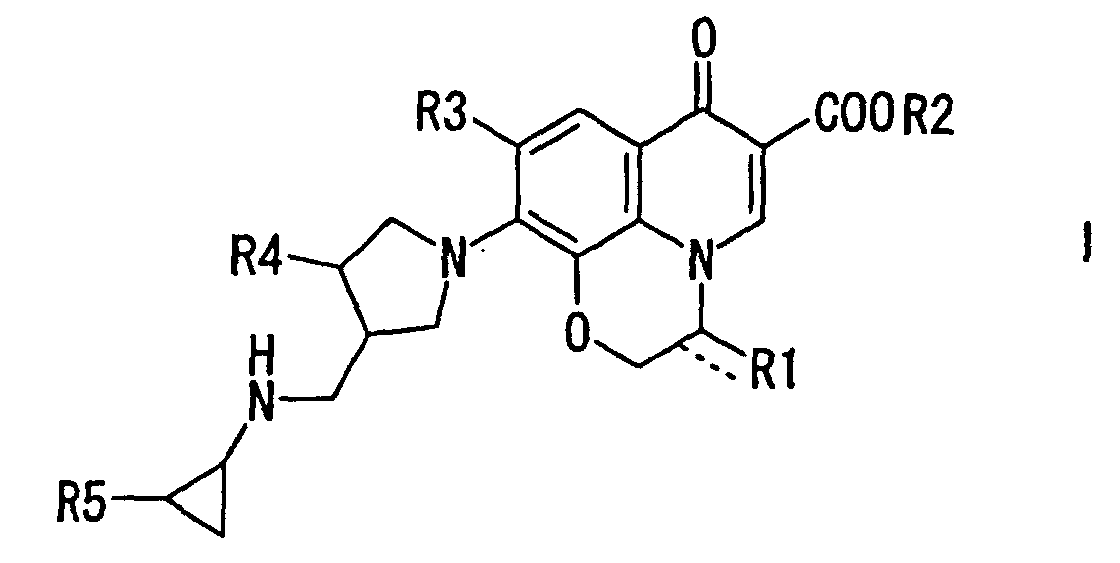
  2. The compound according to claim 1, a salt or a hydrate thereof, wherein R1 in the general formula (I) is a fluoromethyl group.
  3. The compound according to claim 1, a salt or a hydrate thereof, wherein in the general formula (I), R1 is a fluoromethyl group and R3 is a fluorine atom.
  4. The compound according to claim 1, a salt or a hydrate thereof, wherein in the general formula (I), R1 is a fluoromethyl group, R3 is a fluorine atom, and R4 is a hydrogen atom, a methyl group, a fluoromethyl group or a fluorine atom.
  5. The compound according to claim 1, a salt or a hydrate thereof, wherein in the general formula (I), R1 is a fluoromethyl group, R3 is a fluorine atom, R4 is a hydrogen atom, a methyl group, a fluoromethyl group or a fluorine atom, and R5 is a hydrogen atom or a fluorine atom.
  6. The compound according to claim 1, a salt or a hydrate thereof, wherein R1 in the general formula (I) is a methyl group.
  7. The compound according to claim 1, a salt or a hydrate thereof, wherein in the general formula (I), R1 is a methyl group, and R3 is a fluorine atom.
  8. The compound according to claim 1, a salt or a hydrate thereof, wherein in the general formula (I), R1 is a methyl group, R3 is a fluorine atom, and R4 is a hydrogen atom, a methyl group, a fluoromethyl group or a fluorine atom.
  9. The compound according to claim 1, a salt or a hydrate thereof, wherein in the general formula (I), R1 is a methyl group, R3 is a fluorine atom, R4 is a hydrogen atom, a methyl group, a fluoromethyl group or a fluorine atom, and R5 is a hydrogen atom or a fluorine atom.
  10. The compound according to any one of claims 1 to 9, a salt or a hydrate thereof, wherein the compound of the general formula (I) has a single stereochemisry.
  11. The compound according to claim 1, a salt or a hydrate thereof, wherein the compound of the general formula (I) is (3S)-10-[(3S,4R)-3-cyclopropylaminomethyl-4-methyl-1-pyrrolidinyl]-9-fluoro-3-methyl-2,3-dihydro-7-oxo-7H-pyrido[1,2,3-d,e][1,4]benzoxazine-6-carboxylic acid, a salt or a hydrate thereof.
  12. The compound according to claim 1, a salt or a hydrate thereof, wherein the compound of the general formula (I) is (3S)-10-[(3S,4S)-cyclopropylaminomethyl-4-methyl-1-pyrrolidinyl]-9-fluoro-3-methyl-2,3-dihydro-7-oxo-7H-pyrido[1,2,3-d,e][1,4]benzoxazine-6-carboxylic acid, a salt or a hydrate thereof.
  13. The compound according to claim 1, a salt or a hydrate thereof, wherein the compound of the general formula (I) is (3R)-10-[(3S,4R)-3-cyclopropylaminomethyl-4-methyl-1-pyrrolidinyl]-9-fluoro-3-fluoromethyl-2,3-dihydro-7-oxo-7H-pyrido[1,2,3-d,e][1,4]benzoxazine-6-carboxylic acid, a salt or a hydrate thereof.
  14. The compound according to claim 1, a salt or a hydrate thereof, wherein the compound of the general formula (I) is (3R)-10-[(3S,4S)-3-cyclopropylaminomethyl-4-methyl-1-pyrrolidinyl]-9-fluoro-3-fluoromethyl-2,3-dihydro-7-oxo-7H-pyrido[1,2,3-d,e][1,4]benzoxazine-6-carboxylic acid, a salt or a hydrate thereof.
  15. The compound according to claim 1, a salt or a hydrate thereof, wherein the compound of the general formula (I) is (3R)-10-[(3S)-3-cyclopropylaminomethyl-1-pyrrolidinyl]-9-fluoro-3-fluoromethyl-2,3-dihydro-7-oxo-7H-pyrido[1,2,3-d,e][1,4]benzoxazine-6-carboxylic acid, a salt or a hydrate thereof.
  16. The compound according to claim 1, a salt or a hydrate thereof, wherein the compound of the general formula (I) is (3R)-10-[(3R)-3-cyclopropylaminomethyl-1-pyrrolidinyl]-9-fluoro-3-fluoromethyl-2,3-dihydro-7-oxo-7H-pyrido[1,2,3-d,e][1,4]benzoxazine-6-carboxylic acid, a salt or a hydrate thereof.
  17. The compound according to claim 1, a salt or a hydrate thereof, wherein the compound of the general formula (I) is (3S)-10-[(3S,4R)-cyclopropylaminomethyl-4-fluoro-1-pyrrolidinyl]-9-fluoro-3-methyl-2,3-dihydro-7-oxo-7H-pyrido[1,2,3-d,e][1,4]benzoxazine-6-carboxylic acid, a salt or a hydrate thereof.
  18. The compound according to claim 1, a salt or a hydrate thereof, wherein the compound of the general formula (I) is (3S)-10-[(3S,4S)-cyclopropylaminomethyl-4-fluoro-1-pyrrolidinyl]-9-fluoro-3-methyl-2,3-dihydro-7-oxo-7H-pyrido[1,2,3-d,e][1,4]benzoxazine-6-carboxylic acid, a salt or a hydrate thereof.
  19. The compound according to claim 1, a salt or a hydrate thereof, wherein the compound of the general formula (I) is (3R)-10-[(3S,4R)-cyclopropylaminomethyl-4-fluoro-1-pyrrolidinyl]-9-fluoro-3-fluoromethyl-2,3-dihydro-7-oxo-7H-pyrido[1,2,3-d,e][1,4]benzoxazine-6-carboxylic acid, a salt or a hydrate thereof.
  20. The compound according to claim 1, a salt or a hydrate thereof, wherein the compound of the general formula (I) is (3R)-10-[(3S,4S)-cyclopropylaminomethyl-4-fluoro-1-pyrrolidinyl]-9-fluoro-3-fluoromethyl-2,3-dihydro-7-oxo-7H-pyrido[1,2,3-d,e][1,4]benzoxazine-6-carboxylic acid, a salt or a hydrate thereof.
  21. An antibacterial agent containing as an active ingredient the compound according to any one of claims 1 to 20, a salt or a hydrate thereof.
EP03708575A 2002-03-18 2003-03-13 10-(3-cyclopropylaminomethyl-1-pyrrolidinyl)pyridobenzoxazinecarboxylic acid derivative effective against resistant bacteria Expired - Lifetime EP1486500B1 (en)

Applications Claiming Priority (5)

Application Number Priority Date Filing Date Title
JP2002074783 2002-03-18
JP2002369205 2002-12-20
PCT/JP2003/002967 WO2003078439A1 (en) 2002-03-18 2003-03-13 10-(3-cyclopropylaminomethyl-1-pyrrolidinyl)pyridobenzoxazinecarboxylic acid derivative effective against resistant bacterium

Publications (3)

Publication Number Publication Date
EP1486500A1 true EP1486500A1 (en) 2004-12-15
EP1486500A4 EP1486500A4 (en) 2006-02-08
EP1486500B1 EP1486500B1 (en) 2009-09-16

Family

ID=28043757

Family Applications (1)

Application Number Title Priority Date Filing Date
EP03708575A Expired - Lifetime EP1486500B1 (en) 2002-03-18 2003-03-13 10-(3-cyclopropylaminomethyl-1-pyrrolidinyl)pyridobenzoxazinecarboxylic acid derivative effective against resistant bacteria

Country Status (14)

Country Link
US (1) US7153851B2 (en)
EP (1) EP1486500B1 (en)
JP (1) JP4468701B2 (en)
KR (1) KR20040094806A (en)
CN (1) CN1653071A (en)
AT (1) ATE443064T1 (en)
AU (1) AU2003213335B8 (en)
BR (1) BR0308643A (en)
CA (1) CA2478763A1 (en)
DE (1) DE60329280D1 (en)
MX (1) MXPA04009026A (en)
NO (1) NO20043850L (en)
NZ (1) NZ535182A (en)
WO (1) WO2003078439A1 (en)

Cited By (2)

* Cited by examiner, † Cited by third party
Publication number Priority date Publication date Assignee Title
WO2006066896A3 (en) * 2004-12-23 2006-08-31 Novartis Ag Pyrrolidine derivatives for the treatment of a disease depending on the activity of renin
EP4110758A1 (en) * 2020-02-25 2023-01-04 Tes Pharma S.r.l. Heterocyclic compounds for modulating nr2f6

Families Citing this family (13)

* Cited by examiner, † Cited by third party
Publication number Priority date Publication date Assignee Title
SG144936A1 (en) * 2003-09-10 2008-08-28 Kyorin Seiyaku Kk 7-(4-substituted-3-cyclopropylaminomethyl-1- pyrrolidinyl)quinolonecarboxylic acid derivative
NZ533360A (en) 2004-06-04 2007-02-23 Ind Res Ltd Improved method for preparing 3-hydroxy-4-hydroxymethyl-pyrrolidine compounds
WO2006009143A1 (en) * 2004-07-21 2006-01-26 Kyorin Pharmaceutical Co., Ltd. Process for production of (3s)-3-hydroxymethyl-7-oxo- pyridobenzoxazine-6-carboxylic esters
JP5154402B2 (en) * 2006-03-09 2013-02-27 杏林製薬株式会社 Method for producing 3,4-disubstituted pyrrolidine derivative and production intermediate
EP2524911A4 (en) * 2010-01-08 2013-09-11 Kyorin Seiyaku Kk PROCESS FOR PRODUCTION OF 3,4-DISUBSTITUTED PYRROLIDINE DERIVATIVE AND INTERMEDIATE PRODUCTION THEREOF
EP2578568A4 (en) * 2010-05-31 2014-07-09 Kyorin Seiyaku Kk PROCESS FOR THE PREPARATION OF 3-SUBSTITUTED FLUOROPYRROLIDINE DERIVATIVES
KR20130143041A (en) 2010-10-25 2013-12-30 교린 세이야꾸 가부시키 가이샤 Method for producing 3,4-disubstituted pyrrolidine derivative
CN102276628A (en) * 2011-06-21 2011-12-14 周崇科 Fluoroquinolone compounds and synthesis method thereof
ES2768651T3 (en) * 2013-04-25 2020-06-23 Kyorin Seiyaku Kk Solid pharmaceutical composition
BR112017019205A2 (en) * 2015-03-13 2018-04-24 Kyorin Pharmaceutical Co., Ltd. Respiratory-tract-infection medical treatment agent
GB201708606D0 (en) 2017-05-30 2017-07-12 King S College London Antibiotic resistance breakers
MY200429A (en) * 2017-06-16 2023-12-26 Kyorin Seiyaku Kk Therapeutic agent for aspiration pneumonia, lung suppuration, or lung abscess
CN112194667B (en) * 2020-11-06 2021-08-17 湖南科技大学 Substituted 1,4-benzoxazine diazepine compounds and preparation method and use thereof

Family Cites Families (4)

* Cited by examiner, † Cited by third party
Publication number Priority date Publication date Assignee Title
US4822801A (en) * 1984-07-20 1989-04-18 Warner-Lambert Company 4-oxo-1,4-dihydroquinoline-3-carboxylic acid derivative as antibacterial agents
JPS62155282A (en) 1985-12-27 1987-07-10 Sankyo Co Ltd Pyidonebenzoxazinecarboxylic acid derivative
TW425394B (en) 1996-04-24 2001-03-11 Daiichi Seiyaku Co Antimicrobial quinolone derivatives having 3-(N-cycloalkyl) aminomethylpyrrolidine group
JPH10287669A (en) * 1997-04-10 1998-10-27 Dai Ichi Seiyaku Co Ltd Substituted aminomethylpyrrolidine derivative

Cited By (4)

* Cited by examiner, † Cited by third party
Publication number Priority date Publication date Assignee Title
WO2006066896A3 (en) * 2004-12-23 2006-08-31 Novartis Ag Pyrrolidine derivatives for the treatment of a disease depending on the activity of renin
AU2005318392B2 (en) * 2004-12-23 2009-11-05 Novartis Ag Pyrrolidine derivatives for the treatment of a disease depending on the activity of renin
EP4110758A1 (en) * 2020-02-25 2023-01-04 Tes Pharma S.r.l. Heterocyclic compounds for modulating nr2f6
IL295456B1 (en) * 2020-02-25 2026-04-01 Tes Pharma S R L Heterocyclic compounds for modulating nr2f6

Also Published As

Publication number Publication date
JPWO2003078439A1 (en) 2005-07-14
AU2003213335B8 (en) 2009-04-02
CA2478763A1 (en) 2003-09-25
NO20043850L (en) 2004-09-14
CN1653071A (en) 2005-08-10
JP4468701B2 (en) 2010-05-26
AU2003213335A1 (en) 2003-09-29
US7153851B2 (en) 2006-12-26
DE60329280D1 (en) 2009-10-29
EP1486500B1 (en) 2009-09-16
WO2003078439A1 (en) 2003-09-25
US20050182052A1 (en) 2005-08-18
KR20040094806A (en) 2004-11-10
AU2003213335B2 (en) 2008-09-11
BR0308643A (en) 2005-02-09
EP1486500A4 (en) 2006-02-08
NZ535182A (en) 2006-02-24
MXPA04009026A (en) 2005-01-25
ATE443064T1 (en) 2009-10-15

Similar Documents

Publication Publication Date Title
AU2003213335B8 (en) 10-(3-cyclopropylaminomethyl-1-pyrrolidinyl)pyridobenzoxazinecarboxylic acid derivative effective against resistant bacterium
US8106072B2 (en) 7- (4-substituted-3-cyclopropylaminomethyl-1-pyrrolidinyl) quinolonecarboxylic acid derivative
WO2024083258A1 (en) Kras g12c degradation agent, and preparation method and use therefor
JP5475841B2 (en) Tri-, tetra-substituted-3-aminopyrrolidine derivatives
NZ545970A (en) 7-Amino alkylidenyl-heterocyclic quinolones and naphthyridones
EP3802549B1 (en) Novel oxoquinolizine compounds for the treatment and prophylaxis of bacterial infection
CA3075880A1 (en) Tetrahydro-imidazo quinoline compositions as cbp/p300 inhibitors
CN116829557A (en) Pentaheterocyclic compounds, their preparation methods and their applications
JP6824256B2 (en) Hydroxyalkylthiadiazole derivative
CN101622240B (en) Fused Substituted Aminopyrrolidine Derivatives
AU2007339692A1 (en) Fused substituted aminopyrrolidine derivative
EP3856747B1 (en) Substituted pyridoindoles for the treatment and prophylaxis of bacterial infection
TW201109339A (en) 3-(biaryloxy) propionic acid derivative
CA2251927C (en) Cycloalkylaminomethylpyrrolidine derivatives
CN104903322A (en) Antibacterial oxadiazolone derivatives
EP3883937A1 (en) Free amino compounds for the treatment and prophylaxis of bacterial infection
JP5063032B2 (en) Tri-, tetra-substituted-3-aminopyrrolidine derivatives
JP2001181281A (en) Quinolone derivative useful as antimicrobial agent

Legal Events

Date Code Title Description
PUAI Public reference made under article 153(3) epc to a published international application that has entered the european phase

Free format text: ORIGINAL CODE: 0009012

17P Request for examination filed

Effective date: 20040923

AK Designated contracting states

Kind code of ref document: A1

Designated state(s): AT BE BG CH CY CZ DE DK EE ES FI FR GB GR HU IE IT LI LU MC NL PT RO SE SI SK TR

AX Request for extension of the european patent

Extension state: AL LT LV MK

A4 Supplementary search report drawn up and despatched

Effective date: 20051223

17Q First examination report despatched

Effective date: 20070508

GRAP Despatch of communication of intention to grant a patent

Free format text: ORIGINAL CODE: EPIDOSNIGR1

GRAS Grant fee paid

Free format text: ORIGINAL CODE: EPIDOSNIGR3

GRAA (expected) grant

Free format text: ORIGINAL CODE: 0009210

RTI1 Title (correction)

Free format text: 10-(3-CYCLOPROPYLAMINOMETHYL-1-PYRROLIDINYL)PYRIDOBENZOXAZINECARBOXYLIC ACID DERIVATIVE EFFECTIVE AGAINST RESISTANT BACTERIA

RAP1 Party data changed (applicant data changed or rights of an application transferred)

Owner name: KYORIN PHARMACEUTICAL CO., LTD.

AK Designated contracting states

Kind code of ref document: B1

Designated state(s): AT BE BG CH CY CZ DE DK EE ES FI FR GB GR HU IE IT LI LU MC NL PT RO SE SI SK TR

REG Reference to a national code

Ref country code: GB

Ref legal event code: FG4D

REG Reference to a national code

Ref country code: CH

Ref legal event code: EP

REG Reference to a national code

Ref country code: IE

Ref legal event code: FG4D

REF Corresponds to:

Ref document number: 60329280

Country of ref document: DE

Date of ref document: 20091029

Kind code of ref document: P

PG25 Lapsed in a contracting state [announced via postgrant information from national office to epo]

Ref country code: SE

Free format text: LAPSE BECAUSE OF FAILURE TO SUBMIT A TRANSLATION OF THE DESCRIPTION OR TO PAY THE FEE WITHIN THE PRESCRIBED TIME-LIMIT

Effective date: 20090916

Ref country code: FI

Free format text: LAPSE BECAUSE OF FAILURE TO SUBMIT A TRANSLATION OF THE DESCRIPTION OR TO PAY THE FEE WITHIN THE PRESCRIBED TIME-LIMIT

Effective date: 20090916

PG25 Lapsed in a contracting state [announced via postgrant information from national office to epo]

Ref country code: SI

Free format text: LAPSE BECAUSE OF FAILURE TO SUBMIT A TRANSLATION OF THE DESCRIPTION OR TO PAY THE FEE WITHIN THE PRESCRIBED TIME-LIMIT

Effective date: 20090916

Ref country code: NL

Free format text: LAPSE BECAUSE OF FAILURE TO SUBMIT A TRANSLATION OF THE DESCRIPTION OR TO PAY THE FEE WITHIN THE PRESCRIBED TIME-LIMIT

Effective date: 20090916

NLV1 Nl: lapsed or annulled due to failure to fulfill the requirements of art. 29p and 29m of the patents act
PG25 Lapsed in a contracting state [announced via postgrant information from national office to epo]

Ref country code: CY

Free format text: LAPSE BECAUSE OF FAILURE TO SUBMIT A TRANSLATION OF THE DESCRIPTION OR TO PAY THE FEE WITHIN THE PRESCRIBED TIME-LIMIT

Effective date: 20090916

PG25 Lapsed in a contracting state [announced via postgrant information from national office to epo]

Ref country code: RO

Free format text: LAPSE BECAUSE OF FAILURE TO SUBMIT A TRANSLATION OF THE DESCRIPTION OR TO PAY THE FEE WITHIN THE PRESCRIBED TIME-LIMIT

Effective date: 20090916

Ref country code: EE

Free format text: LAPSE BECAUSE OF FAILURE TO SUBMIT A TRANSLATION OF THE DESCRIPTION OR TO PAY THE FEE WITHIN THE PRESCRIBED TIME-LIMIT

Effective date: 20090916

Ref country code: CZ

Free format text: LAPSE BECAUSE OF FAILURE TO SUBMIT A TRANSLATION OF THE DESCRIPTION OR TO PAY THE FEE WITHIN THE PRESCRIBED TIME-LIMIT

Effective date: 20090916

Ref country code: ES

Free format text: LAPSE BECAUSE OF FAILURE TO SUBMIT A TRANSLATION OF THE DESCRIPTION OR TO PAY THE FEE WITHIN THE PRESCRIBED TIME-LIMIT

Effective date: 20091227

Ref country code: PT

Free format text: LAPSE BECAUSE OF FAILURE TO SUBMIT A TRANSLATION OF THE DESCRIPTION OR TO PAY THE FEE WITHIN THE PRESCRIBED TIME-LIMIT

Effective date: 20100118

PG25 Lapsed in a contracting state [announced via postgrant information from national office to epo]

Ref country code: SK

Free format text: LAPSE BECAUSE OF FAILURE TO SUBMIT A TRANSLATION OF THE DESCRIPTION OR TO PAY THE FEE WITHIN THE PRESCRIBED TIME-LIMIT

Effective date: 20090916

PG25 Lapsed in a contracting state [announced via postgrant information from national office to epo]

Ref country code: AT

Free format text: LAPSE BECAUSE OF FAILURE TO SUBMIT A TRANSLATION OF THE DESCRIPTION OR TO PAY THE FEE WITHIN THE PRESCRIBED TIME-LIMIT

Effective date: 20090916

Ref country code: BE

Free format text: LAPSE BECAUSE OF FAILURE TO SUBMIT A TRANSLATION OF THE DESCRIPTION OR TO PAY THE FEE WITHIN THE PRESCRIBED TIME-LIMIT

Effective date: 20090916

PLBE No opposition filed within time limit

Free format text: ORIGINAL CODE: 0009261

STAA Information on the status of an ep patent application or granted ep patent

Free format text: STATUS: NO OPPOSITION FILED WITHIN TIME LIMIT

PG25 Lapsed in a contracting state [announced via postgrant information from national office to epo]

Ref country code: DK

Free format text: LAPSE BECAUSE OF FAILURE TO SUBMIT A TRANSLATION OF THE DESCRIPTION OR TO PAY THE FEE WITHIN THE PRESCRIBED TIME-LIMIT

Effective date: 20090916

26N No opposition filed

Effective date: 20100617

PG25 Lapsed in a contracting state [announced via postgrant information from national office to epo]

Ref country code: GR

Free format text: LAPSE BECAUSE OF FAILURE TO SUBMIT A TRANSLATION OF THE DESCRIPTION OR TO PAY THE FEE WITHIN THE PRESCRIBED TIME-LIMIT

Effective date: 20091217

Ref country code: MC

Free format text: LAPSE BECAUSE OF NON-PAYMENT OF DUE FEES

Effective date: 20100331

REG Reference to a national code

Ref country code: CH

Ref legal event code: PL

PG25 Lapsed in a contracting state [announced via postgrant information from national office to epo]

Ref country code: IE

Free format text: LAPSE BECAUSE OF NON-PAYMENT OF DUE FEES

Effective date: 20100313

PG25 Lapsed in a contracting state [announced via postgrant information from national office to epo]

Ref country code: CH

Free format text: LAPSE BECAUSE OF NON-PAYMENT OF DUE FEES

Effective date: 20100331

Ref country code: LI

Free format text: LAPSE BECAUSE OF NON-PAYMENT OF DUE FEES

Effective date: 20100331

PG25 Lapsed in a contracting state [announced via postgrant information from national office to epo]

Ref country code: IT

Free format text: LAPSE BECAUSE OF FAILURE TO SUBMIT A TRANSLATION OF THE DESCRIPTION OR TO PAY THE FEE WITHIN THE PRESCRIBED TIME-LIMIT

Effective date: 20090916

PG25 Lapsed in a contracting state [announced via postgrant information from national office to epo]

Ref country code: LU

Free format text: LAPSE BECAUSE OF NON-PAYMENT OF DUE FEES

Effective date: 20100313

Ref country code: HU

Free format text: LAPSE BECAUSE OF FAILURE TO SUBMIT A TRANSLATION OF THE DESCRIPTION OR TO PAY THE FEE WITHIN THE PRESCRIBED TIME-LIMIT

Effective date: 20100317

Ref country code: BG

Free format text: LAPSE BECAUSE OF FAILURE TO SUBMIT A TRANSLATION OF THE DESCRIPTION OR TO PAY THE FEE WITHIN THE PRESCRIBED TIME-LIMIT

Effective date: 20090916

PG25 Lapsed in a contracting state [announced via postgrant information from national office to epo]

Ref country code: TR

Free format text: LAPSE BECAUSE OF FAILURE TO SUBMIT A TRANSLATION OF THE DESCRIPTION OR TO PAY THE FEE WITHIN THE PRESCRIBED TIME-LIMIT

Effective date: 20090916

REG Reference to a national code

Ref country code: FR

Ref legal event code: PLFP

Year of fee payment: 13

PGFP Annual fee paid to national office [announced via postgrant information from national office to epo]

Ref country code: DE

Payment date: 20150310

Year of fee payment: 13

PGFP Annual fee paid to national office [announced via postgrant information from national office to epo]

Ref country code: FR

Payment date: 20150309

Year of fee payment: 13

Ref country code: GB

Payment date: 20150311

Year of fee payment: 13

REG Reference to a national code

Ref country code: DE

Ref legal event code: R119

Ref document number: 60329280

Country of ref document: DE

GBPC Gb: european patent ceased through non-payment of renewal fee

Effective date: 20160313

REG Reference to a national code

Ref country code: FR

Ref legal event code: ST

Effective date: 20161130

PG25 Lapsed in a contracting state [announced via postgrant information from national office to epo]

Ref country code: DE

Free format text: LAPSE BECAUSE OF NON-PAYMENT OF DUE FEES

Effective date: 20161001

Ref country code: GB

Free format text: LAPSE BECAUSE OF NON-PAYMENT OF DUE FEES

Effective date: 20160313

Ref country code: FR

Free format text: LAPSE BECAUSE OF NON-PAYMENT OF DUE FEES

Effective date: 20160331