BACKGROUND OF THE INVENTION
1. Technical Field of the Invention
-
The present invention relates to a method for producing
an organic compound suitable for use in products, such as
industrial chemicals, polymeric materials, pharmaceutical
products, and agricultural chemicals, and intermediates
therefor. In this method, an organic material having a
halogen atom bonded to a carbon atom having four σ bonds is
used as the starting material, and the halogen atom of the
organic material is replaced with various nucleophilic
agents.
2.Description of the Related Art
-
Among effective methods for producing various organic
compounds, a method of utilizing nucleophilic substitution,
in which halogen atoms bonded to carbon atoms are replaced
with groups derived from nucleophilic agents, is known in
the art.
-
Nucleophilic substitution has drawbacks in that the
reaction takes a long time depending on the halogenated
compound used, that an expensive non-protonic polar solvent
is necessary to dissolve nucleophilic agents having low
solubility to organic solvents, and that large amounts of
nucleophilic agents are necessary.
-
Various catalysts have been developed to overcome these
drawbacks. For example, methods that use phosphazenium
compound as the catalyst (e.g., Japanese Unexamined Patent
Application Publication No. 2002-003427), methods that use
crown ether as the catalyst (e.g., Journal of Organic
Chemistry 43 (1978) 1017-1018), methods that use ion
exchange resin as the catalyst (e.g., Journal of Organic
Chemistry 50 (1985) 4388-4390), methods that use quaternary
ammonium salts as the catalyst (e.g., Journal of Organic
Chemistry 50 (1985) 879-882), and methods that use
quaternary phosphonium salts, which contain hydrocarbon
groups and the like, as the catalyst (e.g., Tetrahedron
Letters 27 (1986) 6067-6070) are known in the art.
-
However, when crown ethers and ion exchange resin are
used, it takes a long time, e.g., one to two days, to carry
out the reaction depending on the halogenated compound used
as the reaction substrate. Thus, the efficiency is low.
When quaternary ammonium salts and quaternary phosphonium
salts containing hydrocarbons and the like are used, the
salts may become decomposed depending on the type of
nucleophilic agent or the reaction temperature employed.
Thus, recycling is difficult, and the allowable reaction
conditions are limited, which is problem.
SUMMARY OF THE INVENTION
-
An object of the present invention is to provide a
method for manufacturing an organic compound, in which a
halogen atom is replaced with a group derived from a
nucleophilic agent, at high yield and high efficiency, the
method including a step of reacting the nucleophilic agent
with an organic starting material having a halogen atom
bonded to a carbon atom having four σ bonds.
-
The Inventors have conducted extensive investigations
to solve the problem described above and found that the
reaction between a nucleophilic agent and an organic
material having halogen atoms bonded to carbon atoms having
four σ bonds can be smoothly carried out in the presence of
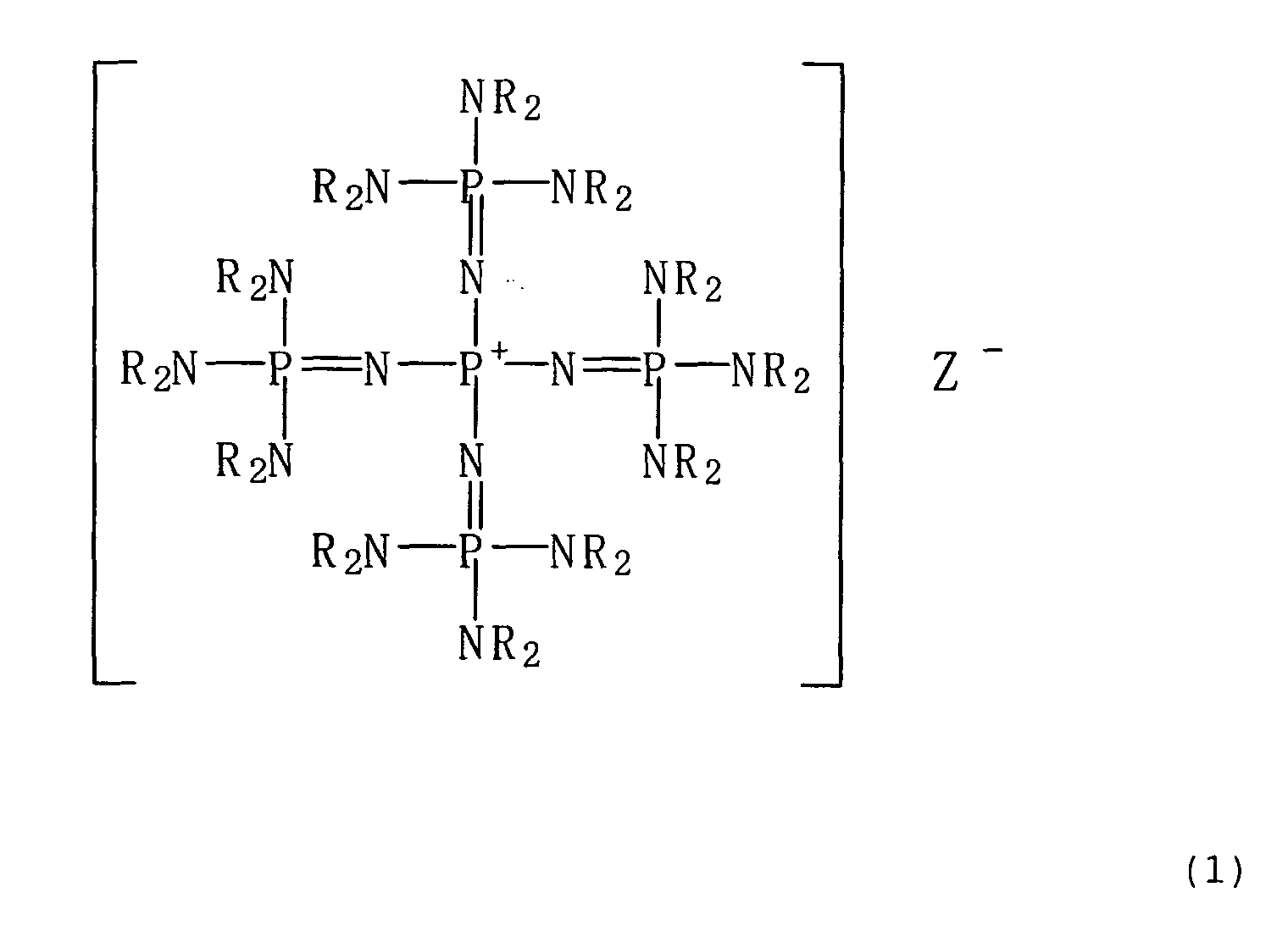
a compound (Chemical 1) represented by general formula (1)
below and that a target organic compound produced by
substituting the halogen atoms with groups derived from the
nucleophilic agent can be produced at high yield and high
efficiency. Thus, the inventors have made the present
invention.
-
In particular, the present invention provides:
- (1) A method for producing an organic compound having Q,
the method including reacting a compound represented by
general formula (2) with an organic starting material having
at least one halogen atom bonded to a carbon atom having
four σ bonds so as to replace the halogen atom in the
organic starting material with Q:
MQa
(wherein M represents an alkali metal atom, an alkali earth
metal atom, or a rare earth metal atom; Q represents a
moiety of an inorganic acid or an active hydrogen compound
derived by eliminating a proton, wherein Q is a halogen atom
different from the halogen atom in the organic starting
material having the halogen atom bonded to the carbon atom
having the four σ bonds; and a represents an integer of 1 to
3) in the presence of a compound represented by general
formula (1)
(wherein Z- represents an anion derived by eliminating a
proton from an inorganic acid or an active hydrogen
compound; R2 is the same or different; R2 each independently
represent a C1-C10 hydrocarbon group or two R2 on the same
nitrogen atom may be bonded with each other to form a ring
with the nitrogen atom).
- (2) The method described in (1) above, in which the organic
starting material having the halogen atom bonded with the
carbon atom having the four σ bonds is represented by
general formula (3), and the organic compound having Q is
represented by general formula (4):
B-X
(wherein X represents a halogen atom, and B represents an
organic group),
B-Q
(wherein B and Q are the same as above).
- (3) The method described in (2) above, in which B in the
compound represented by general formula (3) is selected from
a C1-C12 straight or branched alkyl group, a group
represented by general formula (5), a group represented by
general formula (6), a group represented by general formula
(7), a group represented by general formula (8), a group
represented by general formula (9), or a C1-C12 straight or
branched alkyl group substituted with a group selected from
Substituent Group α:
(wherein b is an integer of 2 to 9),
(wherein Y represents an oxygen atom, a sulfur atom, or NR';
c and d represent integers satisfying the relationship c + d
= 3 to 6; and R' in NR' represents a hydrogen atom or a
methyl group),
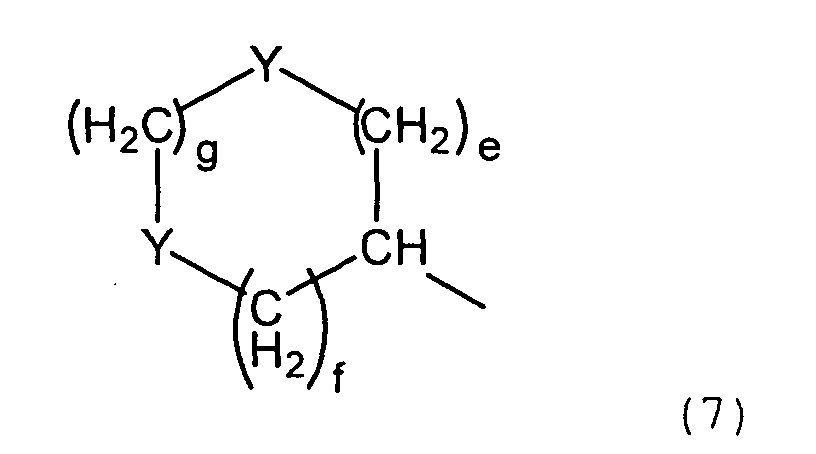
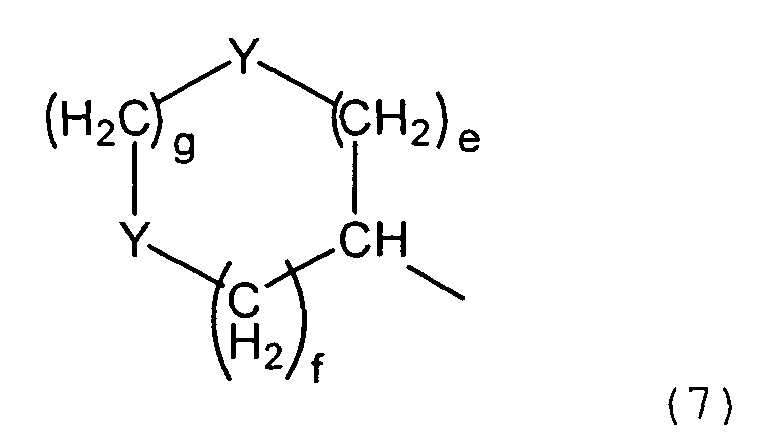
(wherein Y represents an oxygen atom, a sulfur atom, or NR';
e, f, and g are integers satisfying the relationship e + f +
g = 2 to 5; and R' in NR' represents a hydrogen atom or a
methyl group),
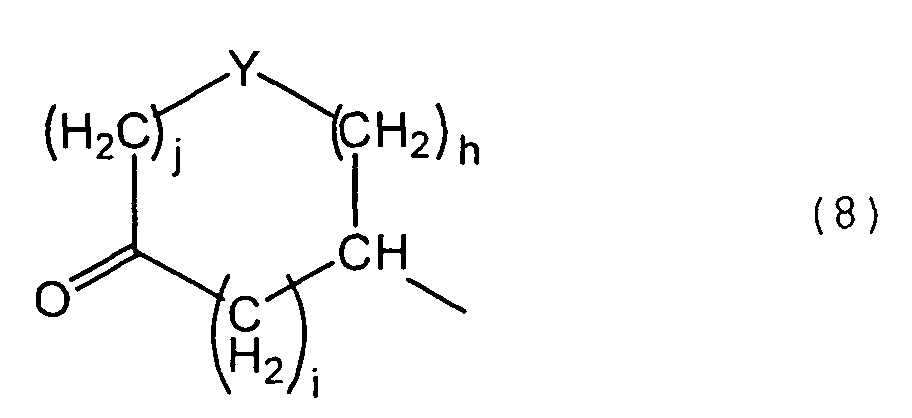
(wherein Y represents an oxygen atom, a sulfur atom, or NR';
h, i and j represent integers satisfying the relationship h
+ i + j = 2 to 5; and R' in NR' represents a hydrogen atom
or a methyl group),
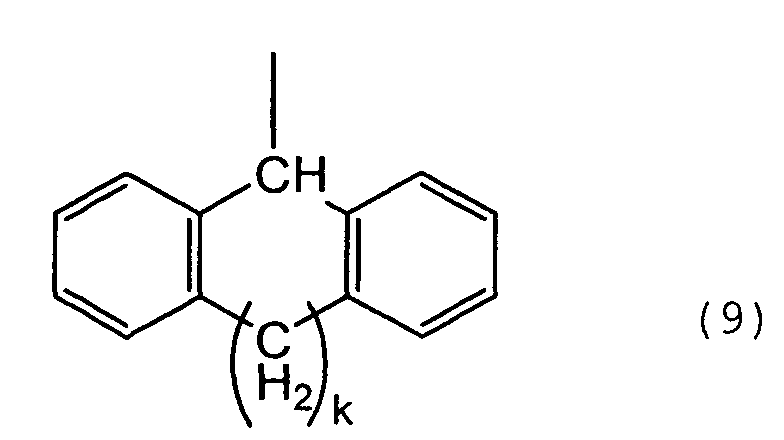
(wherein k represents an integer between 0 and 2),
[Substituent Group α]
groups represented by general formula (5) to (9); C2-C10
alkenyl groups; C2-C10 alkynyl groups; C6-C12 aryl groups;
acyl groups having a total of 2 to 10 carbon atoms including
carbon atoms of carbonyl groups; acyloxy groups having a
total of 2 to 10 carbon atoms including carbon atoms of
carbonyl groups; alkoxycarbonyl groups having a total of 2
to 10 carbon atoms including carbon atoms of carbonyl
groups; arylcarbonyl groups having a total of 7 to 10 carbon
atoms including carbon atoms of carbonyl groups;
alkoxycarbonylalkyl groups having a total of 3 to 10 carbon
atoms including carbon atoms of carbonyl groups; nitro
groups; and cyano group. - (4) The method according to (3) above, in which all R2 in
the compound represented by general formula (1) in (1) above
are C1-C2 alkyl groups or every pair of R2 bonded on the same
nitrogen atom forms a ring as a C4-C5 alkylene group.
- (5) The method described in (3) above, in which the
compound from which Z- in general formula (1) is derived is
a hydrogen halide.
- (6) The method described in (3) above, wherein Q in the
compound represented by general formula (2) in (1) above is
a moiety derived by eliminating proton of one selected from
hydrogen halides, hydrogen cyanides, hydrogen azides,
thiocyanic acids, malonic esters, acetoacetic esters,
cyanoacetic esters, water, carboxylic acids having a total
of 1 to 20 carbon atoms including carbon atoms of carbonyl
groups, C1-C20 alcohols, C6-C20 aromatic compounds having 1 to
3 hydroxyl groups, aliphatic secondary amines having a total
of 2 to 20 carbon atoms, aromatic secondary amines having a
total of 6 to 20 carbon atoms, C1-C10 monovalent thiols, and
C1-C10 aromatic mercapto compounds.
- (7) The method described in (3) above, in the compound
represented by general formula (1) in (1) above, all R2 in
general formula (1) are methyl or ethyl groups, or every
pair of R2 bonded to the same nitrogen atom is a
tetramethylene group; Z- is an chlorine anion or a bromine
anion; in the compound represented by general formula (2) in
(1) above, Q is a moiety of an active hydrogen compound
derived by eliminating a proton, the active hydrogen
compound being selected from Compound Group β; in the
compound represented by general formula (3) in (2) above, B
represents a C1 to C10 straight alkyl group; b in the group
represented by general formula (5) in (3) above is 4 to 7; Y
in the group represented by general formula (6) in (3) above
is an oxygen atom, and c + d is 3 or 4; in the group
represented by general formula (8) in (3) above, Y is an
oxygen atom, h = 2, i = 0, and j = 0; k in the group
represented by general formula (9) in (3) above, k is zero;
or C1-C10 straight alkyl groups substituted with groups
selected from Substituent Group α in (3) above consists of
Substituent Group γ:
[Compounds Group β]
hydrogen fluoride, hydrogen iodide, hydrogen cyanide,
hydrogen azide, thiocyanic acid, diethyl malonate, water,
acetic acid, methanol, phenol, diethylamine, nitrous acid,
and n-butylthiol;
[Substituent Group γ]
tetrahydrofuryl group, 2-oxotetrahydrofuryl group, ethynyl
group, phenyl group, acetyl group, pivalyl group, benzoyl
group, butyryloxy group, methoxycarbonyl group,
ethoxycarbonyl group, methoxycarbonylmethyl group, nitro
group, and cyano group. - (8) The method according to one of (1) to (7), in which the
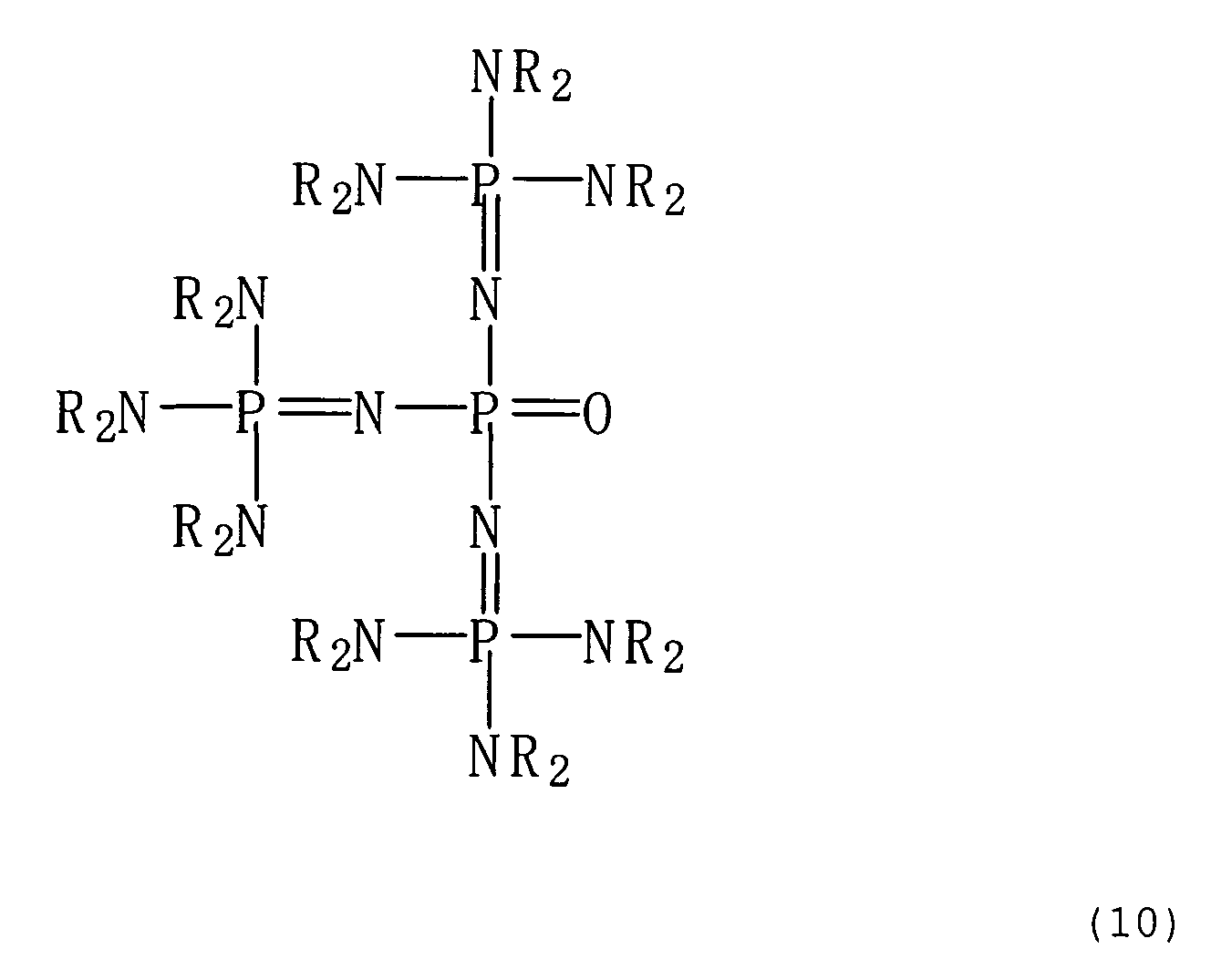
reaction is conducted in the presence of a compound
represented by general formula (10):
(wherein R2 is the same or different; R2 each independently
represent a C1-C10 hydrocarbon group or two R2 on the same
nitrogen atom may be bonded with each other to form a ring
with the nitrogen atom).
- (9) The method according to one of (3) to (8), in which, in
the compound represented by general formula (10) in (8)
above, all R2 are C1-C2 alkyl groups, or every pair R2 bonded
to the same nitrogen atom forms a ring as a C4-C5 alkylene
group.
-
-
The present invention can provide a method for
producing organic compounds by substituting halogen atoms of
a halogenated compound starting material with various
substituents in the presence of a compound represented by
general formula (1). This method is industrially
advantageous over conventional methods.
DESCRIPTION OF THE PREFERRED EMBODYMENTS
-
General formula (1) representing the compound of the
present invention is a canonical structure formula in which
a positive charge of a phosphazenium cation localizes on the
phosphorus atom at the center (i.e., general formula (1)).
However, the compound can also be represented by other
canonical structures. In general, the actual positive
charge is nonlocalized.
-
Examples of the compounds from which Z- is derived
include inorganic acids. Examples of the inorganic acid
include hydrogen halides such as hydrogen fluoride, hydrogen
chloride, hydrogen bromide, hydrogen iodide, and bromoform;
sulfuric acid; perchloric acid; hexafluorophosphoric acid;
tetrafluoroboric acid; hydrogen cyanide; thiocyanic acid;
and hydrogen azide.
-
Examples of the compounds from which Z- is derived also
include active hydrogen compounds. Active hydrogen
compounds are not particularly limited as long as they can
give anions by elimination of protons. Examples of the
active hydrogen compounds include compounds having carbon
atoms bonded with active hydrogen atoms, compounds having
oxygen atoms bonded with active hydrogen atoms, compounds
having nitrogen atoms bonded with active hydrogen atoms, and
compounds having sulfur atoms bonded with active hydrogen
atoms.
-
Examples of the compounds having carbon atoms bonded
with active hydrogen atoms include compounds in which a
carbon atom having at least one hydrogen atom is bonded with
a cyano group, a nitro group, a phenyl group, an acyl group,
an alkoxycarbonyl group, an alkenyl group, or an alkynyl
group, and compounds in which an active hydrogen atom is
directly bonded with an alkenyl or alkynyl group.
-
Specific examples of the compounds in which carbon
atoms are bonded with active hydrogen atoms include cyano-group-containing
compounds such as acetonitrile, n-valeronitrile,
n-butyronitrile, adiponitrile, malononitrile,
phenylacetonitrile, succinonitrile, 3-methoxypropionitrile,
4-methylbenzyl cyanide, 2-nitrophenylacetonitrile, 4-methoxyphenylacetonitrile,
glutaronitrile, 3-phenylpropionitrile,
cyclopentenylacetonitrile,
isopropylidenemalononitrile, benzoylacetonitrile, and
pivaloylacetonitrile; alkoxycarbonyl-group-containing
compounds such as methyl acetate, n-propyl acetate,
isopropyl acetate, 2-methoxyethyl acetate, tert-butyl
acetate, phenyl acetate, ethyl n-butyrate, ethyl propionate,
benzyl acetate, n-amyl acetate, acetic anhydride, ethyl
isovalerate, methyl levulinate, and 2-methylcyclohexyl
acetate; nitro-group-containing compounds such as
nitroethane, 1-nitropropane, 1-nitrobutane, methyl 4-nitrobutyrate,
methyl nitroacetate, nitrocyclopentane,
dinitromethane, and 1,1-dinitroethane; acyl-group-containing
compounds such as 2-butanone, 2-hexanone, 2-heptanone, 4,4-dimethyl-2-pentanone,
methoxyacetone, cyclohexylmethylketone,
acetophenone, benzylacetone, acetylacetone, 1-benzoylacetone,
1,3-cyclopentanedione, 1,3-cyclohexanedione,
dibenzoylmethane, anthrone, 1,3-indanedione, and 3,5-heptanedione;
alkenyl-group-containing compounds such as
2,4-dimethyl-2-pentene, 2-methyl-1-phenylpropene, 1-methyl-1-cyclopentene,
6,6-dimethylfulvene, 1,2,3,4,5-pentamethylcyclopentadiene,
1,3,5,5-tetramethyl-1,3-cyclohexadien;
alkynyl-group-containing compounds such as 1-butyne,
2-butyne, 1-phenyl-1-propyne, 2-pentyne,
methylpropargyl ether, 4-methyl-2-pentyne, 2,4-hexadiyne, 2-butynyl
acetate, and acetylene; phenyl group-containing
compounds such as diphenylmethane, triphenylmethane,
xanthene, 9,10-dihydroanthracene, fluorene, 2,7-dinitrofluorene,
4,4'-difluorodiphenylmethane, 4-benzylbiphenyl,
4-nitrodiphenylmethane, and 4,4'-dinitrodiphenylmethane;
malonic esters such as dimethyl
malonate, diethyl malonate, di-n-butyl malonate, di-tert-butyl
malonate, and benzylmethyl malonate; acetoacetic
esters such as methyl acetoacetate, ethyl acetoacetate, n-butyl
acetoacetate, and sec-butyl acetoacetate; and
cyanoacetic esters such as methyl cyanoacetate, ethyl
cyanoacetate, n-butyl cyanoacetate, isobutyl cyanoacetate,
tert-butyl cyanoacetate, 2-ethylhexyl cyanoacetate, and
benzyl cyanoacetate.
-
Examples of the compounds having oxygen atoms bonded
with active hydrogen atoms include water, carboxylic acids
having a total of 1 to 20 carbon atoms including carbon
atoms of carbonyl groups, carbamic acids having a total of 2
to 20 carbon atoms including carbon atoms of carbonyl
groups; C1-C20 sulfonic acids; C1-C20 alcohols; saccharides
and derivatives thereof; C6-C20 aromatic compounds having
hydroxy groups; and polyalkylene oxides.
-
Examples of the carboxylic acids having a total of 1 to
20 carbon atoms including carbon atoms of carbonyl groups
include monocarboxylic acids such as formic acid, acetic
acid, butyric acid, isobutyric acid, lauric acid, stearic
acid, oleic acid, phenylacetic acid, dihydrocinnamic acid,
cyclohexanecarboxylic acid, benzoic acid, and 2-carboxynaphthalene;
and polyvalent carboxylic acids such as
oxalic acid, malonic acid, succinic acid, maleic acid,
fumaric acid, adipic acid, butanetetracarboxylic acid,
isophthalic acid, terephthalic acid, trimellitic acid, and
pyromellitic acid.
-
Examples of the carbamic acids having a total of 2 to
20 carbon atoms including carbon atoms of carbonyl groups
include N,N-diethylcarbamic acid, N-carboxy pyrrolidone, N-carboxy
aniline, and N,N'-dicarboxy-2,4-toluenediamine.
-
Examples of the C1-C20 sulfonic acids include
methanesulfonic acid, ethanesulfonic acid, p-toluenesulfonic
acid, 4-ethylbenzenesulfonic acid, picrylsulfonic acid, 4-nitrobenzenesulfonic
acid, 3-(N-morpholino)propanesulfonic
acid, 2-morpholinoethanesulfonic acid, 2-naphthalenesulfonic
acid, 4,4'-biphenyldisulfonic acid, 4-nitrotoluene-2-sulfonic
acid, and 3-pyridinesulfonic acid.
-
Examples of the C1-C20 alcohols include monovalent
alcohols such as methanol, ethanol, n-butyl alcohol, sec-butyl
alcohol, tert-butyl alcohol, n-octyl alcohol, lauryl
alcohol, cyclopentanol, cyclohexanol, allyl alcohol, benzyl
alcohol, 1-phenylethyl alcohol, triphenylcarbinol, and
cinnamyl alcohol; and polyalcohols such as ethylene glycol,
propylene glycol, diethylene glycol, dipropylene glycol,
1,3-propanediol, 1,4-butanediol, 1,6-hexanediol, 1,4-cyclohexanediol,
trimethylolpropane, glycerin, diglycerin,
pentaerythritol, and dipentaerythritol.
-
Examples of the saccharides and derivatives thereof
include glucose, sorbitol, dextrose, fructose, and sucrose.
-
Examples of the C6-C20 aromatic compounds having hydroxy
groups include phenol, catechol, resorcinol, hydroquinone,
1-naphthol, 2-naphthol, 1,2-dihydroxynaphthalene, 2,6-dihydroxynaphthalene,
o-cresol, m-cresol, p-cresol, 2,4,6-trimethylphenol,
4-nitrophenol, 4-methoxyphenol, anthrarobin,
9-phenanthrol, 1-hydroxypyrene, and bisphenol A.
-
Examples of the polyalkylene oxides include
polyethylene oxide, polypropylene oxide, and copolymers
thereof.
-
Examples of the compounds having nitrogen atoms bonded
with active hydrogen atoms include C1-C20 aliphatic primary
amines, C6-C20 aromatic primary amines, aliphatic secondary
amines having a total of 2 to 20 carbon atoms, aromatic
secondary amines having a total of 6 to 20 carbon atoms,
polyvalent amines having primary or secondary amine and
having a total of 2 to 20 carbon atoms, saturated or
unsaturated cyclic secondary amines having a total of 4 to
20 carbon atoms, cyclic polyvalent amines including
secondary amines and having a total of 4 to 20 carbon atoms,
acid amides having a total of 2 to 20 carbon atoms including
carbon atoms of carbonyl groups obtained from primary or
secondary amines, five- to seven-membered cyclic amides, and
imides of dicarboxylic acid having a total of 4 to 10 carbon
atoms including carbon atoms of carbonyl groups.
-
Examples of C1-C20 aliphatic primary amines include
methylamine, ethylamine, n-butylamine, isobutylamine, sec-butylamine,
tert-butylamine, and cyclohexylamine.
-
Examples of the C6-C20 aromatic primary amines include
benzylamine, β-phenylethylamine, aniline, o-toluidine, m-toluidine,
and p-toluidine.
-
Examples of the aliphatic secondary amines having a
total of 2 to 20 carbon atoms include dimethylamine, methyl
ethyl amine, diethylamine, ethyl-n-butylamine, methyl-sec-butylamine,
dipentylamine, and dicyclohexylamine.
-
Examples of the aromatic secondary amines having a
total of 6 to 20 carbon atoms include N-methylaniline and
diphenylamine.
-
Examples of the polyvalent amines having primary or
secondary amino groups and having a total of 2 to 20 carbon
atoms include ethylene diamine, di(2-aminoethyl)amine,
hexamethylenediamine, 4,4'-diaminodiphenylmethane, tri(2-aminoethyl)amine,
N,N'-dimethylethylenediamine, N,N'-diethylethylenediamine,
and di(2-methylaminoethyl)amine.
-
Examples of the saturated or unsaturated cyclic
secondary amines having a total of 4 to 20 carbon atoms
include pyrrolidine, piperidine, morpholine, 1,2,3,4-tetrahydroquinoline,
3-pyrroline, pyrrole, indole, carbazole,
imidazole, pyrazole, and purine.
-
Examples of the cyclic polyvalent amines having a total
of 4 to 20 carbon atoms and secondary amino groups include
piperazine, pyrazine, and 1,4,7-triazacyclononane.
-
Examples of the amides having a total of 2 to 20 carbon
atoms including carbon atoms of carbonyl groups obtained
from primary or secondary amines include acetamide,
propionamide, N-methylpropionamide, N-methylbenzamide, and
N-ethylstearamide.
-
Examples of the five- to seven-membered cyclic amides
include 2-pyrrolidone and ε-caprolactam.
-
Examples of the imides of dicarboxylic acids having 4
to 10 carbon atoms including carbon atoms of carbonyl groups
include succinimide, maleinimide, and phthalimide.
-
Examples of the compounds having sulfur atoms bonded to
active hydrogen atoms include monothiols having 1 to 10
carbon atoms, polyvalent thiols having 1 to 10 carbon atoms,
and aromatic mercapto compounds having 1 to 10 carbon atoms.
-
Examples of the monothiols having 1 to 10 carbon atoms
include methanethiol, ethanethiol, n-butanethiol, tert-butanethiol,
hexanethiol, decanethiol, cyclopentyl mercaptan,
and cyclohexyl mercaptan.
-
Examples of the polyvalent thiols having 1 to 10 carbon
atoms include 1,2-ethanedithiol, 1,3-propanedithiol, 2,3-butanedithiol,
1,6-hexanedithiol, 1,2,3-propanetrithiol, and
2,3-di(mercaptomethyl)-1,4-butanedithiol.
-
Examples of the aromatic mercapto compounds having 1 to
10 carbon atoms include thiophenol, o-thiocresol,
thionaphthol, and 1,2-benzenedithiol.
-
Among the compounds from which Z- is derived, hydrogen
halides such as hydrogen fluoride, hydrogen chloride,
hydrogen bromide, hydrogen iodide, and bromoform,
tetrafluoroborate, and hexafluorophosphate are preferred.
Hydrogen chloride, hydrogen bromide, and hydrogen iodide are
more preferred.
-
R2 in general formula (1) is the same or different. R2
each independently represent a C1-C10 hydrocarbon group or
two R2 on the same nitrogen atom may be bonded with each
other to form a ring with the nitrogen atom.
-
Examples of the C1-C10 hydrocarbon group include
aliphatic and aromatic hydrocarbon groups such as methyl,
ethyl, n-butyl, sec-butyl, tert-butyl, 2-butenyl, 1-pentyl,
2-methyl-1-butyl, tert-pentyl, 3-methy-2-butyl, neopentyl,
n-hexyl, 4-methyl-2-pentyl, cyclopentyl, cyclohexyl, 1-octyl,
2-octyl, 2-ethyl-1-hexyl, 1,1-dimethyl-3,3-dimethylbutyl
(a.k.a. tert-octyl), phenyl, 4-toluyl, benzyl, 1-phenylethyl
and 2-phenylethyl. Among these, methyl, ethyl, n-propyl,
isopropyl, tert-butyl, tert-pentyl and 1,1-dimethyl-3,3-dimethylbutyl
are preferred. Methyl is more preferred.
-
In general formula (1), when two R2 on the same
nitrogen atom bonded with each other to form a ring
structure, the ring preferably contains a divalent straight
hydrocarbon group having a C4-C6 main chain and the nitrogen
atom bonded to that hydrocarbon group (the ring formed
becomes a five- to seven-membered ring containing the
nitrogen atom). The hydrocarbon group is preferably
selected from a tetramethylene group, a pentamethylene group,
a hexamethylene group, and groups having these main chains
substituted with alkyl groups such as methyl and ethyl.
Tetramethylene and pentamethylene are more preferable.
-
Among the groups having two R2 bonded on the same
nitrogen atom in general formula (1), either all or part of
such groups may have the two R2 bonded with each other to
form a ring. When part of the groups have the two R2 bonded
with each other to form a ring, the R2 of the remaining
groups that do not form a ring are preferably those
described above as the examples of R2 when R2 independently
represent hydrocarbon groups.
-
One or a combination of a plurality of types of
compounds represented by general formula (1) can be used.
-
Compounds represented by general formula (1) can be
produced by a method disclosed in Japanese Unexamined Patent
Application Publication No. 10-77289 or a method comparable
to this method.
-
Compounds represented by general formula (1) used in
the method of the present invention can be prepared in
advance by the above-described methods. Alternatively, the
compounds may be prepared from suitable starting materials
in the reaction system.
-
In general formula (2), M represents an alkali metal
atom, an alkali earth metal atom, or a rare earth metal atom.
-
For example, the alkali metal atom is lithium, sodium,
potassium, cesium, or rubidium.
-
For example, the alkali earth metal atom is magnesium,
calcium, strontium, or barium.
-
For example, the rare earth metal atom is cerium,
praseodymium, neodymium, or samarium.
-
Among these, lithium, sodium, potassium, cesium, and
rubidium are preferred. Sodium and potassium are more
preferred.
-
In general formula (2), Q represents a moiety of an
inorganic acid or an active hydrogen compound derived by
eliminating a proton. Q is never the same halogen atom as
the halogen atom in an organic starting material described
below replaced with Q.
-
In general formula (2), the inorganic acid or the
active hydrogen compound from which Q is derived may include
a plurality of active hydrogen atoms. The active hydrogen
atoms may be bonded to the same or different atoms in the
inorganic acid or the active hydrogen compound.
-
Examples of the inorganic acid and the active hydrogen
compounds from which Q is derived are the same as those
described above as the compounds from which Z- in general
formula (1) is derived; accordingly detailed description is
not provided here. Preferable examples of the active
hydrogen compound from which Q is derived include hydrogen
halides such as hydrogen fluoride, hydrogen chloride,
hydrogen bromide, or hydrogen iodide; hydrogen cyanide;
hydrogen azide; thiocyanic acid; water; sulfuric acid;
nitrous acid; compounds having cyano group such as
phenylacetonitrile, malononitrile, benzoylacetonitrile, and
pivaloylacetonitrile; compounds having nitro group such as
dinitromethane, methyl nitroacetate, and ethyl nitroacetate;
groups having acyl groups such as acetylacetone, 1-benzoylacetone,
1,3-cyclopentadione, and 1,3-cyclohexanedione;
groups having alkoxycarbonyl groups such
as methyl acetate, ethyl acetate, and phenyl acetate;
compounds having alkenyl groups such as cyclopentadiene, 2-methyl-1-phenylpropene;
compounds having phenyl groups such
as diphenylmethane, triphenylmethane, and fluorene; dimethyl
malonate, diethyl malonate, methyl acetoacetate, ethyl
acetoacetate, methyl cyanoacetate, ethyl cyanoacetate,
carboxylic acids having a total of 1 to 20 carbon atoms
including carbon atoms of carbonyl groups, such as formic
acid, acetic acid, lauric acid, stearic acid, phenylacetic
acid, dihydrocinnamic acid, cyclohexanecarboxylic acid,
benzoic acid, and 2-carboxynaphthalene; C1-C20 sulfonic acids
such as methanesulfonic acid, benzenesulfonic acid, p-toluenesulfonic
acid, trifluoromethanesulfonic acid, 4-nitrobenzenesulfonic
acid, 3-(N-morpholino)propanesulfonic
acid, 2-naphthalenesulfonic acid, and 3-pyridinesulfonic
acid; C1-C20 alcohols such as methanol, n-butyl alcohol, sec-butyl
alcohol, tert-butyl alcohol, cyclopentanol, allyl
alcohol, crotyl alcohol, benzyl alcohol, triphenylcarbinol,
and cinnamyl alcohol; C6-C20 aromatic compounds having
hydroxyl groups, such as phenol, hydroquinone, 2-naphthol,
2,6-dihydroxynaphthalene, 4-nitrophenol, and bisphenol A;
aliphatic secondary amines having a total of 2 to 20 carbon
atoms such as dimethylamine, methyl ethyl amine, ethyl-n-butylamine,
methyl-sec-butylamine, dipentylamine, and
dicyclohexylamine; aromatic secondary amines having a total
of 6 to 20 carbon atoms, such as N-methylaniline and
diphenylamine; C1-C10 monovalent thiols such as methanethiol,
n-butanethiol, tert-butanethiol, decanethiol, cyclopentyl
mercaptan, and cyclohexyl mercaptan; and aromatic mercapto
compounds such as thiophenol, o-thiocresol, thionaphthol,
and 1,2-benzenedithiol.
-
Among these, preferred compounds are hydrogen fluoride,
hydrogen iodide, hydrogen cyanide, hydrogen azide,
thiocyanic acid, water, nitrous acid, malononitrile,
benzoylacetonitrile, pivaloylacetonitrile, acetylacetone, 1-benzoylacetone,
dinitromethane, dimethyl malonate, diethyl
malonate, methyl acetoacetate, ethyl acetoacetate, methyl
cyanoacetate, ethyl cyanoacetate, cyclopentadiene,
diphenylmethane, triphenylmethane, fluorene, and C1-C20
carboxylic acids such as formic acid, acetic acid, propionic
acid, butyric acid, isobutyric acid, lauric acid, stearic
acid, oleic acid, phenylacetic acid, dihydrocinnamic acid,
cyclohexanecarboxylic acid, benzoic acid, 4-methylbenzoic
acid, and 2-carboxynaphthalene; C1-C20 alcohols such as
methanol and ethanol; C6-C20 aromatic compounds having
hydroxy groups, such as phenol, 2-naphthol, 2,6-dihydroxynaphthalene,
and bisphenol A; aliphatic secondary
amines having a total of 2 to 20 carbon atoms, such as
dimethylamine, methyl ethyl amine, ethyl-n-butylamine,
methyl-sec-butylamine, dipentylamine, and dicyclohexylamine;
aromatic secondary amines having 6 to 20 carbon atoms, such
as N-methylaniline and diphenylamine; monovalent thiols such
as methanethiol, ethanethiol, n-butanethiol, tert-butanethiol,
hexanethiol, decanethiol, cyclopentyl mercaptan,
and cyclohexyl mercaptan; and aromatic mercapto compounds
such as thiophenol, o-thiocresol, thionaphthol, and 1,2-benzenedithiol.
Compounds selected from Compound Group β
are particularly preferred.
-
In general formula (2), a is an integer of 1 to 3.
Preferably, a is 1.
-
Compounds represented by general formula (2) used in
the method of the present invention may be prepared in
advance or may be prepared from suitable starting materials
in the reaction system.
-
In the present invention, the organic starting material
having a halogen atom bonded to a carbon atom having four σ
bonds is defined as a compound having a halogen atom bonded
with a carbon atom bonded with four atoms through σ bonds
and located at a particular position in a molecule. When
this compound is reacted with the compound represented by
general formula (2) in the presence of the compound
represented by general formula (1), an organic compound
derived by substituting all or some of the halogen atoms in
the organic starting material with Q is produced.
Hereinafter, the organic staring material having the halogen
atom bonded with the carbon atom having four σ bonds is
simply referred to as the " halogenated compound ".
-
The carbon atom bonded with the halogen atom in the
halogenated compound may be bonded with substituents other
than the halogen as long as an organic compound can be
prepared by substituting all or part of the halogen atoms in
the halogenated compound with Q as a result of the reaction
between the halogenated compound and the compound
represented by general formula (2) in the presence of the
compound represented by general formula (1).
-
When a plurality of halogen atoms exists in the
halogenated compound, an organic compound in which all or
part of the halogen atoms are replaced with Q as a result of
the reaction between the halogenated compound and the
compound represented by general formula (2) in the presence
of the compound represented by general formula (1) can be
obtained.
-
Examples of the halogenated compound that satisfies the
above-described definition include compounds in which a
predetermined number of hydrogen atoms bonded with carbon
atoms are replaced with halogen atoms, the carbon atoms
being contained in aliphatic saturated hydrocarbons,
alicyclic hydrocarbons, hydrogenated condenced polycyclic
hydrocarbons, bridged ring aliphatic hydrocarbons,
aliphatic heterocyclic compounds having an oxygen atom, a
nitrogen atom, or a sulfur atom.
-
Examples of the halogenated compound are organic
compounds having 2 to 6 halogen atoms. Particular examples
of the halogenated compound include compounds having two
halogen atoms, such as 1,2-dichloroethane, 1-bromo-2-chloropropane,
1,2-dichloro-2-methylpropane, 1,2-dichloro-3-butene,
methyl 2,3-dichloropropionate, 2,3-dichloropropionitrile,
1,2-dichlorocyclohexane, 2,3-dichloronorbornane,
2,3-dichloro-1,4-dioxane, (1,2-dichloroethyl)benzene,
and 1,2-dichloroindane; compounds
having four halogen atoms, such as 1,2,3,4-tetrachlorobutane,
1,2,3,4-tetrachloro-1,2,3,4-tetrahydronaphthalene; and
compounds having six halogen atoms such as 1,2,3,4,5-pentabromo-6-chlorocyclohexane.
However, the halogenated
compound is preferably an organic compound having one
halogen atom.
-
The organic compounds having one halogen atom can be
specifically represented by general formula (3).
-
In general formula (3), X is fluorine, chlorine,
bromine, or iodine. Among these, chlorine, bromine, and
iodine are particularly preferred.
-
In general formula (3), B represents an organic group.
The organic group is the moiety of an organic compound
having one halogen atom after elimination of the halogen
atom in which a halogen atom is eliminated from the organic
compound that contains one halogen atom and that satisfies
the definition of the halogen compound described above.
Examples of B in general formula (3) include straight or
branched alkyl groups that may include substituents,
cycloalkyl groups, hydrogenated condensed polycyclic
hydrocarbons, bridge ring aliphatic hydrocarbons, aliphatic
heterocyclic groups, and aliphatic heterocyclic groups
having carbonyl groups in the rings.
-
Examples of the substituents that may be included in
these groups include C2-C12 alkenyl groups, C2-C12 alkynyl
groups, C6-C20 aryl groups, C1-C12 alkoxy groups, C6-C20
aryloxy groups, formyl groups, acyl groups having a total of
2 to 12 carbon atoms including carbon atoms of carbonyl
groups, arylcarbonyl groups having a total of 7 to 20 carbon
atoms including carbon atoms of carbonyl groups, amino group,
C1-C20 alkylamino and dialkylamino groups, cyano group,
cyanate group, isocyanate groups, thiocyanate group,
isothiocyanato group, acetylamino groups having a total of 2
to 12 carbon atoms including carbon atoms of carbonyl groups,
C6-C30 arylamino and diarylamino groups, nitro group, C1-C12
alkylthio groups, C6-C20 arylthio groups, acyloxy groups
having a total of 2 to 12 carbon atoms including carbon
atoms of carbonyl groups, arylcarbonyloxy groups having a
total of 7 to 20 carbon atoms including carbon atoms of
carbonyl groups, alkoxycarbonyl groups having a total of 2
to 12 carbon atoms including carbon atoms of carbonyl groups,
aryloxycarbonyl groups having a total of 7 to 20 carbon
atoms including carbon atoms of carbonyl groups,
alkoxycarbonyloxy groups having a total of 2 to 12 carbon
atoms including carbon atoms of carbonyl groups,
aryloxycarbonyloxy groups having a total of 7 to 20 carbon
atoms including carbon atoms of carbonyl groups, thioformyl
group, alkylthiocarbonyl groups having a total of 2 to 12
carbon atoms including carbon atoms of thiocarbonyl groups,
arylthiocarbonyl groups having a total of 7 to 20 carbon
atoms including carbon atoms of thiocarbonyl groups,
alkylthiocarboxy groups having a total of 2 to 12 carbon
atoms including carbon atoms of thiocarbonyl groups,
arylthiocarboxyl groups having 7 to 20 carbon atoms
including carbon atoms of thiocarbonyl groups,
alkyldithiocaboxyl groups having a total of 2 to 12 carbon
atoms including carbon atoms of thiocarbonyl groups,
aryldithiocarboxyl groups having a total of 7 to 20 carbon
atoms including carbon atoms of thiocarbonyl groups, amide
group, thioamide group, alkylamide and dialkylamide groups
having a total of 2 to 12 carbon atoms including carbon
atoms of carbonyl groups, arylamide and diarylamide groups
having a total of 7 to 20 carbon atoms including carbon
atoms of carbonyl groups, alkylthioamide and
dialkylthioamide groups having a total of 2 to 12 carbon
atoms including carbon atoms of thiocarbonyl groups,
arylthioamide and diarylthioamide groups having a total of 7
to 20 carbon atoms including carbon atoms of thiocarbonyl
groups, C1-C12 alkylsulfonyl groups, C6-C20 arylsulfonyl
groups, C1-C12 alkyloxysulfonyl groups, C6-C20 aryloxysulfonyl
groups, C2-C12 aliphatic heterocyclic groups, and C5-C20
aromatic heterocyclic groups.
Examples of the straight or branched alkyl groups that may
have substituents include C1-C20 straight or branched alkyl
groups that may have substituents, C1-C12 straight or
branched alkyl groups that may have substituents, and C1-C10
straight or branched alkyl groups that may have substituents.
-
Among these straight or branched alkyl groups that may
have substituents, C1-C12 straight or branched alkyl groups
and C1-C12 straight or branched alkyl groups having a group
selected from Substituent Group α are preferred. C1-C10
straight alkyl groups and C1-C10 straight alkyl groups having
a group selected from Substituent Group γ are particularly
preferred.
-
Examples of cycloalkyl groups that may have
substituents include C3-C10 cycloalkyl groups that may have
substituents and groups represented by general formula (5).
In general formula (5), b represents an integer of 2 to 9.
-
Among the cycloalkyl groups that may have substituents,
groups represented by general formula (5) are preferred, and
groups in which b in general formula (5) is 4 to 7 are
particularly preferred.
-
Examples of aliphatic heterocyclic groups that may have
substituents include C4-C7 aliphatic heterocyclic groups that
may have substituents, groups represented by general formula
(6), and groups represented by general formula (7).
-
In general formula (6), Y represents an oxygen atom,
sulfur atom, or NR', and c and d represent integers that
satisfy the relationship c + d = 3 to 6. R' in NR'
represents a hydrogen atom or a methyl group.
-
In general formula (7), Y represents an oxygen atom,
sulfur atom, or NR', and e, f, and g represent integers that
satisfy the relationship e + f + g = 2 to 5. R' in NR'
represents a hydrogen atom or a methyl group.
-
Among the aliphatic heterocyclic groups that may have
substituents, groups represented by general formula (6) and
(7) are preferred. In particular, groups represented by
general formula (6), in which Y is an oxygen atom and c + d
is 3 or 4, are particularly preferred.
-
Examples of the aliphatic heterocyclic groups having
carbonyl groups in the ring that may have substituents
include C4-C7 aliphatic heterocyclic groups and groups
represented by general formula (8).
-
In general formula (8), Y represents an oxygen atom,
sulfur atom, or NR', and h, i, and j represent integers that
satisfy the relationship h + i + j = 2 to 5. R' in NR'
represents a hydrogen atom or a methyl group.
Among the aliphatic heterocyclic groups having carbonyl
groups in the ring that may have substituents, groups
represented by general formula (8) are preferred. Groups
represented by general formula (8), in which Y is an oxygen
atom, h is 2, i is 0, and j is 0, are particularly preferred.
-
Examples of the hydrogenated condensed polycyclic
hydrocarbon groups that may have substituents include C6-C13
hydrogenated condensed polycyclic hydrocarbon groups that
may have substituents and groups represented by general
formula (9).
-
In general formula (9), k represents an integer of 0 to
2.
-
Among the hydrogenated condensed polycyclic hydrocarbon
atoms that may have substituents, groups represented by
general formula (9) are preferred, and groups represented by
general formula (9) in which k is 0 are particularly
preferred.
-
Specific examples of the compounds represented by
general formula (3) are presented below.
-
Examples of the compounds in which B in general formula
(3) is a straight or branched alkyl group that may have a
substituent include 2-chloropropane, 2-chlorobutane, 2-chloropentane,
3-chloropentane, 2-chlorohexane, 3-chlorohexane,
2-chloroheptane, 4-chloroheptane, 2-chlorooctane,
(chloromethyl)cyclopentane,
(bromomethyl)cyclohexane, 2-chloromethyl-1,3-dimethylcyclohexane,
4-chlorooctane, 3-chloro-1-propene, 1-chloro-3-methyl-2-butene,
3-chloro-5-methoxy-1-pentene, 1-chloro-2-pentyne,
3-chloro-3-methyl-1-butyne, 3-chloro-1-butyne,
1-(chloroethyl)benzene, dodecylbenzyl chloride,
diphenylmethyl chloride, 1-chloro-3,3-diethoxypropane, 2-chloropropionaldehyde
dimethyl acetal, 2-chloroethyl methyl
ether, 1-chloro-4-(chloromethoxy)benzene,
dichlorodiphenoxymethane, 3-chloro-2-butanone, 3-chloro-3-methyl-2-butanone,
chloromethyl acetate, chloromethyl
butyrate, 3-chloroacetylacetone, methyl 2-chloropropionate,
methyl 3-chlorobutyrate, ethyl 2-chlorobutyrate, 2-chloroacetophenone,
4-methylphenacyl chloride, methyl 3-chlorobutyrate,
1-chloro-1-nitropropane, 2-chloro-2-nitropropane,
2-chloropropionitrile, 9-(chloromethyl)fluorene,
2-(N,N-bis
(chloromethyl) amino) anthracene, 2-(N,N-bis(chloromethyl)amino)-7-chlorofluorene,
3-chloropropyldodecyl
sulfide, chloromethylcyclohexyl sulfide,
2-chloro-N-(4H-(1,2,4)triazol-3-yl)-acetamide, 2-chloro-N-methylacetamide,
3-(chloromethyl)tetrahydrofuran, 2-(bromomethyl)tetrahydropyran,
2-chloromethyl-1, 3-dimethylcyclohexane,
2-chloromethyl-1,3-dioxolane, 2-(chloromethyl)-1,3-dioxane,
5-(bromomethyl)-2-pyrrolidinone,
and 1-benzyl-5-chloromethyl-2-pyrrolidinone.
-
Examples of compounds in which B in general formula (3)
is a cycloalkyl group that may have a substituent include
chlorocyclopentane, iodocyclohexane, chlorocycloheptane,
chlorocyclooctane, and 1-chloro-1-ethylcyclohexane.
-
Examples of the compounds in which B in general formula
(3) is an aliphatic heterocyclic group that may have a
substituent include 2-chlorotetrahydrofuran, 3-chlorotetrahydrofuran,
4-chlorotetrahydropyran, 4-chloro-N-methylpiperidine,
4-chlorotetrahydrothiopyran, 3-chlorotetrahydrothiophene-1,1-dioxide,
5-chloro-1,3-dioxane,
3-bromotetrahydro-2-methyl-2H-pyran, 3,4,5-triacetoxy-2-chloro-6-methyltetrahydropyran,
(2-(1-bromoundecyl)-(1,3)dioxolan-4-yl)-methanol,
and 2,2-dimethyl-4-bromo-1,3-dioxane.
-
Examples of the compounds in which B in general formula
(3) is an aliphatic heterocyclic group, having a carbonyl
group in the ring, that may have a substituent, include α-bromo-γ-butyrolactone,
3-bromo-1-phenyl-2-pyrrolidinone, 3-chloro-2-piperidone,
and α-bromo-α-methyl-γ-butyrolactone.
-
Examples of the compounds in which B in general formula
(3) is a hydrogenated condensed polycyclic hydrocarbon group
that may have a substituent include 9-chlorofluorene and 9-bromo-2-nitrofluorene.
-
Examples of the compounds in which B in general formula
(3) is a bridged ring aliphatic hydrocarbon group that may
have a substituent include 7-chloronorbornane, 2-bromo-1,7,7-trimethylnorbornane,
1-bromoadamantane, 2-chlorobicyclo[2.2.2]octane.
-
The compound represented by general formula (3) is
reacted with the compound represented by general formula (2)
in the presence of the compound represented by general
formula (1) to obtain a compound represented by general
formula (4) in which the halogen atom X in general formula
(3) is replaced with Q in general formula (2).
-
During the reaction, a solvent may be used if necessary.
The solvent may be any suitable one as long as the solvent
does not hinder the reaction between the compound
represented by general formula (2) and the halogenated
compound. Examples of the solvent include non-protonic
polar solvents such as N,N-dimethylacetamide, N,N-dimethylformamide,
dimethylsulfoxide, sulfolane,
hexamethylphosphoric triamide, 1,3-dimethyl-2-imidazolidinone;
aliphatic and aromatic hydrocarbons such as
n-pentane, n-hexane, n-octane, cyclohexane, benzene, toluene,
xylene, tetralin, naphthalene, chlorobenzene, chlorotoluene,
o-dichlorobenzene, and 1-chloronaphthalene; ethers such as
diethyl ether, tetrahydrofuran, 1,4-dioxane, ethylene glycol
dimethyl ether, triethylene glycol dimethyl ether,
polyethylene glycol, polypropylene glycol, diglyme, anisole,
phenetole, and diphenyl ether; ketones such as acetone,
methyl ethyl ketone, diisopropyl ketone, and benzophenone;
tertiary amines such as tributylamine, N,N-dimethylaniline,
pyridine, and quinoline; nitro compounds such as
nitromethane, nitroethane, nitrobenzene, and o-nitrotoluene;
nitriles such as acetonitrile, propionitrile, 1,2-dicyanoethane,
and benzonitrile; alcohols such as methanol,
ethanol, n-propanol, 2-propanol, n-butanol, and tert-butyl
alcohol; chloroform; carbon tetrachloride; dichloromethane;
and water.
-
These solvents may be used alone or in combination.
Solvents commercially available may be directly used or may
be refined, e.g., distilled, before use.
-
In using the solvent during the reaction, the content
of the solvent is not particularly limited. The content can
be adjusted based on the reaction conditions, such as the
type and the content of starting materials, the reaction
temperature, and the reaction pressure. In general, 1 to 50
grams of solvent is used per gram of the halogenated
compound.
-
The content of the compound represented by general
formula (1), the content of the compound represented by
general formula (2), and the content of the halogenated
compound used in the reaction can be suitably adjusted based
on the reaction conditions, such as the type of compound
represented by general formula (1), the type of compound
represented by general formula (2), the type of halogenated
compound, the type and the content of the solvent when the
solvent is used, the reaction temperature, and the reaction
pressure. In general, the molar ratio of the halogen atoms
in the halogenated compound to the compound represented by
general formula (2) to the compound represented by general
formula (1) is in the range of 1.0:0.5:0.001 to
1.0:4.0:0.999.
-
The reaction is preferably conducted under an inert gas
atmosphere such as nitrogen, argon, or carbon dioxide but
can be conducted in air.
-
Conditions such as the reaction temperature, the
reaction time, and the reaction pressure are not
particularly limited as long as the target substance can be
produced.
-
The reaction temperature is typically in the range of 0
to 250°C, preferably 0 to 230°C, and more preferably 30 to
200°C.
-
The reaction time is typically 48 hours or less,
preferably in the range of 0.01 to 30 hours, and more
preferably in the range of 0.02 to 15 hours.
-
The reaction pressure is typically in the range of 0.01
to 8 atm, preferably 0.1 to 5 atm, and more preferably 1.0
to 3 atm.
-
It was found that during the reaction between the
compound represented by general formula (2) and the
halogenated compound in the presence of a compound
represented by general formula (1), the reaction rate can be
increased and the reaction can progress more efficiently
when a compound represented by general formula (10) exists
in the system:
(wherein R
2 is the same or different; R
2 each independently
represent a C
1-C
10 hydrocarbon group or two R
2 on the same
nitrogen atom may be bonded with each other to form a ring
with the nitrogen atom) .
-
In general formula (10), R2 represent the same groups
as the examples of R2 in general formula (1). Preferable
examples of R2 are also the same as those of R2 in general
formula (1).
-
Compounds represented by general formula (10) can be
prepared by a method disclosed in G.N. Koidan et al.,
Journal of General Chemistry of the USSR, vol. 55, p. 1453
(1985) or a method comparable to this method.
-
The content of the compound represented by general
formula (10) can be adjusted according to the reaction
conditions such as the type and the content of compound
represented by general formula (1), the type and the content
of compound represented by general formula (2), the type and
the content of the halogenated compound, the type and the
content of the solvent when the solvent is used, the
reaction temperature, and the reaction pressure. Typically,
the content of the compound represented by general formula
(10) is less than 1 mole, preferably 0.001 to 0.1 mole, and
more preferably 0.01 to 0.05 mole per mole of the halogen
atom (X) in the halogenated compound to be substituted.
-
The target compound of the present invention prepared
by the reaction described above can be recovered from the
reaction mixture by a known process, such as extraction,
distillation, recrystallization, or column chromatography,
upon completion of the reaction.
-
The compound represented by general formula (1) can be
recovered from the reaction mixture by, for example, a known
separation process after the target compound is recovered
and can be reused.
EXAMPLES
-
The present invention will now be described by way of
nonlimiting examples. The yields described in the examples
and comparative examples below are yields with respect to
the halogenated compound used and are determined by gas
chromatography (hereinafter, simply "GC") unless otherwise
noted. GC-9A manufactured by Shimadzu Corporation was used
as the GC apparatus, and G-250 manufactured by Chemicals
Evaluation and Research Institute was used as the column.
[EXAMPLE 1]
-
A 50-ml flask equipped with a thermometer and a cooling
tube was charged with 0.96 g (9.00 mmol) of 3-chlorotetrahydrofuran,
0.66 g (13.5 mmol) of sodium cyanide,
0.70 g (0.90 mmol) of a phosphazenium compound, i.e.,
tetrakis[tris(dimethylamino)phosphoranylideneamino]
phosphonium chloride ([(Me2N)3P=N]4P+, Cl-), thoroughly dried
with flowing dry nitrogen at 100°C, and 9.44 g of anhydrous
N,N-dimethylformamide (hereinafter, simply referred to as
the "DMF") under a nitrogen atmosphere. The temperature of
the resulting suspension was increased to 130°C in about 20
minutes while stirring. A trace amount of the reaction
mixture was sampled after one hour, four hours, and six
hours to conduct quantitative analysis by GC. The yield of
3-cyanotetrahydrofuran corresponding to the three reaction
times was 19%, 73%, and 85%, respectively. The same
reaction was separately conducted under the same conditions.
The resulting reaction mixture was cooled to room
temperature, and a deposited solid matter was separated by
filtering. The solid matter was washed twice with 4 ml of
DMF, and the wash and the filtrate were mixed. The
resulting solution was extracted three times with 50 ml of
diethyl ether. The ether phase was distilled under a
reduced pressure to obtain 0.66 g of nearly pure 3-cyanotetrahydrofuran
in the form of oily matter.
[COMPARATIVE EXAMPLE 2]
-
The reaction and the quantitative analysis were
conducted as in EXAMPLE 1 but without the phosphazenium
compound, i.e., tetrakis
[tris(dimethylamino)phosphoranylideneamino]
phosphonium chloride. The yield of 3-cyanotetrahydrofuran
after one hour, four hours, and six hours was 8%, 28%, and
40%, respectively.
[COMPARATIVE EXAMPLE 2]
-
The reaction and the quantitative analysis were
conducted as in EXAMPLE 1 except that an equimolar of
tetraphenylphosphonium chloride was used instead of the
phosphazenium compound, i.e., tetrakis
[tris(dimethylamino)phosphoranylideneamino]
phosphonium chloride. The yield of 3-cyanotetrahydrofuran
after one hour, four hours, and six hours was 7%, 25%, and
37%, respectively.
[COMPARATIVE EXAMPLE 3]
-
The reaction and the quantitative analysis were
conducted as in EXAMPLE 1 except that an equimolar of 18-crown-6-ether
was used instead of the phosphazenium compound,
i.e., tetrakis [tris(dimethylamino)phosphoranylideneamino]
phosphonium chloride. The yield of 3-cyanotetrahydrofuran
after one hour, four hours, and six hours was 10%, 34%, and
45%, respectively.
[EXAMPLE 2]
-
A reaction was conducted as in EXAMPLE 1 except that 3-(chloromethyl)tetrahydrofuran
was used instead of the 3-chlorotetrahydrofuran,
sodium azide was used instead of the
sodium cyanide, the reaction temperature was changed to
100°C, and the reaction time was changed to 4 hours without
tracing the progress. The yield of 3-(azidomethyl)tetrahydrofuran
was 85%.
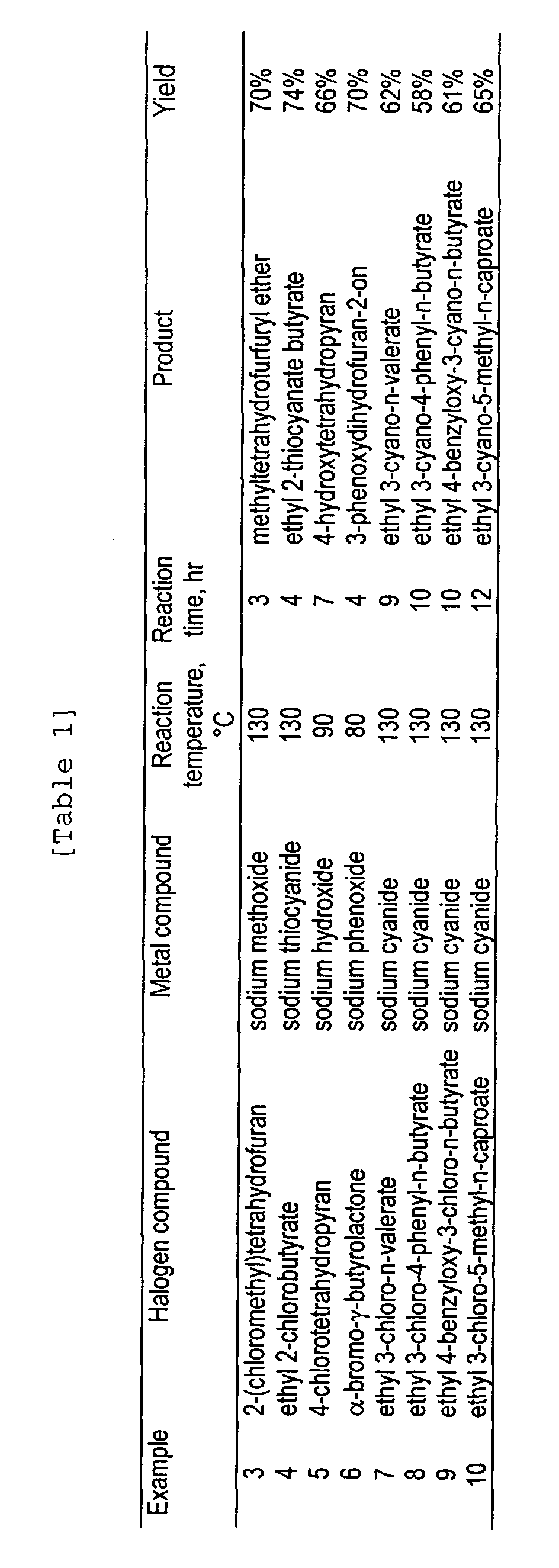
[EXAMPLES 3 to 10]
-
A reaction was conducted as in EXAMPLE 1 except that
various halogenated compounds and various metal compounds
shown in Table 1 were used instead of 3-chlorotetrahydrofuran
and sodium cyanide of EXAMPLE 1, that
the reaction temperature and the reaction time were changed
as in Table 1, and that the progress of the reaction was not
traced. The results are shown in Table 1.
[EXAMPLE 11]
-
A 50-ml pressure glass vessel equipped with a
thermometer was charged with 1.25 g (12.0 mmol) of
chlorocyclopentane, 1.05 g (18.0 mmol) of potassium fluoride,
0.93 g (1.20 mmol) of a phosphazenium compound, i.e.,
tetrakis [tris(dimethylamino)phosphoranylideneamino]
phosphonium chloride ([(Me2N)3P=N]4P+, Cl-), thoroughly dried
with flowing dry nitrogen at 100°C, and 9.44 g of anhydrous
DMF under a nitrogen atmosphere. The temperature of the
resulting suspension was increased to 110°C in about 10
minutes while stirring. The reaction was continued for six
hours at 110°C. Subsequently, a trace amount of the
reaction mixture was sampled to conduct quantitative
analysis by GC. The yield of fluorocyclopentane was 68%.
[EXAMPLES 12 to 14]
-
A reaction was conducted as in EXAMPLE 11 except that
various halogenated compounds and various metal compounds
shown in Table 2 were used instead of chlorocyclopentane and
potassium fluoride and that the reaction temperature and the
reaction time were changed as in Table 2. The results are
shown in Table 2.
[EXAMPLE 15]
-
A 50-ml flask equipped with a thermometer and a cooling
tube was charged with 1.53 g (10 mmol) of trans-1,2-dichlorocyclohexane,
0.74 g (15 mmol) of sodium cyanide,
0.78 g (1.00 mmol) of a phosphazenium compound, i.e.,
tetrakis [tris(dimethylamino)phosphoranylideneamino]
phosphonium chloride ([(Me2N)3P=N]4P+, Cl-), thoroughly dried
with flowing dry nitrogen at 100°C, and 12.5 g of anhydrous
1,3-dimethyl-2-imidazolidinone (hereinafter referred to as
"DMI") under a nitrogen atmosphere. The temperature of the
resulting suspension was increased to 150°C in about 25
minutes while stirring, and the reaction was continued for
five hours at 150°C. Subsequently, a trace amount of the
reaction mixture was sampled to conduct quantitative
analysis by GC. The yield of 1,2-dicyanocyclohexane (a
mixture of cis and trans configurations) was 51%.
[EXAMPLE 16]
-
A 50-ml flask equipped with a thermometer and a cooling
tube was charged with 0.96 g (9.00 mmol) of 3-chlorotetrahydrofuran,
0.66 g (13.5 mmol) of sodium cyanide,
0.70 g (0.90 mmol) of a phosphazenium compound, i.e.,
tetrakis [tris(dimethylamino)phosphoranylideneamino]
phosphonium chloride ([(Me2N)3P=N]4P+, Cl-), thoroughly dried
with flowing dry nitrogen at 100°C, 0.08 g (0.14 mmol) of
tris[tris(dimethylamino)phosphoranylideneamino]phosphine
oxide ([(Me2N)3P=N]3P=O), thoroughly dried with flowing dry
nitrogen at 80°C, and 9.44 g of anhydrous DMF under a
nitrogen atmosphere. The temperature of the resulting
suspension was increased to 130°C in about 20 minutes while
stirring. A trace amount of the reaction mixture was
sampled after one hour, four hours, and six hours to conduct
quantitative analysis by GC. The yield of 3-cyanotetrahydrofuran
corresponding to the three reaction
times was 25%, 87%, and 96%, respectively. The same
reaction was separately conducted under the same conditions.
The resulting reaction mixture was cooled to room
temperature, and a deposited solid matter was separated by
filtering. The solid matter was washed twice with 4 ml of
DMF, and the wash and the filtrate were mixed. The
resulting solution was extracted three times with 50 ml of
diethyl ether. The ether phase was distilled under a
reduced pressure to obtain 0.75 g of nearly pure 3-cyanotetrahydrofuran
in the form of oily matter.
[EXAMPLE 17]
-
A reaction is conducted as in EXAMPLE 16 except that 3-(chloromethyl)tetrahydrofuran
was used instead of 3-chlorotetrahydrofuran,
sodium azide was used instead of
sodium cyanide, the reaction temperature was changed to
100°C, and the reaction time was changed to 4 hours without
tracing the progress. The yield of 3-(azidomethyl)tetrahydrofuran
was 98%.
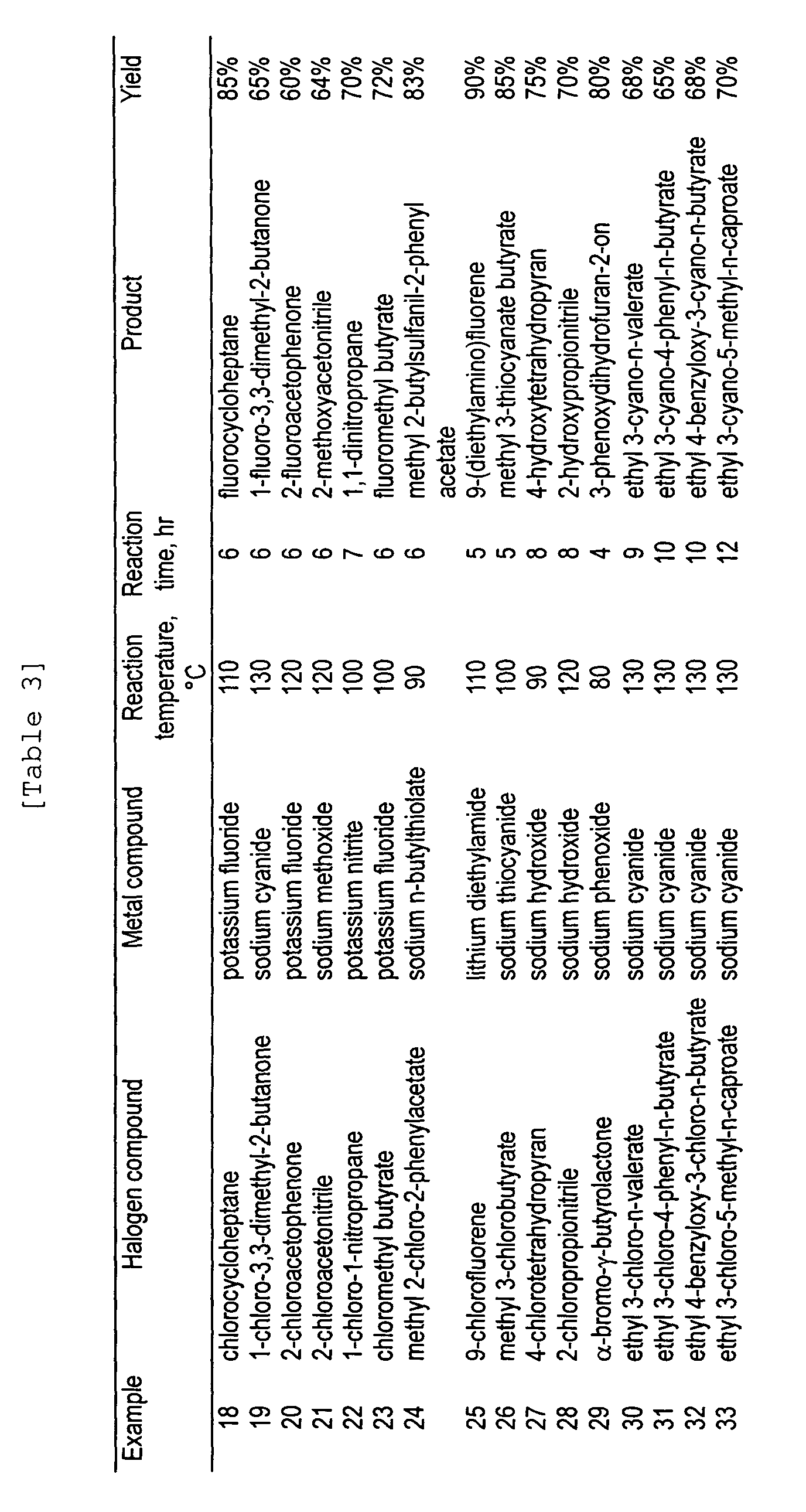
[EXAMPLES 18 to 33]
-
A reaction was conducted as in EXAMPLE 16 except that
various halogenated compounds and various metal compounds
shown in Table 3 were used instead of 3-chlorotetrahydrofuran
and sodium cyanide, that the reaction
temperature and the reaction time were changed as in Table 3,
and that the progress of the reaction was not traced. The
results are shown in Table 3.
[EXAMPLE 34]
-
A 50-ml pressure glass vessel equipped with a
thermometer was charged with 1.25 g (12.0 mmol) of
chlorocyclopentane, 1.05 g (18.0 mmol) of potassium fluoride,
0.93 g (1.20 mmol) of a phosphazenium compound, i.e.,
tetrakis [tris(dimethylamino)phosphoranylideneamino]
phosphonium chloride ([(Me2N)3P=N]4P+, Cl-), thoroughly dried
with flowing dry nitrogen at 100°C, 0.10 g (o.17 mmol) of
tris[tris(dimethylamino)phosphoranylideneamino]phosphine
oxide ([(Me2N)3P=N]3P=O), thoroughly dried with flowing dry
nitrogen at 80°C, and 9.44 g of anhydrous DMF under a
nitrogen atmosphere. The temperature of the resulting
suspension was increased to 110°C in about 10 minutes while
stirring. The reaction was continued for six hours at 110°C.
Subsequently, a trace amount of the reaction mixture was
sampled to conduct quantitative analysis by GC. The yield
of fluorocyclopentane was 80%.
[EXAMPLE 35]
-
A reaction was conducted as in EXAMPLE 34 except that
2-chlorohexane was used instead of chlorocyclopentane of
EXAMPLE 34 and that sodium cyanide was used instead of
potassium fluoride. The yield of 2-cyanohexane was 90%.
[EXAMPLE 36]
-
A reaction was conducted as in EXAMPLE 34 except that
3-chloro-1-butyne was used instead of 3-chlorotetrahydrofuran
in EXAMPLE 34, sodium acetate was used
instead of sodium cyanide, the reaction temperature was
changed to 80°C, and the reaction time was changed to 5
hours without tracing the progress. The yield of 1-methyl-2-propynyl
acetate was 80%.
[EXAMPLE 37]
-
A 50-ml flask equipped with a thermometer, a cooling
tube, and a dropping funnel was charged with 0.34 g (13.9
mmol) of sodium hydride and 15.0 g (126 mmol) of
chlorocyclohexane under a nitrogen atmosphere. Subsequently,
a solution prepared by dissolving 2.40 g (15.0 mmol) of
ethyl malonate in 5 ml of a chlorocyclohexane solution was
added dropwise over 30 minutes while cooling the flask with
an ice bath. Upon completion of the dropping, a solution
prepared by dissolving 0.77 g (0.99 mmol) of a phosphazenium
compound, i.e., tetrakis
[tris(dimethylamino)phosphoranylideneamino]
phosphonium chloride ([(Me2N)3P=N]4P+, Cl-), thoroughly dried
with flowing dry nitrogen at 100°C and 0.09 g (0.16 mmol) of
tris[tris(dimethylamino)phosphoranylideneamino]phosphine
oxide ([(Me2N)3P=N]3P=O), thoroughly dried with flowing dry
nitrogen at 80°C, in 5 ml of a chlorocyclohexyl solution was
added. The temperature of the resulting suspension was
increased to 130°C in about 20 minutes while stirring. The
reaction was continued for 5 hours at 130°C. Subsequently,
a trace amount of the reaction mixture was sampled to
conduct quantitative analysis by GC. The yield of ethyl 2-cyclohexylmalonate
with respect to the sodium hydride was
80%.
[Example 38]
-
A 50-ml flask equipped with a thermometer and a cooling
tube was charged with 1.53 g (10 mmol) of trans-1,2-dichlorocyclohexane,
0.74 g (15 mmol) of sodium cyanide,
0.78 g (1.00 mmol) of a phosphazenium compound, i.e.,
tetrakis [tris(dimethylamino)phosphoranylideneamino]
phosphonium chloride ([(Me2N)3P=N]4P+, Cl-), thoroughly dried
with flowing dry nitrogen at 100°C, 0.06 g (0.10 mmol) of
tris[tris(dimethylamino)phosphoranylideneamino]phosphine
oxide ([(Me2N)3P=N]3P=O) thoroughly dried with flowing dry
nitrogen at 80°C, and 12.5 g of anhydrous DMI under a
nitrogen atmosphere. The temperature of the resulting
suspension was increased to 150°C in about 25 minutes while
stirring. The reaction was continued for 5 hours at 150°C.
Subsequently, a trace amount of the reaction mixture was
sampled to conduct quantitative analysis by GC. The yield
of 1,2-dicyanocyclohexane (mixture of cis and trans
configurations) was 62%.
[EXAMPLE 39]
-
A 100-ml flask equipped with a thermometer and a
cooling tube was charged with 1.92 g (18.0 mmol) of 3-chlorotetrahydrofuran,
1.32 g (13.5 mmol) of sodium cyanide,
1.00 g (55.6 mmol) of water, 1.40 g (1.80 mmol) of a
phosphazenium compound, i.e., tetrakis
[tris(dimethylamino)phosphoranylideneamino]
phosphonium chloride ([(Me2N)3P=N]4P+, Cl-), thoroughly dried
with flowing dry nitrogen at 100°C, 0.16 g (0.28 mmol) of
tris[tris(dimethylamino)phosphoranylideneamino]phosphine
oxide ([(Me2N)3P=N]3P=O) thoroughly dried with flowing dry
nitrogen at 80°C, and 18.9 g of DMF under a nitrogen
atmosphere. The temperature of the resulting suspension was
increased to 120°C in about 16 minutes while stirring. The
reaction was continued for 7 hours at 120°C. Subsequently,
a trace amount of the reaction mixture was sampled to
conduct quantitative analysis by GC. The yield of 3-cyanotetrahydrofuran
was 95%.
[EXAMPLE 40]
-
A 50-ml pressure glass vessel equipped with a
thermometer was charged with 1.25 g (12.0 mmol) of
chlorocyclopentane, 0.88 g (18.0 mmol) of sodium cyanide,
0.93 g (1.20 mmol) of a phosphazenium compound, i.e.,
tetrakis [tris(dimethylamino)phosphoranylideneamino]
phosphonium chloride ([(Me2N)3P=N]4P+, Cl-), thoroughly dried
with flowing dry nitrogen at 100°C, 0.10 g (0.17 mmol) of
tris[tris(dimethylamino)phosphoranylideneamino]phosphine
oxide ([(Me2N)3P=N]3P=O) thoroughly dried with flowing dry
nitrogen at 80°C, and 7.03 g of anhydrous n-octane under a
nitrogen atmosphere. The temperature of the resulting
suspension was increased to 110°C in about 10 minutes while
stirring. The reaction was continued for 6 hours at 110°C.
Subsequently, a trace amount of the reaction mixture was
sampled to conduct quantitative analysis by GC. The yield
of cyanopentane was 82%.
[EXAMPLE 41]
-
A 50-ml flask equipped with a thermometer and a cooling
tube was charged with 1.00 g (9.00 mmol) of 3-(chloromethyl)tetrahydrofuran,
0.66 g (13.5 mmol) of sodium
cyanide, 0.70 g (0.90 mmol) of a phosphazenium compound,
i.e., tetrakis [tris(dimethylamino)phosphoranylideneamino]
phosphonium chloride ([(Me2N)3P=N]4P+, Cl-), thoroughly dried
with flowing dry nitrogen at 100°C, 0.08 g (0.14 mmol) of
tris[tris(dimethylamino)phosphoranylideneamino]phosphine
oxide ([(Me2N)3P=N]3P=O) thoroughly dried with flowing dry
nitrogen at 80°C, and 8.65 g of anhydrous toluene. The
temperature of the resulting suspension was increased to
100°C in about 10 minutes while stirring. The reaction was
continued for 5 hours at 100°C. Subsequently, a trace
amount of the reaction mixture was sampled to conduct
quantitative analysis by GC. The yield of 3-(cyanomethyl)tetrahydrofuran
was 90%.
[EXAMPLE 42]
-
A 50-ml pressure glass vessel equipped with a
thermometer was charged with 1.62 g (12.0 mmol) of 4-chloroheptane,
0.88 g (18.0 mmol) of sodium cyanide, 0.98 g
(1.20 mmol) of a phosphazenium compound, i.e., tetrakis
[tris(dimethylamino)phosphoranylideneamino]
phosphonium bromide ([(Me2N)3P=N]4P+, Br-) , thoroughly dried
with flowing dry nitrogen at 100°C, 0.11 g (0.19 mmol) of
tris[tris(dimethylamino)phosphoranylideneamino]phosphine
oxide ([(Me2N)3P=N]3P=O), and 9.44 g of anhydrous DMF under a
nitrogen atmosphere. The temperature of the resulting
suspension was increased to 110°C in about 10 minutes while
stirring. The reaction was continued for 6 hours at 110°C.
Subsequently, a trace amount of the reaction mixture was
sampled to conduct quantitative analysis by GC. The yield
of 4-cyanoheptane was 89%.
[EXAMPLE 43]
-
A 100-ml flask equipped with a thermometer and a
cooling tube was charged with 2.13 g (20.0 mmol) of 2-chlorotetrahydrofuran,
6.00 g (40.0 mmol) of sodium iodide,
2.22 g (2.00 mmol) of a phosphazenium compound, i.e.,
tetrakis [tris(diethylamino)phosphoranylideneamino]
phosphonium chloride ([(Et2N)3P=N]4P+,Cl-), thoroughly dried
with flowing dry nitrogen at 100°C, 0.25 g (0.43 mmol) of
tris[tris(dimethylamino)phosphoranylideneamino]phosphine
oxide ([(Me2N)3P=N]3P=O) thoroughly dried with flowing dry
nitrogen at 80°C, and 28.3 g of anhydrous DMF under a
nitrogen atmosphere. The temperature of the resulting
suspension was increased to 100°C in about 10 minutes while
stirring. The reaction was continued for 4 hours at 100°C.
Subsequently, a trace amount of the reaction mixture was
sampled to conduct quantitative analysis by GC. The yield
of 2-iodotetrahydrofuran was 93%.
[EXAMPLE 44]
-
A reaction was conducted as in EXAMPLE 43 except that
chlorodiphenylmethane was used instead of 2-chlorotetrahydrofuran
of EXAMPLE 43, that sodium hydroxide
was used instead of sodium iodide, that the reaction
temperature was changed to 110°C, and that the reaction time
was changed to 7 hours. The yield of benzhydrol was 87%.
[EXAMPLE 45]
-
A reaction was conducted as in EXAMPLE 43 except that
chlorocyclohexane was used instead of 2-chlorotetrahydrofuran,
that sodium phenoxide was used
instead of sodium iodide, that tetrakis [tri(pyrrolidin-1-yl)phosphoranylideneamino]phosphonium
chloride ((Py3P=N)4P+,
Cl-) was used instead of tetrakis
[tris(diethylamino)phosphoranylideneamino]
phosphonium chloride, that the reaction temperature was
changed to 120°C, and that the reaction time was changed to
6 hours. The yield of cyclohexylphenyl ether was 81%.
[EXAMPLE 46]
-
A 100-ml flask equipped with a thermometer and a
cooling tube was charged with 1.92 g (18.0 mmol) of 3-chlorotetrahydrofuran,
1.32 g (27.0 mmol) of sodium cyanide,
1.40 g (1.80 mmol) of a phosphazenium compound, i.e.,
tetrakis [tris(dimethylamino)phosphoranylideneamino]
phosphonium chloride ([(Me
2N)
3P=N]
4P
+, Cl
-), thoroughly dried
with flowing dry nitrogen at 100°C, 0.16 g (0.28 mmol) of
tris[tris(dimethylamino)phosphoranylideneamino]phosphine
oxide ([(Me
2N)
3P=N]
3P=O), thoroughly dried with flowing dry
nitrogen at 80°C, and 17.3 g of anhydrous toluene under a
nitrogen atmosphere. The temperature of the resulting
suspension was increased to 120°C in about 20 minutes while
stirring. The reaction was continued for 9 hours at 120°C.
Subsequently, a trace amount of the reaction mixture was
sampled to conduct quantitative analysis by GC. The yield
of 3-cyanotetrahydrofuran was 94%. Deposited solid matter
in the reaction mixture was filtered, and the solid matter
was washed twice with 4 ml of toluene, and the wash and the
filtrate were mixed. 3-Chlorotetrahydrofuran, i.e., the
starting material, 3-cyanotetrahydrofuran, i.e., the product,
toluene and DMF were removed from this solution by
distillation to obtain 1.48 g of a mixed solid matter of the
phosphazenium compound and the phosphine oxide. The solid
matter was added to 5.00 g of hexane, and solid precipitate
(i.e., the phosphazenium compound) was separated by
filtering. The solid obtained was added to 8.14 g of water
and heated to 40°C to prepare a solution. The solution was
cooled to 0°C with stirring to precipitate crystals. After
the crystals were filtered and washed twice with 2 ml of 0°C
water, the resulting crystals were dried with flowing dry
nitrogen at 100°C to obtain 1.32 g of the phosphazenium
compound. This phosphazenium compound recovered was reused
to conduct another cycle of reaction under the same
conditions, and a trace amount of the reaction mixture was
sampled to conduct quantitative analysis by GC. The yield
of 3-cyanotetrahydrofuran was 92%.


 (wherein Y represents an oxygen atom, a sulfur atom, or NR'; c and d represent integers satisfying the relationship c + d = 3 to 6; and R' in NR' represents a hydrogen atom or a methyl group),
 (wherein Y represents an oxygen atom, a sulfur atom, or NR'; e, f, and g are integers satisfying the relationship e + f + g = 2 to 5; and R' in NR' represents a hydrogen atom or a methyl group),
 (wherein Y represents an oxygen atom, a sulfur atom, or NR'; h, i and j represent integers satisfying the relationship h + i + j = 2 to 5; and R' in NR' represents a hydrogen atom or a methyl group),
 (wherein k represents an integer between 0 and 2),


 (wherein Y represents an oxygen atom, a sulfur atom, or NR'; c and d represent integers satisfying the relationship c + d = 3 to 6; and R' in NR' represents a hydrogen atom or a methyl group):
 (wherein Y represents an oxygen atom, a sulfur atom, or NR'; e, f, and g are integers satisfying the relationship e + f + g = 2 to 5; and R' in NR' represents a hydrogen atom or a methyl group),
 (wherein Y represents an oxygen atom, a sulfur atom, or NR'; h, i and j represent integers satisfying the relationship h + i + j = 2 to 5; and R' in NR' represents a hydrogen atom or a methyl group),
 (wherein k represents an integer between 0 and 2),