EP1485506B1 - Method for identifying animals for milk production qualities by analyzing the polymorphism of the pit-1 and kappa-casein genes - Google Patents
Method for identifying animals for milk production qualities by analyzing the polymorphism of the pit-1 and kappa-casein genes Download PDFInfo
- Publication number
- EP1485506B1 EP1485506B1 EP03743886A EP03743886A EP1485506B1 EP 1485506 B1 EP1485506 B1 EP 1485506B1 EP 03743886 A EP03743886 A EP 03743886A EP 03743886 A EP03743886 A EP 03743886A EP 1485506 B1 EP1485506 B1 EP 1485506B1
- Authority
- EP
- European Patent Office
- Prior art keywords
- allele
- seq
- pit
- gene
- fragment
- Prior art date
- Legal status (The legal status is an assumption and is not a legal conclusion. Google has not performed a legal analysis and makes no representation as to the accuracy of the status listed.)
- Expired - Lifetime
Links
- 101150054854 POU1F1 gene Proteins 0.000 title claims abstract description 72
- 235000013336 milk Nutrition 0.000 title claims abstract description 61
- 239000008267 milk Substances 0.000 title claims abstract description 61
- 210000004080 milk Anatomy 0.000 title claims abstract description 61
- 108010076119 Caseins Proteins 0.000 title claims abstract description 60
- 238000004519 manufacturing process Methods 0.000 title claims abstract description 54
- 238000000034 method Methods 0.000 title claims abstract description 43
- 241001465754 Metazoa Species 0.000 title abstract description 25
- 108700028369 Alleles Proteins 0.000 claims abstract description 138
- 230000014616 translation Effects 0.000 claims abstract description 7
- 239000000523 sample Substances 0.000 claims description 50
- 239000012634 fragment Substances 0.000 claims description 37
- 230000003321 amplification Effects 0.000 claims description 33
- 238000003199 nucleic acid amplification method Methods 0.000 claims description 33
- 239000002773 nucleotide Substances 0.000 claims description 19
- 125000003729 nucleotide group Chemical group 0.000 claims description 19
- 241000283690 Bos taurus Species 0.000 claims description 18
- 108091034117 Oligonucleotide Proteins 0.000 claims description 18
- JLCPHMBAVCMARE-UHFFFAOYSA-N [3-[[3-[[3-[[3-[[3-[[3-[[3-[[3-[[3-[[3-[[3-[[5-(2-amino-6-oxo-1H-purin-9-yl)-3-[[3-[[3-[[3-[[3-[[3-[[5-(2-amino-6-oxo-1H-purin-9-yl)-3-[[5-(2-amino-6-oxo-1H-purin-9-yl)-3-hydroxyoxolan-2-yl]methoxy-hydroxyphosphoryl]oxyoxolan-2-yl]methoxy-hydroxyphosphoryl]oxy-5-(5-methyl-2,4-dioxopyrimidin-1-yl)oxolan-2-yl]methoxy-hydroxyphosphoryl]oxy-5-(6-aminopurin-9-yl)oxolan-2-yl]methoxy-hydroxyphosphoryl]oxy-5-(6-aminopurin-9-yl)oxolan-2-yl]methoxy-hydroxyphosphoryl]oxy-5-(6-aminopurin-9-yl)oxolan-2-yl]methoxy-hydroxyphosphoryl]oxy-5-(6-aminopurin-9-yl)oxolan-2-yl]methoxy-hydroxyphosphoryl]oxyoxolan-2-yl]methoxy-hydroxyphosphoryl]oxy-5-(5-methyl-2,4-dioxopyrimidin-1-yl)oxolan-2-yl]methoxy-hydroxyphosphoryl]oxy-5-(4-amino-2-oxopyrimidin-1-yl)oxolan-2-yl]methoxy-hydroxyphosphoryl]oxy-5-(5-methyl-2,4-dioxopyrimidin-1-yl)oxolan-2-yl]methoxy-hydroxyphosphoryl]oxy-5-(5-methyl-2,4-dioxopyrimidin-1-yl)oxolan-2-yl]methoxy-hydroxyphosphoryl]oxy-5-(6-aminopurin-9-yl)oxolan-2-yl]methoxy-hydroxyphosphoryl]oxy-5-(6-aminopurin-9-yl)oxolan-2-yl]methoxy-hydroxyphosphoryl]oxy-5-(4-amino-2-oxopyrimidin-1-yl)oxolan-2-yl]methoxy-hydroxyphosphoryl]oxy-5-(4-amino-2-oxopyrimidin-1-yl)oxolan-2-yl]methoxy-hydroxyphosphoryl]oxy-5-(4-amino-2-oxopyrimidin-1-yl)oxolan-2-yl]methoxy-hydroxyphosphoryl]oxy-5-(6-aminopurin-9-yl)oxolan-2-yl]methoxy-hydroxyphosphoryl]oxy-5-(4-amino-2-oxopyrimidin-1-yl)oxolan-2-yl]methyl [5-(6-aminopurin-9-yl)-2-(hydroxymethyl)oxolan-3-yl] hydrogen phosphate Polymers Cc1cn(C2CC(OP(O)(=O)OCC3OC(CC3OP(O)(=O)OCC3OC(CC3O)n3cnc4c3nc(N)[nH]c4=O)n3cnc4c3nc(N)[nH]c4=O)C(COP(O)(=O)OC3CC(OC3COP(O)(=O)OC3CC(OC3COP(O)(=O)OC3CC(OC3COP(O)(=O)OC3CC(OC3COP(O)(=O)OC3CC(OC3COP(O)(=O)OC3CC(OC3COP(O)(=O)OC3CC(OC3COP(O)(=O)OC3CC(OC3COP(O)(=O)OC3CC(OC3COP(O)(=O)OC3CC(OC3COP(O)(=O)OC3CC(OC3COP(O)(=O)OC3CC(OC3COP(O)(=O)OC3CC(OC3COP(O)(=O)OC3CC(OC3COP(O)(=O)OC3CC(OC3COP(O)(=O)OC3CC(OC3COP(O)(=O)OC3CC(OC3CO)n3cnc4c(N)ncnc34)n3ccc(N)nc3=O)n3cnc4c(N)ncnc34)n3ccc(N)nc3=O)n3ccc(N)nc3=O)n3ccc(N)nc3=O)n3cnc4c(N)ncnc34)n3cnc4c(N)ncnc34)n3cc(C)c(=O)[nH]c3=O)n3cc(C)c(=O)[nH]c3=O)n3ccc(N)nc3=O)n3cc(C)c(=O)[nH]c3=O)n3cnc4c3nc(N)[nH]c4=O)n3cnc4c(N)ncnc34)n3cnc4c(N)ncnc34)n3cnc4c(N)ncnc34)n3cnc4c(N)ncnc34)O2)c(=O)[nH]c1=O JLCPHMBAVCMARE-UHFFFAOYSA-N 0.000 claims description 18
- 102000011632 Caseins Human genes 0.000 claims description 16
- 235000021246 κ-casein Nutrition 0.000 claims description 14
- 238000004458 analytical method Methods 0.000 claims description 13
- 238000007894 restriction fragment length polymorphism technique Methods 0.000 claims description 11
- 238000001514 detection method Methods 0.000 claims description 10
- UYTPUPDQBNUYGX-UHFFFAOYSA-N guanine Chemical group O=C1NC(N)=NC2=C1N=CN2 UYTPUPDQBNUYGX-UHFFFAOYSA-N 0.000 claims description 8
- 108091008146 restriction endonucleases Proteins 0.000 claims description 8
- 238000011895 specific detection Methods 0.000 claims description 8
- 239000012472 biological sample Substances 0.000 claims description 6
- 102100037914 Pituitary-specific positive transcription factor 1 Human genes 0.000 claims description 5
- 101710129981 Pituitary-specific positive transcription factor 1 Proteins 0.000 claims description 5
- RIGXBXPAOGDDIG-UHFFFAOYSA-N n-[(3-chloro-2-hydroxy-5-nitrophenyl)carbamothioyl]benzamide Chemical compound OC1=C(Cl)C=C([N+]([O-])=O)C=C1NC(=S)NC(=O)C1=CC=CC=C1 RIGXBXPAOGDDIG-UHFFFAOYSA-N 0.000 claims description 5
- 229930024421 Adenine Natural products 0.000 claims description 4
- 229960000643 adenine Drugs 0.000 claims description 4
- GFFGJBXGBJISGV-UHFFFAOYSA-N adenyl group Chemical group N1=CN=C2N=CNC2=C1N GFFGJBXGBJISGV-UHFFFAOYSA-N 0.000 claims description 4
- 235000013351 cheese Nutrition 0.000 claims description 4
- 230000002349 favourable effect Effects 0.000 claims description 4
- OPTASPLRGRRNAP-UHFFFAOYSA-N cytosine Chemical group NC=1C=CNC(=O)N=1 OPTASPLRGRRNAP-UHFFFAOYSA-N 0.000 claims 2
- 229940104302 cytosine Drugs 0.000 claims 1
- 210000000442 hair follicle cell Anatomy 0.000 claims 1
- 241000124008 Mammalia Species 0.000 abstract description 14
- 108090000623 proteins and genes Proteins 0.000 description 43
- 108020004414 DNA Proteins 0.000 description 28
- 230000000694 effects Effects 0.000 description 27
- 235000018102 proteins Nutrition 0.000 description 20
- 102000004169 proteins and genes Human genes 0.000 description 20
- 239000003925 fat Substances 0.000 description 17
- 238000006467 substitution reaction Methods 0.000 description 13
- 244000309464 bull Species 0.000 description 11
- 230000006651 lactation Effects 0.000 description 10
- 230000035772 mutation Effects 0.000 description 9
- 238000006243 chemical reaction Methods 0.000 description 8
- 239000005018 casein Substances 0.000 description 6
- 230000002068 genetic effect Effects 0.000 description 5
- TWRXJAOTZQYOKJ-UHFFFAOYSA-L Magnesium chloride Chemical compound [Mg+2].[Cl-].[Cl-] TWRXJAOTZQYOKJ-UHFFFAOYSA-L 0.000 description 4
- 108010011756 Milk Proteins Proteins 0.000 description 4
- 108090000790 Enzymes Proteins 0.000 description 3
- 102000004190 Enzymes Human genes 0.000 description 3
- PEDCQBHIVMGVHV-UHFFFAOYSA-N Glycerine Chemical compound OCC(O)CO PEDCQBHIVMGVHV-UHFFFAOYSA-N 0.000 description 3
- 102000018997 Growth Hormone Human genes 0.000 description 3
- 108010051696 Growth Hormone Proteins 0.000 description 3
- 102000014171 Milk Proteins Human genes 0.000 description 3
- 230000000996 additive effect Effects 0.000 description 3
- 235000019197 fats Nutrition 0.000 description 3
- 239000000122 growth hormone Substances 0.000 description 3
- 239000003550 marker Substances 0.000 description 3
- 235000013372 meat Nutrition 0.000 description 3
- 235000021239 milk protein Nutrition 0.000 description 3
- 239000000203 mixture Substances 0.000 description 3
- 108020004705 Codon Proteins 0.000 description 2
- 241001301450 Crocidium multicaule Species 0.000 description 2
- 102000016928 DNA-directed DNA polymerase Human genes 0.000 description 2
- 108010014303 DNA-directed DNA polymerase Proteins 0.000 description 2
- MTCFGRXMJLQNBG-UHFFFAOYSA-N Serine Natural products OCC(N)C(O)=O MTCFGRXMJLQNBG-UHFFFAOYSA-N 0.000 description 2
- 238000010171 animal model Methods 0.000 description 2
- 238000013459 approach Methods 0.000 description 2
- 238000003935 denaturing gradient gel electrophoresis Methods 0.000 description 2
- 238000011534 incubation Methods 0.000 description 2
- 229910001629 magnesium chloride Inorganic materials 0.000 description 2
- 230000002503 metabolic effect Effects 0.000 description 2
- 239000011541 reaction mixture Substances 0.000 description 2
- 238000013179 statistical model Methods 0.000 description 2
- 241000283725 Bos Species 0.000 description 1
- KCXVZYZYPLLWCC-UHFFFAOYSA-N EDTA Chemical compound OC(=O)CN(CC(O)=O)CCN(CC(O)=O)CC(O)=O KCXVZYZYPLLWCC-UHFFFAOYSA-N 0.000 description 1
- 108700024394 Exon Proteins 0.000 description 1
- 108091028043 Nucleic acid sequence Proteins 0.000 description 1
- 238000012408 PCR amplification Methods 0.000 description 1
- 239000011543 agarose gel Substances 0.000 description 1
- 238000000246 agarose gel electrophoresis Methods 0.000 description 1
- 238000007844 allele-specific PCR Methods 0.000 description 1
- 150000001413 amino acids Chemical class 0.000 description 1
- 238000001574 biopsy Methods 0.000 description 1
- 230000015572 biosynthetic process Effects 0.000 description 1
- 239000008280 blood Substances 0.000 description 1
- 210000004369 blood Anatomy 0.000 description 1
- 238000009395 breeding Methods 0.000 description 1
- 230000001488 breeding effect Effects 0.000 description 1
- UDSAIICHUKSCKT-UHFFFAOYSA-N bromophenol blue Chemical compound C1=C(Br)C(O)=C(Br)C=C1C1(C=2C=C(Br)C(O)=C(Br)C=2)C2=CC=CC=C2S(=O)(=O)O1 UDSAIICHUKSCKT-UHFFFAOYSA-N 0.000 description 1
- 238000004364 calculation method Methods 0.000 description 1
- 239000003153 chemical reaction reagent Substances 0.000 description 1
- 238000003776 cleavage reaction Methods 0.000 description 1
- 230000000052 comparative effect Effects 0.000 description 1
- 230000002596 correlated effect Effects 0.000 description 1
- 230000000875 corresponding effect Effects 0.000 description 1
- 235000020247 cow milk Nutrition 0.000 description 1
- 235000013365 dairy product Nutrition 0.000 description 1
- 238000011161 development Methods 0.000 description 1
- 238000009792 diffusion process Methods 0.000 description 1
- 230000007613 environmental effect Effects 0.000 description 1
- 238000002474 experimental method Methods 0.000 description 1
- 238000010363 gene targeting Methods 0.000 description 1
- 210000004209 hair Anatomy 0.000 description 1
- 210000003780 hair follicle Anatomy 0.000 description 1
- 238000002372 labelling Methods 0.000 description 1
- 210000005075 mammary gland Anatomy 0.000 description 1
- 239000011159 matrix material Substances 0.000 description 1
- 238000005259 measurement Methods 0.000 description 1
- 238000012986 modification Methods 0.000 description 1
- 230000004048 modification Effects 0.000 description 1
- 238000010369 molecular cloning Methods 0.000 description 1
- 239000003147 molecular marker Substances 0.000 description 1
- 230000003234 polygenic effect Effects 0.000 description 1
- 230000008092 positive effect Effects 0.000 description 1
- 230000023603 positive regulation of transcription initiation, DNA-dependent Effects 0.000 description 1
- 238000012552 review Methods 0.000 description 1
- 230000007017 scission Effects 0.000 description 1
- 238000012163 sequencing technique Methods 0.000 description 1
- 239000000243 solution Substances 0.000 description 1
- 238000007619 statistical method Methods 0.000 description 1
- 239000012089 stop solution Substances 0.000 description 1
- 230000000153 supplemental effect Effects 0.000 description 1
- 238000012360 testing method Methods 0.000 description 1
- 210000001519 tissue Anatomy 0.000 description 1
- 230000009466 transformation Effects 0.000 description 1
- 230000007704 transition Effects 0.000 description 1
- 238000011144 upstream manufacturing Methods 0.000 description 1
- XLYOFNOQVPJJNP-UHFFFAOYSA-N water Substances O XLYOFNOQVPJJNP-UHFFFAOYSA-N 0.000 description 1
Images

Classifications
-
- C—CHEMISTRY; METALLURGY
- C12—BIOCHEMISTRY; BEER; SPIRITS; WINE; VINEGAR; MICROBIOLOGY; ENZYMOLOGY; MUTATION OR GENETIC ENGINEERING
- C12Q—MEASURING OR TESTING PROCESSES INVOLVING ENZYMES, NUCLEIC ACIDS OR MICROORGANISMS; COMPOSITIONS OR TEST PAPERS THEREFOR; PROCESSES OF PREPARING SUCH COMPOSITIONS; CONDITION-RESPONSIVE CONTROL IN MICROBIOLOGICAL OR ENZYMOLOGICAL PROCESSES
- C12Q1/00—Measuring or testing processes involving enzymes, nucleic acids or microorganisms; Compositions therefor; Processes of preparing such compositions
- C12Q1/68—Measuring or testing processes involving enzymes, nucleic acids or microorganisms; Compositions therefor; Processes of preparing such compositions involving nucleic acids
- C12Q1/6876—Nucleic acid products used in the analysis of nucleic acids, e.g. primers or probes
-
- C—CHEMISTRY; METALLURGY
- C12—BIOCHEMISTRY; BEER; SPIRITS; WINE; VINEGAR; MICROBIOLOGY; ENZYMOLOGY; MUTATION OR GENETIC ENGINEERING
- C12Q—MEASURING OR TESTING PROCESSES INVOLVING ENZYMES, NUCLEIC ACIDS OR MICROORGANISMS; COMPOSITIONS OR TEST PAPERS THEREFOR; PROCESSES OF PREPARING SUCH COMPOSITIONS; CONDITION-RESPONSIVE CONTROL IN MICROBIOLOGICAL OR ENZYMOLOGICAL PROCESSES
- C12Q2600/00—Oligonucleotides characterized by their use
- C12Q2600/156—Polymorphic or mutational markers
Definitions
- the present invention relates to the fields of milk production and breeding. M ore particularly, this invention relates to methods a nd kits for determining the milk production potential in an animal from an analysis of the polymorphism of its Pit-1 and ⁇ -casein genes.
- Said selection can be made over several generations by crossing animals with the same desired trait and hoping that that trait will be dominant in the next generation.
- That type of selection has a number of disadvantages due to the length of time required and also because the judgment of an expert breeder in the field is required.
- the breeder's judgment is based on observations and hypotheses and thus includes a degree of subjectivity linked with experience. Further, a trait selected in that manner in a given generation will not necessarily be transmitted to the next generation.
- a particular promising approach consists of studying genes with large individual effects and their possible association with certain desired traits in the animals. Such genes can then be used as molecular markers to select the traits in question in an animal. That method necessitates identifying genes with large individual effects or genetic markers associated with the desired traits. The success of that approach hence depends on demonstrating a correlation between the phenotypic trait sought and a certain polymorphism of the gene in question.
- genes of the somatotropic axis have been identified as having an influence on milk production, both in terms of the quantity produced (for example genes of the somatotropic axis) and in terms of milk quality (for example genes associated with protein variations).
- the aim of the invention is to provide a method for identifying a mammal having a genotype indicative of advantageous milk production traits. This method should enable the identification of high potential for milk production and protein production in milk in a mammal, and perform better than known prior art methods.
- the different alleles of the ⁇ -casein gene will be designated in the same manner as in the scientific literature of the prior art, as described in Table 4 of the article by Formaggioni et al., see above. Examples of methods for demonstrating the presence of alleles A and B of the ⁇ -casein gene are described in Examples 1 and 2 below by Restriction Fragment Length Polymorphism (RFLP) and by allele-specific detection, respectively.
- RFLP Restriction Fragment Length Polymorphism
- Alleles A and B of the Pit-1 gene are those described in PCT patent application WO-A-98/03677 .
- the inventors have also demonstrated a further polymorphism in the Pit-1 gene in the 2 exon (Example 5).
- the corresponding alleles C and T differ by substitution of an adenine (allele C) by a guanine (allele T) in the codon for Serine 65. That mutation, while silent, can act as a molecular marker associated with milk production traits.
- the inventors have observed that in 97.8% of bulls tested (in a sample of more than 500 Holstein bulls), the AA genotype for exon 6 is associated with the TT genotype for exon 2, while the BB genotype for exon 6 and CC genotype for exon 2 are correlated.
- the association between the genotype observed for said mutation and the milk production performance is of the same order as for exon 6.
- the Pit-1 gene and the ⁇ -casein gene do not belong to the same metabolic chain. Thus, a priori, they do not have any reason to interact.
- the inventors have developed a method for identifying a mammal that has a genotype indicative of advantageous milk production traits, in which both the Pit-1 gene and the kappa-casein gene are used as genetic markers. They have shown that this method is more effective than known prior art methods based on the use of the Pit-1 marker alone or on the kappa-casein marker alone.
- the invention concerns a method for identifying a mammal having a genotype that is indicative of advantageous milk production traits, comprising the following steps:
- the mammal is a bovine.
- mice with AA Pit-1 and BB ⁇ -casein genotypes have far superior milk production performances than those with bovine BB Pit-1 AA ⁇ -casein genotypes.
- cows tested as AA Pit-1 and BB ⁇ -casein produce about 237 kg more milk on average, on the basis of 305 days of lactation, than those tested BB Pit-1 and AA ⁇ -casein .
- This effect is greater than the sum of the effects observed for the two genes individually (46.3 kg for Pit-1 and 72.2 for ⁇ -casein).
- a very large effect of an association of the two favourable alleles is observed on protein production, which effect is greater than the sum of the individual effects of the two genes.
- Example 7 shows that an analysis of Pit-1 gene polymorphism can also be carried out at exon 2, in which case it is the simultaneous presence of allele T of the Pit-1 gene and allele B of the ⁇ -casein gene that is indicative of high milk production and protein production potential in the test animal.
- the presence of allele B of ⁇ -casein is also indicative of a lactodynamographic milk quality that is favourable to cheese production.
- the first step in the methods of the invention i.e., obtaining a biological sample comprising the DNA of the animal to be tested, can be carried out using any technique that is known to the skilled person, for example by means of a biopsy, or removing a blood sample or any other biological sample.
- this step is carried out using cells deriving from hair follicles obtained by plucking a few hairs from the animal.
- the above steps 1 and 2 can be carried out by 2 different persons.
- the sample can be obtained by the breeder and then sent to a laboratory that will carry out the analysis. Therefore, the present invention also concerns a method for identifying a mammal having a genotype that is indicative of advantageous milk production traits, comprising analyzing in a biological sample from said bovine the polymorphism of the Pit-1 and ⁇ -casein genes of said mammal, in which the simultaneous presence of allele A and/or T of the Pit-1 gene and allele B of the ⁇ -casein gene is indicative of high potential for milk production and protein production in said mammal.
- the polymorphism in the ⁇ -casein gene can be analyzed by restriction fragment length polymorphism (RFLP), by amplifying a fragment comprising nucleotide 5345 of the sequence described by Alexander et al., 1988 (which corresponds to A in allele A and C in allele B) of the ⁇ -casein gene and by digesting the product of this amplification with the restriction enzyme Hinfl.
- RFLP restriction fragment length polymorphism
- Example 2 illustrates the allele-specific detection technique carried out with the following primers and probes:
- the analysis can be carried out for the Pit-1 gene by restriction fragment length polymorphism analysis (RFLP), by amplifying a fragment comprising nucleotide 1178 of the Pit-1 gene and digesting the product of said amplification with the restriction enzyme Hinfl, as shown in Example 3 below.
- RFLP restriction fragment length polymorphism analysis
- the following primers can be used:
- the analysis can also be carried out, for the Pit-1 gene, by allele-specific amplification and/or detection.
- Examples 4 and 5 below illustrate allele-specific amplification of Pit-1 gene fragments, respectively in exons 6 and 2, with the following primers:
- Polymorphism in the P it-1 gene can also be determined by allele-specific detection of an amplified fragment of said gene, for example at exon 6, using the following probes and primers:
- Examples 1 to 5 are provided solely by way of indication, and can be modified by the skilled person. This is particularly the case as regards the reagents and the temperature conditions used to carry out the amplification reactions, but also for the primer sequences. Knowing the position of the polymorphism that is to be detected, it is easy to determine other primers or probes that can be used to amplify the fragment concerned and identify the allele in question. Said primer determination can be made by reading the sequence surrounding the polymorphism site, if necessary using software of the GeneScan® type (Applied Biosystems).
- SSCP single stranded conformation polymorphism
- DGGE denaturing gradient gel electrophoresis
- CFLP cleavage fragment length polymorphism
- the invention also concerns a kit for identifying a genotype indicative of advantageous milk production traits in cattle, comprising oligonucleotides for amplifying a fragment comprising nucleotide 1178 of the Pit-1 gene, oligonucleotides for amplifying a fragment comprising nucleotide 5345 of the ⁇ -casein gene, and the restriction enzyme Hinfl.
- such a kit can contain the following primers to amplify a fragment comprising nucleotide 1178 of the Pit-1 gene:
- the present invention concerns a kit for identifying a genotype indicative of advantageous milk production traits in cattle, comprising oligonucleotides for carrying out allele-specific amplification and/or detection of a fragment of the Pit-1 gene, and oligonucleotides for carrying out allele-specific amplification and/or detection of a fragment of the ⁇ -casein gene.
- the following primers constitute the oligonucleotides for allele-specific amplification of a fragment of the Pit-1 gene:
- the following primers constitute the oligonucleotides for allele-specific amplification of a fragment of the Pit-1 gene targeting exon 2:
- the following primers and probes constitute the oligonucleotides for allele-specific detection of a fragment of a gene for ⁇ -casein:
- nucleotide sequences whether for amplifying fragments of the ⁇ -casein and Pit-1 gene, or for their detection.
- skilled person will be able to modify the labeling of the probes used.
- the application also concerns a genetic marker for determining the milk or meat capacity cattle, characterized in that an adenine in position 195 of the Pit-1 gene is characteristic of good milk production and a guanine in position 195 of the Pit-1 gene is characteristic of good meat production.
- EXAMPLE 1 Determination of A and B alleles for kappa-casein by RFLP analysis
- the reaction mixture was composed of H 2 O, 10x buffer, 2 mM of MgCl 2 , 20 pmol of primers, 0.2 mM of dNTPs, 100 ng/25 ⁇ l of DNA and 0.6U/25 ⁇ l of polymerase [Goldstar DNA Polymerase, EUROGENTEC].
- the PCR reaction cycle was constituted by a first 3 minutes denaturing phase at 96°C followed by 40 cycles of 1 minute at 94°C, 1 minute at 66°C and 1 minute at 72°C.
- the terminal extension phase was carried out at 72°C for 10 minutes.
- PCR product was then incubated with 20U of the Hinfl enzyme for 2 hours at 37°C. Following incubation, 2 ⁇ l of STOP solution (50% glycerol, 20 mM of EDTA, 0.25% of bromophenol blue) was added and the mixture was separated by 2% agarose gel electrophoresis.
- STOP solution 50% glycerol, 20 mM of EDTA, 0.25% of bromophenol blue
- the allele arbitrarily designated "A” in the scientific literature was cut by the Hinfl enzyme and the "B” allele was not digested by the Hinfl enzyme.
- EXAMPLE 2 Determination of A and B alleles for kappa-casein by allele-specific detection
- the reaction mixture was composed of Taq Man Universal PCR master mix (Applied Biosystems Inc) in the presence of primers and probes: Kappa F primer 2.5 ⁇ l Kappa R primer 900 nM Fam Kappa probe 200 nM Vic Kappa probe 200 nM in a volume made up to 5 ⁇ l with water.
- Amplification was measured in real time using an Applied Biosystems model 7900 HT apparatus.
- the PCR reaction cycle was constituted by a first phase of one cycle at 50°C for 2 minutes followed by 1 cycle of 10 min at 95°C followed by 40 cycles of 15 seconds at 95°C and 1 minute at 60°C.
- EXAMPLE 3 Determination of A and B alleles for Pit-1 gene by RFLP analysis
- the product of that amplification was a fragment with 451 base pairs.
- Incubation of that fragment with the restriction enzyme Hinf1 enabled two alleles to be distinguished: allele A was not cut by Hinf1 and allele B comprises a Hinf1 restriction site, which generates two fragments with 244 and 207 base pairs.
- EXAMPLE 4 Determination of A and B alleles of exon 6 of the Pit-1 gene by allele-specific amplification
- This method is based on the use, for PCR, of two primers for which the nucleotide located at the terminal 3' position are different. This difference is responsible for the specificity of the primers as regards one of the two alleles of the gene. This method thus uses specific primers for each allele, and does not require the use of a restriction enzyme.
- Amplification reactions were carried out in a solution of H 2 O, 10x buffer, 3 mM MgCl 2 , 20 p mole/50 ⁇ l of specific primer (A or B), 400 ⁇ m dNTP, 100 ng/50 ⁇ l of DNA, and 1.2 U/50 ⁇ l of polymerase [Goldstar DNA polymerase, EUROGENTEC].
- the PCR reaction comprised a first denaturing step carried out at 96°C for 3 minutes, followed by about 35 cycles of 1 minute at 95°C, 1 minute at 65.2°C and 1 minute at 72°C. The final step was carried out at 72°C for 10 minutes.
- the primers used in this method were as follows:
- each sample was brought into the presence of either primer A or primer B.
- the PCR amplified 320 bp fragment was either present alone in tube A (the animal was thus of genotype AA) or only present in tube B (the animal was thus a BB homozygote) or it was present in both tubes (the animal was AB heterozygous).
- EXAMPLE 5 Determination of C and T alleles for exon 2 of the Pit-1 gene by allele-specific amplification
- a second polymorphous site was determined using single strand conformational polymorphism (SSCP) at the Pit-1 gene. Sequencing of the polymorphous part of the gene allowed the responsible mutation to be identified. It was an A ⁇ G transition at codon 65 of the serine in the protein transactivation region. The amino acid was not modified by this mutation. The two alleles which resulted from this mutation caused the existence of three polymorphous profiles in SSCP.
- SSCP single strand conformational polymorphism
- genotype for the gene for ⁇ -casein was determined for a sample of 1100 Holstein bulls at the point mutation at nucleotide 5345 by Alexander et al., 1988, who differentiated variant B from variant A.
- the frequency of genotypes AA, AB and BB were as follows: 75%, 23% and 2% respectively, which corresponds to 86.5% of allele A and 13.5% of allele B. They follow the Hardy-Weinberg law. These frequencies are similar to those obtained by Van Eenennaam and Medrano (1991) from 1152 Holstein cows (82% A and 18% B) and by Ron et al., (1994) from 119 Holstein bulls (78.6% AA, 20.5% AB and 0.9% BB).
- Table 1 shows the results of a statistical study of the association between the polymorphism of the ⁇ -casein gene and milk production traits obtained in the same study, compared with those obtained by Van Eenennaam et al., (1991) and Ron et al., (1994).
- TABLE 1 Comparative table summarizing results obtained on sample of 1100 Holstein Semex Alliance bulls (Canada and by Van Eenennaam et al. (1991), Ron et al. (1994).
- ⁇ effect on production traits of substitution of allele B by allele A in the ⁇ -casein gene.
- the components for the variance used are those used in Canada. They were a heritability of 0.33 and a repeatability of 0.54. The equations were solved using a "preconditioned conjugate gradient" as convergence was very slow. More than 300 iterations were typically necessary.
- Table 3 shows the estimated additive effects on milk production traits for 110 Canadian Holstein bulls. TABLE 3: Estimated additive effects on milk production traits for 1100 Canadian Holstein bulls.
- ⁇ 1 effect on production traits of substitution of allele B by allele A of the Pit-1 gene.
- ⁇ 2 effect on production traits of substitution of allele B by allele A of the ⁇ -casein gene.
- ⁇ 3 effect on production traits of substitution of allele B by allele A of the Pit-1 gene and of substitution of allele A by allele B of the ⁇ -casein gene.
Landscapes
- Chemical & Material Sciences (AREA)
- Life Sciences & Earth Sciences (AREA)
- Proteomics, Peptides & Aminoacids (AREA)
- Organic Chemistry (AREA)
- Analytical Chemistry (AREA)
- Zoology (AREA)
- Wood Science & Technology (AREA)
- Health & Medical Sciences (AREA)
- Engineering & Computer Science (AREA)
- Microbiology (AREA)
- Immunology (AREA)
- Molecular Biology (AREA)
- Biotechnology (AREA)
- Biophysics (AREA)
- Physics & Mathematics (AREA)
- Biochemistry (AREA)
- Bioinformatics & Cheminformatics (AREA)
- General Engineering & Computer Science (AREA)
- General Health & Medical Sciences (AREA)
- Genetics & Genomics (AREA)
- Measuring Or Testing Involving Enzymes Or Micro-Organisms (AREA)
- Investigating Or Analysing Biological Materials (AREA)
Abstract
Description
- The present invention relates to the fields of milk production and breeding. M ore particularly, this invention relates to methods a nd kits for determining the milk production potential in an animal from an analysis of the polymorphism of its Pit-1 and κ-casein genes.
- Currently, selecting a particular trait in an animal is slow and costly. Said selection is based in part on observation of that animal by dint of different types of measurement such as its weight, size, colour etc., and partly on a study of its genealogy.
- Said selection can be made over several generations by crossing animals with the same desired trait and hoping that that trait will be dominant in the next generation.
- That type of selection has a number of disadvantages due to the length of time required and also because the judgment of an expert breeder in the field is required.
- The breeder's judgment is based on observations and hypotheses and thus includes a degree of subjectivity linked with experience. Further, a trait selected in that manner in a given generation will not necessarily be transmitted to the next generation.
- To overcome the disadvantages mentioned above, novel methods are being developed that are based on scientific advances made in the genetics field.
- A particular promising approach consists of studying genes with large individual effects and their possible association with certain desired traits in the animals. Such genes can then be used as molecular markers to select the traits in question in an animal. That method necessitates identifying genes with large individual effects or genetic markers associated with the desired traits. The success of that approach hence depends on demonstrating a correlation between the phenotypic trait sought and a certain polymorphism of the gene in question.
- In the milk production field, a number of genes have been identified as having an influence on milk production, both in terms of the quantity produced (for example genes of the somatotropic axis) and in terms of milk quality (for example genes associated with protein variations).
- A number of genes associated with the lactodynamographic properties of milk have been identified, in particular the kappa-casein gene (see the review article by Formaggioni et al., 1999). In particular, the influence of polymorphism in the κ-casein gene on Holstein cow milk production traits has been widely demonstrated in the literature (Van Eenennaam and Medrano, 1991; Bovenhuis et al., 1992; Mao et al., 1992; Ron et al., 1994). Allele B of said gene is associated with a milk lactodynamographic quality that is favourable for cheese production, which means that more cheese can be produced, with a firmer curd and a shorter curd formation time (Martinet and Houdebine, 1993).
- The influence of different genes of the somatotropic axis on milk production has also been described. As an example, supplying growth hormone is known to stimulate milk production (see the article by Chilliard et al., 2001). A further somatotropic gene, the Pit-1 gene, has also been identified as having an influence on the quantity of milk produced. In
PCT patent application WO-A-98/03677 filed on 22nd July 1996 - The aim of the invention is to provide a method for identifying a mammal having a genotype indicative of advantageous milk production traits. This method should enable the identification of high potential for milk production and protein production in milk in a mammal, and perform better than known prior art methods. In the remainder of the text, the different alleles of the κ-casein gene will be designated in the same manner as in the scientific literature of the prior art, as described in Table 4 of the article by Formaggioni et al., see above. Examples of methods for demonstrating the presence of alleles A and B of the κ-casein gene are described in Examples 1 and 2 below by Restriction Fragment Length Polymorphism (RFLP) and by allele-specific detection, respectively.
- Alleles A and B of the Pit-1 gene are those described in
PCT patent application WO-A-98/03677 exon 2, while the BB genotype for exon 6 and CC genotype forexon 2 are correlated. The association between the genotype observed for said mutation and the milk production performance is of the same order as for exon 6. - The Pit-1 gene and the κ-casein gene do not belong to the same metabolic chain. Thus, a priori, they do not have any reason to interact.
- Nevertheless, the inventors have developed a method for identifying a mammal that has a genotype indicative of advantageous milk production traits, in which both the Pit-1 gene and the kappa-casein gene are used as genetic markers. They have shown that this method is more effective than known prior art methods based on the use of the Pit-1 marker alone or on the kappa-casein marker alone.
- In a first aspect, the invention concerns a method for identifying a mammal having a genotype that is indicative of advantageous milk production traits, comprising the following steps:
- a) obtaining a biological sample (or tissue) comprising the DNA of said mammal;
- b) analyzing the polymorphism of the Pit-1 and κ-casein genes of said mammal, in which the simultaneous presence of allele A and/or T of the Pit-1 gene and allele B of the κ-casein gene is indicative of high potential for milk production and protein production in said mammal.
- In a preferred implementation of this method, the mammal is a bovine.
- Using a detailed statistical method described in Example 6 below, the inventors have demonstrated that animals with AAPit-1 and BBκ-casein genotypes have far superior milk production performances than those with bovine BBPit-1AAκ-casein genotypes. As summarized in particular in Table 3, cows tested as AAPit-1 and BBκ-casein produce about 237 kg more milk on average, on the basis of 305 days of lactation, than those tested BBPit-1 and AAκ-casein. This effect is greater than the sum of the effects observed for the two genes individually (46.3 kg for Pit-1 and 72.2 for κ-casein). Similarly, a very large effect of an association of the two favourable alleles is observed on protein production, which effect is greater than the sum of the individual effects of the two genes.
- The results shown in Example 7, obtained on a smaller sample of animals, show that an analysis of Pit-1 gene polymorphism can also be carried out at
exon 2, in which case it is the simultaneous presence of allele T of the Pit-1 gene and allele B of the κ-casein gene that is indicative of high milk production and protein production potential in the test animal. - Results published by Chilliard et al. (2001) show that administration of a large quantity of growth hormone does not significantly modify the amount of proteins produced in the milk. Since Pit-1 and growth hormone belong to the same metabolic axis, Chilliard's results suggest that Pit-1 does not exert a direct effect on the amount of proteins produced by the mammary gland. The total quantity of proteins, expressed in kg for complete lactation, can be modified, however, following a modification in the volume of the milk produced.
- In the methods of the invention, the presence of allele B of κ-casein is also indicative of a lactodynamographic milk quality that is favourable to cheese production.
- The first step in the methods of the invention, i.e., obtaining a biological sample comprising the DNA of the animal to be tested, can be carried out using any technique that is known to the skilled person, for example by means of a biopsy, or removing a blood sample or any other biological sample. Preferably, this step is carried out using cells deriving from hair follicles obtained by plucking a few hairs from the animal.
- Of course, the
above steps - In the methods of the invention, the polymorphism in the κ-casein gene can be analyzed by restriction fragment length polymorphism (RFLP), by amplifying a fragment comprising nucleotide 5345 of the sequence described by Alexander et al., 1988 (which corresponds to A in allele A and C in allele B) of the κ-casein gene and by digesting the product of this amplification with the restriction enzyme Hinfl. As described in Example 1 below, such a fragment can be amplified using the following primers:
- 5'-ATCATTTATGGCCATTCCACCAAAG-3' (SEQ ID No: 1) and
- 5'-GCCCATTTCGCCTTCTCTGTAACAGA-3' (SEQ ID No: 2).
- Alternatively and preferably, the analysis is implemented for the κ-casein gene by allele-specific amplification and/or detection. Example 2 illustrates the allele-specific detection technique carried out with the following primers and probes:
- Kappa F primer: 5'-CCGAAGCAGTAGAGAGCACTGTAG-3' (SEQ ID No: 3);
- Kappa R primer: 5'-TCTCAGGTGGGCTCTCAATAACTT-3' (SEQ ID No: 4);
- Kappa Vic probe: 5'-TACTCTAGAAGATTCTC-3' (SEQ ID No: 5);
- Kappa Fam probe: 5'-TACTCTAGAAGCTTCTC-3' (SEQ ID No: 6).
- Similarly, in the methods of the invention, the analysis can be carried out for the Pit-1 gene by restriction fragment length polymorphism analysis (RFLP), by amplifying a fragment comprising nucleotide 1178 of the Pit-1 gene and digesting the product of said amplification with the restriction enzyme Hinfl, as shown in Example 3 below. To this end, the following primers can be used:
- 5'-AAACCATCATCTCCCTTCTT-3' (SEQ ID No: 7);
- 5'-AATGTACAATGTGCCTTCTGAG-3' (SEQ ID No: 8).
- In the methods of the invention, the analysis can also be carried out, for the Pit-1 gene, by allele-specific amplification and/or detection. Examples 4 and 5 below illustrate allele-specific amplification of Pit-1 gene fragments, respectively in
exons 6 and 2, with the following primers: - for allele-specific amplification at exon 6:
- 5'-CAGAGAGAAAAACGGGTGAAGACAAGCATG-3' (SEQ ID No: 9);
specific for allele B; - 5'-CAGAGAGAAAAACGGGTGAAGACAAGCATA-3' (SEQ ID No: 10);
specific for allele A; and - 5'-AGATAGAGGGAAAGATATAGTGAAAGGGACAG-3' (SEQ ID No: 11);
as the reverse primer;
- 5'-CAGAGAGAAAAACGGGTGAAGACAAGCATG-3' (SEQ ID No: 9);
- for allele-specific amplification at exon 2:
- 5'-C TGC CAT CAC GCC ATA GTT C-3' (SEQ ID No: 12.),
specific for allele C; - 5'- C TGC CAT CAC GCC ATA GTT T-3' (SEQ ID No: 13),
specific for allele T; and - 5'-CA ACA GGA CTT CAT TAT TCT GTT CCT CAT TAT TCT GTT CCT T -3' (SEQ ID No: 14) as the reverse primer.
- 5'-C TGC CAT CAC GCC ATA GTT C-3' (SEQ ID No: 12.),
- Polymorphism in the P it-1 gene can also be determined by allele-specific detection of an amplified fragment of said gene, for example at exon 6, using the following probes and primers:
- PIT-1 F primer: 5'-CATTCGAGATGCTCCTTAGAAATAGTAA-3' (SEQ ID No: 15);
- PIT-1R primer: 5'-GTTTTGTAACCGAAGGCAGAGAGA-3' (SEQ ID No: 16);
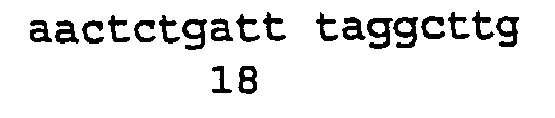
- PIT-1MGB FAM probe: 5'-AACTCTGATTTAGGCTTG-3' (for allele A) (SEQ ID No: 17); and
- PIT-1MGB VIC probe: 5'-AACTCTGATTCAGGCTT-3' (for allele B) (SEQ ID No: 18).
- Clearly, the experimental conditions described in Examples 1 to 5 are provided solely by way of indication, and can be modified by the skilled person. This is particularly the case as regards the reagents and the temperature conditions used to carry out the amplification reactions, but also for the primer sequences. Knowing the position of the polymorphism that is to be detected, it is easy to determine other primers or probes that can be used to amplify the fragment concerned and identify the allele in question. Said primer determination can be made by reading the sequence surrounding the polymorphism site, if necessary using software of the GeneScan® type (Applied Biosystems).
- Further, other techniques can be used to determine polymorphism in the genes under consideration, such as techniques known as SSCP (single stranded conformation polymorphism), DGGE (denaturing gradient gel electrophoresis) and CFLP (cleavage fragment length polymorphism), which have been described, for example, by Sambrook et al. (Molecular Cloning - A Laboratory Manual, Third Edition - Cold Spring Harbor Laboratory Press).
- The invention also concerns a kit for identifying a genotype indicative of advantageous milk production traits in cattle, comprising oligonucleotides for amplifying a fragment comprising nucleotide 1178 of the Pit-1 gene, oligonucleotides for amplifying a fragment comprising nucleotide 5345 of the κ-casein gene, and the restriction enzyme Hinfl.
- As an example, such a kit can contain the following primers to amplify a fragment comprising nucleotide 1178 of the Pit-1 gene:
- 5'-AAACCATCATCTCCCTTCTT-3' (SEQ ID No: 7); and
- 5'-AATGTACAATGTGCCTTCTGAG-3' (SEQ ID No: 8);
- 5'-ATCATTTATGGCCATTCCACCAAAG-3' (SEQ ID No: 1) and
- 5'-GCCCATTTCGCCTTCTCTGTAACAGA-3' (SEQ ID No: 2).
- In a further aspect, the present invention concerns a kit for identifying a genotype indicative of advantageous milk production traits in cattle, comprising oligonucleotides for carrying out allele-specific amplification and/or detection of a fragment of the Pit-1 gene, and oligonucleotides for carrying out allele-specific amplification and/or detection of a fragment of the κ-casein gene.
- In a preferred implementation of such a kit, the following primers constitute the oligonucleotides for allele-specific amplification of a fragment of the Pit-1 gene:
- 5'-CAGAGAGAAAAACGGGTGAAGACAAGCATG-3' (SEQ ID No: 9); specific for allele B;
- 5'-CAGAGAGAAAAACGGGTGAAGACAAGCATA-3' (SEQ ID No: 10); and specific for allele A; and
- 5'-AGATAGAGGGAAAGATATAGTGAAAGGGACAG-3' (SEQ ID No: 11); as the reverse primer.
- In an alternative implementation of such a kit, the following primers constitute the oligonucleotides for allele-specific amplification of a fragment of the Pit-1 gene targeting exon 2:
- 5'-C TGC CAT CAC GCC ATA GTT C-3' (SEQ ID No: 12),
specific for allele C; - 5'- C TGC CAT CAC GCC ATA GTT T-3' (SEQ ID No: 13),
specific for allele T; and - 5'-CA ACA GGA CTT CAT TAT TCT GTT CCT CAT TAT TCT GTT CCT T -3' (SEQ ID No: 14) as the reverse primer.
- In a further implementation of a kit of the invention, the following primers and probes constitute the oligonucleotides for allele-specific detection of a fragment of a gene for κ-casein:
- Kappa F primer: CCGAAGCAGTAGAGAGCACTGTAG (SEQ ID No: 3);
- Kappa R primer: TCTCAGGTGGGCTCTCAATAACTT (SEQ ID No: 4);
- Kappa Vic probe: TACTCTAGAAGATTCTC (SEQ ID No: 5);
- Kappa Fam probe: TACTCTAGAAGCTTCTC (SEQ ID No: 6);
- PIT-1 F primer: CATTCGAGATGCTCCTTAGAAATAGTAA (SEQ ID No: 15);
- PIT-1R primer: GTTTTGTAACCGAAGGCAGAGAGA (SEQ ID No: 16);
- PIT-1MGB FAM probe: AACTCTGATTTAGGCTTG (for allele A) (SEQ ID No: 17); and
- PIT-1MGB VIC probe: AACTCTGATTCAGGCTT (for allele B) (SEQ ID No: 18).
- Clearly, the skilled person can use other nucleotide sequences, whether for amplifying fragments of the κ-casein and Pit-1 gene, or for their detection. Similarly, the skilled person will be able to modify the labeling of the probes used.
- The application also concerns a genetic marker for determining the milk or meat capacity cattle, characterized in that an adenine in position 195 of the Pit-1 gene is characteristic of good milk production and a guanine in position 195 of the Pit-1 gene is characteristic of good meat production.
- The following examples and figures provide non-limiting illustrations and details of certain aspects of the present invention.
-
-
Figure 1 shows the results of allele-specific amplification of exon 6 of the Pit-1 gene, from genomic DNA of an AA homozygous animal (sample 1), a BB homozygous animal (sample 2) and an AB heterozygous animal (sample 3). -
Figure 2 shows the primers used to carry out allele-specific amplification applied toexon 2 of the Pit-1 gene. The gene sequence is shown in italics. -
Figure 3 shows the result of allele-specific amplification ofexon 2 of the Pit-1 gene from genomic DNA of a CC homozygous animal (sample 1), a TT homozygous animal (sample 2) and a CT heterozygous animal (sample 3). - The reaction mixture was composed of H2O, 10x buffer, 2 mM of MgCl2, 20 pmol of primers, 0.2 mM of dNTPs, 100 ng/25µl of DNA and 0.6U/25µl of polymerase [Goldstar DNA Polymerase, EUROGENTEC]. The PCR reaction cycle was constituted by a first 3 minutes denaturing phase at 96°C followed by 40 cycles of 1 minute at 94°C, 1 minute at 66°C and 1 minute at 72°C. The terminal extension phase was carried out at 72°C for 10 minutes.
- The PCR product was then incubated with 20U of the Hinfl enzyme for 2 hours at 37°C. Following incubation, 2 µl of STOP solution (50% glycerol, 20 mM of EDTA, 0.25% of bromophenol blue) was added and the mixture was separated by 2% agarose gel electrophoresis.
Primers: 5'-ATCATTTATGGCCATTCCACCAAAG-3' 5'-GCCCATTTCGCCTTCTCTGTAACAGA-3'. - The allele arbitrarily designated "A" in the scientific literature was cut by the Hinfl enzyme and the "B" allele was not digested by the Hinfl enzyme.
- The reaction mixture was composed of Taq Man Universal PCR master mix (Applied Biosystems Inc) in the presence of primers and probes:
Kappa F primer 2.5 µl Kappa R primer 900 nM Fam Kappa probe 200 nM Vic Kappa probe 200 nM - Amplification was measured in real time using an Applied Biosystems model 7900 HT apparatus.
- The PCR reaction cycle was constituted by a first phase of one cycle at 50°C for 2 minutes followed by 1 cycle of 10 min at 95°C followed by 40 cycles of 15 seconds at 95°C and 1 minute at 60°C.
- The results were read automatically by the apparatus.
- Primers used:
- F primer: CCGAAGCAGTAGAGAGCACTGTAG (SEQ ID No: 3); and
- R primer: TCTCAGGTGGGCTCTCAATAACTT (SEQ ID No: 4);
- Probes:
- Vic probe: TACTCTAGAAGATTCTC (SEQ ID No: 5); and
- Fam probe: TACTCTAGAAGCTTCTC (SEQ ID No: 6).
- The allele arbitrarily named A in the literature was that with nucleotide A in position 5345 and allele B was that with nucleotide C in position 5345.
- Polymorphism of the Pit-1 gene at nucleotide 1178 was analyzed using the following primers:
- 5'-AAACCATCATCTCCCTTCTT-3' (SEQ ID No: 7); and
- 5'-AATGTACAATGTGCCTTCTGAG-3' (SEQ ID No: 8)
- PCR amplification was carried out under conditions substantially identical to those described in Example 1.
- The product of that amplification was a fragment with 451 base pairs. Incubation of that fragment with the restriction enzyme Hinf1 enabled two alleles to be distinguished: allele A was not cut by Hinf1 and allele B comprises a Hinf1 restriction site, which generates two fragments with 244 and 207 base pairs.
- This method is based on the use, for PCR, of two primers for which the nucleotide located at the terminal 3' position are different. This difference is responsible for the specificity of the primers as regards one of the two alleles of the gene. This method thus uses specific primers for each allele, and does not require the use of a restriction enzyme.
- Amplification reactions were carried out in a solution of H2O, 10x buffer, 3 mM MgCl2, 20 p mole/50 µl of specific primer (A or B), 400 µm dNTP, 100 ng/50 µl of DNA, and 1.2 U/50 µl of polymerase [Goldstar DNA polymerase, EUROGENTEC]. The PCR reaction comprised a first denaturing step carried out at 96°C for 3 minutes, followed by about 35 cycles of 1 minute at 95°C, 1 minute at 65.2°C and 1 minute at 72°C. The final step was carried out at 72°C for 10 minutes.
- The primers used in this method were as follows:
- 5'-CAGAGAGAAAAACGGGTGAAGACAAGCATG-3' (SEQ ID No: 9); specific for allele B;
- 5'-CAGAGAGAAAAACGGGTGAAGACAAGCATA-3' (SEQ ID No: 10); and specific for allele A; and
- 5'-AGATAGAGGGAAAGATATAGTGAAAGGGACAG-3' (SEQ ID No: 11); as the reverse primer.
- After the amplification reaction, the products obtained were revealed on agarose gel, as shown in
Figure 1 . In this experiment, each sample was brought into the presence of either primer A or primer B. The PCR amplified 320 bp fragment was either present alone in tube A (the animal was thus of genotype AA) or only present in tube B (the animal was thus a BB homozygote) or it was present in both tubes (the animal was AB heterozygous). - A second polymorphous site was determined using single strand conformational polymorphism (SSCP) at the Pit-1 gene. Sequencing of the polymorphous part of the gene allowed the responsible mutation to be identified. It was an A→G transition at codon 65 of the serine in the protein transactivation region. The amino acid was not modified by this mutation. The two alleles which resulted from this mutation caused the existence of three polymorphous profiles in SSCP.
- A study of this point mutation on the sample of Holstein cattle necessitated the development of a rapid analytical method that was easy to carry out, which is not the case with the SSCP method.
- An allele-specific PCR reaction was thus developed to study this mutation. One of the primers, Pit C, was specific for allele C. The other, Pit T, was specific to allele T. The Pit R allele was used as the reverse primer. To increase the specificity of the reaction, a supplemental mutation was introduced at the third base upstream of the 3'-OH end of the two specific primers (
Figure 2 ). - Pit-C: 5'-C TGC CAT CAC GCC ATA GTT C-3' (SEQ ID No: 12);
- Pit-T: 5'- C TGC CAT GAG GCC ATA GTT T-3' (SEQ ID No: 13); and
- Pit-R: 5'-CA ACA GGA CTT CAT TAT TCT GTT CCT CAT TAT TCT GTT CCT T -3' (SEQ ID No: 14).
- The genotype for the gene for κ-casein was determined for a sample of 1100 Holstein bulls at the point mutation at nucleotide 5345 by Alexander et al., 1988, who differentiated variant B from variant A. The frequency of genotypes AA, AB and BB were as follows: 75%, 23% and 2% respectively, which corresponds to 86.5% of allele A and 13.5% of allele B. They follow the Hardy-Weinberg law. These frequencies are similar to those obtained by Van Eenennaam and Medrano (1991) from 1152 Holstein cows (82% A and 18% B) and by Ron et al., (1994) from 119 Holstein bulls (78.6% AA, 20.5% AB and 0.9% BB).
- The table below (Table 1) shows the results of a statistical study of the association between the polymorphism of the κ-casein gene and milk production traits obtained in the same study, compared with those obtained by Van Eenennaam et al., (1991) and Ron et al., (1994).
TABLE 1: Comparative table summarizing results obtained on sample of 1100 Holstein Semex Alliance bulls (Canada and by Van Eenennaam et al. (1991), Ron et al. (1994). α: effect on production traits of substitution of allele B by allele A in the κ-casein gene. Van Eenennaam Ron et al., 1100 Holstein et al., (1991) (1994) bulls Production characters α α α Milk, kg -146.0 -139.3 -72.2 Fat, kg -2.0 -0.28 -4.2 Proteins, kg -7.0 -2.21 -2.5 Fat, % -0.044 -0.044 -0.02 Proteins, % -0.022 -0.022 -0.001 - In the three studies, allele B had a positive effect on the milk yields, fat and proteins produced without modifying the percentages of fat and proteins. A comparison of the amplitude of the effects shows that overall, these can be considered to be similar. The observed differences can be due to the sample used, the statistical model used and/or the sample.
- The effects of allele substitution in the different genes studied were calculated from a total of 2397037 lactations of 1094443 daughters of 1100 Canadian Holstein bulls. The official lactation data originate from the "Canadian Dairy Network". Table 2 shows the mean values, standard deviations, maxima and minima calculated for the quantities of milk, fat and proteins produced on the basis of 305 days lactation. The relatively high standard deviations and the relatively broad minimum-maximum range show the diversity of this sample in terms of milk production performance. These values are characteristic of a non-selected sample comprising high performance cattle and others that are less so.
TABLE 2: Mean values, standard deviations, minima and maxima calculated for different production parameters from descendants from 110 Holstein (Semex) bulls calculated on the basis of 305 lactation days. Production Mean Standard Minimum Maximum character (kg) deviation Milk 8110.9 1778.1 1049.0 22135.0 Fat 300.7 68.3 37.0 971.0 Proteins 261.1 55.6 32.0 705.0 - The allele probabilities were introduced into a simplified version of a Canadian animal model:

- In which :
- y = vector for 305 days lactation production (milk, fat or proteins);
- h = vector for fixed herd-year-season (October to February and March to September) - parity (first or higher) effects;
- t = vector for fixed lactation (1 to 6 or more) - age classes - month of lactation effects;
- r = vector for 2 regression coefficients on transformed allele probabilities;
- p = vector for random permanent environmental effects;
- a = vector for random polygenic effects;
- e = vector for random residual effects;
- X, T, Z and Z* = incidence matrices linking h, t, p and a to y; and
- Q = 2-column regression variable matrix, 1 column for each allele probability (Pit-1, K-casein).
- The components for the variance used are those used in Canada. They were a heritability of 0.33 and a repeatability of 0.54. The equations were solved using a "preconditioned conjugate gradient" as convergence was very slow. More than 300 iterations were typically necessary.
- The difference between the two coefficients was proportional to 2 x the allele substitution effect. This was obtained by a calculation using an arcsine transformation of the regression variables. The results for the fat and protein percentages were obtained indirectly using means of population:

in which: -
L = mean of milk in the population; - ΔL = effect on milk;
-
C %= m ean of milk component percentage (fat or protein); - ΔC = effect on component (quantity);
- ΔC% = effect on component (percent).
- Table 3 shows the estimated additive effects on milk production traits for 110 Canadian Holstein bulls.
TABLE 3: Estimated additive effects on milk production traits for 1100 Canadian Holstein bulls. α1 : effect on production traits of substitution of allele B by allele A of the Pit-1 gene. α2: effect on production traits of substitution of allele B by allele A of the κ-casein gene. α3: effect on production traits of substitution of allele B by allele A of the Pit-1 gene and of substitution of allele A by allele B of the κ-casein gene. Pit-1
(exon 6)κ-casein AAPit-1BB κ-casein - BBPit-1AA κ-casein Production characters α1 α2 α3 Milk, kg 46.3 -72.2 237 Fat, kg 1.5 -4.2 11.4 Proteins, kg 1.9 -2.5 8.8 Fat, % -0.0002 -0.02 - Proteins, % 0.004 -0.001 - - A selection of the best alleles of the Pit-1 (allele A) and κ-casein (allele B) genes could thus lead to a substantial increase in milk quantities, fat and milk proteins, without modifying the percentages of proteins and fat in milk.
- The animal model and the statistical model were identical to those described in the preceding example.
Table 4 summarizes the observed results:TABLE 4: Estimated additive effects on milk production traits for 1100 Canadian Holstein bulls. α1 : effect on production traits of substitution of allele C by allele T of the Pit-1 gene. α2: effect on production traits of substitution of allele B by allele A of the κ-casein gene. α3: effect on production traits of substitution of allele C by allele T of the Pit-1 gene and of substitution of allele A by allele B of the κ-casein gene. Pit-1
(exon 2)K-casein TTPit-1BSκ-casein - versus CCPit-1AAκ-casein Production characters α1 α2 α3 Milk, kg 17.11 -21.41 77.04 Fat, kg 1.57 -1.21 5.56 Proteins, kg 1.18 -0.14 2.64 Fat, % 0.015 -0.01 - Proteins, % 0.011 -0.001 - - It can be seen that using allele T from the Pit-1 gene and allele B from the kappa-casein gene simultaneously in accordance with the invention results in a substantial increase in milk, fat and milk protein quantities without modifying the percentage of proteins and fat in the milk.
-
- (1) Alexander et al. (1988) Eur. J. Biochem., 178 (2), 395-401. Accession number: X14908, X14326
- (2) Bovenhuis S., Van Arendonk J., Korver S. (1992). Association between milk protein polymorph isms and milk traits. J. Dairy Sci., 75 : 2549-2559.
- (3) Chilliard et al, Biotechnology in Animal Husbandry, Renaville R. & Burny A. (eds), Kluwer academic publishing, pages 65-97 May 2001.
- (4) Formaggioni et al. (1999) Milk protein polymorphism: detection and diffusion of the genetic variants in bos genus. Annali della Facolta di Medicina Veterinaria Vol. XIX
- (5) Mao I., Buttanozzi L.G., Aleandri R. (1992). Effects of polymorphic milk protein genes on milk yield and composition traits in Holstein cattle. Acta Agric. Scand., Sect. A, Animal Sci., 42: 1-7.
- (6) Martinet et Houdebine (1993) Biologie de la lactation Editions Inserm, Inra Editions 587 pages.
- (7) Ron M., Yoffe O., Ezra E., Medrano J.F., Weller (1994). Determination of effects of milk protein genotype on production traits of Israeli Holsteins. J. Dairy Sci., 77:1106-1113.
- (8) Sambrook et al. (Molecular Cloning - A laboratory manual. Third Edition - Cold Spring Harbor Laboratory Press.
- (9) Van Eenennaam A., Medrano J.F. (1991). Milk protein polymorphisms in California dairy cattle. J. Dairy Sci., 74: 1730- 1742.
- (10)
EP 96 401 634.9, filed on 22nd July 1996 -
- <110> ARYSTA LIFESCIENCE CORPORATION
PATRIMOINE DE LA FACULTE UNIVERSITAIRE DES SCIENCES AGRONOMIQUES DE GEMBLOUX - <120> METHOD FOR IDENTIFYING ANIMALS LIKELY TO HAVE GOOD MILK PRODUCTION QUALITIES BY ANALYZING THE POLYMORPHISM OF THE PIT-1 AND KAPPA-CASEIN GENES
- <130> B5163A - AD/VMA/VG
- <140> New International Patent Application
<141> 2003-03-11 - <150>
FR 0203026 <151> 2002-03-11 - <160> 20
- <170> PatentIn version 3.1
- <210> 1
<211> 25
<212> DNA
<213> PRIMER - <400> 1

- <210> 2
<211> 26
<212> DNA
<213> PRIMER - <400> 2

- <210> 3
<211> 24
<212> DNA
<213> PRIMER - <400> 3

- <210> 4
<211> 24
<212> DNA
<213> PRIMER - <400> 4

- <210> 5
<211> 17
<212> DNA
<213> PROBE - <400> 5

- <210> 6
<211> 17
<212> DNA
<213> PROBE - <400> 6

- <210> 7
<211> 20
<212> DNA
<213> PRIMER - <400> 7

- <210> 8
<211> 22
<212> DNA
<213> PRIMER - <400> 8

- <210> 9
<211> 30
<212> DNA
<213> PRIMER - <400> 9

- <210> 10
<211> 30
<212> DNA
<213> PRIMER - <400> 10

- <210> 11
<211> 32
<212> DNA
<213> PRIMER - <400> 11

- <210> 12
<211> 20
<212> DNA
<213> PRIMER - <220>
<221> misc_feature
<222> (1)..(20)
<223>FIGURE 2 - <400> 12

- <210> 13
<211> 20
<212> DNA
<213> PRIMER - <220>
<221> misc_feature
<222> (1)..(20)
<223>FIGURE 2 - <400> 13

- <210> 14
<211> 42
<212> DNA
<213> PRIMER - <220>
<221> misc_feature
<222> (1)..(42)
<223>FIGURE 2 - <400> 14

- <210> 15
<211> 28
<212> DNA
<213> PRIMER - <400> 15

- <210> 16
<211> 24
<212> DNA
<213> PRIMER - <400> 16

- <210> 17
<211> 18
<212> DNA
<213> PROBE - <400> 17
- <210> 18
<211> 17
<212> DNA
<213> PROBE - <400> 18

- <210> 19
<211> 57
<212> DNA
<213> GENOMIC DNA - <220>
<221> misc_feature
<222> (1)..(57)
<223>FIGURE 2 - <400> 19

- <210> 20
<211> 54
<212> DNA
<213> GENOMIC DNA - <220>
<221> misc_feature
<222> (1)..(54)
<223>FIGURE 2 - <400> 20

Claims (20)
- A method for identifying a bovine having a genotype that is indicative of advantageous milk production traits, comprising analyzing in a biological sample from said bovine the polymorphism of the Pit-1 and κ-casein genes of said bovine, in which the simultaneous presence of allele A and/or T of the Pit-1 gene and allele B of the κ-casein gene is indicative of high potential for milk production and protein production in said bovine,
said allele A of the Pit-1 gene being characterized by the presence of adenine at position 1178 of the Pit-1 gene,
said allele T of the Pit-1 gene being characterized by the presence of guanine at position 195 of the Pit-1 gene,
said allele B of the κ-casein gene being characterized by the presence of cytosine at position 5345 of the κ-casein gene. - An identification method according to claim 1, in which the presence of allele B of the κ-casein is also indicative of a lactodynamographic, milk quality that is favourable to cheese production.
- An identification method according to claim 1 or 2, in which said biological sample comprises hair follicle cell DNA of said bovine.
- An identification method according to any one of claims 1 to 3, in which said polymorphism analysis is carried out for the κ-casein gene by restriction fragment length polymorphism (RFLP), by amplifying a fragment comprising nucleotide 5345 of the κ-casein gene and by digesting the product of said amplification with the restriction enzyme Hinfl.
- An identification method according to claim 4, in which the κ-casein gene fragment comprising nucleotide 5345 is amplified with the following primers:5'-ATCATTTATGGCCATTCCACCAAAG-3' (SEQ ID No: 1) and5'-GCCCATTTCGCCTTCTCTGTAACAGA-3' (SEQ ID No: 2).
- An identification method according to any one of claims 1 to 3, in which said polymorphism analysis is implemented for the κ-casein gene by allele-specific amplification and/or detection.
- An identification method according to claim 6, in which allele-specific amplification of the κ-casein gene is carried out using the following primers:CCGAAGCAGTAGAGAGCACTGTAG (SEQ ID No: 3);TCTCAGGTGGGCTCTCAATAACTT (SEQ ID No: 4);And the following probes:Vic: TACTCTAGAAGATTCTC (SEQ ID No: 5);Fam: TACTCTAGAAGCTTCTC (SEQ ID No: 6).
- An identification method according to any one of claims 1 to 7, in which said polymorphism analysis is carried out for the Pit-1 gene by restriction fragment polymorphism analysis (RFLP), by amplifying a fragment comprising nucleotide 1178 of the Pit-1 gene and digesting the product of said amplification with the restriction enzyme HinfI.
- An identification method according to claim 8, in which the Pit-1 gene fragment comprising nucleotide 1178 is amplified with the following primers:5'-AAACCATCATCTCCCTTCTT-3' (SEQ ID No: 7);5'-AATGTACAATGTGCCTTCTGAG-3' (SEQ ID No: 8).
- An identification method according to any one of claims 1 to 7, in which said polymorphism analysis is carried out for the Pit-1 gene by allele-specific amplification and/or detection.
- An identification method according to claim 10, in which allele-specific amplification of the Pit-1 gene is carried out at exon 6, using the following primers:5'-CAGAGAGAAAAACGGGTGAAGACAAGCATG-3' (SEQ ID No: 9);
specific for allele B;5'-CAGAGAGAAAAACGGGTGAAGACAAGCATA-3' (SEQ ID No: 10); and
specific for allele A; and5'-AGATAGAGGGAAAGATATAGTGAAAGGGACAG-3' (SEQ ID No: 11);
as the reverse primer. - An identification method according to claim 10, in which allele-specific amplification of the Pit-1 gene is carried out at exon 2 using the following primers:5'-C TGC CAT CAC GCC ATA GTT C-3' (SEQ ID No: 12), specific for allele C;5'- C TGC CAT CAC GCC ATA GTT T-3' (SEQ ID No: 13), specific for allele T; and5'-CA ACA GGA CTT CAT TAT TCT GTT CCT CAT TAT TCT GTT CCT T -3' (SEQ ID No: 14) as the reverse primer.
- An identification method according to claim 10, in which allele-specific amplification of the Pit-1 gene is carried out at exon 6 using the following primers:PIT-1 F primer: CATTCGAGATGCTCCTTAGAAATAGTAA (SEQ ID No: 15);PIT-1R primer: GTTTTGTAACCGAAGGCAGAGAGA (SEQ ID No: 16);PIT-1MGB FAM probe: AACTCTGATTTAGGCTTG (for allele A) (SEQ ID No: 17); andPIT-1MGB VIC probe: AACTCTGATTCAGGCTT (for allele B) (SEQ ID No: 18).
- A kit for identifying a genotype indicative of advantageous milk production traits in cattle, comprising oligonucleotides for amplifying a fragment comprising nucleotide 1178 of the Pit-1 gene, oligonucleotides for amplifying a fragment comprising nucleotide 5345 of the κ-casein gene, and the restriction enzyme HinfI.
- A kit according to claim 14, in which the oligonucleotides for amplifying a fragment comprising nucleotide 1178 of the Pit-1 gene are constituted by the following primers:5'-AAACCATCATCTCCCTTCTT-3' (SEQ ID No: 7); and5'-AATGTACAATGTGCCTTCTGAG-3' (SEQ ID No: 8);and the oligonucleotides for amplifying a fragment comprising nucleotide 5345 of the κ-casein gene are constituted by the following primers:5'-ATCATTTATGGCCATTCCACCAAAG-3' (SEQ ID No: 1) and5'-GCCCATTTCGCCTTCTCTGTAACAGA-3' (SEQ ID No: 2).
- A kit for identifying a genotype indicative of advantageous milk production traits in cattle, comprising oligonucleotides for carrying out allele-specific amplification and/or detection of a fragment of the Pit-1 gene, and oligonucleotides for carrying out allele-specific amplification and/or detection of a fragment of the κ-casein gene.
- A kit according to claim 16, in which the oligonucleotides for allele-specific amplification of a fragment of the Pit-1 gene are the following primers:5'-CAGAGAGAAAAACGGGTGAAGACAAGCATG-3' (SEQ ID No: 9); specific for allele B;5'-CAGAGAGAAAAACGGGTGAAGACAAGCATA-3' (SEQ ID No: 10); specific for allele A; and5'-AGATAGAGGGAAAGATATAGTGAAAGGGACAG-3' (SEQ ID No: 11);
as the reverse primer. - A kit according to claim 16, in which the oligonucleotides for allele-specific amplification of a fragment of the Pit-1 gene are the following primers:5'-C TGC CAT CAC GCC ATA GTT C-3' (SEQ ID No: 12), specific for allele C;5'- C TGC CAT CAC GCC ATA GTT T-3' (SEQ ID No: 13), specific for allele T; and5'-CA ACA GGA CTT CAT TAT TCT GTT CCT CAT TAT TCT GTT CCT T -3' (SEQ ID No: 14) as the reverse primer.
- A kit according to claim 16, in which the oligonucleotides for allele-specific detection of a fragment of the Pit-1 gene are the following primers:PIT-1 F primer: CATTCGAGATGCTCCTTAGAAATAGTAA (SEQ ID No: 15);PIT-1R primer: GTTTTGTAACCGAAGGCAGAGAGA (SEQ ID No: 16);and the following probes:PIT-1MGB FAM probe: AACTCTGATTTAGGCTTG (for allele A) (SEQ ID No: 17); andPIT-1MGB VIC probe: AACTCTGATTCAGGCTT (for allele B) (SEQ ID No: 18).
- A kit according to claim 16, in which the oligonucleotides for allele-specific detection of a fragment of the κ-casein gene are the following primers:CCGAAGCAGTAGAGAGCACTGTAG (SEQ ID No: 3);TCTCAGGTGGGCTCTCAATAACTT (SEQ ID No: 4);and the following probes:Vic: TACTCTAGAAGATTCTC (SEQ ID No: 5);Fam: TACTCTAGAAGCTTCTC (SEQ ID No: 6).
Applications Claiming Priority (3)
| Application Number | Priority Date | Filing Date | Title |
|---|---|---|---|
| FR0203026A FR2836928B1 (en) | 2002-03-11 | 2002-03-11 | METHOD FOR IDENTIFYING ANIMALS LIKELY TO HAVE GOOD MILK PRODUCTION QUALITIES, BY ANALYSIS OF THE POLYMORPHISM OF THE PIT-1 AND KAPPA-CASEIN GENES |
| FR0203026 | 2002-03-11 | ||
| PCT/EP2003/002879 WO2003076657A2 (en) | 2002-03-11 | 2003-03-11 | Method for identifying animals for milk production qualities by analyzing the polymorphism of the pit-1 and kappa-casein genes |
Publications (2)
| Publication Number | Publication Date |
|---|---|
| EP1485506A2 EP1485506A2 (en) | 2004-12-15 |
| EP1485506B1 true EP1485506B1 (en) | 2009-07-08 |
Family
ID=27763708
Family Applications (1)
| Application Number | Title | Priority Date | Filing Date |
|---|---|---|---|
| EP03743886A Expired - Lifetime EP1485506B1 (en) | 2002-03-11 | 2003-03-11 | Method for identifying animals for milk production qualities by analyzing the polymorphism of the pit-1 and kappa-casein genes |
Country Status (10)
| Country | Link |
|---|---|
| EP (1) | EP1485506B1 (en) |
| JP (1) | JP2005519609A (en) |
| AT (1) | ATE435924T1 (en) |
| AU (1) | AU2003226666B8 (en) |
| CA (1) | CA2479006A1 (en) |
| DE (1) | DE60328268D1 (en) |
| FR (1) | FR2836928B1 (en) |
| NZ (1) | NZ535857A (en) |
| WO (1) | WO2003076657A2 (en) |
| ZA (1) | ZA200408197B (en) |
Families Citing this family (1)
| Publication number | Priority date | Publication date | Assignee | Title |
|---|---|---|---|---|
| EP1590471A4 (en) | 2002-12-31 | 2009-12-09 | Metamorphix Inc | Compositions, methods and systems for inferring bovine traits |
Family Cites Families (2)
| Publication number | Priority date | Publication date | Assignee | Title |
|---|---|---|---|---|
| US5614364A (en) * | 1994-05-16 | 1997-03-25 | Iowa State University Research Foundation, Inc. | Genetic marker for improved milk production traits in cattle |
| EP0821070A1 (en) * | 1996-07-22 | 1998-01-28 | Carelli, Claude Marcel Henri | Pit-1 gene polymorphism and trait selection in animals |
-
2002
- 2002-03-11 FR FR0203026A patent/FR2836928B1/en not_active Expired - Fee Related
-
2003
- 2003-03-11 AT AT03743886T patent/ATE435924T1/en not_active IP Right Cessation
- 2003-03-11 WO PCT/EP2003/002879 patent/WO2003076657A2/en not_active Ceased
- 2003-03-11 AU AU2003226666A patent/AU2003226666B8/en not_active Ceased
- 2003-03-11 EP EP03743886A patent/EP1485506B1/en not_active Expired - Lifetime
- 2003-03-11 JP JP2003574854A patent/JP2005519609A/en active Pending
- 2003-03-11 CA CA002479006A patent/CA2479006A1/en not_active Abandoned
- 2003-03-11 NZ NZ535857A patent/NZ535857A/en not_active IP Right Cessation
- 2003-03-11 DE DE60328268T patent/DE60328268D1/en not_active Expired - Fee Related
-
2004
- 2004-10-11 ZA ZA200408197A patent/ZA200408197B/en unknown
Also Published As
| Publication number | Publication date |
|---|---|
| CA2479006A1 (en) | 2003-09-18 |
| DE60328268D1 (en) | 2009-08-20 |
| EP1485506A2 (en) | 2004-12-15 |
| AU2003226666B8 (en) | 2008-05-29 |
| FR2836928B1 (en) | 2004-12-03 |
| ZA200408197B (en) | 2006-02-22 |
| AU2003226666A1 (en) | 2003-09-22 |
| ATE435924T1 (en) | 2009-07-15 |
| WO2003076657A2 (en) | 2003-09-18 |
| NZ535857A (en) | 2006-01-27 |
| AU2003226666B2 (en) | 2008-05-15 |
| FR2836928A1 (en) | 2003-09-12 |
| WO2003076657A3 (en) | 2004-02-12 |
| WO2003076657A8 (en) | 2004-07-08 |
| JP2005519609A (en) | 2005-07-07 |
Similar Documents
| Publication | Publication Date | Title |
|---|---|---|
| Yao et al. | Sequence variations in the bovine growth hormone gene characterized by single-strand conformation polymorphism (SSCP) analysis and their association with milk production traits in Holsteins | |
| CA2261157C (en) | Pit-1 gene polymorphism and trait selection in animals | |
| CN117051128B (en) | NARS2 gene molecular marker related to pork quality traits and application thereof | |
| US20040018511A1 (en) | Quantitative trait loci and somatostatin | |
| Lindersson et al. | Mapping of serum amylase-1 and quantitative trait loci for milk production traits to cattle chromosome 4 | |
| KR20000067924A (en) | Prolactin receptor gene as a genetic marker for increased litter size in pigs | |
| CN116590433B (en) | Molecular marker, primer, kit, identification method and application of reproductive performance of large white sow | |
| CA2113957A1 (en) | Nucleotide sequences for bovine sex determination | |
| US20050136440A1 (en) | Method for identifying animals for milk production qualities by analysing the polymorphism of the Pit-1 and kappa-casein genes | |
| Kale et al. | FASN gene and its role in bovine milk production | |
| JP5560503B2 (en) | Genetic mutations related to the growth of Japanese black hair | |
| KR101438524B1 (en) | DNA marker for detecting increase of porcine meat quality using a SNP in porcine MYF5 gene | |
| US6458531B1 (en) | Leptin receptor gene as a genetic marker for leanness in pigs | |
| WO1997023644A1 (en) | The pig myogenin gene and method to identify polymorphisms related to muscle growth | |
| EP2368429A1 (en) | Obtention of a Rex animal by molecular methods based on the alteration of the liph function | |
| AU2003226666B8 (en) | Method for identifying animals for milk production qualities by analyzing the polymorphism of the Pit-1 and kappa-casein genes | |
| AU770379B2 (en) | Retinol binding protein 4 as a genetic marker for increased litter size | |
| US8124344B2 (en) | Method of determining an amount of fatty acid contents in bovine intramuscular fat on the basis of genotype of fatty acid synthase gene and method of determining goodness of eating quality of beef on the basis of the results thereof | |
| JP4776037B2 (en) | A method for assessing fat accumulation capacity in porcine muscle from genetic information | |
| Jang et al. | Association of candidate genes with production traits in Korean dairy proven and young bulls | |
| US20080010696A1 (en) | Method of Determining Gene Relating to Favorable Beef Taste and Texture | |
| US20060211774A1 (en) | Method of diagnosins a genetic susceptibility for bone damage | |
| Hartati et al. | Identification of growth hormone receptor (GHR| AluI) gene polymorphism in grati-madura cattle and pamekasan-madura cattle population | |
| CN116042844B (en) | SNP molecular markers affecting pig growth traits and their application | |
| WO2007068936A2 (en) | Diagnostic method |
Legal Events
| Date | Code | Title | Description |
|---|---|---|---|
| PUAI | Public reference made under article 153(3) epc to a published international application that has entered the european phase |
Free format text: ORIGINAL CODE: 0009012 |
|
| 17P | Request for examination filed |
Effective date: 20041008 |
|
| AK | Designated contracting states |
Kind code of ref document: A2 Designated state(s): AT BE BG CH CY CZ DE DK EE ES FI FR GB GR HU IE IT LI LU MC NL PT RO SE SI SK TR |
|
| AX | Request for extension of the european patent |
Extension state: AL LT LV MK |
|
| RAP1 | Party data changed (applicant data changed or rights of an application transferred) |
Owner name: PATRIMOINE DE LA FACULTE UNIVERSITAIRE DES SCIENCE Owner name: ARYSTA LIFESCIENCE EUROPE |
|
| 17Q | First examination report despatched |
Effective date: 20071026 |
|
| GRAP | Despatch of communication of intention to grant a patent |
Free format text: ORIGINAL CODE: EPIDOSNIGR1 |
|
| GRAS | Grant fee paid |
Free format text: ORIGINAL CODE: EPIDOSNIGR3 |
|
| GRAA | (expected) grant |
Free format text: ORIGINAL CODE: 0009210 |
|
| AK | Designated contracting states |
Kind code of ref document: B1 Designated state(s): AT BE BG CH CY CZ DE DK EE ES FI FR GB GR HU IE IT LI LU MC NL PT RO SE SI SK TR |
|
| AX | Request for extension of the european patent |
Extension state: LT LV |
|
| REG | Reference to a national code |
Ref country code: GB Ref legal event code: FG4D |
|
| REG | Reference to a national code |
Ref country code: CH Ref legal event code: EP |
|
| REG | Reference to a national code |
Ref country code: IE Ref legal event code: FG4D |
|
| REF | Corresponds to: |
Ref document number: 60328268 Country of ref document: DE Date of ref document: 20090820 Kind code of ref document: P |
|
| PG25 | Lapsed in a contracting state [announced via postgrant information from national office to epo] |
Ref country code: SI Free format text: LAPSE BECAUSE OF FAILURE TO SUBMIT A TRANSLATION OF THE DESCRIPTION OR TO PAY THE FEE WITHIN THE PRESCRIBED TIME-LIMIT Effective date: 20090708 |
|
| NLV1 | Nl: lapsed or annulled due to failure to fulfill the requirements of art. 29p and 29m of the patents act | ||
| LTIE | Lt: invalidation of european patent or patent extension |
Effective date: 20090708 |
|
| PG25 | Lapsed in a contracting state [announced via postgrant information from national office to epo] |
Ref country code: FI Free format text: LAPSE BECAUSE OF FAILURE TO SUBMIT A TRANSLATION OF THE DESCRIPTION OR TO PAY THE FEE WITHIN THE PRESCRIBED TIME-LIMIT Effective date: 20090708 Ref country code: AT Free format text: LAPSE BECAUSE OF FAILURE TO SUBMIT A TRANSLATION OF THE DESCRIPTION OR TO PAY THE FEE WITHIN THE PRESCRIBED TIME-LIMIT Effective date: 20090708 Ref country code: ES Free format text: LAPSE BECAUSE OF FAILURE TO SUBMIT A TRANSLATION OF THE DESCRIPTION OR TO PAY THE FEE WITHIN THE PRESCRIBED TIME-LIMIT Effective date: 20091019 |
|
| PG25 | Lapsed in a contracting state [announced via postgrant information from national office to epo] |
Ref country code: NL Free format text: LAPSE BECAUSE OF FAILURE TO SUBMIT A TRANSLATION OF THE DESCRIPTION OR TO PAY THE FEE WITHIN THE PRESCRIBED TIME-LIMIT Effective date: 20090708 |
|
| PG25 | Lapsed in a contracting state [announced via postgrant information from national office to epo] |
Ref country code: PT Free format text: LAPSE BECAUSE OF FAILURE TO SUBMIT A TRANSLATION OF THE DESCRIPTION OR TO PAY THE FEE WITHIN THE PRESCRIBED TIME-LIMIT Effective date: 20091109 Ref country code: BG Free format text: LAPSE BECAUSE OF FAILURE TO SUBMIT A TRANSLATION OF THE DESCRIPTION OR TO PAY THE FEE WITHIN THE PRESCRIBED TIME-LIMIT Effective date: 20091008 |
|
| PG25 | Lapsed in a contracting state [announced via postgrant information from national office to epo] |
Ref country code: DK Free format text: LAPSE BECAUSE OF FAILURE TO SUBMIT A TRANSLATION OF THE DESCRIPTION OR TO PAY THE FEE WITHIN THE PRESCRIBED TIME-LIMIT Effective date: 20090708 Ref country code: EE Free format text: LAPSE BECAUSE OF FAILURE TO SUBMIT A TRANSLATION OF THE DESCRIPTION OR TO PAY THE FEE WITHIN THE PRESCRIBED TIME-LIMIT Effective date: 20090708 Ref country code: CZ Free format text: LAPSE BECAUSE OF FAILURE TO SUBMIT A TRANSLATION OF THE DESCRIPTION OR TO PAY THE FEE WITHIN THE PRESCRIBED TIME-LIMIT Effective date: 20090708 Ref country code: RO Free format text: LAPSE BECAUSE OF FAILURE TO SUBMIT A TRANSLATION OF THE DESCRIPTION OR TO PAY THE FEE WITHIN THE PRESCRIBED TIME-LIMIT Effective date: 20090708 |
|
| PLBE | No opposition filed within time limit |
Free format text: ORIGINAL CODE: 0009261 |
|
| STAA | Information on the status of an ep patent application or granted ep patent |
Free format text: STATUS: NO OPPOSITION FILED WITHIN TIME LIMIT |
|
| PG25 | Lapsed in a contracting state [announced via postgrant information from national office to epo] |
Ref country code: BE Free format text: LAPSE BECAUSE OF FAILURE TO SUBMIT A TRANSLATION OF THE DESCRIPTION OR TO PAY THE FEE WITHIN THE PRESCRIBED TIME-LIMIT Effective date: 20090708 Ref country code: SK Free format text: LAPSE BECAUSE OF FAILURE TO SUBMIT A TRANSLATION OF THE DESCRIPTION OR TO PAY THE FEE WITHIN THE PRESCRIBED TIME-LIMIT Effective date: 20090708 |
|
| 26N | No opposition filed |
Effective date: 20100409 |
|
| PG25 | Lapsed in a contracting state [announced via postgrant information from national office to epo] |
Ref country code: GR Free format text: LAPSE BECAUSE OF FAILURE TO SUBMIT A TRANSLATION OF THE DESCRIPTION OR TO PAY THE FEE WITHIN THE PRESCRIBED TIME-LIMIT Effective date: 20091009 Ref country code: MC Free format text: LAPSE BECAUSE OF NON-PAYMENT OF DUE FEES Effective date: 20100331 |
|
| REG | Reference to a national code |
Ref country code: CH Ref legal event code: PL |
|
| GBPC | Gb: european patent ceased through non-payment of renewal fee |
Effective date: 20100311 |
|
| REG | Reference to a national code |
Ref country code: FR Ref legal event code: ST Effective date: 20101130 |
|
| PG25 | Lapsed in a contracting state [announced via postgrant information from national office to epo] |
Ref country code: IE Free format text: LAPSE BECAUSE OF NON-PAYMENT OF DUE FEES Effective date: 20100311 Ref country code: FR Free format text: LAPSE BECAUSE OF NON-PAYMENT OF DUE FEES Effective date: 20100331 |
|
| PG25 | Lapsed in a contracting state [announced via postgrant information from national office to epo] |
Ref country code: CH Free format text: LAPSE BECAUSE OF NON-PAYMENT OF DUE FEES Effective date: 20100331 Ref country code: LI Free format text: LAPSE BECAUSE OF NON-PAYMENT OF DUE FEES Effective date: 20100331 Ref country code: DE Free format text: LAPSE BECAUSE OF NON-PAYMENT OF DUE FEES Effective date: 20101001 |
|
| PG25 | Lapsed in a contracting state [announced via postgrant information from national office to epo] |
Ref country code: IT Free format text: LAPSE BECAUSE OF FAILURE TO SUBMIT A TRANSLATION OF THE DESCRIPTION OR TO PAY THE FEE WITHIN THE PRESCRIBED TIME-LIMIT Effective date: 20090708 Ref country code: GB Free format text: LAPSE BECAUSE OF NON-PAYMENT OF DUE FEES Effective date: 20100311 |
|
| PG25 | Lapsed in a contracting state [announced via postgrant information from national office to epo] |
Ref country code: CY Free format text: LAPSE BECAUSE OF FAILURE TO SUBMIT A TRANSLATION OF THE DESCRIPTION OR TO PAY THE FEE WITHIN THE PRESCRIBED TIME-LIMIT Effective date: 20090708 |
|
| PG25 | Lapsed in a contracting state [announced via postgrant information from national office to epo] |
Ref country code: SE Free format text: LAPSE BECAUSE OF FAILURE TO SUBMIT A TRANSLATION OF THE DESCRIPTION OR TO PAY THE FEE WITHIN THE PRESCRIBED TIME-LIMIT Effective date: 20090708 Ref country code: HU Free format text: LAPSE BECAUSE OF FAILURE TO SUBMIT A TRANSLATION OF THE DESCRIPTION OR TO PAY THE FEE WITHIN THE PRESCRIBED TIME-LIMIT Effective date: 20100109 Ref country code: LU Free format text: LAPSE BECAUSE OF NON-PAYMENT OF DUE FEES Effective date: 20100311 |
|
| PG25 | Lapsed in a contracting state [announced via postgrant information from national office to epo] |
Ref country code: TR Free format text: LAPSE BECAUSE OF FAILURE TO SUBMIT A TRANSLATION OF THE DESCRIPTION OR TO PAY THE FEE WITHIN THE PRESCRIBED TIME-LIMIT Effective date: 20090708 |