EP1484927A2 - Method and apparatus for decoding compressed and encoded digital images - Google Patents
Method and apparatus for decoding compressed and encoded digital images Download PDFInfo
- Publication number
- EP1484927A2 EP1484927A2 EP04011733A EP04011733A EP1484927A2 EP 1484927 A2 EP1484927 A2 EP 1484927A2 EP 04011733 A EP04011733 A EP 04011733A EP 04011733 A EP04011733 A EP 04011733A EP 1484927 A2 EP1484927 A2 EP 1484927A2
- Authority
- EP
- European Patent Office
- Prior art keywords
- decoding
- digital
- image
- encoded
- sequence
- Prior art date
- Legal status (The legal status is an assumption and is not a legal conclusion. Google has not performed a legal analysis and makes no representation as to the accuracy of the status listed.)
- Granted
Links
Images






Classifications
-
- H—ELECTRICITY
- H04—ELECTRIC COMMUNICATION TECHNIQUE
- H04N—PICTORIAL COMMUNICATION, e.g. TELEVISION
- H04N19/00—Methods or arrangements for coding, decoding, compressing or decompressing digital video signals
- H04N19/60—Methods or arrangements for coding, decoding, compressing or decompressing digital video signals using transform coding
- H04N19/61—Methods or arrangements for coding, decoding, compressing or decompressing digital video signals using transform coding in combination with predictive coding
-
- H—ELECTRICITY
- H04—ELECTRIC COMMUNICATION TECHNIQUE
- H04N—PICTORIAL COMMUNICATION, e.g. TELEVISION
- H04N19/00—Methods or arrangements for coding, decoding, compressing or decompressing digital video signals
- H04N19/65—Methods or arrangements for coding, decoding, compressing or decompressing digital video signals using error resilience
- H04N19/68—Methods or arrangements for coding, decoding, compressing or decompressing digital video signals using error resilience involving the insertion of resynchronisation markers into the bitstream
-
- H—ELECTRICITY
- H04—ELECTRIC COMMUNICATION TECHNIQUE
- H04N—PICTORIAL COMMUNICATION, e.g. TELEVISION
- H04N19/00—Methods or arrangements for coding, decoding, compressing or decompressing digital video signals
- H04N19/65—Methods or arrangements for coding, decoding, compressing or decompressing digital video signals using error resilience
- H04N19/69—Methods or arrangements for coding, decoding, compressing or decompressing digital video signals using error resilience involving reversible variable length codes [RVLC]
-
- H—ELECTRICITY
- H04—ELECTRIC COMMUNICATION TECHNIQUE
- H04N—PICTORIAL COMMUNICATION, e.g. TELEVISION
- H04N19/00—Methods or arrangements for coding, decoding, compressing or decompressing digital video signals
- H04N19/85—Methods or arrangements for coding, decoding, compressing or decompressing digital video signals using pre-processing or post-processing specially adapted for video compression
- H04N19/89—Methods or arrangements for coding, decoding, compressing or decompressing digital video signals using pre-processing or post-processing specially adapted for video compression involving methods or arrangements for detection of transmission errors at the decoder
- H04N19/895—Methods or arrangements for coding, decoding, compressing or decompressing digital video signals using pre-processing or post-processing specially adapted for video compression involving methods or arrangements for detection of transmission errors at the decoder in combination with error concealment
Definitions
- the present invention relates to the decoding-decompression of data, particularly it relates to a method for the decoding-decompression of digital images.
- the compression-encoding algorithms make it possible to reduce the amount of memory required for storing individual images or video sequences. Such algorithms make it possible, besides, to reduce the band resources necessary for the transfer of the images between different devices or for the transmission thereof on telecommunications networks such as, for example, the Internet.
- a compression-encoding algorithm transforms a digital image, or a digital video sequence, into a compressed and encoded digital data sequence, for example in the form of a bit sequence.
- DCT Discrete Cosine Transform
- the transformation operation is followed by a subsequent processing such as to reduce the information content of a digital image or of the sequence of digital images, by operating directly within the spatial frequencies domain.
- the images are encoded according to known algorithms, through entropic encoding methods, commonly of the type including a variable length coding (VLC).
- VLC variable length coding
- Huffman coding is for example, a particular type of entropic variable length coding (VLC) that makes it possible to reduce the number of bits necessary to represent a data set without introducing any information loss.
- the thus compressed and encoded images, or video sequences are transferred in the form of a bit sequence in storing devices or they are remote transmitted, for example they are exchanged between multimedia communication terminals.
- the decoding-decompression process is aimed at the reconstruction of the digital images or video sequences from the compressed and encoded data sequence.
- the decoding-decompression process is used in applications that require the displaying on a screen of such digital images or such video sequences.
- bit sequence may be corrupted, i.e. altered, by errors.
- VLC variable length coding
- the object of the present invention is to provide a decoding-decompression method that is robust towards errors and that is able to supply better performances than prior decoding methods.
- a further object of the present invention is to provide a method for transferring digital images, as described in claims 17 to 20.
- a further object of the present invention is a multimedia communication apparatus as described in claim 21.
- the embodiment of the decoding-decompression method in accordance with the invention that will be described below will refer in a particular, but in a non-limiting way, to the decoding-decompression of a digital data sequence obtained from the compression-encoding of a video sequence in accordance with the MPEG-4 standard.
- teachings of the present invention are also applicable to the decoding-decompression of data sequences compressed-encoded by techniques different from the particular method of compression-coding (MPEG-4) to which reference is made in the present description.
- the decoding-decompression method according to the invention applicable to video sequence images, but it is also applicable to individual (or still) images. For example, it is applicable to individual images compressed-encoded according to the JPEG standard.
- the decoding-decompression method according to the present invention is, for example, advantageously usable in new generation multimedia communication terminals or apparatus for transmitting/receiving through a radio frequency signal, compressed-encoded individual images, or video sequences.
- the images and the video sequences are acquired/memorized/displayed and transmitted/received using devices and technologies of the known type and therefore evident to a man skilled in the art.
- a video sequence comprises a series of consecutively acquired images that must be viewed at a preset speed.
- the images of a video sequence may be compressed and encoded using three types of compression-encoding algorithms:
- a video sequence compressed-encoded according to the MPEG-4 standard may comprise images compressed and encoded with 1-type, P-type or B-type coding interleaved with one another.
- Figure 1 schematically represents a block diagram of a compression-encoding method Img Enc compliant to the MPEG-4 standard, for compressing-encoding a digital image sequence by an 1-type coding.
- the images are compressed-encoded irrespective of one another, we will consider the case in which the compression-encoding method Img Enc produces, starting from a digital image Img n pertaining to a video sequence Img 1 , Img 2 ,..., Img n-1 , Img n , Img n+1 a digital sequence Bit Stream compressed and encoded in accordance with the MPEG-4 standard.
- the compression-encoding method Img Enc comprises a first processing step TRANSF in order to produce, starting from the digital image Img n , a transform thereof in a bi-dimensional spatial frequencies domain.
- the transform used is the discrete cosine transform or DCT.
- the digital images at input to the processing step TRANSF are in YcrCb format.
- the transformation operation is independently performed on the three components Y, Cr and Cb.
- the chrominance components Cr, Cb are sub-sampled before being subject to the transformation step.
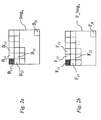
- TRANSF the image Img n is segmented, as shown in figure 2, in a plurality of pixel blocks B 11 , B 12 , ..., B jk , associated to adj acent and not overlapping regions of the image Img n .
- such blocks are square 8x8 pixel blocks.
- the transform in the bi-dimensional spatial frequency domain is performed on these blocks, in this specific example the DCT, in order to obtain a corresponding plurality of blocks F 11 , F 12 ,..., F jk of transform coefficients, shown schematically in figure 2b.
- the coefficients of a block are DCT coefficients and correspond to amplitudes of orthogonal waveforms that define the representation of the block in the bi-dimensional spatial frequencies domain DCT.
- the plurality of coefficient blocks F 11 ,F 12 ,..,F jk as a whole, constitutes a transform image F_Img n .
- the coefficients are digital values that, on the basis of a preset number of bits used for their digital representation, belong to a range [a,b] of possible digital values, in which "a" and "b” represent the extreme digital values of the range [a,b].
- the transformed coefficients are digital values, both positive and negative, represented on 12 bits, therefore pertaining to the range [-2048,2047].
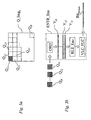
- the compression-coding method Img Enc comprises a subsequent quantization step QUANT for obtaining from the plurality of blocks F 11 ,F 12 ,..., F jk of coefficients a corresponding plurality of quantized coefficient blocks Q 11 , Q 12 ,..., Q jk (shown in figure 3a).
- the quantization step QUANT is such to perform the division, block by block, of every coefficient of the block by a corresponding integer coefficient, denominated quantization coefficient, contained in a suitable matrix, known with the name of quantization matrix.
- the quantization matrix may differ according to the component, that is the plane, of the image to be compressed. Besides, for blocks pertaining to a same plane, the quantization matrix is obtained by a multiplication step of a same initial quantization matrix for a suitable scalar coefficient, denominated quantization factor, which may differ from one block to another.
- Each coefficient, after the division operation, is then subject to an operation of rounding up to the subsequent integer.
- the quantization operation is such to reduce the precision used in the digital representation of the transform coefficients.
- the quantization factor By varying the quantization factor such precision is reduced to a greater or lesser extent.
- quantization makes equal to zero many block coefficients, above all those associated to higher spatial frequencies.
- the quantized transform coefficient blocks Q 11 , Q 12 ,..., Q jk are individually subject to an entropic encoding step ENTR_Enc.
- the entropic encoding phase ENTR_Enc includes a preliminary ordering step ORD of the quantized coefficients, which is performed block by block.
- the ordering step ORD makes it possible to generate from each block, or matrix, Q 11 ,Q 12 ,...,Q jk of quantized coefficients a respective vector V 11 , V 12 ,...,V jk of quantized coefficients, in which the coefficients are substantially ordered according to progressively increasing spatial frequencies.
- a plurality of vectors V 11 , V 12 ,..., V jk is produced in sequence, each one containing the quantized coefficients pertaining to a respective block Q 11 , Q 12 , ..., Q jk .
- ordering used in the MPEG-4 standard are the ordering according to a "zig-zag” scan of the block coefficients (as in the JPEG case) and the ordering according to a scan known to a man skilled in the art with the name of "alternating zig-zag”.
- the latter has two variants, indicated with “alternating horizontal zig-zag” and “alternating vertical zig-zag”.
- the ordering step has the object of ordering the quantized coefficients of a block so as to obtain a final sequence of coefficients equal to zero, in order to increase the efficiency of the subsequent encoding step.
- the coefficient ordering step ORD is followed by an intermediate encoding step RLE_Enc of the type known with the name of RLE (Run Length Encoding) or "run length", in which the quantized coefficient vectors V 11 ,V 12 ,..,V jk are processed individually.
- the final encoding step VLC_FLC includes a variable length coding operation or VLC. This operation is a reversible processing step for the encoding of data and is such to assign shorter code words to statistically more frequent symbols and longer code words to statistically less frequent symbols.
- VLC_FLC In the final encoding step VLC_FLC, as occurs in the example in the MPEG-4 standard, in addition to the variable length coding operation a fixed length coding operation FLC may be performed.
- the final coding step VLC_FLC performs a variable length coding operation for a subset of block symbols (constituted by the combination of a "run” and a "level") having a greater statistical frequency.
- the variable length coding operation for example, associates variable length code words to symbols having a greater statistical frequency, by using standard coding tables.
- the remaining symbols of the block i.e. those that are less probable, are encoded with fixed length code words, by using a fixed length coding operation, or FLC (Fixed Length Coding).
- FLC Fixed Length Coding
- the MPEG-4 standard provides, for less probable symbols, the use of a fixed length coding, known with the name of "ESCAPE coding".
- FIG. 3c The structure of a code word Cod_W that belongs to the output alphabet of an ESCAPE fixed length coding operation is schematically illustrated in figure 3c, in the case in which this word is destined to be decoded with a Reversible Variable Length Decoding (RVLD).
- RVLD Reversible Variable Length Decoding
- the first and the last field indicated with ESCAPE in this example composed by the sequence of bits 00001, serve to signal the start and end of the code word Cod_W.
- the second field is composed of one bit and serves to distinguish whether or not the code word is the last of the sequence.
- the third field, indicated with RUN, in the example is a 6-bit sequence that contains the RUN value of an encoded signal with a "run-length" coding.
- the LEVEL field contains the value ("level") of the quantized coefficient of the coded "run-length" symbol.
- the LEVEL field is constituted by 11 bits in the case in which reversible variable length coding (known by the abbreviation RLVD) is used, otherwise it is constituted by 12 bits.
- the encoded and compressed data resulting from the entropic coding step Entr_Enc are organised in groups, or partitions, of data. Each group comprises a respective plurality of encoded data structures.
- the encoded and compressed data sequence Bit stream are subdivided into data groups, or segments, known with the name of video packets VP 0n , VP 1n , VP 2n , etc.
- the compressed-encoded information relating to an image Img n is subdivided into a plurality of video packets VP 0n , VP 1n , VP 2n , etc.
- each video packet contains compressed and encoded information relating to a same image Img n and organised into a plurality of encoded data structures.
- each MPEG-4 video packet substantially comprises a restart marker RM 1n (or resync marker), followed by a heading VPH 1n and an encoded data field VPD 1n .
- a restart marker, or indicator, RM 1n is a particular bit sequence that makes it possible, in the decoding step, to recover synchronisation.
- a marker indicates the end of a data group and the start of a subsequent data group.
- a restart marker starts with a long series of zeroes (from 16 to 22), in a such way as to be, in a decoding step, easily identified and distinguished from bits pertaining to other fields, for example, a data field VPD 1n or a heading VPH 1n .
- a heading VPH 1n comprises a field MBN 1n that contains the number of the first encoded data structure, contained in the subsequent data field VPD 1n .
- This number is a progressive value representative of the position, inside the image Img n , of the first encoded data structure comprised in the packet VP 1n , in a scan order of the image Img n from left to right and from top to bottom.
- the encoded data structure is, in practice, a macroblock, whose description will be given in greater detail below.
- the field MBN 1n contains the number of the first macroblock contained in the field data VPD 1n of the video packet. This number corresponds to the position of such macroblock inside the image Img n , in a progressive scan order of the image macroblocks in a horizontal sense, from left to right and from top to bottom.
- the heading VPH 1n comprises a second field QP 1n that contains the value of the quantization parameter of the coefficients DCT encoded in the subsequent data field VPD 1n .
- a heading VPH 1n comprises a last field HEC 1n containing additional information.
- a data field VPD 1n comprises data (i.e. transformed quantized and encoded coefficients) relating to a plurality of macroblocks of a same image Img n . More particularly, a data field VPD 1n comprises, for example, data relating to a sequence of macroblocks, of an image, contiguous to one another in the horizontal scan sense. The number of macroblocks contained in a data field may differ from packet to packet.
- a macroblock MB is an encoded data structure comprising encoded data, i.e. substantially compressed and encoded coefficients, corresponding to a region of the initial image with dimensions of 16 ⁇ 16 pixel.
- a macroblock MB comprises the quantized and encoded coefficients obtained from the compression-encoding of four blocks with dimensions of 8x8 of the luminance plane Y, indicated overall by MB_Y.
- a macroblock MB further comprises the quantized and encoded coefficients obtained from the compression-encoding of two blocks with dimensions of 8x8 indicated with MB_Cb and MB_Cr, pertaining respectively to the chrominance plane Cb and the chrominance plane Cr.
- each group comprises data relating to a respective plurality of encoded data structures.
- the quantized and encoded coefficients are organised in encoded data structures, similar to the macroblocks described above, known to a man skilled in the art by the name of MCU (Minimum Compression Units).
- MCU Minimum Compression Units
- the dimensions of such structures depend on the initial sub-sampling of the chrominance planes Cr and Cb.
- each data group comprises information relating to one or more MCU rows.
- a main heading is associated to the compressed-encoded image that defines the dimension of the restart interval , that is the dimension of the data group comprised between two consecutive restart markers.
- the heading comprises an integer that indicates how many MCU rows are comprised between two consecutive restart markers.
- identification information for example a number, is associated to each restart marker, which serves to identify the position of the marker inside the marker sequence relating to a compressed-encoded image.
- the first restart marker included in a bit sequence obtained from the JPEG coding of a digital image is associated the number "1", to the second "2" and so on in progression.
- the identification information associated to a restart marker is representative of the position within the image Img n of the first encoded data structure MCU comprised within the data group that follows the restart marker, in a progressive scan order of the MCU of the image Img n in a horizontal direction, from left to right and from top to bottom.
- the compressed-encoded data sequence may be, for example, memorised in memorisation devices or it may, for example, be transferred from a first to a second multimedia communication terminal. In this transfer, which takes place for example through radio frequency propagation, the compressed-encoded data sequence may be altered by errors.
- the particular decoding-decompression method Img Dec described below refers to the decoding-decompression of a data sequence Bit stream compressed-encoded in accordance with the MPEG-4 standard, obtained for example, by an 1-type MPEG-4 compression-encoding, from a digital image sequence. This means that, for simplicity, in the present description the part of decoding that uses the motion vectors and motion compensation, used in B-type and P-type image decoding-decompression will not be described.
- the decoding-decompression method may be implemented by software resident in a telecommunication device, or it may be implemented as a hardware device, or as a suitable combination of hardware and software.
- the decoding decompression method may be used in a multimedia communication apparatus or terminal suitable to receive a compressed-encoded data sequence.
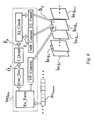
- the decoding-decompression method Img Dec comprises an initial parsing step Rx_Parse of the compressed-encoded bit sequence Bit Stream , shown in greater detail in figure 6a.
- the initial step Rx_Parse comprises a step RX for performing a series of operations relating to the reception/reading of the compressed encoded bit sequence. Such reception/reading operations are known to a man skilled in the art and therefore will not be further described.
- the initial parsing step Rx_Parse includes, besides, an analysis step Parse for performing a series of analysis operations of the sequence received aimed at identifying and extracting, therein, initially compressed-encoded data relating to different images and subsequently compressed-encoded data groups relating to different video packets of a same image.
- the analysis operations are such to extract from the bit sequence received video packets VP 0n , VP 1n , VP 2n , ... relating for example to an image Img n and then to extract there from the encoded data structures, that is the macroblocks MB, always relating to the image Img n . Subsequently, from the latter, the analysis operations are such as to identify and separate compressed-encoded data relating to individual 8x8 pixel blocks of the image Img n .
- the analysis step Parse therefore makes it possible to identify the video packets within the received compressed and encoded data sequence.
- the analysis step Parse comprises, preferably, a detection step RM_Detect of the restart markers, an extraction step of the macroblocks MB_Extract, an extraction step of the blocks B_Extract, a counting step of the macroblocks MB_Count and a check step MB_Check.
- the detection step RM_Detect includes, preferably, the following operations:
- the first and the second restart markers detected are not necessarily consecutive markers in the compressed-encoded data flow, for example the second restart marker detected could also be the marker RM 3n of figure 4.
- the first reading operation is such to read from the field MBN 1n a first value representative of the position within the image Img n of the first macroblock comprised in the video packet VP 1n to be decoded.
- the second reading operation is such to read from the field MBN 2n a second value representative of the position within the image Img n of the first macroblock comprised in the subsequent video packet VP 2n .
- the calculation operation by performing a simple difference between the second and the first value obtains an estimate of the value representative of the number of macroblocks comprised between the first restart marker detected and the second restart marker detected.
- the subsequent step MB_Extract includes an operation for extracting from the video packet VP 1n to be decoded the encoded data structures (that is to say the macroblocks) contained therein.
- a subsequent step B_Extract is such to extract from each macroblock compressed-encoded data relating to individual 8x8 pixel blocks of the image Img n , that are destined to be subject to an entropic decoding step Entr_Dec.
- a count step MB_Count is such to keep updated a count value representative of the number of encoded data structures (that is, of macroblocks in the MPEG case) extracted in the extraction step MB_Extract and comprised in the video packet VP 1n being decoded.
- count value representative of the number of encoded data structures (that is, of macroblocks in the MPEG case) extracted in the extraction step MB_Extract and comprised in the video packet VP 1n being decoded.
- a subsequent check step MB_Check of the number of encoded data structures is such to compare the thus obtained count value with the calculated value in the detection step RM_Detect.
- the check step MB_Check of the number of encoded data structures makes it possible to detect the presence of an error.
- the detected error is localised in the encoded and compressed bit sequence in any point thereof between the first and the second detected restart markers.
- Parse the extraction and decoding (performed in the steps MB-Extract, B_Extract, Entr_Dec and subsequent) of the macroblocks comprised between the first and the second detected restart markers is preferably interrupted.
- This step comprises operations, indicated with the term “concealment operations”, suitable to conceal the error and that replace with replacement information in the decoded image the portions thereof corresponding to the information comprised between the first and the second restart marker detected.
- This replacement is aimed at masking or concealing the errors thus avoiding, for example, the production of unpleasant artefacts in the decompressed and decoded image.
- the group concealment step VP_conceal one or more consecutive data groups, i.e. video packets, may be "concealed".
- the replacement of each group may be partial, i.e. only involve some of the encoded data structures present in the data group, or it may be total, involving all the encoded data structures present in the group.
- one possible usable replacement strategy may use, as replacement information, motion-compensated information taken from the images that in the sequence precede the image to be decoded.
- the macroblocks of the video packet to be decoded and those to be replaced are selected on the basis of a selection strategy compliant to Annex E of the MPEG standard-4 ISO/IEC JTC1/SC 29/WG 11 N 2502 specifications.
- figure 6b graphically illustrates a possible case of selection strategy compliant to Annex E.
- the video packet VP comprises a plurality of macroblocks MB 1 , MB 2 , ..., MB n and is defined by two due restart markers, an initial marker RM 1 and a final marker RM 2 respectively, for example, both detected in the detection step RM_Detect.
- the packet VP is decoded first in a direct sense ("forward decoding") starting from the initial macroblock MB 1 , proceeding with the decoding of the subsequent macroblocks until the detection of a first error at the bit x 1 , for example in the macroblock MB 5 .
- the decoding proceeds in an inverse sense (“backward decoding") starting from the final restart marker RM 2 .
- Macroblocks MB n , MB n-1 are thus decoded, for example, until the detection of a second error at the bit X 2 in the macroblock MB n-3 .
- T is a preset threshold, expressed as a number of bits, and represents a margin due to the fact that with a good probability an error is detected in a subsequent decoding point with respect to the real position of the error.
- all the macroblocks of the video packet VP with the exception of the macroblock MB 1 would be discarded and replaced (for example, by using motion compensated macroblocks of the previous image).
- a partial recovery of the data of macroblocks MB 2 and MB n i.e. of the data of those macroblocks comprising respectively the bit x 1 -T and the bit x 2 -T is also provided, if at least T bits have been decoded for such macroblocks.
- the number of the macroblocks to be replaced is preferably limited, in relation to the strategy recommended in the abovementioned Annex E, taking into account the presence of "not coded" macroblocks and "no-coefficient" macroblocks.
- a not coded macroblock is a macroblock, encoded with P-type coding, equal to a homologue macroblock in the previous image, whereas a "no-coefficient" macroblock is a macroblock for which a particular flag, that is the flag CBP ("Coded Block Pattern"), is set to zero.
- a "no-coefficient" macroblock is a macroblock whose coefficients AC are all equal to zero, thus it is a macroblock that does not comprise DCT coefficients encoded with variable length coding.
- the limitation of the number of macroblocks to be replaced is performed by choosing to decode in any case (that is, regardless of the response of the strategy suggested by Annex E) the macroblocks of the two abovementioned types that are consecutive to one another starting from the start and from the end of the video packet.
- the decoding of the "not coded macroblocks" (instead of the "concealment” thereof) is not such as to produce differences in the decoded-decompressed image, in any case it leads to computational saving.
- the decoding of such macroblocks is intrinsically equivalent to a "concealment”. Therefore, one avoids decoding each one of them twice (that is, once more than necessary).
- Another particularly advantageous strategy in relation to Annex E provides the performing of the total replacement of the macroblocks in which the presence of an error is detected, instead of optionally performing a partial decoding thereof. It has, in fact, been observed that the decoding of the macroblocks for which it is not possible to decode all the coefficients DCT may entail a degradation of the quality of the decoded-decompressed images.
- a preferred embodiment of a selection strategy of the macroblocks to be decoded and of the macroblocks to be replaced can be obtained by performing the following operations:
- the analysis step Parse described above relating to the decoding-decompression of video sequences, can be adapted in order to process a data stream obtained by the compression-encoding of a single digital image, for example, in accordance with the JPEG standard.
- the detection corresponding to the step RM_Detect comprises, preferably, the following operations:
- first and the second restart markers detected are not necessarily consecutive markers.
- the preliminary reading operation is such to read directly from the main heading of the image to be decoded the number NR of rows of MCU comprised between two consecutive restart markers.
- the first reading operation is such to read directly from the first restart marker detected the sequential number N1 associated thereto.
- the second reading operation is such to read the sequential number N2 associated to the second marker detected.
- the step Parse is such to detect an error if the number of encoded data structures, i.e. of MCU, extracted and comprised between the first and the second restart markers detected is different from the value VL calculated.
- a subsequent replacement or "concealment” step acts on the encoded data structures comprised between the first and the second restart markers detected.
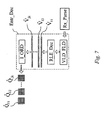
- the entropic decoding step Entr_Dec is shown in greater detail in figure 7.
- This step preferably, is such to operate on data, of the compressed and encoded bit sequence, relating to individual 8x8 pixel blocks, in order to produce at output blocks Q and jk of quantized transform coefficients.
- the entropic decoding step Entr_Dec includes a first processing step VLD_FLD suitable to perform a variable length decoding operation.
- the variable length decoding operation is performed, preferably, in a known way, through the use of a decoding table, in order to produce at output quantized transform coefficients, preferably in the form of "run length" symbols.
- the first processing step VLD_FLD is also suitable to perform a fixed length decoding operation, in order to decode the coefficients that in the respective blocks have a lesser statistical occurrence and for this reason are compressed-encoded with fixed length coding (FLC).
- FLC fixed length coding
- the fixed length decoding operation is performed preferably, in a known way, for example, by means of an "ESCAPE” decoding, for producing at output, quantized transform coefficients, preferably in the form of "run-length" symbols.
- the entropic decoding step Entr_Dec includes an intermediate RLD (Run Length Decoding) decoding step for producing vectors V and jk comprising quantized coefficients ordered substantially according to growing spatial frequencies.
- the entropic decoding step Entr_Dec includes a final inverse ordering step I_ORD that makes it possible to reorder the quantized coefficients of each vector V and jk in a data structure in the form of a block Q and jk , or matrix, of quantized coefficients.
- the inverse ordering operation I_ORD corresponds to an operation inverse to that of ordering ORD performed during compression-encoding.
- the blocks of quantized coefficients Q and jk supplied at output from the entropic decoding step Entr_Dec do not coincide with the corresponding quantized coefficient blocks Q jk supplied on output from the quantization step in the compression-encoding procedure.
- the blocks of quantized coefficients Q and jk at output from the entropic decoding step Entr_Dec are subject to a dequantization or inverse quantization, indicated in the figures with I_Quant. The latter is performed according to conventional techniques and will not be further described.
- the inverse quantization step I_Quant is such to produce from blocks of quantized coefficients Q and jk respective blocks of dequantized coefficients F and jk .
- the decoding-decompression method Img Dec comprises preferably a further error check step IQ_Check on the dequantized coefficients.
- the error check step IQ_Check on the dequantized coefficients analyses the blocks of dequantized coefficients F and jk supplied at output from the inverse quantization step I_Quant.
- the preset range I Conc is linked to the precision used, during the compression-encoding, for the digital representation of the transform coefficients.
- the preset range I conc is substantially equal, or slightly wider than the range I Enc of the possible digital values of compression-encoding.
- the error check step IQ_Check makes it possible to signal the presence of an error ⁇ jk in the block F and jk at a structure concealment step, indicated in figure 6 with MB_Conceal, aimed at concealing the error.
- the error check step IQ_Check is followed by an inverse transformation step I_Transf, of a conventional type, that makes it possible transform the block of dequantized coefficients F and jk into a corresponding pixel block B and jk of the decoded and decompressed image Grillg n .
- the structure concealment step MB_Conceal in order to conceal the error comprises operations, indicated with the term of "concealment”, aimed at replacing the information identified as corrupted by errors with replacement information that in some way masks or conceals the errors, thus avoiding, for example, the production of unpleasant artefacts in the decoded and decompressed image115 g n .
- the coefficient block F and jk is preferably discarded and replaced and is not subject to an inverse transformation phase.
- the pixel block corresponding to the discarded block of coefficients F and jk is preferably replaced with a motion-compensated block of pixels from the previously decoded-decompressed image emitg n-1 , of the video sequence.
- the pixel block corresponding to the discarded coefficient block F and jk is, preferably, replaced by replacement information obtained from pixel blocks spatially adjacent thereto.
- the replacement information is obtained as an average, or as a spatial interpolation of adjacent pixel blocks.
- Techniques of different types may in any case be used to substitute blocks discarded because affected by errors.
- the structure concealment step MB_Conceal conceals, i.e. discards and replaces, the entire macroblock MB containing the coefficient block F and jk affected by the error.
- the entire encoded data structure containing a dequantized coefficient block affected by this error is discarded and replaced.
- Another advantage linked to this choice is due to the fact that the post-processing algorithms of decoded-decompressed images applied subsequently to the decoding-decompression operate, conventionally, at a macroblock level.
- the same principle is applicable for the decoding-decompression of individual images, for example encoded-compressed according to the JPEG standard.
- the structure replacement step MB_Conceal aimed at concealing the error, the entire minimum compression unit MCU containing the coefficient block F and jk affected by error is discarded and replaced.
- the error check step IQ_Check detects the presence of an error by analyzing and selecting exclusively coefficients of the coefficient block F and jk obtained from an initial entropic fixed length decoding FLD step. In fact, the decoding of such coefficients is particularly critical in the presence of errors.
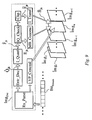
- Figure 9 schematically shows an embodiment variant of the decoding-decompression method described above and represented in figure 6.
- a subsequent clipping step Clip selects the coefficients of the block F and jk to be corrected.
- the clipping step Clip selects any coefficients within the first preset range I conc and outside a second range of digital values I clip , comprised in said first range I conc .
- the clipping step Clip performs a clipping operation, equalling each coefficient selected for the correction to the respective nearest extreme of the second range.
- the corrected dequantized coefficient block , produced at output by the clipping step Clip is subsequently subject to the inverse transformation step I_Transf, which produces a corresponding corrected pixel block of the decompressed-decoded image
- I_Transf the inverse transformation step
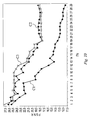
- the graph shown in figure 10 refers to the decoding-decompression of a 128 Kb/s video sequence, containing errors and compressed-encoded in accordance with the MPEG-4 Simple Profile standard with reversible variable length coding RVLC.
- the first image is coded with 1-type compression-encoding
- the subsequent images with P-type compression-encoding
- the curve indicated with C2 refers on the other hand to a decoding-decompression method in accordance with the present invention and, more particularly, in accordance with a first embodiment that provides the use of an error check on the number of encoded data structures in accordance with the MB_ Check phase described above, and does not provide the use of an error check step IQ_Check on de-quantized coefficients.
- the curve indicated with C3 refers to a decoding-decompression method in accordance with the present invention and, more particularly, in accordance with a second embodiment (represented in figure 6) that provides both the use of an error check on the number of encoded data structures, in accordance with the step MB_Check described above, and the use of an error check step IQ_Check on the dequantized coefficients.
- the PSNR measurements made and given on the graph refer to luminance channel Y only.
- PSNR values that can be obtained depend on the particular strategy used for concealing errors.
- the present invention makes it possible to obtain an average improvement in terms of PSNR of approximately 4.83dB compared to a conventional decoding-decompression method.
Landscapes
- Engineering & Computer Science (AREA)
- Multimedia (AREA)
- Signal Processing (AREA)
- Compression Or Coding Systems Of Tv Signals (AREA)
- Compression Of Band Width Or Redundancy In Fax (AREA)
Abstract
- receiving (Rx_Parse) the digital data sequence (BitStream) comprising compressed-encoded data groups separated from one another by at least one restart marker and each one including a respective plurality of encoded data structures,
- calculating (RM_Detect) a representative value of the number of encoded data structures comprised between a first restart marker (RM1n) and a subsequent second restart marker signalling, respectively, the start of a first data group (VP1n) to be decoded and the start of a second data group (VP2n),
- extracting (MB_Extract) from the first data group the encoded data structures;
Description
- figure 1 schematically shows a block diagram relating to a compression/encoding method compliant to the MPEG-4 standard,
- figure 2a schematically shows a possible segmentation of a digital image into pixel blocks,
- figure 2b schematically shows a transform of the image of figure 2 in a spatial frequency domain,
- figure 3a schematically shows the transform of figure 2 after a quantization step,
- figure 3b schematically shows in greater detail some of the steps of the block diagram of figure 1,
- figure 3c shows an example of an "ESCAPE" type fixed length code word,
- figure 4 schematically shows a possible subdivision into video packets of a portion of a compressed-encoded sequence,
- figure 5 schematically shows the structure of a macroblock and the structure of a video packet,
- figure 6 schematically shows a block diagram relating to a first embodiment of a decoding-decompression method in accordance with the present invention,
- figure 6a schematically shows in greater detail certain steps of the block diagram of figure 6,
- figure 6b shows an example of a selection strategy of the macroblocks to be decoded and the macroblocks to be replaced in a video packet affected by error;
- figure 7 schematically shows in greater detail the entropic decoding step of the block diagram of figure 6,
- figure 8a shows a range of possible digital values for the DCT coefficients and first preset range of dequantized coefficients,
- figure 8b shows a range of possible digital values for the DCT coefficients, a first preset range of dequantized DCT coefficients and a second pre-set range of dequantized DCT coefficients,
- figure 9 schematically shows a block diagram relating to an alternative embodiment of a decoding-decompression method in accordance with the present invention, and
- figure 10 shows an experimental graph relating to the performance comparison between a decoding-decompression method according to the present invention and a conventional method.
- I-type (intra-image) compression-encoding, wherein the current image is compressed-encoded independently from the other images of the sequence, exploiting only the spatial correlation inside the image;
- P-type (predictive) compression-encoding, wherein the current image is coded with reference to an image previous thereto;
- B-type (bi-directional) compression-encoding, wherein the current image is encoded with reference to a previous image and a subsequent image.
Finally, the LEVEL field, composed of 11 bits, contains the value ("level") of the quantized coefficient of the coded "run-length" symbol. In accordance with the MPEG-4 standard, the LEVEL field is constituted by 11 bits in the case in which reversible variable length coding (known by the abbreviation RLVD) is used, otherwise it is constituted by 12 bits.
- a first detection operation for detecting a first restart marker RM1n that signals the start of a respective data group, that is a video packet VP1n, to be decoded;
- a first reading operation for reading information representative of the position within the image Imgn of the first encoded data structure comprised in the video packet VP1n to be decoded;
- a second detection operation for detecting a second restart marker RM2n subsequent to the first restart marker RM1n, that signals the start of a second video packet VP2n subsequent to the video packet VP1n to be decoded;
- a second reading operation for reading information representative of the position, within the image Imgn, of the first encoded data structure comprised in the second video packet VP2n to be decoded;
- a calculation operation for estimating, on the basis of said first and second reading operations, a representative value of the number of encoded data structures (that is, in this case of macroblocks) comprised between the first restart marker detected and the second restart marker detected. Below reference will be made to the value using the expressions "estimated value" or "calculated value" indifferently.
- MB1, MB2, MB4, MBn-1, MBn = "not coded" macroblocks;
- MB3,MBn-2 = "no-coefficient" macroblocks;
- a preliminary reading operation, performed once only per image, for reading a dimension information representative of the dimension of the restart interval;
- a first detection operation for detecting a first restart marker RM1n that signals the start of a first data group to be decoded comprising a plurality of encoded data structures (i.e. of MCU);
- a first reading operation for reading information representative of the position within the image Imgn of the first encoded data structure (that is of the first MCU) comprised within the first data group;
- a second detection operation for detecting a second restart marker RM2n subsequent to the first restart marker RM1n, that signals the start of a second data group to be decoded;
- a second reading operation for reading a piece of information representative of the position, within the image Imgn, of the first encoded data structure (that is of the first MCU) comprised in the second data group to be decoded;
- a calculation operation in order to estimate, on the basis of said preliminary, said first and said second reading operation, a representative value of the number of encoded data structures (that is, of MCU) comprised between the first restart marker detected and the subsequent marker detected.


The graph shown in figure 10 refers to the decoding-decompression of a 128 Kb/s video sequence, containing errors and compressed-encoded in accordance with the MPEG-4 Simple Profile standard with reversible variable length coding RVLC.
Claims (21)
- Method (ImgDec) for decoding-decompressing a compressed-encoded digital data sequence (Bitstream) relating to at least an initial compressed-encoded digital image (Imgn) and for providing at least a respective decoded-decompressed digital image (Îmgn), the method comprising the steps of :detecting (MB_Check) the presence of at least one error, if the number of the encoded data structures extracted is different from said calculated value.receiving (Rx_Parse) said digital data sequence (BitStream) comprising compressed-encoded data groups separated from one another by at least one restart marker and each one including a respective plurality of encoded data structures,calculating (RM_Detect) a representative value of the number of encoded data structures comprised between a first restart marker (RM1n) and a subsequent second restart marker signalling, respectively, the start of a first data group (VP1n) to be decoded in the sequence received and the start of a second data group (VP2n) ,extracting (MB_Extract) from said first data group to be decoded the encoded data structures comprised therein;
- The method (ImgDec) according to claim 1, wherein said receiving step comprises the following operations:detecting (RM_Detect) in said received sequence a first restart marker (RM1n) ;detecting (RM_Detect) a second restart marker (RM2n) subsequent to the first restart marker (RM1n).
- The method (ImgDec) according to claim 1, further including a group concealment step (VP_Conceal) for discarding, if the presence of at least one error is detected, at least part of the data comprised between said first (RM1n) and said second (RM2n) marker, thus providing in the decoded-decompressed image replacement information.
- The method according to claim 3, further comprising a step of selecting the encoded data structures to be discarded comprised in said data group.
- The method according to claim 1, further comprising:said limit value being calculated on the basis of one said first and one said second piece of information.a first reading operation for reading a first piece of information representative of the position within the image (Imgn) of the first encoded data structure comprised in said first data group;a second reading operation for reading a second piece of information representative of the position, within the image Imgn, of the first encoded data structure comprised in said second data group;
- The method according to claim 5, wherein said first piece of information and said second piece of information comprise a first and a second numerical value respectively and wherein said calculating step comprises an arithmetical difference operation between said numerical values.
- The method according to claim 5, wherein said first and said second piece of information are respectively read from a first heading and a second heading comprised/associated respectively in/to said first and to said second data group.
- The method according to claim 5, wherein said first and said second piece of information are encoded in said first and said second restart marker respectively.
- The method according to claim 1, wherein said at least one decoded-decompressed digital image is a video sequence of digital images, wherein said data groups are video packets and wherein said encoded data structures are macroblocks.
- The method according to claim 1, wherein said digital data sequence is obtained from an MPEG or H263 or H26L compression-encoding operation of an initial digital images sequence and wherein said method provides a decoded and decompressed digital images sequence.
- The method according to claim 1, wherein the digital data sequence is obtained by a JPEG compression-encoding operation of said initial digital image.
- The method according to claim 11, wherein said data groups comprise at least one or more MCU rows and wherein said encoded data structures are MCU.
- The method according to claim 1, further comprising the following operations:processing (Rx_Parse, Entr_Dec, I_Quant) the digital data sequence (BitStream) for obtaining, from a second data group for which the presence of an error is not detected, a plurality of dequantized blocks (F andjk), each dequantized block (F andjk) comprising digital values corresponding to dequantized coefficients of a transform in a bi-dimensional spatial frequencies domain of a respective pixel block (Bjk) of the initial image (Imgn) ;selecting (IQ_Check) at least one first dequantized block (F andjk) comprising at least one of said digital values outside a first preset range (Iconc) of digital values;discarding (IQ_Conceal) said first selected block and providing in the decoded-decompressed image (Îmgn) a respective pixel block (B andjk) comprising replacement information.
- The method (ImgDec) according to claim 13, wherein said step of processing the digital data sequence in order to obtain the plurality of dequantized blocks (F andjk) includes an entropic decoding step (Entr_Dec) and a subsequent inverse quantization step (I_Quant), the entropic decoding step (Entr_Dec) including one operation of variable length decoding (VLD_FLD).
- The method according to claim 14, wherein said entropic decoding step (Entr_Dec) further includes a fixed length decoding operation (VLD_FLD) and wherein part of the digital values of said dequantized blocks (F andjk) are obtained from the variable length decoding operation and part of them are obtained from the fixed length decoding operation.
- The method according to claim 15, wherein said selection step (IQ_Check) exclusively selects digital values obtained from the fixed length decoding operation.
- The method for transferring at least one initial digital image (Imgn) from a first communication terminal to a second communication terminal, the method comprising the steps of:a) compressing said at least one digital image in said first communication terminal by performing the following operations:segmenting the initial digital image into a plurality of pixel blocks (B11, B12,..., Bjk) ;performing a discrete transform (TRANSF) of the pixel blocks into a bi-dimensional spatial frequencies domain, for obtaining a corresponding plurality of coefficient blocks (F 11 , F 12 ,..., F jk ) ;performing a quantization operation (QUANT) of the coefficient blocks (F 11 , F 12 , ..., F jk ), for obtaining a corresponding plurality of quantized coefficient blocks (Q 11 , Q 12 ,..., Q jk ) :performing an entropic coding step (ENTR_Enc) of the quantized coefficient blocks, encoding at least part of the coefficients by a fixed length coding and obtaining a digital data sequence (BitStream);b) transmitting said digital data sequence (BitStream) to the second communication terminal;c) receiving and decoding-decompressing said digital data sequence (Bitstream) at the second communication terminal with a decoding-decompression method (ImgDec) according to any of the previous claims in order to obtain at least one respective decoded-decompressed image.
- The method according to claim 17, further comprising a step of acquiring said at least one initial digital image (Imgn) by means of the first communication terminal.
- The method according to claim 17, further comprising a step of displaying said decoded-decompressed image (Îmgn) at the second communication terminal.
- The method according to claim 17, wherein said transmitting step transmits the digital data sequence on a radio communication channel.
- Multimedia communication apparatus for decoding-decompressing a digital data sequence providing at least one decoded-decompressed digital image (Îmgn) and corresponding to a respective initial image (Imgn), characterised by the fact that the decoding-decompression of said data sequence is performed in accordance with a method according to any of claims 1 to 16.
Applications Claiming Priority (2)
| Application Number | Priority Date | Filing Date | Title |
|---|---|---|---|
| ITMI20031128 | 2003-06-05 | ||
| IT001128A ITMI20031128A1 (en) | 2003-06-05 | 2003-06-05 | METHOD AND APPARATUS TO DECODE DIGITAL IMAGES |
Publications (3)
| Publication Number | Publication Date |
|---|---|
| EP1484927A2 true EP1484927A2 (en) | 2004-12-08 |
| EP1484927A3 EP1484927A3 (en) | 2004-12-15 |
| EP1484927B1 EP1484927B1 (en) | 2019-02-27 |
Family
ID=30131146
Family Applications (1)
| Application Number | Title | Priority Date | Filing Date |
|---|---|---|---|
| EP04011733.5A Expired - Lifetime EP1484927B1 (en) | 2003-06-05 | 2004-05-18 | Method and apparatus for decoding compressed and encoded digital images |
Country Status (3)
| Country | Link |
|---|---|
| US (1) | US7945103B2 (en) |
| EP (1) | EP1484927B1 (en) |
| IT (1) | ITMI20031128A1 (en) |
Cited By (1)
| Publication number | Priority date | Publication date | Assignee | Title |
|---|---|---|---|---|
| US7945103B2 (en) | 2003-06-05 | 2011-05-17 | Stmicroelectronics S.R.L. | Method and apparatus for decoding compressed and encoded digital images |
Families Citing this family (22)
| Publication number | Priority date | Publication date | Assignee | Title |
|---|---|---|---|---|
| ITMI20031079A1 (en) * | 2003-05-29 | 2004-11-30 | St Microelectronics Srl | METHOD AND APPARATUS TO DEDIFY DIGITAL IMAGES |
| JP2007104519A (en) * | 2005-10-07 | 2007-04-19 | Matsushita Electric Ind Co Ltd | Image encoding apparatus, image decoding apparatus, image encoding method, and image decoding method |
| US8238442B2 (en) * | 2006-08-25 | 2012-08-07 | Sony Computer Entertainment Inc. | Methods and apparatus for concealing corrupted blocks of video data |
| KR101086435B1 (en) * | 2007-03-29 | 2011-11-25 | 삼성전자주식회사 | Error detection method of video data stream and apparatus therefor |
| JP2009130719A (en) * | 2007-11-26 | 2009-06-11 | Sanyo Electric Co Ltd | Transmission method, receiving method and data processor utilizing the same |
| AU2007237313A1 (en) * | 2007-12-03 | 2009-06-18 | Canon Kabushiki Kaisha | Improvement for error correction in distributed vdeo coding |
| US8279945B2 (en) * | 2008-01-28 | 2012-10-02 | Mediatek Inc. | Method for compensating timing mismatch in A/V data stream |
| US9848209B2 (en) * | 2008-04-02 | 2017-12-19 | Microsoft Technology Licensing, Llc | Adaptive error detection for MPEG-2 error concealment |
| US9924184B2 (en) * | 2008-06-30 | 2018-03-20 | Microsoft Technology Licensing, Llc | Error detection, protection and recovery for video decoding |
| US9788018B2 (en) * | 2008-06-30 | 2017-10-10 | Microsoft Technology Licensing, Llc | Error concealment techniques in video decoding |
| US8311111B2 (en) * | 2008-09-11 | 2012-11-13 | Google Inc. | System and method for decoding using parallel processing |
| US9131241B2 (en) * | 2008-11-25 | 2015-09-08 | Microsoft Technology Licensing, Llc | Adjusting hardware acceleration for video playback based on error detection |
| US8340510B2 (en) | 2009-07-17 | 2012-12-25 | Microsoft Corporation | Implementing channel start and file seek for decoder |
| US20120183045A1 (en) * | 2011-01-18 | 2012-07-19 | Louis Joseph Kerofsky | Video decoder with reduced dynamic range transform including clipping |
| US9807395B2 (en) * | 2011-01-18 | 2017-10-31 | Dolby International Ab | Video decoder with reduced dynamic range transform with inverse transform shifting memory |
| US9100657B1 (en) | 2011-12-07 | 2015-08-04 | Google Inc. | Encoding time management in parallel real-time video encoding |
| US11425395B2 (en) | 2013-08-20 | 2022-08-23 | Google Llc | Encoding and decoding using tiling |
| CN103997652B (en) * | 2014-06-12 | 2017-06-20 | 北京奇艺世纪科技有限公司 | A kind of video watermark embedding grammar and device |
| US9794574B2 (en) | 2016-01-11 | 2017-10-17 | Google Inc. | Adaptive tile data size coding for video and image compression |
| US10542258B2 (en) | 2016-01-25 | 2020-01-21 | Google Llc | Tile copying for video compression |
| CN109076242B (en) * | 2016-05-13 | 2023-01-03 | 索尼公司 | Image processing apparatus and method |
| US10945029B2 (en) * | 2019-05-31 | 2021-03-09 | Qualcomm Incorporated | Video frame rendering criteria for video telephony service |
Family Cites Families (7)
| Publication number | Priority date | Publication date | Assignee | Title |
|---|---|---|---|---|
| JPH05115010A (en) * | 1991-10-22 | 1993-05-07 | Canon Inc | Picture decoder |
| JP3474005B2 (en) * | 1994-10-13 | 2003-12-08 | 沖電気工業株式会社 | Video coding method and video decoding method |
| EP0861001B1 (en) * | 1997-02-07 | 2012-05-23 | Texas Instruments Incorporated | Error resilient video encoding |
| US6304607B1 (en) * | 1997-03-18 | 2001-10-16 | Texas Instruments Incorporated | Error resilient video coding using reversible variable length codes (RVLCS) |
| US6052415A (en) * | 1997-08-26 | 2000-04-18 | International Business Machines Corporation | Early error detection within an MPEG decoder |
| US7027515B2 (en) * | 2002-10-15 | 2006-04-11 | Red Rock Semiconductor Ltd. | Sum-of-absolute-difference checking of macroblock borders for error detection in a corrupted MPEG-4 bitstream |
| ITMI20031128A1 (en) | 2003-06-05 | 2004-12-06 | St Microelectronics Srl | METHOD AND APPARATUS TO DECODE DIGITAL IMAGES |
-
2003
- 2003-06-05 IT IT001128A patent/ITMI20031128A1/en unknown
-
2004
- 2004-05-18 EP EP04011733.5A patent/EP1484927B1/en not_active Expired - Lifetime
- 2004-06-07 US US10/863,579 patent/US7945103B2/en active Active
Cited By (1)
| Publication number | Priority date | Publication date | Assignee | Title |
|---|---|---|---|---|
| US7945103B2 (en) | 2003-06-05 | 2011-05-17 | Stmicroelectronics S.R.L. | Method and apparatus for decoding compressed and encoded digital images |
Also Published As
| Publication number | Publication date |
|---|---|
| ITMI20031128A1 (en) | 2004-12-06 |
| ITMI20031128A0 (en) | 2003-06-05 |
| EP1484927B1 (en) | 2019-02-27 |
| US20040258151A1 (en) | 2004-12-23 |
| EP1484927A3 (en) | 2004-12-15 |
| US7945103B2 (en) | 2011-05-17 |
Similar Documents
| Publication | Publication Date | Title |
|---|---|---|
| EP1484927B1 (en) | Method and apparatus for decoding compressed and encoded digital images | |
| US10911786B2 (en) | Image processing device and method | |
| EP1528813B1 (en) | Improved video coding using adaptive coding of block parameters for coded/uncoded blocks | |
| KR100587280B1 (en) | Error concealment method | |
| US20190200042A1 (en) | Parameterization for fading compensation | |
| EP1359770B1 (en) | Signaling for fading compensation in video encoding | |
| US7362809B2 (en) | Computational reduction in motion estimation based on lower bound of cost function | |
| EP1944974A1 (en) | Position dependent post-filter hints | |
| US7463684B2 (en) | Fading estimation/compensation | |
| US8064516B2 (en) | Text recognition during video compression | |
| US20080080623A1 (en) | Method for error concealment in decoding of moving picture and decoding apparatus using the same | |
| JP2895034B1 (en) | Decoder having adaptive block phenomenon removal function and adaptive block phenomenon removal decoding method | |
| KR100927353B1 (en) | Video encoding and decoding method of mitigating data losses in an encoded video signal transmitted through a channel | |
| US7440625B2 (en) | Method and apparatus for decoding compressed and encoded digital images | |
| JP2002027483A (en) | Image encoding device, image decoding device, and storage medium | |
| US20040013200A1 (en) | Advanced method of coding and decoding motion vector and apparatus therefor | |
| US20040228404A1 (en) | Moving picture coding method | |
| US12355957B2 (en) | Temporal filter | |
| KR100230841B1 (en) | Block cancelation method and apparatus in moving picture decoder | |
| KR100543607B1 (en) | How to decode a video | |
| KR100968808B1 (en) | Variable length code decoding system and decoding method thereof | |
| KR20080061379A (en) | Coding / decoding method and apparatus for improving video error concealment | |
| US8358694B2 (en) | Effective error concealment in real-world transmission environment | |
| HK1060244B (en) | Signaling for fading compensation in video encoding |
Legal Events
| Date | Code | Title | Description |
|---|---|---|---|
| PUAI | Public reference made under article 153(3) epc to a published international application that has entered the european phase |
Free format text: ORIGINAL CODE: 0009012 |
|
| PUAL | Search report despatched |
Free format text: ORIGINAL CODE: 0009013 |
|
| AK | Designated contracting states |
Kind code of ref document: A2 Designated state(s): AT BE BG CH CY CZ DE DK EE ES FI FR GB GR HU IE IT LI LU MC NL PL PT RO SE SI SK TR |
|
| AX | Request for extension of the european patent |
Extension state: AL HR LT LV MK |
|
| AK | Designated contracting states |
Kind code of ref document: A3 Designated state(s): AT BE BG CH CY CZ DE DK EE ES FI FR GB GR HU IE IT LI LU MC NL PL PT RO SE SI SK TR |
|
| AX | Request for extension of the european patent |
Extension state: AL HR LT LV MK |
|
| 17P | Request for examination filed |
Effective date: 20050510 |
|
| AKX | Designation fees paid |
Designated state(s): DE FR GB |
|
| RAP1 | Party data changed (applicant data changed or rights of an application transferred) |
Owner name: STMICROELECTRONICS SRL |
|
| RAP1 | Party data changed (applicant data changed or rights of an application transferred) |
Owner name: STMICROELECTRONICS SRL |
|
| REG | Reference to a national code |
Ref country code: DE Ref legal event code: R079 Ref document number: 602004053728 Country of ref document: DE Free format text: PREVIOUS MAIN CLASS: H04N0007640000 Ipc: H04N0019895000 |
|
| GRAP | Despatch of communication of intention to grant a patent |
Free format text: ORIGINAL CODE: EPIDOSNIGR1 |
|
| RIC1 | Information provided on ipc code assigned before grant |
Ipc: H04N 19/895 20140101AFI20180906BHEP Ipc: H04N 19/69 20140101ALI20180906BHEP Ipc: H04N 19/61 20140101ALI20180906BHEP Ipc: H04N 19/68 20140101ALI20180906BHEP |
|
| INTG | Intention to grant announced |
Effective date: 20180921 |
|
| GRAS | Grant fee paid |
Free format text: ORIGINAL CODE: EPIDOSNIGR3 |
|
| GRAA | (expected) grant |
Free format text: ORIGINAL CODE: 0009210 |
|
| AK | Designated contracting states |
Kind code of ref document: B1 Designated state(s): DE FR GB |
|
| REG | Reference to a national code |
Ref country code: GB Ref legal event code: FG4D |
|
| REG | Reference to a national code |
Ref country code: DE Ref legal event code: R096 Ref document number: 602004053728 Country of ref document: DE |
|
| REG | Reference to a national code |
Ref country code: DE Ref legal event code: R097 Ref document number: 602004053728 Country of ref document: DE |
|
| PLBE | No opposition filed within time limit |
Free format text: ORIGINAL CODE: 0009261 |
|
| STAA | Information on the status of an ep patent application or granted ep patent |
Free format text: STATUS: NO OPPOSITION FILED WITHIN TIME LIMIT |
|
| GBPC | Gb: european patent ceased through non-payment of renewal fee |
Effective date: 20190527 |
|
| 26N | No opposition filed |
Effective date: 20191128 |
|
| PG25 | Lapsed in a contracting state [announced via postgrant information from national office to epo] |
Ref country code: GB Free format text: LAPSE BECAUSE OF NON-PAYMENT OF DUE FEES Effective date: 20190527 |
|
| PG25 | Lapsed in a contracting state [announced via postgrant information from national office to epo] |
Ref country code: FR Free format text: LAPSE BECAUSE OF NON-PAYMENT OF DUE FEES Effective date: 20190531 |
|
| PGFP | Annual fee paid to national office [announced via postgrant information from national office to epo] |
Ref country code: DE Payment date: 20230419 Year of fee payment: 20 |
|
| REG | Reference to a national code |
Ref country code: DE Ref legal event code: R071 Ref document number: 602004053728 Country of ref document: DE |