EP1484904A1 - Image forming apparatus - Google Patents
Image forming apparatus Download PDFInfo
- Publication number
- EP1484904A1 EP1484904A1 EP04013291A EP04013291A EP1484904A1 EP 1484904 A1 EP1484904 A1 EP 1484904A1 EP 04013291 A EP04013291 A EP 04013291A EP 04013291 A EP04013291 A EP 04013291A EP 1484904 A1 EP1484904 A1 EP 1484904A1
- Authority
- EP
- European Patent Office
- Prior art keywords
- information
- recording medium
- section
- lightness
- image forming
- Prior art date
- Legal status (The legal status is an assumption and is not a legal conclusion. Google has not performed a legal analysis and makes no representation as to the accuracy of the status listed.)
- Withdrawn
Links
- 230000003287 optical effect Effects 0.000 claims abstract description 27
- 239000011521 glass Substances 0.000 description 6
- 239000003086 colorant Substances 0.000 description 3
- 230000002093 peripheral effect Effects 0.000 description 3
- 238000012986 modification Methods 0.000 description 2
- 230000004048 modification Effects 0.000 description 2
- 230000010365 information processing Effects 0.000 description 1
Images





Classifications
-
- H—ELECTRICITY
- H04—ELECTRIC COMMUNICATION TECHNIQUE
- H04N—PICTORIAL COMMUNICATION, e.g. TELEVISION
- H04N1/00—Scanning, transmission or reproduction of documents or the like, e.g. facsimile transmission; Details thereof
- H04N1/23—Reproducing arrangements
- H04N1/2307—Circuits or arrangements for the control thereof, e.g. using a programmed control device, according to a measured quantity
- H04N1/2323—Circuits or arrangements for the control thereof, e.g. using a programmed control device, according to a measured quantity according to characteristics of the reproducing medium, e.g. type, size or availability
-
- H—ELECTRICITY
- H04—ELECTRIC COMMUNICATION TECHNIQUE
- H04N—PICTORIAL COMMUNICATION, e.g. TELEVISION
- H04N1/00—Scanning, transmission or reproduction of documents or the like, e.g. facsimile transmission; Details thereof
- H04N1/23—Reproducing arrangements
- H04N1/2307—Circuits or arrangements for the control thereof, e.g. using a programmed control device, according to a measured quantity
-
- H—ELECTRICITY
- H04—ELECTRIC COMMUNICATION TECHNIQUE
- H04N—PICTORIAL COMMUNICATION, e.g. TELEVISION
- H04N1/00—Scanning, transmission or reproduction of documents or the like, e.g. facsimile transmission; Details thereof
- H04N1/23—Reproducing arrangements
- H04N1/2307—Circuits or arrangements for the control thereof, e.g. using a programmed control device, according to a measured quantity
- H04N1/2353—Selecting a particular reproducing medium from amongst a plurality of media or from a particular tray, e.g. paper or transparency
Definitions
- the present invention relates to an electrophotographic image forming apparatus.
- an original-reading means detects the size of an original and a recording medium having a size corresponding to the original is selected.
- One such conventional image forming apparatus is disclosed in Japanese Patent Laid Open No. 2000-32207, in which the number of colors in image data is acquired and compared with a predetermined number of colors to select the type of print medium to be printed on.
- the selected medium has not necessarily a lightness level close to that of the original. If the recording medium has a lightness level substantially different from the original, the resulting print quality is poor.
- An object of the invention is to provide an image forming apparatus in which an image of an original document can be printed on a recording medium having a lightness level close to that of the original document.
- An image forming apparatus includes an original reading section (101, 201, 301, 401, 501, 601) , a plurality of medium trays (107-108, 207-208, 307-308, 407-408, 507-508, 607-608), a first information obtaining section, an information storing section (104, 204, 304, 404, 504, 604) , a comparing section (105, 205, 305, 405, 505, 605), a medium selecting section (106, 206, 306, 406, 506, 606), and an image forming section (109, 209, 309, 409, 509, 609) .
- the original reading section irradiates an original document with light and receives light reflected back from the original document.
- the original-reading section obtains first information from the light reflected back from the original document, the first information being information on optical reflection from a non-image area of the original.
- a plurality of medium trays hold different types of recording media therein.
- An information storing section stores second information on optical reflection from each of the different types of recording media.
- a comparing section compares the first information with the second information to output a comparison result.
- a medium selecting section selects a medium from the different types of recording media, the medium being selected according to the comparison result.
- An image forming section forms an image on the recording medium, the image being the information on optical reflection from an image area of the original document.
- the second information represents a lightness level of each of the different types of recording media.
- the second information represents a gloss level of each of the different types of recording media.
- the second information represents a color of each of the different types of recording media.
- the original reading section irradiates a desired recording medium with light and receives light reflected back from the desired recording medium.
- the original reading section obtains the second information on optical reflection from the desired recording medium and stores the second information into the image storing section.
- Each of the plurality of medium trays (207, 208) includes an information obtaining section (207a, 208a) that obtains the second information, the second information being stored into the image storing section (204).
- the image forming apparatus further includes an information-obtaining section (309a) that obtains the second information, said information-obtaining section (309a) being disposed in a path in which the recording medium is transported.
- the image forming apparatus may further include an inputting section (110, 210, 310, 410, 510, 610) through which an operator inputs the second information.
- the image forming apparatus may further include a table (TABLE 1) that lists types of recording media and the second information corresponding to the types of recording media.
- An operator inputs a desired type of recording medium through an inputting section (510).
- a selecting section (511) selects from the table (TABLE 1) the second information on a recording medium of the desired type.
- the second information on the recording medium of the desired type selected by the selecting section (511) is stored into the information storing section (504).
- the image forming apparatus may further include a registering section (613) that registers to the table (TABLE 1) the types of recording media and the second information corresponding to the types of recording media.
- the original reading section (601) irradiates a recording medium of a desired type with light and receives light reflected back from the desired recording medium, so that said original-reading section (601) obtains the second information on optical reflection from a recording medium of the desired type.
- the registering section (613) registers into the table (TABLE 1) a type of the desired recording medium and the second information.
- Fig. 1 illustrates the general configuration of an image forming apparatus according to a first embodiment.
- an original reading section 101 irradiates an original document with light and receives the light reflected back from the original document.
- the received light includes information (i.e., image) on optical reflection from an image area of the original document and information (i.e., lightness level) on optical reflection from a non-image area of the original document.
- the lightness level is outputted to a lightness comparing section 105 while the image is outputted to an image forming section 109.
- the original reading section 101 also irradiates a recording medium with light and receives the light reflected back from the recording medium, thereby determining the lightness level of the recording medium.
- the original reading section 101 may include a gloss sensor and a color sensor so as to detect the gloss and colors of the original document.
- a lightness memory 104 includes a memory area 104a and a memory area 104b that hold the lightness level of the original document detected by the original reading section 101.
- the lightness level of an original document is the lightness level of the medium on which an original image is printed. The top and bottom margins and left side and right side margins of a medium are usually not printed.
- the lightness level of the medium of an original document is determined by detecting the lightness level in a non-image area of the medium, for example, approximately 5 mm from the leading edge, trailing edge, left edge, and right edge of the original document. If the lightness levels are detected from more than one area, an average of the lightness levels in these areas is used as a lightness level of the medium of the original document.
- an average of the lightness levels of an image may be used as the lightness level of the original document.
- the original document such as a borderless photograph
- the original document has non-printed margins, in which case the lightness levels are different depending on peripheral portions on the original document. If it is detected that the lightness levels are different at a plurality of peripheral portions on an original document, a recording medium is fed from a predetermined tray to an image forming section.
- a lightness comparing section 105 is connected to the original reading section 101 and the lightness memory 104, and compares the lightness level read by the original reading section 101 with predetermined lightness levels stored in the memory areas 104a and 104b of the lightness memory 104.
- the memory area 104a holds the lightness level of a recording medium 1 held in a tray 107
- the memory area 104b holds the lightness level of a recording medium 2 held in a tray 108.
- the recording medium 1 and recording medium 2 have different lightness levels.
- a medium selecting section 106 is connected to the lightness comparing section 105 and provides a selection signal to the tray 107 or to the tray 108 depending on the comparison result output from the lightness comparing section 105.
- the tray 107 holds the recording medium 1. Upon receiving the selection signal from the medium selecting section 106, the tray 107 feeds the recording medium to the image forming section 109. Upon receiving the selection signal from the medium selecting section 106, the tray 108 feeds the recording medium 2 to the image forming section 109.
- the image forming section 109 forms an image either on the recording medium 1 fed from the tray 107 or on the recording medium 2 fed from the tray 108.
- An operator inputs a command to perform a copying operation to the original reading section 101 through an operation panel 110.
- the operation panel 110 When the operator inputs a command to store the lightness level of the print medium through the operation panel 110, the operation panel 110 displays a message that prompts the operator to select a tray, and a message that requests to read the lightness level of the recording medium.
- the lightness memory 104 holds the lightness level of the recording medium that is read by the original reading section 101.
- the image forming apparatus operates in two modes: a lightness reading mode in which the lightness level of a recording medium is stored and an image forming mode in which an original document is read to print a corresponding image on a recording medium.
- a lightness reading mode in which the lightness level of a recording medium is stored
- an image forming mode in which an original document is read to print a corresponding image on a recording medium.
- Fig. 2 is a flowchart that illustrates the operation of the first embodiment.
- the operator commands the storage of the lightness level of the recording medium (S101).
- the message that prompts the user to select a tray is displayed on the operation panel 110 (S102).
- the message that requests to read the lightness level of the recording medium 1 is displayed on the operation panel 110 (S104).
- the operator places the recording medium 1 on the glass platen of the original reading section 101 and then inputs a command to read the lightness level of the recording medium 1 (S105), the original reading section 101 reads the lightness level of the recording medium 1 (S106).
- the thus read lightness level is stored into a memory area 104a in the lightness memory 104 (S107).
- the message that requests to read the lightness level of the recording medium 2 is displayed on the operation panel 110 (S108).
- the original reading section 101 reads the lightness level of the recording medium 2 (S110).
- the thus read lightness level is stored into a memory area 104b in the lightness memory 104 (S111).
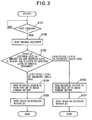
- Fig. 3 is a flowchart illustrating an image forming operation (i.e., a copying operation).
- the original reading section 101 reads optically the image information from the original document (S152).
- the lightness comparing section 105 compares the lightness level of the original document with the lightness level stored in the memory area 104a and the lightness level stored in the memory area 104b. Based on the comparison result, the lightness comparing section 105 determines which of the lightness level in the memory area 104a and the lightness level in the memory area 104b is closer to the lightness level of the original document (S153).
- the comparison result of the lightness comparing section 105 is input to a medium selecting section 106. If the lightness level of the original document is closer to the content in the memory area 104a than to the content in the memory area 104b, then the lightness comparing section 105 outputs a selection signal indicative of the tray 107, and the program proceeds to step S154. If the lightness level of the original document is closer to the content in the memory area 104b than to the content in the memory area 104a, then the lightness comparing section 105 outputs a selection signal indicative of the tray 108, and the program proceeds to step S156.
- the tray 107 Upon receiving the selection signal, the tray 107 feeds the recording medium 1 to the image forming section 109 (S154), which in turn forms the image read from the original document on the recording medium 1. Reading an image from an original document and forming the image on the recording medium may be performed concurrently or the image may be first stored in its entirety into the image forming section and then formed on the recording medium.
- the tray 108 feeds the recording medium 2 to the image forming section 109 (S156), which in turn forms the image read from the original document on the reading medium 1 (S157).
- the lightness level of the medium of an original document is determined by detecting the light reflected from a particular area on the original document (e.g., a non-printed peripheral portion of the original document).
- an information processing section may be added to the system. In other words, information on optical reflection from the entire area of an original document may be obtained first and then the thus read information may be processed into an image signal and a lightness signal.
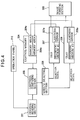
- Fig. 4 illustrates the configuration of an image forming apparatus according to a second embodiment.
- the original reading section 201 irradiates the original document with light and receives the light reflected back from the original document.
- the received light includes information (i.e., image) on optical reflection from an image area of the original document and information (i.e., lightness level) on optical reflection from a non-image area of the original document.
- a lightness memory 204 has a memory area 201a and a memory area 204b, which are connected to a lightness sensor 207a and a lightness sensor 208a, respectively.
- the memory area 204a stores the lightness level of the recording medium 1 detected by the lightness sensor 207a.
- the memory area 204b stores the lightness level of the recording medium 2 detected by the lightness sensor 208a.
- the lightness comparing section 205 is connected to the original reading section 201 and the lightness memory 204, and compares the lightness level of the original document read by the original reading section 201 with the lightness level stored in the memory area 204a and the lightness level stored in the memory area 204b.
- a medium selecting section 206 is connected to the lightness comparing section 205 and outputs a selection signal to a tray 207 or a tray 208 depending on the comparison result output from the lightness comparing section 205.
- the tray 207 holds the recording medium 1 therein. Upon receiving the selection signal from the medium selecting section 206, the tray 207 feeds the recording medium 1 to the image forming section 209. The tray 208 holds the recording medium 2 therein. Upon receiving the selection signal from the medium selecting section 206, the tray 208 feeds the recording medium 2 to the image forming section 209. The recording medium 1 and the recording medium 2 have different lightness levels.
- the image forming section 209 forms an image either on the recording medium 1 supplied from the tray 207 or on the recording medium 2 supplied from the tray 208.
- the lightness sensor 207a is provided in a path in which the recording medium 1 is fed from the tray 207 and detects the lightness level of the recording medium 1.
- the lightness sensor 208a is provided in a path in which the recording medium 1 is fed from_the tray 208 and detects the lightness level of the recording medium 2.
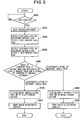
- Fig. 5 is a flowchart illustrating a copying operation of the image forming apparatus according to the second embodiment. The copying operation of the image forming apparatus according to the second embodiment will be described with reference to Fig. 5.
- the original reading section 201 reads the image information from the original document (S202).
- the lightness sensor 207a detects the lightness level of the recording medium 1.
- the detected lightness level of the recording medium 1 is stored into the memory area 204a in the lightness memory 204 (S203).
- the lightness sensor 208a detects the lightness level of the recording medium 2.
- the detected lightness of the recording medium 2 is stored in the memory area 204b of the lightness memory 204 (S204) .
- the lightness comparing section 205 compares the lightness level of the original document with the lightness level stored in the memory area 204b with and the lightness level stored in the memory area 204a to determine which of the lightness level in the memory area 204a and the lightness level in the memory area 204b is closer to the lightness level of the original document (S205).
- the comparison result is fed to the medium selecting section 206, which in turn outputs the selection signal to the tray 207 if the lightness level of the original document is closer to the content of the memory area 204a, or to the tray 208 if the lightness level of the original document is closer to the content of the memory area 204b.
- the tray 207 If the tray 207 receives the selection signal, then the tray 207 feeds the recording medium 1 to the image forming section 209 (S206). Then, the image forming section 209 forms the image read from the original document on the recording medium 1. If the tray 208 receives the selection signal, then the tray 208 feeds the recording medium 2 to the image forming section 209 (S208). Then, the image forming section 209 forms the image read from the original document on the recording medium 2 (S209).
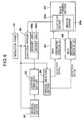
- Fig. 6 illustrates the general configuration of an image forming section according to a third embodiment.
- a lightness memory 304 is connected to a lightness sensor 309a and stores the lightness level of the recording medium detected by the lightness sensor 309a.
- the lightness memory 304 includes a memory area 304a and a memory area 304b.
- a lightness comparing memory 305 is connected to an original reading section 301 and the lightness memory 304.
- the lightness comparing section 305 compares the lightness level of the original document read by the original reading section 301 with the lightness level stored in the memory area 304a and the lightness level stored in the memory area 304b.
- a medium selecting section 306 is connected to the lightness comparing section 305 and outputs a selection signal to a tray 307 or a tray 308 depending on the comparison result of the lightness comparing section 305.
- the tray 307 holds the recording medium 1 and is connected to the medium selecting section 306. Upon receiving the selection signal form the medium selecting section 306, the tray 307 feeds the recording medium 1 to the image forming section 309. The tray 308 is connected to the medium selecting section 306. Upon receiving the selection signal from the medium selecting section 306, the tray 308 feeds the recording medium 2 to the image forming section 309. The recording medium 1 and the recording medium 2 have different lightness levels.
- the image forming section 309 forms the image read from the original document either on the recording medium 1 fed from the tray 307 or on the recording medium 2 fed from the tray 308.
- the lightness sensor 309a is provided in the image forming section 309 and detects the lightness level of the recording medium 1 fed from the tray 307 and the lightness level of the recording medium 2 fed from the tray 308.
- a medium sensor 309b is provided in the image forming section 309 and detects whether the recording medium 1 is present in the tray 307 or the recording medium 2 is present in the tray 308.
- the original reading section 301 irradiates the original document with light and receives the light reflected back from the original document.
- the received light includes information (i.e., image) on optical reflection from an image area of the original document and information (i.e., lightness level) on optical reflection from a non-image area of the original document.
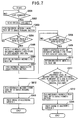
- Fig. 7 is a flowchart illustrating the copying operation of the image forming section according to the third embodiment.
- the medium selecting section 306 outputs a selection signal to the tray 307, which in turn feeds the recording medium 1 to the image forming section 309 (S303).
- the image forming section 309 checks the output of the medium sensor 309b to determine whether the recording medium 1 is present (S304). If the recording medium 1 is detected, the lightness sensor 309a detects the lightness level of the recording medium 1. The detected lightness level of the recording medium 1 is stored into the memory area 304a in the lightness memory 304 (S305). Then, the image forming section 309 returns the recording medium 1 to the tray 307 (S306).
- the medium selecting section 306 outputs a selection signal to the tray 308.
- the tray 308 feeds the recording medium 2 to the image forming section 309 (S307) .
- the image forming section 309 checks the output of the medium sensor 309b to determine whether the recording medium 2 is present (S308). If the recording medium 2 is detected, the lightness sensor 309a detects the lightness level of the recording medium 2. The detected lightness level of the recording medium 2 is stored into the memory area 304b in the lightness memory 304 (S309). Then, the image forming section 309 returns the recording medium 2 to the tray 308 (S310).
- the lightness comparing section 305 compares the lightness level of the original document with the content in the memory area 304a and the content in the memory area 304b, thereby determining which of the content in the memory area 304a and the content in the memory area 304b is closer to the lightness level of the original document (S311).
- the comparison result is input to the medium selecting section 306.
- the medium selecting section outputs a selection signal to the tray 307 if the lightness level of the original document is closer to the content in the memory area 304a than to the content in the memory area 304b.
- the medium selecting section outputs a selection signal to the tray 308 if the lightness of the original document is closer to the content in the memory area 304b than to the content in the memory area 304a. Then, the program proceeds to step S314.
- the tray 307 feeds the recording medium 1 to the image forming section 309 (S312), which in turn forms the image read from the original document on the recording medium 1 (S313).
- the tray 308 feeds the recording medium 2 to the image forming section 309 (S314), which in turn forms the image read from the original document on the recording medium 2 (S315).
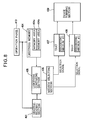
- Fig. 8 illustrates the general configuration of an image forming section according to a fourth embodiment.
- An original reading section 401 irradiates the original document with light and receives the light reflected back from the original document, the reflected light being an image information.
- the received light includes information (i.e., image) on optical reflection from an image area of the original document and information (i.e., lightness level) on optical reflection from a non-image area of the original document.
- a lightness memory 404 has a memory area 404a and a memory area 404b that store lightness levels received through an operation panel 410.
- the lightness comparing section 405 is connected to the original reading section 401 and the lightness memory 404 and compares the lightness level of the original document read by the original reading section 401 with the content in the memory area 404a and the content in the memory area 404b.
- the medium selecting section 406 is connected to the lightness comparing section 405 and outputs a selection signal either to the tray 407 or to the tray 408 depending on the comparison result of the lightness comparing section 405.
- the tray 407 holds the recording medium 1 therein. Upon receiving the selection signal form the medium selecting section 406, the tray 407 feeds the recording medium 1 to the image forming section 409. The tray 408 holds the recording medium 2 therein. Upon receiving the selection signal form the medium selecting section 406, the tray 408 feeds the recording medium 2 to the image forming section 409.
- the recording medium 1 and the recording medium 2 have different lightness levels.
- the image forming section 409 forms an image on the recording medium 1 fed from the tray 407 or on the recording medium 2 fed from the tray 408.
- the original reading section 401 reads the image information of the original document.
- the operation panel 410 Prior to inputting the lightness of a recording medium, the operation panel 410 displays a message that prompts the user to select a tray and a message that requests to input the lightness of the recording medium.
- the image forming apparatus operates in two modes: a lightness reading mode in which the lightness level of a recording medium is stored and an image forming mode in which an original document is read to print a corresponding image on a recording medium.
- a lightness reading mode in which the lightness level of a recording medium is stored
- an image forming mode in which an original document is read to print a corresponding image on a recording medium.
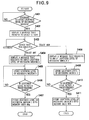
- Fig. 9 is a flowchart that illustrates the lightness reading mode. The operation for storing the lightness of the recording medium held in the tray 407 will be described with reference to Fig. 9.
- the operator commands the storage of the lightness level of the recording medium (S401).
- a message that prompts the user to select a tray is displayed on the operation panel 110 (S402) .
- the operator operates the operation panel 410 to select the tray 407 (S403), the message that requests to read the recording medium 1 is displayed on the operation panel 410 (S404).
- the operation panel 410 determines whether the input lightness level is within a predetermined range (S406). If the lightness level is out of the predetermined range, the program returns to step S405. If the lightness level is within the predetermined range, the input lightness level is stored into the memory area 404a of the lightness memory 404 (S407).
- the operation panel 410 displays a message that prompts to select a tray (S402).
- the operation panel 410 displays a message that prompts the operator to input the lightness level of the recording medium 2 (S408).
- the operation panel 410 determines whether the input lightness level is out of a predetermined range (S410). If the lightness level is within the predetermined range, the program returns to step S409. If the lightness level is within the predetermined range, the input lightness level is stored into the memory area 404b of the lightness memory 404 (S411) .
- the copying operation of the image forming apparatus according to the fourth embodiment is the same as the first embodiment.
- Fig. 10 illustrates an image forming apparatus according to a fifth embodiment.
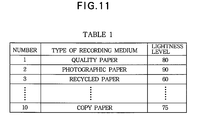
- Fig. 11 illustrates TABLE 1, an example of a table that lists media and their lightness level.
- An original reading section 501 irradiates the original document with light and receives the light reflected back from the original document, the reflected light being an image information.
- the received light includes information (i.e., image) on optical reflection from an image area of the original document and information (i.e., lightness level) on optical reflection from a non-image area of the original document.
- a lightness memory 504 has a memory area 504a and a memory area 504b that store the lightness levels of the recording medium 1 and recording medium 2.
- the lightness comparing section 505 is connected to the original reading section 501 and the lightness memory 504 and compares the lightness level of the original document read by the original reading section 501 with the content in the memory area 504a and the content in the memory area 504b.
- the medium selecting section 506 is connected to the lightness comparing section 505 and outputs a selection signal either to the tray 507 or to the tray 508 depending on the comparison result of the lightness comparing section 505.
- the tray 507 holds the recording medium 1 therein. Upon receiving the selection signal form the medium selecting section 506, the tray 507 feeds the recording medium 1 to the image forming section 509. The tray 408 holds the recording medium 2 therein. Upon receiving the selection signal form the medium selecting section 506, the tray 508 feeds the recording medium 2 to the image forming section 509.
- the recording medium 1 and the recording medium 2 have different lightness levels.
- the image forming section 509 forms an image on the recording medium 1 fed from the tray 507 or on the recording medium 2 fed from tray 508.
- the original reading section 501 reads the image information of the original document.
- the operation panel 510 displays a selection message that prompts the operator to select a tray and a message that requests to select a recording medium.
- the operation panel 510 informs the data selecting section 511 as to which recording medium has been selected.
- the data selecting section 511 selects the lightness level of a desired recording medium from TABLE 1 in Fig. 11.
- the operation of the image forming apparatus operates in two modes: a lightness reading mode in which the lightness level of a recording medium is read and stored into a memory area in the apparatus and an image forming mode (copying operation) in which an image of an original document is read to print the image of the original document on a recording medium.
- a lightness reading mode in which the lightness level of a recording medium is read and stored into a memory area in the apparatus
- an image forming mode copying operation
- Fig. 12 is a flowchart that illustrates the lightness reading mode.
- the operation for storing the lightness of the recording medium held in the tray 507 will be described with reference to Fig. 12.
- the operation panel 510 displays the message that prompts the operator to select a tray (S502).
- the operator operates the operation panel 510 to select the tray 507 (S503)
- the operation panel 510 displays the numbers of media and their names listed in TABLE 1 (S504).
- the operator operates the operation panel 510 to input the number of a desired medium (S505) , the operation panel 510 determines whether the number of the desired medium is within a predetermined range (S506). If the number of the medium is out of the predetermined range, then the program returns to step S505. If the number of medium is within the predetermined range, then a lightness level corresponding to the number of the desired medium is read from the TABLE 1 and stored in the memory area 504a of the lightness memory 504 (S507).
- the operator can select the recording medium in the tray 508 as a desired medium (S508-S511).
- the lightness level of the recording medium in the tray 508 is stored into the memory area 504b.
- the copying operation of the image forming apparatus according to the fifth embodiment is the same as in the first embodiment and the description thereof is omitted.
- Fig. 13 illustrates the general configuration of an image forming apparatus according to a sixth embodiment.
- an original reading section 601 irradiates an original document with light and receive the light reflected back from the original document.
- the received light includes information (i. e. , image) on optical reflection from an image area of the original document and information (i.e., lightness level) on optical reflection from a non-image area of the original document.
- a lightness memory 604 includes a memory area 604a that holds the lightness level of the recording medium 1 and a memory area 604b that hold the lightness level of the recording medium 2.
- a data selecting section 611 causes a corresponding memory area in TABLE 1 to output a lightness level of the selected recording medium to the lightness memory 604. In this manner, the information on lightness of the recording medium held in the tray is registered to the memory area in advance.
- the lightness comparing section 605 When a copy operation is performed, the lightness comparing section 605 is connected to the original reading section 601 and the lightness memory 604. The lightness comparing section 605 compares the lightness level of the original document with the content in the memory area 604a and the content in the memory area 604b. A medium selecting section 606 is connected to the lightness comparing section 605 and outputs a selection signal to the tray 607 or the tray 608 depending on the comparison result of the lightness comparing section 605.
- the tray 607 holds the recording medium 1 therein. Upon receiving the selection signal from the medium selecting section 606, the tray 607 feeds the recording medium 1 to an image forming section 609.
- the tray 608 holds the recording medium 2 therein. Upon receiving the selection signal from the medium selecting section 606, the tray 608 feeds the recording medium 2 to the image forming section 609.
- the recording medium 1 and the recording medium 2 have different lightness levels.
- the image forming section 609 forms an image of the original document on the recording medium 1 fed from the tray 607 or on the recording medium 2 fed from the tray 608.
- the original reading section 601 reads the original document.
- the operation panel 610 When the operator inputs a command to select a desired recording medium for the copy operation, so that the operation panel 610 outputs data that identifies a selected recording medium to the data selecting section 611.
- the operation panel 610 When the operator activates the registration of the lightness level of a recording medium via the operation panel 610, the operation panel 610 displays a message that requests to select a desired number of recording medium. When the operator inputs a desired number of recording medium, the operation panel 610 displays a message that requests to read the desired recording medium. When the operator inputs a command to read the recording medium, the original reading section 601 reads the lightness level of the desired recording medium.
- the data registration controller 613 registers the lightness level of the recording medium read by the original reading section 601 into TABLE 1. Then, the operation panel 610 displays a message that requests to input a type of recording medium and the operator inputs the type of recording medium. Then, the data registration controller 613 registers the type of recording medium into TABLE 1.
- Fig. 14 is a flowchart illustrating the operation for registering the lightness of the recording medium to TABLE 1.
- the operation panel 610 displays a message that prompts the user to select a desired medium number (S602).
- the operation panel 610 displays a message that requests to read a recording medium (S604).
- the original reading section 601 reads the lightness level of the recording medium (S606).
- the data-registering controller 613 stores the lightness level of the recording medium into a memory area into which the lightness level for "#10" should be stored (S607).
- the operation panel 610 displays a message that indicates the completion of the registration of lightness level of the recording medium and a message that prompts the operator to input the type of the recording medium (S608).
- the data-registering controller 613 stores the type of the recording medium into a memory area that corresponds to the medium number "#10" in TABLE 1.
- an original reading section (101, 201, 301, 401, 501, 601) irradiates an original document with light and receives light reflected back from the original document.
- the said original-reading section obtains first information from the light reflected back from the original document, the first information being information on optical reflection from a non-image area of the original.
- a plurality of medium trays (107-108, 207-208, 307-308, 407-408, 507-508, 607-608) hold different types of recording media therein.
- An information storing section (104, 204, 304, 404, 504, 604) stores second information on optical reflection from each of the different types of recording media.
- a comparing section (105, 205, 305, 405, 505, 605) that compares the first information with the second information to output a comparison result.
- a medium selecting section (106, 206, 306, 406, 506, 606) selects a medium from the different types of recording media, the medium being selected according to the comparison result.
- An image forming section (109, 209, 309, 409, 509, 609) prints an image of the original document on the recording medium.
Landscapes
- Engineering & Computer Science (AREA)
- Multimedia (AREA)
- Signal Processing (AREA)
- Control Or Security For Electrophotography (AREA)
- Facsimiles In General (AREA)
Abstract
Description
- The present invention relates to an electrophotographic image forming apparatus.
- Among the image forming apparatus on the market is one in which prior to a copying operation, an original-reading means detects the size of an original and a recording medium having a size corresponding to the original is selected. One such conventional image forming apparatus is disclosed in Japanese Patent Laid Open No. 2000-32207, in which the number of colors in image data is acquired and compared with a predetermined number of colors to select the type of print medium to be printed on.
- Thus, the selected medium has not necessarily a lightness level close to that of the original. If the recording medium has a lightness level substantially different from the original, the resulting print quality is poor.
- An object of the invention is to provide an image forming apparatus in which an image of an original document can be printed on a recording medium having a lightness level close to that of the original document.
- An image forming apparatus includes an original reading section (101, 201, 301, 401, 501, 601) , a plurality of medium trays (107-108, 207-208, 307-308, 407-408, 507-508, 607-608), a first information obtaining section, an information storing section (104, 204, 304, 404, 504, 604) , a comparing section (105, 205, 305, 405, 505, 605), a medium selecting section (106, 206, 306, 406, 506, 606), and an image forming section (109, 209, 309, 409, 509, 609) . The original reading section irradiates an original document with light and receives light reflected back from the original document. The original-reading section obtains first information from the light reflected back from the original document, the first information being information on optical reflection from a non-image area of the original. A plurality of medium trays hold different types of recording media therein. An information storing section stores second information on optical reflection from each of the different types of recording media. A comparing section compares the first information with the second information to output a comparison result. A medium selecting section selects a medium from the different types of recording media, the medium being selected according to the comparison result. An image forming section forms an image on the recording medium, the image being the information on optical reflection from an image area of the original document.
- The second information represents a lightness level of each of the different types of recording media.
- The second information represents a gloss level of each of the different types of recording media.
- The second information represents a color of each of the different types of recording media.
- The original reading section irradiates a desired recording medium with light and receives light reflected back from the desired recording medium. The original reading section obtains the second information on optical reflection from the desired recording medium and stores the second information into the image storing section.
- Each of the plurality of medium trays (207, 208) includes an information obtaining section (207a, 208a) that obtains the second information, the second information being stored into the image storing section (204).
- The image forming apparatus further includes an information-obtaining section (309a) that obtains the second information, said information-obtaining section (309a) being disposed in a path in which the recording medium is transported.
- The image forming apparatus may further include an inputting section (110, 210, 310, 410, 510, 610) through which an operator inputs the second information.
- The image forming apparatus may further include a table (TABLE 1) that lists types of recording media and the second information corresponding to the types of recording media. An operator inputs a desired type of recording medium through an inputting section (510). A selecting section (511) selects from the table (TABLE 1) the second information on a recording medium of the desired type. The second information on the recording medium of the desired type selected by the selecting section (511) is stored into the information storing section (504).
- The image forming apparatus may further include a registering section (613) that registers to the table (TABLE 1) the types of recording media and the second information corresponding to the types of recording media. The original reading section (601) irradiates a recording medium of a desired type with light and receives light reflected back from the desired recording medium, so that said original-reading section (601) obtains the second information on optical reflection from a recording medium of the desired type. The registering section (613) registers into the table (TABLE 1) a type of the desired recording medium and the second information.
- Further scope of applicability of the present invention will become apparent from the detailed description given hereinafter. However, it should be understood that the detailed description and specific examples, while indicating preferred embodiments of the invention, are given by way of illustration only, since various changes and modifications within the spirit and scope of the invention will become apparent to those skilled in the art from this detailed description.
- The present invention will become more fully understood from the detailed description given hereinbelow and the accompanying drawings which are given by way of illustration only, and thus are not limiting the present invention, and wherein:
- Fig. 1 illustrates the general configuration of an image forming apparatus according to a first embodiment;
- Fig. 2 is a flowchart that illustrates the operation of the first embodiment;
- Fig. 3 is a flowchart illustrating an image-forming operation (i.e., a copying operation);
- Fig. 4 illustrates the configuration of an image forming apparatus according to a second embodiment;
- Fig. 5 is a flowchart illustrating a copying operation of an image forming apparatus according to the second embodiment;
- Fig. 6 illustrates the general configuration of an image forming section according to a third embodiment;
- Fig. 7 is a flowchart illustrating the copying operation of the image forming section according to the third embodiment;
- Fig. 8 illustrates the general configuration of an image forming section according to a fourth embodiment;
- Fig. 9 is a flowchart that illustrates the lightness reading mode;
- Fig. 10 illustrates an image forming apparatus according to a fifth embodiment;
- Fig. 11 illustrates an example of a table that lists media and their lightness level;
- Fig. 12 is a flowchart that illustrates a lightness reading mode;
- Fig. 13 illustrates the general configuration of an image forming apparatus according to a sixth embodiment; and
- Fig. 14 is a flowchart illustrating the operation for registering the lightness of a recording medium to a medium lightness level table.
-
- Preferred embodiments of an electrophotographic image forming apparatus according to the invention will be described.
- Fig. 1 illustrates the general configuration of an image forming apparatus according to a first embodiment.
- Referring to Fig. 1, an
original reading section 101 irradiates an original document with light and receives the light reflected back from the original document. The received light includes information (i.e., image) on optical reflection from an image area of the original document and information (i.e., lightness level) on optical reflection from a non-image area of the original document. The lightness level is outputted to alightness comparing section 105 while the image is outputted to animage forming section 109. - Likewise, the
original reading section 101 also irradiates a recording medium with light and receives the light reflected back from the recording medium, thereby determining the lightness level of the recording medium. - The
original reading section 101 may include a gloss sensor and a color sensor so as to detect the gloss and colors of the original document. Alightness memory 104 includes amemory area 104a and amemory area 104b that hold the lightness level of the original document detected by theoriginal reading section 101. The lightness level of an original document is the lightness level of the medium on which an original image is printed. The top and bottom margins and left side and right side margins of a medium are usually not printed. The lightness level of the medium of an original document is determined by detecting the lightness level in a non-image area of the medium, for example, approximately 5 mm from the leading edge, trailing edge, left edge, and right edge of the original document. If the lightness levels are detected from more than one area, an average of the lightness levels in these areas is used as a lightness level of the medium of the original document. - Alternatively, an average of the lightness levels of an image may be used as the lightness level of the original document. For an original document such as a borderless photograph, the original document has non-printed margins, in which case the lightness levels are different depending on peripheral portions on the original document. If it is detected that the lightness levels are different at a plurality of peripheral portions on an original document, a recording medium is fed from a predetermined tray to an image forming section.
- A
lightness comparing section 105 is connected to theoriginal reading section 101 and thelightness memory 104, and compares the lightness level read by theoriginal reading section 101 with predetermined lightness levels stored in thememory areas lightness memory 104. Thememory area 104a holds the lightness level of arecording medium 1 held in atray 107, while thememory area 104b holds the lightness level of arecording medium 2 held in atray 108. Therecording medium 1 andrecording medium 2 have different lightness levels. - A
medium selecting section 106 is connected to thelightness comparing section 105 and provides a selection signal to thetray 107 or to thetray 108 depending on the comparison result output from thelightness comparing section 105. - The
tray 107 holds therecording medium 1. Upon receiving the selection signal from themedium selecting section 106, thetray 107 feeds the recording medium to theimage forming section 109. Upon receiving the selection signal from themedium selecting section 106, thetray 108 feeds therecording medium 2 to theimage forming section 109. - The
image forming section 109 forms an image either on therecording medium 1 fed from thetray 107 or on therecording medium 2 fed from thetray 108. An operator inputs a command to perform a copying operation to theoriginal reading section 101 through anoperation panel 110. - When the operator inputs a command to store the lightness level of the print medium through the
operation panel 110, theoperation panel 110 displays a message that prompts the operator to select a tray, and a message that requests to read the lightness level of the recording medium. Thelightness memory 104 holds the lightness level of the recording medium that is read by theoriginal reading section 101. - The image forming apparatus according to the first embodiment operates in two modes: a lightness reading mode in which the lightness level of a recording medium is stored and an image forming mode in which an original document is read to print a corresponding image on a recording medium. When a recording medium is replenished into a corresponding tray, the image forming apparatus enters the lightness reading mode.
- Fig. 2 is a flowchart that illustrates the operation of the first embodiment.
- The operation for storing the lightness level of the recording medium held in the
tray 107 will now be described with reference to Fig. 2. - Through the
operation panel 110, the operator commands the storage of the lightness level of the recording medium (S101). The message that prompts the user to select a tray is displayed on the operation panel 110 (S102). When the operator operates theoperation panel 110 to select the tray 107 (S103), the message that requests to read the lightness level of therecording medium 1 is displayed on the operation panel 110 (S104). When the operator places therecording medium 1 on the glass platen of theoriginal reading section 101 and then inputs a command to read the lightness level of the recording medium 1 (S105), theoriginal reading section 101 reads the lightness level of the recording medium 1 (S106). The thus read lightness level is stored into amemory area 104a in the lightness memory 104 (S107). When the operator selects thetray 108 from the operation panel 110 (S103), the message that requests to read the lightness level of therecording medium 2 is displayed on the operation panel 110 (S108). When the operator places therecording medium 2 on the glass platen of theoriginal reading section 101 and then inputs a command to read the lightness of therecording medium 2, theoriginal reading section 101 reads the lightness level of the recording medium 2 (S110). The thus read lightness level is stored into amemory area 104b in the lightness memory 104 (S111). - Fig. 3 is a flowchart illustrating an image forming operation (i.e., a copying operation).
- The copying operation will be described with reference to Fig. 3.
- When the operator places an original document on the glass platen of the image forming apparatus and inputs a command to perform a copy operation (S151), the
original reading section 101 reads optically the image information from the original document (S152). Thelightness comparing section 105 compares the lightness level of the original document with the lightness level stored in thememory area 104a and the lightness level stored in thememory area 104b. Based on the comparison result, thelightness comparing section 105 determines which of the lightness level in thememory area 104a and the lightness level in thememory area 104b is closer to the lightness level of the original document (S153). - The comparison result of the
lightness comparing section 105 is input to amedium selecting section 106. If the lightness level of the original document is closer to the content in thememory area 104a than to the content in thememory area 104b, then thelightness comparing section 105 outputs a selection signal indicative of thetray 107, and the program proceeds to step S154. If the lightness level of the original document is closer to the content in thememory area 104b than to the content in thememory area 104a, then thelightness comparing section 105 outputs a selection signal indicative of thetray 108, and the program proceeds to step S156. - Upon receiving the selection signal, the
tray 107 feeds therecording medium 1 to the image forming section 109 (S154), which in turn forms the image read from the original document on therecording medium 1. Reading an image from an original document and forming the image on the recording medium may be performed concurrently or the image may be first stored in its entirety into the image forming section and then formed on the recording medium. - Upon the selection signal, the
tray 108 feeds therecording medium 2 to the image forming section 109 (S156), which in turn forms the image read from the original document on the reading medium 1 (S157). - In the first embodiment, the lightness level of the medium of an original document is determined by detecting the light reflected from a particular area on the original document (e.g., a non-printed peripheral portion of the original document). Alternatively, an information processing section may be added to the system. In other words, information on optical reflection from the entire area of an original document may be obtained first and then the thus read information may be processed into an image signal and a lightness signal.
- Fig. 4 illustrates the configuration of an image forming apparatus according to a second embodiment.
- Referring to Fig. 4, the
original reading section 201 irradiates the original document with light and receives the light reflected back from the original document. The received light includes information (i.e., image) on optical reflection from an image area of the original document and information (i.e., lightness level) on optical reflection from a non-image area of the original document. Alightness memory 204 has a memory area 201a and amemory area 204b, which are connected to alightness sensor 207a and alightness sensor 208a, respectively. Thememory area 204a stores the lightness level of therecording medium 1 detected by thelightness sensor 207a. Thememory area 204b stores the lightness level of therecording medium 2 detected by thelightness sensor 208a. - The
lightness comparing section 205 is connected to theoriginal reading section 201 and thelightness memory 204, and compares the lightness level of the original document read by theoriginal reading section 201 with the lightness level stored in thememory area 204a and the lightness level stored in thememory area 204b. Amedium selecting section 206 is connected to thelightness comparing section 205 and outputs a selection signal to atray 207 or atray 208 depending on the comparison result output from thelightness comparing section 205. - The
tray 207 holds therecording medium 1 therein. Upon receiving the selection signal from themedium selecting section 206, thetray 207 feeds therecording medium 1 to theimage forming section 209. Thetray 208 holds therecording medium 2 therein. Upon receiving the selection signal from themedium selecting section 206, thetray 208 feeds therecording medium 2 to theimage forming section 209. Therecording medium 1 and therecording medium 2 have different lightness levels. Theimage forming section 209 forms an image either on therecording medium 1 supplied from thetray 207 or on therecording medium 2 supplied from thetray 208. - The
lightness sensor 207a is provided in a path in which therecording medium 1 is fed from thetray 207 and detects the lightness level of therecording medium 1. Thelightness sensor 208a is provided in a path in which therecording medium 1 is fedfrom_the tray 208 and detects the lightness level of therecording medium 2. When the operator inputs a command to perform a copying operation from theoperation panel 210, theoriginal reading section 201 reads the lightness level of the recording medium. - Fig. 5 is a flowchart illustrating a copying operation of the image forming apparatus according to the second embodiment. The copying operation of the image forming apparatus according to the second embodiment will be described with reference to Fig. 5.
- When the operator places an original document on the glass platen and inputs a command to perform a copying operation (S201), the
original reading section 201 reads the image information from the original document (S202). Thelightness sensor 207a detects the lightness level of therecording medium 1. The detected lightness level of therecording medium 1 is stored into thememory area 204a in the lightness memory 204 (S203). Thelightness sensor 208a detects the lightness level of therecording medium 2. The detected lightness of therecording medium 2 is stored in thememory area 204b of the lightness memory 204 (S204) . Thelightness comparing section 205 compares the lightness level of the original document with the lightness level stored in thememory area 204b with and the lightness level stored in thememory area 204a to determine which of the lightness level in thememory area 204a and the lightness level in thememory area 204b is closer to the lightness level of the original document (S205). The comparison result is fed to themedium selecting section 206, which in turn outputs the selection signal to thetray 207 if the lightness level of the original document is closer to the content of thememory area 204a, or to thetray 208 if the lightness level of the original document is closer to the content of thememory area 204b. If thetray 207 receives the selection signal, then thetray 207 feeds therecording medium 1 to the image forming section 209 (S206). Then, theimage forming section 209 forms the image read from the original document on therecording medium 1. If thetray 208 receives the selection signal, then thetray 208 feeds therecording medium 2 to the image forming section 209 (S208). Then, theimage forming section 209 forms the image read from the original document on the recording medium 2 (S209). - Fig. 6 illustrates the general configuration of an image forming section according to a third embodiment. A
lightness memory 304 is connected to alightness sensor 309a and stores the lightness level of the recording medium detected by thelightness sensor 309a. Thelightness memory 304 includes amemory area 304a and amemory area 304b. Alightness comparing memory 305 is connected to anoriginal reading section 301 and thelightness memory 304. Thelightness comparing section 305 compares the lightness level of the original document read by theoriginal reading section 301 with the lightness level stored in thememory area 304a and the lightness level stored in thememory area 304b. Amedium selecting section 306 is connected to thelightness comparing section 305 and outputs a selection signal to atray 307 or atray 308 depending on the comparison result of thelightness comparing section 305. - The
tray 307 holds therecording medium 1 and is connected to themedium selecting section 306. Upon receiving the selection signal form themedium selecting section 306, thetray 307 feeds therecording medium 1 to theimage forming section 309. Thetray 308 is connected to themedium selecting section 306. Upon receiving the selection signal from themedium selecting section 306, thetray 308 feeds therecording medium 2 to theimage forming section 309. Therecording medium 1 and therecording medium 2 have different lightness levels. Theimage forming section 309 forms the image read from the original document either on therecording medium 1 fed from thetray 307 or on therecording medium 2 fed from thetray 308. - The
lightness sensor 309a is provided in theimage forming section 309 and detects the lightness level of therecording medium 1 fed from thetray 307 and the lightness level of therecording medium 2 fed from thetray 308. Amedium sensor 309b is provided in theimage forming section 309 and detects whether therecording medium 1 is present in thetray 307 or therecording medium 2 is present in thetray 308. When the operator inputs a command to perform a copying operation from anoperation panel 310, theoriginal reading section 301 reads the original document and themedium selecting section 306 outputs a selection signal, and thelightness memory 304 stores the lightness level of a recording medium fed from a tray corresponding to the selection signal. Theoriginal reading section 301 irradiates the original document with light and receives the light reflected back from the original document. The received light includes information (i.e., image) on optical reflection from an image area of the original document and information (i.e., lightness level) on optical reflection from a non-image area of the original document. - Fig. 7 is a flowchart illustrating the copying operation of the image forming section according to the third embodiment.
- The copying operation of the image forming section according to the third embodiment will be described with reference to Fig. 7. When the operator places an original document on the glass platen of the original reading section 301 (S301), the
original reading section 301 reads the original document (S302). - The
medium selecting section 306 outputs a selection signal to thetray 307, which in turn feeds therecording medium 1 to the image forming section 309 (S303). Theimage forming section 309 checks the output of themedium sensor 309b to determine whether therecording medium 1 is present (S304). If therecording medium 1 is detected, thelightness sensor 309a detects the lightness level of therecording medium 1. The detected lightness level of therecording medium 1 is stored into thememory area 304a in the lightness memory 304 (S305). Then, theimage forming section 309 returns therecording medium 1 to the tray 307 (S306). - The
medium selecting section 306 outputs a selection signal to thetray 308. Upon receiving the selection signal from themedium selecting section 306, thetray 308 feeds therecording medium 2 to the image forming section 309 (S307) . Theimage forming section 309 checks the output of themedium sensor 309b to determine whether therecording medium 2 is present (S308). If therecording medium 2 is detected, thelightness sensor 309a detects the lightness level of therecording medium 2. The detected lightness level of therecording medium 2 is stored into thememory area 304b in the lightness memory 304 (S309). Then, theimage forming section 309 returns therecording medium 2 to the tray 308 (S310). - The
lightness comparing section 305 compares the lightness level of the original document with the content in thememory area 304a and the content in thememory area 304b, thereby determining which of the content in thememory area 304a and the content in thememory area 304b is closer to the lightness level of the original document (S311). - The comparison result is input to the
medium selecting section 306. The medium selecting section outputs a selection signal to thetray 307 if the lightness level of the original document is closer to the content in thememory area 304a than to the content in thememory area 304b. The medium selecting section outputs a selection signal to thetray 308 if the lightness of the original document is closer to the content in thememory area 304b than to the content in thememory area 304a. Then, the program proceeds to step S314. - Upon receiving the selection signal, the
tray 307 feeds therecording medium 1 to the image forming section 309 (S312), which in turn forms the image read from the original document on the recording medium 1 (S313). Upon receiving the selection signal, thetray 308 feeds therecording medium 2 to the image forming section 309 (S314), which in turn forms the image read from the original document on the recording medium 2 (S315). - Fig. 8 illustrates the general configuration of an image forming section according to a fourth embodiment.
- An
original reading section 401 irradiates the original document with light and receives the light reflected back from the original document, the reflected light being an image information. The received light includes information (i.e., image) on optical reflection from an image area of the original document and information (i.e., lightness level) on optical reflection from a non-image area of the original document. Alightness memory 404 has amemory area 404a and amemory area 404b that store lightness levels received through anoperation panel 410. Thelightness comparing section 405 is connected to theoriginal reading section 401 and thelightness memory 404 and compares the lightness level of the original document read by theoriginal reading section 401 with the content in thememory area 404a and the content in thememory area 404b. Themedium selecting section 406 is connected to thelightness comparing section 405 and outputs a selection signal either to thetray 407 or to thetray 408 depending on the comparison result of thelightness comparing section 405. - The
tray 407 holds therecording medium 1 therein. Upon receiving the selection signal form themedium selecting section 406, thetray 407 feeds therecording medium 1 to theimage forming section 409. Thetray 408 holds therecording medium 2 therein. Upon receiving the selection signal form themedium selecting section 406, thetray 408 feeds therecording medium 2 to theimage forming section 409. Therecording medium 1 and therecording medium 2 have different lightness levels. - The
image forming section 409 forms an image on therecording medium 1 fed from thetray 407 or on therecording medium 2 fed from thetray 408. When the operator inputs a command to perform a copying operation from theoperation panel 410, theoriginal reading section 401 reads the image information of the original document. Prior to inputting the lightness of a recording medium, theoperation panel 410 displays a message that prompts the user to select a tray and a message that requests to input the lightness of the recording medium. - The image forming apparatus operates in two modes: a lightness reading mode in which the lightness level of a recording medium is stored and an image forming mode in which an original document is read to print a corresponding image on a recording medium. When a recording medium is replenished into a corresponding tray, the image forming apparatus enters the lightness reading mode.
- Fig. 9 is a flowchart that illustrates the lightness reading mode. The operation for storing the lightness of the recording medium held in the
tray 407 will be described with reference to Fig. 9. - Through the
operation panel 410, the operator commands the storage of the lightness level of the recording medium (S401). A message that prompts the user to select a tray is displayed on the operation panel 110 (S402) . When the operator operates theoperation panel 410 to select the tray 407 (S403), the message that requests to read therecording medium 1 is displayed on the operation panel 410 (S404). When the operator inputs the lightness level of the recording medium 1 (S405), theoperation panel 410 determines whether the input lightness level is within a predetermined range (S406). If the lightness level is out of the predetermined range, the program returns to step S405. If the lightness level is within the predetermined range, the input lightness level is stored into thememory area 404a of the lightness memory 404 (S407). - The operation for storing the lightness of the recording medium held in the
tray 408 will be described with reference to Fig. 9. - When the operator commands to store the lightness of the recording medium from the operation panel 410 (S401), the
operation panel 410 displays a message that prompts to select a tray (S402). When the operator operates theoperation panel 410 to select the tray 408 (S403) , theoperation panel 410 displays a message that prompts the operator to input the lightness level of the recording medium 2 (S408). When the operator inputs the lightness level from the operation panel 410 (S409), theoperation panel 410 determines whether the input lightness level is out of a predetermined range (S410). If the lightness level is within the predetermined range, the program returns to step S409. If the lightness level is within the predetermined range, the input lightness level is stored into thememory area 404b of the lightness memory 404 (S411) . The copying operation of the image forming apparatus according to the fourth embodiment is the same as the first embodiment. - Fig. 10 illustrates an image forming apparatus according to a fifth embodiment.
- Fig. 11 illustrates TABLE 1, an example of a table that lists media and their lightness level.
- An
original reading section 501 irradiates the original document with light and receives the light reflected back from the original document, the reflected light being an image information. The received light includes information (i.e., image) on optical reflection from an image area of the original document and information (i.e., lightness level) on optical reflection from a non-image area of the original document. Alightness memory 504 has amemory area 504a and amemory area 504b that store the lightness levels of therecording medium 1 andrecording medium 2. Thelightness comparing section 505 is connected to theoriginal reading section 501 and thelightness memory 504 and compares the lightness level of the original document read by theoriginal reading section 501 with the content in thememory area 504a and the content in thememory area 504b. Themedium selecting section 506 is connected to thelightness comparing section 505 and outputs a selection signal either to thetray 507 or to thetray 508 depending on the comparison result of thelightness comparing section 505. - The
tray 507 holds therecording medium 1 therein. Upon receiving the selection signal form themedium selecting section 506, thetray 507 feeds therecording medium 1 to theimage forming section 509. Thetray 408 holds therecording medium 2 therein. Upon receiving the selection signal form themedium selecting section 506, thetray 508 feeds therecording medium 2 to theimage forming section 509. Therecording medium 1 and therecording medium 2 have different lightness levels. Theimage forming section 509 forms an image on therecording medium 1 fed from thetray 507 or on therecording medium 2 fed fromtray 508. - When the operator inputs a command to perform a copying operation from the
operation panel 510, theoriginal reading section 501 reads the image information of the original document. - When the operator inputs a command to select a recording medium from the
operation panel 510, theoperation panel 510 displays a selection message that prompts the operator to select a tray and a message that requests to select a recording medium. When the operator selects a recording medium, theoperation panel 510 informs thedata selecting section 511 as to which recording medium has been selected. - In accordance with a command from the
operation panel 510, thedata selecting section 511 selects the lightness level of a desired recording medium from TABLE 1 in Fig. 11. - The operation of the image forming apparatus according to the fifth embodiment operates in two modes: a lightness reading mode in which the lightness level of a recording medium is read and stored into a memory area in the apparatus and an image forming mode (copying operation) in which an image of an original document is read to print the image of the original document on a recording medium. When a recording medium is replenished into a corresponding tray, the image forming apparatus enters the lightness reading mode.
- Fig. 12 is a flowchart that illustrates the lightness reading mode.
- By way of example, the operation for storing the lightness of the recording medium held in the
tray 507 will be described with reference to Fig. 12. When the operator inputs a command to store the lightness level of the recording medium from the operation panel 510 (S501) , theoperation panel 510 displays the message that prompts the operator to select a tray (S502). The operator operates theoperation panel 510 to select the tray 507 (S503) , theoperation panel 510 displays the numbers of media and their names listed in TABLE 1 (S504). - The operator operates the
operation panel 510 to input the number of a desired medium (S505) , theoperation panel 510 determines whether the number of the desired medium is within a predetermined range (S506). If the number of the medium is out of the predetermined range, then the program returns to step S505. If the number of medium is within the predetermined range, then a lightness level corresponding to the number of the desired medium is read from the TABLE 1 and stored in thememory area 504a of the lightness memory 504 (S507). - Likewise, the operator can select the recording medium in the
tray 508 as a desired medium (S508-S511). When thetray 508 is selected, the lightness level of the recording medium in thetray 508 is stored into thememory area 504b. - The copying operation of the image forming apparatus according to the fifth embodiment is the same as in the first embodiment and the description thereof is omitted.
- Fig. 13 illustrates the general configuration of an image forming apparatus according to a sixth embodiment.
- Referring to Fig. 1, an
original reading section 601 irradiates an original document with light and receive the light reflected back from the original document. The received light includes information (i. e. , image) on optical reflection from an image area of the original document and information (i.e., lightness level) on optical reflection from a non-image area of the original document. Alightness memory 604 includes amemory area 604a that holds the lightness level of therecording medium 1 and amemory area 604b that hold the lightness level of therecording medium 2. When the operator selects a desired recording medium from TABLE 1, adata selecting section 611 causes a corresponding memory area in TABLE 1 to output a lightness level of the selected recording medium to thelightness memory 604. In this manner, the information on lightness of the recording medium held in the tray is registered to the memory area in advance. - When a copy operation is performed, the
lightness comparing section 605 is connected to theoriginal reading section 601 and thelightness memory 604. Thelightness comparing section 605 compares the lightness level of the original document with the content in thememory area 604a and the content in thememory area 604b. Amedium selecting section 606 is connected to thelightness comparing section 605 and outputs a selection signal to thetray 607 or thetray 608 depending on the comparison result of thelightness comparing section 605. - The
tray 607 holds therecording medium 1 therein. Upon receiving the selection signal from themedium selecting section 606, thetray 607 feeds therecording medium 1 to animage forming section 609. - The
tray 608 holds therecording medium 2 therein. Upon receiving the selection signal from themedium selecting section 606, thetray 608 feeds therecording medium 2 to theimage forming section 609. Therecording medium 1 and therecording medium 2 have different lightness levels. Theimage forming section 609 forms an image of the original document on therecording medium 1 fed from thetray 607 or on therecording medium 2 fed from thetray 608. - When the operator inputs a command to perform a copy operation, the
original reading section 601 reads the original document. - When the operator inputs a command to select a desired recording medium for the copy operation, so that the
operation panel 610 outputs data that identifies a selected recording medium to thedata selecting section 611. - When the operator activates the registration of the lightness level of a recording medium via the
operation panel 610, theoperation panel 610 displays a message that requests to select a desired number of recording medium. When the operator inputs a desired number of recording medium, theoperation panel 610 displays a message that requests to read the desired recording medium. When the operator inputs a command to read the recording medium, theoriginal reading section 601 reads the lightness level of the desired recording medium. - The
data registration controller 613 registers the lightness level of the recording medium read by theoriginal reading section 601 into TABLE 1. Then, theoperation panel 610 displays a message that requests to input a type of recording medium and the operator inputs the type of recording medium. Then, thedata registration controller 613 registers the type of recording medium into TABLE 1. - Fig. 14 is a flowchart illustrating the operation for registering the lightness of the recording medium to TABLE 1.
- The operation for registering the lightness of the recording medium to TABLE 1 will be described with reference to Fig. 14. By way of example, the operation will be described with respect to a case in which the lightness level of the recording medium is assigned to
medium number # 10 in TABLE. - When the operator inputs a command to register the lightness level of the recording medium from the operation panel 610 (S601), the
operation panel 610 displays a message that prompts the user to select a desired medium number (S602). When the operator has input "#10" from the operation panel 610 (S603) , theoperation panel 610 displays a message that requests to read a recording medium (S604). When the operator places a recording medium on the glass platen and inputs a command to read the recording medium (S605) , theoriginal reading section 601 reads the lightness level of the recording medium (S606). The data-registeringcontroller 613 stores the lightness level of the recording medium into a memory area into which the lightness level for "#10" should be stored (S607). Theoperation panel 610 displays a message that indicates the completion of the registration of lightness level of the recording medium and a message that prompts the operator to input the type of the recording medium (S608). When the operator inputs the type of the recording medium from the operation panel 610 (S609), the data-registeringcontroller 613 stores the type of the recording medium into a memory area that corresponds to the medium number "#10" in TABLE 1. - The invention being thus described, it will be obvious that'the same may be varied in many ways. Such variations are not to be regarded as a departure from the spirit and scope of the invention, and all such modifications as would be obvious to one skilled in the art intended to be included within the scope of the following claims.
- According to an embodiment, an original reading section (101, 201, 301, 401, 501, 601) irradiates an original document with light and receives light reflected back from the original document. The said original-reading section obtains first information from the light reflected back from the original document, the first information being information on optical reflection from a non-image area of the original. A plurality of medium trays (107-108, 207-208, 307-308, 407-408, 507-508, 607-608) hold different types of recording media therein. An information storing section (104, 204, 304, 404, 504, 604) stores second information on optical reflection from each of the different types of recording media. A comparing section (105, 205, 305, 405, 505, 605) that compares the first information with the second information to output a comparison result. A medium selecting section (106, 206, 306, 406, 506, 606) selects a medium from the different types of recording media, the medium being selected according to the comparison result. An image forming section (109, 209, 309, 409, 509, 609) prints an image of the original document on the recording medium.
Claims (10)
- An image forming apparatus comprising:an original-reading section (101, 201, 301, 401, 501, 601) that irradiates an original document with light and receives light reflected back from the original document, wherein said original-reading section obtains first information from the light reflected back from the original document, the first information being information on optical reflection from a non-image area of the original;a plurality of medium trays (107-108, 207-208, 307-308, 407-408, 507-508. 607-608) that hold different types of recording media therein;an information storing section (104, 204, 304, 404, 504, 604) that stores second information on optical reflection from each of the different types of recording media;a comparing section (105, 205, 305, 405, 505, 605) that compares the first information with the second information to output a comparison result;a medium selecting section (106, 206, 306, 406, 506, 606) that selects a medium from the different types of recording media, the medium being selected according to the comparison result; andan image forming section (109, 209, 309, 409, 509, 609) that forms an image on the recording medium, the image being information on optical reflection from an image area of the original document.
- The image forming apparatus according to Claim 1, wherein the second information represents a lightness level of each of the different types of recording media.
- The image forming apparatus according to Claim 1, wherein the second information represents a gloss level of each of the different types of recording media.
- The image forming apparatus according to Claim 1, wherein the second information represents a color of each of the different types of recording media.
- The image forming apparatus according to one of Claims 1 to 4, wherein said original reading section irradiates a desired recording medium with light and receives light reflected back from the desired recording medium;
wherein said original reading section (101, 201, 301, 401, 501, 601) obtains the second information on optical reflection from the desired recording medium and stores the second information into said image storing section. - The image forming apparatus according to one of Claims 1 to 5, wherein each of said plurality of medium trays (207, 208) includes an information obtaining section (207a, 208a) that obtains the second information, the second information being stored into said image storing section (204).
- The image forming apparatus according to one of Claims 1 to 6, further comprising an information-obtaining section (309a) that obtains the second information, said information-obtaining section (309a) being disposed in a path in which the recording medium is transported.
- The image forming apparatus according to one of Claims 1 to 7, further comprising an inputting section (110, 210, 310, 410, 510, 610) through which an operator inputs the second information.
- The image forming apparatus according to one of Claims 1 to 8, further comprising:wherein the second information on the recording medium of the desired type selected by said selecting section (511) is stored into said information storing section (504).a table (TABLE 1) that lists types of recording media and the second information corresponding to the types of recording media;an inputting section (510) through which an operator inputs a desired type of recording medium; anda selecting section (511) that selects from said table (TABLE1) the second information on a recording medium of the desired type;
- The image forming apparatus according to Claim 9, further comprising a registering section (613) that registers to said table (TABLE 1) the types of recording media and the second information corresponding to the types of recording media;
wherein said original reading section (601) irradiates a recording medium of a desired type with light and receives light reflected back from the desired recording medium, so that said original-reading section (601) obtains the second information on optical reflection from a recording medium of the desired type;
wherein said registering section (613) registers into the table (TABLE 1) a type of the desired recording medium and the second information.
Applications Claiming Priority (2)
| Application Number | Priority Date | Filing Date | Title |
|---|---|---|---|
| JP2003159028A JP2004361605A (en) | 2003-06-04 | 2003-06-04 | Image forming device |
| JP2003159028 | 2003-06-04 |
Publications (1)
| Publication Number | Publication Date |
|---|---|
| EP1484904A1 true EP1484904A1 (en) | 2004-12-08 |
Family
ID=33157170
Family Applications (1)
| Application Number | Title | Priority Date | Filing Date |
|---|---|---|---|
| EP04013291A Withdrawn EP1484904A1 (en) | 2003-06-04 | 2004-06-04 | Image forming apparatus |
Country Status (3)
| Country | Link |
|---|---|
| US (1) | US20040246541A1 (en) |
| EP (1) | EP1484904A1 (en) |
| JP (1) | JP2004361605A (en) |
Families Citing this family (3)
| Publication number | Priority date | Publication date | Assignee | Title |
|---|---|---|---|---|
| JP4400473B2 (en) * | 2004-05-28 | 2010-01-20 | コニカミノルタビジネステクノロジーズ株式会社 | Color image forming apparatus and image forming system |
| KR100782838B1 (en) | 2005-02-24 | 2007-12-06 | 삼성 인디아 소프트웨어 오퍼레이션즈 프라이빗 리미티드(에스아이에스오) | An image forming device with intelligence of selecting separate source trays |
| JP6380191B2 (en) * | 2015-03-27 | 2018-08-29 | 京セラドキュメントソリューションズ株式会社 | Image forming apparatus and image forming method |
Citations (2)
| Publication number | Priority date | Publication date | Assignee | Title |
|---|---|---|---|---|
| US5629529A (en) * | 1994-04-05 | 1997-05-13 | Canon Kabushiki Kaisha | Recording medium transporting apparatus and image forming system capable of distinguishing between types of recording media |
| US5678133A (en) * | 1996-07-01 | 1997-10-14 | Xerox Corporation | Auto-gloss selection feature for color image output terminals (IOTs) |
Family Cites Families (17)
| Publication number | Priority date | Publication date | Assignee | Title |
|---|---|---|---|---|
| EP0452157B1 (en) * | 1990-04-13 | 1995-10-18 | Canon Kabushiki Kaisha | Image recording apparatus |
| EP0454479B1 (en) * | 1990-04-27 | 2000-07-12 | Canon Kabushiki Kaisha | Recording apparatus for performing recording using recording head |
| EP0461759B1 (en) * | 1990-05-11 | 1995-09-13 | Canon Kabushiki Kaisha | Recording apparatus for performing recording using recording head |
| US6000776A (en) * | 1990-05-11 | 1999-12-14 | Canon Kabushiki Kaisha | Apparatus and method for regulating image density |
| US5127643A (en) * | 1991-10-16 | 1992-07-07 | Xerox Corporation | Automatic copy sheet selection device |
| US5502555A (en) * | 1994-07-11 | 1996-03-26 | Xerox Corporation | Printing system having an image characteristics automatic method and apparatus for copy sheet reselection |
| JPH0969960A (en) * | 1995-09-01 | 1997-03-11 | Brother Ind Ltd | Print output device |
| US6557965B2 (en) * | 1997-06-30 | 2003-05-06 | Hewlett-Packard Company | Shortcut media determination system for inkjet printing |
| US6386669B1 (en) * | 1997-06-30 | 2002-05-14 | Hewlett-Packard Company | Two-stage media determination system for inkjet printing |
| US6561643B1 (en) * | 1997-06-30 | 2003-05-13 | Hewlett-Packard Co. | Advanced media determination system for inkjet printing |
| US6425650B1 (en) * | 1997-06-30 | 2002-07-30 | Hewlett-Packard Company | Educatable media determination system for inkjet printing |
| US6685313B2 (en) * | 1997-06-30 | 2004-02-03 | Hewlett-Packard Development Company, L.P. | Early transparency detection routine for inkjet printing |
| US7170655B2 (en) * | 2001-07-02 | 2007-01-30 | Hewlett-Packard Development Company, L.P. | Automatic scan sensor image processing |
| US20030072028A1 (en) * | 2001-10-17 | 2003-04-17 | Haines Robert E. | Image forming devices and methods of forming hard images |
| US7068380B2 (en) * | 2001-12-21 | 2006-06-27 | Microsoft Corporation | Print media catalog service |
| US7339702B2 (en) * | 2002-04-25 | 2008-03-04 | Canon Kabushiki Kaisha | Picture reading device for discriminating the type of recording medium and apparatus thereof |
| JP4366916B2 (en) * | 2002-10-29 | 2009-11-18 | 富士ゼロックス株式会社 | Document confirmation system, document confirmation method, and document confirmation program |
-
2003
- 2003-06-04 JP JP2003159028A patent/JP2004361605A/en not_active Withdrawn
-
2004
- 2004-06-01 US US10/858,172 patent/US20040246541A1/en not_active Abandoned
- 2004-06-04 EP EP04013291A patent/EP1484904A1/en not_active Withdrawn
Patent Citations (2)
| Publication number | Priority date | Publication date | Assignee | Title |
|---|---|---|---|---|
| US5629529A (en) * | 1994-04-05 | 1997-05-13 | Canon Kabushiki Kaisha | Recording medium transporting apparatus and image forming system capable of distinguishing between types of recording media |
| US5678133A (en) * | 1996-07-01 | 1997-10-14 | Xerox Corporation | Auto-gloss selection feature for color image output terminals (IOTs) |
Also Published As
| Publication number | Publication date |
|---|---|
| JP2004361605A (en) | 2004-12-24 |
| US20040246541A1 (en) | 2004-12-09 |
Similar Documents
| Publication | Publication Date | Title |
|---|---|---|
| US6823092B1 (en) | Image data registering apparatus and method, storage medium, and program product | |
| US6011877A (en) | Apparatus and method for determining the directional orientation of a document image based upon the location of detected punctuation marks within the document image | |
| US7852504B2 (en) | Image forming device, print job transmission device, data management device, program, storage medium and method for supplying print sheet | |
| US5550623A (en) | Digital copying machine having selective paper feed based on copy productivity | |
| US6345118B1 (en) | Image processing apparatus | |
| JPH09330397A (en) | Automatic image editing device | |
| US5729350A (en) | Using information on an input sheet to change apparatus settings | |
| US7577393B2 (en) | Image forming apparatus and program for controlling an image forming apparatus | |
| JP7256653B2 (en) | Paper feeder and information processing method | |
| KR20200081242A (en) | Image forming apparatus and control method thereof | |
| US20050179914A1 (en) | Image forming apparatus and image forming method | |
| JP5135892B2 (en) | Image forming apparatus | |
| EP1813996A2 (en) | Calibration method, image forming system, image forming apparatus and calibration program | |
| JP2004122766A (en) | Data processing device, data processing method, and computer-readable control program | |
| US8045209B2 (en) | Image processing apparatus | |
| JP6237668B2 (en) | Image forming apparatus, image forming method, and image forming control program | |
| US5513007A (en) | Image processing apparatus and image processing method | |
| US6655676B2 (en) | Image formation apparatus | |
| US20040246541A1 (en) | Image forming apparatus | |
| CN107018250B (en) | Image forming apparatus | |
| US20090052931A1 (en) | Image forming apparatus having writing space mode | |
| JP3481502B2 (en) | Image recording device | |
| US20050270563A1 (en) | Image forming apparatus and display controlling method thereof | |
| US20020186415A1 (en) | Method, apparatus and article of manufacture using media roughness as a print parameter | |
| JP2006323352A (en) | Image forming apparatus and program for controlling image forming apparatus |
Legal Events
| Date | Code | Title | Description |
|---|---|---|---|
| PUAI | Public reference made under article 153(3) epc to a published international application that has entered the european phase |
Free format text: ORIGINAL CODE: 0009012 |
|
| AK | Designated contracting states |
Kind code of ref document: A1 Designated state(s): AT BE BG CH CY CZ DE DK EE ES FI FR GB GR HU IE IT LI LU MC NL PL PT RO SE SI SK TR |
|
| AX | Request for extension of the european patent |
Extension state: AL HR LT LV MK |
|
| 17P | Request for examination filed |
Effective date: 20050524 |
|
| AKX | Designation fees paid |
Designated state(s): DE FR GB NL |
|
| 17Q | First examination report despatched |
Effective date: 20060831 |
|
| STAA | Information on the status of an ep patent application or granted ep patent |
Free format text: STATUS: THE APPLICATION IS DEEMED TO BE WITHDRAWN |
|
| 18D | Application deemed to be withdrawn |
Effective date: 20170103 |