EP1484771A1 - Pressure-sensitive conductive ink composition - Google Patents
Pressure-sensitive conductive ink composition Download PDFInfo
- Publication number
- EP1484771A1 EP1484771A1 EP20040021112 EP04021112A EP1484771A1 EP 1484771 A1 EP1484771 A1 EP 1484771A1 EP 20040021112 EP20040021112 EP 20040021112 EP 04021112 A EP04021112 A EP 04021112A EP 1484771 A1 EP1484771 A1 EP 1484771A1
- Authority
- EP
- European Patent Office
- Prior art keywords
- pressure
- ink composition
- conductive ink
- curing agent
- sensitive
- Prior art date
- Legal status (The legal status is an assumption and is not a legal conclusion. Google has not performed a legal analysis and makes no representation as to the accuracy of the status listed.)
- Granted
Links
- 239000000203 mixture Substances 0.000 title claims abstract description 24
- 239000003795 chemical substances by application Substances 0.000 claims abstract description 20
- 229920005992 thermoplastic resin Polymers 0.000 claims abstract description 12
- 239000011231 conductive filler Substances 0.000 claims abstract description 10
- VYPSYNLAJGMNEJ-UHFFFAOYSA-N Silicium dioxide Chemical compound O=[Si]=O VYPSYNLAJGMNEJ-UHFFFAOYSA-N 0.000 claims description 21
- RTZKZFJDLAIYFH-UHFFFAOYSA-N Diethyl ether Chemical compound CCOCC RTZKZFJDLAIYFH-UHFFFAOYSA-N 0.000 claims description 16
- 235000012239 silicon dioxide Nutrition 0.000 claims description 9
- 239000000377 silicon dioxide Substances 0.000 claims description 9
- DVKJHBMWWAPEIU-UHFFFAOYSA-N toluene 2,4-diisocyanate Chemical compound CC1=CC=C(N=C=O)C=C1N=C=O DVKJHBMWWAPEIU-UHFFFAOYSA-N 0.000 claims description 9
- FKTHNVSLHLHISI-UHFFFAOYSA-N 1,2-bis(isocyanatomethyl)benzene Chemical compound O=C=NCC1=CC=CC=C1CN=C=O FKTHNVSLHLHISI-UHFFFAOYSA-N 0.000 claims description 8
- 239000005057 Hexamethylene diisocyanate Substances 0.000 claims description 8
- 239000005058 Isophorone diisocyanate Substances 0.000 claims description 8
- RRAMGCGOFNQTLD-UHFFFAOYSA-N hexamethylene diisocyanate Chemical compound O=C=NCCCCCCN=C=O RRAMGCGOFNQTLD-UHFFFAOYSA-N 0.000 claims description 8
- 239000012948 isocyanate Substances 0.000 claims description 8
- 150000002513 isocyanates Chemical class 0.000 claims description 8
- NIMLQBUJDJZYEJ-UHFFFAOYSA-N isophorone diisocyanate Chemical compound CC1(C)CC(N=C=O)CC(C)(CN=C=O)C1 NIMLQBUJDJZYEJ-UHFFFAOYSA-N 0.000 claims description 8
- ZWEHNKRNPOVVGH-UHFFFAOYSA-N 2-Butanone Chemical compound CCC(C)=O ZWEHNKRNPOVVGH-UHFFFAOYSA-N 0.000 claims description 6
- 238000004132 cross linking Methods 0.000 claims description 5
- 239000003921 oil Substances 0.000 claims description 5
- 239000011164 primary particle Substances 0.000 claims description 5
- 239000005056 polyisocyanate Substances 0.000 claims description 4
- 229920001228 polyisocyanate Polymers 0.000 claims description 4
- 239000002981 blocking agent Substances 0.000 claims description 3
- ISWSIDIOOBJBQZ-UHFFFAOYSA-N Phenol Chemical compound OC1=CC=CC=C1 ISWSIDIOOBJBQZ-UHFFFAOYSA-N 0.000 claims description 2
- 238000010521 absorption reaction Methods 0.000 claims description 2
- XYIBRDXRRQCHLP-UHFFFAOYSA-N ethyl acetoacetate Chemical compound CCOC(=O)CC(C)=O XYIBRDXRRQCHLP-UHFFFAOYSA-N 0.000 claims description 2
- 150000002483 hydrogen compounds Chemical class 0.000 claims description 2
- VNWKTOKETHGBQD-UHFFFAOYSA-N methane Chemical group C VNWKTOKETHGBQD-UHFFFAOYSA-N 0.000 claims description 2
- PAPBSGBWRJIAAV-UHFFFAOYSA-N ε-Caprolactone Chemical compound O=C1CCCCCO1 PAPBSGBWRJIAAV-UHFFFAOYSA-N 0.000 claims description 2
- HJOVHMDZYOCNQW-UHFFFAOYSA-N isophorone Chemical compound CC1=CC(=O)CC(C)(C)C1 HJOVHMDZYOCNQW-UHFFFAOYSA-N 0.000 claims 2
- OHJMTUPIZMNBFR-UHFFFAOYSA-N biuret Chemical compound NC(=O)NC(N)=O OHJMTUPIZMNBFR-UHFFFAOYSA-N 0.000 claims 1
- 125000002887 hydroxy group Chemical group [H]O* 0.000 claims 1
- ZFSLODLOARCGLH-UHFFFAOYSA-N isocyanuric acid Chemical compound OC1=NC(O)=NC(O)=N1 ZFSLODLOARCGLH-UHFFFAOYSA-N 0.000 claims 1
- 238000006243 chemical reaction Methods 0.000 abstract description 5
- 239000000463 material Substances 0.000 description 10
- 239000006229 carbon black Substances 0.000 description 8
- 239000002245 particle Substances 0.000 description 7
- 229910002012 Aerosil® Inorganic materials 0.000 description 6
- 239000002904 solvent Substances 0.000 description 5
- 239000012298 atmosphere Substances 0.000 description 4
- 230000000052 comparative effect Effects 0.000 description 4
- NQBXSWAWVZHKBZ-UHFFFAOYSA-N 2-butoxyethyl acetate Chemical compound CCCCOCCOC(C)=O NQBXSWAWVZHKBZ-UHFFFAOYSA-N 0.000 description 3
- 241000282320 Panthera leo Species 0.000 description 3
- 229920006287 phenoxy resin Polymers 0.000 description 3
- 239000013034 phenoxy resin Substances 0.000 description 3
- YEJRWHAVMIAJKC-UHFFFAOYSA-N 4-Butyrolactone Chemical compound O=C1CCCO1 YEJRWHAVMIAJKC-UHFFFAOYSA-N 0.000 description 2
- BRLQWZUYTZBJKN-UHFFFAOYSA-N Epichlorohydrin Chemical compound ClCC1CO1 BRLQWZUYTZBJKN-UHFFFAOYSA-N 0.000 description 2
- IISBACLAFKSPIT-UHFFFAOYSA-N bisphenol A Chemical compound C=1C=C(O)C=CC=1C(C)(C)C1=CC=C(O)C=C1 IISBACLAFKSPIT-UHFFFAOYSA-N 0.000 description 2
- 230000009477 glass transition Effects 0.000 description 2
- 239000000758 substrate Substances 0.000 description 2
- SVONRAPFKPVNKG-UHFFFAOYSA-N 2-ethoxyethyl acetate Chemical compound CCOCCOC(C)=O SVONRAPFKPVNKG-UHFFFAOYSA-N 0.000 description 1
- 0 CC(*)(*)Oc1ccc(C(CI)(CI)c(cc2)ccc2OCCO)cc1 Chemical compound CC(*)(*)Oc1ccc(C(CI)(CI)c(cc2)ccc2OCCO)cc1 0.000 description 1
- 241000872198 Serjania polyphylla Species 0.000 description 1
- 239000011230 binding agent Substances 0.000 description 1
- 238000009835 boiling Methods 0.000 description 1
- 238000009826 distribution Methods 0.000 description 1
- 150000002148 esters Chemical class 0.000 description 1
- 238000011156 evaluation Methods 0.000 description 1
- 238000010438 heat treatment Methods 0.000 description 1
- 238000004519 manufacturing process Methods 0.000 description 1
- 239000012046 mixed solvent Substances 0.000 description 1
- 229920001225 polyester resin Polymers 0.000 description 1
- 239000004645 polyester resin Substances 0.000 description 1
- 229920001721 polyimide Polymers 0.000 description 1
- 239000004814 polyurethane Substances 0.000 description 1
- 229920002635 polyurethane Polymers 0.000 description 1
- 230000035945 sensitivity Effects 0.000 description 1
- 238000003860 storage Methods 0.000 description 1
- 239000000126 substance Substances 0.000 description 1
- 229920001187 thermosetting polymer Polymers 0.000 description 1
- 230000001988 toxicity Effects 0.000 description 1
- 231100000419 toxicity Toxicity 0.000 description 1
Images


Classifications
-
- C—CHEMISTRY; METALLURGY
- C09—DYES; PAINTS; POLISHES; NATURAL RESINS; ADHESIVES; COMPOSITIONS NOT OTHERWISE PROVIDED FOR; APPLICATIONS OF MATERIALS NOT OTHERWISE PROVIDED FOR
- C09D—COATING COMPOSITIONS, e.g. PAINTS, VARNISHES OR LACQUERS; FILLING PASTES; CHEMICAL PAINT OR INK REMOVERS; INKS; CORRECTING FLUIDS; WOODSTAINS; PASTES OR SOLIDS FOR COLOURING OR PRINTING; USE OF MATERIALS THEREFOR
- C09D11/00—Inks
- C09D11/52—Electrically conductive inks
-
- Y—GENERAL TAGGING OF NEW TECHNOLOGICAL DEVELOPMENTS; GENERAL TAGGING OF CROSS-SECTIONAL TECHNOLOGIES SPANNING OVER SEVERAL SECTIONS OF THE IPC; TECHNICAL SUBJECTS COVERED BY FORMER USPC CROSS-REFERENCE ART COLLECTIONS [XRACs] AND DIGESTS
- Y10—TECHNICAL SUBJECTS COVERED BY FORMER USPC
- Y10T—TECHNICAL SUBJECTS COVERED BY FORMER US CLASSIFICATION
- Y10T428/00—Stock material or miscellaneous articles
- Y10T428/25—Web or sheet containing structurally defined element or component and including a second component containing structurally defined particles
Definitions
- the present invention relates to a pressure-sensitive conductive ink composition used for pressure-sensitive sensors and the like which measure, for example, pressure and/or its distribution.
- a conventional pressure-sensitive conductive ink composition mixed with an ink binder in which a thermoplastic resin is dissolved by heating in a high-boiling solvent, has been used for pressure-sensitive sensors and the like.
- the pressure-sensitive sensor 1 includes, at one side, a sheet substrate 4 on which line electrodes 2 are printed at predetermined intervals and pressure-sensitive conductive ink 3 is applied to surround the line electrodes 2. At the other side, a sheet substrate 7 has row electrodes 5 printed perpendicular to the line electrodes 2. A pressure-sensitive ink 6 is applied to surround the row electrodes 5.
- the surfaces of the respective pressure-sensitive conductive ink layers are opposed to each other.
- the present invention takes the following technical measures.
- the pressure-sensitive conductive ink composition of the preferred mode for carrying out the present invention includes a thermoplastic resin and a conductive filler.
- the thermoplastic resin is added with a curing agent capable of partial crosslinking reaction.
- the amount of DBP oil absorbed by the carbon black was 310 ml/100 g, and the primary particle diameter of the silicon dioxide particles was 7 nm.
- IPDI LUXATE ALIPHATIC ISOCYANATE IM from Arco Chemical Co., Ltd.
- IPDI LUXATE ALIPHATIC ISOCYANATE IM from Arco Chemical Co., Ltd.
- the resultant kneaded material was applied as print on a polyimide film by a screen printer, preliminarily cured in an oven at 100°C for 4 minutes and further cured firmly at 145°C for 4 minutes to prepare a pressure-sensitive sensor sample.
- the amount of DBP oil absorbed by the carbon black was 310 ml/100 g, and the primary particle diameter of the silicon dioxide particles was 7 nm.
- TDI adduct-type polyisocyanate CORONATE L-70B from Nippon Polyurethane Industry Co., Ltd.
- a pressure-sensitive sensor sample was prepared by applying the resultant kneaded material as print in the same manner as in Example 1.
- the amount of DBP oil absorbed by the carbon black was 310 ml/100 g, and the primary particle diameter of the silicon dioxide particles was 7 nm.
- a pressure-sensitive sensor sample was prepared by applying the resultant kneaded material as print in the same manner as in Example 1.
- the pressure-sensitive sensor samples were respectively pressurized in a pressuring test machine installed in a thermostatic and humidistatic bath and their pressure-sensitive characteristics were measured.
- the temperatures were set at 25°C, 45°C, 65°C, 85°C and 95°C, and a pressure of 0.5 kgf/cm 2 was applied to the samples.
- the humidity resistances of respective sensor samples were evaluated by measuring the pressure-sensitive characteristics thereof (in an atmosphere at 25°C ) after letting them stand for 1,000 hours at 85°C in 85 % relative humidity.
- the samples in Examples 1 to 3 maintained their pressure sensitivity, whereas the sample of the Comparative Example showed a drop in resistance under no pressure and even pressure is applied back thereto, there is no longer a change in resistance.
- the present invention improves the glass transition point and provides a pressure-sensitive conductive ink composition which is capable of maintaining pressure-sensitive characteristics even in an atmosphere at high temperatures where the conventional one fails.
Landscapes
- Chemical & Material Sciences (AREA)
- Life Sciences & Earth Sciences (AREA)
- Engineering & Computer Science (AREA)
- Materials Engineering (AREA)
- Wood Science & Technology (AREA)
- Organic Chemistry (AREA)
- Conductive Materials (AREA)
- Inks, Pencil-Leads, Or Crayons (AREA)
- Compositions Of Macromolecular Compounds (AREA)
- Polyethers (AREA)
Abstract
Description
- The present invention relates to a pressure-sensitive conductive ink composition used for pressure-sensitive sensors and the like which measure, for example, pressure and/or its distribution.
- A conventional pressure-sensitive conductive ink composition, mixed with an ink binder in which a thermoplastic resin is dissolved by heating in a high-boiling solvent, has been used for pressure-sensitive sensors and the like.
- One example of pressure-
sensitive sensor 1 is used in a form shown in Figs. 2 and 3. The pressure-sensitive sensor 1 includes, at one side, a sheet substrate 4 on whichline electrodes 2 are printed at predetermined intervals and pressure-sensitiveconductive ink 3 is applied to surround theline electrodes 2. At the other side, asheet substrate 7 hasrow electrodes 5 printed perpendicular to theline electrodes 2. A pressure-sensitive ink 6 is applied to surround therow electrodes 5. - The surfaces of the respective pressure-sensitive conductive ink layers are opposed to each other.
- In the conventional pressure-sensitive conductive ink compositions, however, there is the problem with maintaining the desired pressure sensitive characteristics in a high-temperature atmosphere.
- It is hence an object of the present invention to provide a pressure-sensitive conductive ink composition capable of maintaining pressure-sensitive characteristics in a high temperature atmosphere.
- To achieve the above object, the present invention takes the following technical measures.
- (1) The pressure-sensitive conductive ink composition of the present invention includes a thermoplastic resin and a conductive filler, the thermoplastic resin being added with a curing agent capable of partial crosslinking reaction. In the present invention, the thermoplastic resin undergoes a partial crosslinking reaction by the curing agent to be thermoset, so that the glass transition point can be improved.
- (2) The thermoplastic resin may have polyhydroxy ether. This provides an ether linkage instead of an ester linkage which are inferior in hydrolyzability, thereby resulting in an improved humidity resistance.
- (3) The pressure-sensitive conductive ink composition of the present invention may have a non-conductive filler.
- (4) The polyhydroxy ether may have a structure of the
following general formula synthesized from bisphenol A and
epichlorohydrin.
The range of n is from about 1 to about 500, preferably from about 50 to about 250, even more preferably from about 80 to about 150.This structure gives the composition an advantageous improvement in heat resistance.

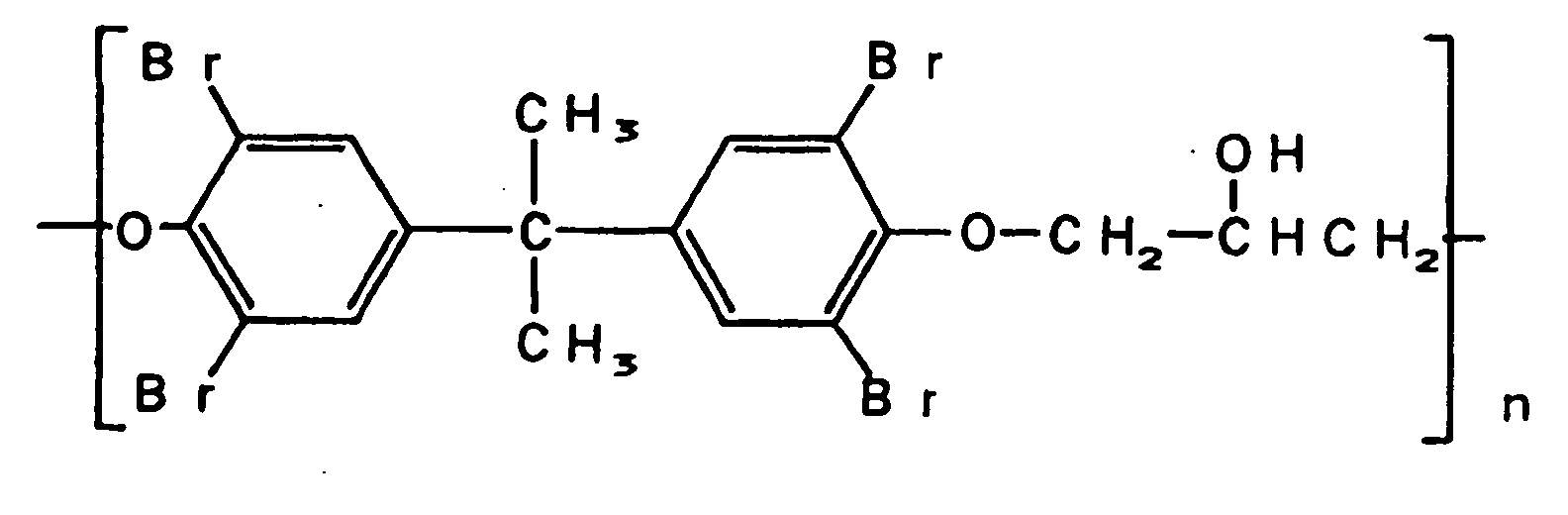
- (5) The polyhydroxy ether may alternatively have a
structure of the following general formula synthesized from
tetrabromophenol A and epichlorohydrin.
The range of n is from about 1 to about 500, preferably from about 50 to about 250, even more preferably from about 80 to about 150.This structure advantageously improves heat resistance while maintaining the flexibility and imparts a flame retardancy.
- (6) The curing agent may be one or more isocyanates selected from the group consisting of TDI (tolylene diisocyanate), IPDI (isophorone diisocyanate), HDI (hexamethylene diisocyanate) and XDI (xylylene diisocyanate). These curing agents advantageously improve heat resistance.
- (7) The curing agent may be one or more polyisocyanates selected from the group consisting of burette-type, adduct-type and isocyanurate-type isocyanates of TDI (tolylene diisocyanate), IPDI (isophorone diisocyanate), HDI (hexamethylene diisocyanate) and XDI (xylylene diisocyanate). These curing agents improve durability and provide easy handling (in toxicity) at the time of manufacturing.
- (8) The curing agent may make use of one or more active hydrogen compounds selected from the group consisting of methyl ethyl ketone, ε-caprolactone, ethyl acetoacetate and phenol as a blocking agent. These blocking agents advantageously give a longer pot-life (storage life).
- (9) The composition may be blended such that the ratio (NCO/OH) of NCO in the isocyanate curing agent to OH in the polyhydroxy ether may be about 0.2 to 2.0. This ratio enables a desired rate of crosslinking reaction.
- (10) The conductive filler may be conductive carbon black with a developed structure having an amount of DBP oil absorption of about 200 to 480 ml/100g. This enables the composition to obtain stable conductivity.
- (11) The non-conductive filler may be superfine silicon dioxide having a primary particle diameter of about 7 to 40 nm. This enhances the dispersibility of carbon black as well as the printability of the composition.
- (12) The pressure-sensitive sensor of the present invention employs the pressure-sensitive conductive ink composition as described above.
-
- Practical examples of the present invention will now be described with reference to the accompanying drawings, in which:
- Fig. 1 is a graph showing the temperature stability of the pressure-sensitive characteristics of various samples of the pressure-sensitive sensor of the present invention as compared to a comparative example;
- Fig. 2 is a front view of the structure of a pressure-sensitive sensor; and
- Fig. 3 is an enlarged cross-sectional view of the structure of line electrodes and pressure-sensitive conductive ink applied around the line electrodes in the pressure-sensitive sensor in Fig. 2.
-
- The pressure-sensitive conductive ink composition of the preferred mode for carrying out the present invention includes a thermoplastic resin and a conductive filler. The thermoplastic resin is added with a curing agent capable of partial crosslinking reaction.
- Fifty parts by weight of solvent (butyl cellosolve acetate) was added to 21.1 parts by weight of phenoxy resin (PAPHEN-PKHH from Union Carbide Co., Ltd.) having the structure of the general formula below (n is as previously defined), 3.5 parts by weight of carbon black (Furnace Black 3950B from Lion Corporation) and 3.5 parts by weight of silicon dioxide particles (Aerosil R812 from Nippon Aerosil Co., Ltd.). These materials were preliminarily mixed and then sufficiently kneaded in a roll mill.

- The amount of DBP oil absorbed by the carbon black was 310 ml/100 g, and the primary particle diameter of the silicon dioxide particles was 7 nm.
- As a curing agent, 21.9 parts by weight of IPDI (LUXATE ALIPHATIC ISOCYANATE IM from Arco Chemical Co., Ltd.) was added to the kneaded material obtained above, and sufficiently stirred with a stirrer. The resultant kneaded material was applied as print on a polyimide film by a screen printer, preliminarily cured in an oven at 100°C for 4 minutes and further cured firmly at 145°C for 4 minutes to prepare a pressure-sensitive sensor sample.
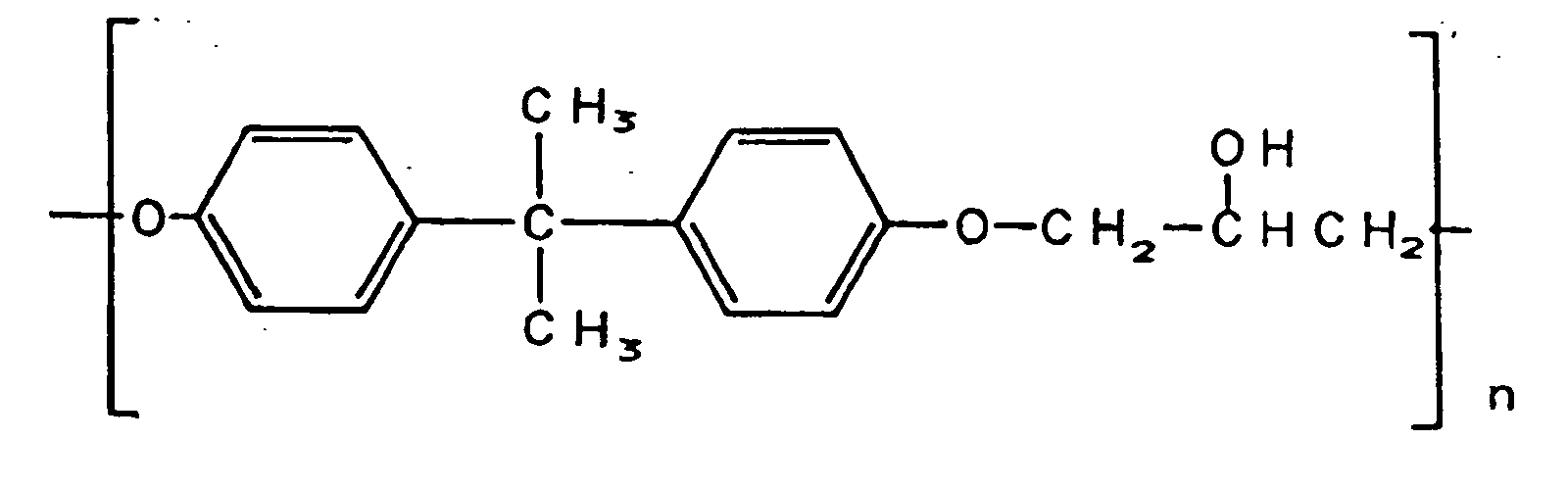
- 59.4 parts by weight of solvent (butyl cellosolve acetate) was added to 16.9 parts by weight of phenoxy resin (Phenototo YP50S from Toto Kasei Co., Ltd.) having the structure of the general formula below (n is as previously defined), 2.8 parts by weight of carbon black (Furnace Black 3950B from Lion Corporation) and 2.8 parts by weight of silicon dioxide particles (Aerosil R812 from Nippon Aerosil Co., Ltd.). These materials were preliminarily mixed and then fully kneaded in a roll mill.
- The amount of DBP oil absorbed by the carbon black was 310 ml/100 g, and the primary particle diameter of the silicon dioxide particles was 7 nm.
- As a curing agent, 18.1 parts by weight of TDI adduct-type polyisocyanate (CORONATE L-70B from Nippon Polyurethane Industry Co., Ltd.) was added to the kneaded material obtained above, and sufficiently stirred with a stirrer.
- A pressure-sensitive sensor sample was prepared by applying the resultant kneaded material as print in the same manner as in Example 1.
- 49.0 parts by weight of solvent (butyl cellosolve acetate) was added to 21.1 parts by weight of phenoxy resin (Phenototo YPB43 from Toto Kasei Co., Ltd.) having the structure of the general formula below (n is as previously defined), 2.8 parts by weight of carbon black (Furnace Black 3950B from Lion Corporation) and 4.3 parts by weight of silicon dioxide particles (Aerosil R812 from Nippon Aerosil Co., Ltd.). These materials were preliminarily mixed and then sufficiently kneaded in a roll mill.

- The amount of DBP oil absorbed by the carbon black was 310 ml/100 g, and the primary particle diameter of the silicon dioxide particles was 7 nm.
- As a curing agent, 22.9 parts by weight of block-type polyisocyanate (Duranate MF-K60X from Asahi Chemical Industry Co., Ltd.) was added to the kneaded material obtained above, and sufficiently stirred with a stirrer.
- A pressure-sensitive sensor sample was prepared by applying the resultant kneaded material as print in the same manner as in Example 1.
- 1.4 parts by weight of the same carbon black as in the Examples and 5.6 parts by weight of the same silicon dioxide particles as in the Examples were added to 25 parts by weight of polyester resin (Vylon RV200, Toyobo Co., Ltd.), and then further 68 parts by weight of solvent (a mixed solvent of 2-ethoxyethyl acetate and γ-butyrolactone) were added thereto. These materials were preliminarily mixed and then kneaded in a roll mill to prepare a pressure-sensitive sensor sample in the same manner as in the Examples.
- The pressure-sensitive sensor samples were respectively pressurized in a pressuring test machine installed in a thermostatic and humidistatic bath and their pressure-sensitive characteristics were measured. The temperatures were set at 25°C, 45°C, 65°C, 85°C and 95°C, and a pressure of 0.5 kgf/cm2 was applied to the samples.
- As shown in the graph in Fig. 1, the resistance of each sample in Examples 1 to 3 hardly changed at temperatures of 25 to 95°C, but the resistance of the sample in the Comparative Example dropped rapidly at a temperature of higher than 65 °C.
- The humidity resistances of respective sensor samples were evaluated by measuring the pressure-sensitive characteristics thereof (in an atmosphere at 25°C ) after letting them stand for 1,000 hours at 85°C in 85 % relative humidity. The samples in Examples 1 to 3 maintained their pressure sensitivity, whereas the sample of the Comparative Example showed a drop in resistance under no pressure and even pressure is applied back thereto, there is no longer a change in resistance.
- Being constituted as stated above, the present invention improves the glass transition point and provides a pressure-sensitive conductive ink composition which is capable of maintaining pressure-sensitive characteristics even in an atmosphere at high temperatures where the conventional one fails.
Claims (8)
- A pressure-sensitive conductive ink composition comprising a thermoplastic resin; a conductive filler; a non-conductive filler; and a curing agent partially crosslinking the thermoplastic resin, wherein said thermoplastic resin is a polyhydroxy ether, and said non-conductive filler is ultrafine silicon dioxide having a primary particle diameter of about 7nm.
- The pressure-sensitive conductive ink composition according to claim 1, wherein said polyhydroxy ether has a structure of the following general formula wherein n is from 1 to about 500.

- The pressure-sensitive conductive ink composition according to claim 1 or claim 2, wherein said curing agent is one or more isocyanates selected from the group consisting of TDI (tolylene diisocyanate), IPDI (isophorone diisocyanate), HDI (hexamethylene diisocyanate) and XDI (xylylene diisocyanate).
- The pressure-sensitive conductive ink composition according to claim 1 or claim 2 wherein said curing agent is one or more polyisocyanates selected from a biuret type, an adduct type and an isocyanurate type of isocyanates of TDI (tolylene diisocyanate), IPDI (isophorone diddsocyanate), HDI (hexamethylene diisocyanate) and XDI (xylylene diisocyanate).
- The pressure-sensitive conductive ink composition according to claim 4, wherein said curing agent includes a blocking agent which includes one or more active hydrogen compounds selected from methyl ethyl ketone, ε-caprolactone, ethyl acetoacetate and phenol.
- The pressure-sensitive conductive ink composition according to any preceding claim, wherein said curing agent is an isocyanate curing agent and an NCO/OH ratio of isocyanate in said curing agent to hydroxy in said polyhydroxy ether is in the range from 0.2 to 2.0.
- The pressure-sensitive conductive ink composition according to any preceding claim, wherein said conductive filler is conductive carbon black having a developed structure with a DBP oil absorption from 200 to 480 ml/100g.
- A pressure-sensitive sensor including said pressure-sensitive conductive ink composition according to any one of the preceding claims.
Applications Claiming Priority (3)
| Application Number | Priority Date | Filing Date | Title |
|---|---|---|---|
| JP37333099 | 1999-12-28 | ||
| JP37333099A JP3787717B2 (en) | 1999-12-28 | 1999-12-28 | Pressure-sensitive conductive ink composition |
| EP20000311740 EP1116754B1 (en) | 1999-12-28 | 2000-12-28 | Pressure-sensitive conductive ink composition |
Related Parent Applications (1)
| Application Number | Title | Priority Date | Filing Date |
|---|---|---|---|
| EP20000311740 Division EP1116754B1 (en) | 1999-12-28 | 2000-12-28 | Pressure-sensitive conductive ink composition |
Publications (2)
| Publication Number | Publication Date |
|---|---|
| EP1484771A1 true EP1484771A1 (en) | 2004-12-08 |
| EP1484771B1 EP1484771B1 (en) | 2006-04-19 |
Family
ID=18501981
Family Applications (2)
| Application Number | Title | Priority Date | Filing Date |
|---|---|---|---|
| EP20040021112 Expired - Lifetime EP1484771B1 (en) | 1999-12-28 | 2000-12-28 | Pressure-sensitive conductive ink composition |
| EP20000311740 Expired - Lifetime EP1116754B1 (en) | 1999-12-28 | 2000-12-28 | Pressure-sensitive conductive ink composition |
Family Applications After (1)
| Application Number | Title | Priority Date | Filing Date |
|---|---|---|---|
| EP20000311740 Expired - Lifetime EP1116754B1 (en) | 1999-12-28 | 2000-12-28 | Pressure-sensitive conductive ink composition |
Country Status (4)
| Country | Link |
|---|---|
| US (1) | US6555024B2 (en) |
| EP (2) | EP1484771B1 (en) |
| JP (1) | JP3787717B2 (en) |
| DE (2) | DE60027485T2 (en) |
Families Citing this family (22)
| Publication number | Priority date | Publication date | Assignee | Title |
|---|---|---|---|---|
| AUPR725601A0 (en) * | 2001-08-24 | 2001-09-20 | Commonwealth Scientific And Industrial Research Organisation | Strain gauges |
| US7785704B2 (en) * | 2003-05-14 | 2010-08-31 | Tekscan, Inc. | High temperature pressure sensitive devices and methods thereof |
| US7112755B2 (en) * | 2003-05-21 | 2006-09-26 | Nitta Corporation | Pressure-sensitive sensor |
| US6874378B2 (en) * | 2003-07-30 | 2005-04-05 | Delphi Technologies, Inc. | Pressure transducer |
| US20060141416A1 (en) * | 2004-12-24 | 2006-06-29 | Knutson Eric J | Occlusal indicator tray & processes therefor |
| EP1883795A1 (en) * | 2005-05-25 | 2008-02-06 | Royal Melbourne Institute Of Technology | Polymeric strain sensor |
| JP2007119682A (en) * | 2005-10-31 | 2007-05-17 | Dainippon Ink & Chem Inc | Active energy ray-curable conductive ink composition |
| EP2234134A4 (en) * | 2007-12-27 | 2011-09-14 | Nissha Printing | Electronic device having protection panel |
| EP2330395A4 (en) * | 2008-09-29 | 2015-12-23 | Nissha Printing | Pressure sensor |
| DE102009014378A1 (en) * | 2009-03-23 | 2010-10-07 | E-Pinc Gmbh | Electrically conductive ink composition, useful e.g. in mass printing method, comprises electrically non-conductive polymer, polymerizable material, siccative, carbon component comprising graphite and/or carbon black and optionally solvent |
| KR101095312B1 (en) * | 2009-04-27 | 2011-12-20 | 한국표준과학연구원 | Pressure sensitive ink composition, resistive film and pressure sensing device using same |
| WO2010126214A1 (en) * | 2009-04-27 | 2010-11-04 | 한국표준과학연구원 | Pressure-sensitive ink composition, and resistive film and pressure sensing device using the same |
| US20120092294A1 (en) | 2010-10-18 | 2012-04-19 | Qualcomm Mems Technologies, Inc. | Combination touch, handwriting and fingerprint sensor |
| US20130071986A1 (en) * | 2011-09-16 | 2013-03-21 | Elpida Memory, Inc. | Partial etch of dram electrode |
| US9075566B2 (en) | 2012-03-02 | 2015-07-07 | Microsoft Technoogy Licensing, LLC | Flexible hinge spine |
| US9134807B2 (en) | 2012-03-02 | 2015-09-15 | Microsoft Technology Licensing, Llc | Pressure sensitive key normalization |
| US9024910B2 (en) | 2012-04-23 | 2015-05-05 | Qualcomm Mems Technologies, Inc. | Touchscreen with bridged force-sensitive resistors |
| US20130300590A1 (en) | 2012-05-14 | 2013-11-14 | Paul Henry Dietz | Audio Feedback |
| US20140374230A1 (en) * | 2013-06-25 | 2014-12-25 | Microsoft Corporation | Pressure sensitive keys with a single-sided direct conduction sensor |
| KR102081892B1 (en) | 2013-09-05 | 2020-02-26 | 삼성전자주식회사 | Resistive pressure sensor including piezo-resistive electrode |
| CN104830159A (en) * | 2014-12-17 | 2015-08-12 | 青岛科技大学 | Preparation method and application of photo-curing color paste containing graphene |
| US10418206B2 (en) * | 2016-09-10 | 2019-09-17 | Xiamen Pinnacle Electrical Co., Ltd. | Conducting structure and conducting method for upper sheet and lower sheet of film button circuit |
Citations (3)
| Publication number | Priority date | Publication date | Assignee | Title |
|---|---|---|---|---|
| US4765930A (en) * | 1985-07-03 | 1988-08-23 | Mitsuboshi Belting Ltd. | Pressure-responsive variable electrical resistive rubber material |
| US5250228A (en) * | 1991-11-06 | 1993-10-05 | Raychem Corporation | Conductive polymer composition |
| US5773113A (en) * | 1996-11-21 | 1998-06-30 | Brady Precision Tape Co. | Adhesive compositions for electronic applications |
Family Cites Families (5)
| Publication number | Priority date | Publication date | Assignee | Title |
|---|---|---|---|---|
| US4595604A (en) | 1984-07-18 | 1986-06-17 | Rohm And Haas Company | Conductive compositions that are directly solderable and flexible and that can be bonded directly to substrates |
| US5089173A (en) * | 1990-05-02 | 1992-02-18 | Advanced Products Inc. | Highly conductive polymer thick film compositions |
| US5989700A (en) * | 1996-01-05 | 1999-11-23 | Tekscan Incorporated | Pressure sensitive ink means, and methods of use |
| US5855820A (en) * | 1997-11-13 | 1999-01-05 | E. I. Du Pont De Nemours And Company | Water based thick film conductive compositions |
| NL1008460C2 (en) | 1998-03-03 | 1999-09-06 | Acheson Colloiden B V | Conductive ink or paint. |
-
1999
- 1999-12-28 JP JP37333099A patent/JP3787717B2/en not_active Expired - Fee Related
-
2000
- 2000-12-28 EP EP20040021112 patent/EP1484771B1/en not_active Expired - Lifetime
- 2000-12-28 US US09/753,230 patent/US6555024B2/en not_active Expired - Fee Related
- 2000-12-28 DE DE2000627485 patent/DE60027485T2/en not_active Expired - Fee Related
- 2000-12-28 EP EP20000311740 patent/EP1116754B1/en not_active Expired - Lifetime
- 2000-12-28 DE DE2000618378 patent/DE60018378T2/en not_active Expired - Fee Related
Patent Citations (3)
| Publication number | Priority date | Publication date | Assignee | Title |
|---|---|---|---|---|
| US4765930A (en) * | 1985-07-03 | 1988-08-23 | Mitsuboshi Belting Ltd. | Pressure-responsive variable electrical resistive rubber material |
| US5250228A (en) * | 1991-11-06 | 1993-10-05 | Raychem Corporation | Conductive polymer composition |
| US5773113A (en) * | 1996-11-21 | 1998-06-30 | Brady Precision Tape Co. | Adhesive compositions for electronic applications |
Also Published As
| Publication number | Publication date |
|---|---|
| DE60018378T2 (en) | 2006-04-06 |
| US20010015423A1 (en) | 2001-08-23 |
| EP1484771B1 (en) | 2006-04-19 |
| DE60027485D1 (en) | 2006-05-24 |
| US6555024B2 (en) | 2003-04-29 |
| HK1071228A1 (en) | 2005-07-08 |
| JP3787717B2 (en) | 2006-06-21 |
| DE60018378D1 (en) | 2005-04-07 |
| EP1116754A2 (en) | 2001-07-18 |
| JP2001184944A (en) | 2001-07-06 |
| EP1116754B1 (en) | 2005-03-02 |
| HK1037662A1 (en) | 2002-02-15 |
| EP1116754A3 (en) | 2002-06-12 |
| DE60027485T2 (en) | 2006-11-23 |
Similar Documents
| Publication | Publication Date | Title |
|---|---|---|
| EP1484771B1 (en) | Pressure-sensitive conductive ink composition | |
| EP2614099B1 (en) | Polyurethane-based coating for display areas | |
| US3650828A (en) | Magnetic coating formulation for recording tape | |
| EP3713977B1 (en) | Durable, electrically conductive polyurethane compositions and methods of applying same | |
| EP1480029B1 (en) | Pressure-sensitive sensor | |
| US8932720B2 (en) | Curing compositions for coating composite materials | |
| CN116265558B (en) | Polyurethane structural adhesive with low specific gravity and high heat conduction and preparation method thereof | |
| KR20160095613A (en) | Composition with which cured product having self-healing property is obtained, and self-healing coat film having cured coating layer thereof | |
| DE102006025313A1 (en) | Low-solvent or solvent-free crosslinker dispersion with pyrazole-blocked isocyanate groups | |
| HK1071228B (en) | Pressure-sensitive conductive ink composition | |
| HK1037662B (en) | Pressure-sensitive conductive ink composition | |
| JPH022900B2 (en) | ||
| DE102006038941A1 (en) | Water-dilutable or water-soluble blocked polyisocyanates for the preparation of aqueous one-component PUR coatings with rapid physical drying | |
| US7226551B2 (en) | Conductive member for OA equipment | |
| JPH0428558B2 (en) | ||
| US7026371B2 (en) | Electron beam curable urethane resin for magnetic recording medium, method of manufacturing the same, and magnetic recording medium using the same | |
| US20240409791A1 (en) | Electroconductive composition | |
| US20240417602A1 (en) | Electroconductive composition | |
| KR20190129529A (en) | Thermal acid generator and thermosetting resin comprising the same | |
| DE102024124243A1 (en) | Improved anti-reflective coating systems, their manufacture and use | |
| DE69416394T2 (en) | Coating composition | |
| JPS6128564A (en) | Magnetic paint composition | |
| DE102024124245A1 (en) | Improved two-component anti-reflective coatings, their production and use on components and devices | |
| TW202144447A (en) | Carbamate resin composition and synthetic leather characterized by comprising a carbamate resin that uses a polyol containing a polycarbonate polyol, a chain extender other than the polyol and a polyisocyanate as essential raw materials | |
| JPH047999B2 (en) |
Legal Events
| Date | Code | Title | Description |
|---|---|---|---|
| PUAI | Public reference made under article 153(3) epc to a published international application that has entered the european phase |
Free format text: ORIGINAL CODE: 0009012 |
|
| AC | Divisional application: reference to earlier application |
Ref document number: 1116754 Country of ref document: EP Kind code of ref document: P |
|
| AK | Designated contracting states |
Kind code of ref document: A1 Designated state(s): DE FR GB IT |
|
| 17P | Request for examination filed |
Effective date: 20050315 |
|
| REG | Reference to a national code |
Ref country code: HK Ref legal event code: DE Ref document number: 1071228 Country of ref document: HK |
|
| 17Q | First examination report despatched |
Effective date: 20050613 |
|
| AKX | Designation fees paid |
Designated state(s): DE FR GB IT |
|
| GRAP | Despatch of communication of intention to grant a patent |
Free format text: ORIGINAL CODE: EPIDOSNIGR1 |
|
| GRAS | Grant fee paid |
Free format text: ORIGINAL CODE: EPIDOSNIGR3 |
|
| GRAA | (expected) grant |
Free format text: ORIGINAL CODE: 0009210 |
|
| AC | Divisional application: reference to earlier application |
Ref document number: 1116754 Country of ref document: EP Kind code of ref document: P |
|
| AK | Designated contracting states |
Kind code of ref document: B1 Designated state(s): DE FR GB IT |
|
| PG25 | Lapsed in a contracting state [announced via postgrant information from national office to epo] |
Ref country code: IT Free format text: LAPSE BECAUSE OF FAILURE TO SUBMIT A TRANSLATION OF THE DESCRIPTION OR TO PAY THE FEE WITHIN THE PRESCRIBED TIME-LIMIT;WARNING: LAPSES OF ITALIAN PATENTS WITH EFFECTIVE DATE BEFORE 2007 MAY HAVE OCCURRED AT ANY TIME BEFORE 2007. THE CORRECT EFFECTIVE DATE MAY BE DIFFERENT FROM THE ONE RECORDED. Effective date: 20060419 |
|
| REG | Reference to a national code |
Ref country code: GB Ref legal event code: FG4D |
|
| REF | Corresponds to: |
Ref document number: 60027485 Country of ref document: DE Date of ref document: 20060524 Kind code of ref document: P |
|
| REG | Reference to a national code |
Ref country code: HK Ref legal event code: GR Ref document number: 1071228 Country of ref document: HK |
|
| PLBE | No opposition filed within time limit |
Free format text: ORIGINAL CODE: 0009261 |
|
| STAA | Information on the status of an ep patent application or granted ep patent |
Free format text: STATUS: NO OPPOSITION FILED WITHIN TIME LIMIT |
|
| 26N | No opposition filed |
Effective date: 20070122 |
|
| EN | Fr: translation not filed | ||
| PG25 | Lapsed in a contracting state [announced via postgrant information from national office to epo] |
Ref country code: FR Free format text: LAPSE BECAUSE OF FAILURE TO SUBMIT A TRANSLATION OF THE DESCRIPTION OR TO PAY THE FEE WITHIN THE PRESCRIBED TIME-LIMIT Effective date: 20070309 |
|
| PGFP | Annual fee paid to national office [announced via postgrant information from national office to epo] |
Ref country code: GB Payment date: 20071120 Year of fee payment: 8 |
|
| PGFP | Annual fee paid to national office [announced via postgrant information from national office to epo] |
Ref country code: DE Payment date: 20071128 Year of fee payment: 8 |
|
| PG25 | Lapsed in a contracting state [announced via postgrant information from national office to epo] |
Ref country code: FR Free format text: LAPSE BECAUSE OF FAILURE TO SUBMIT A TRANSLATION OF THE DESCRIPTION OR TO PAY THE FEE WITHIN THE PRESCRIBED TIME-LIMIT Effective date: 20060419 |
|
| GBPC | Gb: european patent ceased through non-payment of renewal fee |
Effective date: 20081228 |
|
| PG25 | Lapsed in a contracting state [announced via postgrant information from national office to epo] |
Ref country code: DE Free format text: LAPSE BECAUSE OF NON-PAYMENT OF DUE FEES Effective date: 20090701 |
|
| PG25 | Lapsed in a contracting state [announced via postgrant information from national office to epo] |
Ref country code: GB Free format text: LAPSE BECAUSE OF NON-PAYMENT OF DUE FEES Effective date: 20081228 |