EP1484325A1 - Isoxazole derivatives and process for producing the same - Google Patents
Isoxazole derivatives and process for producing the same Download PDFInfo
- Publication number
- EP1484325A1 EP1484325A1 EP02792015A EP02792015A EP1484325A1 EP 1484325 A1 EP1484325 A1 EP 1484325A1 EP 02792015 A EP02792015 A EP 02792015A EP 02792015 A EP02792015 A EP 02792015A EP 1484325 A1 EP1484325 A1 EP 1484325A1
- Authority
- EP
- European Patent Office
- Prior art keywords
- group
- optionally substituted
- hydrogen atom
- halogen atom
- hydroxy
- Prior art date
- Legal status (The legal status is an assumption and is not a legal conclusion. Google has not performed a legal analysis and makes no representation as to the accuracy of the status listed.)
- Granted
Links
- 0 CC(C(*)c1c2c(C3=C(*)C*=CC=C3)n[o]1)C(*)C2=O Chemical compound CC(C(*)c1c2c(C3=C(*)C*=CC=C3)n[o]1)C(*)C2=O 0.000 description 3
Classifications
-
- C—CHEMISTRY; METALLURGY
- C07—ORGANIC CHEMISTRY
- C07D—HETEROCYCLIC COMPOUNDS
- C07D261/00—Heterocyclic compounds containing 1,2-oxazole or hydrogenated 1,2-oxazole rings
- C07D261/20—Heterocyclic compounds containing 1,2-oxazole or hydrogenated 1,2-oxazole rings condensed with carbocyclic rings or ring systems
Definitions
- the present invention relates to isoxazole derivatives and a process of producing the same. More particularly, the present invention relates to intermediates useful for synthesis of pharmaceutical compounds, agricultural chemicals, dye compounds, etc. having the isoxazole skeleton, and a process of producing the same.
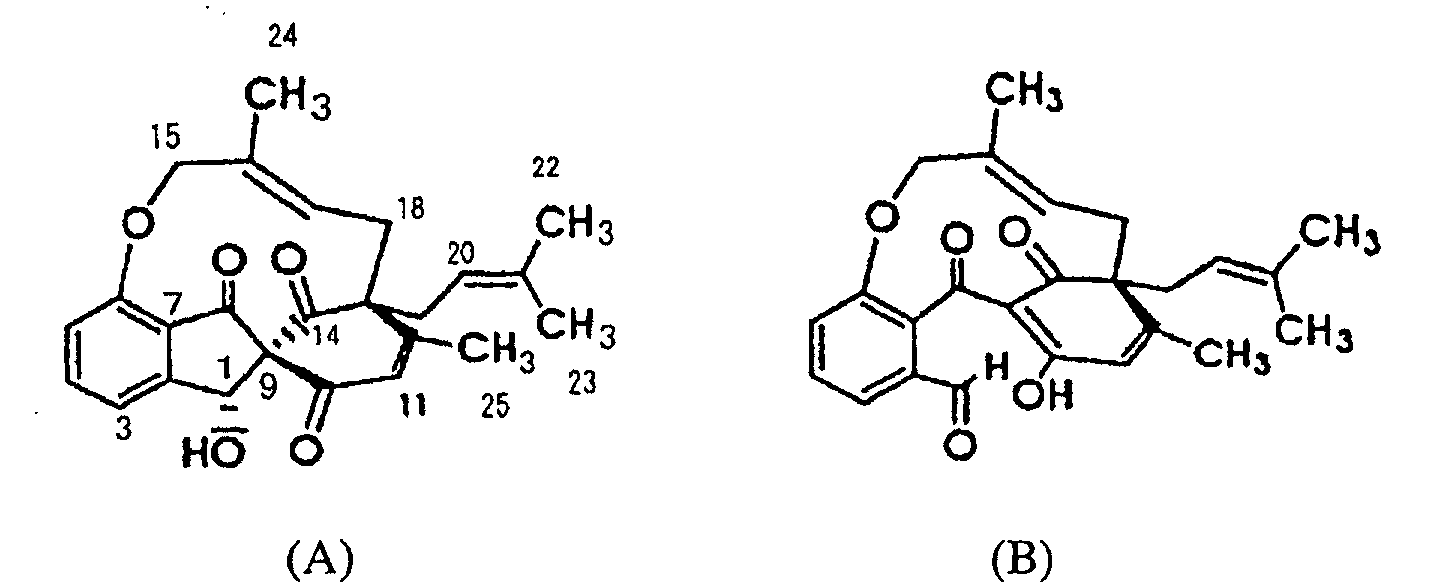
- Coleophomones A and B which are represented by formulae (A) and (B) below, respectively, are naturally occurring substances having a transglycosylase activity and are compounds useful as antibacterial agents.
- coleophomones A and B are obtained by incubating Coleophoma sp. (MF6338). As shown by the formulae (A) and (B) described above, however, these compounds have a novel cyclic structure and thus, their chemical synthesis is unknown yet.
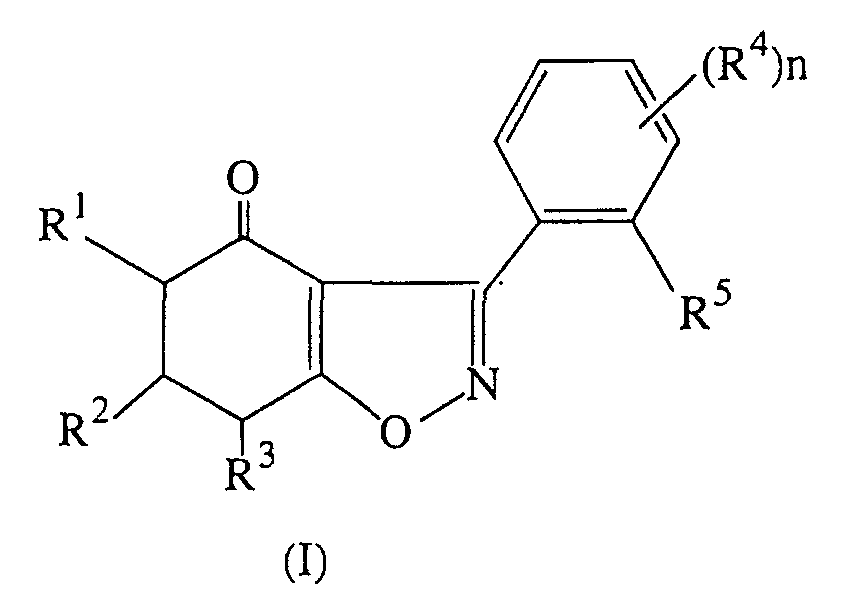
- R 2 specifically represents a hydrogen atom, optionally substituted C 1 - C 4 alkyl group, optionally substituted C 2 - C 4 alkenyl group or optionally substituted C 2 - C 4 alkynyl group; more specifically represents a hydrogen atom or C 1 - C 4 alkyl group; and most specifically a hydrogen atom or methyl group;
- R 3 specifically represents a hydrogen atom, optionally substituted C 1 - C 4 alkyl group, optionally substituted C 2 - C 4 alkenyl group or optionally substituted C 2 - C 4 alkynyl group; more specifically represents a hydrogen atom or C 1 - C 4 alkyl group; and most specifically a hydrogen atom.
- R 4 may be the same or different and each independently represents a hydrogen atom, halogen atom, hydroxy group, optionally substituted C 1 - C 20 hydrocarbon group or optionally substituted C 1 - C 4 alkoxy group; more specifically, R 4 may be the same or different and each independently represents a hydrogen atom, halogen atom, hydroxy group, C 1 - C 4 alkyl group, C 1 - C 4 alkoxy group or C 1 - C 4 alkoxy-C 1 - C 4 alkoxy group; and most specifically, R 4 may be the same or different and each independently represents a hydrogen atom, methoxy group or methoxymethoxy group.
- R 5 specifically represents a hydrogen atom, halogen atom, hydroxy group, optionally substituted C 1 - C 20 hydrocarbon group, optionally substituted C 1 - C 20 alkoxy group or optionally substituted 5- to 6-membered heterocyclic group; more specifically, R 5 represents a hydrogen atom, halogen atom, hydroxy group, C 1 - C 4 alkoxy group or 6-membered heterocyclic group containing 1 or 2 oxygen atoms; and most specifically, R 5 represents a hydrogen atom, halogen atom, hydroxy group, methoxy group or 2,6-dioxycyclohexyl group.
- n is specifically 0, 1, 2 or 3; more specifically 0, 1, or 2, further specifically 0 or 1; and most specifically 0.
- C 1 - C 20 hydrocarbon group refers to a hydrocarbon group which may be saturated or unsaturated acyclic or may also be saturated or unsaturated cyclic and which may be either linear or branched when it is acyclic.
- Examples of the C 1 - C 20 hydrocarbon group include a C 1 - C 20 alkyl group, C 2 - C 20 alkenyl group, C 2 - C 20 alkynyl group, C 3 - C 20 allyl group, C 4 - C 20 alkyldienyl group, C 4 - C 20 polyenyl group, C 6 - C 18 aryl group, C 6 - C 20 alkylaryl group, C 6 - C 20 arylalkyl group, C 4 - C 20 cycloalkyl group, C 4 - C 20 cycloalkenyl group, (C 3 - C 10 cycloalkyl) C 1 - C 10 alkyl group, etc.
- the C 1 - C 20 hydrocarbon group used in the present invention includes a C 1 - C 10 alkyl group, C 2 - C 10 alkenyl group, C 2 - C 10 alkynyl group, C 3 - C 10 allyl group, C 4 - C 10 alkyldienyl group, C 4 - C 10 polyenyl group, C 6 - C 10 aryl group, C 6 - C 12 alkylaryl group, C 6 - C 12 arylalkyl group, C 4 - C 10 cycloalkyl group, C 4 - C 10 cycloalkenyl group, etc.
- alkyl group refers to an alkyl group which may be linear or branched, and examples include methyl group, ethyl group, propyl group, n-butyl group, t-butyl group, pentyl group, hexyl group, etc.
- alkenyl group refers to a straight or branched alkenyl group of 2 to 10 carbon atoms having 1 to 3 double bonds. Specific examples include ethenyl, 1-propenyl, 2-propenyl, 1-methylethenyl, 1-butenyl, 2-butenyl, 3-butenyl, 2-methyl-2-propenyl, 1-pentenyl, 2-pentenyl, 4-pentenyl, 3-methyl-2-butenyl, 1-hexenyl, 2-hexenyl, 1-heptenyl, 2-heptenyl, 1-octenyl, 2-octenyl, 1,3-octadienyl, 2-nonenyl, 1,3-nonadienyl, 2-decenyl, etc.
- alkynyl group refers to a straight or branched alkynyl group of 2 to 10 carbon atoms having 1 to 3 triple bonds and specific examples include ethynyl, 1-propynyl, 2-propynyl, 1-butynyl, 2-butynyl, 3-butynyl, 1-pentynyl, 2-pentynyl, 4-pentynyl, 1-octynyl, 6-methyl-1-heptynyl, 2-decynyl, etc.
- cycloalkyl group refers to, for example, a cycloalkyl group having 3 to 10 carbon atoms. Specific examples include cyclopropyl, cyclobutyl, cyclopentyl, cyclohexyl, cycloheptyl, etc.
- the lower cycloalkyl group includes a cycloalkyl group having 3 to 6 carbon atoms.
- alkoxy group refers to an oxy group, to which an alkyl group is bound and specifically includes methoxy, ethoxy, propoxy, 2-propoxy, butoxy, 1,1-dimethylethoxy, pentoxy, hexoxy, etc.
- acyl group includes, for example, formyl, acetyl, propanoyl, 2-propanyol, pivaloyl, valeryl, pivaloyl, trifluoroacetyl, benzoyl, naphthoyl, nicotinoyl, methanesulfonyl, trifluoromethanesulfonyl, p-toluenesulfonyl, etc.
- the "aryl group” includes, for example, phenyl group, a naphthyl group such as 1-naphthyl group, 2-naphthyl group, etc., an indenyl group such as 2-indenyl group, etc., an anthryl group such as 2-anthryl group, etc., a tolyl group such as 2-tolyl group, 3-tolyl group, 4-tolyl group, etc., biphenyl group, and the like.
- the "heterocyclic group” includes a 5- to 7-membered saturated heterocyclic group or unsaturated heterocyclic group having, for example, 1 to 3 nitrogen atoms, oxygen atoms and/or sulfur atoms.
- saturated heterocyclic group include tetrahydrofuryl, pyrrolidinyl, pyrazolidinyl, imidazolidinyl, piperidyl, morpholinyl, thiamorpholinyl and piperazinyl.
- Examples of the unsaturated heterocyclic group include furyl, thienyl, indolyl, isothiazolyl, etc.
- the groups which can be optionally substituted on the hydrocarbon group, the heterocyclic group, etc. include, for instance, a halogen atom (e.g., fluorine, chlorine, bromine, iodine, etc.), nitro group, cyano group, a C 1-6 alkyl group which may optionally be halogenated, a C 3-6 cycloalkyl group which may optionally be halogenated, a C 1-6 alkoxy group which may optionally be halogenated, a C 1-6 alkylthio group which may optionally be halogenated, hydroxy group, amino group, a mono-C 1-6 alkylamino group (e.g., methylamino group, ethylamino group, propylanvno group, isopropylamino group, butylamino group, etc.), a di-C 1-6 alkylamino group (e.g., dimethylanuno group, diethylamino group, diprop
- R 1 represents a hydrogen atom, optionally substituted C 1 - C 20 hydrocarbon group or optionally substituted C 1 - C 10 alkoxycarbonyl group
- R 2 and R 3 which may be the same or different, each independently represents a hydrogen atom, halogen atom, hydroxy group, optionally substituted C 1 - C 20 alkyl group, or optionally substituted C 6 - C 20 aryl group
- R 4 which may be the same or different, each independently represents a hydrogen atom, halogen atom, hydroxy group, cyano group, nitro group, optionally substituted amino group, optionally substituted C 1 - C 20 hydrocarbon group, optionally substituted C 1 - C 10 alkoxy group, optionally substituted C 1 - C 10 acyl group or optionally substituted 5- to 7-membered heterocyclic group
- R 5 represents a hydrogen atom, halogen atom
- the isoxazole derivatives of the present invention can be produced, e.g., by the process shown by Scheme (I) below. [wherein R 1 , R 2 , R 3 , R 4 , R 5 , Z, Y and n have the same significance as described above].
- the solvents inert to the reaction which can be used for the reaction described above, include, for instance, an alcohol type solvent such as methanol, ethanol, isopropyl alcohol, etc.; an ethereal solvent such as tetrahydrofuran, diethyl ether, etc.; a halogenated hydrocarbon type solvent such as dichloromethane, chloroform, etc.; an aromatic solvent such as benzene, toluene, etc.; a nitrile type solvent such as acetonitrile, etc.; an amide type solvent such as N,N-dimethylformamide, etc.; a ketone type solvent such as dimethyl ketone, etc.; a sulfoxide type solvent such as dimethyl sulfoxide, etc.; water, and the like. These solvents may be used as an admixture of two kinds or more in an appropriate proportion.
- a solvent mixture of an alcohol such as ethanol and water (e.g., 2 : 1) is
- the reaction described above is carried out, for example, at a temperature of -78°C to 150°C, preferably at 10°C to 80°C for 0.1 to 144 hours, preferably 0.1 to 72 hours.
- This reaction is carried out normally under ordinary pressure but, if necessary, can be carried out under reduced pressure or under pressure.
- the reaction of the compounds represented by general formula (I) with the compounds represented by general formula (II) can also be carried out in the presence of a catalytic amount of an amine base.
- the amine base used herein include an aromatic amine such as pyridine, lutidine, etc.; a tertiary amine such as triethylamine, tripropylamine, tributylamine, cyclohexyldimethylamine, 4-dimethylaminopyridine, N,N-dimethylaniline, N-methylpiperidine, N-methylpyrrolidine, N-methylmorpholine, etc.
- the tertiary amine such as triethylamine, tripropylamine, tributylamine, cyclohexyldimethylamine, 4-dimethylaminopyridine, N,N-dimethylaniline, N-methylpiperidine, N-methylpyrrolidine, N-methylmorpholine, etc. are preferably employed.
- the amount of the amine base used is 0.05 to 1.0 mol, preferably 0.1 to 0.5 mol, based on 1 mol of the compound (II).
- the reaction is carried out in the absence of a solvent or in a solvent inert to the reaction.
- the solvents inert to the reaction which can be used in the reaction, include, for example, an alcohol type solvent such as methanol, ethanol, etc.; an ethereal solvent such as tetrahydrofuran, 1,4-dioxan, etc.; a halogenated hydrocarbon type solvent such as dichloromethane, chloroform, etc.; an aromatic solvent such as benzene, toluene, etc.; a nitrile type solvent such as acetonitrile, etc.; an amide type solvent such as N,N-dimethylformamide, etc.; a sulfoxide type solvent such as dimethyl sulfoxide, etc.; 1,2-dimethoxyethane, water, and the like.
- These solvents may be used as an admixture of two kinds or more in an appropriate proportion.
- the alcohol type solvent such as ethanol, etc. is
- the reaction described above is carried out, for example, at a temperature of -78°C to 150°C, preferably at 0°C to 100°C and more preferably at 20°C to 80°C for 0.1 to 50 hours, preferably 1 to 50 hours and more preferably for 1 to 20 hours.
- This reaction is carried out normally under ordinary pressure but, if necessary, can be carried out under reduced pressure or under pressure.
- a molecular sieve, a desiccant or the like can accelerate the reaction.
- 3 ⁇ molecular sieve, 5 ⁇ molecular sieve, basic alumina, etc. can accelerate these reactions. Therefore, these molecular sieves, desiccants, etc. are added to the reaction mixture in proper quantities.
- the desired isoxazole compounds can be obtained from the reaction mixtures thus obtained, if necessary, by means of separation, e.g., various chromatographies, etc.
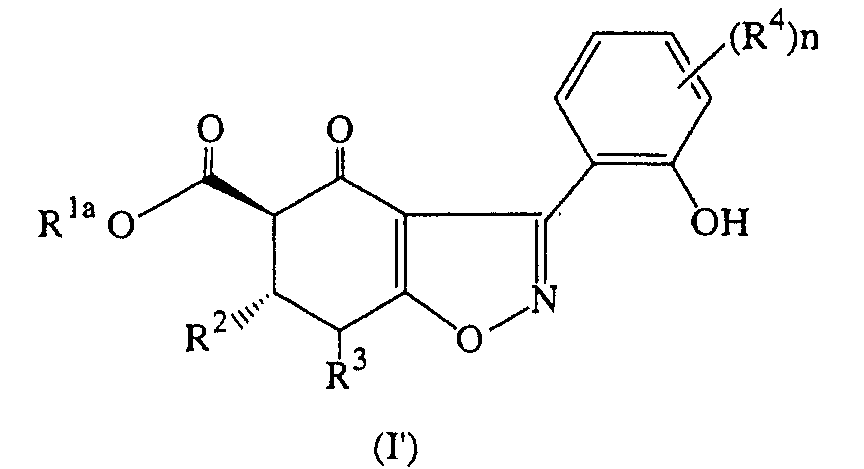
- the isoxazole derivatives represented by the following formula (I'): can be obtained.
- the compounds represented by formula (II), which are used in Schemes (Ia) and (Ib) described above, are either publicly known or can be synthesized by publicly known methods from publicly known compounds.
- the compounds represented by formula (IIa) can be synthesized by the process of Scheme (II) described below (e.g., see Edafiogho, I. O., Hinko, C. N., Chang, H., Moore, J. A., Mulzac, D., Nicholson, J. M., Scott, K. R., J. Med . Chem . 1992, 35 , 2798-2805).
- the compounds represented by general formula (II) can be obtained by reacting the 1,3-dicarbonyl compounds represented by general formula (IV) with the ester compounds represented by general formula (V) in the absence of a solvent or in a solvent inert to the reaction.
- the solvents inert to the reaction which can be used for the reaction described above, include, for instance, an alcohol type solvent such as methanol, ethanol, etc.; an ethereal solvent such as tetrahydrofuran, diethyl ether, etc.; a halogenated hydrocarbon type solvent such as dichloromethane, chloroform, etc.; an aromatic solvent such as benzene, toluene, etc.; a nitrile type solvent such as acetonitrile, etc.; an amide type solvent such as N,N-dimethylformamide, etc.; a ketone type solvent such as dimethyl ketone, etc.; a sulfoxide type solvent such as dimethyl sulfoxide, etc.; water, and the like. These solvents may be used as an admixture of two kinds or more in an appropriate proportion.
- an alcohol type solvent such as ethanol, etc. is preferably used.
- the reaction described above is carried out usually in the presence of a base.
- a base Preferred examples of the base which can be used in this reaction are alkali or alkaline earth metal alkoxides such as sodium ethoxide, sodium butoxide, potassium ethoxide, potassium butoxide, etc.
- the reaction described above is carried out at a temperature of, for example, -78°C to 150°C, preferably at 0°C to 100°C for 10 minutes to 72 hours, preferably for 30 minutes to 12 hours.
- this reaction can be carried out under reflux at a reflux temperature.
- This reaction is carried out normally under ordinary pressure but, if necessary, can be carried out under reduced pressure or under pressure.
- the compounds represented by formula (IIIa) used in Scheme (Ib) above are publicly known or can be synthesized from publicly known compounds by publicly known methods.
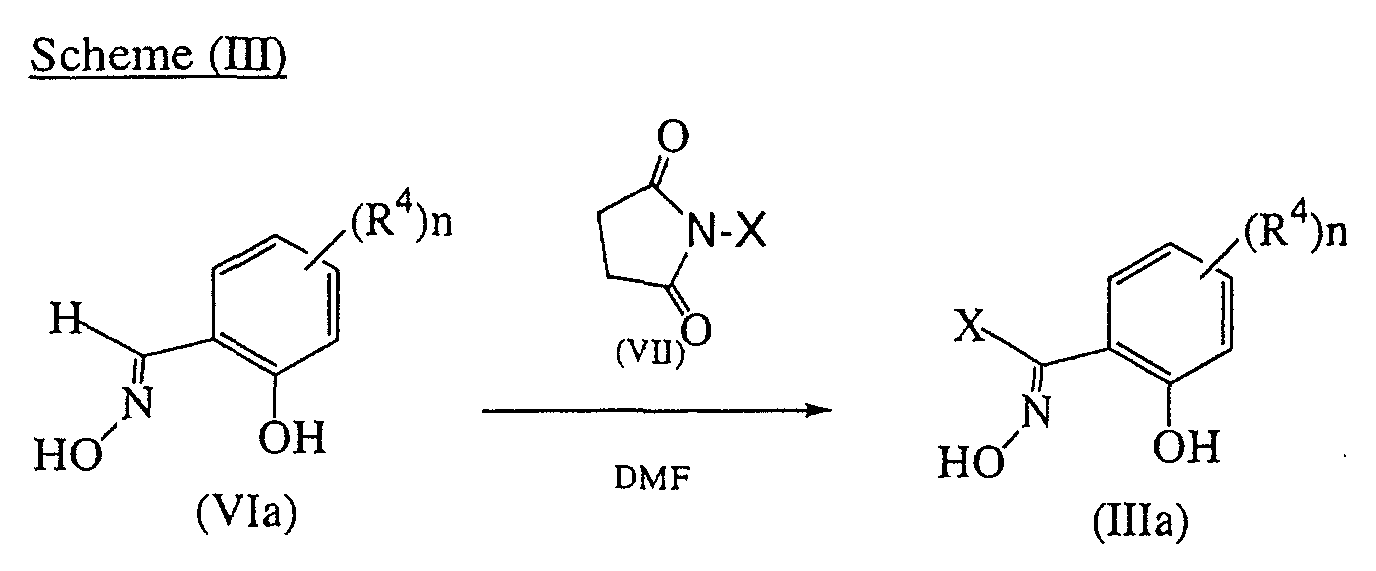
- the compounds represented by formula (IIIa) can be synthesized by the process of Scheme (III) described below (e.g., see Larsen, K. E., Torssell, K. B. G., Tetrahedron 1986, 40, 2985).
- the hydroximino compounds represented by general formula (III) can be obtained by halogenating the oxime compound of general formula (VI) with the halogenated imide compounds (X is a halogen atom) represented by general formula (VII) in the absence of a solvent or in a solvent inert to the reaction.
- X is a halogen atom
- general formula (VII) any agent is usable so long as it is a safe halogenating agent.
- chlorinating agents used herein include, for example, chlorine, hypochlorous acid, sulfinyl chloride, sulfonyl chloride, etc.
- the solvents inert to the reaction which can be used for the reaction described above, include, for example, an alcohol type solvent such as methanol, ethanol, etc.; an ethereal solvent such as tetrahydrofuran, diethyl ether, etc.; a halogenated hydrocarbon type solvent such as dichloromethane, chloroform, etc.; an aromatic solvent such as benzene, toluene, etc.; a nitrile type solvent such as acetonitrile, etc.; an amide type solvent such as N,N-dimethylformamide, etc.; a ketone type solvent such as dimethyl ketone, etc.; water, and the like. These solvents may be used as an admixture of two kinds or more in an appropriate proportion.
- the amide type solvent such as N,N-dimethylformamide, etc. is preferably used.
- the reaction described above is carried out, for example, at a temperature of -78°C to 100°C, preferably at -78°C to -60°C for 5 minutes to 72 hours, preferably for 5 minutes to 36 hours.
- the isoxazole compounds of the present invention thus obtained can be provided for further reduction, esterification, alkylation, transfer reaction, imine-forming reaction, cyclization, etc. to convert into useful harmaceutical compounds, agricultural chemicals, dye compounds, etc.
- N,2-Dihydroxybenzenecarboximidoyl chloride in 100 mL of ethanol was added to sodium salt of ethyl 2-methyl-4,6-dioxocyclohexanecarboxylate in a solvent mixture of 125 mL of water and 75 mL of ethanol at a temperature of 55°C over an hour.
- the reaction mixture was maintained at this temperature for 4 hours and then cooled down to room temperature. After diluting with water (100 mL), the mixture was extracted with ethyl acetate (2 x 100 mL). The resulting extract was washed with saturated sodium chloride aqueous solution (150 mL), dried over anhydrous sodium sulfate, and then concentrated under reduced pressure.
- the compound (IIb) (4.8 mmols, 1.2 equiv) described above was added to the compound (IIIb) (4.0 mmols, 1.0 equiv) described above in 30 mL of isopropyl alcohol at room temperature. Thereafter, powdered 4 ⁇ molecular sieves (4 g, 1 g/mmol) were added to the mixture. The resulting yellow slurry was heated to 50°C and this temperature was maintained for 36 hours. The mixture was cooled to room temperature, then filtered, concentrated and purified by silica gel column chromatography (1:1 hexane/EtOAc). The compound (Ib) described above was obtained as white foam (3.24 mmols, yield: 81%).
- Triethylamine (NEt 3 : 2.17 mmols, 1.40 equiv) was added to the compound (IIb) (2.32 mmols, 1.50 equiv) described above in 10 mL of ethanol at room temperature. The solution obtained was warmed at 50°C and stirred for 24 hours at the temperature. After concentrating under reduced pressure, the concentrate was purified by silica gel column chromatography (1:1 hexane/EtOAc) to give the compound (Ib) described above as white foam (1.36 mmol, yield: 88%).
- Et and iPr represent ethyl and isopropyl, respectively.
- Me and Et represent 2,6-dioxycyclohexanyl, methyl and ethyl, respectively.
- Et and iPr represent ethyl and isopropyl, respectively.
Landscapes
- Chemical & Material Sciences (AREA)
- Organic Chemistry (AREA)
- Heterocyclic Carbon Compounds Containing A Hetero Ring Having Nitrogen And Oxygen As The Only Ring Hetero Atoms (AREA)
- Plural Heterocyclic Compounds (AREA)
- Pharmaceuticals Containing Other Organic And Inorganic Compounds (AREA)
Abstract

Description

R2 and R3, which may be the same or different, each independently represents a hydrogen atom, halogen atom, hydroxy group, optionally substituted C1 - C20 alkyl group or optionally substituted C6- C20 aryl group;
R4, which may be the same or different, each independently represents a hydrogen atom, halogen atom, hydroxy group, cyano group, nitro group, optionally substituted amino group, optionally substituted C1 - C20 hydrocarbon group, optionally substituted C1 - C10 alkoxy group, optionally substituted C1 - C10 acyl group or optionally substituted 5- to 7-membered heterocyclic group;
R5 represents a hydrogen atom, halogen atom, hydroxy group, optionally substituted C1 - C20 hydrocarbon group, optionally substituted C1 - C20 alkoxy group or optionally substituted 5- to 7-membered heterocyclic group; and,
n represents 0, 1, 2, 3 or 4).
R2 and R3, which may be the same or different, each independently represents a hydrogen atom, halogen atom, hydroxy group, optionally substituted C1 - C20 alkyl group, or optionally substituted C6- C20 aryl group;
R4, which may be the same or different, each independently represents a hydrogen atom, halogen atom, hydroxy group, cyano group, nitro group, optionally substituted amino group, optionally substituted C1 - C20 hydrocarbon group, optionally substituted C1 - C10 alkoxy group, optionally substituted C1 - C10 acyl group or optionally substituted 5- to 7-membered heterocyclic group;
R5 represents a hydrogen atom, halogen atom, hydroxy group, optionally substituted C1 - C20 hydrocarbon group or optionally substituted 5- to 7-membered heterocyclic group; and,
n represents 0, 1, 2, 3 or 4);
which comprises reacting the compounds represented by the following formula (II):


1H NMR (400 MHz, CDCl3) δ 9.38 (br s), 8.57 (dd, 1H, J=7.9,0.7), 7.38 (t,1H, J=7.2), 7.07-7.00 (m, 2H), 4.28 (q, 2H, J=7.0), 3.38-3.31 (m, 2H), 2.95-2.89 (m, 1H), 2.80 (dd, 1H, J=17.6,9.7), 1.32 (t, 3H, J=7.1), 1.25 (d, 3H, J=6.5)
13C NMR (100.5 MHz, CDCl3) δ 187.0, 180.4, 169.0, 159.7, 156.6, 132.7, 131.8, 119.8, 117.3, 113.7, 112.2, 62.6, 61.6, 32.5, 29.7, 19.6, 14.2
IR (thin layer): 3230, 2974, 1739, 1691, 1590, 1428, 1445, 1253, 1023, 751
| Elemental Analysis (as C17H17 NO5) | |||
| Calcd. | C, 64.75%; | H, 5.43%; | N, 4.44% |
| Found | C, 64.53%; | H, 5.45%; | N, 4.25 % |

1H NMR (400 MHz, CDCl3) δ {1.21 (d, J = 6.4 Hz), 1.23 (d, J = 6.4 Hz), 3H}, 1.28-1.35 (m, 1H), 2.07-2.18 (m, 1H), 2.21-2.31 (m, 1H), 2.50-2.32 (m, 2H), 2.68-2.77 (m, 1H), 3.15-3.24 (m, 1H), 3.61-3.69 (m, 1H), {3.71 (s), 3.73 (s), 3H}, 3.82-3.89 (m, 1H), 3.97-4.05 (m, 1H), 4.14-4.22 (m, 1H), 5.46 (s, 1H), 6.97 (dd, 1H, J = 7.4, 4.8 Hz), 7.38 (dd, 1H, J = 7.4, 4.8 Hz), 7.47 (t, 1H, J = 7.4 Hz)
13C NMR (400 MHz, CDCl3) δ 14.1, 15.5*, 20.5, 20.7*, 25.5, 25.7*, 30.2, 30.7*, 30.9, 31.0*, 46.4, 46.6*, 55.8, 55.9*, 60.3, 61.2*, 67.0, 67.1*, 67.1, 67.4*, 99.1, 99.4, 111.1, 111.2*, 112.2, 115.1, 116.0, 116.1*, 118.2, 118.3*, 118.4, 127.2, 130.9, 130.9*, 138.7, 155.6, 155.7*, 157.6, 157.8*, 179.7, 179.9*, 190.3, 190.5* (this compound is present in a mixing ratio of 1 : 1 as an atropisomer; symbol * indicates the peaks, which became double intensity by the atropisomer.)
IR (thin layer) n 2964, 2884, 1694, 1599, 1479, 1446, 1272, 1075, 995.
| Elemental Analysis (as C19H21NO5) | |||
| Calcd. | C, 66.46; | H, 6.16; | N, 4.08; |
| Found | C, 66.16; | H, 6.27; | N, 4.03. |


| EX. | Solvent | Temp. (°C) | Amount of the dione (Eq.) | Base (quantity) (Eq.) | Time (min.) | Yield (%) | Amount yielded (mmol) |
| 15 | iPrOH | room temp. | 2.0 | NaOiPr(1.8) | 30 | 77 | 1.0 |
| 16 | toluene | room temp. | 2.0 | Na (-) | 35 | 70 | 1.0. |
| 17 | EtOH | 50°C | 1.5 | NEt3 (1.5) | 1440 | 89 | 1.55 |
| 18 | EtOH | 50°C | 1.5 | NEt3 (1.5) | 2160 | 76 | 0.6 |
| 19 | iPrOH | 50°C | 1.5 | NaOiPr(1.4) | 1440 | 81 | 1.0 |
| 20 | iPrOH | room temp. | 1.3 | NEt3 (1.2) | 1140 | 79 | 0.5 |
| 21 | iPrOH | room temp. | 2.0 | NaOiPr(2.0) | 30 | 70 | 5.0 |
| 22 | iPrOH | room temp. | 2.0 | NaOiPr (2.0) | 5 | 62 | 1.0 |
| 23 | iPrOH | room temp. | 2.0 | NaOiPr (2.0) | 35 | 64 | 1.0 |
Claims (16)
- An isoxazole derivative represented by the following formula (I):(wherein R1 represents a hydrogen atom, optionally substituted C1 - C20 hydrocarbon group or ? C(=O)OR1a (wherein R1a is an optionally substituted C1 - C10 alkyl group, optionally substituted C2 - C10 alkenyl group or optionally substituted C2 - C10 alkynyl group);

R2 and R3, which may be the same or different, each independently represents a hydrogen atom, halogen atom, hydroxy group, optionally substituted C1 - C20 alkyl group, or optionally substituted C6- C20 aryl group;
R4, which may be the same or different, each independently represents a hydrogen atom, halogen atom, hydroxy group, cyano group, nitro group, optionally substituted amino group, optionally substituted C1 - C20 hydrocarbon group, optionally substituted C1 - C10 alkoxy group, optionally substituted C1 - C10 acyl group or optionally substituted 5- to 7-membered heterocyclic group;
R5 represents a hydrogen atom, halogen atom, hydroxy group, optionally substituted C1 - C20 hydrocarbon group, optionally substituted a C1 - C20 alkoxy group or optionally substituted 5- to 7-membered heterocyclic group; and,
n represents 0, 1, 2, 3 or 4). - The isoxazole derivative according to claim 1, wherein R1 represents a hydrogen atom, optionally substituted C1 - C10 hydrocarbon group or ? C(=O)OR1a (wherein R1a represents an optionally substituted C1 - C4 alkyl group, optionally substituted C2 - C4 alkenyl group or optionally substituted C2 - C4 alkynyl group);
R2 represents hydrogen atom, a C1 - C4 alkyl group, optionally substituted C2 - C4 alkenyl group or optionally substituted C2 - C4 alkynyl group;
R3 represents a hydrogen atom, optionally substituted C1 - C4 alkyl group, optionally substituted C2 - C4 alkenyl group or optionally substituted C2 - C4 alkynyl group;
R4, which may be the same or different, each independently represents a hydrogen atom, halogen atom, hydroxy group, optionally substituted C1 - C20 hydrocarbon group or optionally substituted C1 - C4 alkoxy group;
R5 represents a hydrogen atom, halogen atom, hydroxy group, optionally substituted C1 - C20 hydrocarbon group, optionally substituted C1 - C4 alkoxy group or optionally substituted 5- to 6-membered heterocyclic group; and,
n represents 0, 1, 2 or 3. - The isoxazole derivative according to claim 1, wherein R1 represents a hydrogen atom or C1 - C4 alkoxycarbonyl group; R2 represents a hydrogen atom or C1 - C4 alkyl group; R3 represents a hydrogen atom; R4, which may be the same or different, each independently represents a hydrogen atom, halogen atom, hydroxy group, C1 - C4 alkyl group, C1 - C4 alkoxy group or C1 - C4 alkoxy-C1 - C4 alkoxy group; R5 represents a hydrogen atom, halogen atom, hydroxy group, C1 - C4 alkoxy group or 6-membered heterocyclic group containing 1 to 2 oxygen atoms; and n is 0 or 1.
- The isoxazole derivative according to claim 1, wherein R1 represents a hydrogen atom, methoxycarbonyl group or ethoxycarbonyl group; R2 represents a hydrogen atom or methyl group; R3 represents a hydrogen atom; R4, which may be the same or different, each independently represents a hydrogen atom, methoxy group or methoxymethoxy group; R5 represents a hydrogen atom, halogen atom, hydroxy group, methoxy group or 2,6-dioxycyclohexyl group; and n is 0 or 1.
- The isoxazole derivative according to claim 1, which is represented by the following formula (I').
- A process of producing an isoxazole derivative represented by the following formula (I):(wherein:
 which comprises reacting a compound represented by the following formula (II):R1 represents a hydrogen atom, optionally substituted C1 - C20 hydrocarbon group, or ? C(=O)OR1a (wherein R1a is an optionally substituted C1 - C10 alkyl group, optionally substituted C2 - C10 alkenyl group or optionally substituted C2 - C10 alkynyl group);R2 and R3, which may be the same or different, each independently represents a hydrogen atom, halogen atom, hydroxy group, optionally substituted C1 - C20 alkyl group, or optionally substituted C6- C20 aryl group;R4, which may be the same or different, each independently represents a hydrogen atom, halogen atom, hydroxy group, cyano group, nitro group, optionally substituted amino group, optionally substituted C1 - C20 hydrocarbon group, optionally substituted C1 - C10 alkoxy group, optionally substituted C1 - C10 acyl group or optionally substituted 5- to 7-membered heterocyclic group;R5 represents a hydrogen atom, halogen atom, hydroxy group, optionally substituted C1 - C20 hydrocarbon group, optionally substituted C1 - C20 alkoxy group or optionally substituted 5- to 7-membered heterocyclic group; and,n represents 0, 1, 2, 3 or 4),(wherein R1, R2 and R3 are the same as stated above; Z represents -O-M+ (wherein M represents Na, K or NEt3), oxo or hydroxy group; and the dotted line represents a chemical bond when Z is -O-M+ or hydroxy group) with a compound represented by the following formula (III):
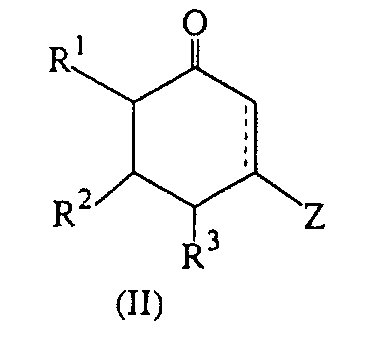 (wherein R4, R5 and n are the same as stated above; and Y represents -C(X)=NOH (wherein X is a halogen atom) or -CNO) in the absence of a solvent or in a solvent inert to the reaction.
- The process of producing the isoxazole derivative according to claim 6, wherein the reaction is carried out in the presence of a catalytic amount of an amine base.
- The process of producing the isoxazole derivative according to claim 7, wherein the amine base is selected from pyridine, lutidine, triethylamine, tripropylamine, tributylamine, cyclohexyldimethylamine, 4-dimethylaminopyridine, N,N-dimethylaniline, N-methylpiperidine, N-methylpyrrolidine and N-methylmorpholine.
- The process of producing the isoxazole derivative according to claim 7, wherein the amine base is used in 0.05 to 1.0 mol based on 1 mol of the compound (II).
- The process of producing the isoxazole derivative according to claim 6, wherein the reaction is carried out at a temperature of -78°C to 150°C for 0.1 to 144 hours.
- The process of producing the isoxazole derivative according to claim 10, wherein the reaction is carried out at a temperature of 10°C to 80°C for 0.1 to 72 hours.
- The process of producing the isoxazole derivative according to claim 6, wherein the solvent is selected from methanol, ethanol, tetrahydrofuran, diethyl ether, dichloromethane, chloroform, benzene, toluene, acetonitrile, N,N-dimethylforniamide, dimethyl ketone and water, and a mixture thereof.
- The process of producing the isoxazole derivative according to claim 6, wherein R1 represents a hydrogen atom, optionally substituted C1 - C10 hydrocarbon group, or a ? C(=O)OR1a (wherein R1a represents an optionally substituted C1 - C4 alkyl group, optionally substituted C2 - C4 alkenyl group or optionally substituted C2 - C4 alkynyl group);
R2 represents a hydrogen atom, optionally substituted C1 - C4 alkyl group, optionally substituted C2 - C4 alkenyl group or optionally substituted C2 - C4 alkynyl group;
R3 represents a hydrogen atom, C1 - C4 alkyl group, optionally substituted C2 - C4 alkenyl group or optionally substituted C2 - C4 alkynyl group;
R4, which may be the same or different, each independently represents a hydrogen atom, halogen atom, hydroxy group, optionally substituted C1 - C20 hydrocarbon group or optionally substituted C1 - C4 alkoxy group;
R5 represents a hydrogen atom, halogen atom, hydroxy group, optionally substituted C1 - C20 hydrocarbon group, optionally substituted C1 - C4 alkoxy group or optionally substituted 5- or 6-membered heterocyclic group;
n is 0,1,2 or 3; and,
Z represents -O-M+ or oxo. - The process of producing the isoxazole derivative according to claim 6, wherein R1 represents a hydrogen atom or C1 - C4 alkoxycarbonyl group; R2 represents a hydrogen atom or C1 - C4 alkyl group; R3 represents a hydrogen atom; R4, which may be the same or different, each independently represents a hydrogen atom, halogen atom, hydroxy group, C1 - C4 alkyl group, C1 - C4 alkoxy group or C1 - C4 alkoxy-C1 - C4 alkoxy group; R5 represents a hydrogen atom, halogen atom, hydroxy group, C1 - C4 alkoxy group or 6-membered heterocyclic group containing 1 - 2 oxygen atoms; n represents 0 or 1; and Z represents -O-Na+ or oxo.
- The process of producing the isoxazole derivative according to claim 6, wherein R1 represents a hydrogen atom, methoxycarbonyl group or ethoxycarbonyl group; R2 represents a hydrogen atom or methyl group; R3 represents a hydrogen atom; R4, which may be the same or different, each independently represents a hydrogen atom, methoxy group or methoxymethoxy group; R5 represents a hydrogen atom, halogen atom, hydroxy group, methoxy group or 2,6-dioxycyclohexyl group; and n is 0 or 1.
- The process of producing the isoxazole derivative according to claim 6, which comprises producing the isoxazole derivative represented by the following formula (I').

Applications Claiming Priority (3)
| Application Number | Priority Date | Filing Date | Title |
|---|---|---|---|
| JP2002063588 | 2002-03-08 | ||
| JP2002063588 | 2002-03-08 | ||
| PCT/JP2002/013641 WO2003076419A1 (en) | 2002-03-08 | 2002-12-26 | Isoxazole derivatives and process for producing the same |
Publications (3)
| Publication Number | Publication Date |
|---|---|
| EP1484325A1 true EP1484325A1 (en) | 2004-12-08 |
| EP1484325A4 EP1484325A4 (en) | 2005-12-14 |
| EP1484325B1 EP1484325B1 (en) | 2014-06-18 |
Family
ID=27800195
Family Applications (1)
| Application Number | Title | Priority Date | Filing Date |
|---|---|---|---|
| EP02792015.6A Expired - Lifetime EP1484325B1 (en) | 2002-03-08 | 2002-12-26 | Isoxazole derivatives and process for producing the same |
Country Status (4)
| Country | Link |
|---|---|
| US (2) | US7342036B2 (en) |
| EP (1) | EP1484325B1 (en) |
| JP (1) | JP4544864B2 (en) |
| WO (1) | WO2003076419A1 (en) |
Families Citing this family (2)
| Publication number | Priority date | Publication date | Assignee | Title |
|---|---|---|---|---|
| RU2481288C1 (en) * | 2011-12-29 | 2013-05-10 | Юлия Алексеевна Щепочкина | Method of producing porous aggregate |
| WO2016123275A1 (en) * | 2015-01-30 | 2016-08-04 | Boehringer Ingelheim International Gmbh | Aldosterone synthase inhibitors |
Family Cites Families (6)
| Publication number | Priority date | Publication date | Assignee | Title |
|---|---|---|---|---|
| US3835168A (en) | 1971-02-09 | 1974-09-10 | Shionogi & Co | Quinone derivatives and compositions containing the same |
| US4920117A (en) | 1989-06-09 | 1990-04-24 | Hoechst-Roussel Pharmaceuticals Inc. | 4,5,5a,6-tetrahydro-3H-isoxazolo(5,4,3-kl)acridines, pharmaceutical compositions and use |
| US5114936A (en) | 1990-08-23 | 1992-05-19 | Hoechst-Roussel Pharmaceuticals Incorporated | 6,7-dihydro-3-phenyl-1,2-benzisoxazol-4(5h)-ones and -ols, compositions and pharmaceutical use |
| US5210087A (en) * | 1991-02-13 | 1993-05-11 | Hoechst-Roussel Pharmaceuticals Inc. | 9-aminotetrahydroacridines and related compounds |
| US5230007A (en) * | 1991-06-28 | 1993-07-20 | Motorola, Inc. | Method for optimizing an adaptive filter update coefficient |
| GB2284600A (en) | 1994-01-21 | 1995-06-14 | Shell Int Research | Herbicidal 3-(hetero)aryl-4-acylisoxazole compositions and compounds |
-
2002
- 2002-12-26 JP JP2003574638A patent/JP4544864B2/en not_active Expired - Fee Related
- 2002-12-26 EP EP02792015.6A patent/EP1484325B1/en not_active Expired - Lifetime
- 2002-12-26 WO PCT/JP2002/013641 patent/WO2003076419A1/en not_active Ceased
-
2004
- 2004-09-02 US US10/932,856 patent/US7342036B2/en not_active Expired - Fee Related
-
2007
- 2007-11-01 US US11/933,937 patent/US7453001B2/en not_active Expired - Fee Related
Also Published As
| Publication number | Publication date |
|---|---|
| JPWO2003076419A1 (en) | 2005-07-07 |
| US20080058530A1 (en) | 2008-03-06 |
| US20050026978A1 (en) | 2005-02-03 |
| JP4544864B2 (en) | 2010-09-15 |
| EP1484325A4 (en) | 2005-12-14 |
| WO2003076419A1 (en) | 2003-09-18 |
| US7342036B2 (en) | 2008-03-11 |
| US7453001B2 (en) | 2008-11-18 |
| EP1484325B1 (en) | 2014-06-18 |
Similar Documents
| Publication | Publication Date | Title |
|---|---|---|
| Šmit et al. | Three-step synthetic pathway to fused bicyclic hydantoins involving a selenocyclization step | |
| Wang et al. | A general synthesis of 2-substituted-5-aminooxazoles: building blocks for multifunctional heterocycles | |
| Xu et al. | Synthetic access to isoxazoline-functionalized isoquinolines via microwave-assisted iminoxyl radical-participated cascade cyclization of vinyl isocyanides | |
| González-Nogal et al. | 1, 3-Dipolar cycloadditions of silicon and tin alkynes and alkenes. Regiospecific synthesis of silyl and stannylpyrazoles and pyrazolines | |
| Zheng et al. | Vinylation of the indole 3-position via palladium-catalyzed cross-coupling | |
| Lee et al. | Regioselective construction of polysubstituted benzene ring from Baylis–Hillman adduct via [4+ 2] annulation strategy | |
| US7453001B2 (en) | Isoxazole derivatives and process for producing the same | |
| Broggini et al. | The first case of asymmetric induction in intramolecular nitrile imine cycloadditions: synthesis of enantiopure 3-substituted 6-oxo-2, 3, 3a, 5-tetrahydro-4-carbomethoxy-furo [3, 4-c] pyrazoles | |
| Sharma et al. | Synthesis of a new isoxazolidine from diacetone glucose | |
| Lee et al. | Efficient synthesis of β-substituted α-haloenones by rhodium (ii)-catalyzed and thermal reactions of iodonium ylides | |
| Kobayashi et al. | Synthesis of 9-arylamino-and (Z)-9-arylimino-9H-pyrrolo [1, 2-a] indoles by reactions of 2-(pyrrol-1-yl) benzaldehydes with aryl amines | |
| Mollet et al. | Synthesis of stereodefined 3, 4-disubstituted piperidines through rearrangement of 2-(2-bromo-1, 1-dimethylethyl) azetidines | |
| Sarkar et al. | Synthesis of the necine bases (±)-macronecine and (±)-supinidine via an aza-ene reaction and allylsilane induced ring closure | |
| Wang et al. | A novel resin-bound CF3-containing building block: application to the solid-phase synthesis of CF3-containing acrylates and 4-isoxazolecarboxylates | |
| JP4252788B2 (en) | Polycyclic compound and method for producing the same | |
| CN113072500A (en) | Synthetic method of dibenzo [ b, e ] azepine compound | |
| Sashida et al. | A facile preparation of 1-benzoselenopyrylium salts1 | |
| JP4600859B2 (en) | Heterocyclic substituted thiophenol compounds, intermediates for production thereof, and production methods | |
| KR100589966B1 (en) | A process for preparing beta- ketoester compound | |
| US7893275B2 (en) | Polycyclic ketone compound and process for producing the same | |
| US20020072613A1 (en) | Process for producing acetophenone compound | |
| JP4253603B2 (en) | Polycyclic compound and method for producing the same | |
| Pang et al. | A novel synthesis of 5-perfluorophenyl 4, 5-dihydro-1H-pyrazoles in THF or water | |
| JP3148226B2 (en) | Process for preparing isoxazole-4,5-dicarboxylic acid diesters and diesters of this kind | |
| Mollet et al. | Full Text HTML |
Legal Events
| Date | Code | Title | Description |
|---|---|---|---|
| PUAI | Public reference made under article 153(3) epc to a published international application that has entered the european phase |
Free format text: ORIGINAL CODE: 0009012 |
|
| 17P | Request for examination filed |
Effective date: 20040907 |
|
| AK | Designated contracting states |
Kind code of ref document: A1 Designated state(s): AT BE BG CH CY CZ DE DK EE ES FI FR GB GR IE IT LI LU MC NL PT SE SI SK TR |
|
| RIN1 | Information on inventor provided before grant (corrected) |
Inventor name: SUZUKI, KEISUKE Inventor name: BODE, JEFFREY W. |
|
| RIC1 | Information provided on ipc code assigned before grant |
Ipc: 7C 07D 261/20 A Ipc: 7A 01N 43/80 B |
|
| A4 | Supplementary search report drawn up and despatched |
Effective date: 20051028 |
|
| 17Q | First examination report despatched |
Effective date: 20071129 |
|
| GRAP | Despatch of communication of intention to grant a patent |
Free format text: ORIGINAL CODE: EPIDOSNIGR1 |
|
| INTG | Intention to grant announced |
Effective date: 20140122 |
|
| RIN1 | Information on inventor provided before grant (corrected) |
Inventor name: BODE, JEFFREY W. Inventor name: SUZUKI, KEISUKE |
|
| GRAS | Grant fee paid |
Free format text: ORIGINAL CODE: EPIDOSNIGR3 |
|
| GRAA | (expected) grant |
Free format text: ORIGINAL CODE: 0009210 |
|
| AK | Designated contracting states |
Kind code of ref document: B1 Designated state(s): DE FR GB |
|
| REG | Reference to a national code |
Ref country code: GB Ref legal event code: FG4D |
|
| REG | Reference to a national code |
Ref country code: DE Ref legal event code: R096 Ref document number: 60246362 Country of ref document: DE Effective date: 20140731 |
|
| RIN2 | Information on inventor provided after grant (corrected) |
Inventor name: SUZUKI, KEISUKE Inventor name: BODE, JEFFREY W. |
|
| REG | Reference to a national code |
Ref country code: DE Ref legal event code: R097 Ref document number: 60246362 Country of ref document: DE |
|
| PLBE | No opposition filed within time limit |
Free format text: ORIGINAL CODE: 0009261 |
|
| STAA | Information on the status of an ep patent application or granted ep patent |
Free format text: STATUS: NO OPPOSITION FILED WITHIN TIME LIMIT |
|
| 26N | No opposition filed |
Effective date: 20150319 |
|
| REG | Reference to a national code |
Ref country code: DE Ref legal event code: R119 Ref document number: 60246362 Country of ref document: DE |
|
| GBPC | Gb: european patent ceased through non-payment of renewal fee |
Effective date: 20141226 |
|
| REG | Reference to a national code |
Ref country code: FR Ref legal event code: ST Effective date: 20150831 |
|
| PG25 | Lapsed in a contracting state [announced via postgrant information from national office to epo] |
Ref country code: GB Free format text: LAPSE BECAUSE OF NON-PAYMENT OF DUE FEES Effective date: 20141226 Ref country code: DE Free format text: LAPSE BECAUSE OF NON-PAYMENT OF DUE FEES Effective date: 20150701 |
|
| PG25 | Lapsed in a contracting state [announced via postgrant information from national office to epo] |
Ref country code: FR Free format text: LAPSE BECAUSE OF NON-PAYMENT OF DUE FEES Effective date: 20141231 |