-
Phenylacetic acid and -acid esters and their derivatives, particularly,
those with one or more than one substituent at the
phenyl ring are interesting starting compounds for active components
in drugs and pesticides. Well-documented is the use of
phenylacetic acids e.g. for the preparation of dibenzocycloheptatriene-type
drugs, as described in DE 1593314 and for analgetica
of the "fenac"- and "fenbufen"-type.
There are various processes for the preparation of unsubstitued
and aryl substituted phenylacetic acid and its derivatives
known. A. Burger and S. Avakian described the preparation
of (4-methoxyphenyl)acetic acid from 4-methoxybenzoic
acid via the corresponding α-diazoketone and its Wolff-rearrangement
into the phenylacetic acid. A. McKillop et al.
described the oxidative rearrangement of many aryl-substituted
acetophenones, mediated by Tl(NO3)3 on Montmorillonit-K10 into
the corresponding phenylacetic acid esters in J. Am. Chem.
Soc. 95, 3340(1973). Other well-known methods are the hydrolysis
of benzylnitriles, the reaction of benzylmagnesium halides
with CO2 and the Willgerodt-Kindler reaction, in which acetophenones
are converted first with elementary sulfur in presence
of a secondary amine, preferably morpholine, into a
thioamide, which is then hydrolysed into the corresponding
phenylacetic acid. All these processes have severe draw-backs
under economical and ecological aspects, as toxic reagents are
used, multi-step reactions are necessary, considerable amounts
of toxic non-biogradable waste are produced and most reactions
are dependent on the electronic nature and the position of the
aryl-substituents with respect to the formation and the yield
of the desired phenylacetic acid or its primary derivative.
-
As there is a pressing need for technologically, economically
and ecologically more favourable methods for the preparation
of phenylacetic acids, some patents have claimed approaches
other than the above-mentioned. GB 820083 describes the preparation
of substituted carboxylic acids, esters or salts, by
reaction of Grignard-compounds with an α-halocarboxylic derivative
like acid, ester or salt. The reaction is carried out
under reflux without any catalyst. As the starting material
contains carbonyl groups side reactions are possible. Organozinc
compounds tolerate a number of functional groups, especially
carbonyl functions, that should not be involved in the
coupling process (Diederich, Stang, Metal-catalyzed Cross-coupling
Reactions, Wiley-VCH 1998, p. 18). This fact was
picked up by Klingstedt and Frejd (Nickel-catalyzed Synthesis
of Arylacetic Esters from Arylzinc Chlorides and Ethyl Bromoacetate,
Klingstedt, T.; Frejd, T.; Organometallics 1983, 2,
p. 598). The first method (reaction of aryl halide and lithiated
ester) described in this paper is not practical for a
larger scale, because a stoichiometric amount of nickel is
necessary.
The therein described second method deals with a Reformatsky-type
coupling, where an aryl halide reacts with bromo-2-(ethylacetato)zink(II),
the Reformatsky reagent of ethyl bromoacetate.
This process can be carried out in the presence of
a catalytical amount of nickel(0). Therefore exist the following
requirements: the use of HMPA, which is very toxic, and
the preformation of the nickel(0) catalyst, because the Reformatsky-reagent
is unable to reduce nickel(II) (precursor of
the catalytic active species) to nickel(0). The latter is realized
by additional reducing reagents or simply the use of
mostly very air-sensitive nickel(0) complexes.
The third method bases on the coupling of arylzinc halides
with ethyl bromoacetate in the presence of a nickel(II) catalyst.
This catalyst is generated in situ by addition of one
equiv. bis(acetylacetonato)nickel(II) and one equiv. phosphine
ligand (PPh3 or CyPh2P) . Nevertheless, there are problems with
relative low yields and side products, like biaryls.
US 2002/0062041 A1 describes the preparation of arylacetic esters
by carbonylation of substituted benzyl chlorides in the
presence of an primary alcohol R-OH, whereas R is the introduced
group of the ester function. This process is carried out
at 20-30bar CO and 130-150°C in an dipolar aprotic solvent
(like N-methylpyrrolidone) and requires a transition metal
catalyst, which contains a Group 8 metal (preferably ruthenium).
-
EP-A-1 191 008 and EP-A-1 201 632 describe the use of phenylacetic
acids as starting products for the preparation of new
liquid crystals, particularly those with one or more fluorosubstituents
on the aryl-ring. Starting from the prior art described
above, it is the object of the invention to provide a
straight-forward one-pot preparation for these acids, respectively
their esters, which makes use only of easily available
educts, particularly various halo-fluoroaryls and both α- and
β-haloacetic esters, which are coupled together by a Ni-catalyzed
Zn-mediated reaction in high yield and purity. Thus,
the invention aims at achieving a simple reaction sequence, a
short reaction-time, good yields and selectivities, an easy
product isolation with lower amounts of waste, use of commercial
starting products and a wide versatility with respect to
the aryl-substituents.
-
This invention relates to a process for the preparation of
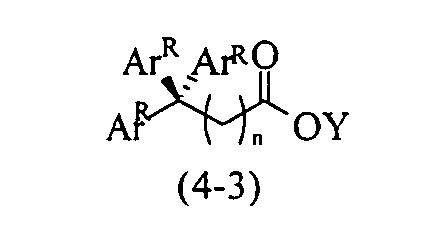
fluorophenylalkylencarboxylic acid derivatives (4-1) to (4-3):
wherein R
a to R
e are H, F, alkyl, alkoxy, fluoroalkyl, cycloalkyl,
fluorocycloalkyl, aryl, fluoroaryl, alkenyl, alkynyl,
R, R
1 and R
2 are hydrogen atoms or alkyl, cycloalkyl, aryl, alkenyl
and alkynyl, which can be substituted by alkyl and
alkoxy groups,
n is from 0 to 10,
Y is alkyl, aryl, Li, Na, K or a group II metal (except Ra),
Ar
R is an aryl group substituted by H, F, alkyl, fluoroalkyl,
cycloalkyl, fluorocycloalkyl, aryl, fluoroaryl, alkenyl, alkynyl;
wherein fluoroarylmetal halides (Ar
RM
a,bX)
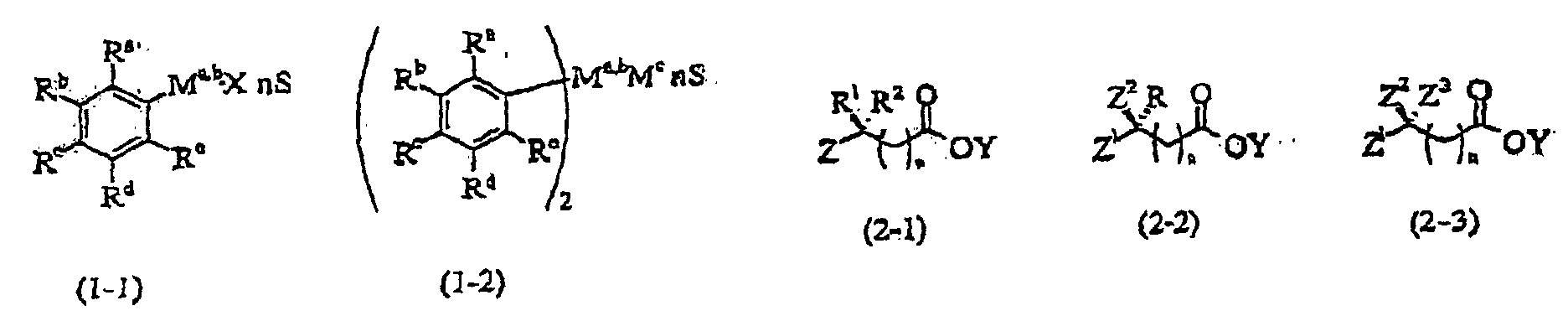
y·nS (1-1) resp.
(Ar
RM
a,bM
c)
y·nS (1-2) :
wherein R
a, R
b, R
c, R
d and R
e are as defined above, wherein in
(1-1) M
a and M
b are Li, Mg, Zn, Cu(II) and in (1-2) M
a and M
b
are Li, Mg or Zn, X is a Cl, Br or I, S is an optionally substituted
dialkyl or alicyclic ether
are reacted with carboxylic acid derivatives R
pZ
(3-p)(CH
2)
nCOOY
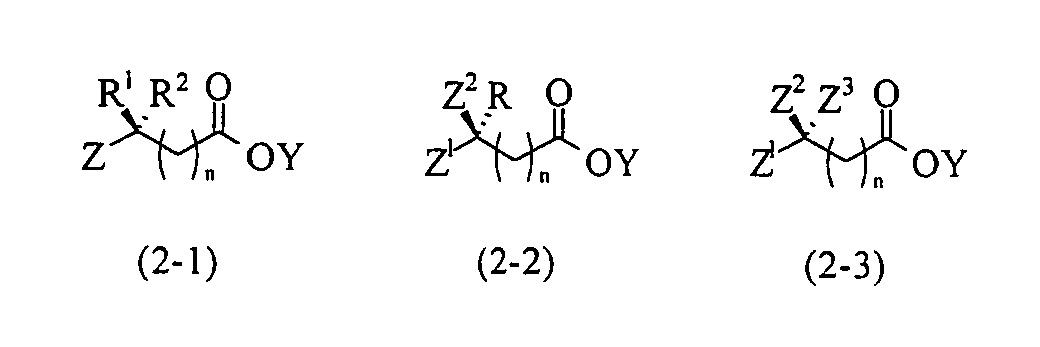
(2-1)~(2-3)
wherein Z, Z
1, Z
2 and Z
3 are Cl, Br or I, n and Y are as
defined above, p is 0 to 3,
in the presence of at least a transition metal catalyst
L
nTMX
1X
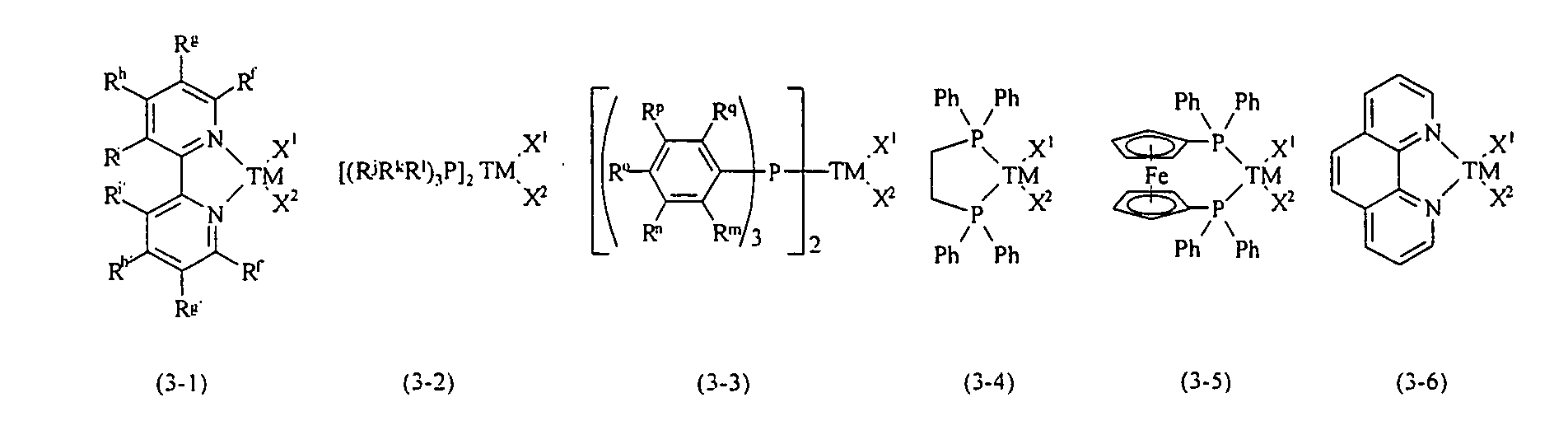
2 selected from the group (3-1)~(3-6)
LnTMXm
wherein TM is divalent or zerovalent nickel, palladium or
platinum,
R
f, R
g, R
h, R
i, R
f', R
g', R
h' and R
i' are hydrogen, alkyl, alkoxy,
perfluoroalkyl, perfluoroalkoxy, alkenyl, alkynyl or halogen
(except At),
R
j, R
k and R
l are alkyl, alkoxy, perfluoroalkyl, perfluoroalkoxy,
cycloalkyl, cycloalkoxy, perfluorocycloalkyl and perfluorocycloalkoxy.
R
m, R
n, R
o, R
p and R
q are hydrogen, alkyl, alkoxy, perfluoroalkyl,
perfluoroalkoxy, alkenyl, alkynyl or halogen (except At),
and wherein, when TM is divalent, X
1 and X
2 are inorganic ionic
ligands,
and when TM is zerovalent, X
1 and X
2 are inorganic or organic
donorligands,
and wherein in (3-7) m and n are integers from 1 to 6, the
ligand L is alkyl phosphine, aryl phosphine, alkyl aryl
phosphine, bipyridyl or phenanthroline, substituted by hydrogen,
alkyl, alkoxy, perfluoroalkyl, perfluoroalkoxy, cycloalkyl,
cycloalkoxy, perfluorocycloalkyl, perfluoroalkoxy and
perfluorocycloalkyl, alkenyl, alkynyl, chlorine, bromine or
iodine;
the ligands can be bridged by substituted or unsubstituted alkyl
groups, aryl groups and ferrocene;
in case TM is a divalent metal, X is an inorganic ionic ligand
like chloride, bromide, iodide, hydride, sulfate, sulfite, nitrate,
amide or amide substituted by alkyl, cycloalkyl, aryl
or organic carboxylate;
X is alkyl, cycloalkyl, aryl or part of an ionic chelate
ligand;
in case TM is a zerovalent metal, X can be an inorganic or organic
donor ligand.
-
As mentioned above, the fluoroarylmetal compound is described
by the general formulae (1)
wherein in (1-1) M
a and M
b are Li, Mg, Zn, Cu(II). In the case
of Li, the metal is not X-substituted. In (1-2) M
a and M
b are
Li, Mg or Zn, M
c is Cu(I). X is a chlorine, bromine or iodine.
R
a to R
e are H, F, alkyl, fluoroalkyl, cycloalkyl, fluorocycloalkyl,
aryl, fluoroaryl, alkenyl, alkynyl. S is a dialkyl
or alicyclic ether. The cyclic ether consists of a five or six
membered ring which is composed of carbon atoms except one,
which is oxygen. In the case of the six membered ring the carbon
atom in position 4 can be replaced by nitrogen, which can
be substituted by H, alkyl, fluoroalkyl, cycloalkyl, fluorocycloalkyl,
aryl, fluoroaryl, alkenyl, alkynyl. The carbon
ring atoms can be substituted by alkyl, alkoxy, aryl, aryloxy
groups.
-
The term "alkyl" as used herein relates to an alkyl group having
1 to 25 carbon atoms.
-
The term "alkenyl" as used herein describes an unsaturated hydrocarbon
group having 2 to 25 carbon atoms, wherein the position
of the double bond(s) is not subject to any limitation.
-
The term "alkynyl" as used herein relates to hydrocarbons with
one or more triple bonds having 2 to 25 carbon atoms, wherein
the position of the triple bond(s) is not subject to any limitation.
-
The term "cycloalkyl" as used herein relates to cyclic alkyl
groups having 3 to 8 carbon atoms.
-
The term "aryl" as used herein relates to aromatic groups such
as phenyl and naphthyl groups.
-
The reaction is carried out in S as the reaction medium in the
temperature range of -80°C to 260°C, depending on the melting
and boiling point of S. Beside S a saturated cyclic, aromatic
or non-cyclic hydrocarbon or mixtures thereof can be used as
reaction medium.
The organometallic aryl metal compound is generated by reaction
of the corresponding aryl halide ArX and M
a (M
a=Mg, Li;
(2), equ. I). In the case of Cu and Zn this compound is obtained
by transmetalation of ArM
aX using metal halide M
bX
(M
b=Cu(II), Zn;
(2), equ. II). This procedure is also practicable
for M
b=Mg, when M
a is Li.
-
The described method is also valid for the syntheses of diaryl
metalates, when Ma and Mb are Li respectively Mg, and Mc is
Cu(I) ((2), equ. III). It will be evident that when the metal
has a differing valence, the formula must be modified to correspond.
The in situ produced aryl metal halides must be handled
between -80°C and reflux temperature of the solvent, depending
on the stability of the organometallic species. Normal
working temperature is between -80°C and 200°C, preferably between
20°C and 70°C.
-
The carboxylic coupling component is described by the general
formulae (3)
wherein Z, Z
1, Z
2 and Z
3 are halogen atoms (which can be different
from each other), except fluorine and astatine. R, R
1
and R
2 are preferably hydrogen atoms, but can also be alkyl,
cycloalkyl, aryl, alkenyl and alkynyl, which can be substituted
by alkyl and alkoxy groups. Y is alkyl, aryl, alkali
metal (except Rb, Cs and Fr) or a group II metal (except Ra).
n is an integer from 0 to 10, preferably 0 and 1.
-
As the formation of the required products via thermal metal
halide elimination is unselective and accompanied by formation
of side products, the coupling process was transformed to
transition metal-catalyzed cross coupling. The choice of appropriate
conditions minimizes the formation of side products.
The advantage of the herein described process is the very high
conversion and selectivity to the required arylalkylencarboxylic
acid derivative. The formation of biphenyls, which are
always formed by application of established methods, is completely
avoided. Furthermore, this method is adaptable to a
wide range of substrates. The used catalysts are easy to prepare
and very cheap. As the used catalysts have high activity,
this process can be carried out with high performance at room
temperature, that means without additional energy effort for
refluxing the reaction mixture. This catalyst system is described
by the general formulas (3-1) to (3-7):
LnTMXm
wherein TM ("transition metal") is divalent or zerovalent
nickel, palladium or platinum. In the case of divalent TM, X
1
and X
2 are inorganic ionic ligands like halide, hydride, sulfate,
sulfite, nitrate, nitrite, substituted amide (H, alkyl,
cycloalkyl, aryl) or organic carboxylates like acetates and
propionates. Furthermore X
1 and X
2 can be: alkyl, cycloalkyl,
aryl. The donor atoms X
1 and X
2 can be a part of an ionic chelate
ligand like diketonate, e.g. penta-2,4-dionate, which can
be substituted by alkyl, cycloalkyl, aryl and fluorine. It is
evident, that a combination of both is possible.
In the case of zerovalent TM, X
1 and X
2 are inorganic or organic
donorligands like carbon monoxide, amines (substituted
by H, alkyl, cycloalkyl, aryl), phosphines (substituted by H,
alkyl, cycloalkyl, perfluoroalkyl, aryl, perfluoroaryl, aryl
sulfonate), ethers (non-cyclic, alicyclic, aromatic), monodentate
olefines, bidentate olefines (butadiene, cyclooctadiene)
or polydentate olefines (aromatic/heteroaromatic compounds,
cyclooctatetraene). R
f, R
g, R
h, R
i, R
f', R
g', R
h' and R
i' are hydrogen,
alkyl, alkoxy, perfluoroalkyl, perfluoroalkoxy, alkenyl,
alkynyl or halogen (except At). R
j, R
k and R
l are alkyl,
alkoxy, perfluoroalkyl, perfluoroalkoxy, cycloalkyl, cycloalkoxy,
perfluorocycloalkyl and perfluorocycloalkoxy. R
m, R
n,
R
o, R
p and R
q are hydrogen, alkyl, alkoxy, perfluoroalkyl, perfluoroalkoxy,
alkenyl, alkynyl or halogen (except At).
-
In formula (3-7) shown above, TM is a transition metal and has
the same meaning as in formulae (3-1) to (3-6). Further, m and
n are integers from 1 to 6, the ligand L is alkyl phosphine,
aryl phosphine, alkyl aryl phosphine, bipyridyl or phenanthroline,
substituted by hydrogen, alkyl, alkoxy, perfluoroalkyl,
perfluoroalkoxy, cycloalkyl, cycloalkoxy, perfluorocycloalkyl,
perfluoroalkoxy and perfluorocycloalkyl, alkenyl, alkynyl,
chlorine, bromine or iodine;
the ligands can be bridged by substituted or unsubstituted alkyl
groups, aryl groups and ferrocene;
in case TM is a divalent metal, X is an inorganic ionic ligand
like chloride, bromide, iodide, hydride, sulfate, sulfite, nitrate,
amide or amide substituted by alkyl, cycloalkyl, aryl
or organic carboxylate;
X is alkyl, cycloalkyl, aryl or part of an ionic chelate
ligand;
in case TM is a zerovalent metal, X can be an inorganic or organic
donor ligand.
-
In the case of the preparation of fluoro-substituted phenylacetic
esters the phosphine-free complex bis(acetylacetonato)-2,2'-bipyridinenickel(II)
represents an high efficient and selective
catalyst, which avoids the formation of biaryls. The
used combination of the starting materials, the catalyst and
the final product is new. The surprising effect from that combination
is, the reaction is mild and easy treated.
-
The herein described catalytic coupling process can be described
by the general equations (5):
wherein all substituents/groups are as defined above.
-
The use of dihalo and trihalo esters enables the introduction
of two, respectively three aromatic substituents to the ester
group. The substituent Ar
R relates the above described aromatic
group, which is substituted by R
a, R
b, R
c, R
d and R
e, whose
meaning is described hereinbefore.
-
The process of this invention can be preferably performed as
an one-pot process within the temperature range between -80°C
and 200°C, preferably between -20°C and 150°C and most preferably
between 20°C and 70°C.
-
The ratio between the halo-fluoroaryl and the haloacetate can
be between 1:1 and 2:1 , preferably between 1.2:1 and 1.5 :1.
-
The ratio of the two metals, involved in the transmetalation
is between 2:1 and 1:2, preferably 1:1.
-
The concentration of the Ni(II)-catalyst can be between
0.01mol% and 5mol%, preferably between 0.05mol% and 1mol%.
-
Preferred ligands for the stable Ni(II)-catalysts are those
derived from α,β-diketones and bipyridyls, as they have an excellent
selectivity towards the desired phenylacetic acid esters,
formed with moderate to good yields with reduced or
negligable formation of unwanted biaryls, whereas those
Ni(II)-catalysts, containing phosphine ligands lead to lower
selectivities and yields of phenylacetic acid esters and increased
formation of undesired biaryls. The most preferred Ni-catalysts
can be added as defined complexes in the preferred
concentrations to the reaction mixtures, they can be also
formed in-situ from Ni(II)-salts and the preferred ligands in
the appropriate stoichiometric relation by adding these components
to the reaction mixtures after the transmetalation step
and before the addition of the haloacetate.
-
Preferred embodiments of the process according to the present
invention are described in the attached claims 2 to 9.
Example 1
-
A solution of 1-bromo-3,4,5-trifluorobenzene (0.132mol, 27.8g)
in THF is added dropwise to a suspension of magnesium
(0.132mol, 3.2g) in THF. The mixture is refluxed for 30min after
the exothermic reaction has faded away. The Grignard solution
is added dropwise to a stirred solution of anhydrous zinc
chloride (0.132mol, 18g) in THF, which is cooled to 0°C. When
the addition is completed, the solution is still stirred at
room temperature for 30min. The reaction mixture is cooled to
0°C, ethyl bromoacetate (0.11mol, 18.4g) and the catalyst
bis(acetylacetonato)-2,2'-bipyridinenickel(II) (0.4mmol, 219
mg, 0.5mol%) is added. The reaction is kept at 5°C overnight.
The solution is quenched with ice/water and extracted with diethyl
ether. The organic layer is washed with saturated sodium
chloride solution. After drying over sodium sulfate, the solvent
is evaporated. The crude product is purified by distillation,
isolated yield: 19.1g, 80%, boiling point (10
-2mbar) :
110°C.
- GC (purified): 100% ethyl 3,4,5-trifluorophenylacetate
- GPC: (RI) 100% ethyl 3,4,5-trifluorophenylacetate
- MS: [m/z] 218 (M+, C10H9F3O2) ; 145 (base, M+-C3H5O2) ; 125 (M+-C3H6FO2);
29 (M+-C8H4F3O2)
- IR: [cm-1] 3459/2ν (C=O); 3081/ν(CH-Ar); 2987; 2942/ν(CH2/CH3) ;
1738/ν(C=O); 1622; 1532/ν(C=C); 1451/δ(CH-Alk); 1259/ν(CF-Ar);
1263/νas, (COO) ; 1046/νas, (OCHR) ; 876; 854/γoop (isolated H-Ar)
- 1H-NMR [ppm] 1.22 (CH3-Et, t, 3H); 3.7 (CH2-COO, s, 2H); 4.14
(CH2-Et, q, 2H); 7.17 (CH-Ar, s, 2H) (acetone-d6, 25°C, 300MHz) 13C-NMR [ppm] 14.4 (CH3-Et); 40.2 (CH2-COO); 61.4 (CH2-Et);
112.3; 112.6 (side product); 114.6; 114.7; 114.8; 114.9 (C2-Ar,
2J (C, F) =15Hz) ; 133 (Cl-Ar); 137.7; 141 (C3/C5-Ar, 1J(C, F) =248Hz) ; 149.8; 153.1 (C4-Ar, 1J(C,F)=247Hz); 170.8 (C1-Ar)
(acetone-d6, 25°C, 75. 43MHz)
- 19F-NMR [ppm] -146 (F-C3/C5-Ar); -174.2 (F-C4-Ar) (acetone-d6,
25 °C, 282.26MHz)
-
saponification:
-
An emulsion of 0.06mol, 13.1g ethyl 3,4,5-trifluorophenylacetate
and 100ml 1.35M aqueous NaOH solution (5.4g, 0.135mol,
2eq) is refluxed for 3h. 4 equivalents HCl (diluted aqueous
solution) are added after cooling to room temperature. The
white precipitate of 3,4,5-trifluorophenylacetic acid (8.7g)
is filtered off and recrystallized from hexane (7.7g) (melting
point: 100°C).
- GC: 100% 3,4,5-trifluorophenylacetic acid
- GPC: RI, UV 100% 3,4,5-trifluorophenylacetic acid
- MS: (m/z) 190 (M+, C8H5F3O2) ; 145 (base, M+-CHO2) ; 125 (M+-CH2FO2)
IR (nujol): [cm-1] ~3000/ν(OH); 3084; 3061/ν(CH-Ar);
1717/ν(C=O); 1624; 1531/ν(C=C); 1326/δ(CH2); 1249/ν(C-F-Ar);
1232/νas (COO); 920/δoop, (OH); 857/γ (isolated H-Ar); 722/δ (CH2)
1H-NMR [ppm] 2.1 (CH2-COO, s, 2H); 7.19 (CH-Ar, m, 2H) (acetone-d6,
25 °C, 300MHz)
- 13C-NMR [ppm] 39.9 (CH2-COO); 114.8 (C2-Ar, 2J(C,F) = 15Hz); 133
(C1-Ar, 3J(C,F)=5Hz); 137.6; 140.9 (C3/C5-Ar, 1J(C,F)=248Hz);
149.8; 153.1 (C4-Ar, 1J(C,F)=249Hz); 171.8 (C1-Ar) (acetone-d6,
25 °C, 75.43MHz)
- 19F-NMR [ppm] -146 (F-C3/C5-Ar); -174,5 (F-C4-Ar) (acetone-d6,
25 °C, 282. 26MHz)
-
Example 2
-
A solution of n-butyl lithium (1.3mmol) in hexane is added
dropwise to a stirred solution of 1,2-difluorobenzene in THF
which is cooled to -78°C. After stirring 1h at -78°C a solution
of anhydrous zinc chloride (1.3mmol) in THF is added
dropwise and the mixture is warmed up to room temperature. The
solution is stirred at room temperature for 1h and cooled to
0°C. Ethyl bromoacetate (1.3mmol) and the catalyst bis(acetylacetonato)-2,2'-bipyridinenickel(II)
(0.4mmol/0.5mol%) are
added, afterwards the reaction is kept at room temperature
overnight. The solution is quenched with ice/water and extracted
with diethyl ether. The organic layer is washed with
saturated sodium chloride solution. After drying over sodium
sulfate the solvent is evaporated. The crude product is purified
by distillation. yield 77%
Example 3
-
By the process of example 2, 1,2-difluorobenzene and ethyl
bromoacetate yield ethyl 2-(2,3-difluorophenyl)acetate. Differing
from example 2, the molar ratio of the aryl compound
and the ester is 1.5:1, the reaction time is 1h. yield 74%
Example 4
-
By the process of example 2, 1,2-difluorobenzene and ethyl
bromoacetate yield ethyl 2-(2,3-difluorophenyl)acetate, using
bis(acetylacetonato)-4,4'-dimethoxy-2,2'-bipyridinenickel(II).
yield 60%
Example 5
-
By the process of example 2, 1,2-difluorobenzene and ethyl
bromoacetate yield ethyl 2-(2,3-difluorophenyl)acetate. Differing
from example 2, the molar ratio of the aryl compound
and the ester is 1.5:1 and the reaction temperature is 50°C.
yield 65%
Example 6
-
By the process of example 2, 1,2-difluorobenzene and ethyl
bromoacetate yield ethyl 2-(2,3-difluorophenyl)acetate, using
bis(acetylacetonato)-4,4'-dimethyl-2,2'-bipyridinenickel(II)
as catalyst. yield 18%
Example 7
-
By the process of example 4, 1,2-difluorobenzene and ethyl
bromoacetate yield ethyl 2-(2,3-difluorophenyl)acetate, the
reaction temperature is 5°C. yield 46%
Example 8
-
By the process of example 2, 1,2-difluorobenzene and ethyl
bromoacetate yield ethyl 2-(2,3-difluorophenyl)acetate, using
bis(acetylacetonato)-bis(perfluorotriphenylphosphine)-nickel(II)
as catalyst. Differing from example 2, the molar
ratio of the aryl compound and the ester is 1.5:1. yield 10%
Example 9
-
By the process of example 2, 1,2-difluorobenzene and ethyl
bromoacetate yield ethyl 2-(2,3-difluorophenyl)acetate, using
bis(acetylacetonato)-bis(triphenylphosphine)nickel(II) as
catalyst. Differing from example 2, the molar ratio of the
aryl compound and the ester is 1.5:1. yield 61%
Example 10
-
By the process of example 2, 1,2-difluorobenzene and ethyl
bromoacetate yield ethyl 2-(2,3-difluorophenyl)acetate, using
bis(acetylacetonato)-bis[tris-(o-tolyl)phosphine]-nickel(II)
as catalyst. Differing from example 2, the molar ratio of the
aryl compound and the ester is 1.5:1. yield 10%
Example 11
-
By the process of example 2, 1,2-difluorobenzene and ethyl
bromoacetate yield ethyl 2-(2,3-difluorophenyl)acetate, using
bis(acetylacetonato)-bis[tris-(p-methoxyphenyl)phosphine]-nickel(II)
as catalyst. Differing from example 2, the molar
ratio of the aryl compound and the ester is 1.5:1. 45%
Example 12
-
By the process of example 2, 1,2-difluorobenzene and ethyl
bromoacetate yield ethyl 2-(2,3-difluorophenyl)acetate, using
bis(acetylacetonato)-bis[tris-(2,6-dimethoxyphenyl)phosphine]-nickel(II)
as catalyst. Differing from example 2, the molar
ratio of the aryl compound and the ester is 1.5:1. yield 8%
Example 13
-
By the process of example 2, 1,2-difluorobenzene and ethyl
bromoacetate yield ethyl 2-(2,3-difluorophenyl)acetate, using
bis(acetylacetonato)-bis(diphenylphosphine)nickel(II) as catalyst.
Differing from example 2, the molar ratio of the aryl
compound and the ester is 1.5:1. yield 57%
Example 14
-
By the process of example 2, 1,2-difluorobenzene and ethyl
bromoacetate yield ethyl 2-(2,3-difluorophenyl)acetate, using
bis(acetylacetonato)-bis(dicyclohexylphenylphosphine)-nickel(II)
as catalyst. Differing from example 2, the molar
ratio of the aryl compound and the ester is 1.5:1. yield 60%.
Example 15
-
By the process of example 2, 1,2-difluorobenzene and ethyl
bromoacetate yield ethyl 2-(2,3-difluorophenyl)acetate, using
bis(acetylacetonato)-bis(tricyclohexylphosphine)nickel(II) as
catalyst. Differing from example 2, the molar ratio of the
aryl compound and the ester is 1.5:1. yield 20%
Example 16
-
By the process of example 2, 1,2-difluorobenzene and ethyl
bromoacetate yield ethyl 2-(2,3-difluorophenyl)acetate, using
dichloro-bis[-1,2-(diphenylphosphino)ethane]nickel(II) as
catalyst. Differing from example 2, the molar ratio of the
aryl compound and the ester is 1.5:1. yield 20%
Example 17
-
By the process of example 2, 1,2-difluorobenzene and ethyl
bromoacetate yield ethyl 2-(2,3-difluorophenyl)acetate, using
bis(acetylacetonato)-[1,1'-(diphenylphosphino)ferrocene]-nickel(II)
as catalyst. Differing from example 2, the molar
ratio of the aryl compound and the ester is 1.5:1. yield 40%
Example 18
-
By the process of example 2, 1,2-difluorobenzene and ethyl
bromoacetate yield ethyl 2-(2,3-difluorophenyl)acetate, using
bis(acetylacetonato)-1,10-(phenanthroline)nickel(II) as catalyst.
Differing from example 2, the molar ratio of the aryl
compound and the ester is 1.5:1. yield 45%
Example 19
-
By the process of example 2, 1,2-difluorobenzene and ethyl
bromoacetate yield ethyl 2-(2,3-difluorophenyl)acetate, using
bis(acetylacetonato)nickel(II) as catalyst. Differing from example
2, the molar ratio of the aryl compound and the ester is
1.5:1. yield 14%
Example 20
-
By the process of example 1, 1-bromo-3,4,5-trifluorobenzene
and ethyl bromoacetate yield ethyl 2-(3,4,5-trifluorophenyl)acetate.
Differing from example 1, the reaction temperature
is room temperature. yield 92%
Example 21
-
By the process of example 1, 1-bromo-3,4,5-trifluorobenzene
and ethyl bromoacetate yield ethyl 2-(3,4,5-trifluorophenyl)-acetate.
Differing from example 1, the reaction time is 45min.
yield 92%
Example 22
-
By the process of example 1, 1-bromo-3,4,5-trifluorobenzene
and ethyl bromoacetate yield ethyl 2-(3,4,5-trifluorophenyl)-acetate,
using dichloro-[1,1'-(diphenylphosphino)ferrocene]palladium(II)
as catalyst. yield 20%
Example 23
-
By the process of example 1, 1-bromo-3,4,5-trifluorobenzene
and ethyl bromoacetate yield ethyl 2-(3,4,5-trifluorophenyl)acetate,
using dichloro-bis(triphenylphosphine)nickel(II)
as catalyst. Differing from example 1, the reaction time is
1h. yield 10%
Example 24
-
By the process of example 1, 1-bromo-3,4,5-trifluorobenzene
and ethyl bromoacetate yield ethyl 2-(3,4,5-trifluorophenyl)acetate,
using dichloro-bis[1,2-(diphenylphosphino)-ethane]nickel(II)
Differing from example 1, the reaction temperature
is room temperature. yield 29%
Example 25
-
By the process of example 1, 1-bromo-3,4,5-trifluorobenzene
and ethyl bromoacetate yield ethyl 2-(3,4,5-trifluorophenyl)acetate,
using bis(acetylacetonato)-[1,1'-(diphenylphosphino)ferrocene]-nickel(II)
as catalyst. Differing from
example 1, the reaction time is 1h. yield 44%
Example 26
-
By the process of example 1, 1-bromo-3,4,5-trifluorobenzene
and ethyl bromoacetate yield ethyl 2-(3,4,5-trifluorophenyl)acetate,
using bis(acetylacetonato)-2,2'-bisoxazolinenickel(II)
as catalyst. Differing from example 1, the reaction
temperature is room temperature. yield 50%
Example 27
-
By the process of example 1, 1-bromo-3,4,5-trifluorobenzene
and ethyl bromoacetate yield ethyl 2-(3,4,5-trifluorophenyl)acetate,
using bis(acetylacetonato)-2,2'-bisoxazolinenickel(II)
as catalyst. Differing from example 1, the reaction
time is 1h. yield 51%
Example 28
-
By the process of example 1, 1-bromo-3,4,5-trifluorobenzene
and ethyl bromoacetate yield ethyl 2-(3,4,5-trifluorophenyl)acetate,
using bis(acetylacetonato)-[1,1'-(diphenylphosphino)ferrocene]-nickel(II)
as catalyst. Differing from
example 1, the reaction temperature is room temperature. yield
45%
Example 29
-
By the process of example 1, 1-bromo-3,4,5-trifluorobenzene
and ethyl bromoacetate yield ethyl 2-(3,4,5-trifluorophenyl)acetate,
using bis(acetylacetonato)-bis(triphenylphosphite)nickel(II)
as catalyst. Differing from example 1, the
reaction temperature is room temperature. yield 60%
Example 30
-
By the process of example 24, 1-bromo-2,4-difluorobenzene and
ethyl bromoacetate yield ethyl 2,4-difluorophenylacetate, using
dichloro-1,2-bis(diphenylphosphino)ethanenickel(II) as
catalyst. yield 28%
Example 31
-
By the process of example 24, 1-bromo-2,4-difluorobenzene and
ethyl bromoacetate yield ethyl 2,4-difluorophenylacetate, using
bis(acetylacetonato)-1,10-phenanthrolinenickel(II) as
catalyst. yield 57%
Example 32
-
By the process of example 24, 1-bromo-2,4-difluorobenzene and
ethyl bromoacetate yield ethyl 2,4-difluorophenylacetate, using
dichloro-1,2-bis(diphenylphosphino)ethanepalladium(II) as
catalyst. yield 27%
Example 33
-
By the process of example 24, 1-bromo-2,4-difluorobenzene and
ethyl bromoacetate yield ethyl 2,4-difluorophenylacetate, using
bis(acetylacetonato)-2,2'-bipyridinenickel(II) as catalyst.
yield 85%
Example 34
-
By the process of example 24, 1-bromo-2,4-difluorobenzene and
ethyl bromoacetate yield ethyl 2,4-difluorophenylacetate, using
bis(acetylacetonato)-2,2'-bipyridinenickel(II) as catalyst.
Differing from example 24, the reaction temperature is
50°C. yield 52%
Example 35
-
By the process of example 24, 1-bromo-2,4-difluorobenzene and
ethyl bromoacetate yield ethyl 2,4-difluorophenylacetate, using
bis(acetylacetonato)-4,4'-dimethyl-2,2'-bipyridinenickel(II)
as catalyst. yield 57%
Example 36
-
By the process of example 24, 1-bromo-2,4-difluorobenzene and
ethyl bromoacetate yield ethyl 2,4-difluorophenylacetate, using
bis(acetylacetonato)-4,4'-dimethoxy-2,2'-bipyridinenickel(II)
as catalyst. yield 60%
Example 37
-
By the process of example 24, 1-bromo-3,5-difluorobenzene and
ethyl bromoacetate yield ethyl 2-(3,5-difluorophenyl)acetate,
using bis(acetylacetonato)-2,2'-bipyridinenickel(II) as catalyst.
yield 94%
Example 38
-
By the process of example 37, 1-bromo-3,4-difluorobenzene and
ethyl bromoacetate yield ethyl 2-(3,4-difluorophenyl)acetate.
yield 87%
Example 39
-
By the process of example 37, 1-bromo-3-fluorobenzene and
ethyl bromoacetate yield ethyl 2-(3-fluorophenyl)acetate.
yield 72%
Example 40
-
By the process of example 37, 1-bromo-4-fluorobenzene and
ethyl bromoacetate yield ethyl 2-(4-fluorophenyl)acetate.
yield 74%
Example 41
-
By the process of example 37, 1-bromo-3,4-difluorobenzene and
ethyl 3-bromopropionate yield ethyl 3-(3,4-difluorophenyl)propionate,
using bis(acetylacetonato)-2,2'-bisoxazolinenickel(II)
as catalyst. yield 11%
Example 42
-
By the process of example 41, 1-bromo-3,4-difluorobenzene and
ethyl 3-iodopropionate yield ethyl 3-(3,4-difluorophenyl)propionate.
yield 55%
Example 43
-
By the process of example 35, 1-bromo-3,4-difluorobenzene and
ethyl 3-iodopropionate yield ethyl 3-(3,4-difluorophenyl)propionate,
using bis(acetylacetonato)-2,2'-bipyridinenickel(II)
as catalyst. yield 45%
Example 44
-
By the process of example 35, 1-bromo-3,4-difluorobenzene and
ethyl 3-iodopropionate yield ethyl 3-(3,4-difluorophenyl)propionate,
using bis(acetylacetonato)-2,2'-bisoxazolinenickel(II)
as catalyst. yield 55%
Example 45
-
By the process of example 35, 1-bromo-3,4-difluorobenzene and
ethyl 3-iodopropionate yield ethyl 3-(3,4-difluorophenyl)propionate,
using bis(acetylacetonato)bis(tricyclohexyl)nickel(II)
as catalyst. yield 10%
Example 46
-
By the process of example 35, 1-bromo-3,4-difluorobenzene and
ethyl 3-iodopropionate yield ethyl 3-(3,4-difluorophenyl)propionate,
using bis(acetylacetonato)bis(tri-n-octyl)nickel(II)
as catalyst. yield 28%


 wherein Ra to Re are H, F, alkyl, alkoxy, fluoroalkyl, cycloalkyl, fluorocycloalkyl, aryl, fluoroaryl, alkenyl, alkynyl, R, R1 and R2 are hydrogen atoms or alkyl, cycloalkyl, aryl, alkenyl and alkynyl, which can be substituted by alkyl and alkoxy groups,



 wherein all substituents/groups are as defined above.


 wherein Ra to Re are H, F, alkyl, alkoxy, fluoroalkyl, cycloalkyl, fluorocycloalkyl, aryl, fluoroaryl, alkenyl, alkynyl,