EP1482695A2 - Equivalent multiple path traffic distribution in communications networks - Google Patents
Equivalent multiple path traffic distribution in communications networks Download PDFInfo
- Publication number
- EP1482695A2 EP1482695A2 EP04300256A EP04300256A EP1482695A2 EP 1482695 A2 EP1482695 A2 EP 1482695A2 EP 04300256 A EP04300256 A EP 04300256A EP 04300256 A EP04300256 A EP 04300256A EP 1482695 A2 EP1482695 A2 EP 1482695A2
- Authority
- EP
- European Patent Office
- Prior art keywords
- address
- bit values
- source address
- destination address
- individual bit
- Prior art date
- Legal status (The legal status is an assumption and is not a legal conclusion. Google has not performed a legal analysis and makes no representation as to the accuracy of the status listed.)
- Granted
Links
Images


Classifications
-
- H—ELECTRICITY
- H04—ELECTRIC COMMUNICATION TECHNIQUE
- H04L—TRANSMISSION OF DIGITAL INFORMATION, e.g. TELEGRAPHIC COMMUNICATION
- H04L45/00—Routing or path finding of packets in data switching networks
-
- H—ELECTRICITY
- H04—ELECTRIC COMMUNICATION TECHNIQUE
- H04L—TRANSMISSION OF DIGITAL INFORMATION, e.g. TELEGRAPHIC COMMUNICATION
- H04L45/00—Routing or path finding of packets in data switching networks
- H04L45/24—Multipath
Definitions
- the present invention relates generally to the field of networked communications and more particularly, to a method and apparatus for the selection, forward ing and distribution of network traffic across equivalent multiple links, paths or path segments to a desired destination.
- an equivalent path will signify a link, path or path segment that is considered to have one or more identical or similar transmission attributes to an alternative link, path or path segment.
- an equivalent path as used herein will denote a link, path or path segment that will produce identical or similar traffic consequences if deployed in substitution for an alternative link, path or path segment.
- a router or other network node will employ the source and destination addresses of a packet in order to select the next path segment where there exist a number of available ECMP segments towards the r elevant destination of the packet.
- a randomized selection function is provisioned to operate on the source and destination addresses of each packet for the purpose of generating a path pointer that is associated with an available ECMP.
- the ran domized selection function in question is intended to produce a distribution of packet traffic more or less evenly among multiple ECMP segments at each network node.
- a randomized function used for path selection is a hashing function or algorithm, as is well known to those skilled in this art. Since such functions or algorithms will make use of the source and destination addresses of each packet in order to achieve path selection, packets associated with the same traffic flow will be forwarded along the same downstream path segment at a given node of the network, thereby preserving packet sequencing. Where packets are associated with different traffic flows, the random nature of hashing functions or algorithms that are employed for path selection will generally promote the desired result of distributing traffic of different flows equally among all available ECMP segments at a given network node.
- ECMP polarization occurs at the network level with the use of path selection routines such as the hashing functions or algorithms described above.
- path selection routines such as the hashing functions or algorithms described above.
- the random nature of hashing functions or algorithms, together with the relative uniqueness of each source and destination address pair for a given traffic flow, should promote the tendency to distribute network traffic evenly among all ECMP segments at each network node along a traffic path.
- a subsequent node in a network could very well employ the identical hashing function or algorithm as its predecessor. For instance, this may occur where network equipment at two contiguous nodes in a network are provided by the same vendor.
- a first node may result in the selection of a particular pa th pointer based upon a specific hashing function or algorithm and address pair.
- Such a path pointer may be associated with the third ECMP segment among those that are available for selection by the first node.
- a second node downstream from the said firs t node may employ the same hashing function or algorithm as the first node. For the same traffic flow as identified by address pair, then, this second node will select the identical path pointer as the first node.
- network traffic in this example would be forwarded in the same manner on two adjacent nodes of the network. Namely, each of the nodes of this example wil I generate the same path pointer that will be associated with the respective third ECMP path segment available to the nodes. This will produce a polarized traffic distribution for the two nodes in question. In the extreme, all nodes along a path could po tentially exhibit this same behaviour, resulting in polarization across the entire source -to-destination path.
- a method of selecting one of a plurality of equivalent paths for forwarding a network message from a network node of a communications n etwork comprising the steps of: providing a source address and a destination address for the network message, the source address and the destination address being respectively comprised of individual bit values, the individual bit values havin g a relative mapping as between the source address and the destination address; decorrelating the relative mapping of individual bit values as between the source address and the destination address to obtain a decorrelated address pair; applying a randomiz ed selection function to the decorrelated address pair, wherein the randomized selection function thereby produces an index which is derived from a relative sequence of bit values pertaining to the decorrelated address pair and for selecting said one of the plurality of equivalent paths by means of the index.
- a network apparatus for selecting one of a plurality of equivalent paths for forwarding a network message from a network node of a communications network, the apparatus comprising: an address reader for deriving a source address and a destination address of said network message, the source address and the destination address being respectively comprised of individual bit values, the individual bit values having a relative mapping as between the source address and the destination address; a decorrelation device for decorrelating the relative mapping of individual bit values as between the source address and the destination address to obtain a decorrelated address pair; and a randomized selection device for producing an index which is derived from a relative sequence of bit values pertaining to the decorrelated address pair and for selecting said one of the plurality of equivalent paths by means of the index.
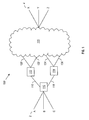
- the present invention may be deployed as shown in Figure 1 within a communications network 100, for instance a network operating according to connectionless forwarding protocols.
- a connectionless forwarding protocol may be one that is compliant with Internet Protocol (IP) addressing standards.
- IP Internet Protocol
- Communications network 100 has nodes 110, 112 and 114, together with a backbone cloud 115.
- FIG. 2 there is shown schematically the process as known in this art of hashing a source address 2 (denoted “S") and a destination address 4 (denoted “D") by way of a hashing algorithm or function 6 so as to generate a path index 8 (denoted "ip").
- the source and destination addresses 2, 4 may for inst ance be extracted from the header 9 of a network message or other datagram, such as an IP packet 10.
- the path segment index 8, as generated by the hashing algorithm or function 6, is utilized for the selection of an available message path segment 12.
- message path segment 12 may be an equivalent path segment (such as the message path denoted "P 5 ”) chosen from one of a plurality of equivalent path segments (denoted as the message paths "P 1 " to "P n ”) found on a forwarding table 14 that is assoc iated with a given node of communications network 100, such as node 110.
- the path segment index 8 points to a specific equivalent path segment of forwarding table 14.
- path selection randomization functions or algorithms may form part of prior art knowledge, and comprise any randomized selection function which operates on the source address and destination addr ess of a network message to generate an index or other numerical pointer for the selection of available equivalent paths.
- each of nodes 110, 112 and 114 are assumed to be sourced from the same equipment vendor and therefore each adopt the same path segment selection methodology for forw arding network traffic.
- Node 110 presents downstream equivalent path segments 116 and 118.
- Node 112 possesses downstream equivalent path segments 120 and 122, with Node 114 having downstream equivalent path segments 124 and 126.
- source addresses 2 comprise the addresses "a", "b” and "c”
- destination addresses 4 comprise the addresses "x", "y” and "z”.
- the selected path segments for IP packets 10 having the source address "a" and the destination address "x" will exhibit a polarization of the network traffic emanating from those same nodes.
- Other nodes (not shown) downstream of the nodes 112 and 114 will in the same manner as previously described produce a similar polarized traffic distribution behaviour.
- the method according to the present invention involves the addition of a preprocessing step as at 5 which operates on at least one of the source address 2 and destination address 4 prior to introducing same to a randomized selecti on function such as the hashing function 6.
- Randomized selection functions as known in this art operate to produce an index for path selection which is derived from a relative sequence of bits as between a source address and a destination address.
- the preprocessing step 5 decorrelates the relative mapping of bits as between the source address 2 and destination address 4 (again denoted as "S" and "D", respectively), and this is shown schematically by the respective decorrelation function ons 5a and 5b.
- the decorrelation functions 5a and 5b respectively produce a decorrelated address pair comprising source address 20 and destination address 24 (each denoted respectively as S d and D d ).
- the decorrelated address pair is then substituted for the source address 2 and the destination address 4 as the expected inputs to the hashing function 6.
- the hashing function 6 then operates as per the prior art to generate a path segment index 8 which in turn is utilized as a pointer to the forwarding tabl e 14 that contains all available equivalent path segments for the particular network node for which path segment selection is taking place.
- the decorrelated address pair need no longer be utilized, since the addressing protocol of the network 100 will make use of the unaltered source address 2 and destination address 4 for traffic forwarding purposes downstream of the node for which path segment selection has already taken place.
- decorrelation of the source address 2 and the destination address 4 can be achieved by any function which operates on the bit values associated with at least one of the said addresses so that the relative sequencing, positional interrelation or positional mapping of bits as between the source address 2 and the destination address 4 is varied.
- the foregoing may moreover be accomplished while retaining the sum of the individual bits associated with each such address.
- this may be achieved by way of a predetermined shuffling or predetermined scrambling of the bit values of at least one of the source address 2 and destination address 4, so as to achieve the desired chan ge in the relative positions of bits therebetween.
- the decorrelation of bit values as aforesaid may be associated with one or more decorrelation parameters that can be randomly assigned for each node of a communications network 100.
- Such decorrelation parameters may therefore be node-specific. This is intended to increase the likelihood that the individual hashing functions 6 associated with each node along a source -to-destination path in a network will not operate on the identical decorrelated pair of source and destination addresses, thereby avoiding the likelihood of traffic polarization.
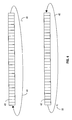
- FIG. 4 there is shown an embodiment of the present invention whereby the decorrelation of the source address 2 and destination address 4 is achieved by way of bit rotation.
- a 32 -bit source address 40 and a 32-bit destination address 42 in accordance with the IP v4 addressing scheme known to those in this art.
- the bits comprised in the source address 40 are shown as being rotated in a notional clockwise direction as at 44.
- the number of bits so rotated may be defined by a decorrelation parameter in the nature of a rotation parameter 48 (denoted "j").
- a second decorrelation parameter in the nature of a rotation parameter 50 may be employed to define such rotation in respect of the destination address 42.
- rotation of the bits comprised in the destination address 42 may be executed in a direction opposite to that employed in respect of the source address 40, for instanc e in the notional counterclockwise direction as at 46.
- the rotation parameters 48 and 50 may each comprise a 4-bit value. This is to reflect a numerical value which may produce up to 16 bits of possible rotation in either of the source address 40 and destination address 44, namely one-half of the length of the 32 -bit addresses in question. Where the rotation parameters are defined to have a numerical value that does not exceed one -half of the address length as afo resaid, and the bit rotation in question operates in opposite directions as previously explained, the sought after decorrelation of bits as between the source address 40 and the destination address 44 is enhanced.
- Each of the rotation parameters 48 and 50 may be assigned a value at node initialization, for instance by way of random generation. Such random generation may employ a timestamp as a mathematical seed for the derivation of the values of the rotation parameters 48, 50.
- the network router 51 may comprise an address reader 52 for reading at least one of the respective bit values of the source address 2 and destination address 4 from a header 9 of a network message such a s an IP packet 10.
- the address reader 52 may derive its address information as at 70 from network messages that are stored in a memory which is configured as a downstream message buffer 53.
- the network message in question may be network mes sage 85 that is located at head of queue within the downstream message buffer 53.
- the downstream message buffer 53 may be provisioned locally of address reader 52 or if desired, may form part of the ingress buffering for the router 51.
- Downstream message buffer 53 receives its input of network messages as at 71 and produces its output thereof as at 73, from which output the address reader derives its address information as aforesaid.
- the output of downstream message buffer 53 may be directed as at 73 tow ards the forwarding functions (not shown) of the network router 51, as well known to this art.
- One or both of the bit values of the source address 2 and destination address 4 may be input from the address reader 52 as at 74 to an associated decorrelation unit 54.
- Each decorrelation unit 54 serves to operate respectively on the bit values associated with the said addresses so that the relative mapping of bits as between the source address 2 and destination address 4 is decorrelated.
- the decorrelation as aforesaid may be achieved by way of varying the relative sequencing, positional interrelation or positional mapping of bits between the source address 2 and the destination address 4. Moreover, this may be performed while retaining the sum of the individual bits associated with each such address.
- a single decorrelation unit 54 may be provided in the network router 51 for processing the bit values associated with the applicable address.
- two decorrelation units 54 may be provisioned as illustrated.
- the decorrelation of the source address 2 and destination address 4 is achieved by way of bit rotation.
- bit rotation is the desired mechanism according to which the decorrelation units 54 operate
- the decorrelation units 54 may be implemented in hardware using shift registers or the like. This will enable the decorrelation algorithms previously described to be executed relatively quickly, for instance at the line rate of the router 51.
- Parameter registers 56 or the like may be utilized to store the current value of the decorrelation parameters previously described, such as the respective rotati on parameters 48, 50.
- One such parameter register 56 is assigned to each of the decorrelation units 54.
- Each parameter register 56 furnishes to its respective decorrelation unit 54 as at 75 the value of the decorrelation parameter stored therein.
- rotation parameters 48, 50 these parameters are utilized to define the extent of bit rotation that will be executed by each of the respective decorrelation units 54.
- the values of the rotation parameters 48, 50 or of any other decorrelation parameter may be furnished for instance to the parameter registers 56 by a random number generator 58 that is operatively connected thereto as at 57.
- a random number generator 58 may service each of the parameter registers 56.
- timestamp information may serve as a mathematical seed for random number generation and where this is desired, each random number generator 58 will receive such timestamp information as at 77 from a clock unit 60 or the like.
- clock units 60 have been illustrated, one being provisioned for each of the random number generators 58, those skilled in this field of art will understand that a single clock unit will suffice for this purpose.
- refresh values for decorrelation parameters may be generated by or supplied to the affected network node in replacement of the values earlier assigned to the node.
- the random number generators may be provided with external signal triggers 62 or the like in order to initiate the generation of new correlation parameters for storage in the parameter registers 56 and in turn for use by the decorrelation units 54.
- the random number generators 58 may be called upon to generate appropriate refre sh values by a signal generated as at 79 at predetermined and selectable intervals by means of a programmable periodic trigger unit 64 or the like, provisioned either for each random number generator 56 as illustrated or by means of a single such unit. Th e latter alternative would be deployed where it is desired to implement the refresh provision of decorrelation parameters at predetermined intervals, as previously described.
- the exemplary router 51 further provides a path selection randomization device such as a hashing unit 66 or the like, as well known in this art.
- a path selection randomization device such as a hashing unit 66 or the like, as well known in this art.
- a decorrelated address pair is produced as referred to above.
- the decorrelated address pair comprises source address 20 and destination address 24, which are input to the hashing unit 66 as at 68.
- the hashing unit 66 then operates as per the prior art to generate a path segment index 8 as at 81 which in turn is utilized as a pointer to a memory 72 or the like which implements the forwarding table 14 that was earlier described.
- the decorrelated address pai r need no longer be utilized by the network router 51, since the addressing protocol of the network 100 will make use of the unaltered source address 2 and destination address 4 for traffic forwarding purposes downstream of the node for which path segment selection has already taken place.
- the selected message path segment 12 is then utilized by the network router 51 in order to forward the network message 85.
- the present invention thus generally seeks to address the occurrence of network polarization in communications networks, particularly those operating according to connectionless forwarding protocols. This is achieved by providing a method and apparatus for distributing network traffic across equivalent path segments in a communications network. W here such network polarization can be avoided or reduced in its prevalence, network traffic congestion may at times be minimized by a more effective utilization of network resources. Moreover, network resources can be expected to be utilized more cost effectively in those instances where network traffic is found to be more evenly distributed according to the teachings of the present invention. While it is desirable to implement the teachings of the present invention to all network nodes residing in a given network configuration, the presumed benefits of the invention may potentially be felt even in networks where less than all of the network nodes thereof make use of same.
- nodes or equipment which deploy the apparatus or methods of the present invention may in a sense compensate for the effects of other nodes or equipment which may instead be contributing to the passage of polarized network traffic.
- the invention also permits a network administrator or other authorized network user to reconfigure network nodes or other network equipment that use the teachings hereof with refresh decorrelation parameters, thereby permitting a response to changes in traffic characteristics, network configuration or other factors that may be causing or contributing to an increase in traffic polarization.
Landscapes
- Engineering & Computer Science (AREA)
- Computer Networks & Wireless Communication (AREA)
- Signal Processing (AREA)
- Data Exchanges In Wide-Area Networks (AREA)
Abstract
Description
Claims (40)
- A method of selecting one of a plurality of equivalent paths for forwarding a network message from a network node of a communications network, the method comprising the steps of:providing a source address and a destination address for the network message, the source address and the destination address being respectively comprised of individual bit values, the individual bit values having a relative mapping as between the source address and the destination address;decorrelating the relative mapping of individu al bit values as between the source address and the destination address to obtain a decorrelated address pair;applying a randomized selection function to the decorrelated address pair, wherein the randomized selection function thereby produces an index w hich is derived from a relative sequence of bit values pertaining to the decorrelated address pair; andselecting said one of the plurality of equivalent paths by means of the index.
- The method according to Claim 1, wherein the said step of decorrela ting the relative mapping of individual bit values as between the source address and the destination address comprises modification of a relative sequence of said bit values as between the source address and the destination address.
- The method accord ing to Claim 2, wherein the said step of decorrelating the relative mapping of individual bit values as between the source address and the destination results in preservation of a summed value of each of the individual bit values of the source address and of a summed value of each of the individual bit values of the destination address following said decorrelating.
- The method according to Claim 3, wherein the randomized selection function is a hashing function.
- The method according to Claim 2, whe rein the said step of decorrelating the relative mapping of individual bit values as between the source address and the destination address is accomplished by scrambling of said individual bit values of at least one of said source address and said destinat ion address.
- The method according to Claim 2, wherein the said step of decorrelating the relative mapping of individual bit values as between the source address and the destination address is accomplished by shuffling of said individual bit values of at least one of said source address and said destination address.
- The method according to Claim 4, wherein the said step of decorrelating the relative mapping of individual bit values as between the source address and the destination address is accomp lished by bit rotation of said individual bit values of at least one of said source address and said destination address.
- The method according to Claim 7, wherein the said step of decorrelating the relative mapping of individual bit values as between the source address and the destination address is accomplished by bit rotation of said individual bit values of each of said source address and said destination address.
- The method according to Claim 8, wherein the bit rotation of said individual bit values of the source address is performed in a direction of rotation that is opposite to a direction of bit rotation of said individual bit values of the destination address.
- The method according to Claim 9, wherein the bit rotation is performed respectively for a predetermined number of bits in respect of each of the source address and the destination address, the predetermined number of bits being defined by a bit rotation parameter associated respectively with each of the source address and the destination address.
- The method according to Claim 10, wherein each bit rotation parameter is derived by means of a random number generator.
- The method according to Claim 11, wherein the random number generator employs a timestamp as a mathematica 1 seed therefor.
- The method according to Claim 12, wherein the timestamp is obtained upon initialization of the network node.
- The method according to Claim 13, wherein each bit rotation parameter is re-derived dynamically subsequent to initial ization of the network node.
- The method according to Claim 14, wherein each bit rotation parameter is re-derived dynamically based upon a new timestamp from that obtained upon initialization of the network node.
- The method according to Claim 15 , wherein the network message is an Internet Protocol packet.
- The method according to Claim 16, wherein the source address and the destination address are each 32 bits in length.
- The method according to Claim 17, wherein the rotation parameters are each 4 bits in length.
- The method according to Claim 18, wherein the predetermined number of bits is in a range of from 1 to 16.
- The method according to Claim 16, wherein the predetermined number of bits is in a range of from 1 to one -half of a total length of the source address.
- The method according to Claim 17, wherein the equivalent paths are equal cost multiple paths.
- A network apparatus for selecting one of a plurality of equivalent paths for forwarding a network message fr om a network node of a communications network, the apparatus comprising:an address reader for deriving a source address and a destination address of said network message, the source address and the destination address being respectively comprised of indi vidual bit values, the individual bit values having a relative mapping as between the source address and the destination address;a decorrelation device for decorrelating the relative mapping of individual bit values as between the source address and the destination address to obtain a decorrelated address pair; anda randomized selection device for producing an index which is derived from a relative sequence of bit values pertaining to the decorrelated address pair and for selecting said one of the plurality of equivalent paths by means of the index.
- The apparatus according to Claim 22, wherein the decorrelating unit decorrelates the relative mapping of individual bit values as between the source address and the destination address by modification of a relative sequence of said bit values as between the source address and the destination address.
- The apparatus according to Claim 23, wherein the decorrelation device unit decorrelates the relative mapping of individual bit values as between the source address and the destination while preserving a summed value of each of the individual bit values of the source address and a summed value of each of the individual bit values of the destination address.
- The apparatus according to Claim 24, wh erein the randomized selection device executes a hashing function for producing the said index.
- The apparatus according to Claim 24, wherein the decorrelation device unit decorrelates the relative mapping of individual bit values as between the sourc e address and the destination address by scrambling of said individual bit values of at least one of said source address and said destination address.
- The apparatus according to Claim 24, wherein the decorrelation device decorrelates the relative map ping of individual bit values as between the source address and the destination address by shuffling of said individual bit values of at least one of said source address and said destination address.
- The apparatus according to Claim 24, wherein the d ecorrelation device decorrelates the relative mapping of individual bit values as between the source address and the destination address by bit rotation of said individual bit values of at least one of said source address and said destination address.
- The network apparatus according to Claim 24, further comprising a second decorrelation device, wherein each of the decorrelation devices operates on a respective source address and destination address to obtain the decorrelated address pair.
- The apparatus according to Claim 30, wherein the decorrelation device decorrelates the relative mapping of individual bit values as between the source address and the destination address by bit rotation of said individual bit values of each of said source address and said destination address.
- The apparatus according to Claim 30, wherein the bit rotation of said individual bit values of the source address is performed in a direction of rotation that is opposite to a direction of bit rotation of said individ ual bit values of the destination address.
- The apparatus according to Claim 31, wherein the bit rotation is performed respectively for a predetermined number of bits in respect of each of the source address and the destination address, the predetermi ned number of bits being defined by a bit rotation parameter associated respectively with each of the source address and the destination address.
- The apparatus according to Claim 32, further comprising two parameter registers for respectively storing each bit rotation parameter.
- The apparatus according to Claim 33, further comprising a random number generator for deriving each bit rotation parameter.
- The apparatus according to Claim 34, wherein the random number generator employs a timesta mp as a mathematical seed therefor.
- The apparatus according to Claim 35, wherein the decorrelation units are each implemented as shift registers.
- The apparatus according to Claim 36, further comprising a clock unit for providing the timestamp to the random number generator.
- The apparatus according to Claim 37, wherein the timestamp is provided to the random number generator and the bit rotation parameters are derived therefrom upon initialization of the network node.
- The apparatus according to Claim 38, wherein each bit rotation parameter is re-derived dynamically subsequent to initialization of the network node.
- The apparatus according to Claim 39, wherein each bit rotation parameter is re-derived dynamically based upon a new time stamp from that provided to the random number generator upon initialization of the network node.
Applications Claiming Priority (2)
| Application Number | Priority Date | Filing Date | Title |
|---|---|---|---|
| US10/427,938 US7346706B2 (en) | 2003-05-02 | 2003-05-02 | Equivalent multiple path traffic distribution in communications networks |
| US427938 | 2003-05-02 |
Publications (3)
| Publication Number | Publication Date |
|---|---|
| EP1482695A2 true EP1482695A2 (en) | 2004-12-01 |
| EP1482695A3 EP1482695A3 (en) | 2006-02-08 |
| EP1482695B1 EP1482695B1 (en) | 2017-12-06 |
Family
ID=33131499
Family Applications (1)
| Application Number | Title | Priority Date | Filing Date |
|---|---|---|---|
| EP04300256.7A Expired - Lifetime EP1482695B1 (en) | 2003-05-02 | 2004-05-03 | Equivalent multiple path traffic distribution in communications networks |
Country Status (2)
| Country | Link |
|---|---|
| US (1) | US7346706B2 (en) |
| EP (1) | EP1482695B1 (en) |
Cited By (1)
| Publication number | Priority date | Publication date | Assignee | Title |
|---|---|---|---|---|
| CN110768917A (en) * | 2019-10-31 | 2020-02-07 | 杭州迪普科技股份有限公司 | Message transmission method and device |
Families Citing this family (42)
| Publication number | Priority date | Publication date | Assignee | Title |
|---|---|---|---|---|
| US7596139B2 (en) | 2000-11-17 | 2009-09-29 | Foundry Networks, Inc. | Backplane interface adapter with error control and redundant fabric |
| US7356030B2 (en) * | 2000-11-17 | 2008-04-08 | Foundry Networks, Inc. | Network switch cross point |
| US7187687B1 (en) | 2002-05-06 | 2007-03-06 | Foundry Networks, Inc. | Pipeline method and system for switching packets |
| US7468975B1 (en) | 2002-05-06 | 2008-12-23 | Foundry Networks, Inc. | Flexible method for processing data packets in a network routing system for enhanced efficiency and monitoring capability |
| US20120155466A1 (en) | 2002-05-06 | 2012-06-21 | Ian Edward Davis | Method and apparatus for efficiently processing data packets in a computer network |
| US6901072B1 (en) | 2003-05-15 | 2005-05-31 | Foundry Networks, Inc. | System and method for high speed packet transmission implementing dual transmit and receive pipelines |
| US7697432B2 (en) * | 2003-06-27 | 2010-04-13 | Broadcom Corporation | Equal and weighted cost multipath load balancing in a network device |
| US7817659B2 (en) | 2004-03-26 | 2010-10-19 | Foundry Networks, Llc | Method and apparatus for aggregating input data streams |
| US8730961B1 (en) | 2004-04-26 | 2014-05-20 | Foundry Networks, Llc | System and method for optimizing router lookup |
| US8448162B2 (en) | 2005-12-28 | 2013-05-21 | Foundry Networks, Llc | Hitless software upgrades |
| US8000952B2 (en) * | 2006-03-09 | 2011-08-16 | International Business Machines Corporation | Method and system for generating multiple path application simulations |
| US8238255B2 (en) | 2006-11-22 | 2012-08-07 | Foundry Networks, Llc | Recovering from failures without impact on data traffic in a shared bus architecture |
| US8395996B2 (en) | 2007-01-11 | 2013-03-12 | Foundry Networks, Llc | Techniques for processing incoming failure detection protocol packets |
| US7821925B2 (en) * | 2007-01-29 | 2010-10-26 | Fulcrum Microsystems, Inc. | Traffic distribution techniques utilizing initial and scrambled hash values |
| US7817571B2 (en) * | 2007-02-14 | 2010-10-19 | Cisco Technology, Inc. | Automatic discovery of blocking access-list ID and match statements in a network |
| JP4347358B2 (en) * | 2007-03-29 | 2009-10-21 | 株式会社沖データ | Image processing apparatus and image processing system |
| US8037399B2 (en) | 2007-07-18 | 2011-10-11 | Foundry Networks, Llc | Techniques for segmented CRC design in high speed networks |
| US8271859B2 (en) * | 2007-07-18 | 2012-09-18 | Foundry Networks Llc | Segmented CRC design in high speed networks |
| US7970916B2 (en) * | 2007-07-25 | 2011-06-28 | Cisco Technology, Inc. | Register clustering in a sip-based network |
| US8149839B1 (en) * | 2007-09-26 | 2012-04-03 | Foundry Networks, Llc | Selection of trunk ports and paths using rotation |
| US7911944B2 (en) * | 2007-12-26 | 2011-03-22 | Nortel Networks Limited | Tie-breaking in shortest path determination |
| US9237100B1 (en) | 2008-08-06 | 2016-01-12 | Marvell Israel (M.I.S.L.) Ltd. | Hash computation for network switches |
| US8767734B1 (en) * | 2008-10-07 | 2014-07-01 | BCK Networks, Inc. | Stream basis set division multiplexing |
| CN102273141B (en) * | 2009-01-12 | 2015-09-02 | 惠普开发有限公司 | Reduce the propagation of the message flooding in computer network |
| US8090901B2 (en) * | 2009-05-14 | 2012-01-03 | Brocade Communications Systems, Inc. | TCAM management approach that minimize movements |
| US8599850B2 (en) * | 2009-09-21 | 2013-12-03 | Brocade Communications Systems, Inc. | Provisioning single or multistage networks using ethernet service instances (ESIs) |
| CN102143041B (en) * | 2010-07-02 | 2014-03-26 | 华为技术有限公司 | Network traffic sharing method, device and system |
| US8614950B2 (en) | 2010-11-30 | 2013-12-24 | Marvell Israel (M.I.S.L) Ltd. | Load balancing hash computation for network switches |
| US9171030B1 (en) | 2012-01-09 | 2015-10-27 | Marvell Israel (M.I.S.L.) Ltd. | Exact match lookup in network switch devices |
| US9819637B2 (en) | 2013-02-27 | 2017-11-14 | Marvell World Trade Ltd. | Efficient longest prefix matching techniques for network devices |
| US9537771B2 (en) | 2013-04-04 | 2017-01-03 | Marvell Israel (M.I.S.L) Ltd. | Exact match hash lookup databases in network switch devices |
| US9906592B1 (en) | 2014-03-13 | 2018-02-27 | Marvell Israel (M.I.S.L.) Ltd. | Resilient hash computation for load balancing in network switches |
| US10587516B1 (en) | 2014-07-15 | 2020-03-10 | Marvell Israel (M.I.S.L) Ltd. | Hash lookup table entry management in a network device |
| CN107580769B (en) | 2015-03-06 | 2021-02-02 | 马维尔亚洲私人有限公司 | Method and apparatus for load balancing in a network switch |
| US10904150B1 (en) | 2016-02-02 | 2021-01-26 | Marvell Israel (M.I.S.L) Ltd. | Distributed dynamic load balancing in network systems |
| US10063407B1 (en) | 2016-02-08 | 2018-08-28 | Barefoot Networks, Inc. | Identifying and marking failed egress links in data plane |
| US10313231B1 (en) * | 2016-02-08 | 2019-06-04 | Barefoot Networks, Inc. | Resilient hashing for forwarding packets |
| US10243857B1 (en) | 2016-09-09 | 2019-03-26 | Marvell Israel (M.I.S.L) Ltd. | Method and apparatus for multipath group updates |
| US10084687B1 (en) | 2016-11-17 | 2018-09-25 | Barefoot Networks, Inc. | Weighted-cost multi-pathing using range lookups |
| US10404619B1 (en) | 2017-03-05 | 2019-09-03 | Barefoot Networks, Inc. | Link aggregation group failover for multicast |
| US10237206B1 (en) | 2017-03-05 | 2019-03-19 | Barefoot Networks, Inc. | Equal cost multiple path group failover for multicast |
| CN113542131B (en) * | 2021-05-25 | 2023-08-22 | 新华三信息安全技术有限公司 | Message forwarding method and device |
Family Cites Families (6)
| Publication number | Priority date | Publication date | Assignee | Title |
|---|---|---|---|---|
| CA2124974C (en) * | 1993-06-28 | 1998-08-25 | Kajamalai Gopalaswamy Ramakrishnan | Method and apparatus for link metric assignment in shortest path networks |
| US5596722A (en) * | 1995-04-03 | 1997-01-21 | Motorola, Inc. | Packet routing system and method for achieving uniform link usage and minimizing link load |
| US6438133B1 (en) * | 1998-09-09 | 2002-08-20 | Cisco Technology, Inc. | Load balancing mechanism for a translational bridge environment |
| US6502135B1 (en) * | 1998-10-30 | 2002-12-31 | Science Applications International Corporation | Agile network protocol for secure communications with assured system availability |
| US6363319B1 (en) * | 1999-08-31 | 2002-03-26 | Nortel Networks Limited | Constraint-based route selection using biased cost |
| US6721800B1 (en) * | 2000-04-10 | 2004-04-13 | International Business Machines Corporation | System using weighted next hop option in routing table to include probability of routing a packet for providing equal cost multipath forwarding packets |
-
2003
- 2003-05-02 US US10/427,938 patent/US7346706B2/en not_active Expired - Lifetime
-
2004
- 2004-05-03 EP EP04300256.7A patent/EP1482695B1/en not_active Expired - Lifetime
Cited By (2)
| Publication number | Priority date | Publication date | Assignee | Title |
|---|---|---|---|---|
| CN110768917A (en) * | 2019-10-31 | 2020-02-07 | 杭州迪普科技股份有限公司 | Message transmission method and device |
| CN110768917B (en) * | 2019-10-31 | 2021-09-21 | 杭州迪普科技股份有限公司 | Message transmission method and device |
Also Published As
| Publication number | Publication date |
|---|---|
| US7346706B2 (en) | 2008-03-18 |
| US20040235480A1 (en) | 2004-11-25 |
| EP1482695B1 (en) | 2017-12-06 |
| EP1482695A3 (en) | 2006-02-08 |
Similar Documents
| Publication | Publication Date | Title |
|---|---|---|
| EP1482695B1 (en) | Equivalent multiple path traffic distribution in communications networks | |
| US8160056B2 (en) | Systems, devices, and methods for network routing | |
| US8687621B2 (en) | Dynamically right-sizing prefixes for network and application performance | |
| Li et al. | Coordinating in-network caching in content-centric networks: Model and analysis | |
| JP2018512099A5 (en) | ||
| Yu et al. | Space shuffle: A scalable, flexible, and high-bandwidth data center network | |
| US10243857B1 (en) | Method and apparatus for multipath group updates | |
| Aubry et al. | Robustly disjoint paths with segment routing | |
| US10542081B2 (en) | Apparatus, design method, and recording medium | |
| Achleitner et al. | Fast network configuration in software defined networking | |
| Tuncer et al. | Flexible traffic splitting in OpenFlow networks | |
| Foerster et al. | Grafting arborescences for extra resilience of fast rerouting schemes | |
| US9992110B2 (en) | Dynamic switching control over multiple internet services provided for home networks | |
| Altın et al. | OSPF routing with optimal oblivious performance ratio under polyhedral demand uncertainty | |
| Schneider et al. | A simulation study of the OSPF-OMP routing algorithm | |
| Kencl et al. | Adaptive load sharing for network processors | |
| CN1984495A (en) | Method and equipment for quality-of-service based routing | |
| RU2622842C1 (en) | Method for masking the structure of telecommunication network | |
| Wójcik et al. | Loop resolution mechanism for flow-aware multi-topology adaptive routing | |
| WO2017052507A1 (en) | Encrypted data packet | |
| Wang et al. | SDN storage: A stream-based storage system over software-defined networks | |
| Nguyen et al. | Conat: A network coding-based interest aggregation in content centric networks | |
| Venkateswaran et al. | Security Management in Content Distribution Networks: a delay-variance reduction approach for content mirror site placement | |
| Wang et al. | A novel route randomization approach for moving target defense | |
| Li et al. | Segment routing in hybrid software-defined networking |
Legal Events
| Date | Code | Title | Description |
|---|---|---|---|
| PUAI | Public reference made under article 153(3) epc to a published international application that has entered the european phase |
Free format text: ORIGINAL CODE: 0009012 |
|
| AK | Designated contracting states |
Kind code of ref document: A2 Designated state(s): AT BE BG CH CY CZ DE DK EE ES FI FR GB GR HU IE IT LI LU MC NL PL PT RO SE SI SK TR |
|
| AX | Request for extension of the european patent |
Extension state: AL HR LT LV MK |
|
| PUAL | Search report despatched |
Free format text: ORIGINAL CODE: 0009013 |
|
| AK | Designated contracting states |
Kind code of ref document: A3 Designated state(s): AT BE BG CH CY CZ DE DK EE ES FI FR GB GR HU IE IT LI LU MC NL PL PT RO SE SI SK TR |
|
| AX | Request for extension of the european patent |
Extension state: AL HR LT LV MK |
|
| 17P | Request for examination filed |
Effective date: 20060808 |
|
| AKX | Designation fees paid |
Designated state(s): DE ES FR GB IT |
|
| RAP1 | Party data changed (applicant data changed or rights of an application transferred) |
Owner name: ALCATEL LUCENT |
|
| RAP1 | Party data changed (applicant data changed or rights of an application transferred) |
Owner name: ALCATEL LUCENT |
|
| 111Z | Information provided on other rights and legal means of execution |
Free format text: DE ES FR GB IT Effective date: 20130410 |
|
| RAP1 | Party data changed (applicant data changed or rights of an application transferred) |
Owner name: ALCATEL LUCENT |
|
| D11X | Information provided on other rights and legal means of execution (deleted) | ||
| 17Q | First examination report despatched |
Effective date: 20150121 |
|
| REG | Reference to a national code |
Ref country code: DE Ref legal event code: R079 Ref document number: 602004052130 Country of ref document: DE Free format text: PREVIOUS MAIN CLASS: H04L0012560000 Ipc: H04L0012701000 |
|
| GRAP | Despatch of communication of intention to grant a patent |
Free format text: ORIGINAL CODE: EPIDOSNIGR1 |
|
| RIC1 | Information provided on ipc code assigned before grant |
Ipc: H04L 12/701 20130101AFI20170531BHEP Ipc: H04L 12/707 20130101ALI20170531BHEP |
|
| INTG | Intention to grant announced |
Effective date: 20170619 |
|
| GRAS | Grant fee paid |
Free format text: ORIGINAL CODE: EPIDOSNIGR3 |
|
| GRAA | (expected) grant |
Free format text: ORIGINAL CODE: 0009210 |
|
| REG | Reference to a national code |
Ref country code: DE Ref legal event code: R081 Ref document number: 602004052130 Country of ref document: DE Owner name: PROVENANCE ASSET GROUP LLC (N.D.GES.D. STAATES, US Free format text: FORMER OWNER: ALCATEL, PARIS, FR |
|
| AK | Designated contracting states |
Kind code of ref document: B1 Designated state(s): DE ES FR GB IT |
|
| REG | Reference to a national code |
Ref country code: GB Ref legal event code: FG4D |
|
| REG | Reference to a national code |
Ref country code: DE Ref legal event code: R096 Ref document number: 602004052130 Country of ref document: DE |
|
| RAP2 | Party data changed (patent owner data changed or rights of a patent transferred) |
Owner name: ALCATEL LUCENT |
|
| REG | Reference to a national code |
Ref country code: DE Ref legal event code: R081 Ref document number: 602004052130 Country of ref document: DE Owner name: PROVENANCE ASSET GROUP LLC (N.D.GES.D. STAATES, US Free format text: FORMER OWNER: ALCATEL LUCENT, BOULOGNE BILLANCOURT, FR |
|
| PG25 | Lapsed in a contracting state [announced via postgrant information from national office to epo] |
Ref country code: ES Free format text: LAPSE BECAUSE OF FAILURE TO SUBMIT A TRANSLATION OF THE DESCRIPTION OR TO PAY THE FEE WITHIN THE PRESCRIBED TIME-LIMIT Effective date: 20171206 |
|
| REG | Reference to a national code |
Ref country code: GB Ref legal event code: 732E Free format text: REGISTERED BETWEEN 20180405 AND 20180411 |
|
| PG25 | Lapsed in a contracting state [announced via postgrant information from national office to epo] |
Ref country code: IT Free format text: LAPSE BECAUSE OF FAILURE TO SUBMIT A TRANSLATION OF THE DESCRIPTION OR TO PAY THE FEE WITHIN THE PRESCRIBED TIME-LIMIT Effective date: 20171206 |
|
| REG | Reference to a national code |
Ref country code: DE Ref legal event code: R097 Ref document number: 602004052130 Country of ref document: DE |
|
| PLBE | No opposition filed within time limit |
Free format text: ORIGINAL CODE: 0009261 |
|
| STAA | Information on the status of an ep patent application or granted ep patent |
Free format text: STATUS: NO OPPOSITION FILED WITHIN TIME LIMIT |
|
| 26N | No opposition filed |
Effective date: 20180907 |
|
| PG25 | Lapsed in a contracting state [announced via postgrant information from national office to epo] |
Ref country code: FR Free format text: LAPSE BECAUSE OF NON-PAYMENT OF DUE FEES Effective date: 20180531 |
|
| PGFP | Annual fee paid to national office [announced via postgrant information from national office to epo] |
Ref country code: DE Payment date: 20200406 Year of fee payment: 17 |
|
| PGFP | Annual fee paid to national office [announced via postgrant information from national office to epo] |
Ref country code: GB Payment date: 20200420 Year of fee payment: 17 |
|
| REG | Reference to a national code |
Ref country code: DE Ref legal event code: R082 Ref document number: 602004052130 Country of ref document: DE Representative=s name: VENNER SHIPLEY LLP, DE |
|
| REG | Reference to a national code |
Ref country code: DE Ref legal event code: R079 Ref document number: 602004052130 Country of ref document: DE Free format text: PREVIOUS MAIN CLASS: H04L0012701000 Ipc: H04L0045000000 |
|
| REG | Reference to a national code |
Ref country code: DE Ref legal event code: R119 Ref document number: 602004052130 Country of ref document: DE |
|
| GBPC | Gb: european patent ceased through non-payment of renewal fee |
Effective date: 20210503 |
|
| PG25 | Lapsed in a contracting state [announced via postgrant information from national office to epo] |
Ref country code: GB Free format text: LAPSE BECAUSE OF NON-PAYMENT OF DUE FEES Effective date: 20210503 Ref country code: DE Free format text: LAPSE BECAUSE OF NON-PAYMENT OF DUE FEES Effective date: 20211201 |