EP1482683A2 - System and method for propagating data - Google Patents
System and method for propagating data Download PDFInfo
- Publication number
- EP1482683A2 EP1482683A2 EP04010949A EP04010949A EP1482683A2 EP 1482683 A2 EP1482683 A2 EP 1482683A2 EP 04010949 A EP04010949 A EP 04010949A EP 04010949 A EP04010949 A EP 04010949A EP 1482683 A2 EP1482683 A2 EP 1482683A2
- Authority
- EP
- European Patent Office
- Prior art keywords
- data
- commutation
- format
- database
- decommutation
- Prior art date
- Legal status (The legal status is an assumption and is not a legal conclusion. Google has not performed a legal analysis and makes no representation as to the accuracy of the status listed.)
- Granted
Links
Images


Classifications
-
- H—ELECTRICITY
- H04—ELECTRIC COMMUNICATION TECHNIQUE
- H04L—TRANSMISSION OF DIGITAL INFORMATION, e.g. TELEGRAPHIC COMMUNICATION
- H04L67/00—Network arrangements or protocols for supporting network services or applications
- H04L67/01—Protocols
- H04L67/10—Protocols in which an application is distributed across nodes in the network
- H04L67/1095—Replication or mirroring of data, e.g. scheduling or transport for data synchronisation between network nodes
-
- H—ELECTRICITY
- H04—ELECTRIC COMMUNICATION TECHNIQUE
- H04L—TRANSMISSION OF DIGITAL INFORMATION, e.g. TELEGRAPHIC COMMUNICATION
- H04L67/00—Network arrangements or protocols for supporting network services or applications
- H04L67/01—Protocols
- H04L67/12—Protocols specially adapted for proprietary or special-purpose networking environments, e.g. medical networks, sensor networks, networks in vehicles or remote metering networks
-
- H—ELECTRICITY
- H04—ELECTRIC COMMUNICATION TECHNIQUE
- H04L—TRANSMISSION OF DIGITAL INFORMATION, e.g. TELEGRAPHIC COMMUNICATION
- H04L67/00—Network arrangements or protocols for supporting network services or applications
- H04L67/50—Network services
- H04L67/60—Scheduling or organising the servicing of application requests, e.g. requests for application data transmissions using the analysis and optimisation of the required network resources
- H04L67/61—Scheduling or organising the servicing of application requests, e.g. requests for application data transmissions using the analysis and optimisation of the required network resources taking into account QoS or priority requirements
-
- H—ELECTRICITY
- H04—ELECTRIC COMMUNICATION TECHNIQUE
- H04L—TRANSMISSION OF DIGITAL INFORMATION, e.g. TELEGRAPHIC COMMUNICATION
- H04L9/00—Cryptographic mechanisms or cryptographic arrangements for secret or secure communications; Network security protocols
- H04L9/40—Network security protocols
-
- H—ELECTRICITY
- H04—ELECTRIC COMMUNICATION TECHNIQUE
- H04L—TRANSMISSION OF DIGITAL INFORMATION, e.g. TELEGRAPHIC COMMUNICATION
- H04L69/00—Network arrangements, protocols or services independent of the application payload and not provided for in the other groups of this subclass
- H04L69/30—Definitions, standards or architectural aspects of layered protocol stacks
- H04L69/32—Architecture of open systems interconnection [OSI] 7-layer type protocol stacks, e.g. the interfaces between the data link level and the physical level
- H04L69/322—Intralayer communication protocols among peer entities or protocol data unit [PDU] definitions
- H04L69/329—Intralayer communication protocols among peer entities or protocol data unit [PDU] definitions in the application layer [OSI layer 7]
Definitions
- the present invention uses a database driven commutation/decommutation system, preferably based on the OS/Comet® product suite as a COTS product, used for satellite command and control and integration and testing, manufactured and sold by Harris Corporation of Melbourne, Florida.
- the present invention requires little software development. It is easy to modify and is database driven.
- the invention uses a dynamic commutation format and switches the format to reprioritize data.
- the new commutation format dynamically changes the data set and update frequency.
- a new commutation format can be initiated from a sender (transmitter) or receiver. Any congestion control along a communications channel, for example, a serial communications channel, can be controlled through the commutation format definition.
- the present invention is advantageous over other database transaction processing (DTP) and allows the commutation/decommutation process to replicate data used in non-telemetry type systems, for example, battlefield management systems.
- DTP database transaction processing
- the system can visually define the data samples, its update frequency, and its priority for any transmitted data.
- New commutation formats can be created and modified dynamically and initiated based on any needs perceived by the sender or receiver. New commutation formats can be based on changing data needs, required update frequency, and any bandwidth limitations. Congestion and prioritization can be controlled by the commutation format definition.
- a sender can provide multiple commutation formats to one or many receivers.
- the system propagates data and includes a commutation engine for commutating data from different data sources into a data stream based on a commutation format.
- a decommutation engine receives the data stream and replicates the data.
- a commutation database has commutation format definitions that are operative with the commutation and decommutation engines and drives the commutation and decommutation based on the commutation format.
- the database can include appropriate commutation and decommutation tables.
- the system and method of the present invention changes the commutation format for prioritizing different data to be commutated and replicated.
- a database stores sampled data from different data sources from which data is commutated.
- a commutation format generator is operative with the commutation database and updates the commutation database with the new commutation format.
- the commutation database stores multiple commutation format definitions to be used with multiple receivers.
- the commutation format can be changed based on a change in environment effecting the data stream, on a change in priority of data, or on changing data requirements at a receiver.
- a change in the commutation format definition can be initiated by a receiver or a transmitter.
- the system includes a distributed messaging system operative with the commutation engine and providing communications among various modules that generate the format data into a data stream based on the commutation format.
- the modules could include a data stream generator module, a data stream commutation format module, and a data output module that could be application specific for a receiver of the data.
- the distributed messaging system could be an OS/Comet® software bus. Other distributed messaging systems could be CORBA or DECOM.
- the system includes a decommutation engine that decommutates the data stream received from the communications channel and replicates the data in the database using the commutation format definition stored in the commutation database.
- the decommutation engine would typically draw upon a decommutation table and decommutation format definitions.
- the decommutation engine can include an input module and decommutation module as part of the decommutation engine. It can be operative with a distributed messaging system.
- a method aspect of the present invention is also disclosed and propagates data for commutating data from different data sources into a data stream based on a commutation format. Based on the commutation format, the data is decommutated to replicate the data.
- the method of the present invention advantageously changes the commutation format for prioritizing different data from the data sources.
- the present invention allows dynamic determination of data selection and its update frequency for data propagation. It allows replication of a changing data set over a limited bandwidth used for propagating data. It also permits selection of any frequency of data updates and permits congestion and prioritization control. It is a database driven solution that is advantageous over prior art database transaction processing (DTP), in which database updates were typically transaction based and each transaction contained additional information required to route and process the data.
- DTP database transaction processing
- the replication set and update frequency would require significant software development and congestion control and prioritization in the prior art techniques are difficult to implement and modify. As data changes in priority and/or becomes more dynamic, it is difficult to resolve how it is optimally propagated.
- This invention is different from past practice in the dynamic creation and modification of commutation formats in response to changing requirements in the data set being replicated point-to-point or point-to-multipoint.
- the dynamic commutation format updates address changes in data selection criteria and data item update frequency to account for reprioritization and congestion control in a database driven commutation/decommutation data propagation system.
- This invention could be used for many types of data including GPS position information for individuals or for equipment, biographical data for infantry, including heart rate and cardiovascular data, ammunition status, equipment state of health information, including oil pressure, fuel level and component wear, environmental data, including temperature, humidity and chemical or hazardous gas sensors.
- the dynamic changes could be the result of changing requirements on behalf of either the sender or receiver. They could be driven by quality of service requirements and the dynamically changing battlefield arena.
- the present invention is a database driven and commutation/decommutation based. It can use the OS/Comet® TT&C commercial COTS product as distributed by Harris Corporation and modified for use in the present invention. All tools of the OS/Comet® product suite can be applicable for the present invention.
- the present invention can be implemented with little software development and can be modified and database driven. It allows dynamic commutation format generation and switching to handle prioritization.
- the commutation format can dynamically change a data set and its update frequency.
- the new commutation format can be initiated by the transmitter (sender) or receiver. Congestion control through the data path can occur through a commutation format definition.
- the present invention is advantageously used in battlefield management systems that use sampled and changing data, which must be distributed to one or multiple users over a typical serial connection having a limited bandwidth.
- FIG. 1 is a fragmentary, high level block diagram of basic components used in the data propagation system 10 of the present invention and showing different data sources 12, for example, individual tanks or infantrymen, which supply data as sampled data into a database 14.
- a transmitter 15 includes a commutation engine 16 operable with the commutation database 17 having commutation format definitions, including commutation and decommutation tables for commutation and decommutation.
- the term commutation format generally can refer to the definitions used for commutation and decommutation.
- the commutation engine 16 commutates data from the different data sources 12 into a data stream 18 based on the commutation format and outputs commutated data as a preferred serial data stream through an output module 20 and into a serial communications channel 32 to an input module 24 of a receiver 26 .
- a decommutation engine 28 receives the data stream from the input module, decommutates the data to replicate the data in a replicated database 30, as illustrated.
- the commutation database 17 stores commutation format definitions that are operative with the commutation and decommutation engines 16,28 for driving the commutation and decommutation based on the commutation format and changing the commutation format and prioritizing different data to be commutated and replicated.
- the database 14 stores sampled data from the different data sources 12 and the sampled data is commutated.
- a commutation format generator 32 could be a processor or other logical circuit and is operative with the commutation database 17 for updating the commutation database with any new commutation format definitions. This allows the system to change the commutation format and prioritize different data to be commutated and replicated.
- the commutation database can store multiple commutation format definitions to be used with multiple receivers that require different data or prioritize data differently.
- the commutation format could be changed based on a change in priority of data, any changed data requirements at a receiver, or a change in environment effecting the data stream, such as changing bandwidth caused by environmental conditions, e.g., a sand storm.
- the transmitter 15 and commutation engine 16 include a distributed messaging system 34 that provides communications among modules that generate and format data into a data stream based on a commutation format.
- the various modules can include a data stream generator module 36 , data stream commutation format module 38 and data stream output module 40, which can be application specific for a receiver.
- data stream output module 40 can apply appropriate messaging protocols for communicating with a receiver. It can obtain data from a database as necessary.
- An interface could be the OS/Comet® software bus. It could also include system V sockets, RS-232 or RS-422 serial data link. Appropriate sequencing, error detection and error correction mechanisms can be used.
- the decommutation engine 28 could also include a distributed messaging system 34 and different modules, including an input module 42 and data stream decommutation module 44 that decommutates data based on the commutation format (decommutation table).
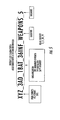
- a graphical user interface can be driven by a display module 46 for displaying data that has been prioritized.
- the input module 42 can be application specific.
- the commutation and decommutation engines 16,28 are operable with the commutation database 17, which includes appropriate commutation and decommutation tables that can be updated by the format generator 32.
- Other details of the decommutation and commutation engines and associated modules and functions, including operation of OS/Comet® and can be modified for use with the present invention, are disclosed in commonly assigned U.S. Patent Nos. 6,048,366 and 6,256,602 to Ellis et al. and commonly assigned WO 01/55874, the disclosures which are hereby incorporated by reference in their entirety.
- FIG. 4 is a high level depiction of several communication networks 50,52,54 interconnected by routers 56.
- One network 50 includes a commutation station 58 and the other two networks 52,54 each include a decommutation station 60.
- the overall system 62 can be used as a battlefield management system, for example.
- the commutation station 58 could be a moving vehicle in communication with various soldiers having backpacks 62, as an example, communicating by wireless signal with the commutation station 58.
- Each backpack 62 could include a transceiver or other system such as a Compact iPAQ computer using Linux and simulated by a Perform file.
- the commutation station could be a Sun Workstation, for example, using OS/Comet® software for commutation and operable as an ActiveM router. Any decommutation station could be a similar platform and operable as a router.
- the commutation and decommutation stations could be operable with DCOM databases holding data from different data sources.
- the router 56 could be operable with an ActiveM Topic Service 64 .
- ActiveM software as developed by Harris Corporation of Melbourne, Florida, is used with Windows and is message-oriented middleware (MOM) that uses distributed applications. ActiveM uses a register (produce) and subscribe (consume) system for message data transfer with intelligent data routing. ActiveM-aware applications can connect to an ActiveM router running on a network node to send and receive data. An ActiveM server running on a single network node can handle topics, subscriptions and registrations and multiple ActiveM subnets can run concurrently on one network. It is possible to communicate between many machines and processors and/or be connected to the internet.
- MOM message-oriented middleware
- ActiveM allows applications to send data transparently between different processes. ActiveM uses the "published and subscribe concept" where data is made available to other applications by an application that registers a Topic with a server. A subscriber "subscribes to a TOPIC with an ActiveM server before it receives messages of the type specified by the TOPIC. A publisher "registers" a TOPIC with an ActiveM server before it sends messages of the type specified by the TOPIC. When a publisher sends a message, all subscribers of that TOPIC will receive a copy of the message. For example, a data set could be 32 characters and associated with a DECOM definition, such as illustrated in FIG. 5.
- a server informs a router that it is requesting information and establishes a link with the router that is servicing the publishing application.
- the application providing the data publishes a message, and it is sent via the routers to the application requesting data.
- the present invention also uses the OS/Comet® software product suite, such as modified for the present invention.
- This software is a COTS product for satellite command and control, and integration and testing.
- a different set of COTS tools can be incorporated, including the OA/tool, GC/tool, FA/tool, AR/tool, and SIM/tool.
- the OS/Comet® software facilitates a specific task related to satellite control and can be modified for use in the present invention, including battlefield management with commutation format definition updates.
- the OS/Comet® software bus allows system administration and communication services and is operative for data distribution, language processing as processed CCL, recording and logging. Data distribution is operable with symbol processing and data processing. Language processing circuits can be used for command processing.
- Different OS/Comet® facilities that can be used in the present invention include a system administration facility that maintains knowledge of OS/Comet® processes and resources. It provides a distributed process naming service with query capability and notification. This facility also manages distribution of system locks and maintains distributed knowledge of OS/Comet® processes and resources.
- the communication services facility of OS/Comet® can implement process-to-process message capability and manage communication between OS/Comet® processes as a system and any user-developed systems on a node and between nodes.
- the symbol processing facility is a specific item of data with associated attributes and can be used for the receipt of data or the specification of command parameters.
- the symbol attributes can include a name, a conversion function used to convert raw data into engineering units, alarm limit set points, and other conversion functions, for example, for battlefield management.
- the data can be represented as symbols and can include command parameter data and process status information.
- An Mfile is a collection of symbols defined by a symbol definition file and generates run-time optimized symbol tables.
- a data distribution facility maintains knowledge of each Mfile, including server and clients, and distributes symbol value updates written to an Mfile by a server to open clients of an Mfile.
- the processing facility with this application software decommutates data into individual symbols.
- Any decommutation format as part of the overall commutation format definitions stored in the commutation database defines the packets that may be received for a specific recording format.
- Decommutation formats can define off-line using a decommutation definition file, which generates the run-time and optimizes the decommutation database.
- the decommutation table is operative as part of the overall format definition.
- the present invention advantageously allows dynamic determination of data selection and update frequency for data propagation. It uses a database driven communication/decommutation solution and is easy to implement with little software development. It is easy to modify and is database driven. It allows dynamic commutation format generation and allows switching to handle prioritization.
- the commutation format can dynamically change the data set and its update frequency. A new commutation format can be initiated from the sender or receiver. Congestion control can be through the commutation format definition.
Landscapes
- Engineering & Computer Science (AREA)
- Computer Networks & Wireless Communication (AREA)
- Signal Processing (AREA)
- General Health & Medical Sciences (AREA)
- Health & Medical Sciences (AREA)
- Computing Systems (AREA)
- Computer Security & Cryptography (AREA)
- Medical Informatics (AREA)
- Information Retrieval, Db Structures And Fs Structures Therefor (AREA)
- Data Exchanges In Wide-Area Networks (AREA)
- Telephonic Communication Services (AREA)
- Small-Scale Networks (AREA)
- Communication Control (AREA)
Abstract
Description
Claims (10)
- A system for propagating data comprising:a commutation engine for commutating data from different data sources into a data stream based on a commutation format;a decommutation engine for receiving the data stream, decommutating the data and replicating the data; anda commutation database having commutation format definitions operative with the commutation and decommutation engines for changing the commutation format and prioritizing different data to be commutated and replicated.
- A system according to claim 1, and further comprising a database for storing sampled data from different data sources from which data is commutated.
- A system according to claim 1, and further comprising a commutation format generator operative with the commutation database for updating the commutation database with a new commutation format.
- A system according to claim 1, wherein said commutation database stores multiple commutation format definitions to be used with multiple receivers.
- A system according to claim 1, wherein the commutation format is changed based on a change in environment effecting the data stream.
- A method of propagating data comprising the steps of:commutating data from different data sources into a data stream based on a commutation format;receiving the data and based on the commutation format, decommutating the data stream to replicate the data; andchanging the commutation format for prioritizing different data from the data sources.
- A method according to claim 6, and further comprising the step of decommutating data at a receiver based on the commutation format.
- A method according to claim 6, and further comprising the step of sampling data from different data sources and storing the sampled data within a database from which data is commutated.
- A method according to claim 6, and further comprising the step of storing definitions for the commutation format within a commutation database and updating the commutation database with a new commutation format.
- A method according to claim 6, and further comprising the step of providing multiple commutation formats for multiple receivers.
Applications Claiming Priority (2)
| Application Number | Priority Date | Filing Date | Title |
|---|---|---|---|
| US10/445,540 US7707315B2 (en) | 2003-05-27 | 2003-05-27 | System and method for propagating data |
| US445540 | 2003-05-27 |
Publications (3)
| Publication Number | Publication Date |
|---|---|
| EP1482683A2 true EP1482683A2 (en) | 2004-12-01 |
| EP1482683A3 EP1482683A3 (en) | 2005-01-12 |
| EP1482683B1 EP1482683B1 (en) | 2006-11-02 |
Family
ID=33131539
Family Applications (1)
| Application Number | Title | Priority Date | Filing Date |
|---|---|---|---|
| EP04010949A Expired - Lifetime EP1482683B1 (en) | 2003-05-27 | 2004-05-07 | System and method for propagating data |
Country Status (4)
| Country | Link |
|---|---|
| US (1) | US7707315B2 (en) |
| EP (1) | EP1482683B1 (en) |
| CA (1) | CA2465876A1 (en) |
| DE (1) | DE602004002988T2 (en) |
Cited By (2)
| Publication number | Priority date | Publication date | Assignee | Title |
|---|---|---|---|---|
| WO2007021230A1 (en) * | 2005-08-16 | 2007-02-22 | Bae Systems Bofors Ab | Network for combat control of ground-based units |
| CN100466857C (en) * | 2007-02-02 | 2009-03-04 | 南京邮电大学 | A Network Reprogramming Method for Wireless Sensor Networks Based on Priority Clustering |
Families Citing this family (7)
| Publication number | Priority date | Publication date | Assignee | Title |
|---|---|---|---|---|
| US7782789B2 (en) | 2004-09-23 | 2010-08-24 | Harris Corporation | Adaptive bandwidth utilization for telemetered data |
| US7529194B2 (en) * | 2005-08-05 | 2009-05-05 | Harris Corporation | Auto-synchronization of format definitions in a commutation/de-commutation system |
| US7417547B2 (en) * | 2006-03-02 | 2008-08-26 | International Business Machines Corporation | Dynamic inventory management of deployed assets |
| US8316558B2 (en) * | 2008-12-16 | 2012-11-27 | Skechers U.S.A., Inc. Ii | Shoe |
| JP2015207819A (en) * | 2014-04-17 | 2015-11-19 | 株式会社リコー | Information processing apparatus, information processing system, communication control method, and program |
| US9944414B2 (en) * | 2014-06-30 | 2018-04-17 | Echostar Satellite Services Llc | Satellite telemetry, tracking and control data tracking and archiving system |
| US20250232254A1 (en) * | 2024-01-11 | 2025-07-17 | Raytheon Company | INTELLIGENT NETWORK OF WEARABLE MAGNETIC Tx/Rx TAGS FOR AUTONOMOUS LOCAL AND GLOBAL MONITORING AND RESUPPLY OF CONSUMABLE RESOURCES IN MOBILE UNITS |
Family Cites Families (12)
| Publication number | Priority date | Publication date | Assignee | Title |
|---|---|---|---|---|
| US3700820A (en) * | 1966-04-15 | 1972-10-24 | Ibm | Adaptive digital communication system |
| US5729544A (en) * | 1994-05-09 | 1998-03-17 | Motorola, Inc. | Method for transmitting data packets based on message type |
| US5541919A (en) * | 1994-12-19 | 1996-07-30 | Motorola, Inc. | Multimedia multiplexing device and method using dynamic packet segmentation |
| IT1281001B1 (en) * | 1995-10-27 | 1998-02-11 | Cselt Centro Studi Lab Telecom | PROCEDURE AND EQUIPMENT FOR CODING, HANDLING AND DECODING AUDIO SIGNALS. |
| US6014628A (en) * | 1997-11-03 | 2000-01-11 | Exigent International, Inc. | Method and system for tracking any entity through any set of processes utilizing a temporal projection |
| US6522654B1 (en) * | 1998-05-15 | 2003-02-18 | Harris-Exigent, Inc. | Method for hosting the internet protocol suite on the IEEE-1394 high speed serial bus |
| US6048366A (en) * | 1998-10-26 | 2000-04-11 | Exigent International, Inc. | Satellite simulator |
| US6442596B1 (en) * | 1999-08-18 | 2002-08-27 | Harris-Exigent, Inc. | Shared data views for large-scale multimode environments |
| US6523066B1 (en) * | 1999-08-23 | 2003-02-18 | Harris-Exigent, Inc. | Dynamic distributed memory locking in a computer network |
| US6349340B1 (en) * | 2000-01-13 | 2002-02-19 | Exigent International, Inc. | Data multicast channelization |
| US6862708B1 (en) | 2000-01-31 | 2005-03-01 | Harris-Exigent, Inc. | Extensible device command commutation engine for formatting device commands for the controls of devices |
| CN1265654C (en) * | 2000-11-14 | 2006-07-19 | 皇家菲利浦电子有限公司 | Wireless network with selection to combinaion of transmission modes |
-
2003
- 2003-05-27 US US10/445,540 patent/US7707315B2/en not_active Expired - Fee Related
-
2004
- 2004-04-30 CA CA002465876A patent/CA2465876A1/en not_active Abandoned
- 2004-05-07 DE DE602004002988T patent/DE602004002988T2/en not_active Expired - Lifetime
- 2004-05-07 EP EP04010949A patent/EP1482683B1/en not_active Expired - Lifetime
Cited By (3)
| Publication number | Priority date | Publication date | Assignee | Title |
|---|---|---|---|---|
| WO2007021230A1 (en) * | 2005-08-16 | 2007-02-22 | Bae Systems Bofors Ab | Network for combat control of ground-based units |
| US7932821B2 (en) | 2005-08-16 | 2011-04-26 | Bae Systems Bofors Ab | Network for combat control of ground-based units |
| CN100466857C (en) * | 2007-02-02 | 2009-03-04 | 南京邮电大学 | A Network Reprogramming Method for Wireless Sensor Networks Based on Priority Clustering |
Also Published As
| Publication number | Publication date |
|---|---|
| EP1482683A3 (en) | 2005-01-12 |
| US7707315B2 (en) | 2010-04-27 |
| DE602004002988T2 (en) | 2007-03-01 |
| US20040243721A1 (en) | 2004-12-02 |
| DE602004002988D1 (en) | 2006-12-14 |
| CA2465876A1 (en) | 2004-11-27 |
| EP1482683B1 (en) | 2006-11-02 |
Similar Documents
| Publication | Publication Date | Title |
|---|---|---|
| US20030229674A1 (en) | Internet scaling in a PUB/SUB ENS | |
| EP1087304A2 (en) | Information management technique | |
| CA2265321A1 (en) | Server-client communication over a network | |
| US7707315B2 (en) | System and method for propagating data | |
| JP4940304B2 (en) | Database management in wireless communication systems | |
| JP2001513589A (en) | Queue system and method for point-to-point message transfer | |
| US6442596B1 (en) | Shared data views for large-scale multimode environments | |
| CA2586897C (en) | Adaptive bandwidth utilization for telemetered data | |
| US6888802B1 (en) | System, device, and method for address reporting in a distributed communication environment | |
| US7529194B2 (en) | Auto-synchronization of format definitions in a commutation/de-commutation system | |
| CN110365790A (en) | Method for message transmission, device, cascade network equipment and readable storage medium storing program for executing | |
| Ren et al. | Analysis of impact of network delay on multiversion conservative timestamp algorithms in DDBS | |
| US6904467B1 (en) | Network system, network control method, and signal sender/receiver | |
| US20070180151A1 (en) | Model driven message processing | |
| JPH06161859A (en) | Distributed shared resource management method | |
| US20040088387A1 (en) | Wireless network and method for sharing flexible data between a master and slaves in real time | |
| US20060047854A1 (en) | Active node, and contents transfer system and method using the active node | |
| CN113301091B (en) | Message processing method and device for distributed system, electronic equipment and medium | |
| HK40057997A (en) | Message processing method and device for distributed system, electronic equipment and medium | |
| CN118200222A (en) | Routing service software for realizing cross-bus data distribution service | |
| JP2020017118A (en) | Broker device, client device, communication system, communication method, and program | |
| US20020099708A1 (en) | Distributed object system | |
| HK40057840A (en) | Message processing method, device and system, electronic equipment and readable storage medium | |
| CN116318505A (en) | Method and device for Ethernet time synchronization | |
| JPH04172032A (en) | Polling control system |
Legal Events
| Date | Code | Title | Description |
|---|---|---|---|
| PUAI | Public reference made under article 153(3) epc to a published international application that has entered the european phase |
Free format text: ORIGINAL CODE: 0009012 |
|
| PUAL | Search report despatched |
Free format text: ORIGINAL CODE: 0009013 |
|
| 17P | Request for examination filed |
Effective date: 20040507 |
|
| AK | Designated contracting states |
Kind code of ref document: A2 Designated state(s): AT BE BG CH CY CZ DE DK EE ES FI FR GB GR HU IE IT LI LU MC NL PL PT RO SE SI SK TR |
|
| AX | Request for extension of the european patent |
Extension state: AL HR LT LV MK |
|
| AK | Designated contracting states |
Kind code of ref document: A3 Designated state(s): AT BE BG CH CY CZ DE DK EE ES FI FR GB GR HU IE IT LI LU MC NL PL PT RO SE SI SK TR |
|
| AX | Request for extension of the european patent |
Extension state: AL HR LT LV MK |
|
| RIC1 | Information provided on ipc code assigned before grant |
Ipc: 7H 04L 12/56 A Ipc: 7H 04L 12/18 B |
|
| AKX | Designation fees paid |
Designated state(s): DE FR GB IT NL |
|
| GRAP | Despatch of communication of intention to grant a patent |
Free format text: ORIGINAL CODE: EPIDOSNIGR1 |
|
| GRAS | Grant fee paid |
Free format text: ORIGINAL CODE: EPIDOSNIGR3 |
|
| GRAA | (expected) grant |
Free format text: ORIGINAL CODE: 0009210 |
|
| AK | Designated contracting states |
Kind code of ref document: B1 Designated state(s): DE FR GB IT NL |
|
| PG25 | Lapsed in a contracting state [announced via postgrant information from national office to epo] |
Ref country code: IT Free format text: LAPSE BECAUSE OF FAILURE TO SUBMIT A TRANSLATION OF THE DESCRIPTION OR TO PAY THE FEE WITHIN THE PRESCRIBED TIME-LIMIT;WARNING: LAPSES OF ITALIAN PATENTS WITH EFFECTIVE DATE BEFORE 2007 MAY HAVE OCCURRED AT ANY TIME BEFORE 2007. THE CORRECT EFFECTIVE DATE MAY BE DIFFERENT FROM THE ONE RECORDED. Effective date: 20061102 |
|
| REG | Reference to a national code |
Ref country code: GB Ref legal event code: FG4D |
|
| REF | Corresponds to: |
Ref document number: 602004002988 Country of ref document: DE Date of ref document: 20061214 Kind code of ref document: P |
|
| ET | Fr: translation filed | ||
| PLBE | No opposition filed within time limit |
Free format text: ORIGINAL CODE: 0009261 |
|
| STAA | Information on the status of an ep patent application or granted ep patent |
Free format text: STATUS: NO OPPOSITION FILED WITHIN TIME LIMIT |
|
| 26N | No opposition filed |
Effective date: 20070803 |
|
| PGRI | Patent reinstated in contracting state [announced from national office to epo] |
Ref country code: IT Effective date: 20080601 |
|
| PGFP | Annual fee paid to national office [announced via postgrant information from national office to epo] |
Ref country code: FR Payment date: 20100601 Year of fee payment: 7 |
|
| PGFP | Annual fee paid to national office [announced via postgrant information from national office to epo] |
Ref country code: DE Payment date: 20100527 Year of fee payment: 7 Ref country code: IT Payment date: 20100525 Year of fee payment: 7 |
|
| PGFP | Annual fee paid to national office [announced via postgrant information from national office to epo] |
Ref country code: GB Payment date: 20100525 Year of fee payment: 7 |
|
| GBPC | Gb: european patent ceased through non-payment of renewal fee |
Effective date: 20110507 |
|
| REG | Reference to a national code |
Ref country code: FR Ref legal event code: ST Effective date: 20120131 |
|
| PG25 | Lapsed in a contracting state [announced via postgrant information from national office to epo] |
Ref country code: IT Free format text: LAPSE BECAUSE OF NON-PAYMENT OF DUE FEES Effective date: 20110507 |
|
| REG | Reference to a national code |
Ref country code: DE Ref legal event code: R119 Ref document number: 602004002988 Country of ref document: DE Effective date: 20111201 |
|
| PG25 | Lapsed in a contracting state [announced via postgrant information from national office to epo] |
Ref country code: FR Free format text: LAPSE BECAUSE OF NON-PAYMENT OF DUE FEES Effective date: 20110531 |
|
| PG25 | Lapsed in a contracting state [announced via postgrant information from national office to epo] |
Ref country code: GB Free format text: LAPSE BECAUSE OF NON-PAYMENT OF DUE FEES Effective date: 20110507 |
|
| PGFP | Annual fee paid to national office [announced via postgrant information from national office to epo] |
Ref country code: NL Payment date: 20120530 Year of fee payment: 9 |
|
| PG25 | Lapsed in a contracting state [announced via postgrant information from national office to epo] |
Ref country code: DE Free format text: LAPSE BECAUSE OF NON-PAYMENT OF DUE FEES Effective date: 20111201 |
|
| REG | Reference to a national code |
Ref country code: NL Ref legal event code: V1 Effective date: 20131201 |
|
| PG25 | Lapsed in a contracting state [announced via postgrant information from national office to epo] |
Ref country code: NL Free format text: LAPSE BECAUSE OF NON-PAYMENT OF DUE FEES Effective date: 20131201 |