EP1482468A2 - Method and device for searching distributed signal sources of base station - Google Patents

Method and device for searching distributed signal sources of base station Download PDF

Info

Publication number
EP1482468A2
EP1482468A2 EP20040011656 EP04011656A EP1482468A2 EP 1482468 A2 EP1482468 A2 EP 1482468A2 EP 20040011656 EP20040011656 EP 20040011656 EP 04011656 A EP04011656 A EP 04011656A EP 1482468 A2 EP1482468 A2 EP 1482468A2
Authority
EP
European Patent Office
Prior art keywords
central vertical
distributed signal
cost function
central
vertical angle
Prior art date
Legal status (The legal status is an assumption and is not a legal conclusion. Google has not performed a legal analysis and makes no representation as to the accuracy of the status listed.)
Withdrawn
Application number
EP20040011656
Other languages
German (de)
French (fr)
Inventor
Joo-Shik Lee
Current Assignee (The listed assignees may be inaccurate. Google has not performed a legal analysis and makes no representation or warranty as to the accuracy of the list.)
LG Electronics Inc
Original Assignee
LG Electronics Inc
Priority date (The priority date is an assumption and is not a legal conclusion. Google has not performed a legal analysis and makes no representation as to the accuracy of the date listed.)
Filing date
Publication date
Application filed by LG Electronics Inc filed Critical LG Electronics Inc
Publication of EP1482468A2 publication Critical patent/EP1482468A2/en
Withdrawn legal-status Critical Current

Links

Images

Classifications

    • HELECTRICITY
    • H04ELECTRIC COMMUNICATION TECHNIQUE
    • H04BTRANSMISSION
    • H04B7/00Radio transmission systems, i.e. using radiation field
    • H04B7/14Relay systems
    • H04B7/15Active relay systems
    • H04B7/155Ground-based stations
    • GPHYSICS
    • G01MEASURING; TESTING
    • G01SRADIO DIRECTION-FINDING; RADIO NAVIGATION; DETERMINING DISTANCE OR VELOCITY BY USE OF RADIO WAVES; LOCATING OR PRESENCE-DETECTING BY USE OF THE REFLECTION OR RERADIATION OF RADIO WAVES; ANALOGOUS ARRANGEMENTS USING OTHER WAVES
    • G01S3/00Direction-finders for determining the direction from which infrasonic, sonic, ultrasonic or electromagnetic waves, or particle emission, not having a directional significance, are being received
    • G01S3/02Direction-finders for determining the direction from which infrasonic, sonic, ultrasonic or electromagnetic waves, or particle emission, not having a directional significance, are being received using radio waves
    • G01S3/74Multi-channel systems specially adapted for direction-finding, i.e. having a single antenna system capable of giving simultaneous indications of the directions of different signals

Definitions

  • Fig. 2 is a structure diagram illustrating a conventional device for searching signal sources of a base station using the circular array antenna 10.
  • the base station uses the 2-D cost function (or 2-dimensional decision function) such as the following formula 1 having the central vertical angles and the central horizontal angles as parameters:
  • 2-D cost function or 2-dimensional decision function
  • formula 1 having the central vertical angles and the central horizontal angles as parameters:
  • the control unit 50 controls formation of antenna beams in the directions of the estimated central vertical angles and central horizontal angles, namely in the signal arrival directions of the corresponding distributed signal sources.
  • the Newton's method is a general method for calculating a solution of a nonlinear multidimensional function. It is difficult to obtain the solution of the nonlinear multidimensional function at a time.
  • the initial value set according to the Newton's method may be an approximate value of the solution (x0 of Fig. 3) making the 2-D cost function have a global maximum, but more possibly is an approximate value of the solution (x1 of Fig. 3) making the 2-D cost function have a local maximum.
  • the conventional device for searching the distributed signal sources of the base station which calculates the 2-D cost function by using the distributed signal sources from one circular array antenna sets the initial value according to the Newton's method, and obtains the solution making the 2-D cost function have the local maximum on the basis of the set initial value. It is thus impossible to estimate the optimum signal arrival directions of the distributed signal sources.
  • the conventional device for searching the distributed signal sources of the base station must simultaneously estimate the central vertical angles and the central horizontal angles when the nonlinear 2-D cost function has the maximum (or minimum), and also estimate the optimum central vertical angles and central horizontal angles, avoiding local maximum problems of the nonlinear 2-D function for the whole distributed signal sources, thereby requiring much calculation to estimate the signal arrival directions of the distributed signal sources.
  • the conventional device for searching the distributed signal sources of the base station seriously generates loads on the beam formation system using one circular array antenna (or adaptive antenna).
  • the present invention employs a pair of circular array antennas.

Landscapes

  • Engineering & Computer Science (AREA)
  • Physics & Mathematics (AREA)
  • General Physics & Mathematics (AREA)
  • Radar, Positioning & Navigation (AREA)
  • Remote Sensing (AREA)
  • Computer Networks & Wireless Communication (AREA)
  • Signal Processing (AREA)
  • Variable-Direction Aerials And Aerial Arrays (AREA)
  • Mobile Radio Communication Systems (AREA)
  • Position Fixing By Use Of Radio Waves (AREA)
  • Radio Transmission System (AREA)

Abstract

The present invention discloses a method and device for searching distributed signal sources of a base station which include a pair of circular array antennas maintaining a predetermined distance from each other in the up/down direction, estimate primary central vertical angles of the distributed signal sources received by each sensor of the pair of circular array antennas according to the TLS-ESPRIT, convert a 2-dimensional cost function into a first 1-dimensional cost function by using the estimated primary central vertical angles of the distributed signal sources, estimate central horizontal angles which are solutions making the first 1-dimensional cost function have a maximum, convert the 2-dimensional cost function into a second 1-dimensional cost function by using the estimated central horizontal angles of the distributed signal sources, and estimate the central vertical angles which are solutions making the second 1-dimensional function have a maximum.

Description

    BACKGROUND OF THE INVENTION 1. Field of the Invention
  • The present invention relates to searching for signal sources of a mobile communication base station, and more particularly to, a method and device for searching distributed signal sources of a base station having adaptive antennas.
  • 2. Description of the Related Art
  • In a mobile communication system, radio signals are transmitted through a multiple path, and thus become distributed signal sources.
  • A base station generally estimates signal arrival directions of the distributed signal sources, namely a direction of a mobile communication terminal by using a circular array antenna of Fig. 1. In the circular array antenna 10, a plurality of sensors 20 are arranged on the circumference of a radius R from an axis 30 at a predetermined interval.
  • Each of the sensors 20 of the circular array antenna 10 individually performs an antenna function. When each sensor 20 receives signals from one signal source, the signals received by the sensors 20 have phase differences. The base station estimates optimum signal arrival directions and forms beams in the estimated directions, by compensating for or correcting the phase differences of the received signals of the sensors 20.
  • Fig. 2 is a structure diagram illustrating a conventional device for searching signal sources of a base station using the circular array antenna 10.
  • The conventional device for searching the signal sources of the base station includes a 2-D searching unit 40 for simultaneously estimating central vertical angles and central horizontal angles of distributed signal sources from the circular array antenna 10 by using a 2-D cost function (2-dimensional cost function), and a control unit 50 for forming beams in signal arrival directions of the distributed signal sources by using the central vertical angles and the central horizontal angles estimated in the 2-D searching unit 40.
  • When estimating the signal arrival directions of the distributed signal sources by using one circular array antenna 10, the base station uses the 2-D cost function (or 2-dimensional decision function) such as the following formula 1 having the central vertical angles and the central horizontal angles as parameters: Formula 1 V(,)= 11 - λ max(,)
  • Here, λ andmax(,) is the maximum eigenvalue of the matrix T and(, ) = Ê H / s ψ(,)Ê * / s Ê T / s ψ *(,) Ês , Ês is a signal eigenvector matrix, ψ(,) which is L×L is a diagonal matrix satisfying ψ(,)=diag(ej2ηsincos(-γ 1) , ···, e j2ηsin cos(-γL),η is a constant number relating to the radius R of the circular array antenna and the distance between the sensors 10, γk is 2π (k-1) / L, and L is a number of the sensors 20.
  • The 2-D cost function has been described in detail in Q.Wan and Y-N.Peng, "Low-complexity estimator for four-dimensional parameters under a reparameterized distributed source model," IEEE Proc.-Radar, Sonar, Navig., vol.148, pp.313-317, December 2001, and thus detailed explanations thereof are omitted.
  • The distributed signal sources received through the sensors 20 of the circular array antenna 10 are transmitted to the 2-D searching unit 40. The 2-D searching unit 40 sets an initial value according to the Newton's method (S10), and simultaneously estimates values of arguments making the 2-D cost function have a maximum as shown in the following formula 2, namely optimum central vertical angles and central horizontal angles of the distributed signal sources on the basis of the set initial value:
    Figure 00030001
  • When the estimated central vertical angles and central horizontal angles of the distributed signal sources are solutions making the 2-D cost function have a global maximum, not a local maximum, the control unit 50 controls formation of antenna beams in the directions of the estimated central vertical angles and central horizontal angles, namely in the signal arrival directions of the corresponding distributed signal sources.
  • The Newton's method is a general method for calculating a solution of a nonlinear multidimensional function. It is difficult to obtain the solution of the nonlinear multidimensional function at a time. The initial value set according to the Newton's method may be an approximate value of the solution (x0 of Fig. 3) making the 2-D cost function have a global maximum, but more possibly is an approximate value of the solution (x1 of Fig. 3) making the 2-D cost function have a local maximum.
  • Accordingly, the conventional device for searching the distributed signal sources of the base station which calculates the 2-D cost function by using the distributed signal sources from one circular array antenna sets the initial value according to the Newton's method, and obtains the solution making the 2-D cost function have the local maximum on the basis of the set initial value. It is thus impossible to estimate the optimum signal arrival directions of the distributed signal sources.
  • In addition, the conventional device for searching the distributed signal sources of the base station must simultaneously estimate the central vertical angles and the central horizontal angles when the nonlinear 2-D cost function has the maximum (or minimum), and also estimate the optimum central vertical angles and central horizontal angles, avoiding local maximum problems of the nonlinear 2-D function for the whole distributed signal sources, thereby requiring much calculation to estimate the signal arrival directions of the distributed signal sources. As a result, the conventional device for searching the distributed signal sources of the base station seriously generates loads on the beam formation system using one circular array antenna (or adaptive antenna).
  • SUMMARY OF THE INVENTION
  • Therefore, an object of the present invention is to provide a method and device for searching distributed signal sources of a base station which can reduce complexity of a method for estimating signal arrival directions of the distributed signal sources and prevent local maximum problems, by estimating primary central vertical angles of the distributed signal sources by using a pair of circular array antennas, estimating central horizontal angles of the distributed signal sources by applying the estimated primary central vertical angles to a 2-D cost function, and estimating central vertical angles of the distributed signal sources by applying the estimated central horizontal angles to the 2-D cost function.
  • To achieve these and other advantages and in accordance with the purpose of the present invention, as embodied and broadly described herein, there is provided a device for searching distributed signal sources of a base station, including: a pair of circular array antennas maintaining a predetermined distance from each other in the up/down direction; a preprocessing unit for estimating primary central vertical angle of the distributed signal source from the pair of circular array antennas; a central horizontal angle searching unit for estimating central horizontal angle of the distributed signal source by using the primary central vertical angle; and a central vertical angle searching unit for estimating central vertical angle of the distributed signal source by using the estimated central horizontal angle.
  • According to one aspect of the invention, a method for searching distributed signal sources of a base station includes the steps of: receiving the distributed signal sources through each sensor of a pair of circular array antennas; estimating primary central vertical angles of the received distributed signal sources; estimating a central horizontal angle of one distributed signal source by using the primary central vertical angle of the distributed signal source; and estimating a central vertical angle of the distributed signal source by using the estimated central horizontal angle.
  • The foregoing and other objects, features, aspects and advantages of the present invention will become more apparent from the following detailed description of the present invention when taken in conjunction with the accompanying drawings.
  • BRIEF DESCRIPTION OF THE DRAWINGS
  • The accompanying drawings, which are included to provide a further understanding of the invention and are incorporated in and constitute a part of this specification, illustrate embodiments of the invention and together with the description serve to explain the principles of the invention.
  • In the drawings:
  • Fig. 1 is a structure diagram illustrating a general circular array antenna of a base station;
  • Fig. 2 is a structure diagram illustrating a conventional device for searching signal sources of a base station by using the general circular array antenna;
  • Fig. 3 is a graph showing examples of a global maximum and a local maximum;
  • Fig. 4 is a structure diagram illustrating a pair of circular array antennas in accordance with the present invention;
  • Fig. 5 is a structure diagram illustrating a device for searching distributed signal sources of a base station in accordance with the present invention; and
  • Fig. 6 is a flowchart showing sequential steps of a method for searching distributed signal sources of a base station in accordance with the present invention.
  • DETAILED DESCRIPTION OF THE PREFERRED EMBODIMENTS
  • Reference will now be made in detail to the preferred embodiments of the present invention, examples of which are illustrated in the accompanying drawings.
  • The present invention employs a pair of circular array antennas.
  • Fig. 4 is a structure diagram illustrating the pair of circular array antennas in accordance with the present invention.
  • Referring to Fig. 4, in the pair of circular array antennas 100, a first circular array antenna 10 and a second circular array antenna 10' are disposed in the upper and lower sides, having their axes on the identical line. Sensors 20 of the first circular array antenna 10 and sensors 20' of the second circular array antenna 10' maintain a distance d, respectively. The distance d is a multiple of a wavelength λ, for example, λ/2 or λ.
  • Each of the distributed signal sources received by the pair of circular array antennas 100 has a central vertical angle , vertical angle distribution σ, central horizontal angle  and horizontal angle distribution σ. Here, the primary object of the present invention is to estimate signal arrival directions of the distributed signal sources, and thus estimation of the vertical angle distribution σ and horizontal angle distribution σ is omitted.
  • Fig. 5 is a structure diagram illustrating a device for searching distributed signal sources of a base station in accordance with the present invention.
  • As illustrated in Fig. 5, the device for searching the distributed signal sources of the base station includes a pair of circular array antennas 100 maintaining a predetermined distance between first and second circular array antennas 10 and 10', a preprocessing unit 110 for estimating primary central vertical angles of the distributed signal sources from the pair of circular array antennas 100, a central horizontal angle searching unit 120 for generating an 1-D cost function by applying the estimated primary central vertical angles to a 2-D cost function, and estimating central horizontal angles of the distributed signal sources by using the 1-D cost function, a central vertical angle searching unit 130 for generating an 1-D cost function by applying the estimated central horizontal angles to the 2-D cost function, and estimating central vertical angles of the distributed signal sources by using the 1-D cost function, and a control unit 140 for forming beam in signal arrival direction of each distributed signal source by using the estimated central vertical angles and central horizontal angles.
  • When estimating the primary central vertical angles of the distributed signal sources, the preprocessing unit 110 can employ an MUSIC method, a maximum likelihood (ML) method, or total least square-estimation of signal parameter via rotational invariance techniques (TLS-ESPRIT). The MUSIC method estimates signal arrival directions satisfying orthogonality in a spectral-based point, by using orthogonality between noise-related eigenvectors obtained by intrinsically separating a covariance matrix and control vectors for the real signal arrival directions. The ML method finds out variables for minimizing differences between a covariance matrix estimated by a parametric model and a theoretical covariance matrix including unknown variables. The TLS-ESPRIT simply estimates signal arrival directions by using the structural characteristics of an antenna in a dot signal source model. The general TLS-ESPRIT has been described in detail in R.Roy and T. Kailath, "ESPRIT-Estimation of signal parameters via rotational invariance techniques", IEEE Trans. Acoust., Speech, Signal Process., vol.37, pp.984-995, July 1989.
  • In accordance with the present invention, the distributed signal sources are received through the pair of circular array antennas 100 maintaining a predetermined distance from each other. Therefore, the TLS-ESPRIT used in the preprocessing unit 110 obtains some relation between the control vectors of the pair of circular array antennas 100, displays some relation as a matrix, and primarily estimates central vertical angles of the distributed signal sources from the relation between the eigenvectors of the matrix and the covariance matrix.
  • The ML method can most precisely estimate the signal arrival directions. However, because the ML method estimates the signal arrival directions by using a nonlinear multidirectional function, the ML method is very complicated, and requires much time to process the corresponding signals. Accordingly, the present invention uses the TLS-ESPRIT to estimate the primary central vertical angles of the distributed signal sources.
  • The operation of the device for searching the distributed signal sources of the base station in accordance with the present invention will now be described.
  • Fig. 6 is a flowchart showing sequential steps of a method for searching distributed signal sources of a base station in accordance with the present invention.
  • When the pair of circular array antennas 100 maintaining a predetermined distance d from each other in the up/down direction receive the distributed signal sources, the preprocessing unit 110 estimates the primary central vertical angles
    Figure 00090001
    of the distributed signal sources received by each sensor 20 and 20' of the pair of circular array antennas 100 according to the TLS-ESPRIT by using incident angles and phase differences of the distributed signal sources. The primary central vertical angles
    Figure 00090002
    do not indicate solutions making the 2-D cost function have a global maximum but approximate values of the solutions. The preprocessing unit 110 estimates the primary central vertical angles
    Figure 00100001
    of the whole distributed signal sources received by the pair of circular array antennas 100 (for example, q distributed signal sources when a number of the distributed signal sources is q) (S20).
  • The central horizontal angle searching unit 120 inputs the primary central vertical angle
    Figure 00100002
    to the formula for solving 2-dimensional optimization problems as shown in formula 2 as central vertical angle variable i, and thus converts the 2-D cost function into an 1-D cost function for central horizontal angle variable i, as represented by following formula 3:
    Figure 00100003
  • Here, i denotes the central vertical angle variable of the i-th distributed signal source, and i denotes the central horizontal angle variable of the i-th distributed signal source.
  • The central horizontal angle searching unit 120 estimates the solution making the 1-D function have the global maximum, namely the central horizontal angle  and i of the i-th distributed signal source (S22). The method for obtaining the solution of the 1-D function is much easier in calculation than the method for obtaining the solution of the nonlinear 2-D function, and does not obtain the solution having the local maximum.
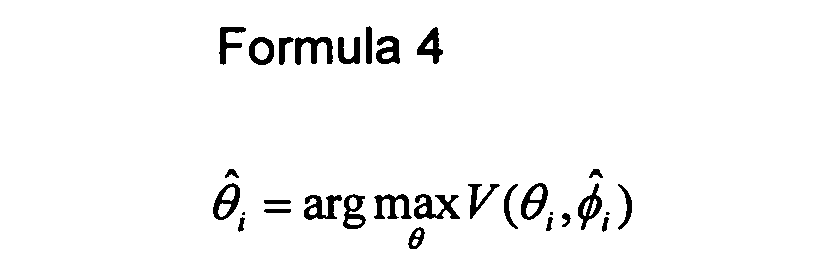
  • The central vertical angle searching unit 130 inputs the estimated central horizontal angle  and i of the i-th distributed signal source to the formula for solving 2-D optimization problems as shown in formula 2 as central horizontal angle variable i, and thus converts the 2-D cost function into an 1-D function for central vertical angle variable i, as represented by following formula 4:
    Figure 00110001
  • Thereafter, the central vertical angle searching unit 130 estimates the solution making the 1-D function have the global maximum, namely the central horizontal angle  and i of the i-th distributed signal source (S24).
  • The central horizontal angle searching unit 120 and the central vertical angle searching unit 130 confirm whether the central vertical angles and the central horizontal angles for q distributed signal sources have been all estimated. The central horizontal angle searching unit 120 and the central vertical angle searching unit 130 sequentially perform estimation of the central horizontal angle using the primary central vertical angle, and estimation of the central vertical angle using the estimated central horizontal angle, until the central vertical angles and the central horizontal angles for q distributed signal sources have been all estimated (S26).
  • When the central vertical angles and the central horizontal angles for q distributed signal sources have been all estimated, the control unit 140 controls beam formation in the signal arrival direction of each distributed signal source.
  • As discussed earlier, in accordance with the present invention, the method and device for searching the distributed signal sources of the base station simplify primary estimation calculation and prevent local maximum problems, by primarily estimating the central vertical angles of the distributed signal sources received by the pair of circular array antennas according to the TLS-ESPRIT.
  • In addition, the method and device for searching the distributed signal sources of the base station perform 1-D searching (1-dimensional searching) by 2q times when q distributed signal sources exist, by estimating the primary central vertical angles of the distributed signal sources, and sequentially performing estimation of the central horizontal angles of the distributed signal sources using the primary central vertical angles and estimation of the central vertical angles of the distributed signal sources using the estimated central horizontal angles on each distributed signal source.
  • Furthermore, the method and device for searching the distributed signal sources of the base station estimate the primary central vertical angles of the distributed signal sources, convert the 2-D cost function into the 1-D cost function for the central horizontal angle variables by inputting the primary central vertical angles of the distributed signal sources to the 2-D cost function, calculate the solutions making the 1-D cost function have the maximum, namely the central horizontal angles, convert the 2-D cost function into the 1-D cost function for the central vertical angle variables by inputting the calculated central horizontal angles to the 2-D cost function, and calculate the solutions making the 1-D cost function have the maximum, namely the central vertical angles. Calculation of the 1-D function is easier than that of the nonlinear 2-D function. As a result, complexity of calculation for estimating the signal arrival directions of the distributed signal sources can be reduced, and loads of the base station for estimating the signal arrival directions of the distributed signal sources can also be reduced.
  • As the present invention may be embodied in several forms without departing from the spirit or essential characteristics thereof, it should also be understood that the above-described embodiments are not limited by any of the details of the foregoing description, unless otherwise specified, but rather should be construed broadly within its spirit and scope as defined in the appended claims, and therefore all changes and modifications that fall within the metes and bounds of the claims, or equivalence of such metes and bounds are therefore intended to be embraced by the appended claims.

Claims (15)

  1. A device for searching distributed signal sources of a base station, comprising:
    a pair of circular array antennas maintaining a predetermined distance from each other in the up/down direction;
    a preprocessing unit for estimating primary central vertical angle of the distributed signal source from the pair of circular array antennas;
    a central horizontal angle searching unit for estimating central horizontal angle of the distributed signal source by using the primary central vertical angle; and
    a central vertical angle searching unit for estimating central vertical angle of the distributed signal source by using the estimated central horizontal angle.
  2. The device of claim 1, wherein two axes of the pair of circular array antennas are disposed on the same line with the predetermined distance from each other, and sensors of the pair of circular array antennas maintain an up/down distance corresponding to the predetermined distance from each other.
  3. The device of claim 2, wherein the predetermined distance comprises a multiple of a wavelength.
  4. The device of claim 1, wherein the preprocessing unit estimates the primary central vertical angle of the distributed signal source received by the pair of circular array antennas according to a TLS-ESPRIT.
  5. The device of claim 1, wherein the central horizontal angle searching unit generates a first 1-dimensional cost function for a central horizontal angle variable, by inputting the primary central vertical angle as a value of a central vertical angle variable into a 2-dimensional cost function for the central vertical angle variable and the central horizontal angle variable, and estimates the central horizontal angle of the distributed signal source making the first 1-dimensional cost function have a maximum.
  6. The device of claim 1, wherein the central vertical angle searching unit generates a second 1-dimensional cost function for central vertical angle variable, by inputting the estimated central horizontal angle as a value of a central horizontal angle variable into a 2-dimensional cost function for the central vertical angle variable and the central horizontal angle variable, and estimates the central vertical angle of the distributed signal source making the second 1-dimensional cost function have a maximum.
  7. The device of claim 1, further comprising a control unit for forming beam in signal arrival direction of the distributed signal source, by using the estimated central vertical angle and central horizontal angle.
  8. A method for searching distributed signal sources of a base station, comprising the steps of:
    receiving the distributed signal sources through each sensor of a pair of circular array antennas;
    estimating primary central vertical angles of the received distributed signal sources;
    estimating a central horizontal angle of one distributed signal source by using the primary central vertical angle of the distributed signal source; and
    estimating a central vertical angle of the distributed signal source by using the estimated central horizontal angle.
  9. The method of claim 8, further comprising a step for sequentially performing the step for estimating the central horizontal angle and the step for estimating the central vertical angle as many as the distributed signal sources.
  10. The method of claim 8, wherein two axes of the pair of circular array antennas are disposed on the same line with a predetermined distance corresponding to a multiple of a wavelength from each other, and sensors of the pair of circular array antennas maintain an up/down distance corresponding to the predetermined distance from each other.
  11. The method of claim 8, wherein the step for estimating the primary central vertical angles estimates the primary central vertical angles of the distributed signal sources received by each sensor of the pair of circular array antennas according to a TLS-ESPRIT.
  12. The method of claim 8, wherein the step for estimating the central horizontal angle of the distributed signal source comprises the steps of:
    converting a 2-dimensional cost function for central vertical angle variables and central horizontal angle variables into a first 1-dimensional cost function for the central horizontal angle variables; and
    estimating the central horizontal angle of the distributed signal source making the first 1-dimensional cost function have a maximum.
  13. The method of claim 12, wherein the step for converting the 2-dimensional cost function into the first 1-dimensional cost function inputs the primary central vertical angle into the 2-dimensional cost function for the central vertical angle variables and central horizontal angle variables as a value of the central vertical angle variable.
  14. The method of claim 8, wherein the step for estimating the central vertical angle of the distributed signal source comprises the steps of:
    converting a 2-dimensional cost function for central vertical angle variables and central horizontal angle variables into a second 1-dimensional cost function for the central vertical angle variables; and
    estimating the central vertical angle of the distributed signal source making the second 1-dimensional cost function have a maximum.
  15. The method of claim 14, wherein the step for converting the 2-dimensional cost function into the second 1-dimensional cost function inputs the estimated central horizontal angle into the 2-dimensional cost function for the central vertical angle variables and central horizontal angle variables as a value of the central horizontal angle variables.
EP20040011656 2003-05-26 2004-05-17 Method and device for searching distributed signal sources of base station Withdrawn EP1482468A2 (en)

Applications Claiming Priority (2)

Application Number Priority Date Filing Date Title
KR1020030033479A KR100585714B1 (en) 2003-05-26 2003-05-26 Signal source search apparatus and method of base station circular array antenna
KR2003033479 2003-05-26

Publications (1)

Publication Number Publication Date
EP1482468A2 true EP1482468A2 (en) 2004-12-01

Family

ID=33129039

Family Applications (1)

Application Number Title Priority Date Filing Date
EP20040011656 Withdrawn EP1482468A2 (en) 2003-05-26 2004-05-17 Method and device for searching distributed signal sources of base station

Country Status (5)

Country Link
US (1) US20040253987A1 (en)
EP (1) EP1482468A2 (en)
JP (1) JP2004354377A (en)
KR (1) KR100585714B1 (en)
CN (1) CN1326334C (en)

Cited By (1)

* Cited by examiner, † Cited by third party
Publication number Priority date Publication date Assignee Title
WO2010040887A1 (en) * 2008-10-06 2010-04-15 Elektrobit System Test Oy Over-the-air test

Families Citing this family (14)

* Cited by examiner, † Cited by third party
Publication number Priority date Publication date Assignee Title
US20050108445A1 (en) * 2003-11-03 2005-05-19 Lassner Michael A. Systems and methods for implementing device regionalization
WO2005074147A1 (en) 2004-01-30 2005-08-11 Universite Laval Multi-user adaptive array receiver and method
EP1846778B1 (en) * 2005-02-01 2008-10-29 Thales 1d or 2d goniometry method of diffuse sources
US20070143294A1 (en) * 2005-12-15 2007-06-21 Accton Technology Corporation Network information access system
JP5135595B2 (en) * 2007-03-29 2013-02-06 日本電気株式会社 Direction measuring device
CN102123349B (en) * 2011-01-10 2014-06-18 张俊虎 Method for accumulatively searching data set of wireless sensor network
US20130031046A1 (en) * 2011-07-27 2013-01-31 Honeywell International Inc. Devices, methods, and systems for model based degree-of-angle localization
CN102707264B (en) * 2012-06-13 2014-03-12 西安电子科技大学 Estimating method of direction of arrival of bistatic MIMO (Multi-Input Multi-Output) radar based on circular array
CN104678350B (en) * 2015-03-10 2017-07-28 重庆邮电大学 Arrival direction estimation based on TLS ESPRIT algorithms in extensive mimo system
US10205491B2 (en) * 2015-09-28 2019-02-12 Futurewei Technologies, Inc. System and method for large scale multiple input multiple output communications
CN106450703A (en) * 2016-11-24 2017-02-22 中国科学院国家空间科学中心 Interference type microwave radiometer circular ring antenna array based on cyclic subarrays
KR102562821B1 (en) 2018-10-19 2023-08-02 삼성전자주식회사 Apparatus and method for receiving and measuring radio signals
CN113270729B (en) * 2021-04-01 2022-03-22 珠海极海半导体有限公司 Three-dimensional array antenna, positioning method and system, BLE chip and wireless MCU chip
US12477354B2 (en) * 2022-05-16 2025-11-18 Qualcomm Incorporated Estimating and compensating antenna array misalignment

Family Cites Families (9)

* Cited by examiner, † Cited by third party
Publication number Priority date Publication date Assignee Title
US5343211A (en) * 1991-01-22 1994-08-30 General Electric Co. Phased array antenna with wide null
JP3232883B2 (en) * 1994-06-23 2001-11-26 三菱電機株式会社 Angle measuring device and complex guidance device
KR100267346B1 (en) * 1998-08-06 2000-10-16 윤종용 Method for finding signal direction in wireless communication with array antenna
US6104346A (en) * 1998-11-06 2000-08-15 Ail Systems Inc. Antenna and method for two-dimensional angle-of-arrival determination
JP3920483B2 (en) * 1998-12-28 2007-05-30 株式会社東芝 Radio wave arrival direction estimation method and antenna apparatus
JP3477132B2 (en) * 1999-12-27 2003-12-10 株式会社東芝 Arrival azimuth measuring device for incoming wave
FR2828936B1 (en) * 2001-08-24 2003-12-05 Thomson Marconi Sonar Sas PROCESS FOR SIGNAL PROCESSING OF A TOWED LINEAR ANTENNA
US6633256B2 (en) * 2001-08-24 2003-10-14 Topcon Gps Llc Methods and systems for improvement of measurement efficiency in surveying
US6992622B1 (en) * 2004-10-15 2006-01-31 Interdigital Technology Corporation Wireless communication method and antenna system for determining direction of arrival information to form a three-dimensional beam used by a transceiver

Cited By (3)

* Cited by examiner, † Cited by third party
Publication number Priority date Publication date Assignee Title
WO2010040887A1 (en) * 2008-10-06 2010-04-15 Elektrobit System Test Oy Over-the-air test
US9786999B2 (en) 2008-10-06 2017-10-10 Keysight Technologies Singapore (Holdings) Pte. Ltd. Over-the-air test
US11152717B2 (en) 2008-10-06 2021-10-19 Keysight Technologies Singapore (Sales) Pte. Ltd. Over-the-air test

Also Published As

Publication number Publication date
KR20040101763A (en) 2004-12-03
KR100585714B1 (en) 2006-06-07
CN1574683A (en) 2005-02-02
CN1326334C (en) 2007-07-11
US20040253987A1 (en) 2004-12-16
JP2004354377A (en) 2004-12-16

Similar Documents

Publication Publication Date Title
EP1482468A2 (en) Method and device for searching distributed signal sources of base station
Larew et al. Adaptive beam tracking with the unscented Kalman filter for millimeter wave communication
US12519509B2 (en) Communication and radar target detection method based on intelligent omni-surface
Chargé et al. A non-circular sources direction finding method using polynomial rooting
US8428897B2 (en) Method and apparatus for spectral cross coherence
US7228244B2 (en) Method and apparatus for direction-of-arrival tracking and their application to beamforming at base-station
CN107843881A (en) Radar angular estimates and error calibration method
EP1032962B1 (en) Discrimination procedure of a wanted signal from a plurality of cochannel interferents received from array antennas of base stations for cellular telecommunication and relative receiver
CN110378320A (en) The common cycle of multiple signals determines method, apparatus and readable storage medium storing program for executing
Viberg et al. Calibration in array processing
Ahmed et al. Simulation of direction of arrival using MUSIC algorithm and beamforming using variable step size LMS algorithm
CN114137476A (en) Short wave direction finding method based on polarization correction
US20230161021A1 (en) Method and apparatus for determination of direction of arrival angle
Wang et al. New generalized ESPRIT for direction estimation and its mathematical link to RARE method
Yin et al. An auto-calibration method for spatially and temporally correlated noncircular sources in unknown noise fields
Du et al. A fast neural beamformer for antenna arrays
Bolkhovskaya et al. Investigation of theoretical limits for unconditional AoA estimations in multi-element antenna arrays by simulations
KR100846446B1 (en) Apparatus for estimation of alternating projection searching and method thereof
Zhuang et al. FFT-based adaptive 2-D DOA estimation for arbitrary array structures
Haardt et al. Structured least squares to improve the performance of ESPRIT-type high-resolution techniques
CN119652374B (en) Adaptive signal beam forming method, device, equipment and storage medium
Suleiman et al. Decentralized direction-of-arrival estimation for arbitrary array geometries
JP2005201798A (en) Arrival direction measurement system and arrival direction measurement method
Viberg et al. Array interpolation based on local polynomial approximation with application to DOA estimation using weighted MUSIC
Perez-Neira et al. High Performance DOA trackers derived from parallel low resolution detectors

Legal Events

Date Code Title Description
PUAI Public reference made under article 153(3) epc to a published international application that has entered the european phase

Free format text: ORIGINAL CODE: 0009012

17P Request for examination filed

Effective date: 20040517

AK Designated contracting states

Kind code of ref document: A2

Designated state(s): AT BE BG CH CY CZ DE DK EE ES FI FR GB GR HU IE IT LI LU MC NL PL PT RO SE SI SK TR

AX Request for extension of the european patent

Extension state: AL HR LT LV MK

STAA Information on the status of an ep patent application or granted ep patent

Free format text: STATUS: THE APPLICATION IS DEEMED TO BE WITHDRAWN

18D Application deemed to be withdrawn

Effective date: 20081202