Technical Field
The present invention relates to compounds that are useful for treating
inflammatory and immune diseases, to pharmaceutical compositions comprising these
compounds, and to methods of inhibiting inflammation or suppressing immune
response in a mammal.
Background
Inflammation results from a cascade of events that includes vasodilation
accompanied by increased vascular permeability and exudation of fluid and plasma
proteins. This disruption of vascular integrity precedes or coincides with an
infiltration of inflammatory cells. Inflammatory mediators generated at the site of the
initial lesion serve to recruit inflammatory cells to the site of injury. These mediators
(chemokines such as IL-8, MCP-1, MIP-1, and RANTES, complement fragments and
lipid mediators) have chemotactic activity for leukocytes and attract the inflammatory
cells to the inflamed lesion. These chemotactic mediators which cause circulating
leukocytes to localize at the site of inflammation require the cells to cross the vascular
endothelium at a precise location. This leukocyte recruitment is accomplished by a
process called cell adhesion.
Cell adhesion occurs through a coordinately regulated series of steps that
allow the leukocytes to first adhere to a specific region of the vascular endothelium
and then cross the endothelial barrier to migrate to the inflamed tissue (Springer, T.A.,
1994, Traffic Signals for Lymphocyte Recirculation and Leukocyte Emigration: The
Multistep Paradigm, Cell 76: 301-314; Lawrence, M. B., and Springer, T. A., 1991,
Leukocytes' Roll on a Selectin at Physiologic Flow Rates: Distinction from and
Prerequisite for Adhesion Through Integrins, Cell.65: 859-873; von Adrian, U.,
Chambers, J. D., McEnvoy, L.M., Bargatze, R.F., Arfos, K.E, and Butcher, E.C.,
1991, Two-Step Model of Leukocyte-Endothelial Cell Interactions in Inflammation,
Proc. Natl. Acad. Sci. USA 88: 7538-7542; and Ley, K., Gaehtgens, P., Fennie, C.,
Singer, M.S., Lasky, L.H. and Rosen, S.D.,1991, Lectin-Like Cell Adhesion Molecule
1 Mediates Rolling in Mesenteric Venules in vivo, Blood 77: 2553-2555). These steps
are mediated by families of adhesion molecules such as integrins, Ig supergene family
members, and selectins which are expressed on the surface of the circulating
leukocytes and on the vascular endothelial cells. The first step consists of leukocytes
rolling along the vascular endothelial cell lining in the region of inflammation. The
rolling step is mediated by an interaction between a leukocyte surface oligosaccharide,
such as Sialylated Lewis-X antigen (SLex), and a selectin molecule expressed on the
surface of the endothelial cell in the region of inflammation. The selectin molecule is
not normally expressed on the surface of endothelial cells but rather is induced by the
action of inflammatory mediators such as TNF-α and interleukin-1. Rolling decreases
the velocity of the circulating leukocyte in the region of inflammation and allows the
cells to more firmly adhere to the endothelial cell. The firm adhesion is accomplished
by the interaction of integrin molecules that are present on the surface of the rolling
leukocytes and their counter-receptors (the Ig superfamily molecules) on the surface
of the endothelial cell. The Ig superfamily molecules or CAMs (Cell Adhesion
Molecules) are either not expressed or are expressed at low levels on normal vascular
endothelial cells. The CAM's, like the selectins, are induced by the action of
inflammatory mediators like TNF-alpha and IL-1. The final event in the adhesion
process is the extravasation of leukocytes through the endothelial cell barrier and their
migration along a chemotactic gradient to the site of inflammation. This
transmigration is mediated by the conversion of the leukocyte integrin from a low
avidity state to a high avidity state. The adhesion process relies on the induced
expression of selectins and CAM's on the surface of vascular endothelial cells to
mediate the rolling and firm adhesion of leukocytes to the vascular endothelium.
The interaction of the intercellular adhesion molecule ICAM-1 (cd54) on
endothelial cells with the integrin LFA-1 on leukocytes plays an important role in
endothelial-leukocyte contact. Leukocytes bearing high-affinity LFA-1 adhere to
endothelial cells through interaction with ICAM-1, initiating the process of
extravasation from the vasculature into the surrounding tissues. Thus, an agent which
blocks the ICAM-1/LFA-1 interaction suppresses these early steps in the
inflammatory response. Consistent with this background, ICAM-1 knockout mice
have numerous abnormalities in their inflammatory responses.
The present invention discloses compounds which bind to the interaction-domain
(I-domain) of LFA-1, thus interrupting endothelial cell-leukocyte adhesion by
blocking the interaction of LFA-1 with ICAM-1, ICAM-3, and other adhesion
molecules. These compounds are useful for the treatment or prophylaxis of diseases
in which leukocyte trafficking plays a role, notably acute and chronic inflammatory
diseases, autoimmune diseases, tumor metastasis, allograft rejection, and reperfusion
injury. The compounds of this invention are diaryl sulfides, which are substituted
with a cinnamide moiety. The cinnamide functionality may be placed either ortho- or
para- to the linking sulfur atom, although para-substitution is preferable. Appropriate
substitution of both aromatic rings is tolerated, and can be used to modulate a variety
of biochemical, physicochemical and pharmacokinetic properties. In particular the
amide moiety is readily modified; a variety of secondary and tertiary amides are
active, and alternatively a heterocyclic ring may be attached at this position.
Modifications of this amide functionality are particularly useful in modulating
physicochemical and pharmacokinetic properties.
Summary of The Invention
The present invention provides compounds of formula I, below,
or a pharmaceutically-acceptable salt or prodrug thereof,
wherein R
1, R
2, R
3, R
4, and R
5 are independently selected from
with the proviso that at least one of R
1 or R
3 is a "
cis-cinnamide" or a
"trans-cinnamide",
defined as
wherein R
8 and R
9 are independently selected from
- a. hydrogen, and
- b. alkyl,
- c. carboxy alkyl,
- d. alkylaminocarbonyl alkyl, and
- e. dialkylaminocarbonyl alkyl,
and R
10 and R
11 are independently selected from
- a. hydrogen,
- b. alkyl,
- c. cycloalkyl,
- d. alkoxycarbonylalkyl,
- e. hydroxyalkyl,
- f. substituted aryl,
- g. heterocyclyl,
- h. heterocyclylalkyl,
- i. heterocyclylamino,
- j. substituted heterocyclyl, and
- k. substituted heterocyclylalkyl,
or where NR
10R
11 is heterocyclyl or substituted heterocyclyl, where
substituents are independently selected from
- 1) alkyl,
- 2) alkoxy,
- 3) alkoxyalkyl,
- 4) cycloalkyl,
- 5) aryl,
- 6) heterocyclyl,
- 7) heterocyclylcarbonyl,
- 8) heterocyclylalkylaminocarbonyl,
- 9) hydroxy,
- 10) hydroxyalkyl,
- 11) hydroxyalkoxyalkyl,
- 12) carboxy,
- 13) carboxyalkyl,
- 14) carboxycarbonyl,
- 15) carboxaldehyde,
- 16) alkoxycarbonyl,
- 17) arylalkoxycarbonyl,
- 18) aminoalkyl,
- 19) aminoalkanoyl,
- 20) carboxamido,
- 21) alkoxycarbonylalkyl,
- 22) carboxamidoalkyl,
- 23) cyano,
- 24) tetrazolyl,
- 25) substituted tetrazolyl,
- 26) alkanoyl,
- 27) hydroxyalkanoyl,
- 28) alkanoyloxy,
- 29) alkanoylamino,
- 30) alkanoyloxyalkyl,
- 31) alkanoylaminoalkyl,
- 32) sulfonate,
- 33) alkylsulfonyl,
- 34) alkylsulfonylaminocarbonyl,
- 35) arylsulfonylaminocarbonyl, and
- 36) heterocyclylsulfonylaminocarbonyl,
and wherein
Ar is a substituted aryl or substituted heteroaryl group, where
substitutions are independently selected from
- a. hydrogen,
- b. halogen,
- c. alkyl,
- d. aryl,
- e. haloalkyl,
- f. hydroxy,
- g. alkoxy,
- h. alkoxyalkyl,
- i. alkoxycarbonyl,
- j. alkoxyalkoxy,
- k. hydroxyalkyl,
- l. aminoalkyl,
- m. aminocarbonyl,
- n. alkyl(alkoxycarbonylalkyl)aminoalkyl,
- o. heterocyclyl,
- p. substituted heterocyclyl,
- q. heterocyclylalkyl,
- r. substituted heterocyclylalkyl,
- s. carboxaldehyde,
- t. carboxaldehyde hydrazone,
- u. carboxamide,
- v. alkoxycarbonylalkyl,
- w. carboxy,
- x. carboxyalkyl,
- y. carboxy alkoxy,
- z. carboxythioalkoxy,
- aa. carboxycycloalkoxy,
- bb. thioalkyl,
- cc. hydroxycarbonylalkyl (carboxyalkyl),
- dd. hydroxyalkylaminocarbonyl,
- ee. cyano,
- ff. amino,
- gg. heterocyclylalkylamino,
- hh. carboxyalkylamino,
- ii. heterocyclylalkylaminocarbonyl, and
- jj. "trans-cinnamide".
Additionally provided are methods of treatment or prophylaxis in which the
inhibition of inflammation or suppression of immune response is desired, comprising
administering an effective amount of a compound of formula I.
Still further provided are pharmaceutical compositions containing compounds
of formula I.
Detailed Description
The term "alkanoyl" as used herein refers to an alkyl group attached to the
parent molecular group through a carbonyl group.
The term " alkanoylamino" as used herein refers to an alkanoyl group attached
to the parent molecular group though an amino group.
The term " alkanoylaminoalkyl" as used herein refers to an alkanoylamino
group attached to the parent molecular group through an alkyl group.
The term "alkanoyloxy" as used herein refers to an alkanoyl group attached to
the parent molecular group through an oxygen radical.
The term " alkanoyloxyalkyl" as used herein refers to an alkanoyloxy group
attached to the parent molecular group through an alkyl group.
The term "alkoxy" as used herein refers to an alkyl group attached to the
parent molecular group through an oxygen atom.
The term "alkoxyalkoxy" as used herein refers to an alkoxy group attached to
the parent molecular group through an alkoxy group.
The term "alkoxyalkyl" as used herein refers to an alkoxy group attached to
the parent molecular group through an alkyl group.
The term "alkoxycarbonyl" as used herein refers to an alkoxy group attached
to the parent molecular group through a carbonyl group.
The term "alkoxycarbonylalkyl" as used herein refers to an alkoxycarbonyl
group attached to the parent molecular group through an alkyl group.
The term "alkyl" as used herein refers to a saturated straight or branched chain
group of 1-10 carbon atoms derived from an alkane by the removal of one hydrogen
atom.
The term "alkyl(alkoxycarbonylalkyl)amino" as used herein refers to an
amino group substituted with one alkyl group and one alkoxycarbonylalkyl group.
The term "alkyl(alkoxycarbonylalkyl)aminoalkyl" as used herein refers to an
alkyl(alkoxycarbonylalkyl)amino group attached to the parent molecular group
through an alkyl group.
The term "alkylene" as used herein refers to a divalent group of 1-10 carbon
atoms derived from a straight or branched chain alkane by the removal of two
hydrogen atoms.
The term "alkylsulfonyl" as used herein refers to an alkyl radical attached to
the parent molecular group through an -SO2- group.
The term "alkylsulfonylaminocarbonyl" as used herein refers to an
alkylsulfonyl group attached to the parent molecular group through an aminocarbonyl
group.
The term "amino" as used herein refers to a radical of the form -NR18R19, or to
to a radical of the form -NR18-, where R18 and R19 are independently selected from
hydrogen, alkyl or cycloalkyl.
The term "aminoalkanoyl" as used herein refers to to an amino group attached
to the parent molecular group through an alkanoyl group.
The term "aminoalkyl" as used herein refers to an amino group attached to the
parent molecular group through an alkyl group.
The term "aminocarbonyl" as used herein refers to an amino group attached to
the parent molecular group through a carbonyl group.
The term "aryl" as used herein refers to a mono- or bicyclic carbocyclic ring
system having one or two aromatic rings. The aryl group can also be fused to a
cyclohexane, cyclohexene, cyclopentane or cyclopentene ring. The aryl groups of this
invention can be optionally substituted with alkyl, halogen, hydroxy, carboxy, or
alkoxy substituents.
The term "arylalkoxy" as used herein refers to an aryl group attached to the
parent molecular group through an alkoxy group.
The term "arylalkoxycarbonyl" as used herein refers to an arylalkoxy group
attached to the parent molecular group through a carbonyl group.
The term "arylsulfonyl" as used herein refers to an aryl radical attached to the
parent molecular group through an -SO2- group.
The term "arylsulfonylaminocarbonyl" as used herein refers to an arylsulfonyl
group attached to the parent molecular group through an aminocarbonyl group.
The term "carboxaldehyde" as used herein refers to the radical -CHO.
The term "carboxaldehyde hydrazone" as used herein refers to the radical
- CH=N-NR20R21, where R20 and R21 are independently selected from hydrogen, alkyl
or cycloalkyl.
The terms "carboxamide" or "carboxamido" as used herein refer to an amino
group attached to the parent molecular group through a carbonyl group.
The term "carboxamidoalkyl" as used herein refers to a carboxamido group
attached to the parent molecular group through an alkyl group.
The term "carboxy" as used herein refers to the radical -COOH.
The term "carboxyalkyl" as used herein refers to a carboxy group attached to
the parent molecular group through a alkyl group.
The term "carboxycarbonyl" as used herein refers to a carboxy group attached
to the parent molecular group through a carbonyl group.
The term "cyano" as used herein refers to the radical -CN.
The term "cycloalkyl" as used herein refers to a monovalent saturated cyclic or
bicyclic hydrocarbon group of 3-12 carbons derived from a cycloalkane by the
removal of a single hydrogen atom. Cycloalkyl groups may be optionally substituted
with alkyl, alkoxy, halo, or hydroxy substituents.
The terms "halo" or "halogen" as used herein refers to F, Cl, Br, or I.
The term "haloalkyl" as used herein refers to an alkyl group substituted with
one or more halogen atoms.
The terms "heterocycle" or "heterocyclyl" represent a 4-, 5-, 6- or 7-membered
ring containing one, two or three heteroatoms independently selected from the group
consisting of nitrogen, oxygen and sulfur. The 4- and 5-membered rings have zero to
two double bonds and the 6- and 7-membered rings have zero to three double bonds.
The term "heterocycle" or "heterocyclic" as used herein additionally refers to bicyclic,
tricyclic and tetracyclic groups in which any of the above heterocyclic rings is fused
to one or two rings independently selected from an aryl ring, a cyclohexane ring, a
cyclohexene ring, a cyclopentane ring, a cyclopentene ring or another monocyclic
heterocyclic ring. Heterocycles include acridinyl, benzimidazolyl, benzofuryl,
benzothiazolyl, benzothienyl, benzoxazolyl, biotinyl, cinnolinyl, dihydrofuryl,
dihydroindolyl, dihydropyranyl, dihydrothienyl, dithiazolyl, furyl, homopiperidinyl,
imidazolidinyl, imidazolinyl, imidazolyl, indolyl, isoquinolyl, isothiazolidinyl,
isothiazolyl, isoxazolidinyl, isoxazolyl, morpholinyl, oxadiazolyl, oxazolidinyl,
oxazolyl, piperazinyl, piperidinyl, pyranyl, pyrazolidinyl, pyrazinyl, pyrazolyl,
pyrazolinyl, pyridazinyl, pyridyl, pyrimidinyl, pyrimidyl, pyrrolidinyl, pyrrolidin-2-onyl,
pyrrolinyl, pyrrolyl, quinolinyl, quinoxaloyl, tetrahydrofuryl,
tetrahydroisoquinolyl, tetrahydroquinolyl, tetrazolyl, thiadiazolyl, thiazolidinyl,
thiazolyl, thienyl, thiomorpholinyl, triazolyl, and the like.
Heterocyclics also include bridged bicyclic groups where a monocyclic
heterocyclic group is bridged by an alkylene group such as
and the like.
Heterocyclics also include compounds of the formula
where X*
and Z* are independently selected from -CH
2-, -CH
2NH-, -CH
2O-, -NH- and -O-,
with the proviso that at least one of X* and Z* is not -CH
2-, and Y* is selected from
- C(O)- and -(C(R")
2)
v-, where R" is hydrogen or alkyl of one to four carbons, and v
is 1-3. These heterocycles include 1,3-benzodioxolyl, 1,4-benzodioxanyl, 1,3-benzimidazol-2-one
and the like. The heterocycle groups of this invention can be
optionally substituted with alkoxy, alkyl, halogen, hydroxy, carboxy, carboxyalkyl, or
alkoxycarbonyl substituents.
The term "heterocyclylalkyl" as used herein refers to an heterocyclic group
attached to the parent molecular group through an alkyl group.
The term "heterocyclylalkylamino" as used herein refers to an
heterocyclylalkyl group attached to the parent molecular group through an amino
group.
The term "heterocyclylalkylaminocarbonyl" as used herein refers to a
heterocyclylalkylamino group attached to the parent molecular group through a
carbonyl group.
The term "heterocyclylamino" as used herein refers to a heterocyclyl group
attached to the parent molecular group through a amino group.
The term "heterocyclylcarbonyl" as used herein refers to a heterocyclyl group
attached to the parent molecular group through a carbonyl group.
The term "heterocyclylsulfonyl" as used herein refers to a heterocyclyl radical
attached to the parent molecular group through an -SO2- group.
The term "heterocyclylsulfonylaminocarbonyl" as used herein refers to a
heterocyclylsulfonyl group attached to the parent molecular group through an
aminocarbonyl group.
The term "hydroxyalkanoyl" as used herein refers to an hydroxy radical
attached to the parent molecular group through an alkanoyl group.
The term "hydroxyalkoxy" as used herein refers to an hydroxy radical attached
to the parent molecular group through an alkoxy group.
The term "hydroxyalkoxyalkyl" as used herein refers to an hydroxyalkoxy
group attached to the parent molecular group through an alkyl group.
The term "hydroxyalkyl" as used herein refers to an hydroxy radical attached
to the parent molecular group through an alkyl group.
The term "hydroxyalkylaminocarbonyl" as used herein refers to an
hydroxyalkyl group attached to the parent molecular group through an aminocarbonyl
group.
The term "perfluoroalkyl" as used herein refers to an alkyl group in which all
of the hydrogen atoms have been replaced by fluoride atoms.
The term "phenyl" as used herein refers to a monocyclic carbocyclic ring
system having one aromatic ring. The phenyl group can also be fused to a
cyclohexane or cyclopentane ring. The phenyl groups of this invention can be
optionally substituted with alkyl, halogen, hydroxy or alkoxy substituents.
The term "pharmaceutically-acceptable prodrugs" as used herein represents
those prodrugs of the compounds of the present invention which are, within the scope
of sound medical judgment, suitable for use in contact with the tissues of humans and
lower animals with undue toxicity, irritation, allergic response, and the like,
commensurate with a reasonable benefit/risk ratio, and effective for their intended use,
as well as the zwitterionic forms, where possible, of the compounds of the invention.
The term "prodrug," as used herein, represents compounds which are rapidly
transformed in vivo to the parent compound of the above formula, for example, by
hydrolysis in blood. A thorough discussion is provided in T. Higuchi and V. Stella,
Pro-drugs as Novel Delivery Systems, Vol. 14 of the A.C.S. Symposium Series, and
in Edward B. Roche, ed., Bioreversible Carriers in Drug Design, American
Pharmaceutical Association and Pergamon Press, 1987, both of which are
incorporated herein by reference.
The term "sulfonate" as used herein refers to the radical -SO3H
The term "tetrazole" or "tetrazolyl" as used herein refers to the heterocyclic
radical -CN4H.
The term "thioalkoxy" as used herein refers to an alkyl group attached to the
parent molecular group through a sulfur atom.
Compounds of the present invention can exist as stereoisomers wherein
asymmetric or chiral centers are present. These compounds are designated by the
symbols "R" or "S," depending on the configuration of substituents around the chiral
carbon atom. The present invention contemplates various stereoisomers and mixtures
thereof. Stereoisomers include enantiomers and diastereomers, and mixtures of
enantiomers or diastereomers are designated (±). Individual stereoisomers of
compounds of the present invention can be prepared synthetically from commercially
available starting materials which contain asymmetric or chiral centers or by
preparation of racemic mixtures followed by resolution well-known to those of
ordinary skill in the art. These methods of resolution are exemplified by (1)
attachment of a mixture of enantiomers to a chiral auxiliary, separation of the
resulting mixture of diastereomers by recrystallization or chromatography and
liberation of the optically pure product from the auxiliary, (2) salt formation
employing an optically active resolving agent, or (3) direct separation of the mixture
of optical enantiomers on chiral chromatographic columns.
Geometric isomers can also exist in the compounds of the present invention.
The present invention contemplates the various geometric isomers and mixtures
thereof resulting from the arrangement of substituents around a carbon-carbon double
bond or arrangement of substituents around a carbocyclic ring. Substituents around a
carbon-carbon double bond are designated as being in the Z or E configuration
wherein the term "Z" represents substituents on the same side of the carbon-carbon
double bond and the term "E" represents substituents on opposite sides of the carbon-carbon
double bond. The arrangement of substituents around a carbocyclic ring are
designated as cis or trans wherein the term "cis" represents substituents on the same
side of the plane of the ring and the term "trans" represents substituents on opposite
sides of the plane of the ring. Mixtures of compounds wherein the substituents are
disposed on both the same and opposite sides of plane of the ring are designated
cis/trans.
As is apparent from the foregoing descriptions, the compounds of Formula 1
are useful in a variety of forms, i.e., with various substitutions as identified.
Examples of particularly desirable compounds are quite diverse, and many are
mentioned herein. Included are compounds in which R1 is a "cis-cinnamide" or a
"trans-cinnamide", and R3 is hydrogen; or where R3 is a "cis-cinnamide" or a "trans-cinnamide",
and R1 is hydrogen, or R1, R2, and R4 are each independently hydrogen or
alkyl, and R5 is halogen, haloalkyl or nitro. Further preferred compounds include
those as above wherein R10 and R11 are each independently hydrogen, alkyl,
cycloalkyl, alkoxycarbonylaalkyl, hydroxyalkyl or heterocyclylalkyl, or where
NR10R11 is heterocyclyl or substituted heterocyclyl, and where Ar is aryl, substituted
aryl, heteroaryl, or substituted heteroaryl.
Compounds of the present invention include:
Pharmaceutical Compositions and Methods of Treatment
The present invention also provides pharmaceutical compositions which
comprise compounds of the present invention formulated together with one or more
pharmaceutically-acceptable carriers. The pharmaceutical compositions may be
specially formulated for oral administration in solid or liquid form, for parenteral
injection, or for rectal administration.
The pharmaceutical compositions of this invention can be administered to
humans and other animals orally, rectally, parenterally, intracisternally,
intravaginally, intraperitoneally, topically (as by powders, ointments, or drops),
bucally, or as an oral or nasal spray. The term "parenteral" administration as used
herein refers to modes of administration which include intravenous, intramuscular,
intraperitoneal, intrasternal, subcutaneous and intraarticular injection and infusion.
Pharmaceutical compositions of this invention for parenteral injection
comprise pharmaceutically-acceptable sterile aqueous or nonaqueous solutions,
dispersions, suspensions or emulsions as well as sterile powders for reconstitution
into sterile injectable solutions or dispersions just prior to use. Examples of suitable
aqueous and nonaqueous carriers, diluents, solvents or vehicles include water,
ethanol, polyols (such as glycerol, propylene glycol, polyethylene glycol, and the
like), and suitable mixtures thereof, vegetable oils (such as olive oil), and injectable
organic esters such as ethyl oleate. Proper fluidity can be maintained, for example, by
the use of coating materials such as lecithin, by the maintenance of the required
particle size in the case of dispersions, and by the use of surfactants.
These compositions may also contain adjuvants such as preservative, wetting
agents, emulsifying agents, and dispersing agents. Prevention of the action of
microorganisms may be ensured by the inclusion of various antibacterial and
antifungal agents, for example, paraben, chlorobutanol, phenol sorbic acid, and the
like. It may also be desirable to include isotonic agents such as sugars, sodium
chloride, and the like, Prolonged absorption of the injectable pharmaceutical form
may be brought about by the inclusion of agents which delay absorption such as
aluminum monostearate and gelatin.
In some cases, in order to prolong the effect of the drug, it is desirable to slow
the absorption of the drug from subcutaneous or intramuscular injection. This may be
accomplished by the use of a liquid suspension of crystalline or amorphous material
with poor water solubility. The rate of absorption of the drug then depends upon its
rate of dissolution which, in turn, may depend upon crystal size and crystalline form.
Alternatively, delayed absorption of a parenterally administered drug form is
accomplished by dissolving or suspending the drug in an oil vehicle.
Injectable depot forms are made by forming microencapsule matrices of the
drug in biodegradable polymers such as polylactide-polyglycolide. Depending upon
the ratio of drug to polymer and the nature of the particular polymer employed, the
rate of drug release can be controlled. Examples of other biodegradable polymers
include poly(orthoesters) and poly(anhydrides). Depot injectable formulations are
also prepared by entrapping the drug in liposomes or microemulsions which are
compatible with body tissues.
The injectable formulations can be sterilized, for example, by filtration
through a bacterial-retaining filter, or by incorporating sterilizing agents in the form
of sterile solid compositions which can be dissolved or dispersed in sterile water or
other sterile injectable medium just prior to use.
Solid dosage forms for oral administration include capsules, tablets, pills,
powders, and granules. In such solid dosage forms, the active compound is mixed
with at least one inert, pharmaceutically-acceptable excipient or carrier such as
sodium citrate or dicalcium phosphate and/or (a) fillers or extenders such as starches,
lactose, sucrose, glucose, mannitol, and silicic acid, (b) binders such as, for example,
carboxymethylcellulose, alginates, gelatin, polyvinylpyrrolidone, sucrose, and acacia,
(c) humectants such as glycerol, (d) disintegrating agents such as agar-agar, calcium
carbonate, potato or tapioca starch, alginic acid, certain silicates, and sodium
carbonate, (e) solution retarding agents such as paraffin, (f) absorption accelerators
such as quaternary ammonium compounds, (g) wetting agents such as, for example,
cetyl alcohol and glycerol monostearate, (h) absorbents such as kaolin and bentonite
clay, and (I) lubricants such as talc, calcium stearate, magnesium stearate, solid
polyethylene glycols, sodium lauryl sulfate, and mixtures thereof. In the case of
capsules, tablets and pills, the dosage form may also comprise buffering agents.
Solid compositions of a similar type may also be employed as fillers in soft
and hard-filled gelatin capsules using such excipients as lactose or milk sugar as well
as high molecular weight polyethylene glycols and the like.
The solid dosage forms of tablets, dragees, capsules, pills, and granules can be
prepared with coatings and shells such as enteric coatings and other coatings well
known in the pharmaceutical formulating art. They may optionally contain
opacifying agents and can also be of a composition that they release the active
ingredient(s) only, or preferentially, in a certain part of the intestinal tract, optionally,
in a delayed manner. Examples of embedding compositions which can be used
include polymeric substances and waxes.
The active compounds can also be in micro-encapsulated form, if appropriate,
with one or more of the above-mentioned excipients.
Liquid dosage forms for oral administration include pharmaceutically-acceptable
emulsions, solutions, suspensions, syrups and elixirs. In addition to the
active compounds, the liquid dosage forms may contain inert diluents commonly used
in the art such as, for example, water or other solvents, solubilizing agents and
emulsifiers such as ethyl alcohol, isopropyl alcohol, ethyl carbonate, ethyl acetate,
benzyl alcohol, benzyl benzoate, propylene glycol, 1,3-butylene glycol, dimethyl
formamide, oils (in particular, cottonseed, groundnut, corn, germ, olive, castor, and
sesame oils), glycerol, tetrahydrofurfuryl alcohol, polyethylene glycols and fatty acid
esters of sorbitan, and mixtures thereof.
Besides inert diluents, the oral compositions can also include adjuvants such
as wetting agents, emulsifying and suspending agents, sweetening, flavoring, and
perfuming agents.
Suspensions, in addition to the active compounds, may contain suspending
agents as, for example, ethoxylated isostearyl alcohols, polyoxyethylene sorbitol and
sorbitan esters, microcrystalline cellulose, aluminum metahydroxide, bentonite, agar-agar,
and tragacanth, and mixtures thereof.
Compositions for rectal or vaginal administration are preferably suppositories
which can be prepared by mixing the compounds of this invention with suitable nonirritating
excipients or carriers such as cocoa butter, polyethylene glycol or a
suppository wax which are solid at room temperature but liquid at body temperature
and therefore melt in the rectum or vaginal cavity and release the active compound.
Compounds of the present invention can also be administered in the form of
liposomes. As is known in the art, liposomes are generally derived from
phospholipids or other lipid substances. Liposomes are formed by mono- or multilamellar
hydrated liquid crystals that are dispersed in an aqueous medium. Any nontoxic,
physiologically-acceptable and metabolizable lipid capable of forming
liposomes can be used. The present compositions in liposome form can contain, in
addition to a compound of the present invention, stabilizers, preservatives, excipients,
and the like. The preferred lipids are the phospholipids and the phosphatidyl cholines
(lecithins), both natural and synthetic.
Methods to form liposomes are known in the art. See, for example, Prescott,
Ed., Methods in Cell Biology, Volume XIV, Academic Press, New York, N.Y.
(1976), p. 33 et seq.
The compounds of the present invention may be used in the form of
pharmaceutically-acceptable salts derived from inorganic or organic acids. By
"pharmaceutically-acceptable salt" is meant those salts which are, within the scope of
sound medical judgment, suitable for use in contact with the tissues of humans and
lower animals without undue toxicity, irritation, allergic response and the like, and are
commensurate with a reasonable benefit/risk ratio. Pharmaceutically-acceptable salts
are well-known in the art. For example, S. M. Berge, et al. Describe
pharmaceutically-acceptable salts in detail in J. Pharmaceutical Sciences, 1977, 66: 1
et seq. The salts may be prepared in situ during the final isolation and purification of
the compounds of the invention or separately by reacting a free base function with a
suitable acid. Representative acid addition salts include acetate, adipate, alginate,
citrate, aspartate, benzoate, benzenesulfonate, bisulfate, butyrate, camphorate,
camphorsulfonate, digluconate, glycerophosphate, hemisulfate, heptanoate, hexanoate,
fumarate, hydrochloride, hydrobromide, hydroiodide, 2-hydroxyethanesulfonate
(isethionate), lactate, maleate, methanesulfonate, nicotinate, 2-naphthalenesulfonate,
oxalate, pamoate, pectinate, persulfate, 3-phenylpropionate, picrate, pivalate,
propionate, succinate, tartrate, thiocyanate, phosphate, glutamate, bicarbonate, p-toluenesulfonate
and undecanoate. Also, the basic nitrogen-containing groups can be
quaternized with such agents as lower alkyl halides such as methyl, ethyl, propyl, and
butyl chlorides, bromides and iodides; dialkyl sulfates like dimethyl, diethyl, dibutyl
and diamyl sulfates; long chain halides such as decyl, lauryl, myristyl and stearyl
chlorides, bromides and iodides; arylalkyl halides like benzyl and phenethyl bromides
and others. Water or oil-soluble or dispersible products are thereby obtained.
Examples of acids which may be employed to form pharmaceutically acceptable acid
addition salts include such inorganic acids as hydrochloric acid, hydrobromic acid,
sulphuric acid and phosphoric acid and such organic acids as oxalic acid, maleic acid,
succinic acid and citric acid.
Basic addition salts can be prepared in situ during the final isolation and
purification of compounds of this invention by reacting a carboxylic acid-containing
moiety with a suitable base such as the hydroxide, carbonate or bicarbonate of a
pharmaceutically acceptable metal cation or with ammonia or an organic primary,
secondary or tertiary amine. Pharmaceutically-acceptable basic addition salts include
cations based on alkali metals or alkaline earth metals such as lithium, sodium,
potassium, calcium, magnesium and aluminum salts and the like and nontoxic
quaternary ammonia and amine cations including ammonium, tetramethylammonium,
tetraethylammonium, methylamine, dimethylamine, trimethylamine, triethylamine,
diethylamine, ethylamine and the like. Other representative organic amines useful for
the formation of base addition salts include ethylenediamine, ethanolamine,
diethanolamine, piperidine, piperazine and the like.
Dosage forms for topical administration of a compound of this invention
include powders, sprays, ointments and inhalants. The active compound is mixed
under sterile conditions with a pharmaceutically-acceptable carrier and any needed
preservatives, buffers, or propellants which may be required. Opthalmic
formulations, eye ointments, powders and solutions are also contemplated as being
within the scope of this invention.
Actual dosage levels of active ingredients in the pharmaceutical compositions
of this invention may be varied so as to obtain an amount of the active compound(s)
that is effective to achieve the desired therapeutic response for a particular patient,
compositions, and mode of administration. The selected dosage level will depend
upon the activity of the particular compound, the route of administration, the severity
of the condition being treated, and the condition and prior medical history of the
patient being treated. However, it is within the skill of the art to start doses of the
compound at levels lower than required for to achieve the desired therapeutic effect
and to gradually increase the dosage until the desired effect is achieved.
Generally dosage levels of about 0.1 to about 50 mg, more preferably of about
5 to about 20 mg of active compound per kilogram of body weight per day are
administered orally or intravenously to a mammalian patient. If desired, the effective
daily dose may be divided into multiple doses for purposes of administration, e.g.
two to four separate doses per day.
Preparation of Compounds of the Invention
The compounds and processes of the present invention may be better
understood in connection with the following synthetic Schemes which illustrate the
methods by which the compounds of the invention can be prepared.
Scheme
1 describes the synthesis of a typical cinnamide-substituted diaryl
sulfide
4 through an aldehyde intermediate
2. Aldehyde
2 is prepared by reaction of a
thiophenol (for example 2,4-dichlorothiophenol, 2-bromothiophenol, or the like) with
halo-substituted benzaldehyde derivative
1 (e.g. 2-chlorobenzaldehyde, 3-chloro,4-fluorobenzaldehyde,
or the like) in the presence of base (e.g. sodium carbonate,
triethylamine, or the like) and a polar solvent (e.g. dimethylformamide,
dimethylsulfoxide, or the like). The aldehyde group is homologated to the
corresponding cinnamic acid
3, using an acetate equivalent (for example, malonic
acid, triethoxyphosphonoacetate, or the like) in the presence of an appropriate base
and solvent. In some cases, it may be necessary to hydrolyze an intermediate ester
(for example using sodium hydroxide in alcohol). The acid group is activated (for
example using thionyl chloride, or dicyclohexylcarbodiimide and N-hydroxysuccinimide,
or the like) and reacted with a primary or secondary amine (for
example, 6-aminohexanol, pyrrolidone-3-propylamine, or the like) to provide the
desired analog
4. In one variant, a halo-acetophenone can replace benzaldehyde
2; the
resultant cinnamides
4 are substituted with a methyl group at the 3-position.
Alternatively, the order of these coupling steps may be reversed (Scheme 2).
A substituted halocinnamic acid
5 (e.g. 3-chloro-2-nitrocinnamic acid or the like) may
be coupled with a primary or secondary amine (e.g. N-acetylpiperazine or the like) as
described above to give the corresponding amide
6. The halo-group can then be
displaced with a substituted thiophenol in the presence of base to provide the product
7.
A number of the compounds described herein may be prepared from
intermediate benzylic alcohols like
8 (Scheme 3) Activation of the alcohol moiety
(for example, using phosphorus tribromide or methanesulfonyl chloride and lithium
halide in dimethylformamide) and displacement with a primary or secondary amine
(e.g. morpholine, N-formylpiperazine or the like) provides analogs with structures
related to
9. Alternatively the alcohol may be oxidized (for example using TPAP or
PCC or the like) to give aldehyde
10.
Cinnamides like
13 may be prepared from halo-substituted derivatives
11 by
palladium-mediated coupling [e.g. using tetrakis (o-tolyl phosphine) palladium (0),
Pd
2(dba)
3, or the like] with acrylamide derivatives
12 (Scheme 4). In similar manner,
anilino-cinnamides like
16 can be prepared by palladium-mediated coupling of amines
15 with halo-cinnamides
14.
In some cases, functional groups on the aromatic rings can be modified to
produce new analogs (Scheme 5). For example, a nitro group in compounds like
17
may be reduced (for example, with tin(II) chloride, or by catalytic hydrogenation, or
the like) to the corresponding amine
18. This amine may then itself be converted to a
halogen, for example by diazotization using nitrous acid or t-butyl nitrite in the
presence of a metal halide salt like cupric bromide, providing analog
19.
It is also possible to assemble cinnamide-substituted diaryl sulfides in a
"reverse" sense (Scheme 6). Thus, for example, compound 20, prepared as described
in Scheme 1, may be deprotected by treatment with base (e.g. potassium t-butoxide or
the like) to provide thiolate anion 21, which may be reacted with an activated
haloarene (e.g. 2,3-dichlorobenzaldehyde, 3-chloro,4-fluorobenzaldehyde or the like)
to provide the corresponding product 22. Alternatively, this same thiolate anion may
be coupled with unactivated aryl halides (e.g. aryl bromide or Aryl iodides) using a
metal-catalyzed Ullman coupling procedure (for example, using a palladium or nickel
catalyst) to give product 23.
A further method for producing diarylsulfide cinnamides is shown in Scheme
7, wherein the diaryl sulfide is formed through coupling of a suitably protected aryl
thiol
28 to an activated cinnamate ester
27. Substituted phenol
24 may be brominated
to give bromophenol
25. Heck-type coupling of bromide
25 with an appropriate
olefinic substrate, for example methyl acrylate, is effected with palladium catalysis,
leading to the cinnamate ester
26. The phenol is then activated towards further
reaction, for example by conversion to the corresponding triflate
27 under standard
conditions. The required protected thiol
28 may be prepared by the method of XXX
(
Tetrahedron Lett.
1994, 35, 3221-3224), by coupling an aryl halide or triflate with
triisopropylsilyl thiol under palladium catalysis. The two partners
27 and
28 are then
reacted in the presence of a fluoride source, for example cesium fluoride, to provide
the diarylsulfide cinnamate
29. Hydrolysis is accomplished by basic media, such as
lithium or sodium hydroxide in water-THF, and the resulting acid
30 is coupled to
amines under standard amide-bond forming conditions (for example, EDC/HOBt) to
produce the amides
31.
A method for preparing cinnamides bearing two arylthio groups is outlined in
Scheme 8. Commercially available difluoro cinnamic acid
32 was coupled with an
amine, using standard conditions, and this derived amide
33 was reacted with excess
aryl thiol to provide the bis-sulfide
34.
Compounds which contain trifluoromethyl groups on the cinnamide-portion of
inhibitors were made by the method shown in Scheme 9. According to the method of
XXX (Ref), Diels-Alder reaction between 1,1,1,4,4,4-hexafluoro-2-butyne and 2-methylfuran
led to bicyclic ether 35, which was rearranged with Lewis acid (for
example, boron trifluoride etherate) to the phenol
36. The methyl group is then
converted to the corresponding aldehyde
37 by bromination followed by reaction with
dimethylsulfoxide. Using the analogous procedures described for Scheme 1 above,
the phenol was activated and condensed with thiols under basic conditions to afford
diarylsulfide aldehydes
38, and further converted to cinnamides
39 by the previously
described procedures.
Cinnamides bearing more complex substituted piperidine amides can be
produced by the methods outlined in Scheme 10 and 11. Cinnamic acids
40 are
coupled to spiro-hydantoin piperidine
41, and the derived amide
42 is first reacted
with an activating reagent (for example di-tert-butyl dicarbonate), and then
hydrolyzed to the amino acid
43. The derived amino group may then be reacted
further, for example with acid anhydrides or acid chlorides, to produce amides
44.
Further derivatives of piperidine amides can be obtained by coupling of
piperidinone
45 with cinnamic acids
40, as shown in Scheme 11. Standard coupling
conditions lead to amide
46, which is first reduced to the corresponding alcohol, then
hydrolyzed to afford hydroxy acid
47.
Also included in this invention are compounds derived from coupling of
amines, or amino acid derivatives (such as a-amino esters) to the carboxylic acid
group of cinnamides
48, using standard coupling and hydrolysis methods, as outlined
in Scheme 12. Thus, amides
49 are produced directly from amine coupling reactions.
Amino acid esters are coupled to
48, and the derived esters are hydrolyzed to the
corresponding acids
50.
Inhibitors bearing substituted piperazine (or homopiperazine) cinnamides may
be produced by the methods described in Scheme 13. The methods described may be
utilized to produce piperazine amide
51. Secondary amine
51 then serves as educt for
preparing amides
52, through standard coupling reactions. Alternatively,
51 may be
converted to tertiary amines
53, through standard reductive alkylation methods (for
example, condensation with an aldehyde in the presence of a reducing agent such as
sodium triacetoxyborohydride).
A process for preparing analogs with amino substitutions of the aryl portion of
the sulfides is illustrated in Scheme 14. The intermediate triflate
27 is reacted with
halo-substituted thiophenols
54 (X = Br, Cl, OTf, OTs) under basic catalysis, to
provide the sulfide derivative
55. The halogen or activated hydroxyl is then
substituted with an amine, using the method of Buchwald (Old, D. W.; Wolfe, J. P.;
Buchwald, S. L.
J.
Am.
Chem.
Soc.
1998,
120, 9722-9723). Similar transition-metal
catalyzed reactions may be applied, for example, the method of Hartwig {Hamann, B.
C.; Hartwig, J. F.
J.
Am.
Chem.
Soc. 1998,
120, 7369-7370). The NR
3R
4 group may
constitute a cyclic or acyclic group, optionally substituted with additional
functionalities that may enhance the activities of the compounds, and that further
synthetic transformations familiar to those skilled in the art may be applied. For
instance, ester groups may be hydrolyzed to the corresponding carboxylic acids or
amides. The derived anilino sulfides may then be processed as described above to
produce the cinnamides
56.
Scheme 15 presents a synthesis of a particular class of substituted aniline
derivatives bearing a carboxylic acid. A cyclic amino acid 58 may be converted into
the corresponding t-butyl ester 61, through the intermediacy of carbamate 59 and ester
60, using standard synthetic methods. The amino ester 61 was then reacted with 2-fluoronitrobenzene
with mild basic catalysis (for example, cesium fluoride, potassium
bicarbonate), to provide the aniline derivative 62. The nitro group may then be
transformed into an iodo-substituted derivative 64, by first conversion to the aniline
63, followed by standard diazotization and reaction of the diazonium salt with
potassium iodide (among other similar methods for this Sandmeyer reaction). Using
the method outlined in Scheme 7, the iodide 64 may be converted to the TIPS-protected
arylthiol 65. In a sequence analogous with that described in Scheme 7, silyl
thioether 65 may be reacted with cinnamide triflate 27 in the presence of a fluoride
source (for example, cesium fluoride), and thus converted to the diarylsulfide 66.
Standard synthetic transformations (ester hydrolysis, amide coupling, and tert-butyl
ester cleavage) provides the desired acid 68, through intermediate ester 67.
Compounds bearing elaborated ether groups on the arylsulfide ring were made
according to Scheme 16. Methyl ether cinnamate esters such as
69 were hydrolyzed
to the corresponding acids, and then the methyl ether was cleaved with boron
tribromide (or alternatively using similar ether cleaving agents, such as trimethylsilyl
iodide) to provide the hydroxy acids
70. Standard coupling methods provided the
amides
71, which were then alkylated on the phenolic group using an appropriate
alkyl halide
72 (where L is a linking group consisting of an acyclic or cyclic alkyl, or
heterocyclic group) or lactone (m=1,2) in the presence of a base (such as potassium
tert-butoxide, sodium hydride, or cesium carbonate). Alternatively, the phenolic
group was alkylated with an ester-bearing alcohol
73, using Mitsunobu conditions.
The resulting ester-bearing ethers
74 were then hydrolyzed to the corresponding acids
75 using standard hydrolysis conditions. Alternatively, the ester of
74 may be
tert-butyl,
in which case acidic deprotection to acid
75 would be employed (for example,
using trifluoroacetic acid in dichloromethane, or hydrochloric acid in dioxane).
Related compounds bearing elaborated functionalized amino substituents were
made according to Scheme 17. Triflate 27 was reacted with an amino thiophenol to
produce the diarylsulfide cinnamide 76 in a similar manner to that described in
Schemes 1, 2 and 7. The cinnamate ester was hydrolyzed to give acid 77, which was
coupled under standard conditions to provide amide 78. The amino group of 78 then
underwent reductive alkylation with an ester-bearing alkyl aldehyde, using standard
conditions (or alternatively using sodium triacetoxyborohydride) to provide the
secondary amine 79. The ester functionality was hydrolyzed to the corresponding
acid salt 80.
An alternative strategy for producing intermediate
78 is shown in Scheme 18.
Nitro-substituted
tert-butyl ester derivative
81 (prepared according to Scheme 14,
using the tert-butyl analog of cinnamate
27) was cleaved to the carboxylic acid,
converted to the cinnamide using standard conditions, and then the nitro group was
reduced using iron powder in aqueous ammonium chloride solution.
A modified method for the preparation of analogs bearing 2,3-bis-(trifluoromethyl)cinnamides
is illustrated in Scheme 19. Commercially available
acrylic acid
82 was esterified with ethyl iodide, and the ester
83 was condensed with
1,1,1,4,4,4-hexafluoro-2-butyne at 110 °C to give the bicyclic adduct
84. The bicyclic
ether was then converted to the corresponding phenol
85 using a Lewis acid (for
example boron trifluoride-etherate). Phenol
85 was the utilized as illustrated in
Scheme 7 or Scheme 14 to prepare the desired inhibitors.
Scheme 20 illustrates an alternative method for preparing substituted
anilinosulfides 57. Cinnamate ester 55 was converted to the corresponding tert-butyl
ester 87, via reaction of acid 86 with tert-butyl trichloroacetimidate under Lewis acid
catalysis. The bromide 87 was then coupled with an appropriately functionalized
amine (illustrated in Scheme 20 with ethyl pyrrolidinecarboxylates) using palladium
catalysis (for example, using the conditions of Buchwald or Hartwig noted for
Scheme 14). The resultant substituted anilines 88 were then first cleaved to acids 89
using acidic conditions (TFA, HCl, or similar known deprotections for tert-butyl
esters), then the acids 89 were coupled to amines HNR3R4 using standard conditions
to provide amides 90. The ethyl ester group of 90 was then hydrolyzed using lithium
or sodium hydroxide in aqueous media to produce acids 91.
Compounds with a 2,6-disubstitution pattern on the cinnamide ring system
were made according to the method of Scheme 21. Commercially available 4,6-dichlorosalicylaldehyde
was condensed with arylthiols under basic conditions to
provide the diarylsulfide
92. The phenolic group was protected with allyl bromide,
providing the O-allyl derivative
93. The method outlined in Scheme 1 was used to
prepare the corresponding cinnamic acid
94, then the allyl group was removed using
palladium(O)-catalyzed transfer to morpholine, thus producing hydroxy cinnamic acid
95. The acid group was coupled to a cyclic amino ester (n=0, 1, 2; R = Me, Et) under
standard conditions to yield the amide
96. Basic hydrolysis conditions reveal the acid
97.
The compounds and processes of the present invention may be better
understood in connection with the following Examples, which are intended as an
illustration of and not a limitation upon the scope of the invention.
Example 1
(2,4-Dichlorophenyl)[2-(E-((6-hydroxyhexylamino)carbonyl)ethenyl)phenyl] sulfide
Example 1A
2-[(2,4-Dichlorophenyl)thio]benzaldehyde
To a stirred solution of 2,4-dichlorothiophenol (2.0 g, 11.2 mmol) in 25 mL of
anhydrous DMF was added potassium carbonate (3.09 g, 22.4 mmol), followed by 2-chlorobenzaldehyde
(126 mL, 11.3 mmol). The mixture was then heated under
nitrogen atmosphere at 70 °C for 5 hours. The reaction mixture was then allowed to
cool to room temperature and partitioned between ether and water. The aqueous layer
was extracted with ether once and the combined organic layer was washed with water
and brine, dried over sodium sulfate and condensed in vacuo. The crude product was
purified via silica gel flash chromatography, eluting with 5-10 % ether/hexanes, to
give 2.62 g (9.25 mmol, 83%) of the desired aldehyde as a colorless oil, which
solidified slowly upon standing at room temperature.
Example 1B
trans
-2-[(2,4-Dichlorophenyl)thio]cinnamic acid
A mixture of the aldehyde (1.50 g, 5.3 mmol) from Example 1A, malonic acid
(1.21 g, 11.6 mmol), piperidine (78.6 µL, 0.80 mmol) in 8.0 mL of anhydrous
pyridine was heated at 110 °C for 2 hours. Gas evolution ceased during this period.
Pyridine was then removed under vacuum. Water and 3N aq. HCl were then added
with stirring. The desired cinnamic acid was then collected through filtration, washed
with cold water and dried in a vacuum oven overnight to give 1.56 g (4.8 mmol, 91
%) of white solid.
Example 1 C
(2,4-Dichlorophenyl)[2-(E-((6-hydroxyhexylamino)carbonyl)ethenyl)phenyl] sulfide
A suspension of the acid (284 mg, 0.87 mmol) from Example 1B in 5 mL of
methylene chloride was stirred with (COCl)2 (84 µL, 0.97 mmol), and one drop of
DMF under nitrogen atmosphere for 90 minutes. The solvent was then removed
under vacuum. The residue (COCl)2 was removed with benzene (2x) in vacuo. To a
separate flask, previously filled with 6-amino-1-hexanol (12 mg, 0.10 mmol), Hunig's
base (22.8 µL, 0.13 mmol) and DMAP (1.1 mg, 0.008 mmol) in 2.0 mL of CH2Cl2,
the acid chloride (30 mg, 0.087 mmol) in 1.0 mL of CH2Cl2 was then dropped in
slowly. After 30 minutes, the reaction mixture was poured into 3N HCl and extracted
with ethyl aceetate (EtOAc). The organic layer was washed with brine, dried with
Na2SO4, condensed under reduced pressure. The crude product was purified by
preparative TLC to give 21.0 mg (90 %) of the title compound as a colorless oil. 1H
NMR (CDCl3, 300 MHz) δ 1.31-1.48 (m, 4H), 1.48-1.70 (m, 4H), 3.37 (q, J = 6.7 Hz,
2H), 3.65 (t, J = 6.3 Hz, 2H), 5.63 (br s, 1H), 6.36 (d, J = 15.9 Hz, 1H), 6.71 (d, J =
9.3 Hz, 1H), 7.05 (dd, J = 2.4, 8.7 Hz, 1H), 7.31-7.49 (m, 4H), 7.65 (dd, J = 2.1, 7.5
Hz, 1H), 7.99 (d, J = 15.9 Hz, 1H). MS (DCI/NH3) (M+NH4)+ at m/z 441, 443, 445.
Example 2
(2,4-Dichlorophenyl)[2-(E-((3-(1-imidazolyl)propylamino)carbonyl)
ethenyl)phenyl] sulfide
The title compound was prepared by the procedures described in Example 1C
substituting 6-amino-1-hexanol with 1-(3-aminopropyl)imidazole. White powder; 1H
NMR (d6-DMSO, 300 MHz) δ 1.88 (p, J = 7.7 Hz, 2H), 3.11 (q, J = 7.7 Hz, 2H), 3.97
(t, J = 7.7 Hz, 2H), 6.63 (d, J = 15.9 Hz, 1H), 6.70 (d, J = 8.7 Hz, 1H), 6.89 (d, J = 0.9
Hz, 1H), 7.17 (d, J = 0.9 Hz, 1H), 7.33 (dd, J = 2.7,8.7 Hz, 1H), 7.46-7.65 (m, 4H),
7.72 (d, J = 2.7 Hz, 1H), 7.78 (d, J = 15.9 Hz, 1H), 7.80 (d, J = 8.7 Hz, 1H), 8.24 (t, J
= 5.9 Hz, 1H). MS (DCI/NH3) (M+H)+ at m/z 448, 450, 452. Analysis calculated for
C21H19N3O1Cl2S1·0.87 H2O: C, 56.30; H, 4.67; N, 9.38. Found: C, 56.30; H, 4.56; N,
9.27.
Example 3
(2,4-Dichlorophenyl)[2-chloro-4-(E-((2-hydroxyethylamino)carbonyl)
ethoyl)phenyl] sulfide
The title compound was prepared by the procedures described in Example 1
substituting 2-chlorobenzaldehyde with 3-chloro-4-fluoro-benzadehyde, and 6-amino-1-hexanol
with ethanolamine. Colorless oil; 1H NMR (CDCl3, 300 MHz) δ 3.57 (q, J
= 7.65 Hz, 2H), 3.71 (q, J = 7.65 Hz, 2H), 6.06 (br s, 1H), 6.40 (d, J = 15.3 Hz, 1H),
6.96 (d, J = 8.7 Hz, 1H), 7.22-7.30 (m, 4H), 7.49-7.60 (m, 1H), 7.55 (d, J = 15.3
Hz,1H). MS (APCI) (M+H)+ at m/z 402, 404, 406, 408. Analysis calculated for
C17H14N1O2Cl3S1·0.25H2O: C, 50.14; H, 3.59; N, 3.44. Found: C, 50.16; H, 3.62; N,
3.29.
Example 4
(2,4-Dichlorophenyl)[2-chloro-4-(E-((6-hydroxyhexylamino)carbonyl)
ethenyl)phenyl] sulfide
The title compound was prepared by the procedures described in Example 1
substituting 2-chlorobenzaldehyde with 3-chloro-4-fluoro-benzadehyde. Colorless oil;
1H NMR (CDCl3, 300 MHz) δ 1.42 (m, 4H), 1.58 (m, 4H), 3.40 (q, J = 6.7 Hz, 2H),
3.65 (br m, 2H), 5.60 (br t, 1H), 6.35 (d, J = 15.3 Hz, 1H), 6.98 (d, J = 8.7 Hz, 1H),
7.22-7.30 (m, 4H), 7.49-7.60 (m, 1H), 7.55 (d, J = 15.3 Hz, 1H). MS (APCI) (M+H)+
at m/z 458, 460, 462, 464. Analysis calculated for C21H22N1O2Cl3S1·0.27H2O: C,
54.39; H, 4.90; N, 3.02. Found: C, 54.40; H, 4.85; N, 2.71.
Example 5
(2,4-Dichlorophenyl)[2-chloro-4-(E-((
bis
-(2-hydroxyethyl)amino)carbonyl)
ethenyl) phenyl] sulfide
The title compound was prepared by the procedures described in Example 1
substituting 2-chlorobenzaldehyde with 3-chloro-4-fluoro-benzadehyde, and 6-amino-1-hexanol
with diethanolamine. Colorless oil; 1H NMR (CDCl3, 300 MHz) δ 2.99 (br
s, 2H), 3.67 (br m, 4H), 3.88 (t, J = 5.1 Hz, 2H), 3.94 (t, J = 5.1 Hz, 2H), 6.94 (d, J =
15.3 Hz, 1H), 6.97 (d, J = 8.7 Hz, 1H), 7.21-7.32 (m, 3H), 7.50-7.54 (m, 1H), 7.58 (d,
J = 2.4 Hz, 1H), 7.58 (d, J = 15.3 Hz, 1H). MS (APCI) (M+H)+ at m/z 446,448,450,
452. Analysis calculated for C19H18N1O3Cl3S1·1.09H2O: C, 48.93; H, 4.36; N, 3.00.
Found: C, 48.88; H, 4.00; N, 3.01.
Example 6
(2,4-Dichlorophenyl)[2-chloro-4-(
E
-((3-(1-pyrrolidin-2-only)propylamino)carbonyl)
ethenyl)phenyl] sulfide
The title compound was prepared by the procedures described in Example 1
substituting 2-chlorobenzaldehyde with 3-chloro-4-fluoro-benzadehyde, and 6-amino-1-hexanol
with 1-(3-aminopropyl)-2-pyrrolidinone. Colorless oil; 1H NMR (CDCl3,
300 MHz) δ 1.74 (qu, J = 6.0 Hz, 2H), 2.09 (qu, J = 7.5 Hz, 2H), 2.45 (t, J = 8.25 Hz,
2H), 3.33 (q, J = 6.0 Hz, 2H), 3.42 (q, J = 8.25 Hz, 4H), 6.46 (d, J = 15.6 Hz, 1H),
7.02 (d, J = 8.7 Hz, 1H), 7.14-7.23 (m, 2H), 7.30 (dd, J = 2.4, 8.7 Hz, 1H), 7.51 (d, J
= 2.4 Hz, 1H), 7.51 (d, J = 15.6 Hz, 1H), 7.60 (d, J = 2.1 Hz, 1H). MS (DCI/NH3)
(M+H)+ at m/z 483, 485, 487, 489. Analysis calculated for C22H21N2O2Cl3S1·0.57H2O:
C, 53.48; H, 4.52; N, 5.67. Found: C, 53.49; H, 4.60; N, 5.65.
Example 7
(2,4-Dichlorophenyl)[2-chloro-4-(E-((1-morpholinyl)carbonyl)ethenyl)phenyl]
sulfide
The title compound was prepared by the procedures described in Example 1
substituting 2-chlorobenzaldehyde with 3-chloro-4-fluoro-benzadehyde, and 6-amino-1-hexanol
with morpholine. White solid; 1H NMR (CDCl3, 300 MHz) δ 3.59-3.80 (m,
8H), 6.83 (d, J = 15.6 Hz, 1H), 6.97 (d, J = 8.7 Hz, 1H), 7.16-7.32 (m, 3H), 7.49-7.53
(m, 1H), 7.59 (d, J = 2.4 Hz, 1H), 7.59 (d, J = 15.6 Hz, 1H). MS (DCI/NH3) (M+H)+
at m/z 428, 430, 432, 434. Analysis calculated for C19H16N1O2Cl3S1·0.46H2O: C,
52.22; H, 3.90; N, 3.20. Found: C, 52.20; H, 3.76; N, 3.12.
Example 8
(2,4-Dichlorophenyl)[2-chloro-4-(E-((4-methylpiperazin-1-yl)carbonyl)
ethenyl)phenyl] sulfide
The title compound was prepared by the procedures described in Example 1
substituting 2-chlorobenzaldehyde with 3-chloro-4-fluoro-benzadehyde, and 6-amino-1-hexanol
with 1-methylpiperazine. Colorless oil; 1H NMR (CDCl3, 300 MHz) δ 2.37
(s, 3H), 2.51 (br m, 4H), 3.63-3.87 (br m, 4H), 6.85 (d, J = 15.6 Hz, 1H), 6.98 (d, J =
8.7 Hz, 1H), 7.19-7.25 (m, 2H), 7.27 (dd, J = 2.1, 8.7 Hz, 1H), 7.52 (t, J = 0.9 Hz,
1H), 7.57 (d, J = 15.6 Hz, 1H), 7.60 (d, J = 2.1 Hz, 1H). MS (DCI/NH3) (M+H)+ at
m/z 441, 443, 445, 447. Analysis calculated for C20H19N2O1Cl3S1·0.45H2O: C, 53.39;
H, 4.46; N, 6.23. Found: C, 53.37; H, 4.46; N, 6.07.
Example 9
(2,4-Dichlorophenyl)[2-chloro-4-(E-((4-acetylpiperazin-1-yl)carbonyl)
ethenyl)phenyl] sulfide
The title compound was prepared by the procedures described in Example 1
substituting 2-chlorobenzaldehyde with 3-chloro-4-fluoro-benzadehyde, and 6-amino-1-hexanol
with 1-acetylpiperazine. White solid; 1H NMR (CDCl3, 300 MHz) δ 2.15
(s, 3H), 3.50-3.58 (m, 2H), 3.58-3.85 (m, 6H), 6.85 (d, J = 15.3 Hz, 1H), 6.96 (d, J =
8.7 Hz, 1H), 7.24-7.36 (m, 3H), 7.54 (d, J = 2.4 Hz, 1H), 7.61 (d, J = 15.3 Hz, 1H),
7.61 (d, J = 2.1 Hz, 1H). MS (DCI/NH3) (M+H)+ at m/z 486, 488, 490, 492. Analysis
calculated for C21H19N2O2Cl3S1·0.85H2O: C, 51.99; H, 4.30; N, 5.77. Found: C, 52.03;
H, 4.27; N, 5.67.
Example 10
(2,4-Dichlorophenyl)[2-chloro-4-(E-((4-(2-pyridyl)piperazin-1-yl)carbonyl)
ethenyl)phenyl] sulfide
The title compound was prepared by the procedures described in Example 1
substituting 2-chlorobenzaldehyde with 3-chloro-4-fluoro-benzadehyde, and 6-amino-1-hexanol
with 1-(2-pyridyl)piperazine. White solid; 1H NMR (CDCl3, 300 MHz) δ
3.59 (br m, 2H), 3.69 (br m, 2H), 3.78 (br m, 2H), 3.86 (br m, 2H), 6.64-6.72 (m, 2H),
6.90 (d, J = 15.6 Hz, 1H), 6.99 (d, J = 8.7 Hz, 1H), 7.22-7.25 (m, 2H), 7.31 (dd, J =
2.4, 8.7 Hz, 1H), 7.49-7.57 (m, 2H), 7.61 (d, J = 15.6 Hz, 1H), 7.62 (d, J = 2.4 Hz,
1H), 8.19-8.24 (m, 1H). MS (DCI/NH3) (M+H)+ at m/z 504, 506, 508, 510. Analysis
calculated for C24H20N3O1Cl3S1: C, 57.10; H, 3.99; N, 832. Found: C, 57.12; H, 4.06;
N, 8.29.
Example 11
(2-(Hydroxymethyl)phenyl)[2-chloro-4-(E-((1-morpholinyl)carbonyl)
ethenyl)phenyl] sulfide
The title compound was prepared by the procedures described in Example 1
substituting 2,4-dichlorothiophenol with 2-mercaptobenzyl alcohol, 2-chlorobenzaldehyde
with 3-chloro-4-fluoro-benzadehyde, and 6-amino-1-hexanol
with morpholine. White solid; 1H NMR (CDCl3, 300 MHz) δ 3.50-3.62 (br m, 6H),
3.65-3.74 (br m, 2H), 4.54 (d, J = 5.7 Hz, 2H), 5.33 (t, J = 5.7 Hz, 1H), 6.62 (d, J =
8.7 Hz, 1H), 7.28 (d, J = 15.0 Hz, 1H), 7.36 (d, J = 7.8 Hz, 1H), 7.42 (d, J = 15.0 Hz,
1H), 7.43 (dd, J = 1.8, 8.7 Hz, 1H), 7.50 (dd, J = 2.1, 8.7 Hz, 1H), 7.55 (dd, J = 2.1,
7.8 Hz, 1H), 7.68 (dd, J = 1.5, 8.1 Hz, 1H), 8.02 (d, J = 2.1 Hz, 1H). MS (DCI/NH3)
(M+H)+ at m/z 390, 392. Analysis calculated for C20H20N1O3Cl1S1 ·0.09H2O: C, 61.35;
H, 5.20; N, 3.58. Found: C, 6137; H, 5.48; N, 3.81.
Example 12
(2-Bromophenyl)[2-chloro-4-(E-((1-morpholinyl)carbonyl) ethenyl)phenyl] sulfide
The title compound was prepared by the procedures described in Example 1
substituting 2,4-dichlorothiophenol with 2-bromothiophenol, 2-chlorobenzaldehyde
with 3-chloro-4-fluoro-benzadehyde, and 6-amino-1-hexanol with morpholine. White
solid; 1H NMR (d6-DMSO, 300 MHz) δ 3.50-3.66 (br m, 6H), 3.66-3.79 (br m, 2H),
7.05 (d, J = 8.7 Hz, 1H), 7.26 (dd, J = 2.1, 8.1 Hz, 1H), 7.33 (dd, J = 2.1, 8.1 Hz, 1H),
7.36 (d, J = 15.6 Hz, 1H), 7.39 (dd, J = 1.8,12.0 Hz, 1H), 7.45 (dd, J = 1.8,6.3 Hz,
1H), 7.48 (d, J = 15.6 Hz,1H), 7.64 (dd, J = 2.1, 8.7 Hz, 1H), 7.80 (dd, J = 2.8, 8.7 Hz,
1H), 8.09 (d, J = 2.1 Hz, 1H). MS (DCI/NH3) (M+H)+ at m/z 438,440,442.
Example 13
(2,4-Dichlorophenyl)[2-chloro-4-(E-((4-(2-hydroxyethyl)piperazin-1-yl)carbonyl)
ethenyl)phenyl] sulfide
The title compound was prepared by the procedures described in Example 1
substituting 2-chlorobenzaldehyde with 3-chloro-4-fluoro-benzadehyde, and 6-amino-1-hexanol
with 1-hydroxyethylpiperazine. Colorless oil; 1H NMR (CDCl3, 300 MHz)
δ 2.85-3.20 (br m, 6H), 3.84-4.19 (m, 6H), 6.80 (d, J = 15.3 Hz, 1H), 6.94 (d, J = 8.7
Hz, 1H), 7.22-7.38 (m, 3H), 7.50-7.56 (m, 1H), 7.56-7.62 (m, 1H), 7.60 (d, J = 15.3
Hz, 1H). MS (DCI/NH3) (M+H)+ at m/z 471,473,475,477.
Example 14
(2,4-Dichlorophenyl)[2-chloro-4-(E-((4-(2-hydroxyethoxyethyl)piperazin-1-yl)carbonyl)
ethenyl)phenyl] sulfide
The title compound was prepared by the procedures described in Example 1
substituting 2-chlorobenzaldehyde with 3-chloro-4-fluoro-benzadehyde, and 6-amino-1-hexanol
with 1-[2-(2-hydroxyethoxy)ethyl]piperazine. Colorless oil; 1H NMR
(CDCl3, 300 MHz) δ 2.73 (br m, 6H), 3.58-3.68 (m, 2H), 3.68-4.00 (m, 8H), 6.84 (d, J
= 15.3 Hz, 1H), 6.97 (d, J = 8.7 Hz, 1H), 7.20-7.34 (m, 3H), 7.54 (d, J = 7.5 Hz, 1H),
7.58 (d, J = 15.3 Hz, 1H), 7.58-7.65 (overlapping d, 1H). MS (DCI/NH3) (M+H)+ at
m/z 515, 517, 519, 521.
Example 15
(2-Bromophenyl)[2-chloro-4-(E-((3-(hydroxymethyl)piperidin-1-yl)carbonyl)
ethenyl)phenyl] sulfide
The title compound was prepared by the procedures described in Example 1
substituting 2,4-dichlorothiophenol with 2-bromothiophenol, 2-chlorobenzaldehyde
with 3-chloro-4-fluoro-benzadehyde, and 6-amino-1-hexanol with 3-hydroxymethylpiperidine.
1H NMR (DMSO-d6, 300MHz) δ 8.07 (d, J = 17.7 Hz, 1H),
7.80 (d, J = 7.7 Hz, 1H), 7.63 (br d, J = 7.7 Hz, 1H), 7.44 (d, J = 7.0 Hz, 1H), 7.40 (br
s, 2H), 7.35 (m, 1H), 7.25 (dd 7.7, 1.5, 1H), 7.06 (dd, J = 8.1, 2.9, 1H), 4.57 (m, 1H),
4.45 (m, 1H), 4.16 (br m, 2H), 1.2 - 1.8 (m, 8H). HRMS calculated for
C21H21N1O2S1Br1Cl1: 466.0243. Observed: 466.0247.
Example 16
(2-Bromophenyl)[2-chloro-4-(E-((2-(hydroxymethyl)piperidin-1-yl)carbonyl)
ethenyl)phenyl] sulfide
The title compound was prepared by the procedures described in Example 1
substituting 2,4-dichlorothiophenol with 2-bromothiophenol, 2-chlorobenzaldehyde
with 3-chloro-4-fluoro-benzadehyde, and 6-amino-1-hexanol with 2-hydroxymethylpiperidine.
1H NMR (DMSO-d6, 300MHz) δ 8.03 (m, 1H), 7.79 (d, J =
7.8 Hz, 1H), 7.61 (m, 1H), 7.30 - 7.45 (m, 4H), 7.23 (m, 1H), 7.07 (m, 1H), 4.79 (m,
2H), 4.61 (m, 2H), 4.10 (m, 1H), 1.50 (m, 6H). HRMS calculated for
C21H21N1O2S1Br1Cl1: 466.0243. Observed: 466.0247.
Example 17
(2-Bromophenyl)[2-chloro-4-(E-((3-acetamidopyrrolidin-1-yl)carbonyl)
ethenyl)phenyl] sulfide
The title compound was prepared by the procedures described in Example 1
substituting 2,4-dichlorothiophenol with 2-bromothiophenol, 2-chlorobenzaldehyde
with 3-chloro-4-fluoro-benzadehyde, and 6-amino-1-hexanol with 3-acetamidopyrrolidine.
1H NMR (DMSO-d6, 300MHz) δ 8.14 (m, 1H), 8.07 (dd, J =
9.8, 1.7 Hz, 1H), 7.80 (d, J = 7.8 Hz, 1H), 7.64 (dd, J = 8.1, 1.7 Hz, 1H), 7.25 - 7.47
(m, 4H), 7.10 (t, J = 7.8 Hz, 1H), 7.03 (dd, J = 8.1, 1.7 Hz, 1H), 3.45 - 4.34 (m, 6H),
2.02 (m, 2H), 1.81 (ap d, J= 1.4 Hz, 1H). HRMS calculated for C21H20N2O2S1Br1Cl1:
479.0196. Observed: 479.0183.
Example 18
(2-Bromophenyl)[2-chloro-4-(E-((4-hydroxypiperidin-1-yl)carbonyl)
ethenyl)phenyl] sulfide
The title compound was prepared by the procedures described in Example I
substituting 2,4-dichlorothiophenol with 2-bromothiophenol, 2-chlorobenzaldehyde
with 3-chloro-4-fluoro-benzadehyde, and 6-amino-1-hexanol with 4-hydroxypiperidine.
1H NMR (DMSO-d6, 300MHz) δ 8.08 (d, J = 1.7 Hz, 1H), 7.80
(dd, J = 8.0, 1.5 Hz, 1H), 7.63 (dd, J = 8.3, 1.9 Hz, 1H), 7.44 (ap dd, J = 7.5, 1.4 Hz,
2H), 7.40 (ap d, J = 3.7 Hz, 2H), 7.34 (dt, J = 7.6, 1.8 Hz, 1H), 7.25 (dd, J = 7.5,1.7
Hz 1H), 7.05 (d, J = 8.1 Hz, 1H), 4.76 (br s, 1H), 4.01 (m, 2H), 3.72 (m, 1H), 3.12 (m,
1H), 1.75 (m, 2H), 1.32 (m, 2H). HRMS calculated for C20H19N1O2S1Br1Cl1:
452.0087. Observed: 452.0076.
Example 19
(2-Bromophenyl)[2-chloro-4-(E-((piperidin-1-yl)carbonyl) ethenyl)phenyl] sulfide
The title compound was prepared by the procedures described in Example 1
substituting 2,4-dichlorothiophenol with 2-bromothiophenol, 2-chlorobenzaldehyde
with 3-chloro-4-fluoro-benzadehyde, and 6-amino-1-hexanol with piperidine. 1H
NMR (DMSO-d6, 300MHz) δ 8.08 (d, J = 1.7 Hz, 1H), 7.80 (dd, J = 8.1, 1.4 Hz, 1H),
7.63 (dd, J = 8.1, 1.7 Hz, 1H), 7.44 (ap dd, J = 7.6, 1.5 Hz, 1H), 7.39 (ap d, J = 4.8
Hz, 2H), 7.34 (dt, J = 7.5, 1.6, 1H), 7.24 (dd, J = 7.5, 1.7, 1H), 7.05 (d, J = 8.1 Hz,
1H), 3.65 (br m, 2H), 3.53 (br m, 2H), 1.62 (br m, 2H), 1.50 (br m, 4H). HRMS
calculated for C20H19N1O1S1Br1Cl1: 436.0130. Observed: 436.0122.
Example 20
(2,4-Dichlorophenyl)[2-chloro-4-(E-((3-carboxypiperidin-1-yl)carbonyl)
ethenyl)phenyl] sulfide
The title compound was prepared by the procedures described in Example I
substituting 2-chlorobenzaldehyde with 3-chloro-4-fluoro-benzadehyde, and 6-amino-1-hexanol
with nipecotic acid. Colorless oil; 1H NMR (CDCl3, 300 MHz) δ 1.44-1.68
(br m, 1H), 1.68-2.00 (br m, 2H), 2.51-2.67 (br m, 1H), 3.13-3.37 (br m, 1H), 3.80-4.12
(br m, 1H), 4.30-5.00 (br m, 3H), 6.86 (d, J = 15.3 Hz, 1H), 6.99 (d, J = 8.7 Hz,
1H), 7.16-7.24 (m, 2H), 7.29 (d, J = 8.7 Hz, 1H), 7.47-7.55 (m, 1H), 7.55 (d, J = 15.3
Hz, 1H), 7.60 (br d, 1H). MS (APCI) (M+H)+ at m/z 470, 472, 474, 476.
Example 21
(2,4-Dichlorophenyl)[2-chloro-4-(E-((4-carboxypiperidin-1-yl)carbonyl)
ethenyl)phenyl] sulfide
The title compound was prepared by the procedures described in Example 1
substituting 2-chlorobenzaldehyde with 3-chloro-4-fluoro-benzadehyde, and 6-amino-1-hexanol
with isonipecotic acid. Colorless oil; 1H NMR (CDCl3, 300 MHz) δ 1.68-1.85
(m, 2H), 1.98-2.09 (m, 2H), 2.60-2.72 (m, 1H), 2.90-3.13 (br m, 1H), 3.17-3.38
(br m, 1H), 3.93-4.12 (br m, 1H), 4.38-4.59 (br m, 1H), 6.86 (d, J = 15.3 Hz, 1H),
6.99 (dd, J = 8.7 Hz, 1H), 7.20-7.25 (m, 2H), 7.28 (dd, J = 1.8, 8.7 Hz, 1H), 7.49-7.53
(m, 1H), 7.56 (d, J = 15.3 Hz, 1H), 7.60 (d, J = 1.8 Hz, 1H). MS (APCI) (M+H)+ at
m/z 470, 472, 474, 476.
Example 22
(2-Bromophenyl)[2-chloro-4-(E-((4-acetylhomopiperazin-1-yl)carbonyl)
ethenyl)phenyl] sulfide
The title compound was prepared by the procedures described in Example 1
substituting 2,4-dichlorothiophenol with 2-bromothiophenol, 2-chlorobenzaldehyde
with 3-chloro-4-fluoro-benzadehyde, and 6-amino-1-hexanol with 4-acetylhomopiperazine.
1H NMR (DMSO-d6, 300MHz) δ 8.10 (m, 1H), 7.81 (d, J =
7.7 Hz, 1H), 7.64 (m, 1H), 7.24 - 7.51 (m, 5H), 7.05 (m, 1H), 3.39 - 3.77 (m, 8H),
1.97 (m, 3H), 1.68 (m, 2H). HRMS calculated for C22H22N2O2S1Br1Cl1: 493.0352.
Observed: 493.0352.
Example 23
(2-Bromophenyl)[2-chloro-4-(E-((thiomorpholin-1-yl)carbonyl)ethenyl)phenyl]
sulfide
The title compound was prepared by the procedures described in Example 1
substituting 2,4-dichlorothiophenol with 2-bromothiophenol, 2-chlorobenzaldehyde
with 3-chloro-4-fluoro-benzadehyde, and 6-amino-1-hexanol with thiomorpholine. 1H
NMR (DMSO-d6, 300MHz) δ 8.10 (d, J = 1.5 Hz, 1H), 7.80 (d, J = 8.5 Hz, 1H), 7.64
(dd, J = 8.1, 1.5 Hz, 1H), 7.31 - 7.48 (m, 4H), 7.36 (m, 1H), 7.26 (dd, J = 8.1, 1.8 Hz,
1H), 7.05 (d J = 8.1 Hz, 1H), 3.96 (m, 2H), 3.82 (m, 2H), 2.62 (m, 4H). HRMS
calculated for C19H17N1O1S2Br1Cl1: 455.9681. Observed: 455.9676.
Example 24
(2-Bromophenyl)[2-chloro-4-(
E
-((4-(1-benzimidazol-2-only)piperidin-1-yl)carbonyl)
ethenyl)phenyl] sulfide
The title compound was prepared by the procedures described in Example 1
substituting 2,4-dichlorothiophenol with 2-bromothiophenol, 2-chlorobenzaldehyde
with 3-chloro-4-fluoro-benzadehyde, and 6-amino-1-hexanol with 4-(1-benzimidazol-2-only)piperidine.
1H NMR (DMSO-d6, 300MHz) δ 8.14 (d, J = 1.5 Hz, 1H), 7.80
(dd, J = 7.9,1.3 Hz, 1H), 7.67 (dd, J = 8.1,1.8 Hz, 1H), 7.48 (ap s, 2H), 7.44 (dt, J =
7.5,1.2, 1H), 7.34 (dt, J = 7.6, 1.6, 1H), 7.26 (dd, J = 7.7, 1.8 Hz, 1H), 7.22 (m, 1H),
7.06 (d, J = 8.1, 1H), 6.97 (ap d, J = 2.6, 3H), 4.64 (m, 1H), 4.48 (m, 2H), 2.79 (m,
2H), 2.29 (m, 2H), 1.78 (m, 2H). HRMS calculated for C27H23N3O2S1Br1Cl1:
568.0461. Observed: 568.0477.
Example 25
(2-Bromophenyl)[2-chloro-4-(E-((2-tetrahydroisoquinolinyl)carbonyl)
ethenyl)phenyl] sulfide
The title compound was prepared by the procedures described in Example 1
substituting 2,4-dichlorothiophenol with 2-bromothiophenol, 2-chlorobenzaldehyde
with 3-chloro-4-fluoro-benzadehyde, and 6-amino-1-hexanol with
tetrahydroisoquinoline. 1H NMR (DMSO-d6, 300MHz) δ 8.12 (d, J = 7.4 Hz, 1H),
7.81 (dd, J = 7.7, 1.1 Hz, 1H), 7.67 (dd, J = 8.3, 1.3 Hz, 1H), 7.47 (m, 2H), 7.43 (dd, J
= 7.5, 1.3 Hz, 2H), 7.34 (dt, J = 7.6, 1.7 Hz, 1H), 7.27 (d 7.7 Hz, 1H), 7.19 (m, 4H),
7.05 (d, J = 8.1 Hz, 1H), 4.92 (s, 1H), 4.72 (s, 1H), 3.95 (t, J = 5.9 Hz, 1H), 3.78 (t, J
= 5.7 Hz, 1H), 2.89 (t, J =5.3 Hz, 1H), 2.83 (t, J =3.7, 1H). HRMS calculated for
C24H19N1O2S1Br1Cl1: 484.0138. Observed: 484.0128.
Example 26
(2-Methylphenyl)[2-trifluoromethyl-4-(E-((4-acetylpiperazin-1-yl)carbonyl)
ethenyl)phenyl] sulfide
The title compound was prepared by the procedures described in Example 1
substituting 2,4-dichlorothiophenol with 2-methylthiophenol, 2-chlorobenzaldehyde
with 4-fluoro-3-trifluoromethylbenzadehyde, and 6-amino-1-hexanol with 1-acetylpiperazine.
1H NMR (CDCl3, 300MHz) δ 7.79 (s, 1H); 7.63 (d, J = 15.4Hz,
1H); 7.51 (d, J = 6.8 Hz, 1H); 7.41-7.33 (m, 3H); 7.28 (m, 1H); 6.83 (d, J = 15.4 Hz,
1H); 6.79 (d, J = 6.8 Hz, 1H); 3.80-3.60 (m, 6H); 3.57-3.50 (m, 2H); 2.34 (s, 3H);
2.14 (s, 3H). MS (ESI) m/z 919 (2M+Na)+, 897 (2M+H)+, 471 (M+Na)+, 449 (M+H)+.
Example 27
(2-Methylphenyl)[2-trifluoromethyl-4-(E-((1-morpholinyl)carbonyl)
ethenyl)phenyl] sulfide
The title compound was prepared by the procedures described in Example 1
substituting 2,4-dichlorothiophenol with 2-methylthiophenol, 2-chlorobenzaldehyde
with 4-fluoro-3-trifluoromethylbenzadehyde, and 6-amino-1-hexanol with
morpholine. 1H NMR (CDCl3, 300MHz) δ 7.79 (s, 1H); 7.63 (d, J = 14.0 Hz, 1H);
7.52 (d, J = 7.6 Hz, 1H); 7.40-7.30 (m, 3H); 7.28 (m, 1H); 6.87 (d, J = 14.0 Hz, 1H);
6.84 (d, J = 7.6 Hz, 1H); 3.73 (br s, 8H); 2.34 (s, 3H). MS (ESI) m/z 837 (2M+Na)+,
815 (2M+H)+, 408 (M+H)+.
Example 28
(2-Methylphenyl)[2-trifluoromethyl-4-(
E
-((2-(1-morpholinyl)ethylamino)carbonyl)
ethenyl)phenyl] sulfide
The title compound was prepared by the procedures described in Example 1
substituting 2,4-dichlorothiophenol with 2-methylthiophenol, 2-chlorobenzaldehyde
with 4-fluoro-3-trifluoromethylbenzadehyde, and 6-amino-1-hexanol with 2-(1-morpholinyl)ethylamine.
1H NMR (CDCl3, 300MHz) δ 7.80 (s, 1H); 7.56 (d, J = 15.8
Hz, 1H); 7.50 (d, J = 8.1 Hz, 1H); 7.40-7.32 (m, 3H); 728 (m, 1H); 6.79 (d, J = 15.8
Hz, 1H); 6.40 (d, J = 8.1 Hz, 1H); 3.75 (t, J = 4.6 Hz, 4H); 3.51 (q, J = 5.5 Hz, 2H),
2.57 (t, J = 5.8 Hz, 2H); 2.55-2.48 (m, 4H); 2.34 (s, 3H). MS (ESI) m/z 923
(2M+Na)+, 473 (M+Na)+, 451 (M+H)+.
Example 29
(2-Methylphenyl)[2-trifluoromethyl-4-(
E
-((4-phenylpiperazin-1-yl)carbonyl)
ethenyl)phenyl] sulfide
The title compound was prepared by the procedures described in Example 1
substituting 2,4-dichlorothiophenol with 2-methylthiophenol, 2-chlorobenzaldehyde
with 4-fluoro-3-trifluoromethylbenzadehyde, and 6-amino-1-hexanol with 4-phenylpiperazine.
1H NMR (CDCl3, 300MHz) δ 7.81 (s, 1H); 7.64 (d, J = 16.0 Hz,
1H); 7.51 (d, J = 8.2 Hz, 1H); 7.40-7.27 (m, 6H); 6.98-6.90 (m, 4H); 6.80 (d, J = 8.2
Hz, 1H); 3.88 (br s, 4H); 2.23 (br s, 4H); 2.34 (s, 3H). MS (ESI) m/z 987 (2M+Na)+,
965 (2M+H)+, 505 (M+Na)+, 483 (M+H)+, 451.
Example 30
(2-Methylphenyl)[2-trifluoromethyl-4-(E-((3-(1-pyrrolidin-2-only)propylamino)carbonyl)
ethenyl)phenyl] sulfide
The title compound was prepared by the procedures described in Example 1
substituting 2,4-dichlorothiophenol with 2-methylthiophenol, 2-chlorobenzaldehyde
with 4-fluoro-3-trifluoromethylbenzadehyde, and 6-amino-1-hexanol with 1-pyrrolidin-2-only)propylamine.
1H NMR (CDCl3, 300MHz) δ 7.78 (s, 1H); 7.53 (d, J
= 15.6 Hz, 1H); 7.49 (d, J = 7.2 Hz, 1H); 7.40-7.33 (m, 3H); 7.14 (m, 1H); 6.80 (d, J =
8.2 Hz, 1H); 6.43 (d, J = 15.6 Hz, 1H); 3.41 (m, 4H); 3.32 (q, J = 6.1 Hz, 2H); 2.43 (t,
J = 6.6 Hz, 2H); 2.34 (s, 3H), 2.08 (m, 2H), 1.75 (m, 2H). MS (ESI) m/z 947
(2M+Na)+, 925 (2M+H)+, 485 (M+Na)+, 463 (M+H)+.
Example 31
(2-Methylphenyl)[2-trifluoromethyl-4-(E-((cyclopropylamino)carbonyl)
ethenyl)phenyl] sulfide
The title compound was prepared by the procedures described in Example 1
substituting 2,4-dichlorothiophenol with 2-methylthiophenol, 2-chlorobenzaldehyde
with 4-fluoro-3-trifluoromethylbenzadehyde, and 6-amino-1-hexanol with
cyclopropylamine. 1H NMR (CDCl3, 300MHz) δ 7.76 (s, 1H); 7.56 (d, J = 15.4 Hz,
1H); 7.50 (d, J = 8.4 Hz, 1H); 7.40-7.30 (m, 3H); 7.28 (m, 1H); 6.88 (d, J = 8.4 Hz,
1H); 6.30 (d, J = 15.4 Hz, 1H); 5.70 (br s, 1H), 2.95 (m, 1H); 2.34 (s, 3H); 0.85 (m,
2H); 0.57 (m, 2H). MS (ESI) m/z 777 (2M+Na)+, 755 (2M+H)+, 400 (M+Na)+, 378
(M+H)+.
Example 32
(2,4-Dichlorophenyl)[2-nitro-4-(E-((4-acetylpiperazin-1-yl)carbonyl)
ethenyl)phenyl] sulfide
Example 32A
1-Chloro-2-nitro-4-(E-((4-acetylpiperazin-1-yl)carbonyl)ethenyl) benzene
To a stirred solution of trans-4-chloro-3-nitrocinnamic acid (1.50 g, 6.59 mmol)
and 1-acetylpiperazine (0.89 g, 6.94 mmol) in 20 mL of DMF at room temperature
was added EDAC (1.4 g, 7.30 mmol). The mixture was then stirred at room
temperature for 2 hours. TLC indicated the complete consumption of the acid. Water
was then added to quench the reaction and to precipitate out the product. Cinnamide
was then collected through filtration and washed with cold water. The light yellow
product was dried in vacuum oven overnight at 40 °C to give 2.04 g (6.03 mmol, 91.6
%) of the title compound.
Example 32B
(2,4-Dichlorophenyl)[2-nitro-4-(E-((4-acetylpiperazin-1-yl)carbonyl)
ethenyl)phenyl] sulfide
To a stirred solution of 4-chloro-3-nitro-cinnamide (275 mg, 0.814 mmol) from
Example 32A in 1.0 mL of DMF was added potassium carbonate (169 mg, 1.22
mmol), followed by the dropwise addition of 2,4-dichlorothiophenol (146 mg, 0.815
mmol). The mixture was then stirred at room temperature for 60 minutes.
Completion of the reaction was indicated by the TLC. Water was then added to
precipitate the product. Filtration, washing with cold water, and drying in a vacuum
oven afforded 350 mg (0.728 mmol, 89%) of the titled compound as light yellow
solid. 1H NMR (d6-DMSO, 300 MHz) δ 2.05 (s, 3H), 3.42-3.50 (br m, 4H), 3.50-3.64
(br m, 2H), 3.64-3.79 (br m, 2H), 6.83 (d, J = 8.7 Hz, 1H), 7.44 (d, J = 15.3 Hz, 1H),
7.55 (d, J = 15.3 Hz, 1H), 7.63 (dd, J = 2.7, 8.7 Hz, 1H), 7.83 (d, J = 8.7 Hz, 1H), 7.93
(d, J = 8.7 Hz, 1H), 7.96 (d, J = 2.7 Hz, 1H), 8.69 (d, J = 1.8 Hz, 1H). MS (DCI/NH3)
(M+H)+ at m/z 497, 499, 501. Analysis calculated for C21H19N3O4 Cl2 S1·0.82H2O: C,
50.94; H, 4.20; N, 8.49. Found: C, 50.91; H, 4.21; N, 8.69.
Example 33
(2,4-Dichlorophenyl)[2-nitro-4-(E-((3-(1-pyrrolidin-2-only)propylamino)carbonyl)
ethenyl)phenyl] sulfide
The title compound was prepared by the procedures described in Example 32
substituting 1-acetylpiperazine with 1-(3-aminopropyl)-2-pyrrolidinone. Light-yellow
powder; 1H NMR (d6-DMSO, 300 MHz) δ 1.64 (p, J = 7.1 Hz, 2H), 1.91 (p, J = 7.5
Hz, 2H), 2.21 (t, J = 8.3 Hz, 2H), 3.15 (q, J = 6.3 Hz, 2H), 3.21 (dd, J = 9.9, 17.7 Hz,
2H), 3.32 (overlapping t, J = 8.4 Hz, 2H), 6.72 (d, J = 15.6 Hz, 1H), 6.86 (d, J = 8.7
Hz, 1H), 7.46 (d, J = 15.6 Hz, 1H), 7.63 (dd, J = 2.4, 8.1 Hz, 1H), 7.79 (dd, J = 2.4,
8.7 Hz, 1H), 7.84 (d, J = 8.7 Hz, 1H), 7.96 (d, J = 2.4 Hz, 1H), 8.18 (t, J = 6.0 Hz,
1H), 8.46 (d, J = 2.1 Hz, 1H). MS (DCI/NH3) (M+H)+ at m/z 494, 496.
Example 34
(2,3-Dichlorophenyl)[2-nitro-4-(E-((4-acetylpiperazin-1-yl)carbonyl)
ethenyl)phenyl] sulfide
The title compound was prepared by the procedures described in Example 32B
substituting 2,4-dichlorothiophenol with 2,3-dichlorothiophenol. Light-yellow
powder; 1H NMR (d6-DMSO, 300 MHz) δ 2.04 (s, 3H), 3.42-3.50 (br m, 4H), 3.50-3.64
(br m, 2H), 3.64-3.79 (br m, 2H), 6.88 (d, J = 8.7 Hz, 1H), 7.45 (d, J = 15.6 Hz,
1H), 7.55 (t, J = 7.65 Hz, 1H), 7.57 (d, J = 15.6 Hz, 1H), 7.78 (dd, J = 1.8, 8.1 Hz,
1H), 7.87 (dd, J = 1.8, 8.1 Hz, 1H), 7.95 (dd, J = 2.7, 9.0 Hz, 1H), 8.69 (d, J = 1.8 Hz,
1H). MS (DCI/NH3) (M+H)+ at m/z 497, 499, 501.
Example 35
(4-Bromophenyl)[2-nitro-4-(E-((4-acetylpiperazin-1-yl)carbonyl)ethenyl)phenyl]
sulfide
The title compound was prepared by the procedures described in Example 32
substituting 2,4-dichlorothiophenol with 4-bromothiophenol. Light-yellow powder; 1H
NMR (d6-DMSO, 300 MHz) δ 2.04 (s, 3H), 3.47 (br m, 4H), 3.52 (br m, 1H), 3.60 (br
m, 1H), 3.68 (br m, 1H), 3.74 (br m, 1H), 6.90 (d, J = 8.7 Hz, 1H), 7.43 (d, J = 15.0
Hz, 1H), 7.54 (d, J = 15.0 Hz, 1H), 7.58 (d, J = 9.0 Hz, 2H), 7.78 (d, J = 9.0 Hz, 2H),
7.92 (dd, J = 2.1, 9.0 Hz, 1H), 8.65 (d, J = 2.1 Hz, 1H). MS (DCI/NH3) (M+H)+ at m/z
507, 509.
Example 36
(4-Methylphenyl)[2-nitro-4-(E-((4-acetylpiperazin-1-yl)carbonyl)ethenyl)phenyl]
sulfide
The title compound was prepared by the procedures described in Example 32
substituting 2,4-dichlorothiophenol with p-thiocresol. Light-yellow powder; 1H NMR
(d6-DMSO, 300 MHz) δ 2.04 (s, 3H), 2.39 (s, 3H), 3.47 (br m, 4H), 3.52 (br m, 1H),
3.60 (br m, 1H), 3.68 (br m, 1H), 6.89 (d, J = 8.7 Hz, 1H), 7.20 (d, J = 8.1 Hz, 1H),
7.39 (d, J = 8.4 Hz, 2H), 7.40 (d, J = 15.0 Hz, 1H), 7.53 (d, J = 15.0 Hz, 1H), 7.54 (d,
J = 8.4 Hz, 2H), 7.89 (dd, J = 2.1, 8.7 Hz, 1H), 8.64 (d, J = 2.1 Hz, 1H). MS
(DCI/NH3) (M+NH4)+ at m/z 443.
Example 37
(2,4-Dichlorophenyl)[2-nitro-4-(E-((4-(tert-butoxycarbonyl)piperazin-1-yl)carbonyl)
ethenyl)phenyl] sulfide
The title compound was prepared by the procedures described in Example 32
substituting 1-acetylpiperazine with tert-butyl piperazine carboxylate. Light-yellow
powder; 1H NMR (d6-DMSO, 300 MHz) δ 1.42 (s, 9H), 3.36 (overlapping m, 4H),
3.55 (br m, 2H), 3.70 (br m, 2H), 6.83 (d, J = 8.7 Hz, 1H), 7.42 (d, J = 15.6 Hz, 1H),
7.54 (d, J = 15.6 Hz, 1H), 7.63 (dd, J = 2.4, 8.4 Hz, 1H), 7.83 (d, J = 8.7 Hz, 1H), 7.92
(dd, J = 2.4, 8.7 Hz, 1H), 7.96 (d, J = 2.7 Hz, 1H), 8.68 (d, J = 2.4 Hz, 1H). MS
(APCI) (M+H)+ at m/z 538, 540, 542.
Example 38
(2,4-Dichlorophenyl)[2-nitro-4-(
E
-((4-(2-furoylcarbonyl)piperazin-1-yl)carbonyl)
ethenyl)phenyl] sulfide
Example 38A
(2,4-Dichlorophenyl)[2-nitro-4-(
E
-((piperazin-1-yl)carbonyl)ethenyl)phenyl] sulfide
Trifluoroacetic Acid Salt
The compound (100 mg, 0.186 mmol) from Example 37 was dissolved in 0.5
mL of neat trifluoroacetic acid (TFA). The mixture was stirred at room temperature
for 1 hour. The TFA was then removed under vacuum to give the title compound
(105 mg) as a yellow solid.
Example 38B
(2,4-Dichlorophenyl)[2-nitro-4-(E-((4-(2-furoylcarbonyl)piperazin-1-yl)carbonyl)
ethenyl)phenyl] sulfide
To a stirred solution of piperazine TFA salt (35 mg, 0.067 mmol) from
Example 38A in 2.0 mL of CH2Cl2 was added Et3N (23 µL, 0.17 mmol), 4-dimethylaminopyridine
(DMAP) (1.0 mg, 0.0082 mmol), and furyl chloride (8.0 µL,
0.080 mmol). The mixture was then stirred at room temperature for 30 minutes before
the solvent was removed. The crude product was purified with Gilson HPLC system,
YMC C-18 column, 75x30 mm I.D., S-5 µM, 120 Å, and a flow rate of 25 mL/min,
λ=214, 245 nm; mobile phase A, 0.05 M NH4Oac, and B, CH3CN; linear gradient 20-100%
of B in 20 minutes to give the title compound (24 mg, 67%) as light-yellow
powder; 1H NMR (d6-DMSO, 300 MHz) δ 3.62-3.87 (br m, 8H), 6.66 (q, J = 2.1 Hz,
1H), 6.84 (d, J = 8.7 Hz, 1H), 7.04 (d, J = 3.3 Hz, 1H), 7.44 (d, J = 15.3 Hz, 1H), 7.56
(d, J = 15.3 Hz, 1H), 7.63 (dd, J = 2.4, 8.1 Hz, 1H), 7.83 (d, J = 8.4 Hz, 1H), 7.87 (d,
J = 2.1 Hz, 1H), 7.92 (dd, J = 2.1, 12.0 Hz, 1H), 7.96 (d, J = 2.1 Hz, 1H), 8.70 (d, J =
2.1 Hz, 1H). MS (APCI) (M+H)+ at m/z 532,534,536.
Example 39
(2,4-Dichlorophenyl)[2-nitro-4-(E-((4-(methanesulfonyl)piperazin-1-yl)carbonyl)
ethenyl)phenyl] sulfide
The title compound was prepared by the procedures described in Example 38B
substituting furoyl chloride with methanesulfonyl chloride. Light-yellow powder; 1H
NMR (d6-DMSO, 300 MHz) δ 2.90 (s, 3H), 3.25 (br m, 4H), 3.68 (br m, 2H), 3.83 (br
m, 2H), 6.84 (d, J = 9.0 Hz, 1H), 7.45 (d, J = 15.6 Hz, 1H), 7.56 (d, J = 15.6 Hz, 1H),
7.63 (dd, J = 2.4, 8.7 Hz, 1H), 7.83 (d, J= 9.0 Hz, 1H), 7.93 (dd, J = 2.1,9.0 Hz, 1H),
7.95 (d, J = 2.7 Hz, 1H), 8.70 (d, J = 2.1 Hz, 1H). MS (ESI) (M+H)+ at m/z 516, 518,
520.
Example 40
(2,4-Dichlorophenyl)[2-nitro-4-(E-((4-(diethylaminocarbonylmethyl)piperazin-1-yl)carbonyl)
ethenyl)phenyl] sulfide
The title compound was prepared by the procedures described in Example 38B
substituting furoyl chloride with 2-chloro-N,N-diethylacetamide. Light-yellow
powder; 1H NMR (d6-DMSO, 300 MHz) δ 1.01 (t, J = 7.2 Hz, 3H), 1.13 (t, J = 7.2 Hz,
3H), 2.46 (br m, 4H), 3.16 (s, 2H), 3.24 (q, J = 7.2 Hz, 2H), 3.37 (q, J = 7.2 Hz, 2H),
3.56 (br m, 2H), 3.69 (br m, 2H), 6.83 (d, J = 9.0 Hz, 1H), 7.46 (d, J = 15.3 Hz, 1H),
7.52 (d, J = 15.3 Hz, 1H), 7.62 (dd, J = 2.4, 8.7 Hz, 1H), 7.82 (d, J = 9.0 Hz, 1H), 7.92
(dd, J = 2.1, 9.0 Hz, 1H), 7.95 (d, J = 2.7 Hz, 1H), 8.67 (d, J = 2.1 Hz, 1H). MS (ESI)
(M+NH4)+ at m/z 573, 575, 577.
Example 41
(2,4-Dichlorophenyl)[2-nitro-4-(E-((4-(diethylaminocarbonyl]piperazin-1-yl)carbonyl)
ethenyl)phenyl] sulfide
The title compound was prepared by the procedures described in Example 38B
substituting furoyl chloride with N,N-diethylcarbamyl chloride. Light-yellow powder;
1H NMR (d6-DMSO, 300 MHz) δ 1.06 (t, J = 6.9 Hz, 6H), 3.12 (br m, 4H), 3.15 (q, J
= 6.9 Hz, 4H), 3.58 (br m, 2H), 3.72 (br m, 2H), 6.83 (d, J = 8.7 Hz, 1H), 7.42 (d, J =
15.6 Hz, 1H), 7.53 (d, J = 15.6 Hz, 1H), 7.63 (dd, J = 2.7, 9.0 Hz, 1H), 7.82 (d,J = 8.7
Hz, 1H), 7.92 (dd, J = 2.4, 8.7 Hz, 1H), 7.95 (d, J = 2.7 Hz, 1H), 8.68 (d, J = 2.1 Hz,
1H). MS (APCI) (M+H)+ at m/z 537, 539, 541.
Example 42
(2,4-Dichlorophenyl)[2-nitro-4-(E-((4-(tert-butoxycarbonylmethyl)piperazin-1-yl)
carbonyl)ethenyl)phenyl] sulfide
The title compound was prepared by the procedures described in Example 38B
substituting CH2CL2 with CH3CN as solvent, and furoyl chloride with tert-butyl
bromoacetate. Light-yellow powder; 1H NMR (CDCl3, 300 MHz) δ 1.47 (s, 9H), 2.70
(br m, 4H), 3.21 (s, 2H), 3.74 (br m, 2H), 3.82 (br m, 2H), 6.73 (d, J = 8.7 Hz, 1H),
6.92 (d, J = 15.0 Hz, 1H), 7.39 (dd, J = 2.4, 8.7 Hz, 1H), 7.47 (d, J = 8.7 Hz, 1H), 7.61
(d, J = 15.0 Hz, 1H), 7.62 (d, J = 2.4 Hz, 1H), 7.66 (d, J = 8.7 Hz, 1H), 8.43 (br d,
1H). MS (APCI) (M+H)+ at m/z 552, 554, 556.
Example 43
(2,4-Dichlorophenyl)[2-nitro-4-(
E
-((4-(carboxycarbonyl)piperazin-1-yl)carbonyl)
ethenyl)phenyl] sulfide
Example 43A
(2,4-Dichlorophenyl)[2-nitro-4-(
E
-((4-(carbethoxycarbonyl)piperazin-1-yl)carbonyl)
ethenyl)phenyl] sulfide
The title compound was prepared by the procedures described in Example 38B
substituting furoyl chloride with ethyl oxalyl chloride.
Example 43B
(2,4-Dichlorophenyl)[2-nitro-4-(
E
-((4-(carboxycarbonyl)piperazin-1-yl)carbonyl)
ethenyl)phenyl] sulfide
To a stirred solution of the ethyl ester (40 mg, 0.074 mmol) from Example
43A in 2 mL of ethanol was added saturated LiOH (0.25 mL). The mixture was then
stirred at room temperature for 2 hours. Water (2 mL) was then added to the reaction
mixture, which was then acidified to pH = 2 with concentrated HCl. The precipitates
were collected through filtration, washed with cold water, dried under vacuum to give
the titled compound (30 mg, 79%) as light yellow solid. 1H NMR (d6-DMSO, 300
MHz) δ 3.52 (br m, 4H), 3.62 (br m, 2H), 3.76 (br m, 2H), 6.84 (d, J = 9.0 Hz, 1H),
7.46 (d, J = 15.3 Hz,1H), 7.56 (d, J =15.3 Hz, 1H), 7.63 (dd, J = 2.7, 8.7 Hz, 1H),
7.83 (d, J = 9.0 Hz, 1H), 7.93 (d, J = 9.0 Hz, 1H), 7.96 (d, J = 2.7 Hz, 1H), 8.70 (br d,
1H). MS (APCI) (M-COO)+ at m/z 466, 468, 470.
Example 44
(2,4-Dichlorophenyl)[2-nitro-4-(E-((4-(carboxymethyl)piperazin-1-yl)carbonyl)
ethenyl)phenyl] sulfide
The title compound was prepared by the procedures described in Example 38A
substituting compound from Example 37 with compound from Example 42. Light-yellow
powder; 1H NMR (d6-DMSO, 300 MHz) δ 3.14 (s, 2H), 3.40 (overlapping br
m, 4H), 3.44 (br m, 1H), 3.51 (br m, 1H), 3.57 (brm, 1H), 3.71 (brm, 1H), 6.82 (d, J
= 8.7 Hz, 1H), 7.42 (d,J = 15.6 Hz, 1H), 7.52 (d,J = 15.6 Hz, 1H), 7.63 (dd, J = 2.4,
8.7 Hz, 1H), 7.83 (d, J = 8.7 Hz, 1H), 7.92 (dd, J = 2.4, 8.7 Hz, 1H), 7.96 (d, J= 2.4
Hz, 1H), 8.68 (d, J = 2.4 Hz, 1H). MS (APCI) (M+H)+ at m/z 496, 498, 500.
Example 45
(2-Methylphenyl)[2-nitro-4-(E-((4-acetylpiperazin-1-yl)carbonyl)
ethenyl)phenyl] sulfide
The title compound was prepared by the procedures described in Example 32
substituting 2,4-dichlorothiophenol with o-thiocresol. Light-yellow powder; 1H NMR
(d6-DMSO, 300 MHz) δ 2.03 (s, 3H), 2.29 (s, 3H), 3.47 (br m, 4H), 3.53 (br m, 1H),
3.60 (br m, 1H), 3.67 (br m, 1H), 3.83 (br m, 1H), 6.64 (d, J = 8.7 Hz, 1H), 7.40 (d, J
= 15.0 Hz, 1H), 7.36-7.42 (m, 1H), 7.46-7.57 (m, 3H), 7.63 (d, J = 6.9 Hz, 1H), 7.89
(dd, J = 2.4, 9.0 Hz, 1H), 8.66 (d, J = 2.4 Hz, 1H), MS (APCI) (M+H)+ at m/z 426.
Example 46
(2-Chlorophenyl)[2-nitro-4-(
E
-((4-acetylpiperazin-1-yl)carbonyl)ethenyl)phenyl]
sulfide
The title compound was prepared by the procedures described in Example 32
substituting 2,4-dichlorothiophenol with 2-chlorothiophenol. Light-yellow powder; 1H
NMR (d6-DMSO, 300 MHz) δ 2.04 (s, 3H), 3.47 (br m, 4H), 3.52 (br m, 1H), 3.60 (br
m, 1H), 3.68 (br m, 1H), 3.73 (br m, 1H), 6.75 (d, J = 9.0 Hz, 1H), 7.43 (d, J = 15.3
Hz, 1H), 7.54 (d, J = 15.3 Hz, 1H), 7.55 (dd, J = 1.8, 8.1 Hz, 1H), 7.64 (t, J = 1.8, 8.1
Hz, 1H), 7.76 (d, J = 1.8, 8.1 Hz, 1H), 7.82 (d, J = 1.8, 8.1 Hz, 1H), 7.93 (dd, J = 2.4,
9.0 Hz, 1H), 8.68 (d, J = 2.4 Hz, 1H). MS (APCI) (M+H)+ at m/z 446, 448, 450.
Example 47
(2-Aminophenyl)[2-nitro-4-(
E
-((4-acetylpiperazin-1-yl)carbonyl)ethepyl)phenyl]
sulfide
The title compound was prepared by the procedures described in Example 32
substituting 2,4-dichlorothiophenol with 2-aminothiophenol. Light-yellow powder; 1H
NMR (d6-DMSO, 300 MHz) δ 2.04 (s, 3H), 3.47 (br m, 4H), 3.52 (br m, 1H), 3.60 (br
m, 1H), 3.68 (br m, 1H), 3.74 (br m, 1H), 5.58 (s, 2H), 6.65 (td, J = 1.5, 15.0 Hz, 1H),
6.72 (dd, J = 1.5, 8.7 Hz, 1H), 7.00 (dd, J = 1.8, 8.7 Hz, 1H), 7.27 (t, J = 1.5, 8.6 Hz,
1H), 7.36 (dd, J = 1.5, 8.7 Hz, 1H), 7.39 (d, J = 15.3 Hz, 1H), 7.53 (d, J = 15.3 Hz,
1H), 7.89 (dd, J = 1.8, 8.7 Hz, 1H), 8.64 (d, J = 1.8 Hz, 1H). MS (APCI) (M+H)+ at
m/z 427.
Example 48
(2-Hydroxymethylphenyl)[2-nitro-4-(E-((4-acetylpiperazin-1-yl)carbonyl)
ethenyl)phenyl] sulfide
The title compound was prepared by the procedures described in Example 32
substituting 2,4-dichlorothiophenol with 2-mercaptobenzyl alcohol. Light-yellow
powder; 1H NMR (d6-DMSO, 300 MHz) δ 2.03 (s, 3H), 3.47 (br m, 4H), 3.52 (br m,
1H), 3.60 (br m, 1H), 3.67 (br m, 1H), 3.73 (br m, 1H), 4.53 (d, J = 5.7 Hz, 1H), 5.34
(t, J = 5.7 Hz, 1H), 6.65 (d, J = 8.7 Hz, 1H), 7.40 (d, J = 15.3 Hz, 1H), 7.46 (d, J = 7.8
Hz, 1H), 7.53 (d, J = 15.3 Hz, 1H), 7.59 (d, J = 7.5 Hz, 1H), 7.64 (d, J = 7.5 Hz, 1H),
7.87 (dd, J = 2.1, 8.7 Hz, 1H), 8.65 (d, J = 2.1 Hz, 1H). MS (APCI) (M+NH4)+ at m/z
459.
Example 49
(2-Ethylphenyl)[2-nitro-4-(E-((4-acetylpiperazin-1-yl)carbonyl)ethenyl)phenyl]
sulfide
The title compound was prepared by the procedures described in Example 32
substituting 2,4-dichlorothiophenol with 2-ethylthiophenol. Light-yellow powder; 1H
NMR (d6-DMSO, 300 MHz) δ 1.01 (t, J = 7.65 Hz, 3H), 2.04 (s, 3H), 2.69 (q, J =
7.65 Hz, 2H), 3.47 (br m, 4H), 3.52 (br m, 1H), 3.59 (br m, 1H), 3.67 (br m, 1H), 3.73
(br m, 1H), 6.64 (d, J = 8.7 Hz, 1H), 7.38 (dd, J = 2.4, 7.5 Hz, 1H), 7.40 (d, J = 15.6
Hz, 1H), 7.50-7.61 (m, 3H), 7.53 (d, J = 15.6 Hz, 1H), 7.89 (dd, J = 2.4,8.7 Hz, 1H),
8.64 (d, J = 2.4 Hz, 1H). MS (APCI) (M+Cl)- at m/z 474,476.
Example 50
(2-iso-Propylphenyl)[2-nitro-4-(E-((4-acetylpiperazin-1-yl)carbonyl)
ethenyl)phenyl] sulfide
The title compound was prepared by the procedures described in Example 32
substituting 2,4-dichlorothiophenol with 2-isopropylthiophenol. Light-yellow powder;
1H NMR (d6-DMSO, 300 MHz) δ 1.05 (d, J = 6.9 Hz, 6H), 2.04 (s, 3H), 3.47 (br m,
4H), 3.52 (br m, 1H), 3.60 (br m, 1H), 3.67 (br m, 1H), 3.72 (br m, 1H), 6.64 (d, J =
8.4 Hz, 1H), 7.34-7.41 (m, 2H), 7.39 (d, J = 15.3 Hz, 1H), 7.52 (d, J = 15.3 Hz, 1H),
7.56-7.73 (m, 2H), 7.90 (dd, J = 2.1, 8.7 Hz, 1H), 8.64 (d, J = 2.1 Hz, 1H). MS
(APCI) (M+NH4)+ at m/z 471. Analysis calculated for C24H27N3O4 S1·0.21H2O: C,
63.03; H, 5.96; N, 9.13. Found: C, 63.03; H, 6.04; N, 9.19.
Example 51
(2-tert-Butylphenyl)[2-nitro-4-(E-((4-acetylpiperazin-1-yl)carbonyl)
ethenyl)phenyl] sulfide
The title compound was prepared by the procedures described in Example 32
substituting 2,4-dichlorothiophenol with 2-tert-butylthiophenol. Light-yellow powder,
1H NMR (d6-DMSO, 300 MHz) δ 1.46 (s, 9H), 2.04 (s, 3H), 3.47 (br m, 4H), 3.52 (br
m, 1H), 3.60 (br m, 1H), 3.67 (br m, 1H), 3.73 (br m, 1H), 6.68 (d, J = 8.7 Hz, 1H),
7.35 (t, J = 7.5 Hz, 1H), 7.39 (d, J = 15.3 Hz, 1H), 7.45-7.57 (m, 2H), 7.50 (d, J =
15.3 Hz, 1H), 7.65 (d, J = 8.1 Hz, 1H), 7.88 (dd, J = 2.4, 8.7 Hz, 1H), 8.64 (d, J = 2.4
Hz, 1H). MS (APCI) (M+NH4)+ at m/z 485.
Example 52
(2-Chlorophenyl)[2-chloro-4-(E-((4-acetylpiperazin-1-yl)carbonyl))
2-propenyl)phenyl] sulfide
Example 52A
3'-Chloro-4'-[(2-chlorophenyl)thio]acetophenone
The title compound was prepared by the procedures described in Example 1A
substituting 2,4-dichlorothiophenol with 2-chlorothiophenol, and 2-chlorobenzaldehyde
with 4'-fluoro-3'-chloroacetophenone.
Example 52B
(2-Chlorophenyl)[2-chloro-4-(E-(1-ethoxycarbonyl)2-propenyl)phenyl] sulfide
To a stirred suspension of NaH (60% in mineral oil, 121 mg, 3.03 mmol) in
20 mL of anhydrous THF under nitrogen atmosphere was added triethyl
phosphonoacetate dropwise. After 20 minutes, the acetophenone (600 mg, 2.02
mmol) from Example 52A in THF (5 mL) was added in one portion. The resulting
clear solution was then stirred at room temperature for 7 hours. Reaction was then
stopped, most of the solvent was evaporated, and the residue was partitioned between
EtOAc (2x20 mL) and water. The combined organic layer was washed with water
and brine, dried over Na2SO4, concentrated in vacuo. The crude product was purified
using silica gel flash column chromatography eluting with 5-10% Et2O in hexanes to
give the (E)-isomer of the cinnamate (500 mg, 68%) as a white solid.
Example 52C
(2-Chlorophenyl)[2-chloro-4-(E-(1-carboxy) 2-propenyl)phenyl] sulfide
A mixture of the cinnamate (500 mg, 1.37 mmol) from Example 52B in 5 mL
of EtOH/THF (4:1) was stirred with sat. LiOH solution (0.50 mL) at 50 °C for 2
hours. The mixture was then acidified with 3N HCl and extracted with CH2Cl2 (3x10
mL). The combined organic layer was dried over MgSO4, concentrated under reduced
pressure to give the titled compound (450mg, 97%) as a white solid.
Example 52D
(2-Chlorophenyl)[2-chloro-4-(E-((4-acetylpiperazin-1-yl)carbonyl))
2-propenyl)phenyl] sulfide
The title compound was prepared using the cinnamic acid from Example 52C
by the procedures described in Example 1C substituting 6-amino-1-hexanol with 1-acetylpiperazine.
White solid; 1H NMR (CDCl3, 300 MHz) δ 2.10-2.20 (m, 3H), 2.25
(s, 3H), 3.40-3.80 (m, 8H), 6.28 (s, 1H), 7.00 (d, J = 8.7 Hz, 1H), 7.19-7.36 (m, 4H),
7.46-7.56 (m, 2H). MS (APCI) (M+NH4)+ at m/z 466, 468, 470.
Example 53
(2-(1-Morpholinylmethyl)phenyl)[2-chloro-4-(E-((1-morpholinyl)carbonyl)
ethenyl) phenyl] sulfide
Example 53A
(2-(1-Bromomethyl)phenyl)[2-chloro-4-(E-((1-morpholinyl)carbonyl)
ethenyl) phenyl] sulfide
To a stirred solution of benzyl alcohol (195 mg, 032 mmol) from Example 11
in 2.0 mL of anhydrous DMF was added LiBr (48 mg, 0.35 mmol). The mixture was
then cooled in an ice-water bath, and PBr3 (60 µL, 0.40 mmol) was dropped in slowly.
The ice bath was then removed and the mixture was stirred at room temperature for 1
hour. Water was then added, the mixture was then partitioned between EtOAc and
aqueous NaHCO3. The aqueous layer was extracted with EtOAc once. The combined
organic layer was washed with water and brine, dried over Na2SO4, concentrated on a
rotavap. The crude bromide (230mg) was used directly for the alkylation without
purification.
Example 53B
(2-(1-Morpholinylmethyl)phenyl)[2-chloro-4-(E-((1-morpholinyl)carbonyl)
ethenyl) phenyl] sulfide
To a stirred solution of morpholine (10 µL, 0.11 mmol) in 0.5 mL of CH3CN
was added Hunig's base (23.7 µL, 0.14 mmol), followed by the bromide (40 mg,
0.091 mmol). The mixture was then stirred at room temperature for 2 hours. Solvent
was then removed and the crude product was purified with Gilson Preparative HPLC
as described in Example 38B to give the titled compound as a white solid. 1H NMR
(d6-DMSO, 300 MHz) δ 2.33 (br t, 4H), 3.45 (br t, 4H), 3.50-3.65 (m, 6H), 3.56 (s,
2H), 3.65-3.80 (br m, 2H), 6.74 (d, J = 8.7 Hz, 1H), 7.30 (d, J = 15.3 Hz, 1H), 7.35-7.41
(m, 2H), 7.43 (d, J = 15.3 Hz, 1H), 7.46 (td, J = 2.4, 8.1 Hz, 1H), 7.52 (dd, J =
2.1, 8.7 Hz, 1H), 7.56 (d, J = 8.1 Hz, 1H), 8.02 (d, J = 2.1 Hz, 1H). MS (DCI/NH3)
(M+H)+ at m/z 459, 461.
Example 54
(2-(4-(1,3-Benzodioxolyl-5-methyl)piperazin-1-ylmethyl)phenyl)[2-chloro-4-(
E
-((1-morpholinyl)carbonyl)ethenyl)phenyl]
sulfide
The title compound was prepared by the procedures described in Example 53B
substituting morpholine with 1-piperonylpiperazine. White solid; 1H NMR (d6-DMSO,
300 MHz) δ 2.13-2.40 (br m, 8H), 3.28 (s, 2H), 3.49-3.64 (br m, 6H), 3.54 (s,
2H), 3.70 (br m, 2H), 5.97 (s, 2H), 6.69 (dd, J = 1.8, 8.1 Hz, 1H), 6.74 (d, J = 8.7 Hz,
1H), 6.79 (d, J = 1.8 Hz, 1H), 6.81 (d, J = 8.1 Hz, 1H), 7.39 (d, J = 15.3 Hz, 1H),
7.33-7.38 (m, 2H), 7.38-7.50 (m, 2H), 7.43 (d, J = 15.3 Hz, 1H), 7.53 (d, J = 8.4 Hz,
1H), 8.00 (d, J = 2.1 Hz, 1H). MS (DCI/NH3) (M+H)+ at m/z 592, 594.
Example 55
(2-(4-(iso-Propylaminocarbonylmethyl)piperazin-1-ylmethyl)phenyl)[2-chloro-4-(E-((1-morpholinyl)carbonyl)ethenyl)phenyl]
sulfide
The title compound was prepared by the procedures described in Example 53B
substituting morpholine with N-isopropyl-1-piperazineacetamide. White solid; 1H
NMR (d6-DMSO, 300 MHz) δ 1.04 (d, J = 6.3 Hz, 6H), 2.20-2.42 (br m, 8H), 2.78 (s,
2H), 3.47-3.64 (br m, 6H), 3.56 (s, 2H), 3.64-3.76 (br m, 2H), 3.85 (qd, J = 6.3, 8.1
Hz, 1H), 6.73 (d, J = 8.7 Hz, 1H), 7.29 (d, J = 15.6 Hz, 1H), 7.31-7.39 (m, 2H), 7.43
(d, J = 15.6 Hz, 1H), 7.45 (td, J = 2.7, 6.3 Hz, 1H), 7.50 (dd, J = 2.1, 8.7 Hz, 1H),
7.55 (d, J = 7.8 Hz, 1H), 8.00 (d, J = 2.1 Hz, 1H). MS (DCI/NH3) (M+H)+ at m/z 557,
559.
Example 56
(2-((N-Ethoxycarbonylmethyl-N-methyl)aminomethyl)phenyl)[2-chloro-4-(E-((1-morpholinyl)carbonyl)ethenyl)phenyl]
sulfide
The title compound was prepared by the procedures described in Example 53B
substituting morpholine with ethyl sarcosinate hydrochloride. White solid; 1H NMR
(d6-DMSO, 300 MHz) δ 1.16 (t, J = 7.2 Hz, 3H), 2.27 (s, 2H), 3.30 (s, 2H), 3.51-3.66
(br m, 6H), 3.66-3.75 (br m, 2H), 3.78 (s, 2H), 4.05 (q, J = 7.2 Hz, 2H), 6.75 (d, J =
8.7 Hz, 1H), 7.30 (d, J = 15.3 Hz, 1H), 7.33-7.38 (m, 2H), 7.42-7.50 (m, 2H), 7.43 (d,
J = 15.3 Hz, 1H), 7.53 (dd, J = 2.1, 8.7 Hz, 1H), 7.60 (d, J = 7.8 Hz, 1H), 8.02 (d, J =
2.1 Hz, 1H). MS (DCI/NH3) (M+H)+ at m/z 489, 491.
Example 57
(2-Formylphenyl)[2-chloro-4-(E-((1-morpholinyl)carbonyl)ethenyl)phenyl] sulfide
To a stirred solution of the alcohol (368 mg, 0.94 mmol) from Example 11 in 5
mL of anhydrous acetonitrile was added activated 4Å molecular sieves, TPAP (3.3
mg, 0.0094 mmol), and NMO (110 mg, 1.03 mmol). The mixture was then stirred at
room temperature for 3 hours. The reaction mixture was then quenched with dimethyl
sulfide (100 µL). The crude product was filtered through celite, washed with
acetonitrile, condensed in vacuo. The titled compound was purified by silica gel
column chromatography to give a white solid (216 mg, 59 %). 1H NMR (d6-DMSO,
300 MHz) δ 3.60 (br m, 6H), 3.73 (br m, 2H), 7.00 (d, J = 8.4 Hz, 1H), 7.40 (d, J =
15.3 Hz, 1H), 7.42 (d, J = 8.4 Hz, 1H), 7.51 (d, J =15.3 Hz, 1H), 7.52 (td, J = 1.8, 8.1
Hz, 1H), 7.61 (td, J = 1.8, 8.1 Hz, 1H), 7.71 (dd, J = 2.1, 8.4 Hz, 1H), 8.02 (dd, J =
2.1, 8.4 Hz, 1H), 8.14 (d, J = 2.1 Hz, 1H). MS (DCI/NH3) (M+H)+ at m/z 388,390.
Example 58
(2-(4-Formylpiperazin-1-ylmethyl)phenyl)[2-chloro-4-(E-((1-morpholinyl)carbonyl)
ethenyl)phenyl] sulfide
The title compound was prepared by the procedures described in Example 53B
substituting morpholine with 1-formyl piperazine. White solid; 1H NMR (d6-DMSO,
300 MHz) δ 2.20-2.32 (m, 6H), 2.74 (br m, 2H), 3.48 (s, 2H), 3.59 (m, 6H), 3.70 (br
m, 2H), 6.74 (d, J = 8.7 Hz, 1H), 7.29 (d, J = 15.6 Hz, 1H), 7.35-7.41 (m, 2H), 7.42
(d, J = 15.6 Hz, 1H), 7.45-7.52 (m, 3H), 7.98 (d, J = 2.1, 1H). MS (DCI/NH3) (M+H)+
at m/z 486, 488.
Example 59
(2-(E-((1-Morpholinyl)carbonyl)ethenyl)phenyl)[2-chloro-4-(E-((1-morpholinyl)
carbonyl)ethenyl)phenyl] sulfide
A mixture of bromide (80 mg, 0.18 mmol) from Example 12,
acryloylmorpholine (33 mg, 0.23 mmol), Pd(OAc)2 (2.0 mg, 0.009 mmol), P(o-tolyl)3
(17 mg, 0.056 mmol), Et3N (39 µL, 0.27 mmol), and anhydrous DMF (1.0 mL) in a
pressure tube was flushed with nitrogen for 5 minutes before it capped and heated at
110 °C over night. TLC indicated almost complete consumption of the starting
bromide. The reaction mixture was then allowed to cool down to room temperature,
partitioned between EtOAc and water. The aqueous layer was extracted once with
EtOAc. The combined organic layer was washed with water and brine, dried over
Na2SO4, condensed under reduced pressure. The crude product was purified with
Gilson Preparative HPLC as described in Example 38B to give the titled compound as
a light-brown solid (35 mg, 39%). 1H NMR (d6-DMSO, 300 MHz) δ 3.43-3.88 (m,
16H), 6.58 (d, J = 8.7 Hz, 1H), 7.30 (d, J = 15.3 Hz, 2H), 7.43 (d, J = 15.3 Hz, 1H),
7.47-7.64 (m, 4H), 7.86 (d, J = 15.3 Hz, 1H), 8.06 (d, J = 2.1 Hz, 1H), 8.14 (d, J = 7.5
Hz, 1H). MS (DCI/NH3) (M+NH4)+ at m/z 516, 518. Analysis calculated for
C26H27N2O4Cl1S1 ·0.46H2O: C, 61.56; H, 5.55; N, 5.21. Found: C, 61.56; H, 5.50; N,
5.43.
Example 60
(2-Formylphenyl)[2-nitro-4-(E-((4-acetylpiperazin-1-yl)carbonyl)ethenyl)phenyl]
sulfide
The title compound was prepared by the procedures described in Example 57
substituting compound from Example 11 with compound from Example 48. Yellow
solid; 1H NMR (d6-DMSO, 300 MHz) δ 2.04 (s, 3H), 3.47 (br m, 4H), 3.52 (br m,
1H), 3.60 (br m, 1H), 3.68 (br m, 1H), 3.74 (br m, 1H), 6.85 (d, J = 8.4 Hz, 1H), 7.44
(d, J = 15.6 Hz, 1H), 7.55 (d, J = 15.6 Hz, 1H), 7.61 (d, J = 7.5 Hz, 1H), 7.73 (t, J =
7.5 Hz, 1H), 7.80 (td, J = 2.4,7.5 Hz, 1H), 7.92 (dd, J = 2.1, 9.0 Hz, 1H), 8.04 (dd, J
= 2.4, 7.5 Hz, 1H), 8.66 (d, J = 2.1 Hz, 1H), 10.29 (s, 1H). MS (APCI) (M+Cl)- at m/z
474,476.
Example 61
(2-Formylphenyl)[2-chloro-4-(E-((1-morpholinyl)carbonyl)ethenyl)phenyl] sulfide,
N,N-dimethyl hydrazone
A mixture of the aldehyde (20 mg, 0.052 mmol) from Example 57, 1,1-dimethyl
hydrazine (3.9 µL, 0.052 mmol) in 0.5 mL of EtOH with a tiny amount of
AcOH was stirred at room temperature over night. The solvent was then removed and
the product was purified by preparative TLC to give the titled compound (20 mg,
90%) as a white solid. 1H NMR (CDCl3, 300 MHz) δ 2.91 (s, 6H), 3.55-3.82 (br m,
8H), 6.64 (d, J = 8.7 Hz, 1H), 6.76 (d, J = 15.3 Hz, 1H), 7.05 (dd, J = 1.8, 8.7 Hz,
1H), 7.26 (td, J = 1.8, 7.8 Hz, 1H), 7.43 (t, J = 7.8 Hz, 1H), 7.47-7.57 (m, 2H), 7.54
(m, 2H), 8.04 (dd, J = 1.8, 8.7 Hz, 1H). MS (DCI/NH3) (M+H)+ at m/z 430, 432, 434,
436.
Example 62
(2-((3-(1-Morpholinyl)propyl)-1-amino)phenyl)[2-chloro-4-(E-((1-morpholinyl)carbonyl)
ethenyl)phenyl] sulfide
A mixture of bromide (60 mg, 0.14 mmol) from Example 12,
aminopropylmorpholine (24 µL, 0.17 mmol), Pd2(dba)3 (1.2 mg, 0.0013mmol),
BINAP (2.5 mg, 0.004 mmol), NaOt-Bu (19 mg, 0.20 mmol), 18-crown-6 (50 mg,
0.20 mmol), and anhydrous toluene (1 mL) in a pressure tube was flushed with
nitrogen for 3 minutes before it was capped and heated at 80 °C over night. The
reaction was then stopped, and allowed to cool down to room temperature. The
reaction mixture was partitioned between EtOAc and water, and the aqueous layer
was extracted once with EtOAc. The combined organic layer was then washed with
water and brine, dried over Na2SO4, condensed under reduced pressure. The crude
product was purified with Gilson Preparative HPLC as described in Example 38B to
give the titled compound as a light-brown oil (30 mg, 44%). 1H NMR (d6-DMSO,
300 MHz) δ 1.62 (quintet, J = 6.5 Hz, 2H), 2.15-2.26 (m, 8H), 3.17 (q, J = 6.5 Hz,
2H), 3.22-3.76 (m, 12 H), 3.50 (t, J = 6.5 Hz, 2H), 5.72 (t, J = 5.7 Hz, 1H), 6.47 (d, J
= 8.7 Hz, 1H), 6.68 (t, J = 7.2 Hz, 1H), 6.81 (d, J = 8.4 Hz, 1H), 7.26 (d, J = 15.6 Hz,
1H), 7.3 5-7.42 (m, 2H), 7.43 (d, J = 15.6 Hz, 1H), 7.44 (d, J = 8.4 Hz, 1H), 7.49 (d, J
= 8.4 Hz, 1H), 8.00 (d, J = 2.1 Hz, 1H). MS (APCI) (M+H)+ at m/z 502, 504.
Example 63
(2,4-Dichlorophenyl)[2-bromo-4-(E-((3-(1-pyrrolidin-2-only)propylamino)carbonyl)
ethenyl)phenyl] sulfide
Example 63A
(2,4-Dichlorophenyl)[2-amino-4-(E-((3-(1-pyrrolidin-2-only)propylamino)carbonyl)
ethenyl)phenyl] sulfide
A mixture of nitro compound (780 mg, 1.58 mmol) from Example 33, SnCl2
(1.50 g, 7.91 mmol) in 25 mL of anhydrous EtOH was refluxed under nitrogen
atmosphere for 90 minutes. The reaction was then allowed to cool down to room
temperature, quenched with sat. NaHCO3, extracted with EtOAc (2x50 mL). The
combined organic layer was washed with water and brine, dried over Na2SO4,
condensed in vacuo to give the crude aniline as yellowish brown solid, which was
converted to the bromide without purification.
Example 63B
(2,4-Dichlorophenyl)[2-bromo-4-(E-((3-(1-pyrrolidin-2-only)propylamino)carbonyl)
ethenyl)phenyl] sulfide
To a stirred solution of t-butyl nitrite (57 µL, 0.48 mmol), CuBr2 (87 mg, 0.39
mmol) in 2.0 mL of CH3CN at room temperature was added a solution of aniline from
Example 63A (150 mg, 0.323 mmol) in 1.0 mL of CH3CN. The dark green solution
was then heated at 65 °C under nitrogen atmosphere for 90 minutes. The reaction
mixture was then allowed to cool down to room temperature, partitioned between
EtOAc and 3N HCl. The organic layer was then washed with brine, dried over
Na2SO4, condensed in vacuo. The crude product was then purified with Gilson
Preparative HPLC as described in Example 38B to give the titled compound as a
light-brown solid (50 mg, 29%). Colorless oil; 1H NMR (d6-DMSO, 300 MHz) δ 1.63
(quintet, J = 7.2 Hz, 2H), 1.91 (quintet, J = 8.4 Hz, 2H), 2.22 (t, J = 8.4 Hz, 2H), 3.09-3.47
(m, 6H), 6.67 (d, J = 15.3 Hz, 1H), 7.07 (d, J = 8.4 Hz, 1H), 7.32 (d, J = 8.7 Hz,
1H), 7.38 (d, J = 15.3 Hz, 1H), 7.50 (dd, J = 2.4, 8.7 Hz, 1H), 7.57 (dd, J = 2.1, 8.4
Hz, 1H), 7.86 (d, J = 2.4 Hz, 1H), 7.96 (d, J = 2.1 Hz, 1H), 8.13 (t, J = 6.0 Hz, 1H).
MS (ESI) (M+H)+ at m/z 527, 529, 531, 533.
Example 64
(2,4-Dichlorophenyl)[2-formyl-4-(E-((1-morpholinyl)carbonyl)ethenyl)phenyl]
sulfide
Example 64A
[1-Fluoro-2-formyl-4-(E-((1-morpholinyl)carbonyl)ethenyl) benzene
The title compound was prepared by the procedures described in Example 59
substituting the bromide from Example 12 with 2-fluoro-5-bromobenzaldehyde.
Example 64B
(2,4-Dichlorophenyl)[2-formyl-4-(E-((1-morpholinyl)carbonyl)ethenyl)phenyl]
sulfide
The title compound was prepared by the procedures described in Example 32
substituting 4-chloro-3-nitro-cinnamide with the compound from Example 64A.
White solid; 1H NMR (d6-DMSO, 300 MHz) δ 3.60 (br m, 6H), 3.71 (br m, 2H), 6.82
(d, J = 8.7 Hz, 1H), 7.35 (d, J = 15.6 Hz, 1H), 7.54 (d, J = 15.6 Hz, 1H), 7.55 (dd, J =
2.4, 8.7 Hz, 1H), 7.61 (d, J = 8.7 Hz, 1H), 7.86 (dd, J = 2.4, 8.4 Hz, 1H), 7.91 (d, J =
2.4 Hz, 1H), 8.41 (d, J = 2.1 Hz, 1H), 10.19 (s, 1H). MS (DCI/NH3) (M+H)+ at m/z
422,424,426,428.
Example 65
(2-Chloro-6-formylphenyl)[2-chloro-4-(E-((4-acetylpiperazin-1-yl)carbonyl)
ethenyl) phenyl] sulfide
Example 65A
(2-Carbomethoxyethyl)[2-chloro-4-(E-((4-acetylpiperazin-1-yl)carbonyl)
ethenyl) phenyl] sulfide
The title compound was prepared by the procedures described in Example 1
substituting 2,4-dichlorothiophenol with methyl 3-mercaptopropionate, and 6-amino-1-hexanol
with 1-acetyl piperazine.
Example 65B
(2-Chloro-6-formylphenyl)[2-chloro-4-(E-((4-acetylpiperazin-1-yl)carbonyl)
ethenyl) phenyl] sulfide
To a stirred solution of the compound (105 mg, 0.26 mmol) from Example
65A in 2 mL ofTHF under nitrogen atmosphere at 0 °C was added t-BuOK solution
(1.0M, 281 µL, 0.29 mmol). Light orange precipitates appeared immediately. After
completion of the addition, the reaction mixture was stirred at room temperature for 1
hour before the solvent was removed on a rotavap under reduced pressure.
The yellow thiolate thus obtained was dissolved in 0.5 mL ofDMF, and 2,3-dichlorobenzaldehyde
was then added. The mixture was then heated at 80 °C under
nitrogen for 2 hours. Reaction was then stopped and the solvent was removed under
vacuum. The crude product was purified with Gilson Preparative HPLC as described
in Example 38B to give the titled compound as a white solid (25 mg, 21%). 1H NMR
(CDCl3, 300 MHz) δ 2.05 (s, 3H), 3.48-3.58 (m, 2H), 3.58-3.84 (m, 6H), 6.53 (d, J =
8.7 Hz, 1H), 6.80 (d, J = 15.3 Hz, 1H), 7.19 (dd, J = 1.8, 8.7 Hz, 1H), 7.51-7.62 (m,
2H), 7.60 (d, J = 15.3 Hz, 1H), 7.84 (dd, J = 1.8, 8.4 Hz, 1H), 7.99 (dd, J = 1.8, 8.4
Hz, 1H). MS (APCI) (M+NH4)+ at m/z 480, 482, 484.
Example 66
(2-Cyanophenyl)[2-chloro-4-(E-((4-acetylpiperazin-1-yl)carbonyl)
ethenyl) phenyl] sulfide
The title compound was prepared by the procedures described in Example 65B
substituting 2,3-dichlorobenzaldehyde with 2-fluorobenzonitrile, giving a white solid.
1H NMR (CDCl3, 300 MHz) δ 2.15 (s, 3H), 3.48-3.57 (m, 2H), 3.59-3.84 (m, 6H),
6.86 (d, J = 15.6 Hz, 1H), 7.12 (d, J = 8.4 Hz, 1H), 7.32 (d, J = 8.4 Hz, 1H), 7.41 (d, J
= 6.6 Hz, 1H), 7.46 (dd, J = 1.8, 8.4 Hz, 1H), 7.55 (dd, J = 1.8,8.1 Hz, 1H), 7.61 (d, J
= 15.6 Hz, 1H), 7.64 (d, J = 1.8 Hz, 1H), 7.75 (dd, J = 1.8, 8.4 Hz, 1H). MS
(DCI/NH3) (M+NH4)+ at m/z 443.
Example 67
(2-Isopropylphenyl)[2-cyano-4-(E-((morpholin-1-yl)carbonyl)
ethenyl) phenyl] sulfide
Example 67A
(2-Isopropylphenyl)(4-bromo-2-cyanophenyl)sulfide
The title compound was prepared by the procedures described in Example 1A
substituting 2,4-dichlorothiophenol with isopropylthiophenol, and 2-chlorobenzaldehyde
with 2-fluorobenzonitrile.
Example 67B
(2-Isopropylphenyl)[2-cyano-4-(E-((morpholin-1-yl)carbonyl)
ethenyl) phenyl] sulfide
The title compound was prepared by the procedures described in Example 59
substituting the bromide from Example 12 with the bromide from Example 67A,
giving a white solid. 1H NMR (CDCl3, 300 MHz) δ 1.19 (d, J = 6.9 Hz, 6H), 3.49
(septet, J = 6.9 Hz, 1H), 3.58-3.87 (m, 8H), 6.73 (d, J = 8.4 Hz, 1H), 6.83 (d, J = 15.6
Hz, 1H), 7.20-7.30 (m, 1H), 7.42 (dd, J = 2.4,8.4 Hz, 1H), 7.46 (d, J = 3.0 Hz, 2H),
7.49 (dd, J = 1.8, 6.9 Hz, 1H), 7.57 (d, J = 15.6 Hz, 1H), 7.76 (d, J = 1.8 Hz, 1H). MS
(APCI+) (M+H)+ at m/z 393.
Example 68
(2-Bromophenyl)[2-nitro-4-(E-((4-acetylpiperazin-1-yl)carbonyl)
ethenyl) phenyl] sulfide
The title compound was prepared by the procedures described in Example 32B
substituting 2,4-dichlorothiophenol with 2-bromothiophenol, providing a light-yellow
solid; 1H NMR (d6-DMSO, 300 MHz) δ 2.04 (s, 3H), 3.40-3.65 (m, 8H), 6.75 (d, J =
8.7 Hz, 1H), 7.42 (d, J = 15.6 Hz, 1H), 7.51 (dd, J =2.1, 6.9 Hz,1H), 7.54 (d, J = 15.6
Hz, 1H), 7.55 (t, J = 2.1 Hz, 1H), 7.59 (dd, J = 2.1, 6.9 Hz ,1H), 7.82 (dd, J = 2.4, 7.8
Hz, 1H), 7.92(td, J = 2.4, 8.4.Hz, 1H), 8.67 (d, J = 2.4 Hz, 1H). MS (APCI-) (M+Cl)-
at m/z 524, 526, 528.
Example 69
(2-(Pyrrolidin-1-yl)phenyl)[2-chloro-4-(E-((morpholin-1-yl)carbonyl)
ethenyl) phenyl] sulfide
To a stirred solution of bromide (75 mg, 0.17 mmol) from Example 12 in
toluene in a sealed tube was added sequentially pyrrolidine (18.4 mL, 0.22 mmol),
Pd2(dba)3(3.0 mg, 0.0034mmol), BINAP (6.0 mg, 0.010mmol), followed by NaOt-Bu
(26 mg, 0.27 mmol). The resulting mixture was then flushed with anhydrous N2 for 2
min before it was capped and heated at 90 °C for 24 h. The reaction mixture was then
allowed to cool down to room temperature and partitioned between ethyl acetate and
brine. The organic layer was then dried with Na2SO4, filtered, and concentrated in
vacuo. The crude product was purified using Gilson Preparative HPLC as described in
Example 38B to give the title compound (40 mg, 55% yield) as a white solid; 1H
NMR (CDCl3, 300 MHz) δ 1.83 (br s, 4H), 3.40 (br s, 4H), 3.56-3.80 (m, 8H), 6.57
(d, J = 8.4 Hz, 1H), 6.75 (d, J = 15.6 Hz, 1H), 6.81 (br t, J = 8.4 Hz, 1H), 6.90 (br s,
1H), 7.15 (dd, J = 2.1, 8.4 Hz, 1H), 7.18-7.27 (m, 1H), 7.32 (td, J = 1.8, 8.4 Hz, 1H),
7.42 (dd, J = 1.8, 7.8 Hz, 1H), 7.50 (d, J = 1.8 Hz, 1H), 7.55 (d, J = 15.6 Hz, 1H). MS
(APCI+) (M+H)+ at m/z 429,431.
Example 70
(2-Methoxyphenyl)-[2-chloro-4(E-[(morpholin-1-yl)carbonyl]ethenyl)phenyl]sulfide
The title compound was prepared according to the procedures of Example 1,
giving a white solid, m.p. 162-164C. 1H NMR (CDCl3, 300 MHz) δ 3.60-3.78 (m,
8H), 3.84 (s, 3H), 6.72 (d, J =9Hz, 1H), 6.78 (d, J =16Hz, 1H), 6.96-7.04 (m, 2H), 7.16
(dd, J =9Hz, 2Hz, 1H), 7.40-7.46 (, 2H), 7.55 (d, J =2H, 1H), 7.58 (d, J =16Hz, 1H).
Anal. Calcd. for C20H20ClNO3S: C, 61.61; H, 5.17; N, 3.59. Found: C, 61.53, H,
5.22; N, 3.50.
Example 71
(2-Isopropylphenyl)[2-nitro-4-(E-((3-carbomethoxypiperazin-1-yl)carbonyl)
ethenyl) phenyl] sulfide
Example 71A
1-tert-Butyoxycarbonyl -2-carbomethoxypiperazine
2-Carbomethoxypiperazine was treated with benzyl chloroformate (1.0 eq) in
aqueous NaHCO3 to give 1-benzyloxycarbonyl-3-carbomethoxypiperazine. This
material was treated with di-tert-butyldicarbonate (1.1 eq) and triethylamine (1.0 eq)
in THF to produce 1-tert-butyoxycarbonyl-4-benzyloxycarbonyl-2-carbomethoxypiperazine.
Hydrogenation of this compound in methanol using 10%
Pd-C gives the title compound after filtration and solvent removal.
Example 71 B
(2-Isopropylphenyl)[2-nitro-4-(E-((3-carbomethoxypiperazin-1-yl)carbonyl)
ethenyl) phenyl] sulfide
A mixture of (2-isopropylphenyl)[2-nitro-4-E-(carboxyethenyl)phenyl]
sulfide (prepared according to the procedures of Example 32), the amine from
Example 71A (1.0 eq), 2-(1H-benzotriazol-1-yl)-1,1,3,3-tetramethyluronium
tetrafluoroborate (1.0 eq), and diisopropylethylamine (2.0 eq) in DMF was stirred at
ambient temperature for 4 hr. Ethyl acetate was added, and the mixture was washed
sequentially with 1N HCl, bicarb, and brine. The resultant yellow solid was treated
with 1:1 TFA/dichloromethane at ambient temperature to give the title compound as a
yellow solid. 1H NMR (DMSO-d6, 300MHz) δ 1.15 (d, J = 6.6 Hz, 6H); 2.52-3.16 (br
m, 4H); 3.25-3.47 (m, 1H); 3.60-3.65 (br d, 3H); 3.60, 3.66 (br s, br s, 3H); 6.61-6.67
(br m, 1H); 7.30-7.62 (m, 6H); 7.88-7.93 (br m, 1H); 8.58-8.65 (br m, 1H). MS
(APCI) (M+H)+ at m/z 470. Anal calcd for C24H27N3S1O5: C, 61.39; H, 5.80; N, 8.95.
Found: C, 61.51; H, 5.87; N, 8.68.
Example 72
(2-Methylphenyl)[2-nitro-4-(
E
-((3-carboxamido-4-carbobenzoxypiperazin-1-yl)carbonyl)ethenyl)
phenyl] sulfide
Prepared according to the procedures of Example 71, giving a yellow solid. 1H
NMR (DMSO-d6, 300MHz) δ 2.30 (s, 3H); 2.80-4.80 (br m, 7H); 5.05-5.15 (br m,
2H); 6.61-6.67 (br m, 1H); 7.02-7.64 (m, 13H); 7.80-7.90 (br m, 1H); 8.56-8.65 (br m,
1H). MS (APCI) (M+H)+ at m/z 561. Anal calcd for
C29H28N4S1O6·0.42CH3COOCH2CH3: C, 61.66; H, 5.29; N, 9.38. Found: C, 61.41; H,
528; N, 9.53.
Example 73
(2-Isopropylphenyl)[2-nitro-4-(
E
-((2-carbomethoxy-4-
tert
-butoxycarbonylpiperazin-1-yl)carbonyl)ethenyl)
phenyl] sulfide
Prepared according to the procedures of Example 71, giving a yellow solid.
1H NMR (DMSO-d6, 300MHz) δ 1.13 (d, J = 6.6 Hz, 6H); 1.40, 1.41 (s, s, 9H); 2.72-3.08
(br m, 1H); 3.17-3.24 (m, 1H); 3.30-3.40 (m, 1H); 3.68 (br s, 3H); 3.79-4.51 (br
m, 4H); 5.06, 5.36 (br s, br s, 1H); 6.61-6.67 (m, 1H); 7.30-7.62 (m, 6H); 7.85-7.93
(br m, 1H); 8.64-8.69 (br m, 1H). MS (APCI) (M+H)+ at m/z 570. Anal calcd for
C29H35N3S1O7·0.15C6H14: C, 61.66; H, 6.43; N, 7.21. Found: C, 61.69; H, 6.35; N,
7.02.
Example 74
(2-Isopropylphenyl)[2-nitro-4-(E-((2-carboxy-4-
tert
-butoxycarbonylpiperazin-1-yl)carbonyl)ethenyl)
phenyl] sulfide
Prepared according to the procedures of Example 71, giving a yellow solid. 1H
NMR (CDCl3, 300MHz) δ 1.14 (d, J = 6.6 Hz, 6H); 1.45 (s, 9H); 2.72-4.75 (br m,
6H); 3.38-3.49 (m, 1H); 5.78 (br s, 1H); 6.68, 6.72 (s, s, 1H); 6.88, 6.94 (br s, br, s,
1H); 7.26-7.71 (m, 6H); 8.44 (br s, 1H). MS (APCI) (M-H)+ at m/z 554. Anal calcd
for C28H33N3S1O7: C, 60.53; H, 5.99; N, 7.56. Found: C, 60.42; H, 6.21; N, 7.31.
Example 75
(2-Isopropylphenyl)[2-trifluoromethyl-4-(E-((4-acetylpiperazin-1-yl)carbonyl)
ethenyl) phenyl] sulfide
The title compound was prepared according to the procedures of Example 1.
1H NMR (CDCl3, 300 MHz) δ 7.78 (s, 1H), 7.62 (d, 1H, J = 15.5 Hz), 7.43-7.49 (m,
3H), 7.37 (d, 1H, J = 8.1 Hz), 7.23 (m, 1H), 6.85 (d, 1H, J = 15.5 Hz), 6.82 (d, 1H, J =
8.5 Hz), 3.63-3.77 (m, 6H), 3.45-3.55 (m, 3H), 2.14 (s, 3H), 1.17 (d, 6H, J = 6.6 Hz).
MS (ESI) m/z 477, 499, 975, 953. Anal. Calcd for C25H27F3N2O2S · 0.5 EtOAc: C,
62.29; H, 6.00; N, 5.38. Found: C, 62.40; H, 6.21; N, 5.35.
Example 76
(2-Isopropylphenyl)[2-trifluoromethyl-4-(
E
-((morpholin -1-yl)carbonyl)
ethenyl) phenyl] sulfide
The title compound was prepared according to the procedures of Example 1.
1H NMR (CDCl3, 300 MHz) 7.78 (s, 1H), 7.62 (br, 1H), 7.33-7.48 (m, 3H), 7.22 (m,
1H), 6.85 (m, 1H), 6.80 (d, 1H, J = 8.5 Hz), 3.73 (br, 8H), 3.49 (dq, 1H, J1 = J2 = 6.9
Hz), 1.17 (d, 6H, J = 7.1 Hz). MS (ESI) m/z 436, 871,893. Anal. Calcd for
C23H24F3N1O2S: C, 63.43; H, 5.55; N, 3.22. Found: C,63.12; H, 5.81, N, 3.10.
Example 77
(2-Isopropylphenyl)[2-trifluoromethyl-4-(E-((3-(pyrrolidin-2-on-1-yl)prop-1-ylamino)carbonyl)
ethenyl)phenyl]sulfide
The title compound was prepared according to the procedures of Example 1.
1H NMR (CDCl3, 300 MHz) δ 7.77 (s, 1H), 7.52(d, 1H, J = 15.4 Hz), 7.43-7.51 (m,
3H), 7.36 (d, 1H, J = 8.8 Hz), 7.22 (m, 1H), 7. 10 (br, 1H), 6.80 (d, 1H, J = 8.4 Hz),
6.44 (d, 1H, J = 15.4 Hz), 3.49 (dq, 1H, J1 = J2 = 6.9 Hz), 3.40 (m, 4H), 3.31 (dd, 2H,
J1 = 5.7 Hz, J2 = 12.0 Hz), 2.44 (t, 2H, J = 8.1 Hz), 2.08 (tt, 2H, J1 = J2 = 7.5 Hz), 1.74
(m, 2H), 1.18 (d, 6H, J = 6.9 Hz). MS (ESI) m/z 491, 513, 981, 1003. Anal. Calcd for
C26H29F3N2O2S: C, 63.66; H, 5.96; N, 5.71. Found: C,64.00; H, 6.12, N, 5.68.
Example 78
(2-Isopropylphenyl)[2-trifluoromethyl-4-(
E
-((cyclobutylamino)carbonyl)
ethenyl) phenyl] sulfide
The title compound was prepared according to the procedures of Example 1.
1H NMR (CDCl3, 300 MHz) δ 7.76 (s, 1H), 7.52 (d, 1H, J = 15.4 Hz), 7.43-7.49 (m,
3H), 7.33 (d, 1H, J = 7.7 Hz), 7.22 (m, 1H), 6.79 (d, 1H, J = 8.1 Hz), 6.33 (d, 1H, J =
15.4 Hz), 5.72 (br, 1H), 4.52 (m, 1H), 3.49 (dq, 1H, J1 = J2 = 6.9 Hz), 2.40 (m, 2H),
1.90 (m, 2H), 1.74 (m, 2H), 1.17 (d, 6H, J = 6.6 Hz). MS (ESI) m/z 420, 839, 861.
Anal. Calcd for C23H24F3N1O1S: C, 65.85; H, 5.77; N, 3.34. Found: C,65.53; H,
5.83, N, 3.21.
Example 79
(2-Isopropylphenyl)[2-trifluoromethyl-4-(
E
-((cyclopentylamino)carbonyl)
ethenyl) phenyl] sulfide
The title compound was prepared according to the procedures of Example 1.
1H NMR (CDCl3, 300 MHz) δ 7.77 (s, 1H), 7.52 (d, 1H, J = 15.5 Hz), 7.43-7.48 (m,
3H), 7.33 (d, 1H, J = 8.8 Hz), 7.22 (m, 1H), 6.79 (d, 1H, J = 8.1 Hz), 6.33 (d, 1H, J =
15.5 Hz), 5.54 (d, J = 7.7, 1H), 4.35 (m, 1H), 3.49 (dq, 1H, J1 = J2 = 6.9 Hz), 2.05 (m,
2H), 1.68 (m, 4H), 1.44(m, 2H), 1.17 (d, 6H, J = 7.0 Hz). MS (ESI) m/z 434, 867, 889.
Anal. Calcd for C24H26F3N1O1S: C, 66.49; H, 6.04; N, 3.23. Found: C, 66.24; H,
6.14, N, 3.06.
Example 80
(2-Isopropylphenyl)[2-trifluoromethyl-4-(
E
-((5-hydroxypent-1-ylamino)carbonyl)
ethenyl) phenyl] sulfide
The title compound was prepared according to the procedures of Example 1.
1H NMR (CDCl3, 300 MHz) δ 7.77 (s, 1H), 7.54 (d, 1H, J = 15.5 Hz), 7.43-7.49 (m,
3H), 7.33 (d, 1H, J = 8.0 Hz), 7.22 (m, 1H), 6.79 (d, 1H, J = 8.4 Hz), 6.35 (d, 1H, J =
15.6 Hz), 5.67 (br, 1H), 3.67 (t, 2H, J = 6.4 Hz), 3.49 (dq, 1H, J1 = J2 = 6.9 Hz), 3.40
(m, 2H), 2.40 (m, 2H), 1.45-1.62 (m, 6H), 1.17 (d, 6H, J = 7.0 Hz). MS (ESI) m/z 452,
474, 903, 925. Anal. Calcd for C24H28F3NO2S · 0.56 EtOAc: C, 62.92; H, 6.54; N,
2.80. Found: C, 62.86; H, 6.53; N, 2.96.
Example 81
(2-Isopropylphenyl)[2-nitro-4-(
E
-((3-carbomethoxy-4-acetylpiperazin-1-yl)carbonyl)ethenyl)
phenyl] sulfide
Prepared according to the procedures of Example 71, giving a yellow solid.
1H NMR (CDCl3, 300MHz) δ 1.14 (d, J = 6.6 Hz, 6H); 2.20 (s, 3H); 2.75-3.80 (br m,
4H); 3.39-3.50 (m, 1H); 3.70, 3.77 (br s, br s, 3H); 4.49-4.75 (br m, 2H); 5.39 (br s,
1H); 6.71(m, 1H); 6.91-7.04 (br m, 1H); 7.25-7.64 (m, 6H); 8.42 (br m, 1H). MS
(APCI) (M+H)+ at m/z 512. Anal calcd for C26H29N3S1O6: C, 61.04; H, 5.71; N, 8.21.
Found: C, 61.40; H, 6.05; N, 7.88.
Example 82
(2-Biphenyl)[2-chloro-4-(
E
-((morpholin-1-yl)carbonyl)
ethenyl) phenyl] sulfide
To a stirred solution of bromide from Example 12 (60 mg, 0.14 mmol)inl mL
of toluene was added 0.5 mL of sat. Na2CO3, Pd(PPh3)4 (8 mg, 0.007 mmol),
phenylboronic acid (17 mg, 0.14 mmol). The mixture was flushed with nitrogen and
heated at 100 °C for 3 h. The reaction mixture was then allowed to cool down to room
temperature and partitioned between ethyl acetate and brine. The organic layer was
then dried with Na2SO4, filtered, and concentrated in vacuo. The crude product was
purified using Gilson Preparative HPLC as described in Example 38B to give the title
compound as colorless oil (40 mg, 67% yield); 1H NMR (CDCl3, 300 MHz) δ 3.58-3.86
(m, 8H), 6.77 (d, J = 15.6 Hz, 1H), 6.86 (d, J = 8.4 Hz, 1H), 7.67 (dd, J = 2.1, 8.4
Hz, 1H), 7.29-7.40 (m, 3H), 7.40-7.48 (m, 6H), 7.56 (d, J = 15.6 Hz, 1H), 7.65 (d, J =
1.8 Hz, 1H). MS (APCI+) (M+H)+ at m/z 436, 438.
Example 83
(3,4-Dimethylphenyl)[2-nitro-4-(
E
-((4-acetylpiperazin-1-yl)carbonyl)ethenyl)phenyl]sulfide
To a solution of the compound of Example 32A (40 mg, 0.12 mmole) in 2.5
mL of dimethylformamide was added 3,4-dimethylthiophenol (17 mg, 0.12 mmole),
followed by potassium carbonate powder (20 mg, 0.14 mmole). The mixture was
heated at 100°C for 20 h. The solvent was removed using N2 gas flow. Water (5 mL)
was then added to the residue, the resulting precipitate was collected through
filtration, washed with cold water, and air dried to give the title compound (42 mg,
81%) as light yellow solid. 1H-NMR (CDCl3, 400 MHz) δ 2.08 (s, 3H), 2.23 (s, 3H),
2.27 (s, 3H), 3.45 (br, m, 2H), 3.63 (br, m, 6H), 6.79 (s, 1H), 6.82 (d, J = 19 Hz, 1H),
7.18 (d, J = 19 Hz, 1H), 7.24 (dd, J = 4, 19 Hz, 1H), 7.27 (s, 1H), 7.34 (d, J = 21 Hz,
1H), 7.56 (d, J = 39 Hz, 1H), 8.32 (d, J = 4 Hz, 1H). MS (APCI) (M+H)+ at m/z 440.
FAB High Resolution MS calculated m/z for C23H26N3O4S (M+H)+: 440.1644.
Observed m/z: 440.1646.
Example 84
(2-Bromophenyl)[2-trifluoromethyl-4-(
E
-((4-acetylpiperazin-1-yl)carbonyl)
ethenyl) phenyl] sulfide
The title compound was prepared by the procedures described in Example 9
substituting 2,4-dichlorothiophenol with 2-bromothiophenol, and 3,4-dichlorobenzaldehyde
with 4-fluoro-3-trifluoromethylbenzaldehyde, to give a white
solid. 1H NMR (d6-DMSO, 300 MHz) δ 2.04 (s, 3H), 3.43-3.80 (m, 8H), 7.21 (dd, J =
2.1, 8.4 Hz, 1H), 7.24 (d, J = 8.4 Hz, 1H), 7.33 (td, J = 2.1, 7.65 Hz, 1H), 7.42 (td, J =
1.8, 7.65 Hz, 1H), 7.45 (d, J = 15.6 Hz, 1H), 7.58 (d, J = 15.6 Hz, 1H), 7.78 (dd, J =
1.8, 8.4 Hz, 1H), 7.96 (dd,J = 1.8, 8.4 Hz, 1H), 8.25 (d, J = 1.8 Hz, 1H). MS (APCI+)
(M+NH4)+ at m/z 530, 532, 534.
Example 85
(5-Indolyl)[2-chloro-4-(E-((4-acetylpiperazin-1-yl)carbonyl)
ethenyl) phenyl] sulfide
To a stirred solution of 5-iodoindole (255 mg, 1.05 mmol) in 5.0 mL of
anhydrous DMF was added the potassium thiolate (457 mg, 1.26 mmol) from
Example 65B, followed by K2CO3 (174 mg, 1.26 mmol), and cuprous iodide (20 mg,
0.11 mmol). The resulting mixture was then heated at 120 °C for overnight. The
reaction mixture was then allowed to cool to ambient temperature and poured into
water. The aqueous mixture was extracted twice with 25 mL of ethyl acetate. The
combined organic layer was then washed with water and brine, dried over Na2SO4,
filtered, concentrated on a rotavap under reduced pressure. The crude product was
purified using Gilson Preparative HPLC as described in Example 38B to give the title
compound (115 mg, 25 % based on the iodide) as a light-brown solid. 1H NMR (d6-DMSO,
300 MHz) δ 2.03 (s, 3H), 3.40-3.78 (m, 8H), 6.51 (d, J = 8.4 Hz, 1H), 6.53 (s,
1H), 7.23 (dd, J = 2.1, 8.4 Hz, 1H), 7.27 (d, J = 15.6 Hz, 1H), 7.39 (d, J = 15.6 Hz,
1H), 7.41 (dd, J = 1.8, 8.4 Hz, 1H), 7.49 (t, J = 2.7 Hz, 1H), 7.56 (d, J = 8.4 Hz, 1H),
7.85 (d, J =1.8 Hz, 1H), 7.99 (d, J = 1.8 Hz, 1H). MS (APCI+) (M+NH4)+ at m/z 440,
442. Anal. Calcd for C23H22ClN3O2S · 0.53 CH2Cl2: C, 58.28; H, 4.79; N, 8.66.
Found: C, 58.31; H, 4.93; N, 8.65.
Example 86
(5-Benzodioxolyl)[2-chloro-4-(E-((4-acetylpiperazin-1-yl)carbonyl)
ethenyl) phenyl] sulfide
The title compound was prepared by the procedures described in Example 85
substituting 5-iodoindole with 1-iodo-3,4-methylenedioxybenzene, providing a white
solid. 1H NMR (CDCl3, 300 MHz) δ 2.14 (s, 3H), 3.48-3.60 (m, 2H), 3.60-3,84 (m,
6H), 6.05 (s, 2H), 6.75 (d, J = 8.4 Hz, 1H), 6.80 (d, J = 15.3 Hz, 1H), 6.88 (d, J = 8.4
Hz, 1H), 6.98 (d, J = 2.1 Hz, 1H), 7.08 (dd, J = 2.1, 8.4 Hz, 1H), 7.19 (d, J = 1.8, 8.4
Hz, 1H), 7.52 (d, J = 2.1 Hz, 1H), 7.58 (d, J = 15.6 Hz, 1H). MS (APCI+) (M+NH4)+
at m/z 445, 447.
Example 87
(2-Isopropylphenyl)[2-nitro-4-(E-((2-carbomethoxypiperazin-1-yl)carbonyl)ethenyl)
phenyl] sulfide
Prepared according to the procedures of Example 71, giving a yellow solid. 1H
NMR (DMSO-d6, 300MHz) δ 1.14 (d, J = 6.6 Hz, 6H); 2.52-2.91 (br m, 5H); 3.30-3.40
(m, 1H); 3.68,3.69 (s, s, 3H); 4.10-4.25 (br m, 1H); 5.00-5.21 (br m, 1H); 6.60-6.65(m,
1H); 729-7.62 (m, 6H); 7.85-7.95 (m, 1H); 8.64-8.68 (m, 1H). MS (APCI)
(M+H)+ at m/z 470.
Example 88
(2,3-Dimethoxyphenyl)-[2-chloro-4(E-[(morpholin-1-yl)carbonyl]ethenyl)phenyl]
sulfide
The title compound was prepared according to the procedures of Example 1,
giving a white solid, m.p. 148-150C. 1H NMR (CDCl3, 300 MHz) δ 3.60-3.78 (m,
8H), 3.85 (s, 3H), 3.91 (s, 3H), 6.78 (d, J =16Hz, 1H), 6.86-6.98 (m, 3H), 7.20 (dd,
J =9Hz, 2Hz, 1H), 7.54 (d, J =2Hz, 1H), 7.58 (d, J =16Hz, 1H). Anal. Calcd. for
C21H22ClNO4S: C, 60.06; H, 5.28; N, 3.33. Found: C, 59.72; H, 5.34; N, 2.97.
Example 89
(2-Fluorophenyl)[2-nitro-4-(E-((4-acetylpiperazin-1-yl)carbonyl)ethenyl)phenyl]sulfide
The title compound was prepared by the procedures described in Example 83
substituting 3,4-dimethylthiophenol with 2-fluorothiophenol. Yellow solid (40 mg,
78%); 1H-NMR (CDCl3, 400 MHz) δ 2.17 (s, 3H), 3.56 (br, m, 2H), 3.77 (br, m, 6H),
6.88 (dd, J =3, 21 Hz, 1H), 6.93 (d, J = 39 Hz, 1H), 7.26 (dd, J = 3, 21 Hz, 1H), 7.33
(dd, J = 3, 19 Hz, 1H), 7.49 (br, d, J = 20 Hz, 1H), 7.58 (m, 1H), 7.66 (m, 2H), 8.46
(d, J = 4 Hz, 1H). MS (APCI) (M+H)+ at m/z 430. FAB High Resolution MS
calculated m/z for C21H21N3O4FS (M+H)+: 430.1237. Observed m/z: 430.1246.
Example 90
(2-Bromophenyl)[2-trifluoromethyl-4-(E-((4-(
tert
-butoxycarbonyl)piperazin-1-yl)carbonyl)ethenyl)
phenyl] sulfide
The title compound was prepared by the procedures described in Example 1
substituting 2,4-dichlorothiophenol with 2-bromothiophenol, 2-chlorobenzaldehyde
with 4-fluoro-3-mfluoromethylbenzadehyde, and 6-amino-1-hexanol with t-butyl 1-piperazinecarboxylate,
to give a white solid. 1H NMR (CDCl3, 300 MHz) d 1.48 (s,
9H), 3.49 (br s, 4H), 3.56-3.78 (m, 4H), 6.89 (d, J = 15.6 Hz, 1H), 7.10 (d, J = 8.4 Hz,
1H), 7.18-7.35 (m, 3H), 7.49 (d, J = 8.4 Hz, 1H), 7.65 (d, J = 15.6 Hz, 1H), 7.68 (dd,
J = 2.1, 8.4 Hz, 1H), 7.85 (br s, 1H). MS (APCI-) (M+Cl)- at m/z 605, 607, 609. Anal.
Calcd for C25H26N2O3BrF3S · 0.03 H2O: C, 52.50; H, 4.59; N, 4.90. Found: C,
52.54; H, 4.71; N, 4.68.
Example 91
(2-(Pyrrolidin-1-yl)phenyl)[2-trifluoromethyl-4-(E-((4-(tert-butoxycarbonyl)piperazin-1-yl)carbonyl)ethenyl)
phenyl] sulfide
The title compound was prepared by the procedures described in Example 69
substituting the bromide from Example 12 with the bromide from Example 90, to give
a white solid. 1H NMR (CDCl3, 300 MHz) δ 1.85 (s, 9H), 1.85 (br s, 4H), 3.32-3.55
(m, 8H), 3.55-3.78 (m, 4H), 6.76 (d, J = 8.4 Hz, 1H), 6.82 (d, J = 15.6 Hz, 1H), 7.23-7.45
(m, 5H), 7.61 (d, J = 15.6 Hz, 1H), 7.75 (br s, 1H). MS (APCI+) (M+H)+ at m/z
562.
Example 92
(3-Carboxamidophenyl)[2-nitro-4-(E-((4-acetylpiperazin-1-yl)carbonyl)
ethenyl)phenyl] sulfide
Example 92A
(3-Carboxyphenyl)[2-nitro-4-(E-((4-acetylpiperazin-1-yl)carbonyl)
ethenyl)phenyl] sulfide
The title compound was prepared by the procedures described in Example 32B
substituting 2,4-dichlorothiophenol with 3-mercaptobenzoic acid:
Example 92B
(3-Carboxamidophenyl)[2-nitro-4-(E-((4-acetylpiperazin-1-yl)carbonyl)
ethenyl)phenyl] sulfide
To a stirred solution of benzoic acid from Example 92A (40 mg, 0.088 mmol)
in 1 mL of anhydrous DMF with HOBT (15 mg, 0.097 mmol) was added EDAC (19
mg, 0.097 mmol), followed by ammonium chloride (large excess). The pH of the
solution was adjusted to 6 with addition of triethylamine. The resulting mixture was
then stirred at ambient temperature for 6 h. Water was added to quenched the reaction.
The product precipitated out after stirring for 30 min, which was then isolated by
filtration and dried in vacuum oven to give a light yellow solid (25 mg, 63% yield). 1H
NMR (d6-DMSO, 300 MHz) δ 2.04 (s, 3H), 3.43-3.82 (m, 8H), 6.84 (d, J = 8.7 Hz,
1H), 7.43 (d, J = 15.6 Hz, 1H), 7.53 (d, J =15.6 Hz, 1H), 7.56 (d, J =1.8 Hz, 1H),
7.66 (t, J = 7.65 Hz, 1H), 8.06 (d, J = 7.80 Hz, 1H), 8.12 (s, 2H), 8.67 (d, J = 2.1 Hz,
1H). MS (ESI+) (M+Na)+ at m/z 477.
Example 93
(3-(Hydroxymethyl)phenyl)[2-nitro-4-(
E
-((4-acetylpiperazin-1-yl)carbonyl)
ethenyl)phenyl] sulfide
To a stirred solution of benzoic acid from Example 92A (255 mg, 0.56 mmol)
in 5 mL of anhydrous THF at 0 °C was added in turn Et3N (102 mL, 0.73 mmol) and
ethyl chloroformate (70 mL, 0.73 mmol). After 60 min, the reaction mixture was
filtered through celite plug into a stirred solution of NaBH4 in water at 0 °C. The
resulting reaction mixture stirred at 0 °C for 2 h before it was extracted with EtOAc
(2×20 mL). The combined organic layers was washed with 3N HCl, brine, dried over
Na2SO4, filtered, concentrated under reduced pressure. The crude product was purified
using Gilson Preparative HPLC as described in Example 38B to give the title
compound (80 mg, 32% yield) as a light-yellow solid. 1H NMR (d6-DMSO, 300 MHz)
δ 2.04 (s, 3H), 3.40-3.79 (m, 8H), 4.56 (s, 2H), 5.38 (br s, 1H), 6.85 (d, J = 8.7 Hz,
1H), 7.42 (d, J = 15.6 Hz, 1H), 7.52 (br s, 3H), 7.57 (br s, 2H), 7.91 (dd, J = 2.1, 8.7
Hz, 1H), 8.66 (d, J = 2.1 Hz, 1H). MS (APCI+) (M+NH4)+ at m/z 459.
Example 94
Phenyl[2-trifluoromethyl-4-(
E
-((4-(
tert
-butoxycarbonyl)piperazin-1-yl)carbonyl)ethenyl)phenyl]
sulfide
The title compound was obtained as a reductive side product from the reaction
mixture described in Example 91, as a colorless oil. 1H NMR (CDCl3, 300 MHz) δ
1.49 (s, 9H), 3.43-3.56 (br s, 4H), 3.56-3.82 (m, 4H), 6.85 (d, J = 15.6 Hz, 1H), 7.06
(d, J = 8.4 Hz, 1H), 7.37-7.50 (m, 4H), 7.63 (d, J = 15.6 Hz, 1H), 7.67 (d, J = 8.4 Hz,
1H), 7.76 (d, J = 11.7 Hz, 1H), 7.80 (s, 1H). MS (APCI-) (M+Cl)- at m/z 527.
Example 95
(2-Isopropylphenyl)[2-trifluoromethyl-4-(
E
-((2-carbomethoxy-4-(
tert
-butoxycarbonyl)piperazin-1-yl)carbonyl)ethenyl)phenyl]
sulfide
The title compound was prepared according to the procedures of Example 71.
1H NMR (CDCl3, 300 MHz) δ 7.79 (s, 1H), 7.62 (d, 1H, J = 15.0 Hz), 7.48 (d, 1H, J =
7.2 Hz), 7.43 (m, 2H), 7.38 (d, 1H, J = 8.1 Hz), 7.22 (m, 1H), 6.86 (d, 1H, J = 15.4
Hz), 6.80 (d, 1H, J = 8.4 Hz), 5.30 (br, 1H), 4.62 (br d, 2H, J = 14.0 Hz), 3.89 (br m,
1H), 3.76 (s, 3H), 3.49 (dq, 1H, J1 = J2 = 6.9 Hz), 3.12 (m, 2H), 2.94 (br, 1H), 1.46 (s,
9H), 1.17 (d, 6H, J = 6.6 Hz). MS (ESI) m/z -591, -627, -677.
Example 96
(2-Isopropylphenyl)[2-nitro-4-(
E
-((3-(pyridine-4-methylaminocarbonyl)-4-
tert
-butoxycarbonylpiperazin-1-yl)carbonyl)ethenyl)phenyl]
sulfide
Prepared according to the procedures of Example 71, giving a yellow solid.
1H NMR (DMSO-d6, 300MHz) δ 1.14 (d, J = 6.6 Hz, 6H); 1.38 (s, 9H); 2.83-3.85 (br
m, 5H); 4.09-4.51 (br m, 4H); 4.91-5.09 (br m, 1H); 6.64 (d, J = 8.5 Hz, 1H); 7.12-7.62
(m, 8H); 7.82-7.96 (m, 1H); 8.26-8.48 (m, 2H); 8.63-8.75 (m, 2H). MS (APCI)
(M+H)+ at m/z 646. Anal calcd for C34H39N5S1O6: C, 63.24; H, 6.09; N, 10.84. Found:
C, 63.07; H, 6.43; N, 10.54.
Example 97
(2-Ethoxyphenyl)-[2-chloro-4(E-[(morpholin-1-yl)carbonyl]ethenyl)phenyl]sulfide
Example 97A
2-Ethoxvbenzenethiol
To 7.82g of ethoxybenzene and 7.41 g of tetramethylethylenediamine in 75 ml
ether, cooled in an ice bath, a solution of 25.6 ml of a 2.5 M n-butyllithium solution in
hexane, was added dropwise under a nitrogen atmosphere. The mixture was stirred
for 1 hour at room temperature and then cooled to -65 degrees. Sulfur (2.28 g) was
added in portions. The mixture was stirred for 3 hours at room temperature and then
cooled in ice. LiAlH4 (0.6 g) was added and the mixture was stirred 1 hour at room
temperature. The mixture was again cooled in ice while 5 ml water was added
dropwise followed by 15% HCl in water until all salts. The aqueous phase was
separated and washed with ether. The combined ether layers was washed with HCl,
then water. After drying with Na2SO4, the ether was evaporated to give 9.66 g of
product. NMR analysis showed 70% pure material with 30% of a diaryl sulfide
impurity. This mixture was carried forward to the next step.
Example 97B
(2-Ethoxyphenyl)-[2-chloro-4(E-[(morpholin-1-yl)carbonyl]ethenyl)phenyl]sulfide
The title compound was prepared according to the procedures of Example 1,
substituting the thiol of Example 97A, giving a white solid, m.p. 125-127C. 1H NMR
(CDCl3, 300 MHz) δ 1.25 (t, J =7Hz, 3H), 3.60-3.78 (m, 8H), 4.05 (q, J =7Hz, 2H),
6.76 (d, J =15Hz, 1H), 6.82 (d, J =9H, 1H), 6.94-7.00 (m, 2H), 7.16 (dd, J =9Hz, 2Hz,
1H), 7.34-7.45 (m, 2H), 7.54 (d, J =2Hz, 1H), 7.58 (d, J =15Hz, 1H). Anal. Calcd. for
C21H22ClNO3S: C, 62.44; H, 5.49; N, 3.47. Found: C, 62.14; H, 5.70; N, 3.22.
Example 98
(2-Methoxyphenyl)[2-nitro-4-(
E
-((4-acetylpiperazin-1-yl)carbonyl)ethenyl)phenyl]sulfide
The title compound was prepared by the procedures described in Example 83
substituting 3,4-dimethylthiophenol with 2-methoxythiophenol, giving a yellow solid
(40 mg, 77%). 1H-NMR (CDCl3, 400 MHz) δ 2.14 (s, 3H), δ 3.54 (br, m, 2H), δ 3.68
(br, m, 6H), δ 3.79 (s, 3H), δ 6.81 (d, J = 21 Hz, 1H), δ 6.89 (d, J = 39 Hz, 1H), δ 7.03
(d, J = 21 Hz, 1H), δ 7.08 (m, 1H), δ 7.41 (br, d, J = 21 Hz, 1H), δ 7.53 (m, 1H), δ
7.60 (m, 1H), δ 7.65 (br, s, 1H), δ 8.42 (br, s, 1H). MS (APCI) (M+H)+ at m/z 442.
Example 99
(2-(Azetidin-1-yl)phenyl)[2-trifluoromethyl-4-(
E
-((4-(
tert
-butoxycarbonyl)piperazin-1-yl)carbonyl)ethenyl)
phenyl] sulfide
The title compound was prepared by the procedures described in Example 69
substituting pyrrolidine with azetidine hydrochloride, and the bromide from Example
12 with bromide from Example 90, giving a white solid. 1H NMR (CDCl3, 300 MHz)
δ 1.48 (s, 9H), 2.18 (pentet, J = 7.43 Hz, 2H), 3.40-3.53 (m, 4H), 3.53-3.77 (m, 4H),
4.02 (t, J = 7.43 Hz, 4H), 6.54 (d, J = 8.7 Hz, 1H), 6.72 (d, J = 8.7 Hz, 1H), 6.78 (tt, J
= 1.5, 7.35 Hz, 1H), 6.81 (d, J = 15.6 Hz, 1H), 7.29-7.42 (m, 3H), 7.61 (d, J = 15.6
Hz, 1H), 7.75 (br s, 1H). MS (APCI+) (M+H)+ at m/z 548.
Example 100
(2-(Piperidin-1-yl)phenyl)[2-trifluoromethyl-4-(E-((4-(
tert
-butoxycarbonyl)piperazin-1-yl)carbonyl)ethenyl)
phenyl] sulfide
The title compound was prepared by the procedures described in Example 69
substituting pyrrolidine with piperidine, and the bromide from Example 12 with
bromide from Example 90, and isolated as a white solid. 1H NMR (CDCl3, 300 MHz)
δ 1.48 (s, 9H), 1.54 (br s, 6H), 2.96 (br s, 4H), 3.48 (br s, 4H), 3.55-3.78 (m, 4H), 6.86
(d, J = 15.6 Hz, 1H), 6.99 (td, J = 1.8, 7.5 Hz, 1H), 7.08 (d, J = 8.4 Hz, 1H), 7.19 (dd,
J = 1.8, 8.1 Hz, 1H), 7.25 (br m, 1H), 7.31 (td, J = 1.8, 7.5 Hz, 1H), 7.42 (dd, J = 1.8,
8.4 Hz, 1H), 7.65 (d, J = 15.6 Hz, 1H), 7.71 (d, J = 1.8 Hz, 1H). MS (APCI+) (M+H)+
at m/z 576.
Example 101
(3-Chloro-2-formylphenyl)[2-chloro-4-(E-((4-acetylpiperazin-1-yl)carbonyl)
ethenyl) phenyl] sulfide
The title compound was prepared by the procedures described in Example 65B
substituting 2,3-dichlorobenzaldehyde with 2,6-dichlorobenzaldehyde, isolated as a
white solid. 1H NMR (CDCl3, 300 MHz) δ 2.05 (s, 3H), 3.56 (br s, 2H), 3.61-3.86 (m,
6H), 6.68 (q, J = 3.0 Hz, 1H), 6.93 (d, J = 15.6 Hz, 1H), 7.23 (d, J = 3.0 Hz, 1H), 7.25
(m, 1H), 7.45 (dd, J = 2.1, 8.4 Hz, 1H), 7.62 (d, J = 8.4 Hz, 1H), 7.67 (d, J = 15.6 Hz,
1H), 7.69 (d, J = 2.1 Hz, 1H). MS (APCI+) (M+H)+ at m/z 463, 465, 467.
Example 102
(2-Trifluoromethylphenyl)[2-trifluoromethyl-4-(
E
-((4-acetylpiperazin-1-yl)carbonyl)
ethenyl) phenyl] sulfide
The title compound was prepared according to the procedures of Example 1.
1H NMR (CDCl3, 300 MHz) δ 7.84 (s, 1H), 7.80 (m, 1H), 7.66 (d, 1H, J = 15.4 Hz),
7.49 (m, 3H), 7.40 (m, 1H), 7.06 (d, 1H, J = 8.0 Hz), 6.87 (d, 1H, J = 15.4 Hz), 3.62-3.80
(m, 6H), 3.53 (m, 2H), 2.15 (s, 3H). MS (ESI) m/z 503, 525, 1027.
Example 103
(3-Bromophenyl)[2-trifluoromethyl-4-(
E
-((4-acetylpiperazin-1-yl)carbonyl)
ethenyl) phenyl] sulfide
The title compound was prepared according to the procedures of Example 1.
1H NMR (CDCl3, 300 MHz) δ 7.83 (s, 1H), 7.66 (d, 1H, J = 15.4 Hz), 7.57 (t, 1H, J
= 1.9 Hz), 7.49 (m, 2H), 7.36 (dt, 1H, J = 1.6, 7.8 Hz), 7.24 (m, 1H), 7.18 (d, 1H, J =
8.1 Hz), 6.87 (d, 1H, J = 15.2 Hz), 3.62-3.82 (m, 6H), 3.54 (m, 2H), 2.15 (s, 3H). MS
(ESI) m/z 514, 515, 535, 537.
Example 104
(3,5-Dimethylphenyl)[2-trifluoromethyl-4-(
E
-((4-acetylpiperazin-1-yl)carbonyl)
ethenyl)phenyl] sulfide
The title compound was prepared according to the procedures of
Example 1. 1H NMR (CDCl3, 300 MHz) δ 7.79 (s, 1H), 7.64 (d, 1H, J = 15.1 Hz),
7.42 (d, 1H, J = 8.8 Hz), 7.49 (m, 2H), 7.13 (s, 2H), 7.04 (s, 2H), 6.84 (d, 1H, J =
15.2 Hz), 3.62-3.82 (m, 6H), 3.54 (m, 2H), 2.32 (s, 6H), 2.15 (s, 3H). MS (ESI) m/z
463,485,925,947.
Example 105
(2-Isopropylphenyl)[2-nitro-4-(
E
-((3-dimethylaminocarbonyl-4-(pyridine-4-carbonyl)piperazin-1-yl)carbonyl)ethenyl)phenyl]
sulfide
Prepared according to the procedures of Example 71, giving a yellow solid.
1H NMR (DMSO-d6, 300MHz) δ 1.14 (d, J = 6.6 Hz, 6H); 2.50-3.83 (br m, 10H);
4.04-4.66 (br m, 3H); 5.32-5.43 (br m, 1H); 6.60-6.69 (m, 1H); 7.15-7.64 (m, 8H);
7.85-7.93 (m, 1H); 8.59-8.72 (m, 3H). MS (APCI) (M+H)+ at m/z 588. Anal calcd
for C31H33N5S1O5·0.67H2O: C, 62.07; H, 5.77; N, 11.68. Found: C, 62.13; H, 6.01; N,
11.48.
Example 106
(2-Isopropylphenyl)[2-nitro-4-(
E
-((3-dimethylaminocarbonyl-4-carbomethoxypiperazin-1-yl)carbonyl)ethenyl)
phenyl] sulfide
Prepared according to the procedures of Example 71, giving a yellow solid.
1H NMR (DMSO-d6, 300MHz) δ 1.14 (d, J = 6.6 Hz, 6H); 2.50-3.83 (br m, 14H);
4.16-4.63 (br m, 2H); 4.98 (br s, 1H); 6.60-6.69 (m, 1H); 7.20-7.61 (m, 6H); 7.85-7.93
(m, 1H); 8.59-8.65 (m, 1H). MS (APCI) (M+H)+ at m/z 541.
Example 107
(2-Isopropylphenyl)[2-nitro-4-(
E
-((3-dimethylaminocarbonyl-4-acetylpiperazin-1-yl)carbonyl)ethenyl)
phenyl] sulfide
Prepared according to the procedures of Example 71, giving a yellow solid.
1H NMR (DMSO-d6, 300MHz) δ 1.14 (d, J = 6.6 Hz, 6H); 1.88, 2.04 (s, s, 3H); 2.50-3.83
(br m, 11H); 4.16-4.59 (br m, 2H); 5.04-5.25 (br m, 1H); 6.60-6.69 (m, 1H);
7.21-7.62 (m, 6H); 7.85-7.93 (m, 1H); 8.58-8.65 (m, 1H). MS (APCI) (M+H)+ at m/z
525. Anal calcd for C27H32N4S1O5: C, 61.81; H, 6.15; N, 10.68. Found: C, 61.93; H,
6.75; N, 9.67.
Example 108
(2-Isopropylphenyl)[2-nitro-4-(
E
-((3-(1-morpholinocarbonyl)-4-
tert
-butoxycarbonylpiperazin-1-yl)carbonyl)ethenyl)
phenyl] sulfide
Prepared according to the procedures of Example 71, giving a yellow solid.
1H NMR (DMSO-d6, 300MHz) δ 1.11-1.16 (br m, 6H); 1.35, 1.40 (br s, br s, 9H);
2.67-5.0(br m, 16H); 6.60-6.69 (m, 1H); 7.28-7.62 (m, 6H); 7.87-7.92 (m, 1H); 8.63-8.67
(br m, 1H). MS (APCI) (M+H)+ at m/z 625. Anal calcd for C32H40N4S1O7: C,
61.52; H, 6.45; N, 8.97. Found: C, 61.10; H, 6.65; N, 8.60.
Example 109
(2-Isopropylphenyl)[2-nitro-4-(
E
-((3-(pyridine-4-methylaminocarbonyl)piperazin-1-yl)carbonyl)ethenyl)
phenyl] sulfide
Prepared according to the procedures of Example 71, giving a yellow solid.
1H NMR (DMSO-d6, 300MHz) δ 1.14 (d, J = 6.6 Hz, 6H); 2.50-4.46 (br m, 10H); 6.63
(d, J = 8.5 Hz, 1H); 7.20-7.64 (m, 8H); 7.85-7.93 (m, 1H); 8.43-8.65 (m, 4H). MS
(APCI) (M+H)+ at m/z 546. Anal calcd for C29H31N5S1O4·0.46CH3COOCH2CH3: C,
63.20; H, 5.96; N, 11.95. Found: C, 63.29; H, 6.27; N, 11.97.
Example 110
(2-Isopropylphenyl)[2-nitro-4-(
E
-(((3-dimethylaminocarbonyl)piperazin-1-yl)carbonyl)ethenyl)
phenyl] sulfide
Prepared according to the procedures of Example 71, giving a yellow solid.
1H NMR (DMSO-d6, 300MHz) δ 1.14 (d, J = 6.6 Hz, 6H); 2.50-3.20 (br m, 4H); 2.82
(s, 3H); 3.04 (s, 3H); 3.26-3.49 (m, 1H); 3.52-3.59 (m, 1H); 4.08-4.47 (br m, 2H);
6.63 (d, J = 8.5 Hz, 1H); 7.31-7.62 (m, 6H); 7.86-7.92 (m, 1H); 8.61 (br m, 1H). MS
(APCI) (M+H)+ at m/z 483. Anal calcd for C25H30N4S1O4·0.39CH3COOCH2CH3: C,
61.71; H, 6.46; N, 10.84. Found: C, 61.96; H, 6.69; N, 10.73.
Example 111
(2-Isopropylphenyl)[2-nitro-4-(
E
-((3-(benzylaminocarbonyl)-4-
tert
-butoxycarbonylpiperazin-1-yl)carbonyl)ethenyl)phenyl]
sulfide
Prepared according to the procedures of Example 71, giving a yellow solid.
1H NMR (DMSO-d6, 300MHz) δ 1.14 (d, J = 6.6 Hz, 6H); 1.33, 1.42 (br s, br s, 9H);
2.75-4.77 (br m, 10H); 6.60-6.66 (br m, 1H); 7.02-7.94 (br m, 12H); 8.47-8.67 (m,
2H). MS (APCI) (M+H)+ at m/z 645.
Example 112
(2-Isopropylphenyl)[2-nitro-4-(
E
-((3-(dimethylaminocarbonyl)-4-
tert
-butoxycarbonylpiperazin-1-yl)carbonyl)ethenyl)phenyl]
sulfide
Prepared according to the procedures of Example 71, giving a yellow solid.
1H NMR (DMSO-d6, 300MHz) δ 1.14 (d, J = 6.6 Hz, 6H); 1.35, 1.40 (br s, br s, 9H)
2.50-4.99 (br m, 14H); 6.60-6.69 (m, 1H); 7.21-7.62 (m, 6H); 7.86-7.92 (m, 1H);
8.59-8.63 (br m, 1H). MS (APCI) (M+H)+ at m/z 583. Anal calcd for
C30H38N4S1O6·0.21C6H14: C, 62.50; H, 6.87; N, 9.32. Found: C, 62.28; H, 7.15; N,
9.11.
Example 113
(2-Bromophenyl)[2-chloro-4-(E-((3-(5
S
-hydroxymethyl-pyrrolidin-2-on-1-yl)prop-1-ylamino)carbonyl)
ethenyl)phenyl]sulfide
(2-Bromophenyl)[2-chloro-4-(2-carboxy-E-ethenyl) phenyl]sulfide was
prepared by the procedures described in Example 1 substituting 2,4
dichlorothiophenol with 2-bromothiophenol, 2-chlorobenzaldehyde with 3,4
dichlorobenzaldehyde. 1-(3-aminopropyl)-5-((S)-thexyldimethylsilyloxymethyl)-2-pyrrolidinone
(0.2818g, 0.8959 mmol) was added to a solution of this cinnamic acid
(0.3312g, 0.8959 mmol), 1-[3-(dimethylamino)propyl]-3-ethyl carbodiimide
hydrochloride (0.3435g, 1.79 mmol), and 1-hydroxybenzotriazole hydrate (0.1816g,
1.34 mmol) in DMF (4.0 mL). After stirring for 12h the reaction mixture was diluted
with EtOAc (250 mL), extracted with sat. NH4Cl (1x75 mL), extracted with H2O
(2x75 mL), rinsed with brine (75mL), and dried over Na2SO4. The resultant
thexyldimethylsilyl alcohol was purified by flash chromatography (EtOAc) on silica
gel (.4974 g, 83%). Tetrabutylammonium fluoride (.68 mL of 1.0 M solution in THF)
was added dropwise to a solution of this protected alcohol (0.4544 g, 0.682 mmol) in
THF (1.7 mL). After 2h the reaction was diluted with EtOAc (50 mL) and extracted
with sat. NH4Cl (1x25 mL), extracted with H2O (2x25 mL), rinsed with brine (25mL),
and dried over Na2SO4. Flash chromatography (EtOAc → 9:1 CH2Cl2:MeOH) on
silica gel yielded the title compound (.3144g, 88%). 1H-NMR (DMSO-d6, 300MHz) δ
8.14 (t, J = 5.5 Hz, 1H), 7.81 (m, 2H), 7.53 (dd, J = 8.3,1.7 Hz, 1H), 7.44 (dt, J = 7.7,
1.5, 1H), 7.40 (dt, J = 7.7, 1.8, 1H), 7.39 (d, J = 15.6 Hz, 1H), 7.28 (dd, J = 7.7, 1.8
Hz, 1H), 7.05 (d, J = 8.1 Hz, 1H), 6.67 (d, J = 15.6 Hz, 1H), 4.84 (t, J = 5.1 Hz, 1H),
2.94-3.62 (m, 8H), 1.54-2.29 (m, 6H), MS(APCI) (M+H)+ at m/z 523, 525, 527, 529.
Example 114
(2-Bromophenyl)[2-chloro-4-(E-((3-(pyrrolidin-2-on-1-yl)prop-1-ylamino)carbonyl)
ethenyl)phenyl]sulfide
The title compound was prepared by the procedures described in Example 1
substituting 2,4 dichlorothiophenol with 2-bromothiophenol, 2-chlorobenzaldehyde
with 3,4 dichlorobenzaldehyde, and 6-amino-1-hexanol with 1-(3-aminopropyl)- 2-pyrrolidinone.
1H-NMR (DMSO-d6, 300MHz) δ 8.12 (t, J = 5.9 Hz, 1H), 7.81 (m,
2H), 7.52 (dd, J = 8.1, 2.0 Hz, 1H), 7.44 (dt, J = 7.5, 1.4, 1H), 7.34 (dt, J = 7.5, 2.0,
1H), 7.39 (d, J = 15.8 Hz, 1H), 7.28 (dd, J = 7.6, 1.9 Hz, 1H), 7.05 (d, J = 8.1 Hz,
1H), 6.67 (d, J = 15.8 Hz, 1H), 4.02 (d, J = .7 Hz, 1H), 3.29-3.35 (m, 2H), 3.11-3.25
(m, 4H), 2.21 (t, J = 8.1 Hz, 1H), 1.94 (m, 2H), 1.64 (m, 2H), MS(APCI) (M+H)+ at
m/z 493, 495, 497, 499.
Example 115
(2-Bromophenyl)[2-chloro-4-(E-(N-methyl-N-(3-(pyrrolidin-2-on-1-yl)prop-1-yl)amino)carbonyl)
ethenyl)phenyl]sulfide
The title compound was prepared by the procedures described in Example 1
substituting 2,4 dichlorothiophenol with 2-bromothiophenol, 2-chlorobenzaldehyde
with 3,4 dichlorobenzaldehyde, and 6-amino-1-hexanol with 1-(3-methylaminopropyl)-2-pyrrolidinone.
1H-NMR (DMSO-d6, 300MHz) δ 8.06 (d, J =
1.5 Hz, 1H), 7.80 (dd, J = 7.7, 1.1 Hz, 1H), 7.64 (dd, J = 8.5, 1.7 Hz, 1H), 7.25-7.46
(m, 5H), 7.04 (d, J =8.1, 1.1, 1H), 3.14-5.30 (m, 6H), 3.14 (s, 1H), 2.91 (s, 2H), 2.19
(m, 2H), 1.92 (m, 2H), 1.68 (m, 2H), MS(APCI) (M+H)+ at m/z 507, 509, 511, 513.
Example 116
(2-[2-Methoxy]ethoxyphenyl)-[2-chloro-4(E-[(morpholin-1-yl)carbonyl]ethenyl)phenyl]
sulfide
The title compound was prepared according to the procedures of Example 97,
substituting 2-methoxyethoxybenzene, giving a white solid. 1H NMR (CDCl3, 300
MHz) δ 3.29 (s, 3H), 3.60 (t, J =7Hz, 2H), 3.60-3.78 (m, 8H), 4.12 (t, J =7Hz, 2H),
6.78 (d, J =15Hz, 1H), 6.82 (d, J =9H, 1H), 6.95-7.03 (m, 2H), 7.18 (dd, J =9Hz, 2Hz,
1H), 7.36-7.45 (m, 2H), 7.52 (d, J =2Hz, 1H), 7.57 (d, J =15Hz, 1H). Anal. Calcd. for
C22H24ClNO4S: C, 60.85; H, 5.57; N, 3.22. Found: C, 60.65; H, 5.59; N, 3.12.
Example 117
(2-Isopropylphenyl)[2-nitro-4-(
E
-((3-(morpholinocarbonyl)piperazin-1-yl)carbonyl)ethenyl)
phenyl] sulfide
Prepared according to the procedures of Example 71, giving a yellow solid.
1H NMR (DMSO-d6, 300MHz) δ 1.14 (d, J = 6.6 Hz, 6H); 2.50-3.40 (br m, 6H); 3.42-3.64
(br m, 8H); 4.07-4.44 (br m, 2H); 4.08-4.47 (br m, 2H); 6.64 (d, J = 8.5 Hz, 1H);
7.31-7.62 (m, 6H); 7.87-7.92 (m, 1H); 8.61 (br m, 1H). MS (APCI) (M+H)+ at m/z
525. Anal calcd for C27H32N4S1O5·1.57H2O: C, 58.64; H, 6.41; N, 10.13. Found: C,
58.69; H, 6.36; N, 9.78.
Example 118
(2-Isopropylphenyl)[2-nitro-4-(
E
-((4-
tert
-butoxycarbonylpiperazin-1-yl)carbonyl)ethenyl)
phenyl] sulfide
Prepared according to the procedures of Example 71, giving a yellow solid.
1H NMR (DMSO-d6, 300MHz) δ 1.14 (d, J = 7.0 Hz, 6H); 1.41 (s, 9H); 3.30-3.40 (m,
1H); 3.50-3.72 (br m, 8H); 6.64 (d, J = 8.5 Hz, 1H); 7.34-7.62 (m, 6H); 7.87-7.92 (dd,
J = 8.5, 1.5 Hz, 1H); 8.65 (d, J = 1.5 Hz, 1H). MS (APCI) (M+H)+ at m/z 512. Anal
calcd for C27H33N3S1O5: C, 63.38; H, 6.50; N, 8.21. Found: C, 63.69; H, 6.62; N, 7.87.
Example 119
(2-Isopropylphenyl)[2-nitro-4-(
E
-((4-methoxycarbonylpiperazin-1-yl)carbonyl)ethenyl)
phenyl] sulfide
Prepared according to the procedures of Example 71, giving a yellow solid.
1H NMR (DMSO-d6, 300MHz) δ 1.14 (d, J = 6.8 Hz, 6H); 3.62 (s, 3H); 3.30-3.38 (m,
1H); 3.38-3.72 (br m, 8H); 6.64 (d, J = 8.8 Hz, 1H); 7.34-7.62 (m, 6H); 7.87-7.92 (dd,
J = 8.8, 2.0 Hz, 1H); 8.64 (d, J = 2.0 Hz, 1H). MS (APCI) (M+H)+ at m/z 470. Anal
calcd for C24H27N3S1O5·0.34C6H14: C, 62.77; H, 6.27; N, 8.44. Found: C, 62.70; H,
6.33; N, 8.27.
Example 120
(2-Isopropylphenyl)[2-nitro-4-(
E
-(4-(pyridine-4-carbonyl)piperazin-1-yl)carbonyl)ethenyl)
phenyl] sulfide
Prepared according to the procedures of Example 71, giving a yellow solid.
1H NMR (DMSO-d6, 300MHz) δ 1.14 (d, J = 6.6 Hz, 6H); 3.30-3.40 (m, 1H); 3.52-3.86
(br m, 8H); 6.61-6.66 (br m, 1H); 7.30-7.62 (m, 8H); 7.83-7.96 (br m, 1H); 8.60-8.71
(m, 3H). MS (APCI) (M+H)+ at m/z 517. Anal calcd for
C28H28N4S1O4·0.38CH3COOCH2CH3: C, 64.46; H, 5.69; N, 10.19. Found: C, 64.52; H,
5.94; N, 10.21.
Example 121
(2-Isopropylphenyl)[2-nitro-4-(
E
-((3-(pyridine-3-methylaminocarbonyl)-4-
tert
-butoxycarbonylpiperazin-1-yl)carbonyl)ethenyl)
phenyl] sulfide
Yellow solid; 1H NMR (DMSO-d6, 300MHz) δ 1.14 (d, J = 6.8 Hz, 6H); 1.31-1.46 (br
m, 9H); 3.30-3.41 (m, 1H); 3.15-4.78 (br m, 9H); 6.61-6.67 (br m, 1H); 7.05-7.95 (br
m, 9H); 8.20-8.65 (br m, 4H). MS (APCI) (M+H)+ at m/z 646. Anal calcd for
C34H39N5S1O6·0.13H2O: C, 62.97; H, 6.49; N, 10.79. Found: C, 62.66; H, 6.26; N,
10.60.
Example 122
(2-Isopropylphenyl)[2-nitro-4-(
E
-((3-(pyridine-2-methylaminocarbonyl)piperazin-1-yl)carbonyl)ethenyl)
phenyl] sulfide
Prepared according to the procedures of Example 71, giving a yellow solid.
1H NMR (DMSO-d6, 300MHz) δ 1.14 (d, J = 7.0Hz, 6H); 3.30-3.41 (m, 1H); 2.50-4.46
(br m, 9H); 6.64 (d, J = 8.5 Hz, 1H); 7.21-7.93 (br m, 10H); 8.45-8.65 (br m,
3H). MS (APCI) (M+H)+ at m/z 546.
Example 123
(2-Isopropylphenyl)[2-nitro-4-(
E
-((3-(pyridine-3-methylaminocarbonyl)piperazin-1-yl)carbonyl)ethenyl)
phenyl] sulfide
Prepared according to the procedures of Example 71, giving a yellow solid. 1H
NMR (DMSO-d6, 300MHz) δ 1.14 (d, J = 6.6 Hz, 6H); 2.50-4.41 (br m, 10H); 6.61-6.67
(br m, 1H); 7.26-7.70 (br m, 8H); 7.86-7.94 (br m, 1H); 8.40-8.67 (br m, 4H).
MS (APCI) (M+H)+ at m/z 546.
Example 124
(4-Hydroxyphenyl)[2-nitro-4-(
E
-((4-acetylpiperazin-1-yl)carbonyl)ethenyl)phenyl]sulfide
The title compound was prepared by the procedures described in Example 83
substituting 3,4-dimethylthiophenol with 4-hydroxythiophenol. Yellow solid (23 mg,
45%); 1H-NMR (Pyridine-d5, 500 MHz) δ 2.08 (s, 3H), 3.42 (br, m, 2H), 3.76 (br, m,
6H), 7.01 (d, J = 17 Hz, 1H), 7.26 (m, 2H), 7.37 (d, J = 31 Hz, 1H), 7.59 (m, 3H), 8.02
(d, J = 31 Hz, 1H), 8.60 (d, J = 4 Hz, 1H). MS (APCI) (M+H)+ at m/z 428. FAB
High Resolution MS calculated m/z for C21H22N3O5S (M+H)+: 428.1280. Observed
m/z: 428.1296.
Example 125
(3,5-Dichlorophenyl)[2-nitro-4-(
E
-((4-acetylpiperazin-1-yl)carbonyl)ethenyl)phenyl]sulfide
The title compound was prepared by the procedures described in Example 83
substituting 3,4-dimethylthiophenol with 3,5-dichlorothiophenol. Yellow solid (12
mg, 21%); 1H-NMR (CDCl3, 400 MHz) δ 2.04 (s, 3H), 3.43 (br, m, 2H), 3.62 (br, m,
6H), 6.82 (d, J = 22 Hz, 1H), 6.82 (d, J = 38 Hz, 1H), 7.37 (s, 1H), 7.38 (s, 1H), 7.40
(m, 1H), 7.43 (dd, J = 3, 21 Hz, 1H), 7.55 (d, J = 38 Hz, 1H), 8.29 (d, J = 4 Hz, 1H).
MS (APCI) (M+H)+ at m/z 480. FAB High Resolution MS calculated m/z for
C21H20N3O4Cl2S (M+H)+: 480.0552. Observed m/z: 480.0553.
Example 126
(2-Bromophenyl)[2-chloro-4-(E-((3-(5
S
-acetoxymethyl-pyrrolidin-2-on-1-yl)prop-1-ylamino)carbonyl)
ethenyl)phenyl]sulfide
To a solution of the compound of Example 113 (0.0466g, 0.0889 mmol) in
CH2Cl2 (.5 mL) was added triethylamine (0.024 mL, 0.18 mmol) and acetic anhydride
(0.0088 mL, 0.0933 mmol). After 12 h the reaction was diluted with MeOH (1.5 mL)
and purified by preparative HPLC to provide the title compound (.0458 g, 91%). 1H-NMR
(DMSO-d6, 300MHz) δ 8.14 (t, J = 5.7 Hz, 1H), 7.80 (m, 2H), 7.53 (dd, J = 8.5,
1.5 Hz, 1H), 7.45 (dt, J = 7.7, 1.5, 1H), 7.35 (dt, J = 7.7, 1.8, 1H), 7.39 (d, J = 15.6
Hz, 1H), 7.29 (dd, J = 7.7, 1.8 Hz, 1H), 7.05 (d, J = 8.1 Hz, 1H), 6.67 (d, J = 15.6 Hz,
1H), 4.20 (dd, J = 11.8, 3.7 Hz, 1H), 4.03 (dd, J = 11.8,4.0 Hz, 1H), 3.85 (m, 1H),
3.45 (m, 2H), 3.15 (m, 2H), 2.95 (m, 2H), 2.00-2.48 (m, 2H), 2.02 (s, 3H), 1.51-1.82
(m, 2H), MS(APCI) (M+H)+ at m/z 565, 567, 569, 571.
Example 127
(2-Bromophenyl)[2-chloro-4-(E-((3-(5
S
-methoxymethyl-pyrrolidin-2-on-1-yl)prop-1-ylamino)carbonyl)
ethenyl)phenyl]sulfide
Sodium hydride (0.0088g, 0.22 mmol, 60% dispersion) was added to a
solution of the compound of Example 113 (0.0524g, 0.1 mmol) in DMF (0.5 mL).
After 15 min, iodomethane (0.025 mL, 0.4 mmol) was added and the reaction was
stirred for 12 h. The reaction was diluted with EtOAc (7 mL) and extracted with sat.
NH4Cl (1x2.5 mL), extracted with H2O (2x2.5 mL), rinsed with brine (2.5mL), dried
over Na2SO4, filtered, and concentrated in vacuo. The crude products were diluted
with MeOH (1.5 mL) and purified by preparative HPLC to provide the title compound
(0.0408 g, 74%). 1H-NMR (DMSO-d6, 300MHz) δ 8.07 (2, 1H), 7.80 (dd, J = 7.9, 1.3
Hz, 1H), 7.64 (dd, J = 8.3, 1.6 Hz, 1H), 7.23-7.46 (m, 5H), 7.04 (d, J = 8.1, 1H), 3.74
(m, 1H), 4.4-3.52 (m, 6H), 3.27 (s, 1.5H), 3.22 (s, 1.5H), 3.14 (s, 1.5H), 2.91 (s,
1.5H), 1.5-2.3 (m, 6H), MS(APCI) (M+H)+ at m/z 551, 553, 555.
Example 128
(2-Bromophenyl)[2-chloro-4-(E-((3-(4
R
-hydroxymethyl-pyrrolidin-2-on-1-yl)prop-1-ylamino)carbonyl)
ethenyl)phenyl]sulfide
The title compound was prepared by the procedures described for Example
113 substituting 1-(3-aminopropyl)-5-((S)-thexyldimethylsilyloxymethyl)-2-pyrrolidinone
with 1-(3-aminopropyl)-4-((R)-thexyldimethylsilyloxy)-2-pyrrolidinone.
1H-NMR (DMSO-d6, 300MHz) δ 8.13 (t, J = 5.5 Hz, 1H), 7.80 (m,
2H), 7.53 (dd, J = 8.5, 1.7 Hz, 1H), 7.27-7.44 (m, 4H), 7.05 (d, J = 8.1 Hz, 1H), 6.67
(d, J = 15.8 Hz, 1H), 5.19 (d, J = 3.7 Hz, 1H), 4.28 (br s, 1H), 3.10-3.62 (m, 8H), 2.06
(dd, 1H), 1.63 (m, 1H), MS(APCI) (M+H)+ at m/z 509,511,513.
Example 129
Phenyl[2-nitro-4-(
E
-((4-acetylpiperazin-1-yl)carbonyl)ethenyl)phenyl]sulfide
The title compound was prepared by the procedures described in Example 83
substituting 3,4-dimethylthiophenol with thiophenol. Yellow solid (36 mg, 73%); 1H-NMR
(CDCl3, 400 MHz) δ 2.20 (s, 3H), 3.59 (br, m, 2H), 3.78 (br, m, 6H), 6.92 (d, J
= 21 Hz, 1H), 6.95 (d, J = 39 Hz, 1H), 7.49 (br, d, J = 21 Hz, 1H), 7.56 (m, 3H), 7.65
(m, 2H), 7.69 (d, J = 38 Hz, 1H), 8.46 (d, J = 4 Hz, 1H). MS (APCI) (M+H)+ at m/z
412. FAB High Resolution MS calculated m/z for C21H22N3O4S (M+H)+: 412.1331.
Observed m/z: 412.1342.
Example 130
(2-Dimethylaminophenyl)[2-nitro-4-(
E
-((4-acetylpiperazin-1-yl)carbonyl)
ethenyl)phenyl] sulfide
To a stirred solution of aniline from Example 47 (21 mg, 0.049 mmol) in 1 mL
of ethanol was added Me2SO4 (14.0 mL, 0.15 mmol) followed by sat. Na2CO3 (25
mL). The mixture was then refluxed for one day. The reaction mixture was allowed to
cool down to ambient temperature, partitioned between EtOAc and water. The organic
layer was washed with brine, dried over Na2SO4, filtered, concentrated under reduced
pressure. The residue was then purified on a Gilson Preparative HPLC as described in
Example 38B to give the title compound (10 mg, 45% yield), as a light yellow solid.
1H NMR (CDCl3, 300 MHz) δ 2.16 (s, 3H), 2.83 (s, 3H), 3.32 (br s, 3H), 3.47-3.85
(m, 8H), 6.75 (d, J = 8.4 Hz, 1H), 6.78 (d, J = 8.4 Hz, 1H), 6.82 (d, J = 8.4 Hz, 1H),
6.89 (d, J = 15.6 Hz, 1H), 7.40-7.51 (m, 3H), 7.64 (d, J = 15.6 Hz, 1H), 8.45 (d, J =
1.8 Hz, 1H). MS (APCI+) (M+H)+ at m/z 454.
Example 131
(3-((2-Hydroxyethyl)aminocarbonyl)phenyl)[2-nitro-4-(
E
-((4-acetylpiperazin-1-yl)carbonyl)ethenyl)
phenyl] sulfide
The title compound was prepared by the procedures described in Example
92B, substituting ammonium chloride with ethanolamine, to give a light yellow solid.
1H NMR (d6-DMSO, 300 MHz) δ 2.04 (s, 3H), 3.30-3.79 (m, 12H), 4.75 (t, J = 5.7
Hz, 1H), 6.85 (d, J = 8.7 Hz, 1H), 7.42 (d, J = 15.6 Hz, 1H), 7.54 (d, J = 15.6 Hz, 1H),
7.66 (t, J = 7.8 Hz, 1H), 7.79 (d, J = 8.1 Hz, 1H), 7.92 (dd, J = 2.1, 8.1 Hz, 1H), 8.04
(d, J = 8.4 Hz, 1H), 8.11 (s, 1H), 8.62 (t, J = 5.7 Hz, 1H), 8.66 (d, J = 2.1 Hz, 1H). MS
(APCI-) (M+Cl)- at m/z 533, 535.
Example 132
(3-((3-(1-Imidazolyl)propyl)aminocarbonyl)phenyl)[2-nitro-4-(
E
-((4-acetylpiperazin-1-yl)carbonyl)ethenyl)
phenyl] sulfide
The title compound was prepared by the procedures described in Example
92B, substituting ammonium chloride with 3-aminopropyl-1-imidazole, as a light
yellow solid. 1H NMR (d6-DMSO, 300 MHz) d 1.96 (quintet, J = 6.98 Hz, 2H), 2.04
(s, 3H), 3.24 (q, J = 6.98 Hz, 2H), 3.35-3.95 (m, 8H), 4.02 (t, J = 6.98 Hz, 2H), 6.87
(d, J = 8.4 Hz, 1H), 6.88 (s, 1H), 7.19 (s, 1H), 7.41 (d, J = 15.6 Hz, 1H), 7.54 (d, J =
15.6 Hz, 1H), 7.64 (s, 1H), 7.68 (d, J = 7.8 Hz, 1H), 7.79 (dt, J = 1.8, 7.8 Hz, 1H),
7.91 (dd, J = 1.8, 8.7 Hz, 1H), 8.03 (d, J = 7.8 Hz, 1H), 8.09 (t, J = 1.8 Hz, 1H), 8.65
(d, J = 1.8 Hz, 1H). MS (APCI-) (M+Cl)- at m/z 597, 599.
Example 133
(3-((2-(1-Morpholinyl)ethyl)aminocarbonyl)phenyl)[2-nitro-4-(
E
-((4-acetylpiperazin-1-yl)carbonyl)ethenyl)phenyl]
sulfide
The title compound was prepared by the procedures described in Example
92B, substituting ammonium chloride with 2-aminoethyl-1-morpholine, as a light
yellow solid. 1H NMR (d6-DMSO, 300 MHz) δ 2.04 (s, 3H), 2.44 (br s, 4H), 3.20-3.80
(m, 16H), 6.87 (d,J = 8.4 Hz, 1H), 7.41 (d, J = 15.6 Hz, 1H), 7.54 (d, J =15.6 Hz,
1H), 7.68 (d, J = 8.4 Hz, 1H), 7.79 (d, J = 8.4 Hz, 1H), 7.91 (dd, J = 2.1, 8.4 Hz, 1H),
8.02 (d, J = 8.4 Hz, 1H), 8.07 (s, 1H), 8.58 (t, J = 6.0 Hz, 1H), 8.65 (d, J = 2.1 Hz,
1H). MS (APCI+) (M+H)+ at m/z 568.
Example 134
(2-Isopropylphenyl)[2-nitro-4-(
E
-((3-hydroxymethyl-4-
tert
-butoxycarbonylpiperazin-1-yl)carbonyl)ethenyl)
phenyl] sulfide
Prepared according to the procedures of Example 71, giving a yellow solid.
1H NMR (DMSO-d6, 300MHz) δ 1.14 (d, J = 7.0 Hz, 6H); 1.41 (s, 9H); 2.62-3.20 (br
m, 4H); 3.30-3.40 (m, 1H); 3.72-4.44 (br m, 4H); 4.72-4.98 (br m, 1H); 6.62-6.66 (br
m, 1H); 7.25-7.63 (m, 6H); 7.83-7.93 (br m, 1H); 8.57-8.66 (br m, 1H). MS (APCI)
(M+H)+ at m/z 542. Anal calcd for C28H35N3S1O6·0.21C6H14: C, 62.78; H, 6.83; N,
7.51. Found: C, 62.65; H, 6.99; N, 7.36.
Example 135
(2-Isopropylphenyl)[2-nitro-4-(
E
-((4-formylpiperazin-1-yl)carbonyl)ethenyl) phenyl]
sulfide
Prepared according to the procedures of Example 71, giving a yellow solid.
1H NMR (DMSO-d6, 300MHz) δ 1.14 (d, J = 7.1 Hz, 6H); 3.30-3.38 (m, 1H); 3.38-3.77
(br m, 8H); 6.64 (d, J = 8.5 Hz, 1H); 7.34-7.62 (m, 6H); 7.88-7.92 (dd, J = 8.5,
1.7 Hz, 1H); 8.08 (s, 1H); 8.65 (d, J = 1.7 Hz, 1H). MS (APCI) (M+H)+ at m/z 440.
Anal calcd for C23H25N3S1O4: C, 62.85; H, 5.73; N, 9.56. Found: C, 63.05; H, 5.98; N,
9.47.
Example 136
(2-Isopropylphenyl)[2-nitro-4-(
E
-(((2-hydroxymethyl-4-
tert
-butoxycarbonylpiperazin-1-yl)carbonyl)ethenyl)
phenyl] sulfide
Prepared according to the procedures of Example 71, giving a yellow solid. 1H
NMR (DMSO-d6, 300MHz) δ 1.14 (d, J = 6.8 Hz, 6H); 1.41 (s, 9H); 2.72-3.50 (br m,
4H); 3.30-3.40 (m, 1H); 3.85-4.52 (br m, 4H); 4.74-4.91 (br m, 1H); 6.62-6.66 (br m,
1H); 7.28-7.62 (m, 6H); 7.81-7.91 (br m, 1H); 8.57-8.66 (br m, 1H). MS (APCI)
(M+H)+ at m/z 542. Anal calcd for C28H35N3S1O6·0.17C6H14: C, 62.65; H, 6.77; N,
7.55. Found: C, 62.54; H, 6.83; N, 7.33.
Example 137
(2-Ethoxyphenyl)-[2-chloro-4(E-[(3-ethoxycarbonylpiperidin-1-yl)carbonyl]ethenyl)
phenyl]sulfide
The title compound was prepared according to the procedures of
Example 97. 1H NMR (CDCl3, 300 MHz) δ 1.25 (t, J = 7 Hz, 6H), broad peaks
totaling 9 protons at 1.50-1.62, 1.65-1.92, 2.01-2.15, 2.45-2.55, 2.95-3.05, 3.13-3.30,3.55-3.68,
3.90-4.10, 4.05 (q, J =7Hz, 2H), 4.15 (q, J =7Hz, 2H), 6.84 (d, J =9Hz,
1H), 6.80-6.95 (broad, 1H), 6.94-6.99 (m, 2H), 7.18 (dd, J =9Hz, 2Hz, 1H), 7.34-7.41
(m, 2H), 7.52 (d, J =15Hz, 1H), 7.55 (d, J =2Hz, 1H). Anal. Calcd. for
C25H28ClNO4S: C, 63.35; H, 5.95; N, 2.95. Found: C, 63.17; H, 6.02; N, 26.02; N,
2.81.
Example 138
(3- Aminophenyl)[2-nitro-4-(
E
-((4-acetylpiperazin-1-yl)carbonyl)ethenyl)phenyl]sulfide
The title compound was prepared by the procedures described in Example 83
substituting 3,4-dimethylthiophenol with 3-aminothiophenol. Yellow solid (2.9 mg,
5.6%); 1H-NMR (CDCl3, 500 MHz) δ 2.20 (s, 3H), 3.60 (br, m, 2H), 3.77 (br, m, 6H),
4.03 (br, s, 2H), 6.85 (dd, J = 4, 16 Hz, 1H), 6.90 (m, 3H), 7.04 (d, J = 17 Hz, 1H),
7.30 (t, J = 16 Hz, 1H), 7.52 (d, J = 17 Hz, 1H), 7.68(d, J = 31 Hz, 1H), 8.44 (d, J = 4
Hz, 1H). MS (APCI) (M+H)+ at m/z 427. FAB High Resolution MS calculated m/z
for C21H23N4O4S (M+H)+: 427.1440. Observed m/z: 427.1440.
Example 139
(4-Aminophenyl)[2-nitro-4-(
E
-((4-acetylpiperazin-1-yl)carbonyl)ethenyl)phenyl]sulfide
The title compound was prepared by the procedures described in Example 83
substituting 3,4-dimethylthiophenol with 4-aminothiophenol. Yellow solid (2.5 mg,
4.9%); 1H-NMR (CDCl3, 500 MHz) δ 2.19 (s, 3H), 3.58 (br, m, 2H), 3.76 (br, m, 6H),
4.03 (br, s, 2H), 6.80 (m, 1H), 6.93 (m, 3H), 7.37 (m, 1H), 7.46 (d, J = 17 Hz, 1H),
7.67 (d, J = 31 Hz, 1H), 8.43 (d, J = 3 Hz, 1H). MS (APCI) (M+H)+ at m/z 427. FAB
High Resolution MS calculated m/z for C21H23N4O4S (M+H)+: 427.1440. Observed
m/z: 427.1441.
Example 140
(2,4-Dimethylphenyl)[2- nitro-4-(
E
-((4-acetylpiperazin-1-yl)carbonyl)ethenyl]phenyl]sulfide
The title compound was prepared by the procedures described in Example 83
substituting 3,4-dimethylthiophenol with 2,4-dimethylthiophenol. Yellow solid (40
mg, 76%); 1H-NMR (CDCl3, 400 MHz) δ 1.54 (br, s, 2H), 2.14 (s, 3H), 3.53 (br, m,
2H), 3.71 (br, m, 6H), 6.58 (d, J = 21 Hz, 1H), 6.76 (d, J = 38 Hz, 1H), 7.03 (m, 1H),
7.09 (m, 1H), 7.28 (br, d, J = 19 Hz, 1H), 7.33 (d, J = 20 Hz, 1H), 7.51 (d, J = 38 Hz,
1H), 8.30 (d, J = 5 Hz, 1H). MS (APCI) (M+H)+ at m/z 440. FAB High Resolution
MS calculated m/z for C23H26N3O4S (M+H)+: 440.1644. Observed m/z: 440.1656.
Example 141
(2,5-Dimethylphenyl)[2- nitro-4-(
E
-((4-acetylpiperazin-1-yl)carbonyl)ethenyl)phenyl]sulfide
The title compound was prepared by the procedures described in Example 83
substituting 3,4-dimethylthiophenol with 2,5-dimethylthiophenol. Yellow solid (34
mg, 64%); 1H-NMR (CDCl3, 400 MHz) δ 2.07 (s, 3H), 2.23 (s, 3H), 2.28 (s, 3H), 3.46
(br, m, 2H), 3.64 (br, m, 6H), 6.65 (d, J = 21 Hz, 1H), 6.81 (d, J = 39 Hz, 1H), 7.19
(m, 2H), 7.34 (m, 2H), 7.56 (d, J = 38 Hz, 1H), 8.35 (d, J = 5 Hz, 1H). MS (APCI)
(M+H)+ at m/z 440. FAB High Resolution MS calculated m/z for C23H26N3O4S
(M+H)+: 440.1644. Observed m/z: 440.1656.
Example 142
(4-Methoxyphenyl)[2-nitro-4-(
E
-((4-acetylpiperazin-1-yl)carbonyl)ethenyl)phenyl]sulfide
The title compound was prepared by the procedures described in Example 83
substituting 3,4-dimethylthiophenol with 4-methoxythiophenol. Yellow solid (44 mg,
83%); 1H-NMR (CDCl3, 400 MHz) δ 2.09 (s, 3H), 3.48 (br, m, 2H), 3.66 (br, m, 6H),
3.83 (s, 3H), 6.79 (d, J = 22 Hz, 1H), 6.83 (d, J = 40 Hz, 1H), 6.95 (m, 1H), 6.98 (m,
1H), 7.37 (br, d, J = 20 Hz, 1H), 7.43 (m, 1H), 7.46 (m, 1H), 7.58 (d, J = 38 Hz, 1H),
8.35 (d, J = 4 Hz, 1H). MS (APCI) (M+H)+ at m/z 442. FAB High Resolution MS
calculated m/z for C22H24N3O5S (M+H)+: 442.1437. Observed m/z: 442.1434.
Example 143
(3-Chlorophenyl)(2-nitro-4-(
E
-((4-acetylpiperazin-1-yl)carbonyl)ethenyl)phenyl]sulfide
The title compound was prepared by the procedures described in Example 83
substituting 3,4-dimethylthiophenol with 3-chlorothiophenol. Yellow solid (43 mg,
80%); 1H-NMR (CDCl3, 400 MHz) δ 2.23 (s, 3H), 3.62 (br, m, 2H), 3.80 (br, m, 6H),
6.97 (d, J = 21 Hz, 1H), 6.99 (d, J = 39 Hz, 1H), 7.28 (d, J = 19 Hz, 1H), 7.57 (m,
3H), 7.675 (t, J = 4 Hz, 1H), 7.73 (d, J = 39 Hz, 1H), 8.48 (d, J = 4 Hz, 1H). FAB
High Resolution MS calculated m/z for C21H21N3O4ClS (M+H)+: 446.0941. Observed
m/z: 446.0953.
Example 144
(2-Chloro, 4,5-diaminophenyl)[2-chloro-4-(
E
-((4-acetylpiperazin-1-yl)carbonyl)ethenyl)phenyl]
sulfide
Example 144A
(2-Chloro, 4-nitro, 5-aminophenyl)[2-chloro-4-(
E
-((4-acetylpiperazin-1-yl)carbonyl)ethenyl)phenyl]
sulfide
The title compound was prepared by the procedures described in Example 65B
substituting 2,3-dichlorobenzaldehyde with 4,5-dichloro-2-nitroaniline.
Example 144B
(2-Chloro, 4,5-diaminophenyl)[2-chloro-4-(
E
-((4-acetylpiperazin-1-yl)carbonyl)ethenyl)phenyl]
sulfide
To a stirred solution of nitrobenzene from Example 144A (170 mg, 0.34
mmol) in 2 mL of EtOH was added SnCl2 (325 mg, 1.72 mmol). The mixture was
then refluxed under nitrogen atmosphere for 2 h. The reaction was allowed to cool
down to ambient temperature, quenched with sat. NaHCO3, extracted with
EtOAc(2×20 mL). The combined organic layer was washed with brine, dried over
Na2SO4, concentrated in vacuo. The residue was then purified on Gilson preparative
HPLC as described in Example 38B to give the title compound (70 mg, 44% yield) as
a light yellow solid. 1H NMR (d6-DMSO, 300 MHz) δ 2.04 (s, 3H), 3.42-3.80 (m,
8H), 4.84 (s, 2H), 5.32 (s, 2H), 6.51 (d, J = 8.4 Hz, 1H), 6.78 (d, J = 8.4 Hz, 2H), 7.26
(d, J = 15.6 Hz, 1H), 7.41 (d, J = 15.6 Hz, 1H), 7.48 (d, J = 8.4 Hz, 1H), 7.95 (d, J =
1.8 Hz, 1H). MS (APCI+) (M+H)+ at m/z 465,467,469,471.
Example 145
(3,4-Diaminophenyl)[2-chloro-4-(
E
-((4-acetylpiperazin-1-yl)carbonyl)ethenyl)
phenyl] sulfide
The title compound was prepared by the procedures described in Example 144,
substituting 4,5-dichloronitroaniline with 5-chloronitroaniline, resulting in a light
brown solid. 1H NMR (d6-DMSO, 300 MHz) δ 2.04 (s, 3H), 3.31-3.80 (m, 8H), 4.75
(s, 2H), 5.01 (s, 2H), 6.61 (t, J = 4.2 Hz, 3H), 6.68 (s, 1H), 7.26 (d, J = 15.6 Hz, 1H),
7.40 (d, J = 15.6 Hz, 1H), 7.46 (d, J = 8.4 Hz, 1H), 7.94 (s, 1H). MS (APCI+) (M+H)+
at m/z 431, 433.
Example 146
(6-Chlorobenzimidazol-2-on-5-yl)[2-chloro-4-(
E
-((4-acetylpiperazin-1-yl)carbonyl)ethenyl)
phenyl] sulfide
A mixture of dianiline from Example 144 (35 mg, 0.075 mmol) and CDI (13
mg, 0.075 mmol) in THF was stirred at ambient temperature for one day. Solvent was
then removed under reduced pressure. The crude product then purified on a Gilson
preparative HPLC as described in Example 38B to give the title compound (12 mg,
32% yield) as a white solid. 1H NMR (d6-DMSO, 300 MHz) δ 2.04 (s, 3H), 3.40-3.80
(m, 8H), 6.63 (d, J = 8.4 Hz, 1H), 7.11 (d, J = 2.4 Hz, 1H), 7.12 (s, 1H), 7.23 (s, 1H),
7.32 (d, J = 15.6 Hz, 1H), 7.43 (d, J = 15.6 Hz, 1H), 7.50 (d, J = 8.4 Hz, 1H), 8.03 (br
s, 1H). MS (APCI+) (M-CO+H)+ at m/z 465, 467.
Example 147
(1-Methylindol-7-yl)[2-chloro-4-(
E
-((4-acetylpiperazin-1-yl)carbonyl)ethenyl)
phenyl] sulfide
The title compound was prepared by the procedures described in 85,
substituting 5-iodoindole with N-methyl-7-bromoindole, giving a light brown solid.
1H NMR (CDCl3, 300 MHz) δ 2.14 (s, 3H), 3.47-3.56 (m, 2H), 3.56-3.83 (m, 6H),
3.96 (s, 3H), 6.42 (d, J = 8.4 Hz, 1H), 6.55 (d, J = 3.6 Hz, 1H), 6.76 (d, J = 15.6 Hz,
1H), 6.99 (d, J = 3.6 Hz, 1H), 7.09 (dd, J = 2.1, 8.4 Hz, 1H), 7.15 (t, J = 7.65 Hz, 1H),
7.42 (dd, J = 0.9, 7.5 Hz, 1H), 7.53 (d, J = 1.8 Hz, 1H), 7.55 (dd, J = 15.6 Hz, 1H),
7.77 (dd, J = 0.9, 7.5 Hz, 1H). MS (APCI+) (M+H)+ at m/z 454, 456.
Example 148
(2-Hydroxy, 4-aminophenyl)[2-chloro-4-(
E
-((4-acetylpiperazin-1-yl)carbonyl)ethenyl)
phenyl] sulfide
The title compound was prepared by the procedures described in Example 144,
substituting 4,5-dichloronitroaniline with 5-chloronitrophenol, giving a light brown
solid. 1H NMR (d6-DMSO, 300 MHz) δ 2.04 (s, 3H), 3.41-3.80 (m,8H), 5.09 (s, 2H),
6.61 (d, J = 8.4 Hz, 1H), 6.70 (d, J = 7.8 Hz, 1H), 6.79 (s, 1H), 6.80 (dd, J =2.1, 7.8
Hz, 1H), 7.26 (d, J = 15.6 Hz, 1H), 7.40 (d, J = 15.6 Hz, 1H), 7.46 (d, J = 8.4 Hz, 1H),
7.94 (br s, 1H). MS (APCI+) (M+H)+ at m/z 432, 434.
Example 149
(2-Isopropylphenyl)[2-nitro-4-(
E
-((4-methylpiperazin-1-yl)carbonyl)ethenyl) phenyl]
sulfide
Prepared according to the procedures of Example 71, giving a yellow solid.
1H NMR (DMSO-d6, 300MHz) δ 1.14 (d, J = 7.0 Hz, 6H); 2.19 (s, 3H); 2.25-2.36 (br
m, 4H); 3.30-3.40 (m, 1H); 3.51-3.72 (br m, 4H); 6.63 (d, J = 8.5 Hz, 1H); 7.24-7.63
(m, 6H); 7.88-7.92 (dd, J = 8.8, 1.8 Hz, 1H); 8.64 (d, J = 1.8 Hz, 1H). MS (APCI)
(M+H)+ at m/z 426. Anal calcd for C23H27N3S1O3·0.26H2O: C, 64.19; H, 6.45; N, 9.76.
Found: C, 64.21; H, 6.59; N, 9.70.
Example 150
(2-Isopropylphenyl)[2-nitro-4-(
E
-((4-(pyridine-2-carbonyl)piperazin-1-yl)carbonyl)ethenyl)
phenyl] sulfide
Prepared according to the procedures of Example 71, giving a yellow solid.
1H NMR (DMSO-d6, 300MHz) δ 1.14 (d, J = 6.8 Hz, 6H); 3.30-3.40 (m, 1H); 3.51-3.83
(br m, 8H); 6.61-6.66 (br m, 1H); 7.30-7.65 (m, 8H); 7.83-7.97 (m, 2H); 8.57-8.67
(m, 2H). MS (APCI) (M+H)+ at m/z 517. Anal calcd for C28H28N4S1O4·0.45H2O:
C, 64.07; H, 5.53; N, 10.67. Found: C, 64.04; H, 5.77; N, 10.97.
Example 151
(2-Isopropylphenyl)[2-nitro-4-(
E
-((4-(pyridine-3-carbonyl)piperazin-1-yl)carbonyl)ethenyl)
phenyl] sulfide
Prepared according to the procedures of Example 71, giving a yellow solid.
1H NMR (DMSO-d6, 300MHz) δ 1.14 (d, J = 7.0 Hz, 6H); 3.30-3.40 (m, 1H); 3.52-3.87
(br m, 8H); 6.64 (d, J = 8.5 Hz, 1H); 7.30-7.64 (m, 7H); 7.83-7.95 (m, 2H); 8.61-8.70
(m, 3H). MS (APCI) (M+H)+ at m/z 517. Anal calcd for C28H28N4S1O4·0.42H2O:
C, 64.16; H, 5.55; N, 10.69. Found: C, 64.18; H, 5.64; N, 10.59.
Example 152
(2-Isopropylphenyl)[2-nitro-4-(
E
-((2-carbomethoxy-4-methoxycarbonylpiperazin-1-yl)carbonyl)ethenyl)
phenyl] sulfide
Prepared according to the procedures of Example 71, giving a yellow solid.
1H NMR (DMSO-d6, 300MHz) δ 1.14 (d, J = 7.1 Hz, 6H); 2.70-3.95 (br m, 4H); 3.30-3.40
(m, 1H); 3.61, 3.61 (s, s, 3H); 3.65, 3.67 (s, s, 3H); 4.16-4.50 (br m, 2H); 5.08-5.39
(br m, 1H); 6.64 (dd, J = 8.5, 5.1 Hz, 1H); 7.30-7.63 (m, 6H); 7.83-7.94 (m, 1H);
8.62-8.67 (m, 1H). MS (APCI) (M+H)+ at m/z 528. Anal calcd for
C26H29N3S1O7·0.19C6H14: C, 59.94; H, 5.87; N, 7.72. Found: C, 59.87; H, 5.94; N,
7.59.
Example 153
(2-Isopropylphenyl)[2-nitro-4-(
E
-((2-carboxy-4-methoxycarbonylpiperazin-1-yl)carbonyl)ethenyl)
phenyl] sulfide
Prepared according to the procedures of Example 71, giving a yellow solid.
1H NMR (DMSO-d6, 300MHz) δ 1.14 (d, J = 6.8 Hz, 6H); 2.70-3.95 (br m, 4H); 3.30-3.40
(m, 1H); 3.61,3.61 (s, s, 3H); 4.16-4.51 (br m, 2H); 5.01-5.28 (br m, 1H); 6.61-6.66
(m, 1H); 7.30-7.63 (m, 6H); 7.83-7.94 (m, 1H); 8.66 (br s, 1H). MS (APCI) (M-H)+
at m/z 512.
Example 154
(2-Isopropylphenyl)[2-nitro-4-(
E
-((3-carbomethoxy-4-methylpiperazin-1-yl)carbonyl)ethenyl)
phenyl] sulfide
Prepared according to the procedures of Example 71, giving a yellow solid.
1H NMR (DMSO-d6, 300MHz) δ 1.14 (d, J = 7.0 Hz, 6H); 2.25, 2.26 (s, s, 3H); 2.20-3.98
(br m, 8H); 3.57, 3.63 (s, s, 3H); 6.63 (d, J = 8.5 Hz, 1H); 7.30-7.63 (m, 6H);
7.91 (dd, J = 8.5, 1.5 Hz, 1H); 8.60-8.68 (br m, 1H). MS (APCI) (M-H)+ at m/z 484.
Example 155
(2-Ethoxyphenyl)-[2-chloro-4(
E
-[(3-carboxypiperidin-1-yl)carbonyl]ethenyl)phenyl]
sulfide
The compound of Example 137 was hydrolyzed using an excess of aqueous
10% NaOH in methanol, stirring overnight. The reaction mixture was concentrated in
vacuo, water was added, and the solution was extracted with ether. The mixture was
acidified; the resultant solid was collected by filtration and dried overnight in a
vacuum oven, giving a while solid, m.p. 166-171C. 1H-NMR (DMSO 300 MHz) δ
1.17 (t, J =7Hz, 3H), broad peaks totaling 9 protons at 1.32-1.48, 1.51-1.78, 1.90-2.04,
2.25-2.50, 2.80-2.90, 2.95-3.17, 3.45-3.51, 3.95-4.19, 4.41-4.51, 4.06 (q, J =7Hz, 1H),
6.80 (d, J =9Hz, 1H), 7.01 (t, J =7Hz, 1H), 7.15 (d, J =8Hz, 1H), 7.26-7.40 (m, 2H),
7.40-7.48 (m, 1H), 7.51 (dd, J =9Hz, 2Hz, 1H), 7.99 (d, J =9Hz, 1H). Anal. Calcd. for
C23H24ClNO4S: C, 61.94; H, 5.42; N, 3.14. Found: C, 61.75; H, 5.65; N, 3.15. The
resultant acid (303 mg, 0.631 mmol) was dissolved in 3 ml MeOH. A KOH solution
(38 mg, 0.595 mmol, of 87.6% KOH) in 1 ml MeOH was added. The resulting
solution was concentrated in vacuo, and 5 ml. ether was added. The mixture was
stirred for one hour to form a powder, which was filtered and dried in the vacuum
oven at 60C to yield 307 mg of a solid, water soluble product.
Example 155
(2-Ethoxyphenyl)-[2-chloro-4(E-[(3-carboxypiperidin-1-yl)carbonyl]ethenyl)phenyl]
sulfide
The compound of Example 137 was hydrolyzed using an excess of aqueous
10% NaOH in methanol, stirring overnight. The reaction mixture was concentrated in
vacuo, water was added, and the solution was extracted with ether, giving a white
solid, m.p. 166-171. 1H NMR (DMSO, 300 MHz) δ 1.17 (t, J =7Hz, 3H), broad peaks
totaling 9 protons at 1.32-1.48, 1.51-1.78, 1.90-2.04, 2.25-2.50, 2.80-2.90, 2.95-3.17,
3.45-3.51, 3.95-4.19, 4.41-4.51, 4.06 (q, J =7Hz, 1H), 6.80 (d, J =9Hz, 1H), 7.01 (t,
J =7Hz, 1H), 7.15 (d, J =8Hz, 1H), 7.26-7.40 (m, 2H), 7.40-7.48 (m, 1H), 7.51 (dd,
J =9Hz, 2Hz, 1H), 7.99 (d, J =9Hz, 1H). Anal. Calcd. for C23H24ClNO4S: C, 61.94;
H, 5.42; N, 3.14. Found: C, 61.75; H, 5.65; N, 3.15. The resultant acid (303 mg,
0.631 mmol) was dissolved in 3 ml MeOH. A KOH solution (38 mg, 0.595 mmol, of
87.6% KOH) in 1 ml MeOH was added. The resulting solution was concentrated in
vacuo, and 5 ml. ether was added. The mixture was stirred for one hour to form a
powder, which was filtered and dried in the vacuum oven at 60C to yield 307 mg of a
solid, water soluble product.
Example 156
(2-Ethoxyphenyl)-[2-chloro-4(E-[(2-ethoxycarbonylpiperidin-1-yl)carbonyl]ethenyl)
phenyl]sulfide
The title compound was prepared according to the procedures of Example 97.
1H NMR (CDCl3, 300 MHz) δ 1.24 (t, J =7Hz, 3H), 1.28 (t, J =7Hz, 3H), broad peaks
totaling 9 protons at 1.35-1.55, 1.65-1.80, 2.25-2.38, 3.33-3.45, 3.95-4.05, 4.15-4.28,
4.60-4.80, 5.44-5.50, 4.05 (q, J =7Hz, 2H), 4.20 (q, J =7Hz, 2H), 6.80-6.98 (m, 4H),
7.12-7.20 (m, 1H)7.35-7.43 (m, 2H), 7.50-7.58 (m, 2H). Anal. Calcd. for
C25H28ClNO4S: C, 63.35; H, 5.95; N, 2.95. Found: C,63.51; H, 6.22; N, 2.61.
Example 157
(2-Ethoxyphenyl)[2-trifluoromethyl-4-(
E
-((1-
tert
-butoxycarbonyl)-4-hydroxypyrrolidin-3-ylamino)carbonyl)ethenyl)
phenyl] sulfide
The title compound was prepared according to the procedures of Example 1.
1H NMR (CDCl3, 300 MHz) δ 7.76 (s, 1H), 7.60 (d, 1H, J = 15.1 Hz), 7.46 (dd, 1H, J
= 1.7, 7.5 Hz), 7.38 (m, 2H), 7.01 (d, 1H, J = 15.4 Hz), 6.98 (d, 1H, J = 7.8 Hz), 6.93
(d, 1H, J = 8.3 Hz), 6.42 (d, 1H, J = 15.0 Hz), 4.30 (br, 2H), 3.98 (q, 2H, J = 7.0 Hz),
3.87 (m, 1H), 3.71 (m, 1H), 3.33 (br, 2H), 1.47 (s, 9H), 1.17 (t, 3H, J = 7.0 Hz). MS
(ESI) m/z -551, -1103. Anal. Calcd for C27H31F3N2O5S · 0.61 EtOAc: C, 58.32; H,
5.96; N, 4.62. Found: C, 58.07; H, 5.88; N, 4.76.
Example 158
(2-Ethoxyphenyl)-[2-chloro-4(
E
-[(2-carboxypiperidin-1-yl)carbonyl]ethenyl)phenyl]
sulfide
The compound of Example 156 was hydrolyzed, and the salt formed,
according to the procedures of Example 155. m.p. 170-171C. 1H-NMR (DMSO 300
MHz) δ 1.16 (t, J =7Hz, 3H), broad peaks totaling 9 protons at 1.20-1.49, 1.51-1.75,
2.10-2.27, 2.55-2.65, 3.10-3.21, 4.20-4.29, 4.35-4.45, 5.13-5.25, 4.05 (q, J =7Hz, 2H),
6.80 (d, J =9Hz, 1H), 6.97-7.07 (m, 1H), 7.15 (d, J =9Hz, 1H), 7.29-7.57 (m, 5H), 8.02
(s, 1H). Anal. Calcd. for C23H24ClNO4S: C, 61.94; H, 5.42; N, 3.14. Found: C,
61.91; H, 5.48; N, 2.90.
Example 159
(2-Ethoxyphenyl)[2-trifluoromethyl-4-(
E
-(((pyrrol-3-in-1-yl)carbonyl)ethenyl)
phenyl] sulfide
The title compound was prepared according to the procedures of Example 1.
1H NMR (CDCl3, 300 MHz) δ 7.81 (s, 1H), 7.68 (d, 1H, J = 15.4 Hz), 7.35-7.47 (m,
3H), 7.04 (d, 1H, J = 8.4 Hz), 6.97 (dd, 1H, J = 1.3, 7.5 Hz), 6.91 (d, 1H, J = 8.5 Hz),
6.70 (d, 1H, J = 15.4 Hz), 5.94 (m, 1H), 5.85 (m, 1H), 4.47 (br, 2H), 4.38 (br, 2H),
3.98 (q, 2H, J = 7.0 Hz), 1.19 (t, 3H, J = 7.0 Hz). MS (ESI) m/z 420, 839, 861.
Example 160
(2-Ethoxyphenyl)[2-trifluoromethyl-4-(E-((3-(pyrrolidin-2-on-1-yl)prop-1-ylamino)carbonyl)ethenyl)phenyl]sulfide
The title compound was prepared according to the procedures of Example 1.
1H NMR (CDCl3, 300 MHz) δ 7.78 (s, 1H), 7.54 (d, 1H, J = 15.8 Hz), 7.42 (dd, 1H, J
= 1.7, 7.5 Hz), 7.34-7.39 (m, 2H), 7.13 (br, 1H), 7.03 (d, 1H, J = 8.5), 6.97 (dd, 1H, J
= 1.1, 7.7 Hz), 6.91 (d, 1H, J = 8.1 Hz), 6.46 (d, 1H, J = 15.8 Hz), 3.98 (q, 2H, J = 7.0
Hz), 3.43 (m, 4H), 3.34 (q, 2H, J = 6.0 Hz), 2.45 (t, 2H, J = 8.1 Hz), 2.08 (m, 2H),
1.75 (m, 2H), 1.18 (t, 3H, J = 7.0 Hz). MS (ESI) m/z 493, 515, 985, 1007.
Example 161
(2-Ethoxyphenyl)[2-trifluoromethyl-4-(
E
-((4-acetylpiperazin-1-yl)carbonyl)ethenyl)
phenyl]sulfide
The title compound was prepared according to the procedures of Example 1.
1H NMR (CDCl3, 300 MHz) δ 7.79 (s, 1H), 7.62 (d, 1H, J = 15.6 Hz), 7.44 (dd, 1H, J
= 1.7, 7.5 Hz), 7.38 (m, 2H), 7.04 (d, 1H, J = 8.1), 6.97 (dd, 1H, J = 1.4, 7.5 Hz), 6.92
(d, 1H, J = 8.1 Hz), 6.84 (d, 1H, J = 15.6 Hz), 3.98 (q, 2H, J = 7.0 Hz), 3.63-78 (m,
6H), 3.53 (m, 2H), 2.14 (s, 3H), 1.19 (t, 3H, J = 7.0 Hz). MS (ESI) m/z 479, 501, 957,
979.
Example 162
(2-Ethoxyphenyl)[2-trifluoromethyl-4-(
E
-((4-(ethoxycarbonyl)piperazin-1-yl)carbonyl)ethenyl)
phenyl] sulfide
The title compound was prepared according to the procedures of Example 71.
1H NMR (CDCl3, 300 MHz) δ 7.79 (d, 1H, J = 1.7 Hz), 7.63 (d, 1H, J = 15.3 Hz),
7.43 (dd, 1H, J = 1.7, 7.7 Hz), 7.38 (m, 2H), 7.04 (d, 1H, J = 8.5), 6.97 (dd, 1H, J =
1.4, 7.5 Hz), 6.92 (d, 1H, J = 8.1 Hz), 6.84 (d, 1H, J = 15.3 Hz), 4.18 (q, 2H, J = 7.1
Hz), 3.98 (q, 2H, J = 6.9 Hz), 3.68 (m, 4H), 3.53 (m, 4H), 1.29 (t, 3H, J = 7.1 Hz) 1.19
(t, 3H, J = 6.9 Hz). MS (ESI) m/z 509, 531, 1017, 1039.
Example 163
(2-Ethoxyphenyl)[2-trifluoromethyl-4-(
E
-((4-(2-furylcarbonyl)piperazin-1-yl)carbonyl)ethenyl)
phenyl] sulfide
The title compound was prepared according to the procedures of Example 71.
1H NMR (CDCl3, 300 MHz) δ 7.80 (d, 1H, J = 1.5 Hz), 7.66 (d, 1H, J = 15.4 Hz),
7.52 (s, 1H), 7.45 (dd, 1H, J = 1.6, 7.5 Hz), 7.40 (m, 2H), 7.08 (d, 1H, J = 4.0 Hz),
7.04 (d, 1H, J = 8.1), 6.98 (dd, 1H, J = 1.1, 7.3 Hz), 6.93 (d, 1H, J = 8.5 Hz), 6.88 (d,
1H, J = 15.4 Hz), 6.52 (dd, 1H, J = 1.6,3.5 Hz), 3.98 (q, 2H, J = 7.0 Hz), 3.73-3.90
(m,8H), 1.19 (t, 3H, J = 7.0 Hz). MS (ESI) m/z 531, 553, 1061, 1083.
Example 164
(2-Ethoxyphenyl)-[2-chloro-4(
E
-[(3-ethoxycarbonylpiperidin-1-yl)carbonyl]ethenyl)
phenyl]sulfide
The title compound was prepared according to the procedures of Example 97.
1H-NMR (CDCl3) δ 1.25 (t, J =7Hz, 6H), broad peaks totaling 9 protons at 1.65-1.80,
1.95-2.04, 2.51-2.63, 2.90-3.00, 3.15-3.30, 2.95-4.05, 4.42-4.55, 4.14 (q, J =7Hz, 2H),
4.15 (q, J =7Hz, 2H), 6.82 (d, J =15 Hz, 1H), 6.84 (d, J =9Hz, 1H), 6.93-6.99 (m, 2H),
7.17 (dd, J =9Hz, 2Hz, 1H), 7.34-7.41 (m, 2H), 7.52 (d, J =15Hz, 1H), 7.55 (d, J =2Hz,
1H). Anal. Calcd. for C25H28ClNO4S: C, 63.35; H, 5.95; N, 2.95. Found: C, 63.09;
H, 6.24; N, 2.77.
Example 165
(2-Ethoxyphenyl)-[2-chloro-4(
E
-[(4-carboxypiperidin-1-yl)carbonyl]ethenyl)phenyl]
sulfide
The compound of Example 164 was hydrolyzed, and the salt formed,
according to the procedures of Example 155. m.p. 165-166C. 1H-NMR (DMSO 300
MHz) δ 1.25 (t, J =7Hz, 3H0, 1.35-1.58 (m, 2H), 1.80-1.95 (m, 2H), 2.50-2.60 (m,
1H), 1.78-1.91 (m, 1H), 3.13-3.24 (m, 1 H), 4.05 (q, J =7Hz, 2H), 4.12-4.35 (m, 2H),
6.80 (d, J =9Hz, 1H), 6.96-7.05 (t, J =8 Hz, 1H), 7.15 (d, J =9Hz, 1H), 7.28-7.48 (m,
4H), 7.51 (dd, J =9Hz, 2Hz, 1H), 8.00 (d, J =2Hz).
Example 166
(Benzodioxan-6-yl)[2-chloro-4-(
E
-((4-acetylpiperazin-1-yl)carbonyl)ethenyl) phenyl]
sulfide
The title compound was prepared by the procedures described in Example 85,
substituting 5-iodoindole with 6-iodobenzenedioxane, giving a white solid. 1H NMR
(CDCl3, 300 MHz) δ 2.14 (s, 3H), 3.44-3.57 (m, 2H), 3.57-3.86 (m, 6H), 4.25-4.35
(m, 4H), 6.75 (d, J = 8.4 Hz, 1H), 6.78 (d, J = 15.6 Hz, 1H), 6.93 (d, J = 8.4 Hz, 1H),
7.03 (dd, J = 2.1, 8.4 Hz, 1H), 7.08 (d, J = 2.1 Hz, 1H), 7.18 (dd, J = 2.1, 8.4 Hz, 1H),
7.51 (d, J = 2.1 Hz, 1H), 7.57 (d, J = 15.6 Hz, 1H). MS (APCI+) (M+H)+ at m/z 459,
461.
Example 167
(2-Isopropylphenyl)[2-nitro-4-(
E
-((4-ethoxycarbonylpiperazin-1-yl)carbonyl)ethenyl)
phenyl] sulfide
Prepared according to the procedures of Example 71, giving a yellow solid.
1H NMR (DMSO-d6, 300MHz) δ 1.14 (d, J = 7.0 Hz, 6H); 1.19 (t, J = 7.0Hz, 3H);
3.30-3.40 (m, 1H); 3.30-3.73 (br m, 8H); 4.06 (q, J = 7.0 Hz, 2H); 6.64 (d, J = 8.5 Hz,
1H); 7.32-7.63 (m, 6H); 7.90 (dd, J = 8.8, 1.8 Hz, 1H); 8.65 (d, J = 1.8 Hz, 1H). MS
(APCI) (M+H)+ at m/z 484. Anal calcd for C25H29N3S1O5: C, 62.09; H, 6.04; N, 8.69.
Found: C, 61.89; H, 6.13; N, 8.51.
Example 168
(2-Isopropylphenyl)[2-nitro-4-(
E
-((4-isopropoxycarbonylpiperazin-1-yl)carbonyl)ethenyl)phenyl]
sulfide
Prepared according to the procedures of Example 71, giving a yellow solid.
1H NMR (DMSO-d6, 300MHz) δ 1.14 (d, J = 6.8 Hz, 6H); 1.20 (d, J = 6.4 Hz, 3H);
3.30-3.40 (m, 1H); 3.32-3.73 (br m, 8H); 4.79 (hept, J = 6.1 Hz, 2H); 6.64 (d, J = 8.5
Hz, 1H); 7.32-7.63 (m, 6H); 7.89 (dd, J = 8.5, 1.7 Hz, 1H); 8.64 (d, J = 1.7 Hz, 1H).
MS (APCI) (M+H)+ at m/z 498. Anal calcd for C26H31N3S1O5: C, 62.76; H, 6.28; N,
8.44. Found: C, 62.57; H, 6.43; N, 8.33.
Example 169
(2-Isopropylphenyl)[2-nitro-4-(
E
-((4-isobutoxycarbonylpiperazin-1-yl)carbonyl)ethenyl)phenyl]
sulfide
Prepared according to the procedures of Example 71, giving a yellow solid.
1H NMR (DMSO-d6, 300MHz) δ 0.90 (d, J = 6.6 Hz, 6H); 1.14 (d, J = 7.0 Hz, 6H);
1.88 (hept, J = 6.6 Hz, 1H); 3.30-3.40 (m, 1H); 3.30-3.73 (br m, 8H); 3.81 (d, J = 6.3
Hz, 2H); 6.64 (d, J = 8.5 Hz, 1H); 7.32-7.63 (m, 6H); 7.90 (dd, J = 8.5,1.5 Hz, 1H);
8.65 (d, J = 1.5 Hz, 1H). MS (APCI) (M+H)+ at m/z 512. Anal calcd for
C27H33N3S1O5: C, 63.38; H, 6.50; N, 8.21. Found: C, 63.15; H, 6.55; N, 8.13.
Example 170
(2-Isopropylphenyl)[2-nitro-4-(
E
-((4-((1-propen-2-oxy)carbonyl)piperazin-1-yl)carbonyl)ethenyl)
phenyl] sulfide
Prepared according to the procedures of Example 71, giving a yellow solid.
1H NMR (DMSO-d6, 300MHz) δ 1.14 (d, J = 6.8 Hz, 6H); 1.88 (s, 3H); 3.30-3.40 (m,
1H); 3.30-3.78 (br m, 8H); 4.65 (s, 1H); 4.69 (m, 1H); 6.64 (d, J = 8.5 Hz, 1H); 7.32-7.63
(m, 6H); 7.90 (dd, J = 8.5, 1.5 Hz, 1H); 8.65 (d, J = 1.5 Hz, 1H). MS (APCI)
(M+NH4)+ at m/z 513. Anal calcd for C26H29N3S1O5: C, 63.01; H, 5.90; N, 8.48.
Found: C, 62.98; H, 6.06; N, 8.27.
Example 171
(2-Isopropylphenyl)[2-nitro-4-(
E
-((4-propionylpiperazin-1-yl)carbonyl)ethenyl)
phenyl] sulfide
Prepared according to the procedures of Example 71, giving a yellow solid.
1H NMR (DMSO-d6, 300MHz) δ 1.00 (t, J = 7.3 Hz, 3H); 1.14 (d, J = 7.0 Hz, 6H);
2.35 (q, J = 7.5 Hz, 2H); 3.30-3.40 (m, 1H); 3.41-3.76 (br m, 8H); 6.64 (d, J = 8.5 Hz,
1H); 7.32-7.63 (m, 6H); 7.90 (dd, J = 8.5, 1.5 Hz, 1H); 8.64 (d, J = 1.5 Hz, 1H). MS
(APCI) (M+ NH4)+ at m/z 485. Anal calcd for C25H29N3S1O4: C, 64.22; H, 6.25; N,
8.99. Found: C, 64.04; H, 6.44; N, 8.80.
Example 172
(2-Isopropylphenyl)[2-nitro-4-(
E
-((4-carboxamidopiperazin-1-yl)carbonyl)ethenyl)
phenyl] sulfide
Prepared according to the procedures of Example 71, giving a yellow solid.
1H NMR (DMSO-d6, 300MHz) δ 1.14 (d, J = 7.0 Hz, 6H); 3.30-3.40 (m, 1H); 3.30-3.73
(br m, 8H); 6.10 (s, 2H); 6.64 (d, J = 8.5 Hz, 1H); 7.32-7.63 (m, 6H); 7.91 (dd, J
= 8.5, 1.8 Hz, 1H); 8.65 (d, J = 1.8 Hz, 1H). MS (APCI) (M+ NH2)+ at m/z 470. Anal
calcd for C23H26N4S1O4·0.26CH3COOCH2CH3: C, 60.48; H, 5.93; N, 11.73. Found: C,
60.10; H, 5.84; N, 11.90.
Example 173
(2-Isopropylphenyl)[2-nitro-4-(
E
-((4-methylaminocarbonylpiperazin-1-yl)carbonyl)ethenyl)
phenyl] sulfide
Prepared according to the procedures of Example 71, giving a yellow solid.
1H NMR (DMSO-d6, 300MHz) δ 1.14 (d, J = 6.8 Hz, 6H); 2.58 (d, J = 4.4 Hz, 3H);
3.30-3.40 (m, 1H); 3.28-3.70 (br m, 8H); 6.52 (q, J = 4.4 Hz, 1H); 6.64 (d, J = 8.5 Hz,
1H); 7.32-7.62 (m, 6H); 7.90 (dd, J = 8.5, 1.8 Hz, 1H); 8.64 (d, J = 1.8 Hz, 1H). MS
(APCI) (M+NH4)+ at m/z 486. Anal calcd for C24H28N4S1O4·0.36CH3COOCH2CH3: C,
61.07; H, 6.22; N, 11.19. Found: C, 61.14; H, 6.41; N, 11.19.
Example 174
(2-Isopropylphenyl)[2-nitro-4-(
E
-((4-(pyrimidin-2-yl)piperazin-1-yl)carbonyl)ethenyl)
phenyl] sulfide
Prepared according to the procedures of Example 71, giving a yellow solid.
1H NMR (DMSO-d6, 300MHz) δ 1.15 (d, J = 6.6 Hz, 6H); 3.30-3.40 (m, 1H); 3.28-3.85
(br m, 8H); 6.64 (d, J = 8.5 Hz, 1H); 6.68 (d, J = 4.8 Hz, 1H); 7.33-7.63 (m, 6H);
7.92 (dd, J = 8.5, 1.8 Hz, 1H); 8.40 (d, J = 4.8 Hz, 2H); 8.67 (d, J = 1.8 Hz, 1H). MS
(APCI) (M+H)+ at m/z 490. Anal calcd for C26H27N5S1O3: C, 63.78; H, 5.56; N, 14.30.
Found: C, 63.83; H, 5.54; N, 14.11.
Example 175
(2-Isopropylphenyl)[2-nitro-4-(
E
-((4-hydroxyacetylpiperazin-1-yl)carbonyl)ethenyl)
phenyl] sulfide
Prepared according to the procedures of Example 71, giving a yellow solid.
1H NMR (DMSO-d6, 300MHz) δ 1.15 (d, J = 6.8 Hz, 6H); 3.30-3.40 (m, 1H); 3.28-3.78
(br m, 8H); 4.12 (d, J =5.8 Hz, 2H); 4.61-4.69 (br m, 1H); 6.64 (d, J = 8.5 Hz,
1H); 7.33-7.63 (m, 6H); 7.90 (dd, J = 8.5, 1.8 Hz, 1H); 8.65 (d, J = 1.8 Hz, 1H). MS
(APCI) (M+H)+ at m/z 470. Anal calcd for C24H27N3S1O5·0.38CH3COOCH2CH3: C,
60.93; H, 6.02; N, 8.35. Found: C, 60.95; H, 6.06; N, 8.35.
Example 176
(2-Isopropylphenyl)[2-nitro-4-(
E
-((4-(pyrazine-2-carbonyl)piperazin-1-yl)carbonyl)ethenyl)
phenyl] sulfide
Prepared according to the procedures of Example 71, giving a yellow solid.
1H NMR (DMSO-d6, 300MHz) δ 1.14 (d, J = 6.6 Hz, 6H); 3.30-3.40 (m, 1H); 3.28-3.88
(br m, 8H); 6.61-6.66 (br m, 1H); 7.31-7.63 (m, 6H); 7.85-7.96 (br m, 1H); 8.61-8.92
(m, 4H). MS (APCI) (M+H)+ at m/z 518. Anal calcd for
C27H27N5S1O4·0.24CH3COOCH2CH3: C, 62.34; H, 5.41; N, 13.01. Found: C, 62.23; H,
5.50; N, 13.10.
Example 177
(2-Isopropylphenyl)[2-trifluoromethyl-4-(
E
-(((2-carboxypyrrol-3-in-1-yl)carbonyl)ethenyl)
phenyl] sulfide
The title compound was prepared according to the procedures of Example 71.
1H NMR (CDCl3, 300 MHz) δ 7.79 (s, 1H), 7.68 (d, 1H, J = 15.4 Hz), 7.48 (d, 1H, J =
7.4 Hz), 7.45 (m, 2H), 7.38 (d, 1H, J = 8.3 Hz), 7.23 (m, 1H), 6.80 (d, 1H, J = 8.5 Hz),
6.70 (d, 1H, J = 15.4 Hz), 6.04 (m, 1H), 5.88 (m, 1H), 5.31 (m, 1H), 4.60 (m, 1H),
4.50 (m, 1H), 3.76 (s, 3H), 3.50 (m, 1H), 1.22 (d, 6H, J = 7.0 Hz). MS (ESI) m/z 476,
498, 951, 973. Anal. Calcd for C25H24F3NO3S · 0.38 EtOAc: C, 62.58; H, 5.35; N,
2.75. Found: C, 62.53; H, 5.27; N, 2.76.
Example 178
(2-Isopropylphenyl)[2-nitro-4-(
E
-((3-hydroxymethyl-4-methylpiperazin-1-yl)carbonyl)ethenyl)
phenyl] sulfide
Prepared according to the procedures of Example 71, giving a yellow solid.
1H NMR (DMSO-d6, 300MHz) δ 1.14 (d, J = 6.8 Hz, 6H); 2.22 (s, 3H); 1.82-4.63 (br
m, 9H); 3.30-3.40 (m, 1H); 6.62-6.66 (br m, 1H); 7.25-7.63 (m, 6H); 7.86-7.92 (br m,
1H); 8.57-8.65 (br m, 1H). MS (APCI) (M+H)+ at m/z 456.
Example 179
(2-Isopropylphenyl)[2-trifluoromethyl-4-(
E
-(((2-carboxypyrrol-3-in-1-yl)carbonyl)ethenyl)
phenyl] sulfide
The title compound was prepared according to the procedures of Example 1.
1H NMR (CDCl3, 300 MHz) δ 7.79 (s, 1H), 7.72 (d, 1H, J = 15.5 Hz), 7.49 (d, 1H, J =
7.4 Hz), 7.36-7.46 (m, 3H), 7.23 (m, 1H), 6.82 (d, 1H, J = 8.5 Hz), 6.74 (d, 1H, J =
15.4 Hz), 6.00 (br, 2H), 4.48 (br, 1H), 4.51 (br, 2H), 3.48 (m, 1H), 1.18 (d, 6H, J =
7.0 Hz). MS (ESI) m/z -460, -492, -921.
Example 180
(2-Isopropylphenyl)[2-trifluoromethyl-4-(
E
-(((2-hydroxymethylpyrrolidin-1-yl)carbonyl)ethenyl)
phenyl] sulfide
The title compound was prepared according to the procedures of Example 1.
1H NMR (CDCl3, 300 MHz) δ 7.79 (s, 1H), 7.68 (d, 1H, J = 15.4 Hz), 7.48 (d, 1H, J =
7.4 Hz), 7.45 (m, 2H), 7.38 (d, 1H, J = 8.3 Hz), 7.23 (m, 1H), 6.80 (d, 1H, J = 8.5 Hz),
6.70 (d, 1H, J = 15.4 Hz), 5.82 (m, 1H), 5.70 (m, 1H), 4.92 (m, 1H), 4.18 (br s, 2H),
3.76 (s, 3H), 3.78 (d, 1H, J = 11.5 Hz), 3.50 (m, 2H), 3.01 (t, 2H, J = 7.5 Hz), 2.58 (t,
2H, J = 7.6 Hz), 1.19 (d, 6H, J = 7.1 Hz). MS (ESI) m/z 450,472,921.
Example 181
(2-Isopropylphenyl)[2-nitro-4-(
E
-((3-methylaminocarbonyl)piperazin-1-yl)carbonyl)ethenyl)phenyl]
sulfide
Prepared according to the procedures of Example 71, giving a yellow solid.
1H NMR (DMSO-d6, 300MHz) δ 1.14 (d, J = 7.0 Hz, 6H); 2.60 (d, J = 4.4 Hz, 3H);
2.50-4.45 (br m, 7H); 3.30-3.40 (m, 1H); 6.62-6.66 (br m, 1H); 7.32-7.62 (m, 6H);
7.81-7.92 (m, 2H); 8.59-8.65 (br m, 1H). MS (APCI) (M+H)+ at m/z 469.
Example 182
(2-Isopropylphenyl)[2-nitro-4-(
E
-(((3-cyclopropylaminocarbonyl)piperazin-1-yl)carbonyl)ethenyl)
phenyl] sulfide
Prepared according to the procedures of Example 71, giving a yellow solid.
1H NMR (DMSO-d6, 300MHz) δ 0.40-0.62 (br m, 4H); 1.14 (d, J = 6.8 Hz, 6H); 2.50-4.41
(br m, 8H); 3.30-3.40 (m, 1H); 6.62-6.67 (br m, 1H); 7.32-7.62 (m, 6H); 7.87-7.92
(m, 2H); 8.59-8.64 (br m, 1H). MS (APCI) (M+H)+ at m/z 495.
Example 183
(2-Isopropylphenyl)[2-nitro-4-(
E
-((3-carboxamidopiperazin-1-yl)carbonyl)ethenyl)
phenyl] sulfide
Prepared according to the procedures of Example 71, giving a yellow solid.
1H NMR (DMSO-d6, 300MHz) δ 1.14 (d, J = 7.0 Hz, 6H); 2.50-4.42 (br m, 7H); 3.30-3.40
(m, 1H); 6.62-6.67 (br m, 1H); 7.12-7.62 (m, 8H); 7.87-7.92 (m, 1H); 8.60-8.65
(br m, 1H). MS (APCI) (M+H)+ at m/z 455.
Example 184
(2-Isopropylphenyl)[2-nitro-4-(
E
-((3-carbomethoxy-4-oxopiperidin-1-yl)carbonyl)ethenyl)
phenyl] sulfide
Prepared according to the procedures of Example 71, giving a yellow solid.
1H NMR (DMSO-d6, 300MHz) δ 1.14 (d, J = 6.8 Hz, 6H); 2.32-2.55 (br m, 2H); 3.30-3.40
(m, 1H); 3.64,3.76 (s, s, 3H); 3.68-4.58 (br m, 5H); 6.64 (d, J = 8.5 Hz, 1H);
7.32-7.63 (m, 6H); 7.88-7.96 (m, 1H); 8.60-8.68 (m, 1H). MS (APCI) (M+H)+ at m/z
483. Anal calcd for C25H26N2S1O6·0.17C6H14: C, 62.86; H, 5.75; N, 5.63. Found: C,
62.81; H, 5.83; N, 5.60.
Example 185
(2-Isopropylphenyl)[2-nitro-4-(
E
-((3,5-dimethylpiperazin-1-yl)carbonyl)ethenyl)
phenyl] sulfide
Prepared according to the procedures of Example 71, giving a yellow solid. 1H
NMR (DMSO-d6, 300MHz) δ 0.96-1.06 (m, 6H); 1.14 (d, J = 6.8Hz, 6H); 2.07-4.39 (
br m, 7H); 6.63 (d, J = 8.5 Hz, 1H); 7.30-7.63 (m, 6H); 7.92 (dd, J = 8.5, 1.7 Hz, 1H);
8.60 (d, J = 1.7 Hz, 1H). MS (APCI) (M+H)+ at m/z 440. Anal calcd for
C26N29N3S1O3: C, 65.58; H, 6.65; N, 9.56. Found: C, 65.36; H, 6.87; N, 9.27.
Example 186
(1-Ethylindol-7-yl)[2-chloro-4-(
E
-((4-acetylpiperazin-1-yl)carbonyl)ethenyl) phenyl]
sulfide
The title compound was prepared by the procedures described in Example 85,
substituting 5-iodoindole with N-ethyl-7-bromoindole, white solid; 1H NMR (CDCl3,
300 MHz) δ 1.30 (t, J = 7.05 Hz, 3H), 2.14 (s, 3H), 3.52 (br s, 2H), 3.58-3.84 (m, 6H),
4.42 (q, J = 7.05 Hz, 2H), 6.42 (d, J = 8.4 Hz, 1H), 6.59 (d, J = 3.0 Hz, 1H), 6.76 (d, J
= 15.6 Hz, 1H), 7.08 (d, J = 8.4 Hz, 1H), 7.10 (d, J = 3.0 Hz, 1H), 7.16 (t, J = 7.65 Hz,
1H), 7.42 (dd, J = 0.9, 7.5 Hz, 1H),7.53 (d, J = 1.8 Hz, 1H), 7.54 (d, J = 15.6 Hz, 1H),
7.78 (dd, J = 0.9, 7.5 Hz, 1H). MS (APCI+) (M+H)+ at m/z 468, 470.
Example 187
(3-[2-Methoxy]ethoxyphenyl)-[2-chloro-4(
E
-[(morpholin-1-yl)carbonyl]ethenyl)phenyl]
sulfide
The title compound was prepared according to the procedures of Example 85.
1H-NMR (CDCl3 300 MHz) δ 3.45 (s, 3H), 3.65-3.80 (m, 10H), 4.09-4.13 (m, 2H),
6.82 (broad d, J =15, 1H), 6.88 (d, J =9Hz, 1H), 6.87 (dd, J =9Hz, 2Hz, 1H), 7.03-7.10
(m, 2H), 7.20 (d, J =9Hz, 1H), 7.31 (t, J =8 Hz, 1H), 7.52 (s, 1H), 7.56 (broad d, J =15,
1H).
Example 188
(2-Bromophenyl)[2-chloro-4-(E-((4,4'-
S
-dioxythiomorpholin-1-yl)carbonyl)
ethenyl)phenyl]sulfide
4-Methylmorpholine N-oxide (0.0935 g, 0.798 mmol) and 4Å molecular
sieves (0.0333g) were added to a solution of (2-Bromophenyl)[2-chloro-4-(E((thiomorpholin-1-yl)carbonyl)
ethenyl)phenyl]sulfide (0.1230g, 0.27 mmol; prepared
according to the procedures described in Example 1). After 15 min,
tetrapropylammonium perruthenate (0.0058g, 0.0166 mmol) was added and after 4h
had elapsed the starting material was consumed by TLC and the crude products were
passed through a plug of silica with 5:2 hexane:ethyl acetate→ 9:1 CH2Cl2: MeOH.
The mixture was then purified by preparative HPLC to provide the title compound
(0.0138 g, 10%). 1H-NMR (DMSO-d6, 300MHz) δ 8.12 (d,J = 1.47 Hz, 1H), 7.81
(dd, J = 7.9, 1.3, 2H), 7.65 (dd, J = 8.0, 1.5 Hz, 1H), 7.47 (d, J =9.0 Hz, 1H), 7.27-7.53
(m, 4H), 7.03 (d, J = 9.0 Hz, 1H), 4.12 (br s, 2H), 3.98 (br s, 2H), 3.26 (br s, 2H),
3.19 (br s, 2H), 1.54-2.29 (m, 6H), MS(APCI) (M+H)+ at m/z 486, 488, 490.
Example 189
(2-Bromophenyl)[2-chloro-4-(E-(N-carbomethoxymethyl-N-(3-(pyrrolidin-2-on-1-yl)prop-1-yl)amino)carbonyl)
ethenyl)phenyl]sulfide
Example 189A
N-Carbomethoxymethyl-N-(3-(pyrrolidin-2-on-1-yl)prop-1-yl)amine
Methyl bromoacetate (1.35 mL, 14.3 mmol) was added dropwise to a solution of 3-aminopropyl-2-pyrrolidinone
(2.0 mL, 14.3 mmol) and diisopropylethylamine (2.7
mL) in CH2Cl2. The reaction was stirred for 12h and was then concentrated in vacuo,
and carried forward without further purification.
Example 189B
(2-Bromophenyl)[2-chloro-4-(E-(N-carbomethoxymethyl-N-(3-(pyrrolidin-2-on-1-yl)prop-1-yl)amino)carbonyl)ethenyl)phenyl]sulfide
The title compound was prepared by the procedures described for Example
113, substituting 2,4 dichlorothiophenol with 2-bromothiophenol, 2-chlorobenzaldehyde
with 3,4 dichlorobenzaldehyde, and 1-(3-aminopropyl)-5-((S)-hydroxymethyl)-2-pyrrolidinone
with the compound from Example 189A. 1H-NMR
(DMSO-d6, 300MHz) δ 8.07 (dd, J = 9.4, 1.7 Hz, 1H), 7.81 (m, 1H), 7.64 (m, 1H),
7.24-7.49 (m, 5H), 7.05 (m, 1H), 4.53 (s, 1H), 4.14 (s, 1H), 3.68 (s, 1H), 3.64 (s, 2H),
3.54 (m, 2H), 3.13-3.43 (m, 4H), 2.39 (m, 2H), 1.91 (m, 2H), 1.72 (m, 2H),
MS(APCI) (M+H)+ at m/z 565,567,569.
Example 190
(2-Bromophenyl)[2-chloro-4-(E-((4-
S
-oxythiomorpholin-1-yl)-2-pyrrolidinone)carbonyl)
ethenyl)phenyl]sulfide
The title compound (0.0178g, 14%) was isolated from the same reaction
mixture as described in Example 188. 1H-NMR (DMSO-d6, 300MHz) δ 8.12 (d, J =
1.8 Hz, 1H), 7.81 (dd, J = 7.9, 1.3 Hz, 1H), 7.65 (dd, J = 8.3, 1.7 Hz, 1H), 7.46 (d, J =
7.4 Hz, 1H), 7.26-7.48 (m, 4H), 7.04 (d, J = 7.4 Hz, 1H), 4.29 (br m, 2H), 3.97 (br m,
1H), 3.61 (br m, 1H), 2.80 (br m, 4H), MS(APCI) (M+H)+ at m/z 470,472,474.
Example 191
(2-Methoxy-5-chlorophenyl)[2-nitro-4-(
E
-((4-acetylpiperazin-1-yl)carbonyl)ethenyl)
phenyl] sulfide
The title compound was prepared according to the procedures of Example 1.
1H NMR (CDCl3, 300 MHz) δ 8.44 (s, 1H), 7.66 (d, 1H, J = 15.1 Hz), 7.58 (d, 1H, J =
2.6 Hz), 7.48 (dd, 1H, J = 2.6, 8.8 Hz), 7.44 (m, 1H), 6.97 (d, 1H, J = 8.8 Hz), 6.92 (d,
1H, J = 15.5 Hz), 6.82 (d, 1H, J = 8.5 Hz), 3.78 (s, 3H), 3.70 (m, 6H), 3.54 (m, 2H),
2.15 (s, 3H). MS (ESI) m/z 476, 498, 951, 973. Anal. Calcd for C22H22ClN3O5S·
0.48 EtOAc: C, 55.44; H, 5.03; N, 8.11. Found: C, 54.36; H, 4.90; N, 8.50.
Example 192
(2-Isopropylphenyl)[2-nitro-4-(
E
-((3-acetoxymethyl)piperazin-1-yl)carbonyl)ethenyl)
phenyl] sulfide
Prepared according to the procedures of Example 71, giving a yellow solid.
1H NMR (DMSO-d6, 300MHz) δ 1.14 (d, J = 6.8 Hz, 6H); 2.04 (s, 3H); 3.30-3.40 (m,
1H); 2.50-4.46 (br m, 9H); 6.64 (d, J = 8.8 Hz, 1H); 7.30-7.62 (m, 6H); 7.87-7.93 (m,
1H); 8.58-8.63 (br m, 1H). MS (APCI) (M+H)+ at m/z 484. Anal calcd for
C25H29N3S1O5·0.2H2O: C, 61.60; H, 6.09; N, 8.62. Found: C, 61.63; H, 6.21; N, 8.41.
Example 193
(2-Isopropylphenyl)[2-nitro-4-(
E
-((3,5-dimethyl-4acetylpiperazin-1-yl)carbonyl)ethenyl)
phenyl] sulfide
Prepared according to the procedures of Example 71, giving a yellow solid.
1H NMR (DMSO-d6, 300MHz) δ 1.00-1.20 (br m, 6H); 1.15 (d, J = 6.8Hz, 6H); 2.04
(s, 3H); 2.76-4.58 (br m, 7H); 6.64 (d, J = 8.5 Hz, 1H); 7.32-7.63 (m, 6H); 7.94 (dd, J
= 8.5, 1.8 Hz, 1H); 8.66 (d, J = 1.8 Hz, 1H). MS (APCI) (M+H)+ at m/z 482. Anal
calcd for C26H31N3S1O4·0.3H2O: C, 64.13; H, 6.54; N, 8.63. Found: C, 64.15; H, 6.61;
N, 8.50.
Example 194
(1-Methylindol-5-yl)[2-chloro-4-(
E
-((4-acetylpiperazin-1-yl)carbonyl)ethenyl)
phenyl] sulfide
The title compound was prepared by the procedures described in Example 85,
substituting 5-iodoindole with N-methyl-5-bromoindole, giving a white solid. 1H
NMR (d6-DMSO, 300 MHz) δ 2.04 (s, 3H), 3.40-3.80 (m, 8H), 3.86 (s, 3H), 6.49 (d, J
= 8.4 Hz, 1H), 6.52 (d, J = 3.0 Hz, 1H), 727 (d, J =15.6 Hz, 1H), 7.31 (dd, J = 2.4,
8.4 Hz, 1H), 7.39 (d, J =15.6 Hz, 1H), 7.41 (dd, J = 1.8, 8.4 Hz, 1H), 7.48 (d, J = 3.0
Hz, 1H), 7.63 (d, J = 8.4 Hz, 1H), 7.85 (d, J = 1.8 Hz, 1H), 7.99 (br s, 1H). MS
(APCI+) (M+H)+ at m/z 454, 456.
Example 195
(Benzodioxan-6-yl)[2-nitro-4-(
E
-((4-acetylpiperazin-1-yl)carbonyl)ethenyl) phenyl]
sulfide
Example 195A
6-Mercaptobenzodioxane
The title compound was prepared by the procedures described in Example
97A, substituting 2-ethoxybenzene with 6-iodobenzenedioxane.
Example 195B
(Benzodioxan-6-yl)[2-nitro-4-(
E
-((4-acetylpiperazin-1-yl)carbonyl)ethenyl)phenyl]
sulfide
The title compound was prepared by the procedures described in Example 32,
substituting 2,4-dichlorobenzenethiol with 6-mercaptobenzenedioxane, to give a light-yellow
solid; 1H NMR (d6-DMSO, 300 MHz) δ 2.04 (s, 3H), 3.41-3.80 (m, 8H), 4.28-4.38
(m, 4H), 6.86 (d, J = 8.4 Hz, 1H), 7.05 (d, J = 8.4 Hz, 1H), 7.10 (dd, J = 2.1, 8.4
Hz, 1H),7.15 (d, J = 2.1 Hz, 1H), 7.40 (d, J = 15.6 Hz, 1H), 7.53 (d, J = 15.6 Hz, 1H),
7.91 (dd, J = 1.8, 8.4 Hz, 1H),8.62 (d, J=1.8 Hz, 1H). MS (APCI+) (M+H)+ at m/z
470. Anal. Calcd for C23H23N3O6S · 0.17 H2O: C, 58.46; H, 4.98; N, 8.89. Found:
C, 58.47; H, 4.88; N, 8.78.
Example 196
(Benzodioxan-6-yl)[2-nitro-4-(E-((3-(pyrrolidin-2-on-1-yl)prop-1-ylamino)carbonyl)
ethenyl)phenyl]sulfide
The title compound was prepared by the procedures described in Example 32,
substituting 2,4-dichlorobenzenethiol with 6-mercaptobenzenedioxane, and 1-acetylpiperazine
with 3-aminopropyl-1-pyrrolidin-2-one, giving a light-yellow solid.
1H NMR (d6-DMSO, 300 MHz) δ 1.64 (p, J = 7.2 Hz, 2H), 1.92 (p, J = 7.8 Hz, 2H),
2.21 (t, J = 7.8 Hz, 2H), 3.13 (t, J = 7.2 Hz, 2H), 3.19 (t, J = 7.2 Hz, 2H), 3.38-3.46
(overlapping t, J = 7.8 Hz, 2H), 4.27-4.37 (m, 4H), 6.70 (d, J = 15.6 Hz, 1H), 6.90 (d,
J = 8.4 Hz, 1H), 7.05 (d, J = 8.4 Hz, 1H), 7.09 (dd, J = 2.1, 8.4 Hz, 1H), 7.16 (d,J =
2.1 Hz, 1H), 7.46 (d, J = 15.6 Hz, 1H), 7.77 (dd, J = 2.1, 8.4 Hz, 1H), 8.16 (t, J = 6.0
Hz, 1H), 8.41 (d, J = 2.1 Hz, 1H). MS (APCI+) (M+H)+ at m/z 484. Anal. Calcd for
C24H25N3O6S · 0.51 CH2Cl2 · 0.24 MeOH: C, 55.61; H, 5.09; N, 7.86. Found: C,
55.39; H, 5.48; N, 8.26.
Example 197
(Benzodioxan-6-yl)[2-nitro-4-(
E
-((3-carboethoxypiperidin-1-yl) carbonyl)ethenyl)
phenyl] sulfide
The title compound was prepared by the procedures described in Example 196
substituting N-(3'-aminopropyl)-2-pyrrolidinone with ethyl nipecotate, giving a
yellow solid, mp 73-75 °C. 1H NMR (CDCl3, 300 MHz) δ 1.26 (t, J =7.0 Hz, 3H),
1.74 (br, 1H), 1.78 (br, 1H), 210 (br, 1H), 2.54 (br, 1H), 2.95-3.70 (br, 2H), 3.90-4.10
(br, 2H), 4.15 (q, J =7.0 Hz, 2H), 4.30-4.40 (m, 4H), 4.65 (br, 1H), 6.90 (d, J =8.5 Hz,
1H), 6.98 (d, J =8.5 Hz, 1H), 7.06 (dd, J =2.0, 8.0 Hz, 1H), 7.10 (d, J =2.0 Hz, 1H),
7.40-7.50 (m, 1H), 7.58 (d, J =15.0 Hz, 1H), 8.40 (d, J =2.0 Hz, 1H). MS (APCI) m/z
499 (M+H)+. Anal. calcd. for C25H26N2O7S: C, 60.23; H, 5.26; N, 5.62. Found: C,
60.09; H, 5.43; N, 5.47.
Example 198
(Benzodioxan-6-yl)[2-nitro-4-(
E
-((4-carboethoxypiperidin-1-yl) carbonyl)ethenyl)
phenyl] sulfide
The title compound was prepared by the procedure described as in example
196 substituting N-(3'-aminopropyl)-2-pyrrolidinone with ethyl isonipecotate, giving
a yellow solid, mp 78-88 °C. 1H NMR (CDCl3, 300 MHz) δ 127 (t, J =7.0 Hz, 3H),
1.65 (m, 2H), 2.00 (m, 2H), 2.60 (m, 1H), 2.80-3.50 (br, 2H), 4.15 (br, 1H), 4.16 (q,
J =7.0, 2H), 4.34 (m, 4H), 4.54 (br, 1H), 6.90 (d, J =8.0 Hz, 1H), 6.98 (d, J =8.0 Hz,
1H), 7.05 (dd, J =2.0, 8.0 Hz, 1H), 7.10 (d, J =2.0 Hz, 1H), 7.12 (br, 1H), 7.44 (d, J =8.0
Hz, 1H), 7.60 (br, 1H), 8.40 (s, 1H). MS (CI/NH3) m/z 499 (M+H)+. Anal. calcd. for
C25H26N2O7S 0.03 H2O: C, 60.16; H, 5.26; N. 5.61. Found: C, 60.15; H, 5.65; N, 5.40.
Example 199
(2-Ethoxyphenyl)[2-trifluoromethyl-4-(
Z
-((4-acetylpiperazin-1-yl)carbonyl)ethenyl)
phenyl] sulfide
Example 199A
(2-Ethoxyphenyl)[2-trifluoromethyl-4-(
Z
-((4-carbomethoxyethenyl) phenyl] sulfide
Bis-(2,2,2-trifluoroethyl)(methoxycarbonylmethyl)phosphonate (120 g, 3.77
mmole), and 18-crown-6 (3.56 g, 13.48 mmol) were dissolved in 22 ml of dry THF.
The mixture was cooled to -78 °C and KN(SiMe3)2 (0.5 M in THF, 4.04 mmol) was
added and stirred for 30 min. (2-Ethoxyphenyl)[2-trifluoromethyl-4-formyl phenyl]
sulfide (1.10 g, 3.77 mmol , prepared according to the procedure of example 1) in 13
ml of THF was added via cannulation. After 1 hr at that temperature, the cooling bath
was removed and the mixture allowed to warm to ambient temperature. Saturated
NH4Cl soln. was added and the mixture was extracted with ethyl acetate three times.
The combined organics were dried over sodium sulfate, concentrated in vacuo and
purified by medium pressure chromatography on silica gel to give 772 mg (60%
yield) of the cis- isomer (Jolefinic = 12.5 Hz) along with 322 mg (25% yield) of the
trans- isomer (Jolefinic = 12.5 Hz).
Example 199B
(2-Ethoxyphenyl)[2-trifluoromethyl-4-(
Z
-((4-acetylpiperazin-1-yl)carbonyl)ethenyl)
phenyl] sulfide
The compound of Example 199A was converted to the corresponding amide
according to the procedures of Example 1. 1H NMR (CDCl3, 300 MHz) δ 7.64 (d, 1H,
J = 16.9 Hz), 7.32-7.4 (m, 2H), 6.98 (m, 2H), 6.93 (m, 2H), 6.65 (d, 1H, J = 12.1 Hz),
6.08 (d, 1H, J = 12.2 Hz), 3.98 (q, 2H, J = 7.0 Hz), 3.68 (m, 2H), 3.62 (m, 2H), 3.44-3.54
(m, 4H), 2.11 and 2.05 (s, 3H), 1.20 (t, 3H, J = 7.0 Hz). MS (ESI)s m/z 479, 501.
Example 200
(2-Ethoxyphenyl)[2-trifluoromethyl-4-(
E
-((6-methylpyrid-2-ylamino)carbonyl)ethenyl)
phenyl] sulfide
The title compound was prepared according to the procedures of Example 1.
1H NMR (CDCl3, 300 MHz) δ 8.12 (d, 1H, J = 8.1 Hz), 7.78 (s, 1H, J = 1.7 Hz), 7.70
(d, 1H, J = 15.6 Hz), 7.63 (t, 1H, J = 7.8 Hz), 7.46 (dd, 1H, J = 1.6, 7.8 Hz), 7.36-7.42
(m, 2H), 7.04 (d, 1H, J = 8.1), 6.99 (dd, 1H, J = 1.2, 7.6 Hz), 6.92 (m, 2H), 6.50 (d,
1H, J = 15.6 Hz), 3.99 (q, 2H, J = 6.9 Hz), 2.47 (s, 3H), 1.19 (t, 3H, J = 7.0 Hz). MS
(ESI)s m/z 459,481. Anal. Calcd for C24H21F3N2O2S · 1.1 H2O: C, 60.27; H, 4.89;
N, 5.86. Found: C, 60.28; H, 5.05; N, 5.94.
Example 201
(2-Methyl-3-chlorophenyl)[2-nitro-4-(
E
-((4-acetylpiperazin-1-yl)carbonyl)ethenyl)
phenyl] sulfide
The title compound was prepared according to the procedures of Example 1.
1H NMR (CDCl3, 300 MHz) δ 8.46 (d, 1H, J = 1.5 Hz), 7.64 (d, 1H, J = 15.4 Hz), 7.56
(d, 1H, J = 2.6 Hz), 7.54 (d, 1H, J = 2.2 Hz), 7.47 (d, 1H, J = 8.5 Hz), 7.27 (m, 1H),
6.92 (d, 1H, J = 15.4 Hz), 6.68 (d, 1H, J = 8.5 Hz), 3.63-3.78 (m, 6H), 3.53 (m, 2H),
2.45 (s, 3H), 2.15 (s, 3H). MS (ESI) m/z 460, 482, 919. Anal. Calcd for
C22H22Cl1N3O4S: C, 57.45, H, 4.82, N, 9.14. Found: C, 75.54, 5.08, N, 8.82.
Example 202
(Benzodioxan-6-yl)[2-nitro-4-(
E
-((3-carboxamidopiperidin-1-yl) carbonyl)ethenyl)
phenyl] sulfide
The title compound was prepared by the procedures described in Example 196,
substituting N-(3'-aminopropyl)-2-pyrrolidinone with nipecotamide, giving a llight
yellow solid, mp 243-245 °C. 1H NMR (CDCl3, 500 MHz) δ 1.38-1.50 (m, 2H), 1.77-2.00
(m, 2H), 2.38 (m, 1H), 2.70 (m, 1H), 3.11 (m, 1H), 4.22 (m, 1H), 4.28-4.30 (m,
2H), 4.32-4.36 (m, 2H), 4.42 (m, 1H), 6.85 (d, J =8.5 Hz, 1H), 7.04-7.16 (m, 2H), 7.35
(s, 1H), 7.40 (d, J =13.0 Hz, 1H), 7.48 (d, J =15.5 Hz, 1H), 7.91 (d, J =8.5 Hz, 1H), 8.58
(s, 1H). MS (APCI) m/z 470 (M+H)+. Anal. calcd. for C23H23N3O6S·0.37 H2O: C,
58.01; H, 5.03; N, 8.82. Found: C, 58.02; H, 5.13; N, 8.61.
Example 203
(Benzodioxan-6-yl)[2-nitro-4-(
E
-((2-carboethoxypiperidin-1-yl) carbonyl)ethenyl)
phenyl] sulfide
The title compound was prepared by the procedures described in Example 196,
substituting N-(3'-aminopropyl)-2-pyrrolidinone with ethyl pipecolinate, producing a
light yellow solid, mp 74-75 °C. 1H NMR (CDCl3, 300 MHz) d 1.28 (t, J =7.0 Hz,
3H), 1.32-1.55 (m, 2H), 1.60-1.82 (m, 3H), 2.33 (m, 1H), 3.40 (m, 1H), 3.98 (m, 1H),
4.23 (q, J = 6.5 Hz, 2H), 4.32 (q, J =5.0 Hz, 4H), 5.45 (m, 1H), 6.90 (d, J =8.0 Hz, 1H),
6.97 (d, J =8.0 Hz, 1H), 7.0-7.10 (m, 3H), 7.44, (d, H=7.5 Hz, 1H), 7.60 (d, J =15.0 Hz,
1H), 8.38 (m, 1H). MS (APCI) m/z 499 (M+H)+. Anal. calcd. for C25H26N2O7S·0.11
H2O: C, 59.99; H, 5.28; N, 5.60. Found: C, 59.98; H, 5.42; N, 5.91.
Example 204
(Benzodioxan-6-yl)[2-nitro-4-(
E
-((4-carboxamidopiperidin-1-yl) carbonyl)ethenyl)
phenyl] sulfide
The title compound was prepared by the procedures described in Example 196,
substituting N-(3'-aminopropyl)-2-pyrrolidinone with isonipecotamide, giving a light
yellow solid, mp >230°C. 1H NMR (CDCl3, 500 MHz) δ 1.35 (m, 1H), 1.60 (m, 1H),
1.72 (m, 1H), 1.68 (m, 1H), 2.20 (m, 1H), 2.75 (m, 1H), 3.04 (m, 1H), 3.20 (m, 1H),
4.20 (m, 1H), 4.32 (m, 4H), 6.85 (d, J =8.5 Hz, 1H), 7.04 (d, J =8.5 Hz, 1H), 7.09 (dd,
J =2.0, 8.5 Hz, 1H), 7.26 (s, 1H), 7.37 (d, J =16 .0 Hz, 1H), 7.47 (d, J =16.0 Hz, 1H),
8.58 (d, J =2.0 Hz, 1H). MS (APCI) m/z 470 (M+H)+. Anal. calcd. for
C23H23N3O6S·0.13 H2O: C, 58.55; H, 4.97; N, 8.91. Found: C, 58.41; H, 5.14; N,
9.30.
Example 205
(Benzodioxan-6-yl)[2-nitro-4-(
E
-((4-
tert
-butoxycarbonylpiperazin-1-yl)
carbonyl)ethenyl) phenyl] sulfide
The title compound was prepared by the procedures described in
Example 196, substituting N-(3'-aminopropyl)-2-pyrrolidinone with Boc-piperazine,
giving a light yellow solid, mp 165-167 °C. 1H NMR (CDCl3, 300 MHz) δ 1.48 (s,
9H), 3.50 (m, 4H), 3.65 (br, m, 4H), 4.32 (m, 4H), 6.89 (d, J =5.0 Hz, 1H), 6.92 (m,
1H), 6.97 (d, J =8.0 Hz, 1H), 7.05 (dd, J =2.0, 8.5 Hz, 1H), 7.10 (d, J =2.0 Hz, 1H), 7.45
(m, 1H), 7.63 (d, J =15.5 Hz, 1H), 8.40 (m, 1H). MS (APCI) M/z 528 (M+H)+. Anal.
calcd. for C26H29N3O7S: C, 59.19; H, 5.54; N, 7.96. Found: C, 58.85; H, 5.69; N, 8.20.
Example 206
(2-Isopropylphenyl)[2-nitro-4-(
E
-((
syn
-3,5-dimethylmorpholin-1-yl)carbonyl)ethenyl)
phenyl] sulfide
Prepared according to the procedures of Example 71, giving a yellow solid.
1H NMR (DMSO-d6, 300MHz) δ 1.10-1.18 (m, 12H); 2.29-2.39 (m, 1H); 2.67-2.78
(m, 1H); 3.30-3.53 (m, 3H); 4.17-4.38 (m, 2H); 6.63 (d, J = 8.8 Hz, 1H); 7.32-7.63
(m, 6H); 7.92 (dd, J = 8.8, 1.5 Hz, 1H); 8.66 (d, J = 1.8 Hz, 1H). MS (APCI) (M+H)+
at m/z 441. Anal calcd for C24H28N2S1O4: C, 65.43; H, 6.41; N, 6.36. Found: C,
65.69; H, 6.70; N, 6.17.
Example 207
(2-Isopropylphenyl)[2-nitro-4-(
E
-((
anti
-3,5-dimethylmorpholin-1-yl)carbonyl)ethenyl)phenyl]
sulfide
Prepared according to the procedures of Example 71, giving a yellow solid.
1H NMR (DMSO-d6, 300MHz) δ 1.07-1.12-(m, 6H); 1.15 (d, J = 6.6 Hz, 6H); 3.32-3.48
(m, 3H); 3.60-3.83 (br m, 2H); 3.87-3.98 (m, 2H); 6.63 (d, J = 8.5 Hz, 1H); 7.32-7.63
(m, 6H); 7.93 (dd, J = 8.8, 1.8 Hz, 1H); 8.64 (d, J = 1.8 Hz, 1H). MS (APCI)
(M+H)+ at m/z 441.
Example 208
(2-Isopropylphenyl)[2-nitro-4-(
E
-((3-carboethoxypiperazin-1-yl)carbonyl)ethenyl)
phenyl] sulfide
Prepared according to the procedures of Example 71, giving a yellow solid.
1H NMR (DMSO-d6, 300MHz) δ 1.14 (d, J = 6.8 Hz, 6H); 1.08-1.26 (m, 3H); 2.52-3.16
(br m, 4H); 3.25-3.40 (m, 1H); 3.41-4.26 (br m, 5H); 6.61-6.67 (br m, 1H); 7.30-7.62
(m, 6H); 7.87-7.93 (br m, 1H); 8.58-8.64 (br m, 1H). MS (APCI) (M+H)+ at m/z
484. Anal calcd for C25H29N3S1O5: C, 62.09; H, 6.04; N, 8.69. Found: C, 61.96; H,
6.28; N, 8.49.
Example 209
(2-Isopropylphenyl)[2-nitro-4-(
E
-((3-isopropoxycarbonylpiperazin-1-yl)carbonyl)ethenyl)phenyl]
sulfide
Prepared according to the procedures of Example 71, giving a yellow solid.
1H NMR (DMSO-d6, 300MHz) δ 1.07-1.21 (br m, 6H); 1.14 (d, J = 7.0 Hz, 6H); 2.52-3.16
(br m, 4H); 3.30-3.40 (m, 1H); 3.41-4.24 (br m, 3H); 4.81-4.97 (m, 1H); 6.61-6.68
(br m, 1H); 7.32-7.63 (m, 6H); 7.87-7.94 (br m, 1H); 8.60-8.66 (br m, 1H). MS
(APCI) (M+H)+ at m/z 498. Anal calcd for C26H31N3S1O5: C, 62.76; H, 6.28; N, 8.44.
Found: C, 62.51; H, 6.52; N, 8.14.
Example 210
(2-Isopropylphenyl)[2-nitro-4-(
E
-((3-(dimethylaminocarbonyl)-4-methylpiperazin-1-yl)carbonyl)ethenyl)
phenyl] sulfide
Prepared according to the procedures of Example 71, giving a yellow solid.
1H NMR (DMSO-d6, 300MHz) δ 1.14 (d, J = 6.8 Hz, 6H); 2.14 (s, 3H); 2.82, 2.84 (s,
s, 3H); 3.12 (s, 3H); 2.12-4.24 (br m, 8H); 6.64 (d, J = 8.5 Hz, 1H); 7.32-7.62 (m,
6H); 7.87-7.94 (br m, 1H); 8.60-8.66 (br m, 1H). MS (APCI) (M+H)+ at m/z 497.
Anal calcd for C26H32N4S1O4·042H2O: C, 61.94; H, 6.56; N, 11.11. Found: C, 62.00;
H, 6.78; N, 10.89.
Example 211
(2-Isopropylphenyl)[2-nitro-4-(
E
-((3-carbomethoxy-4-hydroxypiperidin-1-yl)carbonyl)ethenyl)
phenyl] sulfide
Prepared according to the procedures of Example 71, giving a yellow solid.
1H NMR (DMSO-d6, 300MHz) δ 1.14 (d, J = 7.0 Hz, 6H); 1.59-1.75 (br m, 2H); 2.50-3.14
(br m, 1H); 3.3 0-3.40 (m, 1H); 3.60, 3.61 (s, s, 3H); 4.01-4.44 (br m, 4H);
5.05-5.10 (br m, 1H); 6.63 (d, J = 8.5 Hz, 1H); 7.34-7.62 (m, 6H); 7.87-7.94 (br m,
1H); 8.60-8.66 (br m, 1H). MS (APCI) (M+H)+ at m/z 485.
Example 212
(2-Isopropylphenyl)[2-nitro-4-(
E
-((3-hydroxymethyl-4-hydroxypiperidin-1-yl)carbonyl)ethenyl)
phenyl] sulfide
Prepared according to the procedures of Example 71, giving a yellow solid. 1H
NMR (DMSO-d6, 300MHz) δ 1.14 (d, J = 6.8 Hz, 6H); 1.49-1.90 (br m, 2H); 2.75-3.14
(br m, 1H); 3.30-3.40 (m, 1H); 3.40-4.23 (br m, 5H); 4.38-4.52 (m, 1H); 4.60-4.73
(m, 1H); 6.61-6.66 (m, 1H); 7.27-7.61 (m, 6H); 7.84-7.93 (br m, 1H); 8.54-8.63
(br m, 1H). MS (APCI) (M+H)+ at m/z 457. Anal calcd for C24H28N2S1O5·047H2O: C,
61.97; H, 6.27; N, 6.02. Found: C, 62.02; H, 6.49; N, 5.90.
Example 213
(2-Ethoxyphenyl)[2-trifluoromethyl-4-(
E
-((2-carbomethoxy-4-(methoxycarbonyl)piperazin-1-yl)carbonyl)ethenyl)
phenyl] sulfide
The title compound was prepared according to the procedures of Example 71.
1H NMR (CDCl3, 300 MHz) δ 7.80 (s, 1H), 7.66 (d, 1H, J = 15.4 Hz), 7.45 (dd, 1H, J
= 1.6, 7.5 Hz), 7.48 (m, 2H), 7.01 (d, 1H, J = 6.6 Hz), 6.95 (d, 1H, J = 6.8 Hz), 6.90
(m, 2H), 5.34 (br s, 1H), 4.66 (m, 2H), 3.76 (s, 3H), 3.73 (s, 3H), 3.18 (m, 1H), 3.00
(m, 3H). MS (ESI) m/z 553, 575.
Example 214
(2-Ethoxyphenyl)[2-trifluoromethyl-4-(
E
-((2-carbomethoxy-4-methyl piperazin-1-yl)carbonyl)ethenyl)
phenyl] sulfide
The title compound was prepared according to the procedures of Example 71.
1H NMR (CDCl3, 300 MHz) δ 7.79 (s, 1H), 7.64 (d, 1H, J = 15.3 Hz), 7.45 (dd, 1H, J
= 1.7, 7.8 Hz), 7.4-7.35 (m, 2H), 7.01 (d, 1H, J = 8.1 Hz), 6.97 (dd, 1H, J = 1.2, 7.6
Hz), 6.87-7.91 (m, 2H), 5.36 (br s, 1H), 3.98 (q, 2H, J = 6.9 Hz), 3.90 (m, 1H), 3.78
(s, 3H), 3.65 (m, 1H), 3.42 (m, 1H), 2.85 (m, 1H), 2.32 (s, 3H), 2.24 (m, 1H), 2.19 (m,
1H), 1.18 (t, 3H, J = 6.9 Hz). MS (ESI) m/z 509,531.
Example 215
(2-Ethoxyphenyl)[2-trifluoromethyl-4-(
E
-((2-carboxy-4-(methoxycarbonyl)piperazin-1-yl)carbonyl)ethenyl)phenyl]
sulfide
The title compound was prepared according to the procedures of Example 71.
1H NMR (DMSO-d6, 300 MHz) δ 8.10 (m, 1H), 7.68 (m,1H), 7.42 (m, 2H), 7.30
(m,1H), 7.20 (d, 1H, J = 15.6 Hz), 7.10 (d, 1H, J = 8.1 Hz), 7.04 (d, 1H, J = 8.5 Hz),
6.98 (d, 1H, J = 7.5 Hz), 4.65 (br s, 1H), 4.53 (m, 2H), 4.05 (m, 2H), 4.00 (q, 2H, J =
6.9 Hz), 3.57 (s, 3H), 1.09 (t, 3H, J = 6.9 Hz). MS (ESI) m/z -537, -569.
Example 216
(Indol-6-yl)[2-chloro-4-(
E
-((4-acetylpiperazin-1-yl)carbonyl)ethenyl)phenyl] sulfide
The title compound was prepared by the procedures described in Example 85,
substituting 5-iodoindole with 6-bromoindole, isolated as a white solid. 1H NMR (d6-DMSO,
300 MHz) δ 2.03 (s, 3H), 3.40-3.77 (m, 8H), 6.52-6.55 (m, 1H), 6.60 (d, J =
8.4 Hz, 1H), 7.13 (dd, J = 1.8,8.4 Hz, 1H), 7.27 (d, J = 15.6 Hz, 1H), 7.40 (d, J = 15.6
Hz, 1H), 7.43 (dd, J = 1.8, 8.4 Hz, 1H), 7.51 (t, J = 3.0 Hz, 1H), 7.64 (m, 1H), 7.70 (d,
J = 8.4 Hz, 1H), 7.99 (d, J = 1.8 Hz, 1H). MS (APCI+) (M+H)+ at m/z 440, 442.
Example 217
(1-Ethyl,3-(dimethylaminomethyl)indol-7-yl)[2-chloro-4-(
E
-((4-acetylpiperazin-1-yl)carbonyl)ethenyl)
phenyl] sulfide
The title compound was prepared by the procedures described in Example 85,
substituting 5-iodoindole with 7-bromo-3-N,N-dimethylmethyl-N-ethyl indole, and
isolated as a light-brown solid. 1H NMR (CDCl3, 300 MHz) δ 1.30 (t, J = 7.05 Hz,
3H), 2.14 (s, 3H), 2.41 (s, 6H), 2.93-3.05 (m, 2H), 3.47-3.55 (m, 2H), 3.55-3.87 (m,
6H), 6.42 (d, J = 8.4 Hz, 1H), 6.85 (d, J = 15.6 Hz, 1H), 7.09 (dd, J = 2.1,8.4 Hz,
1H), 7.17 (d, J = 8.4 Hz, 1H), 7.23 (d, J = 8.4 Hz, 1H), 7.43 (dd, J = 0.9,7.8 Hz, 1H),
7.52 (d, J = 2.1 Hz, 1H), 7.54 (d, J = 15.6 Hz, 1H), 7.81 (dd, J = 0.9, 7.8 Hz, 1H). MS
(ESI+) (M+H)+ at m/z 525, 527.
Example 218
(5-Ethoxybenzodioxan-6-yl)(2-chloro-4-(
E
-((4-acetylpiperazin-1-yl)carbonyl)ethenyl)
phenyl] sulfide
The title compound was prepared by the procedures described in Example 85,
substituting 5-iodoindole with 6-bromo-5-ethoxybenzodioxane, as s white solid. 1H
NMR (CDCl3, 300 MHz) δ 128 (t, J = 7.2 Hz, 3H), 2.14 (s, 3H), 3.54 (br s, 2H),
3.60-3.88 (m, 6H), 4.06 (q, J = 7.2 Hz, 2H), 4.33 (s, 4H), 6.70 (d, J = 8.4 Hz, 1H),
6.73 (d, J = 8.4 Hz, 1H), 6.78 (d, J = 15.6 Hz, 1H0, 6.98 (d, J = 8.4 Hz, 1H), 7.17 (dd,
J = 1.8, 8.4 Hz, 1H), 7.50 (d, J = 1.8 Hz, 1H), 7.57 (d, J = 15.6 Hz, 1H). MS (APCI+)
(M+H)+ at m/z 503, 505.
Example 219
(2-Ethyl-4-bromophenyl)[2-nitro-4-(
E
-((4-acetylpiperazin-1-yl)carbonyl)ethenyl)
phenyl] sulfide
The title compound was prepared according to the procedures of Example 32.
1H NMR (CDCl3, 300 MHz) δ 8.43 (d, 1H, J = 2.0 Hz), 7.64 (d, 1H, J = 15.6 Hz), 7.58
(d, 1H, J = 2.0 Hz), 7.40-7.48 (m, 3H), 6.90 (d, 1H, J = 15.2 Hz), 6.90 (d, 1H, J = 8.5
Hz), 3.63-3.77 (m, 6H), 3.54 (m, 2H), 2.72 (q, 2H, J = 7.5 Hz), 2.15 (s, 3H), 1.18 (t,
3H, J = 7.5 Hz). MS (ESI) m/z 518, 520,542, 627. Anal. Calcd for C23H24Br1N3O4S
: C, 53.08; H, 4.60; N, 7.93. Found: C, 53.29, H, 4.67, N, 8.11.
Example 220
(Benzodioxan-6-yl)[2-nitro-4-(
E
-((2-carboxypiperidin-1-yl) carbonyl)ethenyl)
phenyl] sulfide
The title compound was prepared by the hydrolysis of the compound of
Example 203 under basic conditions (aq. NaOH/EtOH), producing a light yellow
solid:, mp 165 °C(dec.). 1H NMR (DMSO-d6, 300 MHz) δ 1.15-1.52 (m, 3H), 1.46-1.62
(m, 2H), 2.32 (m, 1H), 2.80 (m, 1H), 3.45(br, 1/2H), 4.00 (br, 1/2H), 4.44 (br,
1/2H), 4.800 (br, 1/2H), 6.83 (d, J =8.0 Hz, 1H), 7.03 (d, J =8.0 Hz, 1H), 7.09 (dd,
J =2.0, 14.0 Hz, 1H), 7.15 (d, J =2.0 Hz, 1H), 7.20 (d, J =15.5 Hz. 1H), 7.35 (d, J =15.5
Hz, 1H), 7.73 (m, 1H), 8.52 (m, 1H). MS (ESI) m/z 469 (M-H)+, 471 (M+H)+. Anal.
calcd. for C23H21N2O7SNa ·NaOH·2.7 H2O: C, 47.54; H, 4.75; N, 4.82. Found: C,
47.18; H, 4.36; N, 4.89.
Example 221
(Benzodioxan-6-yl)[2-nitro-4-(
E
-((4-carboxymethylpiperazin-1-yl) carbonyl)ethenyl)
phenyl] sulfide
The title compound was prepared by deprotection of the compound 33 with
TFA in CH2Cl2. The resultant free amine was treated with tert-butyl bromoacetate
and TEA in acetonitrile at room temperature, and followed by deprotection with TFA
in CH2Cl2, giving a light solid, mp 120 °C (dec.). 1H NMR (DMSO-d6, 300 MHz) δ
3.20-3.45 (m, 4H), 4.20 (s, 2H), 3.50-3.80 (m, 4H), 4.28-4.46 (m, 4H), 6.86 (d, J =8.5
Hz, 1H), 7.04 (m, J =8.0 Hz, 1H), 7.09 (dd, J =2.0 8.0 Hz, 1H), 7.15 (d, J =2.0 Hz, 1H),
7.40 (d, J =15.5 Hz, 1H), 7.56 (d, J =15.0 Hz, 1H), 7.90 (dd, J =2.0, 8.5 Hz, 1H), 8.63
(m, 1H). MS (ESI) m/z 484 (M-H)+, 486 (M+H)+. Calcd. Anal for
C23H21N3O7S·1.19CF3COOH·1.34 H2O: 47.63; H, 4.11; N, 6.89. Found: C, 47.93; H,
4.51; N, 6.49.
Example 222
(3-Morpholinophenyl)[2-nitro-4-(
E
-((4-acetylpiperazin-1-yl)carbonyl)ethenyl)
phenyl] sulfide
The title compound was prepared according to the procedures of Example 62,
employing the compound of Example 103 as starting material. 1H NMR (CDCl3, 300
MHz) δ 7.80 (s, 1H), 7.64 (d, 1H, J = 15.4 Hz), 7.43 (m, 1H), 7.32 (t, 1H, J = 8.1 Hz),
7.08 (m, 2H), 6.99 (m, 2H), 6.84 (d, 1H, J = 15.4 Hz), 3.87 (t, 4H, J = 4.8 Hz), 3.63-3.79
(m, 6H), 3.50-3.55 (m, 2H), 3.18 (t, 4H, J = 4.8 Hz), 2.10 (s, 3H). MS (ESI) m/z
520, 542, 1061.
Example 223
(5-Ethoxybenzodioxan-8-yl)[2-chloro-4-(
E
-((4-acetylpiperazin-1-yl)carbonyl)ethenyl)phenyl]
sulfide
The title compound was prepared by the procedures described in Example 85,
substituting 5-iodoindole with 8-bromo-5-ethoxybenzodioxane, giving a white solid.
1H NMR (CDCl3, 300 MHz) δ 1.52 (t, J = 7.2 Hz, 3H), 2.15 (s, 3H), 3.48-3.59 (m,
2H), 3.59-3.85 (m, 6H), 4.16 (q, J = 7.2 Hz, 2H), 4.22-4.30 (m, 2H), 4.30-4.40 (m,
2H), 6.59 (d, J = 8.7 Hz, 1H), 6.63 (d, J = 8.7 Hz, 1H), 6.78 (d, J = 15.6 Hz, 1H), 7.08
(d, J = 8.7 Hz, 1H), 7.17 (dd, J = 2.1, 8.7 Hz, 1H), 7.51 (d, J = 2.1 Hz, 1H), 7.58 (d, J
= 15.6 Hz, 1H). MS (APCI+) (M+H)+ at m/z 503, 505.
Example 224
(5-Chloro-8-ethoxyquinolin-7-yl)[2-chloro-4-(
E
-((4-acetylpiperazin-1-yl)carbonyl)ethenyl)phenyl]
sulfide
The title compound was prepared by the procedures described in Example 85,
substituting 5-iodoindole with 5-chloro-8-ethoxy-7-iodoquinoline, giving a white
solid. 1H NMR (d6-DMSO, 300 MHz) δ 1.37 (t, J = 7.2 Hz, 3H), 2.04 (s, 3H), 3.41-3.82
(m, 8H), 4.46 (q, J = 7.2 Hz, 2H), 7.29 (s, 1H), 7.37 (d, J = 8.4 Hz, 1H), 7.42 (d,
J = 15.6 Hz, 1H), 7.51 (d, J = 15.6 Hz, 1H), 7.68 (dd, J = 1.8, 8.4 Hz, 1H), 7.74 (dd, J
= 3.9, 8.4 Hz, 1H), 8.15 (s, 1H), 8.55 (dd, J = 1.8, 8.4 Hz, 1H), 9.05 (dd, J = 1.8, 3.9
Hz, 1H). MS (APCI+) (M+H)+ at m/z 530, 532, 534.
Example 225
(2-Isopropylphenyl)[2-nitro-4-(
E
-((3-carboethoxypiperidin-1-yl)carbonyl)ethenyl)
phenyl] sulfide
Example 225A
(2-Isopropylphenyl)[2-nitro-4-(
E
-(carboxy)ethenyl)phenyl] sulfide
To a stirred mixture of 4-chloro-3-nitrocinnamic acid (500 mg, 2.2 mmol) in 5
mL of anhydrous DMF with K2CO3 (911mg, 6.6 mmol) was added 2-isopropylbenzenethiol
(372 mL, 2.2 mmol) in 1 mL of DMF dropwise. The resulting
mixture was then heated at 70 °C under nitrogen atmosphere over night. Water (25
mL) was then added and the reaction mixture was acidified to pH = 4 with 3N HCl.
The cloudy mixture was extracted with EtOAc (2×20 mL). The combined organic
layer was washed with brine, dried over Na2SO4, concentrated in vacuo to give the
title compound as viscous light-yellow oil, which was used for coupling with further
purification.
Example 225B
(2-Isopropylphenyl)[2-nitro-4-(
E
-((3-carboethoxypiperidin-1-yl)carbonyl)ethenyl)
phenyl] sulfide
The title compound was prepared by the procedures described in Example 92,
substituting the benzoic acid with cinnamic acid from 225A, and ammonium chloride
with ethyl nipecotate, giving a light-yellow solid. 1H NMR (CDCl3, 300 MHz) δ 1.18
(d, J = 6.6 Hz, 6H), 1.27 (t, J= 7.2 Hz, 3H), 1.69-1.82 (m, 1H), 1.82-1.99 (m, 1H),
1.99-2.20 (m, 1H), 2.45-2.62 (m, 2H), 3.45 (septet, J = 6.6 Hz, 1H), 3.56-3.80 (m,
1H), 3.80-4.10 (m, 2H), 4.16 (q, J = 7.2 Hz, 2H), 4.65-4.81 (m, 1H), 6.69 (d, J = 8.4
Hz, 1H), 7.00 (br s, 1H), 7.31 (dd, J = 2.4, 6.9 Hz, 1H), 7.42 (br d, J = 8.4 Hz, 1H),
7.51 (d, J = 15.6 Hz, 1H), 7.52 (overlapping d, 2H), 7.58 (d, J = 15.6 Hz, 1H), 8.43 (s,
1H). MS (APCI+) (M+H)+ at m/z 483.
Example 226
(2-Isopropylphenyl)[2-nitro-4-(
E
-((3-carboxypiperidin-1-yl)carbonyl)ethenyl)
phenyl] sulfide
The title compound was prepared by the procedures described in Example 155,
substituting the ethyl ester from Example 137 with the ethyl ester from Example
225B, and KOH with NaOH, to give a light-yellow solid. 1H NMR (d6-DMSO, 300
MHz) δ 1.15 (d, J = 6.9 Hz, 6H), 1.30-1.50 (m, 1H), 1.50-1.80 (m, 2H), 1.88-2.04 (m,
2H), 2.95-3.17 (m, 1H), 3.94-4.06 (m, 1H), 4.06-4.22 (m, 2H), 4.40-4.52 (m, 1H),
6.63 (d, J = 8.7 Hz, 1H), 7.33-7.53 (m, 3H), 7.56-7.68 (m, 3H), 7.91 (dd, J = 1.8,8.4
Hz, 1H), 8.63 (d, J = 8.4 Hz, 1H). MS (APCI+) (M+H)+ at m/z 455.
Example 227
(2-Isopropylphenyl)[2-nitro-4-(
E
-(((3-ethanesulfonylaminocarbonyl)piperidin-1-yl)carbonyl)ethenyl)phenyl]
sulfide
To a stirred solution of free acid (50 mg, 0.11 mmol) from Example 226 in 1
mL of methylene chloride was added ethyl sulfonamide (18 mg, 0.17 mmol), EDAC
(25 mg, 0.13 mmol), and DAMP (2.7 mg, 0.022 mmol) sequentially. The mixture was
stirred at ambient temperature for 16 h. The solvent was then removed on a rotavap
under reduced pressure and the residue was purified on an Alltech sep-pak, eluting
with 1% MeOH in EtOAc to give 30 mg (50 % yield) the title compound as a light
yellow solid. 1H NMR (CDCl3, 300 MHz) δ 1.18 (d, J = 6.3 Hz, 6H), 1.34 (t, J = 7.5
Hz, 3H), 1.61-1.74 (m, 2H), 1.84-2.04 (m, 1H), 2.13-2.35 (m, 1H), 2.60-2.75 (m, 2H),
3.44 (p, J = 7.5 Hz, 2H), 3.53-3.66 (m, 1H), 3.66-3.85 (m, 2H), 4.00-4.18 (m, 1H),
6.71 (d, J = 8.7 Hz, 1H), 6.88 (d, J = 15.6 Hz, 1H), 7.31 (dd, J = 2.4, 8.4 Hz, 1H), 7.41
(d, J = 1.8, 8.4 Hz, 1H), 7.51 (d, J = 1.8 Hz, 1H), 7.54 (d, J = 8.4 Hz, 1H), 7.67 (d, J =
15.6 Hz, 1H), 8.43 (s, 1H). MS (ESI+) (M+H)+ at m/z 546.
Example 228
(2-Isopropylphenyl)[2-nitro-4-(
E
-(((3-(4-methylpiperazine)
sulfonylaminocarbonyl)piperidin-1-yl)carbonyl)ethenyl) phenyl] sulfide
The title compound was prepared by the procedures described in Example 228,
substituting ethyl sulfonamide with N-methylpiperazine sulfonamide, giving a light
yellow solid. 1H NMR (CDCl3, 300 MHz) δ 1.18 (d, J = 6.5 Hz, 6H), 1.40-2.10 (m,
9H), 2.60 (s, 3H), 2.60-2.76 (m, 4H), 2.90 (br s, 3H), 3.44 (septet, J = 6.5 Hz, 1H),
3.52-4.08 (m, 4H), 6.71 (d, J = 8.4 Hz, 1H), 6.95 (d, J = 15.6 Hz, 1H), 7.31 (d, J =
2.1, 8.4 Hz, 1H), 7.43-7.57 (m, 4H), 7.64 (d,J = 15.6 Hz, 1H), 8.44 (s, 1H). MS
(ESI+) (M+H)+ at m/z 616. Anal. Calcd for C29H37N5O6S2 · 1.13 H2O: C, 54.76; H,
6.22; N, 11.01. Found: C, 54.78; H, 6.11; N, 10.87.
Example 229
(2-Isopropylphenyl)[2-nitro-4-(
E
-(((3-
p
-toluenesulfonylaminocarbonyl)piperidin-1-yl)carbonyl)ethenyl)
phenyl] sulfide
The title compound was prepared by the procedures described in Example 228,
substituting ethyl sulfonamide with p-toluenesulfonamide, giving a light yellow solid.
1H NMR (CDCl3, 300 MHz) δ 1.19 (d, J = 6.5 Hz, 6H), 1.75-1.94 (m, 2H), 2.05-2.24
(m, 1H), 2.40 (s, 3H), 2.48-2.60 (m, 2H), 3.45 (septet, J = 6.5 Hz, 1H), 3.50-3.85 (m,
3H), 3.85-4.12 (m, 1H), 6.72 (d, J = 8.4 Hz, 1H), 6.86 (d, J = 15.6 Hz, 1H), 7.27-7.34
(m, 2H), 7.43 (dd, J = 2.1, 8.4 Hz, 1H), 7.50 (overlapping d, 1H), 7.53 (d, J = 8.4 Hz,
2H), 7.55 (d, J = 8.4 Hz, 1H), 7.92 (d, J = 8.4 Hz, 2H), 8.44 (s, 1H). MS (ESI+)
(M+H)+ at m/z 608.
Example 230
(2-Isopropylphenyl)[2-nitro-4-(
E
-((3-methyl-4-acetylpiperazin-1-yl)carbonyl)ethenyl)
phenyl] sulfide
Prepared according to the procedures of Example 71, giving a yellow solid.
1H NMR (DMSO-d6, 300MHz) δ 0.94-1.18 (m, 3H); 1.14 (d, J = 7.0 Hz, 6H); 1.98-2.08
(br m, 3H); 2.69-3.74 (br m, 4H); 4.02-4.65 (br m, 4H); 6.64 (d, J = 8.5 Hz, 1H);
7.31-7.63 (m, 6H); 7.88-7.96 (br m, 1H); 8.65 (br s, 1H). MS (APCI) (M+H)+ at m/z
468. Anal calcd for C25H29N3S1O4·0.1H2O: C, 63.91; H, 6.70; N, 8.94. Found: C,
63.54; H, 6.41; N, 8.67.
Example 231
(2-Hydroxyphenyl)-[2-chloro-4(
E
-[(morpholin-1-yl)carbonyl]ethenyl)phenyl]sulfide
The title compound was prepared according to the procedures of Example 1,
giving a white solid, m.p. 157-158C. 1H-NMR (CDCl3 300 MHz) δ 3.60-3.76 (m,
8H), 6.42 (s, 1H), 6.57 (d, J =9hz, 1H), 6.76 (d, J =15Hz, 1H), 6.99-7.04 (m, 1H), 7.10-7.20
(m, 2H), 7.42-7.55 (m, 4H). Anal. Calcd. for C19H18ClNO3S: C, 60.71; h, 4.83;
N, 3.73. Found: C, 60.48; H, 5.05; N, 3.69.
Example 232
(1-(Carboxymethyl)indol-5-yl)[2-chloro-4-(
E
-((4-acetylpiperazin-1-yl)carbonyl)ethenyl)
phenyl] sulfide
To a stirred solution of indole compound from Example 85 (35 mg, 0.080
mmol) in 1 mL of anhydrous DMSO was added crushed KOH (18 mg, 0.32 mmol).
After 45 min, t-butyl bromoacetate (23.5 mL, 0.16 mmol) was added. The resulting
mixture was stirred at ambient temperature for 10 h. Water was then added and the
reaction mixture was acidified with 3 N HCl to pH = 3. The title compound (25 mg,
63 %) was collected through filtration and dried in vacuum oven, giving a white solid.
1H NMR (d6-DMSO, 300 MHz) δ 2.04 (s, 3H), 3.38-3.80 (m, 8H), 4.59 (s, 2H), 6.45
(d, J = 3.0 Hz, 1H), 6.52 (d, J = 8.7 Hz, 1H), 7.21 (dd, J = 2.1, 8.7 Hz, 1H), 7.25 (d, J
= 15.6 Hz, 1H), 7.38 (d, J = 15.6 Hz, 1H), 7.40 (d, J = 3.0 Hz, 1H), 7.47 (d, J = 8.4
Hz, 1H), 7.80 (d, J = 2.1 Hz, 1H), 7.97 (s, 1H). MS (ESI+) (M-H)+ at m/z 496, 498.
Example 233
(Benzodioxan-6-yl)[2-trifluoromethyl-4-(
E
-((4-acetylpiperazin-1-yl)carbonyl)ethenyl)
phenyl] sulfide
The title compound was prepared by the procedures described in Example 84,
substituting 2-bromothiophenol with 6-mercaptobenzenedioxane. white solid; 1H
NMR (CDCl3, 300 MHz) δ 2.15 (s, 3H), 3.46-3.89 (m, 8H), 4.30 (dd, J = 2.1,6.0 Hz,
4H), 6.84 (d, J = 15.0 Hz, 1H), 6.92 (d, J = 8.4 Hz, 1H), 6.97-7.10 (m, 3H), 7.42 (d, J
= 8.4 Hz, 1H), 7.64 (d, J = 15.0 Hz, 1H), 7.77 (s, 1H). MS (ESI+) m/z 493 (M+H)+.
Example 234
(2-Isopropylphenyl)[2-nitro-4-(
E
-((3-(1-pyrrolidin-2-onyl)prop-1-ylamino)
carbonyl)ethenyl) phenyl] sulfide
Prepared according to the procedures of Example 71, giving a yellow solid. 1H
NMR (DMSO-d6, 300MHz) δ 1.14 (d, J = 7.1 Hz, 6H); 1.58-1.68 (m, 2H); 1.85-1.97
(m, 2H); 2.18-2.24 (m,2H); 3.10-3.22 (m, 4H); 3.30-3.39 (m, 3H); 6.65-6.72 (m, 2H);
7.32-7.45 (m, 2H); 7.57-7.62 (m, 3H); 7.76 (dd, J = 8.8, 2.0 Hz, 1H); 8.11-8.17 (m,
1H); 8.44 (d, J = 2.0 Hz, 1H). MS (APCI) (M+H)+ at m/z 468. Anal calcd for
C25H29N3S1O4·0.26CH3COOCH2CH3: C, 63.77; H, 6.39; N, 8.57. Found: C, 63.46; H,
6.37; N, 8.90.
Example 235
(3-(2-Morpholinoethylamino)phenyl)[2-trifluoromethyl-4-(
E
-((4-acetylpiperazin-1-yl)carbonyl)ethenyl)
phenyl] sulfide
The title compound was prepared according to the procedures of Example 62,
employing the compound of Example 103 as starting material. 1H NMR (CDCl3, 300
MHz) δ 7.78 (d, 1H, J = 1.4 Hz), 7.64 (d, 1H, J = 15.4 Hz), 7.42 (d, 1H, J = 8.8 Hz),
7.21 (t, 1H, J = 7.9 Hz), 7.12 (d, 1H, J = 8.5 Hz), 6.84 (d, 1H, J = 15.4 Hz), 6.82 (m,
1H), 6.76 (t, 1H, J = 1.8 Hz), 6.66 (m, 1H), 3.72 (m, 10H), 3.51-3.55 (m, 2H), 3.16 (t,
2H, J = 5.9 Hz), 2.64 (t, 2H, J = 5.9 Hz), 2.50 (m, 4H), 2.15 (s, 3H). MS (ESI) m/z
563.
Example 236
(2-Pyrrolidin-1-ylphenyl)[2-nitro-4-(
E
-((4-acetylpiperazin-1-yl)carbonyl)ethenyl)
phenyl] sulfide
The title compound was prepared according to the procedures of Example 62,
employing the compound of Example 103 as starting material. 1H NMR (CDCl3, 300
MHz) δ 7.77 (s, 1H), 7.64 (d, 1H, J = 15.4 Hz), 7.40 (m, 1H), 7.22 (d, 1H, J = 7.8 Hz),
7.10 (d, 1H, J = 8.8 Hz), 6.82 (d, 1H, J = 15.3 Hz), 6.76 (d, 1H, J = 7.8 Hz), 6.70 (t,
1H, J = 2.0 Hz), 6.59 (dd, 1H, J = 2.4, 8.1 Hz), 3.61-3.79 (m, 6H), 3.51-3.54 (m, 2H),
3.28 (m, 4H), 2.14 (s, 3H), 2.01 (m, 4H). MS (ESI) m/z 504.
Example 237
(3-Bromophenyl)[2-nitro-4-(
E
-((3-carboethoxypyrrolidin-1-yl)carbonyl)ethenyl)
phenyl] sulfide
The title compound was prepared according to the procedures of Example 1.
1H NMR (CDCl3, 300 MHz) δ 8.40 (d, 1H, J = 1.5 Hz), 7.75 (m, 1H), 7.45 (m, 1H),
7.48-7.56 (m, 2H), 7.38 (t, 1H, J = 7.9 Hz), 7.00 (br, 1H), 6.87 (d, 1H, J = 9.5 Hz),
4.16 (q, 2H, J = 7.1 Hz), 3.99 (br, 2H), 3.70 (br, 1H), 3.30 (br, 1H), 3.00 (br, 1H), 2.55
(s, 1H), 2.10 (m, 1H), 1.89 (br, 1H), 1.85 (br, 1H), 1.27 (t, 3H, J = 7.0 Hz). MS (ESI)
m/z 519,521. Anal. Calcd for C23H23BrN2O5S · 0.19 H2O: C, 52.84; H, 4.51; N,
5.36. Found: C, 52.85; H, 4.55; N, 5.28.
Example 238
(3-Bromophenyl)[2-nitro-4-(
E
-((4-carboethoxypyrrolidin-1-yl)carbonyl)ethenyl)
phenyl] sulfide
The title compound was prepared according to the procedures of Example 1.
1H NMR (CDCl3, 300 MHz) δ 8.41 (s, 1H), 7.75 (m, 1H), 7.62-7.67 (m, 2H), 7.53 (m,
1H), 7.48 (d, 1H, J = 8.8 Hz), 7.38 (t, 1H, J = 7.9 Hz), 6.98 (br, 1H), 6.88 (d, 1H, J =
8.5 Hz), 4.18 (q, 2H, J = 7.1 Hz), 3.64-78 (br, 4H), 3.55 (br, 4H), 1.29 (t, 3H, J = 7.0
Hz). MS (ESI) m/z 520, 522.
Example 239
(2-(Hydroxymethyl)-benzodioxan-6-yl)[2-chloro-4-(
E
-((4-acetylpiperazin-1-yl)carbonyl)ethenyl)
phenyl] sulfide
The title compound was prepared by the procedures described in Example 85,
substituting 5-iodoindole with a mixture of 2-hydroxymethyl-6-bromobenzodioxane
and 2-hydroxymethyl-7-bromobenzodioxane, giving a white solid. 1H NMR (CDCl3,
300 MHz, mixture of 3:2 regioisomers) δ 2.15 (s, 3H), 3.46-3.83 (m, 8H), 3.83-4.01
(m, 2H), 4.10-4.42 (m, 4H), 6.75 (d, J = 8.4 Hz, 1H), 6.79 (d, J = 15.9 Hz, 1H), [6.95
(d), 6.98 (d), J = 4.8 Hz, 1H in total], [7.04 (t), 7.07 (t), J = 1.5 Hz, 1H in total], [7.10
(d), 7.11 (d), J = 2.4 Hz, 1H in total], 7.19 (d, J = 8.4 Hz, 1H), 7.53 (s, 1H), 7.58 (d, J
= 15.6 Hz, 1H). MS (APCI+) (M+H)+ at m/z 489.
Example 240
(Benzodioxan-6-yl)[2-trifluoromethyl-4-(E-((3-(pyrrolidin-2-on-1-yl)prop-1-ylamino)carbonyl)ethenyl)phenyl]sulfide
The title compound was prepared by the procedures described in Example 233,
substituting 1-acetylpiperazine with 3-aminopropyl-1-pyrolidin-2-one, giving a white
solid. 1H NMR (CDCl3, 300 MHz) δ 1.69-1.80 (m, 2H), 2.08 (p, J = 7.5 Hz, 2H), 2.44
(t, J = 7.5 Hz, 2H), 3.27-3.48 (m, 6H), 4.24-4.34 (m, 4H), 6.44 (d, J = 15.6 Hz, 1H),
6.90 (d, J = 8.4 Hz, 1H), 7.00 (d, J = 8.4 Hz, 1H), 7.01 (dd, J = 2.7, 8.4 Hz, 1H), 7.06
(d, J = 2.7 Hz, 1H), 7.08 (s, 1H), 7.40 (dd, J = 2.1, 8.4 Hz, 1H), 7.53 (d, J = 15.6 Hz,
1H), 7.75 (d, J = 2.1 Hz, 1H). MS (ESI+) (M+H)+ at m/z 507.
Example 241
(3-(Dimethylaminomethyl)indol-5-yl)[2-chloro-4-(
E
-((4-acetylpiperazin-1-yl)carbonyl)ethenyl)phenyl]
sulfide
The title compound was prepared by the procedures described in Example 217,
substituting the indole from 186 with the indole from Example 85, resulting in a white
solid. 1H NMR (CDCl3, 300 MHz) δ 2.15 (s, 3H), 2.54 (s, 6H), 3.47-3.85 (m, 8H),
4.05 (s, 2H), 6.56 (d, J = 8.7 Hz, 1H), 6.77 (d, J = 15.6 Hz, 1H), 7.09 (d, J = 8.7 Hz,
1H), 7.36 (dd, J = 1.5, 8.7 Hz, 1H), 7.50 (d, J = 8.7 Hz, 1H), 7.52 (s, 2H), 7.56 (d, J =
15.6 Hz, 1H),7.88 (s, 1H), 9.27 (s, 1H). MS (ESI+) (M+H)+ at m/z 497,499. Anal.
Calcd for C26H29ClN4O2S · 0.46 TFA · 1.72 MeOH: C, 56.89; H, 6.06; N, 9.27.
Found: C, 56.83; H, 6.15; N, 9.46.
Example 242
(2-Isopropylphenyl)[2-nitro-4-(
E
-((2-carboethoxypiperidin-1-yl)carbonyl)ethenyl)
phenyl] sulfide
The title compound was prepared by the procedures described in Example 225,
substituting ethyl nipecotate with ethyl pipecolinate, giving a light-yellow solid. 1H
NMR (CDCl3, 300 MHz) δ 1.18 (d,J = 6.9 Hz, 6H), 1.28 (t, J = 7.35 Hz, 3H), 1.34-1.62
(m, 2H), 1.62-1.84 (m, 3H), 2.32 (br d, J = 13.2 Hz, 1H), 3.33-3.54 (m, 1H), 3.45
(septet, J = 6.9 Hz, 1H), 3.99 (br d, J = 13.2 Hz, 1H), 4.21 (q, J = 7.35 Hz, 2H), 5.46
(br s, 1H), 6.69 (d, J = 8.7 Hz, 1H), 7.01 (d, J = 15.6 Hz, 1H), 7.25-7.34 (m, 1H), 7.42
(d, J = 8.7 Hz, 1H), 7.46-7.60 (m, 3H), 7.58 (d, J = 15.6 Hz, 1H), 8.44 (s, 1H). MS
(ESI+) (M+H)+ at m/z 483.
Examnle 243
(2-Isopropylphenyl)[2-nitro-4-(
E
-((2-carboxypiperidin-1-yl)carbonyl)ethenyl)
phenyl] sulfide
The title compound was prepared by the procedures described in Example 226,
substituting the ethyl ester from Example 225 with the ethyl ester from Example 242,
giving a light-yellow solid. 1H NMR (CDCl3, 300 MHz) δ 1.18 (d, J = 6.9 Hz, 6H),
1.40-1.89 (m, 5H), 2.34 (br d, J = 11.7 Hz, 1H), 3.31-3.51 (m, 1H), 3.44 (septet, J =
6.9 Hz, 1H), 4.01 (d, J = 11.7 Hz, 1H), 5.42 (br s, 1H), 6.70 (d, J = 7.8 Hz, 1H), 6.99
(brd,J = 15.6 Hz, 1H), 7.29 (td, J = 2.7, 6.9 Hz, 1H), 7.41 (d, J = 7.8 Hz, 1H), 7.45-7.58
(m, 3H), 7.64 (d, J =15.6 Hz, 1H), 8.43 (s, 1H). MS (ESI+) (M+H)+ at m/z 455.
Anal. Calcd for C24H26N2O5S · 0.08 H2O: C, 63.22; H, 5.78; N, 6.14. Found: C,
63.21; H, 5.65; N, 6.00.
Example 244
(2-Isopropylphenyl)[2-nitro-4-(
E
-((4-carboethoxypiperidin-1-yl)carbonyl)ethenyl)
phenyl] sulfide
The title compound was prepared by the procedures described in Example 225,
substituting ethyl nipecotate with ethyl isonipecotate, to give a light-yellow solid. 1H
NMR (CDCl3, 300 MHz) δ 1.18 (d, J = 6.9 Hz, 6H), 1.27 (t, J = 7.5 Hz, 3H), 1.64-1.86
(m, 2H), 1.94-2.09 (m, 2H), 2.90-3.15 (m, 1H), 3.15-3.39 (m, 1H), 3.44 (septet, J
= 6.9 Hz, 1H), 3.95-4.14 (m, 1H), 4.16 (q, J = 7.5 Hz, 2H), 4.40-4.63 (m, 1H), 6.69 (d,
J = 8.7 Hz, 1H), 6.98 (d, J = 15.6 Hz, 1H), 7.29 (td, J = 2.7, 6.9 Hz, 1H), 7.41 (d, J =
8.4 Hz, 1H), 7.46-7.60 (m, 3H), 7.58 (d, J = 15.6 Hz, 1H), 8.43 (s, 1H). MS (ESI+)
(M+H)+ at m/z 483.
Example 245
(2-Isopropylphenyl)[2-nitro-4-(
E
-((4-carboxypiperidin-1-yl)carbonyl)ethenyl)
phenyl] sulfide
The title compound was prepared by the procedures described in Example 226,
substituting the ethyl ester from Example 225 with the ethyl ester from Example 244,
producing a light-yellow solid. 1H NMR (CDCl3, 300 MHz) δ 1.18 (d, J = 6.9 Hz,
6H), 1.65-1.89 (m, 2H), 1.97-2.14 (m, 2H), 2.59-2.74 (m, 1H), 2.93-3.20 (m, 1H),
3.20-3.42 (m, 1H), 3.44 (septet, J = 6.9 Hz, 1H), 3.97-4.18 (m, 1H), 4.40-4.65 (m,
1H), 6.70 (d, J = 8.7 Hz, 1H), 6.97 (d, J = 15.6 Hz, 1H), 7.30 (td, J = 2.7,6.9 Hz, 1H),
7.41 (d, J = 8.7 Hz, 1H), 7.46-7.65 (m, 3H), 7.60 (d, J = 15.6 Hz, 1H), 8.43 (s, 1H).
MS (ESI+) (M+H)+ at m/z 455.
Example 246
(2-Isopropylphenyl)[2-nitro-4-(
E
-(((4-
p
-toluenesulfonylaminocarbonyl)piperidin-1-yl)carbonyl)ethenyl)
phenyl] sulfide
The title compound was prepared by the procedures described in Example 229,
substituting the acid from Example 226 with the acid from Example 245. light-yellow
solid; 1H NMR (d6-DMSO, 300 MHz) δ 1.14 (d, J = 6.9 Hz, 6H), 1.18-1.39 (m, 2H),
1.67-1.79 (m, 2H), 2.39 (s, 3H), 2.60-2.75 (m, 1H), 2.96-3.14 (m, 1H), 3.26-3.42 (m,
1H), 3.34 (septet, J = 6.9 Hz, 1H), 4.10-4.42 (m, 2H), 6.62 (d, J = 8.4 Hz, 1H), 7.32-7.43
(m, 4H), 7.45 (d, J = 15.6 Hz, 1H), 7.58 (d, J = 8.4 Hz, 2H), 7.60 (d, J = 3.6 Hz,
1H), 7.78 (d, J = 8.4 Hz, 2H), 7.87 (dd, J = 2.7, 8.4 Hz, 1 H), 8.60 (d, J = 2.7 Hz, 1 H).
MS (ESI+) (M+H)+ at m/z 606. Anal. Calcd for C31H33N3O6S2 · 0.26 H2O: C,
60.80; H, 5.52; N, 6.86. Found: C, 60.85; H, 5.84; N, 6.61.
Example 247
(2-Isopropylphenyl)[2-nitro-4-(
E
-((3-carboxy-4-hydroxypiperidin-1-yl)carbonyl)ethenyl)
phenyl] sulfide
Prepared according to the procedures of Example 71, giving a yellow solid. 1H
NMR (DMSO-d6, 300MHz) δ 1.14 (d, J = 6.8 Hz, 6H); 1.53-1.70 (br m, 2H); 2.92-3.52
(br m, 1H); 3.30-3.40 (m, 1H); 3.98-4.44 (br m, 4H); 4.90-5.20 (br m, 1H); 6.63
(d, J = 8.5 Hz, 1H); 7.34-7.62 (m, 6H); 7.87-7.94 (br m, 1H); 8.58-8.64 (br m, 1H).
MS (APCI) (M+H)+ at m/z 471. Anal calcd for C24H26N2S1O6: C, 61.26; H, 5.57; N,
5.95. Found: C, 61.05; H, 5.85; N, 5.73.
Example 248
(Benzodioxan-6-yl)[2-trifluoromethyl-4-(
E
-((3-carboethoxypiperidin-1-yl)
carbonyl)ethenyl) phenyl] sulfide
The title compound was prepared by the procedures described in Example 240
substituting N-(3'-aminopropyl)-2-pyrrolidinone with ethyl nipecotate, giving a white
hygroscopic solid. 1H NMR (CDCl3, 300 MHz) δ 1.26 (t, J =7.0 Hz, 3H), 1.54 (m,
1H), 1.65-1.80 (m, 2H), 2.10 (m, 1H), 2.54 (m, 1H), 2.92-3.40 (m, 2H), 3.60-4.10 (m,
2H), 4.14 (q, J =7.0 Hz, 2H), 4.25-4.32 (m, 4H), 6.91 (d, J =7.5 Hz, 1H), 7.00 (dd,
J =2.0, 15.0 Hz, 3H), 7.05 (d, J =2.0 Hz, 1H), 7.40 (d, J =8.0, 1H), 7.56 (d, J =15.0 Hz,
1H), 7.76 (s, 1H). MS (CI/NH3) m/z 522 (M+H)+. Anal. calcd. for C26 H26F3NO5S:
C, 59.88; H, 5.02; N, 2.69. Found: C; 59.92; H, 5.39; N, 2.56.
Example 249
(Benzodioxan-6-yl)[2-trifluoromethyl-4-(
E
-((2-carboethoxypiperidin-1-yl)
carbonyl)ethenyl) phenyl] sulfide
The title compound was prepared by the procedures described in Example 240
substituting N-(3'-aminopropyl)-2-pyrrolidinone with ethyl pipecolinate. 1H NMR
(CDCl3, 300 MHz) δ 1.28 (t, J =7.0 Hz, 3H), 1.35-1.54 (m, 2H), 1.64-1.82 (m, 3H),
2.30 (m, 1H), 3.40 (m, 1H), 4.00 (m, 1H), 4.22 (q, J =7.0 Hz, 2H), 4.26-4.34 (m, 4H),
5.48 (m, 1H), 6.91 (d, J =8.5 Hz, 1H), 6.98 (m, 1H), 7.02 (dd, J =2.0, 8.0 Hz, 2H), 7.06
(d, J =2.0 Hz, 1H), 7.41 (d, J =8.0 Hz, 1H), 7.57 (d, J =15.0 Hz, 1H), 7.77 (s, 1H). MS
(CI/NH3) m/z 522 (M+H)+. Anal. calcd for C26H26F3NO5S: C; 59.88; H, 5.02; N,
2.69. Found: C, 60.25; H, 5.12; N, 2.55.
Example 250
(Benzodioxan-6-yl)[2-nitro-4-(
E
-((4-carboxypiperidin-1-yl) carbonyl)ethenyl)
phenyl] sulfide
The title compound was prepared by the hydrolysis of compound 198 under
basic condition (aq. NaOH/EtOH), and purified by reversed-phase HPLC. 1H NMR
(DMSO-d6, 300 MHz) δ 1.44 (m, 2H), 1.78 (m, 2H), 2.04 (m, 2H), 2.82 (m, 1H),
4.02-4.20 (m, 2H), 4.4.20-4.35 (m, 4H), 6.90 (d, J =8.0 Hz,1H), 6.97 (d, J =8.0 Hz,
1H), 7.05(dd, J =2.0, 8.0 Hz, 1H), 7.10(d, J =2.0 Hz, 1H), 7.15 (br, 1H), 7,44 (m 1H),
7.60 (br, 1H), 8.40 (s, 1H). MS (ESI) m/z 469 (M-1)-.
Example 251
(Benzodioxan-6-yl)[2-trifluoromethyl-4-(
E
-((3-carboxypyrrolidin-1-yl)carbonyl)ethenyl)
phenyl] sulfide
The title compound was prepared according to the procedures of
Example 1. 1H NMR (CDCl3, 300 MHz) δ 7.75 (s, 1H), 7.60 (d, 1H, J = 15.0 Hz)
7.40 (br, 1H), 7.06 (d, 1H, J = 2.2 Hz), 6.96-7.02 (m, 3H), 6.90 (d, 1H, J = 8.5 Hz),
4.30 (m, 5H), 3.99 (br, 2H), 3.29 (br, 2H), 2.60 (br, 2H), 1.85 (br, 2H). MS (ESI) m/z
-492.
Example 252
(Benzodioxan-6-yl)[2-trifluoromethyl-4-(
E
-((4-carboethoxypiperidin-1-yl)
carbonyl)ethenyl) phenyl] sulfide
The title compound was prepared by the procedures described in Example 240
substituting N-(3'-aminopropyl)-2-pyrrolidinone with ethyl isonipecotate, giving a
white sticky solid. 1H NMR (CDCl3, 300 MHz) δ 1.26 (t, J =7.0 Hz, 3H), 1.68-1.80
(m, 2H), 1.98-2.10 (, 2H), 2.54-2.70 (m, 2H), 3.00-3.30 (br, 2H), 4.15 (m, 3H), 4.26-4.34
(m, 4H), 6.90 (d, J =8.0 Hz, 2H), 7.00 (dd, J =2.0, 8.0 Hz, 2H), 7.06 (d, J =2.0 Hz,
1H), 7.41 (m, 1H), 7.50 (br, 1H), 7.75 (s, 1H). MS (CI/NH3) m/z 522 (M+H)+. Anal.
calcd. for C24H22F3NO5S· 0.1 H2O: C, 58.20; H, 4.52; N, 2.83. Found: C, 58.14; H,
4.69; N, 2.76.
Example 253
(Benzodioxan-6-yl)[2-trifluoromethyl-4-(
E
-((2-carbomethoxy-4-
tert
-butoxycarbonylpiperazin-1-yl)
carbonyl)ethenyl) phenyl] sulfide
The title compound was prepared by the procedures described in Example 240
substituting N-(3'-aminopropyl)-2-pyrrolidinone with 1-Boc-3-carbomethoxypiperazine,
giving a white solid, mp 85-87 °C. 1H NMR (CDCl3, 300
MHz) δ 1.46 (s, 9H), 2.90-3.00 (m, 2H), 3.08-3.20 (m, 2H), 3.76 (s, 3H), 3.90 (m,
1H), 4.25-4.34 (m, 4H), 4.58-4.66 (m, 2H), 6.92 (d, J =8.0 Hz, 1H), 6.98 (m, 1H), 7.02
(dd, J =2.0, 8.0 Hz, 2H), 7.06 (d, J =2.0 Hz, 1H), 7.40 (m, 1H), 7.62 (br, 1H), 7.76 (s,
1H). MS (APCI) m/z 609 (M+H)+. Anal. calcd. for C29H31F3N2O7S: C, 57.23; H,
5.13; N, 4.60. Found: C, 57.09; H, 5.25; N, 4.37.
Example 254
(Benzodioxan-6-yl)[2-trifluoromethyl-4-(
E
-((2-carbomethoxy-4-methoxycarbonylpiperazin-1-yl)carbonyl)ethenyl)phenyl]
sulfide
The title compound was prepared by treating the compound of Example 255
with methyl chloroformate and pyridine in CH2Cl2 at room temperature, producing a
white foam. 1H NMR (CDCl3, 300 MHz) δ 3.00 (m, 1H), 3.18 (m, 1H), 3.60 (m, 1H),
3.72 (s, 3H), 3.76 (s, 3H), 3.90 (m, 1H), 4.10 (br, 1H), 4.28-4.34 (m, 4H), 4.64 (m,
1H), 5.32 (m, 1H), 6.85 (d, J =15.5 Hz, 1H), 6.92 (d, J = 8.0 Hz, 1H), 6.98 (m, 1H),
7.02 (dd, J =2.0, 8.0 Hz, 1H), 7.08 (d, J =2.0 Hz, 1H), 7.40 (d, J =8.0 Hz, 1H), 7.64 (d,
J =15.0 Hz, 1H), 7.77 (s, 1H). MS (CI/NH3) m/z 567 (M+H)+. Anal. calcd. for
C26H25F3N2O7S: C, 55.12; H, 4.45; N, 4.94. Found: C, 55.18; H, 4.70; N, 4.68.
Example 255
(Benzodioxan-6-yl)[2-trifluoromethyl-4-(
E
-((2-carbomethoxypiperazin-1-yl)
carbonyl)ethenyl)phenyl] sulfide
The title compound was prepared by deprotection of compound 253 with TFA
in CH2Cl2, resulting in a light yellow solid, mp 70-72 °C. 1H NMR (CDCl3, 300 MHz)
δ 2.90 (m, 1H), 3.05 (m, 1H), 3.35 (m, 1H), 3.68 (m, 1H), 3.80 (s, 3H), 4 00 (m, 1H),
4.25-4.34 (m, 4H), 4,70 (br, 1H), 5.46 (m, 1H), 6.84 (d, J =15.5 Hz, 1H), 6.90 (d,
J =8.0 Hz, 1H), 6.96-7.04 (m, 2H), 7.06 (m, 1H), 7.40 (d, J =8.0 Hz, 1H), 7.65 (d,
J =15.5 Hz, 1H), 7.77 (s, 1H). MS (CI/NH3) m/z 509 (M+H)+. Anal. calcd. for
C24H23F3N2O5S•1.55 H2O: C, 53.74; H, 4.90; N, 5.22. Found: C, 54.04; H, 4.59; N,
4.82.
Example 256
(2-Methyl-3-(carboethoxymethyl)indol-5-yl)[2-trifluoromethyl-4-(
E
-((morpholin-1-yl)carbonyl)ethenyl)phenyl]
sulfide
Example 256A
(4-Bromophenyl)[2-trifluoromethyl-4-(
E
-((morpholin-1-yl)carbonyl)
ethenyl)phenyl] sulfide
The bromide was prepared by the procedure described in Example 12,
substituting 2-bromothiophenol with 4-bromothiophenol, and 3,4-dichlorobenzaldehyde
with 4-fluoro-3-trifluoromethylbenzaldehyde.
Example 256B
(4-Hydrazinophenyl)[2-trifluoromethyl-4-(
E
-((morpholin-1-yl)carbonyl)
ethenyl) phenyl] sulfide, benzophenone hydrazone
To a stirred solution of above-described bromide (1.0 g, 2.12 mmol) in 10 mL
of toluene with Pd(OAc)2 (9.5 mg, 0.04 mmol), BINAP (40 mg, 0.06 mmol), and
benzophenone hydrazone (437 mg, 2.12 mmol) was added NaOt-Bu (285 mg, 2.97
mmol). The reaction mixture was bubbled with N2 for 2 min before it was heated at 80
°C for 4 h. The reaction mixture was then allowed to cool down to ambient
temperature. Ether was then added and the mixture was filtered through celite, washed
with diethyl ether. The filtrate was concentrate in vacuo and the residue was purified
on a SiO2 flash column chromatography eluting with 10-30% EtOAc/hexanes to give
170 mg (13%) of the title compound as light brown foamy solid.
Example 256C
(2-Methyl-3-(carboethoxymethyl)indol-5-yl)[2-trifluoromethyl-4-(
E
-((morpholin-1-yl)carbonyl)ethenyl)
phenyl] sulfide
To a stirred solution of hydrazone (90 mg, 0.15 mmol) in 2 mL of ethanol was
added levunilic acid (24 mL, 23 mmol) and p-TsOH (146 mg, 0.75 mmol). The
mixture was then refluxed for 2 days. After cooled down to ambient temperature, the
reaction mixture was partitioned between EtOAc and sat. NaHCO3. The organic layer
was then washed with brine, dried over Na2SO4, concentrated in vacuo. The residue
was then purified on Gilson preparative HPLC as described in Example 38B to give
6.0 mg (7%) of the title compound. light-brown solid. 1H NMR (CDCl3, 300 MHz) δ
1.20 (t, J = 7.4 Hz, 3H), 2.46 (s, 3H), 3.55-3.83 (br m, 8H), 3.67 (s, 2H), 4.12 (q, J =
7.4 Hz, 2H), 6.79 (d, J =15.3 Hz, 1H), 6.84 (d, J = 8.4 Hz, 1H), 7.23-7.31 (m, 2H),
7.34 (d, J = 8.4 Hz, 1H), 7.60 (d, J = 15.3 Hz, 1H), 7.76 (s, 1H), 7.80 (s, 1H), 8.04 (s,
1H). MS (ESI+) (M+H)+ at m/z 533.
Example 257
(1-(2-Methoxyethyl)indol-5-yl)[2-chloro-4-(
E
-((4-acetylpiperazin-1-yl)carbonyl)ethenyl)
phenyl] sulfide
The title compound was prepared by the procedures described in Example 232,
substituting t-butyl bromoacetate with bromoethylmethyl ether. white solid; 1H NMR
(CDCl3, 300 MHz) δ 2.14 (s, 2H), 3.35 (s, 3H), 3.46-3.56 (m, 2H), 3.56-3.80 (m, 6H),
3.75 (t, J = 5.6 Hz, 2H), 4.33 (t, J = 5.6 Hz, 2H), 6.54 (d, J = 3.3 Hz, 1H), 6.61 (d, J =
8.7 Hz, 1H), 6.75 (d, J = 15.3 Hz, 1H), 7.09 (dd, J = 2.1, 11.7 Hz, 1H), 7.26
(overlapping d, 1H), 7.36 (dd, J = 2.1, 8.7 Hz, 1H), 7.44 (d, J = 8.7 Hz, 1H), 7.51 (d, J
= 2.1 Hz, 1H), 7.56 (d, J = 15.3 Hz, 1H), 7.88 (d, J = 1.5 Hz, 1H). MS (ESI+) (M+H)+
at m/z 498, 500.
Example 258
(2-Isopropylphenyl)[2-nitro-4-(
E
-((3-acetoxymethyl-4-hydroxypiperidin-1-yl)carbonyl)ethenyl)
phenyl] sulfide
Prepared according to the procedures of Example 71, giving a yellow solid.
1H NMR (DMSO-d6, 300MHz) δ 1.14 (d, J = 7.0 Hz, 6H); 1.51-1.90 (br m, 2H); 1.92-2.06
(m, 3H); 2.50-3.21 (br m, 2H); 3.30-3.40 (m, 1H); 3.40-4.44 (br m, 5H); 4.88-4.97
(br m, 1H); 6.63 (d, J = 8.5 Hz, 1H); 7.31-7.62 (m, 6H); 7.87-7.94 (br m, 1H);
8.58-8.64 (br m, 1H). MS (APCI) (M+H)+ at m/z 499. Anal calcd for
C26H30N2S1O6·0.29H2O: C, 61.98; H, 6.12; N, 5.56. Found: C, 62.00; H, 6.35; N, 5.55.
Example 259
(2-Isopropylphenyl)[2-nitro-4-(
E
-((3-(dimethylaminocarbonyl)-4-hydroxypiperidin-1-yl)carbonyl)ethenyl)
phenyl] sulfide
Prepared according to the procedures of Example 71, giving a yellow solid.
1H NMR (DMSO-d6, 300MHz) δ 1.14 (d, J = 6.8 Hz, 6H); 1.54-1.75 (br m, 2H); 2.81,
2.82 (br s, br s, 3H); 3.00, 3.04 (br s, br s, 3H); 2.75-3.60 (br m, 3H); 3.30-3.40 (m,
1H); 3.90-4.28 (br m, 2H); 4.95-5.28 (br m, 1H); 6.61-6.66 (m, 1H); 7.34-7.62 (m,
6H); 7.87-7.94 (br m, 1H); 8.58-8.63 (br m, 1H). MS (ESI) (M+H)+ at m/z 498. Anal
calcd for C26H31N3S1O5·0.34H2O: C, 61.99; H, 6.34; N, 8.34. Found: C, 61.96; H,
6.37; N, 8.56.
Example 260
(2-Isopropylphenyl)[2-nitro-4-(
E
-((3-cyanomorpholin-1-yl)carbonyl)ethenyl) phenyl]
sulfide
Prepared according to the procedures of Example 71, giving a yellow solid.
1H NMR (DMSO-d6, 300MHz) δ 1.14 (d, J = 6.8 Hz, 6H); 3.30-3.40 (m, 1H); 3.30-4.16
(br m, 5H); 4.20-4.29 (br m, 1H); 5.07 (t, J = 3.5 Hz, 1H); 6.65(d, J = 8.8 Hz,
1H); 7.32-7.44 (m, 2H); 7.54-7.62 (m, 4H); 7.91 (dd, J = 8.8, 2.0 Hz, 1H); 8.67 (d, J =
2.0 Hz, 1H). MS (APCI) (M+H)+ at m/z 438. Anal calcd for C23H23N3S1O4·0.25C6H14:
C, 64.11; H, 5.82; N, 9.15. Found: C, 63.99; H, 6.00; N, 9.12.
Example 261
(2-Isopropylphenyl)[2-nitro-4-(
E
-((3-carboethoxymorpholin-1-yl)carbonyl)ethenyl)
phenyl] sulfide
Prepared according to the procedures of Example 71, giving a yellow solid.
1H NMR (DMSO-d6, 300MHz) δ 1.14 (d, J = 7.0 Hz, 6H); 1.12-1.27 (m, 3H); 3.30-3.40
(m, 1H); 3.15-4.33 (br m, 9H); 6.64 (d, J = 8.5 Hz, 1H); 7.32-7.42 (m, 2H); 7.50-7.62
(m, 4H); 7.88-7.96 (br m, 1H); 8.65 (br s, 1H). MS (APCI) (M+H)+ at m/z 485.
Anal calcd for C25H28N2S1O6: C, 61.97; H, 5.82; N, 5.78. Found: C, 61.83; H, 6.07; N,
5.74.
Example 262
(2-Isopropylphenyl)[2-nitro-4-(
E
-((3-(tetrazol-5-yl)morpholin-1-yl)carbonyl)ethenyl)
phenyl] sulfide
The compound of Example 260 (160 mg, 0.336), sodium azide (56.6 mg,
0.872 mmol), n-Bu3SnCl and THF were mixed in a reaction tube, flushed with
nitrogen and heated to reflux overnight. The mixture was then cooled to ambient
temperature and 1N HCl soln. was added. The mixture was extracted with ethyl
acetate three times and the combined organics were dried over MgSO4. The mixture
was filtered through a short silica gel plug to give 96 mg (56% yield) of the desired
material. 1H NMR (DMSO-d6, 300MHz) δ 1.14 (d, J = 6.8 Hz, 6H); 2.96-4.62 (br m,
7H); 4.77 (dd, J = 10.5, 2.7 Hz, 1H); 6.58-6.67 (m, 1H); 7.32-7.62 (m, 6H); 7.92 (dd,
J = 8.8, 2.0 Hz, 1H); 8.62-8.67 (br m, 1H). MS (APCI) (M+H)+ at m/z 481. Anal
calcd for C23H24N6S1O4·1.2H2O: C, 54.93; H, 5.31; N, 16.71. Found: C, 54.97; H,
5.12; N, 16.50.
Example 263
(Benzodioxan-6-yl)[2-trifluoromethyl-4-(
E
-((4-carboxypiperidin-1-yl)
carbonyl)ethenyl) phenyl] sulfide
The title compound was prepared by hydrolysis of the compound of Example
252 under basic conditions (aq. NaOH/EtOH), giving a white solid, mp 88 °C (dec.).
1H NMR (DMSO-d6, 300 MHz) δ 1.40 (m, 2H), 1.98 (m, 2H), 2.95 (m, 1H), 3.15 (m,
1H), 3.45 (m, 1H), 4.20 (m, 2H), 4.35 (m, 4H), 7.00 (m, 4H), 7.20 (m, 2H), 7.90 (m,
1H), 8.20 (m, 1H), 12.30 (s, 1H). MS (APCI) m/z 494 (M+H)+. Anal. calcd. for
C24H22F3NO5S·0.1 H2O: C, 58.20; H, 4.52; N, 2.83. Found: C, 58.14; H, 4.69; N,
2.76.
Example 264
(Benzodioxan-6-yl)[2-trifluoromethyl-4-(
E
-((2-carboxypiperidin-1-yl)
carbonyl)ethenyl) phenyl] sulfide
The title compound was prepared by hydrolysis of the compound of Example
249 under basic conditions (aq. NaOH/EtOH), resulting in a white solid, mp 90 °C
(dec.). 1H NMR (DMSO-d6, 300 MHz) δ 1.15-1.50 (m, 2H), 1.50-1.70 (m, 2H), 2.16
(m, 1H), 2.56 (m, 1H), 3.15 (m, 1H), 4.30 (s, 4H), 4.32 (m, 1H), 5.20 (m, 1H), 7.02
(m, 4H), 7.30-7.52 (m, 2H), 7.84 (m, 1H), 8.15 (s, 1H). MS (APCI) m/z 494 (M+H)+.
Anal. calcd. for C24H22F3NO5·0.3 H2O: C, 57.78; H, 4.57; N, 2.81. Found: C, 57.87;
H, 4.5
7; N, 2.76.
Example 265
(Benzodioxan-6-yl)[2-trifluoromethyl-4-(
E
-((4-carbomethoxypiperazin-1-yl)
carbonyl)ethenyl) phenyl] sulfide
The title compound was prepared according to the procedures of Example 1.
1H NMR (CDCl3, 300 MHz) δ 7.76 (s, 1H), 7.62 (d, 1H, J = 15.0 Hz), 7.40 (d, 1H, J =
8.6 Hz) 7.06 (d, 1H, J = 2.1 Hz), 6.98-7.04 (m, 2H), 6.91 (d, 1H, J = 8.4 Hz), 6.84 (d,
1H, J = 15.6 Hz), 4.31 (m, 4H), 4.18 (q, 2H, J = 7.1 Hz), 3.68 (br, 4H), 3. 54 (br s,
4H), 1.29 (t, 3H, J = 7.2 Hz). MS (ESI) m/z 523, 545, 1045, 1067.
Example 266
(Benzodioxan-6-yl)[2-trifluoromethyl-4-(
E
-((3-aza-6,9-diooxaspiro[5,4]decan-1-yl)carbonyl)ethenyl)
phenyl] sulfide
The title compound was prepared according to the procedures of Example 1.
1H NMR (DMSO-d6, 300 MHz) δ 8.13 (s, 1H), 7.84 (d, 1H, J = 9.0 Hz), 7.48 (d, 1H, J
= 15.4 Hz) 7.38 (d, 1H, J = 15.4 Hz), 6.98-7.06 (m, 4H), 4.30 (m, 4H), 3.92 (s, 4H),
3.74 (br, 2H), 2.62 (br, 2H), 1.63 (br, 4H). MS (ESI) m/z 508, 1015.
Example 267
(Benzodioxan-6-yl)[2-trifluoro-4-(
E
-((4-(benzimidazolon-1-yl)piperidin-1-yl)carbonyl)ethenyl)
phenyl] sulfide
The title compound was prepared according to the procedures of Example 1.
1H NMR (CDCl3, 300 MHz) δ 8.32 (s, 1H), 7.79 (s, 1H), 7.66 (d, 1H, J = 15.4 Hz),
7.44 (d, 1H, J = 8.5 Hz), 7.0-7.12 (m, 6H), 6.94 (d, 1H, J = 9.9 Hz), 6.90 (d, 1H, J =
2.6 Hz), 4.98 (m, 1H), 4.59 (m,1H), 4.20 (m, 5H), 3.31 (br, 1H), 2.83 (br, 1H), 2.40
(m, 2H), 1.98 (m, 2H). MS (ESI) m/z 582, 604, 1163, 1185.
Example 268
(Benzodioxan-6-yl)[2-trifluoromethyl-4-(
E
-((4-(methylaminocarbonyl)piperidin-1-yl)carbonyl)ethenyl)
phenyl] sulfide
The title compound was prepared according to the procedures of Example 1.
1H NMR (CDCl3, 300 MHz) δ 7.75 (s, 1H), 7.67 (d, 1H, J = 15.4 Hz) 7.40 (d, 1H, J =
8.1 Hz), 7.06 (d, 1H, J = 2.4 Hz), 6.96-7.02 (m, 2H), 6.90 (d, 1H, J = 8.2 Hz), 4.28
(m, 4H), 3.95 (br, 2H), 3.50 (m, 1H),2.82 (s, 3H), 2.40 (m, 1H), 2.15 (br, 1H), 1.88
(br, 1H), 1.73 (br, 2H). MS (ESI) m/z 507, 529, 1035.
Example 269
(Benzodioxan-6-yl)[2-trifluoromethyl-4-(
E
-((3-carbomethoxy-4-methoxycarbonylpiperazin-1-yl)
carbonyl)ethenyl) phenyl] sulfide
The title compound was prepared by the procedures described in Example 240
substituting N-(3'-aminopropyl)-2-pyrrolidinone with 2-carbomethoxy-1-methoxycarbonylpiperazine,
producing a light yellow solid, mp 56 °C (dec.). 1H
NMR (CDCl3, 300 MHz) δ 2.70-3.50 (br, 4H), 3.70 (s, 3H), 3.76 (d, J =9.0 Hz, 3H),
4.00(m, 1H), 4.20 (m, 4H), 4.50-5.00 (br, 2H), 6.91 (d, J =8.5 Hz, 1H), 6.92-7.02 (m,
2H), 7.07 (d, J =2.0 Hz, 1H), 7.25 (m, 1H), 7.40 (m, 1H), 7.60 (m, 1H), 7.72 (s, 1H).
MS (APCI) m/z 567 (M+H)+. Anal. calcd. for C26H25F3N2O7S: C, 55.12; H, 4.45; N,
4.94. Found: C, 55.33; H, 4.74; N, 4.76.
Example 270
(2-Isopropylphenyl)[2-nitro-4-(
E
-((3-carboxymorpholin-1-yl)carbonyl)ethenyl)
phenyl] sulfide
Prepared according to the procedures of Example 71, giving a yellow solid. 1H
NMR (DMSO-d6, 300MHz) δ 1.14 (d, J = 6.8 Hz, 6H); 3.08-4.33 (br m, 7H); 3.30-3.40
(m, 1H); 6.58-6.68 (m, 1H); 7.32-7.66 (m, 6H); 7.87-7.94 (m, 1H); 8.53-8.65
(m, 1H). MS (APCI) (M+H)+ at m/z 457. Anal calcd for C23H24N2S1O6: C, 60.51; H,
5.30; N, 6.14. Found: C, 60.33; H, 5.54; N, 5.80.
Example 271
(Benzodioxan-6-yl)[2-trifluoromethyl-4-(
E
-((2-carboxy-4-methoxycarbonylpiperazin-1-yl)
carbonyl)ethenyl) phenyl] sulfide
The title compound was prepared by treating the compound of Example 255
with methyl chloroformate and pyridine in CH2Cl2 at room temperature, and followed
by hydrolysis under basic conditions (aq. NaOH/EtOH), producing a white solid, mp
102°C (dec.). 1H NMR (DMSO-d6, 300 MHz) δ 2.85 (m, 1H), 3.02 (m, 1H), 3.20 (m,
1H), 3.40 (m, 1H), 3.62 (s, 3H), 3.88 (m, 1H), 4.29 (s, 4H), 4.35 (m, 1H), 5.15 (m,
1H), 6.90-7.10 (m, 3H), 7.30 (d, J =15.0 Hz, 1 H), 7.40 (d, J =15.0 Hz, 1H), 7.54 (d,
J =15.0 Hz, 1H), 7.82 (m, 1H), 8.15 (m, 1H). MS (ESI) m/z 553 (M+H)+. Anal. calcd.
for C25H23F3N2O7S· 0.25 H2O: C, 53.91; H, 4.25; N, 5.03. Found: 53.91; H, 4.35; N,
5.05.
Example 272
(Benzodioxan-6-yl)[2-trifluoromethyl-4-(
E
-((morpholin-1-yl)carbonyl)ethenyl)
phenyl] sulfide
The title compound was prepared according to the procedures of Example 1.
1H NMR (CDCl3, 300 MHz) δ 7.76 (s, 1H), 7.62 (d, 1H, J = 15.6 Hz), 7.40 (dd, 1H, J
= 1.8, 8.2 Hz), 7.04 (d, 1H, J = 2.1 Hz), 6.98-7.03 (m, 2H), 6.91 (d, 1H, J = 8.1 Hz),
6.81 (d, 1H, J = 15.3 Hz), 4.30 (m, 4H), 3.65-3.74 (br m, 8H). MS (ESI) m/z 452, 474,
925.
Example 273
(Benzodioxan-6-yl)[2-trifluoromethyl-4-(
E
-((4-(pyrrolidin-1-yl)piperidin-1-yl)carbonyl)ethenyl)
phenyl] sulfide
The title compound was prepared according to the procedures of Example 1.
1H NMR (CDCl3, 300 MHz) δ 7.75 (s, 1H), 7.65 (d, 1H, J = 15.3 Hz), 7.40 (dd, 1H, J
= 1.4, 8.3 Hz), 7.06 (d, 1H, J = 2.4 Hz), 6.98-7.02 (m, 2H), 6.90 (d, 1H, J = 8.1 Hz),
6.85 (d, 1H, J = 15.3 Hz), 4.68 (m,1H), 4.20 (m, 4H), 3.10 (m,1H), 3.14 (m,1H), 2.81
(s, 4H), 2.58 (br, 1H), 2.02 (s, 4H), 1.88 (s, 4H), 1.64 (m,1H). MS (ESI) m/z 519,
1037.
Example 274
(2-Isopropylphenyl)[2-nitro-4-(
E
-((3-aza-6,9-diooxaspiro[5,4]decan-1-yl)carbonyl)ethenyl)
phenyl] sulfide
The title compound was prepared according to the procedures of Example 1.
1H NMR (CDCl3, 300 MHz) δ 8.44 (s, 1H), 7.50-7.62 (m, 4H), 7.41(d, 1H, J = 8.0
Hz), 7.30 (m, 1H), 6.96 (br d, 1H, J = 15.6 Hz), 6.69 (d, 1H, J = 9.4 Hz), 4.00 (s, 4H),
3.75 (br m, 4H), 3.44 (m, 1H), 1.75 (br s, 4H), 1.18 (d, 6H, J = 7.0 Hz). MS (ESI) m/z
439, 937.
Example 275
(2-Isopropylphenyl)[2-nitro-4-(
E
-((2-(dimethylaminomethyl)piperidin-1-yl)carbonyl)ethenyl)
phenyl] sulfide
The title compound was prepared according to the procedures of Example 1.
1H NMR (CDCl3, 300 MHz) δ 8.40 (d, 1H, J = 1.8 Hz), 7.50-7.58 (m,4H), 7.42 (d,
1H, J = 8.1 Hz), 7.30 (dd, 1H, J = 1.9, 7.0 Hz), 7.00 (d, 1H, J = 15.4 Hz), 6.68 (d, 1H,
J = 8.5 Hz), 5.10 (br, 1H), 3.92 (br, 1H), 3.44 (quintet, 1H, J = 6.9 Hz), 3.20 (m,1H),
2.26-2.50 (m, 7H), 1.62-1.85 (m, 7H), 1.48 (m,1H), 1.18 (d, 6H, J = 7.0 Hz). MS
(ESI) m/z 468.
Example 276
(2-Isopropylphenyl)[2-nitro-4-(
E
-((piperidin-1-ylamino)carbonyl)ethenyl) phenyl]
sulfide
The title compound was prepared according to the procedures of Example 1.
1H NMR (CDCl3, 300 MHz) δ 8.44 (d, 1H, J = 1.8 Hz), 7.66 (d, 1H, J = 16.2 Hz), 7.55
(d, 1H, J = 7.4 Hz), 7.47-7.51 (m, 3H), 7.30 (m,2H), 6.72 (d, 1H, J = 8.5 Hz), 6.37 (s,
1H), 3.48 (m, 2H), 3.10 (m,2H), 2.63 (m,1H), 1.81-1.89 (m,2H), 1.62-1.77 (m,4H),
1.19 (d, 6H, J = 7.0 Hz). MS (ESI) m/z 426, 851.
Example 277
(Benzodioxan-6-yl)[2-trifluoromethyl-4-(
E
-((3-carboxy-4-methoxycarbonylpiperazin-1-yl)
carbonyl)ethenyl) phenyl] sulfide
The title compound was prepared by hydrolysis of the compound of Example
269 under basic conditions (aq. NaOH/EtOH). 1H NMR (DMSO-d6, 300 MHz) δ
2.60-3.30 (m, 3H), 3.40-3.50 (m, 1H), 3.62 (d, J =12.0 Hz, 1H),3.80 (m, 1H), 4.25-4.35
(m, 4H), 4.55 (m, 1H), 7.00 (s, 2H), 7.00-7.06 (m, 1H), 7.25 (m,2H), 7.5 (m,
1H), 7.80 (m, 1H), 8.10 (m, 1H). MS (APCI) m/z 553 (M+H)+. Calcd. Anal.
C24H23F3N2O5·1.55 H2O: C, 54.35; H, 4.20; N, 5.07. Found: C, 54.16; H, 4.19; N,
4.96.
Example 278
(2-(Dimethylaminocarbonyl)-benzodioxan-6-yl)[2-chloro-4-(
E
-((4-acetylyiperazin-1-yl)carbonyl)ethenyl)
phenyl] sulfide
The title compound was prepared by the procedures described in Example 85,
substituting 5-iodoindole with 2-N,N-dimethylcarboxamide-6-bromobenzenedioxane
and 3-N,N-dimethylcarboxamide-6-bromobenzenedioxane, giving a white solid. 1H
NMR (CDCl3, 300 MHz, mixture ofregioisomers) δ 1.93 (s, 3H), 2.15 (s, 6H), 3.53
(br s, 2H), 3.59-3.90 (br m, 8H), 4.86-5.01 (m, 1H), 6.74-6.81 (m, 1H), 6.80 (d, J =
15.3 Hz, 1H), 6.93 (d, J = 8.7 Hz, 1H), 7.02 (d, CDCl31.8 Hz, 1H), 7.13 (dd, J = 1.8,
8.4 Hz, 1H), 7.16-7.25 (m, 1H), 7.54 (s, 1H), 7.58 (d, J = 15.6 Hz, 1H). MS (ESI+)
(M+Na)+ at m/z 552, 554.
Example 279
(2-Isopropylphenyl)[2-nitro-4-(
E
-((3-(2-(methoxymethyl)tetrazol-5-yl) piperidin-1-yl)carbonyl)ethenyl)
phenyl] sulfide
The title compound was prepared by the procedures described in Example 225,
substituting ethyl nipecotate with 3-N-methoxymethyltetrazolylpiperidine, to give a
light-yellow solid. 1H NMR (CDCl3, 300 MHz) δ 1.19 (d, J = 6.9 Hz, 6H), 1.62-1.80
(br m, 2H), 1.80-2.20 (br m, 2H), 2.20-2.39 (br m, 2H), 3.12-3.38 (br m, 2H), 3.46 (s,
3H), 4.11 (septet, J = 6.9 Hz, 1H), 4.17-4.34 (br m, 1H), 5.79 (s, 2H), 6.70 (br s, 1H),
7.05 (d, J = 15.3 Hz, 1H), 7.31 (d, J = 7.8 Hz, 1H), 7.35-7.68 (m, 5H), 8.42 (br s, 1H).
MS (ESI+) (M+H)+ at m/z 523.
Example 280
(2-Isopropylphenyl)[2-nitro-4-(
E
-((3-(1-(methoxymethyl)tetrazol-5-yl) piperidin-1-yl)carbonyl)ethenyl)
phenyl] sulfide
The title compound was prepared by the procedures described in Example 279
and separated from the same reaction mixture via SiO2 flash column chromatography,
to give a light-yellow solid. 1H NMR (CDCl3, 300 MHz) δ 1.19 (d, J = 6.9 Hz, 6H),
1.62-1.80 (br m, 2H), 1.80-2.20 (br m, 2H), 2.20-2.39 (br m, 2H), 3.12-3.38 (br m,
2H), 3.46 (s, 3H), 4.11 (septet, J = 6.9 Hz, 1H), 4.17-4.34 (br m, 1H), 5.79 (s, 2H),
6.70 (br s, 1H), 7.05 (d, J = 15.3 Hz, 1H), 7.31 (d, J = 7.8 Hz, 1H), 7.35-7.68 (m, 5H),
8.42 (br s, 1H). MS (ESI+) (M+H)+ at m/z 523.
Example 281
(1-Methylindol-5-yl)[2-chloro-4-(
E
-((3-(1-pyrrolidin-2-onyl)propylamino)
carbonyl)ethenyl) phenyl] sulfide
Example 281A
Triisopropylsilyl(1-methylindol-5-yl) sulfide
To a stirred solution of 5-bromo-N-methyl indole (300 mg, 1.43 mmol) in 5
mL of benzene in a sealed tube was charged with Pd(PPh3)4 (82 mg, 0.072 mmol),
followed by KSTIPS (326 mg, 1.43 mmol). The mixture was flushed with N2, the tube
was capped, and the reaction mixture refluxed for 2 h. The reaction mixture was then
allowed to cool down, partitioned between Et2O and water. The organic layer was
washed with brine, dried over Na2SO4, concentrated in vacuo. The residue was
purified on a SiO2 flash column chromatography eluting with 5% EtOAc/hexanes to
give 400 mg (88 %) of the title compound as colorless oil.
Example 281B
3-Chloro-4-((1-methylindol-5-yl)thio) benzaldehyde
To a stirred solution of thiolsilyl ether (1.0 g, 3.13 mmol) in 5 mL ofDMF
with 3-chloro-4-flurobenzaldehyde (500 mg, 3.13 mmol) at ambient temperature was
added CsF (5.7 mg, 0.38 mmol). The mixture was stirred over night before it was
poured in water and extracted with Et2O (2×25 mL). The combined organic layer was
washed with water and brine, dried over Na2SO4, concentrated in vacuo. The residue
was purified on a SiO2 flash column chromatography eluting with 5-10 %
EtOAc/hexanes to give 650 mg (71 %) of the title compound as white solid.
Example 281C
(1-Methylindol-5-yl)[2-chloro-4-(
E
-((3-(1-pyrrolidin-2-onyl)propylamino)
carbonyl)ethenyl) phenyl] sulfide
The title compound was prepared by the procedures described in Example 92,
substituting the benzoic acid with cinnamic acid prepared from the above-described
aldehyde, and ammonium with 3-aminopropyl-1-pyrrolidin-2-one, to give a white
solid. 1H NMR (CDCl3, 300 MHz) δ 1.74 (br m, 2H), 2.07 (br m, 2H), 2.44 (br m,
2H), 3.32 (br m, 2H), 3.40 (br m, 4H), 3.85 (s, 3H), 6.36 (d, J = 15.3 Hz, 1H), 7.14 (d,
J = 3.0 Hz, 1H), 7.36 (dd, J = 1.5, 9.0 Hz, 1H), 7.41 (d, J = 9.0 Hz, 1H), 7.50 (s, 1H),
7.89 (d, J = 1.5 Hz, 1H). MS (ESI+) (M+H)+ at m/z 468, 470. Anal. Calcd for
C25H26ClN3O2S · 1.37 H2O: C, 60.95; H, 5.88; N, 8.53. Found: C, 60.97; H, 5.98;
N, 8.46.
Example 282
(2-Isopropylphenyl)[2-nitro-4-(
E
-((3-(tetrazol-5-yl)piperidin-1-yl)carbonyl)ethenyl)
phenyl] sulfide
The compound from Example 279 (75 mg, 0.14 mmol) was dissolved in 1 mL
of neat TFA and left at ambient temperature for overnight. The reagent was then
removed in vacuo and the residue was evaporated twice with benzene. The crude
product was purified using Gilson Preparative HPLC as described in Example 38B to
give the title compound as a light-yellow solid (50 mg, 72 %); 1H NMR (CDCl3, 300
MHz) δ 1.17 (d, J = 6.5 Hz, 6H), 1.25-1.39 (m, 1H), 1.69-1.81 (m, 1H), 2.09 (br s,
1H), 2.14-2.30 (m, 1H), 2.57-2.71 (m, 1H), 3.35-3.66 (m, 3H), 3.90-4.03 (m, 1H),
4.66-4.78 (m, 1H), 6.73 (d, J = 8.7 Hz, 1H), 6.86 (d, J = 15.3 Hz, 1H), 7.32 (dd, J =
2.1, 6.9 Hz, 1H), 7.42 (dd, J = 2.1, 8.7 Hz, 1H), 7.47-7.57 (m, 3H), 7.76 (d, J = 15.3
Hz, 1H), 8.46 (d, J = 2.1 Hz, 1H). MS (ESI+) (M+H)+ at m/z 479. Anal. Calcd for
C24H26N6O3S · 0.28 H2O: C, 59.61; H, 5.54; N, 17.38. Found: C, 59.71; H, 5.44; N,
16.99.
Example 283
(1-Methylindol-5-yl)[2-chloro-4-(
E
-((3-carboethoxypiperidin-1-yl)carbonyl)ethenyl)
phenyl] sulfide
The title compound was prepared by the procedures described in Example
281C, substituting aminopropyl pyrrolidinone with ethyl nipecotate, giving a white
solid. 1H NMR (CDCl3, 300 MHz) δ 1.26 (t, J = 7.5 Hz, 3H), 1.65-1.96 (m, 2H), 2.00-2.20
(m, 1H), 2.04 (s, 1H), 2.54 (br m, 1H), 3.12-3.34 (m, 1H), 3.85 (s, 3H), 3.92-4.07
(m, 1H), 4.07-4.20 (m, 1H), 4.15 (q, J = 7.5 Hz, 2H), 4.65-4.90 (m, 1H), 6.53 (d, J =
3.0 Hz, 1H), 6.57(d, J = 8.1 Hz, 1H), 6.85 (d, J = 15.3 Hz, 1H), 7.08 (d, J = 8.7 Hz,
1H), 7.14 (d, J= 3.0 Hz, 1H), 7.37 (dd, J = 1.5, 8.7 Hz, 1H), 7.42 (d, J = 8.7 Hz, 1H),
7.51 (s, 1H), 7.51 (d, J = 15.3 Hz, 1H), 7.89 (d, J = 1.5 Hz, 1H). MS (ESI+) (M+H)+ at
m/z 483, 485.
Example 284
(1-Methylindol-5-yl)[2-chloro-4-(
E
-((3-carboxypiperidin-1-yl)carbonyl)ethenyl)
phenyl] sulfide
The title compound was prepared by the procedures described in Example 155,
substituting the ethyl ester from Example 137 with ethyl ester from Example 283, and
KOH with NaOH, to provide a white solid. 1H NMR (CDCl3, 300 MHz) δ 1.45-1.69
(m, 1H), 1.69-1.98 (m, 2H), 1.98-2.22 (m, 1H), 2.51-2.70 (m, 1H), 3.05-3.47 (m, 1H),
3.80-4.20 (m, 2H), 3.85 (s, 3H), 4.47-4.68 (m, 1H), 6.53 (d, J = 3.0 Hz, 1H), 6.57 (d, J
= 8.1 Hz, 1H), 6.87 (d, J = 15.3 Hz, 1H), 7.08 (d, J = 8.1 Hz, 1H), 7.14 (d, J = 3.0 Hz,
1H), 7.37 (d, J = 9.0 Hz, 1H), 7.42 (d, J = 9.0 Hz, 1H), 7.51 (s, 1H), 7.52 (d, J = 15.3
Hz, 1H), 7.89 (br s, 1H). MS (ESI+) (M-H+H)+ at m/z 453, 455.
Example 285
(1-Methylindol-5-yl)[2-chloro-4-(
E
-((4-carboethoxypiperidin-1-yl)carbonyl)ethenyl)
phenyl] sulfide
The title compound was prepared by the procedures described in Example
281 C, substituting aminopropyl pyrrolidinone with ethyl isonipecotate, giving a white
solid. 1H NMR (CDCl3, 300 MHz) d 1.26 (t, J = 7.5 Hz, 3H), 1.64-1.83 (m, 2H), 1.88-2.08
(m, 2H), 2.48-2.67 (m, 1H), 2.86-3.40 (m, 2H), 3.85 (s, 3H), 3.89-4.24 (m, 1H),
4.15 (q, J = 7.5 Hz, 2H), 4.24-4.65 (m, 1H), 6.53 (d, J = 3.0 Hz, 1H), 6.58 (d, J = 8.1
Hz, 1H), 6.81 (d, J = 15.3 Hz, 1H), 7.07 (d, J = 8.1 Hz, 1H), 7.14 (d, J = 3.0 Hz, 1H),
7.37 (dd, J = 1.5, 9.0 Hz, 1H), 7.50 (d,J = 9.0 Hz, 1H), 7.50 (d, J =15.3 Hz, 1H), 7.88
(d, J = 1.5 Hz, 1H). MS (ESI+) (M+H)+ at m/z 483, 485.
Example 286
(1-Methylindol-5-yl)[2-chloro-4-(
E
-((3-carboxypiperidin-1-yl)carbonyl)ethenyl)
phenyl] sulfide
The title compound was prepared by the procedures described in Example 155,
substituting the ethyl ester from Example 137 with ethyl ester from Example 285, and
KOH with NaOH, giving a white solid. 1H NMR (CDCl3, 300 MHz) δ 1.60-1.90 (m,
2H), 1.90-2.10 (m, 2H), 2.57-2.72 (m, 1H), 2.80-3.40 (m, 2H), 3.85 (s, 3H), 3.91-4.20
(m, 1H), 4.30-4.68 (m, 1H), 6.53 (d, J = 3.0 Hz, 1H), 6.57 (d, J = 8.1 Hz, 1H), 6.80 (d,
J = 15.3 Hz, 1H), 7.07 (d, J = 8.1 Hz, 1H), 7.15 (d, J = 3.0 Hz, 1H), 7.37 (dd, J = 1.5,
9.0 Hz, 1H), 7.51 (d, J = 9.0 Hz, 1H), 7.51 (s, 1H), 7.51 (d, J = 15.3 Hz, 1H), 7.89 (br
s, 1H). MS (ESI+) (M+H)+ at m/z 455,457. Anal. Calcd for C24H23ClN2O3S · 0.42
H2O: C, 62.32; H, 5.20; N, 6.06. Found: C, 62.35; H, 5.30; N, 5.87.
Example 287
(2-Isopropylphenyl)[2-nitro-4-(
E
-((2-(1-methylpyrrolidin-2-yl)ethylamino)carbonyl)ethenyl)phenyl]
sulfide
The title compound was prepared according to the procedures of Example 1.
1H NMR (CDCl3, 300 MHz) δ 8.44 (d, 1H, J = 1.8 Hz), 7.56 (d, 1H, J = 3.7 Hz),
7.50-7.58 (m, 3H), 7.43 (DD, 1H, J = 1.84, 8.4 Hz), 7.30 (dd, 1H, J = 2.2, 6.8 Hz),
6.78 (d, 1H, J = 8.5 Hz), 6.52 (d, 1H, J = 15.8 Hz), 3.63 (m,2H), 3.42 (m, 3H), 3.00
(m,1H), 3.78 (m,1H), 2.59 (s, 3H), 2.05 (m,1H), 2.00 (m, 5H), 1.18 (d, 6H, J = 7.0
Hz). MS (ESI) m/z 454, 490.
Example 288
(2-Isopropylphenyl)[2-nitro-4-(
E
-((4-(pyrrolidin-1-yl)piperidin-1-yl)carbonyl)ethenyl)
phenyl] sulfide
The title compound was prepared according to the procedures of Example 1.
1H NMR (CDCl3, 300 MHz) δ 8.43 (d, 1H, J = 1.8 Hz), 7.57 (d, 1H, J = 8.5 Hz), 7.51-7.55
(m, 3H), 7.41 (dd, 1H, J = 1.84, 8.8 Hz),7.31 (dd, 1H, J = 2.4, 7.5 Hz),6.92 (d,
1H, J = 15.4 Hz), 6.70 (d, 1H, J = 8.5 Hz), 4.70 (m, 1H), 4.10 (m,1H), 3.44 (pent, 1H,
J = 6.8 Hz), 3.16 (m, 1H), 2.80 (br, 4H), 2.55 (br, 1H), 2.03 (m,4H), 1.90 (m, 4H),
1.65 (m, 1H), 1.18 (d, 6H, J = 7.0 Hz). MS (ESI) m/z 480, 959.
Example 289
(2-Isopropyphenyl)[2-nitro-4-(
E
-((4-sulfopiperidin-1-yl)carbonyl)ethenyl)phenyl]
sulfide
The title compound was prepared according to the procedures of Example 1.
1H NMR (DMSO-d6, 300 MHz) δ 8.63 (d, 1H, J = 1.8 Hz), 7.92 (dd, 1H, J =1.8, 8.8
Hz), 7.60 (m, 3H), 7.47 (d, 1H, J = 14.2 Hz), 7.42 (d, 1H, J = 14.2 Hz), 6.62 (d, 1H, J
= 8.5 Hz), 4.45 (m, 2H), 4.38 (m, 2H), 3.34 (m, 1H), 3.00 (m, 2H), 2.70 (m, 1H), 2.60
(m,2H), 1.14 (d, 6H, J = 6.9 Hz). MS (ESI) m/z 491, 981.
Example 290
(2-Isopropylphenyl)[2-nitro-4-(
E
-((3-hydroxypiperidin-1-yl)carbonyl)ethenyl)phenyl]
sulfide
The title compound was prepared according to the procedures of Example 1.
1H NMR (CDCl3, 300 MHz) δ 8.43 (s, 1H), 7.50-7.62 (m, 4H), 7.41 (d, 1H, J = 8.1
Hz), 6.97 (m, 1H), 6.69 (d, 1H, J = 8.1 Hz), 3.85 (m, 2H), 3.65 (m, 1H), 3.50 (m,3H),
1.93 (m,2H), 1.65 (m, 2H), 1.18 (d, 6H, J = 6.6 Hz). MS (ESI) m/z 427, 449, 853,
875.
Example 291
Benzodioxan-6-yl)[2-trifluoromethyl-4-(
E
-((3-((ethanesulfonylamino)carbonyl)piperidin-1-yl)carbonyl)ethenyl)phenyl]
sulfide
The title compound was prepared by the procedures described in Example 227.
The product was purified by reversed-phase HPLC. 1H NMR (CDCl3, 300 MHz) δ
1.34 (t, J = 7.0 Hz, 2H), 1.44 (t, J =7.0 Hz, 3H), 1.95 (br, 1/2H), 2.20 (br, 1/2H), 2.68
(br, 1H), 3.14 (q, J =7.0 Hz, 2H), 3.45 (m, 1H), 3.65 (m, 1H), 3.93 (m, 1H), 4.30 (m,
4H), 4.50-4.60 (br, 2H), 6.92 (d, J =8.0 Hz, 1H), 6.98-7.04 (m, 3H), 7.06 (m, 1H), 7.40
(d, J =8.0 Hz, 1H), 7.65 (m, 1H), 7.75 (s, 1H). MS (APCI) m/z 585 (M+H)+.
Example 292
(Benzodioxan-6-yl)[2-trifluoromethyl-4-(
E
-((3-((
p
-toluenesulfonylamino)carbonyl)piperidin-1-yl)carbonyl)ethenyl)phenyl]
sulfide
The title compound was prepared by the same procedure described in Example
229. 1H NMR (CDCl3, 300 MHz) δ 1.25 (m, 2H), 1.55 (m, 1H), 1.70-2.25 (br, 1H),
2.41 (d, J =13.0 Hz, 3H), 2.55 (br, 1H), 3.50-3.80 (br, 2H), 4.20-4.35 (m, 4H), 4.68-4.75
(m, 2H), 6.90 (d, J =8.0 Hz, 1H), 7.00-7.10 (m, 2H), 7.30 (d, J =8.0 Hz, 1H), 7.81
(d, J =8.0 Hz, 1H), 7.91 (m, 1H). MS (CI/NH3) m/z 647 (M+H)+: Anal. calcd. for
C31H29F3N2O6S2 ·0.5 H2O: C, 56.78; H, 4.61; N, 4.27. Found: C, 56.86; H, 4.69; N,
4.35.
Example 293
(Benzodioxan-6-yl)[2-trifluoromethyl-4-(
E
-((4-((ethanesulfonylamino)carbonyl)piperidin-1-yl)carbonyl)ethenyl)phenyl]
sulfide
The title compound was prepared by the procedures described in Example 227,
giving a white foam. 1H NMR (CDCl3, 300 MHz) δ 1.35-1.40 (m, 2H), 1.44 (t, J =7.0
Hz, 3H), 1.76 (m, 1H), 2.0 (m, 1H), 2.50-3.20 (br, 1H), 3.15 (q, J =7.0 Hz, 2H), 3.40-3.55
(m, 2H), 4.25-4.32 (m, 4H), 4.52 (br, 2H), 6.90 (d, J =8.0 Hz, 1H), 6.98-7.05 (dd,
J =2.0, 8.0 Hz, 2H), 7.06 (d, J =2.0 Hz, 1H), 7.40 (m, 1H), 7.60 (m, 1H), 7.75 (s, 1H),
8.22 (br, 1H). MS (APCI) m/z 585 (M+H)+. Anal. calcd. for C26H27F3N2O6S2•0.8
H2O: C, 52.13; H, 4.81; N, 4.68. Found: C; 52.14; H, 4.80; N, 4.66.
Example 294
(Benzodioxan-6-yl)[2-trifluoromethyl-4-(
E
-((2(tetrazol-5-yl)morpholin-1-yl)carbonyl)ethenyl)phenyl]
sulfide
The corresponding nitrile (160 mg, 0.336 mmol, prepared via the procedures
of Example 1), sodium azide (56.6 mg, 0.872 mmol), n-Bu3SnCl and THF were mixed
in a reaction tube, flushed with nitrogen and heated to reflux overnight. The mixture
was then cooled to ambient temperature, and 1N HCl soln. was added. The mixture
was extracted with ethyl acetate three times and the combined organics were dried
over MgSO4. The mixture was filtered through a short silica gel plug to give 96 mg
(56% yield) of the desired material. 1H NMR (DMSO-d6, 500 MHz, 100 °C) δ 7.99
(d, 1H, J = 1.7 Hz), 7.79 (dd, 1H, J = 2.0,8.6 Hz), 7.50 (d, 1H, J = 15.3 Hz), 7.24 (d,
1H, J = 15.6 Hz), 7.14 (d, 1H, J = 8.2 Hz), 6.96 (m, 1H), 6.94 (d, 1H, J = 2.1 Hz),
6.92 (m, 1H), 4.60 (dd, 1H, J = 3.0, 9.8 Hz), 4.50 (br d, 1H, J = 12.2 Hz), 4.26 (m,
5H), 4.17 (m, 1H), 4.00 (dt, 1H, J = 3.2, 11.6 Hz), 3.72 (td, 1H, J = 3.0, 11.0 Hz), 3.43
(br m, 1H), 3.29 (br m, 1H). MS (ESI) m/z -518. Anal. Calcd for C23H20F3N5O4S·
1.83 HOAc: C, 50.88; H, 4.38; N, 11.13. Found: C, 50.61; H, 4.46; N, 11.4.
Example 295
(2-Isopropylphenyl)[2-nitro-4-(
E
-((2-butyl, 5-(tetrazol-5-yl)morpholin-1-yl)carbonyl)ethenyl)phenyl]
sulfide
Example 295A
2-Butyl-5-cyanomorpholine
The title compound was prepared by the procedures described in Example
260A, substituting ethanolamine with 2-aminohexanol.
Example 295B
(2-Isopropylphenyl)[2-nitro-4-(
E
-((2-butyl-5-cyanomorpholin-1-yl)carbonyl)ethenyl)
phenyl] sulfide
The title compound was prepared by the procedures described in Example
260B, substituting the morpholine from Example 260A with the compound of
Example 295A.
Example 295C
(2-Isopropylphenyl)[2-nitro-4-(
E
-((2-butyl-5-(tetrazol-5-yl)morpholin-1-yl)carbonyl)ethenyl)phenyl]
sulfide
The title compound was prepared by the procedures described in Example 262,
substituting the nitrile compound from Example 260 with the compound of Example
295B, giving a light-yellow solid. 1H NMR (CDCl3, 300 MHz, 3:2 mixture of
diastereomers) δ 0.89 (t, J = 7.5 Hz, 1H), 1.01 (br m, 1H), 1.19 (d, J = 6.5 Hz, 6H),
1.23-1.43 (m, 4H), 1.68-1.84 (m, 1H), 3.10-3.61 (m, 2H), 3.83-4.17 (m, 2H), 4.40-5.26
(m, 2H), 6.67-6.77 (m, 1H), [6.91 (d), 7.02 (d), J = 15.3 Hz, 1H in total], 7.25-7.37
(m, 2H), 7.44-7.60 (m, 3H), [7.67 (d), 7.79 (d), J = 15.3 Hz, 1H in total], 8.43-8.50
(m, 1H). MS (ESI+) (M-H)+ at m/z 535.
Example 296
(2-(and 3-)(Hydroxymethyl)-benzodioxan-6-yl)[2-nitro-4-(
E
-((4-acetylpiperazin-1-yl)carbonyl)ethenyl)
phenyl] sulfide
Example 296A
Triisopropylsilyl (2-(and 3-)hydroxymethylbenzodioxan-6-yl) sulfide
The title compound was prepared by the procedures described in Example
281A, substituting 5-bromo-N-methyl indole with a mixture of 6-bromo-2-hydroxymethylbenzenedioxane
and 6-bromo-3-hydroxymethylbenzenedioxane.
Example 296B
(2-(and 3-)(Hydroxymethyl)-benzodioxan-6-yl)[2-nitro-4-(
E
-((4-acetylpiperazin-1-yl)carbonyl)ethenyl)
phenyl] sulfide
The title compound was prepared by the procedures described in Example
281B, substituting 3-chloro-4-flurobenzaldehyde with 4-chloro-3-nitrocinnamide,
giving a light yellow solid. 1H NMR (CDCl3, 300 MHz, 3:2 mixture of
diastereomers) δ [2.11 (s), 2.15 (s), 3H in total], 3.48-3.83 (m, 8H), 3.83-4.04 (m,
2H), 4.20 (dd, J = 8.4, 11.4 Hz, 1H), 4.26-4.44 (m, 2H), 6.89 (d, J = 5.7 Hz, 1H), 6.92
(s, 1H), 6.97-7.11 (m, 1H), 7.04 (d, J = 15.0 Hz, 1H), 7.14 (d, J = 2.1 Hz, 1H), 7.46
(br d, J = 9.0 Hz, 1H), 7.65 (d, J = 15.0 Hz, 1H), 8.41 (d, J = 2.1 Hz, 1H). MS (ESI+)
(M+H)+ at m/z 500.
Example 297
(2-(and 3-)(Hydroxymethyl)-benzodioxan-6-yl)[2-nitro-4-(E-((3-(pyrrolidin-2-on-1-yl)prop-1-ylamino)carbonyl)
ethenyl)phenyl]sulfide
The title compound was prepared by the procedures described in Example
296B, substituting the acetylpiperazine 4-chloro-3-nitrocinnamide with 3-aminopropyl-1-pyrrolidin-3-one
4-chloro-3-nitrocinnamide, giving a light-yellow
solid. 1H NMR (CDCl3, 300 MHz, 3:2 mixture of diastereomers) δ 1.75 (br m, 2H),
2.08 (p, J = 7.5 Hz, 2H), 2.45 (t, J = 7.5 Hz, 2H), 3.27-3.48 (m, 6H), 3.82-4.03 (m,
2H), 4.13-4.44 (m, 3H), 6.49 (d, J = 15.0 Hz, 1H), 6.88 (d, J = 8.4 Hz, 1H), [6.99 (d),
7.01 (d), J = 8.4 Hz, 1H in total], [7.06 (dd), 7.08 (dd), J = 1.5, 2.4 Hz, 1H in total],
[7.13 (d), 7.14 (d), J = 2.4 Hz, 1H in total], 7.17 (br s, 1H), 7.46 (d, J = 8.4 Hz, 1H),
7.54 (d, J = 15.0 Hz, 1H), 8.36 (d, J = 1.5 Hz, 1H). MS (ESI+) (M+H)+ at m/z 514.
Example 298
(2-(and 3-)(Hydroxymethyl)-benzodioxan-6-yl)[2-trifluoromethyl-4-(E-((3-(pyrrolidin-2-on-1-yl)prop-1-ylamino)carbonyl)
ethenyl)phenyl]sulfide
The title compound was prepared by the procedures described in Example 281,
substituting 6-thiolsilyl indole with the thiolsilyl ether described in Example 296A,
and 3-chloro-4-fluorobenzaldehyde with 4-fluoro-3-trifluoromethylbenzaldehyde,
producing a white solid. 1H NMR (CDCl3, 300 MHz, 3:2 mixture of diastereomers) δ
1.75 (br m, 2H), 2.09 (br m, 2H), 2.45 (br m, 2H), 3.25-3.60 (m, 6H), 3.80-4.43 (m,
5H), 6.46 (d, J = 15.3 Hz, 1H), [6.92 (d), 6.95 (d), J = 6.8 Hz, 1H in total], [7.03 (d),
7.04 (d), J = 8.1 Hz, 1H in total], 7.06-7.10 (m, 1H), 7.13 (br s, 1H), 7.42 (d, J = 8.1
Hz, 1H), 7.54 (d, J = 15.3 Hz, 1H), 7.77 (s, 1H). MS (ESI+) (M+H)+ at m/z 537.
Example 299
(3-Hydroxymethyl)-benzodioxan-6-yl)[2-nitro-4-(E-((3-(pyrrolidin-2-on-1-yl)prop-1-ylamino)carbonyl)
ethenyl)phenyl]sulfide
Example 299A
3-(Hydroxymethyl)-6-bromo-benzodioxane
To a stirred solution of 5-bromosalicylaldehyde (5.0 g, 24.9 mmol), and
epichlorohydrin (5.6 mL, 72.1 mmol) in 20 mL of DMF at 80 °C was added K2CO3
slowly in portions. The resulting mixture was then heated at 90 °C for 3 h. Reaction
was then stopped, water was added, extracted with diethyl ether. The organic extracts
were washed with water, brine, dried over Na2SO4, concentrated in vacuo. The residue
was purified on a SiO2 flash column chromatography eluting with 15-30 %
EtOAc/hexanes to give 2.82 g (44 %) of the title compound as colorless oil.
To a stirred solution of the aldehyde (2.82 g, 11 mmol) in 35 mL of CHCl3
was added mCPBA (2.27 g, 13 mmol). The mixture was stirred at ambient
temperature for 30 min and then heated at 50 °C for 2 h. The reaction was then
quenched with aq. Na2S2O5, extracted with Et2O (2×50 mL). The combined organic
layer was washed with aq. NaHCO3, brine, dried over Na2SO4, concentrated in vacuo
to give 2.92 g of crude product which was proceeded to the next step without
purification.
To a stirred solution of the above-described crude formate (2.92 g) in 5 mL of
THF was added 3N aq. NaOH (3.9 mL, 11.7 mmol). The reaction mixture was then
heated at 70 °C for 4 h. The reaction mixture was then partitioned between EtOAc and
water. The organic layer was then washed with brine, dried over Na2SO4, concentrated
in vacuo to give 2.50 g (93% over two steps) of the title compound.
Example 299B
Triisopropyl (3-(hydroxymethyl)-benzodioxan-6-yl) sulfide
The title compound was prepared by the procedures described in Example
281A, substituting 5-bromo-N-methyl indole with the bromide from Example 299A.
Example 299C
(3-Hydroxymethyl)-benzodioxan-6-yl)[2-nitro-4-(E-((3-(pyrrolidin-2-on-1-yl)prop-1-ylamino)carbonyl)
ethenyl)phenyl]sulfide
The title compound was prepared by the procedures described in Example 297,
substituting the mixture of thiolsilyl ethers from Example 296A with the compound of
Example 299B, giving a white solid. 1H NMR (CDCl3, 300 MHz) δ 1.74 (br m, 2H),
2.08 (t, J = 7.5 Hz, 2H), 2.44 (t, J = 7.5 Hz, 2H), 3.25-3.53 (m, 6H), 3.88 (dd, J = 4.8,
16.8 Hz, 1H), 3.97 (dd, J = 4.8, 16.8 Hz, 1H), 4.21 (dd, J = 3.1, 12.9 Hz, 1H), 4.26-4.36
(m, 1H), 4.40 (dd, J = 2.4, 12.9 Hz, 1H), 6.49 (d, J = 15.3 Hz, 1H), 6.88 (d, J =
8.7 Hz, 1H), 7.00 (d, J = 8.7 Hz, 1H), 7.07 (dd, J = 2.4, 8.7 Hz, 1H), 7.14 (d, J = 2.4
Hz, 1H), 7.20 (br s, 1H), 7.46 (dd, J = 0.9, 8.7 Hz, 1H), 7.54 (d, J = 15.3 Hz, 1H),
8.36 (s, 1H). MS (ESI+) (M+H)+ at m/z 514. Anal. Calcd for C25H27N3O7S · 0.82
H2O: C, 56.83; H, 5.46; N, 7.95. Found: C, 56.84; H, 5.18; N, 7.74.
Example 300
(Benzodioxan-6-yl)[2-chloro-4-(
E
-((3-carboxypiperidin-1-yl)carbonyl)ethenyl)
phenyl] sulfide
The title compound was prepared by the procedures described in Example 263,
substituting 4-fluoro-3-trifluoromethylbenzaldehyde with 3-chloro-4-fluorobenzaldehyde,
giving a white solid. 1H NMR (CDCl3, 300 MHz) δ 1.64-1.88 (br
m, 2H), 1.95-2.09 (br m, 2H), 2.57-2.73 (m, 1H), 2.90-3.17 (m, 1H), 3.17-3.50 (m,
1H), 3.90-4.19 (m, 1H), 4.25-4.36 (m, 4H), 4.39-4.66 (m, 1H), 6.75 (d, J = 8.4 Hz,
1H), 6.84 (d, J = 15.3 Hz, 1H), 6.93 (d, J = 8.7 Hz, 1H), 7.03 (dd, J = 2.4, 8.7 Hz,
1H), 7.08 (d, J = 2.4 Hz, 1H), 7.18 (d, J = 8.4 Hz, 1H), 7.51 (s, 1H), 7.54 (d, J = 15.3
Hz, 1H). MS (ESI+) (M+H)+ at m/z 460, 462.
Example 301
(2-(and 3-)(Aminomethyl)-benzodioxan-6-yl)[2-trifluoromethyl-4-(E-((3-(pyrrolidin-2-on-1-yl)prop-1-ylamino)carbonyl)
ethenyl)phenyl]sulfide
Example 301A
(2-(and 3-)(Mesyloxymethyl)-benzodioxan-6-yl)[2-trifluoromethyl-4-(E-((3-(pyrrolidin-2-on-1-yl)prop-1-ylamino)carbonyl)ethenyl)phenyl]sulfide
To a stirred solution of alcohol from Example 298 (200 mg, 0.37 mmol)) in 2
mL of methylene chloride with Et3N (104 mL, 0.74 mmol)) was added
methanesulfonyl chloride (35 mL, 0.56 mmol) dropwise. The mixture was then stirred
at ambient temperature for one hour. The reaction mixture was then poured into 3N
HCl, extracted with EtOAc (2×10 mL). The combined organic layer was washed with
aq. NaHCO3, brine, dried over Na2SO4, concentrated in vacuo to give 275 mg of crude
product which was proceeded to the next step without purification.
Example 301B
(2-(and 3-)(Azidomethyl)-benzodioxan-6-yl)[2-trifluoromethyl-4-(E-((3-(pyrrolidin-2-on-1-yl)prop-1-ylamino)carbonyl)ethenyl)phenyl]sulfide
To a stirred solution suspension of NaN3 (44 mg, 0.68 mmol) in 1 mL of
DMSO was added mesylate (275 mg) in 0.5 mL of DMSO solution. The reaction
mixture was then heated at 70 °C for 2 h, then cooled down to room temperature,
water was added, extracted with EtOAc (2×10 mL). The combined organic layer was
washed with water, brine, dried over Na2SO4, concentrated in vacuo. The residue was
purified on a SiO2 flash column chromatography eluting with 5-10% MeOH/EtOAc to
give 35 (17%, two steps) mg of the title compound as light brown oil.
Example 301 C
(2-(and 3-)(Aminomethyl)-benzodioxan-6-yl)[2-trifluoromethyl-4-(E-((3-(pyrrolidin-2-on-1-yl)prop-1-ylamino)carbonyl)ethenyl)phenyl]sulfide
To a stirred solution of azide (230 mg, 0.41 mmol) in 1 mL of THF was added
PPh3 (118 mg, 0.45 mmol), followed by one drop of water. The mixture was then
stirred at room temperature for one hour. The volatile solvent was then removed in
vacuo and the crude product was purified using Gilson Preparative HPLC as described
in Example 38B to give 25 mg (11%) of the title compound. Light brown oil; 1H
NMR (CDCl3, 300 MHz, 3:2 mixture of diastereomers) δ 1.74 (br m, 2H), 1.96-2.16
(m, 2H), 2.35-2.50 (m, 2H), 3.23-3.47 (m, 6H), 3.92-4.63 (m, 5H), 6.41-6.55 (m, 1H),
6.83-7.10 (m, 3H), 7.36-7.58 (m, 3H), 7.67-7.67 (m, 2H). MS (ESI+) (M+H)+ at m/z
536. Anal. Calcd for C26H28F3N3O4S · 0 H2O: C, 58.31; H, 5.27; N, 7.85. Found:
C, 58.34; H, 5.48; N, 7.78.
Example 302
(2-Isopropylphenyl)[2-nitro-4-(
E
-((3-(methylaminocarbonyl)morpholin-1-yl)carbonyl)ethenyl)
phenyl] sulfide
Prepared according to the procedures of Example 71, giving a yellow solid.
1H NMR (DMSO-d6, 300MHz) δ 1.14 (d, J = 6.6 Hz, 6H); 2.61 (d, J = 4.8 Hz, 3H);
3.14-4.62 (br m, 7H); 3.30-3.40 (m, 1H); 6.63 (d, J = 8.8 Hz, 1H); 7.32-7.62 (m,
6H); 7.80-7.97 (m, 2H); 8.66(d, J = 1.5 Hz, 1H). MS (APCI) (M+H)+ at m/z 470.
Anal calcd for C24H27N3S1O5·0.8H2O: C, 59.58; H, 5.96; N, 8.68. Found: C, 59.57; H,
5.94; N, 8.72.
Example 303
(2-Isopropylphenyl)[2-nitro-4-(
E
-((3-(hydroxymethyl)morpholin-1-yl)carbonyl)ethenyl)
phenyl] sulfide
Prepared according to the procedures of Example 71, giving a yellow solid.
1H NMR (DMSO-d6, 300MHz) δ 1.14 (d, J = 6.8 Hz, 6H); 2.70-3.51 (br m, 5H); 3.30-3.40
(m, 1H); 3.83-3.93 (m, 1H); 4.03-4.47 (br m, 2H); 4.74-4.82 (m, 1H); 6.64 (d, J
= 8.5 Hz, 1H); 7.30-7.62 (m, 6H); 7.86-7.94 (m, 1H); 8.59-8.65 (m, 1H). MS
(APCI) (M+H)+ at m/z 443. Anal calcd for C23H26N2S1O5: C, 62.43; H, 5.92; N, 6.33.
Found: C, 62.12; H, 6.20; N, 6.06.
Example 304
(2-Isopropylphenyl)[2-nitro-4-(
E
-((3-(acetoxymethyl)morpholin-1-yl)carbonyl)ethenyl)
phenyl] sulfide
Prepared according to the procedures of Example 71, giving a yellow solid.
1H NMR (DMSO-d6, 300MHz) δ 1.14 (d, J = 7.1 Hz, 6H); 2.04 (s, 3H); 3.30-3.40 (m,
1H); 2.58-4.41 (br m, 9H); 6.64 (d, J = 8.5 Hz, 1H); 7.30-7.62 (m, 6H); 7.90 (dd, J =
8.5, 1.8 Hz, 1H); 8.59-8.65 (m, 1H). MS (APCI) (M+H)+ at m/z 485. Anal calcd for
C25H28N2S1O6: C, 61.97; H, 5.82; N, 5.78. Found: C, 61.85; H, 5.84; N, 5.68.
Example 305
(2-Isopropylphenyl)[2-nitro-4-(
E
-((3-(aminomethyl)morpholin-1-yl)carbonyl)ethenyl)
phenyl] sulfide
Prepared according to the procedures of Example 71, giving a yellow solid.
1H NMR (DMSO-d6, 300MHz) δ 1.14 (d, J = 7.0 Hz, 6H); 2.61 (d, J = 5.5 Hz, 2H);
2.49-3.60 (br m, 5H); 3.82-3.93 (m, 1H); 4.13-4.45 (m, 2H); 6.64 (d, J = 8.5 Hz, 1H);
7.32-7.62 (m, 6H); 7.88-7.95 (m, 1H); 8.59-8.67(m, 1H). MS (APCI) (M+H)+ at m/z
442. Anal calcd for C23H27N3S1O4·0.4H2O: C, 61.55; H, 6.25; N, 9.36. Found: C,
61.60; H, 6.25; N, 9.00.
Example 306
(2-Isopropylphenyl)[2-nitro-4-(
E
-((3-(acetamidomethyl)morpholin-1-yl)carbonyl)ethenyl)
phenyl] sulfide
Prepared according to the procedures of Example 71, giving a yellow solid.
1H NMR (DMSO-d6, 300MHz) δ 1.14 (d, J = 6.8 Hz, 6H); 1.82 (s, 3H); 2.70-3.50 (br
m, 7H); 3.85-3.94 (m, 1H); 4.13-4.40 (m, 2H); 6.64 (d, J = 8.5 Hz, 1H); 7.32-7.62
(m, 6H); 7.88-8.06 (m, 1H); 8.59-8.67(m, 1H). MS (APCI) (M+H)+ at m/z 484. Anal
calcd for C25H29N3S1O5·0.27H2O: C, 61.47; H, 6.10; N, 8.60. Found: C, 61.50; H,
6.34; N, 8.53.
Example 307
(Benzodioxan-6-yl)[2-chloro-4-(E-((3-(pyrrolidin-2-on-1-yl)prop-1-ylamino)carbonyl)
ethenyl)phenyl]sulfide
The title compound was prepared by the procedures described in Example 300
substituting ethyl isonipecotate with N-(3'-aminopropyl)-2-pyrrolidinone. 1H NMR
(CDCl3, 300 MHz) δ 1.75 (br s, 2H), 2.02-2.34 (m, 2H), 2.40-2.50 (m, 2H), 3.30-3.50
(m, 6H), 4.28-4.33 (m, 4H), 6.40 (br, 1H), 6.75 (d, J =8.0 Hz, 1H), 6.93 (d, J =8.5 Hz,
1H), 7.02 (dd, J =2.0, 8.0 Hz, 1H), 7.08 (d, J =2.0 Hz, 1H), 7.18 (d, J =8.5 Hz, 1H), 7.45
(m, 1H), 7.50 (s, 1H). MS (ESI) m/z 473 (M+H)+. Anal. calcd. for
C24H25ClN2O4S·0.5 H2O: C, 59.81; H, 5.44; N, 5.81. Found: C, 59.76; H, 5.80; N,
5.43.
Example 308
(Benzodioxan-6-yl)[2-chloro-4-(
E
-((3-carboethoxypiperidin-1-yl)carbonyl)ethenyl)
phenyl] sulfide
The title compound was prepared by the procedures described in Example 300
substituting ethyl isonipecotate with ethyl nipecotate. 1H NMR (CDCl3, 300 MHz)
δ 1.25 (t, J =7.0 Hz, 3H), 1.60-1.90 (br, 2H), 2.10 (br, 1H), 2.52 (br, 1H), 3.00-3.50
(br, 2H), 3.80 (br, 1H), 4.10-4.20 (m, 4H), 4.28-4.35 (m, 4H), 6.74 (d, J =8.0 Hz, 1H),
6.92 (d, J =8.0 Hz, 1H), 7.02 (dd, J =2.0, 8.0 Hz, 1H), 7.08 (d, J =2.0 Hz, 1H), 7.18 (m,
1H), 7.50-7.03 (m, 3H). MS (ESI) m/z 488 (M+H)+. Anal. calcd. for
C25H26ClNO5SNa·0.5 H2O: C, 60.42; H, 5.48; N, 2.82. Found: C, 60.61; H, 5.51; N,
2.42.
Example 309
(Benzodioxan-6-yl)[2-chloro-4-(
E
-((2-carboethoxypiperidin-1-yl) carbonyl)ethenyl)
phenyl] sulfide
The title compound was prepared by the same procedure described in Example
300 substituting ethyl isonipecotate with ethyl pipecolinate. 1H NMR (CDCl3, 300
MHz) δ 1.30 (t, J =7.0 Hz, 3H), 1.30-1.50 (br,3H), 1.55-1.85 (br, 3H), 2.30 (m, 1H),
4.00 (m, 1H), 4.20 (m, 2H), 4.30 (m, 4H), 5.44 (br, 1H), 6.85 (d, J =8.0 Hz, 1H), 6.90
(d, J =8.0 Hz, 1H), 7.00 (dd, J =2.0, 8.0 Hz, 1H), 7.07 (d, J =2.0 Hz, 1H), 7.10-7.20 (m,
2H), 7.22 (m, 1H), 7.50 (s, 1H). MS (ESI) m/z 488 (M+H)+. Anal. calcd. for
C25H26ClNO5S: C, 61.53; H, 5.37; N, 2.87. Found: C, 61.86; H, 5.63; N, 2.56.
Example 310
(2-Methoxyphenyl)-[2,3-dichloro-4(
E
-[(morpholin-1-yl)carbonyl]ethenyl)phenyl]
sulfide
Example 310A
2,3-Dichloro-4-trifluoromethanesulfonyloxy-benzaldehyde
2,3-Dichloro-4-hydroxy-benzaldehyde (9.10 g. , J. Med. Chem. 19 (4), 534,
1994) was dissolved in 45 ml. pyridine at room temperature. The solution was placed
in an ice bath and immediately, 15.63 g. of trifluoromethanesulfonic anhydride was
added slowly. [Note: If the pyridine solution is cooled to zero before addition of
triflic anhydride the aldehyde crystallizes out and the mixture cannot be stirred.]
After the addition is complete the dark mixture was stirred for 1 hour at room
temperature. It was then poured into a stirred mixture of ice water, 100 ml. of
concentrated HCl and ether. [Note: Not everything is soluble in this mixture] The
ether layer was separated, dried over sodium sulfate, and the solvent removed. Warm
heptane was added to this residue, and any insoluble material was filtered. The
solution was concentrated to give 8.74 g. (57% yield) of product as an orange oil
which solidified in the refrigerator.
Example 310B
2,3-Dichloro-4-(2-methoxyphenylthio)-benzaldehyde
2,3-Dichloro-4-trifluoromethanesufonyloxy-benzaldehyde (2.50 g.) was
dissolved in 6 ml. acetonitile. 2-Methoxybenzenethiol (2.55 g. of 70% pure material,
50% excess) was added. With cooling 2.50 g. diisopropylethylamine was added
slowly. The solution was removed from the ice bath, whereon a solid formed. The
solution was warmed in a 50C waterbath for 5 minutes. More acetonitrile (5 ml.) was
added and the mixture was cooled in ice, and then filtered to get 2.047 g. of product,
m.p. 137-139C.
Example 310C
2,3-Dichloro-4-(2-methoxyphenythio)-cinnamic acid
A mixture of 2,3-dichloro-4-(2-methoxyphenylthio)-benzaldehyde (2.03 g.),
1.44 g. malonic acid, 5 ml. pyridine, and 0.100 g piperidine was heated to 115 degrees
for 1.5 hours. The mixture was cooled, and ice and HCl were added. The resulting
solid was filtered, washed with water and dissolved in tetrahydrofuran. This solution
was dried over sodium sulfate, the solvent removed and ether added to give 1.733 g of
product, m.p. 187-188C.
Example 310D
(2-Methoxyphenyl)-[2,3-dichloro-4(
E
-[(morpholin-1-yl)carbonyl]ethenyl)phenyl]
sulfide
The title compound was prepared according to the procedure of Example 1,
substituting the cinnamic acid of Example 310C, giving a white solid, m.p. 161-162C.
1H-NMR (CDCl3 300 MHz) δ 3.83 (s, 3H), 6.55 (d, J =9Hz, 1H), 6.70 (broad d, J =15
Hz, 1H), 6.99-7.05 (m, 2H), 7.26 (d, J =9 Hz, 1H), 7.43-7.50 (m, 2H), 8.07 (broad d,
J =15 Hz, 1H) Anal. Calcd. for C20H19Cl2NO3S: C, 56.61; H, 4.51; N, 3.30. Found:
C, 56.75; H, 4.57; N, 2.61.
Example 311
(2-Methoxyphenyl)-[2,3-dimethyl-4(
E
-[(morpholin-1-yl)carbonyl]ethenyl)phenyl]
sulfide
The title compound was prepared according to the procedures of Example 310.
1H-NMR (CDCl3 300 MHz) δ 2.39 (s, 3H), 2.42 (s, 3H), 3.60-3.80 (m, 8H), 3.90 (s,
3H), 6.69 (d, J =15 Hz, 1H), 6.82-6.94 (m, 3H), 7.05 (d, J =-9Hz, 1H), 7.20-7.30 (m,
2H), 8.06 (d, J =15 Hz, 1H). Anal. Calcd. for C22H25NO3S: C, 68.91; H, 6.57; N, 3.65.
Found: C, 68.75; H, 6.67; N, 3.24.
Example 312
(2-Isopropylphenyl)[2-nitro-4-(
E
-((indol-5-ylamino)carbonyl)ethenyl)phenyl] sulfide
The title compound was prepared according to the procedures of Example 1.
1H NMR (DMSO-d6, 300 MHz) δ 11.04 (s, 1H), 10.10 (s, 1H), 8.52 (d, 1H, J = 1.5
Hz), 8.02 (s, 1H), 7.81 (dd, 1H, J = 1.8, 8.5 Hz), 7.53-6.63 (m, 4H7.39 (m, 1H), 7.25-7.35
(m, 3H), 6.94 (d, 1H, J = 15.8 Hz), 7.72 (d, 1H, J = 8.5 Hz), 6.40 (m, 1H), 3.33
(m, 1H), 1.16 (d, 6H, J = 6.6 Hz). MS (ESI) m/z 458,480,915. Anal. Calcd for
C26H23N3O3S · 0.22 H2O: C, 67.67; H, 5.12; N, 9.10. Found: C, 67.68; H, 5.19; N,
9.08.
Example 313
(Benzodioxan-6-yl)[2-chloro-4-(
E
-((3-carboxypiperidin-1-yl)carbonyl)ethenyl)
phenyl] sulfide
The title compound was prepared by hydrolysis of the compound of Example
308 under basic condition (aq. NaOH/EtOH). 1H NMR (DMSO-d6, 300 MHz) δ 1.10-1.40
(m, 2H), 1.60 (m, 1H), 1.76-1.96 (m, 3H), 2.88 (m, 1H), 3.98 (m, 1H), 3.98 (m,
1H), 4.30 (m, 4H), 6.72 (d, J =8.0 Hz, 1H), 7.02 (m, 3H), 7.30 (m, 2H), 7.48 (m, 1H),
7.92 (m, 1H). MS (ESI) m/z 458 (M+H)+. Anal. calcd. for C23H21ClNO5SNa: C,
55.76; H, 4.58; N, 2.83. Found: C, 55.76; H, 4.78; N, 2.63.
Example 314
(Benzodioxan-6-yl)[2-chloro-4-(
E
-((3-(tetrazol-5-yl)piperidin-1-yl) carbonyl)ethenyl)
phenyl] sulfide
The title compound was prepared by the procedures described in Example 282,
producing a white solid. 1H NMR (CDCl3, 300 MHz) δ 1.66-1.80 (m, 2H), 2.10-2.30
(m, 2H), 2.64 (m, 1H), 3.55 (m, 2H), 3.98 (m, 1H), 4.25 (m, 1H); 4.30-4.36 (m, 4H),
6.72 (dd, J =3.0, 12.0 Hz, 2H), 6.93 (d, J =8.0 Hz, 1H), 7.03 (dd, d=2.0, 8.0 Hz, 1H),
7.09 (d, J =2.0 Hz, 1H), 7.20 (d, J =8.5 Hz, 1H), 7.52 (s, 1H), 7.70 (d, J =15.0 Hz, 1H).
MS (ESI) m/z 484 (M+H)+. Anal. calcd. for C23H22ClN5O3S·0.38 H2O: C, 56.28; H,
4.67; N, 14.27. Found: C, 56.46; H, 4.58; N, 13.94.
Example 315
(Benzodioxan-6-yl)[2-chloro-4-(
E
-((4-(
tert
-butoxycarbonyl)piperazin-1-yl)
carbonyl)ethenyl) phenyl] sulfide
The title compound was prepared by the procedures described in Example 300
substituting ethyl isonipecotate with 1-Boc-piperazine. 1H NMR (CDCl3, 300 MHz) δ
1.50 (s, 9H), 3.50 (br, s 4H), 3.70 (br, 4H), 4.28-4.35 (m, 4H), 6.74 (d, J =8.0 Hz, 1H),
6.82 (m, 1H), 6.92 (d, J =8.0 Hz, 1H), 7.02 (dd, J =2.0, 8.0 Hz, 1H), 7.17 (d, J =2.0 Hz,
1H), 7.28 (d, J =8.0 Hz, 1H), 7.50 (s, 2H), 7.58 (m, 1H). MS (ESI) m/z 517 (M+H)+.
Anal. calcd. for C26H29CIN2O5S·0.1 H2O: C, 60.19; H, 5.67; N, 5.40. Found: C, 60.20;
H, 5.97; N, 5.11.
Example 316
(Benzodioxan-6-yl)[2-chloro-4-(
E
-((2-carboxypiperidin-1-yl)carbonyl)ethenyl)
phenyl] sulfide
The title compound was prepared by hydrolysis of the compound of Example
309 under basic conditions (aq. NaOH/EtOH). 1H NMR (DMSO-d6, 300 MHz) δ
1.10-1.40 (m, 3H), 1.45-1.60 (m, 2H), 2.25-2.45 (m, 2H), 2.55-2.80 (m, 1H), 4.30 (m,
4H), 4.50 (m, 1H), 6.70 (d, J =8.0 Hz, 1H), 7.00 (m, 3H),7.10 (m; 1H), 7.25 (d, J =16.0
Hz, 1H), 7.48 (d, J =8.0 15.5 Hz, 1H), 7.90 (d, J =15.5 Hz, 1H). MS (ESI) m/z 458
(M+H)+. Anal. calcd. for C23H21ClNO5SNa·1.3 H2O: C, 54.69; H, 4.73; N, 2.45.
Found: C, 54.67; H, 4.71; N, 2.77.
Example 317
(Benzodioxan-6-yl)[2-chloro-4-(
E
-((3-(tetrazol-5-yl)morpholin-1-yl)
carbonyl)ethenyl) phenyl] sulfide
The title compound was prepared by the procedures described in Example 262.
1H NMR (CDCl3, 300 MHz) δ 1.50-1.70 (m, 2H), 3.15 (br, 1H), 3.70-3.90 (m, 2H),
4.25-4.35 (m, 4H), 4.55 (m, 1H), 5.04 (br, 1H), 6.72 (d, J =8.0 Hz, 1H), 6.93 (d, J =8.0
Hz, 1H), 7.03 (dd, J =2.0, 8.0 Hz, 1H), 7.07 (d, J =2.0 Hz, 1H), 720-7.30 (m, 2H), 7.50
(m, 1H), 7.65 (m, 1H). MS (ESI) m/z 486 (M+H)+. Anal. calcd. for C22H20ClN5O4S
·H2O: C, 52.43; H, 4.40; N, 13.90. Found: C, 52.34; H, 4.35; 13.62.
Example 318
(Benzodioxan-6-yl)[2-chloro-4-(
E
-((4-(methylaminocarbonyl)piperazin-1-yl)
carbonyl)ethenyl) phenyl] sulfide
The title compound was prepared by deprotection of the of Example 315
compound using anhydrous TFA in dichloromethane, followed by treatment with
methyl isocyanate. 1H NMR (CDCl3, 300 MHz) δ 2.88 (s, 3H), 3.50 (br, 4H), 3.72
(br, 4H), 4.30 (m, 4H), 6.74 (d, J =8.0 Hz, 1H), 6.82 (d, J =15.0 Hz, 1H), 6.92 (d, J =8.0
Hz, 1H), 7.03 (dd, J =2.0, 8.0 Hz, 1H), 7.08 (d, J =2.0 Hz, 1H), 7.20 (d, J =8.0 Hz, 1H),
7.50 (s, 1H), 7.60 (m, 1H). MS (ESI) m/z 474 (M+H)+. Anal. calcd. for
C23H24ClN3O4S: C, 57.63; H, 5.17; N, 8.77. Found: C, 57.53; H, 5.02; N, 8.58.
Example 319
(2-Methoxyphenyl)-[2,3-dichloro-4(
E
-[(4-carboxypiperidin-1-yl)carbonyl]ethenyl)
phenyl] sulfide
The title compound was prepared according to the procedures of Example 310.
1H-NMR (CDCl3 300 MHz) δ 1.66-1.83 (m, 2H), 1.95-2.09 (m, 2H), 2.57-2.69 (m,
1H), 2.94-3.08 (m, 1), 3.15-3.31 (m, 1H), 3.72 (s, 3H), 3.90-4.05 (m, 1H), 4.41-4.55
(m, 1H), 6.55 (d, J =9Hz, 1H), 6.73 (d, J =15Hz, 1H), 7.00-7.05 (m, 2H), 727 (d,
J =8Hz, 1H), 7.44-7.50 (m, 2H), 7.92 (d, J =15Hz, 1H). Anal. Calcd. for
C22H21Cl2NO4S: C, 56.66; H, 4.54; N, 3.00. Found: C, 56,89; H, 4.84; N, 2.64.
Example 320
(Benzodioxan-6-yl)[2-chloro-4-(
E
-((4-(tetrazol-5-yl)piperidin-1-yl) carbonyl)ethenyl)
phenyl] sulfide
The title compound was prepared by the procedures described in Example 314
substituting 3-(tetrazol-5-yl)piperidine with 4-(tetiazol-5-yl)piperidine. The crude
reaction product was purified by reversed-phase HPLC. 1H NMR (DMSO-d6, 300
MHz) δ 1.22 (m, 1H), 1.55-1.75 (m, 2H), 2.06 (m, 1H), 2.45 (m, 1H), 4.22 (m, 4H),
4.30 (m, 4H), 6.70 (m, 1H), 7.00 (dd, J =2.0, 8.0 Hz, 2H), 725-7.40 (m, 4H), 7.50 (m,
1H). MS (ESI) m/z 484 (M+H)+.
Example 321
(2-Methoxyphenyl)-[3-chloro-4(
E
-[(morpholin-1-yl)carbonyl]ethenyl)phenyl]sulfide
The title compound was prepared according to the procedures of Example 1,
giving a white solid, m.p. 124-125C. 1H-NMR (CDCl3 300 MHz) δ 3.60-3.80 (m,
8H), 3.85 (s, 3H), 6.80 (d, J =15 Hz, 1H), 6.95-7.01 (m, 2H), 7.05 (dd, J =9Hz, 2 Hz,
1H), 7.15 (d, J =2Hz, 1H), 7.35-7.48 (m, 3H), 7.75 (d, J =15 Hz, 1H). Anal. Calcd. for
C20H20ClNO3S: C, 61.61; H, 5.17; N, 3.59. Found: C, 61.43; H, 5.30; N, 3.73.
Example 322
(2-Isopropylphenyl)[2-nitro-4-(
E
-((4-oxopiperidin-1-yl)carbonyl)ethenyl) phenyl]
sulfide
The title compound was prepared according to the procedures of Example 1.
1H NMR (CDCl3, 300 MHz) δ 8.45 (s, 1H), 7.50-7.57 (m, 3H), 7.42(br d, 1H, J = 8.1
Hz), 7.30 (m, 1H), 7.02 (br, 1H), 6.72 (d, 1H, J = 8.4 Hz), 4.01 (br s, 4H), 3.44
(quintet, 1H, J = 6.8 Hz), 2.56 (br m, 4H), 1.18 (d, 6H, J = 7.1 Hz). MS (ESI) m/z 425,
457. Anal. Calcd for C23H24N2O4S : C, 65.07; H, 5.70; N, 6.60. Found: C, 64.92; H,
5.67; N, 6.62.
Example 323
(Benzodioxan-6-yl)[2-trifluoromethyl-4-(
E
-((3-
R
-carboethoxypiperidin-1-yl)carbonyl)ethenyl)phenyl]
sulfide
The title compound was prepared by the procedures described in Example 248,
substituting ethyl (±)nipecotate with ethyl nipecotate tartrate, giving a white solid. 1H
NMR (CDCl3, 300 MHz) δ 1.26 (t, J = 7.4 Hz, 3H), 1.46-1.67 (m, 1H), 1.67-1.98 (m,
2H), 1.98-2.23 (m, 1H), 2.46-2.63 (m, 1H), 3.10-3.42 (m, 1H), 3.53-4.13 (m, 2H),
4.16 (q, J = 7.4 Hz, 2H), 4.25-4.40 (m, 4H), 4.60-4.88 (m, 1H), 6.91 (d, J = 8.4 Hz,
1H), 6.93 (d, J = 15.3 Hz, 1H), 6.97-7.05 (m, 2H), 7.07 (d, J = 2.7 Hz, 1H), 7.42 (d, J
= 8.4 Hz, 1H), 7.59 (d, J =15.3 Hz, 1H), 7.77 (s, 1H). MS (ESI+) (M+H)+ at m/z 522.
Example 324
(Benzodioxan-6-yl)[2-trifluoromethyl-4-(
E
-((3-
R
-carboxypiperidin-1-yl)carbonyl)ethenyl)phenyl]
sulfide
The title compound was prepared by the procedures described in Example 251,
substituting the ethyl ester from Example 248 with ethyl ester from Example 323,
giving a white solid. 1H NMR (CDCl3, 300 MHz) δ 1.48-1.71 (m, 1H), 1.71-2.01 (m,
2H), 2.01-2.20 (m, 1H), 2.53-2.70 (m, 1H), 3.18-3.54 (m, 1H), 3.86-4.20 (m, 2H),
4.20-4.33 (m, 4H), 4.45-4.75 (m, 1H), 6.90 (d, J = 8.7 Hz, 1H), 6.95-7.04 (m, 3H),
7.06 (d, J = 2.4 Hz, 1H), 7.35-7.45 (br m, 1H), 7.60 (d, J = 15.3 Hz, 1H), 7.75 (s, 1H).
MS (ESI+) (M+H)+ at m/z 494.
Example 325
(Benzodioxan-6-yl)[2,3-dichloro-4-(E-((3-(pyrrolidin-2-on-1-yl)prop-1-ylamino)carbonyl)ethenyl)phenyl]sulfide
The title compound was prepared by the procedures described in Example 240,
substituting 4-fluoro-3-trifluoromethylbenzaldehyde with 2,3-dichloro-4-trifluoromethanesulfoxybenzaldehyde,
giving a white solid. 1H NMR (CDCl3, 300
MHz) δ 1.71-1.82 (m, 2H), 2.08 (p, J = 7.5 Hz, 2H), 2.46 (t, J = 7.5 Hz, 2H),
3.2603.50 (m, 6H), 4.23-4.36 (m, 4H), 6.36 (t, J = 15.6 Hz, 1H), 6.60 (d, J = 8.7 Hz,
1H), 6.44 (d, J = 8.7 Hz, 1H), 7.03 (dd, J = 2.4, 8.7 Hz, 1H), 7.09 (d, J = 2.4 Hz, 1H),
7.31 (d, J = 8.7 Hz, 1H), 7.94 (d, J = 15.6 Hz, 1H). MS (ESI+) (M+H)+ at m/z 507,
509, 511. Anal. Calcd for C24H24Cl2N2O4S · 1.87 H2O: C, 53.27; H, 5.17; N, 5.18.
Found: C, 53.30; H, 5.17; N, 4.83.
Example 326
(Benzodioxan-6-yl)[2,3-dichloro-4-(
E
-((4-acetylpiperazin-1-yl)carbonyl)ethenyl)
phenyl] sulfide
The title compound was prepared by the procedures described in Example 325,
substituting aminopropyl pyrrolidinone with 1-acetylpiperazine. white solid; 1H NMR
(CDCl3, 300 MHz) δ 2.17 (s, 3H), 3.50-3.94 (m, 8H), 4.26-4.40 (m, 4H), 6.61 (d, J =
8.7 Hz, 1H), 6.71 (d, J = 15.6 Hz, 1H), 6.95 (d, J = 8.4 Hz, 1H), 7.04 (dd, J = 2.4, 8.4
Hz, 1H), 7.09 (d, J = 2.4 Hz, 1H), 7.30 (d, J = 8.7 Hz, 1H), 7.99 (d, J = 15.6 Hz, 1H).
MS (ESI+) (M+Na)+ at m/z 515, 517, 519. Anal. Calcd for C23H22Cl2N2O4S · 0.52
CH2Cl2: C, 52.55; H, 4.32; N, 5.21. Found: C, 52.63; H, 4.16; N, 4.82.
Example 327
(Benzodioxan-6-yl)[2,3-dichloro-4-(
E
-((3-carboethoxypiperidin-1-yl)
carbonyl)ethenyl) phenyl] sulfide
The title compound was prepared by the procedures described in Example 325,
substituting aminopropyl pyrrolidinone with ethyl nipecotate, giving a white solid. 1H
NMR (CDCl3, 300 MHz) δ 1.26 (t, J = 7.0 Hz, 3H), 1.66-1.96 (m, 2H), 1.96-2.21 (m,
1H), 2.44-2.60 (m, 1H), 2.85-3.40 (m, 2H), 3.50-3.70 (m, 1H), 3.80-4.10 (m, 2H),
4.15 (q, J = 7.0 Hz, 2H), 4.26-4.40 (m, 4H), 6.66 (d, J = 8.7 Hz, 1H), 6.74 (d, J = 15.3
Hz, 1H), 6.95 (d, J = 8.4 Hz, 1H), 7.03 (dd, J = 2.4, 8.4 Hz, 1H), 7.09 (d, J = 2.4 Hz,
1H), 7.25-7.38 (in, 1H), 7.93 (d, J = 15.3 Hz, 1H). MS (ESI+) (M+Na)+ at m/z 544,
546, 548.
Example 328
(Benzodioxan-6-yl)[2,3-dichloro-4-(
E
-((4-carboethoxypiperidin-1-yl)
carbonyl)ethenyl) phenyl] sulfide
The title compound was prepared by the procedures described in Example 325,
substituting aminopropyl pyrrolidinone with ethyl isonipecotate, giving a white solid.
1H NMR (CDCl3, 300 MHz) δ 1.26 (t, J = 7.2 Hz, 3H), 1.69 (td, J = 3.9, 10.8 Hz, 1H),
1.74 (td, J = 3.9, 10.8 Hz, 1H), 1.82-2.05 (m, 2H), 2.50-2.63 (m, 1H), 2.84-3.31 (m,
2H), 3.81-4.06 (m, 1H), 4.15 (q, J = 7.2 Hz, 2H), 4.24-4.34 (m, 4H), 4.34-4.59 (m,
1H), 6.61 (d, J = 8.7 Hz, 1H), 6.74 (d, J = 15.6 Hz, 1H), 6.94 (d, J = 8.7 Hz, 1H), 7.03
(dd, J = 2.7, 8.7 Hz, 1H), 7.08 (d, J = 2.7 Hz, 1H), 7.29 (d, J = 8.7 Hz, 1H), 7.90 (d, J
= 15.6 Hz, 1H). MS (ESI+) (M+H)+ at m/z 522, 524, 526. Anal. Calcd for
C25H25Cl2NO5S: C, 57.48; H, 4.82; N, 2.68. Found: C, 57.82; H, 4.96; N, 2.28.
Example 329
(Benzodioxan-6-yl)[2,3-dichloro-4-(
E
-((3-carboxypiperidin-1-yl)carbonyl)ethenyl)
phenyl] sulfide
The title compound was prepared by the procedures described in Example 155,
substituting the ethyl ester from Example 137 with the ethyl ester from Example 327,
and KOH with NaOH, providing a white solid. 1H NMR (CDCl3, 300 MHz) δ 1.70-2.0
(m, 2H), 2.0-2.20 (m, 1H), 2.54-2.68 (m, 1H), 3.03-3.46 (m, 2H), 3.80-4.11 (m,
2H), 4.27-4.40 (m, 4H), 4.50-4.70 (m, 1H), 6.60 (d, J = 8.9 Hz, 1H), 6.79 (d, J = 15.3
Hz, 1H), 6.94 (d, J = 8.5 Hz, 1H), 7.03 (dd, J = 2.1, 8.5 Hz, 1H), 7.08 (d, J = 2.1 Hz,
1H), 7.30 (d, J = 8.9 Hz, 1H), 7.93 (d, J = 15.3 Hz, 1H). MS (ESI+) (M-2H)- at m/z
492,494,496. Anal. Calcd for C23H21Cl2NO5S · 0.73 H2O: C, 54.43; H, 4.46; N,
2.76. Found: C, 54.43; H, 4.39; N, 2.49.
Example 330
(Benzodioxan-6-yl)[2,3-dichloro-4-(
E
-((4-carboxypiperidin-1-yl) carbonyl)ethenyl)
phenyl] sulfide
The title compound was prepared by the procedures described in Example 155,
substituting the ethyl ester from Example 137 with the ethyl ester from Example 328,
and KOH with NaOH, to produce a white solid. 1H NMR (d6-DMSO, 300 MHz) δ
1.33-1.55 (m, 2H), 1.62-1.78 (m, 2H), 1.93-2.07 (m, 1H), 2.90 (brt, J = 10.5 Hz, 1H),
3.16 (brt, J = 10.5 Hz, 1H), 3.96 (br d, J = 13.5 Hz, 1H), 4.09 (br d, J = 13.5 Hz, 1H),
4.26-4.42 (m, 4H), 6.60 (d, J = 9.0 Hz, 1H), 7.04-7.08 (m, 2H), 7.13 (d, J = 1.5 Hz,
1H), 7.22 (d, J = 15.3 Hz, 1H), 7.70 (d, J = 15.3 Hz, 1H), 7.86 (d, J = 9.0 Hz, 1H). MS
(ESI+) (M+H)+ at m/z 516, 518, 520. Anal. Calcd for C23H20Cl2N1NaO5S · 0.36
Et2O: C, 54.06; H, 4.38; N, 2.58. Found: C, 53.99; H, 4.37; N, 2.22.
Example 331
(2-Isopropylphenyl)[2,3-dichloro-4-(
E
-((3-(1-pyrrolidin-2-onyl)propylamino)
carbonyl)ethenyl) phenyl] sulfide
The title compound was prepared by the procedures described in Example 325,
substituting 6-mercaptobenzodioxane with 2-isopropylbenzenethiol, to give a white
solid. 1H NMR (CDCl3, 300 MHz) δ 1.19 (d, J = 7.2 Hz, 6H), 1.76 (p, J = 5.8 Hz,
2H), 2.08 (p, J= 7.65 Hz, 2H), 2.46 (t, J = 7.65 Hz, 2H), 3.32 (q, J = 5.8 Hz, 2H),
3.36-3.51 (m, 5H), 6.35 (d, J =15.3 Hz, 1H), 6.40 (d, J = 8.7 Hz, 1H), 7.10 (brt, J =
7.5 Hz, 1H), 7.20-7.30 (m, 2H), 7.42-7.53 (m, 2H), 7.94 (d, J = 15.3 Hz, 1H). MS
(ESI+) (M+H)+ at m/z 491, 493, 495. Anal. Calcd for C25H28Cl2N2O2S · 0.7
CH2Cl2: C, 56.03; H, 5.38; N, 5.08. Found: C, 56.06; H, 5.22; N, 5.01.
Example 332
(2-Isopropylphenyl)[2,3-dichloro-4-(
E
-((4-acetylpiperazin-1-yl)carbonyl)ethenyl)
phenyl] sulfide
The title compound was prepared by the procedures described in Example 326,
substituting 6-mercaptobenzodioxane with 2-isopropylbenzenethiol, providing a white
solid. 1H NMR (CDCl3, 300 MHz) δ 1.19 (d, J = 7.2 Hz, 6H), 2.17 (s, 3H), 3.46
(septet, J = 7.2 Hz, 1H), 3.50-3.90 (m, 8H), 6.41 (d, J = 8.7 Hz, 1H), 6.71 (d, J =15.3
Hz, 1H), 7.21-7.35 (m, 2H), 7.44-7.57 (m, 3H), 7.99 (d, J = 15.3 Hz, 1H). MS (ESI+)
(M+H)+ at m/z 477,479,481. Anal. Calcd for C24H26Cl2N2O2S · 0.32 CH2Cl2: C,
57.89; H, 5.32; N, 5.55. Found: C, 57.85; H, 5.25; N, 5.74.
Example 333
(2-Isopropylphenyl)[2,3-dichloro-4-(
E
-((3-carboethoxypiperidin-1-yl)
carbonyl)ethenyl)phenyl] sulfide
The title compound was prepared by the procedures described in Example 327,
substituting 6-mercaptobenzodioxane with 2-isopropylbenzenethiol, giving a white
solid. 1H NMR (CDCl3, 300 MHz) δ 1.20 (d, J = 7.2 Hz, 6H), 1.20-1.35 (m, 5H),
1.65-1.93 (m, 1H), 1.93-2.16 (m, 1H), 2.43-2.58 (m, 1H), 3.06-3.35 (m, 1H), 3.47
(septet, J = 7.2 Hz, 1H), 3.77-4.23 (m, 4H), 4.50-4.77 (m, 1H), 6.41 (d, J = 8.4 Hz,
1H), 6.80 (d, J = 15.3 Hz, 1H), 7.18-7.32 (m, 2H), 7.40-7.55 (m, 2H), 7.93 (d, J =
15.3 Hz, 1H). MS (ESI+) (M+H)+ at m/z 506,508,510.
Example 334
(2-Isopropylphenyl)[2,3-dichloro-4-(
E
-((4-carboethoxypiperidin-1-yl)
carbonyl)ethenyl) phenyl] sulfide
The title compound was prepared by the procedures described in Example 328,
substituting 6-mercaptobenzodioxane with 2-isopropylbenzenethiol, to give a white
solid. 1H NMR (CDCl3, 300 MHz) δ 1.19 (d, J = 7.2 Hz, 6H), 1.26 (t, J = 7.05 Hz,
3H), 1.69 (td, J = 3.9, 10.8 Hz, 1H), 1.74 (td, J = 3.9, 10.8 Hz, 1H), 1.88-2.06 (m,
2H), 2.50-2.63 (m, 1H), 2.84-3.08 (m, 1H), 3.08-3.32 (m, 1H), 3.47 (septet, J = 7.2
Hz, 1H), 3.86-4.06 (m, 1H), 4.15 (q, J = 7.05 Hz, 2H), 4.37-4.61 (m, 1H), 6.40 (d, J =
8.7 Hz, 1H), 6.73 (d, J = 15.6 Hz, 1H), 7.22-7.35 (m, 2H), 7.44-7.57 (m, 3H), 7.92 (d,
J = 15.6 Hz, 1H). MS (ESI+) (M+H)+ at m/z 506, 508, 510. Anal. Calcd for
C26H29Cl2NO3S·0.01 H2O: C, 61.64; H, 5.77; N, 2.76. Found: C, 61.64; H, 5.90;
N, 2.70.
Example 335
(2-Isopropylphenyl)[2,3-dichloro-4-(
E
-((3-carboxypiperidin-1-yl)carbonyl)ethenyl)
phenyl] sulfide
The title compound was prepared by the procedures described in Example 329,
substituting 6-mercaptobenzodioxane with 2-isopropylbenzenethiol, giving a white
solid. 1H NMR (CDCl3, 300 MHz) δ 1.19 (d, J = 7.2 Hz, 1H), 1.43-1.67 (m, 1H),
1.67-1.97 (m, 2H), 1.97-2.19 (m, 1H), 2.52-2.64 (m, 1H), 3.04-3.38 (m, 1H), 3.47
(septet, J = 7.2 Hz, 1H), 3.75-4.10 (m, 2H), 4.44-4.70 (m, 1H), 6.40 (d, J = 8.4 Hz,
1H), 6.79 (d, J = 15.3 Hz, 1H), 7.18-7.29 (m, 2H), 7.41-7.53 (m, 3H), 7.93 (d, J =
15.3 Hz, 1H). MS (ESI+) (M+H)+ at m/z 478,480,482. Anal. Calcd for
C24H25Cl2NO3S · 0.05 H2O · 0.01 EtOH: C, 60.13; H, 5.29; N; 2.92. Found: C,
60.14; H, 5.11; N, 2.52.
Example 336
(2-Isopropylphenyl)[2,3-dichloro-4-(
E
-((4-carboxypiperidin-1-yl) carbonyl)ethenyl)
phenyl] sulfide
The title compound was prepared by the procedures described in Example 330,
substituting 6-mercaptobenzodioxane with 2-isopropylbenzenethiol, giving a white
solid. 1H NMR (d6-DMSO, 300 MHz) δ 1.16 (d, J = 7.2 Hz, 6H), 1.33-1.53 (m, 2H),
1.64-1.78 (m, 2H), 1.97-2.10 (m, 1H), 2.88 (brt, J = 10.5 Hz, 1H), 3.15 (brt, J = 10.5
Hz, 1H), 3.97 (br d, J = 13.2 Hz, 1H), 4.11 (br d, J = 13.2 Hz, 1H), 6.41 (d, J = 9.0
Hz, 1H), 7.22 (d, J = 15.6 Hz, 1H), 7.31-7.42 (m, 1H), 7.53 (d, J = 7.8 Hz, 1H), 7.56-7.64
(m, 2H), 7.71 (d, J = 15.6 Hz, 1H), 7.85 (d, J = 9.0 Hz, 1H). MS (ESI+) (M+H)+
at m/z 478, 480, 482. Anal. Calcd for C24H24Cl2NNaO3S · 0.95 H2O: C, 55.70; H,
5.04; N, 2.71. Found: C, 55.69; H, 4.90; N, 2.57.
Example 337
(1-Methylindol-5-yl)[2,3-dichloro-4-(
E
-((3-carboethoxypiperidin-1-yl)
carbonyl)ethenyl) phenyl] sulfide
The title compound was prepared by the procedures described in Example 283,
substituting 4-fluoro-3-chlorobenzaldehyde with 2,3-dichloro-4-trifluoromethanesulfoxybenzaldehyde,
giving a white solid. 1H NMR (CDCl3, 300
MHz) δ 1.23 (t, J = 7.5 Hz, 3H), 1:46-1.67 (m, 1H), 1.67-1.95 (m, 2H), 1.95-2.17 (m,
1H), 2.43-2.60 (m, 1H), 3.02-3.42 (m, 1H), 3.67-3.92 (m, 2H), 3.86 (s, 3H), 4.13 (q, J
= 7.5 Hz, 2H), 4.59-4.80 (m, 1H), 6.46 (d, J = 8.7 Hz, 1H), 6.54 (d, J = 3.0 Hz, 1H),
6.77 (d, J = 15.3 Hz, 1H), 7.15 (d, J = 3.0 Hz, 1H), 7.19 (d, J = 8.7 Hz, 1H), 7.37 (d, J
= 8.7 Hz, 1H), 7.42 (d, J = 8.7 Hz, 1H), 7.89 (s, 1H), 7.92 (d, J =15.3 Hz, 1H). MS
(ESI+) (M+H)+ at m/z 517, 519, 521.
Example 338
(1-Methylindol-5-yl)[2,3-dichloro-4-(
E
-((3-carboxypiperidin-1-yl) carbonyl)ethenyl)
phenyl] sulfide
The title compound was prepared by the procedures described in Example 155,
substituting the ethyl ester from Example 137 with ethyl ester from Example 337, and
KOH with NaOH, to give a white solid. 1H NMR (d6-DMSO, 300 MHz) δ 1.29-1.45
(m, 1H), 1.45-1.78 (m, 2H), 1.78-2.02 (m, 1H), 2.20-2.40 (m, 1H), 2.82 (brt, J = 10.5
Hz, 1H), 3.08 (brt, J = 10.5 Hz, 1H), 3.80-4.07 (m, 2H), 3.86 (s, 3H), 4.38-4.50 (m,
1H), 6.42 (d, J = 8.4 Hz, 1H), 6.54 (d, J = 3.0 Hz, 1H), 7.19 (d, J = 15.3 Hz, 1H), 7.32
(dd, J = 1.8, 8.7 Hz, 1H), 7.48 (d, J = 3.0 Hz, 1H), 7.64 (d, J = 8.7 Hz, 1H), 7.67-7.77
(m, 2H), 7.87 (d, J = 1.8 Hz, 1H). MS (ESI+) (M+H)+ at m/z 489, 491, 493. Anal.
Calcd for C24H22Cl2N2O3S · 0.56 CH2Cl2: C, 54.94; H, 4.34; N, 5.22. Found: C,
54.89; H, 4.44; N, 5.32.
Example 339
(1-Methylindol-5-yl)[2,3-dichloro-4-(
E
-((4-carboethoxypiperidin-1-yl)
carbonyl)ethenyl)phenyl] sulfide
The title compound was prepared by the procedures described in Example 285,
substituting 4-fluoro-3-chlorobenzaldehyde with 2,3-dichloro-4-trifluoromethanesulfoxybenzaldehyde,
providing a white solid. 1H NMR (CDCl3, 300
MHz) δ 1.25 (t, J = 7.2 Hz, 3H), 1.62-1.79 (m, 2H), 1.87-2.04 (m, 2H), 2.41-2.63 (m,
1H), 2.85-3.41 (m, 2H), 3.85 (s, 3H), 3.87-4.10 (m, 1H), 4.15 (q, J = 7.2 Hz, 2H),
4.32-4.60 (m, 1H), 6.46 (d, J = 8.7 Hz, 1H), 6.54 (d, J = 3.0 Hz, 1H), 6.71 (d, J = 15.3
Hz, 1H), 7.15 (d, J = 3.0 Hz, 1H), 7.17 (d, J = 8.7 Hz, 1H), 7.36 (dd, J = 2.4, 8.4 Hz,
1H), 7.42 (d, J = 8.4 Hz, 1H), 7.88 (d, J = 2.4 Hz, 1H), 7.90 (d, J = 15.3 Hz, 1H). MS
(ESI+) (M+H)+ at m/z 517, 519, 521. Anal. Calcd for C26H26Cl2N2O3S · 0.12 H2O:
C, 60.10; H, 5.09; N, 5.39. Found: C, 60.09; H, 5.21; N, 5.54.
Example 340
(1-Methylindol-5-yl)[2,3-dichloro-4-(
E
-((4-carboxypiperidin-1-yl)carbonyl)ethenyl)
phenyl] sulfide
The title compound was prepared by the procedures described in Example 155,
substituting the ethyl ester from Example 137 with ethyl ester from Example 339, and
KOH with NaOH, to give a white solid. 1H NMR (d6-DMSO, 300 MHz) δ 1.31-1.53
(m, 2H), 1.62-1.76 (m, 2H), 1.94-2.09 (m, 1H), 2.88 (brt, J = 10.5 Hz, 1H), 3.13 (brt,
J = 10.5 Hz, 1H), 3.86 (s, 3H), 3.93 (br d, J = 13.2 Hz, 1H), 4.09 (br d, J = 13.2 Hz,
1H), 6.41 (d, J = 8.7 Hz, 1H), 6.53 (dd, J = 0.9, 3.0 Hz, 1H), 7.04 (d, J = 15.3 Hz,
1H), 7.32 (dd, J = 2.1, 8.7 Hz, 1H), 7.48 (d, J = 3.0 Hz, 1H), 7.64 (d, J = 8.7 Hz,
1H), 7.69 (d, J =15.3 Hz, 1H), 7.73 (d, J = 8.7 Hz, 1H), 7.88 (d, J = 2.1 Hz, 1H). MS
(ESI+) (M+H)+ at m/z 489,491,493. Anal. Calcd for C24H21Cl2N2NaO3S · 0 H2O:
C, 56.37; H, 4.14; N, 5.48. Found: C, 56.44; H, 4.38; N, 5.20.
An alternative method for preparing Example 340 is given below.
To a solution of 5-iodoindole (75 g, 0.31 mol) in dry THF (750mL), at -78°C
was added sodium hydride (60% in mineral oil, 14.85 g, 0.37 mol) in one portion.
The suspension was stirred at -78°C for 1 hour after which iodomethane (28.8 mL,
0.46 mol) was added. The reaction mixture was stirred overnight with a slow
elevation on temperature to room temperature(no more dry ice was added). Ether
(600mL) and hexane (1.2L) were added and the mixture was washed with brine (1.6L)
and water (1.5L), dried over Na
2SO
4 and filtered. The solution was concentrated and
the residual brown solid was recrystallized from hexane to give the title compound
(66 g). The impure fraction from the mother liquor was flash chromatographed (8%
EtOAc in hexane) to give an additional quantity of desired product (12.5 g, combined
yield of 99%). MS (DCI/NH
3) m/e 258 (M+H)
+.
Potassium hydride (35% in mineral oil, 12.03 g, 0.105 mol) was charged to a
250 mL RBF and was washed with dry THF (2x50mL). The resultant KH powder
was then suspended in dry THF (75 mL), and cooled to 5 °C. Triisopropylsilylthiol
(20.0 g, 0.105 mol) was slowly added via syringe over a period of 15 minutes.
Vigorous escape of hydrogen gas was observed with addition of the thiol. The
suspension was stirred at 5°C for 1 our and became homogenous. After another hour
stirring at room temperature, this solution was cannulated to a THF solution (100mL)
containing Example 340A (24.5 g, 95.5 mmol) and
tetrakis(triphenylphosphine)palladium(0) (2.2 g, 1.91 mmol). The yellow suspension
was stirred at 70°C for 1 hour. After cooled, ether and hexane were added, and the
mixture was washed with brine, dried (Na
2SO
4) and concentrated. The residual oil
was purified by flash chromatography (silica gel, 3% EtOAc in hexane) to give the
title compound (26.7 g, 88%). MS (DCI/NH
3) m/e 320 (M+H)
+.
To a solution of 2,3-dichlorophenol (200 g, 1.227 mol) in dichloromethane
(800 mL), at 0 °C was added dropwise bromine (196.1g, 1.227 mol) from a dropping
funnel within 1 hour. The red solution was stirred overnight (0°C - rt), and washed
with 10% NaHSO
3. The organic phase was dried over Na
2SO
4, and concentrated. The
residual white solid was recrystallized from hexane to give example 340C as white
needles (207g, 70%). MS (DCI/NH
3)
m/
e 241 (M+H)
+.
A 1 L RBF was charged with Example 340C (48.4 g, 0.2 mol), Pd
2(dba)
3 (4.6
g, 5 mmol), (Tol)
3P (4.66 g, 15.2 mmol), and purged with nitrogen. Dry DMF (300
mL), methyl acrylate (51.66 g, 0.6 mol) and triethylamine (84 mL, 0.6 mol) were then
added. The reaction mixture was purged with nitrogen and stirred at 100°C (oil bath)
for 16 hours. After cooled to room temperature, a lot of white crystalline material
formed. Ethyl acetate (500 mL) and brine (not saturated, 800 mL) were added, and
stirred. The white crystalline material dissolved. A little insoluble black solid (Pd)
was filtered off. To the solution was then added, with stirring, saturated NaCl
solution (2 L) and hexane (500 mL). The mixture was stirred for 1 hour. The formed
yellowish solid was collected by filtration, washed with water (400 mL), acetonitrile
(50 mL) and 1:1 ethyl acetate/hexane (500 mL), and dried to give pure desired
compound (44.99g, 91%). MS (DCI/NH
3)
m/
e 247 (M+H)
+.
To a suspension of Example 340D (18.62 g, 75.4 mmol) in pyridine (150 mL)
at 5°C was added trifluoromethylsulfonyl anhydride (25.53 g, 90 mmol) very slowly.
The suspension was stirred at 5 °C for 1 hour and became homogeneous. The solution
was kept at 5 °C for 2 hours and at room temperature for 20 minutes. Ether (700mL)
was added and the mixture was washed 10%HCl (700 mL)/brine (300 mL), 10%HCl
(100 mL)/brine (900 mL), and brine (500 mL). The organic phase was dried (Na
2SO
4)
and concentrated to give the title compound (24.86 g, 87%). MS (DCI/NH
3)
m/
e 379
(M+H)
+.
To a solution of Example 340B (38.5 g, 0.12 mol) and Example 340E (30.3 g,
0.08 mol) in dry N-methylpyrrolidinone (300 mL) was added CsF (18.2 g, 0.12 mol)
at 5°C under nitrogen atmosphere. After 1 hour stirring at the same temperature, the
cooling bath was removed, and the mixture was stirred at room temperature for 0.5
hour. Ethyl acetate (800 mL) was added, and the mixture was washed with brine and
water, and concentrated. The residual oil was separated by flash chromatography
(20% EtOAc/hexane) to give a yellow solid (30 g).
This yellow solid was dissolved in THF (150 mL), and was added a solution of
LiOH (4.0 g, 0.16 mol) in H
2O (50 mL). The mixture was stirred at room temperature
for 1 hour and more water (100 mL) was added to form a transparent solution. After
overnight stirring the solution was acidified with 10 % aq. HCl. The mixture was
concentrated under reduced pressure to about 100 mL. The formed solid material
was collected by filtration, washed with water (200 mL), acetonitrile (30 mL), 1:1
ether/hexane, and dried to give the title compound (22.3 g, overall 74%). MS
(DCI/NH
3)
m/
e 378 (M+H)
+.
To a solution of Example 340F (9.5 g, 25.1 mmol) and methyl isonipecotate
(7.19 g, 50.2 mmol) in DMF (70 mL) was added EDC (9.64 g, 50.2 mmol), HOBt
(6.78 g, 50.2 mmol) and triethylamine (7.0 mL, 50.2 mmol). The reaction mixture
was stirred at room temperature for 15 hours. Ethyl acetate (800 mL) was added, and
the mixture was washed with brine, and concentrated. The residue was purified by
flash chromatography (60% EtOAc in hexane) to give example 340G as white powder
(10.86 g, 94%). MS (ESI
+)
m/
z 503 (M+H)
+.
To a suspension of Example 340G (11.8 g, 23.6 mmol) in THF (150 mL) was
added a solution of lithium hydroxide monohydrate (1.98 g, 47.2 mmol) in H2O (30
mL). The mixture was stirred at room temperature overnight. Water (120 mL) was
added and formed transparent solution was stirred for another hour before 10% HCl
(30 mL) was added. The mixture was concentrated under reduced pressure to about
120 mL. The formed solid material was collected by filtration, washed with water,
acetonitrile, and dried to give a white solid (11.0 g).
10.50 grams of the solid was suspended in methanol (60 mL), and was treated
with a solution NaOH (0.859g) in methanol (20 mL). After all of the solid material
went into solution, the solvent was removed under reduced pressure. The residual
yellow oil was triturated with ether, and dried to give the title compound as yellow
powder (11.33 g, 95%).
Example 341
(2-Ethoxyphenyl)-[2,3-dichloro-4(
E
-[(4-carboxypiperidin-1-yl)carbonyl]ethenyl)
phenyl] sulfide
The title compound was prepared according to the procedures of Example 310,
substituting 2-ethoxybenzenethiol prepared according to the procedures of Example
97A. 1H-NMR (CD3OD, 300 MHz) Potassium salt δ 1.20 (t, J =7Hz, 3H), 1.55-1.72
(m, 2H), 1.88-1.98 (m, 2H), 2.32 (m, 1H), 2.88 (t, J =12Hz, 1H), 3.20 (t, J =12 Hz, 1H),
4.05 (q, J =7Hz, 2H), 4.14 (d, J =12 Hz, 1H), 4.48, (d, J = 12 Hz, 1H), 6.64 9d, J =9Hz,
1H), 7.00-7.15 (m, 3H), 7.44-7.50 (m, 2H), 7.56 (d, J =9Hz, 1H), 7.90 (d, J =15 Hz,
1H) Anal. Calcd. for C23H22KCl2NO4S 0.5 H2O: C, 52.37, H, 4.39, N, 2.66. Found:
C, 52,23; H, 4.56; N, 2.49.
Example 342
(2-Ethoxyphenyl)-[2,3-dichloro-4(
E
-[(morpholin-1-yl)carbonyl]ethenyl)phenyl]
sulfide
The title compound was prepared according to the procedures of Example 310,
substituting 2-ethoxybenzenethiol prepared according to the procedures of Example
97A. 1H-NMR (CDCl3 300 MHz) δ 1.25 (t, J =7Hz, 3H), 3.55-3.80 (m, 8H), 4.05 (q,
J =7Hz, 2H), 6.63 (d, J =9Hz, 1H), 6.71 (d, J =15 Hz, 1H), 6.95-7.03 (m, 2H), 7.26 (d,
J =9Hz, 1H), 7.39-7.50 (m, 2H), 7.99 (d, J =15 Hz, 1H) Anal. Calcd. for
C21H21Cl2NO3S: C, 57.54; H, 4.82; N, 3.20. Found: C, 57.55; H, 4.77; N, 3.14.
Example 343
(2-Ethoxyphenyl)-[2,3-dichloro-4(
E
-[(3-carboxypiperidin-1-yl)carbonyl]ethenyl)
phenyl] sulfide
The title compound was prepared according to the procedures of Example 310,
substituting 2-ethoxybenzenethiol prepared according to the procedures of Example
97A. 1H-NMR (CD3OD 300MHz) δ 1.20 (t, J =7Hz, 3H), broad peaks totaling 9
protons at 1.4-1.95, 2.0-2.14, 2.22-2.35, 2.75-3.134.10-4.34, 4.69-4.76, 4.05 (q,
J =7Hz, 2H), 6.64 (d, J =9Hz, 1H), 7.03 (t, J =8Hz, 1H), 7.10 (d, J =9Hz, 1H), 7.22 (d,
J =15 Hz, 1H), 7.45-7.50 (m, 2H), 7.62 (d, J =9Hz, 1H), 7.80 (d, J =15 Hz, 1H). The
acid (303 mg, 0.63 mmol) was dissolved in 3 mL of methanol. A solution of KOH
(0.60 mmol) in 1 mL of methanol was added. The resultant solution was stirred for 5
min and concentrated in vacuo. Ether (5 mL) was added, and the mixture was stirred
for 1 hr. The resultant powder was collected by filtration and dried under vacuum at
60C to give 307 mg of a solid, water-soluble product. Anal. Calcd. for
C23H22KC12NO4S 0.5 H2O; C, 52.37; H, 4.39; N, 2.66. Found: C, 52.20; H, 4.65, N,
3.04.
Example 344
(2-Isopropylphenyl)[2-nitro-4-(
E
-((3-carboethoxypyrrolidin-1-yl)carbonyl)ethenyl)
phenyl] sulfide
Prepared according to the procedures of Example 71, giving a yellow solid.
1H NMR (DMSO-d6, 300MHz) δ 1.14 (d, J = 7.0 Hz, 6H); 1.20 (t, J = 7.0 Hz, 3H);
1.92-2.30 (m, 2H); 3.10-4.01 (m, 6H); 4.06-4.17 (m, 2H); 6.64 (d, J = 8.5 Hz, 1H);
7.06-7.17 (m, 1H), 7.34-7.62 (m, 5H); 7.88-7.96 (m, 1H); 8.62 (dd, J = 1.5, 8.5 Hz,
1H). MS (APCI) (M+H)+ at m/z 469. Anal calcd for C25H28N2S1O5: C, 64.08; H, 6.02;
N, 5.98. Found: C, 64.12; H, 5.98; N, 5.89.
Example 345
(2-Isopropylphenyl)[2-nitro-4-(
E
-((3-carboxypyrrolidin-1-yl)carbonyl)ethenyl)
phenyl] sulfide
Prepared according to the procedures of Example 71, giving a yellow solid.
1H NMR (DMSO-d6, 300MHz) δ 1.14 (d, J = 6.8 Hz, 6H); 1.92-224 (m, 2H); 3.01-3.92
(m, 6H); 6.64 (dd, J = 1.7, 8.5 Hz, 1H); 7.04-7.16 (m, 1H), 7.33-7.61 (m, 5H);
7.87-7.95 (m, 1H); 8.61 (dd, J = 1.7, 8.5 Hz, 1H). MS (APCI) (M+H)+ at m/z 441.
Anal calcd for C23H24N2S1O5: C, 62.71; H, 5.49; N, 6.36. Found: C, 62.47; H, 5.39; N,
6.09.
Example 346
(2-Isopropylphenyl)[2,3-difluoro-4-(
E
-((3-carboethoxypiperidin-1-yl)carbonyl)ethenyl)
phenyl] sulfide
Prepared according to the procedures of Example 71, giving a yellow solid.
1H NMR (DMSO-d6, 300MHz) δ 1.18 (d, J = 7.0 Hz, 6H); 1.10-1.22 (m, 3H); 1.30-2.07(br
m, 4H); 2.50-3.45 (br m, 3H); 3.55-4.47 (br m, 5H); 6.62-6.72 (m, 1H); 7.23-7.73
(m, 7H). MS (APCI) (M+H)+ at m/z 474.
Example 347
(2-Isopropylphenyl)[2,3-difluoro-4-(
E
-((3-carboxypiperidin-1-yl)carbonyl)ethenyl)
phenyl] sulfide
Prepared according to the procedures of Example 71, giving a yellow solid.
1H NMR (DMSO-d6, 300MHz) δ 1.18 (d, J = 7.0 Hz, 6H); 1.30-2.03 (br m, 4H); 2.25-3.50
(br m, 4H); 3.87-4.51 (br m, 2H); 6.62-6.72 (m, 1H); 7.23-7.73 (m, 7H). MS
(APCI) (M+H)+ at m/z 446.
Example 348
(2-Isopropylphenyl)[2,3-difluoro-4-(
E
-((4-carboxypiperidin-1-yl)carbonyl)ethenyl)
phenyl] sulfide
Prepared according to the procedures of Example 71, giving a yellow solid.
1H NMR (DMSO-d6, 300MHz) δ 1.18 (d, J = 6.8Hz, 6H); 1.30-1.91 (br m, 4H); 2.50-3.50
(br m, 4H); 4.02-4.34 (br m, 2H); 6.62-6.72 (m, 1H); 7.23-7.73 (m, 7H). MS
(APCI) (M+H)+ at m/z 446.
Example 349
(Benzodioxan-6-yl)[2-trifluoromethyl-4-(
E
-((3-ethoxycarbonylpyrrolidin-1-yl)carbonyl)ethenyl)
phenyl] sulfide
The title compound was prepared according to the procedures of Example 1.
1H NMR (CDCl3, 300 MHz) δ 7.77 (s, 1H), 7.62 (d, 1H, J = 15.4 Hz) 7.42 (d, 1H, J =
8.5 Hz), 7.06 (d, 1H, J = 2.1 Hz), 6.98-7.04 (m, 2H), 6.91 (d, 1H, J = 8.1 Hz), 6.68
(dd, 1H, J = 3.3, 15.3 Hz), 4.30 (m, 4H), 4.19 (q, 2H, J = 7.0 Hz), 3.56-3.92 (m, 4H),
3.06-3.24 (m, 1H),2.10-2.35 (m, 2H), 1.28 and 1.29 (two t, 3H, J = 7.2 Hz). MS (ESI)
m/z 508, 1015.
Example 350
(Benzodioxan-6-yl)[2-trifluoromethyl-4-(
E
-((3-carboxypyrrolidin-1-yl)carbonyl)ethenyl)
phenyl] sulfide
The title compound was prepared by hydrolysis of the compound of Example
349 according to standard procedures. 1H NMR (DMSO-d6, 300 MHz) δ 8.10 (d, 1H,
J = 9.9 Hz), 7.84 (t, 1H, J = 7.8 Hz), 7.46 (d, 1H, J = 15.3 Hz), 7.10 (d, 1H, J = 15.3
Hz), 6.97-7.06 (m, 4H), 4.30 (m, 4H), 3.50 (br, overlapped with water residue peak),
3.00 (m, 1H), 2.10 (m, 1H), 2.00 (m, 1H). MS (ESI) m/z -478, -957.
Example 351
(2-Methoxyphenyl)[2-chloro-3-trifluoromethyl-4-(
E
-((4-carboethoxypiperidin-1-yl)carbonyl)ethenyl)phenyl]
sulfide
Example 351A
3-Chloro-4-hydroxy-2-(trifluoromethyl)benzaldehyde
Chloroform (6.7g, 2.0 eq.) was added dropwise to a stirred mixture of Ca(OH)2
(8.95g, 120 mmol.), K2CO3(13.5g, 98 mmol.), 2-chloro-3-(trifluoromethyl)phenol
(5.0g, 22 mmol.), and H2O (50 mL) at 60°-70° over 2 h. The reaction mixture was
cooled, and acidified with cone. HCl. The product was extracted into EtOAc and dried
over Na2SO4. Solvent was evaporated, the crude product was separated and purified
through a silica column, eluting with hexane and EtOAc (3:2) to give 580 mg (10%)
of the title compound.
Example 351B
(2-Methoxyphenyl)[2-chloro-3-trifluoromethyl-4-(
E
-carboxyethenyl) phenyl] sulfide
The title compound was prepared according to the procedures described in
Example 310, substituting the compound of Example 351A for 4-hydroxy-2,3-dichlorobenzaldehyde.
Example 351C
(2-Methoxyphenyl)[2-chloro-3-trifluoromethyl-4-(
E
-((4-carboethoxypiperidin-1-yl)carbonyl)ethenyl)
phenyl] sulfide
To the acyl chloride (37 mg, 0.1 mmol) prepared from the compound of
Example 351B, as a solution in CH2Cl2 was added 1.2 eq. of ethyl isonipecotate and
1.2 eq. ofHunig's base. The mixture was stirred at room temperature for 20 min.,
∼90% of the solvent was removed in vacuo, and the resultant solution was loaded on a
silica column to elute with hexane and EtOAc (3:2) to give 51mg (98%) of the title
compound. 1H-NMR (CDCl3, 300MHz) δ 1.25 (t, J =7.5Hz, 3H), 1.65-1.78 (m, 2H),
1.92-2.02 (br, 2H), 2.51-2.60 (m, 1H), 2.93-3.24 (br, 2H), 3.82 (s, 3H), 3.88-3.96
(m,1H), 4.15 (q,J =7.5Hz, 2H), 4.40-4.50 (br, 1H), 6.48 (d, J =15Hz, 1H), 6.72 (d,
J =9Hz, 1H), 7.02 (d, J =7.5Hz, 2H), 7.12 (d, J =9Hz, 1H), 7.49 (t, J =9Hz, 2H), 7.86
(qq, J =4.5Hz, 1H). MS (DCI/NH3) m/e 528 (M+H)+.
Example 352
(2-Methoxyphenyl)[2-chloro-3-trifluoromethyl-4-(
E
-((4-carboethoxypiperidin-1-yl)carbonyl)ethenyl)
phenyl] sulfide
The compound of Example 351 was hydrolyzed by aq. NaOH in EtOH at rt. to
give 90% yield of the title compound. 1H NMR(DMSO, 300MHz) δ 1.37-1.52 (br.
2H), 1.78-1.86 (br. 2H), 2.45-2.55 (m, 1H), 2.83 (t, J =12Hz, 1H), 3.17 (t, J =13.5 Hz,
1H), 3.80 (s, 3H), 4.07 (d, J =12Hz, 1H), 4.26 (d, J =13.5Hz, 1H), 6.75 (d, J =9Hz, 1H),
6.98 (d, J =15Hz, 1H), 7.11(t, J =9Hz, 1H), 7.26 (d, J =9Hz, 1H), 7.53 (d, J =7.5Hz, 1H),
7.62 (d, J =9Hz, 2H), 7.70 (qq, J =4.5Hz, 1H). MS (DCI/NH3) m/e 500(M+H)+.
Example 353
(2-Methoxyphenyl)[2-chloro-3-trifluoromethyl-4-(
E
-((morpholin-1-yl)carbonyl)ethenyl)phenyl]
sulfide
Prepared according to the procedures of Example 351, giving 50 mg (91%) of
the title compound. 1H-NMR (CDCl3, 300MHz) δ 3.56-3.62 (br m, 2H), 3.67-3.77 (br
m, 6H), 3.85 (s, 3H), 6.45 (d, J =15Hz, 1H), 6.73 (d, J =9Hz, 1H), 7.03 (d, J =9Hz, 2H),
7.09 (t, J =9Hz, 1H), 7.52 (d, J =9Hz, 2H), 2.93 (qq, J =6Hz, 1H). MS (DCI/NH3) m/z
458 (M+H)+.
Example 354
(Benzodioxan-6-yl)[4-(
E
-((4-carboxypiperidin-1-yl)carbonyl)ethenyl)naphthyl]
sulfide
The methods of Example 310 and 311 were used to convert 4-hydroxy-2-naphthaldehyde
and 6-benzodioxanethiol to the desired product as a yellow solid.
1H
NMR (DMS-d
6, 300MHz) δ 1.50 (br s, 2H), 1.83-1.92 (m, 2H), 2.5-2.6 (m, 1H), 2.85-2.95
(m, 1H), 3.18-3.29 (m, 1H), 4.22 (br s, 5H), 4.30-4.38 (m, 1H), 6.87-6.92 (m,
3H), 7.38 (d, J =15Hz, 1H), 7.45 (d, J =7.5Hz, 1H), 7.64-7.70 (m, 2H), 7.93 (d,
J =7.5Hz, 1H), 8.20-8.45 (m, J =3H). MS(ESI
+)
m/
z 476 (M+H)
+. Anal calcd for
C
27H
25NO
5S·0.67H
2O: C, 66.50; H, 5.44; N, 2.87. Found: C, 66.56; H, 5.81; N, 2.49.
The title compound was prepared from Example 310C, using the procedures
described in Example 340 and substituting methyl isonipecotate with piperadine-4-spiro-5'-hydantoin,
which was prepared according to a literature method (Wysong, C.,
et al,
J. Org. Chem.
1996, 7650).
1H NMR (300 MHz, DMSO-d
6) δ 1.65 (m, 2H),
1.75 (m, 2H), 3.05 (m, 1H), 3.50 (m, 1H), 4,12 (m, 1H), 420 (m, 1H), 6.56 (d,
J =6.5Hz, 1H), 7.10 (t, J =8.0Hz, 1H), 7.22 (d, J =8.0 Hz, 1H), 7.28 (d, J =15.6 Hz, 1H),
7.49 (dd, J =8.0, 1.7Hz, 1H), 7.56 (t, J =8.2Hz, 1H), 7.76 (d, J =15.6Hz, 1H), 7.84(d,
J =8.6Hz, 1H), 8.58 (s, 1H), 10.73(s, 1H). MS (ESI
-)
m/
z 504 (M-H)
-.
The title compound was prepared from Example 310C by the procedures
described in Example 340 and substituting methyl isonipecotate with N-[2-(2-hydroxyethoxy)ethyl]piperazine.
1H NMR (300 MHz, DMSO-d
6) δ 3.10 (m, 2H),
3.50 (m, 4H), 4.50 (m, 2H), 4.70 (s, 1H), 6.57 (d, J =8.5Hz, 1H), 7.09 (t, J =8.0Hz, 1H),
7.23 (d, J =8.0Hz, 1H), 7.26 (d, J =15.5Hz, 1H), 7.49 (dd, J =7.8, 1.7Hz, 1H), 7.57 (t,
J =8.2Hz, 1H), 7.78 (d, J =15.6Hz, 1H), 7.80 (d, J =7.8Hz, 1H). MS (ESI
-)
m/
z 545 (M-H)
-.
The title compound was prepared from Example 310C by the procedures
described in Example 340 and substituting methyl isonipecotate with 1-ethylpiperazine.
1H NMR (300 MHz, CDCl
3) δ 1.09 (t, J =7.1Hz, 3H), 2.42 (q,
J =7.1Hz, 2H), 2.47 (m, 4H), 3.60 (m, 2H), 3.75 (m, 2H), 3.82 (s, 3H), 6.56 (d,
J =8.5Hz, 1H), 6.74(d, J =15.3Hz, 1H), 7.02 (m, 2H), 7.26 (d, J =8.5Hz, 1H), 7.46 (m,
2H), 7.94 (d, J =15.5Hz, 1H). MS (ESI
+)
m/
z 451 (M+H)
+.
The title compound was prepared from the cinnamide acid of Example 331,
using the procedures described in Example 340 and substituting methyl isonipecotate
with N-[2-(2-hydroxyethoxy)ethyl]piperazine. 1H NMR (300 MHz, DMSO-d6) δ
1.18 (d, 6H), 3.0 (m, 3H), 3.30 (m, 2H), 3.50 (m, 10H), 3.80 (m, 2H), 4.50 (t, 1H),
6.45 (d, 1H), 7.30 (d, 1H), 7.35 (dd, 1H), 7.55 (d, 1H), 7.60 (m, 2H), 7.75 (d, 1H),
7.80 (d, 1H). MS (ESI+) m/z 523 (M+H)+.
Example 359
(Benzodioxan-6yl)[2,3-bis(trifluoromethyl)-4-(E-((4-carboxypiperidin-1-yl)carbonyl)ethenyl)phenyl]sulfide
Example 359A
1-Methyl-2,3-bis(trifluoromethyl)-7-oxabicyclo[2.2.1]hepta-2,5-diene
Hexafluoro-2-butyne (21.0 g, 0.13 mol) was transferred into a reaction bottle
and added 2-methylfuran (12.86 g, 0.157 mol). This resulting mixture bottle was
sealed and heated for 15 hr. at 120 °C. After cooling, the excess 2-methylfuran was
rotoevaporated in vacuo at rt, to give crude title product (29 g, 92%), which was used
directly.
Example 359B
4-Methyl-2,3-bis(trifluoromethyl)phenol
A mixture of Example 359A (12.0 g, 0.05 mol) and boron trfluoride-diethyl
ether complex (150 ml) was stirred at room temp overnight, then neutralized carefully
with 20% aqueous potassium carbonate, then the mixture was extracted with ether.
The ether layer was dried over MgSO4 and evaporated under reduced pressure to
afford 10.4g (85%) of the title compound.
Example 359C
4-[4-Bromobenzene sufonyloxy-2,3-bis(trifluoromethyl)]benzyl]bromide
The phenol compound of Example 359B (10 g, 0.04 mol) was treated with 4-bromobenzenesulfonyl
chloride (11.0 g, 0.043 mol) and Hunig's base (5.56 g, 0.043
mol) in CH2Cl2 (150 ml). The solution was washed with water, brine and dried over
MgSO4. After evaporating the solvent, N-bromosuccinimide (7.3 g, 0.04 mol) and
benzoyl peroxide (200 mg) were added and the mixture was suspended in CCl4
(100ml). The resulting mixture was refluxed for 13 hr. When the reaction was
cooled, the white solid was filtered and washed with CCl4 to afford the crude title
compound. This crude product was used for next step without further purification.
Example 359D
4-Hydroxy-2,3-bis(trfluoromethyl)benzaldehyde
The crude product of Example 359C was dissolved in 60 ml of DMSO and 20
ml of CH2Cl2, and 12 g of trimethylamine N-oxide added. The resulting mixture was
stirred at rt for 2.5 hr. The reaction mixture was poured into an ice cold 50% saturated
aqueous NaCl solution (200 ml) and extracted with ether (3X100 ml). The combined
organic layer was washed with brine and dried over Na2SO4. After evaporation of
solvent, the product was purified by column chromatography, eluted with
hexane:EtOAc (3:2) to provide 3.0 g of the title compound, plus 4.0 g of recovered 4-[4-bromobenzenesulfonyloxy-2,3-bis(trfluoromethyl)]toluene.
Example 359E
(Benzodioxan-6-yl)-[2,3-bis(trfluoromethyl)-4-(E-carboethenyl)phenyl]sulfide
The title compound was prepared according to the procedures described in
Example 330, substituting the compound of Example 359D for 4-hydrox-2,3-dichlorobenzaldehyde.
Example 359F
(Benzodioxan-6yl)[2,3-bis(trifluoromethyl)-4-(E-((4-carboxypiperidin-1-yl)carbonyl)ethenyl)phenyl]sulfide
The title compound was prepared from Example 359E by the procedures
described in Example 330, giving a white solid.
1H NMR (CD
3OD, 300MHz) δ
1.65(br s, 2H),1.93-2.04 (m, 2H), 2.57-2.65 (m, 1H), 2.95-3.05 (m, 1H), 3.25 (m, 1H),
4.12 (m, 1H), 4.28 (m, 4H), 4.41 (m, 1H), 6.92-7.03 (m, 4H), 7.25 (d, J =9Hz, 1H),
7.72 (d, J =9Hz, 1H), 7.72-7.81 (m, 1H). MS (ESI)
m/
e 562 (M+H)
+. Anal calcd for
C
25H
21NO
5F
6S: C, 53.48; H, 3.77; N, 2.49. Found: C, 53.42; H, 3.69; N, 2.25.
The title compound was prepared by the procedure described in Example 363
using glycine methyl ester as the coupling substrate. HPLC (Supelco C-18 column,
water:acetonitrile 50:90- 90:50, 9 minute elution, flow rate 1.5 mL/min, rt = 6.11 min.
MS (APCI) m/e 537 (M+H)
+;
1H NMR (300 MHz, DMSO-d
6) δ 1.46(m, 3H), 1.78(br d, 2H), 2.79(m, 1H), 3.15(m,
1H), 3.62(s, 3H), 3.80(s, 3H), 3.83(d, 2H), 4.20(m, 1H), 4.40(m, 1H), 6.58(d, 1H),
7.09(t, 1H), 7.22(d, 1H), 7.25(dd, 1H), 7.48(d, 1H), 7.56(t, 1H), 7.72(d, 1H), 7.81(d,
1H), 8.28(t, 1H). Anal calcd for C
25H
26Cl
2N
2O
5S·1.3 H
2O: C, 53.54; H, 5.14; N, 4.99.
Found: C, 53.49; H, 4.88; N, 4.75.
The title compound was hydrolyzed as described in Example 340H. HPLC (Supelco
C-18 column, water:acetonitrile 90:0- 0:90, 30 minute elution, flow rate 0.8 mL/min)
rt 26.14 min. 1H NMR (300 MHz, DMSO-d6) δ 1.46 (m, 2H), 1.75 (m, 2H), 2.73 (m,
1H), 3.12 (m, 1H), 3.70 (m, 2H), 3.79 (s, 3H), 4.02 (m, 1H), 4.20 (m, 1H), 4.41 (m,
1H), 6.65 (d, 1H), 7.09 (dt, 1H), 7.22 (d, 1H), 7.25 (dd, 1H), 7.48 (dd, 1H), 7.58 (m,
1H), 7.72 (d, 1H), 7.82 (d, 1H), 8.11 (m, 1H). MS (APCI) m/e 523 (M+H)+.
Example 361
(2-Methoxyphenyl) [2,3-bis(trifluoromethyl)-4-(E-((4-carboxymethylpiperazin-1-yl)
carbonyl)ethenyl)phenyl]sulfide
The title compound was prepared according to the procedures of Example 22,
employing the compound of Example 359D as starting material, to give a white solid.
1H NMR (CD3OD, 300 MHz) δ 3.07-3.12 (m, 4H), 3.48 (s, 2H), 3.74 (s, 3H), 3.89 (br
s, 4H), 6.99-7.18 (m, 4H), 7.53 (d, J =9Hz, 2H), 7.72 (d, J =9Hz,1H), 7.78-7.88 (m,
1H). MS (ESI) m/z 549 (M+H)+. Anal calcd for C26H26F6N2O4S·0.9HAc: C, 51.43, H,
4.28, N, 4.65. Found: C, 51.48, H, 4.12, N,4.45.
Example 362
(2-Methoxyphenyl) [2,3-bis(trifluoromethyl)-4-(E-((4-N-(2-hydroxyethyl)piperazin-1-yl)carbonyl)ethenyl)phenyl]sulfide
The title compound was prepared by the procedures described in Example 356,
employing the compound of Example 359D as starting material to give an oil. 1H
NMR (CDCl3, 300 MHz) δ 2.68 (br s, 6H), 3.71 (br s, 4H), 3.80 (br s, 5H), 6.55 (d,
J =15Hz, 1H), 6.93-7.02 (m, 2H), 7.10 (d, J =9Hz, 1H), 7.35 (d, J =9Hz, 1H), 7.41-7.50
(m, 2H), 7.82 (qq, J =15Hz, 1H). MS (ESI) m/z 535 (M+H)+. Anal calcd for
C24H24F6N2O3S·HCl: C,50.49; H, 4.41; N, 4.91. Found: C, 50.72; H, 4.70; N, 4.55.
Example 363
(1-Methylindol-5-yl) [2,3-dichloro-4-(
E
-((4-(carbo-2,3-dihydroxypropylamino)piperidin-1-yl)carbonyl)ethenyl)phenyl]
sulfide
To a solution of Example 340H (100mg, 0.2 mmol) and 3-amino-1,2-propanediol
(37.4 mg, 0.41 mmol) in DMF (3 mL) was added EDC (78 mg, 0.41
mmol), HOBt (55 mg, 0.41 mmol) and triethylamine (0.057 mL, 0.41 mmol). The
reaction mixture was stirred at room temperature for 15 hours. Ethyl acetate (60 mL)
was added, and the mixture was washed with brine. The aqueous phase was extracted
with 10% MeOH in methylene chloride. The combined organic phases were
concentrated to dry. The residual material was triturated with water, filtered, washed
with water, acetonitrile and ethyl acetate, and dried to give example 363 (92 mg,
80%).
1H NMR (300 MHz, DMSO-d
6) δ 1.44 (m, 1H), 1.72 (m, 1H), 2.41 (m, 1H),
2.70 (t, 1H), 3.00 (m, 2H), 3.20 (m, 2H), 3.27 (m, 2H), 3.50 (m, 2H), 3.90 (s, 3H),
4.18 (br d, 1H), 4.40 (br d, 1H), 4.50 (t, 1H), 4.77 (d, 1H), 6.40 (d, 1H), 6.58 (d, 1H),
7.19 (d, 1H), 7.35 (d, 1H), 7.5 0(d, 1H), 7.66 (d, 1H), 7.70 (m, 2H), 7.80 (t, 1H), 7.88
(s, 1H). MS (ESI
+)
m/
z 562 (M+H)
+. Anal. calcd for C
27H
29Cl
2N
3SO
4·0.25H
2O:
C, 57.19; H, 5.24; N, 7.41. Found: C, 57.07; H, 5.22; N, 7.13.
The title compound was prepared by the procedures described in Example
340G substituting methyl isonipecotate with piperazine. MS (DCI/NH
3)
m/
e 423
(M+H)
+.
The title compound was prepared by the procedures described in Example 340,
substituting methyl isonipecotate with Example 364A and substituting Example 340G
with DL-glyceric acid Ca salt.
1H NMR (300 MHz, DMSO-d
6) δ 3.2-3.8 (m, 12H),
4.38 (t, 1H), 6.58 (d, 1H), 7.10 (t, 1H), 7.27 (d, 1H), 7.28 (d, 1H), 7.50 (d, 1H), 7.60
(t, 1H), 7.79 (d, 1H), 7.83 (d, 1H). MS (ESI
+)
m/
z 511 (M+H)
+.
The title compound was prepared by the procedures described in Example 340
substituting methyl isonipecotate with Example 364A and substituting Example 340G
with meso-tartaric acid.
1H NMR (300 MHz, CDCl
3) δ 3.70 (m, 8H), 4.33 (br s, 1H),
4.72 (br s, 1H), 6.58 (d, 1H), 6.77 (d, 1H), 7.03 (m, 2H), 7.25(d, 1H), 7.50 (d, 1H),
7.52 (d, 1H), 8.00 (d, 1H). MS (ESI
+)
m/
z 555 (M+H)
+.
The title compound was prepared by the procedures described in Example 363
substituting 3-amino-1,2-propanediol with glycine methyl ester hydrochloride
followed by hydrolysis.
1H NMR (300 MHz, DMSO-d
6) δ 1.42 (m, 2H), 1.75 (m,
2H), 2.45 (m, 1H), 2.78 (m, 1H), 3.10 (m, 1H), 3.72 (d, 2H), 3.90 (s, 3H), 4.18 (br d,
1H), 4.40 (br d, 1H), 6.42 (d, 1H), 6.57 (d, 1H), 7.18 (d, 1H), 7.32 (d, 1H), 7.50 (d,
1H), 7.65 (d, 1H), 7.67 (d, 1H), 7.70 (m, 1H), 7.88 (s, 1H), 8.18 (t, 1H). MS (ESI
+)
m/
z 546 (M+H)
+. Anal. calcd for C
26H
25N
3Cl
2SO
4: C, 57.15; H, 4.61; N, 7.69.
Found: C, 57.17; H, 4.64; N, 7.39.
The title compound was prepared from Example 340F, by the procedures
described in Example 340G, substituting methyl isonipecotate with piperadine-4-sulfonic
acid.
1H NMR (300 MHz, DMSO-d
6) δ 1.40 (m, 2H), 1.90 (m, 2H), 3.03
(m, 1H), 4.10 (m, 3H), 4.42 (br d, 1H), 6.40 (d, J =8.8Hz, 1H), 6.53 (d, J =3.1Hz, 1H),
7.15 (d, J =15.3Hz, 1H), 7.33 (dd, J =8.5, 1.7Hz, 1H), 7.48 (d, J =3.1Hz, 1H), 7.65 (d,
J =8.5Hz, 1H), 7.67 (d, J =15.2Hz, 1H), 7.74 (d, J =8.8Hz, 1H), 7.87 (d, J =1.5Hz). MS
(ESI
+)
m/
z 525 (M+H)
+. Anal. calcd for C
23H
22N
2Cl
2S
2O
4·0.8 TFA: C, 47.91; H,
3.73; N, 4.54. Found: C, 47.71; H, 3.84; N, 4.73.
The title compound was prepared by the procedures described in Example
340G substituting methyl isonipecotate with N-methyl homopiperazine.
1H NMR
(300 MHz, DMSO-d
6) δ 2.06 (m, 2H), 2.81 (m, 2H), 3.17 (m, 2H), 3.55 (m 3H), 3.70
(s, 3H), 3.86 (s, 3H), 4.05 (m, 1H), 6.42 (dd, J =8.4,3.3Hz, 1H), 6.54 (d, J =3.0Hz, 1H),
7.08 (dd, J =15.4,7.5Hz, 1H), 7.35 (dd, J =8.8,2.0Hz, 1H), 7.49 (d, J =3.0Hz, 1H), 7.65
(d, J =8.5Hz, 1H), 7.73 (d, J =8.8Hz, 1H), 7.80 (d, J =15.2Hz, 1H), 7.88 (d, J =2.0Hz,
1H). MS (ESI
+)
m/
z 474 (M+H)
+. Anal. calcd for C
26H
26N
3Cl
2SF
3O
3·0.75 TFA: C,
49.01; H, 4.00; N, 6.23. Found: C, 48.71; H, 4.09; N, 6.13.
The title compound was prepared by the procedures described in Example
340G substituting methyl isonipecotate with 1-tetrahydrofuroylpiperazine.
1H NMR
(300 MHz, DMSO-d
6) δ 1.80 (m, 2H), 2.00 (m, 2H), 3.50 (m, 8H), 3.75 (m, 2H), 3.88
(s, 3H), 4.68 (t, 1H), 6.42 (d, 1H), 6.57 (d, 1H), 7.19 (d, 1H), 7.32 (d, 1H), 7.48 (d,
1H), 7.65 (d, 1H), 7.70 (d, 1H), 7.75 (d, 1H), 7.87 (s, 1H). MS (ESI
+)
m/
z 544
(M+H)
+. Anal calcd for C
27H
27N
3Cl
2SO
3: C, 59.56; H, 4.99; N, 7.71. Found: C,
59.40; H, 4.94; N, 7.61.
The title compound was processed as reported in Example 1C substituting
morpholine (1.04 mL, 11.9 mmol) for the amine and trans-2,4-difluorocinnamic acid
(1.00 g, 5.4 mmol) for the carboxylic acid. The title compound was obtained as an
off-white foam (1.4 g, 100%). 1H NMR (DMSO-d6, 300 MHz) d 8.04 (dd, J =15.26,
8.82 Hz, 1H), 7.53 (d, J =14.91 Hz, 1H), 7.38-7.30 (m, 1H), 3.61-3.48 (m, 8H). MS
(APCI) m/z 254 (M+H)+.
Example 370B
Morpholinyl-(E)-2,4-
bis
(1,4-benzodioxane-6-mercaptan)cinnamic amide
Example 370A (233 mg, 1.00 mmol) was combined with cesium carbonate
(652 mg, 2.00 mmol), 1,4-benzodioxane-6-thiol (370 mg, 2.20 mmol), and DMF (5
mL). The mixture was processed as reported in Example 1A to provide the title
compound (220 mg, 40%) as a white foam.
1H NMR (DMSO-d
6, 300 MHz) δ 7.83 (d,
J =15.20 Hz, 1H), 7.80 (d, J =8.20 Hz, 1H), 7.17 (d, J =15.3 Hz, 1H), 7.02 (dd, J =8.5,
2.0 Hz, 1H), 6.87-6.75 (m, 6H), 6.48 (s, 1H), 4.33-4.25 (m, 8H), 3.61-3.48 (m, 8H).
MS (APCI)
m/
z 550 (M+H)
+.
To a suspension of Example 355 (700 mg, 1.4 mmol) in DIVE (10 mL) was
added a solution of (BOC)
2O (1.51 g, 6.9 mmol) in DME (5 mL), triethylamine (0.23
mL, 1.7 mmol) and DMAP (9 mg, 0.07 mmol). The reaction mixture was stirred at
room temperature overnight. Additional triethylamine (023 mL) and DMAP (30 mg)
were added, and the mixture was heated at 60 °C for 6 hours. After aqueous work up,
the crude product was suspended in DME (5 mL) and water (5 mL) containing 200
mg of NaOH. The suspension was stirred for 5 hours at room temperature, and
separated by HPLC to give the title compound (300 mg, 45%).
1H NMR (300 MHz,
DMSO-d
6) δ 1.78 (m, 2H), 2.10 (m, 2H), 3.60 (m, 2H), 3.80 (s, 3H), 3.86 (m, 2H),
6.58 (d, 1H), 7.10 (d, 1H), 7.25 (d, 1H), 7.28 (d, 1H), 7.50 (d, 1H), 7.58 (t, 1H), 7.77
(d, 1H), 7.80 (d, 1H), 8.50 (br s, 2H). MS (ESI
+)
m/
z 481 (M+H)
+. Anal calcd for
C
22H
22N
2Cl
2SO
4·0.75 H
2O: C, 47.34; H, 4.06; N, 4.60. Found: C, 47.31; H, 4.05;
N, 4.43.
To a solution of Example 364A (100mg, 0.24 mmol) and 2-furfural (30mg, 0.24
mmol) in dichloroethane (2 mL) was added NaBH(OAc)
3 (142 mg, 0.67 mmol) under
nitrogen atmosphere. The mixture was stirred for 16 hours at room temperature.
Dichloromethane (20 mL) was added and the mixture was washed with 5% NaHCO
3,
then with brine, and the organic phase was separated and concentrated. The residual
solid was chromatographed by flash chromatography (5% MeOH/CH
2CL
2) and
desired fractions were combined, concentrated and dried to afford the title compound
as an off-white solid (84 mg, 69%). HPLC (Supelco C-18 column, water:acetonitrile
100:0- 0:100, 15 minute elution, flow rate 1.5 mL/min) rt 11.90 min.
1H NMR (300
MHz, DMSO-d
6) δ 2.39 (m, 4H), 3.52 (s, 2H), 3.55 (m, 2H), 3.63 (m, 2H), 3.79 (s,
3H), 6.29 (d, 1H), 6.40 (m, 1H), 6.57 (d, 1H), 7.08 (dt, 1H), 7.21 (d, 1H), 7.23 (dd,
1H), 7.48 (dd, 1H), 7.57 (m, 2H), 7.72 (d, 1H), 7.80 (d, 1H). MS (ESI)
m/
e 503
(M+H)
+.
The title compound was prepared from Example 340H by the procedures
described in Example 363 substituting 3-amino-1,2-propanediol with 3-amino-1-propanesulfonic
acid.
1H NMR (300 MHz, DMSO-d
6) δ 1.40 (m, 2H), 1.70 (m, 4H),
2.38 (m, 1H), 2.42 (m, 2H), 2.70 (m, 1H), 3.05 (m, 3H), 3.86 (s, 3H), 4.18 (br d, 1H),
4.40 (br d, 1H), 6.40 (d, 1H), 6.55 (d, 1H), 7.20 (d, 1H), 7.35 (d, 1H), 7.50 (d, 1H),
7.65 (d, 1H), 7.70 (d, 1H), 7.77 (d, 1H), 7.87 (d, 1H). MS (ESI
+)
m/
z 610 (M+H)
+.
Anal calcd for C
27H
29N
3Cl
2S
2O
5·1.5 TFA: C, 46.10; H, 3.93; N, 5.38. Found: C,
46.52; H, 4.03; N, 5.66.
To a suspension of Example 371 (90 mg, 0.187 mmol) and triethylamine (0.08
mL, 0.57 mmol) in DMF (3 mL) was added acetyl chloride (0.1 mL) at room
temperature. The mixture was stirred for 3 hours. Ethyl acetate (60 mL) was added,
and the mixture was washed with brine. The organic phase was dried, filtered and
concentrated. The residue was separated by HPLC (C-18, CH3CN/H2O) to give
example 374 (56 mg, 57%).
1H NMR (300 MHz, DMSO-d6) δ 1.78 (m, 2H), 1.82 (s, 3H), 1.98 (m, 2H), 3.05 (t,
1H), 3.38 (t, 1H), 3.80 (s, 3H), 4.00 (br d, 1H), 4.12 (br d, 1H), 6.58 (d, 1H), 7.08 (t,
1H), 7.23 (d, 1H), 7.25 (d, 1H), 7.50 (d, 1H), 7.58 (t, 1H), 7.78 (d, 1H), 7.80 (d, 1H),
8.18 (s, 1H). MS (ESI+) m/z 523 (M+H)+. Anal calcd for C24H24N2Cl2SO5·0.35TFA:
C, 52.80; H, 4.40; N, 5.05. Found: C, 52.74; H, 4.42; N, 5.11.
Example 375
(2-Methoxyphenyl) [2,3-bis(trifluoromethyl)-4-(E-((4-carboxypiperidin-1-yl)carbonyl)ethenyl)phenyl]sulfide
The title compound was prepared by the procedures described in Example 352,
employing the compound of Example 359D to give a white solid. 1H NMR(CD3OD,
300 MHz) δ 1.65 (br s, 2H), 1.94-2.03 (m, 2H), 2.57-2.67 (m, 1H), 2.95-3.05 (m,
1H), 3.23-3.32 (m, 1H), 3.75 (s, 3H), 4.12 (br s, 1H), 4.40 (br s, 1H), 7.00 (d, J =15Hz,
1H), 7.03-7.20 (m, 3H), 7.47-7.53 (m, 2H), 7.68 (d, J =9Hz, 1H), 7.77 (qq, J =15Hz,
1H). MS (ESI) m/z 534 (M+H)+. Anal calcd for C24H21NF6O4S: C, 54.03; H, 3.97;
N, 2.63. Found: C, 54.11; H, 4.04; N, 1.76.
Example 376
(2-Methoxyphenyl) 5-[8-(E-((4-(aminocarbonyl)piperidin-1-yl)carbonyl)ethenyl)quinolinyl]sulfide
Example 376A
5-Chloro-8-(trifluoromethanesulfonyloxy)quinoline
5-Chloro-8-hydroxyquinoline was treated as described in Example 340E to provide
the title compound. 1H NMR (DMSO-d6, 300 MHz) δ 7.59 (7.5Hz, 1H), 7.65-7.69
(m,2H), 8.63 (dd, J1=9Hz, J2=1.5Hz, 1H), 9.21 (dd, J1=6Hz, J2=1.5Hz, 1H). MS
(APCI-NH3) m/e 312, 314 (M+H)+.
Example 376B
5-Chloro-8-[E-(methoxycarbony)ethenyl]quinoline
The method of Example 340D was used, substituting the product from
Example 376A for Example 340C. Thus, Example 376A (6.23 g, 20.0 mmol) was
converted to the title compound (2.22 g, 45%). 1H NMR (DMSO-d6, 300 MHz) δ
3.78 (s, 3H), 6.98 (d, J =16.5Hz, 1H), 7.78-7.83 (m, 1H), 7.88 (d, J =9Hz, 1H), 8.32 (d,
J =9Hz, 1H), 8.65 (dd, J1=9Hz, J2=1.5Hz, 1H), 8.85 (d, J =16.5 Hz, 1H), 9.12 (dd,
J1=4.5Hz, J2=1.5Hz, 1H). MS (APCI-NH3) m/e 248, 250 (M+H)+.
Example 376C
(2-Methoxyphenyl) 5-[8-(E-(methoxycarbonyl)ethenyl)quinolinyl]sulfide
The method of Example 340F was used, substituting the product from
Example 376B for Example 340E. Thus, Example 376B (2.19 g, 8.84 mmol) was
converted to the title compound (1.07 g, 36%). 1H NMR (DMSO-d6, 300 MHz) δ
3.83 (s, 3H), 6.80 (d, J =16.5Hz, 1H), 6.86-6.99 (m, 2H), 7.16 (d, J =6Hz, 1H), 7.33-7.38
(m, 1H), 7.44 (d, J =7.5Hz, 1H), 7.67-7.72 (m,1H), 8.22 (d, J =7.5Hz, 1H), 8.63
(dd, J1=9Hz, J2=1.5Hz, 1H), 8.82 (d, J =16.5Hz, 1H), 9.07 (dd, J1=6Hz, J2=1.5Hz),
12.48 (s, 1H). MS (APCI-NH3) m/e 338 (M+H)+.
Example 376C
(2-Methoxyphenyl) 5-[8-(E-((4-(aminocarbonyl)piperidin-1-yl)carbonyl)ethenyl)quinolinyl]sulfide
The method of Example 340G was used, substituting the product from Example 376B
for Example 340F, and substituting 4-piperidinecarboxamide for methyl
isonipecotate. 1H NMR (DMSO-d6, 300 MHz) δ 1.71-2.82 (m, 2H), 2.96-2.03 (m,
2H), 2.44-2.52 (m, 1H), 2.81-2.94 and 3.16-3.30 (m, 1H), 3.37-3.54 (m, 2H), 3.88 (s,
3H), 4.17-4.34 and 4.60-4.80 (m, 1H), 5.72 (s, 2H), 6.82 (t, 4.5Hz,1H), 6.90 (dd,
J1=4.5Hz, J2=0.75Hz, 1H), 6.93 (d, 6Hz, 1H), 7.23-7.28 (m, 1H), 7.40 (d, J =9Hz, 1H),
7.47-7.50 (m, 1H), 7.51 (d, J =6Hz, 1H), 7.82 (d, J =4.5 Hz, 1H), 8.57 (d, J =9Hz, 1H),
8.74 (dd, J1=4.5Hz, J2=0.75Hz, 1H), 9.00 (m, 1H).
Example 377
(2-Methoxyphenyl) [2-trifluoromethyl-4-(E-((4-carboxypiperidin-1-yl)carbonyl)ethenyl)phenyl]sulfide
Example 377A
2-Trifluoromethyl-4-(thiobenzodioxan-6-yl)cinnamic acid
A solution of commercially available 4-fluoro-2-(trifluoromethyl)cinnamic
acid (5 g, 21.4 mmol) in ethyl acetate (200 mL) under nitrogen at ambient temperature
was treated with a solution of diazomethane in diethyl ether to a persistent yellow
color, stirred an additional ten minutes, then quenched by dropwise addition of
glacial acetic acid. The resultant clear solution was washed with saturated NaHCO
3,
brine, dried (MgSO
4), filtered through a plug of silica, rinsed with ethyl acetate and
concentrated to give 5.4 grams of a yellow oil. A solution of this methyl ester (2.5
g,10 mmol) and 6-mercaptobenzodioxane (1.9 g, 11mmol) in 40 mL of
dimethylformamide was treated with cesium carbonate (3.9 g, 12 mmol), and stirred
at room temperature for 20 hours. The resultant orange heterogeneous solution was
diluted with diethyl ether and water, washed with 1 M NaOH, distilled water, brine,
dried (MgSO
4), filtered through a plug of silica, concentrated and then flash
chromatographed with 20% ethyl acetate/hexane followed by 33% ethyl
acetate/hexane to give 2.8 g of a light yellow syrup. A solution of this diaryl sulfide
ester (2.8 g, 7.1 mmol) in THF (21 mL) and distilled water (7 mL) was treated with
lithium hydroxide hydrate (450 mg, 10.7 mmol) and stirred 67 hours at ambient
temperature. The resultant solution was diluted with distilled water, washed with
diethyl ether, acidified to pH 1-2 with 3 M H
2SO
4, extracted with diethyl ether,
washed with brine, dried (MgSO
4) and concentrated to give 2.7 g (7.1 mmol) of the
title compound as an off-white powder (71%).
1H NMR (300 MHz, d6-DMSO) δ
7.97 (d, 1H), 7.72 (dq, 1H), 7.47 (d, 1H), 7.31 (dd, 1H), 7.05 (m, 3H), 6.58 (d, 1H),
4.3 (m, 4H). MS (APCI-NH
3)
m/
e 383 (M+H)
+, 400 (M+NH
4)
+.
Example 377A (382 mg, 1 mmol) was coupled with (d,l)-ethyl pipicolinate
according to the procedure of Example 340G. The derived ethyl ester was hydrolyzed
using the method of Example 340H to give 280 mg of the title compound as a light
yellow foam (84%). Analytical HPLC: 4.6X250 mm C18 column, 0.8 mL/min, 254
nm, CH
3CN:H
2O with 0.1 % TFA, 0:100 (0 min), ramp to 90:10 (0-10 min), 90:10
(10-18 min), ramp to 0:100 (18-20 min), rt 11.29 min (98.2 area%).
1H NMR (300
MHz, d6-DMSO) δ 8.07 (t, 1H), 7.65 (dq, 1H), 7.38 (m, 3H), 7.03 (m, 3H), 5.15 (m,
1H), 4.4 (m, 1H), 4.29 (m, 4H), 4.1 (m, 1H), 3.2 (m, 1H), 2.2 (m, 1H), 1.68 (m, 2H),
1.3 (m, 2H). MS (APCI-NH
3)
m/
e 494 (M+H)
+, 511 (M+NH
4)
+.
The title compound was prepared by the procedures described in Example 340
substituting methyl isonipecotate with t-butyl (1S,4S)-(-)2,5-diazabicyclo(2,2,1)heptane-2-carboxylate.
1H NMR (300 MHz, DMSO-d
6) δ 1.40 (s,
9H), 1.82 (m, 2H), 3.17 (m, 1H), 3.30 (m, 2H), 3.58 (m, 1H), 3.82 (s, 3H), 4.05 (m,
1H), 4.40 (m, 1H), 4.75 (br s, 1H), 4.92 (br s, 1H), 6.42 (dd, 1H), 6.58 (d, 1H), 6.75
(d, 1H), 7.05 (d, 1H), 7.35 (d, 1H), 7.50 (d, 1H), 7.65 (d, 1H), 7.68 (d, 1H), 7.78 (t,
1H), 7.77 (s, 1H). MS (ESI
+)
m/
z 558 (M+H)
+. Anal calcd for C
28H
29N
3Cl
2SO
3: C,
60.21; H, 5.23; N, 7.52. Found: C, 60.23; H, 5.36; N, 7.41.
To a solution of Example 378 (820 mg, 1.47 mmol) in CH
2Cl
2 (20 mL) was
added trifluoroacetic acid (2mL) at 0°C. The yellow solution was stirred at the same
temperature for 2 hours. More CH
2Cl
2 (50 mL) was added and the solution was
poured into water (100 mL) containing NaHCO
3 (4.5 g). The insoluble material was
collected by filtration, washed with water and methanol. The CH
2Cl
2 solution was
concentrated, and the residual solid was filtered, washed with water, methanol and
CH
2Cl
2. The combined solid was dried to give the title compound (650 mg, 95%).
1H NMR (300 MHz, DMSO-d
6) δ 1.70 (m, 2H), 2.90 (m, 1H), 3.50 (m, 4H), 3.88 (s,
3H), 4.85 (m, 1H), 6.45 (d, 1H), 6.60 (dd, 1H), 6.77 (d, 1H), 7.05 (dd, 1H), 7.25 (s,
1H), 7.35 (dd, 1H), 7.65 (d, 1H), 7.70 (d, 1H), 7.80 (d, 1H). MS (ESI
+)
m/
z
458(M+H)
+.
To a suspension of Example 340G (300 mg, 0.794 mmol) and methyl 4-oxo-3-piperadine
carboxylate hydrochloride (307 mg, 1.59 mmol) in DMF (10 mL) was
added EDC (305 mg, 1.59 mmol), HOBt (215 mg, 1.59 mmol) and triethylamine
(0.443 mL, 1.59 mmol). The suspension was stirred at room temperature overnight.
Ethyl acetate (100 mL) was added and the mixture was washed with brine, water and
was concentrated. The residual oil was separated by flash chromatography (60%
EtOAc in hexane) to give a white solid (220 mg).
180 mg of this solid was dissolved in THF (10 mL). A solution of lithium
hydroxide monohydrate (29 mg, 0.68 mmol) in water (10 mL) was added. The
mixture was stirred at room temperature 2 hours, NaBH
4 (50 mg) was then added.
After 4 hours stirring, the solution was acidified and concentrated to 5 mL. The
formed white solid was collected by filtration, washed with water, acetonitrile, and
dried to give the title compound (92 mg).
1H NMR (300 MHz, DMSO-d
6) δ 1.60 (m,
2H), 3.00 (m, 1H), 3.40 (m, 1H), 3.85(1H, 4.05 (m, 1H), 4.20 (m, 1H), 4.35 (m, 1H),
5.00 (m, 1H), 6.42 (d, 1H), 6.58 (d, 1H), 7.20 (dd, 1H), 7.35 (d, 1H), 7.50 (d, 1H),
7.6-7.8 (m, 3H), 7.90 (s, 1H). MS (ESI
+)
m/
z 505 (M+H)
+. Anal calcd for
C
24H
22N
2Cl
2SO
4: C, 57.03; H, 4.38; N, 5.54. Found: C, 56.77; H, 4.17; N, 5.34.
The title compound was prepared by the procedures described in Example 340
substituting methyl isonipecotate with thiomorpholine S-oxide.
1H NMR (300 MHz,
CDCl
3) δ 2.70 (m, 2H), 2.85 (m, 2H), 3.85 (s, 3H), 3.90 (m, 2H), 4.20 (m, 1H), 4.60
(m, 1H), 6.45 (d, 1H), 6.55 (d, 1H), 6.70 (d, 1H), 7.18 (d, 1H), 7.20 (d, 1H), 7.38 (d,
1H), 7.41 (d, 1H), 7.77 (s, 1H), 7.98 (d, 1H). MS (ESI
+)
m/
z 479 (M+H)
+.
The title compound was prepared by the procedures described in Example 1 C
substituting Example 1B with (2-methoxy) [2,3-dichloro-4-(
E-(2-carboxyethenyl)phenyl]
sulfide and substituting 6-amino-1-hexanol with sulfanilic
acid.
1H NMR (300 MHz, DMSO-d
6) δ 3.82 (s, 3H), 6.65 (d, 1H), 6.82 (d, 1H), 7.12
(t, 1H), 7.25 (d, 1H), 7.5-7.7 (m, 7H), 7.85 (d, 1H), 10.40 (s, 1H). MS (ESI
+)
m/
z 510
(M+H)
+. Anal calcd for C
22H
17Cl
2NS
2O
5.0.65TFA: C, 50.80; H, 3.25; N, 2.55.
Found: C, 50.75; H, 3.43; N, 2.65.
The title compound was prepared by the procedures described in Example 1 C
substituting Example 1B with (2-methoxy) [2,3-dichloro-4-(
E-(2-carboxyethenyl)phenyl]
sulfide and substituting 6-amino-1-hexanol with 4-aminobenzoic
acid.
1H NMR (300 MHz, DMSO-d
6) δ 3.82 (s, 3H), 6.65 (d, 1H),
6.82 (d, 1H), 7.10 (t, 1H), 7.30 (d, 1H), 7.60 (m, 3H), 7.82 (t, 3H), 7.90 (d, 1H), 7.92
(d, 1H), 10.65 (s, 1H), 12.75 (s, 1H). MS (ESI
+)
m/
z 474 (M+H)
+.
To a solution of the resultant compound from Example 340E (12.0 g, 31.7
mmol) in N-methylpyrrolidinone (63 mL) at 0 °C (under dry N
2) was added 3-bromothiophenol
(4.0 mL, 7.3 g, 38.8 mmol) and a solution of lithium
tert-butoxide
(3.1 g, 38.8 mmol), and the resulting solution was stirred for 3 h at 0 °C. The reaction
was diluted with 500 mL EtOAc and extracted sequentially with 100 mL water, 3 x 60
mL of 1 N aq. NaOH, then 2 x 100 mL brine. The organic phase was dried over
Na
2SO4, filtered, and concentrated in vacuo to produce the crude title compound
(9.2 g).
1H NMR (DMSO-d
6, 300 MHz) δ 3.75 (s, 3H), 6.67 (d, J =15 Hz, 1H), 6.83
(d, J =9 Hz, 1H), 7.46-7.59 (m, 2H), 7.72-7.76 (m, 2H), 7.80 (t, J =2.5 Hz, 1H), 7.85 (d,
J =9 Hz, 1H), 7.88 (d, J =15 Hz, 1H); MS (APCI)
m/
e 419 (M+H)
+.
Using the procedure for Example 340H, Example 348A was hydrolyzed to the
title compound.
1H NMR (DMSO-d
6, 300 MHz) δ 6.56 (d, J =16.5 Hz, 1H), 6.84 (d,
J =9 Hz, 1H), 7.45-7.58 (m, 2H), 7.72 (m, 1H), 7.77-7.86 (m, 4H), 12.75 (br s, 1H);
(ESI)
m/
e 401, 403 (M-H)
-.
The title compound (750 mg, 58%) was prepared from Example 384B (1.0 g,
2.48 mmol), using the procedures described in Example 340G substituting methyl
isonipecotate with ethyl isonipecotate.
1H NMR (300 MHz, DMSO-d
6) δ 1.18 (t,
J =7.5 Hz, 3H), 1.38-1.56 (m, 2H), 1.82-1.92 (m, 2H), 2.50-2.69 (m, 1H), 2.80-2.93
(m, 1H), 3.14-3.27 (m, 1H), 4.07 (t, J =7.5 Hz, 2H), 4.10-4.35 (m, 2H), 6.92 (d, J =9
Hz, 1H), 7.30 (d, J =15 Hz, 1H), 7.43-7.52 (m, 2H), 7.67-7.77 (m, 3H), 7.92 (d, J =9
Hz, 1H).
The procedure of D. W.; Wolfe, J. P.; Buchwald, S. L.
J.
Am.
Chem.
Soc.
1998, 120, 9722-9723, was adapted. To a stirred solution of Example 384D (180 mg,
0.331 mmol) in ethylene glycol dimethyl ether (1 mL) containing 1-(N,N-dimethylamino)-1'-(dicyclohexylphophino)biphenyl
(7 mg, 5 mol%), Pd
2(dba)
3 (8
mg, 2.5 mol%), and morpholine (0.058 ml, 0.663 mmol) was added powdered K
3PO
4
(141 mg, 0.663 mmol). The reaction mixture was bubbled with N
2 for 5 min and
heated at 90 °C in sealed tube for 18 h. Then the solvent was removed under reduced
pressure and residue was diluted with methylene chloride (1 mL). The title compound
(90 mg, 50%) was isolated by flash chromatography on silica gel eluting with 20%
acetone-hexane.
1H NMR (DMSO-d
6, 300 MHz) δ 1.18 (t, J =7.5 Hz, 3H), 1.35-1.55
(m, 2H), 1.79-1.91 (m, 2H), 2.58-2.69 (m, 1H), 2.70-2.94 (m, 2H), 3.16 (t, J =4.5 Hz,
2H), 3.15 (t, J =5 Hz, 4H), 3.73 (t, J =4.5 Hz, 4H), 3.78 (t, J =5 Hz, 2H), 4.08 (q, J =7.5
Hz, 2H), 4.11-4.36 (m, 2H), 6.70 (d, J =8.25 Hz, 1H), 6.97 (m, 1H), 7.10-7.27 (m,
2H),7.24 (d, J =15 Hz, 1H), 7.39 (m, 1H), 7.73 (d, J =15 Hz, 1H), 7.86 (d, J =8.25 Hz,
1H); MS (ESI)
m/
e 549, 551 (M+H)
+.
The title compound (38 mg, 67%) was prepared from Example 384D (60 mg,
0.11mmol) using the procedures described in Example 340H.
1H NMR (DMSO-d
6,
400 MHz) δ 1.37-1.55 (m, 2H), 1.81-1.90 (m, 2H), 2.52-2.58 (m, 1H), 2.80-2.94 (m,
1H), 3.10-3.15 (m, 3H), 3.67-3.75 (m, 3H), 3.76-3.99(m, 3H), 4.04-4.16 (M, 1H),
4.22-4.33 (m, 1H),6.71 (d, J =8Hz, 1H), 6.96 (d, J =7Hz, 1H), 7.07 (m, 1H), 7.12 (s,
1H), 7.24 (d, J =15Hz, 1H), 7.38 (t, j=7Hz, 1H), 7.73 (d, J =15Hz, 1H), 7.85 (d, J =8Hz,
1H). MS (ESI)
m/
e 521, 523 (M+H)
+, 519, 521 (M-H)
-.
4-Cyano-4-phenylpiperidine hydrochloride (2.0g, 0.11mol) was dissolved in 8
mL of conc. H
2SO
4 and 4mL of H
2O, then the solution was heated at reflux for 4 h.
The solution was cooled and then NaOH was added to precipitate a white solid. The
solid was collected, then dissolved in methanol, and the solution was filtered and
concentrated to obtain a white solid. This dried solid was used for without
purification for Example 385B.
Dissolved the 4-phenylpiperidinecarboxylic acid in 10 mL of methanol and
added 2 mL of thionyl chloride dropwise at room temperature. The resulting mixture
was stirred overnight at room temperature. Evaporated solvent in vacuo, added
toluene and evaporated excess thionyl chloride in vacuo. This white powder salt was
used for next step without further purification.
The methyl ester of the title compound was prepared by the procedures
described in Example 356, employing the compound of Example 359D as starting
material, to give an oil. The resultant methyl ester was hydrolyzed with aq. NaOH in
methanol at 60 °C for 4 h to give a white solid.
1H NMR (CD
3OD, 300 MHz) δ 1.88
(br t, J =13.5 Hz, 2H), 2.59(br d, J =13.5 Hz, 2H), 3.13(br t, J =13.5 Hz, 1H), 3.75 (s,
3H), 3.44 (br t, J =13.5 Hz, 1H), 4.12 (br d, J =13.5Hz, 1H), 4.42(br d, J =13.5 Hz, 1H),
6.35 (d, J =15 Hz, 1H), 7.0-7.46 (m, 7H), 7.43-7.55 (m, 3H), 7.62-7.85 (m, 2H);
MS(ESI)
m/
z 610(M+H)
+. Anal calcd for C
30H
25F
6NO
4S·H
2O: C, 57.49; H, 4.13; N,
2.20. Found: C, 57.12; H, 3.93; N, 1.77.
To a suspension of Example 319 (300 mg, 0.64 mmol) in CH
2Cl
2 (10 mL) was
added oxalyl chloride (67 µL) and 2 drops of DMF. The yellow suspension was
stirred at room temperature for 2 h to give an orange solution which was then
concentrated under reduced pressure, and dried under vacuum. An aliquot of the
resulting acid chloride solution (2 mL) was added to a solution containing o-trimethylsilyloxyamine
(101 mg, 0.96 mmol), Hunig's base (122 µL, 0.7 mmol) and
DMAP (2 mg) in CH
2Cl
2 (3 mL). After the solution was stirred at room temperature
for 1 h, TBAF (1.0 M solution in THF, 1.5 mL) was then added. The brown solution
was stirred at room temperature for another h, then it was purified by HPLC (Zorbax,
C-18) to give the title compound as white solid (71 mg).
1H NMR (300 MHz,
DMSO-d
6) δ 1.50 (m, 2H), 1.70 (m, 2H), 2.28 (m, 1H), 2.70 (m, 1H), 3.09 (m, 1H),
3.79 (s, 3H), 4.23 (m, 1H), 4.45 (m, 1H), 6.55 (d, J = 8.8 Hz, 1H), 7.08 (t, J = 7.4 Hz,
1H), 7.25 (m, 2H), 7.48 (d, J = 7.2 Hz, 1H), 7.54 (t, J = 8.2 Hz, 1H), 7.73 (d, J = 15.3
Hz, 1H), 7.82 (d, J = 8.8 Hz, 1H), 8.55 (br s, 1H), 10.46 (s, 1H). MS (ESI
+)
m/
z 481
(M+H)
+.
The title compound was prepared by the procedures described in Example 1C
substituting Example 1B with (2-methoxy) [2,3-dichloro-4-(
E-(2-carboxyethenyl)phenyl]
sulfide and substituting 6-amino-1-hexanol with N-phenylglycine
ethyl ester following by hydrolysis.
1H NMR (300 MHz, DMSO-d
6) δ
3.76 (s, 3H), 4.40 (s, 2H), 6.35 (d, J = 15.5 Hz, 1H), 6.46 (d, J = 8.4 Hz, 1H), 7.05 (t, J
= 73 Hz, 1H), 722 (m, 2H), 7.35 (t, J = 7.5 Hz, 3H), 7.44 (t, J = 7.2 Hz, 3H), 7.55 (t,
J = 7.4 Hz, 1H), 7.76 (d, J = 15.4 Hz, 1H); MS (ESI
+)
m/
z 488,490 (M+H)
+. Anal.
calcd for C
24H
19NCl
2O
4S: C, 59.02; H, 3.92; N, 2.87. Found: C, 58.71; H, 4.10; N,
2.58.
2-Methoxythiophenol (3.5 mL, 28.9 mmol) and 2,4-dichoro-6-hydroxybenzaldehyde
(5.00g, 26.3 mmol) were processed as described in Example 1
to provide the title disulfide (6.71 g, 87%) as a pale yellow solid.
1H NMR (DMSO-d
6,
300 MHz) δ 10.18 (s, 1H), 7.61 (dd,
J =7.4 Hz,
J =1.7 Hz, 1H), 7.56 (dd,
J =7.7 Hz,
J =1.9 Hz, 1H), 7.25 (d,
J =7.3 Hz, 1H), 7.11 (dt,
J =7.7 Hz,
J =1.5 Hz, 1H), 6.69 (d,
J =1.8 Hz, 1H), 6.38 (d,
J =1.5 Hz, 1H), 3.80 (s, 3H); MS (APCI)
m/
z 294 (M+H)
+.
Allyl bromide (2.0 mL, 22.8 mmol) was added to a stirred solution of Example
388A (6.71 g, 22.8 mmol), cesium carbonate (14.86 g, 45.6 mmol), and DMF (45
mL). After 21 h, the pale yellow solution was diluted with 1 N aqueous HCl (100
mL) and extracted with Et
2O (2x75 mL). The ether extracts were combined, dried
(MgSO
4), filtered, and concentrated to a yellow solid (7.20 g, 94%).
1H NMR
(DMSO-d
6, 300 MHz) δ 10.28 (s, 1H), 7.58 (dd,
J =8.4 Hz,
J =1.7 Hz, 1H), 7.52 (dd,
J =7.8 Hz,
J =1.7 Hz, 1H), 7.23 (d,
J =8.1 Hz,
J =1.0 Hz, 1H), 7.08 (dt,
J =7.8 Hz,
J =1.4
Hz, 1H), 6.82 (d,
J =1.7 Hz, 1H), 6.52 (d,
J =1.7 Hz, 1H), 5.97 (m, 1H), 5.33 (d,
J =17.3
Hz, 1H), 5.28 (d,
J =10.8 Hz, 1H), 4.61 (m, 2H), 3.80 (s, 3H); MS (APCI)
m/
z 335
(M+H)
+.
Example 388B was processed as detailed in Example 1B.
1H NMR (DMSO-d
6,
300 MHz) δ 7.77 (d,
J =16.3 Hz, 1H), 7.51 (dd,
J =7.4 Hz,
J =1.7 Hz, 1H), 7.43 (dd,
J =7.4 Hz,
J =1.7 Hz, 1H), 7.19 (dd,
J =8.1 Hz,
J =1.0 Hz, 1H), 7.05 (dt,
J =7.4 Hz,
J =1.4
Hz, 1H), 6.82 (d,
J =1.3 Hz, 1H), 6.72 (d,
J =15.9 Hz, 1H), 6.66 (d,
J =1.7 Hz, 1H), 6.00
(m, 1H), 5.30 (d,
J =9.8 Hz, 1H), 5.26 (d,
J =3.1 Hz, 1H), 4.63 (m, 2H), 3.80 (s, 3H).
MS (APCI)
m/
z 377 (M+H
+) 394 (M+NH
4 +).
The allyl group of Example 388C was removed as reported in the literature
(Honda, M.; Morita, H.; Nagakura, I. J. Org. Chem.
1997, 62, 8932.) and the
carboxylic acid was converted to the amide as reported in Example 165 to provide the
title compound as a white solid.
1H NMR (DMSO-d
6, 300 MHz) δ 7.73 (d,
J =16.3
Hz, 1H), 7.51 (d,
J =7.4 Hz, 1 H), 7.43 (d,
J =7.4 Hz, 1H), 7.19 (d,
J =7.9 Hz, 1H), 7.05
(dt,
J =7.8 Hz,
J =1.1 Hz, 1H), 6.70 (d,
J =1.8 Hz, 1H), 6.59 (d,
J =6.59 Hz, 1H), 4.30
(m, 1H), 3.95 (m, 2H), 3.80 (s, 3H), 2.85 (m, 2H), 1.87 (m, 2H), 1.45 (m,2H). MS
(APCI)
m/
z 448 (M+H
+).
The methyl ester of the title compound was prepared by the procedure
described in Example 363 using L-phenylalanine methyl ester as the coupling
substrate. The methyl ester was then hydrolyzed as described in Example 340 to
provide the title compound. HPLC (Supelco C-18 column, water:acetonitrile 100:0-0:100,20
minute elution, flow rate 1.5 mL/min, RT = 13.97 min; 1H NMR (300
MHz, DMSO-d6) δ 1.45 (m, 2H), 1.56 (m, 1H), 1.68 (m, 1H), 2.41 (m, 1H), 2.71 (m,
1H), 2.83 (m, 2H), 3.08 (m, 2H), 3.79 (s, 3H), 4.12 (m, 1H), 4.30 (m, 1H), 4.41 (m,
1H), 6.55 (d, 1H), 7.09 (t, 1H), 7.22 (m, 6H), 7.48 (dd, 1H), 7.57 (m, 1H), 7.72 (d,
1H), 7.81 (d, 1H), 8.11 (m, 1H), 12.64 (br s, 1H); MS (ESI) m/e 613 (M+H)
+.
The methyl ester of the title compound was prepared by the procedure
described in Example 363 using L-serine methyl ester as the coupling substrate. The
methyl ester was then hydrolyzed as described in Example 340 to give the title
compound. HPLC (Supelco C-18 column, water:acetonitrile 100:0- 0:100, 20 minute
elution, flow rate 1.5 mL/min, RT = 11.79 min;
1H NMR (300 MHz, DMSO-d
6) δ
1.48 (m, 2H), 1.72 (m, 2H), 2.55 (m, 2H), 2.71 (m, 1H), 3.10 (m, 1H), 3.62 (m, 2H),
3.79 (s, 3H), 4.22 (m, 2H), 4.41 (m, 1H), 6.55 (d, 1H), 7.09 (t, 1H), 7.34 (m, 2H), 7.48
(m, 1H), 7.57 (m, 1H), 7.71 (d, 1H), 7.81 (d, 1H), 7.96 (br d, 1H); MS (ESI)
m/
e 553
(M+H)
+.
The title compound (1.2 g, 103%) was prepared from Example 384B (1.00 g,
2.48 mmol), using the procedures described in Example 340G substituting methyl
isonipecotate with 1,2,3,6-tetrtahydropyridine.
1H NMR (300 MHz, DMSO-d
6) δ
2.09-2.2 (m, 2H), 3.61-3.68 (m, 1H), 3.70-3.77 (m, 1H), 4.03 (m, 1H), 4.18 (m, 1H),
5.69-5.78 (M, 1H), 5.80-5.93 (m, 1H), 6.93 (d, J =9 Hz, 1H), 7.20-7.37 (m, 1H), 7.43-7.56
(m, 3H), 7.67-7.79 (m, 2H), 7.88-7.97 (m, 1H); MS (ESI)
m/
e 470, 472 (M+H)
+.
The title compound (50 mg, 46%0 was prepared by the procedures described
in Example 384D, substituting morpholine with ethyl nipecotate.
1H NMR (300
MHz, DMSO-d
6) δ 1.17 (t, J =6.8 Hz, 3H), 1.5-1.76 (m, 3H), 1.82-1.95 (m, 1H), 2.06-2.19
(m, 2H), 2.56-2.67 (m, 1H), 2.84-2.96 (m, 1H), 3.06-3.13 (m, 1H), 3.43-3.52 (m,
1H), 3.61-3.74 (m, 2H), 3.99-4.18 (m, 4H), 5.66-5.91 (m, 2H), 6.73 (d, J =9 Hz, 1H),
6.92 (d, J =7.5 Hz, 1H), 7.06-7.12 (m, 2H), 7.31-7.39 (m, 2H), 7.75 (d, J =15 Hz, 1H),
7.80-7.91 (m, 1H); MS (ESI)
m/
e 545, 547 (M+H)
+.
The title compound (20 mg, 49%) was prepared from Example 391B (43 mg,
0.08 mmol) using the procedures described in Example 340H.
1H NMR (DMSO-d
6,
500 MHz) δ 1.51-1.64 (m, 2H), 1.68-1.73 (m, 1H), 1.87-1.94 (m, 1H), 2.07-2.19 (m,
2H), 2.51-2.57 (m, 1H), 2.83-2.89 (m, 1H), 2.99-3.04 (m, 1H), 3.61-3.73 (m, 4H),
4.02 (br s, 1H), 4.15 (br s, 1H), 5.67-5.76 (m, 1H), 5.79-5.90 (m, 1H), 6.72 (d, J =7.5
Hz, 1H), 6.92 (J =6.25 Hz, 1H), 7.10-7.13 (m, 2H), 7.14-7.30 (m, 1H), 7.36 (t, J =7.5
Hz, 1H), 7.74 (d, J =15 Hz, 1H), 7.80-7.90 (m, 1H); MS (ESI)
m/
e 517, 519 (M+H)
+.
The title compound (1.25 g, 95%) was prepared from Example 384B (1.00 g,
2.475 mmol), using the procedures described in Example 340G substituting methyl
isonipecotate with 3-aminopropylpyrrolidine. MS (ESI)
m/
e 529, (M+H)
+, 527, (M-H)
-.
The title compound (32 mg, 27%) was prepared from Example 392A as
described in Example 384D, substituting morpholine with 4-(1-pyrrolidinyl)piperidine.
1H NMR (500 MHz, DMSO-d
6) δ 1.60-1.67 (m, 4H), 1.84-2.90
(m, 5H), 2.91-2.03 (m, 1H), 2.04-2.11 (m, 3H), 2.20 (t, J =7.5 Hz, 2H), 2.75 (br t,
J =12.5 Hz, 2H), 3.00-3.16 (m, XH), 3.21 (t, J =7.5Hz, XH), 3.33(m, 1H), 3.46-3.64
(m, 1H), 3.87 (br d, J =10Hz, 2H), 6.59 (d, J =15 Hz, 1H), 6.80 (d, J =8.75 Hz, 1H),
6.94 (d, J =7.5 Hz, 1H), 7.12-7.18 (m, 2H), 7.33 (t, J =7.5 Hz, 1H), 7.57 (d, J =8.75 Hz,
1H), 7.68 (d, J =15 Hz, 1H), 8.24 (t, J =5 Hz, 1H); MS (ESI)
m/
e 601, 603, (M+H)
+;
599, 601 (M-H)
-.
The title compound (980 mg, 84%) was prepared from Example 384B (1.00 g,
2.48 mmol), using the procedures described in Example 340G substituting methyl
isonipecotate with morpholine.
1H NMR (400 MHz, DMSO-d
6) 3.53-3.63 (m, 6H),
3.68 (br s, 2H), 6.93 (d, J =8 Hz, 1H), 7.27 (d, J =15 Hz, 1H), 7.44-7.52 (m, 2H), 7.67-7.74
(m, 2H), 7.78 (d, J =15 Hz, 1H), 7.80 (d, J =8 Hz, 1H); MS (ESI)
m/
e 474
(M+H)
+.
The title compound (32 mg, 27%) was prepared from Example 393A as
described in Example 384D, substituting morpholine with1,4-dioxa-8-azaspiro[4,5]decane.
1H NMR (500 MHz, DMSO-d
6) δ 1.68 (t, J =5 Hz, 4H), 3.52-3.60
(m, 7H), 3.66 (br s, 2H), 3.91 (s, 4H), 6.71 (d, J =8.75 Hz, 1H), 6.91 (m, 1H),
7.11-7.13 (m, 2H), 722 (d, J =15 Hz, 1H), 7.35 (m, 1H), 7.76 (d, J =15 Hz, 1H), 7.85
(d, J =8.75 Hz, 1H); MS (ESI)
m/
e 535, 537 (M+H)
+.
The title compound (51 mg, 41%) was prepared from Example 384C as
described in Example 384D, substituting morpholine with ethyl nipecotate followed
by hydrolysis with LiOH as described in Example 340H.
1H NMR (400 MHz,
DMSO-d
6) δ 1.39-1.60 (m, 4H), 1.67-1.76 (m,1H), 1.82-1.96 (m, 3H), 2.52-2.59 (m,
3H), 2.81-2.93 (m, 2H), 2.99-3.07 (m, 1H), 3.14-3.25 (m, 1H), 3.47-3.54 (m, 1H),
3.69 (dd, J
1=4 Hz, J
2=12 Hz, 1H), 4.05-4.17 (m, 1H), 4.24-4.34 (m, 1H), 6.72 (d, J =8
Hz, 1H), 6.92 (d, J =8 Hz, 1H), 7.11 (m, 2H), 7.23 (d, J =15 Hz, 1H), 7.34-7.40 (m,
1H), 7.73 (d, J =15 Hz, 1H), 7.85 (d, J =8 Hz, 1H); MS (ESI)
m/
e 563,565 (M+H)
+.
A solution of Example (2-bromophenyl) (50 mg, 0.11 mmol),
tris(benzylidineacetone)dipalladium[0] (5.1 mg, 0.0056 mmol), and tri-
o-tolylphosphine
(11 mg, 0.035 mmol) in 0.2 mL DMF was degassed with nitrogen gas
for 10 min, then triethylamine (50 µL, 36 mg, 0.36 mmol) and tert-butyl acrylate (50
µL, 44 mg, 0.34 mmol) were added to the solution, and the vessel was sealed under
nitrogen and heated in a 100 °C oil bath for 17 h. The reaction was concentrated
under hi-vacuum, and the residue was partially purified by preparative TLC eluting
with 10% acetone-CH
2Cl
2 to provide 42 mg (0.080 mmol, 73%) of the title compound
as a crude material. The compound was further purified by preparative HPLC (30-100%
MeCN in 0.1 % aqueous TFA, 40 min elution, C-18 reverse-phase Sorbax 10
mm column, producing 26 mg (0.051 mmol, 47%) of the title compound as a glass.
1H NMR (300 MHz, CDCl
3) δ 1.47 (s, 9H), 2.3-2.7 (v br s, 5H), 3.54-3.90 (2 br m,
8H), 6.32 (d, J =16 Hz, 1H), 6.46 (d, J =8 Hz, 1H), 6.69 (br d, J =15 Hz, 1H), 7.24 (br d,
partially overlapped with CHCl
3, approx. 1H), 7.40-7.54 (m, 2H), 7.59 (dd, J =2,8 Hz,
1H), 7.75 (dd, J =2,8 Hz, 1H), 7.94 (br d, J =15 Hz, 1H), 7.98 (d, J =16 Hz, 1H); MS
(ESI)
m/
e 520, 522 (M+H)
+.
Example 395A (26 mg, 0.050 mmol) was dissolved in 1 mL
chloroform and 1 mL TFA and the solution was stirred at ambient temperature for 1 h.
The solvent was concentrated under reduced pressure to provide 25 mg (109%) of the
title compound as an 85:15 mixture of
E- and
Z-cinnamide isomers. Data for major
isomer:
1H NMR (300 MHz, CDCl
3) δ 3.55-3.85 (2 br m, 9H), 6.42 (d, J =16 Hz, 1H),
6.47 (d, J =8 Hz, 1H), 6.69 (d, J =15 Hz, 1H), 7.24 (d, partially overlapped with CHCl
3,
approx. 1H), 7.43-7.56 (m, 2H), 7.78 (dd, J =2,8 Hz, 2H), 7.93 (d, J =15 Hz, 1H), 8.23
(d, J =16 Hz, 1H); MS (ESI)
m/
e 464, 466 (M+H)
+.
The title compound (22 mg, 58%) was prepared from Example 391A as
described in Example 384D, substituting morpholine with ethyl isonipecotate
followed by hydrolysis with LiOH as described in Example 340H.
1H NMR (400
MHz, DMSO-d
6) δ 1.59-1.70 (m, 2H), 1.87-1.93 (m, 2H), 2.07-2.19 (m, 2H), 2.39-2.47
(m, 1H), 2.80-2.90 (m, 2H), 4.03 (br s,1H), 4.16 (br s, 1H), 5.68-5.76 (m, 1H),
5,79-5.90 (m, 1H), 6.72 (d, J =8 Hz, 1H), 6.93 (d, J =7 Hz, 1H), 7.13 (m, 2H), 7.17-7.3
(m, 1H), 7.36 (t, J =7 Hz, 1H), 7.75 (d, J =15 Hz, 1H), 7.80-7.90 (m, 1H); MS (ESI)
m/
e 517, 519 (M+H)
+.
The title compound (39 mg, 79%) was prepared from Example 393A as
described in Example 384D, substituting morpholine with ethyl isonipecotate
followed by hydrolysis with LiOH as described in Example 340H.
1H NMR (400
MHz, DMSO-d
6) δ 1.56-1.68 (m, 2H), 1.86-1.92 (m, 2H), 2.38-2.46 (m, 1H), 2.77-2.86
(m, 2H), 3.52-3.61 (m, 6H), 3.65-3.72 (m, 4H), 6.71 (d, J =8 Hz, 1H), 6.91)d,
J =7 Hz, 1H), 7.10 (m, 2H), 7.21 (d, J =15 Hz, 1H), 7.34 (t, J =8 Hz, 1H), 7.76 (d, J =15
Hz, 1H), 7.83 (d, J =8 Hz, 1H); MS (ESI)
m/
e 521, 523 (M+H)
+.
The title compound (19 mg, 83%) was prepared from Example 384C as
described in Example 384D, substituting morpholine with 4-acetylpiperazine,
followed by hydrolysis with LiOH as described in Example 340H.
1H NMR (300
MHz, DMSO-d
6) δ 1.38-1.54 (m, 2H), 1.82-11.92 (m, 2H), 2.00 (s, 3H), 2.51-2.60
(m, 1H), 2.87-3.00 (m, 5H), 3.13-3.27 (m, 1H), 3.36-3.46 (m, 4H), 4.06-4.18 (m, 1H),
4.22-4.36 (m, 1H), 6.91 (d, J =7.5 Hz, 1H), 7.10-7.17 (m, 1H), 7.20-7.25 (m, 2H), 7.28
(d, J =15 Hz, 1H), 7.39-7.45 (m, 1H), 7.77 (d, J =15 Hz, 1H), 7.89 (d, J =7.5 Hz, 1H);
MS (ESI)
m/
e 562, 564 (M+H)
+.
The title compound (30 mg, 60%) was prepared from Example 393A as
described in Example 384D, substituting morpholine with ethyl nipecotate followed
by hydrolysis with LiOH as described in Example 340H.
1H NMR (400 MHz,
DMSO-d
6) δ 1.51-1.60 (m, 1H), 1.66-1.72 (m, 1H), 1.87-1.94 (m, 1H), 2.79-2.87 (m,
1H), 2.96-3.02 (m, 1H), 3.44-3.72 (m, 12H), 6.71 (d, J =8 Hz, 1H), 6.90 (d, J =7 Hz,
1H), 7.09 (m,2H), 7.21 (d, J =15 Hz, 1H), 7.32-7.38 (m,1H), 7.76 (d, J =15 Hz, 1H),
7.84 (d, J =8 Hz, 1H); MS (ESI)
m/
e 521, 523 (M+H)
+.
To a solution of
tert-butyl 1-piperazinecarboxylate (2.5 g. 13.42 mmol) in
tetrahydrofuran (21.5 ml, 0.25 M) at 0 °C was added triethylamine (2.25 mL, 16.11
mmol) followed by dimethylsulfamoyl chloride (1.73 mL, 16.11 mmol). The reaction
mixture was stirred at 0 °C for 1 h, diluted with ethyl acetate (100 mL) and washed
with saturated NaHCO
3 solution (2x30 mL), followed by brine (2x30 mL). The dried
(Na
2SO
4) organic layer was evaporated to dryness under reduced pressure and the
residue obtained was treated with 10% trifluoroacetic acid in methylene chloride (20
mL) at ambient temperature. After 48 h, methylene chloride was evaporated in vacuo
to obtain a colorless syrup. This crude material was made basic (1 N NaOH, 50 mL),
and the mixture was extracted sequentially with ethyl acetate (2x20 mL) and
methylene chloride (2x30 mL). The combined organic layers were dried (Na
2SO
4)
and evaporated to dryness under reduced pressure to obtain the title compound in
quantitative yield.
1H NMR (300 MHz, DMSO-d
6) δ 2.77 (s, 3H), 2.79 (s, 3H), 3.12-3.20
(m, 7H), 3.3 (m,1H), 8.86 (br s, 1H); MS (ESI)
m/
e 194 (M+H)
+.
The title compound was prepared from Example 384B as described in
Example 340G, substituting methy isonipecotate with Example 400A, followed by
amination with ethyl isonipecotate as described in Example 396.
1H NMR (500
MHz, MeOH-d
4) δ 2.79-2.88 (m, 2H), 2.01-2.08 (m, 2H), 2.48-2.53 (m, 1H), 2.84 (s,
6H), 2.91-2.99 (m, 2H), 3.24-3.29 (m, 2H), 3.66-3.73 (m, 2H), 3.77 (m, 6H), 6.80 (d,
J =7.5 Hz, 1H), 7.05(d, J =7.5 Hz, 1H), 7.11 (d, J =15 Hz, 1H), 7.16-7.22 (m, 2H), 7.39
(t, J =7.5 Hz, 1H), 7.62 (d, J =7.5 Hz, 1H), 7.95 (d, J =15 Hz,1H); MS (ESI)
m/
e 625,
627 (M-H)
-.
Ethyl iodide (64 mL, 0.796 mol) was added to furylacrylic acid (100 g, 0.724
mol), diisopropylethyl amine (140 mL, 0.796 mmol), in acetonitrile (1100 mL), and
the mixture was heated to 60 °C. After 18 h, the dark solution was cooled to room
temperature and concentrated in vacuo. The resulting brown sludge was diluted with
Et
2O (500 mL), washed with 1 N aqueous HCl (2x250 mL), washed with 0.2 N
aqueous NaOH (2x250 mL), washed with saturated aqueous NaHCO
3 (1x250 mL),
dried (MgSO
4), filtered, and concentrated to a black oil (114 g, 95%).
1H NMR
(DMSO-d
6, 300 MHz) δ 7.84 (d,
J =1.7 Hz, 1H), 7.46 (d,
J =15.6 Hz, 1H), 6.97 (d,
J =3.4 Hz, 1H), 6.33 (dd,
J =3.4 Hz,
J =1.7 Hz, 1H), 6.22 (d,
J =15.9 Hz, 1H), 4.17 (q,
J =7.1 Hz, 2H), 1.24 (t,
J =7.1 Hz, 3H); MS (APCI)
m/
z 167 (M+H)
+.
A solution of Example 401A (20 g, 0.12 mol) in tetrahydrofuran (40 mL) at
-50 °C in a 600 mL Parr stirred reactor was treated with hexafluoroacetylene (24.4 g,
0.15 mol), the reactor sealed and heated to 110 °C for 22 hours, allowed to slowly
cool to room temperature, and then concentrated to a brown oil (36 g). This oil was
then treated with boron trifluoride etherate (33 mL, 0.275 mol) at room temperature
for 17 hours, additional boron trifluoride etherate (16 mL, 0.135 mol) added, stirred
six hours, cooled to 0 °C , diethyl ether (200 mL) added, followed by slow addition of
150 mL of 2M potassium carbonate (vigorous gas evolution). This mixture was
diluted with additional diethyl ether, layers separated, organic layer washed with
brine, dried (MgSO
4) and concentrated to give 39 grams of a brown semi-solid. This
semi-solid was diluted with 75 mL of dichloromethane and then flash
chromatographed on silica gel with 10-50% ethyl acetate/hexane to provide the title
compound (22.8 g, 58%). mp 138-140 °C;
1H NMR (300 MHz, d6 DMSO) δ 11.64
(bs, 1H), 7.95 (d, 1H), 7.78 (dq, 1H), 7.33 (d, 1H), 6.47 (d, 1H), 4.21 (q, 2H), 1.26 (t,
3H); MS (APCI-NH
3) m/e 329 (M+H)
+, 346 (M+NH
4)
+, 327 (M-H)
-. Analytical
HPLC: 4.6X250 mm Zorbax C18 column, 1.5 mL/min, 254 nm, CH
3CN:H
2O with
0.1% TFA, 0:100 ramp to 90:10 (0-10 min), 90:10 (10-18 min), ramp to 0:100 (18-20
min), Rt = 10.6 min (98.3 area%).
Triflic anhydride (670 µL, 3.97 mmol) was added to a mixture of Example
401B (1.00 g, 3.05 mmol) and pyridine (6.5 mL). After 2 h, the dark solution was
diluted with Et
2O (75 mL), washed with 1 N aqueous HCl (2x50 mL), washed with
saturated aqueous NaHCO
3 (1x75 mL), dried (MgSO
4), filtered, and concentrated to a
dark amber oil (1.35 g, 96%).
1H NMR (DMSO-d
6, 300 MHz) δ 8.33 (d,
J =8.8 Hz,
1H), 8.11 (d,
J =8.8 Hz, 1H), 7.87-7.78 (m, 1H), 6.67 (d,
J =16.0 Hz, 1H), 4.24 (q,
J =7.1 Hz, 2H), 1.27 (t,
J =7.1 Hz, 3H); MS (APCI)
m/
z 478 (M+NH
4)
+, 495 (M+Cl)
-.
2-Methoxythiophenol (524 µL, 4.30 mmol) was added to Example 401C (1.69
g, 3.90 mmol), cesium carbonate (3.18 g, 9.75 mmol), and DMF (8 mL). After 15h,
the dark solution was diluted with Et
2O (100 mL), washed with water (1x50 mL),
washed with 1 N aqueous HCl (2x100 mL), washed with saturated aqueous NaHCO
3
(1x100 mL), dried (MgSO
4), filtered, and concentrated to a dark oil. Flash silica gel
column chromatography (85:15 hexane:ethyl acetate) provided the ethyl ester (1.16 g,
66%) as a yellow oil. The ester (858 mg) was subsequently hydrolyzed as previously
detailed in Example 155 to provide the title compound (670 mg, 84%) as a white
solid.
1H NMR (DMSO-d
6, 300 MHz) δ 7.89 (d,
J =8.8 Hz, 1H), 7.74-7.67 (m, 1H),
7.55 (dd,
J =7.5 Hz,
J =1.7 Hz, 1H), 7.50 (dd,
J =9.9 Hz,
J =1.7 Hz, 1H), 7.20 (d,
J =8.4
Hz, 1H), 7.19 (t,
J =7.1 Hz, 1H), 7.07 (dt,
J =7.5 Hz,
J =1.3 Hz, 1H), 6.44 (d,
J =15.6
Hz, 1H), 3.75 (s, 3H). MS (APCI)
m/
z 421 (M-H
+).
Example 401D was processed as detailed in Examples 137 and 155 to provide
the title compound (168 mg, 86%) as a white solid.
1H NMR (DMSO-d
6, 300 MHz) δ
7.95 (d, 1H), 7.57 (m, 1H), 7.50 (t, 1H), 7.46 (d, 1H), 7.20 (d, 1H), 7.15 (d, 1H), 7.14
(d, 1H), 7.06 (t, 1H), 4.4 (m, 1H), 4.01 (m, 2H), 3.75 (s, 3H), 1.93 (m, 2H), 1.63 (m,
2H), 1.42 (m, 2H). MS (APCI)
m/
z 534 (M+H
+). Anal. calcd for
C
24H
21F
6NO
4S+0.75M H
2O: C, 52.70; H, 4.15; N, 2.56. Found: C, 53.01; H, 3.78; N,
2.17.
Example 401D was processed as reported in Example 401E, substituting L-proline
methyl ester hydrochloride for the amine.
1H NMR (DMSO-d
6, 300 MHz) δ
7.98 (d,
J =8.2 Hz, 1H), 7.64 (m, 1H), 7.53 (d,
J =8.2 Hz, 1H), 7.50 (t,
J =7.4 Hz, 1H),
7.21 (d, 1H), 7.19 (d, 1H), 7.07 (t,
J =7.8 Hz, 1H), 6.95 (d,
J =15.0 Hz, 1H), 4.34 (m,
1H), 3.70 (m, 2H), 3.76 (s, 3H), 2.08 (m, 2H), 1.91 (m, 2H); MS (APCI)
m/
z 520
(M+H
+). Anal. calcd for C
23H
19F
6NO
4S: C, 53.18; H, 3.69; N, 2.70. Found: C,
52.88; H, 3.86; N, 2.43.
The title compound (1.65 g, 72%) was prepared as described in Example
400A, substituting dimethylsulfamoyl chloride with trifluoromethanesulfonyl chloride
(1.26 ml, 11.81 mmol). MS (ESI)
m/
e 219 (M+H)
+.
Example 403B (51 mg, 38%) was prepared from Example 384B as described
in Example 340G, substituting methy isonipecotate with Example 403A followed by
amination with ethyl isonipecotate as described in Example 396.
1H NMR (500
MHz, DMSO-d
6) δ 1.56-1.66 (m, 2H), 2.84-2.91 (m, 2H), 2.37-2.45 (m, 1H), 2.77-2.86
(m, 2H), 3.63-3.70 )m, 7H), 3.72-3.85 (m, 3H), 6.72 (d, J =8.75 Hz, 1H), 6.90 (d,
J =7.5 Hz, 1H), 7.09 (m, 1H), 7.11 (s, 1H), 7.21 (d, J =15 Hz, 1H), 7.34 (t, J =7.5 Hz,
1H), 7.76 (d, J =15 Hz, 1H), 7.81 (d, J =8.75 Hz, 1H); MS (ESI)
m/
e 650, 652 (M-H)
-.
The title compound was prepared by the procedures described in Example 1 C
substituting Example 1B with (2-methoxy) [2,3-dichloro-4-(
E-(2-carboxyethenyl)phenyl]
sulfide and substituting 6-amino-1-hexanol with piperidine.
1H NMR (300 MHz, DMSO-d
6) δ 1.48 (m, 4H), 1.59 (m, 2H), 3.55 (m, 4H), 3.79 (s,
3H), 6.55 (d, J = 8.4 Hz, 1H), 7.08 (t, J = 7.4 Hz, 1H), 7.21 (d, J = 6.0 Hz, 1H), 7.25
(s, 1H), 7.48 (dd, J = 7.8,1.7 Hz, 1H), 7.56 (m, 1H), 7.72 (d, J = 15.6 Hz, 1H), 7.82
(d, J = 8.5 Hz, 1H); MS (ESI
+)
m/
z 422, 424 (M+H)
+. Anal. calcd for C
21H
21NCl
2SO
2:
C, 59.72; H, 5.01; N, 3.32. Found: C, 59.52; H, 4.94; N, 3.05.
Boron tribromide (84 mL of a 1.0M solution in CH
2Cl
2) was added to a
suspension of Example 310C in CH
2Cl
2 (85 mL) at 0 °C. After addition was
completed, the ice-water bath was removed, and the homogeneous dark solution was
stirred for 2h before the mixture was poured into 1 N aqueous HCl (100 mL) and ice
(100 g), and extracted with EtOAc (3x100 mL). The organic layers were combined,
washed with brine (1x50 mL), dried (MgSO
4), filtered, and concentrated to a white
solid (11.3 g).
1H NMR (DMSO-d
6, 300 MHz) δ 10.26 (s, 1H), 7.82 (d,
J =15.6, 1H),
7.74 (d,
J =8.5 Hz, 1H), 7.44 (dt,
J =7.8 Hz,
J =1.7 Hz, 1H), 7.41 (dd,
J =7.4 Hz,
J =1.7
Hz, 1H), 7.05 (dd,
J =8.4 Hz,
J =1.3 Hz, 1H), 6.94 (dt,
J =7.8 Hz,
J =1.4 Hz, 1H), 6.52
(d,
J =8.2 Hz, 1H), 6.50 (d,
J =16.0 Hz, 1H); MS (APCI)
m/
z 339 (M-H)
-, 375 (M+Cl)
-.
Example 405A (11.3 g) was processed as reported in Example 310D to
provide the title product (8.47 g, 62%) as a white solid.
1H NMR (DMSO-d
6, 300
MHz) δ 10.24 (s, 1H), 7.81 (d,
J =8.9, 1H), 7.77 (d,
J =14.9 Hz, 1H), 7.44 (dt,
J =6.4
Hz,
J =1.7 Hz, 1H), 7.39 (dd,
J=8.2 Hz,
J =1.7 Hz, 1H), 7.05 (dd,
J =8.1 Hz,
J =1.0 Hz,
1H), 6.94 (dt,
J =7.8 Hz,
J =1.0 Hz, 1H), 6.52 (d,
J =8.8 Hz, 1H), 6.53 (d,
J =8.8 Hz,
1H); MS (APCI)
m/
z 410 (M+H)
+, 446 (M+Cl)
-.
The title compound was prepared by the procedures described in Example 1C
substituting Example 1B with (2-methoxy) [2,3-dichloro-4-(
E-(2-carboxyethenyl)phenyl]
sulfide and substituting 6-amino-1-hexanol with methyl 4-(aminomethyl)benzoate
hydrochloride following by hydrolysis.
1H NMR (300 MHz,
DMSO-d
6) δ3.79 (s, 3H), 4.46 (s, 2H), 6.60 (d, J = 8.1 Hz, 1H), 6.66 (d, J = 15.6 Hz,
1H), 7.08 (t, J =8.4 Hz, 1H), 7.25 (d, J = 8.5 Hz, 1H), 7.39 (d, J = 8.5 Hz, 2H), 7.51
(m, 3H), 7.75 (d, J = 15.6 Hz, 1H), 7.90 (d, J = 8.4 Hz, 2H), 8.83 (t, J = 5.7 Hz, 1H),
12.90 (brs, 1H); MS (ESI
+)
m/
z 488,490 (M+H)
+. Anal. calcd for C
24H
19NCl
2O
4S: C,
59.02; H, 3.92; N, 2.87. Found: C, 58.97; H, 4.07; N, 2.71.
The title compound was prepared by the procedures described in Example 1C
substituting Example 1B with (2-methoxy) [2,3-dichloro-4-(
E-(2-carboxyethenyl)phenyl]
sulfide and substituting 6-amino-1-hexanol with 4-(pyrrolidinyl)piperidine.
1H NMR (300 MHz, DMSO-d
6) δ 1.48 (m, 2H), 1.84 (m,
2H), 2.00 (m, 2H), 2.10 (m, 2H), 2.65 (m, 1H), 3.10 (m, 3H), 3.35 (m, 1H), 3.50 (m,
1H), 3.80 (s, 3H), 4.38 (m, 2H), 4.52 (m, 1H), 6.56 (d, J = 8.5 Hz, 1H), 7.08 (t, J = 7.8
Hz, 1H), 7.22 (d, J = 7.8 Hz, 1H), 7.26 (d, J = 15.2 Hz, 1H), 7.48 (dd, J = 7.8, 1.7 Hz,
1H), 7.57 (t, J = 8.2 Hz, 1H), 7.76 (d, J = 15.3 Hz, 1H), 7.82 (d, J = 7.8 Hz, 1H); MS
(ESI
+)
m/
z 491, 493 (M+H)
+. Anal. calcd for C
25H
28N
2Cl
2O
2S 1.8 TFA: C, 49.30; H,
4.31; N, 4.02. Found: C, 49.08; H, 4.31; N, 3.97.
Example 405A (119 mg) was processed as detailed in Example 165 to provide
the title compound as a white solid (43 mg, 28%).
1H NMR (DMSO-d
6, 300 MHz) δ
10.23 (s, 1H), 7.81 (d,
J =8.8, 1H), 7.72 (d,
J =15.2 Hz, 1H), 7.42 (dt,
J =7.8 Hz,
J =1.7
Hz, 1H), 7.39 (dd,
J =7.1 Hz,
J =1.7 Hz, 1H), 7.21 (d,
J =15.3 Hz, 1H), 7.05 (dd,
J =8.2
Hz,
J =1.0 Hz, 1H), 6.93 (dt,
J =7.4 Hz,
J =1.0 Hz, 1H), 6.53 (d,
J =8.5 Hz, 1H), 4.25
(m, 1H), 4.03 (m, 2H), 2.85 (m, 2H), 1.87 (m, 2H), 1.44 (m, 2H). MS (APCI)
m/
z 452
(M+H
+), 450 (M-H
+), 486 (M+Cl
-). Anal. calcd for C
21H
19Cl
2NO
4S+0.25M H
2O: C,
55.21; H, 4.30; N, 3.07. Found: C, 55.26; H, 4.29; N, 2.72.
The title compound (1.65 g, 72%) was prepared as described in Example
400A, substituting dimethylsulfamoyl chloride with methanesulfonyl chloride (1.26
ml, 11.81 mmol).
Example 409B (48 mg, 72%) was prepared from Example 384B as described
in Example 340G, substituting methy isonipecotate with Example 409A followed by
amination with ethyl isonipecotate as described in Example 396.
1H NMR (300
MHz, DMSO-d
6) δ 1.55-1.71 (m, 2H), 1.83-1.94 (m, 2H), 2.36-2.48 (m, 1H), 2.77-2.86
(m, 2H), 2.88 (s, 3H), 3.10-3.18 (m, 4H), 3.66-3.84 (m, 6H), 6.73 (d, J =8 Hz,
1H), 6.93 (d, J =7.5 Hz, 1H), 7.11 (m, 1H), 7.13 (s, 1H), 7.25 (d, J =15 Hz, 1H), 7.32-7.41
(m, 1H), 7.78 (d, J =15 Hz, 1H), 7.85 (d, J =8 Hz, 1H); MS (ESI)
m/
e 598,600
(M+H)
+; 596, 598 (M-H)
-.
The title compound was constructed according to the procedure for Example
340D and 340E, except using
tert-butyl acrylate instead of methyl acrylate.
1H NMR
(300 MHz, DMSO-d
6) δ 8.11 (d, 1H), 7.78 (d, 1H), 7.72 (d, 1H), 6.72 (d, 1H), 1.5 (s,
9H); MS (APCI-NH
3)
m/
e 456 (M+Cl)
-.
Sodium hydride (3.05 g of 60% dispersion, 76 mmol) that had been rinsed with dry
tetrahydrofuran (2x), was suspended in 128 mL of THF, cooled to -5 °C, and slowly
treated with triisopropylsilyl thiol (12.2 mL, 57 mmol), maintaining an internal
temperature below 4 °C, stirred at 0 °C for 1.5 h, then added to a second flask
containing Example 410A (20 g, 47.4 mmol) and tetrakistriphenylphosphine
palladium (4.4 g, 3.8 mmol) in 95 mL of THF. The reaction was heated at reflux for 8
h, then allowed to cool to ambient temperature and concentrated. The resultant slurry
was diluted with ethyl acetate, filtered through celite, washed with brine, dried
(Na
2SO
4) and concentrated. The resultant black residue was flash chromatographed
on silica gel with 2.5-5% acetone/hexane to provide the title compound (18.2 g, 83%).
1H NMR (300 MHz, DMSO-d
6) δ 7.82 (d, 1H), 7.78 (d, 1H), 7.0 (d, 1H), 6.5 (d, 1H),
1.5 (s, 9H), 1.35 (m, 3H), 1.09 (d, 18H); MS (APCI-NH
3)
m/
e 462 (M+H)
+.
A solution of Example 410B in toluene (40 mL) was treated with cesium fluoride
(600 mg, 4 mmol) followed by 2-fluoronitrobenzene (5.03 mL, 47.4 mmol), then
heated at reflux for 2 h, then allowed to cool and the mixture was concentrated under
reduced pressure. The resultant dark brown slurry was diluted with ethyl acetate,
washed with water (2x), 1 M NaOH,(2x), water (2x), dried (Na
2SO
4) and
concentrated. The 21.2 grams of crude product was flash chromatographed on silica
gel with 10% acetone/hexane to provide the title compound (8.92 g, 53%).
1H NMR
(300 MHz, DMSO-d
6) δ 8.17 (dd, 1H), 7.95 (d, 1H), 7.83 (d, 1H), 7.78 (m, 1H), 7.48
(m, 1H), 7.3 (dd, 1H), 7.17 (d, 1H), 6.6 (d, 1H), 1.5 (s, 3H); MS (APCI-NH
3)
m/
e 427
(M+H)
+.
A solution of Example 410C (3.2 g, 7.5 mmol) in dichloromethane (12 mL) at
room temperature was treated with trifluoroacetic acid (4 mL), stirred 30 minutes, and
concentrated to give the title compound (2.8 g, 100%) as an off-white solid.
1H NMR
(300 MHz, DMSO-d
6) δ 8.16 (dd, 1H), 7.94 (d, 1H), 7.86 (d, 1H), 7.76 (m, 1H), 7.48
(m, 1H), 7.29 (dd, 1H), 7.11 (d, 1H), 6.61 (d, 1H); MS (APCI-NH
3)
m/
e 371 (M+H)
+.
A solution of Example 410D (2.7 g, 7.29 mmol) in dimethylformamide (32
mL) was treated with hydroxybenzotriazole hydrate (1.2 g, 8.0 mmol), morpholine
(1.4 mL, 16 mmol) and then 1-(3-dimthylaminopropyl)-3-ethylcarbodiimide
hydrochloride (1.53 g, 8.0 mmol), stirred at room temperature for 64 hours. The
heterogeneous mixture was filtered, the white solid washed with water, and then dried
in a vacuum oven at 50 °C for 24 hours to provide 2.8 g (88%) of the title compound
as a white powder. mp 210-213 °C;
1H NMR (300 MHz, d6 DMSO) δ 8.15 (dd, 1H),
8.03(d, 1H), 7.82 (d, 1H), 7.74 (m, 1H), 7.45 (m, 1H), 7.32 (d, 1H), 7.2 (m, 2H), 3.7
(m, 2H), 3.6 (m, 6H); MS (APCI-NH
3) m/e 440 (M+H)
+.
A solution of iron powder (1.3 g, 22.8 mmol) and ammonium chloride (292
mg, 5.46 mmol) in ethanol (9 mL) and distilled water (9 mL) at 105 °C was treated
with example 410F (2 g, 4.55 mmol) in ethanol (20 mL), stirred for one hour and then
allowed to cool to room temperature. The resultant heterogeneous black mixture was
filtered through a plug of Celite, rinsed through with ethyl acetate (100 mL), the
filtrate washed with 1 M potassium carbonate, brine, dried (Na
2SO
4) and
concentrated to give 1.9 g (100%) of the title compound as an off-white powder. mp
230-240 °C (dec);
1H NMR (300 MHz, d6 DMSO) δ 7.9 (d, 1H), 7.8 (d, 1H), 7.2 (d,
1H), 6.95 (dt, 1H), 6.84 (m, 2H), 6.68 (d, 1H), 6.58 (dt, 1H), 5.05 (bs, 2H), 3.7 (m,
2H), 3.6 (m, 6H); MS (APCI-NH
3) m/e 410 (M+H)
+; Analytical HPLC: 4.6X250 mm
Zorbax C18 column, 1.5 mL/min, 254 nm, CH
3CN:H
2O with 0.1% TFA, 0:100 ramp
to 90:10 (0-10 min), 90:10 (10-18 min), ramp to 0:100 (18-20 min), Rt = 9.2 min.
The title compound was prepared by the procedures described in Example
397B substituting morpholine with thiomorpholine. MS (APCI
+)
m/
z 565, 567
(M+H)
+.
To a solution of Example 411A (107 mg, 0.189 mmol) in CH
2Cl
2 (6 mL) was
added mCPBA (80%, 41 mg, 0.189 mmol) at 0 °C. After stirring at the same
temperature for 2 h, THF (2 mL) was added. The solution was concentrated to 1 mL,
and was diluted with THF to 3 mL. Lithium hydroxide monohydrate (24 mg) in water
(1 mL) was then added. The mixture was stirred at room temperature for 3 hours.
The formed transparent solution was separated by HPLC (Zorbax C-18) to give the
title compound (68 mg).
1H NMR (300 MHz, DMSO-d
6) δ 1.64 (m, 2H), 1.90 (m,
2H), 2.41 (m, 1H), 2.86 (m, 4H), 3.62 (m, 2H), 3.95 (m, 1H), 4.18 (m, 1H), 4.3 (m,
4H), 6.71 (d, J = 8.4 Hz, 1H), 6.93 (d, J = 7.5 Hz, 1H), 7.12 (d, J = 7.5 Hz, 1H), 7.13
(s, 1H), 728 (d, J = 15.3 Hz, 1H), 7.36 (t, J = 8.8 Hz, 1H), 7.80 (d, J = 15.3 Hz, 1H),
7.88 (d, J = 8.8 Hz, 1H); MS (APCI
+)
m/
z 553,555 (M+H)
+. Anal. calcd for
C
25H
26N
2Cl
2S
2O
4 2 TFA: C, 44.57; H, 3.61; N, 3.58. Found: C, 44.34; H, 3.76; N,
3.51.
To a solution of Example 384B (2.35 g, 5.82 mmol) in THF (23 mL) at 5 °C
was added
tert-butyl trichloroacetimidate (2.6 mL, 14.54 mmol) and boron trifluoride-etherate
(2.35 mL, 18.54 mmol). The solution was stirred at the same temperature for
10 minutes, and was then warmed up to room temperature for 5 h. The yellow
solution was poured into aq. NaHCO
3 solution, and the mixture was extracted with
ethyl acetate. The combined organic phases were washed with water, dried over
anhydrous MgSO
4, and concentrated. The residual white solid was dissolved in
CH
2Cl
2 and was precipitated by adding hexane. The formed suspension was filtered
through silica gel, and washed with 1:8 EtOAc/hexane. The solution was
concentrated and was further purified by flash chromatography (silica gel, 1:20
EtOAc/hexane) to give the title compound (2.50 g, 94%). MS (APCI
+)
m/
z 461
(M+H)
+.
A pressure tube was charged with Example 412A (589 mg, 1.28 mmol),
Pd
2(dba)
3 (30 mg, 0.032 mmol), 2-dicyclohexylphosphanyl-2'-dimethylaminobiphenyl
(26 mg, 0.064 mmol), and anhydrous K
3PO
4 (382 mg, 1.8
mmol), and was purged with nitrogen. DME (4 mL) and ethyl isonipecotate (242 mg,
1.54 mmol) were added via syringe, and the mixture was purged with nitrogen again.
The red reaction mixture was stirred at room temperature for 0.5 h and at 95 °C for 15
h. After the reaction mixture was cooled, the it was diluted with ethyl acetate, and
washed with brine. The aqueous phase was extracted with ethyl acetate. The
combined ethyl acetate solution was concentrated and the residual oil was separated
by flash chromatography (silica gel, 1:6 EtOAc/hexane) to give the title compound
(523 mg, 76%). MS (APCI
+)
m/
z 536 (M+H)
+.
To a solution of Example 412B (510 mg, 0.95 mmol) in CH
2Cl
2 (8 mL) at 0 °C
was added trifluoroacetic acid (1.6 mL). The yellow solution was stirred at 0 °C for 1
h, and was warmed to room temperature for 3 h. After diluting with CH
2Cl
2, the
solution was poured into aq. NaHCO
3 solution. The inorganic phase was acidified to
pH 5, and was extracted with 10% MeOH in CH
2Cl
2. The combined organic phases
were washed with water, concentrated under vacuum and dried to give the title
compound (472 mg, 100%). MS (APCI
+)
m/
z 480 (M+H)
+.
To a suspension of Example 412C (150 mg, 0.31 mmol) in DMF (3 mL) was
added 4-hydroxypiperidine (63 mg, 0.62 mmol), 1-(3-dimethylaminopropyl)-3-ethylcarbodimide
(120 mg, 0.62 mmol), HOBt (84 mg, 0.62 mmol) and triethylamine
(87 µL, 0.62 mmol) at room temperature. The mixture was stirred at the same
temperature for 15 h. Ethyl acetate was added, the mixture was washed with brine,
water, and was concentrated. The residual oil was dissolved in THF (3 mL), and was
added lithium hydroxide monohydrate (26 mg, 0.62 mmol) in water (1.5 mL). After
stirring for 15 hours, the solution was separated by HPLC (Zorbax C-18) to give the
title compound (132 mg, 55%).
1H NMR (300 MHz, DMSO-d
6) δ 1.32 (m, 2H), 1.65
(m, 2H), 1.75 (m, 2H), 1.92 (m, 2H), 2.43 (m, 1H), 2.86 (t, J = 10.6 Hz, 2H), 3.15 (m,
1H), 3.32 (m, 1H), 3.71 (m, 3H), 3.95 (m, 2H), 6.73 (d, J = 8.5 Hz, 1H), 6.94 (d, J =
7.2 Hz, 1H), 7.13 (d, J = 7.8 Hz, 1H), 7.13 (s, 1H), 7.24 (d, J = 15.2 Hz, 1H), 7.37 (t, J
= 8.1 Hz, 1H), 7.72 (d, J = 15.2 Hz, 1H), 7.85 (d, J = 8.5 Hz, 1H); MS (ESI
+)
m/
z 535,
537 (M+H)
+. Anal. calcd for C
26H
28N
2Cl
2SO
4 025 TFA: C, 56.43; H, 5.05; N, 4.97.
Found: C, 56.37; H, 5.00; N, 4.91.
Diethyl azodicarboxylate (270 µL, 1.47 mmol) was added to a suspension of
Example 405 (400 mg, 0.95 mmol), triphenylphosphine (386 mg, 1.47 mmol), and
THF (2.0 mL). After 16 h, the dark orange solution was diluted with EtOAc (40 mL),
washed with 1 N aqueous HCl (1x20 mL), washed with 0.2 N aqueous NaOH (1x20
mL), washed with brine (1x20 mL), dried (MgSO
4), filtered, and concentrated. Flash
silica gel column chromatography (9:1 hexane:ethyl acetate) provided a mix of
desired ester and triphenyl phosphine oxide. The mixture (200 mg) was combined
with lithium hydroxide, monohydrate (34 mg, 0.81 mmol), THF (0.5 mL), and H
2O
(0.5 mL). After 21 h, the cloudy solution was diluted with 0.2 N aqueous NaOH (30
mL), washed with CH
2Cl
2 (2x15 mL), combined with 1 N aqueous HCl until pH<2,
and extracted with EtOAc (2x20 mL). The EtOAc extracts were combined, washed
with brine (1x20 mL), dried (MgSO
4), filtered, and concentrated to a white solid (87
mg, 47%).
1H NMR (DMSO-d
6, 300 MHz) δ 7.80 (d,
J =7.8, 1H), 7.77 (d,
J =15.3 Hz,
1H), 7.51 (dt,
J =8.1 Hz,
J =2.0 Hz, 1H), 7.48 (d,
J =8.1 Hz, 1H), 7.22 (d,
J =15.3 Hz,
1H), 7.09 (d,
J =7.8 Hz, 1H), 7.08 (dt,
J =7.1 Hz,
J =1.0 Hz, 1H), 6.71 (d,
J =8.9 Hz,
1H), 4.77 (s, 2H), 3.66 (s, 2H), 3.58 (s, 6H); MS (APCI)
m/
z 468 (M+H)
+; 466 (M-H)
-,
502 (M+Cl)
-. Anal. calcd for C
21H
19Cl
2NO
5S: C, 53.85; H, 4.09; N, 2.99. Found:
C, 54.07; H, 4.28; N, 2.69.
Ethyl 4-bromobutyrate was added to a mixture of Example 405 (300 mg,
0.731 mmol), cesium carbonate (358 mg, 1.10 mmol), and DMF (1.5 mL). After 16
h, the pale milky solution was diluted with EtOAc (30 mL), washed with 1 N aqueous
HCl (2x25 mL), washed with brine (1x25 mL), dried (MgSO
4), filtered, and
concentrated to a white solid (326 mg, 85%) as the ethyl ester. The ethyl ester (312
mg, 0.595 mmol), THF (1.5 mL), and H
2O (1.5 mL) were combined with lithium
hydroxide, monohydrate (63 mg, 1.50 mmol). After 18 h, the clear solution was
poured into 1 N aqueous HCl (25 mL) and extracted with EtOAc (2x25 mL). The
organic layers were combined, dried (MgSO
4), filtered, and concentrated to a white
solid (247 mg, 85%).
1H NMR (DMSO-d
6, 300 MHz) δ 7.79 (d,
J =8.5, 1H), 7.77 (d,
J =15.6 Hz, 1H), 7.51 (dt,
J =7.5 Hz,
J =1.7 Hz, 1H), 7.48 (dd,
J =7.5 Hz,
J =1.0 Hz,
1H), 7.20 (d,
J =14.9 Hz, 1H), 7.19 (d,
J =9.5 Hz, 1H), 7.06 (t,
J =7.5 Hz, 1H), 6.63 (d,
J =8.5 Hz, 1H), 4.01 (t,
J =6.1 Hz, 2H), 3.65 (s, 2H), 3.58 (s, 6H), 2.10 (t,
J =7.4 Hz,
2H), 1.75 (m, 2H); MS (APCI)
m/
z 496 (M+H)
+.
The title compound was prepared by the procedures described in Example 412
substituting 4-hydroxypiperidine with 1-hydroxyethylpiperazine.
1H NMR (300
MHz, DMSO-d
6) δ 1.70 (m, 2H), 1.94 (m, 2H), 2.98 (m, 2H), 3.05 (m, 2H), 3.18 (m,
2H), 3.54 (m, 2H), 3.65 (m, 3H), 3.78 (m, 2H), 6.77 (d, J = 8.8 Hz, 1H), 7.03 (d, J =
6.8 Hz, 1H), 7.28 (d, J = 14.9 Hz, 1H), 7.29 (m, 2H), 7.42 (t, J = 7.8 Hz, 1H), 7.78 (d,
J =15.3 Hz, 1H), 7.86 (d, J = 8.8 Hz, 1H); MS (ESI
+)
m/
z 564, 566 (M+H)
+.
The title compound was prepared by the procedures described in Example 412
substituting 4-hydroxypiperidine with 1-furoylpiperazine.
1H NMR (300 MHz,
DMSO-d
6) δ 1.64 (m, 2H), 1.91 (m, 2H), 2.43 (m, 1H), 2.87 (m, 2H), 3.70 (m, 10H),
6.43 (m, 1H), 6.72 (d, J = 8.5 Hz, 1H), 6.94 (d, J = 7.8 Hz, 1H), 7.03 (d, J = 3.3 Hz,
1H), 7.13 (d, J = 7.8 Hz, 1H), 7.14 (s, 1H), 7.26 (d, J = 15.2 Hz, 1H), 7.36 (t, J =7.5
Hz, 1H), 7.77 (d, J =15.2 Hz, 1H), 7.86 (m, 2H); MS (ESI
+)
m/
z 614, 616 (M+H)
+.
Anal. calcd for C
30H
29N
3Cl
2SO
5 1.5 TFA: C, 50.45; H, 3.91; N, 5.35. Found: C,
50.53; H, 3.96; N, 5.35.
The title compound was prepared by the procedures described in Example 412
substituting 4-hydroxypiperidine with pyrrolidine.
1H NMR (300 MHz, DMSO-d
6) δ
1.63 (m, 2H), 1.79 (m, 2H), 1.88 (m, 4H), 2.43 (m, 1H), 2.82 (m, 2H), 3.39 (t, J = 6.7
Hz, 2H), 3.59 (t, J = 6.8 Hz, 2H), 3.68 (m, 2H), 6.71 (d, J = 8.5 Hz, 1H), 6.92 (d, J =
7.5 Hz, 1H), 6.96 (d, J = 15.3 Hz, 1H), 7.12 (d, J = 6.8 Hz, 1H), 7.13 (s, 1H), 7.35 (t, J
= 8.8 Hz, 1H), 7.72 (d, J = 15.3 Hz, 1H), 7.80 (d, J = 8.5 Hz); MS (ESI
+)
m/
z 505, 507
(M+H)
+. Anal. calcd for C
25H
26N
2Cl
2SO
3 0.8 TFA: C, 53.54; H, 4.53; N, 4.69.
Found: C, 53.74; H, 4.40; N, 4.64.
The title compound was prepared by the procedures described in Example 412
substituting 4-hydroxypiperidine with diethylamine.
1H NMR (300 MHz, DMSO-d
6)
δ 1.06(t, J = 6.7 Hz, 3H), 1.11 (t, J = 6.7 Hz, 3H), 1.63 (m, 2H), 1.88 (m, 2H), 2.43
(m, 1H), 2.82 (m, 2H), 3.35 (q, J = 6.7 Hz, 2H), 3.47 (q, J = 6.7 Hz, 2H), 3.70 (m,
2H), 6.68 (d, J = 8.5 Hz, 1H), 6.92 (d, J = 7.5 Hz, 1H), 7.07 (d, J = 15.2 Hz, 1H), 7.12
(d, J = 8.6 Hz, 1H), 7.13 (s, 1H), 7.35 (t, J = 8.8 Hz, 1H), 7.75 (d, J = 15.3 Hz, 1H),
7.84 (d, J = 8.5 Hz, 1H); MS (ESI
+)
m/
z 507 (M+H)
+. Anal. calcd for C
25H
28N
2Cl
2SO
3
0.2 TFA: C, 57.53; H, 5.36; N, 5.28. Found: C, 57.68; H, 5.38; N, 5.33.
The title compound was prepared by the procedures described in Example 412
substituting 4-hydroxypiperidine with 1-ethylpiperazine.
1H NMR (300 MHz,
DMSO-d
6) δ 1.22 (t, J = 7.5 Hz, 3H), 1.63 (m, 2H), 1.87 (m, 2H), 2.42 (m, 1H), 2.81
(t, J = 10.5 Hz, 2H), 3.00 (m, 2H), 3.15 (m, 2H), 3.40 (m, 1H), 3.51 (m, 2H), 3.67 (m,
2H), 4.50 (m, 2H), 6.73 (d, J = 8.8 Hz, 1H), 6.89 (d, J = 7.8 Hz, 1H), 7.11 (m, 2H),
7.28 (d, J = 15.2 Hz, 1H), 7.36 (m, 1H), 7.80 (d, J = 15.2 Hz, 1H), 7.86 (d, J = 8.5
Hz); MS (APCI
+)
m/
z 548, 550 (M+H)
+. Anal. calcd for C
27H
31N
3Cl
2SO
3 2.2 TFA: C,
47.18; H, 4.19; N, 5.26. Found: C, 47.27; H, 4.27; N, 5.30.
The title compound was prepared by the procedures described in Example 412
substituting 4-hydroxypiperidine with isonipecotamide.
1H NMR (300 MHz, DMSO-d
6)
δ 1.45 (m, 2H), 1.63 (m, 2H), 1.73 (m, 2H), 1.87 (m, 2H), 2.43 (m, 2H), 2.78 (m,
2H), 3.10 (m, 2H), 3.7 (m, 3H), 4.30 (m, 1H), 4.40 (m, 1H), 6.70 (d, J = 8.5 Hz, 1H),
6.78 (s, 1H), 6.92 (d, J = 7.5 Hz, 1H), 7.12 (m, 2H), 7.25 (d, J = 15.2 Hz, 1H), 7.27 (s,
1H), 7.35 (m, 1H), 7.73 (d, J = 15.2 Hz, 1H), 7.86 (d, j = 8.6 Hz, 1H); MS (APCI
+)
m/
z 562 (M+H)
+. Anal. calcd for C
27H
29N
3Cl
2SO
4 0.2 TFA: C, 56.23; H, 5.03; N,
7.18. Found: C, 56.41; H, 4.96; N, 6.98.
The title compound was prepared by the procedures described in Example 412
substituting 4-hydroxypiperidine with 1-(2-ethoxyethyl)piperazine.
1H NMR (300
MHz, DMSO-d
6) δ 1.15 (t, J = 6.8 Hz, 3H), 1.63 (m, 2H), 1.90 (m, 2H), 2.42 (m, 1H),
2.81 (t, J =10.2 Hz, 2H), 3.09(m, 2H), 3.32 (m, 2H), 3.50 (q, J =6.8 Hz, 2H), 3.51 (m,
2H), 3.68 (m, 4H), 4.45 (m, 2H), 6.73 (d, J = 8.6 Hz, 1H), 6.91 (d, J = 7.5 Hz, 1H),
7.11 (m, 2H), 7.26 (d, J = 15.3 Hz, 1H), 7.36 (m, 1H), 7.80 (d, J = 15.2 Hz, 1H), 7.83
(d, J = 8.5 Hz, 1H); MS (APCI
+)
m/
z 592 (M+H)
+. Anal. calcd for C
29H
35N
3Cl
2SO
4
2.5 TFA: C, 46.53; H, 4.31; N, 4.79. Found: C, 46.51; H, 4.31; N, 4,77.
The title compound (24 mg, 42%) was prepared from Example 393A as
described in Example 384D, substituting morpholine with 1-((ethoxycarbonyl)methyl)piperazine,
followed by hydrolysis with LiOH as described
in Example 340H.
1H NMR (300 MHz, MeOH-d
4) δ 3.54 (s, 8H), 3.69 (s, 8H), 4.11
(s, 2H), 6.77 (d, J =8.5 Hz, 1H), 7.06 (d, J =15 Hz, 1H), 7.08 (m, 1H), 7.42 (t, J =7.5
Hz, 1H), 7.59 (d, J =8.25 Hz, 1H), 7.93 (d, J =15 Hz, 1H); MS (ESI)
m/
e 536, 538
(M+H)
+.
The title compound was prepared from Example 401 C using the procedures
described in Example 384A, followed by hydrolysis with LiOH as given in Example
340H.
The title compound was prepared from Example 423A as described in
Example 340G, substituting methy isonipecotate with morpholine, followed by
amination with ethyl isonipecotate as described in Example 396, and subsequent
hydrolysis according to the procedure of Example 340H.
1H NMR (400 MHz,
DMSO-d
6) δ 1.5-1.64 (m, 2H), 1.67-1.75 (m, 1H), 1.87-1.96 (m, 1H), 2.49-2.57 (m,
2H), 2.82-2.91 (m, 1H), 2.99-3.06 (m, 1H), 3.46-3.54 (m, 2H), 3.54-3.62 (m, 5H),
3.63-3.72 (m, 3H), 6.87 (d, J =8 Hz, 1H), 7.06-7.13 (m, 2H), 7.16 (d, J =15 Hz, 1H),
7.25-7.36 (m, 2H), 7.66 (dd, J
1=15 Hz, J
2=4 Hz, 1H), 8.00 (d, J =8 Hz, 1H); MS (ESI)
m/
e 589 (M+H)
+.
Example 310B was processed as described in Examples 310 and 405,
substituting 3-methoxythiophenol for the thiol.
1H NMR (DMSO-d
6, 300 MHz) δ
9.88 (s, 1H), 7.86 (d,
J =8.8, 1H), 7.77 (d,
J =14.9 Hz, 1H), 7.33 (dt,
J =7.4 Hz,
J =1.0
Hz, 1H), 7.24 (d,
J =14.8 Hz, 1H), 6.96 (dd,
J =8.8 Hz,
J =1.0 Hz, 1H), 6.90 (dd,
J =8.8
Hz,
J =1.0 Hz, 1H), 6.89 (s, 1H), 6.79 (d,
J =8.5 Hz, 1H), 3.67 (s, 2H), 3.58 (s, 6H);
MS (APCI)
m/
z 410 (M+H)
+, 427 (M+NH
4)
+; 408 (M-H)
-, 446 (M+Cl)
-. Anal. calcd
for C
19H
17Cl
2NO
3S·0.25 H
2O: C, 55.01; H, 4.25; N, 3.38. Found: C, 55.15; H, 4.25; N,
3.51.
Example 424 was processed as described in Example 414 to provide the title
compound as a white solid.
1H NMR (DMSO-d
6, 300 MHz) δ 7.86 (d,
J =8.8 Hz, 1H),
7.77 (d,
J =15.3 Hz, 1H), 7.43 (dt,
J =7.5 Hz,
J =1.7 Hz, 1H), 7.24 (d,
J =15.2 Hz, 1H),
7.11 (s, 1H), 6.79 (d,
J =8.4 Hz, 1H), 6.73 (d,
J =8.5 Hz, 1H), 4.02 (t,
J =6.5 Hz, 2H),
3.67 (s, 2H), 3.58 (s, 6H), 2.37 (t,
J =7.5 Hz, 2H), 1.95 (m, 2H); MS (APCI)
m/
z 410
(M+H
+), 494 (M-H)
-, 530 (M+Cl)
-.
Example 401D was processed as described in Example 405 to provide the title
compound as a white solid.
1H NMR (DMSO-d
6, 300 MHz) δ 10.26 (s, 1H), 7.96 (d,
J =8.5, 1H), 7.67 (m, 1H), 7.46 (dd,
J =7.4 Hz,
J =1.3 Hz, 1H), 7.38 (dt,
J =7.5 Hz,
J =1.3 Hz, 1H), 7.16 (d,
J =15.2 Hz 1H), 7.13 (d,
J =8.5 Hz, 1H), 7.00 (d,
J =8.2 Hz,
1H), 6.90 (t,
J =7.4 Hz, 2H), 3.65 (s, 2H), 3.57 (s, 6H). MS (APCI)
m/
z 478 (M+H)
+,
495 (M+NH
4)
+; 476 (M-H)
-, 512 (M+Cl)
-.
Example 401C was processed as described in Example 401D, substituting 3-methoxythiophenol
for the thiol, and in Example 405 to provide the title compound as
a white solid.
1H NMR (DMSO-d
6, 300 MHz) δ 9.86 (s, 1H), 8.02 (d,
J =8.8, 1H),
7.67 (m, 1H), 7.35 (d,
J =9.5 Hz, 1H), 7.30 (dt,
J =7.8 Hz,
J =0.7 Hz, 1H), 7.19 (d,
J =15.2 Hz 1H), 6.95 (d,
J =8.8 Hz, 1H), 6.88 (d,
J =7.5 Hz, 1H), 6.85 (s, 1H), 3.67 (s,
2H), 3.58 (s, 6H). MS (APCI)
m/
z 478 (M+H
+), 495 (M+NH4
+), 476 (M-H
+), 512
(M+Cl
-).
The title compound was prepared by the procedures described in Example 412
substituting Example 384B with Example 423A.
1H NMR (300 MHz, DMSO-d
6) δ
1.31 (m, 2H), 1.63 (m, 2H), 1.71 (m, 2H), 1.91 (m, 2H), 2.42 (m, 1H), 2.82 (t, J = 10.5
Hz, 2H), 3.16 (m, 1H), 3.31 (m, 1H), 3.70 (m, 3H), 3.93 (m, 2H), 6.88 (d, J = 7.1 Hz,
1H), 7.10 (d, J = 8.5 Hz, 1H), 7.14 (t, J = 7.1 Hz, 1H), 7.23 (d, J = 8.8 Hz, 1H), 7.28
(d, J = 8.2 Hz, 1H), 7.34 (d, J = 8.2 Hz, 1H), 7.60 (dq, J = 15.2, 4.5 Hz, 1H), 8.01 (d, J
= 8.8 Hz, 1H); MS (APCI
+)
m/
z 603 (M+H)
+. Anal. calcd for C
28H
28F
6N
2O
4S 1.15
TFA: C, 49.60; H, 4.00; N, 3.82. Found: C, 49.65; H, 3.80; N, 3.81.
The title compound was prepared by the procedures described in Example 412
substituting Example 384B with Example 423A, and substituting 4-hydroxypiperidine
with 1,2,5,6-tetrahydropyridine.
1H NMR (300 MHz, DMSO-d
6) δ 1.63 (m, 2H),
1.90 (m, 2H), 2.12 (m, 2H), 2.43 (m, 1H), 2.81 (t, J = 10.5 Hz, 2H), 3.75 (m, 4H),
4.01 ((s, 1H), 4.15 (s, 1H), 5.73 (m, 1H), 5.84 (m, 1H), 6.87 (d, J = 7.5 Hz, 1H), 7.10
(m, 2H), 7.30 (m, 3H), 7.62 (m, 1H), 8.01 (t, J = 6.5 Hz, 1H); MS (APCI
+)
m/
z 585
(M+H)
+. Anal. calcd for C
28H
26F
6N
2O
3S 0.1 TFA: C, 56.83; H, 4.41; N, 4.70. Found:
C, 56.91; H, 4.44; N, 4.60.
Example 405 was processed as described in Example 414, substituting ethyl 5-bromovalerate
for the alkyl halide.
1H NMR (DMSO-d
6, 300 MHz) δ 7.79 (d,
J =8.5,
1H), 7.77 (d,
J =15.3 Hz, 1H), 7.51 (dt,
J =8.2 Hz,
J =1.7 Hz, 1H), 7.48 (dd,
J =7.5 Hz,
J =1.7 Hz, 1H), 7.20 (dd,
J =7.5 Hz,
J =1.7 Hz, 1H), 7.20 (d,
J =15.6 Hz, 1H), 7.05 (dt,
J =7.5 Hz,
J =1.0 Hz, 1H), 6.63 (d,
J =8.5 Hz, 1H), 3.99 (t,
J =6.1 Hz, 2H), 3.65 (s, 2H),
3.58 (s, 6H), 2.10 (t,
J =7.1 Hz, 2H), 1.56 (m, 2H), 1.39 (m, 2H). MS (APCI)
m/
z 510
(M+H)
+. Anal. calcd for C
24H
25Cl
2NO
5S·0.75 H
2O: C, 55.02; H, 5.10; N, 2.67.
Found: C, 54.72; H, 4.82; N, 2.77.
Example 426 was processed as detailed in Example 414, substituting ethyl
bromoacetate for the alkyl bromide.
1H NMR (DMSO-d
6, 300 MHz) δ 7.94 (d,
J =8.4,
1H), 7.66 (m, 1H), 7.50 (m, 1H), 7.47 (d,
J =7.4 Hz, 1H), 7.28 (d,
J =8.5 Hz, 1H), 7.16
(d,
J =14.9 Hz, 1H), 7.07 (m, 2H), 4.74 (s, 2H), 3.65 (s, 2H), 3.57 (s, 6H); MS (APCI)
m/
z 536 (M+H)
+, 553 (M+NH
4)
+; 534 (M-H)
+. Anal. calcd for C
23H
19F
6NO
5S: C,
51.59; H, 3.58; N, 2.62. Found: C, 51.31; H, 3.63; N, 2.33.
Example 426 was processed as described in Example 414 to provide the title
compound as a white solid.
1H NMR (DMSO-d
6, 300 MHz) δ 7.92 (d,
J =8.5, 1H),
7.65 (m, 1H), 7.59 (d,
J =7.8 Hz,
J =1.7 Hz, 1H), 7.50 (t,
J =8.2 Hz, 1H), 7.15 (d,
J =8.2
Hz, 1H), 7.12 (d,
J =15.6 Hz, 1H), 7.09 (d,
J =8.8 Hz, 1H), 7.07 (t,
J =7.2 Hz, 1H), 3.92
(t,
J =6.1 Hz, 2H), 3.65 (s, 2H), 3.57 (s, 6H), 1.99 (t,
J =7.1 Hz, 2H), 1.63 (m, 2H); MS
(APCI)
m/
z 562 (M-H)
-, 598 (M+Cl)
-.
The title compound was prepared by the procedures described in Example 412
substituting Example 384B with Example 423A, and substituting 4-hydroxypiperidine
with bis (2-ethoxyethyl)amine.
1H NMR (300 MHz, DMSO-d
6) δ 0.99 (t, J = 6.8 Hz,
3H), 1.09 (t, J = 6.8 Hz, 3H), 1.63 (m, 2H), 1.90 (m, 2H), 2.44 (m, 1H), 2.82 (t, J =
10.8 Hz, 2H), 3.40 (m, 4H), 3.50 (m, 6H), 3.68 (m, 4H), 6.88 (d, J = 7.5 Hz, 1H), 7.11
(m, 3H), 7.32 (m, 2H), 7.62 (dq, J = 15.2,4.5 Hz, 1H), 7.94 (d, J = 8.5 Hz, 1H); MS
(APCI
+)
m/
z 663 (M+H)
+. Anal. calcd for C
31H
36F
6N
2O
5S 0.7 TFA: C, 52.41; H, 4.98;
N, 3.77. Found: C, 52.38; H, 4.94; N, 3.68.
The title compound was prepared by the procedures described in Example 412
substituting Example 384B with Example 423A, and substituting 4-hydroxypiperidine
with diisopropanolamine.
1H NMR (300 MHz, DMSO-d
6) δ 1.04 (m, 6H), 1.63 (m,
2H), 1.90 (m, 2H), 2.42 (m, 1H), 2.83 (t, J = 10.5 Hz, 2H), 3.04 (m, 1H), 3.26 (m,
1H), 3.45 (m, 2H), 3.67 (m, 2H), 3.75 (m, 1H), 3.90 (m, 1H), 6.90 (d, J = 7.5 Hz, 1H),
7.11 (m, 3H), 7.28 (d, J = 8.5 Hz, 1H), 7.33 (t, J = 8.2 Hz, 1H), 7.63 (m, 1H), 7.95
(dd, J = 8.5, 2.1 Hz, 1H); MS (APCI
+)
m/
z 635 (M+H)
+. Anal. calcd for
C
29H
32F
6N
2O
5S 1.5 TFA: C, 47.71; H, 4.19; N, 3.48. Found: C, 47.52; H, 4.28; N,
3.40.
The title compound was prepared by the procedures described in Example 412
substituting Example 384B with Example 423A, and substituting 4-hydroxypiperidine
with 1-(1,2,3,4-tetrahydrofuroyl)piperazine.
1H NMR (300 MHz, DMSO-d
6) δ 1.62
(m, 2H), 1.88 (m, 2H), 2.43 (m, 1H), 2.82 (t, J = 10.5 Hz, 2H), 3.15 (br s, 4H), 3.71
(m, 2H), 3.75 (m, 2H), 3.86 (m, 2H), 6.87 (d, J = 7.5 Hz, 1H), 7.10 (d, J = 8.5 Hz,
1H), 7.12 (d, J = 7.5 Hz, 1H), 720 (d, J = 15.2 Hz, 1H), 7.28 (d, J = 8.5 Hz, 1H), 7.35
(d, J = 7.8 Hz, 1H), 7.70 (dt, J = 15.2, 4.5 Hz, 1H), 7.98 (d, J = 8.5 Hz, 1H), 8.85 (br s,
1H); MS (APCI
+)
m/
z 588 (M+H)
+. Anal. calcd for C
27H
27F
6N
3O
3S 3.3 TFA: C,
41.87; H, 3.17; N, 4.36. Found: C, 41.78; H, 3.26; N, 4.43.
Example 427 was processed as described in Example 414 to provide the title
compound as a white solid.
1H NMR (DMSO-d
6, 300 MHz) δ 8.02 (d,
J =8.5, 1H),
7.65 (m, 1H), 7.40 (t,
J =7.8 Hz, 1H), 7.33 (d,
J =8.8 Hz, 1H), 7.19 (d,
J =14.9 Hz, 1H),
7.09 (m, 3H), 4.02 (t,
J =6.4 Hz, 2H), 3.67 (s, 2H), 3.58 (s, 6H), 2.37 (t,
J =7.1 Hz, 2H),
1.95 (m, 2H); MS (APCI)
m/
z 564 (M+H)
+; 562 (M-H)
-, 598 (M+Cl)
-.
To a solution of nipecotic acid (10 g, 63.6 mmol) in 1 N NaOH (2.5 g in 64 ml
water, 63.6 mmol) at 0 °C was alternately added benzyloxycarbonyl chloride (10.9
mL, 76.5 mmol) in diethyl ether (50 mL) and 1 N NaOH (5 g in 128 ml water, 1272
mmol) in five portions. The reaction mixture was stirred at 0 °C for 2 h, and at
ambient temperature for 24 h. Then this was made acidic with 10% HCl and the solid
formed was filtered and dried (vacuum oven, 45 °C) to obtain the title compound
(18.9 g, 113%). MS (ESI)
m/
e 264 (M+H)
+.
A solution of Example A (18 g, 62 mmol) in THF (250 mL, 0.25 M) was
treated with trichloroacetimidate (28 mL, 15 5 mmol) and BF
3·Et
2O (18 mL, 1 mL/g)
at ambient temperature. After 18 h the reaction mixture was quenched with solid
NaHCO
3 followed by water and stirred vigorously. Then the solvent was removed,
and partitioned with ethyl acetate (250 mL). The organic layer was separated and
washed with brine (3x80 mL), dried (Na
2SO
4) and evaporated to dryness under
reduced pressure to obtain the crude product. The title compound (19.2 g, 96%) was
obtained by flash chromatography on silica gel eluting with 20% acetone:hexane. MS
(ESI)
m/
e 320 (M+H)
+.
Example 437B (19 g,59.5 mmol) was treated with 10% Pd on carbon (2 g, 10
wt %) in ethanol (237 mL, 0.25 M) to obtain the title compound (10.4 g, 94%). MS
(ESI)
m/
e 186 (M+H)
+.
To a solution of Example 437C (10.4 g, 56.1 mmol) in toluene (112 mL) was
added 2-fluoronitrobenzene (6.0 ml, 56 mmol) and CsF (852 mg, 5.6 mmol). The
reaction mixture was stirred under reflux conditions for 18 h, and allowed to cool to
ambient temperature. The mixture was diluted with ethyl acetate (100 ml), washed
with 10% HCl (2x50 ml), followed by brine (3x100 ml), then dried (Na
2SO
4) and
evaporated in vacuo to obtain the title compound (16.5 g, 94%). MS (ESI)
m/
e 307
(M+H)
+.
Example 437E (16.4 g, 53.5 mmol) was treated with 10% Pd on carbon (1.65
g, 10 wt %) in ethanol (215 ml, 0.5 M) at ambient temperature for 2 hours. The
reaction mixture was filtered through celite and the filtrate was evaporated to dryness
under reduced pressure to obtain the title compound (13.45 g, 91%). MS (ESI)
m/
e
277 (M+H)
+.
Example 437E was dissolved in 3 N H
2SO
4 (195 mL, 0.25 M), cooled to 0 °C
and treated with NaNO
2 (3.35 g, 48.6 mmol) in water (20 mL). After 30 minutes at 0
°C potassium iodide (12.01 g, 72.8 mmol) and urea (583 mg, 9.7 mmol) in water (10
mL) were added and stirred for 1 h. The reaction mixture was quenched with 10%
NaHCO
3 (50 mL) and partitioned with ethyl acetate (450 mL). The organic layer was
separated and washed with 10% NaHCO
3 (2x100 mL), brine (2x100mL), dried
(Na
2SO
4)and evaporated to dryness under reduced pressure. The title compound (17.2
g, 91%) was obtained by flash chromatography on silica gel eluting with 10%
acetone:hexane.
1H NMR (400 MHz, DMSO-d
6) δ 1.39 (s, 9H),6.85 (tt, J
1=1.5 Hz,
J
2=7.5 Hz, 1H), 7.14 (dd, J
1=1.5 Hz, J
2=7.5 Hz, 1H), 7.37 (tt, J
1=1.5 Hz, J
2=7.5 Hz,
1H), 7.84 (dd, J
1=1.5 Hz, J
2=7.5 Hz, 1H); MS (ESI)
m/
e 388 (M+H)
+.
Example 437F was converted to the corresponding triisopropylsilyl thiol
analogue by the method describe d for the preparation of Example 340B. Then this
intermediate was reacted with Example 340E (2.94 g, 7.75 mmol) at -20 °C as
described in Example 340F to obtain the title compound (2.5 g, 63%). MS (ESI)
m/
e
522, 524 (M+H)
+.
Using the procedure for Example 340H, Example 437H was hydrolyzed to the
title compound. MS (ESI)
m/
e 508, 510 (M+H)
+.
The title compound (66 mg) was prepared from Example 437H (90 mg, 0.177
mmol), using the procedures described in Example 340G substituting methyl
isonipecotate with 3-aminopropyl-2-pyrrolidinone followed by treatment with 20%
TFA in methylene chloride as described in Example 412C.
1H NMR (500 MHz,
DMSO-d
6) δ 1.27-2.43 (m, 2H), 2.60-2.72 (m, 3H), 2.84 (m, 3H), 2.17-2.30 (m, 3H),
2.62-2.73 (m, 2H), 3.08-3.23 (m, 5H), 3.29-3.38 (m, 3H), 6.62 (d, J =15 Hz, 1H), 6.92
(d, J =8.5 Hz, 1H), 7.12 (t, J =7.5 Hz, 1H), 7.41 (m, 1H), 7.58 (d, J =8.75 Hz, 1H), 7.70
(d, J =15 Hz, 1H), 8.21 (t, J =5 Hz, 1H); MS (ESI)
m/
e 576, 578 (M+H)
+.
The title compound (445 mg, 71%) was prepared from the reaction of
Example 401 C (500 mg, 1.08 mmol)with Example 437F, using the procedures
described in Example 437G followed by hydrolysis as described in Example 340G.
MS (ESI)
m/
e 604 (M+H)
+.
The title compound was prepared from Example 438A (110 mg, 0.191 mmol),
using the procedures described in Example 340G substituting methyl isonipecotate
with 3-aminopropyl-2-pyrrolidinone followed by treatment with 20% TFA in
methylene chloride as described in Example 412C.
1H NMR (500 MHz, DMSO-d
6)
δ 1.11-1.21 (m, 1H), 1.28-1.38 (m, 1H), 1.60-1.70 (m, 3H), 1.79-1.86 (m, 1H), 1.87-1.94
(m, 2H), 2.05-2.12 (m, 1H), 2.00 (t, J =7.5 Hz, 2H), 2.58-2.66 (m, 2H), 2.96-3.01
(m, 1H), 3.11-3.18 (m, 2H), 3.19 (t, J =6.25 Hz, 2H), 3.26 (m, 1H), 3.32 (t, J =6.25 Hz,
2H), 6.46 (d, J =15 Hz, 1H), 7.15 (t, J =7.5 Hz, 1H), 7.33 (m, 2H), 7.43 (m, 1H), 7.62
(m, 1H), 7.75 (d, J =7.5 Hz, 1H), 8.22 (t, J =5 Hz, 1H); MS (ESI)
m/
e 644 (M+H)
+.
The title compound was prepared from Example 437H (90 mg, 0.177 mmol),
using the procedures described in Example 340G substituting methyl isonipecotate
with 1-(2-hydroxyethyl)piperazine followed by treatment with 20% TFA in methylene
chloride as described in Example 412C.
1H NMR (500 MHz, DMSO-d
6) δ 1.31-1.45
(m, 2H), 1.67-1.74 (m, 1H), 1.86-1.92 (m, 1H), 2.24-2.31 (m, 1H), 2.66 (t, J =10 Hz,
1H), 2.73 (t, J =10Hz, 1H), 3.02-3.24 (m, 5H), 3.33-3.38 (m, 1H), 3.52 (m, 3H), 3.75
(t, J =5 Hz, 2H), 4.31-4.60 (m, 3H), 6.90 (d, J =9 Hz, 1H), 7.11 (t, J =7.5 Hz, 1H), 7.21
(d, J =7.5 Hz, 1H), 7.25 (d, J =7.5 Hz, 1H), 7.30 (d, J =15 Hz, 1H), 7.42 (t, J =7.5Hz,
1H), 7.83 (d, J =15 Hz, 1H), 7.85 (d, 9 Hz, 1H); MS (ESI)
m/
e 564, 566 (M+H)
+.
The title compound was prepared from Example 438A (110 mg, 0.191 mmol),
using the procedures described in Example 340G substituting methyl isonipecotate
with 1,2,5,6-tetrahydropyridine followed by treatment with 20% TFA in methylene
chloride as described in Example 412C.
1H NMR (500 MHz, DMSO-d
6) δ 1.19-1.27
(m, 1H), 1.30-1.40 (m, 1H), 1.64-1.70 (m, 1H), 1.80-1.86 (m, 1H), 2.04-2.18 (m, 2H),
2.60 (t, J =10 Hz, 1H), 2.68 (t, J =10 Hz, 1H), 3.03 (br d, J =10 Hz, 1H), 3.23 (br d,
J =10 Hz, 1H), 3.60-3.74 (m, 2H), 3.91-4.20 (m, 3H), 5.68-5.74 (m, 1H), 5.80-5.90 (m,
1H), 7.06-7.19 (m, 2H), 7.20-7.28 (m, 2H), 7.36 (m, 1H), 7.44 (t, J =7.5 Hz, 1H), 7.62-7.71
(m, 1H), 7.94-8.04 (m, 1H); MS (ESI) m/e 585 (M+H)
+.
The title compound was prepared from Example 438A (110 mg, 0.191 mmol),
using the procedures described in Example 340G substituting methyl isonipecotate
with 1-(2-hydroxyethyl)piperazine followed by treatment with 20% TFA in methylene
chloride as described in Example 412C.
1H NMR (500 MHz, DMSO-d
6) δ 1.17-1.27
(m, 1H), 1.17-1.27 (m, 1H), 1.31-1.41 (m,1H), 1.64-1.71 (m, 1H), 1.80-1.88 (m, 1H),
2.07-2.15 (m, 1H), 2.61 (t, J =10 Hz, 1H), 2.09 (t, J =10 Hz, 1H), 2.91-3.13 (m, 3H),
3.18-3.28 (m, 3H), 3.44-3.58 (m, 3H), 3.75 (t, J =5 Hz, 2H), 4.29-4.58 (m, 3H), 7.15
(d, J =7.5 Hz, 1H), 7.19 (d, J =10 Hz, 1H), 728 (d, J =7.5 Hz, 2H), 7.37 (d, J =7.5
Hz,1H), 7.45 (t, J =7.5Hz, 1H), 7.69-7.77 (m, 1H), 7.98 (d, J =7.5 Hz, 1H), 9.77 (br s,
1H); MS (ESI)
m/
e 632 (M+H)
+.
The title compound was prepared from Example 438A (110 mg, 0.191 mmol),
using the procedures described in Example 340G substituting methyl isonipecotate
with 1-[2-(2-hydroxyethoxy)ethyl]piperazine followed by treatment with 20% TFA in
methylene chloride as described in Example 412C.
1H NMR (500 MHz, DMSO-d
6)
δ 1.17-1.27 (m, 1H), 1.31-1.40 (m, 1H), 1.64-1.70 (m, 1H), 1.80-1.86 (m, 1H), 2.08-2.16
(m, 1H), 2.61 (t, J =10 Hz, 1H), 2.68 (t, J =10 Hz, 1H), 3.03 (br d J =10 Hz, 1H),
3.06-3.18 (m, 2H), 3.25 (br d, J =10 Hz, 1H), 3.33 (m, 2H), 3.42-3.51 (m, 2H), 3.53-3.60
(m, 2H), 3.70-3.80 (m, 5H), 4.32-4.56 (m, 3H), 7.13-7.21 (m, 2H), 7.27 (d, J =9
Hz, 2H), 7.35 (d, J =7.5 Hz, 1H), 7.44 (t, J =7.5 Hz, 1H), 7.68-7.77 (m, 1H), 7.44-8.01
(m, 1H), 9.81 (br s, 1H); MS (ESI)
m/
e 676 (M+H)
+.
β-Propiolactone (50 µL, 0.75 mmol) was added to a mixture of Example 405
(308 mg, 0.75 mmol), potassium tert-butoxide (750 mL, 1 M in THF), and THF (1.0
mL). After 18 h, the reaction was diluted with EtOAc, washed with I M aqueous
HCl, washed with brine, dried (MgSO4), filtered, and concentrated. Purification by
preparative HPLC provided the title compound (72 mg, 20%) as a white solid. 1H
NMR (DMSO-d6, 300 MHz) δ 7.80 (d, J =8.4 Hz, 1H), 7.78 (d, J =15.8 Hz, 1H), 7.52
(dt, J =8.8 Hz, J =1.7 Hz, 1H), 7.46 (dd, J =7.8 Hz, J =17 Hz, 1H), 7.23 (d, J =9.1 Hz,
1H), 7.22 (d, J =15.3 Hz, 1H), 7.08 (t, J =7.4 Hz, 1H), 6.58 (d, J =8.5 Hz, 1H), 4.22 (m,
2H), 4.05 (m, 2H), 3.66 (s, 2H), 3.58 (s, 6H); MS (APCI) m/z 482 (M+H)+; 480 (M-H)-.
Compounds that antagonize the interaction between ICAM-1 and LFA-1 can
be identified, and their activities quantitated, using both biochemical and cell-based
adhesion assays. A primary biochemical assay measures the ability of the compound
in question to block the interaction between the integrin LFA-1 and its adhesion
partner ICAM-1, as described below:
ICAM-1 / LFA-1 Biochemical Interaction Assay
In the biochemical assay, 100 µL of anti-LFA-1 antibody (ICOS Corporation)
at a concentration of 5 µg/ml in Dulbecco's phosphate-buffered saline (D-PBS) is
used to coat wells of a 96-well microtiter plate overnight at 4°C. The wells are then
washed twice with wash buffer (D-PBS w/o Ca
++ or Mg
++, 0.05% Tween 20) and
blocked by addition of 200 µL of D-PBS, 5% fish skin gelatin. Recombinant LFA-1
(100 µL of 0.7 µg/ml, ICOS Corporation) in D-PBS is then added to each well.
Incubation continues for 1 hour at room temperature and the wells are washed twice
with wash buffer. Serial dilutions of compounds being assayed as ICAM-1/LFA-1
antagonists, prepared as 10 mM stock solutions in dimethyl sulfoxide (DMSO), are
diluted in D-PBS, 2mM MgCl
2, 1% fish skin gelatin and 50 µL of each dilution added
to duplicate wells. This is followed by addition of 50 µL of 0.8 µg/ml biotinylated
recombinant ICAM-1/Ig (ICOS Corporation) to the wells and the plates are incubated
at room temperature for 1 hour. The wells are then washed twice with wash buffer and
100 µL of Europium-labeled Streptavidin (Wallac Oy) diluted 1:100 in Delfia assay
buffer (Wallac Oy) are added to the wells. Incubation proceeds for 1 hour at room
temperature. The wells are washed eight times with wash buffer and 100 µL of
enhancement solution (Wallac Oy, cat. No. 1244-105) are added to each well.
Incubation proceeds for 5 minutes with constant mixing. Time-resolved fluorimetry
measurements are made using the Victor 1420 Multilabel Counter (Wallac Oy) and
the percent inhibition of each candidate compound is calculated using the following
equation:
where "background" refers to wells that are not coated with anti-LFA-1 antibody.
Compounds of the present invention exhibit inhibitory activity in the above
assay. % inhibition at 4 µM was demonstrated.
Biologically relevant activity of the compounds in this invention is
confirmed using a cell-based adhesion assay, which measures their ability to block
the adherence of JY-8 cells (a human EBV-transformed B cell line expressing LFA-1
on its surface) to immobilized ICAM-1, as follows:
ICAM-1 / JY-8 cell adhesion assay
For measurement of inhibitory activity in the cell-based adhesion assay, 96-well
microtiter plates are coated with 70 µL of recombinant ICAM-1/Ig (ICOS
Corporation) at a concentration of 5 µg/mL in D-PBS w/o Ca
++ or Mg
++ overnight at
4°C. The wells are then washed twice with D-PBS and blocked by addition of 200
µL of D-PBS, 5% fish skin gelatin by incubation for 1 hour at room temperature.
Fluorescent tagged JY-8 cells (a human EBV-transformed B cell line expressing
LFA-1 on its surface; 50 µL at 2 x 10
6 cells/ml in RPMI 1640/1% fetal bovine
serum) are added to the wells. For fluorescent labeling of JY-8 cells, 5 x 10
6 cells
washed once in RPMI 1640 are resuspended in 1 mL of RPMI 1640 containing 2
µM Calceiun AM (MolecularProbes), are incubated at 37°C for 30 minutes and
washed once with RPMI-1640/ 1 % fetal bovine serum. Dilutions of compounds to
be assayed for ICAM-1/LFA-1 antagonistic activity are prepared in RPMI-1640/ 1%
fetal bovine serum from 10mM stock solutions in DMSO and 50 µL are added to
and the wells are washed gently once with RPMI-1640/ 1% fetal bovine serum.
Fluorescent intensity is measured in a fluorescent plate reader with an excitation
wavelength at 485 nM and an emission wavelength at 530 nM. The percent
inhibition of a candidate compound at a given concentration is calculated using the
following equation:
and these concentration/inhibition data are used to generate dose response curves,
from which IC
50 values are derived.
Compounds of the present invention exhibit blocking activity in the above
assay. Inhibition at 4 µM was demonstrated.
Compounds of the present invention have been demonstrated to act via
interaction with the integrin LFA-1, specifically by binding to the interaction
domain (I-domain), which is known to be critical for the adhesion of LFA-1 to a
variety of cell adhesion molecules. As such, it is expected that these compounds
should block the interaction of LFA-1 with other CAM's. This has in fact been
demonstrated for the case of ICAM-3. Compounds of the present invention may be
evaluated for their ability to block the adhesion of JY-8 cells (a human EBV-transformed
B cell line expressing LFA-1 on its surface) to immobilized ICAM-3,
as follows:
ICAM-3 / JY-8 cell adhesion assay
For measurement of inhibitory activity in the cell-based adhesion assay, 96-well
microtiter plates are coated with 50 µL of recombinant ICAM-3/Ig (ICOS
Corporation) at a concentration of 10 µg/mL in D-PBS w/o Ca
++ or Mg
++ overnight
at 4°C. The wells are then washed twice with D-PBS, blocked by addition of 100
µL of D-PBS, 1% bovine serum albumin (BSA) by incubation for 1 hour at room
temperature, and washed once with RPMI-1640 / 5% heat-inactivated fetal bovine
serum (adhesion buffer). Dilutions of compounds to be assayed for ICAM-3/LFA-1
antagonistic activity are prepared in adhesion buffer from 10 mM stock solutions in
DMSO and 100 µL are added to duplicate wells. JY-8 cells (a human EBV-transformed
B cell line expressing LFA-1 on its surface; 100 µL at 0.75 x 10
6
cells/ml in adhesion buffer) are then added to the wells. Microtiter plates are
incubated for 30 minutes at room temperature; the adherent cells are then fixed with
50 µL of 14% glutaraldehyde/D-PBS and incubated for an additional 90 minutes.
The wells are washed gently with dH
2O; 50 µL of dH
2O is added, followed by 50
µL of 1% crystal violet. After 5 minutes the plates are washed 3X with dH
2O; 75
µL of dH
2O and 225 µL of 95% EtOH are added to each well to extract the crystal
violet from the cells. Absorbance is measured at 570 nM in an ELISA plate reader.
The percent inhibition of a candidate compound is calculated using the following
equation:
Compounds of the present invention exhibit blocking activity in the above
assay. 100 % inhibition at 0.6 µM was demonstrated.
Additional JY-8 (ICAM/LFA-1) Cell Adhesion Assay Protocol
Reagents
- ICAM-1/Ig, ICOS
- D-PBS, Dulbecco's w/o Ca & Mg
- D-PBS, Dulbecco's w/ Ca & Mg
- Blocking Solution: 1% non-fat dried milk in PBS w/o Ca & Mg
- RPMI 1640 media
- RPMI 1640 media with 1%FBS (RPMI-1%FBS)
- RPMI 1640 media with 50%FBS (RPMI-50%FBS)
- 1 mM Calcein AM, Molecular Probes, cat. C-1430 or C-3099
- DMSO
- JY-8 cells
Procedure
1. Coat plate (70ul/well) with 5ug/ml in D-PBS w/ Ca & Mg of ICAM-1/Ig. Cover and
incubate overnight at 4°C.
2. Make compound and control dilutions using RPMI-1%FBS and RPMI-50%FBS as the
diluents.
3. Decant ICAM-1/Ig coated plate(s), and wash 3X with D-PBS w/o Ca & Mg.
4. Block entire plate(s) with 150ul/well of Blocking solution. Cover and incubate for
approximately 1 hour at room temperature.
5. Count the number of viable JY-8 cells using standard methodology. Need
approximately 10-15 x10E6 cells per 96mw tray.
6. Wash cells 1X in RPMI 1640 media without serum - centrifuging for 5 minutes at
approximately 1400rpms. Remove supernate and resuspend cell pellet to 5x10E6 cells
per ml in RPMI 1640 media without serum.
7. Add 2ul of 1mM Calcein AM for every 1ml of cell suspension. Mix. Incubate for 30-60
minutes at 37 degrees C in a CO2 incubator (keeping cap of centrifuge tube loose
for gas exchange).
8. Add approximately 10mls of RPMI-1%FBS, aliquot into two equal pools and
centrifuge for 5 minutes at 1400rpms.
9. Remove supemate from each pool and resuspend each cell pellet to 2x10E6 cell per ml
with RPMI-1%FBS or RPMI-50%FBS.
10. Decant blocked 96mw plate(s) and wash 3X with D-PBS w/o Ca & Mg.
11. Add 50ul/well of each compound dilution or control. Add 50ul of Calcein labeled JY-8
cells to all wells. Centrifuge plate(s) briefly (2-5 seconds) at 100-150rpms. Cover
and incubate for 30-60 minutes at 37 degrees C.
12. Gently wash wells 1X with approximately 150ul per well of PBS w/Ca & Mg.
Remove all liquid from wells.
13. Read absorbence using reader with an excitation of 485/20 and an emission of 530/25.
14. Calculate % inhibition using the following equation:
The ability of the compounds of this invention to treat arthritis can be
demonstrated in a murine collagen-induced arthritis model according to the method of
Kakimoto, et al., Cell Immunol 142: 326-337, 1992, in a rat collagen-induced arthritis
model according to the method of Knoerzer, et al., Toxicol Pathol 25:13-19, 1997, in
a rat adjuvant arthritis model according to the method of Halloran, et al., Arthitis
Rheum 39: 810-819, 1996, in a rat streptococcal cell wall-induced arthritis model
according to the method of Schimmer, et al., J Immunol 160: 1466-1477, 1998, or in a
SCID-mouse human rheumatoid arthritis model according to the method of
Oppenheimer-Marks et al., J Clin Invest 101: 1261-1272, 1998.
The ability of the compounds of this invention to treat Lyme arthritis can be
demonstrated according to the method of Gross et al., Science 281, 703-706, 1998.
The ability of compounds of this invention to treat asthma can be
demonstrated in a murine allergic asthma model according to the method of Wegner
et al., Science 247:456-459, 1990, or in a murine non-allergic asthma model according
to the method of Bloemen et al., Am J Respir Crit Care Med 153:521-529, 1996.
The ability of compounds of this invention to treat inflammatory lung injury
can be demonstrated in a murine oxygen-induced lung injury model according to the
method of Wegner et al., Lung 170:267-279, 1992, in a murine immune complex-induced
lung injury model according to the method of Mulligan et al., J Immunol
154:1350-1363, 1995, or in a murine acid-induced lung injury model according to the
method ofNagase, et al., Am J Respir Crit Care Med 154:504-510, 1996.
The ability of compounds of this invention to treat inflammatory bowel
disease can be demonstrated in a rabbit chemical-induced colitis model according to
the method of Bennet et al., JPharmacol Exp Ther 280:988-1000,1997.
The ability of compounds of this invention to treat autoimmune diabetes can
be demonstrated in an NOD mouse model according to the method of Hasagawa et al.,
Int Immunol 6:831-838, 1994, or in a murine streptozotocin-induced diabetes model
according to the method of Herrold et al., Cell Immunol 157:489-500, 1994.
The ability of compounds of this invention to treat inflammatory liver injury
can de demonstrated in a murine liver injury model according to the method of
Tanaka et al., J Immunol 151:5088-5095, 1993.
The ability of compounds of this invention to treat inflammatory glomerular
injury can be demonstrated in a rat nephrotoxic serum nephritis model according to
the method of Kawasaki, et al., J Immunol 150:1074-1083, 1993.
The ability of compounds of this invention to treat radiation-induced enteritis
can be demonstrated in a rat abdominal irradiation model according to the method of
Panes et al., Gastroenterology 108:1761-1769, 1995.
The ability of compounds of this invention to treat radiation pneumonitis can
be demonstrated in a murine pulmonary irradiation model according to the method of
Hallahan et al., Proc Natl Acad Sci U S A 94:6432-6437, 1997.
The ability of compounds of this invention to treat reperfusion injury can be
demonstrated in the isolated rat heart according to the method of Tamiya et al.,
Immunopharmacology 29(1): 53-63, 1995, or in the anesthetized dog according to the
model of Hartman et al., Cardiovasc Res 30(1): 47-54, 1995.
The ability of compounds of this invention to treat pulmonary reperfusion
injury can be demonstrated in a rat lung allograft reperfusion injury model according
to the method of DeMeester et al., Transplantation 62(10): 1477-1485, 1996, or in a
rabbit pulmonary edema model according to the method of Horgan et al., Am J
Physiol 261(5): H1578-H1584, 1991.
The ability of compounds of this invention to treat stroke can be demonstrated
in a rabbit cerebral embolism stroke model according the method of Bowes et al., Exp
Neurol 119(2): 215-219, 1993, in a rat middle cerebral artery ischemia-reperfusion
model according to the method of Chopp et al., Stroke 25(4): 869-875, 1994, or in a
rabbit reversible spinal cord ischemia model according to the method of Clark et al.,
Neurosurg 75(4): 623-627, 1991.
The ability of compounds of this invention to treat peripheral artery occlusion
can be demonstrated in a rat skeletal muscle ischemia / reperfusion model according
to the method of Gute et al., Mol Cell Biochem 179: 169-187, 1998.
The ability of compounds of this invention to treat graft rejection can be
demonstrated in a murine cardiac allograft rejection model according to the method of
Isobe et al., Science 255: 1125-1127, 1992, in a murine thyroid gland kidney capsule
model according to the method of Talento et al., Transplantation 55: 418-422, 1993,
in a cynomolgus monkey renal allograft model according to the method of Cosimi et
al., J Immunol 144: 4604-4612, 1990, in a rat nerve allograft model according to the
method of Nakao et al., Muscle Nerve 18: 93-102, 1995, in a murine skin allograft
model according to the method of Gorczynski and Wojcik, J Immunol 152: 2011-2019,
1994, in a murine corneal allograft model according to the method of He et al.,
Opthalmol Vis Sci 35: 3218-3225, 1994, or in a xenogeneic pancreatic islet cell
transplantation model according to the method of Zeng et al., Transplantation 58:681-689,
1994.
The ability of compounds of this invention to treat graft-vs.-host disease
(GVHD) can be demonstrated in a murine lethal GVHD model according to the
method of Harning et al., Transplantation 52:842-845, 1991.
The ability of compounds of this invention to treat cancers can be
demonstrated in a human lymphoma metastasis model (in mice) according to the
method of Aoudjit et al., J Immunol 161:2333-2338, 1998.
A compound of formula I
or a pharmaceutically-acceptable salt or prodrug thereof,
wherein R
1, R
2, R
3, R
4, and R
5 are independently selected from
wherein R
8 and R
9 are independently selected from
- a. hydrogen, and
- b. alkyl,
- c. carboxy alkyl,
- d. alkylaminocarbonyl alkyl, and
- e. dialkylaminocarbonyl alkyl,
and R
10 and R
11 are independently selected from
- a. hydrogen,
- b. alkyl,
- c. cycloalkyl,
- d. alkoxycarbonylalkyl,
- e. hydroxyalkyl,
- f. substituted aryl,
- g. heterocyclyl,
- h. heterocyclylalkyl,
- i. heterocyclylamino,
- j. substituted heterocyclyl, and
- k. substituted heterocyclylalkyl,
or where NR
10R
11 is heterocyclyl or substituted heterocyclyl, where
substituents are independently selected from
- 1) alkyl,
- 2) alkoxy,
- 3) alkoxyalkyl,
- 4) cycloalkyl,
- 5) aryl,
- 6) heterocyclyl,
- 7) heterocyclylcarbonyl,
- 8) heterocyclylalkylaminocarbonyl,
- 9) hydroxy,
- 10) hydroxyalkyl,
- 11) hydroxyalkoxyalkyl,
- 12) carboxy,
- 13) carboxyalkyl,
- 14) carboxycarbonyl,
- 15) carboxaldehyde,
- 16) alkoxycarbonyl,
- 17) arylalkoxycarbonyl,
- 18) aminoalkyl,
- 19) aminoalkanoyl,
- 20) carboxamido,
- 21) alkoxycarbonylalkyl,
- 22) carboxamidoalkyl,
- 23) cyano,
- 24) tetrazolyl,
- 25) substituted tetrazolyl,
- 26) alkanoyl,
- 27) hydroxyalkanoyl,
- 28) alkanoyloxy,
- 29) alkanoylamino,
- 30) alkanoyloxyalkyl,
- 31) alkanoylaminoalkyl,
- 32) sulfonate,
- 33) alkylsulfonyl,
- 34) alkylsulfonylaminocarbonyl,
- 35) arylsulfonylaminocarbonyl, and
- 36) heterocyclylsulfonylaminocarbonyl,
and wherein
Ar is a substituted aryl or substituted heteroaryl group, where
substitutions are independently selected from
- a. hydrogen,
- b. halogen,
- c. alkyl,
- d. aryl,
- e. haloalkyl,
- f. hydroxy,
- g. alkoxy,
- h. alkoxyalkyl,
- i. alkoxycarbonyl,
- j. alkoxyalkoxy,
- k. hydroxyalkyl,
- l. aminoalkyl,
- m. aminocarbonyl,
- n. alkyl(alkoxycarbonylalkyl)aminoalkyl,
- o. heterocyclyl,
- p. substituted heterocyclyl,
- q. heterocyclylalkyl,
- r. substituted heterocyclylalkyl,
- s. carboxaldehyde,
- t. carboxaldehyde hydrazone,
- u. carboxamide,
- v. alkoxycarbonylalkyl,
- w. carboxy,
- x. carboxyalkyl,
- y. carboxyalkoxy,
- z. carboxythioalkoxy,
- aa. carboxycycloalkoxy,
- bb. thioalkyl,
- cc. hydroxycarbonylalkyl (carboxyalkyl),
- dd. hydroxyalkylaminocarbonyl,
- ee. cyano,
- ff. amino,
- gg. heterocyclylalkylamino,
- hh. carboxyalkylamino,
- ii. heterocyclylalkylaminocarbonyl, and
- jj. "trans-cinnamide".
or a pharmaceutically-acceptable salt or prodrug thereof.
A compound as defined above wherein R1 is a "cis-cinnamide" or a "transcinnamide",
and R3 is hydrogen.
A compound as defined above wherein R3 is a "cis-cinnamide" or a "trans-cinnamide",
and R1 is hydrogen.
A compound as defined above wherein R3 is a "cis-cinnamide" or a
"trans-cinnamide", and R1, R8, and R9 are hydrogen.
A compound as defined above wherein R3 is a "cis-cinnamide".
A compound as defined above wherein R3 is a "trans-cinnamide".
A compound as defined above wherein R3 is a "cis-cinnamide" or a "trans-cinnamide",
R1, R2, and R4 are each independently hydrogen or alkyl; and R5 is
selected from halogen, haloalkyl, and nitro.
A compound as defined above wherein Ar is substituted aryl or substituted
heteroaryl.
A compound as defined above wherein R10 and R11 are each independently
selected from hydrogen, alkyl, cycloalkyl, alkoxycarbonylalkyl, hydroxyalkyl,
and heterocyclylalkyl.
A compound as defined above wherein NR10R11 is heterocyclyl or substituted
heterocyclyl.
A compound as defined above wherein Ar is selected from substituted
phenyl, 1,3-benzimidazol-2-one, 1,4-benzodioxane, 1,3-benzodioxole, 1-benzopyr-2-en-4-one,
indole, isatin, 1,3-quinazolin-4-one, and quinoline.
A compound as defined above selected from the group consisting of:
A compound as defined above selected from the group consisting of:
Insert new compounds here
A compound as defined above wherein Ar is selected from the group
consisting of methoxyphenyl and isopropylphenyl.
A compound as defined above wherein Ar is benzodioxan or substituted
benzodioxan.
A compound as defined above wherein R3 is a "trans-cinnamide"; and Ar is
selected from 1,3-benzimidazol-2-one, 1,4-benzodioxane, 1,3-benzodioxole, 1-benzopyr-2-en-4-one,
indole, isatin, phenyl, 1,3-quinazolin-4-one, and quinoline.
A compound as defined above wherein R10 and R11 are independently selected
from hydrogen, alkyl, cycloalkyl, alkoxycarbonylalkyl, hydroxyalkyl, and
heterocyclylalkyl.
A compound as defined above wherein NR10R11 is heterocyclyl or substituted
heterocyclyl.
A pharmaceutical composition comprising a compound as defined above in a
pharmaceutically-acceptable carrier.
A method of inhibiting inflammation comprising the administration of a
compound as defined above to a mammal in need of treatment.
A method of inhibiting inflammation comprising the administration of a
composition as defined above to a mammal in need of treatment.
A method of suppressing immune response comprising the administration of a
compound as defined above to a mammal in need of treatment.
A method of suppressing immune response comprising the administration of a
composition as defined above to a mammal in need of treatment.
A compound of formula II
wherein R
1 and R
2 are independently selected from the group consisting of
A process for preparing a compound of formula II
which comprises:
The compound as defined above with the proviso that when three of R1, R2, R4, and R5
are hydrogen, then the remaining R1, R2, R4, or R5 is not carboxyl, 5-tetrazolyl,
hydroxymethyl or carboxyl derivatized in the form of a pharmaceutically
acceptable ester.

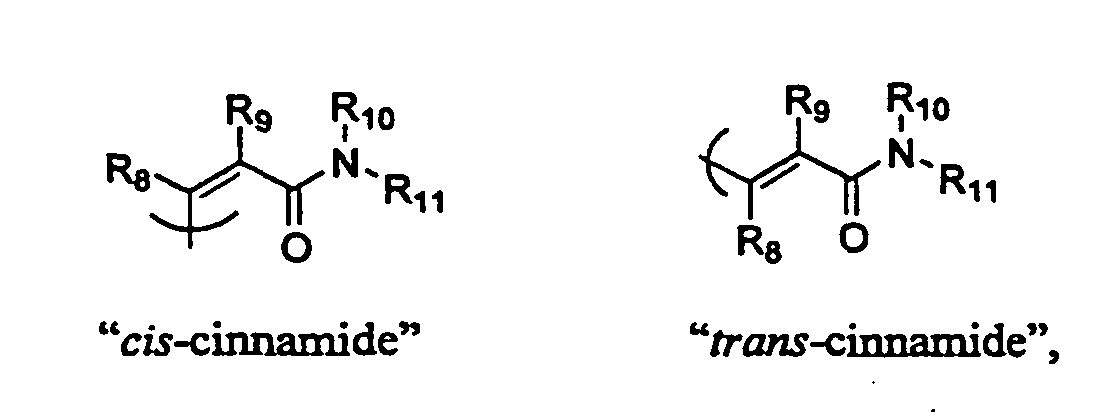


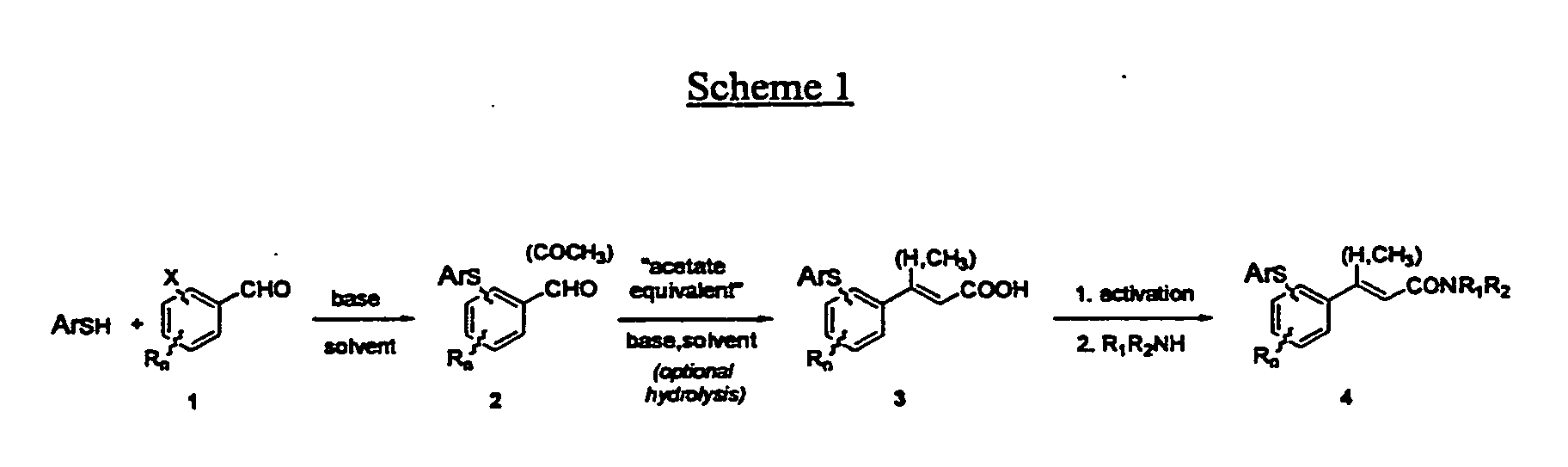
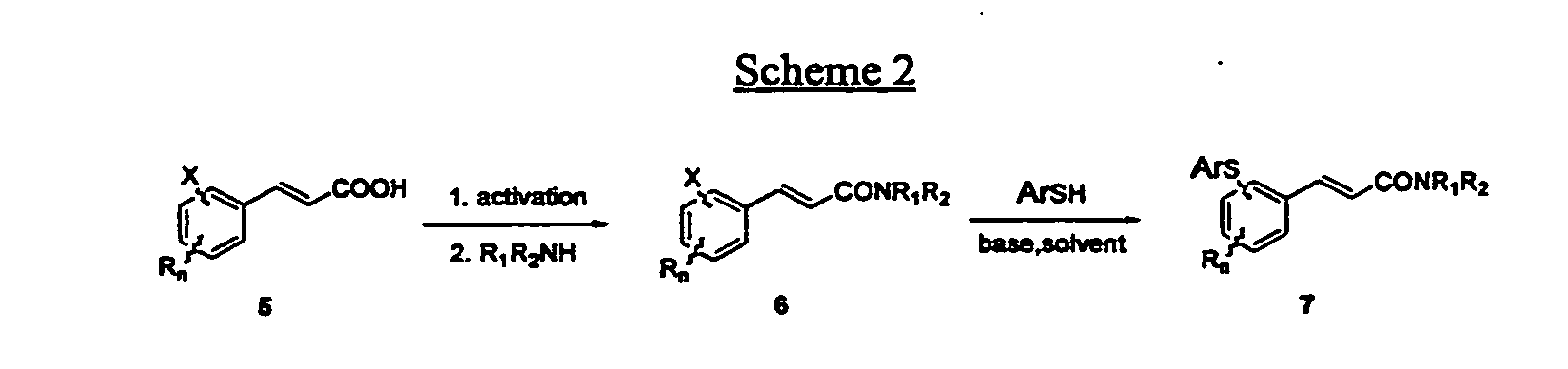

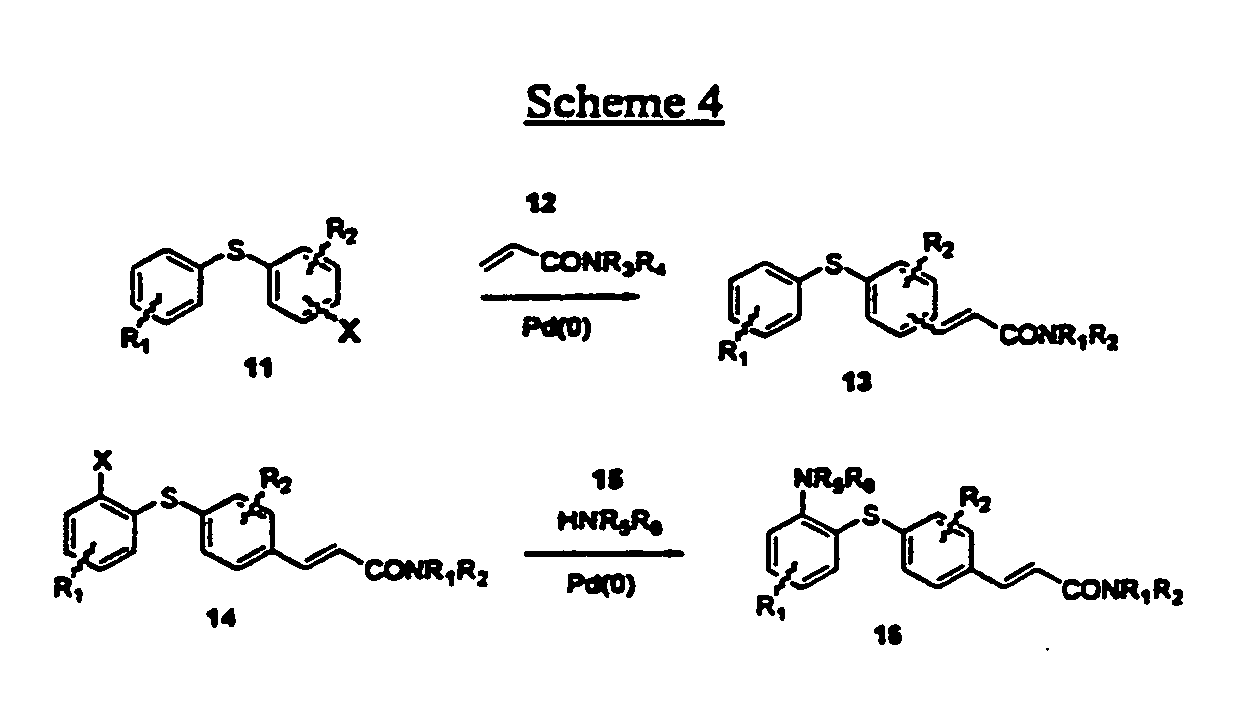


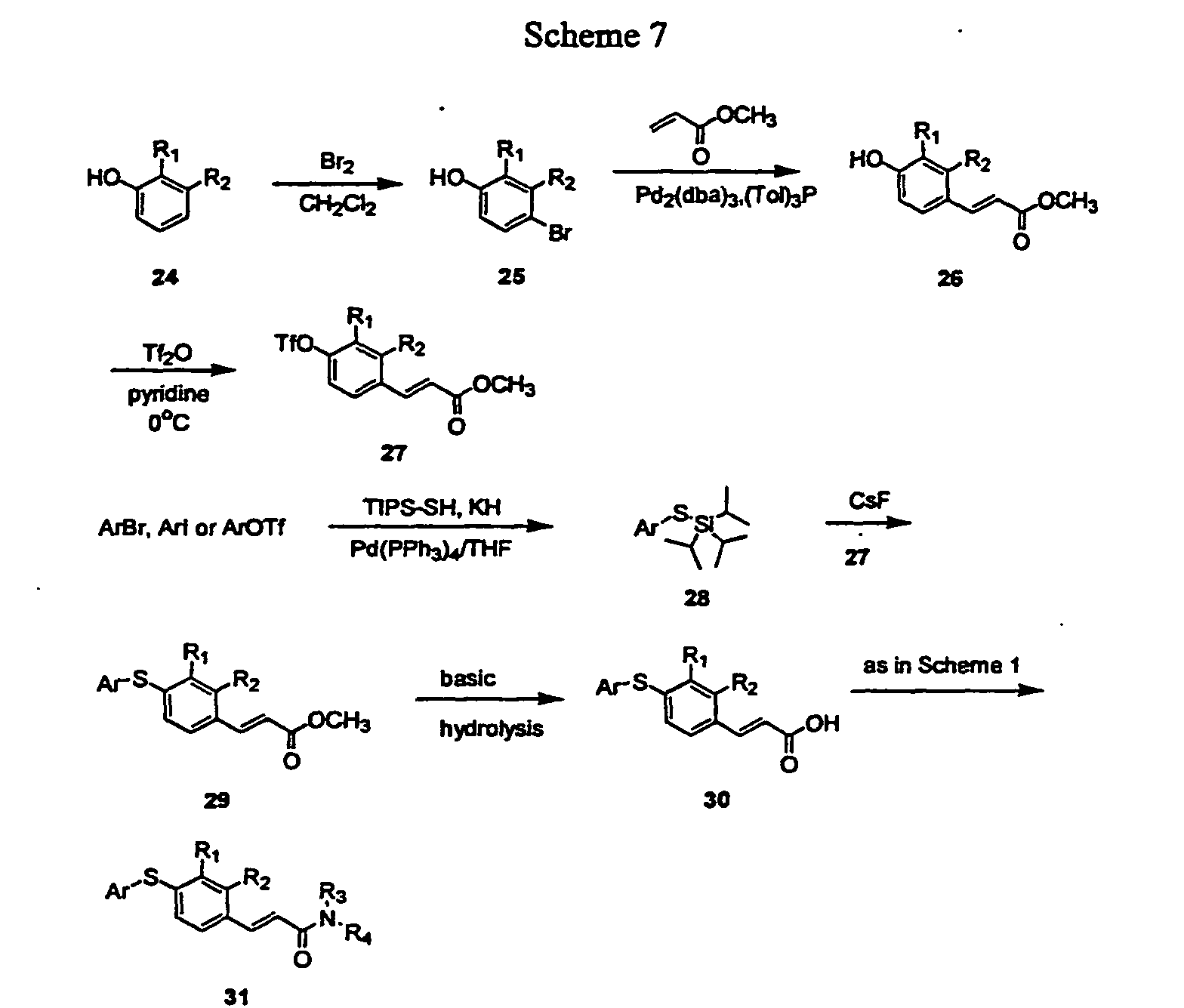
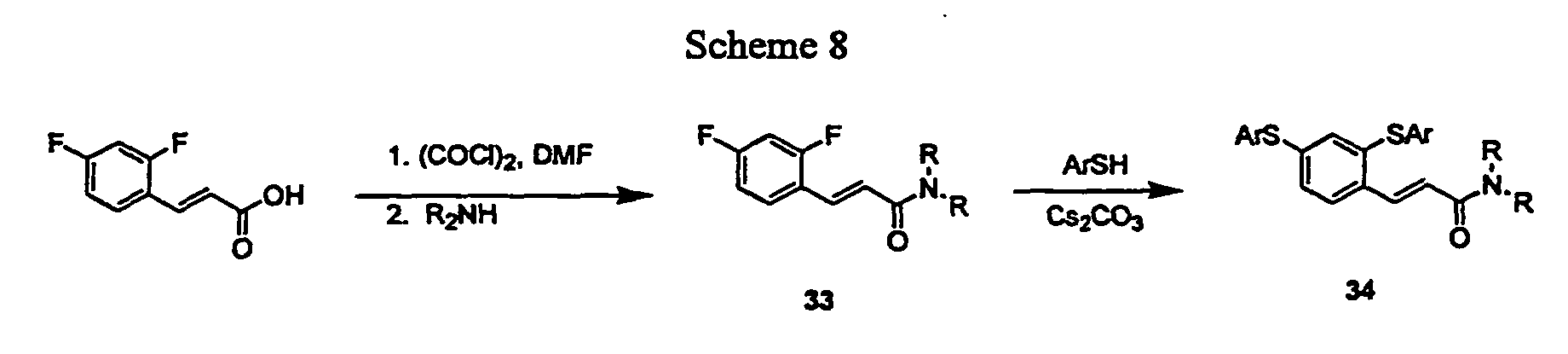

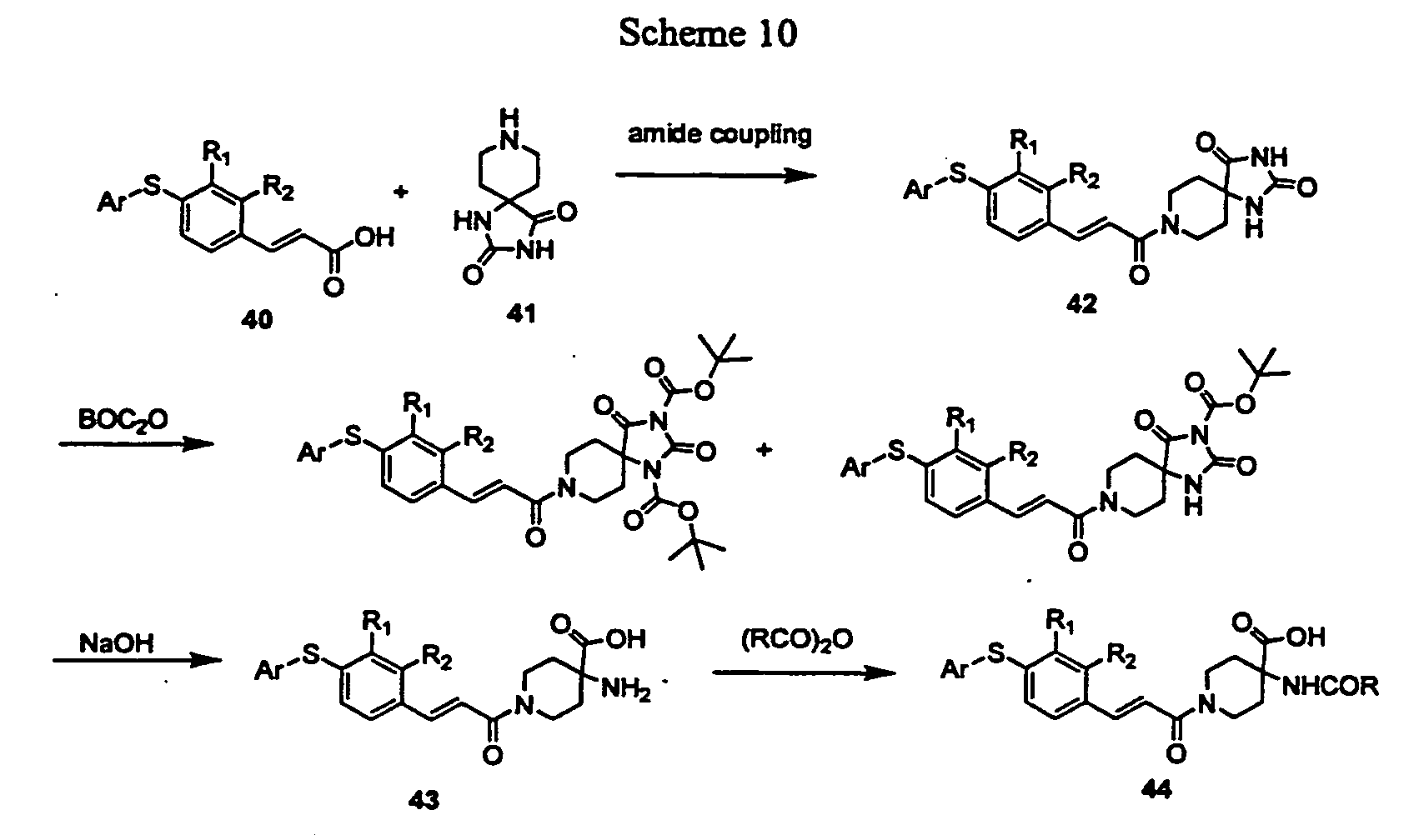


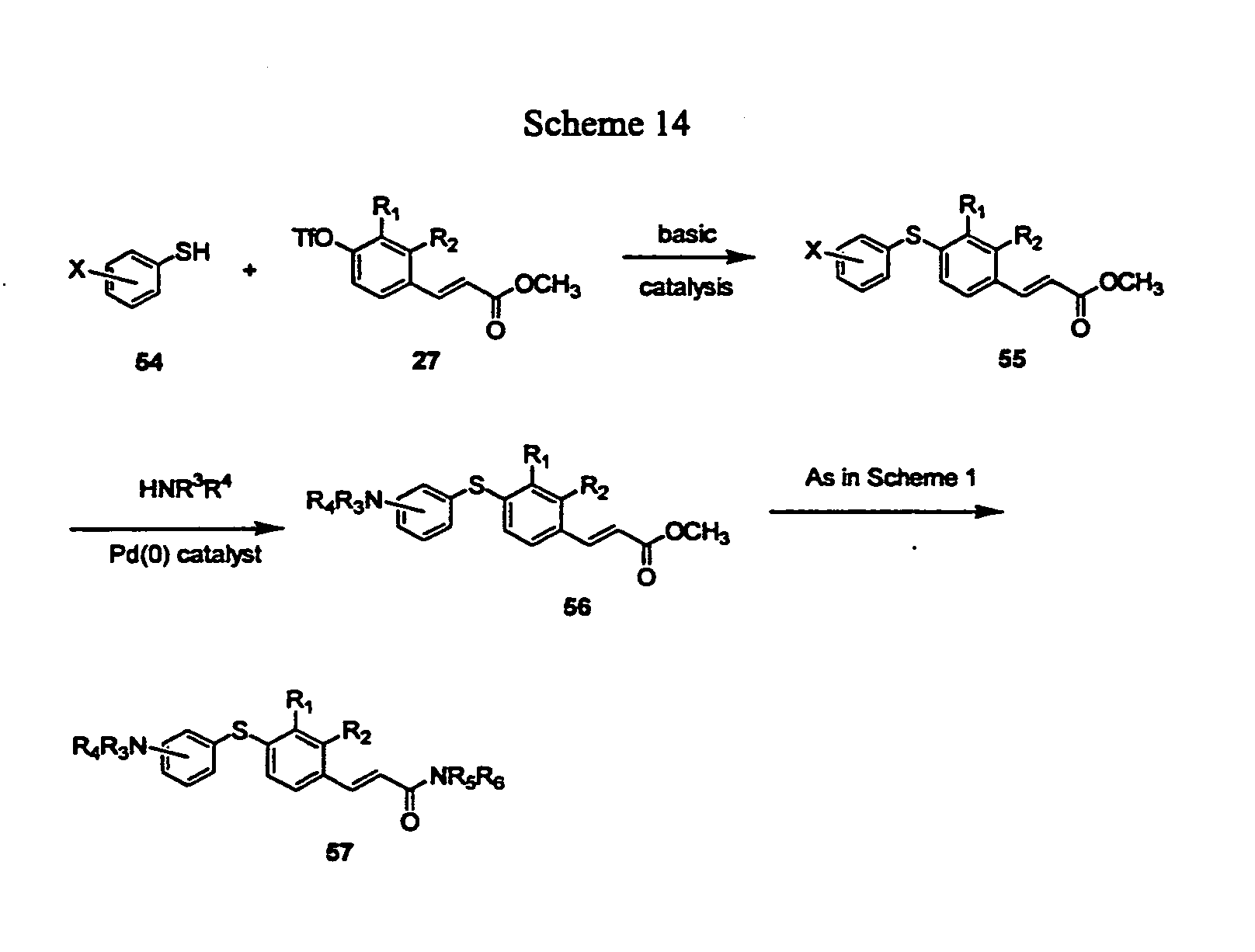


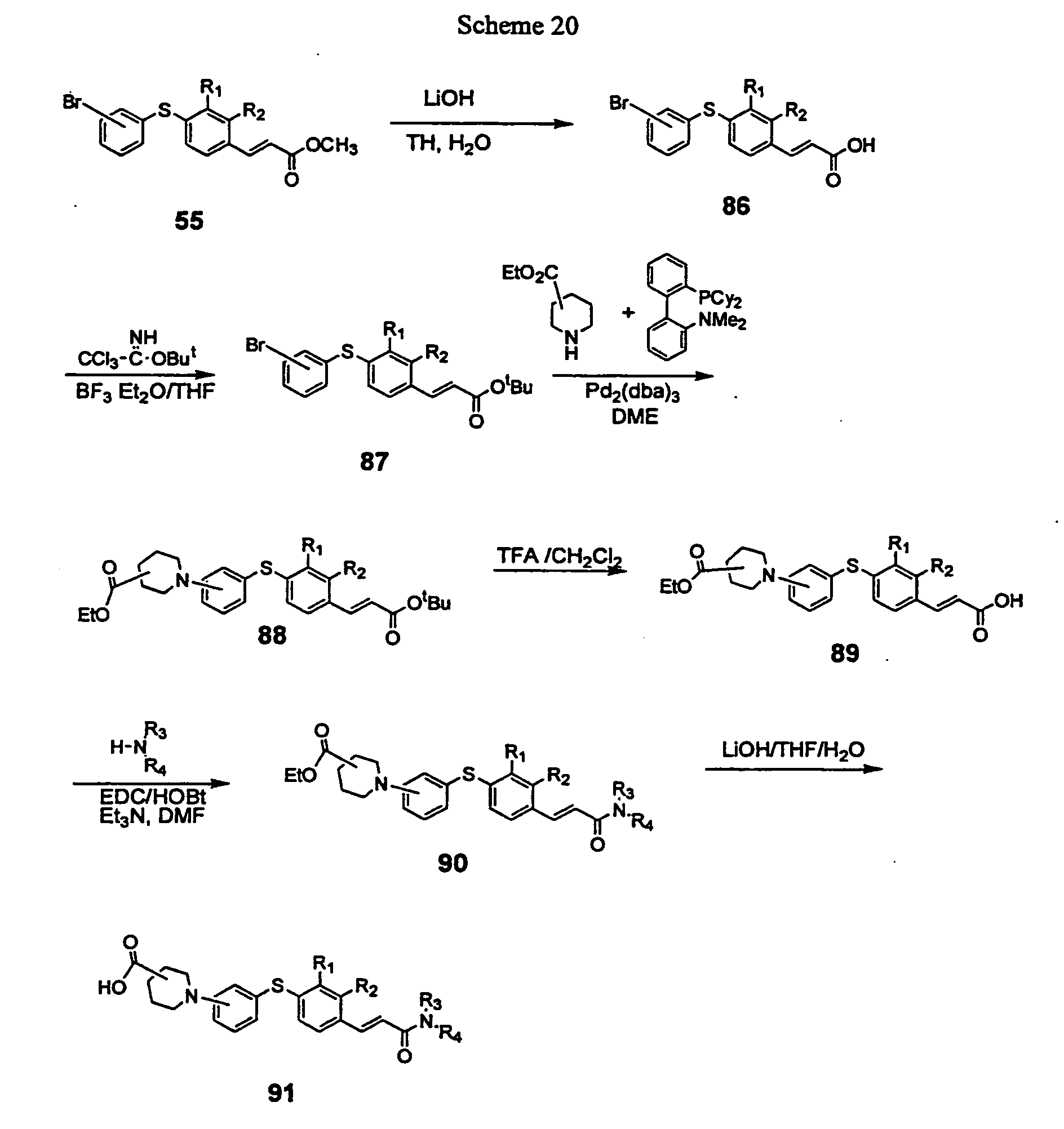

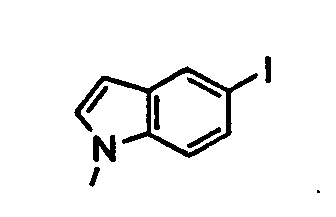
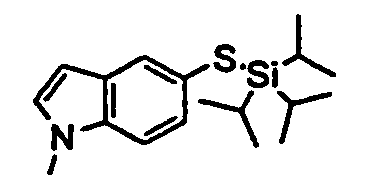


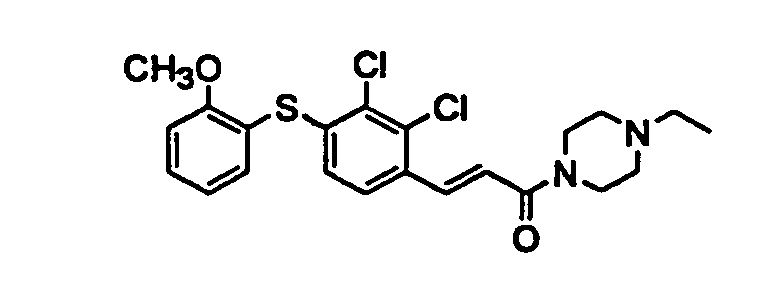
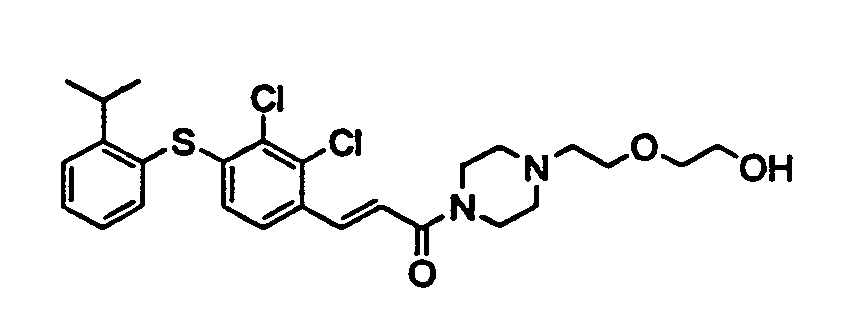
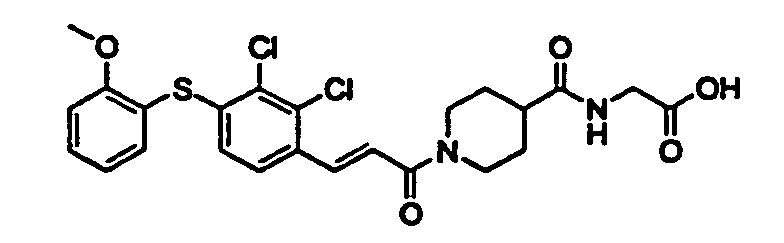
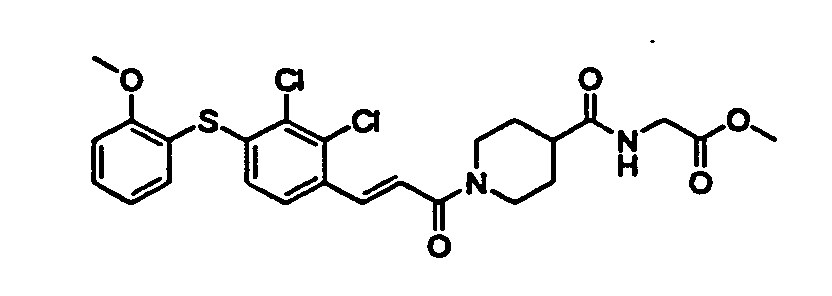
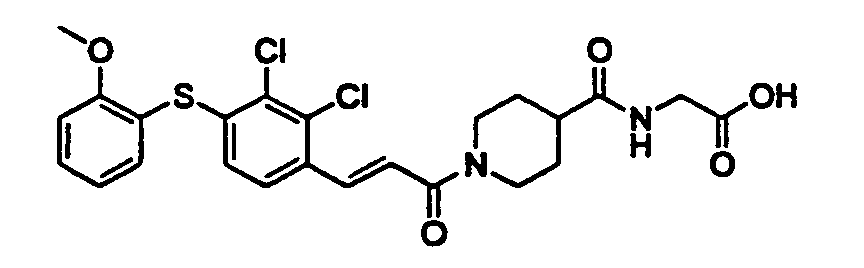


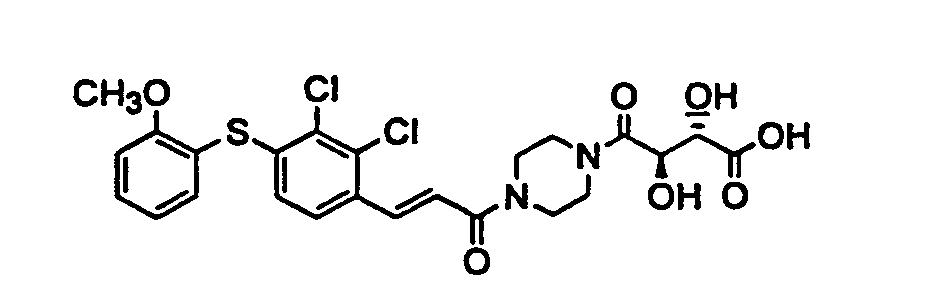
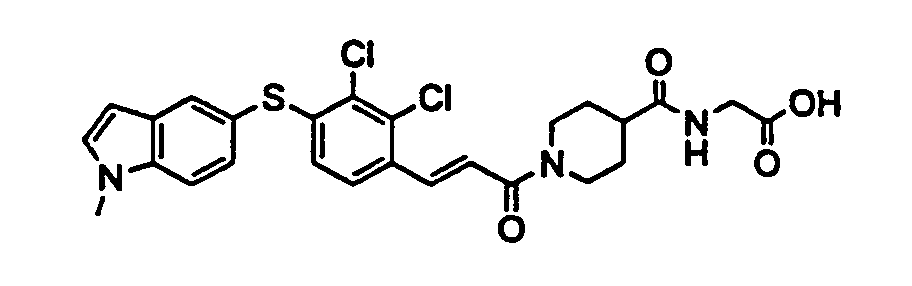


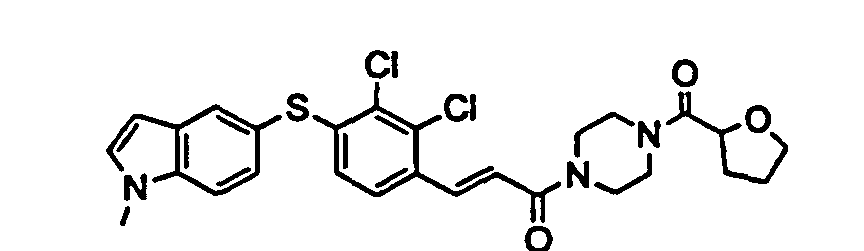

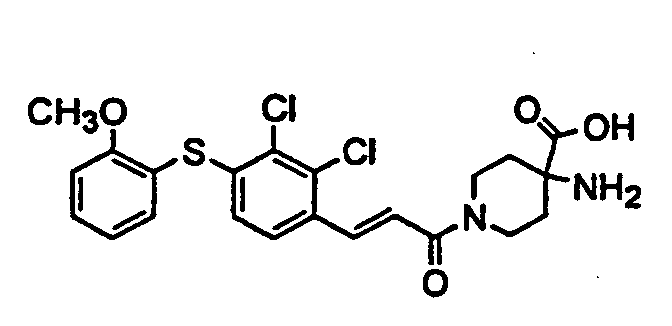

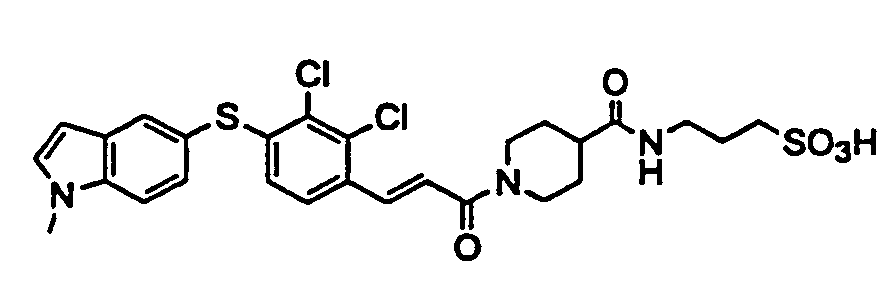


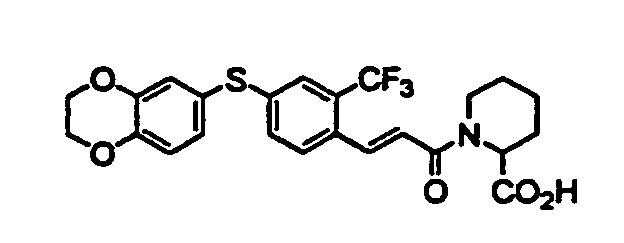
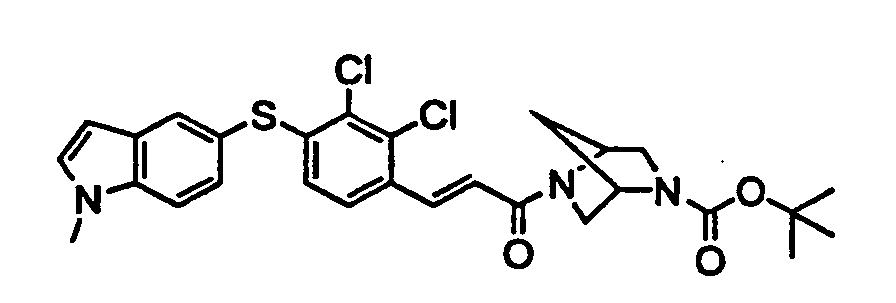
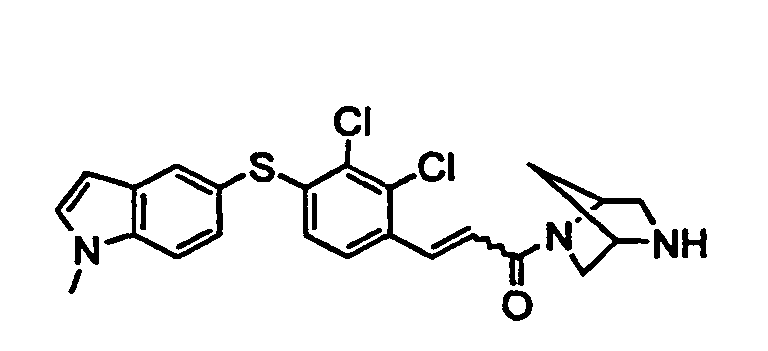
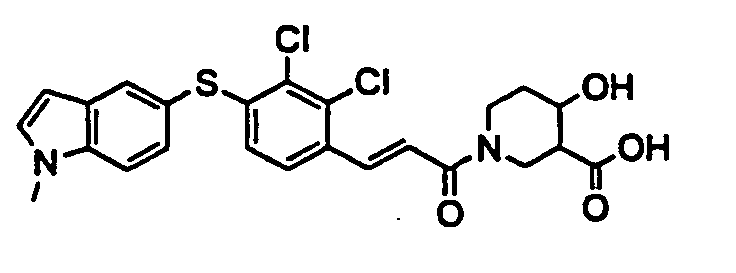
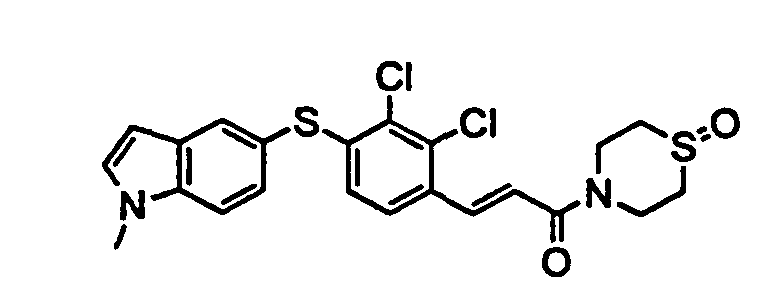

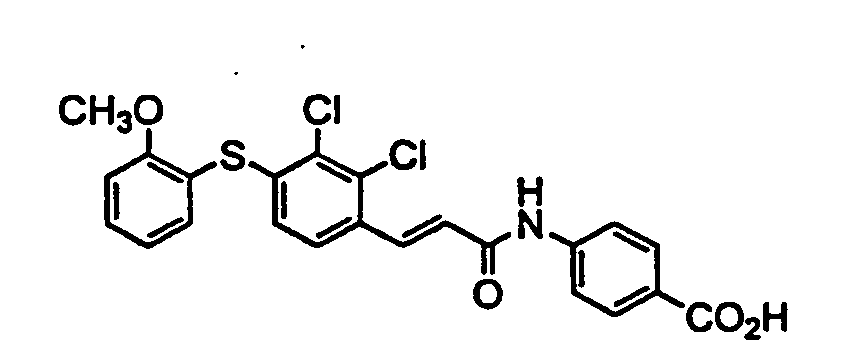
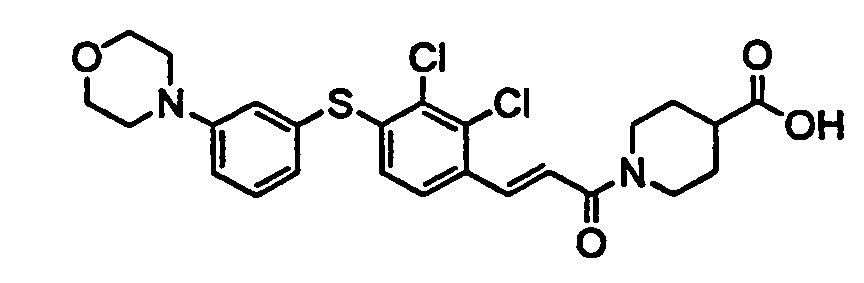
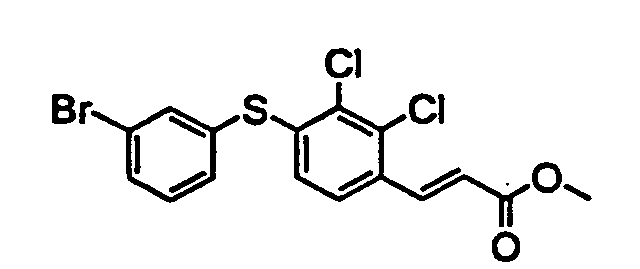

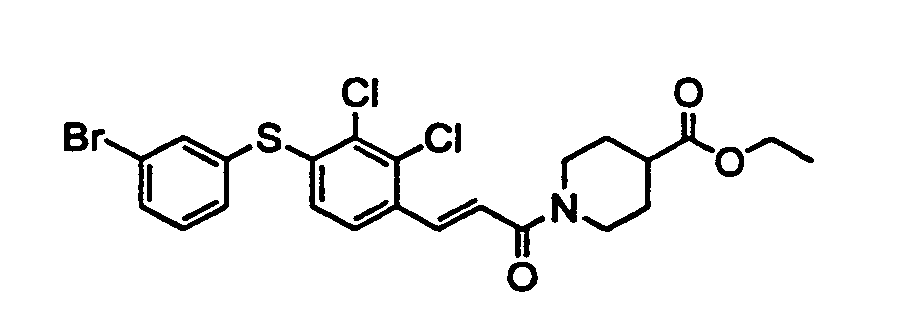

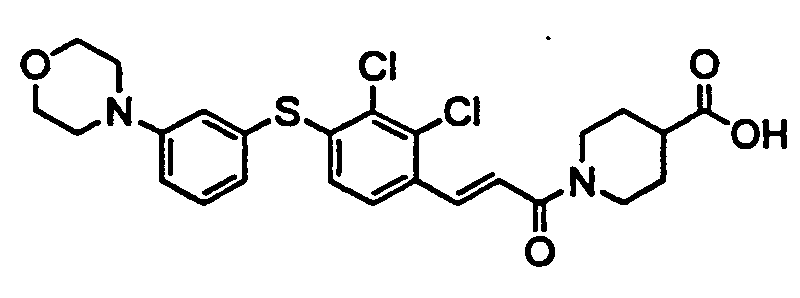


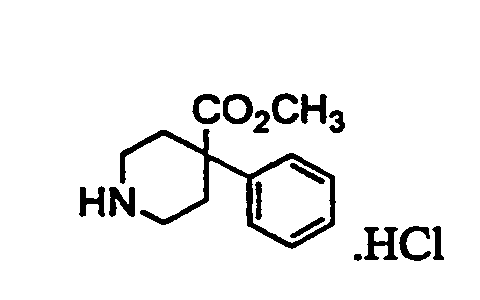
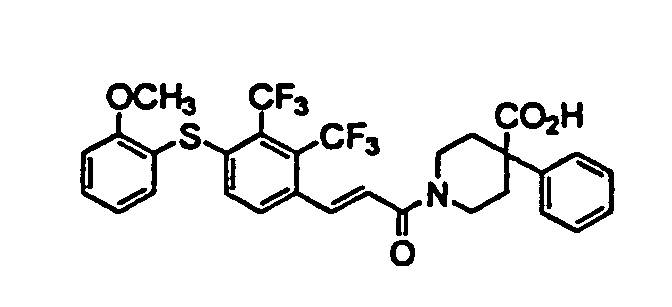

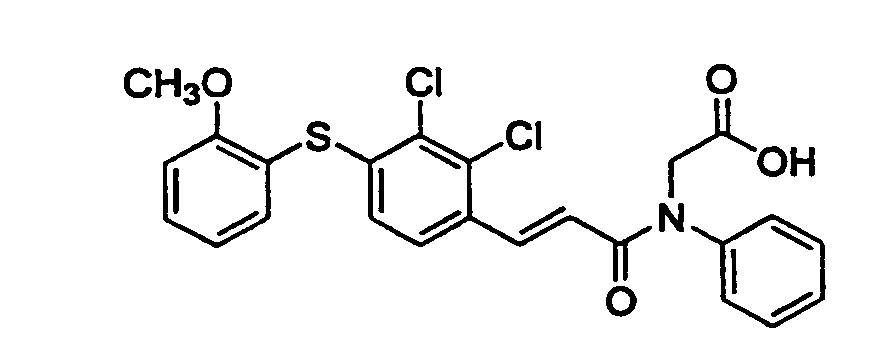
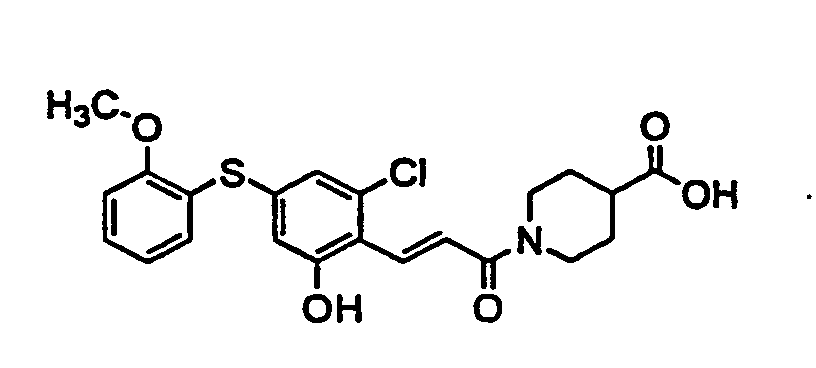
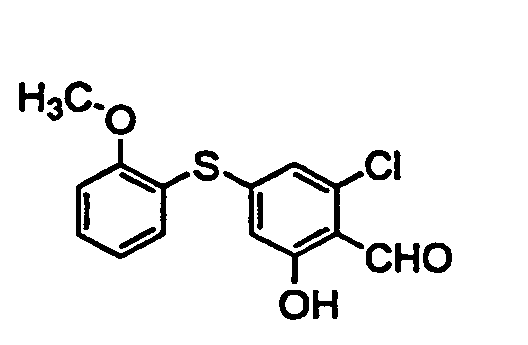
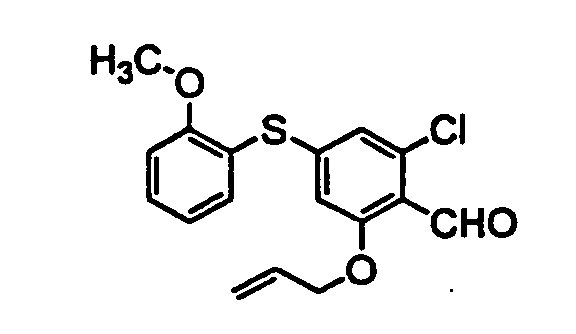
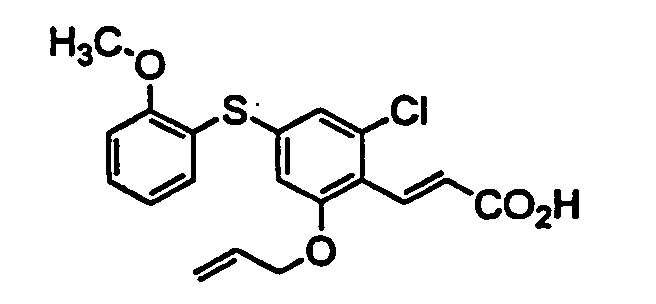
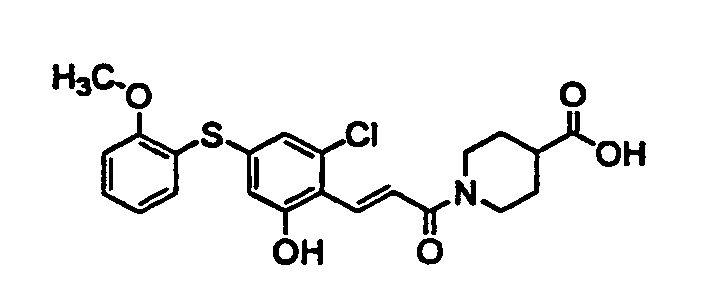
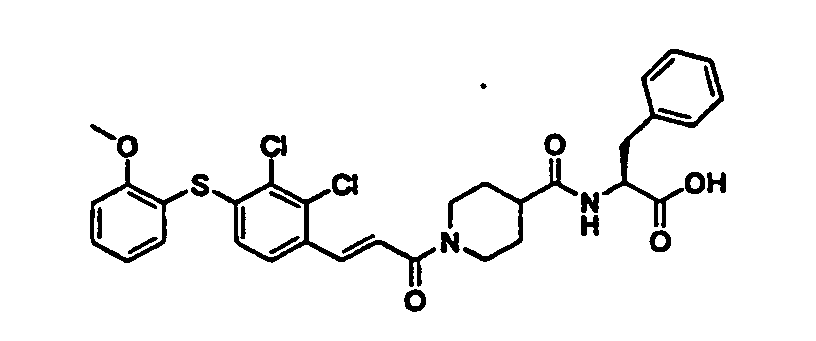
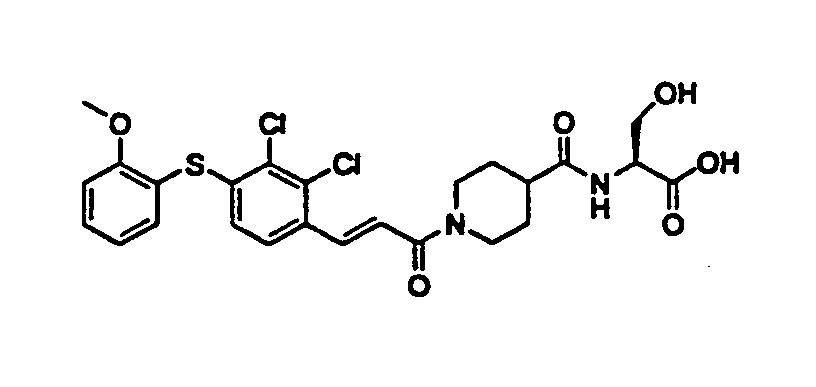
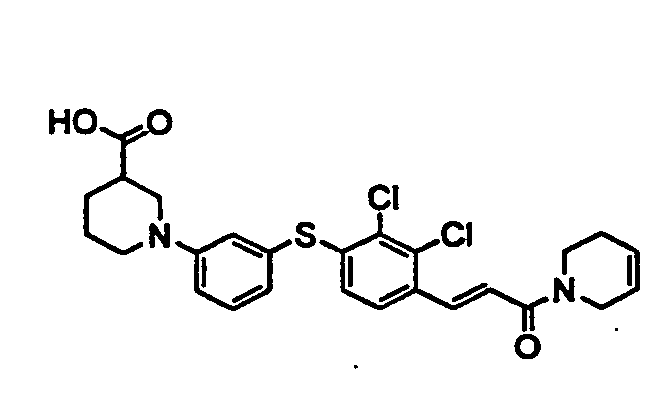
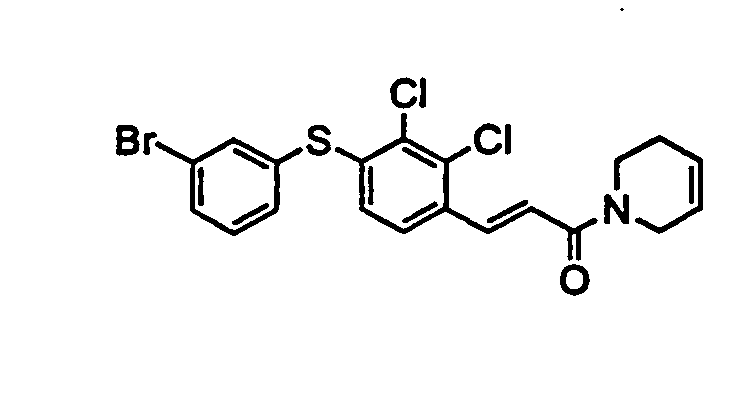


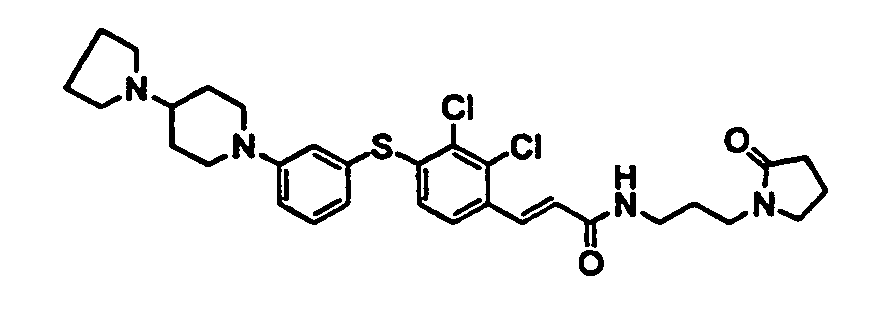
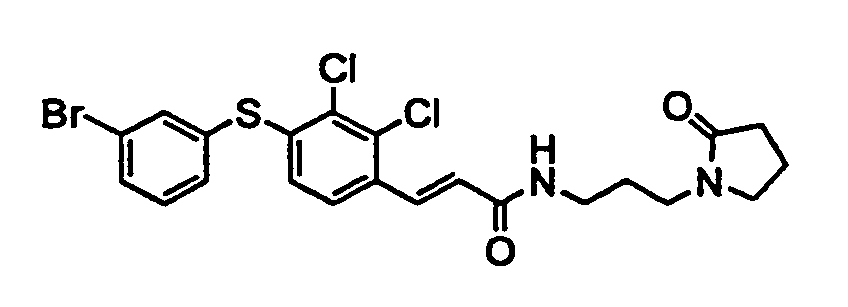
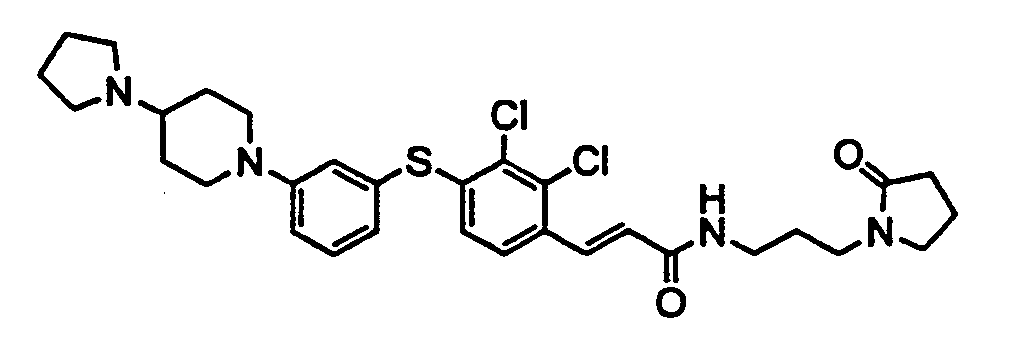
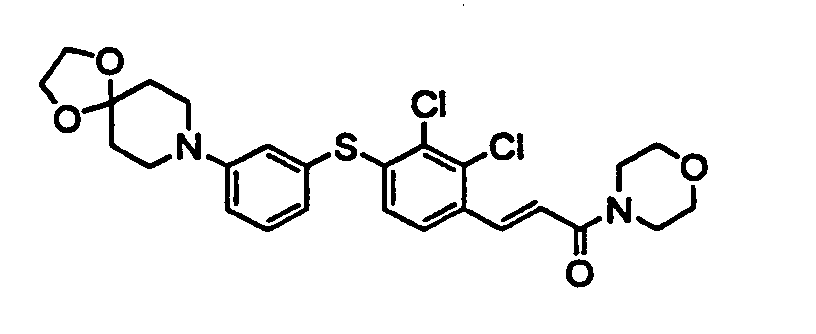
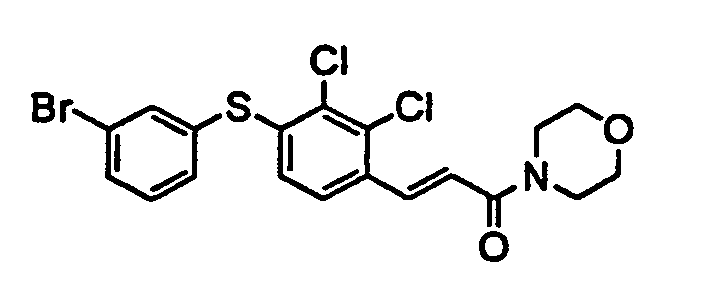


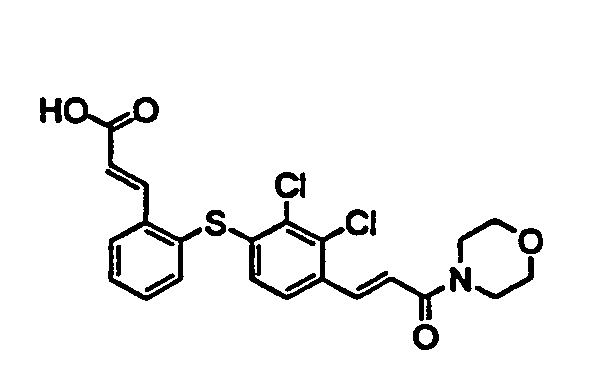

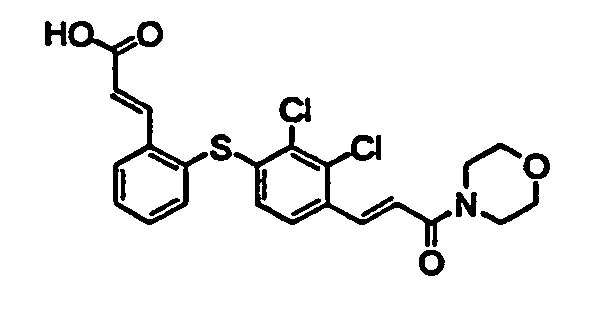


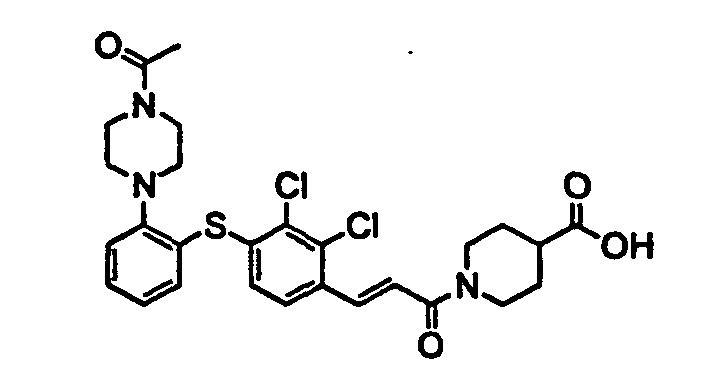


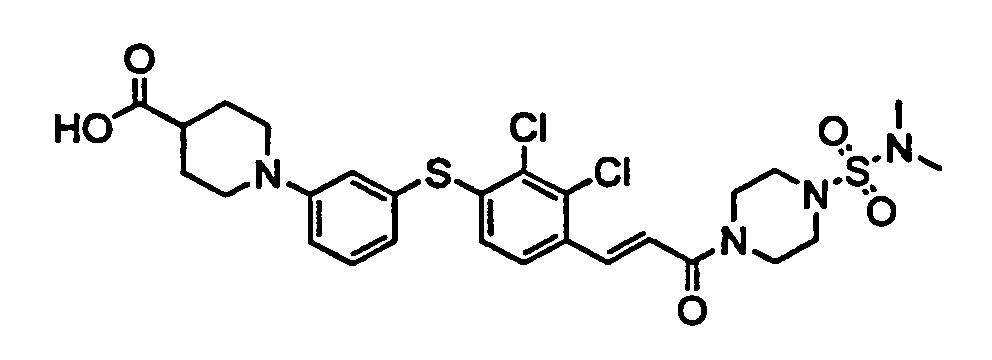
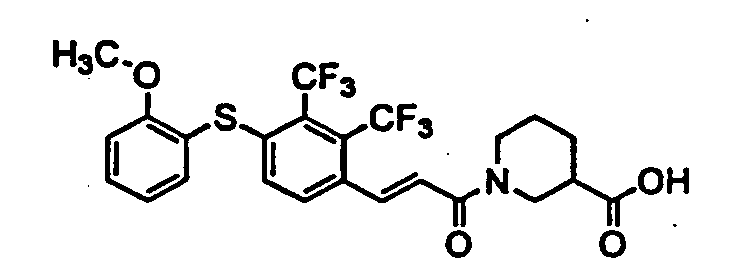


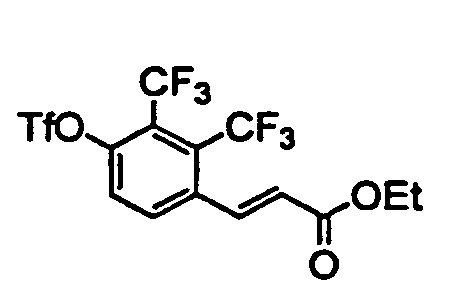

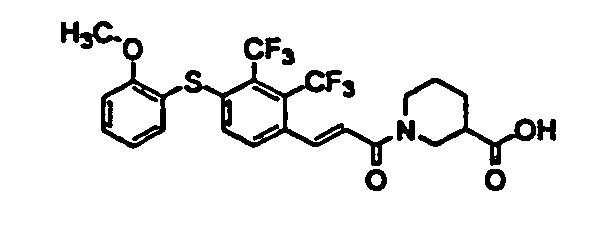

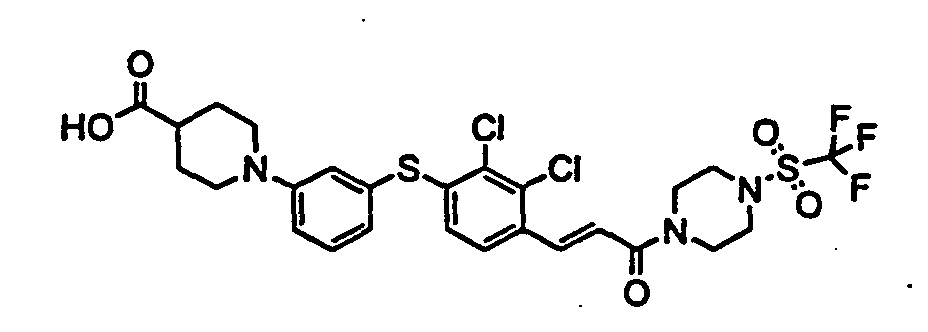
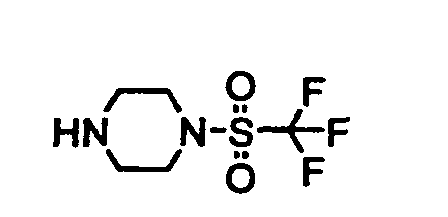
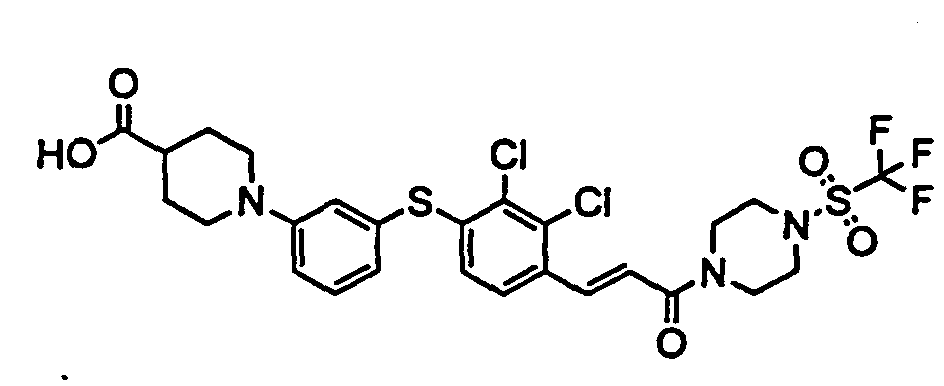
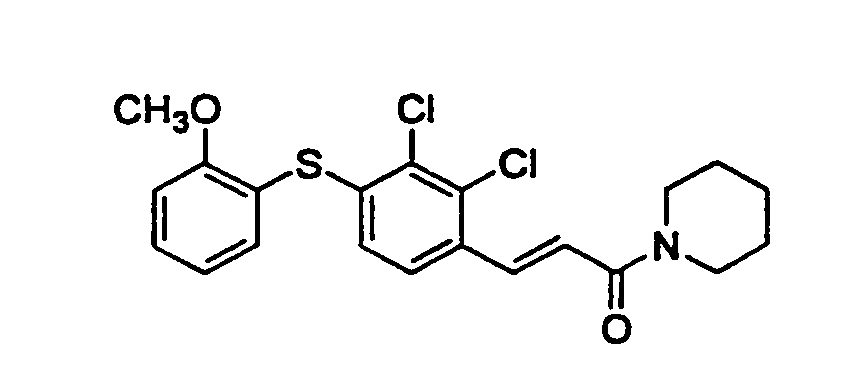
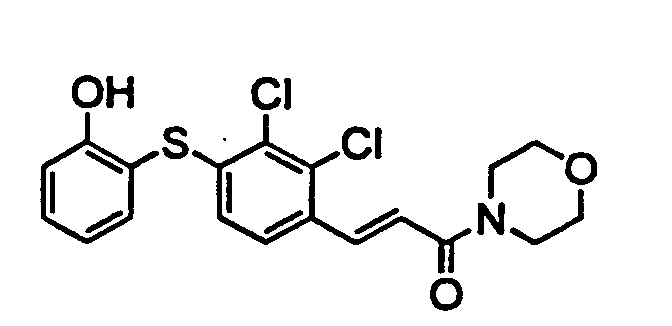
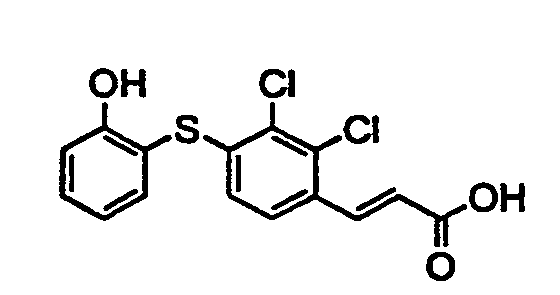

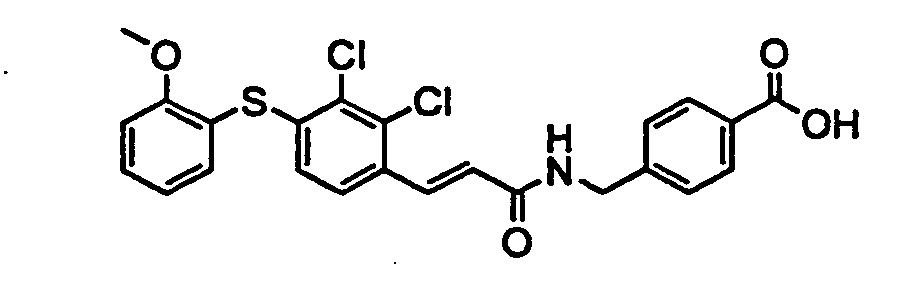
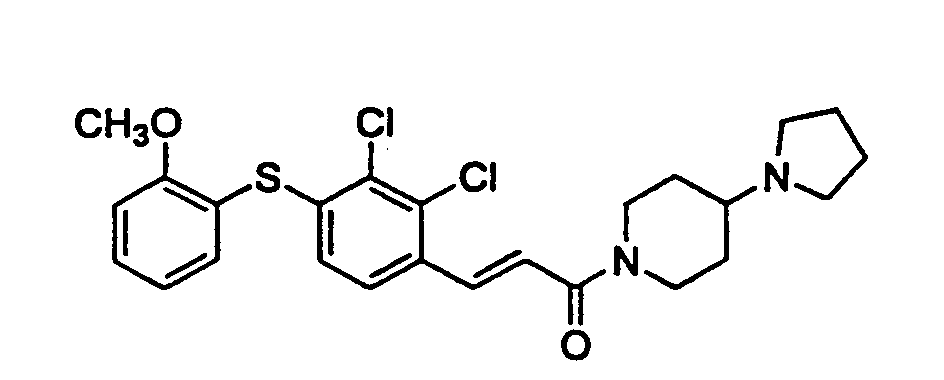
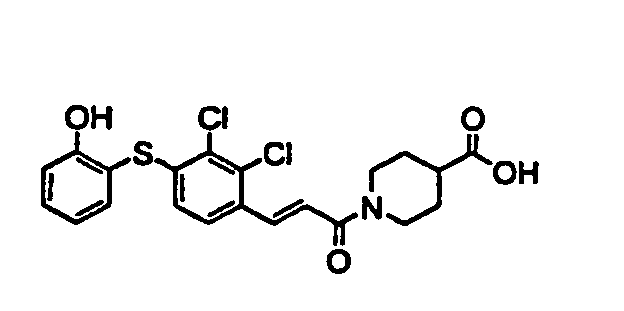

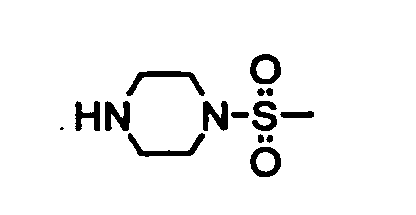
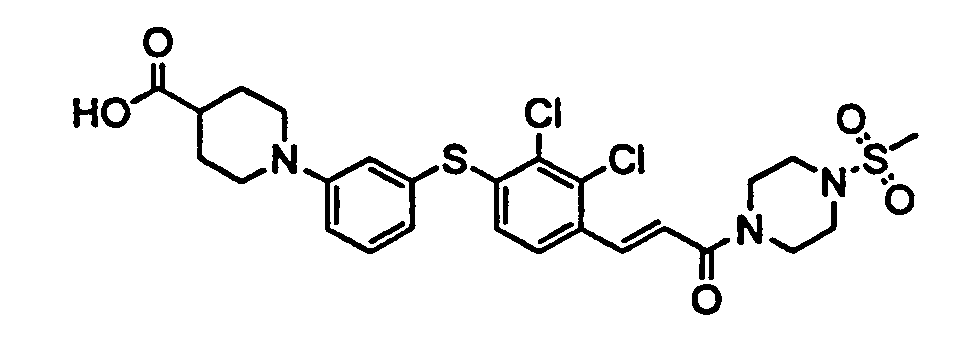

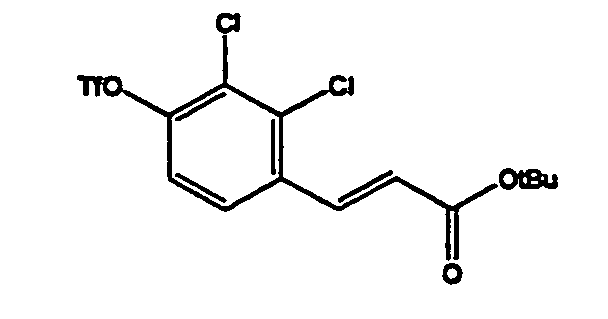
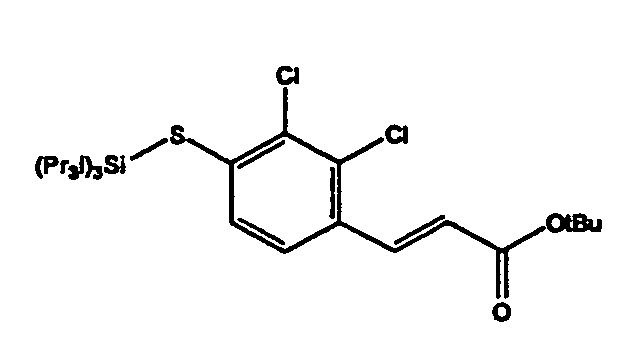
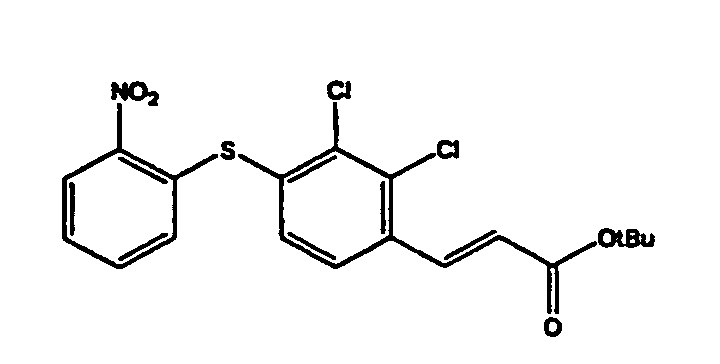

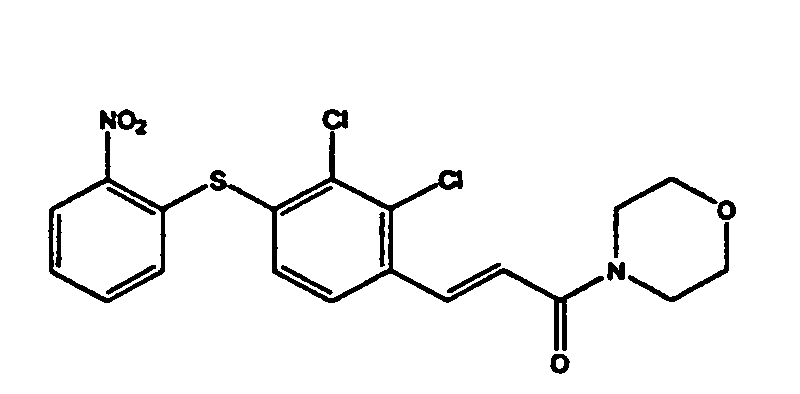


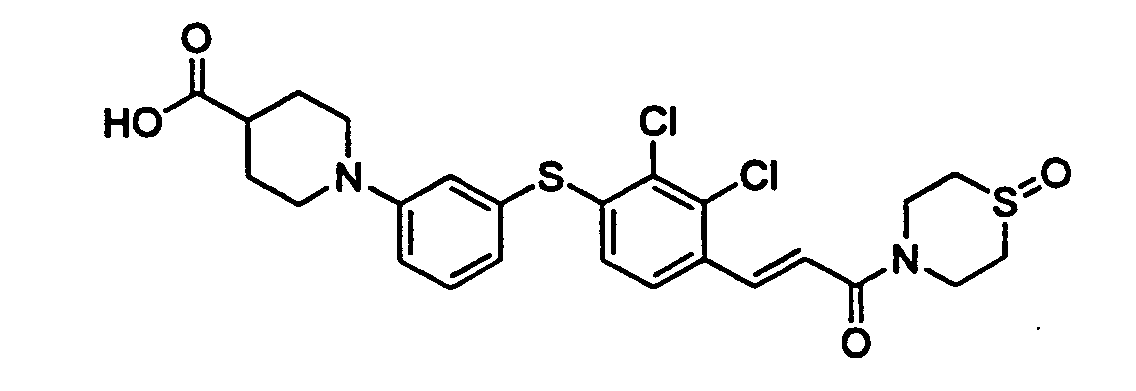
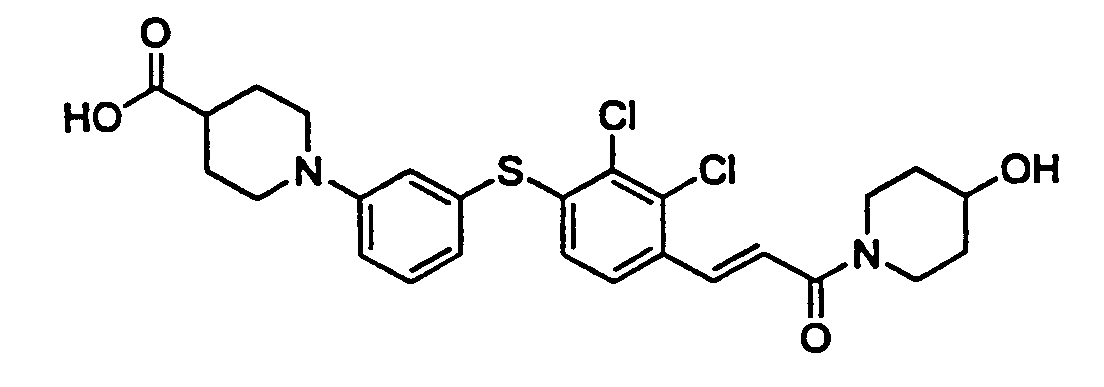

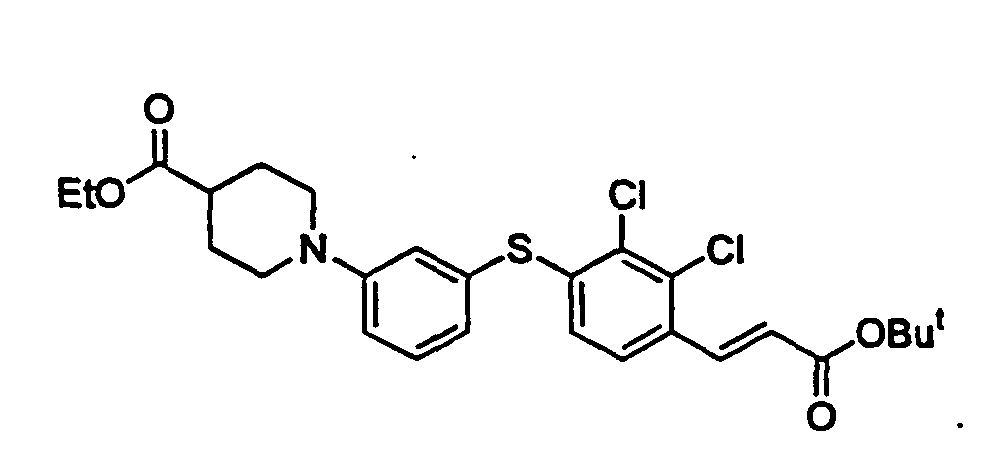
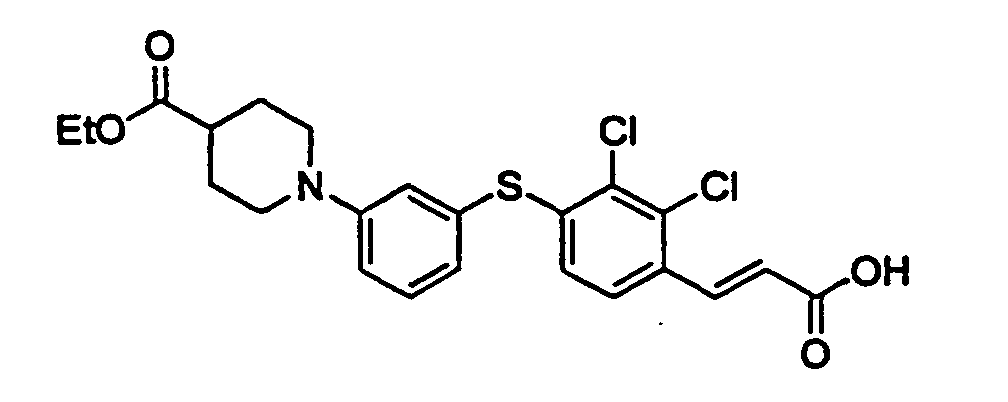
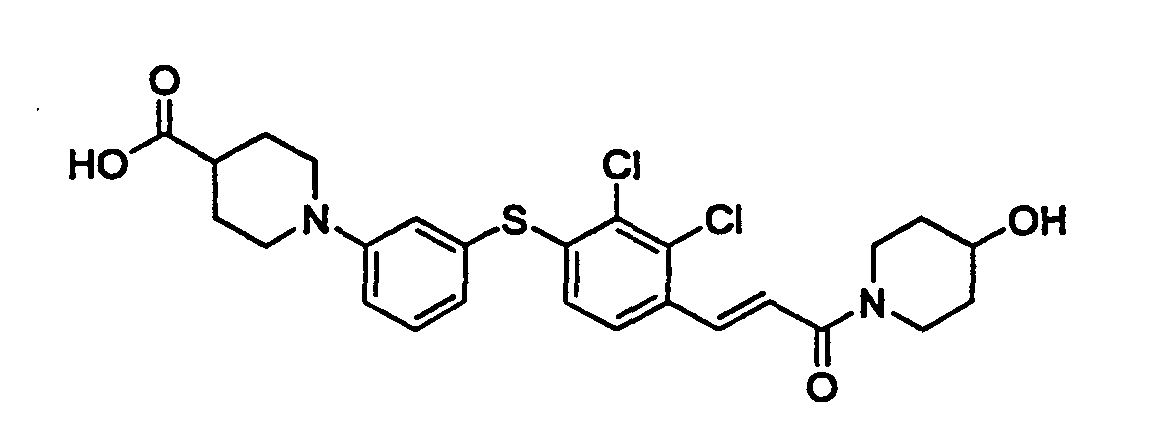


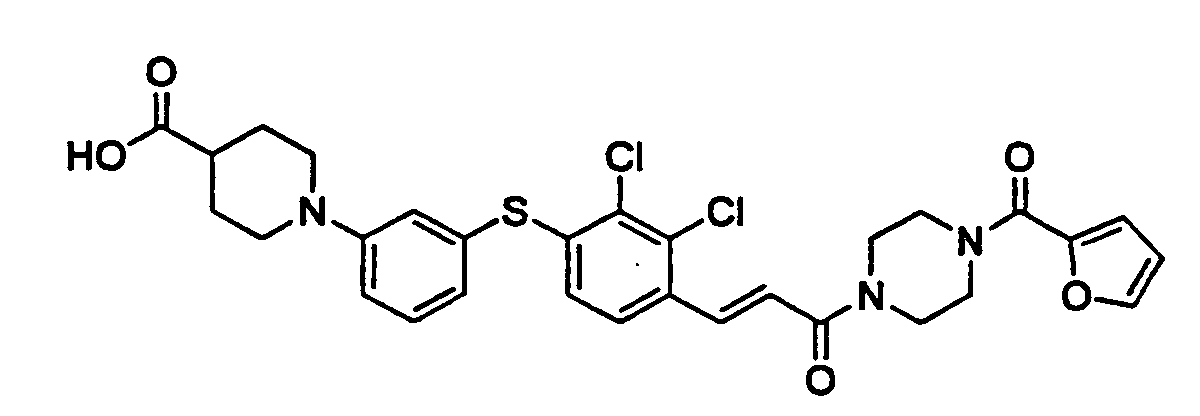
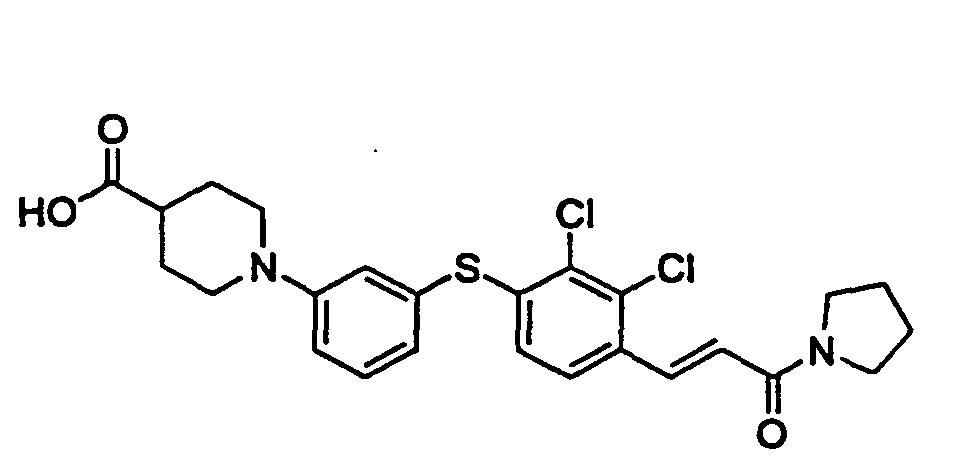

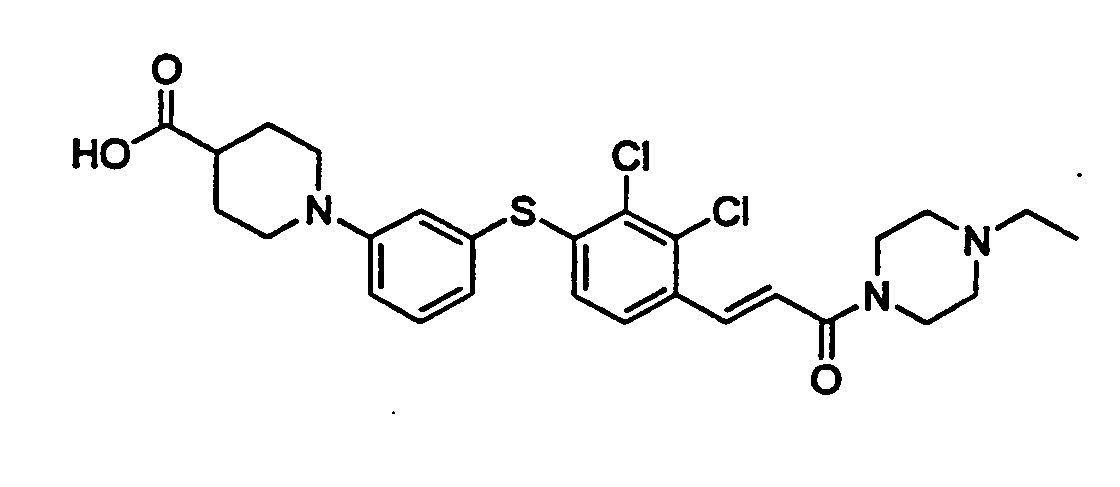
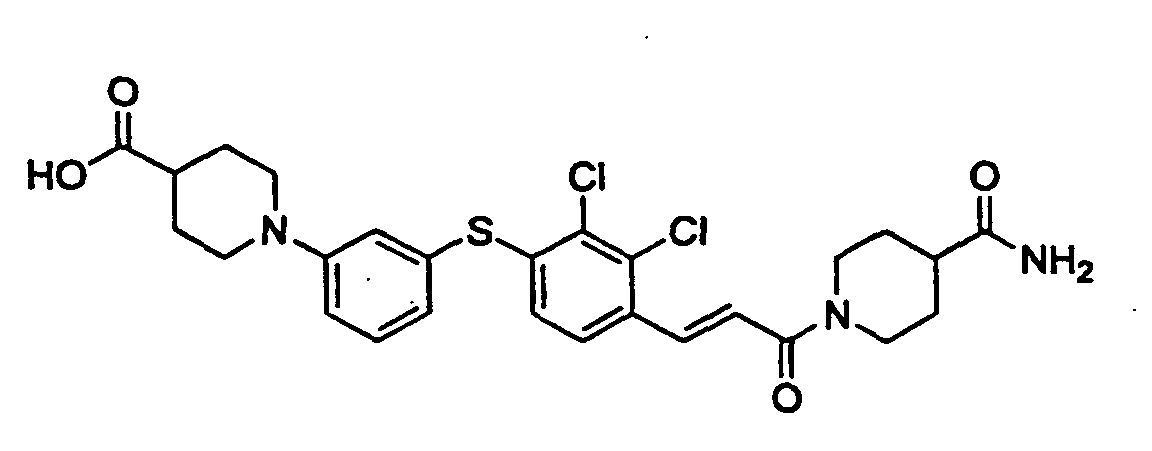


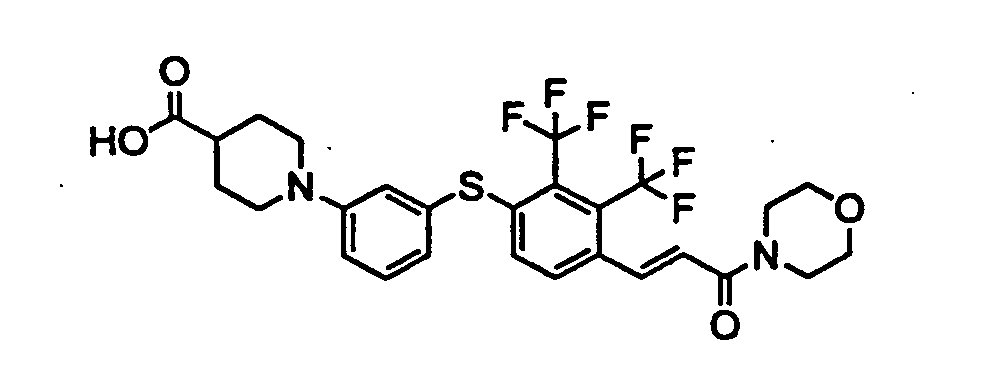

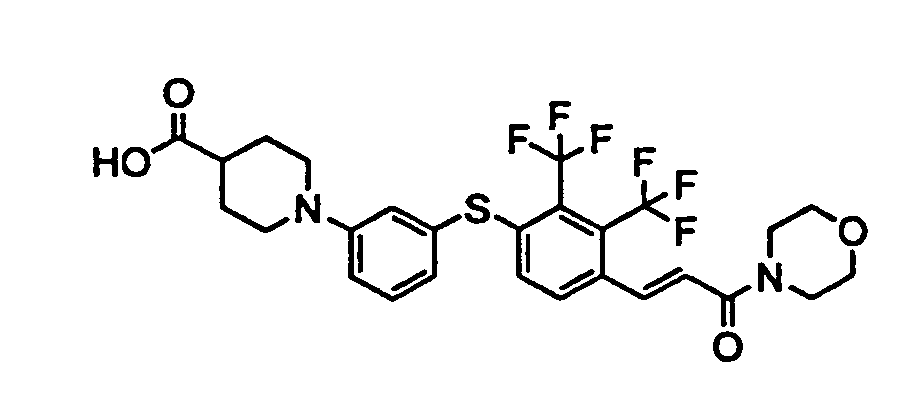


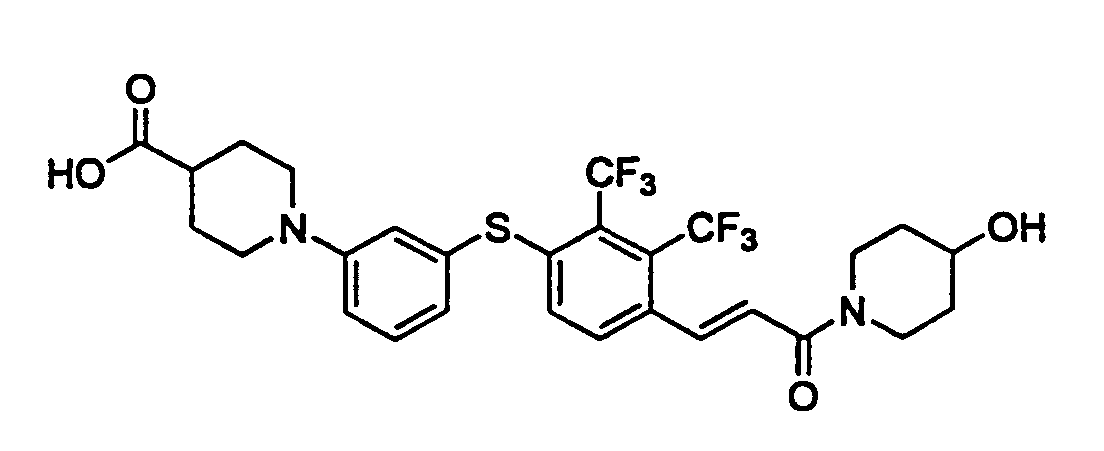


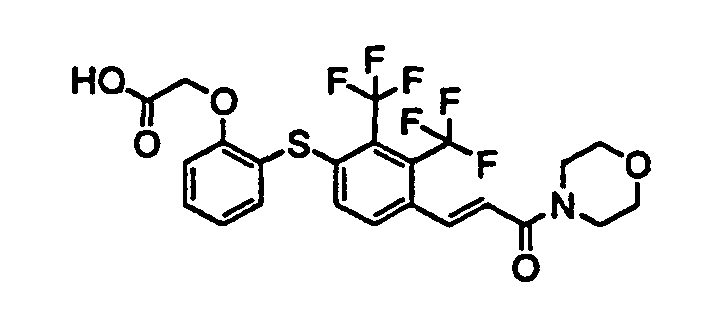
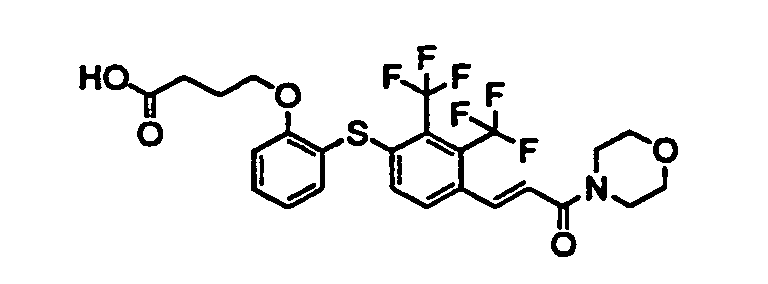

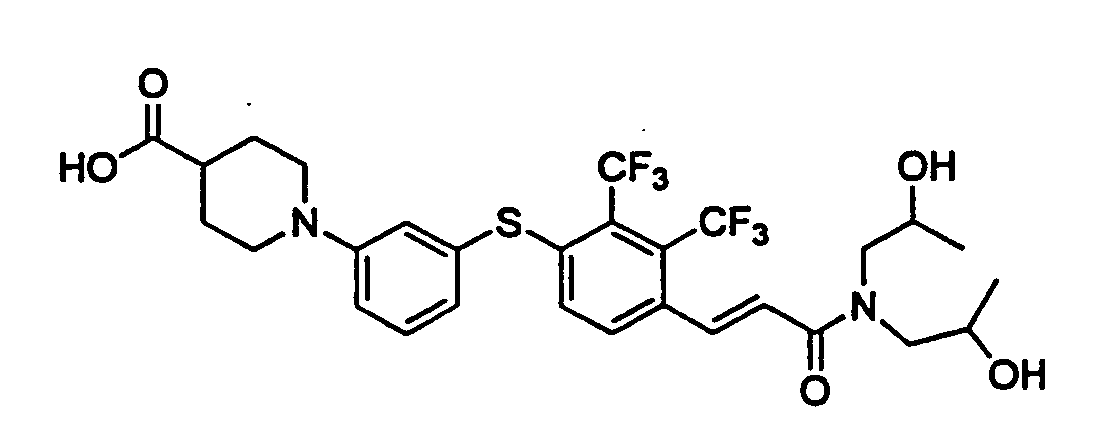
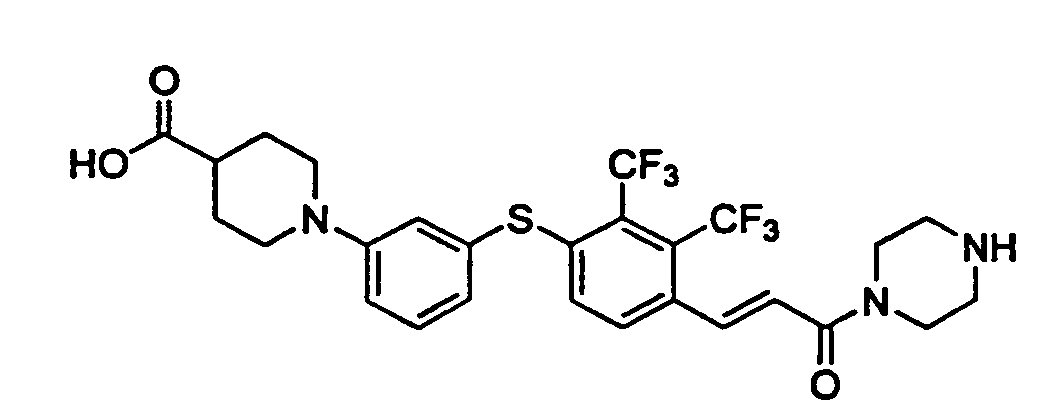

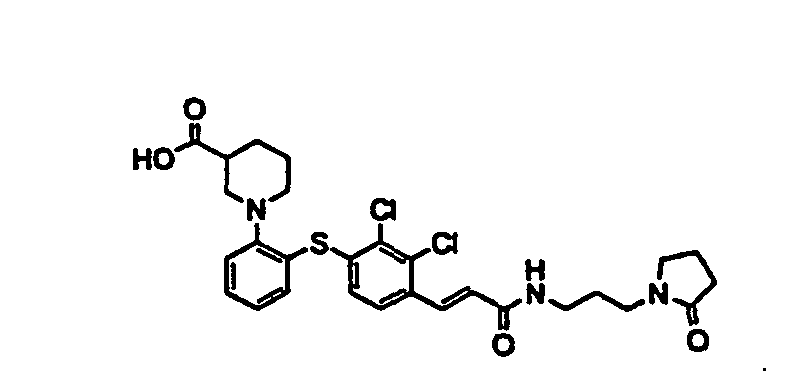

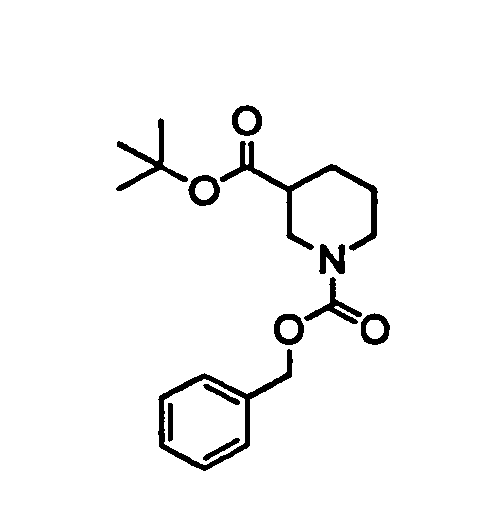
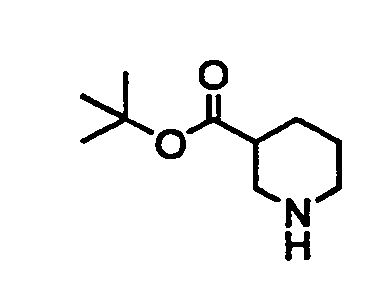

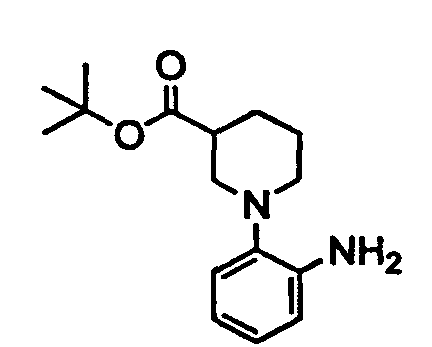


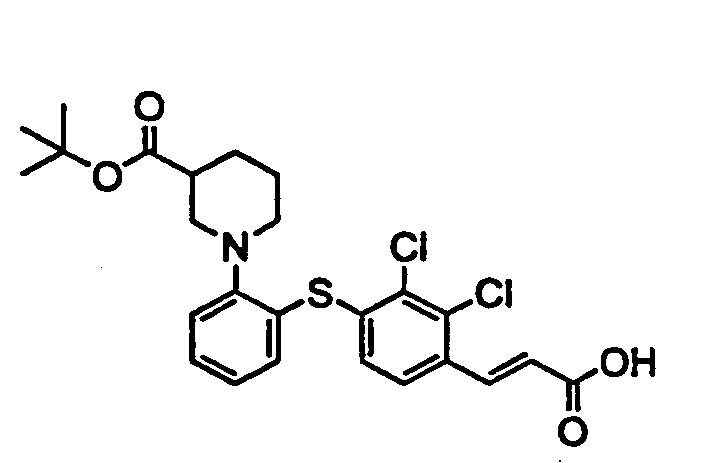
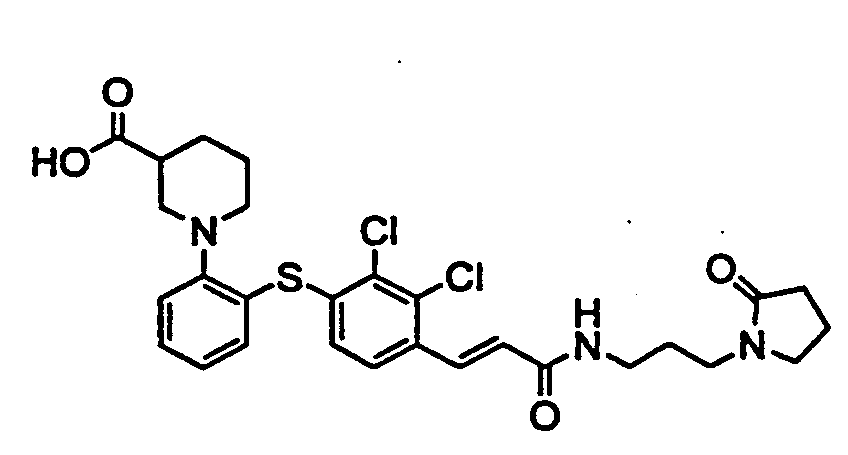

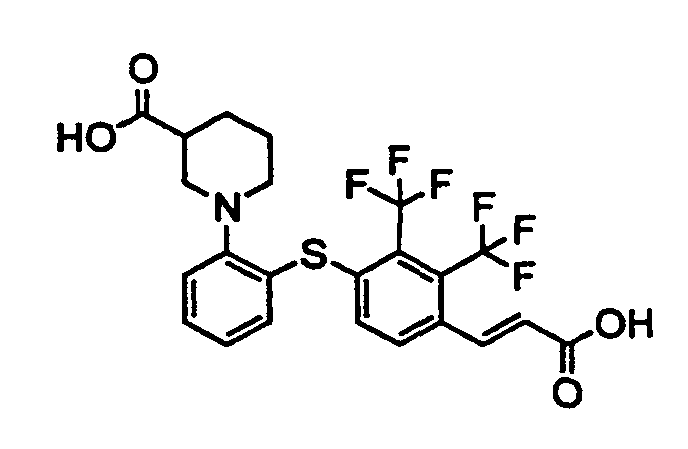
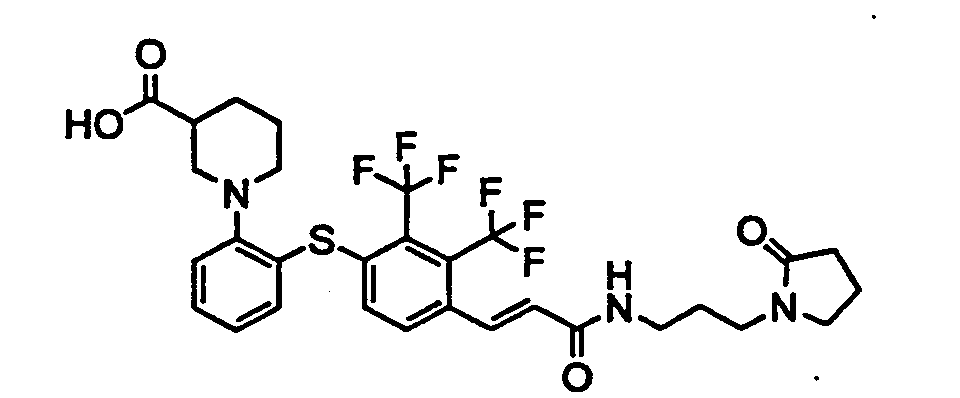


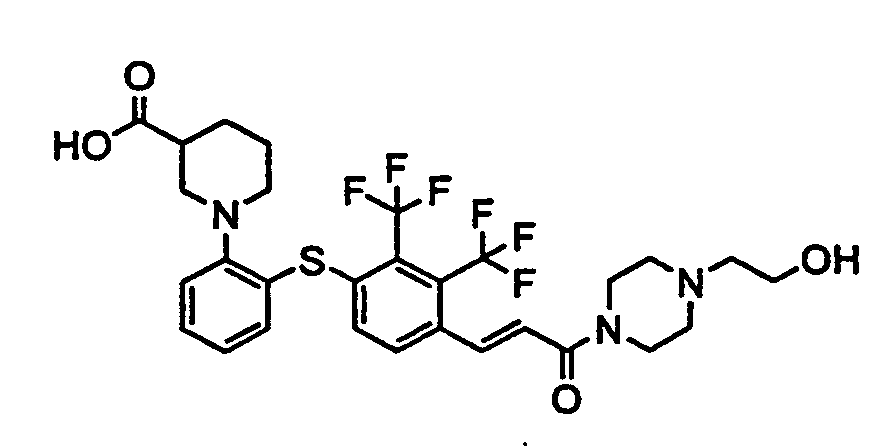

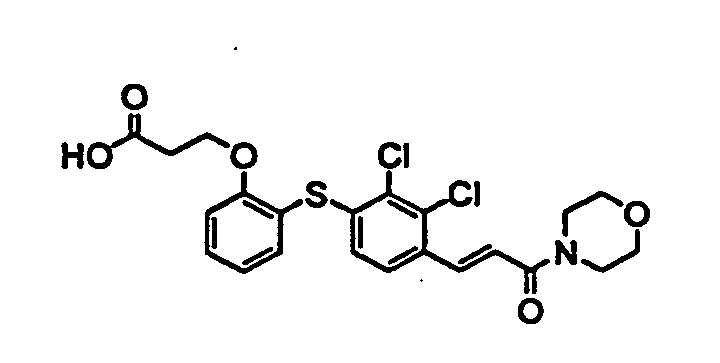




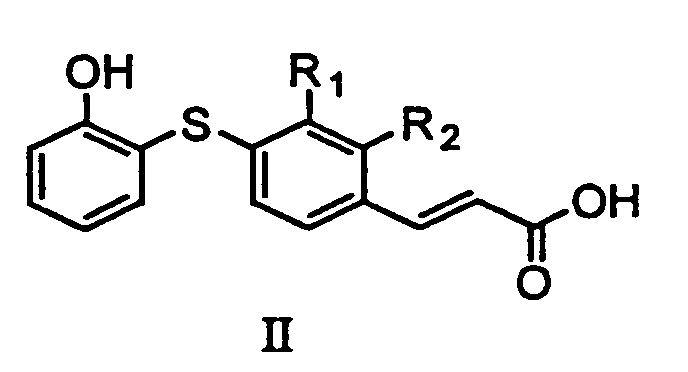
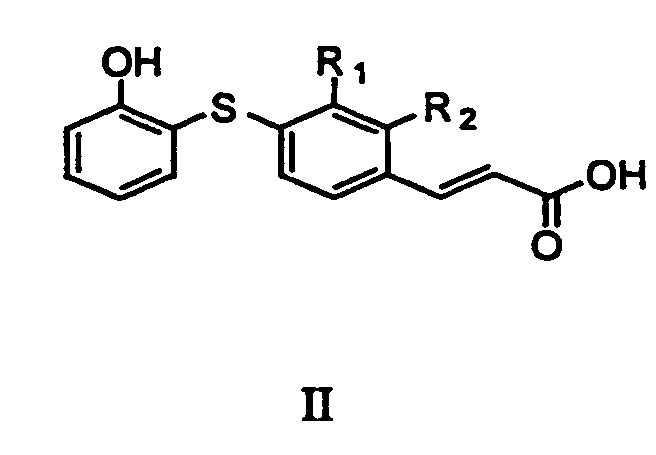
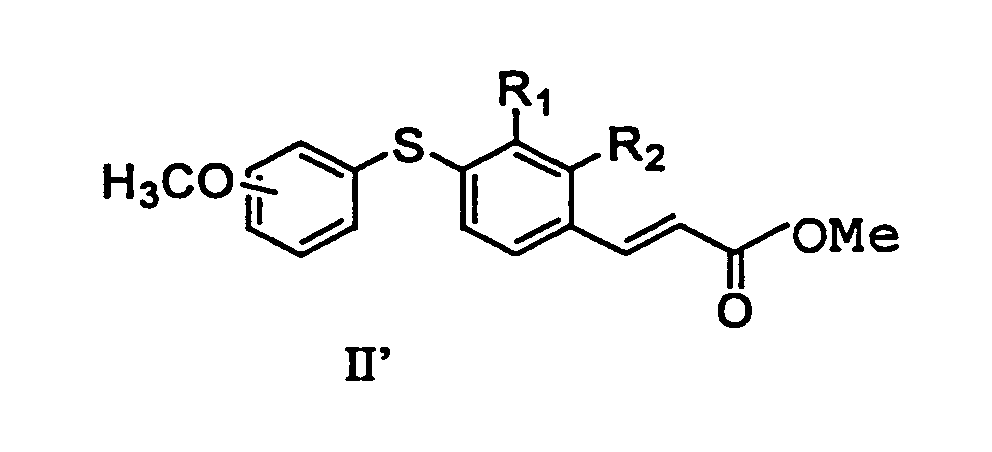
 with the proviso that at least one of R1 or R3 is a "cis-cinnamide" or a "trans-cinnamide", defined asa. hydrogen,b. halogen,c. alkyl,d. haloalkyl,e. alkoxy,f. cyano,g. nitro,h. carboxaldehyde, andwherein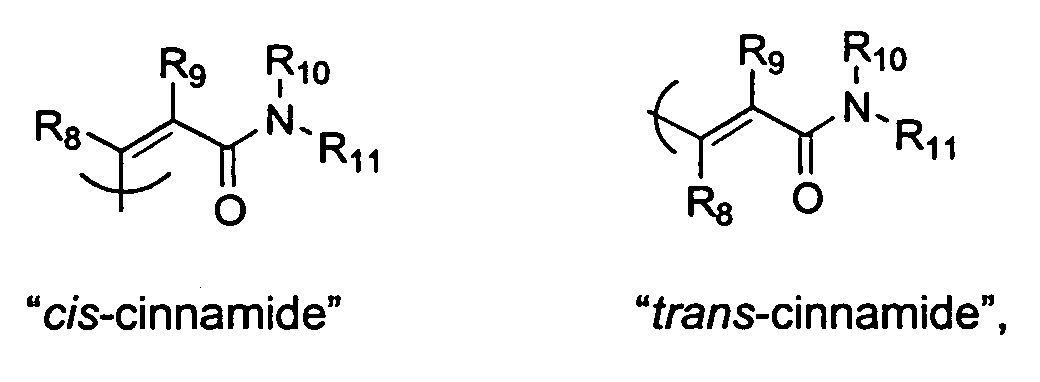
 with the proviso that at least one of R1 or R3 is a "cis-cinnamide" or a "trans-cinnamide", defineda. hydrogen,b. halogenc. alkyl,d. haloalkyl, andwherein
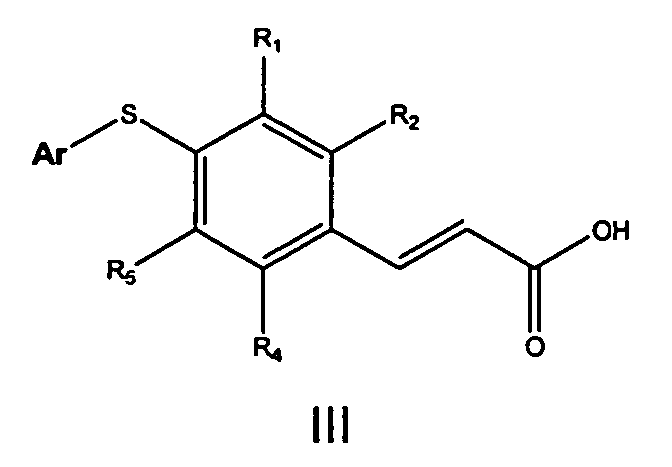 wherein Ar is a substituted aryl or substituted heteroaryl group, which has one or two aromatic rings and which can be fused to a cyclohexane, cyclohexene, cyclopentane or cyclopentene ring, where substitutions are independently selected froma. hydrogen,b. halogen,c. alkyl,d. haloalkyl,e. alkoxy,f. cyano,g. nitro,h. carboxaldehyde, andwhich comprises homologating a compound of formula III' using an acetate equivalent.a. hydrogen,b. halogen,c. alkyl,d. an aryl group as defined above,e. haloalkyl,f. hydroxy,g. alkoxy,h. alkoxyalkyl,i. alkoxycarbonyl,j. alkoxyalkoxy,k. hydroxyalkyl,l. aminoalkyl,m. aminocarbonyl,n. alkyl(alkoxycarbonylalkyl)aminoalkyl,o. a heterocyclyl group as defined abovep. a heterocyclyl group as defined above having substituents independently selected from alkyl, halogen, hydroxyl, alkoxy, carboxy, carboxyalkyl and alkoxycarbonyl,q. a heterocyclylalkyl group as defined above,r. a heterocyclylalkyl group as defined above having substituents independently selected from alkyl, halogen, hydroxy, alkoxy, carboxy, carboxyalkyl and alkoxycarbonyl,s. carboxaldehyde,t. carboxaldehyde hydrazone,u. carboxamide,v. alkoxycarbonylalkyl,w. carboxy,x. carboxyalkyl,y. carboxyalkoxy,z. carboxythioalkoxy,aa. carboxycycloalkoxy,bb. thioalkyl,cc. hydroxycarbonylalkyl(carboxyalkyl),dd. hydroxyalkylaminocarbonyl,ee. cyano,ff. amino,gg. heterocyclylalkylamino, where the heterocyclyl is as defined above,hh. carboxyalkylamino,ii. heterocyclylaminocarbonyl, where the heterocyclyl is as defined above, andjj. "trans-cinnamide",
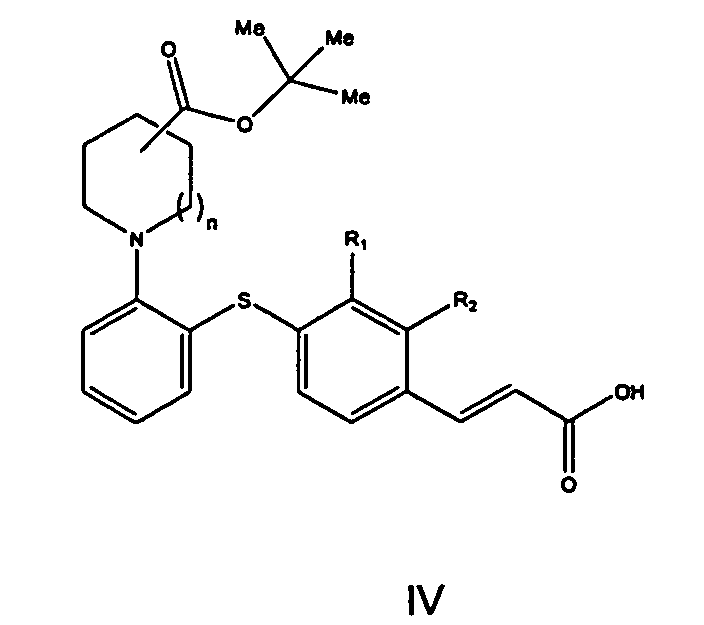 wherein n is equal to 1,a. hydrogen,b. halogen,c. alkyl,d. haloalkyl,e. alkoxy,f. cyano,g. nitro, andh. carboxaldehyde,
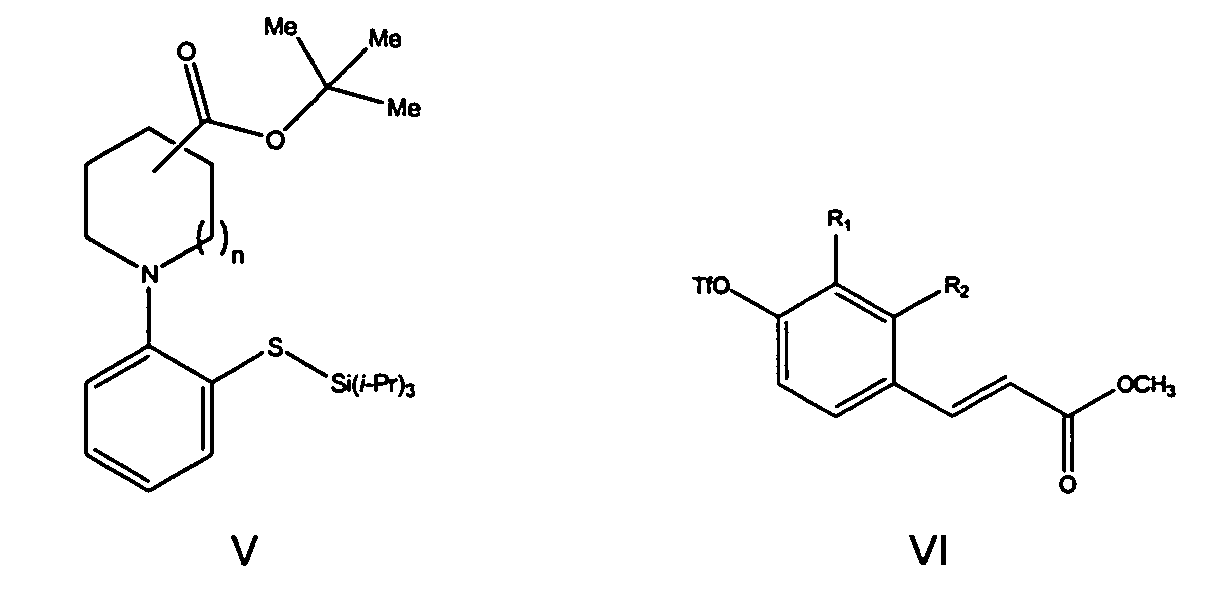 b) hydrolyzing the resulting methyl ester.
 a) conversion of bicycle VII to phenol VIII,
 b) forming aldehyde IX from phenol VIII,
 c) conversion of aldehyde IX to diaryl sulfide X, and
 d) conversion of diaryl sulfide X to intermediate XI.