EP1481955A2 - Porous body-coated fiber, porous body-coated particle, and formed article using the same - Google Patents
Porous body-coated fiber, porous body-coated particle, and formed article using the same Download PDFInfo
- Publication number
- EP1481955A2 EP1481955A2 EP04012767A EP04012767A EP1481955A2 EP 1481955 A2 EP1481955 A2 EP 1481955A2 EP 04012767 A EP04012767 A EP 04012767A EP 04012767 A EP04012767 A EP 04012767A EP 1481955 A2 EP1481955 A2 EP 1481955A2
- Authority
- EP
- European Patent Office
- Prior art keywords
- porous body
- fiber
- coated
- particles
- inorganic
- Prior art date
- Legal status (The legal status is an assumption and is not a legal conclusion. Google has not performed a legal analysis and makes no representation as to the accuracy of the status listed.)
- Ceased
Links
Images




Classifications
-
- C—CHEMISTRY; METALLURGY
- C04—CEMENTS; CONCRETE; ARTIFICIAL STONE; CERAMICS; REFRACTORIES
- C04B—LIME, MAGNESIA; SLAG; CEMENTS; COMPOSITIONS THEREOF, e.g. MORTARS, CONCRETE OR LIKE BUILDING MATERIALS; ARTIFICIAL STONE; CERAMICS; REFRACTORIES; TREATMENT OF NATURAL STONE
- C04B30/00—Compositions for artificial stone, not containing binders
- C04B30/02—Compositions for artificial stone, not containing binders containing fibrous materials
-
- C—CHEMISTRY; METALLURGY
- C04—CEMENTS; CONCRETE; ARTIFICIAL STONE; CERAMICS; REFRACTORIES
- C04B—LIME, MAGNESIA; SLAG; CEMENTS; COMPOSITIONS THEREOF, e.g. MORTARS, CONCRETE OR LIKE BUILDING MATERIALS; ARTIFICIAL STONE; CERAMICS; REFRACTORIES; TREATMENT OF NATURAL STONE
- C04B20/00—Use of materials as fillers for mortars, concrete or artificial stone according to more than one of groups C04B14/00 - C04B18/00 and characterised by shape or grain distribution; Treatment of materials according to more than one of the groups C04B14/00 - C04B18/00 specially adapted to enhance their filling properties in mortars, concrete or artificial stone; Expanding or defibrillating materials
- C04B20/10—Coating or impregnating
- C04B20/1055—Coating or impregnating with inorganic materials
- C04B20/1066—Oxides, Hydroxides
-
- C—CHEMISTRY; METALLURGY
- C04—CEMENTS; CONCRETE; ARTIFICIAL STONE; CERAMICS; REFRACTORIES
- C04B—LIME, MAGNESIA; SLAG; CEMENTS; COMPOSITIONS THEREOF, e.g. MORTARS, CONCRETE OR LIKE BUILDING MATERIALS; ARTIFICIAL STONE; CERAMICS; REFRACTORIES; TREATMENT OF NATURAL STONE
- C04B35/00—Shaped ceramic products characterised by their composition; Ceramics compositions; Processing powders of inorganic compounds preparatory to the manufacturing of ceramic products
- C04B35/01—Shaped ceramic products characterised by their composition; Ceramics compositions; Processing powders of inorganic compounds preparatory to the manufacturing of ceramic products based on oxide ceramics
- C04B35/14—Shaped ceramic products characterised by their composition; Ceramics compositions; Processing powders of inorganic compounds preparatory to the manufacturing of ceramic products based on oxide ceramics based on silica
-
- C—CHEMISTRY; METALLURGY
- C04—CEMENTS; CONCRETE; ARTIFICIAL STONE; CERAMICS; REFRACTORIES
- C04B—LIME, MAGNESIA; SLAG; CEMENTS; COMPOSITIONS THEREOF, e.g. MORTARS, CONCRETE OR LIKE BUILDING MATERIALS; ARTIFICIAL STONE; CERAMICS; REFRACTORIES; TREATMENT OF NATURAL STONE
- C04B35/00—Shaped ceramic products characterised by their composition; Ceramics compositions; Processing powders of inorganic compounds preparatory to the manufacturing of ceramic products
- C04B35/515—Shaped ceramic products characterised by their composition; Ceramics compositions; Processing powders of inorganic compounds preparatory to the manufacturing of ceramic products based on non-oxide ceramics
- C04B35/56—Shaped ceramic products characterised by their composition; Ceramics compositions; Processing powders of inorganic compounds preparatory to the manufacturing of ceramic products based on non-oxide ceramics based on carbides or oxycarbides
- C04B35/565—Shaped ceramic products characterised by their composition; Ceramics compositions; Processing powders of inorganic compounds preparatory to the manufacturing of ceramic products based on non-oxide ceramics based on carbides or oxycarbides based on silicon carbide
-
- C—CHEMISTRY; METALLURGY
- C04—CEMENTS; CONCRETE; ARTIFICIAL STONE; CERAMICS; REFRACTORIES
- C04B—LIME, MAGNESIA; SLAG; CEMENTS; COMPOSITIONS THEREOF, e.g. MORTARS, CONCRETE OR LIKE BUILDING MATERIALS; ARTIFICIAL STONE; CERAMICS; REFRACTORIES; TREATMENT OF NATURAL STONE
- C04B35/00—Shaped ceramic products characterised by their composition; Ceramics compositions; Processing powders of inorganic compounds preparatory to the manufacturing of ceramic products
- C04B35/622—Forming processes; Processing powders of inorganic compounds preparatory to the manufacturing of ceramic products
- C04B35/626—Preparing or treating the powders individually or as batches ; preparing or treating macroscopic reinforcing agents for ceramic products, e.g. fibres; mechanical aspects section B
- C04B35/628—Coating the powders or the macroscopic reinforcing agents
- C04B35/62802—Powder coating materials
- C04B35/62805—Oxide ceramics
- C04B35/62807—Silica or silicates
-
- C—CHEMISTRY; METALLURGY
- C04—CEMENTS; CONCRETE; ARTIFICIAL STONE; CERAMICS; REFRACTORIES
- C04B—LIME, MAGNESIA; SLAG; CEMENTS; COMPOSITIONS THEREOF, e.g. MORTARS, CONCRETE OR LIKE BUILDING MATERIALS; ARTIFICIAL STONE; CERAMICS; REFRACTORIES; TREATMENT OF NATURAL STONE
- C04B35/00—Shaped ceramic products characterised by their composition; Ceramics compositions; Processing powders of inorganic compounds preparatory to the manufacturing of ceramic products
- C04B35/622—Forming processes; Processing powders of inorganic compounds preparatory to the manufacturing of ceramic products
- C04B35/626—Preparing or treating the powders individually or as batches ; preparing or treating macroscopic reinforcing agents for ceramic products, e.g. fibres; mechanical aspects section B
- C04B35/628—Coating the powders or the macroscopic reinforcing agents
- C04B35/62844—Coating fibres
- C04B35/62847—Coating fibres with oxide ceramics
- C04B35/62849—Silica or silicates
-
- C—CHEMISTRY; METALLURGY
- C04—CEMENTS; CONCRETE; ARTIFICIAL STONE; CERAMICS; REFRACTORIES
- C04B—LIME, MAGNESIA; SLAG; CEMENTS; COMPOSITIONS THEREOF, e.g. MORTARS, CONCRETE OR LIKE BUILDING MATERIALS; ARTIFICIAL STONE; CERAMICS; REFRACTORIES; TREATMENT OF NATURAL STONE
- C04B35/00—Shaped ceramic products characterised by their composition; Ceramics compositions; Processing powders of inorganic compounds preparatory to the manufacturing of ceramic products
- C04B35/622—Forming processes; Processing powders of inorganic compounds preparatory to the manufacturing of ceramic products
- C04B35/626—Preparing or treating the powders individually or as batches ; preparing or treating macroscopic reinforcing agents for ceramic products, e.g. fibres; mechanical aspects section B
- C04B35/628—Coating the powders or the macroscopic reinforcing agents
- C04B35/62892—Coating the powders or the macroscopic reinforcing agents with a coating layer consisting of particles
-
- C—CHEMISTRY; METALLURGY
- C04—CEMENTS; CONCRETE; ARTIFICIAL STONE; CERAMICS; REFRACTORIES
- C04B—LIME, MAGNESIA; SLAG; CEMENTS; COMPOSITIONS THEREOF, e.g. MORTARS, CONCRETE OR LIKE BUILDING MATERIALS; ARTIFICIAL STONE; CERAMICS; REFRACTORIES; TREATMENT OF NATURAL STONE
- C04B35/00—Shaped ceramic products characterised by their composition; Ceramics compositions; Processing powders of inorganic compounds preparatory to the manufacturing of ceramic products
- C04B35/71—Ceramic products containing macroscopic reinforcing agents
- C04B35/78—Ceramic products containing macroscopic reinforcing agents containing non-metallic materials
- C04B35/80—Fibres, filaments, whiskers, platelets, or the like
-
- C—CHEMISTRY; METALLURGY
- C04—CEMENTS; CONCRETE; ARTIFICIAL STONE; CERAMICS; REFRACTORIES
- C04B—LIME, MAGNESIA; SLAG; CEMENTS; COMPOSITIONS THEREOF, e.g. MORTARS, CONCRETE OR LIKE BUILDING MATERIALS; ARTIFICIAL STONE; CERAMICS; REFRACTORIES; TREATMENT OF NATURAL STONE
- C04B2235/00—Aspects relating to ceramic starting mixtures or sintered ceramic products
- C04B2235/02—Composition of constituents of the starting material or of secondary phases of the final product
- C04B2235/30—Constituents and secondary phases not being of a fibrous nature
- C04B2235/32—Metal oxides, mixed metal oxides, or oxide-forming salts thereof, e.g. carbonates, nitrates, (oxy)hydroxides, chlorides
- C04B2235/3231—Refractory metal oxides, their mixed metal oxides, or oxide-forming salts thereof
- C04B2235/3232—Titanium oxides or titanates, e.g. rutile or anatase
-
- C—CHEMISTRY; METALLURGY
- C04—CEMENTS; CONCRETE; ARTIFICIAL STONE; CERAMICS; REFRACTORIES
- C04B—LIME, MAGNESIA; SLAG; CEMENTS; COMPOSITIONS THEREOF, e.g. MORTARS, CONCRETE OR LIKE BUILDING MATERIALS; ARTIFICIAL STONE; CERAMICS; REFRACTORIES; TREATMENT OF NATURAL STONE
- C04B2235/00—Aspects relating to ceramic starting mixtures or sintered ceramic products
- C04B2235/02—Composition of constituents of the starting material or of secondary phases of the final product
- C04B2235/30—Constituents and secondary phases not being of a fibrous nature
- C04B2235/34—Non-metal oxides, non-metal mixed oxides, or salts thereof that form the non-metal oxides upon heating, e.g. carbonates, nitrates, (oxy)hydroxides, chlorides
- C04B2235/3418—Silicon oxide, silicic acids or oxide forming salts thereof, e.g. silica sol, fused silica, silica fume, cristobalite, quartz or flint
-
- C—CHEMISTRY; METALLURGY
- C04—CEMENTS; CONCRETE; ARTIFICIAL STONE; CERAMICS; REFRACTORIES
- C04B—LIME, MAGNESIA; SLAG; CEMENTS; COMPOSITIONS THEREOF, e.g. MORTARS, CONCRETE OR LIKE BUILDING MATERIALS; ARTIFICIAL STONE; CERAMICS; REFRACTORIES; TREATMENT OF NATURAL STONE
- C04B2235/00—Aspects relating to ceramic starting mixtures or sintered ceramic products
- C04B2235/02—Composition of constituents of the starting material or of secondary phases of the final product
- C04B2235/30—Constituents and secondary phases not being of a fibrous nature
- C04B2235/38—Non-oxide ceramic constituents or additives
- C04B2235/3817—Carbides
- C04B2235/3826—Silicon carbides
-
- C—CHEMISTRY; METALLURGY
- C04—CEMENTS; CONCRETE; ARTIFICIAL STONE; CERAMICS; REFRACTORIES
- C04B—LIME, MAGNESIA; SLAG; CEMENTS; COMPOSITIONS THEREOF, e.g. MORTARS, CONCRETE OR LIKE BUILDING MATERIALS; ARTIFICIAL STONE; CERAMICS; REFRACTORIES; TREATMENT OF NATURAL STONE
- C04B2235/00—Aspects relating to ceramic starting mixtures or sintered ceramic products
- C04B2235/02—Composition of constituents of the starting material or of secondary phases of the final product
- C04B2235/50—Constituents or additives of the starting mixture chosen for their shape or used because of their shape or their physical appearance
- C04B2235/52—Constituents or additives characterised by their shapes
- C04B2235/5208—Fibers
- C04B2235/5216—Inorganic
- C04B2235/522—Oxidic
- C04B2235/5232—Silica or silicates other than aluminosilicates, e.g. quartz
-
- C—CHEMISTRY; METALLURGY
- C04—CEMENTS; CONCRETE; ARTIFICIAL STONE; CERAMICS; REFRACTORIES
- C04B—LIME, MAGNESIA; SLAG; CEMENTS; COMPOSITIONS THEREOF, e.g. MORTARS, CONCRETE OR LIKE BUILDING MATERIALS; ARTIFICIAL STONE; CERAMICS; REFRACTORIES; TREATMENT OF NATURAL STONE
- C04B2235/00—Aspects relating to ceramic starting mixtures or sintered ceramic products
- C04B2235/02—Composition of constituents of the starting material or of secondary phases of the final product
- C04B2235/50—Constituents or additives of the starting mixture chosen for their shape or used because of their shape or their physical appearance
- C04B2235/52—Constituents or additives characterised by their shapes
- C04B2235/5208—Fibers
- C04B2235/526—Fibers characterised by the length of the fibers
-
- C—CHEMISTRY; METALLURGY
- C04—CEMENTS; CONCRETE; ARTIFICIAL STONE; CERAMICS; REFRACTORIES
- C04B—LIME, MAGNESIA; SLAG; CEMENTS; COMPOSITIONS THEREOF, e.g. MORTARS, CONCRETE OR LIKE BUILDING MATERIALS; ARTIFICIAL STONE; CERAMICS; REFRACTORIES; TREATMENT OF NATURAL STONE
- C04B2235/00—Aspects relating to ceramic starting mixtures or sintered ceramic products
- C04B2235/02—Composition of constituents of the starting material or of secondary phases of the final product
- C04B2235/50—Constituents or additives of the starting mixture chosen for their shape or used because of their shape or their physical appearance
- C04B2235/52—Constituents or additives characterised by their shapes
- C04B2235/5208—Fibers
- C04B2235/5264—Fibers characterised by the diameter of the fibers
-
- C—CHEMISTRY; METALLURGY
- C04—CEMENTS; CONCRETE; ARTIFICIAL STONE; CERAMICS; REFRACTORIES
- C04B—LIME, MAGNESIA; SLAG; CEMENTS; COMPOSITIONS THEREOF, e.g. MORTARS, CONCRETE OR LIKE BUILDING MATERIALS; ARTIFICIAL STONE; CERAMICS; REFRACTORIES; TREATMENT OF NATURAL STONE
- C04B2235/00—Aspects relating to ceramic starting mixtures or sintered ceramic products
- C04B2235/60—Aspects relating to the preparation, properties or mechanical treatment of green bodies or pre-forms
- C04B2235/608—Green bodies or pre-forms with well-defined density
-
- C—CHEMISTRY; METALLURGY
- C04—CEMENTS; CONCRETE; ARTIFICIAL STONE; CERAMICS; REFRACTORIES
- C04B—LIME, MAGNESIA; SLAG; CEMENTS; COMPOSITIONS THEREOF, e.g. MORTARS, CONCRETE OR LIKE BUILDING MATERIALS; ARTIFICIAL STONE; CERAMICS; REFRACTORIES; TREATMENT OF NATURAL STONE
- C04B2235/00—Aspects relating to ceramic starting mixtures or sintered ceramic products
- C04B2235/60—Aspects relating to the preparation, properties or mechanical treatment of green bodies or pre-forms
- C04B2235/61—Mechanical properties, e.g. fracture toughness, hardness, Young's modulus or strength
-
- Y—GENERAL TAGGING OF NEW TECHNOLOGICAL DEVELOPMENTS; GENERAL TAGGING OF CROSS-SECTIONAL TECHNOLOGIES SPANNING OVER SEVERAL SECTIONS OF THE IPC; TECHNICAL SUBJECTS COVERED BY FORMER USPC CROSS-REFERENCE ART COLLECTIONS [XRACs] AND DIGESTS
- Y10—TECHNICAL SUBJECTS COVERED BY FORMER USPC
- Y10T—TECHNICAL SUBJECTS COVERED BY FORMER US CLASSIFICATION
- Y10T428/00—Stock material or miscellaneous articles
- Y10T428/29—Coated or structually defined flake, particle, cell, strand, strand portion, rod, filament, macroscopic fiber or mass thereof
- Y10T428/2913—Rod, strand, filament or fiber
- Y10T428/2918—Rod, strand, filament or fiber including free carbon or carbide or therewith [not as steel]
-
- Y—GENERAL TAGGING OF NEW TECHNOLOGICAL DEVELOPMENTS; GENERAL TAGGING OF CROSS-SECTIONAL TECHNOLOGIES SPANNING OVER SEVERAL SECTIONS OF THE IPC; TECHNICAL SUBJECTS COVERED BY FORMER USPC CROSS-REFERENCE ART COLLECTIONS [XRACs] AND DIGESTS
- Y10—TECHNICAL SUBJECTS COVERED BY FORMER USPC
- Y10T—TECHNICAL SUBJECTS COVERED BY FORMER US CLASSIFICATION
- Y10T428/00—Stock material or miscellaneous articles
- Y10T428/29—Coated or structually defined flake, particle, cell, strand, strand portion, rod, filament, macroscopic fiber or mass thereof
- Y10T428/2913—Rod, strand, filament or fiber
- Y10T428/2918—Rod, strand, filament or fiber including free carbon or carbide or therewith [not as steel]
- Y10T428/292—In coating or impregnation
-
- Y—GENERAL TAGGING OF NEW TECHNOLOGICAL DEVELOPMENTS; GENERAL TAGGING OF CROSS-SECTIONAL TECHNOLOGIES SPANNING OVER SEVERAL SECTIONS OF THE IPC; TECHNICAL SUBJECTS COVERED BY FORMER USPC CROSS-REFERENCE ART COLLECTIONS [XRACs] AND DIGESTS
- Y10—TECHNICAL SUBJECTS COVERED BY FORMER USPC
- Y10T—TECHNICAL SUBJECTS COVERED BY FORMER US CLASSIFICATION
- Y10T428/00—Stock material or miscellaneous articles
- Y10T428/29—Coated or structually defined flake, particle, cell, strand, strand portion, rod, filament, macroscopic fiber or mass thereof
- Y10T428/2913—Rod, strand, filament or fiber
- Y10T428/2927—Rod, strand, filament or fiber including structurally defined particulate matter
-
- Y—GENERAL TAGGING OF NEW TECHNOLOGICAL DEVELOPMENTS; GENERAL TAGGING OF CROSS-SECTIONAL TECHNOLOGIES SPANNING OVER SEVERAL SECTIONS OF THE IPC; TECHNICAL SUBJECTS COVERED BY FORMER USPC CROSS-REFERENCE ART COLLECTIONS [XRACs] AND DIGESTS
- Y10—TECHNICAL SUBJECTS COVERED BY FORMER USPC
- Y10T—TECHNICAL SUBJECTS COVERED BY FORMER US CLASSIFICATION
- Y10T428/00—Stock material or miscellaneous articles
- Y10T428/29—Coated or structually defined flake, particle, cell, strand, strand portion, rod, filament, macroscopic fiber or mass thereof
- Y10T428/2913—Rod, strand, filament or fiber
- Y10T428/2933—Coated or with bond, impregnation or core
- Y10T428/2938—Coating on discrete and individual rods, strands or filaments
-
- Y—GENERAL TAGGING OF NEW TECHNOLOGICAL DEVELOPMENTS; GENERAL TAGGING OF CROSS-SECTIONAL TECHNOLOGIES SPANNING OVER SEVERAL SECTIONS OF THE IPC; TECHNICAL SUBJECTS COVERED BY FORMER USPC CROSS-REFERENCE ART COLLECTIONS [XRACs] AND DIGESTS
- Y10—TECHNICAL SUBJECTS COVERED BY FORMER USPC
- Y10T—TECHNICAL SUBJECTS COVERED BY FORMER US CLASSIFICATION
- Y10T428/00—Stock material or miscellaneous articles
- Y10T428/29—Coated or structually defined flake, particle, cell, strand, strand portion, rod, filament, macroscopic fiber or mass thereof
- Y10T428/2913—Rod, strand, filament or fiber
- Y10T428/2933—Coated or with bond, impregnation or core
- Y10T428/294—Coated or with bond, impregnation or core including metal or compound thereof [excluding glass, ceramic and asbestos]
- Y10T428/2958—Metal or metal compound in coating
Definitions
- the present invention relates to a porous body-coated fiber and a porous body-coated particle.
- the invention also relates to formed articles using the porous body-coated fiber or the porous body-coated particle.
- low-thermal-conductive heat-insulating materials obtained by mixing ultrafine granular anhydrous silica which is a low thermal conductive material (for example, Aerosil (trade name) manufactured by Nippon Aerosil Co., Ltd), a ceramic fiber and further a radiation absorption scattering material comprising particles of silicon nitride, titanium oxide, zirconium oxide or the like, and press molding the resulting mixture, followed by machining (see the following patent documents 1 to 6).
- the above-mentioned ultrafine granular anhydrous silica or supercritical dry silica is fine particles having a diameter of several nanometers to tens of nanometers, and a low thermal conductive material having a thermal conductivity at ordinary temperature (25°C) of about 0.01 W/(m ⁇ k).
- the ultrafine granular anhydrous silica or supercritical dry silica associates by cohesive forces to form secondary particles, because they are fine particles having a diameter of several nanometers to several tens of nanometers.
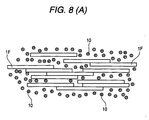
- the secondary particles 10 are dispersed among inorganic fibers 1F such as ceramic fibers or glass fibers.
- interfiber thermal conduction occurs at portions where the inorganic fibers 1F are entangled, which causes the low thermal conductivity of the ultrafine granular anhydrous silica or supercritical dry silica to be largely impaired.
- glass fiber has a thermal conductivity of about 0.1 W/(m ⁇ k), and the heat insulating performance of the whole heat insulating material greatly depends on the thermal conductivity of the glass fiber.
- a radiation absorption scattering material 1a is effective for reducing thermal conduction in a high-temperature region exceeding 200°C.
- solid conduction occurs between the adjacent radiation absorption scattering materials, and particularly, thermal conduction in a low-temperature region of 200°C or lower increases. Still further, solid conduction also occurs between the radiation absorption scattering material 1a and the inorganic fiber 1F.
- a kneaded product of the inorganic fiber 1F, the ultrafine granular anhydrous silica or supercritical dry silica and further the radiation absorption scattering material 1a is press molded using no binder, attaching importance to the heat insulating performance.
- the secondary particles 10 of the ultrafine granular anhydrous silica or supercritical dry silica merely get into among the fibers, so that adhesion force between the secondary particles 10 and the inorganic fiber 1F is low. Accordingly, the secondary particles 10 are eliminated (powder omission) to contaminate the outside. There is therefore also the problem that it is difficult to use for applications requiring cleanness, such as a semiconductor manufacturing apparatus.
- Another object of the invention is to provide a porous body-coated fiber and a porous body-coated particle suitable for obtaining the above-mentioned formed article, and a precursor for the heat insulating material containing the above-mentioned porous body-coated particle.
- the present invention relates to a porous body-coated fiber and a formed article obtained by pressure-forming the porous body-coated fiber (This aspect of the present invention is hereinafter referred to as "first invention").
- the first invention provides the following porous body-coated fibers and formed articles.
- the present invention relates to a porous body-coated particle, a formed article precursor containing the porous body-coated particle, and a formed article obtained by pressure-forming the precursor (This aspect of the present invention is hereinafter referred to as "second invention").
- the second invention provides the following porous body-coated particles, precursors, and formed articles.
- a formed article excellent in heat insulating performance and also excellent in mechanical strength, handling ability and processability can be provided. Furthermore, according to the present invention, a porous body-coated fiber, a porous body-coated particle, and a formed body precursor containing the porous body-coated particle, each suitable for obtaining the above-mentioned formed article can be provided.
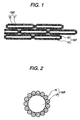
- Fig. 1 is a schematic view showing the porous body-coated fiber of the first invention
- Fig. 3 is an enlarged schematic view showing the secondary particles comprising the fine inorganic particles.
- secondary particles 10 formed by a plurality of fine inorganic particles 10a associated with one another in ring-shaped or helical manner are fixed onto an inorganic fiber 1F and further accumulate thereon to form a porous body covering the inorganic fiber 1F, thus forming the porous body-coated fiber 100F of the first invention.
- the fine inorganic particles 10a are fine particles comprising a low thermal conductive inorganic material, and, for example, they may be ultrafine granular anhydrous silica or supercritical dry silica. As described above, these materials have a thermal conductivity at ordinary temperature (25°C) of about 0.01 W/(m ⁇ k), and they are also preferred in the first invention. In addition, fine particles of alumina and the like can also be used. Further, it is preferred that the fine inorganic particles 10a have an average particle size of 5 to 50 nm. As described above and also shown in Fig. 3, such fine particles associate by van der Waals forces or electrostatic forces to form ring-shaped or helical secondary particles 10.
- the inside diameter of the ring (R) is preferably 0.1 ⁇ m (100 nm) or less.
- the mean free path of air acting as a heat transfer medium is about 100 nm at ordinary temperature, and hence when the inside diameter of the ring (R) is 0.1 ⁇ m (100 nm) or less, heat transfer through the secondary particles 10 can be almost prevented.
- the secondary particles 10 are overlaid in a deformed state to form the porous body. Thereby, the inside diameter of the ring (R) is also decreased to a size not larger than the mean free path.
- the fine inorganic particles 10a having an average particle size of 5 to 50 nm easily form the secondary particles 10 of such an inside diameter of the ring (R).
- These fine inorganic particles 10a may be used as a combination of two or more thereof. Further, they may be mixed with other inorganic particles as needed.
- the inorganic fiber 1F there can be used a ceramic fiber such as alumina fiber, silica ⁇ alumina fiber, silica fiber or mullite fiber, glass fiber or rock wool.
- a ceramic fiber such as alumina fiber, silica ⁇ alumina fiber, silica fiber or mullite fiber, glass fiber or rock wool.
- a low thermal conductive inorganic fiber having a thermal conductivity at ordinary temperature (25°C) of 0.1 W/ (m ⁇ K) or less, preferably 0.04 W/(m ⁇ K) or less is preferred, and a silica-based fiber such as silica ⁇ alumina fiber or silica fiber can be suitably used.
- the inorganic fiber 1F has an average fiber diameter of 15 ⁇ m or less.
- the inorganic fiber 1F has an average fiber length of 50 ⁇ m or more.
- the porous body-coated fiber 100F is poorly orientated to bring about insufficient mechanical strength.
- the inorganic fiber 1F accounts for 5 to 50% by weight and the fine inorganic particles 10a accounts for 50 to 95% by weight.
- the compounding proportion of the fine inorganic particles 10a is less than 50% by weight, there is the possibility that the inorganic fiber 1F may be not sufficiently thickly coated with the secondary particles 10.
- the porous body-coated fiber 100F of the first invention can be obtained by allowing a mixture of the inorganic fiber 1F and the fine inorganic particles 10a mixed with each other at the above-mentioned compounding ratio to pass through little clearance repeatedly.
- a rotary mixer 30 as shown in Fig. 4 is used.
- This rotary mixer 30 comprises a cylindrical chamber 31 and a pressing member 32 disposed therein.
- the chamber 31 rotates in the direction indicated by the arrow in the drawing, and the pressing member 32 is fixed so as to form specified little clearance between one end thereof and an inner wall of the chamber 31.
- the inorganic fiber 1F and the fine inorganic particles 10a are put in the rotary mixer 30 at the above-mentioned compounding ratio (indicated by the numerical reference 35 in the drawing), and the chamber 31 is driven for rotation.
- the inorganic fiber 1F is dispersed with this rotation, and at the same time, the secondary particles 10 comprising the fine inorganic particles 10a are fixed onto the individual inorganic fiber 1F.
- Other secondary particles 10 are sequentially overlaid thereon to form an overlaid product.
- the secondary particles 10 come to be fixed onto the inorganic fiber 1F in the manner of being pushed into the surface thereof.
- the secondary particles 10 are overlaid, the secondary particles 10 are pushed against one another, so that the ring-shaped or helical secondary particles 10 are deformed, or dispersed to chain or individual fine inorganic particles 10a, resulting in mutual complicated entanglement thereof. It does not therefore happen that the fine inorganic particles 10a or the secondary particles 10 are eliminated from the inorganic fiber 1F. Further, a large number of fine voids are formed among the fine inorganic particles 10a, so that the resulting overlaid product becomes a porous body.
- Fig. 5(B) is an electron photomicrograph of a cross section of a conventional heat insulating material comprising an inorganic fiber and fine inorganic particles. Secondary particles comprising the fine inorganic particles are dispersed among the fibers, and the surface of the inorganic fiber is exposed.
- Fig. 4C is an electron photomicrograph of the porous body-coated fiber of the first invention, and the porous body comprising the secondary particles overlaid is formed on the surface of the inorganic fiber. This shows that the inorganic fiber is not exposed.
- Fig. 5A is an electron photomicrograph of an inorganic fiber alone.
- the first invention also provides a formed article using the above-mentioned porous body-coated fiber.
- the formed article can be obtained, for example, by filling a predetermined mold with the porous body-coated fiber, and then conducting press-forming or the like.
- the bulk density By adjusting the bulk density to a range of 200 to 600 kg/m 3 , preferably 300 to 500 kg/m 3 , a formed article excellent in heat insulating performance and mechanical strength can be obtained.
- the formed article has a bending strength of 0.5 MPa, and is difficult to crack. It also has a thermal conductivity at ordinary temperature of 0.04 W/(m ⁇ k) or less, and exhibits excellent heat insulating performance. Further, when it is cut, no chipping of cut edges occurs. It is therefore also excellent in processability.
- the fine inorganic particles 10a are not eliminated, resulting in no contamination of the outside.
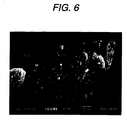
- Fig. 2 is a schematic view showing the porous body-coated particle of the second invention
- Fig. 3 is an enlarged schematic view showing the secondary particles of the fine particles comprising the inorganic compound (hereinafter referred to "fine inorganic particles").
- fine inorganic particles the secondary particles of the fine particles comprising the inorganic compound (hereinafter referred to "fine inorganic particles").
- secondary particles 10 formed by a plurality of fine inorganic particles 10a associated with one another in ring-shaped or helical manner are fixed onto a core particle 1P comprising an inorganic compound and further accumulate thereon, thus forming the porous body-coated particle 100P of the second invention.
- the porous body-coated particle 100P has a structure in which the core particle 1P is coated with a porous body comprising fine inorganic particles 10a.
- the core particle 1P there can be used, for example, a particle comprising a radiation absorption scattering material such as silicon carbide, titanium oxide or zirconium oxide. Any radiation absorption scattering material can be used herein so long as it is an inorganic particle having an absolute refractive index of 1.5 or more, and should not be construed as being limited to the above-mentioned particle.
- this core particle 1P is preferably subjected to oxidation heat treatment. By the oxidation heat treatment, fine particles comprising an oxide are formed on the surface of the core particle 1 to form minute unevenness, thereby enhancing the adhesion with respect to the fine inorganic particles 10a.
- the treatment can be made through heating in the air or in an atmosphere of oxygen at 800 to 1,200°C for 3 to 12 hours. Further, considering the heat insulating performance and mechanical strength at the time when the core particle 1P is made into a formed article, it is preferred that the core particle 1P has an average particle size of 30 ⁇ m or less.
- the fine inorganic particles 10a there can be used, for example, ultrafine granular anhydrous silica or supercritical dry silica. As described above, these materials have a thermal conductivity at ordinary temperature (25°C) of about 0.01 W/(m ⁇ k), and they are also preferred in the second invention. In addition, fine particles of alumina or the like can also be used. Further, it is preferred that the fine inorganic particles 10a have an average particle size of 5 to 50 nm. As described above and also shown in Fig. 3, such fine particles associate by van der Waals forces or electrostatic forces to form ring-shaped or helical secondary particles 10. The inside diameter of the ring (R) is preferably 0.1 ⁇ m (100 nm) or less.
- the mean free path of air acting as a heat transfer medium is about 100 nm at ordinary temperature, and hence when the inside diameter of the ring (R) is 0.1 ⁇ m (100 nm) or less, heat transfer through the secondary particles 10 can be almost prevented.
- the secondary particles 10 are overlaid in a deformed state to form the porous body. Thereby, the inside diameter of the ring (R) is also decreased to a size not larger than the mean free path.
- the fine inorganic particles 10a having an average particle size of 5 to 50 nm easily form the secondary particles 10 of such an inside diameter of the ring (R).
- These fine inorganic particles 10a may be used as a combination of two or more thereof. Further, they may be mixed with other inorganic particles as needed.
- the core particles 1P accounts for 5 to 50% by weight and the fine inorganic particles 10a accounts for 50 to 95% by weight.
- the compounding proportion of the fine inorganic particles 10a is less than 50% by weight, there is the possibility that the core particles 1P may be not sufficiently thickly coated with the secondary particles 10.
- the porous body-coated particle 100P of the second invention can be obtained by allowing a mixture obtained by dry mixing the core particles 1P with the fine inorganic particles 10a at the above-mentioned compounding ratio to pass through little clearance repeatedly.
- a rotary mixer 30 as shown in Fig. 4 is used.
- This rotary mixer 30 comprises a cylindrical chamber 31 and a pressing member 32 disposed therein.
- the chamber 31 rotates in the direction indicated by the arrow in the drawing, and the pressing member 32 is fixed so as to form specified little clearance between one end thereof and an inner wall of the chamber 31.
- the core particles 1P and the fine inorganic particles 10a are put in the rotary mixer 30 at the above-mentioned compounding ratio (indicated by the numerical reference 35 in the drawing), and the chamber 31 is driven for rotation.
- the secondary particles 10 comprising the fine inorganic particles 10a are fixed onto the surfaces of the core particles 1P with this rotation, and other secondary particles 10 are sequentially overlaid thereon to form an overlaid product.
- the secondary particles 10 come to be fixed onto the core particles 1P in the manner of being pushed into the surfaces thereof.
- the secondary particles 10 are overlaid, the secondary particles 10 are pushed against one another, so that the ring-shaped or helical secondary particles 10 are deformed, or dispersed to chain or individual fine inorganic particles 10a, resulting in mutual complicated entanglement thereof. It does not therefore happen that the fine inorganic particles 10a or the secondary particles 10 are eliminated from the core particles 1P. Further, a large number of fine voids are formed among the fine inorganic particles 10a, so that the resulting overlaid product becomes a porous body.
- Fig. 6 is an electron photomicrograph of the porous body-coated particle 100P prepared using silicon nitride having subjected to the oxidation heat treatment as the core particle 1P, and using ultrafine granular anhydrous silica as the fine inorganic particles 10a. This shows that a porous body in which the secondary particles comprising ultrafine granular anhydrous silica are overlaid is formed on the surface of the core particle, and that silicon nitride is not exposed.
- the second invention also provides a formed article containing the above-mentioned porous body-coated particle 100P.
- a binder it deteriorates the heat insulating performance. Accordingly, a fiber material is added to mix with the porous body-coated particle 100P in preparing the formed article in the second invention.
- the fiber material there can be used an inorganic fiber itself or an inorganic fiber coated with a porous body comprising the secondary particles 10 of the fine inorganic particles 1a as described above.
- the use of the inorganic fibers coated with the porous body prevents inorganic fibers from directly contacting with one another in the formed article to cause no occurrence of solid conduction, resulting in excellent heat insulating performance.
- the inorganic fiber there can be used a ceramic fiber such as alumina fiber, silica ⁇ alumina fiber, silica fiber or mullite fiber, glass fiber or rock wool.
- a ceramic fiber such as alumina fiber, silica ⁇ alumina fiber, silica fiber or mullite fiber, glass fiber or rock wool.
- a low thermal conductive inorganic fiber having a thermal conductivity at ordinary temperature (25°C) of 0.1 W/(m ⁇ K) or less, preferably 0.04 W/(m ⁇ K) or less is preferred, and a silica-based fiber such as silica-alumina fiber or silica fiber can be suitably used.
- the inorganic fiber has an average fiber diameter of 15 ⁇ m or less.
- the inorganic fiber has an average fiber length of 50 ⁇ m or more.
- the porous body-coated fiber 100F is poorly orientated to bring about insufficient mechanical strength.
- the inorganic fiber can be coated with the porous body comprising the secondary particles 10 of the fine inorganic particles 10a by mixing the inorganic fiber and the fine inorganic particles 10a by rotation using the rotary mixer.
- the formed article can be obtained by mixing the fiber materials and the above-mentioned porous body-coated particles 100P to prepare a formed article precursor, and filling a predetermined mold with the precursor, followed by press-forming.
- the formed article of the second invention is schematically shown in Fig. 7.
- the porous body-coated particles 100 are dispersed among the fiber materials (here, porous body-coated fiber comprising inorganic fibers 1F coated with the porous body comprising the secondary particles 10 of the fine inorganic particles 10a).
- the porous body-coated particles 100 are coated with the porous body comprising the secondary particles 10 of the fine inorganic particles 10a, so that solid conduction does not occur among the core particles, resulting in excellent heat insulating performance.
- porous body-coated fiber 100F comprising the inorganic fibers 1F coated with the porous body comprising the secondary particles 10 of the fine inorganic particles 10a is used as the fiber material, solid conduction among the fiber materials disappears to give further enhanced heat insulating performance.
- the porous body-coated particle 100P is incorporated preferably in an amount of 55 to 95% by weight based on the total, and the fiber material is preferably in an amount of 5 to 45% by weight, considering the heat insulating performance and mechanical characteristics of the resulting formed article.
- the formed article has a bending strength of 0.5 MPa, and is difficult to crack. It also has a thermal conductivity at 1,000°C of 0.04 W/(m ⁇ k) or less, and exhibits excellent heat insulating performance. Further, when it is cut, no chipping of cut edges occurs. It is therefore also excellent in processability. Moreover, the fine inorganic particles 10a are not eliminated, resulting in no contamination of the outside.
- a silica-based ceramic fiber having an average fiber diameter of 10 ⁇ m and an average fiber length of 5,000 ⁇ m and 97% by weight of fine silica particles having an average particle size of 7 nm and a thermal conductivity (25°C) of 0.01 W/(m ⁇ k) were put in the rotary mixer 30 shown in Fig. 4, and the chamber 31 was continuously rotated at a rotational speed of 1,000 rpm for 30 minutes, setting the little clearance between the chamber 31 and the pressing member 32 to 2,000 ⁇ m. Then, the contents were taken out, and observed under an electron microscope. As a result, the surface of the ceramic fiber was completely covered with a porous body comprising the fine silica particles, as shown in Fig. 5(C).
- a formed article was obtained in the same manner as with Example 1A with the exception that 5% by weight of the silica-based ceramic fiber and 95% by weight of the fine silica particles were used.
- the bulk density, bending strength and thermal conductivity of this formed article are shown in Table 1A. Further, prior to the forming, the contents were observed under an electron microscope. As a result, the surface of the ceramic fiber was completely covered with a porous body comprising the fine silica particles.
- a formed article was obtained in the same manner as with Example 1A with the exception that 10% by weight of the silica-based ceramic fiber and 90% by weight of the fine silica particles were used.
- the bulk density, bending strength and thermal conductivity of this formed article are shown in Table 1A. Further, prior to the forming, the contents were observed under an electron microscope. As a result, the surface of the ceramic fiber was completely covered with a porous body comprising the fine silica particles.
- a formed article was obtained in the same manner as with Example 1A with the exception that 25% by weight of the silica-based ceramic fiber and 75% by weight of the fine silica particles were used.
- the bulk density, bending strength and thermal conductivity of this formed article are shown in Table 1A. Further, prior to the forming, the contents were observed under an electron microscope. As a result, the surface of the ceramic fiber was completely covered with a porous body comprising the fine silica particles.
- a formed article was obtained in the same manner as with Example 1A with the exception that 50% by weight of the silica-based ceramic fiber and 50% by weight of the fine silica particles were used.
- the bulk density, bending strength and thermal conductivity of this formed article are shown in Table 1A.
- the contents were observed under an electron microscope. As a result, the surface of the ceramic fiber was completely covered with a porous body comprising the fine silica particles.
- a formed article was obtained in the same manner as with Example 1A with the exception that 75% by weight of the silica-based ceramic fiber and 25% by weight of the fine silica particles were used.
- the bulk density, bending strength and thermal conductivity of this formed article are shown in Table 1A. Further, prior to the forming, the contents were observed under an electron microscope. As a result, the surface of the ceramic fiber was completely covered with a porous body comprising the fine silica particles.
- a formed article was obtained in the same manner as with Example 1A with the exception that 25% by weight of the silica-based ceramic fiber and a mixture of 65% by weight of the fine silica particles and 10% by weight of titania particles having an average refractive index of 2.72 or more and an average particle size of 1 ⁇ m as the fine inorganic particles were used.
- the bulk density, bending strength and thermal conductivity of this formed article are shown in Table 1A.
- the contents were observed under an electron microscope. As a result, the surface of the ceramic fiber was completely covered with a porous body comprising the fine silica particles and the titania particles.
- Table 1A shows that in each Example according to the first invention, the inorganic fiber completely coated with the porous body comprising the fine inorganic particles is obtained, and that the formed article also has low thermal conductivity and excellent heat insulating performance according thereto.
- all the formed articles of Examples 2A to 5A in which 5 to 50% by weight of the inorganic fiber and 95 to 50% by weight of the fine inorganic particles are incorporated have a bending strength as high as 0.5 MPa or more and also have high mechanical strength.
- Comparative Examples 1A and 2A the fine inorganic particles are dispersed among the inorganic fibers to cause poor heat insulating performance. Further, in Comparative Example 2A, the mixture has no shape retaining properties, and is also poor in moldability.
- Silicon carbide having an average particle size of 3 ⁇ m was subjected to oxidation heat treatment in the air at 1,000°C for 8 hours to prepare core particles.
- Twenty-five percents by weight of the core particles and 75% by weight of fine silica particles having an average particle size of 7 nm and a thermal conductivity (25°C) of 0.01 W/(m ⁇ k) were put in the rotary mixer 30 shown in Fig. 4, and the chamber 31 was continuously rotated at a rotational speed of 1,000 rpm for 30 minutes, setting the little clearance between the chamber 31 and the pressing member 32 to 2,000 ⁇ m. Then, the contents were taken out, and observed under an electron microscope. As a result, the surface of the core particle was completely covered with a porous body comprising the fine silica particles, as shown in Fig. 7.
- Example 1B Three percents by weight of the silica-based ceramic fiber used in Example 1B and 97% by weight of the fine silica particles were put in the rotary mixer 30 shown in Fig. 4, and the chamber-31 was continuously rotated at a rotational speed of 1,000 rpm for 30 minutes, setting the little clearance between the chamber 31 and the pressing member 32 to 2,000 ⁇ m, thereby preparing a silica-based ceramic fiber coated with the fine silica particles.
- Example 1B Twenty percents by weight of the silica-based ceramic fiber coated with the fine silica particles thus prepared and 80% by weight of the porous body-coated particles used in Example 1B were dry mixed to prepare a precursor for a formed article. This precursor was subjected to press-forming to obtain a formed article having a size of 150 mm on a side and a thickness of 10 mm. The press pressure was 6 MPa. The bulk density, bending strength and thermal conductivity of the resulting formed article are shown in Table 1B.
- Table 1B shows that the formed articles of Examples 1B and 2B according to the second invention have high mechanical strength and low thermal conductivity to bring about excellent heat insulating performance. Further, a comparison between Examples 1B and 2B reveals that the use of the fiber material coated with the fine inorganic particles further enhances mechanical strength and heat insulating performance.
- the formed article of Comparative Example 1B in which both the core particles and the inorganic fiber are not coated with the fine inorganic particles is low in mechanical strength and also greatly inferior in heat insulating performance.
- the formed article of Comparative Example 2B in which the fiber material coated with the fine inorganic particles is used is inferior to the formed articles of Examples, although it is observed that both mechanical characteristics and heat insulating performance are improved.
- the porous body-coated fiber and the porous body-coated particle of the present invention can be applied to other uses and hence the formed articles of the present invention encompass various articles such as electromagnetic wave absorbing body and damping plate.
Landscapes
- Chemical & Material Sciences (AREA)
- Engineering & Computer Science (AREA)
- Ceramic Engineering (AREA)
- Manufacturing & Machinery (AREA)
- Materials Engineering (AREA)
- Structural Engineering (AREA)
- Organic Chemistry (AREA)
- Inorganic Chemistry (AREA)
- Chemical Kinetics & Catalysis (AREA)
- Chemical Or Physical Treatment Of Fibers (AREA)
Abstract
Description
| Ex. 1A | Ex. 2A | Ex. 3A | Ex. 4A | Ex. 5A | Ex. 6A | Ex. 7A | Comp. Ex. 1A | Comp. Ex. 2A | |
| Silica-Based Ceramic Fiber | 3 | 5 | 10 | 25 | 50 | 75 | 25 | 25 | 95 |
| Fine Silica Particles | 97 | 95 | 90 | 75 | 50 | 25 | 65 | 775 | 5 |
| Titania Particles | - | - | - | - | - | - | 10 | - | - |
| Bulk Density (kg/m3) | 351 | 376 | 396 | 434 | 495 | 812 | 420 | 1024 | Unmoldable |
| Bending Strength (MPa) | 0.20 | 0.50 | 0.71 | 0.56 | 0.51 | 0.13 | 0.13 | 1.83 | |
| Thermal Conductivity (W/(m·K), 25°C) | 0.037 | 0.035 | 0.030 | 0.026 | 0.024 | 0.045 | 0.032 | 0.084 | |
| Note) Amounts added are indicated in terms of % by weight. |
| Presence or Absence of Coating with Porous Body | Density (kg/m3) | Bending Strength (MPa) | Thermal Conductivity (W/(m·k)) | |||||
| Fiber Material | Radiation | 100°C | 400°C | 600°C | 1000°C | |||
| Example 1B | Not coated | Coated | 405 | 0.30 ' | 0.025 | 0.027 | 0.031 | 0.035 |
| Example 2B | Coated | Coated | 393 | 0.48 | 0.024 | 0.026 | 0.031 | 0.033 |
| Comparative Example 1B | Not coated | Not coated | 346 | 0.16 | 0.030 | 0.036 | 0.048 | 0.080 |
| Comparative Example 1B | Coated | Not coated | 391 | 0.20 | 0.029 | 0.028 | 0.042 | 0.054 |
Claims (18)
- A porous body-coated fiber comprising:wherein said inorganic fiber is coated with said porous body.an inorganic fiber; anda porous body comprising fine inorganic particles associated with one another in ring-shaped or helical manner to form secondary particles,
- The porous body-coated fiber according to claim 1, wherein said inorganic fiber has an average fiber diameter of 15 µm or less, and an average fiber length of 50 µm or more.
- The porous body-coated fiber according to claim 1 or 2, wherein said fine inorganic particles have an average primary particle size of 5 to 50 nm.
- The porous body-coated fiber according to any one of claims 1 to 3, wherein said secondary particles have an inside diameter of the ring of 0.1 µm or less.
- The porous body-coated fiber according to any one of claims 1 to 4, comprising 5 to 50% by weight of said inorganic fiber and 50 to 95% by weight of said fine inorganic particles.
- A formed article obtained by pressure-forming the porous body-coated fiber according to any one of claims 1 to 5.
- The heat insulating material according to claim 6, having a bulk density of 200 to 600 kg/m3 and a bending strength of 0.5 MPa or more.
- The heat insulating material according to claim 6 or 7, having a thermal conductivity at ordinary temperature of 0.04 W/(m·k) or less.
- A porous body-coated particle comprising:wherein said core particle is coated with said porous body.a core particle comprising a second inorganic compound; anda porous body comprising fine particles of a first inorganic compound associated with one another in ring-shaped or helical manner to form secondary particles,
- The porous body-coated particle according to claim 9, wherein said core particle has an average particle size of 30 µm or less.
- The porous body-coated particle according to claim 9 or 10, wherein said fine particles have an average primary particle size of 5 to 50 nm.
- The porous body-coated particle according to any one of claims 9 to 11, wherein said secondary particles have an inside diameter of the ring of 0.1 µm or less.
- The porous body-coated particle according to any one of claims 9 to 12, comprising 5 to 50% by weight of said core particle and 50 to 95% by weight of said fine particles.
- A formed article precursor comprising:at least one fiber material selected from the group consisting of:an inorganic fiber; anda porous body-coated fiber comprising an inorganic fiber and a porous body which comprises fine inorganic particles associated with one another in ring-shaped or helical manner to form secondary particles, said inorganic fiber being coated with said porous body; andthe porous body-coated particle according to any one of claims 9 to 13.
- The precursor according to claim 14, which comprises 55 to 95% by weight of said porous body-coated particle and 5 to 45% by weight of said fiber material.
- A formed article obtained by pressure-forming the precursor according to claim 14 or 15.
- The formed article according to claim 16, having a bulk density of 200 to 600 kg/m3 and a bending strength of 0.3 MPa or more.
- The formed article according to claim 17, having a thermal conductivity at 1, 000°C of 0.04 W/(m·k) or less.
Applications Claiming Priority (4)
| Application Number | Priority Date | Filing Date | Title |
|---|---|---|---|
| JP2003152877A JP4386411B2 (en) | 2003-05-29 | 2003-05-29 | Porous coated fiber and heat insulating material |
| JP2003152877 | 2003-05-29 | ||
| JP2003316772A JP4367612B2 (en) | 2003-09-09 | 2003-09-09 | Porous body-coated particles, and a precursor for heat insulating material and the heat insulating material containing the porous body-coated particles |
| JP2003316772 | 2003-09-09 |
Publications (2)
| Publication Number | Publication Date |
|---|---|
| EP1481955A2 true EP1481955A2 (en) | 2004-12-01 |
| EP1481955A3 EP1481955A3 (en) | 2009-09-02 |
Family
ID=33134374
Family Applications (1)
| Application Number | Title | Priority Date | Filing Date |
|---|---|---|---|
| EP04012767A Ceased EP1481955A3 (en) | 2003-05-29 | 2004-05-28 | Porous body-coated fiber, porous body-coated particle, and formed article using the same |
Country Status (2)
| Country | Link |
|---|---|
| US (1) | US7250212B2 (en) |
| EP (1) | EP1481955A3 (en) |
Cited By (5)
| Publication number | Priority date | Publication date | Assignee | Title |
|---|---|---|---|---|
| CN102234179A (en) * | 2010-04-26 | 2011-11-09 | 住友电气工业株式会社 | Thermal insulator, thermal insulating component, method of manufacturing thermal insulating small fiber and method of manufacturing thermal insulator |
| EP2578583A1 (en) | 2006-07-14 | 2013-04-10 | Amgen Inc. | Fused heterocyclic derivatives and methods of use |
| US8691838B2 (en) | 2008-05-22 | 2014-04-08 | Amgen Inc. | Heterocycles as protein kinase inhibitors |
| EP3170824A1 (en) | 2008-01-15 | 2017-05-24 | Amgen, Inc | 6-([1,2,4]triazolo[4,3-a]pyridin-3-ylmethyl)-1,6-naphthyridin-5(6h)-one derivatives as c-met inhibitors |
| DE102019201460A1 (en) * | 2019-02-05 | 2020-08-06 | Technische Universität Bergakademie Freiberg | Process for the production of glass fibers which are used in the production of a support structure for vacuum insulation panels, and glass fibers produced therewith |
Families Citing this family (3)
| Publication number | Priority date | Publication date | Assignee | Title |
|---|---|---|---|---|
| US7855163B2 (en) * | 2007-05-14 | 2010-12-21 | Geo2 Technologies, Inc. | Low coefficient of thermal expansion bonding system for a high porosity ceramic body and methods of manufacture |
| US7781372B2 (en) * | 2007-07-31 | 2010-08-24 | GE02 Technologies, Inc. | Fiber-based ceramic substrate and method of fabricating the same |
| JP6191012B2 (en) * | 2013-12-12 | 2017-09-06 | パナソニックIpマネジメント株式会社 | Insulation |
Family Cites Families (9)
| Publication number | Priority date | Publication date | Assignee | Title |
|---|---|---|---|---|
| US3022366A (en) * | 1955-03-30 | 1962-02-20 | Pittsburgh Plate Glass Co | Battery separator and manufacture thereof |
| JPS5320959B2 (en) * | 1973-05-14 | 1978-06-29 | ||
| US5834114A (en) * | 1995-05-31 | 1998-11-10 | The Board Of Trustees Of The University Of Illinois | Coated absorbent fibers |
| US6121191A (en) * | 1996-09-20 | 2000-09-19 | Teruo Komatsu | Ultrafine metal particle carrying photocatalyst, highly function material loaded with the photocatalyst, and method of manufacturing them |
| US6365545B1 (en) * | 1996-09-20 | 2002-04-02 | Daiken Chemical Co., Ltd. | Highly functional base material |
| US6936306B1 (en) * | 1998-03-30 | 2005-08-30 | William Marsh Rice University | Chemical control over ceramic porosity using carboxylate-alumoxanes |
| WO2003004438A2 (en) * | 2001-07-06 | 2003-01-16 | 3M Innovative Properties Company | Inorganic fiber substrates for exhaust systems and methods of making same |
| JP2002249832A (en) * | 2001-02-26 | 2002-09-06 | Taiheiyo Cement Corp | Ceramics/metal composite material and its manufacturing method |
| TW200425940A (en) * | 2003-05-16 | 2004-12-01 | Chung Shan Inst Of Science | An air cleaning florescent lamp coated with photocatalysis materials |
-
2004
- 2004-05-28 US US10/855,895 patent/US7250212B2/en not_active Expired - Lifetime
- 2004-05-28 EP EP04012767A patent/EP1481955A3/en not_active Ceased
Cited By (7)
| Publication number | Priority date | Publication date | Assignee | Title |
|---|---|---|---|---|
| EP2578583A1 (en) | 2006-07-14 | 2013-04-10 | Amgen Inc. | Fused heterocyclic derivatives and methods of use |
| EP3093289A1 (en) | 2006-07-14 | 2016-11-16 | Amgen, Inc | [1,2,4]triazolo[4,3-a]pyridine derivatives useful as inhibitors of the hepatocyte growth factor receptor |
| EP3170824A1 (en) | 2008-01-15 | 2017-05-24 | Amgen, Inc | 6-([1,2,4]triazolo[4,3-a]pyridin-3-ylmethyl)-1,6-naphthyridin-5(6h)-one derivatives as c-met inhibitors |
| US8691838B2 (en) | 2008-05-22 | 2014-04-08 | Amgen Inc. | Heterocycles as protein kinase inhibitors |
| CN102234179A (en) * | 2010-04-26 | 2011-11-09 | 住友电气工业株式会社 | Thermal insulator, thermal insulating component, method of manufacturing thermal insulating small fiber and method of manufacturing thermal insulator |
| DE102019201460A1 (en) * | 2019-02-05 | 2020-08-06 | Technische Universität Bergakademie Freiberg | Process for the production of glass fibers which are used in the production of a support structure for vacuum insulation panels, and glass fibers produced therewith |
| DE102019201460B4 (en) | 2019-02-05 | 2026-01-15 | Technische Universität Bergakademie Freiberg | Methods for the production of glass fibers used in the manufacture of a support structure for vacuum insulation panels, as well as glass fibers produced therewith. |
Also Published As
| Publication number | Publication date |
|---|---|
| US7250212B2 (en) | 2007-07-31 |
| EP1481955A3 (en) | 2009-09-02 |
| US20050011343A1 (en) | 2005-01-20 |
Similar Documents
| Publication | Publication Date | Title |
|---|---|---|
| JP2651332B2 (en) | Zirconia-based composite ceramic sintered body and method for producing the same | |
| US7718252B2 (en) | Inorganic fiber article | |
| US7250212B2 (en) | Porous body-coated fiber, porous body-coated particle, and formed article using the same | |
| EP2189419A1 (en) | Noncrystalline composite alkali metal titanate composition and friction material | |
| CN101842325A (en) | Low-creep-zircon material with nano-additives and method of making same | |
| JP4367612B2 (en) | Porous body-coated particles, and a precursor for heat insulating material and the heat insulating material containing the porous body-coated particles | |
| JP4312293B2 (en) | Silicon carbide ceramic composite material and manufacturing method thereof | |
| KR100832389B1 (en) | Aluminum nitride sintered body, member for semiconductor manufacturing device, and method of manufacturing aluminum nitride sintered body | |
| KR20040073987A (en) | Disc roll, method for producing the same, and disc member base material | |
| JP2005289655A (en) | Composite porous body, and molded body and heat insulating material comprising composite porous body | |
| KR20200128119A (en) | Composite ceramics laminate, and manufacturing method | |
| JP2539018B2 (en) | Al Lower 2 O Lower 3 Base ceramics | |
| JP3195266B2 (en) | Multi-layer heat insulating material and its manufacturing method | |
| JPH1095670A (en) | Method for producing silicon carbide composite ceramics | |
| JP5876668B2 (en) | Manufacturing method of molded body and manufacturing method of cutting body | |
| JP4679324B2 (en) | Insulation | |
| JP3177650B2 (en) | High-strength alumina sintered body and method for producing the same | |
| US5925584A (en) | Boron nitride-toughened single phase silicon aluminum oxynitride composite, article and method of making same | |
| JPH059083A (en) | Heat insulating material and its production thereof | |
| JP2007161561A (en) | Lightweight heat insulating molded body and method for producing the same | |
| US5891815A (en) | Silica, boron nitride, aluminum nitride, alumina composite, article and method of making same | |
| JP5459850B2 (en) | Silicon nitride sintered body and method for producing the same | |
| KR101859168B1 (en) | Functionally graded aluminum matrix bulk materials reinforced with carbon nanotube and nano-siliconcarbide and preparation method thereof | |
| EP0696556A1 (en) | Fiber-reinforced composite with sheet silicate interlayer | |
| JPH01153575A (en) | Sialon-based sintered ceramic |
Legal Events
| Date | Code | Title | Description |
|---|---|---|---|
| PUAI | Public reference made under article 153(3) epc to a published international application that has entered the european phase |
Free format text: ORIGINAL CODE: 0009012 |
|
| AK | Designated contracting states |
Kind code of ref document: A2 Designated state(s): AT BE BG CH CY CZ DE DK EE ES FI FR GB GR HU IE IT LI LU MC NL PL PT RO SE SI SK TR |
|
| AX | Request for extension of the european patent |
Extension state: AL HR LT LV MK |
|
| PUAL | Search report despatched |
Free format text: ORIGINAL CODE: 0009013 |
|
| AK | Designated contracting states |
Kind code of ref document: A3 Designated state(s): AT BE BG CH CY CZ DE DK EE ES FI FR GB GR HU IE IT LI LU MC NL PL PT RO SE SI SK TR |
|
| AX | Request for extension of the european patent |
Extension state: AL HR LT LV MK |
|
| 17P | Request for examination filed |
Effective date: 20100209 |
|
| 17Q | First examination report despatched |
Effective date: 20100325 |
|
| AKX | Designation fees paid |
Designated state(s): BE DE GB |
|
| RAP1 | Party data changed (applicant data changed or rights of an application transferred) |
Owner name: NICHIAS CORPORATION Owner name: NAITO, MAKIO |
|
| APBK | Appeal reference recorded |
Free format text: ORIGINAL CODE: EPIDOSNREFNE |
|
| APBN | Date of receipt of notice of appeal recorded |
Free format text: ORIGINAL CODE: EPIDOSNNOA2E |
|
| APBR | Date of receipt of statement of grounds of appeal recorded |
Free format text: ORIGINAL CODE: EPIDOSNNOA3E |
|
| APAF | Appeal reference modified |
Free format text: ORIGINAL CODE: EPIDOSCREFNE |
|
| APBX | Invitation to file observations in appeal sent |
Free format text: ORIGINAL CODE: EPIDOSNOBA2E |
|
| APBZ | Receipt of observations in appeal recorded |
Free format text: ORIGINAL CODE: EPIDOSNOBA4E |
|
| APBT | Appeal procedure closed |
Free format text: ORIGINAL CODE: EPIDOSNNOA9E |
|
| STAA | Information on the status of an ep patent application or granted ep patent |
Free format text: STATUS: THE APPLICATION HAS BEEN REFUSED |
|
| 18R | Application refused |
Effective date: 20170630 |