EP1481898A1 - Power conditioning architecture for spacecraft - Google Patents
Power conditioning architecture for spacecraft Download PDFInfo
- Publication number
- EP1481898A1 EP1481898A1 EP20030291280 EP03291280A EP1481898A1 EP 1481898 A1 EP1481898 A1 EP 1481898A1 EP 20030291280 EP20030291280 EP 20030291280 EP 03291280 A EP03291280 A EP 03291280A EP 1481898 A1 EP1481898 A1 EP 1481898A1
- Authority
- EP
- European Patent Office
- Prior art keywords
- power
- architecture
- batt
- power conditioning
- nodes
- Prior art date
- Legal status (The legal status is an assumption and is not a legal conclusion. Google has not performed a legal analysis and makes no representation as to the accuracy of the status listed.)
- Granted
Links
Images

Classifications
-
- B—PERFORMING OPERATIONS; TRANSPORTING
- B64—AIRCRAFT; AVIATION; COSMONAUTICS
- B64G—COSMONAUTICS; VEHICLES OR EQUIPMENT THEREFOR
- B64G1/00—Cosmonautic vehicles
- B64G1/22—Parts of, or equipment specially adapted for fitting in or to, cosmonautic vehicles
- B64G1/42—Arrangements or adaptations of power supply systems
- B64G1/428—Power distribution and management
-
- H—ELECTRICITY
- H02—GENERATION; CONVERSION OR DISTRIBUTION OF ELECTRIC POWER
- H02J—ELECTRIC POWER NETWORKS; CIRCUIT ARRANGEMENTS OR SYSTEMS FOR SUPPLYING OR DISTRIBUTING ELECTRIC POWER; SYSTEMS FOR STORING ELECTRIC ENERGY
- H02J1/00—Circuit arrangements for DC mains or DC distribution networks
- H02J1/10—Parallel operation of DC sources
-
- H—ELECTRICITY
- H02—GENERATION; CONVERSION OR DISTRIBUTION OF ELECTRIC POWER
- H02J—ELECTRIC POWER NETWORKS; CIRCUIT ARRANGEMENTS OR SYSTEMS FOR SUPPLYING OR DISTRIBUTING ELECTRIC POWER; SYSTEMS FOR STORING ELECTRIC ENERGY
- H02J7/00—Circuit arrangements for charging or discharging batteries or for supplying loads from batteries
- H02J7/34—Parallel operation in networks using both storage and other DC sources, e.g. providing buffering
- H02J7/35—Parallel operation in networks using both storage and other DC sources, e.g. providing buffering with light sensitive cells
Definitions
- the present invention relates to a power conditioning architecture for a vehicle, said architecture comprising a plurality of power sources coupled to a plurality of loads by means of an interconnection device.
- Such a power conditioning architecture wherein several power sources are used is already known in the art, e.g. as shown at Fig. 1 for a spacecraft. Therein, all the energies at the outputs of the power sources (SA i ... SA j ; Batt m ... Batt n ) converge to the interconnection device or common power bus (BUS) at the end of which they are distributed to the different bus users or loads (LOADS) of the vehicle.
- BUS common power bus
- the interconnection device is technically sensitive. This is particularly true when relatively high power has to be delivered to the loads. Heavy copper items or bars interconnected with one or several bolts, e.g. at a current concentrating point (CP) located at the input of the common power bus, are used to deal with the high output currents.
- CP current concentrating point
- This known heavy architecture is also relatively expensive and the conductivity thereof, especially at the interconnection points, is subjected to variations on the whole lifetime.
- An object of the present invention is to provide a power conditioning architecture of the above known type but wherein the problem of current concentration on the interconnection device or common power bus is avoided.
- this object is achieved due to the fact that said interconnection device has a network architecture with scattered nodes interconnected to each other, and that the power sources of said plurality of power sources are coupled to said nodes in a distributive manner.
- the energy transmitted through the interconnection device is also distributed. Since the currents flowing through the interconnection device are reduced, the heavy bolted copper items of the prior art may advantageously be replaced by lighter connection means such as thin wires or paths of printed circuit boards.
- Another characterizing embodiment of the present invention is that the loads of said plurality of loads are connected to said scattered nodes in a distributive manner.
- said power sources are coupled to the scattered nodes of said network architecture via voltage and power control devices.
- the main purpose of the voltage and power control device is to connect or not a power source to a node and, when connected, to adjust the output voltage of the power source to the voltage on the interconnection device.
- the present invention is further characterized in that said network architecture is build in at least one power conditioning and distribution unit including said voltage and power control devices and said nodes.
- PCDU Power Conditioning and Distribution Unit
- the present invention is characterizing in that said nodes are interconnected in a closed loop.
- any open failure on a branch of the network architecture has no negative effect on the operation of the present power conditioning architecture.
- Still another characterizing embodiment of the present invention is that said architecture comprises at least three power sources.
- the present invention is further particularly advantageous when said vehicle is a spacecraft.
- the weight is a critical issue and the voltage may not exceed a predetermined value in order to avoid the well-known Corona effect.
- the only possibility to distribute high power is then to increase the current. Owing to the distributed architecture of the power sources, the currents may remain within acceptable limits even for relatively high power delivery and the above-mentioned heavy copper items are eliminated.
- said plurality of power sources comprises solar arrays and electrical batteries.
- power sources may be used in the power conditioning architecture, mainly depending on the type of vehicle.
- solar arrays are used in complement of electrical batteries.
- nuclear power converter sources might be resorted to.
- Other autonomous vehicles e.g. a submarine, may be concerned as well.
- the term 'coupled' should not be interpreted as being restricted to direct connections only.
- the scope of the expression 'a device A coupled to a device B' should not be limited to devices or systems wherein an output of device A is directly connected to an input of device B. It means that there exists a path between an output of A and an input of B which may be a path including other devices or means.
- the power conditioning architecture represented at Fig. 1 is already known in the art and adapted to be used in a vehicle where energy is supplied by different power sources and has to be distributed to different user loads. Although applicable to some vehicles such as submarines or even cars, the shown power conditioning architecture is particularly adapted to be used in a spacecraft. Therein, two kinds of power sources are available:
- the conditioning of the power sources available on board of spacecraft and the subsequent power distribution to users generically occur under a centralized architecture. This means that the current from the power sources converge onto a single current concentrating point CP where a DC voltage regulation is enforced and from where the current distribution to the bus users LOADS is set up.
- the power sources SA i - SA j and Batt m - Batt n are connected to one end CP of an interconnection device or common power bus BUS via respective power control electronics PCE i - PCE j and PCE m - PCE n, e.g. as mentioned on the Internet site ⁇ http://www.esa.int/est/prod/prod0305.htm >.
- the other end of the BUS is connected to different user loads LOADS.
- the architecture further comprises a voltage control electronic VCE having an input connected to the end CP and controlling the different power control electronics PCE i - PCE j and PCE m - PCE n .
- the power conditioning architecture aims at introducing a network architecture LINE as replacement of the known common power bus.
- the power sources SA i - SA j and Batt m - Batt n as well as the bus users LOADS are scattered over the spacecraft.
- the network LINE is therefore provided with several interconnected nodes N i , N j , N k , N l , N m , N n to which the power sources, solar arrays SA i , SA j and batteries Batt m , Batt n , are coupled via associated voltage and power control device VPCE i , VPCE j - VPCE m , VPCE n .
- the different bus users LOADS are also connected to these nodes N i - N j .
- the energy is no longer concentrated on the common power bus but is distributed over the different interconnections or branches of the network architecture LINE.
- Thin wires and even paths of printed circuit boards may thus advantageously replace the heavy copper bar and bolted interconnections of the known power conditioning architecture.
- Each voltage and power control device VPCE i , VPCE j - VPCE m , VPCE n corresponds to a power control electronic PCE i - PCE j and PCE m - PCE n , as shown at Fig. 1, and to which is associated an equivalent of the above voltage control electronic VCE.
- the main purpose of a voltage and power control device VPCE i , VPCE j - VPCE m , VPCE n is to connect or not the associated power source SA i , SA j - Batt m , Batt n , to a node N i , N j , N m , N n and, when connected, to adjust the output voltage of the power source to the voltage on the interconnection device.
- the voltage and power control device includes its own bus voltage error amplifier to regulate the output voltage to the node so that it doesn't rely on any external component.
- the nodes N i , N j , N k , N l , N m , N n are interconnected in a closed loop.
- the architecture is thereby protected against any open circuit single failure, e.g. on a branch of the network.
- PCDU Power Conditioning and Distribution Unit
- PCU Power Control Unit
- the power conditioning and distribution unit then includes the voltage and power control devices VPCE i , VPCE j - VPCE m , VPCE n and the nodes N i , N j , N m , N n to which they are connected and that are then internal, as well as externally available nodes N k , N l to which the bus users LOADS are connected.
- the set of externally available nodes may obviously be the same as at least a part of the set of internal nodes.
- the number of power sources is preferably equal to or greater than three.
Landscapes
- Engineering & Computer Science (AREA)
- Power Engineering (AREA)
- Remote Sensing (AREA)
- Aviation & Aerospace Engineering (AREA)
- Charge And Discharge Circuits For Batteries Or The Like (AREA)
- Supply And Distribution Of Alternating Current (AREA)
- Direct Current Feeding And Distribution (AREA)
- Retarders (AREA)
- Polymers With Sulfur, Phosphorus Or Metals In The Main Chain (AREA)
- Prostheses (AREA)
Abstract
Description
- The present invention relates to a power conditioning architecture for a vehicle, said architecture comprising a plurality of power sources coupled to a plurality of loads by means of an interconnection device.
- Such a power conditioning architecture wherein several power sources are used is already known in the art, e.g. as shown at Fig. 1 for a spacecraft. Therein, all the energies at the outputs of the power sources (SAi ... SAj; Battm ... Battn) converge to the interconnection device or common power bus (BUS) at the end of which they are distributed to the different bus users or loads (LOADS) of the vehicle.
- In such a known concentrated power conditioning architecture, the interconnection device is technically sensitive. This is particularly true when relatively high power has to be delivered to the loads. Heavy copper items or bars interconnected with one or several bolts, e.g. at a current concentrating point (CP) located at the input of the common power bus, are used to deal with the high output currents. This known heavy architecture is also relatively expensive and the conductivity thereof, especially at the interconnection points, is subjected to variations on the whole lifetime.
- An object of the present invention is to provide a power conditioning architecture of the above known type but wherein the problem of current concentration on the interconnection device or common power bus is avoided.
- According to the invention, this object is achieved due to the fact that said interconnection device has a network architecture with scattered nodes interconnected to each other, and that the power sources of said plurality of power sources are coupled to said nodes in a distributive manner.
- By scattering the power sources all over the network architecture, the energy transmitted through the interconnection device is also distributed. Since the currents flowing through the interconnection device are reduced, the heavy bolted copper items of the prior art may advantageously be replaced by lighter connection means such as thin wires or paths of printed circuit boards.
- Another characterizing embodiment of the present invention is that the loads of said plurality of loads are connected to said scattered nodes in a distributive manner.
- By scattering the loads as well as the power sources all over the network architecture, the currents flowing between the nodes are dramatically reduced. This improves the advantage of the present invention by reducing even more the current concentration on the interconnection device or common power bus. The optimal case is obtained when the power sources and the loads are suitably distributed over the architecture. Only relatively low currents then flow between the nodes of the network architecture.
- Also another characterizing embodiment of the present invention is that said power sources are coupled to the scattered nodes of said network architecture via voltage and power control devices.
- The main purpose of the voltage and power control device is to connect or not a power source to a node and, when connected, to adjust the output voltage of the power source to the voltage on the interconnection device.
- In a preferred embodiment, the present invention is further characterized in that said network architecture is build in at least one power conditioning and distribution unit including said voltage and power control devices and said nodes.
- In this way, the whole network architecture with all the nodes is inside a power conditioning and distribution unit to which all the loads are connected. A Power Conditioning and Distribution Unit [PCDU] is known in the art and is for instance disclosed at the Internet site < http://www.esa.int/est/prod/prod0303.htm >.
- In another preferred embodiment, the present invention is characterizing in that said nodes are interconnected in a closed loop.
- In this with, any open failure on a branch of the network architecture has no negative effect on the operation of the present power conditioning architecture.
- Still another characterizing embodiment of the present invention is that said architecture comprises at least three power sources.
- This allows an easier distribution of the energy over the power conditioning architecture.
- The present invention is further particularly advantageous when said vehicle is a spacecraft.
- In a spacecraft, the weight is a critical issue and the voltage may not exceed a predetermined value in order to avoid the well-known Corona effect. The only possibility to distribute high power is then to increase the current. Owing to the distributed architecture of the power sources, the currents may remain within acceptable limits even for relatively high power delivery and the above-mentioned heavy copper items are eliminated.
- Yet another characterizing embodiment of the present invention is that said plurality of power sources comprises solar arrays and electrical batteries.
- Different types of power sources may be used in the power conditioning architecture, mainly depending on the type of vehicle. In the preferred case of a spacecraft, solar arrays are used in complement of electrical batteries. For future deep space mission, nuclear power converter sources might be resorted to. Other autonomous vehicles, e.g. a submarine, may be concerned as well.
- Further characterizing embodiments of the present power conditioning architecture are mentioned in the appended claims.
- It is to be noticed that the term 'comprising', used in the claims, should not be interpreted as being restricted to the means listed thereafter. Thus, the scope of the expression 'a device comprising means A and B' should not be limited to devices consisting only of components A and B. It means that with respect to the present invention, the only relevant components of the device are A and B.
- Similarly, it is to be noticed that the term 'coupled', also used in the claims, should not be interpreted as being restricted to direct connections only. Thus, the scope of the expression 'a device A coupled to a device B' should not be limited to devices or systems wherein an output of device A is directly connected to an input of device B. It means that there exists a path between an output of A and an input of B which may be a path including other devices or means.
- The above and other objects and features of the invention will become more apparent and the invention itself will be best understood by referring to the following description of an embodiment taken in conjunction with the accompanying drawings wherein:
- Fig. 1 represents a power conditioning architecture used in a spacecraft as already known in the art; and
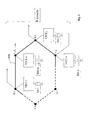
- Fig. 2 represents an improved power conditioning architecture according to the invention.
-
- The power conditioning architecture represented at Fig. 1 is already known in the art and adapted to be used in a vehicle where energy is supplied by different power sources and has to be distributed to different user loads. Although applicable to some vehicles such as submarines or even cars, the shown power conditioning architecture is particularly adapted to be used in a spacecraft. Therein, two kinds of power sources are available:
- several batteries, such as Battm and Battn, used when no sunlight is available, and
- about 40 solar arrays, such as SAi and SAj, used to provide the necessary energy in sunlight mode.
- The conditioning of the power sources available on board of spacecraft and the subsequent power distribution to users generically occur under a centralized architecture. This means that the current from the power sources converge onto a single current concentrating point CP where a DC voltage regulation is enforced and from where the current distribution to the bus users LOADS is set up. In more detail, the power sources SAi - SAj and Battm - Battn are connected to one end CP of an interconnection device or common power bus BUS via respective power control electronics PCEi - PCEj and PCEm - PCEn, e.g. as mentioned on the Internet site < http://www.esa.int/est/prod/prod0305.htm >. The other end of the BUS is connected to different user loads LOADS. The architecture further comprises a voltage control electronic VCE having an input connected to the end CP and controlling the different power control electronics PCEi - PCEj and PCEm- PCEn.
- Although such architecture eases the power bus voltage control, it ensues a concentration of the whole spacecraft current (e.g. 100 A for a 10 KW spacecraft) into a single conductive line BUS. Heavy copper bars requesting bolted interconnections therefore typically constitute such conductive lines. That situation is all the less bearable that the present trend in terms of power level applicable to telecommunication satellites is a steady increase.
- The power conditioning architecture according to the invention and shown at Fig.2 aims at introducing a network architecture LINE as replacement of the known common power bus. In this architecture, the power sources SAi - SAj and Battm - Battn as well as the bus users LOADS are scattered over the spacecraft. The network LINE is therefore provided with several interconnected nodes Ni, Nj, Nk, Nl, Nm, Nn to which the power sources, solar arrays SAi, SAj and batteries Battm, Battn, are coupled via associated voltage and power control device VPCEi, VPCEj - VPCEm, VPCEn. The different bus users LOADS are also connected to these nodes Ni - Nj. As a result, the energy is no longer concentrated on the common power bus but is distributed over the different interconnections or branches of the network architecture LINE. Thin wires and even paths of printed circuit boards may thus advantageously replace the heavy copper bar and bolted interconnections of the known power conditioning architecture.
- Each voltage and power control device VPCEi, VPCEj - VPCEm, VPCEn corresponds to a power control electronic PCEi - PCEj and PCEm - PCEn, as shown at Fig. 1, and to which is associated an equivalent of the above voltage control electronic VCE. The main purpose of a voltage and power control device VPCEi, VPCEj - VPCEm, VPCEn is to connect or not the associated power source SAi, SAj - Battm, Battn, to a node Ni, Nj, Nm, Nn and, when connected, to adjust the output voltage of the power source to the voltage on the interconnection device. The voltage and power control device includes its own bus voltage error amplifier to regulate the output voltage to the node so that it doesn't rely on any external component.
- In a preferred embodiment, the nodes Ni, Nj, Nk, Nl, Nm, Nn are interconnected in a closed loop. The architecture is thereby protected against any open circuit single failure, e.g. on a branch of the network.
- It is further to be noted that the whole architecture may be build inside a Power Conditioning and Distribution Unit [PCDU], as the one disclosed at the Internet site < http://www.esa.int/est/prod/prod0305.htm >, as a Power Control Unit [PCU] for High Power GEO Satellites, or at < http://www.esa.int/est/prod/prod0303.htm > as a Power Conditioning and Distribution Unit for High Power LEO Satellites. The power conditioning and distribution unit then includes the voltage and power control devices VPCEi, VPCEj - VPCEm, VPCEn and the nodes Ni, Nj, Nm, Nn to which they are connected and that are then internal, as well as externally available nodes Nk, Nl to which the bus users LOADS are connected. The set of externally available nodes may obviously be the same as at least a part of the set of internal nodes.
- To allow an efficient distribution of the energy over the power conditioning architecture, the number of power sources is preferably equal to or greater than three.
- It is to be noted that a network architecture as described above with scattered power sources and loads is well known at (earth) ground level for electricity production and distribution. However, the present invention makes a spacecraft power conditioning unit compatible with the network notion by means of convenient voltage regulation provisions against possible node voltage reference unbalance.
- It is also to be noted that, although the above description as been made in relation with a spacecraft, it is also possible to implement the invention in other kinds of vehicles, such as for instance a submarine where the solar arrays will then be replaced by nuclear power sources.
- A final remark is that embodiments of the present invention are described above in terms of functional blocks. From the functional description of these blocks, given above, it will be apparent for a person skilled in the art of designing electronic devices how embodiments of these blocks can be manufactured with well-known electronic components. A detailed architecture of the contents of the functional blocks hence is not given.
- While the principles of the invention have been described above in connection with specific apparatus, it is to be clearly understood that this description is merely made by way of example and not as a limitation on the scope of the invention, as defined in the appended claims.
Claims (10)
- Power conditioning architecture for a vehicle, said architecture comprising a plurality of power sources (SAi ... SAj; Battm ... Battn) coupled to a plurality of loads (LOADS) by means of an interconnection device,
characterized in that said interconnection device (LINE) has a network architecture with scattered nodes (Ni ... Nn) interconnected to each other,
and in that the power sources of said plurality of power sources (SAi ... SAj; Battm .... Battn) are coupled to said nodes in a distributive manner, - Power conditioning architecture according to claim 1, characterized in that the loads of said plurality of loads (LOADS) are connected to said scattered nodes (Ni ... Nn) in a distributive manner.
- Power conditioning architecture according to claim 1, characterized in that said power sources (SAi ... SAj; Battm ... Battn) are coupled to the scattered nodes (Ni ... Nn) of said network architecture via voltage and power control devices (VPCEi ... VPCEn).
- Power conditioning architecture according to claim 3, characterized in that said network architecture is build into at least one power conditioning and distribution unit including said voltage and power control devices (VPCEi ... VPCEn) and said nodes (Ni ... Nn).
- Power conditioning architecture according to claim 1, characterized in that said nodes (Ni ... Nn) are interconnected (LINE) in a closed loop.
- Power conditioning architecture according to claim 1, characterized in that said nodes (Ni ... Nn) are scattered within said vehicle,
- Power conditioning architecture according to claim 1, characterized in that said architecture comprises at least three power sources (SAi ... SAj; Battm ... Battn).
- Power conditioning architecture according to claim 1, characterized in that said vehicle is a spacecraft.
- Power conditioning architecture according to claim 8, characterized in that said plurality of power sources comprises solar arrays (SAi ... SAj) and electrical batteries (Battm ... Battn).
- Power conditioning architecture according to claim 8, characterized in that said spacecraft comprises at least three solar arrays (SAi ... SAj).
Priority Applications (5)
| Application Number | Priority Date | Filing Date | Title |
|---|---|---|---|
| AT03291280T ATE335660T1 (en) | 2003-05-28 | 2003-05-28 | POWER TREATMENT CIRCUIT FOR SPACECRAFT |
| ES03291280T ES2265093T3 (en) | 2003-05-28 | 2003-05-28 | POWER CONDITIONING ARCHITECTURE FOR A SPACE SHIP. |
| DE60307437T DE60307437T2 (en) | 2003-05-28 | 2003-05-28 | Power handling circuit for spacecraft |
| EP03291280A EP1481898B1 (en) | 2003-05-28 | 2003-05-28 | Power conditioning architecture for spacecraft |
| CNB2004100347935A CN100372210C (en) | 2003-05-28 | 2004-05-17 | Power conditioning structures for spacecraft |
Applications Claiming Priority (1)
| Application Number | Priority Date | Filing Date | Title |
|---|---|---|---|
| EP03291280A EP1481898B1 (en) | 2003-05-28 | 2003-05-28 | Power conditioning architecture for spacecraft |
Publications (2)
| Publication Number | Publication Date |
|---|---|
| EP1481898A1 true EP1481898A1 (en) | 2004-12-01 |
| EP1481898B1 EP1481898B1 (en) | 2006-08-09 |
Family
ID=33104208
Family Applications (1)
| Application Number | Title | Priority Date | Filing Date |
|---|---|---|---|
| EP03291280A Expired - Lifetime EP1481898B1 (en) | 2003-05-28 | 2003-05-28 | Power conditioning architecture for spacecraft |
Country Status (5)
| Country | Link |
|---|---|
| EP (1) | EP1481898B1 (en) |
| CN (1) | CN100372210C (en) |
| AT (1) | ATE335660T1 (en) |
| DE (1) | DE60307437T2 (en) |
| ES (1) | ES2265093T3 (en) |
Cited By (1)
| Publication number | Priority date | Publication date | Assignee | Title |
|---|---|---|---|---|
| EP3178741A1 (en) * | 2015-12-10 | 2017-06-14 | Thales | Device for supplying power to an aerospace vehicle, associated system for controlling electric actuators of a space launcher and space launcher |
Families Citing this family (1)
| Publication number | Priority date | Publication date | Assignee | Title |
|---|---|---|---|---|
| CN105762786A (en) * | 2016-04-21 | 2016-07-13 | 上海微小卫星工程中心 | Power supply system for short-period spacecraft |
Citations (3)
| Publication number | Priority date | Publication date | Assignee | Title |
|---|---|---|---|---|
| US4659942A (en) * | 1985-06-03 | 1987-04-21 | The Charles Stark Draper Laboratory, Inc. | Fault-tolerant power distribution system |
| US5798574A (en) * | 1996-12-20 | 1998-08-25 | Trw Inc. | Distributed electrical power system for modular spacecraft |
| US5874786A (en) * | 1997-03-20 | 1999-02-23 | Space Systems/Loral, Inc. | Quad spacecraft power bus systems |
-
2003
- 2003-05-28 EP EP03291280A patent/EP1481898B1/en not_active Expired - Lifetime
- 2003-05-28 DE DE60307437T patent/DE60307437T2/en not_active Expired - Lifetime
- 2003-05-28 ES ES03291280T patent/ES2265093T3/en not_active Expired - Lifetime
- 2003-05-28 AT AT03291280T patent/ATE335660T1/en not_active IP Right Cessation
-
2004
- 2004-05-17 CN CNB2004100347935A patent/CN100372210C/en not_active Expired - Fee Related
Patent Citations (3)
| Publication number | Priority date | Publication date | Assignee | Title |
|---|---|---|---|---|
| US4659942A (en) * | 1985-06-03 | 1987-04-21 | The Charles Stark Draper Laboratory, Inc. | Fault-tolerant power distribution system |
| US5798574A (en) * | 1996-12-20 | 1998-08-25 | Trw Inc. | Distributed electrical power system for modular spacecraft |
| US5874786A (en) * | 1997-03-20 | 1999-02-23 | Space Systems/Loral, Inc. | Quad spacecraft power bus systems |
Cited By (1)
| Publication number | Priority date | Publication date | Assignee | Title |
|---|---|---|---|---|
| EP3178741A1 (en) * | 2015-12-10 | 2017-06-14 | Thales | Device for supplying power to an aerospace vehicle, associated system for controlling electric actuators of a space launcher and space launcher |
Also Published As
| Publication number | Publication date |
|---|---|
| CN100372210C (en) | 2008-02-27 |
| ATE335660T1 (en) | 2006-09-15 |
| DE60307437D1 (en) | 2006-09-21 |
| EP1481898B1 (en) | 2006-08-09 |
| DE60307437T2 (en) | 2007-03-29 |
| ES2265093T3 (en) | 2007-02-01 |
| CN1572655A (en) | 2005-02-02 |
Similar Documents
| Publication | Publication Date | Title |
|---|---|---|
| US7498693B2 (en) | More compact and higher reliability power source system | |
| US9866145B2 (en) | Control of leakage currents in systems with a plurality of parallel inverters | |
| US20160181802A1 (en) | Power system based on current source | |
| US9550423B2 (en) | Interlock switching circuit for protecting an electrical on-board power supply | |
| CN103029586A (en) | Power distribution in aircraft | |
| US9627894B1 (en) | Modular solar inverter | |
| US10784656B2 (en) | Power distribution rack assembly | |
| US7671484B2 (en) | Device for controlling power transfer between two cores of a direct current network | |
| EP3457512B1 (en) | Power distribution system for dc network | |
| US20010054848A1 (en) | Method and apparatus for balancing the power losses in a number of parallel-connected cascode circuits | |
| WO2020246951A1 (en) | Reconfigurable power processing unit for spacecraft operations | |
| US11146072B2 (en) | Inverter with at least two DC/DC converters and use of such an inverter in a photovoltaic installation | |
| US8489903B2 (en) | System for maintaining power efficiency of power supply modules by selectively connecting and disconnecting power supply modules from a plurality of power supply modules based on the calculated power supply module output to input ratio of each module | |
| EP1481898B1 (en) | Power conditioning architecture for spacecraft | |
| KR102307824B1 (en) | Power supply and its current equalization method | |
| KR20190098664A (en) | Power supplying system based on dc for ship capable of bi-polar dc distribution | |
| JP2010142077A (en) | Multi-parallel power supply | |
| CN118381308A (en) | A series type DC unloading device and a control method thereof in cooperation with a converter station | |
| Sayed et al. | Optimal DC voltage control in multi-terminal HVDC network: Modeling and scenarios | |
| US11368022B2 (en) | Device and method for controlling a load flow in an alternating-voltage network | |
| Parkes et al. | The Space Power System Standard | |
| US10622815B2 (en) | Analogue overall balancing system for an assembly of capacitive-effect electrical energy storage devices, rechargeable storage module, electric vehicle and electrical installation comprising such a system | |
| US20250219575A1 (en) | Regulating high-voltage buses with partitioned sets of solar cells | |
| US20250330025A1 (en) | Intelligent Software-controlled Modular Power Management and Distribution | |
| Funato et al. | A new instantaneous power flow control method using variable inductance realized by variable active-passive reactance (VAPAR) |
Legal Events
| Date | Code | Title | Description |
|---|---|---|---|
| PUAI | Public reference made under article 153(3) epc to a published international application that has entered the european phase |
Free format text: ORIGINAL CODE: 0009012 |
|
| AK | Designated contracting states |
Kind code of ref document: A1 Designated state(s): AT BE BG CH CY CZ DE DK EE ES FI FR GB GR HU IE IT LI LU MC NL PT RO SE SI SK TR |
|
| AX | Request for extension of the european patent |
Extension state: AL LT LV MK |
|
| 17P | Request for examination filed |
Effective date: 20050601 |
|
| AKX | Designation fees paid |
Designated state(s): AT BE BG CH CY CZ DE DK EE ES FI FR GB GR HU IE IT LI LU MC NL PT RO SE SI SK TR |
|
| GRAP | Despatch of communication of intention to grant a patent |
Free format text: ORIGINAL CODE: EPIDOSNIGR1 |
|
| GRAS | Grant fee paid |
Free format text: ORIGINAL CODE: EPIDOSNIGR3 |
|
| GRAA | (expected) grant |
Free format text: ORIGINAL CODE: 0009210 |
|
| AK | Designated contracting states |
Kind code of ref document: B1 Designated state(s): AT BE BG CH CY CZ DE DK EE ES FI FR GB GR HU IE IT LI LU MC NL PT RO SE SI SK TR |
|
| PG25 | Lapsed in a contracting state [announced via postgrant information from national office to epo] |
Ref country code: IT Free format text: LAPSE BECAUSE OF FAILURE TO SUBMIT A TRANSLATION OF THE DESCRIPTION OR TO PAY THE FEE WITHIN THE PRESCRIBED TIME-LIMIT;WARNING: LAPSES OF ITALIAN PATENTS WITH EFFECTIVE DATE BEFORE 2007 MAY HAVE OCCURRED AT ANY TIME BEFORE 2007. THE CORRECT EFFECTIVE DATE MAY BE DIFFERENT FROM THE ONE RECORDED. Effective date: 20060809 Ref country code: LI Free format text: LAPSE BECAUSE OF FAILURE TO SUBMIT A TRANSLATION OF THE DESCRIPTION OR TO PAY THE FEE WITHIN THE PRESCRIBED TIME-LIMIT Effective date: 20060809 Ref country code: BE Free format text: LAPSE BECAUSE OF FAILURE TO SUBMIT A TRANSLATION OF THE DESCRIPTION OR TO PAY THE FEE WITHIN THE PRESCRIBED TIME-LIMIT Effective date: 20060809 Ref country code: CZ Free format text: LAPSE BECAUSE OF FAILURE TO SUBMIT A TRANSLATION OF THE DESCRIPTION OR TO PAY THE FEE WITHIN THE PRESCRIBED TIME-LIMIT Effective date: 20060809 Ref country code: SI Free format text: LAPSE BECAUSE OF FAILURE TO SUBMIT A TRANSLATION OF THE DESCRIPTION OR TO PAY THE FEE WITHIN THE PRESCRIBED TIME-LIMIT Effective date: 20060809 Ref country code: FI Free format text: LAPSE BECAUSE OF FAILURE TO SUBMIT A TRANSLATION OF THE DESCRIPTION OR TO PAY THE FEE WITHIN THE PRESCRIBED TIME-LIMIT Effective date: 20060809 Ref country code: AT Free format text: LAPSE BECAUSE OF FAILURE TO SUBMIT A TRANSLATION OF THE DESCRIPTION OR TO PAY THE FEE WITHIN THE PRESCRIBED TIME-LIMIT Effective date: 20060809 Ref country code: SK Free format text: LAPSE BECAUSE OF FAILURE TO SUBMIT A TRANSLATION OF THE DESCRIPTION OR TO PAY THE FEE WITHIN THE PRESCRIBED TIME-LIMIT Effective date: 20060809 Ref country code: CH Free format text: LAPSE BECAUSE OF FAILURE TO SUBMIT A TRANSLATION OF THE DESCRIPTION OR TO PAY THE FEE WITHIN THE PRESCRIBED TIME-LIMIT Effective date: 20060809 Ref country code: RO Free format text: LAPSE BECAUSE OF FAILURE TO SUBMIT A TRANSLATION OF THE DESCRIPTION OR TO PAY THE FEE WITHIN THE PRESCRIBED TIME-LIMIT Effective date: 20060809 |
|
| REG | Reference to a national code |
Ref country code: GB Ref legal event code: FG4D |
|
| REG | Reference to a national code |
Ref country code: CH Ref legal event code: EP |
|
| REG | Reference to a national code |
Ref country code: IE Ref legal event code: FG4D |
|
| REF | Corresponds to: |
Ref document number: 60307437 Country of ref document: DE Date of ref document: 20060921 Kind code of ref document: P |
|
| PG25 | Lapsed in a contracting state [announced via postgrant information from national office to epo] |
Ref country code: DK Free format text: LAPSE BECAUSE OF FAILURE TO SUBMIT A TRANSLATION OF THE DESCRIPTION OR TO PAY THE FEE WITHIN THE PRESCRIBED TIME-LIMIT Effective date: 20061109 Ref country code: BG Free format text: LAPSE BECAUSE OF FAILURE TO SUBMIT A TRANSLATION OF THE DESCRIPTION OR TO PAY THE FEE WITHIN THE PRESCRIBED TIME-LIMIT Effective date: 20061109 Ref country code: SE Free format text: LAPSE BECAUSE OF FAILURE TO SUBMIT A TRANSLATION OF THE DESCRIPTION OR TO PAY THE FEE WITHIN THE PRESCRIBED TIME-LIMIT Effective date: 20061109 |
|
| PG25 | Lapsed in a contracting state [announced via postgrant information from national office to epo] |
Ref country code: PT Free format text: LAPSE BECAUSE OF FAILURE TO SUBMIT A TRANSLATION OF THE DESCRIPTION OR TO PAY THE FEE WITHIN THE PRESCRIBED TIME-LIMIT Effective date: 20070109 |
|
| REG | Reference to a national code |
Ref country code: ES Ref legal event code: FG2A Ref document number: 2265093 Country of ref document: ES Kind code of ref document: T3 |
|
| REG | Reference to a national code |
Ref country code: CH Ref legal event code: PL |
|
| ET | Fr: translation filed | ||
| RAP2 | Party data changed (patent owner data changed or rights of a patent transferred) |
Owner name: ALCATEL LUCENT |
|
| NLT2 | Nl: modifications (of names), taken from the european patent patent bulletin |
Owner name: ALCATEL LUCENT Effective date: 20070404 |
|
| PLBE | No opposition filed within time limit |
Free format text: ORIGINAL CODE: 0009261 |
|
| STAA | Information on the status of an ep patent application or granted ep patent |
Free format text: STATUS: NO OPPOSITION FILED WITHIN TIME LIMIT |
|
| 26N | No opposition filed |
Effective date: 20070510 |
|
| PG25 | Lapsed in a contracting state [announced via postgrant information from national office to epo] |
Ref country code: MC Free format text: LAPSE BECAUSE OF NON-PAYMENT OF DUE FEES Effective date: 20070531 |
|
| PG25 | Lapsed in a contracting state [announced via postgrant information from national office to epo] |
Ref country code: GR Free format text: LAPSE BECAUSE OF FAILURE TO SUBMIT A TRANSLATION OF THE DESCRIPTION OR TO PAY THE FEE WITHIN THE PRESCRIBED TIME-LIMIT Effective date: 20061110 |
|
| PG25 | Lapsed in a contracting state [announced via postgrant information from national office to epo] |
Ref country code: IE Free format text: LAPSE BECAUSE OF NON-PAYMENT OF DUE FEES Effective date: 20070528 |
|
| PG25 | Lapsed in a contracting state [announced via postgrant information from national office to epo] |
Ref country code: EE Free format text: LAPSE BECAUSE OF FAILURE TO SUBMIT A TRANSLATION OF THE DESCRIPTION OR TO PAY THE FEE WITHIN THE PRESCRIBED TIME-LIMIT Effective date: 20060809 |
|
| PG25 | Lapsed in a contracting state [announced via postgrant information from national office to epo] |
Ref country code: LU Free format text: LAPSE BECAUSE OF NON-PAYMENT OF DUE FEES Effective date: 20070528 Ref country code: CY Free format text: LAPSE BECAUSE OF FAILURE TO SUBMIT A TRANSLATION OF THE DESCRIPTION OR TO PAY THE FEE WITHIN THE PRESCRIBED TIME-LIMIT Effective date: 20060809 |
|
| PG25 | Lapsed in a contracting state [announced via postgrant information from national office to epo] |
Ref country code: HU Free format text: LAPSE BECAUSE OF FAILURE TO SUBMIT A TRANSLATION OF THE DESCRIPTION OR TO PAY THE FEE WITHIN THE PRESCRIBED TIME-LIMIT Effective date: 20070210 Ref country code: TR Free format text: LAPSE BECAUSE OF FAILURE TO SUBMIT A TRANSLATION OF THE DESCRIPTION OR TO PAY THE FEE WITHIN THE PRESCRIBED TIME-LIMIT Effective date: 20060809 |
|
| REG | Reference to a national code |
Ref country code: FR Ref legal event code: PLFP Year of fee payment: 13 |
|
| REG | Reference to a national code |
Ref country code: FR Ref legal event code: CA Effective date: 20150521 |
|
| REG | Reference to a national code |
Ref country code: FR Ref legal event code: CA Effective date: 20150521 |
|
| REG | Reference to a national code |
Ref country code: FR Ref legal event code: PLFP Year of fee payment: 14 |
|
| PGFP | Annual fee paid to national office [announced via postgrant information from national office to epo] |
Ref country code: NL Payment date: 20160510 Year of fee payment: 14 |
|
| PGFP | Annual fee paid to national office [announced via postgrant information from national office to epo] |
Ref country code: ES Payment date: 20160427 Year of fee payment: 14 Ref country code: GB Payment date: 20160525 Year of fee payment: 14 Ref country code: DE Payment date: 20160524 Year of fee payment: 14 |
|
| PGFP | Annual fee paid to national office [announced via postgrant information from national office to epo] |
Ref country code: FR Payment date: 20160426 Year of fee payment: 14 |
|
| REG | Reference to a national code |
Ref country code: DE Ref legal event code: R119 Ref document number: 60307437 Country of ref document: DE |
|
| REG | Reference to a national code |
Ref country code: NL Ref legal event code: MM Effective date: 20170601 |
|
| GBPC | Gb: european patent ceased through non-payment of renewal fee |
Effective date: 20170528 |
|
| REG | Reference to a national code |
Ref country code: FR Ref legal event code: ST Effective date: 20180131 |
|
| PG25 | Lapsed in a contracting state [announced via postgrant information from national office to epo] |
Ref country code: NL Free format text: LAPSE BECAUSE OF NON-PAYMENT OF DUE FEES Effective date: 20170601 |
|
| PG25 | Lapsed in a contracting state [announced via postgrant information from national office to epo] |
Ref country code: GB Free format text: LAPSE BECAUSE OF NON-PAYMENT OF DUE FEES Effective date: 20170528 Ref country code: DE Free format text: LAPSE BECAUSE OF NON-PAYMENT OF DUE FEES Effective date: 20171201 |
|
| PG25 | Lapsed in a contracting state [announced via postgrant information from national office to epo] |
Ref country code: FR Free format text: LAPSE BECAUSE OF NON-PAYMENT OF DUE FEES Effective date: 20170531 |
|
| REG | Reference to a national code |
Ref country code: ES Ref legal event code: FD2A Effective date: 20180705 |
|
| PG25 | Lapsed in a contracting state [announced via postgrant information from national office to epo] |
Ref country code: ES Free format text: LAPSE BECAUSE OF NON-PAYMENT OF DUE FEES Effective date: 20170529 |