EP1480642B1 - Peroxisome proliferator activated receptor modulators - Google Patents
Peroxisome proliferator activated receptor modulators Download PDFInfo
- Publication number
- EP1480642B1 EP1480642B1 EP03710780A EP03710780A EP1480642B1 EP 1480642 B1 EP1480642 B1 EP 1480642B1 EP 03710780 A EP03710780 A EP 03710780A EP 03710780 A EP03710780 A EP 03710780A EP 1480642 B1 EP1480642 B1 EP 1480642B1
- Authority
- EP
- European Patent Office
- Prior art keywords
- sub
- phenyl
- compound
- alkyl
- methyl
- Prior art date
- Legal status (The legal status is an assumption and is not a legal conclusion. Google has not performed a legal analysis and makes no representation as to the accuracy of the status listed.)
- Expired - Lifetime
Links
- 102000003728 Peroxisome Proliferator-Activated Receptors Human genes 0.000 title claims description 29
- 108090000029 Peroxisome Proliferator-Activated Receptors Proteins 0.000 title claims description 29
- 150000001875 compounds Chemical class 0.000 claims abstract description 195
- 125000000217 alkyl group Chemical group 0.000 claims abstract description 35
- 150000003839 salts Chemical class 0.000 claims abstract description 29
- 229910052757 nitrogen Inorganic materials 0.000 claims abstract description 25
- 229910052739 hydrogen Inorganic materials 0.000 claims abstract description 20
- 239000001257 hydrogen Substances 0.000 claims abstract description 20
- 125000003118 aryl group Chemical group 0.000 claims abstract description 14
- 125000005110 aryl thio group Chemical group 0.000 claims abstract description 11
- 125000004104 aryloxy group Chemical group 0.000 claims abstract description 11
- 229910052760 oxygen Inorganic materials 0.000 claims abstract description 9
- 125000004435 hydrogen atom Chemical group [H]* 0.000 claims abstract description 7
- 229910052717 sulfur Inorganic materials 0.000 claims abstract description 7
- 125000004178 (C1-C4) alkyl group Chemical group 0.000 claims abstract description 6
- 125000003342 alkenyl group Chemical group 0.000 claims abstract description 3
- 229910052799 carbon Inorganic materials 0.000 claims abstract description 3
- 125000003107 substituted aryl group Chemical group 0.000 claims abstract description 3
- 238000011282 treatment Methods 0.000 claims description 29
- 206010012601 diabetes mellitus Diseases 0.000 claims description 16
- 241000124008 Mammalia Species 0.000 claims description 15
- -1 C1-C5 alkylCOOH Chemical group 0.000 claims description 11
- UFHFLCQGNIYNRP-UHFFFAOYSA-N Hydrogen Chemical compound [H][H] UFHFLCQGNIYNRP-UHFFFAOYSA-N 0.000 claims description 10
- 201000001320 Atherosclerosis Diseases 0.000 claims description 9
- 239000003814 drug Substances 0.000 claims description 9
- 239000008194 pharmaceutical composition Substances 0.000 claims description 9
- 125000002023 trifluoromethyl group Chemical group FC(F)(F)* 0.000 claims description 9
- 238000004519 manufacturing process Methods 0.000 claims description 8
- 125000001475 halogen functional group Chemical group 0.000 claims description 6
- 125000001424 substituent group Chemical group 0.000 claims description 6
- 125000001997 phenyl group Chemical group [H]C1=C([H])C([H])=C(*)C([H])=C1[H] 0.000 claims description 5
- 125000003373 pyrazinyl group Chemical group 0.000 claims description 5
- 125000000714 pyrimidinyl group Chemical group 0.000 claims description 5
- 125000006727 (C1-C6) alkenyl group Chemical group 0.000 claims description 4
- 125000004169 (C1-C6) alkyl group Chemical group 0.000 claims description 4
- 125000002496 methyl group Chemical group [H]C([H])([H])* 0.000 claims description 4
- 125000004076 pyridyl group Chemical group 0.000 claims description 4
- 239000003937 drug carrier Substances 0.000 claims description 3
- 150000002431 hydrogen Chemical class 0.000 claims description 3
- 125000006273 (C1-C3) alkyl group Chemical group 0.000 claims description 2
- 125000006274 (C1-C3)alkoxy group Chemical group 0.000 claims description 2
- 125000000229 (C1-C4)alkoxy group Chemical group 0.000 claims description 2
- 125000006527 (C1-C5) alkyl group Chemical group 0.000 claims description 2
- 125000006529 (C3-C6) alkyl group Chemical group 0.000 claims description 2
- 125000000896 monocarboxylic acid group Chemical group 0.000 claims description 2
- 125000003884 phenylalkyl group Chemical group 0.000 claims 1
- 125000005002 aryl methyl group Chemical group 0.000 abstract 1
- 125000003917 carbamoyl group Chemical class [H]N([H])C(*)=O 0.000 abstract 1
- 125000003178 carboxy group Chemical group [H]OC(*)=O 0.000 abstract 1
- 125000000524 functional group Chemical group 0.000 abstract 1
- XEKOWRVHYACXOJ-UHFFFAOYSA-N Ethyl acetate Chemical compound CCOC(C)=O XEKOWRVHYACXOJ-UHFFFAOYSA-N 0.000 description 186
- 239000000203 mixture Substances 0.000 description 96
- XLYOFNOQVPJJNP-UHFFFAOYSA-N water Chemical compound O XLYOFNOQVPJJNP-UHFFFAOYSA-N 0.000 description 82
- 238000006243 chemical reaction Methods 0.000 description 72
- YMWUJEATGCHHMB-UHFFFAOYSA-N Dichloromethane Chemical compound ClCCl YMWUJEATGCHHMB-UHFFFAOYSA-N 0.000 description 65
- 235000019439 ethyl acetate Nutrition 0.000 description 65
- VLKZOEOYAKHREP-UHFFFAOYSA-N n-Hexane Chemical compound CCCCCC VLKZOEOYAKHREP-UHFFFAOYSA-N 0.000 description 64
- 238000002360 preparation method Methods 0.000 description 56
- 239000000243 solution Substances 0.000 description 56
- WYURNTSHIVDZCO-UHFFFAOYSA-N Tetrahydrofuran Chemical compound C1CCOC1 WYURNTSHIVDZCO-UHFFFAOYSA-N 0.000 description 46
- HEMHJVSKTPXQMS-UHFFFAOYSA-M Sodium hydroxide Chemical compound [OH-].[Na+] HEMHJVSKTPXQMS-UHFFFAOYSA-M 0.000 description 42
- HVYWMOMLDIMFJA-DPAQBDIFSA-N cholesterol Chemical compound C1C=C2C[C@@H](O)CC[C@]2(C)[C@@H]2[C@@H]1[C@@H]1CC[C@H]([C@H](C)CCCC(C)C)[C@@]1(C)CC2 HVYWMOMLDIMFJA-DPAQBDIFSA-N 0.000 description 42
- IJGRMHOSHXDMSA-UHFFFAOYSA-N Atomic nitrogen Chemical compound N#N IJGRMHOSHXDMSA-UHFFFAOYSA-N 0.000 description 40
- OKKJLVBELUTLKV-UHFFFAOYSA-N Methanol Chemical compound OC OKKJLVBELUTLKV-UHFFFAOYSA-N 0.000 description 37
- VYPSYNLAJGMNEJ-UHFFFAOYSA-N Silicium dioxide Chemical compound O=[Si]=O VYPSYNLAJGMNEJ-UHFFFAOYSA-N 0.000 description 37
- 239000012267 brine Substances 0.000 description 35
- HPALAKNZSZLMCH-UHFFFAOYSA-M sodium;chloride;hydrate Chemical compound O.[Na+].[Cl-] HPALAKNZSZLMCH-UHFFFAOYSA-M 0.000 description 35
- VEXZGXHMUGYJMC-UHFFFAOYSA-N Hydrochloric acid Chemical compound Cl VEXZGXHMUGYJMC-UHFFFAOYSA-N 0.000 description 34
- YXFVVABEGXRONW-UHFFFAOYSA-N Toluene Chemical compound CC1=CC=CC=C1 YXFVVABEGXRONW-UHFFFAOYSA-N 0.000 description 33
- PMZURENOXWZQFD-UHFFFAOYSA-L Sodium Sulfate Chemical compound [Na+].[Na+].[O-]S([O-])(=O)=O PMZURENOXWZQFD-UHFFFAOYSA-L 0.000 description 28
- 241000699670 Mus sp. Species 0.000 description 27
- ZMANZCXQSJIPKH-UHFFFAOYSA-N Triethylamine Chemical compound CCN(CC)CC ZMANZCXQSJIPKH-UHFFFAOYSA-N 0.000 description 27
- 239000012044 organic layer Substances 0.000 description 27
- 238000000034 method Methods 0.000 description 24
- 238000005160 1H NMR spectroscopy Methods 0.000 description 22
- LFQSCWFLJHTTHZ-UHFFFAOYSA-N Ethanol Chemical compound CCO LFQSCWFLJHTTHZ-UHFFFAOYSA-N 0.000 description 22
- 239000007787 solid Substances 0.000 description 22
- 239000000047 product Substances 0.000 description 20
- WQZGKKKJIJFFOK-GASJEMHNSA-N Glucose Natural products OC[C@H]1OC(O)[C@H](O)[C@@H](O)[C@@H]1O WQZGKKKJIJFFOK-GASJEMHNSA-N 0.000 description 19
- ZMXDDKWLCZADIW-UHFFFAOYSA-N N,N-Dimethylformamide Chemical compound CN(C)C=O ZMXDDKWLCZADIW-UHFFFAOYSA-N 0.000 description 19
- 239000008103 glucose Substances 0.000 description 19
- RTZKZFJDLAIYFH-UHFFFAOYSA-N Diethyl ether Chemical compound CCOCC RTZKZFJDLAIYFH-UHFFFAOYSA-N 0.000 description 18
- NOESYZHRGYRDHS-UHFFFAOYSA-N insulin Chemical compound N1C(=O)C(NC(=O)C(CCC(N)=O)NC(=O)C(CCC(O)=O)NC(=O)C(C(C)C)NC(=O)C(NC(=O)CN)C(C)CC)CSSCC(C(NC(CO)C(=O)NC(CC(C)C)C(=O)NC(CC=2C=CC(O)=CC=2)C(=O)NC(CCC(N)=O)C(=O)NC(CC(C)C)C(=O)NC(CCC(O)=O)C(=O)NC(CC(N)=O)C(=O)NC(CC=2C=CC(O)=CC=2)C(=O)NC(CSSCC(NC(=O)C(C(C)C)NC(=O)C(CC(C)C)NC(=O)C(CC=2C=CC(O)=CC=2)NC(=O)C(CC(C)C)NC(=O)C(C)NC(=O)C(CCC(O)=O)NC(=O)C(C(C)C)NC(=O)C(CC(C)C)NC(=O)C(CC=2NC=NC=2)NC(=O)C(CO)NC(=O)CNC2=O)C(=O)NCC(=O)NC(CCC(O)=O)C(=O)NC(CCCNC(N)=N)C(=O)NCC(=O)NC(CC=3C=CC=CC=3)C(=O)NC(CC=3C=CC=CC=3)C(=O)NC(CC=3C=CC(O)=CC=3)C(=O)NC(C(C)O)C(=O)N3C(CCC3)C(=O)NC(CCCCN)C(=O)NC(C)C(O)=O)C(=O)NC(CC(N)=O)C(O)=O)=O)NC(=O)C(C(C)CC)NC(=O)C(CO)NC(=O)C(C(C)O)NC(=O)C1CSSCC2NC(=O)C(CC(C)C)NC(=O)C(NC(=O)C(CCC(N)=O)NC(=O)C(CC(N)=O)NC(=O)C(NC(=O)C(N)CC=1C=CC=CC=1)C(C)C)CC1=CN=CN1 NOESYZHRGYRDHS-UHFFFAOYSA-N 0.000 description 18
- CSNNHWWHGAXBCP-UHFFFAOYSA-L Magnesium sulfate Chemical compound [Mg+2].[O-][S+2]([O-])([O-])[O-] CSNNHWWHGAXBCP-UHFFFAOYSA-L 0.000 description 17
- KDLHZDBZIXYQEI-UHFFFAOYSA-N Palladium Chemical compound [Pd] KDLHZDBZIXYQEI-UHFFFAOYSA-N 0.000 description 16
- 235000012000 cholesterol Nutrition 0.000 description 16
- 238000010992 reflux Methods 0.000 description 16
- 239000003981 vehicle Substances 0.000 description 16
- 230000000694 effects Effects 0.000 description 15
- 241001465754 Metazoa Species 0.000 description 14
- 102000023984 PPAR alpha Human genes 0.000 description 14
- HEDRZPFGACZZDS-MICDWDOJSA-N Trichloro(2H)methane Chemical compound [2H]C(Cl)(Cl)Cl HEDRZPFGACZZDS-MICDWDOJSA-N 0.000 description 14
- 239000012071 phase Substances 0.000 description 14
- UFTFJSFQGQCHQW-UHFFFAOYSA-N triformin Chemical compound O=COCC(OC=O)COC=O UFTFJSFQGQCHQW-UHFFFAOYSA-N 0.000 description 14
- QTBSBXVTEAMEQO-UHFFFAOYSA-N Acetic acid Chemical compound CC(O)=O QTBSBXVTEAMEQO-UHFFFAOYSA-N 0.000 description 13
- 210000002966 serum Anatomy 0.000 description 13
- 238000003756 stirring Methods 0.000 description 13
- 108010010234 HDL Lipoproteins Proteins 0.000 description 12
- 102000015779 HDL Lipoproteins Human genes 0.000 description 12
- 210000004369 blood Anatomy 0.000 description 12
- 239000008280 blood Substances 0.000 description 12
- 230000037396 body weight Effects 0.000 description 12
- 238000004587 chromatography analysis Methods 0.000 description 12
- 208000037265 diseases, disorders, signs and symptoms Diseases 0.000 description 12
- 238000004128 high performance liquid chromatography Methods 0.000 description 12
- 238000003818 flash chromatography Methods 0.000 description 11
- 108091008725 peroxisome proliferator-activated receptors alpha Proteins 0.000 description 11
- 239000011541 reaction mixture Substances 0.000 description 11
- 208000011580 syndromic disease Diseases 0.000 description 11
- DTQVDTLACAAQTR-UHFFFAOYSA-N trifluoroacetic acid Substances OC(=O)C(F)(F)F DTQVDTLACAAQTR-UHFFFAOYSA-N 0.000 description 11
- 108010007622 LDL Lipoproteins Proteins 0.000 description 10
- 102000007330 LDL Lipoproteins Human genes 0.000 description 10
- 108010016731 PPAR gamma Proteins 0.000 description 10
- UIIMBOGNXHQVGW-UHFFFAOYSA-M Sodium bicarbonate Chemical class [Na+].OC([O-])=O UIIMBOGNXHQVGW-UHFFFAOYSA-M 0.000 description 10
- 238000004440 column chromatography Methods 0.000 description 10
- 239000012043 crude product Substances 0.000 description 10
- 239000000284 extract Substances 0.000 description 10
- 239000003921 oil Substances 0.000 description 10
- 235000019198 oils Nutrition 0.000 description 10
- 238000000746 purification Methods 0.000 description 10
- 229910052938 sodium sulfate Inorganic materials 0.000 description 10
- 239000002904 solvent Substances 0.000 description 10
- 238000004809 thin layer chromatography Methods 0.000 description 10
- 150000003626 triacylglycerols Chemical class 0.000 description 10
- 102000004877 Insulin Human genes 0.000 description 9
- 108090001061 Insulin Proteins 0.000 description 9
- 238000003556 assay Methods 0.000 description 9
- 239000003153 chemical reaction reagent Substances 0.000 description 9
- 229940125396 insulin Drugs 0.000 description 9
- 239000000741 silica gel Substances 0.000 description 9
- 229910002027 silica gel Inorganic materials 0.000 description 9
- YLQBMQCUIZJEEH-UHFFFAOYSA-N tetrahydrofuran Natural products C=1C=COC=1 YLQBMQCUIZJEEH-UHFFFAOYSA-N 0.000 description 9
- 229940086542 triethylamine Drugs 0.000 description 9
- 208000001072 type 2 diabetes mellitus Diseases 0.000 description 9
- 208000008589 Obesity Diseases 0.000 description 8
- 102100038825 Peroxisome proliferator-activated receptor gamma Human genes 0.000 description 8
- 239000000556 agonist Substances 0.000 description 8
- 238000009739 binding Methods 0.000 description 8
- 210000004027 cell Anatomy 0.000 description 8
- 235000020824 obesity Nutrition 0.000 description 8
- 239000003826 tablet Substances 0.000 description 8
- 208000024172 Cardiovascular disease Diseases 0.000 description 7
- 108010049003 Fibrinogen Proteins 0.000 description 7
- 102000008946 Fibrinogen Human genes 0.000 description 7
- 241000700159 Rattus Species 0.000 description 7
- 229940123464 Thiazolidinedione Drugs 0.000 description 7
- 239000004480 active ingredient Substances 0.000 description 7
- 239000013543 active substance Substances 0.000 description 7
- 230000027455 binding Effects 0.000 description 7
- FJDQFPXHSGXQBY-UHFFFAOYSA-L caesium carbonate Chemical compound [Cs+].[Cs+].[O-]C([O-])=O FJDQFPXHSGXQBY-UHFFFAOYSA-L 0.000 description 7
- 201000010099 disease Diseases 0.000 description 7
- 229940012952 fibrinogen Drugs 0.000 description 7
- 239000000706 filtrate Substances 0.000 description 7
- 238000009472 formulation Methods 0.000 description 7
- 230000009467 reduction Effects 0.000 description 7
- 238000006722 reduction reaction Methods 0.000 description 7
- 239000007858 starting material Substances 0.000 description 7
- 150000001467 thiazolidinediones Chemical class 0.000 description 7
- WFDIJRYMOXRFFG-UHFFFAOYSA-N Acetic anhydride Chemical compound CC(=O)OC(C)=O WFDIJRYMOXRFFG-UHFFFAOYSA-N 0.000 description 6
- 102000004539 Acyl-CoA Oxidase Human genes 0.000 description 6
- 108020001558 Acyl-CoA oxidase Proteins 0.000 description 6
- 102100039556 Galectin-4 Human genes 0.000 description 6
- 101000608765 Homo sapiens Galectin-4 Proteins 0.000 description 6
- 206010022489 Insulin Resistance Diseases 0.000 description 6
- BAPJBEWLBFYGME-UHFFFAOYSA-N Methyl acrylate Chemical compound COC(=O)C=C BAPJBEWLBFYGME-UHFFFAOYSA-N 0.000 description 6
- JGFZNNIVVJXRND-UHFFFAOYSA-N N,N-Diisopropylethylamine (DIPEA) Chemical compound CCN(C(C)C)C(C)C JGFZNNIVVJXRND-UHFFFAOYSA-N 0.000 description 6
- 239000007832 Na2SO4 Substances 0.000 description 6
- CDBYLPFSWZWCQE-UHFFFAOYSA-L Sodium Carbonate Chemical compound [Na+].[Na+].[O-]C([O-])=O CDBYLPFSWZWCQE-UHFFFAOYSA-L 0.000 description 6
- 229960000583 acetic acid Drugs 0.000 description 6
- 238000002474 experimental method Methods 0.000 description 6
- 238000001914 filtration Methods 0.000 description 6
- 239000010410 layer Substances 0.000 description 6
- 239000000463 material Substances 0.000 description 6
- 239000000523 sample Substances 0.000 description 6
- 239000000377 silicon dioxide Substances 0.000 description 6
- 239000000126 substance Substances 0.000 description 6
- 238000012360 testing method Methods 0.000 description 6
- BGHCVCJVXZWKCC-UHFFFAOYSA-N tetradecane Chemical compound CCCCCCCCCCCCCC BGHCVCJVXZWKCC-UHFFFAOYSA-N 0.000 description 6
- RIOQSEWOXXDEQQ-UHFFFAOYSA-N triphenylphosphine Chemical compound C1=CC=CC=C1P(C=1C=CC=CC=1)C1=CC=CC=C1 RIOQSEWOXXDEQQ-UHFFFAOYSA-N 0.000 description 6
- 241000699800 Cricetinae Species 0.000 description 5
- 108010015181 PPAR delta Proteins 0.000 description 5
- 101100244562 Pseudomonas aeruginosa (strain ATCC 15692 / DSM 22644 / CIP 104116 / JCM 14847 / LMG 12228 / 1C / PRS 101 / PAO1) oprD gene Proteins 0.000 description 5
- 208000021017 Weight Gain Diseases 0.000 description 5
- 229910000024 caesium carbonate Inorganic materials 0.000 description 5
- 239000002775 capsule Substances 0.000 description 5
- 239000003795 chemical substances by application Substances 0.000 description 5
- 108700023159 delta Opioid Receptors Proteins 0.000 description 5
- 102000048124 delta Opioid Receptors Human genes 0.000 description 5
- 208000035475 disorder Diseases 0.000 description 5
- 235000019786 weight gain Nutrition 0.000 description 5
- RYHBNJHYFVUHQT-UHFFFAOYSA-N 1,4-Dioxane Chemical compound C1COCCO1 RYHBNJHYFVUHQT-UHFFFAOYSA-N 0.000 description 4
- WEVYAHXRMPXWCK-UHFFFAOYSA-N Acetonitrile Chemical compound CC#N WEVYAHXRMPXWCK-UHFFFAOYSA-N 0.000 description 4
- IAZDPXIOMUYVGZ-WFGJKAKNSA-N Dimethyl sulfoxide Chemical compound [2H]C([2H])([2H])S(=O)C([2H])([2H])[2H] IAZDPXIOMUYVGZ-WFGJKAKNSA-N 0.000 description 4
- 239000012448 Lithium borohydride Substances 0.000 description 4
- WMFOQBRAJBCJND-UHFFFAOYSA-M Lithium hydroxide Chemical compound [Li+].[OH-] WMFOQBRAJBCJND-UHFFFAOYSA-M 0.000 description 4
- 235000019502 Orange oil Nutrition 0.000 description 4
- 108010028924 PPAR alpha Proteins 0.000 description 4
- JUJWROOIHBZHMG-UHFFFAOYSA-N Pyridine Chemical compound C1=CC=NC=C1 JUJWROOIHBZHMG-UHFFFAOYSA-N 0.000 description 4
- YASAKCUCGLMORW-UHFFFAOYSA-N Rosiglitazone Chemical compound C=1C=CC=NC=1N(C)CCOC(C=C1)=CC=C1CC1SC(=O)NC1=O YASAKCUCGLMORW-UHFFFAOYSA-N 0.000 description 4
- QAOWNCQODCNURD-UHFFFAOYSA-N Sulfuric acid Chemical compound OS(O)(=O)=O QAOWNCQODCNURD-UHFFFAOYSA-N 0.000 description 4
- 238000002835 absorbance Methods 0.000 description 4
- 239000002253 acid Substances 0.000 description 4
- 239000002585 base Substances 0.000 description 4
- WQZGKKKJIJFFOK-VFUOTHLCSA-N beta-D-glucose Chemical compound OC[C@H]1O[C@@H](O)[C@H](O)[C@@H](O)[C@@H]1O WQZGKKKJIJFFOK-VFUOTHLCSA-N 0.000 description 4
- 238000005119 centrifugation Methods 0.000 description 4
- 238000001816 cooling Methods 0.000 description 4
- NXQGGXCHGDYOHB-UHFFFAOYSA-L cyclopenta-1,4-dien-1-yl(diphenyl)phosphane;dichloropalladium;iron(2+) Chemical compound [Fe+2].Cl[Pd]Cl.[CH-]1C=CC(P(C=2C=CC=CC=2)C=2C=CC=CC=2)=C1.[CH-]1C=CC(P(C=2C=CC=CC=2)C=2C=CC=CC=2)=C1 NXQGGXCHGDYOHB-UHFFFAOYSA-L 0.000 description 4
- 238000007872 degassing Methods 0.000 description 4
- 239000002552 dosage form Substances 0.000 description 4
- 150000002148 esters Chemical class 0.000 description 4
- 229960002297 fenofibrate Drugs 0.000 description 4
- YMTINGFKWWXKFG-UHFFFAOYSA-N fenofibrate Chemical compound C1=CC(OC(C)(C)C(=O)OC(C)C)=CC=C1C(=O)C1=CC=C(Cl)C=C1 YMTINGFKWWXKFG-UHFFFAOYSA-N 0.000 description 4
- 201000001421 hyperglycemia Diseases 0.000 description 4
- 230000001965 increasing effect Effects 0.000 description 4
- 239000004615 ingredient Substances 0.000 description 4
- 239000003446 ligand Substances 0.000 description 4
- 239000012280 lithium aluminium hydride Substances 0.000 description 4
- AMDDOQIUPAINLH-UHFFFAOYSA-N methyl 2-(3-hydroxyphenyl)acetate Chemical compound COC(=O)CC1=CC=CC(O)=C1 AMDDOQIUPAINLH-UHFFFAOYSA-N 0.000 description 4
- GOOUTUOUMWGIST-UHFFFAOYSA-N methyl 3-[4-(hydroxymethyl)-2-methylphenyl]propanoate Chemical compound COC(=O)CCC1=CC=C(CO)C=C1C GOOUTUOUMWGIST-UHFFFAOYSA-N 0.000 description 4
- 238000003305 oral gavage Methods 0.000 description 4
- 239000010502 orange oil Substances 0.000 description 4
- 239000000546 pharmaceutical excipient Substances 0.000 description 4
- 239000013612 plasmid Substances 0.000 description 4
- 238000011321 prophylaxis Methods 0.000 description 4
- 238000002821 scintillation proximity assay Methods 0.000 description 4
- 235000011152 sodium sulphate Nutrition 0.000 description 4
- 239000000725 suspension Substances 0.000 description 4
- FYSNRJHAOHDILO-UHFFFAOYSA-N thionyl chloride Chemical compound ClS(Cl)=O FYSNRJHAOHDILO-UHFFFAOYSA-N 0.000 description 4
- JHVVADSEVWQAEQ-UHFFFAOYSA-N 2-[5-propyl-2-[4-(trifluoromethyl)phenyl]-1,3-thiazol-4-yl]ethanol Chemical compound OCCC1=C(CCC)SC(C=2C=CC(=CC=2)C(F)(F)F)=N1 JHVVADSEVWQAEQ-UHFFFAOYSA-N 0.000 description 3
- CZMRCDWAGMRECN-UHFFFAOYSA-N 2-{[3,4-dihydroxy-2,5-bis(hydroxymethyl)oxolan-2-yl]oxy}-6-(hydroxymethyl)oxane-3,4,5-triol Chemical compound OCC1OC(CO)(OC2OC(CO)C(O)C(O)C2O)C(O)C1O CZMRCDWAGMRECN-UHFFFAOYSA-N 0.000 description 3
- ZKTZJWYBYCEKTK-UHFFFAOYSA-N 3-[2-methyl-4-[2-[5-methyl-2-(4-pyridin-2-ylphenyl)-1,3-thiazol-4-yl]ethoxy]phenyl]propanoic acid Chemical compound CC=1SC(C=2C=CC(=CC=2)C=2N=CC=CC=2)=NC=1CCOC1=CC=C(CCC(O)=O)C(C)=C1 ZKTZJWYBYCEKTK-UHFFFAOYSA-N 0.000 description 3
- XYAOOGDXDRRDPV-UHFFFAOYSA-N 6-(2-fluorophenyl)pyridine-3-carbonitrile Chemical compound FC1=CC=CC=C1C1=CC=C(C#N)C=N1 XYAOOGDXDRRDPV-UHFFFAOYSA-N 0.000 description 3
- CSCPPACGZOOCGX-UHFFFAOYSA-N Acetone Chemical compound CC(C)=O CSCPPACGZOOCGX-UHFFFAOYSA-N 0.000 description 3
- UHOVQNZJYSORNB-UHFFFAOYSA-N Benzene Chemical compound C1=CC=CC=C1 UHOVQNZJYSORNB-UHFFFAOYSA-N 0.000 description 3
- 108091003079 Bovine Serum Albumin Proteins 0.000 description 3
- 229920002134 Carboxymethyl cellulose Polymers 0.000 description 3
- 206010053567 Coagulopathies Diseases 0.000 description 3
- PEDCQBHIVMGVHV-UHFFFAOYSA-N Glycerine Chemical compound OCC(O)CO PEDCQBHIVMGVHV-UHFFFAOYSA-N 0.000 description 3
- 241000282412 Homo Species 0.000 description 3
- 206010020772 Hypertension Diseases 0.000 description 3
- 238000008214 LDL Cholesterol Methods 0.000 description 3
- 241000699666 Mus <mouse, genus> Species 0.000 description 3
- NFHFRUOZVGFOOS-UHFFFAOYSA-N Pd(PPh3)4 Substances [Pd].C1=CC=CC=C1P(C=1C=CC=CC=1)C1=CC=CC=C1.C1=CC=CC=C1P(C=1C=CC=CC=1)C1=CC=CC=C1.C1=CC=CC=C1P(C=1C=CC=CC=1)C1=CC=CC=C1.C1=CC=CC=C1P(C=1C=CC=CC=1)C1=CC=CC=C1 NFHFRUOZVGFOOS-UHFFFAOYSA-N 0.000 description 3
- KWYUFKZDYYNOTN-UHFFFAOYSA-M Potassium hydroxide Chemical compound [OH-].[K+] KWYUFKZDYYNOTN-UHFFFAOYSA-M 0.000 description 3
- 108010062497 VLDL Lipoproteins Proteins 0.000 description 3
- ARECFHXEUWZILL-UHFFFAOYSA-N [4-methyl-2-[4-(trifluoromethyl)phenyl]-1,3-oxazol-5-yl]methanol Chemical compound O1C(CO)=C(C)N=C1C1=CC=C(C(F)(F)F)C=C1 ARECFHXEUWZILL-UHFFFAOYSA-N 0.000 description 3
- SEHCYQHVWYXBGI-UHFFFAOYSA-N [4-methyl-2-[4-(trifluoromethyl)phenyl]-1,3-thiazol-5-yl]methanol Chemical compound S1C(CO)=C(C)N=C1C1=CC=C(C(F)(F)F)C=C1 SEHCYQHVWYXBGI-UHFFFAOYSA-N 0.000 description 3
- 239000012190 activator Substances 0.000 description 3
- 210000000577 adipose tissue Anatomy 0.000 description 3
- 238000004458 analytical method Methods 0.000 description 3
- 235000010948 carboxy methyl cellulose Nutrition 0.000 description 3
- 238000012754 cardiac puncture Methods 0.000 description 3
- 238000012761 co-transfection Methods 0.000 description 3
- 239000012230 colorless oil Substances 0.000 description 3
- 238000002648 combination therapy Methods 0.000 description 3
- 230000001419 dependent effect Effects 0.000 description 3
- 235000005911 diet Nutrition 0.000 description 3
- 230000037213 diet Effects 0.000 description 3
- 239000006196 drop Substances 0.000 description 3
- 238000011156 evaluation Methods 0.000 description 3
- 239000012091 fetal bovine serum Substances 0.000 description 3
- 235000013305 food Nutrition 0.000 description 3
- 239000005457 ice water Substances 0.000 description 3
- 238000011534 incubation Methods 0.000 description 3
- 229910052943 magnesium sulfate Inorganic materials 0.000 description 3
- UHTAZTXXOJBMPG-UHFFFAOYSA-N methyl 2-[(4-tert-butylbenzoyl)amino]propanoate Chemical compound COC(=O)C(C)NC(=O)C1=CC=C(C(C)(C)C)C=C1 UHTAZTXXOJBMPG-UHFFFAOYSA-N 0.000 description 3
- BMNZQXBKSWWQRT-UHFFFAOYSA-N methyl 2-[5-methyl-2-(6-phenylsulfanylpyridin-3-yl)-1,3-oxazol-4-yl]acetate Chemical compound O1C(C)=C(CC(=O)OC)N=C1C(C=N1)=CC=C1SC1=CC=CC=C1 BMNZQXBKSWWQRT-UHFFFAOYSA-N 0.000 description 3
- RKQLGEJWROBNTL-UHFFFAOYSA-N methyl 3-[2-methyl-4-[2-[5-methyl-2-[4-(4,4,5,5-tetramethyl-1,3,2-dioxaborolan-2-yl)phenyl]-1,3-oxazol-4-yl]ethoxy]phenyl]propanoate Chemical compound C1=C(C)C(CCC(=O)OC)=CC=C1OCCC1=C(C)OC(C=2C=CC(=CC=2)B2OC(C)(C)C(C)(C)O2)=N1 RKQLGEJWROBNTL-UHFFFAOYSA-N 0.000 description 3
- PSHKMPUSSFXUIA-UHFFFAOYSA-N n,n-dimethylpyridin-2-amine Chemical compound CN(C)C1=CC=CC=N1 PSHKMPUSSFXUIA-UHFFFAOYSA-N 0.000 description 3
- 239000003960 organic solvent Substances 0.000 description 3
- 150000007978 oxazole derivatives Chemical class 0.000 description 3
- YJVFFLUZDVXJQI-UHFFFAOYSA-L palladium(ii) acetate Chemical compound [Pd+2].CC([O-])=O.CC([O-])=O YJVFFLUZDVXJQI-UHFFFAOYSA-L 0.000 description 3
- 235000010482 polyoxyethylene sorbitan monooleate Nutrition 0.000 description 3
- 229920000053 polysorbate 80 Polymers 0.000 description 3
- 239000013641 positive control Substances 0.000 description 3
- 102000005962 receptors Human genes 0.000 description 3
- 108020003175 receptors Proteins 0.000 description 3
- 230000002829 reductive effect Effects 0.000 description 3
- 229910000029 sodium carbonate Inorganic materials 0.000 description 3
- 235000017550 sodium carbonate Nutrition 0.000 description 3
- RMVRSNDYEFQCLF-UHFFFAOYSA-N thiophenol Chemical compound SC1=CC=CC=C1 RMVRSNDYEFQCLF-UHFFFAOYSA-N 0.000 description 3
- COIOYMYWGDAQPM-UHFFFAOYSA-N tris(2-methylphenyl)phosphane Chemical compound CC1=CC=CC=C1P(C=1C(=CC=CC=1)C)C1=CC=CC=C1C COIOYMYWGDAQPM-UHFFFAOYSA-N 0.000 description 3
- 210000003462 vein Anatomy 0.000 description 3
- 230000004584 weight gain Effects 0.000 description 3
- KGSUAYOKUTTZHA-UHFFFAOYSA-N 2-[(4-tert-butylbenzoyl)amino]propanoic acid Chemical compound OC(=O)C(C)NC(=O)C1=CC=C(C(C)(C)C)C=C1 KGSUAYOKUTTZHA-UHFFFAOYSA-N 0.000 description 2
- NGNBDVOYPDDBFK-UHFFFAOYSA-N 2-[2,4-di(pentan-2-yl)phenoxy]acetyl chloride Chemical compound CCCC(C)C1=CC=C(OCC(Cl)=O)C(C(C)CCC)=C1 NGNBDVOYPDDBFK-UHFFFAOYSA-N 0.000 description 2
- QMIWDTUPZIPIIA-UHFFFAOYSA-N 2-[2-[6-(2-fluorophenyl)pyridin-3-yl]-5-methyl-1,3-thiazol-4-yl]ethanol Chemical compound OCCC1=C(C)SC(C=2C=NC(=CC=2)C=2C(=CC=CC=2)F)=N1 QMIWDTUPZIPIIA-UHFFFAOYSA-N 0.000 description 2
- UYRWKXLXYZOCMD-UHFFFAOYSA-N 2-[5-ethyl-2-[4-(trifluoromethyl)phenyl]-1,3-thiazol-4-yl]ethyl 4-methylbenzenesulfonate Chemical compound CCC=1SC(C=2C=CC(=CC=2)C(F)(F)F)=NC=1CCOS(=O)(=O)C1=CC=C(C)C=C1 UYRWKXLXYZOCMD-UHFFFAOYSA-N 0.000 description 2
- MJEBLCLHZZPNFO-UHFFFAOYSA-N 3-[2-methyl-4-[2-[5-methyl-2-(4-pyridin-2-ylphenyl)-1,3-oxazol-4-yl]ethoxy]phenyl]propanoic acid Chemical compound CC=1OC(C=2C=CC(=CC=2)C=2N=CC=CC=2)=NC=1CCOC1=CC=C(CCC(O)=O)C(C)=C1 MJEBLCLHZZPNFO-UHFFFAOYSA-N 0.000 description 2
- DYRNKXSRPGAWTP-UHFFFAOYSA-N 3-[2-methyl-4-[2-[5-methyl-2-(4-pyridin-3-ylphenyl)-1,3-thiazol-4-yl]ethoxy]phenyl]propanoic acid Chemical compound CC=1SC(C=2C=CC(=CC=2)C=2C=NC=CC=2)=NC=1CCOC1=CC=C(CCC(O)=O)C(C)=C1 DYRNKXSRPGAWTP-UHFFFAOYSA-N 0.000 description 2
- ZZTWETJWHHBXKC-UHFFFAOYSA-N 3-[4-[2-[2-[6-(2-fluorophenyl)pyridin-3-yl]-5-methyl-1,3-thiazol-4-yl]ethoxy]-2-methylphenyl]propanoic acid Chemical compound CC=1SC(C=2C=NC(=CC=2)C=2C(=CC=CC=2)F)=NC=1CCOC1=CC=C(CCC(O)=O)C(C)=C1 ZZTWETJWHHBXKC-UHFFFAOYSA-N 0.000 description 2
- BWEUSXUCBYHBKS-UHFFFAOYSA-N 3-[4-[[4-ethyl-2-[4-(trifluoromethyl)phenyl]-1,3-oxazol-5-yl]methoxy]-2-methylphenyl]propanoic acid Chemical compound CCC=1N=C(C=2C=CC(=CC=2)C(F)(F)F)OC=1COC1=CC=C(CCC(O)=O)C(C)=C1 BWEUSXUCBYHBKS-UHFFFAOYSA-N 0.000 description 2
- VHYFNPMBLIVWCW-UHFFFAOYSA-N 4-Dimethylaminopyridine Chemical compound CN(C)C1=CC=NC=C1 VHYFNPMBLIVWCW-UHFFFAOYSA-N 0.000 description 2
- MHKMPNFGLYREOZ-UHFFFAOYSA-N 4-phenylmethoxy-2-propylphenol Chemical compound C1=C(O)C(CCC)=CC(OCC=2C=CC=CC=2)=C1 MHKMPNFGLYREOZ-UHFFFAOYSA-N 0.000 description 2
- LVSWSWDANARLPU-UHFFFAOYSA-N 5-(chloromethyl)-4-ethyl-2-[4-(trifluoromethyl)phenyl]-1,3-thiazole Chemical compound S1C(CCl)=C(CC)N=C1C1=CC=C(C(F)(F)F)C=C1 LVSWSWDANARLPU-UHFFFAOYSA-N 0.000 description 2
- RSBFCFXSHHONEK-UHFFFAOYSA-N 6-(2-fluorophenyl)pyridine-3-carbothioamide Chemical compound N1=CC(C(=S)N)=CC=C1C1=CC=CC=C1F RSBFCFXSHHONEK-UHFFFAOYSA-N 0.000 description 2
- UAWMVMPAYRWUFX-UHFFFAOYSA-N 6-Chloronicotinic acid Chemical compound OC(=O)C1=CC=C(Cl)N=C1 UAWMVMPAYRWUFX-UHFFFAOYSA-N 0.000 description 2
- 206010002091 Anaesthesia Diseases 0.000 description 2
- 229940123208 Biguanide Drugs 0.000 description 2
- WKBOTKDWSSQWDR-UHFFFAOYSA-N Bromine atom Chemical compound [Br] WKBOTKDWSSQWDR-UHFFFAOYSA-N 0.000 description 2
- HEDRZPFGACZZDS-UHFFFAOYSA-N Chloroform Chemical compound ClC(Cl)Cl HEDRZPFGACZZDS-UHFFFAOYSA-N 0.000 description 2
- 108020004414 DNA Proteins 0.000 description 2
- 230000004568 DNA-binding Effects 0.000 description 2
- 239000006144 Dulbecco’s modified Eagle's medium Substances 0.000 description 2
- 208000032928 Dyslipidaemia Diseases 0.000 description 2
- 206010014486 Elevated triglycerides Diseases 0.000 description 2
- 208000018522 Gastrointestinal disease Diseases 0.000 description 2
- 206010018429 Glucose tolerance impaired Diseases 0.000 description 2
- MHAJPDPJQMAIIY-UHFFFAOYSA-N Hydrogen peroxide Chemical compound OO MHAJPDPJQMAIIY-UHFFFAOYSA-N 0.000 description 2
- 208000031773 Insulin resistance syndrome Diseases 0.000 description 2
- PIWKPBJCKXDKJR-UHFFFAOYSA-N Isoflurane Chemical compound FC(F)OC(Cl)C(F)(F)F PIWKPBJCKXDKJR-UHFFFAOYSA-N 0.000 description 2
- 108010028554 LDL Cholesterol Proteins 0.000 description 2
- 229910010084 LiAlH4 Inorganic materials 0.000 description 2
- 208000017170 Lipid metabolism disease Diseases 0.000 description 2
- 102000004895 Lipoproteins Human genes 0.000 description 2
- 108090001030 Lipoproteins Proteins 0.000 description 2
- 108060001084 Luciferase Proteins 0.000 description 2
- 239000005089 Luciferase Substances 0.000 description 2
- TWRXJAOTZQYOKJ-UHFFFAOYSA-L Magnesium chloride Chemical compound [Mg+2].[Cl-].[Cl-] TWRXJAOTZQYOKJ-UHFFFAOYSA-L 0.000 description 2
- BAVYZALUXZFZLV-UHFFFAOYSA-N Methylamine Chemical compound NC BAVYZALUXZFZLV-UHFFFAOYSA-N 0.000 description 2
- 102000000536 PPAR gamma Human genes 0.000 description 2
- ISWSIDIOOBJBQZ-UHFFFAOYSA-N Phenol Chemical compound OC1=CC=CC=C1 ISWSIDIOOBJBQZ-UHFFFAOYSA-N 0.000 description 2
- XYFCBTPGUUZFHI-UHFFFAOYSA-N Phosphine Chemical compound P XYFCBTPGUUZFHI-UHFFFAOYSA-N 0.000 description 2
- XBDQKXXYIPTUBI-UHFFFAOYSA-N Propionic acid Substances CCC(O)=O XBDQKXXYIPTUBI-UHFFFAOYSA-N 0.000 description 2
- 108091027981 Response element Proteins 0.000 description 2
- 108010066463 Retinoid X Receptor alpha Proteins 0.000 description 2
- 102000026043 Retinoid X Receptor alpha Human genes 0.000 description 2
- 101100379247 Salmo trutta apoa1 gene Proteins 0.000 description 2
- PXIPVTKHYLBLMZ-UHFFFAOYSA-N Sodium azide Chemical compound [Na+].[N-]=[N+]=[N-] PXIPVTKHYLBLMZ-UHFFFAOYSA-N 0.000 description 2
- WQDUMFSSJAZKTM-UHFFFAOYSA-N Sodium methoxide Chemical compound [Na+].[O-]C WQDUMFSSJAZKTM-UHFFFAOYSA-N 0.000 description 2
- 229940100389 Sulfonylurea Drugs 0.000 description 2
- FZWLAAWBMGSTSO-UHFFFAOYSA-N Thiazole Chemical compound C1=CSC=N1 FZWLAAWBMGSTSO-UHFFFAOYSA-N 0.000 description 2
- 102000040945 Transcription factor Human genes 0.000 description 2
- 108091023040 Transcription factor Proteins 0.000 description 2
- XQEAECAUJYSCKV-UHFFFAOYSA-N [4-ethyl-2-[4-(trifluoromethyl)phenyl]-1,3-thiazol-5-yl]methanol Chemical compound S1C(CO)=C(CC)N=C1C1=CC=C(C(F)(F)F)C=C1 XQEAECAUJYSCKV-UHFFFAOYSA-N 0.000 description 2
- AFGYQILJWHCLFU-UHFFFAOYSA-N [4-propan-2-yl-2-[4-(trifluoromethyl)phenyl]-1,3-thiazol-5-yl]methanol Chemical compound S1C(CO)=C(C(C)C)N=C1C1=CC=C(C(F)(F)F)C=C1 AFGYQILJWHCLFU-UHFFFAOYSA-N 0.000 description 2
- VSCWAEJMTAWNJL-UHFFFAOYSA-K aluminium trichloride Chemical compound Cl[Al](Cl)Cl VSCWAEJMTAWNJL-UHFFFAOYSA-K 0.000 description 2
- 230000037005 anaesthesia Effects 0.000 description 2
- 239000012491 analyte Substances 0.000 description 2
- 239000008135 aqueous vehicle Substances 0.000 description 2
- 239000012298 atmosphere Substances 0.000 description 2
- XIMCEEJARCRRDO-UHFFFAOYSA-N benzyl 4-(3-methoxy-3-oxoprop-1-enyl)-3-methylbenzoate Chemical compound C1=C(C)C(C=CC(=O)OC)=CC=C1C(=O)OCC1=CC=CC=C1 XIMCEEJARCRRDO-UHFFFAOYSA-N 0.000 description 2
- SGLOQAVILGCIRP-UHFFFAOYSA-N benzyl 4-bromo-3-methylbenzoate Chemical compound C1=C(Br)C(C)=CC(C(=O)OCC=2C=CC=CC=2)=C1 SGLOQAVILGCIRP-UHFFFAOYSA-N 0.000 description 2
- AGEZXYOZHKGVCM-UHFFFAOYSA-N benzyl bromide Chemical compound BrCC1=CC=CC=C1 AGEZXYOZHKGVCM-UHFFFAOYSA-N 0.000 description 2
- 150000004283 biguanides Chemical class 0.000 description 2
- 239000011230 binding agent Substances 0.000 description 2
- 230000015572 biosynthetic process Effects 0.000 description 2
- GDTBXPJZTBHREO-UHFFFAOYSA-N bromine Substances BrBr GDTBXPJZTBHREO-UHFFFAOYSA-N 0.000 description 2
- 229910052794 bromium Inorganic materials 0.000 description 2
- 238000007707 calorimetry Methods 0.000 description 2
- 125000002837 carbocyclic group Chemical group 0.000 description 2
- 239000001768 carboxy methyl cellulose Substances 0.000 description 2
- 239000008112 carboxymethyl-cellulose Substances 0.000 description 2
- 239000003054 catalyst Substances 0.000 description 2
- 230000008859 change Effects 0.000 description 2
- 230000035602 clotting Effects 0.000 description 2
- 239000002299 complementary DNA Substances 0.000 description 2
- 239000012141 concentrate Substances 0.000 description 2
- 235000008504 concentrate Nutrition 0.000 description 2
- 239000013058 crude material Substances 0.000 description 2
- 239000010779 crude oil Substances 0.000 description 2
- 125000000753 cycloalkyl group Chemical group 0.000 description 2
- 230000007423 decrease Effects 0.000 description 2
- 238000001514 detection method Methods 0.000 description 2
- 238000011161 development Methods 0.000 description 2
- 208000010643 digestive system disease Diseases 0.000 description 2
- 239000003085 diluting agent Substances 0.000 description 2
- 238000009547 dual-energy X-ray absorptiometry Methods 0.000 description 2
- 230000003028 elevating effect Effects 0.000 description 2
- 238000005516 engineering process Methods 0.000 description 2
- 201000010063 epididymitis Diseases 0.000 description 2
- DNJIEGIFACGWOD-UHFFFAOYSA-N ethanethiol Chemical compound CCS DNJIEGIFACGWOD-UHFFFAOYSA-N 0.000 description 2
- PXHULOFOSFQHDM-UHFFFAOYSA-N ethyl 2-(4-chlorosulfonylphenoxy)acetate Chemical compound CCOC(=O)COC1=CC=C(S(Cl)(=O)=O)C=C1 PXHULOFOSFQHDM-UHFFFAOYSA-N 0.000 description 2
- JJHXEWBXGMMWKR-UHFFFAOYSA-N ethyl 2-(4-hydroxy-2-propylphenoxy)acetate Chemical compound CCCC1=CC(O)=CC=C1OCC(=O)OCC JJHXEWBXGMMWKR-UHFFFAOYSA-N 0.000 description 2
- QYBCKYRNAYJTMC-UHFFFAOYSA-N ethyl 2-(4-phenylmethoxy-2-propylphenoxy)acetate Chemical compound C1=C(OCC(=O)OCC)C(CCC)=CC(OCC=2C=CC=CC=2)=C1 QYBCKYRNAYJTMC-UHFFFAOYSA-N 0.000 description 2
- BYEWUGLPAODKQP-UHFFFAOYSA-N ethyl 2-(4-sulfanylphenoxy)acetate Chemical compound CCOC(=O)COC1=CC=C(S)C=C1 BYEWUGLPAODKQP-UHFFFAOYSA-N 0.000 description 2
- QVGNFYCHAIGESH-UHFFFAOYSA-N ethyl 2-[2-[6-(2-fluorophenyl)pyridin-3-yl]-5-methyl-1,3-thiazol-4-yl]acetate Chemical compound S1C(C)=C(CC(=O)OCC)N=C1C1=CC=C(C=2C(=CC=CC=2)F)N=C1 QVGNFYCHAIGESH-UHFFFAOYSA-N 0.000 description 2
- PRDJGEFZGPKCSG-UHFFFAOYSA-N ethyl 3-oxo-5-phenylpentanoate Chemical compound CCOC(=O)CC(=O)CCC1=CC=CC=C1 PRDJGEFZGPKCSG-UHFFFAOYSA-N 0.000 description 2
- HPCKVKWYSAGGIL-UHFFFAOYSA-N ethyl 4-propan-2-yl-2-[4-(trifluoromethyl)phenyl]-1,3-thiazole-5-carboxylate Chemical compound CC(C)C1=C(C(=O)OCC)SC(C=2C=CC(=CC=2)C(F)(F)F)=N1 HPCKVKWYSAGGIL-UHFFFAOYSA-N 0.000 description 2
- 229940125753 fibrate Drugs 0.000 description 2
- 239000000796 flavoring agent Substances 0.000 description 2
- 235000013355 food flavoring agent Nutrition 0.000 description 2
- 235000012631 food intake Nutrition 0.000 description 2
- 208000018685 gastrointestinal system disease Diseases 0.000 description 2
- 230000014509 gene expression Effects 0.000 description 2
- 230000007062 hydrolysis Effects 0.000 description 2
- 238000006460 hydrolysis reaction Methods 0.000 description 2
- 238000000338 in vitro Methods 0.000 description 2
- 230000000977 initiatory effect Effects 0.000 description 2
- 239000007924 injection Substances 0.000 description 2
- 238000002347 injection Methods 0.000 description 2
- 229960002725 isoflurane Drugs 0.000 description 2
- 150000002632 lipids Chemical class 0.000 description 2
- 210000004185 liver Anatomy 0.000 description 2
- 239000000314 lubricant Substances 0.000 description 2
- HQKMJHAJHXVSDF-UHFFFAOYSA-L magnesium stearate Chemical compound [Mg+2].CCCCCCCCCCCCCCCCCC([O-])=O.CCCCCCCCCCCCCCCCCC([O-])=O HQKMJHAJHXVSDF-UHFFFAOYSA-L 0.000 description 2
- NUJOXMJBOLGQSY-UHFFFAOYSA-N manganese dioxide Chemical compound O=[Mn]=O NUJOXMJBOLGQSY-UHFFFAOYSA-N 0.000 description 2
- 238000005259 measurement Methods 0.000 description 2
- 230000001404 mediated effect Effects 0.000 description 2
- 239000002609 medium Substances 0.000 description 2
- 230000002503 metabolic effect Effects 0.000 description 2
- QARBMVPHQWIHKH-UHFFFAOYSA-N methanesulfonyl chloride Chemical compound CS(Cl)(=O)=O QARBMVPHQWIHKH-UHFFFAOYSA-N 0.000 description 2
- XFBPQJQVVAADEG-UHFFFAOYSA-N methyl 2-(3-sulfanylphenyl)acetate Chemical compound COC(=O)CC1=CC=CC(S)=C1 XFBPQJQVVAADEG-UHFFFAOYSA-N 0.000 description 2
- FWHNDYVYVYLGPZ-UHFFFAOYSA-N methyl 2-(4-bromo-2-methylphenoxy)acetate Chemical compound COC(=O)COC1=CC=C(Br)C=C1C FWHNDYVYVYLGPZ-UHFFFAOYSA-N 0.000 description 2
- OYJIOMARRSXPCH-UHFFFAOYSA-N methyl 2-[2-(6-chloropyridin-3-yl)-5-methyl-1,3-oxazol-4-yl]acetate Chemical compound O1C(C)=C(CC(=O)OC)N=C1C1=CC=C(Cl)N=C1 OYJIOMARRSXPCH-UHFFFAOYSA-N 0.000 description 2
- AENJJFPCIBKLCO-UHFFFAOYSA-N methyl 2-[3-(dimethylcarbamothioyloxy)phenyl]acetate Chemical compound COC(=O)CC1=CC=CC(OC(=S)N(C)C)=C1 AENJJFPCIBKLCO-UHFFFAOYSA-N 0.000 description 2
- GILKSFBVDXHFMO-UHFFFAOYSA-N methyl 2-[3-(dimethylcarbamoylsulfanyl)phenyl]acetate Chemical compound COC(=O)CC1=CC=CC(SC(=O)N(C)C)=C1 GILKSFBVDXHFMO-UHFFFAOYSA-N 0.000 description 2
- IAMMZWVAOUNFAE-UHFFFAOYSA-N methyl 2-[5-propyl-2-[4-(trifluoromethyl)phenyl]-1,3-thiazol-4-yl]acetate Chemical compound COC(=O)CC1=C(CCC)SC(C=2C=CC(=CC=2)C(F)(F)F)=N1 IAMMZWVAOUNFAE-UHFFFAOYSA-N 0.000 description 2
- XFKHALKYWCYHCD-UHFFFAOYSA-N methyl 3-(2-methyl-4-nitrophenyl)prop-2-enoate Chemical compound COC(=O)C=CC1=CC=C([N+]([O-])=O)C=C1C XFKHALKYWCYHCD-UHFFFAOYSA-N 0.000 description 2
- ODLWNGHAFCFPLT-UHFFFAOYSA-N methyl 3-(2-methyl-4-sulfanylphenyl)propanoate Chemical compound COC(=O)CCC1=CC=C(S)C=C1C ODLWNGHAFCFPLT-UHFFFAOYSA-N 0.000 description 2
- IIFOKIAATXLZIB-UHFFFAOYSA-N methyl 3-(3-hydroxyphenyl)propanoate Chemical compound COC(=O)CCC1=CC=CC(O)=C1 IIFOKIAATXLZIB-UHFFFAOYSA-N 0.000 description 2
- PFUCHFQQAZBFDR-UHFFFAOYSA-N methyl 3-(4-amino-2-methylphenyl)propanoate Chemical compound COC(=O)CCC1=CC=C(N)C=C1C PFUCHFQQAZBFDR-UHFFFAOYSA-N 0.000 description 2
- JHUHSBADMPWLGW-UHFFFAOYSA-N methyl 3-(4-hydroxy-2-methylphenyl)propanoate Chemical compound COC(=O)CCC1=CC=C(O)C=C1C JHUHSBADMPWLGW-UHFFFAOYSA-N 0.000 description 2
- RINRGCNMBFHEMJ-UHFFFAOYSA-N methyl 3-[(6-chloropyridine-3-carbonyl)amino]-4-oxopentanoate Chemical compound COC(=O)CC(C(C)=O)NC(=O)C1=CC=C(Cl)N=C1 RINRGCNMBFHEMJ-UHFFFAOYSA-N 0.000 description 2
- UUVCYKHLNRQFIH-UHFFFAOYSA-N methyl 3-[2-methyl-4-[2-[5-methyl-2-(4-pyridin-2-ylphenyl)-1,3-oxazol-4-yl]ethoxy]phenyl]propanoate Chemical compound C1=C(C)C(CCC(=O)OC)=CC=C1OCCC1=C(C)OC(C=2C=CC(=CC=2)C=2N=CC=CC=2)=N1 UUVCYKHLNRQFIH-UHFFFAOYSA-N 0.000 description 2
- KKXSURXZXXXABT-UHFFFAOYSA-N methyl 3-[2-methyl-4-[2-[5-methyl-2-(4-pyridin-3-ylphenyl)-1,3-thiazol-4-yl]ethoxy]phenyl]propanoate Chemical compound C1=C(C)C(CCC(=O)OC)=CC=C1OCCC1=C(C)SC(C=2C=CC(=CC=2)C=2C=NC=CC=2)=N1 KKXSURXZXXXABT-UHFFFAOYSA-N 0.000 description 2
- UZAHCFHUCHGTFX-UHFFFAOYSA-N methyl 3-[4-(aminomethyl)-2-methylphenyl]propanoate Chemical compound COC(=O)CCC1=CC=C(CN)C=C1C UZAHCFHUCHGTFX-UHFFFAOYSA-N 0.000 description 2
- ZPKZMMFSCVFKKN-UHFFFAOYSA-N methyl 3-[4-(azidomethyl)-2-methylphenyl]propanoate Chemical compound COC(=O)CCC1=CC=C(CN=[N+]=[N-])C=C1C ZPKZMMFSCVFKKN-UHFFFAOYSA-N 0.000 description 2
- AHVYQBJXHAMUIA-UHFFFAOYSA-N methyl 3-[4-(chloromethyl)-2-methylphenyl]propanoate Chemical compound COC(=O)CCC1=CC=C(CCl)C=C1C AHVYQBJXHAMUIA-UHFFFAOYSA-N 0.000 description 2
- PRNCVKGVGFNHAU-UHFFFAOYSA-N methyl 3-[4-(dimethylcarbamothioyloxy)-2-methylphenyl]propanoate Chemical compound COC(=O)CCC1=CC=C(OC(=S)N(C)C)C=C1C PRNCVKGVGFNHAU-UHFFFAOYSA-N 0.000 description 2
- BSZYMWFZYRCALU-UHFFFAOYSA-N methyl 3-[4-(dimethylcarbamoylsulfanyl)-2-methylphenyl]propanoate Chemical compound COC(=O)CCC1=CC=C(SC(=O)N(C)C)C=C1C BSZYMWFZYRCALU-UHFFFAOYSA-N 0.000 description 2
- ABMUQGJJDCUULF-UHFFFAOYSA-N methyl 3-[4-(hydroxymethyl)-2-methylphenyl]prop-2-enoate Chemical compound COC(=O)C=CC1=CC=C(CO)C=C1C ABMUQGJJDCUULF-UHFFFAOYSA-N 0.000 description 2
- HNJZVOBPCZVKNY-UHFFFAOYSA-N methyl 3-[4-(iodomethyl)-2-methylphenyl]propanoate Chemical compound COC(=O)CCC1=CC=C(CI)C=C1C HNJZVOBPCZVKNY-UHFFFAOYSA-N 0.000 description 2
- HIJLNRZYWCMFFA-UHFFFAOYSA-N methyl 3-[4-[[4-ethyl-2-[4-(trifluoromethyl)phenyl]-1,3-oxazol-5-yl]methoxy]-2-methylphenyl]propanoate Chemical compound CCC=1N=C(C=2C=CC(=CC=2)C(F)(F)F)OC=1COC1=CC=C(CCC(=O)OC)C(C)=C1 HIJLNRZYWCMFFA-UHFFFAOYSA-N 0.000 description 2
- IYHYMBHPJIWZDT-UHFFFAOYSA-N methyl 4-bromo-3-oxoheptanoate Chemical compound CCCC(Br)C(=O)CC(=O)OC IYHYMBHPJIWZDT-UHFFFAOYSA-N 0.000 description 2
- QEZIRHBMRKAPNG-UHFFFAOYSA-N methyl 4-ethyl-2-[4-(trifluoromethyl)phenyl]-1,3-oxazole-5-carboxylate Chemical compound O1C(C(=O)OC)=C(CC)N=C1C1=CC=C(C(F)(F)F)C=C1 QEZIRHBMRKAPNG-UHFFFAOYSA-N 0.000 description 2
- OQJBFFCUFALWQL-UHFFFAOYSA-N n-(piperidine-1-carbonylimino)piperidine-1-carboxamide Chemical compound C1CCCCN1C(=O)N=NC(=O)N1CCCCC1 OQJBFFCUFALWQL-UHFFFAOYSA-N 0.000 description 2
- 231100000252 nontoxic Toxicity 0.000 description 2
- 230000003000 nontoxic effect Effects 0.000 description 2
- CTSLXHKWHWQRSH-UHFFFAOYSA-N oxalyl chloride Chemical compound ClC(=O)C(Cl)=O CTSLXHKWHWQRSH-UHFFFAOYSA-N 0.000 description 2
- 239000008177 pharmaceutical agent Substances 0.000 description 2
- 230000000144 pharmacologic effect Effects 0.000 description 2
- SCVFZCLFOSHCOH-UHFFFAOYSA-M potassium acetate Chemical compound [K+].CC([O-])=O SCVFZCLFOSHCOH-UHFFFAOYSA-M 0.000 description 2
- BWHMMNNQKKPAPP-UHFFFAOYSA-L potassium carbonate Chemical compound [K+].[K+].[O-]C([O-])=O BWHMMNNQKKPAPP-UHFFFAOYSA-L 0.000 description 2
- 239000000843 powder Substances 0.000 description 2
- 239000002244 precipitate Substances 0.000 description 2
- 230000008569 process Effects 0.000 description 2
- FVSKHRXBFJPNKK-UHFFFAOYSA-N propionitrile Chemical compound CCC#N FVSKHRXBFJPNKK-UHFFFAOYSA-N 0.000 description 2
- UMJSCPRVCHMLSP-UHFFFAOYSA-N pyridine Natural products COC1=CC=CN=C1 UMJSCPRVCHMLSP-UHFFFAOYSA-N 0.000 description 2
- 238000003908 quality control method Methods 0.000 description 2
- 238000011002 quantification Methods 0.000 description 2
- 229960004586 rosiglitazone Drugs 0.000 description 2
- 229920006395 saturated elastomer Polymers 0.000 description 2
- 238000010898 silica gel chromatography Methods 0.000 description 2
- 229910000104 sodium hydride Inorganic materials 0.000 description 2
- 239000012265 solid product Substances 0.000 description 2
- 239000008223 sterile water Substances 0.000 description 2
- 239000000375 suspending agent Substances 0.000 description 2
- 208000024891 symptom Diseases 0.000 description 2
- 238000003786 synthesis reaction Methods 0.000 description 2
- KADALGZIRWLYBP-UHFFFAOYSA-N tert-butyl 3-[4-[2-[2-[6-(2-fluorophenyl)pyridin-3-yl]-5-methyl-1,3-thiazol-4-yl]ethoxy]-2-methylphenyl]propanoate Chemical compound CC=1SC(C=2C=NC(=CC=2)C=2C(=CC=CC=2)F)=NC=1CCOC1=CC=C(CCC(=O)OC(C)(C)C)C(C)=C1 KADALGZIRWLYBP-UHFFFAOYSA-N 0.000 description 2
- CZDYPVPMEAXLPK-UHFFFAOYSA-N tetramethylsilane Chemical compound C[Si](C)(C)C CZDYPVPMEAXLPK-UHFFFAOYSA-N 0.000 description 2
- TUQOTMZNTHZOKS-UHFFFAOYSA-N tributylphosphine Chemical compound CCCCP(CCCC)CCCC TUQOTMZNTHZOKS-UHFFFAOYSA-N 0.000 description 2
- 238000011144 upstream manufacturing Methods 0.000 description 2
- 239000003039 volatile agent Substances 0.000 description 2
- 238000005303 weighing Methods 0.000 description 2
- 238000013293 zucker diabetic fatty rat Methods 0.000 description 2
- VCGRFBXVSFAGGA-UHFFFAOYSA-N (1,1-dioxo-1,4-thiazinan-4-yl)-[6-[[3-(4-fluorophenyl)-5-methyl-1,2-oxazol-4-yl]methoxy]pyridin-3-yl]methanone Chemical compound CC=1ON=C(C=2C=CC(F)=CC=2)C=1COC(N=C1)=CC=C1C(=O)N1CCS(=O)(=O)CC1 VCGRFBXVSFAGGA-UHFFFAOYSA-N 0.000 description 1
- PCTMTFRHKVHKIS-BMFZQQSSSA-N (1s,3r,4e,6e,8e,10e,12e,14e,16e,18s,19r,20r,21s,25r,27r,30r,31r,33s,35r,37s,38r)-3-[(2r,3s,4s,5s,6r)-4-amino-3,5-dihydroxy-6-methyloxan-2-yl]oxy-19,25,27,30,31,33,35,37-octahydroxy-18,20,21-trimethyl-23-oxo-22,39-dioxabicyclo[33.3.1]nonatriaconta-4,6,8,10 Chemical compound C1C=C2C[C@@H](OS(O)(=O)=O)CC[C@]2(C)[C@@H]2[C@@H]1[C@@H]1CC[C@H]([C@H](C)CCCC(C)C)[C@@]1(C)CC2.O[C@H]1[C@@H](N)[C@H](O)[C@@H](C)O[C@H]1O[C@H]1/C=C/C=C/C=C/C=C/C=C/C=C/C=C/[C@H](C)[C@@H](O)[C@@H](C)[C@H](C)OC(=O)C[C@H](O)C[C@H](O)CC[C@@H](O)[C@H](O)C[C@H](O)C[C@](O)(C[C@H](O)[C@H]2C(O)=O)O[C@H]2C1 PCTMTFRHKVHKIS-BMFZQQSSSA-N 0.000 description 1
- QCSLIRFWJPOENV-UHFFFAOYSA-N (2-fluorophenyl)boronic acid Chemical compound OB(O)C1=CC=CC=C1F QCSLIRFWJPOENV-UHFFFAOYSA-N 0.000 description 1
- SCGWHMHVOQPGLS-DFWYDOINSA-N (3s)-3-amino-4-methoxy-4-oxobutanoic acid;hydrochloride Chemical compound Cl.COC(=O)[C@@H](N)CC(O)=O SCGWHMHVOQPGLS-DFWYDOINSA-N 0.000 description 1
- 125000006528 (C2-C6) alkyl group Chemical group 0.000 description 1
- SCYULBFZEHDVBN-UHFFFAOYSA-N 1,1-Dichloroethane Chemical compound CC(Cl)Cl SCYULBFZEHDVBN-UHFFFAOYSA-N 0.000 description 1
- CYSGHNMQYZDMIA-UHFFFAOYSA-N 1,3-Dimethyl-2-imidazolidinon Chemical compound CN1CCN(C)C1=O CYSGHNMQYZDMIA-UHFFFAOYSA-N 0.000 description 1
- KEQGZUUPPQEDPF-UHFFFAOYSA-N 1,3-dichloro-5,5-dimethylimidazolidine-2,4-dione Chemical compound CC1(C)N(Cl)C(=O)N(Cl)C1=O KEQGZUUPPQEDPF-UHFFFAOYSA-N 0.000 description 1
- ABDDQTDRAHXHOC-QMMMGPOBSA-N 1-[(7s)-5,7-dihydro-4h-thieno[2,3-c]pyran-7-yl]-n-methylmethanamine Chemical compound CNC[C@@H]1OCCC2=C1SC=C2 ABDDQTDRAHXHOC-QMMMGPOBSA-N 0.000 description 1
- HIMGPQVBNICCGL-UHFFFAOYSA-N 1-bromo-2-methyl-4-nitrobenzene Chemical compound CC1=CC([N+]([O-])=O)=CC=C1Br HIMGPQVBNICCGL-UHFFFAOYSA-N 0.000 description 1
- 238000001644 13C nuclear magnetic resonance spectroscopy Methods 0.000 description 1
- APMMWHVWSGKVED-UHFFFAOYSA-N 2-(2-formyl-4-phenylmethoxyphenoxy)-2-methylpropanoic acid Chemical compound C1=C(C=O)C(OC(C)(C)C(O)=O)=CC=C1OCC1=CC=CC=C1 APMMWHVWSGKVED-UHFFFAOYSA-N 0.000 description 1
- FKPIWCPCPTWZBA-UHFFFAOYSA-N 2-(4-bromophenyl)-5-(chloromethyl)-4-methyl-1,3-thiazole Chemical compound S1C(CCl)=C(C)N=C1C1=CC=C(Br)C=C1 FKPIWCPCPTWZBA-UHFFFAOYSA-N 0.000 description 1
- MKHDPFCSSMAGKJ-UHFFFAOYSA-N 2-(4-hydroxy-2-methylphenoxy)-2-methylpropanoic acid Chemical compound CC1=CC(O)=CC=C1OC(C)(C)C(O)=O MKHDPFCSSMAGKJ-UHFFFAOYSA-N 0.000 description 1
- RICCLOKZJXCRLO-UHFFFAOYSA-N 2-(4-hydroxy-2-methylphenoxy)acetic acid Chemical compound CC1=CC(O)=CC=C1OCC(O)=O RICCLOKZJXCRLO-UHFFFAOYSA-N 0.000 description 1
- PSGNZSSNBRTYJU-UHFFFAOYSA-N 2-[(6-chloropyridine-3-carbonyl)amino]-4-methoxy-4-oxobutanoic acid Chemical compound COC(=O)CC(C(O)=O)NC(=O)C1=CC=C(Cl)N=C1 PSGNZSSNBRTYJU-UHFFFAOYSA-N 0.000 description 1
- ZYYPGBOENUTPMW-UHFFFAOYSA-N 2-[2-methyl-4-[2-[4-propan-2-yl-2-[4-(trifluoromethyl)phenyl]-1,3-oxazol-5-yl]ethoxy]phenyl]acetic acid Chemical compound CC(C)C=1N=C(C=2C=CC(=CC=2)C(F)(F)F)OC=1CCOC1=CC=C(CC(O)=O)C(C)=C1 ZYYPGBOENUTPMW-UHFFFAOYSA-N 0.000 description 1
- UNKPQBGGBRYPSS-UHFFFAOYSA-N 2-[2-methyl-4-[2-[5-propyl-2-[4-(trifluoromethyl)phenyl]-1,3-thiazol-4-yl]ethylsulfanyl]phenoxy]acetic acid Chemical compound CCCC=1SC(C=2C=CC(=CC=2)C(F)(F)F)=NC=1CCSC1=CC=C(OCC(O)=O)C(C)=C1 UNKPQBGGBRYPSS-UHFFFAOYSA-N 0.000 description 1
- FORUEWCLQPQUAH-UHFFFAOYSA-N 2-[3-[2-[4-propan-2-yl-2-[4-(trifluoromethyl)phenyl]-1,3-oxazol-5-yl]ethoxy]phenyl]acetic acid Chemical compound CC(C)C=1N=C(C=2C=CC(=CC=2)C(F)(F)F)OC=1CCOC1=CC=CC(CC(O)=O)=C1 FORUEWCLQPQUAH-UHFFFAOYSA-N 0.000 description 1
- HFOHQSHVRBGWFU-UHFFFAOYSA-N 2-[3-[2-[4-propan-2-yl-2-[4-(trifluoromethyl)phenyl]-1,3-oxazol-5-yl]ethylsulfanyl]phenyl]acetic acid Chemical compound CC(C)C=1N=C(C=2C=CC(=CC=2)C(F)(F)F)OC=1CCSC1=CC=CC(CC(O)=O)=C1 HFOHQSHVRBGWFU-UHFFFAOYSA-N 0.000 description 1
- RQOWCQLALVXPLK-UHFFFAOYSA-N 2-[3-[2-[5-ethyl-2-[4-(trifluoromethyl)phenyl]-1,3-thiazol-4-yl]ethoxy]phenyl]acetic acid Chemical compound CCC=1SC(C=2C=CC(=CC=2)C(F)(F)F)=NC=1CCOC1=CC=CC(CC(O)=O)=C1 RQOWCQLALVXPLK-UHFFFAOYSA-N 0.000 description 1
- SXGYNDSJPNIWEY-UHFFFAOYSA-N 2-[3-[2-[5-propyl-2-[4-(trifluoromethyl)phenyl]-1,3-thiazol-4-yl]ethoxy]phenyl]acetic acid Chemical compound CCCC=1SC(C=2C=CC(=CC=2)C(F)(F)F)=NC=1CCOC1=CC=CC(CC(O)=O)=C1 SXGYNDSJPNIWEY-UHFFFAOYSA-N 0.000 description 1
- KONNMPCIYSGTES-UHFFFAOYSA-N 2-[3-[[4-propan-2-yl-2-[4-(trifluoromethyl)phenyl]-1,3-oxazol-5-yl]methoxy]phenyl]acetic acid Chemical compound CC(C)C=1N=C(C=2C=CC(=CC=2)C(F)(F)F)OC=1COC1=CC=CC(CC(O)=O)=C1 KONNMPCIYSGTES-UHFFFAOYSA-N 0.000 description 1
- IGHDKFYSVCXSEZ-UHFFFAOYSA-N 2-[3-[[4-propan-2-yl-2-[4-(trifluoromethyl)phenyl]-1,3-oxazol-5-yl]methylsulfanyl]phenyl]acetic acid Chemical compound CC(C)C=1N=C(C=2C=CC(=CC=2)C(F)(F)F)OC=1CSC1=CC=CC(CC(O)=O)=C1 IGHDKFYSVCXSEZ-UHFFFAOYSA-N 0.000 description 1
- PHFJVRBEWSDTRW-UHFFFAOYSA-N 2-[3-[[4-propan-2-yl-2-[4-(trifluoromethyl)phenyl]-1,3-thiazol-5-yl]methoxy]phenyl]acetic acid Chemical compound CC(C)C=1N=C(C=2C=CC(=CC=2)C(F)(F)F)SC=1COC1=CC=CC(CC(O)=O)=C1 PHFJVRBEWSDTRW-UHFFFAOYSA-N 0.000 description 1
- WZCLYRKYRTXLQS-UHFFFAOYSA-N 2-[3-[[5-methyl-2-[4-(trifluoromethyl)phenyl]-1,3-oxazol-4-yl]methoxy]phenyl]acetic acid Chemical compound CC=1OC(C=2C=CC(=CC=2)C(F)(F)F)=NC=1COC1=CC=CC(CC(O)=O)=C1 WZCLYRKYRTXLQS-UHFFFAOYSA-N 0.000 description 1
- JKMHFZQWWAIEOD-UHFFFAOYSA-N 2-[4-(2-hydroxyethyl)piperazin-1-yl]ethanesulfonic acid Chemical compound OCC[NH+]1CCN(CCS([O-])(=O)=O)CC1 JKMHFZQWWAIEOD-UHFFFAOYSA-N 0.000 description 1
- KINXBPKLKUUDIA-UHFFFAOYSA-N 2-[4-[[4-ethyl-2-[4-(trifluoromethyl)phenyl]-1,3-oxazol-5-yl]methoxy]-2-methylphenoxy]acetic acid Chemical compound CCC=1N=C(C=2C=CC(=CC=2)C(F)(F)F)OC=1COC1=CC=C(OCC(O)=O)C(C)=C1 KINXBPKLKUUDIA-UHFFFAOYSA-N 0.000 description 1
- QPNKHTGXUNVDFJ-UHFFFAOYSA-N 2-[4-[[4-ethyl-2-[4-(trifluoromethyl)phenyl]-1,3-oxazol-5-yl]methylsulfanyl]-2-methylphenoxy]acetic acid Chemical compound CCC=1N=C(C=2C=CC(=CC=2)C(F)(F)F)OC=1CSC1=CC=C(OCC(O)=O)C(C)=C1 QPNKHTGXUNVDFJ-UHFFFAOYSA-N 0.000 description 1
- UMVIXOCLVZGTMT-UHFFFAOYSA-N 2-[5-ethyl-2-[4-(trifluoromethyl)phenyl]-1,3-thiazol-4-yl]acetic acid Chemical compound OC(=O)CC1=C(CC)SC(C=2C=CC(=CC=2)C(F)(F)F)=N1 UMVIXOCLVZGTMT-UHFFFAOYSA-N 0.000 description 1
- ISYBURBHZYEREF-UHFFFAOYSA-N 2-[5-ethyl-2-[4-(trifluoromethyl)phenyl]-1,3-thiazol-4-yl]ethanol Chemical compound OCCC1=C(CC)SC(C=2C=CC(=CC=2)C(F)(F)F)=N1 ISYBURBHZYEREF-UHFFFAOYSA-N 0.000 description 1
- KEZKHSAEWBETPK-UHFFFAOYSA-N 2-[[4-(trifluoromethyl)benzoyl]amino]propanoic acid Chemical compound OC(=O)C(C)NC(=O)C1=CC=C(C(F)(F)F)C=C1 KEZKHSAEWBETPK-UHFFFAOYSA-N 0.000 description 1
- IMRWILPUOVGIMU-UHFFFAOYSA-N 2-bromopyridine Chemical compound BrC1=CC=CC=N1 IMRWILPUOVGIMU-UHFFFAOYSA-N 0.000 description 1
- QIQZAISWDRNIFG-UHFFFAOYSA-N 2-hydroxy-5-phenylmethoxybenzaldehyde Chemical compound C1=C(C=O)C(O)=CC=C1OCC1=CC=CC=C1 QIQZAISWDRNIFG-UHFFFAOYSA-N 0.000 description 1
- HCDMJFOHIXMBOV-UHFFFAOYSA-N 3-(2,6-difluoro-3,5-dimethoxyphenyl)-1-ethyl-8-(morpholin-4-ylmethyl)-4,7-dihydropyrrolo[4,5]pyrido[1,2-d]pyrimidin-2-one Chemical compound C=1C2=C3N(CC)C(=O)N(C=4C(=C(OC)C=C(OC)C=4F)F)CC3=CN=C2NC=1CN1CCOCC1 HCDMJFOHIXMBOV-UHFFFAOYSA-N 0.000 description 1
- UMCMPZBLKLEWAF-BCTGSCMUSA-N 3-[(3-cholamidopropyl)dimethylammonio]propane-1-sulfonate Chemical compound C([C@H]1C[C@H]2O)[C@H](O)CC[C@]1(C)[C@@H]1[C@@H]2[C@@H]2CC[C@H]([C@@H](CCC(=O)NCCC[N+](C)(C)CCCS([O-])(=O)=O)C)[C@@]2(C)[C@@H](O)C1 UMCMPZBLKLEWAF-BCTGSCMUSA-N 0.000 description 1
- YHTBNPOVGNEJST-UHFFFAOYSA-N 3-[2-methyl-4-[2-[5-methyl-2-(3-pyrazin-2-ylphenyl)-1,3-oxazol-4-yl]ethoxy]phenyl]propanoic acid Chemical compound CC=1OC(C=2C=C(C=CC=2)C=2N=CC=NC=2)=NC=1CCOC1=CC=C(CCC(O)=O)C(C)=C1 YHTBNPOVGNEJST-UHFFFAOYSA-N 0.000 description 1
- VLJMLUHVEAVSEF-UHFFFAOYSA-N 3-[2-methyl-4-[2-[5-methyl-2-(3-pyridin-2-ylphenyl)-1,3-oxazol-4-yl]ethoxy]phenyl]propanoic acid;2,2,2-trifluoroacetic acid Chemical compound OC(=O)C(F)(F)F.CC=1OC(C=2C=C(C=CC=2)C=2N=CC=CC=2)=NC=1CCOC1=CC=C(CCC(O)=O)C(C)=C1 VLJMLUHVEAVSEF-UHFFFAOYSA-N 0.000 description 1
- NZBMSIBQTJLZLL-UHFFFAOYSA-N 3-[2-methyl-4-[2-[5-methyl-2-(3-pyridin-3-ylphenyl)-1,3-oxazol-4-yl]ethoxy]phenyl]propanoic acid Chemical compound CC=1OC(C=2C=C(C=CC=2)C=2C=NC=CC=2)=NC=1CCOC1=CC=C(CCC(O)=O)C(C)=C1 NZBMSIBQTJLZLL-UHFFFAOYSA-N 0.000 description 1
- QKYYCHQRINWSRX-UHFFFAOYSA-N 3-[2-methyl-4-[2-[5-methyl-2-(3-pyridin-4-ylphenyl)-1,3-oxazol-4-yl]ethoxy]phenyl]propanoic acid Chemical compound CC=1OC(C=2C=C(C=CC=2)C=2C=CN=CC=2)=NC=1CCOC1=CC=C(CCC(O)=O)C(C)=C1 QKYYCHQRINWSRX-UHFFFAOYSA-N 0.000 description 1
- BEDHTEJKNUUOGR-UHFFFAOYSA-N 3-[2-methyl-4-[2-[5-methyl-2-(3-pyrimidin-2-ylphenyl)-1,3-oxazol-4-yl]ethoxy]phenyl]propanoic acid Chemical compound CC=1OC(C=2C=C(C=CC=2)C=2N=CC=CN=2)=NC=1CCOC1=CC=C(CCC(O)=O)C(C)=C1 BEDHTEJKNUUOGR-UHFFFAOYSA-N 0.000 description 1
- FBYGIZCXMPCXGC-UHFFFAOYSA-N 3-[2-methyl-4-[2-[5-methyl-2-(3-pyrimidin-4-ylphenyl)-1,3-oxazol-4-yl]ethoxy]phenyl]propanoic acid Chemical compound CC=1OC(C=2C=C(C=CC=2)C=2N=CN=CC=2)=NC=1CCOC1=CC=C(CCC(O)=O)C(C)=C1 FBYGIZCXMPCXGC-UHFFFAOYSA-N 0.000 description 1
- XMYBELQSWBSANB-UHFFFAOYSA-N 3-[2-methyl-4-[2-[5-methyl-2-(4-pyrazin-2-ylphenyl)-1,3-oxazol-4-yl]ethoxy]phenyl]propanoic acid Chemical compound CC=1OC(C=2C=CC(=CC=2)C=2N=CC=NC=2)=NC=1CCOC1=CC=C(CCC(O)=O)C(C)=C1 XMYBELQSWBSANB-UHFFFAOYSA-N 0.000 description 1
- GSTWNKGBRZNFNL-UHFFFAOYSA-N 3-[2-methyl-4-[2-[5-methyl-2-(4-pyrazin-2-ylphenyl)-1,3-thiazol-4-yl]ethoxy]phenyl]propanoic acid Chemical compound CC=1SC(C=2C=CC(=CC=2)C=2N=CC=NC=2)=NC=1CCOC1=CC=C(CCC(O)=O)C(C)=C1 GSTWNKGBRZNFNL-UHFFFAOYSA-N 0.000 description 1
- BSICOASZGIPLSW-UHFFFAOYSA-N 3-[2-methyl-4-[2-[5-methyl-2-(4-pyridin-3-ylphenyl)-1,3-oxazol-4-yl]ethoxy]phenyl]propanoic acid Chemical compound CC=1OC(C=2C=CC(=CC=2)C=2C=NC=CC=2)=NC=1CCOC1=CC=C(CCC(O)=O)C(C)=C1 BSICOASZGIPLSW-UHFFFAOYSA-N 0.000 description 1
- HAWOQTOLLDIXBC-UHFFFAOYSA-N 3-[2-methyl-4-[2-[5-methyl-2-(4-pyridin-4-ylphenyl)-1,3-oxazol-4-yl]ethoxy]phenyl]propanoic acid Chemical compound CC=1OC(C=2C=CC(=CC=2)C=2C=CN=CC=2)=NC=1CCOC1=CC=C(CCC(O)=O)C(C)=C1 HAWOQTOLLDIXBC-UHFFFAOYSA-N 0.000 description 1
- HNKJXJDAKHLFDB-UHFFFAOYSA-N 3-[2-methyl-4-[2-[5-methyl-2-(4-pyridin-4-ylphenyl)-1,3-thiazol-4-yl]ethoxy]phenyl]propanoic acid Chemical compound CC=1SC(C=2C=CC(=CC=2)C=2C=CN=CC=2)=NC=1CCOC1=CC=C(CCC(O)=O)C(C)=C1 HNKJXJDAKHLFDB-UHFFFAOYSA-N 0.000 description 1
- BJYBIMUZSGCHSX-UHFFFAOYSA-N 3-[2-methyl-4-[2-[5-methyl-2-(4-pyrimidin-2-ylphenyl)-1,3-oxazol-4-yl]ethoxy]phenyl]propanoic acid Chemical compound CC=1OC(C=2C=CC(=CC=2)C=2N=CC=CN=2)=NC=1CCOC1=CC=C(CCC(O)=O)C(C)=C1 BJYBIMUZSGCHSX-UHFFFAOYSA-N 0.000 description 1
- CNGIHPSQMNNAEC-UHFFFAOYSA-N 3-[2-methyl-4-[2-[5-methyl-2-(4-pyrimidin-2-ylphenyl)-1,3-thiazol-4-yl]ethoxy]phenyl]propanoic acid Chemical compound CC=1SC(C=2C=CC(=CC=2)C=2N=CC=CN=2)=NC=1CCOC1=CC=C(CCC(O)=O)C(C)=C1 CNGIHPSQMNNAEC-UHFFFAOYSA-N 0.000 description 1
- NWWWSUVEPSMAQN-UHFFFAOYSA-N 3-[2-methyl-4-[2-[5-methyl-2-(4-pyrimidin-4-ylphenyl)-1,3-oxazol-4-yl]ethoxy]phenyl]propanoic acid Chemical compound CC=1OC(C=2C=CC(=CC=2)C=2N=CN=CC=2)=NC=1CCOC1=CC=C(CCC(O)=O)C(C)=C1 NWWWSUVEPSMAQN-UHFFFAOYSA-N 0.000 description 1
- SGJUGLCHLRZPER-UHFFFAOYSA-N 3-[2-methyl-4-[2-[5-methyl-2-(6-pyridin-2-ylpyridin-3-yl)-1,3-oxazol-4-yl]ethoxy]phenyl]propanoic acid Chemical compound CC=1OC(C=2C=NC(=CC=2)C=2N=CC=CC=2)=NC=1CCOC1=CC=C(CCC(O)=O)C(C)=C1 SGJUGLCHLRZPER-UHFFFAOYSA-N 0.000 description 1
- XPUXOHBDLDWGGQ-UHFFFAOYSA-N 3-[2-methyl-4-[2-[5-methyl-2-[3-(5-methylpyridin-2-yl)phenyl]-1,3-oxazol-4-yl]ethoxy]phenyl]propanoic acid Chemical compound CC=1OC(C=2C=C(C=CC=2)C=2N=CC(C)=CC=2)=NC=1CCOC1=CC=C(CCC(O)=O)C(C)=C1 XPUXOHBDLDWGGQ-UHFFFAOYSA-N 0.000 description 1
- YHTMQHONOHNTNM-UHFFFAOYSA-N 3-[2-methyl-4-[2-[5-methyl-2-[4-(3-methylpyridin-2-yl)phenyl]-1,3-oxazol-4-yl]ethoxy]phenyl]propanoic acid Chemical compound CC=1OC(C=2C=CC(=CC=2)C=2C(=CC=CN=2)C)=NC=1CCOC1=CC=C(CCC(O)=O)C(C)=C1 YHTMQHONOHNTNM-UHFFFAOYSA-N 0.000 description 1
- QSWDLEQATWKBTI-UHFFFAOYSA-N 3-[2-methyl-4-[2-[5-methyl-2-[4-(5-methylpyridin-2-yl)phenyl]-1,3-oxazol-4-yl]ethoxy]phenyl]propanoic acid Chemical compound CC=1OC(C=2C=CC(=CC=2)C=2N=CC(C)=CC=2)=NC=1CCOC1=CC=C(CCC(O)=O)C(C)=C1 QSWDLEQATWKBTI-UHFFFAOYSA-N 0.000 description 1
- HXWTWFNONQHANG-UHFFFAOYSA-N 3-[2-methyl-4-[2-[5-methyl-2-[4-(6-methylpyridin-2-yl)phenyl]-1,3-oxazol-4-yl]ethoxy]phenyl]propanoic acid Chemical compound CC=1OC(C=2C=CC(=CC=2)C=2N=C(C)C=CC=2)=NC=1CCOC1=CC=C(CCC(O)=O)C(C)=C1 HXWTWFNONQHANG-UHFFFAOYSA-N 0.000 description 1
- ROZKRPMMKIQRAI-UHFFFAOYSA-N 3-[2-methyl-4-[2-[5-propyl-2-[4-(trifluoromethyl)phenyl]-1,3-thiazol-4-yl]ethoxy]phenyl]propanoic acid Chemical compound CCCC=1SC(C=2C=CC(=CC=2)C(F)(F)F)=NC=1CCOC1=CC=C(CCC(O)=O)C(C)=C1 ROZKRPMMKIQRAI-UHFFFAOYSA-N 0.000 description 1
- HOKNLVAVTFCXFJ-UHFFFAOYSA-N 3-[2-methyl-4-[2-[5-propyl-2-[4-(trifluoromethyl)phenyl]-1,3-thiazol-4-yl]ethylsulfanyl]phenyl]propanoic acid Chemical compound CCCC=1SC(C=2C=CC(=CC=2)C(F)(F)F)=NC=1CCSC1=CC=C(CCC(O)=O)C(C)=C1 HOKNLVAVTFCXFJ-UHFFFAOYSA-N 0.000 description 1
- WNEODWDFDXWOLU-QHCPKHFHSA-N 3-[3-(hydroxymethyl)-4-[1-methyl-5-[[5-[(2s)-2-methyl-4-(oxetan-3-yl)piperazin-1-yl]pyridin-2-yl]amino]-6-oxopyridin-3-yl]pyridin-2-yl]-7,7-dimethyl-1,2,6,8-tetrahydrocyclopenta[3,4]pyrrolo[3,5-b]pyrazin-4-one Chemical compound C([C@@H](N(CC1)C=2C=NC(NC=3C(N(C)C=C(C=3)C=3C(=C(N4C(C5=CC=6CC(C)(C)CC=6N5CC4)=O)N=CC=3)CO)=O)=CC=2)C)N1C1COC1 WNEODWDFDXWOLU-QHCPKHFHSA-N 0.000 description 1
- GHLFHUWAEXMZCE-UHFFFAOYSA-N 3-[4-[2-[2-(4-bromophenyl)-5-methyl-1,3-thiazol-4-yl]ethoxy]-2-methylphenyl]propanoic acid Chemical compound CC=1SC(C=2C=CC(Br)=CC=2)=NC=1CCOC1=CC=C(CCC(O)=O)C(C)=C1 GHLFHUWAEXMZCE-UHFFFAOYSA-N 0.000 description 1
- FVMDYYGIDFPZAX-UHFFFAOYSA-N 3-hydroxyphenylacetic acid Chemical compound OC(=O)CC1=CC=CC(O)=C1 FVMDYYGIDFPZAX-UHFFFAOYSA-N 0.000 description 1
- CXCSEXPOFCAIKR-UHFFFAOYSA-N 4-(3-methoxy-3-oxopropyl)-3-methylbenzoic acid Chemical compound COC(=O)CCC1=CC=C(C(O)=O)C=C1C CXCSEXPOFCAIKR-UHFFFAOYSA-N 0.000 description 1
- IPRFNMJROWWFBH-UHFFFAOYSA-N 4-(trifluoromethyl)benzenecarbothioamide Chemical compound NC(=S)C1=CC=C(C(F)(F)F)C=C1 IPRFNMJROWWFBH-UHFFFAOYSA-N 0.000 description 1
- QCQCHGYLTSGIGX-GHXANHINSA-N 4-[[(3ar,5ar,5br,7ar,9s,11ar,11br,13as)-5a,5b,8,8,11a-pentamethyl-3a-[(5-methylpyridine-3-carbonyl)amino]-2-oxo-1-propan-2-yl-4,5,6,7,7a,9,10,11,11b,12,13,13a-dodecahydro-3h-cyclopenta[a]chrysen-9-yl]oxy]-2,2-dimethyl-4-oxobutanoic acid Chemical compound N([C@@]12CC[C@@]3(C)[C@]4(C)CC[C@H]5C(C)(C)[C@@H](OC(=O)CC(C)(C)C(O)=O)CC[C@]5(C)[C@H]4CC[C@@H]3C1=C(C(C2)=O)C(C)C)C(=O)C1=CN=CC(C)=C1 QCQCHGYLTSGIGX-GHXANHINSA-N 0.000 description 1
- KVCQTKNUUQOELD-UHFFFAOYSA-N 4-amino-n-[1-(3-chloro-2-fluoroanilino)-6-methylisoquinolin-5-yl]thieno[3,2-d]pyrimidine-7-carboxamide Chemical compound N=1C=CC2=C(NC(=O)C=3C4=NC=NC(N)=C4SC=3)C(C)=CC=C2C=1NC1=CC=CC(Cl)=C1F KVCQTKNUUQOELD-UHFFFAOYSA-N 0.000 description 1
- IWJGMJHAIUBWKT-UHFFFAOYSA-N 4-bromo-2-methylphenol Chemical compound CC1=CC(Br)=CC=C1O IWJGMJHAIUBWKT-UHFFFAOYSA-N 0.000 description 1
- KWVXDZLVCISXIB-UHFFFAOYSA-N 4-bromo-3-methylbenzoic acid Chemical compound CC1=CC(C(O)=O)=CC=C1Br KWVXDZLVCISXIB-UHFFFAOYSA-N 0.000 description 1
- AIPANIYQEBQYGC-UHFFFAOYSA-N 4-bromobenzenecarbothioamide Chemical compound NC(=S)C1=CC=C(Br)C=C1 AIPANIYQEBQYGC-UHFFFAOYSA-N 0.000 description 1
- MSVRGYOYISBGTH-UHFFFAOYSA-N 4-methoxy-2-methylbenzoic acid Chemical compound COC1=CC=C(C(O)=O)C(C)=C1 MSVRGYOYISBGTH-UHFFFAOYSA-N 0.000 description 1
- OTDIEZPDMZBEEF-UHFFFAOYSA-N 4-phenylmethoxy-2-prop-2-enylphenol Chemical compound C1=C(CC=C)C(O)=CC=C1OCC1=CC=CC=C1 OTDIEZPDMZBEEF-UHFFFAOYSA-N 0.000 description 1
- NBTVWKGETKIULY-UHFFFAOYSA-N 4-propan-2-yl-2-[4-(trifluoromethyl)phenyl]-1,3-thiazole-5-carboxylic acid Chemical compound S1C(C(O)=O)=C(C(C)C)N=C1C1=CC=C(C(F)(F)F)C=C1 NBTVWKGETKIULY-UHFFFAOYSA-N 0.000 description 1
- JQVJAQPUFIIRJP-UHFFFAOYSA-N 5-(chloromethyl)-4-methyl-2-[4-(trifluoromethyl)phenyl]-1,3-thiazole Chemical compound S1C(CCl)=C(C)N=C1C1=CC=C(C(F)(F)F)C=C1 JQVJAQPUFIIRJP-UHFFFAOYSA-N 0.000 description 1
- ORLUWEFVZQWBGD-UHFFFAOYSA-N 5-(chloromethyl)-4-propan-2-yl-2-[4-(trifluoromethyl)phenyl]-1,3-thiazole Chemical compound S1C(CCl)=C(C(C)C)N=C1C1=CC=C(C(F)(F)F)C=C1 ORLUWEFVZQWBGD-UHFFFAOYSA-N 0.000 description 1
- UHZKWWSFGDMQGD-UHFFFAOYSA-N 5-(chloromethyl)-4-propyl-2-[4-(trifluoromethyl)phenyl]-1,3-thiazole Chemical compound S1C(CCl)=C(CCC)N=C1C1=CC=C(C(F)(F)F)C=C1 UHZKWWSFGDMQGD-UHFFFAOYSA-N 0.000 description 1
- ORIQLMBUPMABDV-UHFFFAOYSA-N 6-chloropyridine-3-carbonitrile Chemical compound ClC1=CC=C(C#N)C=N1 ORIQLMBUPMABDV-UHFFFAOYSA-N 0.000 description 1
- ZCYVEMRRCGMTRW-UHFFFAOYSA-N 7553-56-2 Chemical compound [I] ZCYVEMRRCGMTRW-UHFFFAOYSA-N 0.000 description 1
- CYJRNFFLTBEQSQ-UHFFFAOYSA-N 8-(3-methyl-1-benzothiophen-5-yl)-N-(4-methylsulfonylpyridin-3-yl)quinoxalin-6-amine Chemical compound CS(=O)(=O)C1=C(C=NC=C1)NC=1C=C2N=CC=NC2=C(C=1)C=1C=CC2=C(C(=CS2)C)C=1 CYJRNFFLTBEQSQ-UHFFFAOYSA-N 0.000 description 1
- HBAQYPYDRFILMT-UHFFFAOYSA-N 8-[3-(1-cyclopropylpyrazol-4-yl)-1H-pyrazolo[4,3-d]pyrimidin-5-yl]-3-methyl-3,8-diazabicyclo[3.2.1]octan-2-one Chemical class C1(CC1)N1N=CC(=C1)C1=NNC2=C1N=C(N=C2)N1C2C(N(CC1CC2)C)=O HBAQYPYDRFILMT-UHFFFAOYSA-N 0.000 description 1
- 101150071783 APOA1 gene Proteins 0.000 description 1
- 229940077274 Alpha glucosidase inhibitor Drugs 0.000 description 1
- USFZMSVCRYTOJT-UHFFFAOYSA-N Ammonium acetate Chemical compound N.CC(O)=O USFZMSVCRYTOJT-UHFFFAOYSA-N 0.000 description 1
- BSYNRYMUTXBXSQ-UHFFFAOYSA-N Aspirin Chemical compound CC(=O)OC1=CC=CC=C1C(O)=O BSYNRYMUTXBXSQ-UHFFFAOYSA-N 0.000 description 1
- 208000031648 Body Weight Changes Diseases 0.000 description 1
- 241000283690 Bos taurus Species 0.000 description 1
- UZYDVUYBBMGTCO-UHFFFAOYSA-N CCC(c1c(CCO)nc(-c2ccc(C(F)(F)F)cc2)[s]1)c1cc(S=O)ccc1C Chemical compound CCC(c1c(CCO)nc(-c2ccc(C(F)(F)F)cc2)[s]1)c1cc(S=O)ccc1C UZYDVUYBBMGTCO-UHFFFAOYSA-N 0.000 description 1
- VLGQRICPEPADCU-UHFFFAOYSA-N CCOC(C(C(CCC=C)=O)N)=O Chemical compound CCOC(C(C(CCC=C)=O)N)=O VLGQRICPEPADCU-UHFFFAOYSA-N 0.000 description 1
- 241000282472 Canis lupus familiaris Species 0.000 description 1
- OKTJSMMVPCPJKN-NJFSPNSNSA-N Carbon-14 Chemical compound [14C] OKTJSMMVPCPJKN-NJFSPNSNSA-N 0.000 description 1
- PTHCMJGKKRQCBF-UHFFFAOYSA-N Cellulose, microcrystalline Chemical compound OC1C(O)C(OC)OC(CO)C1OC1C(O)C(O)C(OC)C(CO)O1 PTHCMJGKKRQCBF-UHFFFAOYSA-N 0.000 description 1
- 241000282693 Cercopithecidae Species 0.000 description 1
- VEXZGXHMUGYJMC-UHFFFAOYSA-M Chloride anion Chemical compound [Cl-] VEXZGXHMUGYJMC-UHFFFAOYSA-M 0.000 description 1
- 241000721047 Danaus plexippus Species 0.000 description 1
- 208000016192 Demyelinating disease Diseases 0.000 description 1
- YXHKONLOYHBTNS-UHFFFAOYSA-N Diazomethane Chemical compound C=[N+]=[N-] YXHKONLOYHBTNS-UHFFFAOYSA-N 0.000 description 1
- IAZDPXIOMUYVGZ-UHFFFAOYSA-N Dimethylsulphoxide Chemical compound CS(C)=O IAZDPXIOMUYVGZ-UHFFFAOYSA-N 0.000 description 1
- 101100321992 Drosophila melanogaster ABCD gene Proteins 0.000 description 1
- 239000004131 EU approved raising agent Substances 0.000 description 1
- 241000283086 Equidae Species 0.000 description 1
- 241000282326 Felis catus Species 0.000 description 1
- 239000004366 Glucose oxidase Substances 0.000 description 1
- 108010015776 Glucose oxidase Proteins 0.000 description 1
- 241000282575 Gorilla Species 0.000 description 1
- 108010023302 HDL Cholesterol Proteins 0.000 description 1
- 239000007995 HEPES buffer Substances 0.000 description 1
- 101000741797 Homo sapiens Peroxisome proliferator-activated receptor delta Proteins 0.000 description 1
- 101001093899 Homo sapiens Retinoic acid receptor RXR-alpha Proteins 0.000 description 1
- 208000031226 Hyperlipidaemia Diseases 0.000 description 1
- 206010021000 Hypoglycaemic coma Diseases 0.000 description 1
- 208000022559 Inflammatory bowel disease Diseases 0.000 description 1
- 101150046735 LEPR gene Proteins 0.000 description 1
- 101150063827 LEPROT gene Proteins 0.000 description 1
- 241000699673 Mesocricetus auratus Species 0.000 description 1
- BZLVMXJERCGZMT-UHFFFAOYSA-N Methyl tert-butyl ether Chemical compound COC(C)(C)C BZLVMXJERCGZMT-UHFFFAOYSA-N 0.000 description 1
- 238000006751 Mitsunobu reaction Methods 0.000 description 1
- 241000699660 Mus musculus Species 0.000 description 1
- AYCPARAPKDAOEN-LJQANCHMSA-N N-[(1S)-2-(dimethylamino)-1-phenylethyl]-6,6-dimethyl-3-[(2-methyl-4-thieno[3,2-d]pyrimidinyl)amino]-1,4-dihydropyrrolo[3,4-c]pyrazole-5-carboxamide Chemical compound C1([C@H](NC(=O)N2C(C=3NN=C(NC=4C=5SC=CC=5N=C(C)N=4)C=3C2)(C)C)CN(C)C)=CC=CC=C1 AYCPARAPKDAOEN-LJQANCHMSA-N 0.000 description 1
- 238000005481 NMR spectroscopy Methods 0.000 description 1
- 101100030361 Neurospora crassa (strain ATCC 24698 / 74-OR23-1A / CBS 708.71 / DSM 1257 / FGSC 987) pph-3 gene Proteins 0.000 description 1
- 102000007399 Nuclear hormone receptor Human genes 0.000 description 1
- 108020005497 Nuclear hormone receptor Proteins 0.000 description 1
- 108091034117 Oligonucleotide Proteins 0.000 description 1
- BPQQTUXANYXVAA-UHFFFAOYSA-N Orthosilicate Chemical compound [O-][Si]([O-])([O-])[O-] BPQQTUXANYXVAA-UHFFFAOYSA-N 0.000 description 1
- ZCQWOFVYLHDMMC-UHFFFAOYSA-N Oxazole Chemical compound C1=COC=N1 ZCQWOFVYLHDMMC-UHFFFAOYSA-N 0.000 description 1
- 229910019142 PO4 Inorganic materials 0.000 description 1
- 229940126033 PPAR agonist Drugs 0.000 description 1
- 241000282579 Pan Species 0.000 description 1
- 241001494479 Pecora Species 0.000 description 1
- 102100038831 Peroxisome proliferator-activated receptor alpha Human genes 0.000 description 1
- 101710117029 Peroxisome proliferator-activated receptor delta Proteins 0.000 description 1
- 102100038824 Peroxisome proliferator-activated receptor delta Human genes 0.000 description 1
- 229940080774 Peroxisome proliferator-activated receptor gamma agonist Drugs 0.000 description 1
- 239000007868 Raney catalyst Substances 0.000 description 1
- NPXOKRUENSOPAO-UHFFFAOYSA-N Raney nickel Chemical compound [Al].[Ni] NPXOKRUENSOPAO-UHFFFAOYSA-N 0.000 description 1
- 229910000564 Raney nickel Inorganic materials 0.000 description 1
- 102100035178 Retinoic acid receptor RXR-alpha Human genes 0.000 description 1
- KEAYESYHFKHZAL-UHFFFAOYSA-N Sodium Chemical compound [Na] KEAYESYHFKHZAL-UHFFFAOYSA-N 0.000 description 1
- UIIMBOGNXHQVGW-DEQYMQKBSA-M Sodium bicarbonate-14C Chemical compound [Na+].O[14C]([O-])=O UIIMBOGNXHQVGW-DEQYMQKBSA-M 0.000 description 1
- DWAQJAXMDSEUJJ-UHFFFAOYSA-M Sodium bisulfite Chemical compound [Na+].OS([O-])=O DWAQJAXMDSEUJJ-UHFFFAOYSA-M 0.000 description 1
- 229920002472 Starch Polymers 0.000 description 1
- 235000021355 Stearic acid Nutrition 0.000 description 1
- 238000006619 Stille reaction Methods 0.000 description 1
- 108010090804 Streptavidin Proteins 0.000 description 1
- 241000282898 Sus scrofa Species 0.000 description 1
- 238000006069 Suzuki reaction reaction Methods 0.000 description 1
- 241000534944 Thia Species 0.000 description 1
- 108090000190 Thrombin Proteins 0.000 description 1
- ATJFFYVFTNAWJD-UHFFFAOYSA-N Tin Chemical compound [Sn] ATJFFYVFTNAWJD-UHFFFAOYSA-N 0.000 description 1
- YZCKVEUIGOORGS-NJFSPNSNSA-N Tritium Chemical compound [3H] YZCKVEUIGOORGS-NJFSPNSNSA-N 0.000 description 1
- 208000036142 Viral infection Diseases 0.000 description 1
- LXRZVMYMQHNYJB-UNXOBOICSA-N [(1R,2S,4R)-4-[[5-[4-[(1R)-7-chloro-1,2,3,4-tetrahydroisoquinolin-1-yl]-5-methylthiophene-2-carbonyl]pyrimidin-4-yl]amino]-2-hydroxycyclopentyl]methyl sulfamate Chemical compound CC1=C(C=C(S1)C(=O)C1=C(N[C@H]2C[C@H](O)[C@@H](COS(N)(=O)=O)C2)N=CN=C1)[C@@H]1NCCC2=C1C=C(Cl)C=C2 LXRZVMYMQHNYJB-UNXOBOICSA-N 0.000 description 1
- SHLFESLFEIDTFC-UHFFFAOYSA-N [2-(4-bromophenyl)-4-methyl-1,3-thiazol-5-yl]methanol Chemical compound S1C(CO)=C(C)N=C1C1=CC=C(Br)C=C1 SHLFESLFEIDTFC-UHFFFAOYSA-N 0.000 description 1
- XRKIHUXCUIFHAS-UHFFFAOYSA-N [4-(3-methoxy-3-oxopropyl)phenyl]boronic acid Chemical compound COC(=O)CCC1=CC=C(B(O)O)C=C1 XRKIHUXCUIFHAS-UHFFFAOYSA-N 0.000 description 1
- ITYGSVIRLDBVQR-UHFFFAOYSA-N [4-ethyl-2-[4-(trifluoromethyl)phenyl]-1,3-oxazol-5-yl]methanol Chemical compound O1C(CO)=C(CC)N=C1C1=CC=C(C(F)(F)F)C=C1 ITYGSVIRLDBVQR-UHFFFAOYSA-N 0.000 description 1
- HYWMKPCIXRSYTR-UHFFFAOYSA-N [4-propyl-2-[4-(trifluoromethyl)phenyl]-1,3-thiazol-5-yl]methanol Chemical compound S1C(CO)=C(CCC)N=C1C1=CC=C(C(F)(F)F)C=C1 HYWMKPCIXRSYTR-UHFFFAOYSA-N 0.000 description 1
- PBCJIPOGFJYBJE-UHFFFAOYSA-N acetonitrile;hydrate Chemical compound O.CC#N PBCJIPOGFJYBJE-UHFFFAOYSA-N 0.000 description 1
- 229960001138 acetylsalicylic acid Drugs 0.000 description 1
- 230000002378 acidificating effect Effects 0.000 description 1
- 150000007513 acids Chemical class 0.000 description 1
- 239000008186 active pharmaceutical agent Substances 0.000 description 1
- 230000001154 acute effect Effects 0.000 description 1
- 239000002671 adjuvant Substances 0.000 description 1
- 150000001350 alkyl halides Chemical class 0.000 description 1
- 239000003888 alpha glucosidase inhibitor Substances 0.000 description 1
- 235000001014 amino acid Nutrition 0.000 description 1
- 150000001413 amino acids Chemical class 0.000 description 1
- 150000008064 anhydrides Chemical class 0.000 description 1
- 125000002178 anthracenyl group Chemical group C1(=CC=CC2=CC3=CC=CC=C3C=C12)* 0.000 description 1
- 230000003178 anti-diabetic effect Effects 0.000 description 1
- 239000003529 anticholesteremic agent Substances 0.000 description 1
- 239000003472 antidiabetic agent Substances 0.000 description 1
- 229940111131 antiinflammatory and antirheumatic product propionic acid derivative Drugs 0.000 description 1
- 239000003524 antilipemic agent Substances 0.000 description 1
- 125000003710 aryl alkyl group Chemical group 0.000 description 1
- 125000005160 aryl oxy alkyl group Chemical group 0.000 description 1
- 230000003143 atherosclerotic effect Effects 0.000 description 1
- QVGXLLKOCUKJST-UHFFFAOYSA-N atomic oxygen Chemical compound [O] QVGXLLKOCUKJST-UHFFFAOYSA-N 0.000 description 1
- 230000001363 autoimmune Effects 0.000 description 1
- 239000011324 bead Substances 0.000 description 1
- 230000008901 benefit Effects 0.000 description 1
- PASDCCFISLVPSO-UHFFFAOYSA-N benzoyl chloride Chemical compound ClC(=O)C1=CC=CC=C1 PASDCCFISLVPSO-UHFFFAOYSA-N 0.000 description 1
- 238000004166 bioassay Methods 0.000 description 1
- 239000012455 biphasic mixture Substances 0.000 description 1
- IPWKHHSGDUIRAH-UHFFFAOYSA-N bis(pinacolato)diboron Chemical compound O1C(C)(C)C(C)(C)OB1B1OC(C)(C)C(C)(C)O1 IPWKHHSGDUIRAH-UHFFFAOYSA-N 0.000 description 1
- 210000000601 blood cell Anatomy 0.000 description 1
- 208000015294 blood coagulation disease Diseases 0.000 description 1
- 230000004579 body weight change Effects 0.000 description 1
- ZADPBFCGQRWHPN-UHFFFAOYSA-N boronic acid Chemical compound OBO ZADPBFCGQRWHPN-UHFFFAOYSA-N 0.000 description 1
- 229940045348 brown mixture Drugs 0.000 description 1
- 239000000872 buffer Substances 0.000 description 1
- 239000001506 calcium phosphate Substances 0.000 description 1
- 229910000389 calcium phosphate Inorganic materials 0.000 description 1
- 235000011010 calcium phosphates Nutrition 0.000 description 1
- 150000001732 carboxylic acid derivatives Chemical group 0.000 description 1
- 239000000969 carrier Substances 0.000 description 1
- 238000012512 characterization method Methods 0.000 description 1
- XTHPWXDJESJLNJ-UHFFFAOYSA-N chlorosulfonic acid Substances OS(Cl)(=O)=O XTHPWXDJESJLNJ-UHFFFAOYSA-N 0.000 description 1
- 239000007979 citrate buffer Substances 0.000 description 1
- 238000000975 co-precipitation Methods 0.000 description 1
- 230000015271 coagulation Effects 0.000 description 1
- 238000005345 coagulation Methods 0.000 description 1
- 238000011284 combination treatment Methods 0.000 description 1
- 230000001276 controlling effect Effects 0.000 description 1
- 230000008878 coupling Effects 0.000 description 1
- 238000010168 coupling process Methods 0.000 description 1
- 238000005859 coupling reaction Methods 0.000 description 1
- 238000002425 crystallisation Methods 0.000 description 1
- 230000008025 crystallization Effects 0.000 description 1
- 238000005520 cutting process Methods 0.000 description 1
- 230000002939 deleterious effect Effects 0.000 description 1
- 229940075894 denatured ethanol Drugs 0.000 description 1
- XXTZHYXQVWRADW-UHFFFAOYSA-N diazomethanone Chemical compound [N]N=C=O XXTZHYXQVWRADW-UHFFFAOYSA-N 0.000 description 1
- 235000014113 dietary fatty acids Nutrition 0.000 description 1
- 238000010790 dilution Methods 0.000 description 1
- 239000012895 dilution Substances 0.000 description 1
- 239000000539 dimer Substances 0.000 description 1
- 229960001760 dimethyl sulfoxide Drugs 0.000 description 1
- LIKFHECYJZWXFJ-UHFFFAOYSA-N dimethyldichlorosilane Chemical compound C[Si](C)(Cl)Cl LIKFHECYJZWXFJ-UHFFFAOYSA-N 0.000 description 1
- LOKCTEFSRHRXRJ-UHFFFAOYSA-I dipotassium trisodium dihydrogen phosphate hydrogen phosphate dichloride Chemical compound P(=O)(O)(O)[O-].[K+].P(=O)(O)([O-])[O-].[Na+].[Na+].[Cl-].[K+].[Cl-].[Na+] LOKCTEFSRHRXRJ-UHFFFAOYSA-I 0.000 description 1
- 238000006073 displacement reaction Methods 0.000 description 1
- 238000004090 dissolution Methods 0.000 description 1
- 231100000673 dose–response relationship Toxicity 0.000 description 1
- 238000012377 drug delivery Methods 0.000 description 1
- 230000002526 effect on cardiovascular system Effects 0.000 description 1
- 239000003480 eluent Substances 0.000 description 1
- 238000010828 elution Methods 0.000 description 1
- 230000001804 emulsifying effect Effects 0.000 description 1
- 239000000839 emulsion Substances 0.000 description 1
- 210000002889 endothelial cell Anatomy 0.000 description 1
- 239000003623 enhancer Substances 0.000 description 1
- 238000007824 enzymatic assay Methods 0.000 description 1
- 230000002255 enzymatic effect Effects 0.000 description 1
- 229940093495 ethanethiol Drugs 0.000 description 1
- VUPMMGFDFRPPDE-UHFFFAOYSA-N ethyl 2-(2-formyl-4-phenylmethoxyphenoxy)-2-methylpropanoate Chemical compound C1=C(C=O)C(OC(C)(C)C(=O)OCC)=CC=C1OCC1=CC=CC=C1 VUPMMGFDFRPPDE-UHFFFAOYSA-N 0.000 description 1
- AHJQBNVBFJGSMO-UHFFFAOYSA-N ethyl 2-(2-methyl-4-sulfanylphenoxy)acetate Chemical compound CCOC(=O)COC1=CC=C(S)C=C1C AHJQBNVBFJGSMO-UHFFFAOYSA-N 0.000 description 1
- OWPJFZIHRIEWLU-UHFFFAOYSA-N ethyl 2-(2-propyl-4-sulfanylphenoxy)acetate Chemical compound CCCC1=CC(S)=CC=C1OCC(=O)OCC OWPJFZIHRIEWLU-UHFFFAOYSA-N 0.000 description 1
- JVMZPMCPSNHLCP-UHFFFAOYSA-N ethyl 2-(3-bromo-4-hydroxyphenoxy)acetate Chemical compound CCOC(=O)COC1=CC=C(O)C(Br)=C1 JVMZPMCPSNHLCP-UHFFFAOYSA-N 0.000 description 1
- AVMBOOUDIFIANG-UHFFFAOYSA-N ethyl 2-(4-bromophenyl)-4-methyl-1,3-thiazole-5-carboxylate Chemical compound CC1=C(C(=O)OCC)SC(C=2C=CC(Br)=CC=2)=N1 AVMBOOUDIFIANG-UHFFFAOYSA-N 0.000 description 1
- BXENIYIGPPXPNY-UHFFFAOYSA-N ethyl 2-(4-chlorosulfonyl-2-methylphenoxy)acetate Chemical compound CCOC(=O)COC1=CC=C(S(Cl)(=O)=O)C=C1C BXENIYIGPPXPNY-UHFFFAOYSA-N 0.000 description 1
- ZLLUDQCJBVEZTQ-UHFFFAOYSA-N ethyl 2-(4-hydroxy-2-methylphenoxy)-2-methylpropanoate Chemical compound CCOC(=O)C(C)(C)OC1=CC=C(O)C=C1C ZLLUDQCJBVEZTQ-UHFFFAOYSA-N 0.000 description 1
- PBQNKBWWOXOAOE-UHFFFAOYSA-N ethyl 2-(4-hydroxyphenoxy)acetate Chemical compound CCOC(=O)COC1=CC=C(O)C=C1 PBQNKBWWOXOAOE-UHFFFAOYSA-N 0.000 description 1
- HBUCOJJHCABBQI-UHFFFAOYSA-N ethyl 2-[4-hydroxy-2-(hydroxymethyl)phenoxy]-2-methylpropanoate Chemical compound CCOC(=O)C(C)(C)OC1=CC=C(O)C=C1CO HBUCOJJHCABBQI-UHFFFAOYSA-N 0.000 description 1
- IOLQWGVDEFWYNP-UHFFFAOYSA-N ethyl 2-bromo-2-methylpropanoate Chemical compound CCOC(=O)C(C)(C)Br IOLQWGVDEFWYNP-UHFFFAOYSA-N 0.000 description 1
- FYIINBVGKBDRME-UHFFFAOYSA-N ethyl 2-chloro-3-oxo-3-phenylpropanoate Chemical compound CCOC(=O)C(Cl)C(=O)C1=CC=CC=C1 FYIINBVGKBDRME-UHFFFAOYSA-N 0.000 description 1
- RICCWHIBTQBAMF-UHFFFAOYSA-N ethyl 2-chloro-3-oxo-5-phenylpentanoate Chemical compound CCOC(=O)C(Cl)C(=O)CCC1=CC=CC=C1 RICCWHIBTQBAMF-UHFFFAOYSA-N 0.000 description 1
- RDULEYWUGKOCMR-UHFFFAOYSA-N ethyl 2-chloro-3-oxobutanoate Chemical compound CCOC(=O)C(Cl)C(C)=O RDULEYWUGKOCMR-UHFFFAOYSA-N 0.000 description 1
- OCEQDMKRBILHRP-UHFFFAOYSA-N ethyl 2-chloro-3-oxohept-6-enoate Chemical compound CCOC(=O)C(Cl)C(=O)CCC=C OCEQDMKRBILHRP-UHFFFAOYSA-N 0.000 description 1
- QUGHPRLZQGGQAK-UHFFFAOYSA-N ethyl 2-chloro-3-oxoheptanoate Chemical compound CCCCC(=O)C(Cl)C(=O)OCC QUGHPRLZQGGQAK-UHFFFAOYSA-N 0.000 description 1
- ZGDSIUBFOLFVBP-UHFFFAOYSA-N ethyl 2-chloro-3-oxohexanoate Chemical compound CCCC(=O)C(Cl)C(=O)OCC ZGDSIUBFOLFVBP-UHFFFAOYSA-N 0.000 description 1
- XBTXDMIYSKXIGL-UHFFFAOYSA-N ethyl 2-chloro-4,4-dimethyl-3-oxopentanoate Chemical compound CCOC(=O)C(Cl)C(=O)C(C)(C)C XBTXDMIYSKXIGL-UHFFFAOYSA-N 0.000 description 1
- AUWPEXCKPSIEIX-UHFFFAOYSA-N ethyl 2-chloro-4-methyl-3-oxopentanoate Chemical compound CCOC(=O)C(Cl)C(=O)C(C)C AUWPEXCKPSIEIX-UHFFFAOYSA-N 0.000 description 1
- OUAPACDYXQWNHE-UHFFFAOYSA-N ethyl 2-chloro-5-(2-chloro-6-fluorophenyl)-3-oxopentanoate Chemical compound CCOC(=O)C(Cl)C(=O)CCC1=C(F)C=CC=C1Cl OUAPACDYXQWNHE-UHFFFAOYSA-N 0.000 description 1
- FCZCIXQGZOUIDN-UHFFFAOYSA-N ethyl 2-diethoxyphosphinothioyloxyacetate Chemical compound CCOC(=O)COP(=S)(OCC)OCC FCZCIXQGZOUIDN-UHFFFAOYSA-N 0.000 description 1
- MGZFVSUXQXCEHM-UHFFFAOYSA-N ethyl 2-phenoxyacetate Chemical compound CCOC(=O)COC1=CC=CC=C1 MGZFVSUXQXCEHM-UHFFFAOYSA-N 0.000 description 1
- BKXPKNYXXNYCBX-UHFFFAOYSA-N ethyl 3-oxohept-6-enoate Chemical compound CCOC(=O)CC(=O)CCC=C BKXPKNYXXNYCBX-UHFFFAOYSA-N 0.000 description 1
- JGGHQGDABQHVRH-UHFFFAOYSA-N ethyl 4-ethyl-2-[4-(trifluoromethyl)phenyl]-1,3-thiazole-5-carboxylate Chemical compound CCC1=C(C(=O)OCC)SC(C=2C=CC(=CC=2)C(F)(F)F)=N1 JGGHQGDABQHVRH-UHFFFAOYSA-N 0.000 description 1
- LPIXRQSYBTUXOQ-UHFFFAOYSA-N ethyl 4-methyl-2-[4-(trifluoromethyl)phenyl]-1,3-thiazole-5-carboxylate Chemical compound CC1=C(C(=O)OCC)SC(C=2C=CC(=CC=2)C(F)(F)F)=N1 LPIXRQSYBTUXOQ-UHFFFAOYSA-N 0.000 description 1
- JZZZHUYRAZPVNS-UHFFFAOYSA-N ethyl 4-propyl-2-[4-(trifluoromethyl)phenyl]-1,3-thiazole-5-carboxylate Chemical compound S1C(C(=O)OCC)=C(CCC)N=C1C1=CC=C(C(F)(F)F)C=C1 JZZZHUYRAZPVNS-UHFFFAOYSA-N 0.000 description 1
- RICCCOVXSZBHMH-UHFFFAOYSA-N ethyl 5-(2-chloro-6-fluorophenyl)-3-oxopentanoate Chemical compound CCOC(=O)CC(=O)CCC1=C(F)C=CC=C1Cl RICCCOVXSZBHMH-UHFFFAOYSA-N 0.000 description 1
- XYIBRDXRRQCHLP-UHFFFAOYSA-N ethyl acetoacetate Chemical compound CCOC(=O)CC(C)=O XYIBRDXRRQCHLP-UHFFFAOYSA-N 0.000 description 1
- PQJJJMRNHATNKG-UHFFFAOYSA-N ethyl bromoacetate Chemical compound CCOC(=O)CBr PQJJJMRNHATNKG-UHFFFAOYSA-N 0.000 description 1
- 230000007717 exclusion Effects 0.000 description 1
- 239000003889 eye drop Substances 0.000 description 1
- 201000005577 familial hyperlipidemia Diseases 0.000 description 1
- 239000000194 fatty acid Substances 0.000 description 1
- 229930195729 fatty acid Natural products 0.000 description 1
- 150000004665 fatty acids Chemical class 0.000 description 1
- 229940063823 fenofibrate 100 mg Drugs 0.000 description 1
- 239000000945 filler Substances 0.000 description 1
- 235000003599 food sweetener Nutrition 0.000 description 1
- 239000000446 fuel Substances 0.000 description 1
- 239000000499 gel Substances 0.000 description 1
- 239000007903 gelatin capsule Substances 0.000 description 1
- 230000002068 genetic effect Effects 0.000 description 1
- 239000012362 glacial acetic acid Substances 0.000 description 1
- 229940116332 glucose oxidase Drugs 0.000 description 1
- 235000019420 glucose oxidase Nutrition 0.000 description 1
- 208000019622 heart disease Diseases 0.000 description 1
- 238000010438 heat treatment Methods 0.000 description 1
- 231100000304 hepatotoxicity Toxicity 0.000 description 1
- 239000000833 heterodimer Substances 0.000 description 1
- 229940083759 high-ceiling diuretics aryloxyacetic acid derivative Drugs 0.000 description 1
- 229930195733 hydrocarbon Natural products 0.000 description 1
- 150000002430 hydrocarbons Chemical class 0.000 description 1
- 150000003840 hydrochlorides Chemical class 0.000 description 1
- 125000002887 hydroxy group Chemical group [H]O* 0.000 description 1
- 230000000260 hypercholesteremic effect Effects 0.000 description 1
- 238000000099 in vitro assay Methods 0.000 description 1
- 238000001727 in vivo Methods 0.000 description 1
- 238000002329 infrared spectrum Methods 0.000 description 1
- 238000001802 infusion Methods 0.000 description 1
- 239000003112 inhibitor Substances 0.000 description 1
- 208000014674 injury Diseases 0.000 description 1
- 150000007529 inorganic bases Chemical class 0.000 description 1
- 229910052500 inorganic mineral Inorganic materials 0.000 description 1
- 230000010354 integration Effects 0.000 description 1
- 230000000968 intestinal effect Effects 0.000 description 1
- 238000007918 intramuscular administration Methods 0.000 description 1
- 238000007912 intraperitoneal administration Methods 0.000 description 1
- 238000007913 intrathecal administration Methods 0.000 description 1
- 238000001990 intravenous administration Methods 0.000 description 1
- 238000007914 intraventricular administration Methods 0.000 description 1
- 229910052740 iodine Inorganic materials 0.000 description 1
- 239000011630 iodine Substances 0.000 description 1
- 208000017169 kidney disease Diseases 0.000 description 1
- JNODQFNWMXFMEV-UHFFFAOYSA-N latrepirdine Chemical compound C1N(C)CCC2=C1C1=CC(C)=CC=C1N2CCC1=CC=C(C)N=C1 JNODQFNWMXFMEV-UHFFFAOYSA-N 0.000 description 1
- 239000002502 liposome Substances 0.000 description 1
- 239000007788 liquid Substances 0.000 description 1
- 238000004811 liquid chromatography Methods 0.000 description 1
- 239000012669 liquid formulation Substances 0.000 description 1
- KWGKDLIKAYFUFQ-UHFFFAOYSA-M lithium chloride Chemical class [Li+].[Cl-] KWGKDLIKAYFUFQ-UHFFFAOYSA-M 0.000 description 1
- 208000019423 liver disease Diseases 0.000 description 1
- 230000007056 liver toxicity Effects 0.000 description 1
- 150000004668 long chain fatty acids Chemical class 0.000 description 1
- 229910001629 magnesium chloride Inorganic materials 0.000 description 1
- 235000019359 magnesium stearate Nutrition 0.000 description 1
- 238000001819 mass spectrum Methods 0.000 description 1
- 150000004667 medium chain fatty acids Chemical class 0.000 description 1
- NLPRPUVYIZIMMA-UHFFFAOYSA-N methyl 2-(3-hydroxy-4-methoxyphenyl)acetate Chemical compound COC(=O)CC1=CC=C(OC)C(O)=C1 NLPRPUVYIZIMMA-UHFFFAOYSA-N 0.000 description 1
- ZBQBSRXDNRKDPZ-UHFFFAOYSA-N methyl 2-(4-hydroxy-2-methylphenyl)acetate Chemical compound COC(=O)CC1=CC=C(O)C=C1C ZBQBSRXDNRKDPZ-UHFFFAOYSA-N 0.000 description 1
- XXTWNWQHEGVDMQ-UHFFFAOYSA-N methyl 2-(4-methoxy-2-methylphenyl)acetate Chemical compound COC(=O)CC1=CC=C(OC)C=C1C XXTWNWQHEGVDMQ-UHFFFAOYSA-N 0.000 description 1
- PEEKXYCWZLGTDH-UHFFFAOYSA-N methyl 2-[3-[2-[5-ethyl-2-[4-(trifluoromethyl)phenyl]-1,3-thiazol-4-yl]ethoxy]phenyl]acetate Chemical compound CCC=1SC(C=2C=CC(=CC=2)C(F)(F)F)=NC=1CCOC1=CC=CC(CC(=O)OC)=C1 PEEKXYCWZLGTDH-UHFFFAOYSA-N 0.000 description 1
- DWKPPFQULDPWHX-UHFFFAOYSA-N methyl 2-aminopropanoate Chemical compound COC(=O)C(C)N DWKPPFQULDPWHX-UHFFFAOYSA-N 0.000 description 1
- YDCHPLOFQATIDS-UHFFFAOYSA-N methyl 2-bromoacetate Chemical compound COC(=O)CBr YDCHPLOFQATIDS-UHFFFAOYSA-N 0.000 description 1
- HRISOAGRIMSPFN-UHFFFAOYSA-N methyl 3-(4-formyl-2-methylphenyl)propanoate Chemical compound COC(=O)CCC1=CC=C(C=O)C=C1C HRISOAGRIMSPFN-UHFFFAOYSA-N 0.000 description 1
- XSYOLIPDIFENBD-UHFFFAOYSA-N methyl 3-[2-methyl-4-(methylaminomethyl)phenyl]propanoate;2,2,2-trifluoroacetic acid Chemical compound OC(=O)C(F)(F)F.CNCC1=CC=C(CCC(=O)OC)C(C)=C1 XSYOLIPDIFENBD-UHFFFAOYSA-N 0.000 description 1
- PMSGRSRAUOKZKG-UHFFFAOYSA-N methyl 3-[2-methyl-4-[2-[5-methyl-2-(4-pyridin-2-ylphenyl)-1,3-thiazol-4-yl]ethoxy]phenyl]propanoate Chemical compound C1=C(C)C(CCC(=O)OC)=CC=C1OCCC1=C(C)SC(C=2C=CC(=CC=2)C=2N=CC=CC=2)=N1 PMSGRSRAUOKZKG-UHFFFAOYSA-N 0.000 description 1
- MYEBJMWNCJBDBE-UHFFFAOYSA-N methyl 3-[4-[2-[2-(4-bromophenyl)-5-methyl-1,3-oxazol-4-yl]ethoxy]-2-methylphenyl]propanoate Chemical compound C1=C(C)C(CCC(=O)OC)=CC=C1OCCC1=C(C)OC(C=2C=CC(Br)=CC=2)=N1 MYEBJMWNCJBDBE-UHFFFAOYSA-N 0.000 description 1
- UQXDLTXJTRFADG-UHFFFAOYSA-N methyl 3-[4-[2-[2-(4-bromophenyl)-5-methyl-1,3-thiazol-4-yl]ethoxy]-2-methylphenyl]propanoate Chemical compound C1=C(C)C(CCC(=O)OC)=CC=C1OCCC1=C(C)SC(C=2C=CC(Br)=CC=2)=N1 UQXDLTXJTRFADG-UHFFFAOYSA-N 0.000 description 1
- CZTKGERSDUGZPQ-UHFFFAOYSA-N methyl 3-oxoheptanoate Chemical compound CCCCC(=O)CC(=O)OC CZTKGERSDUGZPQ-UHFFFAOYSA-N 0.000 description 1
- GTZTYNPAPQKIIR-UHFFFAOYSA-N methyl 4-bromo-3-methylbenzoate Chemical compound COC(=O)C1=CC=C(Br)C(C)=C1 GTZTYNPAPQKIIR-UHFFFAOYSA-N 0.000 description 1
- HCBQTGAZENNMLM-UHFFFAOYSA-N methyl 4-bromo-3-oxopentanoate Chemical compound COC(=O)CC(=O)C(C)Br HCBQTGAZENNMLM-UHFFFAOYSA-N 0.000 description 1
- GDDPIGNZZCBVTE-UHFFFAOYSA-N methyl 4-methyl-2-[4-(trifluoromethyl)phenyl]-1,3-oxazole-5-carboxylate Chemical compound CC1=C(C(=O)OC)OC(C=2C=CC(=CC=2)C(F)(F)F)=N1 GDDPIGNZZCBVTE-UHFFFAOYSA-N 0.000 description 1
- 150000004702 methyl esters Chemical class 0.000 description 1
- 235000010755 mineral Nutrition 0.000 description 1
- 239000011707 mineral Substances 0.000 description 1
- 239000002480 mineral oil Substances 0.000 description 1
- 235000010446 mineral oil Nutrition 0.000 description 1
- 150000007522 mineralic acids Chemical class 0.000 description 1
- 230000000116 mitigating effect Effects 0.000 description 1
- 238000002156 mixing Methods 0.000 description 1
- 239000002808 molecular sieve Substances 0.000 description 1
- 208000010125 myocardial infarction Diseases 0.000 description 1
- PHWISQNXPLXQRU-UHFFFAOYSA-N n,n-dimethylcarbamothioyl chloride Chemical compound CN(C)C(Cl)=S PHWISQNXPLXQRU-UHFFFAOYSA-N 0.000 description 1
- 125000001624 naphthyl group Chemical group 0.000 description 1
- 230000007935 neutral effect Effects 0.000 description 1
- 125000006574 non-aromatic ring group Chemical group 0.000 description 1
- QIQXTHQIDYTFRH-UHFFFAOYSA-N octadecanoic acid Chemical compound CCCCCCCCCCCCCCCCCC(O)=O QIQXTHQIDYTFRH-UHFFFAOYSA-N 0.000 description 1
- OQCDKBAXFALNLD-UHFFFAOYSA-N octadecanoic acid Natural products CCCCCCCC(C)CCCCCCCCC(O)=O OQCDKBAXFALNLD-UHFFFAOYSA-N 0.000 description 1
- 239000004533 oil dispersion Substances 0.000 description 1
- 150000007524 organic acids Chemical class 0.000 description 1
- 150000007530 organic bases Chemical class 0.000 description 1
- 239000012074 organic phase Substances 0.000 description 1
- 238000007254 oxidation reaction Methods 0.000 description 1
- 239000001301 oxygen Substances 0.000 description 1
- 229910052763 palladium Inorganic materials 0.000 description 1
- 230000001575 pathological effect Effects 0.000 description 1
- 239000002307 peroxisome proliferator activated receptor agonist Substances 0.000 description 1
- NBIIXXVUZAFLBC-UHFFFAOYSA-K phosphate Chemical compound [O-]P([O-])([O-])=O NBIIXXVUZAFLBC-UHFFFAOYSA-K 0.000 description 1
- 239000010452 phosphate Substances 0.000 description 1
- 239000002953 phosphate buffered saline Substances 0.000 description 1
- 229910000073 phosphorus hydride Inorganic materials 0.000 description 1
- 230000036470 plasma concentration Effects 0.000 description 1
- 125000003367 polycyclic group Chemical group 0.000 description 1
- 235000011056 potassium acetate Nutrition 0.000 description 1
- 229910000027 potassium carbonate Inorganic materials 0.000 description 1
- 235000015320 potassium carbonate Nutrition 0.000 description 1
- 230000003389 potentiating effect Effects 0.000 description 1
- 238000002953 preparative HPLC Methods 0.000 description 1
- 230000002265 prevention Effects 0.000 description 1
- 230000001737 promoting effect Effects 0.000 description 1
- 150000005599 propionic acid derivatives Chemical class 0.000 description 1
- 238000000159 protein binding assay Methods 0.000 description 1
- 235000018102 proteins Nutrition 0.000 description 1
- 102000004169 proteins and genes Human genes 0.000 description 1
- 108090000623 proteins and genes Proteins 0.000 description 1
- 238000000425 proton nuclear magnetic resonance spectrum Methods 0.000 description 1
- ABMYEXAYWZJVOV-UHFFFAOYSA-N pyridin-3-ylboronic acid Chemical compound OB(O)C1=CC=CN=C1 ABMYEXAYWZJVOV-UHFFFAOYSA-N 0.000 description 1
- 239000013062 quality control Sample Substances 0.000 description 1
- 239000002287 radioligand Substances 0.000 description 1
- 238000011552 rat model Methods 0.000 description 1
- 229940044601 receptor agonist Drugs 0.000 description 1
- 239000000018 receptor agonist Substances 0.000 description 1
- 238000001953 recrystallisation Methods 0.000 description 1
- 238000006268 reductive amination reaction Methods 0.000 description 1
- 230000001105 regulatory effect Effects 0.000 description 1
- 238000011160 research Methods 0.000 description 1
- 230000000241 respiratory effect Effects 0.000 description 1
- 230000004044 response Effects 0.000 description 1
- 230000000717 retained effect Effects 0.000 description 1
- 238000004366 reverse phase liquid chromatography Methods 0.000 description 1
- 238000004007 reversed phase HPLC Methods 0.000 description 1
- 230000035945 sensitivity Effects 0.000 description 1
- 238000000926 separation method Methods 0.000 description 1
- CLDWGXZGFUNWKB-UHFFFAOYSA-M silver;benzoate Chemical compound [Ag+].[O-]C(=O)C1=CC=CC=C1 CLDWGXZGFUNWKB-UHFFFAOYSA-M 0.000 description 1
- XGVXKJKTISMIOW-ZDUSSCGKSA-N simurosertib Chemical compound N1N=CC(C=2SC=3C(=O)NC(=NC=3C=2)[C@H]2N3CCC(CC3)C2)=C1C XGVXKJKTISMIOW-ZDUSSCGKSA-N 0.000 description 1
- URGAHOPLAPQHLN-UHFFFAOYSA-N sodium aluminosilicate Chemical compound [Na+].[Al+3].[O-][Si]([O-])=O.[O-][Si]([O-])=O URGAHOPLAPQHLN-UHFFFAOYSA-N 0.000 description 1
- 239000012312 sodium hydride Substances 0.000 description 1
- 229940079827 sodium hydrogen sulfite Drugs 0.000 description 1
- 235000010267 sodium hydrogen sulphite Nutrition 0.000 description 1
- 239000012321 sodium triacetoxyborohydride Substances 0.000 description 1
- MXBWCDKXDWFHJM-UHFFFAOYSA-M sodium;4-(trifluoromethyl)benzoate Chemical compound [Na+].[O-]C(=O)C1=CC=C(C(F)(F)F)C=C1 MXBWCDKXDWFHJM-UHFFFAOYSA-M 0.000 description 1
- 241000894007 species Species 0.000 description 1
- 238000012453 sprague-dawley rat model Methods 0.000 description 1
- 239000008107 starch Substances 0.000 description 1
- 235000019698 starch Nutrition 0.000 description 1
- 239000008117 stearic acid Substances 0.000 description 1
- 150000003431 steroids Chemical class 0.000 description 1
- 230000004936 stimulating effect Effects 0.000 description 1
- 238000007920 subcutaneous administration Methods 0.000 description 1
- YBBRCQOCSYXUOC-UHFFFAOYSA-N sulfuryl dichloride Chemical compound ClS(Cl)(=O)=O YBBRCQOCSYXUOC-UHFFFAOYSA-N 0.000 description 1
- 238000001356 surgical procedure Methods 0.000 description 1
- 239000003765 sweetening agent Substances 0.000 description 1
- 238000001308 synthesis method Methods 0.000 description 1
- 239000006188 syrup Substances 0.000 description 1
- 235000020357 syrup Nutrition 0.000 description 1
- 238000002626 targeted therapy Methods 0.000 description 1
- FDNPWMMNZZYGKY-UHFFFAOYSA-N tert-butyl 3-(4-hydroxy-2-methylphenyl)propanoate Chemical compound CC1=CC(O)=CC=C1CCC(=O)OC(C)(C)C FDNPWMMNZZYGKY-UHFFFAOYSA-N 0.000 description 1
- 229940124597 therapeutic agent Drugs 0.000 description 1
- 230000001225 therapeutic effect Effects 0.000 description 1
- 150000007979 thiazole derivatives Chemical class 0.000 description 1
- 150000003557 thiazoles Chemical class 0.000 description 1
- YUKQRDCYNOVPGJ-UHFFFAOYSA-N thioacetamide Chemical compound CC(N)=S YUKQRDCYNOVPGJ-UHFFFAOYSA-N 0.000 description 1
- DLFVBJFMPXGRIB-UHFFFAOYSA-N thioacetamide Natural products CC(N)=O DLFVBJFMPXGRIB-UHFFFAOYSA-N 0.000 description 1
- 229960004072 thrombin Drugs 0.000 description 1
- 210000001519 tissue Anatomy 0.000 description 1
- JOXIMZWYDAKGHI-UHFFFAOYSA-N toluene-4-sulfonic acid Chemical compound CC1=CC=C(S(O)(=O)=O)C=C1 JOXIMZWYDAKGHI-UHFFFAOYSA-N 0.000 description 1
- 230000000699 topical effect Effects 0.000 description 1
- 230000009261 transgenic effect Effects 0.000 description 1
- 238000011830 transgenic mouse model Methods 0.000 description 1
- 230000001052 transient effect Effects 0.000 description 1
- 230000008733 trauma Effects 0.000 description 1
- GYUURHMITDQTRU-UHFFFAOYSA-N tributyl(pyridin-2-yl)stannane Chemical compound CCCC[Sn](CCCC)(CCCC)C1=CC=CC=N1 GYUURHMITDQTRU-UHFFFAOYSA-N 0.000 description 1
- QORWJWZARLRLPR-UHFFFAOYSA-H tricalcium bis(phosphate) Chemical compound [Ca+2].[Ca+2].[Ca+2].[O-]P([O-])([O-])=O.[O-]P([O-])([O-])=O QORWJWZARLRLPR-UHFFFAOYSA-H 0.000 description 1
- 229910052722 tritium Inorganic materials 0.000 description 1
- GXPHKUHSUJUWKP-UHFFFAOYSA-N troglitazone Chemical compound C1CC=2C(C)=C(O)C(C)=C(C)C=2OC1(C)COC(C=C1)=CC=C1CC1SC(=O)NC1=O GXPHKUHSUJUWKP-UHFFFAOYSA-N 0.000 description 1
- 229960001641 troglitazone Drugs 0.000 description 1
- GXPHKUHSUJUWKP-NTKDMRAZSA-N troglitazone Natural products C([C@@]1(OC=2C(C)=C(C(=C(C)C=2CC1)O)C)C)OC(C=C1)=CC=C1C[C@H]1SC(=O)NC1=O GXPHKUHSUJUWKP-NTKDMRAZSA-N 0.000 description 1
- 241000701447 unidentified baculovirus Species 0.000 description 1
- 230000009385 viral infection Effects 0.000 description 1
- 238000012800 visualization Methods 0.000 description 1
- 229940088594 vitamin Drugs 0.000 description 1
- 239000011782 vitamin Substances 0.000 description 1
- 235000013343 vitamin Nutrition 0.000 description 1
- 229930003231 vitamin Natural products 0.000 description 1
- 239000013585 weight reducing agent Substances 0.000 description 1
- 239000000080 wetting agent Substances 0.000 description 1
- 229910052727 yttrium Inorganic materials 0.000 description 1
- VWQVUPCCIRVNHF-UHFFFAOYSA-N yttrium atom Chemical compound [Y] VWQVUPCCIRVNHF-UHFFFAOYSA-N 0.000 description 1
- 238000011680 zucker rat Methods 0.000 description 1
Classifications
-
- C—CHEMISTRY; METALLURGY
- C07—ORGANIC CHEMISTRY
- C07D—HETEROCYCLIC COMPOUNDS
- C07D413/00—Heterocyclic compounds containing two or more hetero rings, at least one ring having nitrogen and oxygen atoms as the only ring hetero atoms
- C07D413/02—Heterocyclic compounds containing two or more hetero rings, at least one ring having nitrogen and oxygen atoms as the only ring hetero atoms containing two hetero rings
- C07D413/04—Heterocyclic compounds containing two or more hetero rings, at least one ring having nitrogen and oxygen atoms as the only ring hetero atoms containing two hetero rings directly linked by a ring-member-to-ring-member bond
-
- A—HUMAN NECESSITIES
- A61—MEDICAL OR VETERINARY SCIENCE; HYGIENE
- A61P—SPECIFIC THERAPEUTIC ACTIVITY OF CHEMICAL COMPOUNDS OR MEDICINAL PREPARATIONS
- A61P3/00—Drugs for disorders of the metabolism
- A61P3/08—Drugs for disorders of the metabolism for glucose homeostasis
- A61P3/10—Drugs for disorders of the metabolism for glucose homeostasis for hyperglycaemia, e.g. antidiabetics
-
- A—HUMAN NECESSITIES
- A61—MEDICAL OR VETERINARY SCIENCE; HYGIENE
- A61P—SPECIFIC THERAPEUTIC ACTIVITY OF CHEMICAL COMPOUNDS OR MEDICINAL PREPARATIONS
- A61P43/00—Drugs for specific purposes, not provided for in groups A61P1/00-A61P41/00
-
- A—HUMAN NECESSITIES
- A61—MEDICAL OR VETERINARY SCIENCE; HYGIENE
- A61P—SPECIFIC THERAPEUTIC ACTIVITY OF CHEMICAL COMPOUNDS OR MEDICINAL PREPARATIONS
- A61P9/00—Drugs for disorders of the cardiovascular system
- A61P9/10—Drugs for disorders of the cardiovascular system for treating ischaemic or atherosclerotic diseases, e.g. antianginal drugs, coronary vasodilators, drugs for myocardial infarction, retinopathy, cerebrovascula insufficiency, renal arteriosclerosis
-
- C—CHEMISTRY; METALLURGY
- C07—ORGANIC CHEMISTRY
- C07D—HETEROCYCLIC COMPOUNDS
- C07D263/00—Heterocyclic compounds containing 1,3-oxazole or hydrogenated 1,3-oxazole rings
- C07D263/02—Heterocyclic compounds containing 1,3-oxazole or hydrogenated 1,3-oxazole rings not condensed with other rings
- C07D263/30—Heterocyclic compounds containing 1,3-oxazole or hydrogenated 1,3-oxazole rings not condensed with other rings having two or three double bonds between ring members or between ring members and non-ring members
- C07D263/32—Heterocyclic compounds containing 1,3-oxazole or hydrogenated 1,3-oxazole rings not condensed with other rings having two or three double bonds between ring members or between ring members and non-ring members with only hydrogen atoms, hydrocarbon or substituted hydrocarbon radicals, directly attached to ring carbon atoms
-
- C—CHEMISTRY; METALLURGY
- C07—ORGANIC CHEMISTRY
- C07D—HETEROCYCLIC COMPOUNDS
- C07D277/00—Heterocyclic compounds containing 1,3-thiazole or hydrogenated 1,3-thiazole rings
- C07D277/02—Heterocyclic compounds containing 1,3-thiazole or hydrogenated 1,3-thiazole rings not condensed with other rings
- C07D277/20—Heterocyclic compounds containing 1,3-thiazole or hydrogenated 1,3-thiazole rings not condensed with other rings having two or three double bonds between ring members or between ring members and non-ring members
- C07D277/22—Heterocyclic compounds containing 1,3-thiazole or hydrogenated 1,3-thiazole rings not condensed with other rings having two or three double bonds between ring members or between ring members and non-ring members with only hydrogen atoms, hydrocarbon or substituted hydrocarbon radicals, directly attached to ring carbon atoms
- C07D277/24—Radicals substituted by oxygen atoms
-
- C—CHEMISTRY; METALLURGY
- C07—ORGANIC CHEMISTRY
- C07D—HETEROCYCLIC COMPOUNDS
- C07D277/00—Heterocyclic compounds containing 1,3-thiazole or hydrogenated 1,3-thiazole rings
- C07D277/02—Heterocyclic compounds containing 1,3-thiazole or hydrogenated 1,3-thiazole rings not condensed with other rings
- C07D277/20—Heterocyclic compounds containing 1,3-thiazole or hydrogenated 1,3-thiazole rings not condensed with other rings having two or three double bonds between ring members or between ring members and non-ring members
- C07D277/22—Heterocyclic compounds containing 1,3-thiazole or hydrogenated 1,3-thiazole rings not condensed with other rings having two or three double bonds between ring members or between ring members and non-ring members with only hydrogen atoms, hydrocarbon or substituted hydrocarbon radicals, directly attached to ring carbon atoms
- C07D277/26—Radicals substituted by sulfur atoms
-
- C—CHEMISTRY; METALLURGY
- C07—ORGANIC CHEMISTRY
- C07D—HETEROCYCLIC COMPOUNDS
- C07D413/00—Heterocyclic compounds containing two or more hetero rings, at least one ring having nitrogen and oxygen atoms as the only ring hetero atoms
- C07D413/02—Heterocyclic compounds containing two or more hetero rings, at least one ring having nitrogen and oxygen atoms as the only ring hetero atoms containing two hetero rings
- C07D413/10—Heterocyclic compounds containing two or more hetero rings, at least one ring having nitrogen and oxygen atoms as the only ring hetero atoms containing two hetero rings linked by a carbon chain containing aromatic rings
-
- C—CHEMISTRY; METALLURGY
- C07—ORGANIC CHEMISTRY
- C07D—HETEROCYCLIC COMPOUNDS
- C07D417/00—Heterocyclic compounds containing two or more hetero rings, at least one ring having nitrogen and sulfur atoms as the only ring hetero atoms, not provided for by group C07D415/00
- C07D417/02—Heterocyclic compounds containing two or more hetero rings, at least one ring having nitrogen and sulfur atoms as the only ring hetero atoms, not provided for by group C07D415/00 containing two hetero rings
- C07D417/04—Heterocyclic compounds containing two or more hetero rings, at least one ring having nitrogen and sulfur atoms as the only ring hetero atoms, not provided for by group C07D415/00 containing two hetero rings directly linked by a ring-member-to-ring-member bond
-
- C—CHEMISTRY; METALLURGY
- C07—ORGANIC CHEMISTRY
- C07D—HETEROCYCLIC COMPOUNDS
- C07D417/00—Heterocyclic compounds containing two or more hetero rings, at least one ring having nitrogen and sulfur atoms as the only ring hetero atoms, not provided for by group C07D415/00
- C07D417/02—Heterocyclic compounds containing two or more hetero rings, at least one ring having nitrogen and sulfur atoms as the only ring hetero atoms, not provided for by group C07D415/00 containing two hetero rings
- C07D417/10—Heterocyclic compounds containing two or more hetero rings, at least one ring having nitrogen and sulfur atoms as the only ring hetero atoms, not provided for by group C07D415/00 containing two hetero rings linked by a carbon chain containing aromatic rings
Definitions
- PPARs Peroxisome Proliferator Activated Receptors
- the PPAR ⁇ receptor subtypes are reported to be activated by medium and long-chain fatty acids. They are involved in stimulating beta-oxidation of fatty acids and with the activity of fibrates which reportedly produce a substantial reduction in plasma triglycerides and moderate reduction in low density lipoprotein (LDL) cholesterol.
- LDL low density lipoprotein
- PPAR ⁇ , PPAR ⁇ and PPAR ⁇ receptors have been implicated in diabetes mellitus, cardiovascular disease, obesity, Syndrome X and gastrointestinal disease, such as, inflammatory bowel disease.
- Syndrome X is the combination of symptoms which include hyperinsulemia combined with hypertension, elevated body weight, elevated triglycerides and elevated LDL.
- WO-A-0218355 discloses oxazolyl-aryloxyacetic acid derivatives and their use as PPAR agonists.
- WO-A-0100603 discloses thiazole and oxazole derivatives and their pharmaceutical use as selective activators of human PPAR delta.
- WO-A-02062774 discloses thiazole derivatives for treating PPAR related disorders.
- EP-A-0930299 discloses propionic acid derivatives as therapeutic agents for diabetes and complications of diabetes, as well as related diseases such as hyperlipemia.
- WO-A-0116120 discloses biaryl-oxa(thia)zole derivatives and their use as PPAR modulators.
- WO-A-02092084 discloses carboxylic acid substituted oxazole derivatives for use as PPAR-alpha and -gamma activators in the treatment of diabetes.
- WO-A-02059098 discloses thiazole and oxazole derivatives as activators of human peroxisome proliferator activated receptors.
- TZDs thiazolidinediones
- ISEs insulin sensitivity enhancers
- TZDs are a class of PPAR gamma agonists which have been shown to increase the sensitivity of insulin sensitive cells. Increasing insulin sensitivity rather than the amount of insulin in the blood reduces the likelihood of hypoglycemic coma.
- TZDs and ISEs typically have little effect in preventing the cardiovascular part of Syndrome X in that their administration usually dose not result in the lowering of triglycerides and LDL-cholesterol while raising HDL-cholesterol.
- the present invention is directed to compounds represented by the following structural Formula I: and pharmaceutically acceptable salts thereof, wherein:
- a compound claimed herein is radiolabeled.
- the present invention also relates to pharmaceutical compositions which comprising at least one compound of the present invention, or a pharmaceutically acceptable salt thereof, and a pharmaceutically acceptable carrier.
- the present invention relates to a method of selectively modulating a PPAR alpha receptor by contacting the receptor with at least one compound represented by Structural Formula I, and pharmaceutically acceptable salts thereof.
- the present invention relates to a method of modulating one or more of the PPAR alpha, gamma, and/or delta receptors.
- the present invention contemplates the use of one or more compounds of Formula I for selectively modulating a delta receptor.
- the present invention relates to a method of making a compound represented by Structural Formula I.
- the present invention relates to a compound as claimed by any one of claims 1 to 15 for use as a pharmaceutical.
- the present invention relates to the use of a compound of any one of claims 1 to 15 for the manufacture of a medicament for the treatment of a condition modulated by a peroxisome proliferator activated receptor.
- the present invention relates to the use of a compound of any one of claims 1 to 15 for the manufacture of a medicament for the treatment of diabetes mellitus in a mammal.
- the present invention relates to the use of a compound of any one of claims 1 to 15 for the manufacture of a medicament for the treatment of atherosclerosis in a mammal.
- the present invention relates to a compound as claimed by any one of claims 1 to 15 for the treatment of a condition modulated by a peroxisome proliferator activated receptor.
- the present invention relates to a compound as claimed by any one of claims 1 to 15 for the treatment of diabetes mellitus in a mammal.
- the present invention relates to a compound as claimed by any one of claims 1 to 15 for the treatment of atherosclerosis in a mammal.
- the compounds of the present invention can be effective in treating and preventing Syndrome X, Type II diabetes, hyperglycemia, hyperlipidemia, obesity, coagaulopathy, hypertension, atherosclerosis, and other disorders related to Syndrome X and cardiovascular diseases.
- the compounds can be associated with fewer clinical side effects than compounds currently used to treat these conditions.
- compounds of this invention can be useful for lowering fibrinogen, increasing HDL levels, treating renal disease, controlling desirable weight, treating demyelinating diseases, treating certain viral infections, and treating liver disease.
- Q when Q is a bond or a single bond, then Q is absent.
- alkyl groups include straight chained or branched hydrocarbons, which are completely saturated.
- Cycloalkyl groups include cyclic hydrocarbons, which are partially or completely saturated.
- aryl groups include carbocyclic aromatic ring systems (e.g. phenyl), fused polycyclic aromatic ring systems (e.g. naphthyl and anthracenyl) and aromatic ring systems fused to carbocyclic non-aromatic ring systems (e.g., 1,2,3,4-tetrahydronaphthyl and benzodioxyl).
- carbocyclic aromatic ring systems e.g. phenyl
- fused polycyclic aromatic ring systems e.g. naphthyl and anthracenyl
- aromatic ring systems fused to carbocyclic non-aromatic ring systems e.g., 1,2,3,4-tetrahydronaphthyl and benzodioxyl.
- aryl is phenyl.
- R5 or R6 are substituted, it is especially preferred that there are 1 or 2 independent substituents on said R5 or R6 group.
- a compound represented by Structural Formula I When a compound represented by Structural Formula I has more than one chiral substituent it may exist in diastereoisomeric forms.
- the diastereoisomeric pairs may be separated by methods known to those skilled in the art, for example chromatography or crystallization and the individual enantiomers within each pair may be separated using methods familiar to the skilled artisan.
- the present invention includes each diastereoisomer of compounds of Structural Formula I and mixtures thereof.
- Certain compounds of Structural Formula I may exist in different stable conformational forms which may be separable. Torsional asymmetry due to restricted rotation about an asymmetric single bond, for example because of steric hindrance or ring strain, may permit separation of different conformers.
- the present invention includes each conformational isomer of compounds of Structural Formula I and mixtures thereof.
- Certain compounds of Structural Formula I may exist in zwitterionic form and the present invention includes each zwitterionic form of compounds of Structural Formula I and mixtures thereof.
- the phrase "selectively modulate” means a compound whose EC50 for the stated PPAR receptor is at least ten fold lower than its EC50 for the other PPAR receptor subtypes.
- “Pharmaceutically-acceptable salt” refers to salts of the compounds of the Structural Formula I which are substantially non-toxic to mammals.
- Typical pharmaceutically-acceptable salts include those salts prepared by reaction of the compounds of the present invention with a mineral or organic acid or an organic or inorganic base. Such salts are known as base addition salts, respectively. It should be recognized that the particular counterion forming a part of any salt of this invention is not of a critical nature, so long as the salt as a whole is pharmaceutically-acceptable and as long as the counterion does not contribute undesired qualities to the salt as a whole.
- a compound of Structural Formula I forms salts with pharmaceutically acceptable bases.
- Compounds of Structural Formula I which are substituted with a basic group, may exist as salts with pharmaceutically acceptable acids.
- the present invention includes such salts. These salts may be prepared by methods known to those skilled in the art.
- active ingredient means the compounds generically described by Structural Formula I as well as the salts of such compounds.
- compositions of the present invention are prepared by procedures known in the art using well known and readily available ingredients.
- Preventing refers to reducing the likelihood that the recipient will incur or develop any of the pathological conditions described herein.
- the term preventing is particularly applicable to a patient that is susceptible to the particular patholical condition.
- Treating refers to mediating a disease or condition and preventing, or mitigating, its further progression or ameliorating the symptoms associated with the disease or condition.
- “Pharmaceutically-effective amount” means that amount of a compound, or of its salt thereof, that will elicit the biological or medical response of a tissue, system, or mammal. Such an amount can be administered prophylactically to a patient thought to be susceptible to development of a disease or condition. Such amount when administered prophylactically to a patient can also be effective to prevent or lessen the severity of the mediated condition. Such an amount is intended to include an amount sufficient to modulate a selected PPAR receptor or to prevent or mediate a disease or condition. Conditions prevented or treated by modulation of one or more PPAR receptors include diabetes mellitus, cardiovascular disease, Syndrome X, obesity and gastrointestinal disease. Generally, the effective amount of a Compound of Formula I will be between 0.02 through 5000 mg per day. Preferably 1 through 1,500 mg per day. The desired dose may be presented in a single dose or as divisded doses administered at appropriate intervals.
- a "mammal” is an individual animal that is a member of the taxonomic class Mammalia.
- the class Mammalia includes humans, monkeys, chimpanzees, gorillas, cattle, swine, horses, sheep, dogs, cats, mice, and rats.
- the compounds and compositions of the present invention are useful for the treatment and/or prophylaxis of cardiovascular disease, for raising serum HDL cholesterol levels, for lowering serum triglyceride levels and for lower serum LDL cholesterol levels. Elevated triglyceride and LDL levels, and low HDL levels, are risk factors for the development of heart disease, stroke, and circulatory system disorders and diseases.
- the compounds and compositions of the present invention are also useful for treating and/or preventing obesity.
- these compounds and compositions are useful for the treatment and/or prophylaxis of non-insulin dependent diabetes mellitus (NIDDM) with reduced or no body weight gains by the patients.
- NIDDM non-insulin dependent diabetes mellitus
- the compounds and compositions of the present invention are useful to treat or prevent acute or transient disorders in insulin sensitivity, such as sometimes occur following surgery, trauma, myocardial infarction, and the like. The physician of ordinary skill will know how to identify humans who will benefit from administration of the compounds and compositions of the present invention.
- the present invention further provides an effective, non-toxic amount of a compound of the general formula (I), or a tautomeric form thereof and/or a pharmaceutically acceptable salt thereof for the treatment and/or prophylaxis of hyperglycemia in a human or non-human mammal.
- the invention also relates to the use of a compound of Formula I as described above, for the manufacture of a medicament for use in treating a PPAR receptor mediated condition.
- a therapeutically effective amount of a compound of Structural Formula I can be used for the preparation of a medicament useful for treating Syndrome X, diabetes, treating obesity, lowering tryglyceride levels, lowering serum LDL levels, raising the plasma level of high density lipoprotein, and for treating, preventing or reducing the risk of developing atherosclerosis, and for preventing or reducing the risk of having a first or subsequent atherosclerotic disease event in mammals, particularly in humans.
- a therapeutically effective amount of a compound of the present invention typically reduces serum triglyceride levels of a patient by about 20% or more, and increases serum HDL levels in a patient. Preferably, HDL levels will be increased by about 30% or more.
- a therapeutically effective amount of a compound, used to prevent or treat NIDDM typically reduces serum glucose levels, or more specifically HbA1c, of a patient by about 0.7% or more.
- compositions containing the compound of Structural Formula I or the salts thereof may be provided in dosage unit form, preferably each dosage unit containing from about 1 to about 500 mg. It will, of course, be readily understood that the amount of the compound(s) of Structural Formula I actually to be administered will be determined by a physician, in the light of all the relevant circumstances.
- Syndrome X includes pre-diabetic insulin resistance syndrome and the resulting complications thereof, insulin resistance, non-insulin dependent diabetes, dyslipidemia, hyperglycemia obesity, coagulopathy, hypertension and other complications associated with diabetes.
- the methods and treatments mentioned herein include the above and encompass the treatment and/or prophylaxis of any one of or any combination of the following: pre-diabetic insulin resistance syndrome, the resulting complications thereof, insulin resistance, Type II or non-insulin dependent diabetes, dyslipidemia, hyperglycemia, autoimmune conditions, obesity and the complications associated with diabetes including cardiovascular disease, especially atherosclerosis.
- compositions are formulated and administered in the same general manner as detailed herein.
- the compounds of the instant invention may be used effectively alone or in combination with one or more additional active agents depending on the desired target therapy.
- Combination therapy includes administration of a single pharmaceutical dosage composition containing a compound of Structural Formula I and one or more additional active agents, as well as administration of a compound of Structural Formula I and each active agent in its own separate pharmaceutical dosage formulation.
- a compound of Structural Formula I or thereof and an insulin secretogogue such as biguanides, thiazolidinediones, sulfonylureas, insulin, or ⁇ -glucosidose inhibitors can be administered to the patient together in a single oral dosage composition such as a tablet or capsule, or each agent administered in separate oral dosage formulations.
- a compound of Structural Formula I and one or more additional active agents can be administered at essentially the same time, i.e., concurrently, or at separately staggered times, i.e., sequentially; combination therapy is understood to include all these regimens.
- An example of combination treatment or prevention of atherosclerosis may be wherein a compound of Structural Formula I or salts thereof is administered in combination with one or more of the following active agents: antihyperlipidemic agents; plasma HDL-raising agents; antihypercholesterolemic agents, fibrates, vitamins, aspirin, and the like.
- active agents antihyperlipidemic agents; plasma HDL-raising agents; antihypercholesterolemic agents, fibrates, vitamins, aspirin, and the like.
- the compounds of Structural Formula I can be administered in combination with more than one additional active agent.
- combination therapy can be seen in treating diabetes and related disorders wherein the compounds of Structural Formula I, salts thereof can be effectively used in combination with, for example, sulfonylureas, biguanides, thiazolidinediones, ⁇ -glucosidase inhibitors, other insulin secretogogues, insulin as well as the active agents discussed above for treating atherosclerosis.
- the compounds of the present invention, and the pharmaceutically acceptable salts have valuable pharmacological properties and can be used in pharmaceutical compositions containing a therapeutically effective amount of a compound of the present invention, or pharmaceutically acceptable salts thereof, in combination with one or more pharmaceutically acceptable excipients.
- Excipients are inert substances such as, without limitation carriers, diluents, fillers, flavoring agents, sweeteners, lubricants, solubilizers, suspending agents, wetting agents, binders, disintegrating agents, encapsulating material and other conventional adjuvants. Proper formulation is dependent upon the route of administration chosen. Pharmaceutical compositions typically contain from about 1 to about 99 weight percent of the active ingredient.
- the pharmaceutical formulation is in unit dosage form.
- a "unit dosage form” is a physically discrete unit containing a unit dose, suitable for administration in human subjects or other mammals.
- a unit dosage form can be a capsule or tablet, or a number of capsules or tablets.
- a "unit dose” is a predetermined quantity of the active compound of the present invention, calculated to produce the desired therapeutic effect, in association with one or more pharmaceutically-acceptable excipients.
- the quantity of active ingredient in a unit dose may be varied or adjusted from about 0.1 to about 1000 milligrams or more according to the particular treatment involved.
- the dosage regimen utilizing the compounds of the present invention is selected by one of ordinary skill in the medical or veterinary arts, in view of a variety of factors, including, without limitation, the species, age, weight, sex, and medical condition of the recipient, the severity of the condition to be treated, the route of administration, the level of metabolic and excretory function of the recipient, the dosage form employed, the particular compound and salt thereof employed, and the like.
- the compounds of the present invention are administered in a single daily dose, or the total daily dose may be administered in divided doses, two, three, or more times per day. Where delivery is via transdermal forms, of course, administration is continuous.
- Suitable routes of administration of pharmaceutical compositions of the present invention include, for example, oral, eyedrop, rectal, transmucosal, topical, or intestinal administration; parenteral delivery (bolus or infusion), including intramuscular, subcutaneous, intramedullary injections, as well as intrathecal, direct intraventricular, intravenous, intraperitoneal, intranasal, or intraocular injections.
- parenteral delivery bolus or infusion
- intramuscular, subcutaneous, intramedullary injections as well as intrathecal, direct intraventricular, intravenous, intraperitoneal, intranasal, or intraocular injections.
- the compounds of the invention can also be administered in a targeted drug delivery system, such as, for example, in a liposome coated with endothelial cell-specific antibody.
- Solid form formulations include powders, tablets and capsules.
- a solid carrier can be one or more substances that may also act as flavoring agents, lubricants, solubilisers, suspending agents, binders, tablet disintegrating agents and encapsulating material.
- Sterile liquid formulations include suspensions, emulsions, syrups, and elixirs.
- the active ingredient can be dissolved or suspended in a pharmaceutically acceptable carrier, such as sterile water, sterile organic solvent, or a mixture of both sterile water and sterile organic solvent.
- compositions of the present invention can be manufactured in a manner that is itself known, e.g., by means of conventional mixing, dissolving, granulating, dragee-making, levigating, emulsifying, encapsulating, entrapping or lyophilizing processes.
- Active Ingredient refers to a compound according to Structural Formula I or salts thereof.
- Hard gelatin capsules are prepared using the following ingredients: Quantity (mg/capsule) Active Ingredient 250 Starch, dried 200 Magnesium stearate 10 Total 460 mg
- a tablet is prepared using the ingredients below: Quantity (mg/tablet) Active Ingredient 250 Cellulose, microcrystalline 400 Silicon dioxide, fumed 10 Stearic acid 5 Total 665 mg
- the components are blended and compressed to form tablets each weighing 665 mg.
- the compound is radiolabelled, such as with carbon-14, or tritiated.
- Said radiolabelled or tritiated compounds are useful as reference standards for in vitro assays to identify new selective PPAR receptor agonists.
- the compounds of the present invention can be useful as pharmaceutical agents and as research tools. Certain compounds and conditions within the scope of this invention are preferred. The following conditions, invention embodiments, and compound characteristics listed in tabular form may be independently combined to produce a variety of preferred compounds and process conditions. The following list of embodiments of this invention is not intended to limit the scope of this invention in any way.
- an intermediate like A is alkylated with an alkyl halide like agent B in the presence of a base (e.g. K2CO3, Cs2CO3 etc.). Hydrolysis in the presence of aqueous NaOH or LiOH gave the acid product.
- a base e.g. K2CO3, Cs2CO3 etc.
- an intermediate like A is coupled with an alcohol C under Mitsunobu reaction condition (DEAD/PPh3, ADDP/Pbu3 etc.). Hydrolysis in the presence of aqueous NaOH or LiOH gave the acid product:
- reductive amination protocol for example: Suzuki coupling or Stille coupling reactions are used for the biaryl compound synthesis:
- Infrared spectra are recorded on a Perkin Elmer 781 spectrometer.
- 13 C NMR are recorded on a Varian 400 MHz spectrometer at ambient temperature.
- 3-Oxo-heptanoic acid methyl ester (25 g, 0.157 Mol) is dissolved into anhydrous dichloromethane(DCM) (200 mL) and then cooled to 0°C-5°C while stirring.
- DCM dichloromethane
- a solution of bromine (25.25 g, 0.160 Mol) in DCM (50 mL) is added dropwise over 2h. to the solution of the beta keto-ester. After the addition, the mixture is allowed to stir 0.5h. at 0°C, then the ice bath is removed and the mixture is allowed to stir at room temperature for 18h. TLC will show complete consumtion of starting material, then ice water (200 g)is added with stirring. The organic layer is collected and washed with cold water (2x) and brine.
- 4-Bromo-3-oxo-heptanoic acid methyl ester (6.0 g, 25.0 mmol) is dissolved into denatured ethanol (100 mL) and para-trifluoromethyl thiobenzamide (5.0 g, 24.4 mmol) is added in one portion.
- the reaction is purged of air and flushed with nitrogen then heated to reflux.
- the reaction is monitored by TLC and HPLC and when complete, the reaction is allowed to cool to room temperature.
- the solvent is removed and the reaction is diluted with ethyl acetate (200 mL), followed by ishes with saturated sodium bicarbonate solution, water, and brine.
- [[5-Propyl-2-(4-trifluoromethyl-phenyl)-thiazol-4-yl]-acetic acid methyl ester (8.66 g, 24.2 mmol) is dissolved into anhydrous tetrahydrofuran(THF) (100 mL) and then cooled to 0°C with stirring.
- Lithium aluminum hydride (24.2 mL, 1M in THF, 24.2 mmol) is slowly added by syringe and the reaction is monitored by TLC. Upon complete conversion, the reaction is carefully quenched using water, base, and water. Celite is added to the reaction, followed by diethyl ether and the mixture is then filtered through a celite plug.
- the 2-[5-Propyl-2-(4-trifluoromethyl-phenyl)-thiazol-4-yl]-ethanol (5.739 g, 18.2 mmol) is dissolved into anhydrous dichloromethane(DCM) (100 mL) and dimethylamino pyridine (0.670 g, 5.46 mmol), tosic anhydride (11.9 g, 36.4 mmol), and pyridine (5 mL, 64 mmol) are added at room temperature.
- DCM dichloromethane
- dimethylamino pyridine 0.670 g, 5.46 mmol
- tosic anhydride (11.9 g, 36.4 mmol)
- pyridine 5 mL, 64 mmol
- Phenoxy-acetic acid ethyl ester (9.1 mL) is added to chlorosulfonic acid (15 mL) at 0°C dropwise. The reaction is stirred at 0 °C for 30 min, it is allowed to warm to room temperature. After 2 hrs, the reaction mixture is poured into ice, solid product is collected by filtration and dried under vacuum.
- This compound can also be made by the following procedure: To a stirred suspension of Zn powder (10 ⁇ m, 78.16 g, 1.2 mol) and dichlorodimethyl silane (154.30 g, 145.02 mL, 1.2 mol) in 500 mL of dichloroethane is added a solution of (4-chlorosulfonyl-2-methyl-phenoxy)-acetic acid ethyl ester (100 g, .34 mol) and 1,3-dimethylimidazolidin-2-one (116.98 g, 112.05 mL, 1.02 mol) in 1L of DCE.
- Addition is at a rate so as to maintain the internal temperature at - 52°C, cooling with chilled water as necessary. After addition is complete, the mixture is heated at 75 °C for 1 hour. It is then cooled to room temperature, filtered and concentrated iv. Add MTBE, washed twice with saturated LiCl solution, concentrate iv again. Take up the residue in CH 3 CN, ish with hexane (4X) and concentrate iv to yield a biphasic mixture. Let stand in a separatory funnel and separate layers, keeping the bottom layer for product. Filtration through a plug of silica gel (1 Kg, 25% EtOAc/hexane) and subsequent concentration yielded 61 g (79%) of a clear, colorless oil.
- 3-(4-Dimethylthiocarbamoyloxy-2-methyl-phenyl)-propionic acid methyl ester taken crude from the previous step, is diluted with 75 mL of tetradecane and heated to reflux under nitrogen. The reaction is monitored by TLC until all the conversion is complete, 20h. The reaction is allowed to cool to room temperature, then the tetradecane is decanted away from the resulting oil. The residue is rinsed several times with hexanes. This oil is then purified using flash column chromatography, yielding 5.01 g, or 69% (2 steps) of the product.
- Methylacrylate (10 mL, 121.5 mmol), palladium acetate (1.12 g, 5 mmol), tri-o-tolylphosphine (3.0 g, 10 mmol), and N,N-diisopropyl ethylamine (8.7 mL, 50 mmol) are sequentially added and the resulting reaction mixture is heated to 110 deg C 3 hr.
- the mixture is concentrated, and the residue diluted with aqueous hydrochloric acid (100 mL, 1M).
- the product is extracted with dichloromethane (2 X 100 mL) and ethyl acetate (100 mL).
- Aspartic acid methyl ester hydrochloride salt (57 g, 310 mmol) is dissolved in dichloromethane (500 mL) and cooled to 0°C in an ice water bath. Triethylamine (75 mL, 444 mmol) is slowly added in several portions and the mixture is allowed to stir at 0°C. Meanwhile, 6-chloronicotinic acid (35 g, 222 mmol) is dissolved into dichloromethane (500 mL) with a drop of dimethylformamide and cooled to 0°C in an ice water bath. After one hour at 0°C the ice bath is removed and the solution allowed to warm to room temperature.
- the solvent is evaporated, the solution concentrated to about 100 mL, and then transferred to an addition funnel. This solution is then slowly added to the amino acid solution over two hours at 0°C. After two hours, the ice bath is removed. Upon reaching room temperature, the reaction is complete. The reaction is acidified with concentrated hydrochloric acid. The two phases are separated and the organic layer is washed with water and brine. The organic layer is then dried over anhydrous sodium sulfate, filtered, and concentrated. The white solid is used without further purification.
- methyl ester from step A is dissolved in tetrahydrofuran (1 mL) and 5N sodium hydroxide (1 mL) solution is added with stirring at room temperature.
- the reaction is heated to reflux and monitored by HPLC. Upon complete conversion, the reaction is allowed to cool to room temperature and neutralized with 5N hydrochloric acid (1 mL), diluted with ethyl acetate, and extracted. The organic layer is washed with water and brine, dried over anhydrous sodium sulfate, filtered, and concentrated.
- reaction is heated to 85°C and monitored by HPLC. Upon complete consumption of starting material, the reaction is allowed to cool to room temperature and diluted with ethyl acetate. Celite is added and the mixture is filtered and rinsed with more ethyl acetate and water. The solution is further diluted with water and the two phases are separated. The organic layer is washed with water and brine, dried over anhydrous sodium sulfate, filtered, and concentrated.
- 3-(4- ⁇ 2-[2-(4-Bromo-phenyl)-5-methyl-thiazol-4-yl)-ethoxy ⁇ -2-methyl-phenyl)-propionic acid methyl ester (100 mg, 0.200 mmol) is dissolved in toluene (1 mL), degassed, and filled with nitrogen three times. Palladium tetrakistriphenyl phosphine (10 mg, 0.010 mmol), 3-pyridylboronic acid (31 mg, 0.250 mmol), and sodium carbonate (100 uL of a 10M solution, 0.400 mmol) are added, and the degassing procedure is repeated. Ethanol (1 mL) is added to dissolve the boronic acid.
- reaction is heated to 100°C and monitored by HPLC. Upon complete consumption of starting material, the reaction is allowed to cool to room temperature and diluted with ethyl acetate. Celite is added and the mixture is filtered and rinsed with more ethyl acetate and water. The solution is further diluted with water and the two phases are separated. The organic layer is washed with water and brine, dried over anhydrous sodium sulfate, filtered, and concentrated.
- the in vitro potency of compounds in modulating PPAR receptors are determined by the procedures detailed below.
- DNA-dependent binding (ABCD binding) is carried out using SPA technology with PPAR receptors.
- Tritium-labeled PPAR selective agonists are used as radioligands for generating displacement curves and IC 50 values with compounds of the invention.
- Cotransfection assays are carried out in CV-1 cells.
- the reporter plasmid contained an acylCoA oxidase (AOX) PPRE and TK promoter upstream of the luciferase reporter cDNA.
- Appropriate PPARs are constitutively expressed using plasmids containing the CMV promoter.
- PPAR ⁇ interference by endogenous PPAR ⁇ in CV-1 cells is an issue.
- a GAL4 chimeric system is used in which the DNA binding domain of the transfected PPAR is replaced by that of GAL4, and the GAL4 response element is utilized in place of the AOX PPRE.
- Cotransfection efficacy is determined relative to PPAR ⁇ agonist reference molecules. Efficacies are determined by computer fit to a concentration-response curve, or in some cases at a single high concentration of agonist (10 ⁇ M). These studies are carried out to evaluate the ability of compounds of the invention to bind to and/or activate various nuclear transcription factors, particularly huPPAR ⁇ ("hu" indicates "human”).
- binding and cotransfection data for compounds of the invention are compared with corresponding data for marketed compounds that act on huPPAR ⁇ .
- the binding and cotransfection efficacy values found, for compounds of the invention and compounds of this invention which are useful for modulating a PPAR alpha receptor, are ⁇ 100 nM and ⁇ 50%, respectively.
- DNA-dependent binding is carried out using Scintillation Proximity Assay (SPA) technology (Amersham Pharmacia Biotech).
- SPA Scintillation Proximity Assay
- PPAR ⁇ , PPAR ⁇ and PPAR ⁇ receptors as well as their heterodimer partner RXR ⁇ receptor are prepared using a baculovirus expression system.
- Biotinylated oligonucleotide 5' TAATGTAGGTAATAGTTCAATAGGTCAAAGGG 3' is used for binding of receptor dimers to Yttrium silicate streptavidin-coated SPA beads.
- PPAR ⁇ labeled ligand is 3 H-reference
- PPAR ⁇ and PPAR ⁇ •labeled ligands is 3 H-reference with specific activity of 52 Ci/mmol and 90 Ci/mmol, respectively.
- Competition binding reactions are carried out in 10 mM HEPES pH 7.8, 80 mM KCl, 0.5 mM MgCl 2 , 1 mM DTT, 0.5% CHAPS, 14% glycerol, using 2.5 ⁇ g of each of PPAR ⁇ , ⁇ or ⁇ and RXR ⁇ receptors, 5nM to 10 ⁇ M of competing compounds and 30,000 cpm of corresponding labeled ligand.
- Co-transfection assays are performed in CV-1 cells using calcium phosphate coprecipitation as previously described ( Berger et al. Steroid Biochem. Mol. Biol. 41:733, 1992 ; Mukherjee et al. Nature 386:407-410, 1997 ).
- the reporter plasmid contained an acylCoA oxidase (AOX) PPRE and TK promoter upstream of the luciferase reporter cDNA.
- AOX acylCoA oxidase
- PPARs and RXR ⁇ are constitutively expressed using plasmids containing the CMV promoter.
- CV-1 cells are transfected in T225 cm 2 flasks in DMEM with 10% Fetal Bovine Serum (FBS). After an overnight incubation, transfected cells are trypsinized and plated in 96 well dishes in DMEM media containing 10% charcoal-stripped FBS. After a 6 h incubation, cells are exposed to 0.1 nM to 10 ⁇ M of test compounds. Co-transfection efficacy is determined using reference compounds. Compounds of this invention that are selective for the PPAR ⁇ are at least 10-fold selective for PPAR•• over PPAR ⁇ and PPAR ⁇ .
- mice Seventeen different series of studies are performed to evaluate the effect of compounds of the present invention upon HDL and triglyceride levels in human apoAI mice.
- transgenic for human apoAI C57BL/6-tgn(apoa1)1rub, Jackson Laboratory, Bar Harbor, ME
- Mice are dosed daily by oral gavage for 8 days using a 29 gauge, 1-1/2 inch curved feeding needle (Popper & Sons).
- mice are dosed daily between 6 and 8 a.m. with a dosing volume of 0.2ml. Prior to termination, animals and diets are weighed and body weight change and food consumption are calculated. Three hours after last dose, mice are euthanized with CO2 and blood is removed (0.5-1.0 ml) by cardiac puncture. After sacrifice, the liver, heart, and epididymal fat pad are excised and weighed. Blood is permitted to clot and serum is separated from the blood by centrifugation.
- Cholesterol and triglycerides are measured colorimetrically using commercially prepared reagents (for example, as available from Sigma #339-1000 and Roche #450061 for triglycerides and cholesterol, respectively). The procedures are modified from published work ( McGowan M. W. et al., Clin Chem 29:538-542,1983 ; Allain C. C. et al., Clin Chem 20:470-475,1974 . Commercially available standards for triglycerides and total cholesterol, respectively, commercial quality control plasma, and samples are measured in duplicate using 200 ⁇ l of reagent. An additional aliquot of sample, added to a well containing 200 ⁇ l water, provided a blank for each specimen.
- Plates are incubated at room temperature on a plate shaker and absorbance is read at 500 nm and 540 nm for total cholesterol and triglycerides, respectively. Values for the positive control are always within the expected range and the coefficient of variation for samples is below 10%. All samples from an experiment are assayed at the same time to minimize inter-assay variability.
- Serum lipoproteins are separated and cholesterol quantitated by fast protein liquid chromatography (FPLC) coupled to an in line detection system.
- Samples are applied to a Superose 6 HR size exclusion column (Amersham Pharmacia Biotech) and eluted with phosphate buffered saline-EDTA at 0.5 ml/min.
- Cholesterol reagent for example, Roche Diagnostics Chol/HP 704036
- the mixture passed through a 15 m x 0.5 mm id knitted tubing reactor immersed in a 37 C water bath.
- VLDL very low density lipoprotein
- LDL low density lipoprotein
- HDL high density lipoprotein
- Triglyceride Serum Levels in Mice Dosed with a Compound of the Invention is compared to Mice Receiving the Vehicle to identify compounds that could be particularly useful for lowering triglycerides.
- triglyceride decreases of greater than or equal to 30% (thirty percent) compared to control following a 30 mg/kg dose suggests a compound that can be especially useful for lowering triglyceride levels.
- the percent increase of HDLc serum levels in mice receiving a compound of the invention is compared to mice receiving vehicle to identify compounds of the invention that could be particularly useful for elevating HDL levels.
- mice Five week old male diabetic (db/db) mice [for example, C57BlKs/j-m +/+ Lepr(db), Jackson Laboratory, Bar Harbor, ME] or lean littermates are housed 6 per cage with food and water available at all times. After an acclimation period of 2 weeks, animals are individually identified by ear notches, weighed, and bled via the tail vein for determination of initial glucose levels. Blood is collected (100 ⁇ l) from unfasted animals by wrapping each mouse in a towel, cutting the tip of the tail with a scalpel, and milking blood from the tail into a heparinized capillary tube. Sample is discharged into a heparinized microtainer with gel separator and retained on ice.
- mice are dosed daily by oral gavage for 7 days. Treatments are test compounds (30 mg/kg), a positive control agent (30 mg/kg) or vehicle [1% carboxymethylcellulose (w/v)/ 0.25% Tween80 (w/v); 0.3 ml/mouse]. On day 7, mice are weighed and bled (tail vein) 3 hours after dosing. Twenty-four hours after the 7 th dose (i.e., day 8), animals are bled again (tail vein).
- Samples obtained from conscious animals on days 0, 7 and 8 are assayed for glucose. After the 24 hour bleed, animals are weighed and dosed for the final time. Three hours after dosing on day 8, animals are anesthetized by inhalation of isoflurane and blood obtained via cardiac puncture (0.5-0.7 ml). Whole blood is transferred to serum separator tubes, chilled on ice and permitted to clot. Serum is obtained after centrifugation at 4°C and frozen until analysis for compound levels. After sacrifice by cervical dislocation, the liver, heart and epididymal fat pads are excised and weighed.
- Glucose is measured colorimetrically using commercially purchased reagents. According to the manufacturers, the procedures are modified from published work ( McGowan, M. W., Artiss, J. D., Strandbergh, D. R. & Zak, B. Clin Chem, 20:470-5 (1974 ) and Keston, A. Specific colorimetric enzymatic analytical reagents for glucose. Abstract of papers 129th Meeting ACS, 31C (1956).); and depend on the release of a mole of hydrogen peroxide for each mole of analyte, coupled with a color reaction first described by Trinder ( Trinder, P. Determination of glucose in blood using glucose oxidase with an alternative oxygen acceptor.
- the absorbance of the dye produced is linearly related to the analyte in the sample.
- the assays are further modified in our laboratory for use in a 96 well format.
- the commercially available standard for glucose, commercially available quality control plasma, and samples (2 or 5 ⁇ l/well) are measured in duplicate using 200 ⁇ l of reagent.
- Sample absorbances are compared to a standard curve (100-800 for glucose). Values for the quality control sample are always within the expected range and the coefficient of variation for samples is below 10%. All samples from an experiment are assayed at the same time to minimize inter-assay variability.
- mice Male KK/A y mice are singly housed, maintained under standardized conditions (22°C, 12 h light:dark cycle), and provided free access to food and water throughout the duration of the study. At twenty-two weeks of age the mice are randomly assigned to vehicle control and treated groups based on plasma glucose levels. Mice are then dosed via oral gavage with either vehicle or a Compound of this invention (30 mg/kg) one hour after the initiation of the light cycle (7 A.M.) for 14 days. Plasma glucose, triglyceride, and insulin levels are assessed on day 14.
- mice Male Syrian hamsters (Harlan Sprague Dawley) weighing 80-120 g are placed on a high-fat cholesterol-rich diet for two to three weeks prior to use. Feed and water are provided ad libitum throughout the course of the experiment. Under these conditions, hamsters become hypercholesterolemic showing plasma cholesterol levels between 180-280 mg/dl. (Hamsters fed with normal chow had a total plasma cholesterol level between 100-150 mg/dl.) Hamsters with high plasma cholesterol (180 mg/dl and above) are randomized into treatment groups based on their total cholesterol level using the GroupOptimizeV211.xls program.
- a Compound of this,invention is dissolved in an aqueous vehicle (containing CMC with Tween 80) such that each hamster receives once a day approx. 1 ml of the solution by garvage at doses 3 and 30 mg/kg body weight.
- Fenofibrate Sigma Chemical, prepared as a suspension in the same vehicle
- the blank control is vehicle alone. Dosing is performed daily in the early morning for 14 days.
- Plasma Lipids On the last day of the test, hamsters are bled (400 ul) from the suborbital sinus while under isoflurane anesthesia 2 h after dosing. Blood samples are collected into heparinized microfuge tubes chilled in ice bath. Plasma samples are separated from the blood cells by brief centrifugation. Total cholesterol and triglycerides are determined by means of enzymatic assays carried out automatically in the Monarch equipment (Instrumentation Laboratory) following the manufacturer's precedure.
- Plasma lipoproteins (VLDL, LDL and HDL) are resolved by injecting 25 ul of the pooled plasma samples into an FPLC system eluted with phosphate buffered saline at 0.5 ml/min through a Superose 6 HR 10/30 column (Pharmacia) maintained room temp. Detection and characterization of the isolated plasma lipids are accomplished by postcolumn incubation of the effluent with a Cholesterol/HP reagent (for example, Roche Lab System; infused at 0.12 ml/min) in a knitted reaction coil maintained at 37°C. The intensity of the color formed is proportional to the cholesterol concentration and is measured photometrically at 505 nm.
- a Cholesterol/HP reagent for example, Roche Lab System; infused at 0.12 ml/min
- the total-cholesterol and triglyceride lowering effects of a Compound of this invention is also studied.
- the data for reduction in total cholesterol and triglyceride levels after treatment with a compound of this invention for 14 days is compared to the vehicle to suggest compounds that can be particularly desired.
- the life phase of the study on fibrinogen-lowering effect of compounds of this invention is part of the life phase procedures for the antidiabetic studies of the same compounds.
- On the last (14 th ) day of the treatment period with the animals placed under surgical anesthesia, - 3ml of blood is collected, by cardiac puncture, into a syringe containing citrate buffer.
- the blood sample is chilled and centrifuged at 4°C to isolate the plasma that is stored at - 70°C prior to fibrinogen assay.
- Rat plasma fibrinogen levels are quantified by using a commercial assay system consists of a coagulation instrument following the manufacturer's protocol. In essence, 100 ul of plasma is sampled from each specimen and a 1/20 dilution is prepared with buffer. The diluted plasma is incubated at 37°C for 240 seconds. Fifty microliters of clotting reagent thrombin solution (provided by the instrument's manufacturer in a standard concentration) is then added. The instrument monitores the clotting time, a function of fibrinogen concentration quantified with reference to standard samples.
- Compounds of this invention are capable of lowering fibrinogen level in vivo. Compounds that lower fibrinogen level greater than vehicle can be especially desired.
- Cholesterol and triglyceride lowering effects of compounds of this invention are also produced in Zucker rats.
- Rats Male Zucker Fatty rats, non-diabetic (Charles River Laboratories, Wilmington, MA) or male ZDF rats (Genetic Models, Inc, Indianapolis, IN) of comparable age and weight are acclimated for 1 week prior to treatment. Rats are on normal chow and water is provided ad libitum throughout the course of the experiment.
- Test compounds are dissolved in an aqueous vehicle such that each rat receives once a day approximately 1 ml of the solution by garvage at doses 0.1, 0.3, 1 and 3 mg/kg body weight.
- Fenofibrate Sigma Chemical, prepared as a suspension in the same vehicle
- a known alpha-agonist given at doses of 300 mg/kg, as well as the vehicle are controls. Dosing is performed daily in the early morning for 14 days. Over the course of the experiment, body weight and food consumption are monitored.
Landscapes
- Organic Chemistry (AREA)
- Chemical & Material Sciences (AREA)
- Health & Medical Sciences (AREA)
- Bioinformatics & Cheminformatics (AREA)
- Engineering & Computer Science (AREA)
- Animal Behavior & Ethology (AREA)
- Public Health (AREA)
- Veterinary Medicine (AREA)
- General Health & Medical Sciences (AREA)
- Chemical Kinetics & Catalysis (AREA)
- General Chemical & Material Sciences (AREA)
- Medicinal Chemistry (AREA)
- Nuclear Medicine, Radiotherapy & Molecular Imaging (AREA)
- Diabetes (AREA)
- Pharmacology & Pharmacy (AREA)
- Life Sciences & Earth Sciences (AREA)
- Emergency Medicine (AREA)
- Endocrinology (AREA)
- Hematology (AREA)
- Obesity (AREA)
- Urology & Nephrology (AREA)
- Vascular Medicine (AREA)
- Cardiology (AREA)
- Heart & Thoracic Surgery (AREA)
- Pharmaceuticals Containing Other Organic And Inorganic Compounds (AREA)
- Plural Heterocyclic Compounds (AREA)
- Acyclic And Carbocyclic Compounds In Medicinal Compositions (AREA)
- Electrochromic Elements, Electrophoresis, Or Variable Reflection Or Absorption Elements (AREA)
- Steroid Compounds (AREA)
- Thiazole And Isothizaole Compounds (AREA)
- Heterocyclic Carbon Compounds Containing A Hetero Ring Having Nitrogen And Oxygen As The Only Ring Hetero Atoms (AREA)
- Medicines Containing Material From Animals Or Micro-Organisms (AREA)
- Medicinal Preparation (AREA)
Abstract
Description
- Peroxisome Proliferator Activated Receptors (PPARs) are members of the nuclear hormone receptor super family, which are ligand-activated transcription factors regulating gene expression. Various subtypes of PPARs have been discovered. These include PPARα, NUC1, PPARγ and PPARδ.
- The PPARα receptor subtypes are reported to be activated by medium and long-chain fatty acids. They are involved in stimulating beta-oxidation of fatty acids and with the activity of fibrates which reportedly produce a substantial reduction in plasma triglycerides and moderate reduction in low density lipoprotein (LDL) cholesterol.
- PPARα, PPARγ and PPARδ receptors have been implicated in diabetes mellitus, cardiovascular disease, obesity, Syndrome X and gastrointestinal disease, such as, inflammatory bowel disease. Syndrome X is the combination of symptoms which include hyperinsulemia combined with hypertension, elevated body weight, elevated triglycerides and elevated LDL.
-
WO-A-0218355 -
WO-A-0100603 -
WO-A-02062774 -
EP-A-0930299 discloses propionic acid derivatives as therapeutic agents for diabetes and complications of diabetes, as well as related diseases such as hyperlipemia. -
WO-A-0116120 -
WO-A-02092084 -
WO-A-02059098 - Current PPAR agonist treatment for Syndrome X relates to the use of thiazolidinediones (TZDs) or other insulin sensitivity enhancers (ISEs). TZDs are a class of PPAR gamma agonists which have been shown to increase the sensitivity of insulin sensitive cells. Increasing insulin sensitivity rather than the amount of insulin in the blood reduces the likelihood of hypoglycemic coma. However, TZDs and ISEs typically have little effect in preventing the cardiovascular part of Syndrome X in that their administration usually dose not result in the lowering of triglycerides and LDL-cholesterol while raising HDL-cholesterol. Furthermore, side effects commonly associated with treatment with TZDs include significant weight gain, and, for troglitazone, liver toxicity. Therefore, a need exists for new pharmaceutical agents which affect, treat or prevent cardiovascular disease, particularly that associated with Syndrome X, while preventing or minimizing weight gain, and more preferably while improving insulin sensitivity. It may be especially desirable when the active pharmaceutical agent selectively modulates a PPAR receptor subtype to provide an especially desirable pharmacological profile.
- The present invention is directed to compounds represented by the following structural Formula I:

- (a) R3 is hydrogen;
- (b) R4 is hydrogen;
- (c) R5 is selected from (C1-C6) alkyl, (C1-C6) alkenyl, aryl (C0-C4) alkyl, aryloxy (C0-C4) alkyl, arylthio (C0-C4) alkyl , wherein said aryl (C0-C4)alkyl, aryloxy(C0-C4) alkyl, and arylthio (C0-C4) alkyl are each independently optionally substituted with from one to three substituents each independently selected from R5' ;
- (d) R5' are each independently selected from halo, -(O)-(C1-C5)alkylCOOH, C1-C5 alkyl, C1-C5 alkylCOOH, and CF3 ;
- (e) R6 is selected from pyridinyl, pyrimidinyl, and pyrazinyl, wherein said pyridinyl, pyrimidinyl and pyrazinyl are each optionally substituted with from one to three substituents independently selected from R6';
- (f) R6' is independently selected from CF3, C1-C4 alkyl, halo, hydroxy(C1-C3)alkyl, C1-C3 alkoxy, and -C (O) CH3;
- (g) R7 and R8 are each independently selected from hydrogen, (C1-C6) alkyl, and trifluoromethyl;
- (h) R9 and R10 are each independently selected from hydrogen, (C1-C4) alkyl, (C1-C3) alkenyl, halo, and (C1-C4) alkoxy;
- (i) T1 is N or C;
- (j) Q is selected from a single bond and C;
- (k) W is selected from O and S,
- (l) X is CmH2m;
- (m) m is selected from 0, 1 and 2;
- (n) Y and Z are each independently selected from N, S, and O, with the proviso that at least one of Y and Z is selected from S and O;
- (o) A is COOH;
- In another feature of this invention, a compound claimed herein is radiolabeled.
- In one embodiment, the present invention also relates to pharmaceutical compositions which comprising at least one compound of the present invention, or a pharmaceutically acceptable salt thereof, and a pharmaceutically acceptable carrier.
- In another embodiment, the present invention relates to a method of selectively modulating a PPAR alpha receptor by contacting the receptor with at least one compound represented by Structural Formula I, and pharmaceutically acceptable salts thereof.
- In another embodiment, the present invention relates to a method of modulating one or more of the PPAR alpha, gamma, and/or delta receptors.
- In another embodiment, the present invention contemplates the use of one or more compounds of Formula I for selectively modulating a delta receptor.
- In a further embodiment, the present invention relates to a method of making a compound represented by Structural Formula I.
- In another embodiment, the present invention relates to a compound as claimed by any one of claims 1 to 15 for use as a pharmaceutical.
- In another embodiment, the present invention relates to the use of a compound of any one of claims 1 to 15 for the manufacture of a medicament for the treatment of a condition modulated by a peroxisome proliferator activated receptor.
- In another embodiment, the present invention relates to the use of a compound of any one of claims 1 to 15 for the manufacture of a medicament for the treatment of diabetes mellitus in a mammal.
- In another embodiment, the present invention relates to the use of a compound of any one of claims 1 to 15 for the manufacture of a medicament for the treatment of atherosclerosis in a mammal.
- In another embodiment, the present invention relates to a compound as claimed by any one of claims 1 to 15 for the treatment of a condition modulated by a peroxisome proliferator activated receptor.
- In another embodiment, the present invention relates to a compound as claimed by any one of claims 1 to 15 for the treatment of diabetes mellitus in a mammal.
- In another embodiment, the present invention relates to a compound as claimed by any one of claims 1 to 15 for the treatment of atherosclerosis in a mammal.
- The compounds of the present invention can be effective in treating and preventing Syndrome X, Type II diabetes, hyperglycemia, hyperlipidemia, obesity, coagaulopathy, hypertension, atherosclerosis, and other disorders related to Syndrome X and cardiovascular diseases. In addition, the compounds can be associated with fewer clinical side effects than compounds currently used to treat these conditions. Further, compounds of this invention can be useful for lowering fibrinogen, increasing HDL levels, treating renal disease, controlling desirable weight, treating demyelinating diseases, treating certain viral infections, and treating liver disease.
- The terms used to describe the instant invention have the following meanings herein.
- As used herein, when m is 0, then X is absent.
- As used herein, when Q is a bond or a single bond, then Q is absent.
- As used herein, alkyl groups include straight chained or branched hydrocarbons, which are completely saturated.
- Cycloalkyl groups, as used herein, include cyclic hydrocarbons, which are partially or completely saturated.
- As used herein, aryl groups include carbocyclic aromatic ring systems (e.g. phenyl), fused polycyclic aromatic ring systems (e.g. naphthyl and anthracenyl) and aromatic ring systems fused to carbocyclic non-aromatic ring systems (e.g., 1,2,3,4-tetrahydronaphthyl and benzodioxyl). One especially preferred aryl is phenyl.
- When R5 or R6 are substituted, it is especially preferred that there are 1 or 2 independent substituents on said R5 or R6 group.
- When a compound represented by Structural Formula I has more than one chiral substituent it may exist in diastereoisomeric forms. The diastereoisomeric pairs may be separated by methods known to those skilled in the art, for example chromatography or crystallization and the individual enantiomers within each pair may be separated using methods familiar to the skilled artisan. The present invention includes each diastereoisomer of compounds of Structural Formula I and mixtures thereof.
- Certain compounds of Structural Formula I may exist in different stable conformational forms which may be separable. Torsional asymmetry due to restricted rotation about an asymmetric single bond, for example because of steric hindrance or ring strain, may permit separation of different conformers. The present invention includes each conformational isomer of compounds of Structural Formula I and mixtures thereof.
- Certain compounds of Structural Formula I may exist in zwitterionic form and the present invention includes each zwitterionic form of compounds of Structural Formula I and mixtures thereof.
- As used herein, the phrase "selectively modulate" means a compound whose EC50 for the stated PPAR receptor is at least ten fold lower than its EC50 for the other PPAR receptor subtypes.
- "Pharmaceutically-acceptable salt" refers to salts of the compounds of the Structural Formula I which are substantially non-toxic to mammals. Typical pharmaceutically-acceptable salts include those salts prepared by reaction of the compounds of the present invention with a mineral or organic acid or an organic or inorganic base. Such salts are known as base addition salts, respectively. It should be recognized that the particular counterion forming a part of any salt of this invention is not of a critical nature, so long as the salt as a whole is pharmaceutically-acceptable and as long as the counterion does not contribute undesired qualities to the salt as a whole.
- By virtue of its acidic moiety, a compound of Structural Formula I forms salts with pharmaceutically acceptable bases.
- Compounds of Structural Formula I, which are substituted with a basic group, may exist as salts with pharmaceutically acceptable acids. The present invention includes such salts. These salts may be prepared by methods known to those skilled in the art.
- The term, active ingredient means the compounds generically described by Structural Formula I as well as the salts of such compounds.
- The term pharmaceutically acceptable means that the carrier, diluent, excipients and salt must be compatible with the other ingredients of the composition, and not deleterious to the recipient thereof. Pharmaceutical compositions of the present invention are prepared by procedures known in the art using well known and readily available ingredients.
- Preventing refers to reducing the likelihood that the recipient will incur or develop any of the pathological conditions described herein. The term preventing is particularly applicable to a patient that is susceptible to the particular patholical condition.
- Treating refers to mediating a disease or condition and preventing, or mitigating, its further progression or ameliorating the symptoms associated with the disease or condition.
- "Pharmaceutically-effective amount" means that amount of a compound, or of its salt thereof, that will elicit the biological or medical response of a tissue, system, or mammal. Such an amount can be administered prophylactically to a patient thought to be susceptible to development of a disease or condition. Such amount when administered prophylactically to a patient can also be effective to prevent or lessen the severity of the mediated condition. Such an amount is intended to include an amount sufficient to modulate a selected PPAR receptor or to prevent or mediate a disease or condition. Conditions prevented or treated by modulation of one or more PPAR receptors include diabetes mellitus, cardiovascular disease, Syndrome X, obesity and gastrointestinal disease. Generally, the effective amount of a Compound of Formula I will be between 0.02 through 5000 mg per day. Preferably 1 through 1,500 mg per day. The desired dose may be presented in a single dose or as divisded doses administered at appropriate intervals.
- A "mammal" is an individual animal that is a member of the taxonomic class Mammalia. The class Mammalia includes humans, monkeys, chimpanzees, gorillas, cattle, swine, horses, sheep, dogs, cats, mice, and rats.
- Administration to a human is most preferred. The compounds and compositions of the present invention are useful for the treatment and/or prophylaxis of cardiovascular disease, for raising serum HDL cholesterol levels, for lowering serum triglyceride levels and for lower serum LDL cholesterol levels. Elevated triglyceride and LDL levels, and low HDL levels, are risk factors for the development of heart disease, stroke, and circulatory system disorders and diseases.
- The compounds and compositions of the present invention are also useful for treating and/or preventing obesity.
- Further, these compounds and compositions are useful for the treatment and/or prophylaxis of non-insulin dependent diabetes mellitus (NIDDM) with reduced or no body weight gains by the patients. Furthermore, the compounds and compositions of the present invention are useful to treat or prevent acute or transient disorders in insulin sensitivity, such as sometimes occur following surgery, trauma, myocardial infarction, and the like. The physician of ordinary skill will know how to identify humans who will benefit from administration of the compounds and compositions of the present invention.
- The present invention further provides an effective, non-toxic amount of a compound of the general formula (I), or a tautomeric form thereof and/or a pharmaceutically acceptable salt thereof for the treatment and/or prophylaxis of hyperglycemia in a human or non-human mammal.
- The invention also relates to the use of a compound of Formula I as described above, for the manufacture of a medicament for use in treating a PPAR receptor mediated condition.
- A therapeutically effective amount of a compound of Structural Formula I can be used for the preparation of a medicament useful for treating Syndrome X, diabetes, treating obesity, lowering tryglyceride levels, lowering serum LDL levels, raising the plasma level of high density lipoprotein, and for treating, preventing or reducing the risk of developing atherosclerosis, and for preventing or reducing the risk of having a first or subsequent atherosclerotic disease event in mammals, particularly in humans. In general, a therapeutically effective amount of a compound of the present invention typically reduces serum triglyceride levels of a patient by about 20% or more, and increases serum HDL levels in a patient. Preferably, HDL levels will be increased by about 30% or more. In adition, a therapeutically effective amount of a compound, used to prevent or treat NIDDM, typically reduces serum glucose levels, or more specifically HbA1c, of a patient by about 0.7% or more.
- Advantageously, compositions containing the compound of Structural Formula I or the salts thereof may be provided in dosage unit form, preferably each dosage unit containing from about 1 to about 500 mg. It will, of course, be readily understood that the amount of the compound(s) of Structural Formula I actually to be administered will be determined by a physician, in the light of all the relevant circumstances.
- When used herein Syndrome X includes pre-diabetic insulin resistance syndrome and the resulting complications thereof, insulin resistance, non-insulin dependent diabetes, dyslipidemia, hyperglycemia obesity, coagulopathy, hypertension and other complications associated with diabetes. The methods and treatments mentioned herein include the above and encompass the treatment and/or prophylaxis of any one of or any combination of the following: pre-diabetic insulin resistance syndrome, the resulting complications thereof, insulin resistance, Type II or non-insulin dependent diabetes, dyslipidemia, hyperglycemia, autoimmune conditions, obesity and the complications associated with diabetes including cardiovascular disease, especially atherosclerosis.
- The compositions are formulated and administered in the same general manner as detailed herein. The compounds of the instant invention may be used effectively alone or in combination with one or more additional active agents depending on the desired target therapy. Combination therapy includes administration of a single pharmaceutical dosage composition containing a compound of Structural Formula I and one or more additional active agents, as well as administration of a compound of Structural Formula I and each active agent in its own separate pharmaceutical dosage formulation. For example, a compound of Structural Formula I or thereof and an insulin secretogogue such as biguanides, thiazolidinediones, sulfonylureas, insulin, or α-glucosidose inhibitors can be administered to the patient together in a single oral dosage composition such as a tablet or capsule, or each agent administered in separate oral dosage formulations. Where separate dosage formulations are used, a compound of Structural Formula I and one or more additional active agents can be administered at essentially the same time, i.e., concurrently, or at separately staggered times, i.e., sequentially; combination therapy is understood to include all these regimens.
- An example of combination treatment or prevention of atherosclerosis may be wherein a compound of Structural Formula I or salts thereof is administered in combination with one or more of the following active agents: antihyperlipidemic agents; plasma HDL-raising agents; antihypercholesterolemic agents, fibrates, vitamins, aspirin, and the like. As noted above, the compounds of Structural Formula I can be administered in combination with more than one additional active agent.
- Another example of combination therapy can be seen in treating diabetes and related disorders wherein the compounds of Structural Formula I, salts thereof can be effectively used in combination with, for example, sulfonylureas, biguanides, thiazolidinediones, α-glucosidase inhibitors, other insulin secretogogues, insulin as well as the active agents discussed above for treating atherosclerosis.
- The compounds of the present invention, and the pharmaceutically acceptable salts, have valuable pharmacological properties and can be used in pharmaceutical compositions containing a therapeutically effective amount of a compound of the present invention, or pharmaceutically acceptable salts thereof, in combination with one or more pharmaceutically acceptable excipients. Excipients are inert substances such as, without limitation carriers, diluents, fillers, flavoring agents, sweeteners, lubricants, solubilizers, suspending agents, wetting agents, binders, disintegrating agents, encapsulating material and other conventional adjuvants. Proper formulation is dependent upon the route of administration chosen. Pharmaceutical compositions typically contain from about 1 to about 99 weight percent of the active ingredient.
- Preferably, the pharmaceutical formulation is in unit dosage form. A "unit dosage form" is a physically discrete unit containing a unit dose, suitable for administration in human subjects or other mammals. For example, a unit dosage form can be a capsule or tablet, or a number of capsules or tablets. A "unit dose" is a predetermined quantity of the active compound of the present invention, calculated to produce the desired therapeutic effect, in association with one or more pharmaceutically-acceptable excipients. The quantity of active ingredient in a unit dose may be varied or adjusted from about 0.1 to about 1000 milligrams or more according to the particular treatment involved.
- The dosage regimen utilizing the compounds of the present invention is selected by one of ordinary skill in the medical or veterinary arts, in view of a variety of factors, including, without limitation, the species, age, weight, sex, and medical condition of the recipient, the severity of the condition to be treated, the route of administration, the level of metabolic and excretory function of the recipient, the dosage form employed, the particular compound and salt thereof employed, and the like.
- Preferably, the compounds of the present invention are administered in a single daily dose, or the total daily dose may be administered in divided doses, two, three, or more times per day. Where delivery is via transdermal forms, of course, administration is continuous.
- Suitable routes of administration of pharmaceutical compositions of the present invention include, for example, oral, eyedrop, rectal, transmucosal, topical, or intestinal administration; parenteral delivery (bolus or infusion), including intramuscular, subcutaneous, intramedullary injections, as well as intrathecal, direct intraventricular, intravenous, intraperitoneal, intranasal, or intraocular injections. The compounds of the invention can also be administered in a targeted drug delivery system, such as, for example, in a liposome coated with endothelial cell-specific antibody.
- Solid form formulations include powders, tablets and capsules. A solid carrier can be one or more substances that may also act as flavoring agents, lubricants, solubilisers, suspending agents, binders, tablet disintegrating agents and encapsulating material.
- Sterile liquid formulations include suspensions, emulsions, syrups, and elixirs. The active ingredient can be dissolved or suspended in a pharmaceutically acceptable carrier, such as sterile water, sterile organic solvent, or a mixture of both sterile water and sterile organic solvent.
- Pharmaceutical compositions of the present invention can be manufactured in a manner that is itself known, e.g., by means of conventional mixing, dissolving, granulating, dragee-making, levigating, emulsifying, encapsulating, entrapping or lyophilizing processes.
- The following pharmaceutical formulations 1 and 2 are illustrative only. "Active Ingredient", refers to a compound according to Structural Formula I or salts thereof.
- Hard gelatin capsules are prepared using the following ingredients:
Quantity (mg/capsule) Active Ingredient 250 Starch, dried 200 Magnesium stearate 10 Total 460 mg - A tablet is prepared using the ingredients below:
Quantity (mg/tablet) Active Ingredient 250 Cellulose, microcrystalline 400 Silicon dioxide, fumed 10 Stearic acid 5 Total 665 mg - The components are blended and compressed to form tablets each weighing 665 mg.
- In yet another embodiment of the compounds of the present invention, the compound is radiolabelled, such as with carbon-14, or tritiated. Said radiolabelled or tritiated compounds are useful as reference standards for in vitro assays to identify new selective PPAR receptor agonists.
- The compounds of the present invention can be useful as pharmaceutical agents and as research tools. Certain compounds and conditions within the scope of this invention are preferred. The following conditions, invention embodiments, and compound characteristics listed in tabular form may be independently combined to produce a variety of preferred compounds and process conditions. The following list of embodiments of this invention is not intended to limit the scope of this invention in any way.
- Some prefered characteristics of compounds of formula I are:
- a) R9 is methyl;
- b) R10 is hydrogen;
- c) Q is C;
- d) W is O;
- e) X is CH2;
- f) Z is N;
- g) Z is O;
- h) Y is O;
- i) Y is S;
- j) R5 is C2-C6 alkyl;
- k) R5 is substituted aryloxyalkyl;
- l) R5 is C1-C4alkyl ;
- m) R5 is arylalkyl;
- n) R6 is pyrazinyl;
- o) R6 is pyradinyl;
- p) R6 is pyrimidinyl;
- q) R7 is CF3;
- r) R7 is CH3;
- s) R8 is hydrogen;
- t) T1 is C;
- u) T1 is N;
- v) W is attached to the phenyl ring in a meta position relative to Q;
- w) aryl is a phenyl group;
- x) A compound of Formula I that selectively modulates a delta receptor;
- y) A compound of Formula I that is a PPAR coagaonist that modulates a gamma receptor and a delta receptor;
- z) A compound of Formula I for use in the treatment of cardiovascular disease;
- aa) A compound of Formula I for use in the treatment of Syndrome X;
- bb) A compound of Formula I for use in the control of obesity;
- cc) A compound of Formula I for use in treating diabetes.
- Compounds of the present invention have been formed as specifically described in the examples. Further, many compounds are prepared as more generally as shown in the following schematics. Alternative synthesis methods may also be effective and known to the skilled artisan.
- For example, an intermediate like A is alkylated with an alkyl halide like agent B in the presence of a base (e.g. K2CO3, Cs2CO3 etc.). Hydrolysis in the presence of aqueous NaOH or LiOH gave the acid product.

- Alternatively, an intermediate like A is coupled with an alcohol C under Mitsunobu reaction condition (DEAD/PPh3, ADDP/Pbu3 etc.). Hydrolysis in the presence of aqueous NaOH or LiOH gave the acid product:

- For the compounds with nitrogen in the linker, reductive amination protocol is used, for example:


- The Examples provided herein are illustrative of the invention claimed herein and are not intended to limit the scope of the claimed invention in any way.
- Those examples and preparations marked with an asterisk (*) are not part of the invention and are provided for reference purposes only.
- Infrared spectra are recorded on a Perkin Elmer 781 spectrometer. 1H NMR spectra are recorded on a Varian 400 MHz spectrometer at ambient temperature. Data are reported as follows: chemical shift in ppm from internal standard tetramethylsilane on the δ scale, multiplicity (b = broad, s = single, d = doublet, t = triplet, q = quartet, qn = quintet and m = multiplet), integration, coupling constant (Hz) and assignment. 13C NMR are recorded on a Varian 400 MHz spectrometer at ambient temperature. Chemical shifts are reported in ppm from tetramethylsilane on the δ scale, with the solvent resonance employed as the internal standard (CDCl3 at 77.0 ppm and DMSO-d6 at 39.5 ppm). High resolution mass spectra are obtained on VG ZAB 3F or VG 70 SE spectrometers. Analytical thin layer chromatography is performed on EM Reagent 0.25 mm silica gel 60-F plates. Visualization is accomplished with UV light.
-

The following compounds are made in a similar manner: -

-

-

- The following compounds are made in a similar manner:
-
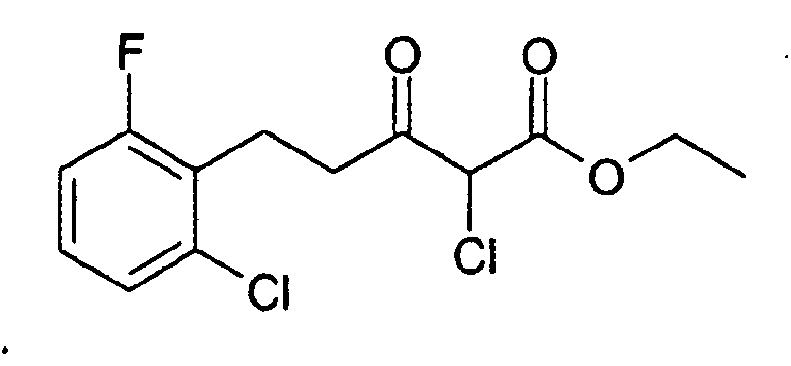
-
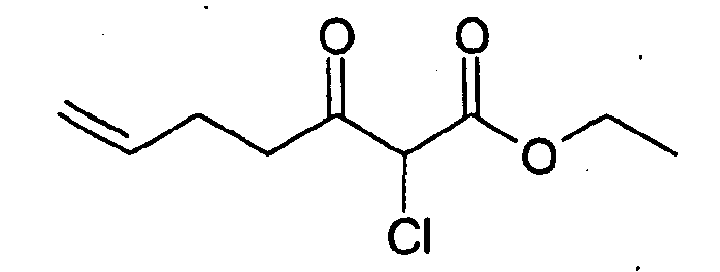
-

-

-

-

-

-

The following thiazoles are made in a similar manner: -

-

-

-

The following compounds are made in a similar manner: -

-

-

-

-

The following compounds are made in a similar manner: -

-

-

-

-

-

-

- D,L Alanine methyl ester (18.5 g, 132 mmol), triethylamine (42 mL, 300 mmol) and dichloromethane (300 mL) are stirred in an ice/water bath. 4-(Trifluromethyl)benzoyl chloride (25 g, 120 mmol) is added dropwise and the resulting mixture is allowed to stir for 20 hr at room temperature. 500 mL water and 100 mL 1M hydrochloric acid are successively added. The organic layer is separated, washed with 250 mL each of saturated sodium hydrogen carbonate, water, and brine, dried over anhydrous magnesium sulfate, filtered, and concentrated to 100 mL volume. The mixture is diluted with 200 mL hexanes, cooled to 0°C for 1 hr, and the white solid filtered and dried under vacuum to afford 2-(4-tert-Butylbenzoylamino)-propionic acid methyl ester, 26.5 g, 80%. MS (ES) : 276 (M++1).
- A mixture of 2-(4-tert-Butyl-benzoylamino)-propionic acid methyl ester (26.3 g, 95.6 mmol), 200 mL 1M sodium hydroxide, and 100 mL tetrahydrofuran is stirred at room temperature 20 hr. The resulting clear solution is cooled on an ice/water bath and the pH is adjusted to 2 with concentrated hydrochloric acid. The product is extracted with three 250 mL portions of ethyl acetate. The combined extracts are washed with 100 mL each of water and brine, dried over anhydrous magnesium sulfate, filtered, and concentrated to afford 2-(4-tert-Butyl-benzoylamino)-propionic acid as a white solid, 24.6 g, 95%. MS M'+1 260.
- To a solution of 2-(4-Trifluoromethyl-benzoylamino)-propionic acid (33.4 g, 128 mmol) is added oxalyl chloride (111 mL, 1.27 Mol) and 1 drop of DMF and the solution stirred overnight. The volatiles are removed in vacuo and toluene (20 mL) is added. The toluene is then removed in vacuo. To the resultant crude oil is dissolve in 50 mL methylene chloride, cooled to 0 °C and triethylamine (27 mL, 192 mmol) is added followed by methanol (50 mL). After 3 hrs the volatiles are removed in vacuo and the crude oil is purified by flash column chromatography (20%-50% ethyl acetate / hexanes) to provide 12.6 g (35%) of 4-Methyl-2-(4-trifluoromethyl-phenyl)-oxazole-5-carboxylic acid methyl ester. This ester (2.0 g, 7.0 mmol) is reduced to the alcohol by dissolution in THF (50 mL) and adding 4 eq. LiBH4 (0.610 g, 28.0 mmol) to provide 1.8 g (100%) [4-Methyl-2-(4-trifluoromethyl-phenyl)-oxazol-5-yl]-methanol. MS M++1 258.
-

-

-

- 3-Oxo-heptanoic acid methyl ester (25 g, 0.157 Mol) is dissolved into anhydrous dichloromethane(DCM) (200 mL) and then cooled to 0°C-5°C while stirring. A solution of bromine (25.25 g, 0.160 Mol) in DCM (50 mL) is added dropwise over 2h. to the solution of the beta keto-ester. After the addition, the mixture is allowed to stir 0.5h. at 0°C, then the ice bath is removed and the mixture is allowed to stir at room temperature for 18h. TLC will show complete consumtion of starting material, then ice water (200 g)is added with stirring. The organic layer is collected and washed with cold water (2x) and brine. The filtered solution is dried over anhydrous sodium sulfate, then concentrated to a clear liquid. The crude 4-Bromo-3-oxo-heptanoic acid methyl ester (31.5 g, 0.135 Mol), 86% yield, is used without further purification.
- 4-Bromo-3-oxo-heptanoic acid methyl ester (6.0 g, 25.0 mmol) is dissolved into denatured ethanol (100 mL) and para-trifluoromethyl thiobenzamide (5.0 g, 24.4 mmol) is added in one portion. The reaction is purged of air and flushed with nitrogen then heated to reflux. The reaction is monitored by TLC and HPLC and when complete, the reaction is allowed to cool to room temperature. The solvent is removed and the reaction is diluted with ethyl acetate (200 mL), followed by ishes with saturated sodium bicarbonate solution, water, and brine. The ethyl acetate solution is dried over anhydrous sodium sulfate, then concentrated and further purified using flash column chromatography(10%EtOAc/Hexanes) to yield pure [[5-Propyl-2-(4-trifluoromethyl-phenyl)-thiazol-4-yl]-acetic acid methyl ester (8.66 g, 24.2 mmol) or 98% yield.
- [[5-Propyl-2-(4-trifluoromethyl-phenyl)-thiazol-4-yl]-acetic acid methyl ester (8.66 g, 24.2 mmol) is dissolved into anhydrous tetrahydrofuran(THF) (100 mL) and then cooled to 0°C with stirring. Lithium aluminum hydride (24.2 mL, 1M in THF, 24.2 mmol) is slowly added by syringe and the reaction is monitored by TLC. Upon complete conversion, the reaction is carefully quenched using water, base, and water. Celite is added to the reaction, followed by diethyl ether and the mixture is then filtered through a celite plug. The two phases are then separated and the organic layer is washed using water and brine. The organic layer is the dried over anhydrous sodium sulfate and concentrated. The pure 2-[5-Propyl-2-(4-trifluoromethyl-phenyl)-thiazol-4-yl]-ethanol (5.739 g, 18.2 mmol) is obtained in 75% yield after flash column chromatography.
- The 2-[5-Propyl-2-(4-trifluoromethyl-phenyl)-thiazol-4-yl]-ethanol (5.739 g, 18.2 mmol) is dissolved into anhydrous dichloromethane(DCM) (100 mL) and dimethylamino pyridine (0.670 g, 5.46 mmol), tosic anhydride (11.9 g, 36.4 mmol), and pyridine (5 mL, 64 mmol) are added at room temperature. The reaction is monitored by TLC, and upon complete consumption of the starting alcohol, the reaction is diluted with DCM and extracted against saturated sodium bicarbonate solution. The organic layer is washed with water and brine, then dried over anhydrous sodium sulfate and concentrated. The pure Toluene-4-sulfonic acid 2-[5-propyl-2-(4-trifluoromethyl-phenyl)-thiazol-4-yl]-ethyl ester (4.46 g, 9.5 mmol) is obtained after flash column chromatography.
The following compounds are prepared in a similar manner: -

-

-

- 5-Benzyloxy-2-hydroxy-benzaldehyde (Kappe, T.; Witoszynskyj, T. Arch. Pharm., 1975, 308 (5), 339-346) (2.28 g, 10.0 mmol), ethyl bromoisobutyrate (2.2 mL, 15 mmol), and cesium carbonate (3.26 g, 10.0 mmol) in dry DMF (25 mL) are heated at 80 °C for 18 h. The reaction mixture is cooled and partitioned between water (30 mL) and ether (75 mL). The organic layer is washed with brine (15 mL). The aqueous layers are back-extracted with ethyl acetate (30 mL), and the organic layer is washed with brine (20 mL). The combined organic layers are dried (Na2SO4) and concentrated to a brown oil. The crude product is purified by flash chromatography using hexanes:ethyl acetate (2.5:1) to give a pale yellow solid (3.04 g, 89%): mp 65 °C; 1H NMR (400 MHz, CDCl3) δ 1.24 (t, 3H, J = 7.1 Hz), 1.62 (s, 6H), 4.23 (q, 2H, J = 7.1 Hz), 6.81 (d, 1H, J = 8.8 Hz), 7.10 (dd, 1H; J = 4.6, 9.0 Hz), 7.30-7.43 (m, 6H); MS (ES) m/e 343.1 [M+1].
- 2-(4-Benzyloxy-2-formyl-phenoxy)-2-methyl-propionic acid ethyl ester (9.00 g, 26.3 mmol) in ethanol (250 mL) is treated with 5% Pd/C (1.25 g) and hydrogen (60 psi, rt, overnight). Additional 5% Pd/C (1.25 g) is added, and the reaction is continued for 6h at 40 °C. The mixture is filtered and concentrated to a tan oil (6.25 g). This oil contained 9 mol% of 2-(4-Hydroxy-2-hydroxymethyl-phenoxy)-2-methyl-propionic acid ethyl ester. 1H NMR (400 MHz, CDCl3) δ 1.26 (t, 3H, J = 7.3 Hz), 1.51 (s, 6H), 2.14 (s, 3H), 4.24 (q, 2H, J = 7.3 Hz), 5.68 (brs, 1H), 6.47 (dd, 1H, J = 3.4, 8.8 Hz), 6.59 (d, 1H, J = 8.3 Hz), 6.60 (brs, 1H).
The following compound is prepared in a similar manner: -

-

- 2-Allyl-4-benzyloxyphenol (
WO 9728137 A1 19970807, Adams, A.D. et al. - A solution of 4-benzyloxy-2-propylphenol (0.50 g, 1.94 mmol) in dry DMF (7 mL) is cooled in an ice bath and treated with NaH (0.15 g, 3.8 mmol, 60 % oil dispersion). The ice bath is removed, ethyl bromoacetate (0.43 mL, 3.9 mmol) is added, and the mixture is placed in an oil bath (T=85 °C). After 18 h, the reaction mixture is cooled and concentrated in vacuo. The residue is diluted with EtOAc, washed with brine (2x), dried (Na2SO4), and concentrated. The crude product is purified by radial chromatography using 10% ethyl acetate in hexanes to give a tan solid (0.62 g, 97%). 1H NMR (400 MHz, CDCl3) δ 7.44-7.31 (m, 5H), 6.82 (d, J = 2.9 Hz, 1H), 6.72 (dd, J = 8.8, 2.9 Hz, 1H), 6.66 (d, J = 8.8 Hz, 1H), 5.00 (s, 2H), 4.57 (s, 2H), 4.25 (q, J = 7.0 Hz, 2H), 2.63 (t, J = 7.6 Hz, 2H), 1.64 (q, J = 7.5 Hz, 2H), 1.29 (t, J = 7.1 Hz, 3H), 0.95 (t, J = 7.3 Hz, 3H); MS (FIA) m/e 329 (M+1).
- A solution of (4-benzyloxy-2-propylphenoxy)acetic acid ethyl ester (0.60 g, 1.83 mmol) in THF (15 mL) is treated with 5% Pd/C (75 mg) and hydrogen (60 psi) at ambient temperature for 24 h. The mixture is filtered and concentrated. The crude product is purified by radial chromatography using 15% ethyl acetate in hexanes to give a tan solid (0.25 g, 57%). 1H NMR (400 MHz, CDCl3) δ 6.66 (d, J = 2.9 Hz, 1H), 6.62 (d, J = 8.8 Hz, 1H), 6.57 (dd, J = 8.8, 2.9 Hz, 1H), 4.56 (s, 1H), 4.40 (s, 1H), 4.25 (q, J = 7.2 Hz, 2H), 2.61 (t, J = 7.6 Hz, 2H), 1.63 (q, J = 7.5 Hz, 2H), 1.29 (t, J = 7.1 Hz, 3H), 0.95 (t, J = 7.3 Hz, 3H); MS (FIA) m/e 239 (M+1).
-

-

- Phenoxy-acetic acid ethyl ester (9.1 mL) is added to chlorosulfonic acid (15 mL) at 0°C dropwise. The reaction is stirred at 0 °C for 30 min, it is allowed to warm to room temperature. After 2 hrs, the reaction mixture is poured into ice, solid product is collected by filtration and dried under vacuum.
- To a mixture of(4-chlorosulfonyl-phenoxy)-acetic acid ethyl ester (0.98 g, 3.5 mmol) and tin powder (2.1 g) in ethanol (4.4 mL) is added HCl in dioxane (1.0 M, 4.4 mL) under nitrogen. The mixture is heated to reflux for 2 hrs, it is poured into ice and methylene chloride and filtered. The layers are separated and extracted with methylene chloride, dried and concentrated. The crude product is used for next step without purification.
The following compounds are made in a similar manner: -

NMR (DMSO-d6) δ 7.1 (s, 1H), 7.05 (dd, 1H), 6.75 (d, 1H), 5.03 (s, 1H), 4.75 (s, 2H), 4.15 (q, 2H), 2.15 (s, 3H), 1.2 (t, 3H). -

-

- 3-(4-Hydroxy-2-methyl-phenyl)-propionic acid methyl ester (5.0 g, 25.75 mmol) is dissolved into dry dioxane (100 mL) and combined with 4-dimethylamino pyridine (0.500 g, 2.6 mmol), triethylamine (7.0 mL, 51.5 mmol), and dimethylaminothiocarbomoyl chloride (4.5 g, 32.17 mmol). The reaction is heated to reflux under nitrogen. The reaction is monitored by TLC until all of the phenol is consumed, 20h. After cooling to room temperature, the reaction is diluted with ethyl acetate (200 mL). Water (75 mL) is added and the two layers are separated. The organic layer is washed with brine (75mL) then dried over anhydrous sodium sulfate. The solvent is removed and the residue is dried under vacuum.
- 3-(4-Dimethylthiocarbamoyloxy-2-methyl-phenyl)-propionic acid methyl ester, taken crude from the previous step, is diluted with 75 mL of tetradecane and heated to reflux under nitrogen. The reaction is monitored by TLC until all the conversion is complete, 20h. The reaction is allowed to cool to room temperature, then the tetradecane is decanted away from the resulting oil. The residue is rinsed several times with hexanes. This oil is then purified using flash column chromatography, yielding 5.01 g, or 69% (2 steps) of the product.
- 3-(4-Dimethylcarbamoylsulfanyl-2-methyl-phenyl)-propionic acid methyl ester (5.01 g, 17.8 mmol) is diluted with methanol (30 mL) and to this is added sodium methoxide (1.7 mL of 4M in methanol, 7.23 mmol). The reaction is heated to reflux under nitrogen and monitored by TLC. After complete conversion, 20h., the reaction is allowed to cool to room temperature. The reaction is neutralized with 1N HCl (7.23 mL) and diluted with ethyl acetate (150 mL). The two phases are separated and the organic layer is washed with water (75 mL), then brine (75 mL). The organic layer is then dried over anhydrous sodium sulfate, then concentrated to yield 4.43 g crude product that is used without further purification.
-

- To a solution of 4-Bromo-3-methyl-benzoic acid benzyl (25.3 g, 0.118 mol) in DMF (200 mL) is added Cs2CO3 (76.6 g, 0.235 mol), followed by benzyl bromide (15.4 mL). After stirred at room temperature for 2 h, the reaction mixture is diluted with ethyl acetate, filtered through celite. The filtrate is washed with water and brine, dried over sodium sulfate, concentration gave the title product.
- To a solution of 4-bromo-3-methyl-benzoic acid benzyl ester (36 g, 118 mmol) in propronitrile (1000 mL) is added methyl acrylate (43.3 mL) and diisopropylethyl amine (42 mL), the solution is degassed and filled with nitrogen for three times. To this mixture are added tri-o-tolyl-phosphane (14.5 g) and palladium acetate (5.34 g) under nitrogen, then heated at 110 °C overnight, cooled to room temperature, filtered through celite. The solvent is evaporated, the residue is taken into ethyl acetate and washed with water and brine, dried over sodium sulfate. Concentration and column chromatography on silica gel eluted with hexanes and ethyl acetate gave the title compound (31 g, 84.7%).
- A mixture of 4-(2-methoxycarbonyl-vinyl)-3-methyl-benzoic acid benzyl ester (11.6 g, 37.4 mmol) and Pd/C (5 %, 1.5 g) in THF (300 mL) and methanol (100 mL) is stirred under 60 psi of hydrogen overnight. Catalyst is filtered off, filtrate is concentrated giving the title compound (8.3 g, 100%).
-

- 4-Methoxy-2-methylbenzoic acid (2.5 g, 15.04 mmol) is stirred in thionyl chloride (50 mL) at reflux 2 hr. The mixture is concentrated and diluted with toluene (10 mL) and concentrated. The resulting solid is dried under vacuum 18 hr. The resulting acid chloride is stirred in 20 mL ether at 0 deg C. A solution of diazomethane (39.6 mmol) in ether (150 mL) is added to the acid chloride solution and stirred 18 hr. The resulting diazoketone solution is concentrated. The residue is stirred in methanol (100 mL) and a solution of silver benzoate in triethylamine (1.0 g in 10 mL) is added and the reaction is heated to 60 deg C and stirred 1 hr. The mixture is concentrated, diluted with 1.0 N aqueous hydrochloric acid (20 mL), extracted to three portions of ethyl acetate (50 mL each). The extracts are combined, washed with aqueous saturated sodium hydrogen carbonate, water, and brine (50 mL each), dried over anhydrous magnesium sulfate, filtered and concentrated. The residue is purified via silica gel chromatography eluting with 9:1 hexanes:ethyl acetate to afford 1.5 g (51%) of the homologated ester as a white solid.
- (4-Methoxy-2-methyl-phenyl)-acetic acid methyl ester (1.5 g, 7.72 mmol) is stirred in dichloromethane (50 mL) at 0 deg. C. Aluminum chloride (4.13 g, 31 mmol) is added followed by ethane thiol (2.9 mL, 38.6 mmol) . The resulting mixture is stirred at room temperature for 2 hr. Water (50 mL) is added and the product is extracted into ethyl acetate (3 X 50 ml), the extracts are combined, dried over anhydrous magnesium sulfate, filtered, and concentrated to afford the title compound as a colorless oil, 1.4 g, 100%. MS M++1 181. The structure is confirmed by 1H NMR spectroscopy.
-

- (3-Hydroxy-phenyl)-acetic acid (5.0 g, 32.86 mmol) is stirred in methanol (100 mL) and concentrated (98%) sulfuric acid (3.0 mL,) is added. The mixture is heated to reflux 18 hr. The reaction is cooled and concentrated. The residue is diluted with water (100 mL) and extracted with ethyl acetate (3 X 50 mL). The combined extracts are dried over anhydrous magnesium sulfate, filtered, and concentrated to yield the title compound as an orange oil, 5.46 g, 100%. MS M++1 167. The structure is confirmed by 1H NMR spectroscopy.
The following compounds are made in a similar manner: -
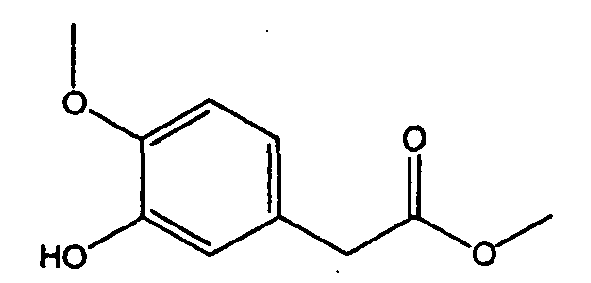
- An orange oil. MS M++1 197. The structure is confirmed by 1H NMR spectroscopy.
-

- An orange oil. MS M++1 181. The structure is confirmed by 1H NMR spectroscopy.
-

- A mixture of (3-Hydroxy-phenyl)-acetic acid methyl ester (5.5 g, 33.1 mmol) , N,N-dimethyl thiocarbamoyl chloride (5.11 g, 41.38 mmol), triethylamine (9.2 mL, 66.2 mmol), N,N-dimethylamino pyridine (0.4 g, 3.31 mmol) and dioxane (50 mL) is stirred at reflux 18 hr. The mixture is concentrated, partioned between 1M aqueous hydrochloric acid (200 mL) and ethyl acetate (3 X 75 mL). The combined organic extracts are dried over anhydrous magnesium sulfate, filtered, concentrated, and purified via silica chromatography eluting the product with dichloromethane to afford the title compound as a brown oil, 6.8 g, 81%. MS M++1 254. The structure is confirmed by 1H NMR spectroscopy.
- (3-Dimethylthiocarbamoyloxy-phenyl)-acetic acid methyl ester (6.8 g, 26.84 mmol) is stirred in tetradecane (30 mL) at 255 deg C for 8 hr. The mixture is cooled, the residue is purified by silica chromatography eluting the product with hexanes to 1:1 hexanes:ethyl acetate to afford the title compound as an orange oil, 4.9 g, 58 %. MS M++1 254. The structure is confirmed by 1H NMR spectroscopy.
- A mixture of (3-dimethylcarbamoylsulfanyl-phenyl)-acetic acid methyl ester (2.0 g, 7.9 mmol), potassium hydroxide (1.4 g, 24 mmol) methanol (50 mL), and water (5 mL) is stirred at reflux 3 hr. The mixture is concentrated, and product partitioned between 1M aqueous hydrochloric acid (50 mL) and ethyl acetate (3 X 75 mL). The combined extracts are dried over anhydrous magnesium sulfate, filtered and concentrated. The residue is taken up in methanol (50 mL), 2 mL concentrated sulfuric acid is added, and the mixture refluxed 3 hr. The mixture is concentrated, and the residue purified by silica chromatography eluting with 7:3 hexanes:ethyl acetate to afford the title compound as a pale yellow oil, 1.0 g, 69%. MS M++1 183. The structure is confirmed by 1H NMR spectroscopy.
-

- A mixture of methyl-4-bromo-3-methylbenzoate (5.7 g, 24.88 mmol), lithium aluminum hydride (29 mL, 29 mmol, 1 M solution in tetrahydrofuran) and tetrahydrofuran (100 mL) is stirred in ice/water for 1 hr. The reaction is quenched with aqueous hydrochloric acid (50 mL, 1 M). The product is extracted into ethyl acetate (3 X 100 mL). The combined extracts are dried over anhydrous magnesium sulfate, filtered and concentrated. The crude product is taken up in propionitrile (100 mL). Methylacrylate (10 mL, 121.5 mmol), palladium acetate (1.12 g, 5 mmol), tri-o-tolylphosphine (3.0 g, 10 mmol), and N,N-diisopropyl ethylamine (8.7 mL, 50 mmol) are sequentially added and the resulting reaction mixture is heated to 110 deg C 3 hr. The mixture is concentrated, and the residue diluted with aqueous hydrochloric acid (100 mL, 1M).The product is extracted with dichloromethane (2 X 100 mL) and ethyl acetate (100 mL). The combined extracts are dried over anhydrous magnesium sulfate, filtered, concentrated, and purified via silica chromatography eluting with 7:3 hexanes:ethyl acetate to 1:1 hexanes:ethyl acetate to afford the pure product as a yellow oil, 4.7 g, 91 %. MS M++1 207. The structure is confirmed by 1H NMR spectroscopy.
- A mixture of 3-(4-Hydroxymethyl-2-methyl-phenyl)-acrylic acid methyl ester (4.7 g, 22.8 mmol), Raney nickel (0.668 g) and tetrahydrofuran (618 mL) is shaken under 60 psig. Hydrogen 24 hr. The catalyst is filtered off, and the mixture is concentrated to afford the product as a pale yellow oil, 4.3 g, 91%. The structure is confirmed by 1H NMR spectroscopy.
- A mixture of 3-(4-Hydroxymethyl-2-methyl-phenyl)-propionic acid methyl ester (0.62 g, 2.98 mmol), triphenyl phosphine (0.86 g, 3.27 mmol) and dichloromethane (10 mL) is stirred at room temperature. A solution of iodine (0.83 g, 3.27 mmol) in benzene (5 mL) is added and the black mixture is stirred at room temperature 2hr. The brown mixture is diluted with 10% aqueous sodium hydrogen sulfite (5 mL) and the resulting clear mixture is washed with ethyl acetate (3 X 50 mL). The combined extracts are dried over anhydrous magnesium sulfate, filtered and concentrated. The residue is purified via silica chromatography eluting with 9:1 hexanes:ethyl acetate to afford the title compound as a crystalline ivory solid, 0.68g, 72%. MS M++1 319. The structure is confirmed by 1H NMR spectroscopy.
-

- A mixture of 4-bromo-2-methylphenol (1.0 g, 5.35 mmol), sodium hydride (0.26 g, 6.42 mmol, 60% mineral oil), N,N-dimethylformamide (10 mL), and methyl-2-bromoacetate (0.56 mL, 5.88 mmol) is stirred at room temperature 18 hr. The mixture is diluted with water (50 mL) and the product extracted to ethyl acetate (3 X 50 mL). The combined extracts are dried over anhydrous magnesium sulfate, filtered, concentrated and purified via silica chromatography eluting with 8:2 hexanes:ethyl acetate to afford title compound as a colorless oil, 1.03 g, 74%. MS M+ 259. The structure is confirmed by 1H NMR spectroscopy.
-

- To a solution of 2-bromo-5-nitrotoluene (3.11 g, 14.39 mmol) in propionitrile (105 mL) is added DIPEA (5.1 mL, 29.28 mmol). The mixture is degassed three times. Methyl acrylate (5.2 mL, 57.74 mmol) is added and the mixture is degassed. Tri-o-tolylphosphine (1.77 g, 5.82 mmol) and Pd(OAc)2 (0.64 g, 2.85 mmol) are added and the mixture is degassed a final two times followed by heating at 110°C for 4 h. Upon cooling, the mixture is passed through Celite and the filtrate is concentrated. The residue is partitioned between Et2O and 1N HCl. The organics are washed with saturated NaHCO3 and brine, and dried with Na2SO4. The crude material is purified by flash chromatography to yield the title compound (2.90 g, 91%).
- A mixture of 3-(2-Methyl-4-nitro-phenyl)-acrylic acid methyl ester (1.47 g, 6.64 mmol) and 5% Pd/C (0.29 g) in MeOH (100 mL) is exposed to a hydrogen atmosphere (60 psi) for 12 h. The mixture is filtered through Celite and purified by flash chromatography to yield the title compound (0.99 g, 77%).
-

- A mixture of 3-(4-Hydroxymethyl-2-methyl-phenyl)-propionic acid methyl ester (0.49 g, 2.35 mmol) and MnO2 (0.80 g, 9.20 mmol) in chloroform (5 mL) is stirred at RT for 4 days. The mixture is filtered through Celite; the Celite is washed with copious amounts of EtOAc. The filtrate is concentrated and purified by flash chromatography to yield the title compound (0.29 g, 60%).
- To a mixture of 3-(4-Formyl-2-methyphenyl)-propionic acid methyl ester (0.27 g, 1.31 mmol) and methylamine (2M in THF, 0.60 mL, 1.20 mmol) in anhydrous CH2Cl2 (10 mL) is added 4Å molecular sieves followed by acetic acid (0.090 mL, 1.57 mmol). The mixture is stirred at RT for 1.5 h. Sodium triacetoxyborohydride (0.39 g, 1.85 mmol) is added, and the mixture is stirred overnight. The reaction is quenched with saturated NaHCO3. The organics are washed with saturated NaHCO3 and brine, and dried with MgSO4. Upon concentration, the mixture is purified by reverse phase chromatography to yield the title compound (0.12 g, 45%).
-

- To a 0°C solution of 3-(4-Hydroxymethyl-2-methyl-phenyl)-propionic acid methyl ester (1.02 g, 4.90 mmol) in anhydrous CH2Cl2 (15 mL) is added triethylamine (0.75 mL, 5.38 mmol) followed by thionyl chloride (0.40 mL, 5.48 mmol). The mixture is allowed to warm to RT overnight. Water is added, and the mixture is extracted with CH2Cl2. The organics are dried with MgSO4 and concentrated. The crude material is purified by flash chromatography to yield the title compound (1.01 g, 91%).
- To a solution of 3-(4-Chloromethyl-2-methyl-phenyl)-propionic acid methyl ester (0.52 g, 2.31 mmol) in DMF (7 mL) is added sodium azide (0.25 g, 3.84 mmol). The mixture is stirred overnight. Water is added, and the mixture is extracted with EtOAc. The organics are dried with Na2SO4 and concentrated to yield the title compound (0.49 g, 91%). The material is used without further purification.
- A mixture of 3-(4-Azidomethyl-2-methyl-phenyl)-propionic acid methyl ester (0.20 g, 0.86 mmol) and 5% Pd/C (32 mg) in EtOH (50 mL) is exposed to a hydrogen atmosphere (60 psi) at RT overnight. Upon filtering the mixture through Celite, the filtrate is concentrated to yield the title compound (0.14 g, 78%). The material is used without further purification.
-

The following compounds are made in a similar manner: -

-

- Aspartic acid methyl ester hydrochloride salt (57 g, 310 mmol) is dissolved in dichloromethane (500 mL) and cooled to 0°C in an ice water bath. Triethylamine (75 mL, 444 mmol) is slowly added in several portions and the mixture is allowed to stir at 0°C. Meanwhile, 6-chloronicotinic acid (35 g, 222 mmol) is dissolved into dichloromethane (500 mL) with a drop of dimethylformamide and cooled to 0°C in an ice water bath. After one hour at 0°C the ice bath is removed and the solution allowed to warm to room temperature. The solvent is evaporated, the solution concentrated to about 100 mL, and then transferred to an addition funnel. This solution is then slowly added to the amino acid solution over two hours at 0°C. After two hours, the ice bath is removed. Upon reaching room temperature, the reaction is complete. The reaction is acidified with concentrated hydrochloric acid. The two phases are separated and the organic layer is washed with water and brine. The organic layer is then dried over anhydrous sodium sulfate, filtered, and concentrated. The white solid is used without further purification.
- 2-[(6-Chloro-pyridine-3-carbonyl)-amino]-succinic acid 4-methyl ester (222 mmol) is dissolved in ethyl acetate (300 mL) at room temperature and pyridine (90 mL, 1.11 mol), acetic anhydride (94 mL, 1.0 mol), and dimethyl amino pyridine (3.5 g, 22.2 mmol) are added. The reaction is heated to 90°C under nitrogen. The reaction is monitored by HPLC and upon complete consumption of the starting material, is allowed to cool to room temperature. The reaction is diluted with additional ethyl acetate and the two phases are separated. The organic layer is washed a few times with 1N HCl, then saturated sodium bicarbonate solution, and finally brine. The organic layer is then dried over anhydrous sodium sulfate, filtered, and concentrated. The 3-[(6-Chloro-pyridine-3-carbonyl)-amino]-4-oxo-pentanoic acid methyl ester is used in the next step without further purification.
- 3-[(6-Chloro-pyridine-3-carbonyl)-amino]-4-oxo-pentanoic acid methyl ester is dissolved in acetic anhydride (75 mL) and concentrated sulfuric acid is added in 500 uL portions five times over a four hour period. The reaction is monitored by HPLC. The reaction is then heated to 40°C until the starting material is consumed. The reaction is allowed to proceed at room temperature overnight. The reaction is then concentrated to dryness and purified by column chromatography. This procedure yielded (12.8 g, 48 mmol) 22% of the desired oxazole over four steps.
-

The following compound is made in a similar manner: -

-

- (3-Hydroxy-phenyl)-acetic acid methyl ester (166 mg, 1.0 mmol) is dissolved into anhydrous acetonitrile(ACN) (5 mL). Toluene-4-sulfonic acid 2-[5-ethyl-2-(4-trifluoromethylphenyl)-thiazol-4-yl]-ethyl ester (432 mg, 0.950 mmol) is added to the reaction, followed by the addition of cesium carbonate (652 mg, 2.00 mmol). The reaction is allowed to stir under nitrogen at room temperature and monitored by TLC and HPLC. Upon complete consumption of the tosylate, the reaction is diluted with diethyl ether and quenched with 0.1N NaOH. The two phases are separated, then the organic layer washed with water and brine. The organic phase is dried over anhydrous sodium sulfate and concentrated under vacuum. The residue is further purified using either EtOAc/Hexanes(1:9) or Acetone/Hexanes(1:9) gradients on silica gel chromatography to yield (3-{2-[5-Ethyl-2-(4-trifluoromethyl-phenyl)-thiazol-4-yl]-ethoxy}-phenyl)-acetic acid methyl ester (140 mg, 0.311 mmol) or 33%.
- 3-{2-[5-Ethyl-2-(4-trifluoromethyl-phenyl)-thiazol-4-yl]-ethoxy}-phenyl)-acetic acid methyl ester (140 mg, 0.311 mmol) is dissolved in tetrahydrofuran (1mL) and 5N NaOH (1mL) is added. The mixture is heated to reflux until the conversion is complete. Upon complete conversion, the reaction is cooled to room temperature and 5N HCl (1mL) is added. The mixture is diluted with diethyl ether and extracted with 1N HCl. The organic layer is washed with water and brine, then dried over anhydrous sodium sulfate. Concentration of the solvent reveals the pure 3-{2-[5-Ethyl-2-(4-trifluoromethyl-phenyl)-thiazol-4-yl]-ethoxy}-phenyl)-acetic acid in near quantitative yield (133 mg, 0.306 mmol).
The following compounds are made in a substantially similar manner: -

-

-

-

-

-
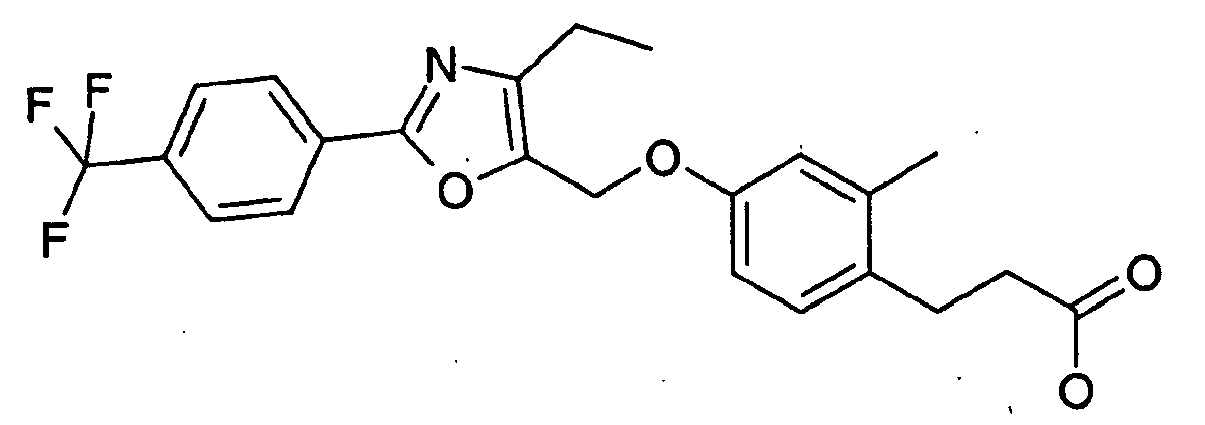
-

- 3-{4-[4-Ethyl-2-(4-trifluoromethyl-phenyl)-oxazol-5-ylmethoxy]-2-methyl-phenyl}-propionic acid methyl ester (0.100g, 0.223 mmole) is treated with a mixture of NaOH (aq) (1 mL)/THF (3 mL)/MeOH (3 mL) at room temperature overnight. The organic solvents are removed on rota-vapor. The residue is diluted with water (10 mL), acidified to pH = 2 with 6N HCl (aq). The precipitate is collected through filtration, washed with cold water (30 mL) and dried to provide the titled compound as a white solid. Mass [EI+] 434 (M++H), 432 (M+-H) .
The following compounds are made in a similar manner: -

-

-

-

-

-

- MS M++1 436. The structure is confirmed by 1H NMR spectroscopy.
-

- MS M++1 450. The structure is confirmed by 1H NMR spectroscopy.
-

-

-

- A mixture of 6-Chloro-nicotinonitrile (7.26 g, 52.4 mmol) and 2-fluorophenyl boronic acid (11 g, 78.6 mmol) and Na2CO3 (11 g, 103 mmol) in toluene (200 mL) and water (10 mL) is degassed and filled with nitrogen for three times, then Pd(PPh3)4 (0.73 g) is added under nitrogen. The reaction mixture is heated at 90°C. After 12 hrs, the reaction mixture is cooled to room temperature, diluted with ethyl acetate, washed with water, dried, concentrated. Column chromatography on silica gel (Hexane/ethyl acetate as eluent) gave 9.8 g of 6-(2-Fluoro-phenyl)-nicotinonitrile.
- A mixture of 6-(2-Fluoro-phenyl)-nicotinonitrile (9.8 g, 49.4 mmol) and thioacetamide (5.94 g, 79.1 mmol)in 4.0 M HCl in dioxane (200 mL) is heated at 100 °C for 3 days, cooled to room temperature. The raction mixture is poured into old saturated sodium bicarbonate and stirred for 30 min. Solid product is collected by filtration and dried under vacuum giving the title compound (11.4 g).
- A mixture of 6-(2-Fluoro-phenyl)-thionicotinamide (1.5 g, 6 mmol) and 4-Bromo-3-oxo-pentanoic acid methyl ester (1.51 g, 7.2 mmol) in ethanol (100 mL) is heated to reflux for 24 h, and concentrated. The residue is purified by column chromatography on silica gel yielding 1.7 g of the product.
- To a solution of {2-[6-(2-Fluoro-phenyl)-pyridin-3-yl]-5-methyl-thiazol-4-yl}-acetic acid ethyl ester (1.7 g, 4.77 mmol) in THF (10 mL) is added LiAlH4 (1.0 M in THF, 4.8 mL, 4.8 mmol) at 0-5 °C, and then stirred for 2 h. The reaction is then quenched by water and 5 N NaOH, diluted with THF and filtered through a pad of celite. The filtrate is concentrated and purified by column yielding 1.4 g of the product.
- A solution of 3-(4-Hydroxy-2-methyl-phenyl)-propionic acid tert-butyl ester (120 mg, 0.5 mmol) and 2-{2-[6-(2-Fluoro-phenyl)-pyridin-3-yl]-5-methyl-thiazol-4-yl}-ethanol (101 mg, 0.323 mmol) in toluene (3.0 mL) is degassed and filled with nitrogen for 3 times. Tributylphosphine (0.124 mL, 0.5 mmol) is added to the reaction mixture under nitrogen at 0 °C, followed by addition of of 1,1'-(azodicarbonyl)-dipiperidine (120 mg, 0.5 mmol). The reaction mixture is allowed to warm to room temperature and stirred overnight, the mixture is loaded on silica gel column. Chromatography gave the title compound (130 mg).
- To a solution of 3-[4-(2-{2-[6-(2-Fluoro-phenyl)-pyridin-3-yl]-5-methyl-thiazol-4-yl}-ethoxy)-2-methyl-phenyl]-propionic acid tert-butyl ester (130 mg) in methylene chloride (1 mL) is added TFA (0.8 mL) and two drops of water. The mixture is stirred for 2 h, and concentrated and purified by reversed phase HPLC (water-acetonitrile with 0.1 % TFA) yield 120 mg of product. MS (ES): 477.2(M++1).
The following compounds are made in substantially similar method: -
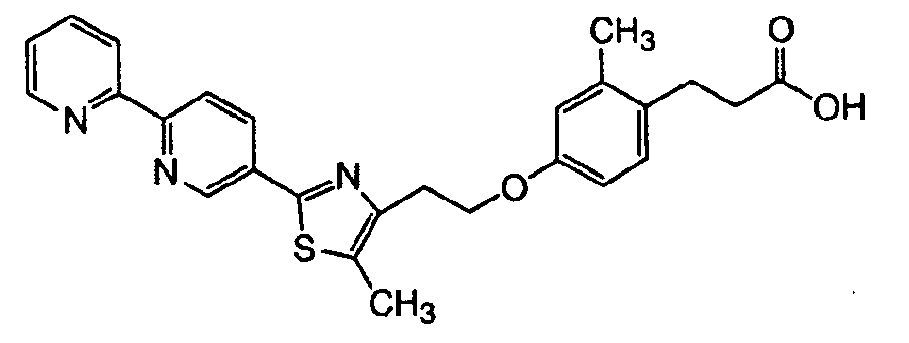
-

- 3-(4-{2-[2-(4-Bromo-phenyl)-5-methyl-thiazol-4-yl]-ethoxy}-2-methyl-phenyl)-propionic acid (100 mg, 0.21 mmol) is dissolved in anhydrous toluene (1 mL), degassed, and filled with nitrogen three times. Palladium tetrakis triphenyl phosphine [Pd(PPh3)4, 21 mg, 0.0021 mmol] is added, and the degassing procedure is repeated. 2-tributylstannylpyridine (63 uL, 0.25 mmol) is then added via syringe and the reaction is heated to reflux. The reaction is monitored by HPLC. Upon complete consumption of starting material, the reaction is allowed to cool to room temperature and diluted with ethyl acetate. Celite is added and the mixture is filtered and rinsed with more ethyl acetate and water. The solution is further diluted with water and the two phases are separated. The organic layer is washed with water and brine, dried over anhydrous sodium sulfate, filtered, and concentrated. The pure 3-(2-Methyl-4-{2-[5-methyl-2-(4-pyridin-2-yl-phenyl)-thiazol-4-yl]-ethoxy}-phenyl)-propionic acid methyl ester is obtained after column chromatography.
- methyl ester from step A is dissolved in tetrahydrofuran (1 mL) and 5N sodium hydroxide (1 mL) solution is added with stirring at room temperature. The reaction is heated to reflux and monitored by HPLC. Upon complete conversion, the reaction is allowed to cool to room temperature and neutralized with 5N hydrochloric acid (1 mL), diluted with ethyl acetate, and extracted. The organic layer is washed with water and brine, dried over anhydrous sodium sulfate, filtered, and concentrated. The pure 3-(2-Methyl-4-{2-[5-methyl-2-(4-pyridin-2-yl-phenyl)-thiazol-4-yl]-ethoxy}-phenyl)-propionic acid (46 mg) may also be obtained by recrystalization from ethyl acetate (48 % yield 2 steps), MS (ES) : 459.2 (M++1) .
The following compounds are made in a similar manner: -

-

-

-

-

- 3-(2-Methyl-4-{2-(5-methyl-2-(4-pyridin-2-yl-phenyl)-oxazol-4-yl]-ethoxy}-phenyl)-propionic acid methyl ester from step B is dissolved in tetrahydrofuran (1 mL) and 5N sodium hydroxide (1 mL) solution is added with stirring at room temperature. The reaction is heated to reflux and monitored by HPLC. Upon complete conversion, the reaction is allowed to cool to room temperature and neutralized with 5N hydrochloric acid (1 mL), diluted with ethyl acetate, and extracted. The organic layer is washed with water and brine, dried over anhydrous sodium sulfate, filtered, and concentrated. The pure 3-(2-methyl-4-{2-[5-methyl-2-(4-pyridin-2-yl-phenyl)-oxazol-4-yl]-ethoxy}-phenyl)-propionic acid (58 mg, 0.13 mmol, 40 % yield for two steps) may also be obtained by recrystalization from ethyl acetate, MS (ES): 443.2 (M++1).
The following compounds are made in a similar manner: -

-

-

-
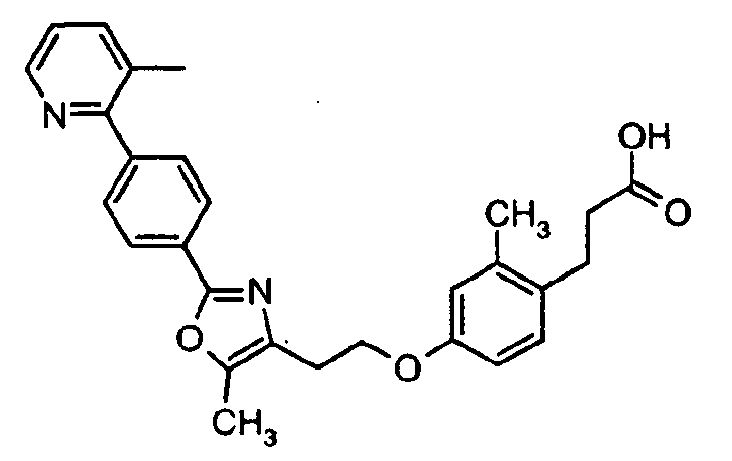
-

-

-

-

-

-

-

-

-

-

-

- 3-(4-{2-[2-(4-Bromo-phenyl)-5-methyl-thiazol-4-yl)-ethoxy}-2-methyl-phenyl)-propionic acid methyl ester (100 mg, 0.200 mmol) is dissolved in toluene (1 mL), degassed, and filled with nitrogen three times. Palladium tetrakistriphenyl phosphine (10 mg, 0.010 mmol), 3-pyridylboronic acid (31 mg, 0.250 mmol), and sodium carbonate (100 uL of a 10M solution, 0.400 mmol) are added, and the degassing procedure is repeated. Ethanol (1 mL) is added to dissolve the boronic acid. The reaction is heated to 100°C and monitored by HPLC. Upon complete consumption of starting material, the reaction is allowed to cool to room temperature and diluted with ethyl acetate. Celite is added and the mixture is filtered and rinsed with more ethyl acetate and water. The solution is further diluted with water and the two phases are separated. The organic layer is washed with water and brine, dried over anhydrous sodium sulfate, filtered, and concentrated. The pure 3-(2-Methyl-4-{2-[5-methyl-2-(4-pyridin-3-yl-phenyl)-thiazol-4-yl]-ethoxy}-phenyl)-propionic acid methyl ester (47 mg, 0.100 mmol) is obtained after column chromatography (50% yield).
- 3-(2-Methyl-4-{2-[5-methyl-2-(4-pyridin-3-yl-phenyl)-thiazol-4-yl]-ethoxy}-phenyl)-propionic acid methyl ester (47 mg, 0.100 mmol) is dissolved in tetrahydrofuran (1 mL) and 5N sodium hydroxide (1 mL) solution is added at room temperature. The reaction is heated to reflux and monitored by HPLC. Upon complete conversion, the reaction is allowed to cool to room temperature and neutralized with 5N hydrochloric acid (1 mL), diluted with ethyl acetate, and extracted. The organic layer is washed with water and brine, dried over anhydrous sodium sulfate, filtered, and concentrated. The pure 3-(2-Methyl-4-{2-[5-methyl-2-(4-pyridin-3-yl-phenyl)-thiazol-4-yl]-ethoxy}-phenyl)-propionic acid ( 40 mg, 0.087 mmol) may also be obtained by recrystalization from ethyl acetate (87% yield). MS (ES): 459.2 (M++1). Alternatively, the acid may be obtained after reversed phase preparative HPLC as the hydrochloride salt.
The following compounds are made in a similar manner: -

-

-
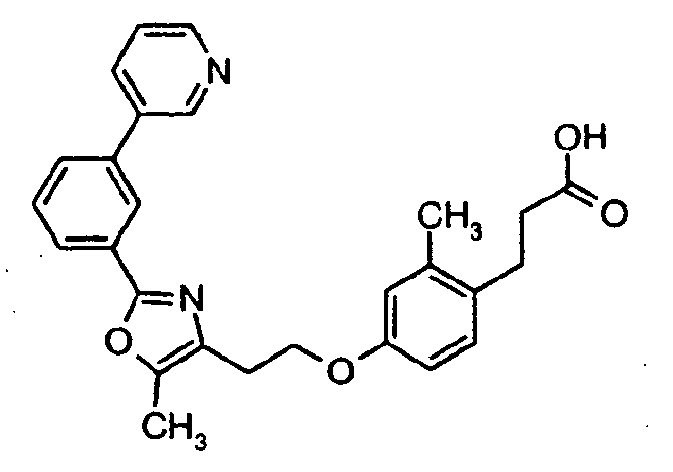
-

- The in vitro potency of compounds in modulating PPAR receptors are determined by the procedures detailed below. DNA-dependent binding (ABCD binding) is carried out using SPA technology with PPAR receptors. Tritium-labeled PPAR selective agonists are used as radioligands for generating displacement curves and IC50 values with compounds of the invention. Cotransfection assays are carried out in CV-1 cells. The reporter plasmid contained an acylCoA oxidase (AOX) PPRE and TK promoter upstream of the luciferase reporter cDNA. Appropriate PPARs are constitutively expressed using plasmids containing the CMV promoter. For PPARα, interference by endogenous PPARγ in CV-1 cells is an issue. In order to eliminate such interference, a GAL4 chimeric system is used in which the DNA binding domain of the transfected PPAR is replaced by that of GAL4, and the GAL4 response element is utilized in place of the AOX PPRE. Cotransfection efficacy is determined relative to PPARα agonist reference molecules. Efficacies are determined by computer fit to a concentration-response curve, or in some cases at a single high concentration of agonist (10 µM). These studies are carried out to evaluate the ability of compounds of the invention to bind to and/or activate various nuclear transcription factors, particularly huPPARα ("hu" indicates "human"). These studies provide in vitro data concerning efficacy and selectivity of compounds of the invention. Furthermore, binding and cotransfection data for compounds of the invention are compared with corresponding data for marketed compounds that act on huPPARα.
The binding and cotransfection efficacy values found, for compounds of the invention and compounds of this invention which are useful for modulating a PPAR alpha receptor, are ≤ 100 nM and ≥ 50%, respectively. - DNA-dependent binding is carried out using Scintillation Proximity Assay (SPA) technology (Amersham Pharmacia Biotech). PPARγ, PPARα and PPARδ receptors as well as their heterodimer partner RXRα receptor are prepared using a baculovirus expression system. Biotinylated oligonucleotide 5'TAATGTAGGTAATAGTTCAATAGGTCAAAGGG3' is used for binding of receptor dimers to Yttrium silicate streptavidin-coated SPA beads. PPARγ labeled ligand is 3H-reference, and PPARα and PPARδ•labeled ligands is 3H-reference with specific activity of 52 Ci/mmol and 90 Ci/mmol, respectively. Competition binding reactions are carried out in 10 mM HEPES pH 7.8, 80 mM KCl, 0.5 mM MgCl2, 1 mM DTT, 0.5% CHAPS, 14% glycerol, using 2.5 µg of each of PPARγ, α or δ and RXRα receptors, 5nM to 10 µM of competing compounds and 30,000 cpm of corresponding labeled ligand.
- Co-transfection assays are performed in CV-1 cells using calcium phosphate coprecipitation as previously described (Berger et al. Steroid Biochem. Mol. Biol. 41:733, 1992; Mukherjee et al. Nature 386:407-410, 1997). The reporter plasmid contained an acylCoA oxidase (AOX) PPRE and TK promoter upstream of the luciferase reporter cDNA. PPARs and RXRα are constitutively expressed using plasmids containing the CMV promoter. For PPARα•or•δ, interference by endogenous PPARs in CV-1 cells is eliminated by using a GAL4 chimeric system in which the DNA binding domain of the transfected PPARα or•δ is replaced by that of GAL4, and the GAL4 response element is utilized in place of the AOX PPRE. CV-1 cells are transfected in T225 cm2 flasks in DMEM with 10% Fetal Bovine Serum (FBS). After an overnight incubation, transfected cells are trypsinized and plated in 96 well dishes in DMEM media containing 10% charcoal-stripped FBS. After a 6 h incubation, cells are exposed to 0.1 nM to 10µM of test compounds. Co-transfection efficacy is determined using reference compounds. Compounds of this invention that are selective for the PPARδ are at least 10-fold selective for PPAR•• over PPARα and PPARγ.
- Seventeen different series of studies are performed to evaluate the effect of compounds of the present invention upon HDL and triglyceride levels in human apoAI mice. For each compound tested, seven to eight week old male mice, transgenic for human apoAI (C57BL/6-tgn(apoa1)1rub, Jackson Laboratory, Bar Harbor, ME) are acclimated in individual cages for two weeks with standard chow diet (Purina 5001) and water provided ad libitum. After the acclimation, mice and chow are weighed and assigned to test groups (n = 5) with randomization by body weight. Mice are dosed daily by oral gavage for 8 days using a 29 gauge, 1-1/2 inch curved feeding needle (Popper & Sons). The vehicle for the controls, test compounds and the positive control (fenofibrate 100mg/kg) is 1% carboxymethylcellulose (w/v) with 0.25% tween 80 (w/v). All mice are dosed daily between 6 and 8 a.m. with a dosing volume of 0.2ml. Prior to termination, animals and diets are weighed and body weight change and food consumption are calculated. Three hours after last dose, mice are euthanized with CO2 and blood is removed (0.5-1.0 ml) by cardiac puncture. After sacrifice, the liver, heart, and epididymal fat pad are excised and weighed. Blood is permitted to clot and serum is separated from the blood by centrifugation.
- Cholesterol and triglycerides are measured colorimetrically using commercially prepared reagents (for example, as available from Sigma #339-1000 and Roche #450061 for triglycerides and cholesterol, respectively). The procedures are modified from published work (McGowan M. W. et al., Clin Chem 29:538-542,1983; Allain C. C. et al., Clin Chem 20:470-475,1974. Commercially available standards for triglycerides and total cholesterol, respectively, commercial quality control plasma, and samples are measured in duplicate using 200 µl of reagent. An additional aliquot of sample, added to a well containing 200 µl water, provided a blank for each specimen. Plates are incubated at room temperature on a plate shaker and absorbance is read at 500 nm and 540 nm for total cholesterol and triglycerides, respectively. Values for the positive control are always within the expected range and the coefficient of variation for samples is below 10%. All samples from an experiment are assayed at the same time to minimize inter-assay variability.
- Serum lipoproteins are separated and cholesterol quantitated by fast protein liquid chromatography (FPLC) coupled to an in line detection system. Samples are applied to a Superose 6 HR size exclusion column (Amersham Pharmacia Biotech) and eluted with phosphate buffered saline-EDTA at 0.5 ml/min. Cholesterol reagent (for example, Roche Diagnostics Chol/HP 704036) at 0.16ml/min mixed with the column effluent through a T-connection and the mixture passed through a 15 m x 0.5 mm id knitted tubing reactor immersed in a 37 C water bath. The colored product produced in the presence of cholesterol is monitored in the flow strem at 505 nm and the analog voltage from the monitor is converted to a digital signal for collection and analysis. The change in voltage corresponding to change in cholesterol concentration is plotted vs time and the area under the curve corresponding to the elution of very low density lipoprotein (VLDL), low density lipoprotein (LDL) and high density lipoprotein (HDL) is calculated using Perkin Elmer Turbochrome software.
- Triglyceride Serum Levels in Mice Dosed with a Compound of the Invention is compared to Mice Receiving the Vehicle to identify compounds that could be particularly useful for lowering triglycerides. Generally, triglyceride decreases of greater than or equal to 30% (thirty percent) compared to control following a 30 mg/kg dose suggests a compound that can be especially useful for lowering triglyceride levels.
- The percent increase of HDLc serum levels in mice receiving a compound of the invention is compared to mice receiving vehicle to identify compounds of the invention that could be particularly useful for elevating HDL levels. Generally, and increase of greater than or equal to 25% (twenty five percent) increase in HDLc level following a 30 mg/kg dose suggests a compound that can be especially useful for elevating HDLc levels.
- It may be particularly desirable to select compounds of this invention that both lower triglyceride levels and increase HDLc levels. However, compounds that either lower triglyceride levels or increase HDLc levels may be desirable as well.
- The effects, upon plasma glucose of administering various dose levels of five different compounds of the present invention and the PPAR gamma agonist rosiglitazone or the PPAR alpha agonist fenofibrate, and the control, to male db/db mice, are studied.
- Five week old male diabetic (db/db) mice [for example, C57BlKs/j-m +/+ Lepr(db), Jackson Laboratory, Bar Harbor, ME] or lean littermates are housed 6 per cage with food and water available at all times. After an acclimation period of 2 weeks, animals are individually identified by ear notches, weighed, and bled via the tail vein for determination of initial glucose levels. Blood is collected (100 µl) from unfasted animals by wrapping each mouse in a towel, cutting the tip of the tail with a scalpel, and milking blood from the tail into a heparinized capillary tube. Sample is discharged into a heparinized microtainer with gel separator and retained on ice. Plasma is obtained after centrifugation at 4ºC and glucose measured immediately. Remaining plasma is frozen until the completion of the experiment, when glucose and triglycerides are assayed in all samples. Animals are grouped based on initial glucose levels and body weights. Beginning the following morning, mice are dosed daily by oral gavage for 7 days. Treatments are test compounds (30 mg/kg), a positive control agent (30 mg/kg) or vehicle [1% carboxymethylcellulose (w/v)/ 0.25% Tween80 (w/v); 0.3 ml/mouse]. On day 7, mice are weighed and bled (tail vein) 3 hours after dosing. Twenty-four hours after the 7th dose (i.e., day 8), animals are bled again (tail vein). Samples obtained from conscious animals on days 0, 7 and 8 are assayed for glucose. After the 24 hour bleed, animals are weighed and dosed for the final time. Three hours after dosing on day 8, animals are anesthetized by inhalation of isoflurane and blood obtained via cardiac puncture (0.5-0.7 ml). Whole blood is transferred to serum separator tubes, chilled on ice and permitted to clot. Serum is obtained after centrifugation at 4°C and frozen until analysis for compound levels. After sacrifice by cervical dislocation, the liver, heart and epididymal fat pads are excised and weighed.
- Glucose is measured colorimetrically using commercially purchased reagents. According to the manufacturers, the procedures are modified from published work (McGowan, M. W., Artiss, J. D., Strandbergh, D. R. & Zak, B. Clin Chem, 20:470-5 (1974) and Keston, A. Specific colorimetric enzymatic analytical reagents for glucose. Abstract of papers 129th Meeting ACS, 31C (1956).); and depend on the release of a mole of hydrogen peroxide for each mole of analyte, coupled with a color reaction first described by Trinder (Trinder, P. Determination of glucose in blood using glucose oxidase with an alternative oxygen acceptor. Ann Clin Biochem, 6:24 (1969)). The absorbance of the dye produced is linearly related to the analyte in the sample. The assays are further modified in our laboratory for use in a 96 well format. The commercially available standard for glucose, commercially available quality control plasma, and samples (2 or 5 µl/well) are measured in duplicate using 200 µl of reagent. An additional aliquot of sample, pipetted to a third well and diluted in 200 µl water, provided a blank for each specimen. Plates are incubated at room temperature for 18 minutes for glucose on a plate shaker (DPC Micormix 5) and absorbance read at 500 nm on a plate reader. Sample absorbances are compared to a standard curve (100-800 for glucose). Values for the quality control sample are always within the expected range and the coefficient of variation for samples is below 10%. All samples from an experiment are assayed at the same time to minimize inter-assay variability.
- The results of the study, suggest compounds of the present invention that significantly reduced db/db mouse plasma glucose levels while resulting in body weight gains that are generally less than those observed for rosiglitazone.
- Female Ay mice are singly housed, maintained under standardized conditions (22°C, 12 h light:dark cycle), and provided free access to food and water throughout the duration of the study. At twenty weeks of age the mice are randomly assigned to vehicle control and treated groups based on body weight and body fat content as assessed by DEXA scanning (N=6). Mice are then dosed via oral gavage with either vehicle or a Compound of this invention (50 mg/kg) one hour after the initiation of the light cycle (for example, about 7 A.M.) for 18 days. Body weights are measured daily throughout the study. On day 14 mice are maintained in individual metabolic chambers for indirect calorimetry assessment of energy expenditure and fuel utilization. On day 18 mice are again subjected to DEXA scanning for post treatment measurement of body composition.
- The results of p.o. dosing of compound for 18 days on body weight, fat mass, and lean mass are evaluated and suggest which compounds of this invention can be especially useful for maintaining desirable weight and/or promoting desired lean to fat mass.
- Indirect calorimetry measurements revealed a significant reduction in respiratory quotient (RQ) in treated animals during the dark cycle [0.864 ± 0.013 (Control) vs. 0.803 ± 0.007 (Treated); p < 0.001]. This reduction in RQ is indicative of an increased utilization of fat during the animals' active (dark) cycle. Additionally, treated animals displayed significantly higher rates of energy expenditure than control animals (17.40 ± 0.49.vs. 13.62 ± 0.26 kcal/kg/hr, respectively).
- Male KK/Ay mice are singly housed, maintained under standardized conditions (22°C, 12 h light:dark cycle), and provided free access to food and water throughout the duration of the study. At twenty-two weeks of age the mice are randomly assigned to vehicle control and treated groups based on plasma glucose levels. Mice are then dosed via oral gavage with either vehicle or a Compound of this invention (30 mg/kg) one hour after the initiation of the light cycle (7 A.M.) for 14 days. Plasma glucose, triglyceride, and insulin levels are assessed on day 14.
- The results of p.o. dosing of compound for 14 days on plasma glucose, triglycerides, and insulin are evaluated to identify compounds of this invention that may be especially desired.
- Male Syrian hamsters (Harlan Sprague Dawley) weighing 80-120 g are placed on a high-fat cholesterol-rich diet for two to three weeks prior to use. Feed and water are provided ad libitum throughout the course of the experiment. Under these conditions, hamsters become hypercholesterolemic showing plasma cholesterol levels between 180-280 mg/dl. (Hamsters fed with normal chow had a total plasma cholesterol level between 100-150 mg/dl.) Hamsters with high plasma cholesterol (180 mg/dl and above) are randomized into treatment groups based on their total cholesterol level using the GroupOptimizeV211.xls program.
- A Compound of this,invention is dissolved in an aqueous vehicle (containing CMC with Tween 80) such that each hamster receives once a day approx. 1 ml of the solution by garvage at doses 3 and 30 mg/kg body weight. Fenofibrate (Sigma Chemical, prepared as a suspension in the same vehicle) is given as a known alpha-agonist control at a dose of 200 mg/kg, and the blank control is vehicle alone. Dosing is performed daily in the early morning for 14 days.
- Quantification of Plasma Lipids :
On the last day of the test, hamsters are bled (400 ul) from the suborbital sinus while under isoflurane anesthesia 2 h after dosing. Blood samples are collected into heparinized microfuge tubes chilled in ice bath. Plasma samples are separated from the blood cells by brief centrifugation. Total cholesterol and triglycerides are determined by means of enzymatic assays carried out automatically in the Monarch equipment (Instrumentation Laboratory) following the manufacturer's precedure. Plasma lipoproteins (VLDL, LDL and HDL) are resolved by injecting 25 ul of the pooled plasma samples into an FPLC system eluted with phosphate buffered saline at 0.5 ml/min through a Superose 6 HR 10/30 column (Pharmacia) maintained room temp. Detection and characterization of the isolated plasma lipids are accomplished by postcolumn incubation of the effluent with a Cholesterol/HP reagent (for example, Roche Lab System; infused at 0.12 ml/min) in a knitted reaction coil maintained at 37°C. The intensity of the color formed is proportional to the cholesterol concentration and is measured photometrically at 505 nm. - The effect of administration of a Compound of this invention for 14 days is studied for the percent reduction in LDL level with reference to the vehicle group. The LDL-lowering efficacy for certain compounds of this invention is markedly more potent than that of fenofibrate. Compounds of this invention that decrease LDL greater than or equal to 30% (thirty percent) compared to vehicle can be especially desired.
- The total-cholesterol and triglyceride lowering effects of a Compound of this invention is also studied. The data for reduction in total cholesterol and triglyceride levels after treatment with a compound of this invention for 14 days is compared to the vehicle to suggest compounds that can be particularly desired.
- The life phase of the study on fibrinogen-lowering effect of compounds of this invention is part of the life phase procedures for the antidiabetic studies of the same compounds. On the last (14th) day of the treatment period, with the animals placed under surgical anesthesia, - 3ml of blood is collected, by cardiac puncture, into a syringe containing citrate buffer. The blood sample is chilled and centrifuged at 4°C to isolate the plasma that is stored at - 70°C prior to fibrinogen assay.
- Rat plasma fibrinogen levels are quantified by using a commercial assay system consists of a coagulation instrument following the manufacturer's protocol. In essence, 100 ul of plasma is sampled from each specimen and a 1/20 dilution is prepared with buffer. The diluted plasma is incubated at 37°C for 240 seconds. Fifty microliters of clotting reagent thrombin solution (provided by the instrument's manufacturer in a standard concentration) is then added. The instrument monitores the clotting time, a function of fibrinogen concentration quantified with reference to standard samples.
- Compounds of this invention are capable of lowering fibrinogen level in vivo. Compounds that lower fibrinogen level greater than vehicle can be especially desired.
- Cholesterol and triglyceride lowering effects of compounds of this invention are also produced in Zucker rats.
- Male Zucker Fatty rats, non-diabetic (Charles River Laboratories, Wilmington, MA) or male ZDF rats (Genetic Models, Inc, Indianapolis, IN) of comparable age and weight are acclimated for 1 week prior to treatment. Rats are on normal chow and water is provided ad libitum throughout the course of the experiment.
- Test compounds are dissolved in an aqueous vehicle such that each rat receives once a day approximately 1 ml of the solution by garvage at doses 0.1, 0.3, 1 and 3 mg/kg body weight. Fenofibrate (Sigma Chemical, prepared as a suspension in the same vehicle) a known alpha-agonist given at doses of 300 mg/kg, as well as the vehicle are controls. Dosing is performed daily in the early morning for 14 days. Over the course of the experiment, body weight and food consumption are monitored.
- Using this assay, compounds of this invention are found to result in significant weight reduction.
- While this invention has been particularly shown and described with references to preferred embodiments thereof, it will be understood by those skilled in the art that various changes in form and details may be made therein without departing from the scope of the invention encompassed by the appended claims.
Claims (23)
- A compound of Formula I:
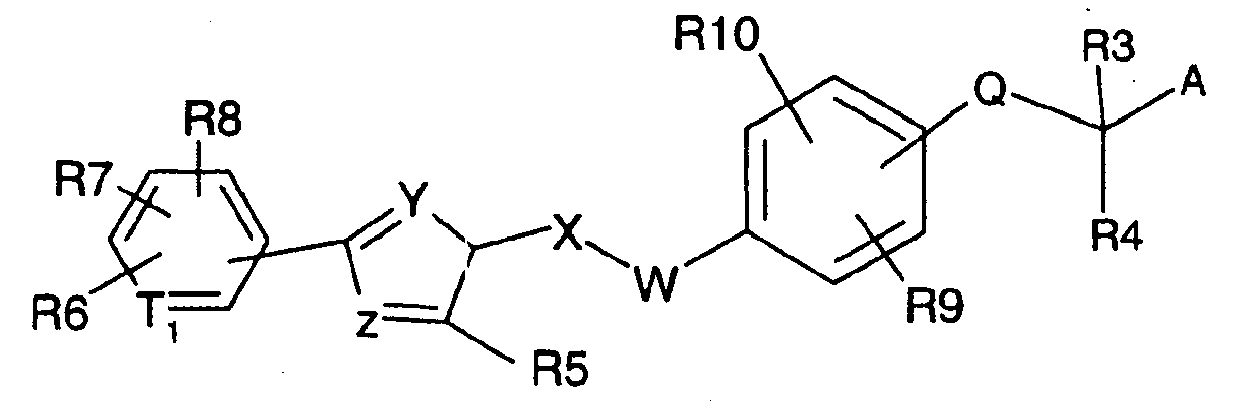 (a) R3 is hydrogen;(b) R4 is hydrogen;(c) R5 is selected from (C1-C6) alkyl, (C1-C6) alkenyl, aryl (C0-C4) alkyl, aryloxy (C0-C4) alkyl, arylthio (C0-C4) alkyl, wherein said aryl (C0-C4) alkyl, aryloxy (C0-C4) alkyl, and arylthio (C0-C4) alkyl are each independently optionally substituted with from one to three substituents each independently selected from R5';(d) R5' are each independently selected from halo, -(O)-(C1-C5)alkylCOOH, C1-C5 alkyl, C1-C5 alkylCOOH, and CF3;(e) R6 is selected from pyridinyl, pyrimidinyl, and pyrazinyl, wherein said pyridinyl, pyrimidinyl and pyrazinyl are each optionally substituted with from one to three substituents independently selected from R6';(f) R6' is independently selected from CF3, C1-C4 alkyl, halo, hydroxy (C1-C3) alkyl, C1-C3 alkoxy, and -C(O)CH3;(g) R7 and R8 are each independently selected from hydrogen, (C1-C6) alkyl, and trifluoromethyl;(h) R9 and R10 are each independently selected from hydrogen, (C1-C4) alkyl, (C1-C3) alkenyl, halo, and (C1-C4) alkoxy;(i) T1 is N or C;(j) Q is selected from a single bond and C;(k) W is selected from O and S,(l) X is CmH2m;(m) m is selected from 0, 1 and 2;(n) Y and Z are each independently selected from N, S, and O, with the proviso that at least one of Y and z is selected from S and O;(o) A is COOH;with the proviso that when R3 and R4 are each hydrogen, and at least one selected from R7 and R8 is CF3, then R5 is selected from (C3-C6) alkyl, (C1-C6) alkenyl, substituted aryl(C0-C4)alkyl, substituted aryloxy(C0-C4) alkyl, substituted arylthio (C0-C4) alkyl, unsubstituted aryl (C0-C4) alkyl, unsubstituted aryloxy(C0-C4) alkyl, and unsubstituted arylthio(C0-C4) alkyl.
 - A compound as claimed by Claim 1 wherein W is O.
- A compound as claimed by Claim 1 wherein W is S.
- A compound as claimed by any one of Claims 1, 2 or 3 wherein Q is C.
- A compound as claimed by any one of Claims 1, 2 or 3 wherein Q is a bond.
- A compound as claimed by any one of Claims 1 to 5 wherein W is bonded to the phenyl meta in relation to Q.
- A compound as claimed by any one of Claims 1 to 6 wherein R5 is (C1-C3) alkyl .
- A compound as claimed by any one of Claims 1 to 6 wherein R5 is methyl.
- A compound as claimed by any one of Claims 1 to 6 wherein R5 is an optionally substituted group selected from aryl (C0-C4) alkyl, aryloxy (C0-C4) alkyl, and arylthio (C0-C4) alkyl.
- A compound as claimed by any one of Claims 1 to 6 wherein R5 is optionally substituted phenyl alkyl.
- A compound as claimed by any one of Claims 1 to 10 wherein Z is N.
- A compound as claimed by any one of Claims 1 to 11 wherein Y is O.
- A compound as claimed by any one of Claims 1 to 11 wherein Y is S.
- A compound as claimed by any one of Claims 1 to 13 wherein T1 is N.
- A compound as claimed by any one of Claims 1 to 13 wherein T1 is C.
- A pharmaceutical composition, comprising a pharmaceutically acceptable carrier and at least one compound as claimed by any one of Claims 1 to 15.
- A compound as Claimed by any one of Claims 1 to 15 for use as a pharmaceutical.
- Use of a compound of any one of Claims 1 to 15 for the manufacture of a medicament for the treatment of a condition modulated by a peroxisome proliferator activated receptor.
- Use of a compound of any one of Claims 1 to 15 for the manufacture of a medicament for the treatment of diabetes mellitus in a mammal.
- Use of a compound of any one of Claims 1 to 15 for the manufacture of a medicament for the treatment of atherosclerosis in a mammal.
- A compound as claimed by any one of claims 1 to 15 for use in the treatment of a condition modulated by a peroxisome proliferator activated receptor.
- A compound as claimed by any one of claims 1 to 15 for use in the treatment of diabetes mellitus in a mammal.
- A compound as claimed by any one of claims 1 to 15 for use in the treatment of atherosclerosis in a mammal.
Applications Claiming Priority (3)
| Application Number | Priority Date | Filing Date | Title |
|---|---|---|---|
| US35980702P | 2002-02-25 | 2002-02-25 | |
| US359807P | 2002-02-25 | ||
| PCT/US2003/002680 WO2003072102A1 (en) | 2002-02-25 | 2003-02-13 | Peroxisome proliferator activated receptor modulators |
Publications (2)
| Publication Number | Publication Date |
|---|---|
| EP1480642A1 EP1480642A1 (en) | 2004-12-01 |
| EP1480642B1 true EP1480642B1 (en) | 2008-11-26 |
Family
ID=27766137
Family Applications (1)
| Application Number | Title | Priority Date | Filing Date |
|---|---|---|---|
| EP03710780A Expired - Lifetime EP1480642B1 (en) | 2002-02-25 | 2003-02-13 | Peroxisome proliferator activated receptor modulators |
Country Status (8)
| Country | Link |
|---|---|
| US (1) | US7259175B2 (en) |
| EP (1) | EP1480642B1 (en) |
| JP (1) | JP2005528346A (en) |
| AT (1) | ATE415160T1 (en) |
| AU (1) | AU2003214932A1 (en) |
| DE (1) | DE60324898D1 (en) |
| ES (1) | ES2316736T3 (en) |
| WO (1) | WO2003072102A1 (en) |
Cited By (1)
| Publication number | Priority date | Publication date | Assignee | Title |
|---|---|---|---|---|
| CN107250981A (en) * | 2014-10-06 | 2017-10-13 | 邻客音公司 | Dynamic loading of routes in single page applications |
Families Citing this family (63)
| Publication number | Priority date | Publication date | Assignee | Title |
|---|---|---|---|---|
| US20040072838A1 (en) * | 2000-12-20 | 2004-04-15 | Pierette Banker | Thiazole and oxazole derivatives as activators of human peroxisome proliferator activated receptors |
| DE60324898D1 (en) | 2002-02-25 | 2009-01-08 | Lilly Co Eli | MODULATORS OF PEROXISOME PROLIFERATOR-ACTIVATED RECEPTORS |
| CN100475810C (en) * | 2002-08-30 | 2009-04-08 | 霍夫曼-拉罗奇有限公司 | Novel 2-arylthiazole compounds as pparalpha and ppargamma agonists |
| EP1569916B1 (en) * | 2002-11-15 | 2009-01-07 | Cadila Healthcare Ltd. | Substituted aralkyl derivatives |
| DE10308351A1 (en) | 2003-02-27 | 2004-11-25 | Aventis Pharma Deutschland Gmbh | 1,3-substituted cycloalkyl derivatives having acidic, usually heterocyclic groups, processes for their preparation and their use as medicaments |
| US6987118B2 (en) * | 2003-05-21 | 2006-01-17 | Pfizer Inc. | Tetrahydroisoquinoline derivatives as PPAR-alpha activators |
| AU2004247355A1 (en) * | 2003-06-06 | 2004-12-23 | F. Hoffmann-La Roche Ag | Aniline derivatives |
| KR20060121884A (en) * | 2003-09-22 | 2006-11-29 | 오노 야꾸힝 고교 가부시키가이샤 | Phenyl Acetate Derivatives, Methods and Uses for the Preparation thereof |
| WO2005087710A1 (en) * | 2004-03-15 | 2005-09-22 | Takeda Pharmaceutical Company Limited | Aminophenylpropanoic acid derivative |
| DE102004016845A1 (en) * | 2004-04-07 | 2005-10-27 | Bayer Healthcare Ag | Phenylthioacetic acid derivatives and their use |
| TW200724138A (en) * | 2005-03-29 | 2007-07-01 | Sk Corp | Substituted carboxylic acid derivatives for the treatment of diabetes and lipid disorders, their preparation and use |
| EP1940767A2 (en) * | 2005-09-07 | 2008-07-09 | Plexxikon, Inc. | Pparactive compounds |
| AU2006287513A1 (en) * | 2005-09-07 | 2007-03-15 | Plexxikon, Inc. | 1, 3-disubstituted indole derivatives for use as PPAR modulators |
| AU2006316079B2 (en) | 2005-11-15 | 2012-03-29 | Otsuka Pharmaceutical Co., Ltd. | Oxazole compound and pharmaceutical composition |
| TWI444370B (en) * | 2006-01-25 | 2014-07-11 | Synta Pharmaceuticals Corp | Thiazole and thiadiazole compounds for inflammation and immune-related uses |
| GB2460784A (en) * | 2007-03-07 | 2009-12-16 | Dong A Pharmtech Co Ltd | Novel phenylpropionic acid derivatives as peroxisome proliferator-activated gamma receptor modulators,method of the same,and pharmaceutical composition |
| PE20090159A1 (en) * | 2007-03-08 | 2009-02-21 | Plexxikon Inc | INDOL-PROPIONIC ACID DERIVED COMPOUNDS AS PPARs MODULATORS |
| WO2009078981A2 (en) * | 2007-12-13 | 2009-06-25 | Sri International | Ppar-delta ligands and methods of their use |
| JP2012506386A (en) * | 2008-10-21 | 2012-03-15 | メタボレックス, インコーポレイテッド | Aryl GPR120 receptor agonist and uses thereof |
| UA107791C2 (en) | 2009-05-05 | 2015-02-25 | Dow Agrosciences Llc | Pesticidal compositions |
| US20130137728A1 (en) * | 2010-03-24 | 2013-05-30 | MUSC Foundation for Research and Development | Compositions and Methods for the Treatment of Degenerative Diseases |
| CN102285933B (en) * | 2010-06-18 | 2016-03-09 | 浙江海正药业股份有限公司 | A kind of have the compound of agonism, its preparation method and application to hypotype peroxisome proliferator-activated receptor |
| US8815271B2 (en) | 2010-11-03 | 2014-08-26 | Dow Agrosciences, Llc. | Pesticidal compositions and processes related thereto |
| WO2012122368A1 (en) * | 2011-03-08 | 2012-09-13 | The Regents Of The University Of California | Deoxycytidine kinase binding compounds |
| US8937083B2 (en) | 2011-10-26 | 2015-01-20 | DowAgroSciences, LLC | Pesticidal compositions and processes related thereto |
| US9708288B2 (en) | 2012-04-27 | 2017-07-18 | Dow Agrosciences Llc | Pesticidal compositions and processes related thereto |
| RU2627654C2 (en) | 2012-04-27 | 2017-08-09 | ДАУ АГРОСАЙЕНСИЗ ЭлЭлСи | Pesticidal compositions and methods related thereto |
| US9282739B2 (en) | 2012-04-27 | 2016-03-15 | Dow Agrosciences Llc | Pesticidal compositions and processes related thereto |
| JP2016535010A (en) | 2013-10-17 | 2016-11-10 | ダウ アグロサイエンシィズ エルエルシー | Method for producing pest control compound |
| EP3057426A4 (en) | 2013-10-17 | 2017-03-29 | Dow AgroSciences LLC | Processes for the preparation of pesticidal compounds |
| CN105636440A (en) | 2013-10-17 | 2016-06-01 | 美国陶氏益农公司 | Processes for the preparation of pesticidal compounds |
| KR20160075565A (en) | 2013-10-17 | 2016-06-29 | 다우 아그로사이언시즈 엘엘씨 | Processes for the preparation of pesticidal compounds |
| CN105636446B (en) | 2013-10-17 | 2018-07-13 | 美国陶氏益农公司 | The method for preparing Pesticidal compound |
| BR112016008070B8 (en) | 2013-10-17 | 2022-08-23 | Dow Agrosciences Llc | PESTICIDE COMPOUNDS AND THEIR PREPARATION PROCESSES |
| EP3057430A4 (en) | 2013-10-17 | 2017-09-13 | Dow AgroSciences LLC | Processes for the preparation of pesticidal compounds |
| US9497966B2 (en) | 2013-10-22 | 2016-11-22 | Dow Agrosciences Llc | Pesticidal compositions and related methods |
| CN105792652A (en) | 2013-10-22 | 2016-07-20 | 美国陶氏益农公司 | Synergistic pesticidal compositions and related methods |
| JP2016538265A (en) | 2013-10-22 | 2016-12-08 | ダウ アグロサイエンシィズ エルエルシー | Synergistic pest control compositions and related methods |
| US9137998B2 (en) | 2013-10-22 | 2015-09-22 | Dow Agrosciences Llc | Pesticidal compositions and related methods |
| AR098101A1 (en) | 2013-10-22 | 2016-05-04 | Dow Agrosciences Llc | PESTICIATED COMPOSITIONS AND RELATED METHODS |
| EP3060044A4 (en) | 2013-10-22 | 2017-04-05 | Dow AgroSciences LLC | Synergistic pesticidal compositions and related methods |
| AR098094A1 (en) | 2013-10-22 | 2016-05-04 | Dow Agrosciences Llc | SYNERGIC PESTICIATED COMPOSITIONS AND RELATED METHODS |
| CN105828608A (en) | 2013-10-22 | 2016-08-03 | 美国陶氏益农公司 | Pesticidal Compositions And Related Methods |
| CA2927206A1 (en) | 2013-10-22 | 2015-04-30 | Dow Agrosciences Llc | Synergistic pesticidal compositions and related methods |
| RU2658995C2 (en) | 2013-10-22 | 2018-06-26 | ДАУ АГРОСАЙЕНСИЗ ЭлЭлСи | Pesticide compositions and related methods |
| MX2016005319A (en) | 2013-10-22 | 2016-08-12 | Dow Agrosciences Llc | Pesticidal compositions and related methods. |
| US9155304B2 (en) | 2013-10-22 | 2015-10-13 | Dow Agrosciences Llc | Synergistic pesticidal compositions and related methods |
| AR098091A1 (en) | 2013-10-22 | 2016-05-04 | Dow Agrosciences Llc | SYNERGIC PESTICIDE COMPOSITIONS AND RELATED METHODS |
| EP3060054A4 (en) | 2013-10-22 | 2017-04-05 | Dow AgroSciences LLC | Synergistic pesticidal compositions and related methods |
| CN105792650A (en) | 2013-10-22 | 2016-07-20 | 美国陶氏益农公司 | Synergistic pesticidal compositions and related methods |
| CA2927226A1 (en) | 2013-10-22 | 2015-04-30 | Dow Agrosciences Llc | Synergistic pesticidal compositions and related methods |
| WO2015061140A1 (en) | 2013-10-22 | 2015-04-30 | Dow Agrosciences Llc | Synergistic pesticidal compositions and related methods |
| EP3174856A4 (en) | 2014-07-31 | 2018-01-10 | Dow AgroSciences LLC | Process for the preparation of 3-(3-chloro-1h-pyrazol-1-yl)pyridine |
| EP3186229A4 (en) | 2014-07-31 | 2018-01-10 | Dow AgroSciences LLC | Process for the preparation of 3-(3-chloro-1h-pyrazol-1-yl)pyridine |
| US9249122B1 (en) | 2014-07-31 | 2016-02-02 | Dow Agrosciences Llc | Process for the preparation of 3-(3-chloro-1H-pyrazol-1-yl)pyridine |
| WO2016028328A1 (en) | 2014-08-19 | 2016-02-25 | Dow Agrosciences Llc | Process for the preparation of 3-(3-chloro-1h-pyrazol-1-yl)pyridine |
| JP2017528469A (en) | 2014-09-12 | 2017-09-28 | ダウ アグロサイエンシィズ エルエルシー | Method for preparing 3- (3-chloro-1H-pyrazol-1-yl) pyridine |
| US10100033B2 (en) | 2016-12-29 | 2018-10-16 | Dow Agrosciences Llc | Processes for the preparation of pesticidal compounds |
| WO2018125817A1 (en) | 2016-12-29 | 2018-07-05 | Dow Agrosciences Llc | Processes for the preparation of pesticidal compounds |
| CN106928073A (en) * | 2017-03-27 | 2017-07-07 | 石家庄度恩医药科技有限公司 | A kind of preparation method of desmethylvenlafaxine |
| EP4237421A4 (en) | 2020-11-02 | 2024-11-06 | Trethera Corporation | CRYSTALLINE FORMS OF A DEOXYCYTIDINE KINASE INHIBITOR AND USES THEREOF |
| CN117843839B (en) * | 2024-01-08 | 2025-11-07 | 中化泉州石化有限公司 | Application of complex catalyst in synthesis of poly alpha-olefin |
| CN120694997B (en) * | 2025-08-25 | 2025-11-11 | 广州市老人院(加挂广州市第二老人院和广州市老年医院牌子) | Application of 2-fluoro-N-(2-(4-methyl-2-(m-tolyl)thiazolyl-5-yl)ethyl)benzenesulfonamide in the preparation of drugs for treating nervous system diseases |
Family Cites Families (14)
| Publication number | Priority date | Publication date | Assignee | Title |
|---|---|---|---|---|
| US5591862A (en) * | 1993-06-11 | 1997-01-07 | Takeda Chemical Industries, Ltd. | Tetrazole derivatives, their production and use |
| AUPN372995A0 (en) | 1995-06-23 | 1995-07-13 | MARRIOTT, Craig | Improved marine craft docking apparatus |
| ATE236137T1 (en) | 1996-02-02 | 2003-04-15 | Merck & Co Inc | HETEROCYCLIC COMPOUNDS AS ANTIDIABETIC AGENTS AND FOR THE TREATMENT OF OBESITY |
| IL128600A0 (en) | 1996-08-19 | 2000-01-31 | Japan Tobacco Inc | Propionic acid derivatives and pharmaceutical compositions containing them |
| JP4345230B2 (en) * | 1998-03-10 | 2009-10-14 | 小野薬品工業株式会社 | Carboxylic acid derivatives and drugs containing the derivatives as active ingredients |
| WO1999066915A2 (en) | 1998-06-23 | 1999-12-29 | Southern Illinois University At Carbondale | Therapeutic applications of estrogenic carboxylic acids |
| GB9914977D0 (en) | 1999-06-25 | 1999-08-25 | Glaxo Group Ltd | Chemical compounds |
| DK1206457T3 (en) | 1999-08-27 | 2004-02-16 | Lilly Co Eli | Biaryl-oxa (thia) zole derivatives and their use as modulators PPAPs |
| DE60129712T2 (en) | 2000-08-23 | 2008-07-03 | Eli Lilly And Co., Indianapolis | OXAZOLYLARYLOXYACETIC ACID DERIVATIVES AND THEIR USE AS PPAR AGONISTS |
| GB0031107D0 (en) | 2000-12-20 | 2001-01-31 | Glaxo Group Ltd | Chemical compounds |
| GB0031103D0 (en) | 2000-12-20 | 2001-01-31 | Glaxo Group Ltd | Chemical compounds |
| CN1267955C (en) | 2001-01-20 | 2006-08-02 | 汤姆森许可公司 | Compliant tension mask assembly |
| ME01310B (en) | 2001-05-15 | 2011-10-10 | Hoffmann La Roche | Carboxylic acid substituted oxazole derivatives for use as ppar-alpha and -gamma activators in the treatment of diabetes |
| DE60324898D1 (en) | 2002-02-25 | 2009-01-08 | Lilly Co Eli | MODULATORS OF PEROXISOME PROLIFERATOR-ACTIVATED RECEPTORS |
-
2003
- 2003-02-13 DE DE60324898T patent/DE60324898D1/en not_active Expired - Fee Related
- 2003-02-13 AU AU2003214932A patent/AU2003214932A1/en not_active Abandoned
- 2003-02-13 JP JP2003570848A patent/JP2005528346A/en active Pending
- 2003-02-13 AT AT03710780T patent/ATE415160T1/en not_active IP Right Cessation
- 2003-02-13 US US10/505,103 patent/US7259175B2/en not_active Expired - Fee Related
- 2003-02-13 ES ES03710780T patent/ES2316736T3/en not_active Expired - Lifetime
- 2003-02-13 WO PCT/US2003/002680 patent/WO2003072102A1/en not_active Ceased
- 2003-02-13 EP EP03710780A patent/EP1480642B1/en not_active Expired - Lifetime
Cited By (2)
| Publication number | Priority date | Publication date | Assignee | Title |
|---|---|---|---|---|
| CN107250981A (en) * | 2014-10-06 | 2017-10-13 | 邻客音公司 | Dynamic loading of routes in single page applications |
| CN107250981B (en) * | 2014-10-06 | 2021-04-02 | 微软技术许可有限责任公司 | Dynamic loading of routes in a single page application |
Also Published As
| Publication number | Publication date |
|---|---|
| US7259175B2 (en) | 2007-08-21 |
| DE60324898D1 (en) | 2009-01-08 |
| US20060084663A1 (en) | 2006-04-20 |
| ATE415160T1 (en) | 2008-12-15 |
| EP1480642A1 (en) | 2004-12-01 |
| AU2003214932A1 (en) | 2003-09-09 |
| JP2005528346A (en) | 2005-09-22 |
| ES2316736T3 (en) | 2009-04-16 |
| WO2003072102A1 (en) | 2003-09-04 |
Similar Documents
| Publication | Publication Date | Title |
|---|---|---|
| US7259175B2 (en) | Peroxisome proliferator activated receptor modulators | |
| US7153878B2 (en) | Peroxisome proliferator activated receptor modulators | |
| US7598266B2 (en) | Fused heterocyclic derivatives as PPAR modulators | |
| US6610696B2 (en) | Modulators of peroxisome proliferator activated receptors | |
| US7528160B2 (en) | Fused heterocyclic derivatives as PPAR modulators | |
| US7507832B2 (en) | Triazole PPAR modulators | |
| HUT65603A (en) | Process for preparing 3-aryl- or heteroaryl-propionic or propenoic acid derivatives and pharmaceutical compositions containing them | |
| US20090176863A1 (en) | Thiophene derivative ppar modulators | |
| EP1313716B1 (en) | Oxazolyl-arylpropionic acid derivatives and their use as ppar agonists | |
| JP2007508382A (en) | Phenoxyether derivatives as PPAR modulators | |
| EP1313717B1 (en) | Oxazolyl-arylpropionic acid derivatives and their use as ppar agonists | |
| EP1490058B1 (en) | Peroxisome proliferator activated receptor modulators | |
| EP1517882A1 (en) | Amide linker peroxisome proliferator activated receptor modulators | |
| Pingali et al. | Design and synthesis of novel oxazole containing 1, 3-Dioxane-2-carboxylic acid derivatives as PPAR α/γ dual agonists | |
| US20080207685A1 (en) | Heterocyclic Compounds As Modulators Of Peroxisome Proliferator Activated Receptors, Useful For The Treatment And/Or Prevention Of Disorders Modulated By A Ppar | |
| US20060166983A1 (en) | Indole derivatives as ppar modulators |
Legal Events
| Date | Code | Title | Description |
|---|---|---|---|
| PUAI | Public reference made under article 153(3) epc to a published international application that has entered the european phase |
Free format text: ORIGINAL CODE: 0009012 |
|
| 17P | Request for examination filed |
Effective date: 20040927 |
|
| AK | Designated contracting states |
Kind code of ref document: A1 Designated state(s): AT BE BG CH CY CZ DE DK EE ES FI FR GB GR HU IE IT LI LU MC NL PT SE SI SK TR |
|
| AX | Request for extension of the european patent |
Extension state: AL LT LV MK RO |
|
| RIN1 | Information on inventor provided before grant (corrected) |
Inventor name: CONNER, SCOTT, EUGENE Inventor name: ZHU, GUOXIN Inventor name: MANTLO, NATHAN, BRYAN |
|
| 17Q | First examination report despatched |
Effective date: 20061002 |
|
| GRAP | Despatch of communication of intention to grant a patent |
Free format text: ORIGINAL CODE: EPIDOSNIGR1 |
|
| GRAS | Grant fee paid |
Free format text: ORIGINAL CODE: EPIDOSNIGR3 |
|
| GRAA | (expected) grant |
Free format text: ORIGINAL CODE: 0009210 |
|
| AK | Designated contracting states |
Kind code of ref document: B1 Designated state(s): AT BE BG CH CY CZ DE DK EE ES FI FR GB GR HU IE IT LI LU MC NL PT SE SI SK TR |
|
| REG | Reference to a national code |
Ref country code: GB Ref legal event code: FG4D |
|
| REG | Reference to a national code |
Ref country code: CH Ref legal event code: EP |
|
| REG | Reference to a national code |
Ref country code: IE Ref legal event code: FG4D |
|
| REF | Corresponds to: |
Ref document number: 60324898 Country of ref document: DE Date of ref document: 20090108 Kind code of ref document: P |
|
| REG | Reference to a national code |
Ref country code: ES Ref legal event code: FG2A Ref document number: 2316736 Country of ref document: ES Kind code of ref document: T3 |
|
| PG25 | Lapsed in a contracting state [announced via postgrant information from national office to epo] |
Ref country code: AT Free format text: LAPSE BECAUSE OF FAILURE TO SUBMIT A TRANSLATION OF THE DESCRIPTION OR TO PAY THE FEE WITHIN THE PRESCRIBED TIME-LIMIT Effective date: 20081126 |
|
| NLV1 | Nl: lapsed or annulled due to failure to fulfill the requirements of art. 29p and 29m of the patents act | ||
| PG25 | Lapsed in a contracting state [announced via postgrant information from national office to epo] |
Ref country code: NL Free format text: LAPSE BECAUSE OF FAILURE TO SUBMIT A TRANSLATION OF THE DESCRIPTION OR TO PAY THE FEE WITHIN THE PRESCRIBED TIME-LIMIT Effective date: 20081126 Ref country code: FI Free format text: LAPSE BECAUSE OF FAILURE TO SUBMIT A TRANSLATION OF THE DESCRIPTION OR TO PAY THE FEE WITHIN THE PRESCRIBED TIME-LIMIT Effective date: 20081126 Ref country code: SI Free format text: LAPSE BECAUSE OF FAILURE TO SUBMIT A TRANSLATION OF THE DESCRIPTION OR TO PAY THE FEE WITHIN THE PRESCRIBED TIME-LIMIT Effective date: 20081126 |
|
| PG25 | Lapsed in a contracting state [announced via postgrant information from national office to epo] |
Ref country code: BG Free format text: LAPSE BECAUSE OF FAILURE TO SUBMIT A TRANSLATION OF THE DESCRIPTION OR TO PAY THE FEE WITHIN THE PRESCRIBED TIME-LIMIT Effective date: 20090226 Ref country code: DK Free format text: LAPSE BECAUSE OF FAILURE TO SUBMIT A TRANSLATION OF THE DESCRIPTION OR TO PAY THE FEE WITHIN THE PRESCRIBED TIME-LIMIT Effective date: 20081126 Ref country code: EE Free format text: LAPSE BECAUSE OF FAILURE TO SUBMIT A TRANSLATION OF THE DESCRIPTION OR TO PAY THE FEE WITHIN THE PRESCRIBED TIME-LIMIT Effective date: 20081126 Ref country code: BE Free format text: LAPSE BECAUSE OF FAILURE TO SUBMIT A TRANSLATION OF THE DESCRIPTION OR TO PAY THE FEE WITHIN THE PRESCRIBED TIME-LIMIT Effective date: 20081126 |
|
| PG25 | Lapsed in a contracting state [announced via postgrant information from national office to epo] |
Ref country code: SE Free format text: LAPSE BECAUSE OF FAILURE TO SUBMIT A TRANSLATION OF THE DESCRIPTION OR TO PAY THE FEE WITHIN THE PRESCRIBED TIME-LIMIT Effective date: 20090226 Ref country code: PT Free format text: LAPSE BECAUSE OF FAILURE TO SUBMIT A TRANSLATION OF THE DESCRIPTION OR TO PAY THE FEE WITHIN THE PRESCRIBED TIME-LIMIT Effective date: 20090427 Ref country code: CZ Free format text: LAPSE BECAUSE OF FAILURE TO SUBMIT A TRANSLATION OF THE DESCRIPTION OR TO PAY THE FEE WITHIN THE PRESCRIBED TIME-LIMIT Effective date: 20081126 |
|
| PG25 | Lapsed in a contracting state [announced via postgrant information from national office to epo] |
Ref country code: MC Free format text: LAPSE BECAUSE OF NON-PAYMENT OF DUE FEES Effective date: 20090228 Ref country code: SK Free format text: LAPSE BECAUSE OF FAILURE TO SUBMIT A TRANSLATION OF THE DESCRIPTION OR TO PAY THE FEE WITHIN THE PRESCRIBED TIME-LIMIT Effective date: 20081126 |
|
| REG | Reference to a national code |
Ref country code: CH Ref legal event code: PL |
|
| PLBE | No opposition filed within time limit |
Free format text: ORIGINAL CODE: 0009261 |
|
| STAA | Information on the status of an ep patent application or granted ep patent |
Free format text: STATUS: NO OPPOSITION FILED WITHIN TIME LIMIT |
|
| PG25 | Lapsed in a contracting state [announced via postgrant information from national office to epo] |
Ref country code: LI Free format text: LAPSE BECAUSE OF NON-PAYMENT OF DUE FEES Effective date: 20090228 Ref country code: CH Free format text: LAPSE BECAUSE OF NON-PAYMENT OF DUE FEES Effective date: 20090228 |
|
| 26N | No opposition filed |
Effective date: 20090827 |
|
| REG | Reference to a national code |
Ref country code: IE Ref legal event code: MM4A |
|
| PG25 | Lapsed in a contracting state [announced via postgrant information from national office to epo] |
Ref country code: IE Free format text: LAPSE BECAUSE OF NON-PAYMENT OF DUE FEES Effective date: 20090213 |
|
| PGFP | Annual fee paid to national office [announced via postgrant information from national office to epo] |
Ref country code: ES Payment date: 20100219 Year of fee payment: 8 |
|
| PGFP | Annual fee paid to national office [announced via postgrant information from national office to epo] |
Ref country code: FR Payment date: 20100222 Year of fee payment: 8 Ref country code: IT Payment date: 20100224 Year of fee payment: 8 |
|
| PGFP | Annual fee paid to national office [announced via postgrant information from national office to epo] |
Ref country code: DE Payment date: 20100226 Year of fee payment: 8 Ref country code: GB Payment date: 20100107 Year of fee payment: 8 |
|
| PG25 | Lapsed in a contracting state [announced via postgrant information from national office to epo] |
Ref country code: GR Free format text: LAPSE BECAUSE OF FAILURE TO SUBMIT A TRANSLATION OF THE DESCRIPTION OR TO PAY THE FEE WITHIN THE PRESCRIBED TIME-LIMIT Effective date: 20090227 |
|
| PG25 | Lapsed in a contracting state [announced via postgrant information from national office to epo] |
Ref country code: LU Free format text: LAPSE BECAUSE OF NON-PAYMENT OF DUE FEES Effective date: 20090213 |
|
| PG25 | Lapsed in a contracting state [announced via postgrant information from national office to epo] |
Ref country code: HU Free format text: LAPSE BECAUSE OF FAILURE TO SUBMIT A TRANSLATION OF THE DESCRIPTION OR TO PAY THE FEE WITHIN THE PRESCRIBED TIME-LIMIT Effective date: 20090527 |
|
| PG25 | Lapsed in a contracting state [announced via postgrant information from national office to epo] |
Ref country code: TR Free format text: LAPSE BECAUSE OF FAILURE TO SUBMIT A TRANSLATION OF THE DESCRIPTION OR TO PAY THE FEE WITHIN THE PRESCRIBED TIME-LIMIT Effective date: 20081126 |
|
| PG25 | Lapsed in a contracting state [announced via postgrant information from national office to epo] |
Ref country code: CY Free format text: LAPSE BECAUSE OF FAILURE TO SUBMIT A TRANSLATION OF THE DESCRIPTION OR TO PAY THE FEE WITHIN THE PRESCRIBED TIME-LIMIT Effective date: 20081126 |
|
| GBPC | Gb: european patent ceased through non-payment of renewal fee |
Effective date: 20110213 |
|
| REG | Reference to a national code |
Ref country code: FR Ref legal event code: ST Effective date: 20111102 |
|
| PG25 | Lapsed in a contracting state [announced via postgrant information from national office to epo] |
Ref country code: IT Free format text: LAPSE BECAUSE OF NON-PAYMENT OF DUE FEES Effective date: 20110213 |
|
| REG | Reference to a national code |
Ref country code: DE Ref legal event code: R119 Ref document number: 60324898 Country of ref document: DE Effective date: 20110901 |
|
| PG25 | Lapsed in a contracting state [announced via postgrant information from national office to epo] |
Ref country code: FR Free format text: LAPSE BECAUSE OF NON-PAYMENT OF DUE FEES Effective date: 20110228 |
|
| REG | Reference to a national code |
Ref country code: DE Ref legal event code: R082 Ref document number: 60324898 Country of ref document: DE Representative=s name: DR. SCHOEN & PARTNER, DE Ref country code: DE Ref legal event code: R082 Ref document number: 60324898 Country of ref document: DE Representative=s name: DR. SCHOEN, NEYMEYR & PARTNER MBB, DE |
|
| PG25 | Lapsed in a contracting state [announced via postgrant information from national office to epo] |
Ref country code: GB Free format text: LAPSE BECAUSE OF NON-PAYMENT OF DUE FEES Effective date: 20110213 |
|
| REG | Reference to a national code |
Ref country code: ES Ref legal event code: FD2A Effective date: 20120411 |
|
| PG25 | Lapsed in a contracting state [announced via postgrant information from national office to epo] |
Ref country code: ES Free format text: LAPSE BECAUSE OF NON-PAYMENT OF DUE FEES Effective date: 20110214 |
|
| PG25 | Lapsed in a contracting state [announced via postgrant information from national office to epo] |
Ref country code: DE Free format text: LAPSE BECAUSE OF NON-PAYMENT OF DUE FEES Effective date: 20110901 |