EP1480346A1 - Ldpc code inspection matrix generation method and inspection matrix generation device - Google Patents
Ldpc code inspection matrix generation method and inspection matrix generation device Download PDFInfo
- Publication number
- EP1480346A1 EP1480346A1 EP03743066A EP03743066A EP1480346A1 EP 1480346 A1 EP1480346 A1 EP 1480346A1 EP 03743066 A EP03743066 A EP 03743066A EP 03743066 A EP03743066 A EP 03743066A EP 1480346 A1 EP1480346 A1 EP 1480346A1
- Authority
- EP
- European Patent Office
- Prior art keywords
- weight
- row
- column
- codes
- check
- Prior art date
- Legal status (The legal status is an assumption and is not a legal conclusion. Google has not performed a legal analysis and makes no representation as to the accuracy of the status listed.)
- Ceased
Links
Images


Classifications
-
- H—ELECTRICITY
- H03—ELECTRONIC CIRCUITRY
- H03M—CODING; DECODING; CODE CONVERSION IN GENERAL
- H03M13/00—Coding, decoding or code conversion, for error detection or error correction; Coding theory basic assumptions; Coding bounds; Error probability evaluation methods; Channel models; Simulation or testing of codes
- H03M13/03—Error detection or forward error correction by redundancy in data representation, i.e. code words containing more digits than the source words
- H03M13/05—Error detection or forward error correction by redundancy in data representation, i.e. code words containing more digits than the source words using block codes, i.e. a predetermined number of check bits joined to a predetermined number of information bits
- H03M13/11—Error detection or forward error correction by redundancy in data representation, i.e. code words containing more digits than the source words using block codes, i.e. a predetermined number of check bits joined to a predetermined number of information bits using multiple parity bits
- H03M13/1102—Codes on graphs and decoding on graphs, e.g. low-density parity check [LDPC] codes
- H03M13/1148—Structural properties of the code parity-check or generator matrix
- H03M13/1151—Algebraically constructed LDPC codes, e.g. LDPC codes derived from Euclidean geometries [EG-LDPC codes]
-
- H—ELECTRICITY
- H03—ELECTRONIC CIRCUITRY
- H03M—CODING; DECODING; CODE CONVERSION IN GENERAL
- H03M13/00—Coding, decoding or code conversion, for error detection or error correction; Coding theory basic assumptions; Coding bounds; Error probability evaluation methods; Channel models; Simulation or testing of codes
- H03M13/03—Error detection or forward error correction by redundancy in data representation, i.e. code words containing more digits than the source words
- H03M13/05—Error detection or forward error correction by redundancy in data representation, i.e. code words containing more digits than the source words using block codes, i.e. a predetermined number of check bits joined to a predetermined number of information bits
- H03M13/13—Linear codes
- H03M13/134—Non-binary linear block codes not provided for otherwise
Definitions
- the present invention relates to a method of generating check matrixes for low density parity check (hereinafter "LDPC") codes that are used as error correction codes.
- LDPC low density parity check
- Fig. 27 is an illustration of an LDPC encoding/decoding system.
- This LDPC encoding/decoding system includes an encoder 101, a modulator 102, a channel 103, a demodulator 104, and a decoder 105.
- a conventional method of generating check matrixes for LDPC codes encoding and decoding using LDPC codes will be explained first.
- the encoder 101 At the sending side, the encoder 101 generates a check matrix H using a certain method, which will be described later, and generates a generator matrix G based on the following conditions:
- the encoder 101 then receives a message (m 1 m 2 ... m k ) of an information length k, and generates a code-word C using the generator matrix G as follows:.
- the modulator 102 subjects the generated code-word C to a digital modulation such as BPSK, QPSK or multi-valued QAM and transmits the resultant modulated signal.
- a digital modulation such as BPSK, QPSK or multi-valued QAM
- the demodulator 104 receives the modulated signal via the channel 103, and subjects it to a digital demodulation such as BPSK, QPSK or multi-valued QAM.
- the decoder 105 then subjects the LDPC-coded, demodulated result to an iterative decoding by "Sum-Product Algorithm” and provides an estimated result (corresponding to the original m 1 m 2 ... m k ).
- check matrixes for the LDPC codes are generated as explained below.
- the check matrix proposed by Gallager, the proposer of the LDPC, is shown in Fig. 28, as an example.
- This matrix is a binary matrix of "1" and "0". Parts of "1” are hatched and parts of "0" are white. There are four “1”s in one row (hereinafter, “row weight”), and there are three “1”s in one column (hereinafter, “column weight”). All columns and rows have respective uniform weights. Thus, it is generally called “Regular-LDPC Code”. In the Gallager's codes, as shown in Fig. 28, the matrix is divided into three blocks, for example, and the second and third blocks are subjected to random permutation.
- Euclid geometric codes are such LDPC codes that exhibit a relatively stable and nice characteristic and can definitely generate a matrix without the use of the computer search.
- Y. Kou et al. Y. Kou, S. Lin, and M. P. C. Fossorier, "Low Density Parity Check Codes Based on Finite Geometries: A Rediscovery," ISIT 2000, pp. 200, Sorrento, Italy, June 25 to 30, 2000.
- This method explains "Regular-LDPC Codes" consisting of regular ensembles.
- a method of generating a check matrix for LDPC codes is herein proposed using Euclid geometric codes EG (2, 2 6 ) or a kind of finite geometric codes. This method achieves a characteristic that is located closely but 1.45 decibels away from the Shannon limit at an error rate of 10 -4 .
- Fig. 29 is an illustration of the Euclid geometric codes EG (2, 2 2 ), which has a structure of "Regular-LDPC Codes" with row and column weights of 4, 4.
- the Euclid geometric codes have a structure with a location of "1" in each row shifted periodically from that in an adjacent row. It is a characteristic of this structure that it can configure codes easily and definitely.
- the method of generating check matrix proposed by Y. Kou et al. further includes changing row and column weights based on the Euclid geometric codes to extend rows and columns, if required. For example, when a column weight in EG (2, 2 2 ) is separated into halves, in the method of Y. Kou et al., every other one of four weights located in one column is separated into two groups.
- Fig. 30 is an illustration of an exemplary regular separation of the column weight from 4 into 2.
- a method of generating check matrixes for LDPC codes is for generating check matrixes for Irregular-LDPC codes, the method including: a weight determination step of determining a maximum value of a column weight; a Euclid geometric code determination step of determining Euclid geometric codes that become a basis based on the maximum value of a column weight; a coding rate determination step of determining a coding rate; a weight searching step of searching an optimum ensemble of a row weight and a column weight according to a linear programming method in a state of a fixed coding rate, and so as to maximize a Gaussian noise; an information calculation step of calculating an information length based on a predetermined block length and the coding rate; a row deletion step of deleting a predetermined row based on the information length using the Euclid geometric codes; and a division step of dividing at random a row weight or a column weight of the matrixes after the row deletion in a predetermined order.
- the row deletion step is for dividing at random the weight of each row in the Euclid geometric codes based on the ensemble, subtracting the information length from a number of rows after the division, and then deleting a number of rows corresponding to the subtraction result while adjusting the ratio of each the weights in the ensemble.
- the row deletion step is for deleting a predetermined number of rows from the basic Euclid geometric codes, and then dividing at random the weight of each row in the Euclid geometric codes after the deletion based on the ensemble.
- the method of generating check matrixes for LDPC codes further includes adjusting a weight distribution in the ensemble such that the total weight number of weight units is equal to an integer, and a sum of the total weight numbers of weight units is equal to the total number of "1"s in Euclid geometric codes, wherein the dividing is performed based on the adjusted ensemble.
- the method of generating check matrixes for LDPC codes further includes: creating a Latin square of basic random sequences; and dividing at random each column and each row by extracting a weight "1" from each row and each column in the Euclid geometric codes based on the Latin square.
- the method of generating check matrixes for LDPC codes further includes dividing the weight of a row or a column in the Euclid geometric codes using a predetermined polynomial, and deleting a "cycle number 6" which is present in the Euclid geometric codes that become a factor of characteristic degradation, to generate a check matrix for Irregular-LDPC codes.
- a check matrix generation apparatus has a structure for generating check matrixes for Irregular-LDPC codes using Euclid geometric codes, the apparatus including: a weight determination unit that determines a maximum value of a column weight; a Euclid geometric code determination unit that determines Euclid geometric codes based on the maximum value of a column weight; a coding rate determination unit that determines a coding rate; a weight searching unit that searches an optimum ensemble of a row weight and a column weight according to a linear programming method in a state of the fixed coding rate, and so as to maximize a Gaussian noise; an information calculation unit that calculates an information length based on a predetermined block length and the coding rate; a row deletion unit that deletes a predetermined row based on the information length using the Euclid geometric codes; and a division unit that divides at random a row weight or a column weight of the matrixes after the row deletion in a predetermined order.
- Fig. 1 is a flowchart of a method of generating check matrixes for LDPC codes according a first embodiment of the present invention
- Fig. 2 is an illustration of an ensemble of a generator function ⁇ (x) and a generator function ⁇ (x) when the rate is 0.5
- Fig. 3 is an illustration of Euclid geometric codes EG (2, 2 2 );
- Fig. 4 is an illustration of a column number of "1" in each row in the Euclid geometric codes EG (2, 2 2 ) shown in Fig. 3;
- Fig. 5 is an illustration of a column number of "1" in each row after a rearrangement;
- Fig. 6 is an illustration of a column number of "1" in each row after deleting five rows from the bottom in Fig.
- Fig. 7 is an illustration of a weight distribution within a column after deleting rows
- Fig. 8 is an illustration of a weight distribution after deleting five rows in the Euclid geometric codes EG (2, 2 5 )
- Fig. 9 is an illustration of a weight distribution after deleting 189 rows in the Euclid geometric codes EG (2, 2 5 );
- Fig. 10 is an exemplary diagram of a division table;
- Fig. 11 is an illustration of a weight distribution adjusting table;
- Fig. 12 is an illustration of an ensemble of a generator function ⁇ (x) and a generator function ⁇ (x) after a weight distribution;
- Fig. 13 is an illustration of a conventional dividing procedure; Fig.
- FIG. 14 is an illustration of a graph of EG (2, 2 5 ) before division;
- Fig. 15 is an illustration of a graph of EG (2, 2 5 ) after division of a random selection of an edge;
- Fig. 16 is an illustration of a relation between an Eb/No and a bit error rate;
- Fig. 17 is an illustration of an ensemble of "Regular-LDPC Codes";
- Fig. 18 is an illustration of an ensemble of "Irregular-LDPC Codes”;
- Fig. 19 is an illustration of a permutation pattern LBj (i) of a basic random sequence C(i) and a basic random sequence;
- Fig. 20 is an illustration of Latin square sequences L jq (i); Fig.
- FIG. 21 is an illustration of LDPC codes shown in Fig. 29 expressed by a bipartile graph
- Fig. 22 is an exemplary diagram of a cycle 4 and a cycle 6
- Fig. 23 is an illustration of a row number of "1" in each column in the Euclid geometric codes EG (2, 2 2 ) shown in Fig. 3
- Fig. 24 is an illustration of a matrix when the weight of the column is 2 by separating the matrix shown in Fig. 23 according to the expression (19)
- Fig. 25 is an illustration of a matrix col_s2_4 (i, j) when the weight of the matrix col (i, j) is simply separated into former two columns and latter two columns;
- FIG. 26 is an illustration of a matrix col_s2_4' (i, j) when the column is separated based on a method according to the second embodiment;
- Fig. 27 is an illustration of an LDPC encoding/decoding system;
- Fig. 28 is an illustration of a conventional check matrix for LDPC codes;
- Fig. 29 is an illustration of a configuration of Euclid geometric codes EG (2, 2 2 ); and
- Fig. 30 is an illustration of an exemplary column weight regularly separated from 4 into 2.
- Fig. 1 is a flowchart of a method of generating check matrixes for LDPC codes of the present invention.
- the method of generating check matrixes for LDPC codes according to the present embodiment may be executed on a communication apparatus according to set parameters, or may be executed on other control unit (such as a computer) outside of the communication apparatus.
- control unit such as a computer
- check matrixes generated for LDPC codes are stored in the communication apparatus. It is assumed here that the method is executed on the communication apparatus.
- the encoder 101 At the sending side, the encoder 101 generates a check matrix H using the method of generating check matrixes for LDPC codes according to the present embodiment and generates a generator matrix G based on the following conditions:
- the encoder 101 then receives a message (m 1 m 2 ... m k ) of an information length k, and generates a code-word C using the generator matrix G.
- the modulator 102 subjects the generated code-word C to digital modulation such as BPSK, QPSK or multi-valued QAM and transmits the resultant modulated signal.
- the demodulator 104 receives the modulated signal via the channel 103, and subjects it to digital demodulation such as BPSK, QPSK or multi-valued QAM.
- the decoder 105 then subjects the LDPC-coded, demodulated result to an iterative decoding by "Sum-Product Algorithm” and provides an estimated result (corresponding to the original (m 1 m 2 ... m k )).
- the method of generating check matrixes for LDPC codes described in Chung et al., or Gaussian Approximation has a premise that defines a point of "1" on a row as a variable node and a point of "1" on a column as a check node in the check matrix.
- LLR message propagation from a check node to a variable node is analyzed first.
- the following equation (2) is defined on condition that 0 ⁇ s ⁇ ⁇ and 0 ⁇ t ⁇ ⁇ .
- s m u0 denotes a mean of u0; u0 a Log Likelihood Ratio (LLR) associated with a signal received via a channel containing a Gaussian noise of distributed value ⁇ n 2 ; and t an ensemble average of LLR output values at check nodes at the time of certain iteration.
- LLR Log Likelihood Ratio
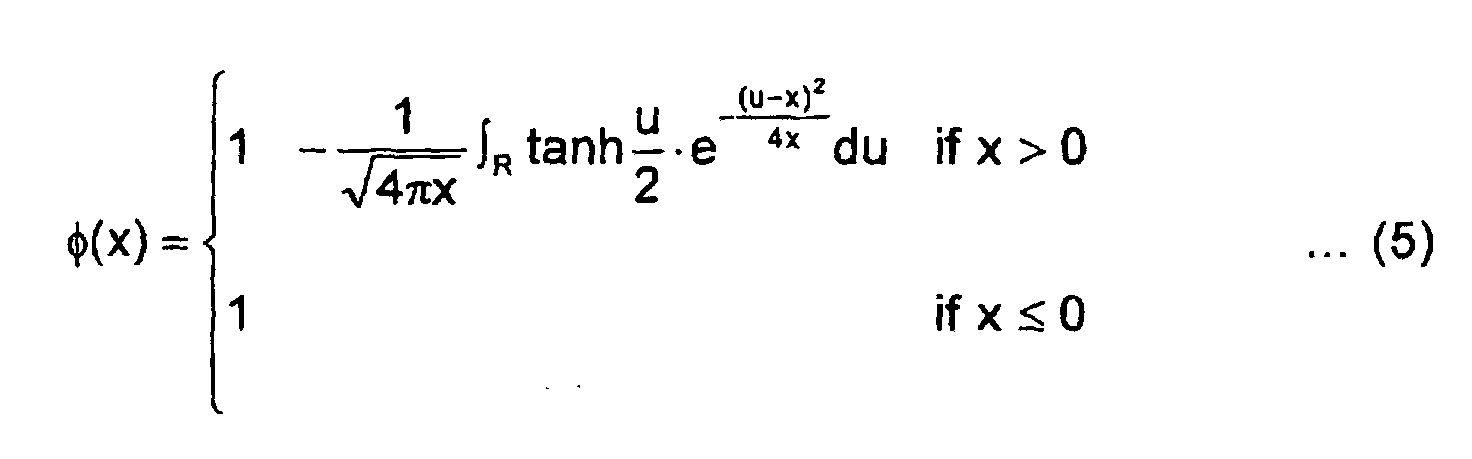
- ⁇ (x) and ⁇ (x) respectively denote generator functions of degree distribution associated with variable nodes and check nodes, and can be represented by the equations (3) and (4).
- a degree is expressed as the number of "1"s in each row of variable nodes or each column of check nodes).
- ⁇ j and ⁇ j respectively denote ratios of edges belonging to variable nodes and check nodes at a degree of i.
- d j denotes a degree of maximum variable nodes
- d r a degree of maximum check nodes.
- ⁇ (x) is defined as the following equation (5):
- a condition required for deriving an SNR limit (threshold) that provides an error with a value of 0 includes t l (s) ⁇ ⁇ (expressed as R + ) when I ⁇ ⁇ . In order to satisfy this condition, it is required to satisfy the following conditional expression (7): t ⁇ f(s, t), all t ⁇ R +
- Equation (8) LLR message propagation from a variable node to a check node is analyzed next.
- the following equation (8) is defined on condition that 0 ⁇ s ⁇ ⁇ and 0 ⁇ r ⁇ 1. In this case, r has an initial value r 0 of ⁇ (s).
- a condition required for deriving an SNR limit (threshold) that provides an error with a value of 0 includes r l (s) ⁇ 0. In order to satisfy this condition, it is required to satisfy the following conditional expression (10): r > h (s, r), all r ⁇ (0, ⁇ (s))
- a problem is found in the method of Chung et al. because a check matrix derived from the maximum of the "rate (coding rate)" is flux. Such the check matrix is not suitable for practical design because the rate fixed in design as a spec varies.
- the Gaussian Approximation iteratively executes the derivation of the degree distribution associated with variable nodes and the derivation of the degree distribution associated with check nodes over certain times. Therefore, a problem arises that it takes time to some extent for searching. Further, a problem arises that the check matrix does not easily apply to an optional ensemble, an optional code length, and an optional coding rate.
- the present invention provides a method of a definite and characteristic-stabilized check matrix for "Irregular-LDPC Codes", which corresponds to an optional ensemble, an optional code length, and an optional coding rate, is searched easily in a short time (refer to Fig. 1).
- the check matrix for "Irregular-LDPC Codes” is generated by dividing or deleting the arrangement of "1" in one row or one column in the Euclid geometric codes.
- Fig. 1 is an illustration of the method of generating check matrixes for LDPC codes of the first embodiment.
- a maximum value dl of the column weight is first determined (step S1, Fig. 1).
- dl is set equal to 32.
- a coding rate (rate) is determined (step S3).
- rate is 0.5
- a case when the rate is 0.5 will be explained, for example.
- ⁇ GA denotes a noise variance at the time of the "threshol” obtained by the Gaussian Approximation
- SNR norm (GA) denotes a difference between SNR at the time of the "threshol” obtained by the Gaussian Approximation and SNR of Shannon limit.
- Steps of executing the Gaussian Approximation to search the ensemble of the generator function ⁇ (x) of the degree distribution of the variable node and the generator function ⁇ (x) of the degree distribution of the check node will be explained.
- the present embodiment employs the linear programming once to find such generator functions ⁇ (x) and ⁇ (x) that satisfy the equations (9) and (10). Therefore, it is possible to search a definite and characteristic-stabilized check matrix for LDPC codes more easily in a shorter time than the method described in the paper that iteratively executes derivation of the generator functions ⁇ (x) and ⁇ (x) to derive both optimal values.
- the ensemble is obtained at step S4.
- the block length N is obtained, and the information length K is fixed from the block length N (step S5).
- rows corresponding to the information length K are deleted (step S6).
- Row deletion methods (a first deletion method, and a second deletion method) according to the present embodiment will be explained in detail.
- the number of rows and the number of columns of the Euclid geometric codes EG (2, 2 s ) that become the base can be expressed as 2 5 ⁇ 2 5 - 1.
- one row of a weight 32 is divided into one row of a weight 10 and two rows of a weight 11 based on the ensemble shown in Fig. 2.
- the number of rows of the weight 10 becomes 1023, and the number of rows of the weight 11 becomes 2046.
- D r R T - K
- a random division that is, a "division method using the Latin square of basic random sequences" described later is executed, for example.
- the rows are deleted at the stage of the basic Euclid geometric codes EG (2, 2 s ).
- Fig. 3 is an illustration of Euclid geometric codes EG (2, 2 2 ) (where a blank box represents zero).
- Fig. 4 is an illustration of a column number of "1"s in each row in the Euclid geometric codes EG (2, 2 2 ) shown in Fig. 3.
- the row number of each row "1" is expressed as Row (i, j) (where i denotes a row number, and j denotes a column number).
- Row (1, j) ⁇ 1, 5, 13, 14 ⁇ .
- Fig. 5 is an illustration of a column number of "1 "s in each row after the rearrangement.
- the column number of "1" of each row after the rearrangement is expressed as Row' (i, j).
- Fig. 6 is an illustration of a column number of "1"s in each row after deleting five rows from the bottom in Fig. 5.
- the column number of "1"s of each row after the deletion is expressed as Row_5' (i, j).
- Fig. 7 is an illustration of a weight distribution within the column after deleting rows, expressing a relationship between the column number and the number of "1"s included in this column in Fig. 6.
- Fig. 8 is an illustration of a weight distribution after deleting five rows in the Euclid geometric codes EG (2, 2 5 ).
- Fig. 9 is an illustration of a weight distribution after deleting 189 rows in the Euclid geometric codes EG (2, 2 5 ) in a process similar to that of the second deletion method.
- the rows are deleted.
- the columns are divided (at step S7).
- the division method according to the present embodiment will be explained in detail with reference to Fig. 2 for the sake of the convenience.
- the value of x of the weight distribution ⁇ x and the value of x of the weight distribution ⁇ x can structure 32, based on the combination of x respectively.
- Fig. 10 is an illustration of a division table. For example, a combination of 7 ⁇ 4 and 2 ⁇ 2 indicates that one column of the weight 32 can be divided into four columns of the weight 7 and two columns of the weight 2.
- each row and each column that become the basis can suitably divide the Euclid geometric codes EG (2, 2 5 ) as shown in Fig. 10, the check matrixes for "Irregular-LDPC Codes" can be configured.
- rows can be divided in a similar manner for the column weights 31, 30, 29, 28, 27, 26, 25, 24, 23, 22, and 21 (refer to Fig. 9).
- Fig. 11 is an illustration of a table for adjusting a weight distribution.
- Fig. 12 is an illustration of an ensemble of a generator function ⁇ (x) and a generator function ⁇ (x) after the weight distribution.
- B 1 (x) ⁇ 1 32 114 136 149 223 260 382 402 438 467 507 574 579 588 622 634 637 638 676 717 728 790 851 861 879 947 954 971 977 979 998 ⁇
- S 1 (n) ⁇ 1 149 402 574 634 717 861 971 ⁇
- S 2 (n) ⁇ 32 223 438 579 637 728 879 977 ⁇
- Euclid geometric codes are not divided regularly as described above. Rather, a number indicative of "1" is extracted from B l (x) at random. Any extracting process may be applied so long as it can retain randomness.
- Fig. 14 is an illustration of a graph of EG (2, 2 5 ) before division. A line connecting both nodes is expressed as an edge.
- Fig. 14 shows Euclid geometric codes in 1023 rows ⁇ 1023 columns (with each row/column weight of 32) before division.
- Fig. 15 is an illustration of a graph after the division, which selects edges from EG (2,2 5 ) at random.
- Fig. 16 is an illustration of a relation between an Eb/No (Signal power to Noise power per information bit) to a bit error rate (hereinafter, "BER"). The number of iteration is equal to 50 times.
- the decoding method is a "Sum-Product Algorithm”.
- the maximum value dl of the column weight is first determined.
- the Euclid geometric codes EG (2, 2 s ) as the base are selected based on the column weight dl.
- the coding rate (rate) is determined next.
- the ensemble of the generator function ⁇ (x) of the degree distribution of the variable node and the generator function ⁇ (x) of the degree distribution of the check node is obtained using the Gaussian Approximation.
- the information length K is firmed from the predetermined block length N, and the deletion processing corresponding to the information length K is carried out in the predetermined order.
- the column division processing is carried out in the predetermined order.
- Fig. 20 is an illustration of Latin square sequences L jq (i).
- the Latin square sequences L jq (i) are used to determine a division pattern of the j ⁇ 32 + q-th column of the matrix to be expanded (for example, the matrix shown in Fig. 12).
- the LDPC codes (i.e., the check matrixes for LDPC codes) are expressed by a bipartile graph (that is, a tanner graph consisting of two kinds of elements of soft AND, and soft EXOR) as a general expression method, for example.
- Fig. 21 is an exemplary diagram of LDPC codes shown in Fig. 29 expressed by a bipartile graph. As shown in this diagram, the variable node is expressed by the soft AND, and the check node is expressed by the soft EXOR on the bipartile graph.
- Fig. 22 is an exemplary diagram of a cycle 4 and a cycle 6.
- the cycle 4 has the largest influence.
- the influence becomes smaller. Accordingly, for the LDPC codes, a structure that restrict the generation of small cycles like the cycle 4 and the cycle 6 is preferable.
- decoding characteristics are improved by deleting the cycle 6 that exists in the Euclid geometric codes.
- the cycle 4 does not exist in the base Euclid geometric codes, and the characteristics are not changed even if rows and columns are divided or deleted (including the division and deletion according to the first embodiment).
- Fig. 23 is an illustration of a row number of "1" in each column in the Euclid geometric codes EG (2, 2 2 ) shown in Fig. 3. This matrix is expressed as col (i, j).
- the column weight is separated from 4 into 2.
- the equation (18) is separated into the former part and the later part, as given by the following equation (19):
- Fig. 24 is an illustration of a matrix when the weight of the column is 2 by separating the matrix shown in Fig. 23 according to the expression (19). This matrix is expressed as col_s2 (i, j).
- the LDPC codes corresponding to the matrix shown in Fig. 24 separated by the above processing have no cycle 6 at all.
- the separation based on the polynomial may be a pair of degrees.
- the column weight can be separated from 4 into 2 using the equation (19) or the equation (20), thereby to completely remove the cycle 6.
- the cycle 6 can be completely removed when all the weight of the column is separated into 2. Therefore, when there is already other column having the weight equal to or more than 3, that is, in the case of the "Irregular-LDPC Codes", the cycle 6 can be removed but can not be removed completely.
- Fig. 25 is an illustration of a matrix col_s2_4 (i, j) when the weight of the matrix col (i, j) is simply separated into former two columns and latter two columns as a procedure to separate a column having the weight 4 into 20 columns having the weight 2 and 5 columns having the weight 4.
- the number of the cycle 6 becomes 35.
- Fig. 26 is an illustration of a matrix col_s2_4' (i, j) when the column is separated based on the above equation. In the matrix col_s2_4' (i, j) shown in Fig. 26, the number of the cycle 6 becomes 33, which is smaller than the number shown in Fig. 25.
- the weight of the column is separated to decrease the number of the cycle 6 that exists in the Euclid geometric codes and that becomes the element of the characteristic degradation. Therefore, the decoding characteristics can be improved.
- the Euclid geometric codes are used as the basic codes (i.e., the basic matrix).
- a matrix other than the Euclid geometric codes such as, projective geometric codes, may also be used if it fulfills the conditions that "the weights of a row and a column are constant" and that "the number of cycle is equal to or more than six".
- the maximum value dl of the column weight is first determined.
- the Euclid geometric codes EG (2, 2 s ) as the base are selected based on the column weight dl.
- the coding rate (rate) is determined next.
- the ensemble of the generator function ⁇ (x) of the degree distribution of the variable node and the generator function ⁇ (x) of the degree distribution of the check node is obtained using the Gaussian Approximation.
- the information length K is firmed from the predetermined block length N, and the deletion processing corresponding to the information length K is carried out in the predetermined order.
- the column division processing is carried out in the predetermined order.
- the weight of each row in the Euclid geometric codes is divided at random based on the predetermined ensemble, the information length is subtracted from the number of rows after the division, and then the number of rows corresponding to the subtraction result is deleted so as not to change as far as possible the ratio of each weight in the ensemble.
- a predetermined number of rows are deleted from the basic Euclid geometric codes, and then the weight of each row in the Euclid geometric codes after the deletion is divided at random based on the ensemble.
- the weight distribution in the ensemble is adjusted such that the total weight number of weight units is equal to an integer, and the sum of the total weight numbers of weight units is equal to the total number of "1"s in Euclid geometric codes.
- the weight of the column is separated to decrease the number of the cycle number 6 which is present in the Euclid geometric codes and which becomes an element of characteristic degradation.
- the maximum value dl of the column weight is first determined.
- the Euclid geometric codes EG (2, 2 s ) as the base are selected based on the column weight dl.
- the coding rate (rate) is determined next.
- the ensemble of the generator function ⁇ (x) of the degree distribution of the variable node and the generator function ⁇ (x) of the degree distribution of the check node is obtained using the Gaussian Approximation.
- the information length K is firmed from the predetermined block length N, and the deletion processing corresponding to the information length K is carried out in the predetermined order.
- the column division processing is carried out in the predetermined order.
- the method of generating check matrixes for LDPC codes and the check matrix generation apparatus according to the present invention are useful for the communication system that employs the LDPC codes as error correction codes.
- the method and the apparatus are suitable for an apparatus that generates definite and characteristic-stabilized "Irregular-LDPC Codes".
Landscapes
- Physics & Mathematics (AREA)
- Mathematical Physics (AREA)
- Discrete Mathematics (AREA)
- General Physics & Mathematics (AREA)
- Probability & Statistics with Applications (AREA)
- Engineering & Computer Science (AREA)
- Theoretical Computer Science (AREA)
- Error Detection And Correction (AREA)
- Complex Calculations (AREA)
Abstract
Description

| Code length | n = 22s - 1 |
| Redundant bit length | n - k = 3s - 1 |
| Information length | k = 22s - 3s |
| Minimum distance | dmin = 2s + 1 |
| Density | r = 2s/(22s - 1) |






An example of random sequence creation is described below using Euclid geometric codes EG (2,25) for convenience of explanation. In Euclid geometric codes EG (2,25), the number of "1 "s present in a row is equal to 25 = 32. When P is used for the minimum prime number that satisfies P ≥ 2s, for example, P = 37 in the case of 25. A basic random sequence C(i) with a sequence length, P - 5 = 32, is created in accordance with the equation (13):
Claims (10)
- A method of generating check matrixes for LDPC codes as a method for generating check matrixes for Irregular-LDPC codes, comprising:a weight determination step of determining a maximum value of a column weight;a basic matrix determination step of determining a basic matrix that fulfills conditions that "the weights of a row and a column are constant" and that "the number of cycle is equal to or more than six" based on the maximum value of a column weight;a coding rate determination step of determining a coding rate;a weight searching step of searching an optimum ensemble of a row weight and a column weight according to a linear programming method in a state of a fixed coding rate, and so as to maximize a Gaussian noise;an information calculation step of calculating an information length based on a predetermined block length and the coding rate;a row deletion step of deleting a predetermined row based on the information length using the basic matrix; anda division step of dividing at random a row or a column of the matrixes after the row deletion in a predetermined order.
- A method of generating check matrixes for Low-Density Parity-Check codes as a method for generating check matrixes for Irregular-LDPC codes using Euclid geometric codes, comprising:a weight determination step of determining a maximum value of a column weight;a Euclid geometric code determination step of determining Euclid geometric codes based on the maximum value of a column weight;a coding rate determination step of determining a coding rate;a weight searching step of searching an optimum ensemble of a row weight and a column weight according to a linear programming method in a state of a fixed coding rate, and so as to maximize a Gaussian noise;an information calculation step of calculating an information length based on a predetermined block length and the coding rate;a row deletion step of deleting a predetermined row based on the information length using the Euclid geometric codes; anda division step of dividing at random a row or a column of the matrixes after the row deletion in a predetermined order.
- The method of generating check matrixes for Low-Density Parity-Check codes according to claim 2, wherein
the row deletion step is for dividing at random the weight of each row in the Euclid geometric codes based on the ensemble, subtracting the information length from a number of rows after the division, and then deleting a number of rows corresponding to the subtraction result while adjusting the ratio of each the weights in the ensemble. - The method of generating check matrixes for Low-Density Parity-Check codes according to claim 2, wherein
the deletion step is for deleting a predetermined number of rows from the basic Euclid geometric codes, and then dividing at random the weight of each row in the Euclid geometric codes after the deletion based on the ensemble. - The method of generating check matrixes for Low-Density Parity-Check codes according to claim 2, further comprising:adjusting a weight distribution in the ensemble such that the total weight number of weight units is equal to an integer, and a sum of the total weight numbers of weight units is equal to the total number of "1"s in Euclid geometric codes, wherein the dividing is performed based on the adjusted ensemble.
- The method of generating check matrixes for Low-Density Parity-Check codes according to claim 2, further comprising:creating a Latin square of basic random sequences; and dividing at random each column and each row by extracting a weight "1" from each row and each column in the Euclid geometric codes.
- A method of generating check matrixes for Low-Density Parity-Check codes as a method for generating check matrixes for Irregular-LDPC codes, comprising:dividing the weight of a row or a column in the basic matrix that fulfills conditions that "the weights of a row and a column are constant" and that "the number of cycle is six or above" using a predetermined polynomial, and deleting a "cycle number 6" that becomes an element of characteristic degradation.
- A method of generating check matrixes for Low-Density Parity-Check codes as a method for generating check matrixes for Irregular-LDPC codes using Euclid geometric codes, comprising:dividing the weight of a row or a column in the Euclid geometric codes using a predetermined polynomial, and deleting a "cycle number 6" that exists in the Euclid geometric codes and that becomes an element of characteristic degradation.
- A check matrix generation apparatus for Low-Density Parity-Check codes as an apparatus that generates check matrixes for Irregular-LDPC codes, comprising:a weight determination unit that determines a maximum value of a column weight;a basic matrix determination unit that determines a basic matrix that fulfills conditions that "the weights of a row and a column are constant" and that "the number of cycle is equal to or more than six" based on the maximum value of a column weight;a coding rate determination unit that determines a coding rate;a weight searching unit that searches an optimum ensemble of a row weight and a column weight according to a linear programming method in a state of a fixed coding rate, and so as to maximize a Gaussian noise;an information calculation unit that calculates an information length based on a predetermined block length and the coding rate;a row deletion unit that deletes a predetermined row based on the information length using the basic matrix; anda division unit that divides at random a row or a column of the matrixes after the row deletion in a predetermined order.
- A check matrix generation apparatus for Low-Density Parity-Check codes as an apparatus that generates check matrixes for Irregular-LDPC codes using Euclid geometric codes, comprising:a weight determination unit that determines a maximum value of a column weight;a Euclid geometric code determination unit that determines Euclid geometric codes based on the maximum value of a column weight;a coding rate determination unit that determines a coding rate;a weight searching unit that searches an optimum ensemble of a row weight and a column weight according to a linear programming method in a state of a fixed coding rate, and so as to maximize a Gaussian noise;an information calculation unit that calculates an information length based on a predetermined block length and the coding rate;a row deletion unit that deletes a predetermined row based on the information length using the Euclid geometric codes; anda division unit that divides at random a row or a column of the matrixes after the row deletion in a predetermined order.
Applications Claiming Priority (3)
| Application Number | Priority Date | Filing Date | Title |
|---|---|---|---|
| JP2002053888 | 2002-02-28 | ||
| JP2002053888 | 2002-02-28 | ||
| PCT/JP2003/002331 WO2003073621A1 (en) | 2002-02-28 | 2003-02-28 | Ldpc code inspection matrix generation method and inspection matrix generation device |
Publications (2)
| Publication Number | Publication Date |
|---|---|
| EP1480346A1 true EP1480346A1 (en) | 2004-11-24 |
| EP1480346A4 EP1480346A4 (en) | 2006-05-10 |
Family
ID=27764375
Family Applications (1)
| Application Number | Title | Priority Date | Filing Date |
|---|---|---|---|
| EP03743066A Ceased EP1480346A4 (en) | 2002-02-28 | 2003-02-28 | METHOD FOR GENERATING LDPC CODE INSPECTION ARRAYS AND DEVICE FOR GENERATING INSPECTION ARRAYS |
Country Status (5)
| Country | Link |
|---|---|
| US (1) | US7089479B2 (en) |
| EP (1) | EP1480346A4 (en) |
| JP (1) | JP3893383B2 (en) |
| CN (1) | CN100592641C (en) |
| WO (1) | WO2003073621A1 (en) |
Cited By (7)
| Publication number | Priority date | Publication date | Assignee | Title |
|---|---|---|---|---|
| EP1460766A4 (en) * | 2001-12-27 | 2007-03-14 | Mitsubishi Electric Corp | GENERATING METHOD OF LDPC CODE EXAMINATION MATRIX |
| EP1598942A4 (en) * | 2003-02-28 | 2007-04-04 | Mitsubishi Electric Corp | METHOD AND DEVICE FOR GENERATING A CONTROL MATRIX |
| GB2439986A (en) * | 2006-07-07 | 2008-01-16 | Siemens Ag | Method for generating Low Density Parity Check (LDPC) codes and apparatus using the LDPC codes |
| CN100385796C (en) * | 2004-11-25 | 2008-04-30 | 上海交通大学 | Channel Coding Method of Low Density Check Code |
| EP1820275A4 (en) * | 2004-12-08 | 2009-11-25 | Korea Electronics Telecomm | LDPC ENCODER AND DECODER AND LDPC ENCODING AND DECODING METHODS |
| US7882418B2 (en) | 2004-12-08 | 2011-02-01 | Electronics And Telecommunications Research Institute | LDPC encoder and decoder and LDPC encoding and decoding methods |
| EP1784919A4 (en) * | 2004-08-09 | 2011-08-10 | Lg Electronics Inc | Method of encoding and decoding using low density parity check matrix |
Families Citing this family (24)
| Publication number | Priority date | Publication date | Assignee | Title |
|---|---|---|---|---|
| KR100996029B1 (en) * | 2003-04-29 | 2010-11-22 | 삼성전자주식회사 | Apparatus and method for encoding low density parity check code |
| US7607063B2 (en) * | 2003-05-30 | 2009-10-20 | Sony Corporation | Decoding method and device for decoding linear code |
| US7814392B2 (en) * | 2003-06-20 | 2010-10-12 | Intel Corporation | System, apparatus and methods of dynamically determined error correction codes in communication systems |
| CN100440737C (en) * | 2003-12-04 | 2008-12-03 | 北京泰美世纪科技有限公司 | A Highly Structured LDPC Encoding and Decoding Method and Its Encoder and Decoder |
| KR20050118056A (en) * | 2004-05-12 | 2005-12-15 | 삼성전자주식회사 | Method and apparatus for channel encoding and decoding in mobile communication systems using multi-rate block ldpc codes |
| US7165205B2 (en) * | 2004-05-14 | 2007-01-16 | Motorola, Inc. | Method and apparatus for encoding and decoding data |
| JP4138700B2 (en) * | 2004-05-31 | 2008-08-27 | 株式会社東芝 | Decoding device and decoding circuit |
| US7752520B2 (en) * | 2004-11-24 | 2010-07-06 | Intel Corporation | Apparatus and method capable of a unified quasi-cyclic low-density parity-check structure for variable code rates and sizes |
| US7634710B2 (en) * | 2005-03-25 | 2009-12-15 | Teranetics, Inc. | Efficient decoding |
| US7461328B2 (en) * | 2005-03-25 | 2008-12-02 | Teranetics, Inc. | Efficient decoding |
| US8122324B2 (en) * | 2005-03-31 | 2012-02-21 | Mitsubishi Electric Corporation | Error correction coding apparatus |
| US7584400B2 (en) * | 2005-04-15 | 2009-09-01 | Trellisware Technologies, Inc. | Clash-free irregular-repeat-accumulate code |
| US7793190B1 (en) * | 2005-08-10 | 2010-09-07 | Trellisware Technologies, Inc. | Reduced clash GRA interleavers |
| WO2007030030A1 (en) * | 2005-09-07 | 2007-03-15 | Intel Corporation | Construction and use of shortened eg-ldpc codes |
| US8316287B1 (en) | 2006-08-24 | 2012-11-20 | Marvell International Ltd. | Low-density parity check codes for holographic storage |
| US8504890B2 (en) * | 2006-12-17 | 2013-08-06 | Ramot At Tel Aviv University Ltd. | Scheduling for LDPC decoding |
| JP4674226B2 (en) * | 2007-08-22 | 2011-04-20 | 日本電信電話株式会社 | Channel encoding method, channel encoding system, hierarchical channel encoding program, and hierarchical channel decoding program |
| US8261152B2 (en) * | 2007-09-10 | 2012-09-04 | Samsung Electronics Co., Ltd. | Apparatus and method for channel encoding/decoding in communication system using variable-length LDPC codes |
| JP5203717B2 (en) * | 2007-12-19 | 2013-06-05 | パナソニック株式会社 | Encoder, decoder, encoding method, and decoding method |
| JP4563476B2 (en) | 2008-07-09 | 2010-10-13 | パナソニック株式会社 | Encoder, decoder and encoding method |
| US8166364B2 (en) | 2008-08-04 | 2012-04-24 | Seagate Technology Llc | Low density parity check decoder using multiple variable node degree distribution codes |
| JP2010114862A (en) * | 2008-10-10 | 2010-05-20 | Panasonic Corp | Encoder, transmission device, and encoding method |
| US8413010B1 (en) | 2009-03-12 | 2013-04-02 | Western Digital Technologies, Inc. | Data storage device employing high quality metrics when decoding logical block address appended to a data sector |
| CN111628783A (en) * | 2019-02-27 | 2020-09-04 | 西南科技大学 | A kind of EG-LDPC decoder |
Family Cites Families (7)
| Publication number | Priority date | Publication date | Assignee | Title |
|---|---|---|---|---|
| US6275538B1 (en) * | 1998-03-11 | 2001-08-14 | Ericsson Inc. | Technique for finding a starting state for a convolutional feedback encoder |
| JP3343857B2 (en) * | 1998-06-30 | 2002-11-11 | インターナショナル・ビジネス・マシーンズ・コーポレーション | Decoding device, arithmetic device, and methods thereof |
| US6307487B1 (en) * | 1998-09-23 | 2001-10-23 | Digital Fountain, Inc. | Information additive code generator and decoder for communication systems |
| US6567465B2 (en) * | 2001-05-21 | 2003-05-20 | Pc Tel Inc. | DSL modem utilizing low density parity check codes |
| US6789227B2 (en) * | 2001-07-05 | 2004-09-07 | International Business Machines Corporation | System and method for generating low density parity check codes using bit-filling |
| JP3808769B2 (en) | 2001-12-27 | 2006-08-16 | 三菱電機株式会社 | LDPC code check matrix generation method |
| US6757122B1 (en) * | 2002-01-29 | 2004-06-29 | Seagate Technology Llc | Method and decoding apparatus using linear code with parity check matrices composed from circulants |
-
2003
- 2003-02-28 EP EP03743066A patent/EP1480346A4/en not_active Ceased
- 2003-02-28 WO PCT/JP2003/002331 patent/WO2003073621A1/en not_active Ceased
- 2003-02-28 US US10/482,815 patent/US7089479B2/en not_active Expired - Fee Related
- 2003-02-28 JP JP2003572182A patent/JP3893383B2/en not_active Expired - Fee Related
- 2003-02-28 CN CN03804524A patent/CN100592641C/en not_active Expired - Fee Related
Cited By (9)
| Publication number | Priority date | Publication date | Assignee | Title |
|---|---|---|---|---|
| EP1460766A4 (en) * | 2001-12-27 | 2007-03-14 | Mitsubishi Electric Corp | GENERATING METHOD OF LDPC CODE EXAMINATION MATRIX |
| US7516388B2 (en) | 2001-12-27 | 2009-04-07 | Mitsubishi Electric Corporation | LDPC code inspection matrix generation method |
| EP1598942A4 (en) * | 2003-02-28 | 2007-04-04 | Mitsubishi Electric Corp | METHOD AND DEVICE FOR GENERATING A CONTROL MATRIX |
| EP1784919A4 (en) * | 2004-08-09 | 2011-08-10 | Lg Electronics Inc | Method of encoding and decoding using low density parity check matrix |
| CN100385796C (en) * | 2004-11-25 | 2008-04-30 | 上海交通大学 | Channel Coding Method of Low Density Check Code |
| EP1820275A4 (en) * | 2004-12-08 | 2009-11-25 | Korea Electronics Telecomm | LDPC ENCODER AND DECODER AND LDPC ENCODING AND DECODING METHODS |
| US7882418B2 (en) | 2004-12-08 | 2011-02-01 | Electronics And Telecommunications Research Institute | LDPC encoder and decoder and LDPC encoding and decoding methods |
| GB2439986A (en) * | 2006-07-07 | 2008-01-16 | Siemens Ag | Method for generating Low Density Parity Check (LDPC) codes and apparatus using the LDPC codes |
| GB2439986B (en) * | 2006-07-07 | 2008-05-21 | Siemens Ag | Method for generating LDPC codes and apparatus using the LDPC codes |
Also Published As
| Publication number | Publication date |
|---|---|
| WO2003073621A1 (en) | 2003-09-04 |
| CN100592641C (en) | 2010-02-24 |
| CN1639985A (en) | 2005-07-13 |
| JP3893383B2 (en) | 2007-03-14 |
| US7089479B2 (en) | 2006-08-08 |
| EP1480346A4 (en) | 2006-05-10 |
| US20040199859A1 (en) | 2004-10-07 |
| JPWO2003073621A1 (en) | 2005-06-23 |
Similar Documents
| Publication | Publication Date | Title |
|---|---|---|
| EP1480346A1 (en) | Ldpc code inspection matrix generation method and inspection matrix generation device | |
| US7516388B2 (en) | LDPC code inspection matrix generation method | |
| EP1598942B1 (en) | Check matrix generation for irregular LDPC codes with determined code rate | |
| EP1526647B1 (en) | Generation of a check matrix for irregular low-density parity-check (LDPC) codes | |
| US8291284B2 (en) | Method and device for decoding LDPC codes and communication apparatus including such device | |
| KR101021465B1 (en) | Signal receiving device and method in communication system using low density parity check code | |
| US9256487B1 (en) | Optimizing error floor performance of finite-precision layered decoders of low-density parity-check (LDPC) codes | |
| US8516347B1 (en) | Non-binary LDPC extrinsic calculation unit (LECU) for iterative decoding | |
| US20110252286A1 (en) | Non-binary ldpc code decoder | |
| US10637510B2 (en) | Methods and devices for error correcting codes decoding | |
| US8799742B1 (en) | QC-LDPC decoder with list-syndrome decoding | |
| JP2008035524A (en) | Apparatus and method for decoding block of symbols using iterative belief propagation | |
| US8321749B1 (en) | System and method for decoding correlated data | |
| US20080184084A1 (en) | Check Matrix Generating Apparatus and Communication Apparatus | |
| Veresova et al. | Comparison of the probability of Reed–Solomon and LDPC codes decoding error in the Gilbert–Elliott channel | |
| US7406648B2 (en) | Methods for coding and decoding LDPC codes, and method for forming LDPC parity check matrix | |
| Khodaei et al. | Reliability Analysis of the Sum-Product Decoding Algorithm for the PSK Modulation Scheme | |
| Sankaranarayanan et al. | UNEQUAL ERROR PROTECTION FOR JOINT SOURCE-CHANNEL CODING SCHEMES | |
| Cai et al. | A New Non-Iterative Decoding Algorithm for the Erasure Channel: Comparisons with Enhanced Iterative Methods |
Legal Events
| Date | Code | Title | Description |
|---|---|---|---|
| PUAI | Public reference made under article 153(3) epc to a published international application that has entered the european phase |
Free format text: ORIGINAL CODE: 0009012 |
|
| 17P | Request for examination filed |
Effective date: 20040809 |
|
| AK | Designated contracting states |
Kind code of ref document: A1 Designated state(s): AT BE BG CH CY CZ DE DK EE ES FI FR GB GR HU IE IT LI LU MC NL PT SE SI SK TR |
|
| AX | Request for extension of the european patent |
Extension state: AL LT LV MK RO |
|
| RAP1 | Party data changed (applicant data changed or rights of an application transferred) |
Owner name: MITSUBISHI DENKI KABUSHIKI KAISHA |
|
| A4 | Supplementary search report drawn up and despatched |
Effective date: 20060323 |
|
| REG | Reference to a national code |
Ref country code: DE Ref legal event code: 8566 |
|
| 17Q | First examination report despatched |
Effective date: 20071114 |
|
| STAA | Information on the status of an ep patent application or granted ep patent |
Free format text: STATUS: THE APPLICATION HAS BEEN REFUSED |
|
| 18R | Application refused |
Effective date: 20120108 |