EP1480091A2 - Power window apparatus - Google Patents
Power window apparatus Download PDFInfo
- Publication number
- EP1480091A2 EP1480091A2 EP04252696A EP04252696A EP1480091A2 EP 1480091 A2 EP1480091 A2 EP 1480091A2 EP 04252696 A EP04252696 A EP 04252696A EP 04252696 A EP04252696 A EP 04252696A EP 1480091 A2 EP1480091 A2 EP 1480091A2
- Authority
- EP
- European Patent Office
- Prior art keywords
- terminal
- switch
- power supply
- ground
- operated
- Prior art date
- Legal status (The legal status is an assumption and is not a legal conclusion. Google has not performed a legal analysis and makes no representation as to the accuracy of the status listed.)
- Withdrawn
Links
Images



Classifications
-
- G—PHYSICS
- G05—CONTROLLING; REGULATING
- G05B—CONTROL OR REGULATING SYSTEMS IN GENERAL; FUNCTIONAL ELEMENTS OF SUCH SYSTEMS; MONITORING OR TESTING ARRANGEMENTS FOR SUCH SYSTEMS OR ELEMENTS
- G05B9/00—Safety arrangements
- G05B9/02—Safety arrangements electric
-
- B—PERFORMING OPERATIONS; TRANSPORTING
- B60—VEHICLES IN GENERAL
- B60J—WINDOWS, WINDSCREENS, NON-FIXED ROOFS, DOORS, OR SIMILAR DEVICES FOR VEHICLES; REMOVABLE EXTERNAL PROTECTIVE COVERINGS SPECIALLY ADAPTED FOR VEHICLES
- B60J1/00—Windows; Windscreens; Accessories therefor
- B60J1/08—Windows; Windscreens; Accessories therefor arranged at vehicle sides
- B60J1/12—Windows; Windscreens; Accessories therefor arranged at vehicle sides adjustable
- B60J1/16—Windows; Windscreens; Accessories therefor arranged at vehicle sides adjustable slidable
- B60J1/17—Windows; Windscreens; Accessories therefor arranged at vehicle sides adjustable slidable vertically
-
- E—FIXED CONSTRUCTIONS
- E05—LOCKS; KEYS; WINDOW OR DOOR FITTINGS; SAFES
- E05F—DEVICES FOR MOVING WINGS INTO OPEN OR CLOSED POSITION; CHECKS FOR WINGS; WING FITTINGS NOT OTHERWISE PROVIDED FOR, CONCERNED WITH THE FUNCTIONING OF THE WING
- E05F15/00—Power-operated mechanisms for wings
- E05F15/60—Power-operated mechanisms for wings using electrical actuators
- E05F15/603—Power-operated mechanisms for wings using electrical actuators using rotary electromotors
- E05F15/665—Power-operated mechanisms for wings using electrical actuators using rotary electromotors for vertically-sliding wings
- E05F15/689—Power-operated mechanisms for wings using electrical actuators using rotary electromotors for vertically-sliding wings specially adapted for vehicle windows
- E05F15/695—Control circuits therefor
-
- E—FIXED CONSTRUCTIONS
- E05—LOCKS; KEYS; WINDOW OR DOOR FITTINGS; SAFES
- E05F—DEVICES FOR MOVING WINGS INTO OPEN OR CLOSED POSITION; CHECKS FOR WINGS; WING FITTINGS NOT OTHERWISE PROVIDED FOR, CONCERNED WITH THE FUNCTIONING OF THE WING
- E05F15/00—Power-operated mechanisms for wings
- E05F15/70—Power-operated mechanisms for wings with automatic actuation
- E05F15/72—Power-operated mechanisms for wings with automatic actuation responsive to emergency conditions, e.g. fire
-
- E—FIXED CONSTRUCTIONS
- E05—LOCKS; KEYS; WINDOW OR DOOR FITTINGS; SAFES
- E05Y—INDEXING SCHEME ASSOCIATED WITH SUBCLASSES E05D AND E05F, RELATING TO CONSTRUCTION ELEMENTS, ELECTRIC CONTROL, POWER SUPPLY, POWER SIGNAL OR TRANSMISSION, USER INTERFACES, MOUNTING OR COUPLING, DETAILS, ACCESSORIES, AUXILIARY OPERATIONS NOT OTHERWISE PROVIDED FOR, APPLICATION THEREOF
- E05Y2201/00—Constructional elements; Accessories therefor
- E05Y2201/40—Motors; Magnets; Springs; Weights; Accessories therefor
- E05Y2201/404—Function thereof
- E05Y2201/422—Function thereof for opening
-
- E—FIXED CONSTRUCTIONS
- E05—LOCKS; KEYS; WINDOW OR DOOR FITTINGS; SAFES
- E05Y—INDEXING SCHEME ASSOCIATED WITH SUBCLASSES E05D AND E05F, RELATING TO CONSTRUCTION ELEMENTS, ELECTRIC CONTROL, POWER SUPPLY, POWER SIGNAL OR TRANSMISSION, USER INTERFACES, MOUNTING OR COUPLING, DETAILS, ACCESSORIES, AUXILIARY OPERATIONS NOT OTHERWISE PROVIDED FOR, APPLICATION THEREOF
- E05Y2201/00—Constructional elements; Accessories therefor
- E05Y2201/40—Motors; Magnets; Springs; Weights; Accessories therefor
- E05Y2201/43—Motors
- E05Y2201/434—Electromotors; Details thereof
-
- E—FIXED CONSTRUCTIONS
- E05—LOCKS; KEYS; WINDOW OR DOOR FITTINGS; SAFES
- E05Y—INDEXING SCHEME ASSOCIATED WITH SUBCLASSES E05D AND E05F, RELATING TO CONSTRUCTION ELEMENTS, ELECTRIC CONTROL, POWER SUPPLY, POWER SIGNAL OR TRANSMISSION, USER INTERFACES, MOUNTING OR COUPLING, DETAILS, ACCESSORIES, AUXILIARY OPERATIONS NOT OTHERWISE PROVIDED FOR, APPLICATION THEREOF
- E05Y2400/00—Electronic control; Electrical power; Power supply; Power or signal transmission; User interfaces
- E05Y2400/10—Electronic control
- E05Y2400/44—Sensors not directly associated with the wing movement
- E05Y2400/447—Moisture or submergence sensors
-
- E—FIXED CONSTRUCTIONS
- E05—LOCKS; KEYS; WINDOW OR DOOR FITTINGS; SAFES
- E05Y—INDEXING SCHEME ASSOCIATED WITH SUBCLASSES E05D AND E05F, RELATING TO CONSTRUCTION ELEMENTS, ELECTRIC CONTROL, POWER SUPPLY, POWER SIGNAL OR TRANSMISSION, USER INTERFACES, MOUNTING OR COUPLING, DETAILS, ACCESSORIES, AUXILIARY OPERATIONS NOT OTHERWISE PROVIDED FOR, APPLICATION THEREOF
- E05Y2400/00—Electronic control; Electrical power; Power supply; Power or signal transmission; User interfaces
- E05Y2400/65—Power or signal transmission
- E05Y2400/654—Power or signal transmission by electrical cables
-
- E—FIXED CONSTRUCTIONS
- E05—LOCKS; KEYS; WINDOW OR DOOR FITTINGS; SAFES
- E05Y—INDEXING SCHEME ASSOCIATED WITH SUBCLASSES E05D AND E05F, RELATING TO CONSTRUCTION ELEMENTS, ELECTRIC CONTROL, POWER SUPPLY, POWER SIGNAL OR TRANSMISSION, USER INTERFACES, MOUNTING OR COUPLING, DETAILS, ACCESSORIES, AUXILIARY OPERATIONS NOT OTHERWISE PROVIDED FOR, APPLICATION THEREOF
- E05Y2800/00—Details, accessories and auxiliary operations not otherwise provided for
- E05Y2800/34—Form stability
- E05Y2800/342—Deformable
-
- E—FIXED CONSTRUCTIONS
- E05—LOCKS; KEYS; WINDOW OR DOOR FITTINGS; SAFES
- E05Y—INDEXING SCHEME ASSOCIATED WITH SUBCLASSES E05D AND E05F, RELATING TO CONSTRUCTION ELEMENTS, ELECTRIC CONTROL, POWER SUPPLY, POWER SIGNAL OR TRANSMISSION, USER INTERFACES, MOUNTING OR COUPLING, DETAILS, ACCESSORIES, AUXILIARY OPERATIONS NOT OTHERWISE PROVIDED FOR, APPLICATION THEREOF
- E05Y2900/00—Application of doors, windows, wings or fittings thereof
- E05Y2900/50—Application of doors, windows, wings or fittings thereof for vehicles
- E05Y2900/53—Type of wing
- E05Y2900/55—Windows
Definitions
- the present invention relates to a power window apparatus, and more particularly, to a control to open and close a window glass.
- a power window apparatus which raises and lowers a window glass with a direct current (DC) motor
- DC direct current
- an operation switch is first operated by an operator, so that a motor electronic control unit (motor ECU), which is electrically connected to the operation switch, controls the motor according to an input signal from the operation switch. Torque produced by the motor is then transmitted to the window glass via a mechanical structure, to raise or lower the window glass.
- motor ECU motor electronic control unit
- a board on which the motor ECU is mounted may have a waterproof structure shown, for example, in Japanese Laid-Open Patent Publication No. 2002-13964, to prevent water entry when the vehicle is submerged in water.
- a board, on which an operation switch (switch unit) is mounted, and a motor controller are connected via a connector.
- the connector is arranged on the board of the switch unit, however, the connected parts of the connector and the switch unit often do not have a waterproof structure. If this power window apparatus is submerged in water, water enters into the connected parts of the connector and the switch unit. Such water entry causes leakage current to flow between terminals of the connector. The leakage current may cause the motor ECU to incorrectly recognize its input signal. Particularly, when the motor ECU drives the motor to raise or lower the window glass in response to a low-level input signal (active-low control), the motor ECU may incorrectly recognize its input signal due to water entry.
- Fig. 1 shows a conventional power window apparatus 50.
- the power window apparatus 50 includes a switch unit 52, which has an operation switch 51, and a motor controller 53.
- the switch unit 52 and the motor controller 53 are connected by a wire harness 54 via a connector (not shown).
- the operation switch 51 includes a lowering switch 55 and a raising switch 56. When, for example, the driver operates the operation switch 51 to lower a window glass, the lowering switch 55 is closed and a down terminal 57 is electrically connected to a ground terminal 58. This electrical connection causes the operation switch 51 to output an input signal V1 having a ground level (low-level) from the down terminal 57.
- a microcomputer 59 included in the motor controller 53 detects the state of the lowering switch 55 based on an input signal V1 provided via another down terminal 60.
- the motor controller 53 actuates a driver circuit 61 to drive a motor M.
- the microcomputer 59 executes active-low control over the motor M.
- a pull-up resistor R1 is connected between the down terminal 60 and a power supply Vo
- a pull-up resistor R2 is connected between an up terminal 62 and the power supply Vo.
- the microcomputer 59 detects a low-level input signal V1 like when the lowering switch 55 is closed. This causes the microcomputer 59 to incorrectly recognize that the lowering switch 55 is in a closed state when the operation switch 51 is not operated.
- the present invention provides a power window apparatus that prevents the operation state of a switch from being incorrectly recognized when submerged in water.
- the present invention provides a power window apparatus for connection to a power supply and ground, for driving an actuator that is used to move a window glass.
- the power window apparatus includes a control unit for driving the actuator in response to a switch signal having a ground level, a connecting terminal, and a ground terminal.
- a switch causes the window glass to move when operated.
- the switch is connected to the control unit through the connecting terminal and connected to ground through the ground terminal.
- the switch generates the switch signal having the ground level when operated.
- a power supply terminal is used to connect the switch and the power supply to each other. When operated, the switch connects the connecting terminal and the ground terminal to each other and generates the switch signal having the ground level in the connecting terminal. When not operated, the switch connects the connecting terminal and the power supply terminal to each other.
- a further embodiment of the present invention is a power window apparatus for connection to a power supply and ground, for driving an actuator that is used to move a widow glass.
- the power window apparatus includes a control unit for driving the actuator in response to a switch signal having a power supply level, a connecting terminal, and a power supply terminal.
- a switch causes the window glass to move when operated.
- the switch is connected to the control unit through the connecting terminal and connected to the power supply through the power supply terminal.
- the switch generates the switch signal having the power supply level when operated.
- a ground terminal is used to connect the switch and ground to each other. When operated, the switch connects the connecting terminal and the power supply terminal to each other and generates the switch signal having the power supply level in the connecting terminal. When not operated, the switch connects the connecting terminal and the ground terminal to each other.
- a further embodiment of the present invention is a power window apparatus for connection to a power supply and ground, for driving an actuator that is used to raise and lower a widow glass.
- the power window apparatus includes a control unit for driving the actuator in response to a first switch signal or a second switch signal, a first terminal, a second terminal, and a ground terminal.
- a raising switch causes the window glass to raise when operated.
- the raising switch is connected to the control unit through the first terminal and connected to ground through the ground terminal.
- the raising switch generates the first switch signal having a ground level when operated.
- a lowering switch causes the window glass to lower when operated.
- the lowering switch is connected to the control unit through the second terminal and connected to ground through the ground terminal.
- the lowering switch generates the second switch signal having a ground level when operated.
- a power supply terminal is used to connect the raising switch and the lowering switch to the power supply.
- the raising switch connects the first terminal and the ground terminal to each other and generates the first switch signal having the ground level in the first terminal.
- the raising switch connects the first terminal and the power supply terminal to each other.
- the lowering switch connects the second terminal and the ground terminal to each other and generates the second switch signal having the ground level in the second terminal.
- the lowering switch connects the second terminal and the power supply terminal to each other.
- a further embodiment of the present invention is a power window apparatus for connection to a power supply and ground, for driving an actuator that is used to raise and lower a window glass.
- the power window apparatus includes a control unit for driving the actuator in response to a first switch signal or a second switch signal, a first terminal, a second terminal, and a power supply terminal.
- a raising switch causes the window glass to raise when operated.
- the raising switch is connected to the control unit through the first terminal and connected to the power supply through the power supply terminal.
- the raising switch generates the first switch signal having a power supply level when operated.
- a lowering switch causes the window glass to lower when operated.
- the lowering switch is connected to the control unit through the second terminal and connected to the power supply through the power supply terminal.
- the lowering switch generates the second switch signal having a power supply level when operated.
- a ground terminal is used to connect the raising switch and the lowering switch to ground.
- the raising switch connects the first terminal and the power supply terminal to each other and generates the first switch signal having the power supply level in the first terminal.
- the raising switch connects the first terminal and the ground terminal to each other.
- the lowering switch connects the second terminal and the power supply terminal to each other and generates the second switch signal having the power supply level in the second terminal.
- the lowering switch connects the second terminal and the ground terminal to each other.
- a further embodiment of the present invention is a method for maintaining a switch signal generated by a switch at a ground level or a power supply level in a power window apparatus that includes the switch, which causes a window glass to move when operated.
- the power window apparatus includes a control unit for driving an actuator to move the window glass in response to a switch signal having a ground level, a connecting terminal connected to the control unit, a ground terminal connected to the ground, and a power supply terminal connected to a power supply.
- the method includes connecting the connecting terminal and the ground terminal to each other and generating a switch signal having the ground level in the connecting terminal when the switch is operated, and connecting the connecting terminal and the power supply terminal to each other and generating a switch signal having the power supply level in the connecting terminal when the switch is not operated.
- a further embodiment of the present invention is a method for maintaining a switch signal generated by a switch at a ground level or a power supply level in a power window apparatus that includes the switch, which causes a window glass to move when operated.
- the power window apparatus includes a control unit for driving an actuator to move the window glass in response to a switch signal having the power supply level, a connecting terminal connected to the control unit, a ground terminal connected to ground, and a power supply terminal connected to a power supply.
- the method includes connecting the connecting terminal and the power supply terminal to each other and generating a switch signal having the power supply level in the connecting terminal when the switch is operated, and connecting the connecting terminal and the ground terminal to each other and generating a switch signal having the ground level in the connecting terminal when the switch is not operated.
- a power window apparatus 1 according to a preferred embodiment of the present invention will now be described with reference to Figs. 2 to 6.
- the power window apparatus 1 includes a switch device 11, which has an operation switch 10, and a motor controller 12, which has a waterproof structure.
- the switch device 11 and the motor controller 12 are connected by a wire harness 13 via a connector (not shown).
- the operation switch 10 includes a lowering switch 14 and a raising switch 15.
- the lowering switch 14 is a transfer contact-type switch connected between three terminals, namely, a down terminal 16, a battery terminal 17, and a ground terminal 18.
- the lowering switch 14 connects either the battery terminal 17 or the ground terminal 18 to the down terminal 16.
- the lowering switch 14 includes a first switch unit 14a connected between the down terminal 16 and the battery terminal 17, and a second switch unit 14b connected between the down terminal 16 and the ground terminal 18.
- the first switch unit 14a and the second switch unit 14b operate in a manner complementary to each other. When the operation switch 10 is not operated, the first switch unit 14a is closed and the second switch unit 14b is opened.
- the first switch unit 14a When, for example, the driver operates the operation switch 10 to lower a window glass, the first switch unit 14a is opened and the second switch unit 14b is closed.
- the state where the first switch unit 14a is closed is hereafter referred to as the lowering switch 14 is in an "opened state”
- the state where the second switch unit 14b is closed is hereafter referred to as the lowering switch 14 is in a "closed state”.
- the battery terminal 17 is connected to a power supply Vo (12V) and the ground terminal 18 is grounded.
- the raising switch 15 is a transfer contact-type switch connected between three terminals, namely, an up terminal 19, the battery terminal 17, and the ground terminal 18.
- the raising switch 15 connects either the battery terminal 17 or the ground terminal 18 to the up terminal 19.
- the raising switch 15 includes a third switch unit 15a connected between the up terminal 19 and the battery terminal 17, and a fourth switch unit 15b connected between the up terminal 19 and the ground terminal 18.
- the third switch unit 15a and the fourth switch unit 15b operate in a manner complementary to each other.
- the operation switch 10 is not operated, the third switch unit 15a is closed and the fourth switch unit 15b is opened.
- the driver operates the operation switch 10 to raise the window glass, the third switch unit 15a is opened and the fourth switch unit 15b is closed.
- the state where the third switch unit 15a is closed is hereafter referred to as the raising switch 15 being in an "opened state”
- the state where the fourth switch unit 15b is closed is hereafter referred to as the raising switch 15 being in a "closed state”.
- either the lowering switch 14 or the raising switch 15 is closed by operating a button (not shown).
- the down terminal 16 connects to the ground terminal 18 via the closed second switch unit 14b.
- the up terminal 19 connects to the ground terminal 18 via the closed fourth switch unit 15b.
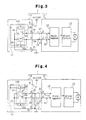
- the lowering switch 14 When the driver operates the operation switch 10 to lower the window glass, the lowering switch 14 enters the closed state as shown in Fig. 3 and the down terminal 16 connects to the ground terminal 18.
- the switch device 11 is connected to the motor controller 12 via the wire harness 13.
- the down terminal 16 and the up terminal 19 of the switch device 11 are respectively connected to a down terminal 20 and an up terminal 21 of the motor controller 12 via a cable of the wire harness 13.
- the motor controller 12 includes a microcomputer 22, a motor M, and a driver circuit 23.
- the motor M functions as an actuator for raising or lowering the window glass.
- the driver circuit 23 drives the motor M according to an instruction given by the microcomputer 22.
- the down terminal 20 and the up terminal 21 are electrically connected to the microcomputer 22.
- the microcomputer 22 actuates the driver circuit 23 according to input signals V1 and V2. In more detail, the microcomputer 22 actuates the driver circuit 23 to rotate the motor M clockwise when the potential level at the down terminal 20 is less than or equal to an actuation threshold Von. The microcomputer 22 does not actuate the driver circuit 23 when the potential level at the down terminal 20 is greater than or equal to a non-actuation threshold Voff (non-actuation threshold Voff > actuation threshold Von: see Fig. 6). In the same manner, the microcomputer 22 actuates the driver circuit 23 to rotate the motor M counterclockwise when the potential level at the up terminal 21 is less than or equal to the actuation threshold Von.
- the microcomputer 22 does not actuate the driver circuit 23 when the potential level at the up terminal 21 is greater than or equal to the non-actuation threshold Voff. In this way, the microcomputer 22 executes active-low control over the motor M according to the level of the input signals V1 and V2.
- the following describes a case in which the vehicle having the power window apparatus 1 with the above-described structure is, for example, submerged in water, with reference to Figs. 4 to 6.
- the lowering switch 14 and the raising switch 15 have the same structure, with the only difference being in the control executed by the microcomputer 22 (to raise or lower the window glass).
- the input signal V1 of the microcomputer 22 is normally held at a high-level (power supply Vo level).
- the input signal V1 shifts to a low-level (ground level).
- the microcomputer 22 actuates the motor M according to the low-level input signal V1.
- the lowering switch 14 is then opened by stopping the operation of the operation switch 10 at the timing indicated by point P2, the input signal V1 returns to the high-level.
- the microcomputer 22 stops the motor M according to the high-level input signal V1.
- the operation switch 10 When the vehicle is submerged in water at the timing indicated by point P3, water enters into each terminal of the connector, and leakage current flows between the down terminal 16 and the ground terminal 18.
- the operation switch 10 When the operation switch 10 is not operated (Fig. 4), the first switch unit 14a of the lowering switch 14 is closed and the down terminal 16 is connected to the battery terminal 17.
- a voltage value of the down terminal 16 is obtained by dividing the voltage of the power supply Vo by a ratio of the resistance between the battery terminal 17 and the down terminal 16 to the resistance of a leakage resistor RL1 between the down terminal 16 and the ground terminal 18. Because the resistance of the leakage resistor RL1 is generally far greater than the resistance between the battery terminal 17 and the down terminal 16, the down terminal 16 is set at a high-level. Even at the time of water entry, therefore, the microcomputer 22 is provided with a high-level input signal V1 when the operation switch 10 is not operated. The microcomputer 22 determines that the lowering switch 14 is in an opened state, and does not actuate the
- the microcomputer 59 incorrectly recognizes that the lowering switch 55 is in the closed state although the lowering switch 55 is actually in the opened state.
- the operation switch 10 is operated at the time of water entry with reference to Fig. 5.
- the on-resistance of the lowering switch 14 in a closed state is far smaller than the resistance of the leakage resistor RL2.
- the potential level of the down terminal 16 shifts to a low-level.
- the microcomputer 22 is provided with a low-level (the same level as when water does not enter into the terminals of the connector) input signal V1 via the down terminal 20.
- the microcomputer 22 determines that the lowering switch 14 is in a closed state based on the low-level input signal V1.
- the microcomputer 22 actuates the motor M to lower the window glass.
- the power window apparatus 1 of the preferred embodiment has the advantages described below.
- the operation switch 10 includes the lowering switch 14 and the raising switch 15 that are transfer contact-type switches.
- the operation switch 10 may include, for example, a relay for switching the connection between terminals.
- the relay may connect the battery terminal 17 to the down terminal 16.
- the relay may connect the ground terminal 18 to the down terminal 16.
- the operation switch 10 may include a semiconductor switch for switching the connection between terminals.
- the microcomputer 22 drives the motor M in response to a low-level signal, based on the level of the input signals V1 and V2.
- the microcomputer of the power window apparatus may drive the motor M in response to a high-level signal, based on the level of the input signals V1 and V2.
- a power window apparatus 30 including a microcomputer 36, which drives a motor M in response to a high-level signal, will now be described in detail with reference to Figs. 7 and 8.
- the power window apparatus 30 includes a switch device 32, which has an operation switch 31, and a motor controller 33, which has a waterproof structure.
- the operation switch 31 includes a lowering switch 34 and a raising switch 35.
- the lowering switch 34 is a transfer contact-type switch connected between three terminals, namely, a down terminal 16, a battery terminal 17, and a ground terminal 18.
- the lowering switch 34 connects either the battery terminal 17 or the ground terminal 18 to the down terminal 16.
- the lowering switch 34 includes a first switch unit 34a connected between the down terminal 16 and the battery terminal 17, and a second switch unit 34b connected between the down terminal 16 and the ground terminal 18.
- the first switch unit 34a and the second switch unit 34b operate in a manner complementary to each other. When the operation switch 31 is not operated, the second switch unit 34b is closed and the first switch unit 34a is opened.
- the driver When, for example, the driver operates the operation switch 31 to lower a window glass, the first switch unit 34a is closed and the second switch unit 34b is opened.
- the state where the second switch unit 34b is closed is hereafter referred to as the lowering switch 34 is in an "opened state”
- the state where the first switch unit 34a is closed is hereafter referred to as the lowering switch 34 is in a "closed state”.
- the raising switch 35 is a transfer contact-type switch connected between three terminals, namely, an up terminal 19, the battery terminal 17, and the ground terminal 18.
- the raising switch 35 connects either the battery terminal 17 or the ground terminal 18 to the up terminal 19.
- the raising switch 35 includes a third switch unit 35a connected between the up terminal 19 and the battery terminal 17, and a fourth switch unit 35b connected between the up terminal 19 and the ground terminal 18.
- the third switch unit 35a and the fourth switch unit 35b operate in a manner complementary to each other.
- the fourth switch unit 35b is closed and the third switch unit 35a is opened.
- the driver operates the operation switch 31 to raise the window glass
- the third switch unit 35a is closed and the fourth switch unit 35b is opened.
- the state where the fourth switch unit 35b is closed is hereafter referred to as the raising switch 35 being in an "opened state”
- the state where the third switch unit 35a is closed is hereafter referred to as the raising switch 35 being in a "closed state”.
- either the lowering switch 34 or the raising switch 35 is closed by operating a button (not shown).
- the motor controller 33 includes the microcomputer 36.
- the microcomputer 36 is connected to a down terminal 20 and an up terminal 21.
- the microcomputer 36 drives the motor M in response to a high-level signal, based on the level of input signals V1 and V2.
- the following describes a case in which the vehicle having the power window apparatus 30 with the above-described structure is, for example, submerged in water.
- the lowering switch 34 and the raising switch 35 have the same structure, with the only difference being in the control executed by the microcomputer 36 (to raise or lower the window glass).
- the second switch unit 34b of the lowering switch 34 When the vehicle is submerged in water and water enters between the down terminal 16 and the battery terminal 17, leakage current flows between the down terminal 16 and the battery terminal 17.
- the operation switch 31 When the operation switch 31 is not operated (see Fig. 7), the second switch unit 34b of the lowering switch 34 is closed and the down terminal 16 is connected to the ground terminal 18.
- a voltage value of the down terminal 16 is obtained by dividing the voltage of a power supply Vo by a ratio of the resistance of a leakage resistor RL3 between the battery terminal 17 and the down terminal 16 to the resistance between the down terminal 16 and the ground terminal 18. Because the resistance of the leakage resistor RL3 is generally far greater than the resistance between the down terminal 16 and the ground terminal 18, the down terminal 16 is set at a low-level. Even at the time of water entry, therefore, the microcomputer 36 is provided with a low-level input signal V1 when the operation switch 31 is not operated. The microcomputer 36 determines that the lowering switch 34 is in an opened state and does
- the lowering switch 34 is closed by operating the operation switch 31 at the time of water entry.
- the on-resistance of the lowering switch 34 in a closed state is far smaller than the resistance of a leakage resistor RL4, the potential level at the down terminal 16 shifts to a high-level.
- the microcomputer 36 determines that the lowering switch 34 is in a closed state, and operates the motor M.
- the power window apparatus 1 of the preferred embodiment may be applied, for example, to a housing. In this case, even when rainwater enters into the switch device 11, the microcomputer 22 is prevented from incorrectly recognizing the operation state of the operation switch 10.
Landscapes
- Engineering & Computer Science (AREA)
- Physics & Mathematics (AREA)
- General Physics & Mathematics (AREA)
- Automation & Control Theory (AREA)
- Mechanical Engineering (AREA)
- Power-Operated Mechanisms For Wings (AREA)
- Window Of Vehicle (AREA)
Abstract
Description
Claims (9)
- A power window apparatus (1) for connection to a power supply and ground, for driving an actuator that is used to move a window glass, the power window apparatus comprising a control unit (22) for driving the actuator in response to a switch signal having a ground level, a connecting terminal (16, 19), and a ground terminal (18), the power window apparatus characterized by
a switch (10) for causing the window glass to move when operated, the switch being connected to the control unit through the connecting terminal and connected to ground through the ground terminal, wherein the switch generates the switch signal having the ground level when operated, and a power supply terminal (17) used to connect the switch and the power supply to each other, wherein when operated, the switch connects the connecting terminal and the ground terminal to each other and generates the switch signal having the ground level in the connecting terminal, and when not operated, the switch connects the connecting terminal and the power supply terminal to each other. - A power window apparatus (30) for connection to a power supply and ground, for driving an actuator that is used to move a widow glass, the power window apparatus comprising a control unit (36) for driving the actuator in response to a switch signal having a power supply level, a connecting terminal (16, 19), and a power supply (17) terminal, the power window apparatus characterized by
a switch (31) for causing the window glass to move when operated, the switch being connected to the control unit through the connecting terminal and connected to the power supply through the power supply terminal, wherein the switch generates the switch signal having the power supply level when operated, and a ground terminal (18) used to connect the switch and ground to each other, wherein when operated, the switch connects the connecting terminal and the power supply terminal to each other and generates the switch signal having the power supply level in the connecting terminal, and when not operated, the switch connects the connecting terminal and the ground terminal to each other. - The power window apparatus according to claim 1 or 2, characterized in that the switch includes a transfer contact-type switch connected between the connecting terminal, the power supply terminal, and the ground terminal.
- The power window apparatus according to claim 1 or 2, characterized in that the switch includes a first switch unit (14a, 15a, 34a, 35a) for selectively connecting the connecting terminal and the power supply terminal to each other, and a second switch unit (14b, 15b, 34b, 35b) for selectively connecting the connecting terminal and the ground terminal to each other in a manner complementary to the first switch unit.
- A power window apparatus (1) for connection to a power supply and ground, for driving an actuator that is used to raise and lower a widow glass, the power window apparatus comprising a control unit (22) for driving the actuator in response to a first switch signal or a second switch signal, a first terminal (19), a second terminal (16), and a ground terminal (18), the power window apparatus characterized by
a raising switch (15) for causing the window glass to raise when operated, the raising switch being connected to the control unit through the first terminal and connected to ground through the ground terminal, wherein the raising switch generates the first switch signal having a ground level when operated, a lowering switch (14) for causing the window glass to lower when operated, the lowering switch being connected to the control unit through the second terminal and connected to ground through the ground terminal, wherein the lowering switch generates the second switch signal having a ground level when operated, and a power supply terminal (17) used to connect the raising switch and the lowering switch to the power supply, wherein when operated, the raising switch connects the first terminal and the ground terminal to each other and generates the first switch signal having the ground level in the first terminal, and when not operated, the raising switch connects the first terminal and the power supply terminal to each other, and wherein when operated, the lowering switch connects the second terminal and the ground terminal to each other and generates the second switch signal having the ground level in the second terminal, and when not operated, the lowering switch connects the second terminal and the power supply terminal to each other. - A power window apparatus (30) for connection to a power supply and ground, for driving an actuator that is used to raise and lower a window glass, the power window apparatus comprising a control unit (36) for driving the actuator in response to a first switch signal or a second switch signal, a first terminal (19), a second terminal (16), and a power supply terminal (17), the power window apparatus characterized by
a raising switch (35) for causing the window glass to raise when operated, the raising switch being connected to the control unit through the first terminal and connected to the power supply through the power supply terminal, wherein the raising switch generates the first switch signal having a power supply level when operated, a lowering switch (34) for causing the window glass to lower when operated, the lowering switch being connected to the control unit through the second terminal and connected to the power supply through the power supply terminal, wherein the lowering switch generates the second switch signal having a power supply level when operated, and a ground terminal (18) used to connect the raising switch and the lowering switch to ground, wherein when operated, the raising switch connects the first terminal and the power supply terminal to each other and generates the first switch signal having the power supply level in the first terminal, and when not operated, the raising switch connects the first terminal and the ground terminal to each other, and wherein when operated, the lowering switch connects the second terminal and the power supply terminal to each other and generates the second switch signal having the power supply level in the second terminal, and when not operated, the lowering switch connects the second terminal and the ground terminal to each other. - The power window apparatus according to claim 5 or 6, characterized in that at least one of the lowering switch and the raising switch includes a transfer contact-type switch.
- A method for maintaining a switch signal generated by a switch (10) at a ground level or a power supply level in a power window apparatus (1) that includes the switch, which causes a window glass to move when operated, the power window apparatus including a control unit (22) for driving an actuator to move the window glass in response to a switch signal having a ground level, a connecting terminal (16, 19) connected to the control unit, a ground terminal (18) connected to the ground, and a power supply terminal (17) connected to a power supply, the method comprising, connecting the connecting terminal and the ground terminal to each other and generating a switch signal having the ground level in the connecting terminal when the switch is operated, the method characterized by
connecting the connecting terminal and the power supply terminal to each other and generating a switch signal having the power supply level in the connecting terminal when the switch is not operated. - A method for maintaining a switch signal generated by a switch (31) at a ground level or a power supply level in a power window apparatus (30) that includes the switch, which causes a window glass to move when operated, the power window apparatus including a control unit (36) for driving an actuator to move the window glass in response to a switch signal having the power supply level, a connecting terminal (16, 19) connected to the control unit, a ground terminal (18) connected to ground, and a power supply terminal (17) connected to a power supply, the method comprising, connecting the connecting terminal and the power supply terminal to each other and generating a switch signal having the power supply level in the connecting terminal when the switch is operated, the method characterized by
connecting the connecting terminal and the ground terminal to each other and generating a switch signal having the ground level in the connecting terminal when the switch is not operated.
Applications Claiming Priority (2)
| Application Number | Priority Date | Filing Date | Title |
|---|---|---|---|
| JP2003134467A JP2004339708A (en) | 2003-05-13 | 2003-05-13 | Power window device |
| JP2003134467 | 2003-05-13 |
Publications (2)
| Publication Number | Publication Date |
|---|---|
| EP1480091A2 true EP1480091A2 (en) | 2004-11-24 |
| EP1480091A3 EP1480091A3 (en) | 2010-04-21 |
Family
ID=33095359
Family Applications (1)
| Application Number | Title | Priority Date | Filing Date |
|---|---|---|---|
| EP04252696A Withdrawn EP1480091A3 (en) | 2003-05-13 | 2004-05-10 | Power window apparatus |
Country Status (5)
| Country | Link |
|---|---|
| US (1) | US6965207B2 (en) |
| EP (1) | EP1480091A3 (en) |
| JP (1) | JP2004339708A (en) |
| KR (1) | KR100943998B1 (en) |
| CN (1) | CN1318720C (en) |
Families Citing this family (6)
| Publication number | Priority date | Publication date | Assignee | Title |
|---|---|---|---|---|
| JP3815738B2 (en) * | 2003-09-08 | 2006-08-30 | 本田技研工業株式会社 | Power window system |
| JP4677280B2 (en) * | 2005-05-10 | 2011-04-27 | 株式会社東海理化電機製作所 | Power window device |
| JP5206430B2 (en) * | 2009-01-09 | 2013-06-12 | 株式会社デンソー | Power window control unit and power window control system |
| JP6750558B2 (en) * | 2017-05-16 | 2020-09-02 | 株式会社オートネットワーク技術研究所 | Power box |
| JP6969524B2 (en) * | 2018-08-30 | 2021-11-24 | 株式会社デンソー | Power window controller |
| CN112102693A (en) * | 2020-09-10 | 2020-12-18 | 长春汽车工业高等专科学校 | Be used for real case of instructing of car door window electric control |
Family Cites Families (13)
| Publication number | Priority date | Publication date | Assignee | Title |
|---|---|---|---|---|
| JP3181461B2 (en) * | 1994-02-04 | 2001-07-03 | アルプス電気株式会社 | Motor drive device with safety function |
| JP3461432B2 (en) * | 1997-07-01 | 2003-10-27 | アルプス電気株式会社 | Power window device |
| JPH1193518A (en) | 1997-09-16 | 1999-04-06 | Niles Parts Co Ltd | Open-close system of power window |
| DE69822412T2 (en) * | 1997-12-05 | 2005-03-03 | Alps Electric Co., Ltd. | Waterproof electric window lift |
| AU757313B2 (en) * | 1999-08-02 | 2003-02-13 | Kabushiki Kaisha Tokai-Rika-Denki-Seisakusho | Power window switch circuit |
| JP2001098844A (en) * | 1999-10-01 | 2001-04-10 | Yazaki Corp | Power window controller for automobile |
| JP2002013964A (en) | 2000-04-26 | 2002-01-18 | Tokai Rika Co Ltd | Insulated board provided with water immersion sensor |
| JP3696052B2 (en) * | 2000-05-30 | 2005-09-14 | アルプス電気株式会社 | Water resistant power window device |
| JP3722675B2 (en) * | 2000-07-28 | 2005-11-30 | アルプス電気株式会社 | Power window device and control method thereof |
| JP3917803B2 (en) * | 2000-08-02 | 2007-05-23 | アルプス電気株式会社 | Power window equipment |
| JP2002274169A (en) * | 2001-03-16 | 2002-09-25 | Denso Corp | Power window device with water immersion sensor |
| JP2002276241A (en) * | 2001-03-16 | 2002-09-25 | Denso Corp | Power window device with water immersion sensor |
| JP2004034807A (en) * | 2002-07-02 | 2004-02-05 | Omron Corp | Opening / closing body control device |
-
2003
- 2003-05-13 JP JP2003134467A patent/JP2004339708A/en active Pending
-
2004
- 2004-05-10 EP EP04252696A patent/EP1480091A3/en not_active Withdrawn
- 2004-05-11 KR KR1020040032947A patent/KR100943998B1/en not_active Expired - Fee Related
- 2004-05-12 US US10/844,205 patent/US6965207B2/en not_active Expired - Lifetime
- 2004-05-13 CN CNB2004100445834A patent/CN1318720C/en not_active Expired - Fee Related
Also Published As
| Publication number | Publication date |
|---|---|
| KR20040097913A (en) | 2004-11-18 |
| CN1318720C (en) | 2007-05-30 |
| EP1480091A3 (en) | 2010-04-21 |
| US6965207B2 (en) | 2005-11-15 |
| US20040227478A1 (en) | 2004-11-18 |
| JP2004339708A (en) | 2004-12-02 |
| CN1550633A (en) | 2004-12-01 |
| KR100943998B1 (en) | 2010-02-24 |
Similar Documents
| Publication | Publication Date | Title |
|---|---|---|
| JP3461432B2 (en) | Power window device | |
| EP1480091A2 (en) | Power window apparatus | |
| JP2001199237A (en) | Water resistant power window device | |
| US6975084B2 (en) | Power window controller | |
| JP3533490B2 (en) | Motor drive | |
| EP1482386A2 (en) | Power window apparatus | |
| JP2020101017A (en) | Control device of opening/closing body | |
| US6548980B1 (en) | Motor drive | |
| US6315418B1 (en) | Method and device for heating a motor vehicle driving mirror | |
| US6559614B2 (en) | Electrical circuit arrangement for controlling an electromotor in a motor vehicle | |
| JP3468036B2 (en) | Drive | |
| JP2001020601A (en) | Electric load driving controller | |
| JP7280389B2 (en) | Circuits, vehicles, and methods for controlling electric motors in vehicle window lifters | |
| JP3284033B2 (en) | Power window and door locking / unlocking control device | |
| JP3461437B2 (en) | Waterproof power window device | |
| KR20170045449A (en) | Circuit for switch use for power window of a car having a prevention of malfunction | |
| JPS62202185A (en) | Power window system | |
| JP3535350B2 (en) | Power window device | |
| JPH08189253A (en) | Power window equipment | |
| JP3461438B2 (en) | Waterproof power window device | |
| JP2005065442A (en) | Drive device | |
| EP0872386A2 (en) | Push-button electronic device for controlling vehicle power windows | |
| JP2000268660A (en) | Power window switch circuit | |
| JPH06217570A (en) | Drive controller for power window | |
| JPS61282572A (en) | Power window motor drive circuit |
Legal Events
| Date | Code | Title | Description |
|---|---|---|---|
| PUAI | Public reference made under article 153(3) epc to a published international application that has entered the european phase |
Free format text: ORIGINAL CODE: 0009012 |
|
| AK | Designated contracting states |
Kind code of ref document: A2 Designated state(s): AT BE BG CH CY CZ DE DK EE ES FI FR GB GR HU IE IT LI LU MC NL PL PT RO SE SI SK TR |
|
| AX | Request for extension of the european patent |
Extension state: AL HR LT LV MK |
|
| PUAL | Search report despatched |
Free format text: ORIGINAL CODE: 0009013 |
|
| AK | Designated contracting states |
Kind code of ref document: A3 Designated state(s): AT BE BG CH CY CZ DE DK EE ES FI FR GB GR HU IE IT LI LU MC NL PL PT RO SE SI SK TR |
|
| AX | Request for extension of the european patent |
Extension state: AL HR LT LV MK |
|
| 17P | Request for examination filed |
Effective date: 20100603 |
|
| AKX | Designation fees paid |
Designated state(s): DE FR GB |
|
| 17Q | First examination report despatched |
Effective date: 20110405 |
|
| STAA | Information on the status of an ep patent application or granted ep patent |
Free format text: STATUS: THE APPLICATION IS DEEMED TO BE WITHDRAWN |
|
| 18D | Application deemed to be withdrawn |
Effective date: 20110817 |