EP1479773A1 - Mite galectin - Google Patents
Mite galectin Download PDFInfo
- Publication number
- EP1479773A1 EP1479773A1 EP03707178A EP03707178A EP1479773A1 EP 1479773 A1 EP1479773 A1 EP 1479773A1 EP 03707178 A EP03707178 A EP 03707178A EP 03707178 A EP03707178 A EP 03707178A EP 1479773 A1 EP1479773 A1 EP 1479773A1
- Authority
- EP
- European Patent Office
- Prior art keywords
- polypeptide
- galectin
- present
- polynucleotide
- amino acid
- Prior art date
- Legal status (The legal status is an assumption and is not a legal conclusion. Google has not performed a legal analysis and makes no representation as to the accuracy of the status listed.)
- Granted
Links
Images



Classifications
-
- C—CHEMISTRY; METALLURGY
- C07—ORGANIC CHEMISTRY
- C07K—PEPTIDES
- C07K14/00—Peptides having more than 20 amino acids; Gastrins; Somatostatins; Melanotropins; Derivatives thereof
- C07K14/435—Peptides having more than 20 amino acids; Gastrins; Somatostatins; Melanotropins; Derivatives thereof from animals; from humans
- C07K14/43504—Peptides having more than 20 amino acids; Gastrins; Somatostatins; Melanotropins; Derivatives thereof from animals; from humans from invertebrates
- C07K14/43513—Peptides having more than 20 amino acids; Gastrins; Somatostatins; Melanotropins; Derivatives thereof from animals; from humans from invertebrates from arachnidae
- C07K14/43531—Peptides having more than 20 amino acids; Gastrins; Somatostatins; Melanotropins; Derivatives thereof from animals; from humans from invertebrates from arachnidae from mites
-
- A—HUMAN NECESSITIES
- A61—MEDICAL OR VETERINARY SCIENCE; HYGIENE
- A61P—SPECIFIC THERAPEUTIC ACTIVITY OF CHEMICAL COMPOUNDS OR MEDICINAL PREPARATIONS
- A61P31/00—Antiinfectives, i.e. antibiotics, antiseptics, chemotherapeutics
-
- A—HUMAN NECESSITIES
- A61—MEDICAL OR VETERINARY SCIENCE; HYGIENE
- A61P—SPECIFIC THERAPEUTIC ACTIVITY OF CHEMICAL COMPOUNDS OR MEDICINAL PREPARATIONS
- A61P31/00—Antiinfectives, i.e. antibiotics, antiseptics, chemotherapeutics
- A61P31/04—Antibacterial agents
-
- A—HUMAN NECESSITIES
- A61—MEDICAL OR VETERINARY SCIENCE; HYGIENE
- A61P—SPECIFIC THERAPEUTIC ACTIVITY OF CHEMICAL COMPOUNDS OR MEDICINAL PREPARATIONS
- A61P31/00—Antiinfectives, i.e. antibiotics, antiseptics, chemotherapeutics
- A61P31/12—Antivirals
-
- A—HUMAN NECESSITIES
- A61—MEDICAL OR VETERINARY SCIENCE; HYGIENE
- A61P—SPECIFIC THERAPEUTIC ACTIVITY OF CHEMICAL COMPOUNDS OR MEDICINAL PREPARATIONS
- A61P33/00—Antiparasitic agents
- A61P33/02—Antiprotozoals, e.g. for leishmaniasis, trichomoniasis, toxoplasmosis
-
- A—HUMAN NECESSITIES
- A61—MEDICAL OR VETERINARY SCIENCE; HYGIENE
- A61P—SPECIFIC THERAPEUTIC ACTIVITY OF CHEMICAL COMPOUNDS OR MEDICINAL PREPARATIONS
- A61P33/00—Antiparasitic agents
- A61P33/10—Anthelmintics
-
- A—HUMAN NECESSITIES
- A61—MEDICAL OR VETERINARY SCIENCE; HYGIENE
- A61P—SPECIFIC THERAPEUTIC ACTIVITY OF CHEMICAL COMPOUNDS OR MEDICINAL PREPARATIONS
- A61P33/00—Antiparasitic agents
- A61P33/14—Ectoparasiticides, e.g. scabicides
-
- A—HUMAN NECESSITIES
- A61—MEDICAL OR VETERINARY SCIENCE; HYGIENE
- A61P—SPECIFIC THERAPEUTIC ACTIVITY OF CHEMICAL COMPOUNDS OR MEDICINAL PREPARATIONS
- A61P37/00—Drugs for immunological or allergic disorders
- A61P37/08—Antiallergic agents
-
- A—HUMAN NECESSITIES
- A61—MEDICAL OR VETERINARY SCIENCE; HYGIENE
- A61P—SPECIFIC THERAPEUTIC ACTIVITY OF CHEMICAL COMPOUNDS OR MEDICINAL PREPARATIONS
- A61P43/00—Drugs for specific purposes, not provided for in groups A61P1/00-A61P41/00
-
- C—CHEMISTRY; METALLURGY
- C07—ORGANIC CHEMISTRY
- C07K—PEPTIDES
- C07K14/00—Peptides having more than 20 amino acids; Gastrins; Somatostatins; Melanotropins; Derivatives thereof
- C07K14/435—Peptides having more than 20 amino acids; Gastrins; Somatostatins; Melanotropins; Derivatives thereof from animals; from humans
- C07K14/46—Peptides having more than 20 amino acids; Gastrins; Somatostatins; Melanotropins; Derivatives thereof from animals; from humans from vertebrates
- C07K14/47—Peptides having more than 20 amino acids; Gastrins; Somatostatins; Melanotropins; Derivatives thereof from animals; from humans from vertebrates from mammals
- C07K14/4701—Peptides having more than 20 amino acids; Gastrins; Somatostatins; Melanotropins; Derivatives thereof from animals; from humans from vertebrates from mammals not used
- C07K14/4726—Lectins
-
- C—CHEMISTRY; METALLURGY
- C07—ORGANIC CHEMISTRY
- C07K—PEPTIDES
- C07K16/00—Immunoglobulins [IG], e.g. monoclonal or polyclonal antibodies
- C07K16/18—Immunoglobulins [IG], e.g. monoclonal or polyclonal antibodies against material from animals or humans
-
- A—HUMAN NECESSITIES
- A61—MEDICAL OR VETERINARY SCIENCE; HYGIENE
- A61K—PREPARATIONS FOR MEDICAL, DENTAL OR TOILETRY PURPOSES
- A61K39/00—Medicinal preparations containing antigens or antibodies
Definitions
- This invention relates to a tick galectin.
- Ticks are the cause, directly or indirectly, of extensive damage to animals or humans.
- Examples of the direct damage are pruritus or bleeding caused by biting or blood-sucking, or tick paralysis or allergic diseases caused by saliva secreted in blood-sucking or regurgitation of midgut contents.
- Examples of the indirect damage are various diseases in livestock, caused by viruses, rickettsiae, bacterium, spirochaeta, protozoa, nematoda, or the like. This damage causes enormous losses at home and abroad, and threat of emerging and re-emerging zoonotic diseases by ticks is becoming a serious problem.
- galection is overexpressed in an'inflammatory tissue or a tumor tissue, and thus galectin is noted as a marker for an inflammation or tumor. Further, it is known that galectin is involved with an apoptosis of T cells or B cells, and plays an important role in self recognition. An attempt to use galectin or an inhibitor thereagainst as an immunosuppressive agent for autoimmune disease, an anti-inflammatory agent, or an antimetastatic agent has been made, and there are great expectations that they can be used as medicaments.
- the present inventors have conducted intensive studies into obtaining a novel polypeptide useful as a candidate for a vaccine against ticks, particularly Ornithodoros moubata, and a polynucleotide encoding the polypeptide and, as a result, found a novel galectin and a polynucleotide encoding the same. Further, the present inventors inoculated the galectin into mice, to observe the induction of an antibody production, and confirmed that the galectin is useful as a tick vaccine. The present invention is based on the above findings.
- the object of the present invention is to provide a novel galectin useful as a tick vaccine, and a polynucleotide encoding the galectin.
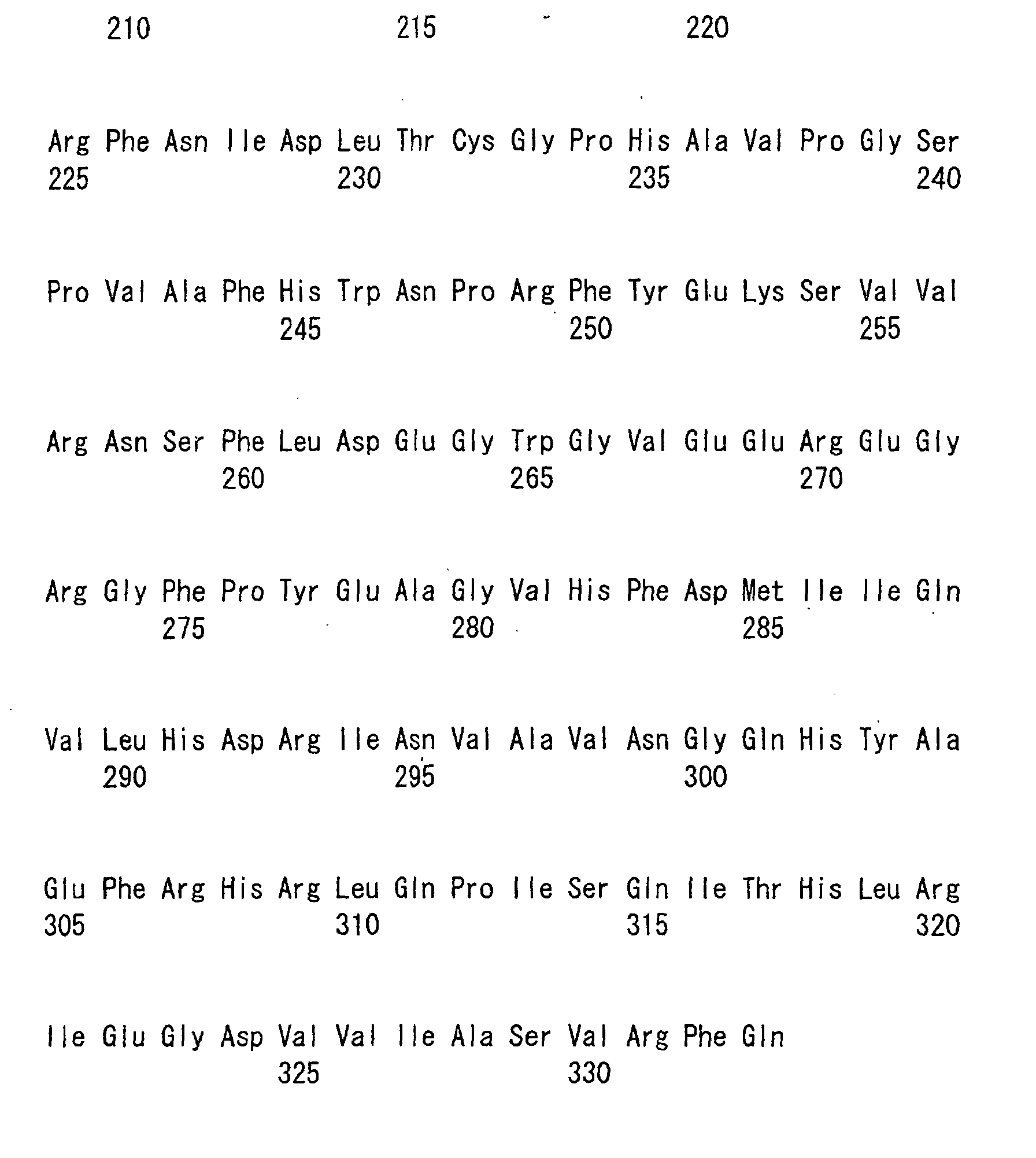
- the object can be solved by a polypeptide of the present invention, i.e., (1) a polypeptide consisting of the amino acid sequence of SEQ ID NO: 2; (2) a polypeptide comprising the amino acid sequence of SEQ ID NO: 2 and exhibiting a galectin activity; (3) a polypeptide exhibiting a galectin activity and comprising an amino acid sequence in which one or plural amino acids are substituted, deleted, and/or inserted at one or plural positions in the amino acid sequence of SEQ ID NO: 2; or (4) a polypeptide comprising an amino acid sequence having a 60% or more homology with the amino acid sequence of SEQ ID NO: 2, and exhibiting a galectin activity.
- the present invention relates to a polynucleotide encoding the polypeptide.
- the present invention relates to a vector comprising the polynucleotide.
- the present invention relates to a transformant comprising the polynucleotide.
- the present invention relates to a process for producing the polypeptide, comprising the step of culturing the transformant.
- the present invention relates to a medicament comprising the polypeptide or a fragment thereof, the polynucleotide, or the vector.
- the present invention relates to a pharmaceutical composition
- a pharmaceutical composition comprising the polypeptide or a fragment thereof, the polynucleotide, or the vector, and a pharmaceutically or veterinary acceptable carrier or diluent.
- the present invention relates to a method for exterminating ticks, comprising administering to a subject in need thereof the polypeptide or a fragment thereof, the polynucleotide, or the vector in an amount effective therefor.
- the present invention relates to a method for treating or preventing a tick-borne infection, comprising administering to a subject in need thereof the polypeptide or a fragment thereof, the polynucleotide, or the vector in an amount effective therefor.
- the present invention relates to an antibody or a fragment thereof, which binds to the polypeptide.
- the present invention relates to a method for screening a substance capable of modifying a galectin activity of the polypeptide, comprising the steps of:
- polypeptides of the present invention includes
- galectin activity means an activity of binding to the ⁇ -galactoside. Whether or not a polypeptide to be tested exhibits the galectin activity may be easily confirmed, for example, by a known method for measuring the galectin activity, in which the polypeptide to be tested is brought into contact with galactose or a derivative thereof, and then the binding between the polypeptide and galactose or a derivative thereof and/or a degree thereof is analyzed. The method is not particularly limited, but is preferably confirmed by a method described in Example 12.
- a polypeptide to be tested is passed through an affinity column (for example, a lactosyl Sepharose column) carrying galactose or a derivative thereof, and then whether or not the polypeptide to be tested is adsorbed by the column is analyzed.
- an affinity column for example, a lactosyl Sepharose column
- galactose or a derivative thereof carrying galactose or a derivative thereof.
- polypeptide comprising the amino acid sequence of SEQ ID NO: 2 and exhibiting the galectin activity includes, for example, a fusion polypeptide consisting of an amino acid sequence in which an appropriate marker sequence or the like is added to the N-terminus and/or the C-terminus of the amino acid sequence of SEQ ID NO: 2, and exhibiting the galectin activity; or a fusion polypeptide of the polypeptide consisting of the amino acid sequence of SEQ ID NO: 2 and a partner for the fusion, and exhibiting the galectin activity.
- the marker sequence for example, a sequence for easily carrying out a confirmation of polypeptide expression, a confirmation of intracellular localization thereof, a purification thereof, or the like may be used.
- a sequence there may be mentioned, for example, a FLAG tag, a hexa-histidine tag, a hemagglutinin tag, a myc epitope, or the like.
- a polypeptide for purification for example, glutathione S-transferase (GST) or a fragment thereof
- a polypeptide for detection for example, hemagglutinin or ⁇ -galactosidase ⁇ peptide (LacZ ⁇ ), or a fragment thereof
- a polypeptide for expression for example, a signal sequence
- an amino acid sequence which can be specifically digested with a protease such as thrombin or factor Xa may be optionally inserted between the polypeptide consisting of the amino acid sequence of SEQ ID NO: 2 and the marker sequence or the partner for fusion.
- the variation functionally equivalent of the present invention is not particularly limited, so long as it is a polypeptide comprising an amino acid sequence in which one or plural (preferably 1 to 10, more preferably 1 to 7, most preferably 1 to 5) amino acids in total (for example, one to several amino acids in total) are deleted, substituted, and/or inserted at one or plural positions in the amino acid sequence of SEQ ID NO: 2, and exhibiting the galectin activity.
- an origin of the variation functionally equivalent is not limited to Ornithodoros moubata.
- variation functionally equivalent of the present invention includes not only Ornithodoros moubata variations of the polypeptide consisting of the amino acid sequence of SEQ ID NO: 2, but also variations functionally equivalent derived from organisms other than Ornithodoros moubata [for example, Argasids (soft ticks) other than Ornithodoros moubata or, or Ixodids (hard ticks)].
- polypeptides prepared using polynucleotides obtained by artificially modifying their amino acid sequences encoded thereby by genetic engineering techniques, on the basis of polynucleotides encoding these native polypeptides (i.e., Ornithodoros moubata variations or variations functionally equivalent derived from organisms other than Ornithodoros moubata), or on the basis of polynucleotides encoding the amino acid sequence of SEQ ID NO: 2.
- variant as used herein means an individual difference between the same polypeptides in the same species or a difference between homologous polypeptides in several species.
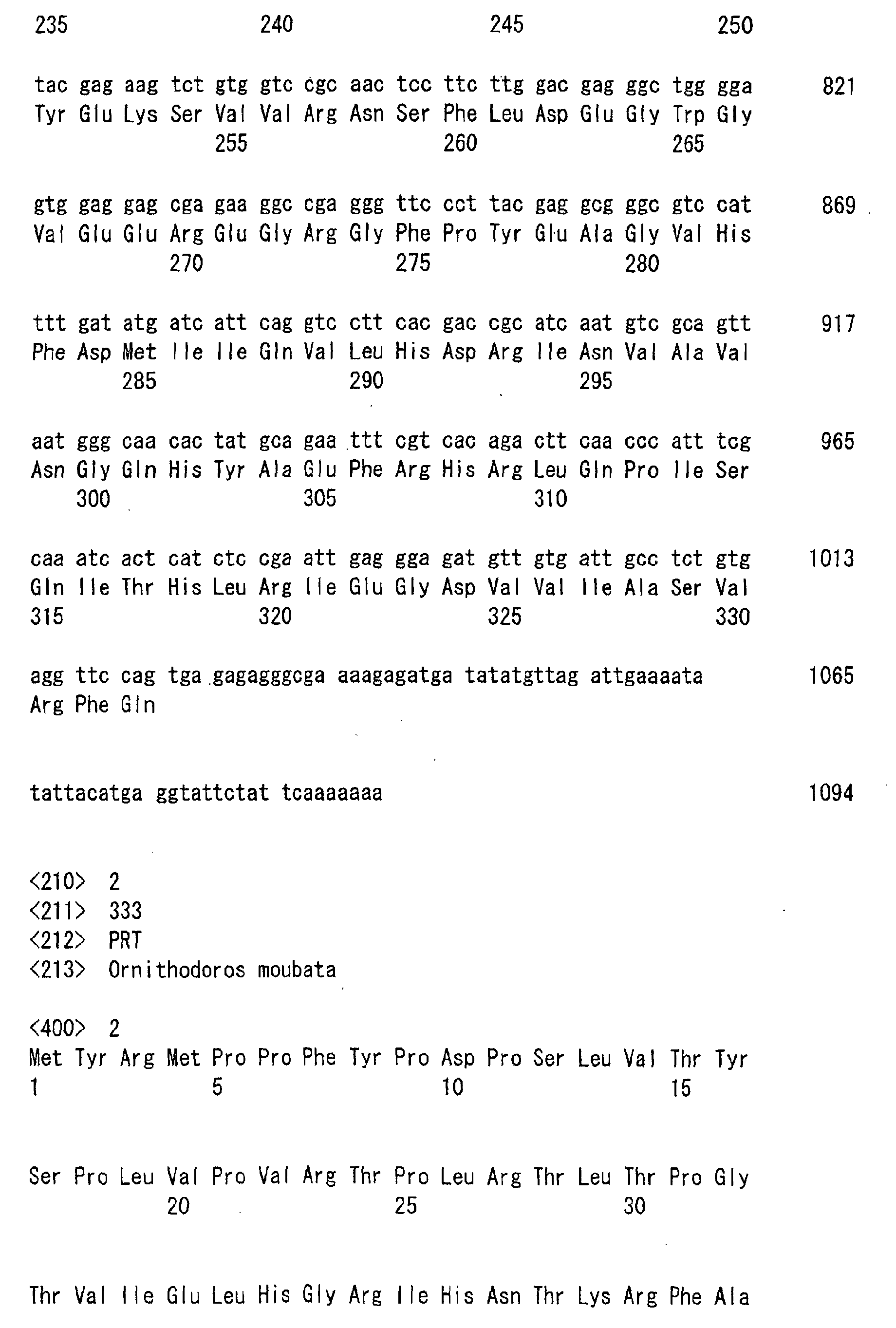
- Ornithodoros moubata variations of the polypeptide consisting of the amino acid sequence of SEQ ID NO: 2, or variations functionally equivalent derived from organisms other than Ornithodoros moubata may be obtained by those skilled in the art in accordance with the information of a base sequence (for example, the base sequence of the 24th to 1025th bases in the base sequence of SEQ ID NO: 1) of a polynucleotide encoding the polypeptide consisting of the amino acid sequence of SEQ ID NO: 2.
- genetic engineering techniques may be generally performed in accordance with known methods (for example, Sambrook et al., "Molecular Cloning, A Laboratory Manual", Cold Spring Harbor Laboratory Press, 1989), unless otherwise specified.
- an appropriate probe or appropriate primers are designed in accordance with the information of a base sequence of a polynucleotide encoding the polypeptide consisting of the amino acid sequence of SEQ ID NO: 2.
- a polymerase chain reaction (PCR) method (Saiki, R. K.
- a hybridization method is carried out using a sample (for example, total RNA or an mRNA fraction, a cDNA library, or a phage library) derived prepared from an organism [for example, Argasids (soft ticks) other than Ornithodoros moubata or, or Ixodids (hard ticks)] of interest and the primers or the probe to obtain a polynucleotide encoding. the polypeptide.
- a desired polypeptide may be obtained by expressing the resulting polynucleotide in an appropriate expression system and confirming that the expressed polypeptide exhibits the galectin activity by, for example, the method described in Example 6.
- polypeptide artificially modified by genetic engineering techniques may be obtained by, for example, the following procedure.
- a gene encoding the polypeptide is obtained by a conventional method such as site-specific directed mutagenesis (Mark, D. F. et al., Proc. Natl. Acad. Sci. USA, 81, 5662-5666, 1984).
- a desired polypeptide may be obtained by expressing the resulting polynucleotide in an appropriate expression system and confirming that the expressed polypeptide exhibits the galectin activity by, for example, the method described in Example 6.
- the homologous polypeptide of the present invention is not particularly limited, so long as it is a polypeptide having an amino acid sequence having a 60% or more homology with the amino acid sequence of SEQ ID NO: 2, and exhibiting the galectin activity.
- the homologous polypeptide of the present invention may have an amino acid sequence having preferably a 70% or more homology, more preferably a 80% or more homology, more preferably a 90% or more homology, more preferably a 95% or more homology, most preferably a 98% or more homology, with respect to the amino acid sequence of SEQ ID NO: 2.
- homology means a value obtained by a Clustal program (Higgins and Sharp, Gene, 73, 237-244, 1988; and Thompson et al., Nucleic Acid Res., 22, 4673-4680, 1994) in accordance with a default parameter.
- novel polypeptide of the present invention may be manufactured by various known methods, for example, known genetic engineering techniques using the polynucleotide of the present invention which encodes the polypeptide of the present invention. More particularly, the polypeptide of the present invention may be prepared by culturing the transformant of the present invention described below (i.e., the transformant comprising the polynucleotide of the present invention) under conditions in which the novel polypeptide of the present invention can be expressed, and then separating and purifying the desired polypeptide from the resulting culture in accordance with a conventional method for a polypeptide separation and purification.
- the transformant of the present invention described below i.e., the transformant comprising the polynucleotide of the present invention
- the separation and purification method there may be mentioned, for example, salting-out with ammonium sulfate, an ion exchange column chromatography using ion exchange cellulose, a molecular sieve column chromatography using molecular sieve gel, an affinity column chromatography using protein A agarose, dialysis, lyophilization, or the like.
- the present invention includes a fragment of the polypeptide of the present invention.
- the fragment of the present invention is useful as an active ingredient for the medicament of the present invention or as an antigen for preparing the antibody of the present invention.
- the polynucleotide of the present invention is not particularly limited, so long as it encodes the polypeptide of the present invention.
- the polynucleotide of the present invention there may be mentioned, for example, a polynucleotide consisting of the 24th to 1025th bases in the base sequence of the SEQ ID NO: 1.
- the term "polynucleotide” as used herein includes both DNA and RNA.
- the present invention includes a polynucleotide comprising a base sequence which can hybridize with the polynucleotide of the present invention, preferably a polynucleotide consisting of a base sequence which can hybridize with the polynucleotide of the present invention.
- the base sequence capable of hybridizing with the polynucleotide of the present invention is preferably a base sequence complementary to the base sequence (or a partial sequence thereof) of the polynucleotide of the present invention, more preferably a base sequence complementary to the base sequence (or a partial sequence thereof) consisting of the 24th to 1025th bases in the base sequence of the SEQ ID NO: 1.
- the vector of the present invention is not particularly limited, so long as it comprises the polynucleotide of the present invention.
- the vector there may be mentioned, for example, a vector obtained by introducing the polynucleotide of the present invention into a known expression vector appropriately selected in accordance with a host cell to be used.
- the transformant of the present invention is not particularly limited, so long as it comprises the polynucleotide of the present invention.
- the transformant of the present invention may be, for example, a cell in which the polynucleotide is integrated into a chromosome of a host cell, or a transformant containing the polynucleotide as a vector comprising polynucleotide.
- the transformant of the present invention may be a transformant expressing the polypeptide of the present invention, or a transformant not expressing the polypeptide of the present invention.
- the transformant of the present invention may be obtained by, for example, transfecting a desired host cell with the vector of the present invention or the polynucleotide of the present invention per se.
- the host cell may be, for example, a known microorganism usually used, for example, an Escherichia coli or yeast (Saccharomyces. cerevisiae), or a known cultivated cell, such as an animal cell, such as a CHO cell, an HEK-293 cell, or a COS cell, or an insect cell such as a BmN4 cell.
- a known microorganism usually used, for example, an Escherichia coli or yeast (Saccharomyces. cerevisiae), or a known cultivated cell, such as an animal cell, such as a CHO cell, an HEK-293 cell, or a COS cell, or an insect cell such as a BmN4 cell.
- the known expression vector may be, for example, pUC, pTV, pGEX, pKK, or pTrcHis for an Escherichia coli; pEMBLY or pYES2 for the yeast; pcDNA3 or pMAMneo for the CHO cell; pcDNA3 for the HEK-293 cell; pcDNA3 for the COS cell; a vector (such as pBK283) containing a polyhedrin promoter of a silkworm nucleopolyhederovirus (BmNPV) for the BmN4 cell.
- the expression vector includes a virus vector which can be used as a vector for a gene therapy, such as retrovirus, adenovirus, or Sendai virus.
- the medicament of the present invention comprises, as a active ingredient, the polypeptide of the present invention or a fragment thereof, the polynucleotide of the present invention, or the vector of the present invention.
- the polypeptide of the present invention or a fragment thereof, the polynucleotide of the present invention, or the vector of the present invention can be orally or parenterally administered alone, or preferably together with a pharmaceutically'or veterinarily acceptable carrier or diluent, to an animal (preferably a mammal, particularly a human) in need of an extermination of ticks.
- the active ingredient in the medicament of the present invention i.e., the polypeptide of the present invention or a fragment thereof, the polynucleotide of the present invention, or the vector of the present invention
- an antibody production may be induced and then ticks may be terminated by development of protective immunity against reinfection in the host animal.
- tick-borne infections such as rickettsiosis, filariasis, Q fever, African recurrent fever, or viral encephalitis.
- the active ingredient in the present invention i.e., the polypeptide of the present invention or a fragment thereof, the polynucleotide of the present invention, or the vector of the present invention
- can be used in the manufacture of the above medicament preferably medicament for exterminating ticks or medicament for treating or preventing a tick-borne infection).
- the fragment of the polypeptide of the present invention is not particularly limited, so long as the fragment administered to a subject can induce immunity thereagainst.
- the fragment can be appropriately selected by those skilled in the art.
- the medicament (particularly the tick vaccine) of the present invention can be used, for example, by mixing the polypeptide of the present invention with an adjuvant or the like and inoculating the resulting mixture into an animal (for example, livestock) at an appropriate interval as a tick vaccine. Further, it can be used by dissolving or suspending the polypeptide of the present invention directly in an appropriate solvent, or by enclosing it in liposomes or integrating a DNA encoding it in an appropriate vector. Furthermore, it can be used in an appropriate formulation such as injections, tablets, capsules, eye drops, creams, suppositories, sprays, poultices, or the like, optionally by adding a pharmaceutical acceptable carrier to the polypeptide of the present invention.
- the pharmaceutical acceptable carrier well-known solvents, bases, stabilizing agents, antiseptics, solubilizing agents, fillers, buffers, and the like may be used.
- the administration method and the dose may be determined in accordance with, for example, the age or sex of each subject, or the kind or degree of each disease.
- the oral administration includes a sublingual administration.
- parenteral administration for example, inhalation, percutaneous administration, ophthalmic administration, vaginal administration, intra-articular administration, rectal administration, intra-arterial administration, intravenous administration, local administration, intramuscular administration, subcutaneous administration, intraperitoneal administration, or the like may be selected.
- the polypeptide of the present invention is useful as an active ingredient for an immunosuppressive agent for autoimmune disease, an anti-inflammatory agent, an antimetastatic agent, or an agent for inducing or suppressing apoptosis.
- the present invention includes an immunosuppressive agent for autoimmune disease, an anti-inflammatory agent, an antimetastatic agent, or an agent for inducing or suppressing apoptosis comprising, as an active ingredient, the polypeptide of the present invention, the polynucleotide of the present invention, the vector of the present invention, the antibody or a fragment thereof of the present invention, or a substance capable of modifying (for example, suppressing or promoting) the galectin activity, which can be obtained by the screening method of the present invention.
- An antibody such as a polyclonal antibody or a monoclonal antibody, which reacts with the polypeptide of the present invention may be obtained by directly administering the polypeptide of the present invention or a fragment thereof to various animals. Alternatively, it may be obtained by a DNA vaccine method (Raz, E. et al., Proc. Natl. Acad. Sci. USA, 91, 9519-9523, 1994; or Donnelly, J. J. et al., J. Infect. Dis., 173, 314-320, 1996), using a plasmid into which a polynucleotide encoding the polypeptide of the present invention is inserted.
- the polyclonal antibody may be produced from a serum or eggs of an animal such as a rabbit, a rat, a goat, or a chicken, in which the animal is immunized and sensitized by the polypeptide of the present invention or a fragment thereof emulsified in an appropriate adjuvant (for example, Freund's complete adjuvant) by intraperitoneal, subcutaneous, or intravenous administration.
- an appropriate adjuvant for example, Freund's complete adjuvant
- the polyclonal antibody may be separated and purified from the resulting serum or eggs in accordance with conventional methods for polypeptide isolation and purification.
- separation and purification methods include, for example, centrifugal separation, dialysis, salting-out with ammonium sulfate, or a chromatographic technique using such as DEAE-cellulose, hydroxyapatite, protein A agarose, and the like.
- the monoclonal antibody may be easily produced by those skilled in the art, according to, for example, a cell fusion method of Kohler and Milstein (Kohler, G. and Milstein, C., Nature, 256, 495-497, 1975).
- a mouse is immunized intraperitoneally, subcutaneously, or intravenously several times at an interval of a few weeks by a repeated inoculation of emulsions in which the polypeptide of the present invention or a fragment thereof is emulsified into a suitable adjuvant such as Freund's complete adjuvant.
- Spleen cells are removed after the final immunization, and then fused with myeloma cells to prepare hybridomas.
- a myeloma cell for obtaining a hybridoma a myeloma cell having a marker such as a deficiency in hypoxanthine-guanine phosphoribosyltransferase or thymidine kinase (for example, mouse myeloma cell line P3X63Ag8.U1) may be used.
- a fusing agent polyethylene glycol may be used.
- a medium for preparation of hybridomas for example, a commonly used medium such as an Eagle's minimum essential medium, a Dulbecco's modified minimum essential medium, or an RPMI-1640 medium may be used by adding properly 10 to 30% of a fetal bovine serum.
- the fused strains may be selected by a HAT selection method.
- a culture supernatant of the hybridomas is screened by a well-known method such as an ELISA method or an immunohistological method, to select hybridoma clones secreting the antibody of interest.
- the monoclonality of the selected hybridoma is guaranteed by repeating subcloning by a limiting dilution method.
- Antibodies in an amount which may be purified are produced by culturing the resulting hybridomas in a medium for 2 to 4 days, or in the peritoneal cavity of a pristane-pretreated BALB/c strain mouse for 10 to 20 days.
- the resulting monoclonal antibodies in the culture supernatant or the ascites may be separated and purified by conventional polypeptide isolation and purification methods.
- the separation and purification methods include, for example, centrifugal separation, dialysis, salting-out with ammonium sulfate, or chromatographic technique using such as DEAE-cellulose, hydroxyapatite, protein A agarose, and the like.
- the monoclonal antibodies or the antibody fragments containing a part thereof may be produced by inserting the whole or a part of a gene encoding the monoclonal antibody into an expression vector and introducing the resulting expression vector into appropriate host cells (such as E. coli, yeast, or animal cells).
- appropriate host cells such as E. coli, yeast, or animal cells.
- Antibody fragments comprising an active part of the antibody such as F(ab') 2 , Fab, Fab', or Fv may be obtained by a conventional method, for example, by digesting the separated and purified antibodies (including polyclonal antibodies and monoclonal antibodies) with a protease such as pepsin, papain, and the like, and separating and purifying the resulting fragments by standard polypeptide isolation and purification methods.
- a protease such as pepsin, papain, and the like
- an antibody which reacts to the polypeptide of the present invention may be obtained in a form of single chain Fv or Fab in accordance with a method of Clackson et al. or a method of Zebedee et al. (Clackson, T. et al., Nature, 352, 624-628, 1991; or Zebedee, S. et al., Proc. Natl. Acad. Sci. USA, 89, 3175-3179, 1992).
- a humanized antibody may be obtained by immunizing a transgenic mouse in which mouse antibody genes are substituted with human antibody genes (Lonberg, N. et al., Nature, 368, 856-859, 1994).
- Substances to be tested to which may be applied the screening method of the present invention are not particularly limited, but there may be mentioned, for example, various known compounds (including peptides) registered in chemical files, compounds obtained by combinatorial chemistry techniques (Terrett, N. K. et al., Tetrahedron, 51, 8135-8137, 1995), or random peptides prepared by employing a phage display method (Felici, F. et al., J. Mol. Biol., 222, 301-310, 1991) or the like.
- culture supernatants of microorganisms, natural components derived from plants or marine organisms, or animal tissue extracts may be used as the test substances for screening.
- compounds (including peptides) obtained by chemically or biologically modifying compounds (including peptides) selected by the screening method of the present invention may be used.
- the screening method of the present invention may be carried out by a method similar to the above-mentioned method for confirming the galectin activity, except that the polypeptide of the present invention, galactose or a derivative thereof, and the test substance are brought into contact with each other instead of bringing the test polypeptide into contact with galactose or a derivative thereof.
- the test substance modifies the galectin activity of the polypeptide of the present invention by bringing into contact the polypeptide of the present invention, galactose or a derivative thereof, and the test substance, and then analyzing whether or not the polypeptide of the present invention binds to galactose or a derivative thereof (or a degree of the binding) in the presence of the test substance.
- the polypeptide of the present invention does not bind to galactose or a derivative thereof, or the degree of the binding is decreased, it is possible to confirm that the test substance suppresses the galectin activity of the polypeptide of the present invention.
- the degree of the binding between the polypeptide of the present invention and galactose or a derivative thereof is increased, it is possible to confirm that the test substance promotes the galectin activity of the polypeptide of the present invention.
- Example 1 Preparation of hybridoma producing anti-tick hemolymph monoclonal antibody
- Hemolymph was collected from Ornithodoros moubata 4th instar nymphs after 6 days from engorgement, and the homogenate thereof was sonicated to obtain a hemolymph solution. After 200 ⁇ L of the hemolymph solution (100 ⁇ g as a protein amount) was mixed with 200 ⁇ L of a complete Freund's adjuvant (Adjuvant Complete Freund; Difco), the mixture was intraperitoneally inoculated into a 7-week-old female BALB/c mouse.
- Adjuvant Complete Freund Adjuvant Complete Freund
- the obtained spleen cells and SP2/0-Ag14 myeloma cells were fused using polyethylene glycol.
- the fused cells were cultured in a GIT medium containing 5% fetal bovine serum (FBS)/5% BriClone (Arch Port Ltd., Dublin, Ireland)/HAT at 37°C under conditions of 5% CO 2 .
- FBS fetal bovine serum
- BriClone BriClone
- clones producing an antibody were screened by an indirect fluorescent antibody (IFA) method in which the hemolymph from Ornithodoros moubata 4th instar nymphs after 6 days from engorgement was used as an antigen, 10% sodium dodecyl sulfate (SDS)-polyacrylamide gel electrophoresis [Laemmli et al., Nature, 227, 680-685 (1970)], and a western blotting method using immunoblotting [Towbin et al., Proc. Natl. Acad. Sci. USA, 76, 4350-4354 (1979)].
- IFA indirect fluorescent antibody
- Example 2 Isolation of gene n4E12-2 encoding novel tick galectin
- RNA was extracted from Ornithodoros moubata 4th instar nymphs after 6 days from engorgement by an Acid Guanidinium-phenol-chloroform method [Chomczynski et al., Anal. Biochem., 162, 156-159 (1987)]. From the resulting total RNA, poly A + RNA was purified using an mRNA isolation kit [Oligotex-dT30 (Super), code W9021B; Takara] in accordance with a protocol attached to the kit.
- cDNA was synthesized using 5 ⁇ g of Ornithodoros moubata mRNA as a template and a cDNA synthesis kit (ZAP-cDNA Synthesis Kit, Cat. No. 200401-5; Stratagen).
- ZAP-cDNA Synthesis Kit Cat. No. 200401-5; Stratagen.
- the resulting cDNA was fractionated by a size fractionation with a Sepharose CL-2B gel column, inserted into a vector (Uni-ZAP XR Vector, Cat. No. 237211; Stratagen), and packaged using a packaging reagent (GigapackIII Gold packaging extract; Stratagen).
- Escherichia coli E. coli XL1-Blue MRF' strain
- the cDNA library was immunoscreened using the monoclonal antibody obtained in Example 1 against the hemolymph from Ornithodoros moubata 4th instar nymphs after 6 days from engorgement, to obtain three overlapping positive clones. These clones were inserted into plasmid (i.e., converted into a pBluescript) by an in vivo Excision method.
- Each plasmid containing a cDNA fragment was purified using a plasmid purification kit (Cat no. 12125; Qiagen), and then PCR was carried out using a sequencing kit (Dye Primer Cycle Sequencing Kit, Part No. 4303153; Perkin Elmer) in accordance with a protocol attached to the kit. Each resulting PCR product was analyzed with a DNA sequencer (ABI PRISM 3100 Genetic Analyzer; Perkin Elmer) to determine a base sequence of each cDNA fragment.
- a DNA sequencer (ABI PRISM 3100 Genetic Analyzer; Perkin Elmer) to determine a base sequence of each cDNA fragment.
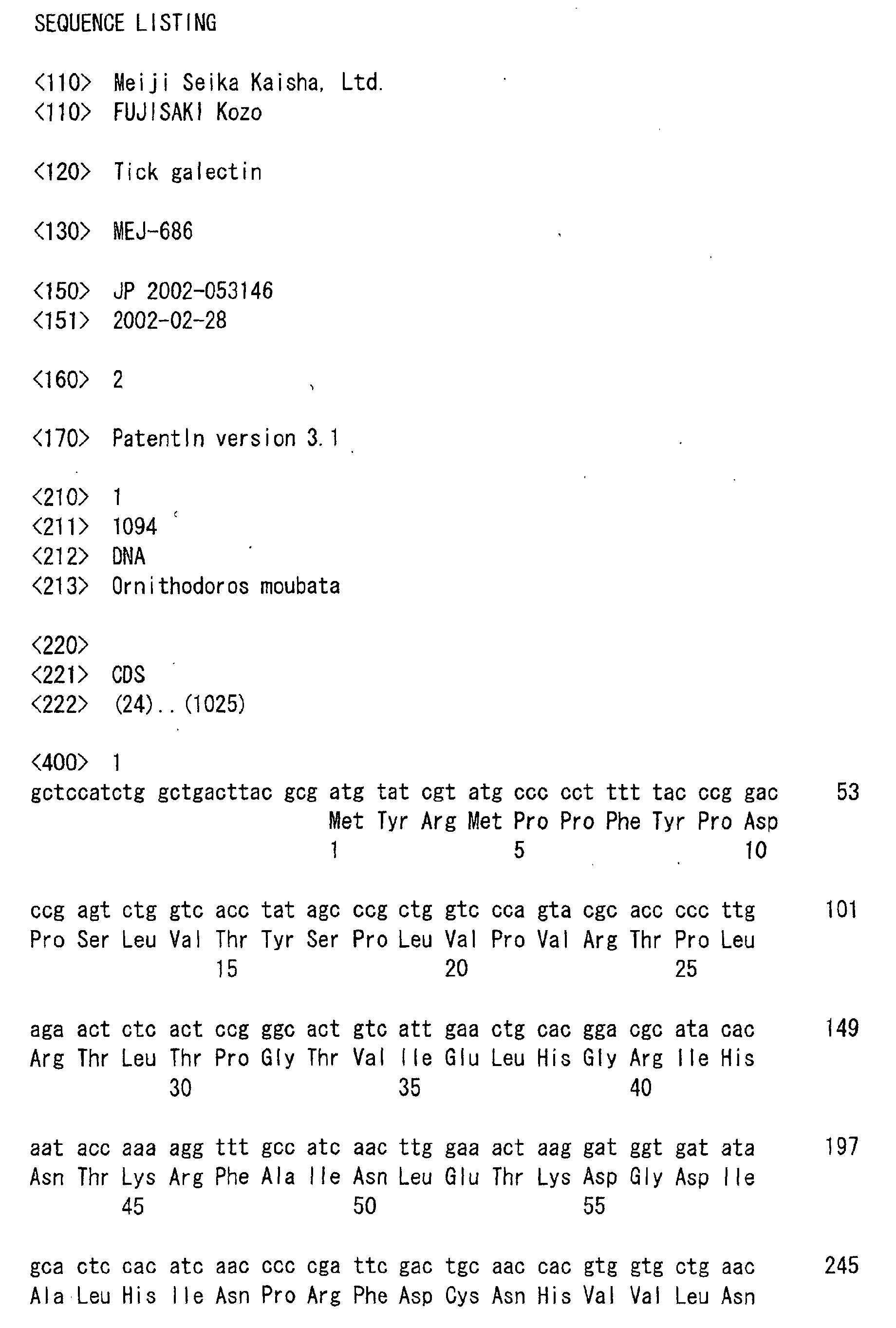
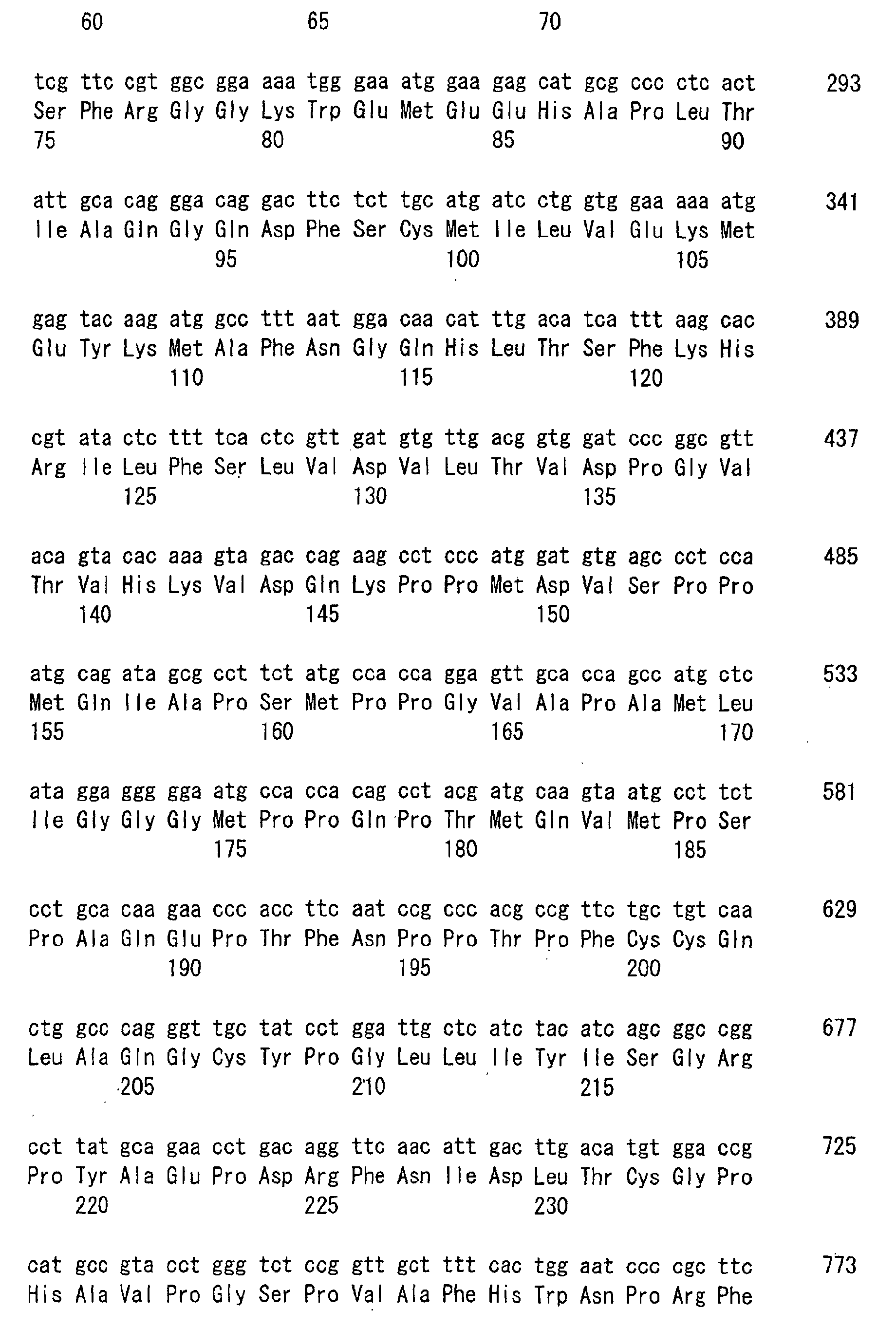
- the full length of the cDNA was 1094 bp, and the base sequence thereof was that of SEQ ID NO: 1. It was confirmed that the base sequence contains an open reading frame consisting of 1002 bp (a base sequence consisting of the 24th to 1025th bases in the base sequence of SEQ ID NO: 1).
- the amino acid sequence of a protein deduced from the open reading frame was the amino acid sequence of SEQ ID NO: 2 consisting of 333 amino acid residues, and the deduced molecular weight was 36.6 kDa.
- n4E12-2 gene The gene is referred to as an n4E12-2 gene.
- the homology search of the amino acid sequence deduced from the n4E12-2 gene was carried out by a BLAST method (Basic local alignment search tool; Altschul, S. F. et al., J. Mol. Biol., 215, 403-410, 1990; obtained from the National Center for Biotechnology Information).
- BLAST method Basic local alignment search tool
- the amino acid sequence had a high homology with a known galectin protein.
- the protein encoded by the n4E12-2 gene is referred to as "galectin".
- the protein was galectin.
- Example 3 Construction of vector for expressing tick galectin fusion protein
- the resulting cDNA fragment containing the n4E12-2 gene was inserted between the EcoRI site and the XhoI site of a vector pGEMEX-4T-3 (Promega) for expression in Escherichia coli, and then recombinant clones in which the galectin ORF fragment was inserted in the same direction as that of glutathione S-transferase (GST) in the vector were selected.
- a recombinant plasmid pGEMEX-4T-3/n4E12-2 was purified using a plasmid purification kit (Qiagen).
- Example 4 Expression of tick galectin recombinant protein in Escherichia coli
- Escherichia coli JM109 (DE3) (Promega) was transformed with the recombinant plasmid prepared in Example 3, and then the transformants were cultured in an LB medium containing ampicillin at 37°C. When OD 600nm of the culture became 0.3 ⁇ 0.5, isopropyl-thio-galactoside (IPTG) was added to the culture so that the final concentration became 0.01 mmol/L, and then the transformants were further cultured for 4 hours.
- IPTG isopropyl-thio-galactoside
- tick galectin recombinant protein was confirmed by carrying out 10% SDS-polyacrylamide gel electrophoresis [Laemmli et al., Nature, 227, 680-685 (1970)] followed by immunoblotting [Towbin et al., Proc. Natl. Acad. Sci. USA, 76, 4350-4354 (1979)], and then an amido black staining.
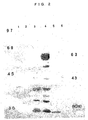
- the expression of the recombinant protein having a molecular weight of approximately 63 kDa was observed, and it was confirmed that the recombinant protein was a fusion protein of a GST leader protein (26 kDa) and the tick galectin protein (36.6 kDa) (see Fig. 1).
- Example 5 Purification of tick galectin recombinant protein and preparation of antiserum
- the recombinant galectin fusion protein expressed in Escherichia coli by the method described in Example 4 was purified in accordance with a protocol attached to a commercially available kit (Bulk GST Purification Module; Amersham Bioscience). More particularly, Escherichia coli induced with' IPTG was collected by centrifugation. The resulting pellet was sonicated in a TNE buffer containing lysozyme, and then the whole was centrifuged at 5000 rpm to obtain the pellet. The resulting pellet (insoluble fraction) was solubilized with Triton X-100, and then the whole was centrifuged at 5000 rpm to obtain the supernatant.
- the resulting supernatant was mixed with a glutathione resin, and then the mixture was centrifuged at 5000 rpm. The resulting pellet was eluted with 16 mmol/L glutathione solution to purify a "soluble fraction".
- Fig. 1 The result of electrophoresis of the purified recombinant galectin fusion protein is shown in Fig. 1.
- the electrophoresis, blotting, and staining were performed in the manner similar to that described in Example 4.
- Fig. 1 the lane on the left side is the result of molecular weight markers
- lane 1 is the result of the insoluble fraction
- lane 2 is the result of the soluble fraction.
- the number "63" at the right side of lane 2 means the molecular weight (63 kDa) of the recombinant galectin fusion protein.
- An emulsion was prepared by mixing 50 ⁇ L of a solution containing 100 ⁇ g of the purified recombinant galectin fusion protein with 50 ⁇ L of a complete Freund's adjuvant (Adjuvant Complete Freund; Difco).
- the emulsion was intraperitoneally inoculated into a 6-week-old female BALB/c mouse. After 2, 4, 6, and 8 weeks from the intraperitoneal inoculation, 100 ⁇ g of the recombinant galectin fusion protein was mixed with 50 ⁇ L of Titer Max (Gold; CytRx), and each booster inoculation was carried out. After 2 weeks from the final inoculation, blood was collected and the resulting serum was kept at -30°C.
- Example 6 Identification of native (wild type) galectin by immunoblotting using anti-tick hemolymph monoclonal antibody
- the wild type galectin protein was identified by immunoblotting [Towbin et al., Proc. Natl. Acad. Sci. USA, 76, 4350-4354 (1979)] using the monoclonal antibody obtained in Example 1 against the hemolymph from Ornithodoros moubata 4th instar nymphs after 6 days from engorgement.
- the hemolymph from Ornithodoros moubata 4th instar nymphs after 6 days from engorgement prepared in the manner similar to that described in Example 1 and a lysate of a tick fat body were used.
- the lysate was prepared by dissecting ticks in PBS (phosphate buffer), homogenizing the obtained tracheae containing the fat body in PBS, and sonicating the homogenate while cooling with ice.
- lane 5 is the result of the hemolymph from Ornithodoros moubata 4th instar nymphs after 6 days from engorgement
- lane 6 is the result of the fat body lysate.
- the numbers "63" and "43" at the side of lane 6 mean the molecular weight (63 kDa) of the recombinant galectin fusion protein and the molecular weight (43 kDa) of the wild type galectin protein, respectively.
- Example 7 Confirmation of reactivity of anti-tick hemolymph monoclonal antibody with respect to recombinant galectin fusion protein
- Example 2 the reactivity of the monoclonal antibody obtained in Example 1 against the hemolymph from Ornithodoros moubata 4th instar nymphs after 6 days from engorgement, with respect to the recombinant galectin fusion protein was examined by immunoblotting.
- samples the soluble and insoluble fractions derived from Escherichia coli transformed with plasmid pGEMEX-4T-3/n4E12-2 and expressing the recombinant galectin fusion protein (see Example 5), and soluble and insoluble fractions derived from Escherichia coli transformed with vector pGEMEX-4T-3 and expressing the GST protein were used.
- lanes 1 and 2 are the results of the soluble and insoluble fractions derived from Escherichia coli transformed with vector pGEMEX-4T-3 and expressing the GST protein, respectively, and lanes 3 and 4 are the results of the soluble and insoluble fractions derived from Escherichia coli transformed with plasmid pGEMEX-4T-3/n4E12-2 and expressing the recombinant galectin fusion protein.
- lanes 1 and 2 are the results of the soluble and insoluble fractions derived from Escherichia coli transformed with vector pGEMEX-4T-3 and expressing the GST protein, respectively
- lanes 3 and 4 are the results of the soluble and insoluble fractions derived from Escherichia coli transformed with plasmid pGEMEX-4T-3/n4E12-2 and expressing the recombinant galectin fusion protein.
- the recombinant galectin fusion protein (approximately 63 kDa) reacted with the monoclonal antibody against the hemolymph from Ornithodoros moubata 4th instar nymphs after 6 days from engorgement. It was shown from the result that the recombinant galectin fusion protein is one of the candidates for a tick vaccine. In this connection, the normal mouse serum did not react with the recombinant galectin fusion protein.
- Example 8 Identification of native (wild type) galectin by immunoblotting using anti-recombinant galectin fusion protein mouse serum
- the wild type galectin protein was identified by immunoblotting [Towbin et al., Proc. Natl. Acad. Sci. USA, 76, 4350-4354 (1979)] using the anti-recombinant galectin fusion protein mouse serum obtained in Example 5.
- Lanes 1 and 4 are the results obtained in Example 9.
- lane 2 is the result of the hemolymph from Ornithodoros moubata 4th instar nymphs after 6 days from engorgement
- lane 3 is the result of the fat body lysate.
- the numbers "63" and "37" at the side of lane 4 mean the molecular weight (63 kDa) of the recombinant galectin fusion protein and the molecular weight (37 kDa) of the wild type galectin protein, respectively.
- Example 9 Confirmation of reactivity of anti-recombinant galectin fusion protein mouse serum with respect to recombinant galectin fusion protein
- Example 5 the reactivity of the anti-recombinant galectin fusion protein mouse serum obtained in Example 5. with respect to the recombinant galectin fusion protein was examined by immunoblotting.
- samples the purified recombinant galectin fusion protein derived from Escherichia coli transformed with plasmid pGEMEX-4T-3/n4E12-2 and expressing the recombinant galectin fusion protein (see Example 5), and the insoluble fraction (before purification) derived from Escherichia coli transformed with vector pGEMEX-4T-3 and expressing the GST protein were used.
- lane 1 is the result of the purified recombinant galectin fusion protein
- lane 4 is the result of the (insoluble) GST protein before purification.
- the recombinant galectin fusion protein (approximately 63 kDa) reacted with the anti-recombinant galectin fusion protein mouse serum. It was shown from the result that the recombinant galectin fusion protein is one of candidates for a tick vaccine. In this connection, the normal mouse serum did not react with the recombinant galectin fusion protein.
- Example 5 whether or not the recombinant galectin fusion protein prepared in Example 5 can induce an antibody production in a mouse was examined.
- mice immunized with the recombinant galectin fusion protein in Example 5 11 mouse antisera were obtained. Each mouse antiserum was reacted with a membrane onto which the purified recombinant galectin fusion protein had been previously transferred, and then an antibody which bound to the antigen was detected by a western blotting method. In this connection, two mouse antisera prepared from two mice immunized with an adjuvant were used as a control.
- Example 11 Confirmation of agglutinin activity of recombinant galectin fusion protein to mouse erythrocytes
- the purified recombinant galectin fusion protein was diluted and added to the erythrocytes, to determine the effective concentration thereof.
- lactose which is an inhibitor of galectin
- an effect of the serum to suppress agglutination by galectin was examined.
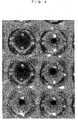
- Fig. 4 The result is shown in Fig. 4.
- wells 1 to 4 are the results when 5 ⁇ g, 0.25 ⁇ g, 0.025 ⁇ g, and 0.0025 ⁇ g of the recombinant galectin fusion protein were added, respectively
- well 5 is the result obtained when 0.25 ⁇ g of the recombinant galectin fusion protein and 10 mmol/L lactose were added
- well 6 is the result obtained when 0.25 ⁇ g of the recombinant galectin fusion protein and 10 ⁇ L of the anti-galectin mouse serum prepared in Example 5 were added.
- the recombinant galectin fusion protein agglutinated mouse erythrocytes dose-dependently. Further, the reaction was inhibited by the anti-recombinant galectin fusion protein mouse serum prepared in Example 5 or 10 mmol/L lactose.
- the purified recombinant galectin fusion protein and lactosyl Sepharose were mixed in a 1.5 mL-microtube, and centrifuged at 5000 rpm. The resulting pellet was washed with PBS-T three times, and eluted with 100 mmol/L lactose.
- lane 1 is the result obtained when the recombinant galectin fusion protein before mixing with lactosyl Sepharose (hereinafter referred to as a preapplied sample) was electrophoresed
- lane 2 is the result obtained when the supernatant obtained by centrifuging the suspended mixture of the recombinant galectin fusion protein and lactosyl Sepharose was electrophoresed
- lanes 3 to 5 are the results when the first to third wash liquids were electrophoresed, respectively
- lane 6 is the result obtained when the supernatant after elution with lactose.
- the number "63" at the side of lane 6 means the molecular weight (63 kDa) of the recombinant galectin fusion protein.
- galectin was eluted with lactose (lane 6), and the amount of galectin was almost equal to that of the recombinant galectin fusion protein contained in the preapplied sample (lane 1). Further, the recombinant galectin fusion protein exhibited a property of binding to lactosyl Sepharose, and was eluted with 100 mmol/L lactose.
- the medicament of the present invention particularly a tick vaccine, can be provided.
- tick vaccine it is possible, for example, to exterminate ticks, or to treat or prevent tick-borne infections such as rickettsiosis, filariasis, Q fever, African recurrent fever, or viral encephalitis.
Landscapes
- Health & Medical Sciences (AREA)
- Chemical & Material Sciences (AREA)
- Life Sciences & Earth Sciences (AREA)
- Organic Chemistry (AREA)
- Medicinal Chemistry (AREA)
- General Health & Medical Sciences (AREA)
- Veterinary Medicine (AREA)
- Chemical Kinetics & Catalysis (AREA)
- General Chemical & Material Sciences (AREA)
- Nuclear Medicine, Radiotherapy & Molecular Imaging (AREA)
- Animal Behavior & Ethology (AREA)
- Pharmacology & Pharmacy (AREA)
- Public Health (AREA)
- Molecular Biology (AREA)
- Genetics & Genomics (AREA)
- Proteomics, Peptides & Aminoacids (AREA)
- Biophysics (AREA)
- Biochemistry (AREA)
- Tropical Medicine & Parasitology (AREA)
- Gastroenterology & Hepatology (AREA)
- Insects & Arthropods (AREA)
- Toxicology (AREA)
- Zoology (AREA)
- Communicable Diseases (AREA)
- Immunology (AREA)
- Oncology (AREA)
- Engineering & Computer Science (AREA)
- Bioinformatics & Cheminformatics (AREA)
- Virology (AREA)
- Pulmonology (AREA)
- Peptides Or Proteins (AREA)
- Micro-Organisms Or Cultivation Processes Thereof (AREA)
- Medicines Containing Material From Animals Or Micro-Organisms (AREA)
- Preparation Of Compounds By Using Micro-Organisms (AREA)
- Investigating Or Analysing Biological Materials (AREA)
- Solid-Sorbent Or Filter-Aiding Compositions (AREA)
- Medicines That Contain Protein Lipid Enzymes And Other Medicines (AREA)
- Medicines Containing Antibodies Or Antigens For Use As Internal Diagnostic Agents (AREA)
- Pharmaceuticals Containing Other Organic And Inorganic Compounds (AREA)
Abstract
Description
(2) a polypeptide comprising the amino acid sequence of SEQ ID NO: 2 and exhibiting a galectin activity;
(3) a polypeptide exhibiting a galectin activity and comprising an amino acid sequence in which one or plural amino acids are substituted, deleted, and/or inserted at one or plural positions in the amino acid sequence of SEQ ID NO: 2; or
(4) a polypeptide comprising an amino acid sequence having a 60% or more homology with the amino acid sequence of SEQ ID NO: 2, and exhibiting a galectin activity.
a fusion polypeptide of the polypeptide consisting of the amino acid sequence of SEQ ID NO: 2 and a partner for the fusion, and exhibiting the galectin activity.

Claims (12)
- (1) a polypeptide consisting of the amino acid sequence of SEQ ID NO: 2;
(2) a polypeptide comprising the amino acid sequence of SEQ ID NO: 2 and exhibiting a galectin activity;
(3) a polypeptide exhibiting a galectin activity and comprising an amino acid sequence in which one or plural amino acids are substituted, deleted, and/or inserted at one or plural positions in the amino acid sequence of SEQ ID NO: 2; or
(4) a polypeptide comprising an amino acid sequence having a 60% or more homology with the amino acid sequence of SEQ ID NO: 2, and exhibiting a galectin activity. - A polynucleotide encoding the polypeptide according to claims 1.
- A vector comprising the polynucleotide according to claim 2.
- A transformant comprising the polynucleotide according to claim 2.
- A process for producing the polypeptide according to claim 1, comprising the step of culturing the transformant according to claim 4.
- A medicament comprising the polypeptide according to claim 1 or a fragment thereof, the polynucleotide according to claim 2, or the vector according to claim 3.
- A medicament according to claim 6, which is a tick vaccine.
- A pharmaceutical composition comprising the polypeptide according to claim 1 or a fragment thereof, the polynucleotide according to claim 2, or the vector according to claim 3, and a pharmaceutically or veterinary acceptable carrier or diluent.
- A method for exterminating ticks, comprising administering to a subject in need thereof the polypeptide according to claim 1 or a fragment thereof, the polynucleotide according to claim 2, or the vector according to claim 3 in an amount effective therefor.
- A method for treating or preventing a tick-borne infection, comprising administering to a subject in need thereof the polypeptide according to claim 1 or a fragment thereof, the polynucleotide according to claim 2, or the vector according to claim 3 in an amount effective therefor.
- An antibody or a fragment thereof, which binds to the polypeptide according to claim 1.
- A method for screening a substance capable of modifying a galectin activity of the polypeptide according to claim 1, comprising the steps of:bringing the polypeptide into contact with a substance to be tested; andanalyzing the galectin activity of the polypeptide.
Applications Claiming Priority (3)
| Application Number | Priority Date | Filing Date | Title |
|---|---|---|---|
| JP2002053146 | 2002-02-28 | ||
| JP2002053146 | 2002-02-28 | ||
| PCT/JP2003/002336 WO2003072781A1 (en) | 2002-02-28 | 2003-02-28 | Mite galectin |
Publications (4)
| Publication Number | Publication Date |
|---|---|
| EP1479773A1 true EP1479773A1 (en) | 2004-11-24 |
| EP1479773A4 EP1479773A4 (en) | 2005-07-27 |
| EP1479773B1 EP1479773B1 (en) | 2006-08-30 |
| EP1479773B8 EP1479773B8 (en) | 2007-02-14 |
Family
ID=27764351
Family Applications (1)
| Application Number | Title | Priority Date | Filing Date |
|---|---|---|---|
| EP03707178A Expired - Lifetime EP1479773B8 (en) | 2002-02-28 | 2003-02-28 | Mite galectin |
Country Status (9)
| Country | Link |
|---|---|
| US (3) | US7135552B2 (en) |
| EP (1) | EP1479773B8 (en) |
| JP (1) | JP4300117B2 (en) |
| AT (1) | ATE338125T1 (en) |
| AU (1) | AU2003211361B8 (en) |
| BR (1) | BR0303322A (en) |
| DE (1) | DE60307987T8 (en) |
| NZ (1) | NZ535468A (en) |
| WO (1) | WO2003072781A1 (en) |
Families Citing this family (5)
| Publication number | Priority date | Publication date | Assignee | Title |
|---|---|---|---|---|
| EP1479773B8 (en) * | 2002-02-28 | 2007-02-14 | Meiji Seika Kaisha Ltd. | Mite galectin |
| JP4719527B2 (en) * | 2005-08-03 | 2011-07-06 | 独立行政法人農業・食品産業技術総合研究機構 | Vector tick galectin, nucleic acid molecule encoding it and use thereof |
| WO2011100528A2 (en) | 2010-02-12 | 2011-08-18 | Emory University | Compositions and uses of lectins |
| JP2012059906A (en) * | 2010-09-09 | 2012-03-22 | Sony Corp | Storage element and memory unit |
| FR3051192B1 (en) * | 2016-05-13 | 2020-12-25 | Univ De Lorraine | METHOD OF PURIFICATION OF RECOMBINANT PROTEINS BY AFFINITY BASED ON THE LECTINIC ACTIVITY OF THE CRD DOMAIN OF A GALECTIN |
Family Cites Families (2)
| Publication number | Priority date | Publication date | Assignee | Title |
|---|---|---|---|---|
| US7488488B2 (en) | 2002-02-28 | 2009-02-10 | Meui Seika Kaisha, Ltd. | Tick chitinase |
| EP1479773B8 (en) * | 2002-02-28 | 2007-02-14 | Meiji Seika Kaisha Ltd. | Mite galectin |
-
2003
- 2003-02-28 EP EP03707178A patent/EP1479773B8/en not_active Expired - Lifetime
- 2003-02-28 US US10/506,047 patent/US7135552B2/en not_active Expired - Fee Related
- 2003-02-28 AT AT03707178T patent/ATE338125T1/en not_active IP Right Cessation
- 2003-02-28 JP JP2003571463A patent/JP4300117B2/en not_active Expired - Fee Related
- 2003-02-28 DE DE60307987T patent/DE60307987T8/en active Active
- 2003-02-28 NZ NZ535468A patent/NZ535468A/en not_active IP Right Cessation
- 2003-02-28 AU AU2003211361A patent/AU2003211361B8/en not_active Ceased
- 2003-02-28 WO PCT/JP2003/002336 patent/WO2003072781A1/en not_active Ceased
- 2003-02-28 BR BR0303322-8A patent/BR0303322A/en not_active IP Right Cessation
-
2006
- 2006-09-22 US US11/525,044 patent/US7547682B2/en not_active Expired - Fee Related
-
2009
- 2009-04-21 US US12/426,999 patent/US8057801B2/en not_active Expired - Fee Related
Non-Patent Citations (2)
| Title |
|---|
| DATABASE EMBL 14 October 2000 (2000-10-14), HILL, C.A. AND GUTIERREZ, J.A.: "EST, Amblyomma americanum" XP002328634 retrieved from EBI Database accession no. BF007251 -& HILL CATHERINE A ET AL: "Analysis of the expressed genome of the lone star tick, Amblyomma americanum (Acari: Ixodidae) using an expressed sequence tag approach" 2000, MICROBIAL AND COMPARATIVE GENOMICS, VOL. 5, NR. 2, PAGE(S) 89-101 , XP009047874 ISSN: 1090-6592 * |
| See also references of WO03072781A1 * |
Also Published As
| Publication number | Publication date |
|---|---|
| US20050106677A1 (en) | 2005-05-19 |
| EP1479773B1 (en) | 2006-08-30 |
| US8057801B2 (en) | 2011-11-15 |
| EP1479773A4 (en) | 2005-07-27 |
| AU2003211361A1 (en) | 2003-09-09 |
| US7547682B2 (en) | 2009-06-16 |
| AU2003211361B8 (en) | 2008-04-03 |
| DE60307987T2 (en) | 2006-12-21 |
| JP4300117B2 (en) | 2009-07-22 |
| ATE338125T1 (en) | 2006-09-15 |
| WO2003072781A1 (en) | 2003-09-04 |
| AU2003211361B2 (en) | 2007-12-13 |
| US7135552B2 (en) | 2006-11-14 |
| NZ535468A (en) | 2006-08-31 |
| US20100196407A1 (en) | 2010-08-05 |
| DE60307987T8 (en) | 2007-05-03 |
| BR0303322A (en) | 2004-12-28 |
| JPWO2003072781A1 (en) | 2005-06-23 |
| DE60307987D1 (en) | 2006-10-12 |
| EP1479773B8 (en) | 2007-02-14 |
| US20070021596A1 (en) | 2007-01-25 |
Similar Documents
| Publication | Publication Date | Title |
|---|---|---|
| Wang et al. | Structural and antigenic properties of merozoite surface protein 4 of Plasmodium falciparum | |
| BG62700B1 (en) | Molecules of recombinant desoxyribonucleinic acid (dna) encoding enzymes animopeptase, and their application for the preparation of vaccines against helminth infections | |
| US8057801B2 (en) | Tick galectin | |
| US20090274715A1 (en) | Tick chitinase | |
| EP0729975B1 (en) | Ecdn protein and dna coding for the same | |
| US20080286817A1 (en) | Novel allergens and treatment | |
| AU696260B2 (en) | Helminth parasite antigen with aminopeptidase-like activity | |
| EP1539820B1 (en) | Ostertagia vaccine | |
| WO1993016722A1 (en) | Antigens protective against echinococcus granulosus infection and vaccines containing such antigens | |
| JP4710009B2 (en) | Tick aspartic protease | |
| JP4710001B2 (en) | Tick leucine aminopeptidase | |
| JP2002300882A (en) | Use of nucleic acid molecule encoding Babesiagibsoni P50 antigen and its expression product |
Legal Events
| Date | Code | Title | Description |
|---|---|---|---|
| PUAI | Public reference made under article 153(3) epc to a published international application that has entered the european phase |
Free format text: ORIGINAL CODE: 0009012 |
|
| 17P | Request for examination filed |
Effective date: 20040909 |
|
| AK | Designated contracting states |
Kind code of ref document: A1 Designated state(s): AT BE BG CH CY CZ DE DK EE ES FI FR GB GR HU IE IT LI LU MC NL PT SE SI SK TR |
|
| AX | Request for extension of the european patent |
Extension state: AL LT LV MK RO |
|
| RIN1 | Information on inventor provided before grant (corrected) |
Inventor name: INOUE, NOBORU,OBIHIRO UNI.OF AGRI.&VETENARY ME Inventor name: FUJISAKI, KOZO,OBIHIRO UNIV.OF AGRI&VETENARY M Inventor name: TSUJI, NAOTOSHI Inventor name: NAGASAWA, HIDEYUKI,OBIHIRO UNIV.AGRI& VET.MED. Inventor name: IGARASHI, IKUO,OBIHIRO UNIV.AGRI& VET.MED. Inventor name: KADOTA, KIMIEOBIHIRO UNI.OF AGRI&VETENARY MED. Inventor name: GEN, GAKUNAN,OBIHIRO UNIV.AGRI & VET. MED. Inventor name: SUGIMOTO, CHICHIRO,OBIHIRO UNIV.AGRI & VET. ME Inventor name: YOKOYAMA, NAOAKI,OBIHIRO UNIV. AGRI.& VET.MED. Inventor name: SUZUKI, HIROSHI,OBIHIRO UNIV.AGRI & VET. MED. |
|
| RIC1 | Information provided on ipc code assigned before grant |
Ipc: 7C 07K 16/18 B Ipc: 7C 12N 15/12 A |
|
| A4 | Supplementary search report drawn up and despatched |
Effective date: 20050609 |
|
| GRAP | Despatch of communication of intention to grant a patent |
Free format text: ORIGINAL CODE: EPIDOSNIGR1 |
|
| GRAS | Grant fee paid |
Free format text: ORIGINAL CODE: EPIDOSNIGR3 |
|
| RIN1 | Information on inventor provided before grant (corrected) |
Inventor name: KADOTA, KIMIEOBIHIRO UNI.OF AGRI&VETENARY MED. Inventor name: SUZUKI, HIROSHI,OBIHIRO UNIV.AGRI & VET. MED. Inventor name: YOKOYAMA, NAOAKI,OBIHIRO UNIV. AGRI.& VET.MED. Inventor name: IGARASHI, IKUO,OBIHIRO UNIV.AGRI& VET.MED. Inventor name: TSUJI, NAOTOSHI Inventor name: SUGIMOTO, CHICHIRO,OBIHIRO UNIV.AGRI & VET. MED. Inventor name: GEN, GAKUNAN,OBIHIRO UNIV.AGRI & VET. MED. Inventor name: FUJISAKI, KOZO,OBIHIRO UNIV.OF AGRI&VETENARY MED. Inventor name: NAGASAWA, HIDEYUKI,OBIHIRO UNIV.AGRI& VET.MED. Inventor name: INOUE, NOBORU,OBIHIRO UNI.OF AGRI.&VETENARY MED. |
|
| GRAA | (expected) grant |
Free format text: ORIGINAL CODE: 0009210 |
|
| AK | Designated contracting states |
Kind code of ref document: B1 Designated state(s): AT BE BG CH CY CZ DE DK EE ES FI FR GB GR HU IE IT LI LU MC NL PT SE SI SK TR |
|
| PG25 | Lapsed in a contracting state [announced via postgrant information from national office to epo] |
Ref country code: IT Free format text: LAPSE BECAUSE OF FAILURE TO SUBMIT A TRANSLATION OF THE DESCRIPTION OR TO PAY THE FEE WITHIN THE PRESCRIBED TIME-LIMIT;WARNING: LAPSES OF ITALIAN PATENTS WITH EFFECTIVE DATE BEFORE 2007 MAY HAVE OCCURRED AT ANY TIME BEFORE 2007. THE CORRECT EFFECTIVE DATE MAY BE DIFFERENT FROM THE ONE RECORDED. Effective date: 20060830 Ref country code: SI Free format text: LAPSE BECAUSE OF FAILURE TO SUBMIT A TRANSLATION OF THE DESCRIPTION OR TO PAY THE FEE WITHIN THE PRESCRIBED TIME-LIMIT Effective date: 20060830 Ref country code: BE Free format text: LAPSE BECAUSE OF FAILURE TO SUBMIT A TRANSLATION OF THE DESCRIPTION OR TO PAY THE FEE WITHIN THE PRESCRIBED TIME-LIMIT Effective date: 20060830 Ref country code: NL Free format text: LAPSE BECAUSE OF FAILURE TO SUBMIT A TRANSLATION OF THE DESCRIPTION OR TO PAY THE FEE WITHIN THE PRESCRIBED TIME-LIMIT Effective date: 20060830 Ref country code: LI Free format text: LAPSE BECAUSE OF FAILURE TO SUBMIT A TRANSLATION OF THE DESCRIPTION OR TO PAY THE FEE WITHIN THE PRESCRIBED TIME-LIMIT Effective date: 20060830 Ref country code: CH Free format text: LAPSE BECAUSE OF FAILURE TO SUBMIT A TRANSLATION OF THE DESCRIPTION OR TO PAY THE FEE WITHIN THE PRESCRIBED TIME-LIMIT Effective date: 20060830 Ref country code: AT Free format text: LAPSE BECAUSE OF FAILURE TO SUBMIT A TRANSLATION OF THE DESCRIPTION OR TO PAY THE FEE WITHIN THE PRESCRIBED TIME-LIMIT Effective date: 20060830 Ref country code: CZ Free format text: LAPSE BECAUSE OF FAILURE TO SUBMIT A TRANSLATION OF THE DESCRIPTION OR TO PAY THE FEE WITHIN THE PRESCRIBED TIME-LIMIT Effective date: 20060830 Ref country code: FI Free format text: LAPSE BECAUSE OF FAILURE TO SUBMIT A TRANSLATION OF THE DESCRIPTION OR TO PAY THE FEE WITHIN THE PRESCRIBED TIME-LIMIT Effective date: 20060830 Ref country code: SK Free format text: LAPSE BECAUSE OF FAILURE TO SUBMIT A TRANSLATION OF THE DESCRIPTION OR TO PAY THE FEE WITHIN THE PRESCRIBED TIME-LIMIT Effective date: 20060830 |
|
| REG | Reference to a national code |
Ref country code: GB Ref legal event code: FG4D |
|
| REG | Reference to a national code |
Ref country code: CH Ref legal event code: EP |
|
| REG | Reference to a national code |
Ref country code: IE Ref legal event code: FG4D |
|
| REF | Corresponds to: |
Ref document number: 60307987 Country of ref document: DE Date of ref document: 20061012 Kind code of ref document: P |
|
| PG25 | Lapsed in a contracting state [announced via postgrant information from national office to epo] |
Ref country code: DK Free format text: LAPSE BECAUSE OF FAILURE TO SUBMIT A TRANSLATION OF THE DESCRIPTION OR TO PAY THE FEE WITHIN THE PRESCRIBED TIME-LIMIT Effective date: 20061130 Ref country code: BG Free format text: LAPSE BECAUSE OF FAILURE TO SUBMIT A TRANSLATION OF THE DESCRIPTION OR TO PAY THE FEE WITHIN THE PRESCRIBED TIME-LIMIT Effective date: 20061130 Ref country code: SE Free format text: LAPSE BECAUSE OF FAILURE TO SUBMIT A TRANSLATION OF THE DESCRIPTION OR TO PAY THE FEE WITHIN THE PRESCRIBED TIME-LIMIT Effective date: 20061130 |
|
| PG25 | Lapsed in a contracting state [announced via postgrant information from national office to epo] |
Ref country code: ES Free format text: LAPSE BECAUSE OF FAILURE TO SUBMIT A TRANSLATION OF THE DESCRIPTION OR TO PAY THE FEE WITHIN THE PRESCRIBED TIME-LIMIT Effective date: 20061211 |
|
| RIN2 | Information on inventor provided after grant (corrected) |
Inventor name: NAGASAWA, HIDEYUKI,OBIHIRO UNIV.AGRI& VET.MED. Inventor name: TSUJI, NAOTOSHI Inventor name: YOKOYAMA, NAOAKI,OBIHIRO UNIV. AGRI.& VET.MED. Inventor name: GEN, GAKUNAN,OBIHIRO UNIV.AGRI & VET. MED. Inventor name: KADOTA, KIMIEOBIHIRO UNI.OF AGRI&VETENARY MED. Inventor name: INOUE, NOBORU,OBIHIRO UNI.OF AGRI.&VETENARY MED. Inventor name: FUJISAKI, KOZO,OBIHIRO UNIV.OF AGRI&VETENARY MED. Inventor name: SUZUKI, HIROSHI,OBIHIRO UNIV.AGRI & VET. MED. Inventor name: IGARASHI, IKUO,OBIHIRO UNIV.AGRI& VET.MED. Inventor name: SUGIMOTO, CHIHIRO,OBIHIRO UNIV.AGRI & VET. MED. |
|
| PG25 | Lapsed in a contracting state [announced via postgrant information from national office to epo] |
Ref country code: PT Free format text: LAPSE BECAUSE OF FAILURE TO SUBMIT A TRANSLATION OF THE DESCRIPTION OR TO PAY THE FEE WITHIN THE PRESCRIBED TIME-LIMIT Effective date: 20070212 |
|
| ET | Fr: translation filed | ||
| PG25 | Lapsed in a contracting state [announced via postgrant information from national office to epo] |
Ref country code: MC Free format text: LAPSE BECAUSE OF NON-PAYMENT OF DUE FEES Effective date: 20070228 |
|
| REG | Reference to a national code |
Ref country code: CH Ref legal event code: PL |
|
| NLV1 | Nl: lapsed or annulled due to failure to fulfill the requirements of art. 29p and 29m of the patents act | ||
| PLBE | No opposition filed within time limit |
Free format text: ORIGINAL CODE: 0009261 |
|
| STAA | Information on the status of an ep patent application or granted ep patent |
Free format text: STATUS: NO OPPOSITION FILED WITHIN TIME LIMIT |
|
| 26N | No opposition filed |
Effective date: 20070531 |
|
| PG25 | Lapsed in a contracting state [announced via postgrant information from national office to epo] |
Ref country code: IE Free format text: LAPSE BECAUSE OF NON-PAYMENT OF DUE FEES Effective date: 20070228 |
|
| PG25 | Lapsed in a contracting state [announced via postgrant information from national office to epo] |
Ref country code: GR Free format text: LAPSE BECAUSE OF FAILURE TO SUBMIT A TRANSLATION OF THE DESCRIPTION OR TO PAY THE FEE WITHIN THE PRESCRIBED TIME-LIMIT Effective date: 20061201 |
|
| PG25 | Lapsed in a contracting state [announced via postgrant information from national office to epo] |
Ref country code: EE Free format text: LAPSE BECAUSE OF FAILURE TO SUBMIT A TRANSLATION OF THE DESCRIPTION OR TO PAY THE FEE WITHIN THE PRESCRIBED TIME-LIMIT Effective date: 20060830 |
|
| PG25 | Lapsed in a contracting state [announced via postgrant information from national office to epo] |
Ref country code: CY Free format text: LAPSE BECAUSE OF FAILURE TO SUBMIT A TRANSLATION OF THE DESCRIPTION OR TO PAY THE FEE WITHIN THE PRESCRIBED TIME-LIMIT Effective date: 20060830 Ref country code: LU Free format text: LAPSE BECAUSE OF NON-PAYMENT OF DUE FEES Effective date: 20070228 |
|
| PG25 | Lapsed in a contracting state [announced via postgrant information from national office to epo] |
Ref country code: TR Free format text: LAPSE BECAUSE OF FAILURE TO SUBMIT A TRANSLATION OF THE DESCRIPTION OR TO PAY THE FEE WITHIN THE PRESCRIBED TIME-LIMIT Effective date: 20060830 Ref country code: HU Free format text: LAPSE BECAUSE OF FAILURE TO SUBMIT A TRANSLATION OF THE DESCRIPTION OR TO PAY THE FEE WITHIN THE PRESCRIBED TIME-LIMIT Effective date: 20070301 |
|
| PGFP | Annual fee paid to national office [announced via postgrant information from national office to epo] |
Ref country code: FR Payment date: 20140211 Year of fee payment: 12 Ref country code: IT Payment date: 20140212 Year of fee payment: 12 |
|
| PGFP | Annual fee paid to national office [announced via postgrant information from national office to epo] |
Ref country code: GB Payment date: 20140226 Year of fee payment: 12 |
|
| PGFP | Annual fee paid to national office [announced via postgrant information from national office to epo] |
Ref country code: DE Payment date: 20140417 Year of fee payment: 12 |
|
| REG | Reference to a national code |
Ref country code: DE Ref legal event code: R119 Ref document number: 60307987 Country of ref document: DE |
|
| GBPC | Gb: european patent ceased through non-payment of renewal fee |
Effective date: 20150228 |
|
| REG | Reference to a national code |
Ref country code: FR Ref legal event code: ST Effective date: 20151030 |
|
| PG25 | Lapsed in a contracting state [announced via postgrant information from national office to epo] |
Ref country code: IT Free format text: LAPSE BECAUSE OF NON-PAYMENT OF DUE FEES Effective date: 20150228 |
|
| PG25 | Lapsed in a contracting state [announced via postgrant information from national office to epo] |
Ref country code: GB Free format text: LAPSE BECAUSE OF NON-PAYMENT OF DUE FEES Effective date: 20150228 Ref country code: DE Free format text: LAPSE BECAUSE OF NON-PAYMENT OF DUE FEES Effective date: 20150901 |
|
| PG25 | Lapsed in a contracting state [announced via postgrant information from national office to epo] |
Ref country code: FR Free format text: LAPSE BECAUSE OF NON-PAYMENT OF DUE FEES Effective date: 20150302 |