EP1478186A2 - Decoding of arbitrarily ordered and interleaved macroblocks - Google Patents
Decoding of arbitrarily ordered and interleaved macroblocks Download PDFInfo
- Publication number
- EP1478186A2 EP1478186A2 EP04009903A EP04009903A EP1478186A2 EP 1478186 A2 EP1478186 A2 EP 1478186A2 EP 04009903 A EP04009903 A EP 04009903A EP 04009903 A EP04009903 A EP 04009903A EP 1478186 A2 EP1478186 A2 EP 1478186A2
- Authority
- EP
- European Patent Office
- Prior art keywords
- macroblocks
- macroblock
- group
- queue
- decoding
- Prior art date
- Legal status (The legal status is an assumption and is not a legal conclusion. Google has not performed a legal analysis and makes no representation as to the accuracy of the status listed.)
- Granted
Links
Images





Classifications
-
- H—ELECTRICITY
- H04—ELECTRIC COMMUNICATION TECHNIQUE
- H04N—PICTORIAL COMMUNICATION, e.g. TELEVISION
- H04N19/00—Methods or arrangements for coding, decoding, compressing or decompressing digital video signals
- H04N19/90—Methods or arrangements for coding, decoding, compressing or decompressing digital video signals using coding techniques not provided for in groups H04N19/10-H04N19/85, e.g. fractals
-
- H—ELECTRICITY
- H04—ELECTRIC COMMUNICATION TECHNIQUE
- H04N—PICTORIAL COMMUNICATION, e.g. TELEVISION
- H04N19/00—Methods or arrangements for coding, decoding, compressing or decompressing digital video signals
- H04N19/10—Methods or arrangements for coding, decoding, compressing or decompressing digital video signals using adaptive coding
- H04N19/102—Methods or arrangements for coding, decoding, compressing or decompressing digital video signals using adaptive coding characterised by the element, parameter or selection affected or controlled by the adaptive coding
- H04N19/129—Scanning of coding units, e.g. zig-zag scan of transform coefficients or flexible macroblock ordering [FMO]
-
- H—ELECTRICITY
- H04—ELECTRIC COMMUNICATION TECHNIQUE
- H04N—PICTORIAL COMMUNICATION, e.g. TELEVISION
- H04N19/00—Methods or arrangements for coding, decoding, compressing or decompressing digital video signals
- H04N19/10—Methods or arrangements for coding, decoding, compressing or decompressing digital video signals using adaptive coding
- H04N19/102—Methods or arrangements for coding, decoding, compressing or decompressing digital video signals using adaptive coding characterised by the element, parameter or selection affected or controlled by the adaptive coding
- H04N19/13—Adaptive entropy coding, e.g. adaptive variable length coding [AVLC] or context adaptive binary arithmetic coding [CABAC]
-
- H—ELECTRICITY
- H04—ELECTRIC COMMUNICATION TECHNIQUE
- H04N—PICTORIAL COMMUNICATION, e.g. TELEVISION
- H04N19/00—Methods or arrangements for coding, decoding, compressing or decompressing digital video signals
- H04N19/10—Methods or arrangements for coding, decoding, compressing or decompressing digital video signals using adaptive coding
- H04N19/169—Methods or arrangements for coding, decoding, compressing or decompressing digital video signals using adaptive coding characterised by the coding unit, i.e. the structural portion or semantic portion of the video signal being the object or the subject of the adaptive coding
- H04N19/17—Methods or arrangements for coding, decoding, compressing or decompressing digital video signals using adaptive coding characterised by the coding unit, i.e. the structural portion or semantic portion of the video signal being the object or the subject of the adaptive coding the unit being an image region, e.g. an object
-
- H—ELECTRICITY
- H04—ELECTRIC COMMUNICATION TECHNIQUE
- H04N—PICTORIAL COMMUNICATION, e.g. TELEVISION
- H04N19/00—Methods or arrangements for coding, decoding, compressing or decompressing digital video signals
- H04N19/10—Methods or arrangements for coding, decoding, compressing or decompressing digital video signals using adaptive coding
- H04N19/169—Methods or arrangements for coding, decoding, compressing or decompressing digital video signals using adaptive coding characterised by the coding unit, i.e. the structural portion or semantic portion of the video signal being the object or the subject of the adaptive coding
- H04N19/17—Methods or arrangements for coding, decoding, compressing or decompressing digital video signals using adaptive coding characterised by the coding unit, i.e. the structural portion or semantic portion of the video signal being the object or the subject of the adaptive coding the unit being an image region, e.g. an object
- H04N19/174—Methods or arrangements for coding, decoding, compressing or decompressing digital video signals using adaptive coding characterised by the coding unit, i.e. the structural portion or semantic portion of the video signal being the object or the subject of the adaptive coding the unit being an image region, e.g. an object the region being a slice, e.g. a line of blocks or a group of blocks
-
- H—ELECTRICITY
- H04—ELECTRIC COMMUNICATION TECHNIQUE
- H04N—PICTORIAL COMMUNICATION, e.g. TELEVISION
- H04N19/00—Methods or arrangements for coding, decoding, compressing or decompressing digital video signals
- H04N19/10—Methods or arrangements for coding, decoding, compressing or decompressing digital video signals using adaptive coding
- H04N19/169—Methods or arrangements for coding, decoding, compressing or decompressing digital video signals using adaptive coding characterised by the coding unit, i.e. the structural portion or semantic portion of the video signal being the object or the subject of the adaptive coding
- H04N19/17—Methods or arrangements for coding, decoding, compressing or decompressing digital video signals using adaptive coding characterised by the coding unit, i.e. the structural portion or semantic portion of the video signal being the object or the subject of the adaptive coding the unit being an image region, e.g. an object
- H04N19/176—Methods or arrangements for coding, decoding, compressing or decompressing digital video signals using adaptive coding characterised by the coding unit, i.e. the structural portion or semantic portion of the video signal being the object or the subject of the adaptive coding the unit being an image region, e.g. an object the region being a block, e.g. a macroblock
-
- H—ELECTRICITY
- H04—ELECTRIC COMMUNICATION TECHNIQUE
- H04N—PICTORIAL COMMUNICATION, e.g. TELEVISION
- H04N19/00—Methods or arrangements for coding, decoding, compressing or decompressing digital video signals
- H04N19/42—Methods or arrangements for coding, decoding, compressing or decompressing digital video signals characterised by implementation details or hardware specially adapted for video compression or decompression, e.g. dedicated software implementation
- H04N19/423—Methods or arrangements for coding, decoding, compressing or decompressing digital video signals characterised by implementation details or hardware specially adapted for video compression or decompression, e.g. dedicated software implementation characterised by memory arrangements
-
- H—ELECTRICITY
- H04—ELECTRIC COMMUNICATION TECHNIQUE
- H04N—PICTORIAL COMMUNICATION, e.g. TELEVISION
- H04N19/00—Methods or arrangements for coding, decoding, compressing or decompressing digital video signals
- H04N19/42—Methods or arrangements for coding, decoding, compressing or decompressing digital video signals characterised by implementation details or hardware specially adapted for video compression or decompression, e.g. dedicated software implementation
- H04N19/436—Methods or arrangements for coding, decoding, compressing or decompressing digital video signals characterised by implementation details or hardware specially adapted for video compression or decompression, e.g. dedicated software implementation using parallelised computational arrangements
-
- H—ELECTRICITY
- H04—ELECTRIC COMMUNICATION TECHNIQUE
- H04N—PICTORIAL COMMUNICATION, e.g. TELEVISION
- H04N19/00—Methods or arrangements for coding, decoding, compressing or decompressing digital video signals
- H04N19/44—Decoders specially adapted therefor, e.g. video decoders which are asymmetric with respect to the encoder
-
- H—ELECTRICITY
- H04—ELECTRIC COMMUNICATION TECHNIQUE
- H04N—PICTORIAL COMMUNICATION, e.g. TELEVISION
- H04N19/00—Methods or arrangements for coding, decoding, compressing or decompressing digital video signals
- H04N19/60—Methods or arrangements for coding, decoding, compressing or decompressing digital video signals using transform coding
- H04N19/61—Methods or arrangements for coding, decoding, compressing or decompressing digital video signals using transform coding in combination with predictive coding
Definitions
- the present invention is related to digital video compression, and more particularly to a system and method for decoding flexibly ordered macroblocks.
- Each picture comprises a two dimensional grid of picture elements (pixels), wherein each pixel is associated with a particular spatial location and stores color data associated therewith.
- pixels picture elements
- each picture is subdivided into regions of 16 ⁇ 16 pixels. Each region is represented by a macroblock.
- a macroblock stores luminance, and chrominance matrices that are mapped to the 16x16 pixels.
- the macroblocks are grouped into any number of slice groups or slices.
- the MPEG standard has been subjected to a number of updates and revisions, resulting in numerous versions.
- each of the slices contain macroblocks which are all in the same row and contiguous with respect to one another.
- the foregoing property permits transmission of a bit stream of the macroblocks in raster scan order by transmitting the slices in raster scan order.
- MPEG-2 also includes syntax indicating where each row in a picture begins. The indication of where each row in a picture begins permits decoding of multiple rows in parallel. Parallel decoding of multiple rows, known as multi-row decoding is especially useful for achieving a decoding rate sufficient for presentation of the video sequence on a video display.
- JVT Joint Video Team
- ITU-VCEG ITU-VCEG
- MPEG-4 Part 10 Advanced Video Coding ITU Rec.
- H.264 and referred to here as AVC, provide much better compression than MPEG-2, in terms of compressed bit rate for a given level of quality. This makes the more recent standards attractive for commercial deployment. However, such standards are also much more complex to encode and decode than MPEG-2.
- the AVC standard has a number of properties that make decoding substantially more complicated.
- the macroblocks forming a slice are not necessarily spatially contiguous. Slices can include macroblocks that are throughout the entire picture, with macroblocks from other slices groups interspersed therebetween.
- the foregoing property is referred to here as Flexible Macroblock Ordering and is identified in the AVC standard by having more than one slice group in a picture. Additionally, new rows do not necessarily begin in a new slice and an AVC bitstream does not necessarily indicate where each row starts.
- AVC also includes a filtering function known as loop filtering or deblocking.
- Loop filtering is applied to the entire decoded picture, requiring in general all upper and left neighbors of each macroblock to have been decoded before loop filtering of the macroblock can begin. While it might be possible to decode all the macroblocks of a picture in the order that the macroblocks were received, and then perform loop filtering, doing so prevents concurrent performance of decoding and loop filtering operations, and as a result the performance requirements of decoders of AVC are increased significantly, adding cost.
- Another problem with sequential performance of decoding and then loop filtering of a picture is that the amount of frame buffer memory required is increased, thereby adding cost to the decoding system.
- Macroblocks within a slice include sequences of either variable length codes or alternatively sequences of arithmetic coded syntax elements using the content adaptive binary arithment coding (CABAC) format.
- CABAC content adaptive binary arithment coding
- the boundaries between macroblocks can only be determined by parsing substantially all syntax elements from the start of each slice. The boundaries are not assured to fall on convenient boundaries such as byte boundaries.
- CABAC content adaptive binary arithment coding
- a system, method, and apparatus for decoding macroblocks of a particular picture in raster scan order which are grouped and transmitted in arbitrarily different orders, such as provided for by Flexible Macroblock Ordering.
- a plurality of streams of compressed data are maintained simultaneously in a plurality of corresponding contexts, with each stream representing a different slice or slice group.
- the macroblocks are decoded in a desired order, such as raster scan order, by selecting the appropriate context.
- a system for decoding macroblocks said system comprises: memory for storing a first group of macroblocks and a second group of macroblocks; a first queue for serially shifting at least one macroblock from the first group; a second queue for serially shifting at least one macroblock from the second group; and a processor for selectively decoding macroblocks from either the first queue or the second queue.
- the processor decodes the macroblocks of the first queue responsive to determining that a next macroblock in raster scan order is in the first group.
- the processor decodes the macroblocks of the second queue responsive to determining that a next macroblock in raster scan order is in the second group.
- the system further comprises: a selector for selecting one of the first queue and the second queue.
- the first queue further comprises: an input buffer for storing macroblocks of the first queue in a sequential order; and a shifter for serially outputting the macroblocks of the first queue in the sequential order.
- the first queue further comprises: an address pointer for pointing to a sequentially next macroblock; and wherein the shifter outputs the macroblock pointed to by the address pointer.
- a circuit for decoding macroblocks comprises: memory for storing a first group of macroblocks and a second group of macroblocks; a first queue operatively coupled to the memory, wherein the first queue stores at least a portion of a macroblock from the first group; a second queue operatively coupled to the memory, wherein the second queue stores at least a portion of a macroblock from the second group; at least one processor operatively coupled to the first queue and the second queue; and memory for storing a plurality of instructions executable by the at least one processor, wherein the plurality of instructions cause: decoding the at least one macroblock from the first queue by the at least one processor; and decoding the at least one macroblock from the second queue, wherein a macroblock immediately following the at least one macroblock from the first queue in raster order is in the second group, by the at least one processor.
- the first queue further comprises: an input buffer for storing macroblocks of the first queue in a sequential order; and a shifter for serially outputting the macroblocks of the first queue in the sequential order.
- the instructions further cause: decoding at least another macroblock from the first queue, wherein a macroblock immediately following the at least one macroblock from the second queue is in the first group, by the at least one processor.
- a method for decoding macroblocks comprises: receiving a first group of macroblocks and a second of macroblocks; decoding at least one macroblock of the first group; decoding at least one macroblock of the second group, wherein a macroblock immediately following in a raster scan order the at least one macroblock in the first group is in the second group; and decoding at least another macroblock of the first group, if the at least another macroblock immediately following in the raster scan order the at least one macroblock of the second group is in the first group
- receiving the first group of macroblocks and the second group of macroblocks further comprises: queuing the macroblocks of the first group; and queuing the macroblocks of the second group.
- decoding the at least one macroblock from the first group further comprises: serially receiving the at least one macroblock from the first group from a queue.
- a system for decoding video data comprises: a first context that receives macroblocks from a first group, wherein the first group contains macroblocks in a non-raster order, and prepares the macroblocks for a subsequent decoding function; a second context that receives macroblocks from a second group, the second group containing macroblocks in a non-raster order, and prepares the macroblocks for the subsequent decoding function, wherein macroblocks upon which the subsequent decoding function is performed are in a raster scan order.
- the first context further comprises: an input buffer for storing macroblocks of the first context in a sequential order; and a shifter for serially outputting the macroblocks of the first context in the sequential order.
- the second context further comprises: an input buffer for storing macroblocks of the second context in a sequential order; and a shifter for ,serially outputting the macroblocks of the second context in the sequential order.
- FIGURE 1 is a block diagram of an exemplary video sequence transmission system
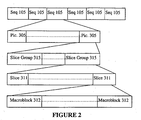
- FIGURE 2 is a block diagram of the AVC video stream hierarchy
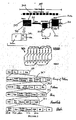
- FIGURE 3 is a table illustrating a picture mapped into interleaved slice groups
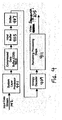
- FIGURE 4 is a block diagram of an exemplary decoder system
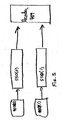
- FIGURE 5 is a block diagram of an exemplary data structure for providing macroblocks to the decoder in accordance with an embodiment of the claimed invention
- FIGURE 6 is a block diagram of a circuit for providing macroblocks to the decoder in accordance with an embodiment of the claimed invention.
- FIGURE 7 is a flow diagram describing the decoding of a bit stream with flexible macroblock ordering.
- a video sequence 105 includes a series of images represented by frames.
- the frames comprise two-dimensional grids of pixels.
- An exemplary video sequence 105 such as a video sequence in accordance with ITU-656, includes 30 720x480 pixel frames per second. The foregoing results in a bit rate of approximately 165 Mbps for one video sequence.
- the communication medium 125 often delivers multiple video sequences 105 to the display unit 110.
- the multiple video sequences 105 are transmitted together using a multiple access scheme, wherein each video sequence 105 is associated with a particular channel.
- the communication medium 125 may comprise either a point-to-point link or a network of links, or any combination thereof.
- the network of links may include either a broadcast network, a switched network, or a packet switched network, such as the internet, or any combination thereof.
- the links may include, for example, a coaxial cable, an Ethernet connection, a Digital Subscriber Loop (DSL), an optical fiber, a satellite/radio link, or a phone line.
- DSL Digital Subscriber Loop
- the encoder 140 receives and encodes the video sequence 105 pursuant to the AVC standard.
- the AVC standard is described in document JVT G-050, which is incorporated by reference herein, in its entirety.
- the video sequence 105 is represented by an AVC bitstream 142.
- the AVC bitstream 142 is transmitted over the communication medium 125 and received by a decoder 145.
- the decoder 145 decodes the AVC bitstream 142, providing video sequence 105' that may be imperceptibly different from video sequence 105 to the human eye.
- the video sequence 105' is provided for display to the display unit 110.
- FIGURE 2 there is illustrated a block diagram ofthe AVC stream 142 hierarchy.
- a video sequence 105 includes an encoded representation of a series of pictures 305.
- each slice group 315 includes one or more slices 311, and each slice 311 contains any number of encoded macroblocks 312.
- the macroblocks 312 forming a slice group 315 are not necessarily spatially contiguous.
- Slice groups 315 may include macroblocks 312 that are throughout the entire picture 305 with macroblocks 312 from other slices groups 315 interspersed therebetween. The foregoing is known as Flexible Macroblock Ordering.
- FIGURE 3 there is illustrated an exemplary picture 305 comprising macroblocks 312.
- the macroblocks 312 are mapped to the picture 305 forming any number of sequential rows 360 of macroblocks 312.
- the macroblocks 312 in the even-numbered rows 360 are in slice group 0, while the macroblocks 312 in odd-numbered rows 360 are in slice group 1.
- the macroblocks 312 are transmitted over the communication medium 125 to the decoder 145.
- the macroblocks 312, as transmitted, are organized by slice groups 315.
- the macroblocks are transmitted in the following order: 312 0,0 , 312 0,1 ...312 0,m-1 , 312 2,0 ,312 2,1 ...312 2,m-1 ... 312 n-2,0 , 312 n-2,1 ...312 n-2,m-1 , 312 1,0 , 312 1,1 ... 312 1,m-1 , 312 3,0 ,312 3,1 ...312 3,m-1 ... 312 n-1,0 , 312 n-1,1 ...312 n-1,m-1
- a system layer processor 401 receives the AVC bit stream 142 containing compressed video data, extracts the compressed video data and places the compressed video data in the compressed data buffer (CDB) 403.
- the CDB 403 is typically a structure in general-purpose memory, such as DRAM for example.
- Input buffer 405 may be a physical buffer dedicated for the purpose of buffering data, or it may be a function of a data cache or other data memory.
- a shifter 407 performs the function of aligning selected bits of data to appropriate bit positions of the entropy decoder 409.
- Entropy decoder 409 performs the function of decoding the entropy coding of the bit stream 142.
- entropy coding uses variable length coding (VLC), and the entropy decoder 409 is a variable length decoder (VLD).
- VLC variable length coding
- VLD variable length decoder
- the entropy coding may be arithmetic coding, and the decoding process may therefore be arithmetic decoding.
- the entropy decoder 409 may be implemented as hardware designed for this purpose, or it may be implemented as software on a programmable processor, or some combination thereof.
- the remaining processing steps comprise all the processing functions not yet listed which are required for decoding the compressed video format of interest. These functions can include inverse scan order, inverse quantization, mismatch control, inverse discrete cosine transform (DCT), and motion compensation with pixel filtering and reconstruction.
- DCT inverse discrete cosine transform
- the foregoing functions may be implemented in a variety of ways, including specialized hardware, software controlling a programmable processor, or a combination thereof.
- FIGURE 5 there is illustrated a data structure for providing macroblocks 312 to the entropy decoder 409 in accordance with one embodiment of the present invention.
- the macroblocks 312 are stored in a CDB 403 which receives at least a portion of the bitstream 142 of AVC data comprising all of the macroblocks associated with a particular picture 305.
- the macroblocks 312 as transmitted over the communication medium 125 to the decoder are organized by slice group 315, e.g., slice group 0, slice group 1.
- slice group 315 e.g., slice group 0, slice group 1.
- One portion 403(0) in the CDB 403 may be associated with one slice group 315, while a second portion 403(1) in the CDB 403 may be associated with a second slice group 315.
- Each slice group 315 contains a number of macroblocks 312.
- Each slice group 315 is associated with a first-in-first-out (FIFO) queue 550(0), 550(1).
- FIFO queue 550 queues the macroblocks 312 from the slice group 315 associated therewith.
- slice group 0 can be associated with FIFO queue 550(0) and slice group 1 can be associated with FIFO queue 550(1).
- the entropy decoder 409 decodes the macroblocks 312 in raster scan order.
- the slice groups 315 do not necessarily comprise macroblocks that are continuous in raster scan order.
- the mapping scheme of the macroblocks to slice groups 315 is recorded.
- the record of the mapping scheme is provided in the input stream.
- the mapping scheme indicates the slice group 315 associated with each macroblock 312.
- the entropy decoder 409 can use this information to determine the slice group 315 associated with the next macroblock 312 in the raster scan order. Based on the indication, the entropy decoder 409 selects the queue 550 associated with the slice group 312 that includes the next macroblock 312 in raster scan order.
- macroblocks 312 0,0 , ... 312 0,m-1 , 312 2,0 ,...312 2,m-1 , 312 4,0 ,...312 4,m-1 ,..312 x-2,0 ,...312 x-2,m-1 are stored in FIFO queue 550(0)
- macroblocks 312 1,0 , ... 312 1,m-1 , 312 3,0 ,...312 3,m-1 , 312 5,0 ,...312 5,m-1 ,..312 x-1,0 ,...312 x-1,m-1 . are stored in FIFO queue 550(1).
- Macroblock 312 0,0 is first in raster order.
- the entropy decoder 409 selects FIFO queue 550(0) and FIFO queue 550(0) provides macroblock 312 0,0 to the entropy decoder 409.
- the next macroblock 312 0,1 is also in slice group 0. Therefore, the entropy decoder 409 selects FIFO queue 550(0) and FIFO queue 550(0) provides macroblock 312 0,1 to the entropy decoder 409.
- the entropy decoder 409 continues to select FIFO queue 550(0) until macroblock 312 0,m-1 . After macroblock 312 0,m-1 , macroblock 312 1,0 is the next macroblock in the raster scan order.
- the entropy decoder 409 selects FIFO queue 550(1) and FIFO queue 550(1) provides macroblock 312 1,0 to the entropy decoder 409.
- the decoder 145 includes compressed data buffer 403.
- the compressed data buffer includes one portion 403(0) associated with one slice group 315, e.g., slice group 0, and another portion 403(1) associated with a second slice group, e.g., slice group 1.
- the decoder includes a plurality of contexts 610(0), 610(1) each of which is associated with a particular one of the slice groups. For example, in the interleaved macroblock scheme of FIGURE 3, context 610(0) can be associated with slice group 0, while context 610(1) can be associated with slice group 1.
- Each context 610 includes an input buffer 615 for buffering data from the associated slice group 315, an address pointer 620 pointing to a memory location in the compressed data buffer 403, and a shifter 625 for shifting data from the input buffer 615 to the entropy decoder 409.
- the address pointer 620 is appropriately incremented to point to the next address to be read in the compressed data buffer 403.
- the data following the address pointed to by the address pointer 620 is placed in the input buffer 615.
- the state of the context including the CDB address pointer, input buffer pointers, and shifter position are all retained and restored when the context is again switched in.
- Transfer of the macroblocks 312 is controlled by a selector 630.
- the entropy decoder 409 selects the context 610 associated with the slice group that includes the first macroblock 312 0,0 of a picture, in raster scan order, e.g., context 610(0) associated with slice group 0.
- the macroblocks 312 of the slice group 315 are provided to and decoded by the entropy decoder 409.
- Each slice group 315 is associated with a particular context 610(0), 610(1).
- Each context 610(0), 610(1) stores the macroblocks 312 from the slice group 315 associated therewith.
- slice group 0 can be associated with context 610(0) and slice group 1 can be associated with context 610(1).
- the entropy decoder 409 deocdes the maroclocks 312 in raster scan order.
- the slice groups 315 do not necessarily comprise macroblocks that are continuous in raster scan order.
- the mapping scheme of the macroblocks to slice groups 315 is recorded.
- the record of the mapping scheme is provided in the input stream.
- the mapping scheme indicates the slice group 315 associated with the next macroblock in the raster scan order.
- the entropy decoder 409 selects the context 610 associated with the slice group that include the next macroblock in raster scan order.
- macroblocks 312 0,0 , ... 312 0,m-1 , 312 2,0 ,...312 2,m-1 , 312 4,0 ,...312 4,m-1 ,..312 x-2,0 ,...312 x-2,m-1 are stored in context 610(0), while macroblocks 312 1,0 , ... 312 1,m-1 , 312 3,0 ,...312 3,m-1 , 312 5,0 ,...312 5,m-1 ,..312 x-1,0 ,...312 x-1,m-1 . are stored in context 610(1).
- Macroblock 312 0,0 is first in raster order.
- the entropy decoder 409 selects context 610(0) and context 610(0) provides macroblock 312 0,0 to the entropy decoder 409.
- the next macroblock 312 0,1 is also in slice group 0. Therefore, the entropy decoder 409 selects context 610(0) and context 610(0) provides macroblock 312 0,1 to the entropy decoder 409.
- the entropy decoder 409 continues to select context 610(0). until macroblock 312 0,m-1 .
- macroblock 312 1,0 is the next macroblock in the raster scan order.
- the next macroblock 312 1,0 is in slice group 1. Therefore, the entropy decoder 409 selects context 610(1) and context 610(1) provides macroblock 312 1,0 to the entropy decoder 409.
- the entropy decoder 409 determines the slice group 315 that includes the first macroblock 312 0,0 of the picture 305 (705).
- the entropy decoder 409 associates each slice group 315 with a particular context 610, and the context 610 loads the input buffer 615 of each context 610 with at least a portion of each associated slice group 315. For example, context 610(0) is associated with slice group 0, while context 610(1) is associated with slice group 1.
- the selector 630 selects (715) the context 610 associated with the slice group 315 which includes the first macroblock 312 0,0 , e.g., context 610(0) associated with slice group 0, and serially receives and decodes the macroblocks 312 therein (720).
- the macroblocks 312 in the context 610(0) are received and decoded until the next macroblock 312 in raster order is determined to be in another slice group (725), e.g., slice group 1.
- the entropy decoder selects the context 610 associated with the slice group including the next macroblock in raster order (715), e.g., context 610(1) associated with slice group 1, and repeats 720-725 for the next slice group.
- 715-725 are repeated until the last macroblock in the picture is decoded (730).
- 705-730 are repeated for the next picture.
- Decoding with two or more concurrent input streams can optionally be combined with the pre-processor method disclosed in incorporated applications Serial No. (attorney docket number 13764US02) and Serial No. 60/380,520 to improve the decoder's ability to decode multiple slices with arbitrarily interleaved macroblocks.
- the pre-processor can determine where the slices begin and end in the decoder's coded data buffer, and which macroblocks are in which slices, and provide information to the decoder that allows it to maintain the appropriate data in the appropriate context of the decoder. This is particularly useful when the number of slices or slice groups that need to be processed concurrently exceed the number of contexts the decoder can support simultaneously. This is also useful when the slices are transmitted in arbitrary order.
- the pre-processor can re-order the compressed data.
- the pre-processor can transcode the entropy coded input stream into a different entropy coded bit stream, and in so doing can also change the order of the data such that the result is in the order desired by the decoder (such as, for example, raster scan order).
Landscapes
- Engineering & Computer Science (AREA)
- Multimedia (AREA)
- Signal Processing (AREA)
- Computing Systems (AREA)
- Theoretical Computer Science (AREA)
- Compression Or Coding Systems Of Tv Signals (AREA)
Abstract
Description
According to another aspect of the invention, a system for decoding macroblocks, said system comprises: memory for storing a first group of macroblocks and a second group of macroblocks; a first queue for serially shifting at least one macroblock from the first group; a second queue for serially shifting at least one macroblock from the second group; and a processor for selectively decoding macroblocks from either the first queue or the second queue.
Advantageously, the processor decodes the macroblocks of the first queue responsive to determining that a next macroblock in raster scan order is in the first group.
Advantageously, the processor decodes the macroblocks of the second queue responsive to determining that a next macroblock in raster scan order is in the second group.
Advantageously, the system further comprises: a selector for selecting one of the first queue and the second queue.
Advantageously, the first queue further comprises: an input buffer for storing macroblocks of the first queue in a sequential order; and a shifter for serially outputting the macroblocks of the first queue in the sequential order.
Advantageously, the first queue further comprises: an address pointer for pointing to a sequentially next macroblock; and wherein the shifter outputs the macroblock pointed to by the address pointer.
According to another aspect of the invention, a circuit for decoding macroblocks, said circuit comprises: memory for storing a first group of macroblocks and a second group of macroblocks; a first queue operatively coupled to the memory, wherein the first queue stores at least a portion of a macroblock from the first group; a second queue operatively coupled to the memory, wherein the second queue stores at least a portion of a macroblock from the second group; at least one processor operatively coupled to the first queue and the second queue; and memory for storing a plurality of instructions executable by the at least one processor, wherein the plurality of instructions cause: decoding the at least one macroblock from the first queue by the at least one processor; and decoding the at least one macroblock from the second queue, wherein a macroblock immediately following the at least one macroblock from the first queue in raster order is in the second group, by the at least one processor.
Advantageously, the first queue further comprises: an input buffer for storing macroblocks of the first queue in a sequential order; and a shifter for serially outputting the macroblocks of the first queue in the sequential order.
Advantageously, the instructions further cause: decoding at least another macroblock from the first queue, wherein a macroblock immediately following the at least one macroblock from the second queue is in the first group, by the at least one processor.
According to another aspect of the invention, a method for decoding macroblocks, said method comprises: receiving a first group of macroblocks and a second of macroblocks; decoding at least one macroblock of the first group; decoding at least one macroblock of the second group, wherein a macroblock immediately following in a raster scan order the at least one macroblock in the first group is in the second group; and decoding at least another macroblock of the first group, if the at least another macroblock immediately following in the raster scan order the at least one macroblock of the second group is in the first group
Advantageously, receiving the first group of macroblocks and the second group of macroblocks further comprises: queuing the macroblocks of the first group; and queuing the macroblocks of the second group.
Advantageously, decoding the at least one macroblock from the first group further comprises: serially receiving the at least one macroblock from the first group from a queue.
According to another aspect of the invention, a system for decoding video data comprises: a first context that receives macroblocks from a first group, wherein the first group contains macroblocks in a non-raster order, and prepares the macroblocks for a subsequent decoding function; a second context that receives macroblocks from a second group, the second group containing macroblocks in a non-raster order, and prepares the macroblocks for the subsequent decoding function, wherein macroblocks upon which the subsequent decoding function is performed are in a raster scan order.
Advantageously, the first context further comprises: an input buffer for storing macroblocks of the first context in a sequential order; and a shifter for serially outputting the macroblocks of the first context in the sequential order.
Advantageously, the second context further comprises: an input buffer for storing macroblocks of the second context in a sequential order; and a shifter for ,serially outputting the macroblocks of the second context in the sequential order.
Claims (10)
- A system for decoding macroblocks, said system comprising:memory for storing a first group of macroblocks and a second group of macroblocks;a first queue for serially shifting at least one macroblock from the first group;a second queue for serially shifting at least one macroblock from the second group; anda processor for selectively decoding macroblocks from either of the queues.
- The system of claim 1, wherein the processor decodes the macroblocks of the first queue responsive to determining that a next macroblock in raster scan order is in the first group.
- The system of claim 2, wherein the processor decodes the macroblocks of the second queue responsive to determining that a next macroblock in raster scan order is in the second group.
- The system of claim 1, further comprising:a selector for selecting one of the first queue and the second queue.
- The system of claim 1, wherein the first queue further comprises:an input buffer for storing macroblocks of the first queue in a sequential order; anda shifter for serially outputting the macroblocks of the first queue in the sequential order.
- The system of claim 5, wherein the first queue further comprises:wherein the shifter outputs the macroblock pointed to by the address pointer.an address pointer for pointing to a sequentially next macroblock; and
- A circuit for decoding macroblocks, said circuit comprising:memory for storing a first group of macroblocks and a second group of macroblocks;a first queue operatively coupled to the memory, wherein the first queue stores at least a portion of a macroblock from the first group;a second queue operatively coupled to the memory, wherein the second queue stores at least a portion of a macroblock from the second group;at least one processor operatively coupled to the first queue and the second queue; andmemory for storing a plurality of instructions executable by the at least one processor, wherein the plurality of instructions cause:decoding the at least one macroblock from the first queue by the at least one processor; anddecoding the at least one macroblock from the second queue, wherein a macroblock immediately following the at least one macroblock from the first queue in raster order is in the second group, by the at least one processor.
- The circuit of claim 7, wherein the first queue further comprises:an input buffer for storing macroblocks of the first queue in a sequential order; anda shifter for serially outputting the macroblocks of the first queue in the sequential order.
- A method for decoding macroblocks, said method comprising:receiving a first group of macroblocks and a second of macroblocks;decoding at least one macroblock of the first group;decoding at least one macroblock of the second group, wherein a macroblock immediately following in a raster scan order the at least one macroblock in the first group is in the second group; anddecoding at least another macroblock of the first group, if the at least another macroblock immediately following in the raster scan order the at least one macroblock of the second group is in the first group.
- A system for decoding video data comprising:a first context that receives macroblocks from a first group, wherein the first group contains macroblocks in a non-raster order, and prepares the macroblocks for a subsequent decoding function;a second context that receives macroblocks from a second group, the second group containing macroblocks in a non-raster order, and prepares the macroblocks for the subsequent decoding function, wherein macroblocks upon which the subsequent decoding function is performed are in a raster scan order.
Applications Claiming Priority (2)
| Application Number | Priority Date | Filing Date | Title |
|---|---|---|---|
| US439372 | 2003-05-16 | ||
| US10/439,372 US7813431B2 (en) | 2002-05-20 | 2003-05-16 | System, method, and apparatus for decoding flexibility ordered macroblocks |
Publications (3)
| Publication Number | Publication Date |
|---|---|
| EP1478186A2 true EP1478186A2 (en) | 2004-11-17 |
| EP1478186A3 EP1478186A3 (en) | 2009-09-23 |
| EP1478186B1 EP1478186B1 (en) | 2019-08-21 |
Family
ID=33029811
Family Applications (1)
| Application Number | Title | Priority Date | Filing Date |
|---|---|---|---|
| EP04009903.8A Expired - Lifetime EP1478186B1 (en) | 2003-05-16 | 2004-04-26 | Decoding of arbitrarily ordered and interleaved macroblocks |
Country Status (2)
| Country | Link |
|---|---|
| US (1) | US7813431B2 (en) |
| EP (1) | EP1478186B1 (en) |
Cited By (6)
| Publication number | Priority date | Publication date | Assignee | Title |
|---|---|---|---|---|
| WO2009047695A1 (en) * | 2007-10-08 | 2009-04-16 | Nxp B.V. | Method and system for decoding digital video content involving arbitrarily accessing an encoded bitstream |
| WO2011065859A1 (en) * | 2009-11-24 | 2011-06-03 | Intel Corporation | Displaying decompressed pictures on liquid crystal dispays in macroblock raster scan order |
| WO2011047330A3 (en) * | 2009-10-15 | 2011-10-13 | Omnivision Technologies, Inc. | Low-cost video encoder |
| CN103828370A (en) * | 2011-10-31 | 2014-05-28 | 联发科技股份有限公司 | Apparatus and method for buffering content array referenced for entropy decoding of multiple picture block coded pictures and entropy decoder |
| EP1989889A4 (en) * | 2006-02-24 | 2014-07-09 | Freescale Semiconductor Inc | Flexible macroblock ordering with reduced data traffic and power consumption |
| US9497466B2 (en) | 2011-01-17 | 2016-11-15 | Mediatek Inc. | Buffering apparatus for buffering multi-partition video/image bitstream and related method thereof |
Families Citing this family (26)
| Publication number | Priority date | Publication date | Assignee | Title |
|---|---|---|---|---|
| US7630440B2 (en) * | 2003-05-28 | 2009-12-08 | Broadcom Corporation | Context adaptive binary arithmetic code decoding engine |
| US6917310B2 (en) * | 2003-06-25 | 2005-07-12 | Lsi Logic Corporation | Video decoder and encoder transcoder to and from re-orderable format |
| US7627039B2 (en) * | 2003-09-05 | 2009-12-01 | Realnetworks, Inc. | Parallel video decoding |
| KR20050113501A (en) * | 2004-05-29 | 2005-12-02 | 삼성전자주식회사 | Syntax parser for a h.264 video decoder |
| JP4182442B2 (en) * | 2006-04-27 | 2008-11-19 | ソニー株式会社 | Image data processing apparatus, image data processing method, image data processing method program, and recording medium storing image data processing method program |
| JP2008072647A (en) * | 2006-09-15 | 2008-03-27 | Toshiba Corp | Information processing apparatus, decoder, and playback apparatus operation control method |
| KR101086434B1 (en) * | 2007-03-28 | 2011-11-25 | 삼성전자주식회사 | Method and device for displaying video data |
| US8582656B2 (en) * | 2007-04-13 | 2013-11-12 | Apple Inc. | Method and system for video encoding and decoding |
| US20080310515A1 (en) * | 2007-06-14 | 2008-12-18 | Yasutomo Matsuba | MPEG-2 2-Slice Coding for Simple Implementation of H.264 MBAFF Transcoder |
| CN101389021B (en) * | 2007-09-14 | 2010-12-22 | 华为技术有限公司 | Video encoding and decoding method and device |
| WO2009033432A1 (en) * | 2007-09-14 | 2009-03-19 | Huawei Technologies Co., Ltd. | A method and apparatus for video encoding and decoding |
| US8542748B2 (en) * | 2008-03-28 | 2013-09-24 | Sharp Laboratories Of America, Inc. | Methods and systems for parallel video encoding and decoding |
| US8311111B2 (en) * | 2008-09-11 | 2012-11-13 | Google Inc. | System and method for decoding using parallel processing |
| US8675730B2 (en) * | 2009-07-13 | 2014-03-18 | Nvidia Corporation | Macroblock grouping in a destination video frame to improve video reconstruction performance |
| US20110164685A1 (en) * | 2010-01-04 | 2011-07-07 | Vixs Systems, Inc. | Entropy decoder with entropy decoding interface and methods for use therewith |
| GB2482731B (en) * | 2010-08-13 | 2016-12-21 | Advanced Risc Mach Ltd | A video decoding apparatus and method |
| US8344917B2 (en) * | 2010-09-30 | 2013-01-01 | Sharp Laboratories Of America, Inc. | Methods and systems for context initialization in video coding and decoding |
| US9313514B2 (en) * | 2010-10-01 | 2016-04-12 | Sharp Kabushiki Kaisha | Methods and systems for entropy coder initialization |
| US8990435B2 (en) * | 2011-01-17 | 2015-03-24 | Mediatek Inc. | Method and apparatus for accessing data of multi-tile encoded picture stored in buffering apparatus |
| FR2972588A1 (en) | 2011-03-07 | 2012-09-14 | France Telecom | METHOD FOR ENCODING AND DECODING IMAGES, CORRESPONDING ENCODING AND DECODING DEVICE AND COMPUTER PROGRAMS |
| FR2977111A1 (en) * | 2011-06-24 | 2012-12-28 | France Telecom | METHOD FOR ENCODING AND DECODING IMAGES, CORRESPONDING ENCODING AND DECODING DEVICE AND COMPUTER PROGRAMS |
| US9100657B1 (en) | 2011-12-07 | 2015-08-04 | Google Inc. | Encoding time management in parallel real-time video encoding |
| US9794574B2 (en) | 2016-01-11 | 2017-10-17 | Google Inc. | Adaptive tile data size coding for video and image compression |
| US10542258B2 (en) | 2016-01-25 | 2020-01-21 | Google Llc | Tile copying for video compression |
| US12505577B2 (en) * | 2020-06-22 | 2025-12-23 | Sony Group Corporation | Information processing apparatus and method for prohibiting the combined use of scalable encoding and scaling encoding |
| JP7834750B2 (en) * | 2020-11-05 | 2026-03-24 | エルジー エレクトロニクス インコーポレイティド | Point cloud data transmission device, point cloud data transmission method, point cloud data receiving device, and point cloud data receiving method |
Family Cites Families (6)
| Publication number | Priority date | Publication date | Assignee | Title |
|---|---|---|---|---|
| JP3443867B2 (en) * | 1992-06-26 | 2003-09-08 | ソニー株式会社 | Image signal encoding / decoding method and image signal recording medium |
| US5717394A (en) * | 1993-02-10 | 1998-02-10 | Ricoh Company Ltd. | Method and apparatus for encoding and decoding data |
| US5812791A (en) * | 1995-05-10 | 1998-09-22 | Cagent Technologies, Inc. | Multiple sequence MPEG decoder |
| US6891893B2 (en) * | 2000-04-21 | 2005-05-10 | Microsoft Corp. | Extensible multimedia application program interface and related methods |
| JP2002010259A (en) * | 2000-06-21 | 2002-01-11 | Mitsubishi Electric Corp | Image encoding device, image encoding method, and recording medium recording image encoding program |
| US6438168B2 (en) * | 2000-06-27 | 2002-08-20 | Bamboo Media Casting, Inc. | Bandwidth scaling of a compressed video stream |
-
2003
- 2003-05-16 US US10/439,372 patent/US7813431B2/en active Active
-
2004
- 2004-04-26 EP EP04009903.8A patent/EP1478186B1/en not_active Expired - Lifetime
Cited By (12)
| Publication number | Priority date | Publication date | Assignee | Title |
|---|---|---|---|---|
| EP1989889A4 (en) * | 2006-02-24 | 2014-07-09 | Freescale Semiconductor Inc | Flexible macroblock ordering with reduced data traffic and power consumption |
| WO2009047695A1 (en) * | 2007-10-08 | 2009-04-16 | Nxp B.V. | Method and system for decoding digital video content involving arbitrarily accessing an encoded bitstream |
| US8774273B2 (en) | 2007-10-08 | 2014-07-08 | Entropic Communications, Inc. | Method and system for decoding digital video content involving arbitrarily accessing an encoded bitstream |
| WO2011047330A3 (en) * | 2009-10-15 | 2011-10-13 | Omnivision Technologies, Inc. | Low-cost video encoder |
| WO2011065859A1 (en) * | 2009-11-24 | 2011-06-03 | Intel Corporation | Displaying decompressed pictures on liquid crystal dispays in macroblock raster scan order |
| CN102696221A (en) * | 2009-11-24 | 2012-09-26 | 英特尔公司 | Displaying decompressed pictures on liquid crystal dispays in macroblock raster scan order |
| CN102696221B (en) * | 2009-11-24 | 2015-12-09 | 英特尔公司 | With macro block raster scan order Explicit solutions compressed picture on a liquid crystal display |
| US9497466B2 (en) | 2011-01-17 | 2016-11-15 | Mediatek Inc. | Buffering apparatus for buffering multi-partition video/image bitstream and related method thereof |
| CN103828370A (en) * | 2011-10-31 | 2014-05-28 | 联发科技股份有限公司 | Apparatus and method for buffering content array referenced for entropy decoding of multiple picture block coded pictures and entropy decoder |
| EP2740270A4 (en) * | 2011-10-31 | 2015-04-29 | Mediatek Inc | Apparatus and method for buffering context arrays referenced for performing entropy decoding upon multi-tile encoded picture and related entropy decoder |
| US9538177B2 (en) | 2011-10-31 | 2017-01-03 | Mediatek Inc. | Apparatus and method for buffering context arrays referenced for performing entropy decoding upon multi-tile encoded picture and related entropy decoder |
| CN103828370B (en) * | 2011-10-31 | 2017-11-03 | 联发科技股份有限公司 | buffer device, buffering method and entropy decoder |
Also Published As
| Publication number | Publication date |
|---|---|
| EP1478186A3 (en) | 2009-09-23 |
| EP1478186B1 (en) | 2019-08-21 |
| US20040066852A1 (en) | 2004-04-08 |
| US7813431B2 (en) | 2010-10-12 |
Similar Documents
| Publication | Publication Date | Title |
|---|---|---|
| US7813431B2 (en) | System, method, and apparatus for decoding flexibility ordered macroblocks | |
| US8451908B2 (en) | System, method, and apparatus for decoding flexibly ordered pixel arrays | |
| JP3942630B2 (en) | Channel buffer management in video decoder | |
| US8817885B2 (en) | Method and apparatus for skipping pictures | |
| US5691768A (en) | Multiple resolution, multi-stream video system using a single standard decoder | |
| TWI530197B (en) | Coded picture buffer removal times signaled in picture and sub-picture timing supplemental enhancement information messages | |
| KR101223983B1 (en) | Bitrate reduction techniques for image transcoding | |
| EP2941869B1 (en) | Video buffering operations for random access in video coding | |
| KR101835318B1 (en) | Method and apparatus for processing video | |
| US6198773B1 (en) | Video memory management for MPEG video decode and display system | |
| KR20060009878A (en) | Method for encoding sequences of pictures | |
| EP1209916A2 (en) | Digital video decoder for decoding digital high definition and/or digital standard definition television signals | |
| US7305036B2 (en) | System and method for entropy code preprocessing | |
| US9131249B2 (en) | Apparatus for encoding moving images to minimize an amount of generated code | |
| JP2018110425A (en) | Low-delay buffering model in video coding | |
| US8554004B2 (en) | Data transform apparatus | |
| JP2005510981A (en) | Multi-channel video transcoding system and method | |
| CN102150428A (en) | System and method for video encoding using adaptive segmentation | |
| TW201320751A (en) | Video encoding and decoding using transforms | |
| US20010026587A1 (en) | Image encoding apparatus and method of same, video camera, image recording apparatus, and image transmission apparatus | |
| CN101904172A (en) | VLC method and apparatus | |
| US7369612B2 (en) | Video decoder and method for using the same | |
| KR20220104266A (en) | Video-encoding method, video-decoding method, and apparatus implementing same | |
| US6795498B1 (en) | Decoding apparatus, decoding method, encoding apparatus, encoding method, image processing system, and image processing method | |
| JP4820559B2 (en) | Video data encoding and decoding method and apparatus |
Legal Events
| Date | Code | Title | Description |
|---|---|---|---|
| PUAI | Public reference made under article 153(3) epc to a published international application that has entered the european phase |
Free format text: ORIGINAL CODE: 0009012 |
|
| AK | Designated contracting states |
Kind code of ref document: A2 Designated state(s): AT BE BG CH CY CZ DE DK EE ES FI FR GB GR HU IE IT LI LU MC NL PL PT RO SE SI SK TR |
|
| AX | Request for extension of the european patent |
Extension state: AL HR LT LV MK |
|
| RAP1 | Party data changed (applicant data changed or rights of an application transferred) |
Owner name: BROADCOM CORPORATION |
|
| PUAL | Search report despatched |
Free format text: ORIGINAL CODE: 0009013 |
|
| RIC1 | Information provided on ipc code assigned before grant |
Ipc: H04N 7/26 20060101AFI20040914BHEP Ipc: H04N 7/50 20060101ALI20090729BHEP |
|
| AK | Designated contracting states |
Kind code of ref document: A3 Designated state(s): AT BE BG CH CY CZ DE DK EE ES FI FR GB GR HU IE IT LI LU MC NL PL PT RO SE SI SK TR |
|
| AX | Request for extension of the european patent |
Extension state: AL HR LT LV MK |
|
| 17P | Request for examination filed |
Effective date: 20100323 |
|
| AKX | Designation fees paid |
Designated state(s): DE FR GB |
|
| 17Q | First examination report despatched |
Effective date: 20160606 |
|
| STAA | Information on the status of an ep patent application or granted ep patent |
Free format text: STATUS: EXAMINATION IS IN PROGRESS |
|
| RAP1 | Party data changed (applicant data changed or rights of an application transferred) |
Owner name: AVAGO TECHNOLOGIES GENERAL IP (SINGAPORE) PTE. LTD |
|
| RAP1 | Party data changed (applicant data changed or rights of an application transferred) |
Owner name: AVAGO TECHNOLOGIES INTERNATIONAL SALES PTE. LIMITE |
|
| REG | Reference to a national code |
Ref country code: DE Ref legal event code: R079 Ref document number: 602004054196 Country of ref document: DE Free format text: PREVIOUS MAIN CLASS: H04N0007260000 Ipc: H04N0019176000 |
|
| GRAP | Despatch of communication of intention to grant a patent |
Free format text: ORIGINAL CODE: EPIDOSNIGR1 |
|
| STAA | Information on the status of an ep patent application or granted ep patent |
Free format text: STATUS: GRANT OF PATENT IS INTENDED |
|
| RIC1 | Information provided on ipc code assigned before grant |
Ipc: H04N 19/176 20140101AFI20190222BHEP |
|
| INTG | Intention to grant announced |
Effective date: 20190313 |
|
| GRAS | Grant fee paid |
Free format text: ORIGINAL CODE: EPIDOSNIGR3 |
|
| GRAA | (expected) grant |
Free format text: ORIGINAL CODE: 0009210 |
|
| STAA | Information on the status of an ep patent application or granted ep patent |
Free format text: STATUS: THE PATENT HAS BEEN GRANTED |
|
| AK | Designated contracting states |
Kind code of ref document: B1 Designated state(s): DE FR GB |
|
| REG | Reference to a national code |
Ref country code: GB Ref legal event code: FG4D |
|
| REG | Reference to a national code |
Ref country code: DE Ref legal event code: R096 Ref document number: 602004054196 Country of ref document: DE |
|
| REG | Reference to a national code |
Ref country code: DE Ref legal event code: R097 Ref document number: 602004054196 Country of ref document: DE |
|
| PLBE | No opposition filed within time limit |
Free format text: ORIGINAL CODE: 0009261 |
|
| STAA | Information on the status of an ep patent application or granted ep patent |
Free format text: STATUS: NO OPPOSITION FILED WITHIN TIME LIMIT |
|
| 26N | No opposition filed |
Effective date: 20200603 |
|
| PG25 | Lapsed in a contracting state [announced via postgrant information from national office to epo] |
Ref country code: FR Free format text: LAPSE BECAUSE OF NON-PAYMENT OF DUE FEES Effective date: 20200430 |
|
| GBPC | Gb: european patent ceased through non-payment of renewal fee |
Effective date: 20200426 |
|
| PG25 | Lapsed in a contracting state [announced via postgrant information from national office to epo] |
Ref country code: GB Free format text: LAPSE BECAUSE OF NON-PAYMENT OF DUE FEES Effective date: 20200426 |
|
| PGFP | Annual fee paid to national office [announced via postgrant information from national office to epo] |
Ref country code: DE Payment date: 20210409 Year of fee payment: 18 |
|
| REG | Reference to a national code |
Ref country code: DE Ref legal event code: R119 Ref document number: 602004054196 Country of ref document: DE |
|
| PG25 | Lapsed in a contracting state [announced via postgrant information from national office to epo] |
Ref country code: DE Free format text: LAPSE BECAUSE OF NON-PAYMENT OF DUE FEES Effective date: 20221103 |