EP1477550A1 - Surfactant package and water in hydrocarbon emulsion using same - Google Patents
Surfactant package and water in hydrocarbon emulsion using same Download PDFInfo
- Publication number
- EP1477550A1 EP1477550A1 EP04011021A EP04011021A EP1477550A1 EP 1477550 A1 EP1477550 A1 EP 1477550A1 EP 04011021 A EP04011021 A EP 04011021A EP 04011021 A EP04011021 A EP 04011021A EP 1477550 A1 EP1477550 A1 EP 1477550A1
- Authority
- EP
- European Patent Office
- Prior art keywords
- acid
- salt
- emulsion
- component
- surfactant package
- Prior art date
- Legal status (The legal status is an assumption and is not a legal conclusion. Google has not performed a legal analysis and makes no representation as to the accuracy of the status listed.)
- Granted
Links
Images
Classifications
-
- C—CHEMISTRY; METALLURGY
- C10—PETROLEUM, GAS OR COKE INDUSTRIES; TECHNICAL GASES CONTAINING CARBON MONOXIDE; FUELS; LUBRICANTS; PEAT
- C10L—FUELS NOT OTHERWISE PROVIDED FOR; NATURAL GAS; SYNTHETIC NATURAL GAS OBTAINED BY PROCESSES NOT COVERED BY SUBCLASSES C10G OR C10K; LIQUIFIED PETROLEUM GAS; USE OF ADDITIVES TO FUELS OR FIRES; FIRE-LIGHTERS
- C10L1/00—Liquid carbonaceous fuels
- C10L1/10—Liquid carbonaceous fuels containing additives
- C10L1/14—Organic compounds
- C10L1/18—Organic compounds containing oxygen
- C10L1/188—Carboxylic acids; metal salts thereof
- C10L1/1881—Carboxylic acids; metal salts thereof carboxylic group attached to an aliphatic carbon atom
-
- C—CHEMISTRY; METALLURGY
- C09—DYES; PAINTS; POLISHES; NATURAL RESINS; ADHESIVES; COMPOSITIONS NOT OTHERWISE PROVIDED FOR; APPLICATIONS OF MATERIALS NOT OTHERWISE PROVIDED FOR
- C09K—MATERIALS FOR MISCELLANEOUS APPLICATIONS, NOT PROVIDED FOR ELSEWHERE
- C09K23/00—Use of substances as emulsifying, wetting, dispersing, or foam-producing agents
-
- C—CHEMISTRY; METALLURGY
- C09—DYES; PAINTS; POLISHES; NATURAL RESINS; ADHESIVES; COMPOSITIONS NOT OTHERWISE PROVIDED FOR; APPLICATIONS OF MATERIALS NOT OTHERWISE PROVIDED FOR
- C09K—MATERIALS FOR MISCELLANEOUS APPLICATIONS, NOT PROVIDED FOR ELSEWHERE
- C09K23/00—Use of substances as emulsifying, wetting, dispersing, or foam-producing agents
- C09K23/38—Alcohols, e.g. oxidation products of paraffins
-
- C—CHEMISTRY; METALLURGY
- C10—PETROLEUM, GAS OR COKE INDUSTRIES; TECHNICAL GASES CONTAINING CARBON MONOXIDE; FUELS; LUBRICANTS; PEAT
- C10L—FUELS NOT OTHERWISE PROVIDED FOR; NATURAL GAS; SYNTHETIC NATURAL GAS OBTAINED BY PROCESSES NOT COVERED BY SUBCLASSES C10G OR C10K; LIQUIFIED PETROLEUM GAS; USE OF ADDITIVES TO FUELS OR FIRES; FIRE-LIGHTERS
- C10L1/00—Liquid carbonaceous fuels
- C10L1/32—Liquid carbonaceous fuels consisting of coal-oil suspensions or aqueous emulsions or oil emulsions
- C10L1/328—Oil emulsions containing water or any other hydrophilic phase
-
- C—CHEMISTRY; METALLURGY
- C09—DYES; PAINTS; POLISHES; NATURAL RESINS; ADHESIVES; COMPOSITIONS NOT OTHERWISE PROVIDED FOR; APPLICATIONS OF MATERIALS NOT OTHERWISE PROVIDED FOR
- C09K—MATERIALS FOR MISCELLANEOUS APPLICATIONS, NOT PROVIDED FOR ELSEWHERE
- C09K23/00—Use of substances as emulsifying, wetting, dispersing, or foam-producing agents
- C09K23/16—Amines or polyamines
-
- C—CHEMISTRY; METALLURGY
- C10—PETROLEUM, GAS OR COKE INDUSTRIES; TECHNICAL GASES CONTAINING CARBON MONOXIDE; FUELS; LUBRICANTS; PEAT
- C10L—FUELS NOT OTHERWISE PROVIDED FOR; NATURAL GAS; SYNTHETIC NATURAL GAS OBTAINED BY PROCESSES NOT COVERED BY SUBCLASSES C10G OR C10K; LIQUIFIED PETROLEUM GAS; USE OF ADDITIVES TO FUELS OR FIRES; FIRE-LIGHTERS
- C10L1/00—Liquid carbonaceous fuels
- C10L1/10—Liquid carbonaceous fuels containing additives
- C10L1/14—Organic compounds
- C10L1/18—Organic compounds containing oxygen
- C10L1/182—Organic compounds containing oxygen containing hydroxy groups; Salts thereof
- C10L1/1822—Organic compounds containing oxygen containing hydroxy groups; Salts thereof hydroxy group directly attached to (cyclo)aliphatic carbon atoms
- C10L1/1824—Organic compounds containing oxygen containing hydroxy groups; Salts thereof hydroxy group directly attached to (cyclo)aliphatic carbon atoms mono-hydroxy
-
- C—CHEMISTRY; METALLURGY
- C10—PETROLEUM, GAS OR COKE INDUSTRIES; TECHNICAL GASES CONTAINING CARBON MONOXIDE; FUELS; LUBRICANTS; PEAT
- C10L—FUELS NOT OTHERWISE PROVIDED FOR; NATURAL GAS; SYNTHETIC NATURAL GAS OBTAINED BY PROCESSES NOT COVERED BY SUBCLASSES C10G OR C10K; LIQUIFIED PETROLEUM GAS; USE OF ADDITIVES TO FUELS OR FIRES; FIRE-LIGHTERS
- C10L1/00—Liquid carbonaceous fuels
- C10L1/10—Liquid carbonaceous fuels containing additives
- C10L1/14—Organic compounds
- C10L1/18—Organic compounds containing oxygen
- C10L1/188—Carboxylic acids; metal salts thereof
- C10L1/1881—Carboxylic acids; metal salts thereof carboxylic group attached to an aliphatic carbon atom
- C10L1/1883—Carboxylic acids; metal salts thereof carboxylic group attached to an aliphatic carbon atom polycarboxylic acid
-
- C—CHEMISTRY; METALLURGY
- C10—PETROLEUM, GAS OR COKE INDUSTRIES; TECHNICAL GASES CONTAINING CARBON MONOXIDE; FUELS; LUBRICANTS; PEAT
- C10L—FUELS NOT OTHERWISE PROVIDED FOR; NATURAL GAS; SYNTHETIC NATURAL GAS OBTAINED BY PROCESSES NOT COVERED BY SUBCLASSES C10G OR C10K; LIQUIFIED PETROLEUM GAS; USE OF ADDITIVES TO FUELS OR FIRES; FIRE-LIGHTERS
- C10L1/00—Liquid carbonaceous fuels
- C10L1/10—Liquid carbonaceous fuels containing additives
- C10L1/14—Organic compounds
- C10L1/22—Organic compounds containing nitrogen
- C10L1/222—Organic compounds containing nitrogen containing at least one carbon-to-nitrogen single bond
- C10L1/2222—(cyclo)aliphatic amines; polyamines (no macromolecular substituent 30C); quaternair ammonium compounds; carbamates
-
- C—CHEMISTRY; METALLURGY
- C10—PETROLEUM, GAS OR COKE INDUSTRIES; TECHNICAL GASES CONTAINING CARBON MONOXIDE; FUELS; LUBRICANTS; PEAT
- C10L—FUELS NOT OTHERWISE PROVIDED FOR; NATURAL GAS; SYNTHETIC NATURAL GAS OBTAINED BY PROCESSES NOT COVERED BY SUBCLASSES C10G OR C10K; LIQUIFIED PETROLEUM GAS; USE OF ADDITIVES TO FUELS OR FIRES; FIRE-LIGHTERS
- C10L1/00—Liquid carbonaceous fuels
- C10L1/10—Liquid carbonaceous fuels containing additives
- C10L1/14—Organic compounds
- C10L1/22—Organic compounds containing nitrogen
- C10L1/222—Organic compounds containing nitrogen containing at least one carbon-to-nitrogen single bond
- C10L1/2222—(cyclo)aliphatic amines; polyamines (no macromolecular substituent 30C); quaternair ammonium compounds; carbamates
- C10L1/2225—(cyclo)aliphatic amines; polyamines (no macromolecular substituent 30C); quaternair ammonium compounds; carbamates hydroxy containing
Definitions
- the invention relates to a surfactant package and a water-in-hydrocarbon emulsion using same.
- U.S. Patent Nos. 4,568,354 and 4,568,355 to Davis et al. are drawn to processes for converting a hazy or potentially hazy water saturated alcohol-gasoline mixture into a clear stable gasoline composition having an improved octane rating.
- the system so produced has a water content of no more than 1% by volume, and relatively large volumes of non-ionic surfactant are used to produce this system.
- U.S. Patent Nos. 4,770,670 and 4,744,796 to Hazbun et al. also disclose the formation of stable microemulsions which contain large amounts of surfactant as compared to the water content.
- a surfactant package for a water-in-hydrocarbon emulsion which comprises a fatty acid component; a fatty acid salt component; an alcohol component and a salt of carboxylic acid.
- a water-in-hydrocarbon emulsion which comprises a water phase; a hydrocarbon phase; and a surfactant package, wherein said surfactant package comprises a fatty acid component; a fatty acid salt component; an alcohol component and a salt of carboxylic acid.
- the carboxylic acid salt component added to the surfactant package allows drastic reduction in the amount of surfactant needed to form a stable microemulsion as compared to the amount of surfactant needed without the carboxylic acid salt component.
- the alcohol component is advantageously a C 4 -C 8 alcohol.
- the invention relates to a surfactant package and a water-in-hydrocarbon emulsion using same.
- the emulsion is stable and can advantageously be formed using very small amounts of surfactant.
- Such an emulsion is useful, for example, as a combustible fuel, for example for compression ignition engines and the like.
- the emulsion has beneficial characteristics as a fuel including reduced emissions.
- Emulsions in accordance with the present invention include stable microemulsions which include a dispersed water phase and a continuous hydrocarbon phase as well as an advantageous surfactant package which, as will be discussed below, includes a combination of components which advantageously reduce the amount of surfactant needed to form the stable emulsion.
- Suitable hydrocarbons for use in making emulsions of the present invention include petroleum hydrocarbons and natural gas derived products, examples of which include Diesel fuel and other low gravity hydrocarbons such as Fischer-Tropsch synthetic Diesel and paraffins C 10 to C 20 .
- Emulsions including this hydrocarbon in accordance with the present invention have reduced NO x emissions and C emissions, and improved opacity as compared to the hydrocarbon alone.
- a suitable hydrocarbon is a Diesel fuel characterized as follows: Sulfur content (% wt/wt) ⁇ 0.5 Density @ 15°C (kg/m 3 ) ⁇ 860 Viscosity @ 40°C (mm 2 /s) ⁇ 4.5 T95 (°C) ⁇ 370 Flash point (°C) >52
- the water phase for use in forming emulsions in accordance with the present invention can suitably be from any acceptable water source, and is preferably a water which is available in sufficient quantities, preferably in close proximity to the location where emulsions are to be formed, and preferably at an inexpensive cost.
- a suitable water phase could be water such as 310 ppm brine.
- a surfactant package is provided which advantageously allows for formation of a stable microemulsion of water-in-hydrocarbon, with surprisingly small amounts of surfactant.
- the surfactant package preferably includes a fatty acid component and a fatty acid salt component, as well as an alcohol component and a salt of a carboxylic acid.
- the fatty acid and fatty acid salt components may advantageously be provided as a tallow fatty acid which is partially neutralized with alkaline compounds such as water soluble amines.
- alkaline compounds such as water soluble amines.
- the partial neutralization using water soluble amines leaves a portion of the initial fatty acid component and the neutralized component which forms the fatty acid salt component as desired.
- Suitable tallow fatty acids include blends of C 16 -C 22 molecules, and suitable water soluble amines for use in partial neutralization of the tallow fatty acids include monoethanolamine, ethylamine, diethylamine, triethylamine, n-propylamine, iso-propylamine, diethanolamine, triethanolamine, ethylenediamine, isopropanolamine, 2-amino-2-methyl 1-propanol and mixtures thereof.
- particularly suitable fatty acids from which components of the surfactant package can be prepared or obtained include those selected from the group consisting of neat oleic acid, neat linoleic acid and mixtures thereof.
- fatty acid and fatty acid salt components identified above can be used to obtain a stable microemulsion, it has advantageously been found in accordance with the present invention that the amount of surfactant needed can be substantially reduced through utilization of an additional component, which is the salt of carboxylic acid as identified above.
- This organic salt can advantageously be formed from monocarboxylic or dicarboxylic acids preferably having between four and twelve carbon atoms in the carbon chain (C 4 -C 12 ), for example those having C 4 -C 8 and C 4 -C 12 molecules, respectively.
- This acid is neutralized using water soluble amine so as to provide the desired carboxylic acid salt for the surfactant package in accordance with the present invention
- suitable water soluble amine for use in neutralizing the mono and dicarboxylic acid includes monoethanolamine, ethylamine, dithylamine, triethylamine, n-propylamine, iso-propylamine, diethanolamine, triethanolamine, ethylenediamine, isopropanolamine, 2-amino-2-methyl 1-propanol and mixtures thereof.
- carboxylic acids include those selected from the group consisting of dodecanodioic acid, dodecanoic acid, hexanodioic acid, hexanoic acid, pentanoic acid, pentanodioic acid, isobutiric acid, isobutanodioic acid, octanodioic acid, octanoic acid, nonadioic acid, nonaioic acid heptanodioic acid, heptanoic acid, decanodioic acid, decanoic acid and combinations thereof.
- This component can be prepared by dissolving the carboxylic acid into water along with the selected water soluble amine so as to neutralize the acid and provide the desired carboxylic acid salt.
- This water can be the water phase of the emulsion, or a portion thereof.
- the surfactant package of the present invention is preferably provided including fatty acid component and fatty acid salt component combined in an amount between about 3.0 and about 5.5% vol based upon volume of the final emulsion.
- the water soluble amine is preferably between about 0.4 and about 1.2% vol based upon the emulsion.
- the surfactant package in accordance with the present invention further preferably includes the carboxylic acid salt in an amount between about 0.1 and about 1.2% vol based upon the final emulsion.
- the surfactant package has been found, advantageously, to allow for water-in-hydrocarbon emulsions wherein the ratio, by volume, of water to surfactant package is at least about 3 and, advantageously, between about 3 and about 4.3.
- This type of surfactant package can advantageously be utilized to stabilize a microemulsion of water-in-hydrocarbon wherein the water phase is present in an amount between about 5 and about 20% vol based upon the final emulsion. It should readily be appreciated that for a microemulsion containing 20% vol water this results in a ratio of water to surfactant package which is greater than about 3, and which is desirable in light of reduction in cost of surfactant package and reduction in impact of surfactant component materials upon the final characteristics of the emulsion.
- the fatty acid and fatty acid salt components are preferably present in a ratio by vol to the salt of carboxylic acid component of between about 3.33 and about 20.
- the surfactant package in accordance with the present invention provides substantially improved results as compared to a surfactant package including only the fatty acid and fatty salt components. Under these circumstances, the present invention allows for a reduction in fatty acid required for formation of the microemulsion by about 55%.
- the surfactant package in accordance of the present invention allows for such a substantial reduction in acid needed through a synergistic effect between the partially neutralized fatty acid and the carboxylate ions of the salt of carboxylic acid.
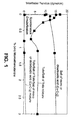
- Figure 1 shows interfacial tension as a function of concentration for a fatty acid (TOFA) and fatty acid salt (salt of TOFA) mixture, for the carboxylic acid salt alone, and for the combination which provides a surfactant package in accordance with the present invention.
- TOFA fatty acid
- Salt of TOFA salt of TOFA
- the carboxylic acid salt component has a relatively high interfacial tension for the entire range of concentrations evaluated.
- emulsions are prepared including in the surfactant package and/or emulsion a water soluble and/or partially water soluble alcohol, specific preferred examples of which include C 4 -C 8 alcohols such as n-butanol, iso-butanol, ter-butanol, n-pentanol, n-hexanol, 2-ethyl hexanol and combinations thereof.
- the alcohol component serves to improve qualities of the microemulsion as desired.
- the additional components identified above can act as cosolvents which can allow for preparation of a more stable microemulsion.
- Suitable fatty acids for use as the fatty acid component of the present surfactant package include neat oleic acid, neat linoleic acid and mixtures thereof.
- the fatty acid salt component can advantageously be a salt formed from such fatty acids, preferably using a water soluble amine such as those identified above. These water soluble amines can be used to partially neutralize the fatty acid component so as to provide both the fatty acid component and fatty acid salt component as desired.
- this combination of surfactant components can provide for a stable microemulsion through provision of surfactant package components having different HLB values.
- the emulsion and surfactant package for use in forming same can advantageously be used to provide an alternative fuel which is advantageously thermodynamically stable over a wide range of storage and handling conditions, and which is visually transparent.
- This emulsion as a fuel also shows great potential for reducing undesirable exhaust emissions.
- microemulsion of the present invention can be prepared using the process as described in co-pending U.S. Patent Application 09/565,556, and/or as described below.
- the process can be started with the formation of a coarse dispersion of the water and hydrocarbon phases, which is refined and homogenized by turbulence-length scales of decreasing size (through mixing mechanisms associated with turbulent diffusion).
- the final stage of mixing involves microscale engulfment and stretching where the ultra low surface tension results in the formation of a microemulsion. Where no ultra-low interfacial tension is achieved, the fineness of the dispersion, for a given surfactant package, depends upon the intensity of the turbulence.
- the water phase, hydrocarbon phase and surfactant package are preferably combined in the desired volumes and subjected to a mixing intensity (W/kg) which can be selected to provide the desired type of emulsion.
- W/kg a mixing intensity
- the mixing intensity is more preferably between about 100 and about 1000 W/kg. If production rates are not critical, average mixing intensities between about 1 W/kg and about 100 W/kg also provide a stable microemulsion.
- Emulsions formed according to the invention are advantageously stable in that the emulsion will retain an average droplet diameter, when stored under normal ambient conditions, for at least about 1 year and typically for an indefinite period of time.
- the mixing intensity referred to herein is presented as average mixing intensity, averaged over the mixing profile of a vessel.
- different orders of mixing intensity can be encountered within the mixing vessel.
- mixing can be accomplished in accordance with the present invention utilizing a Rushton impulsor coupled to a Heidolph motor for providing the desired mechanical energy dissipation rate or mixing intensity.
- the mixing intensity in close proximity to the mixing apparatus can in actuality be closer to the order of 100 W/kg.
- Mixing under such conditions will be referred to herein as mixing at an average mixing intensity of about 1 W/kg, or in the alternative, as 1-100 W/kg.
- the mixing intensity can be made nearly uniform.
- the mixing intensity as referred to herein relates to the energy dissipation rate as measured in power dissipated per unit mass of liquid in the mixer.
- the flow is assumed to be turbulent.
- Suitable mixing equipment is readily available to the person of ordinary skill in the art. Examples of suitable mixing equipment are set forth above and in the examples to follow.
- Sample No. 1 was prepared using only the tallow fatty acid/amine salt of tallow fatty acid mixtures, and 11% surfactant was required in order to form a stable microemulsion.
- Sample 2 was prepared using only 5% of the same surfactant package as used for Sample No. 1, and an unstable macroemulsion resulted.
- Sample No. 3 was prepared using 1.2% of amine salt of dodecanodioic acid, and no emulsion at all was formed.
- Sample No. 4 was prepared using the 5% of tallow fatty acid/salt of tallow fatty acid mixture along with 1.2% of amine salt of dodecanodioic acid. As noted, a stable microemulsion of water in oil was provided. It should be noted that this in connection with an emulsion having 15% vol of water. Thus, the emulsion prepared using Sample No. 4 advantageously has a ratio of water to tallow fatty acid/amine salt of tallow fatty acid of 3.
- Example 4 shows that the microemulsion from Example 4 (sample 1) can be formed using 2 ethyl-hexanol instead of hexanol. Results are shown in Table 6 below. Sample No. Vol% Diesel Vol% Surfactant tallow fatty acid (TOFA) Vol% amine salt of dodecanodioic acid Vol% Monoethanol amine Vol% 2-ethyl-hexanol Observation 1 (78.5-76.7) 4 0.4 (0.60-0.90) 1.5-3.0 Microemulsion water in oil
- Example 5 shows that the microemulsion from Example 5 (Sample 1) can be formed using 0.4% (v/v) of amine salts of different carboxylic acids.
- Table 7 shows the results obtained.
- Microemulsion 2 (78.5-76.8) TOFA/amine salt of hexanoic acid 4.5/0.4 (0.6-0.75) 3 (78.5-76.7) TOFA/amine salt pentanoic acid 4.5/0.4 (0.6-0.9) 4 (78.5-76.6) TOFA/amine salt of isobutiric acid 5/0.4 (0.6-1.0) 5 (78.5-76.4) TOFA/amine salt of octanodioic acid 4/0.4 (0.6-1.2) 6 (75.7-75.4) TOFA/amine salt of non
Landscapes
- Chemical & Material Sciences (AREA)
- Oil, Petroleum & Natural Gas (AREA)
- Organic Chemistry (AREA)
- Engineering & Computer Science (AREA)
- Materials Engineering (AREA)
- Chemical Kinetics & Catalysis (AREA)
- General Chemical & Material Sciences (AREA)
- Health & Medical Sciences (AREA)
- Emergency Medicine (AREA)
- Colloid Chemistry (AREA)
- Liquid Carbonaceous Fuels (AREA)
- Cosmetics (AREA)
- Emulsifying, Dispersing, Foam-Producing Or Wetting Agents (AREA)
- Solid Fuels And Fuel-Associated Substances (AREA)
Abstract
Description
- The invention relates to a surfactant package and a water-in-hydrocarbon emulsion using same.
- The incorporation of water into hydrocarbons is useful for various purposes including the provision of fuels having desirable properties.
- Attempts to provide water-in-hydrocarbon emulsions have met with very serious technical and economic problems due to shortterm stability of emulsions formed having droplet sizes in the macroemulsion range, and further due to the large quantities of surfactants and cosolvents required to form emulsions having droplet sizes in the microemulsion range.
- For example, U.S. Patent Nos. 4,568,354 and 4,568,355 to Davis et al. are drawn to processes for converting a hazy or potentially hazy water saturated alcohol-gasoline mixture into a clear stable gasoline composition having an improved octane rating. The system so produced has a water content of no more than 1% by volume, and relatively large volumes of non-ionic surfactant are used to produce this system.
- Similarly, U.S. Patent Nos. 4,770,670 and 4,744,796 to Hazbun et al. also disclose the formation of stable microemulsions which contain large amounts of surfactant as compared to the water content.
- Other efforts in this area include U.S. Patent No. 5,104,418, WO 99/35215, U.S. Patent No. Re.35,237, U.S. Patent No. 5,743,922, WO 97/34969, U.S. Patent No. 5,873,916 and WO 99/13031.
- In spite of the disclosures in the a foregoing patents, the need remains for a water-in-hydrocarbon emulsion which is stable and which contains a desirable amount of water without the need for relatively large amounts of surfactant and/or other stabilizing agents.
- It is therefore the primary object of the present invention to provide water-in-hydrocarbon emulsions which are both stable and formed using relatively small amounts of surfactant.
- It is a further object of the present invention to provide a surfactant package which is useful for providing such water-in-hydrocarbon emulsions.
- Other objects and advantages of the present invention will be readily apparent from a consideration of the following.
- The problems are solved by the teaching according to the independent claims. Particular developments are given in the dependent claims. Within the frame of the invention are all combinations of at least two of the descriptive elements and technical features disclosed in the claims and/or in the description.
- In accordance with the present invention, the foregoing objects and advantages have been readily attained.
- In accordance with the invention, a surfactant package for a water-in-hydrocarbon emulsion is provided which comprises a fatty acid component; a fatty acid salt component; an alcohol component and a salt of carboxylic acid.
- In further accordance with the invention, a water-in-hydrocarbon emulsion is provided, which comprises a water phase; a hydrocarbon phase; and a surfactant package, wherein said surfactant package comprises a fatty acid component; a fatty acid salt component; an alcohol component and a salt of carboxylic acid.
- In accordance with the present invention, it is found that the carboxylic acid salt component added to the surfactant package allows drastic reduction in the amount of surfactant needed to form a stable microemulsion as compared to the amount of surfactant needed without the carboxylic acid salt component.
- The alcohol component is advantageously a C4-C8 alcohol.
- A detailed description of preferred embodiments of the present invention follows, with reference to the attached drawings, wherein:
- Figure 1 schematically illustrates interfacial tension versus concentration of individual components of the surfactant package as well as the combined surfactant package in accordance with the present invention.
-
- The invention relates to a surfactant package and a water-in-hydrocarbon emulsion using same. The emulsion is stable and can advantageously be formed using very small amounts of surfactant. Such an emulsion is useful, for example, as a combustible fuel, for example for compression ignition engines and the like. The emulsion has beneficial characteristics as a fuel including reduced emissions. Emulsions in accordance with the present invention include stable microemulsions which include a dispersed water phase and a continuous hydrocarbon phase as well as an advantageous surfactant package which, as will be discussed below, includes a combination of components which advantageously reduce the amount of surfactant needed to form the stable emulsion.
- Suitable hydrocarbons for use in making emulsions of the present invention include petroleum hydrocarbons and natural gas derived products, examples of which include Diesel fuel and other low gravity hydrocarbons such as Fischer-Tropsch synthetic Diesel and paraffins C10 to C20.
- Emulsions including this hydrocarbon in accordance with the present invention have reduced NOx emissions and C emissions, and improved opacity as compared to the hydrocarbon alone. One example of a suitable hydrocarbon is a Diesel fuel characterized as follows:
Sulfur content (% wt/wt) <0.5 Density @ 15°C (kg/m3) <860 Viscosity @ 40°C (mm2/s) <4.5 T95 (°C) <370 Flash point (°C) >52 - The water phase for use in forming emulsions in accordance with the present invention can suitably be from any acceptable water source, and is preferably a water which is available in sufficient quantities, preferably in close proximity to the location where emulsions are to be formed, and preferably at an inexpensive cost. For example, a suitable water phase could be water such as 310 ppm brine. Of course, any other water from a suitable source and having various acceptable characteristics for the end emulsion, such as use as a component of a combustible fuel, would be acceptable.
- In accordance with the invention, a surfactant package is provided which advantageously allows for formation of a stable microemulsion of water-in-hydrocarbon, with surprisingly small amounts of surfactant.
- According to the invention, the surfactant package preferably includes a fatty acid component and a fatty acid salt component, as well as an alcohol component and a salt of a carboxylic acid.
- The fatty acid and fatty acid salt components may advantageously be provided as a tallow fatty acid which is partially neutralized with alkaline compounds such as water soluble amines. The partial neutralization using water soluble amines leaves a portion of the initial fatty acid component and the neutralized component which forms the fatty acid salt component as desired.
- Suitable tallow fatty acids include blends of C16-C22 molecules, and suitable water soluble amines for use in partial neutralization of the tallow fatty acids include monoethanolamine, ethylamine, diethylamine, triethylamine, n-propylamine, iso-propylamine, diethanolamine, triethanolamine, ethylenediamine, isopropanolamine, 2-amino-2-methyl 1-propanol and mixtures thereof.
- Examples of particularly suitable fatty acids from which components of the surfactant package can be prepared or obtained include those selected from the group consisting of neat oleic acid, neat linoleic acid and mixtures thereof.
- While the fatty acid and fatty acid salt components identified above can be used to obtain a stable microemulsion, it has advantageously been found in accordance with the present invention that the amount of surfactant needed can be substantially reduced through utilization of an additional component, which is the salt of carboxylic acid as identified above.
- This organic salt can advantageously be formed from monocarboxylic or dicarboxylic acids preferably having between four and twelve carbon atoms in the carbon chain (C4-C12), for example those having C4-C8 and C4-C12 molecules, respectively. This acid is neutralized using water soluble amine so as to provide the desired carboxylic acid salt for the surfactant package in accordance with the present invention, and suitable water soluble amine for use in neutralizing the mono and dicarboxylic acid includes monoethanolamine, ethylamine, dithylamine, triethylamine, n-propylamine, iso-propylamine, diethanolamine, triethanolamine, ethylenediamine, isopropanolamine, 2-amino-2-methyl 1-propanol and mixtures thereof.
- Examples of particularly suitable carboxylic acids include those selected from the group consisting of dodecanodioic acid, dodecanoic acid, hexanodioic acid, hexanoic acid, pentanoic acid, pentanodioic acid, isobutiric acid, isobutanodioic acid, octanodioic acid, octanoic acid, nonadioic acid, nonaioic acid heptanodioic acid, heptanoic acid, decanodioic acid, decanoic acid and combinations thereof.
- This component can be prepared by dissolving the carboxylic acid into water along with the selected water soluble amine so as to neutralize the acid and provide the desired carboxylic acid salt. This water can be the water phase of the emulsion, or a portion thereof.
- The surfactant package of the present invention is preferably provided including fatty acid component and fatty acid salt component combined in an amount between about 3.0 and about 5.5% vol based upon volume of the final emulsion. The water soluble amine is preferably between about 0.4 and about 1.2% vol based upon the emulsion.
- The surfactant package in accordance with the present invention further preferably includes the carboxylic acid salt in an amount between about 0.1 and about 1.2% vol based upon the final emulsion.
- In accordance with the present invention, the surfactant package has been found, advantageously, to allow for water-in-hydrocarbon emulsions wherein the ratio, by volume, of water to surfactant package is at least about 3 and, advantageously, between about 3 and about 4.3.
- This type of surfactant package can advantageously be utilized to stabilize a microemulsion of water-in-hydrocarbon wherein the water phase is present in an amount between about 5 and about 20% vol based upon the final emulsion. It should readily be appreciated that for a microemulsion containing 20% vol water this results in a ratio of water to surfactant package which is greater than about 3, and which is desirable in light of reduction in cost of surfactant package and reduction in impact of surfactant component materials upon the final characteristics of the emulsion.
- Within the surfactant package itself, the fatty acid and fatty acid salt components are preferably present in a ratio by vol to the salt of carboxylic acid component of between about 3.33 and about 20.
- As will be demonstrated in the examples to follow, the surfactant package in accordance with the present invention provides substantially improved results as compared to a surfactant package including only the fatty acid and fatty salt components. Under these circumstances, the present invention allows for a reduction in fatty acid required for formation of the microemulsion by about 55%.
- It is believed that the surfactant package in accordance of the present invention allows for such a substantial reduction in acid needed through a synergistic effect between the partially neutralized fatty acid and the carboxylate ions of the salt of carboxylic acid.
- Figure 1 shows interfacial tension as a function of concentration for a fatty acid (TOFA) and fatty acid salt (salt of TOFA) mixture, for the carboxylic acid salt alone, and for the combination which provides a surfactant package in accordance with the present invention.
- As shown, the carboxylic acid salt component has a relatively high interfacial tension for the entire range of concentrations evaluated.
- Also as shown, there is a range of concentration of the TOFA/salt of TOFA mixture which provides a desirably reduced interfacial tension.
- It is clear, however, that the combination of these components provides substantially improved interfacial tension characteristics, including spontaneous emulsification at very low concentrations. This is desirable from the standpoint of reduced cost for surfactant as well as reduced quantities of surfactant which can affect qualities of the final emulsion product.
- In further accordance with the invention, and as set forth above, emulsions are prepared including in the surfactant package and/or emulsion a water soluble and/or partially water soluble alcohol, specific preferred examples of which include C4-C8 alcohols such as n-butanol, iso-butanol, ter-butanol, n-pentanol, n-hexanol, 2-ethyl hexanol and combinations thereof. The alcohol component serves to improve qualities of the microemulsion as desired. For example, the additional components identified above can act as cosolvents which can allow for preparation of a more stable microemulsion.
- In further accordance with the invention, examples of suitable fatty acids for use as the fatty acid component of the present surfactant package include neat oleic acid, neat linoleic acid and mixtures thereof.
- The fatty acid salt component can advantageously be a salt formed from such fatty acids, preferably using a water soluble amine such as those identified above. These water soluble amines can be used to partially neutralize the fatty acid component so as to provide both the fatty acid component and fatty acid salt component as desired.
- As set forth in co-pending U.S. Patent Application Serial No. 09/565,556, this combination of surfactant components can provide for a stable microemulsion through provision of surfactant package components having different HLB values.
- The emulsion and surfactant package for use in forming same can advantageously be used to provide an alternative fuel which is advantageously thermodynamically stable over a wide range of storage and handling conditions, and which is visually transparent. This emulsion as a fuel also shows great potential for reducing undesirable exhaust emissions.
- The microemulsion of the present invention can be prepared using the process as described in co-pending U.S. Patent Application 09/565,556, and/or as described below.
- Suitable supplies of both water phase and hydrocarbon phase are obtained.
- The process can be started with the formation of a coarse dispersion of the water and hydrocarbon phases, which is refined and homogenized by turbulence-length scales of decreasing size (through mixing mechanisms associated with turbulent diffusion). The final stage of mixing involves microscale engulfment and stretching where the ultra low surface tension results in the formation of a microemulsion. Where no ultra-low interfacial tension is achieved, the fineness of the dispersion, for a given surfactant package, depends upon the intensity of the turbulence.
- In order to form a suitable microemulsion, the water phase, hydrocarbon phase and surfactant package are preferably combined in the desired volumes and subjected to a mixing intensity (W/kg) which can be selected to provide the desired type of emulsion. In accordance with the invention, to form a microemulsion, it may be desirable to utilize a mixing intensity of between about 1 W/kg and about 10,000 W/kg. On an in-line production scale, the mixing intensity is more preferably between about 100 and about 1000 W/kg. If production rates are not critical, average mixing intensities between about 1 W/kg and about 100 W/kg also provide a stable microemulsion. Mixing according to the invention advantageously results in a desirable stable microemulsion having an average droplet size of between about 100Å and about 700Å. Emulsions formed according to the invention are advantageously stable in that the emulsion will retain an average droplet diameter, when stored under normal ambient conditions, for at least about 1 year and typically for an indefinite period of time.
- The mixing intensity referred to herein is presented as average mixing intensity, averaged over the mixing profile of a vessel. Depending upon the mixing intensity and mixing time used, different orders of mixing intensity can be encountered within the mixing vessel. For example, mixing can be accomplished in accordance with the present invention utilizing a Rushton impulsor coupled to a Heidolph motor for providing the desired mechanical energy dissipation rate or mixing intensity. In a typical vessel mixed with this equipment, while the vessel may be mixed having an average energy dissipation rate of about 1 W/kg, the mixing intensity in close proximity to the mixing apparatus can in actuality be closer to the order of 100 W/kg. Mixing under such conditions will be referred to herein as mixing at an average mixing intensity of about 1 W/kg, or in the alternative, as 1-100 W/kg.
- With other equipment, such as a rotor-stator mixer, the mixing intensity can be made nearly uniform.
- It should also be noted that the mixing intensity as referred to herein relates to the energy dissipation rate as measured in power dissipated per unit mass of liquid in the mixer. The flow is assumed to be turbulent.
- Suitable mixing equipment is readily available to the person of ordinary skill in the art. Examples of suitable mixing equipment are set forth above and in the examples to follow.
- It should also be noted that various additional additives can be incorporated into the emulsion depending upon desired characteristics and intended use of the final emulsion product.
- The following examples demonstrate the advantageous formation of stable microemulsions using surfactant packages in accordance with the present invention, with substantially reduced amounts of surfactants.
- The effect of the concentration of tallow fatty acid (TOFA) on the formation of a water in Diesel microemulsion containing 15% v/v water is shown in this example. Different surfactant components and combinations were used to form emulsions, and Table 2 below sets forth results obtained using various different surfactant components and packages.
Sample No. Vol% Diesel Surfactant Vol% Surfactant Vol% Monoethanol amine (MEA) Vol % Hexanol Observation 1 69.8 Tallow fatty acid (TOFA) salt of TOFA 11.0 1.2 2 Base microemulsion 2 (76.5-75.8) Tallow fatty acid (TOFA)/amine salt of TOFA 5.0 (0.5-1.2) 2 Macroemulsion water in oil unstable 3 (79.6-72) Amine salt of dodecanodioic acid 1.2 (0.5-1.2) 2 Water with oil are not blend 4 (75.3-74.6) Tallow fatty acid (TOFA)/amine salt of TOFA/amine salt of dodecanodioic acid 5/1.2 (0.65-0.75) 2 Microemulsion water in oil - As shown, at least 11% v/v of TOFA alone is required for obtaining a transparent microemulsion. This example further shows that the presence of an amine salt of dodecanodioic acid reduced the concentration of the tallow fatty acid required to produce the microemulsion to 5% v/v. The amine salt of dodecanodioic acid by itself was not able to produce the microemulsion.
- Sample No. 1 was prepared using only the tallow fatty acid/amine salt of tallow fatty acid mixtures, and 11% surfactant was required in order to form a stable microemulsion.
-
Sample 2 was prepared using only 5% of the same surfactant package as used for Sample No. 1, and an unstable macroemulsion resulted. - Sample No. 3 was prepared using 1.2% of amine salt of dodecanodioic acid, and no emulsion at all was formed.
- Finally, Sample No. 4 was prepared using the 5% of tallow fatty acid/salt of tallow fatty acid mixture along with 1.2% of amine salt of dodecanodioic acid. As noted, a stable microemulsion of water in oil was provided. It should be noted that this in connection with an emulsion having 15% vol of water. Thus, the emulsion prepared using Sample No. 4 advantageously has a ratio of water to tallow fatty acid/amine salt of tallow fatty acid of 3.
- It should also be noted that the results demonstrated above were obtained including hexanol in an amount of 2% vol as a cosolvent.
- In this example the amine dodecanodioic salt was used at different concentrations in the formation of microemulsions containing 15% v/v of water and 5% v/v of TOFA. Results are shown in Table 3 below.
Sample No. Vol% Diesel Vol% Surfactant Tallow fatty acid (TOFA) Vol% Amine salt of dodecanodioic acid Vol% Monoethanol amine (MEA) Vol% n-hexanol Observation 1 (75.3-75.2) 5 1 (0.70-0.80) 2 Microemulsion water in oil 2 (75.5-75.4) 0.8 (0.70-0.80) Microemulsion water in oil 3 (75.65-75.60) 0.6 (0.8-0.9) Microemulsion water in oil stable 4 (75.7-75.6) 0.5 (0.8-0.9) Microemulsion water in oil Stable 5 (75.4-75.2) 0.4 (0.7-0.9) 2.5 Microemulsion water in oil stable - As shown, even at values of 0.4% v/v of the amine dodecanodioic salt, microemulsion formation is obtained.
- This example shows that by keeping the amine dodecanodioic salt concentration at 0.4% (v/v), a microemulsion containing 15% (v/v) water can be formed with a TOFA concentration as low as 3.0% (v/v). Results are shown in Table 4 below.
Sample No. Vol% Diesel Vol% Surfactant TOFA Vol% amine salt of dodecanodioic acid Vol% Monoethanol amine (MEA) Vol % hexanol Observation 1 76.3 4.0 0.4 0.80-0.90 2.5 Microemulsion water in oil 2 76.8 3.5 3 77.3 3.0 - This example shows combination of appropriate concentrations of TOFA and amine dodecanodioic acid salt to prepare microemulsions with water concentrations ranging between 5 and 20% (v/v). Results are shown in Table 5 below.
Sample No. Vol% Diesel Vol% Surfactant TOFA/amine salt of hexanodioic acid Vol% Monoethanolamine (MEA) Vol% 2-ethyl-hexanol Vol% water Observation 1 (91.5-91.4) 1.5/0.1 0.40-0.50 1.5 5 Microemulsion water in oil 2 (83.1-81.9) 3.0/0.2 0.70-0.90 3 10 Microemulsion water in oil 3 (70.8-70.5) 5/0.3 0.9-1.20 3 20 Microemulsion water in oil - This Example shows that the microemulsion from Example 4 (sample 1) can be formed using 2 ethyl-hexanol instead of hexanol. Results are shown in Table 6 below.
Sample No. Vol% Diesel Vol% Surfactant tallow fatty acid (TOFA) Vol% amine salt of dodecanodioic acid Vol% Monoethanol amine Vol% 2-ethyl-hexanol Observation 1 (78.5-76.7) 4 0.4 (0.60-0.90) 1.5-3.0 Microemulsion water in oil - This example shows that the microemulsion from Example 5 (Sample 1) can be formed using 0.4% (v/v) of amine salts of different carboxylic acids. Table 7 shows the results obtained.
Sample No. Vol% Diesel Surfactant Vol% Surfactant Vol% MEA Vol% 2-ethyl-hexanol Observation 1 (78.5-76.4) TOFA/amine salt of hexanodioic Acid 4/0.4 (0.6-1.2) 1.5-3.0 Microemulsion 2 (78.5-76.8) TOFA/amine salt of hexanoic acid 4.5/0.4 (0.6-0.75) 3 (78.5-76.7) TOFA/amine salt pentanoic acid 4.5/0.4 (0.6-0.9) 4 (78.5-76.6) TOFA/amine salt of isobutiric acid 5/0.4 (0.6-1.0) 5 (78.5-76.4) TOFA/amine salt of octanodioic acid 4/0.4 (0.6-1.2) 6 (75.7-75.4) TOFA/amine salt of nonadioic acid 4/0.4 (0.9-1.2) - It should be appreciated that a surfactant package and water-in-hydrocarbon emulsion including same have been provided which exhibit advantageous characteristics in terms of stability, reduced surfactant quantities, and desirable characteristics of the final product.
- This invention may be embodied in other forms or carried out in other ways without departing from the spirit or essential characteristics thereof. The present embodiment is therefore to be considered as in all respects illustrative and not restrictive, the scope of the invention being indicated by the appended claims, and all changes which come within the meaning and range of equivalency are intended to be embraced therein.
Claims (25)
- A surfactant package for a water-in-hydrocarbon emulsion, comprising:a fatty acid component;a fatty acid and salt component;an alcohol component; anda salt of carboxylic acid.
- The surfactant package of claim 1, wherein said fatty acid component is selected from the group consisting of neat oleic acid, neat linoleic acid and mixtures thereof.
- The surfactant package of claim 1, wherein said fatty acid salt component comprises a salt of a fatty acid and a water soluble amine.
- The surfactant package of claim 3, wherein said water soluble amine is selected from the group consisting of monoethanolamine, ethylamine, diethylamine, triethylamine, n-propylamine, iso-propyl amine, diethanolamine, triethanolamine, ethylenediamine, isopropanolamine, 2-amino-2-methyl 1-propanol and mixtures thereof.
- The surfactant package of claim 1, wherein said carboxylic acid is selected from the group consisting of mono-carboxylic acid, dicarboxylic acid and combinations thereof.
- The surfactant package of claim 1 or 5, wherein said carboxylic acid comprises C4-C12 molecules.
- The surfactant package of one of the claims 1 to 6, wherein said salt of said carboxylic acid is a salt of an acid selected from the group consisting of dodecanodioic acid, dodecanoic acid, hexanodioic acid, hexanoic acid, pentanoic acid, pentanodioic acid, isobutiric acid, isobutanodioic acid, octanodioic acid, octanoic acid, nonadioic acid, nonanoioic acid, heptanodioic acid, heptanoic acid, decanodioic acid, decanoic acid and combinations thereof.
- The surfactant package of one of the claims 1 to 7, wherein said salt of said carboxylic acid is a salt of water soluble amine and said carboxylic acid, wherein said water soluble amine is preferably selected from the group consisting of monoethanolamine, ethylamine, diethylamine, triethylamine, n-propylamine, iso-propyl amine, diethanolamine, triethanolamine, ethylenediamine, isopropanolamine, 2-amino-2-methyl 1-propanol and mixtures thereof.
- The surfactant package of one of the claims 1 to 8, wherein said salt of carboxylic acid comprises carboxylate ions.
- The surfactant package of one of the claims 1 to 9, wherein said fatty acid component and said fatty acid salt component are present in a ratio by volume to said salt of carboxylic acid of between about 3.33 and about 20.
- The surfactant package of one of the claims 1 to 10, wherein said alcohol component comprises C4-C8 alcohols.
- A water-in-hydrocarbon emulsion, comprising a water phase; a hydrocarbon phase; and a surfactant package, wherein said surfactant package comprises :a fatty acid component;a fatty acid salt component;an alcohol component; anda salt of carboxylic acid.
- The emulsion of claim 12, wherein said fatty acid component is selected from the group consisting of neat oleic acid, neat linoleic acid and mixtures thereof.
- The emulsion of claim 12, wherein said fatty acid salt component comprises a salt of a fatty acid and a water soluble amine.
- The emulsion of claim 14, wherein said water soluble amine is selected from the group consisting of monoethanolamine, ethylamine, diethylamine, triethylamine, n-propylamine, iso-propyl amine, diethanolamine, triethanolamine, ethylenediamine, isopropanolamine, 2-amino-2-methyl 1-propanol and mixtures thereof.
- The emulsion of claim 12, wherein said carboxylic acid is selected from the group consisting of mono-carboxylic acid, dicarboxylic acid and combinations thereof.
- The emulsion of claim 12 or 16, wherein said carboxylic acid comprises C4-C12 molecules.
- The emulsion of one of the claims 12 to 17, wherein said salt of said carboxylic acid is a salt of water soluble amine and said carboxylic acid, wherein said water soluble amine is preferably selected from the group consisting of monoethanolamine, ethylamine, diethylamine, triethylamine, n-propylamine, iso-propyl amine, diethanolamine, triethanolamine, ethylenediamine, isopropanolamine, 2-amino-2-methyl 1-propanol and mixtures thereof.
- The emulsion of one of the claims 12 to 18, wherein said salt of carboxylic acid comprises carboxylate ions.
- The emulsion of claim 12, wherein said salt of said carboxylic acid is a salt of an acid selected from the group consisting of dodecanodioic acid, dodecanoic acid, hexanodioic acid, hexanoic acid, pentanoic acid, pentanodioic acid, isobutiric acid, isobutanodioic acid, octanodioic acid, octanoic acid, nonadioic acid, nonanoioic acid, heptanodioic acid, heptanoic acid, decanodioic acid, decanoic acid and combinations thereof.
- The emulsion of claim 12, wherein said fatty acid component and said fatty acid salt component are present in a ratio by volume to said salt of carboxylic acid of between about 3.33 and about 20 and/or wherein said emulsion contains said water phase in an amount between about 5 % vol and about 20 % vol based upon volume of said emulsion.
- The emulsion of claim 12, wherein said fatty acid component and said fatty acid salt component are present in an amount between about 3.0 % vol and about 5.5 % vol based upon volume of said emulsion, wherein said salt of said carboxylic acid is preferably present in an amount between about 0.1 % vol and about 1.2 % vol based upon volume of said emulsion.
- The emulsion of one of the claims 12 to 22, wherein said emulsion has a ratio by volume of said water phase to said surfactant package of at least about 3.0.
- The emulsion of claim 12, wherein said alcohol component comprises C4-C8 alcohol and/or wherein said hydrocarbon phase is Diesel fuel.
- The emulsion of claim 12, wherein said emulsion is a stable microemulsion.
Applications Claiming Priority (2)
| Application Number | Priority Date | Filing Date | Title |
|---|---|---|---|
| US439486 | 2003-05-16 | ||
| US10/439,486 US20040229765A1 (en) | 2003-05-16 | 2003-05-16 | Surfactant package and water in hydrocarbon emulsion using same |
Publications (2)
| Publication Number | Publication Date |
|---|---|
| EP1477550A1 true EP1477550A1 (en) | 2004-11-17 |
| EP1477550B1 EP1477550B1 (en) | 2011-07-06 |
Family
ID=33029814
Family Applications (1)
| Application Number | Title | Priority Date | Filing Date |
|---|---|---|---|
| EP04011021A Expired - Lifetime EP1477550B1 (en) | 2003-05-16 | 2004-05-10 | Surfactant package and water in hydrocarbon emulsion using same |
Country Status (12)
| Country | Link |
|---|---|
| US (2) | US20040229765A1 (en) |
| EP (1) | EP1477550B1 (en) |
| JP (1) | JP3819008B2 (en) |
| CN (1) | CN1550257B (en) |
| AR (1) | AR044253A1 (en) |
| BR (1) | BRPI0401751B1 (en) |
| CL (1) | CL2004001051A1 (en) |
| CO (1) | CO5580164A1 (en) |
| EC (1) | ECSP045066A (en) |
| ES (1) | ES2368911T3 (en) |
| MX (1) | MXPA04003683A (en) |
| PE (1) | PE20050399A1 (en) |
Cited By (3)
| Publication number | Priority date | Publication date | Assignee | Title |
|---|---|---|---|---|
| WO2010133627A3 (en) * | 2009-05-19 | 2011-03-17 | Universität Zu Köln | Biohydrofuel compositions |
| WO2011115501A1 (en) * | 2010-03-16 | 2011-09-22 | Eco Energy Holding As | Stabilized water-in-oil emulsions of light oils, and methods and apparatus/system for the productions of such stabilized emulsions. |
| EP2612898A4 (en) * | 2010-08-31 | 2014-06-25 | Univ Tokyo | WATER / OIL NANOEMULSION AND METHOD FOR PRODUCING THE SAME |
Families Citing this family (9)
| Publication number | Priority date | Publication date | Assignee | Title |
|---|---|---|---|---|
| US9109151B2 (en) * | 2008-07-25 | 2015-08-18 | Intevep, S.A. | Process for preparing thermally stable oil-in-water and water-in-oil emulsions |
| GB201001923D0 (en) * | 2010-02-05 | 2010-03-24 | Palox Offshore S A L | Protection of liquid fuels |
| JP5781745B2 (en) * | 2010-04-28 | 2015-09-24 | 田川 和男 | Oil / water solubilizer, method for producing the same, and mixed fuel |
| JP2013023686A (en) * | 2011-07-19 | 2013-02-04 | Hisao Taniguchi | Hydration additive for hydrocarbon fuel oil and biofuel, method for producing the same, and method for producing hydration fuel |
| WO2016074904A1 (en) * | 2014-11-10 | 2016-05-19 | Eme International Limited | Water in diesel oil fuel micro-emulsions. |
| EP3218093B1 (en) | 2014-11-10 | 2018-12-26 | EME Finance Ltd | Device for mixing water and diesel oil, apparatus and process for producing a water/diesel oil micro-emulsion. |
| IT201600132801A1 (en) | 2016-12-30 | 2018-06-30 | Eme International Ltd | Apparatus and process for producing liquid from biomass, biofuel and biomaterial |
| CN109985566B (en) * | 2017-12-29 | 2021-04-09 | 中国石油化工股份有限公司 | Mixed system containing fatty acid type surfactant and preparation method thereof |
| JP7076673B1 (en) | 2021-01-13 | 2022-05-30 | 一之 梅村 | Energy-saving amine-based additive synthesis method and additive fuel adjustment method |
Citations (15)
| Publication number | Priority date | Publication date | Assignee | Title |
|---|---|---|---|---|
| US4083698A (en) | 1975-06-30 | 1978-04-11 | Fuel Systems, Inc. | Clear and stable liquid fuel compositions for internal combustion engines |
| US4451265A (en) | 1981-04-21 | 1984-05-29 | The United States Of America As Represented By The Secretary Of Agriculture | Diesel fuel-aqueous alcohol microemulsions |
| US4568354A (en) | 1985-06-03 | 1986-02-04 | Texaco Inc. | Conversion of hazy gasoline to clear stable gasoline |
| US4568355A (en) | 1985-06-03 | 1986-02-04 | Texaco Inc. | Clear stable gasoline composition |
| US4744796A (en) | 1986-02-04 | 1988-05-17 | Arco Chemical Company | Microemulsion fuel system |
| US4770670A (en) | 1986-12-22 | 1988-09-13 | Arco Chemical Company | Fire resistant microemulsions containing phenyl alcohols as cosurfactants |
| US5004479A (en) | 1986-06-09 | 1991-04-02 | Arco Chemical Technology, Inc. | Methanol as cosurfactant for microemulsions |
| US5104418A (en) | 1989-05-26 | 1992-04-14 | Eniricerche S.P.A. | Hybrid diesel fuel composition |
| USRE35237E (en) | 1989-11-22 | 1996-05-14 | Gunnerman Rudolf W | Aqueous fuel for internal combustion engine and method of combustion |
| WO1997034969A1 (en) | 1996-03-15 | 1997-09-25 | Elf Antar France | Emulsified fuel and one method for preparing same |
| US5743922A (en) | 1992-07-22 | 1998-04-28 | Nalco Fuel Tech | Enhanced lubricity diesel fuel emulsions for reduction of nitrogen oxides |
| US5873916A (en) | 1998-02-17 | 1999-02-23 | Caterpillar Inc. | Fuel emulsion blending system |
| WO1999013031A1 (en) | 1997-09-12 | 1999-03-18 | Exxon Research And Engineering Company | Emulsion blends |
| WO1999035215A2 (en) | 1998-01-12 | 1999-07-15 | Deborah Wenzel | An additive composition also used as a fuel composition comprising water soluble alcohols |
| US6245723B1 (en) | 1997-01-29 | 2001-06-12 | Henkel Kommanditgesellschaft Auf Aktien (Henkel Kgaa) | Cooling lubricant emulsion |
Family Cites Families (4)
| Publication number | Priority date | Publication date | Assignee | Title |
|---|---|---|---|---|
| US3346494A (en) * | 1964-04-29 | 1967-10-10 | Exxon Research Engineering Co | Microemulsions in liquid hydrocarbons |
| US4451267A (en) * | 1982-09-29 | 1984-05-29 | The United States Of America As Represented By The Secretary Of Agriculture | Microemulsions from vegetable oil and aqueous alcohol with trialkylamine surfactant as alternative fuel for diesel engines |
| US6017368A (en) * | 1998-06-22 | 2000-01-25 | Steinmann; Henry W | Microemulsion fuel compositions for the internal combustion engine and for oil furnaces |
| US6648929B1 (en) * | 1998-09-14 | 2003-11-18 | The Lubrizol Corporation | Emulsified water-blended fuel compositions |
-
2003
- 2003-05-16 US US10/439,486 patent/US20040229765A1/en not_active Abandoned
-
2004
- 2004-04-16 EC EC2004005066A patent/ECSP045066A/en unknown
- 2004-04-19 MX MXPA04003683A patent/MXPA04003683A/en active IP Right Grant
- 2004-05-06 AR ARP040101545A patent/AR044253A1/en active IP Right Grant
- 2004-05-10 ES ES04011021T patent/ES2368911T3/en not_active Expired - Lifetime
- 2004-05-10 EP EP04011021A patent/EP1477550B1/en not_active Expired - Lifetime
- 2004-05-11 CO CO04043416A patent/CO5580164A1/en not_active Application Discontinuation
- 2004-05-12 PE PE2004000488A patent/PE20050399A1/en not_active Application Discontinuation
- 2004-05-13 BR BRPI0401751-0B1A patent/BRPI0401751B1/en not_active IP Right Cessation
- 2004-05-14 CL CL200401051A patent/CL2004001051A1/en unknown
- 2004-05-17 CN CN2004100435512A patent/CN1550257B/en not_active Expired - Fee Related
- 2004-05-17 JP JP2004146848A patent/JP3819008B2/en not_active Expired - Fee Related
-
2010
- 2010-08-27 US US12/870,503 patent/US8647395B2/en not_active Expired - Fee Related
Patent Citations (15)
| Publication number | Priority date | Publication date | Assignee | Title |
|---|---|---|---|---|
| US4083698A (en) | 1975-06-30 | 1978-04-11 | Fuel Systems, Inc. | Clear and stable liquid fuel compositions for internal combustion engines |
| US4451265A (en) | 1981-04-21 | 1984-05-29 | The United States Of America As Represented By The Secretary Of Agriculture | Diesel fuel-aqueous alcohol microemulsions |
| US4568354A (en) | 1985-06-03 | 1986-02-04 | Texaco Inc. | Conversion of hazy gasoline to clear stable gasoline |
| US4568355A (en) | 1985-06-03 | 1986-02-04 | Texaco Inc. | Clear stable gasoline composition |
| US4744796A (en) | 1986-02-04 | 1988-05-17 | Arco Chemical Company | Microemulsion fuel system |
| US5004479A (en) | 1986-06-09 | 1991-04-02 | Arco Chemical Technology, Inc. | Methanol as cosurfactant for microemulsions |
| US4770670A (en) | 1986-12-22 | 1988-09-13 | Arco Chemical Company | Fire resistant microemulsions containing phenyl alcohols as cosurfactants |
| US5104418A (en) | 1989-05-26 | 1992-04-14 | Eniricerche S.P.A. | Hybrid diesel fuel composition |
| USRE35237E (en) | 1989-11-22 | 1996-05-14 | Gunnerman Rudolf W | Aqueous fuel for internal combustion engine and method of combustion |
| US5743922A (en) | 1992-07-22 | 1998-04-28 | Nalco Fuel Tech | Enhanced lubricity diesel fuel emulsions for reduction of nitrogen oxides |
| WO1997034969A1 (en) | 1996-03-15 | 1997-09-25 | Elf Antar France | Emulsified fuel and one method for preparing same |
| US6245723B1 (en) | 1997-01-29 | 2001-06-12 | Henkel Kommanditgesellschaft Auf Aktien (Henkel Kgaa) | Cooling lubricant emulsion |
| WO1999013031A1 (en) | 1997-09-12 | 1999-03-18 | Exxon Research And Engineering Company | Emulsion blends |
| WO1999035215A2 (en) | 1998-01-12 | 1999-07-15 | Deborah Wenzel | An additive composition also used as a fuel composition comprising water soluble alcohols |
| US5873916A (en) | 1998-02-17 | 1999-02-23 | Caterpillar Inc. | Fuel emulsion blending system |
Cited By (3)
| Publication number | Priority date | Publication date | Assignee | Title |
|---|---|---|---|---|
| WO2010133627A3 (en) * | 2009-05-19 | 2011-03-17 | Universität Zu Köln | Biohydrofuel compositions |
| WO2011115501A1 (en) * | 2010-03-16 | 2011-09-22 | Eco Energy Holding As | Stabilized water-in-oil emulsions of light oils, and methods and apparatus/system for the productions of such stabilized emulsions. |
| EP2612898A4 (en) * | 2010-08-31 | 2014-06-25 | Univ Tokyo | WATER / OIL NANOEMULSION AND METHOD FOR PRODUCING THE SAME |
Also Published As
| Publication number | Publication date |
|---|---|
| BRPI0401751A (en) | 2005-06-07 |
| PE20050399A1 (en) | 2005-06-13 |
| ES2368911T3 (en) | 2011-11-23 |
| JP3819008B2 (en) | 2006-09-06 |
| US20040229765A1 (en) | 2004-11-18 |
| CO5580164A1 (en) | 2005-11-30 |
| US8647395B2 (en) | 2014-02-11 |
| CN1550257B (en) | 2011-05-25 |
| BRPI0401751B1 (en) | 2013-12-10 |
| US20110209385A1 (en) | 2011-09-01 |
| CN1550257A (en) | 2004-12-01 |
| JP2004339519A (en) | 2004-12-02 |
| CL2004001051A1 (en) | 2005-05-06 |
| ECSP045066A (en) | 2004-07-23 |
| AR044253A1 (en) | 2005-09-07 |
| MXPA04003683A (en) | 2005-07-01 |
| EP1477550B1 (en) | 2011-07-06 |
Similar Documents
| Publication | Publication Date | Title |
|---|---|---|
| US8647395B2 (en) | Surfactant package and water in hydrocarbon emulsion using same | |
| DE69700529T2 (en) | EMULSIFIED FUEL AND METHOD FOR THE PRODUCTION THEREOF | |
| US4770670A (en) | Fire resistant microemulsions containing phenyl alcohols as cosurfactants | |
| KR100250115B1 (en) | Natural surfactant with amines and ethoxylated alcohol | |
| US7704288B2 (en) | Water in hydrocarbon emulsion useful as low emission fuel and method for forming same | |
| US11708538B2 (en) | Emulsification dispersants, a method for emulsification and dispersion using the emulsification dispersants, emulsions, and emulsion fuels | |
| US4744796A (en) | Microemulsion fuel system | |
| US20130230444A1 (en) | Method of conditioning an internal combustion engine | |
| EP2486111A1 (en) | Method for the in situ production of fuel/water mixtures in combustion engines | |
| WO2005012466A1 (en) | Microemulsions and use thereof as a fuel | |
| US11667861B2 (en) | Emulsifier and emulsions | |
| GB2503564A (en) | Foam control formulations | |
| US7731768B2 (en) | Diesel fuel emulsion | |
| AU2002246715B2 (en) | Stabilizer blends for alcohol in hydrocarbon fuel | |
| EP1101815A2 (en) | Diesel engine fuel in microemulsion form and method for preparing it | |
| JP2006503116A (en) | Polyaphron fuel composition | |
| JP2023547501A (en) | Emulsifier package containing branched surfactant and optionally propoxylated surfactant for fuel emulsifier | |
| JP5781745B2 (en) | Oil / water solubilizer, method for producing the same, and mixed fuel | |
| DE60023749T2 (en) | TEMPERATURE STABILIZED EMULSION FUEL | |
| US7887604B1 (en) | Microemulsion (nanotechnology) fuel additive composition | |
| JP2023552062A (en) | Emulsifier package containing short chain surfactants and optionally long chain surfactants for fuel emulsions | |
| HK40092777A (en) | Emulsifier package with a short-chained and optionally with a long-chained surfactant for fuel emulsion |
Legal Events
| Date | Code | Title | Description |
|---|---|---|---|
| PUAI | Public reference made under article 153(3) epc to a published international application that has entered the european phase |
Free format text: ORIGINAL CODE: 0009012 |
|
| AK | Designated contracting states |
Kind code of ref document: A1 Designated state(s): AT BE BG CH CY CZ DE DK EE ES FI FR GB GR HU IE IT LI LU MC NL PL PT RO SE SI SK TR |
|
| AX | Request for extension of the european patent |
Extension state: AL HR LT LV MK |
|
| 17P | Request for examination filed |
Effective date: 20041120 |
|
| RIN1 | Information on inventor provided before grant (corrected) |
Inventor name: MARCANO, LUIS Inventor name: RIVAS, HERCILIO Inventor name: GUTIERREZ, XIOMARA Inventor name: CARRASQUERO, MIGDALIA |
|
| 17Q | First examination report despatched |
Effective date: 20041228 |
|
| AKX | Designation fees paid |
Designated state(s): DE ES FR GB IT |
|
| GRAP | Despatch of communication of intention to grant a patent |
Free format text: ORIGINAL CODE: EPIDOSNIGR1 |
|
| GRAC | Information related to communication of intention to grant a patent modified |
Free format text: ORIGINAL CODE: EPIDOSCIGR1 |
|
| GRAS | Grant fee paid |
Free format text: ORIGINAL CODE: EPIDOSNIGR3 |
|
| GRAA | (expected) grant |
Free format text: ORIGINAL CODE: 0009210 |
|
| AK | Designated contracting states |
Kind code of ref document: B1 Designated state(s): DE ES FR GB IT |
|
| REG | Reference to a national code |
Ref country code: GB Ref legal event code: FG4D |
|
| REG | Reference to a national code |
Ref country code: DE Ref legal event code: R096 Ref document number: 602004033340 Country of ref document: DE Effective date: 20110901 |
|
| REG | Reference to a national code |
Ref country code: ES Ref legal event code: FG2A Ref document number: 2368911 Country of ref document: ES Kind code of ref document: T3 Effective date: 20111123 |
|
| PLBE | No opposition filed within time limit |
Free format text: ORIGINAL CODE: 0009261 |
|
| STAA | Information on the status of an ep patent application or granted ep patent |
Free format text: STATUS: NO OPPOSITION FILED WITHIN TIME LIMIT |
|
| 26N | No opposition filed |
Effective date: 20120411 |
|
| REG | Reference to a national code |
Ref country code: DE Ref legal event code: R097 Ref document number: 602004033340 Country of ref document: DE Effective date: 20120411 |
|
| REG | Reference to a national code |
Ref country code: FR Ref legal event code: PLFP Year of fee payment: 12 |
|
| PGFP | Annual fee paid to national office [announced via postgrant information from national office to epo] |
Ref country code: GB Payment date: 20150527 Year of fee payment: 12 Ref country code: DE Payment date: 20150528 Year of fee payment: 12 Ref country code: ES Payment date: 20150526 Year of fee payment: 12 |
|
| PGFP | Annual fee paid to national office [announced via postgrant information from national office to epo] |
Ref country code: FR Payment date: 20150519 Year of fee payment: 12 Ref country code: IT Payment date: 20150527 Year of fee payment: 12 |
|
| REG | Reference to a national code |
Ref country code: DE Ref legal event code: R119 Ref document number: 602004033340 Country of ref document: DE |
|
| GBPC | Gb: european patent ceased through non-payment of renewal fee |
Effective date: 20160510 |
|
| PG25 | Lapsed in a contracting state [announced via postgrant information from national office to epo] |
Ref country code: IT Free format text: LAPSE BECAUSE OF NON-PAYMENT OF DUE FEES Effective date: 20160510 |
|
| REG | Reference to a national code |
Ref country code: FR Ref legal event code: ST Effective date: 20170131 |
|
| PG25 | Lapsed in a contracting state [announced via postgrant information from national office to epo] |
Ref country code: DE Free format text: LAPSE BECAUSE OF NON-PAYMENT OF DUE FEES Effective date: 20161201 Ref country code: FR Free format text: LAPSE BECAUSE OF NON-PAYMENT OF DUE FEES Effective date: 20160531 |
|
| PG25 | Lapsed in a contracting state [announced via postgrant information from national office to epo] |
Ref country code: GB Free format text: LAPSE BECAUSE OF NON-PAYMENT OF DUE FEES Effective date: 20160510 |
|
| PG25 | Lapsed in a contracting state [announced via postgrant information from national office to epo] |
Ref country code: ES Free format text: LAPSE BECAUSE OF NON-PAYMENT OF DUE FEES Effective date: 20160511 |
|
| REG | Reference to a national code |
Ref country code: ES Ref legal event code: FD2A Effective date: 20181204 |